Join WhatsApp Icon JEE WhatsApp Group
NCERT Solutions for Class 11 Physics

Chapter 9: Mechanical Properties of Fluids

Download Solutions PDF
Daily JEE Updates, Tips & Important Alerts
Join 30,000+ students and stay updated with JEE notifications and preparation insights.
Join Now!
Free PDF
Complete NCERT Solution PDF for Chapter 9: Mechanical Properties of Fluids

NCERT Solutions For Class 11 Physics Chapter 9 Mechanical Properties of Fluids helps students understand the behaviour of liquids and gases under different conditions. The page provides detailed NCERT Solutions that explain concepts such as pressure, buoyancy, viscosity, surface tension, fluid flow, and Bernoulli’s principle. NCERT Solutions For Class 11 Physics make these concepts easier by providing clear explanations, solved examples, and step-by-step methods for numerical problems. The chapter connects theoretical concepts with practical applications like fluid movement, floating objects, and everyday fluid phenomena. These solutions help students strengthen their understanding of fluid mechanics and improve their problem-solving skills. Students can access the chapter PDF for revision, practice, and exam preparation. The detailed explanations help learners understand the properties and behaviour of fluids effectively.
Download Solutions PDF

Examples 9.1-9.10

Example 9.1 The two thigh bones (femurs), each of cross-sectional area $$10 \, \mathrm{cm^2}$$ support the upper part of a human body of mass $$40 \, \mathrm{kg}$$. Estimate the average pressure sustained by the femurs.

Solution

The total weight of the upper body is supported by the two femurs taken together.

Total cross-sectional area of the two femurs:

$$A = 2 \times 10 \, \mathrm{cm^2} = 20 \, \mathrm{cm^2} = 20 \times 10^{-4} \, \mathrm{m^2} = 2 \times 10^{-3} \, \mathrm{m^2}$$

The downward force on the bones is the weight of the upper body:

$$F = M g = 40 \times 9.8 = 392 \, \mathrm{N}$$

The average pressure sustained by the femurs is therefore

$$P = \frac{F}{A} = \frac{392}{2 \times 10^{-3}} = 1.96 \times 10^{5} \, \mathrm{Pa}$$

This pressure is about twice the atmospheric pressure — much smaller than the breaking stress of bone (~ $$10^{8} \, \mathrm{Pa}$$), so the femurs can comfortably bear it.

Answer

$$P \approx 1.96 \times 10^{5} \, \mathrm{Pa}$$

Example 9.2 What is the pressure on a swimmer $$10 \, \mathrm{m}$$ below the surface of a lake?

Solution

The total (absolute) pressure on the swimmer at depth $$h$$ is the sum of the atmospheric pressure $$P_a$$ acting on the lake surface and the hydrostatic pressure of the water column above her:

$$P = P_a + \rho g h$$

Substituting $$P_a = 1.01 \times 10^{5} \, \mathrm{Pa}$$, $$\rho = 1000 \, \mathrm{kg \, m^{-3}}$$, $$g = 9.8 \, \mathrm{m \, s^{-2}}$$ and $$h = 10 \, \mathrm{m}$$:

$$P = 1.01 \times 10^{5} + 1000 \times 9.8 \times 10$$

$$P = 1.01 \times 10^{5} + 0.98 \times 10^{5} = 1.99 \times 10^{5} \, \mathrm{Pa}$$

This is roughly twice the atmospheric pressure on the surface. At $$h = 10 \, \mathrm{m}$$, the pressure on the swimmer's eardrums is about $$2 \, \mathrm{atm}$$.

Answer

$$P \approx 1.99 \times 10^{5} \, \mathrm{Pa} \approx 2 \, \mathrm{atm}$$

Example 9.3 The density of the atmosphere at sea level is $$1.29 \, \mathrm{kg/m^3}$$. Assume that it does not change with altitude. Then how high would the atmosphere extend?

Solution

If the air had a uniform density $$\rho$$ from the ground up to a height $$h$$, the atmospheric pressure at the ground would simply be the weight per unit area of this air column:

$$P_a = \rho g h$$

Rearranging for the height:

$$h = \frac{P_a}{\rho g}$$

Putting $$P_a = 1.013 \times 10^{5} \, \mathrm{Pa}$$, $$\rho = 1.29 \, \mathrm{kg \, m^{-3}}$$ and $$g = 9.8 \, \mathrm{m \, s^{-2}}$$:

$$h = \frac{1.013 \times 10^{5}}{1.29 \times 9.8} = \frac{1.013 \times 10^{5}}{12.642} \approx 8.01 \times 10^{3} \, \mathrm{m}$$

So under the (false) assumption of constant density, the atmosphere would end at about $$8 \, \mathrm{km}$$. In reality the density of air decreases with altitude (in fact exponentially), so the atmosphere extends far beyond this. The simple estimate above is roughly the “scale height” over which the pressure falls by a factor of $$1/e$$.

Answer

$$h \approx 8 \, \mathrm{km}$$

Example 9.4 At a depth of $$1000 \, \mathrm{m}$$ in an ocean (a) what is the absolute pressure? (b) What is the gauge pressure? (c) Find the force acting on the window of area $$20 \, \mathrm{cm} \times 20 \, \mathrm{cm}$$ of a submarine at this depth, the interior of which is maintained at sea-level atmospheric pressure. (The density of sea water is $$1.03 \times 10^3 \, \mathrm{kg \, m^{-3}}$$, $$g = 10 \, \mathrm{m \, s^{-2}}$$.)

Solution

Given: $$h = 1000 \, \mathrm{m}$$, $$\rho = 1.03 \times 10^{3} \, \mathrm{kg \, m^{-3}}$$, $$g = 10 \, \mathrm{m \, s^{-2}}$$, $$P_a = 1.01 \times 10^{5} \, \mathrm{Pa}$$.

(a) Absolute pressure.

$$P = P_a + \rho g h$$

$$P = 1.01 \times 10^{5} + (1.03 \times 10^{3})(10)(1000)$$

$$P = 1.01 \times 10^{5} + 1.03 \times 10^{7}$$

$$P = 0.0101 \times 10^{7} + 1.03 \times 10^{7} = 1.04 \times 10^{7} \, \mathrm{Pa}$$

$$P \approx 104 \, \mathrm{atm}$$

(b) Gauge pressure.

The gauge pressure is the pressure in excess of the atmospheric pressure:

$$P_g = P - P_a = \rho g h = 1.03 \times 10^{7} \, \mathrm{Pa} \approx 103 \, \mathrm{atm}$$

(c) Force on the window.

The window experiences pressure $$P$$ from outside (sea) and $$P_a$$ from inside (cabin). The net inward pressure equals the gauge pressure $$P_g$$.

$$A = 20 \, \mathrm{cm} \times 20 \, \mathrm{cm} = 400 \, \mathrm{cm^2} = 4 \times 10^{-2} \, \mathrm{m^2}$$

$$F = P_g \, A = (1.03 \times 10^{7})(4 \times 10^{-2})$$

$$F = 4.12 \times 10^{5} \, \mathrm{N}$$

The submarine's window must withstand a force of about $$4 \times 10^{5} \, \mathrm{N}$$ from the surrounding sea water.

Answer

(a) $$P \approx 1.04 \times 10^{7} \, \mathrm{Pa}$$; (b) $$P_g \approx 1.03 \times 10^{7} \, \mathrm{Pa}$$; (c) $$F \approx 4.12 \times 10^{5} \, \mathrm{N}$$

Example 9.5 Two syringes of different cross-sections (without needles) filled with water are connected with a tightly fitted rubber tube filled with water. Diameters of the smaller piston and larger piston are $$1.0 \, \mathrm{cm}$$ and $$3.0 \, \mathrm{cm}$$ respectively. (a) Find the force exerted on the larger piston when a force of $$10 \, \mathrm{N}$$ is applied to the smaller piston. (b) If the smaller piston is pushed in through $$6.0 \, \mathrm{cm}$$, how much does the larger piston move out?

Solution

Let the radii of the small and large pistons be $$r_1 = 0.5 \, \mathrm{cm}$$ and $$r_2 = 1.5 \, \mathrm{cm}$$. Their cross-sectional areas are

$$A_1 = \pi r_1^2, \quad A_2 = \pi r_2^2, \quad \frac{A_2}{A_1} = \left(\frac{r_2}{r_1}\right)^2 = \left(\frac{1.5}{0.5}\right)^2 = 9$$

(a) Force on the larger piston.

By Pascal's law the pressure transmitted through the water is the same at both pistons:

$$\frac{F_1}{A_1} = \frac{F_2}{A_2} \implies F_2 = F_1 \cdot \frac{A_2}{A_1}$$

$$F_2 = 10 \times 9 = 90 \, \mathrm{N}$$

(b) Distance moved by the larger piston.

Water is incompressible, so the volume swept by the small piston equals the volume swept by the large piston:

$$A_1 \, L_1 = A_2 \, L_2 \implies L_2 = L_1 \cdot \frac{A_1}{A_2}$$

$$L_2 = 6.0 \times \frac{1}{9} = 0.67 \, \mathrm{cm}$$

Atmospheric pressure acts equally on both pistons and so does not enter the balance.

Answer

(a) $$F_2 = 90 \, \mathrm{N}$$; (b) $$L_2 \approx 0.67 \, \mathrm{cm}$$

Example 9.6

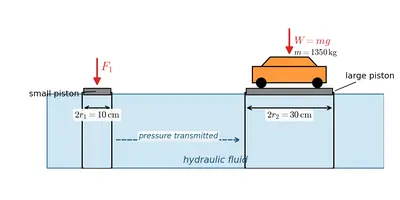
In a car lift compressed air exerts a force $$F_1$$ on a small piston having a radius of $$5.0 \, \mathrm{cm}$$. This pressure is transmitted to a second piston of radius $$15 \, \mathrm{cm}$$ (Fig 9.7). If the mass of the car to be lifted is $$1350 \, \mathrm{kg}$$, calculate $$F_1$$. What is the pressure necessary to accomplish this task? ($$g = 9.8 \, \mathrm{m \, s^{-2}}$$).
Fig 9.7
Fig 9.7

Solution

Let the small and large piston radii be $$r_1 = 5.0 \, \mathrm{cm} = 0.05 \, \mathrm{m}$$ and $$r_2 = 15 \, \mathrm{cm} = 0.15 \, \mathrm{m}$$.

Pascal's law gives equal pressure on both pistons:

$$\frac{F_1}{A_1} = \frac{F_2}{A_2}$$

The large piston has to support the car's weight, so $$F_2 = M g$$:

$$F_1 = M g \cdot \frac{A_1}{A_2} = M g \cdot \left(\frac{r_1}{r_2}\right)^2$$

$$F_1 = 1350 \times 9.8 \times \left(\frac{0.05}{0.15}\right)^2 = 13230 \times \frac{1}{9}$$

$$F_1 \approx 1470 \, \mathrm{N}$$

The pressure required is

$$P = \frac{F_1}{A_1} = \frac{F_1}{\pi r_1^2} = \frac{1470}{\pi (0.05)^2} = \frac{1470}{7.854 \times 10^{-3}}$$

$$P \approx 1.87 \times 10^{5} \, \mathrm{Pa} \approx 1.9 \times 10^{5} \, \mathrm{Pa}$$

This is about $$1.9 \, \mathrm{atm}$$ — easily produced by an ordinary air compressor.

Answer

$$F_1 \approx 1470 \, \mathrm{N}$$, $$P \approx 1.9 \times 10^{5} \, \mathrm{Pa}$$

Example 9.7 A fully loaded Boeing aircraft has a mass of $$3.3 \times 10^5 \, \mathrm{kg}$$. Its total wing area is $$500 \, \mathrm{m^2}$$. It is in level flight with a speed of $$960 \, \mathrm{km/h}$$. (a) Estimate the pressure difference between the lower and upper surfaces of the wings. (b) Estimate the fractional increase in the speed of the air on the upper surface of the wing relative to the lower surface. [The density of air is $$\rho = 1.2 \, \mathrm{kg \, m^{-3}}$$]

Solution

(a) Pressure difference.

In steady level flight the total upward lift on the wings balances the weight of the aircraft:

$$(P_1 - P_2) A = M g$$

where $$P_1$$ and $$P_2$$ are pressures on the lower and upper surfaces of the wing.

$$\Delta P = \frac{M g}{A} = \frac{3.3 \times 10^{5} \times 9.8}{500}$$

$$\Delta P = \frac{3.234 \times 10^{6}}{500} \approx 6.47 \times 10^{3} \, \mathrm{Pa}$$

(b) Fractional speed increase on top.

Apply Bernoulli's principle at the two surfaces (height difference of the wing is negligible):

$$P_1 + \tfrac{1}{2}\rho v_1^2 = P_2 + \tfrac{1}{2}\rho v_2^2$$

$$P_1 - P_2 = \tfrac{1}{2}\rho (v_2^2 - v_1^2) = \tfrac{1}{2}\rho (v_2 - v_1)(v_2 + v_1)$$

The plane's airspeed is $$v = 960 \, \mathrm{km/h} = \dfrac{960 \times 1000}{3600} = 266.7 \, \mathrm{m \, s^{-1}}$$. Since $$v_1$$ and $$v_2$$ are both close to $$v$$, we may approximate $$v_1 + v_2 \approx 2 v$$:

$$\Delta P \approx \rho v (v_2 - v_1)$$

$$\frac{v_2 - v_1}{v} \approx \frac{\Delta P}{\rho v^2} = \frac{6.47 \times 10^{3}}{1.2 \times (266.7)^2}$$

$$\frac{v_2 - v_1}{v} \approx \frac{6.47 \times 10^{3}}{8.53 \times 10^{4}} \approx 0.076$$

So the air on the upper surface flows about $$7.6\%$$ faster than on the lower surface.

Answer

(a) $$\Delta P \approx 6.5 \times 10^{3} \, \mathrm{Pa}$$; (b) $$\Delta v / v \approx 0.08$$ (about $$8\%$$)

Example 9.8

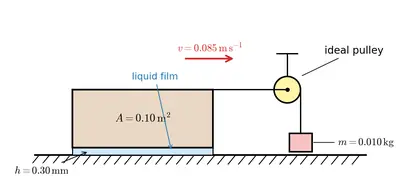
A metal block of area $$0.10 \, \mathrm{m^2}$$ is connected to a $$0.010 \, \mathrm{kg}$$ mass via a string that passes over an ideal pulley (considered massless and frictionless), as in Fig. 9.13. A liquid with a film thickness of $$0.30 \, \mathrm{mm}$$ is placed between the block and the table. When released the block moves to the right with a constant speed of $$0.085 \, \mathrm{m \, s^{-1}}$$. Find the coefficient of viscosity of the liquid.
Fig. 9.13
Fig. 9.13

Solution

Because the block moves at constant speed, it is in equilibrium. The pulling force (the weight of the hanging $$m = 0.010 \, \mathrm{kg}$$ mass transmitted through the string) is exactly balanced by the viscous drag of the liquid film:

$$F = m g = 0.010 \times 9.8 = 0.098 \, \mathrm{N}$$

The viscous force on the block from a Newtonian liquid film of thickness $$l$$ is

$$F = \eta \, A \, \frac{v}{l}$$

where the velocity gradient across the film is $$v/l$$ (top moving at $$v$$, bottom stuck to the table).

Solving for $$\eta$$:

$$\eta = \frac{F \, l}{A \, v}$$

Substituting $$A = 0.10 \, \mathrm{m^2}$$, $$v = 0.085 \, \mathrm{m \, s^{-1}}$$, $$l = 0.30 \times 10^{-3} \, \mathrm{m}$$:

$$\eta = \frac{0.098 \times 0.30 \times 10^{-3}}{0.10 \times 0.085}$$

$$\eta = \frac{2.94 \times 10^{-5}}{8.5 \times 10^{-3}} \approx 3.46 \times 10^{-3} \, \mathrm{Pa \, s}$$

Answer

$$\eta \approx 3.46 \times 10^{-3} \, \mathrm{Pa \, s}$$

Example 9.9 The terminal velocity of a copper ball of radius $$2.0 \, \mathrm{mm}$$ falling through a tank of oil at $$20^\circ \mathrm{C}$$ is $$6.5 \, \mathrm{cm \, s^{-1}}$$. Compute the viscosity of the oil at $$20^\circ \mathrm{C}$$. Density of oil is $$1.5 \times 10^3 \, \mathrm{kg \, m^{-3}}$$, density of copper is $$8.9 \times 10^3 \, \mathrm{kg \, m^{-3}}$$.

Solution

At terminal velocity the net force on the sphere is zero. Equating the apparent weight (gravity $$-$$ buoyancy) to the Stokes' drag:

$$\tfrac{4}{3}\pi r^3 (\rho - \sigma) g = 6 \pi \eta r v_t$$

Solving for $$\eta$$ gives the standard terminal-velocity result:

$$\eta = \frac{2}{9} \cdot \frac{r^2 (\rho - \sigma) g}{v_t}$$

Substituting $$r = 2.0 \times 10^{-3} \, \mathrm{m}$$, $$\rho - \sigma = (8.9 - 1.5) \times 10^{3} = 7.4 \times 10^{3} \, \mathrm{kg \, m^{-3}}$$, $$g = 9.8 \, \mathrm{m \, s^{-2}}$$ and $$v_t = 6.5 \times 10^{-2} \, \mathrm{m \, s^{-1}}$$:

$$\eta = \frac{2}{9} \cdot \frac{(2.0 \times 10^{-3})^2 \times 7.4 \times 10^{3} \times 9.8}{6.5 \times 10^{-2}}$$

$$\eta = \frac{2}{9} \cdot \frac{4.0 \times 10^{-6} \times 7.4 \times 10^{3} \times 9.8}{6.5 \times 10^{-2}}$$

$$\eta = \frac{2}{9} \cdot \frac{0.2901}{6.5 \times 10^{-2}} = \frac{2}{9} \times 4.464$$

$$\eta \approx 0.99 \, \mathrm{Pa \, s}$$

Answer

$$\eta \approx 9.9 \times 10^{-1} \, \mathrm{Pa \, s}$$

Example 9.10 The lower end of a capillary tube of diameter $$2.00 \, \mathrm{mm}$$ is dipped $$8.00 \, \mathrm{cm}$$ below the surface of water in a beaker. What is the pressure required in the tube in order to blow a hemispherical bubble at its end in water? The surface tension of water at temperature of the experiments is $$7.30 \times 10^{-2} \, \mathrm{N \, m^{-1}}$$. 1 atmospheric pressure $$= 1.01 \times 10^5 \, \mathrm{Pa}$$, density of water $$= 1000 \, \mathrm{kg/m^3}$$, $$g = 9.80 \, \mathrm{m \, s^{-2}}$$. Also calculate the excess pressure.

Solution

For a hemispherical bubble at the lower end of the tube, the bubble's radius equals the tube's radius:

$$r = \frac{2.00 \, \mathrm{mm}}{2} = 1.00 \, \mathrm{mm} = 1.00 \times 10^{-3} \, \mathrm{m}$$

The bubble has only one air–water interface (it is an air bubble blown into water), so the excess pressure across that surface is

$$\Delta P = \frac{2 S}{r} = \frac{2 \times 7.30 \times 10^{-2}}{1.00 \times 10^{-3}} = 146 \, \mathrm{Pa}$$

The water pressure just outside the bubble (which sits at a depth $$h = 8.00 \, \mathrm{cm} = 0.08 \, \mathrm{m}$$) is

$$P_{\mathrm{out}} = P_a + \rho g h$$

$$P_{\mathrm{out}} = 1.01 \times 10^{5} + 1000 \times 9.80 \times 0.08$$

$$P_{\mathrm{out}} = 1.01 \times 10^{5} + 784 = 1.0178 \times 10^{5} \, \mathrm{Pa}$$

The pressure inside the bubble (which is the pressure required inside the capillary tube to keep the bubble hemispherical) is

$$P_{\mathrm{in}} = P_{\mathrm{out}} + \Delta P = 1.0178 \times 10^{5} + 146$$

$$P_{\mathrm{in}} \approx 1.019 \times 10^{5} \, \mathrm{Pa}$$

Equivalently, the gauge pressure required is

$$P_{\mathrm{in}} - P_a = \rho g h + \frac{2 S}{r} = 784 + 146 = 930 \, \mathrm{Pa}$$

Answer

Pressure in tube $$\approx 1.019 \times 10^{5} \, \mathrm{Pa}$$; excess pressure (over atmospheric) $$\approx 930 \, \mathrm{Pa}$$; surface excess $$2S/r = 146 \, \mathrm{Pa}$$

Exercises

9.1 Explain why

(a) The blood pressure in humans is greater at the feet than at the brain

Solution

Blood is a fluid, and like every other fluid in a gravitational field it has its own hydrostatic pressure that increases with depth. The pressure difference between two points in the blood at heights $$h_1$$ and $$h_2$$ is

$$\Delta P = \rho g (h_1 - h_2)$$

In a standing human the feet are roughly $$1.5 \, \mathrm{m}$$ below the head, so the additional hydrostatic pressure at the feet over that at the brain is

$$\Delta P \approx 1060 \times 9.8 \times 1.5 \approx 1.56 \times 10^{4} \, \mathrm{Pa}$$

(roughly $$120 \, \mathrm{mm}$$ of Hg). Hence the blood pressure measured at the feet is significantly higher than at the brain.

Answer

Because the blood column from brain to feet contributes hydrostatic pressure $$\rho g h$$, which adds to the pressure at the feet.

(b) Atmospheric pressure at a height of about $$6 \, \mathrm{km}$$ decreases to nearly half of its value at the sea level, though the height of the atmosphere is more than $$100 \, \mathrm{km}$$

Solution

The atmosphere is a compressible fluid: its density $$\rho$$ depends on the local pressure. Starting from the hydrostatic equation for a thin slab of air,

$$\frac{dP}{dh} = -\rho g$$

combined with the ideal-gas relation $$\rho \propto P$$, one obtains an exponential decrease of pressure with height (the so-called barometric formula):

$$P(h) = P_0 \, e^{-h/H}$$

where the “scale height” $$H \approx 8 \, \mathrm{km}$$ for the lower atmosphere. So most of the air mass is packed near the ground, and the pressure halves over a few km even though the atmosphere itself extends hundreds of km. Pressure does not fall linearly with height because $$\rho$$ is not constant.

Answer

Atmospheric density falls rapidly with altitude (the atmosphere is compressible), so pressure decreases exponentially rather than linearly with height — most of the mass of the atmosphere lies within the first ~$$10 \, \mathrm{km}$$.

(c) Hydrostatic pressure is a scalar quantity even though pressure is force divided by area.

Solution

Pressure at a point inside a fluid in equilibrium is the same in all directions (Pascal's principle). It has no preferred direction associated with it — rotate the imaginary test surface about the point and the magnitude of the normal force per unit area does not change.

The vector quantity in the problem is the force, not the pressure: $$\vec{F} = P \, \vec{A}$$, where $$\vec{A}$$ is the area vector (which has a direction normal to the surface). The pressure itself $$P$$ is simply a magnitude (a scalar) that, together with the orientation $$\vec{A}$$ of the chosen surface, determines the force on that surface.

Answer

Pressure at a point inside a fluid has the same magnitude in all directions; only when multiplied by an area vector does it produce a directed force. Hence pressure itself is a scalar.

9.2 Explain why

(a) The angle of contact of mercury with glass is obtuse, while that of water with glass is acute.

Solution

The angle of contact $$\theta$$ is set by the balance of the three surface tensions at the line where solid, liquid and air meet (Young's relation):

$$\cos\theta = \frac{S_{sa} - S_{sl}}{S_{la}}$$

Here $$S_{sa}$$, $$S_{sl}$$ and $$S_{la}$$ are the solid–air, solid–liquid and liquid–air interfacial tensions, set by adhesive (liquid–solid) and cohesive (liquid–liquid) intermolecular forces.

Mercury – glass: Cohesion among Hg atoms is much stronger than the adhesion between Hg and glass, so $$S_{sl} > S_{sa}$$ and $$\cos\theta < 0$$. The angle of contact is therefore obtuse ($$\theta > 90^\circ$$). Mercury does not wet glass.

Water – glass: The adhesion between water molecules and the polar Si–O groups of glass is strong, and cohesion in water is weaker than this. Then $$S_{sa} > S_{sl}$$, so $$\cos\theta > 0$$ and $$\theta$$ is acute. Water wets glass.

Answer

Because mercury–glass adhesion is weaker than mercury–mercury cohesion ($$\theta > 90^\circ$$), whereas water–glass adhesion is stronger than water–water cohesion ($$\theta < 90^\circ$$).

(b) Water on a clean glass surface tends to spread out while mercury on the same surface tends to form drops. (Put differently, water wets glass while mercury does not.)

Solution

A liquid placed on a solid spreads or beads up depending on whether the adhesive force (liquid–solid) is greater or smaller than the cohesive force (liquid–liquid). Equivalently, the angle of contact is acute or obtuse.

Water on glass: water–glass adhesion is strong (acute angle of contact, $$\theta < 90^\circ$$). Water molecules are pulled outward and the liquid spreads to cover as much of the glass as possible — water wets the surface.

Mercury on glass: mercury–mercury cohesion dominates (obtuse contact angle, $$\theta > 90^\circ$$). Mercury molecules prefer their own company, so the liquid contracts into nearly spherical drops to minimise its glass contact area — mercury does not wet the surface.

Answer

Water–glass adhesion exceeds water–water cohesion, so water spreads on glass. Mercury–mercury cohesion exceeds mercury–glass adhesion, so mercury contracts into droplets.

(c) Surface tension of a liquid is independent of the area of the surface

Solution

Surface tension is defined as the force per unit length acting tangentially on any imaginary line drawn in the surface (equivalently, the surface energy per unit area):

$$S = \frac{F}{L} = \frac{\text{surface energy}}{\text{surface area}}$$

Both the numerator and the denominator scale together: if we double the area, the surface energy doubles, but the ratio (energy per unit area) stays the same. Surface tension is an intensive property and depends only on the nature of the liquid–air pair and the temperature, not on how much surface is present.

Answer

Surface tension is an intensive property — force per unit length (or energy per unit area). Doubling the area doubles the surface energy and the perimeter, leaving the ratio unchanged.

(d) Water with detergent dissolved in it should have small angles of contact.

Solution

Detergents (surfactants) work by getting between water molecules and the dirty (often greasy) surface so that water can spread over it. The job of a detergent is to make water wet surfaces that pure water cannot.

From Young's relation $$\cos\theta = (S_{sa} - S_{sl})/S_{la}$$, a small angle of contact requires $$\cos\theta$$ close to $$1$$. Detergent molecules reduce $$S_{sl}$$ (and $$S_{la}$$) so much that the cloth–water and water–air interfaces become almost ideal, and the numerator stays positive and comparable to the denominator. This drives $$\theta$$ towards a small value (a few degrees), allowing the detergent solution to seep deep into the fabric and dissolve the grease.

Answer

Detergent surfactants reduce the water–cloth interfacial tension, making $$\cos\theta$$ close to $$1$$ so the solution wets and penetrates the fabric.

(e) A drop of liquid under no external forces is always spherical in shape

Solution

In the absence of external forces (gravity, contact with a wall, etc.) the only mechanism shaping the drop is surface tension. Surface tension acts to minimise the surface area of the liquid (since surface energy is proportional to surface area).

For a fixed volume $$V$$, the closed surface of minimum area is a sphere — a result from the isoperimetric inequality. Hence a freely floating drop spontaneously assumes a spherical shape.

Answer

Surface tension minimises surface energy, hence surface area. For a fixed volume, the sphere has the least surface area, so a free drop becomes spherical.

9.3 Fill in the blanks using the word(s) from the list appended with each statement:

(a) Surface tension of liquids generally … with temperatures (increases / decreases)

Solution

As temperature rises, the kinetic energy of liquid molecules increases and the inter-molecular cohesive forces weaken. Surface tension, which is a manifestation of the cohesive force at the surface, therefore decreases. It falls to zero at the critical temperature, where the distinction between the liquid and its vapour vanishes.

Answer

decreases

(b) Viscosity of gases … with temperature, whereas viscosity of liquids … with temperature (increases / decreases)

Solution

In gases, viscosity arises from the exchange of momentum between adjacent layers carried by the random thermal motion of molecules. A higher temperature gives faster molecules, more crossings between layers, and so a larger transfer of momentum — viscosity increases with temperature (theory: $$\eta \propto \sqrt{T}$$).

In liquids, viscosity arises from inter-molecular cohesion which resists the sliding of one layer past the next. As temperature rises, cohesive forces weaken and the layers slide more easily — viscosity decreases.

Answer

Gases: increases; liquids: decreases.

(c) For solids with elastic modulus of rigidity, the shearing force is proportional to … , while for fluids it is proportional to … (shear strain / rate of shear strain)

Solution

For an elastic solid (within the elastic limit), Hooke's law gives the shear stress as proportional to the shear strain $$\phi$$:

$$\frac{F}{A} = G \phi$$

where $$G$$ is the modulus of rigidity.

For a Newtonian fluid, in contrast, the shear stress is proportional to the rate of shear strain $$d\phi/dt$$:

$$\frac{F}{A} = \eta \, \frac{d v}{d y} = \eta \, \frac{d \phi}{d t}$$

where $$\eta$$ is the coefficient of viscosity. A fluid offers no equilibrium resistance to shearing, but resists the rate at which it is sheared.

Answer

Solids: shear strain. Fluids: rate of shear strain.

(d) For a fluid in a steady flow, the increase in flow speed at a constriction follows … (conservation of mass / Bernoulli's principle)

Solution

The fact that flow speed increases when the pipe narrows is a direct consequence of the equation of continuity, which is just conservation of mass for an incompressible fluid:

$$A_1 v_1 = A_2 v_2$$

If $$A$$ decreases, $$v$$ must increase so that the same mass of fluid passes every cross-section per second. Bernoulli's principle is a related but separate statement (about pressure–speed–height) — it explains the pressure drop at the constriction, not the speed increase.

Answer

Conservation of mass (the continuity equation).

(e) For the model of a plane in a wind tunnel, turbulence occurs at a … speed for turbulence for an actual plane (greater / smaller)

Solution

The onset of turbulence is governed by the Reynolds number,

$$\mathrm{Re} = \frac{\rho v d}{\eta}$$

For a given fluid (same $$\rho$$, $$\eta$$) the critical Reynolds number $$\mathrm{Re}_c$$ is the same for the model and for the actual plane. A wind-tunnel model has a much smaller characteristic length $$d$$ than the real plane, so the speed $$v$$ required to reach the same $$\mathrm{Re}_c$$ is correspondingly greater:

$$v_{\text{model}} = v_{\text{real}} \cdot \frac{d_{\text{real}}}{d_{\text{model}}}$$

Answer

Greater — the model is smaller, so a higher speed is needed to reach the same Reynolds number at which turbulence sets in.

9.4 Explain why

(a) To keep a piece of paper horizontal, you should blow over, not under, it

Solution

Bernoulli's principle says that in a flowing fluid, where the speed is high the pressure is low:

$$P + \tfrac{1}{2}\rho v^2 + \rho g h = \text{const.}$$

Blowing across the top of the paper creates a high-speed air stream above, and the pressure there falls below the atmospheric pressure that still acts on the still air below the paper. The net upward force from this pressure difference lifts the paper and keeps it horizontal.

If you blow under the paper instead, the high-speed (low-pressure) region is below it, and the atmosphere above pushes it down even more.

Answer

Air blown over the paper moves fast and so (by Bernoulli) has lower pressure; the higher atmospheric pressure below lifts the paper.

(b) When we try to close a water tap with our fingers, fast jets of water gush through the openings between our fingers

Solution

The volume rate of flow through the tap is essentially fixed (set by the supply pressure). By the equation of continuity (conservation of mass), the same volume per second must pass through the much narrower openings between the fingers:

$$A_1 v_1 = A_2 v_2 \implies v_2 = v_1 \frac{A_1}{A_2}$$

When $$A_2 \ll A_1$$, the speed $$v_2$$ becomes very large, producing the fast jets we observe.

Answer

By the continuity equation $$A v = $$ const, so when the available area shrinks the water must speed up.

(c) The size of the needle of a syringe controls flow rate better than the thumb pressure exerted by a doctor while administering an injection

Solution

For laminar flow of a viscous liquid through a pipe, Poiseuille's formula gives

$$Q = \frac{\pi r^4 \Delta P}{8 \eta L}$$

The volume flow rate is linear in the pressure $$\Delta P$$ but goes as the fourth power of the needle radius $$r$$. A small change in needle bore therefore has a much larger effect on the rate of injection than even a sizeable change in the thumb pressure. Doctors choose the appropriate needle for the desired flow rate rather than trying to control the rate by varying their thumb force.

Answer

Poiseuille's law: $$Q \propto r^4 \Delta P$$. Flow is far more sensitive to needle radius (4th power) than to thumb pressure (1st power).

(d) A fluid flowing out of a small hole in a vessel results in a backward thrust on the vessel

Solution

This is a direct consequence of the conservation of linear momentum (Newton's third law). The fluid leaves the hole with some speed $$v$$, carrying with it momentum $$\dot{m} v$$ per unit time in one direction. For the total momentum of the (vessel $$+$$ fluid) system to be conserved, the vessel must acquire equal and opposite momentum.

Equivalently, the wall pushes the escaping fluid forward, and by Newton's third law the fluid pushes the wall backward — this is the “rocket” thrust on the vessel.

Answer

By conservation of momentum (Newton's third law): the fluid leaves carrying forward momentum, so the vessel recoils backward.

(e) A spinning cricket ball in air does not follow a parabolic trajectory

Solution

A spinning ball drags a thin layer of air around with it. On the side where the spinning surface moves with the relative wind, the air there moves faster; on the opposite side it moves slower. By Bernoulli's principle the pressure is lower on the fast-moving side and higher on the slow side. The resulting transverse force (the Magnus effect) acts on the ball in addition to gravity.

Since the ball now experiences a sideways/upwards force on top of $$-mg\hat{j}$$, its acceleration is no longer purely vertical and constant, and the trajectory deviates from the simple parabola of pure projectile motion. This is what bowlers exploit to make the ball “swing” or “cut”.

Answer

Spin produces an asymmetric flow around the ball, so by Bernoulli's principle a sideways (Magnus) force acts on it. With this extra non-gravitational force, the path is no longer a parabola.

9.5 A $$50 \, \mathrm{kg}$$ girl wearing high heel shoes balances on a single heel. The heel is circular with a diameter $$1.0 \, \mathrm{cm}$$. What is the pressure exerted by the heel on the horizontal floor?

Solution

The whole weight of the girl rests on a single circular heel of radius $$r = 0.5 \, \mathrm{cm} = 5.0 \times 10^{-3} \, \mathrm{m}$$.

Area of the heel:

$$A = \pi r^2 = \pi (5.0 \times 10^{-3})^2 = 7.854 \times 10^{-5} \, \mathrm{m^2}$$

Weight on the heel:

$$F = m g = 50 \times 9.8 = 490 \, \mathrm{N}$$

Pressure exerted on the floor:

$$P = \frac{F}{A} = \frac{490}{7.854 \times 10^{-5}} \approx 6.24 \times 10^{6} \, \mathrm{Pa}$$

This is about $$60 \, \mathrm{atm}$$ — far greater than the pressure under an ordinary flat shoe, which is why stiletto heels can dent soft floors.

Answer

$$P \approx 6.24 \times 10^{6} \, \mathrm{Pa}$$ (about $$60 \, \mathrm{atm}$$).

9.6 Toricelli's barometer used mercury. Pascal duplicated it using French wine of density $$984 \, \mathrm{kg \, m^{-3}}$$. Determine the height of the wine column for normal atmospheric pressure.

Solution

In a barometer the atmospheric pressure $$P_a$$ is balanced by the hydrostatic pressure of the fluid column of height $$h$$ and density $$\rho$$:

$$P_a = \rho g h \implies h = \frac{P_a}{\rho g}$$

For normal atmospheric pressure $$P_a = 1.013 \times 10^{5} \, \mathrm{Pa}$$, with $$\rho = 984 \, \mathrm{kg \, m^{-3}}$$ and $$g = 9.8 \, \mathrm{m \, s^{-2}}$$:

$$h = \frac{1.013 \times 10^{5}}{984 \times 9.8} = \frac{1.013 \times 10^{5}}{9643.2}$$

$$h \approx 10.5 \, \mathrm{m}$$

Compare with a mercury barometer (density $$13.6 \times 10^{3} \, \mathrm{kg \, m^{-3}}$$), where the same atmospheric pressure supports a column of only $$0.76 \, \mathrm{m}$$. A wine barometer therefore has to be impractically tall — this is precisely why Torricelli used mercury.

Answer

$$h \approx 10.5 \, \mathrm{m}$$.

9.7 A vertical off-shore structure is built to withstand a maximum stress of $$10^9 \, \mathrm{Pa}$$. Is the structure suitable for putting up on top of an oil well in the ocean? Take the depth of the ocean to be roughly $$3 \, \mathrm{km}$$, and ignore ocean currents.

Solution

The maximum (gauge) pressure on the structure will be at the sea bed. With $$\rho_{\text{sea}} \approx 1.03 \times 10^{3} \, \mathrm{kg \, m^{-3}}$$, $$g = 9.8 \, \mathrm{m \, s^{-2}}$$ and $$h = 3 \, \mathrm{km} = 3 \times 10^{3} \, \mathrm{m}$$,

$$P = \rho g h = (1.03 \times 10^{3})(9.8)(3 \times 10^{3})$$

$$P \approx 3.03 \times 10^{7} \, \mathrm{Pa}$$

Comparing with the design strength $$10^{9} \, \mathrm{Pa}$$:

$$\frac{P}{P_{\max}} = \frac{3.03 \times 10^{7}}{10^{9}} \approx 0.030$$

The maximum stress at the depth is only about $$3\%$$ of what the structure is designed to take. The structure is therefore suitable for installation on the oil well.

Answer

Yes. The pressure at $$3 \, \mathrm{km}$$ is $$\approx 3 \times 10^{7} \, \mathrm{Pa}$$, far below the design limit of $$10^{9} \, \mathrm{Pa}$$.

9.8 A hydraulic automobile lift is designed to lift cars with a maximum mass of $$3000 \, \mathrm{kg}$$. The area of cross-section of the piston carrying the load is $$425 \, \mathrm{cm^2}$$. What maximum pressure would the smaller piston have to bear?

Solution

By Pascal's law the pressure throughout the hydraulic fluid is the same, so the pressure that the small piston must apply equals the pressure exerted on the load piston by the car's weight.

$$F = m g = 3000 \times 9.8 = 2.94 \times 10^{4} \, \mathrm{N}$$

$$A = 425 \, \mathrm{cm^2} = 425 \times 10^{-4} \, \mathrm{m^2} = 4.25 \times 10^{-2} \, \mathrm{m^2}$$

$$P_{\max} = \frac{F}{A} = \frac{2.94 \times 10^{4}}{4.25 \times 10^{-2}}$$

$$P_{\max} \approx 6.92 \times 10^{5} \, \mathrm{Pa}$$

Answer

$$P_{\max} \approx 6.92 \times 10^{5} \, \mathrm{Pa}$$.

9.9 A U-tube contains water and methylated spirit separated by mercury. The mercury columns in the two arms are in level with $$10.0 \, \mathrm{cm}$$ of water in one arm and $$12.5 \, \mathrm{cm}$$ of spirit in the other. What is the specific gravity of spirit?

Solution

The two mercury columns are at the same level, so the pressure at the water–mercury interface equals the pressure at the spirit–mercury interface (they lie on the same horizontal line in a single connected mercury body).

Above each mercury column, only atmospheric pressure plus the column of the lighter liquid contributes:

$$P_a + \rho_w g h_w = P_a + \rho_s g h_s$$

$$\rho_w h_w = \rho_s h_s$$

$$\frac{\rho_s}{\rho_w} = \frac{h_w}{h_s} = \frac{10.0}{12.5} = 0.8$$

The specific gravity of spirit (relative to water) is therefore

$$\boxed{\rho_s / \rho_w = 0.8}$$

Answer

Specific gravity of spirit $$= 0.8$$.

9.10 In the previous problem, if $$15.0 \, \mathrm{cm}$$ of water and spirit each are further poured into the respective arms of the tube, what is the difference in the levels of mercury in the two arms? (Specific gravity of mercury $$= 13.6$$)

Solution

After adding $$15.0 \, \mathrm{cm}$$ to each arm, the columns of liquid above the mercury become

$$h_w = 10.0 + 15.0 = 25.0 \, \mathrm{cm} \quad (\text{water arm})$$

$$h_s = 12.5 + 15.0 = 27.5 \, \mathrm{cm} \quad (\text{spirit arm})$$

From the previous problem the specific gravities (in g/cm$${}^3$$) are: water $$1.00$$, spirit $$0.80$$, mercury $$13.6$$. Since the water column is heavier than the spirit column, mercury will be pushed down in the water arm and up in the spirit arm.

Let the mercury level on the spirit side be higher than on the water side by $$h$$. Consider the horizontal level passing through the (lower) mercury surface in the water arm. On the water arm at that level:

$$P_{\text{water side}} = P_a + \rho_w g \, h_w$$

On the spirit arm at the same horizontal level there is, above this level, a column of mercury of height $$h$$ (the level difference) topped by the spirit column:

$$P_{\text{spirit side}} = P_a + \rho_s g \, h_s + \rho_{Hg} g \, h$$

Equating the two:

$$\rho_w h_w = \rho_s h_s + \rho_{Hg} h$$

Dividing by $$\rho_w$$ and using specific gravities:

$$1.00 \times 25.0 = 0.80 \times 27.5 + 13.6 \, h$$

$$25.0 = 22.0 + 13.6 \, h$$

$$h = \frac{3.0}{13.6} \approx 0.221 \, \mathrm{cm}$$

The mercury level on the spirit side is about $$0.22 \, \mathrm{cm}$$ higher than on the water side.

Answer

The mercury rises in the spirit arm by about $$0.22 \, \mathrm{cm}$$ relative to the water arm.

9.11 Can Bernoulli's equation be used to describe the flow of water through a rapid in a river? Explain.

Solution

Bernoulli's equation

$$P + \tfrac{1}{2}\rho v^2 + \rho g h = \text{const.}$$

is derived under the assumptions that the flow is steady, incompressible, non-viscous, and irrotational (streamline flow).

In a river rapid the water is extremely turbulent: streamlines do not exist, the velocity at each point fluctuates rapidly in magnitude and direction, eddies form and dissipate mechanical energy as heat, and viscous dissipation is no longer negligible. None of Bernoulli's assumptions is satisfied.

So Bernoulli's equation cannot be used to describe the flow of water through a rapid.

Answer

No. The flow in a rapid is turbulent (not steady or streamlined) and dissipative; Bernoulli's equation requires steady, non-viscous, streamline flow.

9.12 Does it matter if one uses gauge instead of absolute pressures in applying Bernoulli's equation? Explain.

Solution

Bernoulli's equation is generally applied as a relation between two points:

$$P_1 + \tfrac{1}{2}\rho v_1^2 + \rho g h_1 = P_2 + \tfrac{1}{2}\rho v_2^2 + \rho g h_2$$

If we replace each $$P_i$$ by the corresponding gauge pressure $$P_i - P_a$$, the atmospheric pressure $$P_a$$ subtracts out from both sides and the equation is unchanged. So as long as the same reference (absolute everywhere, or gauge everywhere) is used at both points, Bernoulli's equation gives the same result. But the two must not be mixed in one equation.

An exception is when one point is open to the atmosphere (and therefore at $$P = P_a$$, gauge pressure $$= 0$$) — here gauge pressure is particularly convenient.

Answer

It does not matter, provided gauge pressures are used consistently at every term. The atmospheric pressure subtracts out from both sides.

9.13 Glycerine flows steadily through a horizontal tube of length $$1.5 \, \mathrm{m}$$ and radius $$1.0 \, \mathrm{cm}$$. If the amount of glycerine collected per second at one end is $$4.0 \times 10^{-3} \, \mathrm{kg \, s^{-1}}$$, what is the pressure difference between the two ends of the tube? (Density of glycerine $$= 1.3 \times 10^3 \, \mathrm{kg \, m^{-3}}$$ and viscosity of glycerine $$= 0.83 \, \mathrm{Pa \, s}$$). [You may also like to check if the assumption of laminar flow in the tube is correct].

Solution

Volume flow rate from the given mass flow rate:

$$Q = \frac{\dot{m}}{\rho} = \frac{4.0 \times 10^{-3}}{1.3 \times 10^{3}} = 3.08 \times 10^{-6} \, \mathrm{m^3 \, s^{-1}}$$

For laminar flow of a viscous liquid through a horizontal pipe, Poiseuille's formula gives the pressure drop:

$$Q = \frac{\pi r^4 \, \Delta P}{8 \eta L} \implies \Delta P = \frac{8 \eta L Q}{\pi r^4}$$

With $$r = 1.0 \, \mathrm{cm} = 10^{-2} \, \mathrm{m}$$, $$L = 1.5 \, \mathrm{m}$$, $$\eta = 0.83 \, \mathrm{Pa \, s}$$:

$$\Delta P = \frac{8 \times 0.83 \times 1.5 \times 3.08 \times 10^{-6}}{\pi \times (10^{-2})^4}$$

$$\Delta P = \frac{3.066 \times 10^{-5}}{3.1416 \times 10^{-8}}$$

$$\Delta P \approx 975 \, \mathrm{Pa} \approx 9.8 \times 10^{2} \, \mathrm{Pa}$$

Check on laminar flow. The mean speed in the tube is

$$v = \frac{Q}{\pi r^2} = \frac{3.08 \times 10^{-6}}{\pi (10^{-2})^2} \approx 9.80 \times 10^{-3} \, \mathrm{m \, s^{-1}}$$

The Reynolds number (using diameter $$d = 2r = 2 \times 10^{-2} \, \mathrm{m}$$) is

$$\mathrm{Re} = \frac{\rho v d}{\eta} = \frac{1.3 \times 10^{3} \times 9.80 \times 10^{-3} \times 2 \times 10^{-2}}{0.83} \approx 0.31$$

This is far smaller than the critical value ($$\mathrm{Re}_c \sim 2000$$), so the assumption of laminar (streamline) flow is very well satisfied.

Answer

$$\Delta P \approx 9.75 \times 10^{2} \, \mathrm{Pa}$$. Reynolds number $$\mathrm{Re} \approx 0.3$$, so laminar flow is indeed valid.

9.14 In a test experiment on a model aeroplane in a wind tunnel, the flow speeds on the upper and lower surfaces of the wing are $$70 \, \mathrm{m \, s^{-1}}$$ and $$63 \, \mathrm{m \, s^{-1}}$$ respectively. What is the lift on the wing if its area is $$2.5 \, \mathrm{m^2}$$? Take the density of air to be $$1.3 \, \mathrm{kg \, m^{-3}}$$.

Solution

Apply Bernoulli's equation between the upper ($$v_u = 70 \, \mathrm{m \, s^{-1}}$$) and lower ($$v_l = 63 \, \mathrm{m \, s^{-1}}$$) surfaces of the wing. The vertical separation of the two surfaces is small, so the gravitational term can be neglected:

$$P_l + \tfrac{1}{2} \rho v_l^2 = P_u + \tfrac{1}{2} \rho v_u^2$$

$$P_l - P_u = \tfrac{1}{2} \rho (v_u^2 - v_l^2)$$

Compute the squared-speed difference:

$$v_u^2 - v_l^2 = 70^2 - 63^2 = 4900 - 3969 = 931 \, \mathrm{m^2 \, s^{-2}}$$

$$P_l - P_u = \tfrac{1}{2} \times 1.3 \times 931 = 605.15 \, \mathrm{Pa}$$

The net upward lift is this pressure difference times the wing area:

$$F = (P_l - P_u) \, A = 605.15 \times 2.5$$

$$F \approx 1.51 \times 10^{3} \, \mathrm{N}$$

Answer

$$F \approx 1.51 \times 10^{3} \, \mathrm{N}$$.

9.15

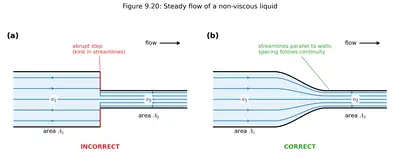
Figures 9.20(a) and (b) refer to the steady flow of a (non-viscous) liquid. Which of the two figures is incorrect? Why?
Figures 9.20
Figures 9.20

Solution

Figure 9.20(a) is incorrect.

In a steady flow through a pipe of varying cross-section, the equation of continuity demands

$$A_1 v_1 = A_2 v_2$$

So where the pipe narrows, the fluid speed must increase, which means the streamlines should crowd closer together at the constriction. By Bernoulli's principle the increased speed at the narrow section implies a decrease in pressure there.

Figure 9.20(a) shows the streamlines as equally spaced through the constriction (and/or the pressure being higher at the narrow part), which violates both the continuity equation and Bernoulli's principle. Figure 9.20(b) correctly depicts the streamlines as crowded together at the narrower section, consistent with a higher flow speed (and a lower pressure) there.

Answer

Figure 9.20(a) is incorrect. At the narrower section the streamlines should be closer together (higher speed by continuity), and the pressure there should be lower (Bernoulli).

9.16 The cylindrical tube of a spray pump has a cross-section of $$8.0 \, \mathrm{cm^2}$$ one end of which has 40 fine holes each of diameter $$1.0 \, \mathrm{mm}$$. If the liquid flow inside the tube is $$1.5 \, \mathrm{m \, min^{-1}}$$, what is the speed of ejection of the liquid through the holes?

Solution

Convert the inside-tube speed to SI units:

$$v_1 = 1.5 \, \mathrm{m \, min^{-1}} = \frac{1.5}{60} \, \mathrm{m \, s^{-1}} = 2.5 \times 10^{-2} \, \mathrm{m \, s^{-1}}$$

Tube cross-section:

$$A_1 = 8.0 \, \mathrm{cm^2} = 8.0 \times 10^{-4} \, \mathrm{m^2}$$

Each hole has radius $$r = 0.5 \, \mathrm{mm} = 5.0 \times 10^{-4} \, \mathrm{m}$$, so the combined area of $$N = 40$$ holes is

$$A_2 = N \pi r^2 = 40 \times \pi \times (5.0 \times 10^{-4})^2$$

$$A_2 = 40 \times \pi \times 2.5 \times 10^{-7} = 3.14 \times 10^{-5} \, \mathrm{m^2}$$

Conservation of mass (continuity): the same volume of liquid per second passing through the tube must pass through the holes:

$$A_1 v_1 = A_2 v_2 \implies v_2 = \frac{A_1 v_1}{A_2}$$

$$v_2 = \frac{8.0 \times 10^{-4} \times 2.5 \times 10^{-2}}{3.14 \times 10^{-5}} = \frac{2.0 \times 10^{-5}}{3.14 \times 10^{-5}}$$

$$v_2 \approx 0.637 \, \mathrm{m \, s^{-1}}$$

Answer

$$v_2 \approx 0.64 \, \mathrm{m \, s^{-1}}$$.

9.17 A U-shaped wire is dipped in a soap solution, and removed. The thin soap film formed between the wire and the light slider supports a weight of $$1.5 \times 10^{-2} \, \mathrm{N}$$ (which includes the small weight of the slider). The length of the slider is $$30 \, \mathrm{cm}$$. What is the surface tension of the film?

Solution

A soap film has two free surfaces (front and back), and both pull the slider upward. Hence the total upward force from surface tension acting on the slider of length $$L$$ is

$$F = 2 \, S \, L$$

In equilibrium this balances the suspended weight $$W$$:

$$W = 2 S L \implies S = \frac{W}{2 L}$$

With $$W = 1.5 \times 10^{-2} \, \mathrm{N}$$ and $$L = 30 \, \mathrm{cm} = 0.30 \, \mathrm{m}$$:

$$S = \frac{1.5 \times 10^{-2}}{2 \times 0.30} = \frac{1.5 \times 10^{-2}}{0.60}$$

$$S = 2.5 \times 10^{-2} \, \mathrm{N \, m^{-1}}$$

Answer

$$S = 2.5 \times 10^{-2} \, \mathrm{N \, m^{-1}}$$.

9.18

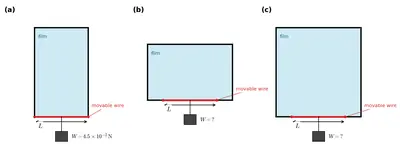
Figure 9.21 (a) shows a thin liquid film supporting a small weight $$= 4.5 \times 10^{-2} \, \mathrm{N}$$. What is the weight supported by a film of the same liquid at the same temperature in Fig. (b) and (c)? Explain your answer physically.
Figure 9.21
Figure 9.21

Solution

The vertical force exerted by a soap film on the slider depends only on the surface tension $$S$$ (set by the liquid and temperature) and the length of the slider $$L$$ along which the two surfaces of the film pull:

$$W = 2 \, S \, L$$

It does not depend on the height (or area) of the film, because surface tension is force per unit length, not force per unit area. So as long as the slider has the same length and the same liquid is used at the same temperature, the weight supported is identical to that in (a):

$$W_{(b)} = W_{(c)} = W_{(a)} = 4.5 \times 10^{-2} \, \mathrm{N}$$

Physically, the film in (b) is larger and in (c) tilted, but in each case the slider still bounds the same length of film with two surfaces, and the same $$2 S L$$ acts vertically on it.

Answer

$$W_{(b)} = W_{(c)} = 4.5 \times 10^{-2} \, \mathrm{N}$$. The force only depends on $$2SL$$, which is fixed by the slider length and the surface tension.

9.19 What is the pressure inside the drop of mercury of radius $$3.00 \, \mathrm{mm}$$ at room temperature? Surface tension of mercury at that temperature ($$20 \,{}^\circ \mathrm{C}$$) is $$4.65 \times 10^{-1} \, \mathrm{N \, m^{-1}}$$. The atmospheric pressure is $$1.01 \times 10^5 \, \mathrm{Pa}$$. Also give the excess pressure inside the drop.

Solution

A mercury drop has a single liquid–air interface, so the excess pressure inside the drop over that of the surrounding air is

$$\Delta P = \frac{2 S}{r}$$

With $$S = 4.65 \times 10^{-1} \, \mathrm{N \, m^{-1}}$$ and $$r = 3.00 \, \mathrm{mm} = 3.00 \times 10^{-3} \, \mathrm{m}$$:

$$\Delta P = \frac{2 \times 4.65 \times 10^{-1}}{3.00 \times 10^{-3}} = \frac{0.930}{3.00 \times 10^{-3}}$$

$$\Delta P = 310 \, \mathrm{Pa}$$

The absolute pressure inside the drop is the atmospheric pressure plus this excess:

$$P_{\mathrm{in}} = P_a + \Delta P = 1.01 \times 10^{5} + 310$$

$$P_{\mathrm{in}} \approx 1.0131 \times 10^{5} \, \mathrm{Pa}$$

The excess pressure is only about $$0.3\%$$ of atmospheric.

Answer

Excess pressure $$\Delta P = 310 \, \mathrm{Pa}$$; pressure inside drop $$P_{\mathrm{in}} \approx 1.0131 \times 10^{5} \, \mathrm{Pa}$$.

9.20 What is the excess pressure inside a bubble of soap solution of radius $$5.00 \, \mathrm{mm}$$, given that the surface tension of soap solution at the temperature ($$20 \,{}^\circ \mathrm{C}$$) is $$2.50 \times 10^{-2} \, \mathrm{N \, m^{-1}}$$? If an air bubble of the same dimension were formed at depth of $$40.0 \, \mathrm{cm}$$ inside a container containing the soap solution (of relative density 1.20), what would be the pressure inside the bubble? (1 atmospheric pressure is $$1.01 \times 10^5 \, \mathrm{Pa}$$).

Solution

(i) Soap bubble in air.

A soap bubble has two air–liquid surfaces (the outer and inner faces of the soap film). The excess pressure inside it is therefore

$$\Delta P_1 = \frac{4 S}{r}$$

With $$S = 2.50 \times 10^{-2} \, \mathrm{N \, m^{-1}}$$ and $$r = 5.00 \, \mathrm{mm} = 5.00 \times 10^{-3} \, \mathrm{m}$$:

$$\Delta P_1 = \frac{4 \times 2.50 \times 10^{-2}}{5.00 \times 10^{-3}} = \frac{0.10}{5.00 \times 10^{-3}} = 20 \, \mathrm{Pa}$$

(ii) Air bubble in soap solution at depth $$h = 40 \, \mathrm{cm}$$.

An air bubble inside the liquid has only a single liquid–air interface, so the excess pressure inside the bubble over the pressure of the surrounding liquid is

$$\Delta P_2 = \frac{2 S}{r} = \frac{2 \times 2.50 \times 10^{-2}}{5.00 \times 10^{-3}} = 10 \, \mathrm{Pa}$$

The pressure of the soap solution at depth $$h = 0.40 \, \mathrm{m}$$ (density $$\rho = 1.20 \times 10^{3} \, \mathrm{kg \, m^{-3}}$$) is

$$P_{\mathrm{liq}} = P_a + \rho g h = 1.01 \times 10^{5} + 1.20 \times 10^{3} \times 9.8 \times 0.40$$

$$P_{\mathrm{liq}} = 1.01 \times 10^{5} + 4.704 \times 10^{3} = 1.0570 \times 10^{5} \, \mathrm{Pa}$$

Pressure inside the air bubble:

$$P_{\mathrm{in}} = P_{\mathrm{liq}} + \Delta P_2 = 1.0570 \times 10^{5} + 10$$

$$P_{\mathrm{in}} \approx 1.058 \times 10^{5} \, \mathrm{Pa}$$

Answer

Excess pressure in soap bubble (in air) $$= 20 \, \mathrm{Pa}$$. Pressure inside the air bubble at $$40 \, \mathrm{cm}$$ depth $$\approx 1.06 \times 10^{5} \, \mathrm{Pa}$$.
NCERT Solutions for Class 11
Maths
NCERT Solutions for Class 11 Maths
Chapter-wise step-by-step
solutions with explanations
explore solutions Maths bg
Physics
NCERT Solutions for Class 11 Physics
Chapter-wise step-by-step
solutions with explanations
explore solutions Physics bg
Chemistry
NCERT Solutions for Class 11 Chemistry
Chapter-wise step-by-step
solutions with explanations
explore solutions Chemistry bg

Frequently Asked Questions

50,000+ JEE Students Trusted Our Score Calculator

Predict your JEE Main percentile, rank & performance in seconds