Join WhatsApp Icon JEE WhatsApp Group
NCERT Solutions for Class 11 Physics

Chapter 8: Mechanical Properties of Solids

Download Solutions PDF
Daily JEE Updates, Tips & Important Alerts
Join 30,000+ students and stay updated with JEE notifications and preparation insights.
Join Now!
Free PDF
Complete NCERT Solution PDF for Chapter 8: Mechanical Properties of Solids

NCERT Solutions For Class 11 Physics Chapter 8 Mechanical Properties of Solids helps students understand how solid materials respond to external forces and changes in shape. The page provides complete NCERT Solutions that explain concepts such as elasticity, stress, strain, Hooke’s law, and elastic moduli. NCERT Solutions For Class 11 Physics make these concepts easier by providing detailed explanations, diagrams, and solved examples from the NCERT textbook. The chapter introduces students to the behaviour of materials under different types of forces and their practical applications. These solutions help learners strengthen their understanding of material properties and solve numerical problems confidently. Students can access the chapter PDF for revision and additional practice. The clear explanations help students build a strong foundation in the mechanics of materials.
Download Solutions PDF

Examples 8.1-8.5

Example 8.1 A structural steel rod has a radius of $$10 \, \mathrm{mm}$$ and a length of $$1.0 \, \mathrm{m}$$. A $$100 \, \mathrm{kN}$$ force stretches it along its length. Calculate (a) stress, (b) elongation, and (c) strain on the rod. Young's modulus, of structural steel is $$2.0 \times 10^{11} \, \mathrm{N\,m^{-2}}$$.

Solution

Given: radius $$r = 10 \, \mathrm{mm} = 1.0 \times 10^{-2} \, \mathrm{m}$$, length $$L = 1.0 \, \mathrm{m}$$, force $$F = 100 \, \mathrm{kN} = 1.0 \times 10^{5} \, \mathrm{N}$$, Young's modulus $$Y = 2.0 \times 10^{11} \, \mathrm{N\,m^{-2}}$$.

Cross-sectional area of the rod:

$$A = \pi r^{2} = \pi (1.0 \times 10^{-2})^{2} \approx 3.14 \times 10^{-4} \, \mathrm{m^{2}}$$

(a) Stress. Stress is the force per unit area:

$$\sigma = \frac{F}{A} = \frac{1.0 \times 10^{5}}{3.14 \times 10^{-4}} \approx 3.18 \times 10^{8} \, \mathrm{N\,m^{-2}}$$

(b) Elongation. From the definition of Young's modulus $$Y = \sigma / \varepsilon = (F/A)/(\Delta L / L)$$, we get

$$\Delta L = \frac{F L}{A Y} = \frac{(1.0 \times 10^{5})(1.0)}{(3.14 \times 10^{-4})(2.0 \times 10^{11})} \approx 1.59 \times 10^{-3} \, \mathrm{m}$$

(c) Strain.

$$\varepsilon = \frac{\Delta L}{L} = \frac{1.59 \times 10^{-3}}{1.0} = 1.59 \times 10^{-3}$$

Equivalently, the strain equals the stress divided by Young's modulus, $$\sigma / Y = (3.18 \times 10^{8})/(2.0 \times 10^{11}) \approx 1.59 \times 10^{-3}$$, which checks our result.

Answer

(a) Stress $$\sigma \approx 3.18 \times 10^{8} \, \mathrm{N\,m^{-2}}$$; (b) elongation $$\Delta L \approx 1.59 \, \mathrm{mm}$$; (c) strain $$\varepsilon \approx 1.59 \times 10^{-3}$$.

Example 8.2 A copper wire of length $$2.2 \, \mathrm{m}$$ and a steel wire of length $$1.6 \, \mathrm{m}$$, both of diameter $$3.0 \, \mathrm{mm}$$, are connected end to end. When stretched by a load, the net elongation is found to be $$0.70 \, \mathrm{mm}$$. Obtain the load applied.

Solution

Both wires share the same diameter $$d = 3.0 \, \mathrm{mm}$$, so they have the same cross-sectional area:

$$A = \pi r^{2} = \pi (1.5 \times 10^{-3})^{2} \approx 7.07 \times 10^{-6} \, \mathrm{m^{2}}$$

Because the wires are joined end-to-end, the same tension $$F$$ (= the applied load) acts in both. The total elongation is the sum of the individual elongations:

$$\Delta L = \Delta L_{\mathrm{Cu}} + \Delta L_{\mathrm{steel}} = \frac{F L_{\mathrm{Cu}}}{A Y_{\mathrm{Cu}}} + \frac{F L_{\mathrm{steel}}}{A Y_{\mathrm{steel}}} = \frac{F}{A}\left(\frac{L_{\mathrm{Cu}}}{Y_{\mathrm{Cu}}} + \frac{L_{\mathrm{steel}}}{Y_{\mathrm{steel}}}\right)$$

Using $$Y_{\mathrm{Cu}} = 1.1 \times 10^{11} \, \mathrm{N\,m^{-2}}$$ and $$Y_{\mathrm{steel}} = 2.0 \times 10^{11} \, \mathrm{N\,m^{-2}}$$:

$$\frac{L_{\mathrm{Cu}}}{Y_{\mathrm{Cu}}} + \frac{L_{\mathrm{steel}}}{Y_{\mathrm{steel}}} = \frac{2.2}{1.1 \times 10^{11}} + \frac{1.6}{2.0 \times 10^{11}} = (2.0 + 0.8) \times 10^{-11} = 2.8 \times 10^{-11} \, \mathrm{m^{3}\,N^{-1}}$$

Setting $$\Delta L = 7.0 \times 10^{-4} \, \mathrm{m}$$:

$$\frac{F}{A} = \frac{7.0 \times 10^{-4}}{2.8 \times 10^{-11}} = 2.5 \times 10^{7} \, \mathrm{N\,m^{-2}}$$

Therefore the load applied is

$$F = (2.5 \times 10^{7})(7.07 \times 10^{-6}) \approx 1.77 \times 10^{2} \, \mathrm{N} \approx 180 \, \mathrm{N}$$

Answer

Applied load $$F \approx 1.77 \times 10^{2} \, \mathrm{N}$$ (about $$180 \, \mathrm{N}$$).

Example 8.3

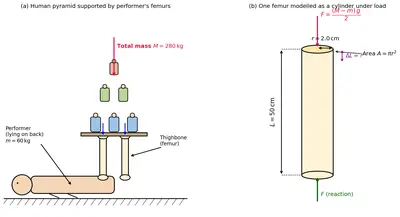
In a human pyramid in a circus, the entire weight of the balanced group is supported by the legs of a performer who is lying on his back (as shown in Fig. 8.4). The combined mass of all the persons performing the act, and the tables, plaques etc. involved is $$280 \, \mathrm{kg}$$. The mass of the performer lying on his back at the bottom of the pyramid is $$60 \, \mathrm{kg}$$. Each thighbone (femur) of this performer has a length of $$50 \, \mathrm{cm}$$ and an effective radius of $$2.0 \, \mathrm{cm}$$. Determine the amount by which each thighbone gets compressed under the extra load.
Fig. 8.4
Fig. 8.4

Solution

The performer's own body lies on the ground, so his weight does not pass through the femurs. The extra mass loaded on his thighbones is

$$m = 280 - 60 = 220 \, \mathrm{kg}$$

This load is shared equally by his two thighbones, so each carries

$$F = \frac{m g}{2} = \frac{(220)(9.8)}{2} = 1078 \, \mathrm{N}$$

The cross-sectional area of a thighbone is

$$A = \pi r^{2} = \pi (2.0 \times 10^{-2})^{2} \approx 1.26 \times 10^{-3} \, \mathrm{m^{2}}$$

The compressive stress in the bone is

$$\sigma = \frac{F}{A} = \frac{1078}{1.26 \times 10^{-3}} \approx 8.57 \times 10^{5} \, \mathrm{N\,m^{-2}}$$

Taking Young's modulus of compact bone as $$Y = 9.4 \times 10^{9} \, \mathrm{N\,m^{-2}}$$, the compressive strain is $$\sigma / Y$$, so the shortening of one femur (length $$L = 0.50 \, \mathrm{m}$$) is

$$\Delta L = \frac{\sigma L}{Y} = \frac{(8.57 \times 10^{5})(0.50)}{9.4 \times 10^{9}} \approx 4.56 \times 10^{-5} \, \mathrm{m}$$

That is, each thighbone shortens by only about $$45.6 \, \mathrm{\mu m}$$ — very small, which is why human bones can support such loads without obvious deformation.

Answer

Each thighbone is compressed by $$\Delta L \approx 4.55 \times 10^{-5} \, \mathrm{m}$$ (about $$45.6 \, \mathrm{\mu m}$$).

Example 8.4 A square lead slab of side $$50 \, \mathrm{cm}$$ and thickness $$10 \, \mathrm{cm}$$ is subject to a shearing force (on its narrow face) of $$9.0 \times 10^{4} \, \mathrm{N}$$. The lower edge is riveted to the floor. How much will the upper edge be displaced?

Solution

The narrow face of the slab is a rectangle of dimensions $$50 \, \mathrm{cm} \times 10 \, \mathrm{cm}$$, so the area over which the shear force acts is

$$A = (0.50)(0.10) = 5.0 \times 10^{-2} \, \mathrm{m^{2}}$$

The shearing stress on this face is

$$\sigma_{s} = \frac{F}{A} = \frac{9.0 \times 10^{4}}{5.0 \times 10^{-2}} = 1.8 \times 10^{6} \, \mathrm{N\,m^{-2}}$$

Using shear modulus of lead $$G = 5.6 \times 10^{9} \, \mathrm{N\,m^{-2}}$$, the shear strain is

$$\theta = \frac{\sigma_{s}}{G} = \frac{1.8 \times 10^{6}}{5.6 \times 10^{9}} \approx 3.21 \times 10^{-4}$$

For a shear deformation, the displacement $$\Delta x$$ of the upper edge is the shear strain times the height $$L$$ over which the deformation occurs. Here the slab is sheared along its full height $$L = 0.50 \, \mathrm{m}$$, so

$$\Delta x = \theta \, L = (3.21 \times 10^{-4})(0.50) \approx 1.6 \times 10^{-4} \, \mathrm{m} = 0.16 \, \mathrm{mm}$$

Answer

The upper edge is displaced by $$\Delta x \approx 1.6 \times 10^{-4} \, \mathrm{m} = 0.16 \, \mathrm{mm}$$.

Example 8.5 The average depth of Indian Ocean is about $$3000 \, \mathrm{m}$$. Calculate the fractional compression, $$\Delta V/V$$, of water at the bottom of the ocean, given that the bulk modulus of water is $$2.2 \times 10^{9} \, \mathrm{N\,m^{-2}}$$. (Take $$g = 10 \, \mathrm{m\,s^{-2}}$$)

Solution

The hydrostatic pressure at a depth $$h = 3000 \, \mathrm{m}$$ below the surface (taking water's density $$\rho = 1.0 \times 10^{3} \, \mathrm{kg\,m^{-3}}$$) is

$$p = \rho g h = (1.0 \times 10^{3})(10)(3000) = 3.0 \times 10^{7} \, \mathrm{N\,m^{-2}}$$

The bulk modulus $$B$$ relates the volumetric stress to the volumetric strain:

$$B = \frac{p}{|\Delta V / V|} \quad\Longrightarrow\quad \frac{\Delta V}{V} = \frac{p}{B}$$

Substituting,

$$\frac{\Delta V}{V} = \frac{3.0 \times 10^{7}}{2.2 \times 10^{9}} \approx 1.36 \times 10^{-2}$$

So water at the bottom of the Indian Ocean is compressed by about $$1.36\%$$ of its surface volume.

Answer

$$\Delta V / V \approx 1.36 \times 10^{-2}$$ (about $$1.36\%$$).

Exercises

8.1 A steel wire of length $$4.7 \, \mathrm{m}$$ and cross-sectional area $$3.0 \times 10^{-5} \, \mathrm{m^2}$$ stretches by the same amount as a copper wire of length $$3.5 \, \mathrm{m}$$ and cross-sectional area of $$4.0 \times 10^{-5} \, \mathrm{m^2}$$ under a given load. What is the ratio of the Young's modulus of steel to that of copper?

Solution

Let the common load be $$F$$ and the common elongation be $$\Delta L$$. From the definition of Young's modulus,

$$Y = \frac{F L}{A \, \Delta L}$$

Applying this to each wire,

$$Y_{s} = \frac{F L_{s}}{A_{s} \, \Delta L}, \qquad Y_{c} = \frac{F L_{c}}{A_{c} \, \Delta L}$$

Since $$F$$ and $$\Delta L$$ cancel when we take the ratio,

$$\frac{Y_{s}}{Y_{c}} = \frac{L_{s}}{L_{c}} \cdot \frac{A_{c}}{A_{s}} = \frac{4.7}{3.5} \cdot \frac{4.0 \times 10^{-5}}{3.0 \times 10^{-5}}$$

$$\frac{Y_{s}}{Y_{c}} = \frac{4.7 \times 4.0}{3.5 \times 3.0} = \frac{18.8}{10.5} \approx 1.79$$

Hence Young's modulus of steel is about $$1.79$$ times that of copper, consistent with steel being the stiffer material.

Answer

$$Y_{\mathrm{steel}} : Y_{\mathrm{copper}} \approx 1.79 : 1$$.

8.2

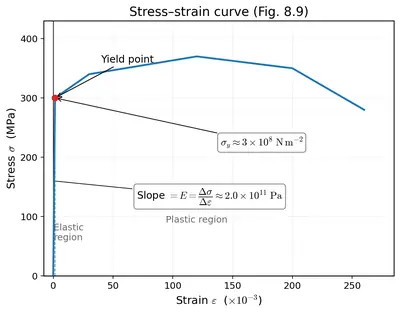
Figure 8.9 shows the strain-stress curve for a given material. What are (a) Young's modulus and (b) approximate yield strength for this material?
Figure 8.9
Figure 8.9

Solution

(a) Young's modulus. Young's modulus equals the slope of the stress-strain curve in its initial (linear, proportional) region. Reading from Fig. 8.9, a representative point on the straight-line portion corresponds to a stress of about $$1.5 \times 10^{8} \, \mathrm{N\,m^{-2}}$$ at a strain of about $$2 \times 10^{-3}$$. Therefore

$$Y = \frac{\mathrm{stress}}{\mathrm{strain}} = \frac{1.5 \times 10^{8}}{2 \times 10^{-3}} \approx 7.5 \times 10^{10} \, \mathrm{N\,m^{-2}}$$

So Young's modulus is of the order of $$7 \times 10^{10} \, \mathrm{N\,m^{-2}}$$.

(b) Yield strength. The yield strength is the stress at which the curve departs noticeably from the straight line (plastic deformation begins). From the graph this occurs at approximately

$$\sigma_{y} \approx 3 \times 10^{8} \, \mathrm{N\,m^{-2}} = 300 \, \mathrm{MPa}$$

Answer

(a) $$Y \approx 7 \times 10^{10} \, \mathrm{N\,m^{-2}}$$; (b) yield strength $$\approx 3 \times 10^{8} \, \mathrm{N\,m^{-2}}$$.

8.3

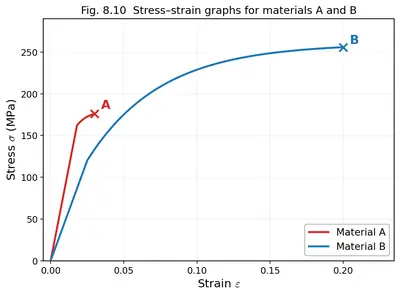
The stress-strain graphs for materials $$A$$ and $$B$$ are shown in Fig. 8.10.

The graphs are drawn to the same scale.

Fig. 8.10
Fig. 8.10

(a) Which of the materials has the greater Young's modulus?

Solution

Young's modulus is the slope of the stress-strain graph in the linear (elastic) region:

$$Y = \frac{\mathrm{stress}}{\mathrm{strain}}$$

From Fig. 8.10 (drawn to the same scale for both materials), the initial straight-line portion for material $$A$$ is steeper than that for material $$B$$. A steeper slope means a larger stress is needed to produce the same strain, hence a larger Young's modulus.

Therefore material $$A$$ has the greater Young's modulus.

Answer

Material $$A$$ has the greater Young's modulus (its stress-strain graph is steeper in the elastic region).

(b) Which of the two is the stronger material?

Solution

The strength of a material is measured by the maximum stress it can withstand before fracture (its ultimate / fracture stress) — not by its stiffness.

From Fig. 8.10, material $$A$$ reaches a higher fracture stress before breaking than material $$B$$. Therefore material $$A$$ is the stronger material.

(Note: "stronger" and "having larger Young's modulus" need not coincide in general, although in this particular graph both happen to favour $$A$$.)

Answer

Material $$A$$ is the stronger material (it can withstand a larger stress before fracturing).

8.4 Read the following two statements below carefully and state, with reasons, if it is true or false.

(a) The Young's modulus of rubber is greater than that of steel;

Solution

False.

Young's modulus measures the resistance of a material to elastic stretching: a larger $$Y$$ means a smaller strain for a given stress. From $$Y = (F/A) / (\Delta L / L)$$, a material that stretches a lot under a given load has a small $$Y$$.

Rubber stretches far more easily than steel for the same applied stress, so its Young's modulus is much smaller. Numerically,

$$Y_{\mathrm{steel}} \approx 2 \times 10^{11} \, \mathrm{N\,m^{-2}}, \qquad Y_{\mathrm{rubber}} \sim 10^{6}{-}10^{7} \, \mathrm{N\,m^{-2}}$$

So $$Y_{\mathrm{steel}}$$ is about four to five orders of magnitude greater than $$Y_{\mathrm{rubber}}$$; the statement is reversed and therefore false.

Answer

False. $$Y_{\mathrm{steel}} \sim 2 \times 10^{11} \, \mathrm{N\,m^{-2}}$$ is far greater than $$Y_{\mathrm{rubber}} \sim 10^{6}{-}10^{7} \, \mathrm{N\,m^{-2}}$$.

(b) The stretching of a coil is determined by its shear modulus.

Solution

True.

When a helical (spring-like) coil is pulled along its axis, the overall lengthening of the spring is not produced by direct longitudinal stretching of the wire. Instead, each small element of the wire of the coil is twisted about its own axis — the wire experiences a shear (torsional) deformation, not a tensile one.

The elastic constant governing shear/torsion is the shear modulus $$G$$ (also called the rigidity modulus). Consequently, the force constant of the coil, and hence the amount by which it stretches for a given load, is determined by the shear modulus of the material of the wire rather than its Young's modulus.

Answer

True. Stretching a coil twists its wire (shear/torsional deformation), so the relevant elastic constant is the shear (rigidity) modulus.

8.5

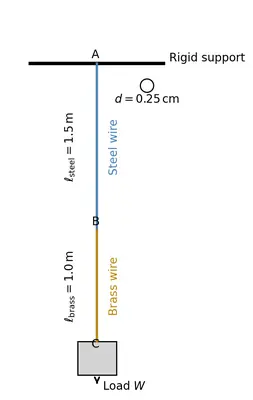
Two wires of diameter $$0.25 \, \mathrm{cm}$$, one made of steel and the other made of brass are loaded as shown in Fig. 8.11. The unloaded length of steel wire is $$1.5 \, \mathrm{m}$$ and that of brass wire is $$1.0 \, \mathrm{m}$$. Compute the elongations of the steel and the brass wires.
Fig. 8.11
Fig. 8.11

Solution

From Fig. 8.11 the arrangement is: the steel wire (length $$1.5 \, \mathrm{m}$$) hangs from the ceiling and supports a $$4 \, \mathrm{kg}$$ mass; the brass wire (length $$1.0 \, \mathrm{m}$$) hangs from that mass and supports an additional $$6 \, \mathrm{kg}$$ at its lower end.

Therefore the tension in each wire is

$$F_{\mathrm{steel}} = (4 + 6) \, g = 10 \times 9.8 = 98 \, \mathrm{N}, \qquad F_{\mathrm{brass}} = 6 \, g = 6 \times 9.8 = 58.8 \, \mathrm{N}$$

Both wires have the same diameter $$d = 0.25 \, \mathrm{cm}$$, so radius $$r = 0.125 \, \mathrm{cm} = 1.25 \times 10^{-3} \, \mathrm{m}$$, and

$$A = \pi r^{2} = \pi (1.25 \times 10^{-3})^{2} \approx 4.909 \times 10^{-6} \, \mathrm{m^{2}}$$

Take $$Y_{\mathrm{steel}} = 2.0 \times 10^{11} \, \mathrm{N\,m^{-2}}$$ and $$Y_{\mathrm{brass}} = 0.91 \times 10^{11} \, \mathrm{N\,m^{-2}}$$.

Elongation of the steel wire:

$$\Delta L_{\mathrm{steel}} = \frac{F_{\mathrm{steel}} L_{\mathrm{steel}}}{A \, Y_{\mathrm{steel}}} = \frac{(98)(1.5)}{(4.909 \times 10^{-6})(2.0 \times 10^{11})} = \frac{147}{9.818 \times 10^{5}} \approx 1.5 \times 10^{-4} \, \mathrm{m}$$

Elongation of the brass wire:

$$\Delta L_{\mathrm{brass}} = \frac{F_{\mathrm{brass}} L_{\mathrm{brass}}}{A \, Y_{\mathrm{brass}}} = \frac{(58.8)(1.0)}{(4.909 \times 10^{-6})(0.91 \times 10^{11})} = \frac{58.8}{4.467 \times 10^{5}} \approx 1.3 \times 10^{-4} \, \mathrm{m}$$

Answer

$$\Delta L_{\mathrm{steel}} \approx 1.5 \times 10^{-4} \, \mathrm{m}$$ and $$\Delta L_{\mathrm{brass}} \approx 1.3 \times 10^{-4} \, \mathrm{m}$$.

8.6 The edge of an aluminium cube is $$10 \, \mathrm{cm}$$ long. One face of the cube is firmly fixed to a vertical wall. A mass of $$100 \, \mathrm{kg}$$ is then attached to the opposite face of the cube. The shear modulus of aluminium is $$25 \, \mathrm{GPa}$$. What is the vertical deflection of this face?

Solution

The opposite face of the cube is pulled downward (parallel to itself) by the hanging weight, while the face glued to the wall is held fixed. This is a pure shear deformation.

Side of cube $$L = 0.10 \, \mathrm{m}$$. Area of the sheared face:

$$A = L^{2} = (0.10)^{2} = 1.0 \times 10^{-2} \, \mathrm{m^{2}}$$

Tangential (shearing) force:

$$F = m g = (100)(9.8) = 980 \, \mathrm{N}$$

Shearing stress:

$$\sigma_{s} = \frac{F}{A} = \frac{980}{1.0 \times 10^{-2}} = 9.8 \times 10^{4} \, \mathrm{N\,m^{-2}}$$

With shear modulus $$G = 25 \, \mathrm{GPa} = 25 \times 10^{9} \, \mathrm{N\,m^{-2}}$$, the shear strain is

$$\theta = \frac{\sigma_{s}}{G} = \frac{9.8 \times 10^{4}}{25 \times 10^{9}} = 3.92 \times 10^{-6}$$

The vertical deflection of the loaded face equals the shear strain times the distance from the fixed face, $$L$$:

$$\Delta x = \theta \, L = (3.92 \times 10^{-6})(0.10) = 3.92 \times 10^{-7} \, \mathrm{m}$$

Answer

Vertical deflection $$\Delta x \approx 3.92 \times 10^{-7} \, \mathrm{m}$$.

8.7 Four identical hollow cylindrical columns of mild steel support a big structure of mass $$50{,}000 \, \mathrm{kg}$$. The inner and outer radii of each column are $$30$$ and $$60 \, \mathrm{cm}$$ respectively. Assuming the load distribution to be uniform, calculate the compressional strain of each column.

Solution

Total weight to be supported:

$$W = M g = (5.0 \times 10^{4})(9.8) = 4.9 \times 10^{5} \, \mathrm{N}$$

With four columns sharing the load equally, the compressive force on one column is

$$F = \frac{W}{4} = \frac{4.9 \times 10^{5}}{4} = 1.225 \times 10^{5} \, \mathrm{N}$$

Cross-sectional area of one hollow column (with inner radius $$r_{1} = 0.30 \, \mathrm{m}$$ and outer radius $$r_{2} = 0.60 \, \mathrm{m}$$):

$$A = \pi (r_{2}^{2} - r_{1}^{2}) = \pi (0.60^{2} - 0.30^{2}) = \pi (0.36 - 0.09) = 0.27 \pi \approx 0.848 \, \mathrm{m^{2}}$$

Compressive stress in a column:

$$\sigma = \frac{F}{A} = \frac{1.225 \times 10^{5}}{0.848} \approx 1.444 \times 10^{5} \, \mathrm{N\,m^{-2}}$$

Taking Young's modulus of steel $$Y = 2.0 \times 10^{11} \, \mathrm{N\,m^{-2}}$$, the compressional strain is

$$\varepsilon = \frac{\sigma}{Y} = \frac{1.444 \times 10^{5}}{2.0 \times 10^{11}} \approx 7.22 \times 10^{-7}$$

Answer

Compressional strain on each column $$\varepsilon \approx 7.22 \times 10^{-7}$$.

8.8 A piece of copper having a rectangular cross-section of $$15.2 \, \mathrm{mm} \times 19.1 \, \mathrm{mm}$$ is pulled in tension with $$44{,}500 \, \mathrm{N}$$ force, producing only elastic deformation. Calculate the resulting strain?

Solution

Cross-sectional area of the rod:

$$A = (15.2 \times 10^{-3})(19.1 \times 10^{-3}) = 2.9032 \times 10^{-4} \, \mathrm{m^{2}}$$

Tensile stress:

$$\sigma = \frac{F}{A} = \frac{4.45 \times 10^{4}}{2.9032 \times 10^{-4}} \approx 1.533 \times 10^{8} \, \mathrm{N\,m^{-2}}$$

Within the elastic limit, strain follows Hooke's law $$\varepsilon = \sigma / Y$$. Using Young's modulus of copper $$Y = 1.1 \times 10^{11} \, \mathrm{N\,m^{-2}}$$:

$$\varepsilon = \frac{\sigma}{Y} = \frac{1.533 \times 10^{8}}{1.1 \times 10^{11}} \approx 1.39 \times 10^{-3}$$

Answer

Strain $$\varepsilon \approx 1.39 \times 10^{-3}$$ (about $$0.14\%$$).

8.9 A steel cable with a radius of $$1.5 \, \mathrm{cm}$$ supports a chairlift at a ski area. If the maximum stress is not to exceed $$10^{8} \, \mathrm{N\,m^{-2}}$$, what is the maximum load the cable can support?

Solution

Cross-sectional area of the cable:

$$A = \pi r^{2} = \pi (1.5 \times 10^{-2})^{2} = \pi (2.25 \times 10^{-4}) \approx 7.069 \times 10^{-4} \, \mathrm{m^{2}}$$

The maximum load is obtained when the stress reaches the permitted limit $$\sigma_{\max} = 10^{8} \, \mathrm{N\,m^{-2}}$$:

$$F_{\max} = \sigma_{\max} \cdot A = (10^{8})(7.069 \times 10^{-4}) \approx 7.07 \times 10^{4} \, \mathrm{N}$$

Converted to a mass (using $$g = 9.8 \, \mathrm{m\,s^{-2}}$$), this corresponds to

$$m_{\max} = \frac{F_{\max}}{g} = \frac{7.07 \times 10^{4}}{9.8} \approx 7.2 \times 10^{3} \, \mathrm{kg}$$

Answer

Maximum load $$F_{\max} \approx 7.07 \times 10^{4} \, \mathrm{N}$$, i.e. a mass of about $$7.2 \times 10^{3} \, \mathrm{kg}$$.

8.10 A rigid bar of mass $$15 \, \mathrm{kg}$$ is supported symmetrically by three wires each $$2.0 \, \mathrm{m}$$ long. Those at each end are of copper and the middle one is of iron. Determine the ratios of their diameters if each is to have the same tension.

Solution

The bar is rigid and is held symmetrically by three wires of the same length $$L$$ from the same horizontal ceiling. As the bar hangs, all three lower attachment points must remain in the same horizontal line, so all three wires must elongate by the same amount $$\Delta L$$.

Using $$\Delta L = F L / (A Y)$$ and setting the elongations equal for the (equal-tension) wires,

$$\frac{T L}{A_{\mathrm{Cu}} Y_{\mathrm{Cu}}} = \frac{T L}{A_{\mathrm{Fe}} Y_{\mathrm{Fe}}}$$

The tension $$T$$ and length $$L$$ cancel, giving

$$A_{\mathrm{Cu}} \, Y_{\mathrm{Cu}} = A_{\mathrm{Fe}} \, Y_{\mathrm{Fe}}$$

For wires of circular cross-section $$A = \pi d^{2}/4$$, so

$$\frac{d_{\mathrm{Cu}}^{2}}{d_{\mathrm{Fe}}^{2}} = \frac{Y_{\mathrm{Fe}}}{Y_{\mathrm{Cu}}} \quad\Longrightarrow\quad \frac{d_{\mathrm{Cu}}}{d_{\mathrm{Fe}}} = \sqrt{\frac{Y_{\mathrm{Fe}}}{Y_{\mathrm{Cu}}}}$$

Using $$Y_{\mathrm{Fe}} = 1.9 \times 10^{11} \, \mathrm{N\,m^{-2}}$$ and $$Y_{\mathrm{Cu}} = 1.1 \times 10^{11} \, \mathrm{N\,m^{-2}}$$:

$$\frac{d_{\mathrm{Cu}}}{d_{\mathrm{Fe}}} = \sqrt{\frac{1.9 \times 10^{11}}{1.1 \times 10^{11}}} = \sqrt{1.727} \approx 1.31$$

Hence the copper wires need to be slightly thicker than the iron wire in the ratio above.

Answer

$$d_{\mathrm{Cu}} : d_{\mathrm{Fe}} = \sqrt{Y_{\mathrm{Fe}}/Y_{\mathrm{Cu}}} \approx 1.31 : 1$$.

8.11 A $$14.5 \, \mathrm{kg}$$ mass, fastened to the end of a steel wire of unstretched length $$1.0 \, \mathrm{m}$$, is whirled in a vertical circle with an angular velocity of $$2 \, \mathrm{rev/s}$$ at the bottom of the circle. The cross-sectional area of the wire is $$0.065 \, \mathrm{cm^2}$$. Calculate the elongation of the wire when the mass is at the lowest point of its path.

Solution

Angular velocity:

$$\omega = 2 \, \mathrm{rev\,s^{-1}} = 2 \times 2\pi \, \mathrm{rad\,s^{-1}} = 4\pi \, \mathrm{rad\,s^{-1}}$$

At the lowest point of the vertical circle the tension in the wire must both support the weight and provide the centripetal force:

$$T = m g + m \omega^{2} L = m\,(g + \omega^{2} L)$$

With $$m = 14.5 \, \mathrm{kg}$$, $$L = 1.0 \, \mathrm{m}$$, $$\omega^{2} = (4\pi)^{2} = 16\pi^{2} \approx 157.9 \, \mathrm{rad^{2}\,s^{-2}}$$:

$$T = 14.5 \,(9.8 + 157.9 \times 1.0) = 14.5 \times 167.7 \approx 2.43 \times 10^{3} \, \mathrm{N}$$

The cross-section is $$A = 0.065 \, \mathrm{cm^{2}} = 6.5 \times 10^{-6} \, \mathrm{m^{2}}$$ and $$Y_{\mathrm{steel}} = 2.0 \times 10^{11} \, \mathrm{N\,m^{-2}}$$. The elongation is

$$\Delta L = \frac{T L}{A Y} = \frac{(2.43 \times 10^{3})(1.0)}{(6.5 \times 10^{-6})(2.0 \times 10^{11})} = \frac{2430}{1.3 \times 10^{6}} \approx 1.87 \times 10^{-3} \, \mathrm{m}$$

So the wire stretches by roughly $$1.87 \, \mathrm{mm}$$ at the lowest point.

Answer

$$\Delta L \approx 1.87 \times 10^{-3} \, \mathrm{m}$$ (about $$1.87 \, \mathrm{mm}$$).

8.12 Compute the bulk modulus of water from the following data: Initial volume = $$100.0 \, \mathrm{litre}$$, Pressure increase = $$100.0 \, \mathrm{atm}$$ ($$1 \, \mathrm{atm} = 1.013 \times 10^{5} \, \mathrm{Pa}$$), Final volume = $$100.5 \, \mathrm{litre}$$. Compare the bulk modulus of water with that of air (at constant temperature). Explain in simple terms why the ratio is so large.

Solution

The magnitude of the volume change is

$$|\Delta V| = 0.5 \, \mathrm{L} = 0.5 \times 10^{-3} \, \mathrm{m^{3}}$$

and the pressure increase is

$$\Delta p = 100 \times 1.013 \times 10^{5} = 1.013 \times 10^{7} \, \mathrm{Pa}$$

With initial volume $$V = 100 \, \mathrm{L} = 0.1 \, \mathrm{m^{3}}$$, the bulk modulus of water is

$$B_{\mathrm{water}} = \frac{\Delta p}{|\Delta V| / V} = \frac{\Delta p \, V}{|\Delta V|} = \frac{(1.013 \times 10^{7})(0.1)}{0.5 \times 10^{-3}} \approx 2.026 \times 10^{9} \, \mathrm{N\,m^{-2}}$$

For air at constant temperature, $$p V = \mathrm{constant}$$, so the isothermal bulk modulus equals the pressure itself; at atmospheric pressure

$$B_{\mathrm{air}} \approx 1.0 \times 10^{5} \, \mathrm{N\,m^{-2}}$$

Hence

$$\frac{B_{\mathrm{water}}}{B_{\mathrm{air}}} \approx \frac{2.026 \times 10^{9}}{1.0 \times 10^{5}} \approx 2 \times 10^{4}$$

Why is the ratio so large? In water (a liquid) the molecules are already packed almost as closely as possible; compressing them further requires overcoming strong intermolecular repulsion, so water resists volume change very strongly. In a gas the molecules are far apart with mostly empty space between them, and only weak interactions, so they can be squeezed together easily with a small pressure increase.

Answer

$$B_{\mathrm{water}} \approx 2.03 \times 10^{9} \, \mathrm{N\,m^{-2}}$$, about $$2 \times 10^{4}$$ times the isothermal bulk modulus of air ($$\sim 10^{5} \, \mathrm{N\,m^{-2}}$$). Liquid molecules are already nearly close-packed, so further compression is strongly resisted; gas molecules are far apart and easily squeezed together.

8.13 What is the density of water at a depth where pressure is $$80.0 \, \mathrm{atm}$$, given that its density at the surface is $$1.03 \times 10^{3} \, \mathrm{kg\,m^{-3}}$$?

Solution

Treat the extra (gauge) pressure $$\Delta p = 80 \, \mathrm{atm} = 80 \times 1.013 \times 10^{5} \approx 8.10 \times 10^{6} \, \mathrm{Pa}$$ as compressing a fixed mass of water by a small fractional volume change. With bulk modulus $$B = 2.2 \times 10^{9} \, \mathrm{Pa}$$,

$$\frac{|\Delta V|}{V} = \frac{\Delta p}{B} = \frac{8.10 \times 10^{6}}{2.2 \times 10^{9}} \approx 3.68 \times 10^{-3}$$

Since the mass $$m$$ is conserved, $$\rho \propto 1/V$$. Writing the new volume as $$V' = V - |\Delta V|$$,

$$\rho' = \frac{m}{V'} = \rho \cdot \frac{V}{V - |\Delta V|} = \frac{\rho}{1 - |\Delta V|/V}$$

For small fractional changes, $$1/(1-x) \approx 1 + x$$, so

$$\rho' \approx \rho \,\bigl(1 + \tfrac{|\Delta V|}{V}\bigr) = (1.03 \times 10^{3})(1 + 3.68 \times 10^{-3})$$

$$\rho' \approx 1.03 \times 10^{3} \times 1.00368 \approx 1.034 \times 10^{3} \, \mathrm{kg\,m^{-3}}$$

The density increases by only about $$0.37\%$$, confirming that water is nearly incompressible.

Answer

$$\rho \approx 1.034 \times 10^{3} \, \mathrm{kg\,m^{-3}}$$ (an increase of roughly $$0.37\%$$).

8.14 Compute the fractional change in volume of a glass slab, when subjected to a hydraulic pressure of $$10 \, \mathrm{atm}$$.

Solution

The applied pressure is

$$p = 10 \, \mathrm{atm} = 10 \times 1.013 \times 10^{5} \approx 1.013 \times 10^{6} \, \mathrm{Pa}$$

For a hydraulic (isotropic) compression, the fractional change in volume is

$$\frac{\Delta V}{V} = \frac{p}{B}$$

Using the bulk modulus of glass $$B = 3.7 \times 10^{10} \, \mathrm{N\,m^{-2}}$$:

$$\frac{\Delta V}{V} = \frac{1.013 \times 10^{6}}{3.7 \times 10^{10}} \approx 2.74 \times 10^{-5}$$

So the glass slab is compressed by only about 27 parts per million of its volume.

Answer

$$\Delta V / V \approx 2.74 \times 10^{-5}$$.

8.15 Determine the volume contraction of a solid copper cube, $$10 \, \mathrm{cm}$$ on an edge, when subjected to a hydraulic pressure of $$7.0 \times 10^{6} \, \mathrm{Pa}$$.

Solution

Initial volume of the cube:

$$V = (0.10)^{3} = 1.0 \times 10^{-3} \, \mathrm{m^{3}}$$

For a hydraulic compression, $$\Delta V / V = p / B$$. Using the bulk modulus of copper $$B = 1.4 \times 10^{11} \, \mathrm{N\,m^{-2}}$$:

$$\frac{\Delta V}{V} = \frac{p}{B} = \frac{7.0 \times 10^{6}}{1.4 \times 10^{11}} = 5.0 \times 10^{-5}$$

Therefore the volume contraction is

$$\Delta V = \left(\frac{\Delta V}{V}\right) V = (5.0 \times 10^{-5})(1.0 \times 10^{-3}) = 5.0 \times 10^{-8} \, \mathrm{m^{3}}$$

or equivalently $$5.0 \times 10^{-2} \, \mathrm{cm^{3}} = 0.05 \, \mathrm{cm^{3}}$$.

Answer

$$\Delta V \approx 5.0 \times 10^{-8} \, \mathrm{m^{3}}$$ (i.e. about $$0.05 \, \mathrm{cm^{3}}$$).

8.16 How much should the pressure on a litre of water be changed to compress it by $$0.10\%$$? carry one quarter of the load.

Solution

The required fractional change in volume is

$$\frac{\Delta V}{V} = 0.10\% = 1.0 \times 10^{-3}$$

From the definition of bulk modulus $$B = \Delta p / (\Delta V / V)$$, the required pressure change is

$$\Delta p = B \cdot \frac{\Delta V}{V}$$

Using the bulk modulus of water $$B = 2.2 \times 10^{9} \, \mathrm{N\,m^{-2}}$$:

$$\Delta p = (2.2 \times 10^{9})(1.0 \times 10^{-3}) = 2.2 \times 10^{6} \, \mathrm{N\,m^{-2}}$$

In terms of atmospheres,

$$\Delta p = \frac{2.2 \times 10^{6}}{1.013 \times 10^{5}} \approx 21.7 \, \mathrm{atm}$$

The initial volume of $$1 \, \mathrm{L}$$ does not enter the answer because the required quantity is the pressure increase, which depends only on the fractional compression and the bulk modulus.

Answer

$$\Delta p \approx 2.2 \times 10^{6} \, \mathrm{Pa}$$ (about $$22 \, \mathrm{atm}$$).
NCERT Solutions for Class 11
Maths
NCERT Solutions for Class 11 Maths
Chapter-wise step-by-step
solutions with explanations
explore solutions Maths bg
Physics
NCERT Solutions for Class 11 Physics
Chapter-wise step-by-step
solutions with explanations
explore solutions Physics bg
Chemistry
NCERT Solutions for Class 11 Chemistry
Chapter-wise step-by-step
solutions with explanations
explore solutions Chemistry bg

Frequently Asked Questions

50,000+ JEE Students Trusted Our Score Calculator

Predict your JEE Main percentile, rank & performance in seconds