Join WhatsApp Icon JEE WhatsApp Group
NCERT Solutions for Class 11 Physics

Chapter 7: Gravitation

Download Solutions PDF
Daily JEE Updates, Tips & Important Alerts
Join 30,000+ students and stay updated with JEE notifications and preparation insights.
Join Now!
Free PDF
Complete NCERT Solution PDF for Chapter 7: Gravitation

NCERT Solutions For Class 11 Physics Chapter 7 Gravitation helps students understand the universal force that governs the interaction between objects with mass. The page provides detailed NCERT Solutions that explain important concepts such as Newton’s law of gravitation, gravitational field, acceleration due to gravity, satellites, and escape velocity. NCERT Solutions For Class 11 Physics help students understand how gravitational forces influence planetary motion and objects on Earth. The chapter connects theoretical concepts with practical applications such as satellite movement and orbital motion. These solutions provide clear explanations for textbook questions and numerical problems. Students can access the chapter PDF for quick revision and effective exam preparation. The detailed approach helps learners develop a strong understanding of gravitational phenomena.
Download Solutions PDF

Examples 7.1-7.8

Example 7.1

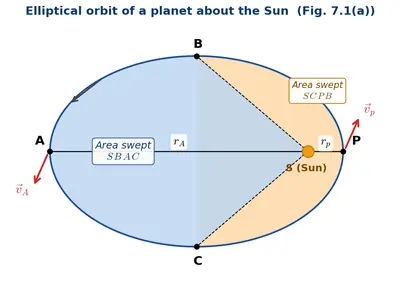
Let the speed of the planet at the perihelion $$P$$ in Fig. 7.1(a) be $$v_p$$ and the Sun-planet distance $$SP$$ be $$r_p$$. Relate $$\{r_p, v_p\}$$ to the corresponding quantities at the aphelion $$\{r_A, v_A\}$$. Will the planet take equal times to traverse $$BAC$$ and $$CPB$$?
Fig. 7.1
Fig. 7.1

Solution

At the perihelion P and the aphelion A, the velocity vector is perpendicular to the radius vector (these are the turning points of the radial motion).

The gravitational force on the planet always passes through the Sun S, so the torque of this force about S is zero. Hence the angular momentum of the planet about the Sun is conserved:

$$L = m\,r_P v_P = m\,r_A v_A$$

Therefore

$$\frac{v_P}{v_A} = \frac{r_A}{r_P}$$

Since $$r_P < r_A$$, we get $$v_P > v_A$$: the planet moves fastest at the perihelion and slowest at the aphelion.

By Kepler's second law, the line joining the Sun to the planet sweeps out equal areas in equal times. The area of the sector SBAC (which contains the aphelion side) is larger than the area of the sector SCPB (which contains the perihelion side), because the planet is on average farther from the Sun on the aphelion side. Equal areas in equal times therefore requires the planet to take a longer time on the arc BAC than on the arc CPB.

So the planet does not take equal times to traverse BAC and CPB.

Answer

$$r_P v_P = r_A v_A$$ (from conservation of angular momentum). The planet takes a longer time to traverse the aphelion arc BAC than the perihelion arc CPB.

Example 7.2

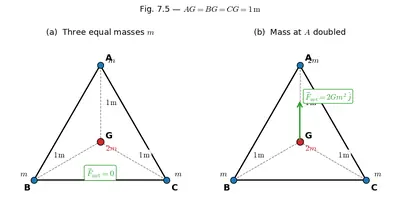
Three equal masses of $$m$$ kg each are fixed at the vertices of an equilateral triangle $$ABC$$.

(a) What is the force acting on a mass $$2m$$ placed at the centroid $$G$$ of the triangle?

(b) What is the force if the mass at the vertex $$A$$ is doubled?

Take $$AG = BG = CG = 1 \, \mathrm{m}$$ (see Fig. 7.5)

Fig. 7.5
Fig. 7.5

Solution

(a) All three vertex masses equal to $$m$$.

Each vertex mass $$m$$ exerts a gravitational pull on the centroid mass $$2m$$ of magnitude

$$F = \frac{G\,(m)(2m)}{(1\,\mathrm{m})^2} = 2Gm^2 \,\mathrm{N}$$

directed from G towards the respective vertex. The position vectors GA, GB, GC have equal magnitudes and are mutually inclined at $$120^{\circ}$$. Their vector sum is therefore zero:

$$\vec{F}_A + \vec{F}_B + \vec{F}_C = \vec{0}$$

Hence the net force on the mass $$2m$$ at G is zero.

(b) Mass at vertex A doubled to $$2m$$.

The forces from B and C are unchanged:

$$F_B = F_C = 2Gm^2 \,\mathrm{N}$$, directed from G along GB and GC respectively.

From (a), $$\vec{F}_A + \vec{F}_B + \vec{F}_C = \vec{0}$$ when all three vertex masses are $$m$$. So

$$\vec{F}_B + \vec{F}_C = -\vec{F}_A^{(\text{old})}$$

which is a vector of magnitude $$2Gm^2$$ directed from G in the direction opposite to GA.

The new force from the doubled mass at A is

$$F_A^{\text{new}} = \frac{G\,(2m)(2m)}{(1)^2} = 4Gm^2\,\mathrm{N}$$

directed from G towards A. Adding,

$$F_{\text{net}} = 4Gm^2 - 2Gm^2 = 2Gm^2\,\mathrm{N}$$

directed from G towards A.

Answer

(a) Net force on $$2m$$ at G is zero. (b) Net force is $$2Gm^2$$ N, directed from G towards A.

Example 7.3 Find the potential energy of a system of four particles placed at the vertices of a square of side $$l$$. Also obtain the potential at the centre of the square.

Solution

Label the four equal point masses (each of mass $$m$$) at the corners of a square of side $$l$$. The number of distinct pairs is $$\binom{4}{2}=6$$. Of these:

  • 4 pairs lie along the sides of the square, separated by $$l$$.
  • 2 pairs lie along the diagonals, separated by $$l\sqrt{2}$$.

The gravitational potential energy of a pair of point masses $$m$$ separated by $$r$$ is $$U_{12} = -Gm^2/r$$. Summing over all 6 pairs:

$$U = -4\,\frac{Gm^2}{l} - 2\,\frac{Gm^2}{l\sqrt{2}}$$

$$U = -\frac{Gm^2}{l}\left(4 + \frac{2}{\sqrt{2}}\right) = -\frac{Gm^2}{l}\left(4 + \sqrt{2}\right)$$

$$U \approx -5.41\,\frac{Gm^2}{l}$$

Potential at the centre of the square. The distance from the centre to each vertex is half the diagonal:

$$d = \frac{l\sqrt{2}}{2} = \frac{l}{\sqrt{2}}$$

The gravitational potential is the sum of contributions from each mass (a scalar):

$$V = 4 \times \left(-\frac{Gm}{d}\right) = -\frac{4 Gm}{l/\sqrt{2}} = -\frac{4\sqrt{2}\,Gm}{l}$$

Answer

$$U = -\dfrac{Gm^2}{l}\,(4+\sqrt{2}) \approx -5.41\,\dfrac{Gm^2}{l}$$; gravitational potential at the centre $$V = -\dfrac{4\sqrt{2}\,Gm}{l}$$.

Example 7.4

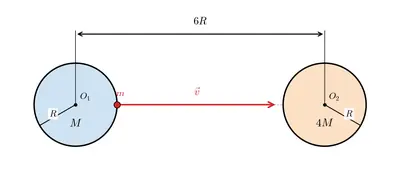
Two uniform solid spheres of equal radii $$R$$, but mass $$M$$ and $$4M$$ have a centre to centre separation $$6R$$, as shown in Fig. 7.10. The two spheres are held fixed. A projectile of mass $$m$$ is projected from the surface of the sphere of mass $$M$$ directly towards the centre of the second sphere. Obtain an expression for the minimum speed $$v$$ of the projectile so that it reaches the surface of the second sphere.
Fig. 7.10
Fig. 7.10

Solution

Let $$O_1$$, $$O_2$$ be the centres of the spheres of mass $$M$$ and $$4M$$ respectively, with $$O_1O_2 = 6R$$. The projectile is launched from the surface of the $$M$$-sphere (distance $$R$$ from $$O_1$$, distance $$5R$$ from $$O_2$$) directly towards $$O_2$$.

Step 1 — Locate the neutral point N. Let N be on the line $$O_1O_2$$ at distance $$x$$ from $$O_1$$. The two gravitational pulls balance when

$$\frac{GMm}{x^2} = \frac{G(4M)m}{(6R - x)^2}$$

$$(6R - x)^2 = 4 x^2 \;\Rightarrow\; 6R - x = 2x \;\Rightarrow\; x = 2R$$

So N is $$2R$$ from $$O_1$$ (i.e. $$4R$$ from $$O_2$$). Between the launch point and N the net force is directed back towards $$O_1$$ (retarding); beyond N it is directed towards $$O_2$$ (accelerating). The projectile needs just enough kinetic energy to reach N — once it crosses N, the second sphere pulls it the rest of the way.

Step 2 — Energy conservation from the launch point to N. For the minimum speed, the projectile reaches N with zero kinetic energy.

Initial gravitational PE (using point masses at the centres, valid because the projectile is outside both spheres):

$$U_i = -\frac{GMm}{R} - \frac{G(4M)m}{5R}$$

PE at N (distances $$2R$$ from $$O_1$$ and $$4R$$ from $$O_2$$):

$$U_N = -\frac{GMm}{2R} - \frac{G(4M)m}{4R} = -\frac{GMm}{2R} - \frac{GMm}{R}$$

Setting total energy at the launch point equal to total energy at N:

$$\tfrac12 m v^2 + U_i = 0 + U_N$$

$$\tfrac12 v^2 = U_N - U_i = \left(-\frac{GM}{2R} - \frac{GM}{R}\right) - \left(-\frac{GM}{R} - \frac{4GM}{5R}\right)$$

$$\tfrac12 v^2 = -\frac{GM}{2R} + \frac{4GM}{5R} = \frac{GM}{R}\left(\frac{4}{5} - \frac{1}{2}\right) = \frac{3\,GM}{10\,R}$$

$$v_{\min} = \sqrt{\frac{3\,GM}{5\,R}}$$

Answer

$$v_{\min} = \sqrt{\dfrac{3\,GM}{5\,R}}$$

Example 7.5 The planet Mars has two moons, phobos and delmos. (i) phobos has a period 7 hours, 39 minutes and an orbital radius of $$9.4 \times 10^3 \, \mathrm{km}$$. Calculate the mass of mars. (ii) Assume that earth and mars move in circular orbits around the sun, with the martian orbit being 1.52 times the orbital radius of the earth. What is the length of the martian year in days?

Solution

(i) Mass of Mars from Phobos's orbit.

$$T = 7\,\mathrm{h}\,39\,\mathrm{min} = (7 \times 3600 + 39 \times 60)\,\mathrm{s} = 27540\,\mathrm{s}$$

$$r = 9.4 \times 10^3\,\mathrm{km} = 9.4 \times 10^6\,\mathrm{m}$$

For a circular orbit, gravitational attraction provides the centripetal force:

$$\frac{G M_{\mathrm{Mars}}\,m}{r^2} = m\left(\frac{2\pi}{T}\right)^2 r \;\Rightarrow\; M_{\mathrm{Mars}} = \frac{4\pi^2 r^3}{G T^2}$$

$$M_{\mathrm{Mars}} = \frac{4\pi^2 (9.4 \times 10^6)^3}{(6.67 \times 10^{-11})(27540)^2}$$

$$M_{\mathrm{Mars}} = \frac{4\pi^2 \times 8.31 \times 10^{20}}{(6.67 \times 10^{-11})(7.58 \times 10^{8})} \approx 6.48 \times 10^{23}\,\mathrm{kg}$$

(ii) Length of the Martian year.

Kepler's third law applied to Earth and Mars (both orbiting the Sun):

$$\left(\frac{T_M}{T_E}\right)^2 = \left(\frac{r_M}{r_E}\right)^3 = (1.52)^3$$

$$T_M = T_E \,(1.52)^{3/2} = 365\,\mathrm{d} \times 1.874 \approx 684\,\mathrm{days}$$

Answer

(i) $$M_{\mathrm{Mars}} \approx 6.48 \times 10^{23}$$ kg. (ii) Martian year $$\approx 684$$ days.

Example 7.6 Weighing the Earth: You are given the following data: $$g = 9.81 \, \mathrm{ms^{-2}}$$, $$R_E = 6.37 \times 10^6 \, \mathrm{m}$$, the distance to the moon $$R = 3.84 \times 10^8 \, \mathrm{m}$$ and the time period of the moon's revolution is 27.3 days. Obtain the mass of the Earth $$M_E$$ in two different ways.

Solution

Method 1 — from the value of $$g$$ at the Earth's surface.

At the surface, the acceleration due to gravity satisfies

$$g = \frac{GM_E}{R_E^2} \;\Rightarrow\; M_E = \frac{g R_E^2}{G}$$

$$M_E = \frac{(9.81)(6.37 \times 10^6)^2}{6.67 \times 10^{-11}} = \frac{(9.81)(4.058 \times 10^{13})}{6.67 \times 10^{-11}}$$

$$M_E \approx 5.97 \times 10^{24}\,\mathrm{kg}$$

Method 2 — from the orbital motion of the Moon.

The Moon moves in a (nearly) circular orbit around the Earth of radius $$R$$ and period $$T$$. Gravity provides the centripetal force:

$$\frac{GM_E m}{R^2} = m\left(\frac{2\pi}{T}\right)^2 R \;\Rightarrow\; M_E = \frac{4\pi^2 R^3}{G T^2}$$

Convert $$T = 27.3$$ days $$= 27.3 \times 86400 \,\mathrm{s} \approx 2.36 \times 10^6$$ s. Then

$$M_E = \frac{4\pi^2 (3.84 \times 10^8)^3}{(6.67 \times 10^{-11})(2.36 \times 10^6)^2}$$

$$M_E = \frac{4\pi^2 \times 5.66 \times 10^{25}}{(6.67 \times 10^{-11})(5.57 \times 10^{12})} \approx 6.02 \times 10^{24}\,\mathrm{kg}$$

The two independent estimates agree to within $$\sim 1\%$$, both giving $$M_E \approx 6 \times 10^{24}\,\mathrm{kg}$$.

Answer

$$M_E \approx 6 \times 10^{24}$$ kg (Method 1: $$5.97 \times 10^{24}$$ kg from $$g$$; Method 2: $$6.02 \times 10^{24}$$ kg from the Moon's orbit).

Example 7.7 Express the constant $$k$$ of Eq. (7.38) in days and kilometres. Given $$k = 10^{-13} \, \mathrm{s^2 \, m^{-3}}$$. The moon is at a distance of $$3.84 \times 10^5 \, \mathrm{km}$$ from the earth. Obtain its time-period of revolution in days.

Solution

The constant $$k$$ comes from Kepler's third law, $$T^2 = k\,r^3$$. We are given

$$k = 10^{-13}\,\mathrm{s^2\,m^{-3}}$$

Convert seconds to days and metres to kilometres:

$$1\,\mathrm{s} = \frac{1}{86400}\,\mathrm{day}, \qquad 1\,\mathrm{m} = 10^{-3}\,\mathrm{km}$$

So $$1\,\mathrm{s^2\,m^{-3}} = \dfrac{1}{(86400)^2}\,\mathrm{day^2} \times \dfrac{1}{(10^{-3})^3\,\mathrm{km^3}} = \dfrac{10^9}{(86400)^2}\,\mathrm{day^2\,km^{-3}}$$

$$k = 10^{-13} \times \dfrac{10^9}{(8.64 \times 10^4)^2}\,\mathrm{day^2\,km^{-3}}$$

$$k = \dfrac{10^{-4}}{7.464 \times 10^9}\,\mathrm{day^2\,km^{-3}} \approx 1.33 \times 10^{-14}\,\mathrm{day^2\,km^{-3}}$$

Period of the Moon. With $$r = 3.84 \times 10^5$$ km,

$$T^2 = k\,r^3 = (1.33 \times 10^{-14})\,(3.84 \times 10^5)^3$$

$$T^2 = (1.33 \times 10^{-14})(5.66 \times 10^{16}) \approx 752.8\,\mathrm{day^2}$$

$$T \approx 27.4\,\mathrm{days}$$

Answer

$$k \approx 1.33 \times 10^{-14}\,\mathrm{day^2\,km^{-3}}$$; period of the Moon $$T \approx 27.4$$ days.

Example 7.8 A 400 kg satellite is in a circular orbit of radius $$2R_E$$ about the Earth. How much energy is required to transfer it to a circular orbit of radius $$4R_E$$? What are the changes in the kinetic and potential energies?

Solution

For a satellite of mass $$m$$ in a circular orbit of radius $$r$$ about the Earth, the centripetal-force condition $$GM_E m/r^2 = mv^2/r$$ gives

$$KE(r) = \tfrac12 m v^2 = \dfrac{GM_E m}{2r}, \qquad PE(r) = -\dfrac{GM_E m}{r}$$

$$E(r) = KE + PE = -\dfrac{GM_E m}{2r}$$

Use $$GM_E = g R_E^2$$. With $$r_1 = 2R_E$$, $$r_2 = 4R_E$$ and $$m = 400$$ kg:

$$E_1 = -\dfrac{g R_E^2 m}{4 R_E} = -\dfrac{g R_E m}{4}, \qquad E_2 = -\dfrac{g R_E m}{8}$$

Energy required to raise the orbit:

$$\Delta E = E_2 - E_1 = -\dfrac{g R_E m}{8} + \dfrac{g R_E m}{4} = \dfrac{g R_E m}{8}$$

$$\Delta E = \dfrac{(9.81)(6.37 \times 10^6)(400)}{8} \approx 3.13 \times 10^{9}\,\mathrm{J}$$

Change in kinetic energy:

$$\Delta KE = KE_2 - KE_1 = \dfrac{g R_E m}{8} - \dfrac{g R_E m}{4} = -\dfrac{g R_E m}{8} \approx -3.13 \times 10^{9}\,\mathrm{J}$$

The KE decreases: the higher orbit is the slower one.

Change in potential energy:

$$\Delta PE = PE_2 - PE_1 = -\dfrac{g R_E m}{4} + \dfrac{g R_E m}{2} = +\dfrac{g R_E m}{4} \approx +6.25 \times 10^{9}\,\mathrm{J}$$

Consistency: $$\Delta E = \Delta KE + \Delta PE = -3.13 \times 10^{9} + 6.25 \times 10^{9} = +3.13 \times 10^{9}\,\mathrm{J}$$ ✓

Answer

Energy required $$\Delta E \approx 3.13 \times 10^{9}$$ J. KE decreases by $$3.13 \times 10^{9}$$ J; PE increases by $$6.25 \times 10^{9}$$ J.

Exercises

7.1 Answer the following:

(a) You can shield a charge from electrical forces by putting it inside a hollow conductor. Can you shield a body from the gravitational influence of nearby matter by putting it inside a hollow sphere or by some other means?

Solution

No, a body cannot be shielded from gravitational influences by any enclosure. Gravitation is a universal interaction; it depends only on mass-energy and acts on every form of matter in exactly the same way (via the equivalence principle), independent of the intervening medium.

The electrical shielding inside a hollow conductor (Faraday cage) works because the conductor contains free mobile charges of both signs that redistribute themselves to cancel any externally applied electric field within the cavity. There is no gravitational analogue: there is no "negative mass" that could be induced inside a hollow sphere to cancel the external gravitational field. Hence no enclosure — solid, hollow or otherwise — can shield a body from gravity.

Answer

No. Gravitation cannot be shielded; there is no gravitational analogue of a Faraday cage because there are no negative masses to induce a cancelling field.

(b) An astronaut inside a small space ship orbiting around the earth cannot detect gravity. If the space station orbiting around the earth has a large size, can he hope to detect gravity?

Solution

Yes. An astronaut in a small spaceship cannot detect gravity because the astronaut and every part of the ship are in free fall together — they share the same gravitational acceleration $$\vec g$$, and so the astronaut feels weightless. This is the local equivalence principle.

However, gravity is not uniform: $$\vec g$$ varies in both magnitude and direction across a finite region (it weakens with distance from the Earth and always points towards the Earth's centre). In a large station, these differences (called tidal forces) become detectable: parts of the station closer to the Earth fall slightly faster than parts farther away, and the station gets stretched along the radial direction and squeezed perpendicular to it. By observing this tidal field, the astronaut can detect the presence of gravity even in free fall.

Answer

Yes — through tidal (differential) gravitational forces across the large station, which break the local-uniformity that makes gravity undetectable in a small spaceship.

(c) If you compare the gravitational force on the earth due to the sun to that due to the moon, you would find that the Sun's pull is greater than the moon's pull. (you can check this yourself using the data available in the succeeding exercises). However, the tidal effect of the moon's pull is greater than the tidal effect of sun. Why?

Solution

Tides are produced not by the gravitational pull itself, but by the difference in pull across the Earth's diameter (i.e. by the tidal field). For a body of mass $$M$$ at distance $$d$$, the tidal acceleration across the Earth (radius $$R_E$$) scales as the derivative of $$GM/d^2$$ with respect to $$d$$:

$$a_{\text{tidal}} \sim \frac{2\,G M R_E}{d^3}$$

So tidal effects fall off as $$1/d^3$$, faster than the gravitational pull itself (which falls as $$1/d^2$$).

Although the Sun is enormously more massive than the Moon ($$M_\odot \approx 2.7 \times 10^7\,M_{\text{moon}}$$), it is also much farther away ($$d_\odot \approx 390\,d_{\text{moon}}$$). Taking the ratio:

$$\frac{a_{\text{tidal,moon}}}{a_{\text{tidal,sun}}} = \frac{M_{\text{moon}}}{M_\odot}\left(\frac{d_\odot}{d_{\text{moon}}}\right)^3 \approx (3.7 \times 10^{-8})\,(390)^3 \approx 2.2$$

The closer distance of the Moon, cubed, more than compensates for its smaller mass. So even though the Sun's direct gravitational pull on Earth is about 180 times the Moon's, the Moon's tidal effect is roughly twice that of the Sun.

Answer

Tidal effects scale as $$M/d^3$$ (not $$M/d^2$$). The Moon's much smaller distance, raised to the third power, more than compensates for its smaller mass, making lunar tides roughly twice the solar tides.

7.2 Choose the correct alternative:

(a) Acceleration due to gravity increases/decreases with increasing altitude.

Solution

At a height $$h$$ above the Earth's surface, the acceleration due to gravity is

$$g_h = \dfrac{GM_E}{(R_E + h)^2}$$

which is a monotonically decreasing function of $$h$$. For $$h \ll R_E$$ this gives the familiar approximation $$g_h \approx g\left(1 - \dfrac{2h}{R_E}\right)$$. So $$g$$ decreases with increasing altitude.

Answer

Decreases.

(b) Acceleration due to gravity increases/decreases with increasing depth (assume the earth to be a sphere of uniform density).

Solution

Inside a sphere of uniform density $$\rho$$, only the mass within radius $$r = R_E - d$$ contributes (Newton's shell theorem). The acceleration at depth $$d$$ is

$$g_d = \dfrac{G \cdot \tfrac{4}{3}\pi(R_E - d)^3 \rho}{(R_E - d)^2} = \tfrac{4}{3}\pi G \rho (R_E - d) = g\left(1 - \dfrac{d}{R_E}\right)$$

So $$g$$ decreases linearly with depth and falls to zero at the centre.

Answer

Decreases.

(c) Acceleration due to gravity is independent of mass of the earth/mass of the body.

Solution

The force on a body of mass $$m$$ at the Earth's surface is $$F = GM_E m/R_E^2$$, so its acceleration is

$$g = \dfrac{F}{m} = \dfrac{GM_E}{R_E^2}$$

This depends on the mass of the Earth $$M_E$$, but not on the mass of the body $$m$$ — a consequence of the equivalence between inertial and gravitational mass.

Answer

Independent of the mass of the body.

(d) The formula $$-G \, Mm(1/r_2 - 1/r_1)$$ is more/less accurate than the formula $$mg(r_2 - r_1)$$ for the difference of potential energy between two points $$r_2$$ and $$r_1$$ distance away from the centre of the earth.

Solution

The exact gravitational potential energy of a mass $$m$$ at distance $$r$$ from a point mass $$M$$ is $$U(r) = -GMm/r$$, so the exact difference is

$$\Delta U_{\text{exact}} = -GMm\left(\dfrac{1}{r_2} - \dfrac{1}{r_1}\right)$$

This holds for any $$r_1, r_2$$ outside the Earth.

The formula $$mg(r_2 - r_1)$$ uses a constant $$g$$, which is valid only when $$g$$ does not vary appreciably between the two points — i.e. when both points are close to the surface and $$|r_2 - r_1| \ll R_E$$.

Hence the formula $$-GMm(1/r_2 - 1/r_1)$$ is more accurate.

Answer

More accurate.

7.3 Suppose there existed a planet that went around the Sun twice as fast as the earth. What would be its orbital size as compared to that of the earth?

Solution

Let $$T_E$$, $$R_E$$ denote the period and the orbital radius of the Earth, and $$T_p$$, $$R_p$$ the same for the hypothetical planet. "Twice as fast" means the planet completes one orbit in half the time:

$$T_p = \dfrac{T_E}{2}$$

Kepler's third law for planets orbiting the same Sun gives

$$\dfrac{T_p^2}{T_E^2} = \dfrac{R_p^3}{R_E^3}$$

$$\dfrac{R_p^3}{R_E^3} = \left(\dfrac{T_p}{T_E}\right)^2 = \dfrac{1}{4}$$

$$\dfrac{R_p}{R_E} = \left(\dfrac{1}{4}\right)^{1/3} = 4^{-1/3} \approx 0.63$$

So the planet's orbital radius is about $$0.63\,R_E \approx 0.63$$ AU — roughly 63% of the Earth-Sun distance.

Answer

$$R_p = 4^{-1/3}\,R_E \approx 0.63\,R_E$$ (about $$0.63$$ AU).

7.4 Io, one of the satellites of Jupiter, has an orbital period of 1.769 days and the radius of the orbit is $$4.22 \times 10^8 \, \mathrm{m}$$. Show that the mass of Jupiter is about one-thousandth that of the sun.

Solution

Convert Io's orbital period to SI units:

$$T = 1.769\,\mathrm{day} \times 86400\,\mathrm{s/day} \approx 1.528 \times 10^5\,\mathrm{s}$$

Apply Kepler's third law to the Io-Jupiter system (Io orbits Jupiter):

$$T^2 = \dfrac{4\pi^2 r^3}{G M_J} \;\Rightarrow\; M_J = \dfrac{4\pi^2 r^3}{G T^2}$$

$$M_J = \dfrac{4\pi^2 (4.22 \times 10^8)^3}{(6.67 \times 10^{-11})(1.528 \times 10^5)^2}$$

$$M_J = \dfrac{4\pi^2 \times 7.51 \times 10^{25}}{(6.67 \times 10^{-11})(2.34 \times 10^{10})}$$

$$M_J = \dfrac{2.965 \times 10^{27}}{1.559} \approx 1.90 \times 10^{27}\,\mathrm{kg}$$

The Sun's mass is $$M_\odot \approx 2 \times 10^{30}$$ kg, so

$$\dfrac{M_J}{M_\odot} = \dfrac{1.90 \times 10^{27}}{2 \times 10^{30}} \approx 9.5 \times 10^{-4} \approx \dfrac{1}{1050}$$

Hence Jupiter is about one-thousandth the mass of the Sun, as required.

Answer

$$M_J \approx 1.90 \times 10^{27}$$ kg, which is about $$\dfrac{1}{1050} \approx \dfrac{1}{1000}$$ of the Sun's mass.

7.5 Let us assume that our galaxy consists of $$2.5 \times 10^{11}$$ stars each of one solar mass. How long will a star at a distance of 50,000 ly from the galactic centre take to complete one revolution? Take the diameter of the Milky Way to be $$10^5 \, \mathrm{ly}$$.

Solution

The star is at the rim of the disk ($$50000\,\mathrm{ly} = \tfrac{1}{2} \times 10^5\,\mathrm{ly}$$), so the entire galactic mass interior to its orbit is effectively the total stellar mass.

Total mass of the galaxy:

$$M = (2.5 \times 10^{11})(2 \times 10^{30}\,\mathrm{kg}) = 5 \times 10^{41}\,\mathrm{kg}$$

Orbital radius in SI units (1 ly $$= 9.46 \times 10^{15}$$ m):

$$r = (5 \times 10^4)(9.46 \times 10^{15}) \approx 4.73 \times 10^{20}\,\mathrm{m}$$

Kepler's third law (treating the rest of the galaxy as a point mass at the centre):

$$T^2 = \dfrac{4\pi^2 r^3}{G M}$$

$$r^3 = (4.73 \times 10^{20})^3 \approx 1.058 \times 10^{62}\,\mathrm{m^3}$$

$$T^2 = \dfrac{4\pi^2 \times 1.058 \times 10^{62}}{(6.67 \times 10^{-11})(5 \times 10^{41})} = \dfrac{4.18 \times 10^{63}}{3.34 \times 10^{31}} \approx 1.25 \times 10^{32}\,\mathrm{s^2}$$

$$T \approx 1.12 \times 10^{16}\,\mathrm{s}$$

Converting to years using $$1\,\mathrm{yr} = 3.156 \times 10^7$$ s:

$$T \approx \dfrac{1.12 \times 10^{16}}{3.156 \times 10^7} \approx 3.55 \times 10^{8}\,\mathrm{yr}$$

Answer

$$T \approx 1.12 \times 10^{16}$$ s $$\approx 3.5 \times 10^{8}$$ years.

7.6 Choose the correct alternative:

(a) If the zero of potential energy is at infinity, the total energy of an orbiting satellite is negative of its kinetic/potential energy.

Solution

For a satellite of mass $$m$$ in a circular orbit of radius $$r$$ around the Earth, the centripetal-force condition $$GM_E m/r^2 = mv^2/r$$ gives

$$KE = \tfrac12 m v^2 = \dfrac{GM_E m}{2r}, \qquad PE = -\dfrac{GM_E m}{r} = -2\,KE$$

Hence

$$E_{\text{total}} = KE + PE = \dfrac{GM_E m}{2r} - \dfrac{GM_E m}{r} = -\dfrac{GM_E m}{2r} = -KE$$

So the total energy equals the negative of the kinetic energy.

Answer

Kinetic energy.

(b) The energy required to launch an orbiting satellite out of earth's gravitational influence is more/less than the energy required to project a stationary object at the same height (as the satellite) out of earth's influence.

Solution

To send a body to infinity (zero total energy), one must supply energy equal to the magnitude of its current total energy.

For a stationary object at radius $$r = R_E + h$$, KE = 0, so

$$\Delta E_{\text{stat}} = 0 - \left(-\dfrac{GM_E m}{r}\right) = \dfrac{GM_E m}{r}$$

For an orbiting satellite at the same height, its total energy is already $$E = -GM_E m/(2r)$$, so

$$\Delta E_{\text{orb}} = 0 - \left(-\dfrac{GM_E m}{2r}\right) = \dfrac{GM_E m}{2r}$$

So $$\Delta E_{\text{orb}} = \tfrac12\,\Delta E_{\text{stat}}$$. Less energy is needed for the orbiting satellite, because half of the work has already been done in supplying it with orbital kinetic energy.

Answer

Less.

7.7 Does the escape speed of a body from the earth depend on (a) the mass of the body, (b) the location from where it is projected, (c) the direction of projection, (d) the height of the location from where the body is launched?

Solution

The escape speed from a point at distance $$r$$ from the centre of a spherical body of mass $$M$$ is obtained from energy conservation (set $$KE_\infty = 0$$ and $$PE_\infty = 0$$):

$$\tfrac12 m v_e^2 - \dfrac{GMm}{r} = 0 \;\Rightarrow\; v_e = \sqrt{\dfrac{2GM}{r}}$$

(a) Does not depend on the mass of the body: $$m$$ cancels in the expression for $$v_e$$.

(b) Does not depend on the location on the Earth's surface (assuming a spherical Earth): all surface points have the same radial distance $$R_E$$ from the centre, so the formula gives the same $$v_e$$ everywhere on the surface.

(c) Does not depend on the direction of projection: the escape condition is purely energetic. (One must, of course, ensure the trajectory does not re-intersect the Earth — but the threshold speed itself is direction-independent.)

(d) Does depend on the height $$h$$ of the launching point, because then $$r = R_E + h$$ and

$$v_e = \sqrt{\dfrac{2GM}{R_E + h}}$$

which decreases as $$h$$ increases.

Answer

(a) No. (b) No. (c) No. (d) Yes — escape speed depends on the radial distance and hence on the launch height.

7.8 A comet orbits the sun in a highly elliptical orbit. Does the comet have a constant (a) linear speed, (b) angular speed, (c) angular momentum, (d) kinetic energy, (e) potential energy, (f) total energy throughout its orbit? Neglect any mass loss of the comet when it comes very close to the Sun.

Solution

The Sun's gravitational pull on the comet is a central, conservative force, so it exerts zero torque about the Sun and does no non-conservative work.

(a) Linear speed — No. By conservation of angular momentum, $$r v_\perp = \text{const}$$, so $$v$$ is largest at perihelion and smallest at aphelion.

(b) Angular speed — No. $$\omega = v_\perp/r$$ varies for the same reason as (a).

(c) Angular momentum — Yes. Gravity is a central force; its torque about the Sun is zero, so $$\vec L$$ is conserved.

(d) Kinetic energy — No. Speed varies along the orbit, so KE varies.

(e) Potential energy — No. $$U = -GM_\odot m / r$$ depends on $$r$$, which changes.

(f) Total mechanical energy — Yes. Gravity is conservative and we are told to neglect mass loss; with no dissipation, $$E = KE + PE$$ is conserved.

Answer

Constants of the motion: (c) angular momentum and (f) total energy. Not constant: (a), (b), (d), (e).

7.9 Which of the following symptoms is likely to afflict an astronaut in space (a) swollen feet, (b) swollen face, (c) headache, (d) orientational problem.

Solution

On Earth, gravity normally pulls bodily fluids (especially blood) downward; the cardiovascular system compensates by pumping harder against this hydrostatic pressure. In micro-gravity (free fall) the downward bias is lost, and the fluids redistribute, accumulating in the upper body.

  • (a) Swollen feetNo. Fluids actually move away from the legs ("chicken-leg syndrome"), so the feet do not swell.
  • (b) Swollen faceYes. Excess fluid in the head and upper body produces a noticeable puffiness of the face.
  • (c) HeadacheYes. Higher intracranial pressure from the fluid shift commonly produces headaches.
  • (d) Orientational problemYes. The vestibular (balance) system relies on gravity to sense "up". Without it, astronauts experience disorientation and space sickness.

Answer

(b), (c) and (d) are likely; (a) swollen feet is not (fluids move away from the legs in micro-gravity).

7.10

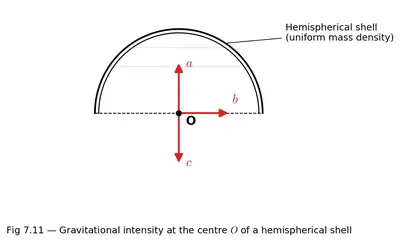
In the following two exercises, choose the correct answer from among the given ones: The gravitational intensity at the centre of a hemispherical shell of uniform mass density has the direction indicated by the arrow (see Fig 7.11) (i) a, (ii) b, (iii) c, (iv) 0.
Fig 7.11
Fig 7.11

Solution

Think of a complete uniform spherical shell — by Newton's shell theorem, the gravitational field inside is exactly zero everywhere. Decompose this complete shell into two hemispherical shells (upper and lower). If the field due to the complete shell vanishes, the fields due to the two hemispheres at the common centre must be equal in magnitude and opposite in direction.

By symmetry, the field at the centre of the flat face of each hemispherical shell must lie along the axis of symmetry of the hemisphere (the components perpendicular to that axis cancel pair-wise). The direction is along the axis, into the body of the hemisphere — towards the curved cap where the mass lies. That is the direction shown by the arrow c in Fig. 7.11.

Answer

(iii) c.

7.11 For the above problem, the direction of the gravitational intensity at an arbitrary point P is indicated by the arrow (i) d, (ii) e, (iii) f, (iv) g.

Solution

Apply the same decomposition argument used in 7.10. Inside a complete uniform spherical shell, the gravitational field is zero at every interior point P. So the field at P due to the upper hemispherical shell plus the field at P due to the lower hemispherical shell must vanish:

$$\vec g_{\text{upper}}(P) + \vec g_{\text{lower}}(P) = \vec 0$$

Thus the field due to the upper hemisphere alone is equal in magnitude and opposite in direction to that of the lower hemisphere. The field due to either hemisphere at the arbitrary internal point P is parallel to the axis of symmetry of the shell (since the perpendicular components cancel as discussed in 7.10). The direction is along the axis, in the sense shown by arrow e in Fig. 7.11.

Answer

(ii) e.

7.12 A rocket is fired from the earth towards the sun. At what distance from the earth's centre is the gravitational force on the rocket zero? Mass of the sun $$= 2 \times 10^{30} \, \mathrm{kg}$$, mass of the earth $$= 6 \times 10^{24} \, \mathrm{kg}$$. Neglect the effect of other planets etc. (orbital radius $$= 1.5 \times 10^{11} \, \mathrm{m}$$).

Solution

Let $$x$$ be the distance from the Earth's centre at which the gravitational forces of the Sun and the Earth on the rocket are equal and opposite. The Sun is at $$r = 1.5 \times 10^{11}$$ m from the Earth, so the rocket is $$r - x$$ from the Sun.

Set the magnitudes equal:

$$\dfrac{G M_E m}{x^2} = \dfrac{G M_S m}{(r - x)^2}$$

$$\left(\dfrac{r - x}{x}\right)^2 = \dfrac{M_S}{M_E} = \dfrac{2 \times 10^{30}}{6 \times 10^{24}} = \dfrac{10^6}{3}$$

$$\dfrac{r - x}{x} = \dfrac{10^3}{\sqrt 3} \approx 577.35$$

$$r = x\,(1 + 577.35) \approx 578.35\,x$$

$$x = \dfrac{r}{578.35} = \dfrac{1.5 \times 10^{11}}{578.35} \approx 2.59 \times 10^{8}\,\mathrm{m}$$

So the null point lies about $$2.6 \times 10^{8}$$ m from the Earth's centre (towards the Sun) — well inside the Earth's orbital radius.

Answer

$$x \approx 2.6 \times 10^{8}$$ m from the Earth's centre (on the Earth-Sun line).

7.13 How will you 'weigh the sun', that is estimate its mass? The mean orbital radius of the earth around the sun is $$1.5 \times 10^8 \, \mathrm{km}$$.

Solution

Treat the Earth as a planet moving in a (nearly) circular orbit of radius $$r$$ about the Sun with period $$T$$. The Sun's gravitational pull provides the centripetal force:

$$\dfrac{G M_S m_E}{r^2} = m_E\,\omega^2 r = m_E\left(\dfrac{2\pi}{T}\right)^2 r$$

$$M_S = \dfrac{4\pi^2 r^3}{G T^2}$$

So one only needs the radius of the Earth's orbit and its period — the Earth's own mass cancels.

Plug in $$r = 1.5 \times 10^{8}$$ km $$= 1.5 \times 10^{11}$$ m and $$T = 1$$ year $$= 365.25 \times 86400 \approx 3.156 \times 10^{7}$$ s:

$$r^3 = (1.5 \times 10^{11})^3 = 3.375 \times 10^{33}\,\mathrm{m^3}$$

$$T^2 = (3.156 \times 10^{7})^2 \approx 9.96 \times 10^{14}\,\mathrm{s^2}$$

$$M_S = \dfrac{4\pi^2 \times 3.375 \times 10^{33}}{(6.67 \times 10^{-11})(9.96 \times 10^{14})} = \dfrac{1.332 \times 10^{35}}{6.643 \times 10^{4}}$$

$$M_S \approx 2.0 \times 10^{30}\,\mathrm{kg}$$

Answer

Using $$M_S = \dfrac{4\pi^2 r^3}{G T^2}$$ with $$r = 1.5 \times 10^{11}$$ m and $$T = 1$$ yr $$= 3.156 \times 10^{7}$$ s, $$M_S \approx 2.0 \times 10^{30}$$ kg.

7.14 A saturn year is 29.5 times the earth year. How far is the saturn from the sun if the earth is $$1.50 \times 10^8 \, \mathrm{km}$$ away from the sun?

Solution

Apply Kepler's third law to two planets orbiting the same Sun:

$$\dfrac{T_S^2}{T_E^2} = \dfrac{r_S^3}{r_E^3} \;\Rightarrow\; \dfrac{r_S}{r_E} = \left(\dfrac{T_S}{T_E}\right)^{2/3}$$

With $$T_S/T_E = 29.5$$:

$$\dfrac{r_S}{r_E} = (29.5)^{2/3} = \left[(29.5)^2\right]^{1/3} = (870.25)^{1/3} \approx 9.55$$

$$r_S \approx 9.55 \times (1.50 \times 10^{8}\,\mathrm{km}) \approx 1.43 \times 10^{9}\,\mathrm{km}$$

Answer

$$r_S \approx 1.43 \times 10^{9}$$ km.

7.15 A body weighs 63 N on the surface of the earth. What is the gravitational force on it due to the earth at a height equal to half the radius of the earth?

Solution

Surface weight: $$W = mg = 63\,\mathrm{N}$$.

At height $$h = R_E/2$$, the radial distance from the Earth's centre is $$R_E + h = \tfrac{3}{2}R_E$$, so

$$g' = \dfrac{G M_E}{(R_E + h)^2} = g\left(\dfrac{R_E}{R_E + h}\right)^2 = g\left(\dfrac{R_E}{(3/2)R_E}\right)^2 = g\left(\dfrac{2}{3}\right)^2 = \dfrac{4g}{9}$$

Hence the gravitational force on the body at that height is

$$W' = m g' = \dfrac{4}{9}(mg) = \dfrac{4}{9}(63\,\mathrm{N}) = 28\,\mathrm{N}$$

Answer

$$W' = 28$$ N.

7.16 Assuming the earth to be a sphere of uniform mass density, how much would a body weigh half way down to the centre of the earth if it weighed 250 N on the surface?

Solution

For a uniform-density Earth, by Newton's shell theorem only the mass within radius $$R_E - d$$ contributes to gravity at depth $$d$$. This gives

$$g_d = g\left(1 - \dfrac{d}{R_E}\right)$$

"Half way down to the centre" means $$d = R_E/2$$, so

$$g_d = g\left(1 - \dfrac{1}{2}\right) = \dfrac{g}{2}$$

Hence the weight there is

$$W_d = m g_d = \dfrac{1}{2}(mg) = \dfrac{1}{2}(250\,\mathrm{N}) = 125\,\mathrm{N}$$

Answer

$$W_d = 125$$ N.

7.17 A rocket is fired vertically with a speed of $$5 \, \mathrm{km \, s^{-1}}$$ from the earth's surface. How far from the earth does the rocket go before returning to the earth? Mass of the earth $$= 6.0 \times 10^{24} \, \mathrm{kg}$$; mean radius of the earth $$= 6.4 \times 10^6 \, \mathrm{m}$$; $$G = 6.67 \times 10^{-11} \, \mathrm{N \, m^2 \, kg^{-2}}$$.

Solution

Let $$h$$ be the maximum height above the Earth's surface (so the apex is at distance $$R_E + h$$ from the centre). Apply energy conservation between the launch point and the apex (where KE = 0):

$$\tfrac12 m v^2 - \dfrac{G M_E m}{R_E} = 0 - \dfrac{G M_E m}{R_E + h}$$

$$\tfrac12 v^2 = G M_E\left(\dfrac{1}{R_E} - \dfrac{1}{R_E + h}\right) = \dfrac{G M_E\,h}{R_E (R_E + h)}$$

Solving for $$h$$:

$$v^2 R_E (R_E + h) = 2 G M_E h \;\Rightarrow\; h = \dfrac{v^2 R_E^2}{2 G M_E - v^2 R_E}$$

Plug in $$v = 5 \times 10^3$$ m/s, $$R_E = 6.4 \times 10^6$$ m, $$G M_E = (6.67 \times 10^{-11})(6.0 \times 10^{24}) = 4.00 \times 10^{14}$$ m³/s²:

$$v^2 R_E^2 = (2.5 \times 10^{7})(4.096 \times 10^{13}) = 1.024 \times 10^{21}\,\mathrm{m^4\,s^{-2}}$$

$$2 G M_E = 8.00 \times 10^{14},\quad v^2 R_E = 1.60 \times 10^{14}$$

$$h = \dfrac{1.024 \times 10^{21}}{(8.00 - 1.60) \times 10^{14}} = \dfrac{1.024 \times 10^{21}}{6.40 \times 10^{14}} = 1.6 \times 10^{6}\,\mathrm{m}$$

So the rocket rises about 1600 km above the Earth's surface; its maximum distance from the Earth's centre is $$R_E + h = (6.4 + 1.6) \times 10^{6} = 8.0 \times 10^{6}$$ m.

Answer

Maximum height above the surface $$h \approx 1.6 \times 10^{6}$$ m $$= 1600$$ km (maximum distance from the Earth's centre $$\approx 8.0 \times 10^{6}$$ m).

7.18 The escape speed of a projectile on the earth's surface is $$11.2 \, \mathrm{km \, s^{-1}}$$. A body is projected out with thrice this speed. What is the speed of the body far away from the earth? Ignore the presence of the sun and other planets.

Solution

Let $$v_e = 11.2$$ km/s be the escape speed, and $$v_i = 3 v_e$$ the initial speed. By definition of escape speed,

$$\tfrac12 m v_e^2 = \dfrac{G M_E m}{R_E}$$

Apply energy conservation between the surface and infinity (where PE = 0):

$$\tfrac12 m v_i^2 - \dfrac{G M_E m}{R_E} = \tfrac12 m v_\infty^2$$

Substitute $$G M_E m / R_E = \tfrac12 m v_e^2$$:

$$\tfrac12 m v_i^2 - \tfrac12 m v_e^2 = \tfrac12 m v_\infty^2$$

$$v_\infty^2 = v_i^2 - v_e^2 = (3 v_e)^2 - v_e^2 = 8\, v_e^2$$

$$v_\infty = v_e\sqrt{8} = 2\sqrt{2}\,v_e = 2\sqrt{2}\,(11.2\,\mathrm{km/s}) \approx 31.7\,\mathrm{km\,s^{-1}}$$

Answer

$$v_\infty = 2\sqrt{2}\,v_e \approx 31.7$$ km s⁻¹.

7.19 A satellite orbits the earth at a height of 400 km above the surface. How much energy must be expended to rocket the satellite out of the earth's gravitational influence? Mass of the satellite $$= 200 \, \mathrm{kg}$$; mass of the earth $$= 6.0 \times 10^{24} \, \mathrm{kg}$$; radius of the earth $$= 6.4 \times 10^6 \, \mathrm{m}$$; $$G = 6.67 \times 10^{-11} \, \mathrm{N \, m^2 \, kg^{-2}}$$.

Solution

Orbital radius:

$$r = R_E + h = (6.4 \times 10^{6}) + (4 \times 10^{5}) = 6.8 \times 10^{6}\,\mathrm{m}$$

For a satellite in a circular orbit, the total mechanical energy is

$$E_{\text{orb}} = -\dfrac{G M_E m}{2 r}$$

To "rocket it out of the Earth's gravitational influence" means to give it enough additional energy that its total energy becomes zero (just barely escaping):

$$\Delta E = 0 - E_{\text{orb}} = +\dfrac{G M_E m}{2 r}$$

Plug in $$G = 6.67 \times 10^{-11}$$, $$M_E = 6.0 \times 10^{24}$$ kg, $$m = 200$$ kg, $$r = 6.8 \times 10^{6}$$ m:

$$\Delta E = \dfrac{(6.67 \times 10^{-11})(6.0 \times 10^{24})(200)}{2 \times 6.8 \times 10^{6}}$$

$$\Delta E = \dfrac{8.004 \times 10^{16}}{1.36 \times 10^{7}} \approx 5.89 \times 10^{9}\,\mathrm{J}$$

Answer

$$\Delta E \approx 5.89 \times 10^{9}$$ J.

7.20 Two stars each of one solar mass ($$= 2 \times 10^{30} \, \mathrm{kg}$$) are approaching each other for a head on collision. When they are at a distance $$10^9 \, \mathrm{km}$$, their speeds are negligible. What is the speed with which they collide? The radius of each star is $$10^4 \, \mathrm{km}$$. Assume the stars to remain undistorted until they collide. (Use the known value of $$G$$).

Solution

Each star has mass $$M = 2 \times 10^{30}$$ kg and radius $$R = 10^4$$ km $$= 10^{7}$$ m. Initial separation $$d = 10^9$$ km $$= 10^{12}$$ m. Initial speeds are negligible.

By symmetry (equal masses), in the centre-of-mass frame each star always has the same speed $$v$$. Just before collision, the centres are separated by $$2R$$.

Conservation of mechanical energy (KE initial $$\approx 0$$):

$$0 + \left(-\dfrac{G M^2}{d}\right) = 2 \times \tfrac12 M v^2 + \left(-\dfrac{G M^2}{2R}\right)$$

$$M v^2 = \dfrac{G M^2}{2R} - \dfrac{G M^2}{d}$$

$$v^2 = G M\left(\dfrac{1}{2R} - \dfrac{1}{d}\right)$$

Numerical values:

$$G M = (6.67 \times 10^{-11})(2 \times 10^{30}) = 1.334 \times 10^{20}\,\mathrm{m^3\,s^{-2}}$$

$$\dfrac{1}{2R} = \dfrac{1}{2 \times 10^{7}} = 5 \times 10^{-8}\,\mathrm{m^{-1}}, \quad \dfrac{1}{d} = 10^{-12}\,\mathrm{m^{-1}}\;(\text{negligible})$$

$$v^2 \approx (1.334 \times 10^{20})(5 \times 10^{-8}) = 6.67 \times 10^{12}\,\mathrm{m^2\,s^{-2}}$$

$$v \approx 2.58 \times 10^{6}\,\mathrm{m\,s^{-1}}$$

This is the speed of each star. Their relative speed of approach at the moment of collision is

$$v_{\text{rel}} = 2 v \approx 5.2 \times 10^{6}\,\mathrm{m\,s^{-1}}$$

Answer

Each star moves with $$v \approx 2.6 \times 10^{6}$$ m s⁻¹ at collision (relative speed of impact $$\approx 5.2 \times 10^{6}$$ m s⁻¹).

7.21 Two heavy spheres each of mass 100 kg and radius 0.10 m are placed 1.0 m apart on a horizontal table. What is the gravitational force and potential at the mid point of the line joining the centres of the spheres? Is an object placed at that point in equilibrium? If so, is the equilibrium stable or unstable?

Solution

Put the origin at the midpoint M of the line joining the centres. Each sphere (mass $$m_0 = 100$$ kg) is at distance $$r = 0.50$$ m from M, and M lies outside both spheres (since $$r > 0.10$$ m), so we can treat each sphere as a point mass at its centre.

Gravitational field (force per unit mass) at M. The two pulls have equal magnitudes

$$\dfrac{G m_0}{r^2} = \dfrac{(6.67 \times 10^{-11})(100)}{(0.5)^2} = 2.67 \times 10^{-8}\,\mathrm{m\,s^{-2}}$$

but they point in opposite directions along the line of centres, so their vector sum is zero. Net gravitational force on a test mass placed at M is $$\boxed{0}$$.

Gravitational potential at M. Potential is a scalar; contributions add:

$$V = -\dfrac{G m_0}{r} - \dfrac{G m_0}{r} = -\dfrac{2 G m_0}{r}$$

$$V = -\dfrac{2 \times (6.67 \times 10^{-11}) \times 100}{0.5} = -2.67 \times 10^{-8}\,\mathrm{J\,kg^{-1}}$$

Equilibrium and its stability. The net force on a test object placed at M is zero, so the object is in equilibrium.

To test stability, displace the object slightly along the line of centres towards (say) the left-hand sphere by $$\epsilon$$. Its distance from the left sphere becomes $$r - \epsilon$$ and from the right sphere $$r + \epsilon$$. The net leftward pull is

$$F_{\text{net}} = \dfrac{G m_0 m}{(r-\epsilon)^2} - \dfrac{G m_0 m}{(r+\epsilon)^2}$$

which is positive (to the left) and grows as $$\epsilon$$ increases. So the small displacement is amplified — the test object accelerates further from the equilibrium point along the line. Hence the equilibrium is unstable.

Answer

Net gravitational force at the midpoint = 0 (by symmetry). Potential $$V = -2.67 \times 10^{-8}$$ J kg⁻¹. An object placed at the midpoint is in equilibrium, but the equilibrium is unstable (along the line of centres a small displacement is amplified).
NCERT Solutions for Class 11
Maths
NCERT Solutions for Class 11 Maths
Chapter-wise step-by-step
solutions with explanations
explore solutions Maths bg
Physics
NCERT Solutions for Class 11 Physics
Chapter-wise step-by-step
solutions with explanations
explore solutions Physics bg
Chemistry
NCERT Solutions for Class 11 Chemistry
Chapter-wise step-by-step
solutions with explanations
explore solutions Chemistry bg

Frequently Asked Questions

50,000+ JEE Students Trusted Our Score Calculator

Predict your JEE Main percentile, rank & performance in seconds