Join WhatsApp Icon JEE WhatsApp Group
NCERT Solutions for Class 11 Physics

Chapter 5: Work, Energy and Power

Download Solutions PDF
Daily JEE Updates, Tips & Important Alerts
Join 30,000+ students and stay updated with JEE notifications and preparation insights.
Join Now!
Free PDF
Complete NCERT Solution PDF for Chapter 5: Work, Energy and Power

NCERT Solutions For Class 11 Physics Chapter 5 Work, Energy and Power helps students understand the relationship between force, displacement, and energy in physical systems. The page provides detailed NCERT Solutions that explain concepts such as work done by a force, kinetic energy, potential energy, power, and the work-energy theorem. NCERT Solutions For Class 11 Physics make these concepts easier to understand through solved examples, numerical problems, and clear explanations. The chapter introduces important principles that are widely used in mechanics and real-life applications. These solutions help students improve their numerical-solving approach and strengthen their conceptual foundation. Students can access the chapter PDF for revision, practice, and exam preparation. The structured explanations help learners apply formulas correctly and solve problems with better accuracy.
Download Solutions PDF

Examples 5.1-5.12

Example 5.1 Find the angle between force $$\mathbf{F} = (3\hat{\mathbf{i}} + 4\hat{\mathbf{j}} - 5\hat{\mathbf{k}})$$ unit and displacement $$\mathbf{d} = (5\hat{\mathbf{i}} + 4\hat{\mathbf{j}} + 3\hat{\mathbf{k}})$$ unit. Also find the projection of $$\mathbf{F}$$ on $$\mathbf{d}$$.

Solution

The angle $$\theta$$ between two vectors is obtained from the scalar (dot) product:

$$\mathbf{F}\cdot\mathbf{d} = |\mathbf{F}|\,|\mathbf{d}|\cos\theta$$

Step 1 — compute the dot product using $$\hat{\mathbf{i}}\cdot\hat{\mathbf{i}} = \hat{\mathbf{j}}\cdot\hat{\mathbf{j}} = \hat{\mathbf{k}}\cdot\hat{\mathbf{k}} = 1$$ and the other cross-products equal to zero:

$$\mathbf{F}\cdot\mathbf{d} = (3)(5) + (4)(4) + (-5)(3) = 15 + 16 - 15 = 16 \text{ unit}$$

Step 2 — compute the magnitudes:

$$|\mathbf{F}| = \sqrt{3^2 + 4^2 + (-5)^2} = \sqrt{9+16+25} = \sqrt{50} = 5\sqrt{2}$$

$$|\mathbf{d}| = \sqrt{5^2 + 4^2 + 3^2} = \sqrt{25+16+9} = \sqrt{50} = 5\sqrt{2}$$

Step 3 — find $$\theta$$:

$$\cos\theta = \dfrac{\mathbf{F}\cdot\mathbf{d}}{|\mathbf{F}|\,|\mathbf{d}|} = \dfrac{16}{(5\sqrt{2})(5\sqrt{2})} = \dfrac{16}{50} = 0.32$$

$$\theta = \cos^{-1}(0.32) \approx 71.3^\circ$$

Step 4 — projection of $$\mathbf{F}$$ on $$\mathbf{d}$$:

$$\mathrm{Proj}_{\mathbf{d}}\,\mathbf{F} = |\mathbf{F}|\cos\theta = \dfrac{\mathbf{F}\cdot\mathbf{d}}{|\mathbf{d}|} = \dfrac{16}{5\sqrt{2}} = \dfrac{16\sqrt{2}}{10} = 1.6\sqrt{2} \approx 2.26 \text{ unit}$$

Answer

$$\theta \approx 71.3^\circ$$; projection of $$\mathbf{F}$$ on $$\mathbf{d}$$ $$= \dfrac{16}{5\sqrt{2}} \approx 2.26$$ unit.

Example 5.2 It is well known that a raindrop falls under the influence of the downward gravitational force and the opposing resistive force. The latter is known to be proportional to the speed of the drop but is otherwise undetermined. Consider a drop of mass $$1.00 \, \mathrm{g}$$ falling from a height $$1.00 \, \mathrm{km}$$. It hits the ground with a speed of $$50.0 \, \mathrm{m\,s^{-1}}$$. (a) What is the work done by the gravitational force? What is the work done by the unknown resistive force?

Solution

Given: $$m = 1.00\,\mathrm{g} = 1.00\times 10^{-3}\,\mathrm{kg}$$, height $$h = 1.00\,\mathrm{km} = 10^{3}\,\mathrm{m}$$, final speed $$v = 50.0\,\mathrm{m\,s^{-1}}$$, $$g = 9.8\,\mathrm{m\,s^{-2}}$$.

Work done by gravity. Gravity acts vertically downward through the entire fall of $$h$$, so

$$W_g = mgh = (10^{-3})(9.8)(10^{3}) = 9.8\,\mathrm{J}$$

Work done by the resistive force. The drop starts from rest, so by the work–energy theorem the net work equals the change in kinetic energy:

$$W_{\text{net}} = W_g + W_r = \Delta K = \dfrac{1}{2}mv^2 - 0$$

$$\dfrac{1}{2}mv^2 = \dfrac{1}{2}(10^{-3})(50.0)^2 = \dfrac{1}{2}(10^{-3})(2500) = 1.25\,\mathrm{J}$$

Therefore

$$W_r = \dfrac{1}{2}mv^2 - W_g = 1.25 - 9.8 = -8.55\,\mathrm{J}$$

The negative sign confirms that the resistive force opposes the motion (and dissipates most of the gravitational work as heat in the surrounding air).

Answer

$$W_g = +9.8\,\mathrm{J}$$; $$W_r = -8.55\,\mathrm{J}$$.

Example 5.3 A cyclist comes to a skidding stop in $$10 \, \mathrm{m}$$. During this process, the force on the cycle due to the road is $$200 \, \mathrm{N}$$ and is directly opposed to the motion. (a) How much work does the road do on the cycle? (b) How much work does the cycle do on the road?

Solution

(a) Work done by the road on the cycle. The force exerted by the road on the cycle is $$F = 200\,\mathrm{N}$$ directed opposite to the cycle's displacement $$s = 10\,\mathrm{m}$$, so the angle between $$\mathbf{F}$$ and $$\mathbf{s}$$ is $$180^\circ$$:

$$W_{\text{road on cycle}} = Fs\cos 180^\circ = -(200)(10) = -2000\,\mathrm{J} = -2\,\mathrm{kJ}$$

This negative work is what brings the cycle to rest (decreases its kinetic energy).

(b) Work done by the cycle on the road. By Newton's third law, the cycle exerts an equal and opposite force of $$200\,\mathrm{N}$$ on the road. However, the road does not undergo any displacement, $$s_{\text{road}} = 0$$, so

$$W_{\text{cycle on road}} = (200)(0) = 0$$

Comment. Although the road–cycle pair forms a Newton's third-law action–reaction pair, the works done by these forces on their respective bodies need not be equal and opposite, because the displacements of the two bodies are different. Here, the cycle's kinetic energy is dissipated as heat (in the tyre and the road surface) — not transferred to the road as work.

Answer

(a) $$-2000\,\mathrm{J}$$ (i.e. $$-2\,\mathrm{kJ}$$); (b) $$0$$.

Example 5.4 In a ballistics demonstration a police officer fires a bullet of mass $$50.0 \, \mathrm{g}$$ with speed $$200 \, \mathrm{m\,s^{-1}}$$ (see Table 5.2) on soft plywood of thickness $$2.00 \, \mathrm{cm}$$. The bullet emerges with only 10% of its initial kinetic energy. What is the emergent speed of the bullet?

Solution

Let $$v_i = 200\,\mathrm{m\,s^{-1}}$$ be the initial speed and $$v_f$$ the emergent speed. The emergent kinetic energy is 10% of the initial:

$$\dfrac{1}{2}mv_f^2 = 0.10 \times \dfrac{1}{2}mv_i^2$$

The mass $$m$$ and the factor $$\tfrac{1}{2}$$ cancel, giving

$$v_f^2 = 0.10\,v_i^2 \;\Rightarrow\; v_f = v_i\sqrt{0.10} = \dfrac{v_i}{\sqrt{10}}$$

$$v_f = \dfrac{200}{\sqrt{10}} \approx 63.2\,\mathrm{m\,s^{-1}}$$

Notice that the speed is reduced only by a factor of about three (not ten) although the kinetic energy is reduced by a factor of ten — because kinetic energy depends on the square of the speed.

Answer

$$v_f = \dfrac{v_i}{\sqrt{10}} \approx 63.2\,\mathrm{m\,s^{-1}}$$.

Example 5.5

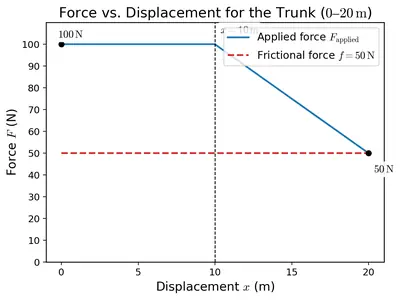
A woman pushes a trunk on a railway platform which has a rough surface. She applies a force of $$100 \, \mathrm{N}$$ over a distance of $$10 \, \mathrm{m}$$. Thereafter, she gets progressively tired and her applied force reduces linearly with distance to $$50 \, \mathrm{N}$$. The total distance through which the trunk has been moved is $$20 \, \mathrm{m}$$. Plot the force applied by the woman and the frictional force, which is $$50 \, \mathrm{N}$$ versus displacement. Calculate the work done by the two forces over $$20 \, \mathrm{m}$$.
Figure
Figure

Solution

Description of the plot. On a graph of force (N) versus displacement $$x$$ (m):

  • The applied force $$F$$ is a horizontal line at $$+100\,\mathrm{N}$$ from $$x=0$$ to $$x=10\,\mathrm{m}$$, then drops linearly from $$+100\,\mathrm{N}$$ at $$x=10\,\mathrm{m}$$ to $$+50\,\mathrm{N}$$ at $$x=20\,\mathrm{m}$$.
  • The frictional force $$f$$ is a horizontal line at $$-50\,\mathrm{N}$$ (negative because it opposes the motion) from $$x=0$$ to $$x=20\,\mathrm{m}$$.

Work done by the woman = area under the $$F$$–$$x$$ graph between $$x=0$$ and $$x=20\,\mathrm{m}$$.

From $$0$$ to $$10\,\mathrm{m}$$ (rectangle):

$$W_1 = (100)(10) = 1000\,\mathrm{J}$$

From $$10$$ to $$20\,\mathrm{m}$$ the force decreases linearly from $$100\,\mathrm{N}$$ to $$50\,\mathrm{N}$$ (trapezium):

$$W_2 = \dfrac{1}{2}(100 + 50)(20 - 10) = \dfrac{1}{2}(150)(10) = 750\,\mathrm{J}$$

Total work done by the woman:

$$W_{F} = W_1 + W_2 = 1000 + 750 = 1750\,\mathrm{J}$$

Work done by friction (acts opposite to displacement of $$20\,\mathrm{m}$$):

$$W_f = -(50)(20) = -1000\,\mathrm{J}$$

Answer

Work done by the woman $$= +1750\,\mathrm{J}$$; work done by friction $$= -1000\,\mathrm{J}$$.

Example 5.6 A block of mass $$m = 1 \, \mathrm{kg}$$, moving on a horizontal surface with speed $$v_i = 2 \, \mathrm{m\,s^{-1}}$$ enters a rough patch ranging from $$x = 0.10 \, \mathrm{m}$$ to $$x = 2.01 \, \mathrm{m}$$. The retarding force $$F_r$$ on the block in this range is inversely proportional to $$x$$ over this range,
$$F_r = \dfrac{-k}{x}$$ for $$0.1 < x < 2.01 \, \mathrm{m}$$
$$= 0$$ for $$x < 0.1 \, \mathrm{m}$$ and $$x > 2.01 \, \mathrm{m}$$
where $$k = 0.5 \, \mathrm{J}$$. What is the final kinetic energy and speed $$v_f$$ of the block as it crosses this patch?

Solution

Initial kinetic energy:

$$K_i = \dfrac{1}{2}mv_i^2 = \dfrac{1}{2}(1)(2)^2 = 2\,\mathrm{J}$$

The retarding force is variable. Work done by it as the block moves from $$x = 0.1\,\mathrm{m}$$ to $$x = 2.01\,\mathrm{m}$$:

$$W_r = \int_{0.1}^{2.01} F_r\,dx = \int_{0.1}^{2.01}\!\left(-\dfrac{k}{x}\right) dx = -k\,[\ln x]_{0.1}^{2.01}$$

$$W_r = -k\,\ln\!\left(\dfrac{2.01}{0.1}\right) = -(0.5)\,\ln(20.1)$$

$$\ln(20.1) \approx 3.00 \;\Rightarrow\; W_r \approx -(0.5)(3.00) = -1.5\,\mathrm{J}$$

Outside the rough patch the retarding force is zero, so the only work on the block from start to finish is $$W_r$$. By the work–energy theorem,

$$K_f = K_i + W_r = 2 - 1.5 = 0.5\,\mathrm{J}$$

Finally,

$$\dfrac{1}{2}mv_f^2 = K_f \;\Rightarrow\; v_f = \sqrt{\dfrac{2K_f}{m}} = \sqrt{\dfrac{2(0.5)}{1}} = 1\,\mathrm{m\,s^{-1}}$$

Answer

$$K_f = 0.5\,\mathrm{J}$$, $$v_f = 1\,\mathrm{m\,s^{-1}}$$.

Example 5.7

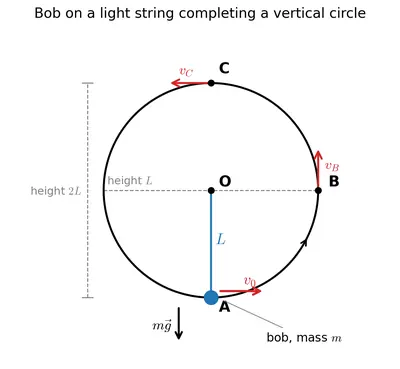
A bob of mass $$m$$ is suspended by a light string of length $$L$$. It is imparted a horizontal velocity $$v_o$$ at the lowest point A such that it completes a semi-circular trajectory in the vertical plane with the string becoming slack only on reaching the topmost point, C. This is shown in Fig. 5.6. Obtain an expression for (i) $$v_o$$; (ii) the speeds at points B and C; (iii) the ratio of the kinetic energies $$(K_B/K_C)$$ at B and C. Comment on the nature of the trajectory of the bob after it reaches the point C.
Fig. 5.6 — a bob on a string of length L tracing a vertical circle, with points A (bottom), B (side) and C (top) marked and the velocity v_o, weight mg and tension T shown.

Solution

Take A (lowest point) as the reference for potential energy. Then the heights of B (horizontal level of the support) and C (topmost point) above A are $$L$$ and $$2L$$ respectively.

Condition at C — string just goes slack. At C the centripetal acceleration is directed downward (toward the centre of the circle). Both gravity $$mg$$ and tension $$T_C$$ point downward, so the centripetal equation is

$$T_C + mg = \dfrac{mv_C^2}{L}$$

The string becomes slack precisely when $$T_C = 0$$, giving

$$mg = \dfrac{mv_C^2}{L} \;\Rightarrow\; v_C^2 = gL$$

(i) Speed at A. Mechanical energy conservation between A and C:

$$\dfrac{1}{2}mv_o^2 = \dfrac{1}{2}mv_C^2 + mg(2L)$$

$$v_o^2 = v_C^2 + 4gL = gL + 4gL = 5gL$$

$$\boxed{\,v_o = \sqrt{5gL}\,}$$

(ii) Speeds at B and C. For B, conservation of energy between A and B (height of B above A is $$L$$):

$$\dfrac{1}{2}mv_o^2 = \dfrac{1}{2}mv_B^2 + mgL$$

$$v_B^2 = v_o^2 - 2gL = 5gL - 2gL = 3gL \;\Rightarrow\; v_B = \sqrt{3gL}$$

And from above, $$v_C = \sqrt{gL}$$.

(iii) Ratio of kinetic energies.

$$\dfrac{K_B}{K_C} = \dfrac{\tfrac{1}{2}mv_B^2}{\tfrac{1}{2}mv_C^2} = \dfrac{v_B^2}{v_C^2} = \dfrac{3gL}{gL} = 3$$

Trajectory after C. At C the string becomes slack, so the bob is no longer constrained. It then moves under gravity alone with an initial horizontal velocity $$v_C = \sqrt{gL}$$ — i.e. it undergoes projectile motion (parabolic path).

Answer

(i) $$v_o = \sqrt{5gL}$$. (ii) $$v_B = \sqrt{3gL}$$, $$v_C = \sqrt{gL}$$. (iii) $$K_B/K_C = 3$$. After C the bob moves as a projectile under gravity.

Example 5.8 To simulate car accidents, auto manufacturers study the collisions of moving cars with mounted springs of different spring constants. Consider a typical simulation with a car of mass $$1000 \, \mathrm{kg}$$ moving with a speed $$18.0 \, \mathrm{km/h}$$ on a smooth road and colliding with a horizontally mounted spring of spring constant $$5.25 \times 10^3 \, \mathrm{N\,m^{-1}}$$. What is the maximum compression of the spring?

Solution

Convert the speed to SI units:

$$v = 18.0\,\mathrm{km/h} = \dfrac{18 \times 1000}{3600}\,\mathrm{m\,s^{-1}} = 5\,\mathrm{m\,s^{-1}}$$

The road is smooth, so the only horizontal force doing work on the car is the spring force. At the instant of maximum compression $$x_m$$, the car is momentarily at rest. All the initial kinetic energy is stored in the spring:

$$\dfrac{1}{2}mv^2 = \dfrac{1}{2}k\,x_m^2$$

Solving for $$x_m$$:

$$x_m = v\sqrt{\dfrac{m}{k}} = 5 \times \sqrt{\dfrac{1000}{5.25\times 10^3}}$$

$$x_m = 5 \times \sqrt{0.1905} = 5 \times 0.4365 \approx 2.18\,\mathrm{m}$$

Answer

$$x_m \approx 2.18\,\mathrm{m}$$.

Example 5.9 Consider Example 5.8 taking the coefficient of friction, $$\mu$$, to be 0.5 and calculate the maximum compression of the spring.

Solution

Now the friction force $$f = \mu mg$$ acts opposite to the motion throughout the compression $$x_m$$. The work–energy theorem (from initial state with speed $$v$$ to the moment of maximum compression where speed is zero) becomes:

$$\Delta K = W_{\text{spring}} + W_{\text{friction}}$$

$$0 - \dfrac{1}{2}mv^2 = -\dfrac{1}{2}kx_m^2 - \mu mg\,x_m$$

Rearranging,

$$\dfrac{1}{2}kx_m^2 + \mu mg\,x_m - \dfrac{1}{2}mv^2 = 0$$

Plug in $$m=1000\,\mathrm{kg}$$, $$v=5\,\mathrm{m\,s^{-1}}$$, $$k=5.25\times 10^{3}\,\mathrm{N\,m^{-1}}$$, $$\mu = 0.5$$, $$g=9.8\,\mathrm{m\,s^{-2}}$$:

$$\dfrac{1}{2}(5250)\,x_m^2 + (0.5)(1000)(9.8)\,x_m - \dfrac{1}{2}(1000)(25) = 0$$

$$2625\,x_m^2 + 4900\,x_m - 12500 = 0$$

Using the quadratic formula:

$$x_m = \dfrac{-4900 + \sqrt{4900^2 + 4(2625)(12500)}}{2(2625)} = \dfrac{-4900 + \sqrt{1.5526\times 10^{8}}}{5250}$$

$$x_m = \dfrac{-4900 + 12460}{5250} \approx \dfrac{7560}{5250} \approx 1.44\,\mathrm{m}$$

The compression is smaller than in Example 5.8 (2.18 m) because some kinetic energy has now been dissipated by friction.

Answer

$$x_m \approx 1.44\,\mathrm{m}$$.

Example 5.10 An elevator can carry a maximum load of $$1800 \, \mathrm{kg}$$ (elevator + passengers) is moving up with a constant speed of $$2 \, \mathrm{m\,s^{-1}}$$. The frictional force opposing the motion is $$4000 \, \mathrm{N}$$. Determine the minimum power delivered by the motor to the elevator in watts as well as in horse power.

Solution

The elevator moves up at constant velocity, so its acceleration is zero — i.e. the net force on it is zero. The motor must exert an upward force $$F$$ that balances both the weight and the friction:

$$F = mg + f = (1800)(9.8) + 4000 = 17640 + 4000 = 21640\,\mathrm{N}$$

The power delivered by the motor at speed $$v = 2\,\mathrm{m\,s^{-1}}$$:

$$P = F\,v = (21640)(2) = 43280\,\mathrm{W} \approx 43.3\,\mathrm{kW}$$

Using $$1\,\mathrm{hp} = 746\,\mathrm{W}$$,

$$P = \dfrac{43280}{746} \approx 58.0\,\mathrm{hp}$$

Answer

$$P \approx 43\,280\,\mathrm{W} \approx 58\,\mathrm{hp}$$.

Example 5.11 Slowing down of neutrons: In a nuclear reactor a neutron of high speed (typically $$10^7 \, \mathrm{m\,s^{-1}}$$) must be slowed to $$10^3 \, \mathrm{m\,s^{-1}}$$ so that it can have a high probability of interacting with isotope $$\mathrm{^{235}_{92}U}$$ and causing it to fission. Show that a neutron can lose most of its kinetic energy in an elastic collision with a light nuclei like deuterium or carbon which has a mass of only a few times the neutron mass. The material making up the light nuclei, usually heavy water ($$\mathrm{D_2O}$$) or graphite, is called a moderator.

Solution

Consider a 1-D elastic collision: a neutron of mass $$m_1$$ with initial speed $$v_{1i}$$ strikes a stationary moderator nucleus of mass $$m_2$$. For an elastic collision (conserving both momentum and kinetic energy), the standard results are

$$v_{1f} = \dfrac{m_1 - m_2}{m_1 + m_2}\,v_{1i}, \qquad v_{2f} = \dfrac{2m_1}{m_1 + m_2}\,v_{1i}$$

The fraction of initial kinetic energy retained by the neutron is

$$\dfrac{K_{1f}}{K_{1i}} = \left(\dfrac{v_{1f}}{v_{1i}}\right)^{\!2} = \left(\dfrac{m_1 - m_2}{m_1 + m_2}\right)^{\!2}$$

The fraction transferred to the moderator nucleus is

$$f = \dfrac{K_{2f}}{K_{1i}} = 1 - \left(\dfrac{m_1 - m_2}{m_1 + m_2}\right)^{\!2} = \dfrac{4\,m_1 m_2}{(m_1 + m_2)^2}$$

For two specific moderators (taking $$m_1 = 1\,\mathrm{u}$$ for the neutron):

Deuterium ($$m_2 = 2\,\mathrm{u}$$):

$$f_D = \dfrac{4(1)(2)}{(1+2)^2} = \dfrac{8}{9} \approx 0.89$$

So about 89% of the neutron's kinetic energy is lost in a single head-on elastic collision with a deuteron.

Carbon ($$m_2 = 12\,\mathrm{u}$$):

$$f_C = \dfrac{4(1)(12)}{(1+12)^2} = \dfrac{48}{169} \approx 0.28$$

About 28% lost per collision with carbon. Note that $$f$$ is maximised when $$m_2 = m_1$$ (giving $$f=1$$, i.e. complete energy transfer). For a very heavy nucleus like uranium ($$m_2 \gg m_1$$) the neutron barely loses any energy — which is why light nuclei (D, C) are used as moderators. After several collisions, the neutron's speed drops from $$\sim 10^7$$ to thermal speeds ($$\sim 10^3$$) at which fission probability is high.

Answer

Fraction of KE transferred $$= \dfrac{4m_1m_2}{(m_1+m_2)^2}$$, which is $$\approx 89\%$$ per collision with deuterium and $$\approx 28\%$$ with carbon — light nuclei rapidly thermalise the neutron.

Example 5.12

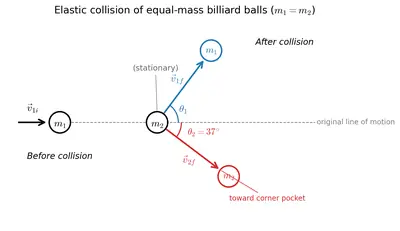
Consider the collision depicted in Fig. 5.10 to be between two billiard balls with equal masses $$m_1 = m_2$$. The first ball is called the cue while the second ball is called the target. The billiard player wants to 'sink' the target ball in a corner pocket, which is at an angle $$\theta_2 = 37^\circ$$. Assume that the collision is elastic and that friction and rotational motion are not important. Obtain $$\theta_1$$.
Fig. 5.10 — collision of a moving mass m1 (velocity v1i) with a stationary mass m2, the two flying off at angles theta1 and theta2 with final velocities v1f and v2f.

Solution

Let the cue ball, moving with speed $$v_1$$, strike the stationary target ball. After the collision, the cue moves with speed $$v_1'$$ at angle $$\theta_1$$ above the original line and the target moves with speed $$v_2'$$ at angle $$\theta_2$$ below it. Since $$m_1 = m_2 = m$$:

Momentum conservation (resolve along and perpendicular to the original direction):

$$m v_1 = m v_1'\cos\theta_1 + m v_2'\cos\theta_2 \quad\text{(along)}$$

$$0 = m v_1'\sin\theta_1 - m v_2'\sin\theta_2 \quad\text{(perpendicular)}$$

Kinetic energy conservation (elastic collision):

$$\dfrac{1}{2}mv_1^2 = \dfrac{1}{2}mv_1'^2 + \dfrac{1}{2}mv_2'^2 \;\Rightarrow\; v_1^2 = v_1'^2 + v_2'^2 \quad (*)$$

Now square the two momentum equations (cancelling $$m$$):

$$v_1 = v_1'\cos\theta_1 + v_2'\cos\theta_2$$

$$0 = v_1'\sin\theta_1 - v_2'\sin\theta_2$$

Squaring and adding:

$$v_1^2 = v_1'^2 + v_2'^2 + 2 v_1' v_2'(\cos\theta_1\cos\theta_2 - \sin\theta_1\sin\theta_2)$$

$$v_1^2 = v_1'^2 + v_2'^2 + 2 v_1' v_2'\cos(\theta_1 + \theta_2)$$

Comparing with $$(*)$$, the cross term must vanish:

$$2 v_1' v_2' \cos(\theta_1 + \theta_2) = 0$$

Assuming both balls are moving after the collision ($$v_1', v_2' \ne 0$$),

$$\cos(\theta_1 + \theta_2) = 0 \;\Rightarrow\; \theta_1 + \theta_2 = 90^\circ$$

That is, for an elastic collision between equal masses (with one initially at rest), the two outgoing velocities are perpendicular. Hence,

$$\theta_1 = 90^\circ - 37^\circ = 53^\circ$$

Answer

$$\theta_1 = 53^\circ$$ (so that $$\theta_1 + \theta_2 = 90^\circ$$).

Exercises

5.1 The sign of work done by a force on a body is important to understand. State carefully if the following quantities are positive or negative:

(a) work done by a man in lifting a bucket out of a well by means of a rope tied to the bucket.

Solution

The man exerts an upward force on the rope (and hence on the bucket) and the bucket moves upward. The force and displacement are in the same direction, so

$$W = F\,s\cos 0^\circ = +Fs > 0$$

Hence the work done is positive.

Answer

Positive.

(b) work done by gravitational force in the above case,

Solution

Gravity acts vertically downward on the bucket, while the displacement of the bucket is vertically upward. The angle between $$\mathbf{F}_g$$ and $$\mathbf{s}$$ is $$180^\circ$$, so

$$W_g = mg\,s\cos 180^\circ = -mgs < 0$$

The work done by gravity is negative.

Answer

Negative.

(c) work done by friction on a body sliding down an inclined plane,

Solution

Kinetic friction always opposes the relative motion. When the body slides down the incline, friction acts up the incline while the displacement is down. The angle between friction and displacement is $$180^\circ$$, so

$$W_f = f\,s\cos 180^\circ = -fs < 0$$

The work done by friction is negative.

Answer

Negative.

(d) work done by an applied force on a body moving on a rough horizontal plane with uniform velocity,

Solution

For the body to move with uniform velocity on a rough surface, the applied force must exactly balance the (kinetic) friction. Hence the applied force is directed along the displacement, with the angle between $$\mathbf{F}$$ and $$\mathbf{s}$$ equal to $$0^\circ$$:

$$W = F\,s\cos 0^\circ = +Fs > 0$$

The work done by the applied force is positive. (The work done by friction is equal in magnitude and opposite in sign, making the net work zero — consistent with zero change in kinetic energy.)

Answer

Positive.

(e) work done by the resistive force of air on a vibrating pendulum in bringing it to rest.

Solution

Air resistance acts on the bob in a direction opposite to its instantaneous velocity (and hence opposite to its instantaneous displacement). The angle between $$\mathbf{F}_{\text{air}}$$ and $$d\mathbf{s}$$ is $$180^\circ$$ at every instant, so the elementary work $$dW = \mathbf{F}_{\text{air}}\cdot d\mathbf{s} < 0$$ everywhere. The total work is therefore negative — that is exactly why the pendulum loses kinetic energy and eventually stops.

Answer

Negative.

5.2 A body of mass $$2 \, \mathrm{kg}$$ initially at rest moves under the action of an applied horizontal force of $$7 \, \mathrm{N}$$ on a table with coefficient of kinetic friction = $$0.1$$. Compute the

(a) work done by the applied force in $$10 \, \mathrm{s}$$,

Solution

Setup. Mass $$m = 2\,\mathrm{kg}$$, applied force $$F = 7\,\mathrm{N}$$ (horizontal), $$\mu_k = 0.1$$. Normal reaction $$N = mg = 2 \times 9.8 = 19.6\,\mathrm{N}$$. Frictional force

$$f = \mu_k N = (0.1)(19.6) = 1.96\,\mathrm{N}$$

Net horizontal force $$F_{\text{net}} = F - f = 7 - 1.96 = 5.04\,\mathrm{N}$$, giving acceleration

$$a = \dfrac{F_{\text{net}}}{m} = \dfrac{5.04}{2} = 2.52\,\mathrm{m\,s^{-2}}$$

Starting from rest, in $$t = 10\,\mathrm{s}$$ the body travels

$$s = \dfrac{1}{2}at^2 = \dfrac{1}{2}(2.52)(10)^2 = 126\,\mathrm{m}$$

Work done by the applied force (along the direction of motion):

$$W_F = F\,s = (7)(126) = 882\,\mathrm{J}$$

Answer

$$W_F = 882\,\mathrm{J}$$.

(b) work done by friction in $$10 \, \mathrm{s}$$,

Solution

Friction opposes motion. Using $$f = 1.96\,\mathrm{N}$$ and $$s = 126\,\mathrm{m}$$ from part (a):

$$W_f = -f\,s = -(1.96)(126) \approx -247\,\mathrm{J}$$

Answer

$$W_f \approx -247\,\mathrm{J}$$.

(c) work done by the net force on the body in $$10 \, \mathrm{s}$$,

Solution

The net force is $$F_{\text{net}} = 5.04\,\mathrm{N}$$ and the displacement is $$s = 126\,\mathrm{m}$$ (both from part (a)). Hence

$$W_{\text{net}} = F_{\text{net}}\,s = (5.04)(126) \approx 635\,\mathrm{J}$$

This may also be obtained as $$W_F + W_f = 882 - 247 = 635\,\mathrm{J}$$.

Answer

$$W_{\text{net}} \approx 635\,\mathrm{J}$$.

(d) change in kinetic energy of the body in $$10 \, \mathrm{s}$$,
and interpret your results.

Solution

The body starts from rest, so the change in kinetic energy after 10 s equals the final kinetic energy:

$$v = u + at = 0 + (2.52)(10) = 25.2\,\mathrm{m\,s^{-1}}$$

$$\Delta K = \dfrac{1}{2}mv^2 - 0 = \dfrac{1}{2}(2)(25.2)^2 \approx 635\,\mathrm{J}$$

Interpretation. The change in kinetic energy ($$\approx 635\,\mathrm{J}$$) equals the work done by the net force computed in part (c). This is precisely the work–energy theorem:

$$W_{\text{net}} = \Delta K$$

It is the work done by the net force — not by any single force — that equals the change in kinetic energy.

Answer

$$\Delta K \approx 635\,\mathrm{J}$$, equal to the net work — verifying the work–energy theorem.

5.3

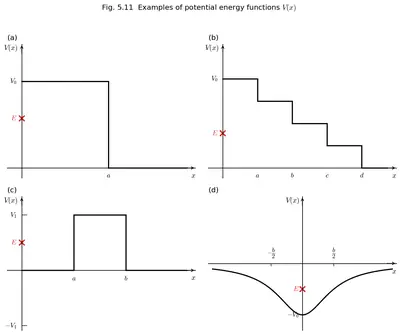
Given in Fig. 5.11 are examples of some potential energy functions in one dimension. The total energy of the particle is indicated by a cross on the ordinate axis. In each case, specify the regions, if any, in which the particle cannot be found for the given energy. Also, indicate the minimum total energy the particle must have in each case. Think of simple physical contexts for which these potential energy shapes are relevant.
Fig. 5.11 — examples of one-dimensional potential energy functions V(x), each with the total energy E marked by a cross on the ordinate axis.

Solution

General principle. The total mechanical energy is $$E = K + V(x)$$ where the kinetic energy $$K = \tfrac{1}{2}mv^{2} \ge 0$$. Hence at every point a classical particle can occupy we must have

$$V(x) \le E.$$

The particle is forbidden in regions where $$V(x) > E$$. The minimum total energy is the global minimum of $$V(x)$$ — any smaller $$E$$ leaves no point at which $$K \ge 0$$.

(a) Single step: $$V = 0$$ for $$x < a$$, $$V = V_{0}$$ for $$x \ge a$$, with the cross marking an $$E < V_{0}$$.

Forbidden region: $$x \ge a$$ (there $$V_{0} > E$$).
Minimum total energy: $$E_{\min} = 0$$ (the global minimum of $$V$$).
Physical context: a body moving on a flat surface that meets a steep vertical step it cannot climb (a ball rolling toward a wall too high to surmount).

(b) Step both ways: $$V = V_{0}$$ everywhere except over a small range, with the cross at $$E < V_{0}$$.

Forbidden region: everywhere on the diagram — the particle cannot exist anywhere because $$V(x) > E$$ at every point.
Minimum total energy: $$E_{\min} = V_{0}$$ (the minimum of $$V$$ on this diagram).
Physical context: a particle which has insufficient energy to penetrate any of the potential plateaus (a body confined outside a closed barrier).

(c) Square well of depth $$V_{1}$$: $$V = V_{0}$$ for $$x < a$$ and $$x > b$$, $$V = -V_{1}$$ for $$a \le x \le b$$, with the cross at $$E$$ in the range $$-V_{1} < E < 0 < V_{0}$$.

Forbidden regions: $$x < a$$ and $$x > b$$ (in both, $$V_{0} > E$$).
Minimum total energy: $$E_{\min} = -V_{1}$$ (the bottom of the well).
Physical context: a particle trapped in a finite potential well — classical analogue of a molecule bound in a potential trough or a ball confined inside a rigid box.

(d) Symmetric pair of barriers: $$V = -V_{1}$$ for $$|x| < a/2$$, $$V = V_{0}$$ for $$a/2 \le |x| \le b/2$$, $$V = -V_{1}$$ outside, with the cross at $$E$$ in the range $$-V_{1} < E < V_{0}$$.

Forbidden regions: the two barrier ranges $$-b/2 < x < -a/2$$ and $$a/2 < x < b/2$$ (there $$V_{0} > E$$).
Minimum total energy: $$E_{\min} = -V_{1}$$ (the floor of each well).
Physical context: two adjacent potential wells separated by a barrier the particle cannot climb — analogous to two bound states of a double-well potential.

Answer

(a) Forbidden: $$x \ge a$$. $$E_{\min}=0$$.
(b) Forbidden everywhere ($$E < V$$ throughout). $$E_{\min}=V_{0}$$.
(c) Forbidden: $$x < a$$ and $$x > b$$. $$E_{\min}=-V_{1}$$.
(d) Forbidden: $$-b/2 < x < -a/2$$ and $$a/2 < x < b/2$$. $$E_{\min}=-V_{1}$$.

5.4

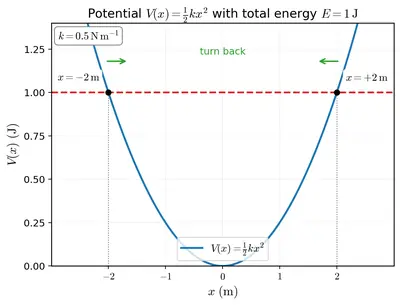
The potential energy function for a particle executing linear simple harmonic motion is given by $$V(x) = kx^2/2$$, where $$k$$ is the force constant of the oscillator. For $$k = 0.5 \, \mathrm{N\,m^{-1}}$$, the graph of $$V(x)$$ versus $$x$$ is shown in Fig. 5.12. Show that a particle of total energy $$1 \, \mathrm{J}$$ moving under this potential must 'turn back' when it reaches $$x = \pm 2 \, \mathrm{m}$$.
Fig. 5.12 — parabolic graph of the potential energy V(x) = kx^2/2 versus x for a linear simple harmonic oscillator, with the total energy shown as a horizontal dashed line.

Solution

The total mechanical energy is

$$E = K + V = \dfrac{1}{2}mv^2 + \dfrac{1}{2}kx^2$$

Since the kinetic energy must satisfy $$K \ge 0$$, the particle is allowed only in regions where

$$V(x) \le E \;\Rightarrow\; \dfrac{1}{2}kx^2 \le E$$

The turning points are the values of $$x$$ where $$V(x) = E$$ (so that $$K = 0$$, i.e. the particle is momentarily at rest):

$$\dfrac{1}{2}kx^2 = E \;\Rightarrow\; x = \pm\sqrt{\dfrac{2E}{k}}$$

Substituting $$E = 1\,\mathrm{J}$$ and $$k = 0.5\,\mathrm{N\,m^{-1}}$$:

$$x = \pm\sqrt{\dfrac{2 \times 1}{0.5}} = \pm\sqrt{4} = \pm 2\,\mathrm{m}$$

For $$|x| > 2\,\mathrm{m}$$ we would need $$K < 0$$, which is impossible. Hence the particle must reverse its motion (turn back) exactly when it reaches $$x = \pm 2\,\mathrm{m}$$, as required.

Answer

Turning points where $$V(x) = E$$, i.e. $$\tfrac{1}{2}(0.5)x^2 = 1 \Rightarrow x = \pm 2\,\mathrm{m}$$. Beyond this, $$K < 0$$ which is impossible, so the particle turns back.

5.5

Answer the following:
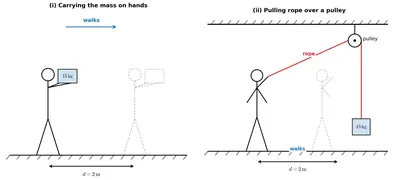
Fig. 5.13 — two cases: (i) a man walking while carrying a 15 kg mass on his hands, and (ii) a man walking while pulling a rope over a pulley with a 15 kg mass hanging at the other end.

(a) The casing of a rocket in flight burns up due to friction. At whose expense is the heat energy required for burning obtained? The rocket or the atmosphere?

Solution

The atmosphere is essentially at rest (or moves very slowly) compared with the rocket, while the rocket is moving very fast. The frictional/drag force between them does negative work on the rocket, decreasing its kinetic energy; the same force does negligible work on the atmosphere because the atmosphere's bulk displacement is negligible. The dissipated mechanical energy appears as heat, which is what burns the rocket's casing.

Hence the heat for burning is obtained at the expense of the rocket's own (kinetic) energy, not the atmosphere's.

Answer

At the expense of the rocket (its kinetic energy is dissipated as heat by air resistance).

(b) Comets move around the sun in highly elliptical orbits. The gravitational force on the comet due to the sun is not normal to the comet's velocity in general. Yet the work done by the gravitational force over every complete orbit of the comet is zero. Why?

Solution

Gravitational force is a conservative force. For any conservative force the work done depends only on the initial and final positions, not on the path taken. Equivalently, the work done by a conservative force around any closed path is zero:

$$\oint \mathbf{F}_g \cdot d\mathbf{r} = 0$$

In one complete orbit the comet returns to its starting point — so the closed-path integral above is zero, regardless of whether $$\mathbf{F}_g$$ is perpendicular to the instantaneous velocity at any specific instant. (Equivalently, the comet returns to the same gravitational potential energy, so $$\Delta U = 0$$, which by the work–energy relation for a conservative force gives $$W = -\Delta U = 0$$.)

Answer

Because gravity is conservative — work over any closed path is zero.

(c) An artificial satellite orbiting the earth in very thin atmosphere loses its energy gradually due to dissipation against atmospheric resistance, however small. Why then does its speed increase progressively as it comes closer and closer to the earth?

Solution

For a satellite of mass $$m$$ in a (nearly) circular orbit of radius $$r$$ around the Earth (mass $$M$$),

$$K = \dfrac{GMm}{2r}, \qquad U = -\dfrac{GMm}{r}, \qquad E = K + U = -\dfrac{GMm}{2r}$$

As the satellite loses mechanical energy to air drag, the total energy $$E$$ becomes more negative — i.e. $$|E|$$ increases. Since $$|E| = \dfrac{GMm}{2r}$$, this forces $$r$$ to decrease.

But the kinetic energy is $$K = |E| = \dfrac{GMm}{2r}$$, which therefore increases as $$r$$ decreases. A larger $$K$$ means a larger speed. The increase in $$K$$ is greater (in magnitude) than the loss to friction, because $$|U|$$ increases by twice as much as $$K$$ does. (Virial theorem: half of the gravitational potential energy lost is dissipated as heat, the other half goes into extra kinetic energy.)

Answer

Because the satellite's total energy becomes more negative as it spirals inward, the orbit radius shrinks, and $$K = -E$$ grows — so speed increases despite the dissipation.

(d) In Fig. 5.13(i) the man walks $$2 \, \mathrm{m}$$ carrying a mass of $$15 \, \mathrm{kg}$$ on his hands. In Fig. 5.13(ii), he walks the same distance pulling the rope behind him. The rope goes over a pulley, and a mass of $$15 \, \mathrm{kg}$$ hangs at its other end. In which case is the work done greater?

Solution

Case (i) — The man holds the mass; he applies an upward force $$F = mg$$ on the mass, but the mass moves horizontally. The force is perpendicular to the displacement, so

$$W_{(i)} = Fs\cos 90^\circ = 0$$

Case (ii) — As the man walks $$2\,\mathrm{m}$$ pulling the rope, the rope on his side moves $$2\,\mathrm{m}$$ horizontally; this raises the hanging mass through $$2\,\mathrm{m}$$ vertically. He must pull the rope with tension $$T = mg$$ (the rope being light and the pulley smooth). The force and displacement of the rope are aligned, so

$$W_{(ii)} = mgh = (15)(9.8)(2) = 294\,\mathrm{J}$$

Hence the work done in case (ii) is greater.

Answer

Case (ii) — work $$\approx 294\,\mathrm{J}$$ (the mass is lifted), whereas in case (i) the force is perpendicular to displacement and the work is $$0$$.

5.6 Underline the correct alternative:

(a) When a conservative force does positive work on a body, the potential energy of the body increases/decreases/remains unaltered.

Solution

For a conservative force, the work done equals the negative change in potential energy:

$$W = -\Delta U$$

If $$W > 0$$, then $$\Delta U < 0$$, i.e. $$U$$ decreases. (Example: as gravity does positive work on a falling body, its gravitational PE decreases.)

Correct alternative: decreases.

Answer

Decreases.

(b) Work done by a body against friction always results in a loss of its kinetic/potential energy.

Solution

Friction does negative work on a moving body. By the work–energy theorem this work equals the change in kinetic energy:

$$W_{\text{friction}} = \Delta K < 0$$

So $$K$$ decreases. Friction does not directly take potential energy away (PE only changes when conservative forces do work).

Correct alternative: kinetic.

Answer

Kinetic.

(c) The rate of change of total momentum of a many-particle system is proportional to the external force/sum of the internal forces on the system.

Solution

Internal forces between particles of the system occur in Newton-third-law pairs and sum to zero. The rate of change of total momentum of the system is therefore determined only by the external forces:

$$\dfrac{d\mathbf{P}_{\text{system}}}{dt} = \mathbf{F}_{\text{ext, net}}$$

Correct alternative: external force.

Answer

External force.

(d) In an inelastic collision of two bodies, the quantities which do not change after the collision are the total kinetic energy/total linear momentum/total energy of the system of two bodies.

Solution

In any collision (elastic or inelastic), if no external impulsive force acts, the total linear momentum is conserved. In an inelastic collision, kinetic energy is not conserved — some of it converts to heat, sound, deformation energy, etc. However, the total energy (kinetic + potential + heat + sound + ...) is always conserved.

Correct alternative: total linear momentum and total energy of the system are unchanged.

Answer

Total linear momentum and total energy (but not total kinetic energy).

5.7 State if each of the following statements is true or false. Give reasons for your answer.

(a) In an elastic collision of two bodies, the momentum and energy of each body is conserved.

Solution

False. In an elastic collision the total momentum and the total kinetic energy of the two-body system are conserved. The momentum and kinetic energy of an individual body change — each body exchanges momentum and energy with the other through the collision force.

Answer

False — only the total momentum and total kinetic energy of the system are conserved, not those of each body individually.

(b) Total energy of a system is always conserved, no matter what internal and external forces on the body are present.

Solution

False. The total energy of a system is conserved only when no external force does work on it (i.e., the system is isolated). If external forces are present and do work, they can transfer energy into or out of the system, so the system's total energy changes by the amount of external work done:

$$\Delta E_{\text{system}} = W_{\text{ext}}$$

(It is the total energy of the universe — system plus surroundings — that is always conserved, not that of any particular system.)

Answer

False — the total energy of a system changes when external forces do work on it. Only the energy of an isolated system (or the universe as a whole) is always conserved.

(c) Work done in the motion of a body over a closed loop is zero for every force in nature.

Solution

False. Only conservative forces (gravity, the electrostatic force, the elastic force of a spring) have zero work over any closed path. Non-conservative forces (friction, viscous drag) always oppose relative motion, so over a closed loop they do net negative work — the energy is dissipated as heat.

Answer

False — true only for conservative forces; non-conservative forces (e.g. friction) do non-zero (negative) work over a closed loop.

(d) In an inelastic collision, the final kinetic energy is always less than the initial kinetic energy of the system.

Solution

True. By definition, an inelastic collision is one in which kinetic energy is not conserved. Some of the initial kinetic energy is converted to other forms (heat, sound, deformation energy of the bodies), so the total final kinetic energy is always less than the initial. (Note: this presumes ordinary collisions where no internal energy is liberated; in chemical or explosive collisions the final KE could exceed the initial.)

Answer

True (for ordinary inelastic collisions) — part of the initial kinetic energy is converted to heat, sound, or deformation.

5.8 Answer carefully, with reasons:

(a) In an elastic collision of two billiard balls, is the total kinetic energy conserved during the short time of collision of the balls (i.e. when they are in contact)?

Solution

No. During the brief contact, the balls deform each other elastically. Part of the kinetic energy is temporarily converted into elastic potential energy of deformation. Conservation of kinetic energy in an elastic collision is a statement that holds only between the initial state (before contact) and the final state (after contact), not at intermediate instants while the bodies are still deforming.

Answer

No — during contact, some KE is temporarily stored as elastic PE of deformation, so KE is not conserved at every instant of the collision.

(b) Is the total linear momentum conserved during the short time of an elastic collision of two balls?

Solution

Yes. The forces between the two balls during the collision are internal to the two-body system; by Newton's third law they are equal and opposite and sum to zero. So at every instant the rate of change of the system's total momentum is zero — the total linear momentum is conserved throughout the collision (not just before and after).

Answer

Yes — internal contact forces are equal and opposite, so the total linear momentum is conserved at every instant of the collision.

(c) What are the answers to (a) and (b) for an inelastic collision?

Solution

Total kinetic energy: not conserved — neither during the collision nor between the initial and final states. Part of the kinetic energy is lost permanently to heat, sound and deformation.

Total linear momentum: still conserved at every instant — the reasoning of (b) (Newton's third law for internal contact forces) does not depend on whether the collision is elastic or inelastic, as long as no external impulsive force acts during the collision.

Answer

Total linear momentum is still conserved at every instant; total kinetic energy is not conserved (it is not even conserved between the initial and final states).

(d) If the potential energy of two billiard balls depends only on the separation distance between their centres, is the collision elastic or inelastic? (Note, we are talking here of potential energy corresponding to the force during collision, not gravitational potential energy).

Solution

If $$U$$ depends only on the separation $$r$$, the force $$\mathbf{F} = -\dfrac{dU}{dr}\hat{\mathbf{r}}$$ is a central, conservative force. The balls return to their original separation after the collision, so $$\Delta U = 0$$, and there is no permanent loss of kinetic energy to other forms. Hence the collision is elastic.

Answer

Elastic — the interaction is conservative, so no kinetic energy is permanently lost.

5.9 A body is initially at rest. It undergoes one-dimensional motion with constant acceleration. The power delivered to it at time $$t$$ is proportional to

(i) $$t^{1/2}$$

Solution

With constant acceleration $$a$$ starting from rest, $$v = at$$ and the force $$F = ma$$ is constant. Power is

$$P = Fv = (ma)(at) = ma^2\,t$$

i.e. $$P \propto t$$, not $$t^{1/2}$$. Option (i) is incorrect.

Answer

Incorrect — power is proportional to $$t$$, not $$t^{1/2}$$.

(ii) $$t$$

Solution

Starting from rest with constant acceleration $$a$$, $$v(t) = at$$. The (constant) net force is $$F = ma$$. Hence the power delivered to the body is

$$P = Fv = (ma)(at) = ma^2\,t$$

So $$P \propto t$$. Option (ii) is correct.

Answer

Correct — $$P = ma^2\,t \propto t$$.

(iii) $$t^{3/2}$$

Solution

From $$P = Fv = ma^2 t$$ (see option (ii)), the time-dependence is linear in $$t$$, not $$t^{3/2}$$. Option (iii) is incorrect.

Answer

Incorrect.

(iv) $$t^2$$

Solution

From $$P = ma^2 t$$, the dependence is linear in $$t$$, not quadratic. Option (iv) is incorrect.

Answer

Incorrect.

5.10 A body is moving unidirectionally under the influence of a source of constant power. Its displacement in time $$t$$ is proportional to

(i) $$t^{1/2}$$

Solution

For constant power $$P$$, $$P = Fv = mv\dfrac{dv}{dt}$$, so $$v\,dv = \dfrac{P}{m}\,dt$$. Integrating from rest gives $$v \propto t^{1/2}$$, and

$$x = \int v\,dt \propto \int t^{1/2}\,dt \propto t^{3/2}$$

So displacement is proportional to $$t^{3/2}$$, not $$t^{1/2}$$. Option (i) is incorrect.

Answer

Incorrect — speed (not displacement) varies as $$t^{1/2}$$.

(ii) $$t$$

Solution

Under constant power $$P$$, from $$P = Fv = m\dfrac{dv}{dt}\,v$$ we get

$$mv\,dv = P\,dt.$$

Integrate with $$v=0$$ at $$t=0$$:

$$\dfrac{1}{2}mv^{2} = P t \;\Rightarrow\; v = \sqrt{\dfrac{2P}{m}}\, t^{1/2}.$$

Since $$v = dx/dt$$, integrate once more (with $$x=0$$ at $$t=0$$):

$$x = \sqrt{\dfrac{2P}{m}} \int_{0}^{t} t^{\,1/2}\,dt = \sqrt{\dfrac{2P}{m}} \cdot \dfrac{2}{3}\,t^{3/2}.$$

Hence $$x \propto t^{3/2}$$, NOT $$x \propto t$$. Option (ii) is incorrect.

Answer

Incorrect. Under constant power, $$x \propto t^{3/2}$$ (so a linear $$x \propto t$$ would require $$v$$ constant and hence $$F = 0$$, which contradicts non-zero power).

(iii) $$t^{3/2}$$

Solution

Constant power $$P$$ gives

$$P = mv\dfrac{dv}{dt} \;\Rightarrow\; \int_0^v v'\,dv' = \int_0^t \dfrac{P}{m}\,dt' \;\Rightarrow\; \dfrac{v^2}{2} = \dfrac{P\,t}{m}$$

$$v = \sqrt{\dfrac{2P}{m}}\,t^{1/2}$$

Integrating once more (with $$x(0)=0$$):

$$x = \int_0^t v\,dt' = \sqrt{\dfrac{2P}{m}}\cdot \dfrac{2}{3}\,t^{3/2}$$

So $$x \propto t^{3/2}$$. Option (iii) is correct.

Answer

Correct — $$x \propto t^{3/2}$$.

(iv) $$t^2$$

Solution

From the derivation in option (iii), $$x \propto t^{3/2}$$, not $$t^{2}$$. Option (iv) is incorrect.

Answer

Incorrect.

5.11 A body constrained to move along the z-axis of a coordinate system is subject to a constant force $$\mathbf{F}$$ given by
$$\mathbf{F} = -\hat{\mathbf{i}} + 2\hat{\mathbf{j}} + 3\hat{\mathbf{k}} \, \mathrm{N}$$
where $$\hat{\mathbf{i}}, \hat{\mathbf{j}}, \hat{\mathbf{k}}$$ are unit vectors along the $$x$$-, $$y$$- and $$z$$-axis of the system respectively. What is the work done by this force in moving the body a distance of $$4 \, \mathrm{m}$$ along the z-axis?

Solution

The body is constrained to move along the $$z$$-axis, so its displacement is

$$\mathbf{s} = 4\,\hat{\mathbf{k}}\,\mathrm{m}$$

The work done by the constant force $$\mathbf{F}$$ is the scalar product

$$W = \mathbf{F}\cdot\mathbf{s} = (-1)(0) + (2)(0) + (3)(4) = 12\,\mathrm{J}$$

Only the component of the force along the displacement (i.e. along $$\hat{\mathbf{k}}$$) contributes; the $$x$$- and $$y$$-components do no work because the body has no displacement in those directions.

Answer

$$W = 12\,\mathrm{J}$$.

5.12 An electron and a proton are detected in a cosmic ray experiment, the first with kinetic energy $$10 \, \mathrm{keV}$$, and the second with $$100 \, \mathrm{keV}$$. Which is faster, the electron or the proton? Obtain the ratio of their speeds. (electron mass = $$9.11 \times 10^{-31} \, \mathrm{kg}$$, proton mass = $$1.67 \times 10^{-27} \, \mathrm{kg}$$, $$1 \, \mathrm{eV} = 1.60 \times 10^{-19} \, \mathrm{J}$$).

Solution

Non-relativistic kinetic energy: $$K = \dfrac{1}{2}mv^2 \;\Rightarrow\; v = \sqrt{\dfrac{2K}{m}}$$. (Even for an electron with $$K = 10\,\mathrm{keV}$$, $$v \sim 6\times 10^7\,\mathrm{m\,s^{-1}} \ll c$$, so the classical formula is acceptable.)

Electron: $$K_e = 10\,\mathrm{keV} = 10^{4} \times 1.6\times 10^{-19} = 1.6\times 10^{-15}\,\mathrm{J}$$

$$v_e = \sqrt{\dfrac{2(1.6\times 10^{-15})}{9.11\times 10^{-31}}} = \sqrt{3.51\times 10^{15}} \approx 5.93\times 10^{7}\,\mathrm{m\,s^{-1}}$$

Proton: $$K_p = 100\,\mathrm{keV} = 10^{5} \times 1.6\times 10^{-19} = 1.6\times 10^{-14}\,\mathrm{J}$$

$$v_p = \sqrt{\dfrac{2(1.6\times 10^{-14})}{1.67\times 10^{-27}}} = \sqrt{1.916\times 10^{13}} \approx 4.38\times 10^{6}\,\mathrm{m\,s^{-1}}$$

The electron is faster — even though it carries less kinetic energy, its mass is about 1836 times smaller. The ratio of speeds is

$$\dfrac{v_e}{v_p} = \sqrt{\dfrac{K_e}{K_p}\cdot \dfrac{m_p}{m_e}} = \sqrt{\dfrac{10}{100}\cdot \dfrac{1.67\times 10^{-27}}{9.11\times 10^{-31}}}$$

$$= \sqrt{0.1 \times 1833.2} = \sqrt{183.3} \approx 13.5$$

So $$v_e : v_p \approx 13.5 : 1$$.

Answer

The electron is faster; $$v_e/v_p \approx 13.5$$.

5.13 A rain drop of radius $$2 \, \mathrm{mm}$$ falls from a height of $$500 \, \mathrm{m}$$ above the ground. It falls with decreasing acceleration (due to viscous resistance of the air) until at half its original height, it attains its maximum (terminal) speed, and moves with uniform speed thereafter. What is the work done by the gravitational force on the drop in the first and second half of its journey? What is the work done by the resistive force in the entire journey if its speed on reaching the ground is $$10 \, \mathrm{m\,s^{-1}}$$?

Solution

Mass of the drop. With radius $$r = 2\,\mathrm{mm} = 2\times 10^{-3}\,\mathrm{m}$$ and water density $$\rho = 1000\,\mathrm{kg\,m^{-3}}$$,

$$m = \dfrac{4}{3}\pi r^3 \rho = \dfrac{4}{3}\pi (2\times 10^{-3})^3(1000) = \dfrac{32\pi}{3}\times 10^{-6}\,\mathrm{kg} \approx 3.35\times 10^{-5}\,\mathrm{kg}$$

Work done by gravity. Gravity acts vertically downward, in the direction of motion, so over any vertical drop $$h$$:

$$W_g = mgh$$

First half: $$h_1 = 250\,\mathrm{m}$$,

$$W_{g,1} = (3.35\times 10^{-5})(9.8)(250) \approx 0.082\,\mathrm{J}$$

Second half: $$h_2 = 250\,\mathrm{m}$$,

$$W_{g,2} \approx 0.082\,\mathrm{J}$$

(The two are equal because gravity is independent of speed.)

Work done by the resistive force. Take initial speed to be zero (drop starts from rest) and final speed $$v = 10\,\mathrm{m\,s^{-1}}$$. By the work–energy theorem over the entire 500 m journey,

$$W_g + W_r = \Delta K = \dfrac{1}{2}mv^2 - 0$$

$$\dfrac{1}{2}mv^2 = \dfrac{1}{2}(3.35\times 10^{-5})(10)^2 \approx 1.675\times 10^{-3}\,\mathrm{J}$$

Total work by gravity = $$0.082 + 0.082 = 0.164\,\mathrm{J}$$. Hence

$$W_r = \Delta K - W_g = 1.675\times 10^{-3} - 0.164 \approx -0.162\,\mathrm{J}$$

The negative sign confirms that the resistive force opposes the motion (and dissipates most of the gravitational work as heat).

Answer

$$W_g \approx +0.082\,\mathrm{J}$$ in each half ($$\approx 0.164\,\mathrm{J}$$ total); $$W_r \approx -0.162\,\mathrm{J}$$ over the entire journey.

5.14 A molecule in a gas container hits a horizontal wall with speed $$200 \, \mathrm{m\,s^{-1}}$$ and angle $$30^\circ$$ with the normal, and rebounds with the same speed. Is momentum conserved in the collision? Is the collision elastic or inelastic?

Solution

Momentum. Resolve the molecule's velocity into a component normal to the wall and a component parallel to it:

$$v_\perp = v\cos 30^\circ, \qquad v_\parallel = v\sin 30^\circ$$

After rebound (same speed, mirror-reflected about the normal), the parallel component is unchanged while the normal component reverses sign. Hence the molecule's momentum does change — by $$\Delta p = 2 m v\cos 30^\circ$$ directed away from the wall — so momentum of the molecule alone is not conserved.

However, by Newton's third law the wall (and hence the container, which is effectively part of the molecule + wall system) receives an equal and opposite impulse. So for the closed system (molecule + wall) the total linear momentum is conserved. In this sense, momentum is conserved in the collision.

Energy. The molecule rebounds with the same speed, so its kinetic energy is unchanged:

$$K_f = \dfrac{1}{2}mv^2 = K_i$$

No kinetic energy is dissipated. The collision is therefore elastic.

Answer

Yes — total momentum of (molecule + wall) is conserved (the wall receives the equal-and-opposite impulse). The collision is elastic, because the molecule's speed (and hence its KE) is unchanged.

5.15 A pump on the ground floor of a building can pump up water to fill a tank of volume $$30 \, \mathrm{m^3}$$ in $$15 \, \mathrm{min}$$. If the tank is $$40 \, \mathrm{m}$$ above the ground, and the efficiency of the pump is 30%, how much electric power is consumed by the pump?

Solution

Mass of water to be lifted (water density $$\rho = 1000\,\mathrm{kg\,m^{-3}}$$):

$$m = \rho V = (1000)(30) = 30000\,\mathrm{kg}$$

Useful work done (in lifting the water through $$h = 40\,\mathrm{m}$$ against gravity):

$$W_{\text{useful}} = mgh = (30000)(9.8)(40) = 1.176\times 10^{7}\,\mathrm{J}$$

Time taken: $$t = 15\,\mathrm{min} = 900\,\mathrm{s}$$. Useful (mechanical) power:

$$P_{\text{useful}} = \dfrac{W_{\text{useful}}}{t} = \dfrac{1.176\times 10^{7}}{900} \approx 1.307\times 10^{4}\,\mathrm{W}$$

The efficiency is $$\eta = 30\% = 0.30$$. The electric power consumed is

$$P_{\text{electric}} = \dfrac{P_{\text{useful}}}{\eta} = \dfrac{1.307\times 10^{4}}{0.30} \approx 4.36\times 10^{4}\,\mathrm{W}$$

So the pump consumes about $$43.6\,\mathrm{kW}$$ of electric power.

Answer

$$P_{\text{electric}} \approx 4.36\times 10^{4}\,\mathrm{W} \approx 43.6\,\mathrm{kW}$$.

5.16

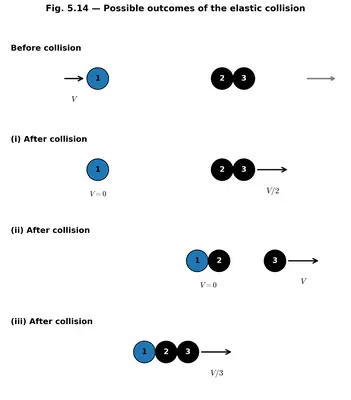
Two identical ball bearings in contact with each other and resting on a frictionless table are hit head-on by another ball bearing of the same mass moving initially with a speed $$V$$. If the collision is elastic, which of the following (Fig. 5.14) is a possible result after collision?
Fig. 5.14 — three possible outcomes (i), (ii), (iii) of a ball bearing striking two identical ball bearings in contact, showing different post-collision speeds.

Solution

Let each ball have mass $$m$$. Initial momentum and initial kinetic energy of the system:

$$p_i = mV, \qquad K_i = \dfrac{1}{2}mV^2$$

Check each option (only option (ii) is reproduced here, since options (i) and (iii) fail):

Option (i): ball 1 stops; balls 2 and 3 move together with speed $$V/2$$.

$$p_f = 0 + 2m\cdot \dfrac{V}{2} = mV \;\checkmark, \quad K_f = \dfrac{1}{2}(2m)\left(\dfrac{V}{2}\right)^{\!2} = \dfrac{mV^2}{4}$$

Since $$K_f = K_i/2 \ne K_i$$, kinetic energy is not conserved — not consistent with an elastic collision.

Option (ii): balls 1 and 2 remain at rest; ball 3 moves off with speed $$V$$.

$$p_f = mV \;\checkmark, \quad K_f = \dfrac{1}{2}mV^2 = K_i \;\checkmark$$

Both momentum and kinetic energy are conserved — this is consistent with an elastic collision.

Option (iii): all three balls move together with speed $$V/3$$.

$$p_f = (3m)\left(\dfrac{V}{3}\right) = mV \;\checkmark, \quad K_f = \dfrac{1}{2}(3m)\left(\dfrac{V}{3}\right)^{\!2} = \dfrac{mV^2}{6}$$

$$K_f \ne K_i$$, so kinetic energy is not conserved — not elastic.

Hence only option (ii) is a possible result of the elastic collision: the incoming ball 1 stops, ball 2 remains at rest, and ball 3 moves off with the initial speed $$V$$ — the momentum and energy are 'passed through' the middle ball.

Answer

Option (ii) is the only possibility — only this case conserves both momentum and kinetic energy (ball 1 stops, ball 2 stays at rest, ball 3 moves with $$V$$).

5.17

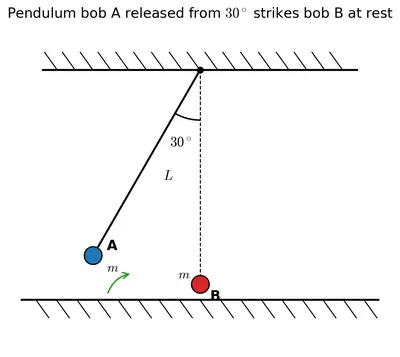
The bob A of a pendulum released from $$30^\circ$$ to the vertical hits another bob B of the same mass at rest on a table as shown in Fig. 5.15. How high does the bob A rise after the collision? Neglect the size of the bobs and assume the collision to be elastic.
Fig. 5.15 — a pendulum bob A released from 30 degrees to the vertical about to hit a bob B of equal mass resting on a table.

Solution

For an elastic one-dimensional collision between two equal masses, the standard result (target initially at rest) is

$$v_A' = \dfrac{m_A - m_B}{m_A + m_B}\,v_A = 0\,, \qquad v_B' = \dfrac{2m_A}{m_A + m_B}\,v_A = v_A$$

That is, the incoming ball A comes to rest and ball B moves off with the velocity that A had just before the collision. Since A has zero velocity immediately after the collision, it has zero kinetic energy and so cannot rise to any height — it simply remains at its lowest point.

Hence bob A rises to a height of $$0$$ after the collision.

(All of A's kinetic energy is transferred to B.)

Answer

Zero — for equal masses in an elastic collision, the incoming bob A stops dead and B carries off all the kinetic energy, so A does not rise at all.

5.18 The bob of a pendulum is released from a horizontal position. If the length of the pendulum is $$1.5 \, \mathrm{m}$$, what is the speed with which the bob arrives at the lowermost point, given that it dissipated 5% of its initial energy against air resistance?

Solution

Take the lowest point of the swing as the reference for potential energy. Released from the horizontal position, the bob falls through a height equal to the length of the pendulum, $$h = L = 1.5\,\mathrm{m}$$. The initial mechanical energy (entirely potential) is

$$E_i = mgh = mgL$$

5% of this is dissipated against air resistance; 95% is available as kinetic energy at the bottom:

$$\dfrac{1}{2}mv^2 = 0.95\,mgL$$

The mass cancels:

$$v = \sqrt{2 \times 0.95\,gL} = \sqrt{1.9 \times 9.8 \times 1.5}$$

$$v = \sqrt{27.93} \approx 5.28\,\mathrm{m\,s^{-1}}$$

Answer

$$v \approx 5.28\,\mathrm{m\,s^{-1}}$$.

5.19 A trolley of mass $$300 \, \mathrm{kg}$$ carrying a sandbag of $$25 \, \mathrm{kg}$$ is moving uniformly with a speed of $$27 \, \mathrm{km/h}$$ on a frictionless track. After a while, sand starts leaking out of a hole on the floor of the trolley at the rate of $$0.05 \, \mathrm{kg\,s^{-1}}$$. What is the speed of the trolley after the entire sand bag is empty?

Solution

Consider the trolley + sand as the system. As the sand leaks out, it falls vertically with respect to the trolley — it carries away exactly the horizontal velocity the trolley had at that instant. The leak does not exert any horizontal thrust on the trolley.

Since the track is frictionless and no external horizontal force acts on the trolley, the trolley's velocity is unchanged by the leaking process. (You can also see this from momentum conservation: the horizontal momentum of the falling sand equals the horizontal momentum it carried while on the trolley, so the trolley's momentum is unchanged.)

Therefore the speed of the trolley remains

$$v = 27\,\mathrm{km/h}$$

Answer

$$v = 27\,\mathrm{km/h}$$ (unchanged) — the leaking sand carries off its own horizontal momentum, exerting no horizontal force on the trolley.

5.20 A body of mass $$0.5 \, \mathrm{kg}$$ travels in a straight line with velocity $$v = a x^{3/2}$$ where $$a = 5 \, \mathrm{m^{-1/2}\,s^{-1}}$$. What is the work done by the net force during its displacement from $$x = 0$$ to $$x = 2 \, \mathrm{m}$$?

Solution

By the work–energy theorem, the work done by the net force equals the change in kinetic energy:

$$W_{\text{net}} = \Delta K = \dfrac{1}{2}mv_f^2 - \dfrac{1}{2}mv_i^2$$

Compute kinetic energy at each end using $$v = a x^{3/2}$$, i.e. $$v^2 = a^2 x^3$$:

At $$x = 0$$: $$v_i = 0 \Rightarrow K_i = 0$$.

At $$x = 2\,\mathrm{m}$$:

$$v_f^2 = (5)^2 (2)^3 = 25 \times 8 = 200\,\mathrm{m^2\,s^{-2}}$$

$$K_f = \dfrac{1}{2}(0.5)(200) = 50\,\mathrm{J}$$

Therefore

$$W_{\text{net}} = K_f - K_i = 50 - 0 = 50\,\mathrm{J}$$

Answer

$$W_{\text{net}} = 50\,\mathrm{J}$$.

5.21 The blades of a windmill sweep out a circle of area $$A$$.

(a) If the wind flows at a velocity $$v$$ perpendicular to the circle, what is the mass of the air passing through it in time $$t$$?

Solution

In a time $$t$$ the column of air that crosses the circular area $$A$$ is a cylinder of length $$vt$$ (the distance the wind travels) and cross-sectional area $$A$$. Its volume is $$Avt$$, and so its mass is

$$m = \rho\,V = \rho A v\,t$$

where $$\rho$$ is the density of air.

Answer

$$m = \rho A v\,t$$.

(b) What is the kinetic energy of the air?

Solution

Using the mass from part (a), the kinetic energy of the air that has passed through the blades in time $$t$$ is

$$K = \dfrac{1}{2}m v^2 = \dfrac{1}{2}(\rho A v\,t)\,v^2 = \dfrac{1}{2}\rho A v^3\,t$$

The corresponding rate at which kinetic energy is being delivered (i.e. the power available in the wind) is

$$P_{\text{wind}} = \dfrac{dK}{dt} = \dfrac{1}{2}\rho A v^3$$

Answer

$$K = \dfrac{1}{2}\rho A v^3\,t$$ (so the wind power available is $$\tfrac{1}{2}\rho A v^3$$).

(c) Assume that the windmill converts 25% of the wind's energy into electrical energy, and that $$A = 30 \, \mathrm{m^2}$$, $$v = 36 \, \mathrm{km/h}$$ and the density of air is $$1.2 \, \mathrm{kg\,m^{-3}}$$. What is the electrical power produced?

Solution

Convert the wind speed:

$$v = 36\,\mathrm{km/h} = \dfrac{36\,000}{3600}\,\mathrm{m\,s^{-1}} = 10\,\mathrm{m\,s^{-1}}$$

Wind power available (from part (b)):

$$P_{\text{wind}} = \dfrac{1}{2}\rho A v^3 = \dfrac{1}{2}(1.2)(30)(10)^3 = \dfrac{1}{2}(1.2)(30)(1000)$$

$$P_{\text{wind}} = 18\,000\,\mathrm{W} = 18\,\mathrm{kW}$$

With efficiency $$\eta = 25\% = 0.25$$, the electrical power produced is

$$P_{\text{elec}} = \eta\,P_{\text{wind}} = (0.25)(18\,000) = 4500\,\mathrm{W} = 4.5\,\mathrm{kW}$$

Answer

$$P_{\text{elec}} = 4.5\,\mathrm{kW}$$.

5.22 A person trying to lose weight (dieter) lifts a $$10 \, \mathrm{kg}$$ mass, one thousand times, to a height of $$0.5 \, \mathrm{m}$$ each time. Assume that the potential energy lost each time she lowers the mass is dissipated.

(a) How much work does she do against the gravitational force?

Solution

For each lift, work done against gravity (on the way up) is

$$W_1 = mgh = (10)(9.8)(0.5) = 49\,\mathrm{J}$$

(Work done by her on the way down is zero, because she has to support the mass while it descends, but she does not do work against gravity — gravity does the work on the descent.)

For 1000 lifts:

$$W = 1000 \times mgh = 1000 \times 49 = 4.9\times 10^{4}\,\mathrm{J}$$

Answer

$$W = 4.9\times 10^{4}\,\mathrm{J} = 49\,000\,\mathrm{J}$$.

(b) Fat supplies $$3.8 \times 10^7 \, \mathrm{J}$$ of energy per kilogram which is converted to mechanical energy with a 20% efficiency rate. How much fat will the dieter use up?

Solution

Only 20% of the fat's chemical energy is delivered as useful mechanical work. If $$m_f$$ is the mass of fat consumed, the mechanical energy delivered equals the work done against gravity (from part (a)):

$$0.20 \times m_f \times (3.8\times 10^{7}) = 4.9\times 10^{4}\,\mathrm{J}$$

$$m_f = \dfrac{4.9\times 10^{4}}{0.20 \times 3.8\times 10^{7}} = \dfrac{4.9\times 10^{4}}{7.6\times 10^{6}}$$

$$m_f \approx 6.45\times 10^{-3}\,\mathrm{kg} \approx 6.45\,\mathrm{g}$$

Answer

$$m_f \approx 6.45\times 10^{-3}\,\mathrm{kg} \approx 6.45\,\mathrm{g}$$ of fat.

5.23 A family uses $$8 \, \mathrm{kW}$$ of power.

(a) Direct solar energy is incident on the horizontal surface at an average rate of $$200 \, \mathrm{W}$$ per square meter. If 20% of this energy can be converted to useful electrical energy, how large an area is needed to supply $$8 \, \mathrm{kW}$$?

Solution

Useful electrical power delivered per unit area:

$$P_{\text{useful}}/\text{area} = 0.20 \times 200 = 40\,\mathrm{W\,m^{-2}}$$

The area $$A$$ required to deliver $$P = 8\,\mathrm{kW} = 8000\,\mathrm{W}$$ is

$$A = \dfrac{P}{P_{\text{useful}}/\text{area}} = \dfrac{8000}{40} = 200\,\mathrm{m^2}$$

Answer

$$A = 200\,\mathrm{m^2}$$.

(b) Compare this area to that of the roof of a typical house.

Solution

A typical small house has a roof area of about $$10\,\mathrm{m} \times 10\,\mathrm{m} = 100\,\mathrm{m^2}$$ (some references take a slightly larger size, up to $$\sim 14\,\mathrm{m}\times 14\,\mathrm{m}\approx 200\,\mathrm{m^2}$$). The area calculated in part (a) is

$$A = 200\,\mathrm{m^2}$$

so the required collecting area is roughly comparable to (or about twice) the entire roof area of a typical house. In other words, with current technology essentially the whole rooftop would have to be covered with solar panels to meet the average $$8\,\mathrm{kW}$$ demand of the household.

Answer

About $$200\,\mathrm{m^2}$$ — comparable to (about twice) the roof area of a typical house, i.e. essentially the whole roof would need to be covered with solar panels.
NCERT Solutions for Class 11
Maths
NCERT Solutions for Class 11 Maths
Chapter-wise step-by-step
solutions with explanations
explore solutions Maths bg
Physics
NCERT Solutions for Class 11 Physics
Chapter-wise step-by-step
solutions with explanations
explore solutions Physics bg
Chemistry
NCERT Solutions for Class 11 Chemistry
Chapter-wise step-by-step
solutions with explanations
explore solutions Chemistry bg

Frequently Asked Questions

50,000+ JEE Students Trusted Our Score Calculator

Predict your JEE Main percentile, rank & performance in seconds