Join WhatsApp Icon JEE WhatsApp Group
NCERT Solutions for Class 11 Physics

Chapter 4: Laws of Motion

Download Solutions PDF
Daily JEE Updates, Tips & Important Alerts
Join 30,000+ students and stay updated with JEE notifications and preparation insights.
Join Now!
Free PDF
Complete NCERT Solution PDF for Chapter 4: Laws of Motion

NCERT Solutions For Class 11 Physics Chapter 4 Laws of Motion helps students understand the fundamental principles that explain how forces influence the motion of objects. The page provides detailed NCERT Solutions covering Newton’s laws of motion, inertia, momentum, friction, and applications of force. NCERT Solutions For Class 11 Physics simplify these concepts through practical examples and step-by-step problem-solving methods. The chapter forms the core foundation of mechanics and is essential for understanding real-world motion. These solutions help students solve numerical problems, revise important theories, and prepare effectively for examinations. Students can download the chapter PDF for easy access during revision. The clear explanations make force and motion concepts easier to understand and apply.

Download Solutions PDF

Examples 4.1-4.12

Example 4.1 An astronaut accidentally gets separated out of his small spaceship accelerating in inter stellar space at a constant rate of $$100 \, \mathrm{m\,s^{-2}}$$. What is the acceleration of the astronaut the instant after he is outside the spaceship? (Assume that there are no nearby stars to exert gravitational force on him.)

Solution

The spaceship is accelerating at $$100 \, \mathrm{m\,s^{-2}}$$ because the engines exert a thrust on it. Once the astronaut is separated from the spaceship, no force from the engines acts on him.

In interstellar space, far from any star or planet, there is no gravitational force on the astronaut either. There are no other material objects nearby to exert any contact force on him.

By Newton's first law, since the net external force on the astronaut is zero, his acceleration is also zero.

$$F_{\text{net}} = 0 \implies a = \frac{F_{\text{net}}}{m} = 0$$

Note that the astronaut will continue to move with whatever velocity he had at the instant of separation (uniform velocity), but his acceleration is zero.

Answer

The acceleration of the astronaut is zero.

Example 4.2 A bullet of mass $$0.04 \, \mathrm{kg}$$ moving with a speed of $$90 \, \mathrm{m\,s^{-1}}$$ enters a heavy wooden block and is stopped after a distance of $$60 \, \mathrm{cm}$$. What is the average resistive force exerted by the block on the bullet?

Solution

Given:

Mass of bullet, $$m = 0.04 \, \mathrm{kg}$$
Initial speed, $$u = 90 \, \mathrm{m\,s^{-1}}$$
Final speed, $$v = 0$$
Distance travelled inside block, $$s = 60 \, \mathrm{cm} = 0.60 \, \mathrm{m}$$

Assuming the retardation is uniform, use the kinematic equation $$v^2 = u^2 + 2as$$ to find the acceleration:

$$0 = (90)^2 + 2a(0.60)$$

$$a = -\frac{8100}{1.2} = -6750 \, \mathrm{m\,s^{-2}}$$

The negative sign indicates retardation (deceleration). By Newton's second law, the average resistive force on the bullet is:

$$F = ma = 0.04 \times (-6750) = -270 \, \mathrm{N}$$

The magnitude of the resistive force is $$270 \, \mathrm{N}$$, directed opposite to the bullet's motion.

Answer

Average resistive force $$= 270 \, \mathrm{N}$$, opposite to the bullet's motion.

Example 4.3 The motion of a particle of mass $$m$$ is described by $$y = ut + \frac{1}{2}gt^2$$. Find the force acting on the particle.

Solution

The position of the particle is given by:

$$y = ut + \frac{1}{2} g t^2$$

Differentiating with respect to time to get the velocity:

$$v = \frac{dy}{dt} = u + g t$$

Differentiating once more to get the acceleration:

$$a = \frac{dv}{dt} = g$$

So the acceleration is constant and equal to $$g$$, independent of time.

By Newton's second law, the force on the particle is:

$$F = ma = mg$$

This is the equation of a body in free fall under gravity, with $$u$$ being the initial velocity (downward).

Answer

$$F = mg$$ (the weight of the particle, directed downward).

Example 4.4 A batsman hits back a ball straight in the direction of the bowler without changing its initial speed of $$12 \, \mathrm{m\,s^{-1}}$$. If the mass of the ball is $$0.15 \, \mathrm{kg}$$, determine the impulse imparted to the ball. (Assume linear motion of the ball)

Solution

Impulse equals the change in linear momentum of the ball.

Take the direction from the bowler to the batsman as positive. Then the velocity of the ball just before the hit is:

$$\vec{u} = +12 \, \mathrm{m\,s^{-1}}$$

After the hit, the ball moves back toward the bowler with the same speed, so:

$$\vec{v} = -12 \, \mathrm{m\,s^{-1}}$$

Change in momentum:

$$\Delta p = m\vec{v} - m\vec{u} = 0.15 \times (-12) - 0.15 \times (+12)$$

$$\Delta p = -1.8 - 1.8 = -3.6 \, \mathrm{kg\,m\,s^{-1}}$$

The impulse imparted to the ball is $$3.6 \, \mathrm{kg\,m\,s^{-1}}$$ in magnitude, directed from the batsman to the bowler.

Answer

Impulse $$= 3.6 \, \mathrm{kg\,m\,s^{-1}}$$, directed from the batsman to the bowler.

Example 4.5

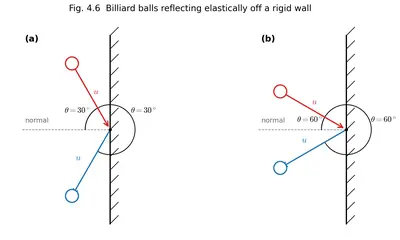
Two identical billiard balls strike a rigid wall with the same speed but at different angles, and get reflected without any change in speed, as shown in Fig. 4.6. What is
Fig. 4.6
Fig. 4.6

(i) the direction of the force on the wall due to each ball?

Solution

Let the wall be vertical along the $$y$$-axis. Take $$x$$-axis horizontal, pointing into the page (away from the wall on the side where the balls travel). Let $$u$$ be the speed of each ball, $$m$$ the mass.

Case (a) — perpendicular incidence: The ball strikes the wall normally with velocity $$+\hat{x}\, u$$ and rebounds with velocity $$-\hat{x}\, u$$.

Initial momentum: $$(p_x)_i = mu, \ (p_y)_i = 0$$.
Final momentum: $$(p_x)_f = -mu, \ (p_y)_f = 0$$.

$$\Delta p_x = -2mu, \quad \Delta p_y = 0$$

The impulse on the ball (and hence the force on the ball) is along the negative $$x$$-direction. By Newton's third law, the force on the wall by the ball is along the positive $$x$$-direction — i.e. normal to the wall, into the wall.

Case (b) — incidence at $$30°$$ with the normal: The initial velocity makes an angle of $$30°$$ with the $$x$$-axis (the normal to the wall).

$$(p_x)_i = mu\cos 30°, \quad (p_y)_i = -mu\sin 30°$$

After reflection (elastic, same speed, angle of reflection = angle of incidence):

$$(p_x)_f = -mu\cos 30°, \quad (p_y)_f = -mu\sin 30°$$

Note that the $$y$$-component (tangential to wall) is unchanged, while the $$x$$-component (normal to wall) reverses.

$$\Delta p_x = -2mu\cos 30°, \quad \Delta p_y = 0$$

So the impulse on the ball is again along the negative $$x$$-direction (normal to wall). By Newton's third law, the force on the wall by the ball is again along the positive $$x$$-direction — normal to the wall, into the wall.

Hence in both cases the force on the wall is directed along the normal to the wall, into the wall. The common, instinctive answer that the force in case (b) is along the line of the incident ball is wrong.

Answer

In both cases the force on the wall is along the normal to the wall, directed into the wall (along the positive $$x$$-axis in the figure).

(ii) the ratio of the magnitudes of impulses imparted to the balls by the wall?

Solution

From part (i):

Magnitude of impulse on ball (a): $$|\Delta p|_a = 2mu$$.

Magnitude of impulse on ball (b): $$|\Delta p|_b = 2mu\cos 30°$$.

Therefore the required ratio is:

$$\frac{|\Delta p|_a}{|\Delta p|_b} = \frac{2mu}{2mu\cos 30°} = \frac{1}{\cos 30°} = \frac{2}{\sqrt{3}} \approx 1.2$$

Answer

Ratio of impulses (a) : (b) $$= \dfrac{2}{\sqrt{3}} \approx 1.2$$.

Example 4.6

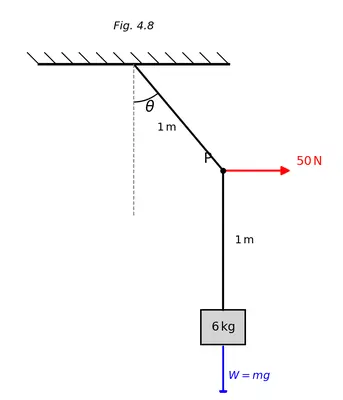
See Fig. 4.8. A mass of $$6 \, \mathrm{kg}$$ is suspended by a rope of length $$2 \, \mathrm{m}$$ from the ceiling. A force of $$50 \, \mathrm{N}$$ in the horizontal direction is applied at the mid-point P of the rope, as shown. What is the angle the rope makes with the vertical in equilibrium? (Take $$g = 10 \, \mathrm{m\,s^{-2}}$$). Neglect the mass of the rope.
Fig. 4.8
Fig. 4.8

Solution

Let $$T_1$$ be the tension in the upper part of the rope (between the ceiling and point P), and $$T_2$$ the tension in the lower part (between P and the mass). The upper part makes an angle $$\theta$$ with the vertical because of the horizontal force at P.

Step 1 — Equilibrium of the mass: The lower rope is vertical (the mass hangs straight down from P). Its weight is balanced by $$T_2$$:

$$T_2 = mg = 6 \times 10 = 60 \, \mathrm{N}$$

Step 2 — Equilibrium at point P: Three forces act at P: tension $$T_1$$ (along the upper rope, making angle $$\theta$$ with vertical, pulling P toward the ceiling), tension $$T_2 = 60 \, \mathrm{N}$$ (pulling P vertically downward, toward the mass), and the horizontal applied force $$50 \, \mathrm{N}$$.

Resolving into horizontal and vertical components:

Horizontal: $$T_1 \sin\theta = 50 \, \mathrm{N}$$

Vertical: $$T_1 \cos\theta = T_2 = 60 \, \mathrm{N}$$

Dividing the two equations:

$$\tan\theta = \frac{50}{60} = \frac{5}{6}$$

$$\theta = \tan^{-1}\!\left(\tfrac{5}{6}\right) \approx 40°$$

Answer

$$\theta = \tan^{-1}\!\left(\dfrac{5}{6}\right) \approx 40°$$

Example 4.7 Determine the maximum acceleration of the train in which a box lying on its floor will remain stationary, given that the co-efficient of static friction between the box and the train's floor is $$0.15$$.

Solution

Consider the box of mass $$m$$ resting on the floor of the train. When the train accelerates with acceleration $$a$$, the box must also accelerate with $$a$$ if it is to remain stationary relative to the train.

The only horizontal force available to give the box this acceleration is the static friction $$f$$ between the box and the floor:

$$f = ma$$

The maximum possible static friction is $$f_{\max} = \mu_s N = \mu_s mg$$.

So the maximum acceleration for which the box does not slip is:

$$a_{\max} = \frac{f_{\max}}{m} = \mu_s g$$

Substituting $$\mu_s = 0.15$$ and $$g = 10 \, \mathrm{m\,s^{-2}}$$:

$$a_{\max} = 0.15 \times 10 = 1.5 \, \mathrm{m\,s^{-2}}$$

Answer

$$a_{\max} = \mu_s g = 1.5 \, \mathrm{m\,s^{-2}}$$.

Example 4.8

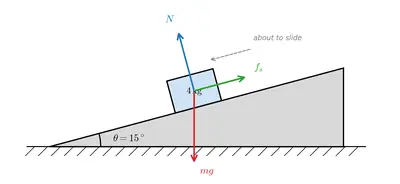
See Fig. 4.11. A mass of $$4 \, \mathrm{kg}$$ rests on a horizontal plane. The plane is gradually inclined until at an angle $$\theta = 15°$$ with the horizontal, the mass just begins to slide. What is the coefficient of static friction between the block and the surface?
Fig. 4.11
Fig. 4.11

Solution

Resolve the weight $$mg$$ along and perpendicular to the inclined surface.

Perpendicular to the surface (no motion): $$N = mg\cos\theta$$.

Along the surface (down the incline): the component of weight is $$mg\sin\theta$$. This is balanced by static friction $$f$$ acting up the incline, as long as the block does not slide.

At the angle of repose, the block is just on the verge of sliding, so the friction is at its maximum value:

$$f = \mu_s N = \mu_s mg\cos\theta$$

Equating the two:

$$mg\sin\theta = \mu_s mg\cos\theta$$

$$\mu_s = \tan\theta$$

With $$\theta = 15°$$:

$$\mu_s = \tan 15° \approx 0.27$$

Note that the coefficient of static friction is independent of the mass of the block.

Answer

$$\mu_s = \tan 15° \approx 0.27$$.

Example 4.9

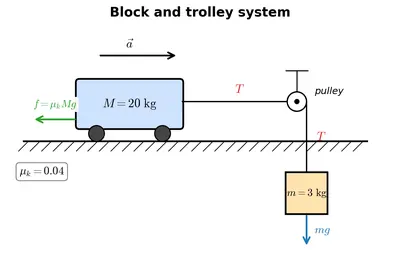
What is the acceleration of the block and trolley system shown in a Fig. 4.12(a), if the coefficient of kinetic friction between the trolley and the surface is $$0.04$$? What is the tension in the string? (Take $$g = 10 \, \mathrm{m\,s^{-2}}$$). Neglect the mass of the string.
Fig. 4.12
Fig. 4.12

Solution

From the figure, a trolley of mass $$M = 20 \, \mathrm{kg}$$ rests on a horizontal surface; a block of mass $$m = 3 \, \mathrm{kg}$$ hangs from a light, inextensible string that passes over a frictionless pulley at the edge of the table. As the string is inextensible and the pulley smooth, both bodies have the same magnitude of acceleration $$a$$. Let $$T$$ be the tension in the string.

Equation of motion for the hanging block (Fig. 4.12(b)): The block accelerates downward.

$$mg - T = ma \implies 30 - T = 3a \quad \cdots (1)$$

Equation of motion for the trolley (Fig. 4.12(c)): The trolley moves horizontally. The forces on it along the direction of motion are tension $$T$$ (forward) and kinetic friction $$f_k$$ (backward). The normal force is $$N = Mg = 200 \, \mathrm{N}$$, so:

$$f_k = \mu_k N = 0.04 \times 200 = 8 \, \mathrm{N}$$

Newton's second law for the trolley:

$$T - f_k = Ma \implies T - 8 = 20a \quad \cdots (2)$$

Adding (1) and (2):

$$30 - 8 = 23a \implies a = \frac{22}{23} \approx 0.96 \, \mathrm{m\,s^{-2}}$$

From (1):

$$T = 30 - 3a = 30 - 3 \times \frac{22}{23} = \frac{690 - 66}{23} = \frac{624}{23} \approx 27.1 \, \mathrm{N}$$

Answer

Acceleration $$a \approx 0.96 \, \mathrm{m\,s^{-2}}$$; tension $$T \approx 27.1 \, \mathrm{N}$$.

Example 4.10 A cyclist speeding at $$18 \, \mathrm{km/h}$$ on a level road takes a sharp circular turn of radius $$3 \, \mathrm{m}$$ without reducing the speed. The co-efficient of static friction between the tyres and the road is $$0.1$$. Will the cyclist slip while taking the turn?

Solution

On a level (unbanked) road, the centripetal force required for the turn is supplied entirely by the static friction between the tyres and the road. The condition for the cyclist not to slip is:

$$\frac{mv^2}{R} \le \mu_s mg \implies v^2 \le \mu_s R g$$

Convert the speed: $$v = 18 \, \mathrm{km/h} = 18 \times \dfrac{1000}{3600} = 5 \, \mathrm{m\,s^{-1}}$$.

$$v^2 = 25 \, \mathrm{m^2\,s^{-2}}$$

$$\mu_s R g = 0.1 \times 3 \times 9.8 = 2.94 \, \mathrm{m^2\,s^{-2}}$$

Since $$v^2 = 25 > 2.94 = \mu_s R g$$, the maximum available friction is far from sufficient to provide the required centripetal force.

Hence the cyclist will slip while taking the turn.

Answer

Yes — since $$v^2 = 25 \, \mathrm{m^2\,s^{-2}} > \mu_s R g = 2.94 \, \mathrm{m^2\,s^{-2}}$$, the cyclist will slip.

Example 4.11 A circular racetrack of radius $$300 \, \mathrm{m}$$ is banked at an angle of $$15°$$. If the coefficient of friction between the wheels of a race-car and the road is $$0.2$$, what is the

(a) optimum speed of the race-car to avoid wear and tear on its tyres, and

Solution

At the optimum speed, the horizontal component of the normal reaction alone provides the centripetal force; the friction force is not called upon. This minimises tyre wear.

For a road banked at angle $$\theta$$, the optimum speed is:

$$v_o = \sqrt{Rg \tan\theta}$$

With $$R = 300 \, \mathrm{m}$$, $$\theta = 15°$$, $$g = 9.8 \, \mathrm{m\,s^{-2}}$$, and $$\tan 15° \approx 0.2679$$:

$$v_o = \sqrt{300 \times 9.8 \times 0.2679}$$

$$v_o = \sqrt{787.6} \approx 28.1 \, \mathrm{m\,s^{-1}}$$

Answer

$$v_o = \sqrt{Rg\tan\theta} \approx 28.1 \, \mathrm{m\,s^{-1}}$$.

(b) maximum permissible speed to avoid slipping?

Solution

At the maximum permissible speed, the friction acts down the slope (resisting the tendency of the car to slide outward) and is at its limiting value $$f = \mu_s N$$. The maximum speed for a banked road is:

$$v_{\max} = \sqrt{\, R g \cdot \dfrac{\mu_s + \tan\theta}{1 - \mu_s \tan\theta}\,}$$

With $$R = 300 \, \mathrm{m}$$, $$g = 9.8 \, \mathrm{m\,s^{-2}}$$, $$\mu_s = 0.2$$ and $$\tan 15° \approx 0.2679$$:

$$\frac{\mu_s + \tan\theta}{1 - \mu_s\tan\theta} = \frac{0.2 + 0.2679}{1 - 0.2 \times 0.2679} = \frac{0.4679}{0.9464} \approx 0.4944$$

$$v_{\max} = \sqrt{300 \times 9.8 \times 0.4944} = \sqrt{1453.5} \approx 38.1 \, \mathrm{m\,s^{-1}}$$

Answer

$$v_{\max} = \sqrt{Rg\dfrac{\mu_s + \tan\theta}{1 - \mu_s\tan\theta}} \approx 38.1 \, \mathrm{m\,s^{-1}}$$.

Example 4.12

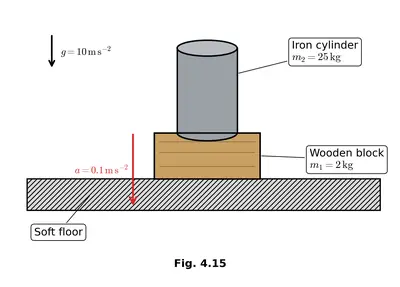
See Fig. 4.15. A wooden block of mass $$2 \, \mathrm{kg}$$ rests on a soft horizontal floor. When an iron cylinder of mass $$25 \, \mathrm{kg}$$ is placed on top of the block, the floor yields steadily and the block and the cylinder together go down with an acceleration of $$0.1 \, \mathrm{m\,s^{-2}}$$. What is the action of the block on the floor (a) before and (b) after the floor yields? Take $$g = 10 \, \mathrm{m\,s^{-2}}$$. Identify the action-reaction pairs in the problem.
Fig. 4.15
Fig. 4.15

(a) What is the action of the block on the floor before the floor yields?

Solution

Before the floor yields, the block is at rest on the floor (only the block, not yet the cylinder — i.e., the block alone). Two forces act on the block:

  • weight, $$W = mg = 2 \times 10 = 20 \, \mathrm{N}$$, acting vertically downward, and
  • normal reaction, $$R$$, from the floor, acting vertically upward.

By Newton's first law (block at rest):

$$R - W = 0 \implies R = 20 \, \mathrm{N}$$

By Newton's third law, the force on the floor by the block (the action of the block on the floor) is equal and opposite to $$R$$:

$$\text{Force on floor by block} = 20 \, \mathrm{N} \text{ vertically downward.}$$

Answer

$$20 \, \mathrm{N}$$, directed vertically downward.

(b) What is the action of the block on the floor after the floor yields? Identify the action-reaction pairs in the problem.

Solution

After the floor yields, treat the block plus the cylinder as one system, total mass:

$$M = m_{\text{block}} + m_{\text{cyl}} = 2 + 25 = 27 \, \mathrm{kg}$$

The system goes down with acceleration $$a = 0.1 \, \mathrm{m\,s^{-2}}$$. Two external forces act on the system: the weight of the system $$Mg$$ acting downward, and the normal reaction $$R'$$ from the floor acting upward.

$$Mg = 27 \times 10 = 270 \, \mathrm{N}$$

Newton's second law (taking downward positive, since the system accelerates downward):

$$Mg - R' = Ma$$

$$270 - R' = 27 \times 0.1 = 2.7$$

$$R' = 267.3 \, \mathrm{N}$$

By Newton's third law, the action of the block on the floor is equal and opposite to $$R'$$:

$$\text{Force on floor by block} = 267.3 \, \mathrm{N} \text{ vertically downward.}$$

Action–reaction pairs:

For case (a):

  • The force of gravity on the block by the Earth ($$20 \, \mathrm{N}$$ downward) and the equal and opposite gravitational force on the Earth by the block ($$20 \, \mathrm{N}$$ upward on the Earth).
  • The force on the floor by the block ($$20 \, \mathrm{N}$$ downward) and the normal force on the block by the floor ($$20 \, \mathrm{N}$$ upward).

For case (b):

  • The gravitational force on the system by the Earth ($$270 \, \mathrm{N}$$ downward) and the gravitational force on the Earth by the system ($$270 \, \mathrm{N}$$ upward on the Earth).
  • The force on the floor by the block ($$267.3 \, \mathrm{N}$$ downward) and the normal force on the block by the floor ($$267.3 \, \mathrm{N}$$ upward).
  • Internal action–reaction pair (within the system): the force on the block by the cylinder (downward) and the force on the cylinder by the block (upward) — these are internal to the system and so do not appear in its free-body diagram.

Note: the weight of the block (or the system) and the normal reaction of the floor are not action–reaction pairs — they act on the same body and are not of the same nature.

Answer

$$267.3 \, \mathrm{N}$$, directed vertically downward.

Exercises

4.1

Give the magnitude and direction of the net force acting on

(For simplicity in numerical calculations, take $$g = 10 \, \mathrm{m\,s^{-2}}$$)

(a) a drop of rain falling down with a constant speed,

Solution

The raindrop is falling with constant speed, hence its velocity is constant — acceleration is zero. By Newton's second law:

$$F_{\text{net}} = ma = 0$$

(The downward weight of the drop is exactly balanced by the upward viscous drag of air and the buoyancy.)

Answer

Net force = $$0$$.

(b) a cork of mass $$10 \, \mathrm{g}$$ floating on water,

Solution

A cork floating on water is in equilibrium — it is at rest, so its acceleration is zero. By Newton's second law, the net force on it is zero.

$$F_{\text{net}} = ma = 0$$

(The weight of the cork acting downward is exactly balanced by the upward buoyant force from the water.)

Answer

Net force = $$0$$.

(c) a kite skillfully held stationary in the sky,

Solution

The kite is held stationary, so it is at rest and its acceleration is zero. By Newton's second law:

$$F_{\text{net}} = ma = 0$$

(Its weight, the tension in the string, and the aerodynamic force due to the wind add to zero.)

Answer

Net force = $$0$$.

(d) a car moving with a constant velocity of $$30 \, \mathrm{km/h}$$ on a rough road,

Solution

The car moves with constant velocity, so its acceleration is zero. By Newton's second law:

$$F_{\text{net}} = ma = 0$$

(The driving force from the engine through the tyres is exactly balanced by the friction/drag forces opposing motion, and the weight is balanced by the normal reaction.)

Answer

Net force = $$0$$.

(e) a high-speed electron in space far from all material objects, and free of electric and magnetic fields.

Solution

There is no electric or magnetic field, no gravity from nearby bodies, and no contact force. So no external force acts on the electron.

$$F_{\text{net}} = 0$$

By Newton's first law, the electron continues to move with the same high speed in a straight line.

Answer

Net force = $$0$$.

4.2

A pebble of mass $$0.05 \, \mathrm{kg}$$ is thrown vertically upwards. Give the direction and magnitude of the net force on the pebble,

Ignore air resistance.

(a) during its upward motion,

Solution

Air resistance is ignored, so the only force on the pebble at any instant in its motion is its weight, acting vertically downward.

$$F = mg = 0.05 \times 10 = 0.5 \, \mathrm{N}$$

So during upward motion the net force on the pebble is $$0.5 \, \mathrm{N}$$ directed vertically downward.

Answer

$$0.5 \, \mathrm{N}$$, vertically downward.

(b) during its downward motion,

Solution

Again, the only force acting on the pebble is its weight (air resistance is ignored).

$$F = mg = 0.05 \times 10 = 0.5 \, \mathrm{N}$$

Direction: vertically downward.

Answer

$$0.5 \, \mathrm{N}$$, vertically downward.

(c) at the highest point where it is momentarily at rest. Do your answers change if the pebble was thrown at an angle of $$45°$$ with the horizontal direction?

Solution

At the highest point the pebble is momentarily at rest (zero velocity), but the only force acting on it is still gravity. "Momentarily at rest" does not mean zero acceleration — the velocity is changing direction even though its magnitude is instantaneously zero.

$$F = mg = 0.05 \times 10 = 0.5 \, \mathrm{N}, \text{ vertically downward.}$$

If the pebble were thrown at $$45°$$ instead of vertically: The trajectory becomes a parabola, but the only force acting on it (with air resistance neglected) is still its weight. So in every case (a), (b), (c) the net force is the same — $$0.5 \, \mathrm{N}$$ vertically downward.

The one nuance is that at the "highest point" of the $$45°$$ projectile, the pebble is not momentarily at rest — only its vertical component of velocity is zero, while its horizontal component is non-zero. But the net force is unchanged: still its weight, vertically downward.

Answer

$$0.5 \, \mathrm{N}$$, vertically downward. The answers do not change if the pebble is thrown at $$45°$$ (the only force in each case is gravity).

4.3

Give the magnitude and direction of the net force acting on a stone of mass $$0.1 \, \mathrm{kg}$$,

Neglect air resistance throughout.

(a) just after it is dropped from the window of a stationary train,

Solution

The stone is in free fall (air resistance neglected). The only force acting on it is its weight.

$$F = mg = 0.1 \times 10 = 1 \, \mathrm{N}$$

Direction: vertically downward.

Answer

$$1 \, \mathrm{N}$$, vertically downward.

(b) just after it is dropped from the window of a train running at a constant velocity of $$36 \, \mathrm{km/h}$$,

Solution

Since the train moves with constant velocity, the ground frame is an inertial frame and so is the train frame. Once the stone is released, it is no longer in contact with the train; the only force acting on it (air resistance neglected) is its weight.

$$F = mg = 0.1 \times 10 = 1 \, \mathrm{N}, \text{ vertically downward.}$$

(The stone retains the horizontal velocity of the train at the moment of release, but no horizontal force acts on it afterwards.)

Answer

$$1 \, \mathrm{N}$$, vertically downward.

(c) just after it is dropped from the window of a train accelerating with $$1 \, \mathrm{m\,s^{-2}}$$,

Solution

The moment the stone is dropped it loses contact with the train; no horizontal force acts on it (air resistance neglected). The acceleration of the train is irrelevant to forces acting on the stone once it is released.

$$F = mg = 0.1 \times 10 = 1 \, \mathrm{N}, \text{ vertically downward.}$$

(Relative to the accelerating train the stone appears to accelerate horizontally backward, but that is a pseudo-effect of viewing motion from a non-inertial frame, not a real force.)

Answer

$$1 \, \mathrm{N}$$, vertically downward.

(d) lying on the floor of a train which is accelerating with $$1 \, \mathrm{m\,s^{-2}}$$, the stone being at rest relative to the train.

Solution

The stone is at rest relative to the train, so in the ground (inertial) frame it has the same acceleration as the train, $$a = 1 \, \mathrm{m\,s^{-2}}$$, in the horizontal direction (the direction the train is accelerating).

The vertical forces — its weight downward and the normal reaction from the floor upward — cancel (no vertical acceleration). The horizontal net force is given by Newton's second law:

$$F_{\text{net}} = ma = 0.1 \times 1 = 0.1 \, \mathrm{N}$$

This horizontal force is provided by static friction from the floor of the train on the stone, in the direction of acceleration of the train.

Answer

$$0.1 \, \mathrm{N}$$, in the direction of the train's acceleration (provided by static friction).

4.4

One end of a string of length $$l$$ is connected to a particle of mass $$m$$ and the other to a small peg on a smooth horizontal table. If the particle moves in a circle with speed $$v$$ the net force on the particle (directed towards the centre) is:

(i) $$T$$, (ii) $$T - \frac{mv^2}{l}$$, (iii) $$T + \frac{mv^2}{l}$$, (iv) $$0$$

$$T$$ is the tension in the string. [Choose the correct alternative].

Solution

The particle moves on a smooth horizontal table in a circle of radius $$l$$. The horizontal forces on the particle are only the tension $$T$$ in the string, directed along the string toward the peg (i.e., toward the centre of the circle). The weight of the particle is balanced by the normal reaction of the table — both are vertical and do not contribute to the horizontal motion.

Hence the net horizontal force on the particle is just $$T$$, directed towards the centre.

This net (centripetal) force provides the centripetal acceleration:

$$T = \frac{mv^2}{l}$$

The expression $$\dfrac{mv^2}{l}$$ is the centripetal force; it is not a separate force to be added/subtracted from $$T$$. The correct alternative is therefore (i): the net force on the particle is $$T$$.

Answer

Option (i): $$T$$.

4.5 A constant retarding force of $$50 \, \mathrm{N}$$ is applied to a body of mass $$20 \, \mathrm{kg}$$ moving initially with a speed of $$15 \, \mathrm{m\,s^{-1}}$$. How long does the body take to stop?

Solution

The retarding force produces a deceleration:

$$a = \frac{F}{m} = \frac{50}{20} = 2.5 \, \mathrm{m\,s^{-2}}$$

(Magnitude; the acceleration is opposite to the velocity.)

Using $$v = u + at$$ with $$u = 15 \, \mathrm{m\,s^{-1}}$$, $$v = 0$$, and $$a = -2.5 \, \mathrm{m\,s^{-2}}$$:

$$0 = 15 + (-2.5)\,t \implies t = \frac{15}{2.5} = 6 \, \mathrm{s}$$

Answer

$$t = 6 \, \mathrm{s}$$.

4.6 A constant force acting on a body of mass $$3.0 \, \mathrm{kg}$$ changes its speed from $$2.0 \, \mathrm{m\,s^{-1}}$$ to $$3.5 \, \mathrm{m\,s^{-1}}$$ in $$25 \, \mathrm{s}$$. The direction of the motion of the body remains unchanged. What is the magnitude and direction of the force?

Solution

Since the direction of motion is unchanged, the speed change directly gives the acceleration:

$$a = \frac{v - u}{t} = \frac{3.5 - 2.0}{25} = \frac{1.5}{25} = 0.06 \, \mathrm{m\,s^{-2}}$$

The acceleration is positive (speed is increasing), so it is along the direction of motion. By Newton's second law:

$$F = ma = 3.0 \times 0.06 = 0.18 \, \mathrm{N}$$

The force has magnitude $$0.18 \, \mathrm{N}$$ and is directed along the direction of motion of the body.

Answer

$$F = 0.18 \, \mathrm{N}$$, in the direction of motion.

4.7 A body of mass $$5 \, \mathrm{kg}$$ is acted upon by two perpendicular forces $$8 \, \mathrm{N}$$ and $$6 \, \mathrm{N}$$. Give the magnitude and direction of the acceleration of the body.

Solution

The resultant of two perpendicular forces is given by the Pythagorean rule:

$$F = \sqrt{F_1^2 + F_2^2} = \sqrt{8^2 + 6^2} = \sqrt{64 + 36} = \sqrt{100} = 10 \, \mathrm{N}$$

By Newton's second law, the magnitude of the acceleration is:

$$a = \frac{F}{m} = \frac{10}{5} = 2 \, \mathrm{m\,s^{-2}}$$

The direction of the acceleration is along the resultant force. Let $$\theta$$ be the angle between the resultant and the $$8 \, \mathrm{N}$$ force:

$$\tan\theta = \frac{6}{8} = 0.75$$

$$\theta = \tan^{-1}(0.75) \approx 36.87°$$

So the acceleration has magnitude $$2 \, \mathrm{m\,s^{-2}}$$ and is directed at about $$36.87°$$ from the $$8 \, \mathrm{N}$$ force (toward the $$6 \, \mathrm{N}$$ force).

Answer

$$a = 2 \, \mathrm{m\,s^{-2}}$$, directed at $$\tan^{-1}(3/4) \approx 36.87°$$ from the $$8 \, \mathrm{N}$$ force.

4.8 The driver of a three-wheeler moving with a speed of $$36 \, \mathrm{km/h}$$ sees a child standing in the middle of the road and brings his vehicle to rest in $$4.0 \, \mathrm{s}$$ just in time to save the child. What is the average retarding force on the vehicle? The mass of the three-wheeler is $$400 \, \mathrm{kg}$$ and the mass of the driver is $$65 \, \mathrm{kg}$$.

Solution

Total mass (vehicle + driver):

$$M = 400 + 65 = 465 \, \mathrm{kg}$$

Initial speed:

$$u = 36 \, \mathrm{km/h} = 36 \times \frac{1000}{3600} = 10 \, \mathrm{m\,s^{-1}}$$

Final speed $$v = 0$$, time $$t = 4 \, \mathrm{s}$$. Average acceleration:

$$a = \frac{v - u}{t} = \frac{0 - 10}{4} = -2.5 \, \mathrm{m\,s^{-2}}$$

Magnitude of the average retarding force:

$$F = Ma = 465 \times 2.5 = 1162.5 \, \mathrm{N}$$

The negative sign of the acceleration indicates the force is opposite to the direction of motion.

Answer

Average retarding force $$\approx 1162.5 \, \mathrm{N}$$, opposite to the direction of motion.

4.9 A rocket with a lift-off mass $$20{,}000 \, \mathrm{kg}$$ is blasted upwards with an initial acceleration of $$5.0 \, \mathrm{m\,s^{-2}}$$. Calculate the initial thrust (force) of the blast.

Solution

Two forces act on the rocket at lift-off: the upward thrust $$F$$ of the blast and the downward weight $$Mg$$. Take upward as positive. Newton's second law:

$$F - Mg = Ma$$

$$F = M(g + a)$$

Substituting $$M = 20{,}000 \, \mathrm{kg}$$, $$g = 10 \, \mathrm{m\,s^{-2}}$$, and $$a = 5.0 \, \mathrm{m\,s^{-2}}$$:

$$F = 20{,}000 \times (10 + 5) = 20{,}000 \times 15 = 3 \times 10^{5} \, \mathrm{N}$$

Answer

Initial thrust $$F = 3 \times 10^{5} \, \mathrm{N}$$.

4.10 A body of mass $$0.40 \, \mathrm{kg}$$ moving initially with a constant speed of $$10 \, \mathrm{m\,s^{-1}}$$ to the north is subject to a constant force of $$8.0 \, \mathrm{N}$$ directed towards the south for $$30 \, \mathrm{s}$$. Take the instant the force is applied to be $$t = 0$$, the position of the body at that time to be $$x = 0$$, and predict its position at $$t = -5 \, \mathrm{s}, 25 \, \mathrm{s}, 100 \, \mathrm{s}$$.

Solution

Take north as the positive $$x$$-direction. Mass $$m = 0.40 \, \mathrm{kg}$$, initial velocity $$u = +10 \, \mathrm{m\,s^{-1}}$$, and the force during $$0 \le t \le 30 \, \mathrm{s}$$ is $$F = -8.0 \, \mathrm{N}$$ (south is negative).

Acceleration during $$0 \le t \le 30 \, \mathrm{s}$$:

$$a = \frac{F}{m} = \frac{-8.0}{0.40} = -20 \, \mathrm{m\,s^{-2}}$$

(i) At $$t = -5 \, \mathrm{s}$$: no force has yet been applied, so the body moves uniformly at $$u = 10 \, \mathrm{m\,s^{-1}}$$. Using $$x = u t$$ measured from $$x = 0$$ at $$t = 0$$:

$$x(-5) = 10 \times (-5) = -50 \, \mathrm{m}$$

So at $$t = -5 \, \mathrm{s}$$, the body is $$50 \, \mathrm{m}$$ south of the origin.

(ii) At $$t = 25 \, \mathrm{s}$$: the force is still acting. Use $$x = ut + \tfrac{1}{2}at^2$$:

$$x(25) = 10 \times 25 + \tfrac{1}{2}(-20)(25)^2$$

$$x(25) = 250 - 10 \times 625 = 250 - 6250 = -6000 \, \mathrm{m}$$

So at $$t = 25 \, \mathrm{s}$$, the body is $$6 \, \mathrm{km}$$ south of the origin.

(iii) At $$t = 100 \, \mathrm{s}$$: the force acts only until $$t = 30 \, \mathrm{s}$$, so we first find the state at $$t = 30 \, \mathrm{s}$$, then use uniform motion afterwards.

Position at $$t = 30 \, \mathrm{s}$$:

$$x(30) = 10 \times 30 + \tfrac{1}{2}(-20)(30)^2 = 300 - 9000 = -8700 \, \mathrm{m}$$

Velocity at $$t = 30 \, \mathrm{s}$$:

$$v(30) = u + at = 10 + (-20)(30) = -590 \, \mathrm{m\,s^{-1}}$$

For $$t > 30 \, \mathrm{s}$$ the body moves uniformly with this velocity. So for the next $$70 \, \mathrm{s}$$ (from $$30 \, \mathrm{s}$$ to $$100 \, \mathrm{s}$$):

$$x(100) = x(30) + v(30) \times 70 = -8700 + (-590)(70)$$

$$x(100) = -8700 - 41300 = -50000 \, \mathrm{m} = -50 \, \mathrm{km}$$

So at $$t = 100 \, \mathrm{s}$$, the body is $$50 \, \mathrm{km}$$ south of the origin.

Answer

$$x(-5\,\mathrm{s}) = -50 \, \mathrm{m}$$, $$x(25\,\mathrm{s}) = -6000 \, \mathrm{m}$$, $$x(100\,\mathrm{s}) = -50000 \, \mathrm{m}$$ (with north taken as positive).

4.11 A truck starts from rest and accelerates uniformly at $$2.0 \, \mathrm{m\,s^{-2}}$$. At $$t = 10 \, \mathrm{s}$$, a stone is dropped by a person standing on the top of the truck ($$6 \, \mathrm{m}$$ high from the ground). What are the (a) velocity, and (b) acceleration of the stone at $$t = 11 \, \mathrm{s}$$? (Neglect air resistance.)

(a) velocity of the stone at $$t = 11 \, \mathrm{s}$$?

Solution

Up to $$t = 10 \, \mathrm{s}$$, the stone moves with the truck. The horizontal velocity of the truck (starting from rest, accelerating at $$2 \, \mathrm{m\,s^{-2}}$$) just before the stone is dropped is:

$$v_x(10) = 0 + 2 \times 10 = 20 \, \mathrm{m\,s^{-1}}$$ (along the direction of motion of the truck)

At the instant of release ($$t = 10 \, \mathrm{s}$$), the stone has this horizontal velocity and zero vertical velocity.

After release, only gravity acts on the stone (air resistance neglected). The horizontal velocity stays $$20 \, \mathrm{m\,s^{-1}}$$; the vertical component grows at $$g = 10 \, \mathrm{m\,s^{-2}}$$.

At $$t = 11 \, \mathrm{s}$$ (i.e., $$1 \, \mathrm{s}$$ after release):

$$v_x = 20 \, \mathrm{m\,s^{-1}}$$ (horizontal, along the truck's direction)

$$v_y = 0 + g \times 1 = 10 \, \mathrm{m\,s^{-1}}$$ (downward)

Magnitude of the velocity:

$$|\vec{v}| = \sqrt{v_x^2 + v_y^2} = \sqrt{400 + 100} = \sqrt{500} \approx 22.36 \, \mathrm{m\,s^{-1}}$$

Direction (angle below the horizontal):

$$\tan\theta = \frac{v_y}{v_x} = \frac{10}{20} = 0.5 \implies \theta \approx 26.57°$$

Answer

$$|\vec{v}| \approx 22.36 \, \mathrm{m\,s^{-1}}$$ at $$\approx 26.57°$$ below the horizontal (with horizontal component along the truck's direction).

(b) acceleration of the stone at $$t = 11 \, \mathrm{s}$$?

Solution

Once the stone is released, it loses contact with the truck. The only force acting on it (air resistance neglected) is its own weight $$mg$$. The acceleration of the truck has no bearing on the stone after release.

$$\vec{a} = \vec{g} \implies |\vec{a}| = g = 10 \, \mathrm{m\,s^{-2}}, \ \text{vertically downward.}$$

Answer

$$10 \, \mathrm{m\,s^{-2}}$$, vertically downward.

4.12 A bob of mass $$0.1 \, \mathrm{kg}$$ hung from the ceiling of a room by a string $$2 \, \mathrm{m}$$ long is set into oscillation. The speed of the bob at its mean position is $$1 \, \mathrm{m\,s^{-1}}$$. What is the trajectory of the bob if the string is cut when the bob is

(a) at one of its extreme positions,

Solution

At an extreme position the bob is momentarily at rest — its instantaneous velocity is zero. The moment the string is cut, the only force acting on the bob is its weight, which is vertically downward. With zero initial velocity, the bob will move along the line of this force.

So the bob falls vertically downward in a straight line (free fall) until it hits the floor.

Answer

The bob falls vertically downward (straight-line free fall) from the extreme position.

(b) at its mean position.

Solution

At the mean (lowest) position of the swing, the bob's velocity is horizontal and equal in magnitude to $$1 \, \mathrm{m\,s^{-1}}$$ (the maximum speed of the oscillation). The moment the string is cut, the only force on the bob is its weight (vertically downward), and it has a horizontal initial velocity.

This is exactly the situation of horizontal projectile motion: the bob has a constant horizontal component of velocity ($$1 \, \mathrm{m\,s^{-1}}$$), while its vertical velocity increases under gravity. Eliminating $$t$$ from $$x = v_0 t$$ and $$y = \tfrac{1}{2} g t^2$$ gives $$y = \dfrac{g}{2 v_0^2} x^2$$, a parabola.

So the trajectory is a parabolic path with the initial horizontal direction tangent to the curve at the point where the string was cut.

Answer

The bob follows a parabolic trajectory (horizontal projectile motion).

4.13

A man of mass $$70 \, \mathrm{kg}$$ stands on a weighing scale in a lift which is moving

What would be the readings on the scale in each case?

(a) upwards with a uniform speed of $$10 \, \mathrm{m\,s^{-1}}$$,

Solution

The reading of the scale is the normal force $$R$$ that the scale exerts on the man (or equivalently, by Newton's third law, the force the man exerts on the scale).

The lift moves with uniform velocity, so the man's acceleration is zero. Newton's second law (taking upward positive):

$$R - mg = 0 \implies R = mg = 70 \times 10 = 700 \, \mathrm{N}$$

The reading equals the man's true weight: $$\dfrac{R}{g} = 70 \, \mathrm{kg}$$.

Answer

Reading = $$700 \, \mathrm{N}$$ (i.e., $$70 \, \mathrm{kg}$$).

(b) downwards with a uniform acceleration of $$5 \, \mathrm{m\,s^{-2}}$$,

Solution

Take upward as positive. The lift, and hence the man, has acceleration $$a = -5 \, \mathrm{m\,s^{-2}}$$.

Newton's second law on the man:

$$R - mg = ma$$

$$R = m(g + a) = 70 \times (10 - 5) = 70 \times 5 = 350 \, \mathrm{N}$$

Apparent mass on the scale = $$R/g = 35 \, \mathrm{kg}$$.

Answer

Reading = $$350 \, \mathrm{N}$$ (i.e., $$35 \, \mathrm{kg}$$).

(c) upwards with a uniform acceleration of $$5 \, \mathrm{m\,s^{-2}}$$.

Solution

Take upward as positive. The lift, and hence the man, has acceleration $$a = +5 \, \mathrm{m\,s^{-2}}$$.

Newton's second law:

$$R - mg = ma$$

$$R = m(g + a) = 70 \times (10 + 5) = 70 \times 15 = 1050 \, \mathrm{N}$$

Apparent mass on the scale = $$R/g = 105 \, \mathrm{kg}$$.

Answer

Reading = $$1050 \, \mathrm{N}$$ (i.e., $$105 \, \mathrm{kg}$$).

(d) What would be the reading if the lift mechanism failed and it hurtled down freely under gravity?

Solution

In free fall the lift, the scale and the man all accelerate downward at $$g$$. Take upward as positive, so $$a = -g$$.

$$R - mg = ma = -mg \implies R = 0$$

The scale reads zero — the well-known state of apparent weightlessness. Note that the man's true weight ($$mg = 700 \, \mathrm{N}$$) is unchanged; only the normal force from the scale (i.e. the apparent weight) is zero, because both the man and the scale fall together with the same acceleration.

Answer

Reading = $$0$$ (apparent weightlessness).

4.14

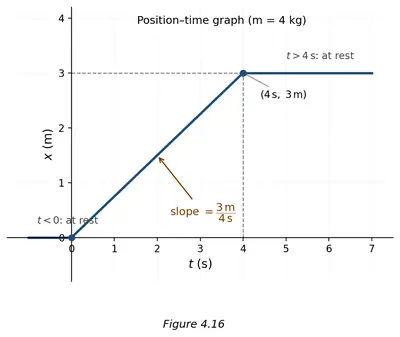
Figure 4.16 shows the position-time graph of a particle of mass $$4 \, \mathrm{kg}$$. What is the (Consider one-dimensional motion only).
Figure 4.16
Figure 4.16

(a) force on the particle for $$t<0$$, $$t>4 \, \mathrm{s}$$, $$0

Solution

Read the velocity off the position–time graph as the slope of the $$x$$ vs $$t$$ line in each region.

For $$t < 0$$: The graph is flat at $$x = 0$$, so the particle is at rest and velocity is zero. Hence acceleration is zero.

$$F = ma = 0$$

For $$0 < t < 4 \, \mathrm{s}$$: The graph is a straight line from $$(0, 0)$$ to $$(4, 3)$$, so the velocity is constant:

$$v = \frac{3 - 0}{4 - 0} = 0.75 \, \mathrm{m\,s^{-1}}$$

Since velocity is constant, acceleration is zero, so:

$$F = 0$$

For $$t > 4 \, \mathrm{s}$$: The graph is flat at $$x = 3 \, \mathrm{m}$$, so the particle is at rest. Velocity is zero, acceleration is zero, so:

$$F = 0$$

In all three intervals, the net force on the particle is zero — the motion within each interval is uniform.

Answer

$$F = 0$$ in all three intervals ($$t < 0$$, $$0 < t < 4 \, \mathrm{s}$$, and $$t > 4 \, \mathrm{s}$$).

(b) impulse at $$t = 0$$ and $$t = 4 \, \mathrm{s}$$?

Solution

Impulse equals the change in linear momentum. The velocity changes abruptly at $$t = 0$$ and again at $$t = 4 \, \mathrm{s}$$, so there is an impulsive (infinitely brief but finite-impulse) force at each instant.

At $$t = 0$$: velocity jumps from $$0$$ (for $$t < 0$$) to $$0.75 \, \mathrm{m\,s^{-1}}$$ (for $$0 < t < 4$$).

$$J_0 = m\,\Delta v = 4 \times (0.75 - 0) = 3 \, \mathrm{kg\,m\,s^{-1}}$$

(positive, i.e., in the direction of motion).

At $$t = 4 \, \mathrm{s}$$: velocity jumps from $$0.75 \, \mathrm{m\,s^{-1}}$$ down to $$0$$.

$$J_4 = m\,\Delta v = 4 \times (0 - 0.75) = -3 \, \mathrm{kg\,m\,s^{-1}}$$

(magnitude $$3 \, \mathrm{kg\,m\,s^{-1}}$$, directed opposite to the previous motion).

Answer

Impulse at $$t = 0$$: $$+3 \, \mathrm{kg\,m\,s^{-1}}$$; at $$t = 4 \, \mathrm{s}$$: $$-3 \, \mathrm{kg\,m\,s^{-1}}$$ (i.e., $$3 \, \mathrm{N\,s}$$ in opposite directions).

4.15 Two bodies of masses $$10 \, \mathrm{kg}$$ and $$20 \, \mathrm{kg}$$ respectively kept on a smooth, horizontal surface are tied to the ends of a light string. A horizontal force $$F = 600 \, \mathrm{N}$$ is applied to (i) A, (ii) B along the direction of string. What is the tension in the string in each case?

(i) Force applied to A along the direction of string. What is the tension in the string?

Solution

Let $$m_A = 10 \, \mathrm{kg}$$, $$m_B = 20 \, \mathrm{kg}$$. The surface is smooth (no friction). The two bodies are connected by a light inextensible string; they accelerate together with the same magnitude of acceleration $$a$$ along the line of the string.

Whole system:

$$F = (m_A + m_B)\,a$$

$$600 = 30 a \implies a = 20 \, \mathrm{m\,s^{-2}}$$

Tension in the string: The string accelerates body B (the trailing body) at $$a$$. The only horizontal force on B is the tension $$T$$:

$$T = m_B\,a = 20 \times 20 = 400 \, \mathrm{N}$$

Answer

$$T = 400 \, \mathrm{N}$$.

(ii) Force applied to B along the direction of string. What is the tension in the string?

Solution

The whole system still has the same acceleration:

$$a = \frac{F}{m_A + m_B} = \frac{600}{30} = 20 \, \mathrm{m\,s^{-2}}$$

Now A is the trailing body (being pulled by the string). The only horizontal force on A is the tension $$T$$:

$$T = m_A\,a = 10 \times 20 = 200 \, \mathrm{N}$$

Answer

$$T = 200 \, \mathrm{N}$$.

4.16 Two masses $$8 \, \mathrm{kg}$$ and $$12 \, \mathrm{kg}$$ are connected at the two ends of a light inextensible string that goes over a frictionless pulley. Find the acceleration of the masses, and the tension in the string when the masses are released.

Solution

This is an Atwood machine. Let $$m_1 = 8 \, \mathrm{kg}$$ and $$m_2 = 12 \, \mathrm{kg}$$. The heavier mass $$m_2$$ will descend; $$m_1$$ will rise. Both have the same magnitude of acceleration $$a$$, since the string is inextensible.

Newton's second law for $$m_2$$ (taking downward positive, the direction of its motion):

$$m_2 g - T = m_2 a \implies 12 \times 10 - T = 12 a \implies 120 - T = 12 a \quad \cdots (1)$$

For $$m_1$$ (taking upward positive, the direction of its motion):

$$T - m_1 g = m_1 a \implies T - 8 \times 10 = 8 a \implies T - 80 = 8 a \quad \cdots (2)$$

Add (1) and (2):

$$120 - 80 = 12 a + 8 a$$

$$40 = 20 a \implies a = 2 \, \mathrm{m\,s^{-2}}$$

From (2):

$$T = 80 + 8 \times 2 = 96 \, \mathrm{N}$$

Answer

Acceleration $$a = 2 \, \mathrm{m\,s^{-2}}$$; tension $$T = 96 \, \mathrm{N}$$.

4.17 A nucleus is at rest in the laboratory frame of reference. Show that if it disintegrates into two smaller nuclei the products must move in opposite directions.

Solution

The nucleus is initially at rest, so its initial momentum (in the laboratory frame) is zero. There is no external force on it during disintegration; the only forces involved are internal nuclear forces, which are action–reaction pairs. By the law of conservation of linear momentum, the total momentum of the system after disintegration must equal that before — i.e., remain zero.

Let the two product nuclei have masses $$m_1$$ and $$m_2$$ and velocities $$\vec{v}_1$$ and $$\vec{v}_2$$ respectively. Conservation of momentum:

$$m_1 \vec{v}_1 + m_2 \vec{v}_2 = 0$$

$$\vec{v}_2 = -\frac{m_1}{m_2}\,\vec{v}_1$$

The minus sign shows that $$\vec{v}_2$$ is in the direction opposite to $$\vec{v}_1$$. Since $$m_1, m_2 > 0$$, the two velocities cannot be in the same direction, nor can either be zero (because if one were zero, conservation would force the other to be zero too, but then the nucleus would not have disintegrated into two moving fragments).

Hence the two products must move in opposite directions, with magnitudes inversely proportional to their masses:

$$\frac{|\vec{v}_1|}{|\vec{v}_2|} = \frac{m_2}{m_1}$$

Answer

Proved: by conservation of linear momentum, $$m_1\vec{v}_1 + m_2\vec{v}_2 = 0$$, so $$\vec{v}_1$$ and $$\vec{v}_2$$ are antiparallel.

4.18 Two billiard balls each of mass $$0.05 \, \mathrm{kg}$$ moving in opposite directions with speed $$6 \, \mathrm{m\,s^{-1}}$$ collide and rebound with the same speed. What is the impulse imparted to each ball due to the other?

Solution

Consider one ball. Take the direction of its initial motion as positive.

Initial momentum:

$$p_i = m u = 0.05 \times (+6) = +0.3 \, \mathrm{kg\,m\,s^{-1}}$$

After rebound, the ball moves with the same speed in the opposite direction:

$$p_f = m v = 0.05 \times (-6) = -0.3 \, \mathrm{kg\,m\,s^{-1}}$$

Impulse on this ball = change in its momentum:

$$J = p_f - p_i = -0.3 - 0.3 = -0.6 \, \mathrm{kg\,m\,s^{-1}}$$

So the impulse imparted to each ball has magnitude $$0.6 \, \mathrm{N\,s}$$, directed opposite to that ball's original direction of motion. By Newton's third law, the impulses on the two balls are equal in magnitude and opposite in direction (consistent with the total momentum of the system being conserved at zero).

Answer

Magnitude of impulse on each ball $$= 0.6 \, \mathrm{N\,s}$$, directed opposite to that ball's initial velocity.

4.19 A shell of mass $$0.020 \, \mathrm{kg}$$ is fired by a gun of mass $$100 \, \mathrm{kg}$$. If the muzzle speed of the shell is $$80 \, \mathrm{m\,s^{-1}}$$, what is the recoil speed of the gun?

Solution

Before firing, both the gun and the shell are at rest, so the total initial momentum of the system is zero. The forces between the shell and the gun during firing are internal, so the total momentum is conserved.

Let $$m_s = 0.020 \, \mathrm{kg}$$ (shell), $$M_g = 100 \, \mathrm{kg}$$ (gun), and let $$v_s = +80 \, \mathrm{m\,s^{-1}}$$ be the shell's velocity after firing. Let $$V_g$$ be the gun's recoil velocity.

Conservation of momentum:

$$m_s v_s + M_g V_g = 0$$

$$V_g = -\frac{m_s v_s}{M_g} = -\frac{0.020 \times 80}{100} = -0.016 \, \mathrm{m\,s^{-1}}$$

The minus sign indicates the gun recoils in the direction opposite to that of the shell. Its recoil speed is $$0.016 \, \mathrm{m\,s^{-1}} = 1.6 \, \mathrm{cm\,s^{-1}}$$.

Answer

Recoil speed of gun $$= 0.016 \, \mathrm{m\,s^{-1}}$$ (opposite to the shell's direction).

4.20 A batsman deflects a ball by an angle of $$45°$$ without changing its initial speed which is equal to $$54 \, \mathrm{km/h}$$. What is the impulse imparted to the ball? (Mass of the ball is $$0.15 \, \mathrm{kg}$$.)

Solution

Let $$v$$ be the (unchanged) speed of the ball, $$m$$ its mass. The ball comes in and goes out at the same speed $$v$$, but the direction changes by $$45°$$. The geometry usually adopted (and used in NCERT) is that the incident and reflected paths make equal angles with the normal to the bat — so each makes $$22.5°$$ with the normal, and the angle between the incident and reflected paths (taken from the bat outward) is $$45°$$.

Set up coordinates with the bat-normal along the $$x$$-axis (positive pointing away from the bat). With the incident direction making $$22.5°$$ with the normal (above the axis):

$$\vec{p}_i = m v(-\cos 22.5°,\ \sin 22.5°)$$

The reflected direction makes $$22.5°$$ with the normal on the other side:

$$\vec{p}_f = m v(+\cos 22.5°,\ \sin 22.5°)$$

The tangential ($$y$$) component is unchanged; the normal component reverses.

$$\Delta\vec{p} = \vec{p}_f - \vec{p}_i = (2 m v \cos 22.5°,\ 0)$$

Magnitude of impulse:

$$|\Delta\vec{p}| = 2 m v \cos 22.5°$$

Convert the speed: $$v = 54 \, \mathrm{km/h} = 54 \times \dfrac{1000}{3600} = 15 \, \mathrm{m\,s^{-1}}$$. Using $$\cos 22.5° \approx 0.9239$$:

$$|\Delta\vec{p}| = 2 \times 0.15 \times 15 \times 0.9239$$

$$|\Delta\vec{p}| \approx 4.16 \, \mathrm{kg\,m\,s^{-1}}$$

The direction of the impulse is along the bat-normal, away from the bat (i.e., it bisects the angle between the reversed incident direction and the reflected direction).

Answer

Impulse $$= 2mv\cos 22.5° \approx 4.16 \, \mathrm{N\,s}$$, directed along the normal to the bat.

4.21 A stone of mass $$0.25 \, \mathrm{kg}$$ tied to the end of a string is whirled round in a circle of radius $$1.5 \, \mathrm{m}$$ with a speed of $$40 \, \mathrm{rev/min}$$ in a horizontal plane. What is the tension in the string? What is the maximum speed with which the stone can be whirled around if the string can withstand a maximum tension of $$200 \, \mathrm{N}$$?

Solution

Given: $$m = 0.25 \, \mathrm{kg}$$, $$r = 1.5 \, \mathrm{m}$$, $$n = 40 \, \mathrm{rev/min}$$.

Convert angular speed:

$$\omega = 2\pi n = 2\pi \times \frac{40}{60} = \frac{4\pi}{3} \, \mathrm{rad\,s^{-1}}$$

The stone moves in a horizontal circle, and the tension in the (horizontal) string provides the centripetal force. (Strictly the string is slightly inclined, forming a conical pendulum, but the problem treats it as horizontal.)

$$T = m \omega^2 r$$

$$\omega^2 = \left(\frac{4\pi}{3}\right)^2 = \frac{16\pi^2}{9} \approx \frac{16 \times 9.8696}{9} \approx 17.546 \, \mathrm{rad^2\,s^{-2}}$$

$$T = 0.25 \times 17.546 \times 1.5 \approx 6.58 \, \mathrm{N}$$

Maximum speed: The string breaks when $$T = T_{\max} = 200 \, \mathrm{N}$$. Using $$T = m v^2 / r$$:

$$v_{\max} = \sqrt{\frac{T_{\max}\, r}{m}} = \sqrt{\frac{200 \times 1.5}{0.25}} = \sqrt{1200} \approx 34.64 \, \mathrm{m\,s^{-1}}$$

Answer

Tension $$T \approx 6.58 \, \mathrm{N}$$; maximum speed $$v_{\max} = \sqrt{T_{\max} r / m} \approx 34.64 \, \mathrm{m\,s^{-1}}$$.

4.22

If, in Exercise 4.21, the speed of the stone is increased beyond the maximum permissible value, and the string breaks suddenly, which of the following correctly describes the trajectory of the stone after the string breaks:

(a) the stone moves radially outwards,

(b) the stone flies off tangentially from the instant the string breaks,

(c) the stone flies off at an angle with the tangent whose magnitude depends on the speed of the particle?

Solution

While the stone moves in a circle, at every instant its velocity vector is along the tangent to the circle at that point — the centripetal acceleration changes the direction of velocity but not its magnitude, and is itself perpendicular (radially inward) to the velocity.

The moment the string breaks, the centripetal force vanishes. Now no horizontal force acts on the stone (the table is horizontal, smooth, the motion is in a horizontal plane). By Newton's first law, the stone continues in a straight line with whatever velocity it had at the instant of release — which was along the tangent.

Therefore the correct alternative is (b): the stone flies off tangentially from the instant the string breaks.

Answer

Option (b): the stone flies off tangentially from the instant the string breaks.

4.23 Explain why

(a) a horse cannot pull a cart and run in empty space,

Solution

When a horse pulls a cart on the ground, it pushes its hooves backward and downward against the ground. By Newton's third law, the ground exerts an equal and opposite reaction on the horse — directed forward and upward. The forward component of this reaction is what propels the horse (and the cart) ahead. This is possible because of the friction between the hooves and the ground.

In empty space there is no ground (and no other body) to push against. The horse can push its legs as much as it likes — there is no surface to react back on it. Without that reaction force, the horse has no external horizontal force, and so cannot accelerate or run.

Answer

Because in empty space there is no surface to push against; the forward reaction of the ground on the horse (made possible by friction) is what propels it.

(b) passengers are thrown forward from their seats when a speeding bus stops suddenly,

Solution

This is an example of inertia of motion (Newton's first law).

While the bus is moving, the passengers are also moving forward with the same velocity. When the bus suddenly brakes, the brakes apply a large retarding force on the bus, but no comparable external force acts directly on the upper body of the passenger. By Newton's first law, the passenger's upper body tends to continue moving forward with the original velocity — and so it is thrown forward relative to the (now decelerating) seat.

The friction between seat and the passenger's lower body can decelerate the lower body to some extent, but the upper body — not in firm contact — continues forward, giving the felt sensation of being thrown forward.

Answer

Because of inertia: the passenger's body tends to continue moving with the bus's original velocity (Newton's first law), while the bus slows down rapidly.

(c) it is easier to pull a lawn mower than to push it,

Solution

Let $$F$$ be the force applied along the handle of the lawn mower, which makes some angle $$\theta$$ above the horizontal. The mower has weight $$mg$$, normal reaction $$N$$ from the ground, and friction $$f = \mu N$$ opposing motion.

Pulling: the applied force has a horizontal component $$F\cos\theta$$ (forward) and a vertical component $$F\sin\theta$$ directed upward. The vertical balance gives:

$$N_{\text{pull}} = mg - F\sin\theta$$

So $$N_{\text{pull}} < mg$$, and the frictional force $$\mu N_{\text{pull}}$$ is reduced.

Pushing: the applied force has horizontal component $$F\cos\theta$$ (forward) and vertical component $$F\sin\theta$$ now directed downward. Hence:

$$N_{\text{push}} = mg + F\sin\theta$$

So $$N_{\text{push}} > mg$$, and the frictional force is increased.

Since $$f_{\text{pull}} < f_{\text{push}}$$, less force is needed to move the lawn mower when pulling than when pushing — pulling is easier.

Answer

Because pulling reduces the normal reaction (vertical component is upward) and hence the friction, while pushing increases the normal reaction and friction.

(d) a cricketer moves his hands backwards while holding a catch.

Solution

By Newton's second law in its impulse form:

$$F = \frac{\Delta p}{\Delta t}$$

The change in momentum $$\Delta p$$ of the ball during the catch is fixed (it goes from its incoming momentum down to zero). By moving his hands backward, the cricketer increases the time $$\Delta t$$ over which the ball is brought to rest. Since $$F \propto 1/\Delta t$$, the average force he has to apply on the ball — and therefore the force the ball applies on his hand by Newton's third law — is reduced.

This protects his hand from injury, by spreading the same change of momentum over a longer time and thus lowering the peak force.

Answer

To increase the time $$\Delta t$$ over which the ball's momentum changes, thereby reducing the average force $$F = \Delta p / \Delta t$$ on his hands and preventing injury.
NCERT Solutions for Class 11
Maths
NCERT Solutions for Class 11 Maths
Chapter-wise step-by-step
solutions with explanations
explore solutions Maths bg
Physics
NCERT Solutions for Class 11 Physics
Chapter-wise step-by-step
solutions with explanations
explore solutions Physics bg
Chemistry
NCERT Solutions for Class 11 Chemistry
Chapter-wise step-by-step
solutions with explanations
explore solutions Chemistry bg

Frequently Asked Questions

50,000+ JEE Students Trusted Our Score Calculator

Predict your JEE Main percentile, rank & performance in seconds