Join WhatsApp Icon JEE WhatsApp Group
NCERT Solutions for Class 11 Physics

Chapter 3: Motion in a Plane

Download Solutions PDF
Daily JEE Updates, Tips & Important Alerts
Join 30,000+ students and stay updated with JEE notifications and preparation insights.
Join Now!
Free PDF
Complete NCERT Solution PDF for Chapter 3: Motion in a Plane

NCERT Solutions For Class 11 Physics Chapter 3 Motion in a Plane helps students understand the movement of objects in two dimensions using vectors and graphical methods. The page provides detailed NCERT Solutions that explain concepts such as vector quantities, projectile motion, and circular motion with proper examples. NCERT Solutions For Class 11 Physics help students learn how different components of motion can be analysed mathematically. This chapter develops the foundation required for solving complex mechanics problems involving multiple directions. The solutions guide students through textbook questions with clear steps and explanations. Students can access the chapter PDF for revision, numerical practice, and better understanding of concepts. The detailed content helps learners improve their analytical skills and apply Physics principles effectively.
Download Solutions PDF

Examples 3.1-3.9

Example 3.1 Rain is falling vertically with a speed of $$35 \, \mathrm{m\,s^{-1}}$$. Winds starts blowing after sometime with a speed of $$12 \, \mathrm{m\,s^{-1}}$$ in east to west direction. In which direction should a boy waiting at a bus stop hold his umbrella?

Solution

Choose a coordinate system with the positive $$x$$-axis pointing east and the positive $$y$$-axis pointing vertically upward. The two velocities (with respect to the ground) are

$$\vec{v}_r = -35\,\hat{\mathbf{j}}\ \mathrm{m\,s^{-1}}$$ (rain, falling vertically downward),
$$\vec{v}_w = -12\,\hat{\mathbf{i}}\ \mathrm{m\,s^{-1}}$$ (wind, blowing from east to west).

The rain reaches the boy with the resultant velocity

$$\vec{v} = \vec{v}_r + \vec{v}_w = -12\,\hat{\mathbf{i}} - 35\,\hat{\mathbf{j}}\ \mathrm{m\,s^{-1}}.$$

Its magnitude is

$$|\vec{v}| = \sqrt{12^2 + 35^2} = \sqrt{144 + 1225} = \sqrt{1369} = 37\ \mathrm{m\,s^{-1}}.$$

If $$\theta$$ is the angle which $$\vec{v}$$ makes with the vertical (downward direction),

$$\tan\theta = \dfrac{12}{35} = 0.343 \quad\Rightarrow\quad \theta \approx 19^\circ.$$

The boy should hold the umbrella tilted about $$19^\circ$$ from the vertical, toward the west (the direction from which the wind blows the rain).

Answer

The boy should hold his umbrella inclined at about $$19^\circ$$ from the vertical, tilted toward the west. The rain reaches him with resultant speed $$37\ \mathrm{m\,s^{-1}}$$.

Example 3.2 Find the magnitude and direction of the resultant of two vectors $$\mathbf{A}$$ and $$\mathbf{B}$$ in terms of their magnitudes and angle $$\theta$$ between them.

Solution

Draw $$\mathbf{A}$$ along $$OP$$ and $$\mathbf{B}$$ along $$OQ$$ so that the angle between them at $$O$$ is $$\theta$$. Complete the parallelogram $$OPSQ$$; its diagonal $$OS$$ represents the resultant $$\mathbf{R} = \mathbf{A} + \mathbf{B}$$. Drop a perpendicular from $$S$$ onto the line $$OP$$ extended, meeting it at $$N$$.

In the right triangle $$PNS$$, $$PS = B$$ and angle $$SPN = \theta$$, so

$$SN = B\sin\theta, \qquad PN = B\cos\theta.$$

From the right triangle $$ONS$$,

$$OS^2 = ON^2 + SN^2 = (OP + PN)^2 + SN^2 = (A + B\cos\theta)^2 + (B\sin\theta)^2.$$

Expanding and using $$\sin^2\theta + \cos^2\theta = 1$$:

$$R^2 = A^2 + 2AB\cos\theta + B^2\cos^2\theta + B^2\sin^2\theta = A^2 + B^2 + 2AB\cos\theta.$$

Hence the magnitude of the resultant is

$$R = \sqrt{A^2 + B^2 + 2AB\cos\theta}.$$

If $$\alpha$$ is the angle that $$\mathbf{R}$$ makes with $$\mathbf{A}$$, then in triangle $$ONS$$

$$\tan\alpha = \dfrac{SN}{ON} = \dfrac{B\sin\theta}{A + B\cos\theta}.$$

So

$$\alpha = \tan^{-1}\!\left(\dfrac{B\sin\theta}{A + B\cos\theta}\right).$$

These two formulae together give the magnitude and direction of the resultant.

Answer

$$R = \sqrt{A^2 + B^2 + 2AB\cos\theta}$$ and $$\tan\alpha = \dfrac{B\sin\theta}{A + B\cos\theta}$$, where $$\alpha$$ is the angle of $$\mathbf{R}$$ with $$\mathbf{A}$$.

Example 3.3 A motorboat is racing towards north at $$25 \, \mathrm{km/h}$$ and the water current in that region is $$10 \, \mathrm{km/h}$$ in the direction of $$60^\circ$$ east of south. Find the resultant velocity of the boat.

Solution

Take east as the positive $$x$$-direction and north as the positive $$y$$-direction. The boat's velocity (relative to water) and the water-current velocity (relative to ground) are

$$\vec{v}_b = 25\,\hat{\mathbf{j}}\ \mathrm{km/h}.$$

The current makes $$60^\circ$$ with south toward east, so it points $$30^\circ$$ south of east:

$$\vec{v}_c = 10\sin 60^\circ\,\hat{\mathbf{i}} - 10\cos 60^\circ\,\hat{\mathbf{j}} = 5\sqrt{3}\,\hat{\mathbf{i}} - 5\,\hat{\mathbf{j}}\ \mathrm{km/h}.$$

The resultant velocity of the boat with respect to ground is

$$\vec{v} = \vec{v}_b + \vec{v}_c = 5\sqrt{3}\,\hat{\mathbf{i}} + 20\,\hat{\mathbf{j}}\ \mathrm{km/h}.$$

Its magnitude is

$$|\vec{v}| = \sqrt{(5\sqrt{3})^2 + 20^2} = \sqrt{75 + 400} = \sqrt{475} \approx 21.8\ \mathrm{km/h}.$$

If $$\phi$$ is the angle that $$\vec{v}$$ makes with north (the $$y$$-axis),

$$\tan\phi = \dfrac{5\sqrt{3}}{20} = \dfrac{\sqrt{3}}{4} \approx 0.4330 \quad\Rightarrow\quad \phi \approx 23.4^\circ.$$

Thus the resultant velocity of the boat is about $$21.8\ \mathrm{km/h}$$, directed about $$23.4^\circ$$ east of north.

Answer

Resultant velocity $$\approx 21.8\ \mathrm{km/h}$$, directed about $$23.4^\circ$$ east of north.

Example 3.4

The position of a particle is given by

$$\mathbf{r} = 3.0t \, \hat{\mathbf{i}} + 2.0t^2 \, \hat{\mathbf{j}} + 5.0 \, \hat{\mathbf{k}}$$

where $$t$$ is in seconds and the coefficients have the proper units for $$\mathbf{r}$$ to be in metres. (a) Find $$\mathbf{v}(t)$$ and $$\mathbf{a}(t)$$ of the particle. (b) Find the magnitude and direction of $$\mathbf{v}(t)$$ at $$t = 1.0 \, \mathrm{s}$$.

Solution

(a) Differentiate $$\mathbf{r}$$ with respect to $$t$$ to obtain the velocity, and again to obtain the acceleration.

$$\mathbf{v}(t) = \dfrac{d\mathbf{r}}{dt} = \dfrac{d}{dt}\big(3.0t\,\hat{\mathbf{i}} + 2.0t^2\,\hat{\mathbf{j}} + 5.0\,\hat{\mathbf{k}}\big) = 3.0\,\hat{\mathbf{i}} + 4.0t\,\hat{\mathbf{j}}\ \mathrm{m\,s^{-1}}.$$

$$\mathbf{a}(t) = \dfrac{d\mathbf{v}}{dt} = 4.0\,\hat{\mathbf{j}}\ \mathrm{m\,s^{-2}}.$$

The acceleration is constant in magnitude and direction (along the $$+y$$-axis).

(b) At $$t = 1.0\ \mathrm{s}$$,

$$\mathbf{v}(1) = 3.0\,\hat{\mathbf{i}} + 4.0\,\hat{\mathbf{j}}\ \mathrm{m\,s^{-1}}.$$

$$|\mathbf{v}(1)| = \sqrt{3.0^2 + 4.0^2} = \sqrt{9 + 16} = \sqrt{25} = 5.0\ \mathrm{m\,s^{-1}}.$$

If $$\theta$$ is the angle that $$\mathbf{v}(1)$$ makes with the $$x$$-axis,

$$\tan\theta = \dfrac{v_y}{v_x} = \dfrac{4.0}{3.0} \quad\Rightarrow\quad \theta = \tan^{-1}\!\left(\dfrac{4}{3}\right) \approx 53^\circ.$$

So at $$t = 1.0\ \mathrm{s}$$ the speed is $$5.0\ \mathrm{m\,s^{-1}}$$ directed about $$53^\circ$$ above the $$x$$-axis in the $$xy$$-plane.

Answer

(a) $$\mathbf{v}(t) = 3.0\,\hat{\mathbf{i}} + 4.0t\,\hat{\mathbf{j}}\ \mathrm{m\,s^{-1}}$$, $$\mathbf{a}(t) = 4.0\,\hat{\mathbf{j}}\ \mathrm{m\,s^{-2}}$$. (b) $$|\mathbf{v}(1)| = 5.0\ \mathrm{m\,s^{-1}}$$ at $$\approx 53^\circ$$ from $$+x$$-axis.

Example 3.5 A particle starts from origin at $$t = 0$$ with a velocity $$5.0 \, \hat{\mathbf{i}} \, \mathrm{m/s}$$ and moves in $$x$$-$$y$$ plane under action of a force which produces a constant acceleration of $$(3.0 \hat{\mathbf{i}} + 2.0 \hat{\mathbf{j}}) \, \mathrm{m/s^2}$$. (a) What is the $$y$$-coordinate of the particle at the instant its $$x$$-coordinate is $$84 \, \mathrm{m}$$? (b) What is the speed of the particle at this time?

Solution

Initial position $$\mathbf{r}_0 = 0$$, initial velocity $$\mathbf{u} = 5.0\,\hat{\mathbf{i}}\ \mathrm{m/s}$$, constant acceleration $$\mathbf{a} = 3.0\,\hat{\mathbf{i}} + 2.0\,\hat{\mathbf{j}}\ \mathrm{m/s^2}$$. Using $$\mathbf{r}(t) = \mathbf{u}t + \tfrac{1}{2}\mathbf{a}t^2$$ component-wise:

$$x(t) = 5.0\,t + \tfrac{1}{2}(3.0)t^2 = 5t + 1.5\,t^2,$$
$$y(t) = 0 + \tfrac{1}{2}(2.0)t^2 = t^2.$$

(a) Set $$x(t) = 84\ \mathrm{m}$$:

$$1.5\,t^2 + 5\,t - 84 = 0 \quad\Rightarrow\quad 3t^2 + 10t - 168 = 0.$$

By the quadratic formula,

$$t = \dfrac{-10 \pm \sqrt{100 + 12\cdot 168}}{6} = \dfrac{-10 \pm \sqrt{2116}}{6} = \dfrac{-10 \pm 46}{6}.$$

Taking the positive root, $$t = 36/6 = 6\ \mathrm{s}$$.

$$y(6) = 6^2 = 36\ \mathrm{m}.$$

(b) The velocity at time $$t$$ is

$$\mathbf{v}(t) = \mathbf{u} + \mathbf{a}\,t = (5.0 + 3.0\,t)\,\hat{\mathbf{i}} + 2.0\,t\,\hat{\mathbf{j}}.$$

At $$t = 6\ \mathrm{s}$$,

$$\mathbf{v} = (5 + 18)\,\hat{\mathbf{i}} + 12\,\hat{\mathbf{j}} = 23\,\hat{\mathbf{i}} + 12\,\hat{\mathbf{j}}\ \mathrm{m/s}.$$

$$|\mathbf{v}| = \sqrt{23^2 + 12^2} = \sqrt{529 + 144} = \sqrt{673} \approx 25.9\ \mathrm{m/s}.$$

Answer

(a) $$y = 36\ \mathrm{m}$$ (at $$t = 6\ \mathrm{s}$$). (b) Speed $$\approx 25.9\ \mathrm{m/s}$$.

Example 3.6 Galileo, in his book Two new sciences, stated that "for elevations which exceed or fall short of $$45^\circ$$ by equal amounts, the ranges are equal". Prove this statement.

Solution

For a projectile launched from level ground with initial speed $$u$$ at angle $$\theta$$ to the horizontal, the horizontal range is

$$R(\theta) = \dfrac{u^2 \sin 2\theta}{g}.$$

Consider two angles that are symmetric about $$45^\circ$$:

$$\theta_1 = 45^\circ + \alpha \quad\text{and}\quad \theta_2 = 45^\circ - \alpha,$$

where $$0 < \alpha < 45^\circ$$. Then

$$R(\theta_1) = \dfrac{u^2 \sin\big(2(45^\circ + \alpha)\big)}{g} = \dfrac{u^2 \sin(90^\circ + 2\alpha)}{g} = \dfrac{u^2 \cos 2\alpha}{g},$$

$$R(\theta_2) = \dfrac{u^2 \sin\big(2(45^\circ - \alpha)\big)}{g} = \dfrac{u^2 \sin(90^\circ - 2\alpha)}{g} = \dfrac{u^2 \cos 2\alpha}{g}.$$

Hence $$R(45^\circ + \alpha) = R(45^\circ - \alpha)$$, proving Galileo's statement. (As a corollary, the maximum range occurs at $$\alpha = 0$$, i.e. $$\theta = 45^\circ$$.)

Answer

Proved: $$R(45^\circ + \alpha) = R(45^\circ - \alpha) = \dfrac{u^2\cos 2\alpha}{g}$$.

Example 3.7 A hiker stands on the edge of a cliff $$490 \, \mathrm{m}$$ above the ground and throws a stone horizontally with an initial speed of $$15 \, \mathrm{m\,s^{-1}}$$. Neglecting air resistance, find the time taken by the stone to reach the ground, and the speed with which it hits the ground. (Take $$g = 9.8 \, \mathrm{m\,s^{-2}}$$).

Solution

Choose the origin at the point of projection on the cliff's edge, with $$+x$$ horizontal in the direction of throw and $$+y$$ vertically upward. Then $$u_x = 15\ \mathrm{m\,s^{-1}}$$, $$u_y = 0$$, $$a_x = 0$$, $$a_y = -g = -9.8\ \mathrm{m\,s^{-2}}$$.

Time of flight. The vertical displacement when the stone strikes the ground is $$y = -490\ \mathrm{m}$$. Using $$y = u_y t + \tfrac{1}{2}a_y t^2$$:

$$-490 = 0 + \tfrac{1}{2}(-9.8)\,t^2 \quad\Rightarrow\quad t^2 = \dfrac{2(490)}{9.8} = 100.$$

$$t = 10\ \mathrm{s}.$$

Speed on landing. The horizontal velocity is unchanged: $$v_x = 15\ \mathrm{m\,s^{-1}}$$. The vertical velocity just before impact is

$$v_y = u_y + a_y t = 0 - 9.8(10) = -98\ \mathrm{m\,s^{-1}}.$$

Hence

$$v = \sqrt{v_x^2 + v_y^2} = \sqrt{15^2 + 98^2} = \sqrt{225 + 9604} = \sqrt{9829} \approx 99.1\ \mathrm{m\,s^{-1}}.$$

Answer

Time of flight $$t = 10\ \mathrm{s}$$; impact speed $$\approx 99\ \mathrm{m\,s^{-1}}$$.

Example 3.8 A cricket ball is thrown at a speed of $$28 \, \mathrm{m\,s^{-1}}$$ in a direction $$30^\circ$$ above the horizontal. Calculate (a) the maximum height, (b) the time taken by the ball to return to the same level, and (c) the distance from the thrower to the point where the ball returns to the same level.

Solution

Here $$u = 28\ \mathrm{m\,s^{-1}}$$, $$\theta_0 = 30^\circ$$, $$g = 9.8\ \mathrm{m\,s^{-2}}$$. Use $$\sin 30^\circ = 1/2$$ and $$\sin 60^\circ = \sqrt{3}/2$$.

(a) Maximum height. Using $$h_{\max} = \dfrac{(u\sin\theta_0)^2}{2g}$$:

$$h_{\max} = \dfrac{(28\sin 30^\circ)^2}{2(9.8)} = \dfrac{(14)^2}{19.6} = \dfrac{196}{19.6} = 10.0\ \mathrm{m}.$$

(b) Time to return to same level (time of flight).

$$T = \dfrac{2\,u\sin\theta_0}{g} = \dfrac{2(28)(1/2)}{9.8} = \dfrac{28}{9.8} = 2.86\ \mathrm{s}.$$

(c) Horizontal range.

$$R = \dfrac{u^2 \sin 2\theta_0}{g} = \dfrac{(28)^2 \sin 60^\circ}{9.8} = \dfrac{784 \times 0.866}{9.8} \approx 69.3\ \mathrm{m}.$$

Answer

(a) $$h_{\max} = 10.0\ \mathrm{m}$$. (b) $$T \approx 2.9\ \mathrm{s}$$. (c) $$R \approx 69.3\ \mathrm{m}$$.

Example 3.9 An insect trapped in a circular groove of radius $$12 \, \mathrm{cm}$$ moves along the groove steadily and completes $$7$$ revolutions in $$100 \, \mathrm{s}$$. (a) What is the angular speed, and the linear speed of the motion? (b) Is the acceleration vector a constant vector? What is its magnitude?

Solution

The radius is $$R = 12\ \mathrm{cm} = 0.12\ \mathrm{m}$$. Seven complete revolutions in $$100\ \mathrm{s}$$ give a time period

$$T = \dfrac{100}{7}\ \mathrm{s} \approx 14.3\ \mathrm{s}.$$

(a) Angular speed:

$$\omega = \dfrac{2\pi}{T} = \dfrac{2\pi \times 7}{100} = \dfrac{14\pi}{100} \approx 0.44\ \mathrm{rad\,s^{-1}}.$$

Linear speed:

$$v = R\,\omega = 0.12 \times 0.44 \approx 0.053\ \mathrm{m\,s^{-1}} = 5.3\ \mathrm{cm\,s^{-1}}.$$

(b) The motion is uniform circular motion, so the speed is constant but the direction of motion changes continuously. The centripetal acceleration always points from the insect to the centre of the groove, so its direction is changing all the time. Therefore the acceleration vector is not a constant vector (only its magnitude is constant).

$$|\mathbf{a}| = \omega^2 R = (0.44)^2 \times 0.12 \approx 0.0232\ \mathrm{m\,s^{-2}} \approx 2.3\ \mathrm{cm\,s^{-2}}.$$

Answer

(a) $$\omega \approx 0.44\ \mathrm{rad\,s^{-1}}$$, $$v \approx 5.3\ \mathrm{cm\,s^{-1}}$$. (b) No, the acceleration vector changes direction; its magnitude is $$\approx 2.3\ \mathrm{cm\,s^{-2}}$$.

Exercises

3.1 State, for each of the following physical quantities, if it is a scalar or a vector: volume, mass, speed, acceleration, density, number of moles, velocity, angular frequency, displacement, angular velocity.

Solution

A scalar has only magnitude (specified by a single real number with a unit); a vector additionally has direction and obeys the laws of vector addition. Classifying each quantity:

QuantityScalar / Vector
VolumeScalar
MassScalar
SpeedScalar
AccelerationVector
DensityScalar
Number of molesScalar
VelocityVector
Angular frequencyScalar
DisplacementVector
Angular velocityVector

Volume, mass, density and number of moles are intrinsically directionless. Speed and angular frequency are magnitudes of the corresponding vector quantities (velocity and angular velocity), and so are scalars. Acceleration, velocity, displacement and angular velocity have a definite direction in space.

Answer

Scalars: volume, mass, speed, density, number of moles, angular frequency. Vectors: acceleration, velocity, displacement, angular velocity.

3.2 Pick out the two scalar quantities in the following list: force, angular momentum, work, current, linear momentum, electric field, average velocity, magnetic moment, relative velocity.

Solution

Work is the dot product $$W = \vec{F}\cdot\vec{d}$$, which is a scalar.

Electric current is defined as the rate of flow of charge $$I = dq/dt$$; although charge has a sign and current has a sense, it does not obey the vector law of addition (currents along wires meeting at a junction add algebraically along the wire, not by the parallelogram law), so current is treated as a scalar.

All other quantities listed (force, angular momentum, linear momentum, electric field, average velocity, magnetic moment, relative velocity) have direction and obey vector addition; they are vectors.

Answer

The two scalars are work and current.

3.3 Pick out the only vector quantity in the following list: Temperature, pressure, impulse, time, power, total path length, energy, gravitational potential, coefficient of friction, charge.

Solution

Impulse is defined as $$\vec{J} = \vec{F}\,\Delta t = \Delta \vec{p}$$ — the change in linear momentum. Since it inherits its direction from the force (or the change of momentum), it has both magnitude and direction and obeys vector addition; hence impulse is a vector.

All the other quantities in the list (temperature, pressure, time, power, total path length, energy, gravitational potential, coefficient of friction, charge) are scalars.

Answer

The only vector quantity is impulse.

3.4 State with reasons, whether the following algebraic operations with scalar and vector physical quantities are meaningful:

(a) adding any two scalars,

Solution

Not always meaningful. Two scalars can be added only when they represent the same physical quantity, i.e. have the same dimensions. For instance, adding two masses or two temperatures is meaningful, but adding a mass to a time interval is not.

Answer

Meaningful only if the two scalars have the same dimensions.

(b) adding a scalar to a vector of the same dimensions,

Solution

Not meaningful. A scalar is specified by a single number; a vector by both a magnitude and a direction. Even if they share dimensions, they are different mathematical objects and cannot be added.

Answer

Not meaningful — a scalar and a vector cannot be added.

(c) multiplying any vector by any scalar,

Solution

Meaningful. If $$\lambda$$ is a (possibly dimensional) scalar and $$\vec{A}$$ is a vector, then $$\lambda\vec{A}$$ is a vector with magnitude $$|\lambda||\vec{A}|$$ and the direction of $$\vec{A}$$ (reversed if $$\lambda < 0$$). Its dimensions are the product of the dimensions of $$\lambda$$ and $$\vec{A}$$. For example, mass (scalar) times velocity (vector) gives momentum (vector).

Answer

Meaningful — the product is a vector along (or opposite to) the original vector.

(d) multiplying any two scalars,

Solution

Meaningful. The product of two scalars is a scalar whose magnitude is the product of the two magnitudes and whose dimensions are the product of the two dimensions. (For example, density $$\times$$ volume = mass; force $$\times$$ displacement (along it) = work.)

Answer

Meaningful — the product is again a scalar.

(e) adding any two vectors,

Solution

Meaningful only when the two vectors represent the same physical quantity (i.e. have the same dimensions). One cannot add a force to a velocity, even though both are vectors. Provided dimensions match, vector addition by the parallelogram (or triangle) law gives a vector of the same kind.

Answer

Meaningful only when the two vectors have the same dimensions.

(f) adding a component of a vector to the same vector.

Solution

Meaningful. A (rectangular) component of a vector $$\vec{A}$$ is itself a vector (such as $$A_x\hat{\mathbf{i}}$$) with the same dimensions as $$\vec{A}$$. Hence it can be added to $$\vec{A}$$ by the usual vector addition rule. For instance, $$\vec{A} + A_x\hat{\mathbf{i}}$$ is a perfectly valid vector.

Answer

Meaningful — a component of a vector is a vector of the same dimensions, so it can be added to the vector.

3.5 Read each statement below carefully and state with reasons, if it is true or false:

(a) The magnitude of a vector is always a scalar,

Solution

True. The magnitude of a vector $$\vec{A}$$, written $$|\vec{A}|$$, is a non-negative real number that does not depend on the choice of coordinate axes. It carries no direction. Therefore it is a scalar.

Answer

True.

(b) each component of a vector is always a scalar,

Solution

False. When we resolve a vector $$\vec{A}$$ along the rectangular axes, the components $$A_x\hat{\mathbf{i}}$$, $$A_y\hat{\mathbf{j}}$$, $$A_z\hat{\mathbf{k}}$$ are themselves vectors directed along those axes. (The numbers $$A_x$$, $$A_y$$, $$A_z$$ on their own are sometimes loosely called "components", but they are signed projections; the components of a vector in the geometric sense are vectors.)

Answer

False — each rectangular component of a vector is itself a vector.

(c) the total path length is always equal to the magnitude of the displacement vector of a particle.

Solution

False. The total path length is the actual distance covered along the curved path, while displacement is the straight-line vector from initial to final position. In general the path length is greater than or equal to the magnitude of displacement; the two are equal only when the motion is along a straight line in one direction without reversal. For example, a particle traversing one full lap of a circle has path length $$2\pi r$$ but zero displacement.

Answer

False — they are equal only for straight-line motion without reversal; otherwise path length $$>$$ displacement.

(d) the average speed of a particle (defined as total path length divided by the time taken to cover the path) is either greater or equal to the magnitude of average velocity of the particle over the same interval of time,

Solution

True. For the same time interval $$\Delta t$$,

$$\text{average speed} = \dfrac{\text{path length}}{\Delta t}, \qquad |\text{average velocity}| = \dfrac{|\text{displacement}|}{\Delta t}.$$

Since path length $$\ge |\text{displacement}|$$ (from part (c)), dividing by the same positive $$\Delta t$$ preserves the inequality. Equality holds only when the motion is along a straight line in a single direction.

Answer

True — average speed $$\ge$$ magnitude of average velocity, with equality only for unidirectional straight-line motion.

(e) Three vectors not lying in a plane can never add up to give a null vector.

Solution

True. Suppose $$\vec{a} + \vec{b} + \vec{c} = \vec{0}$$. Then $$\vec{c} = -(\vec{a} + \vec{b})$$. The vector $$\vec{a} + \vec{b}$$ (and hence its negative) lies in the plane containing $$\vec{a}$$ and $$\vec{b}$$, so $$\vec{c}$$ must lie in that same plane. Therefore the three vectors are coplanar. Conversely, three vectors that do not lie in one plane cannot sum to the null vector.

Answer

True — if three vectors sum to zero, they must lie in a single plane.

3.6

Establish the following vector inequalities geometrically or otherwise:

(a) $$|\mathbf{a}+\mathbf{b}| \leq |\mathbf{a}| + |\mathbf{b}|$$

Solution

Represent $$\vec{a}$$ by $$\vec{OP}$$ and $$\vec{b}$$ by $$\vec{PQ}$$ (head-to-tail). Then $$\vec{OQ} = \vec{a} + \vec{b}$$. In triangle $$OPQ$$, the length of any side is at most the sum of the lengths of the other two:

$$OQ \le OP + PQ \quad\Rightarrow\quad |\vec{a} + \vec{b}| \le |\vec{a}| + |\vec{b}|.$$

Algebraic proof: $$|\vec{a}+\vec{b}|^2 = |\vec{a}|^2 + |\vec{b}|^2 + 2|\vec{a}||\vec{b}|\cos\theta \le |\vec{a}|^2 + |\vec{b}|^2 + 2|\vec{a}||\vec{b}| = (|\vec{a}| + |\vec{b}|)^2,$$ since $$\cos\theta \le 1$$. Taking square roots gives the result. Equality holds when $$\theta = 0$$, i.e. $$\vec{a}$$ and $$\vec{b}$$ are in the same direction.

Answer

Proved. Equality holds when $$\vec{a}$$ and $$\vec{b}$$ are parallel (same direction).

(b) $$|\mathbf{a}+\mathbf{b}| \geq ||\mathbf{a}| - |\mathbf{b}||$$

Solution

In the same triangle $$OPQ$$, each side is at least the (positive) difference of the other two:

$$OQ \ge |OP - PQ| \quad\Rightarrow\quad |\vec{a} + \vec{b}| \ge \big||\vec{a}| - |\vec{b}|\big|.$$

Algebraic proof: $$|\vec{a}+\vec{b}|^2 = |\vec{a}|^2 + |\vec{b}|^2 + 2|\vec{a}||\vec{b}|\cos\theta \ge |\vec{a}|^2 + |\vec{b}|^2 - 2|\vec{a}||\vec{b}| = (|\vec{a}| - |\vec{b}|)^2,$$ since $$\cos\theta \ge -1$$. Taking square roots gives the inequality. Equality holds when $$\theta = 180^\circ$$, i.e. $$\vec{a}$$ and $$\vec{b}$$ are in opposite directions.

Answer

Proved. Equality holds when $$\vec{a}$$ and $$\vec{b}$$ are antiparallel.

(c) $$|\mathbf{a}-\mathbf{b}| \leq |\mathbf{a}| + |\mathbf{b}|$$

Solution

Write $$\vec{a} - \vec{b} = \vec{a} + (-\vec{b})$$ and apply the inequality of (a) with $$\vec{b}$$ replaced by $$-\vec{b}$$. Since $$|-\vec{b}| = |\vec{b}|$$,

$$|\vec{a} - \vec{b}| = |\vec{a} + (-\vec{b})| \le |\vec{a}| + |-\vec{b}| = |\vec{a}| + |\vec{b}|.$$

Equality requires $$\vec{a}$$ and $$-\vec{b}$$ to be parallel in the same direction, i.e. $$\vec{a}$$ and $$\vec{b}$$ to be antiparallel.

Answer

Proved. Equality holds when $$\vec{a}$$ and $$\vec{b}$$ are antiparallel.

(d) $$|\mathbf{a}-\mathbf{b}| \geq ||\mathbf{a}| - |\mathbf{b}||$$
When does the equality sign above apply?

Solution

Apply (b) with $$\vec{b}$$ replaced by $$-\vec{b}$$:

$$|\vec{a} - \vec{b}| = |\vec{a} + (-\vec{b})| \ge \big||\vec{a}| - |-\vec{b}|\big| = \big||\vec{a}| - |\vec{b}|\big|.$$

Equality requires $$\vec{a}$$ and $$-\vec{b}$$ to be antiparallel, i.e. $$\vec{a}$$ and $$\vec{b}$$ to be parallel (same direction).

Summary of equality cases for parts (a)–(d):

  • (a) and (d): equality when $$\vec{a}$$ and $$\vec{b}$$ are in the same direction (parallel).
  • (b) and (c): equality when $$\vec{a}$$ and $$\vec{b}$$ are in opposite directions (antiparallel).

Answer

Proved. Equality holds when $$\vec{a}$$ and $$\vec{b}$$ are parallel (same direction).

3.7 Given $$\mathbf{a} + \mathbf{b} + \mathbf{c} + \mathbf{d} = 0$$, which of the following statements are correct:

(a) $$\mathbf{a}$$, $$\mathbf{b}$$, $$\mathbf{c}$$, and $$\mathbf{d}$$ must each be a null vector,

Solution

Incorrect. The condition $$\vec{a} + \vec{b} + \vec{c} + \vec{d} = \vec{0}$$ requires only that the four vectors form a closed polygon. None of them needs to be the null vector individually. For example the four sides of a square (taken in order) are all non-zero vectors but sum to zero.

Answer

Incorrect — they need not each be null.

(b) The magnitude of $$(\mathbf{a} + \mathbf{c})$$ equals the magnitude of $$(\mathbf{b} + \mathbf{d})$$,

Solution

Correct. From $$\vec{a} + \vec{b} + \vec{c} + \vec{d} = \vec{0}$$ we obtain $$\vec{a} + \vec{c} = -(\vec{b} + \vec{d})$$. Two vectors that are negatives of each other have the same magnitude:

$$|\vec{a} + \vec{c}| = |-(\vec{b} + \vec{d})| = |\vec{b} + \vec{d}|.$$

Answer

Correct.

(c) The magnitude of $$\mathbf{a}$$ can never be greater than the sum of the magnitudes of $$\mathbf{b}$$, $$\mathbf{c}$$, and $$\mathbf{d}$$,

Solution

Correct. From the given relation, $$\vec{a} = -(\vec{b} + \vec{c} + \vec{d})$$, so

$$|\vec{a}| = |\vec{b} + \vec{c} + \vec{d}|.$$

By the (generalised) triangle inequality, $$|\vec{b} + \vec{c} + \vec{d}| \le |\vec{b}| + |\vec{c}| + |\vec{d}|$$. Hence $$|\vec{a}| \le |\vec{b}| + |\vec{c}| + |\vec{d}|$$, so $$|\vec{a}|$$ can never exceed the sum.

Answer

Correct.

(d) $$\mathbf{b} + \mathbf{c}$$ must lie in the plane of $$\mathbf{a}$$ and $$\mathbf{d}$$ if $$\mathbf{a}$$ and $$\mathbf{d}$$ are not collinear, and in the line of $$\mathbf{a}$$ and $$\mathbf{d}$$, if they are collinear?

Solution

Correct. From the given relation,

$$\vec{b} + \vec{c} = -(\vec{a} + \vec{d}).$$

Now $$\vec{a} + \vec{d}$$ is a vector that lies in the plane determined by $$\vec{a}$$ and $$\vec{d}$$ (it is the diagonal of the parallelogram having them as adjacent sides). Therefore its negative, $$\vec{b} + \vec{c}$$, also lies in that plane. If $$\vec{a}$$ and $$\vec{d}$$ are collinear (lie on the same straight line), then $$\vec{a} + \vec{d}$$ — and hence $$\vec{b} + \vec{c}$$ — must lie along that same line.

Answer

Correct.

3.8

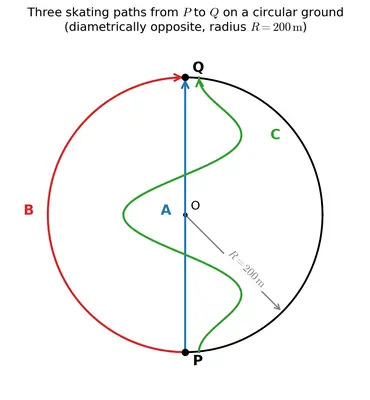
Three girls skating on a circular ice ground of radius $$200 \, \mathrm{m}$$ start from a point $$P$$ on the edge of the ground and reach a point $$Q$$ diametrically opposite to $$P$$ following different paths as shown in Fig. 3.19. What is the magnitude of the displacement vector for each? For which girl is this equal to the actual length of path skate?
Fig. 3.19 — A circular ground with point P at the bottom and diametrically opposite point Q at the top, showing three different paths (A, B and a third) skated from P to Q.

Solution

Displacement is a vector from the initial point to the final point and is the same for all three girls because they begin at $$P$$ and end at $$Q$$. Since $$P$$ and $$Q$$ are diametrically opposite,

$$|\vec{PQ}| = 2R = 2 \times 200\ \mathrm{m} = 400\ \mathrm{m}.$$

The magnitude of the displacement for each girl is $$400\ \mathrm{m}$$, directed from $$P$$ to $$Q$$ along the diameter.

Only the girl whose path is the straight line $$PQ$$ (the diameter) actually travels a distance equal to the magnitude of the displacement. For the other two girls the path is curved, so the path length is greater than $$400\ \mathrm{m}$$.

Answer

Magnitude of displacement = $$400\ \mathrm{m}$$ for each girl. It equals the actual path length only for the girl who skates along the straight diameter $$PQ$$.

3.9

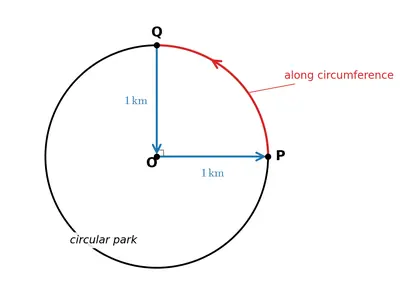
A cyclist starts from the centre $$O$$ of a circular park of radius $$1 \, \mathrm{km}$$, reaches the edge $$P$$ of the park, then cycles along the circumference, and returns to the centre along $$QO$$ as shown in Fig. 3.20. If the round trip takes $$10 \, \mathrm{min}$$, what is the (a) net displacement, (b) average velocity, and (c) average speed of the cyclist?
Fig. 3.20 — A circular park with centre O, showing the cyclist's route from O out to edge P, along the circumference to Q, and back along QO to the centre.

Solution

From the figure, the cyclist's path is: along the radius $$OP$$ to the edge, then along the quarter-arc $$PQ$$ on the circumference, then along the radius $$QO$$ back to the centre. The radius is $$R = 1\ \mathrm{km}$$ and the total time is $$\Delta t = 10\ \mathrm{min} = \tfrac{1}{6}\ \mathrm{h}$$.

(a) Net displacement. The cyclist starts at $$O$$ and returns to $$O$$, so the displacement vector is the null vector:

$$\vec{s}_{\text{net}} = \vec{0}.$$

(b) Average velocity.

$$\vec{v}_{\text{avg}} = \dfrac{\vec{s}_{\text{net}}}{\Delta t} = \vec{0}.$$

(c) Average speed. Total path length = $$OP$$ + arc $$PQ$$ + $$QO$$ = $$R + \tfrac{1}{4}(2\pi R) + R = 2R + \tfrac{\pi R}{2}.$$

$$\text{Path} = 2(1) + \tfrac{\pi(1)}{2} = 2 + \tfrac{\pi}{2} \approx 3.571\ \mathrm{km}.$$

$$\text{Average speed} = \dfrac{\text{Path}}{\Delta t} = \dfrac{3.571}{1/6}\ \mathrm{km\,h^{-1}} \approx 21.4\ \mathrm{km\,h^{-1}}.$$

Answer

(a) Net displacement = $$0$$. (b) Average velocity = $$0$$. (c) Average speed $$\approx 21.4\ \mathrm{km\,h^{-1}}$$.

3.10 On an open ground, a motorist follows a track that turns to his left by an angle of $$60^\circ$$ after every $$500 \, \mathrm{m}$$. Starting from a given turn, specify the displacement of the motorist at the third, sixth and eighth turn. Compare the magnitude of the displacement with the total path length covered by the motorist in each case.

Solution

An exterior angle of $$60^\circ$$ at every turn corresponds to an interior angle of $$120^\circ$$, so successive $$500\ \mathrm{m}$$ legs lie along the sides of a regular hexagon $$ABCDEF$$ with side $$s = 500\ \mathrm{m}$$. After six turns the motorist returns to the starting vertex, since $$6 \times 60^\circ = 360^\circ$$.

After 3 turns. The motorist has covered three consecutive sides $$AB$$, $$BC$$, $$CD$$ and is at vertex $$D$$, which is diametrically opposite to $$A$$ in the hexagon. So

$$|\vec{AD}| = 2s = 1000\ \mathrm{m}, \qquad \text{path length} = 3s = 1500\ \mathrm{m}.$$

Ratio of magnitudes: $$1000/1500 = 2/3$$.

After 6 turns. The motorist has returned to $$A$$.

$$|\text{displacement}| = 0, \qquad \text{path length} = 6s = 3000\ \mathrm{m}.$$

After 8 turns. Eight turns = six turns (one full hexagon) + two more. After two further sides (covering $$AB$$ and $$BC$$) the motorist is at $$C$$. In a regular hexagon, $$AC$$ is found using the law of cosines on triangle $$ABC$$ with $$AB = BC = s$$ and angle $$ABC = 120^\circ$$:

$$AC^2 = s^2 + s^2 - 2s^2\cos 120^\circ = 2s^2 + s^2 = 3s^2 \quad\Rightarrow\quad AC = s\sqrt{3} = 500\sqrt{3}\ \mathrm{m} \approx 866\ \mathrm{m}.$$

Path length $$= 8s = 4000\ \mathrm{m}$$.

Ratio: $$500\sqrt{3}/4000 = \sqrt{3}/8 \approx 0.217$$.

TurnMagnitude of displacementPath length
3rd$$1000\ \mathrm{m}$$$$1500\ \mathrm{m}$$
6th$$0$$$$3000\ \mathrm{m}$$
8th$$500\sqrt{3} \approx 866\ \mathrm{m}$$$$4000\ \mathrm{m}$$

Directions: at the 3rd turn the displacement is along $$AD$$ (the diameter opposite the start); at the 6th turn it is zero (back at the start); at the 8th turn it is along $$AC$$, the line joining the starting vertex to the vertex two sides away.

Answer

3rd turn: displacement $$= 1000\ \mathrm{m}$$, path $$= 1500\ \mathrm{m}$$. 6th turn: displacement $$= 0$$, path $$= 3000\ \mathrm{m}$$. 8th turn: displacement $$= 500\sqrt{3} \approx 866\ \mathrm{m}$$, path $$= 4000\ \mathrm{m}$$.

3.11 A passenger arriving in a new town wishes to go from the station to a hotel located $$10 \, \mathrm{km}$$ away on a straight road from the station. A dishonest cabman takes him along a circuitous path $$23 \, \mathrm{km}$$ long and reaches the hotel in $$28 \, \mathrm{min}$$. What is the (a) average speed of the taxi, (b) the magnitude of average velocity? Are the two equal?

Solution

Total path length $$= 23\ \mathrm{km}$$. Displacement magnitude $$= 10\ \mathrm{km}$$ (straight line from station to hotel). Time $$\Delta t = 28\ \mathrm{min} = \tfrac{28}{60}\ \mathrm{h}$$.

(a) Average speed.

$$v_{\text{avg}} = \dfrac{\text{Path}}{\Delta t} = \dfrac{23}{28/60}\ \mathrm{km\,h^{-1}} = \dfrac{23 \times 60}{28} \approx 49.3\ \mathrm{km\,h^{-1}}.$$

(b) Magnitude of average velocity.

$$|\vec{v}_{\text{avg}}| = \dfrac{|\text{displacement}|}{\Delta t} = \dfrac{10}{28/60}\ \mathrm{km\,h^{-1}} = \dfrac{10 \times 60}{28} \approx 21.4\ \mathrm{km\,h^{-1}}.$$

The two are not equal because the path length ($$23\ \mathrm{km}$$) is greater than the magnitude of displacement ($$10\ \mathrm{km}$$). They would be equal only if the cab travelled along the straight road from the station to the hotel.

Answer

(a) Average speed $$\approx 49.3\ \mathrm{km\,h^{-1}}$$. (b) Magnitude of average velocity $$\approx 21.4\ \mathrm{km\,h^{-1}}$$. They are not equal.

3.12 The ceiling of a long hall is $$25 \, \mathrm{m}$$ high. What is the maximum horizontal distance that a ball thrown with a speed of $$40 \, \mathrm{m\,s^{-1}}$$ can go without hitting the ceiling of the hall?

Solution

For a fixed speed $$u$$, the projectile of maximum range that just grazes the ceiling has its maximum height exactly equal to the ceiling height, $$H = 25\ \mathrm{m}$$. (Throwing at a larger angle would still go higher and hit the ceiling; smaller angle would yield a smaller range while leaving the ceiling untouched.)

From the projectile formula $$H = \dfrac{u^2 \sin^2\theta}{2g}$$, solve for $$\sin^2\theta$$ with $$u = 40\ \mathrm{m\,s^{-1}}$$ and $$g = 9.8\ \mathrm{m\,s^{-2}}$$:

$$\sin^2\theta = \dfrac{2gH}{u^2} = \dfrac{2(9.8)(25)}{(40)^2} = \dfrac{490}{1600} = 0.30625.$$

$$\sin\theta = 0.5534, \qquad \cos\theta = \sqrt{1 - 0.30625} = \sqrt{0.69375} = 0.8329.$$

$$\theta = \sin^{-1}(0.5534) \approx 33.6^\circ.$$

Horizontal range:

$$R = \dfrac{u^2 \sin 2\theta}{g} = \dfrac{u^2 \cdot 2\sin\theta\cos\theta}{g} = \dfrac{1600 \times 2(0.5534)(0.8329)}{9.8}.$$

$$R = \dfrac{1600 \times 0.9220}{9.8} \approx \dfrac{1475}{9.8} \approx 150.5\ \mathrm{m}.$$

The maximum horizontal distance is approximately $$150.5\ \mathrm{m}$$.

Answer

Maximum horizontal distance $$\approx 150.5\ \mathrm{m}$$ (thrown at $$\theta \approx 33.6^\circ$$ above the horizontal).

3.13 A cricketer can throw a ball to a maximum horizontal distance of $$100 \, \mathrm{m}$$. How much high above the ground can the cricketer throw the same ball?

Solution

The maximum horizontal range for a given launch speed $$u$$ occurs at angle $$45^\circ$$ and equals $$R_{\max} = \dfrac{u^2}{g}$$. Given $$R_{\max} = 100\ \mathrm{m}$$,

$$u^2 = R_{\max}\,g = 100 \times 9.8 = 980\ \mathrm{m^2\,s^{-2}}.$$

When the ball is thrown straight up (vertically), all the initial speed is along the upward direction and the maximum height attained is

$$H = \dfrac{u^2}{2g} = \dfrac{980}{2 \times 9.8} = \dfrac{980}{19.6} = 50\ \mathrm{m}.$$

So the cricketer can throw the ball to a height of $$50\ \mathrm{m}$$ above the ground. (Equivalently, $$H_{\max} = R_{\max}/2$$.)

Answer

Maximum height $$= 50\ \mathrm{m}$$.

3.14 A stone tied to the end of a string $$80 \, \mathrm{cm}$$ long is whirled in a horizontal circle with a constant speed. If the stone makes $$14$$ revolutions in $$25 \, \mathrm{s}$$, what is the magnitude and direction of acceleration of the stone?

Solution

Length of string (radius of the circle): $$r = 80\ \mathrm{cm} = 0.80\ \mathrm{m}$$. Frequency:

$$\nu = \dfrac{14}{25}\ \mathrm{rev\,s^{-1}}.$$

Angular speed:

$$\omega = 2\pi\nu = 2\pi \times \dfrac{14}{25} = \dfrac{28\pi}{25}\ \mathrm{rad\,s^{-1}} \approx 3.52\ \mathrm{rad\,s^{-1}}.$$

For uniform circular motion the acceleration is centripetal, of magnitude

$$a = \omega^2 r = \left(\dfrac{28\pi}{25}\right)^2 \times 0.80.$$

Numerically, $$\omega^2 = (3.52)^2 \approx 12.38\ \mathrm{rad^2\,s^{-2}}$$, so

$$a \approx 12.38 \times 0.80 \approx 9.91\ \mathrm{m\,s^{-2}}.$$

The acceleration is directed along the string, from the stone toward the centre of the circle (centripetal direction). Since the speed is constant there is no tangential acceleration.

Answer

Magnitude of acceleration $$\approx 9.91\ \mathrm{m\,s^{-2}}$$, directed along the string from the stone toward the centre of the circle.

3.15 An aircraft executes a horizontal loop of radius $$1.00 \, \mathrm{km}$$ with a steady speed of $$900 \, \mathrm{km/h}$$. Compare its centripetal acceleration with the acceleration due to gravity.

Solution

Convert the data to SI units.

$$r = 1.00\ \mathrm{km} = 1000\ \mathrm{m}, \qquad v = 900\ \mathrm{km/h} = \dfrac{900 \times 1000}{3600}\ \mathrm{m/s} = 250\ \mathrm{m/s}.$$

Centripetal acceleration:

$$a_c = \dfrac{v^2}{r} = \dfrac{(250)^2}{1000} = \dfrac{62500}{1000} = 62.5\ \mathrm{m\,s^{-2}}.$$

Comparing with $$g = 9.8\ \mathrm{m\,s^{-2}}$$:

$$\dfrac{a_c}{g} = \dfrac{62.5}{9.8} \approx 6.38.$$

The centripetal acceleration is about $$6.4$$ times the acceleration due to gravity.

Answer

Centripetal acceleration $$a_c = 62.5\ \mathrm{m\,s^{-2}}$$, so $$a_c/g \approx 6.4$$.

3.16 Read each statement below carefully and state, with reasons, if it is true or false:

(a) The net acceleration of a particle in circular motion is always along the radius of the circle towards the centre

Solution

False. The statement is true only for uniform circular motion, in which the speed is constant and there is no tangential acceleration. In general (non-uniform) circular motion the speed varies, so a tangential component of acceleration is also present. The net acceleration is then the vector sum of the centripetal (radial) and tangential components and does not point along the radius.

Answer

False — true only for uniform circular motion; in general the acceleration also has a tangential component.

(b) The velocity vector of a particle at a point is always along the tangent to the path of the particle at that point

Solution

True. By definition $$\vec{v} = \dfrac{d\vec{r}}{dt}$$, which is the limit of the chord (joining two nearby points on the path) as the time interval $$\to 0$$. This limiting direction is along the tangent to the path at that point.

Answer

True.

(c) The acceleration vector of a particle in uniform circular motion averaged over one cycle is a null vector

Solution

True. In uniform circular motion the acceleration $$\vec{a}$$ always has the same magnitude $$v^2/r$$ and points from the particle toward the centre. For every position on the circle there is a diametrically opposite position whose centripetal acceleration is exactly opposite. Over a full cycle these contributions cancel, so the time-average $$\langle\vec{a}\rangle$$ is zero.

Algebraically, $$\vec{a}(t) = -\omega^2 \vec{r}(t)$$ for circular motion about the origin, and

$$\dfrac{1}{T}\int_0^T \vec{r}(t)\,dt = \vec{0},$$

so the average acceleration over one period is the null vector. (Note: the average magnitude of acceleration is non-zero.)

Answer

True — over a complete revolution the centripetal acceleration vector averages to zero.

3.17

The position of a particle is given by

$$\mathbf{r} = 3.0t \, \hat{\mathbf{i}} - 2.0t^2 \, \hat{\mathbf{j}} + 4.0 \, \hat{\mathbf{k}} \, \mathrm{m}$$

where $$t$$ is in seconds and the coefficients have the proper units for $$\mathbf{r}$$ to be in metres. (a) Find the $$\mathbf{v}$$ and $$\mathbf{a}$$ of the particle? (b) What is the magnitude and direction of velocity of the particle at $$t = 2.0 \, \mathrm{s}$$?

Solution

(a) Differentiate $$\vec{r}$$ with respect to $$t$$:

$$\vec{v}(t) = \dfrac{d\vec{r}}{dt} = 3.0\,\hat{\mathbf{i}} - 4.0\,t\,\hat{\mathbf{j}}\ \mathrm{m\,s^{-1}}.$$

Differentiate again:

$$\vec{a}(t) = \dfrac{d\vec{v}}{dt} = -4.0\,\hat{\mathbf{j}}\ \mathrm{m\,s^{-2}}.$$

The acceleration is constant, of magnitude $$4.0\ \mathrm{m\,s^{-2}}$$, directed along the $$-y$$ axis.

(b) At $$t = 2.0\ \mathrm{s}$$:

$$\vec{v}(2) = 3.0\,\hat{\mathbf{i}} - 8.0\,\hat{\mathbf{j}}\ \mathrm{m\,s^{-1}}.$$

$$|\vec{v}(2)| = \sqrt{3.0^2 + (-8.0)^2} = \sqrt{9 + 64} = \sqrt{73} \approx 8.54\ \mathrm{m\,s^{-1}}.$$

The angle $$\theta$$ that $$\vec{v}(2)$$ makes with the $$+x$$ axis:

$$\tan\theta = \dfrac{v_y}{v_x} = \dfrac{-8.0}{3.0} \approx -2.667 \quad\Rightarrow\quad \theta \approx -69.4^\circ.$$

The velocity points about $$69.4^\circ$$ below the positive $$x$$-axis (in the fourth quadrant of the $$xy$$-plane).

Answer

(a) $$\vec{v}(t) = 3.0\,\hat{\mathbf{i}} - 4.0t\,\hat{\mathbf{j}}\ \mathrm{m\,s^{-1}}$$; $$\vec{a} = -4.0\,\hat{\mathbf{j}}\ \mathrm{m\,s^{-2}}$$. (b) At $$t = 2.0\ \mathrm{s}$$, $$|\vec{v}| \approx 8.54\ \mathrm{m\,s^{-1}}$$, directed about $$69.4^\circ$$ below the $$+x$$-axis.

3.18 A particle starts from the origin at $$t = 0 \, \mathrm{s}$$ with a velocity of $$10.0 \, \hat{\mathbf{j}} \, \mathrm{m/s}$$ and moves in the $$x$$-$$y$$ plane with a constant acceleration of $$(8.0 \hat{\mathbf{i}} + 2.0 \hat{\mathbf{j}}) \, \mathrm{m\,s^{-2}}$$. (a) At what time is the $$x$$-coordinate of the particle $$16 \, \mathrm{m}$$? What is the $$y$$-coordinate of the particle at that time? (b) What is the speed of the particle at the time?

Solution

With $$\vec{r}_0 = \vec{0}$$, $$\vec{u} = 10.0\,\hat{\mathbf{j}}\ \mathrm{m/s}$$, and $$\vec{a} = 8.0\,\hat{\mathbf{i}} + 2.0\,\hat{\mathbf{j}}\ \mathrm{m\,s^{-2}}$$, the equations of motion (constant acceleration) give component-wise:

$$x(t) = 0 + 0\cdot t + \tfrac{1}{2}(8.0)\,t^2 = 4.0\,t^2,$$
$$y(t) = 0 + 10.0\,t + \tfrac{1}{2}(2.0)\,t^2 = 10.0\,t + t^2.$$

(a) Set $$x(t) = 16$$ m:

$$4.0\,t^2 = 16 \quad\Rightarrow\quad t^2 = 4 \quad\Rightarrow\quad t = 2.0\ \mathrm{s}.$$

$$y(2) = 10.0(2) + (2)^2 = 20 + 4 = 24\ \mathrm{m}.$$

(b) Velocity at time $$t$$: $$\vec{v}(t) = \vec{u} + \vec{a}\,t = 8.0\,t\,\hat{\mathbf{i}} + (10.0 + 2.0\,t)\,\hat{\mathbf{j}}.$$

At $$t = 2.0\ \mathrm{s}$$:

$$\vec{v}(2) = 16.0\,\hat{\mathbf{i}} + 14.0\,\hat{\mathbf{j}}\ \mathrm{m/s}.$$

Speed:

$$|\vec{v}(2)| = \sqrt{16^2 + 14^2} = \sqrt{256 + 196} = \sqrt{452} \approx 21.3\ \mathrm{m/s}.$$

Answer

(a) $$t = 2.0\ \mathrm{s}$$ and $$y = 24\ \mathrm{m}$$. (b) Speed $$\approx 21.3\ \mathrm{m/s}$$.

3.19 $$\hat{\mathbf{i}}$$ and $$\hat{\mathbf{j}}$$ are unit vectors along $$x$$- and $$y$$- axis respectively. What is the magnitude and direction of the vectors $$\hat{\mathbf{i}} + \hat{\mathbf{j}}$$ and $$\hat{\mathbf{i}} - \hat{\mathbf{j}}$$? What are the components of a vector $$\mathbf{A} = 2\hat{\mathbf{i}} + 3\hat{\mathbf{j}}$$ along the directions of $$\hat{\mathbf{i}} + \hat{\mathbf{j}}$$ and $$\hat{\mathbf{i}} - \hat{\mathbf{j}}$$? [You may use graphical method]

Solution

Magnitudes.

$$|\hat{\mathbf{i}} + \hat{\mathbf{j}}| = \sqrt{1^2 + 1^2} = \sqrt{2},$$
$$|\hat{\mathbf{i}} - \hat{\mathbf{j}}| = \sqrt{1^2 + (-1)^2} = \sqrt{2}.$$

Directions. Let $$\alpha$$ be the angle of $$\hat{\mathbf{i}} + \hat{\mathbf{j}}$$ with the $$x$$-axis:

$$\tan\alpha = \dfrac{1}{1} = 1 \quad\Rightarrow\quad \alpha = 45^\circ.$$

For $$\hat{\mathbf{i}} - \hat{\mathbf{j}}$$: $$\tan\beta = -1$$, so $$\beta = -45^\circ$$ (i.e. $$45^\circ$$ below the $$+x$$-axis).

Unit vectors along these directions.

$$\hat{\mathbf{n}}_1 = \dfrac{\hat{\mathbf{i}} + \hat{\mathbf{j}}}{\sqrt{2}}, \qquad \hat{\mathbf{n}}_2 = \dfrac{\hat{\mathbf{i}} - \hat{\mathbf{j}}}{\sqrt{2}}.$$

Components of $$\vec{A} = 2\hat{\mathbf{i}} + 3\hat{\mathbf{j}}$$ along these directions are obtained from the dot product:

$$A_1 = \vec{A}\cdot\hat{\mathbf{n}}_1 = \dfrac{(2)(1) + (3)(1)}{\sqrt{2}} = \dfrac{5}{\sqrt{2}} = \dfrac{5\sqrt{2}}{2} \approx 3.54.$$

$$A_2 = \vec{A}\cdot\hat{\mathbf{n}}_2 = \dfrac{(2)(1) + (3)(-1)}{\sqrt{2}} = \dfrac{-1}{\sqrt{2}} = -\dfrac{\sqrt{2}}{2} \approx -0.707.$$

The negative sign for $$A_2$$ indicates that the component is directed opposite to $$\hat{\mathbf{n}}_2$$ (i.e. along $$-\hat{\mathbf{n}}_2$$).

Answer

$$|\hat{\mathbf{i}} + \hat{\mathbf{j}}| = |\hat{\mathbf{i}} - \hat{\mathbf{j}}| = \sqrt{2}$$, at $$+45^\circ$$ and $$-45^\circ$$ from the $$+x$$-axis respectively. Component of $$\vec{A}$$ along $$(\hat{\mathbf{i}}+\hat{\mathbf{j}})$$: $$5/\sqrt{2}$$; along $$(\hat{\mathbf{i}}-\hat{\mathbf{j}})$$: $$-1/\sqrt{2}$$.

3.20

For any arbitrary motion in space, which of the following relations are true:

(The 'average' stands for average of the quantity over the time interval $$t_1$$ to $$t_2$$)

(a) $$\mathbf{v}_{average} = (1/2)\,(\mathbf{v}(t_1) + \mathbf{v}(t_2))$$

Solution

False. The relation $$\vec{v}_{\text{avg}} = \tfrac{1}{2}\big(\vec{v}(t_1) + \vec{v}(t_2)\big)$$ is the average of the velocities at the two end points and equals the time-average of velocity only when the acceleration is constant. For an arbitrary motion (where $$\vec{a}$$ may vary with time) it is not true in general.

Answer

False — valid only for uniform acceleration.

(b) $$\mathbf{v}_{average} = [\mathbf{r}(t_2) - \mathbf{r}(t_1)] / (t_2 - t_1)$$

Solution

True. This is the very definition of average velocity: total displacement divided by the time interval. It holds for any kind of motion, however arbitrary.

Answer

True — definition of average velocity.

(c) $$\mathbf{v}(t) = \mathbf{v}(0) + \mathbf{a}\,t$$

Solution

False. This is the first equation of motion and is valid only when the acceleration $$\vec{a}$$ is constant (independent of time). For arbitrary motion $$\vec{a}$$ may depend on $$t$$ and one must use $$\vec{v}(t) = \vec{v}(0) + \int_0^t \vec{a}(t')\,dt'$$.

Answer

False — valid only for constant acceleration.

(d) $$\mathbf{r}(t) = \mathbf{r}(0) + \mathbf{v}(0)\,t + (1/2)\,\mathbf{a}\,t^2$$

Solution

False. The position equation $$\vec{r}(t) = \vec{r}(0) + \vec{v}(0)\,t + \tfrac{1}{2}\vec{a}\,t^2$$ is derived assuming that the acceleration is constant. It does not apply when $$\vec{a}$$ varies with time.

Answer

False — valid only for constant acceleration.

(e) $$\mathbf{a}_{average} = [\mathbf{v}(t_2) - \mathbf{v}(t_1)] / (t_2 - t_1)$$

Solution

True. This is the definition of average acceleration: change in velocity divided by the time interval. It is valid for any motion, regardless of whether the acceleration is constant.

Answer

True — definition of average acceleration.

3.21

Read each statement below carefully and state, with reasons and examples, if it is true or false:

A scalar quantity is one that

(a) is conserved in a process

Solution

False. Being a scalar has nothing to do with being conserved. For example, kinetic energy (a scalar) is not conserved in an inelastic collision, while a vector quantity like total linear momentum can be conserved. Conservation depends on the physical law, not on the scalar/vector nature of the quantity.

Answer

False — scalars are not necessarily conserved (e.g. KE in an inelastic collision).

(b) can never take negative values

Solution

False. Many scalars can be negative. Temperature on the Celsius scale (or potential energy, gravitational potential, charge) can take negative values. A scalar is only required to have a magnitude (with sign permitted), not to be non-negative.

Answer

False — e.g. temperature in $${}^\circ\mathrm{C}$$, potential energy, charge can be negative.

(c) must be dimensionless

Solution

False. Scalars routinely carry dimensions. Mass, density, time, energy and temperature are all scalars with non-trivial dimensions. Only some special scalars (e.g. coefficient of friction, refractive index) are dimensionless.

Answer

False — mass, time, energy are dimensional scalars.

(d) does not vary from one point to another in space

Solution

False. A scalar can perfectly well be a function of position (a scalar field). For example, the temperature in a room, the pressure in the atmosphere and the gravitational potential vary from point to point but are all scalars.

Answer

False — scalar fields (temperature, pressure, potential) vary in space.

(e) has the same value for observers with different orientations of axes.

Solution

True. Invariance under rotation of the coordinate axes is the defining property of a scalar: its numerical value does not depend on how the observer orients his axes. (By contrast, the components of a vector change when the axes are rotated, although the vector's magnitude — itself a scalar — is unchanged.)

Answer

True — this is the defining property of a scalar.

3.22 An aircraft is flying at a height of $$3400 \, \mathrm{m}$$ above the ground. If the angle subtended at a ground observation point by the aircraft positions $$10.0 \, \mathrm{s}$$ a part is $$30^\circ$$, wat is the speed of the aircraft?

Solution

Let $$O$$ be the ground observation point and $$A$$, $$B$$ the two positions of the aircraft separated by $$\Delta t = 10.0\ \mathrm{s}$$. The aircraft flies horizontally at height $$h = 3400\ \mathrm{m}$$. Because the aircraft is on the same horizontal line, by symmetry the perpendicular from $$O$$ to $$AB$$ lands at the midpoint $$M$$ of $$AB$$, and $$OM = h$$. The given angle is $$\angle AOB = 30^\circ$$, so each half-angle is

$$\angle AOM = \angle MOB = 15^\circ.$$

In the right triangle $$OMA$$,

$$AM = OM\,\tan 15^\circ = 3400 \times \tan 15^\circ.$$

Using $$\tan 15^\circ \approx 0.2679$$:

$$AM \approx 3400 \times 0.2679 \approx 911\ \mathrm{m}.$$

The total horizontal distance covered between the two positions is

$$AB = 2\,AM \approx 2 \times 911 \approx 1822\ \mathrm{m}.$$

Hence the speed is

$$v = \dfrac{AB}{\Delta t} = \dfrac{1822}{10.0} \approx 182\ \mathrm{m\,s^{-1}}.$$

(Equivalently, $$v \approx 656\ \mathrm{km/h}$$.)

Answer

Speed of the aircraft $$\approx 182\ \mathrm{m\,s^{-1}}$$ ($$\approx 656\ \mathrm{km/h}$$).
NCERT Solutions for Class 11
Maths
NCERT Solutions for Class 11 Maths
Chapter-wise step-by-step
solutions with explanations
explore solutions Maths bg
Physics
NCERT Solutions for Class 11 Physics
Chapter-wise step-by-step
solutions with explanations
explore solutions Physics bg
Chemistry
NCERT Solutions for Class 11 Chemistry
Chapter-wise step-by-step
solutions with explanations
explore solutions Chemistry bg

Frequently Asked Questions

50,000+ JEE Students Trusted Our Score Calculator

Predict your JEE Main percentile, rank & performance in seconds