Join WhatsApp Icon JEE WhatsApp Group
NCERT Solutions for Class 11 Physics

Chapter 14: Waves

Download Solutions PDF
Daily JEE Updates, Tips & Important Alerts
Join 30,000+ students and stay updated with JEE notifications and preparation insights.
Join Now!
Free PDF
Complete NCERT Solution PDF for Chapter 14: Waves

NCERT Solutions For Class 11 Physics Chapter 14 Waves helps students explore the principles of wave motion and how energy travels through different mediums. The page provides detailed NCERT Solutions that explain wave characteristics, types of waves, wave equations, superposition, and sound-related applications. NCERT Solutions For Class 11 Physics simplify complex wave concepts with clear explanations and solved examples. The chapter helps students understand how disturbances propagate and how waves behave in different situations. These solutions support textbook practice, revision, and preparation for examinations. Students can download the chapter PDF for convenient learning and quick review. The detailed approach helps learners build a strong foundation in wave mechanics.
Download Solutions PDF

Examples 14.1-14.6

Example 14.1

Given below are some examples of wave motion. State in each case if the wave motion is transverse, longitudinal or a combination of both:

  1. Motion of a kink in a longitudinal spring produced by displacing one end of the spring sideways.
  2. Waves produced in a cylinder containing a liquid by moving its piston back and forth.
  3. Waves produced by a motorboat sailing in water.
  4. Ultrasonic waves in air produced by a vibrating quartz crystal.

Solution

A wave is transverse if the particles of the medium oscillate perpendicular to the direction in which the wave travels, and longitudinal if they oscillate along the direction of travel.

(1) Kink in a spring displaced sideways: One end of the spring is moved sideways, so the kink (the disturbance) is perpendicular to the length of the spring, while it travels along the spring. The particles move at right angles to the direction of propagation, so this is a transverse wave.

(2) Waves in a liquid produced by a piston: The piston moves back and forth along the axis of the cylinder, producing compressions and rarefactions of the liquid in the same direction in which the wave travels. Hence this is a longitudinal wave.

(3) Waves produced by a motorboat: On the surface of water the particles trace nearly circular paths — they move both up-and-down and back-and-forth. Such surface waves are a combination of both transverse and longitudinal motion.

(4) Ultrasonic waves in air from a quartz crystal: Sound waves (including ultrasonic waves) in a gas propagate as compressions and rarefactions, with the air particles oscillating along the direction of propagation. Hence this is a longitudinal wave.

Answer

(1) Transverse; (2) Longitudinal; (3) Combination of transverse and longitudinal; (4) Longitudinal.

Example 14.2

A wave travelling along a string is described by,

$$y(x, t) = 0.005 \sin(80.0 x - 3.0 t)$$,

in which the numerical constants are in SI units ($$0.005 \, \mathrm{m}$$, $$80.0 \, \mathrm{rad \, m^{-1}}$$, and $$3.0 \, \mathrm{rad \, s^{-1}}$$). Calculate (a) the amplitude, (b) the wavelength, and (c) the period and frequency of the wave. Also, calculate the displacement $$y$$ of the wave at a distance $$x = 30.0 \, \mathrm{cm}$$ and time $$t = 20 \, \mathrm{s}$$?

Solution

The given wave is $$y(x,t) = 0.005 \sin(80.0\,x - 3.0\,t)$$. Compare it with the standard form of a travelling harmonic wave

$$y(x,t) = a \sin(kx - \omega t)$$

This identifies the amplitude $$a = 0.005 \, \mathrm{m}$$, the angular wave number $$k = 80.0 \, \mathrm{rad\,m^{-1}}$$ and the angular frequency $$\omega = 3.0 \, \mathrm{rad\,s^{-1}}$$.

(a) Amplitude. The amplitude is the coefficient of the sine function:

$$a = 0.005 \, \mathrm{m} = 5 \, \mathrm{mm}$$

(b) Wavelength. The angular wave number is related to the wavelength by $$k = \dfrac{2\pi}{\lambda}$$, so

$$\lambda = \dfrac{2\pi}{k} = \dfrac{2\pi}{80.0} = 7.85 \times 10^{-2} \, \mathrm{m} = 7.85 \, \mathrm{cm}$$

(c) Period and frequency. The angular frequency is related to the period by $$\omega = \dfrac{2\pi}{T}$$, so

$$T = \dfrac{2\pi}{\omega} = \dfrac{2\pi}{3.0} = 2.09 \, \mathrm{s}$$

The frequency is the reciprocal of the period:

$$\nu = \dfrac{1}{T} = \dfrac{1}{2.09} = 0.48 \, \mathrm{Hz}$$

Displacement at $$x = 30.0 \, \mathrm{cm} = 0.30 \, \mathrm{m}$$ and $$t = 20 \, \mathrm{s}$$. Substitute these values into the wave equation:

$$y = 0.005 \sin\big(80.0 \times 0.30 - 3.0 \times 20\big)$$

$$y = 0.005 \sin(24 - 60) = 0.005 \sin(-36 \, \mathrm{rad})$$

Since the sine function repeats every $$2\pi$$, we may add a whole number of cycles: $$-36 + 6(2\pi) = 1.70 \, \mathrm{rad}$$, so $$\sin(-36) = \sin(1.70) \approx 0.99$$. Therefore

$$y = 0.005 \times 0.99 \approx 5 \times 10^{-3} \, \mathrm{m} = 5 \, \mathrm{mm}$$

Answer

(a) Amplitude $$a = 0.005 \, \mathrm{m} = 5 \, \mathrm{mm}$$; (b) wavelength $$\lambda = 7.85 \, \mathrm{cm}$$; (c) period $$T = 2.09 \, \mathrm{s}$$ and frequency $$\nu = 0.48 \, \mathrm{Hz}$$. The displacement at the given point and time is $$y \approx 5 \, \mathrm{mm}$$.

Example 14.3 A steel wire $$0.72 \, \mathrm{m}$$ long has a mass of $$5.0 \times 10^{-3} \, \mathrm{kg}$$. If the wire is under a tension of $$60 \, \mathrm{N}$$, what is the speed of transverse waves on the wire?

Solution

The speed of a transverse wave on a stretched wire is

$$v = \sqrt{\dfrac{T}{\mu}}$$

where $$T$$ is the tension and $$\mu$$ is the linear mass density (mass per unit length).

Linear mass density.

$$\mu = \dfrac{m}{L} = \dfrac{5.0 \times 10^{-3} \, \mathrm{kg}}{0.72 \, \mathrm{m}} = 6.9 \times 10^{-3} \, \mathrm{kg\,m^{-1}}$$

Speed of the transverse wave.

$$v = \sqrt{\dfrac{T}{\mu}} = \sqrt{\dfrac{60 \, \mathrm{N}}{6.9 \times 10^{-3} \, \mathrm{kg\,m^{-1}}}}$$

$$v = \sqrt{8.64 \times 10^{3}} \approx 93 \, \mathrm{m\,s^{-1}}$$

Answer

The speed of transverse waves on the wire is $$v \approx 93 \, \mathrm{m\,s^{-1}}$$.

Example 14.4 Estimate the speed of sound in air at standard temperature and pressure. The mass of $$1$$ mole of air is $$29.0 \times 10^{-3} \, \mathrm{kg}$$.

Solution

Newton's formula. Newton assumed that sound propagates through a gas under isothermal conditions, which gives the speed

$$v = \sqrt{\dfrac{P}{\rho}}$$

At standard temperature and pressure (STP), $$P = 1.01 \times 10^{5} \, \mathrm{Pa}$$ and $$T = 273 \, \mathrm{K}$$. One mole of any gas occupies $$22.4 \times 10^{-3} \, \mathrm{m^3}$$ at STP, and the mass of one mole of air is $$29.0 \times 10^{-3} \, \mathrm{kg}$$. Hence the density of air is

$$\rho = \dfrac{\text{mass of one mole}}{\text{volume of one mole}} = \dfrac{29.0 \times 10^{-3}}{22.4 \times 10^{-3}} = 1.29 \, \mathrm{kg\,m^{-3}}$$

Newton's formula then gives

$$v = \sqrt{\dfrac{1.01 \times 10^{5}}{1.29}} = \sqrt{7.83 \times 10^{4}} \approx 280 \, \mathrm{m\,s^{-1}}$$

This is about 15% lower than the experimentally measured value of about $$331 \, \mathrm{m\,s^{-1}}$$.

Laplace correction. Laplace pointed out that the compressions and rarefactions in a sound wave occur so rapidly that the process is adiabatic, not isothermal. The correct speed is therefore

$$v = \sqrt{\dfrac{\gamma P}{\rho}}$$

where $$\gamma = C_P/C_V$$. For air, which is mostly diatomic, $$\gamma = 1.4$$. Hence

$$v = \sqrt{\dfrac{1.4 \times 1.01 \times 10^{5}}{1.29}} = \sqrt{1.4} \times 280 \approx 331 \, \mathrm{m\,s^{-1}}$$

which agrees closely with the measured speed of sound in air.

Answer

Newton's (isothermal) formula gives $$v \approx 280 \, \mathrm{m\,s^{-1}}$$; with the Laplace (adiabatic) correction, $$v \approx 331 \, \mathrm{m\,s^{-1}}$$, which agrees with experiment.

Example 14.5 A pipe, $$30.0 \, \mathrm{cm}$$ long, is open at both ends. Which harmonic mode of the pipe resonates a $$1.1 \, \mathrm{kHz}$$ source? Will resonance with the same source be observed if one end of the pipe is closed? Take the speed of sound in air as $$330 \, \mathrm{m \, s^{-1}}$$.

Solution

Pipe open at both ends. For a pipe open at both ends, the resonant (harmonic) frequencies are

$$\nu_n = \dfrac{n\,v}{2L}, \qquad n = 1, 2, 3, \dots$$

The fundamental frequency ($$n = 1$$) is

$$\nu_1 = \dfrac{v}{2L} = \dfrac{330}{2 \times 0.30} = 550 \, \mathrm{Hz}$$

For resonance with the source of frequency $$1.1 \, \mathrm{kHz} = 1100 \, \mathrm{Hz}$$,

$$n = \dfrac{\nu_n}{\nu_1} = \dfrac{1100}{550} = 2$$

So the source resonates with the second harmonic ($$n = 2$$) of the open pipe.

Pipe closed at one end. For a pipe closed at one end, only the odd harmonics are present:

$$\nu_n = \dfrac{(2n-1)\,v}{4L}, \qquad n = 1, 2, 3, \dots$$

The fundamental frequency is

$$\nu_1 = \dfrac{v}{4L} = \dfrac{330}{4 \times 0.30} = 275 \, \mathrm{Hz}$$

To resonate at $$1100 \, \mathrm{Hz}$$ we would need $$\dfrac{1100}{275} = 4$$, i.e. the 4th harmonic. But a closed pipe supports only the odd harmonics ($$1, 3, 5, \dots$$). Since $$4$$ is even, the closed pipe cannot resonate with the same $$1.1 \, \mathrm{kHz}$$ source.

Answer

The $$1.1 \, \mathrm{kHz}$$ source resonates with the second harmonic of the open pipe. If one end is closed, no resonance occurs (1100 Hz would correspond to the 4th harmonic, but a closed pipe supports only odd harmonics).

Example 14.6 Two sitar strings A and B playing the note 'Dha' are slightly out of tune and produce beats of frequency $$5 \, \mathrm{Hz}$$. The tension of the string B is slightly increased and the beat frequency is found to decrease to $$3 \, \mathrm{Hz}$$. What is the original frequency of B if the frequency of A is $$427 \, \mathrm{Hz}$$?

Solution

When two notes of nearly equal frequency are sounded together, the beat frequency equals the difference of the two frequencies:

$$\nu_{\text{beat}} = |\nu_A - \nu_B|$$

Initially the beat frequency is $$5 \, \mathrm{Hz}$$ and $$\nu_A = 427 \, \mathrm{Hz}$$, so the original frequency of B is either

$$\nu_B = 427 + 5 = 432 \, \mathrm{Hz} \quad \text{or} \quad \nu_B = 427 - 5 = 422 \, \mathrm{Hz}$$

To decide which value is correct, use the extra information. The tension of string B is increased. Since the frequency of a stretched string increases with tension ($$\nu \propto \sqrt{T}$$), the frequency of B increases.

  • If $$\nu_B = 432 \, \mathrm{Hz}$$: increasing it moves it further from $$427 \, \mathrm{Hz}$$, so the beat frequency would increase. This contradicts the observation.
  • If $$\nu_B = 422 \, \mathrm{Hz}$$: increasing it moves it closer to $$427 \, \mathrm{Hz}$$, so the beat frequency decreases (here from $$5 \, \mathrm{Hz}$$ to $$3 \, \mathrm{Hz}$$). This matches the observation.

Hence the original frequency of string B is $$\nu_B = 422 \, \mathrm{Hz}$$.

Answer

The original frequency of string B is $$\nu_B = 422 \, \mathrm{Hz}$$.

Exercises

14.1 A string of mass $$2.50 \, \mathrm{kg}$$ is under a tension of $$200 \, \mathrm{N}$$. The length of the stretched string is $$20.0 \, \mathrm{m}$$. If the transverse jerk is struck at one end of the string, how long does the disturbance take to reach the other end?

Solution

The transverse jerk travels along the string as a transverse wave with speed

$$v = \sqrt{\dfrac{T}{\mu}}$$

where $$T$$ is the tension and $$\mu = m/L$$ is the linear mass density of the string.

Linear mass density.

$$\mu = \dfrac{m}{L} = \dfrac{2.50 \, \mathrm{kg}}{20.0 \, \mathrm{m}} = 0.125 \, \mathrm{kg\,m^{-1}}$$

Speed of the disturbance.

$$v = \sqrt{\dfrac{T}{\mu}} = \sqrt{\dfrac{200}{0.125}} = \sqrt{1600} = 40 \, \mathrm{m\,s^{-1}}$$

Time to travel the length of the string. The disturbance travels the full length $$L = 20.0 \, \mathrm{m}$$ at this constant speed:

$$t = \dfrac{L}{v} = \dfrac{20.0}{40} = 0.50 \, \mathrm{s}$$

Answer

The disturbance takes $$t = 0.50 \, \mathrm{s}$$ to reach the other end.

14.2 A stone dropped from the top of a tower of height $$300 \, \mathrm{m}$$ splashes into the water of a pond near the base of the tower. When is the splash heard at the top given that the speed of sound in air is $$340 \, \mathrm{m \, s^{-1}}$$? ($$g = 9.8 \, \mathrm{m \, s^{-2}}$$)

Solution

The total time between dropping the stone and hearing the splash is the sum of two parts: the time $$t_1$$ for the stone to fall to the water, and the time $$t_2$$ for the sound of the splash to travel back up the tower.

Time of fall of the stone. The stone is dropped from rest, so its initial velocity is zero. Using $$h = \dfrac{1}{2}g t_1^{2}$$ with $$h = 300 \, \mathrm{m}$$:

$$t_1 = \sqrt{\dfrac{2h}{g}} = \sqrt{\dfrac{2 \times 300}{9.8}} = \sqrt{61.2} = 7.82 \, \mathrm{s}$$

Time for the sound to travel up. The splash sound travels the height $$h$$ at the speed of sound:

$$t_2 = \dfrac{h}{v} = \dfrac{300}{340} = 0.88 \, \mathrm{s}$$

Total time.

$$t = t_1 + t_2 = 7.82 + 0.88 = 8.7 \, \mathrm{s}$$

Answer

The splash is heard about $$8.7 \, \mathrm{s}$$ after the stone is dropped.

14.3 A steel wire has a length of $$12.0 \, \mathrm{m}$$ and a mass of $$2.10 \, \mathrm{kg}$$. What should be the tension in the wire so that speed of a transverse wave on the wire equals the speed of sound in dry air at $$20\,{}^\circ\mathrm{C} = 343 \, \mathrm{m \, s^{-1}}$$.

Solution

The speed of a transverse wave on the wire is $$v = \sqrt{\dfrac{T}{\mu}}$$, where $$\mu = m/L$$ is the linear mass density. We require this speed to equal the speed of sound in dry air, $$v = 343 \, \mathrm{m\,s^{-1}}$$.

Linear mass density.

$$\mu = \dfrac{m}{L} = \dfrac{2.10 \, \mathrm{kg}}{12.0 \, \mathrm{m}} = 0.175 \, \mathrm{kg\,m^{-1}}$$

Tension. Squaring $$v = \sqrt{T/\mu}$$ gives $$T = v^{2}\mu$$:

$$T = (343)^{2} \times 0.175$$

$$T = 1.176 \times 10^{5} \times 0.175 \approx 2.06 \times 10^{4} \, \mathrm{N}$$

Answer

The required tension in the wire is $$T \approx 2.06 \times 10^{4} \, \mathrm{N}$$.

14.4

Use the formula $$v = \sqrt{\dfrac{\gamma P}{\rho}}$$ to explain why the speed of sound in air

(a) is independent of pressure,

Solution

Express the density of the gas in terms of its pressure and temperature. For a gas of molar mass $$M$$, the ideal gas equation is $$PV = nRT$$, where $$n = \dfrac{\text{mass}}{M}$$ is the number of moles. Hence

$$P = \dfrac{\text{mass}}{M\,V}\,RT = \dfrac{\rho RT}{M} \qquad\Rightarrow\qquad \rho = \dfrac{PM}{RT}$$

Substitute this density into the speed formula:

$$v = \sqrt{\dfrac{\gamma P}{\rho}} = \sqrt{\dfrac{\gamma P}{PM/RT}} = \sqrt{\dfrac{\gamma RT}{M}}$$

The pressure $$P$$ has cancelled out completely. Thus, at a fixed temperature, the speed of sound depends only on $$\gamma$$, $$R$$, $$T$$ and $$M$$ — it does not depend on the pressure. (Equivalently: if $$P$$ changes at constant temperature, the density $$\rho$$ changes in exactly the same proportion, so the ratio $$P/\rho$$ stays constant.)

Answer

At constant temperature $$\rho \propto P$$, so the ratio $$P/\rho$$ is constant; equivalently $$v = \sqrt{\gamma RT/M}$$ contains no $$P$$. Hence the speed of sound is independent of pressure.

(b) increases with temperature,

Solution

From part (a), the speed of sound in a gas can be written as

$$v = \sqrt{\dfrac{\gamma RT}{M}}$$

For a given gas, $$\gamma$$ (the ratio of specific heats), $$R$$ (the gas constant) and $$M$$ (the molar mass) are all constants. Therefore

$$v \propto \sqrt{T}$$

where $$T$$ is the absolute (kelvin) temperature. As the temperature rises, $$\sqrt{T}$$ increases, and so the speed of sound increases with temperature.

Answer

Since $$v = \sqrt{\gamma RT/M} \propto \sqrt{T}$$ (with $$\gamma, R, M$$ constant), the speed of sound increases as the absolute temperature increases.

(c) increases with humidity.

Solution

When air is humid, some of the ordinary air molecules are replaced by water-vapour molecules. The molar mass of water vapour ($$\mathrm{H_2O}$$, about $$18 \, \mathrm{g\,mol^{-1}}$$) is smaller than the average molar mass of dry air (about $$29 \, \mathrm{g\,mol^{-1}}$$).

Hence, at the same temperature and pressure, moist (humid) air is less dense than dry air. From the speed formula

$$v = \sqrt{\dfrac{\gamma P}{\rho}}$$

at a fixed pressure $$v \propto \dfrac{1}{\sqrt{\rho}}$$. A smaller density therefore corresponds to a larger speed. So the speed of sound in air increases with humidity — sound travels faster in moist air than in dry air.

Answer

Water vapour is lighter than dry air, so humid air is less dense. Since $$v \propto 1/\sqrt{\rho}$$ at a given pressure, the lower density of moist air makes the speed of sound larger.

14.5

You have learnt that a travelling wave in one dimension is represented by a function $$y = f(x, t)$$ where $$x$$ and $$t$$ must appear in the combination $$x - vt$$ or $$x + vt$$, i.e. $$y = f(x \pm vt)$$. Is the converse true? Examine if the following functions for $$y$$ can possibly represent a travelling wave:

(a) $$(x - vt)^2$$

Solution

The converse is not true. For a function to represent a travelling wave it must satisfy two conditions:

  1. it must be a function of the single combination $$x \pm vt$$; and
  2. it must be finite (bounded) and single-valued for all values of $$x$$ and $$t$$, because a physical disturbance has a definite, finite displacement everywhere.

A function may satisfy condition 1 yet fail condition 2.

(a) The function $$(x - vt)^{2}$$ is a function of the combination $$x - vt$$, so condition 1 holds. However, as $$x \to \infty$$ (or $$t \to -\infty$$) its value grows without limit: $$(x - vt)^{2} \to \infty$$. It is not bounded, so condition 2 fails. Hence $$(x - vt)^{2}$$ cannot represent a travelling wave.

Answer

No. Although it is a function of $$(x - vt)$$, it is unbounded (it tends to infinity), so it cannot represent a travelling wave.

(b) $$\log\left[(x + vt)/x_0\right]$$

Solution

(b) The function $$\log\!\left[(x + vt)/x_0\right]$$ is a function of the combination $$x + vt$$. But it is not bounded: as $$x + vt \to \infty$$ the logarithm $$\to +\infty$$, and as $$x + vt \to 0$$ it $$\to -\infty$$ (and it is not even defined for a negative argument). Since it is not finite for all $$x$$ and $$t$$, it cannot represent a travelling wave.

Answer

No. Although it is a function of $$(x + vt)$$, the logarithm is unbounded (and undefined for a non-positive argument), so it cannot represent a travelling wave.

(c) $$1/(x + vt)$$

Solution

(c) The function $$\dfrac{1}{x + vt}$$ is a function of the combination $$x + vt$$. But it is not bounded: as $$x + vt \to 0$$ the value $$\to \infty$$. Since it is not finite everywhere, it cannot represent a travelling wave.

Conclusion. None of the three functions represents a travelling wave. This shows that the converse is false: being a function of $$x \pm vt$$ is necessary but not sufficient — the function must in addition be finite and single-valued everywhere.

Answer

No. Although it is a function of $$(x + vt)$$, it becomes infinite at $$x + vt = 0$$, so it cannot represent a travelling wave.

14.6 A bat emits ultrasonic sound of frequency $$1000 \, \mathrm{kHz}$$ in air. If the sound meets a water surface, what is the wavelength of (a) the reflected sound, (b) the transmitted sound? Speed of sound in air is $$340 \, \mathrm{m \, s^{-1}}$$ and in water $$1486 \, \mathrm{m \, s^{-1}}$$.

Solution

The frequency emitted by the bat is

$$\nu = 1000 \, \mathrm{kHz} = 1000 \times 10^{3} \, \mathrm{Hz} = 1.0 \times 10^{6} \, \mathrm{Hz}$$

(a) Reflected sound. The reflected sound travels back in air — the same medium — so both its speed and its frequency are unchanged. Its wavelength is

$$\lambda_{\text{air}} = \dfrac{v_{\text{air}}}{\nu} = \dfrac{340}{1.0 \times 10^{6}} = 3.4 \times 10^{-4} \, \mathrm{m}$$

(b) Transmitted sound. When the sound passes into water, its frequency stays the same — the frequency is fixed by the source and does not change on entering a new medium. Only the speed changes, to $$v_{\text{water}} = 1486 \, \mathrm{m\,s^{-1}}$$. Hence

$$\lambda_{\text{water}} = \dfrac{v_{\text{water}}}{\nu} = \dfrac{1486}{1.0 \times 10^{6}} = 1.49 \times 10^{-3} \, \mathrm{m}$$

Answer

(a) Reflected sound (in air): $$\lambda \approx 3.4 \times 10^{-4} \, \mathrm{m}$$. (b) Transmitted sound (in water): $$\lambda \approx 1.49 \times 10^{-3} \, \mathrm{m}$$.

14.7 A hospital uses an ultrasonic scanner to locate tumours in a tissue. What is the wavelength of sound in the tissue in which the speed of sound is $$1.7 \, \mathrm{km \, s^{-1}}$$? The operating frequency of the scanner is $$4.2 \, \mathrm{MHz}$$.

Solution

The wavelength is related to the speed and the frequency by

$$\lambda = \dfrac{v}{\nu}$$

Here the speed of sound in the tissue is

$$v = 1.7 \, \mathrm{km\,s^{-1}} = 1.7 \times 10^{3} \, \mathrm{m\,s^{-1}}$$

and the operating frequency of the scanner is

$$\nu = 4.2 \, \mathrm{MHz} = 4.2 \times 10^{6} \, \mathrm{Hz}$$

Therefore

$$\lambda = \dfrac{v}{\nu} = \dfrac{1.7 \times 10^{3}}{4.2 \times 10^{6}} \approx 4.1 \times 10^{-4} \, \mathrm{m}$$

Answer

The wavelength of the ultrasound in the tissue is $$\lambda \approx 4.1 \times 10^{-4} \, \mathrm{m}$$.

14.8

A transverse harmonic wave on a string is described by

$$y(x, t) = 3.0 \sin(36\, t + 0.018\, x + \pi/4)$$

where $$x$$ and $$y$$ are in cm and $$t$$ in s. The positive direction of $$x$$ is from left to right.

(a) Is this a travelling wave or a stationary wave? If it is travelling, what are the speed and direction of its propagation?

Solution

The displacement $$y(x,t) = 3.0 \sin(36\,t + 0.018\,x + \pi/4)$$ depends on $$x$$ and $$t$$ only through the single combination $$(36\,t + 0.018\,x)$$. A disturbance of this form moves bodily along the string without change of shape, so it is a travelling (progressive) wave.

Compare it with the standard form $$y = a \sin(\omega t + kx + \phi)$$. We read off the angular frequency $$\omega = 36 \, \mathrm{rad\,s^{-1}}$$ and the angular wave number $$k = 0.018 \, \mathrm{rad\,cm^{-1}}$$.

The $$x$$-term and the $$t$$-term carry the same (positive) sign. This corresponds to the combination $$(x + vt)$$, i.e. a wave travelling in the negative $$x$$-direction — from right to left.

The speed of propagation is

$$v = \dfrac{\omega}{k} = \dfrac{36}{0.018} = 2000 \, \mathrm{cm\,s^{-1}} = 20 \, \mathrm{m\,s^{-1}}$$

Answer

It is a travelling wave moving in the negative $$x$$-direction (right to left) with speed $$v = 20 \, \mathrm{m\,s^{-1}}$$.

(b) What are its amplitude and frequency?

Solution

Comparing $$y = 3.0 \sin(36\,t + 0.018\,x + \pi/4)$$ with the standard form $$y = a \sin(\omega t + kx + \phi)$$:

Amplitude. The amplitude is the coefficient of the sine function:

$$a = 3.0 \, \mathrm{cm}$$

Frequency. The angular frequency is $$\omega = 36 \, \mathrm{rad\,s^{-1}}$$, and $$\omega = 2\pi\nu$$, so

$$\nu = \dfrac{\omega}{2\pi} = \dfrac{36}{2\pi} \approx 5.73 \, \mathrm{Hz}$$

Answer

Amplitude $$a = 3.0 \, \mathrm{cm}$$; frequency $$\nu = \dfrac{36}{2\pi} \approx 5.7 \, \mathrm{Hz}$$.

(c) What is the initial phase at the origin?

Solution

The phase of the wave is the entire argument of the sine function:

$$\theta = 36\,t + 0.018\,x + \dfrac{\pi}{4}$$

The initial phase at the origin is the value of this phase at the point $$x = 0$$ and at the instant $$t = 0$$:

$$\theta_0 = 36(0) + 0.018(0) + \dfrac{\pi}{4} = \dfrac{\pi}{4} \, \mathrm{rad}$$

So the initial phase at the origin is $$\pi/4 \, \mathrm{rad}$$, i.e. $$45^\circ$$.

Answer

The initial phase at the origin is $$\pi/4 \, \mathrm{rad}$$ ($$45^\circ$$).

(d) What is the least distance between two successive crests in the wave?

Solution

The least distance between two successive crests of a wave is exactly one wavelength, $$\lambda$$.

The angular wave number is $$k = 0.018 \, \mathrm{rad\,cm^{-1}}$$, and it is related to the wavelength by $$k = \dfrac{2\pi}{\lambda}$$. Therefore

$$\lambda = \dfrac{2\pi}{k} = \dfrac{2\pi}{0.018} \approx 349 \, \mathrm{cm} \approx 3.49 \, \mathrm{m}$$

Answer

The least distance between two successive crests equals the wavelength, $$\lambda \approx 349 \, \mathrm{cm} \approx 3.49 \, \mathrm{m}$$.

14.9

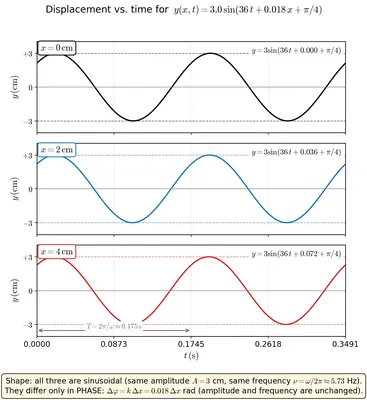
For the wave described in Exercise 14.8, plot the displacement ($$y$$) versus ($$t$$) graphs for $$x = 0$$, $$2$$ and $$4 \, \mathrm{cm}$$. What are the shapes of these graphs? In which aspects does the oscillatory motion in travelling wave differ from one point to another: amplitude, frequency or phase?
Figure
Figure

Solution

The wave is $$y(x,t) = 3.0 \sin(36\,t + 0.018\,x + \pi/4)$$, with $$x$$ and $$y$$ in cm and $$t$$ in s. To draw a $$y$$–$$t$$ graph we fix $$x$$ and treat $$y$$ as a function of $$t$$.

At $$x = 0$$: $$\quad y = 3.0 \sin(36\,t + \pi/4)$$

At $$x = 2 \, \mathrm{cm}$$: $$\quad y = 3.0 \sin(36\,t + 0.036 + \pi/4)$$

At $$x = 4 \, \mathrm{cm}$$: $$\quad y = 3.0 \sin(36\,t + 0.072 + \pi/4)$$

Each of these is a sine function of time, so each $$y$$–$$t$$ graph is a sinusoidal curve with amplitude $$3.0 \, \mathrm{cm}$$ and period

$$T = \dfrac{2\pi}{\omega} = \dfrac{2\pi}{36} \approx 0.175 \, \mathrm{s}$$

To draw them: plot $$y$$ on the vertical axis (from $$-3.0$$ to $$+3.0 \, \mathrm{cm}$$) and $$t$$ on the horizontal axis, marking off intervals of one period $$\approx 0.175 \, \mathrm{s}$$. The curve for $$x = 0$$ starts at $$t = 0$$ with $$y = 3.0 \sin(\pi/4) = +2.12 \, \mathrm{cm}$$.

The only difference between the three cases is the small extra constant added inside the sine: $$0$$, $$0.036 \, \mathrm{rad}$$ and $$0.072 \, \mathrm{rad}$$. These are tiny (a few thousandths of a radian), so the three sinusoidal graphs are practically indistinguishable — each is shifted from the next by only an extremely small phase.

Hence, as we move from one point on the string to another, the oscillation keeps the same amplitude ($$3.0 \, \mathrm{cm}$$) and the same frequency ($$\nu \approx 5.7 \, \mathrm{Hz}$$); only the phase of the oscillation changes from point to point.

Answer

All three graphs are sinusoidal curves with the same amplitude (3.0 cm) and the same period ($$\approx 0.175 \, \mathrm{s}$$); they differ only by a (very small) phase shift. In a travelling wave the oscillatory motion at different points differs only in phase — not in amplitude or frequency.

14.10

For the travelling harmonic wave

$$y(x, t) = 2.0 \cos 2\pi (10\, t - 0.0080\, x + 0.35)$$

where $$x$$ and $$y$$ are in cm and $$t$$ in s. Calculate the phase difference between oscillatory motion of two points separated by a distance of

(a) $$4 \, \mathrm{m}$$,

Solution

Write the wave as $$y(x,t) = 2.0 \cos\!\big[2\pi(10\,t - 0.0080\,x + 0.35)\big]$$ and compare it with the standard form

$$y = a \cos\!\left[2\pi\!\left(\dfrac{t}{T} - \dfrac{x}{\lambda}\right) + \phi_0\right]$$

The coefficient of $$x$$ inside the bracket gives $$\dfrac{1}{\lambda} = 0.0080 \, \mathrm{cm^{-1}}$$, so the wavelength is

$$\lambda = \dfrac{1}{0.0080} = 125 \, \mathrm{cm} = 1.25 \, \mathrm{m}$$

Two points separated by a distance $$\Delta x$$ differ in phase by

$$\Delta\phi = \dfrac{2\pi}{\lambda}\,\Delta x$$

(a) For $$\Delta x = 4 \, \mathrm{m} = 400 \, \mathrm{cm}$$:

$$\Delta\phi = \dfrac{2\pi}{125} \times 400 = 2\pi \times 3.2 = 6.4\pi \, \mathrm{rad}$$

$$\Delta\phi = 6.4\pi \approx 20.1 \, \mathrm{rad}$$

Answer

$$\Delta\phi = 6.4\pi \, \mathrm{rad} \approx 20.1 \, \mathrm{rad}$$.

(b) $$0.5 \, \mathrm{m}$$,

Solution

Using the result from part (a), the phase difference for a separation $$\Delta x$$ is $$\Delta\phi = \dfrac{2\pi}{\lambda}\,\Delta x$$ with $$\lambda = 125 \, \mathrm{cm}$$.

(b) For $$\Delta x = 0.5 \, \mathrm{m} = 50 \, \mathrm{cm}$$:

$$\Delta\phi = \dfrac{2\pi}{125} \times 50 = 2\pi \times 0.4 = 0.8\pi \, \mathrm{rad}$$

$$\Delta\phi = 0.8\pi \approx 2.51 \, \mathrm{rad}$$

Answer

$$\Delta\phi = 0.8\pi \, \mathrm{rad} \approx 2.51 \, \mathrm{rad}$$.

(c) $$\lambda/2$$,

Solution

Using $$\Delta\phi = \dfrac{2\pi}{\lambda}\,\Delta x$$.

(c) For a separation of half a wavelength, $$\Delta x = \dfrac{\lambda}{2}$$:

$$\Delta\phi = \dfrac{2\pi}{\lambda} \times \dfrac{\lambda}{2} = \pi \, \mathrm{rad}$$

The wavelength cancels, so this result does not depend on the actual value of $$\lambda$$.

Answer

$$\Delta\phi = \pi \, \mathrm{rad}$$.

(d) $$3\lambda/4$$

Solution

Using $$\Delta\phi = \dfrac{2\pi}{\lambda}\,\Delta x$$.

(d) For a separation $$\Delta x = \dfrac{3\lambda}{4}$$:

$$\Delta\phi = \dfrac{2\pi}{\lambda} \times \dfrac{3\lambda}{4} = \dfrac{3\pi}{2} \, \mathrm{rad}$$

Again the wavelength cancels, so the result is independent of $$\lambda$$.

Answer

$$\Delta\phi = \dfrac{3\pi}{2} \, \mathrm{rad}$$.

14.11

The transverse displacement of a string (clamped at its both ends) is given by

$$y(x, t) = 0.06 \sin\left(\dfrac{2\pi}{3} x\right) \cos(120\,\pi t)$$

where $$x$$ and $$y$$ are in m and $$t$$ in s. The length of the string is $$1.5 \, \mathrm{m}$$ and its mass is $$3.0 \times 10^{-2} \, \mathrm{kg}$$.

Answer the following:

(a) Does the function represent a travelling wave or a stationary wave?

Solution

The given displacement is

$$y(x,t) = 0.06 \sin\!\left(\dfrac{2\pi}{3}x\right)\cos(120\pi t)$$

It is a product of a function of $$x$$ alone, $$\sin(2\pi x/3)$$, and a function of $$t$$ alone, $$\cos(120\pi t)$$. The variables $$x$$ and $$t$$ do not occur together in the single combination $$x \pm vt$$. Therefore the wave profile does not move along the string — the pattern stays fixed in position while the string oscillates up and down. This represents a stationary (standing) wave.

This is exactly what is expected for a string clamped at both ends: the fixed ends are permanent nodes, and the string vibrates in a fixed pattern of nodes and antinodes.

Answer

It represents a stationary (standing) wave.

(b) Interpret the wave as a superposition of two waves travelling in opposite directions. What is the wavelength, frequency, and speed of each wave?

Solution

Use the trigonometric identity $$2\sin A \cos B = \sin(A+B) + \sin(A-B)$$. Taking $$A = \dfrac{2\pi}{3}x$$ and $$B = 120\pi t$$,

$$y = 0.06 \sin\!\left(\dfrac{2\pi}{3}x\right)\cos(120\pi t)$$

$$y = 0.03\left[\sin\!\left(\dfrac{2\pi}{3}x + 120\pi t\right) + \sin\!\left(\dfrac{2\pi}{3}x - 120\pi t\right)\right]$$

So the standing wave is the sum of two travelling waves, each of amplitude $$0.03 \, \mathrm{m}$$: one moving in the $$-x$$ direction and the other in the $$+x$$ direction.

For each travelling wave, comparing with $$\sin(kx \pm \omega t)$$:

$$k = \dfrac{2\pi}{3} \, \mathrm{rad\,m^{-1}}, \qquad \omega = 120\pi \, \mathrm{rad\,s^{-1}}$$

Wavelength:

$$\lambda = \dfrac{2\pi}{k} = \dfrac{2\pi}{2\pi/3} = 3 \, \mathrm{m}$$

Frequency:

$$\nu = \dfrac{\omega}{2\pi} = \dfrac{120\pi}{2\pi} = 60 \, \mathrm{Hz}$$

Speed:

$$v = \nu\lambda = 60 \times 3 = 180 \, \mathrm{m\,s^{-1}}$$

Answer

Each of the two component travelling waves has wavelength $$\lambda = 3 \, \mathrm{m}$$, frequency $$\nu = 60 \, \mathrm{Hz}$$ and speed $$v = 180 \, \mathrm{m\,s^{-1}}$$.

(c) Determine the tension in the string.

Solution

The speed of a transverse wave on the string is $$v = \sqrt{\dfrac{T}{\mu}}$$, so the tension is $$T = v^{2}\mu$$.

Linear mass density.

$$\mu = \dfrac{m}{L} = \dfrac{3.0 \times 10^{-2} \, \mathrm{kg}}{1.5 \, \mathrm{m}} = 2.0 \times 10^{-2} \, \mathrm{kg\,m^{-1}}$$

Tension. The wave speed found in part (b) is $$v = 180 \, \mathrm{m\,s^{-1}}$$, so

$$T = v^{2}\mu = (180)^{2} \times 2.0 \times 10^{-2}$$

$$T = 3.24 \times 10^{4} \times 2.0 \times 10^{-2} = 648 \, \mathrm{N}$$

Answer

The tension in the string is $$T = 648 \, \mathrm{N}$$.

14.12 (i) For the wave on a string described in Exercise 15.11, do all the points on the string oscillate with the same (a) frequency, (b) phase, (c) amplitude? Explain your answers. (ii) What is the amplitude of a point $$0.375 \, \mathrm{m}$$ away from one end?

Solution

This question refers to the standing wave of Exercise 14.11:

$$y(x,t) = 0.06 \sin\!\left(\dfrac{2\pi}{3}x\right)\cos(120\pi t)$$

(i)(a) Frequency. The time-dependence of every point of the string is the same common factor $$\cos(120\pi t)$$. So all points (except the nodes, which never move) oscillate with the same frequency,

$$\nu = \dfrac{120\pi}{2\pi} = 60 \, \mathrm{Hz}$$

(i)(b) Phase. Again the time factor common to all points is $$\cos(120\pi t)$$ — there is no point-to-point phase lag in time. All points pass through their mean positions, and reach their extreme positions, at the same instants. So all points oscillate in phase (within any one loop between two nodes). Across a node the displacement factor $$\sin(2\pi x/3)$$ changes sign, which simply means the next loop moves in the opposite direction — this is a sign reversal, not a continuously varying phase lag.

(i)(c) Amplitude. The amplitude of the point at position $$x$$ is the magnitude of the $$x$$-dependent factor, $$\big|0.06 \sin(2\pi x/3)\big|$$, which clearly depends on $$x$$. So the points do not all have the same amplitude: it is zero at the nodes and a maximum of $$0.06 \, \mathrm{m}$$ at the antinodes.

(ii) Amplitude at $$x = 0.375 \, \mathrm{m}$$. The amplitude is the magnitude of the displacement factor at that point:

$$A = 0.06 \sin\!\left(\dfrac{2\pi}{3} \times 0.375\right) = 0.06 \sin\!\left(\dfrac{\pi}{4}\right)$$

$$A = 0.06 \times \dfrac{1}{\sqrt{2}} = 0.06 \times 0.707 \approx 0.042 \, \mathrm{m}$$

Answer

(i) All points oscillate with the same frequency (60 Hz) and the same phase, but not the same amplitude — the amplitude varies with position along the string. (ii) The amplitude of the point $$0.375 \, \mathrm{m}$$ from one end is $$A \approx 0.042 \, \mathrm{m}$$.

14.13

Given below are some functions of $$x$$ and $$t$$ to represent the displacement (transverse or longitudinal) of an elastic wave. State which of these represent (i) a travelling wave, (ii) a stationary wave or (iii) none at all:

(a) $$y = 2 \cos(3x) \sin(10 t)$$

Solution

The function $$y = 2\cos(3x)\sin(10t)$$ is a product of a function of $$x$$ alone and a function of $$t$$ alone. The variables $$x$$ and $$t$$ do not appear in the single combination $$x \pm vt$$, so it is not a single travelling wave.

Using the identity $$2\cos A \sin B = \sin(B+A) + \sin(B-A)$$, this is the superposition of two equal travelling waves moving in opposite directions, which is precisely a standing-wave pattern. Hence it represents a stationary wave.

Answer

Stationary wave.

(b) $$y = 2\sqrt{x - vt}$$

Solution

The function $$y = 2\sqrt{x - vt}$$ is a function of the single combination $$(x - vt)$$. However, a genuine wave function must also be finite (bounded) and single-valued for all $$x$$ and $$t$$.

This function fails that test: as $$x - vt \to \infty$$, the value $$y \to \infty$$ (it is unbounded); and for $$x - vt < 0$$ it is not even a real number. A physical disturbance must have a finite, real displacement everywhere.

Therefore this function represents neither a travelling wave nor a stationary wave — none at all.

Answer

None — it is unbounded (and not real for $$x < vt$$), so it does not represent any wave.

(c) $$y = 3 \sin(5x - 0.5 t) + 4 \cos(5x - 0.5 t)$$

Solution

In $$y = 3\sin(5x - 0.5t) + 4\cos(5x - 0.5t)$$, both terms depend on $$x$$ and $$t$$ only through the single combination $$(5x - 0.5t)$$.

Two sinusoids of the same argument can always be combined into one:

$$y = R\sin(5x - 0.5t + \delta), \qquad R = \sqrt{3^{2} + 4^{2}} = 5, \qquad \tan\delta = \dfrac{4}{3}$$

So $$y$$ is a single sinusoidal disturbance of amplitude $$5$$, which depends only on the combination $$(5x - 0.5t)$$ — it moves in the $$+x$$ direction without change of shape. Hence it represents a travelling wave.

Answer

Travelling wave — it reduces to the single wave $$y = 5\sin(5x - 0.5t + \delta)$$ moving in the $$+x$$ direction.

(d) $$y = \cos x \sin t + \cos 2x \sin 2t$$

Solution

In $$y = \cos x\,\sin t + \cos 2x\,\sin 2t$$, each of the two terms is itself a product of a function of $$x$$ and a function of $$t$$ — i.e. each term is a stationary wave on its own (the first with angular frequency $$1$$, the second with angular frequency $$2$$).

The sum is therefore the superposition of two stationary waves of different frequencies; the result is a stationary-wave pattern. It is not a single travelling wave, because $$x$$ and $$t$$ do not occur only in the combination $$x \pm vt$$.

Answer

Stationary wave — it is the superposition of two stationary waves of different (harmonic) frequencies.

14.14 A wire stretched between two rigid supports vibrates in its fundamental mode with a frequency of $$45 \, \mathrm{Hz}$$. The mass of the wire is $$3.5 \times 10^{-2} \, \mathrm{kg}$$ and its linear mass density is $$4.0 \times 10^{-2} \, \mathrm{kg \, m^{-1}}$$. What is (a) the speed of a transverse wave on the string, and (b) the tension in the string?

Solution

The wire is fixed at both ends and vibrates in its fundamental mode. In the fundamental mode the wire forms a single loop, so its length is half a wavelength:

$$L = \dfrac{\lambda}{2} \qquad\Rightarrow\qquad \lambda = 2L$$

Length of the wire. From the total mass and the linear mass density,

$$L = \dfrac{m}{\mu} = \dfrac{3.5 \times 10^{-2} \, \mathrm{kg}}{4.0 \times 10^{-2} \, \mathrm{kg\,m^{-1}}} = 0.875 \, \mathrm{m}$$

So the wavelength of the fundamental mode is

$$\lambda = 2L = 2 \times 0.875 = 1.75 \, \mathrm{m}$$

(a) Speed of the transverse wave. Using $$v = \nu\lambda$$ with the fundamental frequency $$\nu = 45 \, \mathrm{Hz}$$:

$$v = 45 \times 1.75 = 78.75 \, \mathrm{m\,s^{-1}} \approx 79 \, \mathrm{m\,s^{-1}}$$

(b) Tension in the string. From $$v = \sqrt{T/\mu}$$ we get $$T = v^{2}\mu$$:

$$T = (78.75)^{2} \times 4.0 \times 10^{-2}$$

$$T = 6.20 \times 10^{3} \times 4.0 \times 10^{-2} \approx 248 \, \mathrm{N}$$

Answer

(a) The speed of the transverse wave is $$v \approx 79 \, \mathrm{m\,s^{-1}}$$. (b) The tension in the string is $$T \approx 248 \, \mathrm{N}$$.

14.15 A metre-long tube open at one end, with a movable piston at the other end, shows resonance with a fixed frequency source (a tuning fork of frequency $$340 \, \mathrm{Hz}$$) when the tube length is $$25.5 \, \mathrm{cm}$$ or $$79.3 \, \mathrm{cm}$$. Estimate the speed of sound in air at the temperature of the experiment. The edge effects may be neglected.

Solution

The tube is open at one end and closed by the movable piston at the other end — it therefore behaves as a closed pipe (closed at one end). Resonance occurs when there is a displacement antinode at the open end and a node at the piston, which happens for air-column lengths

$$L = \dfrac{\lambda}{4},\quad \dfrac{3\lambda}{4},\quad \dfrac{5\lambda}{4},\quad \dots$$

Hence two consecutive resonance lengths differ by exactly half a wavelength:

$$\Delta L = \dfrac{\lambda}{2}$$

The two observed resonance lengths are $$L_1 = 25.5 \, \mathrm{cm}$$ and $$L_2 = 79.3 \, \mathrm{cm}$$, so

$$\dfrac{\lambda}{2} = L_2 - L_1 = 79.3 - 25.5 = 53.8 \, \mathrm{cm}$$

$$\lambda = 2 \times 53.8 = 107.6 \, \mathrm{cm} = 1.076 \, \mathrm{m}$$

The frequency is fixed by the tuning fork, $$\nu = 340 \, \mathrm{Hz}$$. The speed of sound in air is therefore

$$v = \nu\lambda = 340 \times 1.076 \approx 366 \, \mathrm{m\,s^{-1}}$$

Answer

The speed of sound in air at the temperature of the experiment is $$v \approx 366 \, \mathrm{m\,s^{-1}}$$.

14.16 A steel rod $$100 \, \mathrm{cm}$$ long is clamped at its middle. The fundamental frequency of longitudinal vibrations of the rod are given to be $$2.53 \, \mathrm{kHz}$$. What is the speed of sound in steel?

Solution

The steel rod is clamped at its middle. The clamp holds the centre fixed, so there is a displacement node at the middle of the rod, while the two free ends are displacement antinodes.

In the fundamental mode of longitudinal vibration, the rod has exactly one node (at the centre) with an antinode at each end. The distance from one end (antinode) to the other end (antinode) — the full length of the rod — equals half a wavelength:

$$L = \dfrac{\lambda}{2} \qquad\Rightarrow\qquad \lambda = 2L = 2 \times 100 \, \mathrm{cm} = 200 \, \mathrm{cm} = 2.0 \, \mathrm{m}$$

The fundamental frequency is $$\nu = 2.53 \, \mathrm{kHz} = 2.53 \times 10^{3} \, \mathrm{Hz}$$. The speed of sound (longitudinal waves) in steel is

$$v = \nu\lambda = 2.53 \times 10^{3} \times 2.0$$

$$v = 5.06 \times 10^{3} \, \mathrm{m\,s^{-1}} = 5.06 \, \mathrm{km\,s^{-1}}$$

Answer

The speed of sound in steel is $$v = 5.06 \times 10^{3} \, \mathrm{m\,s^{-1}}$$ (about $$5.06 \, \mathrm{km\,s^{-1}}$$).

14.17 A pipe $$20 \, \mathrm{cm}$$ long is closed at one end. Which harmonic mode of the pipe is resonantly excited by a $$430 \, \mathrm{Hz}$$ source? Will the same source be in resonance with the pipe if both ends are open? (speed of sound in air is $$340 \, \mathrm{m \, s^{-1}}$$).

Solution

Pipe closed at one end. A pipe closed at one end resonates only at the odd-harmonic frequencies

$$\nu_n = \dfrac{(2n-1)\,v}{4L}, \qquad n = 1, 2, 3, \dots$$

The fundamental frequency ($$n = 1$$) is

$$\nu_1 = \dfrac{v}{4L} = \dfrac{340}{4 \times 0.20} = \dfrac{340}{0.80} = 425 \, \mathrm{Hz}$$

The source frequency, $$430 \, \mathrm{Hz}$$, is essentially equal to this fundamental frequency (the small difference lies within experimental tolerance). Hence the $$430 \, \mathrm{Hz}$$ source excites the fundamental mode (the first harmonic), $$n = 1$$, of the closed pipe.

Pipe open at both ends. A pipe open at both ends contains all harmonics:

$$\nu_n' = \dfrac{n\,v}{2L} = \dfrac{n \times 340}{2 \times 0.20} = n \times 850 \, \mathrm{Hz}, \qquad n = 1, 2, 3, \dots$$

For resonance we would need $$n = \dfrac{430}{850} \approx 0.5$$, which is not a whole number. The lowest possible resonance of the open pipe is its fundamental at $$850 \, \mathrm{Hz}$$. Therefore the $$430 \, \mathrm{Hz}$$ source will not be in resonance with the pipe when both ends are open.

Answer

The 430 Hz source excites the fundamental mode (first harmonic) of the closed pipe, whose fundamental frequency is $$425 \, \mathrm{Hz}$$. If both ends were open, the fundamental would be 850 Hz, so the same source would not resonate.

14.18 Two sitar strings A and B playing the note 'Ga' are slightly out of tune and produce beats of frequency $$6 \, \mathrm{Hz}$$. The tension in the string A is slightly reduced and the beat frequency is found to reduce to $$3 \, \mathrm{Hz}$$. If the original frequency of A is $$324 \, \mathrm{Hz}$$, what is the frequency of B?

Solution

When two notes of nearly equal frequency are sounded together, the beat frequency equals the difference of the two frequencies:

$$\nu_{\text{beat}} = |\nu_A - \nu_B|$$

Initially the beat frequency is $$6 \, \mathrm{Hz}$$ and $$\nu_A = 324 \, \mathrm{Hz}$$, so the frequency of B is either

$$\nu_B = 324 + 6 = 330 \, \mathrm{Hz} \quad \text{or} \quad \nu_B = 324 - 6 = 318 \, \mathrm{Hz}$$

To decide which value is correct, use the extra information. The tension in string A is reduced. Since the frequency of a stretched string varies as $$\nu \propto \sqrt{T}$$, reducing the tension makes the frequency of A decrease below $$324 \, \mathrm{Hz}$$.

  • If $$\nu_B = 330 \, \mathrm{Hz}$$: lowering $$\nu_A$$ moves it further from $$330 \, \mathrm{Hz}$$, so the beat frequency would increase. This contradicts the observation.
  • If $$\nu_B = 318 \, \mathrm{Hz}$$: lowering $$\nu_A$$ moves it closer to $$318 \, \mathrm{Hz}$$, so the beat frequency decreases (here from $$6 \, \mathrm{Hz}$$ to $$3 \, \mathrm{Hz}$$). This matches the observation.

Hence the frequency of string B is $$\nu_B = 318 \, \mathrm{Hz}$$.

Answer

The frequency of string B is $$\nu_B = 318 \, \mathrm{Hz}$$.

14.19

Explain why (or how):

(a) in a sound wave, a displacement node is a pressure antinode and vice versa,

Solution

A sound wave in a gas can be described in two equivalent ways: by the displacement of the medium's particles, or by the change in pressure (the excess pressure). These two descriptions are a quarter of a wavelength ($$90^\circ$$) out of step with each other in space.

At a displacement node the particles themselves do not move. Consider the layers of gas on the two sides of such a node. At one instant they both move towards the node, crowding the gas there (a compression); half a period later they both move away from it, thinning the gas (a rarefaction). So the pressure (and density) at a displacement node swings between its largest and smallest values — the variation of pressure is maximum there. A point of maximum pressure variation is, by definition, a pressure antinode.

At a displacement antinode the particles oscillate with the largest amplitude, but neighbouring particles move almost together, in step. The gas there is therefore neither appreciably compressed nor rarefied, so the pressure variation is minimum — a pressure node.

Hence a displacement node is a pressure antinode, and a displacement antinode is a pressure node.

Answer

Where the displacement is zero (a node), the gas layers on either side rush together or apart, producing the largest pressure variation — a pressure antinode. Where the displacement is largest (an antinode), neighbouring particles move in step, producing no compression and the smallest pressure variation — a pressure node.

(b) bats can ascertain distances, directions, nature, and sizes of the obstacles without any "eyes",

Solution

Bats find their way and locate prey by a process called echolocation. A bat emits short pulses of high-frequency ultrasonic waves. These waves spread out, strike obstacles or prey, and are reflected back to the bat as echoes, which the bat detects with its sensitive ears.

By analysing the returning echoes, the bat extracts a great deal of information:

  • Distance: from the time delay between emitting a pulse and receiving its echo, $$d = \dfrac{v\,t}{2}$$ (the factor of two accounts for the to-and-fro path).
  • Direction: from the direction along which the echo arrives.
  • Size and nature: from the intensity and detailed character of the reflected wave — larger obstacles return stronger echoes, and surfaces of different kinds reflect the ultrasound differently.

By continuously emitting pulses and processing the echoes, the bat builds up a 'sound picture' of its surroundings, and so can navigate and hunt without using its eyes.

Answer

Bats use echolocation: they emit ultrasonic pulses and analyse the reflected echoes. The time delay gives distance, the arrival direction gives direction, and the strength and quality of the echo reveal the size and nature of the obstacle.

(c) a violin note and sitar note may have the same frequency, yet we can distinguish between the two notes,

Solution

When a musical instrument sounds a note, it does not produce that one frequency alone. Along with the fundamental it produces a number of overtones (higher harmonics). The set of overtones present, and their relative loudness, differ from one instrument to another. This is what gives a note its quality (or timbre).

A violin and a sitar may be tuned so that the fundamental frequency is the same — the two notes then have the same pitch. But the overtones they produce, and the relative intensities of those overtones, are different for the two instruments. As a result the resultant waveforms are different in shape.

Our ears are sensitive to this difference in quality, so we can tell a violin note from a sitar note even though their fundamental frequencies are identical.

Answer

Although the fundamental frequency (pitch) is the same, the two instruments produce different overtones with different relative intensities. This gives the notes a different quality (timbre), which lets us distinguish them.

(d) solids can support both longitudinal and transverse waves, but only longitudinal waves can propagate in gases, and

Solution

The kind of wave a medium can support depends on the kinds of elasticity (the restoring forces) the medium possesses.

A longitudinal wave consists of alternate compressions and rarefactions, so it needs the medium to resist a change in volume — it requires volume (bulk) elasticity.

A transverse wave consists of layers of the medium sliding sideways past one another, so it needs the medium to resist a change of shape — it requires shear elasticity (rigidity).

A solid possesses both a bulk modulus and a shear modulus; it resists both a change of volume and a change of shape. Hence a solid can support both longitudinal and transverse waves.

A gas (like a liquid) has volume elasticity but no shear elasticity — it cannot resist a shearing stress and offers no restoring force against a change of shape. Therefore a gas can transmit only longitudinal waves; it cannot support transverse mechanical waves.

Answer

Longitudinal waves need volume (bulk) elasticity and transverse waves need shear (rigidity) elasticity. Solids have both, so they support both types of wave; gases have volume elasticity but no rigidity, so they support only longitudinal waves.

(e) the shape of a pulse gets distorted during propagation in a dispersive medium.

Solution

A pulse is not a single harmonic wave of one definite wavelength. By Fourier's theorem, any pulse can be regarded as a superposition of a large number of harmonic waves of different wavelengths (and hence different frequencies). The particular way these components add up at each point gives the pulse its shape.

A medium is called dispersive if the wave speed in it depends on the wavelength (or frequency). In such a medium the different harmonic components that make up the pulse travel at different speeds.

As the pulse propagates, the faster components steadily move ahead of the slower ones; the components get out of step with one another, so the way they add up keeps changing. Consequently the overall shape of the pulse changes — the pulse gets distorted (it generally spreads out and flattens).

In a non-dispersive medium all the components travel at the same speed, they stay in step, and the pulse keeps its shape unchanged as it travels.

Answer

A pulse is a superposition of harmonic waves of many different frequencies. In a dispersive medium each frequency component travels at a different speed, so the components separate and get out of step, and the resultant shape of the pulse changes (distorts) as it propagates.
NCERT Solutions for Class 11
Maths
NCERT Solutions for Class 11 Maths
Chapter-wise step-by-step
solutions with explanations
explore solutions Maths bg
Physics
NCERT Solutions for Class 11 Physics
Chapter-wise step-by-step
solutions with explanations
explore solutions Physics bg
Chemistry
NCERT Solutions for Class 11 Chemistry
Chapter-wise step-by-step
solutions with explanations
explore solutions Chemistry bg

Frequently Asked Questions

50,000+ JEE Students Trusted Our Score Calculator

Predict your JEE Main percentile, rank & performance in seconds