Join WhatsApp Icon JEE WhatsApp Group
NCERT Solutions for Class 11 Physics

Chapter 13: Oscillations

Download Solutions PDF
Daily JEE Updates, Tips & Important Alerts
Join 30,000+ students and stay updated with JEE notifications and preparation insights.
Join Now!
Free PDF
Complete NCERT Solution PDF for Chapter 13: Oscillations

NCERT Solutions For Class 11 Physics Chapter 13 Oscillations helps students understand periodic motion and the principles behind repeated movements. The page provides complete NCERT Solutions that explain concepts such as simple harmonic motion, amplitude, frequency, time period, and energy changes during oscillations. NCERT Solutions For Class 11 Physics guide students through theoretical concepts and numerical problems with clear explanations. The chapter introduces important ideas that are used in mechanics, waves, and many physical systems. These solutions help students strengthen their understanding of periodic motion and improve problem-solving skills. Students can access the chapter PDF for revision and regular practice. The detailed solutions make oscillation concepts easier to understand and apply.
Download Solutions PDF

Examples 13.1-13.8

Example 13.1 On an average, a human heart is found to beat 75 times in a minute. Calculate its frequency and period.

Solution

The heart beats 75 times in one minute, i.e. in 60 s.

The frequency $$\nu$$ is the number of beats per unit time:

$$\nu = \dfrac{\text{number of beats}}{\text{time taken}} = \dfrac{75}{60 \, \mathrm{s}} = 1.25 \, \mathrm{s^{-1}} = 1.25 \, \mathrm{Hz}$$

The period $$T$$ is the time taken for one complete beat. It is the reciprocal of the frequency:

$$T = \dfrac{1}{\nu} = \dfrac{1}{1.25 \, \mathrm{s^{-1}}} = 0.8 \, \mathrm{s}$$

Answer

Frequency $$\nu = 1.25 \, \mathrm{Hz}$$ and period $$T = 0.8 \, \mathrm{s}$$.

Example 13.2

Which of the following functions of time represent (a) periodic and (b) non-periodic motion? Give the period for each case of periodic motion [$$\omega$$ is any positive constant].

  1. $$\sin \omega t + \cos \omega t$$
  2. $$\sin \omega t + \cos 2\omega t + \sin 4\omega t$$
  3. $$e^{-\omega t}$$
  4. $$\log(\omega t)$$

(i) $$\sin \omega t + \cos \omega t$$

Solution

Both $$\sin \omega t$$ and $$\cos \omega t$$ are periodic, each with period $$2\pi/\omega$$. Their sum can be combined into a single sinusoid:

$$\sin \omega t + \cos \omega t = \sqrt{2}\left(\dfrac{1}{\sqrt{2}}\sin \omega t + \dfrac{1}{\sqrt{2}}\cos \omega t\right) = \sqrt{2}\,\sin\!\left(\omega t + \dfrac{\pi}{4}\right)$$

Adding $$2\pi$$ to the argument leaves the value of the sine unchanged, so

$$\sqrt{2}\,\sin\!\left(\omega t + \dfrac{\pi}{4}\right) = \sqrt{2}\,\sin\!\left[\omega\left(t + \dfrac{2\pi}{\omega}\right) + \dfrac{\pi}{4}\right]$$

The function repeats itself after a time $$2\pi/\omega$$. Hence it represents periodic motion with period $$T = \dfrac{2\pi}{\omega}$$.

Answer

Periodic motion, with period $$T = \dfrac{2\pi}{\omega}$$.

(ii) $$\sin \omega t + \cos 2\omega t + \sin 4\omega t$$

Solution

Each term is periodic on its own. The period of a function is the least time after which it repeats its value:

  • $$\sin \omega t$$ has period $$T_0 = \dfrac{2\pi}{\omega}$$,
  • $$\cos 2\omega t$$ has period $$\dfrac{2\pi}{2\omega} = \dfrac{T_0}{2}$$,
  • $$\sin 4\omega t$$ has period $$\dfrac{2\pi}{4\omega} = \dfrac{T_0}{4}$$.

The period of the first term, $$T_0$$, is an integral multiple of the periods of the other two terms ($$T_0 = 2 \times \tfrac{T_0}{2} = 4 \times \tfrac{T_0}{4}$$). Therefore, after a time $$T_0$$ all three terms simultaneously return to their starting values, and so does their sum.

Hence the function represents periodic motion with period $$T = \dfrac{2\pi}{\omega}$$.

Answer

Periodic motion, with period $$T = \dfrac{2\pi}{\omega}$$.

(iii) $$e^{-\omega t}$$

Solution

The function $$e^{-\omega t}$$ is not periodic.

As the time $$t$$ increases, $$e^{-\omega t}$$ decreases steadily (monotonically) and tends to zero as $$t \to \infty$$. It never returns to a value it had earlier.

A function that does not repeat its values at regular intervals cannot represent periodic motion.

Answer

Non-periodic motion.

(iv) $$\log(\omega t)$$

Solution

The function $$\log(\omega t)$$ is not periodic.

As the time $$t$$ increases, $$\log(\omega t)$$ increases monotonically and diverges to $$\infty$$ as $$t \to \infty$$. It never repeats its values, so it cannot represent periodic motion.

(It also grows without bound, so it could not represent any real physical displacement, which must stay finite.)

Answer

Non-periodic motion.

Example 13.3

Which of the following functions of time represent (a) simple harmonic motion and (b) periodic but not simple harmonic? Give the period for each case.

  1. $$\sin \omega t - \cos \omega t$$
  2. $$\sin^2 \omega t$$

(1) $$\sin \omega t - \cos \omega t$$

Solution

Write $$\cos \omega t = \sin\!\left(\dfrac{\pi}{2} - \omega t\right)$$, so that

$$\sin \omega t - \cos \omega t = \sin \omega t - \sin\!\left(\dfrac{\pi}{2} - \omega t\right)$$

Using the identity $$\sin C - \sin D = 2\cos\dfrac{C+D}{2}\,\sin\dfrac{C-D}{2}$$ with $$C = \omega t$$ and $$D = \dfrac{\pi}{2} - \omega t$$:

$$= 2\cos\!\left(\dfrac{\pi}{4}\right)\sin\!\left(\omega t - \dfrac{\pi}{4}\right) = \sqrt{2}\,\sin\!\left(\omega t - \dfrac{\pi}{4}\right)$$

This is exactly the standard SHM form $$A\sin(\omega t + \phi)$$, with amplitude $$A = \sqrt{2}$$ and phase constant $$\phi = -\dfrac{\pi}{4}$$.

Hence it represents simple harmonic motion with period $$T = \dfrac{2\pi}{\omega}$$.

Answer

Simple harmonic motion, with period $$T = \dfrac{2\pi}{\omega}$$.

(2) $$\sin^2 \omega t$$

Solution

Using the trigonometric identity $$\sin^2\theta = \dfrac{1 - \cos 2\theta}{2}$$:

$$\sin^2 \omega t = \dfrac{1}{2} - \dfrac{1}{2}\cos 2\omega t$$

The term $$\cos 2\omega t$$ is periodic with period $$\dfrac{2\pi}{2\omega} = \dfrac{\pi}{\omega}$$. Hence the whole function is periodic with period $$T = \dfrac{\pi}{\omega}$$.

However it is not simple harmonic motion about the origin. A SHM must be a pure sine or cosine oscillating about $$x = 0$$. Here the constant term $$\tfrac{1}{2}$$ shifts the centre of oscillation: the motion is harmonic only about the point $$\tfrac{1}{2}$$, not about zero. As written, $$\sin^2\omega t$$ therefore represents periodic motion but not SHM in the standard sense.

Answer

Periodic motion with period $$T = \dfrac{\pi}{\omega}$$; it is harmonic about the point $$\tfrac{1}{2}$$, not SHM about the origin.

Example 13.4

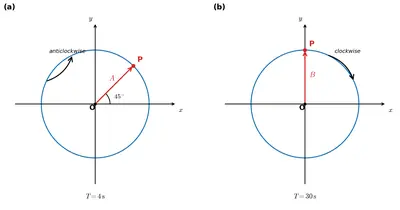
The figure given below depicts two circular motions. The radius of the circle, the period of revolution, the initial position and the sense of revolution are indicated in the figures. Obtain the simple harmonic motions of the $$x$$-projection of the radius vector of the rotating particle P in each case.

(a) Circle of radius $$A$$, period $$T = 4 \, \mathrm{s}$$, with P at initial angle $$45°$$ from the positive $$x$$-axis, rotating anticlockwise.
(b) Circle of radius $$B$$, period $$T = 30 \, \mathrm{s}$$, with P initially on the positive $$y$$-axis, rotating clockwise.
Figure
Figure

Solution

For a particle P moving uniformly on a reference circle of radius $$r$$, the projection of the radius vector OP on the $$x$$-axis executes SHM given by $$x(t) = r\cos\theta(t)$$, where $$\theta(t)$$ is the angle OP makes with the positive $$x$$-axis at time $$t$$. The angular speed is $$\omega = \dfrac{2\pi}{T}$$.

Case (a): radius $$A$$, period $$T = 4 \, \mathrm{s}$$. At $$t = 0$$, OP makes an angle $$45° = \dfrac{\pi}{4}$$ with the positive $$x$$-axis. The rotation is anticlockwise, so the angle increases with time; in a time $$t$$ it sweeps an extra angle $$\dfrac{2\pi}{T}t$$:

$$\theta(t) = \dfrac{2\pi}{T}t + \dfrac{\pi}{4}$$

$$x(t) = A\cos\!\left(\dfrac{2\pi}{T}t + \dfrac{\pi}{4}\right) = A\cos\!\left(\dfrac{2\pi}{4}t + \dfrac{\pi}{4}\right) = A\cos\!\left(\dfrac{\pi}{2}t + \dfrac{\pi}{4}\right)$$

This is a SHM of amplitude $$A$$, period $$4 \, \mathrm{s}$$ and initial phase $$\dfrac{\pi}{4}$$.

Case (b): radius $$B$$, period $$T = 30 \, \mathrm{s}$$. At $$t = 0$$, OP lies along the positive $$y$$-axis, i.e. at $$90° = \dfrac{\pi}{2}$$. The rotation is clockwise, so the angle decreases with time:

$$\theta(t) = \dfrac{\pi}{2} - \dfrac{2\pi}{T}t$$

$$x(t) = B\cos\!\left(\dfrac{\pi}{2} - \dfrac{2\pi}{T}t\right) = B\sin\!\left(\dfrac{2\pi}{T}t\right) = B\sin\!\left(\dfrac{2\pi}{30}t\right) = B\sin\!\left(\dfrac{\pi}{15}t\right)$$

Written in cosine form, $$x(t) = B\cos\!\left(\dfrac{\pi}{15}t - \dfrac{\pi}{2}\right)$$ — a SHM of amplitude $$B$$, period $$30 \, \mathrm{s}$$ and initial phase $$-\dfrac{\pi}{2}$$.

Answer

(a) $$x(t) = A\cos\!\left(\dfrac{\pi}{2}t + \dfrac{\pi}{4}\right)$$, amplitude $$A$$, period $$4 \, \mathrm{s}$$. (b) $$x(t) = B\sin\!\left(\dfrac{\pi}{15}t\right) = B\cos\!\left(\dfrac{\pi}{15}t - \dfrac{\pi}{2}\right)$$, amplitude $$B$$, period $$30 \, \mathrm{s}$$.

Example 13.5

A body oscillates with SHM according to the equation (in SI units),

$$x = 5 \cos [2\pi t + \pi/4]$$

At $$t = 1.5 \, \mathrm{s}$$, calculate the (a) displacement, (b) speed and (c) acceleration of the body.

(a) displacement

Solution

Comparing the given equation $$x = 5\cos[2\pi t + \pi/4]$$ with the standard SHM form $$x = A\cos(\omega t + \phi)$$ (all quantities in SI units):

amplitude $$A = 5 \, \mathrm{m}$$, angular frequency $$\omega = 2\pi \, \mathrm{s^{-1}}$$, hence period $$T = \dfrac{2\pi}{\omega} = 1 \, \mathrm{s}$$.

The displacement at $$t = 1.5 \, \mathrm{s}$$ is

$$x = 5\cos\!\left[2\pi(1.5) + \dfrac{\pi}{4}\right] = 5\cos\!\left[3\pi + \dfrac{\pi}{4}\right]$$

Since $$\cos(3\pi + \theta) = \cos(\pi + \theta) = -\cos\theta$$,

$$x = 5\left(-\cos\dfrac{\pi}{4}\right) = 5 \times (-0.707) = -3.535 \, \mathrm{m}$$

The negative sign means the body is $$3.535 \, \mathrm{m}$$ from the mean position, on the negative side.

Answer

Displacement $$x \approx -3.5 \, \mathrm{m}$$ (more precisely $$-3.535 \, \mathrm{m}$$).

(b) speed

Solution

The velocity in SHM is the time derivative of the displacement:

$$v = \dfrac{dx}{dt} = -A\omega\sin(\omega t + \phi)$$

At $$t = 1.5 \, \mathrm{s}$$, with $$A = 5 \, \mathrm{m}$$ and $$\omega = 2\pi \, \mathrm{s^{-1}}$$:

$$v = -(5)(2\pi)\sin\!\left[2\pi(1.5) + \dfrac{\pi}{4}\right] = -10\pi\,\sin\!\left[3\pi + \dfrac{\pi}{4}\right]$$

Since $$\sin(3\pi + \theta) = \sin(\pi + \theta) = -\sin\theta$$,

$$v = -10\pi\left(-\sin\dfrac{\pi}{4}\right) = 10\pi \times 0.707$$

$$v \approx 31.4 \times 0.707 \approx 22 \, \mathrm{m\,s^{-1}}$$

So the speed of the body is about $$22 \, \mathrm{m\,s^{-1}}$$.

Answer

Speed $$\approx 22 \, \mathrm{m\,s^{-1}}$$.

(c) acceleration

Solution

In SHM the acceleration is related to the displacement by $$a = -\omega^2 x$$.

Using $$\omega = 2\pi \, \mathrm{s^{-1}}$$ and the displacement found in part (a), $$x = -3.535 \, \mathrm{m}$$:

$$a = -\omega^2 x = -(2\pi)^2 \times (-3.535)$$

$$a = -4\pi^2 \times (-3.535) \approx -39.48 \times (-3.535)$$

$$a \approx 140 \, \mathrm{m\,s^{-2}}$$

The acceleration is positive — directed towards the mean position, since the displacement is negative.

Answer

Acceleration $$\approx 140 \, \mathrm{m\,s^{-2}}$$, directed towards the mean position.

Example 13.6

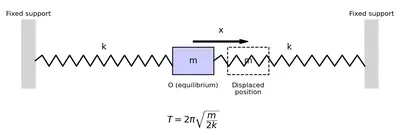
Two identical springs of spring constant $$k$$ are attached to a block of mass $$m$$ and to fixed supports as shown in Fig. 13.14. Show that when the mass is displaced from its equilibrium position on either side, it executes a simple harmonic motion. Find the period of oscillations.
Fig. 13.14
Fig. 13.14

Solution

Let the block be displaced a small distance $$x$$ to the right of its equilibrium position O. Then the left spring is stretched by $$x$$, and at the same time the right spring is compressed by the same amount $$x$$.

The stretched left spring pulls the block back towards O with a force

$$F_1 = -kx$$

The compressed right spring pushes the block back towards O with a force

$$F_2 = -kx$$

Both forces are directed towards the mean position O, so they add up. The net force on the block is

$$F = F_1 + F_2 = -kx - kx = -2kx$$

The net force is proportional to the displacement $$x$$ and is directed opposite to it (towards the mean position). This is exactly the condition $$F = -k_{\text{eff}}\,x$$ for simple harmonic motion, with effective force constant $$k_{\text{eff}} = 2k$$.

The angular frequency is

$$\omega = \sqrt{\dfrac{k_{\text{eff}}}{m}} = \sqrt{\dfrac{2k}{m}}$$

and the period of oscillation is

$$T = \dfrac{2\pi}{\omega} = 2\pi\sqrt{\dfrac{m}{2k}}$$

Answer

The net force $$F = -2kx$$ is restoring and proportional to $$x$$, so the motion is SHM. Period $$T = 2\pi\sqrt{\dfrac{m}{2k}}$$.

Example 13.7 A block whose mass is $$1 \, \mathrm{kg}$$ is fastened to a spring. The spring has a spring constant of $$50 \, \mathrm{N \, m^{-1}}$$. The block is pulled to a distance $$x = 10 \, \mathrm{cm}$$ from its equilibrium position at $$x = 0$$ on a frictionless surface from rest at $$t = 0$$. Calculate the kinetic, potential and total energies of the block when it is $$5 \, \mathrm{cm}$$ away from the mean position.

Solution

The block executes SHM. Since it is pulled to $$10 \, \mathrm{cm}$$ and released from rest, the amplitude is

$$A = 10 \, \mathrm{cm} = 0.1 \, \mathrm{m}$$

Total energy. The total mechanical energy of a harmonic oscillator is constant and equals

$$E = \dfrac{1}{2}kA^2 = \dfrac{1}{2}(50)(0.1)^2 = \dfrac{1}{2}(50)(0.01) = 0.25 \, \mathrm{J}$$

Potential energy at $$x = 5 \, \mathrm{cm} = 0.05 \, \mathrm{m}$$:

$$U = \dfrac{1}{2}kx^2 = \dfrac{1}{2}(50)(0.05)^2 = \dfrac{1}{2}(50)(0.0025) = 0.0625 \, \mathrm{J}$$

Kinetic energy at $$x = 5 \, \mathrm{cm}$$. By conservation of energy, $$K = E - U$$:

$$K = 0.25 - 0.0625 = 0.1875 \, \mathrm{J} \approx 0.19 \, \mathrm{J}$$

As a check, the total energy is $$K + U = 0.1875 + 0.0625 = 0.25 \, \mathrm{J}$$, equal to $$\tfrac{1}{2}kA^2$$, in agreement with the conservation of energy.

Answer

Kinetic energy $$K \approx 0.19 \, \mathrm{J}$$, potential energy $$U = 0.0625 \, \mathrm{J}$$, total energy $$E = 0.25 \, \mathrm{J}$$.

Example 13.8 What is the length of a simple pendulum, which ticks seconds?

Solution

A pendulum that 'ticks seconds' makes one swing (from one extreme towards the other) every second. A complete oscillation consists of two such swings, so the time period is

$$T = 2 \, \mathrm{s}$$

The period of a simple pendulum of length $$L$$ is

$$T = 2\pi\sqrt{\dfrac{L}{g}}$$

Squaring and solving for $$L$$:

$$T^2 = 4\pi^2\dfrac{L}{g} \implies L = \dfrac{gT^2}{4\pi^2}$$

Substituting $$g = 9.8 \, \mathrm{m\,s^{-2}}$$ and $$T = 2 \, \mathrm{s}$$:

$$L = \dfrac{9.8 \times (2)^2}{4\pi^2} = \dfrac{9.8 \times 4}{4\pi^2} = \dfrac{9.8}{\pi^2} \approx \dfrac{9.8}{9.87} \approx 1 \, \mathrm{m}$$

Answer

Length $$L \approx 1 \, \mathrm{m}$$ (a 'seconds pendulum' has time period $$2 \, \mathrm{s}$$).

Exercises

13.1

Which of the following examples represent periodic motion?

(a) A swimmer completing one (return) trip from one bank of a river to the other and back.

Solution

The swimmer makes one return trip and then stops. The motion occurs only once — it is not repeated over and over at regular intervals of time.

For motion to be periodic it must repeat itself indefinitely at equal time intervals. Hence this is not periodic motion.

Answer

Not periodic motion.

(b) A freely suspended bar magnet displaced from its N-S direction and released.

Solution

When a freely suspended bar magnet is displaced from its N–S equilibrium direction and released, the earth's magnetic field exerts a restoring torque on it.

The magnet therefore swings to and fro about the N–S direction, repeating its motion at regular intervals of time.

Hence this represents periodic motion (in fact, oscillatory motion).

Answer

Periodic motion.

(c) A hydrogen molecule rotating about its centre of mass.

Solution

A hydrogen molecule rotating about its centre of mass comes back to the same orientation after each complete rotation.

This happens at regular intervals of time (one rotational period). Hence this represents periodic motion.

Answer

Periodic motion.

(d) An arrow released from a bow.

Solution

An arrow released from a bow travels forward in a single flight. The motion happens only once and is not repeated.

Since it does not repeat itself at regular intervals, this is not periodic motion.

Answer

Not periodic motion.

13.2

Which of the following examples represent (nearly) simple harmonic motion and which represent periodic but not simple harmonic motion?

(a) the rotation of earth about its axis.

Solution

The earth spins about its axis, completing one rotation in about 24 hours. Since this repeats at regular intervals, the motion is periodic.

However, there is no to-and-fro motion about a mean position, and there is no restoring force proportional to a displacement. The conditions for SHM are not met.

Hence the rotation of the earth is periodic but not simple harmonic motion.

Answer

Periodic, but not simple harmonic motion.

(b) motion of an oscillating mercury column in a U-tube.

Solution

When the mercury column in a U-tube is displaced from its equilibrium (equal-level) position, the weight of the unbalanced column provides a restoring force.

This restoring force is proportional to the displacement of the column and is directed towards the equilibrium position. This is exactly the condition for SHM.

Hence the oscillating mercury column executes (nearly) simple harmonic motion.

Answer

(Nearly) simple harmonic motion.

(c) motion of a ball bearing inside a smooth curved bowl, when released from a point slightly above the lower most point.

Solution

For a small displacement near the lowest point of a smooth curved bowl, the arc behaves like a circular arc, so the ball bearing behaves just like the bob of a simple pendulum.

For such small displacements the restoring force is proportional to the displacement and directed towards the lowest (mean) position.

Hence the ball bearing executes (nearly) simple harmonic motion.

Answer

(Nearly) simple harmonic motion.

(d) general vibrations of a polyatomic molecule about its equilibrium position.

Solution

A polyatomic molecule has several natural (normal) modes of vibration, each with its own characteristic frequency.

Its general vibration is a superposition of these individual simple harmonic vibrations of different frequencies. Such a superposition repeats itself, so it is periodic, but it is not a single sinusoid.

Hence the general vibration of a polyatomic molecule is periodic but not simple harmonic motion. (Each individual normal mode, however, is itself SHM.)

Answer

Periodic, but not simple harmonic motion.

13.3

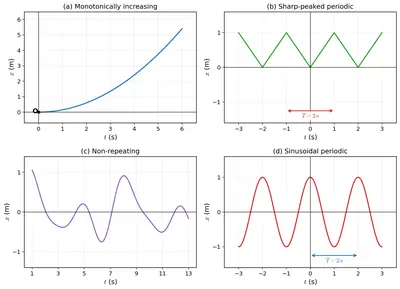
Fig. 13.18 depicts four $$x$$-$$t$$ plots for linear motion of a particle. Which of the plots represent periodic motion? What is the period of motion (in case of periodic motion)?

(a) A monotonically increasing curve starting from the origin.
(b) A curve oscillating between $$t = -3$$ and $$t = 3 \, \mathrm{s}$$ with sharp peaks.
(c) A curve with non-repeating bumps between $$t = 1$$ and $$t = 13 \, \mathrm{s}$$.
(d) A sinusoidal curve from $$t = -3$$ to $$t = 3 \, \mathrm{s}$$.
Fig. 13.18
Fig. 13.18

Solution

A motion is periodic only if its $$x$$–$$t$$ graph repeats exactly the same shape after equal intervals of time.

(a) The curve rises continuously (monotonically) and never repeats its shape. This is non-periodic motion.

(b) The graph repeats the same pattern of sharp peaks after equal time intervals, so it is periodic. The pattern repeats after every $$2 \, \mathrm{s}$$, hence the period is $$T = 2 \, \mathrm{s}$$.

(c) The bumps occur in an irregular, non-repeating way — the shape between $$t = 1\,\mathrm{s}$$ and $$t = 13\,\mathrm{s}$$ does not repeat. This is non-periodic motion.

(d) The sinusoidal graph repeats itself exactly after equal intervals, so it is periodic. It repeats after every $$2 \, \mathrm{s}$$, hence the period is $$T = 2 \, \mathrm{s}$$.

Answer

Plots (b) and (d) represent periodic motion, each with period $$T = 2 \, \mathrm{s}$$. Plots (a) and (c) are non-periodic.

13.4

Which of the following functions of time represent (a) simple harmonic, (b) periodic but not simple harmonic, and (c) non-periodic motion? Give period for each case of periodic motion ($$\omega$$ is any positive constant):

(a) $$\sin \omega t - \cos \omega t$$

Solution

Combine the two terms into a single sinusoid. Writing $$\cos\omega t = \sin\!\left(\dfrac{\pi}{2} - \omega t\right)$$ and using $$\sin C - \sin D = 2\cos\dfrac{C+D}{2}\sin\dfrac{C-D}{2}$$:

$$\sin\omega t - \cos\omega t = \sin\omega t - \sin\!\left(\dfrac{\pi}{2} - \omega t\right) = \sqrt{2}\,\sin\!\left(\omega t - \dfrac{\pi}{4}\right)$$

This is of the standard SHM form $$A\sin(\omega t + \phi)$$. Hence it represents simple harmonic motion with period

$$T = \dfrac{2\pi}{\omega}$$

Answer

Simple harmonic motion, with period $$T = \dfrac{2\pi}{\omega}$$.

(b) $$\sin^3 \omega t$$

Solution

Use the identity $$\sin^3\theta = \dfrac{3\sin\theta - \sin 3\theta}{4}$$:

$$\sin^3\omega t = \dfrac{3\sin\omega t - \sin 3\omega t}{4}$$

This is the sum of two SHMs: $$\sin\omega t$$ (period $$2\pi/\omega$$) and $$\sin 3\omega t$$ (period $$2\pi/3\omega$$). The larger period $$2\pi/\omega$$ is an integral multiple ($$3\times$$) of the smaller one, so the sum repeats after a time $$2\pi/\omega$$.

Hence the motion is periodic with period $$T = \dfrac{2\pi}{\omega}$$, but since it is a superposition of two harmonics of different frequencies it is not simple harmonic.

Answer

Periodic but not simple harmonic motion, with period $$T = \dfrac{2\pi}{\omega}$$.

(c) $$3 \cos (\pi/4 - 2\omega t)$$

Solution

Since cosine is an even function, $$\cos(-\theta) = \cos\theta$$, so

$$3\cos\!\left(\dfrac{\pi}{4} - 2\omega t\right) = 3\cos\!\left(2\omega t - \dfrac{\pi}{4}\right)$$

This is of the standard SHM form $$A\cos(\Omega t + \phi)$$ with amplitude $$A = 3$$, angular frequency $$\Omega = 2\omega$$ and phase $$\phi = -\pi/4$$.

Hence it represents simple harmonic motion with period

$$T = \dfrac{2\pi}{\Omega} = \dfrac{2\pi}{2\omega} = \dfrac{\pi}{\omega}$$

Answer

Simple harmonic motion, with period $$T = \dfrac{\pi}{\omega}$$.

(d) $$\cos \omega t + \cos 3\omega t + \cos 5\omega t$$

Solution

Each term is a SHM on its own:

  • $$\cos\omega t$$ has period $$\dfrac{2\pi}{\omega}$$,
  • $$\cos 3\omega t$$ has period $$\dfrac{2\pi}{3\omega}$$,
  • $$\cos 5\omega t$$ has period $$\dfrac{2\pi}{5\omega}$$.

The largest period $$\dfrac{2\pi}{\omega}$$ is an integral multiple ($$3\times$$ and $$5\times$$) of the other two periods. Therefore after a time $$\dfrac{2\pi}{\omega}$$ all three terms return together and the sum repeats.

Hence the motion is periodic with period $$T = \dfrac{2\pi}{\omega}$$, but being a superposition of three harmonics of different frequencies it is not simple harmonic.

Answer

Periodic but not simple harmonic motion, with period $$T = \dfrac{2\pi}{\omega}$$.

(e) $$\exp(-\omega^2 t^2)$$

Solution

The function $$\exp(-\omega^2 t^2) = e^{-\omega^2 t^2}$$ is a Gaussian. It has its maximum value $$1$$ at $$t = 0$$ and decreases steadily towards zero as $$|t|$$ increases.

It never returns to a value once it has passed it, so it never repeats. Hence it represents non-periodic motion.

Answer

Non-periodic motion.

(f) $$1 + \omega t + \omega^2 t^2$$

Solution

The function $$1 + \omega t + \omega^2 t^2$$ is a polynomial in $$t$$. As $$t$$ increases it grows without bound and never repeats its value.

Hence it represents non-periodic motion. (Being unbounded, it also cannot describe any real oscillatory displacement, which must stay finite.)

Answer

Non-periodic motion.

13.5

A particle is in linear simple harmonic motion between two points, A and B, $$10 \, \mathrm{cm}$$ apart. Take the direction from A to B as the positive direction and give the signs of velocity, acceleration and force on the particle when it is

(a) at the end A,

Solution

The mid-point O of AB is the mean position; OA = OB = 5 cm. The direction A → B is taken as positive. In SHM the acceleration and force always point towards the mean position O, and the force has the same sign as the acceleration ($$F = ma$$).

End A is an extreme point of the motion.

Velocity: at an extreme position the particle is momentarily at rest, so the velocity is zero.

Acceleration and force: they point towards O. From A, the mean position O lies in the direction of B, which is the positive direction. Hence the acceleration is positive and the force is positive.

Answer

Velocity = 0; acceleration positive; force positive.

(b) at the end B,

Solution

End B is the other extreme point of the motion.

Velocity: at an extreme position the particle is momentarily at rest, so the velocity is zero.

Acceleration and force: they point towards the mean position O. From B, the mean position O lies in the direction of A, which is the negative direction. Hence the acceleration is negative and the force is negative.

Answer

Velocity = 0; acceleration negative; force negative.

(c) at the mid-point of AB going towards A,

Solution

The mid-point of AB is the mean position O.

Velocity: the speed is maximum at the mean position. Here the particle is moving towards A, i.e. in the negative direction, so the velocity is negative.

Acceleration and force: at the mean position the displacement from O is zero, so the acceleration is zero and hence the force is also zero.

Answer

Velocity negative; acceleration = 0; force = 0.

(d) at $$2 \, \mathrm{cm}$$ away from B going towards A,

Solution

A point $$2 \, \mathrm{cm}$$ from B is $$10 - 2 = 8 \, \mathrm{cm}$$ from A. Since O is $$5 \, \mathrm{cm}$$ from A, this point lies on the B-side of the mean position (its displacement from O is $$+3 \, \mathrm{cm}$$, towards B).

Velocity: the particle is moving towards A, i.e. in the negative direction, so the velocity is negative.

Acceleration and force: they point towards O. From a point on the B-side, O lies in the direction of A, which is the negative direction. Hence the acceleration is negative and the force is negative.

Answer

Velocity negative; acceleration negative; force negative.

(e) at $$3 \, \mathrm{cm}$$ away from A going towards B, and

Solution

A point $$3 \, \mathrm{cm}$$ from A lies on the A-side of the mean position O (which is $$5 \, \mathrm{cm}$$ from A). Its displacement from O is $$2 \, \mathrm{cm}$$, towards A.

Velocity: the particle is moving towards B, i.e. in the positive direction, so the velocity is positive.

Acceleration and force: they point towards O. From a point on the A-side, O lies in the direction of B, which is the positive direction. Hence the acceleration is positive and the force is positive.

Answer

Velocity positive; acceleration positive; force positive.

(f) at $$4 \, \mathrm{cm}$$ away from B going towards A.

Solution

A point $$4 \, \mathrm{cm}$$ from B is $$10 - 4 = 6 \, \mathrm{cm}$$ from A. Since O is $$5 \, \mathrm{cm}$$ from A, this point lies on the B-side of the mean position (its displacement from O is $$+1 \, \mathrm{cm}$$, towards B).

Velocity: the particle is moving towards A, i.e. in the negative direction, so the velocity is negative.

Acceleration and force: they point towards O. From a point on the B-side, O lies in the direction of A, which is the negative direction. Hence the acceleration is negative and the force is negative.

Answer

Velocity negative; acceleration negative; force negative.

13.6

Which of the following relationships between the acceleration $$a$$ and the displacement $$x$$ of a particle involve simple harmonic motion?

(a) $$a = 0.7x$$

Solution

For simple harmonic motion the acceleration must satisfy $$a = -\omega^2 x$$ — it must be proportional to the first power of the displacement and directed opposite to it (towards the mean position).

Here $$a = 0.7x$$: the acceleration is in the same direction as the displacement (the coefficient $$+0.7$$ is positive). It is not a restoring acceleration.

Hence this does not represent SHM.

Answer

Does not represent SHM (acceleration is not directed opposite to displacement).

(b) $$a = -200 x^2$$

Solution

For SHM the acceleration must be proportional to the first power of the displacement: $$a = -\omega^2 x$$.

Here $$a = -200x^2$$ is proportional to $$x^2$$, not to $$x$$. The relation is not linear in $$x$$. (Also, since $$x^2$$ is always positive, the acceleration is negative for both positive and negative $$x$$, so it is not always a restoring acceleration.)

Hence this does not represent SHM.

Answer

Does not represent SHM (acceleration is proportional to $$x^2$$, not $$x$$).

(c) $$a = -10x$$

Solution

For SHM the acceleration must satisfy $$a = -\omega^2 x$$.

Here $$a = -10x$$ is proportional to the first power of $$x$$ and is directed opposite to the displacement (towards the mean position). It is exactly of the SHM form, with

$$\omega^2 = 10 \implies \omega = \sqrt{10} \, \mathrm{rad\,s^{-1}}$$

Hence this represents simple harmonic motion.

Answer

Represents SHM, with $$\omega = \sqrt{10} \, \mathrm{rad\,s^{-1}}$$.

(d) $$a = 100 x^3$$

Solution

For SHM the acceleration must be proportional to the first power of the displacement and directed opposite to it: $$a = -\omega^2 x$$.

Here $$a = 100x^3$$ is proportional to $$x^3$$, not to $$x$$, and the coefficient $$+100$$ is positive — so the acceleration is in the same direction as the displacement. It is neither linear in $$x$$ nor restoring.

Hence this does not represent SHM.

Answer

Does not represent SHM (acceleration is proportional to $$x^3$$ and not restoring).

13.7

The motion of a particle executing simple harmonic motion is described by the displacement function,

$$x(t) = A \cos (\omega t + \phi)$$.

If the initial ($$t = 0$$) position of the particle is $$1 \, \mathrm{cm}$$ and its initial velocity is $$\omega \, \mathrm{cm/s}$$, what are its amplitude and initial phase angle? The angular frequency of the particle is $$\pi \, \mathrm{s^{-1}}$$. If instead of the cosine function, we choose the sine function to describe the SHM: $$x = B \sin (\omega t + \alpha)$$, what are the amplitude and initial phase of the particle with the above initial conditions.

Solution

Cosine description. The motion is $$x(t) = A\cos(\omega t + \phi)$$ with $$\omega = \pi \, \mathrm{s^{-1}}$$.

The velocity is the time derivative: $$v(t) = \dfrac{dx}{dt} = -A\omega\sin(\omega t + \phi)$$.

Apply the initial conditions at $$t = 0$$. Position: $$x(0) = A\cos\phi = 1 \, \mathrm{cm}$$.
Velocity: $$v(0) = -A\omega\sin\phi = \omega \, \mathrm{cm/s}$$.

From the velocity condition, divide both sides by $$\omega$$:

$$-A\sin\phi = 1 \quad\Longrightarrow\quad A\sin\phi = -1$$

And from the position condition: $$A\cos\phi = 1$$.

Square both equations and add (using $$\sin^2\phi + \cos^2\phi = 1$$):

$$A^2\sin^2\phi + A^2\cos^2\phi = (-1)^2 + (1)^2 \implies A^2 = 2 \implies A = \sqrt{2} \, \mathrm{cm}$$

Divide the two equations to get the phase:

$$\tan\phi = \dfrac{A\sin\phi}{A\cos\phi} = \dfrac{-1}{1} = -1$$

Since $$\cos\phi > 0$$ and $$\sin\phi < 0$$, the angle $$\phi$$ lies in the fourth quadrant:

$$\phi = -\dfrac{\pi}{4} \quad\left(\text{equivalently } \dfrac{7\pi}{4}\right)$$

Sine description. Now take $$x = B\sin(\omega t + \alpha)$$, so $$v = B\omega\cos(\omega t + \alpha)$$.

At $$t = 0$$: $$x(0) = B\sin\alpha = 1$$ and $$v(0) = B\omega\cos\alpha = \omega$$, i.e. $$B\cos\alpha = 1$$.

Square and add:

$$B^2\sin^2\alpha + B^2\cos^2\alpha = 1 + 1 \implies B^2 = 2 \implies B = \sqrt{2} \, \mathrm{cm}$$

Divide:

$$\tan\alpha = \dfrac{B\sin\alpha}{B\cos\alpha} = \dfrac{1}{1} = 1$$

Since both $$\sin\alpha > 0$$ and $$\cos\alpha > 0$$, the angle $$\alpha$$ lies in the first quadrant:

$$\alpha = \dfrac{\pi}{4}$$

Answer

Cosine form: amplitude $$A = \sqrt{2} \, \mathrm{cm}$$, initial phase $$\phi = -\dfrac{\pi}{4}$$ (or $$\dfrac{7\pi}{4}$$). Sine form: amplitude $$B = \sqrt{2} \, \mathrm{cm}$$, initial phase $$\alpha = \dfrac{\pi}{4}$$.

13.8 A spring balance has a scale that reads from $$0$$ to $$50 \, \mathrm{kg}$$. The length of the scale is $$20 \, \mathrm{cm}$$. A body suspended from this balance, when displaced and released, oscillates with a period of $$0.6 \, \mathrm{s}$$. What is the weight of the body?

Solution

Step 1: Find the spring constant of the balance.

The scale reads from $$0$$ to $$50 \, \mathrm{kg}$$ over a length of $$20 \, \mathrm{cm} = 0.20 \, \mathrm{m}$$. This means a load of mass $$50 \, \mathrm{kg}$$ stretches the spring through the full $$0.20 \, \mathrm{m}$$.

The stretching force is the weight of this load:

$$F = mg = 50 \times 9.8 = 490 \, \mathrm{N}$$

The spring constant is the force per unit extension:

$$k = \dfrac{F}{x} = \dfrac{490 \, \mathrm{N}}{0.20 \, \mathrm{m}} = 2450 \, \mathrm{N\,m^{-1}}$$

Step 2: Find the mass of the body from the period.

A mass $$m$$ on this spring oscillates with period

$$T = 2\pi\sqrt{\dfrac{m}{k}}$$

Squaring and solving for $$m$$:

$$m = \dfrac{kT^2}{4\pi^2} = k\left(\dfrac{T}{2\pi}\right)^2$$

$$m = 2450 \times \left(\dfrac{0.6}{2\pi}\right)^2 = 2450 \times (0.09549)^2 = 2450 \times 0.009118 \approx 22.34 \, \mathrm{kg}$$

Step 3: Find the weight of the body.

$$W = mg = 22.34 \times 9.8 \approx 219 \, \mathrm{N}$$

Answer

Spring constant $$k = 2450 \, \mathrm{N\,m^{-1}}$$; mass of the body $$\approx 22.3 \, \mathrm{kg}$$; weight $$\approx 219 \, \mathrm{N}$$.

13.9

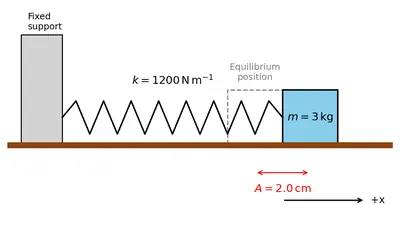
A spring having with a spring constant $$1200 \, \mathrm{N \, m^{-1}}$$ is mounted on a horizontal table as shown in Fig. 13.19. A mass of $$3 \, \mathrm{kg}$$ is attached to the free end of the spring. The mass is then pulled sideways to a distance of $$2.0 \, \mathrm{cm}$$ and released.

Determine (i) the frequency of oscillations, (ii) maximum acceleration of the mass, and (iii) the maximum speed of the mass.

Fig. 13.19
Fig. 13.19

Solution

Given: spring constant $$k = 1200 \, \mathrm{N\,m^{-1}}$$, mass $$m = 3 \, \mathrm{kg}$$, and amplitude $$A = 2.0 \, \mathrm{cm} = 0.02 \, \mathrm{m}$$ (the mass is released from rest at the pulled-out position, so this is the amplitude).

First find the angular frequency:

$$\omega = \sqrt{\dfrac{k}{m}} = \sqrt{\dfrac{1200}{3}} = \sqrt{400} = 20 \, \mathrm{rad\,s^{-1}}$$

(i) Frequency of oscillations.

$$\nu = \dfrac{\omega}{2\pi} = \dfrac{20}{2\pi} = \dfrac{10}{\pi} \approx 3.2 \, \mathrm{Hz}$$

(ii) Maximum acceleration. The acceleration is greatest at the extreme position, where $$|x| = A$$:

$$a_{\max} = \omega^2 A = (20)^2 \times 0.02 = 400 \times 0.02 = 8 \, \mathrm{m\,s^{-2}}$$

(iii) Maximum speed. The speed is greatest at the mean position:

$$v_{\max} = \omega A = 20 \times 0.02 = 0.4 \, \mathrm{m\,s^{-1}}$$

Answer

(i) Frequency $$\nu = \dfrac{10}{\pi} \approx 3.2 \, \mathrm{Hz}$$; (ii) maximum acceleration $$a_{\max} = 8 \, \mathrm{m\,s^{-2}}$$; (iii) maximum speed $$v_{\max} = 0.4 \, \mathrm{m\,s^{-1}}$$.

13.10

In Exercise 13.9, let us take the position of mass when the spring is unstreched as $$x = 0$$, and the direction from left to right as the positive direction of $$x$$-axis. Give $$x$$ as a function of time $$t$$ for the oscillating mass if at the moment we start the stopwatch ($$t = 0$$), the mass is

In what way do these functions for SHM differ from each other, in frequency, in amplitude or the initial phase?

(a) at the mean position,

Solution

From Exercise 13.9 the amplitude is $$A = 2 \, \mathrm{cm}$$ and the angular frequency is $$\omega = 20 \, \mathrm{rad\,s^{-1}}$$.

At $$t = 0$$ the mass is at the mean position, so the displacement is zero at $$t = 0$$: $$x(0) = 0$$.

A function that gives zero at $$t = 0$$ is the sine function. Hence

$$x(t) = A\sin\omega t = 2\sin 20t$$

(here $$x$$ is in cm and $$t$$ in s).

Answer

$$x(t) = 2\sin 20t$$ (cm, with $$t$$ in s).

(b) at the maximum stretched position, and

Solution

The amplitude is $$A = 2 \, \mathrm{cm}$$ and $$\omega = 20 \, \mathrm{rad\,s^{-1}}$$.

At $$t = 0$$ the mass is at the maximum stretched position. Stretching the spring moves the mass in the positive ($$+x$$) direction (left to right), so $$x = +A$$ at $$t = 0$$.

A function that gives its maximum positive value at $$t = 0$$ is the cosine function. Hence

$$x(t) = A\cos\omega t = 2\cos 20t$$

(here $$x$$ is in cm and $$t$$ in s).

Answer

$$x(t) = 2\cos 20t$$ (cm, with $$t$$ in s).

(c) at the maximum compressed position.

Solution

The amplitude is $$A = 2 \, \mathrm{cm}$$ and $$\omega = 20 \, \mathrm{rad\,s^{-1}}$$.

At $$t = 0$$ the mass is at the maximum compressed position. Compressing the spring moves the mass in the negative ($$-x$$) direction, so $$x = -A$$ at $$t = 0$$. Hence

$$x(t) = -A\cos\omega t = -2\cos 20t$$

(here $$x$$ is in cm and $$t$$ in s).

Comparison of the three functions. Writing each as a cosine: (a) $$2\sin 20t = 2\cos\!\left(20t - \dfrac{\pi}{2}\right)$$, (b) $$2\cos 20t$$, (c) $$-2\cos 20t = 2\cos(20t + \pi)$$.

All three have the same amplitude ($$2 \, \mathrm{cm}$$) and the same angular frequency / frequency ($$\omega = 20 \, \mathrm{rad\,s^{-1}}$$). They differ only in the initial phase — namely $$-\dfrac{\pi}{2}$$, $$0$$ and $$\pi$$ respectively.

Answer

$$x(t) = -2\cos 20t$$ (cm, with $$t$$ in s). The three functions (a), (b), (c) have the same amplitude and the same frequency; they differ only in the initial phase.

13.11

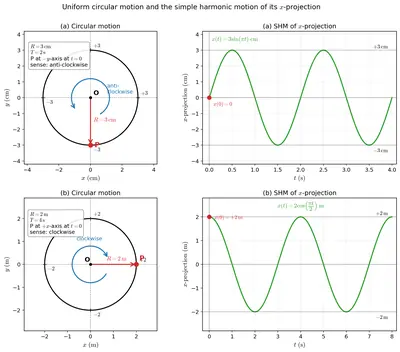
Figures 13.20 correspond to two circular motions. The radius of the circle, the period of revolution, the initial position, and the sense of revolution (i.e. clockwise or anti-clockwise) are indicated on each figure.

(a) Circle of radius $$3 \, \mathrm{cm}$$, period $$T = 2 \, \mathrm{s}$$, P at the negative $$y$$-axis at $$t = 0$$, rotating anti-clockwise.
(b) Circle of radius $$2 \, \mathrm{m}$$, period $$T = 4 \, \mathrm{s}$$, P at the positive $$x$$-axis at $$t = 0$$, rotating clockwise.

Obtain the corresponding simple harmonic motions of the $$x$$-projection of the radius vector of the revolving particle P, in each case.
Figures 13.20
Figures 13.20

Solution

For a particle P moving uniformly on a reference circle of radius $$r$$, the projection on the $$x$$-axis executes SHM given by $$x(t) = r\cos\theta(t)$$, where $$\theta(t)$$ is the angle the radius vector OP makes with the positive $$x$$-axis. The angular speed is $$\omega = \dfrac{2\pi}{T}$$.

Case (a): radius $$r = 3 \, \mathrm{cm}$$, period $$T = 2 \, \mathrm{s}$$, so

$$\omega = \dfrac{2\pi}{2} = \pi \, \mathrm{rad\,s^{-1}}$$

At $$t = 0$$, P is on the negative $$y$$-axis, i.e. $$\theta(0) = -\dfrac{\pi}{2}$$. The rotation is anticlockwise, so the angle increases with time:

$$\theta(t) = -\dfrac{\pi}{2} + \pi t$$

$$x(t) = 3\cos\!\left(\pi t - \dfrac{\pi}{2}\right) = 3\sin(\pi t) \quad (x \text{ in cm})$$

Case (b): radius $$r = 2 \, \mathrm{m}$$, period $$T = 4 \, \mathrm{s}$$, so

$$\omega = \dfrac{2\pi}{4} = \dfrac{\pi}{2} \, \mathrm{rad\,s^{-1}}$$

At $$t = 0$$, P is on the positive $$x$$-axis, i.e. $$\theta(0) = 0$$. The rotation is clockwise, so the angle decreases with time:

$$\theta(t) = -\dfrac{\pi}{2}t$$

$$x(t) = 2\cos\!\left(-\dfrac{\pi}{2}t\right) = 2\cos\!\left(\dfrac{\pi}{2}t\right) \quad (x \text{ in m})$$

Answer

(a) $$x(t) = 3\cos\!\left(\pi t - \dfrac{\pi}{2}\right) = 3\sin(\pi t)$$ cm. (b) $$x(t) = 2\cos\!\left(\dfrac{\pi}{2}t\right)$$ m.

13.12

Plot the corresponding reference circle for each of the following simple harmonic motions. Indicate the initial ($$t = 0$$) position of the particle, the radius of the circle, and the angular speed of the rotating particle. For simplicity, the sense of rotation may be fixed to be anticlockwise in every case: ($$x$$ is in cm and $$t$$ is in s).

(a) $$x = -2 \sin (3t + \pi/3)$$

Solution

To read off the reference circle, convert the function to the standard form $$x = A\cos(\omega t + \phi)$$ (this represents the $$x$$-projection of a particle rotating anticlockwise).

Use the identity $$-\sin\theta = \cos\!\left(\theta + \dfrac{\pi}{2}\right)$$:

$$x = -2\sin\!\left(3t + \dfrac{\pi}{3}\right) = 2\cos\!\left(3t + \dfrac{\pi}{3} + \dfrac{\pi}{2}\right) = 2\cos\!\left(3t + \dfrac{5\pi}{6}\right)$$

Comparing with $$x = A\cos(\omega t + \phi)$$:

  • Radius of the circle (amplitude): $$A = 2 \, \mathrm{cm}$$.
  • Angular speed of the rotating particle: $$\omega = 3 \, \mathrm{rad\,s^{-1}}$$.
  • Initial phase: $$\phi = \dfrac{5\pi}{6} = 150°$$.

So at $$t = 0$$ the radius vector OP points at $$150°$$, measured anticlockwise from the positive $$x$$-axis. Its $$x$$-projection at $$t = 0$$ is $$x(0) = 2\cos 150° = -\sqrt{3} \approx -1.73 \, \mathrm{cm}$$.

Answer

Reference circle of radius $$2 \, \mathrm{cm}$$, angular speed $$3 \, \mathrm{rad\,s^{-1}}$$; at $$t = 0$$ the radius vector is at $$150°$$ from the positive $$x$$-axis.

(b) $$x = \cos (\pi/6 - t)$$

Solution

Since cosine is an even function, $$\cos(-\theta) = \cos\theta$$, so

$$x = \cos\!\left(\dfrac{\pi}{6} - t\right) = \cos\!\left(t - \dfrac{\pi}{6}\right)$$

Comparing with the standard form $$x = A\cos(\omega t + \phi)$$:

  • Radius of the circle (amplitude): $$A = 1 \, \mathrm{cm}$$.
  • Angular speed of the rotating particle: $$\omega = 1 \, \mathrm{rad\,s^{-1}}$$.
  • Initial phase: $$\phi = -\dfrac{\pi}{6} = -30°$$.

So at $$t = 0$$ the radius vector OP points at $$-30°$$ (i.e. $$30°$$ below the positive $$x$$-axis). Its $$x$$-projection at $$t = 0$$ is $$x(0) = \cos(-30°) = \dfrac{\sqrt{3}}{2} \approx 0.87 \, \mathrm{cm}$$.

Answer

Reference circle of radius $$1 \, \mathrm{cm}$$, angular speed $$1 \, \mathrm{rad\,s^{-1}}$$; at $$t = 0$$ the radius vector is at $$-30°$$ from the positive $$x$$-axis.

(c) $$x = 3 \sin (2\pi t + \pi/4)$$

Solution

Convert the sine to a cosine using $$\sin\theta = \cos\!\left(\theta - \dfrac{\pi}{2}\right)$$:

$$x = 3\sin\!\left(2\pi t + \dfrac{\pi}{4}\right) = 3\cos\!\left(2\pi t + \dfrac{\pi}{4} - \dfrac{\pi}{2}\right) = 3\cos\!\left(2\pi t - \dfrac{\pi}{4}\right)$$

Comparing with the standard form $$x = A\cos(\omega t + \phi)$$:

  • Radius of the circle (amplitude): $$A = 3 \, \mathrm{cm}$$.
  • Angular speed of the rotating particle: $$\omega = 2\pi \, \mathrm{rad\,s^{-1}}$$.
  • Initial phase: $$\phi = -\dfrac{\pi}{4} = -45°$$.

So at $$t = 0$$ the radius vector OP points at $$-45°$$ from the positive $$x$$-axis. Its $$x$$-projection at $$t = 0$$ is $$x(0) = 3\cos(-45°) \approx 2.12 \, \mathrm{cm}$$.

Answer

Reference circle of radius $$3 \, \mathrm{cm}$$, angular speed $$2\pi \, \mathrm{rad\,s^{-1}}$$; at $$t = 0$$ the radius vector is at $$-45°$$ from the positive $$x$$-axis.

(d) $$x = 2 \cos \pi t$$

Solution

The function $$x = 2\cos\pi t$$ is already in the standard form $$x = A\cos(\omega t + \phi)$$.

Comparing directly:

  • Radius of the circle (amplitude): $$A = 2 \, \mathrm{cm}$$.
  • Angular speed of the rotating particle: $$\omega = \pi \, \mathrm{rad\,s^{-1}}$$.
  • Initial phase: $$\phi = 0$$.

So at $$t = 0$$ the radius vector OP lies along the positive $$x$$-axis, and the $$x$$-projection is $$x(0) = 2\cos 0 = 2 \, \mathrm{cm}$$.

Answer

Reference circle of radius $$2 \, \mathrm{cm}$$, angular speed $$\pi \, \mathrm{rad\,s^{-1}}$$; at $$t = 0$$ the radius vector lies along the positive $$x$$-axis.

13.13

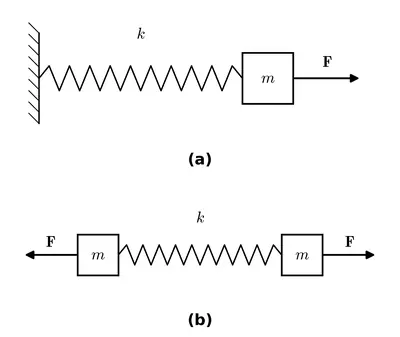
Figure 13.21(a) shows a spring of force constant $$k$$ clamped rigidly at one end and a mass $$m$$ attached to its free end. A force $$\mathbf{F}$$ applied at the free end stretches the spring. Figure 13.21 (b) shows the same spring with both ends free and attached to a mass $$m$$ at either end. Each end of the spring in Fig. 13.21(b) is stretched by the same force $$\mathbf{F}$$.

Figure 13.21
Figure 13.21

(a) What is the maximum extension of the spring in the two cases?

Solution

Figure (a): One end of the spring is clamped to a rigid wall and a force $$F$$ is applied at the free end. In equilibrium the wall supplies an equal and opposite reaction $$F$$. The spring is therefore under a tension $$F$$, so by Hooke's law its extension is

$$x_a = \dfrac{F}{k}$$

Figure (b): Both ends of the spring are free, and each end is pulled outward by a force $$F$$. These two equal and opposite forces keep the spring in equilibrium. The tension at every cross-section of the spring is still $$F$$ (it is not $$2F$$ — a stretched spring pulled at both ends by $$F$$ has tension $$F$$ throughout, just as in case (a) where the wall plays the role of the second $$F$$). Hence its extension is

$$x_b = \dfrac{F}{k}$$

Therefore the maximum extension of the spring is the same in both cases, equal to $$\dfrac{F}{k}$$.

Answer

In both cases the maximum extension is the same: $$x = \dfrac{F}{k}$$.

(b) If the mass in Fig. (a) and the two masses in Fig. (b) are released, what is the period of oscillation in each case?

Solution

Case (a): a single mass $$m$$ attached to a spring of force constant $$k$$ whose other end is fixed. This is the standard linear oscillator, for which the restoring force is $$F = -kx$$ and the period is

$$T_a = 2\pi\sqrt{\dfrac{m}{k}}$$

Case (b): two equal masses $$m$$ attached to the two ends of the same spring. By symmetry, the mid-point of the spring does not move at all — it behaves like a fixed point.

Each mass therefore behaves as if it were attached to only half of the spring. A spring of half the length is stiffer: halving the length doubles the force constant, so each half has force constant $$2k$$.

Hence each mass oscillates on an effective spring of constant $$2k$$, giving

$$T_b = 2\pi\sqrt{\dfrac{m}{2k}}$$

(The same result follows by treating it as a two-body problem with reduced mass $$\mu = \dfrac{m \cdot m}{m + m} = \dfrac{m}{2}$$, so that $$T_b = 2\pi\sqrt{\dfrac{\mu}{k}} = 2\pi\sqrt{\dfrac{m}{2k}}$$.)

Answer

Case (a): $$T = 2\pi\sqrt{\dfrac{m}{k}}$$. Case (b): $$T = 2\pi\sqrt{\dfrac{m}{2k}}$$.

13.14 The piston in the cylinder head of a locomotive has a stroke (twice the amplitude) of $$1.0 \, \mathrm{m}$$. If the piston moves with simple harmonic motion with an angular frequency of $$200 \, \mathrm{rad/min}$$, what is its maximum speed?

Solution

The stroke of the piston is twice the amplitude, so

$$2A = 1.0 \, \mathrm{m} \implies A = 0.5 \, \mathrm{m}$$

In SHM the speed is maximum at the mean position, and its value is

$$v_{\max} = \omega A$$

With the given angular frequency $$\omega = 200 \, \mathrm{rad\,min^{-1}}$$:

$$v_{\max} = 200 \times 0.5 = 100 \, \mathrm{m\,min^{-1}}$$

Expressing this in SI units (per second):

$$v_{\max} = \dfrac{100 \, \mathrm{m}}{60 \, \mathrm{s}} \approx 1.67 \, \mathrm{m\,s^{-1}}$$

Answer

Maximum speed $$v_{\max} = 100 \, \mathrm{m\,min^{-1}} \approx 1.67 \, \mathrm{m\,s^{-1}}$$.

13.15 The acceleration due to gravity on the surface of moon is $$1.7 \, \mathrm{m \, s^{-2}}$$. What is the time period of a simple pendulum on the surface of moon if its time period on the surface of earth is $$3.5 \, \mathrm{s}$$? ($$g$$ on the surface of earth is $$9.8 \, \mathrm{m \, s^{-2}}$$)

Solution

The time period of a simple pendulum is

$$T = 2\pi\sqrt{\dfrac{L}{g}}$$

The length $$L$$ of the pendulum is a property of the pendulum itself and is the same on the earth and on the moon. So $$T$$ depends only on $$g$$, and

$$\dfrac{T_{\text{moon}}}{T_{\text{earth}}} = \dfrac{2\pi\sqrt{L/g_{\text{moon}}}}{2\pi\sqrt{L/g_{\text{earth}}}} = \sqrt{\dfrac{g_{\text{earth}}}{g_{\text{moon}}}}$$

Therefore

$$T_{\text{moon}} = T_{\text{earth}}\sqrt{\dfrac{g_{\text{earth}}}{g_{\text{moon}}}} = 3.5\sqrt{\dfrac{9.8}{1.7}}$$

$$T_{\text{moon}} = 3.5 \times \sqrt{5.76} = 3.5 \times 2.40 \approx 8.4 \, \mathrm{s}$$

The pendulum runs slower on the moon (larger period) because the moon's gravity is weaker.

Answer

Time period on the moon $$T_{\text{moon}} \approx 8.4 \, \mathrm{s}$$.

13.16 A simple pendulum of length $$l$$ and having a bob of mass $$M$$ is suspended in a car. The car is moving on a circular track of radius $$R$$ with a uniform speed $$v$$. If the pendulum makes small oscillations in a radial direction about its equilibrium position, what will be its time period?

Solution

As the car moves round the circular track of radius $$R$$ at uniform speed $$v$$, it has a centripetal acceleration directed horizontally towards the centre of the track:

$$a_c = \dfrac{v^2}{R}$$

The pendulum bob is thus acted upon by two accelerations:

  • the acceleration due to gravity $$g$$, acting vertically downward;
  • an effective (radial) acceleration $$a_c = \dfrac{v^2}{R}$$, acting horizontally.

These two accelerations are mutually perpendicular, so the bob hangs along the direction of their resultant. The magnitude of this effective acceleration due to gravity is

$$g_{\text{eff}} = \sqrt{g^2 + a_c^2} = \sqrt{g^2 + \left(\dfrac{v^2}{R}\right)^2}$$

For small oscillations about this new equilibrium direction, the period is obtained by replacing $$g$$ with $$g_{\text{eff}}$$ in the pendulum formula $$T = 2\pi\sqrt{l/g}$$:

$$T = 2\pi\sqrt{\dfrac{l}{g_{\text{eff}}}} = 2\pi\sqrt{\dfrac{l}{\sqrt{g^2 + \dfrac{v^4}{R^2}}}}$$

(The result does not depend on the mass $$M$$ of the bob.)

Answer

$$T = 2\pi\sqrt{\dfrac{l}{\sqrt{g^2 + v^4/R^2}}}$$, where $$\sqrt{g^2 + v^4/R^2}$$ is the effective acceleration due to gravity.

13.17

A cylindrical piece of cork of density of base area $$A$$ and height $$h$$ floats in a liquid of density $$\rho_l$$. The cork is depressed slightly and then released. Show that the cork oscillates up and down simple harmonically with a period

$$T = 2\pi \sqrt{\dfrac{h\rho}{\rho_l g}}$$

where $$\rho$$ is the density of cork. (Ignore damping due to viscosity of the liquid).

Solution

Let the cork have base area $$A$$, height $$h$$ and density $$\rho$$. Its mass is

$$m = (\text{volume}) \times \rho = A h \rho$$

Equilibrium condition. When the cork floats in equilibrium, let it be submerged to a depth $$l$$. By the law of floatation, the weight of the cork equals the weight of the liquid displaced (Archimedes' principle):

$$\underbrace{A h \rho\, g}_{\text{weight of cork}} = \underbrace{A l\, \rho_l\, g}_{\text{weight of liquid displaced}} \implies l = \dfrac{h\rho}{\rho_l}$$

Displaced position. Now push the cork down through a small extra distance $$x$$. The submerged depth becomes $$l + x$$, so an extra volume $$A x$$ of liquid is displaced. This produces an extra upward (buoyant) force, which is the net restoring force:

$$F = -(\text{extra volume}) \times \rho_l \times g = -A x\, \rho_l\, g$$

The negative sign shows that the force is directed opposite to the displacement $$x$$ — it pushes the cork back towards the equilibrium position.

Equation of motion. By Newton's second law, $$F = m a$$:

$$m a = -A\rho_l g\, x$$

$$(A h \rho)\, a = -A\rho_l g\, x$$

$$a = -\left(\dfrac{\rho_l\, g}{h\rho}\right) x$$

The acceleration is proportional to the displacement and directed towards the mean position. This is exactly the condition for simple harmonic motion, $$a = -\omega^2 x$$, with

$$\omega^2 = \dfrac{\rho_l\, g}{h\rho}$$

Hence the time period is

$$T = \dfrac{2\pi}{\omega} = 2\pi\sqrt{\dfrac{h\rho}{\rho_l\, g}}$$

which is the required result.

Answer

Proved. The cork executes SHM with $$\omega^2 = \dfrac{\rho_l g}{h\rho}$$, giving period $$T = 2\pi\sqrt{\dfrac{h\rho}{\rho_l g}}$$.

13.18 One end of a U-tube containing mercury is connected to a suction pump and the other end to atmosphere. A small pressure difference is maintained between the two columns. Show that, when the suction pump is removed, the column of mercury in the U-tube executes simple harmonic motion.

Solution

Let the U-tube have a uniform cross-sectional area $$A$$, and let the mercury have density $$\rho$$. Let the total length of the mercury column (measured along the tube) be $$L$$. Then the mass of the whole mercury column is

$$m = (\text{volume}) \times \rho = A L \rho$$

Displaced position. When the suction pump is removed, the mercury is free to move. Suppose the mercury level in one limb falls by a distance $$y$$; then, since mercury is incompressible, the level in the other limb rises by the same distance $$y$$.

The difference in the heights of mercury in the two limbs is therefore $$2y$$.

Restoring force. This extra column of mercury, of height $$2y$$, is unbalanced and its weight acts to bring the levels back to equal. The restoring force is the weight of this unbalanced column:

$$F = -(\text{volume of unbalanced column}) \times \rho \times g = -(A \cdot 2y)\,\rho\, g = -2A\rho g\, y$$

The negative sign shows the force opposes the displacement, pushing the mercury back towards the equal-level (mean) position.

Equation of motion. By Newton's second law, $$F = m a$$:

$$(A L \rho)\, a = -2A\rho g\, y$$

$$a = -\left(\dfrac{2g}{L}\right) y$$

The acceleration is proportional to the displacement $$y$$ and directed towards the mean position. This is precisely the defining condition for simple harmonic motion, $$a = -\omega^2 y$$, with

$$\omega^2 = \dfrac{2g}{L}$$

Hence the mercury column executes SHM, with time period

$$T = \dfrac{2\pi}{\omega} = 2\pi\sqrt{\dfrac{L}{2g}}$$

Answer

Proved. The mercury column executes SHM with $$\omega = \sqrt{2g/L}$$, i.e. with time period $$T = 2\pi\sqrt{\dfrac{L}{2g}}$$ (where $$L$$ is the total length of the mercury column).
NCERT Solutions for Class 11
Maths
NCERT Solutions for Class 11 Maths
Chapter-wise step-by-step
solutions with explanations
explore solutions Maths bg
Physics
NCERT Solutions for Class 11 Physics
Chapter-wise step-by-step
solutions with explanations
explore solutions Physics bg
Chemistry
NCERT Solutions for Class 11 Chemistry
Chapter-wise step-by-step
solutions with explanations
explore solutions Chemistry bg

Frequently Asked Questions

50,000+ JEE Students Trusted Our Score Calculator

Predict your JEE Main percentile, rank & performance in seconds