Join WhatsApp Icon JEE WhatsApp Group
NCERT Solutions for Class 11 Physics

Chapter 12: Kinetic Theory

Download Solutions PDF
Daily JEE Updates, Tips & Important Alerts
Join 30,000+ students and stay updated with JEE notifications and preparation insights.
Join Now!
Free PDF
Complete NCERT Solution PDF for Chapter 12: Kinetic Theory

NCERT Solutions For Class 11 Physics Chapter 12 Kinetic Theory helps students understand the microscopic behaviour of gases and the relationship between molecular motion and macroscopic properties. The page provides detailed NCERT Solutions that explain concepts such as molecular motion, gas laws, pressure, temperature, and kinetic interpretation of gases. NCERT Solutions For Class 11 Physics make these concepts easier by connecting theoretical ideas with mathematical explanations. The chapter helps students understand how individual particles contribute to the overall behaviour of gases. These solutions assist learners in solving textbook problems and strengthening their conceptual understanding. Students can use the chapter PDF for revision, practice, and examination preparation. The detailed explanations help students develop a deeper understanding of the kinetic nature of matter.

Download Solutions PDF

Examples 12.1-12.9

Example 12.1 The density of water is $$1000 \, \mathrm{kg \, m^{-3}}$$. The density of water vapour at $$100^\circ \mathrm{C}$$ and 1 atm pressure is $$0.6 \, \mathrm{kg \, m^{-3}}$$. The volume of a molecule multiplied by the total number gives, what is called, molecular volume. Estimate the ratio (or fraction) of the molecular volume to the total volume occupied by the water vapour under the above conditions of temperature and pressure.

Solution

Idea: The volume actually occupied by the molecules themselves (the molecular volume) is essentially the volume the same molecules occupy when packed together as a liquid, because in the liquid phase the molecules are nearly touching.

Take a fixed mass $$M$$ of water. In the liquid state its volume is $$V_{liquid} = \dfrac{M}{\rho_{water}} = \dfrac{M}{1000}$$.

As vapour, the same mass occupies $$V_{vapour} = \dfrac{M}{\rho_{vapour}} = \dfrac{M}{0.6}$$.

The ratio of the vapour volume to the liquid volume is $$\dfrac{V_{vapour}}{V_{liquid}} = \dfrac{M/0.6}{M/1000} = \dfrac{1000}{0.6} \approx 1.7 \times 10^{3}$$.

In the liquid the molecules are closely packed, so the molecular volume is essentially equal to the liquid volume; the fraction of molecular volume to total volume in the liquid is taken as $$1$$.

When the same molecules spread out into the vapour, the total volume increases by the factor $$\dfrac{1000}{0.6}$$, while the molecular volume itself does not change. Hence the fraction becomes smaller by the same factor:

$$\text{Fraction} = \dfrac{V_{molecular}}{V_{vapour}} = \dfrac{V_{liquid}}{V_{vapour}} = \dfrac{0.6}{1000} = 6 \times 10^{-4}$$

So only about $$0.06\%$$ of the volume of water vapour is actually occupied by the molecules — the rest is empty space.

Answer

The fraction of molecular volume to the total volume of the water vapour is about $$6 \times 10^{-4}$$.

Example 12.2 Estimate the volume of a water molecule using the data in Example 12.1.

Solution

In the liquid (or solid) phase the water molecules are closely packed, so the density of a single molecule is roughly equal to the density of bulk water, $$\rho = 1000 \, \mathrm{kg \, m^{-3}}$$.

To find the volume of one molecule we first need the mass of one molecule. One mole of water has mass $$M_0 = (2 + 16) \, \mathrm{g} = 18 \, \mathrm{g} = 0.018 \, \mathrm{kg}$$ and contains $$N_A = 6.02 \times 10^{23}$$ molecules.

Mass of one water molecule:

$$m = \dfrac{M_0}{N_A} = \dfrac{0.018}{6.02 \times 10^{23}} \approx 3 \times 10^{-26} \, \mathrm{kg}$$

Volume of one water molecule:

$$V = \dfrac{m}{\rho} = \dfrac{3 \times 10^{-26}}{1000} = 3 \times 10^{-29} \, \mathrm{m^3}$$

Treating the molecule as a tiny sphere of radius $$r$$, we have $$V = \dfrac{4}{3}\pi r^3$$, so

$$r = \left(\dfrac{3V}{4\pi}\right)^{1/3} = \left(\dfrac{3 \times 3 \times 10^{-29}}{4 \times 3.14}\right)^{1/3} \approx 2 \times 10^{-10} \, \mathrm{m} = 2 \, \mathrm{\AA}$$

So a water molecule has a volume of about $$3 \times 10^{-29} \, \mathrm{m^3}$$, corresponding to a radius of about $$2 \, \mathrm{\AA}$$.

Answer

Volume of a water molecule $$\approx 3 \times 10^{-29} \, \mathrm{m^3}$$ (radius $$\approx 2 \, \mathrm{\AA}$$).

Example 12.3 What is the average distance between atoms (interatomic distance) in water? Use the data given in Examples 12.1 and 12.2.

Solution

This example estimates the average spacing between molecules in water vapour, using the data of the previous examples.

From Example 12.1, a given mass of water in the vapour state occupies $$\dfrac{1000}{0.6} \approx 1.7 \times 10^{3}$$ times the volume it occupies as a liquid. So the volume available to each molecule in the vapour is about $$10^{3}$$ times larger than in the liquid.

If the volume per molecule increases by a factor of $$10^{3}$$, the linear dimension (which scales as the cube root of volume) increases by

$$\left(10^{3}\right)^{1/3} = 10 \text{ times}$$

In the liquid the molecules are essentially touching, and the radius of a molecule is about $$2 \, \mathrm{\AA}$$ (Example 12.2). In the vapour the corresponding linear size available per molecule becomes

$$10 \times 2 \, \mathrm{\AA} = 20 \, \mathrm{\AA}$$

The average distance between two neighbouring molecules is twice this value:

$$\text{Interatomic distance} \approx 2 \times 20 \, \mathrm{\AA} = 40 \, \mathrm{\AA} = 4 \times 10^{-9} \, \mathrm{m}$$

Thus in water vapour the molecules are, on average, about $$40 \, \mathrm{\AA}$$ apart — roughly ten times the molecular size itself.

Answer

Average interatomic distance in water vapour $$\approx 40 \, \mathrm{\AA} = 4 \times 10^{-9} \, \mathrm{m}$$.

Example 12.4 A vessel contains two non-reactive gases: neon (monatomic) and oxygen (diatomic). The ratio of their partial pressures is 3:2. Estimate the ratio of (i) number of molecules and (ii) mass density of neon and oxygen in the vessel. Atomic mass of $$\mathrm{Ne} = 20.2 \, \mathrm{u}$$, molecular mass of $$\mathrm{O_2} = 32.0 \, \mathrm{u}$$.

(i) Estimate the ratio of the number of molecules of neon and oxygen in the vessel.

Solution

The partial pressure of a gas in a mixture is the pressure it would exert if it alone occupied the whole vessel at the same temperature. Each gas (treated as ideal) obeys $$PV = \mu RT$$.

Since the two gases share the same volume $$V$$ and the same temperature $$T$$,

$$P_1 V = \mu_1 R T \qquad \text{and} \qquad P_2 V = \mu_2 R T$$

Dividing one equation by the other, $$V$$, $$R$$ and $$T$$ cancel:

$$\dfrac{P_1}{P_2} = \dfrac{\mu_1}{\mu_2}$$

Taking subscript 1 for neon and 2 for oxygen, and using the given ratio $$\dfrac{P_1}{P_2} = \dfrac{3}{2}$$:

$$\dfrac{\mu_1}{\mu_2} = \dfrac{3}{2}$$

The number of moles is proportional to the number of molecules, $$\mu = \dfrac{N}{N_A}$$, so

$$\dfrac{N_1}{N_2} = \dfrac{\mu_1}{\mu_2} = \dfrac{3}{2}$$

The numbers of molecules of neon and oxygen are in the ratio $$3 : 2$$.

Answer

$$N_{\mathrm{Ne}} : N_{\mathrm{O_2}} = 3 : 2$$

(ii) Estimate the ratio of the mass density of neon and oxygen in the vessel.

Solution

Mass density is mass per unit volume. The neon and oxygen molecules occupy the same volume $$V$$, so

$$\dfrac{\rho_1}{\rho_2} = \dfrac{m_1 / V}{m_2 / V} = \dfrac{m_1}{m_2}$$

where $$m_1$$ and $$m_2$$ are the total masses of neon and oxygen. Writing each total mass as (number of moles) $$\times$$ (molar mass), $$m_1 = \mu_1 M_1$$ and $$m_2 = \mu_2 M_2$$:

$$\dfrac{\rho_1}{\rho_2} = \dfrac{\mu_1 M_1}{\mu_2 M_2} = \dfrac{\mu_1}{\mu_2} \times \dfrac{M_1}{M_2}$$

From part (i), $$\dfrac{\mu_1}{\mu_2} = \dfrac{3}{2}$$. With $$M_1 = 20.2 \, \mathrm{u}$$ (Ne) and $$M_2 = 32.0 \, \mathrm{u}$$ ($$\mathrm{O_2}$$):

$$\dfrac{\rho_1}{\rho_2} = \dfrac{3}{2} \times \dfrac{20.2}{32.0} = \dfrac{3}{2} \times 0.631 = 0.947$$

The mass density of neon is about $$0.947$$ times that of oxygen in the vessel.

Answer

$$\dfrac{\rho_{\mathrm{Ne}}}{\rho_{\mathrm{O_2}}} = 0.947$$

Example 12.5 A flask contains argon and chlorine in the ratio of 2:1 by mass. The temperature of the mixture is $$27^\circ \mathrm{C}$$. Obtain the ratio of (i) average kinetic energy per molecule, and (ii) root mean square speed $$v_{rms}$$ of the molecules of the two gases. Atomic mass of argon $$= 39.9 \, \mathrm{u}$$; Molecular mass of chlorine $$= 70.9 \, \mathrm{u}$$.

(i) Obtain the ratio of average kinetic energy per molecule of the molecules of argon and chlorine.

Solution

A key result of kinetic theory is that the average kinetic energy per molecule of any ideal gas depends only on the absolute temperature:

$$\bar{E} = \dfrac{3}{2} k_B T$$

This is true whether the gas is monatomic (argon) or diatomic (chlorine) — it does not depend on the mass or nature of the molecule.

Argon and chlorine are in the same flask, hence at the same temperature $$T = 27^\circ\mathrm{C} = 300 \, \mathrm{K}$$. Therefore their average kinetic energies per molecule are equal:

$$\dfrac{\bar{E}_{\mathrm{Ar}}}{\bar{E}_{\mathrm{Cl}}} = \dfrac{(3/2)\,k_B T}{(3/2)\,k_B T} = 1$$

The ratio is $$1 : 1$$. (The 2:1 composition of the mixture by mass is irrelevant here.)

Answer

Ratio of average kinetic energy per molecule (Ar : Cl) $$= 1 : 1$$.

(ii) Obtain the ratio of root mean square speed $$v_{rms}$$ of the molecules of argon and chlorine.

Solution

The average kinetic energy per molecule can be written in terms of the root mean square speed:

$$\dfrac{1}{2} m \, v_{rms}^{2} = \dfrac{3}{2} k_B T$$

Since both gases are at the same temperature, the right-hand side is the same for both. Hence the quantity $$m \, v_{rms}^{2}$$ is equal for argon and chlorine:

$$m_{\mathrm{Ar}} \, v_{rms,\mathrm{Ar}}^{2} = m_{\mathrm{Cl}} \, v_{rms,\mathrm{Cl}}^{2}$$

$$\dfrac{v_{rms,\mathrm{Ar}}^{2}}{v_{rms,\mathrm{Cl}}^{2}} = \dfrac{m_{\mathrm{Cl}}}{m_{\mathrm{Ar}}} = \dfrac{M_{\mathrm{Cl}}}{M_{\mathrm{Ar}}} = \dfrac{70.9}{39.9} = 1.77$$

(The ratio of the masses of single molecules equals the ratio of the molecular masses. For argon a molecule is just a single atom.)

Taking the square root:

$$\dfrac{v_{rms,\mathrm{Ar}}}{v_{rms,\mathrm{Cl}}} = \sqrt{1.77} = 1.33$$

Argon molecules move about $$1.33$$ times faster (rms) than chlorine molecules, because they are lighter.

Answer

$$\dfrac{v_{rms,\mathrm{Ar}}}{v_{rms,\mathrm{Cl}}} = 1.33$$

Example 12.6 Uranium has two isotopes of masses 235 and 238 units. If both are present in Uranium hexafluoride gas which would have the larger average speed? If atomic mass of fluorine is 19 units, estimate the percentage difference in speeds at any temperature.

Solution

At a fixed temperature the average kinetic energy of a molecule, $$\dfrac{1}{2} m \langle v^2 \rangle = \dfrac{3}{2}k_B T$$, is the same for all molecules. So the lighter molecule moves faster.

The two species are uranium hexafluoride molecules, $$\mathrm{UF_6}$$, each containing one of the two uranium isotopes. With the atomic mass of fluorine $$= 19$$, the molecular masses are:

For $${}^{235}\mathrm{U}$$: $$M_1 = 235 + 6 \times 19 = 235 + 114 = 349 \, \mathrm{u}$$

For $${}^{238}\mathrm{U}$$: $$M_2 = 238 + 6 \times 19 = 238 + 114 = 352 \, \mathrm{u}$$

Since $$v \propto \dfrac{1}{\sqrt{M}}$$, the molecule containing the lighter isotope $${}^{235}\mathrm{U}$$ (molecular mass $$349 \, \mathrm{u}$$) has the larger average speed.

The ratio of the speeds is

$$\dfrac{v_{349}}{v_{352}} = \sqrt{\dfrac{M_2}{M_1}} = \sqrt{\dfrac{352}{349}} = \sqrt{1.0086} = 1.0044$$

The percentage difference in speeds is

$$\dfrac{\Delta v}{v} \times 100 = (1.0044 - 1) \times 100 \approx 0.44\%$$

So the molecules carrying $${}^{235}\mathrm{U}$$ are the faster ones, by about $$0.44\%$$. (This tiny difference is exactly what is exploited to separate the uranium isotopes by gaseous diffusion.)

Answer

The molecule containing the lighter $${}^{235}\mathrm{U}$$ isotope (molecular mass $$349 \, \mathrm{u}$$) has the larger speed; the two speeds differ by about $$0.44\%$$.

Example 12.7

(a) When a molecule (or an elastic ball) hits a (massive) wall, it rebounds with the same speed. When a ball hits a massive bat held firmly, the same thing happens. However, when the bat is moving towards the ball, the ball rebounds with a different speed. Does the ball move faster or slower? (Ch.5 will refresh your memory on elastic collisions.)

(b) When gas in a cylinder is compressed by pushing in a piston, its temperature rises. Guess at an explanation of this in terms of kinetic theory using (a) above.

(c) What happens when a compressed gas pushes a piston out and expands. What would you observe?

(d) Sachin Tendulkar used a heavy cricket bat while playing. Did it help him in anyway?

(a) When a molecule (or an elastic ball) hits a (massive) wall, it rebounds with the same speed. When a ball hits a massive bat held firmly, the same thing happens. However, when the bat is moving towards the ball, the ball rebounds with a different speed. Does the ball move faster or slower? (Ch.5 will refresh your memory on elastic collisions.)

Solution

Treat the collision as elastic (recall the chapter on collisions). Let the ball approach the bat with speed $$u$$ relative to the ground, and let the bat move towards the ball with speed $$V$$.

In the reference frame of the bat, the ball approaches with relative speed $$V + u$$. After an elastic bounce off the (effectively massive) bat, the ball moves away from the bat with the same relative speed $$V + u$$.

Converting back to the ground frame, the bat itself is moving at speed $$V$$, so the speed of the rebounding ball relative to the ground is

$$V + (V + u) = 2V + u$$

Since $$2V + u > u$$, the ball rebounds faster than it arrived. A bat moving towards the ball speeds the ball up.

Answer

The ball moves faster — it rebounds with speed $$2V + u$$, where $$V$$ is the bat's speed and $$u$$ the ball's incoming speed.

(b) When gas in a cylinder is compressed by pushing in a piston, its temperature rises. Guess at an explanation of this in terms of kinetic theory using (a) above.

Solution

Pushing the piston in is exactly like the moving bat of part (a): the piston is a massive wall moving towards the gas molecules.

Each molecule that strikes the advancing piston rebounds with a greater speed than it had before the collision — just as the ball gained speed from the moving bat.

An increase in molecular speeds means an increase in the average kinetic energy of the molecules. Since the temperature of a gas is a direct measure of the average kinetic energy of its molecules $$\left(\dfrac{1}{2}m\langle v^2\rangle = \dfrac{3}{2}k_B T\right)$$, the temperature of the gas rises.

Answer

The advancing piston acts like a moving bat: molecules rebound faster, their average kinetic energy increases, and so the temperature of the gas rises.

(c) What happens when a compressed gas pushes a piston out and expands. What would you observe?

Solution

When the compressed gas pushes the piston out, the piston is a massive wall moving away from the gas molecules — the opposite of the situation in part (a).

A molecule striking a receding piston rebounds with a smaller speed than it had before; it gives up some of its energy to the piston by doing work on it. The average molecular speed therefore decreases.

A decrease in average kinetic energy means a fall in temperature. Hence the expanding gas cools down — its temperature drops. This is exactly what is observed, for example, when gas escaping from a compressed cylinder feels cold.

Answer

The molecules rebound more slowly from the receding piston, so the gas loses kinetic energy and cools down — its temperature falls.

(d) Sachin Tendulkar used a heavy cricket bat while playing. Did it help him in anyway?

Solution

Yes. From part (a), the speed of the ball after being hit is $$2V + u$$, where $$V$$ is the speed of the bat and $$u$$ the incoming speed of the ball. This result assumed the bat is effectively massive compared with the ball.

A heavier bat behaves more nearly like an ideal massive object: it loses less of its own speed in the collision, so it keeps moving and imparts close to the full $$2V$$ boost to the ball. With a light bat the collision departs from this ideal and the ball is given less extra speed (and the bat is slowed more).

So a heavy bat, swung at a good speed, sends the ball off faster and farther. It did help Sachin Tendulkar hit the ball harder.

Answer

Yes — a heavier bat is closer to an ideal massive object, so it loses less speed in the collision and imparts greater speed to the ball.

Example 12.8 A cylinder of fixed capacity 44.8 litres contains helium gas at standard temperature and pressure. What is the amount of heat needed to raise the temperature of the gas in the cylinder by $$15.0^\circ \mathrm{C}$$? ($$R = 8.31 \, \mathrm{J \, mol^{-1} \, K^{-1}}$$).

Solution

Step 1 — Find the number of moles. At standard temperature and pressure, 1 mole of any ideal gas occupies $$22.4 \, \mathrm{litres}$$. The cylinder holds $$44.8 \, \mathrm{litres}$$ of helium at STP, so

$$\mu = \dfrac{44.8}{22.4} = 2 \, \mathrm{mol}$$

Step 2 — Choose the right specific heat. The cylinder has a fixed capacity, so the volume of the gas is constant. The heat needed is therefore governed by the molar specific heat at constant volume, $$C_v$$.

Helium is monatomic, so

$$C_v = \dfrac{3}{2}R$$

Step 3 — Compute the heat. The heat required to raise the temperature by $$\Delta T = 15.0^\circ\mathrm{C} = 15.0 \, \mathrm{K}$$ is

$$Q = \mu \, C_v \, \Delta T = \mu \times \dfrac{3}{2}R \times \Delta T$$

$$Q = 2 \times \dfrac{3}{2} \times R \times 15.0 = 45 \, R$$

$$Q = 45 \times 8.31 \, \mathrm{J} = 374 \, \mathrm{J}$$

About $$374 \, \mathrm{J}$$ of heat is needed.

Answer

$$Q = 45R \approx 374 \, \mathrm{J}$$

Example 12.9 Estimate the mean free path for a water molecule in water vapour at 373 K. Use information from Exercises 12.1 and Eq. (12.41) above.

Solution

The mean free path is given by

$$l = \dfrac{1}{\sqrt{2}\,n\pi d^2}$$

where $$n$$ is the number density of molecules and $$d$$ their diameter.

The size $$d$$ of a water-vapour molecule is taken to be the same as that of an air molecule, $$d \approx 2 \times 10^{-10} \, \mathrm{m}$$. For air at STP it was found (Eq. 12.41) that the number density is $$n_0 = 2.7 \times 10^{25} \, \mathrm{m^{-3}}$$ and the mean free path is $$l_0 \approx 2.9 \times 10^{-7} \, \mathrm{m}$$.

Adjust the number density to 373 K. At fixed pressure, $$n = \dfrac{P}{k_B T}$$, so the number density is inversely proportional to the absolute temperature. Going from $$273 \, \mathrm{K}$$ to $$373 \, \mathrm{K}$$,

$$n = 2.7 \times 10^{25} \times \dfrac{273}{373} \approx 2 \times 10^{25} \, \mathrm{m^{-3}}$$

Find the mean free path. Since $$l \propto \dfrac{1}{n}$$,

$$l = l_0 \times \dfrac{n_0}{n} = 2.9 \times 10^{-7} \times \dfrac{2.7 \times 10^{25}}{2 \times 10^{25}} \approx 4 \times 10^{-7} \, \mathrm{m}$$

The mean free path of a water molecule in vapour at 373 K is about $$4 \times 10^{-7} \, \mathrm{m}$$ — roughly 100 times the interatomic distance ($$\sim 40 \, \mathrm{\AA}$$) found in Example 12.3. It is this large value that allows a gas to behave as a gas, unable to hold together without a container.

Answer

Mean free path $$l \approx 4 \times 10^{-7} \, \mathrm{m}$$.

Exercises

12.1 Estimate the fraction of molecular volume to the actual volume occupied by oxygen gas at STP. Take the diameter of an oxygen molecule to be $$3 \, \mathrm{\AA}$$.

Solution

At STP, 1 mole of oxygen gas occupies the molar volume $$V_{gas} = 22.4 \, \mathrm{litres} = 22.4 \times 10^{-3} \, \mathrm{m^3}$$ and contains $$N_A = 6.02 \times 10^{23}$$ molecules.

Volume of one molecule. Taking the oxygen molecule as a sphere of diameter $$d = 3 \, \mathrm{\AA} = 3 \times 10^{-10} \, \mathrm{m}$$, its radius is $$r = 1.5 \times 10^{-10} \, \mathrm{m}$$, so

$$v = \dfrac{4}{3}\pi r^3 = \dfrac{4}{3} \times 3.14 \times (1.5 \times 10^{-10})^3$$

$$v = \dfrac{4}{3} \times 3.14 \times 3.375 \times 10^{-30} = 1.41 \times 10^{-29} \, \mathrm{m^3}$$

Total molecular volume of 1 mole.

$$V_{molecular} = N_A \, v = 6.02 \times 10^{23} \times 1.41 \times 10^{-29} = 8.51 \times 10^{-6} \, \mathrm{m^3}$$

Required fraction.

$$\dfrac{V_{molecular}}{V_{gas}} = \dfrac{8.51 \times 10^{-6}}{22.4 \times 10^{-3}} = 3.8 \times 10^{-4}$$

So only about $$3.8 \times 10^{-4}$$ (less than $$0.04\%$$) of the volume occupied by oxygen gas at STP is actually taken up by the molecules themselves; the rest is empty space.

Answer

Fraction of molecular volume to actual volume $$\approx 3.8 \times 10^{-4}$$.

12.2 Molar volume is the volume occupied by 1 mol of any (ideal) gas at standard temperature and pressure (STP: 1 atmospheric pressure, $$0^\circ \mathrm{C}$$). Show that it is 22.4 litres.

Solution

The molar volume is the volume occupied by 1 mole of an ideal gas. We obtain it from the ideal gas equation

$$PV = \mu R T$$

For 1 mole, $$\mu = 1$$, so

$$V = \dfrac{RT}{P}$$

At STP the standard conditions are:

$$T = 0^\circ\mathrm{C} = 273 \, \mathrm{K}$$
$$P = 1 \, \mathrm{atm} = 1.013 \times 10^{5} \, \mathrm{Pa}$$
$$R = 8.31 \, \mathrm{J \, mol^{-1} \, K^{-1}}$$

Substituting these values:

$$V = \dfrac{R T}{P} = \dfrac{8.31 \times 273}{1.013 \times 10^{5}}$$

$$V = \dfrac{2268.6}{1.013 \times 10^{5}} = 2.24 \times 10^{-2} \, \mathrm{m^3}$$

Converting to litres ($$1 \, \mathrm{m^3} = 10^{3} \, \mathrm{litre}$$):

$$V = 2.24 \times 10^{-2} \times 10^{3} \, \mathrm{litre} = 22.4 \, \mathrm{litre}$$

Hence the molar volume of any ideal gas at STP is $$22.4 \, \mathrm{litres}$$, as required.

Answer

Shown: at STP, $$V = RT/P \approx 22.4 \, \mathrm{litres}$$ for 1 mole of any ideal gas.

12.3

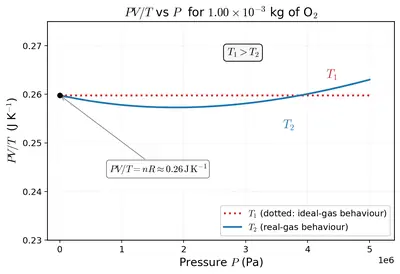
Figure 12.8 shows plot of $$PV/T$$ versus $$P$$ for $$1.00 \times 10^{-3} \, \mathrm{kg}$$ of oxygen gas at two different temperatures.
Figure 12.8
Figure 12.8

(a) What does the dotted plot signify?

Solution

For an ideal gas the equation of state is $$PV = \mu RT$$, which can be rearranged as

$$\dfrac{PV}{T} = \mu R$$

For a fixed mass of gas, $$\mu$$ is constant and $$R$$ is a universal constant. Hence $$\dfrac{PV}{T}$$ is a constant, independent of the pressure $$P$$. Plotted against $$P$$, a constant gives a horizontal straight line.

The dotted plot is exactly such a horizontal line. It therefore signifies ideal-gas behaviour: $$PV/T$$ stays constant (equal to $$\mu R$$) at all pressures. A real gas approaches this behaviour only at low pressure and high temperature.

Answer

The dotted line represents ideal-gas behaviour — $$PV/T$$ is constant (equal to $$\mu R$$) and independent of pressure.

(b) Which is true: $$T_1 > T_2$$ or $$T_1 < T_2$$?

Solution

A real gas behaves more like an ideal gas — that is, its $$PV/T$$ curve stays closer to the horizontal dotted line — when the temperature is higher (and the pressure lower).

In Fig. 12.8 the curve labelled $$T_1$$ lies closer to the dotted ideal-gas line and deviates from it less than the curve $$T_2$$ does. The curve that deviates less corresponds to the higher temperature.

Therefore $$T_1 > T_2$$.

Answer

$$T_1 > T_2$$.

(c) What is the value of $$PV/T$$ where the curves meet on the $$y$$-axis?

Solution

Where the curves meet the $$y$$-axis the pressure $$P \to 0$$. At very low pressure every real gas behaves ideally, so there

$$\dfrac{PV}{T} = \mu R$$

The gas is oxygen, of mass $$m = 1.00 \times 10^{-3} \, \mathrm{kg}$$ and molar mass $$M_0 = 32.0 \, \mathrm{g} = 32.0 \times 10^{-3} \, \mathrm{kg}$$. The number of moles is

$$\mu = \dfrac{m}{M_0} = \dfrac{1.00 \times 10^{-3}}{32.0 \times 10^{-3}} = \dfrac{1}{32} \, \mathrm{mol}$$

Hence

$$\dfrac{PV}{T} = \mu R = \dfrac{1}{32} \times 8.31 = 0.26 \, \mathrm{J \, K^{-1}}$$

Answer

$$\dfrac{PV}{T} = \mu R \approx 0.26 \, \mathrm{J \, K^{-1}}$$

(d) If we obtained similar plots for $$1.00 \times 10^{-3} \, \mathrm{kg}$$ of hydrogen, would we get the same value of $$PV/T$$ at the point where the curves meet on the $$y$$-axis? If not, what mass of hydrogen yields the same value of $$PV/T$$ (for low pressure high temperature region of the plot)? (Molecular mass of $$\mathrm{H_2} = 2.02 \, \mathrm{u}$$, of $$\mathrm{O_2} = 32.0 \, \mathrm{u}$$, $$R = 8.31 \, \mathrm{J \, mol^{-1} \, K^{-1}}$$.)

Solution

At the meeting point on the $$y$$-axis, $$\dfrac{PV}{T} = \mu R$$, which depends only on the number of moles $$\mu$$. Two gases give the same value here only if they contain the same number of moles.

For oxygen, the mass $$1.00 \times 10^{-3} \, \mathrm{kg}$$ corresponds to $$\mu = \dfrac{1}{32} \, \mathrm{mol}$$ (from part (c)).

For hydrogen, the same mass $$1.00 \times 10^{-3} \, \mathrm{kg}$$ would give

$$\mu = \dfrac{1.00 \times 10^{-3}}{2.02 \times 10^{-3}} = 0.495 \, \mathrm{mol}$$

which is not $$\dfrac{1}{32} \, \mathrm{mol}$$. So we would not get the same value of $$PV/T$$.

To obtain the same value we need the same number of moles, $$\mu = \dfrac{1}{32} \, \mathrm{mol}$$, of hydrogen. The required mass of hydrogen is

$$m = \mu M_0 = \dfrac{1}{32} \times 2.02 \, \mathrm{g} = 0.063 \, \mathrm{g} = 6.3 \times 10^{-5} \, \mathrm{kg}$$

So about $$6.3 \times 10^{-2} \, \mathrm{g}$$ of hydrogen yields the same value of $$PV/T$$.

Answer

No — equal masses give different $$PV/T$$. The same value needs $$\mu = \dfrac{1}{32} \, \mathrm{mol}$$ of hydrogen, i.e. a mass of $$6.3 \times 10^{-5} \, \mathrm{kg}$$ ($$\approx 0.063 \, \mathrm{g}$$).

12.4 An oxygen cylinder of volume 30 litre has an initial gauge pressure of 15 atm and a temperature of $$27^\circ \mathrm{C}$$. After some oxygen is withdrawn from the cylinder, the gauge pressure drops to 11 atm and its temperature drops to $$17^\circ \mathrm{C}$$. Estimate the mass of oxygen taken out of the cylinder ($$R = 8.31 \, \mathrm{J \, mol^{-1} \, K^{-1}}$$, molecular mass of $$\mathrm{O_2} = 32 \, \mathrm{u}$$).

Solution

Use the ideal gas equation in the form $$PV = \mu RT = \dfrac{m}{M}RT$$, so that the mass of gas is $$m = \dfrac{PVM}{RT}$$. We find the number of moles before and after, and take the difference.

Data. The gauge pressure must be converted to absolute pressure by adding 1 atm.

Initial state: $$P_1 = (15 + 1) \, \mathrm{atm} = 16 \, \mathrm{atm} = 16 \times 1.013 \times 10^{5} = 1.621 \times 10^{6} \, \mathrm{Pa}$$, and $$T_1 = 27^\circ\mathrm{C} = 300 \, \mathrm{K}$$.

Final state: $$P_2 = (11 + 1) \, \mathrm{atm} = 12 \, \mathrm{atm} = 12 \times 1.013 \times 10^{5} = 1.216 \times 10^{6} \, \mathrm{Pa}$$, and $$T_2 = 17^\circ\mathrm{C} = 290 \, \mathrm{K}$$.

Volume $$V = 30 \, \mathrm{litre} = 30 \times 10^{-3} \, \mathrm{m^3}$$, molar mass $$M = 32 \, \mathrm{g} = 32 \times 10^{-3} \, \mathrm{kg \, mol^{-1}}$$.

Initial number of moles.

$$\mu_1 = \dfrac{P_1 V}{R T_1} = \dfrac{1.621 \times 10^{6} \times 30 \times 10^{-3}}{8.31 \times 300} = \dfrac{4.863 \times 10^{4}}{2493} = 19.5 \, \mathrm{mol}$$

Final number of moles.

$$\mu_2 = \dfrac{P_2 V}{R T_2} = \dfrac{1.216 \times 10^{6} \times 30 \times 10^{-3}}{8.31 \times 290} = \dfrac{3.647 \times 10^{4}}{2409.9} = 15.1 \, \mathrm{mol}$$

Oxygen removed. The number of moles withdrawn is

$$\Delta\mu = \mu_1 - \mu_2 = 19.5 - 15.1 = 4.4 \, \mathrm{mol}$$

The corresponding mass is

$$\Delta m = \Delta\mu \times M = 4.4 \times 32 \, \mathrm{g} \approx 140 \, \mathrm{g} = 0.14 \, \mathrm{kg}$$

About $$0.14 \, \mathrm{kg}$$ of oxygen is taken out of the cylinder.

Answer

Mass of oxygen withdrawn $$\approx 0.14 \, \mathrm{kg}$$ (about $$140 \, \mathrm{g}$$).

12.5 An air bubble of volume $$1.0 \, \mathrm{cm^3}$$ rises from the bottom of a lake 40 m deep at a temperature of $$12^\circ \mathrm{C}$$. To what volume does it grow when it reaches the surface, which is at a temperature of $$35^\circ \mathrm{C}$$?

Solution

The amount of gas in the bubble stays fixed as it rises, so we apply the combined gas law

$$\dfrac{P_1 V_1}{T_1} = \dfrac{P_2 V_2}{T_2}$$

where subscript 1 denotes the bottom of the lake and 2 the surface.

Pressure at the bottom (state 1). This is atmospheric pressure plus the pressure of the 40 m column of water above the bubble:

$$P_1 = P_{atm} + \rho g h = 1.013 \times 10^{5} + (1000)(9.8)(40)$$

$$P_1 = 1.013 \times 10^{5} + 3.92 \times 10^{5} = 4.933 \times 10^{5} \, \mathrm{Pa}$$

Pressure at the surface (state 2).

$$P_2 = P_{atm} = 1.013 \times 10^{5} \, \mathrm{Pa}$$

Temperatures. $$T_1 = 12^\circ\mathrm{C} = 285 \, \mathrm{K}$$ and $$T_2 = 35^\circ\mathrm{C} = 308 \, \mathrm{K}$$.

Solve for the final volume.

$$V_2 = V_1 \times \dfrac{P_1}{P_2} \times \dfrac{T_2}{T_1}$$

$$V_2 = 1.0 \times \dfrac{4.933 \times 10^{5}}{1.013 \times 10^{5}} \times \dfrac{308}{285}$$

$$V_2 = 1.0 \times 4.87 \times 1.081 = 5.3 \, \mathrm{cm^3}$$

The bubble grows to about $$5.3 \, \mathrm{cm^3}$$ — roughly five times its original size — by the time it reaches the surface.

Answer

The bubble grows to $$V_2 \approx 5.3 \, \mathrm{cm^3}$$.

12.6 Estimate the total number of air molecules (inclusive of oxygen, nitrogen, water vapour and other constituents) in a room of capacity $$25.0 \, \mathrm{m^3}$$ at a temperature of $$27^\circ \mathrm{C}$$ and 1 atm pressure.

Solution

Treat the air in the room as an ideal gas. The most convenient form of the ideal gas law for finding the number of molecules $$N$$ is

$$PV = N k_B T \quad\Rightarrow\quad N = \dfrac{PV}{k_B T}$$

Data.

$$P = 1 \, \mathrm{atm} = 1.013 \times 10^{5} \, \mathrm{Pa}$$
$$V = 25.0 \, \mathrm{m^3}$$
$$T = 27^\circ\mathrm{C} = 300 \, \mathrm{K}$$
$$k_B = 1.38 \times 10^{-23} \, \mathrm{J \, K^{-1}}$$

Compute.

$$N = \dfrac{(1.013 \times 10^{5})(25.0)}{(1.38 \times 10^{-23})(300)}$$

$$N = \dfrac{2.533 \times 10^{6}}{4.14 \times 10^{-21}} = 6.1 \times 10^{26}$$

The room contains about $$6.1 \times 10^{26}$$ air molecules.

Answer

Total number of air molecules $$N \approx 6.1 \times 10^{26}$$.

12.7 Estimate the average thermal energy of a helium atom at (i) room temperature ($$27^\circ \mathrm{C}$$), (ii) the temperature on the surface of the Sun (6000 K), (iii) the temperature of 10 million kelvin (the typical core temperature in the case of a star).

(i) Estimate the average thermal energy of a helium atom at room temperature ($$27^\circ \mathrm{C}$$).

Solution

The average thermal (kinetic) energy of a single atom of a monatomic gas such as helium is

$$\bar{E} = \dfrac{3}{2} k_B T$$

At room temperature $$T = 27^\circ\mathrm{C} = 300 \, \mathrm{K}$$, with $$k_B = 1.38 \times 10^{-23} \, \mathrm{J \, K^{-1}}$$:

$$\bar{E} = \dfrac{3}{2} \times (1.38 \times 10^{-23}) \times 300$$

$$\bar{E} = 1.5 \times 1.38 \times 300 \times 10^{-23} = 6.21 \times 10^{-21} \, \mathrm{J}$$

Answer

$$\bar{E} \approx 6.21 \times 10^{-21} \, \mathrm{J}$$

(ii) Estimate the average thermal energy of a helium atom at the temperature on the surface of the Sun (6000 K).

Solution

The average thermal energy of a helium atom is again $$\bar{E} = \dfrac{3}{2} k_B T$$.

Here $$T = 6000 \, \mathrm{K}$$, so

$$\bar{E} = \dfrac{3}{2} \times (1.38 \times 10^{-23}) \times 6000$$

$$\bar{E} = 1.5 \times 1.38 \times 6000 \times 10^{-23} = 1.24 \times 10^{-19} \, \mathrm{J}$$

Answer

$$\bar{E} \approx 1.24 \times 10^{-19} \, \mathrm{J}$$

(iii) Estimate the average thermal energy of a helium atom at the temperature of 10 million kelvin (the typical core temperature in the case of a star).

Solution

The average thermal energy of a helium atom is $$\bar{E} = \dfrac{3}{2} k_B T$$.

Here $$T = 10 \text{ million kelvin} = 10^{7} \, \mathrm{K}$$, so

$$\bar{E} = \dfrac{3}{2} \times (1.38 \times 10^{-23}) \times 10^{7}$$

$$\bar{E} = 1.5 \times 1.38 \times 10^{-16} = 2.07 \times 10^{-16} \, \mathrm{J}$$

At such enormous core temperatures the thermal energies are large enough to bring nuclei close together against their electrical repulsion, which is what makes nuclear fusion possible in stars.

Answer

$$\bar{E} \approx 2.07 \times 10^{-16} \, \mathrm{J}$$

12.8 Three vessels of equal capacity have gases at the same temperature and pressure. The first vessel contains neon (monatomic), the second contains chlorine (diatomic), and the third contains uranium hexafluoride (polyatomic). Do the vessels contain equal number of respective molecules? Is the root mean square speed of molecules the same in the three cases? If not, in which case is $$v_{rms}$$ the largest?

Solution

Number of molecules. By Avogadro's law (which follows from the ideal gas law $$PV = N k_B T$$), equal volumes of gas at the same temperature and pressure contain equal numbers of molecules.

The three vessels have equal capacity (the same volume $$V$$) and the gases are at the same $$T$$ and $$P$$, so

$$N = \dfrac{PV}{k_B T}$$

is the same for all three. Yes — all three vessels contain equal numbers of molecules (neon, chlorine and uranium hexafluoride).

RMS speed. The root mean square speed is

$$v_{rms} = \sqrt{\dfrac{3 k_B T}{m}}$$

At the same temperature, $$v_{rms} \propto \dfrac{1}{\sqrt{m}}$$, so it depends on the molecular mass. The three gases have very different molecular masses:

Neon $$\approx 20.2 \, \mathrm{u}$$, chlorine $$(\mathrm{Cl_2}) \approx 70.9 \, \mathrm{u}$$, uranium hexafluoride $$(\mathrm{UF_6}) \approx 352 \, \mathrm{u}$$.

So the rms speeds are not the same. The lightest molecule has the largest rms speed; since neon has the smallest molecular mass, neon has the largest $$v_{rms}$$.

Answer

Yes, all three vessels hold equal numbers of molecules. The rms speeds are not equal — being the lightest, neon has the largest $$v_{rms}$$.

12.9 At what temperature is the root mean square speed of an atom in an argon gas cylinder equal to the rms speed of a helium gas atom at $$-20^\circ \mathrm{C}$$? (atomic mass of $$\mathrm{Ar} = 39.9 \, \mathrm{u}$$, of $$\mathrm{He} = 4.0 \, \mathrm{u}$$).

Solution

The root mean square speed of a gas atom is

$$v_{rms} = \sqrt{\dfrac{3RT}{M}}$$

where $$M$$ is the molar mass. We require the rms speed of argon at some temperature $$T_{\mathrm{Ar}}$$ to equal that of helium at $$T_{\mathrm{He}} = -20^\circ\mathrm{C} = 253 \, \mathrm{K}$$:

$$\sqrt{\dfrac{3R\,T_{\mathrm{Ar}}}{M_{\mathrm{Ar}}}} = \sqrt{\dfrac{3R\,T_{\mathrm{He}}}{M_{\mathrm{He}}}}$$

Squaring both sides and cancelling the common factor $$3R$$:

$$\dfrac{T_{\mathrm{Ar}}}{M_{\mathrm{Ar}}} = \dfrac{T_{\mathrm{He}}}{M_{\mathrm{He}}}$$

Solving for $$T_{\mathrm{Ar}}$$:

$$T_{\mathrm{Ar}} = T_{\mathrm{He}} \times \dfrac{M_{\mathrm{Ar}}}{M_{\mathrm{He}}} = 253 \times \dfrac{39.9}{4.0}$$

$$T_{\mathrm{Ar}} = 253 \times 9.975 = 2523.7 \, \mathrm{K}$$

So at about $$T_{\mathrm{Ar}} \approx 2.52 \times 10^{3} \, \mathrm{K}$$ the argon atoms have the same rms speed as helium atoms at $$-20^\circ\mathrm{C}$$. (Argon must be much hotter because its atoms are about 10 times heavier than helium atoms.)

Answer

$$T_{\mathrm{Ar}} \approx 2.52 \times 10^{3} \, \mathrm{K}$$ (about $$2.5 \times 10^{3} \, \mathrm{K}$$).

12.10 Estimate the mean free path and collision frequency of a nitrogen molecule in a cylinder containing nitrogen at 2.0 atm and temperature $$17^\circ \mathrm{C}$$. Take the radius of a nitrogen molecule to be roughly $$1.0 \, \mathrm{\AA}$$. Compare the collision time with the time the molecule moves freely between two successive collisions (Molecular mass of $$\mathrm{N_2} = 28.0 \, \mathrm{u}$$).

Solution

Step 1 — Number density. From $$PV = N k_B T$$, the number of molecules per unit volume is

$$n = \dfrac{P}{k_B T}$$

With $$P = 2.0 \, \mathrm{atm} = 2.0 \times 1.013 \times 10^{5} = 2.026 \times 10^{5} \, \mathrm{Pa}$$ and $$T = 17^\circ\mathrm{C} = 290 \, \mathrm{K}$$:

$$n = \dfrac{2.026 \times 10^{5}}{(1.38 \times 10^{-23})(290)} = \dfrac{2.026 \times 10^{5}}{4.00 \times 10^{-21}} = 5.06 \times 10^{25} \, \mathrm{m^{-3}}$$

Step 2 — Mean free path. The molecular diameter is $$d = 2r = 2 \times 1.0 \, \mathrm{\AA} = 2.0 \times 10^{-10} \, \mathrm{m}$$. The mean free path is

$$l = \dfrac{1}{\sqrt{2}\,\pi d^2 n}$$

$$l = \dfrac{1}{1.414 \times 3.14 \times (2.0 \times 10^{-10})^2 \times 5.06 \times 10^{25}}$$

$$l = \dfrac{1}{1.414 \times 3.14 \times 4.0 \times 10^{-20} \times 5.06 \times 10^{25}} = \dfrac{1}{8.99 \times 10^{6}}$$

$$l = 1.11 \times 10^{-7} \, \mathrm{m}$$

Step 3 — RMS speed. With molar mass $$M = 28.0 \, \mathrm{g} = 28.0 \times 10^{-3} \, \mathrm{kg \, mol^{-1}}$$:

$$v_{rms} = \sqrt{\dfrac{3RT}{M}} = \sqrt{\dfrac{3 \times 8.31 \times 290}{28.0 \times 10^{-3}}}$$

$$v_{rms} = \sqrt{\dfrac{7229.7}{0.028}} = \sqrt{2.58 \times 10^{5}} = 508 \, \mathrm{m \, s^{-1}}$$

Step 4 — Collision frequency. This is the number of collisions per second, $$\nu = \dfrac{v_{rms}}{l}$$:

$$\nu = \dfrac{508}{1.11 \times 10^{-7}} = 4.58 \times 10^{9} \, \mathrm{s^{-1}}$$

Step 5 — Collision time versus free-travel time. The time the molecule moves freely between two successive collisions is

$$\tau_{free} = \dfrac{l}{v_{rms}} = \dfrac{1.11 \times 10^{-7}}{508} = 2.18 \times 10^{-10} \, \mathrm{s}$$

The collision time — roughly the time the molecule takes to cross its own diameter during a collision — is

$$\tau_{coll} \approx \dfrac{d}{v_{rms}} = \dfrac{2.0 \times 10^{-10}}{508} = 3.9 \times 10^{-13} \, \mathrm{s}$$

The ratio of the two times is

$$\dfrac{\tau_{free}}{\tau_{coll}} = \dfrac{l/v_{rms}}{d/v_{rms}} = \dfrac{l}{d} = \dfrac{1.11 \times 10^{-7}}{2.0 \times 10^{-10}} \approx 500$$

So a nitrogen molecule spends about $$500$$ times as long travelling freely between collisions as it does in a collision. The molecule is in free flight for the overwhelming majority of the time.

Answer

Mean free path $$l \approx 1.11 \times 10^{-7} \, \mathrm{m}$$; collision frequency $$\nu \approx 4.58 \times 10^{9} \, \mathrm{s^{-1}}$$. The time between collisions ($$\approx 2.2 \times 10^{-10} \, \mathrm{s}$$) is about 500 times the collision time ($$\approx 4 \times 10^{-13} \, \mathrm{s}$$).
NCERT Solutions for Class 11
Maths
NCERT Solutions for Class 11 Maths
Chapter-wise step-by-step
solutions with explanations
explore solutions Maths bg
Physics
NCERT Solutions for Class 11 Physics
Chapter-wise step-by-step
solutions with explanations
explore solutions Physics bg
Chemistry
NCERT Solutions for Class 11 Chemistry
Chapter-wise step-by-step
solutions with explanations
explore solutions Chemistry bg

Frequently Asked Questions

50,000+ JEE Students Trusted Our Score Calculator

Predict your JEE Main percentile, rank & performance in seconds