Join WhatsApp Icon JEE WhatsApp Group
NCERT Solutions for Class 11 Physics

Chapter 11: Thermodynamics

Download Solutions PDF
Daily JEE Updates, Tips & Important Alerts
Join 30,000+ students and stay updated with JEE notifications and preparation insights.
Join Now!
Free PDF
Complete NCERT Solution PDF for Chapter 11: Thermodynamics

NCERT Solutions For Class 11 Physics Chapter 11 Thermodynamics introduces students to the principles governing heat, work, and energy transformations in physical systems. The page provides detailed NCERT Solutions that explain concepts such as thermodynamic systems, internal energy, first law of thermodynamics, heat engines, and processes. NCERT Solutions For Class 11 Physics help students understand how energy changes occur and how thermodynamic principles are applied in real-world systems. The chapter develops analytical thinking and provides the foundation for advanced Physics concepts. These solutions guide students through textbook questions with accurate explanations and problem-solving methods. Students can access the chapter PDF for revision and exam preparation. The clear presentation helps learners understand the relationship between heat and energy effectively.
Download Solutions PDF

Exercises

11.1 A geyser heats water flowing at the rate of $$3.0$$ litres per minute from $$27\,{}^\circ\mathrm{C}$$ to $$77\,{}^\circ\mathrm{C}$$. If the geyser operates on a gas burner, what is the rate of consumption of the fuel if its heat of combustion is $$4.0 \times 10^4 \, \mathrm{J/g}$$?

Solution

Given: rate of water flow $$= 3.0$$ litres per minute, temperature rises from $$27\,{}^\circ\mathrm{C}$$ to $$77\,{}^\circ\mathrm{C}$$, heat of combustion of the fuel $$= 4.0 \times 10^4 \, \mathrm{J/g}$$.

Step 1 — Mass of water heated per minute. Taking the density of water as $$1 \, \mathrm{kg/L}$$, the mass of water flowing through the geyser each minute is $$m = 3.0 \, \mathrm{kg}$$.

Step 2 — Heat required per minute. The rise in temperature is $$\Delta T = 77 - 27 = 50\,{}^\circ\mathrm{C} = 50 \, \mathrm{K}$$. With specific heat of water $$c = 4.2 \times 10^3 \, \mathrm{J\,kg^{-1}\,K^{-1}}$$, the heat absorbed by the water each minute is

$$Q = mc\,\Delta T = 3.0 \times (4.2 \times 10^3) \times 50 = 6.3 \times 10^5 \, \mathrm{J}$$

Step 3 — Mass of fuel burnt per minute. All this heat is supplied by burning the fuel. Since burning $$1 \, \mathrm{g}$$ of fuel releases $$4.0 \times 10^4 \, \mathrm{J}$$, the mass of fuel needed per minute is

$$m_{\text{fuel}} = \dfrac{Q}{\text{heat of combustion}} = \dfrac{6.3 \times 10^5}{4.0 \times 10^4} = 15.75 \, \mathrm{g}$$

Hence the geyser consumes fuel at the rate of about $$15.75 \, \mathrm{g}$$ per minute.

Answer

The fuel is consumed at a rate of about $$15.75 \, \mathrm{g\,min^{-1}}$$ ($$\approx 16 \, \mathrm{g}$$ per minute).

11.2 What amount of heat must be supplied to $$2.0 \times 10^{-2} \, \mathrm{kg}$$ of nitrogen (at room temperature) to raise its temperature by $$45\,{}^\circ\mathrm{C}$$ at constant pressure? (Molecular mass of $$\mathrm{N_2} = 28$$; $$R = 8.3 \, \mathrm{J\,mol^{-1}\,K^{-1}}$$.)

Solution

Given: mass of nitrogen $$m = 2.0 \times 10^{-2} \, \mathrm{kg} = 20 \, \mathrm{g}$$, molecular mass $$M = 28 \, \mathrm{g\,mol^{-1}}$$, rise in temperature $$\Delta T = 45\,{}^\circ\mathrm{C} = 45 \, \mathrm{K}$$, $$R = 8.3 \, \mathrm{J\,mol^{-1}\,K^{-1}}$$, and the heating is at constant pressure.

Step 1 — Number of moles.

$$n = \dfrac{m}{M} = \dfrac{20}{28} = 0.714 \, \mathrm{mol}$$

Step 2 — Molar specific heat at constant pressure. Nitrogen ($$\mathrm{N_2}$$) is a diatomic gas. For a diatomic gas the molar specific heat at constant pressure is

$$C_p = \dfrac{7}{2}R = \dfrac{7}{2}\times 8.3 = 29.05 \, \mathrm{J\,mol^{-1}\,K^{-1}}$$

Step 3 — Heat supplied at constant pressure. At constant pressure the heat required is

$$Q = nC_p\,\Delta T = 0.714 \times 29.05 \times 45 \approx 933.4 \, \mathrm{J}$$

Hence about $$933 \, \mathrm{J}$$ of heat must be supplied to the nitrogen.

Answer

Heat required $$Q = nC_p\,\Delta T = 0.714 \times 29.05 \times 45 \approx 933.4 \, \mathrm{J}$$.

11.3 Explain why

(a) Two bodies at different temperatures $$T_1$$ and $$T_2$$ if brought in thermal contact do not necessarily settle to the mean temperature $$(T_1 + T_2)/2$$.

Solution

When two bodies are placed in thermal contact, heat flows from the hotter body to the colder one until both reach a common final temperature $$T$$. By the principle of calorimetry, the heat lost by the hotter body equals the heat gained by the colder body:

$$m_1 c_1 (T_1 - T) = m_2 c_2 (T - T_2)$$

Solving this equation for the common temperature $$T$$:

$$m_1 c_1 T_1 - m_1 c_1 T = m_2 c_2 T - m_2 c_2 T_2$$

$$m_1 c_1 T_1 + m_2 c_2 T_2 = (m_1 c_1 + m_2 c_2)\,T$$

$$T = \dfrac{m_1 c_1 T_1 + m_2 c_2 T_2}{m_1 c_1 + m_2 c_2}$$

This is a weighted mean of $$T_1$$ and $$T_2$$, the weights being the heat capacities $$m_1 c_1$$ and $$m_2 c_2$$ of the two bodies. It reduces to the simple average $$\dfrac{T_1 + T_2}{2}$$ only in the special case $$m_1 c_1 = m_2 c_2$$. In general the two bodies have different masses and/or different specific heats, so the final temperature is not the mean temperature.

Answer

The final temperature is the weighted mean $$T = \dfrac{m_1 c_1 T_1 + m_2 c_2 T_2}{m_1 c_1 + m_2 c_2}$$; it equals $$(T_1+T_2)/2$$ only when the heat capacities $$m_1c_1$$ and $$m_2c_2$$ are equal, which is not generally true.

(b) The coolant in a chemical or a nuclear plant (i.e., the liquid used to prevent the different parts of a plant from getting too hot) should have high specific heat.

Solution

The specific heat $$c$$ of a substance is the heat needed to raise the temperature of unit mass of it by one degree. The heat absorbed by a coolant is given by

$$Q = mc\,\Delta T$$

so that the temperature rise of the coolant is $$\Delta T = \dfrac{Q}{mc}$$.

A coolant with a high specific heat $$c$$ can therefore absorb a large quantity of heat $$Q$$ while its own temperature rises only by a small amount $$\Delta T$$. For a given mass of coolant circulating through the plant, a larger $$c$$ means more heat is carried away per cycle without the coolant itself becoming too hot.

Such a coolant removes heat from the hot parts of the plant efficiently and keeps them at a safe temperature. Hence the coolant should have a high specific heat.

Answer

A high specific heat lets the coolant absorb a large amount of heat ($$Q = mc\,\Delta T$$) with only a small rise in its own temperature, so it carries heat away efficiently.

(c) Air pressure in a car tyre increases during driving.

Solution

While a car is being driven, the tyre rolls and repeatedly flexes and deforms. The friction between the tyre and the road, together with the internal friction within the continuously flexing rubber, generates heat. This heat raises the temperature of the air trapped inside the tyre.

The volume of a tyre is very nearly fixed, so the air inside is heated at essentially constant volume. For a gas at constant volume, Gay-Lussac's law gives

$$\dfrac{P}{T} = \text{constant} \quad\Rightarrow\quad P \propto T$$

As the temperature $$T$$ of the trapped air rises, its pressure $$P$$ rises in the same proportion. That is why the air pressure in a car tyre increases during driving.

Answer

Driving heats the trapped air through friction; at nearly constant volume $$P \propto T$$ (Gay-Lussac's law), so the pressure rises as the temperature rises.

(d) The climate of a harbour town is more temperate than that of a town in a desert at the same latitude.

Solution

A harbour town lies right next to the sea, whereas a desert town does not. The key difference is that water has a very high specific heat capacity — much higher than that of sand or rock.

Because of this high specific heat, the sea absorbs a large amount of heat during the day (and in summer) with only a small rise in its temperature, and it releases that heat slowly during the night (and in winter) with only a small fall in temperature. The sea thus acts as a huge heat reservoir that moderates the temperature of the air over the nearby land.

In addition, evaporation of sea water keeps the coastal air humid, which further reduces the swings of temperature between day and night. A desert, having no such body of water, heats up rapidly by day and cools rapidly by night, producing large temperature extremes.

Hence a harbour town has a much smaller range of temperature — a more temperate (equable) climate — than a desert town at the same latitude.

Answer

The sea, with its high specific heat, absorbs and releases heat with little change in its own temperature, and evaporation moistens the air; this keeps a harbour town's temperature range small, unlike a dry desert town.

11.4 A cylinder with a movable piston contains $$3$$ moles of hydrogen at standard temperature and pressure. The walls of the cylinder are made of a heat insulator, and the piston is insulated by having a pile of sand on it. By what factor does the pressure of the gas increase if the gas is compressed to half its original volume?

Solution

Identifying the process. The walls of the cylinder are heat insulators and the piston is also insulated (by the sand on it). So no heat can enter or leave the gas: $$Q = 0$$. The compression is therefore an adiabatic process.

Step 1 — Adiabatic relation. For an adiabatic process, $$PV^{\gamma} = \text{constant}$$. Comparing the initial state $$(P_1, V_1)$$ with the final state $$(P_2, V_2)$$,

$$P_1 V_1^{\gamma} = P_2 V_2^{\gamma}$$

Step 2 — Ratio of pressures.

$$\dfrac{P_2}{P_1} = \left(\dfrac{V_1}{V_2}\right)^{\gamma}$$

The gas is compressed to half its volume, so $$V_2 = \dfrac{V_1}{2}$$, which gives $$\dfrac{V_1}{V_2} = 2$$.

Step 3 — Value of $$\gamma$$. Hydrogen ($$\mathrm{H_2}$$) is a diatomic gas, for which

$$\gamma = \dfrac{C_p}{C_v} = \dfrac{7}{5} = 1.4$$

Step 4 — Factor by which the pressure increases.

$$\dfrac{P_2}{P_1} = (2)^{1.4} \approx 2.64$$

Hence the pressure of the gas increases by a factor of about $$2.64$$. (Note that the number of moles of gas does not affect this ratio.)

Answer

The pressure increases by a factor $$\dfrac{P_2}{P_1} = \left(\dfrac{V_1}{V_2}\right)^{\gamma} = 2^{1.4} \approx 2.64$$.

11.5 In changing the state of a gas adiabatically from an equilibrium state $$A$$ to another equilibrium state $$B$$, an amount of work equal to $$22.3 \, \mathrm{J}$$ is done on the system. If the gas is taken from state $$A$$ to $$B$$ via a process in which the net heat absorbed by the system is $$9.35 \, \mathrm{cal}$$, how much is the net work done by the system in the latter case? (Take $$1 \, \mathrm{cal} = 4.19 \, \mathrm{J}$$)

Solution

First law of thermodynamics: $$\Delta U = Q - W$$, where $$Q$$ is the heat absorbed by the system, $$W$$ is the work done by the system, and $$\Delta U$$ is the change in internal energy.

Process 1 — adiabatic path $$A \to B$$. Work done on the system is $$22.3 \, \mathrm{J}$$, so the work done by the system is

$$W = -22.3 \, \mathrm{J}$$

For an adiabatic process no heat is exchanged, so $$Q = 0$$. Applying the first law,

$$\Delta U = Q - W = 0 - (-22.3) = +22.3 \, \mathrm{J}$$

Key idea — internal energy is a state function. $$\Delta U$$ depends only on the initial state $$A$$ and the final state $$B$$, not on the path joining them. Hence for any process taking the gas from $$A$$ to $$B$$,

$$\Delta U = 22.3 \, \mathrm{J}$$

Process 2 — path $$A \to B$$ with heat absorbed. The heat absorbed is $$Q = 9.35 \, \mathrm{cal}$$. Converting to joules,

$$Q = 9.35 \times 4.19 = 39.18 \, \mathrm{J}$$

Applying the first law to this process and solving for the work done by the system,

$$W = Q - \Delta U = 39.18 - 22.3 = 16.88 \, \mathrm{J}$$

Hence the net work done by the system in the second process is about $$16.9 \, \mathrm{J}$$.

Answer

Net work done by the system $$W = Q - \Delta U = 39.18 - 22.3 \approx 16.9 \, \mathrm{J}$$.

11.6 Two cylinders $$A$$ and $$B$$ of equal capacity are connected to each other via a stopcock. $$A$$ contains a gas at standard temperature and pressure. $$B$$ is completely evacuated. The entire system is thermally insulated. The stopcock is suddenly opened. Answer the following:

(a) What is the final pressure of the gas in $$A$$ and $$B$$?

Solution

When the stopcock is opened, the gas initially confined to cylinder $$A$$ rushes into the evacuated cylinder $$B$$. Since $$A$$ and $$B$$ have equal capacity, the gas finally spreads over a total volume that is twice its original volume.

This is a free expansion — the gas expands against vacuum, and the whole system is thermally insulated. As shown in parts (b) and (c), the temperature of the gas does not change in such an expansion. Applying the ideal gas law at constant temperature (Boyle's law) between the initial and final states,

$$P_1 V_1 = P_2 V_2$$

With initial pressure $$P_1 = 1 \, \mathrm{atm}$$, initial volume $$V_1 = V$$ and final volume $$V_2 = 2V$$,

$$P_2 = \dfrac{P_1 V_1}{V_2} = \dfrac{1 \times V}{2V} = 0.5 \, \mathrm{atm}$$

Hence the final pressure of the gas is $$0.5 \, \mathrm{atm}$$, the same throughout cylinders $$A$$ and $$B$$.

Answer

The gas occupies twice its original volume, so the final pressure is $$P_2 = \dfrac{P_1 V_1}{V_2} = 0.5 \, \mathrm{atm}$$ in both $$A$$ and $$B$$.

(b) What is the change in internal energy of the gas?

Solution

Heat exchanged. The entire system is thermally insulated, so no heat can be exchanged with the surroundings:

$$Q = 0$$

Work done. The gas expands into the evacuated cylinder $$B$$. Since the gas pushes against a vacuum, there is no external (opposing) pressure, and so the gas does no work:

$$W = 0$$

Applying the first law of thermodynamics $$\Delta U = Q - W$$:

$$\Delta U = 0 - 0 = 0$$

Hence there is no change in the internal energy of the gas.

Answer

$$\Delta U = Q - W = 0 - 0 = 0$$ — the internal energy of the gas does not change.

(c) What is the change in the temperature of the gas?

Solution

The gas may be treated as an ideal gas. For an ideal gas the internal energy $$U$$ depends only on its temperature $$T$$.

From part (b), the change in internal energy during the free expansion is zero:

$$\Delta U = 0$$

Since $$U$$ is a function of temperature alone, $$\Delta U = 0$$ necessarily means

$$\Delta T = 0$$

Hence there is no change in the temperature of the gas — it remains at the standard temperature it had before the stopcock was opened.

Answer

There is no change in temperature ($$\Delta T = 0$$): since $$\Delta U = 0$$ and the internal energy of an ideal gas depends only on temperature.

(d) Do the intermediate states of the system (before settling to the final equilibrium state) lie on its $$P$$-$$V$$-$$T$$ surface?

Solution

No. When the stopcock is opened suddenly, the gas undergoes a rapid free expansion. During this expansion the gas is turbulent: its pressure, volume and temperature are not uniform and do not have single, well-defined values throughout the gas. The gas passes through a succession of non-equilibrium states.

The $$P$$-$$V$$-$$T$$ surface of a gas represents only its equilibrium states — states in which $$P$$, $$V$$ and $$T$$ each have a single definite value satisfying the equation of state. Because the intermediate states of this rapid expansion are not equilibrium states, they cannot be represented as points on the $$P$$-$$V$$-$$T$$ surface.

Only the initial state (before the stopcock is opened) and the final state (after the gas has settled to equilibrium) are equilibrium states, and only these two lie on the $$P$$-$$V$$-$$T$$ surface.

Answer

No. The sudden free expansion is non-quasi-static, so the intermediate states are non-equilibrium states; only equilibrium states lie on the $$P$$-$$V$$-$$T$$ surface.

11.7 An electric heater supplies heat to a system at a rate of $$100 \, \mathrm{W}$$. If system performs work at a rate of $$75$$ joules per second. At what rate is the internal energy increasing?

Solution

Given: the heater supplies heat to the system at the rate $$\dfrac{\Delta Q}{\Delta t} = 100 \, \mathrm{W} = 100 \, \mathrm{J/s}$$, and the system performs work at the rate $$\dfrac{\Delta W}{\Delta t} = 75 \, \mathrm{J/s}$$.

First law of thermodynamics: the heat supplied to a system is shared between the increase in its internal energy and the work done by it:

$$\Delta Q = \Delta U + \Delta W$$

Rearranging for the change in internal energy,

$$\Delta U = \Delta Q - \Delta W$$

Dividing throughout by the time interval $$\Delta t$$ gives the rate of increase of internal energy:

$$\dfrac{\Delta U}{\Delta t} = \dfrac{\Delta Q}{\Delta t} - \dfrac{\Delta W}{\Delta t} = 100 - 75 = 25 \, \mathrm{J/s}$$

Hence the internal energy of the system is increasing at the rate of $$25 \, \mathrm{W}$$.

Answer

The internal energy increases at the rate $$\dfrac{\Delta U}{\Delta t} = 100 - 75 = 25 \, \mathrm{W}$$ (i.e. $$25 \, \mathrm{J/s}$$).

11.8

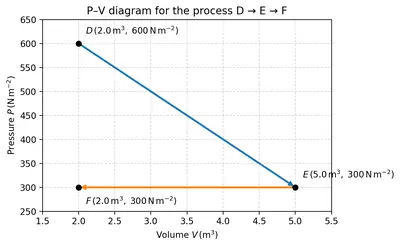
A thermodynamic system is taken from an original state to an intermediate state by the linear process shown in Fig. (11.13)

The P-V diagram shows pressure $$P$$ (in $$\mathrm{N/m^2}$$) on the vertical axis and volume $$V$$ (in $$\mathrm{m^3}$$) on the horizontal axis. Three points are marked: $$D$$ at $$(2.0, 600)$$, $$E$$ at $$(5.0, 300)$$, and $$F$$ at $$(2.0, 300)$$. The system goes from $$D$$ to $$E$$ along a straight line (linear process), then from $$E$$ to $$F$$ along a horizontal line at $$P = 300 \, \mathrm{N/m^2}$$.

Its volume is then reduced to the original value from $$E$$ to $$F$$ by an isobaric process. Calculate the total work done by the gas from $$D$$ to $$E$$ to $$F$$.

Fig. (11.13
Fig. (11.13

Solution

The work done by a gas in a process equals the area under the path on the $$P$$-$$V$$ diagram. It is positive when the volume increases (gas does work) and negative when the volume decreases (work is done on the gas).

The three states are: $$D\,(V_D = 2.0 \, \mathrm{m^3},\ P_D = 600 \, \mathrm{N/m^2})$$, $$E\,(V_E = 5.0 \, \mathrm{m^3},\ P_E = 300 \, \mathrm{N/m^2})$$ and $$F\,(V_F = 2.0 \, \mathrm{m^3},\ P_F = 300 \, \mathrm{N/m^2})$$.

Process $$D \to E$$ (straight-line process). The volume increases from $$2.0 \, \mathrm{m^3}$$ to $$5.0 \, \mathrm{m^3}$$ while the pressure falls linearly from $$600 \, \mathrm{N/m^2}$$ to $$300 \, \mathrm{N/m^2}$$. The region under the straight line $$DE$$ is a trapezium, whose area is

$$W_{DE} = \dfrac{1}{2}\,(P_D + P_E)\,(V_E - V_D)$$

$$W_{DE} = \dfrac{1}{2}\,(600 + 300)\,(5.0 - 2.0) = \dfrac{1}{2}\times 900 \times 3.0 = 1350 \, \mathrm{J}$$

The volume increases, so this work is done by the gas: $$W_{DE} = +1350 \, \mathrm{J}$$.

Process $$E \to F$$ (isobaric). The pressure is constant at $$P = 300 \, \mathrm{N/m^2}$$ while the volume decreases from $$5.0 \, \mathrm{m^3}$$ to $$2.0 \, \mathrm{m^3}$$. The work done is

$$W_{EF} = P\,(V_F - V_E) = 300 \times (2.0 - 5.0) = 300 \times (-3.0) = -900 \, \mathrm{J}$$

The volume decreases, so this work is done on the gas: $$W_{EF} = -900 \, \mathrm{J}$$.

Total work done by the gas.

$$W = W_{DE} + W_{EF} = 1350 + (-900) = 450 \, \mathrm{J}$$

Hence the total work done by the gas in going from $$D$$ to $$E$$ to $$F$$ is $$450 \, \mathrm{J}$$.

Answer

Total work done by the gas $$W = W_{DE} + W_{EF} = 1350 - 900 = 450 \, \mathrm{J}$$.
NCERT Solutions for Class 11
Maths
NCERT Solutions for Class 11 Maths
Chapter-wise step-by-step
solutions with explanations
explore solutions Maths bg
Physics
NCERT Solutions for Class 11 Physics
Chapter-wise step-by-step
solutions with explanations
explore solutions Physics bg
Chemistry
NCERT Solutions for Class 11 Chemistry
Chapter-wise step-by-step
solutions with explanations
explore solutions Chemistry bg

Frequently Asked Questions

50,000+ JEE Students Trusted Our Score Calculator

Predict your JEE Main percentile, rank & performance in seconds