Join WhatsApp Icon JEE WhatsApp Group
NCERT Solutions for Class 11 Physics

Chapter 10: Thermal Properties of Matter

Download Solutions PDF
Daily JEE Updates, Tips & Important Alerts
Join 30,000+ students and stay updated with JEE notifications and preparation insights.
Join Now!
Free PDF
Complete NCERT Solution PDF for Chapter 10: Thermal Properties of Matter

NCERT Solutions For Class 11 Physics Chapter 10 Thermal Properties of Matter helps students explore how heat affects different materials and how thermal changes occur in physical systems. The page provides comprehensive NCERT Solutions that explain concepts such as temperature, thermal expansion, heat transfer, specific heat capacity, and calorimetry. NCERT Solutions For Class 11 Physics simplify these concepts through detailed explanations and practical examples from everyday life. The chapter helps students understand how materials respond to changes in temperature and how heat energy moves between objects. These solutions support students in solving textbook exercises, revising important formulas, and preparing for examinations. Students can download the chapter PDF for easy access during study sessions. The structured explanations make thermal concepts easier to understand and apply.

Download Solutions PDF

Examples 10.1-10.8

Example 10.1 Show that the coefficient of area expansion, $$(\Delta A/A)/\Delta T$$, of a rectangular sheet of the solid is twice its linear expansivity, $$\alpha_l$$.

Solution

Consider a rectangular sheet of the solid of length $$a$$ and breadth $$b$$. Its initial area is

$$A = ab.$$

When the temperature rises by $$\Delta T$$, each linear dimension changes according to the linear-expansion law. The new length and breadth are

$$a' = a(1 + \alpha_l \Delta T), \qquad b' = b(1 + \alpha_l \Delta T).$$

The new area is

$$A' = a'b' = ab(1 + \alpha_l \Delta T)^2 = ab\left(1 + 2\alpha_l \Delta T + \alpha_l^2 (\Delta T)^2\right).$$

For ordinary solids $$\alpha_l$$ is of the order of $$10^{-5} \, \mathrm{K^{-1}}$$, so the term $$\alpha_l^2 (\Delta T)^2$$ is negligible compared with $$2\alpha_l \Delta T$$. Therefore

$$A' \approx ab\left(1 + 2\alpha_l \Delta T\right),$$

$$\Delta A = A' - A = ab \cdot 2\alpha_l \Delta T = 2\alpha_l A \, \Delta T.$$

Hence the coefficient of area expansion is

$$\frac{\Delta A / A}{\Delta T} = 2\alpha_l.$$

Thus the area expansivity is twice the linear expansivity, as required.

Answer

Proved: $$\dfrac{\Delta A/A}{\Delta T} = 2\alpha_l$$.

Example 10.2 A blacksmith fixes iron ring on the rim of the wooden wheel of a horse cart. The diameter of the rim and the iron ring are $$5.243 \, \mathrm{m}$$ and $$5.231 \, \mathrm{m}$$, respectively at $$27 \, \mathrm{^\circ C}$$. To what temperature should the ring be heated so as to fit the rim of the wheel?

Solution

When the iron ring is heated its diameter increases. The ring will just fit on the rim when its diameter, on heating, becomes equal to the diameter of the rim.

Let $$d_1 = 5.231 \, \mathrm{m}$$ be the diameter of the ring at $$T_1 = 27 \, \mathrm{^\circ C}$$, and let $$d_2 = 5.243 \, \mathrm{m}$$ be the required diameter (equal to the rim).

Applying the linear-expansion law to the diameter,

$$d_2 = d_1\left(1 + \alpha_l (T_2 - T_1)\right),$$

so the change in diameter is

$$\Delta d = d_2 - d_1 = d_1\,\alpha_l\,(T_2 - T_1).$$

For iron, $$\alpha_l = 1.20 \times 10^{-5} \, \mathrm{K^{-1}}$$. Substituting,

$$5.243 - 5.231 = 5.231 \times (1.20 \times 10^{-5}) \times (T_2 - 27).$$

$$0.012 = (6.277 \times 10^{-5})\,(T_2 - 27).$$

$$T_2 - 27 = \frac{0.012}{6.277 \times 10^{-5}} \approx 191.2 \, \mathrm{^\circ C}.$$

Therefore

$$T_2 = 27 + 191.2 \approx 218 \, \mathrm{^\circ C}.$$

The ring should be heated to about $$218 \, \mathrm{^\circ C}$$ so that it can be slipped on to the rim.

Answer

The ring must be heated to about $$218 \, \mathrm{^\circ C}$$.

Example 10.3 A sphere of $$0.047 \, \mathrm{kg}$$ aluminium is placed for sufficient time in a vessel containing boiling water, so that the sphere is at $$100 \, \mathrm{^\circ C}$$. It is then immediately transferred to $$0.14 \, \mathrm{kg}$$ copper calorimeter containing $$0.25 \, \mathrm{kg}$$ water at $$20 \, \mathrm{^\circ C}$$. The temperature of water rises and attains a steady state at $$23 \, \mathrm{^\circ C}$$. Calculate the specific heat capacity of aluminium.

Solution

Heat lost by the hot aluminium sphere is gained by the water and the copper calorimeter (principle of calorimetry; the system is isolated).

Data: mass of aluminium $$m_{\mathrm{Al}} = 0.047 \, \mathrm{kg}$$, falling from $$100 \, \mathrm{^\circ C}$$ to $$23 \, \mathrm{^\circ C}$$; mass of water $$m_w = 0.25 \, \mathrm{kg}$$ and mass of copper calorimeter $$m_{\mathrm{Cu}} = 0.14 \, \mathrm{kg}$$, both rising from $$20 \, \mathrm{^\circ C}$$ to $$23 \, \mathrm{^\circ C}$$.

Take the specific heat capacities $$s_w = 4.18 \times 10^3 \, \mathrm{J\,kg^{-1}\,K^{-1}}$$ and $$s_{\mathrm{Cu}} = 0.386 \times 10^3 \, \mathrm{J\,kg^{-1}\,K^{-1}}$$.

Heat lost by the sphere:

$$Q_{\mathrm{lost}} = m_{\mathrm{Al}}\,s_{\mathrm{Al}}\,(100 - 23) = 0.047 \times s_{\mathrm{Al}} \times 77.$$

Heat gained by water and calorimeter:

$$Q_{\mathrm{gained}} = m_w s_w (23 - 20) + m_{\mathrm{Cu}} s_{\mathrm{Cu}} (23 - 20).$$

$$Q_{\mathrm{gained}} = (0.25)(4180)(3) + (0.14)(386)(3) = 3135 + 162.1 = 3297.1 \, \mathrm{J}.$$

Equating $$Q_{\mathrm{lost}} = Q_{\mathrm{gained}}$$:

$$0.047 \times s_{\mathrm{Al}} \times 77 = 3297.1.$$

$$s_{\mathrm{Al}} = \frac{3297.1}{0.047 \times 77} = \frac{3297.1}{3.619} \approx 911 \, \mathrm{J\,kg^{-1}\,K^{-1}}.$$

Hence the specific heat capacity of aluminium is about $$0.911 \, \mathrm{kJ\,kg^{-1}\,K^{-1}}$$.

Answer

$$s_{\mathrm{Al}} \approx 911 \, \mathrm{J\,kg^{-1}\,K^{-1}} = 0.911 \, \mathrm{kJ\,kg^{-1}\,K^{-1}}$$.

Example 10.4 When $$0.15 \, \mathrm{kg}$$ of ice at $$0 \, \mathrm{^\circ C}$$ is mixed with $$0.30 \, \mathrm{kg}$$ of water at $$50 \, \mathrm{^\circ C}$$ in a container, the resulting temperature is $$6.7 \, \mathrm{^\circ C}$$. Calculate the heat of fusion of ice. ($$s_{\mathrm{water}} = 4186 \, \mathrm{J \, kg^{-1} \, K^{-1}}$$)

Solution

By the principle of calorimetry, the heat released by the warm water as it cools is absorbed by the ice — first to melt it, then to warm the resulting melt-water up to the final temperature.

Data: $$m_{\mathrm{ice}} = 0.15 \, \mathrm{kg}$$ at $$0 \, \mathrm{^\circ C}$$; $$m_w = 0.30 \, \mathrm{kg}$$ at $$50 \, \mathrm{^\circ C}$$; final temperature $$\theta = 6.7 \, \mathrm{^\circ C}$$; $$s_w = 4186 \, \mathrm{J\,kg^{-1}\,K^{-1}}$$.

Heat lost by the warm water (cooling from $$50 \, \mathrm{^\circ C}$$ to $$6.7 \, \mathrm{^\circ C}$$):

$$Q_{\mathrm{lost}} = m_w s_w (50 - 6.7) = 0.30 \times 4186 \times 43.3 \approx 54376 \, \mathrm{J}.$$

Heat gained by the ice = heat to melt it + heat to warm the melt-water from $$0 \, \mathrm{^\circ C}$$ to $$6.7 \, \mathrm{^\circ C}$$:

$$Q_{\mathrm{gained}} = m_{\mathrm{ice}}\,L_f + m_{\mathrm{ice}}\,s_w\,(6.7 - 0).$$

The warming term is

$$m_{\mathrm{ice}}\,s_w\,(6.7) = 0.15 \times 4186 \times 6.7 \approx 4207 \, \mathrm{J}.$$

Equating $$Q_{\mathrm{lost}} = Q_{\mathrm{gained}}$$:

$$54376 = 0.15\,L_f + 4207.$$

$$0.15\,L_f = 54376 - 4207 = 50169 \, \mathrm{J}.$$

$$L_f = \frac{50169}{0.15} \approx 3.34 \times 10^5 \, \mathrm{J\,kg^{-1}}.$$

The latent heat of fusion of ice is about $$3.34 \times 10^5 \, \mathrm{J\,kg^{-1}}$$.

Answer

$$L_f \approx 3.34 \times 10^5 \, \mathrm{J\,kg^{-1}}$$.

Example 10.5 Calculate the heat required to convert $$3 \, \mathrm{kg}$$ of ice at $$-12 \, \mathrm{^\circ C}$$ kept in a calorimeter to steam at $$100 \, \mathrm{^\circ C}$$ at atmospheric pressure. Given specific heat capacity of ice $$= 2100 \, \mathrm{J \, kg^{-1} \, K^{-1}}$$, specific heat capacity of water $$= 4186 \, \mathrm{J \, kg^{-1} \, K^{-1}}$$, latent heat of fusion of ice $$= 3.35 \times 10^5 \, \mathrm{J \, kg^{-1}}$$ and latent heat of steam $$= 2.256 \times 10^6 \, \mathrm{J \, kg^{-1}}$$.

Solution

The conversion of ice at $$-12 \, \mathrm{^\circ C}$$ into steam at $$100 \, \mathrm{^\circ C}$$ takes place in four stages. The total heat is the sum of the heats for each stage. Here $$m = 3 \, \mathrm{kg}$$.

Stage 1 — warm the ice from $$-12 \, \mathrm{^\circ C}$$ to $$0 \, \mathrm{^\circ C}$$:

$$Q_1 = m\,s_{\mathrm{ice}}\,\Delta T = 3 \times 2100 \times 12 = 7.56 \times 10^4 \, \mathrm{J}.$$

Stage 2 — melt the ice at $$0 \, \mathrm{^\circ C}$$:

$$Q_2 = m\,L_f = 3 \times 3.35 \times 10^5 = 1.005 \times 10^6 \, \mathrm{J}.$$

Stage 3 — warm the water from $$0 \, \mathrm{^\circ C}$$ to $$100 \, \mathrm{^\circ C}$$:

$$Q_3 = m\,s_{\mathrm{water}}\,\Delta T = 3 \times 4186 \times 100 = 1.2558 \times 10^6 \, \mathrm{J}.$$

Stage 4 — convert the water at $$100 \, \mathrm{^\circ C}$$ into steam:

$$Q_4 = m\,L_v = 3 \times 2.256 \times 10^6 = 6.768 \times 10^6 \, \mathrm{J}.$$

Total heat required:

$$Q = Q_1 + Q_2 + Q_3 + Q_4 = (0.0756 + 1.005 + 1.2558 + 6.768) \times 10^6 \, \mathrm{J}.$$

$$Q \approx 9.1 \times 10^6 \, \mathrm{J}.$$

About $$9.1 \times 10^6 \, \mathrm{J}$$ of heat is required.

Answer

$$Q \approx 9.1 \times 10^6 \, \mathrm{J}$$.

Example 10.6

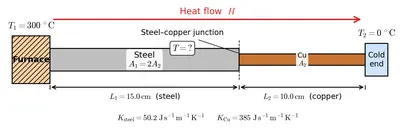
What is the temperature of the steel-copper junction in the steady state of the system shown in Fig. 10.15. Length of the steel rod $$= 15.0 \, \mathrm{cm}$$, length of the copper rod $$= 10.0 \, \mathrm{cm}$$, temperature of the furnace $$= 300 \, \mathrm{^\circ C}$$, temperature of the other end $$= 0 \, \mathrm{^\circ C}$$. The area of cross section of the steel rod is twice that of the copper rod. (Thermal conductivity of steel $$= 50.2 \, \mathrm{J \, s^{-1} \, m^{-1} \, K^{-1}}$$; and of copper $$= 385 \, \mathrm{J \, s^{-1} \, m^{-1} \, K^{-1}}$$).
Fig. 10.15
Fig. 10.15

Solution

In the steady state the heat current $$H$$ (heat flowing per second) is the same all along the composite rod — no heat accumulates at the junction.

Let $$T$$ be the steady-state temperature of the steel–copper junction. Let the cross-sectional area of the copper rod be $$A$$; then the steel rod has area $$2A$$.

Data: $$L_{\mathrm{steel}} = 0.15 \, \mathrm{m}$$, $$L_{\mathrm{Cu}} = 0.10 \, \mathrm{m}$$, $$K_{\mathrm{steel}} = 50.2 \, \mathrm{J\,s^{-1}\,m^{-1}\,K^{-1}}$$, $$K_{\mathrm{Cu}} = 385 \, \mathrm{J\,s^{-1}\,m^{-1}\,K^{-1}}$$.

Heat current through the steel rod (furnace end at $$300 \, \mathrm{^\circ C}$$):

$$H_{\mathrm{steel}} = \frac{K_{\mathrm{steel}}\,(2A)\,(300 - T)}{L_{\mathrm{steel}}}.$$

Heat current through the copper rod (far end at $$0 \, \mathrm{^\circ C}$$):

$$H_{\mathrm{Cu}} = \frac{K_{\mathrm{Cu}}\,A\,(T - 0)}{L_{\mathrm{Cu}}}.$$

In the steady state $$H_{\mathrm{steel}} = H_{\mathrm{Cu}}$$:

$$\frac{50.2 \times 2A \times (300 - T)}{0.15} = \frac{385 \times A \times T}{0.10}.$$

The area $$A$$ cancels. Simplifying each side:

$$669.3\,(300 - T) = 3850\,T.$$

$$200800 - 669.3\,T = 3850\,T.$$

$$200800 = 4519.3\,T.$$

$$T = \frac{200800}{4519.3} \approx 44.4 \, \mathrm{^\circ C}.$$

The steel–copper junction is at about $$44.4 \, \mathrm{^\circ C}$$ in the steady state.

Answer

Junction temperature $$T \approx 44.4 \, \mathrm{^\circ C}$$.

Example 10.7

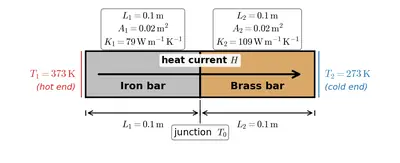
An iron bar ($$L_1 = 0.1 \, \mathrm{m}$$, $$A_1 = 0.02 \, \mathrm{m^2}$$, $$K_1 = 79 \, \mathrm{W \, m^{-1} \, K^{-1}}$$) and a brass bar ($$L_2 = 0.1 \, \mathrm{m}$$, $$A_2 = 0.02 \, \mathrm{m^2}$$, $$K_2 = 109 \, \mathrm{W \, m^{-1} \, K^{-1}}$$) are soldered end to end as shown in Fig. 10.16. The free ends of the iron bar and brass bar are maintained at $$373 \, \mathrm{K}$$ and $$273 \, \mathrm{K}$$ respectively. Obtain expressions for and hence compute (i) the temperature of the junction of the two bars, (ii) the equivalent thermal conductivity of the compound bar, and (iii) the heat current through the compound bar.
Fig. 10.16
Fig. 10.16

Solution

The two bars are joined end to end and carry the same heat current $$H$$ in the steady state. They have equal lengths $$L_1 = L_2 = L = 0.1 \, \mathrm{m}$$ and equal areas $$A_1 = A_2 = A = 0.02 \, \mathrm{m^2}$$. The iron end is at $$T_1 = 373 \, \mathrm{K}$$ and the brass end at $$T_2 = 273 \, \mathrm{K}$$.

(i) Temperature of the junction. Let $$T_0$$ be the junction temperature. Equal heat currents through the two bars:

$$\frac{K_1 A (T_1 - T_0)}{L} = \frac{K_2 A (T_0 - T_2)}{L}.$$

Since $$A$$ and $$L$$ are equal on both sides, they cancel:

$$K_1 (T_1 - T_0) = K_2 (T_0 - T_2).$$

Solving for $$T_0$$:

$$T_0 = \frac{K_1 T_1 + K_2 T_2}{K_1 + K_2}.$$

$$T_0 = \frac{(79)(373) + (109)(273)}{79 + 109} = \frac{29467 + 29757}{188} = \frac{59224}{188} \approx 315.0 \, \mathrm{K}.$$

(ii) Equivalent thermal conductivity. Replace the compound bar by a single bar of length $$2L$$, area $$A$$ and conductivity $$K$$ carrying the same current. Writing the temperature drops across the two bars and adding them,

$$T_1 - T_0 = \frac{HL}{K_1 A}, \qquad T_0 - T_2 = \frac{HL}{K_2 A},$$

$$T_1 - T_2 = \frac{HL}{A}\left(\frac{1}{K_1} + \frac{1}{K_2}\right).$$

For the equivalent bar, $$T_1 - T_2 = \dfrac{H(2L)}{K A}$$. Equating the two expressions and cancelling $$HL/A$$:

$$\frac{2}{K} = \frac{1}{K_1} + \frac{1}{K_2} \quad\Rightarrow\quad K = \frac{2 K_1 K_2}{K_1 + K_2}.$$

$$K = \frac{2 \times 79 \times 109}{79 + 109} = \frac{17222}{188} \approx 91.6 \, \mathrm{W\,m^{-1}\,K^{-1}}.$$

(iii) Heat current. Using the equivalent bar of length $$2L = 0.2 \, \mathrm{m}$$:

$$H = \frac{K A (T_1 - T_2)}{2L} = \frac{91.6 \times 0.02 \times (373 - 273)}{0.2}.$$

$$H = \frac{91.6 \times 0.02 \times 100}{0.2} \approx 916.1 \, \mathrm{W}.$$

(The same value follows from $$H = K_1 A (T_1 - T_0)/L$$ using the iron bar.)

Answer

(i) $$T_0 \approx 315 \, \mathrm{K}$$; (ii) $$K \approx 91.6 \, \mathrm{W\,m^{-1}\,K^{-1}}$$; (iii) $$H \approx 916.1 \, \mathrm{W}$$.

Example 10.8 A pan filled with hot food cools from $$94 \, \mathrm{^\circ C}$$ to $$86 \, \mathrm{^\circ C}$$ in 2 minutes when the room temperature is at $$20 \, \mathrm{^\circ C}$$. How long will it take to cool from $$71 \, \mathrm{^\circ C}$$ to $$69 \, \mathrm{^\circ C}$$?

Solution

By Newton's law of cooling, while a body cools through a small temperature range the rate of fall of temperature is proportional to the excess of the body's (average) temperature over the surroundings:

$$\frac{\Delta T}{\Delta t} = K\left(\langle T\rangle - T_s\right),$$

where $$\langle T\rangle$$ is the average temperature during the interval and $$T_s = 20 \, \mathrm{^\circ C}$$ is the room temperature.

First cooling (94 °C to 86 °C in 2 min):

Average temperature $$\langle T\rangle = \dfrac{94 + 86}{2} = 90 \, \mathrm{^\circ C}$$, so the excess is $$90 - 20 = 70 \, \mathrm{^\circ C}$$.

$$\frac{94 - 86}{2} = K(70) \quad\Rightarrow\quad 4 = 70\,K \quad\Rightarrow\quad K = \frac{4}{70} \, \mathrm{min^{-1}}.$$

Second cooling (71 °C to 69 °C in time $$t$$):

Average temperature $$\langle T\rangle = \dfrac{71 + 69}{2} = 70 \, \mathrm{^\circ C}$$, so the excess is $$70 - 20 = 50 \, \mathrm{^\circ C}$$.

$$\frac{71 - 69}{t} = K(50) = \frac{4}{70} \times 50.$$

$$\frac{2}{t} = \frac{200}{70} = 2.857 \, \mathrm{min^{-1}}.$$

$$t = \frac{2}{2.857} \approx 0.7 \, \mathrm{min} \approx 42 \, \mathrm{s}.$$

It takes about $$0.7$$ minute (roughly $$42$$ seconds) to cool from $$71 \, \mathrm{^\circ C}$$ to $$69 \, \mathrm{^\circ C}$$.

Answer

About $$0.7 \, \mathrm{min}$$ (≈ $$42 \, \mathrm{s}$$).

Exercises

10.1 The triple points of neon and carbon dioxide are $$24.57 \, \mathrm{K}$$ and $$216.55 \, \mathrm{K}$$ respectively. Express these temperatures on the Celsius and Fahrenheit scales.

Solution

The Kelvin (absolute), Celsius and Fahrenheit scales are related by

$$t_C = T - 273.15, \qquad t_F = \frac{9}{5}\,t_C + 32,$$

where $$T$$ is in kelvin, $$t_C$$ in $$\mathrm{^\circ C}$$ and $$t_F$$ in $$\mathrm{^\circ F}$$.

Neon (triple point $$T = 24.57 \, \mathrm{K}$$):

$$t_C = 24.57 - 273.15 = -248.58 \, \mathrm{^\circ C}.$$

$$t_F = \frac{9}{5}(-248.58) + 32 = -447.44 + 32 = -415.44 \, \mathrm{^\circ F}.$$

Carbon dioxide (triple point $$T = 216.55 \, \mathrm{K}$$):

$$t_C = 216.55 - 273.15 = -56.60 \, \mathrm{^\circ C}.$$

$$t_F = \frac{9}{5}(-56.60) + 32 = -101.88 + 32 = -69.88 \, \mathrm{^\circ F}.$$

Answer

Neon: $$-248.58 \, \mathrm{^\circ C}$$, $$-415.44 \, \mathrm{^\circ F}$$. Carbon dioxide: $$-56.60 \, \mathrm{^\circ C}$$, $$-69.88 \, \mathrm{^\circ F}$$.

10.2 Two absolute scales $$A$$ and $$B$$ have triple points of water defined to be $$200 \, \mathrm{A}$$ and $$350 \, \mathrm{B}$$. What is the relation between $$T_A$$ and $$T_B$$?

Solution

On an absolute (thermodynamic) scale, the temperature assigned to a body is proportional to the chosen physical quantity, and the scale is fixed by assigning a definite number to the triple point of water.

If $$T_A$$ is the reading of a body on scale $$A$$ and $$T_B$$ its reading on scale $$B$$, then on each scale the ratio of a temperature to the triple-point value represents the same physical fraction. Hence

$$\frac{T_A}{(\text{triple point on } A)} = \frac{T_B}{(\text{triple point on } B)}.$$

The triple point of water is $$200 \, \mathrm{A}$$ on scale $$A$$ and $$350 \, \mathrm{B}$$ on scale $$B$$, so

$$\frac{T_A}{200} = \frac{T_B}{350}.$$

This gives the required relation:

$$T_A = \frac{200}{350}\,T_B = \frac{4}{7}\,T_B \qquad \text{or} \qquad T_B = \frac{7}{4}\,T_A.$$

So any given temperature reads $$\tfrac{4}{7}$$ as many units on scale $$A$$ as it does on scale $$B$$.

Answer

$$T_A = \dfrac{4}{7}\,T_B$$ (equivalently $$T_B = 1.75\,T_A$$).

10.3

The electrical resistance in ohms of a certain thermometer varies with temperature according to the approximate law :

$$R = R_0 \left[1 + \alpha (T - T_0)\right]$$

The resistance is $$101.6 \, \Omega$$ at the triple-point of water $$273.16 \, \mathrm{K}$$, and $$165.5 \, \Omega$$ at the normal melting point of lead ($$600.5 \, \mathrm{K}$$). What is the temperature when the resistance is $$123.4 \, \Omega$$?

Solution

The resistance varies linearly with temperature: $$R = R_0\left[1 + \alpha (T - T_0)\right]$$. Take the triple point of water as the reference, $$T_0 = 273.16 \, \mathrm{K}$$ with $$R_0 = 101.6 \, \Omega$$.

Find $$\alpha$$ using the lead point. At the melting point of lead, $$R = 165.5 \, \Omega$$ and $$T = 600.5 \, \mathrm{K}$$:

$$165.5 = 101.6\left[1 + \alpha (600.5 - 273.16)\right].$$

$$\frac{165.5}{101.6} = 1 + \alpha (327.34) \quad\Rightarrow\quad 1.6289 = 1 + 327.34\,\alpha.$$

$$\alpha = \frac{0.6289}{327.34} = 1.921 \times 10^{-3} \, \mathrm{K^{-1}}.$$

Find $$T$$ when $$R = 123.4 \, \Omega$$.

$$123.4 = 101.6\left[1 + \alpha (T - 273.16)\right].$$

$$\frac{123.4}{101.6} = 1 + \alpha (T - 273.16) \quad\Rightarrow\quad 1.2146 = 1 + \alpha (T - 273.16).$$

$$\alpha (T - 273.16) = 0.2146.$$

$$T - 273.16 = \frac{0.2146}{1.921 \times 10^{-3}} \approx 111.7 \, \mathrm{K}.$$

$$T \approx 273.16 + 111.7 \approx 384.8 \, \mathrm{K}.$$

The temperature at which the resistance is $$123.4 \, \Omega$$ is about $$384.8 \, \mathrm{K}$$.

Answer

$$T \approx 384.8 \, \mathrm{K}$$.

10.4 Answer the following :

(a) The triple-point of water is a standard fixed point in modern thermometry. Why? What is wrong in taking the melting point of ice and the boiling point of water as standard fixed points (as was originally done in the Celsius scale)?

Solution

The triple point of water is the unique temperature and pressure at which ice, liquid water and water vapour coexist in equilibrium. It occurs at one definite set of conditions — a pressure of about $$0.61 \, \mathrm{kPa}$$ and a temperature of $$273.16 \, \mathrm{K}$$ — and this value can be reproduced exactly anywhere and at any time. Because it is fixed and perfectly reproducible, it is taken as a standard fixed point in modern thermometry.

The melting point of ice and the boiling point of water are not reliable fixed points because they depend strongly on the external pressure (and on dissolved impurities). The boiling point in particular changes appreciably with atmospheric pressure, and even the melting point shifts slightly with pressure. Their values therefore vary from place to place and from time to time, so they cannot serve as precise, universally reproducible standards.

Answer

The triple point occurs at a single, perfectly reproducible temperature and pressure, whereas the ice point and steam point depend on pressure and impurities and so are not reproducible standards.

(b) There were two fixed points in the original Celsius scale as mentioned above which were assigned the number $$0 \, \mathrm{^\circ C}$$ and $$100 \, \mathrm{^\circ C}$$ respectively. On the absolute scale, one of the fixed points is the triple-point of water, which on the Kelvin absolute scale is assigned the number $$273.16 \, \mathrm{K}$$. What is the other fixed point on this (Kelvin) scale?

Solution

The Kelvin absolute scale needs only one experimentally realised fixed point, the triple point of water, which is assigned the value $$273.16 \, \mathrm{K}$$. The other fixed point of the scale is absolute zero — the temperature at which (ideally) the pressure of an ideal gas would fall to zero. On the Kelvin scale this point is assigned the value $$0 \, \mathrm{K}$$.

Answer

Absolute zero, $$0 \, \mathrm{K}$$.

(c)

The absolute temperature (Kelvin scale) $$T$$ is related to the temperature $$t_c$$ on the Celsius scale by

$$t_c = T - 273.15$$

Why do we have $$273.15$$ in this relation, and not $$273.16$$?

Solution

On the Celsius scale, $$0 \, \mathrm{^\circ C}$$ is defined as the melting point of ice at standard atmospheric pressure (the 'ice point'). The triple point of water is not the same as the ice point — it lies $$0.01 \, \mathrm{^\circ C}$$ above it.

The triple point of water is assigned $$273.16 \, \mathrm{K}$$, and this corresponds to $$0.01 \, \mathrm{^\circ C}$$. The ice point ($$0 \, \mathrm{^\circ C}$$) is therefore $$0.01 \, \mathrm{K}$$ lower, namely

$$273.16 - 0.01 = 273.15 \, \mathrm{K}.$$

Since the Celsius temperature is measured from the ice point, the conversion uses the kelvin value of the ice point:

$$t_c = T - 273.15.$$

That is why $$273.15$$ appears in the relation, and not $$273.16$$ (which is the value belonging to the triple point).

Answer

Because $$0 \, \mathrm{^\circ C}$$ is the ice point, which is $$273.15 \, \mathrm{K}$$; the triple point ($$273.16 \, \mathrm{K}$$) lies $$0.01 \, \mathrm{^\circ C}$$ higher.

(d) What is the temperature of the triple-point of water on an absolute scale whose unit interval size is equal to that of the Fahrenheit scale?

Solution

On the Kelvin scale the triple point of water is $$273.16 \, \mathrm{K}$$, and the size of one kelvin equals the size of one Celsius degree.

Between the ice point and the steam point there are $$100$$ Celsius (or Kelvin) divisions, but $$180$$ Fahrenheit divisions. Hence one Fahrenheit degree is smaller than one kelvin:

$$1 \, \mathrm{K} = \frac{180}{100} = \frac{9}{5} \text{ Fahrenheit-sized degrees}.$$

Let $$T_F$$ be the triple-point temperature on an absolute scale whose unit interval equals a Fahrenheit degree. The same physical temperature must contain $$\tfrac{9}{5}$$ times as many of these smaller units as it does kelvins:

$$T_F = \frac{9}{5} \times 273.16 = 491.69.$$

So on such a scale the triple point of water lies at about $$491.69$$ degrees.

Answer

$$T_F = \dfrac{9}{5} \times 273.16 \approx 491.69$$ degrees.

10.5

Two ideal gas thermometers $$A$$ and $$B$$ use oxygen and hydrogen respectively. The following observations are made :

TemperaturePressure thermometer APressure thermometer B
Triple-point of water$$1.250 \times 10^5 \, \mathrm{Pa}$$$$0.200 \times 10^5 \, \mathrm{Pa}$$
Normal melting point of sulphur$$1.797 \times 10^5 \, \mathrm{Pa}$$$$0.287 \times 10^5 \, \mathrm{Pa}$$

(a) What is the absolute temperature of normal melting point of sulphur as read by thermometers $$A$$ and $$B$$?

Solution

A constant-volume ideal-gas thermometer measures absolute temperature through the pressure of the trapped gas. Calibrating it at the triple point of water ($$273.16 \, \mathrm{K}$$), the temperature corresponding to a pressure $$P$$ is

$$T = 273.16 \times \frac{P}{P_{\mathrm{tr}}},$$

where $$P_{\mathrm{tr}}$$ is the pressure at the triple point.

Thermometer A: $$P_{\mathrm{tr}} = 1.250 \times 10^5 \, \mathrm{Pa}$$ and $$P = 1.797 \times 10^5 \, \mathrm{Pa}$$ at the melting point of sulphur.

$$T_A = 273.16 \times \frac{1.797 \times 10^5}{1.250 \times 10^5} = 273.16 \times 1.4376 \approx 392.69 \, \mathrm{K}.$$

Thermometer B: $$P_{\mathrm{tr}} = 0.200 \times 10^5 \, \mathrm{Pa}$$ and $$P = 0.287 \times 10^5 \, \mathrm{Pa}$$.

$$T_B = 273.16 \times \frac{0.287 \times 10^5}{0.200 \times 10^5} = 273.16 \times 1.435 \approx 391.98 \, \mathrm{K}.$$

So the normal melting point of sulphur is about $$392.69 \, \mathrm{K}$$ as read by thermometer A and about $$391.98 \, \mathrm{K}$$ as read by thermometer B.

Answer

$$T_A \approx 392.69 \, \mathrm{K}$$ and $$T_B \approx 391.98 \, \mathrm{K}$$.

(b) What do you think is the reason behind the slight difference in answers of thermometers $$A$$ and $$B$$? (The thermometers are not faulty). What further procedure is needed in the experiment to reduce the discrepancy between the two readings?

Solution

The two thermometers use different gases (oxygen and hydrogen), and these gases are not perfectly ideal — at the pressures used they show small departures from ideal-gas behaviour. Since the two gases deviate from ideality by slightly different amounts, the two thermometers give slightly different readings even though neither thermometer is faulty.

To reduce the discrepancy, the measurements should be repeated with smaller and smaller amounts of gas, i.e. at lower and lower triple-point pressures, and the readings extrapolated to the limit of zero pressure. In that limit every real gas behaves as an ideal gas, and both thermometers then give the same (correct) absolute temperature.

Answer

Oxygen and hydrogen are not perfectly ideal gases and deviate slightly — and by different amounts — from ideal behaviour. Repeating the readings at lower and lower pressures and extrapolating to zero pressure removes the discrepancy.

10.6 A steel tape $$1 \, \mathrm{m}$$ long is correctly calibrated for a temperature of $$27.0 \, \mathrm{^\circ C}$$. The length of a steel rod measured by this tape is found to be $$63.0 \, \mathrm{cm}$$ on a hot day when the temperature is $$45.0 \, \mathrm{^\circ C}$$. What is the actual length of the steel rod on that day? What is the length of the same steel rod on a day when the temperature is $$27.0 \, \mathrm{^\circ C}$$? Coefficient of linear expansion of steel $$= 1.20 \times 10^{-5} \, \mathrm{K^{-1}}$$.

Solution

Actual length on the hot day (45 °C). The measuring tape is itself made of steel and was calibrated (i.e. its centimetre-marks are correct) at $$27.0 \, \mathrm{^\circ C}$$. On the hot day the tape has expanded, so every centimetre-mark on it now spans a slightly larger physical distance:

$$\text{(true length of one tape division)} = 1 \, \mathrm{cm} \times (1 + \alpha\,\Delta T).$$

Here $$\Delta T = 45.0 - 27.0 = 18.0 \, \mathrm{^\circ C}$$ and $$\alpha = 1.20 \times 10^{-5} \, \mathrm{K^{-1}}$$, so

$$1 + \alpha\,\Delta T = 1 + (1.20 \times 10^{-5})(18.0) = 1 + 2.16 \times 10^{-4}.$$

The tape reads $$63.0 \, \mathrm{cm}$$, so the actual length of the rod at $$45.0 \, \mathrm{^\circ C}$$ is

$$L_{45} = 63.0 \times (1 + 2.16 \times 10^{-4}) = 63.0 + 63.0 \times 2.16 \times 10^{-4}.$$

$$L_{45} = 63.0 + 0.0136 \approx 63.0136 \, \mathrm{cm}.$$

Length of the rod at 27 °C. The rod is also made of steel. On cooling from $$45.0 \, \mathrm{^\circ C}$$ back to $$27.0 \, \mathrm{^\circ C}$$ it contracts:

$$L_{27} = \frac{L_{45}}{1 + \alpha\,\Delta T} = \frac{63.0136}{1 + 2.16 \times 10^{-4}} \approx 63.0136 - 0.0136 \approx 63.0 \, \mathrm{cm}.$$

This result is expected: at $$27.0 \, \mathrm{^\circ C}$$ the tape is correctly calibrated, and since the rod and tape are made of the same material, the tape simply reads the rod's true length, $$63.0 \, \mathrm{cm}$$.

Answer

Actual length at $$45 \, \mathrm{^\circ C}$$ is about $$63.0136 \, \mathrm{cm}$$; at $$27 \, \mathrm{^\circ C}$$ it is $$63.0 \, \mathrm{cm}$$.

10.7 A large steel wheel is to be fitted on to a shaft of the same material. At $$27 \, \mathrm{^\circ C}$$, the outer diameter of the shaft is $$8.70 \, \mathrm{cm}$$ and the diameter of the central hole in the wheel is $$8.69 \, \mathrm{cm}$$. The shaft is cooled using 'dry ice'. At what temperature of the shaft does the wheel slip on the shaft? Assume coefficient of linear expansion of the steel to be constant over the required temperature range : $$\alpha_{\mathrm{steel}} = 1.20 \times 10^{-5} \, \mathrm{K^{-1}}$$.

Solution

The wheel will slip on to the shaft only when the shaft is cooled enough for its outer diameter to shrink to the diameter of the central hole in the wheel.

Let $$d_1 = 8.70 \, \mathrm{cm}$$ be the shaft diameter at $$T_1 = 27 \, \mathrm{^\circ C}$$, and let it shrink to $$d_2 = 8.69 \, \mathrm{cm}$$ at the required temperature $$T_2$$.

The change in diameter due to linear contraction is

$$d_2 - d_1 = d_1\,\alpha\,(T_2 - T_1).$$

Substituting $$\alpha = 1.20 \times 10^{-5} \, \mathrm{K^{-1}}$$:

$$8.69 - 8.70 = 8.70 \times (1.20 \times 10^{-5}) \times (T_2 - 27).$$

$$-0.01 = (1.044 \times 10^{-4})\,(T_2 - 27).$$

$$T_2 - 27 = \frac{-0.01}{1.044 \times 10^{-4}} \approx -95.8 \, \mathrm{^\circ C}.$$

$$T_2 = 27 - 95.8 \approx -68.8 \, \mathrm{^\circ C}.$$

So the shaft must be cooled to about $$-69 \, \mathrm{^\circ C}$$ (roughly $$204 \, \mathrm{K}$$) for the wheel to slip on. Dry ice (solid $$\mathrm{CO_2}$$, at about $$-78 \, \mathrm{^\circ C}$$) is cold enough to achieve this.

Answer

$$T_2 \approx -69 \, \mathrm{^\circ C}$$ (about $$204 \, \mathrm{K}$$).

10.8 A hole is drilled in a copper sheet. The diameter of the hole is $$4.24 \, \mathrm{cm}$$ at $$27.0 \, \mathrm{^\circ C}$$. What is the change in the diameter of the hole when the sheet is heated to $$227 \, \mathrm{^\circ C}$$? Coefficient of linear expansion of copper $$= 1.70 \times 10^{-5} \, \mathrm{K^{-1}}$$.

Solution

When a metal sheet with a hole in it is heated, the hole expands exactly as if it were a disc of the same metal filling the hole. So the diameter of the hole increases according to the linear-expansion law, using the linear expansivity of the metal.

Data: initial diameter $$d = 4.24 \, \mathrm{cm}$$, temperature rise $$\Delta T = 227 - 27.0 = 200 \, \mathrm{^\circ C}$$, and $$\alpha = 1.70 \times 10^{-5} \, \mathrm{K^{-1}}$$.

The change in diameter is

$$\Delta d = d\,\alpha\,\Delta T = 4.24 \times (1.70 \times 10^{-5}) \times 200.$$

$$\Delta d = 4.24 \times 3.40 \times 10^{-3} \approx 1.44 \times 10^{-2} \, \mathrm{cm}.$$

The diameter of the hole increases by about $$1.44 \times 10^{-2} \, \mathrm{cm}$$ (i.e. about $$0.0144 \, \mathrm{cm}$$).

Answer

The hole diameter increases by about $$1.44 \times 10^{-2} \, \mathrm{cm}$$.

10.9 A brass wire $$1.8 \, \mathrm{m}$$ long at $$27 \, \mathrm{^\circ C}$$ is held taut with little tension between two rigid supports. If the wire is cooled to a temperature of $$-39 \, \mathrm{^\circ C}$$, what is the tension developed in the wire, if its diameter is $$2.0 \, \mathrm{mm}$$? Co-efficient of linear expansion of brass $$= 2.0 \times 10^{-5} \, \mathrm{K^{-1}}$$; Young's modulus of brass $$= 0.91 \times 10^{11} \, \mathrm{Pa}$$.

Solution

If the wire could contract freely on cooling, its length would decrease by $$\Delta L = L\,\alpha\,|\Delta T|$$. But the rigid supports prevent this contraction, so the wire is effectively held stretched back to its original length. This produces a tensile strain, and hence a tension, in the wire.

Temperature change: $$\Delta T = (-39) - 27 = -66 \, \mathrm{^\circ C}$$, so the wire is prevented from contracting by an amount corresponding to $$|\Delta T| = 66 \, \mathrm{^\circ C}$$.

The prevented (tensile) strain is

$$\text{strain} = \frac{\Delta L}{L} = \alpha\,|\Delta T| = (2.0 \times 10^{-5})(66) = 1.32 \times 10^{-3}.$$

From the definition of Young's modulus, $$Y = \dfrac{\text{stress}}{\text{strain}}$$, the tensile stress is

$$\text{stress} = Y \times \text{strain} = (0.91 \times 10^{11})(1.32 \times 10^{-3}) \approx 1.20 \times 10^{8} \, \mathrm{Pa}.$$

The cross-sectional area of the wire (diameter $$2.0 \, \mathrm{mm}$$, so radius $$r = 1.0 \times 10^{-3} \, \mathrm{m}$$) is

$$A = \pi r^2 = \pi (1.0 \times 10^{-3})^2 \approx 3.14 \times 10^{-6} \, \mathrm{m^2}.$$

The tension developed is

$$F = \text{stress} \times A = (1.20 \times 10^{8})(3.14 \times 10^{-6}) \approx 3.8 \times 10^{2} \, \mathrm{N}.$$

Equivalently, $$F = Y A \alpha\,|\Delta T| \approx 377 \, \mathrm{N}$$. So a tension of about $$3.8 \times 10^{2} \, \mathrm{N}$$ develops in the wire.

Answer

Tension $$F \approx 3.8 \times 10^{2} \, \mathrm{N}$$ (about $$377 \, \mathrm{N}$$).

10.10 A brass rod of length $$50 \, \mathrm{cm}$$ and diameter $$3.0 \, \mathrm{mm}$$ is joined to a steel rod of the same length and diameter. What is the change in length of the combined rod at $$250 \, \mathrm{^\circ C}$$, if the original lengths are at $$40.0 \, \mathrm{^\circ C}$$? Is there a 'thermal stress' developed at the junction? The ends of the rod are free to expand (Co-efficient of linear expansion of brass $$= 2.0 \times 10^{-5} \, \mathrm{K^{-1}}$$, steel $$= 1.2 \times 10^{-5} \, \mathrm{K^{-1}}$$).

Solution

Since the ends of the combined rod are free to expand, the brass part and the steel part each expand independently, and the total change in length is simply the sum of the two.

Both rods have original length $$L = 50 \, \mathrm{cm} = 0.50 \, \mathrm{m}$$, and the temperature rise is $$\Delta T = 250 - 40.0 = 210 \, \mathrm{^\circ C}$$.

Expansion of the brass rod ($$\alpha_b = 2.0 \times 10^{-5} \, \mathrm{K^{-1}}$$):

$$\Delta L_b = L\,\alpha_b\,\Delta T = 0.50 \times (2.0 \times 10^{-5}) \times 210 = 2.1 \times 10^{-3} \, \mathrm{m}.$$

Expansion of the steel rod ($$\alpha_s = 1.2 \times 10^{-5} \, \mathrm{K^{-1}}$$):

$$\Delta L_s = L\,\alpha_s\,\Delta T = 0.50 \times (1.2 \times 10^{-5}) \times 210 = 1.26 \times 10^{-3} \, \mathrm{m}.$$

Total change in length:

$$\Delta L = \Delta L_b + \Delta L_s = 2.1 \times 10^{-3} + 1.26 \times 10^{-3} = 3.36 \times 10^{-3} \, \mathrm{m}.$$

$$\Delta L \approx 0.34 \, \mathrm{cm}.$$

Thermal stress: Because the ends of the rod are free to expand, neither part is prevented from expanding — there is no constraint on the change of length. Hence no thermal stress is developed at the junction. (Note that the diameter of the rods does not enter the calculation at all.)

Answer

Total change in length $$\Delta L \approx 0.34 \, \mathrm{cm}$$ (an increase); no thermal stress is developed at the junction because the ends are free to expand.

10.11 The coefficient of volume expansion of glycerine is $$49 \times 10^{-5} \, \mathrm{K^{-1}}$$. What is the fractional change in its density for a $$30 \, \mathrm{^\circ C}$$ rise in temperature?

Solution

The density of a fixed mass $$m$$ of glycerine is $$\rho = m/V$$. When the temperature rises by $$\Delta T$$, the volume increases by $$\Delta V = \gamma V \Delta T$$, where $$\gamma$$ is the coefficient of volume expansion. The mass is unchanged, so the density decreases.

The new density is

$$\rho' = \frac{m}{V + \Delta V} = \frac{m}{V(1 + \gamma \Delta T)} = \frac{\rho}{1 + \gamma \Delta T}.$$

The fractional change in density is

$$\frac{\Delta \rho}{\rho} = \frac{\rho' - \rho}{\rho} = \frac{1}{1 + \gamma \Delta T} - 1 = \frac{-\gamma \Delta T}{1 + \gamma \Delta T}.$$

Since $$\gamma \Delta T \ll 1$$, to a very good approximation

$$\frac{\Delta \rho}{\rho} \approx -\gamma \Delta T.$$

Substituting $$\gamma = 49 \times 10^{-5} \, \mathrm{K^{-1}}$$ and $$\Delta T = 30 \, \mathrm{^\circ C}$$:

$$\frac{\Delta \rho}{\rho} = -(49 \times 10^{-5}) \times 30 = -1.47 \times 10^{-2}.$$

The density decreases by a fraction of about $$1.5 \times 10^{-2}$$, i.e. by roughly $$1.5\%$$.

Answer

The density decreases by a fraction of about $$1.5 \times 10^{-2}$$ ($$\approx 1.5\%$$).

10.12 A $$10 \, \mathrm{kW}$$ drilling machine is used to drill a bore in a small aluminium block of mass $$8.0 \, \mathrm{kg}$$. How much is the rise in temperature of the block in $$2.5$$ minutes, assuming $$50\%$$ of power is used up in heating the machine itself or lost to the surroundings. Specific heat of aluminium $$= 0.91 \, \mathrm{J \, g^{-1} \, K^{-1}}$$.

Solution

The drilling machine has a power of $$P = 10 \, \mathrm{kW} = 10^4 \, \mathrm{W}$$ and runs for $$t = 2.5 \, \mathrm{min} = 150 \, \mathrm{s}$$.

Total energy supplied by the machine:

$$E = P\,t = 10^4 \times 150 = 1.5 \times 10^6 \, \mathrm{J}.$$

Only $$50\%$$ of this energy actually heats the aluminium block (the other half heats the machine or is lost to the surroundings), so the heat absorbed by the block is

$$Q = 0.50 \times E = 0.50 \times 1.5 \times 10^6 = 7.5 \times 10^5 \, \mathrm{J}.$$

The rise in temperature follows from $$Q = m\,s\,\Delta T$$, with $$m = 8.0 \, \mathrm{kg}$$ and $$s = 0.91 \, \mathrm{J\,g^{-1}\,K^{-1}} = 910 \, \mathrm{J\,kg^{-1}\,K^{-1}}$$:

$$\Delta T = \frac{Q}{m\,s} = \frac{7.5 \times 10^5}{8.0 \times 910} = \frac{7.5 \times 10^5}{7280}.$$

$$\Delta T \approx 103 \, \mathrm{^\circ C}.$$

The temperature of the aluminium block rises by about $$103 \, \mathrm{^\circ C}$$.

Answer

The rise in temperature is about $$103 \, \mathrm{^\circ C}$$.

10.13 A copper block of mass $$2.5 \, \mathrm{kg}$$ is heated in a furnace to a temperature of $$500 \, \mathrm{^\circ C}$$ and then placed on a large ice block. What is the maximum amount of ice that can melt? (Specific heat of copper $$= 0.39 \, \mathrm{J \, g^{-1} \, K^{-1}}$$; heat of fusion of water $$= 335 \, \mathrm{J \, g^{-1}}$$).

Solution

The hot copper block is placed on a large block of ice at $$0 \, \mathrm{^\circ C}$$. The maximum amount of ice melts when the copper gives up all the heat it possibly can — that is, when it cools all the way down to $$0 \, \mathrm{^\circ C}$$.

Heat released by the copper block in cooling from $$500 \, \mathrm{^\circ C}$$ to $$0 \, \mathrm{^\circ C}$$:

$$Q = m\,s_{\mathrm{Cu}}\,\Delta T,$$

with $$m = 2.5 \, \mathrm{kg} = 2500 \, \mathrm{g}$$, $$s_{\mathrm{Cu}} = 0.39 \, \mathrm{J\,g^{-1}\,K^{-1}}$$ and $$\Delta T = 500 \, \mathrm{^\circ C}$$:

$$Q = 2500 \times 0.39 \times 500 = 4.875 \times 10^5 \, \mathrm{J}.$$

This heat is used to melt the ice. If $$m_{\mathrm{ice}}$$ is the mass melted and $$L_f = 335 \, \mathrm{J\,g^{-1}}$$ is the heat of fusion,

$$Q = m_{\mathrm{ice}}\,L_f \quad\Rightarrow\quad m_{\mathrm{ice}} = \frac{Q}{L_f} = \frac{4.875 \times 10^5}{335}.$$

$$m_{\mathrm{ice}} \approx 1455 \, \mathrm{g} \approx 1.45 \, \mathrm{kg}.$$

So at most about $$1.45 \, \mathrm{kg}$$ of ice can melt.

Answer

At most about $$1.45 \, \mathrm{kg}$$ of ice can melt.

10.14 In an experiment on the specific heat of a metal, a $$0.20 \, \mathrm{kg}$$ block of the metal at $$150 \, \mathrm{^\circ C}$$ is dropped in a copper calorimeter (of water equivalent $$0.025 \, \mathrm{kg}$$) containing $$150 \, \mathrm{cm^3}$$ of water at $$27 \, \mathrm{^\circ C}$$. The final temperature is $$40 \, \mathrm{^\circ C}$$. Compute the specific heat of the metal. If heat losses to the surroundings are not negligible, is your answer greater or smaller than the actual value for specific heat of the metal?

Solution

By the principle of calorimetry, the heat lost by the hot metal block equals the heat gained by the water together with the copper calorimeter.

Data: mass of metal $$m = 0.20 \, \mathrm{kg}$$, cooling from $$150 \, \mathrm{^\circ C}$$ to $$40 \, \mathrm{^\circ C}$$; volume of water $$150 \, \mathrm{cm^3}$$, so mass of water $$m_w = 0.150 \, \mathrm{kg}$$; water equivalent of the calorimeter $$w = 0.025 \, \mathrm{kg}$$; the water and calorimeter both warm from $$27 \, \mathrm{^\circ C}$$ to $$40 \, \mathrm{^\circ C}$$. Take $$s_w = 4186 \, \mathrm{J\,kg^{-1}\,K^{-1}}$$.

The 'water equivalent' means the calorimeter absorbs heat just like $$0.025 \, \mathrm{kg}$$ of water, so the water and calorimeter together behave as an effective mass

$$m_w + w = 0.150 + 0.025 = 0.175 \, \mathrm{kg}$$

of water.

Heat gained by water and calorimeter:

$$Q_{\mathrm{gained}} = (m_w + w)\,s_w\,(40 - 27) = 0.175 \times 4186 \times 13 \approx 9523 \, \mathrm{J}.$$

Heat lost by the metal block:

$$Q_{\mathrm{lost}} = m\,s\,(150 - 40) = 0.20 \times s \times 110 = 22\,s.$$

Setting $$Q_{\mathrm{lost}} = Q_{\mathrm{gained}}$$:

$$22\,s = 9523 \quad\Rightarrow\quad s = \frac{9523}{22} \approx 433 \, \mathrm{J\,kg^{-1}\,K^{-1}}.$$

So the specific heat of the metal is about $$0.43 \, \mathrm{J\,g^{-1}\,K^{-1}}$$ ($$\approx 433 \, \mathrm{J\,kg^{-1}\,K^{-1}}$$).

Effect of heat losses. If heat losses to the surroundings are not negligible, then part of the heat given out by the metal escapes to the surroundings instead of going into the water. The water and calorimeter therefore receive less heat and reach a lower final temperature than they otherwise would. Using this lower final temperature in the calculation makes $$Q_{\mathrm{gained}}$$ — and hence the computed $$s$$ — come out smaller. Therefore the calculated value is smaller (an underestimate) than the actual specific heat of the metal.

Answer

$$s \approx 0.43 \, \mathrm{J\,g^{-1}\,K^{-1}}$$ ($$\approx 433 \, \mathrm{J\,kg^{-1}\,K^{-1}}$$). With non-negligible heat losses, the computed value is smaller than the actual specific heat.

10.15

Given below are observations on molar specific heats at room temperature of some common gases.

GasMolar specific heat ($$C_v$$) ($$\mathrm{cal \, mol^{-1} \, K^{-1}}$$)
Hydrogen$$4.87$$
Nitrogen$$4.97$$
Oxygen$$5.02$$
Nitric oxide$$4.99$$
Carbon monoxide$$5.01$$
Chlorine$$6.17$$

The measured molar specific heats of these gases are markedly different from those for monatomic gases. Typically, molar specific heat of a monatomic gas is $$2.92 \, \mathrm{cal/mol \, K}$$. Explain this difference. What can you infer from the somewhat larger (than the rest) value for chlorine?

Solution

According to the law of equipartition of energy, each active degree of freedom of a molecule contributes $$\tfrac{1}{2}R$$ to the molar specific heat at constant volume.

Monatomic gases: a single atom has only $$3$$ translational degrees of freedom, so

$$C_v = 3 \times \tfrac{1}{2}R = \tfrac{3}{2}R \approx 2.92 \, \mathrm{cal\,mol^{-1}\,K^{-1}}.$$

Diatomic gases: hydrogen, nitrogen, oxygen, nitric oxide and carbon monoxide are all diatomic. In addition to $$3$$ translational degrees of freedom, a diatomic molecule has $$2$$ rotational degrees of freedom (rotation about the two axes perpendicular to the line joining the atoms). This gives $$5$$ active degrees of freedom, so

$$C_v = 5 \times \tfrac{1}{2}R = \tfrac{5}{2}R \approx 4.95 \, \mathrm{cal\,mol^{-1}\,K^{-1}}.$$

This is why the measured values for these five gases (about $$4.9$$–$$5.0 \, \mathrm{cal\,mol^{-1}\,K^{-1}}$$) are close to $$5$$ and markedly larger than the monatomic value $$2.92$$.

Chlorine: its molar specific heat ($$6.17 \, \mathrm{cal\,mol^{-1}\,K^{-1}}$$) is noticeably larger than $$\tfrac{5}{2}R$$. This indicates that, besides translation and rotation, the chlorine molecule also has appreciably excited vibrational degrees of freedom at room temperature. (The chlorine atoms are heavy, so the molecule vibrates at a relatively low frequency; this vibrational mode is therefore partly active even at ordinary temperatures and adds an extra contribution to $$C_v$$.)

Answer

These gases are diatomic: they have extra rotational degrees of freedom, giving $$C_v \approx \tfrac{5}{2}R \approx 5 \, \mathrm{cal\,mol^{-1}\,K^{-1}}$$ instead of the monatomic $$\tfrac{3}{2}R$$. Chlorine's larger value shows its vibrational modes are also excited at room temperature.

10.16 A child running a temperature of $$101 \, \mathrm{^\circ F}$$ is given an antipyrin (i.e. a medicine that lowers fever) which causes an increase in the rate of evaporation of sweat from his body. If the fever is brought down to $$98 \, \mathrm{^\circ F}$$ in 20 minutes, what is the average rate of extra evaporation caused, by the drug. Assume the evaporation mechanism to be the only way by which heat is lost. The mass of the child is $$30 \, \mathrm{kg}$$. The specific heat of human body is approximately the same as that of water, and latent heat of evaporation of water at that temperature is about $$580 \, \mathrm{cal \, g^{-1}}$$.

Solution

The fall in the child's body temperature is $$101 \, \mathrm{^\circ F} - 98 \, \mathrm{^\circ F} = 3 \, \mathrm{^\circ F}$$. We must convert this temperature interval to the Celsius scale. Since a change of $$180 \, \mathrm{^\circ F}$$ corresponds to a change of $$100 \, \mathrm{^\circ C}$$,

$$\Delta T = 3 \times \frac{100}{180} = 3 \times \frac{5}{9} = \frac{5}{3} \approx 1.67 \, \mathrm{^\circ C}.$$

The heat lost by the child's body (taking the specific heat equal to that of water, $$s = 1000 \, \mathrm{cal\,kg^{-1}\,{}^\circ C^{-1}}$$, and mass $$m = 30 \, \mathrm{kg}$$) is

$$Q = m\,s\,\Delta T = 30 \times 1000 \times \frac{5}{3} = 5.0 \times 10^{4} \, \mathrm{cal}.$$

All of this heat is removed by the evaporation of sweat. If $$m_e$$ is the mass of sweat evaporated and $$L = 580 \, \mathrm{cal\,g^{-1}}$$ is the latent heat of evaporation,

$$Q = m_e\,L \quad\Rightarrow\quad m_e = \frac{Q}{L} = \frac{5.0 \times 10^{4}}{580} \approx 86.2 \, \mathrm{g}.$$

This evaporation takes place over $$t = 20 \, \mathrm{min}$$, so the average rate of extra evaporation is

$$\text{rate} = \frac{m_e}{t} = \frac{86.2 \, \mathrm{g}}{20 \, \mathrm{min}} \approx 4.3 \, \mathrm{g\,min^{-1}}.$$

Answer

The average rate of extra evaporation is about $$4.3 \, \mathrm{g\,min^{-1}}$$.

10.17 A 'thermacole' icebox is a cheap and an efficient method for storing small quantities of cooked food in summer in particular. A cubical icebox of side $$30 \, \mathrm{cm}$$ has a thickness of $$5.0 \, \mathrm{cm}$$. If $$4.0 \, \mathrm{kg}$$ of ice is put in the box, estimate the amount of ice remaining after 6 h. The outside temperature is $$45 \, \mathrm{^\circ C}$$, and co-efficient of thermal conductivity of thermacole is $$0.01 \, \mathrm{J \, s^{-1} \, m^{-1} \, K^{-1}}$$. [Heat of fusion of water $$= 335 \times 10^3 \, \mathrm{J \, kg^{-1}}$$]

Solution

Heat leaks into the icebox by conduction through all six faces of the cube. Each face has area $$(0.30 \, \mathrm{m})^2 = 0.09 \, \mathrm{m^2}$$, so the total surface area is

$$A = 6 \times 0.09 = 0.54 \, \mathrm{m^2}.$$

The wall thickness is $$L = 5.0 \, \mathrm{cm} = 0.05 \, \mathrm{m}$$, and the temperature difference between the outside ($$45 \, \mathrm{^\circ C}$$) and the ice inside ($$0 \, \mathrm{^\circ C}$$) is $$\Delta T = 45 \, \mathrm{^\circ C}$$.

Over a time $$t = 6 \, \mathrm{h} = 6 \times 3600 = 21600 \, \mathrm{s}$$, the heat conducted into the box is

$$Q = \frac{K\,A\,\Delta T\,t}{L}.$$

With $$K = 0.01 \, \mathrm{J\,s^{-1}\,m^{-1}\,K^{-1}}$$:

$$Q = \frac{(0.01)(0.54)(45)(21600)}{0.05}.$$

$$Q = \frac{5248.8}{0.05} \approx 1.05 \times 10^{5} \, \mathrm{J}.$$

This heat melts some of the ice. With heat of fusion $$L_f = 335 \times 10^3 \, \mathrm{J\,kg^{-1}}$$, the mass melted is

$$m_{\mathrm{melted}} = \frac{Q}{L_f} = \frac{1.05 \times 10^{5}}{335 \times 10^3} \approx 0.313 \, \mathrm{kg}.$$

The ice remaining after $$6 \, \mathrm{h}$$ is therefore

$$m_{\mathrm{left}} = 4.0 - 0.313 \approx 3.7 \, \mathrm{kg}.$$

Answer

About $$3.7 \, \mathrm{kg}$$ of ice remains after $$6 \, \mathrm{h}$$ (roughly $$0.31 \, \mathrm{kg}$$ melts).

10.18 A brass boiler has a base area of $$0.15 \, \mathrm{m^2}$$ and thickness $$1.0 \, \mathrm{cm}$$. It boils water at the rate of $$6.0 \, \mathrm{kg/min}$$ when placed on a gas stove. Estimate the temperature of the part of the flame in contact with the boiler. Thermal conductivity of brass $$= 109 \, \mathrm{J \, s^{-1} \, m^{-1} \, K^{-1}}$$; Heat of vaporisation of water $$= 2256 \times 10^3 \, \mathrm{J \, kg^{-1}}$$.

Solution

In the steady state, the heat conducted through the base of the boiler per second equals the heat needed per second to convert the boiling water into steam.

Heat current required. Water boils away at the rate $$\dot{m} = 6.0 \, \mathrm{kg/min} = \dfrac{6.0}{60} = 0.10 \, \mathrm{kg/s}$$. With heat of vaporisation $$L_v = 2256 \times 10^3 \, \mathrm{J\,kg^{-1}}$$, the heat needed per second is

$$H = \dot{m}\,L_v = 0.10 \times 2256 \times 10^3 = 2.256 \times 10^{5} \, \mathrm{J\,s^{-1}}.$$

Conduction through the base. Let $$T$$ be the temperature of the flame side of the base; its inner side is in contact with boiling water at $$100 \, \mathrm{^\circ C}$$. With base area $$A = 0.15 \, \mathrm{m^2}$$, thickness $$L = 1.0 \, \mathrm{cm} = 0.01 \, \mathrm{m}$$ and $$K = 109 \, \mathrm{J\,s^{-1}\,m^{-1}\,K^{-1}}$$,

$$H = \frac{K\,A\,(T - 100)}{L}.$$

Equating the two expressions for $$H$$:

$$2.256 \times 10^{5} = \frac{109 \times 0.15 \times (T - 100)}{0.01}.$$

$$2.256 \times 10^{5} = 1635\,(T - 100).$$

$$T - 100 = \frac{2.256 \times 10^{5}}{1635} \approx 138 \, \mathrm{^\circ C}.$$

$$T \approx 100 + 138 = 238 \, \mathrm{^\circ C}.$$

The part of the flame in contact with the boiler is at about $$238 \, \mathrm{^\circ C}$$.

Answer

The temperature of the flame in contact with the boiler is about $$238 \, \mathrm{^\circ C}$$.

10.19 Explain why :

(a) a body with large reflectivity is a poor emitter

Solution

When radiation falls on a body, it is partly absorbed, partly reflected and partly transmitted. For an opaque body (no transmission), the absorptivity $$a$$ and reflectivity $$r$$ are related by

$$a + r = 1.$$

So a body with large reflectivity $$r$$ has a small absorptivity $$a$$ — it is a poor absorber of radiation.

By Kirchhoff's law of radiation, at any given temperature a good absorber is a good emitter and a poor absorber is a poor emitter — the emissive power of a body is proportional to its absorptive power. Since a highly reflecting body is a poor absorber, it must also be a poor emitter.

Answer

High reflectivity means low absorptivity ($$a + r = 1$$); by Kirchhoff's law a poor absorber is a poor emitter, so a highly reflecting body emits poorly.

(b) a brass tumbler feels much colder than a wooden tray on a chilly day

Solution

On a chilly day the brass tumbler and the wooden tray are both at the same (low) temperature of the surroundings — both are actually equally cold.

The sensation of 'cold' is not a measure of temperature; it is a measure of how fast heat flows out of the hand. Brass is a very good conductor of heat, while wood is a poor conductor (an insulator).

When the hand touches the brass tumbler, heat is conducted away from the hand rapidly into the brass, so the hand loses heat quickly and feels very cold. When the hand touches the wooden tray, heat is conducted away only slowly, so the hand loses heat much more slowly and feels comparatively warm.

Hence the brass tumbler feels much colder than the wooden tray, even though both are at the same temperature.

Answer

Both are at the same temperature, but brass is a much better heat conductor than wood, so it draws heat out of the hand far faster and therefore feels colder.

(c) an optical pyrometer (for measuring high temperatures) calibrated for an ideal black body radiation gives too low a value for the temperature of a red hot iron piece in the open, but gives a correct value for the temperature when the same piece is in the furnace

Solution

An optical pyrometer estimates temperature from the intensity (and colour) of the radiation it receives, and it is calibrated assuming the source radiates like an ideal black body.

A red-hot iron piece is not a perfect black body. Out in the open, it emits less radiation than a black body would at the same temperature (its emissivity is less than $$1$$). Since the pyrometer assumes black-body emission, it interprets this smaller intensity as coming from a cooler black body — so it reads a temperature that is too low.

Inside a furnace, however, the iron piece and the furnace walls are all at the same high temperature. Radiation inside such a uniformly heated enclosure is black-body radiation, regardless of the nature of the bodies inside it: whatever the iron fails to emit on its own account, it makes up by reflecting the radiation falling on it from the hot walls. The total radiation leaving the iron then corresponds exactly to black-body radiation at the furnace temperature, so the pyrometer gives the correct value.

Answer

In the open the iron emits less than a black body, so the pyrometer reads low; inside a furnace at uniform temperature the radiation is black-body radiation (emission plus reflection of the walls' radiation), so the reading is correct.

(d) the earth without its atmosphere would be inhospitably cold

Solution

The Earth's surface, warmed by the Sun during the day, re-radiates energy back into space — mostly as long-wavelength infrared radiation.

The atmosphere contains gases such as carbon dioxide and water vapour which are largely transparent to the incoming short-wavelength solar radiation but strongly absorb the outgoing infrared radiation from the Earth. This absorbed heat is partly re-radiated back to the surface — the so-called greenhouse effect — so the atmosphere acts like a blanket that traps heat near the surface and keeps it warm.

If the Earth had no atmosphere, there would be nothing to trap this outgoing infrared radiation. The heat radiated by the surface would escape directly and completely into space, and the surface temperature would fall to a very low value. The Earth would then be inhospitably cold.

Answer

Atmospheric gases (CO₂, water vapour) trap the Earth's outgoing infrared radiation (greenhouse effect) and keep the surface warm; without an atmosphere this heat would escape into space and the Earth would become extremely cold.

(e) heating systems based on circulation of steam are more efficient in warming a building than those based on circulation of hot water

Solution

Steam at $$100 \, \mathrm{^\circ C}$$ carries far more heat per unit mass than hot water at $$100 \, \mathrm{^\circ C}$$.

When steam passes through the radiators of a building and cools, it first condenses into water, releasing its large latent heat of vaporisation — about $$2.256 \times 10^{6} \, \mathrm{J\,kg^{-1}}$$ — and the resulting water then cools further, giving up additional sensible heat.

Hot water, on the other hand, releases only sensible heat as it cools (about $$4186 \, \mathrm{J\,kg^{-1}}$$ for each degree of cooling); there is no latent heat to be given up.

So, for the same mass of circulating substance, steam delivers a much greater quantity of heat to the room. That is why steam-based heating systems warm a building more efficiently than hot-water systems.

Answer

Steam gives up its large latent heat of vaporisation ($$\approx 2.256 \times 10^{6} \, \mathrm{J\,kg^{-1}}$$) on condensing, in addition to sensible heat, whereas hot water releases only sensible heat — so steam delivers far more heat per kilogram.

10.20 A body cools from $$80 \, \mathrm{^\circ C}$$ to $$50 \, \mathrm{^\circ C}$$ in 5 minutes. Calculate the time it takes to cool from $$60 \, \mathrm{^\circ C}$$ to $$30 \, \mathrm{^\circ C}$$. The temperature of the surroundings is $$20 \, \mathrm{^\circ C}$$.

Solution

Newton's law of cooling in differential form is

$$\dfrac{dT}{dt} = -k\,(T - T_{s}),$$

where $$T_{s} = 20^{\circ}\mathrm{C}$$ is the temperature of the surroundings. Integrating from initial temperature $$T_{i}$$ to final $$T_{f}$$ over time $$t$$:

$$\ln\dfrac{T_{i} - T_{s}}{T_{f} - T_{s}} = k\,t.$$

First cooling: $$80^{\circ}\mathrm{C} \to 50^{\circ}\mathrm{C}$$ in $$5$$ min.

$$\ln\dfrac{80 - 20}{50 - 20} = 5k \;\Rightarrow\; \ln\dfrac{60}{30} = 5k \;\Rightarrow\; \ln 2 = 5k \;\Rightarrow\; k = \dfrac{\ln 2}{5}\,\mathrm{min^{-1}}.$$

Second cooling: $$60^{\circ}\mathrm{C} \to 30^{\circ}\mathrm{C}$$ in time $$t$$.

$$\ln\dfrac{60 - 20}{30 - 20} = k\,t \;\Rightarrow\; \ln\dfrac{40}{10} = k\,t \;\Rightarrow\; \ln 4 = k\,t \;\Rightarrow\; 2\ln 2 = k\,t.$$

Substitute $$k = (\ln 2)/5$$:

$$t = \dfrac{2 \ln 2}{(\ln 2)/5} = 2 \times 5 = 10\,\mathrm{min}.$$

(The simple averaging shortcut $$\Delta T / \Delta t = k\,(\langle T\rangle - T_{s})$$ gives an approximate $$9\,\mathrm{min}$$, but it is only accurate for small temperature differences; for this 30 K drop the exponential form above is needed.)

The body takes $$10$$ minutes to cool from $$60^{\circ}\mathrm{C}$$ to $$30^{\circ}\mathrm{C}$$.

Answer

$$t = 10\,\mathrm{minutes}$$.
NCERT Solutions for Class 11
Maths
NCERT Solutions for Class 11 Maths
Chapter-wise step-by-step
solutions with explanations
explore solutions Maths bg
Physics
NCERT Solutions for Class 11 Physics
Chapter-wise step-by-step
solutions with explanations
explore solutions Physics bg
Chemistry
NCERT Solutions for Class 11 Chemistry
Chapter-wise step-by-step
solutions with explanations
explore solutions Chemistry bg

Frequently Asked Questions

50,000+ JEE Students Trusted Our Score Calculator

Predict your JEE Main percentile, rank & performance in seconds