Join WhatsApp Icon JEE WhatsApp Group
NCERT Solutions for Class 11 Maths

Chapter 9: Straight Lines

Download Solutions PDF
Daily JEE Updates, Tips & Important Alerts
Join 30,000+ students and stay updated with JEE notifications and preparation insights.
Join Now!
Free PDF
Complete NCERT Solution PDF for Chapter 9: Straight Lines

NCERT Solutions For Class 11 Maths Chapter 9 Straight Lines helps students understand the concepts used to represent and analyse lines on a coordinate plane. The page provides detailed NCERT Solutions that explain slope, equations of straight lines, different forms of line equations, and relationships between lines. NCERT Solutions For Class 11 Maths simplify coordinate geometry concepts through clear explanations, graphical methods, and solved examples. The chapter helps students develop a strong understanding of analytical geometry and prepares them for advanced topics in Mathematics. These solutions guide learners in solving problems involving distances, slopes, and equations of lines. Students can access the chapter PDF for revision, practice, and examination preparation. The structured explanations make coordinate-based concepts easier to understand and apply.
Download Solutions PDF

Examples 1-3

Example 1 Find the slope of the lines:

(a) Passing through the points $$(3, -2)$$ and $$(-1, 4)$$,

Solution

The slope of a line passing through two points $$(x_1, y_1)$$ and $$(x_2, y_2)$$ is given by

$$m = \dfrac{y_2 - y_1}{x_2 - x_1}$$

Here the points are $$(3, -2)$$ and $$(-1, 4)$$. Taking $$(x_1, y_1) = (3, -2)$$ and $$(x_2, y_2) = (-1, 4)$$,

$$m = \dfrac{4 - (-2)}{-1 - 3} = \dfrac{6}{-4} = -\dfrac{3}{2}$$

Answer

Slope $$= -\dfrac{3}{2}$$

(b) Passing through the points $$(3, -2)$$ and $$(7, -2)$$,

Solution

Using $$m = \dfrac{y_2 - y_1}{x_2 - x_1}$$ with the points $$(3, -2)$$ and $$(7, -2)$$:

$$m = \dfrac{-2 - (-2)}{7 - 3} = \dfrac{0}{4} = 0$$

The slope is $$0$$. This means the line is horizontal, i.e. parallel to the $$x$$-axis.

Answer

Slope $$= 0$$

(c) Passing through the points $$(3, -2)$$ and $$(3, 4)$$,

Solution

Using $$m = \dfrac{y_2 - y_1}{x_2 - x_1}$$ with the points $$(3, -2)$$ and $$(3, 4)$$:

$$m = \dfrac{4 - (-2)}{3 - 3} = \dfrac{6}{0}$$

Since division by zero is not defined, the slope of this line does not exist. The line is vertical, i.e. parallel to the $$y$$-axis (both given points have $$x = 3$$).

Answer

The slope is not defined; the line is vertical.

(d) Making inclination of $$60^\circ$$ with the positive direction of $$x$$-axis.

Solution

If a line makes an inclination $$\theta$$ with the positive direction of the $$x$$-axis, its slope is

$$m = \tan\theta$$

Here $$\theta = 60^\circ$$, so

$$m = \tan 60^\circ = \sqrt{3}$$

Answer

Slope $$= \sqrt{3}$$

Example 2 If the angle between two lines is $$\frac{\pi}{4}$$ and slope of one of the lines is $$\frac{1}{2}$$, find the slope of the other line.

Solution

Let the slope of the other line be $$m$$. The slope of the first line is $$m_1 = \dfrac{1}{2}$$.

If $$\theta$$ is the acute angle between two lines having slopes $$m_1$$ and $$m_2$$, then

$$\tan\theta = \left|\dfrac{m_2 - m_1}{1 + m_1 m_2}\right|$$

Here $$\theta = \dfrac{\pi}{4}$$, so $$\tan\theta = \tan\dfrac{\pi}{4} = 1$$. Therefore

$$1 = \left|\dfrac{m - \frac{1}{2}}{1 + \frac{1}{2}m}\right|$$

This means $$\dfrac{m - \frac{1}{2}}{1 + \frac{1}{2}m} = 1$$ or $$\dfrac{m - \frac{1}{2}}{1 + \frac{1}{2}m} = -1$$.

Case 1: $$\dfrac{m - \frac{1}{2}}{1 + \frac{1}{2}m} = 1$$

$$m - \dfrac{1}{2} = 1 + \dfrac{1}{2}m \;\Rightarrow\; m - \dfrac{1}{2}m = 1 + \dfrac{1}{2} \;\Rightarrow\; \dfrac{1}{2}m = \dfrac{3}{2} \;\Rightarrow\; m = 3$$

Case 2: $$\dfrac{m - \frac{1}{2}}{1 + \frac{1}{2}m} = -1$$

$$m - \dfrac{1}{2} = -\left(1 + \dfrac{1}{2}m\right) \;\Rightarrow\; m + \dfrac{1}{2}m = -1 + \dfrac{1}{2} \;\Rightarrow\; \dfrac{3}{2}m = -\dfrac{1}{2} \;\Rightarrow\; m = -\dfrac{1}{3}$$

Hence the slope of the other line is $$3$$ or $$-\dfrac{1}{3}$$, depending on which side of the first line it is drawn.

Answer

Slope of the other line $$= 3$$ or $$-\dfrac{1}{3}$$

Example 3 Line through the points $$(-2, 6)$$ and $$(4, 8)$$ is perpendicular to the line through the points $$(8, 12)$$ and $$(x, 24)$$. Find the value of $$x$$.

Solution

Slope of the line through $$(-2, 6)$$ and $$(4, 8)$$:

$$m_1 = \dfrac{8 - 6}{4 - (-2)} = \dfrac{2}{6} = \dfrac{1}{3}$$

Slope of the line through $$(8, 12)$$ and $$(x, 24)$$:

$$m_2 = \dfrac{24 - 12}{x - 8} = \dfrac{12}{x - 8}$$

Since the two lines are perpendicular, the product of their slopes is $$-1$$:

$$m_1 m_2 = -1$$

$$\dfrac{1}{3} \cdot \dfrac{12}{x - 8} = -1 \;\Rightarrow\; \dfrac{12}{3(x - 8)} = -1 \;\Rightarrow\; \dfrac{4}{x - 8} = -1$$

$$4 = -(x - 8) \;\Rightarrow\; 4 = 8 - x \;\Rightarrow\; x = 4$$

Answer

$$x = 4$$

Exercise 9.1

1

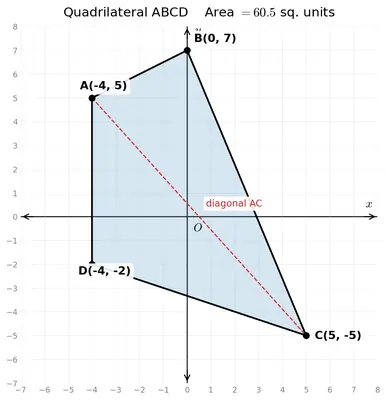
Draw a quadrilateral in the Cartesian plane, whose vertices are $$(-4, 5)$$, $$(0, 7)$$, $$(5, -5)$$ and $$(-4, -2)$$. Also, find its area.
Figure
Figure

Solution

Let the vertices be $$A(-4, 5)$$, $$B(0, 7)$$, $$C(5, -5)$$ and $$D(-4, -2)$$. Plot the points and join them in order to obtain quadrilateral $$ABCD$$.

Drawing: Mark $$A(-4, 5)$$ and $$D(-4, -2)$$ on the vertical line $$x = -4$$, mark $$B(0, 7)$$ on the $$y$$-axis, and $$C(5, -5)$$ in the fourth quadrant. Join $$AB$$, $$BC$$, $$CD$$ and $$DA$$.

Draw the diagonal $$AC$$. It divides the quadrilateral into two triangles, $$\triangle ABC$$ and $$\triangle ACD$$.

The area of a triangle with vertices $$(x_1, y_1)$$, $$(x_2, y_2)$$, $$(x_3, y_3)$$ is

$$\text{Area} = \dfrac{1}{2}\left|x_1(y_2 - y_3) + x_2(y_3 - y_1) + x_3(y_1 - y_2)\right|$$

Area of $$\triangle ABC$$ with $$A(-4, 5)$$, $$B(0, 7)$$, $$C(5, -5)$$:

$$= \dfrac{1}{2}\left|(-4)(7 - (-5)) + 0(-5 - 5) + 5(5 - 7)\right|$$

$$= \dfrac{1}{2}\left|(-4)(12) + 0 + 5(-2)\right| = \dfrac{1}{2}\left|-48 - 10\right| = \dfrac{1}{2}(58) = 29$$

Area of $$\triangle ACD$$ with $$A(-4, 5)$$, $$C(5, -5)$$, $$D(-4, -2)$$:

$$= \dfrac{1}{2}\left|(-4)(-5 - (-2)) + 5(-2 - 5) + (-4)(5 - (-5))\right|$$

$$= \dfrac{1}{2}\left|(-4)(-3) + 5(-7) + (-4)(10)\right| = \dfrac{1}{2}\left|12 - 35 - 40\right| = \dfrac{1}{2}(63) = 31.5$$

Total area of the quadrilateral:

$$\text{Area} = 29 + 31.5 = 60.5 \text{ square units}$$

Answer

Area $$= 60.5$$ square units

2 The base of an equilateral triangle with side $$2a$$ lies along the $$y$$-axis such that the mid-point of the base is at the origin. Find vertices of the triangle.

Solution

The base of the triangle lies along the $$y$$-axis, and its mid-point is the origin $$O(0, 0)$$. The base has length $$2a$$ (the side of the equilateral triangle).

Since the mid-point of the base is the origin, the two end-points of the base lie on the $$y$$-axis at distance $$a$$ on either side of $$O$$. So the base vertices are

$$B(0, a) \quad \text{and} \quad C(0, -a)$$

Let the third vertex be $$A(x, 0)$$. By symmetry it lies on the $$x$$-axis, which is the perpendicular bisector of the base.

Each side of the triangle is $$2a$$. Consider side $$AB$$, which joins $$A(x, 0)$$ and $$B(0, a)$$:

$$AB^2 = (x - 0)^2 + (0 - a)^2 = x^2 + a^2$$

Since $$AB = 2a$$, we get $$AB^2 = 4a^2$$, so

$$x^2 + a^2 = 4a^2 \;\Rightarrow\; x^2 = 3a^2 \;\Rightarrow\; x = \pm\sqrt{3}\,a$$

Hence the third vertex is $$(\sqrt{3}\,a, 0)$$ or $$(-\sqrt{3}\,a, 0)$$.

Answer

Vertices: $$(0, a)$$, $$(0, -a)$$ and $$(\sqrt{3}\,a, 0)$$; or $$(0, a)$$, $$(0, -a)$$ and $$(-\sqrt{3}\,a, 0)$$.

3 Find the distance between $$P(x_1, y_1)$$ and $$Q(x_2, y_2)$$ when :

(i) PQ is parallel to the $$y$$-axis,

Solution

If $$PQ$$ is parallel to the $$y$$-axis, then $$P$$ and $$Q$$ have the same $$x$$-coordinate, i.e. $$x_1 = x_2$$.

By the distance formula,

$$PQ = \sqrt{(x_2 - x_1)^2 + (y_2 - y_1)^2}$$

Putting $$x_2 - x_1 = 0$$:

$$PQ = \sqrt{0 + (y_2 - y_1)^2} = |y_2 - y_1|$$

Answer

$$PQ = |y_2 - y_1|$$

(ii) PQ is parallel to the $$x$$-axis.

Solution

If $$PQ$$ is parallel to the $$x$$-axis, then $$P$$ and $$Q$$ have the same $$y$$-coordinate, i.e. $$y_1 = y_2$$.

By the distance formula,

$$PQ = \sqrt{(x_2 - x_1)^2 + (y_2 - y_1)^2}$$

Putting $$y_2 - y_1 = 0$$:

$$PQ = \sqrt{(x_2 - x_1)^2 + 0} = |x_2 - x_1|$$

Answer

$$PQ = |x_2 - x_1|$$

4 Find a point on the $$x$$-axis, which is equidistant from the points $$(7, 6)$$ and $$(3, 4)$$.

Solution

Let the required point on the $$x$$-axis be $$P(x, 0)$$, since every point on the $$x$$-axis has $$y$$-coordinate $$0$$.

$$P$$ is equidistant from $$A(7, 6)$$ and $$B(3, 4)$$, so $$PA = PB$$, and hence $$PA^2 = PB^2$$.

$$PA^2 = (x - 7)^2 + (0 - 6)^2 = (x - 7)^2 + 36$$

$$PB^2 = (x - 3)^2 + (0 - 4)^2 = (x - 3)^2 + 16$$

Equating:

$$(x - 7)^2 + 36 = (x - 3)^2 + 16$$

$$x^2 - 14x + 49 + 36 = x^2 - 6x + 9 + 16$$

$$-14x + 85 = -6x + 25$$

$$85 - 25 = -6x + 14x \;\Rightarrow\; 60 = 8x \;\Rightarrow\; x = \dfrac{15}{2}$$

Hence the required point is $$\left(\dfrac{15}{2}, 0\right)$$.

Answer

$$\left(\dfrac{15}{2},\ 0\right)$$

5 Find the slope of a line, which passes through the origin, and the mid-point of the line segment joining the points $$P(0, -4)$$ and $$B(8, 0)$$.

Solution

First find the mid-point of the segment joining $$P(0, -4)$$ and $$B(8, 0)$$.

$$\text{Mid-point} = \left(\dfrac{0 + 8}{2}, \dfrac{-4 + 0}{2}\right) = (4, -2)$$

The required line passes through the origin $$(0, 0)$$ and the mid-point $$(4, -2)$$. Its slope is

$$m = \dfrac{-2 - 0}{4 - 0} = \dfrac{-2}{4} = -\dfrac{1}{2}$$

Answer

Slope $$= -\dfrac{1}{2}$$

6 Without using the Pythagoras theorem, show that the points $$(4, 4)$$, $$(3, 5)$$ and $$(-1, -1)$$ are the vertices of a right angled triangle.

Solution

Let the points be $$A(4, 4)$$, $$B(3, 5)$$ and $$C(-1, -1)$$. Instead of the Pythagoras theorem we use slopes: if two sides of the triangle are perpendicular, the triangle is right-angled.

Slope of $$AB = \dfrac{5 - 4}{3 - 4} = \dfrac{1}{-1} = -1$$

Slope of $$BC = \dfrac{-1 - 5}{-1 - 3} = \dfrac{-6}{-4} = \dfrac{3}{2}$$

Slope of $$CA = \dfrac{4 - (-1)}{4 - (-1)} = \dfrac{5}{5} = 1$$

Now consider the two sides $$AB$$ and $$CA$$ meeting at $$A$$:

$$(\text{slope of } AB) \times (\text{slope of } CA) = (-1)(1) = -1$$

Since the product of their slopes is $$-1$$, the sides $$AB$$ and $$CA$$ are perpendicular. Hence the angle at vertex $$A$$ is a right angle.

Therefore the points $$(4, 4)$$, $$(3, 5)$$ and $$(-1, -1)$$ are the vertices of a right-angled triangle, right-angled at $$(4, 4)$$.

Answer

The triangle is right-angled at $$(4, 4)$$, since the slopes of sides $$AB$$ and $$CA$$ are $$-1$$ and $$1$$, whose product is $$-1$$.

7 Find the slope of the line, which makes an angle of $$30^\circ$$ with the positive direction of $$y$$-axis measured anticlockwise.

Solution

The positive direction of the $$y$$-axis itself makes an angle of $$90^\circ$$ with the positive direction of the $$x$$-axis.

The required line is at $$30^\circ$$ from the positive $$y$$-axis, measured anticlockwise. So, measured anticlockwise from the positive $$x$$-axis, the inclination of the line is

$$\theta = 90^\circ + 30^\circ = 120^\circ$$

Hence the slope is

$$m = \tan\theta = \tan 120^\circ = \tan(180^\circ - 60^\circ) = -\tan 60^\circ = -\sqrt{3}$$

Answer

Slope $$= -\sqrt{3}$$

8 Without using distance formula, show that points $$(-2, -1)$$, $$(4, 0)$$, $$(3, 3)$$ and $$(-3, 2)$$ are the vertices of a parallelogram.

Solution

Let the points be $$A(-2, -1)$$, $$B(4, 0)$$, $$C(3, 3)$$ and $$D(-3, 2)$$, taken in order. A quadrilateral is a parallelogram if both pairs of opposite sides are parallel, that is, have equal slopes.

Slope of $$AB = \dfrac{0 - (-1)}{4 - (-2)} = \dfrac{1}{6}$$

Slope of $$CD = \dfrac{2 - 3}{-3 - 3} = \dfrac{-1}{-6} = \dfrac{1}{6}$$

Since slope of $$AB$$ = slope of $$CD$$, the sides $$AB$$ and $$CD$$ are parallel.

Slope of $$BC = \dfrac{3 - 0}{3 - 4} = \dfrac{3}{-1} = -3$$

Slope of $$DA = \dfrac{-1 - 2}{-2 - (-3)} = \dfrac{-3}{1} = -3$$

Since slope of $$BC$$ = slope of $$DA$$, the sides $$BC$$ and $$DA$$ are parallel.

Both pairs of opposite sides are parallel, so $$ABCD$$ is a parallelogram.

Answer

Opposite sides $$AB,\,CD$$ have slope $$\tfrac{1}{6}$$ and $$BC,\,DA$$ have slope $$-3$$; both pairs are parallel, so the points form a parallelogram.

9 Find the angle between the $$x$$-axis and the line joining the points $$(3, -1)$$ and $$(4, -2)$$.

Solution

First find the slope of the line joining $$(3, -1)$$ and $$(4, -2)$$:

$$m = \dfrac{-2 - (-1)}{4 - 3} = \dfrac{-1}{1} = -1$$

If $$\theta$$ is the angle that the line makes with the positive direction of the $$x$$-axis, then $$m = \tan\theta$$:

$$\tan\theta = -1$$

The angle $$\theta$$ in the range $$0^\circ \le \theta < 180^\circ$$ whose tangent is $$-1$$ is

$$\theta = 180^\circ - 45^\circ = 135^\circ$$

Hence the line makes an angle of $$135^\circ$$ with the $$x$$-axis.

Answer

Angle $$= 135^\circ$$

10 The slope of a line is double of the slope of another line. If tangent of the angle between them is $$\frac{1}{3}$$, find the slopes of the lines.

Solution

Let the slope of one line be $$m$$. Then the slope of the other line, being double of it, is $$2m$$.

If $$\theta$$ is the angle between the lines, then $$\tan\theta = \left|\dfrac{m_2 - m_1}{1 + m_1 m_2}\right|$$. Taking $$m_1 = m$$, $$m_2 = 2m$$ and $$\tan\theta = \dfrac{1}{3}$$:

$$\dfrac{1}{3} = \left|\dfrac{2m - m}{1 + m \cdot 2m}\right| = \left|\dfrac{m}{1 + 2m^2}\right|$$

So $$\dfrac{m}{1 + 2m^2} = \dfrac{1}{3}$$ or $$\dfrac{m}{1 + 2m^2} = -\dfrac{1}{3}$$.

Case 1: $$3m = 1 + 2m^2$$

$$2m^2 - 3m + 1 = 0 \;\Rightarrow\; (2m - 1)(m - 1) = 0 \;\Rightarrow\; m = \dfrac{1}{2} \text{ or } m = 1$$

The pair of slopes $$(m, 2m)$$ is $$\left(\dfrac{1}{2}, 1\right)$$ or $$(1, 2)$$.

Case 2: $$3m = -(1 + 2m^2)$$

$$2m^2 + 3m + 1 = 0 \;\Rightarrow\; (2m + 1)(m + 1) = 0 \;\Rightarrow\; m = -\dfrac{1}{2} \text{ or } m = -1$$

The pair of slopes $$(m, 2m)$$ is $$\left(-\dfrac{1}{2}, -1\right)$$ or $$(-1, -2)$$.

Hence the slopes of the two lines are $$\dfrac{1}{2}$$ and $$1$$, or $$1$$ and $$2$$, or $$-\dfrac{1}{2}$$ and $$-1$$, or $$-1$$ and $$-2$$.

Answer

The slopes are $$\dfrac{1}{2}$$ and $$1$$, or $$1$$ and $$2$$, or $$-\dfrac{1}{2}$$ and $$-1$$, or $$-1$$ and $$-2$$.

11 A line passes through $$(x_1, y_1)$$ and $$(h, k)$$. If slope of the line is $$m$$, show that $$k - y_1 = m(h - x_1)$$.

Solution

The line passes through the two points $$(x_1, y_1)$$ and $$(h, k)$$, and its slope is $$m$$.

By the definition of the slope of a line through two points,

$$m = \dfrac{\text{difference of } y\text{-coordinates}}{\text{difference of } x\text{-coordinates}} = \dfrac{k - y_1}{h - x_1}$$

(here $$h \neq x_1$$, otherwise the slope would be undefined). Multiplying both sides by $$(h - x_1)$$:

$$m(h - x_1) = k - y_1$$

That is, $$k - y_1 = m(h - x_1)$$, which is the required result.

Answer

Proved: $$k - y_1 = m(h - x_1)$$.

Examples 4-8

Example 4 Find the equations of the lines parallel to axes and passing through $$(-2, 3)$$.

Solution

We need the two lines through $$(-2, 3)$$ that are parallel to the coordinate axes.

Line parallel to the $$x$$-axis: Every point on a line parallel to the $$x$$-axis has the same $$y$$-coordinate. Since the line passes through $$(-2, 3)$$, that constant $$y$$-coordinate is $$3$$. Its equation is

$$y = 3$$

Line parallel to the $$y$$-axis: Every point on a line parallel to the $$y$$-axis has the same $$x$$-coordinate. Since the line passes through $$(-2, 3)$$, that constant $$x$$-coordinate is $$-2$$. Its equation is

$$x = -2$$

Answer

$$y = 3$$ (parallel to the $$x$$-axis) and $$x = -2$$ (parallel to the $$y$$-axis).

Example 5 Find the equation of the line through $$(-2, 3)$$ with slope $$-4$$.

Solution

The equation of a line through the point $$(x_0, y_0)$$ with slope $$m$$ (point-slope form) is

$$y - y_0 = m(x - x_0)$$

Here $$(x_0, y_0) = (-2, 3)$$ and $$m = -4$$:

$$y - 3 = -4(x - (-2))$$

$$y - 3 = -4(x + 2)$$

$$y - 3 = -4x - 8$$

$$4x + y + 5 = 0$$

Answer

$$4x + y + 5 = 0$$

Example 6 Write the equation of the line through the points $$(1, -1)$$ and $$(3, 5)$$.

Solution

First find the slope of the line through $$(1, -1)$$ and $$(3, 5)$$:

$$m = \dfrac{5 - (-1)}{3 - 1} = \dfrac{6}{2} = 3$$

Now use the point-slope form $$y - y_0 = m(x - x_0)$$ with the point $$(1, -1)$$:

$$y - (-1) = 3(x - 1)$$

$$y + 1 = 3x - 3$$

$$3x - y - 4 = 0$$

Answer

$$3x - y - 4 = 0$$

Example 7 Write the equation of the lines for which $$\tan \theta = \frac{1}{2}$$, where $$\theta$$ is the inclination of the line and

(i) $$y$$-intercept is $$-\frac{3}{2}$$

Solution

The inclination $$\theta$$ of the line satisfies $$\tan\theta = \dfrac{1}{2}$$, so the slope of the line is $$m = \tan\theta = \dfrac{1}{2}$$.

The $$y$$-intercept is $$c = -\dfrac{3}{2}$$. Using the slope-intercept form $$y = mx + c$$:

$$y = \dfrac{1}{2}x - \dfrac{3}{2}$$

Multiplying throughout by $$2$$:

$$2y = x - 3 \;\Rightarrow\; x - 2y - 3 = 0$$

Answer

$$x - 2y - 3 = 0$$

(ii) $$x$$-intercept is $$4$$.

Solution

As before, the slope of the line is $$m = \tan\theta = \dfrac{1}{2}$$.

The $$x$$-intercept is $$4$$, which means the line crosses the $$x$$-axis at the point $$(4, 0)$$.

Using the point-slope form $$y - y_0 = m(x - x_0)$$ with $$(x_0, y_0) = (4, 0)$$:

$$y - 0 = \dfrac{1}{2}(x - 4)$$

$$2y = x - 4 \;\Rightarrow\; x - 2y - 4 = 0$$

Answer

$$x - 2y - 4 = 0$$

Example 8 Find the equation of the line, which makes intercepts $$-3$$ and $$2$$ on the $$x$$- and $$y$$-axes respectively.

Solution

Using the intercept form, a line with $$x$$-intercept $$a$$ and $$y$$-intercept $$b$$ has the equation

$$\dfrac{x}{a} + \dfrac{y}{b} = 1$$

Here $$a = -3$$ and $$b = 2$$:

$$\dfrac{x}{-3} + \dfrac{y}{2} = 1$$

Multiplying both sides by $$6$$:

$$-2x + 3y = 6$$

$$2x - 3y + 6 = 0$$

Answer

$$2x - 3y + 6 = 0$$

Exercise 9.2

1

In Exercises 1 to 8, find the equation of the line which satisfy the given conditions:

Write the equations for the $$x$$-and $$y$$-axes.

Solution

Equation of the $$x$$-axis: Every point lying on the $$x$$-axis has its $$y$$-coordinate equal to $$0$$, and this is the only condition that all such points satisfy. Hence the equation of the $$x$$-axis is

$$y = 0$$

Equation of the $$y$$-axis: Every point lying on the $$y$$-axis has its $$x$$-coordinate equal to $$0$$. Hence the equation of the $$y$$-axis is

$$x = 0$$

Answer

$$x$$-axis: $$y = 0$$; $$y$$-axis: $$x = 0$$.

2 Passing through the point $$(-4, 3)$$ with slope $$\frac{1}{2}$$.

Solution

Use the point-slope form $$y - y_0 = m(x - x_0)$$ with the point $$(-4, 3)$$ and slope $$m = \dfrac{1}{2}$$:

$$y - 3 = \dfrac{1}{2}(x - (-4))$$

$$y - 3 = \dfrac{1}{2}(x + 4)$$

Multiply both sides by $$2$$:

$$2(y - 3) = x + 4$$

$$2y - 6 = x + 4$$

$$x - 2y + 10 = 0$$

Answer

$$x - 2y + 10 = 0$$

3 Passing through $$(0, 0)$$ with slope $$m$$.

Solution

Use the point-slope form $$y - y_0 = m(x - x_0)$$ with the point $$(0, 0)$$ and slope $$m$$:

$$y - 0 = m(x - 0)$$

$$y = mx$$

This is the equation of the required line through the origin.

Answer

$$y = mx$$

4 Passing through $$(2, 2\sqrt{3})$$ and inclined with the $$x$$-axis at an angle of $$75^\circ$$.

Solution

The slope of the line is $$m = \tan 75^\circ$$. Compute it using $$75^\circ = 45^\circ + 30^\circ$$:

$$\tan 75^\circ = \dfrac{\tan 45^\circ + \tan 30^\circ}{1 - \tan 45^\circ \tan 30^\circ} = \dfrac{1 + \frac{1}{\sqrt{3}}}{1 - \frac{1}{\sqrt{3}}} = \dfrac{\sqrt{3} + 1}{\sqrt{3} - 1}$$

Rationalise by multiplying numerator and denominator by $$(\sqrt{3} + 1)$$:

$$\tan 75^\circ = \dfrac{(\sqrt{3} + 1)^2}{(\sqrt{3} - 1)(\sqrt{3} + 1)} = \dfrac{3 + 2\sqrt{3} + 1}{3 - 1} = \dfrac{4 + 2\sqrt{3}}{2} = 2 + \sqrt{3}$$

So $$m = 2 + \sqrt{3}$$. Use the point-slope form with the point $$(2, 2\sqrt{3})$$:

$$y - 2\sqrt{3} = (2 + \sqrt{3})(x - 2)$$

$$y - 2\sqrt{3} = (2 + \sqrt{3})x - 2(2 + \sqrt{3})$$

$$y - 2\sqrt{3} = (2 + \sqrt{3})x - 4 - 2\sqrt{3}$$

$$y = (2 + \sqrt{3})x - 4$$

$$(2 + \sqrt{3})x - y - 4 = 0$$

Answer

$$(2 + \sqrt{3})x - y - 4 = 0$$

5 Intersecting the $$x$$-axis at a distance of $$3$$ units to the left of origin with slope $$-2$$.

Solution

The line meets the $$x$$-axis $$3$$ units to the left of the origin, so it passes through the point $$(-3, 0)$$.

Use the point-slope form $$y - y_0 = m(x - x_0)$$ with $$(x_0, y_0) = (-3, 0)$$ and $$m = -2$$:

$$y - 0 = -2(x - (-3))$$

$$y = -2(x + 3)$$

$$y = -2x - 6$$

$$2x + y + 6 = 0$$

Answer

$$2x + y + 6 = 0$$

6 Intersecting the $$y$$-axis at a distance of $$2$$ units above the origin and making an angle of $$30^\circ$$ with positive direction of the $$x$$-axis.

Solution

The line meets the $$y$$-axis $$2$$ units above the origin, so it passes through the point $$(0, 2)$$.

It makes an angle of $$30^\circ$$ with the positive direction of the $$x$$-axis, so its slope is

$$m = \tan 30^\circ = \dfrac{1}{\sqrt{3}}$$

Use the point-slope form with the point $$(0, 2)$$:

$$y - 2 = \dfrac{1}{\sqrt{3}}(x - 0)$$

$$\sqrt{3}(y - 2) = x$$

$$\sqrt{3}\,y - 2\sqrt{3} = x$$

$$x - \sqrt{3}\,y + 2\sqrt{3} = 0$$

Answer

$$x - \sqrt{3}\,y + 2\sqrt{3} = 0$$

7 Passing through the points $$(-1, 1)$$ and $$(2, -4)$$.

Solution

Slope of the line through $$(-1, 1)$$ and $$(2, -4)$$:

$$m = \dfrac{-4 - 1}{2 - (-1)} = \dfrac{-5}{3}$$

Use the point-slope form $$y - y_0 = m(x - x_0)$$ with the point $$(-1, 1)$$:

$$y - 1 = -\dfrac{5}{3}(x - (-1))$$

$$3(y - 1) = -5(x + 1)$$

$$3y - 3 = -5x - 5$$

$$5x + 3y + 2 = 0$$

Answer

$$5x + 3y + 2 = 0$$

8 The vertices of $$\Delta PQR$$ are $$P(2, 1)$$, $$Q(-2, 3)$$ and $$R(4, 5)$$. Find equation of the median through the vertex $$R$$.

Solution

The median through vertex $$R$$ joins $$R$$ to the mid-point of the opposite side $$PQ$$.

Mid-point of $$PQ$$, with $$P(2, 1)$$ and $$Q(-2, 3)$$:

$$M = \left(\dfrac{2 + (-2)}{2}, \dfrac{1 + 3}{2}\right) = (0, 2)$$

The median is the line joining $$R(4, 5)$$ and $$M(0, 2)$$. Its slope:

$$m = \dfrac{2 - 5}{0 - 4} = \dfrac{-3}{-4} = \dfrac{3}{4}$$

Equation through $$M(0, 2)$$ using the point-slope form:

$$y - 2 = \dfrac{3}{4}(x - 0)$$

$$4(y - 2) = 3x \;\Rightarrow\; 4y - 8 = 3x$$

$$3x - 4y + 8 = 0$$

Answer

$$3x - 4y + 8 = 0$$

9 Find the equation of the line passing through $$(-3, 5)$$ and perpendicular to the line through the points $$(2, 5)$$ and $$(-3, 6)$$.

Solution

Slope of the line through $$(2, 5)$$ and $$(-3, 6)$$:

$$m_1 = \dfrac{6 - 5}{-3 - 2} = \dfrac{1}{-5} = -\dfrac{1}{5}$$

The required line is perpendicular to this line, so its slope $$m$$ satisfies $$m \cdot m_1 = -1$$:

$$m = -\dfrac{1}{m_1} = -\dfrac{1}{-1/5} = 5$$

Use the point-slope form with the point $$(-3, 5)$$:

$$y - 5 = 5(x - (-3))$$

$$y - 5 = 5(x + 3)$$

$$y - 5 = 5x + 15$$

$$5x - y + 20 = 0$$

Answer

$$5x - y + 20 = 0$$

10 A line perpendicular to the line segment joining the points $$(1, 0)$$ and $$(2, 3)$$ divides it in the ratio $$1: n$$. Find the equation of the line.

Solution

The required line is perpendicular to the segment joining $$A(1, 0)$$ and $$B(2, 3)$$, and it crosses this segment at the point dividing $$AB$$ in the ratio $$1 : n$$.

By the section formula, the point dividing $$A(1, 0)$$ and $$B(2, 3)$$ internally in the ratio $$1 : n$$ is

$$P = \left(\dfrac{1 \cdot 2 + n \cdot 1}{1 + n}, \dfrac{1 \cdot 3 + n \cdot 0}{1 + n}\right) = \left(\dfrac{n + 2}{n + 1}, \dfrac{3}{n + 1}\right)$$

Slope of $$AB$$:

$$m_{AB} = \dfrac{3 - 0}{2 - 1} = 3$$

The required line is perpendicular to $$AB$$, so its slope is $$m = -\dfrac{1}{3}$$.

Equation of the line through $$P$$ with slope $$-\dfrac{1}{3}$$:

$$y - \dfrac{3}{n + 1} = -\dfrac{1}{3}\left(x - \dfrac{n + 2}{n + 1}\right)$$

Multiply both sides by $$3$$:

$$3y - \dfrac{9}{n + 1} = -x + \dfrac{n + 2}{n + 1}$$

$$x + 3y = \dfrac{9}{n + 1} + \dfrac{n + 2}{n + 1} = \dfrac{9 + n + 2}{n + 1} = \dfrac{n + 11}{n + 1}$$

Multiplying both sides by $$(n + 1)$$:

$$(1 + n)\,x + 3(1 + n)\,y = n + 11$$

Answer

$$(1 + n)\,x + 3(1 + n)\,y = n + 11$$

11 Find the equation of a line that cuts off equal intercepts on the coordinate axes and passes through the point $$(2, 3)$$.

Solution

Let the line cut off equal intercepts $$a$$ on each axis (with $$a \neq 0$$). Using the intercept form with $$x$$-intercept $$a$$ and $$y$$-intercept $$a$$:

$$\dfrac{x}{a} + \dfrac{y}{a} = 1 \;\Rightarrow\; x + y = a$$

The line passes through $$(2, 3)$$, so substitute $$x = 2$$, $$y = 3$$:

$$2 + 3 = a \;\Rightarrow\; a = 5$$

Hence the equation of the line is

$$x + y = 5$$

Answer

$$x + y = 5$$

12 Find equation of the line passing through the point $$(2, 2)$$ and cutting off intercepts on the axes whose sum is $$9$$.

Solution

Let the $$x$$-intercept be $$a$$ and the $$y$$-intercept be $$b$$. The intercept form of the line is

$$\dfrac{x}{a} + \dfrac{y}{b} = 1$$

The sum of the intercepts is $$9$$, so $$a + b = 9$$, which gives $$b = 9 - a$$.

The line passes through $$(2, 2)$$:

$$\dfrac{2}{a} + \dfrac{2}{9 - a} = 1$$

Multiply through by $$a(9 - a)$$:

$$2(9 - a) + 2a = a(9 - a)$$

$$18 - 2a + 2a = 9a - a^2$$

$$18 = 9a - a^2$$

$$a^2 - 9a + 18 = 0 \;\Rightarrow\; (a - 3)(a - 6) = 0$$

So $$a = 3$$ or $$a = 6$$.

If $$a = 3$$, then $$b = 9 - 3 = 6$$:

$$\dfrac{x}{3} + \dfrac{y}{6} = 1 \;\Rightarrow\; 2x + y = 6$$

If $$a = 6$$, then $$b = 9 - 6 = 3$$:

$$\dfrac{x}{6} + \dfrac{y}{3} = 1 \;\Rightarrow\; x + 2y = 6$$

Answer

$$2x + y = 6$$ or $$x + 2y = 6$$

13 Find equation of the line through the point $$(0, 2)$$ making an angle $$\frac{2\pi}{3}$$ with the positive $$x$$-axis. Also, find the equation of line parallel to it and crossing the $$y$$-axis at a distance of $$2$$ units below the origin.

Solution

The line makes an angle $$\dfrac{2\pi}{3}$$ with the positive direction of the $$x$$-axis, so its slope is

$$m = \tan\dfrac{2\pi}{3} = \tan 120^\circ = -\sqrt{3}$$

It passes through $$(0, 2)$$. Using the point-slope form:

$$y - 2 = -\sqrt{3}(x - 0)$$

$$y - 2 = -\sqrt{3}\,x$$

$$\sqrt{3}\,x + y - 2 = 0$$

Parallel line: A line parallel to the one above has the same slope $$-\sqrt{3}$$. This line crosses the $$y$$-axis $$2$$ units below the origin, so it passes through $$(0, -2)$$:

$$y - (-2) = -\sqrt{3}(x - 0)$$

$$y + 2 = -\sqrt{3}\,x$$

$$\sqrt{3}\,x + y + 2 = 0$$

Answer

Required line: $$\sqrt{3}\,x + y - 2 = 0$$; parallel line: $$\sqrt{3}\,x + y + 2 = 0$$.

14 The perpendicular from the origin to a line meets it at the point $$(-2, 9)$$, find the equation of the line.

Solution

The perpendicular from the origin $$O(0, 0)$$ meets the required line at $$P(-2, 9)$$. So the segment $$OP$$ is perpendicular to the line.

Slope of $$OP$$:

$$m_{OP} = \dfrac{9 - 0}{-2 - 0} = -\dfrac{9}{2}$$

Since the line is perpendicular to $$OP$$, its slope $$m$$ satisfies $$m \cdot m_{OP} = -1$$:

$$m = -\dfrac{1}{m_{OP}} = -\dfrac{1}{-9/2} = \dfrac{2}{9}$$

The line passes through $$P(-2, 9)$$. Using the point-slope form:

$$y - 9 = \dfrac{2}{9}(x - (-2))$$

$$9(y - 9) = 2(x + 2)$$

$$9y - 81 = 2x + 4$$

$$2x - 9y + 85 = 0$$

Answer

$$2x - 9y + 85 = 0$$

15 The length $$L$$ (in centimetre) of a copper rod is a linear function of its Celsius temperature $$C$$. In an experiment, if $$L = 124.942$$ when $$C = 20$$ and $$L = 125.134$$ when $$C = 110$$, express $$L$$ in terms of $$C$$.

Solution

Since $$L$$ is a linear function of $$C$$, the relation between them is the equation of a straight line in the $$C$$-$$L$$ plane. This line passes through the two given data points $$(C, L) = (20,\ 124.942)$$ and $$(110,\ 125.134)$$.

Slope of the line:

$$m = \dfrac{125.134 - 124.942}{110 - 20} = \dfrac{0.192}{90}$$

Using the point-slope form with the point $$(20,\ 124.942)$$:

$$L - 124.942 = \dfrac{0.192}{90}(C - 20)$$

$$L = \dfrac{0.192}{90}(C - 20) + 124.942$$

This expresses $$L$$ in terms of $$C$$.

Answer

$$L = \dfrac{0.192}{90}(C - 20) + 124.942$$

16 The owner of a milk store finds that, he can sell $$980$$ litres of milk each week at Rs $$14$$/litre and $$1220$$ litres of milk each week at Rs $$16$$/litre. Assuming a linear relationship between selling price and demand, how many litres could he sell weekly at Rs $$17$$/litre?

Solution

Let the selling price (in Rs per litre) be $$x$$ and the quantity sold (in litres) be $$y$$. The relationship is linear, so the point $$(x, y)$$ lies on a straight line through the two data points $$(14,\ 980)$$ and $$(16,\ 1220)$$.

Slope of the line:

$$m = \dfrac{1220 - 980}{16 - 14} = \dfrac{240}{2} = 120$$

Equation of the line through $$(14,\ 980)$$:

$$y - 980 = 120(x - 14)$$

To find the quantity sold at Rs $$17$$/litre, put $$x = 17$$:

$$y - 980 = 120(17 - 14) = 120 \times 3 = 360$$

$$y = 980 + 360 = 1340$$

Hence he could sell $$1340$$ litres of milk weekly at Rs $$17$$/litre.

Answer

$$1340$$ litres

17 $$P(a, b)$$ is the mid-point of a line segment between axes. Show that equation of the line is $$\frac{x}{a} + \frac{y}{b} = 2$$.

Solution

Let the line meet the $$x$$-axis at $$A(p, 0)$$ and the $$y$$-axis at $$B(0, q)$$. The segment between the axes is $$AB$$.

The mid-point of $$AB$$ is

$$\left(\dfrac{p + 0}{2}, \dfrac{0 + q}{2}\right) = \left(\dfrac{p}{2}, \dfrac{q}{2}\right)$$

This mid-point is given to be $$P(a, b)$$, so

$$\dfrac{p}{2} = a \;\Rightarrow\; p = 2a, \qquad \dfrac{q}{2} = b \;\Rightarrow\; q = 2b$$

Using the intercept form with $$x$$-intercept $$p = 2a$$ and $$y$$-intercept $$q = 2b$$:

$$\dfrac{x}{2a} + \dfrac{y}{2b} = 1$$

Multiplying both sides by $$2$$:

$$\dfrac{x}{a} + \dfrac{y}{b} = 2$$

which is the required equation.

Answer

Proved: $$\dfrac{x}{a} + \dfrac{y}{b} = 2$$.

18 Point $$R(h, k)$$ divides a line segment between the axes in the ratio $$1: 2$$. Find equation of the line.

Solution

Let the line meet the $$x$$-axis at $$A(a, 0)$$ and the $$y$$-axis at $$B(0, b)$$. The point $$R(h, k)$$ divides the segment $$AB$$ in the ratio $$1 : 2$$, measured from $$A$$ on the $$x$$-axis (so $$AR : RB = 1 : 2$$).

By the section formula, the point dividing $$A(a, 0)$$ and $$B(0, b)$$ internally in the ratio $$1 : 2$$ is

$$\left(\dfrac{1 \cdot 0 + 2 \cdot a}{1 + 2}, \dfrac{1 \cdot b + 2 \cdot 0}{1 + 2}\right) = \left(\dfrac{2a}{3}, \dfrac{b}{3}\right)$$

Equating this to $$R(h, k)$$:

$$\dfrac{2a}{3} = h \;\Rightarrow\; a = \dfrac{3h}{2}, \qquad \dfrac{b}{3} = k \;\Rightarrow\; b = 3k$$

Using the intercept form $$\dfrac{x}{a} + \dfrac{y}{b} = 1$$:

$$\dfrac{x}{3h/2} + \dfrac{y}{3k} = 1 \;\Rightarrow\; \dfrac{2x}{3h} + \dfrac{y}{3k} = 1$$

Multiplying both sides by $$3$$:

$$\dfrac{2x}{h} + \dfrac{y}{k} = 3$$

Answer

$$\dfrac{2x}{h} + \dfrac{y}{k} = 3$$

19 By using the concept of equation of a line, prove that the three points $$(3, 0)$$, $$(-2, -2)$$ and $$(8, 2)$$ are collinear.

Solution

We first find the equation of the line passing through two of the points, say $$A(3, 0)$$ and $$B(-2, -2)$$, and then check whether the third point lies on it.

Slope of $$AB$$:

$$m = \dfrac{-2 - 0}{-2 - 3} = \dfrac{-2}{-5} = \dfrac{2}{5}$$

Equation of line $$AB$$ using the point-slope form through $$A(3, 0)$$:

$$y - 0 = \dfrac{2}{5}(x - 3)$$

$$5y = 2(x - 3) \;\Rightarrow\; 2x - 5y - 6 = 0$$

Now substitute the third point $$C(8, 2)$$ into the left-hand side:

$$2(8) - 5(2) - 6 = 16 - 10 - 6 = 0$$

Since $$C(8, 2)$$ satisfies the equation of line $$AB$$, the point $$C$$ lies on the line $$AB$$. Therefore the three points $$(3, 0)$$, $$(-2, -2)$$ and $$(8, 2)$$ are collinear.

Answer

All three points satisfy $$2x - 5y - 6 = 0$$, so they are collinear.

Examples 9-10

Example 9 Find the distance of the point $$(3, -5)$$ from the line $$3x - 4y - 26 = 0$$.

Solution

The distance of a point $$(x_1, y_1)$$ from the line $$Ax + By + C = 0$$ is

$$d = \dfrac{|Ax_1 + By_1 + C|}{\sqrt{A^2 + B^2}}$$

Here the line is $$3x - 4y - 26 = 0$$, so $$A = 3$$, $$B = -4$$, $$C = -26$$, and the point is $$(x_1, y_1) = (3, -5)$$:

$$d = \dfrac{|3(3) + (-4)(-5) + (-26)|}{\sqrt{3^2 + (-4)^2}} = \dfrac{|9 + 20 - 26|}{\sqrt{9 + 16}}$$

$$d = \dfrac{|3|}{\sqrt{25}} = \dfrac{3}{5}$$

Answer

$$d = \dfrac{3}{5}$$ units

Example 10 Find the distance between the parallel lines $$3x - 4y + 7 = 0$$ and $$3x - 4y + 5 = 0$$.

Solution

The distance between two parallel lines $$Ax + By + C_1 = 0$$ and $$Ax + By + C_2 = 0$$ is

$$d = \dfrac{|C_1 - C_2|}{\sqrt{A^2 + B^2}}$$

Here the lines are $$3x - 4y + 7 = 0$$ and $$3x - 4y + 5 = 0$$, so $$A = 3$$, $$B = -4$$, $$C_1 = 7$$ and $$C_2 = 5$$:

$$d = \dfrac{|7 - 5|}{\sqrt{3^2 + (-4)^2}} = \dfrac{2}{\sqrt{25}} = \dfrac{2}{5}$$

Answer

$$d = \dfrac{2}{5}$$ units

Exercise 9.3

1 Reduce the following equations into slope - intercept form and find their slopes and the $$y$$ - intercepts.

(i) $$x + 7y = 0$$,

Solution

The slope-intercept form is $$y = mx + c$$, where $$m$$ is the slope and $$c$$ is the $$y$$-intercept.

$$x + 7y = 0 \;\Rightarrow\; 7y = -x \;\Rightarrow\; y = -\dfrac{1}{7}x + 0$$

Comparing with $$y = mx + c$$: slope $$m = -\dfrac{1}{7}$$ and $$y$$-intercept $$c = 0$$.

Answer

Slope $$= -\dfrac{1}{7}$$, $$y$$-intercept $$= 0$$.

(ii) $$6x + 3y - 5 = 0$$,

Solution

Rearrange into the slope-intercept form $$y = mx + c$$:

$$6x + 3y - 5 = 0 \;\Rightarrow\; 3y = -6x + 5 \;\Rightarrow\; y = -2x + \dfrac{5}{3}$$

Comparing with $$y = mx + c$$: slope $$m = -2$$ and $$y$$-intercept $$c = \dfrac{5}{3}$$.

Answer

Slope $$= -2$$, $$y$$-intercept $$= \dfrac{5}{3}$$.

(iii) $$y = 0$$.

Solution

The equation $$y = 0$$ can be written as

$$y = 0 \cdot x + 0$$

Comparing with the slope-intercept form $$y = mx + c$$: slope $$m = 0$$ and $$y$$-intercept $$c = 0$$. (This line is the $$x$$-axis itself.)

Answer

Slope $$= 0$$, $$y$$-intercept $$= 0$$.

2 Reduce the following equations into intercept form and find their intercepts on the axes.

(i) $$3x + 2y - 12 = 0$$,

Solution

The intercept form is $$\dfrac{x}{a} + \dfrac{y}{b} = 1$$, where $$a$$ is the $$x$$-intercept and $$b$$ is the $$y$$-intercept.

$$3x + 2y - 12 = 0 \;\Rightarrow\; 3x + 2y = 12$$

Divide both sides by $$12$$:

$$\dfrac{3x}{12} + \dfrac{2y}{12} = 1 \;\Rightarrow\; \dfrac{x}{4} + \dfrac{y}{6} = 1$$

So the $$x$$-intercept is $$4$$ and the $$y$$-intercept is $$6$$.

Answer

Intercept form: $$\dfrac{x}{4} + \dfrac{y}{6} = 1$$; $$x$$-intercept $$= 4$$, $$y$$-intercept $$= 6$$.

(ii) $$4x - 3y = 6$$,

Solution

To get the intercept form $$\dfrac{x}{a} + \dfrac{y}{b} = 1$$, divide both sides of $$4x - 3y = 6$$ by $$6$$:

$$\dfrac{4x}{6} - \dfrac{3y}{6} = 1 \;\Rightarrow\; \dfrac{x}{3/2} + \dfrac{y}{-2} = 1$$

So the $$x$$-intercept is $$\dfrac{3}{2}$$ and the $$y$$-intercept is $$-2$$.

Answer

Intercept form: $$\dfrac{x}{3/2} + \dfrac{y}{-2} = 1$$; $$x$$-intercept $$= \dfrac{3}{2}$$, $$y$$-intercept $$= -2$$.

(iii) $$3y + 2 = 0$$.

Solution

$$3y + 2 = 0 \;\Rightarrow\; 3y = -2 \;\Rightarrow\; y = -\dfrac{2}{3}$$

This is a line parallel to the $$x$$-axis. Dividing $$3y = -2$$ by $$-2$$ gives the intercept-type form

$$\dfrac{y}{-2/3} = 1$$

There is no $$x$$ term, so the line never meets the $$x$$-axis — it has no $$x$$-intercept. Its $$y$$-intercept is $$-\dfrac{2}{3}$$.

Answer

$$y$$-intercept $$= -\dfrac{2}{3}$$; the line is parallel to the $$x$$-axis and has no $$x$$-intercept.

3 Find the distance of the point $$(-1, 1)$$ from the line $$12(x + 6) = 5(y - 2)$$.

Solution

First write the line in the general form $$Ax + By + C = 0$$:

$$12(x + 6) = 5(y - 2)$$

$$12x + 72 = 5y - 10$$

$$12x - 5y + 82 = 0$$

The distance of the point $$(-1, 1)$$ from this line is

$$d = \dfrac{|12(-1) - 5(1) + 82|}{\sqrt{12^2 + (-5)^2}} = \dfrac{|-12 - 5 + 82|}{\sqrt{144 + 25}}$$

$$d = \dfrac{|65|}{\sqrt{169}} = \dfrac{65}{13} = 5$$

Answer

$$d = 5$$ units

4 Find the points on the $$x$$-axis, whose distances from the line $$\frac{x}{3} + \frac{y}{4} = 1$$ are $$4$$ units.

Solution

First write the line in general form. From $$\dfrac{x}{3} + \dfrac{y}{4} = 1$$, multiply both sides by $$12$$:

$$4x + 3y = 12 \;\Rightarrow\; 4x + 3y - 12 = 0$$

Let a required point on the $$x$$-axis be $$(a, 0)$$. Its distance from the line is $$4$$:

$$\dfrac{|4a + 3(0) - 12|}{\sqrt{4^2 + 3^2}} = 4$$

$$\dfrac{|4a - 12|}{5} = 4 \;\Rightarrow\; |4a - 12| = 20$$

So $$4a - 12 = 20$$ or $$4a - 12 = -20$$.

If $$4a - 12 = 20$$: $$4a = 32 \;\Rightarrow\; a = 8$$.

If $$4a - 12 = -20$$: $$4a = -8 \;\Rightarrow\; a = -2$$.

Hence the required points are $$(8, 0)$$ and $$(-2, 0)$$.

Answer

$$(8, 0)$$ and $$(-2, 0)$$

5 Find the distance between parallel lines

(i) $$15x + 8y - 34 = 0$$ and $$15x + 8y + 31 = 0$$

Solution

The distance between two parallel lines $$Ax + By + C_1 = 0$$ and $$Ax + By + C_2 = 0$$ is

$$d = \dfrac{|C_1 - C_2|}{\sqrt{A^2 + B^2}}$$

Here $$A = 15$$, $$B = 8$$, $$C_1 = -34$$ and $$C_2 = 31$$:

$$d = \dfrac{|-34 - 31|}{\sqrt{15^2 + 8^2}} = \dfrac{|-65|}{\sqrt{225 + 64}} = \dfrac{65}{\sqrt{289}} = \dfrac{65}{17}$$

Answer

$$d = \dfrac{65}{17}$$ units

(ii) $$l(x + y) + p = 0$$ and $$l(x + y) - r = 0$$.

Solution

Write both lines in the general form $$Ax + By + C = 0$$:

$$l(x + y) + p = 0 \;\Rightarrow\; lx + ly + p = 0$$

$$l(x + y) - r = 0 \;\Rightarrow\; lx + ly - r = 0$$

These are parallel lines with $$A = l$$, $$B = l$$, $$C_1 = p$$ and $$C_2 = -r$$. The distance between them is

$$d = \dfrac{|C_1 - C_2|}{\sqrt{A^2 + B^2}} = \dfrac{|p - (-r)|}{\sqrt{l^2 + l^2}} = \dfrac{|p + r|}{\sqrt{2l^2}}$$

$$d = \dfrac{|p + r|}{|l|\sqrt{2}}$$

Answer

$$d = \dfrac{|p + r|}{|l|\sqrt{2}}$$ units

6 Find equation of the line parallel to the line $$3x - 4y + 2 = 0$$ and passing through the point $$(-2, 3)$$.

Solution

Any line parallel to $$3x - 4y + 2 = 0$$ has the same coefficients of $$x$$ and $$y$$, so it can be written as

$$3x - 4y + k = 0$$

for some constant $$k$$. This line passes through $$(-2, 3)$$, so substitute $$x = -2$$, $$y = 3$$:

$$3(-2) - 4(3) + k = 0$$

$$-6 - 12 + k = 0 \;\Rightarrow\; k = 18$$

Hence the required line is

$$3x - 4y + 18 = 0$$

Answer

$$3x - 4y + 18 = 0$$

7 Find equation of the line perpendicular to the line $$x - 7y + 5 = 0$$ and having $$x$$ intercept $$3$$.

Solution

Find the slope of $$x - 7y + 5 = 0$$ by writing it as $$y = \dfrac{x + 5}{7}$$, which gives slope $$\dfrac{1}{7}$$.

The required line is perpendicular to it, so its slope is

$$m = -\dfrac{1}{1/7} = -7$$

The $$x$$-intercept is $$3$$, so the line passes through the point $$(3, 0)$$. Using the point-slope form:

$$y - 0 = -7(x - 3)$$

$$y = -7x + 21$$

$$7x + y - 21 = 0$$

Answer

$$7x + y - 21 = 0$$

8 Find angles between the lines $$\sqrt{3}x + y = 1$$ and $$x + \sqrt{3}y = 1$$.

Solution

Find the slopes of the two lines.

$$\sqrt{3}\,x + y = 1 \;\Rightarrow\; y = -\sqrt{3}\,x + 1$$, so $$m_1 = -\sqrt{3}$$.

$$x + \sqrt{3}\,y = 1 \;\Rightarrow\; y = \dfrac{1 - x}{\sqrt{3}}$$, so $$m_2 = -\dfrac{1}{\sqrt{3}}$$.

If $$\theta$$ is the angle between the lines,

$$\tan\theta = \left|\dfrac{m_2 - m_1}{1 + m_1 m_2}\right| = \left|\dfrac{-\frac{1}{\sqrt{3}} - (-\sqrt{3})}{1 + (-\sqrt{3})\left(-\frac{1}{\sqrt{3}}\right)}\right|$$

Numerator: $$-\dfrac{1}{\sqrt{3}} + \sqrt{3} = \dfrac{-1 + 3}{\sqrt{3}} = \dfrac{2}{\sqrt{3}}$$.   Denominator: $$1 + 1 = 2$$.

$$\tan\theta = \left|\dfrac{2/\sqrt{3}}{2}\right| = \dfrac{1}{\sqrt{3}}$$

So $$\theta = 30^\circ$$. The other angle between the lines is its supplement, $$180^\circ - 30^\circ = 150^\circ$$.

Answer

The angles between the lines are $$30^\circ$$ and $$150^\circ$$.

9 The line through the points $$(h, 3)$$ and $$(4, 1)$$ intersects the line $$7x - 9y - 19 = 0$$. at right angle. Find the value of $$h$$.

Solution

Slope of the line joining $$(h, 3)$$ and $$(4, 1)$$:

$$m_1 = \dfrac{1 - 3}{4 - h} = \dfrac{-2}{4 - h}$$

Slope of the line $$7x - 9y - 19 = 0$$: writing it as $$y = \dfrac{7x - 19}{9}$$ gives $$m_2 = \dfrac{7}{9}$$.

The two lines intersect at right angles, so $$m_1 m_2 = -1$$:

$$\dfrac{-2}{4 - h} \cdot \dfrac{7}{9} = -1$$

$$\dfrac{-14}{9(4 - h)} = -1$$

$$-14 = -9(4 - h) \;\Rightarrow\; 14 = 9(4 - h)$$

$$14 = 36 - 9h \;\Rightarrow\; 9h = 22 \;\Rightarrow\; h = \dfrac{22}{9}$$

Answer

$$h = \dfrac{22}{9}$$

10 Prove that the line through the point $$(x_1, y_1)$$ and parallel to the line $$Ax + By + C = 0$$ is $$A(x - x_1) + B(y - y_1) = 0$$.

Solution

The slope of the line $$Ax + By + C = 0$$ (with $$B \neq 0$$) is found by writing $$y = -\dfrac{A}{B}x - \dfrac{C}{B}$$, which gives slope $$-\dfrac{A}{B}$$.

The required line is parallel to it, so it has the same slope $$-\dfrac{A}{B}$$, and it passes through $$(x_1, y_1)$$. By the point-slope form:

$$y - y_1 = -\dfrac{A}{B}(x - x_1)$$

Multiplying both sides by $$B$$:

$$B(y - y_1) = -A(x - x_1)$$

$$A(x - x_1) + B(y - y_1) = 0$$

which is the required equation. (If $$B = 0$$, the line $$Ax + C = 0$$ is vertical; the line through $$(x_1, y_1)$$ parallel to it is $$x = x_1$$, i.e. $$A(x - x_1) = 0$$, which is again the stated form.)

Answer

Proved: the required line is $$A(x - x_1) + B(y - y_1) = 0$$.

11 Two lines passing through the point $$(2, 3)$$ intersects each other at an angle of $$60^\circ$$. If slope of one line is $$2$$, find equation of the other line.

Solution

Let the slope of the other line be $$m$$. One line has slope $$2$$, and the angle between the two lines is $$60^\circ$$.

$$\tan 60^\circ = \left|\dfrac{m - 2}{1 + 2m}\right| \;\Rightarrow\; \sqrt{3} = \left|\dfrac{m - 2}{1 + 2m}\right|$$

So $$\dfrac{m - 2}{1 + 2m} = \sqrt{3}$$ or $$\dfrac{m - 2}{1 + 2m} = -\sqrt{3}$$.

Case 1: $$m - 2 = \sqrt{3}(1 + 2m)$$

$$m - 2 = \sqrt{3} + 2\sqrt{3}\,m \;\Rightarrow\; m - 2\sqrt{3}\,m = 2 + \sqrt{3} \;\Rightarrow\; m(1 - 2\sqrt{3}) = 2 + \sqrt{3}$$

$$m = \dfrac{2 + \sqrt{3}}{1 - 2\sqrt{3}}$$

Rationalising (multiply numerator and denominator by $$1 + 2\sqrt{3}$$): the denominator is $$1 - 12 = -11$$ and the numerator is $$(2 + \sqrt{3})(1 + 2\sqrt{3}) = 8 + 5\sqrt{3}$$, so $$m = -\dfrac{8 + 5\sqrt{3}}{11}$$.

Case 2: $$m - 2 = -\sqrt{3}(1 + 2m)$$

$$m - 2 = -\sqrt{3} - 2\sqrt{3}\,m \;\Rightarrow\; m + 2\sqrt{3}\,m = 2 - \sqrt{3} \;\Rightarrow\; m(1 + 2\sqrt{3}) = 2 - \sqrt{3}$$

$$m = \dfrac{2 - \sqrt{3}}{1 + 2\sqrt{3}}$$

Rationalising similarly gives $$m = \dfrac{5\sqrt{3} - 8}{11}$$.

Both lines pass through $$(2, 3)$$, so by the point-slope form the other line is

$$y - 3 = \dfrac{2 + \sqrt{3}}{1 - 2\sqrt{3}}(x - 2) \qquad \text{or} \qquad y - 3 = \dfrac{2 - \sqrt{3}}{1 + 2\sqrt{3}}(x - 2)$$

Answer

$$y - 3 = \dfrac{2 + \sqrt{3}}{1 - 2\sqrt{3}}(x - 2)$$ or $$y - 3 = \dfrac{2 - \sqrt{3}}{1 + 2\sqrt{3}}(x - 2)$$ (slopes $$-\dfrac{8 + 5\sqrt{3}}{11}$$ and $$\dfrac{5\sqrt{3} - 8}{11}$$).

12 Find the equation of the right bisector of the line segment joining the points $$(3, 4)$$ and $$(-1, 2)$$.

Solution

The right bisector (perpendicular bisector) of a segment passes through its mid-point and is perpendicular to the segment.

Mid-point of the segment joining $$(3, 4)$$ and $$(-1, 2)$$:

$$M = \left(\dfrac{3 + (-1)}{2}, \dfrac{4 + 2}{2}\right) = (1, 3)$$

Slope of the segment:

$$m_1 = \dfrac{2 - 4}{-1 - 3} = \dfrac{-2}{-4} = \dfrac{1}{2}$$

The right bisector is perpendicular to the segment, so its slope is

$$m = -\dfrac{1}{1/2} = -2$$

Equation of the right bisector through $$M(1, 3)$$:

$$y - 3 = -2(x - 1)$$

$$y - 3 = -2x + 2$$

$$2x + y - 5 = 0$$

Answer

$$2x + y - 5 = 0$$

13 Find the coordinates of the foot of perpendicular from the point $$(-1, 3)$$ to the line $$3x - 4y - 16 = 0$$.

Solution

Let the foot of the perpendicular be $$P(a, b)$$. Since $$P$$ lies on the given line,

$$3a - 4b - 16 = 0 \qquad \text{...(1)}$$

The slope of the line $$3x - 4y - 16 = 0$$ is $$\dfrac{3}{4}$$. The segment joining $$(-1, 3)$$ and $$P(a, b)$$ is perpendicular to the line, so its slope is $$-\dfrac{4}{3}$$:

$$\dfrac{b - 3}{a - (-1)} = -\dfrac{4}{3}$$

$$3(b - 3) = -4(a + 1) \;\Rightarrow\; 3b - 9 = -4a - 4 \;\Rightarrow\; 4a + 3b - 5 = 0 \qquad \text{...(2)}$$

Now solve (1) and (2). From (1): $$3a - 4b = 16$$. From (2): $$4a + 3b = 5$$.

Multiply (1) by $$3$$ and (2) by $$4$$:

$$9a - 12b = 48, \qquad 16a + 12b = 20$$

Adding these: $$25a = 68 \;\Rightarrow\; a = \dfrac{68}{25}$$.

Substitute into (2): $$3b = 5 - 4a = 5 - \dfrac{272}{25} = \dfrac{125 - 272}{25} = -\dfrac{147}{25}$$, so $$b = -\dfrac{49}{25}$$.

Hence the foot of the perpendicular is $$\left(\dfrac{68}{25}, -\dfrac{49}{25}\right)$$.

Answer

$$\left(\dfrac{68}{25},\ -\dfrac{49}{25}\right)$$

14 The perpendicular from the origin to the line $$y = mx + c$$ meets it at the point $$(-1, 2)$$. Find the values of $$m$$ and $$c$$.

Solution

The point $$(-1, 2)$$ lies on the line $$y = mx + c$$, so

$$2 = m(-1) + c \;\Rightarrow\; c = m + 2 \qquad \text{...(1)}$$

The perpendicular from the origin $$O(0, 0)$$ meets the line at $$(-1, 2)$$, so the segment from $$O$$ to $$(-1, 2)$$ is perpendicular to the line.

Slope of this segment:

$$\dfrac{2 - 0}{-1 - 0} = -2$$

The line has slope $$m$$ and is perpendicular to this segment, so the product of slopes is $$-1$$:

$$m \times (-2) = -1 \;\Rightarrow\; m = \dfrac{1}{2}$$

From (1): $$c = \dfrac{1}{2} + 2 = \dfrac{5}{2}$$.

Answer

$$m = \dfrac{1}{2}$$, $$c = \dfrac{5}{2}$$

15 If $$p$$ and $$q$$ are the lengths of perpendiculars from the origin to the lines $$x \cos \theta - y \sin \theta = k \cos 2\theta$$ and $$x \sec \theta + y \csc \theta = k$$, respectively, prove that $$p^2 + 4q^2 = k^2$$.

Solution

Length $$p$$. Write the first line as $$x\cos\theta - y\sin\theta - k\cos 2\theta = 0$$. The perpendicular distance from the origin is

$$p = \dfrac{|0 \cdot \cos\theta - 0 \cdot \sin\theta - k\cos 2\theta|}{\sqrt{\cos^2\theta + \sin^2\theta}} = \dfrac{|k\cos 2\theta|}{1} = |k\cos 2\theta|$$

So $$p^2 = k^2\cos^2 2\theta$$.

Length $$q$$. Write the second line as $$x\sec\theta + y\csc\theta - k = 0$$. The perpendicular distance from the origin is

$$q = \dfrac{|-k|}{\sqrt{\sec^2\theta + \csc^2\theta}}$$

Now

$$\sec^2\theta + \csc^2\theta = \dfrac{1}{\cos^2\theta} + \dfrac{1}{\sin^2\theta} = \dfrac{\sin^2\theta + \cos^2\theta}{\sin^2\theta\cos^2\theta} = \dfrac{1}{\sin^2\theta\cos^2\theta}$$

Therefore

$$q = |k| \cdot |\sin\theta\cos\theta| = |k| \cdot \dfrac{|\sin 2\theta|}{2}$$

using the identity $$2\sin\theta\cos\theta = \sin 2\theta$$. Squaring, $$q^2 = \dfrac{k^2\sin^2 2\theta}{4}$$, so $$4q^2 = k^2\sin^2 2\theta$$.

Adding the two results:

$$p^2 + 4q^2 = k^2\cos^2 2\theta + k^2\sin^2 2\theta = k^2\left(\cos^2 2\theta + \sin^2 2\theta\right) = k^2$$

Hence $$p^2 + 4q^2 = k^2$$, as required.

Answer

Proved: $$p^2 + 4q^2 = k^2$$.

16 In the triangle ABC with vertices $$A(2, 3)$$, $$B(4, -1)$$ and $$C(1, 2)$$, find the equation and length of altitude from the vertex $$A$$.

Solution

The altitude from vertex $$A$$ is the line through $$A$$ perpendicular to the opposite side $$BC$$.

Slope of $$BC$$, with $$B(4, -1)$$ and $$C(1, 2)$$:

$$m_{BC} = \dfrac{2 - (-1)}{1 - 4} = \dfrac{3}{-3} = -1$$

The altitude is perpendicular to $$BC$$, so its slope is $$m = -\dfrac{1}{-1} = 1$$.

Equation of the altitude through $$A(2, 3)$$ with slope $$1$$:

$$y - 3 = 1(x - 2) \;\Rightarrow\; x - y + 1 = 0$$

Length of the altitude equals the perpendicular distance from $$A(2, 3)$$ to the line $$BC$$.

Equation of $$BC$$: it passes through $$B(4, -1)$$ with slope $$-1$$:

$$y - (-1) = -1(x - 4) \;\Rightarrow\; y + 1 = -x + 4 \;\Rightarrow\; x + y - 3 = 0$$

Distance from $$A(2, 3)$$ to this line:

$$d = \dfrac{|2 + 3 - 3|}{\sqrt{1^2 + 1^2}} = \dfrac{2}{\sqrt{2}} = \sqrt{2}$$

Answer

Altitude from $$A$$: $$x - y + 1 = 0$$; its length $$= \sqrt{2}$$ units.

17 If $$p$$ is the length of perpendicular from the origin to the line whose intercepts on the axes are $$a$$ and $$b$$, then show that $$\frac{1}{p^2} = \frac{1}{a^2} + \frac{1}{b^2}$$.

Solution

The line with intercepts $$a$$ and $$b$$ on the axes has equation

$$\dfrac{x}{a} + \dfrac{y}{b} = 1$$

Multiplying both sides by $$ab$$ to get the general form:

$$bx + ay - ab = 0$$

The perpendicular distance from the origin $$(0, 0)$$ to this line is

$$p = \dfrac{|b(0) + a(0) - ab|}{\sqrt{b^2 + a^2}} = \dfrac{|ab|}{\sqrt{a^2 + b^2}}$$

Squaring both sides:

$$p^2 = \dfrac{a^2 b^2}{a^2 + b^2}$$

Taking the reciprocal:

$$\dfrac{1}{p^2} = \dfrac{a^2 + b^2}{a^2 b^2} = \dfrac{a^2}{a^2 b^2} + \dfrac{b^2}{a^2 b^2} = \dfrac{1}{b^2} + \dfrac{1}{a^2}$$

Hence $$\dfrac{1}{p^2} = \dfrac{1}{a^2} + \dfrac{1}{b^2}$$, as required.

Answer

Proved: $$\dfrac{1}{p^2} = \dfrac{1}{a^2} + \dfrac{1}{b^2}$$.

Miscellaneous Examples

Example 11 If the lines $$2x + y - 3 = 0$$, $$5x + ky - 3 = 0$$ and $$3x - y - 2 = 0$$ are concurrent, find the value of $$k$$.

Solution

For three lines to be concurrent, they must all pass through one common point.

Find the point of intersection of the first and third lines, $$2x + y - 3 = 0$$ and $$3x - y - 2 = 0$$. Adding them eliminates $$y$$:

$$(2x + y - 3) + (3x - y - 2) = 0 \;\Rightarrow\; 5x - 5 = 0 \;\Rightarrow\; x = 1$$

From $$2x + y - 3 = 0$$: $$y = 3 - 2x = 3 - 2 = 1$$. So the first and third lines meet at $$(1, 1)$$.

For concurrency, the second line $$5x + ky - 3 = 0$$ must also pass through $$(1, 1)$$:

$$5(1) + k(1) - 3 = 0 \;\Rightarrow\; 2 + k = 0 \;\Rightarrow\; k = -2$$

Answer

$$k = -2$$

Example 12 Find the distance of the line $$4x - y = 0$$ from the point $$P(4, 1)$$ measured along the line making an angle of $$135^\circ$$ with the positive $$x$$-axis.

Solution

Through $$P(4, 1)$$ draw a line making an angle $$135^\circ$$ with the positive $$x$$-axis. Any point on this line at a distance $$r$$ from $$P$$ has coordinates

$$x = 4 + r\cos 135^\circ, \qquad y = 1 + r\sin 135^\circ$$

Since $$\cos 135^\circ = -\dfrac{1}{\sqrt{2}}$$ and $$\sin 135^\circ = \dfrac{1}{\sqrt{2}}$$,

$$x = 4 - \dfrac{r}{\sqrt{2}}, \qquad y = 1 + \dfrac{r}{\sqrt{2}}$$

The required distance is the value of $$r$$ for which this point lies on the line $$4x - y = 0$$. Substitute:

$$4\left(4 - \dfrac{r}{\sqrt{2}}\right) - \left(1 + \dfrac{r}{\sqrt{2}}\right) = 0$$

$$16 - \dfrac{4r}{\sqrt{2}} - 1 - \dfrac{r}{\sqrt{2}} = 0$$

$$15 - \dfrac{5r}{\sqrt{2}} = 0 \;\Rightarrow\; \dfrac{5r}{\sqrt{2}} = 15 \;\Rightarrow\; r = 3\sqrt{2}$$

Hence the required distance is $$3\sqrt{2}$$ units.

Answer

Distance $$= 3\sqrt{2}$$ units

Example 13 Assuming that straight lines work as the plane mirror for a point, find the image of the point $$(1, 2)$$ in the line $$x - 3y + 4 = 0$$.

Solution

Let the image of $$Q(1, 2)$$ in the line be $$Q'(h, k)$$. Since the line acts as a mirror, it is the perpendicular bisector of the segment $$QQ'$$.

Condition 1 — mid-point of $$QQ'$$ lies on the line. The mid-point is $$\left(\dfrac{1 + h}{2}, \dfrac{2 + k}{2}\right)$$. Putting it in $$x - 3y + 4 = 0$$:

$$\dfrac{1 + h}{2} - 3 \cdot \dfrac{2 + k}{2} + 4 = 0$$

Multiply by $$2$$: $$(1 + h) - 3(2 + k) + 8 = 0 \;\Rightarrow\; h - 3k + 3 = 0 \qquad \text{...(1)}$$

Condition 2 — $$QQ'$$ is perpendicular to the line. The slope of $$x - 3y + 4 = 0$$ is $$\dfrac{1}{3}$$, so the slope of $$QQ'$$ must be $$-3$$:

$$\dfrac{k - 2}{h - 1} = -3 \;\Rightarrow\; k - 2 = -3(h - 1) \;\Rightarrow\; 3h + k - 5 = 0 \qquad \text{...(2)}$$

From (1), $$h = 3k - 3$$. Substitute into (2):

$$3(3k - 3) + k - 5 = 0 \;\Rightarrow\; 9k - 9 + k - 5 = 0 \;\Rightarrow\; 10k = 14 \;\Rightarrow\; k = \dfrac{7}{5}$$

Then $$h = 3k - 3 = \dfrac{21}{5} - 3 = \dfrac{6}{5}$$.

Hence the image of $$(1, 2)$$ is $$\left(\dfrac{6}{5}, \dfrac{7}{5}\right)$$.

Answer

Image $$= \left(\dfrac{6}{5},\ \dfrac{7}{5}\right)$$

Example 14 Show that the area of the triangle formed by the lines $$y = m_1 x + c_1$$, $$y = m_2 x + c_2$$ and $$x = 0$$ is $$\frac{(c_1 - c_2)^2}{2|m_1 - m_2|}$$.

Solution

Find the three vertices of the triangle as the pairwise intersections of the three lines.

Vertex $$A$$ — line 1 with $$x = 0$$: putting $$x = 0$$ in $$y = m_1 x + c_1$$ gives $$y = c_1$$, so $$A = (0, c_1)$$.

Vertex $$B$$ — line 2 with $$x = 0$$: putting $$x = 0$$ in $$y = m_2 x + c_2$$ gives $$y = c_2$$, so $$B = (0, c_2)$$.

Vertex $$C$$ — lines 1 and 2: setting $$m_1 x + c_1 = m_2 x + c_2$$,

$$x(m_1 - m_2) = c_2 - c_1 \;\Rightarrow\; x_C = \dfrac{c_2 - c_1}{m_1 - m_2}$$

The side $$AB$$ lies along the $$y$$-axis (the line $$x = 0$$), so take it as the base. Its length is

$$AB = |c_1 - c_2|$$

The height is the perpendicular distance of $$C$$ from the $$y$$-axis, which is the absolute value of the $$x$$-coordinate of $$C$$:

$$\text{height} = |x_C| = \left|\dfrac{c_2 - c_1}{m_1 - m_2}\right|$$

Therefore

$$\text{Area} = \dfrac{1}{2} \times \text{base} \times \text{height} = \dfrac{1}{2} \cdot |c_1 - c_2| \cdot \left|\dfrac{c_2 - c_1}{m_1 - m_2}\right|$$

$$= \dfrac{1}{2} \cdot \dfrac{|c_1 - c_2|^2}{|m_1 - m_2|} = \dfrac{(c_1 - c_2)^2}{2|m_1 - m_2|}$$

which is the required result.

Answer

Proved: the area is $$\dfrac{(c_1 - c_2)^2}{2|m_1 - m_2|}$$.

Example 15 A line is such that its segment between the lines $$5x - y + 4 = 0$$ and $$3x + 4y - 4 = 0$$ is bisected at the point $$(1, 5)$$. Obtain its equation.

Solution

Let the required line meet $$5x - y + 4 = 0$$ at $$A$$ and $$3x + 4y - 4 = 0$$ at $$B$$, with $$(1, 5)$$ the mid-point of $$AB$$.

Since $$A$$ lies on $$5x - y + 4 = 0$$, we may write $$A = (\alpha,\ 5\alpha + 4)$$.

Since $$B$$ lies on $$3x + 4y - 4 = 0$$, we may write $$B = \left(\beta,\ \dfrac{4 - 3\beta}{4}\right)$$.

The mid-point of $$AB$$ is $$(1, 5)$$. Equating $$x$$-coordinates:

$$\dfrac{\alpha + \beta}{2} = 1 \;\Rightarrow\; \alpha + \beta = 2 \qquad \text{...(1)}$$

Equating $$y$$-coordinates:

$$\dfrac{(5\alpha + 4) + \dfrac{4 - 3\beta}{4}}{2} = 5 \;\Rightarrow\; (5\alpha + 4) + \dfrac{4 - 3\beta}{4} = 10$$

Multiply by $$4$$: $$4(5\alpha + 4) + (4 - 3\beta) = 40 \;\Rightarrow\; 20\alpha + 16 + 4 - 3\beta = 40$$

$$20\alpha - 3\beta = 20 \qquad \text{...(2)}$$

From (1), $$\beta = 2 - \alpha$$. Substitute into (2):

$$20\alpha - 3(2 - \alpha) = 20 \;\Rightarrow\; 20\alpha - 6 + 3\alpha = 20 \;\Rightarrow\; 23\alpha = 26 \;\Rightarrow\; \alpha = \dfrac{26}{23}$$

So $$A = \left(\dfrac{26}{23},\ 5 \cdot \dfrac{26}{23} + 4\right) = \left(\dfrac{26}{23},\ \dfrac{222}{23}\right)$$.

The required line passes through $$A$$ and $$(1, 5)$$. Its slope:

$$m = \dfrac{\dfrac{222}{23} - 5}{\dfrac{26}{23} - 1} = \dfrac{\dfrac{222 - 115}{23}}{\dfrac{26 - 23}{23}} = \dfrac{107}{3}$$

Equation through $$(1, 5)$$:

$$y - 5 = \dfrac{107}{3}(x - 1) \;\Rightarrow\; 3(y - 5) = 107(x - 1)$$

$$3y - 15 = 107x - 107 \;\Rightarrow\; 107x - 3y - 92 = 0$$

Answer

$$107x - 3y - 92 = 0$$

Example 16 Show that the path of a moving point such that its distances from two lines $$3x - 2y = 5$$ and $$3x + 2y = 5$$ are equal is a straight line.

Solution

Let the moving point be $$P(h, k)$$. Its distances from the two lines $$3x - 2y - 5 = 0$$ and $$3x + 2y - 5 = 0$$ are equal:

$$\dfrac{|3h - 2k - 5|}{\sqrt{3^2 + (-2)^2}} = \dfrac{|3h + 2k - 5|}{\sqrt{3^2 + 2^2}}$$

Both denominators equal $$\sqrt{13}$$, so they cancel:

$$|3h - 2k - 5| = |3h + 2k - 5|$$

This gives $$3h - 2k - 5 = \pm(3h + 2k - 5)$$.

Case 1 (taking $$+$$): $$3h - 2k - 5 = 3h + 2k - 5 \;\Rightarrow\; -2k = 2k \;\Rightarrow\; k = 0$$.

Case 2 (taking $$-$$): $$3h - 2k - 5 = -(3h + 2k - 5) \;\Rightarrow\; 3h - 5 = -3h + 5 \;\Rightarrow\; 6h = 10 \;\Rightarrow\; h = \dfrac{5}{3}$$.

Replacing $$(h, k)$$ by $$(x, y)$$, the point lies on $$y = 0$$ or on $$x = \dfrac{5}{3}$$. Each of these is the equation of a straight line.

Hence the path of the moving point is a straight line.

Answer

The path is $$y = 0$$ or $$x = \dfrac{5}{3}$$, each of which is a straight line.

Miscellaneous Exercise on Chapter 9

1 Find the values of $$k$$ for which the line $$(k - 3)x - (4 - k^2)y + k^2 - 7k + 6 = 0$$ is

(a) Parallel to the $$x$$-axis,

Solution

The line $$(k - 3)x - (4 - k^2)y + (k^2 - 7k + 6) = 0$$ is parallel to the $$x$$-axis when the coefficient of $$x$$ is zero, while the coefficient of $$y$$ is non-zero.

Set the coefficient of $$x$$ equal to zero:

$$k - 3 = 0 \;\Rightarrow\; k = 3$$

Check the coefficient of $$y$$ at $$k = 3$$: $$-(4 - k^2) = -(4 - 9) = 5 \neq 0$$, so the line is genuine and horizontal.

Hence $$k = 3$$.

Answer

$$k = 3$$

(b) Parallel to the $$y$$-axis,

Solution

The line is parallel to the $$y$$-axis when the coefficient of $$y$$ is zero, while the coefficient of $$x$$ is non-zero.

Set the coefficient of $$y$$ equal to zero:

$$4 - k^2 = 0 \;\Rightarrow\; k^2 = 4 \;\Rightarrow\; k = 2 \text{ or } k = -2$$

Check the coefficient of $$x$$, which is $$k - 3$$: at $$k = 2$$ it is $$-1 \neq 0$$, and at $$k = -2$$ it is $$-5 \neq 0$$. Both values give a genuine vertical line.

Hence $$k = 2$$ or $$k = -2$$.

Answer

$$k = 2$$ or $$k = -2$$

(c) Passing through the origin.

Solution

The line passes through the origin when substituting $$x = 0$$ and $$y = 0$$ satisfies the equation; this leaves only the constant term, so the constant term must be zero.

$$k^2 - 7k + 6 = 0$$

$$(k - 1)(k - 6) = 0 \;\Rightarrow\; k = 1 \text{ or } k = 6$$

(For each value the coefficients of $$x$$ and $$y$$ are not both zero, so a genuine line is obtained.) Hence $$k = 1$$ or $$k = 6$$.

Answer

$$k = 1$$ or $$k = 6$$

2 Find the equations of the lines, which cut-off intercepts on the axes whose sum and product are $$1$$ and $$-6$$, respectively.

Solution

Let the intercepts on the axes be $$a$$ and $$b$$. We are given

$$a + b = 1, \qquad ab = -6$$

So $$a$$ and $$b$$ are the roots of the quadratic equation $$t^2 - (a + b)t + ab = 0$$:

$$t^2 - t - 6 = 0 \;\Rightarrow\; (t - 3)(t + 2) = 0 \;\Rightarrow\; t = 3 \text{ or } t = -2$$

So either $$(a, b) = (3, -2)$$ or $$(a, b) = (-2, 3)$$.

Using the intercept form $$\dfrac{x}{a} + \dfrac{y}{b} = 1$$:

If $$a = 3$$, $$b = -2$$: $$\dfrac{x}{3} + \dfrac{y}{-2} = 1$$. Multiplying by $$6$$: $$2x - 3y = 6$$, i.e. $$2x - 3y - 6 = 0$$.

If $$a = -2$$, $$b = 3$$: $$\dfrac{x}{-2} + \dfrac{y}{3} = 1$$. Multiplying by $$6$$: $$-3x + 2y = 6$$, i.e. $$3x - 2y + 6 = 0$$.

Answer

$$2x - 3y - 6 = 0$$ or $$3x - 2y + 6 = 0$$

3 What are the points on the $$y$$-axis whose distance from the line $$\frac{x}{3} + \frac{y}{4} = 1$$ is $$4$$ units.

Solution

First write the line in general form. From $$\dfrac{x}{3} + \dfrac{y}{4} = 1$$, multiply both sides by $$12$$:

$$4x + 3y - 12 = 0$$

Let a required point on the $$y$$-axis be $$(0, b)$$. Its distance from the line is $$4$$:

$$\dfrac{|4(0) + 3b - 12|}{\sqrt{4^2 + 3^2}} = 4$$

$$\dfrac{|3b - 12|}{5} = 4 \;\Rightarrow\; |3b - 12| = 20$$

So $$3b - 12 = 20$$ or $$3b - 12 = -20$$.

If $$3b - 12 = 20$$: $$3b = 32 \;\Rightarrow\; b = \dfrac{32}{3}$$.

If $$3b - 12 = -20$$: $$3b = -8 \;\Rightarrow\; b = -\dfrac{8}{3}$$.

Hence the required points are $$\left(0, \dfrac{32}{3}\right)$$ and $$\left(0, -\dfrac{8}{3}\right)$$.

Answer

$$\left(0,\ \dfrac{32}{3}\right)$$ and $$\left(0,\ -\dfrac{8}{3}\right)$$

4 Find perpendicular distance from the origin to the line joining the points $$(\cos \theta, \sin \theta)$$ and $$(\cos \phi, \sin \phi)$$.

Solution

Let the two points be $$A(\cos\theta, \sin\theta)$$ and $$B(\cos\phi, \sin\phi)$$.

Slope of $$AB$$:

$$m = \dfrac{\sin\phi - \sin\theta}{\cos\phi - \cos\theta}$$

Use the identities $$\sin\phi - \sin\theta = 2\cos\dfrac{\theta + \phi}{2}\sin\dfrac{\phi - \theta}{2}$$ and $$\cos\phi - \cos\theta = -2\sin\dfrac{\theta + \phi}{2}\sin\dfrac{\phi - \theta}{2}$$:

$$m = \dfrac{2\cos\frac{\theta + \phi}{2}\sin\frac{\phi - \theta}{2}}{-2\sin\frac{\theta + \phi}{2}\sin\frac{\phi - \theta}{2}} = -\cot\dfrac{\theta + \phi}{2}$$

Write $$\alpha = \dfrac{\theta + \phi}{2}$$, so the slope is $$-\dfrac{\cos\alpha}{\sin\alpha}$$. The equation of line $$AB$$ through $$A(\cos\theta, \sin\theta)$$ is

$$y - \sin\theta = -\dfrac{\cos\alpha}{\sin\alpha}(x - \cos\theta)$$

$$\sin\alpha\,(y - \sin\theta) = -\cos\alpha\,(x - \cos\theta)$$

$$x\cos\alpha + y\sin\alpha = \cos\theta\cos\alpha + \sin\theta\sin\alpha = \cos(\alpha - \theta)$$

Since $$\alpha - \theta = \dfrac{\theta + \phi}{2} - \theta = \dfrac{\phi - \theta}{2}$$, the line is

$$x\cos\alpha + y\sin\alpha - \cos\dfrac{\phi - \theta}{2} = 0$$

The perpendicular distance from the origin $$(0,0)$$ is

$$d = \dfrac{\left|-\cos\frac{\phi - \theta}{2}\right|}{\sqrt{\cos^2\alpha + \sin^2\alpha}} = \left|\cos\dfrac{\phi - \theta}{2}\right|$$

Hence the perpendicular distance from the origin is $$\left|\cos\dfrac{\theta - \phi}{2}\right|$$.

Answer

Perpendicular distance $$= \left|\cos\dfrac{\theta - \phi}{2}\right|$$

5 Find the equation of the line parallel to $$y$$-axis and drawn through the point of intersection of the lines $$x - 7y + 5 = 0$$ and $$3x + y = 0$$.

Solution

First find the point of intersection of $$x - 7y + 5 = 0$$ and $$3x + y = 0$$.

From $$3x + y = 0$$: $$y = -3x$$. Substitute into $$x - 7y + 5 = 0$$:

$$x - 7(-3x) + 5 = 0 \;\Rightarrow\; x + 21x + 5 = 0 \;\Rightarrow\; 22x = -5 \;\Rightarrow\; x = -\dfrac{5}{22}$$

Then $$y = -3x = \dfrac{15}{22}$$. So the point of intersection is $$\left(-\dfrac{5}{22}, \dfrac{15}{22}\right)$$.

A line parallel to the $$y$$-axis has an equation of the form $$x = \text{constant}$$. Since it passes through the point of intersection, the constant is its $$x$$-coordinate:

$$x = -\dfrac{5}{22}$$

Answer

$$x = -\dfrac{5}{22}$$

6 Find the equation of a line drawn perpendicular to the line $$\frac{x}{4} + \frac{y}{6} = 1$$ through the point, where it meets the $$y$$-axis.

Solution

The given line is $$\dfrac{x}{4} + \dfrac{y}{6} = 1$$. It meets the $$y$$-axis where $$x = 0$$:

$$\dfrac{0}{4} + \dfrac{y}{6} = 1 \;\Rightarrow\; y = 6$$

So the point where it meets the $$y$$-axis is $$(0, 6)$$.

Find the slope of the given line. Multiplying $$\dfrac{x}{4} + \dfrac{y}{6} = 1$$ by $$12$$ gives $$3x + 2y = 12$$, i.e. $$y = -\dfrac{3}{2}x + 6$$, so its slope is $$-\dfrac{3}{2}$$.

The required line is perpendicular to it, so its slope is

$$m = -\dfrac{1}{-3/2} = \dfrac{2}{3}$$

Equation of the required line through $$(0, 6)$$:

$$y - 6 = \dfrac{2}{3}(x - 0)$$

$$3(y - 6) = 2x \;\Rightarrow\; 3y - 18 = 2x$$

$$2x - 3y + 18 = 0$$

Answer

$$2x - 3y + 18 = 0$$

7 Find the area of the triangle formed by the lines $$y - x = 0$$, $$x + y = 0$$ and $$x - k = 0$$.

Solution

The three lines are $$y = x$$, $$y = -x$$ and $$x = k$$. Find the vertices of the triangle as the pairwise intersections.

$$y = x$$ and $$y = -x$$: $$x = -x \Rightarrow x = 0$$, hence $$y = 0$$. Vertex $$O = (0, 0)$$.

$$y = x$$ and $$x = k$$: $$x = k$$, $$y = k$$. Vertex $$P = (k, k)$$.

$$y = -x$$ and $$x = k$$: $$x = k$$, $$y = -k$$. Vertex $$Q = (k, -k)$$.

Using the area formula for vertices $$(x_1, y_1)$$, $$(x_2, y_2)$$, $$(x_3, y_3)$$:

$$\text{Area} = \dfrac{1}{2}\left|x_1(y_2 - y_3) + x_2(y_3 - y_1) + x_3(y_1 - y_2)\right|$$

With $$O(0, 0)$$, $$P(k, k)$$, $$Q(k, -k)$$:

$$\text{Area} = \dfrac{1}{2}\left|0(k - (-k)) + k(-k - 0) + k(0 - k)\right|$$

$$= \dfrac{1}{2}\left|0 - k^2 - k^2\right| = \dfrac{1}{2}\left(2k^2\right) = k^2$$

Answer

Area $$= k^2$$ square units

8 Find the value of $$p$$ so that the three lines $$3x + y - 2 = 0$$, $$px + 2y - 3 = 0$$ and $$2x - y - 3 = 0$$ may intersect at one point.

Solution

For the three lines to intersect at one point, that point must lie on all three lines.

Find the intersection of the first and third lines, $$3x + y - 2 = 0$$ and $$2x - y - 3 = 0$$. Adding them eliminates $$y$$:

$$(3x + y - 2) + (2x - y - 3) = 0 \;\Rightarrow\; 5x - 5 = 0 \;\Rightarrow\; x = 1$$

From $$3x + y - 2 = 0$$: $$y = 2 - 3x = 2 - 3 = -1$$. So the common point is $$(1, -1)$$.

The second line $$px + 2y - 3 = 0$$ must also pass through $$(1, -1)$$:

$$p(1) + 2(-1) - 3 = 0 \;\Rightarrow\; p - 2 - 3 = 0 \;\Rightarrow\; p = 5$$

Answer

$$p = 5$$

9 If three lines whose equations are $$y = m_1 x + c_1$$, $$y = m_2 x + c_2$$ and $$y = m_3 x + c_3$$ are concurrent, then show that $$m_1(c_2 - c_3) + m_2(c_3 - c_1) + m_3(c_1 - c_2) = 0$$.

Solution

The three lines are concurrent, so they pass through one common point.

Find the point of intersection of the first two lines. Setting $$m_1 x + c_1 = m_2 x + c_2$$:

$$x(m_1 - m_2) = c_2 - c_1 \;\Rightarrow\; x = \dfrac{c_2 - c_1}{m_1 - m_2}$$

and then

$$y = m_1 x + c_1 = \dfrac{m_1(c_2 - c_1)}{m_1 - m_2} + c_1 = \dfrac{m_1 c_2 - m_1 c_1 + c_1 m_1 - c_1 m_2}{m_1 - m_2} = \dfrac{m_1 c_2 - m_2 c_1}{m_1 - m_2}$$

For concurrency this point must lie on the third line $$y = m_3 x + c_3$$:

$$\dfrac{m_1 c_2 - m_2 c_1}{m_1 - m_2} = m_3 \cdot \dfrac{c_2 - c_1}{m_1 - m_2} + c_3$$

Multiply both sides by $$(m_1 - m_2)$$:

$$m_1 c_2 - m_2 c_1 = m_3(c_2 - c_1) + c_3(m_1 - m_2)$$

$$m_1 c_2 - m_2 c_1 = m_3 c_2 - m_3 c_1 + m_1 c_3 - m_2 c_3$$

Bring every term to the left-hand side:

$$m_1 c_2 - m_1 c_3 + m_2 c_3 - m_2 c_1 + m_3 c_1 - m_3 c_2 = 0$$

Group the terms containing $$m_1$$, $$m_2$$ and $$m_3$$:

$$m_1(c_2 - c_3) + m_2(c_3 - c_1) + m_3(c_1 - c_2) = 0$$

which is the required result.

Answer

Proved: $$m_1(c_2 - c_3) + m_2(c_3 - c_1) + m_3(c_1 - c_2) = 0$$.

10 Find the equation of the lines through the point $$(3, 2)$$ which make an angle of $$45^\circ$$ with the line $$x - 2y = 3$$.

Solution

The slope of the line $$x - 2y = 3$$ is found by writing $$y = \dfrac{x - 3}{2}$$, which gives slope $$\dfrac{1}{2}$$.

Let the slope of a required line be $$m$$. The angle between it and the given line is $$45^\circ$$:

$$\tan 45^\circ = \left|\dfrac{m - \frac{1}{2}}{1 + \frac{1}{2}m}\right| \;\Rightarrow\; 1 = \left|\dfrac{m - \frac{1}{2}}{1 + \frac{1}{2}m}\right|$$

So $$\dfrac{m - \frac{1}{2}}{1 + \frac{1}{2}m} = 1$$ or $$\dfrac{m - \frac{1}{2}}{1 + \frac{1}{2}m} = -1$$.

Case 1: $$m - \dfrac{1}{2} = 1 + \dfrac{1}{2}m \;\Rightarrow\; \dfrac{1}{2}m = \dfrac{3}{2} \;\Rightarrow\; m = 3$$.

Case 2: $$m - \dfrac{1}{2} = -1 - \dfrac{1}{2}m \;\Rightarrow\; \dfrac{3}{2}m = -\dfrac{1}{2} \;\Rightarrow\; m = -\dfrac{1}{3}$$.

Both lines pass through $$(3, 2)$$. Using the point-slope form:

With $$m = 3$$: $$y - 2 = 3(x - 3) \;\Rightarrow\; y - 2 = 3x - 9 \;\Rightarrow\; 3x - y - 7 = 0$$.

With $$m = -\dfrac{1}{3}$$: $$y - 2 = -\dfrac{1}{3}(x - 3) \;\Rightarrow\; 3(y - 2) = -(x - 3) \;\Rightarrow\; x + 3y - 9 = 0$$.

Answer

$$3x - y - 7 = 0$$ and $$x + 3y - 9 = 0$$

11 Find the equation of the line passing through the point of intersection of the lines $$4x + 7y - 3 = 0$$ and $$2x - 3y + 1 = 0$$ that has equal intercepts on the axes.

Solution

First find the point of intersection of $$4x + 7y - 3 = 0$$ and $$2x - 3y + 1 = 0$$.

Write them as $$4x + 7y = 3$$ ...(A) and $$2x - 3y = -1$$ ...(B). Multiply (B) by $$2$$: $$4x - 6y = -2$$. Subtract this from (A):

$$(4x + 7y) - (4x - 6y) = 3 - (-2) \;\Rightarrow\; 13y = 5 \;\Rightarrow\; y = \dfrac{5}{13}$$

From (B): $$2x = -1 + 3y = -1 + \dfrac{15}{13} = \dfrac{2}{13} \;\Rightarrow\; x = \dfrac{1}{13}$$.

So the point of intersection is $$\left(\dfrac{1}{13}, \dfrac{5}{13}\right)$$.

A line with equal non-zero intercepts $$a$$ on both axes is $$\dfrac{x}{a} + \dfrac{y}{a} = 1$$, i.e. $$x + y = a$$. Since it passes through $$\left(\dfrac{1}{13}, \dfrac{5}{13}\right)$$:

$$\dfrac{1}{13} + \dfrac{5}{13} = a \;\Rightarrow\; a = \dfrac{6}{13}$$

So the line is $$x + y = \dfrac{6}{13}$$, i.e. $$13x + 13y - 6 = 0$$.

(If the intercepts are allowed to be equal and zero, the line passes through the origin; since $$\dfrac{y}{x} = \dfrac{5/13}{1/13} = 5$$, that line is $$y = 5x$$, i.e. $$5x - y = 0$$.)

Answer

$$13x + 13y - 6 = 0$$ (i.e. $$x + y = \tfrac{6}{13}$$); also $$5x - y = 0$$ if zero intercepts are allowed.

12 Show that the equation of the line passing through the origin and making an angle $$\theta$$ with the line $$y = mx + c$$ is $$\frac{y}{x} = \frac{m \pm \tan \theta}{1 \mp m \tan \theta}$$.

Solution

Let the required line through the origin have slope $$M$$. Since it passes through the origin, its equation is $$y = Mx$$, so $$M = \dfrac{y}{x}$$.

The given line $$y = mx + c$$ has slope $$m$$. The angle between the two lines is $$\theta$$, so

$$\tan\theta = \left|\dfrac{M - m}{1 + mM}\right|$$

Removing the modulus,

$$\dfrac{M - m}{1 + mM} = \pm\tan\theta$$

$$M - m = \pm\tan\theta\,(1 + mM) = \pm\tan\theta \pm mM\tan\theta$$

Collect the terms containing $$M$$ on the left:

$$M \mp mM\tan\theta = m \pm \tan\theta$$

$$M(1 \mp m\tan\theta) = m \pm \tan\theta$$

$$M = \dfrac{m \pm \tan\theta}{1 \mp m\tan\theta}$$

Since $$M = \dfrac{y}{x}$$, the equation of the line through the origin is

$$\dfrac{y}{x} = \dfrac{m \pm \tan\theta}{1 \mp m\tan\theta}$$

which is the required result.

Answer

Proved: $$\dfrac{y}{x} = \dfrac{m \pm \tan\theta}{1 \mp m\tan\theta}$$.

13 In what ratio, the line joining $$(-1, 1)$$ and $$(5, 7)$$ is divided by the line $$x + y = 4$$?

Solution

Let the line $$x + y = 4$$ divide the segment joining $$A(-1, 1)$$ and $$B(5, 7)$$ in the ratio $$k : 1$$.

By the section formula, the dividing point is

$$\left(\dfrac{k(5) + 1(-1)}{k + 1}, \dfrac{k(7) + 1(1)}{k + 1}\right) = \left(\dfrac{5k - 1}{k + 1}, \dfrac{7k + 1}{k + 1}\right)$$

This point lies on the line $$x + y = 4$$:

$$\dfrac{5k - 1}{k + 1} + \dfrac{7k + 1}{k + 1} = 4$$

$$\dfrac{(5k - 1) + (7k + 1)}{k + 1} = 4 \;\Rightarrow\; \dfrac{12k}{k + 1} = 4$$

$$12k = 4(k + 1) \;\Rightarrow\; 12k = 4k + 4 \;\Rightarrow\; 8k = 4 \;\Rightarrow\; k = \dfrac{1}{2}$$

So the ratio is $$k : 1 = \dfrac{1}{2} : 1 = 1 : 2$$. Since $$k > 0$$, the division is internal.

Answer

The line $$x + y = 4$$ divides the segment internally in the ratio $$1 : 2$$.

14 Find the distance of the line $$4x + 7y + 5 = 0$$ from the point $$(1, 2)$$ along the line $$2x - y = 0$$.

Solution

First note that the point $$(1, 2)$$ lies on the line $$2x - y = 0$$, since $$2(1) - 2 = 0$$. So the required distance is measured from $$(1, 2)$$ along the line $$2x - y = 0$$ up to the point where it meets $$4x + 7y + 5 = 0$$.

Find the intersection of $$2x - y = 0$$ and $$4x + 7y + 5 = 0$$. From $$2x - y = 0$$: $$y = 2x$$. Substitute:

$$4x + 7(2x) + 5 = 0 \;\Rightarrow\; 4x + 14x + 5 = 0 \;\Rightarrow\; 18x = -5 \;\Rightarrow\; x = -\dfrac{5}{18}$$

Then $$y = 2x = -\dfrac{5}{9}$$. So the lines meet at $$\left(-\dfrac{5}{18}, -\dfrac{5}{9}\right)$$.

The required distance is the distance between $$(1, 2)$$ and this point:

$$1 - \left(-\dfrac{5}{18}\right) = \dfrac{23}{18}, \qquad 2 - \left(-\dfrac{5}{9}\right) = \dfrac{23}{9} = \dfrac{46}{18}$$

$$d = \sqrt{\left(\dfrac{23}{18}\right)^2 + \left(\dfrac{46}{18}\right)^2} = \dfrac{1}{18}\sqrt{23^2 + 46^2} = \dfrac{1}{18}\sqrt{23^2(1 + 4)} = \dfrac{23\sqrt{5}}{18}$$

Answer

Distance $$= \dfrac{23\sqrt{5}}{18}$$ units

15 Find the direction in which a straight line must be drawn through the point $$(-1, 2)$$ so that its point of intersection with the line $$x + y = 4$$ may be at a distance of $$3$$ units from this point.

Solution

Let the line through $$(-1, 2)$$ make an inclination $$\theta$$ with the positive $$x$$-axis. A point on this line at a distance $$r$$ from $$(-1, 2)$$ has coordinates

$$x = -1 + r\cos\theta, \qquad y = 2 + r\sin\theta$$

This point should lie on $$x + y = 4$$ when $$r = 3$$:

$$(-1 + 3\cos\theta) + (2 + 3\sin\theta) = 4$$

$$1 + 3\cos\theta + 3\sin\theta = 4 \;\Rightarrow\; 3(\cos\theta + \sin\theta) = 3 \;\Rightarrow\; \cos\theta + \sin\theta = 1$$

Write $$\cos\theta + \sin\theta = \sqrt{2}\sin(\theta + 45^\circ)$$:

$$\sqrt{2}\sin(\theta + 45^\circ) = 1 \;\Rightarrow\; \sin(\theta + 45^\circ) = \dfrac{1}{\sqrt{2}}$$

Hence $$\theta + 45^\circ = 45^\circ$$ or $$\theta + 45^\circ = 135^\circ$$, which gives

$$\theta = 0^\circ \qquad \text{or} \qquad \theta = 90^\circ$$

So the line must be drawn either parallel to the $$x$$-axis ($$\theta = 0^\circ$$) or parallel to the $$y$$-axis ($$\theta = 90^\circ$$).

Answer

The line must be drawn parallel to the $$x$$-axis ($$\theta = 0^\circ$$) or parallel to the $$y$$-axis ($$\theta = 90^\circ$$).

16 The hypotenuse of a right angled triangle has its ends at the points $$(1, 3)$$ and $$(-4, 1)$$. Find an equation of the legs (perpendicular sides) of the triangle which are parallel to the axes.

Solution

The two legs (perpendicular sides) are parallel to the coordinate axes, so they are a vertical line and a horizontal line meeting at the right-angle vertex.

The right-angle vertex shares its $$x$$-coordinate with one end of the hypotenuse and its $$y$$-coordinate with the other end. The ends of the hypotenuse are $$(1, 3)$$ and $$(-4, 1)$$, so the right-angle vertex is either $$(1, 1)$$ or $$(-4, 3)$$.

Case 1 — right angle at $$(1, 1)$$: the vertical leg passes through $$(1, 3)$$ and $$(1, 1)$$, so it is $$x = 1$$; the horizontal leg passes through $$(-4, 1)$$ and $$(1, 1)$$, so it is $$y = 1$$.

Case 2 — right angle at $$(-4, 3)$$: the vertical leg passes through $$(-4, 1)$$ and $$(-4, 3)$$, so it is $$x = -4$$; the horizontal leg passes through $$(1, 3)$$ and $$(-4, 3)$$, so it is $$y = 3$$.

Answer

Legs: $$x = 1$$ and $$y = 1$$; or $$x = -4$$ and $$y = 3$$.

17 Find the image of the point $$(3, 8)$$ with respect to the line $$x + 3y = 7$$ assuming the line to be a plane mirror.

Solution

Let the image of $$(3, 8)$$ in the line $$x + 3y - 7 = 0$$ be $$(h, k)$$. Since the line acts as a mirror, it is the perpendicular bisector of the segment joining $$(3, 8)$$ and $$(h, k)$$.

Condition 1 — mid-point lies on the line. The mid-point is $$\left(\dfrac{3 + h}{2}, \dfrac{8 + k}{2}\right)$$. Putting it in $$x + 3y - 7 = 0$$:

$$\dfrac{3 + h}{2} + 3 \cdot \dfrac{8 + k}{2} - 7 = 0$$

Multiply by $$2$$: $$(3 + h) + 3(8 + k) - 14 = 0 \;\Rightarrow\; h + 3k + 13 = 0 \qquad \text{...(1)}$$

Condition 2 — the segment is perpendicular to the line. The slope of $$x + 3y - 7 = 0$$ is $$-\dfrac{1}{3}$$, so the slope of the segment joining $$(3, 8)$$ and $$(h, k)$$ is $$3$$:

$$\dfrac{k - 8}{h - 3} = 3 \;\Rightarrow\; k - 8 = 3(h - 3) \;\Rightarrow\; 3h - k - 1 = 0 \qquad \text{...(2)}$$

From (2), $$k = 3h - 1$$. Substitute into (1):

$$h + 3(3h - 1) + 13 = 0 \;\Rightarrow\; h + 9h - 3 + 13 = 0 \;\Rightarrow\; 10h + 10 = 0 \;\Rightarrow\; h = -1$$

Then $$k = 3(-1) - 1 = -4$$.

Hence the image of $$(3, 8)$$ is $$(-1, -4)$$.

Answer

Image $$= (-1, -4)$$

18 If the lines $$y = 3x + 1$$ and $$2y = x + 3$$ are equally inclined to the line $$y = mx + 4$$, find the value of $$m$$.

Solution

The slopes are: line 1, $$y = 3x + 1$$, slope $$m_1 = 3$$; line 2, $$2y = x + 3$$ i.e. $$y = \dfrac{x}{2} + \dfrac{3}{2}$$, slope $$m_2 = \dfrac{1}{2}$$; and the line $$y = mx + 4$$ has slope $$m$$.

'Equally inclined' means the angle between line 1 and $$y = mx + 4$$ equals the angle between line 2 and $$y = mx + 4$$:

$$\left|\dfrac{m_1 - m}{1 + m_1 m}\right| = \left|\dfrac{m_2 - m}{1 + m_2 m}\right|$$

$$\left|\dfrac{3 - m}{1 + 3m}\right| = \left|\dfrac{\frac{1}{2} - m}{1 + \frac{1}{2}m}\right| = \left|\dfrac{1 - 2m}{2 + m}\right|$$

So $$\dfrac{3 - m}{1 + 3m} = \pm\dfrac{1 - 2m}{2 + m}$$.

Case 1 (with $$+$$): $$(3 - m)(2 + m) = (1 - 2m)(1 + 3m)$$

$$6 + m - m^2 = 1 + m - 6m^2 \;\Rightarrow\; 6 - m^2 = 1 - 6m^2 \;\Rightarrow\; 5m^2 = -5$$

This gives $$m^2 = -1$$, which has no real solution.

Case 2 (with $$-$$): $$(3 - m)(2 + m) = -(1 - 2m)(1 + 3m)$$

$$6 + m - m^2 = -(1 + m - 6m^2) = -1 - m + 6m^2$$

$$6 + m - m^2 + 1 + m - 6m^2 = 0 \;\Rightarrow\; 7 + 2m - 7m^2 = 0 \;\Rightarrow\; 7m^2 - 2m - 7 = 0$$

By the quadratic formula:

$$m = \dfrac{2 \pm \sqrt{(-2)^2 - 4(7)(-7)}}{2(7)} = \dfrac{2 \pm \sqrt{4 + 196}}{14} = \dfrac{2 \pm \sqrt{200}}{14} = \dfrac{2 \pm 10\sqrt{2}}{14}$$

$$m = \dfrac{1 \pm 5\sqrt{2}}{7}$$

Answer

$$m = \dfrac{1 \pm 5\sqrt{2}}{7}$$

19 If sum of the perpendicular distances of a variable point $$P(x, y)$$ from the lines $$x + y - 5 = 0$$ and $$3x - 2y + 7 = 0$$ is always $$10$$. Show that $$P$$ must move on a line.

Solution

Let $$P(x, y)$$ be the variable point. Its perpendicular distances from the lines $$x + y - 5 = 0$$ and $$3x - 2y + 7 = 0$$ are

$$d_1 = \dfrac{|x + y - 5|}{\sqrt{1^2 + 1^2}} = \dfrac{|x + y - 5|}{\sqrt{2}}, \qquad d_2 = \dfrac{|3x - 2y + 7|}{\sqrt{3^2 + (-2)^2}} = \dfrac{|3x - 2y + 7|}{\sqrt{13}}$$

Their sum is always $$10$$:

$$\dfrac{|x + y - 5|}{\sqrt{2}} + \dfrac{|3x - 2y + 7|}{\sqrt{13}} = 10$$

Consider any region of the plane in which the signs of $$x + y - 5$$ and $$3x - 2y + 7$$ stay fixed (for instance, both non-negative). In that region the modulus signs can be dropped, and the equation becomes

$$\dfrac{x + y - 5}{\sqrt{2}} + \dfrac{3x - 2y + 7}{\sqrt{13}} = 10$$

Multiplying through by $$\sqrt{2}\cdot\sqrt{13} = \sqrt{26}$$:

$$\sqrt{13}\,(x + y - 5) + \sqrt{2}\,(3x - 2y + 7) = 10\sqrt{26}$$

$$\left(\sqrt{13} + 3\sqrt{2}\right)x + \left(\sqrt{13} - 2\sqrt{2}\right)y + \left(7\sqrt{2} - 5\sqrt{13} - 10\sqrt{26}\right) = 0$$

This is an equation of the first degree, of the form $$Ax + By + C = 0$$, in which the constants $$A$$ and $$B$$ are not both zero. An equation of the first degree in $$x$$ and $$y$$ always represents a straight line. (For other sign-combinations of the two expressions we similarly obtain first-degree equations.)

Hence the point $$P$$ must move along a straight line.

Answer

The given condition reduces to a first-degree equation $$Ax + By + C = 0$$, which represents a straight line; hence $$P$$ moves on a line. Proved.

20 Find equation of the line which is equidistant from parallel lines $$9x + 6y - 7 = 0$$ and $$3x + 2y + 6 = 0$$.

Solution

First make the coefficients of $$x$$ and $$y$$ the same in both equations. Multiply $$3x + 2y + 6 = 0$$ by $$3$$:

$$9x + 6y + 18 = 0$$

So the two parallel lines are $$9x + 6y - 7 = 0$$ and $$9x + 6y + 18 = 0$$.

The line equidistant from them is parallel to both and lies midway between them, so it has the form $$9x + 6y + c = 0$$, where $$c$$ is the average of the two constant terms:

$$c = \dfrac{-7 + 18}{2} = \dfrac{11}{2}$$

So the required line is

$$9x + 6y + \dfrac{11}{2} = 0$$

Multiplying both sides by $$2$$ to clear the fraction:

$$18x + 12y + 11 = 0$$

Answer

$$18x + 12y + 11 = 0$$

21 A ray of light passing through the point $$(1, 2)$$ reflects on the $$x$$-axis at point $$A$$ and the reflected ray passes through the point $$(5, 3)$$. Find the coordinates of $$A$$.

Solution

When a ray reflects off the $$x$$-axis, the reflected ray travels as if it came in a straight line from the image of the source in the $$x$$-axis.

The image of the source $$(1, 2)$$ in the $$x$$-axis is $$(1, -2)$$.

Therefore the points $$(1, -2)$$, $$A$$ and $$(5, 3)$$ are collinear, with $$A$$ lying on the $$x$$-axis. Find the line through $$(1, -2)$$ and $$(5, 3)$$.

Slope $$= \dfrac{3 - (-2)}{5 - 1} = \dfrac{5}{4}$$. Equation through $$(5, 3)$$:

$$y - 3 = \dfrac{5}{4}(x - 5)$$

The point $$A$$ is where this line meets the $$x$$-axis, i.e. where $$y = 0$$:

$$0 - 3 = \dfrac{5}{4}(x - 5) \;\Rightarrow\; -3 = \dfrac{5}{4}(x - 5)$$

$$x - 5 = -\dfrac{12}{5} \;\Rightarrow\; x = 5 - \dfrac{12}{5} = \dfrac{13}{5}$$

Hence $$A = \left(\dfrac{13}{5}, 0\right)$$.

Answer

$$A = \left(\dfrac{13}{5},\ 0\right)$$

22 Prove that the product of the lengths of the perpendiculars drawn from the points $$(\sqrt{a^2 - b^2}, 0)$$ and $$(-\sqrt{a^2 - b^2}, 0)$$ to the line $$\frac{x}{a} \cos \theta + \frac{y}{b} \sin \theta = 1$$ is $$b^2$$.

Solution

Write the line $$\dfrac{x}{a}\cos\theta + \dfrac{y}{b}\sin\theta = 1$$ in the general form:

$$\dfrac{\cos\theta}{a}x + \dfrac{\sin\theta}{b}y - 1 = 0$$

Let $$D = \sqrt{\dfrac{\cos^2\theta}{a^2} + \dfrac{\sin^2\theta}{b^2}}$$ denote the denominator that appears in the distance formula. The perpendicular distances from $$\left(\sqrt{a^2 - b^2}, 0\right)$$ and $$\left(-\sqrt{a^2 - b^2}, 0\right)$$ are

$$p_1 = \dfrac{\left|\dfrac{\cos\theta}{a}\sqrt{a^2 - b^2} - 1\right|}{D}, \qquad p_2 = \dfrac{\left|-\dfrac{\cos\theta}{a}\sqrt{a^2 - b^2} - 1\right|}{D}$$

Writing $$u = \dfrac{\cos\theta}{a}\sqrt{a^2 - b^2}$$, the numerators are $$|u - 1|$$ and $$|u + 1|$$, whose product is $$|u^2 - 1|$$. So

$$p_1 p_2 = \dfrac{|u^2 - 1|}{D^2} = \dfrac{\left|\dfrac{\cos^2\theta}{a^2}(a^2 - b^2) - 1\right|}{D^2}$$

Numerator.

$$\dfrac{\cos^2\theta(a^2 - b^2)}{a^2} - 1 = \dfrac{a^2\cos^2\theta - b^2\cos^2\theta - a^2}{a^2} = \dfrac{-a^2(1 - \cos^2\theta) - b^2\cos^2\theta}{a^2} = \dfrac{-(a^2\sin^2\theta + b^2\cos^2\theta)}{a^2}$$

So the numerator equals $$\dfrac{a^2\sin^2\theta + b^2\cos^2\theta}{a^2}$$.

Denominator.

$$D^2 = \dfrac{\cos^2\theta}{a^2} + \dfrac{\sin^2\theta}{b^2} = \dfrac{b^2\cos^2\theta + a^2\sin^2\theta}{a^2 b^2}$$

Product.

$$p_1 p_2 = \dfrac{\dfrac{a^2\sin^2\theta + b^2\cos^2\theta}{a^2}}{\dfrac{a^2\sin^2\theta + b^2\cos^2\theta}{a^2 b^2}} = \dfrac{a^2 b^2}{a^2} = b^2$$

Hence the product of the lengths of the two perpendiculars is $$b^2$$.

Answer

Proved: the product of the perpendicular lengths is $$b^2$$.

23 A person standing at the junction (crossing) of two straight paths represented by the equations $$2x - 3y + 4 = 0$$ and $$3x + 4y - 5 = 0$$ wants to reach the path whose equation is $$6x - 7y + 8 = 0$$ in the least time. Find equation of the path that he should follow.

Solution

To reach the path $$6x - 7y + 8 = 0$$ in the least time, the person must travel along the shortest route, which is the perpendicular from the junction point to that line.

Step 1 — find the junction point (intersection of $$2x - 3y + 4 = 0$$ and $$3x + 4y - 5 = 0$$).

Multiply the first equation by $$4$$ and the second by $$3$$:

$$8x - 12y + 16 = 0, \qquad 9x + 12y - 15 = 0$$

Adding them: $$17x + 1 = 0 \;\Rightarrow\; x = -\dfrac{1}{17}$$.

From $$2x - 3y + 4 = 0$$: $$3y = 2x + 4 = -\dfrac{2}{17} + 4 = \dfrac{66}{17} \;\Rightarrow\; y = \dfrac{22}{17}$$.

So the junction is $$\left(-\dfrac{1}{17}, \dfrac{22}{17}\right)$$.

Step 2 — find the path. The slope of the line $$6x - 7y + 8 = 0$$ is $$\dfrac{6}{7}$$. The required path is perpendicular to it, so its slope is

$$m = -\dfrac{7}{6}$$

Equation of the path through the junction $$\left(-\dfrac{1}{17}, \dfrac{22}{17}\right)$$:

$$y - \dfrac{22}{17} = -\dfrac{7}{6}\left(x + \dfrac{1}{17}\right)$$

Multiply both sides by $$6$$:

$$6y - \dfrac{132}{17} = -7x - \dfrac{7}{17}$$

$$7x + 6y - \dfrac{132}{17} + \dfrac{7}{17} = 0 \;\Rightarrow\; 7x + 6y - \dfrac{125}{17} = 0$$

Multiplying by $$17$$:

$$119x + 102y - 125 = 0$$

Answer

$$119x + 102y - 125 = 0$$
NCERT Solutions for Class 11
Maths
NCERT Solutions for Class 11 Maths
Chapter-wise step-by-step
solutions with explanations
explore solutions Maths bg
Physics
NCERT Solutions for Class 11 Physics
Chapter-wise step-by-step
solutions with explanations
explore solutions Physics bg
Chemistry
NCERT Solutions for Class 11 Chemistry
Chapter-wise step-by-step
solutions with explanations
explore solutions Chemistry bg

Frequently Asked Questions

50,000+ JEE Students Trusted Our Score Calculator

Predict your JEE Main percentile, rank & performance in seconds