Join WhatsApp Icon JEE WhatsApp Group
NCERT Solutions for Class 11 Chemistry

Chapter 9: Hydrocarbons

Download Solutions PDF
Daily JEE Updates, Tips & Important Alerts
Join 30,000+ students and stay updated with JEE notifications and preparation insights.
Join Now!
Free PDF
Complete NCERT Solution PDF for Chapter 9: Hydrocarbons

NCERT Solutions For Class 11 Chemistry Chapter 9 Hydrocarbons helps students understand the structure, properties, and reactions of compounds made up of carbon and hydrogen. The page provides detailed NCERT Solutions that explain different types of hydrocarbons, including alkanes, alkenes, alkynes, aromatic hydrocarbons, and their chemical reactions. NCERT Solutions For Class 11 Chemistry make hydrocarbon concepts easier through reaction mechanisms, examples, and clear explanations. The chapter helps students develop a strong foundation for advanced organic Chemistry topics. These solutions assist learners in solving textbook exercises, revising reactions, and preparing for examinations. Students can download the chapter PDF for convenient revision and practice. The detailed content helps students understand the behaviour and applications of hydrocarbons effectively.

Download Solutions PDF

Problems (In-chapter Solved Examples)

Problem 9.1 Write structures of different chain isomers of alkanes corresponding to the molecular formula $$\mathrm{C_6H_{14}}$$. Also write their IUPAC names.

Solution

Chain isomers differ in the way the carbon skeleton (the chain) is built. For $$\mathrm{C_6H_{14}}$$ we keep the molecular formula fixed and vary only the arrangement of the six carbon atoms.

1. Continuous (unbranched) chain of 6 carbons:
$$\mathrm{CH_3-CH_2-CH_2-CH_2-CH_2-CH_3}$$
IUPAC name: Hexane (n-hexane)

2. A 5-carbon chain with one methyl branch. The branch can sit on C-2 or on C-3 (a branch on C-1 or C-4/C-5 would simply lengthen the main chain or duplicate C-2).
Branch on C-2: $$\mathrm{CH_3-CH(CH_3)-CH_2-CH_2-CH_3}$$
IUPAC name: 2-Methylpentane

Branch on C-3: $$\mathrm{CH_3-CH_2-CH(CH_3)-CH_2-CH_3}$$
IUPAC name: 3-Methylpentane

3. A 4-carbon chain with two methyl branches. Both methyls on C-2 (a dimethyl-2,3 arrangement on a butane chain is also possible).
Both on C-2: $$\mathrm{CH_3-C(CH_3)_2-CH_2-CH_3}$$
IUPAC name: 2,2-Dimethylbutane

One methyl on C-2 and one on C-3: $$\mathrm{CH_3-CH(CH_3)-CH(CH_3)-CH_3}$$
IUPAC name: 2,3-Dimethylbutane

Thus $$\mathrm{C_6H_{14}}$$ has five chain isomers.

Answer

Five chain isomers: hexane, 2-methylpentane, 3-methylpentane, 2,2-dimethylbutane and 2,3-dimethylbutane.

Problem 9.2 Write structures of different isomeric alkyl groups corresponding to the molecular formula $$\mathrm{C_5H_{11}}$$. Write IUPAC names of alcohols obtained by attachment of $$\mathrm{-OH}$$ groups at different carbons of the chain.

Solution

An alkyl group $$\mathrm{C_5H_{11}-}$$ is derived from a pentane $$(\mathrm{C_5H_{12}})$$ skeleton by removing one hydrogen atom. The carbon skeleton can be a straight chain (pentane) or a branched chain (2-methylbutane, 2,2-dimethylpropane). Removing an H from each distinct carbon gives the various isomeric alkyl groups. Attaching $$\mathrm{-OH}$$ at that same carbon gives the corresponding alcohol.

From pentane $$\mathrm{CH_3-CH_2-CH_2-CH_2-CH_3}$$:

  • $$\mathrm{-OH}$$ at C-1 $$\rightarrow$$ $$\mathrm{CH_3CH_2CH_2CH_2CH_2-OH}$$ : Pentan-1-ol
  • $$\mathrm{-OH}$$ at C-2 $$\rightarrow$$ $$\mathrm{CH_3CH_2CH_2CH(OH)CH_3}$$ : Pentan-2-ol
  • $$\mathrm{-OH}$$ at C-3 $$\rightarrow$$ $$\mathrm{CH_3CH_2CH(OH)CH_2CH_3}$$ : Pentan-3-ol

From 2-methylbutane $$\mathrm{(CH_3)_2CH-CH_2-CH_3}$$:

  • $$\mathrm{-OH}$$ at a terminal methyl (C-1) $$\rightarrow$$ $$\mathrm{(CH_3)_2CH-CH_2-CH_2OH}$$ : 3-Methylbutan-1-ol
  • $$\mathrm{-OH}$$ at the branch carbon (C-2) $$\rightarrow$$ $$\mathrm{(CH_3)_2C(OH)-CH_2-CH_3}$$ : 2-Methylbutan-2-ol
  • $$\mathrm{-OH}$$ at C-3 $$\rightarrow$$ $$\mathrm{(CH_3)_2CH-CH(OH)-CH_3}$$ : 3-Methylbutan-2-ol
  • $$\mathrm{-OH}$$ at the C-4 methyl $$\rightarrow$$ $$\mathrm{CH_3-CH(CH_2OH)-CH_2-CH_3}$$ : 2-Methylbutan-1-ol

From 2,2-dimethylpropane (neopentane) $$\mathrm{(CH_3)_4C}$$: all four methyl groups are equivalent, so only one alkyl group (neopentyl) is possible.

  • $$\mathrm{-OH}$$ on a methyl $$\rightarrow$$ $$\mathrm{(CH_3)_3C-CH_2OH}$$ : 2,2-Dimethylpropan-1-ol

So eight distinct alcohols are obtained, derived from the three pentane skeletons.

Answer

Alcohols: pentan-1-ol, pentan-2-ol, pentan-3-ol, 3-methylbutan-1-ol, 2-methylbutan-2-ol, 3-methylbutan-2-ol, 2-methylbutan-1-ol and 2,2-dimethylpropan-1-ol.

Problem 9.3 Write IUPAC names of the following compounds:

(i) $$\mathrm{(CH_3)_3 C\,CH_2 C(CH_3)_3}$$

Solution

Expand the structure: $$\mathrm{CH_3-\underset{\displaystyle CH_3}{\underset{|}{\overset{\displaystyle CH_3}{\overset{|}{C}}}}-CH_2-\underset{\displaystyle CH_3}{\underset{|}{\overset{\displaystyle CH_3}{\overset{|}{C}}}}-CH_3}$$

The longest continuous carbon chain runs methyl $$\rightarrow$$ quaternary C $$\rightarrow$$ $$\mathrm{CH_2}$$ $$\rightarrow$$ quaternary C $$\rightarrow$$ methyl, i.e. 5 carbons $$\Rightarrow$$ parent = pentane.

Numbering from either end is equivalent. Carbon-2 carries two methyl groups and carbon-4 carries two methyl groups: locants $$2,2,4,4$$.

IUPAC name: 2,2,4,4-Tetramethylpentane.

Answer

2,2,4,4-Tetramethylpentane

(ii) $$\mathrm{(CH_3)_2\,C(C_2H_5)_2}$$

Solution

The central carbon is bonded to two methyl groups and two ethyl groups: $$\mathrm{CH_3-CH_2-\underset{\displaystyle CH_3}{\underset{|}{\overset{\displaystyle CH_3}{\overset{|}{C}}}}-CH_2-CH_3}$$

The longest chain runs through both ethyl groups and the central carbon: $$\mathrm{CH_3CH_2-C-CH_2CH_3}$$, i.e. 5 carbons $$\Rightarrow$$ parent = pentane.

The central carbon is C-3 and bears the two methyl substituents: locants $$3,3$$.

IUPAC name: 3,3-Dimethylpentane.

Answer

3,3-Dimethylpentane

(iii) tetra–tert-butylmethane

Solution

Tetra-tert-butylmethane is a central carbon bonded to four tert-butyl groups, $$\mathrm{C[C(CH_3)_3]_4}$$.

To get the IUPAC name, pick the longest chain. Run it through two of the tert-butyl groups and the central carbon: $$\mathrm{CH_3-C(CH_3)_2-C-C(CH_3)_2-CH_3}$$, which is a chain of 5 carbons $$\Rightarrow$$ parent = pentane.

The central carbon is C-3. The two tert-butyl groups that are not part of the main chain remain as substituents on C-3 $$\Rightarrow$$ 3,3-di-tert-butyl.

Carbons C-2 and C-4 (the quaternary carbons of the tert-butyl groups lying in the chain) each carry two methyl groups $$\Rightarrow$$ 2,2,4,4-tetramethyl.

IUPAC name: 3,3-di-tert-butyl-2,2,4,4-tetramethylpentane.

Answer

3,3-di-tert-butyl-2,2,4,4-tetramethylpentane

Problem 9.4 Write structural formulas of the following compounds:

(i) 3, 4, 4, 5-Tetramethylheptane

Solution

The parent is heptane — a continuous chain of 7 carbon atoms, numbered C-1 to C-7.

The prefix tetramethyl with locants $$3,4,4,5$$ means: one methyl on C-3, two methyls on C-4, one methyl on C-5.

Drawing the skeleton and adding the substituents:

$$\mathrm{CH_3-CH_2-\underset{\displaystyle CH_3}{\underset{|}{CH}}-\underset{\displaystyle CH_3}{\underset{|}{\overset{\displaystyle CH_3}{\overset{|}{C}}}}-\underset{\displaystyle CH_3}{\underset{|}{CH}}-CH_2-CH_3}$$

Condensed structure: $$\mathrm{CH_3CH_2-CH(CH_3)-C(CH_3)_2-CH(CH_3)-CH_2CH_3}$$.

Answer

$$\mathrm{CH_3CH_2-CH(CH_3)-C(CH_3)_2-CH(CH_3)-CH_2CH_3}$$

(ii) 2,5-Dimethyhexane

Solution

The parent name hexane indicates a continuous chain of $$6$$ carbon atoms, numbered $$C_{1}$$ to $$C_{6}$$. The prefix 2,5-dimethyl attaches a methyl substituent to $$C_{2}$$ and another to $$C_{5}$$.

Expanded skeletal/condensed form (the parent six-carbon chain is shown left to right):

$$\mathrm{CH_{3}} - \underset{\displaystyle \mathrm{CH_{3}}}{\underset{|}{\mathrm{CH}}} - \mathrm{CH_{2}} - \mathrm{CH_{2}} - \underset{\displaystyle \mathrm{CH_{3}}}{\underset{|}{\mathrm{CH}}} - \mathrm{CH_{3}}$$

Condensed line formula (parent chain shown explicitly, not as isopropyl groups):

$$\mathrm{CH_{3} - CH(CH_{3}) - CH_{2} - CH_{2} - CH(CH_{3}) - CH_{3}}.$$

Answer

$$\mathrm{CH_{3} - CH(CH_{3}) - CH_{2} - CH_{2} - CH(CH_{3}) - CH_{3}}$$ (2,5-dimethylhexane).

Problem 9.5 Write structures for each of the following compounds. Why are the given names incorrect? Write correct IUPAC names.

(i) 2-Ethylpentane

Solution

Draw the structure as named: a pentane chain with an ethyl group on C-2.

$$\mathrm{CH_3-\underset{\displaystyle C_2H_5}{\underset{|}{CH}}-CH_2-CH_2-CH_3}$$

Why the name is wrong: The first rule of IUPAC nomenclature is that the parent must be the longest continuous carbon chain. Here the chain chosen has only 5 carbons, but a longer chain of 6 carbons exists — start at the terminal carbon of the ethyl group, pass through C-2, and continue to C-5:

$$\mathrm{CH_3-CH_2-\underset{\displaystyle CH_3}{\underset{|}{CH}}-CH_2-CH_2-CH_3}$$

This 6-carbon parent (hexane) carries a methyl branch. Numbering to give the branch the lower locant places the methyl on C-3.

Correct IUPAC name: 3-Methylhexane.

Answer

Wrong because the longest chain (6 C, not 5) was not chosen. Correct name: 3-Methylhexane.

(ii) 5-Ethyl – 3-methylheptane

Solution

Draw the structure as named: a heptane chain with an ethyl on C-5 and a methyl on C-3.

$$\mathrm{CH_3-CH_2-\underset{\displaystyle CH_3}{\underset{|}{CH}}-CH_2-\underset{\displaystyle C_2H_5}{\underset{|}{CH}}-CH_2-CH_3}$$

Why the name is wrong: The parent chain (7 C, heptane) is correct, but the chain has been numbered from the wrong end. The substituent locant set is $$\{3,5\}$$ from either end, so it cannot decide the direction. The tie-breaking rule then assigns the lower locant to the substituent that comes first alphabetically. "Ethyl" precedes "methyl", so the ethyl group must get the lower number.

Numbering from the other end gives ethyl at C-3 and methyl at C-5.

Correct IUPAC name: 3-Ethyl-5-methylheptane.

Answer

Wrong because the chain was numbered from the wrong end; the first-cited (alphabetically) substituent must get the lower locant. Correct name: 3-Ethyl-5-methylheptane.

Problem 9.6 Sodium salt of which acid will be needed for the preparation of propane ? Write chemical equation for the reaction.

Solution

Alkanes can be prepared by decarboxylation: the sodium salt of a carboxylic acid, on heating with soda lime ($$\mathrm{NaOH}$$ + $$\mathrm{CaO}$$), loses $$\mathrm{CO_2}$$ and gives an alkane with one carbon fewer than the acid.

Propane has 3 carbon atoms. So the carboxylic acid required must have $$3 + 1 = 4$$ carbon atoms — that is butanoic acid ($$\mathrm{CH_3CH_2CH_2COOH}$$). Its sodium salt is sodium butanoate.

Chemical equation:

$$\mathrm{CH_3CH_2CH_2COONa + NaOH \xrightarrow[\Delta]{CaO} CH_3CH_2CH_3 + Na_2CO_3}$$

Thus the sodium salt of butanoic acid (sodium butanoate) is needed.

Answer

Sodium salt of butanoic acid (sodium butanoate): $$\mathrm{CH_3CH_2CH_2COONa + NaOH \xrightarrow[\Delta]{CaO} CH_3CH_2CH_3 + Na_2CO_3}$$.

Problem 9.7 Write IUPAC names of the following compounds:

(i) $$\mathrm{(CH_3)_2CH-CH=CH-CH_2-CH=CH-CH(CH_3)-CH_2-CH_3}$$

Solution

The parent chain must contain both double bonds. Starting at a methyl of the isopropyl group and running to the end gives a 10-carbon chain that includes both $$\mathrm{C=C}$$ bonds $$\Rightarrow$$ parent = deca-diene.

Number so the double bonds get the lowest locants. From the isopropyl end the double bonds fall at $$3,6$$; from the other end they fall at $$4,7$$. Since $$3 < 4$$, number from the isopropyl end.

With this numbering: C-2 carries a methyl group, C-8 carries a methyl group, and the double bonds are between C-3/C-4 and C-6/C-7.

IUPAC name: 2,8-Dimethyldeca-3,6-diene.

Answer

2,8-Dimethyldeca-3,6-diene

(ii) $$\mathrm{CH_2=CH-CH=CH-CH=CH-CH=CH_2}$$

Solution

Count the carbon atoms in the continuous chain: there are 8 carbons $$\Rightarrow$$ parent = octa-.

There are four $$\mathrm{C=C}$$ double bonds $$\Rightarrow$$ suffix = tetraene.

Numbering from C-1: the double bonds begin at carbons $$1, 3, 5, 7$$.

IUPAC name: Octa-1,3,5,7-tetraene.

Answer

Octa-1,3,5,7-tetraene

(iii) $$\mathrm{CH_2 = C(CH_2 CH_2 CH_3)_2}$$

Solution

The structure is $$\mathrm{CH_2=C}$$ with the central carbon also bonded to two propyl groups ($$\mathrm{-CH_2CH_2CH_3}$$).

The parent chain must contain the double bond. Run it through the $$\mathrm{=CH_2}$$, the central carbon, and one propyl group: $$\mathrm{CH_2=C-CH_2-CH_2-CH_3}$$ — a 5-carbon chain $$\Rightarrow$$ parent = pent-1-ene.

The remaining propyl group is a substituent on C-2.

IUPAC name: 2-Propylpent-1-ene.

Answer

2-Propylpent-1-ene

(iv) $$\mathrm{CH_3CH_2CH_2CH_2-CH(CH_3)-CH_2-C(C_2H_5)=CH-CH_2-CH(CH_3)-CH_3}$$

Solution

The longest chain that contains the double bond runs through the written backbone and has 11 carbons $$\Rightarrow$$ parent = undec-ene.

Number to give the double bond the lowest locant. From the left end the $$\mathrm{C=C}$$ is at C-7; from the right end it is at C-4. Since $$4 < 7$$, number from the right end.

With this numbering: the double bond is between C-4 and C-5; an ethyl group sits on C-5; a methyl on C-2; a methyl on C-7.

Listing substituents alphabetically (ethyl before methyl):

IUPAC name: 5-Ethyl-2,7-dimethylundec-4-ene.

Answer

5-Ethyl-2,7-dimethylundec-4-ene

Problem 9.8 Calculate number of sigma ($$\sigma$$) and pi ($$\pi$$) bonds in the above structures (i-iv).

Solution

Method. Every single bond is one $$\sigma$$ bond. A double bond is one $$\sigma$$ + one $$\pi$$; a triple bond is one $$\sigma$$ + two $$\pi$$. For an open-chain (acyclic) molecule with $$n$$ carbon atoms the number of C–C linkages is $$n-1$$ (each linkage contributes one $$\sigma$$). The number of C–H $$\sigma$$ bonds equals the number of H atoms.

(i) 2,8-Dimethyldeca-3,6-diene — molecular formula $$\mathrm{C_{12}H_{22}}$$.
C–C $$\sigma$$ bonds $$= 12-1 = 11$$; C–H $$\sigma$$ bonds $$= 22$$.
Total $$\sigma = 11 + 22 = 33$$; $$\pi = 2$$ (two C=C).

(ii) Octa-1,3,5,7-tetraene — molecular formula $$\mathrm{C_8H_{10}}$$.
C–C $$\sigma$$ bonds $$= 8-1 = 7$$; C–H $$\sigma$$ bonds $$= 10$$.
Total $$\sigma = 7 + 10 = 17$$; $$\pi = 4$$ (four C=C).

(iii) 2-Propylpent-1-ene — molecular formula $$\mathrm{C_8H_{16}}$$.
C–C $$\sigma$$ bonds $$= 8-1 = 7$$; C–H $$\sigma$$ bonds $$= 16$$.
Total $$\sigma = 7 + 16 = 23$$; $$\pi = 1$$ (one C=C).

(iv) 5-Ethyl-2,7-dimethylundec-4-ene — molecular formula $$\mathrm{C_{15}H_{30}}$$.
C–C $$\sigma$$ bonds $$= 15-1 = 14$$; C–H $$\sigma$$ bonds $$= 30$$.
Total $$\sigma = 14 + 30 = 44$$; $$\pi = 1$$ (one C=C).

Answer

(i) 33 σ, 2 π; (ii) 17 σ, 4 π; (iii) 23 σ, 1 π; (iv) 44 σ, 1 π.

Problem 9.9 Write structures and IUPAC names of different structural isomers of alkenes corresponding to $$\mathrm{C_5H_{10}}$$.

Solution

For alkenes of formula $$\mathrm{C_5H_{10}}$$ we vary (a) the position of the C=C double bond and (b) the carbon skeleton. This gives the following five structural isomers:

1. $$\mathrm{CH_2=CH-CH_2-CH_2-CH_3}$$ — Pent-1-ene

2. $$\mathrm{CH_3-CH=CH-CH_2-CH_3}$$ — Pent-2-ene (a position isomer of pent-1-ene)

3. $$\mathrm{CH_2=C(CH_3)-CH_2-CH_3}$$ — 2-Methylbut-1-ene

4. $$\mathrm{CH_2=CH-CH(CH_3)-CH_3}$$ — 3-Methylbut-1-ene

5. $$\mathrm{CH_3-C(CH_3)=CH-CH_3}$$ — 2-Methylbut-2-ene

Isomers 1 and 2 are position isomers; isomers with a methyl branch (3, 4, 5) are chain isomers of the straight-chain pentenes. (Pent-2-ene additionally shows cis–trans isomerism, but that is geometrical, not structural, isomerism.)

Answer

Five structural isomers: pent-1-ene, pent-2-ene, 2-methylbut-1-ene, 3-methylbut-1-ene and 2-methylbut-2-ene.

Problem 9.10 Draw cis and trans isomers of the following compounds. Also write their IUPAC names :

(i) $$\mathrm{CHCl = CHCl}$$

Solution

This is 1,2-dichloroethene. Each doubly-bonded carbon carries one $$\mathrm{H}$$ and one $$\mathrm{Cl}$$. Because each carbon bears two different groups, geometrical (cis–trans) isomerism is possible.

cis isomer: Draw the C=C double bond horizontally. Place a $$\mathrm{Cl}$$ on the upper position of the left carbon and a $$\mathrm{Cl}$$ on the upper position of the right carbon (both $$\mathrm{Cl}$$ on the same side); the two $$\mathrm{H}$$ atoms occupy the lower positions. This is cis-1,2-dichloroethene.

trans isomer: Place a $$\mathrm{Cl}$$ on the upper position of the left carbon and the $$\mathrm{Cl}$$ on the lower position of the right carbon (the two $$\mathrm{Cl}$$ on opposite sides); the $$\mathrm{H}$$ atoms then also lie on opposite sides. This is trans-1,2-dichloroethene.

Answer

cis-1,2-dichloroethene (both Cl on the same side) and trans-1,2-dichloroethene (Cl atoms on opposite sides).

(ii) $$\mathrm{C_2H_5 C(CH_3) = C(CH_3) C_2H_5}$$

Solution

Write the longest chain through the double bond: $$\mathrm{CH_3CH_2-C(CH_3)=C(CH_3)-CH_2CH_3}$$ — a 6-carbon chain with the C=C between C-3 and C-4 and a methyl on each of C-3 and C-4. Parent name: 3,4-dimethylhex-3-ene.

Each doubly-bonded carbon carries two different groups (an ethyl and a methyl), so geometrical isomerism exists.

cis isomer: Draw the C=C horizontally. Put the two ethyl groups on the same side (both up); the two methyl groups then lie together on the other side (both down). This is cis-3,4-dimethylhex-3-ene.

trans isomer: Put the two ethyl groups on opposite sides (one up, one down); the methyl groups are likewise on opposite sides. This is trans-3,4-dimethylhex-3-ene.

Answer

cis-3,4-dimethylhex-3-ene (ethyl groups on the same side) and trans-3,4-dimethylhex-3-ene (ethyl groups on opposite sides).

Problem 9.11 Which of the following compounds will show cis-trans isomerism?

(i) $$\mathrm{(CH_3)_2 C = CH - C_2H_5}$$

Solution

Rule for cis–trans isomerism: each of the two doubly-bonded carbons must carry two different groups.

Here the left carbon of the $$\mathrm{C=C}$$ bears two identical methyl groups $$\mathrm{(CH_3, CH_3)}$$. Since one of the alkene carbons has two like groups, swapping them produces no new arrangement.

Therefore this compound does not show cis–trans isomerism.

Answer

Does not show cis–trans isomerism (one C of the C=C bears two identical methyl groups).

(ii) $$\mathrm{CH_2 = CBr_2}$$

Solution

For cis–trans isomerism each doubly-bonded carbon must carry two different groups.

Here the left carbon bears two identical hydrogen atoms $$\mathrm{(H, H)}$$ and the right carbon bears two identical bromine atoms $$\mathrm{(Br, Br)}$$. Both alkene carbons have like groups.

Therefore this compound does not show cis–trans isomerism.

Answer

Does not show cis–trans isomerism (both alkene carbons carry two identical groups).

(iii) $$\mathrm{C_6H_5 CH = CH - CH_3}$$

Solution

For cis–trans isomerism each doubly-bonded carbon must carry two different groups.

Left carbon: $$\mathrm{C_6H_5}$$ and $$\mathrm{H}$$ — different. Right carbon: $$\mathrm{CH_3}$$ and $$\mathrm{H}$$ — different.

Both conditions are satisfied, so this compound shows cis–trans isomerism: the cis form has $$\mathrm{C_6H_5}$$ and $$\mathrm{CH_3}$$ on the same side, the trans form has them on opposite sides.

Answer

Shows cis–trans isomerism (each alkene carbon bears two different groups).

(iv) $$\mathrm{CH_3 CH = CCl\,CH_3}$$

Solution

For cis–trans isomerism each doubly-bonded carbon must carry two different groups.

Left carbon: $$\mathrm{CH_3}$$ and $$\mathrm{H}$$ — different. Right carbon: $$\mathrm{Cl}$$ and $$\mathrm{CH_3}$$ — different.

Both conditions are satisfied, so this compound shows cis–trans isomerism.

Answer

Shows cis–trans isomerism (each alkene carbon bears two different groups).

Problem 9.12 Write IUPAC names of the products obtained by addition reactions of HBr to hex-1-ene

(i) in the absence of peroxide and

Solution

Hex-1-ene is $$\mathrm{CH_2=CH-CH_2-CH_2-CH_2-CH_3}$$.

In the absence of peroxide, HBr adds by an ionic (electrophilic) mechanism and follows Markovnikov's rule: the hydrogen of HBr goes to the doubly-bonded carbon that already bears more hydrogen atoms (C-1), and the bromine goes to the other carbon (C-2). This is because the more stable secondary carbocation forms at C-2.

$$\mathrm{CH_2=CH-CH_2CH_2CH_2CH_3 + HBr \longrightarrow CH_3-CHBr-CH_2CH_2CH_2CH_3}$$

Product: 2-Bromohexane.

Answer

2-Bromohexane

(ii) in the presence of peroxide.

Solution

In the presence of peroxide, HBr adds by a free-radical mechanism, so the addition is anti-Markovnikov (the peroxide or Kharasch effect). The bromine atom adds to the terminal carbon (C-1) because this generates the more stable secondary carbon radical at C-2.

$$\mathrm{CH_2=CH-CH_2CH_2CH_2CH_3 \xrightarrow{HBr,\ peroxide} BrCH_2-CH_2-CH_2CH_2CH_2CH_3}$$

Product: 1-Bromohexane.

(The peroxide effect is observed only with HBr, not with HCl or HI.)

Answer

1-Bromohexane

Problem 9.13 Write structures of different isomers corresponding to the 5th member of alkyne series. Also write IUPAC names of all the isomers. What type of isomerism is exhibited by different pairs of isomers?

Solution

The alkyne series is ethyne (1st), propyne (2nd), but-1-yne (3rd), pentyne (4th), hexyne (5th). So the 5th member has molecular formula $$\mathrm{C_6H_{10}}$$.

Straight-chain isomers (vary position of the triple bond on a 6-carbon chain):

  1. $$\mathrm{HC\equiv C-CH_2-CH_2-CH_2-CH_3}$$ — Hex-1-yne
  2. $$\mathrm{CH_3-C\equiv C-CH_2-CH_2-CH_3}$$ — Hex-2-yne
  3. $$\mathrm{CH_3-CH_2-C\equiv C-CH_2-CH_3}$$ — Hex-3-yne

Branched isomers (5-carbon chain with one methyl, or 4-carbon chain with two methyls):

  1. $$\mathrm{HC\equiv C-CH(CH_3)-CH_2-CH_3}$$ — 3-Methylpent-1-yne
  2. $$\mathrm{HC\equiv C-CH_2-CH(CH_3)-CH_3}$$ — 4-Methylpent-1-yne
  3. $$\mathrm{CH_3-C\equiv C-CH(CH_3)-CH_3}$$ — 4-Methylpent-2-yne
  4. $$\mathrm{HC\equiv C-C(CH_3)_2-CH_3}$$ — 3,3-Dimethylbut-1-yne

So there are seven isomers.

Types of isomerism:

  • Position isomerism — between isomers having the same carbon skeleton but a different position of the triple bond, e.g. hex-1-yne, hex-2-yne and hex-3-yne; or 4-methylpent-1-yne and 4-methylpent-2-yne.
  • Chain isomerism — between isomers having different carbon skeletons, e.g. hex-1-yne (straight chain) with 3-methylpent-1-yne or with 3,3-dimethylbut-1-yne.

Answer

Seven isomers of C6H10: hex-1-yne, hex-2-yne, hex-3-yne, 3-methylpent-1-yne, 4-methylpent-1-yne, 4-methylpent-2-yne and 3,3-dimethylbut-1-yne. Pairs differing only in triple-bond position are position isomers; pairs differing in carbon skeleton are chain isomers.

Problem 9.14 How will you convert ethanoic acid into benzene?

Solution

The conversion is carried out in three stages.

Step 1 — Ethanoic acid to methane (decarboxylation). The sodium salt of ethanoic acid, heated with soda lime ($$\mathrm{NaOH}$$ + $$\mathrm{CaO}$$), loses $$\mathrm{CO_2}$$ to give methane.

$$\mathrm{CH_3COONa + NaOH \xrightarrow[\Delta]{CaO} CH_4 + Na_2CO_3}$$

Step 2 — Methane to ethyne. Methane, on being heated to about $$1773\ \mathrm{K}$$, gives ethyne (acetylene).

$$\mathrm{2CH_4 \xrightarrow{1773\ K} CH\equiv CH + 3H_2}$$

Step 3 — Ethyne to benzene (cyclic polymerisation). Three molecules of ethyne, on passing through a red-hot iron tube at about $$873\ \mathrm{K}$$, undergo cyclic polymerisation to benzene.

$$\mathrm{3\,CH\equiv CH \xrightarrow[873\ K]{Red\ hot\ Fe\ tube} C_6H_6}$$

Answer

Ethanoic acid → (soda lime) methane → (1773 K) ethyne → (red-hot Fe tube, 873 K, cyclic polymerisation of 3 molecules) benzene.

In-Text Questions

1 What will happen if two different alkyl halides are taken (in the Wurtz reaction)?

Solution

In the Wurtz reaction an alkyl halide reacts with sodium; the two alkyl groups couple to form a new C–C bond.

If two different alkyl halides $$\mathrm{R-X}$$ and $$\mathrm{R'-X}$$ are used together, the alkyl groups couple in all possible combinations. Three different alkanes are formed:

$$\mathrm{R-R}$$, $$\mathrm{R'-R'}$$ and $$\mathrm{R-R'}$$

This produces a mixture of three alkanes which have similar physical properties and are therefore very difficult to separate. Hence, the Wurtz reaction with two different alkyl halides is not a useful synthetic method — it is best used with a single alkyl halide to make a symmetrical alkane.

Answer

A mixture of three alkanes (R–R, R'–R' and the cross product R–R') is obtained, which is hard to separate; so it is not a useful preparation.

2 Methane cannot be prepared by this method (Kolbe's electrolytic method). Why?

Solution

In Kolbe's electrolytic method, an aqueous solution of the sodium (or potassium) salt of a carboxylic acid is electrolysed. At the anode the carboxylate ion is discharged and loses $$\mathrm{CO_2}$$, giving an alkyl free radical; two alkyl radicals then combine to give an alkane.

$$\mathrm{2\,RCOO^- \longrightarrow 2\,R^{\bullet} + 2\,CO_2}$$
$$\mathrm{R^{\bullet} + R^{\bullet} \longrightarrow R-R}$$

Because the alkane is formed by the union of two alkyl groups, the smallest possible alkane obtainable is ethane ($$\mathrm{CH_3-CH_3}$$), formed when two methyl radicals combine (from sodium acetate).

Methane ($$\mathrm{CH_4}$$) has only one carbon atom and so cannot arise from the coupling of two alkyl groups. There is no carboxylate that would yield it. Hence methane cannot be prepared by Kolbe's electrolytic method.

Answer

Kolbe's method makes an alkane by coupling two alkyl radicals, so the smallest product is ethane. Methane (one carbon) cannot be formed this way.

3 Toluene ($$\mathrm{C_7H_8}$$) is methyl derivative of benzene. Which alkane do you suggest for preparation of toluene ?

Solution

Toluene contains seven carbon atoms (a benzene ring of 6 carbons plus a methyl group). It can be obtained from an alkane by aromatization (also called reforming) — the alkane is cyclised and dehydrogenated over a catalyst at high temperature and pressure.

For this, the straight-chain alkane must also have seven carbon atoms, i.e. n-heptane. On heating n-heptane at about $$773\ \mathrm{K}$$ and $$10$$–$$20\ \mathrm{atm}$$ over a catalyst such as $$\mathrm{V_2O_5}$$, $$\mathrm{Mo_2O_3}$$ or $$\mathrm{Cr_2O_3}$$ supported on alumina, it cyclises and loses hydrogen to give toluene.

$$\mathrm{CH_3(CH_2)_5CH_3 \xrightarrow[773\ K,\ 10{-}20\ atm]{Cr_2O_3/Al_2O_3} C_6H_5CH_3 + 4H_2}$$

So n-heptane is suggested for the preparation of toluene.

Answer

n-Heptane (CH3(CH2)5CH3); it undergoes aromatization to toluene with loss of 4 H2.

4 Will propene thus obtained (from propyne via $$\mathrm{Pd/C}$$ reduction) show geometrical isomerism? Think for the reason in support of your answer.

Solution

Propene is $$\mathrm{CH_3-CH=CH_2}$$.

Condition for geometrical (cis–trans) isomerism: each of the two doubly-bonded carbon atoms must carry two different groups.

Examine the two alkene carbons of propene:

  • One carbon ($$\mathrm{=CH-}$$) carries a $$\mathrm{CH_3}$$ group and an $$\mathrm{H}$$ — two different groups.
  • The terminal carbon ($$\mathrm{=CH_2}$$) carries two $$\mathrm{H}$$ atoms — two identical groups.

Since one of the doubly-bonded carbons bears two identical atoms, interchanging them does not create a new spatial arrangement. Therefore propene does not show geometrical isomerism.

Answer

No. The terminal $$\mathrm{=CH_2}$$ carbon carries two identical H atoms, so the condition for cis–trans isomerism is not met.

5 Why do we get isopropyl benzene on treating benzene with 1-chloropropane instead of n-propyl benzene?

Solution

The reaction of benzene with an alkyl halide and anhydrous $$\mathrm{AlCl_3}$$ is a Friedel–Crafts alkylation. The Lewis acid first generates a carbocation from the alkyl halide.

1-Chloropropane gives a primary carbocation:

$$\mathrm{CH_3CH_2CH_2-Cl \xrightarrow{AlCl_3} CH_3CH_2\overset{+}{C}H_2\ (1^\circ\ carbocation)}$$

A primary carbocation is unstable. It rearranges by a 1,2-hydride shift: a hydrogen atom (with its bonding electrons) moves from the middle carbon to the positively charged carbon, converting the unstable primary cation into a much more stable secondary (isopropyl) carbocation:

$$\mathrm{CH_3CH_2\overset{+}{C}H_2 \longrightarrow CH_3-\overset{+}{C}H-CH_3\ (2^\circ\ carbocation)}$$

It is this more stable isopropyl cation that attacks the benzene ring. Hence the product is isopropylbenzene (cumene) and not n-propylbenzene.

Answer

The primary n-propyl carbocation from 1-chloropropane rearranges by a 1,2-hydride shift to the more stable secondary isopropyl carbocation, which then attacks benzene — giving isopropylbenzene.

Exercises

9.1 How do you account for the formation of ethane during chlorination of methane ?

Solution

Chlorination of methane proceeds by a free-radical chain mechanism, which involves three kinds of steps.

Initiation: a chlorine molecule absorbs energy (ultraviolet light or heat) and undergoes homolysis into two chlorine atoms (radicals).

$$\mathrm{Cl_2 \xrightarrow{h\nu} 2\,\overset{\bullet}{C}l}$$

Propagation: a chlorine radical abstracts a hydrogen atom from methane to give a methyl radical; the methyl radical then reacts with $$\mathrm{Cl_2}$$ to give chloromethane and regenerate a chlorine radical.

$$\mathrm{CH_4 + \overset{\bullet}{C}l \longrightarrow \overset{\bullet}{C}H_3 + HCl}$$
$$\mathrm{\overset{\bullet}{C}H_3 + Cl_2 \longrightarrow CH_3Cl + \overset{\bullet}{C}l}$$

Termination: the chain ends when two radicals combine with each other. One such termination step is the combination of two methyl radicals:

$$\mathrm{\overset{\bullet}{C}H_3 + \overset{\bullet}{C}H_3 \longrightarrow CH_3-CH_3}$$

This coupling of two methyl radicals produces a molecule of ethane. Hence ethane is obtained as a by-product during the chlorination of methane.

Answer

Ethane is formed in a chain-termination step by the combination (coupling) of two methyl radicals: $$\mathrm{\overset{\bullet}{C}H_3 + \overset{\bullet}{C}H_3 \longrightarrow CH_3CH_3}$$.

9.2 Write IUPAC names of the following compounds :

(a) $$\mathrm{CH_3 CH = C(CH_3)_2}$$

Solution

Expand the structure as $$\mathrm{CH_3-CH=C(CH_3)-CH_3}$$, the second $$\mathrm{CH_3}$$ on the right carbon being a branch.

The longest chain that contains the double bond has 4 carbon atoms $$\Rightarrow$$ parent = butene.

Number the chain so that the double bond gets the lowest locant. From the right end the $$\mathrm{C=C}$$ lies between C-2 and C-3, so the parent is but-2-ene.

The extra methyl substituent sits on C-2.

IUPAC name: 2-Methylbut-2-ene.

Answer

2-Methylbut-2-ene

(b) $$\mathrm{CH_2 = CH - C \equiv C - CH_3}$$

Solution

The continuous chain has 5 carbon atoms $$\Rightarrow$$ parent = pent-. It contains one double bond and one triple bond, so it is an enyne.

Number the chain to give the lowest set of locants to the multiple bonds. From the left end: double bond at C-1, triple bond at C-3 — locant set $$\{1,3\}$$. From the right end: triple bond at C-2, double bond at C-4 — locant set $$\{2,4\}$$. Since $$\{1,3\}$$ is the lower set, number from the left.

So the double bond is between C-1 and C-2, and the triple bond between C-3 and C-4.

IUPAC name: Pent-1-en-3-yne.

Answer

Pent-1-en-3-yne

(c) A cyclohexane ring bearing a propenyl ($$\mathrm{-CH_2-CH=CH-CH_3}$$ type) substituent.

Solution

The compound is a cyclohexane ring carrying the side chain $$\mathrm{-CH_2-CH=CH-CH_3}$$.

The ring has 6 carbon atoms while the side chain has only 4, so the ring is taken as the parent and the chain becomes a substituent.

Name the substituent: in $$\mathrm{-CH_2-CH=CH-CH_3}$$ the point of attachment to the ring is C-1, and the double bond lies between C-2 and C-3 $$\Rightarrow$$ it is a but-2-en-1-yl group.

IUPAC name: (But-2-en-1-yl)cyclohexane.

Answer

(But-2-en-1-yl)cyclohexane

(d) A cyclohexane ring with the side chain $$\mathrm{-CH_2-CH_2-CH=CH_2}$$.

Solution

The compound is a cyclohexane ring carrying the side chain $$\mathrm{-CH_2-CH_2-CH=CH_2}$$.

The ring (6 carbons) is larger than the side chain (4 carbons), so the ring is taken as the parent and the chain becomes a substituent.

In the substituent $$\mathrm{-CH_2-CH_2-CH=CH_2}$$ the point of attachment is C-1 and the double bond lies between C-3 and C-4 $$\Rightarrow$$ it is a but-3-en-1-yl group.

IUPAC name: (But-3-en-1-yl)cyclohexane.

Answer

(But-3-en-1-yl)cyclohexane

(e) A benzene ring substituted with $$\mathrm{-CH_3}$$ and $$\mathrm{-OH}$$ groups (ortho-methylphenol type).

Solution

A benzene ring bearing an $$\mathrm{-OH}$$ group is named as a phenol. The principal characteristic group ($$\mathrm{-OH}$$) is given the lowest locant, so the $$\mathrm{-OH}$$-bearing carbon is C-1.

The $$\mathrm{-CH_3}$$ group is in the ortho position, i.e. on the adjacent carbon, which is C-2.

IUPAC name: 2-Methylphenol (common name: o-cresol).

Answer

2-Methylphenol (o-cresol)

(f) $$\mathrm{CH_3 (CH_2)_4 - CH(CH_2-CH(CH_3)_2)-(CH_2)_3-CH_3}$$

Solution

Expand the structure:

$$\mathrm{CH_3-CH_2-CH_2-CH_2-CH_2-\underset{\displaystyle CH_2-CH(CH_3)_2}{\underset{|}{CH}}-CH_2-CH_2-CH_2-CH_3}$$

The longest continuous chain runs straight across the written backbone and contains 10 carbon atoms $$\Rightarrow$$ parent = decane. (Turning into the side chain gives a chain of at most 9 carbons, so the straight chain is the longer one.)

The only substituent is $$\mathrm{-CH_2-CH(CH_3)_2}$$, i.e. a 2-methylpropyl (isobutyl) group.

Number the decane chain to give this substituent the lowest locant: from the left end it is on C-6, from the right end it is on C-5. Hence number from the right — the substituent is on C-5.

IUPAC name: 5-(2-Methylpropyl)decane (also written as 5-isobutyldecane).

Answer

5-(2-Methylpropyl)decane

(g) $$\mathrm{CH_3-CH=CH-CH_2-CH=CH-CH(C_2H_5)-CH_2-CH=CH_2}$$

Solution

The structure is $$\mathrm{CH_3-CH=CH-CH_2-CH=CH-CH(C_2H_5)-CH_2-CH=CH_2}$$.

The longest chain contains all three double bonds and has 10 carbon atoms $$\Rightarrow$$ parent = deca-triene.

Number the chain to give the double bonds the lowest set of locants. From the left end the double bonds begin at $$\{2,5,9\}$$; from the right end they begin at $$\{1,5,8\}$$. Since $$\{1,5,8\}$$ is the lower set, number from the right end.

With this numbering the double bonds start at C-1, C-5 and C-8, and an ethyl group sits on C-4.

IUPAC name: 4-Ethyldeca-1,5,8-triene.

Answer

4-Ethyldeca-1,5,8-triene

9.3 For the following compounds, write structural formulas and IUPAC names for all possible isomers having the number of double or triple bond as indicated :

(a) $$\mathrm{C_4H_8}$$ (one double bond)

Solution

$$\mathrm{C_4H_8}$$ with one double bond is an alkene of 4 carbon atoms. We vary the position of the $$\mathrm{C=C}$$ bond and the carbon skeleton.

Straight chain (butene):

1. $$\mathrm{CH_2=CH-CH_2-CH_3}$$ — But-1-ene

2. $$\mathrm{CH_3-CH=CH-CH_3}$$ — But-2-ene

Branched chain:

3. $$\mathrm{CH_2=C(CH_3)-CH_3}$$ — 2-Methylprop-1-ene

Thus there are three structural isomers: but-1-ene, but-2-ene and 2-methylprop-1-ene.

In addition, but-2-ene shows geometrical isomerism — it exists as cis-but-2-ene (the two $$\mathrm{CH_3}$$ groups on the same side) and trans-but-2-ene (the two $$\mathrm{CH_3}$$ groups on opposite sides).

Answer

Three structural isomers: but-1-ene, but-2-ene and 2-methylprop-1-ene (but-2-ene additionally exists as cis and trans forms).

(b) $$\mathrm{C_5H_8}$$ (one triple bond)

Solution

$$\mathrm{C_5H_8}$$ with one triple bond is an alkyne of 5 carbon atoms. We vary the position of the $$\mathrm{C\equiv C}$$ bond and the carbon skeleton.

Straight chain (pentyne):

1. $$\mathrm{HC\equiv C-CH_2-CH_2-CH_3}$$ — Pent-1-yne

2. $$\mathrm{CH_3-C\equiv C-CH_2-CH_3}$$ — Pent-2-yne

Branched chain (a 4-carbon chain with a methyl branch):

3. $$\mathrm{HC\equiv C-CH(CH_3)-CH_3}$$ — 3-Methylbut-1-yne

Thus there are three isomers: pent-1-yne, pent-2-yne and 3-methylbut-1-yne.

Answer

Three isomers: pent-1-yne, pent-2-yne and 3-methylbut-1-yne.

9.4 Write IUPAC names of the products obtained by the ozonolysis of the following compounds :

(i) Pent-2-ene

Solution

In ozonolysis the alkene is treated with ozone and the resulting ozonide is cleaved (hydrolysed in the presence of $$\mathrm{Zn}$$). The $$\mathrm{C=C}$$ double bond is broken and each doubly-bonded carbon ends up as a carbonyl ($$\mathrm{C=O}$$) group.

Pent-2-ene: $$\mathrm{CH_3-CH=CH-CH_2-CH_3}$$.

Cleaving the double bond:

$$\mathrm{CH_3-CH=CH-CH_2CH_3 \xrightarrow[(ii)\ H_2O/Zn]{(i)\ O_3} CH_3CHO + CH_3CH_2CHO}$$

The two carbonyl products are ethanal ($$\mathrm{CH_3CHO}$$) and propanal ($$\mathrm{CH_3CH_2CHO}$$).

Answer

Ethanal and propanal.

(ii) 3,4-Dimethylhept-3-ene

Solution

3,4-Dimethylhept-3-ene is a 7-carbon chain with the double bond between C-3 and C-4 and a methyl group on each of C-3 and C-4:

$$\mathrm{CH_3CH_2-C(CH_3)=C(CH_3)-CH_2CH_2CH_3}$$

Ozonolysis cleaves the $$\mathrm{C=C}$$ bond; each alkene carbon becomes a carbonyl carbon.

Left fragment $$\mathrm{CH_3CH_2-C(CH_3)=O}$$ — the carbonyl carbon carries an ethyl group and a methyl group $$\Rightarrow$$ butan-2-one.

Right fragment $$\mathrm{O=C(CH_3)-CH_2CH_2CH_3}$$ — the carbonyl carbon carries a methyl group and a propyl group $$\Rightarrow$$ pentan-2-one.

Products: butan-2-one and pentan-2-one.

Answer

Butan-2-one and pentan-2-one.

(iii) 2-Ethylbut-1-ene

Solution

2-Ethylbut-1-ene is a but-1-ene chain carrying an ethyl group on C-2:

$$\mathrm{CH_2=C(C_2H_5)-CH_2-CH_3}$$

Ozonolysis cleaves the $$\mathrm{C=C}$$ bond; each alkene carbon becomes a carbonyl carbon.

The terminal $$\mathrm{=CH_2}$$ carbon becomes $$\mathrm{HCHO}$$ — methanal (formaldehyde).

The other carbon bears an ethyl group and the $$\mathrm{-CH_2CH_3}$$ of the parent chain (also an ethyl group), so it becomes $$\mathrm{O=C(C_2H_5)_2}$$ — a carbonyl carbon carrying two ethyl groups $$\Rightarrow$$ pentan-3-one.

Products: methanal and pentan-3-one.

Answer

Methanal and pentan-3-one.

(iv) 1-Phenylbut-1-ene

Solution

1-Phenylbut-1-ene is $$\mathrm{C_6H_5-CH=CH-CH_2-CH_3}$$ — a but-1-ene chain carrying a phenyl group on C-1.

Ozonolysis cleaves the $$\mathrm{C=C}$$ bond; each alkene carbon becomes a carbonyl carbon.

One fragment $$\mathrm{C_6H_5-CH=O}$$ — benzaldehyde (benzenecarbaldehyde).

The other fragment $$\mathrm{O=CH-CH_2-CH_3}$$ — propanal.

Products: benzaldehyde and propanal.

Answer

Benzaldehyde and propanal.

9.5 An alkene 'A' on ozonolysis gives a mixture of ethanal and pentan-3-one. Write structure and IUPAC name of 'A'.

Solution

In ozonolysis the $$\mathrm{C=C}$$ double bond breaks and each alkene carbon is converted to a carbonyl carbon. To find the parent alkene we do the reverse: join the carbonyl carbons of the two products by a double bond.

Ethanal is $$\mathrm{CH_3-CHO}$$ — its carbonyl carbon carries a $$\mathrm{CH_3}$$ group and an $$\mathrm{H}$$. It came from the fragment $$\mathrm{CH_3-CH=}$$.

Pentan-3-one is $$\mathrm{(C_2H_5)_2C=O}$$ — its carbonyl carbon carries two ethyl groups. It came from the fragment $$\mathrm{=C(C_2H_5)_2}$$.

Joining the two fragments through a double bond gives alkene 'A':

$$\mathrm{CH_3-CH=C(C_2H_5)_2}$$

Naming 'A': the longest chain through the double bond has 5 carbons (pent-2-ene), with an ethyl group on C-3.

IUPAC name of 'A': 3-Ethylpent-2-ene.

Answer

A is $$\mathrm{CH_3-CH=C(C_2H_5)_2}$$, i.e. 3-ethylpent-2-ene.

9.6 An alkene 'A' contains three C – C, eight C – H $$\sigma$$ bonds and one C – C $$\pi$$ bond. 'A' on ozonolysis gives two moles of an aldehyde of molar mass 44 u. Write IUPAC name of 'A'.

Solution

Step 1 — find the molecular formula. 'A' has three C–C $$\sigma$$ bonds and one C–C $$\pi$$ bond. A double bond is one $$\sigma$$ + one $$\pi$$, so the $$\pi$$ bond is part of one of these three C–C linkages. There are therefore 3 carbon–carbon linkages in all, which means a chain of $$3+1 = 4$$ carbon atoms.

There are 8 C–H $$\sigma$$ bonds, i.e. 8 hydrogen atoms. So the molecular formula of 'A' is $$\mathrm{C_4H_8}$$ — consistent with an alkene $$\mathrm{C_nH_{2n}}$$.

Step 2 — use the ozonolysis data. 'A' on ozonolysis gives two moles of a single aldehyde of molar mass $$44\ \mathrm{u}$$. The aldehyde of molar mass $$44$$ is ethanal, $$\mathrm{CH_3CHO}$$, since $$12\times2 + 1\times4 + 16 = 44$$.

Obtaining two moles of the same aldehyde means the alkene is symmetrical about the double bond, with a $$\mathrm{CH_3-CH=}$$ unit on each side:

$$\mathrm{CH_3-CH=CH-CH_3}$$

This is $$\mathrm{C_4H_8}$$, which matches the bond count of Step 1.

IUPAC name of 'A': But-2-ene.

Answer

A is $$\mathrm{CH_3CH=CHCH_3}$$ — but-2-ene.

9.7 Propanal and pentan-3-one are the ozonolysis products of an alkene? What is the structural formula of the alkene?

Solution

In ozonolysis the $$\mathrm{C=C}$$ bond breaks and each alkene carbon becomes a carbonyl carbon. To reconstruct the alkene, join the carbonyl carbons of the two products through a double bond.

Propanal is $$\mathrm{CH_3CH_2-CHO}$$ — its carbonyl carbon carries an ethyl group and an $$\mathrm{H}$$. It came from the fragment $$\mathrm{CH_3CH_2-CH=}$$.

Pentan-3-one is $$\mathrm{(C_2H_5)_2C=O}$$ — its carbonyl carbon carries two ethyl groups. It came from the fragment $$\mathrm{=C(C_2H_5)_2}$$.

Joining the two fragments through a double bond gives the alkene:

$$\mathrm{CH_3CH_2-CH=C(C_2H_5)_2}$$

This alkene is 3-ethylhex-3-ene.

Answer

The alkene is $$\mathrm{CH_3CH_2-CH=C(C_2H_5)_2}$$ (3-ethylhex-3-ene).

9.8 Write chemical equations for combustion reaction of the following hydrocarbons:

(i) Butane

Solution

Butane is $$\mathrm{C_4H_{10}}$$. Complete combustion converts a hydrocarbon entirely to $$\mathrm{CO_2}$$ and $$\mathrm{H_2O}$$.

Balance carbon first ($$4\ \mathrm{CO_2}$$), then hydrogen ($$5\ \mathrm{H_2O}$$), then oxygen: the right side has $$4\times2 + 5 = 13$$ oxygen atoms, i.e. $$\tfrac{13}{2}\ \mathrm{O_2}$$.

$$\mathrm{C_4H_{10} + \tfrac{13}{2}\,O_2 \longrightarrow 4\,CO_2 + 5\,H_2O}$$

Multiplying throughout by 2 to clear the fraction:

$$\mathrm{2\,C_4H_{10} + 13\,O_2 \longrightarrow 8\,CO_2 + 10\,H_2O}$$

Answer

$$\mathrm{2C_4H_{10} + 13O_2 \longrightarrow 8CO_2 + 10H_2O}$$

(ii) Pentene

Solution

Pentene is an alkene of 5 carbons, $$\mathrm{C_5H_{10}}$$.

Balance carbon ($$5\ \mathrm{CO_2}$$), then hydrogen ($$5\ \mathrm{H_2O}$$), then oxygen: the right side has $$5\times2 + 5 = 15$$ oxygen atoms, i.e. $$\tfrac{15}{2}\ \mathrm{O_2}$$.

$$\mathrm{C_5H_{10} + \tfrac{15}{2}\,O_2 \longrightarrow 5\,CO_2 + 5\,H_2O}$$

Multiplying throughout by 2:

$$\mathrm{2\,C_5H_{10} + 15\,O_2 \longrightarrow 10\,CO_2 + 10\,H_2O}$$

Answer

$$\mathrm{2C_5H_{10} + 15O_2 \longrightarrow 10CO_2 + 10H_2O}$$

(iii) Hexyne

Solution

Hexyne is an alkyne of 6 carbons, $$\mathrm{C_6H_{10}}$$.

Balance carbon ($$6\ \mathrm{CO_2}$$), then hydrogen ($$5\ \mathrm{H_2O}$$), then oxygen: the right side has $$6\times2 + 5 = 17$$ oxygen atoms, i.e. $$\tfrac{17}{2}\ \mathrm{O_2}$$.

$$\mathrm{C_6H_{10} + \tfrac{17}{2}\,O_2 \longrightarrow 6\,CO_2 + 5\,H_2O}$$

Multiplying throughout by 2:

$$\mathrm{2\,C_6H_{10} + 17\,O_2 \longrightarrow 12\,CO_2 + 10\,H_2O}$$

Answer

$$\mathrm{2C_6H_{10} + 17O_2 \longrightarrow 12CO_2 + 10H_2O}$$

(iv) Toluene

Solution

Toluene is $$\mathrm{C_6H_5CH_3}$$, with molecular formula $$\mathrm{C_7H_8}$$.

Balance carbon ($$7\ \mathrm{CO_2}$$), then hydrogen ($$4\ \mathrm{H_2O}$$), then oxygen: the right side has $$7\times2 + 4 = 18$$ oxygen atoms, i.e. $$9\ \mathrm{O_2}$$ (a whole number, so no doubling is needed).

$$\mathrm{C_7H_8 + 9\,O_2 \longrightarrow 7\,CO_2 + 4\,H_2O}$$

Answer

$$\mathrm{C_7H_8 + 9O_2 \longrightarrow 7CO_2 + 4H_2O}$$

9.9

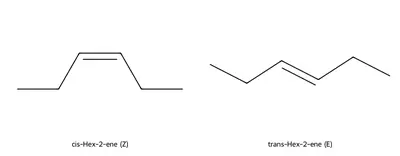
Draw the cis and trans structures of hex-2-ene. Which isomer will have higher b.p. and why?
Figure
Figure

Solution

Hex-2-ene is $$\mathrm{CH_3-CH=CH-CH_2-CH_2-CH_3}$$. Each carbon of the $$\mathrm{C=C}$$ bond carries two different groups (one carbon bears $$\mathrm{CH_3}$$ and $$\mathrm{H}$$; the other bears the n-propyl group $$\mathrm{-CH_2CH_2CH_3}$$ and $$\mathrm{H}$$), so geometrical isomerism is possible.

cis-hex-2-ene: draw the $$\mathrm{C=C}$$ horizontally with the $$\mathrm{CH_3}$$ group and the $$\mathrm{n}$$-propyl group on the same side of the double bond; the two $$\mathrm{H}$$ atoms then lie together on the opposite side.

trans-hex-2-ene: draw the $$\mathrm{CH_3}$$ group and the $$\mathrm{n}$$-propyl group on opposite sides of the double bond; the two $$\mathrm{H}$$ atoms are likewise on opposite sides.

Which has the higher boiling point? In the cis isomer the two alkyl groups lie on the same side, so their bond dipoles do not cancel and the molecule has a net dipole moment — it is polar. In the trans isomer the alkyl groups are on opposite sides and their dipoles largely cancel, so it is almost non-polar.

The polar cis isomer has stronger intermolecular (dipole–dipole) attractions, so more energy is needed to separate its molecules. Hence cis-hex-2-ene has the higher boiling point.

Answer

cis-hex-2-ene has the higher boiling point. It is polar (net dipole moment), whereas trans-hex-2-ene is nearly non-polar, so the cis isomer has stronger intermolecular forces.

9.10 Why is benzene extra ordinarily stable though it contains three double bonds?

Solution

Although benzene is conventionally drawn with three double bonds, the six $$\pi$$ electrons are not localised as three separate double bonds.

Each of the six carbon atoms is $$sp^2$$ hybridised and carries one unhybridised $$p$$-orbital perpendicular to the plane of the ring. These six $$p$$-orbitals overlap sideways with one another all round the ring.

This overlap produces two continuous rings of delocalised $$\pi$$ electron charge — one lying above and one below the plane of the carbon hexagon. The $$\pi$$ electrons therefore belong to the molecule as a whole, not to individual pairs of carbon atoms.

This complete delocalisation lowers the energy of the molecule. The actual benzene molecule is more stable than any single Kekulé structure (with fixed double bonds) by an amount called the resonance energy (about $$150\ \mathrm{kJ\,mol^{-1}}$$).

Because of this large resonance (delocalisation) energy, benzene is extraordinarily stable. It resists addition reactions (which would destroy the delocalised system) and instead prefers substitution reactions (which preserve it).

Answer

Its six π electrons are completely delocalised over all six carbon atoms (resonance), giving a large resonance/delocalisation energy (~150 kJ/mol). This makes benzene far more stable than a localised triene would be.

9.11 What are the necessary conditions for any system to be aromatic?

Solution

A system is said to be aromatic only if it satisfies all of the following conditions:

  1. It must be cyclic and planar. All the atoms of the ring lie in one plane, so that the $$p$$-orbitals can overlap effectively.
  2. It must have complete delocalisation of $$\pi$$ electrons in the ring. Every atom of the ring is $$sp^2$$ (or $$sp$$) hybridised and carries a $$p$$-orbital, giving an uninterrupted (fully conjugated) closed loop of overlapping $$p$$-orbitals.
  3. It must obey Hückel's rule. The cyclic $$\pi$$ system must contain $$(4n+2)$$ $$\pi$$ electrons, where $$n = 0, 1, 2, 3, \ldots$$ — that is, $$2, 6, 10, \ldots$$ $$\pi$$ electrons. Benzene, with $$6$$ $$\pi$$ electrons, corresponds to $$n = 1$$.

Answer

The system must be (1) cyclic and planar, (2) have a continuous closed loop of fully delocalised (conjugated) π electrons, and (3) contain (4n+2) π electrons (Hückel's rule, n = 0, 1, 2, ...).

9.12 Explain why the following systems are not aromatic?

(i) A cyclohexane ring bearing an exocyclic $$\mathrm{=CH_2}$$ group (methylenecyclohexane-type system).

Solution

This system is a cyclohexane ring carrying an exocyclic $$\mathrm{=CH_2}$$ group. The ring carbon atoms are essentially $$sp^3$$ hybridised (saturated), and the only double bond points outside the ring.

For aromaticity the ring must have a continuous closed loop of delocalised $$\pi$$ electrons, which requires every ring atom to be $$sp^2$$ with a $$p$$-orbital that conjugates all round the ring.

Here there is no such loop: the ring atoms carry no conjugated $$p$$-orbitals going round the ring, so there are no delocalised $$\pi$$ electrons within the ring and Hückel's $$(4n+2)$$ rule cannot even be applied.

Hence this system is not aromatic.

Answer

Not aromatic: the ring carbons are sp3 and the double bond is exocyclic, so the ring has no continuous closed loop of delocalised π electrons.

(ii) A bicyclic fused-ring system (two fused four-membered rings) lacking continuous conjugation.

Solution

This is a bicyclic (fused-ring) system in which there is no continuous conjugated path of $$p$$-orbitals running round a single closed ring.

Aromaticity requires a planar ring with an uninterrupted closed loop of delocalised $$\pi$$ electrons, with every ring atom $$sp^2$$ hybridised and its $$p$$-orbitals overlapping continuously.

In this fused system the conjugation is broken — not all ring atoms are $$sp^2$$ with parallel, continuously overlapping $$p$$-orbitals — so the $$\pi$$ electrons are not delocalised over a complete closed ring, and Hückel's $$(4n+2)$$ condition cannot be satisfied for a single ring.

Hence this system is not aromatic.

Answer

Not aromatic: it lacks a continuous closed loop of delocalised π electrons (conjugation is broken), so Hückel's (4n+2) rule cannot be satisfied.

(iii) Cyclooctatetraene (an 8-membered ring with four alternating double bonds).

Solution

Cyclooctatetraene is an 8-membered carbon ring containing four alternating $$\mathrm{C=C}$$ double bonds, so it has $$4 \times 2 = 8$$ $$\pi$$ electrons.

Hückel test. An aromatic ring must have $$(4n+2)$$ $$\pi$$ electrons. Setting $$4n+2 = 8$$ gives $$n = 1.5$$, which is not a whole number. So $$8$$ $$\pi$$ electrons do not satisfy Hückel's rule (the allowed numbers are $$2, 6, 10, \ldots$$).

Geometry. To avoid the strain and electronic instability of a planar $$8$$ $$\pi$$-electron ring, cyclooctatetraene actually adopts a non-planar 'tub' shape. Its $$p$$-orbitals are therefore not all parallel and cannot overlap continuously round the ring, so the $$\pi$$ electrons are not delocalised.

Failing both the electron-count rule and the planarity/delocalisation requirement, cyclooctatetraene is not aromatic.

Answer

Not aromatic: it has 8 π electrons, which does not fit the (4n+2) rule, and it is non-planar (tub-shaped), so the π electrons are not delocalised.

9.13 How will you convert benzene into

(i) p-nitrobromobenzene

Solution

We need a bromine atom and a nitro group para to each other. Bromine ($$\mathrm{-Br}$$) is an ortho/para-directing group, so bromination is carried out first and nitration second.

Step 1 — Bromination. Benzene reacts with bromine in the presence of a Lewis acid catalyst ($$\mathrm{FeBr_3}$$) to give bromobenzene.

$$\mathrm{C_6H_6 + Br_2 \xrightarrow{FeBr_3} C_6H_5Br + HBr}$$

Step 2 — Nitration. Bromobenzene is treated with a nitrating mixture of concentrated $$\mathrm{HNO_3}$$ and concentrated $$\mathrm{H_2SO_4}$$. Since $$\mathrm{-Br}$$ directs the incoming group to the ortho and para positions, the para product predominates.

$$\mathrm{C_6H_5Br \xrightarrow[\text{conc. }H_2SO_4]{\text{conc. }HNO_3} \textit{p}\text{-}O_2N\text{-}C_6H_4\text{-}Br}$$

The major product is p-nitrobromobenzene.

Answer

Brominate benzene first (Br2/FeBr3 → bromobenzene), then nitrate it (conc. HNO3 + conc. H2SO4). The o/p-directing Br group gives p-nitrobromobenzene as the major product.

(ii) m-nitrochlorobenzene

Solution

We need a chlorine atom and a nitro group meta to each other. The nitro group ($$\mathrm{-NO_2}$$) is a meta-directing group, so nitration is carried out first and chlorination second.

Step 1 — Nitration. Benzene is treated with a nitrating mixture of concentrated $$\mathrm{HNO_3}$$ and concentrated $$\mathrm{H_2SO_4}$$ to give nitrobenzene.

$$\mathrm{C_6H_6 \xrightarrow[\text{conc. }H_2SO_4]{\text{conc. }HNO_3} C_6H_5NO_2}$$

Step 2 — Chlorination. Nitrobenzene reacts with chlorine in the presence of anhydrous $$\mathrm{FeCl_3}$$. Because $$\mathrm{-NO_2}$$ directs the incoming group to the meta position, the meta isomer is obtained.

$$\mathrm{C_6H_5NO_2 + Cl_2 \xrightarrow{anhyd.\ FeCl_3} \textit{m}\text{-}O_2N\text{-}C_6H_4\text{-}Cl + HCl}$$

The product is m-nitrochlorobenzene.

Answer

Nitrate benzene first (conc. HNO3 + conc. H2SO4 → nitrobenzene), then chlorinate it (Cl2/anhydrous FeCl3). The m-directing NO2 group gives m-nitrochlorobenzene.

(iii) p-nitrotoluene

Solution

We need a methyl group and a nitro group para to each other. The methyl group ($$\mathrm{-CH_3}$$) is an ortho/para-directing group, so methylation is carried out first and nitration second.

Step 1 — Friedel–Crafts methylation. Benzene reacts with methyl chloride in the presence of anhydrous $$\mathrm{AlCl_3}$$ to give toluene.

$$\mathrm{C_6H_6 + CH_3Cl \xrightarrow{anhyd.\ AlCl_3} C_6H_5CH_3 + HCl}$$

Step 2 — Nitration. Toluene is treated with concentrated $$\mathrm{HNO_3}$$ and concentrated $$\mathrm{H_2SO_4}$$. As $$\mathrm{-CH_3}$$ directs the incoming group to the ortho and para positions, the para product predominates.

$$\mathrm{C_6H_5CH_3 \xrightarrow[\text{conc. }H_2SO_4]{\text{conc. }HNO_3} \textit{p}\text{-}O_2N\text{-}C_6H_4\text{-}CH_3}$$

The major product is p-nitrotoluene.

Answer

Methylate benzene first (CH3Cl/anhydrous AlCl3 → toluene), then nitrate it (conc. HNO3 + conc. H2SO4). The o/p-directing CH3 group gives p-nitrotoluene as the major product.

(iv) acetophenone?

Solution

Acetophenone is $$\mathrm{C_6H_5-CO-CH_3}$$. It is prepared by Friedel–Crafts acylation of benzene.

Benzene is treated with acetyl chloride ($$\mathrm{CH_3COCl}$$) in the presence of anhydrous $$\mathrm{AlCl_3}$$. The Lewis acid generates the acylium electrophile $$\mathrm{CH_3\overset{+}{C}O}$$, which substitutes onto the ring.

$$\mathrm{C_6H_6 + CH_3COCl \xrightarrow{anhyd.\ AlCl_3} C_6H_5COCH_3 + HCl}$$

The product is acetophenone (1-phenylethan-1-one). Acetic anhydride $$\mathrm{(CH_3CO)_2O}$$ may be used in place of acetyl chloride.

Answer

By Friedel–Crafts acylation: treat benzene with acetyl chloride (CH3COCl) and anhydrous AlCl3 to give acetophenone, C6H5COCH3.

9.14 In the alkane $$\mathrm{H_3C - CH_2 - C(CH_3)_2 - CH_2 - CH(CH_3)_2}$$, identify $$1^\circ$$, $$2^\circ$$, $$3^\circ$$ carbon atoms and give the number of H atoms bonded to each one of these.

Solution

First write out the structure, labelling the backbone carbons C-1 to C-5:

$$\mathrm{\overset{C1}{C}H_3 - \overset{C2}{C}H_2 - \overset{C3}{C}(CH_3)_2 - \overset{C4}{C}H_2 - \overset{C5}{C}H(CH_3)_2}$$

Besides the five backbone carbons there are four branch methyl carbons — two attached to C-3 and two attached to C-5.

A carbon is classified by how many other carbon atoms are directly attached to it: primary $$(1^\circ)$$ — bonded to one C; secondary $$(2^\circ)$$ — bonded to two C; tertiary $$(3^\circ)$$ — bonded to three C; quaternary $$(4^\circ)$$ — bonded to four C.

CarbonNo. of C attachedTypeNo. of H atoms
C-1 and the four branch $$\mathrm{CH_3}$$ groups1$$1^\circ$$3 each
C-22$$2^\circ$$2
C-42$$2^\circ$$2
C-53$$3^\circ$$1
C-34$$4^\circ$$0

Summary:

  • Primary $$(1^\circ)$$ carbons: 5 in all — C-1 together with the four branch methyl groups — each bonded to 3 H atoms.
  • Secondary $$(2^\circ)$$ carbons: 2 — C-2 and C-4 — each bonded to 2 H atoms.
  • Tertiary $$(3^\circ)$$ carbon: 1 — C-5 — bonded to 1 H atom.
  • (C-3 is a quaternary carbon, bonded to 0 H atoms.)

Answer

1° carbons: 5 (C-1 plus the four branch CH3 groups), 3 H each. 2° carbons: 2 (C-2 and C-4), 2 H each. 3° carbon: 1 (C-5), 1 H. (C-3 is quaternary, 0 H.)

9.15 What effect does branching of an alkane chain has on its boiling point?

Solution

The boiling point of an alkane depends on the strength of the intermolecular van der Waals (London dispersion) forces, which in turn depend on how large an area of contact the molecules can present to one another.

As an alkane chain becomes more branched, the molecule becomes more compact and approaches a spherical shape. A sphere has the smallest surface area for a given volume, so branched molecules touch one another over a smaller area.

A smaller area of contact means weaker van der Waals forces, so less energy is needed to separate the molecules, and the boiling point is lower.

Therefore, for isomers of the same molecular formula, boiling point decreases as branching increases. For example, among the isomers of $$\mathrm{C_5H_{12}}$$:

n-pentane (b.p. $$309\ \mathrm{K}$$) $$>$$ 2-methylbutane (b.p. $$301\ \mathrm{K}$$) $$>$$ 2,2-dimethylpropane (b.p. $$282.5\ \mathrm{K}$$).

Answer

Branching lowers the boiling point. A branched molecule is more compact (nearly spherical) and has a smaller surface area, so the van der Waals forces between molecules are weaker — hence a lower boiling point than the straight-chain isomer.

9.16 Addition of HBr to propene yields 2-bromopropane, while in the presence of benzoyl peroxide, the same reaction yields 1-bromopropane. Explain and give mechanism.

Solution

Without peroxide — Markovnikov addition (ionic mechanism). In the absence of peroxide, HBr adds to propene by an ionic (electrophilic) mechanism that follows Markovnikov's rule: the hydrogen adds to the doubly-bonded carbon that already carries more hydrogen atoms.

Mechanism:

Step 1 — HBr supplies the electrophile $$\mathrm{H^+}$$, which adds to the double bond. Addition could give either a secondary or a primary carbocation:

$$\mathrm{CH_3-CH=CH_2 + H^+ \longrightarrow CH_3-\overset{+}{C}H-CH_3}$$ (secondary — more stable)
or $$\mathrm{CH_3-CH_2-\overset{+}{C}H_2}$$ (primary — less stable)

The secondary carbocation is more stable (greater stabilisation by hyperconjugation and the inductive effect), so it is formed preferentially.

Step 2 — the bromide ion $$\mathrm{Br^-}$$ attacks this carbocation:

$$\mathrm{CH_3-\overset{+}{C}H-CH_3 + Br^- \longrightarrow CH_3-CHBr-CH_3}$$

Product: 2-bromopropane.

With benzoyl peroxide — anti-Markovnikov addition (free-radical mechanism, the peroxide or Kharasch effect). In the presence of peroxide, HBr adds by a free-radical chain mechanism, and the bromine adds to the terminal carbon (anti-Markovnikov).

Mechanism:

Initiation — the peroxide breaks homolytically, and the radicals formed react with HBr to give bromine atoms:

$$\mathrm{(C_6H_5COO)_2 \xrightarrow{\Delta} 2\,C_6H_5\overset{\bullet}{C}OO \longrightarrow 2\,\overset{\bullet}{C}_6H_5 + 2\,CO_2}$$
$$\mathrm{\overset{\bullet}{C}_6H_5 + HBr \longrightarrow C_6H_6 + \overset{\bullet}{B}r}$$

Propagation — the bromine radical adds to the double bond. It adds to the terminal carbon because this produces the more stable secondary carbon radical:

$$\mathrm{CH_3-CH=CH_2 + \overset{\bullet}{B}r \longrightarrow CH_3-\overset{\bullet}{C}H-CH_2Br}$$ (secondary radical — more stable)
$$\mathrm{CH_3-\overset{\bullet}{C}H-CH_2Br + HBr \longrightarrow CH_3-CH_2-CH_2Br + \overset{\bullet}{B}r}$$

The regenerated $$\mathrm{\overset{\bullet}{B}r}$$ continues the chain. Product: 1-bromopropane.

Conclusion. The change of mechanism reverses the orientation of addition: the ionic route goes through the more stable carbocation (Br on C-2), while the free-radical route goes through the more stable carbon radical (Br on C-1). The peroxide effect is observed only with HBr (not with HCl or HI).

Answer

Without peroxide HBr adds ionically (Markovnikov) via the more stable secondary carbocation, placing Br on C-2 → 2-bromopropane. With benzoyl peroxide it adds by a free-radical chain (anti-Markovnikov) via the more stable secondary carbon radical, placing Br on the terminal carbon → 1-bromopropane.

9.17 Write down the products of ozonolysis of 1,2-dimethylbenzene (o-xylene). How does the result support Kekulé structure for benzene?

Solution

The two Kekulé structures. Kekulé represented benzene as a six-membered ring with three alternating double bonds. Because the double bonds can be placed in two alternative ways, benzene is a resonance hybrid of two Kekulé structures (I and II) in which the double bonds occupy different positions.

For o-xylene (1,2-dimethylbenzene) the two Kekulé forms differ in whether the bond between the two methyl-bearing carbons (C-1 and C-2) is a double bond or a single bond.

Ozonolysis of structure I (double bonds at C1–C2, C3–C4, C5–C6). Cleaving each $$\mathrm{C=C}$$ converts the carbons to carbonyl groups and gives:

  • from the C1–C6 fragment (one $$\mathrm{CH_3}$$, one $$\mathrm{H}$$): methylglyoxal, $$\mathrm{CH_3-CO-CHO}$$
  • from the C2–C3 fragment (one $$\mathrm{CH_3}$$, one $$\mathrm{H}$$): methylglyoxal, $$\mathrm{CH_3-CO-CHO}$$
  • from the C4–C5 fragment (two $$\mathrm{H}$$): glyoxal, $$\mathrm{OHC-CHO}$$

Ozonolysis of structure II (double bonds at C2–C3, C4–C5, C6–C1) gives:

  • from the C1–C2 fragment (two $$\mathrm{CH_3}$$): dimethylglyoxal, $$\mathrm{CH_3-CO-CO-CH_3}$$
  • from the C3–C4 fragment (two $$\mathrm{H}$$): glyoxal, $$\mathrm{OHC-CHO}$$
  • from the C5–C6 fragment (two $$\mathrm{H}$$): glyoxal, $$\mathrm{OHC-CHO}$$

Observed result. In practice, ozonolysis of o-xylene gives a mixture of three products: glyoxal $$\mathrm{(OHC-CHO)}$$, methylglyoxal $$\mathrm{(CH_3COCHO)}$$ and dimethylglyoxal $$\mathrm{(CH_3COCOCH_3)}$$.

How this supports the Kekulé structure. A single fixed Kekulé structure could give only two of these three products. Obtaining all three shows that the bond between the methyl-bearing carbons is a double bond in some molecules and a single bond in others — i.e. benzene is a resonance hybrid of the two Kekulé structures, with the double bonds continually interchanging their positions. This is exactly what Kekulé proposed (two oscillating forms), so the result supports the Kekulé structure for benzene.

Answer

Ozonolysis of o-xylene gives three products — glyoxal, methylglyoxal and dimethylglyoxal. A single fixed Kekulé structure would give only two of them; obtaining all three shows that benzene is a resonance hybrid of the two Kekulé structures (the double bonds keep oscillating). This supports the Kekulé structure.

9.18 Arrange benzene, n-hexane and ethyne in decreasing order of acidic behaviour. Also give reason for this behaviour.

Solution

The acidic behaviour compared here is the tendency of a C–H bond to release its hydrogen as $$\mathrm{H^+}$$. This depends on the hybridisation of the carbon holding that hydrogen — specifically on the s-character of its hybrid orbital.

An orbital with greater s-character holds its electrons closer to the nucleus, making that carbon effectively more electronegative. This makes the C–H bond more polar, the proton easier to remove, and the resulting carbanion more stable.

HydrocarbonHybridisation of C–H carbons-character
Ethyne $$\mathrm{(HC\equiv CH)}$$$$sp$$50%
Benzene$$sp^2$$33%
n-Hexane$$sp^3$$25%

Greater s-character $$\Rightarrow$$ more acidic. Hence the decreasing order of acidic behaviour is:

$$\text{Ethyne} \;>\; \text{Benzene} \;>\; \textit{n}\text{-Hexane}$$

Answer

Decreasing acidity: ethyne > benzene > n-hexane. The C–H carbon is sp (50% s) in ethyne, sp2 (33% s) in benzene and sp3 (25% s) in n-hexane; greater s-character makes the C–H bond more polar and the proton more easily lost.

9.19 Why does benzene undergo electrophilic substitution reactions easily and nucleophilic substitutions with difficulty?

Solution

In benzene each carbon is $$sp^2$$ hybridised, and the six unhybridised $$p$$-orbitals overlap to form a delocalised $$\pi$$ electron cloud lying above and below the plane of the ring.

This $$\pi$$ cloud makes the ring a region of high electron density.

Electrophilic substitution (occurs easily): an electrophile $$\mathrm{E^+}$$ is electron-deficient. It is strongly attracted to the electron-rich $$\pi$$ cloud of benzene and therefore readily attacks the ring. Substitution (rather than addition) then takes place because it restores the stable delocalised $$\pi$$ system. Hence benzene undergoes electrophilic substitution easily.

Nucleophilic substitution (occurs with difficulty): a nucleophile is electron-rich (it carries a lone pair or a negative charge). It is repelled by the electron-rich $$\pi$$ cloud of benzene, so it cannot easily approach and attack the ring. Hence benzene undergoes nucleophilic substitution only with great difficulty.

Answer

Benzene's delocalised π electron cloud makes the ring electron-rich. It therefore attracts electron-deficient electrophiles (so electrophilic substitution is easy) but repels electron-rich nucleophiles (so nucleophilic substitution is difficult).

9.20 How would you convert the following compounds into benzene?

(i) Ethyne

Solution

Ethyne is converted to benzene by cyclic polymerisation. When ethyne is passed through a red-hot iron tube at about $$873\ \mathrm{K}$$, three molecules of ethyne combine (trimerise) to form one molecule of benzene.

$$\mathrm{3\,CH\equiv CH \xrightarrow[873\ K]{\text{Red-hot Fe tube}} C_6H_6}$$

Answer

Pass ethyne through a red-hot iron tube at 873 K; three molecules cyclise (polymerise) to benzene: $$\mathrm{3CH\equiv CH \rightarrow C_6H_6}$$.

(ii) Ethene

Solution

Ethene is first converted into ethyne, which is then trimerised to benzene.

Step 1 — Ethene to 1,2-dibromoethane. Ethene adds bromine across the double bond.

$$\mathrm{CH_2=CH_2 + Br_2 \longrightarrow BrCH_2-CH_2Br}$$

Step 2 — 1,2-Dibromoethane to ethyne. Heating with alcoholic $$\mathrm{KOH}$$ removes two molecules of HBr (double dehydrohalogenation).

$$\mathrm{BrCH_2-CH_2Br \xrightarrow[\Delta]{\text{alc. }KOH} CH\equiv CH + 2\,KBr + 2\,H_2O}$$

(A stronger base such as $$\mathrm{NaNH_2}$$ may be used to drive the second elimination.)

Step 3 — Ethyne to benzene. Three molecules of ethyne undergo cyclic polymerisation on a red-hot iron tube at about $$873\ \mathrm{K}$$.

$$\mathrm{3\,CH\equiv CH \xrightarrow[873\ K]{\text{Red-hot Fe tube}} C_6H_6}$$

Answer

Ethene + Br2 → 1,2-dibromoethane; this with alcoholic KOH → ethyne; then three molecules of ethyne, passed through a red-hot Fe tube at 873 K, cyclise to benzene.

(iii) Hexane

Solution

Hexane is converted to benzene by aromatization (cyclisation followed by dehydrogenation, also called reforming).

n-Hexane is heated to about $$773\ \mathrm{K}$$ under $$10$$–$$20\ \mathrm{atm}$$ pressure over a catalyst such as $$\mathrm{V_2O_5}$$, $$\mathrm{Mo_2O_3}$$ or $$\mathrm{Cr_2O_3}$$ supported on alumina. The chain cyclises into a six-membered ring and loses hydrogen to give benzene.

$$\mathrm{CH_3(CH_2)_4CH_3 \xrightarrow[773\ K,\ 10{-}20\ atm]{Cr_2O_3/Al_2O_3} C_6H_6 + 4\,H_2}$$

Answer

Heat n-hexane at about 773 K and 10–20 atm over a Cr2O3/Al2O3 catalyst (aromatization): it cyclises and loses 4 H2 to give benzene.

9.21 Write structures of all the alkenes which on hydrogenation give 2-methylbutane.

Solution

On hydrogenation a $$\mathrm{C=C}$$ double bond becomes a $$\mathrm{C-C}$$ single bond (two H atoms add across it). So an alkene gives 2-methylbutane on hydrogenation only if it has the carbon skeleton of 2-methylbutane with one double bond placed somewhere within it.

The 2-methylbutane skeleton is $$\mathrm{CH_3-CH(CH_3)-CH_2-CH_3}$$ (C-1 to C-4 with a methyl branch on C-2). Place the double bond at each possible position:

1. Double bond between C-1 and C-2:
$$\mathrm{CH_2=C(CH_3)-CH_2-CH_3}$$ — 2-Methylbut-1-ene

2. Double bond between C-2 and C-3:
$$\mathrm{CH_3-C(CH_3)=CH-CH_3}$$ — 2-Methylbut-2-ene

3. Double bond between C-3 and C-4:
$$\mathrm{(CH_3)_2CH-CH=CH_2}$$ — 3-Methylbut-1-ene

(Placing a double bond from C-2 to the branch methyl gives the same compound as case 1, since the two methyl groups on C-2 are equivalent.)

Each of these three alkenes, on catalytic hydrogenation, gives 2-methylbutane.

Answer

Three alkenes: 2-methylbut-1-ene, 2-methylbut-2-ene and 3-methylbut-1-ene.

9.22 Arrange the following set of compounds in order of their decreasing relative reactivity with an electrophile, $$\mathrm{E^+}$$

(a) Chlorobenzene, 2,4-dinitrochlorobenzene, p-nitrochlorobenzene

Solution

Reaction with an electrophile $$\mathrm{E^+}$$ is an electrophilic substitution; it is faster when the ring is more electron-rich. The nitro group $$\mathrm{(-NO_2)}$$ is strongly electron-withdrawing (a powerful deactivating group), so each $$\mathrm{-NO_2}$$ added makes the ring poorer in electrons and therefore less reactive towards $$\mathrm{E^+}$$.

  • Chlorobenzene — carries no $$\mathrm{-NO_2}$$ group.
  • p-Nitrochlorobenzene — carries one $$\mathrm{-NO_2}$$ group.
  • 2,4-Dinitrochlorobenzene — carries two $$\mathrm{-NO_2}$$ groups.

More nitro groups $$\Rightarrow$$ more deactivation $$\Rightarrow$$ lower reactivity. Hence the decreasing order of reactivity towards $$\mathrm{E^+}$$ is:

$$\text{Chlorobenzene} > \textit{p}\text{-nitrochlorobenzene} > 2,4\text{-dinitrochlorobenzene}$$

Answer

Chlorobenzene > p-nitrochlorobenzene > 2,4-dinitrochlorobenzene. Each electron-withdrawing –NO2 group deactivates the ring, so more –NO2 groups mean lower reactivity towards an electrophile.

(b) Toluene, $$\mathrm{\textit{p}-H_3C - C_6H_4 - NO_2}$$, $$\mathrm{\textit{p}-O_2N - C_6H_4 - NO_2}$$.

Solution

Reactivity towards an electrophile $$\mathrm{E^+}$$ increases when the ring is made more electron-rich and decreases when it is made more electron-poor.

  • The methyl group $$\mathrm{(-CH_3)}$$ is electron-donating (activating) — it raises the ring's electron density.
  • The nitro group $$\mathrm{(-NO_2)}$$ is strongly electron-withdrawing (deactivating) — it lowers the ring's electron density.

Comparing the three compounds:

  • Toluene $$\mathrm{(C_6H_5CH_3)}$$ — one activating $$\mathrm{-CH_3}$$ and no deactivating group $$\Rightarrow$$ most reactive.
  • p-Nitrotoluene $$\mathrm{(\textit{p}\text{-}H_3C\text{-}C_6H_4\text{-}NO_2)}$$ — one activating $$\mathrm{-CH_3}$$ together with one deactivating $$\mathrm{-NO_2}$$ $$\Rightarrow$$ intermediate.
  • p-Dinitrobenzene $$\mathrm{(\textit{p}\text{-}O_2N\text{-}C_6H_4\text{-}NO_2)}$$ — two strongly deactivating $$\mathrm{-NO_2}$$ groups $$\Rightarrow$$ least reactive.

Hence the decreasing order of reactivity towards $$\mathrm{E^+}$$ is:

$$\text{Toluene} > \textit{p}\text{-nitrotoluene} > \textit{p}\text{-dinitrobenzene}$$

Answer

Toluene > p-nitrotoluene > p-dinitrobenzene. The electron-donating –CH3 activates the ring while the electron-withdrawing –NO2 deactivates it, so reactivity falls as –CH3 is replaced by –NO2.

9.23 Out of benzene, m-dinitrobenzene and toluene which will undergo nitration most easily and why?

Solution

Nitration is an electrophilic substitution carried out by the nitronium ion $$\mathrm{NO_2^+}$$. It occurs more easily the more electron-rich the ring is.

  • Toluene bears a $$\mathrm{-CH_3}$$ group, which is electron-donating (by the inductive effect and hyperconjugation). It increases the electron density of the ring — the ring is activated.
  • Benzene has no substituent — it is the reference compound, neither activated nor deactivated.
  • m-Dinitrobenzene bears two $$\mathrm{-NO_2}$$ groups, which are strongly electron-withdrawing. They decrease the electron density of the ring — the ring is strongly deactivated.

The more electron-rich the ring, the faster it reacts with $$\mathrm{NO_2^+}$$. Hence the ease of nitration is:

$$\text{Toluene} > \text{Benzene} > \textit{m}\text{-dinitrobenzene}$$

Therefore toluene undergoes nitration most easily, because its electron-releasing methyl group makes the ring the most electron-rich (most activated) of the three.

Answer

Toluene undergoes nitration most easily. Its electron-donating –CH3 group raises the ring's electron density (activates it), whereas the two electron-withdrawing –NO2 groups of m-dinitrobenzene strongly deactivate the ring.

9.24 Suggest the name of a Lewis acid other than anhydrous aluminium chloride which can be used during ethylation of benzene.

Solution

Ethylation of benzene is a Friedel–Crafts alkylation: benzene reacts with an ethyl halide (e.g. ethyl chloride) in the presence of a Lewis acid catalyst. The Lewis acid is needed to generate the ethyl carbocation electrophile from the ethyl halide.

Apart from anhydrous aluminium chloride $$\mathrm{(AlCl_3)}$$, another Lewis acid that works well for this purpose is anhydrous ferric chloride, $$\mathrm{FeCl_3}$$.

(Other Lewis acids such as anhydrous $$\mathrm{AlBr_3}$$, $$\mathrm{FeBr_3}$$ or $$\mathrm{BF_3}$$ can also be used.)

Answer

Anhydrous ferric chloride, FeCl3 (other Lewis acids such as anhydrous AlBr3, FeBr3 or BF3 also work).

9.25 Why is Wurtz reaction not preferred for the preparation of alkanes containing odd number of carbon atoms? Illustrate your answer by taking one example.

Solution

In the Wurtz reaction an alkyl halide reacts with sodium; two alkyl groups join together through a new C–C bond:

$$\mathrm{2\,R-X + 2\,Na \longrightarrow R-R + 2\,NaX}$$

When a single alkyl halide $$\mathrm{R-X}$$ is used, the product $$\mathrm{R-R}$$ contains twice the number of carbon atoms of the group R. So a single alkyl halide can give only an alkane with an even number of carbon atoms (ethane, butane, hexane, and so on).

To obtain an alkane with an odd number of carbon atoms, one is forced to couple two different alkyl halides. But then the two kinds of alkyl groups combine in all possible ways and a mixture of three alkanes is produced. These three alkanes have similar physical properties and are very difficult to separate, so the yield of the desired alkane is poor. This is why the Wurtz reaction is not preferred for odd-carbon alkanes.

Example — preparation of propane (3 carbon atoms, odd). One must take methyl bromide and ethyl bromide together. The coupling then gives three products:

$$\mathrm{CH_3Br + CH_3Br \xrightarrow{2Na} CH_3-CH_3}$$  (ethane)
$$\mathrm{C_2H_5Br + C_2H_5Br \xrightarrow{2Na} C_2H_5-C_2H_5}$$  (butane)
$$\mathrm{CH_3Br + C_2H_5Br \xrightarrow{2Na} CH_3-C_2H_5}$$  (propane)

The desired propane is obtained only as part of a hard-to-separate mixture with ethane and butane, in low yield. Hence the Wurtz reaction is not preferred for preparing alkanes with an odd number of carbon atoms.

Answer

A single alkyl halide couples to give an alkane with an even number of carbon atoms. An odd-carbon alkane requires two different alkyl halides, which produces a mixture of three alkanes (e.g. propane comes mixed with ethane and butane) that is hard to separate and gives a poor yield — so the Wurtz reaction is not preferred.
NCERT Solutions for Class 11
Maths
NCERT Solutions for Class 11 Maths
Chapter-wise step-by-step
solutions with explanations
explore solutions Maths bg
Physics
NCERT Solutions for Class 11 Physics
Chapter-wise step-by-step
solutions with explanations
explore solutions Physics bg
Chemistry
NCERT Solutions for Class 11 Chemistry
Chapter-wise step-by-step
solutions with explanations
explore solutions Chemistry bg

Frequently Asked Questions

50,000+ JEE Students Trusted Our Score Calculator

Predict your JEE Main percentile, rank & performance in seconds