Join WhatsApp Icon JEE WhatsApp Group
NCERT Solutions for Class 11 Chemistry

Chapter 8: Organic Chemistry – Some Basic Principles and Techniques

Download Solutions PDF
Daily JEE Updates, Tips & Important Alerts
Join 30,000+ students and stay updated with JEE notifications and preparation insights.
Join Now!
Free PDF
Complete NCERT Solution PDF for Chapter 8: Organic Chemistry – Some Basic Principles and Techniques

NCERT Solutions For Class 11 Chemistry Chapter 8 Organic Chemistry – Some Basic Principles and Techniques introduces students to the fundamental concepts required for studying carbon-based compounds. The page provides complete NCERT Solutions that explain topics such as classification of organic compounds, nomenclature, isomerism, purification methods, and reaction mechanisms. NCERT Solutions For Class 11 Chemistry help students understand the basic principles of organic Chemistry through systematic explanations and examples. The chapter builds the foundation required for learning complex organic reactions in higher classes. These solutions help students practise textbook questions, understand structures, and improve their problem-solving approach. Students can access the chapter PDF for revision and preparation. The detailed explanations make organic Chemistry concepts easier to understand and apply.
Download Solutions PDF

In-text Problems

Problem 8.1

How many $$\sigma$$ and $$\pi$$ bonds are present in each of the following molecules?

(a) $$\mathrm{HC\equiv C-CH=CH-CH_3}$$ (b) $$\mathrm{CH_2=C=CH-CH_3}$$

Solution

Counting rule: every single bond is one $$\sigma$$ bond; a double bond is one $$\sigma$$ + one $$\pi$$; a triple bond is one $$\sigma$$ + two $$\pi$$. Each C–H bond is a $$\sigma$$ bond.

(a) $$\mathrm{HC\equiv C-CH=CH-CH_3}$$

Label the carbons $$\mathrm{C_1\equiv C_2-C_3=C_4-C_5}$$.

Bond$$\sigma$$$$\pi$$
$$\mathrm{C_1-H}$$10
$$\mathrm{C_1\equiv C_2}$$12
$$\mathrm{C_2-C_3}$$10
$$\mathrm{C_3-H}$$10
$$\mathrm{C_3=C_4}$$11
$$\mathrm{C_4-H}$$10
$$\mathrm{C_4-C_5}$$10
$$\mathrm{C_5-H}$$ (three)30

Adding up: $$\sigma = 1+1+1+1+1+1+1+3 = 10$$ and $$\pi = 2+1 = 3$$.

(b) $$\mathrm{CH_2=C=CH-CH_3}$$

Label the carbons $$\mathrm{C_1=C_2=C_3-C_4}$$.

Bond$$\sigma$$$$\pi$$
$$\mathrm{C_1-H}$$ (two)20
$$\mathrm{C_1=C_2}$$11
$$\mathrm{C_2=C_3}$$11
$$\mathrm{C_3-H}$$10
$$\mathrm{C_3-C_4}$$10
$$\mathrm{C_4-H}$$ (three)30

Adding up: $$\sigma = 2+1+1+1+1+3 = 9$$ and $$\pi = 1+1 = 2$$.

Answer

(a) $$10\ \sigma$$ bonds and $$3\ \pi$$ bonds; (b) $$9\ \sigma$$ bonds and $$2\ \pi$$ bonds.

Problem 8.2

What is the type of hybridisation of each carbon in the following compounds?

(a) $$\mathrm{CH_3Cl}$$, (b) $$\mathrm{(CH_3)_2CO}$$, (c) $$\mathrm{CH_3CN}$$, (d) $$\mathrm{HCONH_2}$$, (e) $$\mathrm{CH_3CH=CHCN}$$

Solution

The hybridisation of a carbon atom is fixed by the number of $$\sigma$$ bonds it forms (i.e. the number of atoms directly attached): four $$\sigma$$ bonds $$\to sp^3$$, three $$\sigma$$ bonds $$\to sp^2$$, two $$\sigma$$ bonds $$\to sp$$.

(a) $$\mathrm{CH_3Cl}$$: the carbon forms 4 $$\sigma$$ bonds (three C–H, one C–Cl) $$\to sp^3$$.

(b) $$\mathrm{(CH_3)_2CO}$$: each $$\mathrm{CH_3}$$ carbon forms 4 $$\sigma$$ bonds $$\to sp^3$$. The carbonyl carbon forms 3 $$\sigma$$ bonds (two C–C, one C–O) plus one $$\pi$$ bond $$\to sp^2$$.

(c) $$\mathrm{CH_3CN}$$: the $$\mathrm{CH_3}$$ carbon forms 4 $$\sigma$$ bonds $$\to sp^3$$. The nitrile carbon forms 2 $$\sigma$$ bonds (one C–C, one C–N) plus two $$\pi$$ bonds $$\to sp$$.

(d) $$\mathrm{HCONH_2}$$: the carbon forms 3 $$\sigma$$ bonds (C–H, C–O, C–N) plus one $$\pi$$ bond $$\to sp^2$$.

(e) $$\mathrm{CH_3CH=CHCN}$$: the $$\mathrm{CH_3}$$ carbon $$\to sp^3$$; the two doubly-bonded carbons ($$\mathrm{-CH=CH-}$$) each form 3 $$\sigma$$ bonds $$\to sp^2$$; the nitrile carbon forms 2 $$\sigma$$ bonds $$\to sp$$.

Answer

(a) $$sp^3$$. (b) $$\mathrm{CH_3}$$ carbons $$sp^3$$, carbonyl carbon $$sp^2$$. (c) $$\mathrm{CH_3}$$ carbon $$sp^3$$, nitrile carbon $$sp$$. (d) $$sp^2$$. (e) $$\mathrm{CH_3}$$ carbon $$sp^3$$, the two $$=CH-$$ carbons $$sp^2$$, nitrile carbon $$sp$$.

Problem 8.3

Write the state of hybridisation of carbon in the following compounds and shapes of each of the molecules.

(a) $$\mathrm{H_2C=O}$$, (b) $$\mathrm{CH_3F}$$, (c) $$\mathrm{HC\equiv N}$$.

Solution

The hybridisation follows from the number of $$\sigma$$ bonds on the carbon, and the molecular shape from the geometry of the $$\sigma$$-bond framework around it.

(a) $$\mathrm{H_2C=O}$$ (methanal): the carbon forms 3 $$\sigma$$ bonds (two C–H, one C–O) and one $$\pi$$ bond, so it is $$sp^2$$ hybridised. Three $$\sigma$$ bonds and no lone pair on carbon give a trigonal planar molecule with bond angles close to $$120^\circ$$.

(b) $$\mathrm{CH_3F}$$: the carbon forms 4 $$\sigma$$ bonds (three C–H, one C–F), so it is $$sp^3$$ hybridised. The molecule is tetrahedral with bond angles close to $$109.5^\circ$$.

(c) $$\mathrm{HC\equiv N}$$ (hydrogen cyanide): the carbon forms 2 $$\sigma$$ bonds (one C–H, one C–N) and two $$\pi$$ bonds, so it is $$sp$$ hybridised. The molecule is linear with a bond angle of $$180^\circ$$.

Answer

(a) $$sp^2$$ hybridised carbon, trigonal planar shape. (b) $$sp^3$$ hybridised carbon, tetrahedral shape. (c) $$sp$$ hybridised carbon, linear shape.

Problem 8.4

Expand each of the following condensed formulas into their complete structural formulas.

(a) $$\mathrm{CH_3CH_2COCH_2CH_3}$$

(b) $$\mathrm{CH_3CH=CH(CH_2)_3CH_3}$$

Solution

In a complete (expanded) structural formula every bond is shown explicitly, including all C–H bonds, so each carbon visibly satisfies its tetravalency.

(a) $$\mathrm{CH_3CH_2COCH_2CH_3}$$ (pentan-3-one): the connectivity is $$\mathrm{CH_3-CH_2-CO-CH_2-CH_3}$$, the central CO being a carbonyl carbon doubly bonded to oxygen. Drawing in every atom and bond:

    H   H   O   H   H
    |   |   ‖   |   |
H - C - C - C - C - C - H
    |   |       |   |
    H   H       H   H

Each terminal carbon carries 3 H, each $$\mathrm{CH_2}$$ carries 2 H, and the central carbon is joined to oxygen by a C=O double bond.

(b) $$\mathrm{CH_3CH=CH(CH_2)_3CH_3}$$ (hept-2-ene): expanding the $$\mathrm{(CH_2)_3}$$ shorthand into three $$\mathrm{CH_2}$$ units gives the connectivity $$\mathrm{CH_3-CH=CH-CH_2-CH_2-CH_2-CH_3}$$. Drawing in every atom and bond:

    H   H   H   H   H   H   H
    |   |   |   |   |   |   |
H - C - C = C - C - C - C - C - H
    |           |   |   |   |
    H           H   H   H   H

$$\mathrm{C_1}$$ carries 3 H, the two doubly-bonded carbons $$\mathrm{C_2}$$ and $$\mathrm{C_3}$$ carry 1 H each, the three $$\mathrm{CH_2}$$ carbons carry 2 H each, and $$\mathrm{C_7}$$ carries 3 H.

Answer

(a) $$\mathrm{CH_3-CH_2-CO-CH_2-CH_3}$$ drawn with all C–H bonds shown (pentan-3-one). (b) $$\mathrm{CH_3-CH=CH-CH_2-CH_2-CH_2-CH_3}$$ with all C–H bonds shown (hept-2-ene).

Problem 8.5

For each of the following compounds, write a condensed formula and also their bond-line formula.

(a) $$\mathrm{HOCH_2CH_2CH_2CH(CH_3)CH(CH_3)CH_3}$$

(b) A compound with structure $$\mathrm{N\equiv C-CH(OH)-C\equiv N}$$ (hydroxyl group on the central carbon, with two nitrile groups attached).

Solution

In a condensed formula most bonds are omitted and repeating groups are collected; in a bond-line formula the carbon skeleton is a zig-zag of lines (carbons at vertices and line ends), C–H bonds are not drawn, and only heteroatoms (O, N, etc.) are written.

(a) $$\mathrm{HOCH_2CH_2CH_2CH(CH_3)CH(CH_3)CH_3}$$

Condensed formula: only the three consecutive $$\mathrm{CH_2}$$ groups can be collected, as $$\mathrm{(CH_2)_3}$$:

$$\mathrm{HO(CH_2)_3CH(CH_3)CH(CH_3)CH_3}$$

The two middle $$\mathrm{CH}$$ units each carry their own methyl branch, so they must be written out separately as $$\mathrm{CH(CH_3)CH(CH_3)CH_3}$$. They cannot be merged into $$\mathrm{CH(CH_3)_2}$$, because $$\mathrm{CH(CH_3)_2}$$ means a single carbon bearing two methyl groups (an isopropyl group), not two adjacent carbons each bearing one methyl.

Bond-line formula: draw a six-carbon zig-zag main chain. Put $$\mathrm{-OH}$$ at the first vertex ($$\mathrm{C_1}$$) and a short methyl line at the 4th and 5th vertices. This is the bond-line drawing of 4,5-dimethylhexan-1-ol.

(b) $$\mathrm{N\equiv C-CH(OH)-C\equiv N}$$

Condensed formula: $$\mathrm{NCCH(OH)CN}$$  (equivalently $$\mathrm{(NC)_2CHOH}$$).

Bond-line formula: draw the central carbon as one vertex bearing an $$\mathrm{-OH}$$; from that vertex draw two lines, each ending in a triple bond to a nitrogen ($$\mathrm{-C\equiv N}$$). So a CH(OH) vertex carries two $$\mathrm{C\equiv N}$$ groups.

Answer

(a) Condensed: $$\mathrm{HO(CH_2)_3CH(CH_3)CH(CH_3)CH_3}$$; bond-line is the six-carbon zig-zag of 4,5-dimethylhexan-1-ol with $$\mathrm{-OH}$$ at C-1. (b) Condensed: $$\mathrm{NCCH(OH)CN}$$; bond-line shows a central CH(OH) vertex bearing two $$\mathrm{-C\equiv N}$$ groups.

Problem 8.6

Expand each of the following bond-line formulas to show all the atoms including carbon and hydrogen.

(a) Isopropylcyclohexane (a cyclohexane ring bonded to an isopropyl group).

(b) A straight-chain octane drawn as a bond-line (zig-zag) formula.

(c) A pentyne with a hydroxyl substituent: $$\mathrm{HC\equiv C-CH_2-CH(OH)-CH_3}$$ shown as a bond-line formula.

(d) 2,3-Dimethylbutane: $$\mathrm{(CH_3)_2CH-CH(CH_3)_2}$$ shown as a bond-line formula.

Solution

In a bond-line formula, carbon atoms sit at every line end and junction, and each carbon silently carries just enough hydrogen atoms to complete its four bonds. Expanding the formula means writing in every C and H explicitly.

(a) Isopropylcyclohexane: a six-membered (cyclohexane) ring bonded to an isopropyl group, $$\mathrm{-CH(CH_3)_2}$$. The single ring carbon that bears the isopropyl group is a $$\mathrm{CH}$$; the other five ring carbons are each $$\mathrm{CH_2}$$. The expanded structure is a $$\mathrm{C_6H_{11}}$$ ring joined to $$\mathrm{-CH(CH_3)_2}$$ — molecular formula $$\mathrm{C_9H_{18}}$$.

(b) Octane: a straight chain of eight carbons; expanded, $$\mathrm{CH_3-CH_2-CH_2-CH_2-CH_2-CH_2-CH_2-CH_3}$$, i.e. $$\mathrm{CH_3(CH_2)_6CH_3}$$.

(c) $$\mathrm{HC\equiv C-CH_2-CH(OH)-CH_3}$$: showing every atom, $$\mathrm{H-C\equiv C-CH_2-CH(OH)-CH_3}$$ — the terminal alkyne carbon carries 1 H, the next carbon carries none, the $$\mathrm{CH_2}$$ carries 2 H, the carbinol carbon carries 1 H plus an $$\mathrm{-OH}$$, and the last carbon carries 3 H (the compound is pent-4-yn-2-ol).

(d) 2,3-Dimethylbutane, $$\mathrm{(CH_3)_2CH-CH(CH_3)_2}$$: expanded as $$\mathrm{CH_3-CH(CH_3)-CH(CH_3)-CH_3}$$ — a four-carbon main chain with one methyl branch on $$\mathrm{C_2}$$ and one on $$\mathrm{C_3}$$.

Answer

(a) A cyclohexane ring (one CH, five $$\mathrm{CH_2}$$) bonded to $$\mathrm{-CH(CH_3)_2}$$; formula $$\mathrm{C_9H_{18}}$$. (b) $$\mathrm{CH_3(CH_2)_6CH_3}$$. (c) $$\mathrm{H-C\equiv C-CH_2-CH(OH)-CH_3}$$. (d) $$\mathrm{CH_3-CH(CH_3)-CH(CH_3)-CH_3}$$.

Problem 8.7

Structures and IUPAC names of some hydrocarbons are given below. Explain why the names given in the parentheses are incorrect.

(a) $$\mathrm{CH_3-CH-CH_2-CH_2-CH-CH-CH_2-CH_3}$$ with methyl groups on C-2, C-5 and C-6 — named 2,5,6-Trimethyloctane [and not 3,4,7-Trimethyloctane].

(b) $$\mathrm{CH_3-CH_2-CH-CH_2-CH-CH_2-CH_3}$$ with an ethyl group at C-3 and a methyl group at C-5 — named 3-Ethyl-5-methylheptane [and not 5-Ethyl-3-methylheptane].

Solution

The relevant IUPAC numbering rules are: (1) number the parent chain from the end that gives the lowest set of locants to the substituents; (2) if both ends give the same locant set, assign the lower locant to the substituent cited first in alphabetical order.

(a) The molecule is an octane chain carrying three methyl groups. Numbering from one end gives the locant set $$\{2,5,6\}$$; numbering from the other end gives $$\{3,4,7\}$$. Comparing the two sets term by term, the first point of difference is $$2$$ versus $$3$$; since $$2 < 3$$, the set $$\{2,5,6\}$$ is the lower one. The correct name is therefore 2,5,6-trimethyloctane. The name 3,4,7-trimethyloctane is incorrect because it is based on the higher locant set.

(b) The molecule is a heptane chain bearing one ethyl group and one methyl group. Numbering from either end gives the same locant set $$\{3,5\}$$, so rule (1) cannot decide. Rule (2) then applies: the lower locant must go to the substituent that comes first alphabetically. Ethyl comes before methyl, so ethyl must receive locant 3. The correct name is 3-ethyl-5-methylheptane. The name 5-ethyl-3-methylheptane is incorrect because it gives the lower locant (3) to methyl instead of to ethyl.

Answer

(a) Numbering must use the lowest locant set: $$\{2,5,6\}$$ beats $$\{3,4,7\}$$ at the first point of difference ($$2<3$$), so 3,4,7-trimethyloctane is wrong. (b) The locant set $$\{3,5\}$$ is the same from either end, so the lower locant (3) must go to ethyl (alphabetically before methyl), making 5-ethyl-3-methylheptane wrong.

Problem 8.8

Write the IUPAC names of the compounds i-iv from their given structures.

(i) $$\mathrm{CH_3-CH_2-CH-CH_2-CH_2-CH-CH_2-CH_3}$$ with $$\mathrm{-OH}$$ at C-3 and $$\mathrm{-CH_3}$$ at C-6 (chain numbered 1–8 from left).

(ii) $$\mathrm{CH_3-CH_2-CO-CH_2-CO-CH_3}$$ (carbons numbered 1–6 from right, with two keto groups at C-2 and C-4).

(iii) $$\mathrm{CH_3-CO-CH_2-CH_2-CH_2-COOH}$$ (a keto group at C-5 and a carboxylic acid group at C-1 of a six-carbon chain).

(iv) $$\mathrm{CH\equiv C-CH=CH-CH=CH_2}$$ (chain of six carbons with C$$\equiv$$C at C-5 and C=C double bonds at C-1 and C-3).

Solution

Number each parent chain so that the principal characteristic group (or, for a hydrocarbon, the multiple bonds) receives the lowest possible locant.

(i) An eight-carbon (octane) chain bearing an $$\mathrm{-OH}$$ and a $$\mathrm{-CH_3}$$ branch. The $$\mathrm{-OH}$$ group is the principal characteristic group, so it must take the lowest locant. Numbering from the left gives $$\mathrm{-OH}$$ at C-3 and $$\mathrm{-CH_3}$$ at C-6; numbering from the right would give C-6 and C-3. The first numbering gives $$\mathrm{-OH}$$ the lower locant (3). Name: 6-methyloctan-3-ol.

(ii) $$\mathrm{CH_3CH_2COCH_2COCH_3}$$ — a six-carbon parent chain carrying two keto groups at C-2 and C-4. Two C=O groups give the suffix -dione. Name: hexane-2,4-dione.

(iii) $$\mathrm{CH_3COCH_2CH_2CH_2COOH}$$ — a six-carbon chain. The carboxylic acid outranks the ketone, so $$\mathrm{-COOH}$$ becomes C-1 and supplies the suffix -oic acid; the keto group, now at C-5, is named by the prefix oxo. Name: 5-oxohexanoic acid.

(iv) $$\mathrm{CH\equiv C-CH=CH-CH=CH_2}$$ — six carbons with two C=C double bonds and one C≡C triple bond. Numbering from the $$\mathrm{=CH_2}$$ end places the double bonds at C-1 and C-3 and the triple bond at C-5, the locant set $$\{1,3,5\}$$, which is lower than numbering from the other end. Name: hexa-1,3-dien-5-yne.

Answer

(i) 6-Methyloctan-3-ol. (ii) Hexane-2,4-dione. (iii) 5-Oxohexanoic acid. (iv) Hexa-1,3-dien-5-yne.

Problem 8.9

Derive the structure of (i) 2-Chlorohexane, (ii) Pent-4-en-2-ol, (iii) 3-Nitrocyclohexene, (iv) Cyclohex-2-en-1-ol, (v) 6-Hydroxyheptanal.

Solution

To build a structure from an IUPAC name, read off the parent chain or ring, the principal group implied by the suffix, the substituents named by the prefixes, and the locants.

(i) 2-Chlorohexane: a six-carbon (hexane) chain with a $$\mathrm{-Cl}$$ on C-2.

$$\mathrm{CH_3-CHCl-CH_2-CH_2-CH_2-CH_3}$$

(ii) Pent-4-en-2-ol: a five-carbon chain with an $$\mathrm{-OH}$$ on C-2 and a C=C double bond starting at C-4.

$$\mathrm{CH_3-CH(OH)-CH_2-CH=CH_2}$$

(iii) 3-Nitrocyclohexene: a cyclohexene ring — the double bond is between C-1 and C-2 by convention — bearing a $$\mathrm{-NO_2}$$ group on C-3.

(iv) Cyclohex-2-en-1-ol: a six-membered carbon ring carrying an $$\mathrm{-OH}$$ on C-1 and a C=C double bond between C-2 and C-3.

(v) 6-Hydroxyheptanal: a seven-carbon chain ending in $$\mathrm{-CHO}$$ (the aldehyde carbon is C-1) with an $$\mathrm{-OH}$$ on C-6.

$$\mathrm{OHC-CH_2-CH_2-CH_2-CH_2-CH(OH)-CH_3}$$

Answer

(i) $$\mathrm{CH_3CHClCH_2CH_2CH_2CH_3}$$. (ii) $$\mathrm{CH_3CH(OH)CH_2CH=CH_2}$$. (iii) a cyclohexene ring with $$\mathrm{-NO_2}$$ on C-3. (iv) a cyclohexene ring with $$\mathrm{-OH}$$ on C-1 and C=C between C-2 and C-3. (v) $$\mathrm{OHC(CH_2)_4CH(OH)CH_3}$$.

Problem 8.10

Write the structural formula of:

(a) o-Ethylanisole, (b) p-Nitroaniline, (c) 2,3-Dibromo-1-phenylpentane, (d) 4-Ethyl-1-fluoro-2-nitrobenzene.

Solution

(a) o-Ethylanisole: anisole is methoxybenzene, $$\mathrm{C_6H_5-OCH_3}$$. The prefix o- (ortho) places an ethyl group on the ring carbon adjacent to the $$\mathrm{-OCH_3}$$ group. So the structure is a benzene ring carrying $$\mathrm{-OCH_3}$$ and $$\mathrm{-C_2H_5}$$ on adjacent (1,2-) carbons.

(b) p-Nitroaniline: aniline is aminobenzene, $$\mathrm{C_6H_5-NH_2}$$. The prefix p- (para) places a $$\mathrm{-NO_2}$$ group on the ring carbon directly opposite (1,4-) the $$\mathrm{-NH_2}$$ group.

(c) 2,3-Dibromo-1-phenylpentane: a five-carbon (pentane) chain with a phenyl group on C-1 and a bromine atom on each of C-2 and C-3:

$$\mathrm{C_6H_5-CH_2-CHBr-CHBr-CH_2-CH_3}$$

(d) 4-Ethyl-1-fluoro-2-nitrobenzene: a benzene ring with $$\mathrm{-F}$$ on C-1, $$\mathrm{-NO_2}$$ on C-2 and $$\mathrm{-C_2H_5}$$ on C-4.

Answer

(a) Benzene ring with $$\mathrm{-OCH_3}$$ and $$\mathrm{-C_2H_5}$$ on adjacent carbons. (b) Benzene ring with $$\mathrm{-NH_2}$$ and $$\mathrm{-NO_2}$$ para to each other. (c) $$\mathrm{C_6H_5CH_2CHBrCHBrCH_2CH_3}$$. (d) Benzene ring with $$\mathrm{-F}$$ at C-1, $$\mathrm{-NO_2}$$ at C-2 and $$\mathrm{-C_2H_5}$$ at C-4.

Problem 8.11

Using curved-arrow notation, show the formation of reactive intermediates when the following covalent bonds undergo heterolytic cleavage.

(a) $$\mathrm{CH_3-SCH_3}$$, (b) $$\mathrm{CH_3-CN}$$, (c) $$\mathrm{CH_3-Cu}$$

Solution

In heterolytic cleavage (heterolysis), the shared pair of a covalent bond goes entirely to one of the bonded atoms. A curved arrow is drawn from the bond to the atom that keeps the electron pair — and that is the more electronegative atom.

(a) $$\mathrm{CH_3-SCH_3}$$: sulphur is more electronegative than carbon, so the C–S bonding pair shifts onto sulphur (curved arrow from the C–S bond to S):

$$\mathrm{CH_3{-}SCH_3 \longrightarrow \overset{+}{C}H_3 \;+\; {}^{-}SCH_3}$$

Intermediates: a methyl carbocation, $$\mathrm{\overset{+}{C}H_3}$$, and a methanethiolate anion.

(b) $$\mathrm{CH_3-CN}$$: the cyano group is more electronegative than the methyl carbon, so the bonding pair shifts onto the $$\mathrm{-CN}$$ group:

$$\mathrm{CH_3{-}CN \longrightarrow \overset{+}{C}H_3 \;+\; {}^{-}CN}$$

Intermediates: a methyl carbocation and a cyanide ion.

(c) $$\mathrm{CH_3-Cu}$$: copper is a metal and is less electronegative than carbon, so the bonding pair shifts onto carbon (curved arrow from the C–Cu bond to C):

$$\mathrm{CH_3{-}Cu \longrightarrow {}^{-}CH_3 \;+\; \overset{+}{C}u}$$

Intermediates: a methyl carbanion, $$\mathrm{{}^{-}CH_3}$$, and a copper cation.

Answer

(a) $$\mathrm{\overset{+}{C}H_3}$$ (carbocation) and $$\mathrm{{}^{-}SCH_3}$$. (b) $$\mathrm{\overset{+}{C}H_3}$$ (carbocation) and $$\mathrm{{}^{-}CN}$$. (c) $$\mathrm{{}^{-}CH_3}$$ (carbanion) and $$\mathrm{\overset{+}{C}u}$$.

Problem 8.12

Giving justification, categorise the following molecules/ions as nucleophile or electrophile:

$$\mathrm{HS^-}$$, $$\mathrm{BF_3}$$, $$\mathrm{C_2H_5O^-}$$, $$\mathrm{(CH_3)_3N:}$$, $$\mathrm{\overset{+}{C}l}$$, $$\mathrm{CH_3-\overset{+}{C}=O}$$, $$\mathrm{H_2\ddot{N}{:}^-}$$, $$\mathrm{\overset{+}{N}O_2}$$.

Solution

A nucleophile is an electron-rich species — it carries a lone pair and/or a negative charge — and it seeks a positive (electron-poor) centre. An electrophile is an electron-deficient species — it carries a positive charge and/or has an incomplete octet — and it seeks electrons.

SpeciesTypeJustification
$$\mathrm{HS^-}$$NucleophileNegative charge with lone pairs on S — electron-rich.
$$\mathrm{BF_3}$$ElectrophileBoron has only six electrons (incomplete octet) — electron-deficient.
$$\mathrm{C_2H_5O^-}$$NucleophileNegative charge with lone pairs on O — electron-rich.
$$\mathrm{(CH_3)_3N{:}}$$NucleophileNitrogen has a lone pair available for donation.
$$\mathrm{\overset{+}{C}l}$$ElectrophilePositively charged and electron-deficient.
$$\mathrm{CH_3-\overset{+}{C}=O}$$ElectrophileThe carbon carries a positive charge and an incomplete octet.
$$\mathrm{H_2\ddot{N}{:}^-}$$NucleophileNegative charge with a lone pair on N — electron-rich.
$$\mathrm{\overset{+}{N}O_2}$$ElectrophileThe nitronium ion is positively charged and electron-deficient.

Answer

Nucleophiles (electron-rich, with lone pairs and/or negative charge): $$\mathrm{HS^-}$$, $$\mathrm{C_2H_5O^-}$$, $$\mathrm{(CH_3)_3N{:}}$$, $$\mathrm{H_2\ddot{N}{:}^-}$$. Electrophiles (electron-deficient, positively charged or with an incomplete octet): $$\mathrm{BF_3}$$, $$\mathrm{\overset{+}{C}l}$$, $$\mathrm{CH_3-\overset{+}{C}=O}$$, $$\mathrm{\overset{+}{N}O_2}$$.

Problem 8.13

Identify electrophilic centre in the following: $$\mathrm{CH_3CH=O}$$, $$\mathrm{CH_3CN}$$, $$\mathrm{CH_3I}$$.

Solution

An electrophilic centre is an atom that is electron-deficient (it carries a partial or full positive charge) and is therefore the site attacked by a nucleophile. In each molecule, a carbon is bonded to a more electronegative atom, which pulls the bonding electrons away and leaves that carbon $$\delta+$$.

$$\mathrm{CH_3CH=O}$$: the more electronegative oxygen draws the C=O electrons towards itself, so the carbonyl carbon (the carbon of $$\mathrm{-CHO}$$) is the electrophilic centre: $$\mathrm{C^{\delta+}=O^{\delta-}}$$.

$$\mathrm{CH_3CN}$$: nitrogen is more electronegative than carbon, so the nitrile carbon (the carbon of $$\mathrm{-CN}$$) is the electrophilic centre: $$\mathrm{C^{\delta+}\equiv N^{\delta-}}$$.

$$\mathrm{CH_3I}$$: iodine is more electronegative than carbon, so the carbon bonded to iodine is the electrophilic centre: $$\mathrm{C^{\delta+}-I^{\delta-}}$$.

Answer

$$\mathrm{CH_3CH=O}$$ — the carbonyl carbon; $$\mathrm{CH_3CN}$$ — the nitrile carbon; $$\mathrm{CH_3I}$$ — the carbon bonded to iodine. Each of these carbons is $$\delta+$$ because it is attached to a more electronegative atom.

Problem 8.14

Which bond is more polar in the following pairs of molecules: (a) $$\mathrm{H_3C-H}$$, $$\mathrm{H_3C-Br}$$ (b) $$\mathrm{H_3C-NH_2}$$, $$\mathrm{H_3C-OH}$$ (c) $$\mathrm{H_3C-OH}$$, $$\mathrm{H_3C-SH}$$

Solution

A bond is more polar when the two bonded atoms differ more in electronegativity. The relevant trend is that $$\mathrm{O}$$ is more electronegative than $$\mathrm{N}$$ and than $$\mathrm{S}$$, while $$\mathrm{Br}$$ is clearly more electronegative than $$\mathrm{H}$$, and $$\mathrm{C}$$ and $$\mathrm{H}$$ have nearly equal electronegativities.

(a) $$\mathrm{H_3C-H}$$ vs $$\mathrm{H_3C-Br}$$: carbon and hydrogen have almost the same electronegativity, so the C–H bond is nearly non-polar; bromine is much more electronegative than carbon. Therefore $$\mathrm{H_3C-Br}$$ has the more polar bond.

(b) $$\mathrm{H_3C-NH_2}$$ vs $$\mathrm{H_3C-OH}$$: oxygen is more electronegative than nitrogen, so the C–O bond is more polar than the C–N bond. Therefore $$\mathrm{H_3C-OH}$$ has the more polar bond.

(c) $$\mathrm{H_3C-OH}$$ vs $$\mathrm{H_3C-SH}$$: oxygen is more electronegative than sulphur, so the C–O bond is more polar than the C–S bond. Therefore $$\mathrm{H_3C-OH}$$ has the more polar bond.

Answer

(a) $$\mathrm{H_3C-Br}$$. (b) $$\mathrm{H_3C-OH}$$. (c) $$\mathrm{H_3C-OH}$$. In each pair, the bond to the more electronegative atom is the more polar one.

Problem 8.15 In which C–C bond of $$\mathrm{CH_3CH_2CH_2Br}$$, the inductive effect is expected to be the least?

Solution

Number the carbons of $$\mathrm{CH_3CH_2CH_2Br}$$ as $$\mathrm{C_1H_3-C_2H_2-C_3H_2-Br}$$, so bromine sits on $$\mathrm{C_3}$$.

Bromine is electronegative and exerts a $$-I$$ (electron-withdrawing) inductive effect along the carbon chain. This effect is relayed through the $$\sigma$$ bonds but falls off rapidly with distance — it becomes practically negligible beyond about three bonds from the source.

There are two C–C bonds: the $$\mathrm{C_2-C_3}$$ bond (directly next to the carbon carrying Br) and the $$\mathrm{C_1-C_2}$$ bond (one bond further away). Because the inductive effect weakens with distance from bromine, it is felt least in the bond that is farthest from bromine — the $$\mathrm{C_1-C_2}$$ bond (the $$\mathrm{CH_3-CH_2}$$ bond).

Answer

In the $$\mathrm{C_1-C_2}$$ bond — the $$\mathrm{CH_3-CH_2}$$ bond farthest from bromine — because the $$-I$$ inductive effect of Br weakens rapidly with distance along the chain.

Problem 8.16 Write resonance structures of $$\mathrm{CH_3COO^-}$$ and show the movement of electrons by curved arrows.

Solution

In the acetate ion the carboxylate carbon is bonded to a methyl group and to two oxygen atoms. If we draw it with one C=O double bond and one C–O$${}^-$$ single bond, the $$\pi$$ electrons can be delocalised: the C=O $$\pi$$ pair shifts onto that oxygen while a lone pair on the singly-bonded (negatively charged) oxygen moves in to form a new C=O bond. This produces a second, equivalent structure.

$$\mathrm{CH_3-C(=O)-\ddot{\overset{\,}{O}}{:}^- \;\longleftrightarrow\; CH_3-C(-\ddot{\overset{\,}{O}}{:}^-)=O}$$

Curved arrows: one arrow runs from the C=O $$\pi$$ bond to the carbonyl oxygen, placing the negative charge there; a second arrow runs from a lone pair on the original $$\mathrm{O^-}$$ into the C–O bond, forming the new double bond.

The two contributing structures are exactly equivalent (they differ only in which oxygen carries the double bond and the charge). The real ion is therefore a resonance hybrid in which both C–O bonds are identical, each with a bond order of about $$1.5$$, and the negative charge is spread equally over the two oxygen atoms.

Answer

Two equivalent resonance structures: $$\mathrm{CH_3-C(=O)-O^- \leftrightarrow CH_3-C(-O^-)=O}$$, interconverted by shifting the C=O $$\pi$$ pair onto one oxygen and a lone pair of the other oxygen into the C–O bond. The hybrid has two identical C–O bonds and the negative charge shared equally over both oxygens.

Problem 8.17 Write resonance structures of $$\mathrm{CH_2=CH-CHO}$$. Indicate relative stability of the contributing structures.

Solution

Propenal, $$\mathrm{CH_2=CH-CHO}$$, is a conjugated molecule: the C=C $$\pi$$ bond, the C=O $$\pi$$ bond and the lone pairs on oxygen all belong to one delocalised system. Shifting the $$\pi$$ electrons gives the following contributing structures.

Structure I: $$\mathrm{CH_2=CH-CH=O}$$ — the neutral structure, no charges.

Structure II: $$\mathrm{CH_2=CH-\overset{+}{C}H-\overset{-}{O}{:}}$$ — the C=O $$\pi$$ pair shifted onto oxygen.

Structure III: $$\mathrm{\overset{+}{C}H_2-CH=CH-\overset{-}{O}{:}}$$ — the $$\pi$$ electrons relayed right through the conjugated chain.

Relative stability: Structure I is the most stable and the major contributor, since it has no charge separation and every atom has a complete octet. Structures II and III are minor contributors because each involves charge separation. Of the two, structure II is more stable than III: in both, the negative charge sits on the electronegative oxygen, but in II the positive and negative charges are on adjacent carbon and oxygen atoms (less charge separation), whereas in III the positive charge is on a terminal primary carbon far from the negative oxygen.

Order of contribution: $$\mathrm{I > II > III}$$.

Answer

Resonance structures — I: $$\mathrm{CH_2=CH-CH=O}$$; II: $$\mathrm{CH_2=CH-\overset{+}{C}H-\overset{-}{O}}$$; III: $$\mathrm{\overset{+}{C}H_2-CH=CH-\overset{-}{O}}$$. Stability/contribution order: I > II > III. I is most stable (no charge separation, complete octets); II is more stable than III because it has less charge separation.

Problem 8.18

Explain why the following two structures, I and II cannot be the major contributors to the real structure of $$\mathrm{CH_3COOCH_3}$$.

Structure I: $$\mathrm{CH_3-\overset{+}{\underset{:\ddot{O}:^-}{C}}-\ddot{\ddot{O}}-CH_3}$$ (negative charge on the doubly-bonded oxygen, positive charge on the carbonyl carbon)

Structure II: $$\mathrm{CH_3-\underset{:\ddot{O}:^-}{C}=\overset{+}{O}-CH_3}$$ (negative charge on the doubly-bonded oxygen, positive charge on the ether oxygen with a C=O$${}^+$$ double bond).

Solution

The real structure of methyl acetate, $$\mathrm{CH_3COOCH_3}$$, is best represented by the neutral form $$\mathrm{CH_3-C(=O)-O-CH_3}$$, which has no charge separation and a complete octet on every atom. A contributing structure counts as a major contributor only if it is comparable in stability to this neutral form.

Structure I places a positive charge on the carbonyl carbon and a negative charge on oxygen. In this structure the positively charged carbon is joined to only three atoms by single bonds, with no $$\pi$$ bond, so it has only six electrons — an incomplete octet. An electron-deficient carbon, together with the charge separation, makes structure I a high-energy form, so it contributes very little.

Structure II also involves charge separation, and crucially it carries a positive charge on an oxygen atom. Oxygen is highly electronegative and strongly resists bearing a positive charge, so a structure that puts a positive charge on oxygen is very unstable and contributes very little.

Since structure I suffers from an incomplete octet and structure II from a positively charged electronegative oxygen — and both involve charge separation — both are far less stable than the neutral structure, and therefore neither can be a major contributor to the resonance hybrid.

Answer

Structure I is not a major contributor because its positively charged carbon has an incomplete octet (only six electrons), in addition to charge separation. Structure II is not a major contributor because it places a positive charge on a highly electronegative oxygen atom, in addition to charge separation. Both are far less stable than the neutral structure of $$\mathrm{CH_3COOCH_3}$$.

Problem 8.19 Explain why $$\mathrm{(CH_3)_3\overset{+}{C}}$$ is more stable than $$\mathrm{CH_3\overset{+}{C}H_2}$$ and $$\mathrm{\overset{+}{C}H_3}$$ is the least stable cation.

Solution

The stability of a carbocation increases with the number of alkyl groups attached to the positively charged (electron-deficient) carbon. Two effects are responsible.

(1) Inductive effect ($$+I$$): alkyl groups are electron-releasing. They push electron density towards the positive carbon, partially neutralising and dispersing the positive charge. The more alkyl groups attached, the greater this stabilisation.

(2) Hyperconjugation: the C–H $$\sigma$$ bonds on carbons adjacent ($$\alpha$$) to the cationic centre can overlap sideways with the empty $$p$$ orbital, delocalising the positive charge. The more $$\alpha$$ C–H bonds, the more hyperconjugative structures and the greater the stabilisation.

Comparing the three cations:

  • $$\mathrm{(CH_3)_3\overset{+}{C}}$$ — three methyl groups and nine $$\alpha$$ C–H bonds: maximum $$+I$$ effect and maximum hyperconjugation, so it is the most stable.
  • $$\mathrm{CH_3\overset{+}{C}H_2}$$ — one methyl group and three $$\alpha$$ C–H bonds: only intermediate stabilisation.
  • $$\mathrm{\overset{+}{C}H_3}$$ — no alkyl group and no $$\alpha$$ C–H bond: it gets no $$+I$$ help and no hyperconjugative stabilisation, so it is the least stable.

Hence the stability order is $$\mathrm{(CH_3)_3\overset{+}{C} > CH_3\overset{+}{C}H_2 > \overset{+}{C}H_3}$$.

Answer

$$\mathrm{(CH_3)_3\overset{+}{C}}$$ is the most stable: its three alkyl groups disperse the positive charge through the $$+I$$ effect and it has nine $$\alpha$$ C–H bonds for hyperconjugation. $$\mathrm{\overset{+}{C}H_3}$$ is the least stable: it has no alkyl group to donate electrons and no $$\alpha$$ C–H bond for hyperconjugation.

Problem 8.20 On complete combustion, $$0.246 \, \mathrm{g}$$ of an organic compound gave $$0.198 \, \mathrm{g}$$ of carbon dioxide and $$0.1014 \, \mathrm{g}$$ of water. Determine the percentage composition of carbon and hydrogen in the compound.

Solution

In combustion analysis all the carbon of the compound ends up in $$\mathrm{CO_2}$$ and all the hydrogen ends up in $$\mathrm{H_2O}$$.

Carbon. $$44\ \mathrm{g}$$ of $$\mathrm{CO_2}$$ contains $$12\ \mathrm{g}$$ of carbon, so

$$\%\,\mathrm{C} = \frac{12}{44}\times\frac{\text{mass of }\mathrm{CO_2}}{\text{mass of compound}}\times 100 = \frac{12\times 0.198}{44\times 0.246}\times 100$$

$$\%\,\mathrm{C} = \frac{237.6}{10.824} = 21.95\%$$

Hydrogen. $$18\ \mathrm{g}$$ of $$\mathrm{H_2O}$$ contains $$2\ \mathrm{g}$$ of hydrogen, so

$$\%\,\mathrm{H} = \frac{2}{18}\times\frac{\text{mass of }\mathrm{H_2O}}{\text{mass of compound}}\times 100 = \frac{2\times 0.1014}{18\times 0.246}\times 100$$

$$\%\,\mathrm{H} = \frac{20.28}{4.428} = 4.58\%$$

Answer

Carbon $$= 21.95\%$$ and hydrogen $$= 4.58\%$$.

Problem 8.21 In Dumas' method for estimation of nitrogen, $$0.3 \, \mathrm{g}$$ of an organic compound gave $$50 \, \mathrm{mL}$$ of nitrogen collected at $$300 \, \mathrm{K}$$ temperature and $$715 \, \mathrm{mm}$$ pressure. Calculate the percentage composition of nitrogen in the compound. (Aqueous tension at $$300 \, \mathrm{K} = 15 \, \mathrm{mm}$$)

Solution

Step 1 — pressure of dry nitrogen. The nitrogen is collected over water, so the measured pressure includes the aqueous tension (the vapour pressure of water). Subtracting it:

$$p_{\mathrm{N_2}} = 715 - 15 = 700\ \mathrm{mm}$$

Step 2 — volume of nitrogen at STP. Apply $$\dfrac{p_1V_1}{T_1}=\dfrac{p_2V_2}{T_2}$$ with the measured values $$p_1=700\ \mathrm{mm}$$, $$V_1=50\ \mathrm{mL}$$, $$T_1=300\ \mathrm{K}$$ and STP values $$p_2=760\ \mathrm{mm}$$, $$T_2=273\ \mathrm{K}$$:

$$V_2 = \frac{p_1V_1T_2}{T_1\,p_2} = \frac{700\times 50\times 273}{300\times 760} = \frac{9555000}{228000} = 41.91\ \mathrm{mL}$$

Step 3 — percentage of nitrogen. At STP, $$22400\ \mathrm{mL}$$ of $$\mathrm{N_2}$$ weighs $$28\ \mathrm{g}$$.

$$\%\,\mathrm{N} = \frac{28}{22400}\times\frac{V_2}{\text{mass of compound}}\times 100 = \frac{28\times 41.91}{22400\times 0.3}\times 100$$

$$\%\,\mathrm{N} = \frac{117348}{6720} = 17.46\%$$

Answer

Nitrogen $$= 17.46\%$$.

Problem 8.22 During estimation of nitrogen present in an organic compound by Kjeldahl's method, the ammonia evolved from $$0.5 \, \mathrm{g}$$ of the compound in Kjeldahl's estimation of nitrogen, neutralized $$10 \, \mathrm{mL}$$ of $$1 \, \mathrm{M} \, \mathrm{H_2SO_4}$$. Find out the percentage of nitrogen in the compound.

Solution

In Kjeldahl's method the nitrogen of the compound is converted to ammonia, which is then neutralised by a known amount of standard acid.

Step 1 — moles of acid. $$10\ \mathrm{mL}$$ of $$1\ \mathrm{M}\ \mathrm{H_2SO_4}$$ contains

$$n_{\mathrm{H_2SO_4}} = \frac{10}{1000}\times 1 = 0.01\ \mathrm{mol}$$

Step 2 — moles of ammonia (= moles of nitrogen). Sulphuric acid is dibasic, so each mole neutralises two moles of ammonia:

$$2\,\mathrm{NH_3} + \mathrm{H_2SO_4} \longrightarrow (\mathrm{NH_4})_2\mathrm{SO_4}$$

$$n_{\mathrm{NH_3}} = 2\times 0.01 = 0.02\ \mathrm{mol} = n_{\mathrm{N}}$$

Step 3 — mass and percentage of nitrogen.

$$\text{mass of N} = n_{\mathrm{N}}\times 14 = 0.02\times 14 = 0.28\ \mathrm{g}$$

$$\%\,\mathrm{N} = \frac{0.28}{0.5}\times 100 = 56\%$$

Answer

Nitrogen $$= 56\%$$.

Problem 8.23 In Carius method of estimation of halogen, $$0.15 \, \mathrm{g}$$ of an organic compound gave $$0.12 \, \mathrm{g}$$ of $$\mathrm{AgBr}$$. Find out the percentage of bromine in the compound.

Solution

In the Carius method the halogen of the compound is precipitated as silver halide; here the bromine is recovered as $$\mathrm{AgBr}$$.

Molar mass of $$\mathrm{AgBr} = 108 + 80 = 188\ \mathrm{g\,mol^{-1}}$$, of which $$80\ \mathrm{g}$$ is bromine. So every $$188\ \mathrm{g}$$ of $$\mathrm{AgBr}$$ contains $$80\ \mathrm{g}$$ of Br.

$$\%\,\mathrm{Br} = \frac{80}{188}\times\frac{\text{mass of }\mathrm{AgBr}}{\text{mass of compound}}\times 100 = \frac{80\times 0.12}{188\times 0.15}\times 100$$

$$\%\,\mathrm{Br} = \frac{960}{28.2} = 34.04\%$$

Answer

Bromine $$= 34.04\%$$.

Problem 8.24 In sulphur estimation, $$0.157 \, \mathrm{g}$$ of an organic compound gave $$0.4813 \, \mathrm{g}$$ of barium sulphate. What is the percentage of sulphur in the compound?

Solution

In sulphur estimation the sulphur of the compound is precipitated as barium sulphate, $$\mathrm{BaSO_4}$$.

Molar mass of $$\mathrm{BaSO_4} = 137 + 32 + 64 = 233\ \mathrm{g\,mol^{-1}}$$, of which $$32\ \mathrm{g}$$ is sulphur. So every $$233\ \mathrm{g}$$ of $$\mathrm{BaSO_4}$$ contains $$32\ \mathrm{g}$$ of S.

$$\%\,\mathrm{S} = \frac{32}{233}\times\frac{\text{mass of }\mathrm{BaSO_4}}{\text{mass of compound}}\times 100 = \frac{32\times 0.4813}{233\times 0.157}\times 100$$

$$\%\,\mathrm{S} = \frac{15.4016}{36.581}\times 100 = 42.10\%$$

Answer

Sulphur $$= 42.10\%$$.

Exercises

8.1

What are hybridisation states of each carbon atom in the following compounds?

$$\mathrm{CH_2=C=O}$$, $$\mathrm{CH_3CH=CH_2}$$, $$\mathrm{(CH_3)_2CO}$$, $$\mathrm{CH_2=CHCN}$$, $$\mathrm{C_6H_6}$$

Solution

The hybridisation of a carbon is fixed by the number of $$\sigma$$ bonds it forms: four $$\sigma \to sp^3$$, three $$\sigma \to sp^2$$, two $$\sigma \to sp$$.

$$\mathrm{CH_2=C=O}$$ (ketene): the $$\mathrm{CH_2}$$ carbon forms 3 $$\sigma$$ bonds (two C–H, one C–C) $$\to sp^2$$; the central carbon forms 2 $$\sigma$$ bonds (one C–C, one C–O) with two $$\pi$$ bonds $$\to sp$$.

$$\mathrm{CH_3CH=CH_2}$$ (propene): the $$\mathrm{CH_3}$$ carbon forms 4 $$\sigma$$ bonds $$\to sp^3$$; the two doubly-bonded carbons $$\mathrm{(-CH=CH_2)}$$ each form 3 $$\sigma$$ bonds $$\to sp^2$$.

$$\mathrm{(CH_3)_2CO}$$ (propanone): the two $$\mathrm{CH_3}$$ carbons each form 4 $$\sigma$$ bonds $$\to sp^3$$; the carbonyl carbon forms 3 $$\sigma$$ bonds $$\to sp^2$$.

$$\mathrm{CH_2=CHCN}$$ (acrylonitrile): the $$\mathrm{=CH_2}$$ and $$\mathrm{=CH-}$$ carbons each form 3 $$\sigma$$ bonds $$\to sp^2$$; the nitrile (CN) carbon forms 2 $$\sigma$$ bonds $$\to sp$$.

$$\mathrm{C_6H_6}$$ (benzene): every ring carbon forms 3 $$\sigma$$ bonds (two C–C, one C–H), so all six carbons are $$sp^2$$.

Answer

$$\mathrm{CH_2=C=O}$$: $$sp^2$$ ($$\mathrm{CH_2}$$ carbon), $$sp$$ (central carbon). $$\mathrm{CH_3CH=CH_2}$$: $$sp^3,\ sp^2,\ sp^2$$. $$\mathrm{(CH_3)_2CO}$$: $$sp^3$$ (both methyl carbons), $$sp^2$$ (carbonyl carbon). $$\mathrm{CH_2=CHCN}$$: $$sp^2,\ sp^2,\ sp$$ (nitrile carbon). $$\mathrm{C_6H_6}$$: all six carbons $$sp^2$$.

8.2

Indicate the $$\sigma$$ and $$\pi$$ bonds in the following molecules:

$$\mathrm{C_6H_6}$$, $$\mathrm{C_6H_{12}}$$, $$\mathrm{CH_2Cl_2}$$, $$\mathrm{CH_2=C=CH_2}$$, $$\mathrm{CH_3NO_2}$$, $$\mathrm{HCONHCH_3}$$

Solution

A single bond is $$1\,\sigma$$; a double bond is $$1\,\sigma + 1\,\pi$$; a triple bond is $$1\,\sigma + 2\,\pi$$. Every bond to hydrogen is a $$\sigma$$ bond.

$$\mathrm{C_6H_6}$$ (benzene): 6 C–C ring bonds + 6 C–H bonds $$= 12\,\sigma$$; three double bonds $$= 3\,\pi$$. Total: $$12\,\sigma$$ and $$3\,\pi$$.

$$\mathrm{C_6H_{12}}$$ (cyclohexane): 6 C–C ring bonds + 12 C–H bonds, all single $$= 18\,\sigma$$; no double bond $$\Rightarrow 0\,\pi$$. Total: $$18\,\sigma$$ and $$0\,\pi$$.

$$\mathrm{CH_2Cl_2}$$: 2 C–H + 2 C–Cl bonds, all single $$= 4\,\sigma$$; $$0\,\pi$$. Total: $$4\,\sigma$$ and $$0\,\pi$$.

$$\mathrm{CH_2=C=CH_2}$$ (allene): 4 C–H bonds + 2 C–C bonds $$= 6\,\sigma$$; two C=C double bonds $$= 2\,\pi$$. Total: $$6\,\sigma$$ and $$2\,\pi$$.

$$\mathrm{CH_3NO_2}$$ (nitromethane): 3 C–H + 1 C–N + 2 N–O bonds $$= 6\,\sigma$$; one N=O double bond $$= 1\,\pi$$. Total: $$6\,\sigma$$ and $$1\,\pi$$.

$$\mathrm{HCONHCH_3}$$ (N-methylformamide): the $$\sigma$$ bonds are H–C, C–O, C–N, N–H, N–C and three methyl C–H, i.e. $$8\,\sigma$$; the C=O double bond contributes $$1\,\pi$$. Total: $$8\,\sigma$$ and $$1\,\pi$$.

Answer

$$\mathrm{C_6H_6}$$: $$12\,\sigma,\ 3\,\pi$$. $$\mathrm{C_6H_{12}}$$: $$18\,\sigma,\ 0\,\pi$$. $$\mathrm{CH_2Cl_2}$$: $$4\,\sigma,\ 0\,\pi$$. $$\mathrm{CH_2=C=CH_2}$$: $$6\,\sigma,\ 2\,\pi$$. $$\mathrm{CH_3NO_2}$$: $$6\,\sigma,\ 1\,\pi$$. $$\mathrm{HCONHCH_3}$$: $$8\,\sigma,\ 1\,\pi$$.

8.3 Write bond line formulas for: Isopropyl alcohol, 2,3-Dimethylbutanal, Heptan-4-one.

Solution

In a bond-line formula the carbon skeleton is drawn as a zig-zag of lines: carbons sit at the line ends and bends, C–H bonds are not drawn, and heteroatoms (O, etc.) with their hydrogens are written explicitly.

Isopropyl alcohol (propan-2-ol), $$\mathrm{(CH_3)_2CHOH}$$: draw a three-carbon chain as a shallow 'V' and attach $$\mathrm{-OH}$$ to the middle (apex) carbon.

2,3-Dimethylbutanal, $$\mathrm{OHC-CH(CH_3)-CH(CH_3)-CH_3}$$: draw a four-carbon zig-zag main chain; put a doubly-bonded oxygen ($$\mathrm{=O}$$) on the terminal C-1 (the $$\mathrm{-CHO}$$ carbon) and a short methyl line on C-2 and on C-3.

Heptan-4-one, $$\mathrm{CH_3CH_2CH_2-CO-CH_2CH_2CH_3}$$: draw a seven-carbon zig-zag chain and place a doubly-bonded oxygen ($$\mathrm{=O}$$) on the central carbon, C-4.

Answer

Isopropyl alcohol — a three-carbon 'V' with $$\mathrm{-OH}$$ on the middle carbon. 2,3-Dimethylbutanal — a four-carbon zig-zag with $$\mathrm{=O}$$ on C-1 and methyl branches on C-2 and C-3. Heptan-4-one — a seven-carbon zig-zag with $$\mathrm{=O}$$ on the central C-4.

8.4

Give the IUPAC names of the following compounds:

(a) bond-line structure showing a phenyl group attached to an ethyl group ($$\mathrm{C_6H_5-CH_2-CH_3}$$, ethylbenzene).

(b) bond-line structure with a four-carbon chain bearing an isopropyl group and a $$\mathrm{-CN}$$ (nitrile) group.

(c) bond-line structure of a branched alkane: hexane backbone with two methyl groups (a 2,5-dimethyl-substituted heptane-type skeleton).

(d) bond-line structure of a pentane chain with $$\mathrm{-Cl}$$ on one terminal carbon and $$\mathrm{-Br}$$ on the adjacent carbon (1-chloro-2-bromo type substitution on a branched alkane).

(e) bond-line structure showing $$\mathrm{Cl-CH_2-CH_2-CHO}$$ (3-chloropropanal).

(f) $$\mathrm{Cl_2CHCH_2OH}$$.

(a) Bond-line: phenyl group ($$\mathrm{C_6H_5-}$$) attached to a $$\mathrm{-CH_2-CH_3}$$ chain.

Solution

The structure is a benzene ring carrying a $$\mathrm{-CH_2-CH_3}$$ (ethyl) group, i.e. $$\mathrm{C_6H_5-C_2H_5}$$. A benzene ring bearing a single ethyl substituent is named as a substituted benzene: the substituent name is prefixed to 'benzene'.

Answer

Ethylbenzene.

(b) Bond-line: an isobutyl chain ($$\mathrm{(CH_3)_2CH-CH_2-}$$) bonded to a $$\mathrm{-CN}$$ group.

Solution

The structure is $$\mathrm{(CH_3)_2CH-CH_2-CN}$$. The nitrile group is the principal characteristic group, so the carbon of $$\mathrm{-CN}$$ is part of the parent chain and is numbered C-1. The longest chain through it has four carbons: $$\mathrm{N\equiv C^1-C^2H_2-C^3H(CH_3)-C^4H_3}$$. The parent is therefore butanenitrile, with a methyl branch on C-3.

Answer

3-Methylbutanenitrile.

(c) Bond-line: an unbranched hexane skeleton with methyl substituents (a dimethyl-substituted hexane-/heptane-type branched chain).

Solution

Identify the longest continuous carbon chain — here it runs through seven carbons, so the parent is heptane. The chain carries two methyl substituents. Numbering from the end that gives the lower locant set places the two methyl groups on C-2 and C-5.

Answer

2,5-Dimethylheptane.

(d) Bond-line: a pentane-type chain with $$\mathrm{-Cl}$$ and $$\mathrm{-Br}$$ on adjacent carbons.

Solution

The parent chain has five carbons (pentane). A chlorine atom sits on a terminal carbon and a bromine on the carbon adjacent to it. Numbering from the chlorine end gives the locant set $$\{1,2\}$$, which is lower than $$\{4,5\}$$ from the other end; so chlorine is on C-1 and bromine on C-2. In the name the substituents are cited in alphabetical order — bromo before chloro.

Answer

2-Bromo-1-chloropentane.

(e) Bond-line: $$\mathrm{Cl-CH_2-CH_2-CHO}$$.

Solution

The structure is $$\mathrm{Cl-CH_2-CH_2-CHO}$$. The $$\mathrm{-CHO}$$ (aldehyde) group is the principal characteristic group, so its carbon is numbered C-1; the parent is propanal (a three-carbon aldehyde). The chlorine substituent then lies on C-3.

Answer

3-Chloropropanal.

(f) $$\mathrm{Cl_2CHCH_2OH}$$.

Solution

The structure is $$\mathrm{Cl_2CH-CH_2OH}$$. The $$\mathrm{-OH}$$ (alcohol) group is the principal characteristic group, so the parent is ethanol, with the carbon bearing $$\mathrm{-OH}$$ numbered C-1. The two chlorine atoms are both attached to C-2, so each gets the locant 2.

Answer

2,2-Dichloroethan-1-ol (2,2-dichloroethanol).

8.5

Which of the following represents the correct IUPAC name for the compounds concerned?

(a) 2,2-Dimethylpentane or 2-Dimethylpentane

(b) 2,4,7-Trimethyloctane or 2,5,7-Trimethyloctane

(c) 2-Chloro-4-methylpentane or 4-Chloro-2-methylpentane

(d) But-3-yn-1-ol or But-4-ol-1-yne

Solution

Apply the IUPAC numbering and citation rules to decide the correct name in each pair.

(a) 2,2-Dimethylpentane is correct. When two identical substituents are present, every one of them must be given its own locant, even if they are on the same carbon. Both methyl groups sit on C-2, so both locants must be written: 2,2-dimethylpentane. The form '2-dimethylpentane' is wrong because it shows the multiplying prefix 'di' but supplies only one locant.

(b) 2,4,7-Trimethyloctane is correct. Number from the end that gives the lowest set of locants. The two candidate sets are $$\{2,4,7\}$$ and $$\{2,5,7\}$$; comparing term by term, the first point of difference is $$4$$ versus $$5$$, and $$4 < 5$$, so $$\{2,4,7\}$$ is the lower set.

(c) 2-Chloro-4-methylpentane is correct. Both numberings give the same locant set $$\{2,4\}$$. When the sets tie, the lower locant must go to the substituent that comes first in alphabetical order. Chloro precedes methyl, so chloro must receive locant 2.

(d) But-3-yn-1-ol is correct. The $$\mathrm{-OH}$$ group is the principal characteristic group: it must receive the lowest possible locant and be expressed as the suffix '-ol'. Numbering from the $$\mathrm{-OH}$$ end puts $$\mathrm{-OH}$$ on C-1 and the triple bond on C-3, giving but-3-yn-1-ol. The form 'but-4-ol-1-yne' is wrong: it fails to give $$\mathrm{-OH}$$ the lowest locant and lists the suffixes in the wrong order.

Answer

(a) 2,2-Dimethylpentane. (b) 2,4,7-Trimethyloctane. (c) 2-Chloro-4-methylpentane. (d) But-3-yn-1-ol.

8.6

Draw formulas for the first five members of each homologous series beginning with the following compounds.

(a) $$\mathrm{H-COOH}$$ (b) $$\mathrm{CH_3COCH_3}$$ (c) $$\mathrm{H-CH=CH_2}$$

Solution

Successive members of a homologous series differ by one $$\mathrm{-CH_2-}$$ unit and share the same general formula and functional group.

(a) Carboxylic acid series (functional group $$\mathrm{-COOH}$$):

  1. $$\mathrm{HCOOH}$$ — methanoic acid
  2. $$\mathrm{CH_3COOH}$$ — ethanoic acid
  3. $$\mathrm{CH_3CH_2COOH}$$ — propanoic acid
  4. $$\mathrm{CH_3CH_2CH_2COOH}$$ — butanoic acid
  5. $$\mathrm{CH_3CH_2CH_2CH_2COOH}$$ — pentanoic acid

(b) Ketone series (functional group $$\mathrm{>C=O}$$):

  1. $$\mathrm{CH_3COCH_3}$$ — propanone
  2. $$\mathrm{CH_3COCH_2CH_3}$$ — butan-2-one
  3. $$\mathrm{CH_3COCH_2CH_2CH_3}$$ — pentan-2-one
  4. $$\mathrm{CH_3COCH_2CH_2CH_2CH_3}$$ — hexan-2-one
  5. $$\mathrm{CH_3COCH_2CH_2CH_2CH_2CH_3}$$ — heptan-2-one

(c) Alkene series (starting from $$\mathrm{H-CH=CH_2}$$, i.e. $$\mathrm{CH_2=CH_2}$$; functional group C=C):

  1. $$\mathrm{CH_2=CH_2}$$ — ethene
  2. $$\mathrm{CH_3CH=CH_2}$$ — propene
  3. $$\mathrm{CH_3CH_2CH=CH_2}$$ — but-1-ene
  4. $$\mathrm{CH_3CH_2CH_2CH=CH_2}$$ — pent-1-ene
  5. $$\mathrm{CH_3CH_2CH_2CH_2CH=CH_2}$$ — hex-1-ene

Answer

(a) $$\mathrm{HCOOH},\ \mathrm{CH_3COOH},\ \mathrm{CH_3CH_2COOH},\ \mathrm{CH_3CH_2CH_2COOH},\ \mathrm{CH_3CH_2CH_2CH_2COOH}$$. (b) $$\mathrm{CH_3COCH_3},\ \mathrm{CH_3COCH_2CH_3},\ \mathrm{CH_3COCH_2CH_2CH_3},\ \mathrm{CH_3COCH_2CH_2CH_2CH_3},\ \mathrm{CH_3COCH_2CH_2CH_2CH_2CH_3}$$. (c) $$\mathrm{CH_2=CH_2},\ \mathrm{CH_3CH=CH_2},\ \mathrm{CH_3CH_2CH=CH_2},\ \mathrm{CH_3CH_2CH_2CH=CH_2},\ \mathrm{CH_3CH_2CH_2CH_2CH=CH_2}$$.

8.7

Give condensed and bond line structural formulas and identify the functional group(s) present, if any, for:

(a) 2,2,4-Trimethylpentane

(b) 2-Hydroxy-1,2,3-propanetricarboxylic acid

(c) Hexanedial

Solution

(a) 2,2,4-Trimethylpentane. Parent: pentane (five carbons), with two methyl groups on C-2 and one on C-4.

Condensed formula: $$\mathrm{(CH_3)_3C-CH_2-CH(CH_3)-CH_3}$$, i.e. $$\mathrm{(CH_3)_3CCH_2CH(CH_3)_2}$$.

Bond-line formula: a five-carbon zig-zag chain with two short methyl lines at C-2 and one methyl line at C-4.

Functional group: none — it is a saturated hydrocarbon (alkane).

(b) 2-Hydroxy-1,2,3-propanetricarboxylic acid (citric acid). Parent: a three-carbon (propane) chain carrying a $$\mathrm{-COOH}$$ on each of C-1, C-2 and C-3, and an $$\mathrm{-OH}$$ on C-2.

Condensed formula: $$\mathrm{HOOC-CH_2-C(OH)(COOH)-CH_2-COOH}$$.

Bond-line formula: a three-carbon chain with a $$\mathrm{-COOH}$$ group drawn at each of the three carbons and an $$\mathrm{-OH}$$ on the central carbon.

Functional groups: three carboxylic acid groups ($$\mathrm{-COOH}$$) and one alcoholic hydroxyl group ($$\mathrm{-OH}$$).

(c) Hexanedial. Parent: a six-carbon chain with a $$\mathrm{-CHO}$$ group at each end.

Condensed formula: $$\mathrm{OHC-CH_2-CH_2-CH_2-CH_2-CHO}$$, i.e. $$\mathrm{OHC(CH_2)_4CHO}$$.

Bond-line formula: a six-carbon zig-zag chain with a doubly-bonded oxygen ($$\mathrm{=O}$$) on each terminal carbon.

Functional group: two aldehyde groups ($$\mathrm{-CHO}$$).

Answer

(a) $$\mathrm{(CH_3)_3CCH_2CH(CH_3)_2}$$ — no functional group (saturated hydrocarbon). (b) $$\mathrm{HOOC-CH_2-C(OH)(COOH)-CH_2-COOH}$$ — three carboxylic acid $$\mathrm{(-COOH)}$$ groups and one hydroxyl $$\mathrm{(-OH)}$$ group. (c) $$\mathrm{OHC(CH_2)_4CHO}$$ — two aldehyde $$\mathrm{(-CHO)}$$ groups.

8.8

Identify the functional groups in the following compounds.

(a) A benzene ring bearing $$\mathrm{-CHO}$$, $$\mathrm{-OMe}$$ and $$\mathrm{-OH}$$ substituents (vanillin-like structure).

(b) A benzene ring with an $$\mathrm{-NH_2}$$ group and a $$\mathrm{-C(=O)OCH_2CH_2N(C_2H_5)_2}$$ (ester of a diethylaminoethyl group) group para to it.

(c) A benzene ring with a $$\mathrm{-CH=CHNO_2}$$ group ($$\beta$$-nitrostyrene).

Solution

A functional group is the atom or group of atoms that defines the chemical behaviour of a molecule. Read them off the structure.

(a) The vanillin-like compound is a benzene ring carrying three substituents. Its functional groups are: an aldehyde group $$\mathrm{(-CHO)}$$; an ether (methoxy) group $$\mathrm{(-OCH_3)}$$; and a phenolic hydroxyl group $$\mathrm{(-OH)}$$ attached to the ring. The benzene ring itself is the aromatic (arene) system.

(b) This compound contains: a primary amino group $$\mathrm{(-NH_2)}$$ on the ring; an ester group $$\mathrm{(-COO-)}$$ joining the ring to the side chain; and a tertiary amine $$\mathrm{(-N(C_2H_5)_2)}$$ at the end of the side chain. The benzene ring is the aromatic system.

(c) The $$\beta$$-nitrostyrene-like compound contains: a carbon–carbon double bond $$\mathrm{(-CH=CH-)}$$, i.e. an alkene unit; and a nitro group $$\mathrm{(-NO_2)}$$. The benzene ring is the aromatic system.

Answer

(a) Aldehyde $$\mathrm{(-CHO)}$$, ether/methoxy $$\mathrm{(-OCH_3)}$$ and phenolic hydroxyl $$\mathrm{(-OH)}$$, on an aromatic ring. (b) Primary amino $$\mathrm{(-NH_2)}$$, ester $$\mathrm{(-COO-)}$$ and tertiary amino $$\mathrm{(-N(C_2H_5)_2)}$$, on an aromatic ring. (c) Carbon–carbon double bond (alkene) and nitro $$\mathrm{(-NO_2)}$$, on an aromatic ring.

8.9 Which of the two: $$\mathrm{O_2NCH_2CH_2O^-}$$ or $$\mathrm{CH_3CH_2O^-}$$ is expected to be more stable and why?

Solution

Both species are alkoxide ions, $$\mathrm{R-O^-}$$, in which the oxygen carries a negative charge. An alkoxide ion is more stable when that negative charge is dispersed (spread out) and less stable when it is intensified (concentrated).

In $$\mathrm{O_2NCH_2CH_2O^-}$$ the nitro group $$\mathrm{(-NO_2)}$$ is strongly electron-withdrawing — it exerts a $$-I$$ (negative inductive) effect. It pulls electron density away from the negatively charged oxygen, dispersing the negative charge and so stabilising the ion.

In $$\mathrm{CH_3CH_2O^-}$$ the ethyl group is electron-releasing — it exerts a $$+I$$ (positive inductive) effect. It pushes electron density towards the oxygen, intensifying the negative charge and so destabilising the ion.

Therefore $$\mathrm{O_2NCH_2CH_2O^-}$$ is the more stable of the two.

Answer

$$\mathrm{O_2NCH_2CH_2O^-}$$ is the more stable. Its electron-withdrawing $$\mathrm{-NO_2}$$ group ($$-I$$ effect) disperses the negative charge on oxygen, whereas in $$\mathrm{CH_3CH_2O^-}$$ the electron-releasing ethyl group ($$+I$$ effect) intensifies the negative charge.

8.10 Explain why alkyl groups act as electron donors when attached to a $$\pi$$ system.

Solution

When an alkyl group is attached to a $$\pi$$ system — for example, a C=C double bond or a carbocation centre — it releases electron density into that system, i.e. it behaves as an electron donor. The main reason is hyperconjugation.

The carbon of the alkyl group that is directly joined to the $$\pi$$ system carries C–H $$\sigma$$ bonds. The orbital of each such C–H $$\sigma$$ bond can overlap sideways with the adjacent $$p$$ orbital of the $$\pi$$ system. Through this overlap the C–H bonding electrons become partially delocalised into the $$\pi$$ system — this is the 'no-bond resonance' of hyperconjugation. The net flow of electron density is from the alkyl group into the $$\pi$$ system, so the alkyl group acts as an electron donor.

In addition, an alkyl group exerts a small electron-releasing inductive effect ($$+I$$), which pushes electron density in the same direction. Hyperconjugation and the $$+I$$ effect together make alkyl groups electron-donating towards a $$\pi$$ system.

Answer

Mainly because of hyperconjugation: the C–H $$\sigma$$ bonds of the alkyl group overlap with the adjacent $$p$$ orbital of the $$\pi$$ system and delocalise their electrons into it, so the alkyl group releases electron density into the $$\pi$$ system. Its small $$+I$$ inductive effect acts in the same direction.

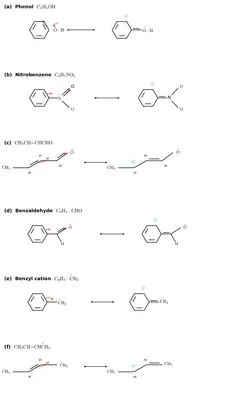
8.11

Draw the resonance structures for the following compounds. Show the electron shift using curved-arrow notation.

(a) $$\mathrm{C_6H_5OH}$$ (b) $$\mathrm{C_6H_5NO_2}$$ (c) $$\mathrm{CH_3CH=CHCHO}$$ (d) $$\mathrm{C_6H_5-CHO}$$ (e) $$\mathrm{C_6H_5-\overset{+}{C}H_2}$$ (f) $$\mathrm{CH_3CH=CH\overset{+}{C}H_2}$$

Figure
Figure

Solution

In drawing resonance structures only electrons (lone pairs and $$\pi$$ electrons) are moved — never atoms. A curved arrow shows a pair of electrons moving from its tail to its head.

(a) Phenol, $$\mathrm{C_6H_5OH}$$: a lone pair on oxygen is delocalised into the ring. A curved arrow runs from an oxygen lone pair into the ring-carbon–O bond, and the ring $$\pi$$ bonds shift in turn. This produces structures with a positive charge on oxygen and a negative charge on the ortho (two positions) and para ring carbons.

(b) Nitrobenzene, $$\mathrm{C_6H_5NO_2}$$: the $$\mathrm{-NO_2}$$ group is strongly electron-withdrawing, so the ring $$\pi$$ electrons are pulled towards it. Curved arrows move ring $$\pi$$ pairs towards the C–N bond, leaving a positive charge on the ortho and para ring carbons (and negative charge developing on the nitro oxygens).

(c) $$\mathrm{CH_3CH=CHCHO}$$ (but-2-enal): the C=C and C=O bonds are conjugated. The contributing structures are

$$\mathrm{CH_3CH=CH-CH=O \;\longleftrightarrow\; CH_3CH=CH-\overset{+}{C}H-\overset{-}{O} \;\longleftrightarrow\; CH_3\overset{+}{C}H-CH=CH-\overset{-}{O}}$$

One curved arrow shifts the C=O $$\pi$$ pair onto oxygen; a second relays the C=C $$\pi$$ pair along the chain.

(d) Benzaldehyde, $$\mathrm{C_6H_5CHO}$$: the carbonyl group is conjugated with the ring. Curved arrows shift the C=O $$\pi$$ pair onto oxygen and move the ring $$\pi$$ bonds, generating structures with a positive charge on the ortho and para ring carbons and a negative charge on the carbonyl oxygen.

(e) Benzyl cation, $$\mathrm{C_6H_5\overset{+}{C}H_2}$$: the positive charge is delocalised into the ring. Curved arrows move ring $$\pi$$ pairs towards the exocyclic $$\mathrm{CH_2}$$ carbon, giving structures with the positive charge on the ortho and para ring carbons.

(f) $$\mathrm{CH_3CH=CH\overset{+}{C}H_2}$$ (an allylic cation): a curved arrow shifts the C=C $$\pi$$ pair towards the positively charged carbon, so the positive charge is shared between the two end carbons of the allyl unit:

$$\mathrm{CH_3CH=CH-\overset{+}{C}H_2 \;\longleftrightarrow\; CH_3\overset{+}{C}H-CH=CH_2}$$

Answer

Each species is a resonance hybrid. (a) Phenol — the O lone pair is delocalised into the ring, giving negative charge at the ortho/para carbons. (b) Nitrobenzene — ring $$\pi$$ electrons are drawn to $$\mathrm{-NO_2}$$, giving positive charge at the ortho/para carbons. (c) But-2-enal — $$\mathrm{CH_3CH=CH-CH=O \leftrightarrow CH_3CH=CH-\overset{+}{C}H-\overset{-}{O} \leftrightarrow CH_3\overset{+}{C}H-CH=CH-\overset{-}{O}}$$. (d) Benzaldehyde — positive charge delocalised to the ortho/para ring carbons, negative on the carbonyl O. (e) Benzyl cation — positive charge delocalised to the ortho/para ring carbons. (f) Allylic cation — $$\mathrm{CH_3CH=CH\overset{+}{C}H_2 \leftrightarrow CH_3\overset{+}{C}HCH=CH_2}$$.

8.12 What are electrophiles and nucleophiles? Explain with examples.

Solution

Nucleophiles. A nucleophile (literally ‘nucleus-loving’) is a reagent that is electron-rich: it possesses at least one lone pair of electrons and/or a negative charge. It forms a new bond by donating an electron pair to an electron-deficient (positive) centre, so it attacks electrophilic carbon atoms.

Examples: hydroxide ion $$\mathrm{OH^-}$$, cyanide ion $$\mathrm{CN^-}$$, alkoxide ion $$\mathrm{RO^-}$$, water $$\mathrm{H_2O}$$ and ammonia $$\mathrm{NH_3}$$ (the last two are neutral nucleophiles, donating a lone pair).

Electrophiles. An electrophile (literally ‘electron-loving’) is a reagent that is electron-deficient: it carries a positive charge and/or has an incomplete octet. It forms a new bond by accepting an electron pair from an electron-rich centre, so it attacks nucleophilic (electron-rich) sites.

Examples: proton $$\mathrm{H^+}$$, nitronium ion $$\mathrm{\overset{+}{N}O_2}$$, carbocations such as $$\mathrm{\overset{+}{C}H_3}$$, and Lewis acids with incomplete octets such as $$\mathrm{BF_3}$$ and $$\mathrm{AlCl_3}$$.

In short, a nucleophile is an electron-pair donor that seeks a positive centre, whereas an electrophile is an electron-pair acceptor that seeks an electron-rich centre.

Answer

A nucleophile is an electron-rich reagent (it has a lone pair and/or a negative charge) that donates an electron pair to a positive centre — e.g. $$\mathrm{OH^-}$$, $$\mathrm{CN^-}$$, $$\mathrm{H_2O}$$, $$\mathrm{NH_3}$$. An electrophile is an electron-deficient reagent (it has a positive charge and/or an incomplete octet) that accepts an electron pair from an electron-rich centre — e.g. $$\mathrm{H^+}$$, $$\mathrm{\overset{+}{N}O_2}$$, carbocations, $$\mathrm{BF_3}$$.

8.13

Identify the reagents shown in bold in the following equations as nucleophiles or electrophiles:

(a) $$\mathrm{CH_3COOH + \mathbf{HO^-} \rightarrow CH_3COO^- + H_2O}$$

(b) $$\mathrm{CH_3COCH_3 + \mathbf{{}^-CN} \rightarrow (CH_3)_2C(CN)(OH)}$$

(c) $$\mathrm{C_6H_6 + \mathbf{CH_3\overset{+}{C}O} \rightarrow C_6H_5COCH_3}$$

Solution

Decide for each bold reagent whether it is electron-rich (a nucleophile) or electron-deficient (an electrophile) from its charge and electron density.

(a) $$\mathrm{HO^-}$$: it carries a negative charge and lone pairs on oxygen, and here it donates an electron pair to capture the acidic proton of $$\mathrm{CH_3COOH}$$. Being an electron-pair donor, it is a nucleophile (acting here as a base).

(b) $$\mathrm{{}^-CN}$$: the cyanide ion carries a negative charge and a lone pair on carbon, which it donates to the electron-deficient carbonyl carbon of propanone. It is a nucleophile.

(c) $$\mathrm{CH_3\overset{+}{C}O}$$: the acylium ion carries a positive charge on an electron-deficient carbon; it accepts a pair of $$\pi$$ electrons from the benzene ring. It is an electrophile.

Answer

(a) $$\mathrm{HO^-}$$ — nucleophile. (b) $$\mathrm{{}^-CN}$$ — nucleophile. (c) $$\mathrm{CH_3\overset{+}{C}O}$$ — electrophile.

8.14

Classify the following reactions in one of the reaction type studied in this unit.

(a) $$\mathrm{CH_3CH_2Br + HS^- \rightarrow CH_3CH_2SH + Br^-}$$

(b) $$\mathrm{(CH_3)_2C=CH_2 + HCl \rightarrow (CH_3)_2ClC-CH_3}$$

(c) $$\mathrm{CH_3CH_2Br + HO^- \rightarrow CH_2=CH_2 + H_2O + Br^-}$$

(d) $$\mathrm{(CH_3)_3C-CH_2OH + HBr \rightarrow (CH_3)_2CBrCH_2CH_2CH_3 + H_2O}$$

Solution

Classify each reaction by comparing the structures of reactant and product.

(a) $$\mathrm{CH_3CH_2Br + HS^- \rightarrow CH_3CH_2SH + Br^-}$$: the nucleophile $$\mathrm{HS^-}$$ takes the place of the leaving group $$\mathrm{Br^-}$$ on carbon — one group is replaced by another. This is a substitution reaction (nucleophilic substitution).

(b) $$\mathrm{(CH_3)_2C=CH_2 + HCl \rightarrow (CH_3)_3CCl}$$: the elements of HCl add across the C=C double bond — H going to the $$\mathrm{=CH_2}$$ carbon and Cl to the more substituted carbon (Markovnikov addition) — so the double bond becomes a single bond and no atom leaves the molecule. The product is 2-chloro-2-methylpropane, written conventionally as $$\mathrm{(CH_3)_3CCl}$$ (the same compound as $$\mathrm{(CH_3)_2CClCH_3}$$). This is an addition reaction (electrophilic addition).

(c) $$\mathrm{CH_3CH_2Br + HO^- \rightarrow CH_2=CH_2 + H_2O + Br^-}$$: a hydrogen atom and a bromine atom are lost from adjacent carbons and a new C=C double bond is formed. This is an elimination reaction (dehydrohalogenation).

(d) $$\mathrm{(CH_3)_3C-CH_2OH + HBr \rightarrow (CH_3)_2CBrCH_2CH_2CH_3 + H_2O}$$: comparing reactant and product, the carbon skeleton itself has changed — in the reactant the framework carries a $$\mathrm{-C(CH_3)_3}$$ (neopentyl-type) group, whereas in the product an alkyl group has migrated to a neighbouring carbon, giving a different skeleton. A reaction in which the carbon skeleton is reorganised is a rearrangement reaction.

Answer

(a) Substitution reaction (nucleophilic substitution). (b) Addition reaction (electrophilic addition) — HCl adds across the C=C bond to give $$\mathrm{(CH_3)_3CCl}$$. (c) Elimination reaction (dehydrohalogenation). (d) Rearrangement reaction — the carbon skeleton is reorganised.

8.15

What is the relationship between the members of following pairs of structures? Are they structural or geometrical isomers or resonance contributors?

(a) Two structures: bond-line drawings of butan-2-one ($$\mathrm{CH_3-CO-CH_2-CH_3}$$) and a four-carbon ketone of identical connectivity drawn differently (or with a methyl-shifted skeleton).

(b) Two geometrical-isomer structures of 1,2-disubstituted ethylene of the form $$\mathrm{D-CH=CH-D}$$ (one with D's cis and the other with D's trans).

(c) Two structures of an enol/oxocarbenium-type form: $$\mathrm{H_2\overset{+}{O}=CH-OH}$$ and $$\mathrm{H-\overset{+}{C}H-OH}$$ (a resonance pair involving an enol/oxocarbenium ion).

Solution

Recall the three relationships. Structural (constitutional) isomers have the same molecular formula but differ in how the atoms are connected. Geometrical isomers have the same connectivity but differ in the spatial arrangement of groups about a rigid C=C double bond (cis/trans). Resonance contributors are not separate molecules at all — they are alternative electron distributions of one and the same species, differing only in the positions of electrons, never of atoms.

(a) Both drawings are of a four-carbon ketone with exactly the same connectivity — butan-2-one, $$\mathrm{CH_3-CO-CH_2-CH_3}$$ — simply drawn in two different ways. They are therefore the same compound (identical structures); they are neither isomers nor resonance contributors.

(b) The two structures of the type $$\mathrm{D-CH=CH-D}$$ have the same connectivity but differ in the arrangement about the rigid C=C double bond: in one the two D atoms lie on the same side (cis), in the other on opposite sides (trans). They are geometrical isomers.

(c) In $$\mathrm{H_2\overset{+}{O}=CH-OH}$$ and $$\mathrm{H-\overset{+}{C}H-OH}$$ the atoms occupy the same positions; the structures differ only in where the electrons (and hence the charge) are placed. They are resonance contributors of a single species.

Answer

(a) The same compound — identical structures (neither isomers nor resonance contributors). (b) Geometrical isomers (cis and trans). (c) Resonance contributors (resonance structures of one species).

8.16

For the following bond cleavages, use curved-arrows to show the electron flow and classify each as homolysis or heterolysis. Identify reactive intermediate produced as free radical, carbocation and carbanion.

(a) $$\mathrm{CH_3O-OCH_3 \rightarrow CH_3\dot{O} + \dot{O}CH_3}$$

(b) $$\mathrm{{>}C=O + {}^-OH \rightarrow {>}\!\!\underset{-}{C}\!\!{-O} + H_2O}$$ (where a carbonyl compound reacts with hydroxide to give the hydrate-anion).

(c) A tertiary alkyl bromide $$\mathrm{(CH_3)_3C-Br}$$ undergoing C–Br bond cleavage to yield $$\mathrm{(CH_3)_3C^+ + Br^-}$$.

(d) Benzene reacting with an electrophile $$\mathrm{E^+}$$ to form an arenium-ion (Wheland-type) intermediate $$\mathrm{C_6H_6E^+}$$ in which the electrophile is attached and the ring carries a positive charge.

Solution

In homolysis the bonding pair splits evenly — one electron to each atom (shown by single-barbed 'fishhook' arrows) — giving neutral free radicals. In heterolysis the bonding pair goes entirely to one atom (shown by a normal double-barbed curved arrow), giving oppositely charged ions.

(a) $$\mathrm{CH_3O-OCH_3 \rightarrow CH_3\dot{O} + \dot{O}CH_3}$$: the O–O bond breaks so that each oxygen keeps one electron — two fishhook arrows point away from the bond, one to each oxygen. This is homolysis, and the reactive intermediates are free radicals (methoxy radicals).

(b) carbonyl compound $$+\ \mathrm{{}^-OH}$$: water appears as a product of this step, which tells us that a hydrogen has been transferred to the hydroxide ion — i.e. $$\mathrm{OH^-}$$ acts here as a base. A double-barbed curved arrow runs from a lone pair of $$\mathrm{OH^-}$$ to a hydrogen of the carbonyl compound (forming the O–H bond of water), and a second double-barbed arrow runs from that C–H bond entirely onto its carbon. Because the C–H bonding pair goes wholly to one atom, this is heterolysis; the carbon left holding the lone pair and a negative charge is a carbanion.

(c) $$\mathrm{(CH_3)_3C-Br \rightarrow (CH_3)_3C^+ + Br^-}$$: the C–Br bonding pair shifts entirely onto the more electronegative bromine (a double-barbed arrow from the C–Br bond to Br). This is heterolysis, and the reactive intermediate is the carbocation $$\mathrm{(CH_3)_3C^+}$$ (along with a bromide ion).

(d) benzene + $$\mathrm{E^+}$$: a pair of ring $$\pi$$ electrons forms a new bond to the electrophile (a double-barbed arrow from the ring $$\pi$$ bond to $$\mathrm{E^+}$$). This is heterolysis of the $$\pi$$ bond, and the reactive intermediate is the positively charged arenium ion, which is a carbocation.

Answer

(a) Homolysis — produces free radicals ($$\mathrm{CH_3\dot{O}}$$). (b) Heterolysis — produces a carbanion ($$\mathrm{OH^-}$$ acts as a base and abstracts a hydrogen, the C–H bonding pair staying on carbon, and water is released). (c) Heterolysis — produces a carbocation, $$\mathrm{(CH_3)_3C^+}$$. (d) Heterolysis of a ring $$\pi$$ bond — produces a carbocation (the arenium ion).

8.17

Explain the terms Inductive and Electromeric effects. Which electron displacement effect explains the following correct orders of acidity of the carboxylic acids?

(a) $$\mathrm{Cl_3CCOOH > Cl_2CHCOOH > ClCH_2COOH}$$

(b) $$\mathrm{CH_3CH_2COOH > (CH_3)_2CHCOOH > (CH_3)_3C.COOH}$$

Solution

Inductive effect. When two atoms of different electronegativity are joined by a $$\sigma$$ bond, the bonding electrons are displaced permanently towards the more electronegative atom. This polarisation is relayed along the chain of $$\sigma$$ bonds, weakening with every bond and becoming negligible after about three bonds. It is a permanent effect, present whether or not a reagent is attacking. A group that draws electrons towards itself shows a $$-I$$ effect; one that pushes electrons away shows a $$+I$$ effect.

Electromeric effect. This is the complete transfer of a shared pair of $$\pi$$ electrons to one of the doubly bonded atoms. It occurs only momentarily, in the presence of an attacking reagent, and disappears as soon as the reagent is removed — it is a temporary effect.

(a) $$\mathrm{Cl_3CCOOH > Cl_2CHCOOH > ClCH_2COOH}$$: chlorine is electron-withdrawing and exerts a $$-I$$ effect. The more chlorine atoms attached, the more the negative charge of the carboxylate ion $$\mathrm{(RCOO^-)}$$ is dispersed, the more stable that anion, and hence the stronger the acid. Three Cl atoms give a larger $$-I$$ effect than two, and two more than one, so acidity follows the order shown. This trend is governed by the inductive effect.

(b) $$\mathrm{CH_3CH_2COOH > (CH_3)_2CHCOOH > (CH_3)_3CCOOH}$$: alkyl (methyl) groups are electron-releasing and exert a $$+I$$ effect. The more methyl groups attached, the more electron density is pushed onto the carboxylate ion, intensifying its negative charge, destabilising the anion and so weakening the acid. Fewer methyl groups therefore mean a stronger acid, giving the order shown. This trend is also governed by the inductive effect.

Answer

The inductive effect is the permanent displacement of $$\sigma$$-bond electrons along a chain towards a more electronegative atom; the electromeric effect is the temporary, complete transfer of a $$\pi$$-electron pair to one atom in the presence of an attacking reagent. Both acidity orders are explained by the inductive effect — the $$-I$$ effect of chlorine in (a) and the $$+I$$ effect of the methyl groups in (b).

8.18

Give a brief description of the principles of the following techniques taking an example in each case.

(a) Crystallisation (b) Distillation (c) Chromatography

Solution

(a) Crystallisation. Principle: it relies on the difference in solubility of the desired compound and its impurities in a suitable solvent. The impure solid is dissolved in the minimum quantity of a hot solvent in which it is sparingly soluble at room temperature but freely soluble when hot. The hot solution is filtered to remove insoluble impurities and then cooled; the pure compound, being far less soluble in the cold solvent, separates as crystals while the soluble impurities stay behind in the mother liquor. Example: purification of impure sugar, or of benzoic acid, by crystallisation from water.

(b) Distillation. Principle: it relies on the difference in boiling points (volatilities) of the components. The mixture is boiled; the more volatile component vaporises first and its vapour is led into a condenser, where it is cooled back to liquid and collected, leaving the less volatile component or non-volatile impurity behind. Example: separation of a mixture of chloroform (b.p. 334 K) and aniline (b.p. 457 K).

(c) Chromatography. Principle: it relies on the difference in the way the components of a mixture distribute themselves between a stationary phase and a moving (mobile) phase. A component held more strongly by the stationary phase moves slowly, while one held less strongly moves faster with the mobile phase; because the components travel at different rates they are separated. Example: separation of the coloured pigments of a plant leaf, or of the dyes present in a sample of ink.

Answer

(a) Crystallisation — separation based on the difference in solubility of the compound and its impurities in a solvent; e.g. purification of impure sugar. (b) Distillation — separation based on the difference in boiling points; e.g. separating chloroform and aniline. (c) Chromatography — separation based on the differing distribution of components between a stationary and a mobile phase; e.g. separating leaf pigments.

8.19 Describe the method, which can be used to separate two compounds with different solubilities in a solvent S.

Solution

Two compounds that have different solubilities in the same solvent S can be separated by fractional crystallisation.

Method: dissolve the mixture in the minimum quantity of hot solvent S to obtain a nearly saturated solution, and allow it to cool slowly. The compound that is less soluble in S reaches saturation first and crystallises out, while the more soluble compound remains dissolved in the mother liquor. The crystals are separated from the mother liquor by filtration.

The mother liquor is then concentrated by evaporating part of the solvent and cooled again; this yields a fresh crop of crystals, now richer in the more soluble compound. By repeating this cycle of crystallisation and collecting the crystals in separate fractions, the two compounds are finally obtained in pure form. The method works precisely because the two substances differ in solubility in solvent S.

Answer

Fractional crystallisation: dissolve the mixture in hot solvent S and cool it so that the less-soluble compound crystallises out first and is filtered off; then concentrate the mother liquor and cool again to crystallise the more-soluble compound. Repeating the cycle gives both compounds in pure form.

8.20 What is the difference between distillation, distillation under reduced pressure and steam distillation?

Solution

Distillation (simple distillation) is used to separate a volatile liquid from a non-volatile impurity, or to separate two liquids whose boiling points differ appreciably. The liquid is boiled at atmospheric pressure, its vapour is condensed, and the components are collected separately. It can be used only for liquids that boil without decomposing at their normal boiling points. Example: separating diethyl ether from toluene.

Distillation under reduced pressure is used for liquids that decompose at or below their normal boiling point. When the external pressure above the liquid is lowered, the liquid boils at a lower temperature; it can then be distilled well below its normal boiling point and so without decomposition. Example: glycerol, which decomposes at its normal boiling point, is distilled under reduced pressure.

Steam distillation is used to purify a substance that is steam-volatile and immiscible with water, when the impurities present are non-volatile in steam. Steam is passed through the liquid, and the substance distils over together with steam at a temperature below its own boiling point (and below 373 K). Example: purification of aniline by steam distillation.

Answer

Simple distillation separates liquids that boil without decomposition, using the difference in their boiling points. Distillation under reduced pressure lowers the boiling point (by lowering the pressure) so that liquids which would decompose at their normal boiling point can still be distilled. Steam distillation distils a water-immiscible, steam-volatile substance along with steam at a temperature below its own boiling point.

8.21 Discuss the chemistry of Lassaigne's test.

Solution

In Lassaigne's test the covalently bonded nitrogen, sulphur and halogens of an organic compound are first converted into ionic salts, so that they can then be detected by ordinary inorganic tests. This conversion is achieved by fusing the compound with a small piece of sodium metal:

$$\mathrm{Na + C + N \xrightarrow{\Delta} NaCN}$$

$$\mathrm{2Na + S \xrightarrow{\Delta} Na_2S}$$

$$\mathrm{Na + X \xrightarrow{\Delta} NaX}\quad(\mathrm{X = Cl,\ Br,\ I})$$

If both nitrogen and sulphur are present together, sodium thiocyanate is formed: $$\mathrm{Na + C + N + S \xrightarrow{\Delta} NaSCN}$$.

The fused mass is extracted with distilled water and boiled; the resulting solution is the sodium fusion extract (Lassaigne's extract).

Test for nitrogen: the extract is warmed with iron(II) sulphate and then acidified with sulphuric acid. The cyanide ions form hexacyanoferrate(II), which reacts with iron(III) ions (formed by aerial oxidation of $$\mathrm{Fe^{2+}}$$) to give Prussian blue:

$$\mathrm{6CN^- + Fe^{2+} \rightarrow [Fe(CN)_6]^{4-}}$$

$$\mathrm{3[Fe(CN)_6]^{4-} + 4Fe^{3+} \rightarrow Fe_4[Fe(CN)_6]_3}$$ (Prussian blue)

Test for sulphur: the extract gives a violet colouration with sodium nitroprusside: $$\mathrm{Na_2S + Na_2[Fe(CN)_5NO] \rightarrow Na_4[Fe(CN)_5NOS]}$$.

Test for halogen: the extract is acidified with dilute nitric acid and silver nitrate is added; a precipitate of silver halide $$\mathrm{(AgX)}$$ confirms the halogen.

Answer

The compound is fused with sodium, converting covalent N, S and X into ionic $$\mathrm{NaCN}$$, $$\mathrm{Na_2S}$$ and $$\mathrm{NaX}$$ (or $$\mathrm{NaSCN}$$). The aqueous fusion extract is then tested: $$\mathrm{CN^-}$$ gives Prussian blue $$\mathrm{Fe_4[Fe(CN)_6]_3}$$ with $$\mathrm{Fe^{2+}/Fe^{3+}}$$; $$\mathrm{S^{2-}}$$ gives a violet colour with sodium nitroprusside; $$\mathrm{X^-}$$ gives a silver halide precipitate with $$\mathrm{AgNO_3}$$ after acidification with $$\mathrm{HNO_3}$$.

8.22 Differentiate between the principle of estimation of nitrogen in an organic compound by (i) Dumas method and (ii) Kjeldahl's method.

Solution

Both methods estimate nitrogen, but they convert it into different measurable forms.

(i) Dumas method. Principle: the nitrogenous compound, heated strongly with excess copper(II) oxide in an atmosphere of carbon dioxide, is oxidised so that its nitrogen is set free as nitrogen gas. Any oxides of nitrogen formed are reduced to $$\mathrm{N_2}$$ by passing the gases over a hot copper gauze:

$$\mathrm{C_xH_yN_z + (2x+\tfrac{y}{2})\,CuO \rightarrow x\,CO_2 + \tfrac{y}{2}\,H_2O + \tfrac{z}{2}\,N_2 + (2x+\tfrac{y}{2})\,Cu}$$

The nitrogen gas is collected over a potassium hydroxide solution and its volume measured; from this the percentage of nitrogen is calculated.

(ii) Kjeldahl's method. Principle: the compound is heated with concentrated sulphuric acid (with $$\mathrm{K_2SO_4}$$ and a $$\mathrm{CuSO_4}$$ catalyst), which converts its nitrogen into ammonium sulphate. The mixture is then treated with excess sodium hydroxide, liberating ammonia, which is absorbed in a known, measured volume of standard acid. The acid left unreacted is determined by back-titration, giving the quantity of ammonia and hence the percentage of nitrogen.

Key difference: in the Dumas method the nitrogen is measured as free $$\mathrm{N_2}$$ gas, whereas in Kjeldahl's method it is measured as ammonia (formed via ammonium sulphate). The Dumas method works for all nitrogen-containing compounds; Kjeldahl's method cannot be used for compounds in which nitrogen is present in a ring, or in nitro and azo groups.

Answer

In the Dumas method the nitrogen of the compound is converted to free $$\mathrm{N_2}$$ gas (by heating with CuO) and its volume measured. In Kjeldahl's method the nitrogen is converted to ammonium sulphate (by heating with conc. $$\mathrm{H_2SO_4}$$); ammonia is then liberated with alkali and estimated by titration. Dumas applies to all nitrogen compounds, whereas Kjeldahl does not work for nitrogen in rings or in nitro/azo groups.

8.23 Discuss the principle of estimation of halogens, sulphur and phosphorus present in an organic compound.

Solution

The estimation of halogens, sulphur and phosphorus is based on the Carius method: a known mass of the organic compound is heated strongly with fuming nitric acid in a sealed hard-glass tube (the Carius tube). This oxidises the element to an inorganic form that can be precipitated and weighed.

Halogens. The compound is heated with fuming $$\mathrm{HNO_3}$$ in the presence of silver nitrate. The halogen is converted to silver halide, $$\mathrm{AgX}$$, which is filtered, washed, dried and weighed. From the mass of $$\mathrm{AgX}$$ the percentage of halogen is calculated.

Sulphur. Heating with fuming $$\mathrm{HNO_3}$$ oxidises the sulphur to sulphuric acid, which is precipitated as barium sulphate by adding barium chloride solution. The $$\mathrm{BaSO_4}$$ is weighed and the percentage of sulphur calculated from it.

Phosphorus. Heating with fuming $$\mathrm{HNO_3}$$ oxidises the phosphorus to phosphoric acid, which is precipitated as ammonium phosphomolybdate, or as magnesium ammonium phosphate that is ignited to magnesium pyrophosphate $$\mathrm{(Mg_2P_2O_7)}$$. The precipitate is weighed and the percentage of phosphorus calculated.

In every case the percentage of the element is found from $$\%\,\text{element} = \dfrac{\text{mass of element in the precipitate}}{\text{mass of organic compound}}\times 100$$, using the formula mass of the precipitate.

Answer

By the Carius method, a known mass of the compound is heated with fuming $$\mathrm{HNO_3}$$ in a sealed tube. Halogen is precipitated and weighed as silver halide $$\mathrm{(AgX)}$$; sulphur is oxidised to $$\mathrm{H_2SO_4}$$ and precipitated as $$\mathrm{BaSO_4}$$; phosphorus is oxidised to phosphoric acid and precipitated as ammonium phosphomolybdate or as $$\mathrm{Mg_2P_2O_7}$$. The weighed mass of each precipitate gives the percentage of that element.

8.24 Explain the principle of paper chromatography.

Solution

Paper chromatography is a form of partition chromatography. The chromatography paper (made of cellulose) holds water molecules trapped in its pores; this fixed layer of water acts as the stationary phase, while the developing solvent that travels up the paper is the mobile phase.

A small spot of the mixture is placed near one end of a strip of the paper, and that end is dipped into the solvent. As the solvent rises through the paper by capillary action, each component of the mixture continuously distributes (partitions) itself between the stationary water phase and the moving solvent.

A component that is more soluble in the mobile phase spends more time moving, and so travels faster and farther up the paper; a component more soluble in the stationary (water) phase is held back and moves slowly. Because different components partition differently, they travel different distances and become separated, appearing as distinct spots. The developed strip is called a chromatogram.

Each component is characterised by its retardation factor:

$$R_f = \dfrac{\text{distance travelled by the component}}{\text{distance travelled by the solvent front}}$$

Answer

Paper chromatography is partition chromatography: the water held in the cellulose paper is the stationary phase and the developing solvent is the mobile phase. Each component of the mixture partitions itself between the two phases according to its relative solubility, so components travel different distances up the paper and get separated. Each is characterised by its $$R_f$$ value (distance moved by component ÷ distance moved by the solvent front).

8.25 Why is nitric acid added to sodium extract before adding silver nitrate for testing halogens?

Solution

The sodium fusion extract used for testing halogens may also contain sodium cyanide ($$\mathrm{NaCN}$$) and sodium sulphide ($$\mathrm{Na_2S}$$), if the organic compound also contained nitrogen and sulphur. With silver nitrate these would themselves give precipitates — white silver cyanide ($$\mathrm{AgCN}$$) and black silver sulphide ($$\mathrm{Ag_2S}$$) — which would interfere with the halogen test.

To prevent this, the extract is first boiled with dilute nitric acid. The $$\mathrm{HNO_3}$$ decomposes any cyanide and sulphide, driving them off as gaseous hydrogen cyanide and hydrogen sulphide:

$$\mathrm{NaCN + HNO_3 \rightarrow NaNO_3 + HCN\uparrow}$$

$$\mathrm{Na_2S + 2HNO_3 \rightarrow 2NaNO_3 + H_2S\uparrow}$$

Once the cyanide and sulphide ions have been removed, adding silver nitrate produces only the genuine silver halide precipitate, so the halogen test gives a reliable result.

Answer

Because the fusion extract may also contain $$\mathrm{NaCN}$$ and $$\mathrm{Na_2S}$$, which would otherwise give interfering precipitates ($$\mathrm{AgCN}$$ and $$\mathrm{Ag_2S}$$) with silver nitrate. Boiling with $$\mathrm{HNO_3}$$ decomposes them, expelling $$\mathrm{HCN}$$ and $$\mathrm{H_2S}$$ as gases, so $$\mathrm{AgNO_3}$$ then gives only the true silver halide precipitate.

8.26 Explain the reason for the fusion of an organic compound with metallic sodium for testing nitrogen, sulphur and halogens.

Solution

In an organic compound the nitrogen, sulphur and halogen atoms are joined to carbon by covalent bonds. They are therefore not present as ions, and so they cannot be detected by the ordinary inorganic tests, which respond only to ions present in solution.

When the compound is fused with sodium metal, the highly reactive sodium breaks these covalent bonds and combines with the elements to form ionic sodium salts:

$$\mathrm{Na + C + N \rightarrow NaCN}\qquad \mathrm{2Na + S \rightarrow Na_2S}\qquad \mathrm{Na + X \rightarrow NaX}$$

In these salts the nitrogen, sulphur and halogen are present as the ions $$\mathrm{CN^-}$$, $$\mathrm{S^{2-}}$$ and $$\mathrm{X^-}$$, all of which are water-soluble. The elements can now be detected easily by the usual ionic tests carried out on the aqueous extract. Thus the purpose of fusing the compound with sodium is to convert the covalently bonded elements into a detectable ionic form.

Answer

Because in an organic compound N, S and the halogens are bonded to carbon covalently and so cannot be detected by ionic tests. Fusion with sodium converts them into ionic, water-soluble sodium salts ($$\mathrm{NaCN}$$, $$\mathrm{Na_2S}$$, $$\mathrm{NaX}$$), in which the elements exist as ions and can then be detected by ordinary inorganic tests.

8.27 Name a suitable technique of separation of the components from a mixture of calcium sulphate and camphor.

Solution

A mixture of calcium sulphate and camphor is best separated by sublimation.

Camphor is a solid that sublimes — on heating it passes directly from the solid state to vapour without melting — whereas calcium sulphate is non-volatile and does not sublime. When the mixture is heated, the camphor vaporises and its vapour is then condensed back to the pure solid on a cool surface, while the calcium sulphate is left behind. This cleanly separates the two components.

Answer

Sublimation — on heating, camphor sublimes and is recovered by condensing its vapour, while the non-volatile calcium sulphate is left behind.

8.28 Explain, why an organic liquid vaporises at a temperature below its boiling point in its steam distillation?

Solution

In steam distillation the organic liquid and water are immiscible, so they do not interfere with each other; each one exerts its own vapour pressure independently of the other.

A liquid (or such a mixture) boils when its total vapour pressure becomes equal to the atmospheric (external) pressure. For the steam-distillation mixture, the total vapour pressure is the sum of the two separate vapour pressures:

$$p_{\text{total}} = p_{\text{organic liquid}} + p_{\text{water}}$$

The mixture therefore boils when

$$p_{\text{organic liquid}} + p_{\text{water}} = p_{\text{atmospheric}}$$

Since water supplies a part of the pressure, the organic liquid only needs to provide the remainder: $$p_{\text{organic liquid}} = p_{\text{atmospheric}} - p_{\text{water}}$$, which is less than atmospheric pressure. A liquid attains a vapour pressure below atmospheric at a temperature below its normal boiling point. Hence, during steam distillation, the organic liquid vaporises and distils over at a temperature below its own boiling point.

Answer

Because the organic liquid and water each exert vapour pressure independently, and the mixture boils when $$p_{\text{organic}} + p_{\text{water}} = p_{\text{atmospheric}}$$. As water contributes part of the pressure, the organic liquid's own vapour pressure need only reach $$p_{\text{atm}} - p_{\text{water}}$$, which is below atmospheric — a value attained at a temperature below its normal boiling point.

8.29 Will $$\mathrm{CCl_4}$$ give white precipitate of $$\mathrm{AgCl}$$ on heating it with silver nitrate? Give reason for your answer.

Solution

No — $$\mathrm{CCl_4}$$ does not give a white precipitate of $$\mathrm{AgCl}$$ when heated with silver nitrate.

In carbon tetrachloride the four chlorine atoms are bonded to carbon by covalent bonds. The compound does not ionise, so it furnishes no free chloride ions ($$\mathrm{Cl^-}$$) in solution.

Silver nitrate reacts only with ionic (free) chloride ions, by the reaction $$\mathrm{Ag^+ + Cl^- \rightarrow AgCl\downarrow}$$. Since $$\mathrm{CCl_4}$$ supplies no $$\mathrm{Cl^-}$$ ions, no precipitate of silver chloride can form. (This is precisely why a covalent halogen compound must first be fused with sodium — to convert the covalently bonded chlorine into ionic $$\mathrm{Cl^-}$$ — before it can be tested with $$\mathrm{AgNO_3}$$.)

Answer

No. In $$\mathrm{CCl_4}$$ the chlorine is covalently bonded to carbon, so the compound provides no free $$\mathrm{Cl^-}$$ ions. Since silver nitrate reacts only with ionic chloride, no white precipitate of $$\mathrm{AgCl}$$ is formed.

8.30 Why is a solution of potassium hydroxide used to absorb carbon dioxide evolved during the estimation of carbon present in an organic compound?

Solution

In the estimation of carbon, the organic compound is burnt completely so that all of its carbon is converted into carbon dioxide. To measure how much carbon dioxide is produced, the gas is passed through a weighed bulb containing a solution of potassium hydroxide.

Potassium hydroxide is a strong base, and carbon dioxide is an acidic oxide, so the two react readily and completely:

$$\mathrm{2KOH + CO_2 \rightarrow K_2CO_3 + H_2O}$$

The $$\mathrm{CO_2}$$ is thus absorbed quantitatively (completely) by the KOH solution. The increase in mass of the KOH bulb equals the mass of $$\mathrm{CO_2}$$ absorbed, and from this the percentage of carbon in the compound is calculated. A strong base such as $$\mathrm{KOH}$$ is used because it guarantees that the absorption of the acidic $$\mathrm{CO_2}$$ is total and accurate.

Answer

Because $$\mathrm{KOH}$$, being a strong base, absorbs the acidic $$\mathrm{CO_2}$$ completely and quantitatively ($$\mathrm{2KOH + CO_2 \rightarrow K_2CO_3 + H_2O}$$). The increase in mass of the KOH bulb then gives the exact mass of $$\mathrm{CO_2}$$ produced, from which the percentage of carbon is calculated.

8.31 Why is it necessary to use acetic acid and not sulphuric acid for acidification of sodium extract for testing sulphur by lead acetate test?

Solution

In the lead acetate test, the sodium fusion extract is acidified and lead acetate solution is added; sulphur present as $$\mathrm{S^{2-}}$$ then gives a black precipitate of lead sulphide ($$\mathrm{PbS}$$), which confirms sulphur.

If sulphuric acid were used to acidify the extract, the sulphate ions of the acid would react with the lead acetate to form a white, insoluble precipitate of lead sulphate ($$\mathrm{PbSO_4}$$):

$$\mathrm{(CH_3COO)_2Pb + H_2SO_4 \rightarrow PbSO_4\downarrow + 2CH_3COOH}$$

This white $$\mathrm{PbSO_4}$$ would mask the black colour of $$\mathrm{PbS}$$ and make the test unreliable.

Acetic acid, by contrast, is a weak acid and forms no insoluble salt with lead acetate. It simply supplies the acidic medium required, so the black $$\mathrm{PbS}$$ is seen clearly. Hence acetic acid, and not sulphuric acid, must be used for the acidification.

Answer

Because sulphuric acid would react with lead acetate to give a white precipitate of lead sulphate ($$\mathrm{PbSO_4}$$), which masks the black lead sulphide ($$\mathrm{PbS}$$) and spoils the test. Acetic acid is a weak acid that forms no insoluble salt with lead acetate, so it provides the acidic medium without interfering, and the black $$\mathrm{PbS}$$ shows up clearly.

8.32 An organic compound contains $$69\%$$ carbon and $$4.8\%$$ hydrogen, the remainder being oxygen. Calculate the masses of carbon dioxide and water produced when $$0.20 \, \mathrm{g}$$ of this substance is subjected to complete combustion.

Solution

On complete combustion all the carbon of the compound goes to $$\mathrm{CO_2}$$ and all the hydrogen to $$\mathrm{H_2O}$$. First find the masses of carbon and hydrogen in the $$0.20\ \mathrm{g}$$ sample from the given percentages, then convert these to masses of $$\mathrm{CO_2}$$ and $$\mathrm{H_2O}$$.

Mass of carbon in the sample. The compound is $$69\%$$ carbon, so

$$\text{mass of C} = \frac{69}{100}\times 0.20 = 0.138\ \mathrm{g}$$

Mass of $$\mathrm{CO_2}$$. $$12\ \mathrm{g}$$ of carbon gives $$44\ \mathrm{g}$$ of $$\mathrm{CO_2}$$, so

$$\text{mass of }\mathrm{CO_2} = 0.138\times\frac{44}{12} = 0.506\ \mathrm{g}$$

Mass of hydrogen in the sample. The compound is $$4.8\%$$ hydrogen, so

$$\text{mass of H} = \frac{4.8}{100}\times 0.20 = 0.0096\ \mathrm{g}$$

Mass of $$\mathrm{H_2O}$$. $$2\ \mathrm{g}$$ of hydrogen gives $$18\ \mathrm{g}$$ of $$\mathrm{H_2O}$$, so

$$\text{mass of }\mathrm{H_2O} = 0.0096\times\frac{18}{2} = 0.0864\ \mathrm{g}$$

Answer

Mass of carbon dioxide produced $$= 0.506\ \mathrm{g}$$; mass of water produced $$= 0.0864\ \mathrm{g}$$.

8.33 A sample of $$0.50 \, \mathrm{g}$$ of an organic compound was treated according to Kjeldahl's method. The ammonia evolved was absorbed in $$50 \, \mathrm{mL}$$ of $$0.5 \, \mathrm{M} \, \mathrm{H_2SO_4}$$. The residual acid required $$60 \, \mathrm{mL}$$ of $$0.5 \, \mathrm{M}$$ solution of $$\mathrm{NaOH}$$ for neutralisation. Find the percentage composition of nitrogen in the compound.

Solution

In Kjeldahl's method the ammonia liberated is passed into a known volume of standard sulphuric acid; the part of the acid left unreacted is then determined by titration against standard $$\mathrm{NaOH}$$.

Step 1 — total acid taken.

$$n_{\mathrm{H_2SO_4}}(\text{total}) = \frac{50}{1000}\times 0.5 = 0.025\ \mathrm{mol}$$

Step 2 — residual (unreacted) acid. The leftover acid is neutralised by the $$\mathrm{NaOH}$$. Moles of $$\mathrm{NaOH}$$ used:

$$n_{\mathrm{NaOH}} = \frac{60}{1000}\times 0.5 = 0.030\ \mathrm{mol}$$

Since $$\mathrm{2NaOH + H_2SO_4 \rightarrow Na_2SO_4 + 2H_2O}$$, the residual acid is

$$n_{\mathrm{H_2SO_4}}(\text{residual}) = \frac{0.030}{2} = 0.015\ \mathrm{mol}$$

Step 3 — acid that reacted with ammonia.

$$n_{\mathrm{H_2SO_4}}(\text{used by }\mathrm{NH_3}) = 0.025 - 0.015 = 0.010\ \mathrm{mol}$$

Step 4 — moles of nitrogen. Since $$\mathrm{2NH_3 + H_2SO_4 \rightarrow (NH_4)_2SO_4}$$,

$$n_{\mathrm{NH_3}} = 2\times 0.010 = 0.020\ \mathrm{mol} = n_{\mathrm{N}}$$

Step 5 — percentage of nitrogen.

$$\text{mass of N} = 0.020\times 14 = 0.28\ \mathrm{g}$$

$$\%\,\mathrm{N} = \frac{0.28}{0.50}\times 100 = 56\%$$

Answer

Nitrogen $$= 56\%$$.

8.34 $$0.3780 \, \mathrm{g}$$ of an organic chloro compound gave $$0.5740 \, \mathrm{g}$$ of silver chloride in Carius estimation. Calculate the percentage of chlorine present in the compound.

Solution

In the Carius method the chlorine of the compound is precipitated as silver chloride, $$\mathrm{AgCl}$$.

Molar mass of $$\mathrm{AgCl} = 108 + 35.5 = 143.5\ \mathrm{g\,mol^{-1}}$$, of which $$35.5\ \mathrm{g}$$ is chlorine. So every $$143.5\ \mathrm{g}$$ of $$\mathrm{AgCl}$$ contains $$35.5\ \mathrm{g}$$ of Cl.

$$\%\,\mathrm{Cl} = \frac{35.5}{143.5}\times\frac{\text{mass of }\mathrm{AgCl}}{\text{mass of compound}}\times 100 = \frac{35.5\times 0.5740}{143.5\times 0.3780}\times 100$$

$$\%\,\mathrm{Cl} = \frac{2037.7}{54.243} = 37.57\%$$

Answer

Chlorine $$= 37.57\%$$.

8.35 In the estimation of sulphur by Carius method, $$0.468 \, \mathrm{g}$$ of an organic sulphur compound afforded $$0.668 \, \mathrm{g}$$ of barium sulphate. Find out the percentage of sulphur in the given compound.

Solution

In the Carius method the sulphur of the compound is oxidised and precipitated as barium sulphate, $$\mathrm{BaSO_4}$$.

Molar mass of $$\mathrm{BaSO_4} = 137 + 32 + 64 = 233\ \mathrm{g\,mol^{-1}}$$, of which $$32\ \mathrm{g}$$ is sulphur. So every $$233\ \mathrm{g}$$ of $$\mathrm{BaSO_4}$$ contains $$32\ \mathrm{g}$$ of S.

$$\%\,\mathrm{S} = \frac{32}{233}\times\frac{\text{mass of }\mathrm{BaSO_4}}{\text{mass of compound}}\times 100 = \frac{32\times 0.668}{233\times 0.468}\times 100$$

$$\%\,\mathrm{S} = \frac{2137.6}{109.044} = 19.60\%$$

Answer

Sulphur $$= 19.60\%$$.

8.36

In the organic compound $$\mathrm{CH_2 = CH - CH_2 - CH_2 - C \equiv CH}$$, the pair of hydridised orbitals involved in the formation of: $$\mathrm{C_2 - C_3}$$ bond is:

(a) $$sp – sp^2$$ (b) $$sp – sp^3$$ (c) $$sp^2 – sp^3$$ (d) $$sp^3 – sp^3$$

Solution

Number the carbons of $$\mathrm{CH_2=CH-CH_2-CH_2-C\equiv CH}$$ as $$\mathrm{C_1=C_2-C_3-C_4-C_5\equiv C_6}$$.

Find the hybridisation of the two carbons that make the $$\mathrm{C_2-C_3}$$ bond:

  • $$\mathrm{C_2}$$ is doubly bonded (it is part of $$\mathrm{C_1=C_2}$$), forming 3 $$\sigma$$ bonds, so it is $$sp^2$$ hybridised.
  • $$\mathrm{C_3}$$ is joined only by single bonds, forming 4 $$\sigma$$ bonds, so it is $$sp^3$$ hybridised.

The $$\mathrm{C_2-C_3}$$ $$\sigma$$ bond is therefore formed by the overlap of an $$sp^2$$ orbital of $$\mathrm{C_2}$$ with an $$sp^3$$ orbital of $$\mathrm{C_3}$$.

Hence the correct option is (c).

Answer

(c) $$sp^2 - sp^3$$.

8.37

In the Lassaigne's test for nitrogen in an organic compound, the Prussian blue colour is obtained due to the formation of:

(a) $$\mathrm{Na_4[Fe(CN)_6]}$$ (b) $$\mathrm{Fe_4[Fe(CN)_6]_3}$$ (c) $$\mathrm{Fe_2[Fe(CN)_6]}$$ (d) $$\mathrm{Fe_3[Fe(CN)_6]_4}$$

Solution

In Lassaigne's test for nitrogen, the cyanide ions of the sodium fusion extract first form hexacyanoferrate(II) ions with iron(II). These then react with iron(III) ions (produced by oxidation of some $$\mathrm{Fe^{2+}}$$) to give an intensely coloured compound:

$$\mathrm{3[Fe(CN)_6]^{4-} + 4Fe^{3+} \rightarrow Fe_4[Fe(CN)_6]_3}$$

This blue compound, iron(III) hexacyanoferrate(II), $$\mathrm{Fe_4[Fe(CN)_6]_3}$$, is the Prussian blue responsible for the colour.

Hence the correct option is (b).

Answer

(b) $$\mathrm{Fe_4[Fe(CN)_6]_3}$$ (Prussian blue).

8.38

Which of the following carbocation is most stable?

(a) $$\mathrm{(CH_3)_3C.\overset{+}{C}H_2}$$ (b) $$\mathrm{(CH_3)_3\overset{+}{C}}$$ (c) $$\mathrm{CH_3CH_2\overset{+}{C}H_2}$$ (d) $$\mathrm{CH_3\overset{+}{C}HCH_2CH_3}$$

Solution

A carbocation becomes more stable as more alkyl groups are attached to the positively charged carbon, because alkyl groups disperse the positive charge through the $$+I$$ (electron-releasing) inductive effect and through hyperconjugation. The stability order is tertiary > secondary > primary.

  • (a) $$\mathrm{(CH_3)_3C\!\cdot\!\overset{+}{C}H_2}$$ — the positive carbon is bonded to only one carbon: a primary carbocation.
  • (b) $$\mathrm{(CH_3)_3\overset{+}{C}}$$ — the positive carbon is bonded to three carbons: a tertiary carbocation.
  • (c) $$\mathrm{CH_3CH_2\overset{+}{C}H_2}$$ — the positive carbon is bonded to one carbon: a primary carbocation.
  • (d) $$\mathrm{CH_3\overset{+}{C}HCH_2CH_3}$$ — the positive carbon is bonded to two carbons: a secondary carbocation.

The tertiary carbocation is the most stable, so the correct option is (b).

Answer

(b) $$\mathrm{(CH_3)_3\overset{+}{C}}$$ — a tertiary carbocation, the most stable of the four.

8.39

The best and latest technique for isolation, purification and separation of organic compounds is:

(a) Crystallisation (b) Distillation (c) Sublimation (d) Chromatography

Solution

Crystallisation, distillation and sublimation are all valuable classical techniques, but each has limitations — they may fail for very small quantities, for non-volatile or thermally unstable substances, or for compounds with very similar properties.

Chromatography is the most modern and versatile technique. It can isolate, purify and separate the components of even a complex mixture, works with very small amounts of material, and can separate substances whose properties are very close. It is therefore regarded as the best and latest technique for the isolation, purification and separation of organic compounds.

Hence the correct option is (d).

Answer

(d) Chromatography.

8.40

The reaction:

$$\mathrm{CH_3CH_2I + KOH(aq) \rightarrow CH_3CH_2OH + KI}$$

is classified as:

(a) electrophilic substitution (b) nucleophilic substitution (c) elimination (d) addition

Solution

In the reaction $$\mathrm{CH_3CH_2I + KOH(aq) \rightarrow CH_3CH_2OH + KI}$$, the hydroxide ion $$\mathrm{(OH^-)}$$ — an electron-rich nucleophile — attacks the carbon atom that bears the iodine, while the iodide ion $$\mathrm{(I^-)}$$ departs as the leaving group.

One group (iodine) on a saturated carbon has been replaced by another group ($$\mathrm{-OH}$$), and the attacking reagent is a nucleophile. The reaction is therefore a nucleophilic substitution.

Hence the correct option is (b).

Answer

(b) Nucleophilic substitution.
NCERT Solutions for Class 11
Maths
NCERT Solutions for Class 11 Maths
Chapter-wise step-by-step
solutions with explanations
explore solutions Maths bg
Physics
NCERT Solutions for Class 11 Physics
Chapter-wise step-by-step
solutions with explanations
explore solutions Physics bg
Chemistry
NCERT Solutions for Class 11 Chemistry
Chapter-wise step-by-step
solutions with explanations
explore solutions Chemistry bg

Frequently Asked Questions

50,000+ JEE Students Trusted Our Score Calculator

Predict your JEE Main percentile, rank & performance in seconds