Join WhatsApp Icon JEE WhatsApp Group
NCERT Solutions for Class 11 Chemistry

Chapter 4: Chemical Bonding and Molecular Structure

Download Solutions PDF
Daily JEE Updates, Tips & Important Alerts
Join 30,000+ students and stay updated with JEE notifications and preparation insights.
Join Now!
Free PDF
Complete NCERT Solution PDF for Chapter 4: Chemical Bonding and Molecular Structure

NCERT Solutions For Class 11 Chemistry Chapter 4 Chemical Bonding and Molecular Structure helps students understand how atoms combine to form molecules and compounds. The page provides complete NCERT Solutions that explain concepts such as ionic bonds, covalent bonds, Lewis structures, molecular shapes, hybridisation, and bond theories. NCERT Solutions For Class 11 Chemistry make these concepts easier through diagrams, examples, and detailed explanations. The chapter builds the foundation for understanding molecular behaviour and chemical properties. These solutions help students solve textbook questions, revise important theories, and prepare effectively for examinations. Students can access the chapter PDF for quick learning and practice. The clear explanations help learners understand bonding concepts and molecular structures with confidence.

Download Solutions PDF

Problems (Worked Examples)

Problem 4.1 Write the Lewis dot structure of CO molecule.

Solution

Step 1: Count the valence electrons.

Carbon ($$Z=6$$, group 14) has $$4$$ valence electrons and oxygen ($$Z=8$$, group 16) has $$6$$ valence electrons. The molecule is neutral, so the total number of valence electrons is

$$4 + 6 = 10 \text{ electrons (i.e. } 5 \text{ pairs)}.$$

Step 2: Draw a single bond and distribute the rest as lone pairs.

Place one C–O single bond; this uses $$2$$ electrons and leaves $$8$$ to be placed as lone pairs. Putting three lone pairs on oxygen and one lone pair on carbon accounts for all $$8$$.

Step 3: Check the octets and promote the bond if necessary.

Count the electrons around each atom in this single-bonded structure:

  • Oxygen: $$2$$ (shared pair of the bond) $$+$$ $$6$$ (three lone pairs) $$= 8$$ — octet complete.
  • Carbon: $$2$$ (shared pair of the bond) $$+$$ $$2$$ (one lone pair) $$= 4$$ — carbon is $$4$$ electrons short of an octet.

To complete carbon's octet, two lone pairs of oxygen are converted into shared pairs. This turns the single C–O bond into a triple bond, $$\mathrm{C}\!\equiv\!\mathrm{O}$$.

Recounting with the triple bond: each atom now has one lone pair plus the three shared pairs of the triple bond, i.e. $$2 + 6 = 8$$ electrons — both carbon and oxygen have a complete octet.

Lewis structure:

$$:\!\mathrm{C}\!\equiv\!\mathrm{O}\!:$$

(One lone pair on carbon, one lone pair on oxygen, and a triple bond joining them.)

Answer

$$:\!\mathrm{C}\!\equiv\!\mathrm{O}\!:$$ — a triple bond between C and O with one lone pair on each atom.

Problem 4.2 Write the Lewis structure of the nitrite ion, $$\mathrm{NO_2^-}$$.

Solution

Step 1: Count the total number of valence electrons.

Nitrogen ($$5e^-$$) $$+ 2 \times$$ oxygen ($$6e^-$$ each) $$+ 1$$ for the negative charge:

$$5 + (2\times 6) + 1 = 18 \text{ electrons (i.e. } 9 \text{ pairs)}.$$

Step 2: Choose the skeleton.

The less electronegative N is the central atom, with both O atoms terminal: $$\mathrm{O\!-\!N\!-\!O}$$.

Step 3: Draw single bonds and place lone pairs on the terminal oxygens.

Two N–O single bonds use $$4e^-$$. Place the remaining $$14e^-$$ as lone pairs — three lone pairs on each O (12$$e^-$$) and one lone pair on N ($$2e^-$$).

Step 4: Complete the octet on N.

N now has only $$6$$ electrons around it. To complete its octet, convert one lone pair on one of the oxygens into a shared pair, forming an $$\mathrm{N=O}$$ double bond on that side.

Lewis structure:

$$\left[\,\ddot{\mathrm{O}}\!=\!\ddot{\mathrm{N}}\!-\!\ddot{\mathrm{O}}\!:\,\right]^{-}$$

The double bond can equally well be drawn to the other oxygen; both arrangements are equivalent resonance forms, so the actual structure is a resonance hybrid with two equivalent N–O bonds of intermediate length.

Answer

Bent ion with one N=O and one N–O bond (resonance hybrid of two equivalent canonical structures), one lone pair on N and total charge $$-1$$.

Problem 4.3 Explain the structure of $$\mathrm{CO_3^{2-}}$$ ion in terms of resonance.

Solution

Total valence electrons: C contributes $$4$$, three O contribute $$3\times6=18$$, and the $$2-$$ charge adds $$2$$ more, giving $$4+18+2 = 24$$ electrons.

If we attempt a single Lewis structure, the carbon must form one C=O double bond (so its octet is complete) and two C–O single bonds (these oxygens then carry the negative charges). The single Lewis structure is

$$\left[\begin{array}{c}\mathrm{O}\\ \|\\ \mathrm{O}\!-\!\mathrm{C}\!-\!\mathrm{O}\end{array}\right]^{2-}$$

However, all three C–O bonds in the carbonate ion are experimentally found to be of equal length ($$\approx 129\,\mathrm{pm}$$), which is intermediate between a C–O single bond ($$143\,\mathrm{pm}$$) and a C=O double bond ($$122\,\mathrm{pm}$$). A single Lewis structure cannot explain this.

This experimental observation is accounted for by resonance: the real structure is a resonance hybrid of the three equivalent canonical forms

$$\mathrm{(I)}\ \mathrm{O\!=\!C(-O^-)(-O^-)} \;\longleftrightarrow\; \mathrm{(II)}\ \mathrm{^-O\!-\!C(=O)(-O^-)} \;\longleftrightarrow\; \mathrm{(III)}\ \mathrm{^-O\!-\!C(-O^-)(=O)}$$

obtained by interchanging the position of the double bond. Each form contributes equally to the hybrid, so

  • the three C–O bonds become equivalent with bond order $$\dfrac{1+1+2}{3} = \dfrac{4}{3} \approx 1.33;$$
  • the negative charge is delocalised, with each oxygen carrying a $$-\dfrac{2}{3}$$ charge in the hybrid;
  • the ion is planar with the central carbon $$sp^2$$-hybridised and bond angles of $$120^\circ$$.

Thus resonance correctly predicts the equal C–O bond lengths and the equal distribution of charge over the three oxygens in $$\mathrm{CO_3^{2-}}$$.

Answer

$$\mathrm{CO_3^{2-}}$$ is a resonance hybrid of three equivalent structures; all three C–O bonds are equivalent with bond order $$4/3$$ and the $$2-$$ charge is shared equally among the three oxygens.

Problem 4.4 Explain the structure of $$\mathrm{CO_2}$$ molecule.

Solution

In $$\mathrm{CO_2}$$, carbon is the central atom and bonded to two oxygen atoms. The single Lewis structure that satisfies the octet of every atom is

$$\mathrm{O\!=\!C\!=\!O}$$

with each oxygen carrying two lone pairs and joined to carbon by a double bond. With two electron domains (two double bonds) and no lone pairs on carbon, VSEPR predicts a linear geometry with O=C=O bond angle $$= 180^\circ$$, and the C–O bond length is $$\approx 122\,\mathrm{pm}$$ (typical of C=O).

The experimental C–O bond length in $$\mathrm{CO_2}$$, however, is $$\approx 115\,\mathrm{pm}$$, which is appreciably shorter than a pure C=O double bond ($$\approx 121\,\mathrm{pm}$$) and approaches a C$$\equiv$$O triple bond ($$\approx 110\,\mathrm{pm}$$). This observation cannot be explained by the single Lewis structure above. It is accounted for by treating $$\mathrm{CO_2}$$ as a resonance hybrid of the following canonical structures:

$$\mathrm{(I)}\ \mathrm{O\!=\!C\!=\!O} \;\longleftrightarrow\; \mathrm{(II)}\ ^{-}\!\mathrm{O\!-\!C}\!\equiv\!\mathrm{O}^{+} \;\longleftrightarrow\; \mathrm{(III)}\ ^{+}\!\mathrm{O}\!\equiv\!\mathrm{C\!-\!O}^{-}$$

Structures (II) and (III) have one C=O double bond and one C$$\equiv$$O triple bond and impart partial triple-bond character to both C–O linkages of the hybrid. The bond order of each C–O linkage in the hybrid lies between 2 and 3, explaining the shorter observed bond length.

Overall, $$\mathrm{CO_2}$$ is a linear, non-polar molecule (the two equivalent C=O bond dipoles cancel) whose two C–O bonds are identical and possess partial triple-bond character due to resonance.

Answer

Linear molecule O=C=O ($$sp$$-hybridised C, bond angle $$180^\circ$$); a resonance hybrid of $$\mathrm{O\!=\!C\!=\!O}$$, $$\mathrm{^{-}O\!-\!C\!\equiv\!O^{+}}$$ and $$\mathrm{^{+}O\!\equiv\!C\!-\!O^{-}}$$, with C–O bond length intermediate between double and triple bond.

Exercises

4.1 Explain the formation of a chemical bond.

Solution

A chemical bond is the force of attraction that holds two atoms (or ions) together in a molecule or in a crystal. Atoms combine because the resulting aggregate has a lower energy than the separated atoms — bond formation is therefore an energetically favourable process.

Several theories have been proposed to explain how chemical bonds form:

1. Kossel–Lewis approach (electronic theory of valency). Inert (noble) gases possess very stable electronic configurations ($$ns^2np^6$$, an octet). Atoms of other elements try to attain such a stable noble-gas configuration by losing, gaining or sharing electrons. This forms the basis of the octet rule: "atoms tend to adjust their electronic arrangements so as to have eight electrons in their outermost shell".

On this basis bonds are formed in the following ways:

  • Electrovalent (ionic) bond — by complete transfer of one or more electrons from one atom (typically a metal) to another (typically a non-metal). The atom losing electrons becomes a cation and the one gaining them becomes an anion, and the two oppositely-charged ions are then held together by electrostatic forces. Example: $$\mathrm{Na} + \mathrm{Cl} \rightarrow \mathrm{Na^+} + \mathrm{Cl^-} \rightarrow \mathrm{NaCl}$$.
  • Covalent bond — by mutual sharing of one or more pairs of electrons between two atoms. Each shared pair is contributed by both atoms (one from each, in normal covalency). Example: $$\mathrm{H_2}$$, $$\mathrm{Cl_2}$$, $$\mathrm{CH_4}$$.
  • Co-ordinate (dative) bond — a special case of a covalent bond in which the shared pair of electrons is contributed by only one of the two atoms. Example: the N$$\to$$B bond in $$\mathrm{H_3N\!\to\!BF_3}$$.

2. Modern view. Atoms approach each other and their valence orbitals overlap. The resulting redistribution of electron density between the nuclei lowers the potential energy of the system. A stable bond results when the decrease in potential energy due to attraction more than compensates for the increase due to inter-electronic and inter-nuclear repulsions, and the system attains a minimum-energy configuration at a definite internuclear distance — the equilibrium bond length.

Thus the driving force for chemical bond formation is the tendency of atoms to achieve a state of lower energy (and, in the Kossel–Lewis picture, a stable octet).

Answer

A chemical bond forms because the combined system has lower energy than the isolated atoms; according to Kossel–Lewis, atoms attain the stable noble-gas octet by transferring electrons (ionic bond), sharing electrons (covalent bond) or by one atom donating both shared electrons (co-ordinate bond).

4.2 Write Lewis dot symbols for atoms of the following elements: $$\mathrm{Mg}$$, $$\mathrm{Na}$$, $$\mathrm{B}$$, $$\mathrm{O}$$, $$\mathrm{N}$$, $$\mathrm{Br}$$.

Solution

The Lewis dot symbol of an atom is its chemical symbol surrounded by dots equal to the number of valence electrons the atom possesses. The dots are placed on the four sides of the symbol — singly at first, and then paired up once each side already carries one dot. The number of valence electrons follows from the electronic configuration / group number:

ElementConfigurationValence electronsLewis dot symbol
$$\mathrm{Mg}$$$$[\mathrm{Ne}]3s^2$$$$2$$$$\cdot\,\mathrm{Mg}\,\cdot$$
$$\mathrm{Na}$$$$[\mathrm{Ne}]3s^1$$$$1$$$$\mathrm{Na}\,\cdot$$
$$\mathrm{B}$$$$[\mathrm{He}]2s^2 2p^1$$$$3$$$$\overset{\textstyle\cdot}{\cdot\,\mathrm{B}\,\cdot}$$
$$\mathrm{O}$$$$[\mathrm{He}]2s^2 2p^4$$$$6$$$$\overset{\textstyle\cdot\,\cdot}{\underset{\textstyle\cdot\,\cdot}{\cdot\,\mathrm{O}\,\cdot}}$$
$$\mathrm{N}$$$$[\mathrm{He}]2s^2 2p^3$$$$5$$$$\overset{\textstyle\cdot\,\cdot}{\underset{\textstyle\cdot}{\cdot\,\mathrm{N}\,\cdot}}$$
$$\mathrm{Br}$$$$[\mathrm{Ar}]3d^{10}4s^2 4p^5$$$$7$$$$\overset{\textstyle\cdot\,\cdot}{\underset{\textstyle\cdot\,\cdot}{:\,\mathrm{Br}\,\cdot}}$$

Reading the dots around each symbol: $$\mathrm{Mg}$$ — 2 single dots; $$\mathrm{Na}$$ — 1 single dot; $$\mathrm{B}$$ — 3 single dots; $$\mathrm{O}$$ — 2 lone pairs $$+$$ 2 single dots (6 in all); $$\mathrm{N}$$ — 1 lone pair $$+$$ 3 single dots (5 in all); $$\mathrm{Br}$$ — 3 lone pairs $$+$$ 1 single dot (7 in all).

Answer

Number of dots in the Lewis symbol = number of valence electrons. Mg: 2; Na: 1; B: 3; O: 6; N: 5; Br: 7.

4.3 Write Lewis symbols for the following atoms and ions: $$\mathrm{S}$$ and $$\mathrm{S^{2-}}$$; $$\mathrm{Al}$$ and $$\mathrm{Al^{3+}}$$; $$\mathrm{H}$$ and $$\mathrm{H^-}$$

Solution

The Lewis symbol of an atom or ion shows the chemical symbol surrounded by dots equal to the number of valence electrons; the dots are placed on the four sides, singly first and then paired up. For an ion of charge $$+n$$ remove $$n$$ electrons; for an ion of charge $$-n$$ add $$n$$ electrons; and enclose the ion in square brackets with the charge written at the top right.

(a) $$\mathrm{S}$$ and $$\mathrm{S^{2-}}$$. Sulphur ($$Z=16$$, $$[\mathrm{Ne}]3s^2 3p^4$$) has $$6$$ valence electrons; $$\mathrm{S^{2-}}$$ has $$6+2 = 8$$.

$$\mathrm{S}:\quad\overset{\textstyle\cdot\,\cdot}{\underset{\textstyle\cdot\,\cdot}{\cdot\,\mathrm{S}\,\cdot}}\qquad(\text{6 dots} = \text{2 lone pairs} + \text{2 single dots})$$

$$\mathrm{S^{2-}}:\quad\left[\;\overset{\textstyle\cdot\,\cdot}{\underset{\textstyle\cdot\,\cdot}{:\,\mathrm{S}\,:}}\;\right]^{2-}\qquad(\text{8 dots} = \text{4 lone pairs})$$

(b) $$\mathrm{Al}$$ and $$\mathrm{Al^{3+}}$$. Aluminium ($$Z=13$$, $$[\mathrm{Ne}]3s^2 3p^1$$) has $$3$$ valence electrons; $$\mathrm{Al^{3+}}$$ has lost all three and so carries no dots.

$$\mathrm{Al}:\quad\overset{\textstyle\cdot}{\cdot\,\mathrm{Al}\,\cdot}\qquad(\text{3 single dots})$$

$$\mathrm{Al^{3+}}:\quad\left[\,\mathrm{Al}\,\right]^{3+}\qquad(\text{no dots})$$

(c) $$\mathrm{H}$$ and $$\mathrm{H^-}$$. Hydrogen ($$Z=1$$) has $$1$$ valence electron; $$\mathrm{H^-}$$ has $$2$$ (one lone pair — the He configuration).

$$\mathrm{H}:\quad\mathrm{H}\,\cdot\qquad(\text{1 dot})$$

$$\mathrm{H^-}:\quad\left[\,\mathrm{H}\!:\,\right]^{-}\qquad(\text{2 dots} = \text{1 lone pair})$$

Answer

S: 6 dots; $$\mathrm{S^{2-}}$$: 8 dots in [ ]$${}^{2-}$$. Al: 3 dots; $$\mathrm{Al^{3+}}$$: no dots in [ ]$${}^{3+}$$. H: 1 dot; $$\mathrm{H^{-}}$$: 2 dots in [ ]$${}^{-}$$.

4.4

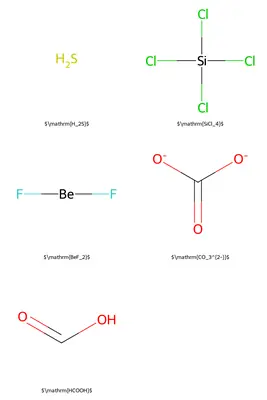
Draw the Lewis structures for the following molecules and ions: $$\mathrm{H_2S}$$, $$\mathrm{SiCl_4}$$, $$\mathrm{BeF_2}$$, $$\mathrm{CO_3^{2-}}$$, $$\mathrm{HCOOH}$$
Figure
Figure

Solution

For each species we (i) count the valence electrons, (ii) put a single bond between every pair of bonded atoms, (iii) distribute the remaining electrons as lone pairs so as to complete octets on the terminal atoms, and (iv) move lone pairs to form multiple bonds if the central atom is still short of an octet.

(i) $$\mathrm{H_2S}$$. Total valence electrons $$= 2(1) + 6 = 8$$. Two S–H single bonds use $$4e^-$$; the remaining $$4e^-$$ go on S as two lone pairs.

$$\mathrm{H}\!-\!\ddot{\mathrm{S}}\!-\!\mathrm{H}\;\;(\text{2 lone pairs on S})$$

(ii) $$\mathrm{SiCl_4}$$. Total valence electrons $$= 4 + 4(7) = 32$$. Four Si–Cl single bonds use $$8e^-$$; the remaining $$24e^-$$ are placed as three lone pairs on each Cl.

$$\mathrm{Cl_3 lone\;pair\;Si\!-\!Cl},$$ i.e. tetrahedral Si with four single bonds to Cl, each Cl carrying three lone pairs (no lone pair on Si).

(iii) $$\mathrm{BeF_2}$$. Total valence electrons $$= 2 + 2(7) = 16$$. Two Be–F single bonds use $$4e^-$$; the remaining $$12e^-$$ go as three lone pairs on each F. Be has only $$4$$ electrons in its valence shell — it is an exception to the octet rule (electron-deficient).

$$:\!\ddot{\mathrm{F}}\!-\!\mathrm{Be}\!-\!\ddot{\mathrm{F}}\!:\;\;\text{(linear, no lone pair on Be)}$$

(iv) $$\mathrm{CO_3^{2-}}$$. Total valence electrons $$= 4 + 3(6) + 2 = 24$$. Three C–O single bonds use $$6e^-$$; place the remaining $$18e^-$$ as lone pairs (three on each O). C still has only $$6$$ electrons, so move one lone pair from one O to form a C=O double bond. The two singly bonded oxygens each carry a negative charge.

$$\left[\;\!{}^-\!\ddot{\mathrm{O}}\!-\!\mathrm{C}(=\!\ddot{\mathrm{O}}\!:)\!-\!\ddot{\mathrm{O}}^-\;\right]^{2-}\quad\Longleftrightarrow\quad\text{(2 other equivalent resonance forms)}$$

(All three C–O bonds are equivalent in the resonance hybrid; bond order $$= 4/3$$.)

(v) $$\mathrm{HCOOH}$$ (formic acid). Total valence electrons $$= 2(1) + 4 + 2(6) = 18$$. The skeleton is

$$\mathrm{H\!-\!C(\!=\!O)\!-\!O\!-\!H}$$

i.e. C is bonded to H, doubly bonded to one O (carbonyl) and singly bonded to the second O (which is also bonded to H). The carbonyl O carries two lone pairs and the hydroxyl O carries two lone pairs; all atoms now have octets (H has duplet).

Answer

Drawn above: $$\mathrm{H_2S}$$ — bent with 2 lone pairs on S; $$\mathrm{SiCl_4}$$ — tetrahedral, no lone pair on Si; $$\mathrm{BeF_2}$$ — linear, electron-deficient Be; $$\mathrm{CO_3^{2-}}$$ — resonance hybrid of three equivalent forms with one C=O and two C–O$${}^-$$; $$\mathrm{HCOOH}$$ — H–C(=O)–O–H with two lone pairs on each O.

4.5 Define octet rule. Write its significance and limitations.

Solution

Octet rule. Kossel and Lewis pointed out that the noble (inert) gases possess very stable electronic configurations consisting of eight electrons in their outermost (valence) shell (except He, which has $$2$$). Atoms of other elements tend to attain the stable configuration of the nearest noble gas. In other words, "in the formation of a chemical bond, atoms lose, gain or share electrons so as to acquire eight electrons in their outermost shell". This is the octet rule.

Significance.

  • It successfully accounts for the formation of a very large number of stable molecules and ions (e.g. $$\mathrm{NaCl}$$, $$\mathrm{CaO}$$, $$\mathrm{H_2O}$$, $$\mathrm{NH_3}$$, $$\mathrm{CH_4}$$, $$\mathrm{CO_2}$$).
  • It rationalises the chemical formulae of common compounds — e.g. why Na is monovalent ($$3s^1$$), Mg divalent ($$3s^2$$), Al trivalent ($$3s^2 3p^1$$); why C is tetravalent and why O is divalent.
  • It explains why certain elements such as Na (loses 1 e$${}^-$$) and Cl (gains 1 e$${}^-$$) react together in $$1:1$$ stoichiometry.
  • It provides a simple book-keeping device — the Lewis dot structure — for predicting connectivity in molecules.

Limitations.

  • Incomplete octet of the central atom (electron-deficient molecules). Molecules of elements having fewer than four valence electrons frequently leave the central atom short of an octet. e.g. $$\mathrm{LiCl}$$ (2 valence e$${}^-$$ around Li), $$\mathrm{BeH_2}$$ (4 e$${}^-$$ around Be), $$\mathrm{BCl_3}$$ (6 e$${}^-$$ around B).
  • Expanded octet (hypervalent molecules). Elements of the third and higher periods can use their empty $$d$$-orbitals to accommodate more than 8 electrons in their valence shell, giving rise to molecules such as $$\mathrm{PF_5}$$ ($$10e^-$$), $$\mathrm{SF_6}$$ ($$12e^-$$), $$\mathrm{H_2SO_4}$$, $$\mathrm{IF_7}$$.
  • Odd-electron species. The rule cannot apply to molecules with an odd number of valence electrons, e.g. $$\mathrm{NO}$$ ($$11e^-$$), $$\mathrm{NO_2}$$ ($$17e^-$$), $$\mathrm{ClO_2}$$.
  • Failure for noble-gas compounds. Xe and Kr form compounds such as $$\mathrm{XeF_2}$$, $$\mathrm{XeF_4}$$, $$\mathrm{XeOF_2}$$, $$\mathrm{KrF_2}$$ even though their atoms already have an octet.
  • It is silent about the shape of molecules; e.g. why $$\mathrm{H_2O}$$ is bent and not linear is not explained.
  • It does not explain the relative stability of molecules — it does not say anything about the energetics of bond formation.
  • Pure ionic and pure covalent character are extremes — most bonds have partial ionic/covalent character which the rule does not address.

Answer

Defined; significance and limitations listed above.

4.6 Write the favourable factors for the formation of ionic bond.

Solution

An ionic (electrovalent) bond is formed by complete transfer of one or more electrons from a metallic atom to a non-metallic atom. The energetics can be summarised by the Born–Haber cycle. The factors that favour ionic bond formation are:

(i) Low ionisation enthalpy of the metal atom. The energy required to remove the electrons from the metal must be small. Therefore alkali and alkaline-earth metals (large atomic size, low effective nuclear charge for the outermost electron) readily form cations.

$$\mathrm{M}(g) \xrightarrow{\Delta_i H}\mathrm{M^+}(g) + e^-$$

(ii) High (negative) electron-gain enthalpy of the non-metal. A large amount of energy should be released when the gaseous non-metal atom accepts an electron; this favours formation of the anion. Halogens and chalcogens (high effective nuclear charge, small size) have high $$-\Delta_{eg}H$$.

$$\mathrm{X}(g) + e^- \xrightarrow{\Delta_{eg} H} \mathrm{X^-}(g)$$

(iii) High lattice enthalpy of the resulting compound. The release of a large amount of energy on the close packing of $$\mathrm{M^+}$$ and $$\mathrm{X^-}$$ ions into the crystal lattice (lattice enthalpy, $$\Delta_{lattice}H$$) is what ultimately drives the overall process to be exothermic. By the Kapustinskii / Born–Landé idea,

$$\Delta_{lattice}H \;\propto\; \dfrac{|Z^+||Z^-|}{r^+ + r^-}$$

So lattice enthalpy is large when the ions have large charges and small radii.

(iv) Achievement of a noble-gas configuration. The formation of cation/anion should lead to a stable octet (or pseudo-noble-gas) configuration.

(v) Large electronegativity difference between the two atoms (commonly $$\geq 1.7$$ on the Pauling scale) favours electron transfer rather than sharing.

Net energy balance: an ionic bond is formed only when

$$\Delta_i H + \Delta_{eg} H + \Delta_{lattice}H \;<\; 0,$$

i.e. when the lattice enthalpy released is large enough to outweigh the (positive) ionisation enthalpy and any positive contribution from the electron-gain step.

Answer

Low ionisation enthalpy of the metal; high (negative) electron-gain enthalpy of the non-metal; high lattice enthalpy of the resulting crystal (favoured by small, highly-charged ions); attainment of stable octet; large electronegativity difference.

4.7 Discuss the shape of the following molecules using the VSEPR model: $$\mathrm{BeCl_2}$$, $$\mathrm{BCl_3}$$, $$\mathrm{SiCl_4}$$, $$\mathrm{AsF_5}$$, $$\mathrm{H_2S}$$, $$\mathrm{PH_3}$$

Solution

VSEPR (Valence-Shell Electron-Pair Repulsion) theory says that the geometry around a central atom is decided by the total number of electron pairs (bond pairs + lone pairs) in its valence shell; these arrange themselves so as to be as far apart as possible. Lone pairs occupy more space than bond pairs.

(a) $$\mathrm{BeCl_2}$$. Central Be has $$2$$ valence electrons; with two Cl atoms forming two Be–Cl single bonds, the steric number is $$2$$ (2 bond pairs, no lone pairs). The two pairs arrange themselves linearly.

$$\therefore \text{Linear, Cl–Be–Cl bond angle} = 180^\circ.$$

(b) $$\mathrm{BCl_3}$$. B has $$3$$ valence electrons and forms three B–Cl single bonds, giving steric number $$3$$ (3 bp, 0 lp).

$$\therefore \text{Trigonal planar, Cl–B–Cl bond angle} = 120^\circ.$$

(c) $$\mathrm{SiCl_4}$$. Si has $$4$$ valence electrons and forms four Si–Cl single bonds, steric number $$4$$ (4 bp, 0 lp).

$$\therefore \text{Regular tetrahedral, Cl–Si–Cl bond angle} = 109.5^\circ.$$

(d) $$\mathrm{AsF_5}$$. As has $$5$$ valence electrons and forms five As–F single bonds, steric number $$5$$ (5 bp, 0 lp).

$$\therefore \text{Trigonal bipyramidal — three equatorial F's at } 120^\circ\text{ and two axial F's at } 90^\circ\text{ to the equatorial plane.}$$

(e) $$\mathrm{H_2S}$$. S has $$6$$ valence electrons; two of them form two S–H bonds and the remaining four sit as two lone pairs. Steric number $$= 2+2 = 4$$.

The four electron pairs are arranged tetrahedrally, but the molecular shape (ignoring lone pairs) is bent (angular). Lone-pair–lone-pair and lone-pair–bond-pair repulsions compress the H–S–H angle below the regular tetrahedral $$109.5^\circ$$; experimentally the angle $$\approx 92^\circ$$.

(f) $$\mathrm{PH_3}$$. P has $$5$$ valence electrons; three of them form three P–H bonds and the remaining two sit as one lone pair. Steric number $$= 3+1 = 4$$.

The four pairs adopt a tetrahedral arrangement, but the molecular shape is trigonal pyramidal. The lone pair compresses the H–P–H angle below $$109.5^\circ$$; experimentally $$\approx 93.5^\circ$$.

Answer

$$\mathrm{BeCl_2}$$ — linear ($$180^\circ$$); $$\mathrm{BCl_3}$$ — trigonal planar ($$120^\circ$$); $$\mathrm{SiCl_4}$$ — tetrahedral ($$109.5^\circ$$); $$\mathrm{AsF_5}$$ — trigonal bipyramidal ($$120^\circ$$ equatorial, $$90^\circ$$ axial); $$\mathrm{H_2S}$$ — bent (~$$92^\circ$$, 2 lone pairs); $$\mathrm{PH_3}$$ — trigonal pyramidal (~$$93.5^\circ$$, 1 lone pair).

4.8 Although geometries of $$\mathrm{NH_3}$$ and $$\mathrm{H_2O}$$ molecules are distorted tetrahedral, bond angle in water is less than that of ammonia. Discuss.

Solution

In both molecules the central atom is $$sp^3$$-hybridised, so the underlying electron-pair geometry is tetrahedral. The molecular shape, however, depends on the relative numbers of bond pairs (bp) and lone pairs (lp):

MoleculeValence electrons on central atomBond pairsLone pairsObserved bond angle
$$\mathrm{NH_3}$$$$5$$ (N: $$2s^2 2p^3$$)$$3$$$$1$$$$\approx 107^\circ$$
$$\mathrm{H_2O}$$$$6$$ (O: $$2s^2 2p^4$$)$$2$$$$2$$$$\approx 104.5^\circ$$

According to VSEPR theory the magnitude of repulsion between different pairs of electrons follows the order

$$\text{lp–lp} \;>\; \text{lp–bp} \;>\; \text{bp–bp}.$$

Starting from the ideal tetrahedral angle of $$109.5^\circ$$, each lone pair compresses the bond-pair–bond-pair angle from the ideal value because the lone-pair–bond-pair repulsion is stronger than bond-pair–bond-pair repulsion. The greater the number of lone pairs on the central atom, the greater the compression of the bond angle.

$$\mathrm{NH_3}$$ has one lone pair, while $$\mathrm{H_2O}$$ has two. The two lone pairs in water exert greater repulsive force on the bond pairs (and also repel each other) than the single lone pair in ammonia. Consequently, the H–O–H bond angle is reduced more than the H–N–H bond angle:

$$109.5^\circ \;\xrightarrow{\text{1 lp}}\; 107^\circ\ (\mathrm{NH_3}) \;\xrightarrow{\text{2 lp}}\; 104.5^\circ\ (\mathrm{H_2O}).$$

Hence the bond angle in water ($$104.5^\circ$$) is smaller than that in ammonia ($$107^\circ$$).

Answer

Because $$\mathrm{H_2O}$$ has two lone pairs on O whereas $$\mathrm{NH_3}$$ has only one on N. The extra lone pair in water exerts additional lp–bp and lp–lp repulsion, compressing the bond angle further from the ideal tetrahedral $$109.5^\circ$$ (from $$107^\circ$$ in $$\mathrm{NH_3}$$ to $$104.5^\circ$$ in $$\mathrm{H_2O}$$).

4.9 How do you express the bond strength in terms of bond order?

Solution

Bond order is defined as the number of chemical bonds (or shared electron pairs) between a pair of atoms. In Lewis structures it equals the number of bonds drawn between the two atoms. In molecular-orbital theory it is given by

$$\text{Bond order} \;=\; \dfrac{1}{2}\,(N_b - N_a),$$

where $$N_b$$ and $$N_a$$ are the numbers of electrons in bonding and antibonding molecular orbitals respectively.

Examples — $$\mathrm{H_2}$$: B.O. $$= 1$$; $$\mathrm{O_2}$$: B.O. $$= 2$$; $$\mathrm{N_2}$$: B.O. $$= 3$$.

Relation between bond order and bond strength. Other factors being similar (same pair of atoms, similar bond environment),

  • Bond strength (bond-dissociation enthalpy) increases with bond order, because a larger number of shared electron pairs increases the electron density between the nuclei and hence the attraction. e.g. for the C–C linkage: B.O. $$1 \rightarrow 348\,\mathrm{kJ/mol}$$ (C–C); B.O. $$2 \rightarrow 614\,\mathrm{kJ/mol}$$ (C=C); B.O. $$3 \rightarrow 839\,\mathrm{kJ/mol}$$ (C$$\equiv$$C).
  • Bond length decreases with increasing bond order. e.g. $$r_{\mathrm{C-C}} = 154\,\mathrm{pm}$$, $$r_{\mathrm{C=C}} = 134\,\mathrm{pm}$$, $$r_{\mathrm{C\equiv C}} = 120\,\mathrm{pm}$$.

Hence we may say: the higher the bond order, the shorter and stronger the bond. In MO language, a higher bond order corresponds to a greater excess of bonding over antibonding electrons and thus greater stability of the molecule.

Answer

Bond order is the number of bonding electron pairs (in MO theory, $$\tfrac{1}{2}(N_b-N_a)$$). Bond strength (and stability) increases — and bond length decreases — with increasing bond order; the higher the bond order, the stronger and shorter the bond.

4.10 Define the bond length.

Solution

Bond length is defined as the equilibrium distance between the nuclei of two atoms which are chemically bonded together in a molecule. It is the inter-nuclear distance at which the potential-energy curve of the diatomic species has its minimum and is expressed in $$\text{\AA}$$ or pm ($$1\,\text{\AA} = 100\,\mathrm{pm}$$).

Experimentally bond lengths are determined by spectroscopic methods, X-ray diffraction and electron-diffraction studies. For a covalent bond between two like atoms A–A, half the inter-nuclear distance is called the covalent radius of A:

$$r_A = \dfrac{d_{\mathrm{A-A}}}{2}.$$

For a heteronuclear bond A–B, the bond length is approximately the sum of the covalent radii of A and B:

$$d_{\mathrm{A-B}} \;\approx\; r_A + r_B.$$

For ionic compounds, the inter-nuclear distance equals the sum of the ionic radii of the cation and anion: $$d = r^+ + r^-$$.

Bond length decreases with increasing bond order (e.g. C–C: $$154\,\mathrm{pm}$$, C=C: $$134\,\mathrm{pm}$$, C$$\equiv$$C: $$120\,\mathrm{pm}$$) and increases with the size of the bonded atoms.

Answer

Bond length is the equilibrium internuclear distance between two atoms covalently/ionically joined in a molecule; for A–B, $$d_{AB} \approx r_A + r_B$$ where $$r$$ denotes the covalent (or ionic) radius. Units: pm / Å.

4.11 Explain the important aspects of resonance with reference to the $$\mathrm{CO_3^{2-}}$$ ion.

Solution

When a single Lewis structure cannot adequately describe a molecule or ion, the actual structure is regarded as the average of several alternative Lewis structures — called canonical (resonating) structures — which differ only in the position of electrons (lone pairs and π-electrons), not in the positions of the nuclei. The real species is called the resonance hybrid and the phenomenon is termed resonance. The double-headed arrow ($$\leftrightarrow$$) is used between canonical forms.

Important aspects of resonance.

  • Canonical structures are hypothetical; the real molecule never exists as any one of them. The actual species (resonance hybrid) is a delocalised structure intermediate between the canonical forms.
  • The canonical structures must have the same number and arrangement of atoms and the same number of unpaired electrons; only the electron distribution differs.
  • The resonance hybrid is more stable than any individual canonical structure. The extra stability is called the resonance energy (or delocalisation energy).
  • The greater the number of equivalent (low-energy) canonical structures, the greater the resonance stabilisation.

Application to $$\mathrm{CO_3^{2-}}$$. Three equivalent Lewis structures can be drawn for the carbonate ion by interchanging the position of the C=O double bond among the three oxygens:

$$\mathrm{(I)}\;\mathrm{O\!=\!C(-O^-)(-O^-)}\;\longleftrightarrow\;\mathrm{(II)}\;\mathrm{^-O\!-\!C(=O)(-O^-)}\;\longleftrightarrow\;\mathrm{(III)}\;\mathrm{^-O\!-\!C(-O^-)(=O)}$$

None of these canonical structures alone is consistent with experiment, which shows that all three C–O bonds are equivalent (same length, $$\approx 129\,\mathrm{pm}$$, intermediate between C–O single ($$143\,\mathrm{pm}$$) and C=O double ($$122\,\mathrm{pm}$$) bonds), and that the negative charge is distributed symmetrically. The resonance hybrid explains both observations:

  • Each C–O bond has bond order $$\dfrac{1+1+2}{3}=\dfrac{4}{3}\approx 1.33$$;
  • Each oxygen carries an equal fractional charge of $$-\dfrac{2}{3}$$;
  • The ion is planar, with C $$sp^2$$-hybridised and bond angles of $$120^\circ$$;
  • $$\mathrm{CO_3^{2-}}$$ is more stable (lower energy) than any single canonical form would suggest, owing to resonance energy.

Answer

Canonical forms have identical atom positions but different electron arrangements; the real species is a more-stable resonance hybrid. For $$\mathrm{CO_3^{2-}}$$ three equivalent canonical structures combine to give equal C–O bond lengths (B.O. $$=4/3$$) and equal $$-2/3$$ charge on each O, with extra stability called resonance energy.

4.12

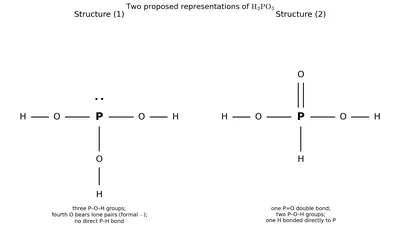
$$\mathrm{H_3PO_3}$$ can be represented by structures 1 and 2 shown below. Can these two structures be taken as the canonical forms of the resonance hybrid representing $$\mathrm{H_3PO_3}$$? If not, give reasons for the same.

Structure (1): $$\mathrm{H-O-P(-O-H)(-O\ddot{:})}$$ with H on top P (P bonded to three O–H groups and one O with lone pairs).

Structure (2): $$\mathrm{H-O-P(=O)(-O-H)}$$ with H on top P (P doubly bonded to one O, singly bonded to two O–H groups, and to one H directly).

Figure
Figure

Solution

No, structures (1) and (2) cannot be regarded as canonical forms (contributing structures) of a resonance hybrid representing $$\mathrm{H_3PO_3}$$.

One of the cardinal rules of resonance is that the positions of the atomic nuclei must be identical in all canonical structures; only the electron distribution (lone pairs and π-electrons) may differ. The two given structures violate this rule:

  • In structure (1), all three hydrogen atoms are attached to oxygen atoms (i.e. $$\mathrm{H-O-P(OH)_2(O)}$$ with three P–OH groups).
  • In structure (2), only two hydrogens are bonded to oxygen, while the third hydrogen is bonded directly to the phosphorus atom (i.e. $$\mathrm{H-P(=O)(OH)_2}$$).

Hence the two structures differ in the position of a hydrogen atom (P–H vs. O–H), which means they are not resonance forms but two different tautomers/isomers of $$\mathrm{H_3PO_3}$$. (Experimentally, $$\mathrm{H_3PO_3}$$ exists predominantly as structure (2) and behaves as a dibasic acid because only the two O–H hydrogens are ionisable; the direct P–H hydrogen is not acidic.)

Therefore the two given representations are not canonical forms of $$\mathrm{H_3PO_3}$$.

Answer

No — the two structures differ in the position of a hydrogen atom (in (1) H is on O, in (2) H is on P), violating the rule that canonical forms must have identical atomic positions. They are tautomers, not resonance structures.

4.13 Write the resonance structures for $$\mathrm{SO_3}$$, $$\mathrm{NO_2}$$ and $$\mathrm{NO_3^-}$$.

Solution

In each case the central atom is bonded to terminal O atoms; the resonance (canonical) forms differ only in the placement of the multiple bond among the equivalent terminal oxygens — the positions of the nuclei stay the same.

(i) $$\mathrm{SO_3}$$. Total valence electrons $$= 6 + 3(6) = 24$$. S is the central atom and is bonded to three oxygens. Three equivalent canonical structures are obtained by shifting the position of the S=O double bond among the three oxygens; in each form there is one S=O double bond and two S–O$${}^-$$ single bonds, with the central S carrying a $$+2$$ formal charge:

$$\mathrm{(I)}\;\mathrm{O\!=\!S(-O^-)(-O^-)}\;\longleftrightarrow\;\mathrm{(II)}\;\mathrm{^-O\!-\!S(=O)(-O^-)}\;\longleftrightarrow\;\mathrm{(III)}\;\mathrm{^-O\!-\!S(-O^-)(=O)}$$

The resonance hybrid is the trigonal-planar $$\mathrm{SO_3}$$ molecule in which all three S–O bonds are equivalent, with an average bond order of $$\dfrac{2+1+1}{3} = \dfrac{4}{3}$$.

(ii) $$\mathrm{NO_2}$$. Total valence electrons $$= 5 + 2(6) = 17$$ (odd-electron species). Two equivalent canonical structures are obtained by interchanging the position of the N=O double bond:

$$\mathrm{(I)}\ \mathrm{O\!=\!\dot{N}\!-\!\ddot{O}}\;\longleftrightarrow\;\mathrm{(II)}\ \mathrm{\ddot{O}\!-\!\dot{N}\!=\!O}$$

Each canonical form has one N=O double bond, one N–O single bond, and an odd electron on N. The hybrid is a bent molecule with equivalent N–O bonds (intermediate between single and double, B.O. $$= 1.5$$).

(iii) $$\mathrm{NO_3^-}$$. Total valence electrons $$= 5 + 3(6) + 1 = 24$$. N is bonded to three O atoms. Three equivalent canonical structures (one N=O double bond and two N–O$${}^-$$ single bonds) are obtained by rotating the position of the double bond:

$$\mathrm{(I)}\;\mathrm{O\!=\!N(-O^-)(-O^-)}\;\longleftrightarrow\;\mathrm{(II)}\;\mathrm{^-O\!-\!N(=O)(-O^-)}\;\longleftrightarrow\;\mathrm{(III)}\;\mathrm{^-O\!-\!N(-O^-)(=O)}$$

In every canonical form N has a formal charge of $$+1$$ and the two singly bonded oxygens each carry $$-1$$. The resonance hybrid is trigonal planar with all three N–O bonds equivalent (B.O. $$= 4/3$$) and the charge $$-1$$ delocalised equally over all three oxygens (each O carries $$-\tfrac{2}{3}$$).

Answer

Three equivalent canonical forms for $$\mathrm{SO_3}$$ (one S=O and two S–O$${}^-$$), two equivalent forms for $$\mathrm{NO_2}$$ (one N=O and one N–O with the odd electron on N), and three equivalent forms for $$\mathrm{NO_3^-}$$ (one N=O and two N–O$${}^-$$); in each case the multiple bond is shifted among the equivalent oxygens.

4.14 Use Lewis symbols to show electron transfer between the following atoms to form cations and anions:

(a) $$\mathrm{K}$$ and $$\mathrm{S}$$

Solution

K ($$Z=19$$, $$[\mathrm{Ar}]4s^1$$) has $$1$$ valence electron, S ($$Z=16$$, $$[\mathrm{Ne}]3s^2 3p^4$$) has $$6$$. S needs $$2$$ electrons to complete its octet, so two K atoms transfer one electron each to one S atom:

$$2\mathrm{K}\!\cdot\;+\;:\!\ddot{\mathrm{S}}\!\cdot\cdot\;\longrightarrow\;2[\mathrm{K}]^+ + \left[\,:\!\ddot{\ddot{\mathrm{S}}}\!:\,\right]^{2-}$$

Each $$\mathrm{K^+}$$ has the Ar configuration; $$\mathrm{S^{2-}}$$ has the Ar configuration ($$3s^2 3p^6$$). The compound is potassium sulphide $$\mathrm{K_2S}$$.

Answer

$$2\mathrm{K}\!\cdot\,+\,:\!\ddot{\mathrm{S}}\!\cdot\cdot\,\rightarrow\,2[\mathrm{K}]^+ + [:\!\ddot{\ddot{\mathrm{S}}}\!:]^{2-}\;\;(\mathrm{K_2S})$$

(b) $$\mathrm{Ca}$$ and $$\mathrm{O}$$

Solution

Ca ($$Z=20$$, $$[\mathrm{Ar}]4s^2$$) has $$2$$ valence electrons; O ($$[\mathrm{He}]2s^2 2p^4$$) has $$6$$ and needs $$2$$. Ca therefore transfers both its valence electrons to a single O atom:

$$\cdot\mathrm{Ca}\cdot\;+\;:\!\ddot{\mathrm{O}}\!\cdot\cdot\;\longrightarrow\;[\mathrm{Ca}]^{2+} + \left[\,:\!\ddot{\ddot{\mathrm{O}}}\!:\,\right]^{2-}$$

$$\mathrm{Ca^{2+}}$$ attains the Ar configuration; $$\mathrm{O^{2-}}$$ attains the Ne configuration. The compound is calcium oxide $$\mathrm{CaO}$$.

Answer

$$\cdot\mathrm{Ca}\cdot\,+\,:\!\ddot{\mathrm{O}}\!\cdot\cdot\,\rightarrow\,[\mathrm{Ca}]^{2+} + [:\!\ddot{\ddot{\mathrm{O}}}\!:]^{2-}\;\;(\mathrm{CaO})$$

(c) $$\mathrm{Al}$$ and $$\mathrm{N}$$

Solution

Al ($$Z=13$$, $$[\mathrm{Ne}]3s^2 3p^1$$) has $$3$$ valence electrons; N ($$[\mathrm{He}]2s^2 2p^3$$) has $$5$$ and needs $$3$$ to complete its octet. One Al atom transfers all three of its valence electrons to one N atom:

$$\cdot\dot{\mathrm{Al}}\!\cdot\;+\;:\!\dot{\mathrm{N}}\!\cdot\cdot\;\longrightarrow\;[\mathrm{Al}]^{3+} + \left[\,:\!\ddot{\ddot{\mathrm{N}}}\!:\,\right]^{3-}$$

$$\mathrm{Al^{3+}}$$ attains the Ne configuration ($$2s^2 2p^6$$); $$\mathrm{N^{3-}}$$ attains the Ne configuration ($$2s^2 2p^6$$). The compound is aluminium nitride $$\mathrm{AlN}$$.

Answer

$$\cdot\dot{\mathrm{Al}}\!\cdot\,+\,:\!\dot{\mathrm{N}}\!\cdot\cdot\,\rightarrow\,[\mathrm{Al}]^{3+} + [:\!\ddot{\ddot{\mathrm{N}}}\!:]^{3-}\;\;(\mathrm{AlN})$$

4.15 Although both $$\mathrm{CO_2}$$ and $$\mathrm{H_2O}$$ are triatomic molecules, the shape of $$\mathrm{H_2O}$$ molecule is bent while that of $$\mathrm{CO_2}$$ is linear. Explain this on the basis of dipole moment.

Solution

The dipole moment of a molecule is the vector sum of the bond dipoles of all the bonds in the molecule:

$$\vec{\mu}_{\text{molecule}} \;=\; \sum_i \vec{\mu}_i.$$

Both C–O bond in $$\mathrm{CO_2}$$ and O–H bond in $$\mathrm{H_2O}$$ are polar individually (O is more electronegative than C, and O is more electronegative than H). Whether the molecule as a whole has a net dipole moment therefore depends on its geometry, because the bond dipoles must be added as vectors.

$$\mathrm{CO_2}$$. Experimentally the dipole moment of $$\mathrm{CO_2}$$ is $$0\,\mathrm{D}$$. The only way two equal C=O bond dipoles can give a zero resultant is if they point in exactly opposite directions along the same line. Hence $$\mathrm{CO_2}$$ must be linear ($$\angle\mathrm{O\!=\!C\!=\!O} = 180^\circ$$), with $$\vec{\mu}_{C\!=\!O} + \vec{\mu}_{C\!=\!O} = 0$$. Schematically:

$$\overset{\delta-}{\mathrm{O}}\!\Longleftarrow\!\overset{\delta+}{\mathrm{C}}\!\Longrightarrow\!\overset{\delta-}{\mathrm{O}}\;\;\Longrightarrow\;\;\vec{\mu}_{\text{net}} = 0.$$

$$\mathrm{H_2O}$$. Experimentally, water has a substantial dipole moment of $$1.85\,\mathrm{D}$$ (non-zero). If $$\mathrm{H_2O}$$ were linear, the two equal O–H bond dipoles (pointing from H towards O) would also cancel and give $$\vec{\mu}=0$$. Since water is observed to have a non-zero dipole moment, the molecule cannot be linear; it must be bent (angular), so that the two O–H bond vectors add to give a net resultant directed along the bisector of the H–O–H angle. (The two lone pairs on oxygen are responsible for the bending; $$\angle\mathrm{H\!-\!O\!-\!H} \approx 104.5^\circ$$.)

Thus the contrasting dipole moments — zero for $$\mathrm{CO_2}$$ and $$1.85\,\mathrm{D}$$ for $$\mathrm{H_2O}$$ — are direct evidence that $$\mathrm{CO_2}$$ is linear while $$\mathrm{H_2O}$$ is bent.

Answer

Bond dipoles add vectorially. $$\mathrm{CO_2}$$ has $$\mu = 0$$ — the two equal C=O dipoles cancel, which is only possible if the molecule is linear. $$\mathrm{H_2O}$$ has $$\mu \ne 0$$ ($$\approx 1.85\,\mathrm{D}$$) — the two O–H bond dipoles do not cancel, so the molecule must be bent.

4.16 Write the significance/applications of dipole moment.

Solution

Dipole moment ($$\mu$$) is a vector quantity defined for a polar bond/molecule as the product of the magnitude of the partial charge $$q$$ and the distance $$d$$ separating the centres of positive and negative charge:

$$\mu = q \times d.$$

It is measured in Debye units ($$1\,\mathrm{D} = 3.33564 \times 10^{-30}\,\mathrm{C\,m}$$). Its main uses are:

  • Predicting polarity of molecules. Molecules with non-zero dipole moments are polar (e.g. $$\mathrm{HCl}$$, $$\mu = 1.03\,\mathrm{D}$$); those with $$\mu = 0$$ are non-polar (e.g. $$\mathrm{H_2}$$, $$\mathrm{CO_2}$$, $$\mathrm{BF_3}$$, $$\mathrm{CH_4}$$).
  • Distinguishing geometries / determining molecular shape. If a molecule has a non-zero dipole moment it cannot have a symmetrical shape that would cancel the bond dipoles. Example: $$\mathrm{CO_2}$$ has $$\mu=0$$ — so it is linear; $$\mathrm{H_2O}$$ has $$\mu = 1.85\,\mathrm{D}$$ — so it is bent. $$\mathrm{NH_3}$$ ($$\mu = 1.46\,\mathrm{D}$$) is pyramidal, while $$\mathrm{BF_3}$$ ($$\mu = 0$$) is planar.
  • Distinguishing cis/trans (geometrical) isomers. e.g. cis-1,2-dichloroethene has non-zero $$\mu$$, while the trans isomer has $$\mu = 0$$ because the two C–Cl bond dipoles cancel.
  • Estimating per-cent ionic character of a bond. By comparing the observed dipole moment with the hypothetical fully-ionic value:

$$\%\ \text{ionic character} \;=\; \dfrac{\mu_{\text{observed}}}{\mu_{\text{ionic}}}\times 100,\quad \text{where } \mu_{\text{ionic}} = e \times d.$$

e.g. for HCl with $$\mu_{obs} = 1.03\,\mathrm{D}$$ and $$\mu_{\text{ionic}} = 6.12\,\mathrm{D}$$ (calc.), the per-cent ionic character is $$\approx 17\%$$.

  • Comparing relative polarities and hence physical properties such as boiling point, solubility, dielectric constant.
  • Determining symmetry of a molecule: highly symmetric molecules ($$\mathrm{CCl_4}$$, $$\mathrm{SF_6}$$) have $$\mu = 0$$.

Answer

Dipole moment is used to (i) decide whether a molecule is polar or non-polar, (ii) determine molecular shape/geometry, (iii) distinguish cis-trans isomers, (iv) calculate per-cent ionic character of a bond ($$\mu_{obs}/\mu_{ionic} \times 100$$), and (v) compare polarities and related physical properties.

4.17 Define electronegativity. How does it differ from electron gain enthalpy?

Solution

Electronegativity ($$\chi$$). The tendency of an atom in a chemical bond to attract towards itself the shared pair of electrons. It is a relative number (dimensionless) and has no units (Pauling, Mulliken, Allred–Rochow scales).

Electron gain enthalpy ($$\Delta_{eg}H$$). The enthalpy change accompanying the addition of an electron to an isolated, gaseous, neutral atom in its ground state to form a gaseous anion:

$$\mathrm{X}(g) + e^-(g) \;\longrightarrow\; \mathrm{X^-}(g);\quad \Delta H = \Delta_{eg}H.$$

It has the units of energy (kJ/mol).

Differences.

PropertyElectronegativityElectron-gain enthalpy
DefinitionTendency of an atom in a bonded state to attract the shared electron pairEnthalpy change when an isolated gaseous atom accepts an electron
State of atomBonded (within a molecule)Free, gaseous, isolated
ProcessNot a physical process — a relative property of an atomAn actual measurable physical process: $$\mathrm{X}(g)+e^-\to\mathrm{X^-}(g)$$
UnitsDimensionless (relative scale, e.g. Pauling)kJ mol$${}^{-1}$$ (energy)
SignAlways positive (no sign convention)Generally negative; positive only for noble gases and a few others
VariationOf a fixed value for a given atom (but varies somewhat with bond environment / oxidation state)Has a definite numerical value for a given atom
Trend across a periodIncreases from left to rightBecomes more negative from left to right, i.e. $$-\Delta_{eg}H$$ generally increases (with a few exceptions)
Trend down a groupDecreasesBecomes less negative down a group, i.e. $$-\Delta_{eg}H$$ generally decreases; there are exceptions — e.g. $$\Delta_{eg}H$$ of chlorine is more negative than that of fluorine

Although the two properties run roughly in parallel (an atom that strongly attracts the bonded pair also usually releases much energy on capturing a free electron), they are not the same — one is a relative tendency in a bonded state and the other is the measurable enthalpy of a specific process for the free atom.

Answer

Electronegativity is the tendency of an atom in a chemical bond to attract the shared pair towards itself (dimensionless); electron-gain enthalpy is the energy released/absorbed when an isolated gaseous atom acquires an electron (kJ/mol). The first is a relative property of an atom in a molecule, the second a measurable enthalpy for the free atom.

4.18 Explain with the help of suitable example polar covalent bond.

Solution

A polar covalent bond is a covalent bond between two atoms of different electronegativities. Because the more electronegative atom attracts the shared electron pair more strongly, the shared pair is displaced towards it, producing a partial negative charge ($$\delta-$$) on the more electronegative atom and an equal partial positive charge ($$\delta+$$) on the less electronegative atom. The bond therefore has both covalent character (sharing) and ionic character (charge separation).

Example: HCl. Hydrogen ($$\chi = 2.1$$) and chlorine ($$\chi = 3.0$$) differ in electronegativity by $$\Delta\chi = 0.9$$. The shared electron pair in H–Cl is displaced towards the more electronegative chlorine atom, giving

$$\overset{\delta+}{\mathrm{H}}\!-\!\overset{\delta-}{\mathrm{Cl}}.$$

The bond thus possesses a permanent dipole moment of $$1.03\,\mathrm{D}$$ directed from H ($$\delta+$$) to Cl ($$\delta-$$). Other examples are $$\mathrm{H_2O}$$, $$\mathrm{NH_3}$$, $$\mathrm{HF}$$ and the C=O bond.

The greater the difference in electronegativity ($$\Delta\chi$$) between the two atoms, the greater the polarity of the bond. When $$\Delta\chi$$ is very large (commonly $$\Delta\chi \geq 1.7$$ on the Pauling scale), the bond is regarded as essentially ionic; when $$\Delta\chi = 0$$ the bond is purely (non-polar) covalent.

Hannay–Smyth gave an empirical relation for the percentage ionic character of a bond:

$$\%\,\text{ionic character} = 16\,(\chi_A - \chi_B) + 3.5\,(\chi_A - \chi_B)^2.$$

For HCl, $$\Delta\chi = 0.9$$, giving $$\%\,\text{ionic character} \approx 17\%$$, i.e. HCl is largely covalent but with significant ionic character — a typical polar covalent bond.

Answer

A polar covalent bond is a covalent bond between atoms of different electronegativities; the bonded pair is displaced towards the more electronegative atom, producing $$\delta+$$ and $$\delta-$$ charges and a permanent dipole moment. Example: $$\overset{\delta+}{\mathrm{H}}\!-\!\overset{\delta-}{\mathrm{Cl}}$$ with $$\mu = 1.03\,\mathrm{D}$$.

4.19 Arrange the bonds in order of increasing ionic character in the molecules: $$\mathrm{LiF}$$, $$\mathrm{K_2O}$$, $$\mathrm{N_2}$$, $$\mathrm{SO_2}$$ and $$\mathrm{ClF_3}$$.

Solution

The ionic character of a bond rises with the difference in electronegativity ($$\Delta\chi$$) between the bonded atoms. Using Pauling electronegativities:

MoleculeBondElectronegativities$$\Delta\chi$$
$$\mathrm{N_2}$$N–N3.0, 3.0$$0$$ (purely covalent)
$$\mathrm{SO_2}$$S–O2.5, 3.5$$1.0$$
$$\mathrm{ClF_3}$$Cl–F3.0, 4.0$$1.0$$ (close to S–O)
$$\mathrm{K_2O}$$K–O0.8, 3.5$$2.7$$
$$\mathrm{LiF}$$Li–F1.0, 4.0$$3.0$$

The Cl–F bond, although having the same $$\Delta\chi$$ as S–O numerically, is more polar than S–O if one is being precise about the small difference; however many texts put $$\mathrm{SO_2}$$ before $$\mathrm{ClF_3}$$ because the dipole moments of $$\mathrm{SO_2}$$ (1.62 D, bent) and $$\mathrm{ClF_3}$$ (0.6 D, T-shaped) reflect their geometry. Following the NCERT convention (purely on $$\Delta\chi$$):

$$\mathrm{N_2} \;<\; \mathrm{SO_2} \;<\; \mathrm{ClF_3} \;<\; \mathrm{K_2O} \;<\; \mathrm{LiF}.$$

(Increasing ionic character means increasing electronegativity difference; $$\mathrm{N_2}$$ is purely covalent ($$\Delta\chi=0$$), whereas $$\mathrm{LiF}$$ is the most ionic of the lot.)

Answer

$$\mathrm{N_2} \;<\; \mathrm{SO_2} \;<\; \mathrm{ClF_3} \;<\; \mathrm{K_2O} \;<\; \mathrm{LiF}$$.

4.20

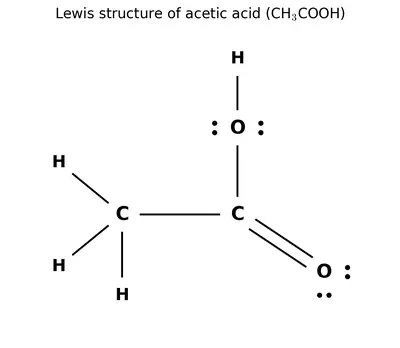
The skeletal structure of $$\mathrm{CH_3COOH}$$ as shown below is correct, but some of the bonds are shown incorrectly. Write the correct Lewis structure for acetic acid.

$$\mathrm{H=C(-H)(-H)-C(=\ddot{O}\!:)-\ddot{O}\!:-H}$$ (as drawn in the textbook with incorrect double bond placement)

Figure
Figure

Solution

Total valence electrons in $$\mathrm{CH_3COOH}$$ are

$$4\,(\text{H}) + 2\times 4\,(\text{C}) + 2\times 6\,(\text{O}) = 4 + 8 + 12 = 24.$$

The skeletal connectivity (from the textbook) is correct: $$\mathrm{H_3C\!-\!C(=O)\!-\!O\!-\!H}$$. The errors in the printed figure are (i) one of the C–H bonds is drawn as a double bond, which would make H pentavalent (impossible since H has only one valence electron — it can form only a single bond), and (ii) the lone pairs on the two oxygens may be missing or misplaced.

The correct Lewis structure:

$$\mathrm{H}\!-\!\overset{\displaystyle H}{\underset{\displaystyle H}{\mathrm{C}}}\!-\!\mathrm{C}\!(=\!\ddot{\mathrm{O}}\!:)\!-\!\ddot{\mathrm{O}}\!-\!\mathrm{H}$$

That is: the methyl carbon ($$\mathrm{C_1}$$) is $$sp^3$$-hybridised and forms three single C–H bonds and one C–C single bond. The carboxyl carbon ($$\mathrm{C_2}$$) is $$sp^2$$-hybridised, forms a C=O double bond with one oxygen (the carbonyl oxygen carrying two lone pairs) and a C–O–H single bond with the other oxygen (the hydroxyl oxygen carrying two lone pairs). All atoms have completed their octets (H — duplet, C — octet, O — octet).

Electron book-keeping check: bonds drawn = $$3\,(C_1\!-\!H) + 1\,(C_1\!-\!C_2) + 1\,(C_2\!=\!O) + 1\,(C_2\!-\!O) + 1\,(O\!-\!H) = 8$$ bonds $$\Rightarrow$$ $$8\times 2 = 16$$ shared electrons. The two oxygens have $$2 + 2 = 4$$ lone pairs $$= 8$$ electrons. Total $$= 16 + 8 = 24$$ — matches.

Answer

$$\mathrm{H_3C\!-\!C(=\!\ddot{O}\!:)\!-\!\ddot{O}\!-\!H}$$ — three single C–H bonds on the methyl carbon, a C–C single bond, a C=O double bond (carbonyl O with 2 lone pairs) and a C–O–H single bond (hydroxyl O with 2 lone pairs). Each H forms one bond; both C atoms and both O atoms attain octets.

4.21 Apart from tetrahedral geometry, another possible geometry for $$\mathrm{CH_4}$$ is square planar with the four H atoms at the corners of the square and the C atom at its centre. Explain why $$\mathrm{CH_4}$$ is not square planar?

Solution

According to VSEPR theory the four pairs of bonding electrons around the central carbon atom in $$\mathrm{CH_4}$$ will arrange themselves in space so as to be as far apart as possible (i.e. to minimise the inter-pair electrostatic repulsion). For four pairs the geometry that gives the largest angle between any two pairs is the regular tetrahedron, in which the H–C–H angle is

$$\theta_{\text{tetra}} = 109.5^\circ\;\;(\cos^{-1}\!\left(-\tfrac{1}{3}\right)).$$

If the molecule were square planar with the four H atoms at the corners of a square and C at its centre, the H–C–H angle for adjacent hydrogens would be

$$\theta_{\text{sq-pl}} = 90^\circ,$$

which is considerably smaller than the tetrahedral angle. This would force the four bonding pairs (and the H atoms) much closer together, leading to greater bond-pair–bond-pair repulsion and a higher energy.

The tetrahedral arrangement, by contrast, gives the maximum possible separation of the four bond pairs ($$109.5^\circ$$) and hence the minimum mutual repulsion and the lowest energy.

From the orbital-overlap (hybridisation) view, the carbon atom in $$\mathrm{CH_4}$$ uses four equivalent $$sp^3$$ hybrid orbitals, which by their very mathematical form are directed towards the four corners of a regular tetrahedron — not to the corners of a square — and overlap with the four hydrogen $$1s$$ orbitals to form four equivalent, maximally-overlapped C–H sigma bonds.

Therefore the tetrahedral geometry is energetically more stable than the hypothetical square-planar geometry, and $$\mathrm{CH_4}$$ is observed to be tetrahedral, not square planar.

Answer

Because the tetrahedral arrangement places the four bond pairs at $$109.5^\circ$$ — the maximum possible separation — minimising bond-pair repulsion; a square-planar geometry would place adjacent C–H pairs at only $$90^\circ$$, giving much greater repulsion and higher energy. Also, sp$${}^3$$ hybrid orbitals on C point to the corners of a tetrahedron, not of a square.

4.22 Explain why $$\mathrm{BeH_2}$$ molecule has a zero dipole moment although the Be–H bonds are polar.

Solution

Each individual Be–H bond is polar because beryllium ($$\chi = 1.5$$) and hydrogen ($$\chi = 2.1$$) differ in electronegativity (here $$\Delta\chi \approx 0.6$$); the bond dipole is directed from Be towards H ($$\overset{\delta+}{\mathrm{Be}}\!-\!\overset{\delta-}{\mathrm{H}}$$).

$$\mathrm{BeH_2}$$ is a linear molecule (Be is $$sp$$-hybridised, with two bond pairs and no lone pair on Be; the H–Be–H bond angle is $$180^\circ$$). Hence the two equal Be–H bond dipoles point in exactly opposite directions along the same line:

$$\overset{\delta-}{\mathrm{H}}\!\Longleftarrow\!\overset{\delta+}{\mathrm{Be}}\!\Longrightarrow\!\overset{\delta-}{\mathrm{H}}$$

The net dipole moment of the molecule is the vector sum of the individual bond dipoles:

$$\vec{\mu}_{\text{net}} \;=\; \vec{\mu}_{\mathrm{Be\!-\!H_1}} + \vec{\mu}_{\mathrm{Be\!-\!H_2}} \;=\; \vec{\mu}\,(-\hat{x}) + \vec{\mu}\,(+\hat{x}) \;=\; \vec{0}.$$

Since the two equal and oppositely directed Be–H bond dipoles exactly cancel each other, the molecule as a whole has zero dipole moment, in spite of the individual bonds being polar.

Answer

$$\mathrm{BeH_2}$$ is linear (H–Be–H $$= 180^\circ$$); the two equal Be–H bond dipoles point in exactly opposite directions and cancel each other, so the net (vector) dipole moment of the molecule is zero.

4.23 Which out of $$\mathrm{NH_3}$$ and $$\mathrm{NF_3}$$ has higher dipole moment and why?

Solution

$$\mathrm{NH_3}$$ has the higher dipole moment, although the individual N–F bond is more polar than the N–H bond.

Both $$\mathrm{NH_3}$$ and $$\mathrm{NF_3}$$ are trigonal pyramidal ($$sp^3$$-hybridised N with one lone pair and three bonded atoms). In each case the resultant dipole moment of the molecule has two contributions:

  • the vector sum of the three N–X bond dipoles ($$X = $$ H or F), which points along the C$$_3$$ axis;
  • the dipole of the lone pair on nitrogen, which points along the same axis (from N outwards along the symmetry axis on the side opposite the three X atoms).

The direction of the bond dipole is decided by the electronegativity difference:

  • In $$\mathrm{NH_3}$$, $$\chi_{\mathrm{N}} = 3.0 > \chi_{\mathrm{H}} = 2.1$$, so each bond dipole points from H towards N. Thus the resultant of the three N–H bond dipoles is directed along the C$$_3$$ axis towards the N atom; this resultant is in the same direction as the lone-pair moment. The two contributions add:

$$\mu(\mathrm{NH_3}) = \mu_{\text{bp(sum)}} + \mu_{\text{lp}} \;=\; 1.46\,\mathrm{D}.$$

  • In $$\mathrm{NF_3}$$, $$\chi_{\mathrm{F}} = 4.0 > \chi_{\mathrm{N}} = 3.0$$, so each bond dipole points from N towards F. The resultant of the three N–F bond dipoles is directed along the C$$_3$$ axis away from the N atom; this is opposite to the lone-pair moment. The two contributions therefore subtract:

$$\mu(\mathrm{NF_3}) = |\,\mu_{\text{bp(sum)}} - \mu_{\text{lp}}\,| \;=\; 0.24\,\mathrm{D}.$$

Hence $$\mu(\mathrm{NH_3}) > \mu(\mathrm{NF_3})$$.

Answer

$$\mathrm{NH_3}\,(1.46\,\mathrm{D}) > \mathrm{NF_3}\,(0.24\,\mathrm{D})$$. In $$\mathrm{NH_3}$$ the resultant of the three N–H bond dipoles and the lone-pair dipole on N point in the same direction and add up; in $$\mathrm{NF_3}$$ the resultant of the N–F bond dipoles points opposite to the lone-pair dipole and partly cancels it.

4.24 What is meant by hybridisation of atomic orbitals? Describe the shapes of $$sp$$, $$sp^2$$, $$sp^3$$ hybrid orbitals.

Solution

Hybridisation. The process of intermixing of atomic orbitals of comparable energies belonging to the same atom to give rise to a set of new orbitals (called hybrid orbitals) of equivalent energy and identical shape is called hybridisation. The number of hybrid orbitals obtained is equal to the number of atomic orbitals mixed. Hybrid orbitals overlap better than pure orbitals because they are more directional (they protrude more on one side of the nucleus); this leads to stronger bonds.

Salient features.

  • Only orbitals of nearly the same energy on the same atom can mix.
  • The number of hybrid orbitals formed = number of atomic orbitals mixed.
  • All hybrid orbitals are equivalent in shape and energy.
  • The hybrid orbitals are oriented in space so that the inter-orbital repulsion is minimised — this dictates the geometry of the molecule.

(i) $$sp$$ hybridisation. One $$s$$ and one $$p$$ orbital intermix to give two equivalent $$sp$$ hybrid orbitals. Each has $$50\%\,s$$ and $$50\%\,p$$ character. The two $$sp$$ orbitals are linear, directed at $$180^\circ$$ to each other. Shape: each hybrid orbital is large on one side of the nucleus and small on the other (a slightly distorted dumb-bell). Examples — $$\mathrm{BeCl_2}$$, $$\mathrm{CO_2}$$, $$\mathrm{C_2H_2}$$.

$$s + p_x \;\longrightarrow\; \text{two } sp \text{ hybrids at } 180^\circ.$$

(ii) $$sp^2$$ hybridisation. One $$s$$ orbital and two $$p$$ orbitals mix to give three equivalent $$sp^2$$ hybrid orbitals, each with $$33\%\,s$$ and $$67\%\,p$$ character. They are trigonal planar — directed to the corners of an equilateral triangle in a plane, at angles of $$120^\circ$$ to each other. The third $$p$$ orbital (unhybridised) is perpendicular to this plane. Examples — $$\mathrm{BCl_3}$$, $$\mathrm{C_2H_4}$$, $$\mathrm{SO_3}$$.

$$s + p_x + p_y \;\longrightarrow\; \text{three } sp^2 \text{ hybrids at } 120^\circ.$$

(iii) $$sp^3$$ hybridisation. One $$s$$ orbital and all three $$p$$ orbitals mix to give four equivalent $$sp^3$$ hybrid orbitals, each with $$25\%\,s$$ and $$75\%\,p$$ character. They are directed to the four corners of a regular tetrahedron, with inter-orbital angles of $$109.5^\circ$$. Examples — $$\mathrm{CH_4}$$, $$\mathrm{NH_3}$$, $$\mathrm{H_2O}$$, $$\mathrm{SiCl_4}$$.

$$s + p_x + p_y + p_z \;\longrightarrow\; \text{four } sp^3 \text{ hybrids at } 109.5^\circ.$$

In each case the larger lobe of every hybrid orbital points outward from the nucleus along the bonding direction, allowing efficient overlap with the orbital of the bonding partner to form a strong sigma bond.

Answer

Hybridisation = intermixing of orbitals of nearly equal energy on the same atom to give an equal number of equivalent hybrid orbitals. $$sp$$ — 2 hybrids, linear, $$180^\circ$$; $$sp^2$$ — 3 hybrids, trigonal planar, $$120^\circ$$; $$sp^3$$ — 4 hybrids, tetrahedral, $$109.5^\circ$$.

4.25 Describe the change in hybridisation (if any) of the Al atom in the following reaction. $$\mathrm{AlCl_3 + Cl^- \rightarrow AlCl_4^-}$$

Solution

In $$\mathrm{AlCl_3}$$. Aluminium (group 13) has the ground-state configuration $$[\mathrm{Ne}]3s^2 3p^1$$. In the excited state it becomes $$[\mathrm{Ne}]3s^1 3p^2$$, and the one $$3s$$ and two $$3p$$ orbitals mix to form three equivalent $$sp^2$$ hybrid orbitals, which overlap with the $$p$$-orbitals of the three Cl atoms to form three Al–Cl sigma bonds. Hence in $$\mathrm{AlCl_3}$$, Al is $$sp^2$$-hybridised and the molecule is trigonal planar with Cl–Al–Cl bond angles of $$120^\circ$$. The Al atom has an empty unhybridised $$3p_z$$ orbital, so it is electron-deficient (only six electrons in its valence shell).

Formation of $$\mathrm{AlCl_4^-}$$. The chloride ion $$\mathrm{Cl^-}$$ donates a lone pair to the empty $$3p_z$$ orbital of Al, forming a co-ordinate (dative) Al$$\leftarrow$$Cl bond. To accommodate the four bond pairs symmetrically and minimise their mutual repulsion, the original three $$sp^2$$ hybrid orbitals and the now-occupied $$3p_z$$ orbital mix to give four equivalent $$sp^3$$ hybrid orbitals.

$$\underbrace{sp^2 + 3p_z}_{\text{re-mix}} \;\longrightarrow\; 4\,sp^3 \text{ orbitals}.$$

Hence Al in $$\mathrm{AlCl_4^-}$$ is $$sp^3$$-hybridised and the ion is tetrahedral with Cl–Al–Cl bond angles of $$109.5^\circ$$. All four Al–Cl bonds are equivalent (the dative bond is indistinguishable from the original covalent bonds).

Net change: hybridisation of Al changes from $$sp^2$$ (trigonal planar) in $$\mathrm{AlCl_3}$$ to $$sp^3$$ (tetrahedral) in $$\mathrm{AlCl_4^-}$$.

Answer

Hybridisation of Al changes from $$sp^2$$ (trigonal planar in $$\mathrm{AlCl_3}$$) to $$sp^3$$ (tetrahedral in $$\mathrm{AlCl_4^-}$$).

4.26 Is there any change in the hybridisation of B and N atoms as a result of the following reaction? $$\mathrm{BF_3 + NH_3 \rightarrow F_3B \cdot NH_3}$$

Solution

$$\mathrm{BF_3}$$. Boron has the ground-state configuration $$1s^2 2s^2 2p^1$$. In the excited state ($$1s^2 2s^1 2p^2$$) one $$2s$$ and two $$2p$$ orbitals mix to form three equivalent $$sp^2$$ hybrid orbitals. These overlap with $$p$$-orbitals of the three F atoms, giving three B–F sigma bonds. Hence $$\mathrm{BF_3}$$ is $$sp^2$$-hybridised, trigonal planar (F–B–F $$= 120^\circ$$). B has an empty unhybridised $$2p_z$$ orbital and only six electrons in its valence shell — it is electron-deficient and a Lewis acid.

$$\mathrm{NH_3}$$. Nitrogen has configuration $$1s^2 2s^2 2p^3$$. The $$2s$$ and three $$2p$$ orbitals mix to give four $$sp^3$$ hybrid orbitals. Three of them overlap with the $$1s$$ orbitals of the three H atoms (forming three N–H sigma bonds), and the fourth contains the lone pair on N. Hence $$\mathrm{NH_3}$$ is $$sp^3$$-hybridised, trigonal pyramidal.

Adduct $$\mathrm{F_3B\!\cdot\!NH_3}$$ (or $$\mathrm{F_3B\!\leftarrow\!NH_3}$$). The lone pair on the N atom of ammonia is donated to the empty $$2p_z$$ orbital of boron, forming a dative B$$\leftarrow$$N bond. As a result, boron now has four bond pairs in its valence shell. To accommodate them symmetrically, the three $$sp^2$$ orbitals of B and its empty $$2p_z$$ remix to give four $$sp^3$$ hybrid orbitals.

$$\therefore \text{Hybridisation of B changes from } sp^2\;(\text{trigonal planar}) \;\longrightarrow\; sp^3\;(\text{tetrahedral}).$$

Nitrogen, however, was already $$sp^3$$ in $$\mathrm{NH_3}$$ (with one lone pair occupying the fourth $$sp^3$$ orbital). After donation of this lone pair to B, the same orbital now contains a shared pair forming the B$$\leftarrow$$N bond, but the hybridisation of N remains unchanged ($$sp^3$$); only the geometry around N becomes slightly more like ideal tetrahedral.

Summary. Boron: $$sp^2 \to sp^3$$ (yes, change). Nitrogen: $$sp^3 \to sp^3$$ (no change).

Answer

Yes for B (changes from $$sp^2$$ — trigonal planar in $$\mathrm{BF_3}$$ — to $$sp^3$$ — tetrahedral in the adduct). No for N (remains $$sp^3$$, pyramidal in $$\mathrm{NH_3}$$ and roughly tetrahedral in the adduct).

4.27 Draw diagrams showing the formation of a double bond and a triple bond between carbon atoms in $$\mathrm{C_2H_4}$$ and $$\mathrm{C_2H_2}$$ molecules.

Solution

(i) $$\mathrm{C_2H_4}$$ (ethene) — formation of the C=C double bond.

Each carbon atom undergoes $$sp^2$$ hybridisation: one $$2s$$ and two $$2p$$ orbitals ($$2p_x$$ and $$2p_y$$, say) mix to give three equivalent $$sp^2$$ hybrids in a plane at $$120^\circ$$ to one another. The third $$p$$ orbital ($$2p_z$$) remains unhybridised and lies perpendicular to the plane of the $$sp^2$$ hybrids.

Two of the three $$sp^2$$ hybrids of each carbon form $$\sigma$$-bonds with the $$1s$$ orbitals of two hydrogen atoms (one on each side). The remaining $$sp^2$$ hybrid of each C overlaps head-on (along the C–C internuclear axis) with the corresponding $$sp^2$$ hybrid of the other carbon, forming a strong C–C sigma ($$\sigma_{sp^2-sp^2}$$) bond.

The two unhybridised $$2p_z$$ orbitals (one on each carbon), being parallel to one another and perpendicular to the molecular plane, now overlap sideways above and below the plane to form a pi ($$\pi_{p-p}$$) bond. The combination of one $$\sigma$$ and one $$\pi$$ bond gives the carbon–carbon double bond:

$$\mathrm{C=C}\;=\;\sigma_{sp^2\text{-}sp^2} + \pi_{p\text{-}p}.$$

Diagram (described): two trigonal-planar carbons with H's at $$120^\circ$$; lobes of the $$2p_z$$ orbitals point up and down on both atoms and overlap laterally to form a $$\pi$$ cloud above and below the C–C axis. The H–C–H and H–C=C angles are each approximately $$120^\circ$$ and the whole molecule is planar.

(ii) $$\mathrm{C_2H_2}$$ (ethyne) — formation of the C$$\equiv$$C triple bond.

Each carbon undergoes $$sp$$ hybridisation: one $$2s$$ and one $$2p$$ orbital ($$2p_x$$, along the internuclear axis) mix to give two equivalent $$sp$$ hybrids lying along the axis at $$180^\circ$$. The other two $$p$$ orbitals ($$2p_y$$ and $$2p_z$$) remain unhybridised and are perpendicular to the molecular axis and to each other.

One $$sp$$ hybrid of each carbon forms a $$\sigma$$-bond with the $$1s$$ orbital of a hydrogen atom (giving the two C–H bonds). The remaining $$sp$$ hybrid of each carbon overlaps head-on (along the C–C axis) with that of the other carbon to give a C–C sigma ($$\sigma_{sp\text{-}sp}$$) bond.

The two unhybridised $$2p_y$$ orbitals (parallel to each other) overlap sideways to form one $$\pi$$ bond above and below the C–C axis; simultaneously the two unhybridised $$2p_z$$ orbitals overlap sideways to form a second $$\pi$$ bond at right angles to the first. Thus the C$$\equiv$$C triple bond comprises one $$\sigma$$ and two $$\pi$$ bonds:

$$\mathrm{C}\!\equiv\!\mathrm{C}\;=\;\sigma_{sp\text{-}sp} + \pi_{p_y\text{-}p_y} + \pi_{p_z\text{-}p_z}.$$

The two $$\pi$$ electron clouds are mutually perpendicular and together form a cylindrically symmetric envelope around the C–C axis. The molecule is linear (H–C$$\equiv$$C–H, bond angle $$180^\circ$$).

Answer

$$\mathrm{C_2H_4}$$: each C is $$sp^2$$; C=C is one $$\sigma$$ ($$sp^2$$–$$sp^2$$ head-on) and one $$\pi$$ ($$2p_z$$–$$2p_z$$ lateral). $$\mathrm{C_2H_2}$$: each C is $$sp$$; C$$\equiv$$C is one $$\sigma$$ ($$sp$$–$$sp$$) and two mutually perpendicular $$\pi$$ bonds ($$2p_y$$–$$2p_y$$ and $$2p_z$$–$$2p_z$$).

4.28 What is the total number of sigma and pi bonds in the following molecules?

(a) $$\mathrm{C_2H_2}$$

Solution

The structure of ethyne is

$$\mathrm{H}\!-\!\mathrm{C}\!\equiv\!\mathrm{C}\!-\!\mathrm{H}.$$

Each carbon is $$sp$$-hybridised. Counting bonds:

  • Two C–H single bonds — each is one $$\sigma$$ bond $$\Rightarrow$$ $$2\,\sigma$$.
  • One C$$\equiv$$C triple bond — one $$\sigma$$ and two $$\pi$$ bonds $$\Rightarrow$$ $$1\,\sigma + 2\,\pi$$.

Total: $$\sigma\text{-bonds} = 2 + 1 = 3$$ and $$\pi\text{-bonds} = 2$$.

Answer

$$\sigma$$-bonds $$= 3$$, $$\pi$$-bonds $$= 2$$.

(b) $$\mathrm{C_2H_4}$$

Solution

The structure of ethene is

$$\mathrm{H_2C}\!=\!\mathrm{CH_2}.$$

Each carbon is $$sp^2$$-hybridised. Counting bonds:

  • Four C–H single bonds — each is one $$\sigma$$ bond $$\Rightarrow$$ $$4\,\sigma$$.
  • One C=C double bond — one $$\sigma$$ and one $$\pi$$ bond $$\Rightarrow$$ $$1\,\sigma + 1\,\pi$$.

Total: $$\sigma\text{-bonds} = 4 + 1 = 5$$ and $$\pi\text{-bonds} = 1$$.

Answer

$$\sigma$$-bonds $$= 5$$, $$\pi$$-bonds $$= 1$$.

4.29 Considering x-axis as the internuclear axis which out of the following will not form a sigma bond and why?

(a) $$1s$$ and $$1s$$

Solution

A sigma bond is formed by head-on (axial) overlap of two orbitals along the internuclear axis (here the x-axis). Two $$1s$$ orbitals are spherically symmetric, so they overlap head-on along the internuclear axis to give a $$\sigma_{1s\text{-}1s}$$ bond (as in $$\mathrm{H_2}$$).

$$\therefore$$ A sigma bond is formed.

Answer

Forms a $$\sigma$$ bond (e.g. in $$\mathrm{H_2}$$).

(b) $$1s$$ and $$2p_x$$

Solution

With the x-axis as the internuclear axis, a $$2p_x$$ orbital is oriented along this axis. The $$1s$$ orbital (spherical) and the $$2p_x$$ orbital (lobe along x) therefore overlap end-on along the internuclear axis, forming a $$\sigma_{s\text{-}p_x}$$ bond (as in $$\mathrm{HF}$$, $$\mathrm{HCl}$$).

$$\therefore$$ A sigma bond is formed.

Answer

Forms a $$\sigma$$ bond.

(c) $$2p_y$$ and $$2p_y$$

Solution

With the x-axis as the internuclear axis, two $$2p_y$$ orbitals lie perpendicular to this axis (their lobes are along the y-axis). They can therefore overlap only sideways (laterally) above and below the internuclear axis, which gives a $$\pi$$ bond, not a $$\sigma$$ bond.

$$\therefore\;\;\textbf{No sigma bond}\text{ is formed in this case; only a }\pi\text{ bond can form.}$$

Answer

Does not form a $$\sigma$$ bond; the two $$2p_y$$ orbitals are perpendicular to the internuclear (x) axis and can overlap only sideways, forming a $$\pi$$ bond.

(d) $$1s$$ and $$2s$$

Solution

Both $$1s$$ and $$2s$$ orbitals are spherically symmetric, so they can overlap head-on along the internuclear (x) axis, forming a $$\sigma_{s\text{-}s}$$ bond.

$$\therefore$$ A sigma bond is formed.

Answer

Forms a $$\sigma$$ bond.

4.30 Which hybrid orbitals are used by carbon atoms in the following molecules?

(a) $$\mathrm{CH_3-CH_3}$$

Solution

In ethane each carbon is bonded to four atoms (one C and three H) by four single ($$\sigma$$) bonds. With four electron domains around each C, the steric number is $$4$$. Hence both carbons are $$sp^3$$-hybridised, and the geometry around each carbon is tetrahedral (bond angles $$\approx 109.5^\circ$$).

Answer

Both carbons are $$sp^3$$.

(b) $$\mathrm{CH_3-CH=CH_2}$$

Solution

Propene has three carbons. Numbering them $$\mathrm{C_1\!-\!C_2\!=\!C_3}$$ (where $$\mathrm{C_1} = \mathrm{CH_3}$$ and $$\mathrm{C_2}\!=\!\mathrm{C_3}$$ is the double bond):

  • $$\mathrm{C_1}$$ (methyl): four single ($$\sigma$$) bonds to three H and one C — steric number $$4$$ — $$sp^3$$.
  • $$\mathrm{C_2}$$ (the =CH–): three $$\sigma$$ bonds (to one H, to $$\mathrm{C_1}$$ and to $$\mathrm{C_3}$$) and one $$\pi$$ bond — steric number $$3$$ (ignore $$\pi$$) — $$sp^2$$.
  • $$\mathrm{C_3}$$ (the $$=\mathrm{CH_2}$$): three $$\sigma$$ bonds (two H, one C) and one $$\pi$$ bond — steric number $$3$$ — $$sp^2$$.

Answer

$$\mathrm{C_1}$$ (methyl carbon): $$sp^3$$; $$\mathrm{C_2}$$ and $$\mathrm{C_3}$$ (the doubly-bonded carbons): $$sp^2$$.

(c) $$\mathrm{CH_3-CH_2-OH}$$

Solution

Ethanol has two carbons, both of which are bonded only by single ($$\sigma$$) bonds.

  • $$\mathrm{C_1}$$ (methyl, $$\mathrm{CH_3}$$): bonded to three H and one C — four $$\sigma$$ bonds — $$sp^3$$.
  • $$\mathrm{C_2}$$ (methylene, $$\mathrm{CH_2}$$): bonded to two H, one C and one O — four $$\sigma$$ bonds — $$sp^3$$.

Answer

Both carbons are $$sp^3$$.

(d) $$\mathrm{CH_3-CHO}$$

Solution

Acetaldehyde has two carbons.

  • $$\mathrm{C_1}$$ (methyl, $$\mathrm{CH_3}$$): four $$\sigma$$ bonds (three H + one C) — $$sp^3$$.
  • $$\mathrm{C_2}$$ (the –CHO, aldehyde C): three $$\sigma$$ bonds (to H, to $$\mathrm{C_1}$$ and to O) and one $$\pi$$ bond in the C=O — steric number $$3$$ — $$sp^2$$.

Answer

Methyl carbon: $$sp^3$$; aldehyde carbon (–CHO): $$sp^2$$.

(e) $$\mathrm{CH_3COOH}$$

Solution

Acetic acid has two carbons.

  • $$\mathrm{C_1}$$ (methyl, $$\mathrm{CH_3}$$): four $$\sigma$$ bonds (three H + one C) — $$sp^3$$.
  • $$\mathrm{C_2}$$ (the carboxyl carbon, –COOH): three $$\sigma$$ bonds (to $$\mathrm{C_1}$$, to one O via a double bond, and to the other O via a single bond) and one $$\pi$$ bond (in the C=O) — steric number $$3$$ — $$sp^2$$.

Answer

Methyl carbon: $$sp^3$$; carboxyl carbon (–COOH): $$sp^2$$.

4.31 What do you understand by bond pairs and lone pairs of electrons? Illustrate by giving one example of each type.

Solution

In a covalent compound, the valence electrons of an atom in its bonded state can be divided into two categories.

(i) Bond pairs (shared pairs). A pair of electrons that is shared between two atoms and is responsible for the bond between them is called a bond pair (or shared pair). Bond pairs are localised between two nuclei.

Example. In the methane molecule $$\mathrm{CH_4}$$ there are four C–H bonds. Each C–H bond consists of one shared pair of electrons (one from C and one from H). Hence $$\mathrm{CH_4}$$ has $$4$$ bond pairs and no lone pairs on the central carbon.

$$\mathrm{CH_4}:\;\mathrm{H}\!-\!\mathrm{C}\!-\!\mathrm{H}\text{ (with two more H above and below)},\quad\text{4 bond pairs on C, 0 lone pairs}.$$

(ii) Lone pairs (non-bonding pairs). A pair of valence electrons that is not involved in bonding (i.e. it remains on one atom and is not shared with another) is called a lone pair (or non-bonding pair). Lone pairs occupy more space than bond pairs because they are attracted by only one nucleus.

Example. In the water molecule $$\mathrm{H_2O}$$, the oxygen atom has $$6$$ valence electrons. Two of them are used in two O–H bond pairs, while the remaining four form two lone pairs on oxygen:

$$\mathrm{H}\!-\!\ddot{\mathrm{O}}\!-\!\mathrm{H} \quad\text{(2 bond pairs and 2 lone pairs on O)}.$$

The presence of the two lone pairs on oxygen reduces the H–O–H bond angle from the ideal tetrahedral $$109.5^\circ$$ to $$\approx 104.5^\circ$$.

Similarly, in $$\mathrm{NH_3}$$ there are three N–H bond pairs and one lone pair on nitrogen.

Answer

Bond pair = a shared pair of electrons forming a covalent bond between two atoms (e.g. the four C–H pairs in $$\mathrm{CH_4}$$). Lone pair = a non-bonding valence pair localised on one atom (e.g. the two lone pairs on O in $$\mathrm{H_2O}$$, or the one lone pair on N in $$\mathrm{NH_3}$$).

4.32 Distinguish between a sigma and a pi bond.

Solution

PropertySigma bond ($$\sigma$$)Pi bond ($$\pi$$)
Mode of overlapEnd-on (axial / head-on) overlap of orbitals along the internuclear axisSideways (lateral) overlap of two parallel $$p$$-orbitals perpendicular to the internuclear axis
Orbitals involved$$s$$–$$s$$, $$s$$–$$p$$ or $$p$$–$$p$$ (axial), or any hybrid orbital combinationsOnly pure unhybridised $$p$$-orbitals (or, in rare cases, $$d$$-orbitals)
Electron densityConcentrated between the two nuclei, symmetric about the internuclear axisConcentrated above and below the internuclear axis with a nodal plane containing the axis
Extent of overlapLarge (head-on overlap)Comparatively small (sideways overlap)
StrengthStrongerWeaker
Free rotation about the bondPossible — rotation around the internuclear axis does not break the bondNot possible — rotation destroys the lateral overlap and breaks the bond
ExistenceCan exist independently between two atomsAlways exists in addition to a $$\sigma$$ bond — never alone
Effect on hybridisationFormed by hybrid orbitalsFormed by unhybridised $$p$$-orbitals
ExamplesH–H in $$\mathrm{H_2}$$, C–C in $$\mathrm{CH_3\!-\!CH_3}$$The second bond in C=C ($$\mathrm{C_2H_4}$$); the two extra bonds in C$$\equiv$$C ($$\mathrm{C_2H_2}$$)

Answer

Sigma bonds arise from axial (head-on) overlap, are stronger, allow free rotation, can exist alone, and have their electron density on the internuclear axis. Pi bonds arise from lateral overlap of pure $$p$$-orbitals, are weaker, do not allow rotation, exist only in addition to a $$\sigma$$ bond, and have their electron density above and below the internuclear axis (with a nodal plane through the axis).

4.33 Explain the formation of $$\mathrm{H_2}$$ molecule on the basis of valence bond theory.

Solution

Consider two hydrogen atoms $$\mathrm{H_A}$$ and $$\mathrm{H_B}$$, each having one electron ($$e_A$$ and $$e_B$$) in a $$1s$$ orbital. According to valence-bond theory (proposed by Heitler and London, 1927; later modified by Pauling and Slater), a covalent bond is formed when two singly-occupied atomic orbitals with electrons of opposite spin overlap.

When the two H atoms are far apart, their interaction is negligible and the potential energy of the system is taken as zero. As they approach each other, the following interactions arise:

  • Attractive forces: (i) between the nucleus of one atom and the electron of the other ($$\mathrm{H_A}$$ nucleus – $$e_B$$ and $$\mathrm{H_B}$$ nucleus – $$e_A$$), and (ii) between the two electrons of opposite spin (in a paired state, the exchange interaction is attractive).
  • Repulsive forces: (i) between the two nuclei, and (ii) between the two electrons.

At large separations, attractive forces dominate over repulsive forces. The potential energy of the system decreases as the atoms approach until an internuclear distance is reached at which the attractive and repulsive forces just balance and the potential energy attains its minimum. This distance is called the equilibrium bond length ($$r_e = 74\,\mathrm{pm}$$ for $$\mathrm{H_2}$$).

At this point the two $$1s$$ orbitals overlap head-on, producing a region of high electron density between the two nuclei. The two electrons (with opposite spins, in accordance with the Pauli exclusion principle) pair up in the overlap region, forming a $$\sigma_{1s\text{-}1s}$$ bond.

If the atoms are brought still closer than $$r_e$$, the nuclear–nuclear and electron–electron repulsions increase rapidly and the potential energy rises steeply.

The energy released when two H atoms combine to form a $$\mathrm{H_2}$$ molecule (the depth of the well below the zero of energy) is the bond dissociation enthalpy: $$\Delta H_{\mathrm{H\!-\!H}} = 435.8\,\mathrm{kJ/mol}.$$

$$\mathrm{H}(g)\;+\;\mathrm{H}(g)\;\longrightarrow\;\mathrm{H_2}(g);\quad \Delta H = -435.8\,\mathrm{kJ/mol}.$$

The $$\mathrm{H_2}$$ molecule is more stable than the two isolated H atoms by exactly this amount of energy. Thus the formation of $$\mathrm{H_2}$$ is explained by the overlap of two singly-occupied $$1s$$ orbitals containing electrons of opposite spin, resulting in a $$\sigma$$ bond between the two H atoms.

Answer

Two H atoms approach each other; the attractive forces (each nucleus to the other's electron, plus the exchange interaction between paired electrons of opposite spin) and repulsive forces (nucleus–nucleus, electron–electron) balance at an equilibrium distance of $$74\,\mathrm{pm}$$ where the potential energy is minimum. The two $$1s$$ orbitals overlap head-on to form a $$\sigma$$ bond, releasing $$435.8\,\mathrm{kJ/mol}$$.

4.34 Write the important conditions required for the linear combination of atomic orbitals to form molecular orbitals.

Solution

According to Molecular Orbital Theory, atomic orbitals (AOs) on different atoms combine linearly to give molecular orbitals (MOs). Mathematically, for two AOs $$\psi_A$$ and $$\psi_B$$,

$$\psi_{\mathrm{MO}}^{\pm} = c_1 \psi_A \pm c_2 \psi_B,$$

which generates a bonding ($$+$$ combination) and an antibonding ($$-$$ combination) MO. For this linear combination of atomic orbitals (LCAO) to be effective, the following conditions must be met.

(i) Comparable energies. The atomic orbitals to be combined must have nearly the same energy. e.g. the $$1s$$ orbital of one atom combines effectively with the $$1s$$ orbital of another atom, but not with a $$2s$$ or $$2p$$ orbital that is far apart in energy.

(ii) Appreciable overlap. The atomic orbitals must overlap to a sufficient extent. The greater the overlap, the lower the energy of the bonding MO (and the more stable the bond).

(iii) Same symmetry about the molecular (internuclear) axis. The orbitals being combined must have the same symmetry about the internuclear axis. Taking the x-axis as the bond axis: a $$2p_x$$ orbital can combine with another $$2p_x$$ (or with $$1s$$, $$2s$$, since they are spherically symmetric), but a $$2p_x$$ cannot combine with a $$2p_y$$ or $$2p_z$$ (different symmetry — net overlap is zero, since positive and negative lobes cancel out).

If any of these conditions is not satisfied, the constructive overlap is negligible and no effective molecular orbital is formed.

Answer

Three conditions: (i) the combining atomic orbitals must have comparable (nearly equal) energies; (ii) they must overlap appreciably; (iii) they must have the same symmetry about the internuclear axis.

4.35 Use molecular orbital theory to explain why the $$\mathrm{Be_2}$$ molecule does not exist.

Solution

Each Be atom has the ground-state electronic configuration $$1s^2 2s^2$$, i.e. $$4$$ electrons. A hypothetical $$\mathrm{Be_2}$$ molecule would therefore contain $$8$$ electrons. Filling the molecular orbitals in order of increasing energy (for $$\mathrm{Be_2}$$ only the $$\sigma_{1s}$$, $$\sigma^*_{1s}$$, $$\sigma_{2s}$$, $$\sigma^*_{2s}$$ MOs are populated):

$$\mathrm{Be_2}:\;(\sigma_{1s})^2\,(\sigma^*_{1s})^2\,(\sigma_{2s})^2\,(\sigma^*_{2s})^2.$$

Number of bonding electrons $$N_b = 2 + 2 = 4.$$ Number of antibonding electrons $$N_a = 2 + 2 = 4.$$ Bond order:

$$\text{B.O.} = \dfrac{1}{2}(N_b - N_a) = \dfrac{1}{2}(4-4) = 0.$$

A zero bond order means that the bonding effect exerted by the electrons in the bonding MOs is exactly cancelled by the destabilising effect of the electrons in the antibonding MOs. Consequently no net stabilisation of the diatomic species over the two free Be atoms is achieved, and the $$\mathrm{Be_2}$$ molecule is unstable and does not exist as a discrete, bound molecule under ordinary conditions.

Answer

$$\mathrm{Be_2}$$ has $$8$$ electrons distributed as $$(\sigma_{1s})^2(\sigma^*_{1s})^2(\sigma_{2s})^2(\sigma^*_{2s})^2$$, giving $$N_b = N_a = 4$$ and hence bond order $$\tfrac{1}{2}(4-4) = 0$$. A zero bond order means no net bonding, so $$\mathrm{Be_2}$$ does not exist.

4.36 Compare the relative stability of the following species and indicate their magnetic properties; $$\mathrm{O_2}$$, $$\mathrm{O_2^+}$$, $$\mathrm{O_2^-}$$ (superoxide), $$\mathrm{O_2^{2-}}$$ (peroxide)

Solution

$$\mathrm{O_2}$$ and its ions are described by molecular-orbital (MO) theory. Apart from the inner shell, the $$\sigma_{2s}$$ and $$\sigma^*_{2s}$$ orbitals are completely filled in every one of these species; they hold one bonding pair and one antibonding pair, which cancel exactly and contribute nothing to the bond order. They are therefore left out of the count below, and we consider only the electrons in the MOs formed from the $$2p$$ atomic orbitals, listed here in increasing order of energy:

$$\sigma_{2p_z},\; \pi_{2p_x}\!\equiv\!\pi_{2p_y},\; \pi^*_{2p_x}\!\equiv\!\pi^*_{2p_y},\; \sigma^*_{2p_z}.$$

In the table, $$N_b$$ is the number of electrons in the bonding $$2p$$ orbitals ($$\sigma_{2p_z}$$ and the two $$\pi_{2p}$$) and $$N_a$$ the number in the antibonding $$2p$$ orbitals ($$\pi^*_{2p}$$ — the $$\sigma^*_{2p_z}$$ stays empty for all four species). The bond order is $$\tfrac{1}{2}(N_b - N_a)$$.

SpeciesTotal e$${}^-$$$$2p$$-MO configuration$$N_b$$$$N_a$$B.O.Unpaired e$${}^-$$Magnetic property
$$\mathrm{O_2^+}$$$$15$$$$(\sigma_{2p_z})^2(\pi_{2p})^4(\pi^*_{2p})^1$$$$6$$$$1$$$$\tfrac{1}{2}(6-1) = 2.5$$$$1$$Paramagnetic
$$\mathrm{O_2}$$$$16$$$$(\sigma_{2p_z})^2(\pi_{2p})^4(\pi^*_{2p})^2$$$$6$$$$2$$$$\tfrac{1}{2}(6-2) = 2.0$$$$2$$Paramagnetic
$$\mathrm{O_2^-}$$ (superoxide)$$17$$$$(\sigma_{2p_z})^2(\pi_{2p})^4(\pi^*_{2p})^3$$$$6$$$$3$$$$\tfrac{1}{2}(6-3) = 1.5$$$$1$$Paramagnetic
$$\mathrm{O_2^{2-}}$$ (peroxide)$$18$$$$(\sigma_{2p_z})^2(\pi_{2p})^4(\pi^*_{2p})^4$$$$6$$$$4$$$$\tfrac{1}{2}(6-4) = 1.0$$$$0$$Diamagnetic

(The two $$\pi^*_{2p}$$ electrons of $$\mathrm{O_2}$$ occupy the two degenerate $$\pi^*$$ orbitals singly with parallel spins, by Hund's rule — giving $$2$$ unpaired electrons. The third $$\pi^*$$ electron in $$\mathrm{O_2^-}$$ pairs up in one of these orbitals, leaving $$1$$ unpaired; in $$\mathrm{O_2^{2-}}$$ both $$\pi^*$$ orbitals are full, so none is unpaired.)

Stability order (the greater the bond order, the stronger the bond and the more stable the species):

$$\mathrm{O_2^+}\,(2.5) \;>\; \mathrm{O_2}\,(2.0) \;>\; \mathrm{O_2^-}\,(1.5) \;>\; \mathrm{O_2^{2-}}\,(1.0).$$

Magnetic properties. $$\mathrm{O_2^+}$$, $$\mathrm{O_2}$$ and $$\mathrm{O_2^-}$$ each have unpaired electrons ($$1$$, $$2$$ and $$1$$ respectively) and are therefore paramagnetic; $$\mathrm{O_2^{2-}}$$ has all its electrons paired and is diamagnetic.

Answer

Stability: $$\mathrm{O_2^+}\,(B.O.=2.5) > \mathrm{O_2}\,(2.0) > \mathrm{O_2^-}\,(1.5) > \mathrm{O_2^{2-}}\,(1.0)$$. Magnetic behaviour: $$\mathrm{O_2^+}$$, $$\mathrm{O_2}$$ and $$\mathrm{O_2^-}$$ are paramagnetic ($$1, 2$$ and $$1$$ unpaired e$${}^-$$); $$\mathrm{O_2^{2-}}$$ is diamagnetic (all paired).

4.37 Write the significance of a plus and a minus sign shown in representing the orbitals.

Solution

An atomic orbital is described by a wave function $$\psi$$ that is a solution of the Schrödinger equation. The wave function itself is not directly observable, but its square $$\psi^2$$ gives the probability density of finding the electron at a point.

In pictorial representations of orbitals (e.g. of $$p$$ orbitals), the lobes are marked with a $$+$$ or $$-$$ sign. These signs do not represent electric charge but the algebraic sign (phase) of the wave function $$\psi$$ in that region of space — i.e. whether $$\psi$$ is positive or negative there.

The sign of the wave function is important when atomic orbitals combine to form molecular orbitals:

  • When two lobes of the same sign overlap, the wave functions interfere constructively (their values add), producing an increased probability of finding electrons between the nuclei. This forms a bonding molecular orbital.
  • When two lobes of opposite sign overlap, the wave functions interfere destructively (they cancel), producing a node between the nuclei. This forms an antibonding molecular orbital.
  • If lobes of opposite signs are equal in extent (symmetric arrangement), the net overlap is zero and no bond is formed — the two orbitals are said to have different symmetry about the internuclear axis.

Thus the $$+$$ and $$-$$ signs on the lobes of an orbital are the algebraic signs of $$\psi$$; they determine whether the overlap of two orbitals will be constructive (bonding) or destructive (antibonding) and hence whether an effective molecular orbital can be formed.

Answer

The $$+$$ and $$-$$ signs are the algebraic signs (phases) of the wave function $$\psi$$ — not electrical charges. Overlap of lobes with the same sign is constructive (gives a bonding MO); overlap of lobes with opposite signs is destructive (gives an antibonding MO or no bond).

4.38 Describe the hybridisation in case of $$\mathrm{PCl_5}$$. Why are the axial bonds longer as compared to equatorial bonds?

Solution

Hybridisation in $$\mathrm{PCl_5}$$. Phosphorus has the ground-state configuration $$1s^2 2s^2 2p^6 3s^2 3p^3$$ (i.e. $$[\mathrm{Ne}]3s^2 3p^3$$). In its excited state one $$3s$$ electron is promoted to an empty $$3d$$ orbital, giving the configuration

$$3s^1\,3p_x^1\,3p_y^1\,3p_z^1\,3d_{z^2}^1.$$

These five singly-occupied orbitals — one $$3s$$, three $$3p$$ and one $$3d_{z^2}$$ — mix to form five equivalent $$sp^3d$$ hybrid orbitals. According to VSEPR theory, these five hybrid orbitals adopt a trigonal-bipyramidal arrangement: three lie in a plane at $$120^\circ$$ to one another (the equatorial orbitals) and the other two lie above and below this plane along the principal axis, at $$90^\circ$$ to the equatorial plane (the axial orbitals). The five $$sp^3d$$ hybrid orbitals overlap with the half-filled $$3p_z$$ orbitals of five Cl atoms to form five P–Cl sigma bonds.

The geometry of $$\mathrm{PCl_5}$$ is therefore trigonal bipyramidal with three equatorial Cl atoms ($$120^\circ$$ apart) and two axial Cl atoms ($$180^\circ$$ apart, each at $$90^\circ$$ to the equatorial plane).

Why axial bonds are longer than equatorial bonds. The five P–Cl bonds in $$\mathrm{PCl_5}$$ are not all equivalent:

  • An equatorial Cl–P–Cl angle is $$120^\circ$$; each equatorial bond pair is repelled by only two other equatorial bond pairs at $$120^\circ$$ and two axial bond pairs at $$90^\circ$$.
  • An axial bond pair is repelled by three equatorial bond pairs at $$90^\circ$$ and one axial bond pair at $$180^\circ$$.

Repulsion between bond pairs at $$90^\circ$$ is much stronger than at $$120^\circ$$ (or at $$180^\circ$$, where it is least). Hence each axial bond pair experiences three strong $$90^\circ$$ repulsions from the three equatorial bond pairs, while each equatorial bond pair experiences only two such $$90^\circ$$ repulsions (from the two axial bond pairs). The greater the repulsion, the more the bond pair is pushed away from the central atom — i.e. the longer is the bond.

Consequently, the two axial P–Cl bonds ($$\approx 219\,\mathrm{pm}$$) are slightly longer than the three equatorial P–Cl bonds ($$\approx 202\,\mathrm{pm}$$). This is also why axial bonds are weaker than equatorial bonds, and why $$\mathrm{PCl_5}$$ readily dissociates into trigonal-planar $$\mathrm{PCl_3}$$ (equatorial bonds) and $$\mathrm{Cl_2}$$ on heating.

Answer

P is $$sp^3d$$ hybridised (one $$3s$$ + three $$3p$$ + one $$3d_{z^2}$$ orbital), giving five hybrid orbitals arranged in a trigonal bipyramid. The two axial bonds are longer than the three equatorial bonds because each axial bond pair experiences three repulsions at $$90^\circ$$ from the three equatorial bond pairs, whereas each equatorial bond pair experiences only two such $$90^\circ$$ repulsions; greater repulsion lengthens the axial bonds ($$\approx 219\,\mathrm{pm}$$ vs $$\approx 202\,\mathrm{pm}$$).

4.39 Define hydrogen bond. Is it weaker or stronger than the van der Waals forces?

Solution

Hydrogen bond. When a hydrogen atom is covalently bonded to a small, highly electronegative atom (F, O, N), the H atom acquires a substantial partial positive charge ($$\delta+$$) and the electronegative atom acquires a partial negative charge ($$\delta-$$). This $$\delta+$$ hydrogen atom of one molecule is then electrostatically attracted to a lone pair on the electronegative atom (F, O, N) of another molecule (or of another part of the same molecule). This attractive interaction, written as

$$\mathrm{X\!-\!H\,\cdots\,Y},\quad \text{with X, Y = F, O or N},$$

is called a hydrogen bond. The dashed line ($$\cdots$$) denotes the hydrogen bond and the solid line a normal covalent bond. Examples: $$\mathrm{O\!-\!H\,\cdots\,O}$$ in water, $$\mathrm{N\!-\!H\,\cdots\,N}$$ in ammonia, $$\mathrm{F\!-\!H\,\cdots\,F}$$ in HF.

Two types: intermolecular (between different molecules — e.g. in water, alcohols, $$o$$-/$$p$$-isomers of nitrophenol etc.) and intramolecular (within the same molecule — e.g. in $$o$$-nitrophenol, salicylaldehyde).

Comparison with van der Waals forces. Hydrogen bonds are stronger than van der Waals forces but weaker than ordinary covalent bonds. Typical bond energies (kJ/mol):

InteractionBond energy (kJ/mol)
Covalent bond$$\sim 200\!-\!400$$
Hydrogen bond$$\sim 5\!-\!40$$
van der Waals forces (London/dispersion)$$\sim 0.4\!-\!4$$

Hence a hydrogen bond is roughly $$10$$ times stronger than ordinary van der Waals interactions but $$10$$–$$20$$ times weaker than a normal covalent bond. The strong intermolecular H-bonding in water is responsible for many of its anomalous properties: high boiling point ($$100^\circ\mathrm{C}$$), large $$\Delta_{vap}H$$, expansion on freezing, high surface tension, and so on.

Answer

A hydrogen bond is an electrostatic attraction between a hydrogen atom covalently bonded to a small electronegative atom (F, O or N) and a lone pair on another such electronegative atom, written $$\mathrm{X\!-\!H\,\cdots\,Y}$$. It is stronger than van der Waals forces (typically $$5$$–$$40\,\mathrm{kJ/mol}$$ vs. $$\lesssim 4\,\mathrm{kJ/mol}$$) but much weaker than a covalent bond.

4.40 What is meant by the term bond order? Calculate the bond order of: $$\mathrm{N_2}$$, $$\mathrm{O_2}$$, $$\mathrm{O_2^+}$$ and $$\mathrm{O_2^-}$$.

Solution

Bond order (B.O.) is defined as half the difference between the number of electrons in bonding ($$N_b$$) and antibonding ($$N_a$$) molecular orbitals:

$$\text{B.O.} \;=\; \dfrac{1}{2}\,(N_b - N_a).$$

It represents the number of bonds (single, double, triple) between two atoms. The higher the bond order, the shorter and stronger the bond and the more stable the molecule. A bond order of zero means no net bonding and the molecule does not exist.

(i) $$\mathrm{N_2}$$ ($$14$$ electrons). MO configuration (for N$$_2$$ the order $$\sigma_{2s}$$, $$\sigma^*_{2s}$$, $$\pi_{2p}$$, $$\sigma_{2p}$$, $$\pi^*_{2p}$$, $$\sigma^*_{2p}$$ is used because the $$\pi_{2p}$$ lies below the $$\sigma_{2p}$$ for $$Z\leq 7$$):

$$\mathrm{N_2}:\;(\sigma_{1s})^2(\sigma^*_{1s})^2(\sigma_{2s})^2(\sigma^*_{2s})^2(\pi_{2p_x})^2(\pi_{2p_y})^2(\sigma_{2p_z})^2.$$

$$N_b = 2+2+2+2+2 = 10$$;\;\; $$N_a = 2+2 = 4$$.

$$\therefore\;\text{B.O.}(\mathrm{N_2}) = \dfrac{10-4}{2} = 3.$$

(ii) $$\mathrm{O_2}$$ ($$16$$ electrons).

$$\mathrm{O_2}:\;(\sigma_{1s})^2(\sigma^*_{1s})^2(\sigma_{2s})^2(\sigma^*_{2s})^2(\sigma_{2p_z})^2(\pi_{2p_x})^2(\pi_{2p_y})^2(\pi^*_{2p_x})^1(\pi^*_{2p_y})^1.$$

$$N_b = 2+2+2+2+2 = 10$$;\;\; $$N_a = 2+2+1+1 = 6$$.

$$\therefore\;\text{B.O.}(\mathrm{O_2}) = \dfrac{10-6}{2} = 2.$$

(iii) $$\mathrm{O_2^+}$$ ($$15$$ electrons). One electron is removed from a $$\pi^*$$ antibonding MO compared to $$\mathrm{O_2}$$.

$$N_b = 10,\;\; N_a = 5.\quad\therefore\;\text{B.O.}(\mathrm{O_2^+}) = \dfrac{10-5}{2} = 2.5.$$

(iv) $$\mathrm{O_2^-}$$ ($$17$$ electrons). One extra electron compared to $$\mathrm{O_2}$$, placed in a $$\pi^*$$ antibonding MO.

$$N_b = 10,\;\; N_a = 7.\quad\therefore\;\text{B.O.}(\mathrm{O_2^-}) = \dfrac{10-7}{2} = 1.5.$$

Summary. $$\text{B.O.}(\mathrm{N_2}) = 3,\;\text{B.O.}(\mathrm{O_2}) = 2,\;\text{B.O.}(\mathrm{O_2^+}) = 2.5,\;\text{B.O.}(\mathrm{O_2^-}) = 1.5.$$

Answer

Bond order $$= \tfrac{1}{2}(N_b-N_a)$$, where $$N_b$$ and $$N_a$$ are the numbers of bonding and antibonding electrons. Values: $$\mathrm{N_2}: 3$$; $$\mathrm{O_2}: 2$$; $$\mathrm{O_2^+}: 2.5$$; $$\mathrm{O_2^-}: 1.5$$.
NCERT Solutions for Class 11
Maths
NCERT Solutions for Class 11 Maths
Chapter-wise step-by-step
solutions with explanations
explore solutions Maths bg
Physics
NCERT Solutions for Class 11 Physics
Chapter-wise step-by-step
solutions with explanations
explore solutions Physics bg
Chemistry
NCERT Solutions for Class 11 Chemistry
Chapter-wise step-by-step
solutions with explanations
explore solutions Chemistry bg

Frequently Asked Questions

50,000+ JEE Students Trusted Our Score Calculator

Predict your JEE Main percentile, rank & performance in seconds