Join WhatsApp Icon JEE WhatsApp Group
NCERT Solutions for Class 10 Science

Chapter 9: Light – Reflection and Refraction

Download Solutions PDF
Daily JEE Updates, Tips & Important Alerts
Join 30,000+ students and stay updated with JEE notifications and preparation insights.
Join Now!
Free PDF
Complete NCERT Solution PDF for Chapter 9: Light – Reflection and Refraction

NCERT Solutions For Class 10 Science Chapter 9 Light – Reflection and Refraction helps students understand the behaviour of light when it interacts with different surfaces and materials. The page provides detailed NCERT Solutions that explain important concepts such as reflection, refraction, laws of reflection, refractive index, and image formation using mirrors and lenses. NCERT Solutions For Class 10 Science make complex concepts of optics easier through clear explanations, diagrams, and step-by-step solutions. The chapter helps students understand the working principles behind everyday optical devices and phenomena. These solutions are useful for solving textbook questions, revising important concepts, and preparing effectively for board examinations. Students can access the chapter PDF for quick revision and practice. The detailed explanations help learners develop a strong foundation in light-related concepts and improve their problem-solving skills.

Download Solutions PDF

Intext Questions (after Section 9.2.2)

1 Define the principal focus of a concave mirror.

Solution

For a concave (spherical) mirror, take a set of rays that are parallel to the principal axis and allow them to strike the reflecting surface.

After reflection, all these rays actually intersect the principal axis at one common point. This fixed point is called the principal focus, denoted by $$F$$.

Thus, the principal focus of a concave mirror is the point on its principal axis where light rays travelling parallel to that axis converge after reflection.

Answer

The principal focus of a concave mirror is the point on its principal axis where rays parallel to that axis meet after reflection.

2 The radius of curvature of a spherical mirror is 20 cm. What is its focal length?

Solution

The relation between the focal length $$f$$ of a spherical mirror and its radius of curvature $$R$$ is

$$R = 2f$$

Solve for the focal length:

$$f = \frac{R}{2}$$

Given $$R = 20\,\text{cm}$$, substitute this value:

$$f = \frac{20\,\text{cm}}{2} = 10\,\text{cm}$$

Thus, the focal length of the mirror is 10 cm.

Answer

$$f = 10\,\text{cm}$$

3 Name a mirror that can give an erect and enlarged image of an object.

Solution

Concept

Of the three common types of mirrors, only one can produce an image that is simultaneously erect and enlarged:

  • A plane mirror always gives an erect image, but it is exactly the same size as the object (magnification $$m=+1$$); it is never enlarged.
  • A convex mirror always gives an erect image, but it is always diminished, i.e. $$|m|\lt 1$$.
  • A concave mirror gives an erect image only when the object is placed between its pole $$P$$ and principal focus $$F$$; in that position the image is virtual, erect and enlarged.

Verification using the mirror formula

We use NCERT's New Cartesian sign convention: distances measured opposite to the incident light (in front of the mirror) are negative, while distances measured along the incident light (behind the mirror) are positive. For a concave mirror, the principal focus lies in front of the mirror, so $$f$$ is negative — this is the convention adopted throughout NCERT Class 10 (see Example 9.2).

Take, for illustration, a concave mirror of focal length $$|f|=15\,\mathrm{cm}$$, so $$f=-15\,\mathrm{cm}$$, and place the object midway between $$P$$ and $$F$$ at $$u=-10\,\mathrm{cm}$$. The object distance therefore satisfies the range condition $$|u|<|f|$$. The mirror formula is

$$\frac{1}{v}+\frac{1}{u}=\frac{1}{f}$$

Substituting,

$$\frac{1}{v}=\frac{1}{-15}-\frac{1}{-10}=-\frac{1}{15}+\frac{1}{10}=\frac{1}{30}$$

so $$v=+30\,\mathrm{cm}$$. The positive sign shows that the image is formed behind the mirror, hence it is virtual.

The magnification is

$$m=-\frac{v}{u}=-\frac{+30}{-10}=+3$$

The positive sign confirms the image is erect, and $$|m|=3>1$$ confirms it is enlarged (three times the object).

Ray diagram (description)
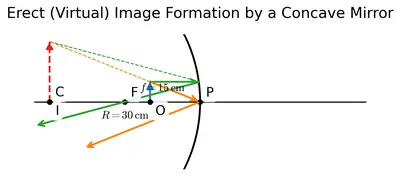
Draw the principal axis with a concave mirror at the right. Mark the pole $$P$$, focus $$F$$ and centre of curvature $$C$$. Place an upright object between $$P$$ and $$F$$. From the tip of the object draw (i) a ray parallel to the principal axis — after reflection it passes through $$F$$; (ii) a ray directed toward $$C$$ — it retraces its path. The reflected rays diverge in front of the mirror; their backward extensions meet behind the mirror, giving a virtual, erect and enlarged image.

Conclusion
A concave mirror, with the object placed between its pole and its principal focus, gives an erect and enlarged image of the object.

Answer

A concave mirror — when the object is placed between its pole and its principal focus, it forms a virtual, erect and enlarged image.

4 Why do we prefer a convex mirror as a rear-view mirror in vehicles?

Solution

Goal of a rear-view mirror
A driver must see as much of the road behind as possible without turning the head. The mirror should therefore

  • give an erect image (so left–right sense is not reversed),
  • show a large area of the traffic behind (large field of view), and
  • keep the image small enough to fit inside a compact mirror.

Image formation by the three common types of mirrors

MirrorNature of image when object is behind the driverField of view
PlaneVirtual, erect, $$m = 1$$ (same size)Small (limited to the size of the mirror)
ConcaveFor objects far away the image forms in front of the mirror and is inverted (unless the object is very close). Not suitable.Still narrow
ConvexVirtual, erect, diminished because for a convex mirror $$m = \frac{v}{u}$$ and $$|v| < |u| \;\Rightarrow\; |m| < 1$$Very large : diverging mirror spreads the reflected rays so the driver can see a wider region.

Why the convex mirror wins

  1. Always an erect image
    The ray diagram for any real object shows the image forming between the pole P and the focus F, hence it is always virtual and erect.
  2. Diminished image
    From the mirror equation $$\frac{1}{f}=\frac{1}{v}+\frac{1}{u}$$ with $$f>0$$ (convex), and $$u<0$$, we get $$v$$ also positive but smaller in magnitude than $$u$$, so $$|m| = \bigl|\tfrac{v}{u}\bigr| < 1$$. A smaller image lets many vehicles appear simultaneously in the limited mirror area.
  3. Wide field of view
    Because a convex surface diverges the incident parallel rays, light coming from a wider angular range behind the car is brought into the driver’s eyes. Geometrically, the effective angle seen = twice the angle between incident and reflected rays, which is larger for convex curvature.

Conclusion
Convex mirrors fulfil all three requirements: they give an erect, diminished image and allow the driver to survey a very large region of the road behind. Hence every vehicle uses a convex mirror as its rear-view mirror.

Answer

A convex mirror is preferred because it always forms a virtual, erect and diminished image of objects behind the vehicle and, owing to its diverging surface, provides a much wider field of view than either a plane or a concave mirror.

Examples 9.1–9.2

Example 9.1 A convex mirror used for rear-view on an automobile has a radius of curvature of $$3.00 \, \mathrm{m}$$. If a bus is located at $$5.00 \, \mathrm{m}$$ from this mirror, find the position, nature and size of the image.

Solution

Given data

  • Type of mirror: convex
  • Radius of curvature: $$R = +3.00\,\text{m}$$ (positive because the centre of curvature is behind a convex mirror)
  • Object (bus) distance: $$u = -5.00\,\text{m}$$ (negative because the object is in front of the mirror, i.e. on the side opposite to the incident light)

1. Focal length

For a spherical mirror $$f = \dfrac{R}{2}$$, therefore

$$f = \dfrac{+3.00\,\text{m}}{2} = +1.50\,\text{m}$$

2. Position of the image

Using the mirror formula $$\dfrac{1}{f}=\dfrac{1}{v}+\dfrac{1}{u}$$:

\[\dfrac{1}{v}=\dfrac{1}{f}-\dfrac{1}{u}\]

Substituting $$f=+1.50\,\text{m},\;u=-5.00\,\text{m}:$$

$$\dfrac{1}{v}=\dfrac{1}{+1.50}-\left(\dfrac{1}{-5.00}\right)=0.6667+0.2000=0.8667\,\text{m}^{-1}$$

$$v=\dfrac{1}{0.8667}\approx+1.15\,\text{m}$$

The positive sign shows that the image is formed behind the mirror.

3. Nature of the image

  • Since $$v$$ is positive, the image is virtual (it cannot be obtained on a screen).
  • In a convex mirror, a virtual image is always erect (upright).

4. Size of the image (magnification)

For mirrors, magnification $$m = -\dfrac{v}{u}$$:

$$m = -\dfrac{+1.15}{-5.00}=+0.23$$

  • Magnitude $$|m|=0.23<1$$, so the image is diminished (about 23 % the size of the bus).
  • The positive sign of $$m$$ confirms the image is erect.

5. Result

The image of the bus is formed at $$1.15\,\text{m}$$ behind the mirror, it is virtual, erect and diminished to roughly $$0.23$$ times the height of the bus.

Answer

Image distance: $$v\approx+1.15\,\text{m}$$ (behind the mirror).
Nature: virtual and erect.
Size: diminished, magnification $$m=+0.23$$ (image height ≈ 23 % of object).

Example 9.2 An object, $$4.0 \, \mathrm{cm}$$ in size, is placed at $$25.0 \, \mathrm{cm}$$ in front of a concave mirror of focal length $$15.0 \, \mathrm{cm}$$. At what distance from the mirror should a screen be placed in order to obtain a sharp image? Find the nature and the size of the image.

Solution

Given data

  • Object height $$h = 4.0\,\mathrm{cm}$$
  • Object distance (measured from the pole along the incident light, hence negative) $$u = -25.0\,\mathrm{cm}$$
  • Focal length of the concave mirror (concave → negative) $$f = -15.0\,\mathrm{cm}$$

Step 1 – Locate the image

The mirror formula is

$$\frac1f = \frac1v + \frac1u$$

Substituting the numerical values with their signs,

$$\frac1{-15} = \frac1v + \frac1{-25}$$

⇒ $$\frac1v = \frac1{-15} - \Bigl(\!-\!\frac1{25}\Bigr) = -\frac1{15} + \frac1{25}$$

Bring to a common denominator (75):

$$\frac1v = -\frac5{75} + \frac3{75} = -\frac2{75}$$

Therefore

$$v = -\frac{75}{2}\,\mathrm{cm} = -37.5\,\mathrm{cm}$$

The negative sign means the image is formed in front of the mirror on the same side as the object (a real image). Hence the screen must be placed $$37.5\,\mathrm{cm}$$ in front of the mirror to obtain a sharp image.

Step 2 – Find the magnification and size of the image

For mirrors, the linear magnification is

$$m = -\frac v u$$

$$m = -\frac{(-37.5)}{(-25)} = -\frac{37.5}{-25} = -1.5$$

Magnitude $$|m| = 1.5$$ → the image is 1.5 times the size of the object.
The negative sign shows that the image is inverted relative to the object.

Image height

$$h' = m\,h = (-1.5)(4.0\,\mathrm{cm}) = -6.0\,\mathrm{cm}$$

Thus the image is $$6.0\,\mathrm{cm}$$ high and inverted (sign negative).

Result

  • Screen position: $$37.5\,\mathrm{cm}$$ in front of the mirror.
  • Nature of image: Real, inverted, magnified.
  • Image height: $$6.0\,\mathrm{cm}$$.

Answer

Screen (image) distance: $$v = -37.5\,\mathrm{cm}$$ (37.5 cm in front of the mirror).
Image: real, inverted and magnified; height $$= 6.0\,\mathrm{cm}$$.

Intext Questions (after Example 9.2)

1 Find the focal length of a convex mirror whose radius of curvature is $$32 \, \mathrm{cm}$$.

Solution

Given: Radius of curvature of the convex mirror, $$R = 32\,\mathrm{cm}$$.

Relation between focal length and radius of curvature

For any spherical mirror of small aperture, the focal length and the radius of curvature are related by

$$f = \dfrac{R}{2}$$

Sign convention (NCERT, New Cartesian)

Incident light is taken to travel from left to right. All distances are measured from the pole of the mirror; distances measured in the direction of the incident light (i.e. behind the mirror) are taken positive, while those measured opposite to the incident light (i.e. in front of the mirror) are taken negative.

For a convex mirror the centre of curvature $$C$$ and the principal focus $$F$$ both lie behind the mirror. Hence both $$R$$ and $$f$$ are positive for a convex mirror. (This is the same convention NCERT applies in Example 9.1, where a convex mirror with $$R=3.00\,\mathrm{m}$$ is treated with $$R=+3.00\,\mathrm{m}$$ and $$f=+1.50\,\mathrm{m}$$.)

Calculation

Substituting $$R=+32\,\mathrm{cm}$$ into $$f=R/2$$,

$$f = \dfrac{+32\,\mathrm{cm}}{2} = +16\,\mathrm{cm}$$

Hence the focal length of the given convex mirror is $$+16\,\mathrm{cm}$$, i.e. 16 cm behind the mirror.

Answer

$$f = +16\,\mathrm{cm}$$ (focus lies 16 cm behind the convex mirror).

2 A concave mirror produces three times magnified (enlarged) real image of an object placed at $$10 \, \mathrm{cm}$$ in front of it. Where is the image located?

Solution

Let the pole of the mirror be the origin and the principal axis the reference line. According to the mirror sign convention:

  • The object is in front of the mirror → $$u = -10\,\mathrm{cm}$$.
  • The image is real and enlarged three times. A real image formed by a concave mirror is inverted, so the linear magnification is negative:
    $$m = -3$$.

The magnification produced by a spherical mirror is related to the object distance $$u$$ and the image distance $$v$$ by

$$m = -\dfrac{v}{u}$$

Substituting the known values:

$$-3 = -\dfrac{v}{-10}$$

$$-3 = \dfrac{v}{10}$$

Multiplying both sides by 10:

$$v = -30\,\mathrm{cm}$$

The negative sign means the image lies on the same side of the mirror as the object (i.e. in front of the mirror).

Therefore, the image is formed 30 cm in front of the concave mirror.

Answer

$$v = -30\,\mathrm{cm}$$  → the image is 30 cm in front of the mirror.

Intext Questions (after Section 9.3.2)

1 A ray of light travelling in air enters obliquely into water. Does the light ray bend towards the normal or away from the normal? Why?

Solution

Given A ray of light travels from air (rarer medium) into water (denser medium) at an oblique incidence (i.e. the incident ray is not along the normal).

Concepts to be used

  • Refractive index $$n = \dfrac{c}{v}$$, where $$c$$ is the speed of light in vacuum and $$v$$ the speed in the medium.
  • Snell’s law for refraction at the boundary between two media $$n_1 \sin i = n_2 \sin r$$, where
     • $$n_1$$, $$n_2$$ are the refractive indices of the first and second media, respectively,
     • $$i$$ is the angle of incidence,
     • $$r$$ is the angle of refraction.

Step 1 Compare the optical densities

Refractive index of air: $$n_\text{air} \approx 1.00$$.
Refractive index of water: $$n_\text{water} \approx 1.33$$.
Because $$n_\text{water} > n_\text{air}$$, water is optically denser than air and the speed of light in water is smaller than in air.

Step 2 Apply Snell’s law

Let the light travel from medium 1 (air) to medium 2 (water). Using $$n_1 \sin i = n_2 \sin r$$, we get

$$\sin r = \dfrac{n_1}{n_2} \sin i = \dfrac{n_\text{air}}{n_\text{water}} \sin i \;.$$

Since $$\dfrac{n_\text{air}}{n_\text{water}} < 1$$,

$$\sin r < \sin i \;\;\Longrightarrow\;\; r < i.$$ Thus the angle that the refracted ray makes with the normal is smaller than the angle of incidence.

Step 3 Interpretation

Because $$r < i$$, the refracted ray lies closer to the normal than the incident ray. We say: the ray has bent towards the normal.

Conclusion

When a ray of light enters obliquely from air into water, it bends towards the normal. The reason is that water is optically denser (higher refractive index) than air, so the light slows down and, according to Snell’s law, its angle with the normal decreases.


Diagram suggestion (for the student to draw): Draw a horizontal boundary line separating air (above) and water (below). Mark a normal at the point of incidence. Show the incident ray in air making an angle $$i$$ with the normal, and the refracted ray in water making a smaller angle $$r$$ with the normal, bending towards the normal.

Answer

The ray bends towards the normal, because water has a higher refractive index than air; hence, by Snell’s law $$\sin r = (n_{\text{air}}/n_{\text{water}})\sin i$$, so $$r < i$$.

2 Light enters from air to glass having refractive index $$1.50$$. What is the speed of light in the glass? The speed of light in vacuum is $$3 \times 10^8 \, \mathrm{m\,s^{-1}}$$.

Solution

Step 1 : Write the relation between refractive index and speed of light
The absolute refractive index $$n$$ of a medium is defined as the ratio of the speed of light in vacuum $$c$$ to the speed of light in that medium $$v$$:
$$n = \dfrac{c}{v}$$

Step 2 : Re-arrange to find the speed of light in the medium
Solving the above equation for $$v$$ gives
$$v = \dfrac{c}{n}$$

Step 3 : Substitute the given values
Given
$$n = 1.50\;,\; c = 3 \times 10^{8}\,\mathrm{m\,s^{-1}}$$
Therefore
$$v = \dfrac{3 \times 10^{8}\,\mathrm{m\,s^{-1}}}{1.50}$$

Step 4 : Calculate
$$v = 2 \times 10^{8}\,\mathrm{m\,s^{-1}}$$

Hence, the speed of light in the glass is $$2 \times 10^{8}\,\mathrm{m\,s^{-1}}$$.

Answer

$$2 \times 10^{8}\,\mathrm{m\,s^{-1}}$$

3 Find out, from Table 9.3, the medium having highest optical density. Also find the medium with lowest optical density.

Solution

Optical density describes how much a material slows down light. It is directly proportional to the absolute refractive index $$n$$ of the medium: a larger value of $$n$$ means a higher optical density.

From Table 9.3 (NCERT Class 10, Ch. 9) the given refractive indices are:

MediumRefractive index $$n$$
Air1.0003
Ice1.31
Water1.33
Alcohol1.36
Kerosene1.44
Crown glass1.52
Rock salt1.54
Carbon disulphide1.63
Dense flint glass1.65
Ruby1.71
Sapphire1.77
Diamond2.42

Comparing the values:

  • The largest refractive index is $$2.42$$ for diamond, so diamond is the optically densest medium in the list.
  • The smallest refractive index is $$1.0003$$ for air, so air is the optically least dense medium in the list.

Hence, diamond has the highest optical density, while air has the lowest optical density as per Table 9.3.

Answer

Highest optical density : Diamond
Lowest optical density  : Air

4 You are given kerosene, turpentine and water. In which of these does the light travel fastest? Use the information given in Table 9.3.

Solution

The speed of light in any transparent medium $$v$$ is related to the speed of light in vacuum $$c$$ through the medium’s absolute refractive index $$n$$:

$$n = \frac{c}{v}\; \Longrightarrow \; v = \frac{c}{n}$$

Hence, for a fixed $$c$$, smaller $$n$$ means greater $$v$$.

From Table 9.3 (NCERT Class 10, Ch. 9):

MediumRefractive index $$n$$
Water1.33
Kerosene1.44
Turpentine1.47

Since$$1.33 < 1.44 < 1.47$$, water has the lowest refractive index of the three. Therefore, using $$v = \frac{c}{n}$$, the speed of light is

  • highest in water,
  • lower in kerosene,
  • lowest in turpentine.

Thus, light travels fastest in water.

Answer

Water

5 The refractive index of diamond is $$2.42$$. What is the meaning of this statement?

Solution

Step 1 : Definition of absolute refractive index
For any transparent medium, its absolute refractive index $$n$$ is defined as the ratio of the speed of light in vacuum (or very nearly in air) to the speed of light in that medium:

$$n = \frac{c}{v}$$

where

  • $$c$$ = speed of light in vacuum   ($$3.0 \times 10^{8}\;\text{m s}^{-1}$$)
  • $$v$$ = speed of light in the given medium

Step 2 : Using the given value
For diamond, the numerical value of the refractive index is given as $$n_{\text{diamond}} = 2.42$$, so

$$2.42 = \frac{c}{v_{\text{diamond}}}$$

Step 3 : Finding the speed of light in diamond

$$v_{\text{diamond}} = \frac{c}{2.42}$$

$$v_{\text{diamond}} = \frac{3.0 \times 10^{8}\;\text{m s}^{-1}}{2.42} \approx 1.24 \times 10^{8}\;\text{m s}^{-1}$$

Step 4 : Interpretation
Because the refractive index compares speeds, the statement “The refractive index of diamond is 2.42” means

  • Light travels 2.42 times slower in diamond than in vacuum (or air).
  • The speed of light inside diamond is only about $$1.24 \times 10^{8}\;\text{m s}^{-1}$$.
  • Thus diamond is optically much denser than air.

Answer

It means light travels 2.42 times slower in diamond than in vacuum (or air); equivalently, the speed of light in diamond is about $$1.24\times10^8\,\text{m s}^{-1}$$ because $$n=\dfrac{c}{v}=2.42.$$

Examples 9.3–9.4

Example 9.3 A concave lens has focal length of $$15 \, \mathrm{cm}$$. At what distance should the object from the lens be placed so that it forms an image at $$10 \, \mathrm{cm}$$ from the lens? Also, find the magnification produced by the lens.

Solution

Given data

  • Focal length of the concave lens: $$f = 15\;\text{cm}$$ (concave ⇒ $$f$$ is taken negative, so $$f = -15\;\text{cm}$$)
  • Required image distance from the lens: $$v = -10\;\text{cm}$$ (virtual image on the same side as the object ⇒ negative sign)

1. Find the object distance  $$u$$

Lens formula (valid for both convex and concave lenses)

$$\frac{1}{f}=\frac{1}{v}+\frac{1}{u}$$

Substitute the known values:

$$\frac{1}{-15}=\frac{1}{-10}+\frac{1}{u}$$

Perform the algebra step by step:

$$-\frac{1}{15} = -\frac{1}{10}+\frac{1}{u}$$

Move $$-\dfrac{1}{10}$$ to the left side:

$$\frac{1}{u} = -\frac{1}{15}+\frac{1}{10}$$

Put the two fractions over a common denominator (30):

$$\frac{1}{u}= -\frac{2}{30}+\frac{3}{30}=\frac{1}{30}$$

Hence

$$u = 30\;\text{cm}$$

According to the sign convention, the object is placed on the left side of the lens, so the formal value is $$u = -30\;\text{cm}$$. In everyday language, the object must be kept 30 cm in front of the lens.

2. Find the magnification  $$m$$

For a lens, magnification is

$$m = \frac{v}{u}$$

Insert $$v = -10\,\text{cm},\; u = -30\,\text{cm}:$$

$$m = \frac{-10}{-30}=\frac{1}{3}\;\approx\;0.33$$

The positive sign shows that the image is erect, and the numerical value $$0.33$$ (or $$\tfrac13$$) means the image height is one-third of the object height.

Result

  • Object distance: 30 cm in front of the lens.
  • Magnification: $$+\tfrac13$$ (erect, diminished image).

Answer

$$u = -30\;\text{cm}$$ (object 30 cm in front of the lens)
$$m = +\dfrac13 \;(\text{image is erect and one-third the object size})$$

Example 9.4 A $$2.0 \, \mathrm{cm}$$ tall object is placed perpendicular to the principal axis of a convex lens of focal length $$10 \, \mathrm{cm}$$. The distance of the object from the lens is $$15 \, \mathrm{cm}$$. Find the nature, position and size of the image. Also find its magnification.

Solution

Given

  • Height of object: $$h_o = 2.0\,\text{cm}$$
  • Object distance from lens: $$u = -15\,\text{cm}$$ (negative by the sign convention: object is on the same side as the incident light)
  • Focal length of convex lens: $$f = +10\,\text{cm}$$ (positive for a convex lens)

We have to find the image distance $$v$$, the image height $$h_i$$, its nature and the magnification $$m$$.

1. Use the lens formula

The lens formula is

$$\frac{1}{f} = \frac{1}{v} - \frac{1}{u}$$

Substitute the known values:

$$\frac{1}{10} = \frac{1}{v} - \frac{1}{(-15)}$$

Simplify the minus sign:

$$\frac{1}{10} = \frac{1}{v} + \frac{1}{15}$$

Bring $$\frac{1}{15}$$ to the left:

$$\frac{1}{10} - \frac{1}{15} = \frac{1}{v}$$

Take the LCM (30):

$$\frac{3}{30} - \frac{2}{30} = \frac{1}{30}$$

Thus

$$\frac{1}{v} = \frac{1}{30} \;\;\Rightarrow\;\; v = 30\,\text{cm}$$

Sign of $$v$$: It is positive, so the image is formed on the side opposite to the object (real image).

2. Magnification

Linear magnification $$m$$ for a lens is

$$m = \frac{h_i}{h_o} = \frac{v}{u}$$

Substitute values:

$$m = \frac{30}{-15} = -2$$

3. Image height

$$h_i = m\,h_o = (-2)(2.0\,\text{cm}) = -4.0\,\text{cm}$$

The negative sign means the image is inverted.

4. Nature and size of the image

  • Because $$v$$ is positive, the image is real and formed on the opposite side of the lens.
  • Because $$m$$ is negative, the image is inverted.
  • Since $$|m| = 2 > 1$$, the image is magnified (twice the object’s size).
  • Image distance: $$30\,\text{cm}$$ from the lens on the image side.
  • Image height: $$4.0\,\text{cm}$$ (inverted).

Result

The image is real, inverted and magnified (height $$4.0\,\text{cm}$$), located $$30\,\text{cm}$$ from the lens on the side opposite the object. The magnification is $$m = -2$$.

Answer

Image: real, inverted, magnified (twice).
Position: 30 cm from the lens on the opposite side.
Size: 4.0 cm tall (inverted).
Magnification: $$m = -2$$.

Intext Questions (after Section 9.3.8)

1 Define 1 dioptre of power of a lens.

Solution

Concept of power of a lens
For any thin lens, its power $$P$$ is defined as the reciprocal of its focal length $$f$$ (measured in metres):
$$P = \frac{1}{f}\;(\text{m}^{-1}).$$
The SI unit of power is the dioptre, written as $$\text{D}$$.

Meaning of one dioptre
Put $$P = 1\,\text{D}$$ in the definition:
$$1\,\text{D} = \frac{1}{f}\Rightarrow f = 1\,\text{m}.$$

Thus a lens whose focal length is $$1\,\text{metre}$$ has power $$1\,\text{dioptre}$$. In words:

One dioptre is the power of a lens that brings parallel light rays to focus (or appears to diverge them) at a distance of one metre from the lens.

Answer

1 dioptre is the power of a lens whose focal length is 1 metre, i.e. $$P = 1\,\text{D} \Longleftrightarrow f = 1\,\text{m}.$$

2 A convex lens forms a real and inverted image of a needle at a distance of $$50 \, \mathrm{cm}$$ from it. Where is the needle placed in front of the convex lens if the image is equal to the size of the object? Also, find the power of the lens.

Solution

Given data

  • Distance of the real, inverted image from the lens: $$v = +50\,\mathrm{cm}$$ (positive because the real image is formed on the side opposite to the object).
  • The image is equal in size to the object and inverted ⇒ linear magnification $$m = -1$$.

Step 1 – Relate object and image distances using magnification

For a thin lens,

$$m = \frac{h'}{h} = \frac{v}{u}$$

where $$h'$$ is image height and $$h$$ is object height. Using $$m = -1$$,

$$\frac{v}{u} = -1 \;\;\Longrightarrow\;\; v = -u$$

Substituting $$v = +50\,\mathrm{cm}$$,

$$+50 = -u \;\;\Longrightarrow\;\; u = -50\,\mathrm{cm}$$

Hence the needle (object) is placed $$50\,\mathrm{cm}$$ in front of the lens (negative sign ⇒ same side as the incoming light).

Step 2 – Find the focal length using the lens formula

The thin-lens formula is

$$\frac{1}{f} = \frac{1}{v} - \frac{1}{u}$$

Insert $$v = +50\,\mathrm{cm}$$ and $$u = -50\,\mathrm{cm}$$:

$$\frac{1}{f} = \frac{1}{50} - \Bigl(\! -\frac{1}{50} \Bigr) = \frac{1}{50} + \frac{1}{50} = \frac{2}{50} = \frac{1}{25}$$

Therefore, $$f = 25\,\mathrm{cm}$$.

Step 3 – Calculate the power of the lens

Convert the focal length to metres: $$f = 25\,\mathrm{cm} = 0.25\,\mathrm{m}$$.

Lens power:

$$P = \frac{1}{f\;(\mathrm{in\;metres})} = \frac{1}{0.25} = 4\,\mathrm{dioptres\,(D)}$$

Result

  • The needle is placed $$50\,\mathrm{cm}$$ in front of the convex lens.
  • Focal length of the lens: $$25\,\mathrm{cm}$$.
  • Power of the lens: $$4\,\mathrm{D}$$.

Answer

The needle is placed $$50\,\mathrm{cm}$$ in front of the convex lens.
Focal length $$f = 25\,\mathrm{cm}$$ ⇒ power $$P = 4\,\mathrm{D}$$.

3 Find the power of a concave lens of focal length $$2 \, \mathrm{m}$$.

Solution

Given data

  • Focal length of the concave lens: $$f = 2\,\mathrm{m}$$

Step 1 – Assign the correct sign to focal length

A concave (diverging) lens always has a negative focal length, so

$$f = -2\,\mathrm{m}$$

Step 2 – Recall the formula for optical power

The power $$P$$ of a lens (in dioptres, $$\mathrm D$$) is the reciprocal of the focal length expressed in metres:

$$P = \frac{1}{f \,(\text{in metres})}$$

Step 3 – Calculate the power

$$P = \frac{1}{-2\,\mathrm m} = -0.5\,\mathrm D$$

Result

Therefore, the power of the concave lens is $$-0.5\,\mathrm{dioptre}$$.

Answer

$$P = -0.5\,\mathrm{D}$$

Exercises

1

Which one of the following materials cannot be used to make a lens?

  • (a) Water
  • (b) Glass
  • (c) Plastic
  • (d) Clay

Solution

Key concept — what is a lens?
A lens is a portion of transparent material bounded by (at least) one spherical surface such that light entering it is refracted. The refraction obeys Snell’s law, $$n_1\sin i = n_2\sin r$$, where $$n$$ is the refractive index of the medium.

Requirement for making a lens
• The material must be transparent so that light can pass through it.
• It must allow uniform refraction to occur.

Examining the given options

MaterialTransparency?Suitable for lens?
WaterYes (clear liquids)Yes; e.g. water-filled lenses
GlassYesYes; most common lens material
PlasticYes (polymers like CR-39, polycarbonate)Yes; used for lightweight spectacle lenses
ClayNo (opaque)No refraction possible → cannot form a lens

Conclusion
Clay is opaque; light cannot pass through it, so it cannot be fashioned into a lens.

Answer

(d) Clay

2

The image formed by a concave mirror is observed to be virtual, erect and larger than the object. Where should be the position of the object?

  • (a) Between the principal focus and the centre of curvature
  • (b) At the centre of curvature
  • (c) Beyond the centre of curvature
  • (d) Between the pole of the mirror and its principal focus.

Solution

Key idea : The nature and size of the image produced by a concave mirror depend only on the object’s distance $$u$$ from the mirror compared with the focal length $$f$$ (distance PF).

Standard results for a concave mirror

Object positionImage positionNatureSize
$$P \;(>F)$$ to $$\,F$$ (i.e. $$0<u<f$$)Behind the mirrorVirtual, erectMagnified
At $$F$$At infinityReal, invertedHighly enlarged
Between $$F$$ and $$2F$$ (centre of curvature $$C$$)Beyond $$2F$$Real, invertedMagnified
At $$C$$At $$C$$Real, invertedSame size
Beyond $$C$$Between $$F$$ and $$C$$Real, invertedDiminished

The question specifies that the image is

  • virtual,
  • erect, and
  • larger than (i.e. magnified with respect to) the object.

From the table, these three features occur only when the object is placed between the pole $$P$$ and the principal focus $$F$$, that is, at a distance $$u$$ less than the focal length $$f$$.

Ray-diagram confirmation : Draw two rays from the top of the object—(i) a ray parallel to the principal axis (which, after reflection, passes through $$F$$), and (ii) a ray heading towards $$F$$ (which, after reflection, emerges parallel to the axis). The reflected rays diverge; when extended backward they appear to meet at a point behind the mirror, giving a virtual, erect and enlarged image. This is exactly the description in the problem statement.

Hence the correct option is (d).

Answer

(d) Between the pole of the mirror and its principal focus.

3

Where should an object be placed in front of a convex lens to get a real image of the size of the object?

  • (a) At the principal focus of the lens
  • (b) At twice the focal length
  • (c) At infinity
  • (d) Between the optical centre of the lens and its principal focus.

Solution

Given: A convex (converging) lens of focal length $$f$$.

Required: Object position that produces a real image having the same size as the object.

Step 1 — Condition on magnification

For a thin lens, the linear magnification is

$$m = \dfrac{v}{u}$$

where $$u$$ is the object distance and $$v$$ is the image distance, both measured from the optical centre with NCERT's sign convention: object distances on the incident side are negative ($$u<0$$), and image distances on the opposite (transmitted) side are positive ($$v>0$$).

For an image of the same size as the object, $$|m|=1$$, so $$|v|=|u|$$. A real image formed by a convex lens has $$v>0$$, while the object has $$u<0$$; therefore

$$v=-u \qquad\text{(1)}$$

Step 2 — Apply the lens formula

The thin-lens formula is

$$\dfrac{1}{f}=\dfrac{1}{v}-\dfrac{1}{u}$$

Substituting $$v=-u$$ from equation (1),

$$\dfrac{1}{f}=\dfrac{1}{-u}-\dfrac{1}{u}=-\dfrac{1}{u}-\dfrac{1}{u}=-\dfrac{2}{u}$$

Solving for $$u$$,

$$u=-2f$$

The negative sign confirms the object lies on the incident side; its distance from the lens is $$2f$$.

Step 3 — Image distance and magnification check

From equation (1), $$v=-u=+2f$$. The image therefore forms on the opposite side, also at a distance $$2f$$ from the lens.

$$m=\dfrac{v}{u}=\dfrac{+2f}{-2f}=-1$$

The magnitude 1 confirms equal size, and the negative sign indicates the image is inverted (hence real).

Conclusion

The object must be placed at a distance equal to twice the focal length of the convex lens, i.e. at $$2f$$ on the incident side. The correct option is (b) At twice the focal length.

Answer

(b) At twice the focal length

4

A spherical mirror and a thin spherical lens have each a focal length of $$-15 \, \mathrm{cm}$$. The mirror and the lens are likely to be

  • (a) both concave.
  • (b) both convex.
  • (c) the mirror is concave and the lens is convex.
  • (d) the mirror is convex, but the lens is concave.

Solution

Step 1 · Recall the sign conventions
For the new Cartesian sign convention (objects kept to the left of the optical element):

  • Spherical mirror
    • If the principal focus lies to the left of the mirror, the focal length $$f$$ is taken as negative ⇒ the mirror is concave.
    • If the principal focus lies to the right, $$f$$ is positive ⇒ the mirror is convex.
  • Thin lens
    • Distances measured to the right of the lens are positive, to the left are negative.
    • For a convex (converging) lens the principal focus is to the right ⇒ $$f > 0$$.
    • For a concave (diverging) lens the principal focus is to the left ⇒ $$f < 0$$.

Step 2 · Apply the data given
The problem states that both the spherical mirror and the thin spherical lens have the same focal length

$$f = -15\,\text{cm}$$

Because $$f$$ is negative for the mirror, it must be a concave mirror.
Because $$f$$ is negative for the lens, it must be a concave lens.

Step 3 · Choose the correct option
The only option matching “mirror concave, lens concave” is

  • (a) both concave.

Answer

(a) both concave

5

No matter how far you stand from a mirror, your image appears erect. The mirror is likely to be

  • (a) only plane.
  • (b) only concave.
  • (c) only convex.
  • (d) either plane or convex.

Solution

An image appears always erect only if the mirror produces an upright image for every possible position of the object.

1. Plane mirror
A plane mirror always forms a virtual, erect image of the same size as the object. Its magnification is $$m=+1$$ for every object distance, so the image is never inverted.

2. Concave mirror
A concave mirror gives an erect (virtual) image only when the object is placed between the pole $$P$$ and the principal focus $$F$$. For any object beyond $$F$$, the image becomes real and inverted. Hence a concave mirror cannot guarantee an erect image at all distances.

3. Convex mirror
A convex mirror always forms a virtual, erect and diminished image for every position of the object. Its magnification satisfies

$$0 \lt m \lt 1$$

(the positive sign indicates the image is erect, and the magnitude less than 1 indicates the image is diminished).

Conclusion
A mirror that gives an erect image regardless of the object's distance can be either a plane mirror or a convex mirror — but not a concave mirror. Therefore the correct option is (d) either plane or convex.

Answer

(d) either plane or convex

6

Which of the following lenses would you prefer to use while reading small letters found in a dictionary?

  • (a) A convex lens of focal length $$50 \, \mathrm{cm}$$.
  • (b) A concave lens of focal length $$50 \, \mathrm{cm}$$.
  • (c) A convex lens of focal length $$5 \, \mathrm{cm}$$.
  • (d) A concave lens of focal length $$5 \, \mathrm{cm}$$.

Solution

To read very small print we need a magnifying glass, i.e. a lens that can give a large, upright (virtual) image of the object kept close to the eye.

Step 1 ― Type of lens required
A convex (converging) lens used with the object placed between the lens and its focus produces a virtual, erect and magnified image on the same side of the lens. A concave (diverging) lens always gives a virtual image that is diminished; therefore a concave lens is useless for magnification.

Conclusion 1  •  We must choose a convex lens.

Step 2 ― Which focal length gives higher magnification?
For a simple microscope, the angular magnification (linear magnification for small angles) obtained with the final image at the least-distance of distinct vision $$D \approx 25\,\mathrm{cm}$$ is
$$m = 1 + \dfrac{D}{f}$$
where $$f$$ is the focal length of the convex lens.

Option (a) : $$f = 50\,\mathrm{cm}$$
$$m = 1 + \dfrac{25}{50} = 1 + 0.5 = 1.5$$

Option (c) : $$f = 5\,\mathrm{cm}$$
$$m = 1 + \dfrac{25}{5} = 1 + 5 = 6$$
The lens with the smaller focal length (5 cm) gives a much larger magnification (6 times) than the 50 cm lens.

Conclusion 2  •  Among the convex lenses, the one with $$f = 5\,\mathrm{cm}$$ is preferred.

Final choice
Taking both conclusions together, the best lens for reading tiny letters is:

(c) A convex lens of focal length 5 cm.

Answer

(c) A convex lens of focal length 5 cm.

7

We wish to obtain an erect image of an object, using a concave mirror of focal length $$15 \, \mathrm{cm}$$. What should be the range of distance of the object from the mirror? What is the nature of the image? Is the image larger or smaller than the object? Draw a ray diagram to show the image formation in this case.
Figure
Figure

Solution

Given data

  • Concave mirror
  • Focal length  $$f = 15\;\text{cm}$$ (magnitude)

Step 1  Recall the condition for an erect image in a concave mirror

A concave mirror produces an erect, virtual image only when the object is placed between the pole P and the focus F.

Step 2  Translate the above condition into a distance range

Let the object distance (in magnitude) be $$d_o$$. For the object to lie between P and F, we must have

$$0 < d_o < f \; (= 15\;\text{cm}).$$

Hence the object must be kept closer than 15 cm from the mirror.

Step 3  Confirm the nature and size of the image (using the mirror formula if desired)

The mirror formula is

$$\frac1f = \frac1v + \frac1u,$$

where (with the sign convention)

  • $$f = -15\;\text{cm}$$ (concave mirror)
  • $$u$$ is negative (object in front)

Take, for example, $$u = -10\;\text{cm}$$ (which satisfies $$|u| < 15\;\text{cm}$$):

$$\frac1{-15} = \frac1v + \frac1{-10} \;\Longrightarrow\; \frac1v = -\frac1{15} + \frac1{10} = \frac1{30} \;\Longrightarrow\; v = +30\;\text{cm}.$$

Positive $$v$$ means the image lies behind the mirror → virtual and erect.

The magnification is

$$m = \frac{h_i}{h_o} = -\frac{v}{u} = -\frac{(+30)}{(-10)} = +3,$$

so $$|m| > 1$$ → the image is larger than the object. (Any other object position in the same range gives $$|m| > 1$$ as well.)

Step 4  Summarise the answers

  • Range of object distance: between the pole P and the focus F, i.e. $$0 < d_o < 15\;\text{cm}$$.
  • Nature of image: virtual, erect.
  • Size of image: magnified (larger than the object).

Step 5  Ray diagram (description)

  1. Draw the principal axis; mark the pole P, the focus F at 15 cm from P, and the centre of curvature C at 30 cm.
  2. Place the object (an upright arrow) anywhere between P and F.
  3. From the top of the object draw
    • a ray parallel to the principal axis; after reflection it passes through (or appears to pass through) the focus,
    • a ray aimed towards the centre of curvature; it reflects back on itself,
    or any other standard pair of rays.
  4. Extend the reflected rays backward; they meet behind the mirror, giving the virtual, erect, enlarged image.

The diagram clearly shows the image behind the mirror, upright and larger than the object.

Answer

The object must be placed between the pole and the focus, i.e. at any distance less than 15 cm from the mirror.

The image obtained is virtual, erect and magnified (larger than the object).

8

Name the type of mirror used in the following situations. Support your answer with reason.

(a) Headlights of a car.

Solution

Given: We have to state which mirror is fitted behind the bulb in a car head-light and justify the choice.

Key points to recall

  • A mirror kept behind the source is intended to send the light forward as a strong, almost parallel beam.
  • When an object (here, the filament of the bulb) is placed at the principal focus $$F$$ of a concave mirror, the reflected rays emerge parallel to the principal axis, i.e. they produce a parallel beam that can travel large distances without much spread.

Reasoning step-by-step

  1. The bulb filament is fixed very close to the focus $$F$$ of the mirror.
  2. For a concave mirror, if the object is at $$F$$, using the mirror equation $$\frac{1}{f}=\frac{1}{v}+\frac{1}{u}$$ with $$u \approx -f$$ we get $$\frac{1}{v}=0$$ \( \Rightarrow v = \infty \). This mathematically confirms that the image is formed at infinity ‑– equivalently, the reflected rays are parallel.
  3. Parallel rays mean the light spreads little and can illuminate the road far ahead.

Hence a concave mirror is used in car head-lights.

Answer

(a) Concave mirror

(b) Side/rear-view mirror of a vehicle.

Solution

Given: Identify the type of mirror used as a side / rear-view mirror of a vehicle and justify the choice.

Requirements of a rear-view mirror

  • It should give a wide field of view so that the driver can see a large region of the road behind.
  • The image must be erect so that the left–right orientation of approaching vehicles is preserved.
  • A diminished image is acceptable (and indeed useful), since several vehicles can then fit within the small mirror.

Why a convex mirror satisfies all three requirements

(i) Wide field of view. A convex mirror has a reflecting surface that bulges outward, so it diverges incident rays. Geometrically, it collects light coming from a much wider angular region than a plane or concave mirror of the same size, giving the driver a larger field of view.

(ii) Always virtual and erect. For any real object in front of a convex mirror, the reflected rays diverge and only appear to meet behind the mirror, so the image is virtual and erect.

(iii) Always diminished — full derivation using the mirror formula. Using NCERT's New Cartesian sign convention, for a convex mirror $$f>0$$ (focus lies behind the mirror) and for a real object $$u<0$$ (object lies in front of the mirror). The mirror formula is

$$\dfrac{1}{v}+\dfrac{1}{u}=\dfrac{1}{f}$$

Solve for $$\dfrac{1}{v}$$:

$$\dfrac{1}{v}=\dfrac{1}{f}-\dfrac{1}{u}$$

Write the two terms in terms of magnitudes. Because $$f>0$$, $$\dfrac{1}{f}=\dfrac{1}{|f|}$$; because $$u<0$$, $$-\dfrac{1}{u}=\dfrac{1}{|u|}$$. Therefore

$$\dfrac{1}{v}=\dfrac{1}{|f|}+\dfrac{1}{|u|}$$

Both terms on the right are positive, so $$\dfrac{1}{v}>0$$, meaning $$v>0$$ — the image is virtual (behind the mirror).

Moreover, since the right-hand side is the sum of two positive numbers, it is strictly greater than either of them alone. In particular

$$\dfrac{1}{v}=\dfrac{1}{|f|}+\dfrac{1}{|u|}>\dfrac{1}{|u|}$$

Taking reciprocals of two positive quantities reverses the inequality, so

$$v<|u|,\quad\text{i.e. }\;|v|<|u|.$$

The magnification is

$$m=-\dfrac{v}{u}=\dfrac{|v|}{|u|}$$

so $$0

Conclusion
A convex mirror is used as a side / rear-view mirror of a vehicle, because it always forms a virtual, erect and diminished image of objects behind the vehicle and provides a much wider field of view than a plane or concave mirror.

Answer

(b) Convex mirror

(c) Solar furnace.

Solution

Situation: Concentrating sunlight onto a small area in a solar furnace.

Essential requirement – All rays coming from the Sun (effectively parallel) must be brought to a single point so that the temperature there becomes extremely high.

Optical fact

  • A concave mirror converts an incoming parallel beam into rays that pass through its principal focus $$F$$. This is the exact inverse of what happens in car head-lights.
  • The Sun is so far away that its rays are practically parallel when they reach the mirror.

Hence a large concave mirror (often called a solar concentrator) is employed. All incident solar rays meet at the focus, where the furnace crucible is placed, achieving very high temperatures.

Answer

(c) Concave mirror

9 One-half of a convex lens is covered with a black paper. Will this lens produce a complete image of the object? Verify your answer experimentally. Explain your observations.

Solution

Conceptual idea

For a thin convex lens every small portion of the glass behaves like a complete lens. Light coming from one point on the object spreads out in all directions; each ray that subsequently passes through any part of the lens is bent by refraction so that all such rays again meet at one point – the image-point that corresponds to the original object-point. Hence the formation of an image of the whole object does not require the whole aperture of the lens; it merely requires that at least some rays from every point of the object be able to pass through some un-blocked region of the lens.

Therefore, if half of a convex lens is obstructed, the uncovered half can still receive rays coming from every point of the object and can still bring those rays to their respective image points. The geometry of the image (position and size) is unaltered; the photometric characteristics (brightness / intensity) are, however, reduced because fewer rays reach the screen or the eye.

Ray diagram (to be drawn)

  • Draw the principal axis, a convex lens with its optical centre O, and the focal points F and 2F on both sides.
  • Place an upright object AB beyond 2F on the left.
  • For the full lens show two standard rays from the tip A: one parallel to the axis (refracted through F) and one through O (undeviated). They meet at A′ giving an inverted image A′B′.
  • Now dark-shade the upper half of the lens. From A draw only the portions of each standard ray that pass through the lower half of the lens; extend them to meet at the same point A′. Repeat for a point on B. The diagram shows a complete but fainter image.

Quantitative touch

The lens formula $$\frac1f = \frac1v + \frac1u$$ contains only the curvature and refractive indices of the lens material, none of which changes when half of the lens is blocked. Consequently the focal length $$f$$, image distance $$v$$ and magnification $$m = -\dfrac v u$$ remain exactly the same. What changes is the intensity of the converging beam, which is roughly proportional to the clear aperture area; covering one half reduces the area (and hence the brightness of the image) by about 50 %.

Experimental verification

  1. Apparatus
    Convex lens (f ≈ 10 cm) in a holder, screen, metre scale, candle (or small illuminated arrow), opaque black paper.
  2. Procedure
    1. Mount the lens on the bench and place the candle well beyond $$2F$$. Move the screen until a sharp, inverted image is obtained. Note the size and brightness.
    2. Without disturbing object and screen positions, paste the black paper over (say) the upper half of the lens aperture.
    3. Look at the screen again. A sharp, complete image is still present at the same position and of the same size, but the luminous parts look appreciably dimmer.
  3. Observation table
ConditionImage seen?Brightness
Full lens clearYes, completeNormal
Upper half coveredYes, completeAbout half

Conclusion

Covering one half of a convex lens does not remove any part of the image; it only reduces the intensity of light reaching the image. Thus the lens produces a complete but fainter image of the object.

Answer

Yes. Even when one-half of a convex lens is blocked, the uncovered half still forms a complete image at the same position and of the same size; only the brightness is reduced (approximately to one-half).

10

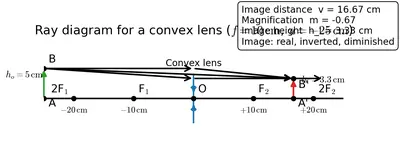
An object $$5 \, \mathrm{cm}$$ in length is held $$25 \, \mathrm{cm}$$ away from a converging lens of focal length $$10 \, \mathrm{cm}$$. Draw the ray diagram and find the position, size and the nature of the image formed.
Figure
Figure

Solution

Given data

  • Object height, $$h_o = 5\,\mathrm{cm}$$
  • Object distance (measured from optical centre of the lens), $$u = -25\,\mathrm{cm}$$
    (negative by the sign convention because the object is placed to the left of the lens)
  • Focal length of the converging (convex) lens, $$f = +10\,\mathrm{cm}$$

1. Position of the image

For a thin lens, the lens formula is

$$\frac1f = \frac1v - \frac1u$$

Substitute the values with their signs:

$$\frac1{10} = \frac1v - \frac1{(-25)}$$

$$0.1 = \frac1v + 0.04$$

Bring like terms together:

$$\frac1v = 0.1 - 0.04 = 0.06$$

Hence

$$v = \frac1{0.06} = 16.7\,\mathrm{cm}$$ (to two significant figures)

The positive value of $$v$$ means the image is formed on the side of the lens opposite to the object (real image).

2. Linear magnification and size of the image

Magnification $$m$$ produced by a lens is

$$m = \frac{h_i}{h_o} = \frac{v}{u}$$

Compute $$m$$:

$$m = \frac{16.7}{-25} = -0.667$$

Therefore

$$h_i = m\,h_o = (-0.667)(5\,\mathrm{cm}) = -3.3\,\mathrm{cm}$$

The negative sign for $$h_i$$ shows the image is inverted. Its magnitude gives the height: $$3.3\,\mathrm{cm}$$. Because $$|m| < 1$$, the image is diminished.

3. Nature of the image

  • Real (because $$v$$ is positive).
  • Inverted (because $$m$$ is negative).
  • Diminished (because $$|m| < 1$$).
  • Formed between $$F$$ and $$2F$$ on the other side of the lens (since $$v = 16.7\,\mathrm{cm}$$ lies between $$f = 10\,\mathrm{cm}$$ and $$2f = 20\,\mathrm{cm}$$).

4. Ray diagram – what to draw

  1. Draw the principal axis horizontally. Place a convex lens centred on it, indicating its optical centre O, principal focus $$F$$ (10 cm from O) and point $$2F$$ (20 cm from O) on both sides.
  2. Mark the object AB of height 5 cm upright at a point 25 cm to the left of the lens (slightly beyond $$2F$$).
  3. From the tip B of the object draw:
    (a) A ray parallel to the principal axis; after refraction it passes through the principal focus $$F$$ on the right.
    (b) A ray through the optical centre O; it goes straight without deviation.
  4. The two refracted rays meet at point B′ on the right side, between $$F$$ and $$2F$$. Drop a perpendicular from B′ to the principal axis to locate A′, the image of A.
  5. Measure OA′ to confirm 16.7 cm, and A′B′ for the image height 3.3 cm. The arrow A′B′ points downward, showing inversion.

Thus the ray diagram verifies the calculated position and size.

Answer

The image is formed $$16.7\,\mathrm{cm}$$ on the other side of the lens, it is real, inverted and diminished, with a height of about $$3.3\,\mathrm{cm}$$.

11

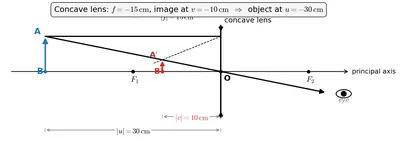
A concave lens of focal length $$15 \, \mathrm{cm}$$ forms an image $$10 \, \mathrm{cm}$$ from the lens. How far is the object placed from the lens? Draw the ray diagram.
Figure
Figure

Solution

Given data

  • Focal length of the concave lens: $$f = 15\,\mathrm{cm}$$
  • Because the lens is concave, its focal length is taken negative by the Cartesian sign convention: $$f = -15\,\mathrm{cm}$$.
  • The image is formed $$10\,\mathrm{cm}$$ from the lens on the same side as the object (virtual image for a concave lens), so the image distance is also negative: $$v = -10\,\mathrm{cm}$$.

Lens formula

The thin-lens formula relates object distance $$u$$, image distance $$v$$ and focal length $$f$$:

$$\frac{1}{f} = \frac{1}{v} - \frac{1}{u}$$

Substitute the known values

$$\frac{1}{-15} = \frac{1}{-10} - \frac{1}{u}$$

Rearrange and solve for $$\tfrac{1}{u}$$

$$\frac{1}{-15} - \frac{1}{-10} = -\frac{1}{u}$$

Find a common denominator (30):

$$\left(-\frac{2}{30}\right) - \left(-\frac{3}{30}\right) = -\frac{1}{u}$$

$$\frac{1}{30} = -\frac{1}{u}$$

Invert to get $$u$$

$$u = -30\,\mathrm{cm}$$

The negative sign confirms that the object is placed on the same side of the lens as the incoming light (to the left of the lens).

Result

The object must be placed $$30\,\mathrm{cm}$$ in front of the concave lens.

Ray diagram (description)

  1. Draw the principal axis horizontally and mark the optical centre O of the concave lens at the centre.
  2. Mark the two focal points $$F_1$$ and $$F_2$$ at $$15\,\mathrm{cm}$$ on either side of the lens.
  3. Place the object (an upright arrow) at a distance of $$30\,\mathrm{cm}$$ to the left of the lens (i.e. at twice the focal length).
  4. From the top of the object draw:
    • One ray parallel to the principal axis; after passing through the lens it appears to diverge from the focal point $$F_1$$ on the same (left) side.
    • A second ray heading towards the optical centre O; it emerges undeviated.
  5. Extend the refracted rays backwards (to the left) with dotted lines. They meet at a point $$10\,\mathrm{cm}$$ from the lens between the optical centre and $$F_1$$. This intersection gives the upright, diminished, virtual image.

Answer

Object distance $$u = -30\,\mathrm{cm}$$; the object is therefore $$30\,\mathrm{cm}$$ in front of the concave lens. (Draw the lens with the object at 30 cm and the virtual, upright image at 10 cm between the lens and its focus.)

12 An object is placed at a distance of $$10 \, \mathrm{cm}$$ from a convex mirror of focal length $$15 \, \mathrm{cm}$$. Find the position and nature of the image.

Solution

Given data

  • Object distance from the mirror: $$u = 10\,\text{cm}$$ (object is in front of the mirror, so by the Cartesian sign convention $$u = -10\,\text{cm}$$)
  • Focal length of convex mirror: $$f = +15\,\text{cm}$$ (focus lies behind the mirror, hence positive)

Mirror formula

For any spherical mirror,

$$\frac{1}{v} + \frac{1}{u} = \frac{1}{f}$$

Substituting the signed values,

$$\frac{1}{v} + \frac{1}{(-10)} = \frac{1}{15}$$

Simplify step by step:

$$\frac{1}{v} - \frac{1}{10} = \frac{1}{15}$$

Bring the second term to the right:

$$\frac{1}{v} = \frac{1}{15} + \frac{1}{10}$$

$$\frac{1}{v} = \frac{2}{30} + \frac{3}{30} = \frac{5}{30} = \frac{1}{6}$$

Therefore,

$$v = 6\,\text{cm}$$

The image distance $$v$$ is positive, so the image forms behind the mirror on the same side as the focus.

Magnification

Lateral magnification for mirrors is

$$m = -\frac{v}{u}$$

$$m = -\frac{6}{-10} = +0.6$$

  • Positive $$m$$ → image is erect.
  • |$$m$$| < 1 → image is diminished.

Nature and location of the image

  • Position: $$6\,\text{cm}$$ behind the mirror (between the pole and its focus).
  • Nature: virtual, erect and diminished.

Ray diagram (how to draw)

  1. Draw the principal axis with the convex mirror (reflecting surface facing the object to the left).
  2. Mark the pole P, centre of curvature C (to the right, twice the focal length), and focus F at $$15\,\text{cm}$$ behind the mirror.
  3. Place the object AB $$10\,\text{cm}$$ in front of the mirror on the principal axis.
  4. Draw a ray from the tip A parallel to the axis; after reflection it appears to originate from F.
  5. Draw a second ray from A directed toward the pole; reflect it symmetrically according to the law of reflection.
  6. The backward extensions of the two reflected rays meet at A′, $$6\,\text{cm}$$ behind the mirror. Drop a perpendicular to the axis for B′.

The point A′B′ represents the required virtual, erect, diminished image.

Answer

The image forms 6 cm behind the convex mirror; it is virtual, erect and diminished.

13 The magnification produced by a plane mirror is $$+1$$. What does this mean?

Solution

Step 1 – Recall the definition of magnification
For any mirror, linear magnification $$m$$ is defined as
$$m = \frac{\text{height of the image }(h_i)}{\text{height of the object }(h_o)} = -\frac{v}{u}$$
where $$v$$ is the image distance (measured from the mirror) and $$u$$ is the object distance (measured from the mirror). The negative sign in $$-\dfrac{v}{u}$$ is a part of the Cartesian sign convention for mirrors.

Step 2 – Relation between $$u$$ and $$v$$ for a plane mirror
For a plane mirror the focal length is infinite, therefore the mirror formula
$$\frac{1}{f}=\frac{1}{v}+\frac{1}{u}$$ reduces to
$$0 = \frac{1}{v}+\frac{1}{u}\;\;\Rightarrow\;\; v = -u.$$
This means that the numerical value of $$v$$ equals that of $$u$$, but their signs are opposite: the object is in front of the mirror (so $$u$$ is negative) while the image is formed an equal distance behind the mirror (so $$v$$ is positive).

Step 3 – Magnification for a plane mirror
Substituting $$v = -u$$ into the magnification formula gives
$$m = -\frac{v}{u} = -\frac{-u}{u} = +1.$$

Step 4 – Interpreting $$m = +1$$

  • The magnitude "1" means $$|h_i| = |h_o|$$ → the image is exactly the same size as the object.
  • The positive sign "+" means the image is erect (upright) with respect to the object.
  • Because $$v = -u$$, the image appears the same distance behind the plane mirror as the object is in front of it.
Hence a plane mirror always produces an erect, virtual image of the same size located symmetrically behind the mirror surface.

Answer

The image formed by the plane mirror is erect and exactly the same size as the object, situated the same distance behind the mirror as the object is in front of it.

14 An object $$5.0 \, \mathrm{cm}$$ in length is placed at a distance of $$20 \, \mathrm{cm}$$ in front of a convex mirror of radius of curvature $$30 \, \mathrm{cm}$$. Find the position of the image, its nature and size.

Solution

Given data

  • Object height: $$h_o = 5.0\,\text{cm}$$
  • Object distance (from the pole, taken to the left of the mirror): $$u = -20\,\text{cm}$$
  • Radius of curvature of the convex mirror: $$R = +30\,\text{cm}$$ (positive because the centre of curvature lies behind a convex mirror, i.e. on the right side of the pole)

1. Focal length of the mirror

For any spherical mirror, $$f = \dfrac{R}{2}$$, therefore

$$f = \dfrac{+30\,\text{cm}}{2} = +15\,\text{cm}$$

2. Position of the image

Using the mirror formula $$\dfrac{1}{f} = \dfrac{1}{v} + \dfrac{1}{u}$$ and substituting the known values:

$$\dfrac{1}{15} = \dfrac{1}{v} + \dfrac{1}{-20}$$

Re-arrange to isolate $$\tfrac{1}{v}$$:

$$\dfrac{1}{v} = \dfrac{1}{15} - \left( -\dfrac{1}{20} \right) = \dfrac{1}{15} + \dfrac{1}{20}$$

Bring to a common denominator (LCM = 60):

$$\dfrac{1}{v} = \dfrac{4}{60} + \dfrac{3}{60} = \dfrac{7}{60}$$

Hence

$$v = \dfrac{60}{7}\,\text{cm} \approx +8.6\,\text{cm}$$

The positive sign means the image is formed on the right side of the mirror (behind it). For mirrors, such a position corresponds to a virtual image.

3. Magnification and size of the image

Magnification for mirrors is $$m = -\dfrac{v}{u}$$.

$$m = -\dfrac{\;\dfrac{60}{7}\;}{-20} = +\dfrac{60}{140} = \dfrac{3}{7} \approx 0.43$$

The positive magnification confirms that the image is erect, and because $$|m| < 1$$, it is diminished.

The image height $$h_i$$ is

$$h_i = m\,h_o = \dfrac{3}{7}\times 5.0\,\text{cm} = \dfrac{15}{7}\,\text{cm} \approx 2.1\,\text{cm}$$

4. Final result

  • Image distance: $$v \approx +8.6\,\text{cm}$$ (behind the mirror)
  • Nature: virtual, erect and diminished
  • Image height: $$h_i \approx 2.1\,\text{cm}$$

Answer

Image at $$8.6\,\text{cm}$$ behind the mirror; virtual, erect, diminished; height $$\approx 2.1\,\text{cm}$$.

15 An object of size $$7.0 \, \mathrm{cm}$$ is placed at $$27 \, \mathrm{cm}$$ in front of a concave mirror of focal length $$18 \, \mathrm{cm}$$. At what distance from the mirror should a screen be placed, so that a sharp focussed image can be obtained? Find the size and the nature of the image.

Solution

Given data

  • Object height: $$h = 7.0\,\text{cm}$$
  • Object distance (from pole P): $$u = 27\,\text{cm}$$ (in front of the mirror)
  • Focal length of concave mirror: $$f = 18\,\text{cm}$$

Step 1   Sign convention

  • For mirrors, distances measured towards the mirror (to the left of the pole) are taken as negative.
  • Therefore:  $$u = -27\,\text{cm}, \qquad f = -18\,\text{cm}$$

Step 2   Locate the image using the mirror formula

The mirror formula is   $$\frac{1}{v}+\frac{1}{u}=\frac{1}{f}$$

Insert the known values:

$$\frac{1}{v}+\frac{1}{(-27)} = \frac{1}{(-18)}$$

$$\frac{1}{v}-\frac{1}{27} = -\frac{1}{18}$$

Move $$-\frac{1}{27}$$ to the right side:

$$\frac{1}{v} = -\frac{1}{18}+\frac{1}{27}$$

Take the LCM (54):

$$\frac{1}{v}= -\frac{3}{54}+\frac{2}{54}= -\frac{1}{54}$$

Thus

$$v = -54\,\text{cm}$$

The negative sign means the image is formed on the same side as the object, so the image is real and lies 54 cm in front of the mirror.

Therefore, the screen must be placed 54 cm in front of the mirror to obtain a sharp image.

Step 3   Magnification and size of the image

Linear magnification is

$$m = -\frac{v}{u}$$

Substitute $$v=-54\,\text{cm}$$ and $$u=-27\,\text{cm}$$:

$$m = -\frac{-54}{-27}= -2$$

  • Magnitude $$|m| = 2$$  ⇒  the image is twice the size of the object.
  • Negative sign  ⇒  the image is inverted with respect to the object.

Image height:

$$h' = m\,h = (-2)(7.0\,\text{cm}) = -14\,\text{cm}$$

The minus sign in height again indicates inversion, so the size is 14 cm and the image is inverted.

Nature of image

  • Real (because $$v$$ is negative).
  • Inverted (because $$m$$ is negative).
  • Magnified (because $$|m| > 1$$).

Answer

The screen should be placed $$54\,\text{cm}$$ in front of the mirror.

The image is real, inverted and magnified; its height is $$14\,\text{cm}$$ (twice the object size).

16 Find the focal length of a lens of power $$-2.0 \, \mathrm{D}$$. What type of lens is this?

Solution

Given data

Power of the lens: $$P = -2.0 \\mathrm{D}$$ (dioptres)

Step 1 ‒ Write the power–focal-length relation

For any thin lens,

$$P = \frac{1}{f}$$

where

  • $$P$$ is the power in dioptres (D).
  • $$f$$ is the focal length in metres (m).

Step 2 ‒ Insert the given power

$$-2.0 = \frac{1}{f}$$

Step 3 ‒ Solve for $$f$$

Multiply both sides by $$f$$ and then divide by $$-2.0$$:

$$f = \frac{1}{-2.0} \\mathrm{m}$$

$$f = -0.5 \\mathrm{m}$$

Step 4 ‒ Convert metres to centimetres (optional)

$$f = -0.5 \\mathrm{m} \times 100 \, \frac{\mathrm{cm}}{\mathrm{m}} = -50 \\mathrm{cm}$$

Step 5 ‒ Identify the type of lens

The focal length is negative ( $$f < 0$$ ), which by convention corresponds to a diverging or concave lens.

Result

The lens has focal length $$-0.5 \\mathrm{m}$$ ( $$-50 \\mathrm{cm}$$ ) and is a concave lens.

Answer

$$f = -0.50\,\text{m} = -50\,\text{cm};$$ concave (diverging) lens.

17 A doctor has prescribed a corrective lens of power $$+1.5 \, \mathrm{D}$$. Find the focal length of the lens. Is the prescribed lens diverging or converging?

Solution

The relation between the power $$P$$ of a lens and its focal length $$f$$ (in metres) is

$$P = \frac{1}{f}.$$

Re-arranging for the focal length,

$$f = \frac{1}{P}.$$

Given $$P = +1.5\,\mathrm{D}$$, substitute:

$$f = \frac{1}{+1.5}\,\mathrm{m}.$$

Performing the division,

$$f = 0.666\overline{6}\,\mathrm{m} \approx 0.67\,\mathrm{m}.$$

Expressed in centimetres:

$$f = 0.67 \times 100 = 67\,\mathrm{cm}.$$

Because the power is positive, the lens must be convex, i.e. a converging lens.

Answer

$$f \approx 0.67\,\mathrm{m}\; (67\,\mathrm{cm}),$$ and the lens is converging (convex).

NCERT Solutions for Class 10
Maths
NCERT Solutions for Class 10 Maths
Chapter-wise step-by-step
solutions with explanations
explore solutions Maths bg
Science
NCERT Solutions for Class 10 Science
Chapter-wise step-by-step
solutions with explanations
explore solutions Science bg

Frequently Asked Questions

50,000+ JEE Students Trusted Our Score Calculator

Predict your JEE Main percentile, rank & performance in seconds