Join WhatsApp Icon JEE WhatsApp Group
NCERT Solutions for Class 10 Science

Chapter 3: Metals and Non-metals

Download Solutions PDF
Daily JEE Updates, Tips & Important Alerts
Join 30,000+ students and stay updated with JEE notifications and preparation insights.
Join Now!
Free PDF
Complete NCERT Solution PDF for Chapter 3: Metals and Non-metals

NCERT Solutions For Class 10 Science Chapter 3 Metals and Non-metals helps students understand the physical and chemical properties of metals and non-metals along with their practical applications. The page provides well-structured NCERT Solutions that explain topics such as reactivity, extraction of metals, corrosion, alloys, and properties of different elements. NCERT Solutions For Class 10 Science help students compare metals and non-metals through simple explanations and examples from daily life. The chapter develops an understanding of how metals are obtained from ores and how their properties determine their uses. These solutions help students revise important concepts, solve textbook questions, and prepare for board examinations. Students can download the chapter PDF for easy access and quick revision. The detailed explanations make learning about metals and non-metals more interesting and easier to understand.

Download Solutions PDF

Intext Questions (Page 40)

1 Give an example of a metal which

(i) is a liquid at room temperature.

Solution

At ordinary room temperature (about 25 °C), almost every metal is solid because of strong metallic bonding. The one notable exception is mercury.

• Melting point of mercury = $$-38.83\,{}^{\circ}\mathrm{C}$$ (well below room temperature).
• Therefore it exists as a liquid under normal laboratory conditions.

Answer

Mercury (Hg)

(ii) can be easily cut with a knife.

Solution

Metals such as sodium and potassium have very low densities and weak metallic bonding compared with most metals.

• Melting point of sodium ≈ $$97.8\,{}^{\circ}\mathrm{C}$$ (still solid at room temperature).
• The crystals are so soft that the metal can be sliced with an ordinary steel knife.

Answer

Sodium (Na)

(iii) is the best conductor of heat.

Solution

Thermal conductivity of some common metals (in $$\mathrm{W\,m^{-1}\,K^{-1}}$$):

  • Silver ≈ $$430$$
  • Copper ≈ $$385$$
  • Aluminium ≈ $$237$$

Since silver has the highest value, it is regarded as the best conductor of heat among all metals.

Answer

Silver (Ag)

(iv) is a poor conductor of heat.

Solution

Compared with most metals, lead has a much lower thermal conductivity.

• Thermal conductivity of lead ≈ $$35\,\mathrm{W\,m^{-1}\,K^{-1}}$$, which is an order of magnitude lower than copper or silver.
• Hence lead is termed a “poor” conductor of heat among metals.

Answer

Lead (Pb)

2 Explain the meanings of malleable and ductile.

Solution

Step 1 – Recall the everyday observation
When a black-smith hammers a piece of hot iron, it spreads out and takes the shape of a thin plate. In another workshop the same iron can be pulled through a narrow hole to get a long wire. These two observations correspond to two different mechanical properties of solids.

Step 2 – Define the first property: malleability
A solid is said to be malleable if it can be hammered, rolled or pressed into very thin sheets without breaking or cracking.

  • This property is quantified in industries by the minimum thickness (in µm) that a sheet can attain before it fractures.
  • Metals such as $$\mathrm{Au}$$ (gold), $$\mathrm{Ag}$$ (silver), $$\mathrm{Cu}$$ (copper) and $$\mathrm{Al}$$ (aluminium) show very high malleability; for example, 1 g of gold can be beaten into a sheet of area about 1 m2.
  • The underlying reason is the metallic bond: positive metal ions are embedded in a ‘sea’ of mobile electrons, so rows of ions can slide over one another when hammered without disrupting the bond network.

Step 3 – Define the second property: ductility
A solid is said to be ductile if it can be drawn (stretched) into long, thin wires without snapping.

  • The property is measured by the extent (in metres) to which a material can be elongated per unit cross-sectional area before fracture.
  • Gold and silver are again the best examples; copper and aluminium follow close behind and are widely used for electrical wiring because they combine high ductility with good conductivity.
  • The same metallic bonding that permits atoms to slide over one another under tensile stress allows the metal to neck down smoothly into a wire.

Step 4 – Distinguish clearly

  • Malleability deals with compressive stress (hammering); the result is a sheet.
  • Ductility deals with tensile stress (pulling); the result is a wire.

Conclusion
Therefore, malleable means “capable of being shaped into thin sheets by hammering or rolling,” while ductile means “capable of being drawn into wires by stretching.” Both properties are characteristic of most metals because of their unique metallic bonding.

Answer

Malleable = can be hammered or rolled into thin sheets; ductile = can be drawn out into thin wires.

Intext Questions (Page 46)

1 Why is sodium kept immersed in kerosene oil?

Solution

Why special storage is needed. Sodium belongs to Group 1 (alkali metals). It has a single valence electron, so it loses that electron very readily and is therefore extremely reactive.

Step 1 – Reaction with the oxygen of air.
Whenever a fresh surface of sodium is exposed, it combines almost instantly with oxygen:
$$4\,\mathrm{Na}+\mathrm{O_2}\;\rightarrow\;2\,\mathrm{Na_2O}$$ (or, in excess oxygen, $$2\,\mathrm{Na_2O_2}$$).
The reaction is highly exothermic; the heat produced can ignite the metal itself.

Step 2 – Reaction with moisture (water vapour).
Water vapour present in air also attacks sodium vigorously:
$$2\,\mathrm{Na}+2\,\mathrm{H_2O}\;\rightarrow\;2\,\mathrm{NaOH}+\mathrm{H_2}$$.
The hydrogen liberated may catch fire because even this reaction releases a great deal of heat.

Resulting hazard. Because of the above two rapid, exothermic reactions, sodium left in the open can catch fire or even explode.

Step 3 – Why kerosene is chosen.
Kerosene is a mixture of saturated hydrocarbons that does not react with sodium at ordinary temperatures. When sodium pieces are completely submerged in kerosene, air (oxygen) and moisture cannot reach the metal surface, so no reaction takes place.

Conclusion. Sodium is stored under kerosene oil so that it remains isolated from both air and water and hence is prevented from undergoing dangerous, spontaneous reactions.

Answer

Sodium is stored under kerosene oil because it reacts violently with the oxygen and moisture present in air, producing $$\mathrm{Na_2O}$$ / $$\mathrm{NaOH}$$ along with a large amount of heat; the kerosene layer keeps air and water away and thus prevents fire or explosion.

2 Write equations for the reactions of

(i) iron with steam

Solution

When red-hot iron is passed over steam, it is oxidised to magnetite and hydrogen gas is liberated.

Step 1 — Skeletal equation
$$\mathrm{Fe + H_2O \;\longrightarrow\; Fe_3O_4 + H_2}$$

Step 2 — Balancing atoms

  1. Iron: $$\mathrm{Fe_3O_4}$$ contains 3 Fe, so write 3 before $$\mathrm{Fe}$$.
  2. Oxygen: the product has 4 O, therefore write 4 before $$\mathrm{H_2O}$$.
  3. Hydrogen: left now has $$4\times2 = 8$$ H, hence write 4 before $$\mathrm{H_2}$$.

Balanced equation

$$\mathrm{3Fe\;(s) + 4H_2O\;(g) \;\xrightarrow{\text{red-hot}}\; Fe_3O_4\;(s) + 4H_2\;(g)}$$

Answer

$$\mathrm{3Fe + 4H_2O \;\longrightarrow\; Fe_3O_4 + 4H_2}$$

(ii) calcium and potassium with water

Solution

Calcium and potassium both react vigorously with cold water, forming the corresponding alkali and hydrogen.

(a) Calcium with water

Skeletal equation: $$\mathrm{Ca + H_2O \;\rightarrow\; Ca(OH)_2 + H_2}$$

Balancing H and O: place 2 before $$\mathrm{H_2O}$$.

Balanced equation:

$$\mathrm{Ca\;(s) + 2H_2O\;(l) \;\longrightarrow\; Ca(OH)_2\;(aq) + H_2\;(g)}$$

(b) Potassium with water

Skeletal equation: $$\mathrm{K + H_2O \;\rightarrow\; KOH + H_2}$$

To balance K and O, write 2 before $$\mathrm{K}$$, $$\mathrm{H_2O}$$ and $$\mathrm{KOH}$$.

Balanced equation:

$$\mathrm{2K\;(s) + 2H_2O\;(l) \;\longrightarrow\; 2KOH\;(aq) + H_2\;(g)}$$

Answer

$$\mathrm{Ca + 2H_2O \;\longrightarrow\; Ca(OH)_2 + H_2}$$
$$\mathrm{2K + 2H_2O \;\longrightarrow\; 2KOH + H_2}$$

3

Samples of four metals A, B, C and D were taken and added to the following solution one by one. The results obtained have been tabulated as follows.

MetalIron(II) sulphateCopper(II) sulphateZinc sulphateSilver nitrate
ANo reactionDisplacement
BDisplacementNo reaction
CNo reactionNo reactionNo reactionDisplacement
DNo reactionNo reactionNo reactionNo reaction

Use the Table above to answer the following questions about metals A, B, C and D.

(i) Which is the most reactive metal?

Solution

Step 1 — What a ‘displacement’ entry tells us.
A free metal can displace another metal from its salt only if the free metal is more reactive than the metal already locked up in the salt. Each entry in the table therefore gives a one-sided inequality between two metals.

Step 2 — Read each row.

  • Row A: no reaction with $$\mathrm{FeSO_4}$$ ⇒ $$\mathrm{A < Fe}$$; displacement from $$\mathrm{CuSO_4}$$ ⇒ $$\mathrm{A > Cu}$$. Hence $$\mathrm{Fe > A > Cu}$$.
  • Row B: displacement from $$\mathrm{FeSO_4}$$ ⇒ $$\mathrm{B > Fe}$$; no reaction with $$\mathrm{ZnSO_4}$$ ⇒ $$\mathrm{B < Zn}$$. Hence $$\mathrm{Zn > B > Fe}$$.
  • Row C: no reaction with $$\mathrm{FeSO_4}$$, $$\mathrm{CuSO_4}$$ or $$\mathrm{ZnSO_4}$$ ⇒ $$\mathrm{C < Cu}$$; displacement from $$\mathrm{AgNO_3}$$ ⇒ $$\mathrm{C > Ag}$$. Hence $$\mathrm{Cu > C > Ag}$$.
  • Row D: No displacement anywhere — not even from $$\mathrm{AgNO_3}$$ ⇒ $$\mathrm{D < Ag}$$.

Step 3 — Slot the four samples into the standard series.
The reactivity series fixes $$\mathrm{Zn > Fe > Cu > Ag}$$. Combining this with the inequalities of Step 2, the overall order becomes

$$\mathrm{Zn > B > Fe > A > Cu > C > Ag > D}$$

Step 4 — Pick the most reactive of A, B, C, D.
Among the four unknown metals the order is $$\mathrm{B > A > C > D}$$. B sits above iron (because B alone displaces Fe from $$\mathrm{FeSO_4}$$), while A sits below iron (A is unable to displace Fe). The fact that A displaces $$\mathrm{Cu^{2+}}$$ only proves $$\mathrm{A > Cu}$$; it does not place A above B in the series. Hence the most reactive metal among A, B, C and D is B.

Answer

Metal B — it is the only sample that is more reactive than iron, since B alone displaces Fe from $$\mathrm{FeSO_4}$$ ($$\mathrm{Zn > B > Fe > A > Cu > C > Ag > D}$$).

(ii) What would you observe if B is added to a solution of Copper(II) sulphate?

Solution

Because the analysis in part (i) has shown that $$\mathrm{B > Fe > Cu}$$, metal B is certainly more reactive than copper. When a strip of B is placed in a solution of $$\mathrm{CuSO_4}$$, B will displace copper according to

$$\mathrm{B\,(s) + CuSO_4\,(aq) \;\longrightarrow\; BSO_4\,(aq) + Cu\,(s)}$$

Expected observations

  • The characteristic blue colour of $$\mathrm{CuSO_4}$$ gradually fades (if $$\mathrm{BSO_4}$$ is colourless it becomes nearly colourless).
  • A reddish-brown layer of metallic copper is deposited on the surface of metal B (and may settle at the bottom).

Answer

The blue $$\mathrm{CuSO_4}$$ solution will lose its colour and a reddish-brown deposit of copper metal will form on the piece of B.

(iii) Arrange the metals A, B, C and D in the order of decreasing reactivity.

Solution

From the table and the reasoning already given:

  • B displaces Fe, so $$\mathrm{B > Fe}$$; no other sample shows such a displacement → B is the most reactive.
  • A displaces copper but not iron; therefore $$\mathrm{Fe > A > Cu}$$.
  • C displaces only silver; consequently $$\mathrm{Cu > C > Ag}$$.
  • D does not bring about any displacement; it is less reactive than even silver.

Combining these results with the known order $$\mathrm{Zn > Fe > Cu > Ag}$$ gives

$$\mathrm{B > A > C > D}$$

Answer

Order of decreasing reactivity: $$\mathrm{B > A > C > D}$$

4 Which gas is produced when dilute hydrochloric acid is added to a reactive metal? Write the chemical reaction when iron reacts with dilute $$\mathrm{H_2SO_4}$$.

Solution

Step 1 : Identify the gas evolved when a reactive metal reacts with dilute $$\mathrm{HCl}$$

Metals that lie above hydrogen in the reactivity series displace hydrogen from dilute acids. The general reaction with dilute hydrochloric acid is :

$$\mathrm{Metal + 2HCl \;\longrightarrow\; MetalCl_2 + H_2\uparrow}$$

The gas released is therefore molecular hydrogen, $$\mathrm{H_2}$$.


Step 2 : Write and balance the equation for iron with dilute $$\mathrm{H_2SO_4}$$

Iron is above hydrogen in the reactivity series, so it displaces hydrogen from dilute sulphuric acid:

$$\mathrm{Fe + H_2SO_4 \;\longrightarrow\; FeSO_4 + H_2\uparrow}$$

• Number of Fe atoms : 1 on each side.
• Number of S atoms : 1 on each side.
• Number of O atoms : 4 on each side.
• Number of H atoms : 2 on each side.

Thus the equation is already balanced.


Step 3 : State the observations

  • Effervescence is seen due to the evolution of colourless and odourless $$\mathrm{H_2}$$ gas.
  • If a burning splint is brought near the gas, it burns with a characteristic ‘pop’ sound, confirming hydrogen.

Answer

The gas produced is hydrogen, $$\mathrm{H_2}$$.
Reaction with dilute sulphuric acid:  $$\mathrm{Fe + H_2SO_4 \;\rightarrow\; FeSO_4 + H_2\uparrow}$$

5 What would you observe when zinc is added to a solution of iron(II) sulphate? Write the chemical reaction that takes place.

Solution

Step 1 – Compare reactivities
According to the reactivity series of metals
$$\mathrm{K \gt Ca \gt Na \gt Mg \gt Al \gt Zn \gt Fe \gt Pb \gt Cu}$$
Zinc is placed above iron, therefore zinc is more reactive than iron.

Step 2 – Predict the type of reaction
When a more reactive metal is brought into contact with a salt of a less reactive metal, the more reactive metal displaces the less reactive one. This is called a displacement reaction.

Step 3 – Write the word and chemical equations
Word equation: Zinc + Iron(II) sulphate → Zinc sulphate + Iron
Chemical equation: $$\mathrm{Zn(s) + FeSO_4(aq) \rightarrow ZnSO_4(aq) + Fe(s)}$$

Step 4 – Observations in the test-tube

  • The original light-green colour of $$\mathrm{FeSO_4}$$ solution gradually fades and finally becomes colourless, because $$\mathrm{ZnSO_4}$$ formed in solution is colourless.
  • A grey deposit of metallic iron appears on the surface of the zinc granule/pellet and may settle at the bottom.
  • Occasionally, if the moist iron layer gets oxidised by air it may look slightly brown, but the fresh deposit is grey.

Hence the experimental evidence (colour change and metal deposit) confirms that zinc has displaced iron from iron(II) sulphate.

Answer

The light-green $$\mathrm{FeSO_4}$$ solution loses its colour and a grey deposit of iron appears on the zinc.
Reaction: $$\mathrm{Zn(s)+FeSO_4(aq)\rightarrow ZnSO_4(aq)+Fe(s)}$$

Intext Questions (Page 49)

1

(i) Write the electron-dot structures for sodium, oxygen and magnesium.

Solution

The electron-dot (Lewis) symbol of an atom shows only the electrons of its valence (outermost) shell. Dots are placed one at a time on the four sides of the chemical symbol; once each side has one dot, subsequent dots pair up.

AtomZElectronic configurationValence electronsElectron-dot (Lewis) symbol
Sodium, Na112, 8, 11The symbol Na with one single dot on one side, i.e. Na·
Oxygen, O82, 66The symbol O is surrounded by six dots — one pair (··) above the symbol, one pair (··) below the symbol, one single dot on the left and one single dot on the right, i.e. 2 + 2 + 1 + 1 = 6 dots in all. Schematically:
  ··
· O ·
  ··
Magnesium, Mg122, 8, 22The symbol Mg with one single dot on each of two different sides, i.e. ·Mg·

Thus the oxygen Lewis symbol carries two lone pairs together with two unpaired electrons, which add up to exactly six valence electrons. Sodium needs to lose its single dot to reach a noble-gas configuration ($$\mathrm{Na^+}$$); magnesium loses both of its dots ($$\mathrm{Mg^{2+}}$$); oxygen accepts two more electrons to complete its octet of eight dots ($$\mathrm{O^{2-}}$$).

Answer

Na· (1 dot);  ·Mg· (1 dot on each of two sides);  for oxygen, the symbol O is surrounded by six dots — a pair (··) above the symbol, a pair (··) below the symbol, one single dot on the left and one single dot on the right (2 + 2 + 1 + 1 = 6).

(ii) Show the formation of $$\mathrm{Na_2O}$$ and $$\mathrm{MgO}$$ by the transfer of electrons.

Solution

1. Formation of $$\mathrm{Na_2O}$$

  1. Each sodium atom has one valence electron $$\;(\text{Na}\;\to\;\text{Na}^+ + e^-)$$.
  2. Oxygen requires two electrons to complete its octet $$\;(\text{O} + 2e^-\;\to\;\text{O}^{2-})$$.
  3. Therefore two Na atoms each transfer one electron to the same O atom.

Electron-dot steps to draw:

  • Write two Na symbols, each with one dot; write an O symbol with six dots.
  • Show one electron arrow from each Na dot to two of the vacant positions on O.
  • After transfer: write $$\mathrm{2\,Na^+}$$ (no dots) and $$\mathrm{O^{2-}}$$ (now eight dots) close together to indicate the ionic solid $$\mathrm{Na_2O}$$.

2. Formation of $$\mathrm{MgO}$$

  1. Magnesium has two valence electrons $$\;(\text{Mg}\;\to\;\text{Mg}^{2+}+2e^-)$$.
  2. Oxygen again needs two electrons $$\;(\text{O}+2e^-\;\to\;\text{O}^{2-})$$.
  3. Thus one Mg atom transfers its two electrons to one O atom.

Electron-dot steps to draw:

  • Write Mg with two dots; write O with six dots.
  • Show two arrows from the Mg dots to the two vacancies on O.
  • After transfer: write $$\mathrm{Mg^{2+}}$$ (no dots) beside $$\mathrm{O^{2-}}$$ (eight dots) to depict $$\mathrm{MgO}$$.

Answer

In $$\mathrm{Na_2O}$$, two $$\mathrm{Na}$$ atoms each lose one electron to the same O atom, giving $$\mathrm{2\,Na^+}$$ and $$\mathrm{O^{2-}}$$.
In $$\mathrm{MgO}$$, one $$\mathrm{Mg}$$ atom loses two electrons to one O atom, giving $$\mathrm{Mg^{2+}}$$ and $$\mathrm{O^{2-}}$$.

(iii) What are the ions present in these compounds?

Solution

After ionic bond formation:

  • In $$\mathrm{Na_2O}$$ → ions present are $$\mathrm{Na^+}$$ and $$\mathrm{O^{2-}}$$.
  • In $$\mathrm{MgO}$$ → ions present are $$\mathrm{Mg^{2+}}$$ and $$\mathrm{O^{2-}}$$.

Answer

$$\mathrm{Na_2O:\;Na^+\;and\;O^{2-}}$$;   $$\mathrm{MgO:\;Mg^{2+}\;and\;O^{2-}}$$

2 Why do ionic compounds have high melting points?

Solution

Step 1 · Nature of an ionic compound
An ionic compound (for example, $$\mathrm{NaCl}$$) is made up of positive ions (cations) and negative ions (anions) that are arranged in a three-dimensional crystal lattice.
Each $$\mathrm{Na^+}$$ is surrounded by six $$\mathrm{Cl^-}$$ ions and vice-versa. No single ‘molecule’ exists; the entire crystal is one giant aggregation of alternate charges.

Step 2 · Origin of the forces holding the lattice together
The binding force between any pair of opposite charges is the electrostatic (Coulombic) attraction given by
$$F = \dfrac{1}{4\pi\varepsilon_0}\,\dfrac{q_1 q_2}{r^2}$$
where $$q_1$$ and $$q_2$$ are integral multiples of the electronic charge $$e$$ and $$r$$ is the distance between the ion centres. Because $$|q_1| = |q_2| = e$$ (or multiples of it) and $$r$$ is very small (≈ $$2\text{–}3\,\text{Å}$$), $$F$$ is numerically very large. Thus each pair of neighbouring ions experiences a strong attraction, and every ion is simultaneously attracted by many oppositely charged neighbours.

Step 3 · Concept of lattice enthalpy
The total energy that holds one mole of such a crystal together is expressed as its lattice enthalpy (or lattice energy). Typical values are hundreds of kilojoules per mole; e.g. $$\Delta H_{\text{lattice}}(\mathrm{NaCl})\approx 787\,\text{kJ mol}^{-1}$$. Such large positive values indicate that a very large amount of energy must be supplied to separate the ions.

Step 4 · Why a high melting point follows
Melting requires the crystal lattice to be disrupted so that the ions can move past one another. To achieve this, enough thermal energy must be supplied to overcome the very strong electrostatic attractions described in Step 2. Because these attractions are so strong (large $$F$$ and large lattice enthalpy), the required thermal energy corresponds to a very high temperature. Consequently ionic compounds possess high melting points—often well above $$800\,{}^{\circ}\!\mathrm{C}$$ for common salts like $$\mathrm{NaCl}$$ or $$\mathrm{MgO}$$.

Step 5 · Summary
The high melting points of ionic compounds arise from the strong Coulombic (electrostatic) forces between the oppositely charged ions in their rigid lattice; breaking these forces needs large amounts of energy, which is only available at high temperatures.

Answer

Because the oppositely charged ions in an ionic crystal are held together by very strong Coulombic (electrostatic) forces, a large amount of thermal energy is needed to overcome these attractions and free the ions; therefore ionic compounds melt only at very high temperatures and so have high melting points.

Intext Questions (Page 53)

1 Define the following terms.

(i) Mineral

Solution

A mineral is any naturally occurring chemical substance – element or compound – that is present in the Earth’s crust.

• It may contain one or more metals as well as non-metallic constituents.
• In many minerals the percentage of the desired metal is too low, or the metal is too tightly combined with impurities, to allow economical extraction.

Thus a mineral is the natural raw material from which an ore may or may not be obtained after further selection.

Answer

A mineral is a naturally occurring inorganic substance (element or compound) found in the Earth’s crust that contains a metal together with other materials.

(ii) Ore

Solution

An ore is a mineral (or mixture of minerals) that contains a sufficient percentage of a desired metal so that the metal can be extracted from it profitably and technically.

• All ores are minerals, but only those minerals from which the metal can be extracted on a commercial scale are called ores.
• Economic viability depends on metal content, ease of extraction and market value.

Answer

An ore is a mineral from which a metal can be extracted conveniently and economically.

(iii) Gangue

Solution

While processing an ore, unwanted earthly and rocky materials are removed. These non-valuable impurities are called gangue (or matrix).

• Gangue can include sand, clay, quartz, mica, etc.
• The separation of gangue from the ore is called concentration or dressing of ore.

Answer

Gangue is the earthy or rocky impurities (such as sand, clay, etc.) that are present with the ore and have no commercial value.

2 Name two metals which are found in nature in the free state.

Solution

Metals are arranged in a reactivity series.

  • Highly reactive metals (e.g. $$\mathrm{Na}$$, $$\mathrm{K}$$, $$\mathrm{Ca}$$, $$\mathrm{Al}$$) readily combine with other elements and therefore occur in nature as compounds, usually oxides, carbonates, sulphides or chlorides.

  • Moderately reactive metals (e.g. $$\mathrm{Zn}$$, $$\mathrm{Fe}$$, $$\mathrm{Pb}$$) also occur mostly as compounds, though sometimes they can be obtained in the native form after simple roasting or reduction.

  • Very low-reactivity or noble metals do not combine easily with air, water or other chemicals. Because of this chemical inertness, they can remain unchanged for long geological periods and are often found in the native (free) state in the earth’s crust.

The most common examples of such chemically inert (noble) metals are:

  1. Gold  $$\mathrm{Au}$$
  2. Platinum  $$\mathrm{Pt}$$

Hence, gold and platinum occur naturally in the free, metallic state.

Answer

Gold (Au) and Platinum (Pt)

3 What chemical process is used for obtaining a metal from its oxide?

Solution

To extract a free metal from its oxide we must remove the oxygen that is chemically combined with the metal. In chemical language, removal of oxygen from a compound is called reduction.

Therefore the overall process used is reduction of the metal oxide. Depending on the reactivity of the particular metal, different reducing agents or methods are chosen:

  • Reduction by carbon or carbon monoxide (applicable to moderately reactive metals such as Fe, Zn, Pb, Cu). Example:  $$\mathrm{2Fe_2O_3 + 3C \rightarrow 4Fe + 3CO_2}$$

  • Displacement (thermite) reduction with a more reactive metal like Al, e.g. $$\mathrm{Fe_2O_3 + 2Al \rightarrow 2Fe + Al_2O_3}$$

  • Electrolytic reduction for very highly reactive metals (Na, Mg, Al, etc.), where the oxide (or another suitable compound) is reduced at the cathode: $$\mathrm{Al_2O_3 \xrightarrow[\text{electrolysis}][] 2Al + \tfrac32 O_2}$$

In every case, the essential step is the reduction of the metal oxide to the free metal.

Answer

Reduction of the metal oxide (removal of oxygen) is the process used to obtain the free metal.

Intext Questions (Page 55)

1

Metallic oxides of zinc, magnesium and copper were heated with the following metals.

MetalZincMagnesiumCopper
Zinc oxide
Magnesium oxide
Copper oxide

In which cases will you find displacement reactions taking place?

Solution

Basic principle
When a metal that is more reactive is heated with the oxide of a less reactive metal, it removes (displaces) the oxygen from that oxide:

$$\text{More–reactive metal + Metal oxide} \longrightarrow \text{Oxide of more–reactive metal + Free metal}$$

From the reactivity series that you memorise in Class 10:

$$\mathrm{Mg > Zn > Cu}$$

Hence $$\mathrm{Mg}$$ is the most reactive of the three, followed by $$\mathrm{Zn}$$, while $$\mathrm{Cu}$$ is the least reactive.

Step-by-step testing of every combination

1. Heating zinc oxide (ZnO) with the metals

  • With zinc: no reaction (same metal).
  • With magnesium: $$\mathrm{Mg + ZnO \rightarrow MgO + Zn}$$  ✓ displacement.
  • With copper: $$\mathrm{Cu}$$ is less reactive than $$\mathrm{Zn}$$ ⇒ no reaction.

2. Heating magnesium oxide (MgO) with the metals

  • With zinc: $$\mathrm{Zn}$$ is less reactive than $$\mathrm{Mg}$$ ⇒ no reaction.
  • With magnesium: same metal ⇒ no reaction.
  • With copper: $$\mathrm{Cu}$$ is still less reactive ⇒ no reaction.

3. Heating copper oxide (CuO) with the metals

  • With zinc: $$\mathrm{Zn + CuO \rightarrow ZnO + Cu}$$  ✓ displacement.
  • With magnesium: $$\mathrm{Mg + CuO \rightarrow MgO + Cu}$$  ✓ displacement.
  • With copper: no reaction (same metal).

Summary table

Metal oxide heatedZincMagnesiumCopper
Zinc oxideNo reactionDisplacementNo reaction
Magnesium oxideNo reactionNo reactionNo reaction
Copper oxideDisplacementDisplacementNo reaction

Therefore, displacement reactions are observed only in these three cases.

Answer

Displacement takes place only in the following combinations:
$$\mathrm{Mg + ZnO \rightarrow MgO + Zn}$$;
$$\mathrm{Zn + CuO \rightarrow ZnO + Cu}$$;
$$\mathrm{Mg + CuO \rightarrow MgO + Cu}$$.

2 Which metals do not corrode easily?

Solution

Step 1  — Recall the idea of corrosion
Corrosion is the slow oxidation of a metal in the presence of air, moisture or other chemicals, leading to the formation of compounds such as oxides, carbonates, sulphides, etc. A metal that is very unreactive toward oxygen, water and other common corrosive agents will therefore resist corrosion.

Step 2  — Connect corrosion resistance with a metal's position in the reactivity series
Metals placed low in the reactivity series are the least reactive because their tendency to lose electrons and form positive ions is very small. Owing to this low reactivity, they do not combine readily with $$\mathrm{O_2}$$, $$\mathrm{H_2O}$$, $$\mathrm{CO_2}$$, acids or bases, and hence they do not corrode.

Step 3  — Identify such metals
The metals lying at the bottom of the series are mainly noble metals. Two common examples are:

  • Gold $$\left(\mathrm{Au}\right)$$
  • Platinum $$\left(\mathrm{Pt}\right)$$

Step 4  — State the result
Because gold and platinum are extremely low in the reactivity series (they are often called noble metals), they show negligible chemical interaction with the atmosphere and therefore do not corrode easily.

Answer

Gold and platinum.

3 What are alloys?

Solution

Step 1 – Recall the definition of an alloy

An alloy is a homogeneous mixture (solid–solution) that is obtained when two or more elements, at least one of which is a metal, are melted together and then allowed to solidify.

Step 2 – Essential features

  • The constituents may be metal + metal (e.g. brass — copper and zinc) or metal + non-metal (e.g. steel — iron and carbon).
  • The mixture is uniform throughout; therefore it is called a homogeneous solid mixture.
  • Alloys usually possess properties superior to those of the pure metals, such as greater strength, resistance to corrosion, lower melting point, etc.

Step 3 – Conclusion

Thus, alloys are homogeneous mixtures of two or more elements (at least one being a metal) formed by fusing the components together and then solidifying the melt.

Answer

Alloys are homogeneous solid mixtures of two or more elements, at least one of which is a metal, prepared by fusing the components together and allowing the molten mixture to solidify.

Exercises

1 Which of the following pairs will give displacement reactions?
(a) $$\mathrm{NaCl}$$ solution and copper metal
(b) $$\mathrm{MgCl_2}$$ solution and aluminium metal
(c) $$\mathrm{FeSO_4}$$ solution and silver metal
(d) $$\mathrm{AgNO_3}$$ solution and copper metal.

Solution

Key principle — Displacement reaction (Class 10 rule)

A metal placed higher in the reactivity series can displace a metal that is lower from its salt solution. If the free metal is lower than the metal present in the compound, no reaction occurs.

Simplified reactivity series needed here

$$\mathrm{K \;>\; Na \;>\; Ca \;>\; Mg \;>\; Al \;>\; Zn \;>\; Fe \;>\; Pb \;>\; (H) \;>\; Cu \;>\; Hg \;>\; Ag \;>\; Au}$$

We now test each pair.

  1. (a) $$\mathrm{NaCl}$$ solution + copper metal

    • Position comparison: $$\mathrm{Cu}$$ is below $$\mathrm{Na}$$ in the series.
    • Requirement: free metal must be higher → not satisfied.
    No displacement.

  2. (b) $$\mathrm{MgCl_2}$$ solution + aluminium metal

    • Positions: $$\mathrm{Al}$$ lies below $$\mathrm{Mg}$$.
    • Rule not satisfied.
    No displacement.

  3. (c) $$\mathrm{FeSO_4}$$ solution + silver metal

    • Positions: $$\mathrm{Ag}$$ is well below $$\mathrm{Fe}$$.
    • Rule not satisfied.
    No displacement.

  4. (d) $$\mathrm{AgNO_3}$$ solution + copper metal

    • Positions: $$\mathrm{Cu}$$ lies above $$\mathrm{Ag}$$ in the reactivity series.
    • Rule satisfied → copper can replace silver.
    Balanced equation:
    $$\mathrm{Cu + 2\,AgNO_3 \;\longrightarrow\; Cu(NO_3)_2 + 2\,Ag}$$
    Displacement occurs.

Conclusion: only pair (d) undergoes a displacement reaction.

Answer

(d) only

2 Which of the following methods is suitable for preventing an iron frying pan from rusting?
(a) Applying grease
(b) Applying paint
(c) Applying a coating of zinc
(d) All of the above.

Solution

To minimise rusting (formation of hydrated iron(III) oxide) the surface of iron must be kept away from both moist air and oxygen:

$$\mathrm{4Fe + 3O_2 + 2H_2O \rightarrow 2Fe_2O_3\cdot 2H_2O}$$

  1. Applying grease − the oily layer forms a barrier that repels water and air, so the iron is no longer exposed.
  2. Applying paint − paint dries to an impermeable film, again blocking contact with air and moisture.
  3. Coating with zinc (galvanisation) − the zinc layer not only isolates iron from the environment but also offers sacrificial protection; zinc oxidises preferentially if the coating is damaged.

All three techniques therefore satisfy the requirement of cutting the iron off from oxygen and water, so any of them is suitable for an iron frying pan.

Hence the correct choice is option (d).

Answer

(d) All of the above

3 An element reacts with oxygen to give a compound with a high melting point. This compound is also soluble in water. The element is likely to be
(a) calcium
(b) carbon
(c) silicon
(d) iron.

Solution

Step 1 – Interpret the data given in the question
The oxide described is said to have

  • a very high melting point, and
  • is soluble in water.
Both properties together usually point to an ionic oxide of a highly electro-positive metal. Ionic lattices are held together by strong electrostatic forces, so they melt only at very high temperatures, and many of them (especially those of Group 1 and Group 2 metals) dissolve in water to give alkaline solutions.

Step 2 – Analyse each option

OptionOxide formed with oxygenMelting pointSolubility in waterConclusion
(a) Calcium$$\mathrm{CaO}$$Very high (≈2570 °C)Reacts with and dissolves in water to give $$\mathrm{Ca(OH)_2}$$Satisfies both conditions ✔
(b) Carbon$$\mathrm{CO_2}$$Low (sublimes at −78 °C)Limited solubility; forms weak $$\mathrm{H_2CO_3}$$Does not fit ✘
(c) Silicon$$\mathrm{SiO_2}$$Very high (>1600 °C)Insoluble in waterFails second condition ✘
(d) Iron$$\mathrm{Fe_2O_3}$$High (>1500 °C)Insoluble in waterFails second condition ✘

Step 3 – Select the correct element
Only calcium produces an oxide that is both highly refractory and capable of dissolving/reacting with water. Hence, the element must be calcium.

Answer

(a) calcium

4 Food cans are coated with tin and not with zinc because
(a) zinc is costlier than tin.
(b) zinc has a higher melting point than tin.
(c) zinc is more reactive than tin.
(d) zinc is less reactive than tin.

Solution

First, recall why a metal coating is applied inside food-storage cans:

  • The coating metal must prevent corrosion of the iron/steel body of the can.
  • It must not react with the food contents; otherwise the food will be spoiled or become toxic.

The tendency of a metal to react with common substances (air, water, acids present in food, etc.) is governed by its chemical reactivity.

Now compare the two possible coating metals:

  1. Zinc is placed above tin in the reactivity series. Hence zinc readily reacts with dilute acids and even with weak organic acids that are naturally present in many foods (e.g. citric acid, lactic acid). Therefore, if the inner surface of a food can were coated with zinc, the zinc layer would gradually dissolve, contaminating the food and also exposing the underlying iron to rusting.
  2. Tin is located much lower in the reactivity series. It is considerably less reactive, so it remains unaffected by the weak acids found in food. Thus tin provides an inert, protective layer and keeps the food safe for long periods.

Hence the decisive factor is the difference in reactivity. Cost or melting point does not determine the suitability here.

Therefore the correct statement is:

(c) zinc is more reactive than tin.

Answer

(c)

5 You are given a hammer, a battery, a bulb, wires and a switch.

(a) How could you use them to distinguish between samples of metals and non-metals?

Solution

Apparatus supplied: hammer, battery (cell), bulb, connecting wires, switch and the unknown solid samples.

  1. Test 1 – Malleability (mechanical test)
      • Place the first sample on a hard surface (a wooden block or the floor).
      • Strike it gently with the hammer.
      • Observation criteria
    • If the sample flattens, bends into thin sheets or changes shape without cracking, it is said to be malleable.
    • If the sample shatters into pieces or powders, it is brittle.
      • Inference: Malleability is a characteristic property of metals; brittleness is typical of non-metals.
  2. Test 2 – Electrical conductivity (electrical test)
      • Make a simple electric circuit:
  • Connect the positive terminal of the battery to one terminal of the switch with a wire.
  • Connect the other terminal of the switch to one end of the unknown sample (use crocodile clips).
  • Join the other end of the sample to the base terminal of the bulb holder.
  • Complete the circuit by connecting the remaining bulb terminal back to the negative end of the battery.

(Describe, or draw, a circuit in which the sample forms the gap between two crocodile clips.)

  • Close the switch so that a potential difference $$V$$ is applied across the sample. If the sample is a good conductor, its resistance $$R$$ is low and the current $$I = \frac{V}{R}$$ is sufficiently large to make the bulb glow. If it is an insulator, $$R$$ is very high, current is negligible and the bulb does not glow.

  • Observations ⇢ Inference

  • Bulb glows → good conductor → sample is a metal.
  • Bulb does not glow → poor conductor → sample is a non-metal.

Decision table (combined tests)

TestResult with metalResult with non-metal
HammerFlattens / bendsBreaks / powders
CircuitBulb glowsBulb stays off

Answer

Hammer test: metals flatten, non-metals shatter; conductivity test: metals make the bulb glow, non-metals do not.

(b) Assess the usefulness of these tests in distinguishing between metals and non-metals.

Solution

Usefulness and limitations of the two tests

  1. Reliability in most cases
    • The vast majority of common metals (Cu, Al, Fe, Ag, etc.) are both malleable and good conductors, so they are quickly identified by the two tests.
    • Most common non-metals (S, P, coal, plastic, wood) are brittle and insulators, so they fail both tests. Thus, for routine laboratory work these tests are very helpful.
  2. Known exceptions
  • Malleability exception: Zn becomes brittle on hammering; Na and K are so soft they cut like wax and cannot be flattened safely; Pb is malleable but its behaviour is borderline.
  • Conductivity exception: Graphite (a form of carbon) is a good conductor although a non-metal; ionic solids conduct in molten or solution state only; some metals (e.g. Bi) conduct poorly and may not light a small torch bulb.
  1. Safety and practical issues
    • Soft reactive metals (Na, K) react violently with moisture, so the hammer test may be hazardous.
    • A low-voltage battery and miniature bulb limit the current; a metal with high resistivity might not allow enough current to light the bulb even though it is technically a conductor.
  2. Conclusion
    The malleability and conductivity experiments are simple, quick and generally correct, but they are not fool-proof. A student should use them in combination with other characteristic properties (lustre, sonority, reaction with acids, density, etc.) to reach a definitive classification.

Answer

The tests are quick and usually correct, but they are not absolute: some metals (e.g. Zn, Na, K) may not show clear malleability, and a non-metal like graphite conducts electricity, while a poorly conducting metal might not light the bulb. Hence the two tests are useful as first checks but must be supported by additional evidence.

6 What are amphoteric oxides? Give two examples of amphoteric oxides.

Solution

Definition of Amphoteric Oxide

An oxide that exhibits dual behaviour — it reacts with both acids and bases to yield salt and water — is termed an amphoteric oxide.

Chemical evidence

  1. Behaviour as a base (reaction with an acid):
    $$\mathrm{Al_2O_3 + 6HCl \;\longrightarrow\; 2AlCl_3 + 3H_2O}$$
    $$\mathrm{ZnO + 2HCl \;\longrightarrow\; ZnCl_2 + H_2O}$$

  2. Behaviour as an acid (reaction with a base):
    $$\mathrm{Al_2O_3 + 2NaOH \;\longrightarrow\; 2NaAlO_2 + H_2O}$$
    $$\mathrm{ZnO + 2NaOH \;\longrightarrow\; Na_2ZnO_2 + H_2O}$$

Because they can react in both ways, $$\mathrm{Al_2O_3}$$ and $$\mathrm{ZnO}$$ are classified as amphoteric oxides.

Answer

Amphoteric oxides are those oxides that react with both acids and bases to form salt and water. Two common examples are $$\mathrm{Al_2O_3}$$ (aluminium oxide) and $$\mathrm{ZnO}$$ (zinc oxide).

7 Name two metals which will displace hydrogen from dilute acids, and two metals which will not.

Solution

Step 1 · Position of hydrogen in the reactivity series
In the reactivity series, hydrogen is placed below metals such as $$\mathrm{K,\,Na,\,Ca,\,Mg,\,Al,\,Zn,\,Fe,\,Pb}$$ and above metals such as $$\mathrm{Cu,\,Hg,\,Ag,\,Au,\,Pt}$$.

Step 2 · Criterion for displacement of hydrogen from dilute acids
A metal that lies above hydrogen in the series can donate electrons to the hydrogen ions of a dilute acid, thereby reducing them to molecular hydrogen $$\mathrm{H_2}$$ gas. Metals placed below hydrogen cannot do so under ordinary conditions.

Step 3 · Two metals that will displace hydrogen

  • Magnesium $$\mathrm{(Mg)}$$
  • Zinc $$\mathrm{(Zn)}$$

Illustrative equations:

  • $$\mathrm{Mg + 2HCl \rightarrow MgCl_2 + H_2\uparrow}$$
  • $$\mathrm{Zn + 2HCl \rightarrow ZnCl_2 + H_2\uparrow}$$

Step 4 · Two metals that will not displace hydrogen

  • Copper $$\mathrm{(Cu)}$$
  • Silver $$\mathrm{(Ag)}$$

Because both of these metals lie below hydrogen, reactions such as

  • $$\mathrm{Cu + 2HCl \nrightarrow}$$
  • $$\mathrm{Ag + H_2SO_4(dil.) \nrightarrow}$$

do not occur under normal laboratory conditions. Hence, copper and silver fail to liberate hydrogen from dilute acids, whereas magnesium and zinc do so readily.

Answer

Metals that displace hydrogen: magnesium (Mg) and zinc (Zn).
Metals that do not: copper (Cu) and silver (Ag).

8 In the electrolytic refining of a metal M, what would you take as the anode, the cathode and the electrolyte?

Solution

Step 1 — Principle of electrolytic refining.
During refining, the impure metal must dissolve from the anode into the electrolyte, while pure metal must be deposited from the electrolyte onto the cathode. This requires:

  • an anode made of the impure sample of the metal,
  • a cathode made of a thin sheet of pure metal, and
  • an electrolyte that already contains a soluble salt of the same metal, so that ions of M are present in solution.

Step 2 — Apply the principle to metal M.

  • Anode: a thick rod or block of impure M.
  • Cathode: a thin strip of pure M.
  • Electrolyte: an aqueous solution of a soluble salt of M. The exact formula of the salt depends on the usual valency of M, and must follow ordinary valency rules. Common choices are listed below.
Valency of MChlorideSulphateNitrate
+1$$\mathrm{MCl}$$$$\mathrm{M_2SO_4}$$$$\mathrm{MNO_3}$$
+2$$\mathrm{MCl_2}$$$$\mathrm{MSO_4}$$$$\mathrm{M(NO_3)_2}$$
+3$$\mathrm{MCl_3}$$$$\mathrm{M_2(SO_4)_3}$$$$\mathrm{M(NO_3)_3}$$

For example, in the commercial electrorefining of copper (a divalent metal) the electrolyte is acidified $$\mathrm{CuSO_4}$$ — exactly of the divalent form $$\mathrm{MSO_4}$$.

Step 3 — Electrode reactions (illustrated for a divalent M).

  • At the anode (oxidation): $$\mathrm{M\,(s) \;\longrightarrow\; M^{2+}\,(aq) + 2e^-}$$
  • At the cathode (reduction): $$\mathrm{M^{2+}\,(aq) + 2e^- \;\longrightarrow\; M\,(s)}$$

Impure metal therefore dissolves from the anode as $$\mathrm{M^{n+}}$$ ions and deposits as pure metal on the cathode. Insoluble impurities sink below the anode as anode mud, while any soluble impurities stay dissolved in the electrolyte.

Answer

Anode: a thick block of impure metal M.  Cathode: a thin sheet of pure M.  Electrolyte: an aqueous solution of a soluble salt of M whose formula matches the valency of M — e.g. for divalent M, $$\mathrm{MCl_2}$$, $$\mathrm{MSO_4}$$ or $$\mathrm{M(NO_3)_2}$$; for trivalent M, $$\mathrm{MCl_3}$$, $$\mathrm{M_2(SO_4)_3}$$ or $$\mathrm{M(NO_3)_3}$$.

9

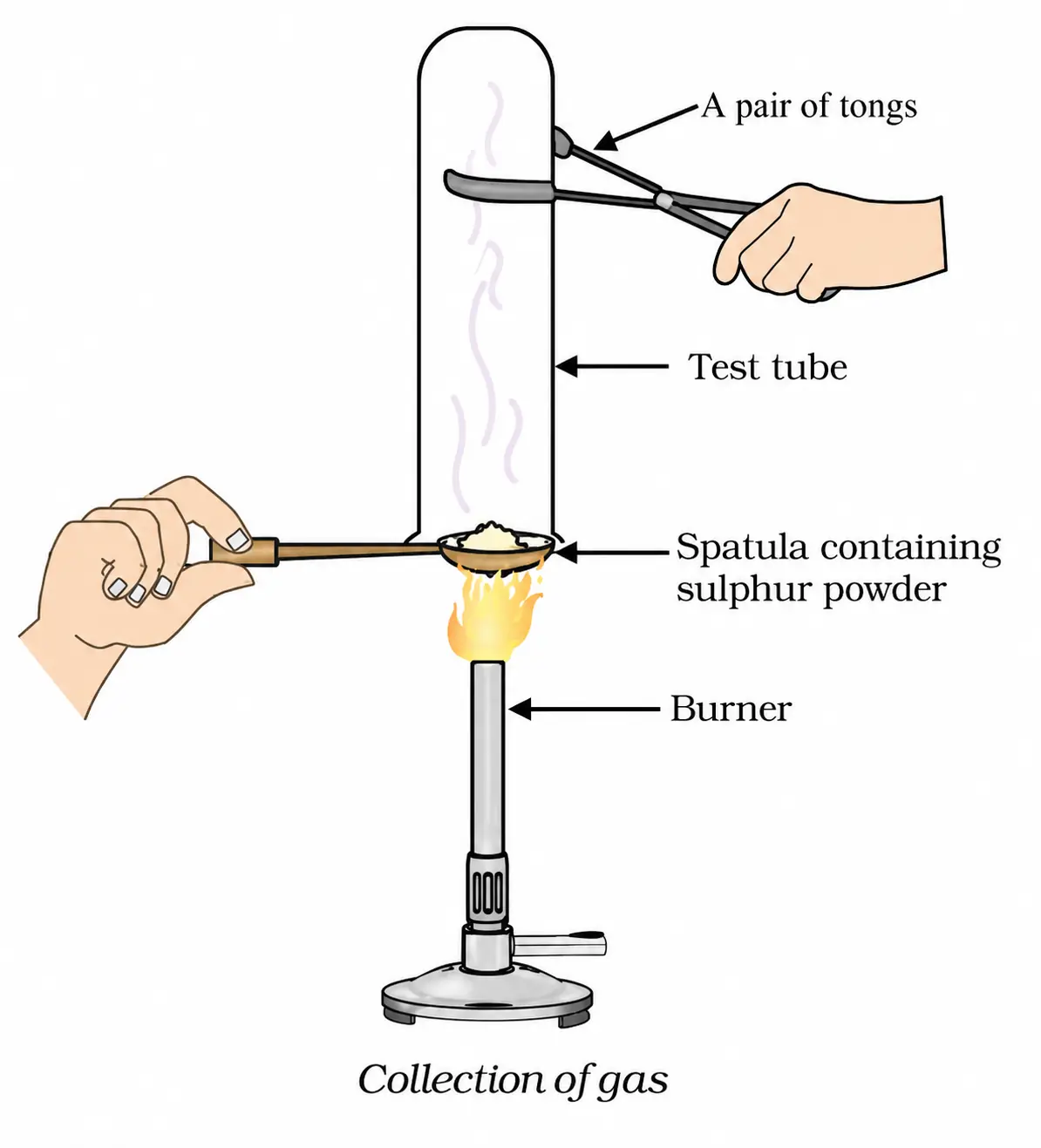
Pratyush took sulphur powder on a spatula and heated it. He collected the gas evolved by inverting a test tube over it, as shown in figure below.
Figure
Figure

(a) What will be the action of gas on (i) dry litmus paper? (ii) moist litmus paper?

Solution

Identification of the gas formed
When sulphur is heated in air it combines with the oxygen present and forms sulphur dioxide gas, $$\mathrm{SO_2}$$.

(i) Action on dry litmus paper
Dry litmus contains no water, so $$\mathrm{SO_2}$$ cannot generate hydrogen ions. Hence there is no colour change in either blue or red dry litmus.

(ii) Action on moist litmus paper
The moisture on the litmus dissolves the gas:
$$\mathrm{SO_2 + H_2O \rightarrow H_2SO_3}$$
$$\mathrm{H_2SO_3}$$ is sulphurous acid, which releases $$\mathrm{H^+}$$ ions and shows acidic behaviour. Therefore:

  • Blue moist litmus turns red.
  • Red moist litmus remains red.

Answer

(i) No change.  (ii) Blue litmus turns red.

(b) Write a balanced chemical equation for the reaction taking place.

Solution

The combustion of sulphur in oxygen is:

$$\mathrm{S + O_2 \rightarrow SO_2}$$

The equation is already balanced (1 S and 2 O atoms on each side).

Answer

$$\mathrm{S + O_2 \rightarrow SO_2}$$

10 State two ways to prevent the rusting of iron.

Solution

Key idea : Rusting is an oxidation of iron to hydrated iron(III) oxide, represented as $$\mathrm{Fe_2O_3\;\cdot xH_2O}$$. The reaction needs both oxygen and water, so any method that keeps at least one of these away from the metal, or makes iron chemically less reactive, will stop rust from forming.

  1. Barrier (coating) methods
    • Painting, oiling, greasing or plastic coating puts an impermeable film over the surface. The film blocks contact with moist air, so neither $$\mathrm{O_2}$$ nor $$\mathrm{H_2O}$$ can reach the iron and the rusting reaction cannot occur.
    • Galvanisation is a special barrier method: the iron object is coated with a thin layer of molten zinc. Besides acting as a physical shield, zinc is more reactive than iron, so it also offers sacrificial protection if the coat is scratched.
  2. Changing the composition of the metal (alloying)

    Making stainless steel by mixing iron with at least $$\mathrm{12\%}$$ chromium (often with $$\mathrm{Ni}$$ and $$\mathrm{C}$$ as well) produces a hard, passive surface layer of $$\mathrm{Cr_2O_3}$$. This compact oxide firmly adheres to the alloy and blocks further entry of air or moisture, so the bulk iron beneath never rusts.

Any two of the above techniques, clearly stated, earn full marks because each removes a necessary condition for the rusting reaction.

Answer

(i) Coat the iron with another material (e.g. painting, oiling, greasing or galvanising with zinc) so air and water cannot touch the metal.
(ii) Convert the iron into a rust-resistant alloy such as stainless steel by adding chromium and nickel.

11 What type of oxides are formed when non-metals combine with oxygen?

Solution

When a non-metal reacts with oxygen, an oxide of the non-metal is produced:

$$\mathrm{Non\!\!-\!metal + O_2 \rightarrow Non\!\!-\!metal\ oxide}$$

To classify the oxide we examine how it behaves with water and with indicators.

  1. Acidic oxides
    Most non-metal oxides dissolve in water (or react with the alkali present in moist litmus paper) to give an acid; they turn blue litmus red.
    Example:

    $$\mathrm{SO_2 + H_2O \rightarrow H_2SO_3}$$

    The solution contains $$\mathrm{H_2SO_3}$$ (sulphurous acid), so $$\mathrm{SO_2}$$ is an acidic oxide. Other common acidic oxides are $$\mathrm{CO_2, SO_3, P_2O_5}$$.

  • Neutral oxides

    A few non-metal oxides do not show either acidic or basic behaviour; they are called neutral oxides.


    Examples: $$\mathrm{CO, NO, N_2O}$$. They do not change the colour of litmus paper.

  • Therefore, the oxides formed by non-metals are either acidic or neutral.

    Answer

    Non-metals form acidic (and occasionally neutral) oxides on reaction with oxygen.

    12 Give reasons

    (a) Platinum, gold and silver are used to make jewellery.

    Solution

    Metals chosen for jewellery must satisfy several conditions:

    • Lustrous appearance → They should have a bright, shiny surface so that ornaments look attractive. Platinum, gold and silver possess very high metallic lustre.
    • Malleability and ductility → Jewellery is made by beating the metal into very thin sheets (malleability) or drawing it into wires (ductility). These three metals can be hammered or drawn without breaking.
    • Resistance to corrosion → They should not tarnish or react with the components of air, water or sweat. The noble-metal character of $$\mathrm{Pt}$$, $$\mathrm{Au}$$ and $$\mathrm{Ag}$$ makes them chemically almost inert, so they retain their shine for years.
    • Hypo-allergenic and dense → They do not cause skin irritation and, being dense, give the desired ‘feel’ to ornaments.

    Because they simultaneously satisfy all these criteria, platinum, gold and silver are preferred for making jewellery.

    Answer

    They are lustrous, highly malleable/ductile and, being chemically inert (do not corrode or tarnish), keep their shine for a long time; hence they are ideal for jewellery.

    (b) Sodium, potassium and lithium are stored under oil.

    Solution

    $$\mathrm{Na}$$, $$\mathrm{K}$$ and $$\mathrm{Li}$$ lie at the extreme left of the reactivity series and possess very low ionisation energies.

    • They react instantaneously with moist air: $$\mathrm{2Na + 2H_2O \to 2NaOH + H_2 \uparrow}$$ (similar reactions for $$\mathrm{K}$$ and $$\mathrm{Li}$$).
    • The heat evolved is enough to ignite the liberated $$\mathrm{H_2}$$ gas, so the metals may catch fire spontaneously.
    • Storing them under kerosene/paraffin oil cuts off contact with air and moisture, stopping the reaction.

    Answer

    Because they react so vigorously with oxygen and water that they may catch fire, the metals are kept immersed in kerosene (oil) to isolate them from air and moisture.

    (c) Aluminium is a highly reactive metal, yet it is used to make utensils for cooking.

    Solution

    Although aluminium is high in the reactivity series, it can safely be used for cookware because of the following reasons:

    1. Formation of a protective oxide film
      Aluminium reacts instantly with oxygen forming a thin, compact layer of $$\mathrm{Al_2O_3}$$: $$\mathrm{4Al + 3O_2 \to 2Al_2O_3}$$. This layer is adherent and impermeable; it seals the underlying metal, preventing further reaction (passivation).
    2. Good conductor and light in weight
      Heat passes quickly through $$\mathrm{Al}$$ utensils, cooking is uniform, and the metal is light, so vessels are easy to handle.
    3. Non-toxic and inexpensive
      Neither the metal nor its oxide contaminates food, and aluminium is cheaper than many other corrosion-resistant metals.

    Answer

    Aluminium quickly forms a thin, tough layer of $$\mathrm{Al_2O_3}$$ that prevents any further reaction; this passive layer makes the metal corrosion-resistant while it remains light and a good conductor, so it is suitable for cooking utensils.

    (d) Carbonate and sulphide ores are usually converted into oxides during the process of extraction.

    Solution

    During metal extraction the reduction step (removal of oxygen) is easiest when the ore is already an oxide. Hence:

    • Thermodynamic advantage
      Ellingham diagrams show that the free–energy change $$\Delta G$$ for reducing metal oxides with common reducing agents (e.g. $$\mathrm{C}$$, $$\mathrm{CO}$$) is more negative than for sulphides or carbonates. Therefore oxides are reduced at lower temperatures.
    • Process simplicity
      Calcination converts carbonate ores to oxide with release of $$\mathrm{CO_2}$$:
      $$\mathrm{\,\,\,\,\,\,\,\,\,\,\,\,\,\,ZnCO_3 \xrightarrow{\Delta} ZnO + CO_2}$$
      Roasting converts sulphide ores to oxide with release of $$\mathrm{SO_2}$$:
      $$\mathrm{2ZnS + 3O_2 \xrightarrow{\Delta} 2ZnO + 2SO_2}$$
    • Impurity removal
      Volatile $$\mathrm{CO_2}$$ and $$\mathrm{SO_2}$$ escape, helping to concentrate the metal in the ore.

    Thus, carbonate and sulphide ores are first changed into their oxides before the final reduction step.

    Answer

    Because metal oxides can be reduced to the free metal more easily (thermodynamically and practically) than the corresponding carbonates or sulphides, these ores are first heated (calcined or roasted) to convert them into oxides and only then reduced.

    13 You must have seen tarnished copper vessels being cleaned with lemon or tamarind juice. Explain why these sour substances are effective in cleaning the vessels.

    Solution

    Step 1 - What causes the dull green coating?

    When a copper article is kept in moist air for some time it reacts slowly with the oxygen, water vapour and carbon dioxide present in the atmosphere. A basic salt, commonly called basic copper carbonate, is formed on the surface:

    $$\mathrm{2\,Cu + O_2 + CO_2 + H_2O \;\longrightarrow\; CuCO_3\,\cdot\,Cu(OH)_2}$$

    This layer is green in colour and masks the bright reddish-brown lustre of metallic copper; we say the metal has become tarnished.

    Step 2 - Nature of the coating

    • The layer $$\mathrm{CuCO_3\,\cdot\,Cu(OH)_2}$$ is basic because it contains the hydroxide part $$\mathrm{Cu(OH)_2}$$.
    • Being insoluble in water, it stays stuck to the surface.

    Step 3 - Composition of lemon or tamarind juice

    • Lemon juice is rich in citric acid, $$\mathrm{C_6H_8O_7}$$.
    • Tamarind contains mainly tartaric acid, $$\mathrm{C_4H_6O_6}$$.
    • Both juices therefore supply plenty of hydrogen ions $$\mathrm{H^+}$$; they are sour and acidic.

    Step 4 - Acid–base reaction that cleans the vessel

    When the sour juice is rubbed on the tarnished copper surface, the hydrogen ions of the acid react with the basic copper carbonate:

    $$\mathrm{CuCO_3\,\cdot\,Cu(OH)_2 + 4\,H^+ \;\longrightarrow\; 2\,Cu^{2+} + 3\,H_2O + CO_2\uparrow}$$

    • The solid green layer is converted into soluble copper ions in the liquid.
    • Carbon dioxide gas escapes as bubbles.
    • Water is produced, helping to wash the surface.

    Result

    Because the insoluble basic layer is neutralised and dissolved, it gets loosened and wiped away, revealing the shiny metallic copper beneath.

    Therefore lemon or tamarind juice, being acidic, effectively cleans tarnished copper utensils.

    Answer

    Sour juices contain acids (citric in lemon, tartaric in tamarind). These acids neutralise and dissolve the basic green layer $$\mathrm{CuCO_3\,\cdot\,Cu(OH)_2}$$ formed on copper: $$\mathrm{CuCO_3\,\cdot\,Cu(OH)_2 + 4H^+ \rightarrow 2Cu^{2+} + 3H_2O + CO_2\uparrow}$$. The insoluble coating is thus removed and the clean, shiny copper surface reappears.

    14 Differentiate between metal and non-metal on the basis of their chemical properties.

    Solution

    To compare metals and non-metals we list each important chemical behaviour side-by-side and quote at least one typical reaction that a Class 10 learner is expected to know.

    Chemical point of comparisonMetalsNon-metals
    Nature of oxides formed on burning in air (oxygen) Give basic (or amphoteric) oxides.
    Example : $$4\,\mathrm{Na} + \mathrm{O_2} \rightarrow 2\,\mathrm{Na_2O}$$.
    $$\mathrm{Na_2O} + \mathrm{H_2O} \rightarrow 2\,\mathrm{NaOH}$$ (alkaline).
    Give acidic (or neutral) oxides.
    Example : $$\mathrm{S} + \mathrm{O_2} \rightarrow \mathrm{SO_2}$$.
    $$\mathrm{SO_2} + \mathrm{H_2O} \rightarrow \mathrm{H_2SO_3}$$ (acidic).
    Reaction with water (cold / hot / steam) Many react to liberate hydrogen gas.
    Example : $$2\,\mathrm{Na} + 2\,\mathrm{H_2O} \rightarrow 2\,\mathrm{NaOH} + \mathrm{H_2}$$ ↑
    Generally no reaction. Exception: $$\mathrm{Cl_2}$$ dissolves forming $$\mathrm{HCl}$$ and $$\mathrm{HClO}$$.
    Reaction with dilute mineral acids Readily react and liberate $$\mathrm{H_2}$$ gas.
    Example : $$\mathrm{Zn} + \mathrm{H_2SO_4(dil.)} \rightarrow \mathrm{ZnSO_4} + \mathrm{H_2}$$ ↑
    Do not react with dilute $$\mathrm{HCl}$$ or $$\mathrm{H_2SO_4}$$ (no $$\mathrm{H_2}$$ evolved). Concentrated oxidising acids may oxidise some non-metals but that is beyond Class 10.
    Displacement reactions A more reactive metal displaces a less reactive metal from its salt solution.
    Example : $$\mathrm{Fe} + \mathrm{CuSO_4} \rightarrow \mathrm{FeSO_4} + \mathrm{Cu}$$
    More reactive non-metals (halogens) displace less reactive ones: $$\mathrm{Cl_2} + 2\,\mathrm{KI} \rightarrow 2\,\mathrm{KCl} + \mathrm{I_2}$$
    Formation of ions & nature of bonding Lose valence electrons ⇒ form cations, e.g. $$\mathrm{Na} \rightarrow \mathrm{Na^+} + e^-$$. Hence form ionic bonds with non-metals. Gain / share electrons ⇒ form anions, e.g. $$\mathrm{Cl} + e^- \rightarrow \mathrm{Cl^-}$$, or form covalent bonds among themselves.
    Valence electron count Usually 1, 2 or 3 electrons in outermost shell. Usually 4, 5, 6 or 7 electrons in outermost shell.

    Thus, metals are chemically characterised by their tendency to lose electrons, form basic oxides and liberate hydrogen from water/ acids, whereas non-metals generally gain electrons, give acidic oxides and show little or no reaction with water or dilute acids.

    Answer

    Metals lose electrons, form basic (or amphoteric) oxides and liberate hydrogen with water or dilute acids; non-metals gain/share electrons, form acidic/neutral oxides and usually do not evolve hydrogen with water or dilute acids.

    15 A man went door to door posing as a goldsmith. He promised to bring back the glitter of old and dull gold ornaments. An unsuspecting lady gave a set of gold bangles to him which he dipped in a particular solution. The bangles sparkled like new but their weight was reduced drastically. The lady was upset but after a futile argument the man beat a hasty retreat. Can you play the detective to find out the nature of the solution he had used?

    Solution

    Step 1 — What did the trickster actually do?
    The bangles came out shiny like new, but they also became noticeably lighter. So not only the dull tarnish but a thin layer of metallic gold itself has been removed by the ‘cleaner’. The reagent he used must therefore be a liquid that can dissolve metallic gold.

    Step 2 — Which laboratory reagent can dissolve gold?
    Gold is a noble metal: it does not react with dilute or concentrated $$\mathrm{HCl}$$, $$\mathrm{H_2SO_4}$$, $$\mathrm{HNO_3}$$ or $$\mathrm{NaOH}$$ taken individually. The one common reagent that does attack gold is aqua regia:

    • Composition: a freshly prepared mixture of concentrated $$\mathrm{HCl}$$ and concentrated $$\mathrm{HNO_3}$$ in the volume ratio 3 : 1.
    • The Latin name aqua regia means ‘royal water’, because the mixture attacks even the ‘royal’ (noble) metals such as Au and Pt.

    Step 3 — Why does aqua regia dissolve gold? (balanced equation).
    Inside the mixture, $$\mathrm{HNO_3}$$ acts as a strong oxidising agent that pulls electrons out of gold, while $$\mathrm{HCl}$$ supplies $$\mathrm{Cl^-}$$ ions that lock the resulting cation into the very stable tetrachloroaurate(III) complex $$\mathrm{[AuCl_4]^-}$$. The two half-equations (each balanced for atoms and for charge) are:

    • Oxidation: $$\mathrm{Au + 4\,Cl^- \;\longrightarrow\; [AuCl_4]^- + 3e^-}$$
    • Reduction: $$\mathrm{NO_3^- + 4\,H^+ + 3e^- \;\longrightarrow\; NO + 2\,H_2O}$$

    The 3 electrons released by gold exactly match the 3 electrons taken up by nitrogen, so adding the half-equations gives the net ionic equation:

    $$\mathrm{Au + 4\,Cl^- + NO_3^- + 4\,H^+ \;\longrightarrow\; [AuCl_4]^- + NO\uparrow + 2\,H_2O}$$

    Reassembling the $$\mathrm{H^+}$$ with $$\mathrm{Cl^-}$$ and $$\mathrm{NO_3^-}$$ into their parent acids gives the overall balanced molecular equation:

    $$\mathrm{Au + 4\,HCl + HNO_3 \;\longrightarrow\; HAuCl_4 + NO\uparrow + 2\,H_2O}$$

    Quick atom and charge check: Au: 1 = 1;   H: 4 + 1 = 5 = 1 + 4;   Cl: 4 = 4;   N: 1 = 1;   O: 3 = 1 + 2 = 3. Both sides carry zero net charge. Hence the equation is fully balanced for atoms and charge, with the three electrons transferred from Au to N already accounted for inside the half-equations.

    The product $$\mathrm{HAuCl_4}$$ (chloroauric acid) is soluble, so a microscopic skin of gold dissolves away in the liquid — restoring the shine but reducing the mass.

    Step 4 — Detective’s verdict.
    The cheating ‘goldsmith’ must have dipped the bangles in aqua regia, a 3 : 1 (by volume) mixture of concentrated $$\mathrm{HCl}$$ and concentrated $$\mathrm{HNO_3}$$. The dissolved gold (as $$\mathrm{HAuCl_4}$$) was carried away in the liquid that the man kept for himself.

    Answer

    The solution used was aqua regia — a freshly mixed 3 : 1 (by volume) mixture of concentrated $$\mathrm{HCl}$$ and concentrated $$\mathrm{HNO_3}$$. It dissolves a thin layer of gold via the balanced equation $$\mathrm{Au + 4\,HCl + HNO_3 \;\longrightarrow\; HAuCl_4 + NO\uparrow + 2\,H_2O}$$ (Au: 1=1, H: 5=5, Cl: 4=4, N: 1=1, O: 3=3), giving the bangles a fresh sparkle but reducing their weight.

    16 Give reasons why copper is used to make hot water tanks and not steel (an alloy of iron).

    Solution

    Step 1 │ Recall the position of the two metals in the reactivity series
    Copper lies below hydrogen, whereas iron lies above hydrogen in the reactivity series. Therefore:

    • Iron is sufficiently reactive to displace hydrogen from water when the water is supplied as steam (high temperature).
    • Copper is less reactive than hydrogen; it cannot displace hydrogen even from hot water or steam.

    Step 2 │ Write the reaction of iron (steel) with steam
    When iron is heated in the presence of steam, it gets oxidised and liberates hydrogen gas:

    $$3\mathrm{Fe} + 4\mathrm{H_2O} \;\xrightarrow{\text{heat}}\; \mathrm{Fe_3O_4} + 4\mathrm{H_2}$$

    This reaction produces the mixed oxide $$\mathrm{Fe_3O_4}$$ that adheres as a scale or can later convert to rust $$\bigl(\mathrm{Fe_2O_3\,·\,xH_2O}\bigr)$$ in moist air. Hence a steel tank would corrode and weaken when it stores hot water for a long time.

    Step 3 │ Note the absence of a similar reaction for copper
    Copper does not react with either cold water, hot water, or steam:

    $$\mathrm{Cu} + \mathrm{H_2O}\;(\text{any state}) \;\nrightarrow\; \text{no reaction}$$

    Thus a copper tank remains chemically unchanged and free from corrosion even at the temperature of boiling water.

    Step 4 │ Add the thermal-conduction argument
    Besides chemical inertness, copper has a much higher thermal conductivity than steel. Therefore:

    • Heat is transferred to the water faster, so the water heats up quickly and uniformly.
    • Fuel or electrical energy is saved in domestic and industrial installations.

    Conclusion
    Because copper (i) does not react with hot water or steam and hence resists corrosion, and (ii) conducts heat better than steel, it is preferred for making hot-water tanks, whereas steel (an alloy mainly of iron) would corrode and is a poorer heat conductor.

    Answer

    Copper is chosen because it does not react with hot water/steam, while steel (iron) does: $$3\mathrm{Fe}+4\mathrm{H_2O}\to\mathrm{Fe_3O_4}+4\mathrm{H_2}$$, leading to rusting and weakening of the tank. In addition, copper conducts heat much better, so water heats faster. Hence hot-water tanks are made of copper, not steel.

    NCERT Solutions for Class 10
    Maths
    NCERT Solutions for Class 10 Maths
    Chapter-wise step-by-step
    solutions with explanations
    explore solutions Maths bg
    Science
    NCERT Solutions for Class 10 Science
    Chapter-wise step-by-step
    solutions with explanations
    explore solutions Science bg

    Frequently Asked Questions

    50,000+ JEE Students Trusted Our Score Calculator

    Predict your JEE Main percentile, rank & performance in seconds