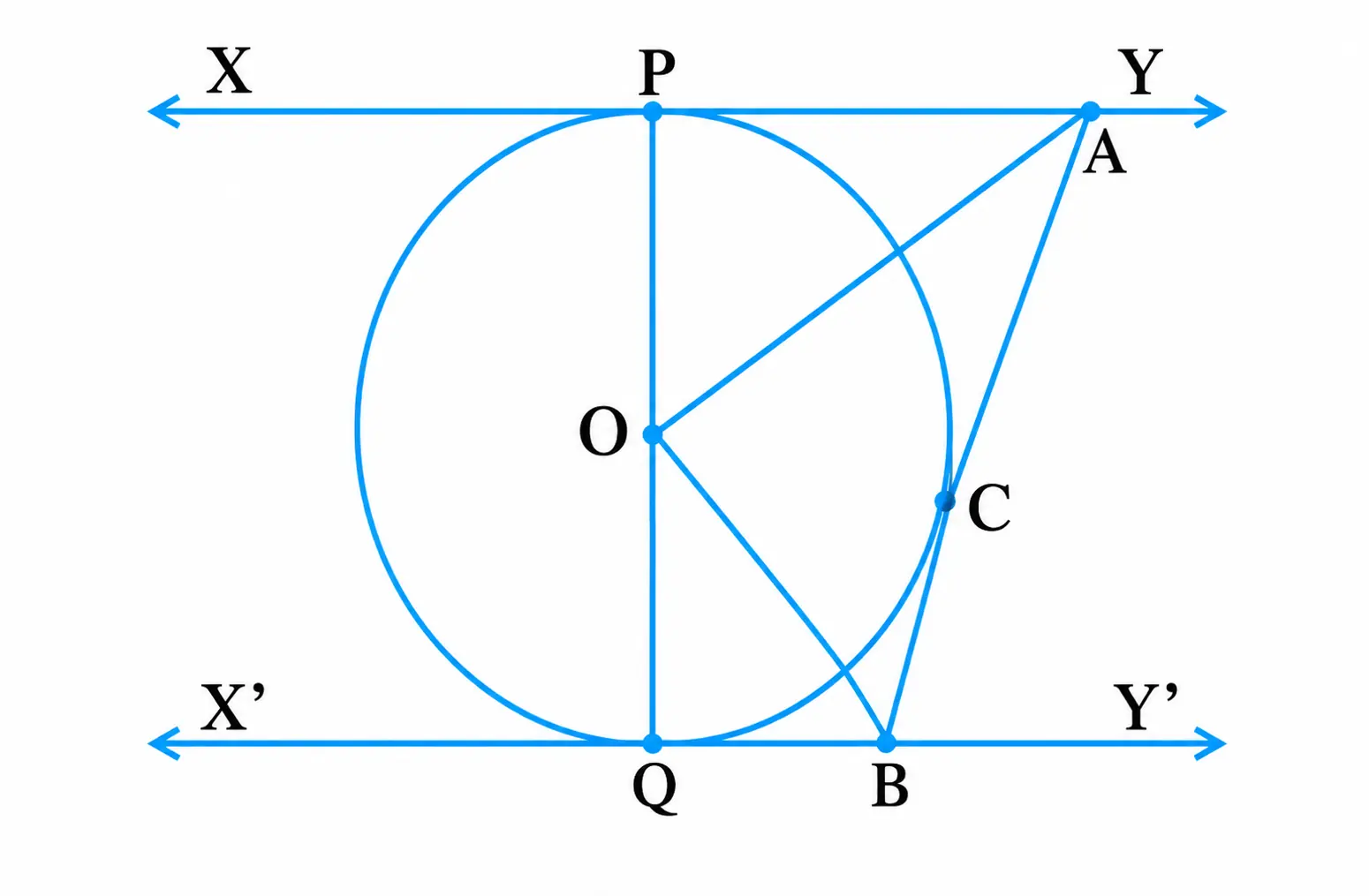
Given data
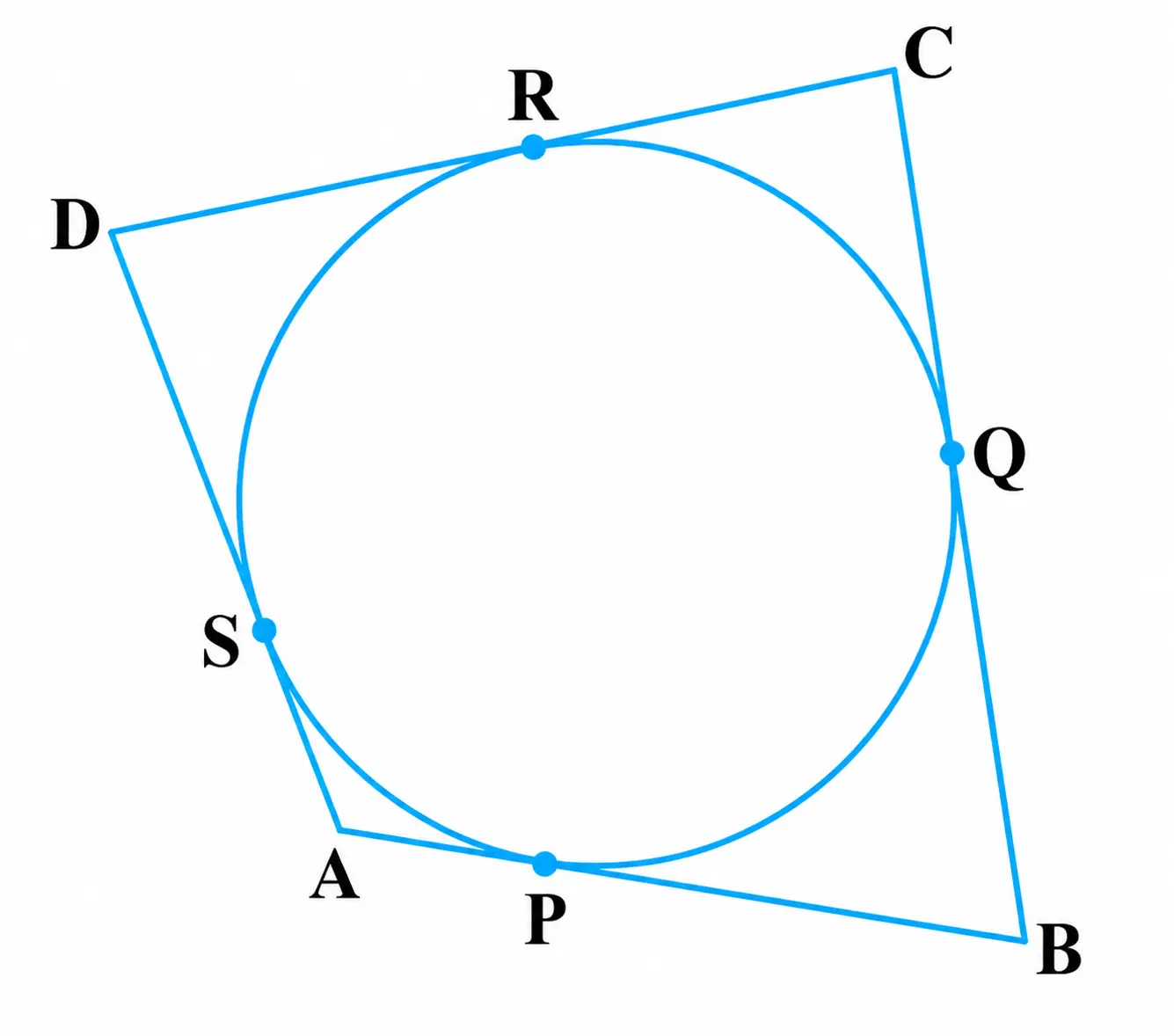
- A circle with centre $$O$$ and radius $$r$$.
- Two parallel tangents $$XY$$ and $$X'Y'$$ touch the circle at points $$P$$ and $$Q$$ respectively.
- A third tangent $$AB$$ touches the circle at the point $$C$$ and meets $$XY$$ at $$A$$ and $$X'Y'$$ at $$B$$.
We must prove that $$\angle AOB = 90^\circ$$.
Step 1 : An analytic set–up
Choose Cartesian axes so that $$O$$ is the origin and the two parallel tangents become the horizontal lines
$$XY : y = r\quad\text{and}\quad X'Y' : y = -r$$
(The distance of each of these lines from the origin is $$|r|$$, so they are indeed tangents.)
Step 2 : Co-ordinates of the point of contact $$C$$ of the tangent $$AB$$
Let the co-ordinates of $$C$$ be $$C(x_0, y_0)$$. Because $$C$$ lies on the circle,
$$x_0^{2}+y_0^{2}=r^{2}\;\;\;\;\; (1)$$
The equation of the tangent to the circle at $$C(x_0,y_0)$$ is (Class X, Chapter 7)
$$x_0x+y_0y=r^{2}.\;\;\;\;\; (2)$$
This is precisely the straight line $$AB$$.
Step 3 : Co-ordinates of $$A$$ and $$B$$
(i) Point A
Substitute $$y=r$$ (because $$A$$ lies on $$XY$$) in (2):
$$x_0x+y_0r=r^{2}\;\Longrightarrow\;x=\dfrac{r^{2}-y_0r}{x_0}.$$
Thus
$$A\,(\,\dfrac{r^{2}-y_0r}{x_0},\;r\,).$$
(ii) Point B
Substitute $$y=-r$$ in (2):
$$x_0x-y_0r=r^{2}\;\Longrightarrow\;x=\dfrac{r^{2}+y_0r}{x_0}.$$
Hence
$$B\,(\,\dfrac{r^{2}+y_0r}{x_0},\;-r\,).$$
Step 4 : The vectors $$\overrightarrow{OA}$$ and $$\overrightarrow{OB}$$
$$\overrightarrow{OA}=\left[\dfrac{r^{2}-y_0r}{x_0},\;r\right],\qquad \overrightarrow{OB}=\left[\dfrac{r^{2}+y_0r}{x_0},\;-r\right].$$
Step 5 : Their scalar (dot) product
$$\overrightarrow{OA}\,\cdot\,\overrightarrow{OB}=\dfrac{r^{2}-y_0r}{x_0}\,\cdot\,\dfrac{r^{2}+y_0r}{x_0}+r\,(-r)$$
$$=\dfrac{r^{4}-y_0^{2}r^{2}}{x_0^{2}}-r^{2}$$
$$=\dfrac{r^{4}-y_0^{2}r^{2}-r^{2}x_0^{2}}{x_0^{2}}$$
Using relation (1), $$x_0^{2}=r^{2}-y_0^{2}$$. Substituting,
$$r^{4}-y_0^{2}r^{2}-r^{2}x_0^{2}=r^{4}-y_0^{2}r^{2}-r^{2}(r^{2}-y_0^{2})=0.$$
Therefore $$\overrightarrow{OA}\,\cdot\,\overrightarrow{OB}=0$$.
Step 6 : Geometrical conclusion
The dot product of two vectors is zero exactly when the vectors are perpendicular. Hence
$$OA \perp OB\;\;\Longrightarrow\;\;\angle AOB = 90^{\circ}.$$
Result The required angle is a right angle.
Thus, in the configuration of Fig. 10.13, $$\angle AOB = 90^{\circ}$$ is proved.
 91- 6303239042