Join WhatsApp Icon JEE WhatsApp Group
NCERT Solutions for Class 10 Maths

Chapter 7: Coordinate Geometry

Download Solutions PDF
Daily JEE Updates, Tips & Important Alerts
Join 30,000+ students and stay updated with JEE notifications and preparation insights.
Join Now!
Free PDF
Complete NCERT Solution PDF for Chapter 7: Coordinate Geometry

NCERT Solutions For Class 10 Maths Chapter 7 Coordinate Geometry helps students understand how geometric points are represented and calculated using algebraic methods. The page provides detailed NCERT Solutions that explain distance formula, section formula, and concepts related to coordinates on a plane. NCERT Solutions For Class 10 Maths help students connect geometry with algebra and solve problems involving points, distances, and ratios. The chapter improves students’ graphical understanding and problem-solving skills. These solutions provide clear explanations for textbook questions and help students apply formulas correctly. Students can download the chapter PDF for convenient revision and practice sessions. The structured solutions make coordinate-based problems easier to understand and solve accurately.
Download Solutions PDF

Examples 1-5

Example 1 Do the points $$(3, 2)$$, $$(-2, -3)$$ and $$(2, 3)$$ form a triangle? If so, name the type of triangle formed.

Solution

Given points: $$A(3,2)$$, $$B(-2,-3)$$ and $$C(2,3)$$.

1. Test for collinearity (area method)

The area of the triangle formed by three points $$ (x_1,y_1),(x_2,y_2),(x_3,y_3) $$ is

$$ \text{Area}=\tfrac12\, | x_1(y_2-y_3)+x_2(y_3-y_1)+x_3(y_1-y_2) |. $$

Substituting $$A(3,2),\;B(-2,-3),\;C(2,3):$$

$$ \begin{aligned} \text{Area} & = \tfrac12 |\, 3((-3)-3)+(-2)(3-2)+2(2-(-3)) \,| \\[2pt] & = \tfrac12 |\, 3(-6)+(-2)(1)+2(5) \,| \\[2pt] & = \tfrac12 |\,-18-2+10\,| \\[2pt] & = \tfrac12 |\,-10| \\[2pt] & = \tfrac12 \times 10 = 5.\end{aligned} $$

Since $$\text{Area}=5\neq0$$, the three points are not collinear; they do form a triangle.

2. Find the lengths of the sides

SideFormulaValue of $$(\text{length})^2$$
$$AB$$$$ (3-(-2))^2+(2-(-3))^2 $$$$5^2+5^2=25+25=50$$
$$BC$$$$ (-2-2)^2+(-3-3)^2 $$$$(-4)^2+(-6)^2=16+36=52$$
$$CA$$$$ (2-3)^2+(3-2)^2 $$$$(-1)^2+1^2=1+1=2$$

Thus
$$AB^2=50,\; BC^2=52,\; CA^2=2.$$

3. Classify the triangle

The largest square of a side is $$BC^2=52$$. Check the Pythagoras relation:

$$ AB^2 + CA^2 = 50 + 2 = 52 = BC^2. $$

Since the sum of the squares of the two shorter sides equals the square of the longest side, the triangle satisfies the converse of the Pythagoras theorem. Therefore, $$\triangle ABC$$ is a right-angled triangle.

All three side lengths are different (50, 52, 2), so it is specifically a right-angled scalene triangle.

Conclusion: The points $$ (3,2),\;(-2,-3),\;(2,3) $$ form a right-angled triangle, right-angled at $$A(3,2)$$.

Answer

Yes. The three points are not collinear and form a right-angled triangle (right angle at (3, 2)).

Example 2 Show that the points $$(1, 7)$$, $$(4, 2)$$, $$(-1, -1)$$ and $$(-4, 4)$$ are the vertices of a square.

Solution

Let us denote the four given points by

$$A(1,7), \; B(4,2), \; C(-1,-1), \; D(-4,4).$$

To prove that $$ABCD$$ is a square we shall show

  1. all four sides are equal, and
  2. one interior angle is a right angle.

These two facts together are sufficient because a quadrilateral with all sides equal is a rhombus, and a rhombus that has one right angle is automatically a square.

1. Length of the four sides

The distance formula between two points $$P(x_1,y_1)$$ and $$Q(x_2,y_2)$$ is

$$PQ = \sqrt{(x_2-x_1)^2 + (y_2-y_1)^2}.$$

Rather than carrying the square roots, we calculate the squares of the side–lengths.

SideSquared length
$$AB$$$$(4-1)^2 + (2-7)^2 = 3^2 + (-5)^2 = 9 + 25 = 34$$
$$BC$$$$( -1-4)^2 + (-1-2)^2 = (-5)^2 + (-3)^2 = 25 + 9 = 34$$
$$CD$$$$( -4+1)^2 + (4+1)^2 = (-3)^2 + 5^2 = 9 + 25 = 34$$
$$DA$$$$(1+4)^2 + (7-4)^2 = 5^2 + 3^2 = 25 + 9 = 34$$

Thus

$$AB = BC = CD = DA = \sqrt{34}.$$

Hence all four sides are equal.

2. Verification of a right angle

We now examine angle $$ABC$$ by computing the slopes of $$AB$$ and $$BC$$.

Slope of $$AB$$:

$$m_{AB} = \dfrac{2-7}{4-1} = -\dfrac{5}{3}.$$

Slope of $$BC$$:

$$m_{BC} = \dfrac{-1-2}{-1-4} = \dfrac{-3}{-5} = \dfrac{3}{5}.$$

The product of the two slopes is

$$m_{AB}\,m_{BC} = \Bigl(-\dfrac{5}{3}\Bigr)\Bigl(\dfrac{3}{5}\Bigr) = -1.$$

Since the product of the slopes of two lines is $$-1$$, the lines are perpendicular. Therefore $$\angle ABC = 90^{\circ}$$.

Conclusion

Quadrilateral $$ABCD$$ has all its sides equal and one right angle; hence it is a square.

Therefore the four given points are indeed the vertices of a square.

Answer

Proved  — the four points are the vertices of a square.

Example 3

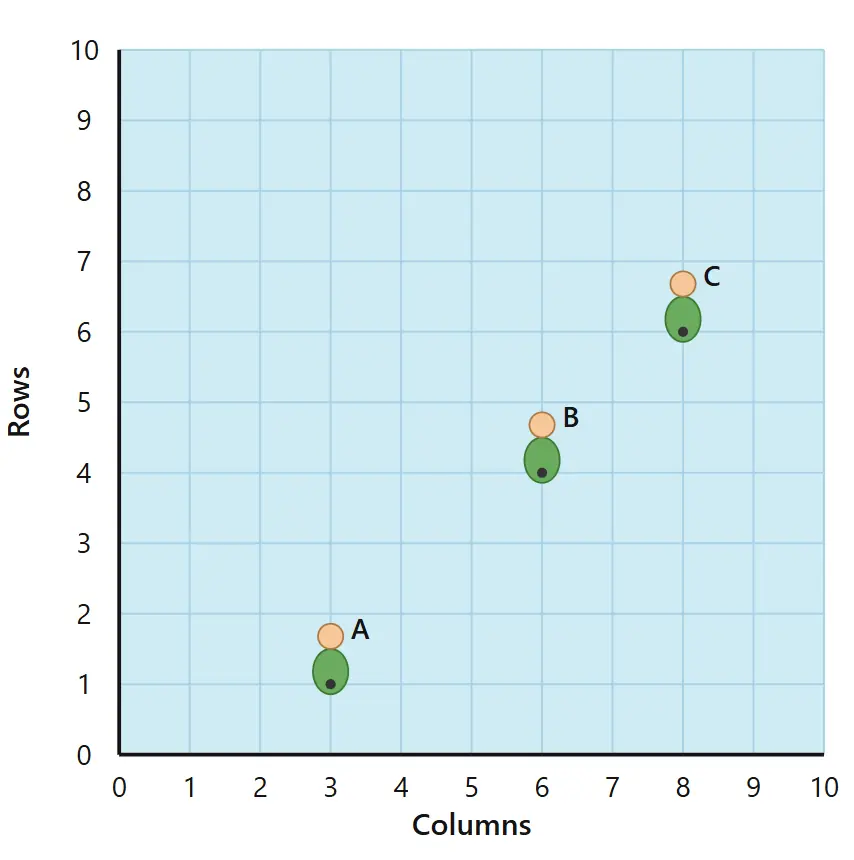
Fig. 7.6 shows the arrangement of desks in a classroom. Ashima, Bharti and Camella are seated at $$\mathrm{A}(3, 1)$$, $$\mathrm{B}(6, 4)$$ and $$\mathrm{C}(8, 6)$$ respectively. Do you think they are seated in a line? Give reasons for your answer.
Fig. 7.6
Fig. 7.6

Solution

Given points: $$A(3,1)$$, $$B(6,4)$$ and $$C(8,6)$$.

To know whether the three students are sitting in a straight line, we must check if the three points are collinear. We do this by comparing the slopes of any two of the three possible line segments.

Step 1 – Slope of $$AB$$

$$m_{AB}=\frac{y_B-y_A}{x_B-x_A}=\frac{4-1}{6-3}=\frac{3}{3}=1$$

Step 2 – Slope of $$BC$$

$$m_{BC}=\frac{y_C-y_B}{x_C-x_B}=\frac{6-4}{8-6}=\frac{2}{2}=1$$

Step 3 – Comparison

The two slopes are equal: $$m_{AB}=m_{BC}=1$$. If two different pairs of points among three share the same slope, the three points lie on the same straight line; that is, they are collinear.

(Optional cross-check)  Area of $$\triangle ABC$$:

$$\text{Area}=\tfrac12\bigl|x_1(y_2-y_3)+x_2(y_3-y_1)+x_3(y_1-y_2)\bigr|$$

$$=\tfrac12\bigl|3(4-6)+6(6-1)+8(1-4)\bigr|=\tfrac12\bigl|-6+30-24\bigr|=\tfrac12\times0=0$$

Zero area again confirms collinearity.

Conclusion: Ashima, Bharti and Camella are seated in a single straight line.

Answer

Yes. Since the slopes $$m_{AB}=1$$ and $$m_{BC}=1$$ are equal, points A(3,1), B(6,4) and C(8,6) are collinear; hence the three students sit in one straight line.

Example 4 Find a relation between $$x$$ and $$y$$ such that the point $$(x, y)$$ is equidistant from the points $$(7, 1)$$ and $$(3, 5)$$.

Solution

Let the required point be $$(x, y)$$.

Its distance from $$(7,1)$$ must be the same as its distance from $$(3,5)$$.

Using the distance formula, equate the two distances (it is easier to square them so that square‐roots disappear):

$$\bigl[(x-7)^2+(y-1)^2\bigr]=\bigl[(x-3)^2+(y-5)^2\bigr]$$

Expand both sides completely.

Left side:

$$ (x-7)^2 = x^2-14x+49, \qquad (y-1)^2 = y^2-2y+1 $$

So the left side becomes $$x^2-14x+49+y^2-2y+1$$.

Right side:

$$ (x-3)^2 = x^2-6x+9, \qquad (y-5)^2 = y^2-10y+25 $$

So the right side becomes $$x^2-6x+9+y^2-10y+25$$.

Set them equal:

$$x^2-14x+49+y^2-2y+1 = x^2-6x+9+y^2-10y+25$$

Cancel the identical terms $$x^2$$ and $$y^2$$ on both sides:

$$-14x+49-2y+1 = -6x+9-10y+25$$

Bring all terms to the left (subtract the right side from the left side so that the result equals 0):

$$\bigl(-14x+49-2y+1\bigr)-\bigl(-6x+9-10y+25\bigr)=0$$

Simplify term by term:

  • x–terms: $$-14x+6x = -8x$$
  • y–terms: $$-2y+10y = 8y$$
  • constants: $$49+1-9-25 = 16$$

Hence

$$-8x+8y+16 = 0$$

Divide through by $$8$$ (or multiply by $$-1$$) to write it neatly:

$$x-y-2 = 0$$

or, equivalently,

$$y = x-2$$

Thus every point on the line $$x-y-2=0$$ is equidistant from $$(7,1)$$ and $$(3,5)$$.

Answer

Required relation: $$x - y - 2 = 0$$ (i.e. $$y = x - 2$$).

Example 5 Find a point on the $$y$$-axis which is equidistant from the points $$\mathrm{A}(6, 5)$$ and $$\mathrm{B}(-4, 3)$$.

Solution

Let the required point be $$P(0,y)$$ because any point on the $$y$$-axis has an $$x$$-coordinate $$0$$.

Using the distance formula,

$$PA=\sqrt{(0-6)^{2}+(y-5)^{2}}=\sqrt{36+(y-5)^{2}}$$

$$PB=\sqrt{(0+4)^{2}+(y-3)^{2}}=\sqrt{16+(y-3)^{2}}$$

Because $$P$$ is equidistant from $$A$$ and $$B$$, we set $$PA=PB$$ and square both sides:

$$36+(y-5)^{2}=16+(y-3)^{2}$$

Expand the squares:

$$36+y^{2}-10y+25=16+y^{2}-6y+9$$

Simplify:

$$y^{2}-10y+61=y^{2}-6y+25$$

Subtract $$y^{2}$$ from both sides:

$$-10y+61=-6y+25$$

Bring like terms together:

$$-4y=-36$$

$$y=9$$

Therefore the required point on the $$y$$-axis is $$P(0,9)$$.

Answer

$$(0,9)$$

Exercise 7.1

1 Find the distance between the following pairs of points:

(i) $$(2, 3)$$, $$(4, 1)$$

Solution

Let the two points be $$A(2,3)$$ and $$B(4,1)$$.

The distance formula is

$$AB = \sqrt{(x_2 - x_1)^2 + (y_2 - y_1)^2}.$$

Here $$x_1 = 2,\; y_1 = 3,\; x_2 = 4,\; y_2 = 1$$.

Substituting these values,

$$AB = \sqrt{(4-2)^2 + (1-3)^2} = \sqrt{(2)^2 + (-2)^2}$$

$$= \sqrt{4 + 4} = \sqrt{8} = 2\sqrt{2}\text{ units}.$$

Answer

$$2\sqrt{2}$$

(ii) $$(-5, 7)$$, $$(-1, 3)$$

Solution

Let the two points be $$C(-5,7)$$ and $$D(-1,3)$$.

Using the distance formula,

$$CD = \sqrt{(x_2 - x_1)^2 + (y_2 - y_1)^2}.$$

Here $$x_1 = -5,\; y_1 = 7,\; x_2 = -1,\; y_2 = 3$$.

Substituting:

$$CD = \sqrt{(-1 - (-5))^2 + (3 - 7)^2}$$

$$= \sqrt{(4)^2 + (-4)^2} = \sqrt{16 + 16}$$

$$= \sqrt{32} = 4\sqrt{2}\text{ units}.$$

Answer

$$4\sqrt{2}$$

(iii) $$(a, b)$$, $$(-a, -b)$$

Solution

Let the two points be $$P(a,b)$$ and $$Q(-a,-b)$$.

By the distance formula,

$$PQ = \sqrt{(x_2 - x_1)^2 + (y_2 - y_1)^2}.$$

Here $$x_1 = a,\; y_1 = b,\; x_2 = -a,\; y_2 = -b$$.

Therefore,

$$PQ = \sqrt{(-a - a)^2 + (-b - b)^2}$$

$$= \sqrt{(-2a)^2 + (-2b)^2} = \sqrt{4a^2 + 4b^2}$$

$$= \sqrt{4(a^2 + b^2)} = 2\sqrt{a^{2} + b^{2}}\text{ units}.$$

Answer

$$2\sqrt{a^{2}+b^{2}}$$

2 Find the distance between the points $$(0, 0)$$ and $$(36, 15)$$. Can you now find the distance between the two towns A and B discussed in Section 7.2.

Solution

To find the length of the straight line joining two points we use the Distance Formula.

If $$P(x_1,y_1)$$ and $$Q(x_2,y_2)$$ are any two points in the Cartesian plane, then

$$PQ = \sqrt{(x_2 - x_1)^2 + (y_2 - y_1)^2}.$$

1. Distance between $$(0,0)$$ and $$(36,15)$$

Here, $$x_1 = 0,\; y_1 = 0,\; x_2 = 36,\; y_2 = 15.$$ Substituting in the formula,

$$PQ = \sqrt{(36-0)^2 + (15-0)^2} = \sqrt{36^2 + 15^2}.$$

Calculate the squares:

$$36^2 = 1296,\; 15^2 = 225.$$

Add the squares:

$$1296 + 225 = 1521.$$

Take the square root:

$$PQ = \sqrt{1521} = 39.$$

Therefore, the required distance is $$39$$ units.

2. Distance between the two towns A and B (Section 7.2)

In Section 7.2, town B is described as being $$40\text{ km}$$ east and $$30\text{ km}$$ north of town A. If we choose town A to be the origin $$A(0,0)$$, then town B is at $$B(40,30).$$

Using the same formula,

$$AB = \sqrt{(40-0)^2 + (30-0)^2} = \sqrt{40^2 + 30^2}.$$

Compute the squares and add:

$$40^2 = 1600,\; 30^2 = 900,\; 1600 + 900 = 2500.$$

$$AB = \sqrt{2500} = 50.$$

So, the two towns are $$50\text{ km}$$ apart.

Answer

The distance between $$(0,0)$$ and $$(36,15)$$ is $$39$$ units. Hence, the towns A and B in Section 7.2 are $$50\text{ km}$$ apart.

3 Determine if the points $$(1, 5)$$, $$(2, 3)$$ and $$(-2, -11)$$ are collinear.

Solution

Step 1 – Label the points

Let $$A(1,5), B(2,3), C(-2,-11)$$.

Step 2 – Write the slope formula

If two points $$P(x_1,y_1)$$ and $$Q(x_2,y_2)$$ are distinct, the slope of the line $$PQ$$ is

$$m_{PQ}=\frac{y_2-y_1}{x_2-x_1}$$.

Step 3 – Find the slope of $$AB$$

$$m_{AB}=\frac{3-5}{2-1}=\frac{-2}{1}=-2$$.

Step 4 – Find the slope of $$BC$$

$$m_{BC}=\frac{-11-3}{-2-2}=\frac{-14}{-4}=\frac{7}{2}=3.5$$.

Step 5 – Compare the slopes

$$m_{AB}=-2\neq3.5=m_{BC}$$.

Since the slopes are different, the three points do not lie on the same straight line; hence they are not collinear.

Answer

The points are not collinear.

4 Check whether $$(5, -2)$$, $$(6, 4)$$ and $$(7, -2)$$ are the vertices of an isosceles triangle.

Solution

Let us denote the three points as follows:

  • $$A(5,-2)$$
  • $$B(6,4)$$
  • $$C(7,-2)$$

To know whether $$\triangle ABC$$ is isosceles, we compare the lengths of its sides using the distance formula.

Distance formula
For two points $$\bigl(x_1,y_1\bigr)$$ and $$\bigl(x_2,y_2\bigr)$$ the distance is $$\sqrt{(x_2-x_1)^2+(y_2-y_1)^2}$$.

  1. Side $$AB$$

    $$\begin{aligned} AB&=\sqrt{(6-5)^2+(4-(-2))^2}\\[2pt] &=\sqrt{1^2+6^2}\\[2pt] &=\sqrt{1+36}\\[2pt] &=\sqrt{37} \end{aligned}$$

  2. Side $$BC$$

    $$\begin{aligned} BC&=\sqrt{(7-6)^2+((-2)-4)^2}\\[2pt] &=\sqrt{1^2+(-6)^2}\\[2pt] &=\sqrt{1+36}\\[2pt] &=\sqrt{37} \end{aligned}$$

  3. Side $$AC$$

    $$\begin{aligned} AC&=\sqrt{(7-5)^2+((-2)-(-2))^2}\\[2pt] &=\sqrt{2^2+0^2}\\[2pt] &=\sqrt{4}\\[2pt] &=2 \end{aligned}$$

We have

$$AB = BC = \sqrt{37},\quad AC = 2.$$

Since two sides (here $$AB$$ and $$BC$$) are equal, $$\triangle ABC$$ is an isosceles triangle.

Answer

The three points form an isosceles triangle: $$AB = BC = \sqrt{37}\;\text{and}\;AC = 2.$$

5

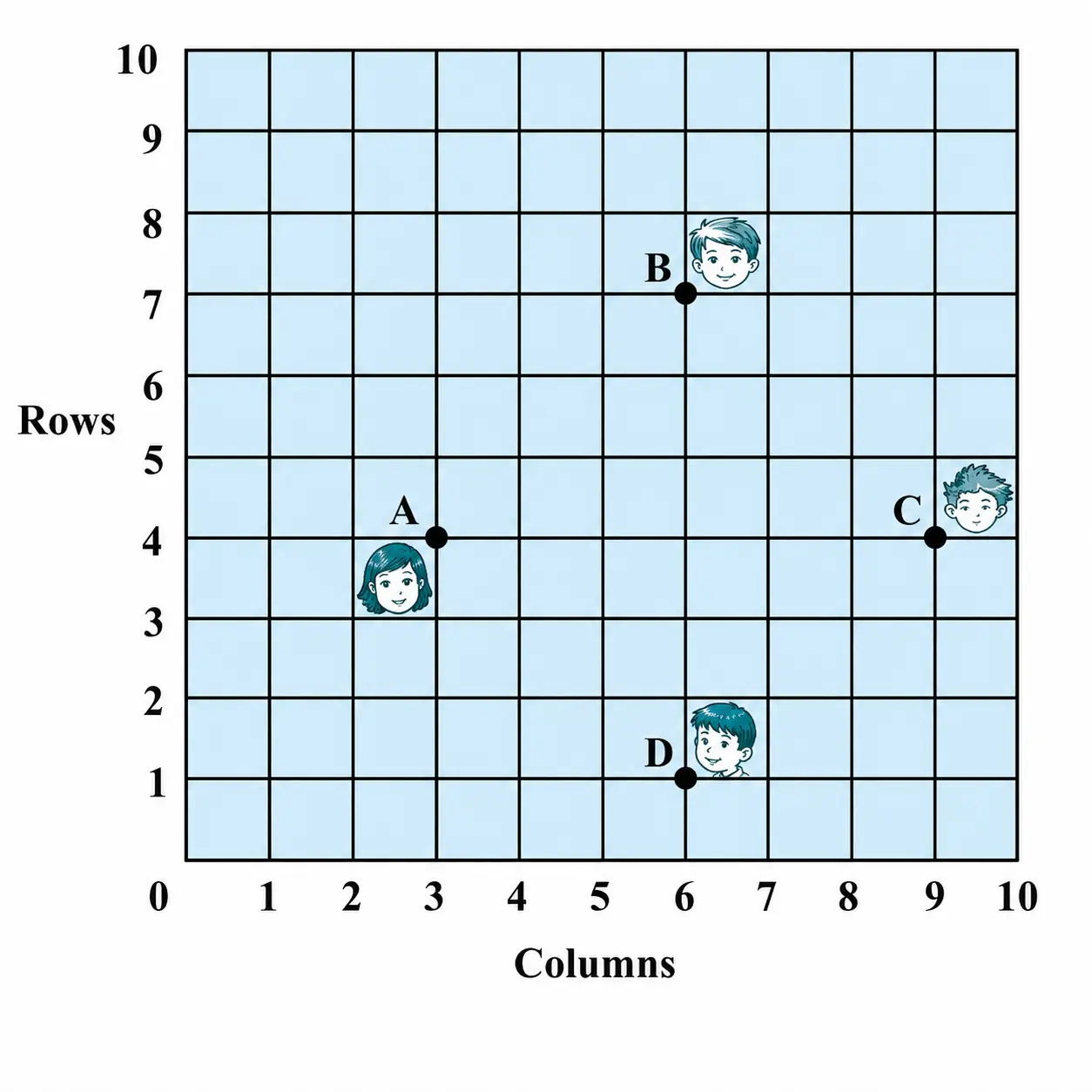
In a classroom, 4 friends are seated at the points A, B, C and D as shown in Fig. 7.8. Champa and Chameli walk into the class and after observing for a few minutes Champa asks Chameli, "Don't you think ABCD is a square?" Chameli disagrees. Using distance formula, find which of them is correct.
Fig. 7.8
Fig. 7.8

Solution

From Fig. 7.8 the coordinates of the four friends are

$$A(1,1),\;B(1,4),\;C(5,4),\;D(5,1).$$

The distance formula is

$$ ext{Distance}= oot{}\sqrt{(x_2-x_1)^2+(y_2-y_1)^2}.$$

Calculate all four sides.

  • Side $$AB$$:
    $$AB= oot{}\sqrt{(1-1)^2+(4-1)^2}= oot{}\sqrt{0+9}=3.$$
  • Side $$BC$$:
    $$BC= oot{}\sqrt{(5-1)^2+(4-4)^2}= oot{}\sqrt{16+0}=4.$$
  • Side $$CD$$:
    $$CD= oot{}\sqrt{(5-5)^2+(1-4)^2}= oot{}\sqrt{0+9}=3.$$
  • Side $$DA$$:
    $$DA= oot{}\sqrt{(1-5)^2+(1-1)^2}= oot{}\sqrt{16+0}=4.$$

So $$AB=CD=3\text{ units}$$ and $$BC=DA=4\text{ units}$$. All four sides are not equal, therefore $$ABCD$$ cannot be a square.

For completeness, check the diagonals.

  • Diagonal $$AC$$:
    $$AC= oot{}\sqrt{(5-1)^2+(4-1)^2}= oot{}\sqrt{16+9}=5.$$
  • Diagonal $$BD$$:
    $$BD= oot{}\sqrt{(5-1)^2+(1-4)^2}= oot{}\sqrt{16+9}=5.$$

Although the two diagonals are equal, unequal sides show the quadrilateral is only a rectangle, not a square.

Conclusion : Chameli’s observation is correct; $$ABCD$$ is not a square, so Champa’s guess is wrong.

Answer

Chameli is correct; $$ABCD$$ is not a square (it is a rectangle).

6 Name the type of quadrilateral formed, if any, by the following points, and give reasons for your answer:

(i) $$(-1, -2)$$, $$(1, 0)$$, $$(-1, 2)$$, $$(-3, 0)$$

Solution

Let the vertices be $$A(-1,-2)$$, $$B(1,0)$$, $$C(-1,2)$$ and $$D(-3,0)$$ taken in this order.

Step 1 • Slopes of the four sides

  • $$m_{AB}=\dfrac{0-(-2)}{1-(-1)}=\dfrac{2}{2}=1$$
  • $$m_{BC}=\dfrac{2-0}{-1-1}=\dfrac{2}{-2}=-1$$
  • $$m_{CD}=\dfrac{0-2}{-3-(-1)}=\dfrac{-2}{-2}=1$$
  • $$m_{DA}=\dfrac{-2-0}{-1-(-3)}=\dfrac{-2}{2}=-1$$

Opposite sides have equal slopes: $$m_{AB}=m_{CD}$$ and $$m_{BC}=m_{DA}$$, so each pair of opposite sides is parallel ⇒ $$AB\parallel CD$$ and $$BC\parallel AD$$. Hence $$ABCD$$ is a parallelogram.

Step 2 • Lengths of the sides

  • $$AB=\sqrt{(1+1)^2+(0+2)^2}=\sqrt{4+4}=\sqrt8$$
  • $$BC=\sqrt{(-1-1)^2+(2-0)^2}=\sqrt{4+4}=\sqrt8$$
  • $$CD=\sqrt{(-3+1)^2+(0-2)^2}=\sqrt{4+4}=\sqrt8$$
  • $$DA=\sqrt{(-1+3)^2+(-2-0)^2}=\sqrt{4+4}=\sqrt8$$

All four sides are equal.

Step 3 • One right angle

$$m_{AB}\,m_{BC}=1\times(-1)=-1$$, therefore $$AB\perp BC$$. A parallelogram with one right angle is a rectangle; a rectangle with all sides equal is a square.

Hence $$ABCD$$ is a square.

Answer

The quadrilateral is a square.

(ii) $$(-3, 5)$$, $$(3, 1)$$, $$(0, 3)$$, $$(-1, -4)$$

Solution

Let $$A(-3,5)$$, $$B(3,1)$$, $$C(0,3)$$ and $$D(-1,-4)$$.

Checking collinearity

  • $$m_{AB}=\dfrac{1-5}{3-(-3)}=\dfrac{-4}{6}=-\dfrac23$$
  • $$m_{BC}=\dfrac{3-1}{0-3}=\dfrac{2}{-3}=-\dfrac23$$

Since $$m_{AB}=m_{BC}$$, points $$A,B,C$$ are collinear (they lie on the same straight line).

With three of the four points collinear, a closed four-sided figure cannot be obtained.

Therefore no quadrilateral can be formed with the given points.

Answer

No quadrilateral is obtained because the points $$A(-3,5),\;B(3,1)\;\text{and}\;C(0,3)$$ are collinear.

(iii) $$(4, 5)$$, $$(7, 6)$$, $$(4, 3)$$, $$(1, 2)$$

Solution

Take $$A(4,5)$$, $$B(7,6)$$, $$C(4,3)$$, $$D(1,2)$$.

Step 1 • Slopes

  • $$m_{AB}=\dfrac{6-5}{7-4}=\dfrac13$$
  • $$m_{BC}=\dfrac{3-6}{4-7}=\dfrac{-3}{-3}=1$$
  • $$m_{CD}=\dfrac{2-3}{1-4}=\dfrac{-1}{-3}=\dfrac13$$
  • $$m_{DA}=\dfrac{5-2}{4-1}=\dfrac{3}{3}=1$$

Thus $$m_{AB}=m_{CD}$$ and $$m_{BC}=m_{DA}$$, so $$AB\parallel CD$$ and $$BC\parallel AD$$.

Step 2 • Lengths

  • $$AB=\sqrt{(7-4)^2+(6-5)^2}=\sqrt{9+1}=\sqrt{10}$$
  • $$BC=\sqrt{(4-7)^2+(3-6)^2}=\sqrt{9+9}=\sqrt{18}$$
  • $$CD=\sqrt{(1-4)^2+(2-3)^2}=\sqrt{9+1}=\sqrt{10}$$
  • $$DA=\sqrt{(4-1)^2+(5-2)^2}=\sqrt{9+9}=\sqrt{18}$$

Opposite sides are equal: $$AB=CD$$ and $$BC=DA$$.

Conclusion

The figure has both pairs of opposite sides parallel and equal ⇒ it is a parallelogram. Adjacent sides are of unequal length and no right angle is present, so it is neither a rectangle nor a rhombus.

Answer

The quadrilateral is a parallelogram.

7 Find the point on the $$x$$-axis which is equidistant from $$(2, -5)$$ and $$(-2, 9)$$.

Solution

Step 1 – Introduce the unknown point
Because the point lies on the $$x$$-axis, its $$y$$-coordinate is zero. Write it as $$P(a,0)$$, where $$a$$ is a real number we have to find.

Step 2 – Write the two required distances
Using the distance formula between two points $$(x_1,y_1)$$ and $$(x_2,y_2)$$, the distances $$PA$$ and $$PB$$ are:

$$PA = \sqrt{(a-2)^2 + (0-(-5))^2} = \sqrt{(a-2)^2 + 25}$$

$$PB = \sqrt{(a-(-2))^2 + (0-9)^2} = \sqrt{(a+2)^2 + 81}$$

Step 3 – Use the condition “equidistant”
The point $$P$$ is equidistant from $$A(2,-5)$$ and $$B(-2,9)$$, so

$$\sqrt{(a-2)^2 + 25} = \sqrt{(a+2)^2 + 81}$$

Step 4 – Remove the square roots
Square both sides:

$$(a-2)^2 + 25 = (a+2)^2 + 81$$

Step 5 – Expand and simplify

$$(a^2 - 4a + 4) + 25 = (a^2 + 4a + 4) + 81$$

$$a^2 - 4a + 29 = a^2 + 4a + 85$$

Subtract $$a^2$$ from each side:

$$-4a + 29 = 4a + 85$$

Collect like terms:

$$-4a - 4a = 85 - 29$$

$$-8a = 56$$

Step 6 – Solve for $$a$$

$$a = \frac{56}{-8} = -7$$

Step 7 – State the coordinates
The required point on the $$x$$-axis is therefore $$P(-7,0)$$.

Answer

$(-7,0)$

8 Find the values of $$y$$ for which the distance between the points $$\mathrm{P}(2, -3)$$ and $$\mathrm{Q}(10, y)$$ is $$10$$ units.

Solution

We know the distance formula between two points $$P(x_1, y_1)$$ and $$Q(x_2, y_2)$$: $$PQ = \sqrt{(x_2 - x_1)^2 + (y_2 - y_1)^2}$$

For the given points, we have

  • $$x_1 = 2,\;y_1 = -3$$
  • $$x_2 = 10,\;y_2 = y$$

The distance $$PQ$$ is given to be $$10$$ units, so

$$\sqrt{(10 - 2)^2 + (y - (-3))^2} = 10$$

Simplify step by step:

  1. Compute the difference in $$x$$-coordinates:
    $$(10 - 2) = 8$$
  2. Substitute this into the expression:
    $$\sqrt{8^2 + (y + 3)^2} = 10$$
  3. Square both sides to remove the square root:
    $$(8^2) + (y + 3)^2 = 10^2$$
  4. Simplify the squares:
    $$64 + (y + 3)^2 = 100$$
  5. Isolate the squared term:
    $$(y + 3)^2 = 100 - 64 = 36$$
  6. Take square roots of both sides:
    $$y + 3 = \pm 6$$
  7. Solve the two linear equations:
  • For the positive root, $$y + 3 = 6 \;\Rightarrow\; y = 6 - 3 = 3$$
  • For the negative root, $$y + 3 = -6 \;\Rightarrow\; y = -6 - 3 = -9$$

Hence, the required values of $$y$$ are $$3$$ and $$-9$$.

Answer

$$y = 3 \quad \text{or} \quad y = -9$$

9 If $$\mathrm{Q}(0, 1)$$ is equidistant from $$\mathrm{P}(5, -3)$$ and $$\mathrm{R}(x, 6)$$, find the values of $$x$$. Also find the distances QR and PR.

Solution

Given points
P(5, -3), Q(0, 1), R(x, 6)

Since Q is equidistant from P and R, we must have $$\mathrm{QP}=\mathrm{QR}$$.

Step 1  Compute $$\mathrm{QP}$$

Using the distance formula,
$$\mathrm{QP}=\sqrt{(0-5)^2+(1-(-3))^2} =\sqrt{(-5)^2+(4)^2} =\sqrt{25+16} =\sqrt{41}.$$

Step 2  Write an expression for $$\mathrm{QR}$$

$$\mathrm{QR}=\sqrt{(0-x)^2+(1-6)^2} =\sqrt{x^2+(-5)^2} =\sqrt{x^2+25}.$$

Step 3  Equate the two distances

$$\sqrt{41}=\sqrt{x^2+25}.$$

Square both sides to remove the square roots:

$$41=x^2+25 \;\;\Rightarrow\;\; x^2=16 \;\;\Rightarrow\;\; x=4 \text{ or } x=-4.$$

Step 4  Find $$\mathrm{QR}$$

For either value of $$x$$ we have already seen that $$\mathrm{QR}=\sqrt{41}\;(\approx6.40)\text{ units}.$$

Step 5  Find $$\mathrm{PR}$$ for each value of $$x$$

General expression:
$$\mathrm{PR}=\sqrt{(5-x)^2+(-3-6)^2} =\sqrt{(5-x)^2+(-9)^2} =\sqrt{(5-x)^2+81}.$$

  • When $$x=4$$:
    $$\mathrm{PR}=\sqrt{(5-4)^2+81} = \sqrt{1+81} = \sqrt{82}\;(\approx9.06)\text{ units}.$$
  • When $$x=-4$$:
    $$\mathrm{PR}=\sqrt{(5+4)^2+81} = \sqrt{81+81} = \sqrt{162} = 9\sqrt{2}\;(\approx12.73)\text{ units}.$$

Result

$$x=4\text{ or }x=-4;\quad \mathrm{QR}=\sqrt{41}\text{ units};\quad \mathrm{PR}=\sqrt{82}\text{ units (if }x=4\text{)}\text{ or }9\sqrt{2}\text{ units (if }x=-4\text{).}$$

Answer

$$x = 4 \text{ or } x = -4$$;
$$\mathrm{QR}=\sqrt{41}$$ units.
For $$x = 4$$, $$\mathrm{PR}=\sqrt{82}$$ units.
For $$x = -4$$, $$\mathrm{PR}=9\sqrt{2}$$ units.

10 Find a relation between $$x$$ and $$y$$ such that the point $$(x, y)$$ is equidistant from the point $$(3, 6)$$ and $$(-3, 4)$$.

Solution

The point $$(x,y)$$ is said to be equidistant from $$(3,6)$$ and $$(-3,4)$$ when the two distance-formula values are equal.

Step 1 · Write the two distances

Distance from $$(x,y)$$ to $$(3,6):$$
$$\sqrt{(x-3)^2+(y-6)^2}$$

Distance from $$(x,y)$$ to $$(-3,4):$$
$$\sqrt{(x+3)^2+(y-4)^2}$$

Step 2 · Set the distances equal

$$\sqrt{(x-3)^2+(y-6)^2}=\sqrt{(x+3)^2+(y-4)^2}$$

Step 3 · Eliminate the square roots by squaring

$$(x-3)^2+(y-6)^2=(x+3)^2+(y-4)^2$$

Step 4 · Expand each binomial square

$$x^2-6x+9+y^2-12y+36=x^2+6x+9+y^2-8y+16$$

Step 5 · Cancel the common terms on both sides

  • $$x^2$$ appears on both sides → cancels.
  • $$y^2$$ appears on both sides → cancels.

That leaves

$$-6x-12y+45=6x-8y+25$$

Step 6 · Gather all terms on one side

$$-6x-12y+45-6x+8y-25=0$$

Step 7 · Combine like terms

$$-12x-4y+20=0$$

Step 8 · Divide by −4 to simplify

$$3x+y-5=0$$

Step 9 · Write the relation

Therefore, the required relation between $$x$$ and $$y$$ is

$$3x+y-5=0$$  or  $$y=5-3x$$.

Answer

Relation:  $$3x+y-5=0$$ (equivalently, $$y=5-3x$$)

Examples 6-10

Example 6 Find the coordinates of the point which divides the line segment joining the points $$(4, -3)$$ and $$(8, 5)$$ in the ratio $$3 : 1$$ internally.

Solution

Let the given points be
A$$\,(x_1,\,y_1)=(4,-3)$$ and B$$\,(x_2,\,y_2)=(8,5)$$.

The point P$$\,(x,\,y)$$ divides AB internally in the ratio $$3:1$$, that is

$$\;AP:PB = 3:1\;.$$

For an internal division in the ratio $$m:n$$, the section formula gives

$$\;P\,(x,\,y)=\Bigl(\dfrac{m\,x_2+n\,x_1}{m+n},\;\dfrac{m\,y_2+n\,y_1}{m+n}\Bigr).$$

Here $$m=3$$ and $$n=1$$. Substituting the known coordinates:

x–coordinate

$$x = \dfrac{3\,(8)+1\,(4)}{3+1} = \dfrac{24+4}{4} = \dfrac{28}{4} = 7.$$

y–coordinate

$$y = \dfrac{3\,(5)+1\,(-3)}{3+1} = \dfrac{15-3}{4} = \dfrac{12}{4} = 3.$$

Therefore the required point is $$\,(7,\,3)$$.

Answer

$$(7,\,3)$$

Example 7 In what ratio does the point $$(-4, 6)$$ divide the line segment joining the points $$\mathrm{A}(-6, 10)$$ and $$\mathrm{B}(3, -8)$$?

Solution

Let the point $$P(-4,6)$$ divide the line segment joining $$A(-6,10)$$ and $$B(3,-8)$$ internally in the ratio $$m:n$$, where $$m:n = AP:PB$$.

By the section formula, the coordinates of $$P$$ are given by
$$x_P = \dfrac{m\,x_B + n\,x_A}{m+n}, \qquad y_P = \dfrac{m\,y_B + n\,y_A}{m+n}.$$

Substituting the given coordinates:

For the abscissa ($$x$$-coordinate):
$$-4 = \dfrac{m\,(3) + n\,(-6)}{m+n}.$$

Cross-multiplying:
$$-4(m+n) = 3m - 6n \;\Longrightarrow\; -4m - 4n = 3m - 6n.$$

Rearranging terms:
$$-4m - 4n - 3m + 6n = 0 \;\Longrightarrow\; -7m + 2n = 0.$$
Hence, $$2n = 7m \;\Longrightarrow\; n = \dfrac{7}{2}m.$$

For the ordinate ($$y$$-coordinate):
$$6 = \dfrac{m\,(-8) + n\,(10)}{m+n}.$$

Cross-multiplying:
$$6(m+n) = -8m + 10n \;\Longrightarrow\; 6m + 6n = -8m + 10n.$$

Simplifying:
$$6m + 6n + 8m - 10n = 0 \;\Longrightarrow\; 14m - 4n = 0.$$
So, $$14m = 4n \;\Longrightarrow\; n = \dfrac{14}{4}m = \dfrac{7}{2}m.$$

The same relation $$n = \dfrac{7}{2}m$$ is obtained from both coordinates, confirming consistency.

Therefore,

$$\dfrac{AP}{PB} = \dfrac{m}{n} = \dfrac{m}{\tfrac{7}{2}m} = \dfrac{2}{7}.$$

Hence the point $$(-4,6)$$ divides the line segment $$AB$$ in the ratio $$2:7$$.

Answer

$$2:7$$

Example 8 Find the coordinates of the points of trisection (i.e., points dividing in three equal parts) of the line segment joining the points $$\mathrm{A}(2, -2)$$ and $$\mathrm{B}(-7, 4)$$.

Solution

Given end-points:
$$A(2,-2), \; B(-7,4).$$

Let $$P$$ and $$Q$$ be the points of trisection, counted from $$A$$ towards $$B$$.

Because $$A P : P B = 1 : 2$$, the internal section formula gives

$$P\bigl(x_P,y_P\bigr)=\left(\dfrac{1\,x_B+2\,x_A}{1+2},\;\dfrac{1\,y_B+2\,y_A}{1+2}\right).$$

Substitute $$x_A=2,\;y_A=-2,\;x_B=-7,\;y_B=4$$:

$$x_P = \dfrac{1(-7)+2(2)}{3}=\dfrac{-7+4}{3}=-1,\quad y_P = \dfrac{1(4)+2(-2)}{3}=\dfrac{4-4}{3}=0.$$

Thus $$P(-1,0).$$

The second point $$Q$$ satisfies $$A Q : Q B = 2 : 1$$, so

$$Q\bigl(x_Q,y_Q\bigr)=\left(\dfrac{2\,x_B+1\,x_A}{2+1},\;\dfrac{2\,y_B+1\,y_A}{2+1}\right).$$

Compute:

$$x_Q = \dfrac{2(-7)+1(2)}{3}=\dfrac{-14+2}{3}=-4,\quad y_Q = \dfrac{2(4)+1(-2)}{3}=\dfrac{8-2}{3}=2.$$

Therefore $$Q(-4,2).$$

Hence the points which divide $$\overline{AB}$$ into three equal parts are
$$(-1,0)\;\text{and}\;(-4,2).$$

Answer

$$(-1,0)$$ and $$(-4,2)$$

Example 9 Find the ratio in which the $$y$$-axis divides the line segment joining the points $$(5, -6)$$ and $$(-1, -4)$$. Also find the point of intersection.

Solution

Let $$A(5,-6)$$ and $$B(-1,-4)$$ be the given end-points.
Because the required point $$P$$ lies on the $$y$$-axis, its coordinates are of the form $$P(0, y)$$.

Suppose $$P$$ divides $$AB$$ internally in the ratio $$m:n$$, taken as
$$AP:PB = m:n$$.

Section formula (internal division):
If $$P(x,y)$$ divides $$A(x_1,y_1)$$ and $$B(x_2,y_2)$$ in the ratio $$m:n$$, then

$$x = \dfrac{m x_2 + n x_1}{m+n}, \qquad y = \dfrac{m y_2 + n y_1}{m+n}. $$

Here $$x_1 = 5,\; y_1 = -6,\; x_2 = -1,\; y_2 = -4.$$ Since $$x = 0$$ for every point on the $$y$$-axis, we have

$$0 = \dfrac{m(-1) + n(5)}{m+n}.$$

Equating the numerator to zero (the denominator is non-zero):
$$ -m + 5n = 0 \;\Longrightarrow\; m = 5n. $$

Thus the required ratio is
$$ m:n = 5n:n = 5:1. $$

Substitute $$m = 5,\; n = 1$$ in the formula for the $$y$$-coordinate:

$$ y = \dfrac{5(-4) + 1(-6)}{5 + 1} = \dfrac{-20 - 6}{6} = \dfrac{-26}{6} = -\dfrac{13}{3}. $$

Therefore

  • the $$y$$-axis divides the segment internally in the ratio 5 : 1,
  • the point of intersection is $$P\bigl(0, -\dfrac{13}{3}\bigr).$$

Answer

Ratio = 5 : 1,  Intersection point = $$(0,-\dfrac{13}{3})$$.

Example 10 If the points $$\mathrm{A}(6, 1)$$, $$\mathrm{B}(8, 2)$$, $$\mathrm{C}(9, 4)$$ and $$\mathrm{D}(p, 3)$$ are the vertices of a parallelogram, taken in order, find the value of $$p$$.

Solution

The vertices of the parallelogram are taken in order:

$$\mathrm{A}(6,1),\;\mathrm{B}(8,2),\;\mathrm{C}(9,4),\;\mathrm{D}(p,3).$$

In a parallelogram, each pair of opposite sides is parallel. Therefore:

  • $$\overline{AB}\;\parallel\;\overline{CD}$$
  • $$\overline{BC}\;\parallel\;\overline{AD}$$

Using the pair $$\overline{AB}\parallel\overline{CD}$$

  1. Find the slope of $$\overline{AB}$$:
    $$m_{AB}=\frac{2-1}{8-6}=\frac{1}{2}.$$
  2. Find the slope of $$\overline{CD}$$:
    $$m_{CD}=\frac{3-4}{p-9}=\frac{-1}{p-9}.$$
  3. Since the lines are parallel, their slopes are equal:
    $$m_{AB}=m_{CD}\;\Longrightarrow\;\frac{-1}{p-9}=\frac{1}{2}.$$
  4. Solve for $$p$$ by cross-multiplying:
    $$-1\times2=1\times(p-9)\;\Longrightarrow\;-2=p-9.$$
    Add $9$ to both sides:
    $$p=7.$$

Verification with the other pair $$\overline{BC}\parallel\overline{AD}$$ (optional)

Slope of $$\overline{BC}$$: $$m_{BC}=\frac{4-2}{9-8}=2.$$

Slope of $$\overline{AD}$$: $$m_{AD}=\frac{3-1}{p-6}=\frac{2}{p-6}.$$

Set $$m_{BC}=m_{AD}$$:
$$\frac{2}{p-6}=2\;\Longrightarrow\;p-6=1\;\Longrightarrow\;p=7.$$
The value is consistent.

Hence, the required value of $$p$$ is $$7$$.

Answer

$$p = 7$$

Exercise 7.2

1 Find the coordinates of the point which divides the join of $$(-1, 7)$$ and $$(4, -3)$$ in the ratio $$2 : 3$$.

Solution

The required point P divides the line segment joining
$$A(-1,7)$$ and $$B(4,-3)$$ internally in the ratio $$2:3$$, i.e. $$AP:PB = 2:3$$.

For internal division in the ratio $$m_1:m_2$$, the coordinates of the point are given by the section formula

$$\bigl(\,x,\,y\bigr) = \left( \dfrac{m_1x_2 + m_2x_1}{m_1 + m_2},\; \dfrac{m_1y_2 + m_2y_1}{m_1 + m_2} \right).$$

Here
$$m_1 = 2, \; m_2 = 3,$$
$$x_1 = -1, \; y_1 = 7,$$
$$x_2 = 4, \; y_2 = -3.$$

Finding the x-coordinate

$$x = \dfrac{m_1x_2 + m_2x_1}{m_1 + m_2} = \dfrac{2\times4 + 3\times(-1)}{2+3} = \dfrac{8 - 3}{5} = \dfrac{5}{5} = 1.$$

Finding the y-coordinate

$$y = \dfrac{m_1y_2 + m_2y_1}{m_1 + m_2} = \dfrac{2\times(-3) + 3\times7}{2+3} = \dfrac{-6 + 21}{5} = \dfrac{15}{5} = 3.$$

Thus the point which divides $$AB$$ in the ratio $$2:3$$ is $$\bigl(1, 3\bigr).$$

Answer

$$(1, 3)$$

2 Find the coordinates of the points of trisection of the line segment joining $$(4, -1)$$ and $$(-2, -3)$$.

Solution

Given end-points of the line segment:
A $$\bigl(x_1,\,y_1\bigr)=(4,-1)$$,  B $$\bigl(x_2,\,y_2\bigr)=(-2,-3)$$.

Let P and Q be the required points such that the segment AB is divided into three equal parts, i.e.
$$AP = PQ = QB$$.

That means

  • P divides AB internally in the ratio $$1:2$$ (one part from A, two parts from B).
  • Q divides AB internally in the ratio $$2:1$$ (two parts from A, one part from B).

Section formula
If a point R divides AB in the ratio $$m:n$$ (AR : RB), its coordinates are
$$\Bigl( \dfrac{nx_1+mx_2}{m+n},\; \dfrac{ny_1+my_2}{m+n} \Bigr).$$

----------------------------------------------------------

1. Coordinates of P  (ratio $$1:2$$)

Here $$m=1,\;n=2$$.

$$\begin{aligned} P_x &= \dfrac{2\,x_1 + 1\,x_2}{1+2} = \dfrac{2\times4 + 1\times(-2)}{3} = \dfrac{8-2}{3} = 2,\\[4pt] P_y &= \dfrac{2\,y_1 + 1\,y_2}{1+2} = \dfrac{2\times(-1) + 1\times(-3)}{3} = \dfrac{-2-3}{3} = -\dfrac{5}{3}. \end{aligned}$$

Therefore $$P\,(2,-\tfrac{5}{3}).$$

----------------------------------------------------------

2. Coordinates of Q  (ratio $$2:1$$)

Now $$m=2,\;n=1$$.

$$\begin{aligned} Q_x &= \dfrac{1\,x_1 + 2\,x_2}{2+1} = \dfrac{1\times4 + 2\times(-2)}{3} = \dfrac{4-4}{3} = 0,\\[4pt] Q_y &= \dfrac{1\,y_1 + 2\,y_2}{2+1} = \dfrac{1\times(-1) + 2\times(-3)}{3} = \dfrac{-1-6}{3} = -\dfrac{7}{3}. \end{aligned}$$

Hence $$Q\,(0,-\tfrac{7}{3}).$$

Conclusion
The points that trisect the line segment joining $$A(4,-1)$$ and $$B(-2,-3)$$ are
$$\bigl(2,-\tfrac{5}{3}\bigr)\;\text{and}\;\bigl(0,-\tfrac{7}{3}\bigr).$$

Answer

The required points are $$\bigl(2,-\tfrac{5}{3}\bigr)$$ and $$\bigl(0,-\tfrac{7}{3}\bigr).$$

3

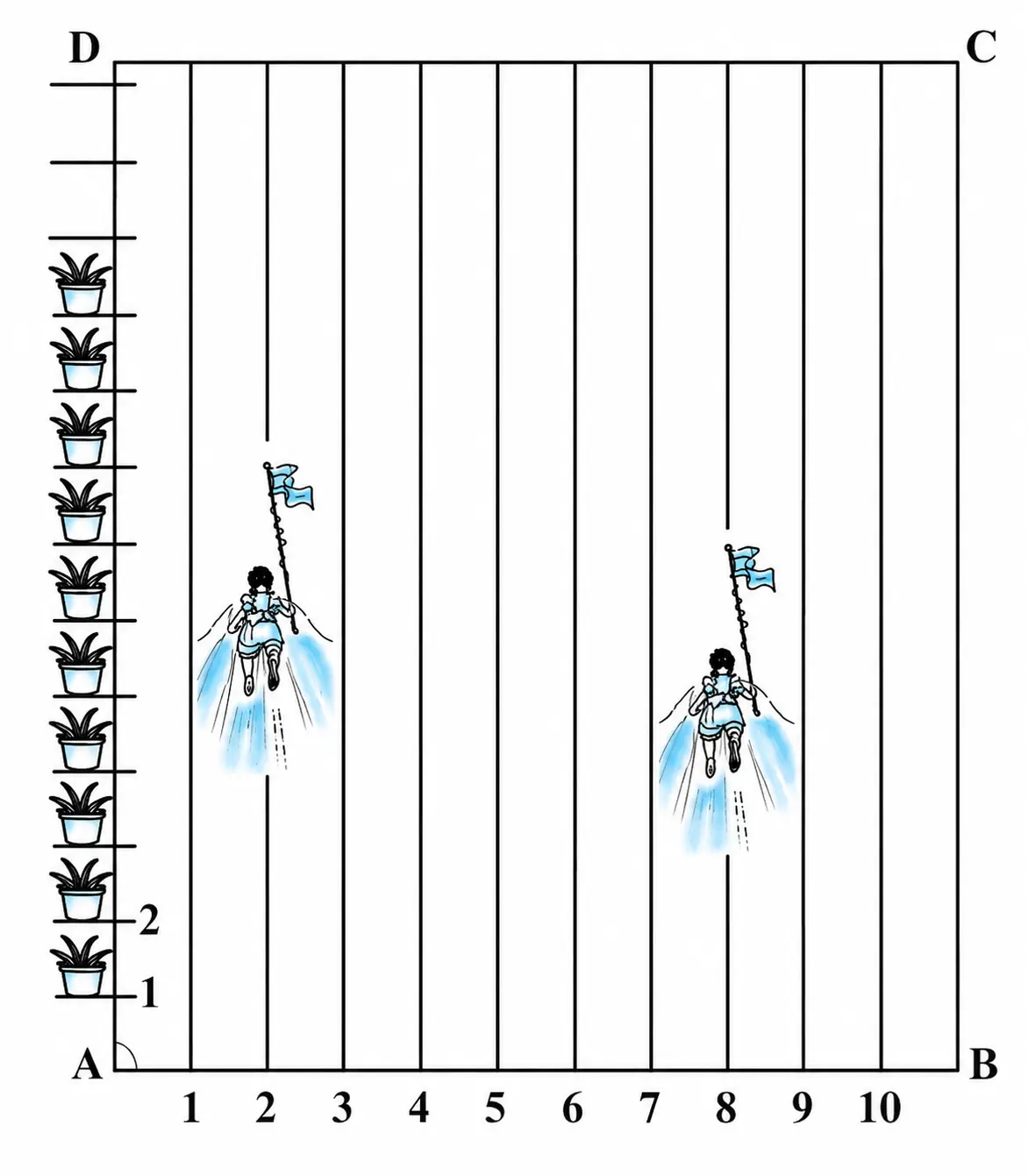
To conduct Sports Day activities, in your rectangular shaped school ground ABCD, lines have been drawn with chalk powder at a distance of 1m each. 100 flower pots have been placed at a distance of 1m from each other along AD, as shown in Fig. 7.12. Niharika runs $$\dfrac{1}{4}$$ th the distance AD on the 2nd line and posts a green flag. Preet runs $$\dfrac{1}{5}$$ th the distance AD on the eighth line and posts a red flag. What is the distance between both the flags? If Rashmi has to post a blue flag exactly halfway between the line segment joining the two flags, where should she post her flag?
Fig. 7.12
Fig. 7.12

Solution

Step 1 : Choice of coordinate axes

Place the rectangle ABCD in the Cartesian plane with

  • vertex $$A(0,0)$$,
  • side $$AB$$ on the x-axis,
  • side $$AD$$ on the y-axis.

Because 100 flower-pots, each 1 m apart, are arranged on $$AD$$, we take

$$AD = 100\;\text{m},\;\text{ so }\;D(0,100).$$

Chalk lines parallel to $$AD$$ are drawn at every 1 m, i.e. at $$x = 0,1,2,3,\dots$$ m.
Thus

  • the 1st line is $$x = 1$$,
  • the 2nd line is $$x = 2$$,
  • the 8th line is $$x = 8$$.

Step 2 : Coordinates of the two flags

Niharika runs $$\dfrac14$$ of $$AD$$ on the 2nd line.

Vertical distance covered $$= \dfrac14 \times 100 = 25\;\text{m}$$.
Hence the green flag is at $$N\bigl(2,25\bigr).$$

Preet runs $$\dfrac15$$ of $$AD$$ on the 8th line.

Vertical distance covered $$= \dfrac15 \times 100 = 20\;\text{m}$$.
Hence the red flag is at $$P\bigl(8,20\bigr).$$

Step 3 : Distance between the flags

Using the distance formula,

$$\begin{aligned} NP &= \sqrt{(8-2)^2 + (20-25)^2} \\ &= \sqrt{6^2 + (-5)^2} \\ &= \sqrt{36 + 25} \\ &= \sqrt{61}\;\text{m} \approx 7.81 \text{ m.} \end{aligned}$$

Step 4 : Mid-point of the segment joining the flags

For points $$N(x_1,y_1)$$ and $$P(x_2,y_2)$$, the midpoint is

$$M\left(\dfrac{x_1+x_2}{2},\;\dfrac{y_1+y_2}{2}\right).$$

Therefore

$$\begin{aligned} M &= \left(\dfrac{2+8}{2},\;\dfrac{25+20}{2}\right) \\ &= (5,22.5). \end{aligned}$$

Interpretation

  • Rashmi must stand on the 5th chalk line (because $$x = 5$$ m from $$AD$$).
  • She should run $$22.5$$ m up from $$AB$$ along that line.

Hence her blue flag will be exactly midway between the green and red flags.

Answer

The two flags are $$\sqrt{61}\,\text{m}\;(\approx 7.81\,\text{m})$$ apart.
Rashmi should place the blue flag on the 5th line, $$22.5\,\text{m}$$ above $$AB$$ — the point $$\bigl(5,22.5\bigr).$$

4 Find the ratio in which the line segment joining the points $$(-3, 10)$$ and $$(6, -8)$$ is divided by $$(-1, 6)$$.

Solution

Let the given points be

  • $$A(-3, 10)\;\,(x_1, y_1)$$
  • $$B(6, -8)\;\,(x_2, y_2)$$
  • $$P(-1, 6)\;\,(x, y)$$ – the point which divides AB.

Suppose $$P$$ divides the line segment $$AB$$ internally in the ratio $$m : n$$, where

  • $$m$$ corresponds to the part $$AP$$,
  • $$n$$ corresponds to the part $$PB$$.

By the section formula for internal division, the coordinates of $$P$$ are

$$x = \dfrac{m x_2 + n x_1}{m + n}, \qquad y = \dfrac{m y_2 + n y_1}{m + n}.$$

Substituting all the known values:

For the x-coordinate

$$-1 = \dfrac{m(6) + n(-3)}{m + n}.$$

Multiplying both sides by $$(m + n)$$ gives

$$-m - n = 6m - 3n \;\;\Longrightarrow\;\; 0 = 7m - 2n.$$

Hence

$$\boxed{\;2n = 7m\;} \;\;\Longrightarrow\;\; n = \dfrac{7}{2} m. \quad(1)$$

For the y-coordinate

$$6 = \dfrac{m(-8) + n(10)}{m + n}.$$

Multiplying by $$(m + n)$$:

$$6m + 6n = -8m + 10n \;\;\Longrightarrow\;\; 14m - 4n = 0.$$

This simplifies to

$$\boxed{\;4n = 14m\;} \;\;\Longrightarrow\;\; n = \dfrac{7}{2} m. \quad(2)$$

Equations (1) and (2) are identical, so the value is consistent.
Choosing the smallest integral values that satisfy $$n = \dfrac{7}{2}m$$ gives

$$m = 2, \; n = 7.$$

Therefore

$$AP : PB = m : n = 2 : 7.$$

Because both $$m$$ and $$n$$ are positive, the point $$(-1, 6)$$ lies between $$A$$ and $$B$$ – the division is internal.

Answer

The point $$(-1, 6)$$ divides the segment joining $$(-3, 10)$$ and $$(6, -8)$$ internally in the ratio $$\displaystyle AP : PB = 2 : 7.$$

5 Find the ratio in which the line segment joining $$\mathrm{A}(1, -5)$$ and $$\mathrm{B}(-4, 5)$$ is divided by the $$x$$-axis. Also find the coordinates of the point of division.

Solution

Given: $$\mathrm{A}(1,-5)$$ and $$\mathrm{B}(-4,5)$$.

Let $$\mathrm{P}(x,0)$$ be the required point on the $$x$$-axis. Suppose $$\mathrm{P}$$ divides $$\overline{\mathrm{AB}}$$ internally in the ratio $$k:1$$ (that is, $$\mathrm{AP}:\mathrm{PB}=k:1$$).

Section formula

  • $$x=\dfrac{k x_2+x_1}{k+1}$$
  • $$y=\dfrac{k y_2+y_1}{k+1}$$

Here $$x_1=1,\;y_1=-5,\;x_2=-4,\;y_2=5$$.

Because $$\mathrm{P}$$ lies on the $$x$$-axis, its $$y$$-coordinate is zero:

$$0=\dfrac{k(5)+(-5)}{k+1}=\dfrac{5k-5}{k+1}$$

The denominator $$k+1\neq0$$, so

$$5k-5=0\;\Rightarrow\;k=1$$

Hence $$\mathrm{AP}:\mathrm{PB}=1:1$$.

Coordinates of \(\mathrm{P}\)

With $$k=1$$,

$$x=\dfrac{1\cdot(-4)+1}{1+1}=\dfrac{-4+1}{2}=\dfrac{-3}{2}=-1.5$$

Therefore $$\mathrm{P}\Bigl(-\dfrac{3}{2},\,0\Bigr)$$.

Result
Ratio: $$1:1$$
Point of division: $$\left(-\dfrac{3}{2},\,0\right)$$

Answer

$$1:1$$, $$\left(-\dfrac32,0\right)$$

6 If $$(1, 2)$$, $$(4, y)$$, $$(x, 6)$$ and $$(3, 5)$$ are the vertices of a parallelogram taken in order, find $$x$$ and $$y$$.

Solution

Let the vertices of the parallelogram in order be

  • $$A(1, 2)$$
  • $$B(4, y)$$
  • $$C(x, 6)$$
  • $$D(3, 5)$$

In a parallelogram the diagonals bisect each other, so the midpoint of $$AC$$ equals the midpoint of $$BD$$.

Midpoint of $$AC$$:

$$\left(\frac{1 + x}{2},\;\frac{2 + 6}{2}\right)=\left(\frac{1+x}{2},\;4\right)$$

Midpoint of $$BD$$:

$$\left(\frac{4 + 3}{2},\;\frac{y + 5}{2}\right)=\left(\frac{7}{2},\;\frac{y+5}{2}\right)$$

Equating the corresponding coordinates:

$$\frac{1 + x}{2}=\frac{7}{2}\;\Rightarrow\;1 + x = 7\;\Rightarrow\;x = 6$$

$$4 = \frac{y + 5}{2}\;\Rightarrow\;8 = y + 5\;\Rightarrow\;y = 3$$

Hence, $$x = 6$$ and $$y = 3$$.

Answer

$$x = 6,\; y = 3$$

7 Find the coordinates of a point A, where AB is the diameter of a circle whose centre is $$(2, -3)$$ and B is $$(1, 4)$$.

Solution

The problem involves the mid-point formula.

If a point $$M(x_m, y_m)$$ is the mid-point of the segment joining $$A(x_1, y_1)$$ and $$B(x_2, y_2)$$, then

$$x_m = \frac{x_1 + x_2}{2}, \;\; y_m = \frac{y_1 + y_2}{2}.$$

Here, the centre of the circle is the mid-point of the diameter $$AB$$.

  • Centre (mid-point) $$M = (2,\,-3).$$
  • Given end-point $$B = (1,\,4).$$
  • Let the unknown end-point be $$A = (x,\,y).$$

Apply the mid-point formulas separately for the x– and y–coordinates.

  1. x-coordinate
    $$\frac{x + 1}{2} = 2 \;\;\Longrightarrow\; x + 1 = 4 \;\;\Longrightarrow\; x = 3.$$
  2. y-coordinate
    $$\frac{y + 4}{2} = -3 \;\;\Longrightarrow\; y + 4 = -6 \;\;\Longrightarrow\; y = -10.$$

Hence $$A = (3,\,-10).$$

Answer

$$(3,\,-10)$$

8 If A and B are $$(-2, -2)$$ and $$(2, -4)$$, respectively, find the coordinates of P such that $$\mathrm{AP} = \dfrac{3}{7} \mathrm{AB}$$ and P lies on the line segment AB.

Solution

Let the given points be

$$A(-2,-2), \; B(2,-4).$$

P lies on the line segment $$\overline{AB}$$ and the length condition is

$$\mathrm{AP}=\dfrac{3}{7}\,\mathrm{AB}.$$

This means that P divides AB internally in the ratio

$$\mathrm{AP}:\mathrm{PB}=3:4,$$

because $$\mathrm{PB}=\mathrm{AB}-\mathrm{AP}=\dfrac{4}{7}\,\mathrm{AB}.$$

Denote the ratio by $$m:n=3:4$$ (with $$m=3$$ toward B and $$n=4$$ toward A).

By the Section Formula, if P divides the segment joining

$$A(x_1,y_1) \text{ and } B(x_2,y_2)$$

internally in the ratio $$m:n$$, then

$$ P\left(\dfrac{mx_2+nx_1}{m+n},\;\dfrac{my_2+ny_1}{m+n}\right). $$

Substitute $$x_1=-2,\;y_1=-2,\;x_2=2,\;y_2=-4,\;m=3,\;n=4$$:

\[\begin{aligned} x_P &= \dfrac{3\,(2)+4\,(-2)}{3+4} = \dfrac{6-8}{7} = -\dfrac{2}{7},\\[4pt] y_P &= \dfrac{3\,(-4)+4\,(-2)}{3+4} = \dfrac{-12-8}{7} = -\dfrac{20}{7}. \end{aligned}\]

Therefore, the required point is

$$P\left(-\dfrac{2}{7},\,-\dfrac{20}{7}\right).$$

Answer

$$P\left(-\dfrac{2}{7},\,-\dfrac{20}{7}\right)$$

9 Find the coordinates of the points which divide the line segment joining $$\mathrm{A}(-2, 2)$$ and $$\mathrm{B}(2, 8)$$ into four equal parts.

Solution

Given: End-points of the line segment are $$A(-2,2)$$ and $$B(2,8)$$.

To divide $$\overline{AB}$$ into four equal parts we need the three interior points which cut the segment in the ratios

  • $$1:3$$ (nearest to A)
  • $$1:1$$ (mid-point)
  • $$3:1$$ (nearest to B)

Let those points be $$P_1,\;P_2,\;P_3$$ respectively.

1. Coordinates of $$P_1$$ (ratio $$1:3$$)

Section formula for a point dividing $$A(x_1,y_1)$$ and $$B(x_2,y_2)$$ internally in the ratio $$m:n$$ is

$$\bigl(\dfrac{mx_2+nx_1}{m+n},\dfrac{my_2+ny_1}{m+n}\bigr).$$

Here $$m=1,\;n=3,$$ $$x_1=-2,\;y_1=2,\;x_2=2,\;y_2=8$$.

$$\displaystyle x_{P_1}=\frac{1\times2+3\times(-2)}{1+3}=\frac{2-6}{4}=-1,\;\;y_{P_1}=\frac{1\times8+3\times2}{4}=\frac{8+6}{4}=\frac{14}{4}=\tfrac72.$$

Thus $$P_1(-1,\tfrac72).$$

2. Coordinates of $$P_2$$ (ratio $$1:1$$: the mid-point)

Mid-point formula:

$$\displaystyle x_{P_2}=\frac{-2+2}{2}=0,\;\;y_{P_2}=\frac{2+8}{2}=5.$$

Hence $$P_2(0,5).$$

3. Coordinates of $$P_3$$ (ratio $$3:1$$)

Now $$m=3,\;n=1$$.

$$\displaystyle x_{P_3}=\frac{3\times2+1\times(-2)}{3+1}=\frac{6-2}{4}=1,\;\;y_{P_3}=\frac{3\times8+1\times2}{4}=\frac{24+2}{4}=\frac{26}{4}=\tfrac{13}{2}.$$

Therefore $$P_3(1,\tfrac{13}{2}).$$

Result

The required points dividing $$AB$$ into four equal parts are

$$P_1(-1,\tfrac72),\;P_2(0,5),\;P_3(1,\tfrac{13}{2}).$$

Answer

The three internal points are $$(-1,\tfrac72),\;(0,5),\;(1,\tfrac{13}{2}).$$

10 Find the area of a rhombus if its vertices are $$(3, 0)$$, $$(4, 5)$$, $$(-1, 4)$$ and $$(-2, -1)$$ taken in order. [Hint: Area of a rhombus $$= \dfrac{1}{2}$$ (product of its diagonals)]

Solution

Label the vertices in the order given:

  • $$A(3,0)$$
  • $$B(4,5)$$
  • $$C(-1,4)$$
  • $$D(-2,-1)$$

Step 1  (optional check): All four sides are equal, so the quadrilateral is indeed a rhombus.

SideCalculation  $$\bigl((x_2-x_1)^2+(y_2-y_1)^2\bigr)^{1/2}$$Length
$$AB$$$$\sqrt{(4-3)^2+(5-0)^2}$$$$\sqrt{1+25}=\sqrt{26}$$
$$BC$$$$\sqrt{(-1-4)^2+(4-5)^2}$$$$\sqrt{25+1}=\sqrt{26}$$
$$CD$$$$\sqrt{(-2+1)^2+(-1-4)^2}$$$$\sqrt{1+25}=\sqrt{26}$$
$$DA$$$$\sqrt{(3+2)^2+(0+1)^2}$$$$\sqrt{25+1}=\sqrt{26}$$

Since all four sides are equal, the given quadrilateral is a rhombus, so we can use the diagonal formula for its area.

Step 2 : Find the lengths of the two diagonals.

  • Diagonal $$AC$$
    $$AC=\sqrt{\,( -1-3 )^2 + ( 4-0 )^2}\;=\;\sqrt{(-4)^2+4^2}\;=\;\sqrt{16+16}\;=\;\sqrt{32}=4\sqrt{2}$$
  • Diagonal $$BD$$
    $$BD=\sqrt{\,( -2-4 )^2 + ( -1-5 )^2}\;=\;\sqrt{(-6)^2+(-6)^2}\;=\;\sqrt{36+36}\;=\;\sqrt{72}=6\sqrt{2}$$

Step 3 : Apply the rhombus area formula.

The area of a rhombus is one-half the product of its diagonals:

$$\text{Area}=\tfrac12\times AC \times BD =\tfrac12\times\bigl(4\sqrt{2}\bigr)\times\bigl(6\sqrt{2}\bigr) =\tfrac12\times24\times2 =24$$

Therefore, the area of the rhombus is $$24$$ square units.

Answer

Area of the rhombus $$= 24\text{ square units}$$

NCERT Solutions for Class 10
Maths
NCERT Solutions for Class 10 Maths
Chapter-wise step-by-step
solutions with explanations
explore solutions Maths bg
Science
NCERT Solutions for Class 10 Science
Chapter-wise step-by-step
solutions with explanations
explore solutions Science bg

Frequently Asked Questions

50,000+ JEE Students Trusted Our Score Calculator

Predict your JEE Main percentile, rank & performance in seconds