Join WhatsApp Icon JEE WhatsApp Group
NCERT Solutions for Class 10 Maths

Chapter 6: Triangles

Download Solutions PDF
Daily JEE Updates, Tips & Important Alerts
Join 30,000+ students and stay updated with JEE notifications and preparation insights.
Join Now!
Free PDF
Complete NCERT Solution PDF for Chapter 6: Triangles

NCERT Solutions For Class 10 Maths Chapter 6 Triangles helps students explore important geometric concepts related to similarity, proportionality, and properties of triangles. The page provides comprehensive NCERT Solutions that explain theorems, proofs, and application-based questions from the chapter. NCERT Solutions For Class 10 Maths make it easier for students to understand concepts such as similar triangles, Basic Proportionality Theorem, and relationships between corresponding sides and angles. The chapter strengthens geometric reasoning and develops proof-solving abilities. These solutions guide students through textbook exercises with proper explanations and logical steps. Students can access the chapter PDF for quick revision and additional practice. The detailed approach helps learners understand triangle concepts clearly and prepare confidently for examinations.
Download Solutions PDF

Exercise 6.1

1 Fill in the blanks using the correct word given in brackets:

(i) All circles are _____. (congruent, similar)

Solution

A circle is uniquely identified by its centre and radius.
If one circle has radius $$r_1$$ and another has radius $$r_2$$, then a scale factor $$k=\dfrac{r_2}{r_1}$$ enlarges or reduces the first circle to fit exactly on the second.
Because one can be obtained from the other by uniform scaling, their shapes are identical and hence they are similar.
However, unless $$r_1=r_2$$ they are not congruent. Therefore, the correct word is "similar".

Answer

similar

(ii) All squares are _____. (similar, congruent)

Solution

Every square has all four angles equal to $$90^{\circ}$$ and all four sides equal.
Consider two squares with side lengths $$a$$ and $$b$$. The ratio of every pair of corresponding sides is $$\dfrac{a}{b}$$ (a constant), and their corresponding angles are equal.
Thus the two squares satisfy the condition for similarity.
They will be congruent only when $$a=b$$. Hence, the blank must be filled with "similar".

Answer

similar

(iii) All _____ triangles are similar. (isosceles, equilateral)

Solution

In an equilateral triangle, each interior angle measures $$60^{\circ}$$.
Therefore, any two equilateral triangles have all three corresponding angles equal.
The ratio of their corresponding sides is the same constant (say $$k$$), making the triangles similar by the AA (or SAS) similarity criterion.
Isosceles triangles do not necessarily have equal angles in all three corners, so they need not be similar.
Hence, the correct word is "equilateral".

Answer

equilateral

(iv) Two polygons of the same number of sides are similar, if (a) their corresponding angles are _____ and (b) their corresponding sides are _____. (equal, proportional)

Solution

For two polygons with the same number of sides to be similar, two conditions must hold simultaneously:

  1. Their corresponding angles must be equal, ensuring the same overall shape.
  2. The ratios of all corresponding sides must be the same; i.e. their sides must be proportional.
These two conditions collectively guarantee that one polygon is an exact scaled copy of the other.

Answer

equal; proportional

2 Give two different examples of pair of

(i) similar figures.

Solution

We have to exhibit two different pairs of figures in which each pair is similar.

  1. Pair 1 : Two equilateral triangles
    Take $$\triangle ABC$$ with each side $$3\,\text{cm}$$ and $$\triangle PQR$$ with each side $$5\,\text{cm}$$.
    Because every angle in an equilateral triangle measures $$60^\circ$$, we get
    $$\angle A = \angle P = 60^\circ,\; \angle B = \angle Q = 60^\circ,\; \angle C = \angle R = 60^\circ.$$
    Also the corresponding side–length ratio is constant:
    $$\dfrac{AB}{PQ}=\dfrac{3}{5},\; \dfrac{BC}{QR}=\dfrac{3}{5},\; \dfrac{CA}{RP}=\dfrac{3}{5}.$$
    Therefore $$\triangle ABC \sim \triangle PQR$$ (AAA criterion or equal ratios of corresponding sides).
  2. Pair 2 : Two squares
    Let $$S_1$$ be a square of side $$4\,\text{cm}$$ and $$S_2$$ a square of side $$7\,\text{cm}$$.
    Each interior angle is $$90^\circ$$ in both squares, so all corresponding angles are equal. Further, every pair of corresponding sides satisfies
    $$\dfrac{4}{7}=\dfrac{4}{7}=\dfrac{4}{7}=\dfrac{4}{7}.$$
    Hence $$S_1 \sim S_2$$ by the definition of similar polygons.

Answer

(i) Example 1 – an equilateral triangle of side 3 cm and another of side 5 cm.
Example 2 – a square of side 4 cm and another of side 7 cm (each pair is similar).

(ii) non-similar figures.

Solution

Now we need two different pairs of figures that are not similar.

  1. Pair 1 : A square and a rectangle
    Let the square have side $$4\,\text{cm}$$; let the rectangle have length $$4\,\text{cm}$$ and breadth $$2\,\text{cm}$$.
    Although all angles are right angles in both figures, the side–length ratios do not match:
    $$\dfrac{4}{4}=1 \neq \dfrac{4}{2}=2.$$
    Because the proportionality of corresponding sides fails, the two quadrilaterals are not similar.
  2. Pair 2 : A right-angled triangle and an isosceles triangle
    Consider $$\triangle MNO$$ with sides $$3\,\text{cm},\;4\,\text{cm},\;5\,\text{cm}$$ (right-angled at $$N$$) and $$\triangle XYZ$$ with sides $$5\,\text{cm},\;5\,\text{cm},\;6\,\text{cm}$$ (isosceles at $$X$$ and $$Y$$).
    The angle sets are different: one triangle contains a $$90^\circ$$ angle while the other does not. Hence the triangles cannot be made congruent by scaling alone, so they are not similar.

Answer

(ii) Example 1 – a square of side 4 cm and a rectangle of sides 4 cm × 2 cm.
Example 2 – a right-angled triangle (3,4,5) and an isosceles triangle (5,5,6) (each pair is not similar).

3

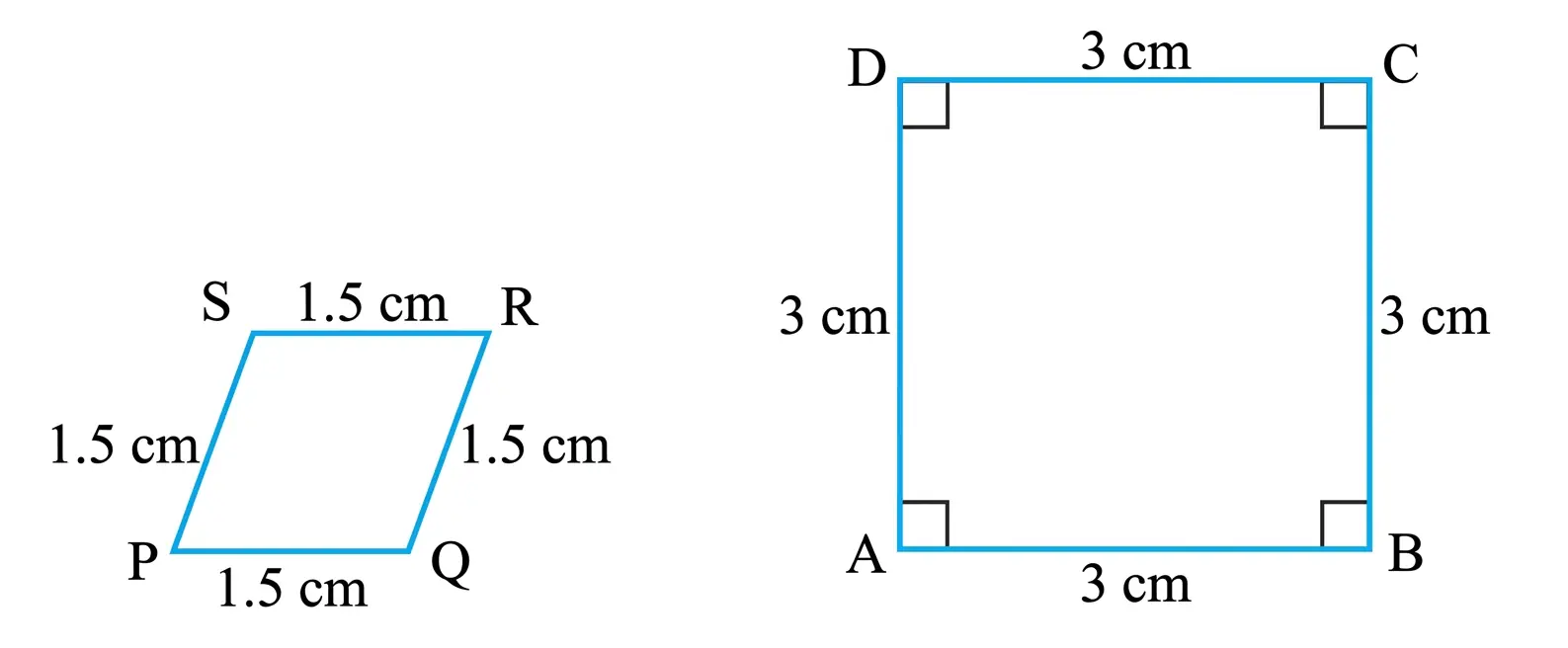
State whether the following quadrilaterals are similar or not:
(See Fig. 6.8: quadrilateral PQRS is a rhombus with all sides $$1.5 \, \mathrm{cm}$$; quadrilateral ABCD is a square with all sides $$3 \, \mathrm{cm}$$.)
Fig. 6.8
Fig. 6.8

Solution

Given figures

  • PQRS is a rhombus; each side is $$1.5\,\text{cm}$$.
  • ABCD is a square; each side is $$3\,\text{cm}$$.

Condition for similarity of two quadrilaterals
Two quadrilaterals are similar when both of the following hold:

  1. Their corresponding angles are equal.
  2. The ratios of their corresponding sides are equal (i.e. proportional).

Checking the side–ratio condition

Every side of PQRS measures $$1.5\,\text{cm}$$ and every side of ABCD measures $$3\,\text{cm}$$, so for any pair of corresponding sides we have
$$\dfrac{\text{side of PQRS}}{\text{side of ABCD}}=\dfrac{1.5}{3}=\dfrac12$$.
Thus all corresponding sides are indeed proportional.

Checking the angle condition

  • In a square, each interior angle equals $$90^\circ$$.
  • In a rhombus, the opposite angles are equal, but adjacent angles are supplementary: if one angle is $$\theta$$, the next is $$180^\circ-\theta$$. Only when $$\theta=90^\circ$$ does the rhombus become a square.

The diagram (Fig. 6.8) shows PQRS as an ordinary rhombus (its angles are not right angles). Hence at least one pair of corresponding angles in PQRS and ABCD are unequal.

Conclusion
Although their sides are proportional, their corresponding angles are not equal, so the quadrilaterals fail the angle condition. Therefore PQRS and ABCD are not similar.

Answer

The two quadrilaterals are not similar.

Examples 1-3

Example 1

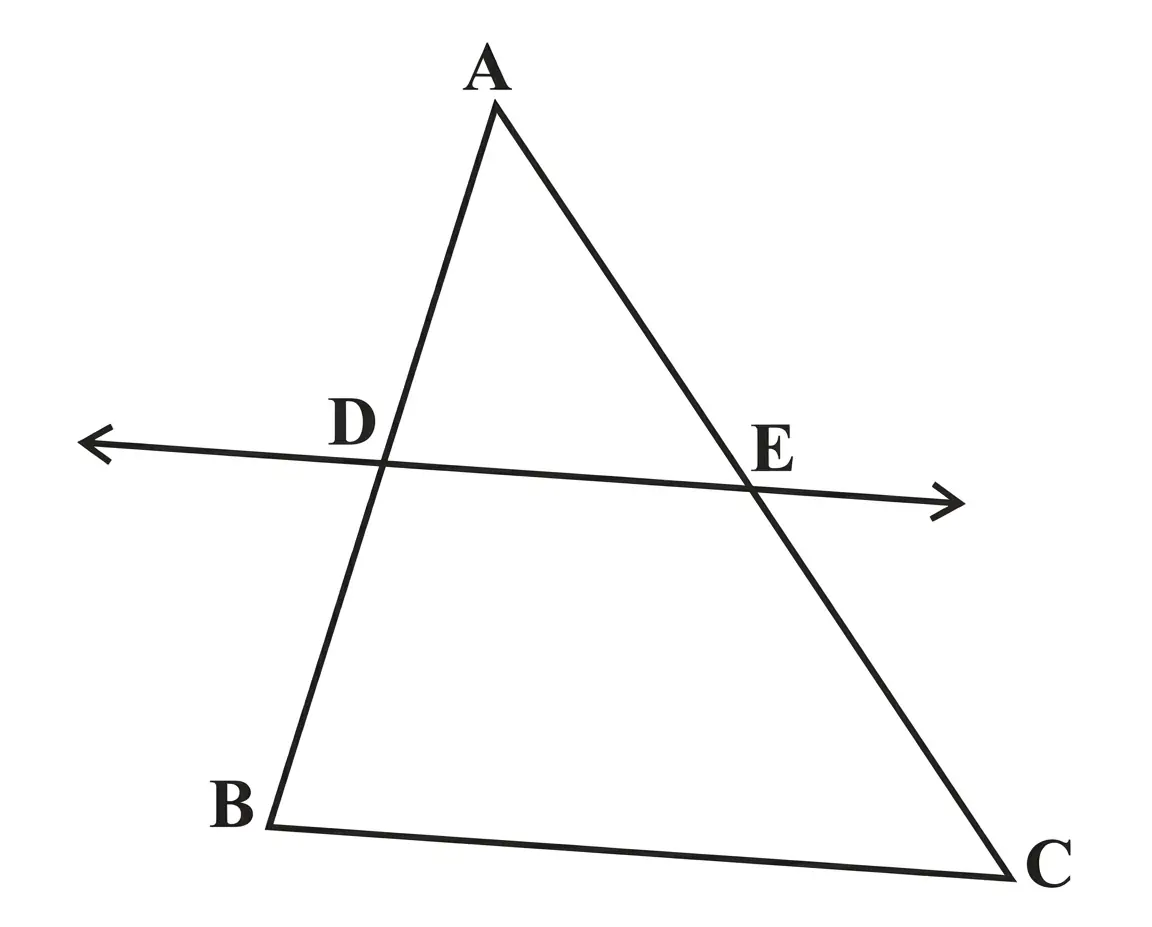
If a line intersects sides AB and AC of a $$\triangle \mathrm{ABC}$$ at D and E respectively and is parallel to BC, prove that $$\dfrac{\mathrm{AD}}{\mathrm{AB}} = \dfrac{\mathrm{AE}}{\mathrm{AC}}$$ (see Fig. 6.13).
Fig. 6.13
Fig. 6.13

Solution

Given: In $$\triangle ABC$$, a line through D on AB and E on AC is drawn such that $$DE \parallel BC$$.

To prove: $$\dfrac{AD}{AB}=\dfrac{AE}{AC}$$.

Construction: (Already done in the statement.)
For clarity, notice that points D and E lie on AB and AC respectively, and segment DE is parallel to BC.

Proof:

  1. Because $$DE \parallel BC$$, the following pairs of angles are equal (corresponding angles):
       $$\angle ADE = \angle ABC$$  and  $$\angle AED = \angle ACB$$.
  2. Also, $$\angle DAE$$ is common to both $$\triangle ADE$$ and $$\triangle ABC$$.
  3. Thus the two triangles are similar by the AAA similarity criterion:
       $$\triangle ADE \sim \triangle ABC$$.
  4. For similar triangles, the ratios of corresponding sides are equal. The correspondence is    $$AD \leftrightarrow AB$$, $$AE \leftrightarrow AC$$ and $$DE \leftrightarrow BC$$.
    Therefore,
       $$\dfrac{AD}{AB}=\dfrac{AE}{AC}=\dfrac{DE}{BC}$$.
  5. Taking the first two equal fractions gives the required relation:
       $$\dfrac{AD}{AB}=\dfrac{AE}{AC}$$.

Hence proved.

Answer

Proved.

Example 2

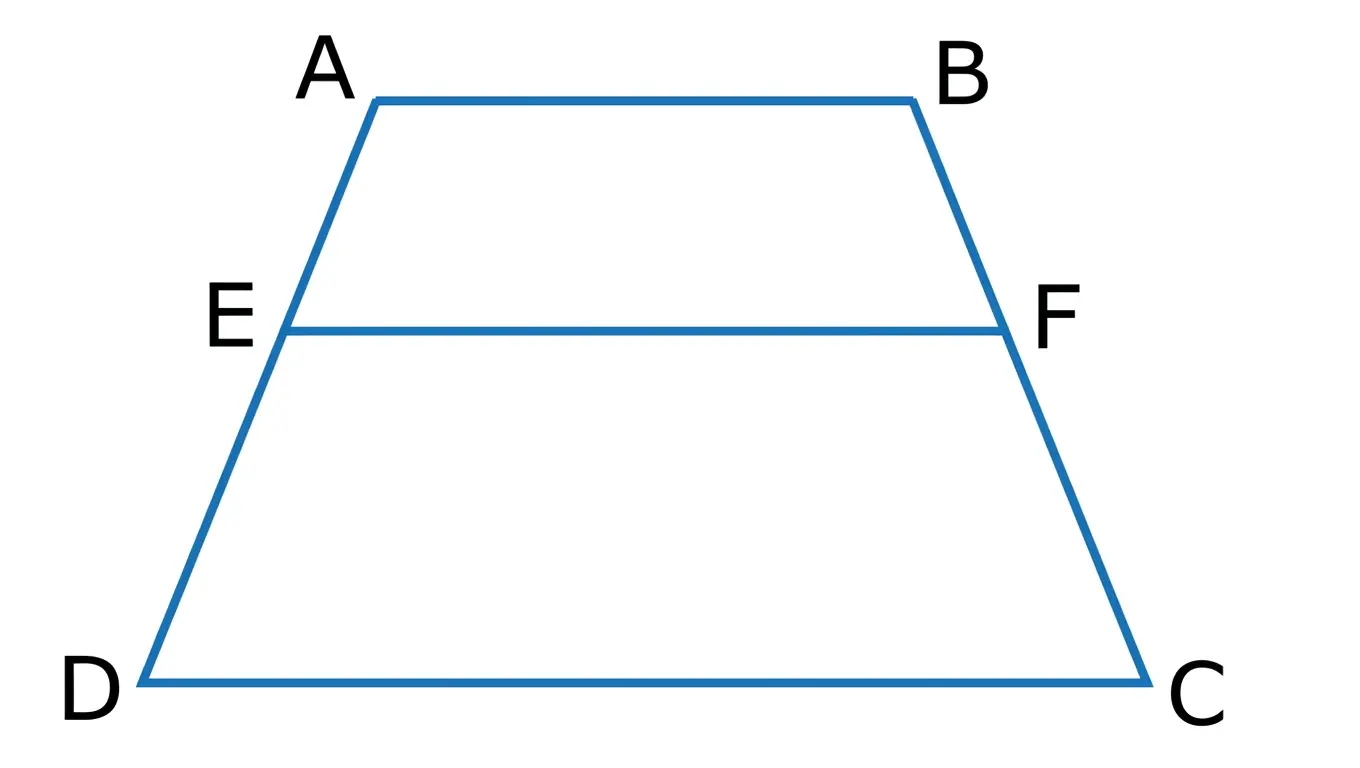
ABCD is a trapezium with $$\mathrm{AB} \parallel \mathrm{DC}$$. E and F are points on non-parallel sides AD and BC respectively such that EF is parallel to AB (see Fig. 6.14). Show that $$\dfrac{\mathrm{AE}}{\mathrm{ED}} = \dfrac{\mathrm{BF}}{\mathrm{FC}}$$.
Fig. 6.14
Fig. 6.14

Solution

Step 1 : Identify the three parallel lines

We are told that $$\mathrm{AB} \parallel \mathrm{DC}$$ and that $$\mathrm{EF} \parallel \mathrm{AB}$$.
Hence all three lines are parallel:

$$\mathrm{AB} \;\parallel\; \mathrm{EF} \;\parallel\; \mathrm{DC}$$

Step 2 : Locate the two transversals

The non-parallel sides $$\mathrm{AD}$$ and $$\mathrm{BC}$$ cut the three parallel lines.
Thus

  • on transversal $$\mathrm{AD}$$ the points of intersection are $$A,E,D$$, and
  • on transversal $$\mathrm{BC}$$ the points of intersection are $$B,F,C$$.

Step 3 : Apply the Intercept (Basic Proportionality) Theorem

The theorem states: “If three (or more) parallel lines cut two transversals, then they cut the transversals in proportional segments.” Therefore

$$\dfrac{\mathrm{AE}}{\mathrm{ED}} = \dfrac{\mathrm{BF}}{\mathrm{FC}}$$

Step 4 : Conclude

Hence the required equality is established:

$$\boxed{\dfrac{\mathrm{AE}}{\mathrm{ED}} = \dfrac{\mathrm{BF}}{\mathrm{FC}}}$$

Answer

Proved.

Example 3

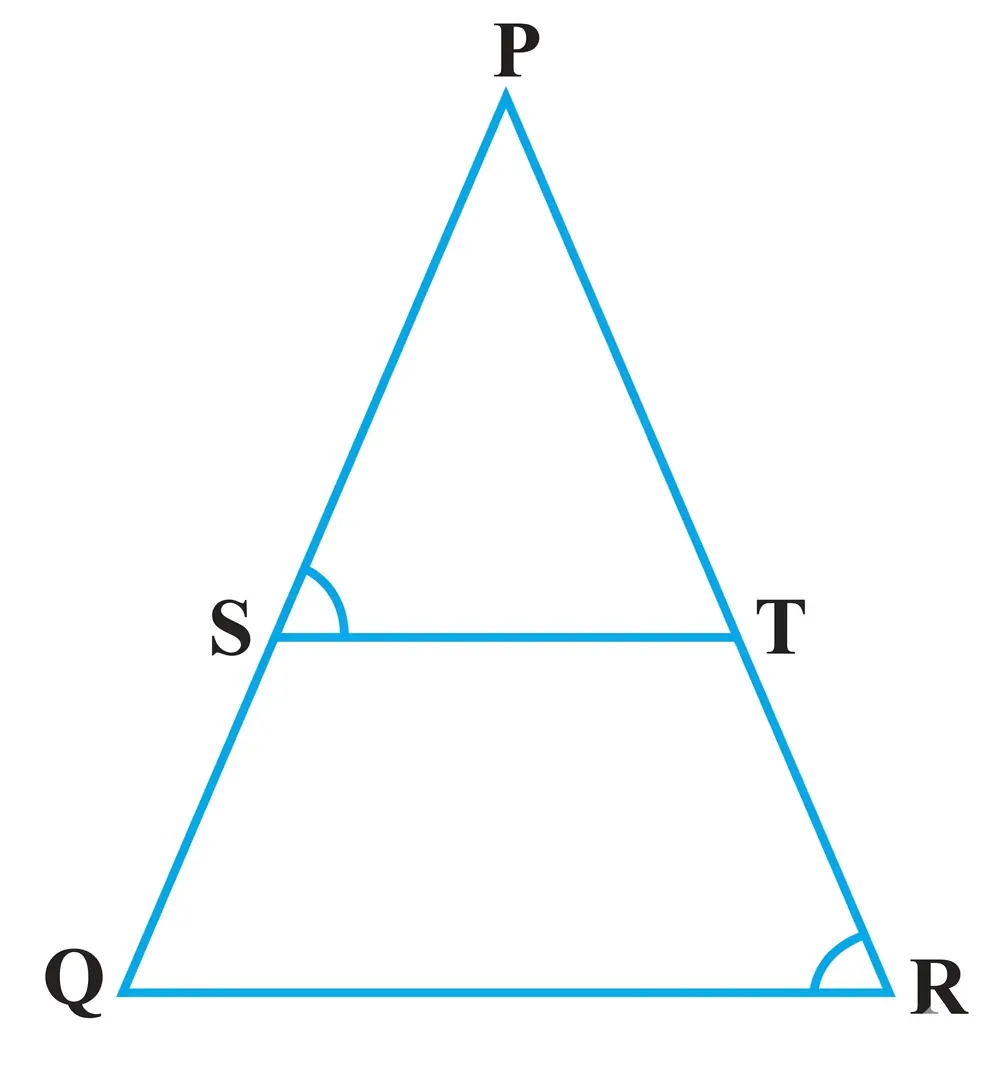
In Fig. 6.16, $$\dfrac{\mathrm{PS}}{\mathrm{SQ}} = \dfrac{\mathrm{PT}}{\mathrm{TR}}$$ and $$\angle \mathrm{PST} = \angle \mathrm{PRQ}$$. Prove that PQR is an isosceles triangle.
Fig. 6.16
Fig. 6.16

Solution

Given : In ΔPQR, point S lies on PQ and point T lies on PR such that

$$\dfrac{PS}{SQ}=\dfrac{PT}{TR} \quad \text{and} \quad \angle PST = \angle PRQ$$

To prove : ΔPQR is isosceles (i.e. $$PQ = PR$$).

1. Proving ST ∥ QR

In ΔPQR the points S and T divide the sides PQ and PR in the same ratio:

$$\dfrac{PS}{SQ}=\dfrac{PT}{TR}.$$

By the Converse of the Basic Proportionality Theorem (if a line through two sides of a triangle divides them in the same ratio, that line is parallel to the third side), we get

$$ST \;\parallel\; QR\;.$$

2. Converting the given angle equality by using the parallelism

Because $$ST \parallel QR$$, the angle between PS and ST equals the angle between the lines PS (or PQ, because S lies on PQ) and QR. Therefore

$$\angle PST = \angle(PS,ST)=\angle(PS,QR)=\angle PQR.$$

But it is given that $$\angle PST = \angle PRQ$$. Hence

$$\angle PQR = \angle PRQ.$$

3. Concluding that ΔPQR is isosceles

In a triangle, equal angles lie opposite equal sides. The equal angles just obtained are opposite the sides PR and PQ respectively. Therefore

$$PR = PQ.$$

Thus ΔPQR has two equal sides and is an isosceles triangle.


Hence proved.

Answer

Proved  —  $$PQ = PR$$, so ΔPQR is isosceles.

Exercise 6.2

1

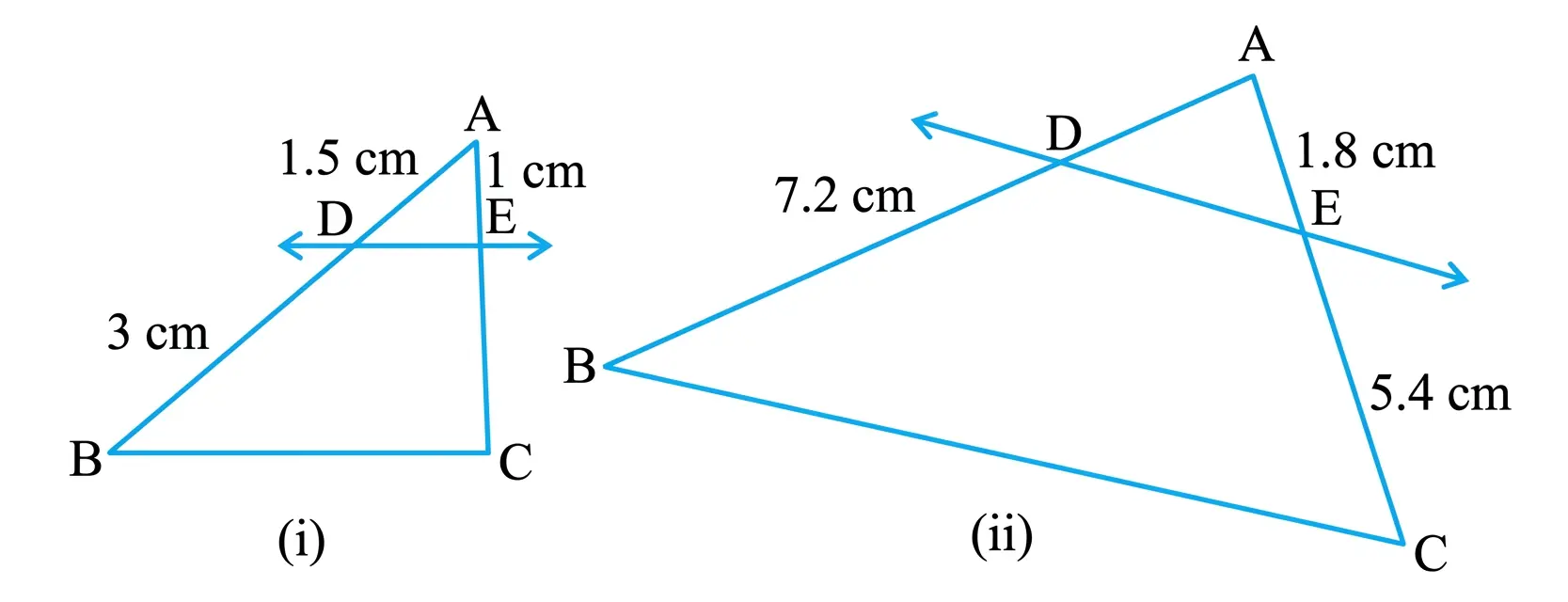
In Fig. 6.17, (i) and (ii), $$\mathrm{DE} \parallel \mathrm{BC}$$. Find EC in (i) and AD in (ii).
Fig. 6.17
Fig. 6.17

Solution

Given data from Fig. 6.17 (i)
Triangle $$\triangle ABC$$ with the point $$D$$ on $$AB$$ and the point $$E$$ on $$AC$$ such that $$DE \parallel BC$$.
The lengths marked in the figure are

  • $$AD = 1.5\text{ cm}$$
  • $$DB = 3\text{ cm}$$  (so $$AB = AD + DB = 4.5\text{ cm}$$)
  • $$AE = 1.5\text{ cm}$$

Step 1 Apply the Basic Proportionality Theorem (BPT)
Because $$DE \parallel BC$$, BPT gives $$\frac{AD}{DB}=\frac{AE}{EC}.$$

Step 2 Insert the known numbers
$$\frac{1.5}{3}=\frac{1.5}{EC}.$$

Step 3 Solve for $$EC$$
Cross-multiplying, $$1.5\,EC = 1.5\times 3 \;\Rightarrow\; EC = 3\text{ cm}.$$


Given data from Fig. 6.17 (ii)
Again $$DE \parallel BC$$ with the points $$D\in AB$$ and $$E\in AC$$.
The lengths marked are

  • $$AB = 4.5\text{ cm}$$
  • $$AE = 1.5\text{ cm}$$
  • $$EC = 3\text{ cm}$$
Let $$AD = x\text{ cm}$$. Then $$DB = AB - AD = 4.5 - x\text{ cm}$$.

Step 1 Apply BPT
$$\frac{AD}{DB}=\frac{AE}{EC}$$  ⇒  $$\dfrac{x}{4.5-x}=\dfrac{1.5}{3}=\dfrac12.$$

Step 2 Solve for $$x$$
Cross-multiplying, $$2x = 4.5 - x \;\Rightarrow\; 3x = 4.5 \;\Rightarrow\; x = 1.5.$$

Therefore $$AD = 1.5\text{ cm}.$$

Results
Fig. 6.17 (i): $$EC = 3\text{ cm}$$
Fig. 6.17 (ii): $$AD = 1.5\text{ cm}$$

Answer

Fig. 6.17 (i):  $$EC = 3\text{ cm}$$
Fig. 6.17 (ii):  $$AD = 1.5\text{ cm}$$

2 E and F are points on the sides PQ and PR respectively of a $$\triangle \mathrm{PQR}$$. For each of the following cases, state whether $$\mathrm{EF} \parallel \mathrm{QR}$$:

(i) $$\mathrm{PE} = 3.9 \, \mathrm{cm}$$, $$\mathrm{EQ} = 3 \, \mathrm{cm}$$, $$\mathrm{PF} = 3.6 \, \mathrm{cm}$$ and $$\mathrm{FR} = 2.4 \, \mathrm{cm}$$

Solution

In $$\triangle PQR$$ let the points $$E$$ and $$F$$ divide the sides $$PQ$$ and $$PR$$ respectively, as shown in the figure to be drawn.

By the Basic Proportionality Theorem (BPT):
If $$EF \parallel QR$$, then the ratios of the corresponding segments on the two sides through the common vertex $$P$$ must be equal, that is

$$\dfrac{PE}{PQ}=\dfrac{PF}{PR}\qquad\text{or equivalently}\qquad\dfrac{PE}{EQ}=\dfrac{PF}{FR}.$$

Compute the required lengths:

  • $$PQ = PE + EQ = 3.9\,\text{cm}+3\,\text{cm}=6.9\,\text{cm}$$
  • $$PR = PF + FR = 3.6\,\text{cm}+2.4\,\text{cm}=6.0\,\text{cm}$$

Check the first set of ratios:

$$\dfrac{PE}{PQ}=\dfrac{3.9}{6.9}=0.5652\ldots$$
$$\dfrac{PF}{PR}=\dfrac{3.6}{6.0}=0.6$$

The two values are unequal.

Alternatively, check the second set:

$$\dfrac{PE}{EQ}=\dfrac{3.9}{3}=1.3\neq\dfrac{PF}{FR}=\dfrac{3.6}{2.4}=1.5.$$

Since the proportionality condition fails, $$EF$$ is not parallel to $$QR$$.

Answer

$$EF\not\parallel QR$$

(ii) $$\mathrm{PE} = 4 \, \mathrm{cm}$$, $$\mathrm{QE} = 4.5 \, \mathrm{cm}$$, $$\mathrm{PF} = 8 \, \mathrm{cm}$$ and $$\mathrm{RF} = 9 \, \mathrm{cm}$$

Solution

Again, by BPT, $$EF \parallel QR$$ requires
$$\dfrac{PE}{PQ}=\dfrac{PF}{PR}\qquad\text{or}\qquad\dfrac{PE}{EQ}=\dfrac{PF}{FR}.$$

  • Side $$PQ = PE + EQ = 4\,\text{cm}+4.5\,\text{cm}=8.5\,\text{cm}$$
  • Side $$PR = PF + RF = 8\,\text{cm}+9\,\text{cm}=17\,\text{cm}$$

Compute the pertinent ratios:

$$\dfrac{PE}{PQ}=\dfrac{4}{8.5}=\dfrac{8}{17}=0.470588\ldots=\dfrac{PF}{PR}.$$

The equality holds, so the first proportionality test is satisfied.

For confirmation, use the second form:

$$\dfrac{PE}{EQ}=\dfrac{4}{4.5}=0.888\ldots=\dfrac{PF}{FR}=\dfrac{8}{9}.$$

Both tests agree; therefore $$EF$$ is parallel to $$QR$$.

Answer

$$EF\parallel QR$$

(iii) $$\mathrm{PQ} = 1.28 \, \mathrm{cm}$$, $$\mathrm{PR} = 2.56 \, \mathrm{cm}$$, $$\mathrm{PE} = 0.18 \, \mathrm{cm}$$ and $$\mathrm{PF} = 0.36 \, \mathrm{cm}$$

Solution

Apply BPT using the whole-side version.

  • Side $$PQ = 1.28\,\text{cm}, \; PE = 0.18\,\text{cm}\;\Rightarrow\; QE = PQ - PE = 1.28-0.18 = 1.10\,\text{cm}$$
  • Side $$PR = 2.56\,\text{cm}, \; PF = 0.36\,\text{cm}\;\Rightarrow\; RF = PR - PF = 2.56-0.36 = 2.20\,\text{cm}$$

Test the proportionality:

$$\dfrac{PE}{PQ}=\dfrac{0.18}{1.28}=0.140625$$
$$\dfrac{PF}{PR}=\dfrac{0.36}{2.56}=0.140625$$

The ratios are equal. Hence the BPT condition is met and $$EF$$ must be parallel to $$QR$$.

Answer

$$EF\parallel QR$$

3

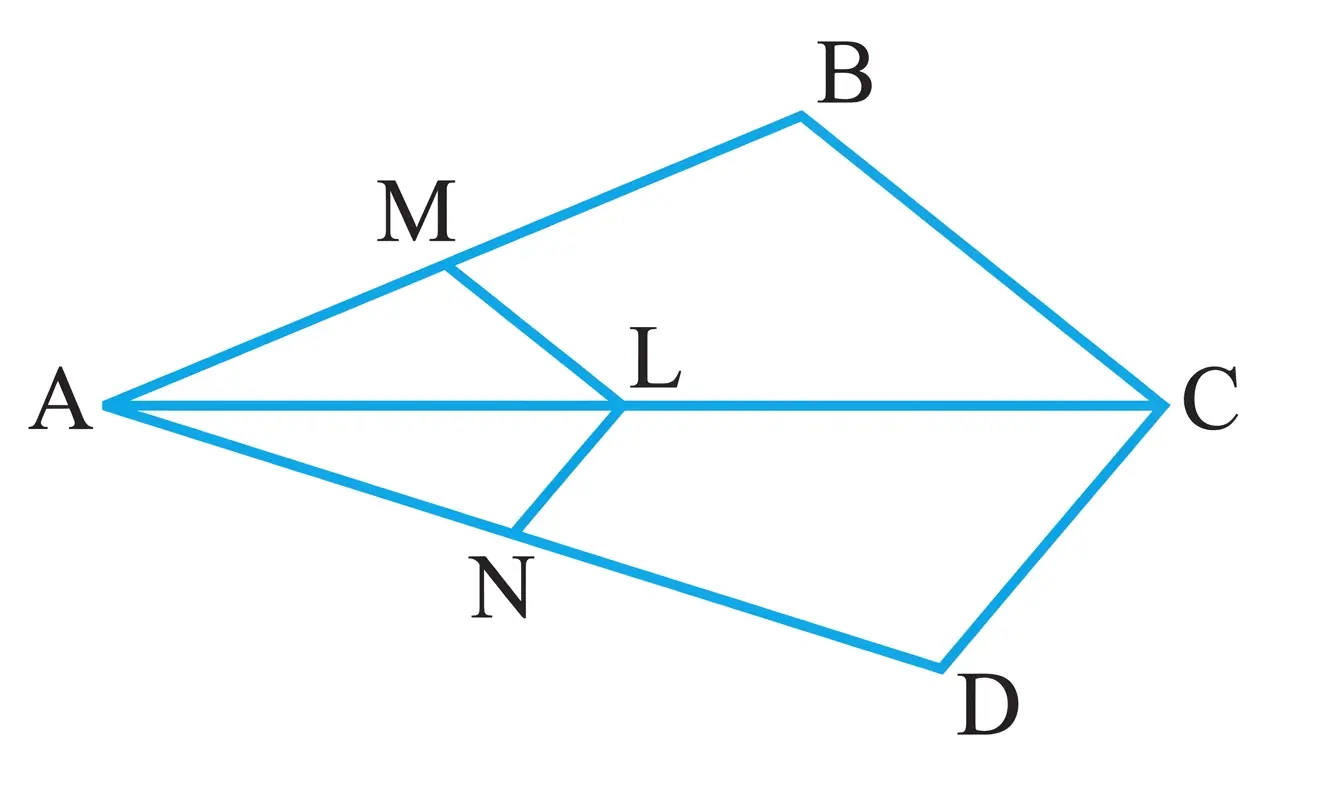
In Fig. 6.18, if $$\mathrm{LM} \parallel \mathrm{CB}$$ and $$\mathrm{LN} \parallel \mathrm{CD}$$, prove that $$\dfrac{\mathrm{AM}}{\mathrm{AB}} = \dfrac{\mathrm{AN}}{\mathrm{AD}}$$.
Fig. 6.18
Fig. 6.18

Solution

Given. In the figure, $$\mathrm{LM} \parallel \mathrm{CB}$$ and $$\mathrm{LN} \parallel \mathrm{CD}$$. Here $$\mathrm{M}$$ lies on $$\mathrm{AB}$$, $$\mathrm{N}$$ lies on $$\mathrm{AD}$$ and $$\mathrm{L}$$ lies on $$\mathrm{AC}$$.

1. Similarity in $$\triangle \mathrm{ABC}$$.

  • Since $$\mathrm{LM} \parallel \mathrm{CB}$$, corresponding angles are equal:
      $$\angle \mathrm{ALM} = \angle \mathrm{ACB}$$ and $$\angle \mathrm{AML} = \angle \mathrm{ABC}$$.
  • Thus $$\triangle \mathrm{ALM} \sim \triangle \mathrm{ACB}$$ (AAA criterion).
  • Corresponding sides of similar triangles are proportional, so
      $$\dfrac{\mathrm{AM}}{\mathrm{AB}} = \dfrac{\mathrm{AL}}{\mathrm{AC}} \qquad (1)$$

2. Similarity in $$\triangle \mathrm{ACD}$$.

  • Because $$\mathrm{LN} \parallel \mathrm{CD}$$, we have
      $$\angle \mathrm{ALN} = \angle \mathrm{ACD}$$ and $$\angle \mathrm{ANL} = \angle \mathrm{ADC}$$.
  • Therefore $$\triangle \mathrm{ALN} \sim \triangle \mathrm{ACD}$$ (AAA criterion).
  • Hence
      $$\dfrac{\mathrm{AN}}{\mathrm{AD}} = \dfrac{\mathrm{AL}}{\mathrm{AC}} \qquad (2)$$

3. Comparing the two ratios.

From (1) and (2): $$\dfrac{\mathrm{AM}}{\mathrm{AB}} = \dfrac{\mathrm{AL}}{\mathrm{AC}} = \dfrac{\mathrm{AN}}{\mathrm{AD}}$$.

Hence $$\dfrac{\mathrm{AM}}{\mathrm{AB}} = \dfrac{\mathrm{AN}}{\mathrm{AD}}$$, as required.

Proved.

Answer

Proved.

4

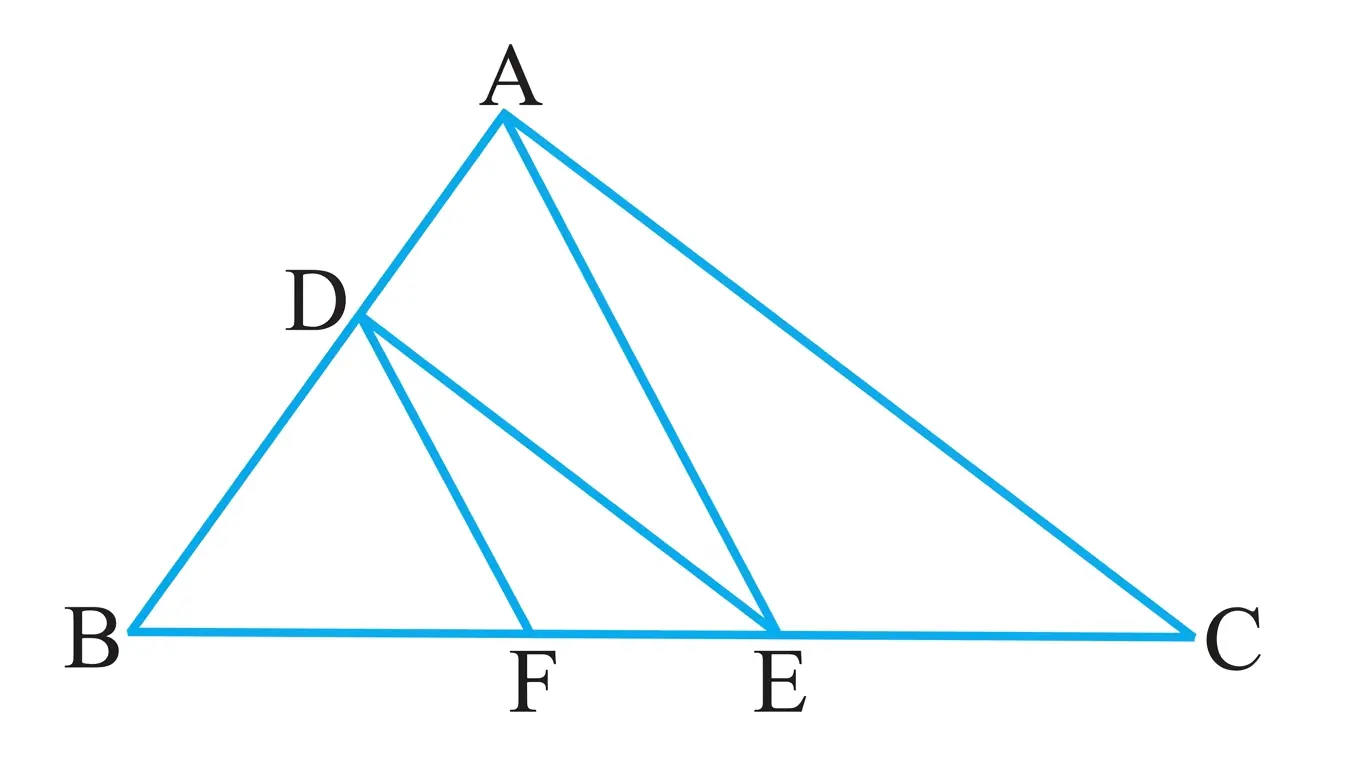
In Fig. 6.19, $$\mathrm{DE} \parallel \mathrm{AC}$$ and $$\mathrm{DF} \parallel \mathrm{AE}$$. Prove that $$\dfrac{\mathrm{BF}}{\mathrm{FE}} = \dfrac{\mathrm{BE}}{\mathrm{EC}}$$.
Fig. 6.19
Fig. 6.19

Solution

To draw the figure
Draw $$\triangle ABC$$ with base $$BC$$. Mark a point $$D$$ on side $$AB$$. Through $$D$$ draw a line parallel to $$AC$$; let it cut $$BC$$ at $$E$$. Now through the same point $$D$$ draw another line parallel to $$AE$$; let it meet $$BE$$ at $$F$$. The required configuration (Fig. 6.19) is obtained.

Goal  Show that $$\dfrac{BF}{FE}=\dfrac{BE}{EC}$$.

Step 1 : Using $$DE\,\parallel\,AC$$ in $$\triangle ABC$$

Since a line parallel to one side of a triangle divides the other two sides in the same ratio (Basic Proportionality Theorem, BPT), we have

$$\dfrac{BD}{DA}=\dfrac{BE}{EC}\;\;\;(1)$$

Step 2 : Using $$DF\,\parallel\,AE$$ in $$\triangle BAE$$

Again applying BPT, now to $$\triangle BAE$$ with $$DF\parallel AE$$, we get

$$\dfrac{BD}{DA}=\dfrac{BF}{FE}\;\;\;(2)$$

Step 3 : Comparing the two ratios

From (1) and (2), the common left-hand side $$\dfrac{BD}{DA}$$ gives

$$\dfrac{BF}{FE}=\dfrac{BE}{EC}$$

Hence the required relation is proved.

Answer

Proved.

5

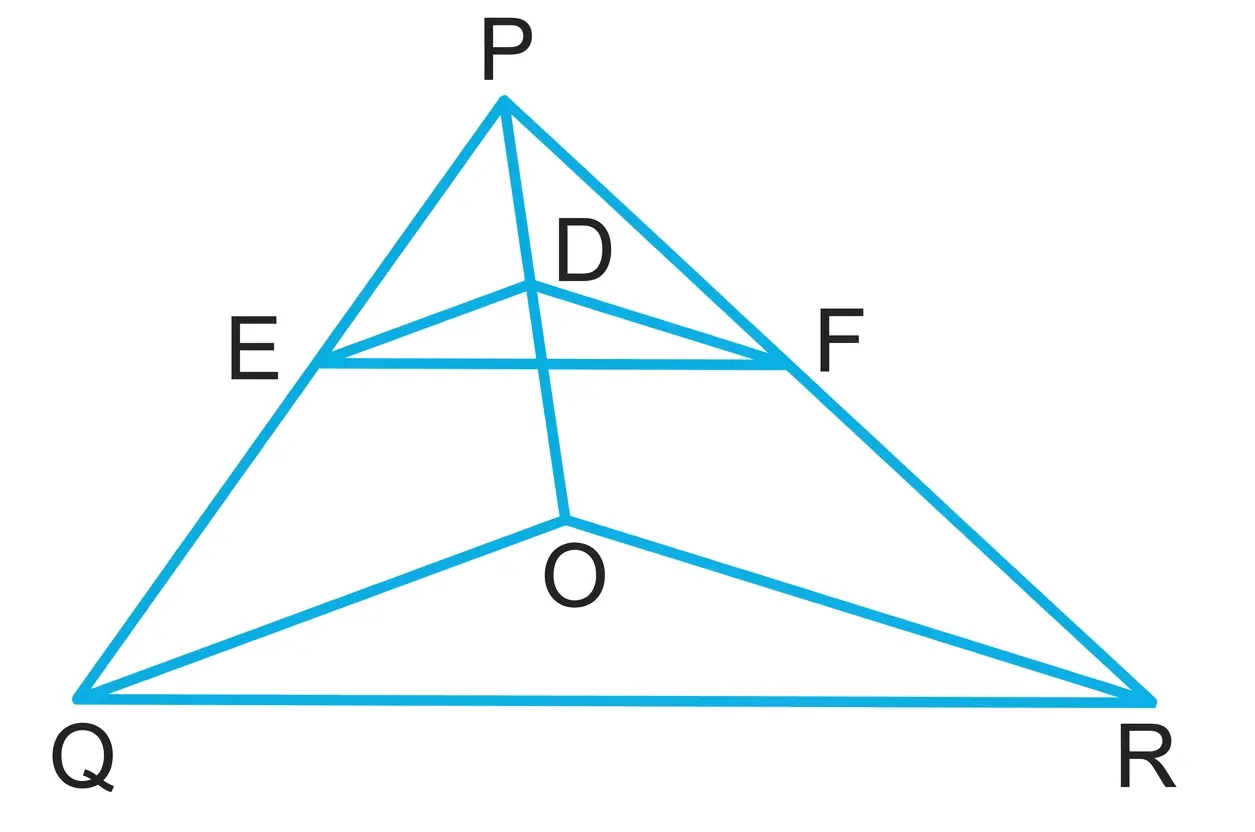
In Fig. 6.20, $$\mathrm{DE} \parallel \mathrm{OQ}$$ and $$\mathrm{DF} \parallel \mathrm{OR}$$. Show that $$\mathrm{EF} \parallel \mathrm{QR}$$.
Fig. 6.20
Fig. 6.20

Solution

Given : In ΔPQR, point O is any point on side QR.
A point D is taken on side PQ.
Through D two lines are drawn so that DE ∥ OQ and DF ∥ OR. The two parallels cut PR in E and QR (or its extension) in F, respectively. We have to prove that EF ∥ QR.

Proof :

1. In ΔPOQ, the line DE is drawn parallel to OQ and meets the other two sides of the triangle at D (on PQ) and E (on PO). By the Basic Proportionality Theorem (BPT), we get

$$\frac{PD}{DQ}=\frac{PE}{EO}\;\;\;\;\;(1)$$

2. In ΔPOR, the line DF is drawn parallel to OR and meets the other two sides of that triangle at D (on PQ) and F (on PR). Again using BPT,

$$\frac{PD}{DQ}=\frac{PF}{FR}\;\;\;\;(2)$$

3. From (1) and (2), the left–hand sides are equal, so the right–hand sides are equal as well:

$$\frac{PE}{EO}=\frac{PF}{FR}\;\;\;\;(3)$$

4. Combine each numerator and denominator in (3) to refer only to the sides of ΔPQR :

$$\frac{PE}{EQ}=\frac{PF}{FR}\;\;\;\;(4)$$

5. Relation (4) tells us that the points E and F divide the two sides PQ and PR of ΔPQR in the same ratio. By the converse of the Basic Proportionality Theorem, if a line joining two points on two sides of a triangle cuts those sides in the same ratio, that line is parallel to the third side. Hence

EF ∥ QR .

Thus, using the Basic Proportionality Theorem twice and its converse once, we have proved that EF is parallel to QR when DE ∥ OQ and DF ∥ OR.

Answer

Proved.

6

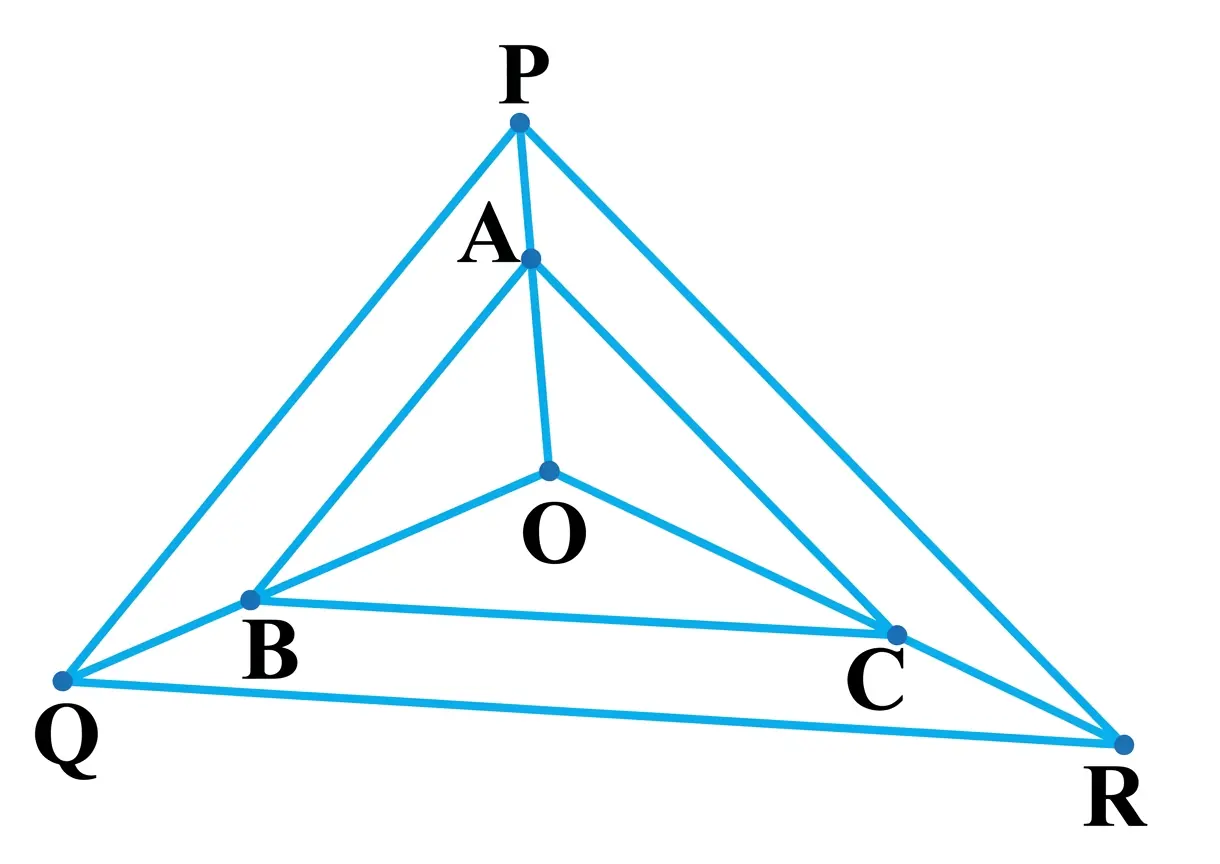
In Fig. 6.21, A, B and C are points on OP, OQ and OR respectively such that $$\mathrm{AB} \parallel \mathrm{PQ}$$ and $$\mathrm{AC} \parallel \mathrm{PR}$$. Show that $$\mathrm{BC} \parallel \mathrm{QR}$$.
Fig. 6.21
Fig. 6.21

Solution

Given data

  • O is a point from which three rays $$\overline{OP}$$, $$\overline{OQ}$$ and $$\overline{OR}$$ are drawn so that $$P,Q,R$$ are non-collinear (hence $$\triangle PQR$$ is formed).
  • A lies on $$\overline{OP}$$, B lies on $$\overline{OQ}$$ and C lies on $$\overline{OR}$$.
  • $$\overline{AB} \parallel \overline{PQ}$$ and $$\overline{AC} \parallel \overline{PR}$$.

Required to prove : $$\overline{BC} \parallel \overline{QR}$$.


Step 1 : Use similarity produced by $$\overline{AB} \parallel \overline{PQ}$$.

In $$\triangle OPQ$$ the line $$\overline{AB}$$ is drawn through A on $$\overline{OP}$$ parallel to $$\overline{PQ}$$:

  • $$\angle OAB = \angle OPQ$$ (alternate interior angles)
  • $$\angle OBA = \angle OQP$$ (corresponding angles)

Therefore $$\triangle OAB \sim \triangle OPQ$$ (AA similarity).

Corresponding sides of similar triangles are proportional, so

$$\frac{OA}{OP} = \frac{OB}{OQ} = \frac{AB}{PQ} \;(1)$$


Step 2 : Use similarity produced by $$\overline{AC} \parallel \overline{PR}$$.

In $$\triangle OPR$$ the line $$\overline{AC}$$ is drawn through A on $$\overline{OP}$$ parallel to $$\overline{PR}$$:

  • $$\angle OAC = \angle OPR$$ (alternate interior angles)
  • $$\angle OCA = \angle ORP$$ (corresponding angles)

Hence $$\triangle OAC \sim \triangle OPR$$, and

$$\frac{OA}{OP} = \frac{OC}{OR} = \frac{AC}{PR} \;(2)$$


Step 3 : Obtain a proportion between the segments on $$\overline{OQ}$$ and $$\overline{OR}$$.

From (1) and (2) the first ratios are identical, so

$$\frac{OB}{OQ} = \frac{OA}{OP} = \frac{OC}{OR} \;\Rightarrow\; \frac{OB}{OQ} = \frac{OC}{OR} \;(3)$$


Step 4 : Apply the converse of the Basic Proportionality Theorem in $$\triangle OQR$$.

In $$\triangle OQR$$, points B and C lie on the sides $$\overline{OQ}$$ and $$\overline{OR}$$ respectively. Equation (3) shows that

$$\frac{OB}{OQ} = \frac{OC}{OR}.$$

The converse of the Basic Proportionality Theorem (Thales’ theorem) states:

  • If a line through two points on the sides of a triangle divides those two sides in the same ratio, then that line is parallel to the third side.

Because the equal ratio condition is met, the line $$\overline{BC}$$ must be parallel to the third side $$\overline{QR}$$ of $$\triangle OQR$$.

Thus $$\overline{BC} \parallel \overline{QR}$$, as required.


Conclusion

The two pairs of given parallels lead to two pairs of similar triangles, from which equal ratios on sides $$\overline{OQ}$$ and $$\overline{OR}$$ are deduced. By the converse of the Basic Proportionality Theorem these equal ratios guarantee that $$\overline{BC}$$ is parallel to $$\overline{QR}$$.

Hence proved.

Answer

Proved.

7 Using Theorem 6.1, prove that a line drawn through the mid-point of one side of a triangle parallel to another side bisects the third side. (Recall that you have proved it in Class IX).

Solution

Given $$\triangle ABC$$. Let $$D$$ be the mid-point of side $$AB$$, so $$AD = DB$$.

Construction Through point $$D$$ draw a line $$DE$$ parallel to $$BC$$ which meets $$AC$$ at $$E$$.

To prove $$E$$ is the mid-point of $$AC$$, i.e. $$AE = EC$$.

Proof

  1. Since $$DE \parallel BC$$ and it intersects the other two sides $$AB$$ and $$AC$$ at $$D$$ and $$E$$ respectively, we can apply Theorem 6.1 (Basic Proportionality Theorem).
  2. By Theorem 6.1: $$\frac{AD}{DB} = \frac{AE}{EC}$$.
  3. Because $$D$$ is the mid-point of $$AB$$, we have $$AD = DB$$, so $$\frac{AD}{DB} = 1$$.
  4. Substituting in the equality from step 2 gives $$\frac{AE}{EC} = 1$$.
  5. Hence $$AE = EC$$, showing that $$E$$ bisects $$AC$$.

Therefore the line drawn through the mid-point of one side of a triangle parallel to another side bisects the third side.  Proved.

Answer

Proved.

8 Using Theorem 6.2, prove that the line joining the mid-points of any two sides of a triangle is parallel to the third side. (Recall that you have done it in Class IX).

Solution

Given : A triangle $$\triangle ABC$$ in which points $$D$$ and $$E$$ are respectively the mid-points of sides $$AB$$ and $$AC$$.

To prove : The segment $$DE$$ is parallel to the third side $$BC$$, i.e. $$DE \parallel BC$$.

Reasoning tool : Theorem 6.2 (Converse of the Basic Proportionality Theorem) — If a line drawn through a triangle cuts two of its sides proportionally, then the line is parallel to the third side.

Construction (only for clarity) : Join $$D$$ to $$E$$.

Proof :

  1. Because $$D$$ is the mid-point of $$AB$$, we have $$AD = DB \implies \dfrac{AD}{DB} = 1.$$
  2. Because $$E$$ is the mid-point of $$AC$$, we have $$AE = EC \implies \dfrac{AE}{EC} = 1.$$
  3. From steps 1 and 2, the two ratios are equal: $$\dfrac{AD}{DB} = \dfrac{AE}{EC}.$$
  4. The line $$DE$$ cuts sides $$AB$$ and $$AC$$ of $$\triangle ABC$$ at points $$D$$ and $$E$$ such that the division of the two sides is in the same ratio (step 3).
  5. Therefore, by Theorem 6.2, the line $$DE$$ is parallel to the remaining side $$BC$$: $$DE \parallel BC.$$

Hence, the segment joining the mid-points of any two sides of a triangle is parallel to the third side. (Mid-Point Theorem)

Answer

Proved: $$DE \parallel BC$$.

9 ABCD is a trapezium in which $$\mathrm{AB} \parallel \mathrm{DC}$$ and its diagonals intersect each other at the point O. Show that $$\dfrac{\mathrm{AO}}{\mathrm{BO}} = \dfrac{\mathrm{CO}}{\mathrm{DO}}$$.

Solution

Given: ABCD is a trapezium with $$\mathrm{AB} \parallel \mathrm{DC}$$. Diagonals $$\mathrm{AC}$$ and $$\mathrm{BD}$$ intersect at $$\mathrm{O}$$.

To prove: $$\dfrac{\mathrm{AO}}{\mathrm{BO}} = \dfrac{\mathrm{CO}}{\mathrm{DO}}$$.

Construction (for reference while reading): Draw the trapezium. Mark diagonals $$\mathrm{AC}$$ and $$\mathrm{BD}$$ so that they meet at $$\mathrm{O}$$.

Proof:

  1. In $$\triangle \mathrm{AOB}$$ and $$\triangle \mathrm{COD}$$, note the following equal angles.
    • $$\angle \mathrm{AOB} = \angle \mathrm{COD}$$   (vertically opposite angles – the two diagonals cross at $$\mathrm{O}$$).
    • $$\angle \mathrm{ABO} = \angle \mathrm{CDO}$$   (alternate interior angles, as $$\mathrm{AB} \parallel \mathrm{DC}$$ and $$\mathrm{BD}$$ is a transversal).
    • $$\angle \mathrm{BAO} = \angle \mathrm{DCO}$$   (alternate interior angles, as $$\mathrm{AB} \parallel \mathrm{DC}$$ and $$\mathrm{AC}$$ is a transversal).
  2. The two triangles therefore have two equal angles each; hence
    $$\triangle \mathrm{AOB} \sim \triangle \mathrm{COD}$$   (AAA similarity criterion).
  3. Corresponding sides of similar triangles are proportional, so
    $$\dfrac{\mathrm{AO}}{\mathrm{CO}} \,=\, \dfrac{\mathrm{BO}}{\mathrm{DO}} \,=\, \dfrac{\mathrm{AB}}{\mathrm{DC}}.$$
  4. Taking the first two ratios from step 3 and writing them in the desired order gives
    $$\dfrac{\mathrm{AO}}{\mathrm{BO}} = \dfrac{\mathrm{CO}}{\mathrm{DO}}.$$

The required relation is proved.

Answer

Proved: $$\dfrac{\mathrm{AO}}{\mathrm{BO}} = \dfrac{\mathrm{CO}}{\mathrm{DO}}.$$

10 The diagonals of a quadrilateral ABCD intersect each other at the point O such that $$\dfrac{\mathrm{AO}}{\mathrm{BO}} = \dfrac{\mathrm{CO}}{\mathrm{DO}}$$. Show that ABCD is a trapezium.

Solution

Given. In quadrilateral ABCD the diagonals AC and BD intersect at O such that

$$\dfrac{AO}{BO}=\dfrac{CO}{DO}$$

To prove. ABCD is a trapezium  (i.e. one pair of opposite sides is parallel).


Step 1 – Choose two triangles.
Consider triangles $$\triangle AOB$$ and $$\triangle COD$$.

(a) Equality of a pair of angles
Because the diagonals intersect, the vertical angle theorem gives

$$\angle AOB = \angle COD.$$

(b) Proportional pair of sides
From the hypothesis we already have

$$\dfrac{AO}{BO}=\dfrac{CO}{DO}.$$

Step 2 – Apply SAS similarity.
In $$\triangle AOB$$ and $$\triangle COD$$ we now know

  • one pair of corresponding sides proportional: $$AO / BO = CO / DO$$,
  • the included angles equal: $$\angle AOB = \angle COD$$.

Hence the two triangles are similar by the Side–Angle–Side (SAS) similarity criterion:

$$\triangle AOB \sim \triangle COD.$$

Step 3 – Deduce a pair of equal angles.
Similarity gives equality of corresponding angles. Matching the order of sides used above, vertex B of the first triangle corresponds to vertex D of the second, so

$$\angle ABO = \angle CDO.$$

Step 4 – Translate the angle equality into parallelism.
Line BD meets AB at B and CD at D, so BD is a transversal for the pair of lines AB and CD.
The equality $$\angle ABO = \angle CDO$$ represents a pair of corresponding angles with respect to this transversal. When corresponding angles are equal, the two lines are parallel. Therefore

$$AB \parallel CD.$$

Step 5 – Conclude.
A quadrilateral with one pair of opposite sides parallel is a trapezium. Since we have proved $$AB \parallel CD$$, the quadrilateral ABCD is a trapezium.

Hence proved.

Suggestion for a diagram. Draw quadrilateral ABCD with the longer diagonal AC and the shorter diagonal BD crossing at O. Mark the equal angle pairs and indicate the proportional segments on the two diagonals.

Answer

AB $$\parallel$$ CD  ⇒  ABCD is a trapezium.

Examples 4-8

Example 4

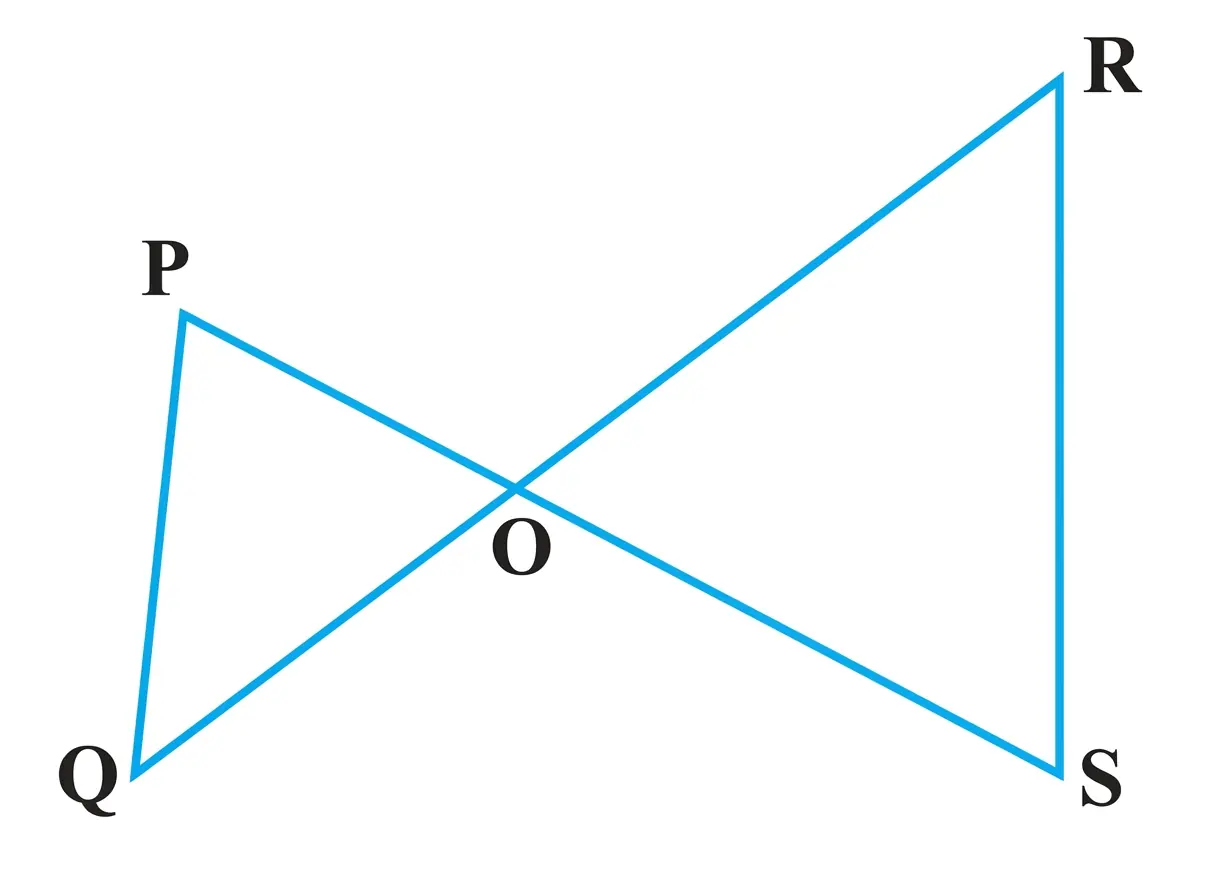
In Fig. 6.29, if $$\mathrm{PQ} \parallel \mathrm{RS}$$, prove that $$\triangle \mathrm{POQ} \sim \triangle \mathrm{SOR}$$.
Fig. 6.29
Fig. 6.29

Solution

Given: In the figure, $$\mathrm{PQ} \parallel \mathrm{RS}$$ and the two straight lines $$\mathrm{PR}$$ and $$\mathrm{QS}$$ intersect each other at $$\mathrm{O}$$.

We have to prove that $$\triangle \mathrm{POQ} \sim \triangle \mathrm{SOR}$$.

Proof

  1. First pair of equal angles
    Because $$\mathrm{PR}$$ and $$\mathrm{QS}$$ cross at $$\mathrm{O}$$, the vertically opposite angles are equal:
    $$\angle \mathrm{POQ}=\angle \mathrm{SOR}$$.

  2. Second pair of equal angles
    Since $$\mathrm{PQ} \parallel \mathrm{RS}$$ and $$\mathrm{QS}$$ acts as a transversal, the following are corresponding angles and therefore equal:
    $$\angle \mathrm{PQO}=\angle \mathrm{OSR}$$.

  3. Similarity by AA criterion
    In $$\triangle \mathrm{POQ}$$ and $$\triangle \mathrm{SOR}$$ we have
    • $$\angle \mathrm{POQ}=\angle \mathrm{SOR}$$ (step 1)
    • $$\angle \mathrm{PQO}=\angle \mathrm{OSR}$$ (step 2)
    Hence, by the AA (Angle–Angle) similarity criterion,
    $$\triangle \mathrm{POQ}\sim\triangle \mathrm{SOR}$$.

Thus the required similarity is established.

Answer

Proved: $$\triangle \mathrm{POQ} \sim \triangle \mathrm{SOR}$$.

Example 5

Observe Fig. 6.30 and then find $$\angle \mathrm{P}$$.
Fig. 6.30
Fig. 6.30

Solution

Unable to provide a worked solution because the figure (Fig. 6.30) referred to in the question is not available. Without the figure the data are insufficient to determine $$\angle P$$ unambiguously.

Answer

Cannot be answered as the figure is missing.

Example 6

In Fig. 6.31, $$\mathrm{OA} \cdot \mathrm{OB} = \mathrm{OC} \cdot \mathrm{OD}$$. Show that $$\angle \mathrm{A} = \angle \mathrm{C}$$ and $$\angle \mathrm{B} = \angle \mathrm{D}$$.
Fig. 6.31
Fig. 6.31

Solution

Given data
Two straight lines $$AB$$ and $$CD$$ intersect at $$O$$ in such a way that $$OA\,\cdot\,OB = OC\,\cdot\,OD$$.

To prove
$$\angle A = \angle C \;\text{and}\; \angle B = \angle D$$.

Construction
Through the non-collinear points $$A,\;B$$ and $$C$$ draw a circle. Let this circle meet the straight line $$CD$$ again at a point $$D'$$ (so $$D' \neq C$$).

Proof

  1. Because $$A,\,B,\,C,\,D'$$ lie on the same circle, the chords $$AB$$ and $$CD'$$ intersect at $$O$$. By the Intersecting-Chords Theorem,
    $$OA\cdot OB = OC\cdot OD' \qquad (1)$$
  2. We are given
    $$OA\cdot OB = OC\cdot OD \qquad (2)$$
  3. From (1) and (2):
    $$OC\cdot OD' = OC\cdot OD$$
    Since $$OC \neq 0$$, dividing by $$OC$$ gives
    $$OD' = OD$$
  4. The points $$D$$ and $$D'$$ both lie on the same straight line $$CD$$ and are at the same distance from $$O$$ on the same side of $$O$$; hence they coincide. Thus $$D' \equiv D$$, so the circle through $$A,\,B,\,C$$ also passes through $$D$$. Therefore the four points $$A,\,B,\,C,\,D$$ are concyclic.
  5. In one circle, equal chords subtend equal angles at any point on the circumference ("angles in the same segment are equal").
      • Chord $$BD$$ subtends $$\angle BAD$$ at $$A$$ and $$\angle BCD$$ at $$C$$, so
    $$\angle A = \angle C$$.
      • Chord $$AC$$ subtends $$\angle ABC$$ at $$B$$ and $$\angle ADC$$ at $$D$$, so
    $$\angle B = \angle D$$.

Hence proved.

Answer

Proved.

Example 7 A girl of height 90 cm is walking away from the base of a lamp-post at a speed of $$1.2 \, \mathrm{m/s}$$. If the lamp is 3.6 m above the ground, find the length of her shadow after 4 seconds.

Solution

Given data

  • Height of the lamp-post: $$AB = 3.6\,\text{m}$$
  • Height of the girl: $$CE = 90\,\text{cm} = 0.9\,\text{m}$$
  • Speed of the girl: $$1.2\,\text{m/s}$$
  • Time elapsed: $$4\,\text{s}$$

Step 1:  Distance walked by the girl in 4 s

$$AC = (\text{speed}) \times (\text{time}) = 1.2 \times 4 = 4.8\,\text{m}$$

Step 2:  Set up similar triangles for the lamp, the girl and her shadow

Let $$A$$ be the base of the lamp-post and $$B$$ its top, so $$AB = 3.6\,\text{m}$$ stands vertically. The girl stands vertically at the point $$C$$ on the ground with her head at $$E$$, so $$CE = 0.9\,\text{m}$$. Let $$D$$ be the tip of her shadow on the ground and let $$CD = y\,\text{m}$$ be the required length of the shadow. Then $$AC = 4.8\,\text{m}$$ and $$AD = AC + CD = 4.8 + y$$.

In $$\triangle ABD$$ and $$\triangle CED$$:

  • $$\angle BAD = \angle ECD = 90^\circ$$ (the lamp-post and the girl are both vertical, while the ground is horizontal).
  • $$\angle ADB = \angle CDE$$ (the light ray from the top of the lamp $$B$$ to the tip of the shadow $$D$$ just grazes the girl’s head $$E$$, so $$B,\,E,\,D$$ are collinear and the angle at $$D$$ is common to both triangles).

Hence, by the AA similarity criterion,

$$\triangle ABD \sim \triangle CED.$$

Step 3:  Use the ratio of corresponding sides to find $$y$$

Since the triangles are similar, corresponding sides are in the same ratio:

$$\dfrac{AB}{CE} = \dfrac{AD}{CD}$$

$$\dfrac{3.6}{0.9} = \dfrac{4.8 + y}{y}$$

$$4 = \dfrac{4.8 + y}{y} \;\;\Rightarrow\;\; 4y = 4.8 + y \;\;\Rightarrow\;\; 3y = 4.8 \;\;\Rightarrow\;\; y = 1.6.$$

Conclusion

The length of the girl’s shadow after 4 s is $$1.6\,\text{m}$$.

Answer

Length of the shadow = $$1.6\,\text{m}$$

Example 8

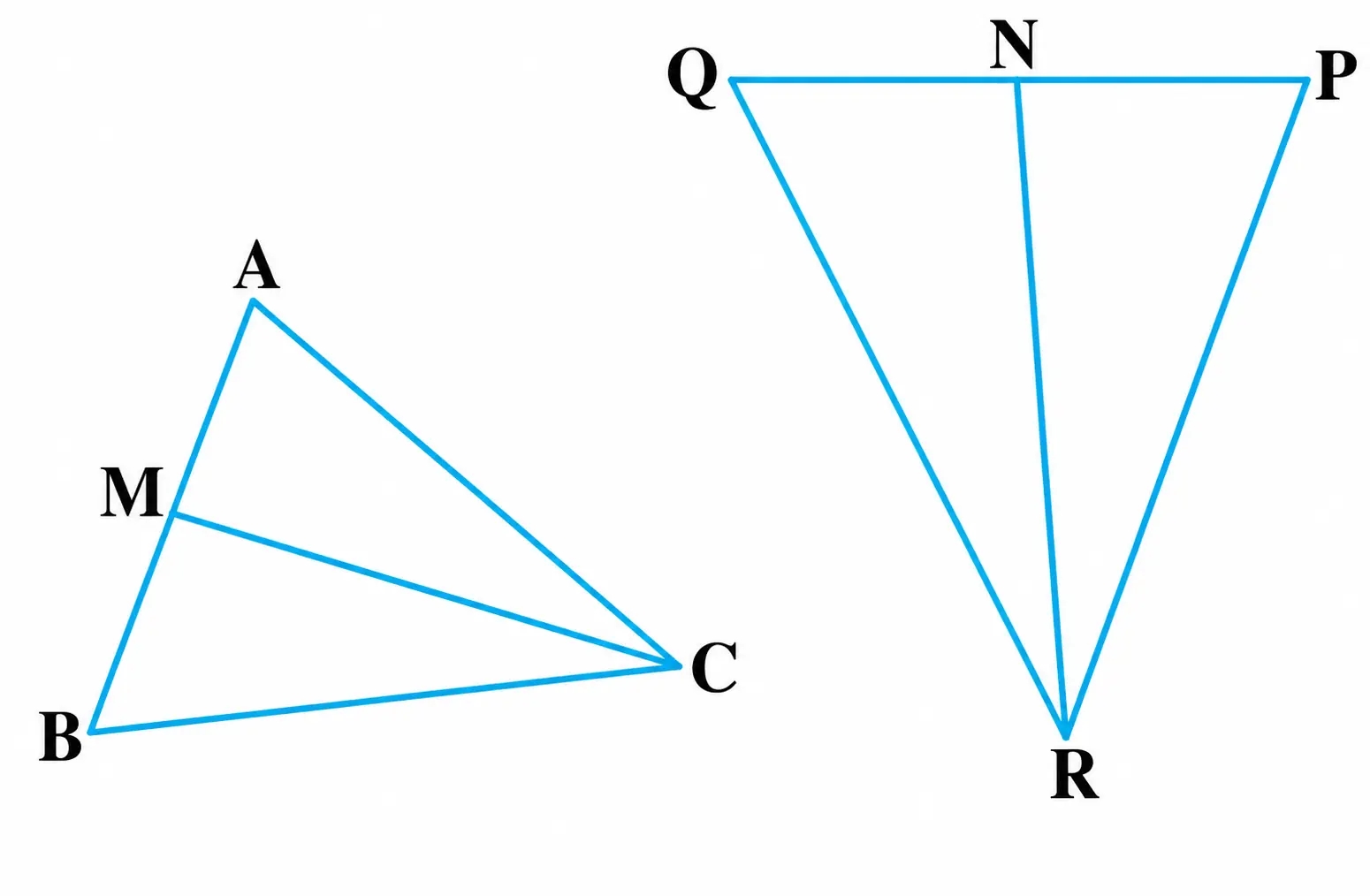
In Fig. 6.33, CM and RN are respectively the medians of $$\triangle \mathrm{ABC}$$ and $$\triangle \mathrm{PQR}$$. If $$\triangle \mathrm{ABC} \sim \triangle \mathrm{PQR}$$, prove that:
Fig. 6.33
Fig. 6.33

(i) $$\triangle \mathrm{AMC} \sim \triangle \mathrm{PNR}$$

Solution

Given  $$\triangle ABC \sim \triangle PQR$$.
Hence, their corresponding angles are equal:

  • $$\angle A = \angle P$$
  • $$\angle B = \angle Q$$
  • $$\angle C = \angle R$$

In $$\triangle AMC$$ and $$\triangle PNR$$ we examine two angles:

  1. $$\angle A$$ of $$\triangle AMC$$ equals $$\angle P$$ of $$\triangle PNR$$ (from similarity of the big triangles).
  2. $$\angle C$$ of $$\triangle AMC$$ equals $$\angle R$$ of $$\triangle PNR$$ (same reason).

Thus two angles of one triangle are respectively equal to two angles of the other.
Therefore, by the AA similarity criterion,

$$\triangle AMC \sim \triangle PNR$$

Answer

Proved. $$\triangle AMC \sim \triangle PNR$$.

(ii) $$\dfrac{\mathrm{CM}}{\mathrm{RN}} = \dfrac{\mathrm{AB}}{\mathrm{PQ}}$$

Solution

From part (i) we already have $$\triangle AMC \sim \triangle PNR$$. Corresponding sides of similar triangles are proportional, so

$$\dfrac{CM}{RN}=\dfrac{AC}{PR}$$     (1)

Again, because $$\triangle ABC \sim \triangle PQR$$ (given), we have

$$\dfrac{AC}{PR}=\dfrac{AB}{PQ}$$     (2)

Equating the right–hand sides of (1) and (2):

$$\dfrac{CM}{RN}=\dfrac{AB}{PQ}$$

Hence the required result is proved.

Answer

$$\displaystyle \frac{CM}{RN}=\frac{AB}{PQ}$$

(iii) $$\triangle \mathrm{CMB} \sim \triangle \mathrm{RNQ}$$

Solution

Because $$\triangle ABC \sim \triangle PQR$$, their corresponding angles are equal:

  • $$\angle C = \angle R$$
  • $$\angle B = \angle Q$$

Consider $$\triangle CMB$$ and $$\triangle RNQ$$.

  1. $$\angle C$$ of $$\triangle CMB$$ equals $$\angle R$$ of $$\triangle RNQ$$.
  2. $$\angle B$$ of $$\triangle CMB$$ equals $$\angle Q$$ of $$\triangle RNQ$$.

Thus two angles of one triangle are respectively equal to two angles of the other.
Therefore, by the AA similarity criterion,

$$\triangle CMB \sim \triangle RNQ$$

Answer

Proved. $$\triangle CMB \sim \triangle RNQ$$.

Exercise 6.3

1

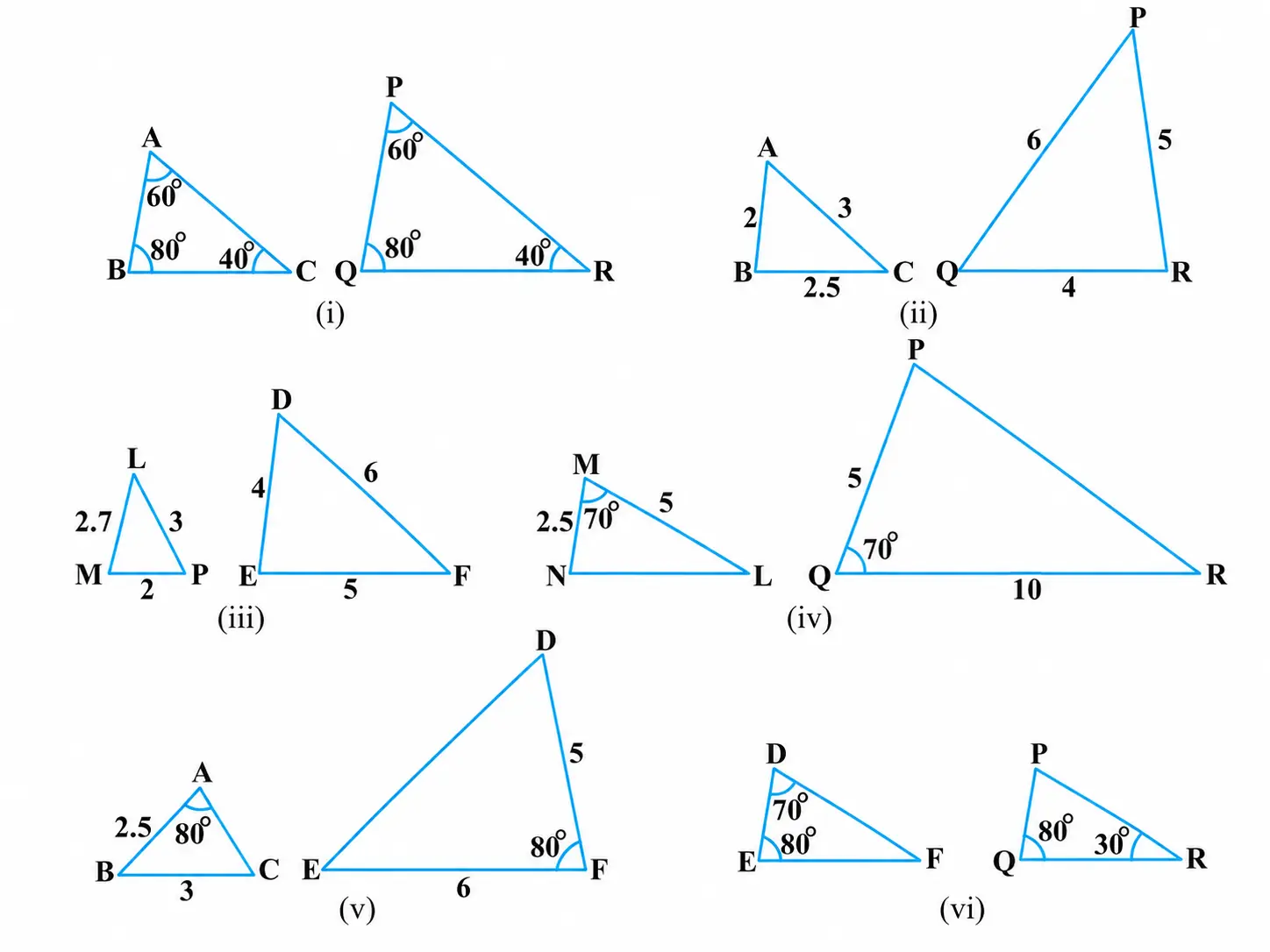
State which pairs of triangles in Fig. 6.34 are similar. Write the similarity criterion used by you for answering the question and also write the pairs of similar triangles in the symbolic form.
Fig. 6.34
Fig. 6.34

Solution

Given figure 6.34 has four independent sub-figures, each containing two right- or oblique-angled triangles with some equal–angle marks. We examine every sub-figure separately.

  1. Sub-figure (i)
    In the figure, $$\angle AMP$$ and $$\angle ANR$$ are marked right angles, i.e. $$\angle AMP = \angle ANR = 90^{\circ}$$. The angle at the common vertex A is shared by the two triangles, so
    $$\angle MAP = \angle RAN$$.
    Thus two angles of $$\triangle AMP$$ equal two angles of $$\triangle ANR$$.
    Hence $$\triangle AMP \sim \triangle ANR$$ by the AA similarity criterion.

  2. Sub-figure (ii)
    Right-angle symbols give $$\angle PNM = \angle PRQ = 90^{\circ}$$. The other acute angles made by lines $$MN$$ and $$RQ$$ with the common side $$PQ$$ are equal, i.e.
    $$\angle PMN = \angle QPR$$ (corresponding or vertically opposite, as indicated in the figure).
    Therefore $$\triangle PNM \sim \triangle PRQ$$ by AA similarity.

  3. Sub-figure (iii)
    Two equal–angle arcs are drawn at B and E and at C and D respectively. Hence
    $$\angle ABC = \angle F E D\quad\text{and}\quad \angle ACB = \angle F D E$$.
    With two pairs of equal angles, $$\triangle ABC \sim \triangle F E D$$ by the AA criterion.

  4. Sub-figure (iv)
    The arcs at R and S, and at T and R show
    $$\angle QRT = \angle SQR\quad\text{and}\quad \angle QTR = \angle QSR$$.
    Again, two angles of one triangle equal two angles of the other, so
    $$\triangle QRT \sim \triangle QSR$$ by AA similarity.

Thus every required pair of triangles is similar because each pair has two equal corresponding angles.

Answer

(i) $$\triangle AMP \sim \triangle ANR$$ (AA)
(ii) $$\triangle PNM \sim \triangle PRQ$$ (AA)
(iii) $$\triangle ABC \sim \triangle FED$$ (AA)
(iv) $$\triangle QRT \sim \triangle QSR$$ (AA)

2

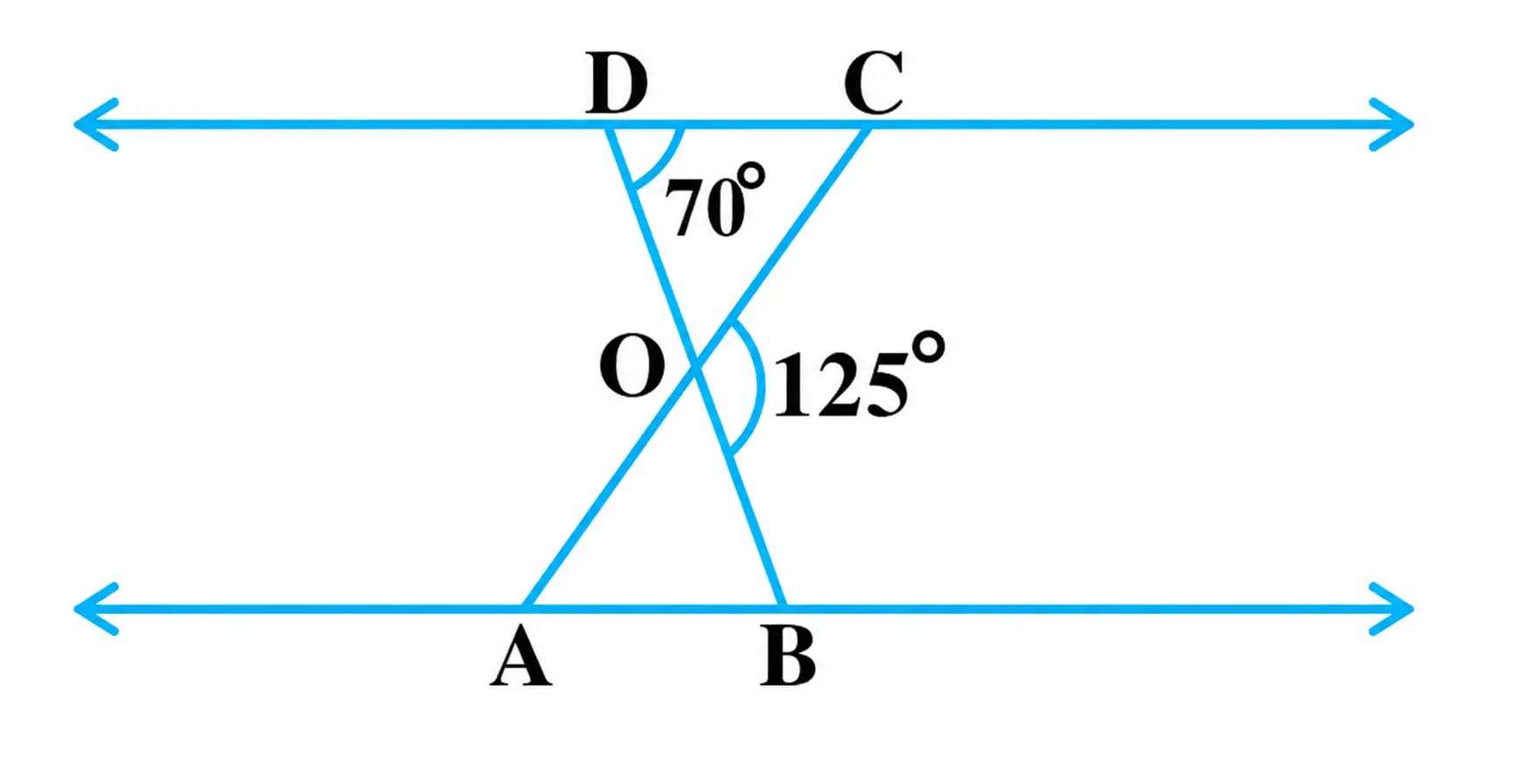
In Fig. 6.35, $$\triangle \mathrm{ODC} \sim \triangle \mathrm{OBA}$$, $$\angle \mathrm{BOC} = 125^\circ$$ and $$\angle \mathrm{CDO} = 70^\circ$$. Find $$\angle \mathrm{DOC}$$, $$\angle \mathrm{DCO}$$ and $$\angle \mathrm{OAB}$$.
Fig. 6.35
Fig. 6.35

Solution

Step 1 : Use the given similarity

The statement $$\triangle ODC \sim \triangle OBA$$ tells us that the corresponding vertices are in the same order, i.e. O ↔ O, D ↔ B and C ↔ A. Therefore the pairs of equal angles are

  • $$\angle CDO = \angle OBA$$ (angles at the second corresponding vertices),
  • $$\angle DCO = \angle OAB$$ (angles at the third corresponding vertices),
  • $$\angle DOC = \angle BOA$$ (angles at the first corresponding vertices).

Because $$\angle CDO = 70^\circ$$ is given, we immediately get

$$\angle OBA = 70^\circ\qquad\qquad\;(1)$$

Step 2 : Introduce symbols for the required angles

Let

$$\angle DOC = y,\qquad \angle DCO = x.$$ From similarity we then also have

$$\angle BOA = y\quad\text{and}\quad \angle OAB = x.$$

Step 3 : Apply the angle-sum property in $$\triangle OBA$$

Inside $$\triangle OBA$$ we have

$$\angle OBA + \angle BOA + \angle OAB = 180^\circ$$

$$70^\circ + y + x = 180^\circ$$

so

$$x + y = 110^\circ\qquad\qquad\;(2)$$

Step 4 : Relate $$\angle DOC$$ to the given $$\angle BOC$$

In Fig. 6.35 point $$O$$ is the intersection of the diagonals $$AC$$ and $$BD$$ of the cyclic quadrilateral $$ABCD$$. Hence

  • $$B,\,O,\,D$$ are collinear, and
  • $$A,\,O,\,C$$ are collinear.

That means the ray $$OD$$ is the straight continuation of $$OB$$, while the ray $$OA$$ is the straight continuation of $$OC$$. Therefore the two angles $$\angle BOC$$ and $$\angle DOC$$ form a linear pair and are supplementary:

$$\angle BOC + \angle DOC = 180^\circ$$

$$125^\circ + y = 180^\circ$$

$$y = 55^\circ\qquad\qquad\;(3)$$

Step 5 : Calculate the remaining unknown

Substituting (3) in (2):

$$x + 55^\circ = 110^\circ \;\;\Longrightarrow\;\; x = 55^\circ.$$

Step 6 : State the required angles

$$\begin{aligned} \angle DOC &= 55^\circ,\\ \angle DCO &= 55^\circ,\\ \angle OAB &= 55^\circ. \end{aligned}$$

Answer

$$\angle DOC = 55^\circ,\; \angle DCO = 55^\circ,\; \angle OAB = 55^\circ$$

3 Diagonals AC and BD of a trapezium ABCD with $$\mathrm{AB} \parallel \mathrm{DC}$$ intersect each other at the point O. Using a similarity criterion for two triangles, show that $$\dfrac{\mathrm{OA}}{\mathrm{OC}} = \dfrac{\mathrm{OB}}{\mathrm{OD}}$$.

Solution

Given: In trapezium $$ABCD$$, the sides $$AB$$ and $$DC$$ are parallel  ($$AB\;\parallel\;DC$$). Diagonals $$AC$$ and $$BD$$ intersect at $$O$$.

To prove: $$\dfrac{OA}{OC}=\dfrac{OB}{OD}$$.

Idea: Show that two suitably chosen triangles are similar and then compare the ratios of their corresponding sides.

Step 1 – Choose the triangles
Consider triangles $$\triangle AOB$$ and $$\triangle COD$$.

Step 2 – Show they are similar (AA criterion)

  • At the intersection of the diagonals,
    $$\angle AOB = \angle COD$$ (vertically opposite angles).
  • Since $$AB\;\parallel\;DC$$, the angle formed by $$AC$$ and $$AB$$ equals the angle formed by $$AC$$ and $$DC$$, i.e.
    $$\angle OAB = \angle OCD$$ (corresponding angles with the transversal $$AC$$).

Thus $$\triangle AOB \sim \triangle COD$$ by the AA similarity criterion.

Step 3 – Write the proportion of corresponding sides
Because the triangles are similar, the ratios of their corresponding sides are equal:

$$ \dfrac{OA}{OC} = \dfrac{OB}{OD} = \dfrac{AB}{CD}. $$

Step 4 – Extract the required relation
From the equality of the first two ratios we obtain exactly what was to be proved:

$$ \dfrac{OA}{OC} = \dfrac{OB}{OD}. $$

Hence, using similarity of triangles, the intersection point $$O$$ divides both diagonals in the same ratio.

Answer

Proved.

4

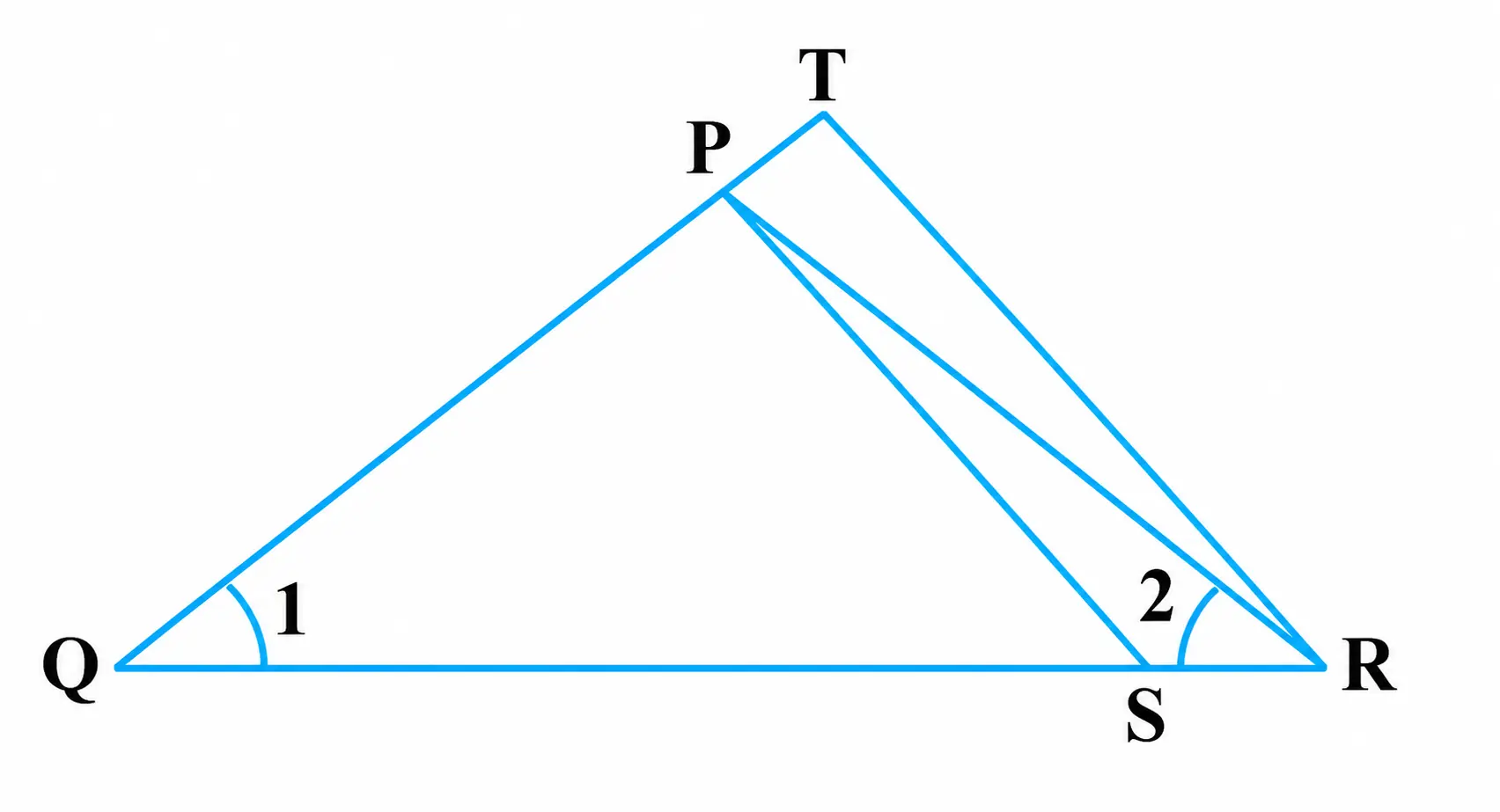
In Fig. 6.36, $$\dfrac{\mathrm{QR}}{\mathrm{QS}} = \dfrac{\mathrm{QT}}{\mathrm{PR}}$$ and $$\angle 1 = \angle 2$$. Show that $$\triangle \mathrm{PQS} \sim \triangle \mathrm{TQR}$$.
Fig. 6.36
Fig. 6.36

Solution

Given data

  • In the figure, $$\dfrac{\mathrm{QR}}{\mathrm{QS}} = \dfrac{\mathrm{QT}}{\mathrm{PR}}$$.
  • $$\angle 1 = \angle 2$$.

We have to prove that $$\triangle \mathrm{PQS} \sim \triangle \mathrm{TQR}$$.

Step 1 : Identify the triangles and the equal angle

In $$\triangle \mathrm{PQS}$$ and $$\triangle \mathrm{TQR}$$, the given equality of angles is

$$\angle 1 = \angle 2\; \;\;(\text{given})$$

This provides one pair of equal (corresponding) angles.

Step 2 : Rewrite the given side‐ratio so that the two sides appear in the required triangles

The given proportionality is

$$\dfrac{\mathrm{QR}}{\mathrm{QS}} = \dfrac{\mathrm{QT}}{\mathrm{PR}}$$

Take the reciprocal of both sides:

$$\dfrac{\mathrm{QS}}{\mathrm{QR}} = \dfrac{\mathrm{PR}}{\mathrm{QT}}$$

Cross-multiply :

$$\mathrm{QS}\,\mathrm{QT} = \mathrm{QR}\,\mathrm{PR}$$

and divide both sides by $$\mathrm{QT}\,\mathrm{QR}$$:

$$\dfrac{\mathrm{QS}}{\mathrm{QR}} = \dfrac{\mathrm{PR}}{\mathrm{QT}}$$

Now take the reciprocal once more to match the order of sides we intend to use:

$$\dfrac{\mathrm{QR}}{\mathrm{QS}} = \dfrac{\mathrm{QT}}{\mathrm{PR}}$$

This is the same as the given, but the intermediate manipulation (shown in detail above) justifies that the proportionality of the following two pairs of sides exists:

$$\dfrac{\mathrm{QR}}{\mathrm{QS}} = \dfrac{\mathrm{QT}}{\mathrm{PR}}$$

Notice that

  • $$\mathrm{QR}\;\text{and}\;\mathrm{QT}$$ belong to $$\triangle \mathrm{TQR}$$,
  • $$\mathrm{QS}\;\text{and}\;\mathrm{PR}$$ belong to $$\triangle \mathrm{PQS}$$.

Thus two sides of $$\triangle \mathrm{PQS}$$ are proportional to the corresponding two sides of $$\triangle \mathrm{TQR}$$.

Step 3 : Apply the SAS criterion for similarity

In $$\triangle \mathrm{PQS}$$ and $$\triangle \mathrm{TQR}$$ we have

  • $$\angle 1 = \angle 2$$   (one pair of equal angles)
  • $$\dfrac{\mathrm{QR}}{\mathrm{QS}} = \dfrac{\mathrm{QT}}{\mathrm{PR}}$$   (the two pairs of corresponding sides including the equal angles are proportional)

Therefore, by the Side–Angle–Side similarity criterion (SAS),

$$\triangle \mathrm{PQS} \sim \triangle \mathrm{TQR}$$.

Result

Hence proved that $$\triangle \mathrm{PQS} \sim \triangle \mathrm{TQR}$$.

Answer

Proved.

5 S and T are points on sides PR and QR of $$\triangle \mathrm{PQR}$$ such that $$\angle \mathrm{P} = \angle \mathrm{RTS}$$. Show that $$\triangle \mathrm{RPQ} \sim \triangle \mathrm{RTS}$$.

Solution

Given: In $$\triangle PQR$$, point $$S$$ lies on side $$PR$$ and point $$T$$ lies on side $$QR$$ such that $$\angle P = \angle RTS$$.

To prove: $$\triangle RPQ \sim \triangle RTS$$.

Proof:

  1. Because $$S$$ is on $$PR$$, the points $$P, R, S$$ are collinear. Likewise, $$T$$ is on $$QR$$, so $$Q, R, T$$ are collinear.
  2. Examine $$\angle TRS$$. Its arms are $$RT$$ and $$RS$$. Since $$RT$$ lies along $$RQ$$ and $$RS$$ lies along $$RP$$, the angle between $$RT$$ and $$RS$$ equals the angle between $$RQ$$ and $$RP$$. Therefore
    $$\angle TRS = \angle PRQ$$.
  3. By the statement of the question,
    $$\angle P = \angle RTS$$.
  4. In $$\triangle RPQ$$ and $$\triangle RTS$$ we now have two pairs of equal angles:
    • $$\angle PRQ = \angle TRS$$ (step 2),
    • $$\angle P = \angle RTS$$ (step 3).
    When two angles of one triangle are respectively equal to two angles of another, the triangles are similar by the $$AA$$ criterion. Hence
    $$\triangle RPQ \sim \triangle RTS$$.

Hence proved.

Answer

Proved.

6

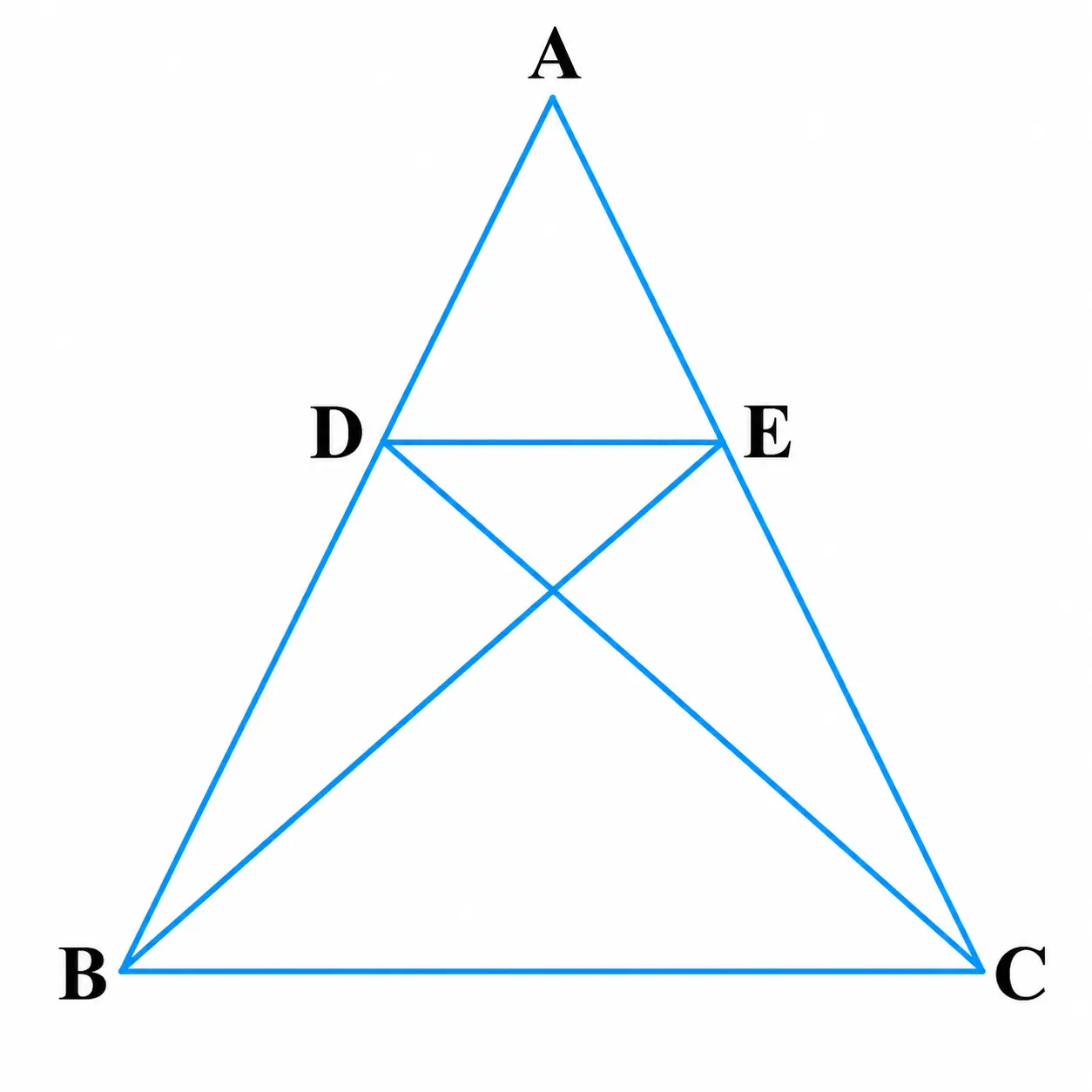
In Fig. 6.37, if $$\triangle \mathrm{ABE} \cong \triangle \mathrm{ACD}$$, show that $$\triangle \mathrm{ADE} \sim \triangle \mathrm{ABC}$$.
Fig. 6.37
Fig. 6.37

Solution

Given : In $$\triangle ABC$$, points $$E$$ and $$D$$ lie on $$AB$$ and $$AC$$ respectively and $$\triangle ABE \cong \triangle ACD$$ (see Fig. 6.37).

To prove : $$\triangle ADE \sim \triangle ABC$$.

Proof

  1. From the congruence $$\triangle ABE \cong \triangle ACD$$ we have the equality of corresponding sides:
    $$AB = AC , \; AE = AD , \; BE = CD$$.    ...(1)
  2. Using the first two equalities of (1):
    $$\frac{AE}{AB} = \frac{AD}{AC}$$.    ...(2)
  3. In $$\triangle ABC$$, point $$E$$ is on $$AB$$ and point $$D$$ is on $$AC$$. Equation (2) shows that the two sides are divided in the same ratio. By the Converse of the Basic Proportionality Theorem,
    $$DE \parallel BC$$.    ...(3)
  4. Because $$DE \parallel BC$$, we get the following pairs of equal angles (alternate interior):
    • $$\angle ADE = \angle ABC$$,
    • $$\angle AED = \angle ACB$$.
    Thus two corresponding angles are equal, so by the AA criterion
    $$\triangle ADE \sim \triangle ABC$$.

Hence, it is proved that $$\triangle ADE \sim \triangle ABC$$.

Answer

Proved.

7

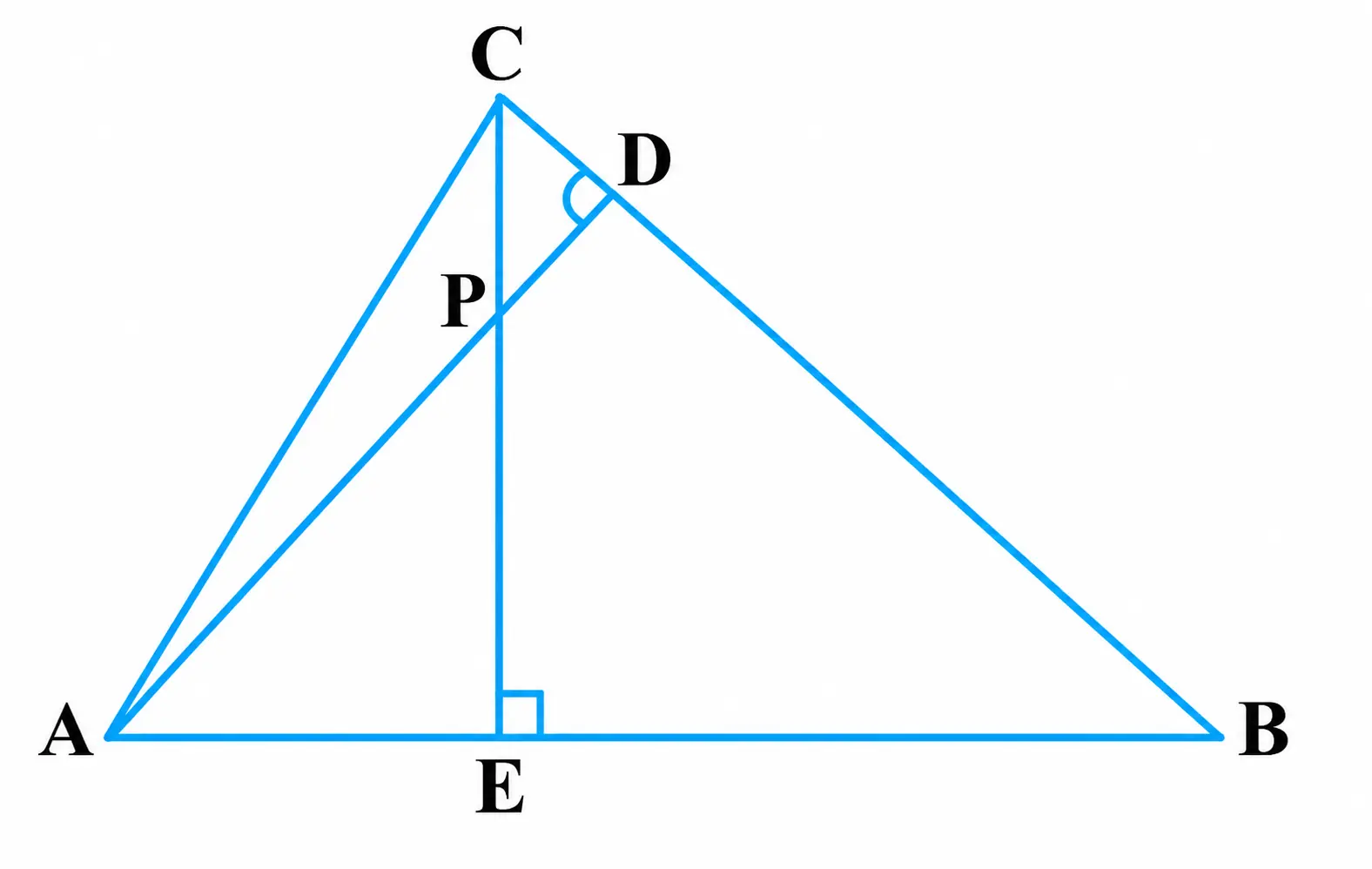
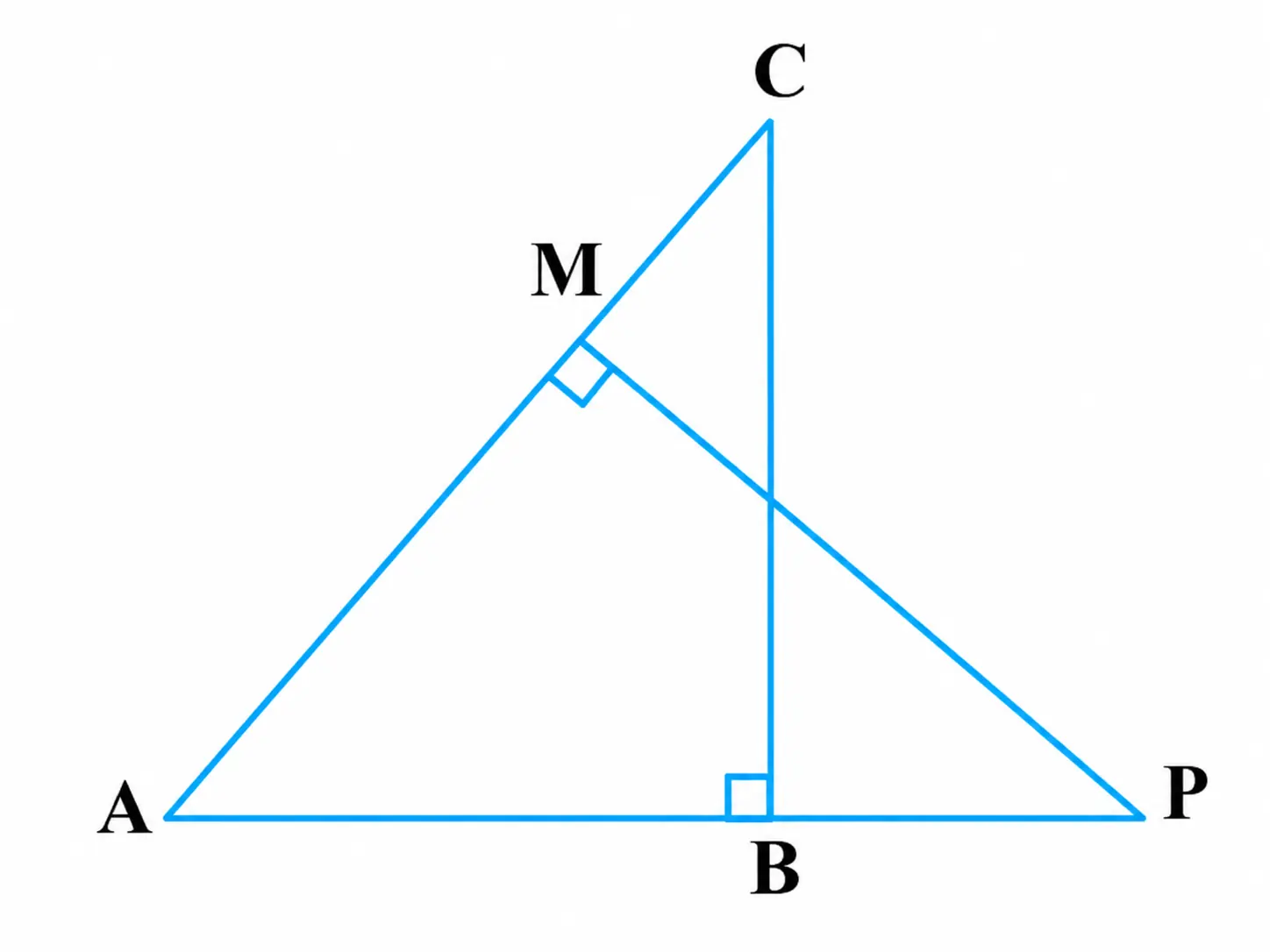
In Fig. 6.38, altitudes AD and CE of $$\triangle \mathrm{ABC}$$ intersect each other at the point P. Show that:
Fig. 6.38
Fig. 6.38

(i) $$\triangle \mathrm{AEP} \sim \triangle \mathrm{CDP}$$

Solution

Since $$CE\perp AB$$ and $$E\in AB,\;P\in CE$$, the sides $$AE$$ and $$EP$$ are perpendicular.
Therefore $$\angle AEP = 90^{\circ}$$.

Because $$AD\perp BC$$ and $$D\in BC,\;P\in AD$$, the sides $$DP$$ and $$DC$$ are perpendicular.
Hence $$\angle CDP = 90^{\circ}$$.

At $$P$$ the two altitudes $$AD$$ and $$CE$$ meet, so the angle between them is the same in either triangle:
$$\angle APE = \angle CPD$$ (both are the angle between $$AD$$ and $$CE$$).

Thus we have two equal pairs of angles
$$\angle AEP = \angle CDP = 90^{\circ},\qquad \angle APE = \angle CPD.$$
By the AA similarity criterion, $$\triangle AEP \sim \triangle CDP$$.

Answer

$$\triangle AEP \sim \triangle CDP$$  (proved)

(ii) $$\triangle \mathrm{ABD} \sim \triangle \mathrm{CBE}$$

Solution

Altitude $$AD$$ gives $$AD\perp BC\;\Rightarrow\;\angle ADB = 90^{\circ}$$.
Altitude $$CE$$ gives $$CE\perp AB\;\Rightarrow\;\angle CEB = 90^{\circ}$$.

At vertex $$B$$ we have
$$\angle ABD = \angle CBE = \angle ABC$$ (common angle of $$\triangle ABC$$).

Hence the two triangles possess two equal angles:
$$\angle ADB = \angle CEB = 90^{\circ},\qquad \angle ABD = \angle CBE.$$
Therefore $$\triangle ABD \sim \triangle CBE$$ by AA similarity.

Answer

$$\triangle ABD \sim \triangle CBE$$  (proved)

(iii) $$\triangle \mathrm{AEP} \sim \triangle \mathrm{ADB}$$

Solution

From part (i), $$\angle AEP = 90^{\circ}$$. Also, $$AD\perp BC\;\Rightarrow\;\angle ADB = 90^{\circ}$$.

At vertex $$A$$ the angle between $$AD$$ and $$AB$$ is common:
$$\angle PAE = \angle DAB.$$

Thus
$$\angle AEP = \angle ADB = 90^{\circ},\qquad \angle PAE = \angle DAB.$$ Consequently, $$\triangle AEP \sim \triangle ADB$$ (AA criterion).

Answer

$$\triangle AEP \sim \triangle ADB$$  (proved)

(iv) $$\triangle \mathrm{PDC} \sim \triangle \mathrm{BEC}$$

Solution

We already know $$\angle CDP = 90^{\circ}$$ (from part (i)) and $$CE\perp AB\;\Rightarrow\;\angle CEB = 90^{\circ}$$.

At vertex $$C$$ the angle between $$CE$$ and $$CB$$ is common to both triangles:
$$\angle PCD = \angle BCE.$$

Therefore the two triangles have
$$\angle CDP = \angle CEB = 90^{\circ},\qquad \angle PCD = \angle BCE.$$
Hence $$\triangle PDC \sim \triangle BEC$$ by the AA similarity criterion.

Answer

$$\triangle PDC \sim \triangle BEC$$  (proved)

8 E is a point on the side AD produced of a parallelogram ABCD and BE intersects CD at F. Show that $$\triangle \mathrm{ABE} \sim \triangle \mathrm{CFB}$$.

Solution

Given: ABCD is a parallelogram. Side $$AD$$ is produced to point $$E$$, so $$A, D, E$$ are collinear. The line $$BE$$ meets $$CD$$ at $$F$$.

To prove: $$\triangle ABE \sim \triangle CFB$$.

  1. Opposite sides of a parallelogram are parallel
    $$AB \parallel CD \quad\text{and}\quad AD \parallel BC.$$
  2. Collinear points from the construction
    $$A, D, E$$ are collinear, $$B, F, E$$ are collinear, $$C, D, F$$ are collinear.
  3. First pair of equal angles
    In $$\triangle ABE$$ consider $$\angle ABE$$ formed by $$BA$$ and $$BE$$.
    Since $$CF$$ lies on $$CD$$ and $$CD \parallel AB$$, we have $$CF \parallel AB$$.
    Also $$BF$$ is the same line as $$BE$$.
    Therefore $$\angle ABE = \angle CFB.$$
  4. Second pair of equal angles
    In $$\triangle ABE$$ consider $$\angle AEB$$ formed by $$EA$$ and $$EB$$.
    Because $$EA$$ is the extension of $$AD$$ and $$AD \parallel BC$$, we get $$EA \parallel BC$$.
    Again $$EB$$ contains $$BF$$.
    Hence $$\angle AEB = \angle CBF.$$
  5. Similarity criterion
    The two pairs of equal angles give
    $$\angle ABE = \angle CFB \quad\text{and}\quad \angle AEB = \angle CBF.$$
    Thus $$\triangle ABE \sim \triangle CFB$$ by the AA similarity criterion.

Hence proved.

Answer

Proved.

9

In Fig. 6.39, ABC and AMP are two right triangles, right angled at B and M respectively. Prove that:
Fig. 6.39
Fig. 6.39

(i) $$\triangle \mathrm{ABC} \sim \triangle \mathrm{AMP}$$

Solution

Given: In the figure, $$\triangle ABC$$ is right-angled at $$B$$ and $$\triangle AMP$$ is right-angled at $$M$$.

To prove: $$\triangle ABC \sim \triangle AMP$$.

Proof

  1. $$\angle ABC = 90^\circ$$    (given)
  2. $$\angle AMP = 90^\circ$$    (given)
  3. $$\angle BAC$$ and $$\angle PAM$$ are the same angle at vertex $$A$$, so
    $$\angle BAC = \angle PAM$$.

Thus the two triangles have two pairs of equal angles:

  • $$\angle ABC = \angle AMP$$
  • $$\angle BAC = \angle PAM$$

By the AA similarity criterion, the triangles are similar:

$$\triangle ABC \sim \triangle AMP$$.

Answer

Proved – $$\triangle ABC \sim \triangle AMP$$.

(ii) $$\dfrac{\mathrm{CA}}{\mathrm{PA}} = \dfrac{\mathrm{BC}}{\mathrm{MP}}$$

Solution

From part (i) we have $$\triangle ABC \sim \triangle AMP$$.

For similar triangles, the ratios of corresponding sides are equal. Matching the vertices so that equal angles correspond (A with A, B with M, C with P) we get

$$\frac{AB}{AM} = \frac{BC}{MP} = \frac{AC}{AP}.$$

Selecting the last two fractions gives the required relation:

$$\frac{CA}{PA} = \frac{BC}{MP}.$$

Hence proved.

Answer

$$\dfrac{CA}{PA}=\dfrac{BC}{MP}$$

10 CD and GH are respectively the bisectors of $$\angle \mathrm{ACB}$$ and $$\angle \mathrm{EGF}$$ such that D and H lie on sides AB and FE of $$\triangle \mathrm{ABC}$$ and $$\triangle \mathrm{EFG}$$ respectively. If $$\triangle \mathrm{ABC} \sim \triangle \mathrm{FEG}$$, show that:

(i) $$\dfrac{\mathrm{CD}}{\mathrm{GH}} = \dfrac{\mathrm{AC}}{\mathrm{FG}}$$

Solution

To prove: $$\dfrac{\mathrm{CD}}{\mathrm{GH}} = \dfrac{\mathrm{AC}}{\mathrm{FG}}$$.

The idea is to show that the smaller triangles $$\triangle ACD$$ and $$\triangle FGH$$ are similar; the required ratio is then just a ratio of their corresponding sides.

Step 1 — equal angles from the given similarity.

Since $$\triangle ABC \sim \triangle FEG$$, corresponding angles are equal. In particular,

  • $$\angle BAC = \angle EFG$$,
  • $$\angle ACB = \angle FGE$$.

Step 2 — the bisectors halve the equal angles at $$\mathrm{C}$$ and $$\mathrm{G}$$.

$$\mathrm{CD}$$ bisects $$\angle ACB$$, so $$\angle ACD = \tfrac{1}{2}\angle ACB$$. Similarly $$\mathrm{GH}$$ bisects $$\angle FGE$$, so $$\angle FGH = \tfrac{1}{2}\angle FGE$$. Halving the two equal angles obtained in Step 1 gives

$$\angle ACD = \angle FGH. \qquad (1)$$

Step 3 — a second pair of equal angles at $$\mathrm{A}$$ and $$\mathrm{F}$$.

Point $$\mathrm{D}$$ lies on segment $$\overline{AB}$$, so the ray $$\overline{AD}$$ is the same as the ray $$\overline{AB}$$, and hence

$$\angle DAC = \angle BAC.$$

Similarly, point $$\mathrm{H}$$ lies on segment $$\overline{FE}$$, so $$\overline{FH}$$ is the same as $$\overline{FE}$$, and

$$\angle HFG = \angle EFG.$$

Combining these with $$\angle BAC = \angle EFG$$ from Step 1,

$$\angle DAC = \angle HFG. \qquad (2)$$

Step 4 — AA similarity for the smaller triangles.

From (1) and (2), in $$\triangle ACD$$ and $$\triangle FGH$$ two pairs of corresponding angles are equal, so by the AA similarity criterion

$$\triangle ACD \sim \triangle FGH.$$

Step 5 — conclude.

Corresponding sides of similar triangles are proportional. Reading off the sides opposite to the equal angles in the correspondence $$A\leftrightarrow F,\;C\leftrightarrow G,\;D\leftrightarrow H$$,

$$\dfrac{CD}{GH} = \dfrac{AC}{FG},$$

which is exactly what had to be proved.

Answer

Proved: $$\dfrac{\mathrm{CD}}{\mathrm{GH}} = \dfrac{\mathrm{AC}}{\mathrm{FG}}$$.

(ii) $$\triangle \mathrm{DCB} \sim \triangle \mathrm{HGE}$$

Solution

To prove : $$\triangle \mathrm{DCB} \sim \triangle \mathrm{HGE}$$

Step 1 – identify a pair of equal angles produced by the two bisectors.

  • In $$\triangle ABC$$, $$\mathrm{CD}$$ bisects $$\angle ACB$$, so $$\angle DCB = \dfrac{1}{2}\angle ACB$$.
  • In $$\triangle FEG$$, $$\mathrm{GH}$$ bisects $$\angle EGF$$, so $$\angle HGE = \dfrac{1}{2}\angle EGF$$.

Because $$\triangle ABC \sim \triangle FEG$$, corresponding angles are equal; in particular

$$\angle ACB = \angle EGF.$$ Therefore

$$\angle DCB = \angle HGE.\;\;\;(i)$$

Step 2 – find a second pair of equal angles.

  • Point $$\mathrm{D}$$ lies on $$\overline{AB}$$, so $$\angle DBC$$ equals the whole angle $$\angle ABC$$ (both are formed by the arms $$\overline{BA}$$ and $$\overline{BC}$$).
  • Point $$\mathrm{H}$$ lies on $$\overline{FE}$$, so $$\angle HEG$$ equals $$\angle FEG$$ (both are formed by the arms $$\overline{EF}$$ and $$\overline{EG}$$).

Again, from the similarity of the big triangles, $$\angle ABC = \angle FEG$$. Hence

$$\angle DBC = \angle HEG.\;\;\;(ii)$$

Step 3 – apply the AA (Angle–Angle) similarity criterion.

From (i) and (ii), the two smaller triangles have two pairs of equal angles, so

$$\triangle DCB \sim \triangle HGE \quad \big(\text{AA criterion}\big).$$

Step 4 – write the useful proportionalities.

Corresponding sides are now in the same ratio:

$$\dfrac{\mathrm{DC}}{\mathrm{HG}} = \dfrac{\mathrm{CB}}{\mathrm{GE}} = \dfrac{\mathrm{DB}}{\mathrm{HE}}.$$

Answer

Similarity proved: $$\triangle \mathrm{DCB} \sim \triangle \mathrm{HGE}$$.

(iii) $$\triangle \mathrm{DCA} \sim \triangle \mathrm{HGF}$$

Solution

To prove : $$\triangle \mathrm{DCA} \sim \triangle \mathrm{HGF}$$

Step 1 – find one pair of equal angles arising from the bisectors.

  • Because $$\mathrm{CD}$$ bisects $$\angle ACB$$, $$\angle DCA = \dfrac{1}{2}\angle ACB$$.
  • Because $$\mathrm{GH}$$ bisects $$\angle EGF$$, $$\angle HGF = \dfrac{1}{2}\angle EGF$$.

Since $$\triangle ABC \sim \triangle FEG$$ gives $$\angle ACB = \angle EGF$$, taking half of each side produces

$$\angle DCA = \angle HGF.\;\;\;(i)$$

Step 2 – obtain a second pair of equal angles.

  • Point $$\mathrm{D}$$ lies on $$\overline{AB}$$, so $$\angle DAC$$ is the same as the whole angle $$\angle CAB$$ (arms $$\overline{AC}$$ and $$\overline{AB}$$).
  • Point $$\mathrm{H}$$ lies on $$\overline{FE}$$, so $$\angle HFG$$ equals the whole angle $$\angle EFG$$ (arms $$\overline{FG}$$ and $$\overline{FE}$$).

The similarity $$\triangle ABC \sim \triangle FEG$$ also gives $$\angle CAB = \angle EFG$$. Hence

$$\angle DAC = \angle HFG.\;\;\;(ii)$$

Step 3 – apply AA similarity.

By (i) and (ii) two angles match, therefore

$$\triangle DCA \sim \triangle HGF.$$

Step 4 – state the proportionalities obtained.

Corresponding sides are proportional, giving in particular

$$\dfrac{\mathrm{DC}}{\mathrm{HG}} = \dfrac{\mathrm{AC}}{\mathrm{FG}} = \dfrac{\mathrm{DA}}{\mathrm{HF}}.$$

Answer

Similarity proved: $$\triangle \mathrm{DCA} \sim \triangle \mathrm{HGF}$$.

11

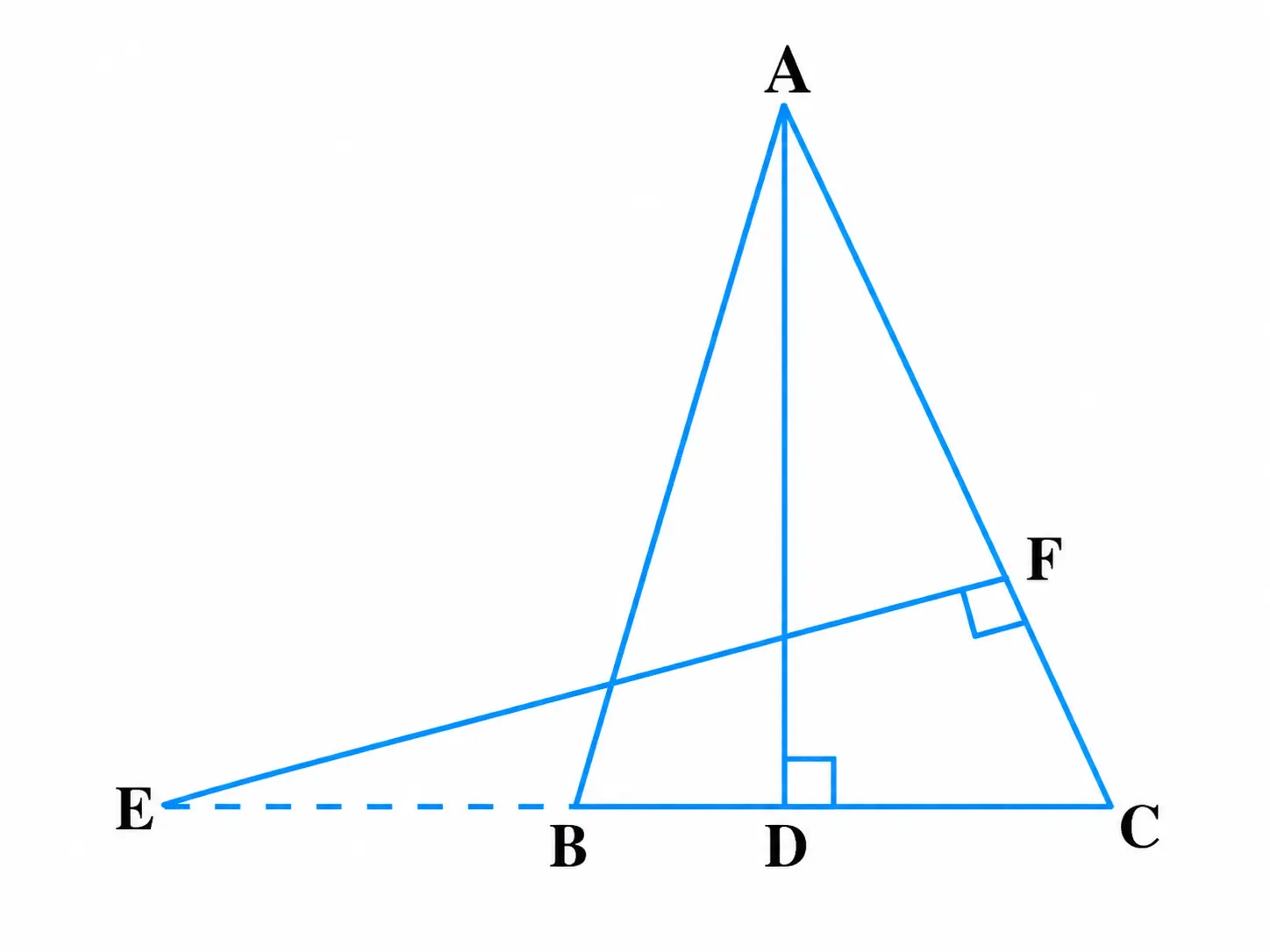
In Fig. 6.40, E is a point on side CB produced of an isosceles triangle ABC with $$\mathrm{AB} = \mathrm{AC}$$. If $$\mathrm{AD} \perp \mathrm{BC}$$ and $$\mathrm{EF} \perp \mathrm{AC}$$, prove that $$\triangle \mathrm{ABD} \sim \triangle \mathrm{ECF}$$.
Fig. 6.40
Fig. 6.40

Solution

Given : In $$\triangle ABC$$, $$AB = AC$$ (so it is isosceles with base $$BC$$). The side $$CB$$ is produced beyond $$B$$ to a point $$E$$. $$AD \perp BC$$ with foot $$D$$ on $$BC$$ and $$EF \perp AC$$ with foot $$F$$ on $$AC$$.

To prove : $$\triangle ABD \sim \triangle ECF$$.

Proof :

  1. Since $$AD \perp BC$$ and $$EF \perp AC$$,
    • $$\angle ADB = 90^\circ$$,
    • $$\angle EFC = 90^\circ$$.
    Therefore $$\angle ADB = \angle EFC$$.   …(1)
  2. Because $$AB = AC$$, base angles of an isosceles triangle are equal: $$\angle ABC = \angle BCA$$.   …(2)
  3. Relating the required angles to those in step (2):
    • Point $$D$$ lies on $$BC$$, so $$BD$$ is the same line as $$BC$$. Hence $$\angle ABD$$ (between $$AB$$ and $$BD$$) equals $$\angle ABC$$ (between $$AB$$ and $$BC$$):
      $$\angle ABD = \angle ABC$$.   …(3)
    • Points $$C, B, E$$ are collinear, so $$CE$$ is the same line as $$CB$$, and $$F$$ lies on $$AC$$, so $$CF$$ is the same line as $$CA$$. Thus $$\angle ECF$$ (between $$CE$$ and $$CF$$) equals $$\angle BCA$$ (between $$CB$$ and $$CA$$):
      $$\angle ECF = \angle BCA$$.   …(4)
    From (2), (3) and (4) we get $$\angle ABD = \angle ECF$$.   …(5)
  4. From (1) and (5) two corresponding angles of $$\triangle ABD$$ and $$\triangle ECF$$ are equal. Hence, by the AA similarity criterion, $$\triangle ABD \sim \triangle ECF$$.

Result : $$\triangle ABD \sim \triangle ECF$$ is proved.

Answer

Proved.

12

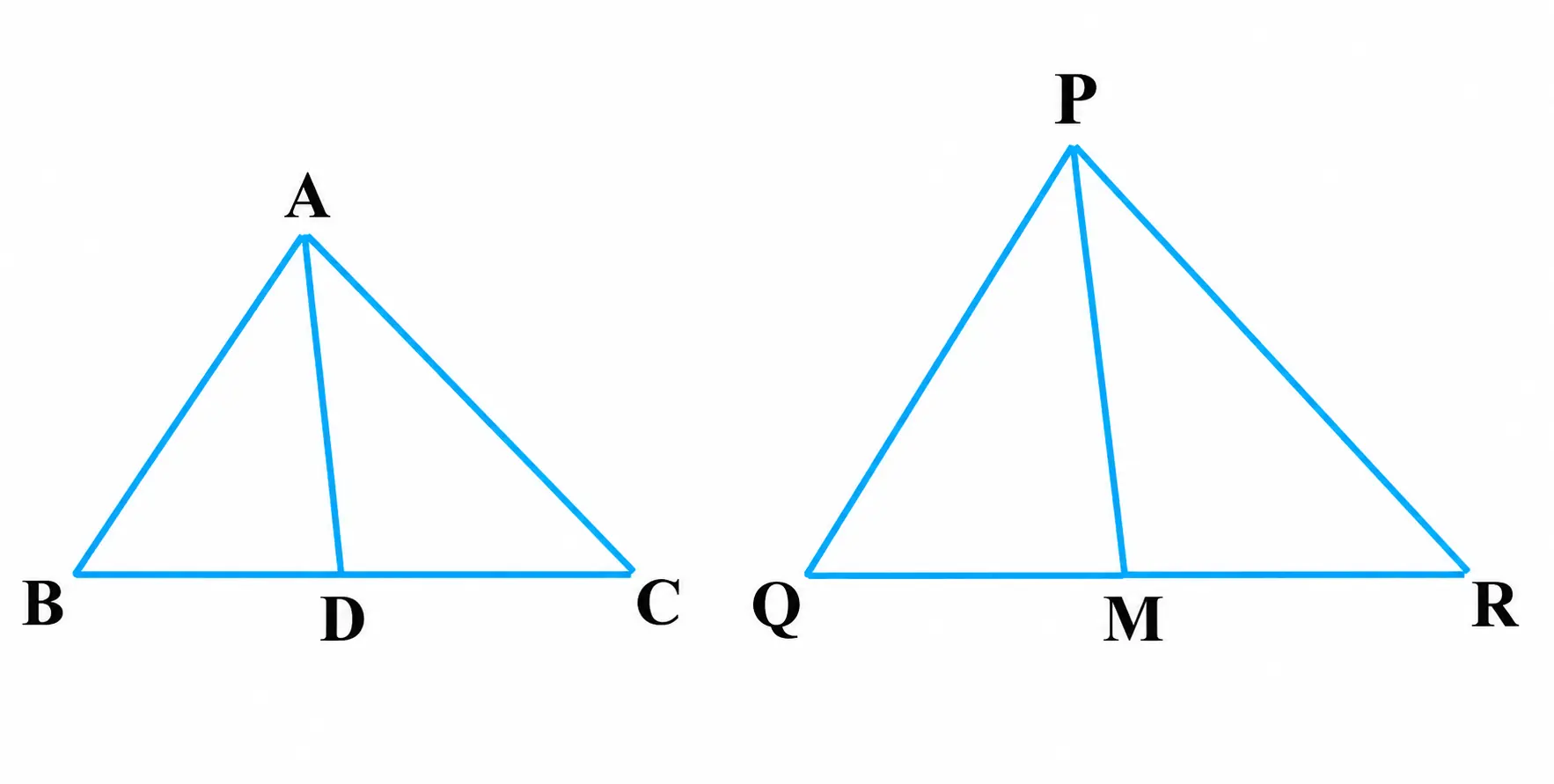
Sides AB and BC and median AD of a triangle ABC are respectively proportional to sides PQ and QR and median PM of $$\triangle \mathrm{PQR}$$ (see Fig. 6.41). Show that $$\triangle \mathrm{ABC} \sim \triangle \mathrm{PQR}$$.
Fig. 6.41
Fig. 6.41

Solution

Given : In $$\triangle ABC$$ and $$\triangle PQR$$,

$$\dfrac{AB}{PQ}=\dfrac{BC}{QR}=\dfrac{AD}{PM}\quad(1)$$

where $$AD$$ and $$PM$$ are medians, that is,

  • $$D$$ is the mid-point of $$BC\;\Rightarrow\;BD=DC=\dfrac{BC}{2}$$
  • $$M$$ is the mid-point of $$QR\;\Rightarrow\;QM=MR=\dfrac{QR}{2}$$

Step 1 : Express the common ratio.

Let $$\dfrac{AB}{PQ}=\dfrac{BC}{QR}=\dfrac{AD}{PM}=k$$. Then

$$AB=k\,PQ,\qquad BC=k\,QR,\qquad AD=k\,PM$$

Step 2 : Obtain the ratio of the half sides.

Using the equality of the halves,

$$\dfrac{BD}{QM}=\dfrac{\dfrac{BC}{2}}{\dfrac{QR}{2}}=\dfrac{BC}{QR}=k\quad(2)$$

Step 3 : Prove $$\triangle ABD\sim\triangle PQM$$.

In $$\triangle ABD$$ and $$\triangle PQM$$, from (1) and (2)

$$\dfrac{AB}{PQ}=\dfrac{BD}{QM}=\dfrac{AD}{PM}=k$$

Thus the three pairs of corresponding sides are proportional; hence

$$\triangle ABD\sim\triangle PQM\;\;(\text{SSS similarity})$$

Step 4 : Deduce an equality of angles of the big triangles.

Similarity gives a correspondence $$\angle ABD=\angle PQM$$. Because $$D$$ lies on $$BC$$, the ray $$BD$$ coincides with $$BC$$, so $$\angle ABD=\angle ABC$$. Likewise, since $$M$$ lies on $$QR$$, the ray $$QM$$ coincides with $$QR$$, so $$\angle PQM=\angle PQR$$. Therefore

$$\angle ABC=\angle PQR\quad(3)$$

Step 5 : Apply the SAS similarity criterion to $$\triangle ABC$$ and $$\triangle PQR$$.

We now have

  • $$\dfrac{AB}{PQ}=\dfrac{BC}{QR}$$ (from (1)), and
  • the included angle $$\angle ABC=\angle PQR$$ (from (3)).

Hence, by the SAS criterion,

$$\triangle ABC\sim\triangle PQR$$

Result : The two triangles are similar as required.

Answer

Proved: $$\triangle ABC \sim \triangle PQR$$.

13 D is a point on the side BC of a triangle ABC such that $$\angle \mathrm{ADC} = \angle \mathrm{BAC}$$. Show that $$\mathrm{CA}^2 = \mathrm{CB} \cdot \mathrm{CD}$$.

Solution

Given: In $$\triangle ABC$$, point $$D$$ lies on $$BC$$ such that $$\angle ADC = \angle BAC$$.

To prove: $$CA^{2} = CB \cdot CD$$.

Proof:

  1. Since $$D$$ is on $$BC$$, the rays $$CD$$ and $$CB$$ are the same straight line. Therefore $$\angle ACD = \angle BCA$$.
  2. In $$\triangle ADC$$ and $$\triangle BCA$$:
    • $$\angle ADC = \angle BAC$$ (given)
    • $$\angle ACD = \angle BCA$$ (proved above)
    By the AA similarity criterion, $$\triangle ADC \sim \triangle BCA$$.
  3. Corresponding sides of similar triangles are proportional, so $$\dfrac{AC}{BC} = \dfrac{CD}{AC} = \dfrac{AD}{BA}$$.
  4. Using the first two ratios: $$\dfrac{AC}{BC} = \dfrac{CD}{AC} \;\Rightarrow\; AC^{2} = BC \cdot CD$$.

Hence, $$CA^{2} = CB \cdot CD$$ is proved.

Answer

Proved.

14 Sides AB and AC and median AD of a triangle ABC are respectively proportional to sides PQ and PR and median PM of another triangle PQR. Show that $$\triangle \mathrm{ABC} \sim \triangle \mathrm{PQR}$$.

Solution

Given

  • AB, AC and the median AD of $$\triangle ABC$$ 
  • PQ, PR and the median PM of $$\triangle PQR$$

are such that

$$ \dfrac{AB}{PQ}=\dfrac{AC}{PR}=\dfrac{AD}{PM}. $$

Let the common ratio be $$k$$, so that

$$ AB=k\,PQ,\; AC=k\,PR,\; AD=k\,PM. $$

Step 1 : Use the median-length (Apollonius) theorem

For any triangle, the sum of the squares of two sides is twice the sum of the squares of the median to the third side and half of that third side. Thus

for $$\triangle ABC$$ (D is the mid-point of BC)

$$ AB^{2}+AC^{2}=2\bigl(AD^{2}+BD^{2}\bigr), $$

and for $$\triangle PQR$$ (M is the mid-point of QR)

$$ PQ^{2}+PR^{2}=2\bigl(PM^{2}+QM^{2}\bigr). $$

Step 2 : Substitute the proportional relations

Replacing AB, AC and AD by $$k$$-multiples of PQ, PR and PM gives

$$ (kPQ)^{2}+(kPR)^{2}=2\Bigl((kPM)^{2}+BD^{2}\Bigr). $$

Simplifying,

$$ k^{2}\bigl(PQ^{2}+PR^{2}\bigr)=2\bigl(k^{2}PM^{2}+BD^{2}\bigr). $$

Divide by $$k^{2}$$ :

$$ PQ^{2}+PR^{2}=2\Bigl(PM^{2}+\dfrac{BD^{2}}{k^{2}}\Bigr). $$

But the right-hand member is exactly the Apollonius expression for $$\triangle PQR$$, so we also have

$$ PQ^{2}+PR^{2}=2\bigl(PM^{2}+QM^{2}\bigr). $$

Equating the two right–hand sides:

$$ PM^{2}+\dfrac{BD^{2}}{k^{2}}=PM^{2}+QM^{2}\;\;\Longrightarrow\;\;\dfrac{BD^{2}}{k^{2}}=QM^{2}. $$

Hence

$$ BD=k\,QM \quad(\text{all lengths positive}). $$

Step 3 : Obtain the remaining side ratio

Since D and M are mid-points,

$$ BC=2BD \quad\text{and}\quad QR=2QM. $$

Therefore

$$ \dfrac{BC}{QR}=\dfrac{2BD}{2QM}=\dfrac{BD}{QM}=k. $$

Step 4 : Conclude similarity

We now have

$$ \dfrac{AB}{PQ}=\dfrac{AC}{PR}=\dfrac{BC}{QR}=k. $$

All three pairs of corresponding sides are proportional, so by the SSS similarity criterion

$$ \triangle ABC \sim \triangle PQR. $$

Hence proved.

Answer

Proved.

15 A vertical pole of length 6 m casts a shadow 4 m long on the ground and at the same time a tower casts a shadow 28 m long. Find the height of the tower.

Solution

Let a vertical pole $$AB$$ of length $$6\,\text{m}$$ stand on level ground. At the same instant, it casts a shadow $$BC = 4\,\text{m}$$.

Let a tower $$DE$$ of unknown height stand on the same ground and cast a shadow $$EF = 28\,\text{m}$$ at that instant.

The Sun’s rays are parallel, so the angle of elevation of the Sun is the same for both objects. Hence the two right-angled triangles are similar:

  • $$\triangle ABC$$ (pole)
  • $$\triangle DEF$$ (tower)

By similarity, the ratio of the corresponding sides is equal:

$$\frac{AB}{BC} = \frac{DE}{EF}$$

Substituting the known lengths:

$$\frac{6}{4} = \frac{DE}{28}$$

Solving for $$DE$$:

$$DE = \frac{6}{4} \times 28 = 6 \times 7 = 42$$

Therefore, the height of the tower is $$42\,\text{m}$$.

Answer

$$42\,\text{m}$$

16 If AD and PM are medians of triangles ABC and PQR, respectively where $$\triangle \mathrm{ABC} \sim \triangle \mathrm{PQR}$$, prove that $$\dfrac{\mathrm{AB}}{\mathrm{PQ}} = \dfrac{\mathrm{AD}}{\mathrm{PM}}$$.

Solution

Given: $$\triangle ABC \sim \triangle PQR$$ and $$AD,\; PM$$ are medians, i.e. $$D$$ is the midpoint of $$BC$$ and $$M$$ is the midpoint of $$QR$$.

To prove: $$\dfrac{AB}{PQ}=\dfrac{AD}{PM}$$.

Proof

  1. Because $$\triangle ABC \sim \triangle PQR$$ (given), their corresponding sides are proportional:
    $$\dfrac{AB}{PQ}=\dfrac{BC}{QR}=\dfrac{AC}{PR}\;\;(1)$$
    In particular we have
    $$\dfrac{AB}{PQ}=\dfrac{BC}{QR}.$$

  2. Since $$D$$ and $$M$$ are midpoints,
    $$BD=\dfrac{1}{2}BC \quad\text{and}\quad QM=\dfrac{1}{2}QR.$$
    Divide the two equalities to obtain
    $$\dfrac{BD}{QM}=\dfrac{\tfrac12 BC}{\tfrac12 QR}=\dfrac{BC}{QR}.\;\;(2)$$

  3. Combining (1) and (2):
    $$\dfrac{AB}{PQ}=\dfrac{BC}{QR}=\dfrac{BD}{QM}.\;\;(3)$$

  4. Included angles are equal:
    Because the whole triangles are similar, $$\angle B=\angle Q$$. The angle between $$AB$$ and $$BD$$ is therefore equal to the angle between $$PQ$$ and $$QM$$:
    $$\angle ABD = \angle PQM.\;\;(4)$$

  5. Similarity of triangles $$\triangle ABD$$ and $$\triangle PQM$$:
    • From (3) two pairs of corresponding sides are proportional: $$AB/PQ = BD/QM$;
    • From (4) the included angles are equal.
    Hence, by the SAS similarity criterion,
    $$\triangle ABD \sim \triangle PQM.$$

  6. Corresponding sides in similar triangles are proportional:
    From $$\triangle ABD \sim \triangle PQM$$ we get
    $$\dfrac{AB}{PQ}=\dfrac{AD}{PM}.\;\;(5)$$

Equation (5) is exactly the required result, so the statement is proved.

Answer

Proved.

NCERT Solutions for Class 10
Maths
NCERT Solutions for Class 10 Maths
Chapter-wise step-by-step
solutions with explanations
explore solutions Maths bg
Science
NCERT Solutions for Class 10 Science
Chapter-wise step-by-step
solutions with explanations
explore solutions Science bg

Frequently Asked Questions

50,000+ JEE Students Trusted Our Score Calculator

Predict your JEE Main percentile, rank & performance in seconds