Join WhatsApp Icon JEE WhatsApp Group
NCERT Solutions for Class 10 Maths

Chapter 3: Pair of Linear Equations in Two Variables

Download Solutions PDF
Daily JEE Updates, Tips & Important Alerts
Join 30,000+ students and stay updated with JEE notifications and preparation insights.
Join Now!
Free PDF
Complete NCERT Solution PDF for Chapter 3: Pair of Linear Equations in Two Variables

NCERT Solutions For Class 10 Maths Chapter 3 Pair of Linear Equations in Two Variables helps students understand equations involving two variables and different methods used to find their solutions. The page provides detailed NCERT Solutions that explain graphical methods, substitution method, elimination method, and cross multiplication method. NCERT Solutions For Class 10 Maths help students learn how to solve pairs of equations and interpret their solutions using graphs. The chapter develops algebraic thinking and improves students’ ability to solve real-life problems involving two unknown quantities. These solutions provide clear steps for textbook questions and numerical problems. Students can access the chapter PDF for revision, practice, and board exam preparation. The detailed approach helps learners confidently solve equation-based problems.

Download Solutions PDF

Examples 1-3 (Graphical Method)

Example 1 Check graphically whether the pair of equations $$x + 3y = 6$$ and $$2x - 3y = 12$$ is consistent. If so, solve them graphically.

Solution

The two linear equations are

$$x + 3y = 6 \qquad\text{(1)}$$
$$2x - 3y = 12 \qquad\text{(2)}$$

To examine them graphically we need at least two convenient points (intercepts are the easiest) for each line.

Equation (1) :  $$x + 3y = 6$$

$$x$$$$y$$
0$$\dfrac{6}{3}=2$$
60

Thus draw a straight line through the points $$A(0,2)$$ and $$B(6,0)$$.

Equation (2) :  $$2x - 3y = 12$$

$$x$$$$y$$
0$$\dfrac{-12}{3}=-4$$
60

Draw the second straight line through the points $$C(0,-4)$$ and $$B(6,0)$$.

Graph to be drawn: On a Cartesian plane mark the points above, plot the two straight lines, and extend them so that their intersection is clearly visible. (Use the same scale on both axes.)

Point of intersection

Both lines meet at the common point $$B(6,0)$$. This single point of intersection shows that the pair has exactly one solution.

Therefore the system is consistent and independent, and its graphical solution is

$$ (x,y) = (6,0) $$

Answer

Consistent with the unique solution  $$x = 6,\; y = 0$$

Example 2 Graphically, find whether the following pair of equations has no solution, unique solution or infinitely many solutions: $$5x - 8y + 1 = 0$$ and $$3x - \dfrac{24}{5}y + \dfrac{3}{5} = 0$$.

Solution

Step 1 : Rewrite each equation in the form $$y = mx + c$$

First equation:

$$5x - 8y + 1 = 0 \\[2pt] \Rightarrow -8y = -5x - 1 \\[2pt] \Rightarrow y = \frac{5}{8}x + \frac{1}{8}$$

Second equation:

$$3x - \frac{24}{5}y + \frac{3}{5} = 0 \\[2pt] \Rightarrow -\frac{24}{5}y = -3x - \frac{3}{5} \\[2pt] \Rightarrow y = \frac{5}{24}\left(3x + \frac{3}{5}\right) \\[2pt] \Rightarrow y = \frac{5}{8}x + \frac{1}{8}$$

Both equations reduce to exactly the same slope–intercept form:

$$y = \frac{5}{8}x + \frac{1}{8}$$

Step 2 : Prepare points for graphing

Choose $$x$$Compute $$y = \dfrac{5}{8}x + \dfrac{1}{8}$$
$$0$$$$\dfrac{1}{8}=0.125$$
$$3$$$$\dfrac{5}{8}\times3+\dfrac{1}{8}=\dfrac{16}{8}=2$$

The ordered pairs are $$(0,0.125)$$ and $$(3,2)$$. Any other values of $$x$$ would of course give points on the same line.

Step 3 : Draw the graphs

  • On graph paper mark the points $$(0,0.125)$$ and $$(3,2)$$ and join them with a straight line. Label this line $$5x - 8y + 1 = 0$$.
  • Plot the same two points again and draw the line for $$3x - \dfrac{24}{5}y + \dfrac{3}{5} = 0$$. It coincides exactly with the first line.

Step 4 : Interpret the graph

Since both equations represent the very same straight line, every point on the line satisfies both equations. Thus the two lines coincide.

Conclusion

The pair of linear equations has infinitely many solutions.

Answer

Infinitely many solutions (both equations represent the same straight line).

Example 3 Champa went to a 'Sale' to purchase some pants and skirts. When her friends asked her how many of each she had bought, she answered, "The number of skirts is two less than twice the number of pants purchased. Also, the number of skirts is four less than four times the number of pants purchased". Help her friends to find how many pants and skirts Champa bought.

Solution

Step 1 — Define variables

Let $$x$$ be the number of pants and $$y$$ be the number of skirts Champa bought.

Step 2 — Form the linear equations

  • The number of skirts is two less than twice the number of pants:
    $$y = 2x - 2 \qquad\text{(1)}$$
  • The number of skirts is four less than four times the number of pants:
    $$y = 4x - 4 \qquad\text{(2)}$$

Step 3 — Solve the pair of equations

Equate the right-hand sides of (1) and (2):

$$2x - 2 = 4x - 4$$

Bring like terms together:

$$-2 + 4 = 4x - 2x$$

$$2 = 2x$$

$$x = 1$$

Substitute $$x = 1$$ in equation (1):

$$y = 2(1) - 2 = 0$$

Step 4 — Conclusion

Champa bought $$1$$ pant and $$0$$ skirts.

Answer

Number of pants = $$1$$; Number of skirts = $$0$$.

Exercise 3.1

1 Form the pair of linear equations in the following problems, and find their solutions graphically.

(i) 10 students of Class X took part in a Mathematics quiz. If the number of girls is 4 more than the number of boys, find the number of boys and girls who took part in the quiz.

Solution

Let

  • $$x$$ be the number of boys,
  • $$y$$ be the number of girls.

Two facts are given:

  1. Total students = 10.
    \[x + y = 10 \quad(1)\]
  2. Girls are 4 more than boys.
    \[y = x + 4 \;\Longrightarrow\; x - y = -4 \quad(2)\]

Graphical work

  1. Line (1) : $$x + y = 10$$
    $$x$$$$y$$
    010
    100
    Plot (0,10) and (10,0); join them.
  2. Line (2) : $$x - y = -4$$
    $$x$$$$y$$
    04
    48
    Plot (0,4) and (4,8); join them.

The two straight lines meet at the point $$ (3,7)$$ (read from the graph).

Hence

  • Number of boys $$x = 3$$,
  • Number of girls $$y = 7$$.

Answer

3 boys and 7 girls

(ii) 5 pencils and 7 pens together cost $$\text{₹}\,\, 50$$, whereas 7 pencils and 5 pens together cost $$\text{₹}\,\, 46$$. Find the cost of one pencil and that of one pen.

Solution

Let

  • $$x$$ be the cost (in rupees) of one pencil,
  • $$y$$ be the cost (in rupees) of one pen.

Two purchase statements are given:

  1. 5 pencils + 7 pens cost ₹50.
    \[5x + 7y = 50 \quad(1)\]
  2. 7 pencils + 5 pens cost ₹46.
    \[7x + 5y = 46 \quad(2)\]

Graphical work

  1. Line (1)
    $$x$$$$y$$
    0\dfrac{50}{7}=7.14
    5\dfrac{50-25}{7}=\dfrac{25}{7}=3.57
    Plot these two points and draw the line.
  2. Line (2)
    $$x$$$$y$$
    0\dfrac{46}{5}=9.2
    2\dfrac{46-14}{5}=\dfrac{32}{5}=6.4
    Plot these two points and draw the line.

The two lines intersect at $$ (3,5)$$.

Verification (optional algebra)

Using elimination:

Multiply (1) by 7 and (2) by 5:

$$35x + 49y = 350$$
$$35x + 25y = 230$$

Subtract ⇒ $$24y = 120 \Rightarrow y = 5$$.
Substitute in (1): $$5x + 7(5)=50 \Rightarrow 5x = 15 \Rightarrow x = 3$$.

So the intersection point observed graphically is indeed correct.

Therefore

  • Cost of one pencil = ₹3,
  • Cost of one pen = ₹5.

Answer

Pencil = ₹3, Pen = ₹5

2 On comparing the ratios $$\dfrac{a_1}{a_2}, \dfrac{b_1}{b_2}$$ and $$\dfrac{c_1}{c_2}$$, find out whether the lines representing the following pairs of linear equations intersect at a point, are parallel or coincident:

(i) $$5x - 4y + 8 = 0$$
$$7x + 6y - 9 = 0$$

Solution

General form for each line is $$a_1x + b_1y + c_1 = 0$$ and $$a_2x + b_2y + c_2 = 0$$.

For $$5x - 4y + 8 = 0$$ and $$7x + 6y - 9 = 0$$, compare the coefficients:

$$a_1 = 5, \; b_1 = -4, \; c_1 = 8$$
$$a_2 = 7, \; b_2 = 6, \; c_2 = -9$$

Compute the three ratios:

$$\dfrac{a_1}{a_2} = \dfrac{5}{7}, \qquad \dfrac{b_1}{b_2} = \dfrac{-4}{6}= -\dfrac{2}{3}, \qquad \dfrac{c_1}{c_2} = \dfrac{8}{-9}= -\dfrac{8}{9}$$

Since $$\dfrac{a_1}{a_2} \ne \dfrac{b_1}{b_2}$$, the pair represents intersecting lines (one unique solution).

Answer

The lines intersect at exactly one point.

(ii) $$9x + 3y + 12 = 0$$
$$18x + 6y + 24 = 0$$

Solution

The equations are $$9x + 3y + 12 = 0$$ and $$18x + 6y + 24 = 0$$.

Coefficients:

$$a_1 = 9, \; b_1 = 3, \; c_1 = 12$$
$$a_2 = 18, \; b_2 = 6, \; c_2 = 24$$

Ratios:

$$\dfrac{a_1}{a_2} = \dfrac{9}{18}=\dfrac{1}{2}, \qquad \dfrac{b_1}{b_2}=\dfrac{3}{6}=\dfrac{1}{2}, \qquad \dfrac{c_1}{c_2}=\dfrac{12}{24}=\dfrac{1}{2}$$

All three ratios are equal, i.e. $$\dfrac{a_1}{a_2}=\dfrac{b_1}{b_2}=\dfrac{c_1}{c_2}$$, so the two equations represent coincident lines (infinitely many common points).

Answer

The two lines are coincident.

(iii) $$6x - 3y + 10 = 0$$
$$2x - y + 9 = 0$$

Solution

The equations are $$6x - 3y + 10 = 0$$ and $$2x - y + 9 = 0$$.

Coefficients:

$$a_1 = 6, \; b_1 = -3, \; c_1 = 10$$
$$a_2 = 2, \; b_2 = -1, \; c_2 = 9$$

Ratios:

$$\dfrac{a_1}{a_2}=\dfrac{6}{2}=3, \qquad \dfrac{b_1}{b_2}=\dfrac{-3}{-1}=3, \qquad \dfrac{c_1}{c_2}=\dfrac{10}{9}$$

Here $$\dfrac{a_1}{a_2}=\dfrac{b_1}{b_2}$$ but $$\dfrac{a_1}{a_2} \ne \dfrac{c_1}{c_2}$$, therefore the pair represents parallel lines (no solution).

Answer

The two lines are parallel.

3 On comparing the ratios $$\dfrac{a_1}{a_2}, \dfrac{b_1}{b_2}$$ and $$\dfrac{c_1}{c_2}$$, find out whether the following pair of linear equations are consistent, or inconsistent.

(i) $$3x + 2y = 5$$ ; $$2x - 3y = 7$$

Solution

Write both equations in the form $$a_1x+b_1y+c_1=0$$, $$a_2x+b_2y+c_2=0$$.

Equation 1 : $$3x+2y-5=0 \Rightarrow a_1=3,\;b_1=2,\;c_1=-5$$

Equation 2 : $$2x-3y-7=0 \Rightarrow a_2=2,\;b_2=-3,\;c_2=-7$$

Find the three ratios:

$$\frac{a_1}{a_2}=\frac{3}{2},\qquad \frac{b_1}{b_2}=\frac{2}{-3},\qquad \frac{c_1}{c_2}=\frac{-5}{-7}=\frac57$$

Here $$\dfrac{a_1}{a_2}\neq\dfrac{b_1}{b_2}$$, so the pair has one unique solution.

Hence the given equations are consistent (independent).

Answer

Consistent — unique solution

(ii) $$2x - 3y = 8$$ ; $$4x - 6y = 9$$

Solution

Standard form:

Equation 1 : $$2x-3y-8=0 \Rightarrow a_1=2,\;b_1=-3,\;c_1=-8$$

Equation 2 : $$4x-6y-9=0 \Rightarrow a_2=4,\;b_2=-6,\;c_2=-9$$

Ratios:

$$\frac{a_1}{a_2}=\frac{2}{4}=\frac12,\qquad \frac{b_1}{b_2}=\frac{-3}{-6}=\frac12,\qquad \frac{c_1}{c_2}=\frac{-8}{-9}=\frac89$$

Since $$\dfrac{a_1}{a_2}=\dfrac{b_1}{b_2}\neq\dfrac{c_1}{c_2}$$, the pair has no solution.

Therefore the equations are inconsistent.

Answer

Inconsistent — no solution

(iii) $$\dfrac{3}{2}x + \dfrac{5}{3}y = 7$$ ; $$9x - 10y = 14$$

Solution

Standard form:

Equation 1 : $$\frac32x+\frac53y-7=0 \Rightarrow a_1=\frac32,\;b_1=\frac53,\;c_1=-7$$

Equation 2 : $$9x-10y-14=0 \Rightarrow a_2=9,\;b_2=-10,\;c_2=-14$$

Ratios:

$$\frac{a_1}{a_2}=\frac{\tfrac32}{9}=\frac16,\qquad \frac{b_1}{b_2}=\frac{\tfrac53}{-10}=-\frac16,\qquad \frac{c_1}{c_2}=\frac{-7}{-14}=\frac12$$

Because $$\dfrac{a_1}{a_2}\neq\dfrac{b_1}{b_2}$$, there is exactly one solution.

The pair of equations is consistent (independent).

Answer

Consistent — unique solution

(iv) $$5x - 3y = 11$$ ; $$-10x + 6y = -22$$

Solution

Standard form:

Equation 1 : $$5x-3y-11=0 \Rightarrow a_1=5,\;b_1=-3,\;c_1=-11$$

Equation 2 : $$-10x+6y+22=0 \Rightarrow a_2=-10,\;b_2=6,\;c_2=22$$

Ratios:

$$\frac{a_1}{a_2}=\frac{5}{-10}=-\frac12,\qquad \frac{b_1}{b_2}=\frac{-3}{6}=-\frac12,\qquad \frac{c_1}{c_2}=\frac{-11}{22}=-\frac12$$

Here $$\dfrac{a_1}{a_2}=\dfrac{b_1}{b_2}=\dfrac{c_1}{c_2}$$, so the lines coincide and there are infinitely many solutions.

The equations are consistent (dependent).

Answer

Consistent — infinitely many solutions

(v) $$\dfrac{4}{3}x + 2y = 8$$ ; $$2x + 3y = 12$$

Solution

Standard form:

Equation 1 : $$\frac43x+2y-8=0 \Rightarrow a_1=\frac43,\;b_1=2,\;c_1=-8$$

Equation 2 : $$2x+3y-12=0 \Rightarrow a_2=2,\;b_2=3,\;c_2=-12$$

Ratios:

$$\frac{a_1}{a_2}=\frac{\tfrac43}{2}=\frac23,\qquad \frac{b_1}{b_2}=\frac{2}{3}=\frac23,\qquad \frac{c_1}{c_2}=\frac{-8}{-12}=\frac23$$

Since all three ratios are equal, the two equations represent the same straight line; thus there are infinitely many solutions.

The pair is consistent (dependent).

Answer

Consistent — infinitely many solutions

4 Which of the following pairs of linear equations are consistent/inconsistent? If consistent, obtain the solution graphically:

(i) $$x + y = 5$$, $$2x + 2y = 10$$

Solution

The given equations are

$$x+y=5\qquad\qquad(1)$$
$$2x+2y=10\qquad(2)$$

Write them in the standard form $$ax+by+c=0$$:

$$x+y-5=0\;(a_1=1,\,b_1=1,\,c_1=-5)$$
$$2x+2y-10=0\;(a_2=2,\,b_2=2,\,c_2=-10)$$

Check the ratios of the coefficients:

$$\frac{a_1}{a_2}=\frac{1}{2},\;\frac{b_1}{b_2}=\frac{1}{2},\;\frac{c_1}{c_2}=\frac{-5}{-10}=\frac{1}{2}$$

The three ratios are equal, therefore the two equations represent the same line. The pair is consistent with infinitely many solutions.

Graphical representation
To draw the line, take two convenient points from (1).
• If $$x=0$$, then $$y=5$$ ⇒ point $$(0,5)$$.
• If $$y=0$$, then $$x=5$$ ⇒ point $$(5,0)$$.
Plot these on graph paper and draw a straight line. Equation (2) gives exactly the same line, so both coincide.

Every point on the line $$x+y=5$$ (for example $$(1,4),(2,3),(4,1)\dots)$$ satisfies both equations.

Answer

Consistent (coincident lines); infinitely many solutions — every point that satisfies $$x+y=5$$.

(ii) $$x - y = 8$$, $$3x - 3y = 16$$

Solution

The given equations are

$$x-y=8\qquad\qquad(1)$$
$$3x-3y=16\qquad(2)$$

Convert to standard form:

$$x-y-8=0\;(a_1=1,\,b_1=-1,\,c_1=-8)$$
$$3x-3y-16=0\;(a_2=3,\,b_2=-3,\,c_2=-16)$$

Coefficient ratios:

$$\frac{a_1}{a_2}=\frac{1}{3},\;\frac{b_1}{b_2}=\frac{-1}{-3}=\frac{1}{3},\;\frac{c_1}{c_2}=\frac{-8}{-16}=\frac{1}{2}$$

Since $$\dfrac{a_1}{a_2}=\dfrac{b_1}{b_2}\neq\dfrac{c_1}{c_2}$$, the lines are parallel and distinct. Hence the pair is inconsistent; there is no solution.

Graphical representation

  • Equation (1): if $$x=0$$, $$y=-8$$; if $$y=0$$, $$x=8$$. Draw the line through $$(0,-8)$$ and $$(8,0)$$.
  • Equation (2): divide by 3 ⇒ $$x-y=\frac{16}{3}$$.
     If $$x=0$$ ⇒ $$y=-\tfrac{16}{3}$$; if $$y=0$$ ⇒ $$x=\tfrac{16}{3}$$. Draw the line through these two points.

The two straight lines never meet, confirming the absence of any common solution.

Answer

Inconsistent (parallel lines); no solution.

(iii) $$2x + y - 6 = 0$$, $$4x - 2y - 4 = 0$$

Solution

The equations are

$$2x+y-6=0\qquad\qquad(1)$$
$$4x-2y-4=0\qquad(2)$$

Identify coefficients:

$$a_1=2,\,b_1=1,\,c_1=-6;\qquad a_2=4,\,b_2=-2,\,c_2=-4$$

Coefficient ratios:

$$\frac{a_1}{a_2}=\frac{2}{4}=\frac12,\;\frac{b_1}{b_2}=\frac{1}{-2}=-\frac12$$
Since $$\dfrac{a_1}{a_2}\neq\dfrac{b_1}{b_2}$$, the lines intersect at a single point; the pair is consistent with a unique solution.

Finding the solution algebraically (for exact coordinates)

Rewrite (2) by dividing by 2: $$2x-y=2\qquad(2′)$$

Add (1) and (2′):
$$\bigl(2x+y\bigr)+\bigl(2x-y\bigr)=6+2\;\Rightarrow\;4x=8\;\Rightarrow\;x=2$$
Substitute in (1): $$2(2)+y=6\;\Rightarrow\;y=2$$

Thus the solution is $$(2,2)$$.

Graphical representation

  • Equation (1): if $$x=0$$, $$y=6$$; if $$y=0$$, $$x=3$$. Plot $$(0,6)$$ and $$(3,0)$$ and draw the first line.
  • Equation (2′): if $$x=0$$, $$y=-2$$; if $$y=0$$, $$x=1$$. Plot $$(0,-2)$$ and $$(1,0)$$ and draw the second line.

The two lines intersect exactly at the point $$(2,2)$$, verifying the calculated solution.

Answer

Consistent; unique solution $$x=2,\;y=2$$.

(iv) $$2x - 2y - 2 = 0$$, $$4x - 4y - 5 = 0$$

Solution

The equations are

$$2x-2y-2=0\qquad\qquad(1)$$
$$4x-4y-5=0\qquad(2)$$

Coefficients:

$$a_1=2,\,b_1=-2,\,c_1=-2;\qquad a_2=4,\,b_2=-4,\,c_2=-5$$

Coefficient ratios:

$$\frac{a_1}{a_2}=\frac{2}{4}=\frac12,\;\frac{b_1}{b_2}=\frac{-2}{-4}=\frac12,\;\frac{c_1}{c_2}=\frac{-2}{-5}=\frac25$$

Because $$\dfrac{a_1}{a_2}=\dfrac{b_1}{b_2}\neq\dfrac{c_1}{c_2}$$, the two lines are parallel but distinct. Hence the pair is inconsistent; there is no common solution.

Graphical representation

  • Equation (1): divide by 2 ⇒ $$x-y=1$$. Points: $$(0,-1)$$ and $$(1,0)$$.
  • Equation (2): divide by 4 ⇒ $$x-y=\tfrac54$$. Points: $$(0,-\tfrac54)$$ and $$(\tfrac54,0)$$.

Both are parallel straight lines that never meet, confirming that the system has no solution.

Answer

Inconsistent (parallel lines); no solution.

5 Half the perimeter of a rectangular garden, whose length is 4 m more than its width, is 36 m. Find the dimensions of the garden.

Solution

Step 1 : Introduce variables

Let the width of the rectangular garden be $$w\text{ m}$$.
Because the length is 4 m more than the width, the length is $$l = w + 4\text{ m}$$.

Step 2 : Translate the perimeter condition into an equation

The perimeter of a rectangle is $$2(l + w)$$. Half of the perimeter is therefore $$l + w$$.
According to the statement, this half-perimeter equals 36 m:

$$l + w = 36$$

Step 3 : Form a pair of linear equations

We already have one equation; using the relation between length and width gives a second:

  • $$l - w = 4$$   (since $$l = w + 4$$)
  • $$l + w = 36$$   (half-perimeter)

Step 4 : Solve the simultaneous equations (elimination method)

Add the two equations term by term:

$$ (l - w) + (l + w) = 4 + 36 \;\;\Rightarrow\;\; 2l = 40 $$

Therefore $$ l = 20 $$.

Substitute $$l = 20$$ in $$l + w = 36$$:

$$ 20 + w = 36 \;\;\Rightarrow\;\; w = 16 $$.

Step 5 : Verification

Length $$= 20\text{ m}$$, width $$= 16\text{ m}$$.
Half-perimeter $$= l + w = 20 + 16 = 36\text{ m}$$, which matches the given condition, so the solution is correct.

Conclusion

The rectangular garden is 20 m long and 16 m wide.

Answer

Length = 20 m,  Width = 16 m.

6 Given the linear equation $$2x + 3y - 8 = 0$$, write another linear equation in two variables such that the geometrical representation of the pair so formed is:

(i) intersecting lines

Solution

The given line is $$2x + 3y - 8 = 0$$   … (1)

Let the required second line be $$a_2x + b_2y + c_2 = 0$$   … (2)

For (1) and (2) to represent intersecting lines we need their slopes to be different, i.e.

$$\frac{a_1}{a_2} \neq \frac{b_1}{b_2}$$

Choosing small integral coefficients that violate this equality, take

$$x - y + 1 = 0$$

Here $$a_2 = 1,\; b_2 = -1,\; c_2 = 1$$.

Now $$\frac{a_1}{a_2}=\frac{2}{1}=2$$ while $$\frac{b_1}{b_2}=\frac{3}{-1}=-3$$, clearly $$2\neq -3$$. Hence the two lines intersect at one unique point.

Answer

$$x - y + 1 = 0$$

(ii) parallel lines

Solution

The given line is again (1) $$2x + 3y - 8 = 0$$.

For the second line to be parallel (but not coincident) with (1) we require

$$\frac{a_1}{a_2}=\frac{b_1}{b_2}\quad\text{and}\quad \frac{c_1}{c_2}\neq\frac{a_1}{a_2}$$

Multiplying every coefficient of (1) by 2 would give an identical ratio for $$c$$ as well, so we alter only the constant term:

Choose $$4x + 6y - 9 = 0$$.

Now

$$\frac{a_1}{a_2}=\frac{2}{4}=\tfrac12, \qquad \frac{b_1}{b_2}=\frac{3}{6}=\tfrac12$$

but

$$\frac{c_1}{c_2}=\frac{-8}{-9}=\tfrac89\neq\tfrac12$$.

Because the first two ratios are equal while the third is different, the two lines are parallel and distinct.

Answer

$$4x + 6y - 9 = 0$$

(iii) coincident lines

Solution

For the required line to be coincident with $$2x + 3y - 8 = 0$$ we must have

$$\frac{a_1}{a_2}=\frac{b_1}{b_2}=\frac{c_1}{c_2}$$.

This is achieved simply by multiplying the whole equation by the same non-zero constant, say 2:

$$4x + 6y - 16 = 0$$.

Indeed, $$\frac{2}{4}=\frac{3}{6}=\frac{-8}{-16}=\tfrac12$$, so every ratio is equal and both equations describe the same straight line.

Answer

$$4x + 6y - 16 = 0$$

7

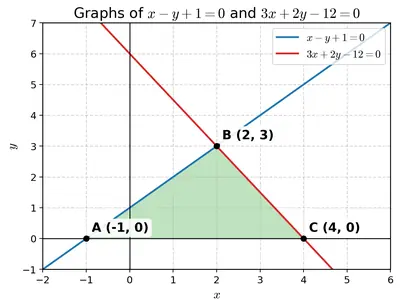
Draw the graphs of the equations $$x - y + 1 = 0$$ and $$3x + 2y - 12 = 0$$. Determine the coordinates of the vertices of the triangle formed by these lines and the $$x$$-axis, and shade the triangular region.
Figure
Figure

Solution

Step 1 : Rewrite each equation in slope–intercept form

For $$x-y+1=0$$, isolate $$y$$:

$$x-y+1=0 \\[2pt] -y=-x-1 \\[2pt] y=x+1$$

For $$3x+2y-12=0$$, isolate $$y$$:

$$3x+2y-12=0 \\[2pt] 2y=12-3x \\[2pt] y=6-\dfrac{3}{2}x$$

Step 2 : Find two convenient points for each line

LineTake $$x$$Compute $$y$$Point
$$y=x+1$$$$x=0$$$$y=1$$$$(0,1)$$
$$x=1$$$$y=2$$$$(1,2)$$
$$y=6-\dfrac{3}{2}x$$$$x=0$$$$y=6$$$$(0,6)$$
$$x=2$$$$y=3$$$$(2,3)$$

Plot each pair of points on graph paper and join them with a straight line to obtain the two required lines.

Step 3 : Locate the intersections with the $$x$$-axis

  • On the first line $$y=x+1$$, put $$y=0$$ (because the $$x$$-axis has $$y=0$$):
    $$0=x+1 \Rightarrow x=-1$$ so the point is $$(-1,0)$$.
  • On the second line $$y=6-\dfrac{3}{2}x$$, put $$y=0$$:
    $$0=6-\dfrac{3}{2}x \Rightarrow \dfrac{3}{2}x=6 \Rightarrow x=4$$, giving the point $$(4,0)$$.

Step 4 : Find the intersection of the two lines

Solve the system
$$y=x+1,\quad y=6-\dfrac{3}{2}x$$

Set the right‐hand sides equal:

$$x+1=6-\dfrac{3}{2}x \\[4pt] x+\dfrac{3}{2}x=6-1 \\[4pt] \dfrac{5}{2}x=5 \Rightarrow x=2$$

Substitute $$x=2$$ in $$y=x+1$$:

$$y=2+1=3$$

Thus the two lines meet at $$ (2,3) $$.

Step 5 : Vertices of the required triangle

The three intersections found give the vertices:

  • With the $$x$$-axis on the first line: $$(-1,0)$$
  • With the $$x$$-axis on the second line: $$(4,0)$$
  • Intersection of the two lines: $$(2,3)$$

Step 6 : Draw and shade

On the same set of axes:

  1. Draw the line through $$(0,1)$$ and $$(1,2)$$ (this is $$y=x+1$$).
  2. Draw the line through $$(0,6)$$ and $$(2,3)$$ (this is $$y=6-\tfrac{3}{2}x$$).
  3. Mark the points $$(-1,0)$$, $$(4,0)$$ and $$(2,3)$$, join them to outline the triangle.
  4. Shade the interior of this triangle.

The shaded triangular region has the required vertices $$(-1,0)$$, $$(4,0)$$ and $$(2,3)$$.

Answer

Vertices of the triangle: $$(-1,0),\;(4,0),\;(2,3).$$

Examples 4-7 (Substitution Method)

Example 4 Solve the following pair of equations by substitution method: $$7x - 15y = 2$$ and $$x + 2y = 3$$.

Solution

We have the simultaneous linear equations

$$7x - 15y = 2 \qquad \text{(1)}$$
$$x + 2y = 3 \qquad \text{(2)}$$

Step 1  (Express one variable in terms of the other)

From equation (2)

$$x + 2y = 3 \;\;\Rightarrow\;\; x = 3 - 2y \qquad \text{(3)}$$

Step 2  (Substitute in the other equation)

Substitute the value of $$x$$ from (3) into equation (1):

$$7(3 - 2y) - 15y = 2$$

$$21 - 14y - 15y = 2$$

$$21 - 29y = 2$$

Step 3  (Solve for $$y$$)

$$-29y = 2 - 21 = -19$$

$$y = \frac{-19}{-29} = \frac{19}{29}$$

Step 4  (Find $$x$$ using equation (3))

$$x = 3 - 2y = 3 - 2 \left( \frac{19}{29} \right)$$

$$x = \frac{87}{29} - \frac{38}{29} = \frac{49}{29}$$

Step 5  (Verification)

Substitute $$x = \dfrac{49}{29}$$ and $$y = \dfrac{19}{29}$$ in equation (1):

$$7\left( \frac{49}{29} \right) - 15\left( \frac{19}{29} \right) = \frac{343 - 285}{29} = \frac{58}{29} = 2$$

Both equations are satisfied, so the solution is correct.

Hence, the required solution is

$$x = \frac{49}{29}, \; y = \frac{19}{29}$$

Answer

$$x = \dfrac{49}{29}, \; y = \dfrac{19}{29}$$

Example 5 Solve the following question—Aftab tells his daughter, "Seven years ago, I was seven times as old as you were then. Also, three years from now, I shall be three times as old as you will be." (Isn't this interesting?) Represent this situation algebraically and graphically by the method of substitution.

Solution

Step 1 : Define the variables

Let
$$x$$ = Aftab’s present age (in years)
$$y$$ = Daughter’s present age (in years)

Step 2 : Translate the first statement

Seven years ago, Aftab’s age was $$x-7$$ and the daughter’s age was $$y-7$$.
The condition “I was seven times as old as you” gives

$$x-7 = 7\bigl(y-7\bigr)$$

Simplify:
$$x-7 = 7y-49\\[4pt] x-7y = -42\\[4pt] \boxed{ \,x-7y=-42\, }$$

Step 3 : Translate the second statement

Three years from now, Aftab’s age will be $$x+3$$ and the daughter’s age will be $$y+3$$.
The condition “I shall be three times as old as you” gives

$$x+3 = 3\bigl(y+3\bigr)$$

Simplify:
$$x+3 = 3y+9\\[4pt] x-3y = 6\\[4pt] \boxed{\,x-3y=6\,}$$

We have the required pair of linear equations

$$x-7y = -42, \qquad x-3y = 6$$

Step 4 : Solve by the method of substitution

From $$x-3y = 6$$ we express $$x$$ in terms of $$y$$:
$$x = 3y + 6$$

Substitute this in the first equation $$x-7y = -42$$:

$$(3y+6) - 7y = -42\\[4pt] -4y + 6 = -42\\[4pt] -4y = -48\\[4pt] y = 12$$

Put $$y=12$$ in $$x = 3y + 6$$:
$$x = 3(12) + 6 = 42$$

Therefore
Aftab’s present age $$= 42$$ years
Daughter’s present age $$= 12$$ years

Step 5 : Graphical representation

Draw the coordinate axes. Each ordered pair $$\bigl(x, y\bigr)$$ represents (Aftab’s age, daughter’s age).

  • For the line $$x-7y=-42$$ choose convenient values:
    $$y$$Compute $$x=7y-42$$
    0$$-42$$
    60
    1242
    Plot any two points such as $$(-42,0)$$ and $$(42,12)$$, then draw the straight line.
  • For the line $$x-3y=6$$ choose convenient values:
    $$y$$Compute $$x=3y+6$$
    06
    624
    1242
    Plot points such as $$(6,0)$$ and $$(42,12)$$, then draw this line.

The two lines intersect at the point $$(42, 12)$$, confirming the solution obtained algebraically.

Thus, the situation is fully represented both algebraically and graphically, and the ages are determined.

Answer

Present ages:
Aftab  = $$42$$ years,
Daughter  = $$12$$ years.

Example 6 In a shop the cost of 2 pencils and 3 erasers is $$\text{₹}\,\, 9$$ and the cost of 4 pencils and 6 erasers is $$\text{₹}\,\, 18$$. Find the cost of each pencil and each eraser.

Solution

Step 1 – Define the variables

Let

  • $$x$$ be the cost (in rupees) of one pencil,
  • $$y$$ be the cost (in rupees) of one eraser.

Step 2 – Translate the statement into linear equations

The information is:

  • 2 pencils + 3 erasers cost $$\text{₹}\,\,9$$  ⇒  $$2x+3y=9$$ … (1)
  • 4 pencils + 6 erasers cost $$\text{₹}\,\,18$$ ⇒ $$4x+6y=18$$ … (2)

Step 3 – Compare the two equations

Divide equation (2) by 2:

$$\dfrac{4x+6y}{2}=\dfrac{18}{2}\;\Longrightarrow\;2x+3y=9$$ … (2′)

Clearly, (2′) is exactly the same as equation (1).
Therefore the two given equations are not independent; they represent the same line in the $$xy$$-plane.

Step 4 – Interpretation

Because both equations are identical, every ordered pair $$(x,y)$$ satisfying $$2x+3y=9$$ is a solution of the system. Hence the system has infinitely many solutions.

Step 5 – Conclusion about the costs

The data provided are not sufficient to obtain unique values of $$x$$ and $$y$$. Any positive pair $$(x,y)$$ for which $$2x+3y=9$$ can serve as the prices of a pencil and an eraser. For example:

  • If $$x=3$$ then $$2(3)+3y=9\;\Longrightarrow\;6+3y=9\;\Longrightarrow\;y=1$$, so one possible pricing is $$\text{₹}\,\,3$$ per pencil and $$\text{₹}\,\,1$$ per eraser.
  • If $$x=\dfrac{9}{2}$$ then $$2\!\left(\dfrac{9}{2}\right)+3y=9\;\Longrightarrow\;9+3y=9\;\Longrightarrow\;y=0$$ (which is unrealistic in a shop).

Thus the cost of each pencil and each eraser cannot be uniquely determined from the given information.

Answer

The two equations coincide, so there are infinitely many solutions; the individual costs cannot be fixed uniquely.

Example 7 Two rails are represented by the equations $$x + 2y - 4 = 0$$ and $$2x + 4y - 12 = 0$$. Will the rails cross each other?

Solution

Step 1 : Write the equations in the standard form

The two equations already are in the form $$a x + b y + c = 0$$:

  • First rail : $$x + 2y - 4 = 0$$   ⟹  $$a_1 = 1,\; b_1 = 2,\; c_1 = -4$$
  • Second rail : $$2x + 4y - 12 = 0$$ ⟹ $$a_2 = 2,\; b_2 = 4,\; c_2 = -12$$

Step 2 : Compare the ratios of the coefficients

$$\frac{a_1}{a_2} = \frac{1}{2},\qquad \frac{b_1}{b_2} = \frac{2}{4} = \frac{1}{2},\qquad \frac{c_1}{c_2} = \frac{-4}{-12} = \frac{1}{3}$$

We observe that

$$\frac{a_1}{a_2} = \frac{b_1}{b_2} \; \text{but} \; \frac{a_1}{a_2} \neq \frac{c_1}{c_2}.$$

Step 3 : Interpretation

If $$\frac{a_1}{a_2} = \frac{b_1}{b_2} \neq \frac{c_1}{c_2},$$ the pair of lines is parallel and distinct. Parallel lines never meet, so there is no common point of intersection.

Alternative check (using slopes)

Slope of a line $$ax + by + c = 0$$ is $$m = -\frac{a}{b}$$.

  • For the first rail: $$m_1 = -\frac{1}{2}$$
  • For the second rail: $$m_2 = -\frac{2}{4} = -\frac{1}{2}$$

Since $$m_1 = m_2,$$ both rails have the same slope, hence are parallel.

Conclusion

The two rails are parallel and therefore will not cross each other.

Answer

The rails are parallel (distinct), so they will never cross.

Exercise 3.2

1 Solve the following pair of linear equations by the substitution method.

(i) $$x + y = 14$$
$$x - y = 4$$

Solution

The equations are

$$x + y = 14 \quad (1)$$

$$x - y = 4 \quad (2)$$

From (1) express $$x$$:

$$x = 14 - y$$

Substitute this in (2):

$$14 - y - y = 4$$

$$14 - 2y = 4$$

$$-2y = -10$$

$$y = 5$$

Put $$y = 5$$ in $$x = 14 - y$$:

$$x = 14 - 5 = 9$$

Hence $$x = 9,\; y = 5$$.

Answer

$$x = 9,\; y = 5$$

(ii) $$s - t = 3$$
$$\dfrac{s}{3} + \dfrac{t}{2} = 6$$

Solution

The equations are

$$s - t = 3 \quad (1)$$

$$\dfrac{s}{3} + \dfrac{t}{2} = 6 \quad (2)$$

From (1): $$s = t + 3$$.

Substitute in (2):

$$\dfrac{t + 3}{3} + \dfrac{t}{2} = 6$$

Take LCM 6:

$$\dfrac{2(t + 3) + 3t}{6} = 6$$

$$5t + 6 = 36$$

$$5t = 30$$

$$t = 6$$

Then $$s = t + 3 = 9$$.

Thus $$s = 9,\; t = 6$$.

Answer

$$s = 9,\; t = 6$$

(iii) $$3x - y = 3$$
$$9x - 3y = 9$$

Solution

The equations are

$$3x - y = 3 \quad (1)$$

$$9x - 3y = 9 \quad (2)$$

From (1): $$y = 3x - 3$$.

Substitute in (2):

$$9x - 3(3x - 3) = 9$$

$$9x - 9x + 9 = 9$$

$$9 = 9$$

The identity is true for every $$x$$; hence the two equations are dependent and have infinitely many solutions.

If $$x = k$$ (any real number), then $$y = 3k - 3$$.

Solution set: $$\{(k,\;3k - 3)\;|\;k \in \mathbb{R}\}$$.

Answer

Infinitely many solutions: $$y = 3x - 3$$ (any real $$x$$)

(iv) $$0.2x + 0.3y = 1.3$$
$$0.4x + 0.5y = 2.3$$

Solution

Given

$$0.2x + 0.3y = 1.3 \quad (1)$$

$$0.4x + 0.5y = 2.3 \quad (2)$$

Multiply each equation by 10:

$$2x + 3y = 13 \quad (3)$$

$$4x + 5y = 23 \quad (4)$$

From (3): $$2x = 13 - 3y \;\Rightarrow\; x = \dfrac{13 - 3y}{2}$$.

Substitute in (4):

$$4\left(\dfrac{13 - 3y}{2}\right) + 5y = 23$$

$$2(13 - 3y) + 5y = 23$$

$$26 - 6y + 5y = 23$$

$$26 - y = 23$$

$$y = 3$$

Then $$x = \dfrac{13 - 3\times3}{2} = 2$$.

So $$x = 2,\; y = 3$$.

Answer

$$x = 2,\; y = 3$$

(v) $$\sqrt{2}\,x + \sqrt{3}\,y = 0$$
$$\sqrt{3}\,x - \sqrt{8}\,y = 0$$

Solution

The equations are

$$\sqrt{2}\,x + \sqrt{3}\,y = 0 \quad (1)$$

$$\sqrt{3}\,x - \sqrt{8}\,y = 0 \quad (2)$$

From (1): $$\sqrt{2}\,x = -\sqrt{3}\,y \;\Rightarrow\; x = -\dfrac{\sqrt{3}}{\sqrt{2}}\,y$$.

Substitute in (2):

$$\sqrt{3}\left(-\dfrac{\sqrt{3}}{\sqrt{2}}y\right) - \sqrt{8}\,y = 0$$

$$-\dfrac{3}{\sqrt{2}}y - \sqrt{8}\,y = 0$$

Take $$y$$ common:

$$y\left(-\dfrac{3}{\sqrt{2}} - \sqrt{8}\right) = 0$$

The bracketed coefficient is non–zero, hence $$y = 0$$.

Putting $$y = 0$$ in (1): $$\sqrt{2}\,x = 0 \;\Rightarrow\; x = 0$$.

Thus $$x = 0,\; y = 0$$.

Answer

$$x = 0,\; y = 0$$

(vi) $$\dfrac{3x}{2} - \dfrac{5y}{3} = -2$$
$$\dfrac{x}{3} + \dfrac{y}{2} = \dfrac{13}{6}$$

Solution

The equations are

$$\dfrac{3x}{2} - \dfrac{5y}{3} = -2 \quad (1)$$

$$\dfrac{x}{3} + \dfrac{y}{2} = \dfrac{13}{6} \quad (2)$$

From (2):

$$\dfrac{x}{3} = \dfrac{13}{6} - \dfrac{y}{2}$$

$$x = 3\left(\dfrac{13}{6} - \dfrac{y}{2}\right) = \dfrac{13 - 3y}{2}$$

Substitute this $$x$$ in (1):

$$\dfrac{3}{2}\left(\dfrac{13 - 3y}{2}\right) - \dfrac{5y}{3} = -2$$

$$\dfrac{39 - 9y}{4} - \dfrac{5y}{3} = -2$$

Take LCM 12:

$$\dfrac{117 - 27y - 20y}{12} = -2$$

$$\dfrac{117 - 47y}{12} = -2$$

$$117 - 47y = -24$$

$$-47y = -141$$

$$y = 3$$

Put $$y = 3$$ in $$x = \dfrac{13 - 3y}{2}$$:

$$x = \dfrac{13 - 9}{2} = 2$$

Hence $$x = 2,\; y = 3$$.

Answer

$$x = 2,\; y = 3$$

2 Solve $$2x + 3y = 11$$ and $$2x - 4y = -24$$ and hence find the value of '$$m$$' for which $$y = mx + 3$$.

Solution

We have the simultaneous linear equations

$$2x + 3y = 11 \quad\ldots(1)$$

$$2x - 4y = -24 \quad\ldots(2)$$

  1. Eliminate one variable (by the elimination method).
    Subtract equation (2) from equation (1):

\[(2x + 3y) - (2x - 4y) = 11 - ( -24 )\]

On simplifying,

$$2x + 3y - 2x + 4y = 11 + 24$$

$$7y = 35$$

Therefore,

$$y = \frac{35}{7} = 5$$

  1. Substitute the value of $$y$$ in one of the original equations to find $$x$$.

From equation (1): $$2x + 3y = 11$$

Substitute $$y = 5$$:

$$2x + 3(5) = 11$$

$$2x + 15 = 11$$

$$2x = 11 - 15 = -4$$

$$x = \frac{-4}{2} = -2$$

  1. Find the value of $$m$$ when the line $$y = mx + 3$$ passes through the point $$(-2, 5)$$ just obtained.

Substitute $$x = -2$$ and $$y = 5$$ in $$y = mx + 3$$:

$$5 = m(-2) + 3$$

$$5 = -2m + 3$$

Bring 3 to the left:

$$5 - 3 = -2m$$

$$2 = -2m$$

$$m = \frac{2}{-2} = -1$$

Solution set: $$x = -2$$, $$y = 5$$ and $$m = -1$$.

Answer

$$x = -2, \; y = 5, \; m = -1$$

3 Form the pair of linear equations for the following problems and find their solution by substitution method.

(i) The difference between two numbers is 26 and one number is three times the other. Find them.

Solution

Let the two numbers be $$x$$ and $$y$$ (take $$x$$ as the larger one).

According to the conditions:

  • Difference is 26    $$x - y = 26$$
  • One number is three times the other    $$x = 3y$$

Substitute $$x = 3y$$ in $$x - y = 26$$:

$$3y - y = 26 \ 2y = 26 \ y = 13$$

Put $$y = 13$$ in $$x = 3y$$:

$$x = 3(13) = 39$$

Answer

The numbers are $$39$$ and $$13$$.

(ii) The larger of two supplementary angles exceeds the smaller by 18 degrees. Find them.

Solution

Let the larger angle be $$L$$ and the smaller angle be $$S$$.

  • Supplementary    $$L + S = 180$$
  • Larger exceeds smaller by 18°    $$L - S = 18$$

From the first equation, $$L = 180 - S$$.

Substitute in the second:

$$180 - S - S = 18 \ 180 - 2S = 18 \ 2S = 162 \ S = 81$$

Then $$L = 180 - 81 = 99$$

Answer

The angles are $$99^{\circ}$$ and $$81^{\circ}$$.

(iii) The coach of a cricket team buys 7 bats and 6 balls for $$\text{₹}\,\, 3800$$. Later, she buys 3 bats and 5 balls for $$\text{₹}\,\, 1750$$. Find the cost of each bat and each ball.

Solution

Let the cost of one bat be $$x$$ rupees and that of one ball be $$y$$ rupees.

Forming equations:

  • $$7x + 6y = 3800$$
  • $$3x + 5y = 1750$$

From the second: $$3x = 1750 - 5y \ \Rightarrow \ x = \dfrac{1750 - 5y}{3}$$

Substitute in the first:

$$7\left(\dfrac{1750 - 5y}{3}\right) + 6y = 3800$$

$$\dfrac{12250 - 35y}{3} + 6y = 3800$$

Multiply by 3:

$$12250 - 35y + 18y = 11400$$

$$12250 - 17y = 11400 \;\Rightarrow\; -17y = -850 \;\Rightarrow\; y = 50$$

Now $$x = \dfrac{1750 - 5(50)}{3} = \dfrac{1750 - 250}{3} = \dfrac{1500}{3} = 500$$

Answer

Cost of one bat = $$\text{₹}\,\,500$$;   cost of one ball = $$\text{₹}\,\,50$$.

(iv) The taxi charges in a city consist of a fixed charge together with the charge for the distance covered. For a distance of 10 km, the charge paid is $$\text{₹}\,\, 105$$ and for a journey of 15 km, the charge paid is $$\text{₹}\,\, 155$$. What are the fixed charges and the charge per km? How much does a person have to pay for travelling a distance of 25 km?

Solution

Let the fixed charge be $$x$$ rupees and the charge per km be $$y$$ rupees.

  • For 10 km: $$x + 10y = 105$$
  • For 15 km: $$x + 15y = 155$$

Subtract the first from the second:

$$5y = 50 \;\Rightarrow\; y = 10$$

Substitute in $$x + 10y = 105$$:

$$x + 10(10) = 105 \;\Rightarrow\; x = 5$$

For 25 km, charge = $$x + 25y = 5 + 25(10) = 255$$

Answer

Fixed charge = $$\text{₹}\,\,5$$;   charge per km = $$\text{₹}\,\,10$$;   fare for 25 km = $$\text{₹}\,\,255$$.

(v) A fraction becomes $$\dfrac{9}{11}$$, if 2 is added to both the numerator and the denominator. If, 3 is added to both the numerator and the denominator it becomes $$\dfrac{5}{6}$$. Find the fraction.

Solution

Let the required fraction be $$\dfrac{x}{y} \; (y \neq 0).$$

  • If 2 is added: $$\dfrac{x+2}{y+2} = \dfrac{9}{11} \;\Rightarrow\; 11(x+2) = 9(y+2)$$
    $$11x + 22 = 9y + 18 \;\Rightarrow\; 11x - 9y = -4 \;(1)$$
  • If 3 is added: $$\dfrac{x+3}{y+3} = \dfrac{5}{6} \;\Rightarrow\; 6(x+3) = 5(y+3)$$
    $$6x + 18 = 5y + 15 \;\Rightarrow\; 6x - 5y = -3 \;(2)$$

From (2): $$6x = 5y - 3 \;\Rightarrow\; x = \dfrac{5y - 3}{6}$$

Substitute in (1):

$$11\left(\dfrac{5y - 3}{6}\right) - 9y = -4$$

$$\dfrac{55y - 33}{6} - 9y = -4$$

Converting $$9y$$ to sixths: $$\dfrac{54y}{6}$$

$$\dfrac{55y - 33 - 54y}{6} = -4 \;\Rightarrow\; \dfrac{y - 33}{6} = -4$$

$$y - 33 = -24 \;\Rightarrow\; y = 9$$

Then $$x = \dfrac{5(9) - 3}{6} = \dfrac{45 - 3}{6} = \dfrac{42}{6} = 7$$

Answer

The fraction is $$\dfrac{7}{9}$$.

(vi) Five years hence, the age of Jacob will be three times that of his son. Five years ago, Jacob's age was seven times that of his son. What are their present ages?

Solution

Let Jacob's present age be $$J$$ years and his son's present age be $$S$$ years.

  • Five years hence: $$J + 5 = 3(S + 5)$$
  • Five years ago: $$J - 5 = 7(S - 5)$$

Simplify:

$$J + 5 = 3S + 15 \;\Rightarrow\; J - 3S = 10 \;(1)$$

$$J - 5 = 7S - 35 \;\Rightarrow\; J - 7S = -30 \;(2)$$

Subtract (2) from (1):

$$(J - 3S) - (J - 7S) = 10 - (-30)$$
$$-3S + 7S = 40 \;\Rightarrow\; 4S = 40 \;\Rightarrow\; S = 10$$

Put $$S = 10$$ in (1):

$$J - 3(10) = 10 \;\Rightarrow\; J = 40$$

Answer

Jacob is 40 years old and his son is 10 years old.

Examples 8-10 (Elimination Method)

Example 8 The ratio of incomes of two persons is $$9 : 7$$ and the ratio of their expenditures is $$4 : 3$$. If each of them manages to save $$\text{₹}\,\, 2000$$ per month, find their monthly incomes.

Solution

Let the monthly incomes of the two persons be in the ratio $$9:7$$.
Hence, write them as

$$\text{Income}_1 = 9x, \qquad \text{Income}_2 = 7x \;\;(x>0).$$

Their monthly expenditures are in the ratio $$4:3$$, so

$$\text{Expenditure}_1 = 4y, \qquad \text{Expenditure}_2 = 3y \;\;(y>0).$$

Both save $$\text{₹}\,\,2000$$ every month.
Savings = Income − Expenditure, therefore

  • Person 1: $$9x - 4y = 2000$$
  • Person 2: $$7x - 3y = 2000$$

We now have a pair of linear equations in two variables:

\(i\) $$9x - 4y = 2000$$
\(ii\) $$7x - 3y = 2000$$

Eliminate $$y$$.
Multiply \((i)\) by 3 and \((ii)\) by 4 so the coefficients of $$y$$ become equal:

$$27x - 12y = 6000 \;\;\;(iii)$$
$$28x - 12y = 8000 \;\;\;(iv)$$

Subtract \((iii)\) from \((iv)\):

$$\bigl(28x-12y\bigr) - \bigl(27x-12y\bigr) = 8000 - 6000$$
$$x = 2000$$

Find $$y$$.
Substitute $$x=2000$$ in equation \((ii)\):

$$7(2000) - 3y = 2000$$
$$14000 - 3y = 2000$$
$$3y = 12000$$
$$y = 4000$$

Compute the incomes.

Person 1: $$9x = 9(2000) = \text{₹}\,\,18000$$
Person 2: $$7x = 7(2000) = \text{₹}\,\,14000$$

Therefore, the monthly incomes of the two persons are $$\text{₹}\,\,18000$$ and $$\text{₹}\,\,14000$$ respectively.

Answer

Their monthly incomes are $$\text{₹}\,\,18000$$ and $$\text{₹}\,\,14000$$ respectively.

Example 9 Use elimination method to find all possible solutions of the following pair of linear equations: $$2x + 3y = 8$$ and $$4x + 6y = 7$$.

Solution

We are given the pair of linear equations

\[2x + 3y = 8 \quad(1)\]

\[4x + 6y = 7 \quad(2)\]

Step 1 – Prepare the equations for elimination
Notice that the coefficients of $$x$$ and of $$y$$ in (2) are exactly twice those in (1). To see this formally, multiply equation (1) by 2.

Multiplying (1) by 2:

\[2 \times (2x + 3y) = 2 \times 8 \implies 4x + 6y = 16 \quad(3)\]

Step 2 – Eliminate one variable
Now subtract equation (2) from equation (3):

$$\bigl(4x + 6y\bigr) - \bigl(4x + 6y\bigr) = 16 - 7$$
$$0 = 9$$

Step 3 – Interpret the result
The statement $$0 = 9$$ is impossible. This contradiction means the original two equations cannot be satisfied by any ordered pair $$(x, y)$$.

Step 4 – Conclusion
Since the elimination process has produced an impossibility, the given pair of linear equations is inconsistent. Therefore, there is no solution; geometrically, the two lines are parallel and distinct.

Answer

No solution (the pair of equations is inconsistent)

Example 10 The sum of a two-digit number and the number obtained by reversing the digits is 66. If the digits of the number differ by 2, find the number. How many such numbers are there?

Solution

Let the digit in the tens place be $$x$$ and the digit in the units place be $$y$$ (with $$x\neq 0$$).

The number is $$10x+y$$, while the number obtained by reversing its digits is $$10y+x$$.

1. Sum of the two numbers

\[10x+y+10y+x=66 \;\Rightarrow\; 11x+11y=66 \;\Rightarrow\; x+y=6\quad(1)\]

2. Difference of the digits

$$|x-y|=2$$ gives two possibilities:

  1. \[x-y=2\quad(2a)\]
  2. \[x-y=-2\quad(2b)\]

Case I: Using (1) and (2a)

Adding: $$(x+y)+(x-y)=6+2\;\Rightarrow\;2x=8\;\Rightarrow\;x=4$$

Then from (1): $$4+y=6\;\Rightarrow\;y=2$$

Number: $$10x+y=10\times4+2=42$$.

Case II: Using (1) and (2b)

Adding: $$(x+y)+(x-y)=6-2\;\Rightarrow\;2x=4\;\Rightarrow\;x=2$$

Then from (1): $$2+y=6\;\Rightarrow\;y=4$$

Number: $$10x+y=10\times2+4=24$$.

Both numbers satisfy the given conditions.

Hence the required numbers are 42 and 24, and there are 2 such numbers.

Answer

42 and 24; there are 2 such numbers.

Exercise 3.3

1 Solve the following pair of linear equations by the elimination method and the substitution method:

(i) $$x + y = 5$$ and $$2x - 3y = 4$$

Solution

Elimination method

Equation (1) $$x + y = 5$$
Equation (2) $$2x - 3y = 4$$

Multiply (1) by 3 so that the coefficients of $$y$$ become opposites:

$$3x + 3y = 15 \\[6pt] \text{(3)}$$

Add (2) and (3):

$$\begin{aligned} (2)&:&\;2x - 3y &= 4\\ (3)&:&\;3x + 3y &= 15\\ \hline 5x &= 19 \end{aligned} \Rightarrow x = \dfrac{19}{5}$$

Put $$x = \dfrac{19}{5}$$ in (1):

$$\dfrac{19}{5} + y = 5 \;\Rightarrow\; y = 5 - \dfrac{19}{5} = \dfrac{6}{5}$$

Substitution method

From (1) $$y = 5 - x$$. Substitute in (2):

$$2x - 3(5 - x) = 4 \;\Rightarrow\; 2x - 15 + 3x = 4 \;\Rightarrow\; 5x = 19$$

$$x = \dfrac{19}{5},\; y = 5 - \dfrac{19}{5} = \dfrac{6}{5}$$

Thus $$x = \dfrac{19}{5},\; y = \dfrac{6}{5}$$.

Answer

$$x = \dfrac{19}{5},\; y = \dfrac{6}{5}$$

(ii) $$3x + 4y = 10$$ and $$2x - 2y = 2$$

Solution

Given equations

(1) $$3x + 4y = 10$$
(2) $$2x - 2y = 2$$

Divide (2) by 2 to simplify:

(3) $$x - y = 1$$

Elimination method

Multiply (3) by 4 to match the coefficient of $$y$$ in (1):

$$4x - 4y = 4 \;\;\;(4)$$

Add (1) and (4):

$$\begin{aligned} 3x + 4y &= 10\\ 4x - 4y &= 4\\ \hline 7x &= 14 \end{aligned} \Rightarrow x = 2$$

Substitute $$x = 2$$ in (3): $$2 - y = 1 \;\Rightarrow\; y = 1$$

Substitution method

From (3) $$y = x - 1$$. Substitute in (1):

$$3x + 4(x - 1) = 10 \;\Rightarrow\; 3x + 4x - 4 = 10 \;\Rightarrow\; 7x = 14 \;\Rightarrow\; x = 2$$

Hence $$y = 2 - 1 = 1$$.

Therefore $$x = 2,\; y = 1$$.

Answer

$$x = 2,\; y = 1$$

(iii) $$3x - 5y - 4 = 0$$ and $$9x = 2y + 7$$

Solution

Rewrite the equations in standard form

(1) $$3x - 5y - 4 = 0 \;\Rightarrow\; 3x - 5y = 4$$
(2) $$9x = 2y + 7 \;\Rightarrow\; 9x - 2y = 7$$

Elimination method

Multiply (1) by 2 and (2) by 5 to make the coefficients of $$y$$ equal:

$$\begin{aligned} 6x - 10y &= 8 \quad\;\;(3)\\ 45x - 10y &= 35 \quad (4) \end{aligned}$$

Subtract (3) from (4):

$$45x - 10y - (6x - 10y) = 35 - 8 \;\Rightarrow\; 39x = 27 \;\Rightarrow\; x = \dfrac{27}{39} = \dfrac{9}{13}$$

Substitute $$x = \dfrac{9}{13}$$ in (1):

$$3\left(\dfrac{9}{13}\right) - 5y = 4 \;\Rightarrow\; \dfrac{27}{13} - 5y = 4$$

$$-5y = 4 - \dfrac{27}{13} = \dfrac{25}{13} \;\Rightarrow\; y = -\dfrac{25}{13}\times\dfrac{1}{5} = -\dfrac{5}{13}$$

Substitution method

From (2): $$9x = 2y + 7 \;\Rightarrow\; y = \dfrac{9x - 7}{2}$$

Substitute in (1):

$$3x - 5\left(\dfrac{9x - 7}{2}\right) = 4$$

$$\Rightarrow\; 3x - \dfrac{45x - 35}{2} = 4$$

Multiply by 2: $$6x - 45x + 35 = 8 \;\Rightarrow\; -39x = -27 \;\Rightarrow\; x = \dfrac{9}{13}$$

Then $$y = \dfrac{9(9/13) - 7}{2} = \dfrac{81/13 - 91/13}{2} = -\dfrac{10/13}{2} = -\dfrac{5}{13}$$

Thus $$x = \dfrac{9}{13},\; y = -\dfrac{5}{13}$$.

Answer

$$x = \dfrac{9}{13},\; y = -\dfrac{5}{13}$$

(iv) $$\dfrac{x}{2} + \dfrac{2y}{3} = -1$$ and $$x - \dfrac{y}{3} = 3$$

Solution

Convert both equations to integral coefficients

(1) $$\dfrac{x}{2} + \dfrac{2y}{3} = -1 \;\Rightarrow\; 6\Bigl(\dfrac{x}{2} + \dfrac{2y}{3}\Bigr) = 6(-1) \;\Rightarrow\; 3x + 4y = -6$$
(2) $$x - \dfrac{y}{3} = 3 \;\Rightarrow\; 3\Bigl(x - \dfrac{y}{3}\Bigr) = 3\times 3 \;\Rightarrow\; 3x - y = 9$$

Elimination method

Equations now are
(1′) $$3x + 4y = -6$$
(2′) $$3x - y = 9$$

Subtract (2′) from (1′):

$$5y = -6 - 9 = -15 \;\Rightarrow\; y = -3$$

Substitute $$y = -3$$ in (2′):

$$3x - (-3) = 9 \;\Rightarrow\; 3x + 3 = 9 \;\Rightarrow\; 3x = 6 \;\Rightarrow\; x = 2$$

Substitution method

From (2′): $$3x - y = 9 \;\Rightarrow\; y = 3x - 9$$

Put this in (1′):

$$3x + 4(3x - 9) = -6 \;\Rightarrow\; 3x + 12x - 36 = -6$$

$$15x = 30 \;\Rightarrow\; x = 2,\; y = 3(2) - 9 = -3$$

Therefore $$x = 2,\; y = -3$$.

Answer

$$x = 2,\; y = -3$$

2 Form the pair of linear equations in the following problems, and find their solutions (if they exist) by the elimination method:

(i) If we add 1 to the numerator and subtract 1 from the denominator, a fraction reduces to 1. It becomes $$\dfrac{1}{2}$$ if we only add 1 to the denominator. What is the fraction?

Solution

Let the required fraction be $$\dfrac{x}{y}$$, where $$x$$ is the numerator and $$y$$ is the denominator.

According to the first condition,

$$\dfrac{x+1}{y-1}=1 \;\Longrightarrow\; x+1=y-1 \;\Longrightarrow\; x-y=-2 \;\;(1)$$

According to the second condition,

$$\dfrac{x}{y+1}=\dfrac12 \;\Longrightarrow\; 2x=y+1 \;\Longrightarrow\; 2x-y=1 \;\;(2)$$

We now solve the pair of linear equations (1) and (2) by the elimination method.

Subtract (1) from (2):
$$\bigl(2x-y\bigr)-\bigl(x-y\bigr)=1-(-2)$$
$$2x-y-x+y=x+0y=3$$
$$\therefore\; x=3$$

Substitute $$x=3$$ in (1):
$$3-y=-2\;\Longrightarrow\; y=5$$

Hence the fraction is $$\dfrac{3}{5}$$.

Answer

Required fraction = $$\dfrac{3}{5}$$.

(ii) Five years ago, Nuri was thrice as old as Sonu. Ten years later, Nuri will be twice as old as Sonu. How old are Nuri and Sonu?

Solution

Let the present ages of Nuri and Sonu be $$x$$ years and $$y$$ years respectively.

Five years ago:
$$x-5=3(y-5)\;\Longrightarrow\; x-5=3y-15\;\Longrightarrow\; x-3y=-10\;\;(1)$$

Ten years hence:
$$x+10=2(y+10)\;\Longrightarrow\; x+10=2y+20\;\Longrightarrow\; x-2y=10\;\;(2)$$

Eliminate $$x$$ by subtracting (1) from (2):
$$\{x-2y\}-\{x-3y\}=10-(-10)$$
$$-2y+3y=y=20$$

Put $$y=20$$ in (2):
$$x-2(20)=10\;\Longrightarrow\; x-40=10\;\Longrightarrow\; x=50$$

Therefore, Nuri is $$50$$ years old and Sonu is $$20$$ years old.

Answer

Nuri = 50 years, Sonu = 20 years.

(iii) The sum of the digits of a two-digit number is 9. Also, nine times this number is twice the number obtained by reversing the order of the digits. Find the number.

Solution

Let the tens digit be $$x$$ and the units digit be $$y$$.
Original number = $$10x+y$$.
Number with digits reversed = $$10y+x$$.

Given, the sum of the digits is 9:
$$x+y=9\;\;(1)$$

Also, nine times the number equals twice the reversed number:
$$9(10x+y)=2(10y+x)$$
$$90x+9y=20y+2x$$
$$88x=11y\;\Longrightarrow\; 8x=y\;\;(2)$$

Substitute $$y=8x$$ in (1):
$$x+8x=9\;\Longrightarrow\; 9x=9\;\Longrightarrow\; x=1$$

Then $$y=8$$. Hence the required number is
$$10x+y=10(1)+8=18$$.

Answer

The number is 18.

(iv) Meena went to a bank to withdraw $$\text{₹}\,\, 2000$$. She asked the cashier to give her $$\text{₹}\,\, 50$$ and $$\text{₹}\,\, 100$$ notes only. Meena got 25 notes in all. Find how many notes of $$\text{₹}\,\, 50$$ and $$\text{₹}\,\, 100$$ she received.

Solution

Let Meena receive $$x$$ notes of $$\text{₹}\,\,50$$ and $$y$$ notes of $$\text{₹}\,\,100$$.

Total number of notes:
$$x+y=25\;\;(1)$$

Total amount:
$$50x+100y=2000\;\Longrightarrow\; x+2y=40\;\;(2)$$

Subtract (1) from (2):
$$\bigl(x+2y\bigr)-\bigl(x+y\bigr)=40-25$$
$$y=15$$

Substitute $$y=15$$ in (1):
$$x+15=25\;\Longrightarrow\; x=10$$

Therefore, Meena received 10 notes of $$\text{₹}\,\,50$$ and 15 notes of $$\text{₹}\,\,100$$.

Answer

Rs 50 notes = 10,   Rs 100 notes = 15.

(v) A lending library has a fixed charge for the first three days and an additional charge for each day thereafter. Saritha paid $$\text{₹}\,\, 27$$ for a book kept for seven days, while Susy paid $$\text{₹}\,\, 21$$ for the book she kept for five days. Find the fixed charge and the charge for each extra day.

Solution

Let the fixed charge for the first three days be $$\text{₹}\,\,x$$ and the additional charge per extra day be $$\text{₹}\,\,y$$.

Saritha: kept the book 7 days.
Total charge: $$x+4y=27$$   (since 7−3 = 4 extra days)   $$\;(1)$$

Susy: kept the book 5 days.
Total charge: $$x+2y=21$$   (5−3 = 2 extra days)   $$\;(2)$$

Subtract (2) from (1):
$$\{x+4y\}-\{x+2y\}=27-21$$
$$2y=6\;\Longrightarrow\; y=3$$

Put $$y=3$$ in (2):
$$x+2(3)=21\;\Longrightarrow\; x+6=21\;\Longrightarrow\; x=15$$

Hence the fixed charge is $$\text{₹}\,\,15$$ and the additional charge per extra day is $$\text{₹}\,\,3$$.

Answer

Fixed charge = Rs 15,  Charge per extra day = Rs 3.

NCERT Solutions for Class 10
Maths
NCERT Solutions for Class 10 Maths
Chapter-wise step-by-step
solutions with explanations
explore solutions Maths bg
Science
NCERT Solutions for Class 10 Science
Chapter-wise step-by-step
solutions with explanations
explore solutions Science bg

Frequently Asked Questions

50,000+ JEE Students Trusted Our Score Calculator

Predict your JEE Main percentile, rank & performance in seconds