Join WhatsApp Icon JEE WhatsApp Group
NCERT Solutions for Class 10 Maths

Chapter 2: Polynomials

Download Solutions PDF
Daily JEE Updates, Tips & Important Alerts
Join 30,000+ students and stay updated with JEE notifications and preparation insights.
Join Now!
Free PDF
Complete NCERT Solution PDF for Chapter 2: Polynomials

NCERT Solutions For Class 10 Maths Chapter 2 Polynomials helps students explore algebraic expressions and understand the relationship between polynomial equations and their roots. The page provides complete NCERT Solutions that explain concepts like zeros of polynomials, relationship between zeros and coefficients, and graphical interpretation of polynomial equations. NCERT Solutions For Class 10 Maths simplify algebraic concepts through solved examples and detailed explanations. The chapter strengthens students’ understanding of equations and prepares them for more advanced algebra topics. These solutions help students solve textbook exercises confidently and improve their problem-solving approach. Students can use the chapter PDF for regular practice and revision before examinations. The structured explanations make polynomial concepts easier to understand and apply.
Download Solutions PDF

Example 1

Example 1

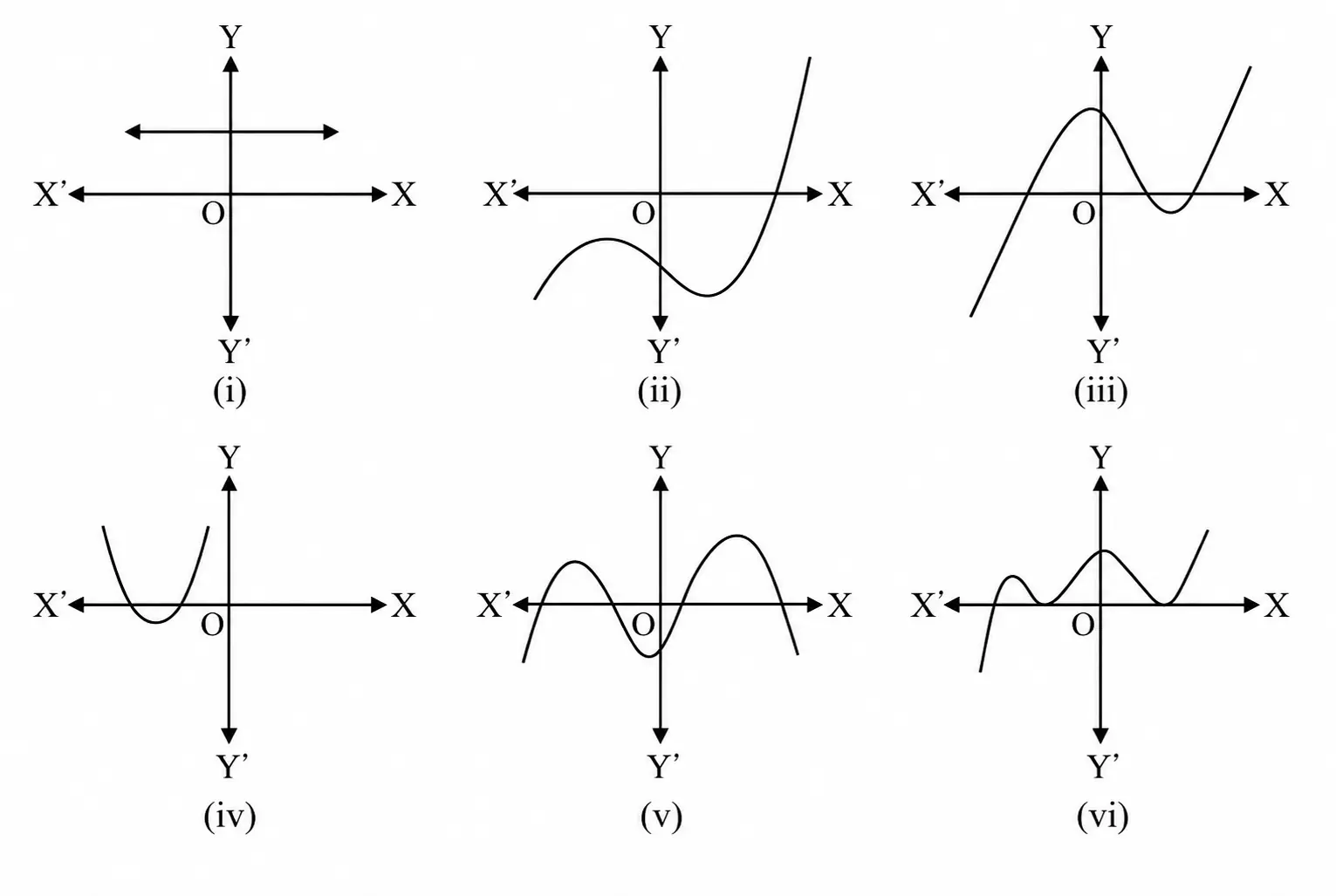
Look at the graphs in Fig. 2.9 given below. Each is the graph of $$y = p(x)$$, where $$p(x)$$ is a polynomial. For each of the graphs, find the number of zeroes of $$p(x)$$.
Fig. 2.9
Fig. 2.9

Solution

Concept used

For any polynomial $$y = p(x)$$, a zero (or root) is a value of $$x$$ for which $$p(x)=0$$. On the cartesian plane this means the point lies on the x-axis (because on the x-axis, $$y=0$$). Therefore:

The number of zeroes of $$p(x)$$ equals the number of points where its graph intersects or just touches the x-axis.

Look at each part of Fig. 2.9 and simply count those contact points.

Graph in Fig. 2.9Observation from the pictureNumber of zeroes of $$p(x)$$
(i)The curve lies completely above the x-axis and never meets it.0
(ii)The curve touches the x-axis at exactly one point (is tangent there) and then turns back.1
(iii)The curve cuts the x-axis at two distinct points.2
(iv)The curve cuts the x-axis at three distinct points.3

Thus each graph gives the required count of zeroes as summarised above.

Answer

(i) 0   (ii) 1   (iii) 2   (iv) 3

Exercise 2.1

1

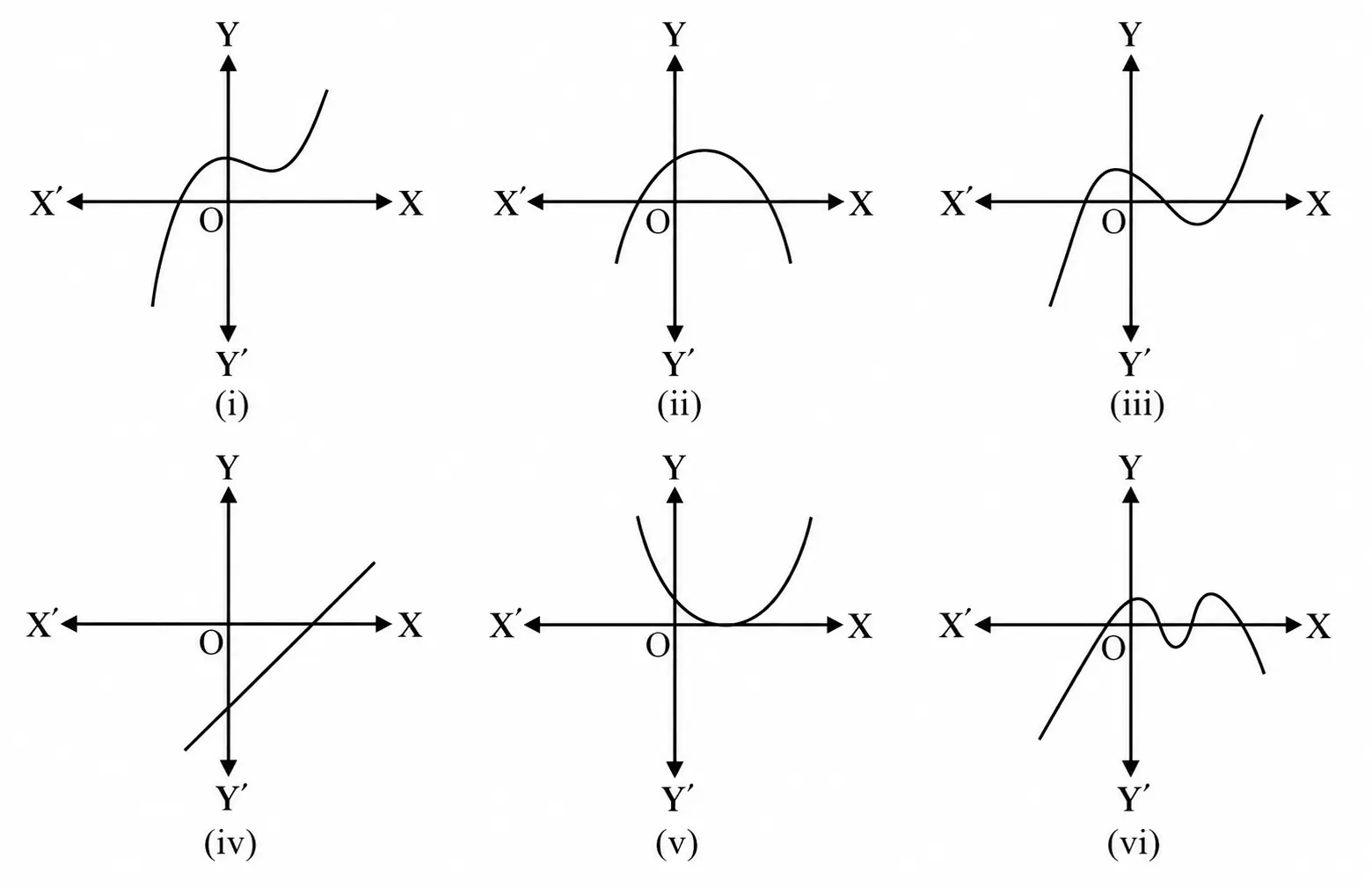
The graphs of $$y = p(x)$$ are given in Fig. 2.10 below, for some polynomials $$p(x)$$. Find the number of zeroes of $$p(x)$$, in each case.
Fig. 2.10
Fig. 2.10

Solution

Concept used
Zeroes (or roots) of a polynomial $$p(x)$$ are the values of $$x$$ for which $$p(x)=0$$. On the coordinate plane the condition $$p(x)=0$$ corresponds to the points where the graph of $$y=p(x)$$ meets or touches the x-axis. Therefore:

  • Each point of intersection with the x-axis contributes one zero.
  • If the graph merely touches the axis (is tangent) and turns back, that point is still counted as one zero.

So, to find the required number we only have to count how many distinct points the given curve has with the x-axis in every sub-figure of Fig. 2.10.

  1. Figure (i): the curve lies completely above the x-axis and never meets it.
    Hence, $$0$$ zeroes.
  2. Figure (ii): the curve just touches the x-axis at one point and turns back.
    Hence, $$1$$ zero.
  3. Figure (iii): the curve cuts the x-axis at two distinct points.
    Hence, $$2$$ zeroes.
  4. Figure (iv): the curve meets the x-axis at three distinct points.
    Hence, $$3$$ zeroes.
  5. Figure (v): the curve crosses the x-axis at four distinct points.
    Hence, $$4$$ zeroes.
  6. Figure (vi): the curve intersects the x-axis at five distinct points.
    Hence, $$5$$ zeroes.

Thus each graph illustrates a different possible number of real zeroes for a polynomial.

Answer

(i) 0, (ii) 1, (iii) 2, (iv) 3, (v) 4, (vi) 5

Examples 2-5

Example 2 Find the zeroes of the quadratic polynomial $$x^2 + 7x + 10$$, and verify the relationship between the zeroes and the coefficients.

Solution

The given quadratic polynomial is $$x^{2}+7x+10$$.

Step 1: Identify the coefficients
Compare with the general form $$ax^{2}+bx+c$$. We get
$$a=1,\; b=7,\; c=10$$.

Step 2: Factorise the polynomial

  • We need two numbers whose product is $$a\,c = 1 \times 10 = 10$$ and whose sum is $$b = 7$$.
  • The numbers $$5$$ and $$2$$ work because $$5+2 = 7$$ and $$5\times 2 = 10$$.

Rewrite the middle term using these numbers:

$$x^{2}+7x+10 = x^{2}+5x+2x+10$$

Group the terms:

$$x^{2}+5x+2x+10 = (x^{2}+5x)+(2x+10)$$

Factor each group:

$$ (x^{2}+5x)+(2x+10) = x(x+5)+2(x+5)$$

Take the common binomial factor $$x+5$$ out:

$$x(x+5)+2(x+5) = (x+5)(x+2)$$

Step 3: Find the zeroes

Set each factor equal to zero:

$$x+5 = 0 \;\;\Rightarrow\;\; x = -5$$
$$x+2 = 0 \;\;\Rightarrow\;\; x = -2$$

Thus, the zeroes are $$\alpha = -5$$ and $$\beta = -2$$.

Step 4: Verify the relationship between zeroes and coefficients

For any quadratic $$ax^{2}+bx+c$$ with zeroes $$\alpha,\beta$$,

Sum of zeroes: $$\alpha+\beta = -\dfrac{b}{a}$$
Product of zeroes: $$\alpha\beta = \dfrac{c}{a}$$

Here, $$a=1,\; b=7,\; c=10$$.

  • Sum: $$\alpha+\beta = (-5)+(-2) = -7$$
    Right-hand side: $$-\dfrac{b}{a} = -\dfrac{7}{1} = -7$$
    The two values match.
  • Product: $$\alpha\beta = (-5)(-2) = 10$$
    Right-hand side: $$\dfrac{c}{a} = \dfrac{10}{1} = 10$$
    The two values match.

Both relationships are satisfied, so the verification is complete.

Answer

Zeroes: $$x=-5,\;-2$$.
Sum and product of zeroes agree with $$-\dfrac{b}{a}$$ and $$\dfrac{c}{a}$$, respectively; hence the relationship is verified.

Example 3 Find the zeroes of the polynomial $$x^2 - 3$$ and verify the relationship between the zeroes and the coefficients.

Solution

The given quadratic polynomial is $$p(x)=x^{2}-3$$.

Step 1: Find the zeroes of $$p(x)$$

Set the polynomial equal to zero:

$$x^{2}-3=0$$

Transpose $$-3$$ to the right side:

$$x^{2}=3$$

Taking the square root of both sides gives two values:

$$x=\pm\sqrt{3}$$

Thus the zeroes are $$\alpha=\sqrt{3}$$ and $$\beta=-\sqrt{3}$$.

Step 2: Write down the coefficients

The standard form of a quadratic is $$ax^{2}+bx+c$$. Comparing with $$x^{2}-3$$ we get:

  • $$a=1$$
  • $$b=0$$
  • $$c=-3$$

Step 3: Verify the relationship between zeroes and coefficients

For any quadratic polynomial:

  • Sum of the zeroes: $$\alpha+\beta=-\frac{b}{a}$$
  • Product of the zeroes: $$\alpha\beta=\frac{c}{a}$$

Using the calculated zeroes

Sum: $$\alpha+\beta=\sqrt{3}+(-\sqrt{3})=0$$

Product: $$\alpha\beta=\sqrt{3}\times(-\sqrt{3})=-3$$

Using the coefficient relations

Sum: $$-\frac{b}{a}=-\frac{0}{1}=0$$

Product: $$\frac{c}{a}=\frac{-3}{1}=-3$$

The sums match and the products match, therefore the relationship between the zeroes and the coefficients is verified.

Answer

Zeroes: $$x=\sqrt{3},\,-\sqrt{3}$$; relation verified since $$\alpha+\beta=0=-\frac{b}{a}$$ and $$\alpha\beta=-3=\frac{c}{a}$$.

Example 4 Find a quadratic polynomial, the sum and product of whose zeroes are $$-3$$ and $$2$$, respectively.

Solution

Let the quadratic polynomial be monic (leading coefficient equal to $$1$$).
Denote its zeroes by $$\alpha$$ and $$\beta$$.

For any quadratic polynomial $$ax^2+bx+c$$ with $$a\neq0$$, the relations between coefficients and zeroes are

  • sum of zeroes: $$\alpha+\beta=-\frac{b}{a}$$,
  • product of zeroes: $$\alpha\beta=\frac{c}{a}$$.

When $$a=1$$, we can write the polynomial directly as

$$x^2-(\alpha+\beta)x+\alpha\beta$$.

The problem gives

$$\alpha+\beta=-3,\qquad \alpha\beta=2.$$

Substituting these values, we obtain

$$x^2-(-3)x+2=x^2+3x+2.$$

Hence the required quadratic polynomial is $$x^2+3x+2$$.

Check: $$x^2+3x+2=(x+1)(x+2)$$ has zeroes $$-1$$ and $$-2$$. Their sum $$(-1)+(-2)=-3$$ and product $$(-1)(-2)=2$$, exactly as required.

Answer

$$x^2 + 3x + 2$$

Example 5 Verify that $$3, -1, -\frac{1}{3}$$ are the zeroes of the cubic polynomial $$p(x) = 3x^3 - 5x^2 - 11x - 3$$, and then verify the relationship between the zeroes and the coefficients.

Solution

Step 1 : Write the polynomial
$$p(x)=3x^{3}-5x^{2}-11x-3$$

Step 2 : Verify each proposed zero

(i) For $$x=3$$:
$$p(3)=3(3)^{3}-5(3)^{2}-11(3)-3=3\cdot27-5\cdot9-33-3=81-45-33-3=0$$

(ii) For $$x=-1$$:
$$p(-1)=3(-1)^{3}-5(-1)^{2}-11(-1)-3=-3-5+11-3=0$$

(iii) For $$x=-\dfrac13$$:
$$p\!\left(-\dfrac13\right)=3\left(-\dfrac1{27}\right)-5\left(\dfrac1{9}\right)-11\left(-\dfrac13\right)-3=-\dfrac19-\dfrac59+\dfrac{11}3-3=-\dfrac23+\dfrac{11}3-3=3-3=0$$

Therefore $$3,-1,-\dfrac13$$ are indeed the zeroes of $$p(x)$$.

Step 3 : State the general relationships
For a cubic $$ax^{3}+bx^{2}+cx+d$$ with zeroes $$\alpha ,\beta ,\gamma$$:

  • $$\alpha+\beta+\gamma=-\dfrac ba$$
  • $$\alpha\beta+\beta\gamma+\gamma\alpha=\dfrac ca$$
  • $$\alpha\beta\gamma=-\dfrac da$$

Here $$a=3,\;b=-5,\;c=-11,\;d=-3$$.

Step 4 : Compute the left-hand sides with the found zeroes

Sum of zeroes:
$$\alpha+\beta+\gamma=3+(-1)+\left(-\dfrac13\right)=\dfrac53$$

Sum of pairwise products:
$$\alpha\beta+\beta\gamma+\gamma\alpha=3(-1)+(-1)\left(-\dfrac13\right)+\left(-\dfrac13\right)3=-3+\dfrac13-1=-\dfrac{11}3$$

Product of zeroes:
$$\alpha\beta\gamma=3\times(-1)\times\left(-\dfrac13\right)=1$$

Step 5 : Compute the right-hand sides from coefficients

$$-\dfrac ba=-\dfrac{-5}3=\dfrac53$$
$$\dfrac ca=\dfrac{-11}3=-\dfrac{11}3$$
$$-\dfrac da=-\dfrac{-3}3=1$$

Step 6 : Compare
The left-hand and right-hand sides match in every case, so the relationships between the zeroes and the coefficients are verified.

Answer

The numbers $$3,-1,-\dfrac13$$ are zeroes of $$p(x)=3x^{3}-5x^{2}-11x-3$$, and they satisfy
$$\alpha+\beta+\gamma=-\dfrac ba,\;\alpha\beta+\beta\gamma+\gamma\alpha=\dfrac ca,\;\alpha\beta\gamma=-\dfrac da.$$ Thus the required relationships are verified.

Exercise 2.2

1 Find the zeroes of the following quadratic polynomials and verify the relationship between the zeroes and the coefficients.

(i) $$x^2 - 2x - 8$$

Solution

Given quadratic polynomial $$p(x)=x^2-2x-8$$.

Step 1 : Find the zeroes

Factorising, $$x^2-2x-8=(x-4)(x+2).$$

Hence $$x-4=0\ \Rightarrow\ x=4,$$ and $$x+2=0\ \Rightarrow\ x=-2.$$

Thus the zeroes are $$4\;\text{and}\;-2.$$

Step 2 : Verify the relationships

For a quadratic $$ax^2+bx+c,$$

  • Sum of zeroes $$= -\dfrac{b}{a}.$$
  • Product of zeroes $$= \dfrac{c}{a}.$$

Here $$a=1,\;b=-2,\;c=-8.$$

Calculated from zeroes:
Sum $$=4+(-2)=2,$$
Product $$=4\times(-2)=-8.$$

From coefficients:
$$-\dfrac{b}{a}=-\dfrac{-2}{1}=2,$$
$$\dfrac{c}{a}=\dfrac{-8}{1}=-8.$$

Both sums and products agree ⇒ relationship verified.

Answer

Zeroes : $$4,\;-2$$
Relationship between zeroes and coefficients is verified.

(ii) $$4s^2 - 4s + 1$$

Solution

Given quadratic polynomial $$p(s)=4s^2-4s+1.$$

Step 1 : Find the zeroes

Recognise a perfect square:
$$4s^2-4s+1=(2s-1)^2.$$

Set it to zero: $$2s-1=0\ \Rightarrow\ s=\dfrac{1}{2}.$$

The same value occurs twice, so the zeroes are both $$\dfrac{1}{2}.$$

Step 2 : Verify the relationships

Here $$a=4,\;b=-4,\;c=1.$$

From zeroes:
Sum $$=\dfrac{1}{2}+\dfrac{1}{2}=1,$$
Product $$=\dfrac{1}{2}\times\dfrac{1}{2}=\dfrac{1}{4}.$$

From coefficients:
$$-\dfrac{b}{a}=-\dfrac{-4}{4}=1,$$
$$\dfrac{c}{a}=\dfrac{1}{4}.$$

They match; hence verified.

Answer

Zeroes : $$\dfrac{1}{2},\;\dfrac{1}{2}$$
Relationship verified.

(iii) $$6x^2 - 3 - 7x$$

Solution

Given polynomial $$p(x)=6x^2-3-7x.$$ Rearranged as $$6x^2-7x-3.$$

Step 1 : Find the zeroes

Factorise:
$$6x^2-7x-3=(3x+1)(2x-3).$$

Equating each factor to zero:

  • $$3x+1=0\ \Rightarrow\ x=-\dfrac{1}{3},$$
  • $$2x-3=0\ \Rightarrow\ x=\dfrac{3}{2}.$$

Step 2 : Verify the relationships

Here $$a=6,\;b=-7,\;c=-3.$$

From zeroes:
Sum $$=-\dfrac{1}{3}+\dfrac{3}{2}=\dfrac{7}{6},$$
Product $$=-\dfrac{1}{3}\times\dfrac{3}{2}=-\dfrac{1}{2}.$$

From coefficients:
$$-\dfrac{b}{a}=-\dfrac{-7}{6}=\dfrac{7}{6},$$
$$\dfrac{c}{a}=\dfrac{-3}{6}=-\dfrac{1}{2}.$$

They coincide, so verified.

Answer

Zeroes : $$-\dfrac{1}{3},\;\dfrac{3}{2}$$
Relationship verified.

(iv) $$4u^2 + 8u$$

Solution

Given polynomial $$p(u)=4u^2+8u.$$ Rewriting as $$4u^2+8u+0.$$

Step 1 : Find the zeroes

Factor common term:
$$4u^2+8u=4u(u+2).$$

Set each factor to zero:

  • $$4u=0\ \Rightarrow\ u=0,$$
  • $$u+2=0\ \Rightarrow\ u=-2.$$

Step 2 : Verify the relationships

Here $$a=4,\;b=8,\;c=0.$$

From zeroes:
Sum $$=0+(-2)=-2,$$
Product $$=0\times(-2)=0.$$

From coefficients:
$$-\dfrac{b}{a}=-\dfrac{8}{4}=-2,$$
$$\dfrac{c}{a}=\dfrac{0}{4}=0.$$

Results agree; verified.

Answer

Zeroes : $$0,\;-2$$
Relationship verified.

(v) $$t^2 - 15$$

Solution

Given polynomial $$p(t)=t^2-15.$$

Step 1 : Find the zeroes

Set to zero:
$$t^2-15=0\;\;\Rightarrow\;\;t^2=15\;\;\Rightarrow\;\;t=\pm\sqrt{15}.$$

Step 2 : Verify the relationships

Here $$a=1,\;b=0,\;c=-15.$$

From zeroes:
Sum $$=\sqrt{15}+(-\sqrt{15})=0,$$
Product $$=\sqrt{15}\times(-\sqrt{15})=-15.$$

From coefficients:
$$-\dfrac{b}{a}=-\dfrac{0}{1}=0,$$
$$\dfrac{c}{a}=\dfrac{-15}{1}=-15.$$

Matches ⇒ verified.

Answer

Zeroes : $$\sqrt{15},\;-\sqrt{15}$$
Relationship verified.

(vi) $$3x^2 - x - 4$$

Solution

Given polynomial $$p(x)=3x^2-x-4.$$

Step 1 : Find the zeroes

Factorising by splitting the middle term:
$$3x^2-x-4=3x^2-4x+3x-4=(3x-4)(x+1).$$

Equating factors to zero:

  • $$3x-4=0\ \Rightarrow\ x=\dfrac{4}{3},$$
  • $$x+1=0\ \Rightarrow\ x=-1.$$

Step 2 : Verify the relationships

Here $$a=3,\;b=-1,\;c=-4.$$

From zeroes:
Sum $$=\dfrac{4}{3}+(-1)=\dfrac{1}{3},$$
Product $$=\dfrac{4}{3}\times(-1)=-\dfrac{4}{3}.$$

From coefficients:
$$-\dfrac{b}{a}=-\dfrac{-1}{3}=\dfrac{1}{3},$$
$$\dfrac{c}{a}=\dfrac{-4}{3}=-\dfrac{4}{3}.$$

The relationships hold true.

Answer

Zeroes : $$\dfrac{4}{3},\;-1$$
Relationship verified.

2 Find a quadratic polynomial each with the given numbers as the sum and product of its zeroes respectively.

(i) $$\frac{1}{4}, -1$$

Solution

Let the zeroes be $$\alpha$$ and $$\beta$$.
Given $$\alpha + \beta = \tfrac{1}{4}$$ (sum) and $$\alpha\beta = -1$$ (product).

The monic quadratic polynomial whose zeroes are $$\alpha,\beta$$ is
$$p(x)=x^{2}- (\alpha + \beta)x + \alpha\beta$$.

Substituting the given values:
$$p(x)=x^{2}-\tfrac{1}{4}x - 1.$$

To clear the fraction, multiply by 4:

$$4\,x^{2}-x-4.$$

Hence a required quadratic polynomial is $$4x^{2}-x-4$$.

Answer

$$4x^{2}-x-4$$

(ii) $$\sqrt{2}, \frac{1}{3}$$

Solution

Let the zeroes be $$\alpha$$ and $$\beta$$ with
$$\alpha + \beta = \sqrt{2}, \; \alpha\beta = \tfrac{1}{3}.$$

The polynomial is
$$p(x)=x^{2}- (\sqrt{2})x + \tfrac{1}{3}.$$

Multiplying by 3 to remove the denominator:

$$3x^{2}-3\sqrt{2}\,x+1.$$

Thus the required quadratic polynomial is $$3x^{2}-3\sqrt{2}\,x+1$$.

Answer

$$3x^{2}-3\sqrt{2}\,x+1$$

(iii) $$0, \sqrt{5}$$

Solution

Sum of zeroes $$\alpha+\beta = 0,$$ product $$\alpha\beta = \sqrt{5}.$$

Polynomial:
$$p(x)=x^{2}-0\cdot x+\sqrt{5}=x^{2}+\sqrt{5}.$$

Hence $$x^{2}+\sqrt{5}$$ is the required quadratic polynomial.

Answer

$$x^{2}+\sqrt{5}$$

(iv) $$1, 1$$

Solution

Sum $$\alpha+\beta = 1,$$ product $$\alpha\beta = 1.$$

Polynomial:
$$p(x)=x^{2}-1\cdot x+1=x^{2}-x+1.$$

Therefore the required quadratic polynomial is $$x^{2}-x+1$$.

Answer

$$x^{2}-x+1$$

(v) $$-\frac{1}{4}, \frac{1}{4}$$

Solution

Sum $$\alpha+\beta = -\tfrac{1}{4},$$ product $$\alpha\beta = \tfrac{1}{4}.$$

Polynomial:
$$p(x)=x^{2}-(-\tfrac{1}{4})x+\tfrac{1}{4}=x^{2}+\tfrac{1}{4}x+\tfrac{1}{4}.$$

Multiply by 4:

$$4x^{2}+x+1.$$

Hence the required quadratic polynomial is $$4x^{2}+x+1$$.

Answer

$$4x^{2}+x+1$$

(vi) $$4, 1$$

Solution

Sum $$\alpha+\beta = 4,$$ product $$\alpha\beta = 1.$$

Polynomial:
$$p(x)=x^{2}-4x+1.$$

Therefore the required quadratic polynomial is $$x^{2}-4x+1$$.

Answer

$$x^{2}-4x+1$$

NCERT Solutions for Class 10
Maths
NCERT Solutions for Class 10 Maths
Chapter-wise step-by-step
solutions with explanations
explore solutions Maths bg
Science
NCERT Solutions for Class 10 Science
Chapter-wise step-by-step
solutions with explanations
explore solutions Science bg

Frequently Asked Questions

50,000+ JEE Students Trusted Our Score Calculator

Predict your JEE Main percentile, rank & performance in seconds