Join WhatsApp Icon JEE WhatsApp Group
NCERT Solutions for Class 10 Maths

Chapter 13: Probability

Download Solutions PDF
Daily JEE Updates, Tips & Important Alerts
Join 30,000+ students and stay updated with JEE notifications and preparation insights.
Join Now!
Free PDF
Complete NCERT Solution PDF for Chapter 13: Probability

NCERT Solutions For Class 10 Maths Chapter 13 Probability introduces students to the mathematical study of chance and uncertainty. The page provides detailed NCERT Solutions that explain probability concepts, formulas, and methods of solving problems through practical examples. NCERT Solutions For Class 10 Maths help students understand outcomes, events, sample spaces, and calculation of probabilities in different situations. The chapter develops logical reasoning and helps students analyse possibilities using mathematical approaches. These solutions provide clear explanations for textbook exercises and help learners prepare effectively for board examinations. Students can access the chapter PDF for revision, practice, and quick reference. The simple explanations make probability concepts easier to understand and apply while solving questions.
Download Solutions PDF

Examples

Example 1 Find the probability of getting a head when a coin is tossed once. Also find the probability of getting a tail.

Solution

Step 1 : Define the sample space
When a fair coin is tossed once, only two distinct outcomes are possible—Head (H) or Tail (T). Hence the sample space is
$$S = \{\mathrm{H}, \mathrm{T}\}$$
Therefore
$$n(S) = 2$$

Step 2 : Probability of getting a head
Let the event of getting a head be denoted by $$E_H$$. Then
$$E_H = \{\mathrm{H}\} \quad \Rightarrow \quad n(E_H) = 1$$
Using the classical definition of probability,
$$P(\text{head}) = P(E_H) = \frac{n(E_H)}{n(S)} = \frac{1}{2}$$

Step 3 : Probability of getting a tail
Let the event of getting a tail be denoted by $$E_T$$. Then
$$E_T = \{\mathrm{T}\} \quad \Rightarrow \quad n(E_T) = 1$$
Thus
$$P(\text{tail}) = P(E_T) = \frac{n(E_T)}{n(S)} = \frac{1}{2}$$

Step 4 : Verification
For any experiment, the probabilities of all mutually exclusive and exhaustive outcomes must add up to 1. Indeed,
$$P(\text{head}) + P(\text{tail}) = \frac{1}{2} + \frac{1}{2} = 1$$
which is consistent with theory.

Therefore, the probability of getting either a head or a tail on a single toss of a fair coin is \(\frac12\) in each case.

Answer

$$P(\text{head}) = \dfrac12,\; P(\text{tail}) = \dfrac12$$

Example 2 A bag contains a red ball, a blue ball and a yellow ball, all the balls being of the same size. Kritika takes out a ball from the bag without looking into it. What is the probability that she takes out the

(i) yellow ball?

Solution

Let $$S$$ denote the sample space for drawing one ball from the bag.

All the balls are identical in size, so each is equally likely to be chosen.

Total number of possible outcomes:
$$|S| = 3$$ (red, blue, yellow)

Let $$E_Y$$ be the event “drawing a yellow ball”.
Number of favourable outcomes:
$$|E_Y| = 1$$

By the definition of probability,
$$P(E_Y) = \frac{|E_Y|}{|S|} = \frac{1}{3}$$

Answer

$$\displaystyle P(\text{yellow}) = \frac{1}{3}$$

(ii) red ball?

Solution

Total possible outcomes remain $$|S| = 3$$.

Let $$E_R$$ be the event “drawing a red ball”.
Number of favourable outcomes:
$$|E_R| = 1$$

Hence,
$$P(E_R) = \frac{|E_R|}{|S|} = \frac{1}{3}$$

Answer

$$\displaystyle P(\text{red}) = \frac{1}{3}$$

(iii) blue ball?

Solution

The sample space size is still $$|S| = 3$$.

Let $$E_B$$ be the event “drawing a blue ball”.
Number of favourable outcomes:
$$|E_B| = 1$$

Therefore,
$$P(E_B) = \frac{|E_B|}{|S|} = \frac{1}{3}$$

Answer

$$\displaystyle P(\text{blue}) = \frac{1}{3}$$

Example 3 Suppose we throw a die once. (i) What is the probability of getting a number greater than $$4$$? (ii) What is the probability of getting a number less than or equal to $$4$$?

Solution

Step 1: Sample space
A standard die has six faces, so the possible outcomes when it is thrown once are
$$S = \{1,2,3,4,5,6\}$$
Thus, $$n(S) = 6$$.

Step 2: Events of interest

  • (i) Getting a number greater than $$4$$:
    $$A = \{5,6\} \;\Rightarrow\; n(A)=2$$
  • (ii) Getting a number less than or equal to $$4$$:
    $$B = \{1,2,3,4\} \;\Rightarrow\; n(B)=4$$

Step 3: Probability formula
For any event $$E$$, $$P(E)=\dfrac{n(E)}{n(S)}$$.

(i) $$P(A)=\dfrac{n(A)}{n(S)}=\dfrac{2}{6}=\dfrac{1}{3}$$.

(ii) $$P(B)=\dfrac{n(B)}{n(S)}=\dfrac{4}{6}=\dfrac{2}{3}$$.

Check
Events $$A$$ and $$B$$ are complementary, hence
$$P(A)+P(B)=\dfrac{1}{3}+\dfrac{2}{3}=1$$, confirming the computations.

Answer

(i) $$\dfrac{1}{3}$$;  (ii) $$\dfrac{2}{3}$$

Example 4 One card is drawn from a well-shuffled deck of $$52$$ cards. Calculate the probability that the card will

(i) be an ace,

Solution

Let $$S$$ be the sample space when one card is drawn from a well-shuffled standard deck.

Number of possible outcomes: $$n(S)=52$$.

Let event $$E$$ be “getting an ace”.
There are four aces: Ace ♠, Ace ♥, Ace ♦, Ace ♣. Hence
$$n(E)=4$$.

By the classical definition of probability,

$$P(E)=\frac{n(E)}{n(S)}=\frac{4}{52}=\frac{1}{13}.$$

Answer

$$\dfrac{1}{13}$$

(ii) not be an ace.

Solution

Let event $$F$$ be “getting a card that is not an ace”.

The complement of “not an ace” is “an ace”, whose probability is already found:
$$P(\text{ace})=\frac{1}{13}.$$

Using $$P(F)=1-P(\text{ace})$$,

$$P(F)=1-\frac{1}{13}=\frac{12}{13}.$$

(Alternatively, count directly: $$n(F)=52-4=48\;\Rightarrow\;P(F)=48/52=12/13$$.)

Answer

$$\dfrac{12}{13}$$

Example 5 Two players, Sangeeta and Reshma, play a tennis match. It is known that the probability of Sangeeta winning the match is $$0.62$$. What is the probability of Reshma winning the match?

Solution

We are given the probability that Sangeeta wins the tennis match.

Let

  • $$P(S)$$ = probability that Sangeeta wins.
  • $$P(R)$$ = probability that Reshma wins.

The question states that

$$P(S) = 0.62$$

In a tennis match there are no ties: exactly one of the two players must win. Hence the two outcomes "Sangeeta wins" and "Reshma wins" are exhaustive and mutually exclusive.

Therefore, by the fundamental rule for the probabilities of complementary events,

$$P(S) + P(R) = 1$$

We substitute the known value and solve for $$P(R)$$:

$$0.62 + P(R) = 1$$

Subtract $$0.62$$ from both sides:

$$P(R) = 1 - 0.62$$

Carry out the subtraction:

$$P(R) = 0.38$$

Thus, the probability that Reshma wins the match is $$0.38$$.

Answer

$$0.38$$

Example 6 Savita and Hamida are friends. What is the probability that both will have (i) different birthdays? (ii) the same birthday? (ignoring a leap year).

Solution

Let the possible birthdays be the 365 different calendar days of a non-leap year.

Total number of equally likely outcomes

For each of the two friends, the birthday can be chosen in $$365$$ ways. Using the Fundamental Principle of Counting (FPC), the number of ordered pairs of birthdays is therefore

$$365 \times 365 = 365^2.$$

(i) Probability that the birthdays are different

  • Savita can be born on any of the $$365$$ days.
  • To be different, Hamida must then be born on any of the remaining $$365 - 1 = 364$$ days.

Hence, the number of favourable outcomes is $$365 \times 364.$$

Probability

$$P(\text{different birthdays}) = \dfrac{365 \times 364}{365^2} = \dfrac{364}{365}.$$

(ii) Probability that the birthdays are the same

  • The common birthday can be any one of the $$365$$ days.
  • Once that day is fixed, both friends must have that very day as their birthday. This yields exactly $$365$$ favourable ordered pairs.

Thus,

$$P(\text{same birthday}) = \dfrac{365}{365^2} = \dfrac{1}{365}.$$

As a check, $$\dfrac{364}{365} + \dfrac{1}{365} = 1,$$ confirming that the two complementary events together exhaust all possibilities.

Answer

(i) $$\dfrac{364}{365}$$    (ii) $$\dfrac{1}{365}$$

Example 7 There are $$40$$ students in Class X of a school of whom $$25$$ are girls and $$15$$ are boys. The class teacher has to select one student as a class representative. She writes the name of each student on a separate card, the cards being identical. Then she puts cards in a bag and stirs them thoroughly. She then draws one card from the bag. What is the probability that the name written on the card is the name of (i) a girl? (ii) a boy?

Solution

Given data

  • Total number of students in the class = $$40$$
  • Number of girls = $$25$$
  • Number of boys = $$15$$

Each student’s name is written on one identical card and one card is drawn at random. Every card is therefore equally likely to be selected.

Theoretical probability of an event $$E$$ is

$$\text{P}(E)=\dfrac{\text{Number of favourable outcomes}}{\text{Total number of possible outcomes}}$$

Total number of possible outcomes = total cards = $$40$$.

(i) Event E1: “the card bears the name of a girl”

  • Favourable outcomes = number of girls = $$25$$

Probability

$$\text{P}(E_1)=\dfrac{25}{40}=\dfrac{5}{8}$$

(ii) Event E2: “the card bears the name of a boy”

  • Favourable outcomes = number of boys = $$15$$

Probability

$$\text{P}(E_2)=\dfrac{15}{40}=\dfrac{3}{8}$$

Check: $$\text{P}(E_1)+\text{P}(E_2)=\dfrac{5}{8}+\dfrac{3}{8}=1$$, confirming the probabilities are consistent.

Answer

(i) $$\dfrac{5}{8}$$
(ii) $$\dfrac{3}{8}$$

Example 8 A box contains $$3$$ blue, $$2$$ white, and $$4$$ red marbles. If a marble is drawn at random from the box, what is the probability that it will be

(i) white?

Solution

Step 1: Count the total number of marbles in the box.

Total marbles  =  $$3+2+4 = 9$$.

Step 2: Identify the favourable outcomes for drawing a white marble.

Number of white marbles  =  $$2$$.

Step 3: Use the classical definition of probability.

Probability of an event  =  $$\dfrac{\text{number of favourable outcomes}}{\text{total number of equally likely outcomes}}$$.

Therefore,

$$P(\text{white}) = \dfrac{2}{9}$$.

Answer

$$\dfrac{2}{9}$$

(ii) blue?

Solution

Step 1: Total number of marbles is still $$9$$ (calculated earlier).

Step 2: Favourable outcomes for drawing a blue marble.

Number of blue marbles  =  $$3$$.

Step 3: Apply the probability formula.

$$P(\text{blue}) = \dfrac{3}{9} = \dfrac{1}{3}$$.

Answer

$$\dfrac{1}{3}$$

(iii) red?

Solution

Step 1: Total marbles  =  $$9$$.

Step 2: Favourable outcomes for drawing a red marble.

Number of red marbles  =  $$4$$.

Step 3: Calculate the probability.

$$P(\text{red}) = \dfrac{4}{9}$$.

Answer

$$\dfrac{4}{9}$$

Example 9 Harpreet tosses two different coins simultaneously (say, one is of ₹$$1$$ and other of ₹$$2$$). What is the probability that she gets at least one head?

Solution

When two different coins (₹1-coin and ₹2-coin) are tossed together, every coin can show either Head (H) or Tail (T).

Step 1 – List the sample space
For each of the two coins write the first letter (H/T), keeping the order ₹1-coin first, ₹2-coin second:

$$S = \{\text{HH},\;\text{HT},\;\text{TH},\;\text{TT}\}$$

Hence, the total number of equally likely outcomes is $$n(S)=4$$.

Step 2 – Identify the favourable outcomes
We need “at least one head”. Every outcome containing one head or two heads qualifies:

$$F = \{\text{HH},\;\text{HT},\;\text{TH}\}$$

Thus, the number of favourable outcomes is $$n(F)=3$$.

Step 3 – Calculate the probability
By the classical definition,

$$P(\text{at least one head}) = \dfrac{n(F)}{n(S)} = \dfrac{3}{4}$$

Therefore, the probability that Harpreet gets at least one head is $$\dfrac{3}{4}$$.

Answer

$$\dfrac{3}{4}$$

Example 10 In a musical chair game, the person playing the music has been advised to stop playing the music at any time within $$2$$ minutes after she starts playing. What is the probability that the music will stop within the first half-minute after starting?

Solution

Step 1 — Describe the random experiment

The music can stop at any instant from the moment it is started until exactly 2 minutes have passed. Hence the possible stopping times (in minutes) form the continuum

$$0 \le t \le 2$$

This interval $$[0,2]$$ is the sample-space for the experiment.

Step 2 — Assumption of equal likelihood

Because the announcer has been told to stop the music "at any time" within the 2-minute period, every instant in $$[0,2]$$ is taken to be equally likely. For such a continuous and uniform situation, the probability of an event is

$$\text{Probability} \,=\, \dfrac{\text{length of favourable time-interval}}{\text{length of total time-interval}}$$

Step 3 — Identify the favourable event

We want the music to stop within the first half-minute, i.e. during

$$0 \le t \le 0.5$$

The length of this interval is

$$0.5 \text{ minutes}$$

Step 4 — Compute the probability

Total length of the sample-space interval:

$$2 \text{ minutes}$$

Therefore

$$P(\text{stop within first half-minute}) = \dfrac{0.5}{2} = \dfrac{1}{4}$$

Step 5 — Convert to decimal (optional)

$$\dfrac{1}{4} = 0.25$$

Thus the required probability is $$\dfrac{1}{4}$$ (or 25 %).

Answer

$$\displaystyle P = \frac14$$

Example 11

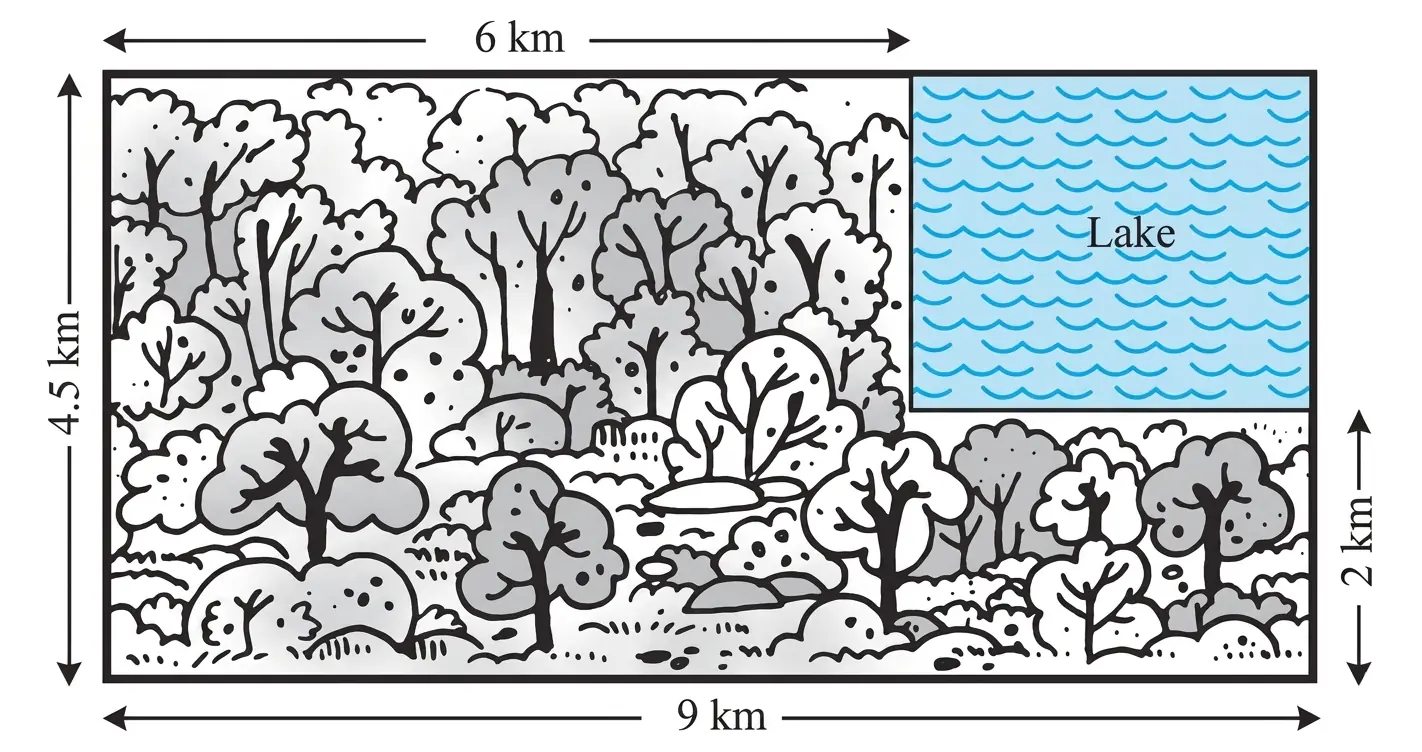
A missing helicopter is reported to have crashed somewhere in the rectangular region shown in Fig. 14.2. What is the probability that it crashed inside the lake shown in the figure?
Fig. 14.2
Fig. 14.2

Solution

Step 1 : Identify the required areas

The helicopter is equally likely to have crashed anywhere in the entire rectangular region.
Hence the theoretical probability is

$$P(\text{crash in lake})=\frac{\text{area of lake}}{\text{area of rectangle}}.$$

Dimensions from Fig. 14.2

  • Rectangle: $$200\,\text{km}\times150\,\text{km}$$
  • Lake (an ellipse): major axis $$100\,\text{km}$$, minor axis $$50\,\text{km}$$

Step 2 : Calculate the area of the rectangle

$$\text{Area}_{\text{rect}} = 200\times150 = 30000\;\text{km}^2$$

Step 3 : Calculate the area of the lake (ellipse)

Semi-major axis $$a = \dfrac{100}{2}=50\,\text{km}$$
Semi-minor axis $$b = \dfrac{50}{2}=25\,\text{km}$$

Area of an ellipse: $$\pi a b$$

$$\text{Area}_{\text{lake}} = \pi\times50\times25 = 1250\pi\;\text{km}^2$$

Step 4 : Compute the probability

$$P(\text{crash in lake}) = \frac{1250\pi}{30000} = \frac{\pi}{24}$$

Step 5 : Give the numerical approximation

Using $$\pi\approx3.14$$:

$$P\approx\frac{3.14}{24}\approx0.131\;(\text{about }13.1\%)$$

Thus the probability that the helicopter crashed inside the lake is $$\frac{\pi}{24}\approx0.131$$.

Answer

Required probability $$=\dfrac{\pi}{24}\approx0.131$$

Example 12 A carton consists of $$100$$ shirts of which $$88$$ are good, $$8$$ have minor defects and $$4$$ have major defects. Jimmy, a trader, will only accept the shirts which are good, but Sujatha, another trader, will only reject the shirts which have major defects. One shirt is drawn at random from the carton. What is the probability that

(i) it is acceptable to Jimmy?

Solution

Total number of shirts in the carton = $$100$$.

Number of shirts that Jimmy accepts (good shirts) = $$88$$.

Required probability (favourable outcomes ÷ total outcomes):
$$P(\text{acceptable to Jimmy}) = \dfrac{88}{100}.$$

Simplifying the fraction:
$$\dfrac{88}{100} = \dfrac{22}{25} = 0.88.$$

Answer

$$\displaystyle P(\text{acceptable to Jimmy}) = \frac{22}{25} = 0.88$$

(ii) it is acceptable to Sujatha?

Solution

Total number of shirts in the carton = $$100$$.

Sujatha rejects only the shirts that have major defects.

Number of shirts with major defects = $$4$$.

Hence, number of shirts she will accept = total shirts − major-defect shirts
$$= 100 - 4 = 96.$$

Required probability:
$$P(\text{acceptable to Sujatha}) = \dfrac{96}{100}.$$

Simplifying:
$$\dfrac{96}{100} = \dfrac{24}{25} = 0.96.$$

Answer

$$\displaystyle P(\text{acceptable to Sujatha}) = \frac{24}{25} = 0.96$$

Example 13 Two dice, one blue and one grey, are thrown at the same time. Write down all the possible outcomes. What is the probability that the sum of the two numbers appearing on the top of the dice is

(i) $$8$$?

Solution

Let the ordered pair $$(b,g)$$ denote the numbers that appear on the blue and grey dice respectively.
Because each die has the six faces $$1,2,3,4,5,6$$, the complete sample space is

$$(1,1),(1,2),(1,3),(1,4),(1,5),(1,6);(2,1),(2,2),(2,3),(2,4),(2,5),(2,6);(3,1),(3,2),(3,3),(3,4),(3,5),(3,6);(4,1),(4,2),(4,3),(4,4),(4,5),(4,6);(5,1),(5,2),(5,3),(5,4),(5,5),(5,6);(6,1),(6,2),(6,3),(6,4),(6,5),(6,6)$$

Altogether there are $$6\times6=36$$ equally likely outcomes.

The sum of the two numbers is $$8$$ for the following ordered pairs:

  • $$(2,6)$$ because $$2+6=8$$
  • $$(3,5)$$ because $$3+5=8$$
  • $$(4,4)$$ because $$4+4=8$$
  • $$(5,3)$$ because $$5+3=8$$
  • $$(6,2)$$ because $$6+2=8$$

Number of favourable outcomes $$=5$$.

Required probability $$=\dfrac{\text{number of favourable outcomes}}{\text{total outcomes}}=\dfrac{5}{36}$$.

Answer

$$\displaystyle\frac{5}{36}$$

(ii) $$13$$?

Solution

From the same sample space of $$36$$ equally likely outcomes, we now look for pairs whose sum is $$13$$.

The maximum possible sum of two dice is $$6+6=12$$, so no ordered pair gives a sum of $$13$$.

Number of favourable outcomes $$=0$$.

Therefore the probability is $$\dfrac{0}{36}=0$$.

Answer

$$0$$

(iii) less than or equal to $$12$$?

Solution

Again starting with the $$36$$ equally likely outcomes, we are asked for the probability that the sum of the two numbers is less than or equal to $$12$$.

The smallest possible sum is $$1+1=2$$ and the largest possible sum is $$6+6=12$$; every outcome in the sample space therefore satisfies the condition.

Number of favourable outcomes $$=36$$.

Required probability $$=\dfrac{36}{36}=1$$.

Answer

$$1$$

Exercise 14.1

1 Complete the following statements:

(i) Probability of an event E + Probability of the event 'not E' = ________.

Solution

For any experiment, the events E and "not E" (written Ec) are complementary. Their sample-space probabilities must exhaust all possibilities, so

$$P(E)+P(E^c)=1.$$

Hence the required number is 1.

Answer

$$1$$

(ii) The probability of an event that cannot happen is ________. Such an event is called ________.

Solution

An event that can never occur is called an impossible event. Its favourable outcomes are nil, so

$$P(\text{impossible event})=0.$$

Thus the two blanks are 0 and “impossible event”.

Answer

$$0$$; impossible event

(iii) The probability of an event that is certain to happen is ________. Such an event is called ________.

Solution

An event that must occur in every trial is a sure (certain) event. All outcomes favour it, giving

$$P(\text{sure event})=1.$$

Therefore the blanks are 1 and “sure (or certain) event”.

Answer

$$1$$; sure (certain) event

(iv) The sum of the probabilities of all the elementary events of an experiment is ________.

Solution

The elementary events of an experiment form a complete, mutually exclusive set covering the whole sample space. Hence their probabilities add to 1:

$$\sum P(\text{each elementary event})=1.$$

Answer

$$1$$

(v) The probability of an event is greater than or equal to ________ and less than or equal to ________.

Solution

Probability is defined as a non–negative ratio that cannot exceed 1. Thus for every event E

$$0\le P(E)\le 1.$$

So the blanks are 0 and 1.

Answer

$$0,\;1$$

2 Which of the following experiments have equally likely outcomes? Explain.

(i) A driver attempts to start a car. The car starts or does not start.

Solution

First write the sample space.

$$S=\{\text{car starts},\;\text{car does not start}\}$$

Let $$P(\text{car starts})=p$$. Then

$$P(\text{car does not start})=1-p$$

The value of $$p$$ depends on the condition of the car; normally $$p\neq\tfrac12$$. Since the two outcomes occur with different probabilities, they are not equally likely.

Answer

Outcomes are not equally likely.

(ii) A player attempts to shoot a basketball. She/he shoots or misses the shot.

Solution

The sample space is

$$S=\{\text{shot scored},\;\text{shot missed}\}$$

If the player succeeds with probability $$p$$, then

$$P(\text{scored})=p,\qquad P(\text{missed})=1-p$$

The value of $$p$$ depends on the player’s skill and is almost never exactly $$\tfrac12$$. Therefore the two outcomes do not occur with equal probability.

Answer

Outcomes are not equally likely.

(iii) A trial is made to answer a true-false question. The answer is right or wrong.

Solution

The experiment is guessing the answer to a true–false question (no prior knowledge assumed).

Sample space:

$$S=\{\text{right},\;\text{wrong}\}$$

Because the guess is made at random,

$$P(\text{right})=\tfrac12,\qquad P(\text{wrong})=\tfrac12$$

Both outcomes have the same probability, hence they are equally likely.

Answer

Outcomes are equally likely.

(iv) A baby is born. It is a boy or a girl.

Solution

Sample space for the sex of a newborn:

$$S=\{\text{boy},\;\text{girl}\}$$

Empirical data show that the probabilities are almost the same, so we take

$$P(\text{boy})\approx\tfrac12,\qquad P(\text{girl})\approx\tfrac12$$

Therefore the two outcomes may be treated as equally likely.

Answer

Outcomes are equally likely.

3 Why is tossing a coin considered to be a fair way of deciding which team should get the ball at the beginning of a football game?

Solution

Step 1 : Identify the experiment
Tossing a coin once is a random experiment. The set of all possible outcomes (sample space) is $$S = \{H,\;T\}$$, where $$H$$ stands for heads and $$T$$ stands for tails.

Step 2 : Check whether outcomes are equally likely
For a well-made, unbiased coin the physical design is symmetric, so there is no reason for either face to turn up more often in the long run. Hence each outcome is equally likely:

  • Probability of heads  $$P(H)=\dfrac{1}{2}$$
  • Probability of tails  $$P(T)=\dfrac{1}{2}$$

Step 3 : Relate the coin outcomes to the two teams
Before the toss, one team is asked to choose heads (or the referee assigns heads to Team A and tails to Team B). Because the outcomes are equally likely, the probability that either team wins the toss is also $$\dfrac{1}{2}$$.

Step 4 : Interpret “fairness”
A method is called fair when all competitors have the same chance of success. Since each team’s chance of getting the ball is $$\dfrac{1}{2}$$, neither team is favoured. Therefore tossing an unbiased coin is a fair way to decide which team starts the game.

Answer

Because, for an unbiased coin, heads and tails are equally likely (each has probability $$\tfrac12$$), so each team has the same $$\tfrac12$$ chance of winning the toss; therefore the decision procedure is fair.

4 Which of the following cannot be the probability of an event?
(A) $$\dfrac{2}{3}$$     (B) $$-1.5$$     (C) $$15\%$$     (D) $$0.7$$

Solution

Concept Used
For any event $$E$$, its probability $$P(E)$$ always satisfies the inequality
$$0 \le P(E) \le 1$$.

Check each option

  • (A) $$\dfrac{2}{3}=0.666\ldots$$   lies between 0 and 1 ⇒ possible.
  • (B) $$-1.5$$   is less than 0 ⇒ impossible.
  • (C) $$15\% = \dfrac{15}{100}=0.15$$   lies between 0 and 1 ⇒ possible.
  • (D) $$0.7$$   lies between 0 and 1 ⇒ possible.

Conclusion
The only value that does not satisfy $$0 \le P(E) \le 1$$ is $$-1.5$$.

Answer

(B)  $$-1.5$$

5 If $$P(E) = 0.05$$, what is the probability of 'not E'?

Solution

Let the complement of event E be denoted by $$\overline{E}$$ (read “not E”).

For any event, the probabilities of the event and its complement add up to $$1$$:

$$P(E) + P(\overline{E}) = 1$$

Rearranging, we get the complement rule:

$$P(\overline{E}) = 1 - P(E)$$

The question gives $$P(E) = 0.05$$, so

$$P(\overline{E}) = 1 - 0.05 = 0.95$$

Hence, the probability of “not E” is $$0.95$$.

Answer

$$0.95$$

6 A bag contains lemon flavoured candies only. Malini takes out one candy without looking into the bag. What is the probability that she takes out

(i) an orange flavoured candy?

Solution

Let the total number of candies in the bag be $$n$$. All of them are lemon flavoured, so there is no orange flavoured candy.

The probability of an event is given by
$$\text{P(Event)} = \dfrac{\text{Number of favourable outcomes}}{\text{Total number of possible outcomes}}$$

For the event “taking out an orange flavoured candy”:

  • Number of favourable outcomes = $$0$$ (because there is no orange candy).
  • Total number of possible outcomes = $$n$$ (any of the $$n$$ candies can be drawn).

Thus
$$\text{P(orange)} = \dfrac{0}{n} = 0$$

Answer

$$0$$

(ii) a lemon flavoured candy?

Solution

Assume the bag contains $$n$$ candies in total. The statement says every one of these $$n$$ candies is lemon flavoured.

For the event “taking out a lemon flavoured candy”:

  • Number of favourable outcomes = $$n$$ (each of the $$n$$ candies is favourable).
  • Total number of possible outcomes = $$n$$.

Therefore
$$\text{P(lemon)} = \dfrac{n}{n} = 1$$

Answer

$$1$$

7 It is given that in a group of $$3$$ students, the probability of $$2$$ students not having the same birthday is $$0.992$$. What is the probability that the $$2$$ students have the same birthday?

Solution

Step 1 – Identify the two complementary events

  • Event $$E$$ : “Out of the three students, at least two have the same birthday.”
  • Event $$\overline{E}$$ : “No two students have the same birthday.” (or, equivalently, “Two students do not have the same birthday”).

Since one (and only one) of these two events must occur, they are complementary, so

$$P(E) + P(\overline{E}) = 1$$

Step 2 – Insert the given probability

We are told that $$P(\overline{E}) = 0.992$$. Substituting,

$$P(E) + 0.992 = 1$$

Step 3 – Solve for $$P(E)$$

$$P(E) = 1 - 0.992 = 0.008$$

Step 4 – Write the result clearly

The probability that at least two of the three students have the same birthday is therefore

$$P(E) = 0.008 = \dfrac{8}{1000} = \dfrac{1}{125}$$.

Answer

$$0.008$$

8 A bag contains $$3$$ red balls and $$5$$ black balls. A ball is drawn at random from the bag. What is the probability that the ball drawn is (i) red? (ii) not red?

Solution

Given data
Total number of balls in the bag = $$3+5=8$$.
Number of red balls = $$3$$.
Number of black balls = $$5$$.

Recall the definition of probability
For any event $$E$$, $$P(E)=\dfrac{\text{Number of favourable outcomes}}{\text{Total number of possible outcomes}}$$.

(i) Probability that the ball drawn is red
Favourable outcomes = number of red balls = $$3$$.
Total possible outcomes = total number of balls = $$8$$.
Therefore,
$$P(\text{red})=\dfrac{3}{8}$$.

(ii) Probability that the ball drawn is not red
“Not red” means the ball is black.
Favourable outcomes = number of black balls = $$5$$.
Total possible outcomes = $$8$$.
Hence,
$$P(\text{not red})=\dfrac{5}{8}$$.
(You could also use the complement rule: $$P(\text{not red})=1-P(\text{red})=1-\frac{3}{8}=\frac{5}{8}$$, which gives the same result.)

Answer

(i) $$\dfrac{3}{8}$$    (ii) $$\dfrac{5}{8}$$

9 A box contains $$5$$ red marbles, $$8$$ white marbles and $$4$$ green marbles. One marble is taken out of the box at random. What is the probability that the marble taken out will be

(i) red?

Solution

Total number of marbles in the box

$$5 + 8 + 4 = 17$$

Let $$S$$ denote the sample space when one marble is drawn at random. Hence

$$n(S) = 17$$

The event of getting a red marble is denoted by $$R$$. The box contains $$5$$ red marbles, therefore

$$n(R) = 5$$

By the classical definition of probability,

$$P(R) = \frac{n(R)}{n(S)} = \frac{5}{17}$$

Answer

$$P(\text{red}) = \dfrac{5}{17}$$

(ii) white?

Solution

Again the total number of marbles is

$$n(S) = 17$$

The event of getting a white marble is denoted by $$W$$. There are $$8$$ white marbles, so

$$n(W) = 8$$

Hence

$$P(W) = \frac{n(W)}{n(S)} = \frac{8}{17}$$

Answer

$$P(\text{white}) = \dfrac{8}{17}$$

(iii) not green?

Solution

Total number of marbles:

$$n(S) = 17$$

The event of not getting a green marble is denoted by $$\overline{G}$$. There are $$4$$ green marbles, so the number of marbles that are not green is

$$n(\overline{G}) = 17 - 4 = 13$$

Therefore,

$$P(\text{not green}) = \frac{n(\overline{G})}{n(S)} = \frac{13}{17}$$

Answer

$$P(\text{not green}) = \dfrac{13}{17}$$

10 A piggy bank contains hundred $$50$$p coins, fifty ₹$$1$$ coins, twenty ₹$$2$$ coins and ten ₹$$5$$ coins. If it is equally likely that one of the coins will fall out when the bank is turned upside down, what is the probability that the coin (i) will be a $$50$$ p coin? (ii) will not be a ₹$$5$$ coin?

Solution

First write down the information given in the question.

  • Number of 50 p coins  = $$100$$
  • Number of ₹1 coins  = $$50$$
  • Number of ₹2 coins  = $$20$$
  • Number of ₹5 coins  = $$10$$

Total number of coins in the piggy bank:

$$100 + 50 + 20 + 10 = 180$$

Because the piggy bank is turned upside down and each coin is equally likely to fall out, the sample space has $$180$$ equally likely outcomes.

  1. Probability that the coin will be a 50 p coin

Number of favourable outcomes (choosing a 50 p coin) = $$100$$.

Probability  = $$\dfrac{\text{favourable outcomes}}{\text{total outcomes}} = \dfrac{100}{180}$$

Simplify the fraction:

$$\dfrac{100}{180} = \dfrac{10}{18} = \dfrac{5}{9}$$

  1. Probability that the coin will not be a ₹5 coin

Coins that are not ₹5 coins are the 50 p, ₹1 and ₹2 coins.

Number of such coins = $$100 + 50 + 20 = 170$$

Probability  = $$\dfrac{170}{180}$$

Again simplify:

$$\dfrac{170}{180} = \dfrac{17}{18}$$

Thus, the required probabilities are:

  • (i) $$\dfrac{5}{9}$$
  • (ii) $$\dfrac{17}{18}$$

Answer

(i) $$\dfrac{5}{9}$$
(ii) $$\dfrac{17}{18}$$

11

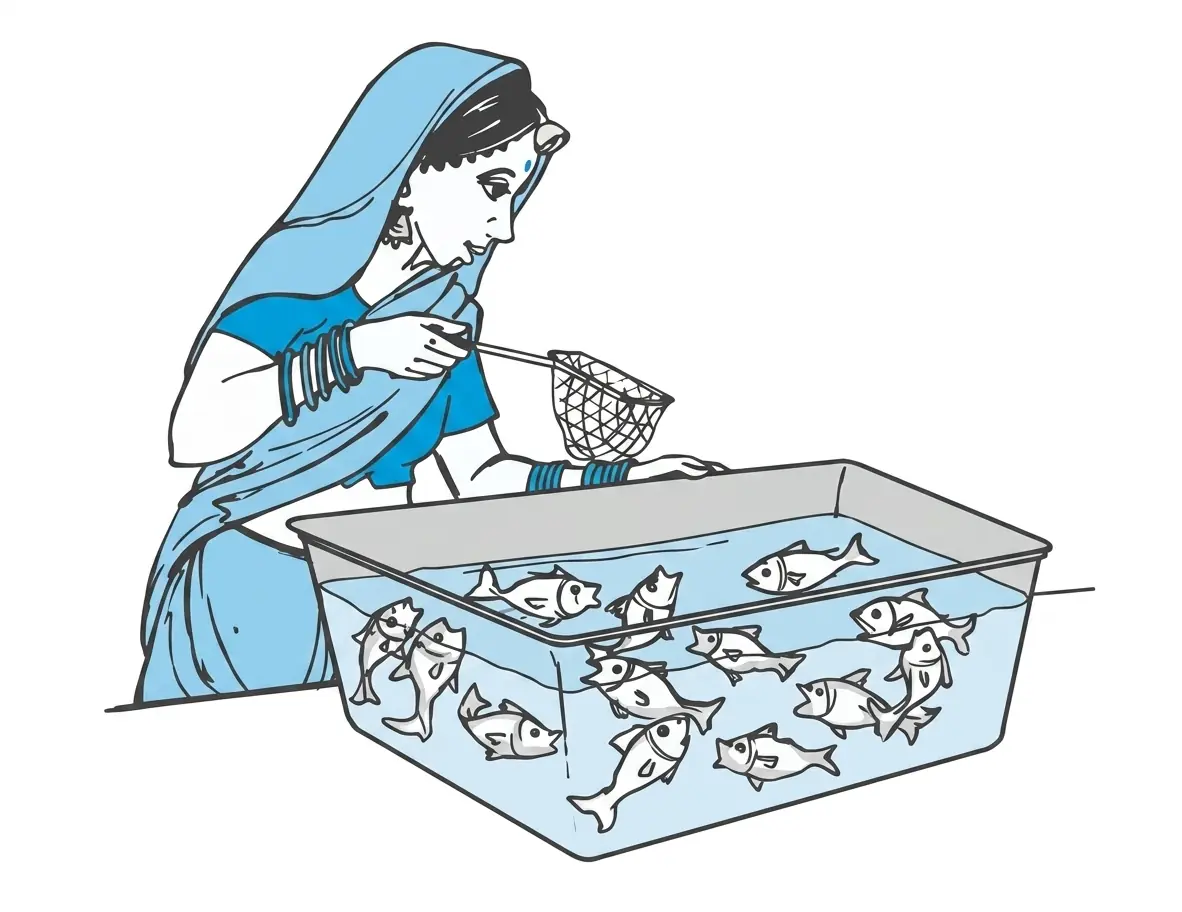
Gopi buys a fish from a shop for his aquarium. The shopkeeper takes out one fish at random from a tank containing $$5$$ male fish and $$8$$ female fish (see Fig. 14.4). What is the probability that the fish taken out is a male fish?
Fig. 14.4
Fig. 14.4

Solution

The tank contains two kinds of fish.

  • Male fish : $$5$$
  • Female fish : $$8$$

Total number of fish in the tank

$$\text{Total} = 5 + 8 = 13$$

When one fish is taken out at random, every fish is equally likely to be chosen.

Number of favourable outcomes (choosing a male fish) is

$$\text{Favourable cases} = 5$$

By the definition of probability for equally likely outcomes,

$$P(\text{male fish}) = \dfrac{\text{number of favourable outcomes}}{\text{total number of possible outcomes}}$$

Substituting the numbers,

$$P(\text{male fish}) = \dfrac{5}{13}$$

Thus, the probability that the fish taken out is a male fish is $$\dfrac{5}{13}$$.

Answer

$$\dfrac{5}{13}$$

12

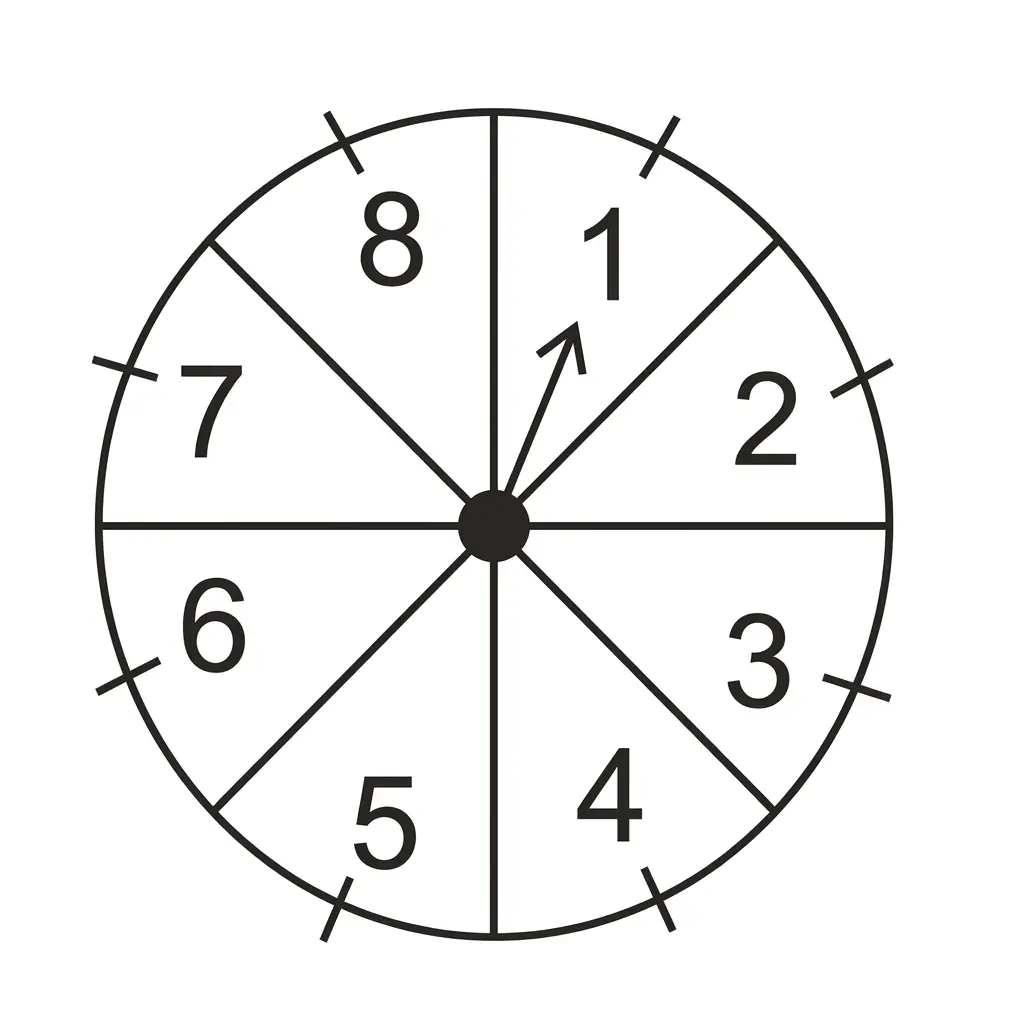
A game of chance consists of spinning an arrow which comes to rest pointing at one of the numbers $$1, 2, 3, 4, 5, 6, 7, 8$$ (see Fig. 14.5), and these are equally likely outcomes. What is the probability that it will point at
Fig. 14.5
Fig. 14.5

(i) $$8$$?

Solution

The spinner can stop at any one of the eight numbers

$$S = \{1, 2, 3, 4, 5, 6, 7, 8\}$$

Total equally likely outcomes

$$n(S) = 8$$

(i) Event : the arrow points at $$8$$

$$E_1 = \{8\}$$

Number of favourable outcomes

$$n(E_1) = 1$$

Using the definition of probability,

$$P(E_1) = \frac{n(E_1)}{n(S)} = \frac{1}{8}$$

Answer

$$P(\text{arrow points at }8) = \dfrac{1}{8}$$

(ii) an odd number?

Solution

(ii) Event : the arrow points at an odd number

Odd numbers among $$1$$ to $$8$$ are $$1, 3, 5, 7$$, so

$$E_2 = \{1, 3, 5, 7\}$$

Number of favourable outcomes

$$n(E_2) = 4$$

Therefore,

$$P(E_2) = \frac{n(E_2)}{n(S)} = \frac{4}{8} = \frac{1}{2}$$

Answer

$$P(\text{odd number}) = \dfrac{1}{2}$$

(iii) a number greater than $$2$$?

Solution

(iii) Event : the arrow points at a number greater than $$2$$

Numbers greater than $$2$$ are $$3, 4, 5, 6, 7, 8$$

$$E_3 = \{3, 4, 5, 6, 7, 8\}$$

Number of favourable outcomes

$$n(E_3) = 6$$

Hence,

$$P(E_3) = \frac{n(E_3)}{n(S)} = \frac{6}{8} = \frac{3}{4}$$

Answer

$$P(\text{number}>2) = \dfrac{3}{4}$$

(iv) a number less than $$9$$?

Solution

(iv) Event : the arrow points at a number less than $$9$$

Every number on the spinner $$1$$ to $$8$$ satisfies this condition.

$$E_4 = \{1, 2, 3, 4, 5, 6, 7, 8\} = S$$

Number of favourable outcomes

$$n(E_4) = 8$$

Hence,

$$P(E_4) = \frac{n(E_4)}{n(S)} = \frac{8}{8} = 1$$

Answer

$$P(\text{number}<9) = 1$$

13 A die is thrown once. Find the probability of getting

(i) a prime number;

Solution

When a die is thrown once, the possible outcomes form the sample space

$$S = \{1,2,3,4,5,6\}$$ so $$n(S)=6$$.

(i) A prime number on a die is one of $$2,3,5$$.

Event $$A=\{2,3,5\}$$ therefore $$n(A)=3$$.

Using $$P(A)=\dfrac{n(A)}{n(S)}$$,

$$P(\text{prime}) = \dfrac{3}{6}=\dfrac12$$.

Answer

$$\dfrac12$$

(ii) a number lying between $$2$$ and $$6$$;

Solution

The numbers that lie strictly between $$2$$ and $$6$$ are $$3,4,5$$.

Event $$B=\{3,4,5\}$$ so $$n(B)=3$$ (total still $$n(S)=6$$).

$$P(B)=\dfrac{n(B)}{n(S)}=\dfrac{3}{6}=\dfrac12$$.

Answer

$$\dfrac12$$

(iii) an odd number.

Solution

The odd numbers on a die are $$1,3,5$$.

Event $$C=\{1,3,5\}$$ gives $$n(C)=3$$.

With $$n(S)=6$$,

$$P(\text{odd}) = \dfrac{n(C)}{n(S)} = \dfrac{3}{6} = \dfrac12$$.

Answer

$$\dfrac12$$

14 One card is drawn from a well-shuffled deck of $$52$$ cards. Find the probability of getting

(i) a king of red colour

Solution

Total number of equally likely outcomes (size of the sample space) is $$52$$.
A king of red colour can be either the king of hearts or the king of diamonds.

  • Favourable outcomes $$=2$$ (king ♥ and king ♦).
  • Required probability $$P=\dfrac{2}{52}=\dfrac{1}{26}$$.

Answer

$$\dfrac{1}{26}$$

(ii) a face card

Solution

Face cards are the jacks, queens and kings.

  • There are $$3$$ face cards in each of the $$4$$ suits, so favourable outcomes $$=3\times4=12$$.
  • Total possible outcomes $$=52$$.

Hence $$P=\dfrac{12}{52}=\dfrac{3}{13}$$.

Answer

$$\dfrac{3}{13}$$

(iii) a red face card

Solution

Red suits are hearts and diamonds. Each of these suits contains the three face cards (J, Q, K).

  • Favourable outcomes $$=3\times2=6$$.
  • Total possible outcomes $$=52$$.

Therefore $$P=\dfrac{6}{52}=\dfrac{3}{26}$$.

Answer

$$\dfrac{3}{26}$$

(iv) the jack of hearts

Solution

There is exactly one jack of hearts in the deck.

  • Favourable outcomes $$=1$$.
  • Total possible outcomes $$=52$$.

So $$P=\dfrac{1}{52}$$.

Answer

$$\dfrac{1}{52}$$

(v) a spade

Solution

The suit of spades contains $$13$$ cards.

  • Favourable outcomes $$=13$$.
  • Total possible outcomes $$=52$$.

Hence $$P=\dfrac{13}{52}=\dfrac{1}{4}$$.

Answer

$$\dfrac{1}{4}$$

(vi) the queen of diamonds

Solution

There is exactly one queen of diamonds in the deck.

  • Favourable outcomes $$=1$$.
  • Total possible outcomes $$=52$$.

Therefore $$P=\dfrac{1}{52}$$.

Answer

$$\dfrac{1}{52}$$

15 Five cards — the ten, jack, queen, king and ace of diamonds, are well-shuffled with their face downwards. One card is then picked up at random.

(i) What is the probability that the card is the queen?

Solution

Total equally likely outcomes when one card is picked: 5 (ten, jack, queen, king, ace).

Favourable outcomes for the event “card is the queen”: 1 (only the queen of diamonds).

Probability formula: $$P(E)=\frac{\text{favourable outcomes}}{\text{total outcomes}}$$.

Thus $$P(\text{queen}) = \frac{1}{5}$$.

Answer

$$\frac{1}{5}$$

(ii) If the queen is drawn and put aside, what is the probability that the second card picked up is (a) an ace? (b) a queen?

Solution

The queen drawn first is kept aside — it is not returned to the pack.

Cards now remaining for the second draw: ten, jack, king, ace  →  total = 4.

(a) Second card is an ace
Favourable outcomes: 1 (the ace of diamonds).
Total outcomes: 4.
Therefore $$P(\text{ace}) = \frac{1}{4}$$.

(b) Second card is a queen
The only queen is already removed, so favourable outcomes = 0.
Hence $$P(\text{queen}) = \frac{0}{4} = 0$$.

Answer

(a) $$\tfrac14$$; (b) $$0$$

16 $$12$$ defective pens are accidentally mixed with $$132$$ good ones. It is not possible to just look at a pen and tell whether or not it is defective. One pen is taken out at random from this lot. Determine the probability that the pen taken out is a good one.

Solution

First identify how many pens there are altogether and how many of these are the kind we want (good pens).

Total number of pens

The collection contains $$12$$ defective pens and $$132$$ good pens.

Hence, total pens  $$= 12 + 132 = 144$$.

Favourable outcomes

We want the chosen pen to be good. The number of good pens is $$132$$.

Probability concept

When every pen is equally likely to be taken, the probability of an event is

$$\text{Probability(Event)} = \dfrac{\text{Number of favourable outcomes}}{\text{Total number of equally likely outcomes}}.$$

Substitute the relevant numbers:

$$\text{Probability(choosing a good pen)} = \dfrac{132}{144}.$$

Simplify the fraction

Both numerator and denominator are divisible by $$12$$:

$$\dfrac{132 \div 12}{144 \div 12} = \dfrac{11}{12}.$$

Therefore, the probability that the pen drawn at random is good equals $$\dfrac{11}{12} \; (\approx 0.9167).$$

Answer

$$\dfrac{11}{12}$$

17

(i) A lot of $$20$$ bulbs contain $$4$$ defective ones. One bulb is drawn at random from the lot. What is the probability that this bulb is defective?

Solution

Total number of bulbs in the lot = $$20$$.
Number of defective bulbs = $$4$$.

When one bulb is drawn at random, every bulb is equally likely to be chosen. Hence

$$P(\text{defective}) = \dfrac{\text{number of defective bulbs}}{\text{total number of bulbs}} = \dfrac{4}{20} = \dfrac{1}{5}.$$

Therefore, the probability that the bulb drawn is defective is $$\dfrac{1}{5}$$.

Answer

$$\dfrac{1}{5}$$

(ii) Suppose the bulb drawn in (i) is not defective and is not replaced. Now one bulb is drawn at random from the rest. What is the probability that this bulb is not defective?

Solution

The bulb removed in part (i) is known to be not defective and is not replaced.

Original numbers: defective = $$4$$, non-defective = $$16$$, total = $$20$$.

After removing one non-defective bulb:

  • Total bulbs left = $$20-1=19$$,
  • Defective bulbs left = $$4$$,
  • Non-defective bulbs left = $$16-1=15$$.

The probability that the next bulb drawn is not defective is

$$P(\text{not defective}) = \dfrac{15}{19}.$$

Thus the required probability is $$\dfrac{15}{19}$$.

Answer

$$\dfrac{15}{19}$$

18 A box contains $$90$$ discs which are numbered from $$1$$ to $$90$$. If one disc is drawn at random from the box, find the probability that it bears (i) a two-digit number (ii) a perfect square number (iii) a number divisible by $$5$$.

Solution

Let the experiment be “drawing one disc from the box”.
Since the discs are numbered from $$1$$ to $$90$$, the sample-space contains
$$90$$ equally likely elementary events.

Total number of possible outcomes $$= 90$$.

Recall that for any event

$$P(\text{event})=\dfrac{\text{number of favourable outcomes}}{\text{total number of possible outcomes}}.$$


(i) The disc bears a two-digit number

  • The smallest two-digit natural number is $$10$$.
  • The greatest number on the discs is $$90$$, which is also a two-digit number.
  • Thus the favourable numbers are $$10,11,12,\ldots ,90$$.

Count of those numbers:

$$\;\;90-10+1 = 81$$

Hence

$$P(\text{two-digit}) = \dfrac{81}{90} = \dfrac{9}{10}.$$


(ii) The disc bears a perfect square number

List all perfect squares not exceeding $$90$$:

$$1^2=1,\;2^2=4,\;3^2=9,\;4^2=16,\;5^2=25,\;6^2=36,\;7^2=49,\;8^2=64,\;9^2=81$$

The next square, $$10^2=100$$, is greater than $$90$$, so we stop at $$81$$.

Number of favourable outcomes $$= 9$$.

Therefore

$$P(\text{perfect square}) = \dfrac{9}{90} = \dfrac{1}{10}.$$


(iii) The disc bears a number divisible by $$5$$

  • The smallest positive multiple of $$5$$ in the range is $$5$$.
  • The greatest multiple of $$5$$ not exceeding $$90$$ is $$90$$ itself.

These form an arithmetic progression $$5,10,15,\ldots ,90$$ with first term $$a=5$$, common difference $$d=5$$.

If there are $$n$$ such terms, then $$a+(n-1)d = 90$$:

$$5+(n-1)\times5 = 90 \;\Rightarrow\; 5(n-1)=85 \;\Rightarrow\; n-1=17 \;\Rightarrow\; n=18.$$

So, favourable outcomes $$=18$$.

Hence

$$P(\text{divisible by }5)=\dfrac{18}{90}=\dfrac{1}{5}.$$


Therefore, the required probabilities are:

  • (i) $$\dfrac{9}{10}$$
  • (ii) $$\dfrac{1}{10}$$
  • (iii) $$\dfrac{1}{5}$$

Answer

(i) $$\dfrac{9}{10}$$    (ii) $$\dfrac{1}{10}$$    (iii) $$\dfrac{1}{5}$$

19

A child has a die whose six faces show the letters as given below:
ABCDEA
The die is thrown once. What is the probability of getting (i) A? (ii) D?

Solution

Step 1 – Describe the sample space
The die has six faces marked

ABCDEA

Hence the sample space is $$S=\{A,B,C,D,E,A\}$$ and
$$n(S)=6.$$

Step 2 – Find the probability of getting A
Faces that show A: the 1st and 6th faces ⇒ 2 favourable outcomes.
Therefore
$$n(E_1)=2,$$ where $$E_1$$ is the event “getting A”.
Probability
$$P(A)=\frac{n(E_1)}{n(S)}=\frac{2}{6}=\frac13.$$

Step 3 – Find the probability of getting D
Faces that show D: only the 4th face ⇒ 1 favourable outcome.
Thus $$n(E_2)=1,$$ where $$E_2$$ is the event “getting D”.
Probability
$$P(D)=\frac{n(E_2)}{n(S)}=\frac{1}{6}.$$

Result
(i) $$P(A)=\dfrac13$$
(ii) $$P(D)=\dfrac16$$

Answer

(i) $$\dfrac13$$
(ii) $$\dfrac16$$

20

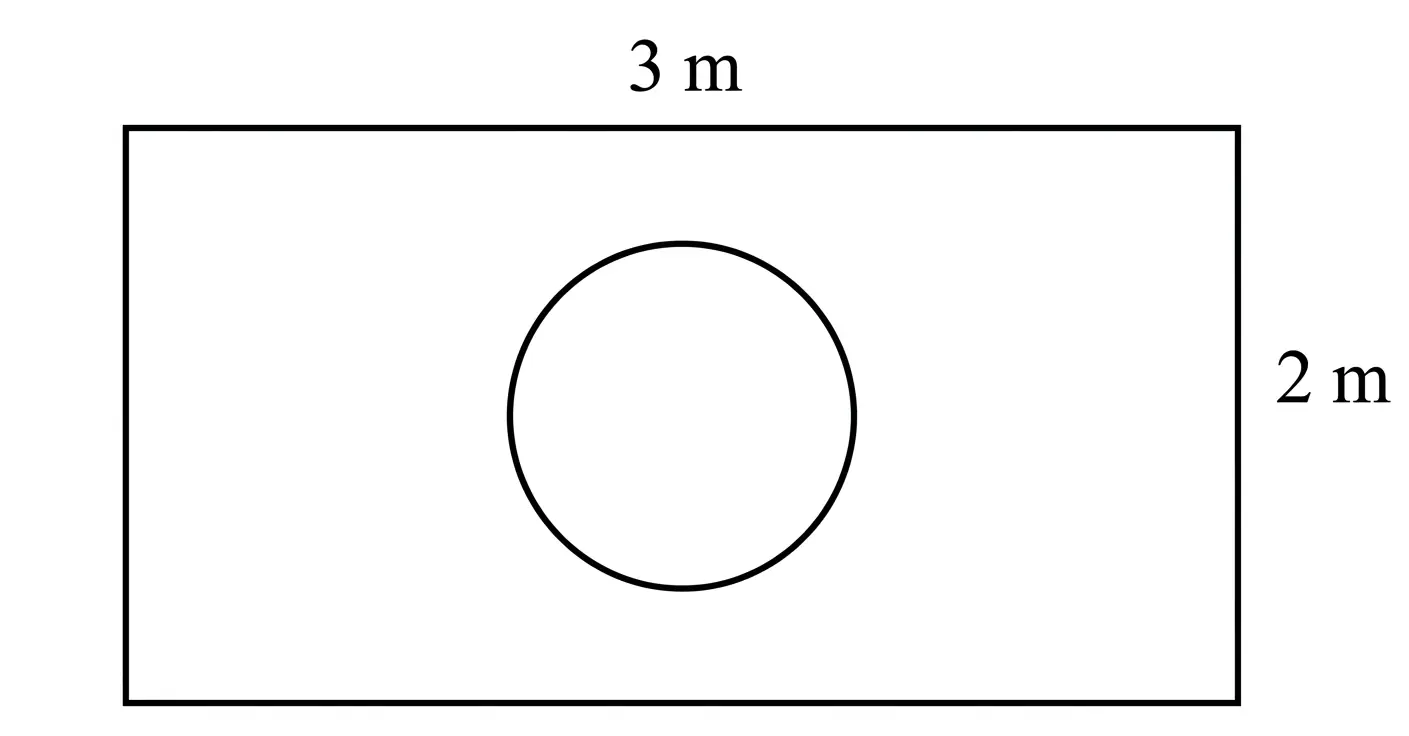
Suppose you drop a die at random on the rectangular region shown in Fig. 14.6. What is the probability that it will land inside the circle with diameter $$1$$m?
Fig. 14.6
Fig. 14.6

Solution

Step 1 : Idea of geometric probability
When every point of a region is equally likely to be hit, the probability that the point will fall inside any sub-region equals the
ratio

$$\text{Probability} = \dfrac{\text{area of the favourable region}}{\text{area of the whole region}}$$

Here the whole region is the rectangle of Fig. 14.6, while the favourable region is the circle drawn inside it.

Step 2 : Area of the rectangular region
From the figure, the rectangle measures $$3\,\text{m}$$ by $$2\,\text{m}$$.

$$A_{\text{rect}} = l \times b = 3\,\text{m} \times 2\,\text{m} = 6\,\text{m}^2$$

Step 3 : Area of the circular region
The circle has diameter $$1\,\text{m}$$, so its radius is

$$r = \dfrac{1\,\text{m}}{2} = 0.5\,\text{m}$$

Hence

$$A_{\text{circle}} = \pi r^2 = \pi(0.5)^2 = 0.25\,\pi\;\text{m}^2$$

Step 4 : Required probability

$$P = \dfrac{A_{\text{circle}}}{A_{\text{rect}}} = \dfrac{0.25\,\pi}{6} = \dfrac{\pi}{24}$$

Taking $$\pi \approx 3.14$$,

$$P \approx \dfrac{3.14}{24} \approx 0.13$$

Therefore the probability that the die will land inside the circle is $$\dfrac{\pi}{24}\; (\text{about }13\%).$$

Answer

$$P=\dfrac{\pi}{24}\;\left(\approx 0.13\right)$$

21 A lot consists of $$144$$ ball pens of which $$20$$ are defective and the others are good. Nuri will buy a pen if it is good, but will not buy if it is defective. The shopkeeper draws one pen at random and gives it to her. What is the probability that

(i) She will buy it?

Solution

Total number of pens in the lot (equally likely outcomes):
$$n(S)=144$$

Number of good pens (favourable outcomes for buying):
$$n(E)=144-20=124$$

Probability that the pen drawn is good (and hence Nuri buys it):
$$P(E)=\frac{n(E)}{n(S)}=\frac{124}{144}$$

Simplify the fraction by dividing numerator and denominator by their HCF (=4):
$$P(E)=\frac{124\div4}{144\div4}=\frac{31}{36}$$

Answer

$$\displaystyle P(\text{Nuri buys the pen})=\frac{31}{36}$$

(ii) She will not buy it?

Solution

Probability that Nuri does not buy the pen  =  Probability that the pen drawn is defective.

Number of defective pens (favourable outcomes):
$$n(F)=20$$

Total number of pens remains
$$n(S)=144$$

Required probability:
$$P(F)=\frac{n(F)}{n(S)}=\frac{20}{144}$$

Simplifying by 4:
$$P(F)=\frac{20\div4}{144\div4}=\frac{5}{36}$$

(We could also have used $$P(F)=1-P(E)=1-\tfrac{31}{36}=\tfrac{5}{36}$$ as a check.)

Answer

$$\displaystyle P(\text{Nuri does not buy the pen})=\frac{5}{36}$$

22 Refer to Example 13.

(i)

Complete the following table:
Event: 'Sum on 2 dice'$$2$$$$3$$$$4$$$$5$$$$6$$$$7$$$$8$$$$9$$$$10$$$$11$$$$12$$
Probability$$\dfrac{1}{36}$$$$\dfrac{5}{36}$$$$\dfrac{1}{36}$$

Solution

For two fair dice each of the 36 ordered pairs
$$S=\{(1,1),(1,2),\ldots ,(6,6)\}$$
is equally likely. To obtain the probability of a given sum we count the favourable ordered pairs.

SumOrdered pairs giving the sumNumber of pairsProbability $$=\dfrac{\text{favourable}}{36}$$
$$2$$$$(1,1)$$$$1$$$$\dfrac{1}{36}$$
$$3$$$$(1,2),(2,1)$$$$2$$$$\dfrac{2}{36}$$
$$4$$$$(1,3),(2,2),(3,1)$$$$3$$$$\dfrac{3}{36}$$
$$5$$$$(1,4),(2,3),(3,2),(4,1)$$$$4$$$$\dfrac{4}{36}$$
$$6$$$$(1,5),(2,4),(3,3),(4,2),(5,1)$$$$5$$$$\dfrac{5}{36}$$
$$7$$$$(1,6),(2,5),(3,4),(4,3),(5,2),(6,1)$$$$6$$$$\dfrac{6}{36}$$
$$8$$$$(2,6),(3,5),(4,4),(5,3),(6,2)$$$$5$$$$\dfrac{5}{36}$$
$$9$$$$(3,6),(4,5),(5,4),(6,3)$$$$4$$$$\dfrac{4}{36}$$
$$10$$$$(4,6),(5,5),(6,4)$$$$3$$$$\dfrac{3}{36}$$
$$11$$$$(5,6),(6,5)$$$$2$$$$\dfrac{2}{36}$$
$$12$$$$(6,6)$$$$1$$$$\dfrac{1}{36}$$

Placing these probabilities in the given row completes the table.

Answer

Completed probabilities:$$\begin{aligned}2&:\;\dfrac{1}{36},\;3:\dfrac{2}{36},\;4:\dfrac{3}{36},\;5:\dfrac{4}{36},\;6:\dfrac{5}{36},\\7&:\;\dfrac{6}{36},\;8:\dfrac{5}{36},\;9:\dfrac{4}{36},\;10:\dfrac{3}{36},\;11:\dfrac{2}{36},\;12:\dfrac{1}{36}\end{aligned}$$

(ii) A student argues that 'there are $$11$$ possible outcomes $$2, 3, 4, 5, 6, 7, 8, 9, 10, 11$$ and $$12$$. Therefore, each of them has a probability $$\dfrac{1}{11}$$. Do you agree with this argument? Justify your answer.

Solution

The student’s reasoning is incorrect. Although there are 11 different sums, these sums are not equally likely because they arise from different numbers of equally likely elementary outcomes.

Each throw of two dice has 36 possible ordered pairs, every one of which occurs with probability $$\dfrac{1}{36}$$. As shown in part (i), the numbers of ordered pairs producing the various sums are unequal (for example 6 pairs give a sum of 7 but only 1 pair gives a sum of 2). Therefore

  • $$P(\text{sum }7)=\dfrac{6}{36}=\dfrac{1}{6}$$
  • $$P(\text{sum }2)=\dfrac{1}{36}$$

Since these probabilities are different, neither of them equals $$\dfrac{1}{11}$$, so the claim that each sum has probability $$\dfrac{1}{11}$$ is false.

Answer

No. The 11 sums are not equally likely because each is obtained from a different number of the 36 equally likely ordered pairs of dice. Hence their probabilities are those listed in (i), not $$\dfrac{1}{11}$$.

23 A game of tossing a one rupee coin $$3$$ times and noting its outcome each time. Hanif wins if all the tosses give the same result i.e., three heads or three tails, and loses otherwise. Calculate the probability that Hanif will lose the game.

Solution

Given: A fair one–rupee coin is tossed $$3$$ times. All $$2^3 = 8$$ possible sequences of Heads (H) and Tails (T) are equally likely.

Hanif wins only when the three results are identical:

  • All Heads  $$\to$$  H H H
  • All Tails  $$\to$$  T T T

So, number of winning outcomes $$= 2.$$

Therefore, number of losing outcomes

$$8 - 2 = 6.$$

The required probability is

$$P(\text{Hanif loses}) = \dfrac{\text{number of losing outcomes}}{\text{total outcomes}} = \dfrac{6}{8} = \dfrac{3}{4}.$$

Answer

$$\displaystyle \frac{3}{4}$$

24 A die is thrown twice. What is the probability that
(i) $$5$$ will not come up either time? (ii) $$5$$ will come up at least once?
[Hint: Throwing a die twice and throwing two dice simultaneously are treated as the same experiment]

Solution

Experiment
Throwing a die twice (or, equivalently, throwing two dice together) gives a sample space of size
$$6 \times 6 = 36$$ equally likely ordered pairs.

Favourable outcomes

  • A single throw produces the face $$5$$ with probability $$\dfrac16$$.
  • It produces a face other than $$5$$ with probability $$\dfrac56$$.

(i) “5 will not come up either time”

The two throws are independent, so

$$P(\text{no 5 in first throw}) = \frac56$$
$$P(\text{no 5 in second throw}) = \frac56$$

Hence

$$P(\text{no 5 in both throws}) = \frac56 \times \frac56 = \frac{25}{36}$$

(ii) “5 will come up at least once”

“At least once” is the complement of “never”. Therefore

$$P(\text{at least one 5}) = 1 - P(\text{no 5 in both throws})$$
$$= 1 - \frac{25}{36} = \frac{11}{36}$$

Verification by direct counting (optional)

The three mutually exclusive cases are:

  • $$5$$ on the first throw, not $$5$$ on the second: $$\frac16 \times \frac56 = \frac5{36}$$
  • Not $$5$$ on the first, $$5$$ on the second: $$\frac56 \times \frac16 = \frac5{36}$$
  • $$5$$ on both throws: $$\frac16 \times \frac16 = \frac1{36}$$

Total $$= \frac5{36}+\frac5{36}+\frac1{36}=\frac{11}{36}$$, confirming the previous result.

Answer

(i) $$\displaystyle \frac{25}{36}$$
(ii) $$\displaystyle \frac{11}{36}$$

25 Which of the following arguments are correct and which are not correct? Give reasons for your answer.

(i) If two coins are tossed simultaneously there are three possible outcomes — two heads, two tails or one of each. Therefore, for each of these outcomes, the probability is $$\dfrac{1}{3}$$.

Solution

Step 1 – List the sample space for two coins.

When two fair coins are tossed once, every coin can show a Head (H) or a Tail (T).
The sample space is

$$S=\{HH, HT, TH, TT\}$$

Hence $$n(S)=4.$$

Step 2 – Describe each event mentioned in the argument.

Verbal descriptionEvent setNumber of sample points
“Two heads”$$\{HH\}$$1
“Two tails”$$\{TT\}$$1
“One of each”$$\{HT, TH\}$$2

Step 3 – Compute the probabilities.

  • $$P(\text{two heads})=\dfrac{1}{4}$$
  • $$P(\text{two tails})=\dfrac{1}{4}$$
  • $$P(\text{one of each})=\dfrac{2}{4}=\dfrac{1}{2}$$

Step 4 – Check the argument.

The three events are not equally likely because their numbers of favourable sample points are 1, 1 and 2 respectively. Therefore assigning the probability $$\dfrac{1}{3}$$ to each event is wrong.

Conclusion: The argument is not correct.

Answer

Not correct — the three events are not equally likely; their probabilities are $$\tfrac14,\,\tfrac14,\,\tfrac12$$.

(ii) If a die is thrown, there are two possible outcomes — an odd number or an even number. Therefore, the probability of getting an odd number is $$\dfrac{1}{2}$$.

Solution

Step 1 – List the sample space for one die.

For a fair die, $$S=\{1,2,3,4,5,6\}$$ so $$n(S)=6.$$

Step 2 – Identify the events.

Verbal descriptionEvent setNumber of sample points
“Odd number”$$\{1,3,5\}$$3
“Even number”$$\{2,4,6\}$$3

Step 3 – Compute the probability of getting an odd number.

$$P(\text{odd})=\dfrac{3}{6}=\dfrac12$$

Step 4 – Check the argument.

The two events (odd, even) have the same number of favourable outcomes and are therefore equally likely. Assigning probability $$\dfrac12$$ to each is correct.

Conclusion: The argument is correct.

Answer

Correct — the probability of an odd number is $$\tfrac12$$.

NCERT Solutions for Class 10
Maths
NCERT Solutions for Class 10 Maths
Chapter-wise step-by-step
solutions with explanations
explore solutions Maths bg
Science
NCERT Solutions for Class 10 Science
Chapter-wise step-by-step
solutions with explanations
explore solutions Science bg

Frequently Asked Questions

50,000+ JEE Students Trusted Our Score Calculator

Predict your JEE Main percentile, rank & performance in seconds