Join WhatsApp Icon JEE WhatsApp Group
NCERT Solutions for Class 10 Maths

Chapter 11: Surface Areas and Volumes

Download Solutions PDF
Daily JEE Updates, Tips & Important Alerts
Join 30,000+ students and stay updated with JEE notifications and preparation insights.
Join Now!
Free PDF
Complete NCERT Solution PDF for Chapter 11: Surface Areas and Volumes

NCERT Solutions For Class 10 Maths Chapter 11 Surface Areas and Volumes helps students understand measurements of three-dimensional shapes and their practical applications. The page provides detailed NCERT Solutions that explain concepts related to cubes, cuboids, cylinders, cones, spheres, and combinations of solids. NCERT Solutions For Class 10 Maths make it easier for students to learn formulas and apply them to solve real-life measurement problems. The chapter develops spatial understanding and improves calculation skills through various geometric applications. These solutions guide students through textbook exercises with accurate methods and detailed explanations. Students can access the chapter PDF for quick revision and regular practice. The structured approach helps learners confidently solve problems involving surface area and volume calculations.
Download Solutions PDF

Examples 1-4

Example 1

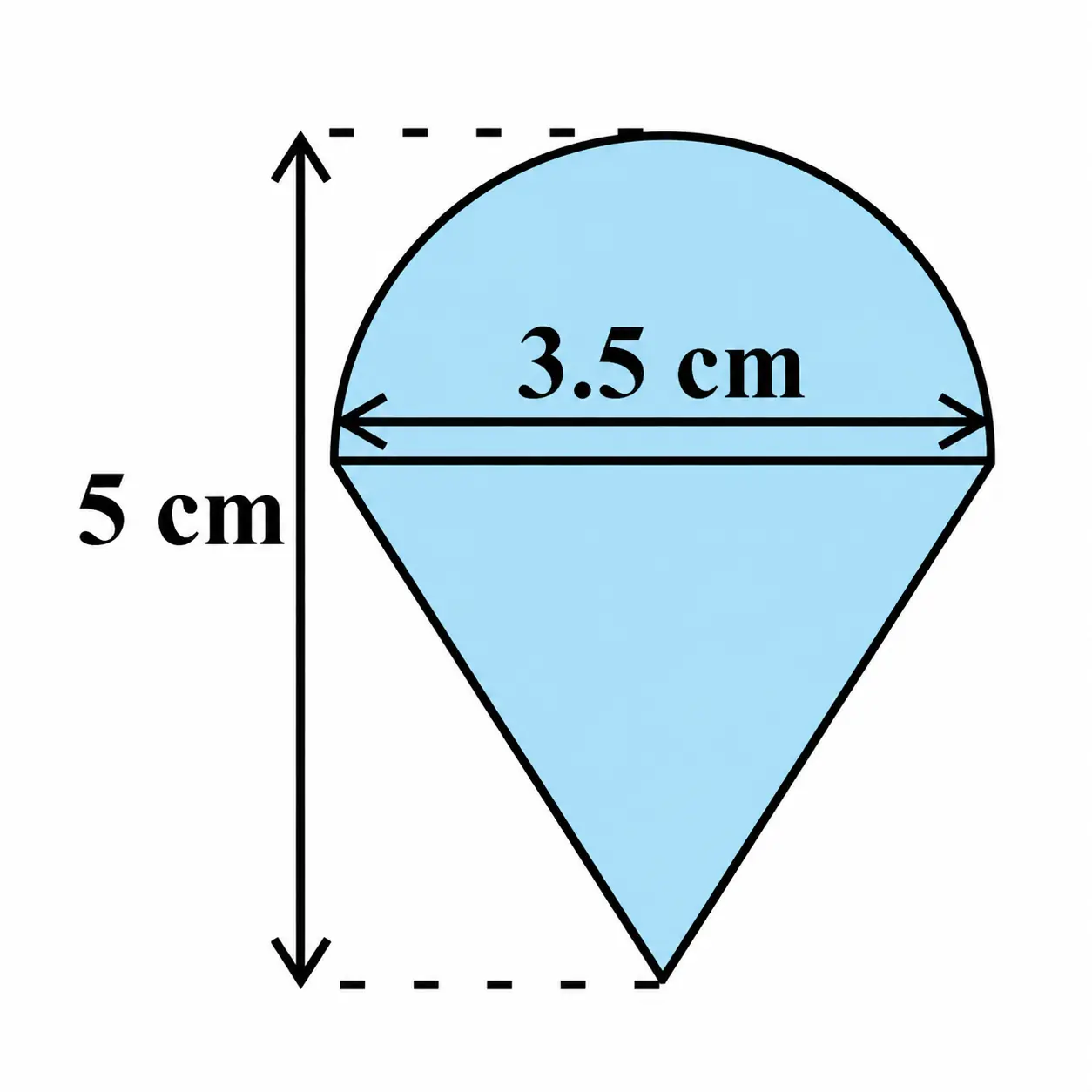
Rasheed got a playing top (lattu) as his birthday present, which surprisingly had no colour on it. He wanted to colour it with his crayons. The top is shaped like a cone surmounted by a hemisphere (see Fig 12.6). The entire top is 5 cm in height and the diameter of the top is 3.5 cm. Find the area he has to colour. (Take $$\pi = \dfrac{22}{7}$$)
Fig 12.6
Fig 12.6

Solution

Step 1 – Identify the dimensions
The diameter of the top is 3.5 cm, hence the radius is $$r = \dfrac{3.5}{2} = 1.75\,\text{cm}$$.
Total height of the toy is $$H = 5\,\text{cm}$$.

Step 2 – Separate the two parts
The toy consists of

  • a hemisphere (radius $$r$$) on the top, and
  • a right circular cone underneath it, having the same base radius $$r$$.
Height of the hemisphere = its radius = $$1.75\,\text{cm}$$.
Therefore height of the cone is
$$h = H - r = 5 - 1.75 = 3.25\,\text{cm}$$.

Step 3 – Slant height of the cone
$$l = \sqrt{r^{2} + h^{2}} = \sqrt{1.75^{2} + 3.25^{2}} = \sqrt{3.0625 + 10.5625} = \sqrt{13.625} \approx 3.69\,\text{cm}$$

Step 4 – Areas to be coloured
The common circular face where the hemisphere meets the cone is not exposed, so only the curved surfaces are coloured.

  • Curved Surface Area (CSA) of hemisphere:
    $$2\pi r^{2} = 2 \times \dfrac{22}{7} \times 1.75^{2} = 19.25\,\text{cm}^{2}$$
  • CSA of cone:
    $$\pi r l = \dfrac{22}{7} \times 1.75 \times 3.69 \approx 20.30\,\text{cm}^{2}$$

Step 5 – Total coloured area
$$\text{Required area} = 19.25 + 20.30 = 39.55\,\text{cm}^{2}$$ (correct to two decimal places).

Therefore, Rasheed has to colour approximately $$39.55\,\text{cm}^{2}$$ of the playing top.

Answer

$$\text{Area to be coloured} \approx 39.55\,\text{cm}^2$$

Example 2

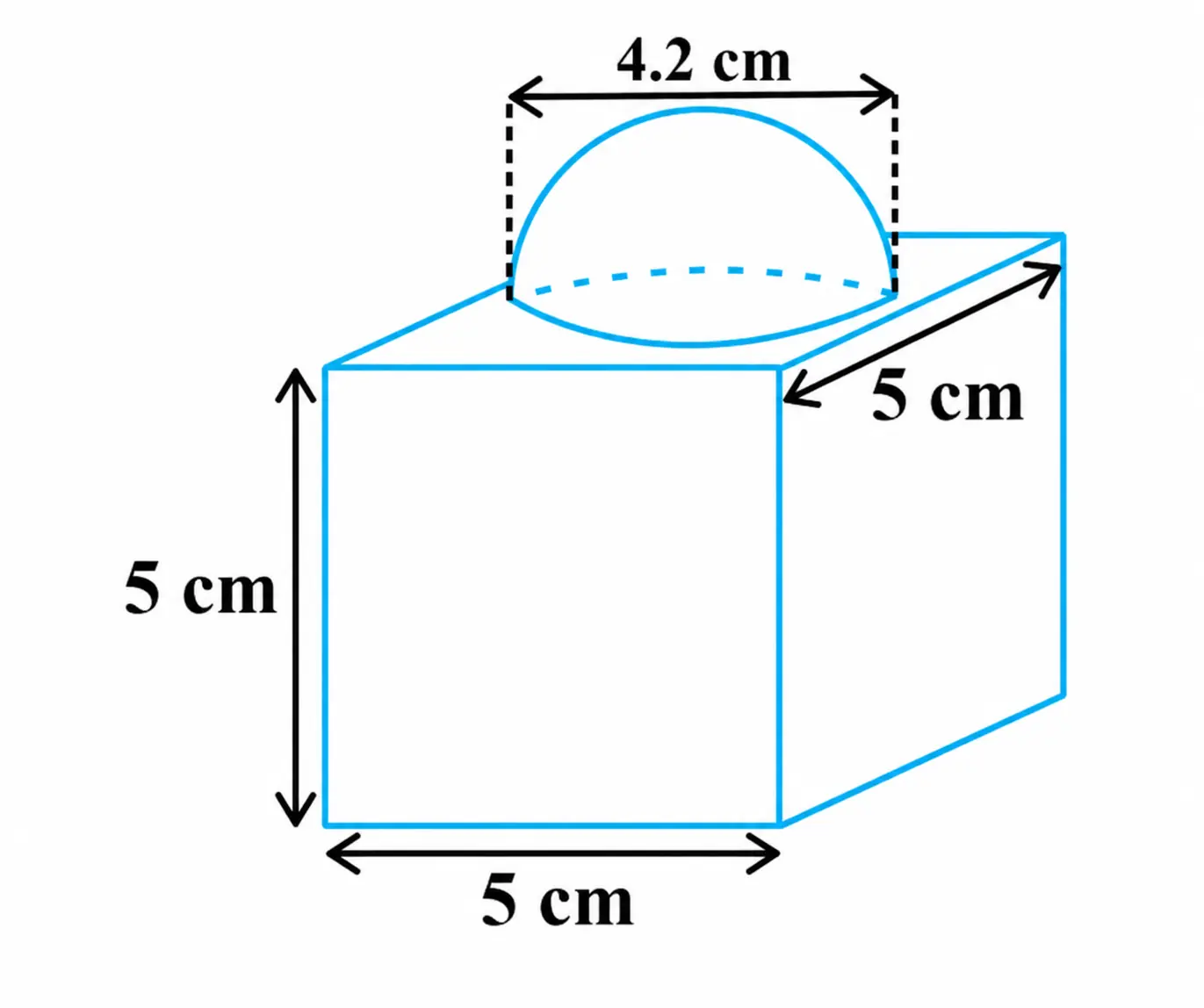
The decorative block shown in Fig. 12.7 is made of two solids — a cube and a hemisphere. The base of the block is a cube with edge 5 cm, and the hemisphere fixed on the top has a diameter of 4.2 cm. Find the total surface area of the block. (Take $$\pi = \dfrac{22}{7}$$)
Fig. 12.7
Fig. 12.7

Solution

Given data

  • Edge of the cube, $$a = 5 \text{ cm}$$
  • Diameter of the hemisphere, $$4.2 \text{ cm}$$ so its radius is $$r = \dfrac{4.2}{2} = 2.1 \text{ cm}$$

The decorative block consists of a cube with a hemisphere fixed on its top face. Only the outer surfaces that can be touched or seen from outside are to be counted.

1. Surface area contributed by the cube

The cube has 6 faces, each of area $$a^2$$.

When the hemisphere is placed on the top face:

  • All five side and bottom faces remain completely exposed. Their total area is $$5a^2$$.
  • From the top face, the circular portion of radius $$r$$ is covered by the hemisphere’s base. Therefore, only the part of the square outside this circle is visible. Its area is $$a^2 - \pi r^2$$.

Hence, the exposed area of the cube equals

$$5a^2 + (a^2 - \pi r^2) = 6a^2 - \pi r^2.$$

2. Surface area contributed by the hemisphere

The hemisphere contributes only its curved surface, since its flat circular base is attached to the cube. The curved surface area (CSA) of a hemisphere is

$$2\pi r^2.$$

3. Total surface area of the block

Adding the exposed area of the cube and the CSA of the hemisphere:

$$\text{T.S.A.} = \bigl(6a^2 - \pi r^2\bigr) + 2\pi r^2 = 6a^2 + \pi r^2.$$

Substitute the given measurements.

• $$6a^2 = 6 \times (5)^2 = 6 \times 25 = 150 \text{ cm}^2.$$
• $$\pi r^2 = \dfrac{22}{7} \times (2.1)^2 = \dfrac{22}{7} \times 4.41 = \dfrac{22 \times 4.41}{7} = 13.86 \text{ cm}^2.$$

Therefore,

$$\text{T.S.A.} = 150 \text{ cm}^2 + 13.86 \text{ cm}^2 = 163.86 \text{ cm}^2.$$

Total surface area of the decorative block = $$163.86 \text{ cm}^2.$$

Answer

$$\displaystyle 163.86\; \text{cm}^2$$

Example 3

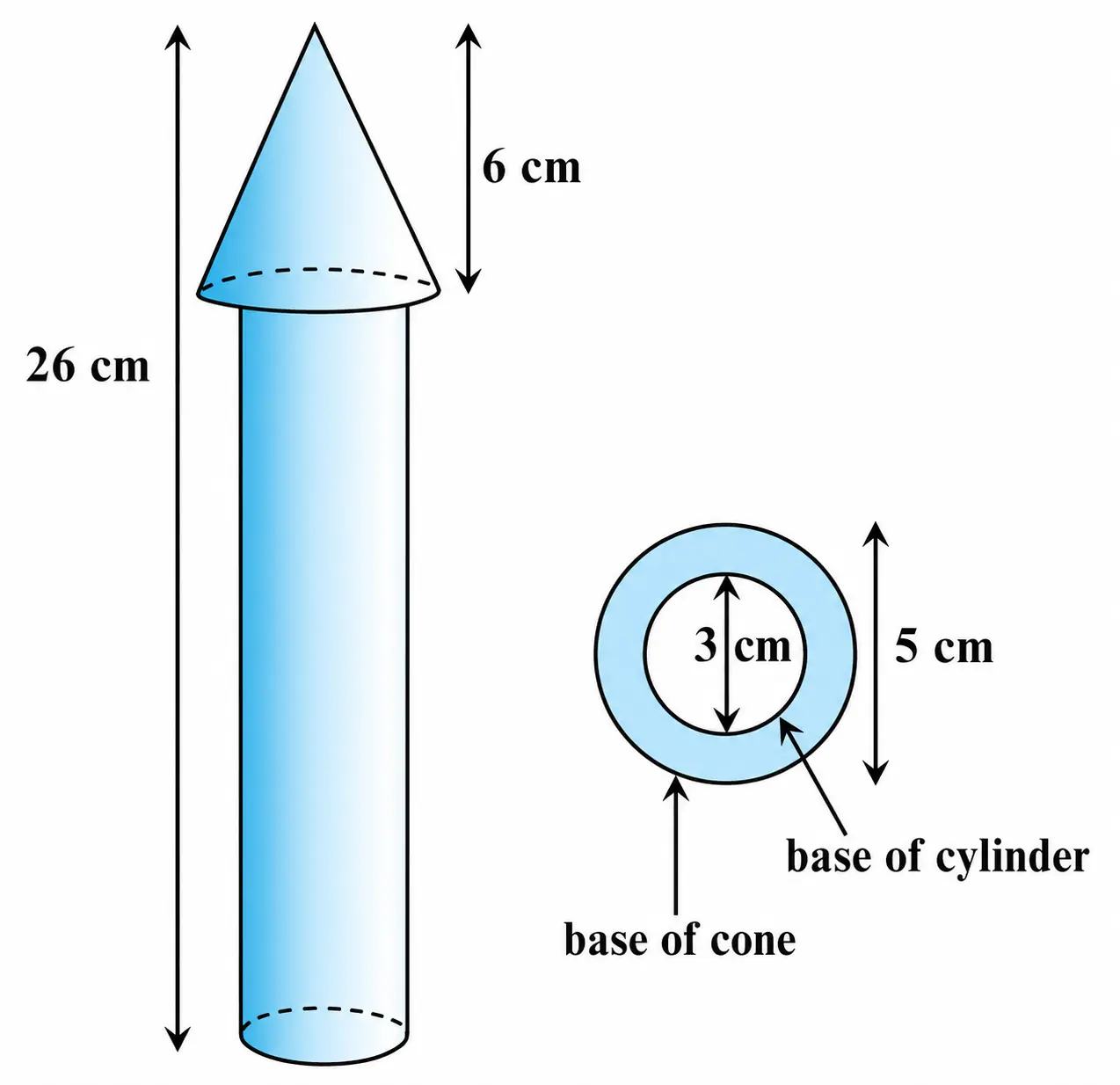
A wooden toy rocket is in the shape of a cone mounted on a cylinder, as shown in Fig. 12.8. The height of the entire rocket is 26 cm, while the height of the conical part is 6 cm. The base of the conical portion has a diameter of 5 cm, while the base diameter of the cylindrical portion is 3 cm. If the conical portion is to be painted orange and the cylindrical portion yellow, find the area of the rocket painted with each of these colours. (Take $$\pi = 3.14$$)
Fig. 12.8
Fig. 12.8

Solution

Step 1 : Separate the two parts and note their dimensions

  • Conical part
      Height $$h_c = 6\,\text{cm}$$
      Diameter $$= 5\,\text{cm}\;\Rightarrow\;\text{radius } r_c = 2.5\,\text{cm}$$
  • Cylindrical part
      Height $$h_{\!y}= 26 - 6 = 20\,\text{cm}$$ (total height minus height of cone)
      Diameter $$= 3\,\text{cm}\;\Rightarrow\;\text{radius } r_{\!y}= 1.5\,\text{cm}$$

Step 2 : Slant height of the cone

$$l = \sqrt{r_c^{\,2}+h_c^{\,2}} = \sqrt{(2.5)^2 + 6^2} = \sqrt{6.25+36}=\sqrt{42.25}=6.5\,\text{cm}$$

Step 3 : Area to be painted orange (curved surface of cone)

Curved surface area of cone:
$$A_{\text{orange}} = \pi r_c l = 3.14 \times 2.5 \times 6.5 = 51.025\,\text{cm}^2$$

Step 4 : Area to be painted yellow (curved surface of cylinder + its bottom)

Curved surface of cylinder:
$$\text{CSA}_\text{cyl} = 2\pi r_{\!y} h_{\!y}= 2\times3.14\times1.5\times20 = 188.4\,\text{cm}^2$$

Bottom circular face (only the lower base is exposed):
$$\text{Base area}= \pi r_{\!y}^{\,2}=3.14\times1.5^2 = 7.065\,\text{cm}^2$$

Total yellow area:
$$A_{\text{yellow}} = 188.4 + 7.065 = 195.465\,\text{cm}^2$$

Step 5 : Final results

The areas to be painted are therefore:
Orange : $$\approx 51.03\,\text{cm}^2$$
Yellow : $$\approx 195.47\,\text{cm}^2$$

Answer

Orange surface area ≈ $$51.03\,\text{cm}^2$$
Yellow surface area ≈ $$195.47\,\text{cm}^2$$

Example 4

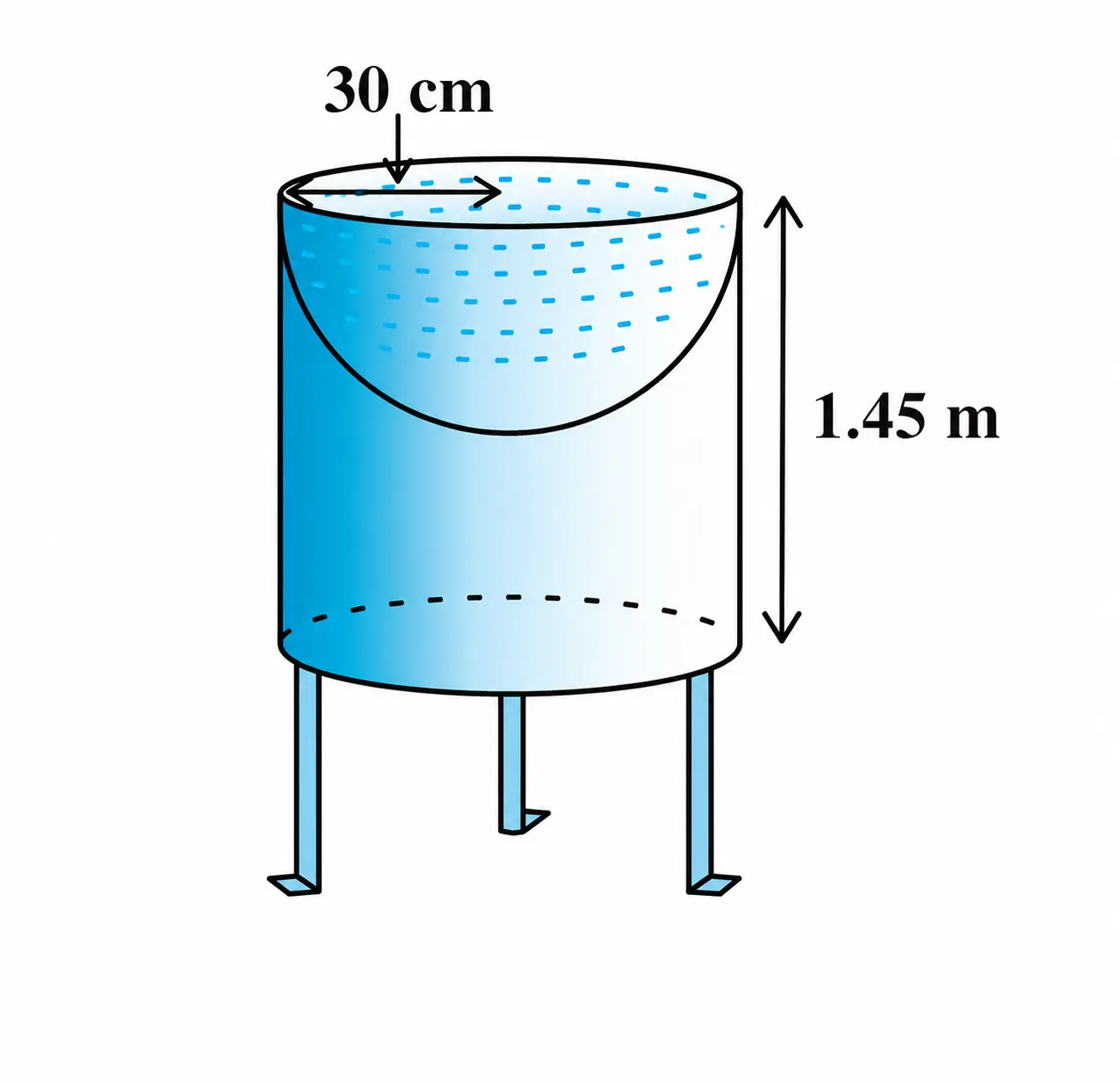
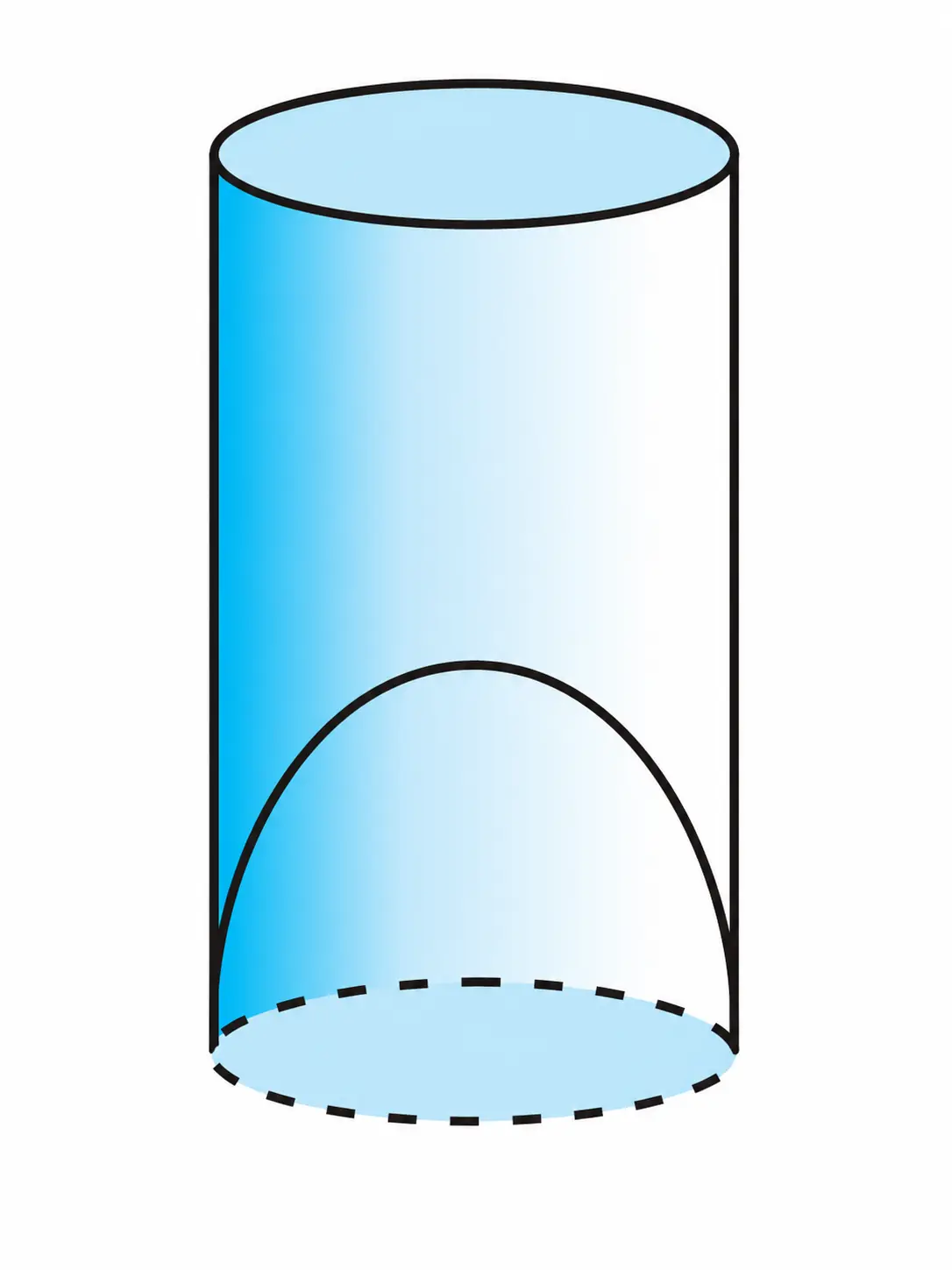
Mayank made a bird-bath for his garden in the shape of a cylinder with a hemispherical depression at one end (see Fig. 12.9). The height of the cylinder is 1.45 m and its radius is 30 cm. Find the total surface area of the bird-bath. (Take $$\pi = \dfrac{22}{7}$$)
Fig. 12.9
Fig. 12.9

Solution

Given data

  • Radius of the cylinder ( = radius of the hemisphere ): $$r = 30 \text{ cm}$$
  • Height of the cylindrical part: $$h = 1.45 \text{ m} = 1.45 \times 100 = 145 \text{ cm}$$
  • Take $$\pi = \dfrac{22}{7}$$

The bird-bath consists of

  1. the curved (lateral) surface of the cylinder,
  2. the circular base of the cylinder,
  3. the inner curved surface of the hemispherical depression.

The flat top of the cylinder is not present (it has been removed to make the depression), so it contributes no area.

1. Curved surface area of the cylinder

$$\text{CSA}_{\text{cyl}} = 2\pi r h = 2 \times \dfrac{22}{7} \times 30 \times 145 = \dfrac{191400}{7}\;\text{cm}^2$$

2. Area of the circular base

$$A_{\text{base}} = \pi r^{2} = \dfrac{22}{7} \times 30^{2} = \dfrac{19800}{7}\;\text{cm}^2$$

3. Curved surface area of the hemisphere (inner surface of the depression)

$$\text{CSA}_{\text{hemi}} = 2\pi r^{2} = 2 \times \dfrac{22}{7} \times 30^{2} = \dfrac{39600}{7}\;\text{cm}^2$$

Total surface area

$$\begin{aligned} \text{TSA} &= \text{CSA}_{\text{cyl}} + A_{\text{base}} + \text{CSA}_{\text{hemi}} \\ &= \dfrac{191400}{7} + \dfrac{19800}{7} + \dfrac{39600}{7} \\ &= \dfrac{250800}{7}\;\text{cm}^2\\[4pt] &\approx 35828.57\;\text{cm}^2 \end{aligned}$$

Changing to square metres ( $$1\,\text{m}^2 = 10000\,\text{cm}^2$$ ):

$$\text{TSA} = \dfrac{250800}{7 \times 10000}\;\text{m}^2 \approx 3.58\;\text{m}^2$$

Therefore, the total surface area of the bird-bath is $$\dfrac{250800}{7}\;\text{cm}^2 \; ( \approx 3.58\;\text{m}^2).$$

Answer

The total surface area of the bird-bath is $$\dfrac{250800}{7}\;\text{cm}^2 \;\bigl(\approx 3.58\;\text{m}^2\bigr).$$

Exercise 12.1

1 2 cubes each of volume $$64 \, \mathrm{cm^3}$$ are joined end to end. Find the surface area of the resulting cuboid.

Solution

Two identical cubes are joined along one face. We first find the edge of one cube.

  1. Let the edge of each cube be $$a\,\text{cm}$$.
    Given volume of a cube $$=64\,\mathrm{cm^3}$$.

    For a cube, $$\text{Volume}=a^3\!.$$ Hence $$a^3=64\;\Rightarrow\;a=\sqrt[3]{64}=4\,\text{cm}.$$

  2. When the cubes are joined end-to-end, the common face disappears from the exterior. The resulting solid is a cuboid whose

    • length $$l=2a=2\times4=8\,\text{cm},$$
    • breadth $$b=a=4\,\text{cm},$$
    • height $$h=a=4\,\text{cm}.$$
  3. Surface area of a cuboid is $$2(lb+bh+hl)$$.

    Substituting the values:

    $$\begin{aligned} \text{Surface area} &=2\bigl(l b+b h+h l\bigr)\\[2pt] &=2\bigl(8\times4+4\times4+4\times8\bigr)\\[2pt] &=2\bigl(32+16+32\bigr)\\[2pt] &=2\times80\\[2pt] &=160\,\mathrm{cm^2}. \end{aligned}$$

Therefore, the surface area of the solid obtained by joining the two cubes is $$160\,\mathrm{cm^2}$$.

Answer

Surface area &= $$160\,\mathrm{cm^2}$$

2 A vessel is in the form of a hollow hemisphere mounted by a hollow cylinder. The diameter of the hemisphere is 14 cm and the total height of the vessel is 13 cm. Find the inner surface area of the vessel.

Solution

The vessel is made by attaching a hollow cylinder on the open side of a hollow hemisphere.

Inner diameter of hemisphere = 14 cm  ⇒  inner radius $$r = \frac{14}{2}=7\,\text{cm}$$.

Total height of vessel = 13 cm.

The hemisphere already contributes a height equal to its radius, so the height of the cylindrical part is

$$h = 13\,\text{cm} - 7\,\text{cm} = 6\,\text{cm}.$$

The inner surface in contact with any liquid consists of

  • the curved surface of the hemisphere, and
  • the curved surface of the cylinder.

Curved surface area of hemisphere: $$2\pi r^{2}.$$

Curved surface area of cylinder: $$2\pi r h.$$

Total inner surface area $$S$$:

$$S = 2\pi r^{2} + 2\pi r h = 2\pi r (r + h).$$

Substituting $$r = 7\,\text{cm}$$ and $$h = 6\,\text{cm}$$,

$$S = 2 \times \frac{22}{7} \times 7 \times (7 + 6)$$

$$\;\;= 2 \times \frac{22}{7} \times 7 \times 13$$

$$\;\;= 44 \times 13$$

$$\;\;= 572.$$

Hence, the inner surface area of the vessel is $$572\,\text{cm}^{2}.$$

Answer

Inner surface area of the vessel = $$572\,\text{cm}^{2}$$

3 A toy is in the form of a cone of radius 3.5 cm mounted on a hemisphere of same radius. The total height of the toy is 15.5 cm. Find the total surface area of the toy.

Solution

Let the common radius of the hemisphere and the cone be $$r = 3.5\;\text{cm}$$.

Total height of the toy is $$H = 15.5\;\text{cm}$$.

Since the flat face of the hemisphere is joined to the base of the cone,

$$\text{height of cone }(h) = H - r = 15.5 - 3.5 = 12\;\text{cm}$$

1. Slant height of the cone

$$l = \sqrt{r^{2} + h^{2}} = \sqrt{(3.5)^{2} + 12^{2}} = \sqrt{12.25 + 144} = \sqrt{156.25} = 12.5\;\text{cm}$$

2. Curved Surface Area (C.S.A.) of the cone

$$S_{\text{cone}} = \pi r l = \pi \times 3.5 \times 12.5 = 43.75\pi\;\text{cm}^{2}$$

3. Curved Surface Area of the hemisphere

$$S_{\text{hemi}} = 2\pi r^{2} = 2\pi \times (3.5)^{2} = 24.5\pi\;\text{cm}^{2}$$

4. Total Surface Area of the toy

Only the curved portions are exposed, hence

$$S = S_{\text{cone}} + S_{\text{hemi}} = (43.75\pi + 24.5\pi) = 68.25\pi\;\text{cm}^{2}$$

Using $$\pi = \dfrac{22}{7}$$,

$$S = 68.25 \times \dfrac{22}{7} = 214.5\;\text{cm}^{2}$$

Therefore, the total surface area of the toy is $$214.5\;\text{cm}^{2}$$.

Answer

$$214.5\;\text{cm}^{2}$$

4 A cubical block of side 7 cm is surmounted by a hemisphere. What is the greatest diameter the hemisphere can have? Find the surface area of the solid.

Solution

Given data

  • Side of the cube  $$a = 7 \text{ cm}$$
  • A hemisphere is placed on the top face of the cube, with its flat circular face lying on that square face.

(1) Greatest possible diameter of the hemisphere

The circular base of the hemisphere must fit completely inside the top square of side $$7 \text{ cm}$$. Hence the largest possible diameter equals the side of the square:

$$\text{Maximum diameter}=7\,\text{cm} \;\Rightarrow\; \text{radius } r=\dfrac{7}{2}=3.5\,\text{cm}$$

(2) Surface area of the combined solid

The visible surface consists of

  1. the curved surface of the hemisphere;
  2. all five other faces of the cube (four vertical + the bottom);
  3. the portion of the top face of the cube that is outside the circular base of the hemisphere.

(i) Curved surface area of the hemisphere

$$\text{CSA}_{\text{hemisphere}} = 2\pi r^{2} = 2\pi \,(3.5)^{2}=2\pi(12.25)=24.5\pi\,\text{cm}^{2}$$

(ii) Visible area of the cube

  • Total area of all six faces of the cube: $$6a^{2}=6(7)^{2}=6\times49=294\,\text{cm}^{2}$$
  • Portion of the top face hidden by the hemisphere: $$\pi r^{2}=\pi(3.5)^{2}=\pi\times12.25=12.25\pi\,\text{cm}^{2}$$
  • Therefore, visible area of the cube
    $$=294-12.25\pi\,\text{cm}^{2}$$

(iii) Total surface area of the solid

$$\text{TSA}=\bigl(294-12.25\pi\bigr)+24.5\pi=294+12.25\pi\,\text{cm}^{2}$$

Using $$\pi\approx3.14$$,

$$\text{TSA}\approx294+12.25\times3.14=294+38.465\approx332.5\,\text{cm}^{2}$$

Result

  • Greatest possible diameter of the hemisphere: 7 cm
  • Total surface area of the solid: approximately 332.5 cm2 (exactly $$294+12.25\pi\,\text{cm}^{2}$$).

Answer

Greatest diameter = 7 cm;
Total surface area = $$294+12.25\pi\,\text{cm}^{2}\approx332.5\,\text{cm}^{2}$$.

5 A hemispherical depression is cut out from one face of a cubical wooden block such that the diameter $$l$$ of the hemisphere is equal to the edge of the cube. Determine the surface area of the remaining solid.

Solution

Step 1 : Understand the solid

The original solid is a cube of edge $$l$$. One of its square faces is provided with a hemispherical depression whose diameter equals that edge. Hence the hemisphere has radius

$$r = \dfrac{l}{2}$$

After scooping out the hemisphere:

  • The flat circular part (the base of the hemisphere) is removed from the square face.
  • The curved surface of the hemisphere becomes an additional exposed surface.

Step 2 : Begin with the total surface area of the cube

A cube of edge $$l$$ has

$$\text{Total surface area of cube}=6l^{2}$$

Step 3 : Subtract the area that disappears

The circular base of the hemisphere is cut away from one square face. Its area is

$$\text{Area of circular base}=\pi r^{2}=\pi\left(\dfrac{l}{2}\right)^{2}=\dfrac{\pi l^{2}}{4}$$

So we must subtract this much from one face of the cube.

Step 4 : Add the new area that appears

The curved surface area of a hemisphere is

$$\text{Curved area of hemisphere}=2\pi r^{2}=2\pi\left(\dfrac{l}{2}\right)^{2}=\dfrac{\pi l^{2}}{2}$$

This curved surface is now exposed, so it must be added to the total surface area.

Step 5 : Compute the final surface area

$$\begin{aligned}\text{Required surface area}&=6l^{2}-\dfrac{\pi l^{2}}{4}+\dfrac{\pi l^{2}}{2}\\[4pt]&=6l^{2}+\left(\dfrac{\pi l^{2}}{2}-\dfrac{\pi l^{2}}{4}\right)\\[4pt]&=6l^{2}+\dfrac{\pi l^{2}}{4}\\[6pt]&=l^{2}\left(6+\dfrac{\pi}{4}\right)\;\text{square units}\end{aligned}$$

Thus, the surface area of the remaining solid is $$l^{2}\left(6+\dfrac{\pi}{4}\right).$$

Answer

Surface area  =  $$l^{2}\Bigl(6+\dfrac{\pi}{4}\Bigr)$$ square units.

6

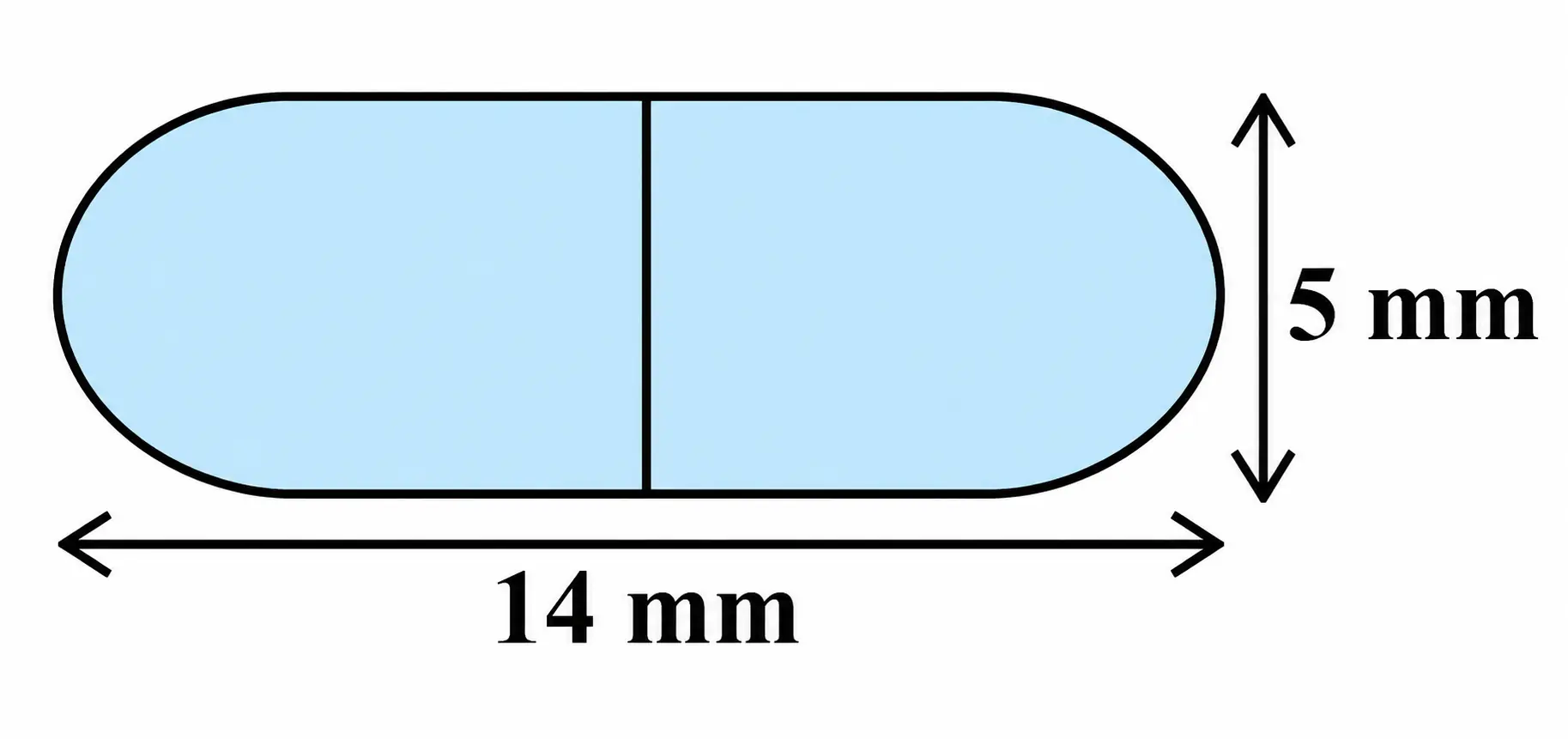
A medicine capsule is in the shape of a cylinder with two hemispheres stuck to each of its ends (see Fig. 12.10). The length of the entire capsule is 14 mm and the diameter of the capsule is 5 mm. Find its surface area.
Fig. 12.10
Fig. 12.10

Solution

Given

  • Total length of capsule = 14 mm
  • Diameter = 5 mm  ⇒  radius $$r = \frac{5}{2} = 2.5\,\text{mm}$$

The capsule consists of

  • a right circular cylinder (middle part) of height $$h$$
  • two identical hemispheres (one at each end)

1. Height of the cylindrical part

Each hemisphere contributes a length equal to its radius $$r$$. Therefore

$$h = 14 - 2r = 14 - 2(2.5) = 14 - 5 = 9\,\text{mm}$$

2. Surface area to be found

Total curved surface area

$$S = \text{CSA of cylinder} + \text{surface area of the two hemispheres}$$

But two hemispheres together form a complete sphere; hence

$$S = \underbrace{2\pi r h}_{\text{cylinder}} + \underbrace{4\pi r^{2}}_{\text{sphere}}$$

3. Substitute $$r = 2.5\,\text{mm},\; h = 9\,\text{mm}$$

CSA of cylinder:
$$2\pi r h = 2\pi(2.5)(9) = 45\pi$$

Surface area of sphere:
$$4\pi r^{2} = 4\pi(2.5)^{2} = 4\pi(6.25) = 25\pi$$

Add them:

$$S = 45\pi + 25\pi = 70\pi$$

4. Numerical value

Take $$\pi = \frac{22}{7}$$:

$$S = 70 \times \frac{22}{7} = 10 \times 22 = 220\,\text{mm}^{2}$$

Therefore, the surface area of the capsule is $$220\,\text{mm}^{2}$$.

Answer

$$220\,\text{mm}^{2}$$

7 A tent is in the shape of a cylinder surmounted by a conical top. If the height and diameter of the cylindrical part are 2.1 m and 4 m respectively, and the slant height of the top is 2.8 m, find the area of the canvas used for making the tent. Also, find the cost of the canvas of the tent at the rate of $$\mathrm{\textsf{₹}}500$$ per $$\mathrm{m^2}$$. (Note that the base of the tent will not be covered with canvas.)

Solution

Given data

  • Diameter (cylinder) = 4 m  →  radius $$r = \dfrac{4}{2} = 2\,\text{m}$$
  • Height of cylindrical part $$h = 2.1\,\text{m}$$
  • Slant height of conical top $$l = 2.8\,\text{m}$$
  • The base of the tent is not covered with canvas.

1. Curved surface area of the cylindrical portion

$$\text{CSA}_{\text{cyl}} = 2\pi r h$$

$$\text{CSA}_{\text{cyl}} = 2 \times \pi \times 2 \times 2.1 = 8.4\pi\,\text{m}^2$$

Taking $$\pi = \dfrac{22}{7}$$,

$$\text{CSA}_{\text{cyl}} = 8.4 \times \dfrac{22}{7} = 26.4\,\mathrm{m^2}$$

2. Curved surface area of the conical top

$$\text{CSA}_{\text{cone}} = \pi r l$$

$$\text{CSA}_{\text{cone}} = \pi \times 2 \times 2.8 = 5.6\pi\,\text{m}^2$$

Again using $$\pi = \dfrac{22}{7}$$,

$$\text{CSA}_{\text{cone}} = 5.6 \times \dfrac{22}{7} = 17.6\,\mathrm{m^2}$$

3. Total canvas area required

Base is open, so only the two curved surfaces are added:

$$A_{\text{total}} = \text{CSA}_{\text{cyl}} + \text{CSA}_{\text{cone}}$$

$$A_{\text{total}} = 26.4 + 17.6 = 44.0\,\mathrm{m^2}$$

4. Cost of the canvas

Rate = $$\text{₹}\,500$$ per $$\mathrm{m^2}$$

$$\text{Cost} = 44.0 \times 500 = \text{₹}\,22\,000$$

Answer

Total canvas area = $$44\,\mathrm{m^2}$$
Cost of canvas = ₹ 22 000

8 From a solid cylinder whose height is 2.4 cm and diameter 1.4 cm, a conical cavity of the same height and same diameter is hollowed out. Find the total surface area of the remaining solid to the nearest $$\mathrm{cm^2}$$.

Solution

Given data

  • Height of the cylinder $$h_c = 2.4\,\mathrm{cm}$$
  • Diameter of both the cylinder and the cone $$=1.4\,\mathrm{cm}\;\Rightarrow\;\text{radius }r = 0.7\,\mathrm{cm}$$
  • The cone that is hollowed out has the same height and radius as the cylinder, so $$h_{\text{cone}} = 2.4\,\mathrm{cm},\;r_{\text{cone}} = 0.7\,\mathrm{cm}$$

The remaining solid looks like a cylinder whose top circular face has been removed and replaced by the curved surface of the (inverted) cone drilled out. Therefore its exposed surfaces are:

  1. Curved surface of the cylinder.
  2. The circular base of the cylinder (bottom face).
  3. Curved (lateral) surface of the conical cavity.

1. Curved surface area of the cylinder

$$\text{CSA}_{\text{cyl}} = 2\pi r h_c$$

$$= 2 \times \pi \times 0.7 \times 2.4 = 3.36\pi\;\text{cm}^2$$

2. Area of the circular base

$$A_{\text{base}} = \pi r^2 = \pi\,(0.7)^2 = 0.49\pi\;\text{cm}^2$$

3. Curved surface area of the conical cavity

First find its slant height $$l$$.

$$l = \sqrt{r^2 + h_{\text{cone}}^2} = \sqrt{(0.7)^2 + (2.4)^2} = \sqrt{0.49 + 5.76} = \sqrt{6.25} = 2.5\,\text{cm}$$

Now

$$\text{CSA}_{\text{cone}} = \pi r l = \pi \times 0.7 \times 2.5 = 1.75\pi\;\text{cm}^2$$

Total surface area of the remaining solid

$$\text{TSA} = \text{CSA}_{\text{cyl}} + A_{\text{base}} + \text{CSA}_{\text{cone}}$$

$$= 3.36\pi + 0.49\pi + 1.75\pi$$

$$= 5.60\pi\;\text{cm}^2$$

Using $$\pi = \dfrac{22}{7}$$,

$$\text{TSA} = 5.60 \times \dfrac{22}{7} = 5.60 \times 3.142857\ldots \approx 17.6\,\text{cm}^2$$

To the nearest square centimetre,

$$\boxed{18\,\mathrm{cm^2}}$$

Answer

$$18\,\mathrm{cm^2}$$

9

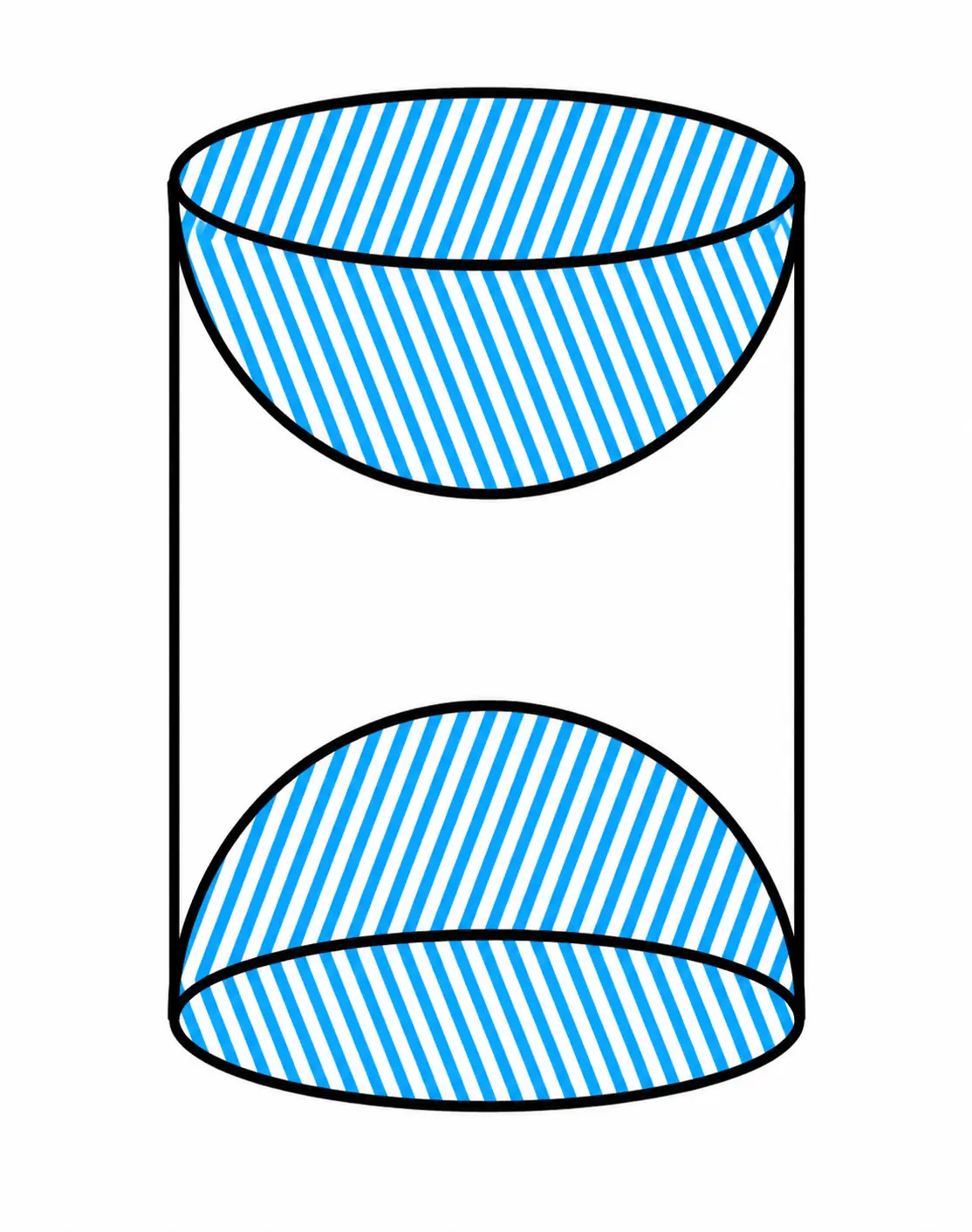
A wooden article was made by scooping out a hemisphere from each end of a solid cylinder, as shown in Fig. 12.11. If the height of the cylinder is 10 cm, and its base is of radius 3.5 cm, find the total surface area of the article.
Fig. 12.11
Fig. 12.11

Solution

Given data

  • Radius of the cylinder (and of each hemisphere) $$r = 3.5\text{ cm}$$
  • Height of the cylinder $$h = 10\text{ cm}$$

The article consists of

  1. the curved (lateral) surface of the original cylinder, and
  2. the curved surfaces of two hemispherical hollows scooped out from its ends.

There are no flat circular faces left, because each end has been scooped out.

(1) Curved surface area of the cylinder

The formula for the curved surface area (CSA) of a cylinder is $$2\pi r h$$. Hence

$$\text{CSA}_{\text{cyl}} = 2\pi r h = 2\pi \times 3.5 \times 10 = 70\pi\;\text{cm}^2.$$

(2) Curved surface area of the two hemispherical hollows

The curved surface area of one hemisphere is $$2\pi r^2$$. Therefore for two hemispheres,

$$\text{CSA}_{\text{2 hemis}} = 2 \times 2\pi r^2 = 4\pi r^2.$$

Substituting $$r = 3.5\text{ cm}$$ gives

$$\text{CSA}_{\text{2 hemis}} = 4\pi \times (3.5)^2 = 4\pi \times 12.25 = 49\pi\;\text{cm}^2.$$

Total surface area of the article

$$\text{TSA} = \text{CSA}_{\text{cyl}} + \text{CSA}_{\text{2 hemis}} = 70\pi + 49\pi = 119\pi\;\text{cm}^2.$$

Using $$\pi = \dfrac{22}{7}$$ (convenient because $$r = \dfrac{7}{2}\text{ cm}$$),

$$\text{TSA} = 119\times\dfrac{22}{7} = 17\times 22 = 374\;\text{cm}^2.$$

Therefore, the total surface area of the wooden article is $$374\text{ cm}^2$$.

Answer

$$\text{Total surface area} = 374\;\text{cm}^2$$

Examples 5-7

Example 5

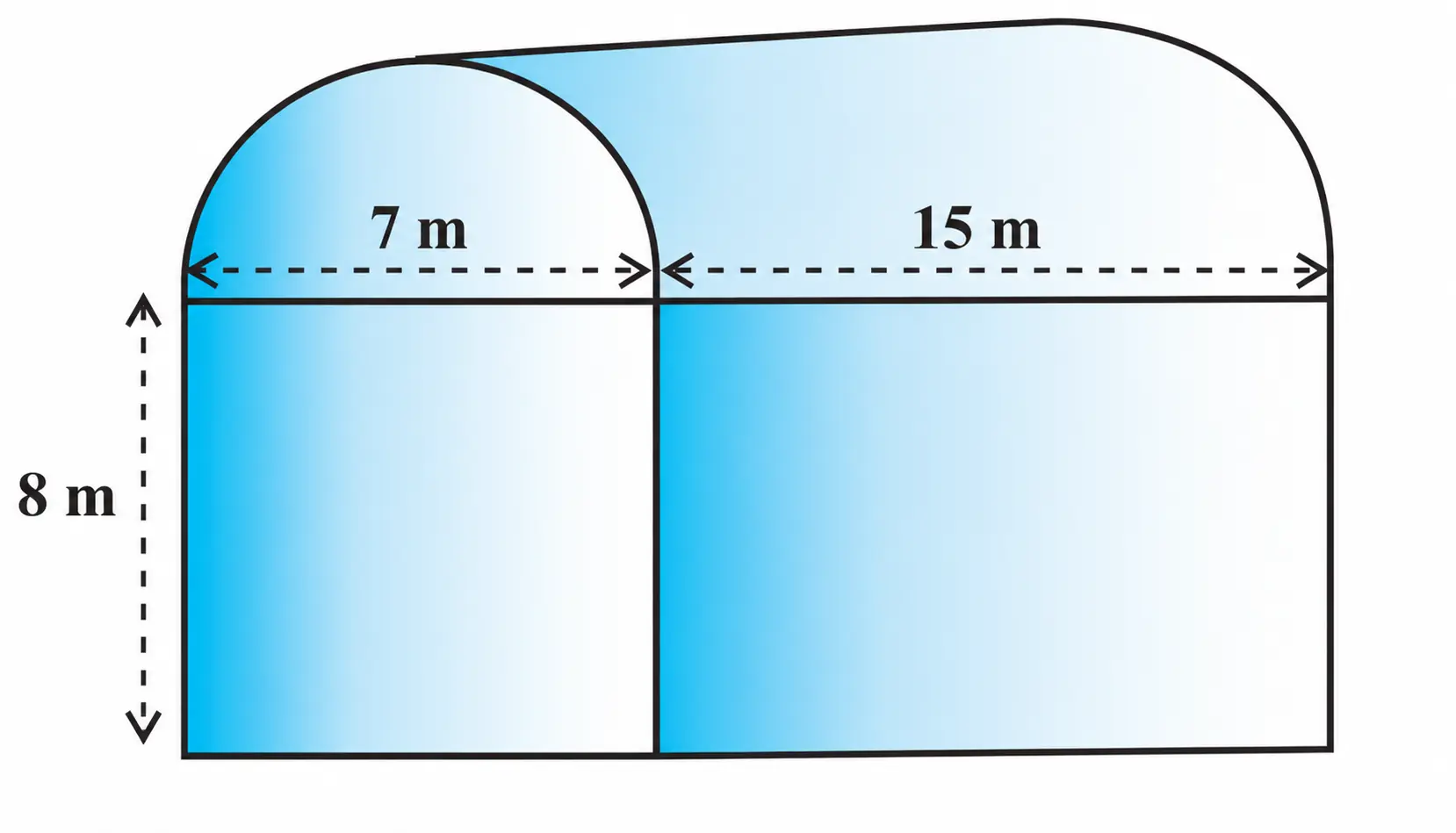
Shanta runs an industry in a shed which is in the shape of a cuboid surmounted by a half cylinder (see Fig. 12.12). If the base of the shed is of dimension $$7 \, \mathrm{m} \times 15 \, \mathrm{m}$$, and the height of the cuboidal portion is 8 m, find the volume of air that the shed can hold. Further, suppose the machinery in the shed occupies a total space of $$300 \, \mathrm{m^3}$$, and there are 20 workers, each of whom occupy about $$0.08 \, \mathrm{m^3}$$ space on an average. Then, how much air is in the shed? (Take $$\pi = \dfrac{22}{7}$$)
Fig. 12.12
Fig. 12.12

Solution

The shed consists of

  • a cuboid of base $$7\,\mathrm{m}\times15\,\mathrm{m}$$ and height $$8\,\mathrm{m}$$,
  • a half-cylinder whose diameter equals the smaller side $$7\,\mathrm{m}$$ and whose length equals the larger side $$15\,\mathrm{m}$$.

1. Volume of the cuboidal part
Base area $$=7\times15=105\,\mathrm{m^2}$$.
Volume $$=105\times8=840\,\mathrm{m^3}$$.

2. Volume of the half-cylindrical part
Radius $$r=\dfrac{7}{2}=3.5\,\mathrm{m}$$, length $$h=15\,\mathrm{m}$$.
Volume of full cylinder $$=\pi r^{2}h=\dfrac{22}{7}\times(3.5)^{2}\times15$$.
Compute: $$r^{2}=12.25$$, so $$\pi r^{2}h=\dfrac{22}{7}\times12.25\times15=577.5\,\mathrm{m^3}$$.
Half of this: $$\dfrac{577.5}{2}=288.75\,\mathrm{m^3}$$.

3. Total volume of the shed
$$840+288.75=1128.75\,\mathrm{m^3}$$.

4. Space occupied inside
Machinery: $$300\,\mathrm{m^3}$$.
Workers: $$20\times0.08=1.6\,\mathrm{m^3}$$.
Total occupied $$=300+1.6=301.6\,\mathrm{m^3}$$.

5. Volume of air actually present
$$1128.75-301.6=827.15\,\mathrm{m^3}$$.

Therefore, the shed can hold $$1128.75\,\mathrm{m^3}$$ of air in all, and after accounting for machinery and workers, about $$827.15\,\mathrm{m^3}$$ of air remains.

Answer

(i) Volume the shed can hold: $$1128.75\,\mathrm{m^3}$$
(ii) Air actually available: $$827.15\,\mathrm{m^3}$$

Example 6

A juice seller was serving his customers using glasses as shown in Fig. 12.13. The inner diameter of the cylindrical glass was 5 cm, but the bottom of the glass had a hemispherical raised portion which reduced the capacity of the glass. If the height of a glass was 10 cm, find the apparent capacity of the glass and its actual capacity. (Use $$\pi = 3.14$$.)
Fig. 12.13
Fig. 12.13

Solution

Given data

  • Inner diameter of the cylindrical glass = 5 cm
    Therefore, radius $$r = \dfrac{5}{2} \text{ cm}=2.5\text{ cm}$$
  • Height of the glass (i.e. of the cylinder) $$h = 10\text{ cm}$$
  • The base is a raised hemisphere of the same radius $$r = 2.5\text{ cm}$$ which occupies some of the space inside the glass.

1. Apparent capacity (volume if the whole interior were cylindrical)

Volume of cylinder
$$V_{\text{cyl}} = \pi r^{2} h$$
$$V_{\text{cyl}} = 3.14 \times (2.5\text{ cm})^{2} \times 10\text{ cm}$$
$$V_{\text{cyl}} = 3.14 \times 6.25 \times 10$$
$$V_{\text{cyl}} = 3.14 \times 62.5$$
$$V_{\text{cyl}} = 196.25\text{ cm}^3$$

Thus the apparent capacity of the glass is 196.25 cm3 (≈ 196 ml).

2. Actual capacity (space available for juice)

The raised bottom is a hemisphere, so its volume is

$$V_{\text{hemi}} = \tfrac{2}{3}\pi r^{3}$$
$$V_{\text{hemi}} = \dfrac{2}{3} \times 3.14 \times (2.5\text{ cm})^{3}$$
$$V_{\text{hemi}} = \dfrac{2}{3} \times 3.14 \times 15.625$$
$$V_{\text{hemi}} = \dfrac{2}{3} \times 49.0625$$
$$V_{\text{hemi}} = \dfrac{98.125}{3}$$
$$V_{\text{hemi}} \approx 32.71\text{ cm}^3$$

Therefore,

Actual capacity
$$= V_{\text{cyl}} - V_{\text{hemi}}$$
$$= 196.25\text{ cm}^3 - 32.71\text{ cm}^3$$
$$\approx 163.54\text{ cm}^3$$

Result

  • Apparent capacity = 196.25 cm3 (≈ 196 mL)
  • Actual capacity = 163.54 cm3 (≈ 164 mL)

Answer

Apparent capacity = 196.25 cm3;  Actual capacity ≈ 163.54 cm3

Example 7 A solid toy is in the form of a hemisphere surmounted by a right circular cone. The height of the cone is 2 cm and the diameter of the base is 4 cm. Determine the volume of the toy. If a right circular cylinder circumscribes the toy, find the difference of the volumes of the cylinder and the toy. (Take $$\pi = 3.14$$)

Solution

Step 1 : Identify the common radius
The diameter of the base of the cone is 4 cm, therefore the radius of the cone (and also of the hemisphere beneath it) is
$$r = \dfrac{4}{2}\text{ cm}=2\text{ cm}$$

Step 2 : Volume of the hemisphere
For a hemisphere of radius $$r$$ :
$$V_{\text{hemi}} = \dfrac{2}{3}\,\pi r^{3}$$
Substituting $$r = 2\text{ cm}$$:
$$V_{\text{hemi}} = \dfrac{2}{3}\,\pi(2)^{3}=\dfrac{2}{3}\,\pi\times8 = \dfrac{16}{3}\,\pi\;\text{cm}^3$$

Step 3 : Volume of the cone
For a cone of radius $$r$$ and height $$h$$ :
$$V_{\text{cone}} = \dfrac{1}{3}\,\pi r^{2} h$$
Given $$h = 2\text{ cm}$$ and $$r = 2\text{ cm}$$:
$$V_{\text{cone}} = \dfrac{1}{3}\,\pi(2)^{2}(2) = \dfrac{1}{3}\,\pi\times4\times2 = \dfrac{8}{3}\,\pi\;\text{cm}^3$$

Step 4 : Volume of the solid toy
The toy consists of the cone + the hemisphere:
$$V_{\text{toy}} = V_{\text{cone}} + V_{\text{hemi}}$$
$$\phantom{V_{\text{toy}}}= \dfrac{8}{3}\,\pi + \dfrac{16}{3}\,\pi = \dfrac{24}{3}\,\pi = 8\pi\;\text{cm}^3$$
Using $$\pi = 3.14$$:
$$V_{\text{toy}} = 8\times3.14 = 25.12\;\text{cm}^3$$

Step 5 : Dimensions of the circumscribing right circular cylinder
• Radius of the cylinder = radius of the toy = $$2\text{ cm}$$.
• Height of the cylinder = height of cone $$+$$ height of hemisphere
$$\;\;\;\;\;\;\;= 2\text{ cm} + 2\text{ cm} = 4\text{ cm}$$.

Step 6 : Volume of the cylinder
For a cylinder of radius $$r$$ and height $$H$$ :
$$V_{\text{cyl}} = \pi r^{2} H$$
Substituting $$r = 2\text{ cm},\;H = 4\text{ cm}$$:
$$V_{\text{cyl}} = \pi(2)^{2}(4) = \pi\times4\times4 = 16\pi\;\text{cm}^3$$
Using $$\pi = 3.14$$:
$$V_{\text{cyl}} = 16\times3.14 = 50.24\;\text{cm}^3$$

Step 7 : Difference of the two volumes
$$\text{Difference} = V_{\text{cyl}} - V_{\text{toy}} = 16\pi - 8\pi = 8\pi\;\text{cm}^3$$
Numerically:
$$\text{Difference} = 50.24\;\text{cm}^3 - 25.12\;\text{cm}^3 = 25.12\;\text{cm}^3$$

Result
Volume of the toy = $$25.12\;\text{cm}^3$$.
Difference between the volumes of the circumscribing cylinder and the toy = $$25.12\;\text{cm}^3$$.

Answer

Volume of toy = $$25.12\;\text{cm}^3$$
Difference in volumes = $$25.12\;\text{cm}^3$$

Exercise 12.2

1 A solid is in the shape of a cone standing on a hemisphere with both their radii being equal to 1 cm and the height of the cone is equal to its radius. Find the volume of the solid in terms of $$\pi$$.

Solution

Given data

  • Common radius of the hemisphere and the cone: $$r = 1 \text{ cm}$$
  • Height of the cone: $$h = r = 1 \text{ cm}$$

The solid is made by placing a right-circular cone on top of a hemisphere. Its volume is therefore the sum of the individual volumes.

1. Volume of the hemisphere

The volume of a hemisphere of radius $$r$$ is

$$V_{\text{hemi}} = \tfrac{2}{3}\,\pi r^{3}$$

Substituting $$r = 1 \text{ cm}$$:

$$V_{\text{hemi}} = \tfrac{2}{3}\,\pi\,(1)^{3} = \tfrac{2}{3}\,\pi \;\text{cm}^{3}$$

2. Volume of the cone

The volume of a right-circular cone is

$$V_{\text{cone}} = \tfrac{1}{3}\,\pi r^{2}h$$

With $$r = 1 \text{ cm}$$ and $$h = 1 \text{ cm}$$:

$$V_{\text{cone}} = \tfrac{1}{3}\,\pi\,(1)^{2}(1) = \tfrac{1}{3}\,\pi \;\text{cm}^{3}$$

3. Volume of the required solid

Add the two volumes:

$$V_{\text{total}} = V_{\text{hemi}} + V_{\text{cone}} = \tfrac{2}{3}\,\pi + \tfrac{1}{3}\,\pi = \pi$$

Thus

$$V_{\text{total}} = \pi \;\text{cm}^{3}$$

The volume of the solid is $$\pi \text{ cm}^{3}$$.

Answer

$$\pi \text{ cm}^{3}$$

2 Rachel, an engineering student, was asked to make a model shaped like a cylinder with two cones attached at its two ends by using a thin aluminium sheet. The diameter of the model is 3 cm and its length is 12 cm. If each cone has a height of 2 cm, find the volume of air contained in the model that Rachel made. (Assume the outer and inner dimensions of the model to be nearly the same.)

Solution

Step 1 : Understand the shape

  • The model consists of a right circular cylinder in the middle and a right circular cone fixed at each of its two ends.
  • The whole model has one common diameter, so the radius of every part is the same.

Step 2 : Identify the dimensions

  • Diameter of the model → $$3\,\text{cm}$$ ⇒ radius $$r = \dfrac{3}{2}\,\text{cm} = 1.5\,\text{cm}$$.
  • Total length of the model → $$12\,\text{cm}$$.
  • Height of each cone → $$2\,\text{cm}$$.
  • Hence, length (height) of the cylindrical part is $$h_{\text{cyl}} = 12 - 2\times 2 = 12 - 4 = 8\,\text{cm}$$.

Step 3 : Volume of the cylinder

For a cylinder, $$V = \pi r^{2}h$$.

Thus $$V_{\text{cyl}} = \pi(1.5)^{2}\times 8 = \pi\times 2.25\times 8 = 18\pi\,\text{cm}^{3}.$$

Step 4 : Volume of one cone

For a cone, $$V = \dfrac{1}{3}\pi r^{2}h$$.

Hence $$V_{\text{cone}} = \dfrac{1}{3}\pi (1.5)^{2}\times 2 = \dfrac{1}{3}\pi\times 2.25\times 2 = 1.5\pi\,\text{cm}^{3}.$$

Step 5 : Volume of two cones

$$V_{\text{2 cones}} = 2\times 1.5\pi = 3\pi\,\text{cm}^{3}.$$

Step 6 : Total volume of the model

$$V_{\text{total}} = V_{\text{cyl}} + V_{\text{2 cones}} = 18\pi + 3\pi = 21\pi\,\text{cm}^{3}.$$

Step 7 : Numerical value

Taking $$\pi = \dfrac{22}{7}$$,

$$V_{\text{total}} = 21\times \dfrac{22}{7} = 3\times 22 = 66\,\text{cm}^{3}.$$

Therefore, the volume of air that the model can contain is $$66\,\text{cm}^{3}$$.

Answer

$$66\,\text{cm}^{3}$$

3

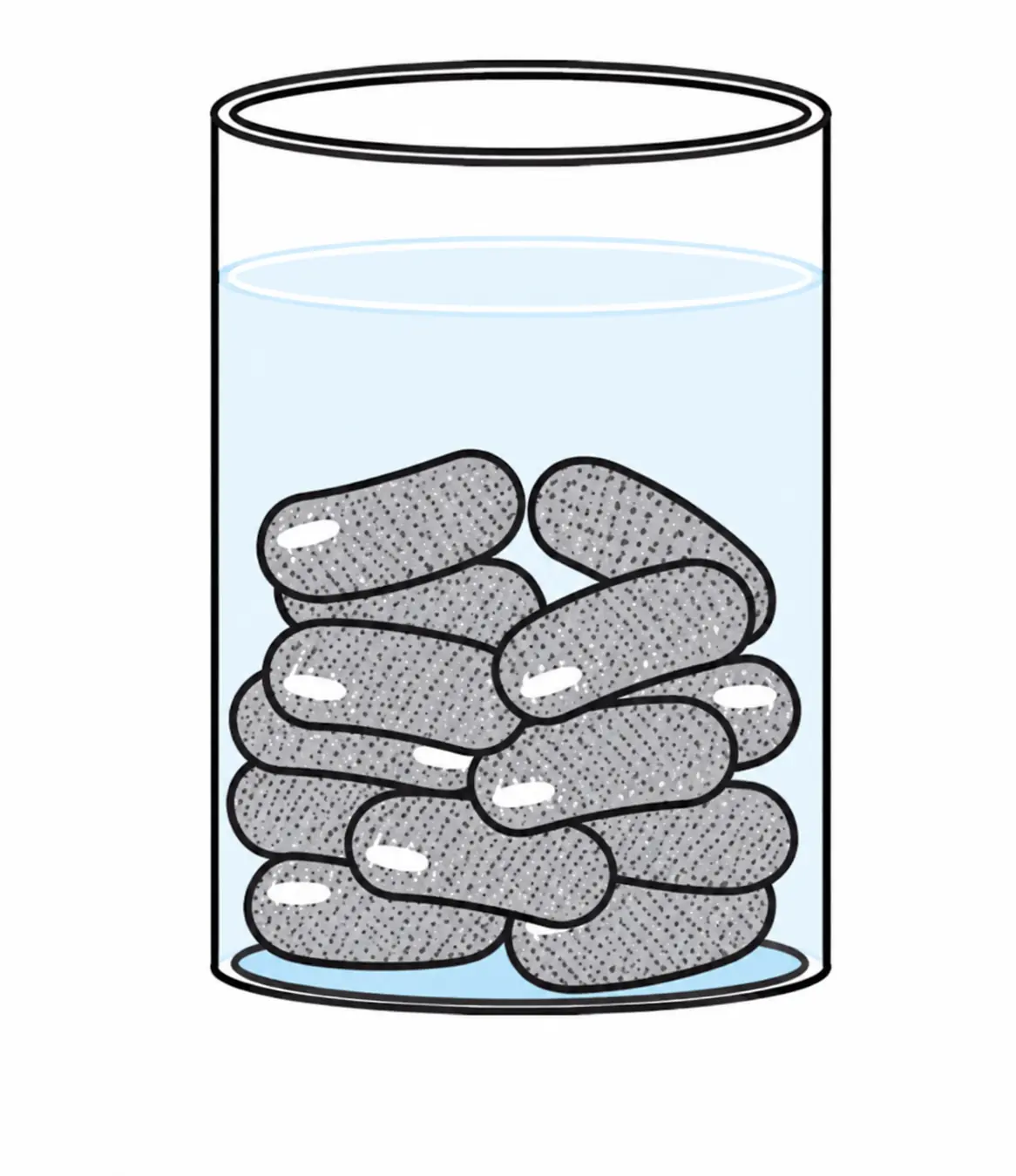
A gulab jamun, contains sugar syrup up to about 30% of its volume. Find approximately how much syrup would be found in 45 gulab jamuns, each shaped like a cylinder with two hemispherical ends with length 5 cm and diameter 2.8 cm (see Fig. 12.15).
Fig. 12.15
Fig. 12.15

Solution

A gulab jamun looks like a solid obtained by joining two identical hemispheres to the ends of a right circular cylinder.

Step 1 – Identify the dimensions
Diameter of the hemispherical ends = 2.8 cm   ⇒  Radius $$r = \frac{2.8}{2}=1.4\;\text{cm}$$
Total length of the sweet = 5 cm.
Length contributed by the two hemispheres $$=2r=2\times1.4=2.8\;\text{cm}$$
Therefore height of the cylindrical part is
$$h = 5\;\text{cm}-2.8\;\text{cm}=2.2\;\text{cm}$$

Step 2 – Volume of one gulab jamun

  • Cylinder: $$V_{\text{cyl}} = \pi r^{2}h = \pi\,(1.4)^{2}(2.2)\;\text{cm}^{3}$$
    $$\;\;\;\;\; = \pi\,(1.96)(2.2)=4.312\pi\;\text{cm}^{3}$$
  • Two hemispheres form one sphere: $$V_{\text{sphere}} = \frac43\pi r^{3}=\frac43\pi(1.4)^{3}=\frac43\pi(2.744)=3.658666\pi\;\text{cm}^{3}$$

Total volume of one sweet
$$V = V_{\text{cyl}}+V_{\text{sphere}}=(4.312+3.658666)\pi=7.970666\pi\;\text{cm}^{3}$$

Taking $$\pi = \frac{22}{7}$$,
$$V = 7.970666\times\frac{22}{7}\;\text{cm}^{3}\approx25.05\;\text{cm}^{3}$$

Step 3 – Volume of syrup in one sweet
The syrup is about 30 % of the volume, therefore
$$V_{\text{syrup(per sweet)}} = 0.30\times25.05\;\text{cm}^{3}\approx7.515\;\text{cm}^{3}$$

Step 4 – Volume of syrup in 45 sweets
$$V_{\text{syrup(45)}} = 45\times7.515\;\text{cm}^{3}\approx338.2\;\text{cm}^{3}$$

Since $$1\;\text{cm}^{3}=1\;\text{mL},$$ about  338 mL of sugar syrup is present in 45 gulab jamuns.

Answer

Approximately $$338\;\text{cm}^{3}\;(\text{or }338\,\text{mL})$$ of sugar syrup.

4

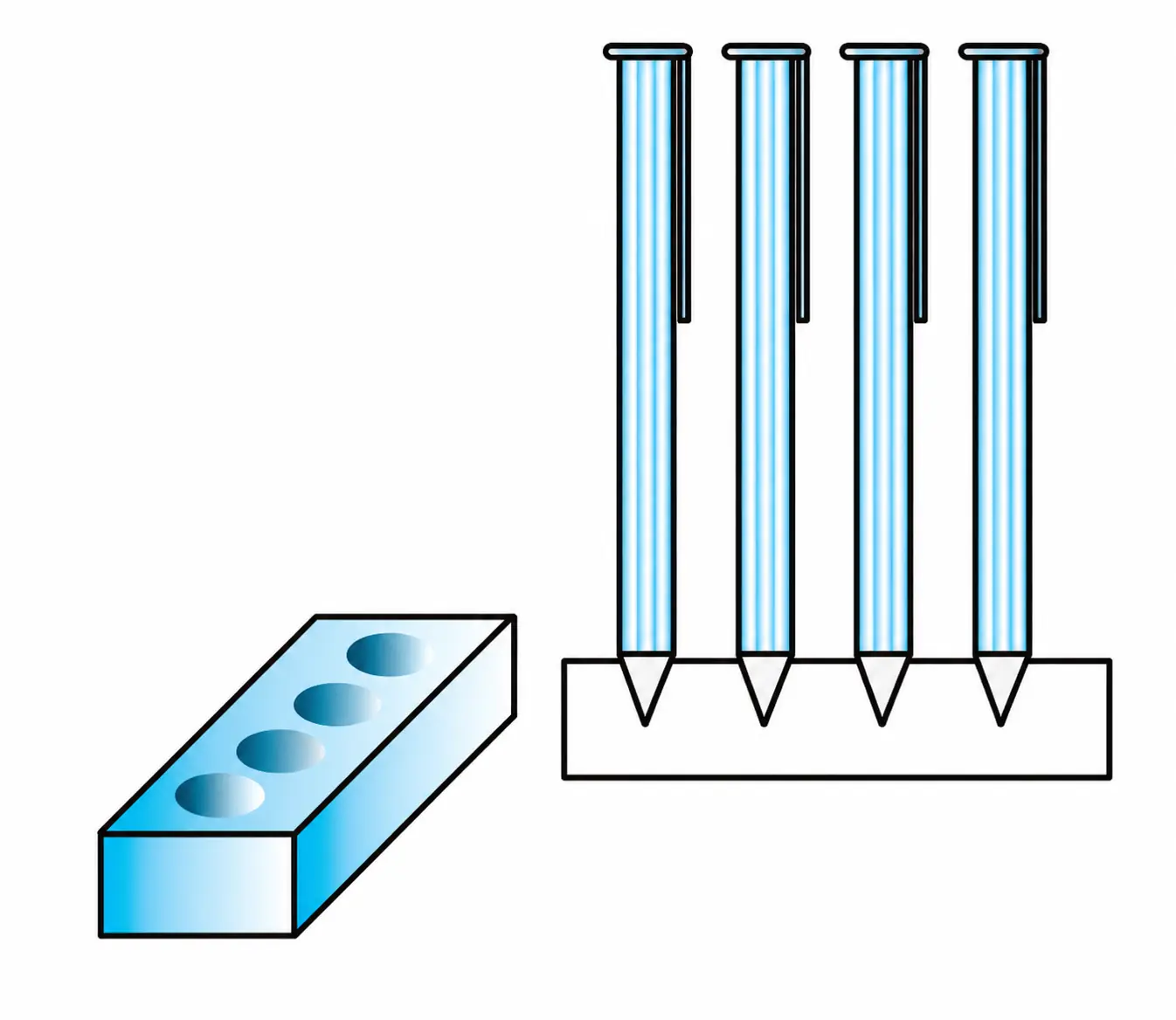
A pen stand made of wood is in the shape of a cuboid with four conical depressions to hold pens. The dimensions of the cuboid are 15 cm by 10 cm by 3.5 cm. The radius of each of the depressions is 0.5 cm and the depth is 1.4 cm. Find the volume of wood in the entire stand (see Fig. 12.16).
Fig. 12.16
Fig. 12.16

Solution

Given data

  • Dimensions of the wooden cuboid (pen-stand): length $$l = 15 \text{ cm}$$, breadth $$b = 10 \text{ cm}$$, height $$h = 3.5 \text{ cm}$$.
  • Each pen-holding depression is a right circular cone with radius $$r = 0.5 \text{ cm}$$ and depth (height) $$H = 1.4 \text{ cm}$$.
  • Total number of such cones: $$4$$.

1. Volume of the wooden cuboid (before making the holes)

The volume of a cuboid is $$l\,b\,h$$.

$$V_{\text{cuboid}} = 15 \times 10 \times 3.5 = 525 \text{ cm}^3$$

2. Volume of one conical depression

The volume of a right circular cone is $$\dfrac{1}{3}\pi r^{2} H$$.

$$\begin{aligned} V_{\text{cone}} & = \frac{1}{3}\,\pi\,(0.5)^2\,(1.4) \\ & = \frac{1}{3}\,\pi\,(0.25)\,(1.4) \\ & = \frac{1}{3}\,\pi\,(0.35) \\ & = \frac{7\pi}{60}\;\text{cm}^3 \end{aligned}$$

Using $$\pi = \dfrac{22}{7}$$:

$$V_{\text{cone}} = \frac{7}{60}\times\frac{22}{7} = \frac{22}{60} = \frac{11}{30} \text{ cm}^3 \approx 0.367 \text{ cm}^3$$

3. Volume removed due to four cones

$$V_{\text{removed}} = 4\,V_{\text{cone}} = 4\times\frac{11}{30}=\frac{44}{30}=\frac{22}{15}\;\text{cm}^3\approx 1.467\;\text{cm}^3$$

4. Volume of wood actually present

The required volume is the cuboid volume minus the volume removed:

$$\begin{aligned} V_{\text{wood}} &= V_{\text{cuboid}} - V_{\text{removed}} \\ &= 525 - \frac{22}{15} \\ &= \frac{525\times 15 - 22}{15} \\ &= \frac{7875 - 22}{15} \\ &= \frac{7853}{15} \text{ cm}^3 \\ &\approx 523.53 \text{ cm}^3 \end{aligned}$$

Therefore, the volume of wood in the pen stand is approximately $$523.5\,\text{cm}^3$$.

Answer

$$V_{\text{wood}} \approx 5.24 \times 10^{2}\;\text{cm}^3 = 523.5\,\text{cm}^3$$

5 A vessel is in the form of an inverted cone. Its height is 8 cm and the radius of its top, which is open, is 5 cm. It is filled with water up to the brim. When lead shots, each of which is a sphere of radius 0.5 cm are dropped into the vessel, one-fourth of the water flows out. Find the number of lead shots dropped in the vessel.

Solution

Given data

  • Inverted cone (vessel)
  • Height of cone: $$h = 8 \text{ cm}$$
  • Radius of the top (base of the cone): $$r = 5 \text{ cm}$$
  • Radius of each lead shot (sphere): $$R = 0.5 \text{ cm}$$
  • After dropping the shots, one-fourth of the water originally in the cone flows out.

Step 1 · Volume of water initially in the cone

The cone is completely filled, so

$$V_{\text{cone}} = \frac{1}{3} \pi r^2 h$$

Substituting $$r = 5\text{ cm},\; h = 8\text{ cm}:$$

$$V_{\text{cone}} = \frac{1}{3} \pi (5)^2 (8) = \frac{1}{3} \pi \times 25 \times 8 = \frac{200}{3} \pi \; \text{cm}^3$$

Step 2 · Volume of water that flows out

One-fourth of the original volume flows out, hence

$$V_{\text{out}} = \frac{1}{4} \times V_{\text{cone}} = \frac{1}{4} \times \frac{200}{3} \pi = \frac{50}{3} \pi \; \text{cm}^3$$

Step 3 · Volume displaced by the lead shots

Each shot sinks completely, so it displaces an amount of water equal to its own volume. Therefore, the total volume of all the lead shots equals $$V_{\text{out}}$$.

Step 4 · Volume of one lead shot

For a sphere,

$$V_{\text{sphere}} = \frac{4}{3} \pi R^3$$

With $$R = 0.5\text{ cm}:$$

$$V_{\text{sphere}} = \frac{4}{3} \pi (0.5)^3 = \frac{4}{3} \pi \times \frac{1}{8} = \frac{4}{24} \pi = \frac{1}{6} \pi \; \text{cm}^3$$

Step 5 · Let the number of lead shots be $$n$$

Total volume of all shots:

$$V_{\text{shots}} = n \times \frac{1}{6} \pi$$

But $$V_{\text{shots}} = V_{\text{out}}$$, so

$$n \times \frac{1}{6} \pi = \frac{50}{3} \pi$$

Cancel $$\pi$$ on both sides:

$$\frac{n}{6} = \frac{50}{3}$$

Multiply both sides by 6:

$$n = \frac{50}{3} \times 6 = 100$$

Step 6 · State the result

Exactly 100 lead shots must have been dropped into the vessel.

Answer

Number of lead shots dropped  =  100

6 A solid iron pole consists of a cylinder of height 220 cm and base diameter 24 cm, which is surmounted by another cylinder of height 60 cm and radius 8 cm. Find the mass of the pole, given that $$1 \, \mathrm{cm^3}$$ of iron has approximately 8g mass. (Use $$\pi = 3.14$$)

Solution

Step 1 : Separate the pole into two cylinders

  • Lower cylinder (C1): height $$h_1 = 220\,\text{cm}$$, diameter $$24\,\text{cm}\Rightarrow r_1 = 12\,\text{cm}$$
  • Upper cylinder (C2): height $$h_2 = 60\,\text{cm}$$, radius $$r_2 = 8\,\text{cm}$$

Step 2 : Volume of the lower cylinder

$$V_1 = \pi r_1^{2} h_1 = 3.14 \times (12)^2 \times 220$$

$$ (12)^2 = 144\;\;\Rightarrow\;\;V_1 = 3.14 \times 144 \times 220 $$

$$144 \times 220 = 31\,680$$

$$V_1 = 3.14 \times 31\,680 = 99\,475.2\,\text{cm}^3$$

Step 3 : Volume of the upper cylinder

$$V_2 = \pi r_2^{2} h_2 = 3.14 \times (8)^2 \times 60$$

$$ (8)^2 = 64\;\;\Rightarrow\;\;V_2 = 3.14 \times 64 \times 60 $$

$$64 \times 60 = 3\,840$$

$$V_2 = 3.14 \times 3\,840 = 12\,057.6\,\text{cm}^3$$

Step 4 : Total volume of the pole

$$V = V_1 + V_2 = 99\,475.2 + 12\,057.6 = 111\,532.8\,\text{cm}^3$$

Step 5 : Convert volume to mass

Given: each $$1\,\text{cm}^3$$ of iron weighs $$8\,\text{g}$$.

$$\text{Mass} = V \times 8 = 111\,532.8 \times 8 = 892\,262.4\,\text{g}$$

$$892\,262.4\,\text{g} = \dfrac{892\,262.4}{1\,000}\,\text{kg} = 892.2624\,\text{kg}$$

Step 6 : Round off

The mass of the pole is therefore approximately $$892.26\,\text{kg}$$ (to two decimal places).

Answer

Mass of the iron pole ≈ $$892.26\,\text{kg}$$

7 A solid consisting of a right circular cone of height 120 cm and radius 60 cm standing on a hemisphere of radius 60 cm is placed upright in a right circular cylinder full of water such that it touches the bottom. Find the volume of water left in the cylinder, if the radius of the cylinder is 60 cm and its height is 180 cm.

Solution

Given data

  • Cylinder: radius $$r = 60\,\text{cm}$$, height $$h = 180\,\text{cm}$$.
  • Hemisphere: radius $$r = 60\,\text{cm}$$ (stands on the cylinder's bottom).
  • Cone: base radius $$r = 60\,\text{cm}$$, height $$H = 120\,\text{cm}$$ (its base exactly fits the flat face of the hemisphere).
  • The cylinder was completely filled with water before the solid was immersed.

Step 1  Volume of the cylinder (initial volume of water)

$$V_{\text{cyl}} = \pi r^{2} h = \pi (60)^2 (180) = \pi \times 3600 \times 180 = 648000\pi\;\text{cm}^3$$

Step 2  Volume of the solid

(a) Hemisphere:

$$V_{\text{hem}} = \frac{2}{3}\pi r^{3} = \frac{2}{3}\pi (60)^3 = \frac{2}{3}\pi \times 216000 = 144000\pi\;\text{cm}^3$$

(b) Cone:

$$V_{\text{cone}} = \frac13 \pi r^{2} H = \frac13 \pi (60)^2 (120) = \frac13 \pi \times 3600 \times 120 = 144000\pi\;\text{cm}^3$$

Total volume of the immersed solid:

$$V_{\text{solid}} = V_{\text{hem}} + V_{\text{cone}} = 144000\pi + 144000\pi = 288000\pi\;\text{cm}^3$$

Step 3  Volume of water left in the cylinder

Water displaced $$= V_{\text{solid}}$$, so

$$V_{\text{water\,left}} = V_{\text{cyl}} - V_{\text{solid}} = 648000\pi - 288000\pi = 360000\pi\;\text{cm}^3$$

If required numerically, using $$\pi \approx 3.14$$,

$$V_{\text{water\,left}} \approx 360000 \times 3.14 = 1130400\;\text{cm}^3 \;\; (= 1130.4\,\text{L}).$$

Hence the volume of water remaining in the cylinder is $$360000\pi\;\text{cm}^3$$ (approximately 1130.4 litres).

Answer

Volume of water left in the cylinder = $$360000\pi\;\text{cm}^3$$  (≈ 1130.4 L)

8 A spherical glass vessel has a cylindrical neck 8 cm long, 2 cm in diameter; the diameter of the spherical part is 8.5 cm. By measuring the amount of water it holds, a child finds its volume to be $$345 \, \mathrm{cm^3}$$. Check whether she is correct, taking the above as the inside measurements, and $$\pi = 3.14$$.

Solution

Given internal measurements

  • Cylindrical neck: length (height) $$h = 8\text{ cm}$$, diameter $$= 2\text{ cm} \Rightarrow r = \dfrac{2}{2}=1\text{ cm}$$
  • Spherical part: diameter $$= 8.5\text{ cm} \Rightarrow R = \dfrac{8.5}{2}=4.25\text{ cm}$$
  • Use $$\pi = 3.14$$ throughout.

1. Volume of the cylindrical neck

$$V_{\text{cylinder}} = \pi r^{2}h = 3.14 \times (1)^2 \times 8 = 3.14 \times 8 = 25.12\,\text{cm}^3$$

2. Volume of the spherical part

Formula: $$V_{\text{sphere}} = \dfrac{4}{3}\pi R^{3}$$

First, find $$R^{3}$$:

$$R^{2} = 4.25 \times 4.25 = 18.0625$$

$$R^{3} = 18.0625 \times 4.25 = 76.765625$$

Now substitute in the volume formula:

$$V_{\text{sphere}} = \dfrac{4}{3} \times 3.14 \times 76.765625$$

$$3.14 \times 76.765625 = 241.0440625$$

$$\dfrac{4}{3} \times 241.0440625 = \dfrac{964.17625}{3} = 321.392083\text{ cm}^3$$ (≈ $$321.39\text{ cm}^3$$)

3. Total internal volume of the vessel

$$V_{\text{total}} = V_{\text{sphere}} + V_{\text{cylinder}}$$

$$V_{\text{total}} = 321.392083 + 25.12 = 346.512083\text{ cm}^3$$

Thus the calculated capacity of the vessel is about $$346.5\text{ cm}^3$$.

4. Verification with the child’s result

The child measured $$345\text{ cm}^3$$ of water.

The difference is $$346.5 - 345 = 1.5\text{ cm}^3$$, which is less than $$0.5\%$$ of the computed value and can be attributed to normal measurement errors (water meniscus, slight air bubbles, etc.).

Conclusion: The child’s measurement is essentially correct.

Answer

Theoretical capacity ≈ $$346.5\,\text{cm}^3$$; measured capacity $$= 345\,\text{cm}^3$$. The two values agree closely, so the child’s result is correct.

NCERT Solutions for Class 10
Maths
NCERT Solutions for Class 10 Maths
Chapter-wise step-by-step
solutions with explanations
explore solutions Maths bg
Science
NCERT Solutions for Class 10 Science
Chapter-wise step-by-step
solutions with explanations
explore solutions Science bg

Frequently Asked Questions

50,000+ JEE Students Trusted Our Score Calculator

Predict your JEE Main percentile, rank & performance in seconds