Join WhatsApp Icon JEE WhatsApp Group
NCERT Solutions for Class 10 Maths

Chapter 10: Areas Related to Circles

Download Solutions PDF
Daily JEE Updates, Tips & Important Alerts
Join 30,000+ students and stay updated with JEE notifications and preparation insights.
Join Now!
Free PDF
Complete NCERT Solution PDF for Chapter 10: Areas Related to Circles

NCERT Solutions For Class 10 Maths Chapter 10 Areas Related to Circles helps students learn how to calculate areas and measurements associated with circular figures. The page provides complete NCERT Solutions that explain concepts such as circumference, area of circles, sectors, and segments with detailed methods. NCERT Solutions For Class 10 Maths help students understand the application of formulas and solve real-world problems involving circular shapes. The chapter combines geometry with calculations and improves students’ practical problem-solving abilities. These solutions provide step-by-step explanations for textbook exercises and numerical questions. Students can use the chapter PDF for revision, practice, and board exam preparation. The clear presentation helps learners apply formulas accurately and solve area-related problems with confidence.
Download Solutions PDF

Examples

Example 1 Find the area of the sector of a circle with radius 4 cm and of angle $$30^\circ$$. Also, find the area of the corresponding major sector (Use $$\pi = 3.14$$).

Solution

Given: radius $$r = 4 \text{ cm}$$, central angle $$\theta = 30^\circ$$; take $$\pi = 3.14$$.

1. Area of the minor sector (angle $$30^\circ$$)

Sector-area formula: $$\text{Area} = \frac{\theta}{360^\circ}\times \pi r^2$$

$$\text{Area} = \frac{30^\circ}{360^\circ}\times \pi\times(4\,\text{cm})^2$$

$$= \frac{30}{360}\times\pi\times16\,\text{cm}^2 = \frac{1}{12}\times16\pi\,\text{cm}^2$$

$$= \frac{4\pi}{3}\,\text{cm}^2$$

Using $$\pi = 3.14$$, $$\text{Area} = \frac{4\times3.14}{3}\,\text{cm}^2 = 4.19\,\text{cm}^2\;\text{(approx)}$$

2. Area of the corresponding major sector

Angle of major sector $$= 360^\circ-30^\circ = 330^\circ$$

$$\text{Area} = \frac{330^\circ}{360^\circ}\times\pi\times(4\,\text{cm})^2 = \frac{11}{12}\times16\pi\,\text{cm}^2$$

$$= \frac{44\pi}{3}\,\text{cm}^2$$

Numerically, $$\text{Area} = \frac{44\times3.14}{3}\,\text{cm}^2 = 46.05\,\text{cm}^2\;\text{(approx)}$$

Hence, area of the $$30^\circ$$ sector is about $$4.19\,\text{cm}^2$$ and area of the corresponding major sector is about $$46.05\,\text{cm}^2$$.

Answer

Minor sector (30°): $$4.19 \text{ cm}^2$$
Major sector (330°): $$46.05 \text{ cm}^2$$

Example 2

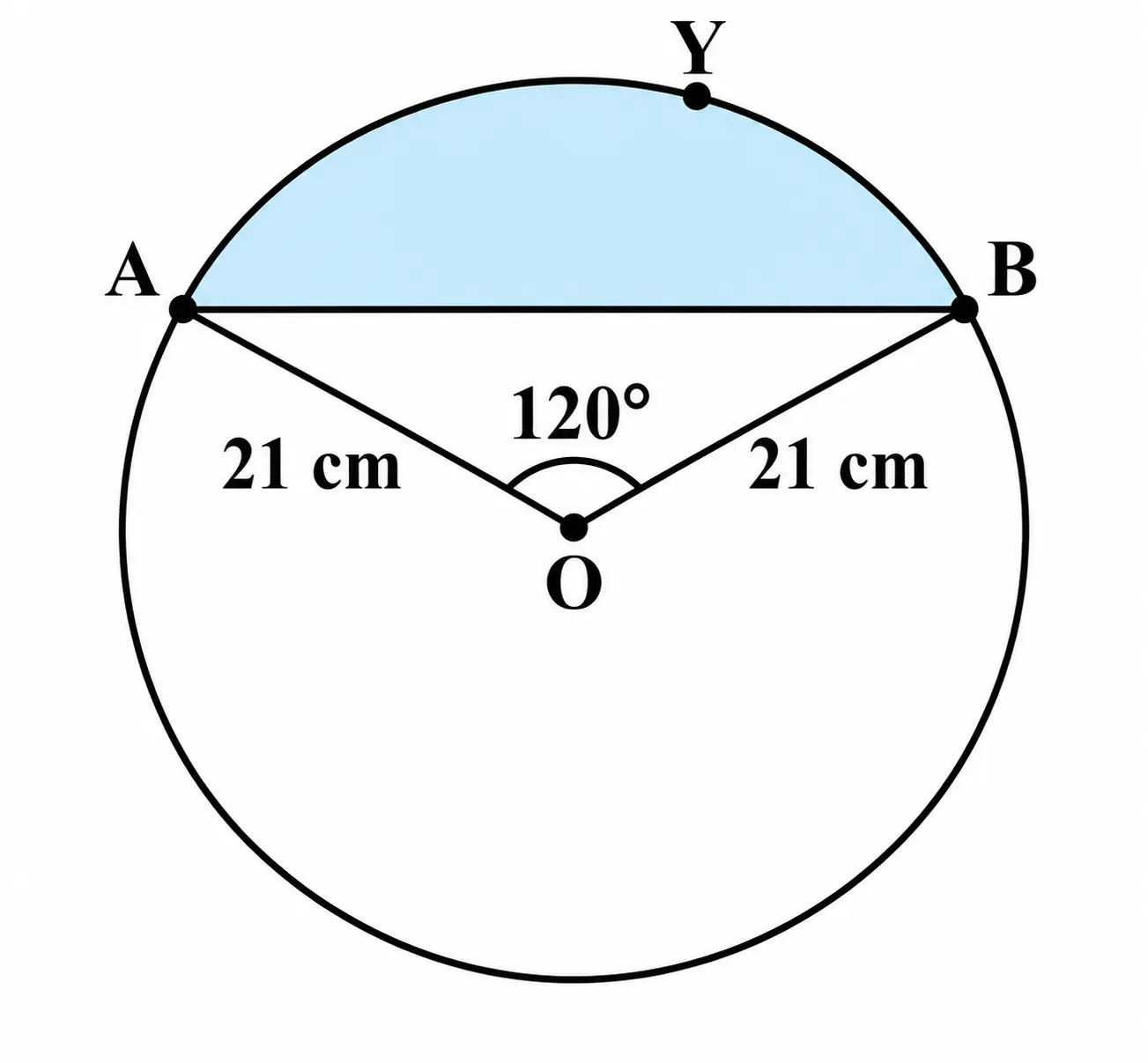
Find the area of the segment AYB shown in Fig. 11.6, if radius of the circle is 21 cm and $$\angle AOB = 120^\circ$$. (Use $$\pi = \dfrac{22}{7}$$)
Fig. 11.6
Fig. 11.6

Solution

Given data

  • Radius of the circle : $$r = 21\text{ cm}$$
  • Central angle : $$\angle AOB = 120^{\circ}$$
  • Take $$\pi = \dfrac{22}{7}$$ and $$\sqrt3 \approx 1.732$$ (NCERT convention).

The shaded part AYB is a segment of the circle. For any segment,

$$\text{Area of segment} \;=\;\text{Area of the corresponding sector}\;\;-\n\;\text{Area of the triangle formed by the two radii.}$$

We therefore compute the two areas separately.

1. Area of sector $$OAB$$

For a sector subtending angle $$\theta^{\circ}$$ at the centre,

$$\text{Area of sector}=\frac{\theta}{360^{\circ}}\;\pi r^{2}$$

Here $$\theta = 120^{\circ}$$, hence

$$\text{Area of sector}=\frac{120^{\circ}}{360^{\circ}}\times\frac{22}{7}\times(21)^{2}$$

$$=\frac{1}{3}\times\frac{22}{7}\times441$$

First reduce $$441\div7 = 63$$, so

$$=\frac{1}{3}\times22\times63=22\times21=462\text{ cm}^{2}$$

2. Area of triangle $$\Delta OAB$$

The triangle is isosceles with two sides $$OA=OB=r=21\text{ cm}$$ and included angle $$120^{\circ}$$. Using the formula $$\text{Area}=\dfrac12 ab\sin C$$,

$$\text{Area of }\Delta OAB = \dfrac12\times21\times21\times\sin120^{\circ}$$

$$=\dfrac{441}{2}\times\dfrac{\sqrt3}{2}=\dfrac{441\sqrt3}{4}$$

Putting $$\sqrt3\approx1.732$$:

$$\dfrac{441\times1.732}{4}=\dfrac{763.812}{4}\approx190.953\text{ cm}^{2}$$

3. Area of segment AYB

$$\text{Area of segment}=462\text{ cm}^{2}-190.953\text{ cm}^{2}\approx271.047\text{ cm}^{2}$$

Rounded to one decimal place,

Area of the segment AYB ≈ $$271.1\text{ cm}^{2}$$

Answer

Area of segment AYB  ≈ $$271.1\text{ cm}^{2}$$

Exercise 11.1

1 Find the area of a sector of a circle with radius 6 cm if angle of the sector is $$60^\circ$$.

Solution

Given data

  • Radius of the circle: $$r = 6\,\text{cm}$$
  • Central angle of the sector: $$\theta = 60^{\circ}$$

Step 1 — Recall the area formula for a sector

For a circle of radius $$r$$ and a sector subtending a central angle $$\theta$$ (in degrees), the area of that sector is

$$A_{\text{sector}} = \frac{\theta}{360^{\circ}}\,\pi r^{2}$$

Step 2 — Substitute the given values

Plug $$\theta = 60^{\circ}$$ and $$r = 6\,\text{cm}$$ into the formula:

$$A_{\text{sector}} = \frac{60^{\circ}}{360^{\circ}} \times \pi \times (6\,\text{cm})^{2}$$

Step 3 — Simplify the numerical factor

$$\frac{60^{\circ}}{360^{\circ}} = \frac{1}{6}$$

Step 4 — Square the radius

$$(6\,\text{cm})^{2} = 36\,\text{cm}^{2}$$

Step 5 — Combine the factors

$$A_{\text{sector}} = \frac{1}{6} \times \pi \times 36\,\text{cm}^{2}$$

$$A_{\text{sector}} = 6\pi\,\text{cm}^{2}$$

Step 6 — Write the approximate numerical value (optional)

Using $$\pi \approx 3.14$$,

$$A_{\text{sector}} \approx 6 \times 3.14\,\text{cm}^{2} = 18.84\,\text{cm}^{2}$$

Hence, the area of the sector is $$6\pi\,\text{cm}^{2}$$ (approximately $$18.84\,\text{cm}^{2}$$).

Answer

Area of the sector $$= 6\pi\,\text{cm}^{2}\;\left(\approx 18.84\,\text{cm}^{2}\right)$$

2 Find the area of a quadrant of a circle whose circumference is 22 cm.

Solution

Given: The circumference of the circle is 22 cm.

Let the radius of the circle be $$r$$ cm.

The formula for circumference is $$2\pi r$$, so

$$2\pi r = 22$$

Using $$\pi = \dfrac{22}{7}$$,

$$2 \times \dfrac{22}{7} \times r = 22$$

$$\dfrac{44}{7}\,r = 22$$

$$r = \dfrac{22 \times 7}{44} = \dfrac{7}{2} = 3.5 \text{ cm}$$

Area of the whole circle

$$\pi r^2 = \dfrac{22}{7} \times (3.5)^2$$

$$= \dfrac{22}{7} \times 12.25$$

$$= \dfrac{269.5}{7} = 38.5 \text{ cm}^2$$

Area of one quadrant

$$\text{Area}_{\text{quadrant}} = \dfrac{1}{4} \times 38.5 = 9.625 \text{ cm}^2$$

Hence, the area of the required quadrant is $$9.625\;\mathrm{cm^2}$$.

Answer

$$9.625\;\mathrm{cm^2}$$

3 The length of the minute hand of a clock is 14 cm. Find the area swept by the minute hand in 5 minutes.

Solution

Given: Length of the minute hand (radius of the circle) $$r = 14 \text{ cm}$$.

The minute hand completes one full revolution, i.e. an angle of $$360^{\circ}$$, in $$60$$ minutes.

In $$5$$ minutes the angle swept is

$$\theta = 360^{\circ}\times\frac{5}{60}=30^{\circ}.$$

The area traced is therefore the area of a sector of a circle with radius $$r$$ and central angle $$\theta$$.

The area of a sector is given by $$A = \frac{\theta}{360^{\circ}}\times\pi r^{2}$$.

Substituting $$\theta = 30^{\circ}$$ and $$r = 14 \text{ cm}$$,

$$A = \frac{30^{\circ}}{360^{\circ}}\times\pi\times(14\,\text{cm})^{2}$$
$$= \frac{1}{12}\times\pi\times196\,\text{cm}^{2}$$
$$= \frac{196}{12}\pi\,\text{cm}^{2}$$
$$= \frac{49}{3}\pi\,\text{cm}^{2}.$$

Using $$\pi\approx3.14$$,

$$A\approx\frac{49}{3}\times3.14\approx51.3\,\text{cm}^{2}.$$

Thus, the area swept by the minute hand in 5 minutes is $$\dfrac{49\pi}{3}\,\text{cm}^{2}$$ (approximately $$51.3\,\text{cm}^{2}$$).

Answer

$$\dfrac{49\pi}{3}\,\text{cm}^{2}\;(\approx51.3\,\text{cm}^{2})$$

4 A chord of a circle of radius 10 cm subtends a right angle at the centre. Find the area of the corresponding: (i) minor segment (ii) major sector. (Use $$\pi = 3.14$$)

Solution

Given data

  • Radius of the circle: $$r = 10 \text{ cm}$$
  • Angle subtended at the centre by the chord: $$\theta = 90^\circ$$ (a right angle)
  • Take $$\pi = 3.14$$ as instructed.

1. Area of the minor segment

The minor segment is the shaded region bounded by the chord and the arc with central angle $$90^\circ$$. Its area equals

$$\text{(area of the sector)} \; - \; \text{(area of the triangle OAB)}.$$

Area of the sector OAB

For a sector, $$\text{Area} = \dfrac{\theta}{360^\circ}\, \pi r^2$$. Hence

$$\text{Sector area} = \frac{90^\circ}{360^\circ}\, \pi (10)^2 = \frac14 \times 3.14 \times 100 = 3.14 \times 25 = 78.5 \text{ cm}^2.$$

Area of the triangle OAB

Triangle OAB is isosceles with sides $$OA = OB = 10 \text{ cm}$$ and included angle $$90^\circ$$ at O. Using the formula

$$\text{Area} = \dfrac12 \, a b \sin C,$$

we get

$$\text{Triangle area} = \frac12 \times 10 \times 10 \times \sin 90^\circ = 50 \text{ cm}^2.$$

Hence

$$\text{Minor segment area} = 78.5 \text{ cm}^2 - 50 \text{ cm}^2 = 28.5 \text{ cm}^2.$$

2. Area of the major sector

The major sector is subtended by the reflex angle $$360^\circ - 90^\circ = 270^\circ$$.

Again using $$\text{Area} = \dfrac{\theta}{360^\circ}\, \pi r^2$$:

$$\text{Major sector area} = \frac{270^\circ}{360^\circ} \times 3.14 \times 100 = \frac34 \times 3.14 \times 100 = 75 \times 3.14 = 235.5 \text{ cm}^2.$$

Final results

  • (i) $$\boxed{28.5 \text{ cm}^2}$$ — area of the minor segment.
  • (ii) $$\boxed{235.5 \text{ cm}^2}$$ — area of the major sector.

Answer

(i) Area of the minor segment = $$28.5\text{ cm}^2$$
(ii) Area of the major sector = $$235.5\text{ cm}^2$$

5 In a circle of radius 21 cm, an arc subtends an angle of $$60^\circ$$ at the centre. Find:

(i) the length of the arc

Solution

The given circle has radius $$r = 21\,\text{cm}$$ and the subtended angle at the centre is $$\theta = 60^\circ$$.

For any circle,

$$\text{length of arc} = \frac{\theta}{360^\circ}\times 2\pi r$$

Substituting the values (take $$\pi = \frac{22}{7}$$):

$$\text{length of arc} = \frac{60^\circ}{360^\circ}\times 2\times\frac{22}{7}\times 21$$

$$= \frac{1}{6}\times 2\times\frac{22}{7}\times 21$$

$$= \frac{1}{6}\times 2\times22\times3$$

$$= \frac{1}{6}\times 132$$

$$= 22\,\text{cm}$$

Answer

$$22\,\text{cm}$$

(ii) area of the sector formed by the arc

Solution

The area of a sector of a circle is

$$\text{Area of sector} = \frac{\theta}{360^\circ}\times \pi r^2$$

With $$r = 21\,\text{cm}$$, $$\theta = 60^\circ$$ and $$\pi = \frac{22}{7}$$:

$$\text{Area of sector} = \frac{60^\circ}{360^\circ}\times \frac{22}{7}\times 21^2$$

$$= \frac{1}{6}\times \frac{22}{7}\times 441$$

$$= \frac{1}{6}\times 22\times 63$$

$$= \frac{1386}{6}$$

$$= 231\,\text{cm}^2$$

Answer

$$231\,\text{cm}^2$$

(iii) area of the segment formed by the corresponding chord

Solution

The required segment is the part of the sector that remains after removing the triangle formed by the two radii and the chord.

Step 1 – Area of the sector (already found in part (ii)):

$$\text{Sector area} = 231\,\text{cm}^2$$

Step 2 – Area of the triangle $OAB$

The triangle $OAB$ is isosceles with sides $$OA = OB = r = 21\,\text{cm}$$ and included angle $$\angle AOB = 60^\circ$$.

Using the formula $$\text{Area of }\triangle = \tfrac12 r^2 \sin\theta$$,

$$\text{Area}_{\triangle OAB} = \tfrac12\times 21^2 \times \sin 60^\circ$$

Since $$\sin 60^\circ = \frac{\sqrt3}{2}$$,

$$= \tfrac12\times441\times\frac{\sqrt3}{2}$$

$$= \frac{441\sqrt3}{4}$$

$$= 110.25\sqrt3\,\text{cm}^2$$

Step 3 – Area of the segment

$$\text{Segment area} = \text{Sector area} - \text{Triangle area}$$

$$= 231 - 110.25\sqrt3\,\text{cm}^2$$

Numerically, $$\sqrt3 \approx 1.732$$, so

$$\text{Segment area} \approx 231 - 110.25\times1.732 \approx 231 - 190.98 \approx 40.0\,\text{cm}^2$$

Answer

Exact: $$\bigl(231 - 110.25\sqrt3\bigr)\,\text{cm}^2$$
Approx.: $$\;40\,\text{cm}^2\;(\text{to 1 d.p.})$$

6 A chord of a circle of radius 15 cm subtends an angle of $$60^\circ$$ at the centre. Find the areas of the corresponding minor and major segments of the circle. (Use $$\pi = 3.14$$ and $$\sqrt{3} = 1.73$$)

Solution

Given 

  • Radius of the circle  $$r = 15\,\text{cm}$$
  • Angle subtended by the chord at the centre  $$\theta = 60^\circ$$

Draw the circle with centre O, let the chord be $$\overline{AB}$$ so that $$\angle AOB = 60^\circ$$. The required regions are:

  • Minor segment: the region bounded by the chord $$AB$$ and the smaller arc $$\widehat{AB}$$.
  • Major segment: the region bounded by the chord $$AB$$ and the larger arc.

1. Area of the sector O A B

$$\text{Area of sector} = \dfrac{\theta}{360^{\circ}} \times \pi r^{2}$$

$$= \dfrac{60^{\circ}}{360^{\circ}} \times 3.14 \times 15^{2} = \dfrac16 \times 3.14 \times 225 = 3.14 \times 37.5 = 117.75\,\text{cm}^2$$

2. Area of triangle O A B

The triangle is isosceles with sides $$OA = OB = 15\,\text{cm}$$ and included angle $$60^{\circ}$$.

$$\text{Area of }\triangle OAB = \dfrac12 r^{2} \sin\theta$$

First, $$\sin 60^{\circ} = \dfrac{\sqrt3}{2} = \dfrac{1.73}{2} = 0.865$$.

$$\therefore \text{Area of }\triangle OAB = \dfrac12 \times 15^{2} \times 0.865 = \dfrac12 \times 225 \times 0.865 = 112.5 \times 0.865 = 97.3125 \approx 97.31\,\text{cm}^2$$

3. Area of the minor segment

$$\text{Minor segment} = \text{Sector} - \triangle OAB$$

$$= 117.75 - 97.31 = 20.44\,\text{cm}^2$$

4. Area of the major segment

Total area of circle:

$$\pi r^{2} = 3.14 \times 225 = 706.5\,\text{cm}^2$$

$$\text{Major segment} = \text{Area of circle} - \text{Minor segment}$$

$$= 706.5 - 20.44 = 686.06\,\text{cm}^2$$

Hence,

  • Area of the minor segment  $$\approx 20.44\,\text{cm}^2$$
  • Area of the major segment  $$\approx 686.06\,\text{cm}^2$$

Answer

Minor segment: $$20.44\,\text{cm}^2$$
Major segment: $$686.06\,\text{cm}^2$$

7 A chord of a circle of radius 12 cm subtends an angle of $$120^\circ$$ at the centre. Find the area of the corresponding segment of the circle. (Use $$\pi = 3.14$$ and $$\sqrt{3} = 1.73$$)

Solution

Given data

  • Radius of the circle: $$r = 12 \text{ cm}$$
  • Angle subtended by the chord at the centre: $$\theta = 120^{\circ}$$
  • Take $$\pi = 3.14$$ and $$\sqrt{3} = 1.73$$.

We have to find the area of the segment cut off by the chord.

The required segment is the part of the sector of angle $$120^{\circ}$$ that remains after removing the isosceles triangle formed by the two radii and the chord.


1. Area of the sector $$OAB$$ (angle $$120^{\circ}$$)

For a sector of angle $$\theta$$ in a circle of radius $$r$$,

$$\text{Area of sector} = \frac{\theta}{360^{\circ}} \times \pi r^{2}$$

Substituting the given values,

$$\frac{120^{\circ}}{360^{\circ}} \times 3.14 \times (12)^{2} = \frac{1}{3} \times 3.14 \times 144$$

$$= \frac{452.16}{3}$$

$$= 150.72 \text{ cm}^{2}$$


2. Area of the isosceles triangle $$\triangle OAB$$

The two sides $$OA$$ and $$OB$$ are radii, so $$OA = OB = r = 12 \text{ cm}$$, and the included angle is $$120^{\circ}$$.

Using the formula $$\text{Area} = \tfrac12 ab \sin C$$ for $$\triangle OAB$$,

$$\text{Area of } \triangle OAB = \tfrac12 \times 12 \times 12 \times \sin 120^{\circ}$$

We know $$\sin 120^{\circ} = \sin(180^{\circ}-60^{\circ}) = \sin 60^{\circ}$$ and $$\sin 60^{\circ} = \frac{\sqrt{3}}{2}$$.

Hence $$\sin 120^{\circ} = \frac{1.73}{2} = 0.865$$.

Therefore

$$\tfrac12 \times 12 \times 12 \times 0.865 = 72 \times 0.865$$

$$= 62.28 \text{ cm}^{2}$$


3. Area of the corresponding segment

$$\text{Area of segment} = \text{Area of sector} - \text{Area of triangle}$$

$$= 150.72 \text{ cm}^{2} - 62.28 \text{ cm}^{2}$$

$$= 88.44 \text{ cm}^{2}$$


Hence, the area of the segment is $$88.44 \text{ cm}^{2}$$.

Answer

Area of the required segment = $$88.44 \text{ cm}^{2}$$

8

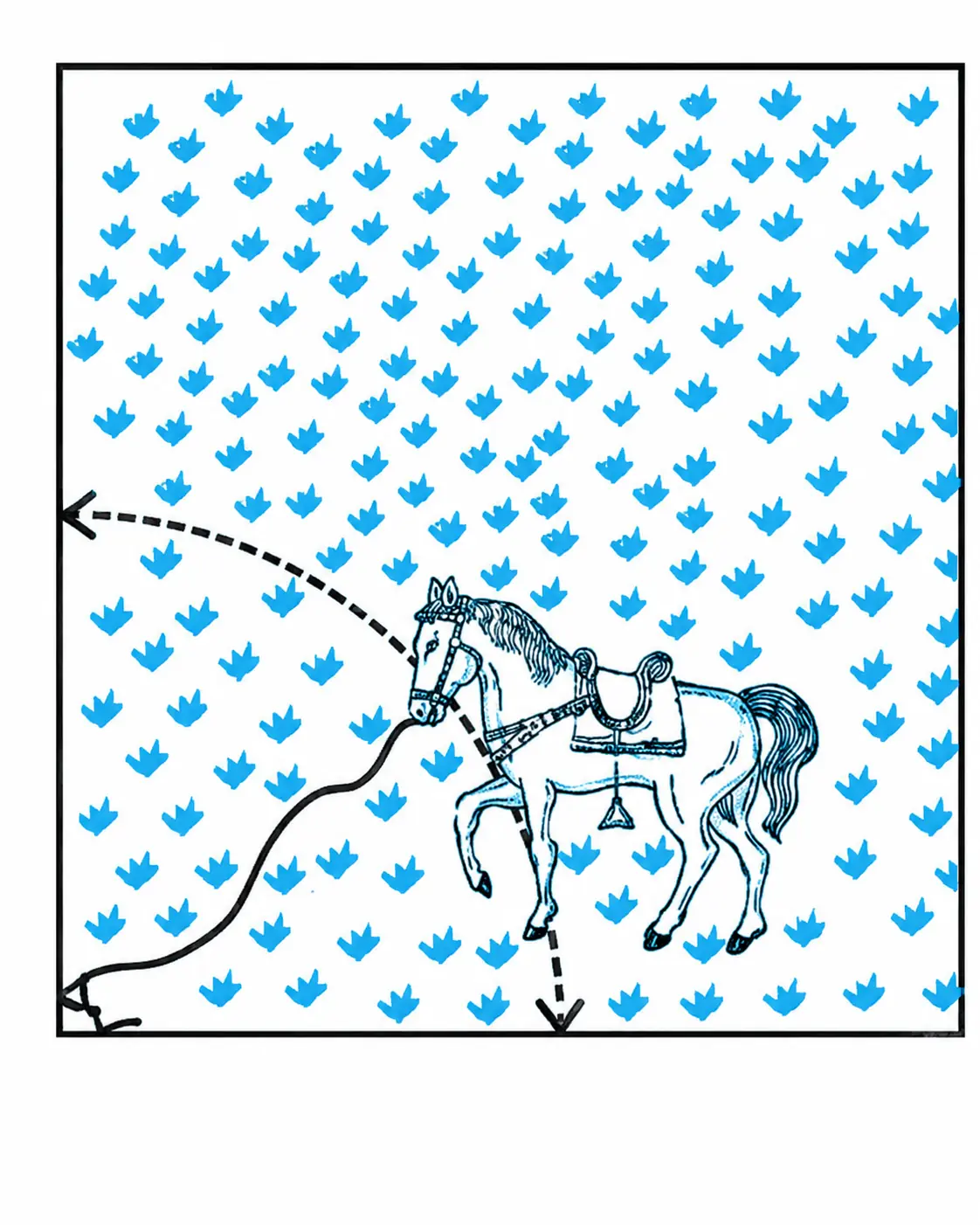
A horse is tied to a peg at one corner of a square shaped grass field of side 15 m by means of a 5 m long rope (see Fig. 11.8). Find
Fig. 11.8
Fig. 11.8

(i) the area of that part of the field in which the horse can graze.

Solution

The horse is tied at a corner of the square field, so the tip of the rope can move through a quarter–circle of radius $$r = 5\,\text{m}$$ that lies completely inside the field (because the side of the square is $$15\,\text{m} > 5\,\text{m}$$).

Area of a full circle of radius $$r$$:
$$A_{\text{circle}} = \pi r^{2} = \pi (5)^{2} = 25\pi\,\text{m}^{2}$$

Required grazing area (one-fourth of the circle):
$$A_{\text{graze}} = \dfrac{1}{4}\times 25\pi = \dfrac{25\pi}{4}\,\text{m}^{2}$$

Using $$\pi = 3.14$$:
$$A_{\text{graze}} = \dfrac{25\times 3.14}{4} = \dfrac{78.50}{4} = 19.625\,\text{m}^{2}$$

Answer

19.625 m2

(ii) the increase in the grazing area if the rope were 10 m long instead of 5 m. (Use $$\pi = 3.14$$)

Solution

When the rope length is doubled to $$10\,\text{m}$$, the horse can graze over a quarter–circle of radius $$10\,\text{m}$$ (still completely inside the $$15\,\text{m}$$ square).

New grazing area:
$$A_{\text{new}} = \dfrac{1}{4}\times \pi (10)^{2} = \dfrac{1}{4}\times 100\pi = 25\pi\,\text{m}^{2}$$

With $$\pi = 3.14$$:
$$A_{\text{new}} = 25\times 3.14 = 78.50\,\text{m}^{2}$$

Old grazing area (from part (i)):
$$A_{\text{old}} = 19.625\,\text{m}^{2}$$

Increase in grazing area:
$$\Delta A = A_{\text{new}} - A_{\text{old}} = 78.50 - 19.625 = 58.875\,\text{m}^{2}$$

Answer

Increase = 58.875 m2

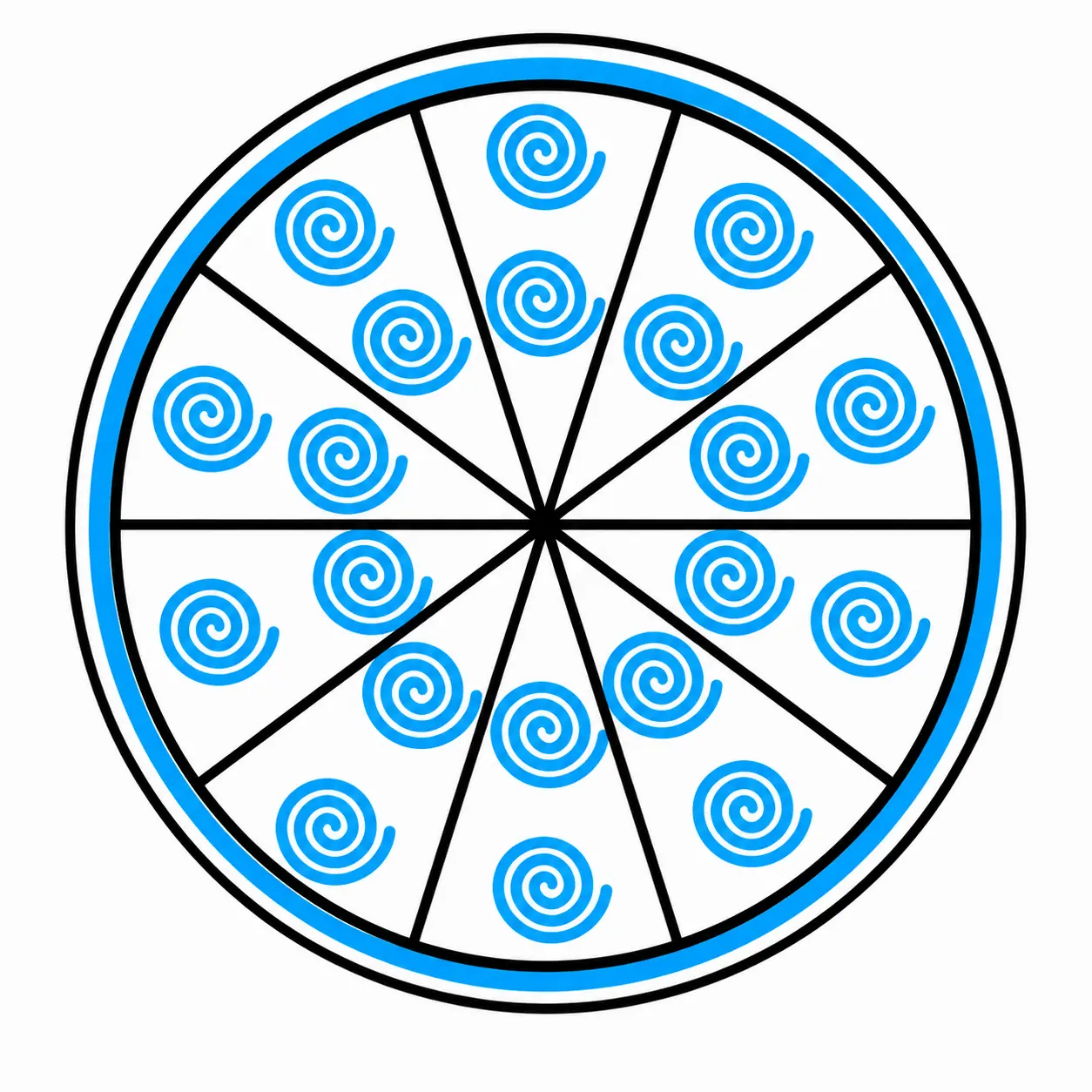
9

A brooch is made with silver wire in the form of a circle with diameter 35 mm. The wire is also used in making 5 diameters which divide the circle into 10 equal sectors as shown in Fig. 11.9. Find:
Fig. 11.9
Fig. 11.9

(i) the total length of the silver wire required.

Solution

The diameter of the circular brooch is given as 35 mm.

Radius: $$r = \frac{35\,\text{mm}}{2} = 17.5\,\text{mm}$$

1. Length of wire for the circumference

$$\text{Circumference}=2\pi r = 2 \times \frac{22}{7} \times 17.5\,\text{mm}$$

$$= \frac{44}{7}\times 17.5\,\text{mm}=\frac{44\times 17.5}{7}\,\text{mm}=110\,\text{mm}$$

2. Length of wire for the diameters

Each diameter measures 35 mm and there are 5 of them:

$$5\times 35\,\text{mm}=175\,\text{mm}$$

3. Total length of wire required

$$\text{Total length}=110\,\text{mm}+175\,\text{mm}=285\,\text{mm}$$

Answer

(i) Total length of silver wire = $$285\,\text{mm}$$

(ii) the area of each sector of the brooch.

Solution

The 5 diameters divide the circle into 10 equal sectors.

1. Area of the complete circle

Radius: $$r = 17.5\,\text{mm}$$

$$\text{Area of circle}=\pi r^{2}=\frac{22}{7}\times (17.5\,\text{mm})^{2}$$

$$=\frac{22}{7}\times 306.25\,\text{mm}^2=22\times 43.75\,\text{mm}^2=962.5\,\text{mm}^2$$

2. Area of one sector

Since there are 10 equal sectors,

$$\text{Area of each sector}=\frac{962.5\,\text{mm}^2}{10}=96.25\,\text{mm}^2$$

Answer

(ii) Area of each sector = $$96.25\,\text{mm}^2$$

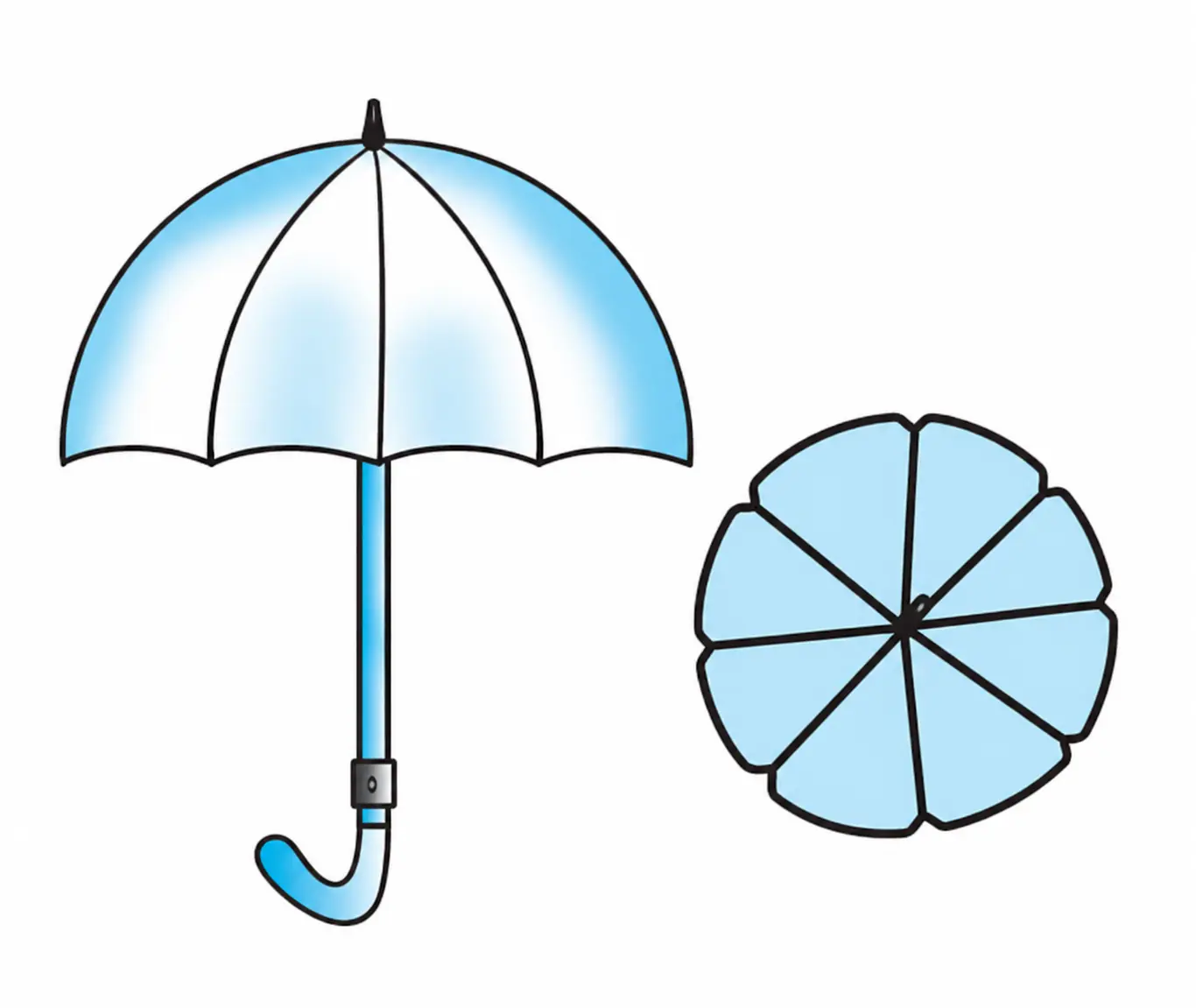
10

An umbrella has 8 ribs which are equally spaced (see Fig. 11.10). Assuming umbrella to be a flat circle of radius 45 cm, find the area between the two consecutive ribs of the umbrella.
Fig. 11.10
Fig. 11.10

Solution

Given: The umbrella is assumed to be a flat circle of radius $$r = 45\text{ cm}$$ with $$8$$ equally-spaced ribs.

Step 1 – Central angle between two consecutive ribs
The ribs divide the full circle ( $$360^{\circ}$$ ) into $$8$$ equal sectors, so each sector subtends an angle
$$\theta = \frac{360^{\circ}}{8} = 45^{\circ}$$ at the centre.

Step 2 – Area of one sector
The area $$A$$ of a sector of angle $$\theta$$ in a circle of radius $$r$$ is
$$A = \frac{\theta}{360^{\circ}} \times \pi r^{2}$$.
Substituting $$\theta = 45^{\circ}$$ and $$r = 45\text{ cm}$$:
$$A = \frac{45^{\circ}}{360^{\circ}} \times \pi (45\text{ cm})^{2}$$
$$\;\; = \frac{1}{8}\times \pi \times 45^{2}\text{ cm}^2$$
$$\;\; = \frac{1}{8}\times \pi \times 2025\text{ cm}^2$$
$$\;\; = \frac{2025\pi}{8}\text{ cm}^2$$.

Step 3 – Numerical value (optional)
Using $$\pi \approx 3.14$$,
$$A \approx \frac{2025 \times 3.14}{8}\text{ cm}^2$$
$$\;\; = 253.125 \times 3.14\text{ cm}^2$$
$$\;\; \approx 794.8\text{ cm}^2 \approx 7.95\times10^{2}\text{ cm}^2$$.

Hence, the area between two consecutive ribs is $$\dfrac{2025\pi}{8}\text{ cm}^2$$ (approximately $$795\text{ cm}^2$$).

Answer

Area between two consecutive ribs = $$\dfrac{2025\pi}{8}\;\text{cm}^2 \;\approx\; 7.95\times10^{2}\;\text{cm}^2$$

11 A car has two wipers which do not overlap. Each wiper has a blade of length 25 cm sweeping through an angle of $$115^\circ$$. Find the total area cleaned at each sweep of the blades.

Solution

Given data

  • Length of each wiper blade (radius of the sweep)  $$r = 25\,\text{cm}$$
  • Angular sweep of each blade  $$\theta = 115^{\circ}$$
  • The two wipers do not overlap.

1. Area swept by one wiper

The path traced by one blade is a sector of a circle.
For a sector of angle $$\theta$$ (in degrees) and radius $$r$$, the area is

$$A_{\text{sector}} = \frac{\theta}{360^{\circ}} \times \pi r^{2}$$

Substituting the given values,

$$A_{1} = \frac{115}{360} \times \pi \times (25)^{2}$$

$$A_{1} = \frac{115}{360} \times \pi \times 625$$

$$A_{1} = \frac{115 \times 625}{360}\,\pi = \frac{71875}{360}\,\pi \;\text{cm}^{2}$$

Using $$\pi = \dfrac{22}{7}$$ (the value usually prescribed in NCERT):

$$A_{1} = \frac{71875}{360} \times \frac{22}{7}\;\text{cm}^{2}$$

Simplifying,

$$A_{1} = \frac{1\,581\,250}{2\,520}\;\text{cm}^{2} \approx 627.5\;\text{cm}^{2}$$

2. Total area cleaned by the two wipers

The wipers do not overlap, so their swept areas simply add:

$$A_{\text{total}} = 2A_{1}$$

$$A_{\text{total}} = 2 \times 627.5\;\text{cm}^{2} \approx 1\,255\;\text{cm}^{2}$$

3. Conclusion

The two wiper blades together clean about $$1.26 \times 10^{3}\;\text{cm}^{2}$$ (that is, roughly $$1\,255\;\text{cm}^{2}$$) of the windscreen in one complete sweep.

Answer

The two wipers clean approximately $$1.26 \times 10^{3}\;\text{cm}^{2}\;(\approx 1\,255\;\text{cm}^{2})$$ in each sweep.

12 To warn ships for underwater rocks, a lighthouse spreads a red coloured light over a sector of angle $$80^\circ$$ to a distance of 16.5 km. Find the area of the sea over which the ships are warned. (Use $$\pi = 3.14$$)

Solution

Let the lighthouse be at the centre O of the circular region that receives the warning light.

Given:

  • Radius of the illuminated sector, $$r = 16.5\,\text{km}$$.
  • Angle of the sector, $$\theta = 80^\circ$$.
  • Take $$\pi = 3.14$$.

The area of a sector of a circle is obtained from

$$\text{Area of sector} = \frac{\theta}{360^\circ}\,\pi r^2$$.

Substituting the given values,

$$\text{Area} = \frac{80^\circ}{360^\circ}\times 3.14 \times (16.5\,\text{km})^2$$

Simplify the fraction:

$$\frac{80}{360} = \frac{8}{36} = \frac{2}{9}$$.

Next, compute the square of the radius:

$$r^2 = (16.5)^2 = 272.25\,\text{km}^2$$.

Now evaluate the product:

$$\text{Area} = \frac{2}{9} \times 3.14 \times 272.25$$

First multiply $$3.14$$ and $$272.25$$:

$$3.14 \times 272.25 = 854.865$$.

Then multiply by $$\tfrac{2}{9}$$:

$$\text{Area} = \frac{2 \times 854.865}{9} = \frac{1709.73}{9} = 189.97\,\text{km}^2 \,(\text{approx.})$$

Therefore, the red light from the lighthouse warns ships over an area of about $$190\,\text{km}^2$$ of sea.

Answer

Warned sea area  ≈  $$190\,\text{km}^2$$

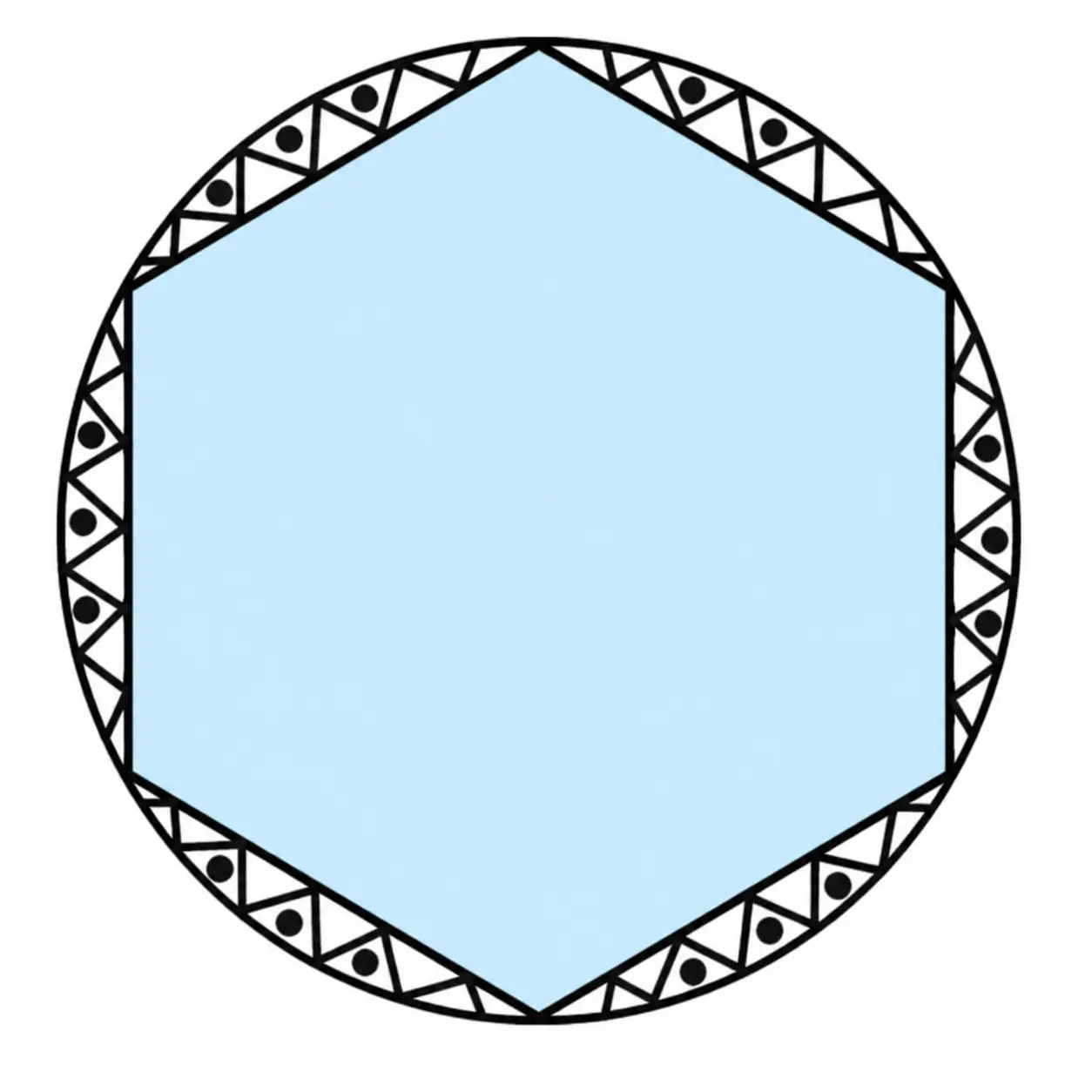
13

A round table cover has six equal designs as shown in Fig. 11.11. If the radius of the cover is 28 cm, find the cost of making the designs at the rate of $$\mathrm{\rlap{/}{=}} \, 0.35$$ per cm$$^2$$. (Use $$\sqrt{3} = 1.7$$)
Fig. 11.11
Fig. 11.11

Solution

Step 1 : Understand the figure
The six identical designs join the centre of the round table cover to six equally–spaced points on the rim. Hence these six points form a regular hexagon whose every side equals the radius of the cover, $$r = 28\text{ cm}$$.

Step 2 : Area of one design
Each design is the triangular region between two consecutive radii; therefore it is an equilateral triangle of side $$a = 28\text{ cm}$$.
For an equilateral triangle, $$\text{Area} = \dfrac{\sqrt3}{4}\,a^{2}$$.

$$\text{Area of one design} = \frac{\sqrt3}{4}\,(28)^2 = \frac{\sqrt3}{4}\times 784 = 196\sqrt3\;\text{cm}^2$$

Step 3 : Area of six designs

$$\text{Total area} = 6 \times 196\sqrt3 = 1176\sqrt3\;\text{cm}^2$$

Given $$\sqrt3 = 1.7$$,

$$\text{Total area} = 1176 \times 1.7 = 1999.2\;\text{cm}^2$$

Step 4 : Cost of making the designs
Rate of making = Rs 0.35 per cm2

$$\text{Cost} = 1999.2 \times 0.35 = 699.72$$

Conclusion
The cost of making the six designs on the round table cover is approximately Rs 700 (exact value Rs 699.72).

Answer

Rs 699.72 ≈ Rs 700

14

Tick the correct answer in the following:

Area of a sector of angle $$p$$ (in degrees) of a circle with radius R is

  1. (A) $$\dfrac{p}{180} \times 2\pi \mathrm{R}$$
  2. (B) $$\dfrac{p}{180} \times \pi \mathrm{R}^2$$
  3. (C) $$\dfrac{p}{360} \times 2\pi \mathrm{R}$$
  4. (D) $$\dfrac{p}{720} \times 2\pi \mathrm{R}^2$$

Solution

Let a circle of radius $$R$$ be drawn.

Step 1 : Area of the whole circle
For the entire circle the angle at the centre is $$360^{\circ}$$ and the area is $$\pi R^{2}$$.

Step 2 : Proportionality of area and angle
For sectors of the same circle, the area is directly proportional to the central angle. Hence, if a sector subtends an angle $$p^{\circ}$$ at the centre, we write

$$\frac{\text{Area of sector}}{\text{Area of full circle}} = \frac{\text{Sector angle}}{\text{Full angle}}$$

Substituting the known values:

$$\frac{\text{Area of sector}}{\pi R^{2}} = \frac{p}{360}$$

Step 3 : Solve for the area of the sector

$$\text{Area of sector} = \frac{p}{360}\,\pi R^{2}$$

Step 4 : Match with the given options
The obtained expression can be rewritten as

$$\frac{p}{360}\,\pi R^{2}=\frac{p}{720}\,(2\pi R^{2}),$$

which is exactly the expression listed in option (D).

Therefore, option (D) is correct.

Answer

(D)

NCERT Solutions for Class 10
Maths
NCERT Solutions for Class 10 Maths
Chapter-wise step-by-step
solutions with explanations
explore solutions Maths bg
Science
NCERT Solutions for Class 10 Science
Chapter-wise step-by-step
solutions with explanations
explore solutions Science bg

Frequently Asked Questions

50,000+ JEE Students Trusted Our Score Calculator

Predict your JEE Main percentile, rank & performance in seconds