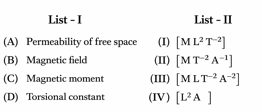
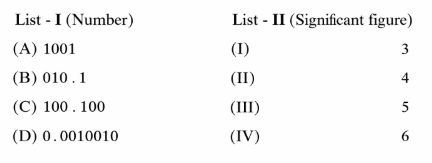
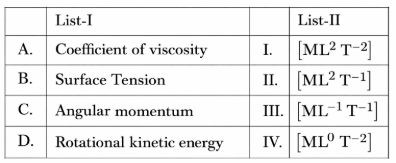
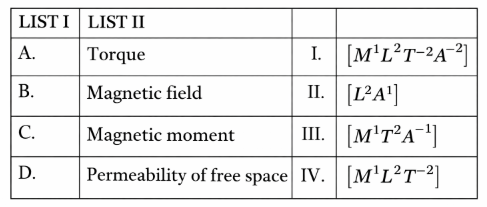
First we recall the symbols for the fundamental (base) dimensions that we will use throughout the solution:
$$$[M] \;{\rm for\; mass},\qquad [L] \;{\rm for\; length},\qquad [T] \;{\rm for\; time},\qquad [I] \;{\rm for\; electric\; current}.$$$
We now determine the dimensions of the two electromagnetic constants that occur in the question.
For the permeability of free space we start from the defining relation
$$B \;=\; \mu_0\,H.$$
Here $$B$$ is the magnetic flux density and $$H$$ is the magnetic field intensity. In SI units
$$B$$ (tesla) has the dimension
$$$[B] \;=\; \frac{{\rm force}}{{\rm current}\times{\rm length}}
\;=\; \frac{[M\,L\,T^{-2}]}{[I]\,[L]}
\;=\; [M\,T^{-2}\,I^{-1}],$$$
and $$H$$ (ampere per metre) has the dimension
$$[H]\;=\;[I\,L^{-1}].$$
Therefore
$$$[\mu_0] \;=\; \frac{[B]}{[H]}
\;=\; \frac{[M\,T^{-2}\,I^{-1}]}{[I\,L^{-1}]}
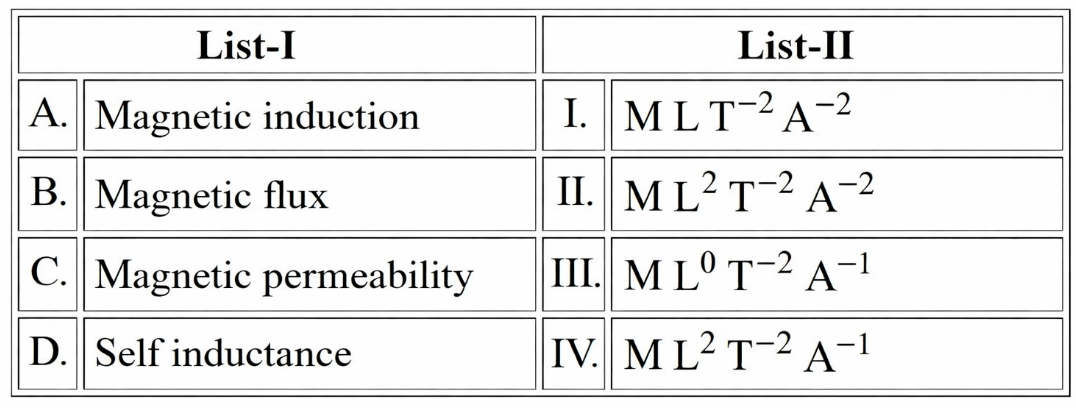
\;=\; [M\,L\,T^{-2}\,I^{-2}].$$$
For the permittivity of free space we employ Coulomb’s law
$$F \;=\; \frac{1}{4\pi\varepsilon_0}\,\frac{q_1q_2}{r^2},$$
so that
$$\varepsilon_0 \;=\; \frac{q_1q_2}{4\pi\,F\,r^2}.$$
Ignoring numerical constants, its dimension is
$$$[\varepsilon_0]
\;=\; \frac{[Q]^2}{[M\,L\,T^{-2}]\,[L]^2}
\;=\; \frac{[I^2\,T^2]}{[M\,L^3\,T^{-2}]}
\;=\; [M^{-1}\,L^{-3}\,T^{4}\,I^{2}].$$$
With these preliminaries completed, we are ready to analyse each of the three given quantities.
1. Dimension of $$x=\dfrac{1}{\sqrt{\mu_0\varepsilon_0}}.$$
First multiply the dimensions of $$\mu_0$$ and $$\varepsilon_0$$:
$$$[\mu_0\varepsilon_0]
\;=\;[M\,L\,T^{-2}\,I^{-2}]\times[M^{-1}\,L^{-3}\,T^{4}\,I^{2}]
\;=\;L^{(1-3)}\,T^{(-2+4)}\,M^{(1-1)}\,I^{(-2+2)}
\;=\;[L^{-2}\,T^{2}].$$$
The square root of this product therefore has the dimension
$$\sqrt{[\mu_0\varepsilon_0]}
\;=\;[L^{-1}\,T^{1}].$$
Because $$x$$ is the reciprocal of that square root, we invert the above result:
$$[x]\;=\;\frac{1}{[L^{-1}\,T^{1}]}\;=\;[L^{1}\,T^{-1}].$$
This is exactly the dimension of speed (length per time).
2. Dimension of $$y=\dfrac{E}{B}.$$
We already know $$[B]=[M\,T^{-2}\,I^{-1}].$$ Let us now find $$[E]$$, the electric field intensity. By definition
$$E \;=\; \frac{\text{force}}{\text{charge}},$$
so
$$$[E]
\;=\;\frac{[M\,L\,T^{-2}]}{[I\,T]}
\;=\;[M\,L\,T^{-3}\,I^{-1}].$$$
Dividing $$E$$ by $$B$$ gives
$$$[y]
\;=\;\frac{[M\,L\,T^{-3}\,I^{-1}]}{[M\,T^{-2}\,I^{-1}]}
\;=\;[L\,T^{-1}].$$$
Thus $$y$$ also has the dimension of speed.
3. Dimension of $$z=\dfrac{l}{C\,R}.$$
The length $$l$$ has the obvious dimension $$[l]=[L].$$
For the capacitance $$C$$ we use the definition
$$C \;=\; \frac{Q}{V},$$
and voltage (potential difference) satisfies
$$$V \;=\; \frac{\text{work}}{\text{charge}}
\;=\; \frac{[M\,L^{2}\,T^{-2}]}{[I\,T]}
\;=\;[M\,L^{2}\,T^{-3}\,I^{-1}].$$$
Hence
$$$[C]
\;=\;\frac{[I\,T]}{[M\,L^{2}\,T^{-3}\,I^{-1}]}
\;=\;[M^{-1}\,L^{-2}\,T^{4}\,I^{2}].$$$
For resistance $$R$$, Ohm’s law gives $$R = V/I,$$ so
$$$[R]
\;=\;\frac{[M\,L^{2}\,T^{-3}\,I^{-1}]}{[I]}
\;=\;[M\,L^{2}\,T^{-3}\,I^{-2}].$$$
The product $$C\,R$$ therefore possesses the dimension
$$$[C\,R]
\;=\;[M^{-1}\,L^{-2}\,T^{4}\,I^{2}]
\times[M\,L^{2}\,T^{-3}\,I^{-2}]
\;=\;L^{(-2+2)}\,T^{(4-3)}\,M^{(-1+1)}\,I^{(2-2)}
\;=\;[T^{1}].$$$
Finally, dividing the length $$l$$ by this product yields
$$[z]
\;=\;\frac{[L]}{[T]}
\;=\;[L\,T^{-1}].$$
Thus $$z$$ again has the dimension of speed.
We have shown that
$$$[x]=[L\,T^{-1}],\qquad
[y]=[L\,T^{-1}],\qquad
[z]=[L\,T^{-1}].$$$
All three quantities share the identical dimension (that of velocity).
Hence, the correct answer is Option A.