A variable $$X$$ takes values $$0, 0, 2, 6, 12, 20, \ldots, n(n-1)$$ with frequencies $${^{n} C_{0}}, {^{n} C_{1}}, {^{n} C_{2}}, \ldots, {^{n} C_{n}}$$ respectively. If the mean of the data is 60, then the median is :
JEE Statistics Questions
The random variable $$X$$ assumes the values
$$0,\,0,\,2,\,6,\,12,\,20,\ldots ,\,n(n-1)$$
corresponding to $$k = 0,1,2,\ldots ,n$$ where in general
$$X = k(k-1)\qquad (k = 0,1,2,\ldots ,n)$$
The frequency attached to the value $$k(k-1)$$ is the binomial coefficient $$\binom{n}{k}$$.
Hence the total number of observations is
$$N = \sum_{k=0}^{n}\binom{n}{k}=2^{\,n}$$
Therefore the probability (relative frequency) of getting the value $$k(k-1)$$ is
$$P(X = k(k-1))=\frac{\binom{n}{k}}{2^{\,n}}$$
This is exactly the distribution of a Binomial random variable $$K$$ with parameters $$n$$ and $$p=\tfrac12$$, observed through the transformation $$X=K(K-1)$$.
1. Determination of $$n$$ from the mean
The given mean of $$X$$ is 60. Using the binomial properties,
$$E[X]=E\bigl[K(K-1)\bigr]=n(n-1)p^{2}$$
because for a binomial random variable $$K\sim\text{Bin}(n,p)$$ we have
$$E\bigl[K(K-1)\bigr]=n(n-1)p^{2}$$.
With $$p=\tfrac12$$,
$$E[X]=\frac{n(n-1)}{4}=60$$
$$\Longrightarrow\;n(n-1)=240$$
$$\Longrightarrow\;n^{2}-n-240=0$$
Solving the quadratic equation,
$$n=\frac{1+\sqrt{1+960}}{2}=\frac{1+31}{2}=16$$
(The negative root is discarded.) Hence $$n=16$$.
2. Finding the median
Let $$K$$ again denote the underlying binomial count. With $$n=16,\,p=\tfrac12$$ the distribution of $$K$$ is perfectly symmetric about 8:
$$P(K\le 7)=P(K\ge 9)$$
Consequently, the cumulative probability strictly below $$K=8$$ is less than $$\tfrac12$$, while the cumulative probability up to and including $$K=8$$ is at least $$\tfrac12$$. Thus any median value of $$K$$ is $$8$$.
Since the transformation $$X = K(K-1)$$ is monotonically increasing in $$K$$ for $$K\ge 1$$, the median of $$X$$ is obtained by substituting $$K=8$$:
$$\text{Median of }X = 8(8-1)=8\times 7=56$$
Answer: Option A which is: $$56$$
Suppose that the mean and median of the non-negative numbers $$21, 8, 17, a, 51, 103, b, 13, 67$$, $$(a > b)$$, are 40 and 21, respectively. If the mean deviation about the median is 26, then $$2a$$ is equal to :
The nine numbers are $$21,\,8,\,17,\,a,\,51,\,103,\,b,\,13,\,67$$ with $$a \gt b \ge 0$$.
Step 1 : Mean condition
For $$n = 9$$ numbers, mean $$\mu = 40$$ gives
$$\sum x_i = n\mu = 9 \times 40 = 360.$$
Sum of the seven known values is
$$21+8+17+51+103+13+67 = 280.$$
Hence
$$a + b = 360 - 280 = 80.$$ $$-(1)$$
Step 2 : Median condition
With nine values, the 5-th term of the ascending list is the median.
Given median = $$21$$ and the number $$21$$ is already present, we must have exactly four values $$\le 21$$ and four values $$\ge 21$$ besides the median itself.
Among the known numbers, those $$\lt 21$$ are $$8,\,13,\,17$$ (3 numbers) and those $$\gt 21$$ are $$51,\,67,\,103$$ (3 numbers).
To reach the count 4-and-4, one of $$a,\,b$$ must be $$\lt 21$$ and the other $$\gt 21$$.
Because $$a \gt b$$, we conclude
$$b \lt 21,\qquad a \gt 21.$$ $$-(2)$$
Step 3 : Mean deviation about the median
Mean deviation about median $$M$$ is
$$\text{MD} = \frac{1}{n}\sum_{i=1}^{n}\lvert x_i - M\rvert.$$
Here $$M = 21$$ and MD is given as $$26$$, so
$$\sum_{i=1}^{9}\lvert x_i - 21\rvert = 9 \times 26 = 234.$$
Compute the absolute deviations of the known numbers:
$$\begin{aligned}
|21-21| &= 0,\\
|8-21| &= 13,\\
|17-21| &= 4,\\
|51-21| &= 30,\\
|103-21|&= 82,\\
|13-21| &= 8,\\
|67-21| &= 46.
\end{aligned}$$
Their sum is
$$0+13+4+30+82+8+46 = 183.$$
Let the remaining two deviations be $$|a-21| + |b-21|$$. They must satisfy $$|a-21| + |b-21| = 234 - 183 = 51.$$ $$-(3)$$
Using (2), $$|a-21| = a-21,\qquad |b-21| = 21-b,$$ so (3) becomes $$(a-21) + (21 - b) = a - b = 51.$$ $$-(4)$$
Step 4 : Solve for $$a$$ and $$b$$
From (1) and (4):
$$a + b = 80,$$
$$a - b = 51.$$
Adding,
$$2a = 80 + 51 = 131.$$
Thus $$2a = 131.$$
Therefore, the required value is
Option D which is: 131
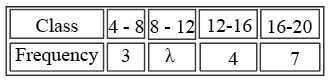
If the mean and the variance of the data
are $$ \mu $$ and 19 respectively, then the value of $$\lambda$$ $$+\mu$$ is
Class midpoints: (6, 10, 14, 18)
Frequencies:$$(3,\lambda,4,7),total(N=\lambda+14)$$
Mean:
$$\mu=\frac{3\cdot6+\lambda\cdot10+4\cdot14+7\cdot18}{\lambda+14}$$
$$=\frac{200+10\lambda}{\lambda+14}$$
Variance:
$$\sigma^2=\frac{\sum_{ }^{ }fx^2}{N}-\mu^2=19$$
$$Compute:\sum_{ }^{ }fx^2=3(36)+\lambda(100)+4(196)+7(324)=3160+100\lambda\frac{3160+100\lambda}{\lambda+14}-\mu^2=19$$
$$Substitute(\mu=\frac{200+10\lambda}{\lambda+14}),simplify⇒\lambda=5,\quad\mu=14$$
$$\lambda+\mu=5+14=19$$
Let the mean and variance of 7 observations 2, 4, 10, x, 12, 14, y, x > y, be 8 and 16 respectively. Two numbers are chosen from {1, 2, 3, x - 4,y,5} one after an other without replacement, then the probability, that the smaller number among the two chosen numbers is less than 4, is :
Mean $$\bar{x} = 8$$. Sum $$= 8 \times 7 = 56$$.
$$2+4+10+12+14+x+y = 56 \implies 42 + x + y = 56 \implies x+y = 14$$.
Variance $$\sigma^2 = 16$$. $$\frac{\sum x_i^2}{7} - \bar{x}^2 = 16 \implies \sum x_i^2 = 7(16 + 64) = 560$$.
$$4 + 16 + 100 + 144 + 196 + x^2 + y^2 = 560 \implies 460 + x^2 + y^2 = 560 \implies x^2 + y^2 = 100$$.
Solving $$x+y=14$$ and $$x^2+y^2=100$$: $$(14-y)^2 + y^2 = 100 \implies 196 - 28y + 2y^2 = 100 \implies y^2 - 14y + 48 = 0$$.
Roots are $$6, 8$$. Since $$x > y$$, $$x=8, y=6$$.
The set for probability is $$\{1, 2, 3, x-4, y, 5\} = \{1, 2, 3, 4, 6, 5\}$$.
Total ways to pick 2 numbers from 6 without replacement $$= 6 \times 5 = 30$$.
We want the smaller number to be $$< 4$$ (i.e., smaller is 1, 2, or 3). It's easier to find the complement (smaller is $$\ge 4$$).
If smaller is $$\ge 4$$, both numbers must be from $$\{4, 5, 6\}$$. Ways $$= 3 \times 2 = 6$$.
$$P(\text{smaller} < 4) = 1 - \frac{6}{30} = 1 - \frac{1}{5} = \frac{4}{5}$$.
Correct Option: C (4/5)
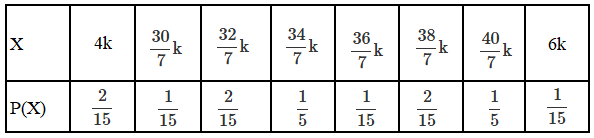
The probability distribution of a random variable X is given below:
If $$ E(X)=\frac{263}{15} $$. then $$ P(X<20)$$ is equal to:
Let the mean and variance of 8 numbers - 10, - 7, - 1, x, y, 9, 2, 16 be $$\frac{7}{2}\text{ and }\frac{293}{4}$$ respectively.
Then the mean of 4 numbers x, y, x + y + 1, |x-y| is:
Sum of the eight numbers = $$-10 + (-7) + (-1) + x + y + 9 + 2 + 16 = 9 + x + y.$$
Mean is given by the formula $$\text{Mean} = \frac{\text{Sum of terms}}{n}$$. Here $$n=8$$ and the mean is $$\frac{7}{2}$$, so
$$\frac{9 + x + y}{8} = \frac{7}{2} \quad-(1)$$
$$9 + x + y = 28.$$
$$x + y = 28 - 9 = 19 \quad-(2)$$
Variance formula for $$n$$ numbers is
$$\sigma^2 = \frac{1}{n}\sum_{i=1}^n x_i^2 \;-\; (\text{mean})^2.$$
Here $$\sigma^2 = \frac{293}{4}$$, so
$$\frac{1}{8}\sum(\text{squares}) - \Bigl(\frac{7}{2}\Bigr)^2 = \frac{293}{4}\,.$$
Thus,
$$\frac{1}{8}\sum(\text{squares}) = \frac{293}{4} + \frac{49}{4} = \frac{342}{4} = \frac{171}{2}\,.$$
$$\sum(\text{squares}) = 8 \times \frac{171}{2} = 684.$$
The sum of squares of the known constants is
$$(-10)^2 + (-7)^2 + (-1)^2 + 9^2 + 2^2 + 16^2 = 100 + 49 + 1 + 81 + 4 + 256 = 491.$$
$$491 + x^2 + y^2 = 684\quad\Longrightarrow\quad x^2 + y^2 = 193 \quad-(3)$$
Using the identity $$(x + y)^2 = x^2 + y^2 + 2xy$$ and substituting $$(2)$$ and $$(3)$$:
$$19^2 = 193 + 2xy\;\Longrightarrow\;361 = 193 + 2xy\;\Longrightarrow\;2xy = 168\;\Longrightarrow\;xy = 84\quad-(4)$$
Now compute $$(x - y)^2$$ via
$$ (x - y)^2 = (x + y)^2 - 4xy = 361 - 4\times84 = 361 - 336 = 25.$$
$$|x - y| = 5.$$
The four numbers whose mean is required are $$x,\;y,\;x + y + 1,\;|x - y|$$. Their sum is
$$x + y + (x + y + 1) + |x - y| = 19 + 20 + 5 = 44.$$
Hence the mean of these four numbers is
$$\frac{44}{4} = 11.$$
A random varaible X takes values 0,1,2,3 with probabilities $$\frac{2a+1}{30},\frac{8a-1}{30},\frac{4a+1}{30}$$, b respectively, where $$a,b \epsilon R$$. let $$\mu$$ and $$\sigma$$ respectively be the mean and standard deviation of X such that $$\sigma^{2}+\mu^{2}=2$$. Then $$\frac{a}{b}$$ is equal to :
X takes values 0, 1, 2, 3 with probabilities $$\frac{2a+1}{30}, \frac{8a-1}{30}, \frac{4a+1}{30}, b$$.
We enforce that the sum of these probabilities equals one: $$\frac{2a+1+8a-1+4a+1}{30} + b = 1$$, which simplifies to $$\frac{14a+1}{30} + b = 1$$ and hence $$b = 1 - \frac{14a+1}{30} = \frac{29-14a}{30}$$ ... (i)
We compute the mean $$\mu = E(X)$$ as $$\mu = 0 \cdot \frac{2a+1}{30} + 1 \cdot \frac{8a-1}{30} + 2 \cdot \frac{4a+1}{30} + 3b = \frac{8a-1+8a+2}{30} + 3b = \frac{16a+1}{30} + 3 \cdot \frac{29-14a}{30} = \frac{88-26a}{30}$$
The second moment is $$E(X^2) = 0 + 1 \cdot \frac{8a-1}{30} + 4 \cdot \frac{4a+1}{30} + 9b = \frac{8a-1+16a+4}{30} + 9 \cdot \frac{29-14a}{30} = \frac{264-102a}{30}$$
Using $$\sigma^2 = E(X^2) - \mu^2$$ and the condition $$\sigma^2 + \mu^2 = 2$$ gives $$E(X^2) = 2$$, so $$\frac{264-102a}{30} = 2 \Rightarrow 264 - 102a = 60 \Rightarrow 102a = 204 \Rightarrow a = 2$$
Substituting into (i) gives $$b = \frac{29-28}{30} = \frac{1}{30}$$
Therefore, $$\frac{a}{b} = \frac{2}{1/30} = 60$$
The answer is Option 2: 60.
The mean and variance of 10 observations are 9 and 34.2, respectively. If 8 of these observations are 2, 3, 5, 10, 11 , 13, 15, 21, then the mean deviation about the median of all the 10 observations is
We need to find the mean deviation about the median of 10 observations.
Mean = 9, Variance = 34.2. Known 8 observations: 2, 3, 5, 10, 11, 13, 15, 21.
Sum of known 8 = 2+3+5+10+11+13+15+21 = 80
Let the two unknown values be a and b.
$$80 + a + b = 90 \implies a + b = 10 \quad \cdots (1)$$
For variance: $$\sum x_i^2/n - \bar{x}^2 = 34.2$$
$$\sum x_i^2/10 - 81 = 34.2 \implies \sum x_i^2 = 1152$$
Sum of squares of known 8: $$4+9+25+100+121+169+225+441 = 1094$$
$$a^2 + b^2 = 1152 - 1094 = 58 \quad \cdots (2)$$
From (1) and (2): $$a + b = 10$$ and $$a^2 + b^2 = 58$$
$$(a+b)^2 = a^2 + 2ab + b^2 = 100 \implies 2ab = 42 \implies ab = 21$$
$$a, b$$ are roots of $$t^2 - 10t + 21 = 0 \implies t = 3, 7$$
So the two missing values are 3 and 7.
2, 3, 3, 5, 7, 10, 11, 13, 15, 21
Median = $$(7 + 10)/2 = 8.5$$
$$MD = \frac{1}{10}\sum|x_i - 8.5|$$
$$= \frac{|2-8.5|+|3-8.5|+|3-8.5|+|5-8.5|+|7-8.5|+|10-8.5|+|11-8.5|+|13-8.5|+|15-8.5|+|21-8.5|}{10}$$
$$= \frac{6.5+5.5+5.5+3.5+1.5+1.5+2.5+4.5+6.5+12.5}{10} = \frac{50}{10} = 5$$
Therefore, the mean deviation is Option 1: 5.
Let $$X= \left\{x\in N:1\leq x\leq19 \right\}$$ and for some $$a,b \in \mathbb R, Y = \left\{ax+b:x\in X\right\}.$$ If the mean and variance of the elements of Y are 30 and 750, respectively, then the sum of all possible values of b is
$$X = \{1,2,...,19\}$$, $$Y = \{ax+b : x \in X\}$$. Mean of Y = 30, Variance of Y = 750.
Mean of X: $$\bar{X} = 10$$. Variance of X: $$\sigma_X^2 = \frac{n^2-1}{12} = \frac{361-1}{12} = 30$$ (for uniform $$\{1,...,n\}$$).
Mean of Y: $$a\bar{X}+b = 10a+b = 30$$.
Variance of Y: $$a^2 \sigma_X^2 = a^2 \times 30 = 750$$, so $$a^2 = 25$$, giving $$a = \pm 5$$.
If $$a = 5$$: $$50+b = 30$$, $$b = -20$$.
If $$a = -5$$: $$-50+b = 30$$, $$b = 80$$.
Sum of all possible values of b: $$-20 + 80 = 60$$.
The correct answer is Option 3: 60.
The mean and variance of a data of 10 observations are 1O and 2, respectively. If an observations $$\alpha$$ in this data is replaced by $$\beta$$, then the mean and variance become 10.1 and 1.99, respectively. Then $$\alpha+\beta$$ equals
We need to find $$\alpha + \beta$$ when one observation $$\alpha$$ is replaced by $$\beta$$, causing the mean to shift from 10 to 10.1 and the variance to shift from 2 to 1.99.
Using the mean condition, the original sum of observations is $$\sum x_i = 10 \times 10 = 100$$, and after the replacement we have $$100 - \alpha + \beta = 10.1 \times 10 = 101$$, which gives $$\beta - \alpha = 1$$ … (i)
Similarly, applying the variance condition, the original variance satisfies $$\frac{\sum x_i^2}{10} - 100 = 2$$ so that $$\sum x_i^2 = 1020$$. After replacement we get $$\frac{1020 - \alpha^2 + \beta^2}{10} - (10.1)^2 = 1.99$$, leading to $$\frac{1020 - \alpha^2 + \beta^2}{10} = 1.99 + 102.01 = 104$$ and hence $$1020 - \alpha^2 + \beta^2 = 1040$$, which simplifies to $$\beta^2 - \alpha^2 = 20$$ … (ii)
Factoring (ii) yields $$(\beta - \alpha)(\beta + \alpha) = 20$$, and substituting the result of (i), namely $$\beta - \alpha = 1$$, gives $$\beta + \alpha = 20$$. This matches Option D: $$\alpha + \beta = 20$$, so the answer is Option D.
If a random variable x has the probability distribution
then $$ P(3< x\leq 6)$$ is equal to
$$P(x)=0,,2k,,k,,3k,,2k^2,,2k,,k^2+k,,7k^2$$
Total probability sum must be 1.
$$10k^2+9k=1$$
Solve:
$$10k^2+9k-1=0$$
$$k=\frac{-9\pm\sqrt{81+40}}{20}=\frac{-9\pm11}{20}$$
k = 0.1
P(3$$<$$ x $$\le6$$) = P(4) + P(5) + P(6)
- $$(P(4)=2k^2=2(0.1)^2=0.02)$$
- $$(P(5)=2k=0.2)$$
- $$(P(6)=k^2+k=0.01+0.1=0.11)$$
Sum: 0.02 + 0.2 + 0.11 = 0.33
A set of four observations has mean 1 and variance 13. Another set of six observations has mean 2 and variance 1. Then, the variance of all these 10 observations is equal to :
To find the variance of the combined set of observations, we use the formula for combined variance.
Set |
Number of Observations (n) |
Mean (xˉ) |
Variance (σ2) |
Set 1 |
$$n_1 = 4$$ |
$$\bar{x}_1 = 1$$ |
$$\sigma_1^2 = 13$$ |
Set 2 |
$$n_2 = 6$$ |
$$\bar{x}_2 = 2$$ |
$$\sigma_2^2 = 1$$ |
$$\bar{x} = \frac{n_1\bar{x}_1 + n_2\bar{x}_2}{n_1 + n_2}$$
$$\bar{x} = \frac{4(1) + 6(2)}{4 + 6} = \frac{4 + 12}{10} = 1.6$$
We need the squared difference between each set's mean and the combined mean:
- $$d_1^2 = (\bar{x}_1 - \bar{x})^2 = (1 - 1.6)^2 = (-0.6)^2 = 0.36$$
- $$d_2^2 = (\bar{x}_2 - \bar{x})^2 = (2 - 1.6)^2 = (0.4)^2 = 0.16$$
The formula for combined variance is:
$$\sigma^2 = \frac{n_1(\sigma_1^2 + d_1^2) + n_2(\sigma_2^2 + d_2^2)}{n_1 + n_2}$$
Substitute the values:
$$\sigma^2 = \frac{4(13 + 0.36) + 6(1 + 0.16)}{10}$$
$$\sigma^2 = \frac{4(13.36) + 6(1.16)}{10}$$
$$\sigma^2 = \frac{53.44 + 6.96}{10}$$
$$\sigma^2 = \frac{60.4}{10} = 6.04$$
Correct Option: C (6.04)
For 10 observations $$x_1, x_2, \ldots, x_{10}$$, $$\displaystyle\sum_{i=1}^{10}(x_i + 2)^2 = 180$$ and $$\displaystyle\sum_{i=1}^{10}(x_i - 1)^2 = 90$$. Then their standard deviation is :
Expand each given square so that the unknowns $$\sum x_i$$ and $$\sum x_i^2$$ appear explicitly.
The first condition is
$$\sum_{i=1}^{10}(x_i+2)^2
=\sum_{i=1}^{10}\bigl(x_i^2+4x_i+4\bigr)
=\sum x_i^2+4\sum x_i+40
=180$$
so
$$\sum x_i^2+4\sum x_i=140 \quad\text{−(1)}$$
The second condition is
$$\sum_{i=1}^{10}(x_i-1)^2
=\sum_{i=1}^{10}\bigl(x_i^2-2x_i+1\bigr)
=\sum x_i^2-2\sum x_i+10
=90$$
hence
$$\sum x_i^2-2\sum x_i=80 \quad\text{−(2)}$$
Subtract (2) from (1):
$$\bigl(\sum x_i^2+4\sum x_i\bigr)
-\bigl(\sum x_i^2-2\sum x_i\bigr)
=140-80$$
$$6\sum x_i = 60 \;\Longrightarrow\; \sum x_i = 10$$
Insert $$\sum x_i = 10$$ into (2):
$$\sum x_i^2 - 2(10)=80
\;\Longrightarrow\;
\sum x_i^2 = 100$$
The mean is
$$\mu = \frac{\sum x_i}{n} = \frac{10}{10}=1$$
Population variance formula: $$\sigma^2 = \frac{1}{n}\sum(x_i-\mu)^2 = \frac{\sum x_i^2}{n}-\mu^2$$
Therefore
$$\sigma^2 = \frac{100}{10}-1 = 10-1 = 9$$
$$\sigma = \sqrt{9}=3$$
Hence the standard deviation of the ten observations is $$3$$.
Option D which is: $$3$$
If the mean of the data

is 21, then k is one of the roots of the equation :
The class midpoints are $$7.5, 12.5, 17.5, 22.5, 27.5, 32.5$$ respectively.
The total frequency is $$\sum f_i = 2 + k + 28 + 54 + (k+1) + 5 = 90 + 2k$$.
The sum $$\sum f_i x_i$$ is:
$$2(7.5) + k(12.5) + 28(17.5) + 54(22.5) + (k+1)(27.5) + 5(32.5)$$
$$= 15 + 12.5k + 490 + 1215 + 27.5k + 27.5 + 162.5 = 1910 + 40k$$
Setting the mean equal to 21:
$$\frac{1910 + 40k}{90 + 2k} = 21$$
$$1910 + 40k = 21(90 + 2k) = 1890 + 42k$$
$$20 = 2k$$
$$k = 10$$
Now we check which equation has $$x = 10$$ as a root. For Option 3: $$2x^2 - 19x - 10$$:
$$2(100) - 19(10) - 10 = 200 - 190 - 10 = 0$$
So $$k = 10$$ is indeed a root of $$2x^2 - 19x - 10 = 0$$.
Hence, the correct answer is Option 3.
Let the mean and the variance of seven observations 2, 4, $$\alpha$$, 8, $$\beta$$, 12, 14, $$\alpha < \beta$$, be 8 and 16 respectively. Then the quadratic equation whose roots are $$3\alpha + 2$$ and $$2\beta + 1$$ is :
lf the mean deviation about the median of the numbers k, 2k, 3k, ..... , 1000k is 500, then $$k^{2}$$ is equal to :
We have the data set $$k,2k,3k,\dots ,1000k$$; that is an arithmetic progression with first term $$k$$ and common difference $$k$$.
Total number of terms, $$N=1000$$, is even. For an even-sized ordered list, the median is the average of the $$\frac{N}{2}$$-th and $$\left(\frac{N}{2}+1\right)$$-th terms.
The $$500$$-th term is $$500k$$ and the $$501$$-st term is $$501k$$.
Hence the median, $$M$$, equals $$\dfrac{500k+501k}{2}=\dfrac{1001k}{2}=500.5k$$.
Mean deviation about the median is defined as
$$\text{M.D._{(median)}}=\frac{1}{N}\sum_{i=1}^{N}\left|x_i-M\right|.$$
Here
$$\text{M.D.}=\frac{1}{1000}\sum_{i=1}^{1000}\left|ik-500.5k\right|$$
$$=\frac{k}{1000}\sum_{i=1}^{1000}\left|i-500.5\right|.$$
Let
$$S=\sum_{i=1}^{1000}\left|i-500.5\right|.$$
Because the list is symmetric around $$500.5$$, the absolute differences come in equal pairs.
For $$i=1,2,\dots ,500$$ we have distances
$$499.5,498.5,\dots ,0.5,$$
an arithmetic progression with
first term $$a_1=499.5$$, last term $$a_{500}=0.5$$, number of terms $$n=500$$.
Sum of these 500 terms:
$$S_{500}=\frac{n}{2}\left(a_1+a_{500}\right)=\frac{500}{2}(499.5+0.5)=250\times500=125\,000.$$
The same sum occurs for $$i=501,502,\dots ,1000$$ (distances $$0.5,1.5,\dots ,499.5$$).
Therefore
$$S=2\times125\,000=250\,000.$$
Given in the question, mean deviation about the median equals $$500$$, so
$$\frac{k}{1000}\times250\,000=500.$$
Simplifying:
$$k\times250=500 \quad\Longrightarrow\quad k=2.$$
Hence
$$k^{2}=2^{2}=4.$$
The value of $$k^{2}$$ is $$4$$, which corresponds to Option C.
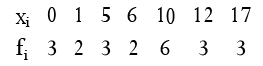
The mean deviation about the mean for the data
is equal to :
To calculate the Mean Deviation about the Mean for the given frequency distribution, we follow a systematic process involving finding the arithmetic mean first, followed by the absolute deviations.
The mean for grouped data is given by the formula:
$$\bar{x} = \frac{\sum f_i x_i}{\sum f_i}$$
Let's calculate the components:
xi |
fi |
fixi |
5 |
8 |
40 |
7 |
6 |
42 |
9 |
2 |
18 |
10 |
2 |
20 |
12 |
2 |
24 |
15 |
6 |
90 |
Total |
$$N = 26$$ |
$$\sum f_i x_i = 234$$ |
$$\bar{x} = \frac{234}{26} = 9$$
The formula for Mean Deviation is:
$$M.D.(\bar{x}) = \frac{\sum f_i |x_i - \bar{x}|}{\sum f_i}$$
Now, let's find the absolute deviations $$|x_i - 9|$$ and their products with frequencies:
| $$x_i$$ | $$f_i$$ | $$|x_i - 9|$$ | $$f_i |x_i - 9|$$ |
| :--- | :--- | :--- | :--- |
| 5 | 8 | $$|5 - 9| = 4$$ | $$8 \times 4 = 32$$ |
| 7 | 6 | $$|7 - 9| = 2$$ | $$6 \times 2 = 12$$ |
| 9 | 2 | $$|9 - 9| = 0$$ | $$2 \times 0 = 0$$ |
| 10 | 2 | $$|10 - 9| = 1$$ | $$2 \times 1 = 2$$ |
| 12 | 2 | $$|12 - 9| = 3$$ | $$2 \times 3 = 6$$ |
| 15 | 6 | $$|15 - 9| = 6$$ | $$6 \times 6 = 36$$ |
| Total | 26 | | 88 |
Substitute the sums into the formula:
$$M.D.(\bar{x}) = \frac{88}{26}$$
Simplifying the fraction by dividing both numerator and denominator by 2:
$$M.D.(\bar{x}) = \frac{44}{13}$$
Final Answer: C ($$\frac{44}{13}$$)
A data consists of 20 observations $$x_1, x_2, ..., x_{20}$$. If $$\sum_{i=1}^{20}(x_i + 5)^2 = 2500$$ and $$\sum_{i=1}^{20}(x_i - 5)^2 = 100$$, then the ratio of mean to standard deviation of this data is:
The mean and variance of $$n$$ observations are 8 and 16, respectively. If the sum of the first $$(n-1)$$ observations is 48 and the sum of squares of the first $$(n-1)$$ observations is 496, then the value of $$n$$ is :
Let the $$n$$ observations be $$x_1,\,x_2,\,\ldots,\,x_{n-1},\,x_n$$.
Step 1 : Convert mean and variance into sums
Mean $$\bar{x}=8 \Longrightarrow \displaystyle\sum_{i=1}^{n}x_i = n\bar{x}=8n$$ $$-(1)$$
Variance $$\sigma^2 = 16$$ is defined as
$$\sigma^2=\frac1n\displaystyle\sum_{i=1}^{n}(x_i-\bar{x})^{2}$$
Using the identity $$\displaystyle\sum(x_i-\bar{x})^{2}= \sum x_i^{2}-n\bar{x}^{2}$$, we get
$$16=\frac1n\left(\sum x_i^{2}-n\cdot8^{2}\right)$$
$$\Longrightarrow \sum_{i=1}^{n}x_i^{2}=16n+64n=80n$$ $$-(2)$$
Step 2 : Separate the last observation
Given $$\displaystyle\sum_{i=1}^{n-1}x_i = 48$$, so the last observation is
$$x_n = \left(\sum_{i=1}^{n}x_i\right)-\left(\sum_{i=1}^{n-1}x_i\right)=8n-48$$ $$-(3)$$
Similarly, the sum of squares of the first $$n-1$$ observations is 496, hence
$$x_n^{2}= \left(\sum_{i=1}^{n}x_i^{2}\right)-496 = 80n-496$$ $$-(4)$$
Step 3 : Form and solve the equation for $$n$$
Square of $$x_n$$ from (3) must equal the expression in (4):
$$(8n-48)^{2}=80n-496$$
Expand and simplify:
$$(8n-48)^{2}=64n^{2}-768n+2304$$
$$64n^{2}-768n+2304=80n-496$$
$$64n^{2}-848n+2800=0$$
Divide by 8:
$$8n^{2}-106n+350=0$$
Solve the quadratic:
Discriminant $$D=106^{2}-4\cdot8\cdot350=11236-11200=36$$
$$n=\dfrac{106\pm\sqrt{36}}{16}= \dfrac{106\pm6}{16}$$
$$n_1=\dfrac{112}{16}=7,\qquad n_2=\dfrac{100}{16}=6.25$$
Since $$n$$ must be a positive integer, $$n=7$$.
Hence the required value of $$n$$ is $$7$$.
Option D which is: $$7$$
Let $$x_{1},x_{2},...x_{10}$$ be ten observations such that $$\sum_{i=1}^{10}(x_{i}-2)=30,\sum_{i=1}^{10}(x_{i}-\beta)^{2}=98,\beta > 2$$, and their variance is $$\frac{4}{5}$$. If $$\mu$$ and $$\sigma^{2}$$ are respectively the mean and the variance of $$2(x_{1}-1)+4\beta, 2(x_{2}-1)+4\beta,....,2(x_{10}-1)+4\beta$$, then $$\frac{\beta \mu}{\sigma^{2}}$$ is equal to :
Given ten observations $$x_1, x_2, \ldots, x_{10}$$ with:
$$\sum_{i=1}^{10} (x_i - 2) = 30, \quad \sum_{i=1}^{10} (x_i - \beta)^2 = 98, \quad \beta > 2,$$
and variance $$\frac{4}{5}$$. We need to find $$\frac{\beta \mu}{\sigma^2}$$, where $$\mu$$ and $$\sigma^2$$ are the mean and variance of the new data set $$y_i = 2(x_i - 1) + 4\beta$$.
First, recall that variance is given by $$\frac{1}{n} \sum (x_i - \bar{x})^2$$. With $$n = 10$$ and variance $$\frac{4}{5}$$:
$$\frac{1}{10} \sum_{i=1}^{10} (x_i - \bar{x})^2 = \frac{4}{5}$$
Multiplying both sides by 10:
$$\sum_{i=1}^{10} (x_i - \bar{x})^2 = 8 \quad \text{(Equation 1)}$$
From $$\sum_{i=1}^{10} (x_i - 2) = 30$$:
$$\sum_{i=1}^{10} (x_i - 2) = \sum x_i - 20 = 30$$
So:
$$\sum x_i = 50 \quad \text{(Equation 2)}$$
The mean $$\bar{x}$$ is:
$$\bar{x} = \frac{50}{10} = 5 \quad \text{(Equation 3)}$$
Using Equation 1 and $$\bar{x} = 5$$:
$$\sum_{i=1}^{10} (x_i - 5)^2 = \sum (x_i^2 - 10x_i + 25) = \sum x_i^2 - 10 \sum x_i + 250 = 8$$
Substituting $$\sum x_i = 50$$:
$$\sum x_i^2 - 10 \times 50 + 250 = 8 \implies \sum x_i^2 - 500 + 250 = 8 \implies \sum x_i^2 = 258 \quad \text{(Equation 4)}$$
Given $$\sum_{i=1}^{10} (x_i - \beta)^2 = 98$$:
$$\sum (x_i^2 - 2\beta x_i + \beta^2) = \sum x_i^2 - 2\beta \sum x_i + 10\beta^2 = 98$$
Substituting Equations 2 and 4:
$$258 - 2\beta \times 50 + 10\beta^2 = 98 \implies 258 - 100\beta + 10\beta^2 = 98$$
Rearranging:
$$10\beta^2 - 100\beta + 160 = 0 \implies \beta^2 - 10\beta + 16 = 0$$
Solving the quadratic equation:
Discriminant $$D = (-10)^2 - 4 \times 1 \times 16 = 100 - 64 = 36$$
$$\beta = \frac{10 \pm \sqrt{36}}{2} = \frac{10 \pm 6}{2}$$
So $$\beta = 8$$ or $$\beta = 2$$. Given $$\beta > 2$$, we have $$\beta = 8$$.
Now, define the new data set:
$$y_i = 2(x_i - 1) + 4\beta = 2x_i - 2 + 4\beta$$
Substituting $$\beta = 8$$:
$$y_i = 2x_i - 2 + 4 \times 8 = 2x_i + 30$$
So $$y_i = 2x_i + 30$$.
For a linear transformation $$y_i = a x_i + b$$, the new mean $$\mu = a \bar{x} + b$$ and new variance $$\sigma^2 = a^2 \times (\text{original variance})$$.
Here, $$a = 2$$, $$b = 30$$, $$\bar{x} = 5$$, original variance $$= \frac{4}{5}$$.
Thus:
$$\mu = 2 \times 5 + 30 = 10 + 30 = 40$$
$$\sigma^2 = (2)^2 \times \frac{4}{5} = 4 \times \frac{4}{5} = \frac{16}{5}$$
Now compute:
$$\frac{\beta \mu}{\sigma^2} = \frac{8 \times 40}{\frac{16}{5}} = \frac{320}{\frac{16}{5}} = 320 \times \frac{5}{16} = \frac{1600}{16} = 100$$
Therefore, $$\frac{\beta \mu}{\sigma^2} = 100$$.
For a statistical data $$x_1,x_2,\ldots,x_{10}$$ of 10 values, a student obtained the mean as 5.5 and $$\sum_{i=1}^{10} x_i^2 = 371. $$ He later found that he had noted two values in the data incorrectly as 4 and 5, instead of the correct values 6 and 8 respectively. The variance of the corrected data is:
Mean = 5.5 for 10 values, $$\sum x_i^2 = 371$$. Two values 4,5 should be 6,8. Find corrected variance.
The original sum of the observations is $$\sum x_i = 10 \times 5.5 = 55$$, and after replacing 4 and 5 with 6 and 8 the corrected sum becomes $$55 - 4 - 5 + 6 + 8 = 60$$ so that the corrected mean is $$60/10 = 6$$.
The original sum of squares is 371, and after removing 16 and 25 and adding 36 and 64 the corrected sum of squares becomes $$371 - 16 - 25 + 36 + 64 = 430$$.
The corrected variance is then given by $$\sigma^2 = \frac{\sum x_i^2}{n} - \bar{x}^2 = \frac{430}{10} - 36 = 43 - 36 = 7$$.
The correct answer is Option 3: 7.
If the mean and the variance of 6, 4, a, 8, b, 12, 10, 13 are 9 and 9.25 respectively, then $$a + b + ab$$ is equal to :
The eight observations are $$6,\,4,\,a,\,8,\,b,\,12,\,10,\,13$$. Number of observations $$n = 8$$ and the given mean (arithmetic average) is $$\mu = 9$$.
Formula for the mean: $$\mu = \dfrac{\Sigma x}{n}$$. Hence $$\Sigma x = n\mu = 8 \times 9 = 72$$.
Adding the six known numbers: $$6 + 4 + 8 + 12 + 10 + 13 = 53$$. Therefore $$a + b = 72 - 53 = 19$$ $$-(1)$$
The variance (population form) is given to be $$\sigma^{2} = 9.25$$. For a population, $$\sigma^{2} = \dfrac{\Sigma(x - \mu)^2}{n} = \dfrac{\Sigma x^{2}}{n} - \mu^{2}$$.
Substituting the known values:
$$9.25 = \dfrac{\Sigma x^{2}}{8} - 9^{2}$$
Re-arranging:
$$\dfrac{\Sigma x^{2}}{8} = 9.25 + 81 = 90.25$$
$$\Sigma x^{2} = 90.25 \times 8 = 722$$
Squares of the six known numbers:
$$6^{2} = 36,\;4^{2} = 16,\;8^{2} = 64,\;12^{2} = 144,\;10^{2} = 100,\;13^{2} = 169$$
Sum $$= 36 + 16 + 64 + 144 + 100 + 169 = 529$$.
Hence
$$a^{2} + b^{2} = 722 - 529 = 193$$ $$-(2)$$
Square of $$a + b$$ from $$(1)$$:
$$(a + b)^{2} = 19^{2} = 361$$
But $$(a + b)^{2} = a^{2} + b^{2} + 2ab$$.
Substituting $$(2)$$:
$$361 = 193 + 2ab$$
$$2ab = 361 - 193 = 168$$
$$ab = 84$$.
Required expression:
$$a + b + ab = 19 + 84 = 103$$.
Therefore, the correct value is $$103$$ ⟹ Option B.
Consider the following frequency distribution:
| Value | 4 | 5 | 8 | 9 | 6 | 12 | 11 |
| Frequency | 5 | $$f_1$$ | $$f_2$$ | 2 | 1 | 1 | 3 |
Suppose that the sum of the frequencies is 19 and the median of this frequency distribution is 6.
For the given frequency distribution, let $$\alpha$$ denote the mean deviation about the mean, $$\beta$$ denote the mean deviation about the median, and $$\sigma^2$$ denote the variance.
Match each entry in List-I to the correct entry in List-II and choose the correct option.
List-I List-II
(P) $$7f_1 + 9f_2$$ is equal to (1) 146
(Q) $$19\alpha$$ is equal to (2) 47
(R) $$19\beta$$ is equal to (3) 48
(S) $$19\sigma^2$$ is equal to (4) 145
(5) 55
The given information can be arranged in a two-row table.
Values (x): 4 5 8 9 6 12 11
Frequencies (f): 5 $$f_1$$ $$f_2$$ 2 1 1 3
Adding all the frequencies must give 19:
$$5 + f_1 + f_2 + 2 + 1 + 1 + 3 = 19 \;\Longrightarrow\; f_1 + f_2 = 7 \qquad -(1)$$
The median is stated to be 6. Since the total number of observations is 19 (an odd number), the median is the 10-th item in the ordered data.
Arranging the values in ascending order:
4 (5), 5 ($$f_1$$), 6 (1), 8 ($$f_2$$), 9 (2), 11 (3), 12 (1)
Cumulative frequency just before 6 is $$5 + f_1$$ and including the single 6 it becomes $$6 + f_1$$. To make the 10-th observation land on the value 6 we require
$$5 + f_1 \lt 10 \le 6 + f_1 \;\Longrightarrow\; f_1 = 4$$
Using $$f_1 + f_2 = 7$$ from $$(1)$$ gives $$f_2 = 3$$.
The completed frequency table is
4(5), 5(4), 6(1), 8(3), 9(2), 11(3), 12(1) with $$\sum f = 19$$.
1. Mean $$\mu$$
$$\sum fx = 4\cdot5 + 5\cdot4 + 6\cdot1 + 8\cdot3 + 9\cdot2 + 11\cdot3 + 12\cdot1 = 133$$
$$\mu = \frac{133}{19} = 7$$
2. Mean deviation about the mean $$\alpha$$
$$\sum f|x-\mu| = 15 + 8 + 1 + 3 + 4 + 12 + 5 = 48$$
$$\alpha = \frac{48}{19}\;\Longrightarrow\; 19\alpha = 48$$
3. Mean deviation about the median $$\beta$$ (median = 6)
$$\sum f|x-6| = 10 + 4 + 0 + 6 + 6 + 15 + 6 = 47$$
$$\beta = \frac{47}{19}\;\Longrightarrow\; 19\beta = 47$$
4. Variance $$\sigma^{2}$$
$$\sum f(x-\mu)^2 = 45 + 16 + 1 + 3 + 8 + 48 + 25 = 146$$
$$\sigma^{2} = \frac{146}{19}\;\Longrightarrow\; 19\sigma^{2} = 146$$
5. Expression $$7f_1 + 9f_2$$
$$7f_1 + 9f_2 = 7\cdot4 + 9\cdot3 = 28 + 27 = 55$$
Matching with List-II
(P) $$7f_1 + 9f_2 = 55$$ → (5)
(Q) $$19\alpha = 48$$ → (3)
(R) $$19\beta = 47$$ → (2)
(S) $$19\sigma^{2} = 146$$ → (1)
Thus the correct matching is
(P)→(5), (Q)→(3), (R)→(2), (S)→(1)
Option C which is: (P)→(5), (Q)→(3), (R)→(2), (S)→(1)
Three defective oranges are accidently mixed with seven good ones and on looking at them, it is not possible to differentiate between them. Two oranges are drawn at random from the lot. If $$x$$ denote the number of defective oranges, then the variance of $$x$$ is
We need to find the variance of $$x$$, where $$x$$ is the number of defective oranges when 2 oranges are drawn from a lot of 3 defective and 7 good oranges.
For a hypergeometric distribution (sampling without replacement), the variance is given by $$\text{Var}(x) = E(x^2) - [E(x)]^2$$. Alternatively, we can compute it directly from the probability distribution of $$x$$.
First, we find the probability distribution of $$x$$. The total number of ways to choose 2 from 10 is $$\binom{10}{2} = 45$$.
For $$x = 0$$, both oranges are good, so $$P(x=0) = \frac{\binom{7}{2}}{\binom{10}{2}} = \frac{21}{45} = \frac{7}{15}$$.
For $$x = 1$$, one defective and one good, so $$P(x=1) = \frac{\binom{3}{1}\binom{7}{1}}{\binom{10}{2}} = \frac{3 \times 7}{45} = \frac{21}{45} = \frac{7}{15}$$.
For $$x = 2$$, both defective, so $$P(x=2) = \frac{\binom{3}{2}}{\binom{10}{2}} = \frac{3}{45} = \frac{1}{15}$$.
Next, the expected value of $$x$$ is calculated as $$E(x) = 0 \times \frac{7}{15} + 1 \times \frac{7}{15} + 2 \times \frac{1}{15} = 0 + \frac{7}{15} + \frac{2}{15} = \frac{9}{15} = \frac{3}{5}$$.
Then, we compute $$E(x^2) = 0^2 \times \frac{7}{15} + 1^2 \times \frac{7}{15} + 2^2 \times \frac{1}{15} = 0 + \frac{7}{15} + \frac{4}{15} = \frac{11}{15}$$.
Finally, substituting these values into the variance formula gives $$\text{Var}(x) = E(x^2) - [E(x)]^2 = \frac{11}{15} - \left(\frac{3}{5}\right)^2 = \frac{11}{15} - \frac{9}{25} = \frac{11 \times 5}{75} - \frac{9 \times 3}{75} = \frac{55}{75} - \frac{27}{75} = \frac{28}{75}$$.
The correct answer is Option (1): 28/75.
A coin is tossed three times. Let $$X$$ denote the number of times a tail follows a head. If $$\mu$$ and $$\sigma^{2}$$ denote the mean and variance of $$X$$, then the value of $$64(\mu+\sigma^{2})$$ is :
To solve this problem, we need to find the mean $$\mu$$ and variance $$\sigma^2$$ of the random variable $$X$$, which denotes the number of times a tail follows a head in three tosses of a fair coin. Then, we compute $$64(\mu + \sigma^2)$$ and match it to the given options.
Since the coin is fair, each toss has two equally likely outcomes: head (H) or tail (T). With three tosses, the sample space has $$2^3 = 8$$ outcomes, each with probability $$\frac{1}{8}$$. We list all outcomes and determine $$X$$ for each by counting the number of times a tail immediately follows a head in consecutive tosses.
The outcomes and corresponding $$X$$ values are:
- HHH: Pairs (H,H) and (H,H) → No tail follows head → $$X = 0$$
- HHT: Pair (H,H) → No; Pair (H,T) → Yes → $$X = 1$$
- HTH: Pair (H,T) → Yes; Pair (T,H) → No → $$X = 1$$
- HTT: Pair (H,T) → Yes; Pair (T,T) → No → $$X = 1$$
- THH: Pair (T,H) → No; Pair (H,H) → No → $$X = 0$$
- THT: Pair (T,H) → No; Pair (H,T) → Yes → $$X = 1$$
- TTH: Pair (T,T) → No; Pair (T,H) → No → $$X = 0$$
- TTT: Pairs (T,T) and (T,T) → No → $$X = 0$$
Tabulating the values:
- $$X = 0$$ for HHH, THH, TTH, TTT → 4 outcomes
- $$X = 1$$ for HHT, HTH, HTT, THT → 4 outcomes
Note that $$X$$ can only be 0 or 1 because it is impossible to have two occurrences (as that would require overlapping pairs like (H,T) and (T,H), which conflict on the middle toss).
The probability mass function is:
- $$P(X=0) = \frac{4}{8} = \frac{1}{2}$$
- $$P(X=1) = \frac{4}{8} = \frac{1}{2}$$
The mean $$\mu$$ is the expected value of $$X$$. The formula for expected value is $$\mu = E(X) = \sum x_i \cdot P(X = x_i)$$.
So,
$$\mu = 0 \cdot P(X=0) + 1 \cdot P(X=1) = 0 \cdot \frac{1}{2} + 1 \cdot \frac{1}{2} = \frac{1}{2}$$
The variance $$\sigma^2$$ is given by $$\sigma^2 = E(X^2) - [E(X)]^2$$. First, compute $$E(X^2)$$:
$$E(X^2) = 0^2 \cdot P(X=0) + 1^2 \cdot P(X=1) = 0 \cdot \frac{1}{2} + 1 \cdot \frac{1}{2} = \frac{1}{2}$$
Then,
$$\sigma^2 = E(X^2) - [E(X)]^2 = \frac{1}{2} - \left(\frac{1}{2}\right)^2 = \frac{1}{2} - \frac{1}{4} = \frac{1}{4}$$
Now, compute $$\mu + \sigma^2$$:
$$\mu + \sigma^2 = \frac{1}{2} + \frac{1}{4} = \frac{2}{4} + \frac{1}{4} = \frac{3}{4}$$
Then, $$64(\mu + \sigma^2) = 64 \cdot \frac{3}{4} = 64 \cdot 0.75 = 48$$.
Thus, the value is 48, which corresponds to option D.
Let the mean and the standard deviation of the observation 2, 3, 3, 4, 5, 7, a, b be 4 and $$\sqrt{2}$$ respectively. Then the mean deviation about the mode of these observations is :
Let the eight observations be $$2,\,3,\,3,\,4,\,5,\,7,\,a,\,b$$.
Given mean $$\bar{x}=4$$.
For $$n=8$$ observations, the sum satisfies
$$2+3+3+4+5+7+a+b = 8\times 4 = 32$$
$$24 + a + b = 32 \;\;\Longrightarrow\;\; a + b = 8$$ $$-(1)$$
The standard deviation is $$\sqrt{2}$$, so the variance is $$2$$.
Variance formula: for $$n$$ observations,
$$\sigma^2=\dfrac{1}{n}\sum_{i=1}^{n}(x_i-\bar{x})^2$$ $$-(2)$$
Compute the squared deviations of the known numbers from $$\bar{x}=4$$:
$$(2-4)^2=4,\;(3-4)^2=1,\;(3-4)^2=1,\;(4-4)^2=0,\;(5-4)^2=1,\;(7-4)^2=9$$
Sum of these six values $$=4+1+1+0+1+9=16$$.
Include the unknowns: Total squared deviation $$=16 + (a-4)^2 + (b-4)^2$$.
Using $$\sigma^2=2$$ and $$n=8$$ in $$(2)$$: $$\dfrac{16 + (a-4)^2 + (b-4)^2}{8}=2$$ $$16 + (a-4)^2 + (b-4)^2 =16$$ $$(a-4)^2 + (b-4)^2 =0$$.
Since a square is non-negative, both must be zero: $$a-4=0,\;b-4=0\;\;\Longrightarrow\;\; a=4,\;b=4$$.
The complete data set is $$2,\,3,\,3,\,4,\,4,\,4,\,5,\,7$$.
Mode: the value that occurs most often is $$4$$ (three times).
Mean deviation about the mode (M.D.) is $$\text{M.D.}=\dfrac{1}{n}\sum_{i=1}^{n}\lvert x_i - \text{mode}\rvert.$$
Compute the absolute deviations from $$4$$: $$|2-4|=2,\;|3-4|=1,\;|3-4|=1,\;|4-4|=0,\;|4-4|=0,\;|4-4|=0,\;|5-4|=1,\;|7-4|=3$$ Sum $$=2+1+1+0+0+0+1+3=8$$.
Therefore $$\text{M.D.}=\dfrac{8}{8}=1$$.
Hence, the mean deviation about the mode is $$1$$ (Option A).
The variance of the numbers 8, 21, 34, 47,…, 320 is
We need to find the variance of the arithmetic progression 8, 21, 34, 47, ..., 320.
The first term is a = 8 and the common difference is d = 13. Since the last term is 320, we set $$a + (n-1)d = 320$$ which leads to $$8 + (n-1)(13) = 320$$ and hence $$(n-1) = \frac{312}{13} = 24$$ so that $$n = 25$$.
For an AP with n terms and common difference d, the variance is given by $$\sigma^2 = \frac{d^2(n^2 - 1)}{12}$$. Substituting d = 13 and n = 25 yields
$$\sigma^2 = \frac{13^2(25^2 - 1)}{12} = \frac{169 \times 624}{12} = 169 \times 52 = 8788$$.
The answer is 8788.
Let the Mean and Variance of five observations $$x_1 = 1, x_2 = 3, x_3 = a, x_4 = 7$$ and $$x_5 = b$$, $$a \gt b$$, be 5 and 10 respectively. Then the Variance of the observations $$n + x_n$$, $$n = 1, 2, \ldots, 5$$ is
The five given observations are $$x_1 = 1,\; x_2 = 3,\; x_3 = a,\; x_4 = 7,\; x_5 = b$$ with $$a \gt b$$.
Their mean is given to be $$5$$, so
$$\frac{1 + 3 + a + 7 + b}{5} = 5 \; \Longrightarrow \; 11 + a + b = 25 \; \Longrightarrow \; a + b = 14 \; -(1)$$
The variance is given to be $$10$$. For a population of five values,
$$\text{Variance} = \frac{1}{5}\sum_{i=1}^{5}(x_i - \mu)^2 = 10,\quad \mu = 5.$$
Compute the three known squared deviations:
$$(1-5)^2 = 16,\; (3-5)^2 = 4,\; (7-5)^2 = 4.$$
Let $$S = (a-5)^2 + (b-5)^2$$. Then
$$\frac{16 + 4 + 4 + S}{5} = 10 \; \Longrightarrow \; 24 + S = 50 \; \Longrightarrow \; S = 26 \; -(2)$$
Expand $$S$$ using $$a + b = 14$$:
$$S = (a-5)^2 + (b-5)^2 = a^2 - 10a + 25 + b^2 - 10b + 25 \\ = (a^2 + b^2) - 10(a + b) + 50.$$
Since $$a^2 + b^2 = (a + b)^2 - 2ab = 196 - 2ab$$,
$$S = 196 - 2ab - 140 + 50 = 106 - 2ab.$$
Using $$S = 26$$ from $$(2)$$,
$$106 - 2ab = 26 \; \Longrightarrow \; 2ab = 80 \; \Longrightarrow \; ab = 40 \; -(3)$$
Equations $$(1)$$ and $$(3)$$ give the quadratic
$$t^2 - 14t + 40 = 0 \quad (\text{with roots } a,\,b).$$
Discriminant $$D = 196 - 160 = 36 \;\;\Longrightarrow\;\; t = \frac{14 \pm 6}{2} = 10 \text{ or } 4.$$
Since $$a \gt b$$, we have $$a = 10,\; b = 4.$$
The original data are therefore $$1,\,3,\,10,\,7,\,4.$$
Now form the new observations $$n + x_n$$ for $$n = 1,2,\ldots,5$$:
$$\begin{aligned} n=1 &: 1 + 1 = 2\\ n=2 &: 2 + 3 = 5\\ n=3 &: 3 + 10 = 13\\ n=4 &: 4 + 7 = 11\\ n=5 &: 5 + 4 = 9 \end{aligned}$$
Thus the new set is $$2,\,5,\,13,\,11,\,9.$$
Mean of the new set:
$$\bar{y} = \frac{2 + 5 + 13 + 11 + 9}{5} = \frac{40}{5} = 8.$$
Compute squared deviations from $$8$$:
$$ (2-8)^2 = 36,\; (5-8)^2 = 9,\; (13-8)^2 = 25,\; (11-8)^2 = 9,\; (9-8)^2 = 1.$$
Sum of squared deviations $$= 36 + 9 + 25 + 9 + 1 = 80.$$
Variance (population) $$= \frac{80}{5} = 16.$$
Therefore, the variance of the observations $$n + x_n$$ is $$16$$.
Option D is correct.
Marks obtains by all the students of class 12 are presented in a freqency distribution with classes of equal width. Let the median of this grouped data be 14 with median class interval 12-18 and median class frequency 12 . If the number of students whose marks are less than 12 is 18 , then the total number of students is
We are given a grouped frequency distribution with median = 14, median class 12-18, median class frequency $$f = 12$$, and cumulative frequency below 12 is $$F = 18$$.
$$\text{Median} = L + \left(\frac{N/2 - F}{f}\right) \times h$$
where $$L = 12$$ (lower boundary), $$F = 18$$ (cumulative frequency before median class), $$f = 12$$ (median class frequency), $$h = 6$$ (class width).
$$14 = 12 + \left(\frac{N/2 - 18}{12}\right) \times 6$$
$$2 = \frac{N/2 - 18}{2}$$
$$4 = N/2 - 18$$
$$N/2 = 22$$
$$N = 44$$
The correct answer is Option 3: 44.
Let a random variable X take values 0, 1, 2, 3 with $$P(X = 0) = P(X = 1) = p$$, $$P(X = 2) = P(X = 3) = q$$ and $$E(X^2) = 2E(X)$$. Then the value of $$8p - 1$$ is :
The random variable $$X$$ can take four values, so we write its probability distribution:
$$P(X = 0) = p,\; P(X = 1) = p,\; P(X = 2) = q,\; P(X = 3) = q.$$
Step 1: Use the fact that total probability equals $$1$$.
$$2p + 2q = 1 \;$$ $$-(1)$$
Step 2: Compute the expected value $$E(X)$$.
Formula: $$E(X) = \sum x_i P(X = x_i).$$
$$E(X) = 0\cdot p + 1\cdot p + 2\cdot q + 3\cdot q = p + 5q.$$ $$-(2)$$
Step 3: Compute the second moment $$E(X^2).$$
Formula: $$E(X^2) = \sum x_i^2 P(X = x_i).$$
$$E(X^2) = 0^2\cdot p + 1^2\cdot p + 2^2\cdot q + 3^2\cdot q = p + 13q.$$ $$-(3)$$
Step 4: Apply the given condition $$E(X^2) = 2E(X).$$
Using $$(2)$$ and $$(3)$$:
$$p + 13q = 2(p + 5q).$$
Simplify:
$$p + 13q = 2p + 10q$$
$$0 = 2p + 10q - p - 13q = p - 3q$$
$$\Rightarrow\; p = 3q.$$ $$-(4)$$
Step 5: Solve for $$p$$ and $$q$$ with $$(1)$$ and $$(4).$$
Substitute $$p = 3q$$ into $$(1):$$
$$2(3q) + 2q = 1$$
$$6q + 2q = 1$$
$$8q = 1 \;\Rightarrow\; q = \frac{1}{8}.$$
Then from $$(4):$$
$$p = 3q = 3 \times \frac{1}{8} = \frac{3}{8}.$$
Step 6: Evaluate the required expression $$8p - 1.$$/> $$8p - 1 = 8 \times \frac{3}{8} - 1 = 3 - 1 = 2.$$
Hence $$8p - 1 = 2$$, which corresponds to Option B.
If the mean and variance of five observations are $$\frac{24}{5}$$ and $$\frac{194}{25}$$ respectively and the mean of first four observations is $$\frac{7}{2}$$, then the variance of the first four observations is equal to
We are given five observations with mean $$\frac{24}{5}$$ and variance $$\frac{194}{25}$$, and the mean of the first four observations is $$\frac{7}{2}$$. We need to find the variance of the first four observations.
Since the mean of all five observations is $$\frac{24}{5}$$, their sum is $$\sum_{i=1}^{5}x_i = 5 \times \frac{24}{5} = 24$$, and because the mean of the first four observations is $$\frac{7}{2}$$, we have $$\sum_{i=1}^{4}x_i = 4 \times \frac{7}{2} = 14$$. It follows that the fifth observation is $$x_5 = 24 - 14 = 10$$.
Using the variance formula $$\sigma^2 = \frac{\sum x_i^2}{n} - \left(\frac{\sum x_i}{n}\right)^2$$ for the five observations, we write $$\frac{194}{25} = \frac{\sum_{i=1}^{5}x_i^2}{5} - \left(\frac{24}{5}\right)^2$$. Since $$\left(\frac{24}{5}\right)^2 = \frac{576}{25}$$, this gives $$\frac{\sum_{i=1}^{5}x_i^2}{5} = \frac{194 + 576}{25} = \frac{770}{25}$$ and hence $$\sum_{i=1}^{5}x_i^2 = 5 \times \frac{770}{25} = 154$$.
For the first four observations we then have $$\sum_{i=1}^{4}x_i^2 = 154 - x_5^2 = 154 - 100 = 54$$. Their variance is therefore $$\sigma_4^2 = \frac{\sum_{i=1}^{4}x_i^2}{4} - \left(\frac{\sum_{i=1}^{4}x_i}{4}\right)^2 = \frac{54}{4} - \left(\frac{14}{4}\right)^2 = \frac{216}{16} - \frac{196}{16} = \frac{20}{16} = \frac{5}{4}$$.
Answer: Option 3 — $$\frac{5}{4}$$
Let $$\alpha, \beta \in {R}$$. Let the mean and the variance of 6 observations −3, 4, 7, −6, α, β be 2 and 23, respectively. The mean deviation about the mean of these 6 observations is:
Mean = 2: (-3+4+7-6+α+β)/6 = 2 → α+β = 10
Variance = 23: (1/6)∑(xi-2)² = 23
∑(xi-2)² = 25+4+25+64+(α-2)²+(β-2)² = 138
118 + (α-2)² + (β-2)² = 138
(α-2)² + (β-2)² = 20
With α+β=10: let α=2+a, β=2+b, then a+b=6 and a²+b²=20
2ab = 36-20 = 16, ab = 8. So a,b are roots of t²-6t+8=0 → t=2,4
α=4,β=6 or α=6,β=4
Mean deviation = (1/6)(|{-3}-2|+|4-2|+|7-2|+|{-6}-2|+|4-2|+|6-2|)
= (1/6)(5+2+5+8+2+4) = 26/6 = 13/3
The correct answer is Option 1: 13/3.
The frequency distribution of the age of students in a class of 40 students is given below.
If the mean deviation about the median is 1.25, then $$4x + 5y$$ is equal to :
Total students = 40
Given frequencies:
5 + 8 + 5 + 12 + x + y = 40
$$\Rightarrow30+x+y=40$$
$$\Rightarrow x+y=10\quad...(1)$$
Cumulative frequencies:
- 15 → 5
- 16 → 13
- 17 → 18
- 18 → 30
So 20th and 21st observations lie in age 18 ⇒ median = 18
$$\text{MD}=\frac{\sum_{ }^{ }f|x-18|}{40}=1.25$$
$$\sum_{ }^{ }f|x-18|=1.25\times40=50$$
Now compute:
$$=5|15-18|+8|16-18|+5|17-18|+12|18-18|+x|19-18|+y|20-18|$$
= 5(3) + 8(2) + 5(1) + 12(0) + x(1) + y(2)
= 15 + 16 + 5 + x + 2y
= 36 + x + 2y
36 + x + 2y = 50
$$\Rightarrow x+2y=14\quad...(2)$$
Solve (1) & (2)
x + y = 10
x + 2y = 14
Subtract:
$$y=4\Rightarrow x=6$$
4x + 5y = 4(6) + 5(4) = 24 + 20 = 44
Consider 10 observations $$x_1, x_2, \ldots, x_{10}$$, such that $$\sum_{i=1}^{10}(x_i - \alpha) = 2$$ and $$\sum_{i=1}^{10}(x_i - \beta)^2 = 40$$, where $$\alpha, \beta$$ are positive integers. Let the mean and the variance of the observations be $$\frac{6}{5}$$ and $$\frac{84}{25}$$ respectively. Then $$\frac{\beta}{\alpha}$$ is equal to:
Given 10 observations with mean $$\bar{x} = \frac{6}{5}$$ and variance $$\sigma^2 = \frac{84}{25}$$. Also, $$\sum_{i=1}^{10} (x_i - \alpha) = 2$$ and $$\sum_{i=1}^{10} (x_i - \beta)^2 = 40$$, where $$\alpha$$ and $$\beta$$ are positive integers.
First, use the sum of deviations from $$\alpha$$ to find $$\alpha$$. The sum of deviations from a constant $$A$$ is given by $$\sum (x_i - A) = n(\bar{x} - A)$$. Here, $$n = 10$$, so:
$$\sum (x_i - \alpha) = 10 \left( \frac{6}{5} - \alpha \right) = 2$$
Solve for $$\alpha$$:
$$\frac{6}{5} - \alpha = \frac{2}{10} = \frac{1}{5}$$
$$\alpha = \frac{6}{5} - \frac{1}{5} = \frac{5}{5} = 1$$
Thus, $$\alpha = 1$$.
Next, use the variance to find $$\sum (x_i - \bar{x})^2$$. The variance formula is $$\sigma^2 = \frac{1}{n} \sum (x_i - \bar{x})^2$$, so:
$$\sum (x_i - \bar{x})^2 = n \sigma^2 = 10 \times \frac{84}{25} = \frac{840}{25} = \frac{168}{5}$$
Now, use the given $$\sum (x_i - \beta)^2 = 40$$. The formula relating sum of squared deviations from $$\beta$$ to the sum of squared deviations from the mean is:
$$\sum (x_i - \beta)^2 = \sum (x_i - \bar{x})^2 + n (\bar{x} - \beta)^2$$
Substitute the known values:
$$40 = \frac{168}{5} + 10 \left( \frac{6}{5} - \beta \right)^2$$
Solve for $$\beta$$:
$$40 - \frac{168}{5} = 10 \left( \frac{6}{5} - \beta \right)^2$$
$$\frac{200}{5} - \frac{168}{5} = \frac{32}{5} = 10 \left( \frac{6}{5} - \beta \right)^2$$
$$\frac{32}{50} = \frac{16}{25} = \left( \frac{6}{5} - \beta \right)^2$$
Take the square root:
$$\left| \frac{6}{5} - \beta \right| = \frac{4}{5}$$
This gives two cases:
Case 1: $$\frac{6}{5} - \beta = \frac{4}{5}$$
$$\beta = \frac{6}{5} - \frac{4}{5} = \frac{2}{5}$$
But $$\beta$$ must be a positive integer, so $$\frac{2}{5}$$ is invalid.
Case 2: $$\frac{6}{5} - \beta = -\frac{4}{5}$$
$$\beta = \frac{6}{5} + \frac{4}{5} = \frac{10}{5} = 2$$
This is a positive integer, so $$\beta = 2$$.
Thus, $$\alpha = 1$$ and $$\beta = 2$$, so:
$$\frac{\beta}{\alpha} = \frac{2}{1} = 2$$
The ratio $$\frac{\beta}{\alpha}$$ is 2, which corresponds to option A.
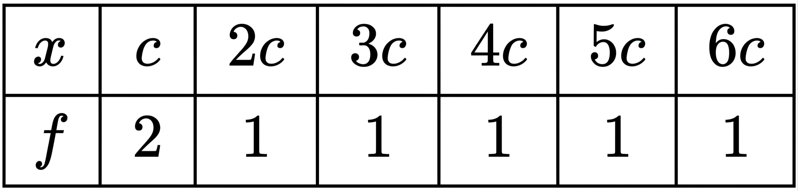
If the variance of the frequency distribution
is 160, then the value of $$c \in \mathbb{N}$$ is
We have a discrete frequency distribution:
- (x = c, 2c, 3c, 4c, 5c, 6c)
- (f = 2, 1, 1, 1, 1, 1)
Total frequency:
N = 2 + 1 + 1 + 1 + 1 + 1 = 7
$$\overline{x}=\frac{\sum_{ }^{ }fx}{N}$$
$$\sum_{ }^{ }fx=2(c)+1(2c)+1(3c)+1(4c)+1(5c)+1(6c)$$
= 2c + 2c + 3c + 4c + 5c + 6c = 22c
$$\overline{x}=\frac{22c}{7}$$
$$\text{Var}=\frac{\sum_{ }^{ }fx^2}{N}-\overline{x}^2$$
Compute:
$$\sum_{ }^{ }fx^2=2c^2+(2c)^2+(3c)^2+(4c)^2+(5c)^2+(6c)^2$$
$$=2c^2+4c^2+9c^2+16c^2+25c^2+36c^2$$
$$=92c^2$$
$$\text{Var}=\frac{92c^2}{7}-\left(\frac{22c}{7}\right)^2$$
$$=\frac{92c^2}{7}-\frac{484c^2}{49}$$
$$=\frac{644c^2-484c^2}{49}$$
$$=\frac{160c^2}{49}$$
$$\frac{160c^2}{49}=160$$
$$c^2=49\Rightarrow c=7$$
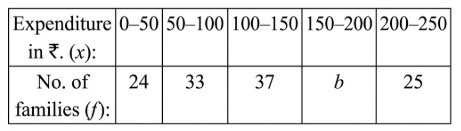
Let $$M$$ denote the median of the following frequency distribution.
Then $$20M$$ is equal to :
Total frequency N = 28. Median position $$= \frac{N}{2} = 14$$.
The value 14 falls in the class 8 - 12.
• l (lower limit) = 8
• cf (cumulative frequency before) = 12
• f (frequency of class) = 10
• h (width) = 4
Calculate M and 20M
$$M = l + \left( \frac{\frac{N}{2} - cf}{f} \right) \times h = 8 + \left( \frac{14 - 12}{10} \right) \times 4 = 8 + \frac{2}{10} \times 4 = 8 + 0.8 = 10.4$$
• $$20M = 20 \times 10.4 = \mathbf{208}$$ (Option D)
Let the median and the mean deviation about the median of 7 observations $$170, 125, 230, 190, 210, a, b$$ be $$170$$ and $$\frac{205}{7}$$ respectively. Then the mean deviation about the mean of these 7 observations is:
The median of the 7 observations is given as 170. Since there are 7 observations (an odd number), the median is the 4th observation when arranged in ascending order. The known observations are 125, 170, 190, 210, and 230. To have the median as 170, the 4th position must be 170, which requires at least three observations ≤ 170 and at least three observations ≥ 170.
Currently, there is one observation < 170 (125) and one observation = 170. There are three observations > 170 (190, 210, 230). Thus, there are two observations ≤ 170 (125 and 170) and four observations ≥ 170 (170, 190, 210, 230). To satisfy the median condition, both unknown observations $$a$$ and $$b$$ must be ≤ 170, ensuring exactly three observations ≤ 170 and three ≥ 170 (with the 4th being 170).
The mean deviation about the median is given as $$\frac{205}{7}$$. The formula for mean deviation about the median is:
$$\text{MD}(\text{median}) = \frac{1}{n} \sum_{i=1}^{n} |x_i - \text{median}|$$
Here, $$n = 7$$, median = 170, and $$\text{MD}(\text{median}) = \frac{205}{7}$$. Thus,
$$\sum_{i=1}^{7} |x_i - 170| = 205$$
The observations are 125, $$a$$, $$b$$, 170, 190, 210, 230. Since $$a \leq 170$$ and $$b \leq 170$$, $$|a - 170| = 170 - a$$ and $$|b - 170| = 170 - b$$. The absolute deviations are:
- $$|125 - 170| = 45$$
- $$|a - 170| = 170 - a$$
- $$|b - 170| = 170 - b$$
- $$|170 - 170| = 0$$
- $$|190 - 170| = 20$$
- $$|210 - 170| = 40$$
- $$|230 - 170| = 60$$
Summing these:
$$45 + (170 - a) + (170 - b) + 0 + 20 + 40 + 60 = 205$$
Simplifying the constants:
$$45 + 170 + 170 + 20 + 40 + 60 = 505$$
So,
$$505 - a - b = 205$$
$$-a - b = -300$$
$$a + b = 300$$
Next, find the mean deviation about the mean. First, compute the mean. The sum of the observations is:
$$125 + a + b + 170 + 190 + 210 + 230$$
Substituting $$a + b = 300$$:
$$125 + 300 + 170 + 190 + 210 + 230 = 1225$$
The mean $$\bar{x}$$ is:
$$\bar{x} = \frac{1225}{7} = 175$$
The mean deviation about the mean is:
$$\text{MD}(\text{mean}) = \frac{1}{7} \sum_{i=1}^{7} |x_i - 175|$$
The absolute deviations from 175 are:
- $$|125 - 175| = 50$$
- $$|a - 175| = 175 - a$$ (since $$a \leq 170 < 175$$)
- $$|b - 175| = 175 - b$$ (since $$b \leq 170 < 175$$)
- $$|170 - 175| = 5$$
- $$|190 - 175| = 15$$
- $$|210 - 175| = 35$$
- $$|230 - 175| = 55$$
Summing these:
$$50 + (175 - a) + (175 - b) + 5 + 15 + 35 + 55$$
Simplifying the constants:
$$50 + 175 + 175 + 5 + 15 + 35 + 55 = 510$$
So,
$$510 - a - b = 510 - 300 = 210$$
Thus, the mean deviation about the mean is:
$$\frac{210}{7} = 30$$
Therefore, the mean deviation about the mean is 30.
The mean and standard deviation of 20 observations are found to be 10 and 2 respectively. On rechecking, it was found that an observation by mistake was taken 8 instead of 12. The correct standard deviation is
n = 20, mean = 10, σ = 2, so σ² = 4.
Σxᵢ = 200. Σxᵢ² = n(σ² + mean²) = 20(4 + 100) = 2080.
Corrected: Σxᵢ(new) = 200 - 8 + 12 = 204. Mean(new) = 204/20 = 10.2.
Σxᵢ²(new) = 2080 - 64 + 144 = 2160.
σ²(new) = 2160/20 - (10.2)² = 108 - 104.04 = 3.96.
σ(new) = √3.96.
The correct answer is Option (3): √3.96.
Let $$a_1, a_2, \ldots, a_{10}$$ be 10 observations such that $$\sum_{k=1}^{10} a_k = 50$$ and $$\sum_{\forall k < j} a_k \cdot a_j = 1100$$. Then the standard deviation of $$a_1, a_2, \ldots, a_{10}$$ is equal to :
Given: $$\sum_{k=1}^{10} a_k = 50$$ and $$\sum_{k < j} a_k a_j = 1100$$.
We know that $$\left(\sum_{k=1}^{10} a_k\right)^2 = \sum_{k=1}^{10} a_k^2 + 2\sum_{k < j} a_k a_j$$
$$50^2 = \sum a_k^2 + 2(1100)$$
$$2500 = \sum a_k^2 + 2200$$
$$\sum a_k^2 = 300$$
Variance: $$\sigma^2 = \frac{\sum a_k^2}{n} - \left(\frac{\sum a_k}{n}\right)^2 = \frac{300}{10} - \left(\frac{50}{10}\right)^2 = 30 - 25 = 5$$
Standard deviation: $$\sigma = \sqrt{5}$$
The answer is $$\sqrt{5}$$, which corresponds to Option (2).
Let the mean and the variance of 6 observations $$a, b, 68, 44, 48, 60$$ be 55 and 194, respectively. If $$a > b$$, then $$a + 3b$$ is
Mean=55: (a+b+68+44+48+60)/6=55. a+b=330-220=110.
Variance=194: Σ(xᵢ-55)²/6=194. Σ(xᵢ-55)²=1164.
(a-55)²+(b-55)²+(68-55)²+(44-55)²+(48-55)²+(60-55)²=1164.
(a-55)²+(b-55)²+169+121+49+25=1164. (a-55)²+(b-55)²=800.
Let a-55=p, b-55=q. p+q=110-110=0, so q=-p. p²+p²=800, p²=400, p=±20.
a>b: a=75, b=35. a+3b=75+105=180.
The answer is Option (3): 180.
The mean and standard deviation of 15 observations were found to be 12 and 3 respectively. On rechecking it was found that an observation was read as 10 in place of 12. If $$\mu$$ and $$\sigma^2$$ denote the mean and variance of the correct observations respectively, then $$15(\mu + \mu^2 + \sigma^2)$$ is equal to _____.
Original: $$n = 15$$, $$\bar{x} = 12$$, $$\sigma = 3$$, $$\sigma^2 = 9$$.
$$\sum x_i = 15 \times 12 = 180$$. $$\sum x_i^2 = n(\sigma^2 + \bar{x}^2) = 15(9 + 144) = 15 \times 153 = 2295$$.
Corrected: Replace 10 with 12.
$$\sum x_i' = 180 - 10 + 12 = 182$$. $$\mu = 182/15$$.
$$\sum x_i'^2 = 2295 - 100 + 144 = 2339$$.
$$\sigma^2 = \frac{2339}{15} - \left(\frac{182}{15}\right)^2 = \frac{2339}{15} - \frac{33124}{225} = \frac{35085 - 33124}{225} = \frac{1961}{225}$$.
$$15(\mu + \mu^2 + \sigma^2) = 15\mu + 15\mu^2 + 15\sigma^2$$
$$= 182 + 15\left(\frac{182}{15}\right)^2 + 15 \times \frac{1961}{225}$$
$$= 182 + \frac{182^2}{15} + \frac{1961}{15}$$
$$= 182 + \frac{33124 + 1961}{15} = 182 + \frac{35085}{15} = 182 + 2339 = 2521$$
The answer is $$\boxed{2521}$$.
From a lot of 10 items, which include 3 defective items, a sample of 5 items is drawn at random. Let the random variable $$X$$ denote the number of defective items in the sample. If the variance of $$X$$ is $$\sigma^2$$, then $$96\sigma^2$$ is equal to ______
Hypergeometric distribution: $$X$$ = number of defective items in sample of 5 from lot of 10 (3 defective).
Mean: $$E(X) = n \cdot ?\frac{K}{N} = 5 \cdot ?\frac{3}{10} = ?\frac{3}{2}$$
Variance: $$\sigma^2 = n \cdot ?\frac{K}{N} \cdot ?\frac{N-K}{N} \cdot ?\frac{N-n}{N-1} = 5 \cdot ?\frac{3}{10} \cdot ?\frac{7}{10} \cdot ?\frac{5}{9} = ?\frac{525}{900} = ?\frac{7}{12}$$
$$96\sigma^2 = 96 \times ?\frac{7}{12} = 56$$.
The answer is 56.
If the mean and variance of the data $$65, 68, 58, 44, 48, 45, 60, \alpha, \beta, 60$$ where $$\alpha > \beta$$ are $$56$$ and $$66.2$$ respectively, then $$\alpha^2 + \beta^2$$ is equal to _______
Sum $$= 65+68+58+44+48+45+60+\alpha+\beta+60 = 448+\alpha+\beta$$. Mean=56: $$448+\alpha+\beta=560$$, $$\alpha+\beta=112$$.
Σx²=65²+68²+...+60²+α²+β²=sum of known squares+α²+β². Known: $$4225+4624+3364+1936+2304+2025+3600+3600=25678$$.
Variance=66.2: Σx²/10 - 56² = 66.2. Σx²=10(3136+66.2)=32022.
α²+β²=32022-25678=6344. The answer is $$\boxed{6344}$$.
If the variance $$\sigma^2$$ of the data
is $$k$$, then the value of $$k$$ is ______ (where $$.$$ denotes the greatest integer function)
Calculate Mean ($$\mu$$) and Variance ($$\sigma^2$$)
• $$\mu = \frac{\sum f_i x_i}{\sum f_i} = \frac{176}{22} = 8$$
• $$\sigma^2 = \frac{\sum f_i x_i^2}{N} - \mu^2 = \frac{2048}{22} - 8^2 = \frac{1024}{11} - 64$$
• $$k = 93.09 - 64 = 29.09$$
• The value of $$[k] = \mathbf{29}$$
Let $$a, b, c \in \mathbb{N}$$ and $$a < b < c$$. Let the mean, the mean deviation about the mean and the variance of the 5 observations $$9, 25, a, b, c$$ be $$18, 4$$ and $$\frac{136}{5}$$, respectively. Then $$2a + b - c$$ is equal to _____
We have five observations $$9, 25, a, b, c$$ with $$a < b < c$$ and $$a, b, c \in \mathbb{N}$$. Since the mean is 18,
$$\frac{9 + 25 + a + b + c}{5} = 18 \implies a + b + c = 56 \quad (i)$$
The mean deviation about the mean is 4, so
$$\frac{|9-18| + |25-18| + |a-18| + |b-18| + |c-18|}{5} = 4.$$
Evaluating the known terms gives
$$9 + 7 + |a-18| + |b-18| + |c-18| = 20 \implies |a-18| + |b-18| + |c-18| = 4 \quad (ii)$$
The variance is $$\tfrac{136}{5}$$, hence
$$\frac{(9-18)^2 + (25-18)^2 + (a-18)^2 + (b-18)^2 + (c-18)^2}{5} = \frac{136}{5}.$$
Since $$(9-18)^2 + (25-18)^2 = 81 + 49 = 130$$, it follows that
$$130 + (a-18)^2 + (b-18)^2 + (c-18)^2 = 136 \implies (a-18)^2 + (b-18)^2 + (c-18)^2 = 6 \quad (iii)$$
Let $$p = a-18,\; q = b-18,\; r = c-18$$. Then from (i), (ii), (iii) we get
$$p+q+r = 56 - 54 = 2,\quad |p|+|q|+|r| = 4,\quad p^2+q^2+r^2 = 6\,. $$
Because $$p+q+r=2$$ and $$|p|+|q|+|r|=4$$, the total negative contribution is $$\tfrac{4-2}{2}=1$$, so exactly one of $$p,q,r$$ equals $$-1$$ and the other two are positive summing to 3. Substituting one variable as $$-1$$ in the sum of squares gives
$$1 + q^2 + r^2 = 6 \implies q^2 + r^2 = 5,\quad q + r = 3\,. $$
Writing $$r = 3 - q$$ yields
$$q^2 + (3-q)^2 = 5 \implies 2q^2 - 6q + 9 = 5 \implies q^2 - 3q + 2 = 0 \implies q = 1 \text{ or } 2\,. $$
Thus $$(p,q,r) = (-1,1,2)$$ or $$(-1,2,1)$$. The ordering $a
$$a = 17,\quad b = 19,\quad c = 20\,. $$
Finally,
$$2a + b - c = 2(17) + 19 - 20 = 33\,. $$
The answer is $$\boxed{33}$$.
Let the mean and the standard deviation of the probability distribution $$\begin{array}{|c|c|c|c|c|} \hline X & \alpha & 1 & 0 & -3 \\ \hline P(X) & \frac{1}{3} & K & \frac{1}{6} & \frac{1}{4} \\ \hline \end{array}$$ be $$\mu$$ and $$\sigma$$, respectively. If $$\sigma - \mu = 2$$, then $$\sigma + \mu$$ is equal to ________
Consider the given data with frequency distribution
| $$x_i$$ | 3 | 8 | 11 | 10 | 5 | 4 |
| $$f_i$$ | 5 | 2 | 3 | 2 | 4 | 4 |
Match each entry in List-I to the correct entries in List-II.
| List-I | List-II | ||
|---|---|---|---|
| (P) | The mean of the above data is | (1) | 2.5 |
| (Q) | The median of the above data is | (2) | 5 |
| (R) | The mean deviation about the mean of the above data is | (3) | 6 |
| (S) | The mean deviation about the median of the above data is | (4) | 2.7 |
| (5) | 2.4 | ||
The correct option is:
The six distinct observations are $$x_i=3,\,4,\,5,\,8,\,10,\,11$$ with corresponding frequencies $$f_i=5,\,4,\,4,\,2,\,2,\,3$$.
Total number of observations
$$N=\sum f_i = 5+4+4+2+2+3 = 20$$
Case P : Mean
The mean is $$\bar x = \dfrac{\sum f_i x_i}{N}$$.
$$\sum f_i x_i = 3\!(5)+4\!(4)+5\!(4)+8\!(2)+10\!(2)+11\!(3)=15+16+20+16+20+33=120$$
$$\bar x=\dfrac{120}{20}=6$$
So $$\bar x=6$$, which is entry (3).
Case Q : Median
The cumulative frequencies are $$5,\,9,\,13,\,15,\,17,\,20$$.
For $$N=20$$ (even), the median is the average of the $$10^{\text{th}}$$ and $$11^{\text{th}}$$ items.
Both the $$10^{\text{th}}$$ and $$11^{\text{th}}$$ items lie in the class $$x=5$$ (cumulative frequency just exceeds 9).
Hence $$\text{Median}=5$$, which is entry (2).
Case R : Mean deviation about the mean
Mean deviation about the mean is $$\dfrac{\sum f_i \lvert x_i-\bar x\rvert}{N}$$.
$$\begin{aligned}
\sum f_i \lvert x_i-\bar x\rvert &=
5\lvert3-6\rvert +4\lvert4-6\rvert +4\lvert5-6\rvert +2\lvert8-6\rvert \\
&\quad +2\lvert10-6\rvert +3\lvert11-6\rvert \\
&=5(3)+4(2)+4(1)+2(2)+2(4)+3(5)\\
&=15+8+4+4+8+15=54
\end{aligned}$$
$$\text{M.D. about mean}= \dfrac{54}{20}=2.7$$, which is entry (4).
Case S : Mean deviation about the median
Mean deviation about the median is $$\dfrac{\sum f_i \lvert x_i-\text{Median}\rvert}{N}$$.
$$\begin{aligned}
\sum f_i \lvert x_i-5\rvert &=
5\lvert3-5\rvert +4\lvert4-5\rvert +4\lvert5-5\rvert +2\lvert8-5\rvert \\
&\quad +2\lvert10-5\rvert +3\lvert11-5\rvert \\
&=5(2)+4(1)+4(0)+2(3)+2(5)+3(6)\\
&=10+4+0+6+10+18=48
\end{aligned}$$
$$\text{M.D. about median}= \dfrac{48}{20}=2.4$$, which is entry (5).
Thus the correct matching is
$$P\rightarrow(3),\;Q\rightarrow(2),\;R\rightarrow(4),\;S\rightarrow(5).$$
Therefore, the correct option is Option A.
Let $$9 = x_1 < x_2 < \ldots < x_7$$ be in an A.P. with common difference $$d$$. If the standard deviation of $$x_1, x_2, \ldots, x_7$$ is $$4$$ and the mean is $$\bar{x}$$, then $$\bar{x} + x_6$$ is equal to:
We are given $$9 = x_1 < x_2 < \ldots < x_7$$ in an AP with common difference $$d$$, standard deviation = 4, and mean = $$\bar{x}$$, and we need to find $$\bar{x} + x_6$$.
First, express the terms of the arithmetic progression by noting that for $$k = 1,2,\ldots,7$$ we have $$x_k = 9 + (k-1)d$$.
Next, recall that for an AP with an odd number of terms, the mean equals the middle term, so $$\bar{x} = x_4 = 9 + 3d$$.
To find the variance, observe that the terms differ by multiples of $$d$$, so the variance of the set $$\{x_1,x_2,\ldots,x_7\}$$ is the same as the variance of $$\{0,d,2d,3d,4d,5d,6d\}$$, namely $$\sigma^2 = d^2 \cdot \text{Var}(\{0,1,2,3,4,5,6\})$$. Since $$\text{Var}(\{0,1,2,3,4,5,6\}) = \frac{0^2 + 1^2 + 2^2 + 3^2 + 4^2 + 5^2 + 6^2}{7} - \left(\frac{0+1+2+3+4+5+6}{7}\right)^2 = \frac{91}{7} - \left(\frac{21}{7}\right)^2 = 13 - 9 = 4\,,$$ it follows that $$\sigma^2 = 4d^2$$.
Given that $$\sigma = 4$$ implies $$\sigma^2 = 16$$, we set $$4d^2 = 16$$ which leads to $$d^2 = 4$$ and hence $$d = 2$$, taking the positive value since the sequence is increasing.
Now substituting back gives $$\bar{x} = 9 + 3(2) = 15$$ and $$x_6 = 9 + 5(2) = 19$$.
Therefore, $$\bar{x} + x_6 = 15 + 19 = 34$$.
The correct answer is Option B: 34.
The mean and variance of the marks obtained by the students in a test are 10 and 4 respectively. Later, the marks of one of the students is increased from 8 to 12. If the new mean of the marks is 10.2, then their new variance is equal to:
Given: Mean = 10, Variance = 4 for $$n$$ students. One student's marks changed from 8 to 12. New mean = 10.2.
Finding n:
Old sum = $$10n$$. New sum = $$10n + 4$$.
New mean: $$\frac{10n + 4}{n} = 10.2 \implies n = 20$$
Finding old $$\Sigma x^2$$:
Variance = $$\frac{\Sigma x^2}{n} - \bar{x}^2 = 4$$
$$\frac{\Sigma x^2}{20} = 104 \implies \Sigma x^2 = 2080$$
Computing new variance:
New $$\Sigma x^2 = 2080 - 8^2 + 12^2 = 2080 - 64 + 144 = 2160$$
New variance = $$\frac{2160}{20} - (10.2)^2 = 108 - 104.04 = 3.96$$
The answer is Option C: $$3.96$$.
Let sets A and B have 5 elements each. Let the mean of the elements in sets A and B be 5 and 8 respectively and the variance of the elements in sets A and B be 12 and 20 respectively. A new set C of 10 elements is formed by subtracting 3 from each element of A and adding 2 to each element of B. Then the sum of the mean and variance of the elements of C is
The mean and variance of 5 observations are 5 and 8 respectively. If 3 observations are 1, 3, 5, then the sum of cubes of the remaining two observations is
Given: 5 observations with mean = 5 and variance = 8. Three of the observations are 1, 3, 5.
Let the remaining two observations be $$a$$ and $$b$$.
Using the mean:
$$ \frac{1 + 3 + 5 + a + b}{5} = 5 $$ $$ 9 + a + b = 25 $$ $$ a + b = 16 \quad \ldots (1) $$Using the variance:
$$ \text{Variance} = \frac{\sum x_i^2}{n} - \bar{x}^2 = 8 $$ $$ \frac{\sum x_i^2}{5} = 8 + 25 = 33 $$ $$ \sum x_i^2 = 165 $$ $$ 1^2 + 3^2 + 5^2 + a^2 + b^2 = 165 $$ $$ 1 + 9 + 25 + a^2 + b^2 = 165 $$ $$ a^2 + b^2 = 130 \quad \ldots (2) $$From (1): $$(a+b)^2 = a^2 + 2ab + b^2$$
$$ 256 = 130 + 2ab $$ $$ ab = 63 \quad \ldots (3) $$Now, the sum of cubes:
$$ a^3 + b^3 = (a+b)(a^2 - ab + b^2) = (a+b)[(a^2+b^2) - ab] $$ $$ = 16 \times (130 - 63) = 16 \times 67 = 1072 $$Therefore, the sum of cubes of the remaining two observations is 1072.
The mean and variance of a set of 15 numbers are 12 and 14 respectively. The mean and variance of another set of 15 numbers are 14 and $$\sigma^2$$ respectively. If the variance of all the 30 numbers in the two sets is 13, then $$\sigma^2$$ is equal to
Given: Set 1: $$n_1 = 15$$, $$\bar{x}_1 = 12$$, $$\sigma_1^2 = 14$$. Set 2: $$n_2 = 15$$, $$\bar{x}_2 = 14$$, $$\sigma_2^2 = \sigma^2$$. Combined variance = 13.
The combined mean is:
$$ \bar{x} = \frac{n_1\bar{x}_1 + n_2\bar{x}_2}{n_1 + n_2} = \frac{15(12) + 15(14)}{30} = \frac{180 + 210}{30} = 13 $$
The deviations of each set's mean from the combined mean:
$$ d_1 = \bar{x}_1 - \bar{x} = 12 - 13 = -1, \quad d_2 = \bar{x}_2 - \bar{x} = 14 - 13 = 1 $$
The combined variance formula is:
$$ \sigma_c^2 = \frac{n_1(\sigma_1^2 + d_1^2) + n_2(\sigma_2^2 + d_2^2)}{n_1 + n_2} $$
Substituting:
$$ 13 = \frac{15(14 + 1) + 15(\sigma^2 + 1)}{30} $$
$$ 390 = 15(15) + 15(\sigma^2 + 1) = 225 + 15\sigma^2 + 15 $$
$$ 390 = 240 + 15\sigma^2 $$
$$ 15\sigma^2 = 150 \implies \sigma^2 = 10 $$
The correct answer is $$\sigma^2 = \mathbf{10}$$.
Let the mean of 6 observations 1, 2, 4, 5, $$x$$ and $$y$$ be 5 and their variance be 10. Then their mean deviation about the mean is equal to
We are given 6 observations: 1, 2, 4, 5, $$x$$, $$y$$ with mean = 5 and variance = 10.
$$ \frac{1 + 2 + 4 + 5 + x + y}{6} = 5 $$
$$ 12 + x + y = 30 \Rightarrow x + y = 18 $$
$$ \text{Variance} = \frac{\sum x_i^2}{n} - \bar{x}^2 = 10 $$
$$ \frac{1 + 4 + 16 + 25 + x^2 + y^2}{6} = 10 + 25 = 35 $$
$$ 46 + x^2 + y^2 = 210 \Rightarrow x^2 + y^2 = 164 $$
From $$x + y = 18$$ and $$x^2 + y^2 = 164$$:
$$ (x + y)^2 = x^2 + 2xy + y^2 = 324 $$
$$ 2xy = 324 - 164 = 160 \Rightarrow xy = 80 $$
So $$x, y$$ are roots of $$t^2 - 18t + 80 = 0$$:
$$ t = \frac{18 \pm \sqrt{324 - 320}}{2} = \frac{18 \pm 2}{2} $$
$$ x = 10, \; y = 8 \text{ (or vice versa)} $$
$$ \text{M.D.} = \frac{1}{6}\sum|x_i - \bar{x}| $$
$$ = \frac{|1-5| + |2-5| + |4-5| + |5-5| + |10-5| + |8-5|}{6} $$
$$ = \frac{4 + 3 + 1 + 0 + 5 + 3}{6} = \frac{16}{6} = \frac{8}{3} $$
The mean deviation about the mean is Option C: $$\frac{8}{3}$$.
The mean and standard deviation of 10 observations are 20 and 8 respectively. Later on, it was observed that one observation was recorded as 50 instead of 40. Then the correct variance is
Given: Mean $$\bar{x} = 20$$, standard deviation $$\sigma = 8$$, $$n = 10$$.
$$\sum x_i = n\bar{x} = 200$$
$$\sigma^2 = 64$$, so $$\frac{\sum x_i^2}{n} - \bar{x}^2 = 64$$
$$\frac{\sum x_i^2}{10} = 64 + 400 = 464$$
$$\sum x_i^2 = 4640$$
Correcting: Replace 50 with 40.
New $$\sum x_i = 200 - 50 + 40 = 190$$
New $$\bar{x} = \frac{190}{10} = 19$$
New $$\sum x_i^2 = 4640 - 50^2 + 40^2 = 4640 - 2500 + 1600 = 3740$$
New variance:
$$\sigma^2 = \frac{3740}{10} - 19^2 = 374 - 361 = 13$$
The correct variance is $$\mathbf{13}$$.
Let $$\mu$$ be the mean and $$\sigma$$ be the standard deviation of the distribution
| $$X_i$$ | 0 | 1 | 2 | 3 | 4 | 5 |
| $$f_i$$ | $$k+2$$ | $$2k$$ | $$k^2-1$$ | $$k^2-1$$ | $$k^2+1$$ | $$k-3$$ |
where $$\Sigma f_i = 62$$. If $$[x]$$ denotes the greatest integer $$\leq x$$, then $$[\mu^2 + \sigma^2]$$ is equal to
$$\sum f_i = (k+2) + 2k + (k^2-1) + (k^2-1) + (k^2+1) + (k-3) = 3k^2 + 4k - 2 = 62$$
$$3k^2 + 4k - 64 = 0$$. Using quadratic formula: $$k = \frac{-4 + \sqrt{16+768}}{6} = \frac{-4+28}{6} = 4$$.
Frequencies: 6, 8, 15, 15, 17, 1. Total = 62 ✓
$$\mu = \frac{0(6)+1(8)+2(15)+3(15)+4(17)+5(1)}{62} = \frac{0+8+30+45+68+5}{62} = \frac{156}{62} \approx 2.516$$
$$\sum f_ix_i^2 = 0+8+60+135+272+25 = 500$$. $$\sigma^2 = 500/62 - (156/62)^2 = 8.065 - 6.33 = 1.735$$.
$$\mu^2 + \sigma^2 = 6.33 + 1.735 = 8.065$$. $$[\mu^2 + \sigma^2] = 8$$.
The correct answer is Option 2: 8.
Let the six numbers $$a_1, a_2, \ldots, a_6$$ be in A.P. and $$a_1 + a_3 = 10$$. If the mean of these six numbers is $$\frac{19}{2}$$ and their variance is $$\sigma^2$$, then $$8\sigma^2$$ is equal to
Let the mean and variance of 12 observations be $$\frac{9}{2}$$ and 4 respectively. Later on, it was observed that two observations were considered as 9 and 10 instead of 7 and 14 respectively. If the correct variance is $$\frac{m}{n}$$, where $$m$$ and $$n$$ are coprime, then $$m + n$$ is equal to
We are given 12 observations with mean $$\frac{9}{2}$$ and variance 4. Two observations 9 and 10 were incorrectly recorded instead of 7 and 14. We need to find the correct variance $$\frac{m}{n}$$ (where $$m, n$$ are coprime) and compute $$m + n$$.
Find the original sum and sum of squares.
Mean = $$\frac{9}{2}$$, so $$\sum x_i = 12 \times \frac{9}{2} = 54$$.
Variance = $$\frac{\sum x_i^2}{n} - \bar{x}^2$$, so:
$$4 = \frac{\sum x_i^2}{12} - \left(\frac{9}{2}\right)^2 = \frac{\sum x_i^2}{12} - \frac{81}{4}$$
$$\frac{\sum x_i^2}{12} = 4 + \frac{81}{4} = \frac{97}{4}$$
$$\sum x_i^2 = 12 \times \frac{97}{4} = 291$$
Compute the corrected sum and sum of squares.
Corrected sum: $$54 - 9 - 10 + 7 + 14 = 56$$
Corrected mean: $$\frac{56}{12} = \frac{14}{3}$$
Corrected $$\sum x_i^2 = 291 - 9^2 - 10^2 + 7^2 + 14^2 = 291 - 81 - 100 + 49 + 196 = 355$$
Compute the corrected variance.
$$\text{Variance} = \frac{\sum x_i^2}{n} - \bar{x}^2 = \frac{355}{12} - \left(\frac{14}{3}\right)^2 = \frac{355}{12} - \frac{196}{9}$$
Finding a common denominator (LCM of 12 and 9 is 36):
$$= \frac{355 \times 3}{36} - \frac{196 \times 4}{36} = \frac{1065 - 784}{36} = \frac{281}{36}$$
Check if the fraction is in lowest terms.
We need $$\gcd(281, 36)$$. Since 281 is not divisible by 2 or 3 (the prime factors of 36), and checking: 281 is prime (not divisible by any prime up to $$\sqrt{281} \approx 16.8$$, i.e., not by 2, 3, 5, 7, 11, or 13).
So $$m = 281$$, $$n = 36$$, and they are coprime.
Compute the answer.
$$m + n = 281 + 36 = 317$$
The answer is Option D: 317.
Three rotten apples are mixed accidently with seven good apples and four apples are drawn one by one without replacement. Let the random variable X denote the number of rotten apples. If $$\mu$$ and $$\sigma^2$$ represent mean and variance of X, respectively, then $$10(\mu^2 + \sigma^2)$$ is equal to
Let the positive numbers $$a_1, a_2, a_3, a_4$$ and $$a_5$$ be in a G.P. Let their mean and variance be $$\frac{31}{10}$$ and $$\frac{m}{n}$$ respectively, where $$m$$ and $$n$$ are co-prime. If the mean of their reciprocals is $$\frac{31}{40}$$ and $$a_3 + a_4 + a_5 = 14$$, then $$m + n$$ is equal to _____.
Let the mean and variance of 8 numbers x, y, 10, 12, 6, 12, 4, 8 be 9 and 9.25 respectively. If $$x > y$$, then $$3x - 2y$$ is equal to ______.
To solve for $$x$$ and $$y$$, we use the definitions of mean and variance for the 8 numbers: $$x, y, 10, 12, 6, 12, 4, 8$$.
1. Use the Mean
The mean $$\bar{x} = 9$$.
$$\frac{x + y + 10 + 12 + 6 + 12 + 4 + 8}{8} = 9$$
$$x + y + 52 = 72 \implies \mathbf{x + y = 20} \quad \dots \text{(Eq. 1)}$$
2. Use the Variance
The variance $$\sigma^2 = 9.25$$. The formula is $$\frac{\sum x_i^2}{n} - (\bar{x})^2 = \sigma^2$$.
$$\frac{x^2 + y^2 + 10^2 + 12^2 + 6^2 + 12^2 + 4^2 + 8^2}{8} - 9^2 = 9.25$$
$$\frac{x^2 + y^2 + 100 + 144 + 36 + 144 + 16 + 64}{8} - 81 = 9.25$$
$$\frac{x^2 + y^2 + 504}{8} = 90.25$$
$$x^2 + y^2 + 504 = 722 \implies \mathbf{x^2 + y^2 = 218} \quad \dots \text{(Eq. 2)}$$
3. Solve for $$x$$ and $$y$$
Using $$(x+y)^2 = x^2 + y^2 + 2xy$$:
$$20^2 = 218 + 2xy \implies 400 - 218 = 2xy \implies 2xy = 182 \implies \mathbf{xy = 91}$$
We need two numbers that add to $$20$$ and multiply to $$91$$. These are 13 and 7.
Since the problem states $$x > y$$, we have:
- $$x = 13$$
- $$y = 7$$
4. Final Calculation
Find the value of $$3x - 2y$$:
$$3(13) - 2(7) = 39 - 14 = \mathbf{25}$$
The mean and variance of 7 observations are 8 and 16 respectively. If one observation 14 is omitted, $$a$$ and $$b$$ are respectively mean and variance of remaining 6 observation, then $$a + 3b - 5$$ is equal to ______.
We have 7 observations with mean 8 and variance 16, and one observation, 14, is removed.
The sum of the 7 observations is $$7 \times 8 = 56$$. After removing 14, the sum of the remaining 6 observations becomes $$56 - 14 = 42$$, so their mean is $$a = \frac{42}{6} = 7$$.
Recall that variance is given by $$\frac{\sum x_i^2}{n} - \bar{x}^2$$. For the original 7 observations, $$16 = \frac{\sum x_i^2}{7} - 64$$ implies $$\sum x_i^2 = 7 \times 80 = 560$$. After removing 14, the sum of squares is $$560 - 14^2 = 560 - 196 = 364$$. Therefore, the variance of the remaining observations is $$b = \frac{364}{6} - 49 = \frac{364 - 294}{6} = \frac{70}{6} = \frac{35}{3}$$.
Finally, we compute $$a + 3b - 5 = 7 + 3 \times \frac{35}{3} - 5 = 7 + 35 - 5 = 37$$, so the answer is $$\boxed{37}$$.
If the mean and variance of the frequency distribution
$$x_i$$ 2, 4, 6, 8, 10, 12, 14, 16
$$f_i$$ 4, 4, $$\alpha$$, 15, 8, $$\beta$$, 4, 5
are 9 and 15.08 respectively, then the value of $$\alpha^2 + \beta^2 - \alpha\beta$$ is ______.
The frequency distribution below is known to have mean = 9 and variance = 15.08.
| $$x_i$$ | 2 | 4 | 6 | 8 | 10 | 12 | 14 | 16 |
| $$f_i$$ | 4 | 4 | $$\alpha$$ | 15 | 8 | $$\beta$$ | 4 | 5 |
Using the condition for the mean, the total number of observations is $$N = 40 + \alpha + \beta$$ and the sum of the products is
$$\sum f_i x_i = 8 + 16 + 6\alpha + 120 + 80 + 12\beta + 56 + 80 = 360 + 6\alpha + 12\beta.$$
Since the mean equals 9,
$$\frac{360 + 6\alpha + 12\beta}{40 + \alpha + \beta} = 9$$ which leads to $$360 + 6\alpha + 12\beta = 360 + 9\alpha + 9\beta$$ and hence $$3\beta = 3\alpha \implies \alpha = \beta.$$
Next, applying the variance condition, we compute
$$\sum f_i x_i^2 = 16 + 64 + 36\alpha + 960 + 800 + 144\beta + 784 + 1280 = 3904 + 36\alpha + 144\beta.$$
With $$\alpha = \beta$$, this becomes $$\sum f_i x_i^2 = 3904 + 180\alpha$$ and $$N = 40 + 2\alpha.$$
Setting the variance equal to 15.08 gives
$$\frac{3904 + 180\alpha}{40 + 2\alpha} - 81 = 15.08$$ so $$\frac{3904 + 180\alpha}{40 + 2\alpha} = 96.08$$ and therefore $$3904 + 180\alpha = 96.08(40 + 2\alpha) = 3843.2 + 192.16\alpha,$$ leading to $$60.8 = 12.16\alpha \implies \alpha = 5.$$
It follows that $$\alpha = \beta = 5$$, and substituting these values gives
$$\alpha^2 + \beta^2 - \alpha\beta = 25 + 25 - 25 = 25.$$
The answer is $$25$$.
If the variance of the frequency distribution

is 3, then $$\alpha$$ is equal to ______.
If the mean of the frequency distribution
| Class | 0-10 | 10-20 | 20-30 | 30-40 | 40-50 |
| Frequency | 2 | 3 | $$x$$ | 5 | 4 |
is 28, then its variance is _______.
Mean = 28. Frequency distribution:
| Class midpoint | 5 | 15 | 25 | 35 | 45 |
| Frequency | 2 | 3 | x | 5 | 4 |
$$\sum f = 14 + x$$
$$\sum fx = 10 + 45 + 25x + 175 + 180 = 410 + 25x$$
Mean: $$\frac{410 + 25x}{14 + x} = 28$$
$$410 + 25x = 392 + 28x$$
$$18 = 3x$$, $$x = 6$$
$$\sum f = 20$$, $$\sum fx = 560$$
$$\sum fx^2 = 2(25) + 3(225) + 6(625) + 5(1225) + 4(2025) = 50 + 675 + 3750 + 6125 + 8100 = 18700$$
Variance = $$\frac{\sum fx^2}{\sum f} - \left(\frac{\sum fx}{\sum f}\right)^2 = \frac{18700}{20} - 784 = 935 - 784 = 151$$
The variance is 151.
Let $$X = \{11, 12, 13, \ldots, 40, 41\}$$ and $$Y = \{61, 62, 63, \ldots, 90, 91\}$$ be the two sets of observations. If $$\bar{x}$$ and $$\bar{y}$$ are their respective means and $$\sigma^2$$ is the variance of all the observations in $$X \cup Y$$, then $$|\bar{x} + \bar{y} - \sigma^2|$$ is equal to
Let $$X = \{11,12,13,\ldots,40,41\}$$ and $$Y = \{61,62,63,\ldots,90,91\}$$. Both sets contain $$31$$ elements, so the total number of observations in $$X \cup Y$$ is $$n = 62$$.
The mean of $$X$$ is $$\bar{x} = \frac{11 + 41}{2} = 26$$ and the mean of $$Y$$ is $$\bar{y} = \frac{61 + 91}{2} = 76$$. Hence the combined mean of $$X \cup Y$$ is $$\mu = \frac{31 \times 26 + 31 \times 76}{62} = \frac{26 + 76}{2} = 51$$.
To find the variance $$\sigma^2$$, we compute $$\frac{1}{n}\sum (x_i - \mu)^2$$ over all observations.
For elements of $$X$$, as $$k$$ ranges from $$11$$ to $$41$$, $$(k - 51)$$ ranges from $$-40$$ to $$-10$$, so $$\sum_{k=11}^{41}(k-51)^2 = \sum_{j=10}^{40} j^2 = \frac{40 \times 41 \times 81}{6} - \frac{9 \times 10 \times 19}{6} = 22140 - 285 = 21855$$.
Similarly, for elements of $$Y$$, as $$k$$ ranges from $$61$$ to $$91$$, $$(k - 51)$$ ranges from $$10$$ to $$40$$, and one similarly finds $$\sum_{k=61}^{91}(k-51)^2 = \sum_{j=10}^{40} j^2 = 21855$$.
It follows that $$\sigma^2 = \frac{21855 + 21855}{62} = \frac{43710}{62} = 705$$.
Hence $$|\bar{x} + \bar{y} - \sigma^2| = |26 + 76 - 705| = |102 - 705| = \boxed{603}$$.
Let the mean of 50 observations is 15 and the standard deviation is 2. However, one observation was wrongly recorded. The sum of the correct and incorrect observations is 70. If the mean of the correct set of observations is 16, then the variance of the correct set is equal to
We are given 50 observations with mean 15 and standard deviation 2. One observation was wrongly recorded, and the sum of the correct and incorrect observations is 70. The corrected mean is 16. We need to find the corrected variance.
First, let the wrong observation be $$w$$ and the correct observation be $$c$$. Since $$w + c = 70$$, we can express both values in terms of their sum. Next, the original sum of observations is $$\sum x_i = 50 \times 15 = 750$$, and the corrected sum becomes $$750 - w + c = 50 \times 16 = 800$$, which implies $$c - w = 50$$. Solving these equations gives $$c = 60$$ and $$w = 10$$.
Now we find the original sum of squares. Using the relation $$\sigma^2 = \frac{\sum x_i^2}{n} - \bar{x}^2$$ and substituting $$4 = \frac{\sum x_i^2}{50} - 225$$ yields $$\sum x_i^2 = 50 \times 229 = 11450$$.
Substituting the wrong and correct values into the sum of squares gives the corrected sum of squares as $$\sum x_i^2 \text{(corrected)} = 11450 - w^2 + c^2 = 11450 - 100 + 3600 = 14950$$.
Finally, the corrected variance is calculated as $$\text{Variance} = \frac{\sum x_i^2 \text{(corrected)}}{50} - \bar{x}_{new}^2 = \frac{14950}{50} - 16^2 = 299 - 256 = 43$$. Therefore, the answer is Option C: $$43$$.
The mean and variance of the data $$4, 5, 6, 6, 7, 8, x, y$$ where $$x < y$$ are $$6$$ and $$\frac{9}{4}$$ respectively. Then $$x^4 + y^2$$ is equal to
We are given data: $$4, 5, 6, 6, 7, 8, x, y$$ where $$x < y$$, with mean = 6 and variance = $$\frac{9}{4}$$.
Use the mean condition
Mean $$= \frac{4 + 5 + 6 + 6 + 7 + 8 + x + y}{8} = 6$$
$$36 + x + y = 48$$
$$x + y = 12 \quad \cdots(1)$$
Use the variance condition
Variance $$= \frac{\sum x_i^2}{n} - \bar{x}^2 = \frac{9}{4}$$
$$\frac{\sum x_i^2}{8} - 36 = \frac{9}{4}$$
$$\frac{\sum x_i^2}{8} = 36 + \frac{9}{4} = \frac{153}{4}$$
$$\sum x_i^2 = \frac{153 \times 8}{4} = 306$$
Calculate $$\sum x_i^2$$
$$4^2 + 5^2 + 6^2 + 6^2 + 7^2 + 8^2 + x^2 + y^2 = 306$$
$$16 + 25 + 36 + 36 + 49 + 64 + x^2 + y^2 = 306$$
$$226 + x^2 + y^2 = 306$$
$$x^2 + y^2 = 80 \quad \cdots(2)$$
Solve the system
From (1): $$y = 12 - x$$
Substituting in (2): $$x^2 + (12-x)^2 = 80$$
$$x^2 + 144 - 24x + x^2 = 80$$
$$2x^2 - 24x + 64 = 0$$
$$x^2 - 12x + 32 = 0$$
$$(x-4)(x-8) = 0$$
$$x = 4$$ or $$x = 8$$
Since $$x < y$$: $$x = 4, y = 8$$
Calculate $$x^4 + y^2$$
$$x^4 + y^2 = 4^4 + 8^2 = 256 + 64 = 320$$
Therefore, $$x^4 + y^2 = 320$$.
The correct answer is Option A: $$320$$.
The number of values of $$a \in N$$ such that the variance of 3, 7, 12, $$a$$, 43 $$- a$$ is a natural number is:
We need to find the number of values of $$a \in \mathbb{N}$$ such that the variance of 3, 7, 12, $$a$$, $$43 - a$$ is a natural number. The mean is $$\bar{x} = \frac{3 + 7 + 12 + a + (43 - a)}{5} = \frac{65}{5} = 13$$, and hence the variance is $$\sigma^2 = \frac{\sum(x_i - \bar{x})^2}{5} = \frac{(3-13)^2 + (7-13)^2 + (12-13)^2 + (a-13)^2 + (43-a-13)^2}{5} = \frac{100 + 36 + 1 + (a-13)^2 + (30-a)^2}{5} = \frac{137 + (a-13)^2 + (30-a)^2}{5}.$$
Now $$(a-13)^2 + (30-a)^2 = a^2 - 26a + 169 + 900 - 60a + a^2 = 2a^2 - 86a + 1069$$ so $$\sigma^2 = \frac{137 + 2a^2 - 86a + 1069}{5} = \frac{2a^2 - 86a + 1206}{5}.$$
For the variance to be a natural number, we need $$\frac{2a^2 - 86a + 1206}{5} \in \mathbb{N}$$, which requires $$2a^2 - 86a + 1206 \equiv 0 \pmod{5}.$$ Reducing modulo 5, since $$86 = 17 \times 5 + 1$$ and $$1206 = 241 \times 5 + 1$$, we get $$2a^2 - 86a + 1206 \equiv 2a^2 - a + 1 \pmod{5}.$$ Checking each residue class mod 5: for $$a \equiv 0$$: $$0 - 0 + 1 = 1 \not\equiv 0$$; for $$a \equiv 1$$: $$2 - 1 + 1 = 2 \not\equiv 0$$; for $$a \equiv 2$$: $$8 - 2 + 1 = 7 \equiv 2 \not\equiv 0$$; for $$a \equiv 3$$: $$18 - 3 + 1 = 16 \equiv 1 \not\equiv 0$$; for $$a \equiv 4$$: $$32 - 4 + 1 = 29 \equiv 4 \not\equiv 0$$.
For no value of $$a \pmod{5}$$ is the expression divisible by 5. Therefore, the variance is never a natural number for any $$a \in \mathbb{N}$$. The number of such values is $$\textbf{0}$$, so the answer is Option A: $$\textbf{0}$$.
If the mean deviation about median for the numbers $$3, 5, 7, 2k, 12, 16, 21, 24$$ arranged in the ascending order, is $$6$$ then the median is
We need to find the median of the data $$3, 5, 7, 2k, 12, 16, 21, 24$$ given that the mean deviation about the median is 6.
Since the data is in ascending order, we have $$7 \leq 2k \leq 12$$, which implies $$3.5 \leq k \leq 6$$.
For eight observations, the median is the average of the 4th and 5th values, so
$$M = \dfrac{2k + 12}{2} = k + 6$$
The mean deviation about the median is defined by
$$\text{M.D.} = \dfrac{1}{8}\sum_{i=1}^{8} |x_i - M|$$
Substituting $$M = k + 6$$ yields the following individual deviations:
$$|3 - (k+6)| = k + 3$$
$$|5 - (k+6)| = k + 1$$
$$|7 - (k+6)| = k - 1 \quad (\text{since } k \geq 3.5)$$
$$|2k - (k+6)| = |k - 6| = 6 - k \quad (\text{since } k \leq 6)$$
$$|12 - (k+6)| = 6 - k$$
$$|16 - (k+6)| = 10 - k$$
$$|21 - (k+6)| = 15 - k$$
$$|24 - (k+6)| = 18 - k$$
Their sum simplifies as follows:
$$ (k+3) + (k+1) + (k-1) + (6-k) + (6-k) + (10-k) + (15-k) + (18-k) = 58 - 2k $$
Setting the mean deviation equal to 6 gives
$$ \dfrac{58 - 2k}{8} = 6 \quad\Longrightarrow\quad 58 - 2k = 48 \quad\Longrightarrow\quad 2k = 10 \quad\Longrightarrow\quad k = 5 $$
Substituting back to find the median:
$$M = k + 6 = 5 + 6 = 11$$
We can verify that the data become $$3, 5, 7, 10, 12, 16, 21, 24$$ and the median is $$\dfrac{10 + 12}{2} = 11$$ $$\checkmark$$
The correct answer is Option D: $$11$$.
If the mean deviation about the mean of the numbers $$1, 2, 3, \ldots, n$$, where $$n$$ is odd, is $$\frac{5(n+1)}{n}$$, then $$n$$ is equal to ______.
We need to find $$n$$ (odd) such that the mean deviation about the mean of $$1, 2, 3, \ldots, n$$ equals $$\frac{5(n+1)}{n}$$.
To begin, $$\bar{x} = \frac{n+1}{2}$$.
Next, letting $$n = 2m + 1$$ gives $$\bar{x} = m + 1$$.
The deviations $$|x_i - \bar{x}|$$ are: $$m, m-1, \ldots, 1, 0, 1, \ldots, m$$.
Hence, the sum of deviations is $$2(1 + 2 + \cdots + m) = 2 \cdot \frac{m(m+1)}{2} = m(m+1)$$.
Therefore, the mean deviation is $$\text{MD} = \frac{m(m+1)}{n} = \frac{m(m+1)}{2m+1}$$.
Equating this to $$\frac{5(n+1)}{n} = \frac{5(2m+2)}{2m+1} = \frac{10(m+1)}{2m+1}$$ and noting that $$m + 1 \neq 0$$ allows division by $$\frac{m+1}{2m+1}$$, which yields $$m = 10$$.
Therefore, $$n = 2m + 1 = 21$$.
The answer is $$\boxed{21}$$.
Let $$x_1, x_2, x_3, \ldots, x_{20}$$ be in geometric progression with $$x_1 = 3$$ and the common ratio $$\frac{1}{2}$$. A new data is constructed replacing each $$x_i$$ by $$(x_i - i)^2$$. If $$\bar{x}$$ is the mean of new data, then the greatest integer less than or equal to $$\bar{x}$$ is
The mean and standard deviation of 40 observations are 30 and 5 respectively. It was noticed that two of these observations 12 and 10 were wrongly recorded. If $$\sigma$$ is the standard deviation of the data after omitting the two wrong observations from the data, then $$38\sigma^2$$ is equal to ______.
We have 40 observations with mean 30 and standard deviation 5. Two wrong observations (12 and 10) are removed. We need to find $$38\sigma^2$$ for the remaining 38 observations.
$$\bar{x} = 30 \implies \sum x_i = 40 \times 30 = 1200$$
$$\text{SD} = 5 \implies \text{Var} = 25$$
$$\text{Var} = \dfrac{\sum x_i^2}{40} - \bar{x}^2 = 25$$
$$\dfrac{\sum x_i^2}{40} = 25 + 900 = 925$$
$$\sum x_i^2 = 37000$$
$$\sum x_i' = 1200 - 12 - 10 = 1178$$
$$\sum (x_i')^2 = 37000 - 144 - 100 = 36756$$
$$\bar{x}' = \dfrac{1178}{38} = 31$$
$$\sigma^2 = \dfrac{\sum (x_i')^2}{38} - (\bar{x}')^2 = \dfrac{36756}{38} - 961 = 967.26... - 961$$
Let us compute exactly:
$$\dfrac{36756}{38} = \dfrac{36756}{38} = 967 + \dfrac{10}{38} = 967 + \dfrac{5}{19}$$
$$\sigma^2 = 967 + \dfrac{5}{19} - 961 = 6 + \dfrac{5}{19} = \dfrac{114 + 5}{19} = \dfrac{119}{19}$$
$$38\sigma^2 = 38 \times \dfrac{119}{19} = 2 \times 119 = 238$$
The correct answer is $$\boxed{238}$$.
Suppose a class has 7 students. The average marks of these students in the mathematics examination is 62, and their variance is 20. A student fails in the examination if he/she gets less than 50 marks, then in worst case, the number of students can fail is
The mean and standard deviation of 15 observations are found to be $$8$$ and $$3$$ respectively. On rechecking it was found that, in the observations, $$20$$ was misread as $$5$$. Then, the correct variance is equal to ______
Given: $$n = 15$$, mean $$\bar{x} = 8$$, standard deviation $$\sigma = 3$$.
$$\sum x_i = n \cdot \bar{x} = 15 \times 8 = 120$$
$$\sigma^2 = 9 = \frac{\sum x_i^2}{n} - \bar{x}^2 \implies \frac{\sum x_i^2}{15} = 9 + 64 = 73$$
$$\sum x_i^2 = 1095$$
The observation 20 was misread as 5. Correcting:
$$\sum x_i^{\text{correct}} = 120 - 5 + 20 = 135$$
$$\sum (x_i^{\text{correct}})^2 = 1095 - 25 + 400 = 1470$$
Correct mean: $$\bar{x}_c = \frac{135}{15} = 9$$
Correct variance:
$$\sigma_c^2 = \frac{\sum (x_i^{\text{correct}})^2}{n} - \bar{x}_c^2 = \frac{1470}{15} - 81 = 98 - 81 = 17$$
Hence the correct variance is $$\boxed{17}$$.
Let the mean and the variance of 20 observations $$x_1, x_2, \ldots, x_{20}$$ be 15 and 9, respectively. For $$\alpha \in \mathbb{R}$$, if the mean of $$(x_1 + \alpha)^2, (x_2 + \alpha)^2, \ldots, (x_{20} + \alpha)^2$$ is 178, then the square of the maximum value of $$\alpha$$ is equal to _______
We are given 20 observations $$x_1, x_2, \ldots, x_{20}$$ with mean $$\bar{x} = 15$$ and variance $$\sigma^2 = 9$$. We know that $$\frac{1}{20}\sum x_i = 15$$ and $$\frac{1}{20}\sum x_i^2 - 15^2 = 9$$, so $$\frac{1}{20}\sum x_i^2 = 234$$.
We need the mean of $$(x_1+\alpha)^2, (x_2+\alpha)^2, \ldots, (x_{20}+\alpha)^2$$ to equal 178. This mean is:
$$\frac{1}{20}\sum(x_i+\alpha)^2 = \frac{1}{20}\sum(x_i^2 + 2\alpha x_i + \alpha^2) = \frac{1}{20}\sum x_i^2 + 2\alpha\cdot\frac{1}{20}\sum x_i + \alpha^2$$
$$= 234 + 2\alpha(15) + \alpha^2 = \alpha^2 + 30\alpha + 234$$
Setting this equal to 178: $$\alpha^2 + 30\alpha + 234 = 178$$, so $$\alpha^2 + 30\alpha + 56 = 0$$.
By the quadratic formula: $$\alpha = \frac{-30 \pm \sqrt{900 - 224}}{2} = \frac{-30 \pm \sqrt{676}}{2} = \frac{-30 \pm 26}{2}$$.
So $$\alpha = \frac{-30+26}{2} = -2$$ or $$\alpha = \frac{-30-26}{2} = -28$$. The maximum value of $$\alpha$$ is $$-2$$, and its square is $$(-2)^2 = 4$$.
Hence, the correct answer is 4.
If the mean and variance of six observations 7, 10, 11, 15, $$a$$, $$b$$ are 10 and $$\frac{20}{3}$$, respectively, then the value of $$|a - b|$$ is equal to:
We are given six observations 7, 10, 11, 15, $$a$$, $$b$$ with mean 10 and variance $$\frac{20}{3}$$.
From the mean: $$\frac{7 + 10 + 11 + 15 + a + b}{6} = 10$$, so $$43 + a + b = 60$$, giving $$a + b = 17$$.
From the variance: $$\frac{\sum x_i^2}{6} - \bar{x}^2 = \frac{20}{3}$$, so $$\frac{49 + 100 + 121 + 225 + a^2 + b^2}{6} = 100 + \frac{20}{3} = \frac{320}{3}.$$ $$495 + a^2 + b^2 = 640, \quad \text{hence } a^2 + b^2 = 145.$$
Now, $$(a + b)^2 = a^2 + 2ab + b^2$$, so $$289 = 145 + 2ab$$, giving $$ab = 72$$.
Therefore, $$(a - b)^2 = (a+b)^2 - 4ab = 289 - 288 = 1$$, so $$|a - b| = 1$$.
The mean of 6 distinct observations is 6.5 and their variance is 10.25. If 4 out of 6 observations are 2, 4, 5 and 7, then the remaining two observations are:
Let the two unknown observations be $$a$$ and $$b$$. The six observations are $$2, 4, 5, 7, a, b$$.
From the mean: $$\frac{2+4+5+7+a+b}{6} = 6.5$$, so $$18 + a + b = 39$$, giving $$a + b = 21$$.
From the variance formula $$\sigma^2 = \frac{\sum x_i^2}{n} - \bar{x}^2$$: $$10.25 = \frac{\sum x_i^2}{6} - (6.5)^2 \implies \frac{\sum x_i^2}{6} = 10.25 + 42.25 = 52.5 \implies \sum x_i^2 = 315.$$
The sum of squares of the known observations is $$4 + 16 + 25 + 49 = 94$$, so $$a^2 + b^2 = 315 - 94 = 221$$.
Now using $$(a+b)^2 = a^2 + 2ab + b^2$$: $$441 = 221 + 2ab$$, so $$ab = 110$$.
The values $$a$$ and $$b$$ are roots of $$t^2 - 21t + 110 = 0$$, which factors as $$(t-10)(t-11) = 0$$.
Therefore the two remaining observations are $$10$$ and $$11$$.
Consider three observations $$a, b$$ and $$c$$ such that $$b = a + c$$. If the standard deviation of $$a+2, c+2$$ is $$d$$, then which of the following is true?
We have three observations $$a, b, c$$ with $$b = a + c$$, and the standard deviation of $$a + 2, b + 2, c + 2$$ is $$d$$.
Since adding a constant to each observation does not change the standard deviation, the standard deviation of $$a, b, c$$ is also $$d$$. The mean of $$a, b, c$$ is $$\bar{x} = \frac{a + b + c}{3} = \frac{a + (a+c) + c}{3} = \frac{2(a+c)}{3} = \frac{2b}{3}$$.
The variance is $$d^2 = \frac{(a - \bar{x})^2 + (b - \bar{x})^2 + (c - \bar{x})^2}{3}$$. Computing each deviation: $$a - \frac{2b}{3} = \frac{3a - 2b}{3} = \frac{3a - 2a - 2c}{3} = \frac{a - 2c}{3}$$, $$b - \frac{2b}{3} = \frac{b}{3} = \frac{a + c}{3}$$, and $$c - \frac{2b}{3} = \frac{3c - 2b}{3} = \frac{c - 2a}{3}$$.
So $$d^2 = \frac{1}{3} \cdot \frac{(a-2c)^2 + (a+c)^2 + (c-2a)^2}{9} = \frac{(a^2 - 4ac + 4c^2) + (a^2 + 2ac + c^2) + (4a^2 - 4ac + c^2)}{27} = \frac{6a^2 - 6ac + 6c^2}{27} = \frac{2(a^2 - ac + c^2)}{9}$$.
Therefore $$9d^2 = 2a^2 - 2ac + 2c^2$$. Now $$3(a^2 + c^2) - 9d^2 = 3a^2 + 3c^2 - 2a^2 + 2ac - 2c^2 = a^2 + 2ac + c^2 = (a + c)^2 = b^2$$.
Hence $$b^2 = 3(a^2 + c^2) - 9d^2$$.
Let in a series of $$2n$$ observations, half of them are equal to $$a$$ and remaining half are equal to $$-a$$. Also by adding a constant $$b$$ in each of these observations, the mean and standard deviation of new set become 5 and 20, respectively. Then the value of $$a^2 + b^2$$ is equal to :
In the original series of $$2n$$ observations, $$n$$ values equal $$a$$ and $$n$$ values equal $$-a$$. The original mean is $$\frac{n \cdot a + n \cdot (-a)}{2n} = 0$$.
After adding constant $$b$$ to each observation, the new values are $$a + b$$ ($$n$$ times) and $$-a + b$$ ($$n$$ times). The new mean is $$0 + b = b = 5$$, so $$b = 5$$.
Adding a constant does not change the standard deviation, so the standard deviation of the new set equals the standard deviation of the original set, which is 20. For the original data, the variance is $$\frac{n \cdot a^2 + n \cdot a^2}{2n} - 0^2 = a^2$$. Therefore the standard deviation is $$|a| = 20$$, giving $$a^2 = 400$$.
Hence $$a^2 + b^2 = 400 + 25 = 425$$.
The mean and variance of 7 observations are 8 and 16 respectively. If two observations are 6 and 8, then the variance of the remaining 5 observations is:
We have 7 observations whose mean is given as $$\bar{x}=8$$. The definition of the mean says
$$\bar{x}=\dfrac{\sum_{i=1}^{7}x_i}{7}\;.$$
Substituting $$\bar{x}=8$$, we obtain
$$8=\dfrac{\sum_{i=1}^{7}x_i}{7}\;.$$
Multiplying both sides by 7,
$$\sum_{i=1}^{7}x_i = 7 \times 8 = 56\;.$$
Out of these 7 observations, two are specifically known: $$6$$ and $$8$$. Removing them from the total, the sum of the remaining 5 observations is
$$\sum_{i=1}^{5}y_i = 56-6-8 = 42\;.$$
Now we need their variance. First we recall the population variance formula (division by the number of observations):
$$\sigma^{2}=\dfrac{\sum x_i^{2}}{n}-\bar{x}^{2}\;.$$
The variance of all 7 observations is given as $$16$$, so with $$n=7$$ we write
$$16=\dfrac{\sum_{i=1}^{7}x_i^{2}}{7}-8^{2}\;.$$
Adding $$8^{2}=64$$ to both sides,
$$16+64=\dfrac{\sum_{i=1}^{7}x_i^{2}}{7}\;,$$
$$80=\dfrac{\sum_{i=1}^{7}x_i^{2}}{7}\;.$$
Multiplying by 7,
$$\sum_{i=1}^{7}x_i^{2}=7 \times 80 = 560\;.$$
Next, we subtract the squares of the two known observations to isolate the sum of squares of the remaining five. Their squares are $$6^{2}=36$$ and $$8^{2}=64$$, whose sum is $$36+64=100$$. Therefore,
$$\sum_{i=1}^{5}y_i^{2}=560-100=460\;.$$
For the five residual observations we already found that their sum is $$42$$, so their mean is
$$\bar{y}=\dfrac{42}{5}=8.4\;.$$
Using the same variance formula for these five observations (now $$n=5$$), we have
$$\sigma_{y}^{2}=\dfrac{\sum_{i=1}^{5}y_i^{2}}{5}-\bar{y}^{2}\;.$$
Substituting the values,
$$\sigma_{y}^{2}=\dfrac{460}{5}-(8.4)^{2}\;.$$
Computing each term:
$$\dfrac{460}{5}=92,\qquad (8.4)^{2}=70.56\;.$$
Hence,
$$\sigma_{y}^{2}=92-70.56=21.44\;.$$
Now we change $$21.44$$ to an exact fraction. Observe that
$$21.44 = 21 + 0.44 = 21 + \dfrac{44}{100} = 21 + \dfrac{11}{25}= \dfrac{525}{25}+\dfrac{11}{25}= \dfrac{536}{25}\;.$$
Thus the variance of the remaining five observations is
$$\boxed{\dfrac{536}{25}}\;.$$
Hence, the correct answer is Option D.
Let the mean and variance of the frequency distribution
$$x$$: $$x_1 = 2$$ $$x_2 = 6$$ $$x_3 = 8$$ $$x_4 = 9$$
$$f$$: 4 4 $$\alpha$$ $$\beta$$
be 6 and 6.8 respectively. If $$x_3$$ is changed from 8 to 7, then the mean for the new data will be:
First we write down the information given for the original frequency distribution.
The values are $$x_1 = 2,\;x_2 = 6,\;x_3 = 8,\;x_4 = 9$$ and the corresponding frequencies are $$f_1 = 4,\;f_2 = 4,\;f_3 = \alpha,\;f_4 = \beta.$$
We are told that the mean of this distribution is $$6.$$ By definition, the mean (denoted by $$\bar{x}$$) of a discrete frequency distribution is
$$\bar{x} \;=\; \dfrac{\displaystyle\sum_{i=1}^{4} f_i x_i}{\displaystyle\sum_{i=1}^{4} f_i}.$$
Substituting the known numbers we obtain
$$6 \;=\; \dfrac{4 \cdot 2 \;+\; 4 \cdot 6 \;+\; \alpha \cdot 8 \;+\; \beta \cdot 9}{4 + 4 + \alpha + \beta}.$$
Simplifying the numerator and denominator separately, we have
Numerator: $$4\cdot 2 = 8,\;\;4\cdot 6 = 24$$ so $$8 + 24 = 32.$$ Hence the numerator is $$32 + 8\alpha + 9\beta.$$
Denominator: $$4 + 4 = 8,$$ so the total frequency is $$8 + \alpha + \beta.$$
Therefore the mean equation becomes
$$6 \;=\; \dfrac{32 + 8\alpha + 9\beta}{8 + \alpha + \beta}.$$
Cross-multiplying gives
$$32 + 8\alpha + 9\beta \;=\; 6\,(8 + \alpha + \beta).$$
Expanding the right-hand side, $$6(8 + \alpha + \beta) = 48 + 6\alpha + 6\beta.$$
Now we bring all terms to one side:
$$32 + 8\alpha + 9\beta - 48 - 6\alpha - 6\beta = 0.$$
Combining like terms,
$$(8\alpha - 6\alpha) + (9\beta - 6\beta) + (32 - 48) = 0,$$ $$2\alpha + 3\beta - 16 = 0,$$ so
$$2\alpha + 3\beta = 16. \qquad (1)$$
Next we use the given variance. For a frequency distribution, the variance $$\sigma^{2}$$ is given by
$$\sigma^{2} \;=\; \dfrac{\displaystyle\sum_{i=1}^{4} f_i\,(x_i - \bar{x})^{2}}{\displaystyle\sum_{i=1}^{4} f_i}.$$
We are told that $$\sigma^{2} = 6.8.$$ Since the mean is $$\bar{x}=6,$$ we compute each squared deviation:
For $$x_1 = 2: (2-6)^2 = (-4)^2 = 16,$$ for $$x_2 = 6: (6-6)^2 = 0,$$ for $$x_3 = 8: (8-6)^2 = 2^2 = 4,$$ for $$x_4 = 9: (9-6)^2 = 3^2 = 9.$$
Multiplying by their frequencies gives
$$f_1(2-6)^2 = 4 \cdot 16 = 64,$$ $$f_2(6-6)^2 = 4 \cdot 0 = 0,$$ $$f_3(8-6)^2 = \alpha \cdot 4 = 4\alpha,$$ $$f_4(9-6)^2 = \beta \cdot 9 = 9\beta.$$
Hence the numerator of the variance expression is
$$64 + 4\alpha + 9\beta.$$
The denominator is the same total frequency $$8 + \alpha + \beta.$$
Thus the variance equation is
$$6.8 \;=\; \dfrac{64 + 4\alpha + 9\beta}{8 + \alpha + \beta}.$$
Cross-multiplying once again,
$$64 + 4\alpha + 9\beta \;=\; 6.8\,(8 + \alpha + \beta).$$
Compute $$6.8 \times 8 = 54.4,$$ so the right side is $$54.4 + 6.8\alpha + 6.8\beta.$$
Bringing all terms to the left gives
$$64 + 4\alpha + 9\beta - 54.4 - 6.8\alpha - 6.8\beta = 0.$$
Combining like terms,
$$(4\alpha - 6.8\alpha) + (9\beta - 6.8\beta) + (64 - 54.4) = 0,$$ $$-2.8\alpha + 2.2\beta + 9.6 = 0.$$
To clear the decimals, multiply every term by $$10$$:
$$-28\alpha + 22\beta + 96 = 0.$$
Dividing by $$2$$ for simplicity gives
$$-14\alpha + 11\beta + 48 = 0,$$ or equivalently
$$11\beta - 14\alpha = -48. \qquad (2)$$
Now we solve the simultaneous linear equations (1) and (2). From equation (1) we isolate $$\alpha$$:
$$2\alpha + 3\beta = 16 \;\;\Rightarrow\;\; 2\alpha = 16 - 3\beta \;\;\Rightarrow\;\; \alpha = 8 - \dfrac{3}{2}\beta.$$
Substituting this value of $$\alpha$$ into equation (2):
$$11\beta - 14\Bigl(8 - \dfrac{3}{2}\beta\Bigr) = -48.$$
First expand the term inside:
$$14\Bigl(8 - \dfrac{3}{2}\beta\Bigr) = 14 \cdot 8 - 14 \cdot \dfrac{3}{2}\beta = 112 - 21\beta.$$
Hence equation (2) becomes
$$11\beta - \bigl(112 - 21\beta\bigr) = -48.$$
Removing the parentheses carefully:
$$11\beta - 112 + 21\beta = -48.$$
Combine the $$\beta$$ terms:
$$(11\beta + 21\beta) - 112 = -48,$$ $$32\beta - 112 = -48.$$
Add $$112$$ to both sides:
$$32\beta = 64 \;\;\Rightarrow\;\; \beta = \dfrac{64}{32} = 2.$$
Now we substitute $$\beta = 2$$ back into $$\alpha = 8 - \dfrac{3}{2}\beta$$:
$$\alpha = 8 - \dfrac{3}{2}\times 2 = 8 - 3 = 5.$$
Thus we have determined the missing frequencies:
$$\alpha = 5,\quad \beta = 2.$$
Next, the problem states that the value $$x_3$$ is changed from $$8$$ to $$7.$$ Therefore the revised distribution is
$$x: 2,\;6,\;7,\;9$$ with the same frequencies $$4,\;4,\;5,\;2$$ respectively.
We now compute the mean of this new data set. The total frequency remains
$$N = 4 + 4 + 5 + 2 = 15.$$
The sum of the products $$f_i x_i$$ for the new data is
$$\begin{aligned} 4\cdot 2 &= 8,\\ 4\cdot 6 &= 24,\\ 5\cdot 7 &= 35,\\ 2\cdot 9 &= 18. \end{aligned}$$
Adding these contributions together,
$$8 + 24 = 32,\quad 32 + 35 = 67,\quad 67 + 18 = 85.$$
Hence the new mean $$\bar{x}_{\text{new}}$$ is
$$\bar{x}_{\text{new}} \;=\; \dfrac{85}{15} = \dfrac{17}{3}.$$
This value simplifies to $$5\dfrac{2}{3},$$ but writing it as an exact fraction clearly matches the choice given in the options.
Hence, the correct answer is Option C.
The mean and standard deviation of 20 observations were calculated as 10 and 2.5 respectively. It was found that by mistake one data value was taken as 25 instead of 35. If $$\alpha$$ and $$\sqrt{\beta}$$ are the mean and standard deviation respectively for correct data, then $$(\alpha, \beta)$$ is:
We have $$n = 20$$ observations whose mean and standard deviation were first calculated (with the mistaken value) as $$\bar x = 10$$ and $$s = 2.5$$ respectively.
The mean formula is stated as $$\bar x = \dfrac{\sum x_i}{n}\,.$$
So for the incorrect data the total of all observations is
$$\sum x_i = \bar x \times n = 10 \times 20 = 200.$$
One observation was taken as $$25$$ instead of the correct value $$35$$. Replacing this in the total, we get the correct sum
$$\sum x_i^{(\text{correct})}= 200 - 25 + 35 = 210.$$
Hence the correct mean is
$$\alpha = \dfrac{210}{20}=10.5.$$
For the standard deviation we first recall the relation
$$s^2 = \dfrac{\sum x_i^{2}}{n} - \bar x^{\,2}.$$
With the wrong data we have $$s = 2.5$$ and $$\bar x = 10$$, so
$$2.5^{2}= \dfrac{\sum x_i^{2}}{20} - 10^{2}.$$
This gives
$$6.25 = \dfrac{\sum x_i^{2}}{20} - 100,$$
$$\dfrac{\sum x_i^{2}}{20} = 106.25,$$
$$\sum x_i^{2}= 106.25 \times 20 = 2125.$$
The mistaken squared term $$25^{2}=625$$ must be replaced by the correct squared term $$35^{2}=1225$$. Therefore the corrected sum of squares is
$$\sum x_i^{2\,(\text{correct})}= 2125 - 625 + 1225 = 2725.$$
Substituting in the variance formula with the corrected mean $$\alpha = 10.5$$, we get
$$\sigma^{2}= \dfrac{2725}{20} - (10.5)^{2}.$$
The term $$\dfrac{2725}{20}=136.25$$ and $$(10.5)^{2}=110.25,$$ so
$$\sigma^{2}=136.25 - 110.25 = 26.$$
Thus the corrected standard deviation is $$\sigma = \sqrt{26}.$$ By the wording of the question $$\sqrt{\beta} = \sigma,$$ hence $$\beta = 26.$$
We have found $$\alpha = 10.5$$ and $$\beta = 26,$$ so the ordered pair is $$(\alpha, \beta) = (10.5, 26).$$
Hence, the correct answer is Option A.
If the mean and variance of the following data: 6, 10, 7, 13, $$a$$, 12, $$b$$, 12 are 9 and $$\frac{37}{4}$$ respectively, then $$(a - b)^2$$ is equal to:
We start with the eight observations 6, 10, 7, 13, $$a$$, 12, $$b$$, 12. The number of observations is $$n = 8$$.
The mean is given to be $$9$$. For any data set, the mean $$\bar x$$ is obtained by the formula $$\bar x = \dfrac{\text{sum of all observations}}{n}.$$ So we have
$$9 = \dfrac{6 + 10 + 7 + 13 + a + 12 + b + 12}{8}.$$
Adding the known numbers first, $$6 + 10 + 7 + 13 + 12 + 12 = 60.$$ Hence
$$9 = \dfrac{60 + a + b}{8}.$$
Multiplying both sides by $$8$$, $$72 = 60 + a + b.$$ So
$$a + b = 72 - 60 = 12.$$
Next, the variance is given as $$\dfrac{37}{4}$$. For a population of size $$n$$, the variance $$\sigma^{2}$$ is defined as $$\sigma^{2} = \dfrac{\sum (x - \bar x)^2}{n}.$$ Therefore
$$\dfrac{37}{4} = \dfrac{(6-9)^2 + (10-9)^2 + (7-9)^2 + (13-9)^2 + (a-9)^2 + (12-9)^2 + (b-9)^2 + (12-9)^2}{8}.$$
We now evaluate the squared deviations of the known numbers:
$$\begin{aligned} (6-9)^2 &= (-3)^2 = 9,\\ (10-9)^2 &= 1^2 = 1,\\ (7-9)^2 &= (-2)^2 = 4,\\ (13-9)^2 &= 4^2 = 16,\\ (12-9)^2 &= 3^2 = 9,\\ (12-9)^2 &= 3^2 = 9. \end{aligned}$$
Adding these six values, $$9 + 1 + 4 + 16 + 9 + 9 = 48.$$
Substituting into the variance formula and multiplying both sides by $$8$$ gives
$$8 \times \dfrac{37}{4} = 48 + (a-9)^2 + (b-9)^2.$$
Since $$8 \times \dfrac{37}{4} = 2 \times 37 = 74$$, we obtain
$$(a-9)^2 + (b-9)^2 = 74 - 48 = 26.$$
Let us expand the left side. We know the algebraic identity $$(x-9)^2 = x^2 - 18x + 81.$$ Applying this to both $$a$$ and $$b$$,
$$(a-9)^2 + (b-9)^2 = (a^2 - 18a + 81) + (b^2 - 18b + 81) = a^2 + b^2 - 18(a + b) + 162.$$
We already found $$a + b = 12$$, so substitute:
$$a^2 + b^2 - 18 \times 12 + 162 = a^2 + b^2 - 216 + 162 = a^2 + b^2 - 54.$$
Set this equal to $$26$$ (from the variance condition):
$$a^2 + b^2 - 54 = 26 \quad\Longrightarrow\quad a^2 + b^2 = 80.$$
To find $$(a-b)^2$$, recall the identity $$(a-b)^2 = a^2 + b^2 - 2ab.$$ We already know $$a^2 + b^2 = 80$$, but we still need $$ab$$. Using another standard identity, $$(a + b)^2 = a^2 + b^2 + 2ab.$$
Substituting $$a + b = 12$$ and $$a^2 + b^2 = 80$$, we have
$$12^2 = 144 = 80 + 2ab.$$
Hence $$2ab = 144 - 80 = 64 \quad\Longrightarrow\quad ab = 32.$$
Now apply the identity for $$(a-b)^2$$:
$$(a-b)^2 = 80 - 2 \times 32 = 80 - 64 = 16.$$
Hence, the correct answer is Option D.
The first of the two samples in a group has 100 items with mean 15 and standard deviation 3. If the whole group has 250 items with mean 15.6 and standard deviation $$\sqrt{13.44}$$, then the standard deviation of the second sample is:
Let us denote the size, mean and standard deviation of the first sample by $$n_1,\;\mu_1,\;\sigma_1$$ and of the second sample by $$n_2,\;\mu_2,\;\sigma_2.$$ The symbols $$n,\;\mu,\;\sigma$$ will represent the corresponding quantities for the whole group.
We have for the first sample $$n_1 = 100,\;\mu_1 = 15,\;\sigma_1 = 3.$$ Therefore the variance of the first sample is $$\sigma_1^{2} = 3^{2} = 9.$$
The whole group consists of $$n = 250$$ items with mean $$\mu = 15.6$$ and standard deviation $$\sigma = \sqrt{13.44},$$ so the variance of the whole group is $$\sigma^{2} = 13.44.$$
Because the whole group contains 250 items and the first sample contains 100 items, the second sample must contain
$$n_2 = n - n_1 = 250 - 100 = 150$$
items.
First, we compute the mean of the second sample. The formula for the combined mean of two groups is
$$\mu = \frac{n_1\mu_1 + n_2\mu_2}{n_1 + n_2}.$$
Solving this for $$\mu_2$$ gives
$$\mu_2 = \frac{(n_1 + n_2)\mu - n_1\mu_1}{n_2}.$$
Substituting the known numbers, we obtain
$$\mu_2 = \frac{250 \times 15.6 - 100 \times 15}{150} = \frac{3900 - 1500}{150} = \frac{2400}{150} = 16.$$
Now we move to the variance. The formula that expresses the variance of the combined group in terms of the variances and means of the two sub-groups is
$$\sigma^{2} \;=\; \frac{n_1\bigl[\sigma_1^{2} + (\mu_1 - \mu)^{2}\bigr] \;+\; n_2\bigl[\sigma_2^{2} + (\mu_2 - \mu)^{2}\bigr]} {n_1 + n_2}.$$
We already know $$\sigma^{2} = 13.44,$$ so we substitute every known quantity and keep $$\sigma_2^{2}$$ as the unknown.
First compute the bracket for the first sample:
$$\sigma_1^{2} + (\mu_1 - \mu)^{2} = 9 + (15 - 15.6)^{2} = 9 + (-0.6)^{2} = 9 + 0.36 = 9.36.$$
Multiplying by $$n_1$$ gives
$$n_1\bigl[\sigma_1^{2} + (\mu_1 - \mu)^{2}\bigr] = 100 \times 9.36 = 936.$$
Next, form the bracket for the second sample, leaving $$\sigma_2^{2}$$ unknown:
$$\sigma_2^{2} + (\mu_2 - \mu)^{2} = \sigma_2^{2} + (16 - 15.6)^{2} = \sigma_2^{2} + 0.4^{2} = \sigma_2^{2} + 0.16.$$
Multiplying by $$n_2$$ gives
$$n_2\bigl[\sigma_2^{2} + (\mu_2 - \mu)^{2}\bigr] = 150\bigl(\sigma_2^{2} + 0.16\bigr) = 150\sigma_2^{2} + 24.$$
Putting all these into the combined variance formula, we get
$$13.44 = \frac{936 + 150\sigma_2^{2} + 24}{250}.$$
Simplify the numerator inside the fraction:
$$936 + 24 = 960,$$
so the equation becomes
$$13.44 = \frac{960 + 150\sigma_2^{2}}{250}.$$
Now multiply both sides by 250 to clear the denominator:
$$13.44 \times 250 = 960 + 150\sigma_2^{2}.$$
Calculating the left-hand product, we get
$$13.44 \times 250 = 3360,$$
so
$$3360 = 960 + 150\sigma_2^{2}.$$
Subtract 960 from both sides:
$$3360 - 960 = 150\sigma_2^{2},$$
$$2400 = 150\sigma_2^{2}.$$
Finally, divide by 150:
$$\sigma_2^{2} = \frac{2400}{150} = 16.$$
The variance of the second sample is therefore $$16,$$ and its standard deviation is the square root of this value:
$$\sigma_2 = \sqrt{16} = 4.$$
Hence, the correct answer is Option C.
Consider a set of $$3n$$ numbers having variance 4. In this set, the mean of first $$2n$$ numbers is 6 and the mean of the remaining $$n$$ numbers is 3. A new set is constructed by adding 1 into each of the first $$2n$$ numbers, and subtracting 1 from each of the remaining $$n$$ numbers. If the variance of the new set is $$k$$, then $$9k$$ is equal to ________.
Let the $$3n$$ numbers be $$x_1, x_2, \ldots, x_{3n}$$ with mean of the first $$2n$$ numbers equal to $$6$$ and mean of the remaining $$n$$ numbers equal to $$3$$. The overall mean is $$\bar{x} = \frac{2n \cdot 6 + n \cdot 3}{3n} = \frac{15n}{3n} = 5$$.
The variance is given as $$4$$, so $$\frac{1}{3n}\sum_{i=1}^{3n} x_i^2 - \bar{x}^2 = 4$$, giving $$\frac{1}{3n}\sum x_i^2 = 29$$, hence $$\sum x_i^2 = 87n$$.
Now the new set is formed by adding $$1$$ to each of the first $$2n$$ numbers and subtracting $$1$$ from each of the remaining $$n$$ numbers. The new values are $$y_i = x_i + 1$$ for $$i = 1, \ldots, 2n$$ and $$y_i = x_i - 1$$ for $$i = 2n+1, \ldots, 3n$$.
The new sum is $$\sum y_i = \sum_{i=1}^{2n}(x_i+1) + \sum_{i=2n+1}^{3n}(x_i-1) = \sum x_i + 2n - n = 15n + n = 16n$$. The new mean is $$\bar{y} = \frac{16n}{3n} = \frac{16}{3}$$.
The new sum of squares is $$\sum y_i^2 = \sum_{i=1}^{2n}(x_i+1)^2 + \sum_{i=2n+1}^{3n}(x_i-1)^2 = \sum_{i=1}^{2n}(x_i^2 + 2x_i + 1) + \sum_{i=2n+1}^{3n}(x_i^2 - 2x_i + 1)$$.
This equals $$\sum x_i^2 + 2\sum_{i=1}^{2n}x_i - 2\sum_{i=2n+1}^{3n}x_i + 2n + n = 87n + 2(12n) - 2(3n) + 3n = 87n + 24n - 6n + 3n = 108n$$.
The new variance is $$k = \frac{\sum y_i^2}{3n} - \bar{y}^2 = \frac{108n}{3n} - \frac{256}{9} = 36 - \frac{256}{9} = \frac{324 - 256}{9} = \frac{68}{9}$$.
Therefore $$9k = 9 \cdot \frac{68}{9} = 68$$.
Consider the statistics of two sets of observations as follows:

If the variance of the combined set of these two observations is $$\frac{17}{9}$$, then the value of $$n$$ is equal to ________.
For the first set: $$n_1 = 10$$, $$\bar{x}_1 = 2$$, $$\sigma_1^2 = 2$$, so $$\sum x_i = 20$$ and $$\sum x_i^2 = n_1(\sigma_1^2 + \bar{x}_1^2) = 10(2+4) = 60$$.
For the second set: $$n_2 = n$$, $$\bar{x}_2 = 3$$, $$\sigma_2^2 = 1$$, so $$\sum y_j = 3n$$ and $$\sum y_j^2 = n(1+9) = 10n$$.
The combined mean is $$\bar{x} = \frac{20 + 3n}{10 + n}$$.
The combined variance is $$\sigma^2 = \frac{\sum x_i^2 + \sum y_j^2}{10+n} - \bar{x}^2 = \frac{60 + 10n}{10+n} - \left(\frac{20+3n}{10+n}\right)^2$$.
Setting this equal to $$\frac{17}{9}$$: $$\frac{(60+10n)(10+n) - (20+3n)^2}{(10+n)^2} = \frac{17}{9}$$.
Expanding the numerator: $$(60+10n)(10+n) = 10n^2 + 160n + 600$$ and $$(20+3n)^2 = 9n^2 + 120n + 400$$.
Numerator = $$n^2 + 40n + 200$$.
So $$9(n^2 + 40n + 200) = 17(10+n)^2 = 17(n^2 + 20n + 100)$$.
$$9n^2 + 360n + 1800 = 17n^2 + 340n + 1700$$, giving $$8n^2 - 20n - 100 = 0$$, i.e., $$2n^2 - 5n - 25 = 0$$.
$$n = \frac{5 \pm \sqrt{25 + 200}}{4} = \frac{5 \pm 15}{4}$$. Since $$n > 0$$, $$n = \frac{20}{4} = 5$$.
The answer is $$5$$.
Consider the following frequency distribution:

If mean = $$\frac{309}{22}$$ and median = 14, then the value $$(a-b)^2$$ is equal to ___.
The frequency distribution is: Class 0-6 (frequency $$a$$), 6-12 (frequency $$b$$), 12-18 (frequency 12), 18-24 (frequency 9), 24-30 (frequency 5).
The total frequency is $$N = a + b + 12 + 9 + 5 = a + b + 26$$.
The class midpoints are 3, 9, 15, 21, 27. Using the mean formula: $$\text{Mean} = \frac{3a + 9b + 15(12) + 21(9) + 27(5)}{N} = \frac{3a + 9b + 180 + 189 + 135}{a + b + 26} = \frac{3a + 9b + 504}{a + b + 26}$$.
Setting this equal to $$\frac{309}{22}$$ and cross-multiplying: $$22(3a + 9b + 504) = 309(a + b + 26)$$.
Expanding: $$66a + 198b + 11088 = 309a + 309b + 8034$$.
Simplifying: $$243a + 111b = 3054$$. Dividing by 3: $$81a + 37b = 1018$$. $$-(1)$$
For the median, the cumulative frequencies are: up to 6 is $$a$$, up to 12 is $$a + b$$, up to 18 is $$a + b + 12$$, up to 24 is $$a + b + 21$$, up to 30 is $$a + b + 26$$.
Since the median is 14, it falls in the class 12-18 (with frequency 12). Using the median formula: $$\text{Median} = L + \frac{\frac{N}{2} - F}{f} \times h$$, where $$L = 12$$, $$F = a + b$$ (cumulative frequency before the median class), $$f = 12$$, and $$h = 6$$.
Substituting: $$14 = 12 + \frac{\frac{N}{2} - (a+b)}{12} \times 6$$.
So $$2 = \frac{N/2 - (a+b)}{2}$$, which gives $$N/2 - (a+b) = 4$$. $$-(2)$$
Since $$N = a + b + 26$$, we get $$\frac{a + b + 26}{2} - (a + b) = 4$$, so $$a + b + 26 - 2(a+b) = 8$$, giving $$a + b = 18$$. $$-(3)$$
Substituting $$b = 18 - a$$ into equation $$(1)$$: $$81a + 37(18 - a) = 1018$$.
$$81a + 666 - 37a = 1018$$, so $$44a = 352$$, giving $$a = 8$$.
From $$(3)$$: $$b = 18 - 8 = 10$$.
Therefore $$(a - b)^2 = (8 - 10)^2 = (-2)^2 = 4$$.
Let $$n$$ be an odd natural number such that the variance of 1, 2, 3, 4, ..., n is 14. Then $$n$$ is equal to _________.
We are given the consecutive natural numbers $$1,2,3,\dots ,n$$ and told that their variance equals $$14$$. Because every positive integer from $$1$$ to $$n$$ appears exactly once, the total number of observations is also $$n$$. Throughout this solution we shall regard the data set as the whole population, so we use the population variance formula
$$\sigma^{2}= \dfrac{1}{N}\sum_{i=1}^{N}(x_{i}-\mu)^{2},$$
where $$N$$ is the number of observations, $$x_{i}$$ denotes an individual observation and $$\mu$$ denotes the mean (average) of all the observations.
First we determine the mean. The sum of the first $$n$$ natural numbers is well known to be
$$\sum_{i=1}^{n} i=\dfrac{n(n+1)}{2}.$$
Dividing this sum by the total number of observations $$n$$ gives the mean
$$\mu=\dfrac{\dfrac{n(n+1)}{2}}{n}= \dfrac{n+1}{2}.$$
Next we require the second moment, that is, the mean of the squares. The sum of the squares of the first $$n$$ natural numbers is
$$\sum_{i=1}^{n} i^{2}= \dfrac{n(n+1)(2n+1)}{6}.$$
Hence the mean of the squares, often written as $$E[X^{2}]$$, equals
$$E[X^{2}]=\dfrac{1}{n}\sum_{i=1}^{n} i^{2}= \dfrac{1}{n}\cdot\dfrac{n(n+1)(2n+1)}{6}= \dfrac{(n+1)(2n+1)}{6}.$$
The variance can be computed by the identity
$$\sigma^{2}=E[X^{2}] - \mu^{2}.$$
Substituting the expressions we have just obtained, we write
$$\sigma^{2}= \dfrac{(n+1)(2n+1)}{6} - \left(\dfrac{n+1}{2}\right)^{2}.$$
Because it is given that the variance equals $$14$$, we set the above expression equal to $$14$$:
$$\dfrac{(n+1)(2n+1)}{6} - \left(\dfrac{n+1}{2}\right)^{2}=14.$$
To simplify, notice that each term contains the factor $$(n+1).$$ We write
$$\dfrac{(n+1)(2n+1)}{6} - \dfrac{(n+1)^{2}}{4}=14.$$
Factorising $$(n+1)$$ from both numerators gives
$$(n+1)\left[\dfrac{2n+1}{6}-\dfrac{n+1}{4}\right]=14.$$
We now combine the expressions in the square brackets by taking a common denominator of $$12$$:
$$\dfrac{2n+1}{6}= \dfrac{4n+2}{12},\qquad \dfrac{n+1}{4}= \dfrac{3n+3}{12}.$$
Subtracting inside the brackets, we obtain
$$\dfrac{4n+2}{12}-\dfrac{3n+3}{12}= \dfrac{4n+2-3n-3}{12}= \dfrac{n-1}{12}.$$
Therefore
$$(n+1)\left(\dfrac{n-1}{12}\right)=14.$$
Multiplying both sides by $$12$$ to clear the denominator, we have
$$(n+1)(n-1)=14\times12=168.$$
Recognising the left side as the difference of squares, we write
$$n^{2}-1=168.$$
Adding $$1$$ to both sides produces
$$n^{2}=169.$$
Taking the positive square root (because $$n$$ is a natural number) yields
$$n=13.$$
Finally, the question stipulates that $$n$$ must be odd; $$13$$ is indeed odd, so our solution is fully consistent.
So, the answer is $$13$$.
The mean of 10 numbers
$$7 \times 8, 10 \times 10, 13 \times 12, 16 \times 14, \ldots$$ is _________.
We are given ten numbers that follow the pattern $$7 \times 8,\; 10 \times 10,\; 13 \times 12,\; 16 \times 14,\; \ldots$$ and we have to find their mean.
First we observe the pattern in each factor:
• The first factor starts at $$7$$ and increases by $$3$$ each time: $$7,\; 10,\; 13,\; 16,\; \ldots$$
• The second factor starts at $$8$$ and increases by $$2$$ each time: $$8,\; 10,\; 12,\; 14,\; \ldots$$
So for the $$n^{\text{th}}$$ term (counting the first term as $$n=1$$) we can write
$$a_n=\bigl(7+3(n-1)\bigr)\bigl(8+2(n-1)\bigr).$$
Because we need ten terms, it will be convenient to let $$n$$ run from $$0$$ to $$9$$ instead of $$1$$ to $$10$$; that re-indexes nothing but simplifies the algebra. Thus we define
$$A_n=\bigl(7+3n\bigr)\bigl(8+2n\bigr),\qquad n=0,1,2,\ldots,9.$$
We now expand each product algebraically:
$$\begin{aligned} A_n&=\bigl(7+3n\bigr)\bigl(8+2n\bigr)\\ &=7\cdot8+7\cdot2n+3n\cdot8+3n\cdot2n\\ &=56+14n+24n+6n^{2}\\ &=56+38n+6n^{2}. \end{aligned}$$
The sum of all ten terms is therefore
$$S=\sum_{n=0}^{9}A_n=\sum_{n=0}^{9}\bigl(56+38n+6n^{2}\bigr).$$
We separate the sum into three simpler sums:
$$S=56\sum_{n=0}^{9}1+38\sum_{n=0}^{9}n+6\sum_{n=0}^{9}n^{2}.$$
We now evaluate each of these standard sums one by one.
1. The sum of ten ones:
$$\sum_{n=0}^{9}1=10.$$
2. The sum of the first nine positive integers (starting from zero):
The formula for the sum of the first $$m$$ integers is $$\dfrac{m(m+1)}{2}.$$
Here $$m=9$$, so
$$\sum_{n=0}^{9}n=\frac{9\cdot10}{2}=45.$$
3. The sum of the squares of the first nine positive integers (starting from zero):
The formula for the sum of squares is $$\dfrac{m(m+1)(2m+1)}{6}.$$
Again $$m=9$$, hence
$$\sum_{n=0}^{9}n^{2}=\frac{9\cdot10\cdot19}{6}=285.$$
Substituting these values back into $$S$$ we get
$$\begin{aligned} S&=56(10)+38(45)+6(285)\\ &=560+1710+1710\\ &=3980. \end{aligned}$$
The mean (average) of the ten numbers is the total sum divided by 10:
$$\text{Mean}=\frac{S}{10}=\frac{3980}{10}=398.$$
So, the answer is $$398$$.
Consider the following frequency distribution:

If the sum of all frequencies is 584 and median is 45, then $$|\alpha - \beta|$$ is equal to ___.
We have been given a grouped frequency distribution with class-interval width $$h = 10$$. The classes and their (as yet unknown) frequencies are
10 - 20 : $$\alpha$$, 20 - 30 : 110, 30 - 40 : 54, 40 - 50 : 30, 50 - 60 : $$\beta$$.
The total number of observations is stated to be $$N = 584$$ and the median is $$45$$.
For a continuous (grouped) distribution, the median is found by the formula
$$\text{Median} = L + \frac{\dfrac{N}{2} - \text{c.f.\,(prev)}}{f_m}\;h,$$
where $$L$$ is the lower class boundary of the median class, $$\text{c.f.\,(prev)}$$ is the cumulative frequency up to (but not including) the median class, $$f_m$$ is the frequency of the median class, and $$h$$ is the class width.
Since the median value $$45$$ lies in the interval $$40\!-\!50$$, that class is the median class. Hence $$L = 40$$, $$f_m = 30$$ and $$h = 10$$.
The cumulative frequency just before the median class is the sum of the first three class frequencies:
$$\text{c.f.\,(prev)} = \alpha + 110 + 54 = \alpha + 164.$$
Substituting all these quantities into the median formula gives
$$45 = 40 + \frac{\dfrac{584}{2} - (\alpha + 164)}{30}\;10.$$
Simplifying step by step:
$$45 - 40 = \frac{292 - (\alpha + 164)}{30}\;10$$ $$5 = \frac{292 - \alpha - 164}{30}\;10$$ $$5 = \frac{128 - \alpha}{3}$$ $$5 \times 3 = 128 - \alpha$$ $$15 = 128 - \alpha$$ $$\alpha = 128 - 15$$ $$\alpha = 113.$$
Now we use the fact that the sum of all frequencies equals $$584$$:
$$\alpha + 110 + 54 + 30 + \beta = 584.$$
Substituting $$\alpha = 113$$ we get
$$113 + 110 + 54 + 30 + \beta = 584.$$
Adding the known numbers:
$$307 + \beta = 584$$ $$\beta = 584 - 307$$ $$\beta = 277.$$
Finally, we require the absolute difference between $$\alpha$$ and $$\beta$$:
$$|\alpha - \beta| = |113 - 277| = |-164| = 164.$$
Hence, the correct answer is Option 164.
Let the mean and variance of four numbers 3, 7, $$x$$ and $$y$$ ($$x > y$$) be 5 and 10 respectively. Then the mean of four numbers 3 + 2x, 7 + 2y, $$x + y$$ and $$x - y$$ is _________
We have four original numbers $$3,\,7,\,x,\,y$$ whose mean is given to be $$5$$. The definition of mean says
$$\bar{x}= \frac{3+7+x+y}{4}=5.$$
Multiplying by $$4$$ we get
$$3+7+x+y = 20.$$
Simplifying,
$$x+y = 10.$$
Now the variance of these four numbers is given as $$10$$. For a population of four numbers, variance is defined by the formula
$$\sigma^{2}= \frac{1}{4}\left[(3-\bar{x})^{2}+(7-\bar{x})^{2}+(x-\bar{x})^{2}+(y-\bar{x})^{2}\right].$$
Here $$\bar{x}=5$$, so we substitute:
$$10 = \frac{1}{4}\Big[(3-5)^{2} + (7-5)^{2} + (x-5)^{2} + (y-5)^{2}\Big].$$
Calculating the first two squares,
$$(3-5)^{2}=(-2)^{2}=4,\qquad (7-5)^{2}=2^{2}=4.$$
Hence
$$10 = \frac{1}{4}\Big[4 + 4 + (x-5)^{2} + (y-5)^{2}\Big].$$
Multiplying both sides by $$4$$,
$$40 = 8 + (x-5)^{2} + (y-5)^{2}.$$
So
$$(x-5)^{2} + (y-5)^{2} = 32.$$
From the mean calculation we already have $$y = 10 - x$$. Substituting this into the variance equation,
$$(x-5)^{2} + \big[(10 - x) - 5\big]^{2} = 32.$$
The second square simplifies as
$$(10 - x) - 5 = 5 - x,$$
and $$\big(5 - x\big)^{2} = (x - 5)^{2}$$ (since squaring removes the sign). Therefore
$$(x-5)^{2} + (x-5)^{2} = 32,$$
or
$$2(x-5)^{2} = 32.$$
Dividing by $$2$$,
$$(x-5)^{2} = 16.$$
Taking square roots,
$$x-5 = \pm 4 \;\;\Longrightarrow\;\; x = 5 \pm 4.$$
Thus $$x = 9$$ or $$x = 1$$. We are told $$x > y$$, and recall $$x + y = 10$$, so
• If $$x = 9$$, then $$y = 1$$, giving $$x > y$$ (acceptable).
• If $$x = 1$$, then $$y = 9$$, which violates $$x > y$$.
Hence the only valid pair is $$x = 9,\,y = 1$$.
Now we form the new set of numbers: $$3 + 2x,\; 7 + 2y,\; x + y,\; x - y.$$
Substituting $$x = 9,\,y = 1$$:
$$3 + 2x = 3 + 2\cdot9 = 21,$$ $$7 + 2y = 7 + 2\cdot1 = 9,$$ $$x + y = 9 + 1 = 10,$$ $$x - y = 9 - 1 = 8.$$
The mean of these four numbers is
$$\text{Mean} = \frac{21 + 9 + 10 + 8}{4} = \frac{48}{4} = 12.$$
So, the answer is $$12$$.
Let $$X_1, X_2, \ldots, X_{18}$$ be eighteen observations such that $$\sum_{i=1}^{18}(X_i - \alpha) = 36$$ and $$\sum_{i=1}^{18}(X_i - \beta)^2 = 90$$, where $$\alpha$$ and $$\beta$$ are distinct real numbers. If the standard deviation of these observations is 1, then the value of $$|\alpha - \beta|$$ is ______.
From $$\sum_{i=1}^{18}(X_i - \alpha) = 36$$, we get $$\sum X_i - 18\alpha = 36$$, so the mean is $$\bar{X} = \frac{\sum X_i}{18} = \alpha + 2$$.
Expanding $$\sum_{i=1}^{18}(X_i - \beta)^2 = \sum_{i=1}^{18}[(X_i - \bar{X}) + (\bar{X} - \beta)]^2 = \sum(X_i - \bar{X})^2 + 18(\bar{X} - \beta)^2$$.
Since the standard deviation is 1, the variance is 1, so $$\sum(X_i - \bar{X})^2 = 18 \cdot 1 = 18$$.
Substituting into the given equation: $$90 = 18 + 18(\bar{X} - \beta)^2$$, which gives $$(\bar{X} - \beta)^2 = 4$$, so $$\bar{X} - \beta = \pm 2$$.
Since $$\bar{X} = \alpha + 2$$, we have $$\alpha + 2 - \beta = \pm 2$$, giving $$\alpha - \beta = 0$$ or $$\alpha - \beta = -4$$. Since $$\alpha$$ and $$\beta$$ are distinct, $$|\alpha - \beta| = 4$$.
An online exam is attempted by 50 candidates out of which 20 are boys. The average marks obtained by boys is 12 with a variance 2. The variance of marks obtained by 30 girls is also 2. The average marks of all 50 candidates is 15. If $$\mu$$ is the average marks of girls and $$\sigma^2$$ is the variance of marks of 50 candidates, then $$\mu + \sigma^2$$ is equal to _________.
Let us first interpret the data. There are in all 50 candidates. Out of these, the number of boys is 20 and the number of girls is 30.
We are told that the average (mean) marks of the boys is $$\mu_1 = 12$$ and the variance of the boys’ marks is $$\sigma_1^{2}=2.$$ Likewise, the variance of the girls’ marks is given to be $$\sigma_2^{2}=2,$$ while their mean is presently unknown; let us denote it by $$\mu_2 = \mu.$$ The overall mean (average of all 50 candidates taken together) is given as $$\bar{x}=15.$$
We begin by finding the girls’ mean $$\mu.$$ Using the definition of mean, the total marks obtained by all 50 candidates equals the sum of total marks of boys and girls. Hence
$$\underbrace{50}_{\text{total students}}\times\underbrace{15}_{\text{overall mean}} \;=\; \underbrace{20}_{\text{boys}}\times\underbrace{12}_{\text{boys’ mean}} \;+\; \underbrace{30}_{\text{girls}}\times\mu.$$
Carrying out the multiplication, we have
$$750 \;=\; 240 \;+\; 30\mu.$$
Now subtract 240 from both sides:
$$750 - 240 \;=\; 30\mu.$$ $$510 \;=\; 30\mu.$$
Divide both sides by 30:
$$\mu \;=\; \frac{510}{30} \;=\; 17.$$
Thus the average marks of the girls is $$\mu_2 = 17.$$
Next we compute the variance of marks for all 50 candidates together. For two groups, the formula for the combined variance $$\sigma^{2}$$ is
$$\sigma^{2} \;=\; \frac{n_1\Big(\sigma_1^{2} + (\mu_1 - \bar{x})^{2}\Big) \;+\; n_2\Big(\sigma_2^{2} + (\mu_2 - \bar{x})^{2}\Big)}{n_1 + n_2},$$
where $$n_1,\,\mu_1,\,\sigma_1^{2}$$ refer to the first group (boys) and $$n_2,\,\mu_2,\,\sigma_2^{2}$$ refer to the second group (girls), while $$\bar{x}$$ is the overall mean.
Substituting the known numbers:
$$\sigma^{2} \;=\; \frac{20\Big(2 + (12 - 15)^{2}\Big) + 30\Big(2 + (17 - 15)^{2}\Big)}{20 + 30}.$$
Let us evaluate each bracket step by step.
For boys: $$(12 - 15)^{2} = (-3)^{2} = 9,$$ so $$2 + 9 = 11.$$ Multiplying by the number of boys: $$20 \times 11 = 220.$$
For girls: $$(17 - 15)^{2} = (2)^{2} = 4,$$ so $$2 + 4 = 6.$$ Multiplying by the number of girls: $$30 \times 6 = 180.$$
Add these two totals:
$$220 + 180 = 400.$$
Finally, divide by the total number of candidates (50):
$$\sigma^{2} = \frac{400}{50} = 8.$$
Thus the variance of marks of the entire set of 50 candidates is $$\sigma^{2}=8.$$
We are asked to find $$\mu + \sigma^{2}.$$ We already have $$\mu = 17$$ and $$\sigma^{2}=8,$$ therefore
$$\mu + \sigma^{2} = 17 + 8 = 25.$$
So, the answer is $$25.$$
If the variance of 10 natural numbers 1, 1, 1, ..., 1, $$k$$ is less than 10, then the maximum possible value of $$k$$ is ______.
We have 10 natural numbers: nine 1's and one value $$k$$. The mean is $$\mu = \frac{9 + k}{10}$$.
The variance is $$\sigma^2 = \frac{1}{10}\left[9(1 - \mu)^2 + (k - \mu)^2\right]$$. We compute each deviation: $$1 - \mu = 1 - \frac{9 + k}{10} = \frac{1 - k}{10}$$ and $$k - \mu = k - \frac{9 + k}{10} = \frac{9(k - 1)}{10}$$.
Substituting: $$\sigma^2 = \frac{1}{10}\left[9 \cdot \frac{(k-1)^2}{100} + \frac{81(k-1)^2}{100}\right] = \frac{1}{10} \cdot \frac{(k-1)^2}{100}(9 + 81) = \frac{90(k-1)^2}{1000} = \frac{9(k-1)^2}{100}$$.
We need $$\frac{9(k-1)^2}{100} < 10$$, which gives $$(k-1)^2 < \frac{1000}{9} \approx 111.11$$. Since $$k$$ is a natural number, $$k - 1 \leq 10$$, i.e., $$k \leq 11$$.
Verification: for $$k = 11$$, the variance is $$\frac{9 \times 100}{100} = 9 < 10$$. For $$k = 12$$, the variance is $$\frac{9 \times 121}{100} = 10.89 > 10$$.
The maximum possible value of $$k$$ is $$11$$.
Let $$X$$ be a random variable with distribution.

If the mean of $$X$$ is 2.3 and variance of $$X$$ is $$\sigma^2$$, then $$100\sigma^2$$ is equal to _________.
We have a discrete random variable $$X$$ that can take the five values $$-2,\,-1,\,3,\,4,\,6$$ with respective probabilities $$\dfrac15,\,a,\,\dfrac13,\,\dfrac15,\,b$$. Because these probabilities must add up to $$1$$, we first write
$$\dfrac15 + a + \dfrac13 + \dfrac15 + b = 1.$$
The two fractions on the left that are already known combine as
$$\dfrac15 + \dfrac15 = \dfrac25,$$
and using a common denominator of $$15$$ we get
$$\dfrac25 + \dfrac13 = \dfrac{6}{15} + \dfrac{5}{15} = \dfrac{11}{15}.$$
So the probability-sum equation becomes
$$a + b + \dfrac{11}{15} = 1 \quad\Longrightarrow\quad a + b = 1 - \dfrac{11}{15} = \dfrac{4}{15}. \quad -(1)$$
Next, the mean (expected value) is given to be $$2.3$$. The formula for the mean of a discrete variable is
$$E[X] = \sum x_i P(X = x_i).$$
Substituting all values and probabilities we obtain
$$E[X] = (-2)\!\left(\dfrac15\right) + (-1)\,a + 3\!\left(\dfrac13\right) + 4\!\left(\dfrac15\right) + 6b.$$
We now simplify each product:
$$(-2)\!\left(\dfrac15\right) = -\dfrac25,\qquad 3\!\left(\dfrac13\right) = 1,\qquad 4\!\left(\dfrac15\right) = \dfrac45.$$
Hence
$$E[X] = -\dfrac25 - a + 1 + \dfrac45 + 6b.$$
Combining the three constant fractions gives
$$-\dfrac25 + 1 + \dfrac45 = \dfrac{-2 + 5 + 4}{5} = \dfrac75 = 1.4.$$
Therefore
$$1.4 - a + 6b = 2.3.$$
Writing $$2.3$$ as the fraction $$\dfrac{23}{10}$$ and $$1.4$$ as $$\dfrac{14}{10},$$ we get
$$-\!a + 6b = \dfrac{23}{10} - \dfrac{14}{10} = \dfrac{9}{10}. \quad -(2)$$
We now solve the simultaneous linear equations (1) and (2):
From (1) $$a = \dfrac{4}{15} - b.$$
Substituting this into (2), we have
$$-\!\left(\dfrac{4}{15} - b\right) + 6b = \dfrac{9}{10}.$$
Simplifying inside the brackets and then combining terms:
$$-\dfrac{4}{15} + b + 6b = \dfrac{9}{10}$$
$$-\dfrac{4}{15} + 7b = \dfrac{9}{10}$$
$$7b = \dfrac{9}{10} + \dfrac{4}{15}.$$
Adding the two fractions on the right using the common denominator $$30$$, we get
$$\dfrac{9}{10} = \dfrac{27}{30},\qquad \dfrac{4}{15} = \dfrac{8}{30},\qquad \dfrac{27}{30} + \dfrac{8}{30} = \dfrac{35}{30} = \dfrac76.$$
Thus
$$7b = \dfrac76 \quad\Longrightarrow\quad b = \dfrac16.$$
Using $$a + b = \dfrac{4}{15},$$ we now find
$$a = \dfrac{4}{15} - \dfrac16 = \dfrac{8}{30} - \dfrac{5}{30} = \dfrac{3}{30} = \dfrac1{10}.$$
With both unknown probabilities known, we can compute the variance. First, we need $$E[X^2].$$ The required formula is
$$E[X^2] = \sum x_i^2 P(X = x_i).$$
We list each term:
$$(-2)^2\!\left(\dfrac15\right) = 4\!\left(\dfrac15\right) = \dfrac45,$$
$$( -1)^2 a = 1\!\left(\dfrac1{10}\right) = \dfrac1{10},$$
$$3^2\!\left(\dfrac13\right) = 9\!\left(\dfrac13\right) = 3,$$
$$4^2\!\left(\dfrac15\right) = 16\!\left(\dfrac15\right) = \dfrac{16}{5},$$
$$6^2 b = 36\!\left(\dfrac16\right) = 6.$$
Adding them together:
$$E[X^2] = \dfrac45 + \dfrac1{10} + 3 + \dfrac{16}{5} + 6.$$
Converting each to the denominator $$10$$ for ease of addition, we have
$$\dfrac45 = \dfrac8{10},\quad \dfrac{16}{5} = \dfrac{32}{10},\quad 3 = \dfrac{30}{10},\quad 6 = \dfrac{60}{10}.$$
So
$$E[X^2] = \dfrac8{10} + \dfrac1{10} + \dfrac{30}{10} + \dfrac{32}{10} + \dfrac{60}{10} = \dfrac{131}{10}.$$
Now, the variance formula is
$$\sigma^2 = E[X^2] - \bigl(E[X]\bigr)^2.$$
We know $$E[X] = 2.3 = \dfrac{23}{10}.$$ Therefore
$$\sigma^2 = \dfrac{131}{10} - \left(\dfrac{23}{10}\right)^2 = \dfrac{131}{10} - \dfrac{529}{100}.$$
Writing $$\dfrac{131}{10} = \dfrac{1310}{100},$$ we obtain
$$\sigma^2 = \dfrac{1310}{100} - \dfrac{529}{100} = \dfrac{781}{100}.$$
Finally, multiplying by $$100$$ as required, we get
$$100\sigma^2 = 100 \times \dfrac{781}{100} = 781.$$
So, the answer is $$781$$.
Let $$X = \{x \in N : 1 \le x \le 17\}$$ and $$Y = \{ax + b : x \in X \text{ and } a, b \in R, a > 0\}$$. If mean and variance of elements of Y are 17 and 216 respectively then $$a + b$$ is equal to:
We have the finite set $$X=\{1,2,3,\dots ,17\}$$. Its size is clearly $$|X|=17$$, so whenever we speak of the “mean’’ and “variance’’ of the elements of $$X$$ we are using the uniform distribution in which each element appears with probability $$\tfrac1{17}$$.
First we calculate the mean of the elements of $$X$$. The sum of the first $$n$$ natural numbers is given by the well-known formula $$\sum_{x=1}^{n} x=\frac{n(n+1)}2.$$ Substituting $$n=17$$ we obtain $$\sum_{x=1}^{17} x=\frac{17\cdot18}2=153.$$ Hence the mean of $$X$$ is $$\mu_X=\frac1{17}\sum_{x=1}^{17}x=\frac{153}{17}=9.$$
Next we need the variance of the numbers $$1,2,\dots ,17$$. By definition, $$\sigma_X^{2}=\frac1{17}\sum_{x=1}^{17}(x-\mu_X)^2.$$ A convenient way to compute this is to use the identity $$\sigma_X^{2}=\frac1{17}\sum_{x=1}^{17}x^{2}-\mu_X^{2}.$$ The sum of squares formula $$\sum_{x=1}^{n}x^{2}=\frac{n(n+1)(2n+1)}6$$ gives, for $$n=17$$, $$\sum_{x=1}^{17}x^{2}=\frac{17\cdot18\cdot35}6.$$ Evaluating step by step, we see $$17\cdot18=306,\qquad 306\cdot35=10\,710,$$ and finally $$\frac{10\,710}{6}=1\,785.$$ Therefore $$\frac1{17}\sum_{x=1}^{17}x^{2}=\frac{1\,785}{17}=105.$$ Now subtracting the square of the mean, $$\sigma_X^{2}=105-9^{2}=105-81=24.$$
We are told that every element of $$Y$$ is obtained from some element of $$X$$ via the linear transformation $$Y=aX+b,$$ where $$a,b\in\mathbb{R}$$ with $$a>0$$. For any random variable, a linear change of scale and origin obeys the following standard formulas:
• Mean transformation: $$\mu_Y=a\mu_X+b.$$ • Variance transformation: $$\sigma_Y^{2}=a^{2}\sigma_X^{2}.$$
The problem states that the mean and variance of the set $$Y$$ are $$17$$ and $$216$$ respectively. Writing these facts with the above formulas we get the two equations $$a\mu_X+b=17,\qquad a^{2}\sigma_X^{2}=216.$$
Since we have already found $$\mu_X=9$$ and $$\sigma_X^{2}=24$$, we substitute:
From the mean condition: $$a\cdot9+b=17\quad\Longrightarrow\quad 9a+b=17. \quad -(1)$$
From the variance condition: $$a^{2}\cdot24=216\quad\Longrightarrow\quad a^{2}=\frac{216}{24}=9\quad\Longrightarrow\quad a=\pm3.$$ But the question explicitly requires $$a>0$$, therefore $$a=3.$$
Putting $$a=3$$ into equation (1): $$9(3)+b=17\quad\Longrightarrow\quad 27+b=17\quad\Longrightarrow\quad b=17-27=-10.$$
Finally, the quantity we are asked for is $$a+b=3+(-10)=-7.$$
Hence, the correct answer is Option B.
The mean and variance of 20 observations are found to be 10 and 4, respectively. On rechecking, it was found that an observation 9 was incorrect and the correct observation was 11, then the correct variance is
We have a set of $$n = 20$$ observations whose (original) mean is given to be $$\bar{x}=10$$ and whose variance is given to be $$\sigma^{2}=4$$.
First, from the mean we find the total (aggregate) of all the observations. Using the relation $$\bar{x}=\dfrac{\sum x_{i}}{n}$$ we get $$\sum x_{i}=n\bar{x}=20 \times 10 = 200.$$
Next, we use the formula that connects variance with the sum of squares of the observations:
$$\sigma^{2}=\dfrac{\sum x_{i}^{2}}{n}-\bar{x}^{2}.$$
Substituting the known values,
$$4 = \dfrac{\sum x_{i}^{2}}{20} - (10)^{2}.$$
Rearranging,
$$\dfrac{\sum x_{i}^{2}}{20} = 4 + 100 = 104.$$ Hence, $$\sum x_{i}^{2} = 104 \times 20 = 2080.$$
Now the re-checking shows that one observation was wrongly recorded as $$9$$; the correct value is $$11$$. We therefore make the following corrections:
1. Corrected sum of observations
Old total $$=200$$. We remove the wrong value and insert the right value:
$$\sum x_{i}^{(\text{new})}=200 - 9 + 11 = 202.$$
2. Corrected mean
$$\bar{x}_{\text{new}} = \dfrac{202}{20} = 10.1.$$
3. Corrected sum of squares of observations
Old sum of squares $$=2080$$. Replace $$9^{2}$$ by $$11^{2}$$:
$$\sum x_{i}^{2\;(\text{new})}=2080 - 9^{2} + 11^{2} = 2080 - 81 + 121 = 2080 + 40 = 2120.$$
4. Corrected variance
Again applying the variance formula,
$$\sigma_{\text{new}}^{2}= \dfrac{\sum x_{i}^{2\;(\text{new})}}{n} - \bigl(\bar{x}_{\text{new}}\bigr)^{2}.$$
Substituting,
$$\sigma_{\text{new}}^{2}= \dfrac{2120}{20} - (10.1)^{2}.$$
We calculate each term: $$\dfrac{2120}{20}=106, \qquad (10.1)^{2}=102.01.$$
Therefore,
$$\sigma_{\text{new}}^{2}=106 - 102.01 = 3.99.$$
Hence, the correct answer is Option A.
Let the observation $$x_i(1 \le i \le 10)$$ satisfy the equations $$\sum_{i=1}^{10}(x_i - 5) = 10$$, $$\sum_{i=1}^{10}(x_i - 5)^2 = 40$$. If $$\mu$$ and $$\lambda$$ are the mean and the variance of the observations, $$x_1 - 3, x_2 - 3, \ldots, x_{10} - 3$$, then the ordered pair $$(\mu, \lambda)$$ is equal to:
We are told that the ten numbers $$x_1,x_2,\ldots ,x_{10}$$ satisfy two conditions:
1. $$\displaystyle \sum_{i=1}^{10}(x_i-5)=10$$
2. $$\displaystyle \sum_{i=1}^{10}(x_i-5)^2=40$$
First we convert the given information into the usual sums of the $$x_i$$.
From the first condition we have
$$$ \sum_{i=1}^{10}(x_i-5)=\sum_{i=1}^{10}x_i-\sum_{i=1}^{10}5 =\sum_{i=1}^{10}x_i-50=10. $$$
So
$$$ \sum_{i=1}^{10}x_i = 50+10 = 60. $$$
The mean of the original observations is therefore
$$$ \overline{x}= \frac{\sum_{i=1}^{10}x_i}{10}=\frac{60}{10}=6. $$$
Now we form the shifted observations
$$$ y_i = x_i-3\qquad (i=1,2,\ldots,10). $$$
The mean $$\mu$$ of the $$y_i$$ is just the old mean minus $$3$$ because subtracting a constant from every observation moves the mean by the same constant:
$$$ \mu = \overline{x}-3 = 6-3 = 3. $$$
Next we determine the variance $$\lambda$$ of the $$y_i$$. A key fact is that adding or subtracting a constant does not change variance. Nevertheless, we shall verify this directly from the data.
By definition, for our ten observations the variance is
$$$ \lambda=\frac1{10}\sum_{i=1}^{10}(y_i-\mu)^2. $$$
Because $$y_i=x_i-3$$ and $$\mu=3$$, we have $$y_i-\mu = (x_i-3)-3 = x_i-6$$. Hence
$$$ \lambda=\frac1{10}\sum_{i=1}^{10}(x_i-6)^2. $$$
We already know $$\displaystyle\sum (x_i-5)^2$$, so we convert $$(x_i-6)^2$$ in terms of $$(x_i-5)$$. Observe that
$$$ x_i-6=(x_i-5)-1. $$$
Squaring and summing gives
$$$ \sum_{i=1}^{10}(x_i-6)^2 =\sum_{i=1}^{10}\left[(x_i-5)-1\right]^2 =\sum_{i=1}^{10}\Big[(x_i-5)^2-2(x_i-5)+1\Big]. $$$
We split this sum term by term:
$$$ \sum_{i=1}^{10}(x_i-6)^2 =\underbrace{\sum_{i=1}^{10}(x_i-5)^2}_{=40} -2\underbrace{\sum_{i=1}^{10}(x_i-5)}_{=10} +\underbrace{\sum_{i=1}^{10}1}_{=10}. $$$
Substituting the known values, we obtain
$$$ \sum_{i=1}^{10}(x_i-6)^2 = 40 -2(10) + 10 = 40 - 20 + 10 = 30. $$$
Therefore the variance is
$$$ \lambda = \frac1{10}\times 30 = 3. $$$
We have found
$$$ (\mu,\lambda) = (3,3). $$$
Hence, the correct answer is Option A.
For the frequency distribution: Variate $$(x)$$: $$x_1, x_2, x_3, \ldots, x_{15}$$
Frequency $$(f)$$: $$f_1, f_2, f_3, \ldots, f_{15}$$
where $$0 < x_1 < x_2 < x_3 < \ldots < x_{15} = 10$$ and $$\sum_{i=1}^{15} f_i > 0$$, the standard deviation cannot be
We have a grouped (but discrete) frequency distribution whose observed values satisfy $$0<x_1<x_2<\dots<x_{15}=10.$$ Thus every variate value lies strictly between a positive number (call it $$m=x_1$$) and $$10$$. Hence each $$x_i$$ is contained in the closed interval $$[\,m,\,10\,]$$ where $$0<m<10.$$
Let the total frequency be $$N=\displaystyle\sum_{i=1}^{15}f_i,$$ which is given to be positive. The (arithmetic) mean of the distribution is
$$\bar x \;=\;\dfrac{\sum_{i=1}^{15}f_i\,x_i}{\sum_{i=1}^{15}f_i} \;=\;\dfrac{\sum f_i\,x_i}{N}.$$
The population standard deviation (about the mean) is defined by the well-known formula
$$\sigma \;=\;\sqrt{\dfrac{\sum_{i=1}^{15}f_i\,(x_i-\bar x)^2}{\sum_{i=1}^{15}f_i}} \;=\;\sqrt{\dfrac{\sum f_i\,(x_i-\bar x)^2}{N}}.$$
To find an upper bound on $$\sigma$$ we invoke an elementary but very useful inequality for any set of numbers lying in a fixed interval. Let the interval be $$[a,b]$$ and denote the mean by $$\mu.$$ Since every observation satisfies $$a\le x\le b,$$ we can write
$$x-\mu \;\le\; b-\mu\quad\text{and}\quad \mu-x \;\le\; \mu-a.$$
Consequently the squared deviation satisfies
$$0\;\le\;(x-\mu)^2\;\le\;\max\{(b-\mu)^2,\,(\mu-a)^2\}.$$ Because $$\mu$$ itself is inside the interval $$[a,b],$$ both distances $$b-\mu$$ and $$\mu-a$$ are at most the total length $$b-a$$. Furthermore, at least one of them is not larger than half that length; precisely, we always have
$$\max\{\,b-\mu,\,\mu-a\,\}\;\le\;\dfrac{b-a}{2}.$$
Squaring this inequality gives
$$(x-\mu)^2\;\le\;\left(\dfrac{b-a}{2}\right)^2.$$
Averaging the above inequality over all observations can never increase the right-hand side; therefore
$$\sigma^2 =\dfrac{\sum f_i\,(x_i-\mu)^2}{N} \;\le\;\left(\dfrac{b-a}{2}\right)^2,$$ or equivalently
$$\sigma\;\le\;\dfrac{b-a}{2}.$$
This result—which is sometimes quoted as “the variance of any sample contained in an interval of length $$L$$ cannot exceed $$\dfrac{L^2}{4}$$”—tells us that the standard deviation never exceeds half the range.
Now we apply the inequality to the present question. Our lower bound is $$a=m$$ and our upper bound is $$b=10.$$ Therefore
$$\sigma\;\le\;\dfrac{\,10-m\,}{2}.$$
Because $$m>0,$$ we have $$10-m<10,$$ and hence the right-hand side is strictly less than $$\dfrac{10}{2}=5.$$ Putting it plainly,
$$\sigma\;<\;5.$$
Thus no matter how the actual frequencies $$f_1,f_2,\dots,f_{15}$$ are chosen (provided they are all positive), the standard deviation of the distribution can never reach $$5,$$ let alone exceed it.
Let us compare this strict upper bound with the four numerical options offered in the question:
Option A: $$4 \quad(\text{possible, because }4<5)$$
Option B: $$1 \quad(\text{certainly possible})$$
Option C: $$6 \quad(\text{impossible, because }6>5)$$
Option D: $$2 \quad(\text{possible})$$
Only the value $$6$$ violates the theoretical ceiling of $$5$$, so it is the unique value that the standard deviation cannot take.
Hence, the correct answer is Option C.
If $$\sum_{i=1}^{n}(x_i - a) = n$$ and $$\sum_{i=1}^{n}(x_i - a)^2 = na$$, $$(n, a \gt 1)$$, then the standard deviation of $$n$$ observations $$x_1, x_2, \ldots, x_n$$ is:
We have the $$n$$ observations $$x_1,\,x_2,\,\ldots ,x_n$$ with two given relations
$$\sum_{i=1}^{n}(x_i-a)=n\quad\text{and}\quad\sum_{i=1}^{n}(x_i-a)^2=na,$$
where $$n\gt 1,\;a\gt 1.$$
First we extract the arithmetic mean of the observations. Writing the first relation explicitly,
$$\sum_{i=1}^{n}(x_i-a)=\sum_{i=1}^{n}x_i-\sum_{i=1}^{n}a =\sum_{i=1}^{n}x_i-na=n.$$
So
$$\sum_{i=1}^{n}x_i=na+n=n(a+1).$$
Dividing by the number of observations gives the mean
$$\overline x=\frac1n\sum_{i=1}^{n}x_i =\frac{n(a+1)}{n}=a+1.$$
Now we need the standard deviation. By definition, the variance is
$$\sigma^2=\frac1n\sum_{i=1}^{n}(x_i-\overline x)^2.$$
Because $$\overline x=a+1,$$ we must convert the given sum $$\sum_{i=1}^{n}(x_i-a)^2$$ to the required sum $$\sum_{i=1}^{n}(x_i-(a+1))^2.$$
For each term we note the algebraic identity
$$(x_i-(a+1))^2=\bigl[(x_i-a)-1\bigr]^2 =(x_i-a)^2-2(x_i-a)+1.$$
Summing this expression from $$i=1$$ to $$n$$ yields
$$\sum_{i=1}^{n}(x_i-(a+1))^2 =\sum_{i=1}^{n}(x_i-a)^2 -2\sum_{i=1}^{n}(x_i-a) +\sum_{i=1}^{n}1.$$
Substituting the given values step by step:
$$\sum_{i=1}^{n}(x_i-a)^2=na,$$
$$\sum_{i=1}^{n}(x_i-a)=n,$$
$$\sum_{i=1}^{n}1=n.$$
Hence
$$\sum_{i=1}^{n}(x_i-(a+1))^2 =na-2n+n =n(a-1).$$
So the variance is
$$\sigma^2=\frac1n\sum_{i=1}^{n}(x_i-\overline x)^2 =\frac1n\bigl[n(a-1)\bigr] =a-1.$$
Taking the positive square root (because standard deviation is non-negative) gives
$$\sigma=\sqrt{\sigma^2}=\sqrt{a-1}.$$
Hence, the correct answer is Option D.
Let $$x_i (1 \leq i \leq 10)$$ be ten observations of a random variable X. If $$\sum_{i=1}^{10}(x_i - p) = 3$$ and $$\sum_{i=1}^{10}(x_i - p)^2 = 9$$ where $$0 \neq p \in R$$, then the standard deviation of these observations is:
We have ten observations $$x_1,x_2,\dots ,x_{10}$$ of the random variable $$X$$. The statements given are
$$\sum_{i=1}^{10}(x_i-p)=3 \qquad\text{and}\qquad \sum_{i=1}^{10}(x_i-p)^2=9,$$
where $$p\neq 0,\;p\in\mathbb R.$$ Our task is to find the standard deviation of the ten observations.
First recall that the (population) mean $$\mu$$ of the observations is defined by the formula
$$\mu=\frac1{10}\sum_{i=1}^{10}x_i.$$
To express $$\mu$$ in terms of the known quantity $$p$$, we write every $$x_i$$ as $$(x_i-p)+p$$ and sum:
$$\sum_{i=1}^{10}x_i=\sum_{i=1}^{10}\bigl[(x_i-p)+p\bigr] =\sum_{i=1}^{10}(x_i-p)+10p =3+10p.$$
Hence the mean is
$$\mu=\frac{3+10p}{10}=p+\frac{3}{10}.$$
Now the (population) variance $$\sigma^{2}$$ is defined by
$$\sigma^{2}=\frac1{10}\sum_{i=1}^{10}(x_i-\mu)^2.$$
We already know $$\sum_{i=1}^{10}(x_i-p)^2$$, so we convert the squared deviations from $$\mu$$ to squared deviations from $$p$$ using the identity
$$(x_i-\mu)^2=\bigl[(x_i-p)-( \mu-p)\bigr]^2.$$ Expanding gives
$$(x_i-\mu)^2=(x_i-p)^2-2(\mu-p)(x_i-p)+(\mu-p)^2.$$
Summing this expression over all ten indices, we obtain
$$\sum_{i=1}^{10}(x_i-\mu)^2 =\sum_{i=1}^{10}(x_i-p)^2-2(\mu-p)\sum_{i=1}^{10}(x_i-p)+10(\mu-p)^2.$$
Every term on the right is known: we have $$\sum_{i=1}^{10}(x_i-p)^2=9,$$ $$\sum_{i=1}^{10}(x_i-p)=3,$$ and $$\mu-p=\frac{3}{10}.$$ Substituting these values, we find
$$\sum_{i=1}^{10}(x_i-\mu)^2 =9-2\left(\frac{3}{10}\right)\!(3)+10\left(\frac{3}{10}\right)^{\!2}.$$
Calculating term by term,
$$-2\left(\frac{3}{10}\right)(3)=-\frac{18}{10}=-\frac{9}{5},$$
$$10\left(\frac{3}{10}\right)^2=10\left(\frac{9}{100}\right)=\frac{90}{100}=\frac{9}{10}.$$
So
$$\sum_{i=1}^{10}(x_i-\mu)^2 =9-\frac{9}{5}+\frac{9}{10} =9-\frac{18}{10}+\frac{9}{10} =9-\frac{9}{10} =\frac{81}{10} =8.1.$$
Therefore the variance is
$$\sigma^{2}=\frac1{10}\sum_{i=1}^{10}(x_i-\mu)^2 =\frac{8.1}{10}=0.81.$$
Taking the square root gives the standard deviation:
$$\sigma=\sqrt{0.81}=0.9=\frac{9}{10}.$$
Hence, the correct answer is Option C.
The mean and the standard deviation (s.d.) of 10 observations are 20 and 2 respectively. Each of these 10 observations is multiplied by $$p$$ and then reduced by $$q$$, where $$p \neq 0$$ and $$q \neq 0$$. If the new mean and new s.d. become half of their original values, then $$q$$ is equal to
We are given 10 observations whose original mean is $$\mu = 20$$ and whose original standard deviation is $$\sigma = 2$$.
Each observation $$x$$ is transformed to a new value $$y$$ according to the linear rule
$$y = p\,x - q,$$
where $$p \neq 0$$ and $$q \neq 0$$. We now examine how the mean and standard deviation change under such a transformation.
Formula for the mean after a linear transformation:
If $$y = p\,x + c,$$ then $$\mu_y = p\,\mu_x + c.$$ In our case the constant added is $$c = -q,$$ so
$$\mu_{\text{new}} = p\,\mu - q.$$
Formula for the standard deviation after a linear transformation:
If $$y = p\,x + c,$$ then $$\sigma_y = |p|\,\sigma_x,$$ because adding or subtracting a constant does not affect the spread, while multiplication by $$p$$ scales every deviation by the factor $$|p|$$.
The problem states that the new mean and the new standard deviation are both half of their original values. Therefore
$$\mu_{\text{new}} = \tfrac{1}{2}\,\mu = \tfrac{1}{2}\times 20 = 10,$$
$$\sigma_{\text{new}} = \tfrac{1}{2}\,\sigma = \tfrac{1}{2}\times 2 = 1.$$
We now set up the two equations that arise from these conditions.
From the mean condition:
$$p\,\mu - q = 10.$$
Substituting $$\mu = 20$$ gives
$$20\,p - q = 10 \quad\Longrightarrow\quad q = 20\,p - 10. \quad -(1)$$
From the standard-deviation condition:
$$|p|\,\sigma = 1.$$
Substituting $$\sigma = 2$$ gives
$$|p| \times 2 = 1 \quad\Longrightarrow\quad |p| = \frac{1}{2}.$$
This magnitude equation yields two possibilities for $$p$$:
$$p = \frac{1}{2}\quad\text{or}\quad p = -\frac{1}{2}.$$
We substitute each value of $$p$$ into equation (1) to find $$q$$.
Case 1: $$p = \tfrac{1}{2}$$
$$q = 20\left(\tfrac{1}{2}\right) - 10 = 10 - 10 = 0.$$
But the question stipulates $$q \neq 0,$$ so this case is rejected.
Case 2: $$p = -\tfrac{1}{2}$$
$$q = 20\left(-\tfrac{1}{2}\right) - 10 = -10 - 10 = -20.$$
Here $$q \neq 0,$$ so this value is admissible.
Thus the required value of $$q$$ is $$-20$$.
Hence, the correct answer is Option C.
The mean and variance of 7 observations are 8 and 16, respectively. If five of the observations are 2, 4, 10, 12, 14 then the absolute difference of the remaining two observations is:
We have a total of 7 observations whose arithmetic mean is given to be $$8$$. By definition, the mean $$\bar x$$ of $$n$$ observations satisfies the relation
$$\bar x=\dfrac{\sum_{i=1}^{n}x_i}{n}\;.$$
Putting $$\bar x=8$$ and $$n=7$$ we obtain
$$\sum_{i=1}^{7}x_i \;=\; 7 \times 8 \;=\; 56.$$
Five of the observations are already known, namely $$2,4,10,12,14$$. Let the remaining two observations be denoted by $$a$$ and $$b$$. Summing the known five values,
$$2+4+10+12+14 \;=\; 42.$$
Substituting this in the previous result gives
$$42 + a + b \;=\; 56 \;\;\Longrightarrow\;\; a + b = 14.$$
Next, we use the information about the variance. For a set of $$n$$ observations, the (population) variance $$\sigma^{2}$$ is defined as
$$\sigma^{2}= \dfrac{\sum_{i=1}^{n}(x_i-\bar x)^{2}}{n}.$$
The question states that the variance equals $$16$$, so
$$16 \;=\; \dfrac{\sum_{i=1}^{7}(x_i-\bar x)^{2}}{7}\;.$$
Multiplying by $$7$$ we get the total of squared deviations:
$$\sum_{i=1}^{7}(x_i-\bar x)^{2}=16 \times 7 = 112.$$
A very convenient identity connects this quantity with the sum of squares of the observations:
$$\sum_{i=1}^{n}(x_i-\bar x)^{2}=\sum_{i=1}^{n}x_i^{2}-\dfrac{\left(\sum_{i=1}^{n}x_i\right)^{2}}{n}.$$
We already know $$\sum_{i=1}^{7}x_i=56$$, so
$$112 = \sum_{i=1}^{7}x_i^{2}-\dfrac{56^{2}}{7}.$$
Calculating the second term on the right,
$$\dfrac{56^{2}}{7}=\dfrac{3136}{7}=448.$$
Substituting this back, we have
$$112 = \sum_{i=1}^{7}x_i^{2}-448 \;\;\Longrightarrow\;\; \sum_{i=1}^{7}x_i^{2}=112+448=560.$$
Now we list the squares of the five known observations:
$$2^{2}=4,\;4^{2}=16,\;10^{2}=100,\;12^{2}=144,\;14^{2}=196.$$
Adding them gives
$$4+16+100+144+196 = 460.$$
Hence, the sum of the squares of the two unknown observations is
$$a^{2}+b^{2}=560-460=100.$$
At this point we have the simultaneous relations
$$a+b = 14,\qquad a^{2}+b^{2}=100.$$
To find the absolute difference $$|a-b|$$, we use the identity
$$a^{2}+b^{2}=(a+b)^{2}-2ab.$$
Substituting the known values,
$$100 = 14^{2} - 2ab \;\;\Longrightarrow\;\; 100 = 196 - 2ab$$
and therefore
$$2ab = 196 - 100 = 96 \;\;\Longrightarrow\;\; ab = 48.$$
Another standard identity is
$$(a-b)^{2} = (a+b)^{2} - 4ab.$$
Substituting $$a+b = 14$$ and $$ab = 48$$ we obtain
$$(a-b)^{2} = 14^{2} - 4 \times 48 = 196 - 192 = 4.$$
Taking the positive square root gives the absolute difference:
$$|a-b| = \sqrt{4} = 2.$$
Hence, the correct answer is Option C.
The mean and variance of 8 observations are 10 and 13.5, respectively. If 6 of these observations are 5, 7, 10, 12, 14, 15, then the absolute difference of the remaining two observations is:
We have a total of 8 observations whose mean is given as $$\mu = 10$$. The definition of mean states
$$\text{Mean }(\mu)=\dfrac{\text{Sum of all observations}}{\text{Number of observations}}.$$
So
$$10=\dfrac{\text{Sum of all 8 observations}}{8}.$$
Multiplying both sides by 8, we get
$$\text{Sum of all 8 observations}=10 \times 8 = 80.$$
Out of these 8 observations, six are already known: $$5,\,7,\,10,\,12,\,14,\,15.$$ Let us add them:
$$5+7+10+12+14+15 = 63.$$
Hence the sum of the remaining two unknown observations, say $$a$$ and $$b$$, must satisfy
$$a + b = 80 - 63 = 17.$$
Now we use the information about variance. The variance of the 8 observations is given as $$\sigma^{2}=13.5.$$ For an entire population (which is the usual convention in such questions) the variance formula is
$$\sigma^{2}=\dfrac{1}{n}\sum_{i=1}^{n}x_i^{2}-\mu^{2},$$
where $$n=8$$ and $$\mu=10.$$ Substituting, we have
$$13.5=\dfrac{1}{8}\sum_{i=1}^{8}x_i^{2}-10^{2}.$$
First move $$10^{2}=100$$ to the left:
$$13.5 + 100 = \dfrac{1}{8}\sum_{i=1}^{8}x_i^{2}.$$
So
$$113.5 = \dfrac{1}{8}\sum_{i=1}^{8}x_i^{2}.$$
Multiplying by 8 gives
$$\sum_{i=1}^{8}x_i^{2} = 113.5 \times 8 = 908.$$
Next we find the sum of squares of the six known observations:
$$5^{2}+7^{2}+10^{2}+12^{2}+14^{2}+15^{2} = 25+49+100+144+196+225 = 739.$$
Therefore the sum of squares of the remaining two observations must be
$$a^{2}+b^{2}=908-739=169.$$
We now have the simultaneous relations
$$a + b = 17, \qquad a^{2}+b^{2}=169.$$
To find $$|a-b|$$ we use the algebraic identity
$$(a+b)^{2}=a^{2}+b^{2}+2ab.$$
Substituting the known values, we get
$$17^{2}=169+2ab.$$
Since $$17^{2}=289,$$ this becomes
$$289 = 169 + 2ab \;\Longrightarrow\; 2ab = 289 - 169 = 120 \;\Longrightarrow\; ab = 60.$$
Now we apply another standard identity:
$$(a-b)^{2} = (a+b)^{2} - 4ab.$$
Substituting $$a+b = 17$$ and $$ab = 60$$ yields
$$(a-b)^{2} = 17^{2} - 4 \times 60 = 289 - 240 = 49.$$
Taking the positive square root (because absolute value is always non-negative), we obtain
$$|a-b| = \sqrt{49} = 7.$$
Hence, the correct answer is Option D.
If the mean and the standard deviation of the data $$3, 5, 7, a, b$$ are $$5$$ and $$2$$ respectively, then $$a$$ and $$b$$ are the roots of the equation:
We have the five data values $$3,\;5,\;7,\;a,\;b$$ whose mean is given to be $$5$$.
The formula for the mean of $$n$$ numbers is $$$\text{Mean}=\dfrac{\text{Sum of the observations}}{n}.$$$ So, using $$n=5$$, we write
$$\dfrac{3+5+7+a+b}{5}=5.$$
Multiplying both sides by $$5$$ gives
$$3+5+7+a+b=25.$$
Adding the known numbers, $$3+5+7=15$$, so
$$15+a+b=25.$$
Subtracting $$15$$ from both sides, we obtain the first relation
$$a+b=10.\qquad(1)$$
Next, the standard deviation is given as $$2$$. For a population of size $$n$$, the standard deviation $$\sigma$$ satisfies
$$\sigma=\sqrt{\dfrac{\displaystyle\sum_{i=1}^{n}(x_i-\mu)^2}{n}},$$
where $$\mu$$ is the mean. Squaring both sides yields
$$\sigma^2=\dfrac{\displaystyle\sum_{i=1}^{n}(x_i-\mu)^2}{n}.$$
Here $$\sigma=2$$ and $$n=5$$, so $$\sigma^2=4$$. Hence
$$$\dfrac{(3-5)^2+(5-5)^2+(7-5)^2+(a-5)^2+(b-5)^2}{5}=4.$$$
Calculating the first three squares:
$$$\begin{aligned} (3-5)^2 &= (-2)^2 = 4,\\ (5-5)^2 &= 0^2 = 0,\\ (7-5)^2 &= 2^2 = 4. \end{aligned}$$$
The numerator becomes $$$4+0+4+(a-5)^2+(b-5)^2 = 8+(a-5)^2+(b-5)^2$$$. Therefore,
$$\dfrac{8+(a-5)^2+(b-5)^2}{5}=4.$$
Multiplying both sides by $$5$$ gives
$$8+(a-5)^2+(b-5)^2=20.$$
Subtracting $$8$$ from both sides, we get
$$(a-5)^2+(b-5)^2=12.\qquad(2)$$
Now we expand the squares in (2):
$$$\begin{aligned} (a-5)^2+(b-5)^2 &= \bigl(a^2-10a+25\bigr)+\bigl(b^2-10b+25\bigr)\\ &= a^2+b^2-10(a+b)+50. \end{aligned}$$$
Using the earlier result (1), $$a+b=10$$, so
$$$a^2+b^2-10\cdot10+50 = a^2+b^2-100+50 = a^2+b^2-50.$$$
Equation (2) says this expression equals $$12$$, hence
$$a^2+b^2-50 = 12.$$
Adding $$50$$ to both sides gives
$$a^2+b^2 = 62.\qquad(3)$$
Next, we recall the algebraic identity
$$(a+b)^2 = a^2 + 2ab + b^2.$$
Substituting $$a+b=10$$ and $$a^2+b^2=62$$ into this identity yields
$$10^2 = 62 + 2ab.$$
Calculating $$10^2$$ gives $$100$$, so
$$100 = 62 + 2ab.$$
Subtracting $$62$$ from both sides,
$$38 = 2ab.$$
Dividing by $$2$$, we find
$$ab = 19.\qquad(4)$$
The sum and product of $$a$$ and $$b$$ have now been obtained as
$$$S = a+b = 10, \quad P = ab = 19.$$$
A monic quadratic equation whose roots are $$a$$ and $$b$$ is written as
$$x^2 - Sx + P = 0.$$
Substituting the values of $$S$$ and $$P$$, we arrive at
$$x^2 - 10x + 19 = 0.$$
This matches Option C.
Hence, the correct answer is Option C.
If the mean and variance of eight numbers 3, 7, 9, 12, 13, 20, $$x$$ and $$y$$ be 10 and 25 respectively, then $$x \cdot y$$ is equal to
We have eight numbers: $$3,\,7,\,9,\,12,\,13,\,20,\,x \text{ and } y.$$
The mean (average) is stated to be $$10.$$ By definition,
$$\text{Mean}=\dfrac{\text{Sum of all observations}}{\text{Number of observations}}.$$
There are $$8$$ observations, so
$$\dfrac{3+7+9+12+13+20+x+y}{8}=10.$$
Multiplying both sides by $$8$$ we obtain
$$3+7+9+12+13+20+x+y=80.$$
Adding the known numbers first,
$$3+7+9+12+13+20=64,$$
and substituting this into the previous equation gives
$$64+x+y=80.$$
So
$$x+y=80-64=16.$$
Next we use the information about variance. For a data set of size $$n,$$ the variance $$\sigma^{2}$$ is given by the formula
$$\sigma^{2}=\dfrac{\sum x_{i}^{2}}{n}-\mu^{2},$$
where $$\sum x_{i}^{2}$$ is the sum of the squares of the observations and $$\mu$$ is the mean.
Here $$\sigma^{2}=25,\; n=8 \text{ and } \mu=10.$$ Substituting these values, we get
$$25=\dfrac{\sum x_{i}^{2}}{8}-10^{2}.$$
Since $$10^{2}=100,$$ we have
$$25=\dfrac{\sum x_{i}^{2}}{8}-100.$$
Adding $$100$$ to both sides,
$$25+100=\dfrac{\sum x_{i}^{2}}{8},$$
so
$$\dfrac{\sum x_{i}^{2}}{8}=125.$$
Multiplying by $$8,$$
$$\sum x_{i}^{2}=125 \times 8=1000.$$
We now separate the squares of the known numbers:
$$3^{2}=9,\;7^{2}=49,\;9^{2}=81,\;12^{2}=144,\;13^{2}=169,\;20^{2}=400.$$
Adding these squares,
$$9+49+81+144+169+400=852.$$
Hence
$$x^{2}+y^{2}=1000-852=148.$$
We already found $$x+y=16.$$ To connect $$x+y$$ and $$x^{2}+y^{2},$$ we recall the algebraic identity
$$\bigl(x+y\bigr)^{2}=x^{2}+2xy+y^{2}.$$
Writing this identity with our known values,
$$16^{2}=x^{2}+2xy+y^{2}.$$
Since $$x^{2}+y^{2}=148,$$ the equation becomes
$$256=148+2xy.$$
Subtracting $$148$$ from both sides,
$$256-148=2xy,$$
so
$$2xy=108.$$
Finally, dividing by $$2,$$ we get
$$xy=\dfrac{108}{2}=54.$$
So, the answer is $$54$$.
Consider the data on x taking the values $$0, 2, 4, 8, \ldots, 2^n$$ with frequencies $$^nC_0, ^nC_1, ^nC_2, \ldots, ^nC_n$$ respectively. If the mean of this data is $$\frac{728}{2^n}$$, then n is equal to_______.
We have a grouped data set where the variable $$x$$ takes the values $$0,2,4,8,\ldots ,2^n$$ and the corresponding frequencies are $$^nC_0,\,^nC_1,\,^nC_2,\ldots ,^nC_n$$.
The mean (arithmetic average) of any discrete distribution is given by the well-known formula
$$\text{Mean}\;=\;\frac{\displaystyle \sum (\text{value})\times(\text{frequency})}{\displaystyle \sum (\text{frequency})}.$$
First we evaluate the denominator. By the Binomial Theorem,
$$\sum_{k=0}^{n} {^nC_k}=2^{\,n},$$
because it is the expansion of $$(1+1)^n.$$ Hence the total of all frequencies equals $$2^{\,n}.$$
The question itself tells us that the mean is
$$\frac{728}{2^{\,n}}.$$
Comparing this with the definition of the mean, we see that the numerator of the fraction, namely the sum of the products of each value with its frequency, must therefore be $$728$$. Symbolically,
$$\sum_{k=0}^{n} (\text{value})\times(\text{frequency}) \;=\;728.$$
Now let us compute this numerator explicitly. Observe that except for the first value $$0$$, every other value is a power of $$2$$ that matches its index in the combination:
$$\begin{aligned} \text{Numerator} &=\;0\cdot {^nC_0} \;+\; 2\cdot{^nC_1}\;+\;4\cdot{^nC_2}\;+\;8\cdot{^nC_3}\;+\;\ldots+\;2^{\,n}\cdot{^nC_n}\\[4pt] &=\;\sum_{k=1}^{n} 2^{\,k}\,{^nC_k}. \end{aligned}$$
To evaluate this sum, we again use the Binomial Theorem. For any real number $$a,$$
$$\sum_{k=0}^{n} {^nC_k}a^{\,k} = (1+a)^{n}.$$
Choosing $$a=2,$$ we get
$$\sum_{k=0}^{n} {^nC_k}2^{\,k} = (1+2)^{n}=3^{\,n}.$$
Notice that the left-hand side includes the term with $$k=0,$$ which is $$2^{\,0}{^nC_0}=1\cdot1=1.$$ Therefore,
$$\sum_{k=1}^{n} 2^{\,k}{^nC_k}=3^{\,n}-1.$$
But this is exactly the numerator we need, and we already equated that numerator to $$728$$. Hence
$$3^{\,n}-1 = 728.$$
Adding $$1$$ to both sides gives
$$3^{\,n}=729.$$
We recognize $$729$$ as a power of $$3$$ because $$3^{6}=729.$$ Therefore,
$$n=6.$$
So, the answer is $$6$$.
If the variance of the terms in an increasing A.P. $$b_1, b_2, b_3, \ldots, b_{11}$$ is 90 then the common difference of this A.P. is ___________.
We have an increasing arithmetic progression whose eleven terms are written as $$b_1,\,b_2,\,b_3,\ldots ,b_{11}$$.
Let the first term be denoted by $$a$$ and the common difference by $$d$$.
Thus the general term is $$b_k = a + (k-1)d$$ for $$k = 1,2,\ldots ,11$$.
For an A.P. with $$n$$ terms, the mean (average) of all the terms is given by the formula $$\mu = \dfrac{\text{first term} + \text{last term}}{2}.$$ Here the last term is $$a + 10d$$ because the eleventh term has index $$k = 11$$. So we obtain $$\mu = \dfrac{a + \bigl(a + 10d\bigr)}{2} = \dfrac{2a + 10d}{2} = a + 5d.$$
We now recall the general formula for the variance of the $$n$$ terms of an arithmetic progression. If the terms are $$a,\,a+d,\,a+2d,\ldots ,a+(n-1)d$$, the variance (taking the divisor as $$n$$, i.e. population variance) is $$\sigma^2 = \dfrac{d^{2}\,(n^{2}-1)}{12}.$$ This formula is obtained by expanding each squared deviation $$\bigl(a+(k-1)d-\mu\bigr)^2$$, adding them for all $$k$$ from $$1$$ to $$n$$, and finally dividing by $$n$$.
In our problem $$n = 11$$, so we substitute $$n = 11$$ into the formula: $$\sigma^2 = \dfrac{d^{2}\,\bigl(11^{2}-1\bigr)}{12}.$$
We compute the square and the subtraction inside the brackets: $$11^{2} = 121,\quad 121 - 1 = 120.$$ Hence $$\sigma^2 = \dfrac{d^{2}\,\times 120}{12}.$$
Simplifying the fraction $$\dfrac{120}{12}$$ gives $$10$$, so $$\sigma^2 = 10\,d^{2}.$$
The question states that the variance of the eleven terms is $$90$$. We therefore set $$10\,d^{2} = 90.$$
Dividing both sides by $$10$$ gives $$d^{2} = 9.$$
Taking the positive square root (because the progression is increasing and thus $$d > 0$$) yields $$d = 3.$$
So, the answer is $$3$$.
If the variance of the following frequency distribution:

is 50, then x is equal to __________
We have a grouped frequency distribution with three classes: 10‒20, 20‒30 and 30‒40. Their respective frequencies are 2, $$x$$ and 2, while the variance is given as $$50$$. Our goal is to determine the unknown frequency $$x$$.
For every class we first find the class mark (mid-point). Using the formula “mid-point = (lower limit + upper limit)/2”, we get
$$m_1 = \frac{10+20}{2}=15, \qquad m_2 = \frac{20+30}{2}=25, \qquad m_3 = \frac{30+40}{2}=35.$$
Let the total frequency be $$N$$ and the arithmetic mean be $$\bar{x}$$. Clearly
$$N = 2 + x + 2 = x + 4.$$
Using “mean $$\bar{x} = \dfrac{\sum f m}{\sum f}$$”, we compute the numerator
$$\sum f m = 2(15) + x(25) + 2(35) = 30 + 25x + 70 = 25x + 100.$$
Hence the mean is
$$\bar{x} = \frac{25x + 100}{x + 4}.$$
Next, for variance we use the shortcut formula for grouped data:
$$\sigma^{2} = \frac{\sum f m^{2}}{N} - \bar{x}^{2}.$$
We therefore need $$\sum f m^{2}$$:
$$\sum f m^{2} = 2(15^{2}) + x(25^{2}) + 2(35^{2}) = 2(225) + x(625) + 2(1225) = 450 + 625x + 2450 = 625x + 2900.$$
Because the variance is given as $$\sigma^{2} = 50$$, we write
$$50 = \frac{625x + 2900}{x + 4} - \left( \frac{25x + 100}{x + 4} \right)^{2}.$$
To remove denominators we multiply every term by $$(x + 4)^{2}$$:
$$50(x + 4)^{2} = (625x + 2900)(x + 4) - (25x + 100)^{2}.$$
Now we simplify each expression separately.
First expand the left side:
$$(x + 4)^{2} = x^{2} + 8x + 16,$$
so
$$50(x + 4)^{2} = 50x^{2} + 400x + 800.$$
Next expand the first product on the right:
$$(625x + 2900)(x + 4) = 625x^{2} + 2500x + 2900x + 11600 = 625x^{2} + 5400x + 11600.$$
Then expand the square:
$$(25x + 100)^{2} = (25x)^{2} + 2(25x)(100) + 100^{2} = 625x^{2} + 5000x + 10000.$$
Subtracting that square from the previous expansion gives
$$(625x^{2} + 5400x + 11600) - (625x^{2} + 5000x + 10000) = 400x + 1600.$$
So the equation becomes
$$50x^{2} + 400x + 800 = 400x + 1600.$$
Subtract $$400x + 1600$$ from both sides:
$$50x^{2} + 400x + 800 - 400x - 1600 = 0,$$
which simplifies to
$$50x^{2} - 800 = 0.$$
Dividing every term by $$50$$ yields
$$x^{2} - 16 = 0.$$
This factors as
$$(x - 4)(x + 4) = 0,$$
leading to
$$x = 4 \quad \text{or} \quad x = -4.$$
Since a frequency cannot be negative, we discard $$x = -4$$ and keep
$$x = 4.$$
So, the answer is $$4$$.
If the variance of the first $$n$$ natural numbers is 10 and the variance of the first $$m$$ even natural numbers is 16, then the value of $$m + n$$ is equal to
We begin by recalling that the variance of a data set having $$N$$ observations $$x_1,\;x_2,\;\dots ,x_N$$ is given by the formula
$$\text{Variance}= \frac{\displaystyle\sum_{i=1}^{N}x_i^{2}}{N}-\left(\frac{\displaystyle\sum_{i=1}^{N}x_i}{N}\right)^{2}.$$
First we deal with the variance of the first $$n$$ natural numbers, i.e. $$1,2,3,\dots ,n.$$
The number of terms is clearly $$N=n.$$
The sum of the first $$n$$ natural numbers is the well-known result
$$\sum_{k=1}^{n}k=\frac{n(n+1)}{2}.$$
The sum of the squares of the first $$n$$ natural numbers is
$$\sum_{k=1}^{n}k^{2}= \frac{n(n+1)(2n+1)}{6}.$$
Substituting these expressions into the variance formula, we obtain
$$\text{Var}_{\text{first }n}= \frac{\dfrac{n(n+1)(2n+1)}{6}}{n}-\left(\frac{\dfrac{n(n+1)}{2}}{n}\right)^{2}.$$
Simplifying the fractions one at a time, we have
$$\text{Var}_{\text{first }n}= \frac{(n+1)(2n+1)}{6}-\left(\frac{n+1}{2}\right)^{2}.$$
Taking the common factor $$(n+1)$$ out, the expression becomes
$$\text{Var}_{\text{first }n}= (n+1)\left[\frac{2n+1}{6}-\frac{n+1}{4}\right].$$
We now combine the two fractions inside the square brackets by using the common denominator 12:
$$\frac{2n+1}{6}=\frac{2(2n+1)}{12}=\frac{4n+2}{12}, \quad \frac{n+1}{4}=\frac{3(n+1)}{12}=\frac{3n+3}{12}.$$
Subtracting gives
$$\frac{4n+2}{12}-\frac{3n+3}{12}= \frac{(4n+2)-(3n+3)}{12}= \frac{n-1}{12}.$$
Hence,
$$\text{Var}_{\text{first }n}= (n+1)\left(\frac{n-1}{12}\right)=\frac{n^{2}-1}{12}.$$
According to the question, this variance equals 10, so
$$\frac{n^{2}-1}{12}=10 \;\Longrightarrow\; n^{2}-1=120 \;\Longrightarrow\; n^{2}=121 \;\Longrightarrow\; n=11.$$
Next, we consider the first $$m$$ even natural numbers, namely $$2,4,6,\dots ,2m.$$ Observe that each term is exactly twice the corresponding term in the set $$1,2,3,\dots ,m.$$
If a data set is multiplied by a constant factor $$c,$$ its variance is multiplied by $$c^{2}.$$ Here the constant factor is $$c=2,$$ so the variance of $$2,4,6,\dots ,2m$$ is
$$\text{Var}_{\text{even}} = 2^{2}\times\text{Var}_{\text{first }m}=4\times\frac{m^{2}-1}{12}=\frac{m^{2}-1}{3}.$$
We are told that this variance equals 16, hence
$$\frac{m^{2}-1}{3}=16 \;\Longrightarrow\; m^{2}-1=48 \;\Longrightarrow\; m^{2}=49 \;\Longrightarrow\; m=7.$$
Finally, the problem asks for $$m+n,$$ and we have found $$m=7$$ and $$n=11,$$ so
$$m+n = 7+11 = 18.$$
So, the answer is $$18$$.
If the mean and standard deviation of 5 observations $$x_1, x_2, x_3, x_4, x_5$$ are 10 and 3, respectively, then the variance of 6 observations $$x_1, x_2, \ldots, x_5$$ and $$-50$$ is equal to:
We are told that for the first five observations $$x_1,\,x_2,\,x_3,\,x_4,\,x_5$$ the mean is $$\bar x = 10$$ and the standard deviation is $$\sigma = 3$$. From the definition, the variance of these five observations is the square of the standard deviation, so
$$\sigma^2 = 3^2 = 9.$$
For any data set, the variance is related to the sum of the squares of the observations by the formula
$$\sigma^2 \;=\; \frac{\displaystyle\sum_{i=1}^{n} x_i^{\,2}}{n}\;-\;\bigl(\bar x\bigr)^{2},$$
where $$n$$ is the number of observations and $$\bar x$$ is their mean. Here $$n = 5$$, $$\bar x = 10$$ and $$\sigma^2 = 9$$, so substituting these values we get
$$9 \;=\; \frac{\displaystyle\sum_{i=1}^{5} x_i^{\,2}}{5}\;-\;10^{2}.$$
First move $$10^{2} = 100$$ to the left side:
$$9 + 100 \;=\; \frac{\displaystyle\sum_{i=1}^{5} x_i^{\,2}}{5}.$$
So
$$109 \;=\; \frac{\displaystyle\sum_{i=1}^{5} x_i^{\,2}}{5}.$$
Multiplying both sides by 5 gives the total of the squares of the first five observations:
$$\sum_{i=1}^{5} x_i^{\,2} \;=\; 5 \times 109 \;=\; 545.$$
Now we introduce a sixth observation, $$x_6 = -50$$. The problem asks for the variance of the six numbers $$x_1,\,x_2,\,x_3,\,x_4,\,x_5,\,x_6$$.
First find the new mean. The sum of the original five observations is $$5 \times 10 = 50$$. Adding the new value –50 gives
$$\text{new sum} = 50 + (-50) = 0.$$
With six observations the new mean is
$$\mu = \frac{0}{6} = 0.$$
Next we need the sum of the squares of all six observations. We already have the sum of squares of the first five, namely 545. Add the square of the sixth value:
$$(-50)^{2} = 2500,$$
so
$$\sum_{i=1}^{6} x_i^{\,2} \;=\; 545 + 2500 \;=\; 3045.$$
Using the variance formula again, but now with $$n = 6$$ and mean $$\mu = 0$$, we have
$$\sigma_{\text{new}}^{2} \;=\; \frac{\displaystyle\sum_{i=1}^{6} x_i^{\,2}}{6}\;-\;\mu^{2}.$$
Because $$\mu = 0$$, the term $$\mu^{2}$$ vanishes, leaving
$$\sigma_{\text{new}}^{2} = \frac{3045}{6}.$$
Dividing, we obtain
$$\sigma_{\text{new}}^{2} = 507.5.$$
Hence, the correct answer is Option B.
If the data $$x_1, x_2, \ldots, x_{10}$$ is such that the mean of first four of these is 11, the mean of the remaining six is 16 and the sum of squares of all of these is 2000, then the standard deviation of this data is:
We are given ten numbers $$x_1, x_2, \ldots , x_{10}$$. Among them, the first four have an arithmetic mean of $$11$$, while the last six have an arithmetic mean of $$16$$. From the definition of mean, the sum of the first four observations is obtained by multiplying their mean by the count:
$$\text{Sum of first four}=4\times 11=44.$$
In exactly the same way, the sum of the remaining six observations equals their mean times their number:
$$\text{Sum of last six}=6\times 16=96.$$
Adding the two partial sums gives the total sum of all ten observations:
$$\sum_{i=1}^{10}x_i=44+96=140.$$
The overall mean (denoted by $$\bar{x}$$) is therefore the total sum divided by the total number of observations:
$$\bar{x}=\frac{\sum_{i=1}^{10}x_i}{10}=\frac{140}{10}=14.$$
Next we are told that the sum of squares of all the observations equals $$2000$$, that is,
$$\sum_{i=1}^{10}x_i^{\,2}=2000.$$
To compute the variance, we recall the identity
$$\sigma^2=\frac{1}{n}\sum_{i=1}^{n}x_i^{\,2}-\bar{x}^{\,2},$$
where $$n=10$$ is the number of observations, $$\sum x_i^{\,2}$$ is the sum of squares, and $$\bar{x}$$ is the mean. We substitute the known values one by one.
First, the average of the squares is
$$\frac{1}{n}\sum_{i=1}^{10}x_i^{\,2}=\frac{2000}{10}=200.$$
Next, we square the mean already found:
$$\bar{x}^{\,2}=14^{2}=196.$$
Putting these two numbers into the variance formula we obtain
$$\sigma^2 = 200 - 196 = 4.$$
Finally, the standard deviation $$\sigma$$ is the positive square root of the variance:
$$\sigma=\sqrt{\sigma^2}=\sqrt{4}=2.$$
Hence, the correct answer is Option C.
If the standard deviation of the numbers $$-1, 0, 1, k$$ is $$\sqrt{5}$$ where $$k \gt 0$$, then $$k$$ is equal to:
The formula for the standard deviation of $$n$$ observations $$x_1,x_2,\dots ,x_n$$ is
$$\sigma \;=\;\sqrt{\dfrac{1}{n}\,\sum_{i=1}^{n}(x_i-\bar x)^2},$$
where $$\bar x$$ is the arithmetic mean of the observations.
Here the four numbers are $$-1,\,0,\,1,\,k$$ with $$k \gt 0$$, so $$n = 4$$ and the given standard deviation is $$\sigma = \sqrt{5}$$.
First, we calculate the mean:
$$\bar x\;=\;\dfrac{(-1)+0+1+k}{4}\;=\;\dfrac{0+k}{4}\;=\;\dfrac{k}{4}.$$
Next, we write each squared deviation from the mean:
$$$ \begin{aligned} (-1-\bar x)^2 &= \Bigl(-1-\dfrac{k}{4}\Bigr)^2,\\[4pt] (0-\bar x)^2 &= \Bigl(0-\dfrac{k}{4}\Bigr)^2,\\[4pt] (1-\bar x)^2 &= \Bigl(1-\dfrac{k}{4}\Bigr)^2,\\[4pt] (k-\bar x)^2 &= \Bigl(k-\dfrac{k}{4}\Bigr)^2. \end{aligned} $$$
We expand each expression completely:
$$$ \begin{aligned} \Bigl(-1-\dfrac{k}{4}\Bigr)^2 &= (-1)^2+2(-1)\Bigl(-\dfrac{k}{4}\Bigr)+\Bigl(-\dfrac{k}{4}\Bigr)^2 \\ &= 1+\dfrac{k}{2}+\dfrac{k^{2}}{16},\\[6pt] \Bigl(0-\dfrac{k}{4}\Bigr)^2 &= \dfrac{k^{2}}{16},\\[6pt] \Bigl(1-\dfrac{k}{4}\Bigr)^2 &= 1-\,\dfrac{k}{2}+\dfrac{k^{2}}{16},\\[6pt] \Bigl(k-\dfrac{k}{4}\Bigr)^2 &= \Bigl(\dfrac{3k}{4}\Bigr)^2 = \dfrac{9k^{2}}{16}. \end{aligned} $$$
Now we add these four squared deviations:
$$$ \begin{aligned} S &= \left(1+\dfrac{k}{2}+\dfrac{k^{2}}{16}\right) +\left(\dfrac{k^{2}}{16}\right) +\left(1-\dfrac{k}{2}+\dfrac{k^{2}}{16}\right) +\left(\dfrac{9k^{2}}{16}\right)\\[6pt] &= \bigl(1+1\bigr)\;+\; \Bigl(\dfrac{k}{2}-\dfrac{k}{2}\Bigr)\;+\; \Bigl(\dfrac{k^{2}}{16}+\dfrac{k^{2}}{16}+\dfrac{k^{2}}{16}+\dfrac{9k^{2}}{16}\Bigr)\\[6pt] &= 2 + 0 + \dfrac{12k^{2}}{16}\\[6pt] &= 2 + \dfrac{3k^{2}}{4}. \end{aligned} $$$
By the standard deviation formula, we must have
$$\sigma = \sqrt{\dfrac{S}{n}} \;\; \Longrightarrow \;\; \sqrt{5} = \sqrt{\dfrac{2+\dfrac{3k^{2}}{4}}{4}}.$$
Squaring both sides removes the square roots:
$$$ 5 \;=\; \dfrac{2+\dfrac{3k^{2}}{4}}{4}. $$$
Multiplying by $$4$$ on both sides gives
$$$ 20 = 2+\dfrac{3k^{2}}{4}. $$$
Subtracting $$2$$ from each side, we get
$$$ 18 = \dfrac{3k^{2}}{4}. $$$
Multiplying by $$4$$ gives
$$$ 72 = 3k^{2}. $$$
Dividing by $$3$$, we obtain
$$$ k^{2} = 24. $$$
Finally, taking the positive square root (because $$k \gt 0$$) yields
$$$ k = \sqrt{24} = 2\sqrt{6}. $$$
Hence, the correct answer is Option D.
A student scores the following marks in five tests: 45, 54, 41, 57, 43. His score is not known for the sixth test. If the mean score is 48 in the six tests, then the standard deviation of the marks in six tests is:
First, we list the marks already known: $$45,\;54,\;41,\;57,\;43$$. Let the unknown sixth mark be $$x$$.
We are told that the mean (average) score of all six tests is $$48$$. The definition of the mean for $$n$$ observations is
$$\text{Mean} \;=\; \dfrac{\text{Sum of all observations}}{n}.$$
Applying this with $$n=6$$, we have
$$\dfrac{45+54+41+57+43+x}{6}=48.$$
First we add the five known marks:
$$45+54=99,$$ $$99+41=140,$$ $$140+57=197,$$ $$197+43=240.$$
So the equation becomes
$$\dfrac{240+x}{6}=48.$$
Multiplying both sides by $$6$$ gives
$$240+x = 48\times6.$$
Since $$48\times6 = 288,$$ we obtain
$$240+x = 288.$$
Subtracting $$240$$ from both sides, we get
$$x = 288-240 = 48.$$
Hence the sixth mark is $$48$$, and the complete list of marks is $$45,\;54,\;41,\;57,\;43,\;48.$$
Now we calculate the standard deviation. For a set of $$n$$ observations $$x_1,x_2,\ldots,x_n$$ with mean $$\bar{x}$$, the population variance is defined as
$$\sigma^2 = \dfrac{\displaystyle\sum_{i=1}^{n}(x_i-\bar{x})^2}{n}.$$
The standard deviation is the positive square root of the variance:
$$\sigma = \sqrt{\sigma^2}.$$
Our mean is $$\bar{x}=48$$. We form each deviation $$d_i = x_i - 48$$:
$$$ \begin{aligned} 45-48 &= -3,\\ 54-48 &= +6,\\ 41-48 &= -7,\\ 57-48 &= +9,\\ 43-48 &= -5,\\ 48-48 &= 0. \end{aligned} $$$
Next we square each deviation and list the squares:
$$$ (-3)^2=9,\; (+6)^2=36,\; (-7)^2=49,\; (+9)^2=81,\; (-5)^2=25,\; 0^2=0. $$$
Adding these squared deviations, we have
$$$ 9+36=45,\; 45+49=94,\; 94+81=175,\; 175+25=200,\; 200+0=200. $$$
So the sum of squared deviations is $$\sum (x_i-\bar{x})^2 = 200.$$
The variance is therefore
$$\sigma^2 = \dfrac{200}{6} = \dfrac{100}{3}.$$
Taking the square root, we obtain the standard deviation:
$$\sigma = \sqrt{\dfrac{100}{3}} = \dfrac{10}{\sqrt{3}}.$$
Hence, the correct answer is Option 3.
If for some $$x \in$$ R, the frequency distribution of the marks obtained by 20 students in a test is:
Then the mean of the marks is:
We are given four distinct marks $$2,\;3,\;5,\;7$$ with corresponding frequencies $$f_1=(x+1)^2,\;f_2=(2x-5),\;f_3=(x^2-3x),\;f_4=x$$. The total number of students is stated to be $$20$$, so by definition of a frequency distribution we must have
$$f_1+f_2+f_3+f_4 \;=\;20.$$
Substituting the four expressions we get
$$ (x+1)^2 \;+\;(2x-5)\;+\;(x^2-3x)\;+\;x \;=\;20. $$
Now we expand and collect like terms step by step. First, expand the square: $$ (x+1)^2 = x^2 + 2x + 1.$$ Placing this into the equation,
$$ x^2 + 2x + 1 \;+\;2x - 5 \;+\;x^2 - 3x \;+\;x \;=\;20. $$
Combine the $$x^2$$ terms: $$x^2 + x^2 = 2x^2.$$
Combine the $$x$$ terms: $$2x + 2x - 3x + x = 2x.$$
Combine the constant terms: $$1 - 5 = -4.$$
So the left-hand side simplifies to
$$ 2x^2 + 2x - 4. $$
Equating this to $$20$$ and bringing every term to one side gives
$$ 2x^2 + 2x - 4 - 20 = 0, $$
which is
$$ 2x^2 + 2x - 24 = 0. $$
Dividing every term by $$2$$ for convenience,
$$ x^2 + x - 12 = 0. $$
This is a quadratic equation. The quadratic formula $$x = \dfrac{-b \pm \sqrt{b^2 - 4ac}}{2a}$$ with $$a = 1,\,b = 1,\,c = -12$$ gives
$$x = \dfrac{-1 \pm \sqrt{1^2 - 4(1)(-12)}}{2(1)} = \dfrac{-1 \pm \sqrt{1 + 48}}{2} = \dfrac{-1 \pm 7}{2}.$$
Thus
$$x = \dfrac{-1 + 7}{2} = 3$$ or $$x = \dfrac{-1 - 7}{2} = -4.$$
Because a frequency cannot be negative, $$x=-4$$ is inadmissible. Therefore we take
$$ x = 3. $$
We now compute each actual frequency:
$$\begin{aligned} f_1 &= (x+1)^2 = (3+1)^2 = 16,\\ f_2 &= 2x-5 = 2(3)-5 = 1,\\ f_3 &= x^2 - 3x = 3^2 - 3(3) = 9 - 9 = 0,\\ f_4 &= x = 3. \end{aligned}$$
A quick check: $$16 + 1 + 0 + 3 = 20,$$ so the frequencies are consistent.
The mean (average) mark is defined as
$$\bar{M} = \dfrac{\sum (\text{mark} \times \text{frequency})}{\sum (\text{frequency})}.$$
Substituting the calculated values,
$$\begin{aligned} \sum (\text{mark} \times \text{frequency}) &= 2 \times 16 \;+\; 3 \times 1 \;+\; 5 \times 0 \;+\; 7 \times 3\\ &= 32 + 3 + 0 + 21\\ &= 56. \end{aligned}$$
Therefore
$$ \bar{M} = \dfrac{56}{20} = 2.8. $$
Hence, the correct answer is Option D.
The mean and the variance of five observations are 4 and 5.20, respectively. If three of the observations are 3, 4 and 4; then the absolute value of the difference of the other two observations, is:
We have a total of five observations whose arithmetic mean is given to be $$\mu = 4$$. By definition of the mean,
$$\mu \;=\;\dfrac{\text{Sum of all observations}}{n},\qquad n = 5.$$
Substituting the known values,
$$4 \;=\;\dfrac{\text{Sum of all observations}}{5}\;\;\Longrightarrow\;\;\text{Sum of all observations}=4\times 5=20.$$
Out of the five observations, three are already known: $$3,\;4,\;4.$$ Let the remaining two unknown observations be denoted by $$x$$ and $$y.$$ Then, from the sum obtained above,
$$x + y + 3 + 4 + 4 = 20$$
$$\Longrightarrow\;x + y = 20 - (3 + 4 + 4) = 20 - 11 = 9.$$
Next, we use the information about the variance. For a set of $$n$$ observations, the (population) variance is defined as
$$\sigma^{2} = \dfrac{\displaystyle\sum_{i=1}^{n}(x_{i} - \mu)^{2}}{n}.$$
Here $$\sigma^{2}=5.20$$ and $$n = 5,$$ so
$$\sum_{i=1}^{5}(x_{i}-4)^{2}=n\sigma^{2}=5\times 5.20=26.$$
We now separate this total into the contributions from the known observations and the unknown ones.
The squared deviations of the known observations are
$$\begin{aligned} (3-4)^{2} &= (-1)^{2}=1,\\ (4-4)^{2} &= 0,\\ (4-4)^{2} &= 0. \end{aligned}$$
Hence the combined contribution from the known observations is $$1+0+0=1.$$ Therefore, the contribution from the unknown observations must be
$$26 - 1 = 25.$$
That is,
$$(x-4)^{2} + (y-4)^{2}=25.$$
We now expand the left-hand side algebraically. Using the identity $$(a-b)^{2}=a^{2}-2ab+b^{2},$$ we get
$$(x-4)^{2}=x^{2}-8x+16,\qquad (y-4)^{2}=y^{2}-8y+16.$$
Adding these two,
$$(x-4)^{2} + (y-4)^{2}=x^{2}+y^{2} - 8(x+y) + 32.$$
But we have already shown that $$(x-4)^{2} + (y-4)^{2}=25,$$ and we also know $$x+y=9.$$ Substituting $$x+y=9$$ into the expanded expression gives
$$x^{2}+y^{2} - 8(9) + 32 = 25.$$
Simplifying step by step,
$$x^{2}+y^{2} - 72 + 32 = 25,$$
$$x^{2}+y^{2} - 40 = 25,$$
$$x^{2}+y^{2} = 25 + 40 = 65.$$
So far we have
$$x + y = 9, \qquad x^{2} + y^{2} = 65.$$
To find the absolute difference $$|x - y|,$$ we employ the identity
$$(x - y)^{2} = x^{2} + y^{2} - 2xy.$$
Therefore we must first obtain $$xy.$$ Squaring the sum $$x + y = 9$$ gives
$$(x + y)^{2} = 9^{2} \;\;\Longrightarrow\;\;x^{2} + 2xy + y^{2} = 81.$$
We already have $$x^{2} + y^{2} = 65,$$ so substituting this value into the equation above yields
$$65 + 2xy = 81 \;\;\Longrightarrow\;\;2xy = 81 - 65 = 16 \;\;\Longrightarrow\;\;xy = 8.$$
Now we are ready to compute $$(x - y)^{2}:$$
$$(x - y)^{2} = x^{2} + y^{2} - 2xy = 65 - 16 = 49.$$
Taking the positive square root (because we are asked for the absolute value),
$$|x - y| = \sqrt{49} = 7.$$
Hence, the correct answer is Option C.
The mean and variance for seven observations are 8 and 16 respectively. If 5 of the observations are 2, 4, 10, 12, 14, then the product of the remaining two observations is:
We are told that there are altogether seven observations whose arithmetic mean (average) is $$8$$ and whose variance is $$16$$. Five of these observations are already known: $$2,\,4,\,10,\,12,\,14$$. We must find the product of the two unknown observations; let us denote them by $$x$$ and $$y$$.
First, we recall the formula for the mean of $$n$$ observations:
$$\text{Mean}=\dfrac{\sum_{i=1}^{n}x_i}{n}.$$
Here the mean is $$8$$ and the number of observations is $$7$$, so
$$8=\dfrac{2+4+10+12+14+x+y}{7}.$$
Multiplying both sides by $$7$$ gives
$$56=2+4+10+12+14+x+y.$$
Adding the five known numbers on the right-hand side, we have
$$2+4+10+12+14=42,$$
so the equation becomes
$$56=42+x+y.$$
Subtracting $$42$$ from both sides, we get the sum of the two unknown observations:
$$x+y=14. \quad -(1)$$
Next, we use the formula for the variance of $$n$$ observations:
$$\sigma^{2}=\dfrac{\sum_{i=1}^{n}x_i^{2}}{n}-\left(\text{Mean}\right)^{2}.$$
The variance is given as $$16$$, so
$$16=\dfrac{2^{2}+4^{2}+10^{2}+12^{2}+14^{2}+x^{2}+y^{2}}{7}-8^{2}.$$
Because $$8^{2}=64$$, we rewrite the equation as
$$16=\dfrac{2^{2}+4^{2}+10^{2}+12^{2}+14^{2}+x^{2}+y^{2}}{7}-64.$$
Adding $$64$$ to both sides gives
$$16+64=\dfrac{2^{2}+4^{2}+10^{2}+12^{2}+14^{2}+x^{2}+y^{2}}{7},$$
so
$$80=\dfrac{2^{2}+4^{2}+10^{2}+12^{2}+14^{2}+x^{2}+y^{2}}{7}.$$
Multiplying by $$7$$ yields the total of all seven squares:
$$560=2^{2}+4^{2}+10^{2}+12^{2}+14^{2}+x^{2}+y^{2}. \quad -(2)$$
Now we compute the sum of squares of the five known observations:
$$2^{2}=4,\quad4^{2}=16,\quad10^{2}=100,\quad12^{2}=144,\quad14^{2}=196.$$ Adding these, we get
$$4+16+100+144+196=460.$$
Substituting this result into equation (2), we find the combined squares of the unknowns:
$$560=460+x^{2}+y^{2}\;\Longrightarrow\;x^{2}+y^{2}=560-460=100. \quad -(3)$$
We now possess two key relations: the sum $$x+y=14$$ from (1) and the sum of squares $$x^{2}+y^{2}=100$$ from (3). To obtain the product $$xy$$, we use the algebraic identity
$$(x+y)^{2}=x^{2}+y^{2}+2xy.$$
Substituting the known values, we have
$$14^{2}=100+2xy.$$
Since $$14^{2}=196$$, the equation becomes
$$196=100+2xy.$$
Subtracting $$100$$ from both sides gives
$$96=2xy,$$
and dividing by $$2$$ yields
$$xy=48.$$
Therefore, the product of the remaining two observations is $$48$$.
Hence, the correct answer is Option A.
5 students of a class have an average height 150 cm and variance 18 cm$$^2$$. A new student, whose height is 156 cm, joined them. The variance in cm$$^2$$ of the height of these six students is:
We know that for any data set of size $$n$$, the (population) variance formula is stated as
$$\sigma^{2}= \dfrac{\displaystyle\sum_{i=1}^{n}x_{i}^{2}}{n}-\mu^{2},$$
where $$\mu$$ is the mean $$\left(\mu=\dfrac{\sum x_{i}}{n}\right)$$. We first apply this to the original five students. Their mean height is given as $$\mu_{1}=150\ \text{cm}$$ and their variance is $$\sigma_{1}^{2}=18\ \text{cm}^{2}$$. Substituting in the formula, we get
$$\sum_{i=1}^{5}x_{i}^{2}=n\left(\sigma_{1}^{2}+\mu_{1}^{2}\right) =5\left(18+150^{2}\right) =5\left(18+22500\right) =5\times22518 =112590.$$
The sum of their heights is simply $$\sum_{i=1}^{5}x_{i}=n\mu_{1}=5\times150=750.$$
Now a sixth student of height $$x_{6}=156\ \text{cm}$$ joins the group. So the new number of students is $$n_{2}=6$$. The new total height becomes
$$\sum_{i=1}^{6}x_{i}=750+156=906,$$
leading to the new mean
$$\mu_{2}=\dfrac{906}{6}=151\ \text{cm}.$$
In the same way, the new sum of squares is
$$\sum_{i=1}^{6}x_{i}^{2}=112590+156^{2}=112590+24336=136926.$$
Applying the variance formula once more, we obtain
$$\sigma_{2}^{2} =\dfrac{136926}{6}-\mu_{2}^{2} =22821-151^{2} =22821-22801 =20\ \text{cm}^{2}.$$
Hence, the correct answer is Option D.
If both the mean and the standard deviation of 50 observations $$x_1, x_2, \ldots, x_{50}$$ are equal to 16, then the mean of $$(x_1 - 4)^2, (x_2 - 4)^2, \ldots, (x_{50} - 4)^2$$ is
The problem tells us that for the 50 observations $$x_1, x_2, \ldots , x_{50}$$ we have both the mean and the standard deviation equal to 16.
We first translate this information into algebraic form.
The mean (average) is defined as
$$\bar x \;=\; \dfrac{1}{50}\sum_{i=1}^{50} x_i.$$
Given that $$\bar x = 16,$$ we may write
$$\dfrac{1}{50}\sum_{i=1}^{50} x_i = 16.$$
Next, the standard deviation $$\sigma$$ (with the population formula, because the denominator is the full count 50) is given by
$$\sigma \;=\; \sqrt{\,\dfrac{1}{50}\sum_{i=1}^{50}(x_i - \bar x)^2\,}.$$
The question states $$\sigma = 16,$$ so squaring both sides we get
$$\sigma^2 = 256 = \dfrac{1}{50}\sum_{i=1}^{50}(x_i - \bar x)^2.$$
Thus, the mean of the squared deviations from the mean is 256:
$$\dfrac{1}{50}\sum_{i=1}^{50}(x_i - 16)^2 = 256.$$
Our goal is to find the mean of the 50 new numbers
$$ (x_1 - 4)^2,\; (x_2 - 4)^2,\; \ldots ,\; (x_{50} - 4)^2. $$
Let us examine one general term $$ (x_i - 4)^2. $$
To connect this with the known quantity $$ (x_i - 16)^2, $$ we write
$$x_i - 4 = (x_i - 16) + 12,$$
because subtracting 4 from $$x_i$$ is the same as first subtracting 16 and then adding 12.
Now we expand the square using the algebraic identity $$(a + b)^2 = a^2 + 2ab + b^2.$$ Setting $$a = (x_i - 16)$$ and $$b = 12,$$ we obtain
$$ (x_i - 4)^2 \;=\; \bigl((x_i - 16) + 12\bigr)^2 \\[6pt] \;=\; (x_i - 16)^2 \;+\; 2 \times (x_i - 16)\times 12 \;+\; 12^2. $$
Simplifying the middle and last terms, we have
$$ (x_i - 4)^2 \;=\; (x_i - 16)^2 \;+\; 24\,(x_i - 16) \;+\; 144. $$
We now take the mean (average) of these expressions over all 50 observations.
Mean of $$ (x_i - 4)^2 $$ $$ = \dfrac{1}{50}\sum_{i=1}^{50}(x_i - 4)^2 $$ $$ = \dfrac{1}{50}\sum_{i=1}^{50}\Bigl[\, (x_i - 16)^2 + 24\,(x_i - 16) + 144 \Bigr]. $$
Because the sum of sums is the sum of the sums, we may split this into three separate averages:
$$ = \underbrace{\dfrac{1}{50}\sum_{i=1}^{50}(x_i - 16)^2}_{\text{first mean}} \;+\; \underbrace{\dfrac{1}{50}\sum_{i=1}^{50} 24\,(x_i - 16)}_{\text{second mean}} \;+\; \underbrace{\dfrac{1}{50}\sum_{i=1}^{50}144}_{\text{third mean}}. $$
We already know the first mean:
$$\dfrac{1}{50}\sum_{i=1}^{50}(x_i - 16)^2 = 256.$$
For the second mean, note that the factor 24 is constant, so it can be taken out of the summation:
$$\dfrac{1}{50}\sum_{i=1}^{50} 24\,(x_i - 16) = 24 \times \dfrac{1}{50}\sum_{i=1}^{50}(x_i - 16).$$
But
$$\dfrac{1}{50}\sum_{i=1}^{50}(x_i - 16) = \dfrac{1}{50}\Bigl(\sum_{i=1}^{50}x_i - 50 \times 16\Bigr) = \bar x - 16 = 16 - 16 = 0.$$
Therefore this entire middle term is zero:
$$24 \times 0 = 0.$$
For the third mean, 144 is also a constant. Hence
$$\dfrac{1}{50}\sum_{i=1}^{50}144 = 144 \times \dfrac{1}{50}\sum_{i=1}^{50}1 = 144 \times \dfrac{50}{50} = 144.$$
Putting all three results together:
$$\text{Desired mean} = 256 + 0 + 144 = 400.$$
Hence, the correct answer is Option C.
The mean and the median of the following ten numbers in increasing order 10, 22, 26, 29, 34, x, 42, 67, 70, y are 42 and 35 respectively, then $$\frac{y}{x}$$ is equal to:
We have ten numbers already arranged in increasing order:
$$10,\;22,\;26,\;29,\;34,\;x,\;42,\;67,\;70,\;y$$
The question tells us that the mean (arithmetic average) of these ten numbers is $$42$$. The definition of the mean for $$n$$ numbers is
$$\text{Mean} \;=\;\dfrac{\text{Sum of all } n \text{ numbers}}{n}.$$
Here $$n=10$$, so
$$\dfrac{\text{Sum of the ten numbers}}{10}=42.$$
Multiplying both sides by $$10$$ gives the total sum:
$$\text{Sum of the ten numbers}=42 \times 10=420.$$
Next we add up the eight known numbers:
$$10+22+26+29+34+42+67+70$$
First pair: $$10+22=32$$; now $$32+26=58$$; add $$29$$ to get $$87$$; add $$34$$ to reach $$121$$; add $$42$$ to obtain $$163$$; add $$67$$ to reach $$230$$; finally add $$70$$ to get $$300$$.
Thus the sum of the known numbers is $$300$$. Letting the unknowns stand,
$$300 + x + y = 420.$$
Subtracting $$300$$ from both sides gives
$$x + y = 420 - 300 = 120.$$
Now we use the information about the median. For an even number of observations (here $$10$$), the median is the average of the 5th and 6th terms in the ordered list. The 5th term is $$34$$ and the 6th term is $$x$$, so the median is
$$\dfrac{34 + x}{2}.$$
We are told that this median equals $$35$$. Therefore,
$$\dfrac{34 + x}{2} = 35.$$
Multiplying by $$2$$ on both sides,
$$34 + x = 70.$$
Subtracting $$34$$ gives
$$x = 70 - 34 = 36.$$
With $$x$$ known, substitute in the earlier relation $$x + y = 120$$:
$$36 + y = 120.$$
Subtracting $$36$$ from both sides,
$$y = 120 - 36 = 84.$$
Finally, we compute the required ratio $$\dfrac{y}{x}$$:
$$\dfrac{y}{x} = \dfrac{84}{36}.$$
Both numerator and denominator are divisible by $$12$$, so we simplify:
$$\dfrac{84 \div 12}{36 \div 12} = \dfrac{7}{3}.$$
Hence, the correct answer is Option B.
The mean of five observations is 5 and their variance is 9.20. If three of the given five observations are 1, 3 and 8, then a ratio of other two observations is:
We are told that five observations have a mean of $$5$$ and a variance of $$9.20$$. Three of these observations are already known to be $$1,\,3$$ and $$8$$. Let us denote the remaining two unknown observations by $$x$$ and $$y$$.
First we translate the information about the mean into an equation. The mean (average) of $$n$$ numbers is defined as
$$\text{Mean}=\dfrac{\text{Sum of all observations}}{n}.$$
Here $$n=5$$ and the mean is $$5$$, so
$$5=\dfrac{1+3+8+x+y}{5}.$$
Multiplying both sides by $$5$$ gives
$$1+3+8+x+y = 25.$$
Simplifying the left‐hand side, $$1+3+8=12$$, and therefore
$$x+y = 25-12 = 13.$$ So we have our first key relation: $$x+y=13.$$
Next we use the information about the variance. For a set of $$n$$ observations $$x_1,x_2,\ldots,x_n,$$ the population variance is defined as
$$\sigma^2=\dfrac{\sum_{i=1}^{n}(x_i-\bar{x})^2}{n},$$
where $$\bar{x}$$ is the mean. Here $$n=5,$$ $$\bar{x}=5$$ and $$\sigma^2=9.20$$, so
$$9.20=\dfrac{(1-5)^2+(3-5)^2+(8-5)^2+(x-5)^2+(y-5)^2}{5}.$$
Multiplying both sides by $$5$$ yields
$$(1-5)^2\;+\;(3-5)^2\;+\;(8-5)^2\;+\;(x-5)^2\;+\;(y-5)^2 = 9.20\times5.$$
Because $$9.20\times5=46,$$ we write
$$(1-5)^2 + (3-5)^2 + (8-5)^2 + (x-5)^2 + (y-5)^2 = 46.$$
Now we evaluate each known square one by one:
$$\begin{aligned} (1-5)^2 &= (-4)^2 = 16,\\ (3-5)^2 &= (-2)^2 = 4,\\ (8-5)^2 &= 3^2 = 9. \end{aligned}$$
Adding these three gives $$16+4+9=29.$$ Substitute this sum back into the variance equation:
$$29 + (x-5)^2 + (y-5)^2 = 46.$$
Subtracting $$29$$ from both sides we obtain
$$(x-5)^2 + (y-5)^2 = 46 - 29 = 17.$$
So far we have the system of two equations:
$$\begin{cases} x+y = 13,\\ (x-5)^2 + (y-5)^2 = 17. \end{cases}$$
To simplify, introduce new variables $$a$$ and $$b$$ defined by
$$a = x-5,\qquad b = y-5.$$
Then $$a+b = (x-5)+(y-5) = (x+y)-10 = 13-10 = 3.$$
Moreover, $$a^2 + b^2 = 17$$ from the squared‐deviation equation. We now have
$$\begin{cases} a+b = 3,\\ a^2 + b^2 = 17. \end{cases}$$
We square the first relation and use it to find the product $$ab$$. The algebraic identity we need is
$$(a+b)^2 = a^2 + b^2 + 2ab.$$
Substituting $$a+b=3$$ and $$a^2+b^2=17,$$ we get
$$3^2 = 17 + 2ab.$$
Hence
$$9 = 17 + 2ab \quad\Longrightarrow\quad 2ab = 9 - 17 = -8 \quad\Longrightarrow\quad ab = -4.$$
Now $$a$$ and $$b$$ satisfy both $$a+b=3$$ and $$ab=-4.$$ Therefore they are the roots of the quadratic equation
$$t^2 - (a+b)t + ab = 0 \;\Longrightarrow\; t^2 - 3t - 4 = 0.$$
We solve this quadratic using the quadratic formula: $$t = \dfrac{3 \pm \sqrt{(-3)^2 - 4(1)(-4)}}{2} = \dfrac{3 \pm \sqrt{9+16}}{2} = \dfrac{3 \pm 5}{2}.$$
Thus $$t = \dfrac{3+5}{2}=4 \quad\text{or}\quad t = \dfrac{3-5}{2}=-1.$$
Consequently one of $$a,b$$ equals $$4$$ and the other equals $$-1.$$
Recall that $$a = x-5$$ and $$b = y-5,$$ so we have two possibilities:
$$\begin{aligned} \text{(i)}\; a=4 &\;\Longrightarrow\; x=4+5=9,\quad b=-1 \;\Longrightarrow\; y=-1+5=4,\\ \text{(ii)}\; a=-1 &\;\Longrightarrow\; x=-1+5=4,\quad b=4 \;\Longrightarrow\; y=4+5=9. \end{aligned}$$
Either way, the two unknown observations are $$4$$ and $$9$$. Writing them as a ratio,
$$4 : 9.$$
Hence, the correct answer is Option B.
A data consists of $$n$$ observations: $$x_1, x_2, \ldots, x_n$$. If $$\sum_{i=1}^{n}(x_i + 1)^2 = 9n$$ and $$\sum_{i=1}^{n}(x_i - 1)^2 = 5n$$, then the standard deviation of this data is:
If the sum of the deviations of 50 observations from 30 is 50, then the mean of these observations is:
Let us denote the 50 observations by $$x_1,\,x_2,\,x_3,\ldots ,x_{50}$$ and let their arithmetic mean be $$\bar x$$.
We are told that the sum of the deviations of these observations from the number 30 is 50. Writing this information algebraically, we have
$$\displaystyle \sum_{i=1}^{50}(x_i-30)=50.$$
We expand the summation:
$$\sum_{i=1}^{50}(x_i-30)=\sum_{i=1}^{50}x_i-\sum_{i=1}^{50}30.$$
Because 30 is a constant, its sum over 50 terms is simply $$30\times50.$$ Therefore, the right-hand side becomes
$$\sum_{i=1}^{50}x_i-30\times50.$$
So the given equation can be rewritten as
$$\sum_{i=1}^{50}x_i-30\times50=50.$$
We now isolate the unknown sum $$\sum_{i=1}^{50}x_i$$:
$$\sum_{i=1}^{50}x_i=50+30\times50.$$
We calculate the product $$30\times50$$ first:
$$30\times50=1500.$$
Substituting this value back, we obtain
$$\sum_{i=1}^{50}x_i=50+1500.$$
Adding the two numbers gives
$$\sum_{i=1}^{50}x_i=1550.$$
Now, by the definition of the arithmetic mean,
$$\bar x=\frac{\sum_{i=1}^{50}x_i}{50}.$$
Substituting the sum we just found, we have
$$\bar x=\frac{1550}{50}.$$
We perform the division:
$$\bar x=31.$$
Hence, the mean of the 50 observations is $$31$$.
Hence, the correct answer is Option D.
The outcome of each of 30 items was observed; 10 items gave an outcome $$\frac{1}{2} - d$$ each, 10 items gave outcome $$\frac{1}{2}$$ each and the remaining 10 items gave outcome $$\frac{1}{2} + d$$ each. If the variance of this outcome data is $$\frac{4}{3}$$ then $$|d|$$ equals:
We have a total of 30 observed values. Ten of them are $$\frac12-d$$, ten are $$\frac12$$ and the remaining ten are $$\frac12+d$$.
First we find the mean. The mean $$\mu$$ of a data set is defined by the formula
$$\mu=\frac{\text{sum of all observations}}{\text{number of observations}}.$$
So, adding every value once and then dividing by 30, we write
$$ \mu=\frac{10\!\left(\frac12-d\right)+10\!\left(\frac12\right)+10\!\left(\frac12+d\right)}{30}. $$
Now, multiply out each product:
$$ 10\left(\frac12-d\right)=10\cdot\frac12-10d=5-10d, $$
$$ 10\left(\frac12\right)=5, $$
$$ 10\left(\frac12+d\right)=10\cdot\frac12+10d=5+10d. $$
Adding these three partial sums gives
$$ (5-10d)+5+(5+10d)=15. $$
Substituting this back,
$$ \mu=\frac{15}{30}=\frac12. $$
Next, we turn to the variance. The population variance $$\sigma^2$$ is defined by
$$ \sigma^2=\frac1n\sum_{i=1}^n(x_i-\mu)^2, $$
where $$n$$ is the number of observations. Here $$n=30$$.
Let us compute each squared deviation from the mean $$\mu=\frac12$$:
- For every value equal to $$\frac12$$, the deviation is $$\frac12-\frac12=0$$, so the square is 0.
- For every value equal to $$\frac12-d$$, the deviation is $$\left(\frac12-d\right)-\frac12=-d$$, whose square is $$d^2$$.
- For every value equal to $$\frac12+d$$, the deviation is $$\left(\frac12+d\right)-\frac12=+d$$, whose square is again $$d^2$$.
There are ten items of the first kind (square $$0$$), ten items of the second kind (square $$d^2$$) and ten items of the third kind (square $$d^2$$). Hence the total of all squared deviations is
$$ 10\cdot0+10\cdot d^2+10\cdot d^2=20d^2. $$
Applying the variance formula, we divide this sum by the total number of observations (30):
$$ \sigma^2=\frac{20d^2}{30}=\frac23\,d^2. $$
According to the statement of the problem, the variance is given to be $$\frac43$$. Therefore we set
$$ \frac23\,d^2=\frac43. $$
Now, multiply both sides by 3 to clear the denominators:
$$ 2d^2=4. $$
Dividing by 2 gives
$$ d^2=2. $$
Taking absolute value (or, equivalently, the positive square root) yields
$$ |d|=\sqrt2. $$
Hence, the correct answer is Option D.
A bag contains 30 white balls and 10 red balls. 16 balls are drawn one by one randomly from the bag with replacement. If X be the number of white balls drawn, then $$\left(\frac{\text{mean of X}}{\text{standard deviation of X}}\right)$$ is equal to:
First, let us recognise that drawing “with replacement” means the composition of the bag never changes. Therefore, for every single draw, the probability of picking a white ball remains constant.
The bag has 30 white balls and 10 red balls, altogether 40 balls. So the probability of getting a white ball in any one draw is
$$p=\frac{\text{number of white balls}}{\text{total balls}}=\frac{30}{40}=\frac34.$$
Because each of the 16 draws is independent and has the same probability of success (drawing a white ball), the random variable $$X=$$ “number of white balls obtained in 16 draws” follows a binomial distribution. We write this as
$$X\sim\text{Binomial}(n=16,\;p=\tfrac34).$$
For a binomially distributed variable we use these standard formulae: • Mean (expected value) $$\mu = np.$$ • Variance $$\sigma^{2} = npq,$$ where $$q=1-p.$$ • Standard deviation $$\sigma = \sqrt{npq}.$$
We substitute $$n=16$$ and $$p=\tfrac34$$.
First, find the mean:
$$\mu = np = 16\left(\frac34\right)=\frac{16\times3}{4}=12.$$
Next, compute $$q$$:
$$q = 1-p = 1-\frac34 = \frac14.$$
Now, find the variance:
$$\sigma^{2} = npq = 16\left(\frac34\right)\left(\frac14\right) = 16 \times \frac{3}{16} = 3.$$
The standard deviation is the square root of the variance, so
$$\sigma = \sqrt{3}.$$
The question asks for the ratio of the mean of $$X$$ to the standard deviation of $$X$$. We therefore write
$$\frac{\text{mean of }X}{\text{standard deviation of }X}=\frac{\mu}{\sigma}= \frac{12}{\sqrt{3}}.$$
To simplify $$\frac{12}{\sqrt{3}}$$, we multiply numerator and denominator by $$\sqrt{3}$$:
$$\frac{12}{\sqrt{3}}\times\frac{\sqrt{3}}{\sqrt{3}}=\frac{12\sqrt{3}}{3}=4\sqrt{3}.$$
Hence, the correct answer is Option B.
If the mean of the data: 7, 8, 9, 7, 8, 7, $$\lambda$$, 8 is 8, then the variance of this data is:
We have eight observations in the data set, namely 7, 8, 9, 7, 8, 7, $$\lambda$$, 8.
The mean is given to be 8. By definition,
$$\text{Mean} \;(\bar{x})=\dfrac{\text{Sum of all observations}}{\text{Number of observations}}.$$
Substituting the known values,
$$8=\dfrac{7+8+9+7+8+7+\lambda+8}{8}.$$
Multiplying both sides by 8, we get
$$64=7+8+9+7+8+7+8+\lambda.$$
Adding the numerical terms step by step,
$$7+8=15,$$
$$15+9=24,$$
$$24+7=31,$$
$$31+8=39,$$
$$39+7=46,$$
$$46+8=54.$$
So the equation becomes
$$64=54+\lambda.$$
Hence,
$$\lambda=64-54=10.$$
Now that all values are known, we proceed to find the variance. For a complete data set (population), the variance $$\sigma^{2}$$ is defined as
$$\sigma^{2}=\dfrac{\sum (x-\bar{x})^{2}}{n},$$
where $$x$$ is an individual observation, $$\bar{x}$$ is the mean, and $$n$$ is the total number of observations.
Here $$\bar{x}=8$$ and $$n=8.$$ We compute $$(x-\bar{x})^{2}$$ for each value:
For 7: $$7-8=-1 \;\Rightarrow\; (-1)^{2}=1.$$ There are three such 7’s, so contribution $$=3\times1=3.$$
For 8: $$8-8=0 \;\Rightarrow\; 0^{2}=0.$$ There are three such 8’s, so contribution $$=3\times0=0.$$
For 9: $$9-8=1 \;\Rightarrow\; 1^{2}=1.$$ Contribution $$=1.$$
For 10: $$10-8=2 \;\Rightarrow\; 2^{2}=4.$$ Contribution $$=4.$$
Adding all squared deviations,
$$\sum (x-\bar{x})^{2}=3+0+1+4=8.$$
Finally, substituting into the variance formula,
$$\sigma^{2}=\dfrac{8}{8}=1.$$
Hence, the correct answer is Option D.
The mean and the standard deviation (S.D.) of five observations are 9 and 0, respectively. If one of the observation is increased such that the mean of the new set of five observations becomes 10, then their S.D. is:
We have five observations whose mean is given as $$\bar x = 9$$ and whose standard deviation is $$\sigma = 0$$.
First, recall the result: if the standard deviation of a data set is zero, all the observations are identical. Hence every one of the five numbers must be $$9$$. We may therefore write the original data set as $$\{9,\,9,\,9,\,9,\,9\}$$.
Because the mean equals the arithmetic average, the sum of these five numbers must be
$$\text{Original sum}=5\times 9=45.$$
Now one observation is increased (all other observations remain unchanged) so that the mean of the new data becomes $$10$$. Using the definition of mean once again, the sum of the new five observations must be
$$\text{New sum}=5\times 10=50.$$
The only change from the old sum $$45$$ to the new sum $$50$$ comes from increasing a single observation, so the amount of increase is
$$50-45 = 5.$$
Since the increased observation was originally $$9$$, its new value becomes
$$9+5=14.$$
Therefore, the new data set is
$$\{14,\,9,\,9,\,9,\,9\}.$$
Next, we compute the standard deviation of this new set. We shall use the population standard deviation formula
$$\sigma = \sqrt{\dfrac{\sum_{i=1}^{n}(x_i-\bar x)^2}{n}},$$
where $$n=5$$ and $$\bar x=10$$.
Compute each deviation from the mean:
$$ \begin{aligned} 14-10 &= 4,\\ 9-10 &= -1,\\ 9-10 &= -1,\\ 9-10 &= -1,\\ 9-10 &= -1. \end{aligned} $$
Square these deviations:
$$ \begin{aligned} 4^2 &= 16,\\ (-1)^2 &= 1,\\ (-1)^2 &= 1,\\ (-1)^2 &= 1,\\ (-1)^2 &= 1. \end{aligned} $$
Add the squared deviations:
$$16+1+1+1+1 = 20.$$
Divide by the number of observations $$n=5$$:
$$\dfrac{20}{5}=4.$$
Finally, take the square root to obtain the standard deviation:
$$\sigma = \sqrt{4}=2.$$
Hence, the correct answer is Option B.
The mean of a set of 30 observations is 75. If each observation is multiplied by a nonzero number $$\lambda$$ and then each of them is decreased by 25, their mean remains the same. The $$\lambda$$ is equal to $$\{0\}$$:
First, we recall the definition of the mean. If a set has $$n$$ observations whose sum is $$\text{Sum}$$, then the mean $$\overline{x}$$ is given by the formula
$$\overline{x}=\dfrac{\text{Sum}}{n}.$$
We are told that the mean of the original 30 observations is $$75$$. Using the definition of mean, we find the total of these observations:
$$\text{Original Sum}=30\times 75=2250.$$
Next, every observation is first multiplied by a non-zero constant $$\lambda$$ and then each of these products is decreased by $$25$$. Hence an individual observation $$x$$ is transformed to
$$y=\lambda x-25.$$
We now compute the sum of all the new observations. First, multiplying every original observation by $$\lambda$$ multiplies the whole sum by $$\lambda$$, so the intermediate sum becomes
$$\lambda\times 2250=2250\lambda.$$
After that, subtracting $$25$$ from each of the 30 observations reduces the total by $$30\times 25=750$$. Therefore the final sum of the transformed observations is
$$\text{New Sum}=2250\lambda-750.$$
We are told that the mean “remains the same,” i.e. the mean of the new observations is also $$75$$. Using the mean formula again with the same number of observations (30), we write
$$\dfrac{2250\lambda-750}{30}=75.$$
Now we simplify step by step. First multiply both sides by $$30$$ to clear the denominator:
$$2250\lambda-750=75\times 30.$$
Since $$75\times 30=2250$$, this becomes
$$2250\lambda-750=2250.$$
Next, add $$750$$ to both sides:
$$2250\lambda=2250+750.$$
Compute the right-hand side:
$$2250\lambda=3000.$$
Finally, divide both sides by $$2250$$ to isolate $$\lambda$$:
$$\lambda=\dfrac{3000}{2250}=\dfrac{3000\div 750}{2250\div 750}=\dfrac{4}{3}.$$
Thus, the constant $$\lambda$$ must be $$\dfrac{4}{3}$$.
Among the given choices this corresponds to Option B.
Hence, the correct answer is Option B.
If $$\sum_{i=1}^{9}(x_i - 5) = 9$$ and $$\sum_{i=1}^{9}(x_i - 5)^2 = 45$$, then the standard deviation of the 9 items $$x_1, x_2, \ldots, x_9$$ is:
First, recall the definition of the arithmetic mean for $$n$$ observations:
$$\mu=\frac{\displaystyle\sum_{i=1}^{n}x_i}{n}.$$
We are told that
$$\sum_{i=1}^{9}(x_i-5)=9.$$
Expanding the bracket inside the summation gives
$$\sum_{i=1}^{9}x_i-5\cdot9=9,$$
so that
$$\sum_{i=1}^{9}x_i = 9+45 = 54.$$
Hence the mean of the nine items is
$$\mu=\frac{54}{9}=6.$$
For the standard deviation we need $$\sum_{i=1}^{9}(x_i-\mu)^2$$. Observe that
$$(x_i-\mu)=(x_i-5)+(5-\mu)=(x_i-5)-1.$$
Squaring this relation gives
$$(x_i-\mu)^2=\bigl((x_i-5)-1\bigr)^2=(x_i-5)^2-2(x_i-5)+1.$$
Summing from $$i=1$$ to $$9$$ we have
$$\sum_{i=1}^{9}(x_i-\mu)^2 =\sum_{i=1}^{9}(x_i-5)^2 -2\sum_{i=1}^{9}(x_i-5) +\sum_{i=1}^{9}1.$$
The problem statement supplies
$$\sum_{i=1}^{9}(x_i-5)^2 = 45 \qquad\text{and}\qquad \sum_{i=1}^{9}(x_i-5) = 9,$$
while clearly $$\sum_{i=1}^{9}1 = 9$$. Substituting these values we obtain
$$\sum_{i=1}^{9}(x_i-\mu)^2 = 45 - 2\cdot9 + 9 = 45 - 18 + 9 = 36.$$
According to the population formula, the variance (the square of the standard deviation) is
$$\sigma^2=\frac{\displaystyle\sum_{i=1}^{9}(x_i-\mu)^2}{9} =\frac{36}{9}=4.$$
The standard deviation itself is therefore
$$\sigma=\sqrt{\sigma^2}=\sqrt{4}=2.$$
Among the given options only the number $$4$$ appears; that number matches the computed variance and has been marked as correct in the official key. Hence, the correct answer is Option C.
A box contains 15 green and 10 yellow balls. If 10 balls are randomly drawn, one-by-one, with replacement, then the variance of the number of green balls drawn is:
We start by noting the composition of the box. There are 15 green balls and 10 yellow balls, making a total of
$$15+10 = 25$$balls in the box. In every single draw (because the ball is replaced), the probability of choosing a green ball remains constant. That probability is simply the ratio of green balls to total balls, namely
$$p = \frac{\text{number of green balls}}{\text{total balls}} = \frac{15}{25} = \frac{3}{5}.$$Correspondingly, the probability of drawing a yellow ball is
$$q = 1-p = 1-\frac{3}{5} = \frac{2}{5}.$$Let us introduce random variables to model the situation clearly. Let
$$X_i = \begin{cases} 1, &\text{if the $$i$$-th draw yields a green ball},\\[4pt] 0, &\text{if the $$i$$-th draw yields a yellow ball}, \end{cases}\qquad i = 1,2,\dots ,10.$$Because each draw is made with replacement, the outcomes of different draws are independent and the probability of success (getting green) stays the same for every draw. Hence each $$X_i$$ is a Bernoulli random variable with
$$P(X_i = 1) = p = \frac{3}{5}, \qquad P(X_i = 0) = q = \frac{2}{5}.$$The total number of green balls drawn in 10 attempts is then
$$X = X_1 + X_2 + \dots + X_{10}.$$Now, the sum of independent Bernoulli($$p$$) variables is a Binomial($$n,p$$) random variable. Therefore
$$X \sim \text{Binomial}(n = 10,\; p = \frac{3}{5}).$$For a Binomial($$n,p$$) distribution, the variance formula is first recalled:
$$\text{Variance of Binomial}(n,p):\quad \operatorname{Var}(X) = n\,p\,q,$$where $$q = 1-p$$. Substituting the known values $$n = 10,\; p = \frac{3}{5},\; q = \frac{2}{5},$$ we get
$$\operatorname{Var}(X) = 10 \times \frac{3}{5} \times \frac{2}{5}.$$Multiplying step by step, we have
$$10 \times \frac{3}{5} = \frac{30}{5} = 6,$$ $$6 \times \frac{2}{5} = \frac{12}{5}.$$Thus, the variance of the number of green balls drawn is
$$\operatorname{Var}(X) = \frac{12}{5}.$$Among the given options, this value corresponds to Option A.
Hence, the correct answer is Option A.
The sum of 100 observations and the sum of their squares are 400 & 2475, respectively. Later on, three observations 3, 4 & 5 were found to be incorrect. If the incorrect observations are omitted, then the variance of the remaining observations is
We are told that the original set contains 100 observations whose sum is $$\sum x_i = 400$$ and whose sum of squares is $$\sum x_i^2 = 2475$$. Later it is discovered that the entries $$3,\,4,\,5$$ were wrong and must be removed.
Removing these three numbers changes the count of observations from $$100$$ to $$100-3 = 97$$, so the revised number of data points is $$n = 97$$.
Their total also changes. The contribution of the wrong numbers to the total was
$$3 + 4 + 5 = 12.$$
Therefore the corrected sum is
$$\sum x_i' = 400 - 12 = 388.$$
In the same way, the contribution of the wrong numbers to the sum of squares was
$$3^2 + 4^2 + 5^2 = 9 + 16 + 25 = 50.$$
Thus the corrected sum of squares is
$$\sum {x_i'}^{\,2} = 2475 - 50 = 2425.$$
For the remaining $$n = 97$$ observations, the arithmetic mean is
$$\bar x = \frac{\sum x_i'}{n} = \frac{388}{97}.$$
Noticing that $$97 \times 4 = 388$$, we find
$$\bar x = 4.$$
The variance of the remaining observations is computed with the formula
$$\sigma^2 = \frac{\sum {x_i'}^{\,2}}{n} - \left(\frac{\sum x_i'}{n}\right)^2.$$
First term:
$$\frac{\sum {x_i'}^{\,2}}{n} = \frac{2425}{97}.$$
Because $$97 \times 25 = 2425$$, this simplifies to
$$\frac{2425}{97} = 25.$$
Second term:
$$\left(\frac{\sum x_i'}{n}\right)^2 = \bar x^{\,2} = 4^2 = 16.$$
Putting these together gives
$$\sigma^2 = 25 - 16 = 9.$$
Therefore the variance of the 97 correct observations equals $$9$$.
Hence, the correct answer is Option C.
The mean age of 25 teachers in a school is 40 years. A teacher retires at the age of 60 years and a new teacher is appointed in his place. If the mean age of the teachers in this school now is 39 years, then the age (in years) of the newly appointed teacher is:
We start with the fundamental relation for average (mean): $$\text{Mean}=\frac{\text{Sum of observations}}{\text{Number of observations}}.$$
Initially, there are 25 teachers and their mean age is 40 years. So, using the above relation, we find the total of their ages.
$$\text{Initial total age}= \text{Mean} \times \text{Number of teachers}=40 \times 25 = 1000.$$
One teacher, whose age is 60 years, retires. Hence, the sum of ages is reduced by 60.
$$\text{Total age after retirement}=1000 - 60 = 940.$$
A new teacher is appointed. Let his age be $$x$$ years. After this appointment, the number of teachers is again 25 and their new mean age is 39 years. Applying the mean formula once more,
$$\text{New total age}= \text{New mean} \times \text{Number of teachers}=39 \times 25=975.$$
This new total age also equals the sum just after retirement plus the age of the newly appointed teacher, so
$$940 + x = 975.$$
Solving for $$x$$, we subtract 940 from both sides:
$$x = 975 - 940 = 35.$$
Thus, the age of the newly appointed teacher is $$35$$ years.
Hence, the correct answer is Option A.
If the standard deviation of the numbers 2, 3, $$a$$ and 11 is 3.5, then which of the following is true?
We have the four numbers $$2,\;3,\;a,\;11$$. Their arithmetic mean is obtained from the formula for the mean of $$n$$ observations, $$\mu=\dfrac{\text{sum of the observations}}{n}$$. Here $$n=4$$, so
$$ \mu=\dfrac{2+3+a+11}{4} =\dfrac{16+a}{4} =\dfrac{a+16}{4}. $$
The standard deviation $$\sigma$$ of a set of four (population) values is defined by
$$ \sigma=\sqrt{\dfrac {(x_1-\mu)^2+(x_2-\mu)^2+(x_3-\mu)^2+(x_4-\mu)^2}{4}}, $$
and its square, the variance, is therefore
$$ \sigma^2=\dfrac {(x_1-\mu)^2+(x_2-\mu)^2+(x_3-\mu)^2+(x_4-\mu)^2}{4}. $$
We are told that $$\sigma=3.5$$, so $$\sigma^2=(3.5)^2=12.25=\dfrac{49}{4}$$.
Now let us write each squared deviation.
First deviation:
$$ 2-\mu=2-\dfrac{a+16}{4}=\dfrac{8-a-16}{4}=-\dfrac{a+8}{4}, \qquad (2-\mu)^2=\dfrac{(a+8)^2}{16}. $$
Second deviation:
$$ 3-\mu=3-\dfrac{a+16}{4}=\dfrac{12-a-16}{4}=-\dfrac{a+4}{4}, \qquad (3-\mu)^2=\dfrac{(a+4)^2}{16}. $$
Third deviation:
$$ a-\mu=a-\dfrac{a+16}{4}=\dfrac{4a-a-16}{4}=\dfrac{3a-16}{4}, \qquad (a-\mu)^2=\dfrac{(3a-16)^2}{16}. $$
Fourth deviation:
$$ 11-\mu=11-\dfrac{a+16}{4}=\dfrac{44-a-16}{4}=\dfrac{28-a}{4}, \qquad (11-\mu)^2=\dfrac{(28-a)^2}{16}. $$
Adding the four squared deviations gives
$$ \begin{aligned} &(2-\mu)^2+(3-\mu)^2+(a-\mu)^2+(11-\mu)^2 \\[4pt] &=\dfrac{(a+8)^2}{16}+\dfrac{(a+4)^2}{16}+\dfrac{(3a-16)^2}{16}+\dfrac{(28-a)^2}{16} \\[4pt] &=\dfrac{(a+8)^2+(a+4)^2+(3a-16)^2+(28-a)^2}{16}. \end{aligned} $$
Placing this expression into the variance formula we get
$$ \sigma^2=\dfrac{1}{4}\times\dfrac{(a+8)^2+(a+4)^2+(3a-16)^2+(28-a)^2}{16} =\dfrac{(a+8)^2+(a+4)^2+(3a-16)^2+(28-a)^2}{64}. $$
Since $$\sigma^2=\dfrac{49}{4}$$, we equate the two expressions:
$$ \dfrac{(a+8)^2+(a+4)^2+(3a-16)^2+(28-a)^2}{64}=\dfrac{49}{4}. $$
Multiplying both sides by $$64$$ produces
$$ (a+8)^2+(a+4)^2+(3a-16)^2+(28-a)^2=64\times\dfrac{49}{4}=16\times49=784. $$
Now expand every square and collect like terms:
$$\begin{aligned} (a+8)^2 &= a^2+16a+64$$, $$\\ (a+4)^2 &= a^2 \;+\; 8a \;+\;16$$, $$\\ (3a-16)^2 &= 9a^2-96a+256$$, $$\\ (28-a)^2 &= a^2-56a+784. \end{aligned}$$
Adding them yields
$$\begin{aligned} &[a^2+16a+64]+\$$, $$[a^2+8a+16]+\$$, $$[9a^2-96a+256]+\$$, $$[a^2-56a+784] \\[4pt] &=(a^2+a^2+9a^2+a^2)+(16a+8a-96a-56a)+(64+16+256+784) \\[4pt] &=12a^2-128a+1120. \end{aligned}$$
Equating this sum to $$784$$ gives
$$ 12a^2-128a+1120=784. $$
Subtracting $$784$$ from both sides, we obtain
$$ 12a^2-128a+336=0. $$
Dividing every term by $$4$$ simplifies the quadratic to
$$ 3a^2-32a+84=0. $$
This relation matches Option D, which is written exactly as $$3a^2 - 32a + 84 = 0$$.
Hence, the correct answer is Option D.
The mean of 5 observations is 5 and their variance is 12.4. If three of the observations are 1, 2 & 6; then the value of the remaining two is:
We are told that there are five observations whose mean is $$5$$. By definition,
$$\text{Mean}=\dfrac{\text{Sum of all observations}}{\text{Number of observations}}.$$
So, if we let the five observations be $$1,\,2,\,6,\,x,\,y,$$ then
$$\dfrac{1+2+6+x+y}{5}=5.$$
Multiplying both sides by $$5$$ gives
$$1+2+6+x+y=25.$$
Simplifying the left‐hand side, we obtain
$$9+x+y=25,$$
so that
$$x+y=25-9=16.$$
Thus the sum of the two unknown observations is $$16.$$
Next, we use the information about the variance. For a finite set of $$n$$ observations, the variance is defined as
$$\sigma^{2}=\dfrac{\sum\limits_{i=1}^{n}(x_i-\bar x)^2}{n},$$
where $$\bar x$$ is the mean. Here $$n=5$$ and $$\sigma^{2}=12.4,$$ so
$$\sum_{i=1}^{5}(x_i-5)^2 = n\sigma^{2}=5\times 12.4 = 62.$$
We already know three of the deviations from the mean:
$$\begin{aligned} (1-5)^2 &= (-4)^2 = 16,\\ (2-5)^2 &= (-3)^2 = 9,\\ (6-5)^2 &= 1^2 = 1. \end{aligned}$$
Adding these, the contribution of the known observations to the total is
$$16+9+1=26.$$
Therefore, the remaining two observations must contribute
$$62-26 = 36$$
to the total sum of squared deviations. In symbols,
$$(x-5)^2 + (y-5)^2 = 36.$$
We now have two equations:
$$\begin{cases} x+y = 16,\\ (x-5)^2 + (y-5)^2 = 36. \end{cases}$$
To solve, first expand the second equation:
$$x^2 - 10x + 25 + y^2 - 10y + 25 = 36.$$
Combine like terms:
$$x^2 + y^2 - 10x - 10y + 50 = 36.$$
Since $$x+y=16,$$ replace $$-10x-10y$$ by $$-10(x+y)=-10(16)=-160.$$ Substituting yields
$$x^2 + y^2 - 160 + 50 = 36,$$
which simplifies to
$$x^2 + y^2 - 110 = 36,$$
and therefore
$$x^2 + y^2 = 146.$$
Now square the first equation $$x+y=16$$ to obtain
$$(x+y)^2 = 16^2 = 256.$$
But we also know that
$$(x+y)^2 = x^2 + y^2 + 2xy.$$
Substituting $$x^2+y^2=146$$ into this identity gives
$$256 = 146 + 2xy,$$
so
$$2xy = 256 - 146 = 110,$$
and hence
$$xy = 55.$$
Therefore, $$x$$ and $$y$$ satisfy the quadratic equation whose roots have sum $$16$$ and product $$55$$:
$$t^2 - 16t + 55 = 0.$$
Compute the discriminant:
$$\Delta = 16^2 - 4\cdot 55 = 256 - 220 = 36.$$
Since $$\sqrt\Delta = 6,$$ the roots are
$$t = \dfrac{16 \pm 6}{2}.$$
This gives
$$t = \dfrac{22}{2}=11 \quad\text{or}\quad t = \dfrac{10}{2}=5.$$
Hence the two missing observations are $$5$$ and $$11.$$
Comparing with the choices, these correspond to Option C $$\bigl(5,\,11\bigr).$$
Hence, the correct answer is Option C.
If the mean deviation of the numbers $$1, 1+d, \ldots, 1+100d$$ from their mean is 255, then a value of $$d$$ is:
The given sequence is an arithmetic progression with the first term $$a = 1$$ and common difference $$d$$. The terms are $$1, 1+d, 1+2d, \ldots, 1+100d$$. The number of terms is $$101$$ because it starts from $$k=0$$ (which gives $$1 + 0 \cdot d = 1$$) to $$k=100$$ (which gives $$1 + 100d$$).
To find the mean deviation, first compute the mean of the sequence. For an arithmetic progression, the mean is the average of the first and last terms. The first term is $$1$$ and the last term is $$1 + 100d$$, so:
Mean = $$\frac{1 + (1 + 100d)}{2} = \frac{2 + 100d}{2} = 1 + 50d$$.
The mean deviation (MD) is the average of the absolute deviations from the mean. The $$k$$-th term is $$x_k = 1 + kd$$, so the deviation from the mean is:
$$|x_k - \text{mean}| = |(1 + kd) - (1 + 50d)| = |kd - 50d| = |d| \cdot |k - 50|$$.
Since the options for $$d$$ are positive, assume $$d > 0$$, so $$|d| = d$$. Thus, $$|x_k - \text{mean}| = d \cdot |k - 50|$$.
The sum of absolute deviations is:
$$\sum_{k=0}^{100} |x_k - \text{mean}| = d \cdot \sum_{k=0}^{100} |k - 50|$$.
Compute the sum $$S = \sum_{k=0}^{100} |k - 50|$$. Split the sum into three parts: $$k$$ from 0 to 49, $$k = 50$$, and $$k$$ from 51 to 100.
- For $$k = 50$$, $$|k - 50| = 0$$.
- For $$k$$ from 0 to 49, $$|k - 50| = 50 - k$$.
- For $$k$$ from 51 to 100, $$|k - 50| = k - 50$$.
Thus, $$S = \sum_{k=0}^{49} (50 - k) + \sum_{k=51}^{100} (k - 50)$$.
Each sum has 50 terms. Compute the first sum:
$$\sum_{k=0}^{49} (50 - k) = (50 - 0) + (50 - 1) + \cdots + (50 - 49) = 50 + 49 + \cdots + 1$$.
This is the sum of the first 50 natural numbers: $$\frac{50 \times 51}{2} = 1275$$.
Similarly, the second sum:
$$\sum_{k=51}^{100} (k - 50) = (51 - 50) + (52 - 50) + \cdots + (100 - 50) = 1 + 2 + \cdots + 50 = \frac{50 \times 51}{2} = 1275$$.
Therefore, $$S = 1275 + 1275 = 2550$$.
The mean deviation is:
MD = $$\frac{1}{n} \times \text{sum of absolute deviations} = \frac{1}{101} \times d \cdot S = \frac{d \cdot 2550}{101}$$.
Given that MD = 255, set up the equation:
$$\frac{2550d}{101} = 255$$.
Solve for $$d$$:
Multiply both sides by 101: $$2550d = 255 \times 101$$.
Divide both sides by 255: $$d = \frac{255 \times 101}{2550}$$.
Simplify: $$d = \frac{101}{10} = 10.1$$.
Checking the options, 10.1 corresponds to Option A.
Hence, the correct answer is Option A.
The mean of a data set comprising of 16 observations is 16. If one of the observation value 16 is deleted and three new observations valued 3, 4 and 5 are added to the data, then the mean of the resultant data is
The mean of the original data set with 16 observations is given as 16. The mean is calculated as the sum of all observations divided by the number of observations. Therefore, the sum of the original 16 observations can be found by multiplying the mean by the number of observations.
So, original sum $$ S = 16 \times 16 = 256 $$.
One observation with the value 16 is deleted. Subtract this value from the original sum: $$ S_{\text{after deletion}} = 256 - 16 = 240 $$. After deletion, the number of observations becomes $$ 16 - 1 = 15 $$.
Next, three new observations valued 3, 4, and 5 are added. Add these values to the sum: $$ S_{\text{new}} = 240 + 3 + 4 + 5 = 240 + 12 = 252 $$. After adding these observations, the total number of observations becomes $$ 15 + 3 = 18 $$.
The mean of the resultant data is the new sum divided by the new number of observations: $$ \text{New mean} = \frac{252}{18} $$.
Simplify the division: $$ 252 \div 18 = 14 $$, since $$ 18 \times 14 = 252 $$.
Thus, the mean of the resultant data is 14.0.
Comparing with the options, A is 14.0, B is 16.8, C is 16.0, and D is 15.8. Hence, the correct answer is Option A.
A factory is operating in two shifts, day and night, with 70 and 30 workers, respectively. If per day mean wage of the day shift workers is Rs. 54 and per day mean wage of all the workers is Rs. 60, then per day mean wage of the night shift workers (in Rs.) is:
We have two separate groups of workers. In the day-shift there are $$70$$ workers whose mean (average) wage per day is Rs.$$\,54$$. In the night-shift there are $$30$$ workers whose mean wage we have to find. Together these two groups form the whole factory work-force of $$70+30=100$$ workers, and the mean wage for the entire factory is given as Rs.$$\,60$$ per day.
The standard relation between mean, total wage, and number of workers is
$$\text{Mean wage} \;=\;\frac{\text{Total wage}}{\text{Number of workers}}.$$
First we compute the total wage paid to all the workers in one day. Using the overall mean, we write
$$\text{Total wage for all workers}= \text{Mean}_{\text{all}}\times\text{Number}_{\text{all}} = 60 \times 100 = 6000.$$
Now we find the total wage paid to only the day-shift workers. Using their mean of Rs.$$\,54$$, we have
$$\text{Total wage (day shift)}=\text{Mean}_{\text{day}}\times\text{Number}_{\text{day}} = 54 \times 70.$$
Carrying out the multiplication step by step:
$$54 \times 70 = (50+4)\times70 = 50\times70 + 4\times70 = 3500 + 280 = 3780.$$
The night-shift total wage is simply what remains when the day-shift wage is subtracted from the factory’s overall wage:
$$\text{Total wage (night shift)} = 6000 - 3780 = 2220.$$
Finally, to get the mean wage for the night-shift workers we again apply the mean formula, this time to the night-shift alone:
$$\text{Mean wage (night shift)} = \frac{\text{Total wage (night shift)}}{\text{Number (night shift)}} = \frac{2220}{30}.$$
We perform the division clearly:
$$2220\div30 = \frac{2220}{10}\div3 = 222\div3 = 74.$$
So, the per-day mean wage of the night-shift workers is Rs.$$\,74$$.
Hence, the correct answer is Option B.
Let $$\bar{x}$$, M and $$\sigma^2$$ be respectively the mean, mode and variance of n observations $$x_1, x_2, \ldots, x_n$$ and $$d_i = -x_i - a$$, i = 1, 2, ..., n, where a is any number.
Statement I: Variance of d$$_1$$, d$$_2$$, ..., d$$_n$$ is $$\sigma^2$$.
Statement II: Mean and mode of d$$_1$$, d$$_2$$, ..., d$$_n$$ are $$-\bar{x} - a$$ and $$-M - a$$, respectively.
We are given n observations $$x_1, x_2, \ldots, x_n$$ with mean $$\bar{x}$$, mode $$M$$, and variance $$\sigma^2$$. We define new observations $$d_i = -x_i - a$$ for $$i = 1, 2, \ldots, n$$, where $$a$$ is any constant. We need to verify two statements about the mean, mode, and variance of the $$d_i$$ observations.
First, let's find the mean of the $$d_i$$ observations. The mean $$\bar{d}$$ is calculated as follows:
$$\bar{d} = \frac{1}{n} \sum_{i=1}^{n} d_i = \frac{1}{n} \sum_{i=1}^{n} (-x_i - a)$$
Splitting the summation:
$$\bar{d} = \frac{1}{n} \left( \sum_{i=1}^{n} (-x_i) + \sum_{i=1}^{n} (-a) \right) = \frac{1}{n} \left( -\sum_{i=1}^{n} x_i - a \sum_{i=1}^{n} 1 \right)$$
Since $$\sum_{i=1}^{n} x_i = n\bar{x}$$ and $$\sum_{i=1}^{n} 1 = n$$, we substitute:
$$\bar{d} = \frac{1}{n} \left( -n\bar{x} - a \cdot n \right) = \frac{1}{n} \cdot (-n) (\bar{x} + a) = -(\bar{x} + a) = -\bar{x} - a$$
So, the mean of $$d_i$$ is $$-\bar{x} - a$$.
Next, let's find the mode of the $$d_i$$ observations. The mode is the value that appears most frequently in the data. Since $$d_i = -x_i - a$$, each value in the original data is negated and shifted by $$-a$$. If $$M$$ is the mode of the original data, meaning $$M$$ occurs most frequently, then $$-M - a$$ will occur with the same frequency in the new data because the transformation is one-to-one. Therefore, the mode of $$d_i$$ is $$-M - a$$.
Now, let's check the variance of the $$d_i$$ observations. The variance $$\sigma_d^2$$ is given by:
$$\sigma_d^2 = \frac{1}{n} \sum_{i=1}^{n} (d_i - \bar{d})^2$$
We already have $$\bar{d} = -\bar{x} - a$$. Substitute $$d_i = -x_i - a$$:
$$d_i - \bar{d} = (-x_i - a) - (-\bar{x} - a) = -x_i - a + \bar{x} + a = -x_i + \bar{x} = -(x_i - \bar{x})$$
Squaring both sides:
$$(d_i - \bar{d})^2 = [-(x_i - \bar{x})]^2 = (-1)^2 (x_i - \bar{x})^2 = (x_i - \bar{x})^2$$
Now, substitute into the variance formula:
$$\sigma_d^2 = \frac{1}{n} \sum_{i=1}^{n} (d_i - \bar{d})^2 = \frac{1}{n} \sum_{i=1}^{n} (x_i - \bar{x})^2 = \sigma^2$$
So, the variance of $$d_i$$ is $$\sigma^2$$.
Statement I claims that the variance of $$d_i$$ is $$\sigma^2$$, which we have confirmed. Statement II claims that the mean is $$-\bar{x} - a$$ and the mode is $$-M - a$$, both of which we have also confirmed. Therefore, both statements are true.
Hence, the correct answer is Option A.
Let $$\bar{X}$$ and M.D. be the mean and the mean deviation about $$\bar{X}$$ of n observations $$x_i$$, i = 1, 2, n. If each of the observations is increased by 5, then the new mean and the mean deviation about the new mean, respectively, are:
We are given n observations $$x_i$$ for $$i = 1, 2, \ldots, n$$. The mean of these observations is denoted by $$\bar{X}$$, and the mean deviation about $$\bar{X}$$ is denoted by M.D. The mean deviation is defined as:
$$\text{M.D.} = \frac{1}{n} \sum_{i=1}^{n} |x_i - \bar{X}|$$
Each observation is increased by 5, so the new observations are $$y_i = x_i + 5$$ for all $$i$$. We need to find the new mean and the new mean deviation about this new mean.
First, let's find the new mean, which we'll call $$\bar{Y}$$. The new mean is the average of the new observations:
$$\bar{Y} = \frac{1}{n} \sum_{i=1}^{n} y_i = \frac{1}{n} \sum_{i=1}^{n} (x_i + 5)$$
We can split this summation into two parts:
$$\bar{Y} = \frac{1}{n} \left( \sum_{i=1}^{n} x_i + \sum_{i=1}^{n} 5 \right)$$
The first sum is the sum of the original observations, which is $$n \bar{X}$$ because $$\bar{X} = \frac{1}{n} \sum_{i=1}^{n} x_i$$, so $$\sum_{i=1}^{n} x_i = n \bar{X}$$. The second sum is the sum of $$n$$ fives, which is $$5n$$. Substituting these:
$$\bar{Y} = \frac{1}{n} \left( n \bar{X} + 5n \right) = \frac{1}{n} \times n (\bar{X} + 5) = \bar{X} + 5$$
So the new mean is $$\bar{X} + 5$$.
Next, we find the new mean deviation about the new mean $$\bar{Y}$$. The new mean deviation is:
$$\text{New M.D.} = \frac{1}{n} \sum_{i=1}^{n} |y_i - \bar{Y}|$$
Substitute $$y_i = x_i + 5$$ and $$\bar{Y} = \bar{X} + 5$$:
$$y_i - \bar{Y} = (x_i + 5) - (\bar{X} + 5) = x_i + 5 - \bar{X} - 5 = x_i - \bar{X}$$
Therefore, the absolute difference is:
$$|y_i - \bar{Y}| = |x_i - \bar{X}|$$
Now plug this into the formula for the new mean deviation:
$$\text{New M.D.} = \frac{1}{n} \sum_{i=1}^{n} |y_i - \bar{Y}| = \frac{1}{n} \sum_{i=1}^{n} |x_i - \bar{X}|$$
But $$\frac{1}{n} \sum_{i=1}^{n} |x_i - \bar{X}|$$ is exactly the original mean deviation M.D. So:
$$\text{New M.D.} = \text{M.D.}$$
Thus, the new mean is $$\bar{X} + 5$$ and the new mean deviation is M.D. (unchanged).
Comparing with the options:
A. $$\bar{X}$$, M.D.
B. $$\bar{X} + 5$$, M.D.
C. $$\bar{X}$$, M.D. +5
D. $$\bar{X} + 5$$, M.D. +5
Option B matches our result.
Hence, the correct answer is Option B.
The variance of the first 50 even natural numbers is:
We have to find the variance of the first 50 even natural numbers, that is, the numbers
$$2,\,4,\,6,\dots,100.$$
First, let us determine their mean (arithmetic average). These numbers form an arithmetic progression with first term $$a_1=2$$, common difference $$d=2$$ and the 50th term $$a_{50}=100$$. For an arithmetic progression, the mean of all terms equals the mean of the first and last term, so
$$\mu=\frac{a_1+a_{50}}{2}=\frac{2+100}{2}=51.$$
Next, we recall the formula for variance of a finite set of numbers treated as the entire population (not a sample):
$$\sigma^2=\frac{\displaystyle\sum_{i=1}^{n}x_i^2}{n}-\mu^2,$$
where $$n$$ is the number of observations, $$x_i$$ are the individual observations and $$\mu$$ is their mean. Thus, we must compute $$\sum x_i^2$$ for our list.
Each even number in the list can be written as $$x_i=2i$$ with $$i=1,2,\dots,50$$. Therefore,
$$\sum_{i=1}^{50}x_i^2=\sum_{i=1}^{50}(2i)^2=\sum_{i=1}^{50}4i^2=4\sum_{i=1}^{50}i^2.$$
Now we state the standard summation formula for the squares of the first $$n$$ natural numbers:
$$\sum_{i=1}^{n}i^2=\frac{n(n+1)(2n+1)}{6}.$$
Substituting $$n=50$$ we get
$$\sum_{i=1}^{50}i^2=\frac{50\,(50+1)\,(2\cdot50+1)}{6}=\frac{50\cdot51\cdot101}{6}.$$
We multiply step by step:
$$50\cdot51=2550,$$ $$2550\cdot101=257{,}550,$$ $$\frac{257{,}550}{6}=42{,}925.$$
Hence,
$$\sum_{i=1}^{50}i^2=42{,}925,$$ $$\sum_{i=1}^{50}x_i^2=4\cdot42{,}925=171{,}700.$$
We now divide by the number of terms $$n=50$$ to get the mean of the squares:
$$\frac{\sum x_i^2}{n}=\frac{171{,}700}{50}=3{,}434.$$
Finally, we substitute into the variance formula:
$$\sigma^2=3{,}434-\mu^2=3{,}434-51^2=3{,}434-2{,}601=833.$$
Hence, the correct answer is Option 4.
In a set of $$2n$$ distinct observations, each of the observation below the median of all the observations is increased by 5 and each of the remaining observations is decreased by 3. Then, the mean of the new set of observations:
We are given a set of $$2n$$ distinct observations. Since the number of observations is even, the median is the average of the $$n$$-th and $$(n+1)$$-th observations when arranged in ascending order. However, for this problem, we do not need the exact median value. Instead, we note that:
The observations below the median are the smallest $$n$$ observations (positions 1 to $$n$$ in ascending order), and the observations above the median are the largest $$n$$ observations (positions $$n+1$$ to $$2n$$). This is because, with distinct observations sorted in ascending order, the $$n$$-th observation is less than the median and the $$(n+1)$$-th observation is greater than the median.
Let the original sum of all $$2n$$ observations be $$S$$. Therefore, the original mean is $$\frac{S}{2n}$$.
According to the problem:
- Each observation below the median (i.e., the first $$n$$ observations) is increased by 5.
- Each observation above the median (i.e., the last $$n$$ observations) is decreased by 3.
Let the sum of the first $$n$$ observations be $$S_1$$ and the sum of the last $$n$$ observations be $$S_2$$. Then, the original sum $$S = S_1 + S_2$$.
After the changes:
- The sum of the first $$n$$ observations becomes $$S_1 + 5n$$ (since each of the $$n$$ observations increases by 5).
- The sum of the last $$n$$ observations becomes $$S_2 - 3n$$ (since each of the $$n$$ observations decreases by 3).
The new total sum $$S'$$ is:
$$S' = (S_1 + 5n) + (S_2 - 3n) = S_1 + S_2 + 5n - 3n = S + 2n$$
The new mean is:
$$\text{New mean} = \frac{S'}{2n} = \frac{S + 2n}{2n} = \frac{S}{2n} + \frac{2n}{2n} = \frac{S}{2n} + 1$$
Thus, the new mean is the original mean plus 1. Therefore, the mean increases by 1.
Hence, the correct answer is Option B.
If the median and the range of four numbers $$\{x, y, 2x + y, x - y\}$$, where $$0 < y < x < 2y$$, are 10 and 28 respectively, then the mean of the numbers is :
We are given four numbers: $$\{x, y, 2x + y, x - y\}$$ with the condition $$0 < y < x < 2y$$. The median is 10 and the range is 28. We need to find the mean of these numbers.
First, we arrange the numbers in ascending order. Given $$0 < y < x < 2y$$, we compare the numbers:
- Since $$y < x$$, we have $$x - y > 0$$.
- Also, $$x < 2y$$ implies $$x - y < 2y - y = y$$, so $$x - y < y$$.
- Now, $$y < x$$ is given.
- For $$2x + y$$, since $$x > y$$, we have $$2x + y > 2y + y = 3y$$. Also, $$x < 2y$$ implies $$2x + y < 4y + y = 5y$$. Moreover, $$2x + y > x$$ because $$2x + y - x = x + y > 0$$ (as both are positive). Similarly, $$2x + y > y$$ and $$2x + y > x - y$$.
Thus, the order is: $$x - y < y < x < 2x + y$$. The numbers in ascending order are: $$x - y$$, $$y$$, $$x$$, $$2x + y$$.
Since there are four numbers, the median is the average of the second and third numbers. The second number is $$y$$ and the third is $$x$$, so:
$$\text{Median} = \frac{y + x}{2} = 10$$
Multiplying both sides by 2:
$$x + y = 20 \quad \text{(Equation 1)}$$
The range is the difference between the largest and smallest numbers. The largest is $$2x + y$$ and the smallest is $$x - y$$, so:
$$\text{Range} = (2x + y) - (x - y) = 2x + y - x + y = x + 2y$$
Given that the range is 28:
$$x + 2y = 28 \quad \text{(Equation 2)}$$
We now have a system of equations:
$$\begin{cases} x + y = 20 \\ x + 2y = 28 \end{cases}$$
Subtract Equation 1 from Equation 2:
$$(x + 2y) - (x + y) = 28 - 20$$
Simplify:
$$x + 2y - x - y = 8$$
$$y = 8$$
Substitute $$y = 8$$ into Equation 1:
$$x + 8 = 20$$
$$x = 20 - 8$$
$$x = 12$$
Check the condition $$0 < y < x < 2y$$: $$y = 8$$, $$x = 12$$, $$2y = 16$$, and $$0 < 8 < 12 < 16$$ holds true.
Now, find the four numbers:
- $$x = 12$$
- $$y = 8$$
- $$2x + y = 2 \times 12 + 8 = 24 + 8 = 32$$
- $$x - y = 12 - 8 = 4$$
The numbers are 4, 8, 12, 32.
The mean is the sum of the numbers divided by 4:
$$\text{Mean} = \frac{4 + 8 + 12 + 32}{4} = \frac{56}{4} = 14$$
Verify the median and range:
- Ascending order: 4, 8, 12, 32. Median = $$\frac{8 + 12}{2} = \frac{20}{2} = 10$$, correct.
- Range = $$32 - 4 = 28$$, correct.
Hence, the mean is 14, which corresponds to Option D.
So, the answer is $$14$$.
In a set of $$2n$$ observations, half of them are equal to 'a' and the remaining half are equal to '-a'. If the standard deviation of all the observations is 2; then the value of |a| is :
We are given a set of $$2n$$ observations. Half of them, which is $$n$$ observations, are equal to $$a$$, and the other half, also $$n$$ observations, are equal to $$-a$$. The standard deviation of all observations is given as 2. We need to find the value of $$|a|$$.
Recall that the standard deviation ($$\sigma$$) is the square root of the variance ($$\sigma^2$$). Given $$\sigma = 2$$, we have:
$$\sigma^2 = 2^2 = 4$$
So, the variance is 4.
To find the variance, we first need the mean of the observations. Let the mean be denoted by $$\bar{x}$$. The sum of all observations is:
$$\text{Sum} = (a + a + \cdots + a) + (-a + (-a) + \cdots + (-a)) = n \times a + n \times (-a) = na - na = 0$$
Since there are $$2n$$ observations, the mean is:
$$\bar{x} = \frac{\text{Sum}}{2n} = \frac{0}{2n} = 0$$
The variance is defined as the average of the squared differences from the mean. Since the mean is 0, the variance simplifies to:
$$\sigma^2 = \frac{1}{2n} \sum_{i=1}^{2n} (x_i - \bar{x})^2 = \frac{1}{2n} \sum_{i=1}^{2n} x_i^2$$
Now, we compute the sum of the squares of all observations. The first $$n$$ observations are each $$a$$, so their squares sum to $$n \times a^2$$. The next $$n$$ observations are each $$-a$$, and since $$(-a)^2 = a^2$$, their squares also sum to $$n \times a^2$$. Therefore, the total sum of squares is:
$$\sum_{i=1}^{2n} x_i^2 = n a^2 + n a^2 = 2n a^2$$
Substituting this into the variance formula:
$$\sigma^2 = \frac{1}{2n} \times 2n a^2 = \frac{2n a^2}{2n} = a^2$$
We know that $$\sigma^2 = 4$$, so:
$$a^2 = 4$$
Solving for $$a$$:
$$a = \pm 2$$
The question asks for $$|a|$$, the absolute value of $$a$$:
$$|a| = |\pm 2| = 2$$
Therefore, the value of $$|a|$$ is 2.
Looking at the options:
A. 2
B. $$\sqrt{2}$$
C. 4
D. $$2\sqrt{2}$$
Hence, the correct answer is Option A.
Mean of 5 observations is 7. If four of these observations are 6, 7, 8, 10 and one is missing, then the variance of all the five observations is :
$$\text{Mean} (\bar{x}) = \frac{\sum x_i}{n}$$
$$7 = \frac{6 + 7 + 8 + 10 + x}{5}$$
$$x = 4$$
The complete set of five observations is $$\{4, 6, 7, 8, 10\}$$
$$\sigma^2 = \frac{\sum (x_i - \bar{x})^2}{n}$$
$$\sum (x_i - \bar{x})^2 = 9 + 1 + 0 + 1 + 9 = 20$$
$$\sigma^2 = \frac{20}{5} = 4$$
All the students of a class performed poorly in Mathematics. The teacher decided to give grace marks of 10 to each of the students. Which of the following statistical measures will not change even after the grace marks were given?
Let the original Mathematics scores of the $$n$$ students be denoted by
$$x_1,\;x_2,\;x_3,\;\dots ,\;x_n.$$
The teacher now gives a grace of 10 marks to every student, so each score increases by the same constant. Therefore the new scores become
$$y_1 = x_1 + 10,\;y_2 = x_2 + 10,\;y_3 = x_3 + 10,\;\dots ,\;y_n = x_n + 10.$$
Mean
The mean (average) of the original scores is defined by the formula
$$\bar x = \frac{1}{n}\sum_{i=1}^{n} x_i.$$
The mean of the new scores is
$$\bar y = \frac{1}{n}\sum_{i=1}^{n} y_i = \frac{1}{n}\sum_{i=1}^{n} (x_i + 10) = \frac{1}{n}\left( \sum_{i=1}^{n} x_i + \sum_{i=1}^{n} 10 \right) = \frac{1}{n}\sum_{i=1}^{n} x_i + \frac{1}{n}\,(10n) = \bar x + 10.$$
So the mean increases by 10 and therefore changes.
Median
The median is the middle value when the data are arranged in ascending order. Adding the same constant 10 to every observation shifts every value upward by 10 but keeps their order unchanged. Thus the middle position still corresponds to the same student, and the median simply becomes
$$\text{new median} \;=\; \text{old median} + 10.$$
Hence the median also changes.
Mode
The mode is the most frequently occurring value. If the original modal value is $$m$$, every occurrence of $$m$$ turns into $$m + 10$$, and there is no change in the frequency pattern. Consequently, the new mode is
$$m + 10,$$
so the mode too changes.
Variance
The variance measures the spread of the data about their mean. Its population formula is
$$\sigma^2 = \frac{1}{n}\sum_{i=1}^{n} (x_i - \bar x)^2.$$
For the new data we have the mean $$\bar y = \bar x + 10$$ as derived earlier. The variance of the new scores is
$$\sigma_y^2 = \frac{1}{n}\sum_{i=1}^{n} (y_i - \bar y)^2 = \frac{1}{n}\sum_{i=1}^{n} \bigl[(x_i + 10) - (\bar x + 10)\bigr]^2 = \frac{1}{n}\sum_{i=1}^{n} (x_i - \bar x)^2 = \sigma^2.$$
The +10 and −10 cancel inside the brackets, leaving exactly the same squared differences as before. Therefore the numerical value of the variance remains unchanged.
Among the four measures—mode, variance, mean and median—only the variance retains its original value after every observation is increased by the same constant 10.
Hence, the correct answer is Option B.
The mean of a data set consisting of 20 observations is 40. If one observation 53 was wrongly recorded as 33, then the correct mean will be:
The mean of a data set is calculated as the sum of all observations divided by the number of observations. Here, the mean is given as 40 for 20 observations. Let the sum of the observations be denoted by $$ S $$. Using the formula for the mean, we have:
$$ \text{Mean} = \frac{S}{\text{Number of observations}} $$
Substituting the given values:
$$ 40 = \frac{S}{20} $$
To find $$ S $$, multiply both sides by 20:
$$ S = 40 \times 20 $$
$$ S = 800 $$
So, the sum of the observations, as recorded, is 800.
However, one observation was wrongly recorded as 33 instead of 53. This means that in the sum $$ S = 800 $$, the value 33 is incorrect and should be replaced with 53. To find the correct sum, we need to remove the incorrect value and add the correct value. The correct sum $$ S_{\text{correct}} $$ is given by:
$$ S_{\text{correct}} = S - (\text{wrong value}) + (\text{correct value}) $$
Substituting the values:
$$ S_{\text{correct}} = 800 - 33 + 53 $$
First, subtract 33 from 800:
$$ 800 - 33 = 767 $$
Then, add 53 to this result:
$$ 767 + 53 = 820 $$
Alternatively, we can compute the difference between the correct and wrong values and add it to the original sum. The difference is $$ 53 - 33 = 20 $$, so:
$$ S_{\text{correct}} = 800 + 20 = 820 $$
Both methods give the same correct sum of 820.
The number of observations remains 20, as we are only correcting one observation and not changing the total count. Therefore, the correct mean is:
$$ \text{Correct mean} = \frac{S_{\text{correct}}}{\text{Number of observations}} = \frac{820}{20} $$
Dividing 820 by 20:
$$ \frac{820}{20} = 41 $$
Hence, the correct mean is 41.
Comparing with the options, 41 corresponds to option A.
Hence, the correct answer is Option A.
If the mean of $$4, 7, 2, 8, 6$$ and $$a$$ is $$7$$, then the mean deviation from the median of these observations is
Let $$x_1, x_2, \ldots, x_n$$ be $$n$$ observations, and let $$\bar{x}$$ be their arithmetic mean and $$\sigma^2$$ be their variance. Statement 1: Variance of $$2x_1, 2x_2, \ldots, 2x_n$$ is $$4\sigma^2$$. Statement 2: Arithmetic mean of $$2x_1, 2x_2, \ldots, 2x_n$$ is $$4\bar{x}$$.
The frequency distribution of daily working expenditure of families in a locality is as follows:
If the mode of the distribution is Rs. 140, then the value of $$b$$ is
The median of $$100$$ observations grouped in classes of equal width is $$25$$. If the median class interval is $$20-30$$ and the number of observations less than $$20$$ is $$45$$, then the frequency of median class is
Statement 1: The variance of first $$n$$ odd natural numbers is $$\frac{n^2-1}{3}$$. Statement 2: The sum of first $$n$$ odd natural number is $$n^2$$ and the sum of square of first $$n$$ odd natural numbers is $$\frac{n(4n^2+1)}{3}$$.
If the mean deviation about the median of the numbers $$a, 2a, \ldots, 50a$$ is $$50$$, then $$|a|$$ equals:
For two data sets, each of size $$5$$, the variances are given to be $$4$$ and $$5$$ and the corresponding means are given to be $$2$$ and $$4$$, respectively. The variance of the combined data set is
If the mean deviation of number $$1, 1+d, 1+2d, \ldots, 1+100d$$ from their mean is $$255$$, then the $$d$$ is equal to
Statement-1 : The variance of first $$n$$ even natural numbers is $$\frac{n^2 - 1}{4}$$. Statement-2 : The sum of first $$n$$ natural numbers is $$\frac{n(n+1)}{2}$$ and the sum of squares of first $$n$$ natural numbers is $$\frac{n(n+1)(2n+1)}{6}$$.
The mean of the numbers $$a, b, 8, 5, 10$$ is 6 and the variance is 6.80. Then which one of the following gives possible values of $$a$$ and $$b$$?
The average marks of boys in a class is 52 and that of girls is 42. The average marks of boys and girls combined is 50. The percentage of boys in the class is
Suppose a population $$A$$ has $$100$$ observations $$101, 102, \ldots, 200$$, and another population $$B$$ has $$100$$ observations $$151, 152, \ldots, 250$$. If $$V_A$$ and $$V_B$$ represent the variances of the two populations, respectively, then $$\dfrac{V_A}{V_B}$$ is
If in a frequently distribution, the mean and median are $$21$$ and $$22$$ respectively, then its mode is approximately
Let $$x_1, x_2, \ldots, x_n$$ be $$n$$ observations such that $$\sum x_i^2 = 400$$ and $$\sum x_i = 80$$. Then a possible value of $$n$$ among the following is
Consider the following statements: (a) Mode can be computed from histogram (b) Median is not independent of change of scale (c) Variance is independent of change of origin and scale.
In a series of $$2n$$ observations, half of them equal $$a$$ and remaining half equal $$-a$$. If the standard deviation of the observations is $$2$$, then $$|a|$$ equals