
Join Our JEE Preparation Group
Prep with like-minded aspirants; Get access to free daily tests and study material.
Sign in
Please select an account to continue using cracku.in
↓ →
Join Our JEE Preparation Group
Prep with like-minded aspirants; Get access to free daily tests and study material.
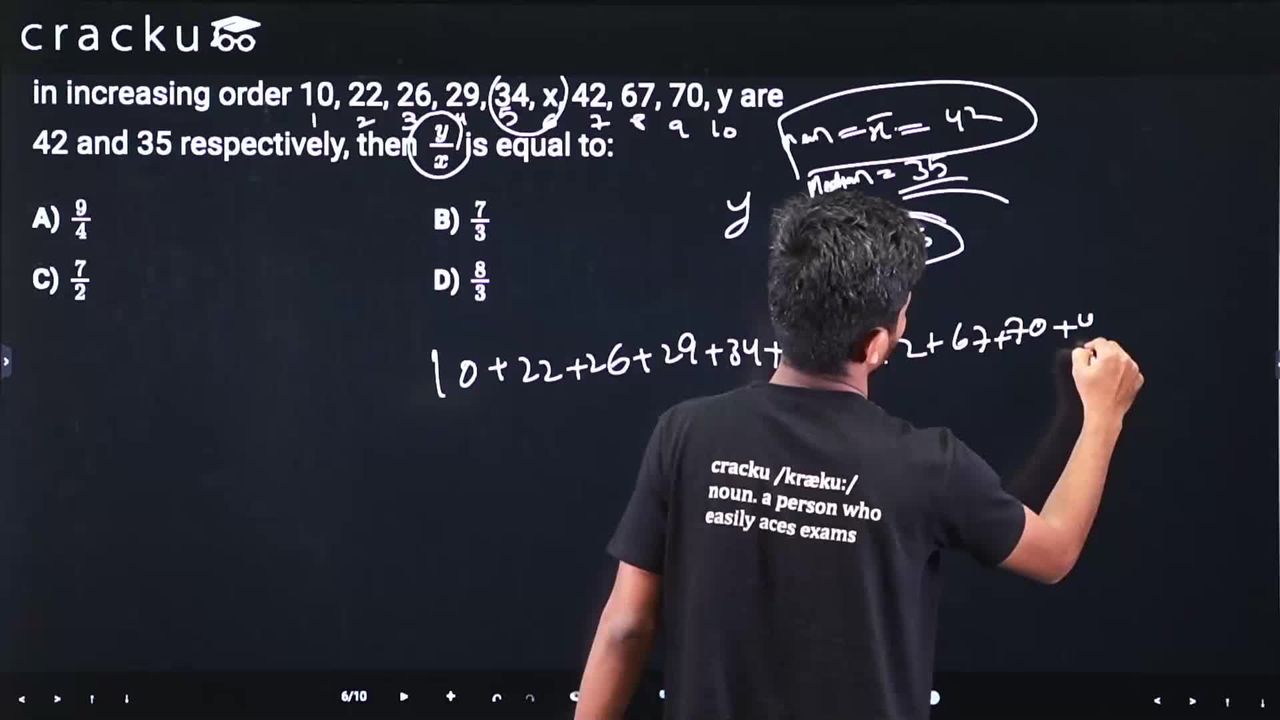
The mean and the median of the following ten numbers in increasing order 10, 22, 26, 29, 34, x, 42, 67, 70, y are 42 and 35 respectively, then $$\frac{y}{x}$$ is equal to:
We have ten numbers already arranged in increasing order:
$$10,\;22,\;26,\;29,\;34,\;x,\;42,\;67,\;70,\;y$$
The question tells us that the mean (arithmetic average) of these ten numbers is $$42$$. The definition of the mean for $$n$$ numbers is
$$\text{Mean} \;=\;\dfrac{\text{Sum of all } n \text{ numbers}}{n}.$$
Here $$n=10$$, so
$$\dfrac{\text{Sum of the ten numbers}}{10}=42.$$
Multiplying both sides by $$10$$ gives the total sum:
$$\text{Sum of the ten numbers}=42 \times 10=420.$$
Next we add up the eight known numbers:
$$10+22+26+29+34+42+67+70$$
First pair: $$10+22=32$$; now $$32+26=58$$; add $$29$$ to get $$87$$; add $$34$$ to reach $$121$$; add $$42$$ to obtain $$163$$; add $$67$$ to reach $$230$$; finally add $$70$$ to get $$300$$.
Thus the sum of the known numbers is $$300$$. Letting the unknowns stand,
$$300 + x + y = 420.$$
Subtracting $$300$$ from both sides gives
$$x + y = 420 - 300 = 120.$$
Now we use the information about the median. For an even number of observations (here $$10$$), the median is the average of the 5th and 6th terms in the ordered list. The 5th term is $$34$$ and the 6th term is $$x$$, so the median is
$$\dfrac{34 + x}{2}.$$
We are told that this median equals $$35$$. Therefore,
$$\dfrac{34 + x}{2} = 35.$$
Multiplying by $$2$$ on both sides,
$$34 + x = 70.$$
Subtracting $$34$$ gives
$$x = 70 - 34 = 36.$$
With $$x$$ known, substitute in the earlier relation $$x + y = 120$$:
$$36 + y = 120.$$
Subtracting $$36$$ from both sides,
$$y = 120 - 36 = 84.$$
Finally, we compute the required ratio $$\dfrac{y}{x}$$:
$$\dfrac{y}{x} = \dfrac{84}{36}.$$
Both numerator and denominator are divisible by $$12$$, so we simplify:
$$\dfrac{84 \div 12}{36 \div 12} = \dfrac{7}{3}.$$
Hence, the correct answer is Option B.
Was this solution helpful?
Click on the Email ☝️ to Watch the Video Solution
Create a FREE account and get:
_1.webp)

Educational materials for JEE preparation

Ask our AI anything

AI can make mistakes. Please verify important information.
AI can make mistakes. Please verify important information.


