
Join Our JEE Preparation Group
Prep with like-minded aspirants; Get access to free daily tests and study material.
Sign in
Please select an account to continue using cracku.in
↓ →
Join Our JEE Preparation Group
Prep with like-minded aspirants; Get access to free daily tests and study material.
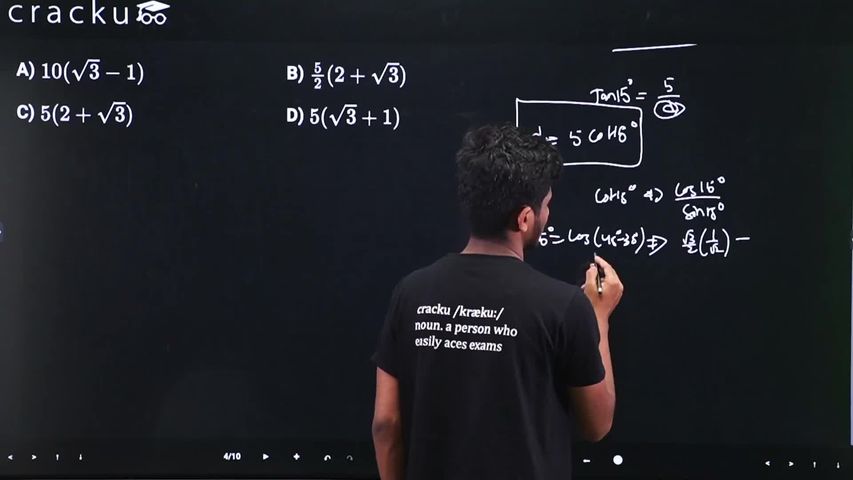
Two poles standing on a horizontal ground are of heights 5 m and 10 m respectively. The line joining their tops makes an angle of 15° with the ground. Then the distance (in m) between the poles, is:
Let us denote the bases of the two vertical poles by the points $$A$$ and $$B$$ on the common horizontal ground.
The pole at $$A$$ has height $$5\ \text{m}$$, so its top is the point $$P$$ such that $$AP = 5$$.
The pole at $$B$$ has height $$10\ \text{m}$$, so its top is the point $$Q$$ with $$BQ = 10$$.
Let the horizontal distance between the two bases be $$AB = x$$ metres. Our aim is to find this unknown $$x$$.
We are told that the straight line joining the tops, that is the segment $$PQ$$, makes an angle of $$15^{\circ}$$ with the horizontal ground. This means that, if we travel from the shorter top $$P$$ (height $$5$$) to the taller top $$Q$$ (height $$10$$) along the segment $$PQ$$, we are ascending at an inclination of $$15^{\circ}$$ above the horizontal.
Now observe the right-angled triangle whose horizontal leg is $$AB$$, vertical leg is the difference of heights $$BQ - AP$$, and hypotenuse is $$PQ$$. The vertical rise from $$P$$ to $$Q$$ is
$$\text{rise} \;=\; 10 - 5 \;=\; 5\ \text{m}.$$
The horizontal run is exactly the distance $$x = AB$$ that we want.
By definition, for any right-angled triangle, the tangent of the angle made by the hypotenuse with the horizontal base equals
$$\tan(\text{angle}) \;=\; \dfrac{\text{opposite side (rise)}}{\text{adjacent side (run)}}.$$
Applying this to our triangle with angle $$15^{\circ}$$, we have
$$\tan 15^{\circ} \;=\; \dfrac{5}{x}.$$
Solving this equation for $$x$$ gives
$$x \;=\; \dfrac{5}{\tan 15^{\circ}}.$$
Next, we recall the exact trigonometric value
$$\tan 15^{\circ} = 2 - \sqrt{3}.$$
Substituting this into the expression for $$x$$, we get
$$x \;=\; \dfrac{5}{2 - \sqrt{3}}.$$
To simplify, we rationalise the denominator. Multiply numerator and denominator by the conjugate $$(2 + \sqrt{3})$$:
$$x \;=\; 5 \times \dfrac{2 + \sqrt{3}}{(2 - \sqrt{3})(2 + \sqrt{3})}.$$
The denominator is a difference of squares:
$$(2 - \sqrt{3})(2 + \sqrt{3}) = 2^{2} - (\sqrt{3})^{2} = 4 - 3 = 1.$$
Therefore, the fraction simplifies beautifully to
$$x \;=\; 5(2 + \sqrt{3}).$$
This value represents the distance between the two poles, in metres.
Hence, the correct answer is Option C.
Was this solution helpful?
Click on the Email ☝️ to Watch the Video Solution
Create a FREE account and get:
_1.webp)

Educational materials for JEE preparation

Ask our AI anything

AI can make mistakes. Please verify important information.
AI can make mistakes. Please verify important information.


