
Join Our JEE Preparation Group
Prep with like-minded aspirants; Get access to free daily tests and study material.
Sign in
Please select an account to continue using cracku.in
↓ →
Join Our JEE Preparation Group
Prep with like-minded aspirants; Get access to free daily tests and study material.
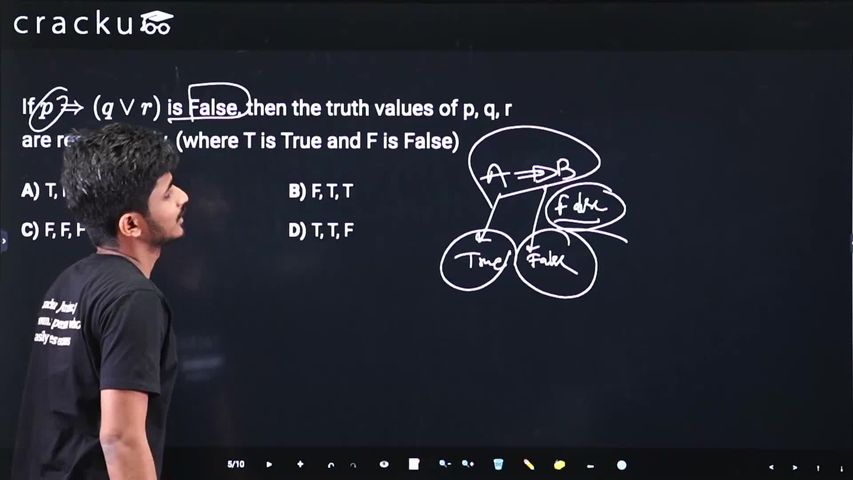
If $$p \Rightarrow (q \lor r)$$ is False, then the truth values of p, q, r are respectively, (where T is True and F is False)
First, recall the logical rule for an implication. The statement $$p \Rightarrow s$$ is false only in one specific situation: when the antecedent $$p$$ is True (T) and the consequent $$s$$ is False (F). In every other combination the implication is True. Symbolically, we can rewrite an implication with the formula $$p \Rightarrow s \;=\; \lnot p \,\lor\, s,$$ which confirms the same fact because a disjunction $$\lnot p \lor s$$ fails exactly when $$\lnot p$$ is F (so $$p$$ is T) and simultaneously $$s$$ is F.
Now we apply this rule to the given compound statement $$p \Rightarrow (q \lor r).$$ Here the consequent is the disjunction $$(q \lor r).$$ We are told that the whole implication is False. Therefore, by the rule just stated, the following two conditions must hold together:
1. $$p$$ is True, because the antecedent must be True for the implication to fail.
2. $$(q \lor r)$$ is False, because the consequent must be False for the implication to fail.
Next, we analyse the disjunction $$(q \lor r).$$ A disjunction $$q \lor r$$ is True if at least one of $$q$$ or $$r$$ is True, and it is False only when both $$q$$ and $$r$$ are False. So, for $$(q \lor r)$$ to be False, we must have
$$q = \text{F} \quad \text{and} \quad r = \text{F}.$$
We already found $$p = \text{T}.$$ Putting these results together, the required truth values are
$$p = \text{T}, \qquad q = \text{F}, \qquad r = \text{F}.$$
Looking at the options, this matches Option A, which lists T, F, F in that order.
Hence, the correct answer is Option A.
Was this solution helpful?
Click on the Email ☝️ to Watch the Video Solution
Create a FREE account and get:
_1.webp)

Educational materials for JEE preparation

Ask our AI anything

AI can make mistakes. Please verify important information.
AI can make mistakes. Please verify important information.


