
Join Our JEE Preparation Group
Prep with like-minded aspirants; Get access to free daily tests and study material.
Sign in
Please select an account to continue using cracku.in
↓ →
Join Our JEE Preparation Group
Prep with like-minded aspirants; Get access to free daily tests and study material.
If $$f(x) = [x] - \left[\frac{x}{4}\right]$$, $$x \in R$$, where $$[x]$$ denotes the greatest integer function, then:
We are given the function $$f(x)= [x]-\left[\dfrac{x}{4}\right]$$ where $$[\,\cdot\,]$$ denotes the greatest-integer (floor) function. Our task is to study the behaviour of this function when $$x$$ approaches $$4$$ from the left and from the right, and then decide whether the function is continuous at $$x=4$$.
First recall the definition of the greatest-integer function: for any real number $$t$$, $$[t]$$ is the unique integer satisfying $$[t]\le t<[t]+1$$. We shall repeatedly use this basic property.
We begin with the left-hand neighbourhood of $$4$$. Take $$x$$ such that $$3<x<4$$. Because $$x<4$$, the greatest integer not exceeding $$x$$ is $$3$$, i.e. $$[x]=3$$. Now consider the term $$\dfrac{x}{4}$$. For the same $$x$$ we have
$$
\frac{3}{4}<\frac{x}{4}<1.
$$
Each number lying strictly between $$\dfrac{3}{4}$$ and $$1$$ has greatest integer $$0$$, so
$$
\left[\frac{x}{4}\right]=0\qquad\text{whenever }3<x<4.
$$
Putting these two pieces together, for $$x$$ in the interval $$(3,4)$$ we get
$$
f(x)= [x]-\left[\frac{x}{4}\right]=3-0=3.
$$
Hence the left-hand expression of the function is the constant $$3$$, and therefore the left-hand limit exists and equals
$$
\lim_{x\to4^-}f(x)=3.
$$
Now we turn to the right-hand neighbourhood of $$4$$. Take $$x$$ such that $$4<x<5$$. In this case we clearly have $$[x]=4$$ because $$4<x<5$$. Likewise
$$
1<\frac{x}{4}<\frac{5}{4}=1.25,
$$
so every value of $$\dfrac{x}{4}$$ in this range lies strictly between $$1$$ and $$2$$. The greatest integer not exceeding such a number is $$1$$, and therefore
$$
\left[\frac{x}{4}\right]=1\qquad\text{whenever }4<x<5.
$$
Substituting into the definition of $$f$$ again gives, for $$x$$ in $$(4,5)$$,
$$
f(x)= [x]-\left[\frac{x}{4}\right]=4-1=3.
$$
Thus the value of $$f(x)$$ to the right of $$4$$ is also the constant $$3$$, which means the right-hand limit exists and equals
$$
\lim_{x\to4^+}f(x)=3.
$$
Because both one-sided limits exist and are equal, the two-sided limit exists and equals $$3$$.
Finally we evaluate the actual value of the function at $$x=4$$:
$$
f(4)= [4]-\left[\frac{4}{4}\right]=4-1=3.
$$
We now invoke the continuity criterion: a function is continuous at a point $$c$$ if
$$
\lim_{x\to c}f(x)=f(c).
$$
We have already shown
$$
\lim_{x\to4}f(x)=3\quad\text{and}\quad f(4)=3,
$$
so the equality holds. Hence the function is continuous at $$x=4$$. Both one-sided limits exist, they are equal to each other, and they coincide with the function’s value at the point.
Among the given statements, Option B is exactly the assertion that $$f$$ is continuous at $$x=4$$. None of the other options correctly matches our findings.
Hence, the correct answer is Option B.
Was this solution helpful?
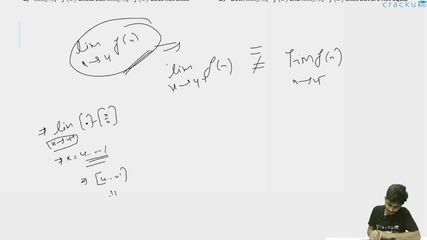
Click on the Email ☝️ to Watch the Video Solution
Create a FREE account and get:
_1.webp)

Educational materials for JEE preparation

Ask our AI anything

AI can make mistakes. Please verify important information.
AI can make mistakes. Please verify important information.


