
Join Our JEE Preparation Group
Prep with like-minded aspirants; Get access to free daily tests and study material.
Sign in
Please select an account to continue using cracku.in
↓ →
Join Our JEE Preparation Group
Prep with like-minded aspirants; Get access to free daily tests and study material.
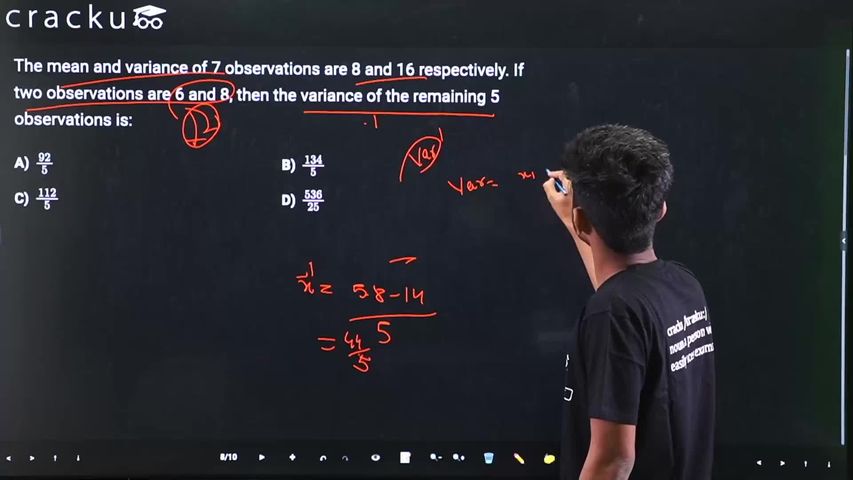
The mean and variance of 7 observations are 8 and 16 respectively. If two observations are 6 and 8, then the variance of the remaining 5 observations is:
We have 7 observations whose mean is given as $$\bar{x}=8$$. The definition of the mean says
$$\bar{x}=\dfrac{\sum_{i=1}^{7}x_i}{7}\;.$$
Substituting $$\bar{x}=8$$, we obtain
$$8=\dfrac{\sum_{i=1}^{7}x_i}{7}\;.$$
Multiplying both sides by 7,
$$\sum_{i=1}^{7}x_i = 7 \times 8 = 56\;.$$
Out of these 7 observations, two are specifically known: $$6$$ and $$8$$. Removing them from the total, the sum of the remaining 5 observations is
$$\sum_{i=1}^{5}y_i = 56-6-8 = 42\;.$$
Now we need their variance. First we recall the population variance formula (division by the number of observations):
$$\sigma^{2}=\dfrac{\sum x_i^{2}}{n}-\bar{x}^{2}\;.$$
The variance of all 7 observations is given as $$16$$, so with $$n=7$$ we write
$$16=\dfrac{\sum_{i=1}^{7}x_i^{2}}{7}-8^{2}\;.$$
Adding $$8^{2}=64$$ to both sides,
$$16+64=\dfrac{\sum_{i=1}^{7}x_i^{2}}{7}\;,$$
$$80=\dfrac{\sum_{i=1}^{7}x_i^{2}}{7}\;.$$
Multiplying by 7,
$$\sum_{i=1}^{7}x_i^{2}=7 \times 80 = 560\;.$$
Next, we subtract the squares of the two known observations to isolate the sum of squares of the remaining five. Their squares are $$6^{2}=36$$ and $$8^{2}=64$$, whose sum is $$36+64=100$$. Therefore,
$$\sum_{i=1}^{5}y_i^{2}=560-100=460\;.$$
For the five residual observations we already found that their sum is $$42$$, so their mean is
$$\bar{y}=\dfrac{42}{5}=8.4\;.$$
Using the same variance formula for these five observations (now $$n=5$$), we have
$$\sigma_{y}^{2}=\dfrac{\sum_{i=1}^{5}y_i^{2}}{5}-\bar{y}^{2}\;.$$
Substituting the values,
$$\sigma_{y}^{2}=\dfrac{460}{5}-(8.4)^{2}\;.$$
Computing each term:
$$\dfrac{460}{5}=92,\qquad (8.4)^{2}=70.56\;.$$
Hence,
$$\sigma_{y}^{2}=92-70.56=21.44\;.$$
Now we change $$21.44$$ to an exact fraction. Observe that
$$21.44 = 21 + 0.44 = 21 + \dfrac{44}{100} = 21 + \dfrac{11}{25}= \dfrac{525}{25}+\dfrac{11}{25}= \dfrac{536}{25}\;.$$
Thus the variance of the remaining five observations is
$$\boxed{\dfrac{536}{25}}\;.$$
Hence, the correct answer is Option D.
Click on the Email ☝️ to Watch the Video Solution
Create a FREE account and get:
_1.webp)

Educational materials for JEE preparation

Ask our AI anything

AI can make mistakes. Please verify important information.
AI can make mistakes. Please verify important information.


