
Join Our JEE Preparation Group
Prep with like-minded aspirants; Get access to free daily tests and study material.
Sign in
Please select an account to continue using cracku.in
↓ →
Join Our JEE Preparation Group
Prep with like-minded aspirants; Get access to free daily tests and study material.
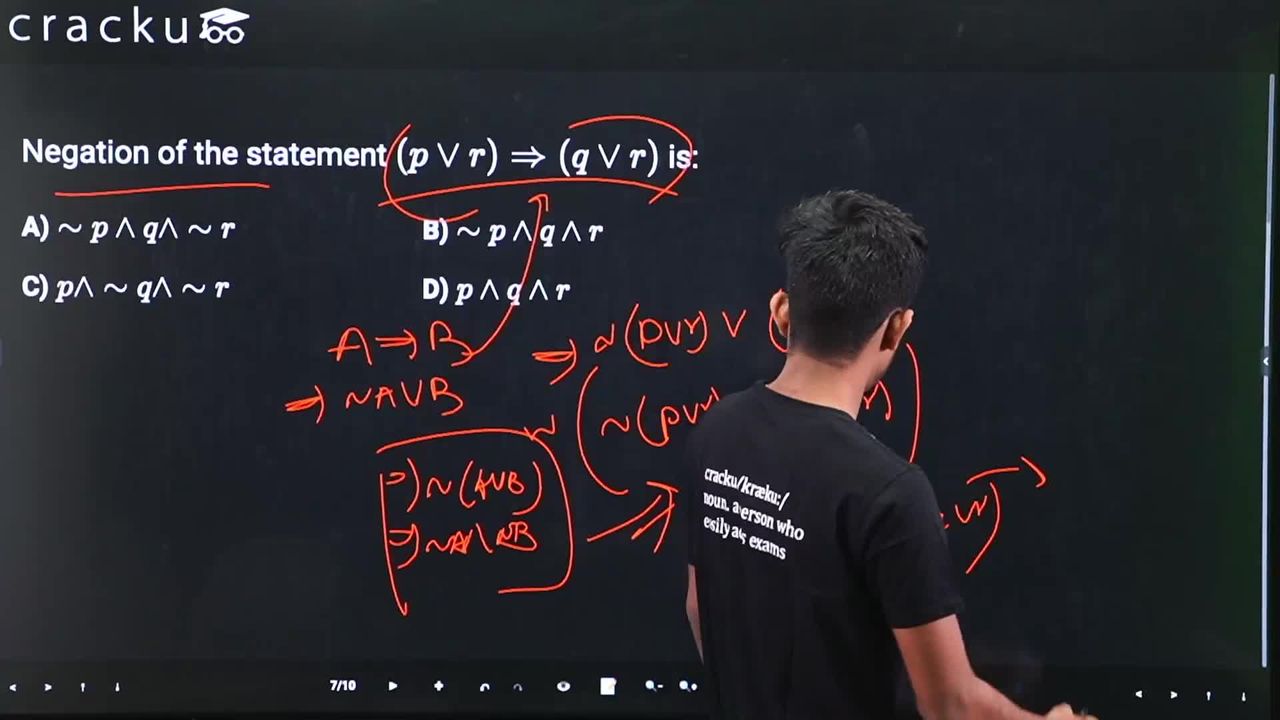
We begin with the given statement of implication
$$ (p \vee r) \Rightarrow (q \vee r). $$
First, we recall the logical equivalence that an implication $$A \Rightarrow B$$ can be rewritten as $$\sim A \,\vee\, B.$$ Stating this clearly:
$$ A \Rightarrow B \;\; \text{is equivalent to} \;\; \sim A \vee B. $$
Here, the role of $$A$$ is played by $$(p \vee r)$$ and the role of $$B$$ is played by $$(q \vee r).$$ Applying the formula gives
$$ (p \vee r) \Rightarrow (q \vee r) \;\; \equiv \;\; \sim(p \vee r) \,\vee\, (q \vee r). $$
Now we want the negation of the entire implication. So we place a negation sign in front of the whole expression we just obtained:
$$ \sim\!\bigl[(p \vee r) \Rightarrow (q \vee r)\bigr] \;=\; \sim\!\bigl[\;\sim(p \vee r) \,\vee\, (q \vee r)\bigr]. $$
Next, we use De Morgan’s law, which states that the negation of a disjunction is the conjunction of the negations:
$$ \sim(A \vee B) \;\equiv\; \sim A \,\wedge\, \sim B. $$
Applying this law with $$A = \sim(p \vee r)$$ and $$B = (q \vee r),$$ we get
$$ \sim\!\bigl[\;\sim(p \vee r) \,\vee\, (q \vee r)\bigr] \;=\; \bigl[\;\sim\!\bigl(\sim(p \vee r)\bigr)\bigr] \,\wedge\, \bigl[\;\sim(q \vee r)\bigr]. $$
Simplify each part separately. First, note that the double negation law tells us $$\sim(\sim X) = X.$$ Therefore,
$$ \sim\!\bigl(\,\sim(p \vee r)\bigr) \;=\; (p \vee r). $$
For the second part, we again apply De Morgan’s law:
$$ \sim(q \vee r) \;=\; (\sim q) \,\wedge\, (\sim r). $$
Substituting these simplified pieces back, the negation becomes
$$ (p \vee r) \,\wedge\, \bigl[(\sim q) \wedge (\sim r)\bigr]. $$
Associativity of $$\wedge$$ allows us to drop parentheses inside the conjunction, giving
$$ (p \vee r) \,\wedge\, \sim q \,\wedge\, \sim r. $$
Now we must distribute $$(p \vee r)$$ over the other conjunctive factors. Using the distributive property $$ (X \vee Y)\,\wedge\,Z \;\equiv\; (X \wedge Z) \vee (Y \wedge Z), $$ with $$X = p,\; Y = r,\; Z = (\sim q \wedge \sim r),$$ we have
$$ (p \vee r) \,\wedge\, \sim q \,\wedge\, \sim r \;=\; \bigl[p \wedge (\sim q) \wedge (\sim r)\bigr] \;\vee\; \bigl[r \wedge (\sim q) \wedge (\sim r)\bigr]. $$
Observe that the second term contains the factor $$(r \wedge \sim r),$$ which is always false. Hence that entire term vanishes, leaving only
$$ p \,\wedge\, \sim q \,\wedge\, \sim r. $$
Thus, the negation of $$(p \vee r) \Rightarrow (q \vee r)$$ simplifies completely to
$$ p \wedge \sim q \wedge \sim r. $$
Comparing with the options provided, this matches Option C.
Hence, the correct answer is Option C.
Click on the Email ☝️ to Watch the Video Solution
Create a FREE account and get:
_1.webp)

Educational materials for JEE preparation

Ask our AI anything

AI can make mistakes. Please verify important information.
AI can make mistakes. Please verify important information.


