
Join Our JEE Preparation Group
Prep with like-minded aspirants; Get access to free daily tests and study material.
Sign in
Please select an account to continue using cracku.in
↓ →
Join Our JEE Preparation Group
Prep with like-minded aspirants; Get access to free daily tests and study material.
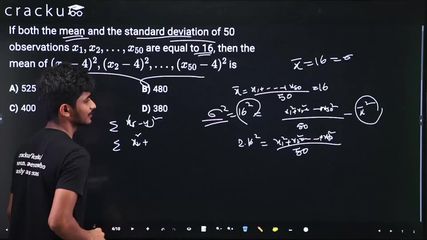
If both the mean and the standard deviation of 50 observations $$x_1, x_2, \ldots, x_{50}$$ are equal to 16, then the mean of $$(x_1 - 4)^2, (x_2 - 4)^2, \ldots, (x_{50} - 4)^2$$ is
The problem tells us that for the 50 observations $$x_1, x_2, \ldots , x_{50}$$ we have both the mean and the standard deviation equal to 16.
We first translate this information into algebraic form.
The mean (average) is defined as
$$\bar x \;=\; \dfrac{1}{50}\sum_{i=1}^{50} x_i.$$
Given that $$\bar x = 16,$$ we may write
$$\dfrac{1}{50}\sum_{i=1}^{50} x_i = 16.$$
Next, the standard deviation $$\sigma$$ (with the population formula, because the denominator is the full count 50) is given by
$$\sigma \;=\; \sqrt{\,\dfrac{1}{50}\sum_{i=1}^{50}(x_i - \bar x)^2\,}.$$
The question states $$\sigma = 16,$$ so squaring both sides we get
$$\sigma^2 = 256 = \dfrac{1}{50}\sum_{i=1}^{50}(x_i - \bar x)^2.$$
Thus, the mean of the squared deviations from the mean is 256:
$$\dfrac{1}{50}\sum_{i=1}^{50}(x_i - 16)^2 = 256.$$
Our goal is to find the mean of the 50 new numbers
$$ (x_1 - 4)^2,\; (x_2 - 4)^2,\; \ldots ,\; (x_{50} - 4)^2. $$
Let us examine one general term $$ (x_i - 4)^2. $$
To connect this with the known quantity $$ (x_i - 16)^2, $$ we write
$$x_i - 4 = (x_i - 16) + 12,$$
because subtracting 4 from $$x_i$$ is the same as first subtracting 16 and then adding 12.
Now we expand the square using the algebraic identity $$(a + b)^2 = a^2 + 2ab + b^2.$$ Setting $$a = (x_i - 16)$$ and $$b = 12,$$ we obtain
$$ (x_i - 4)^2 \;=\; \bigl((x_i - 16) + 12\bigr)^2 \\[6pt] \;=\; (x_i - 16)^2 \;+\; 2 \times (x_i - 16)\times 12 \;+\; 12^2. $$
Simplifying the middle and last terms, we have
$$ (x_i - 4)^2 \;=\; (x_i - 16)^2 \;+\; 24\,(x_i - 16) \;+\; 144. $$
We now take the mean (average) of these expressions over all 50 observations.
Mean of $$ (x_i - 4)^2 $$ $$ = \dfrac{1}{50}\sum_{i=1}^{50}(x_i - 4)^2 $$ $$ = \dfrac{1}{50}\sum_{i=1}^{50}\Bigl[\, (x_i - 16)^2 + 24\,(x_i - 16) + 144 \Bigr]. $$
Because the sum of sums is the sum of the sums, we may split this into three separate averages:
$$ = \underbrace{\dfrac{1}{50}\sum_{i=1}^{50}(x_i - 16)^2}_{\text{first mean}} \;+\; \underbrace{\dfrac{1}{50}\sum_{i=1}^{50} 24\,(x_i - 16)}_{\text{second mean}} \;+\; \underbrace{\dfrac{1}{50}\sum_{i=1}^{50}144}_{\text{third mean}}. $$
We already know the first mean:
$$\dfrac{1}{50}\sum_{i=1}^{50}(x_i - 16)^2 = 256.$$
For the second mean, note that the factor 24 is constant, so it can be taken out of the summation:
$$\dfrac{1}{50}\sum_{i=1}^{50} 24\,(x_i - 16) = 24 \times \dfrac{1}{50}\sum_{i=1}^{50}(x_i - 16).$$
But
$$\dfrac{1}{50}\sum_{i=1}^{50}(x_i - 16) = \dfrac{1}{50}\Bigl(\sum_{i=1}^{50}x_i - 50 \times 16\Bigr) = \bar x - 16 = 16 - 16 = 0.$$
Therefore this entire middle term is zero:
$$24 \times 0 = 0.$$
For the third mean, 144 is also a constant. Hence
$$\dfrac{1}{50}\sum_{i=1}^{50}144 = 144 \times \dfrac{1}{50}\sum_{i=1}^{50}1 = 144 \times \dfrac{50}{50} = 144.$$
Putting all three results together:
$$\text{Desired mean} = 256 + 0 + 144 = 400.$$
Hence, the correct answer is Option C.
Was this solution helpful?
Click on the Email ☝️ to Watch the Video Solution
Create a FREE account and get:
_1.webp)

Educational materials for JEE preparation

Ask our AI anything

AI can make mistakes. Please verify important information.
AI can make mistakes. Please verify important information.
