
Join Our JEE Preparation Group
Prep with like-minded aspirants; Get access to free daily tests and study material.
Sign in
Please select an account to continue using cracku.in
↓ →
Join Our JEE Preparation Group
Prep with like-minded aspirants; Get access to free daily tests and study material.
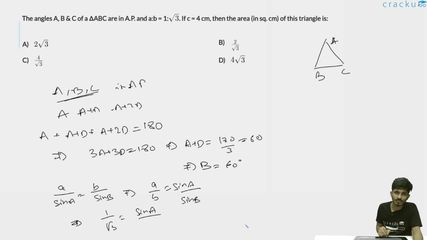
The angles A, B & C of a ΔABC are in A.P. and a:b = 1:$$\sqrt{3}$$. If c = 4 cm, then the area (in sq. cm) of this triangle is:
We have a triangle $$\triangle ABC$$ in which the three interior angles $$A,\,B,\,C$$ are in arithmetic progression (A.P.).
If three numbers are in A.P., the middle term equals the average of the other two. Hence we may write
$$A,\;A+d,\;A+2d$$
for the three angles, where $$d$$ is their common difference. Their sum must be $$180^{\circ}$$, so
$$A+(A+d)+(A+2d)=180^{\circ}$$
$$3A+3d=180^{\circ}$$
Dividing every term by $$3$$ gives
$$A+d=60^{\circ} \quad\Longrightarrow\quad B=60^{\circ}.$$
Thus
$$A=60^{\circ}-d,\qquad C=60^{\circ}+d.$$
Next, the ratio of the sides opposite these angles is given: $$a:b=1:\sqrt{3}$$. We invoke the Sine Rule, which states
$$\frac{a}{\sin A}=\frac{b}{\sin B}=\frac{c}{\sin C}=2R,$$
where $$R$$ is the circumradius. From the first two fractions we get
$$\frac{a}{b}=\frac{\sin A}{\sin B}.$$
Substituting $$a:b=1:\sqrt{3}$$ and $$B=60^{\circ}$$ yields
$$\frac{1}{\sqrt{3}}=\frac{\sin A}{\sin 60^{\circ}}.$$
Because $$\sin 60^{\circ}=\dfrac{\sqrt{3}}{2},$$ we have
$$\frac{1}{\sqrt{3}}=\frac{\sin A}{\sqrt{3}/2}.$$
Multiplying both sides by $$\dfrac{\sqrt{3}}{2}$$ gives
$$\sin A=\frac{1}{2}.$$ Hence $$A=30^{\circ}$$ (the possibility $$150^{\circ}$$ is impossible, since it would make the third angle negative).
Since $$B=60^{\circ},$$ the remaining angle is
$$C=180^{\circ}-A-B=180^{\circ}-30^{\circ}-60^{\circ}=90^{\circ}.$$
Thus $$\triangle ABC$$ is a right-angled triangle with $$C=90^{\circ}.$$ The side opposite the right angle, namely $$c=AB,$$ is the hypotenuse.
For a $$30^{\circ}\!-\!60^{\circ}\!-\!90^{\circ}$$ triangle the sides satisfy the well-known ratio
$$a:b:c = 1:\sqrt{3}:2.$$
Given $$c=4\text{ cm},$$ equating the “2” part to $$4$$ shows
$$2k = 4 \;\Longrightarrow\; k = 2.$$
Therefore
$$a = k = 2\text{ cm},\qquad b = k\sqrt{3} = 2\sqrt{3}\text{ cm}.$$
Because the legs $$a$$ and $$b$$ are perpendicular (the right angle is at $$C$$), the area $$\Delta$$ of the triangle is
$$\Delta = \frac{1}{2}\,a\,b.$$
Substituting the lengths just found,
$$\Delta = \frac{1}{2}\times 2 \times 2\sqrt{3}=2\sqrt{3}\;\text{sq.\;cm}.$$
Hence, the correct answer is Option A.
Was this solution helpful?
Click on the Email ☝️ to Watch the Video Solution
Create a FREE account and get:
_1.webp)

Educational materials for JEE preparation

Ask our AI anything

AI can make mistakes. Please verify important information.
AI can make mistakes. Please verify important information.
