
Join Our JEE Preparation Group
Prep with like-minded aspirants; Get access to free daily tests and study material.
Sign in
Please select an account to continue using cracku.in
↓ →
Join Our JEE Preparation Group
Prep with like-minded aspirants; Get access to free daily tests and study material.
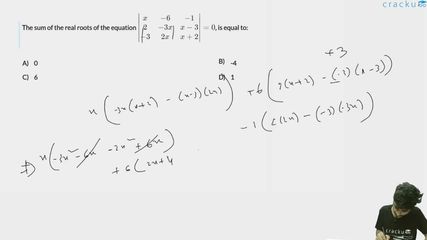
The sum of the real roots of the equation $$\begin{vmatrix} x & -6 & -1 \\ 2 & -3x & x-3 \\ -3 & 2x & x+2 \end{vmatrix} = 0$$, is equal to:
We begin with the determinant
$$ \Delta \;=\; \begin{vmatrix} x & -6 & -1\\ 2 & -3x & x-3\\ -3 & 2x & x+2 \end{vmatrix}. $$
To obtain the characteristic polynomial, we expand this determinant along the first row. For a $$3\times3$$ matrix, the expansion formula is
$$ \begin{vmatrix} a_{11} & a_{12} & a_{13}\\ a_{21} & a_{22} & a_{23}\\ a_{31} & a_{32} & a_{33} \end{vmatrix} =\;a_{11}C_{11}+a_{12}C_{12}+a_{13}C_{13}, $$
where each cofactor is $$C_{1j}=(-1)^{1+j}M_{1j}$$ and $$M_{1j}$$ is the minor obtained after deleting row 1 and column $$j$$.
We now compute each minor and cofactor step by step.
First cofactor $$C_{11}$$:
The minor is
$$ M_{11}=\begin{vmatrix} -3x & x-3\\ 2x & x+2 \end{vmatrix} =(-3x)(x+2)-(x-3)(2x) =-3x^2-6x-2x^2+6x =-5x^2. $$
Since $$(-1)^{1+1}=+1$$, we get $$C_{11}=M_{11}=-5x^2$$.
Thus the contribution from $$a_{11}=x$$ is
$$x\cdot C_{11}=x(-5x^2)=-5x^3.$$ Second cofactor $$C_{12}$$:
Delete column 2 to obtain
$$ M_{12}=\begin{vmatrix} 2 & x-3\\ -3 & x+2 \end{vmatrix} =2(x+2)-(x-3)(-3) =2x+4+3x-9 =5x-5 =5(x-1). $$
Because $$(-1)^{1+2}=-1$$, we have $$C_{12}=-M_{12}=-5(x-1)$$.
The entry in the first row and second column is $$-6$$, so the term generated is
$${(-6)}\cdot C_{12}=(-6)\bigl[-5(x-1)\bigr]=30(x-1).$$ Third cofactor $$C_{13}$$:
The needed minor is
$$ M_{13}=\begin{vmatrix} 2 & -3x\\ -3 & 2x \end{vmatrix} =2(2x)-(-3x)(-3) =4x-9x =-5x. $$
Here $$(-1)^{1+3}=+1$$, so $$C_{13}=M_{13}=-5x$$.
With $$a_{13}=-1$$, the contribution is
$${(-1)}\cdot C_{13}=(-1)(-5x)=5x.$$
Adding all three contributions, we get the determinant in simplified form:
$$ \Delta=-5x^3+30(x-1)+5x. $$
Open the parentheses and combine like terms:
$$ \Delta=-5x^3+30x-30+5x =-5x^3+35x-30. $$
Factor out $$-5$$:
$$ \Delta=-5\bigl(x^3-7x+6\bigr). $$
The determinant must vanish, so we set $$\Delta=0$$ and divide by $$-5$$ (which does not affect the roots):
$$ x^3-7x+6=0. $$
We now solve the cubic equation $$x^3-7x+6=0.$$ Possible rational roots are the factors of $$6$$, i.e. $$\pm1,\pm2,\pm3,\pm6$$.
Checking sequentially:
For $$x=1$$: $$1-7+6=0,$$ so $$x=1$$ is a root.
For $$x=2$$: $$8-14+6=0,$$ so $$x=2$$ is also a root.
For $$x=-3$$: $$-27+21+6=0,$$ hence $$x=-3$$ is a root as well.
Thus the cubic factors completely as
$$ x^3-7x+6=(x-1)(x-2)(x+3). $$
The real roots are therefore $$x=1,\;x=2,\;x=-3.$$
The sum of the real roots is
$$ 1+2+(-3)=0. $$
Hence, the correct answer is Option A.
Was this solution helpful?
Click on the Email ☝️ to Watch the Video Solution
Create a FREE account and get:
_1.webp)

Educational materials for JEE preparation

Ask our AI anything

AI can make mistakes. Please verify important information.
AI can make mistakes. Please verify important information.
