
Join Our JEE Preparation Group
Prep with like-minded aspirants; Get access to free daily tests and study material.
Sign in
Please select an account to continue using cracku.in
↓ →
Join Our JEE Preparation Group
Prep with like-minded aspirants; Get access to free daily tests and study material.
Let $$\lambda$$ be a real number for which the system of linear equations
$$x + y + z = 6$$,
$$4x + \lambda y - \lambda z = \lambda - 2$$ and
$$3x + 2y - 4z = -5$$
has infinitely many solutions. Then $$\lambda$$ is a root of the quadratic equation:
We have the three simultaneous linear equations
$$\begin{aligned} x+y+z &= 6,\\ 4x+\lambda y-\lambda z &= \lambda-2,\\ 3x+2y-4z &= -5. \end{aligned}$$
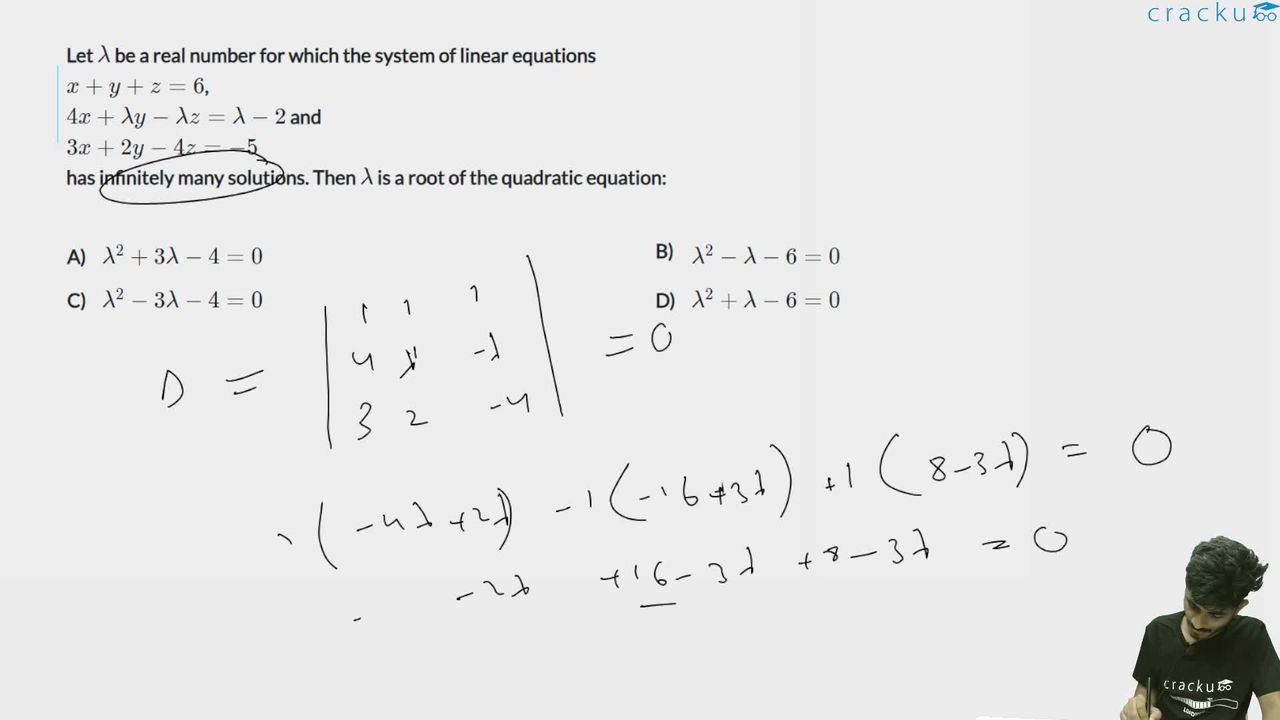
For a system of three equations in the three unknowns $$x,y,z$$ to possess infinitely many solutions, the rank of the coefficient matrix must be smaller than the number of variables, yet equal to the rank of the augmented matrix. A necessary condition for this is that the determinant of the coefficient matrix be zero, for otherwise the rank would be three and the solution unique.
We first form the coefficient matrix and write its determinant:
$$\Delta= \begin{vmatrix} 1 & 1 & 1\\ 4 & \lambda & -\lambda\\ 3 & 2 & -4 \end{vmatrix}.$$
Expanding along the first row (cofactor expansion) we get
$$\begin{aligned} \Delta &= 1\Bigl( \lambda(-4)-(-\lambda)(2)\Bigr) - 1\Bigl(4(-4)-(-\lambda)(3)\Bigr) + 1\Bigl(4\cdot 2-\lambda\cdot 3\Bigr).\\[4pt] &= 1\bigl(-4\lambda+2\lambda\bigr) -1\bigl(-16+3\lambda\bigr) +\bigl(8-3\lambda\bigr).\\[4pt] &= (-2\lambda)+\bigl(16-3\lambda\bigr)+\bigl(8-3\lambda\bigr).\\[4pt] &= (-2\lambda-3\lambda-3\lambda)+(16+8).\\[4pt] &= -8\lambda+24\\[4pt] &= 8(3-\lambda). \end{aligned}$$
Setting $$\Delta=0$$ gives
$$8(3-\lambda)=0\qquad\Rightarrow\qquad \lambda=3.$$
Thus the only value that can possibly yield infinitely many solutions is $$\lambda=3$$. We must still verify that with $$\lambda=3$$ the system is consistent and has more than one solution.
Putting $$\lambda=3$$ into the original equations produces
$$\begin{aligned} x+y+z &= 6,\\ 4x+3y-3z &= 1,\quad(\text{since } \lambda-2 = 1),\\ 3x+2y-4z &= -5. \end{aligned}$$
From the first equation we express $$x=6-y-z$$ and substitute this value into the last two equations:
$$\begin{aligned} 4(6-y-z)+3y-3z &= 1 &\Longrightarrow&\; 24-4y-4z+3y-3z=1\\ &\Longrightarrow&\; -y-7z=-23\\ &\Longrightarrow&\; y+7z=23,\\[6pt] 3(6-y-z)+2y-4z &= -5 &\Longrightarrow&\; 18-3y-3z+2y-4z=-5\\ &\Longrightarrow&\; -y-7z=-23\\ &\Longrightarrow&\; y+7z=23. \end{aligned}$$
Both reduced equations are identical, so after eliminating $$x$$ we are left with only one independent equation $$y+7z=23$$. Thus there are two independent equations in three unknowns, and one free parameter remains, confirming that the system indeed has infinitely many solutions when $$\lambda=3$$.
Consequently $$\lambda$$ must equal $$3$$. We now look for the given quadratic whose roots include $$3$$:
$$\lambda^2-\lambda-6=(\lambda-3)(\lambda+2).$$
This polynomial clearly vanishes at $$\lambda=3$$, while none of the other listed quadratics does. Hence the required quadratic is
$$\boxed{\lambda^2-\lambda-6=0}.$$
Among the options, this is Option B.
Hence, the correct answer is Option B.
Was this solution helpful?
Click on the Email ☝️ to Watch the Video Solution
Create a FREE account and get:
_1.webp)

Educational materials for JEE preparation

Ask our AI anything

AI can make mistakes. Please verify important information.
AI can make mistakes. Please verify important information.
