
Join Our JEE Preparation Group
Prep with like-minded aspirants; Get access to free daily tests and study material.
Sign in
Please select an account to continue using cracku.in
↓ →
Join Our JEE Preparation Group
Prep with like-minded aspirants; Get access to free daily tests and study material.
If $$\cos^{-1}x - \cos^{-1}\frac{y}{2} = \alpha$$, where $$-1 \leq x \leq 1$$, $$-2 \leq y \leq 2$$, $$x \leq \frac{y}{2}$$, then for all x, y, $$4x^2 - 4xy\cos\alpha + y^2$$ is equal to:
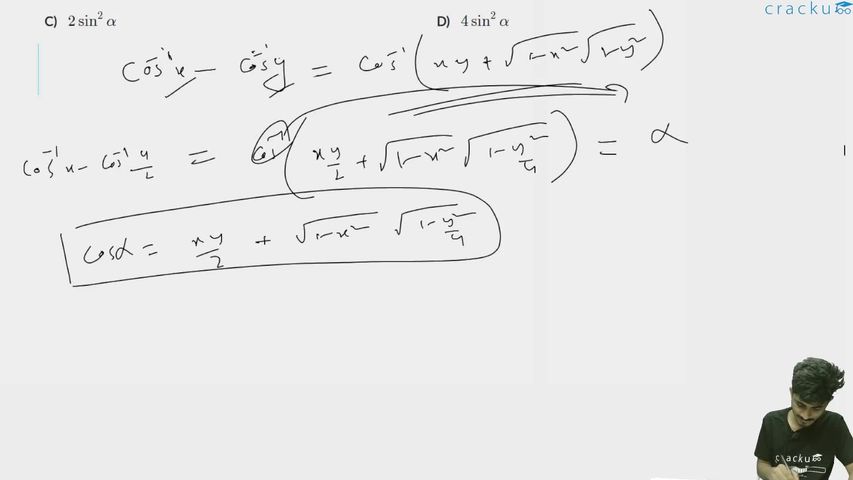
We are given the relation $$\cos^{-1}x-\cos^{-1}\frac{y}{2}=\alpha$$.
Let us introduce two auxiliary angles to translate the inverse-cosine statement into ordinary cosine values. Put
$$\theta=\cos^{-1}x \qquad\text{and}\qquad \phi=\cos^{-1}\frac{y}{2}.$$
By definition of the inverse cosine we immediately have
$$x=\cos\theta,\qquad \frac{y}{2}=\cos\phi\;\;\Longrightarrow\;\;y=2\cos\phi.$$
The given equation now reads
$$\theta-\phi=\alpha\;\;\Longrightarrow\;\;\theta=\phi+\alpha.$$
Our target expression is
$$4x^{2}-4xy\cos\alpha+y^{2}.$$
Substituting $$x=\cos\theta$$ and $$y=2\cos\phi$$ we get
$$4(\cos\theta)^{2}-4(\cos\theta)(2\cos\phi)\cos\alpha+(2\cos\phi)^{2}.$$
Simplifying the numerical coefficients,
$$=4\cos^{2}\theta-8\cos\theta\cos\phi\cos\alpha+4\cos^{2}\phi.$$
Every term now carries a common factor 4, so we factor it out:
$$=4\Bigl(\cos^{2}\theta-2\cos\theta\cos\phi\cos\alpha+\cos^{2}\phi\Bigr).$$
We must evaluate the bracket. To do so we replace $$\theta$$ by $$\phi+\alpha$$ because $$\theta=\phi+\alpha.$$ First recall the compound-angle formula
$$\cos(A+B)=\cos A\cos B-\sin A\sin B.$$
Applying it to $$\cos\theta=\cos(\phi+\alpha)$$ yields
$$\cos\theta=\cos(\phi+\alpha)=\cos\phi\cos\alpha-\sin\phi\sin\alpha.$$
For brevity let us denote
$$C=\cos\theta,\qquad D=\cos\phi,\qquad S=\sin\phi.$$
Then $$C=D\cos\alpha-S\sin\alpha$$ and the bracket becomes
$$C^{2}-2CD\cos\alpha+D^{2}.$$
Compute $$C^{2}$$ first:
$$C^{2}=(D\cos\alpha-S\sin\alpha)^{2}=D^{2}\cos^{2}\alpha-2DS\cos\alpha\sin\alpha+S^{2}\sin^{2}\alpha.$$
Now insert this into the bracket:
$$$ \begin{aligned} &\;\;C^{2}-2CD\cos\alpha+D^{2}\\ &= \bigl(D^{2}\cos^{2}\alpha-2DS\cos\alpha\sin\alpha+S^{2}\sin^{2}\alpha\bigr) -2\bigl(D\cos\alpha-S\sin\alpha\bigr)D\cos\alpha +D^{2}. \end{aligned} $$$
Work out the middle product:
$$$ -2CD\cos\alpha=-2\bigl(D\cos\alpha-S\sin\alpha\bigr)D\cos\alpha =-2D^{2}\cos^{2}\alpha+2DS\cos\alpha\sin\alpha. $$$
Adding everything term by term:
$$$ \begin{aligned} C^{2}-2CD\cos\alpha+D^{2}&= \underbrace{D^{2}\cos^{2}\alpha}_{(1)} -\underbrace{2DS\cos\alpha\sin\alpha}_{(2)} +\underbrace{S^{2}\sin^{2}\alpha}_{(3)} \\ &\quad -\underbrace{2D^{2}\cos^{2}\alpha}_{(4)} +\underbrace{2DS\cos\alpha\sin\alpha}_{(5)} +\underbrace{D^{2}}_{(6)}. \end{aligned} $$$
The cross terms (2) and (5) cancel each other, leaving
$$-D^{2}\cos^{2}\alpha+S^{2}\sin^{2}\alpha+D^{2}.$$\p>
Factor out $$\sin^{2}\alpha$$ from the two compatible terms and remember $$\sin^{2}\alpha=1-\cos^{2}\alpha$$:
$$$ \begin{aligned} &=D^{2}\bigl(1-\cos^{2}\alpha\bigr)+S^{2}\sin^{2}\alpha\\ &=\sin^{2}\alpha\bigl(D^{2}+S^{2}\bigr). \end{aligned} $$$
But $$D^{2}+S^{2}=\cos^{2}\phi+\sin^{2}\phi=1,$$ so the entire bracket collapses beautifully to
$$\sin^{2}\alpha.$$
Returning to the full expression we earlier factored,
$$4\Bigl(\cos^{2}\theta-2\cos\theta\cos\phi\cos\alpha+\cos^{2}\phi\Bigr)=4\sin^{2}\alpha.$$
This value is completely independent of $$x$$ and $$y$$, depending only on the given constant angle $$\alpha$$.
Hence, the correct answer is Option D.
Was this solution helpful?
Click on the Email ☝️ to Watch the Video Solution
Create a FREE account and get:
_1.webp)

Educational materials for JEE preparation

Ask our AI anything

AI can make mistakes. Please verify important information.
AI can make mistakes. Please verify important information.
