
Join Our JEE Preparation Group
Prep with like-minded aspirants; Get access to free daily tests and study material.
Sign in
Please select an account to continue using cracku.in
↓ →
Join Our JEE Preparation Group
Prep with like-minded aspirants; Get access to free daily tests and study material.
If the data $$x_1, x_2, \ldots, x_{10}$$ is such that the mean of first four of these is 11, the mean of the remaining six is 16 and the sum of squares of all of these is 2000, then the standard deviation of this data is:
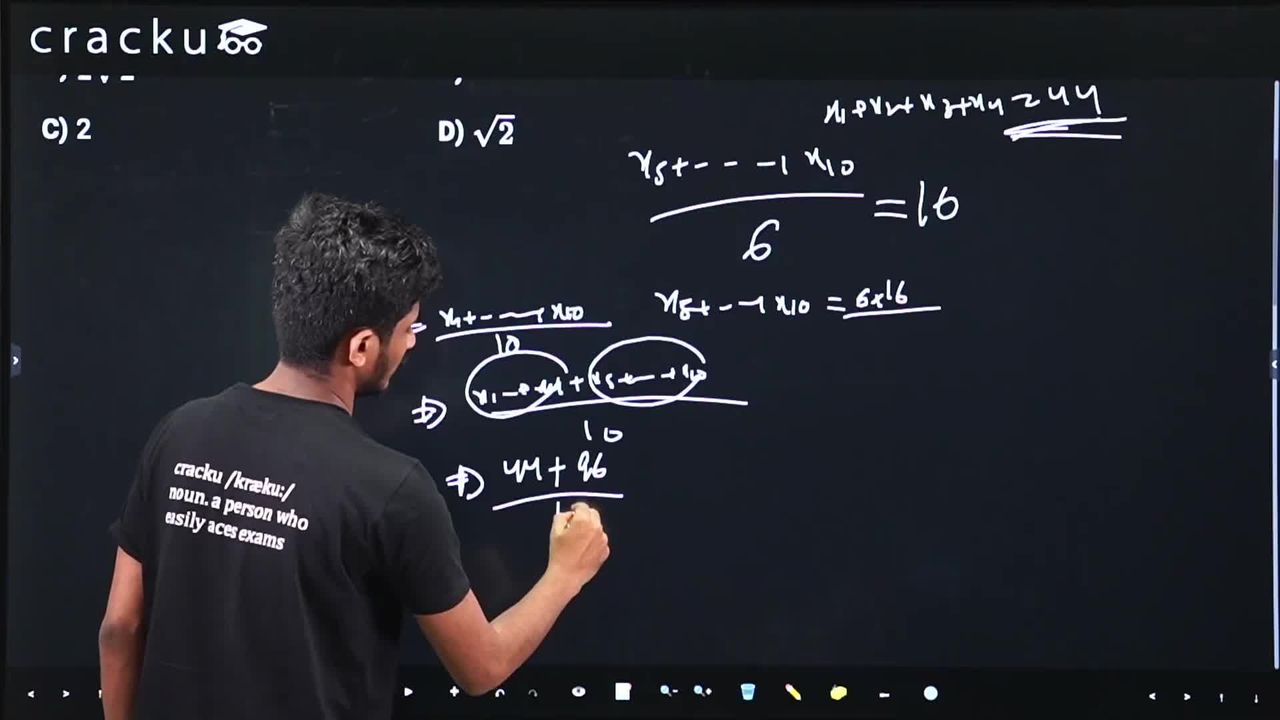
We are given ten numbers $$x_1, x_2, \ldots , x_{10}$$. Among them, the first four have an arithmetic mean of $$11$$, while the last six have an arithmetic mean of $$16$$. From the definition of mean, the sum of the first four observations is obtained by multiplying their mean by the count:
$$\text{Sum of first four}=4\times 11=44.$$
In exactly the same way, the sum of the remaining six observations equals their mean times their number:
$$\text{Sum of last six}=6\times 16=96.$$
Adding the two partial sums gives the total sum of all ten observations:
$$\sum_{i=1}^{10}x_i=44+96=140.$$
The overall mean (denoted by $$\bar{x}$$) is therefore the total sum divided by the total number of observations:
$$\bar{x}=\frac{\sum_{i=1}^{10}x_i}{10}=\frac{140}{10}=14.$$
Next we are told that the sum of squares of all the observations equals $$2000$$, that is,
$$\sum_{i=1}^{10}x_i^{\,2}=2000.$$
To compute the variance, we recall the identity
$$\sigma^2=\frac{1}{n}\sum_{i=1}^{n}x_i^{\,2}-\bar{x}^{\,2},$$
where $$n=10$$ is the number of observations, $$\sum x_i^{\,2}$$ is the sum of squares, and $$\bar{x}$$ is the mean. We substitute the known values one by one.
First, the average of the squares is
$$\frac{1}{n}\sum_{i=1}^{10}x_i^{\,2}=\frac{2000}{10}=200.$$
Next, we square the mean already found:
$$\bar{x}^{\,2}=14^{2}=196.$$
Putting these two numbers into the variance formula we obtain
$$\sigma^2 = 200 - 196 = 4.$$
Finally, the standard deviation $$\sigma$$ is the positive square root of the variance:
$$\sigma=\sqrt{\sigma^2}=\sqrt{4}=2.$$
Hence, the correct answer is Option C.
Was this solution helpful?
Click on the Email ☝️ to Watch the Video Solution
Create a FREE account and get:
_1.webp)

Educational materials for JEE preparation

Ask our AI anything

AI can make mistakes. Please verify important information.
AI can make mistakes. Please verify important information.
