
Join Our JEE Preparation Group
Prep with like-minded aspirants; Get access to free daily tests and study material.
Sign in
Please select an account to continue using cracku.in
↓ →
Join Our JEE Preparation Group
Prep with like-minded aspirants; Get access to free daily tests and study material.
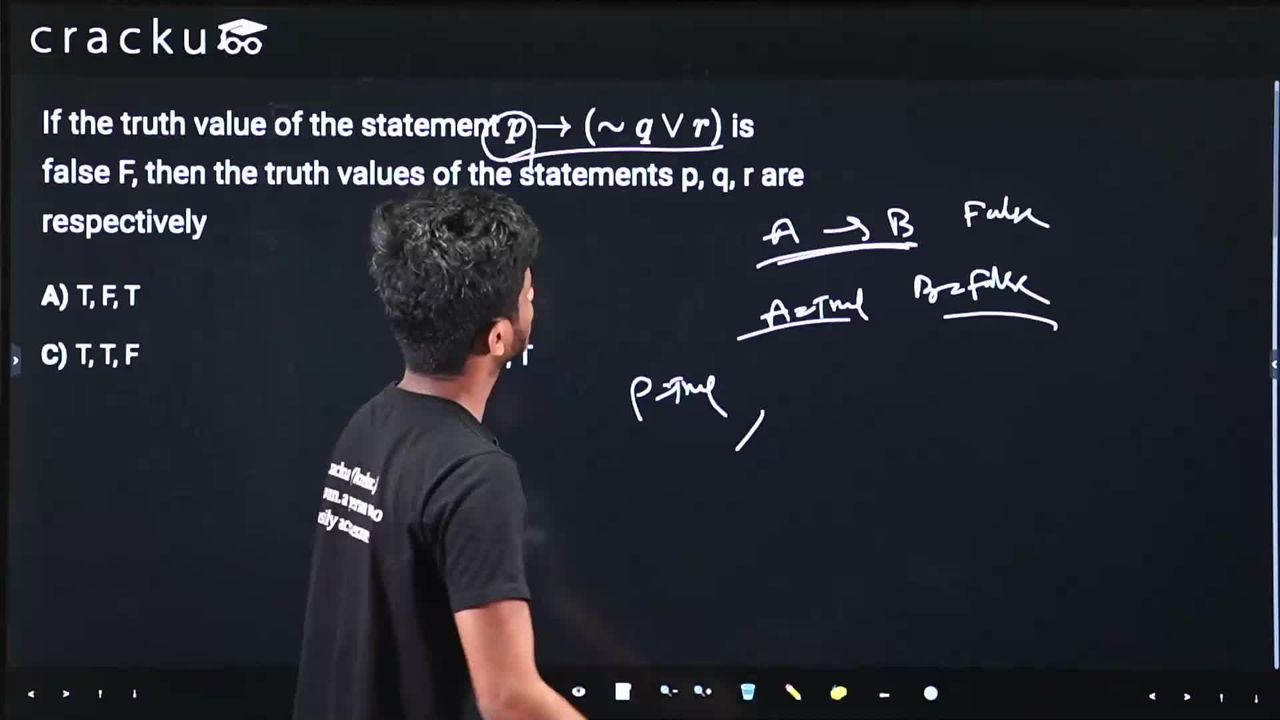
If the truth value of the statement $$p \to (\sim q \vee r)$$ is false F, then the truth values of the statements p, q, r are respectively
We are told that the compound statement $$p \to (\sim q \vee r)$$ has the truth value False (F).
First, recall the logical rule for an implication. The statement $$A \to B$$ is False only when its antecedent $$A$$ is True and its consequent $$B$$ is False. In every other combination, an implication is True. We now apply this rule to our given implication.
Here, the antecedent is $$p$$ and the consequent is $$(\sim q \vee r)$$. Since the whole implication is False, we must have
$$p = \text{True} \quad\text{and}\quad (\sim q \vee r) = \text{False}.$$
So we have already obtained the first truth value:
$$p = T.$$
Next, we analyze the consequent $$(\sim q \vee r).$$ This is a disjunction (“or”) of two parts, $$\sim q$$ and $$r$$. Remember the truth table for a disjunction. A statement of the form $$X \vee Y$$ is False only when both $$X$$ and $$Y$$ are False:
$$X \vee Y = F \quad\text{iff}\quad X = F \text{ and } Y = F.$$
Applying this rule to $$(\sim q \vee r)$$, the overall disjunction is False, so both pieces must be False:
$$\sim q = F \quad\text{and}\quad r = F.$$
Now we can extract the truth values of $$q$$ and $$r$$ one by one.
Since $$\sim q = F,$$ the negation of $$q$$ is False. A negation is False precisely when the original statement is True. Therefore,
$$q = T.$$
We have already obtained from the disjunction that
$$r = F.$$
Collecting our results, the ordered triple of truth values is
$$\bigl(p,\, q,\, r\bigr) = (T,\, T,\, F).$$
Looking at the options, this matches Option C (labelled “3”).
Hence, the correct answer is Option C.
Click on the Email ☝️ to Watch the Video Solution
Create a FREE account and get:
_1.webp)

Educational materials for JEE preparation

Ask our AI anything

AI can make mistakes. Please verify important information.
AI can make mistakes. Please verify important information.


