Let $$A =\left\{x: |x^{2}-10|\leq6 \right\}$$ and $$B= \left\{x:|x-2|>1 \right\}$$. Then
- Home
- >
- JEE Questions
- >
- JEE Mathematics Questions
- >
- Sets
JEE Sets Questions
For $$A$$,
When $$x^2<10$$, i.e. when $$x>-\sqrt{10}$$ or when $$x<\sqrt{10}$$, we get
$$A = \{x: 10-x^{2} \leq 6 \}$$ or $$A = \{x: x^2\geq 4\}$$
Provided the range, we get $$A = (-\sqrt{10}, -2] \cup [2, \sqrt{10})$$
When $$x^2\geq 10$$, i.e. when $$x\leq -\sqrt{10}$$ or when $$x\geq \sqrt{10}$$, we get
$$A = \{x: x^2-10\leq 6\}$$ or $$A= \{x: x^2\leq 16\}$$
Provided the range, we get $$A= [-4, -\sqrt{10}] \cup [\sqrt{10}, 4]$$
Combining both the cases, we get the set $$A = [-4, -2] \cup [2, 4]$$
For $$B$$,
When $$x< 2$$
$$B= \{x: 2-x >1 \}$$ or $$B= \{x: x<1 \}$$
Provided the range, we get $$B= (-\infty, 1)$$
When $$x\geq 2$$
$$B= \{x: x-2 >1 \}$$ or $$B= \{x: x>3 \}$$
Provided the range, we get $$B= (3, \infty)$$
Combining both the cases, we get the set $$B= (-\infty, 1) \cup (3, \infty)$$
These give,
$$A\cup B = (-\infty, 1)\cup [2, \infty)$$
$$A-B = [2,3]$$
$$B-A = (-\infty, -4) \cup (-2, 1) \cup (4, \infty)$$
$$A\cap B = [-4,-2]\cup (3, 4]$$
Only Option C satisfies, and is the correct answer.
Let $$A={(x,y) \in R\times R : |x+y|\geq 3}$$ and $$B={(x,y) \in R\times R : |x|+|y|\leq 3}$$. If $$C = \{(x,y) \in A \cap B : x = 0 \text{ or } y = 0\}$$,then $$\sum_{(x,y) \in C} |x+y|$$ is :
We need to find the points in $$A \cap B$$ where x=0 or y=0, and then compute $$\sum |x+y|$$ for those points.
The sets are defined by $$A = \{(x,y) \in \mathbb{R} \times \mathbb{R} : |x+y| \geq 3\}$$, $$B = \{(x,y) \in \mathbb{R} \times \mathbb{R} : |x|+|y| \leq 3\}$$, and we consider $$C = \{(x,y) \in A \cap B : x = 0 \text{ or } y = 0\}$$.
If x=0, then from A we have $$|y| \geq 3$$ and from B we have $$|y| \leq 3$$, which together imply $$|y| = 3$$, so y=3 or y=-3, giving the points $$(0,3)$$ and $$(0,-3)$$.
If y=0, then from A we have $$|x| \geq 3$$ and from B we have $$|x| \leq 3$$, which together imply $$|x| = 3$$, so x=3 or x=-3, giving the points $$(3,0)$$ and $$(-3,0)$$.
Thus $$C = \{(0,3), (0,-3), (3,0), (-3,0)\}$$.
It follows that $$\sum_{(x,y) \in C} |x+y| = |0+3| + |0-3| + |3+0| + |-3+0| = 3 + 3 + 3 + 3 = 12.$$
The correct answer is Option 4: 12.
Let A = {1, 2, 3}. The number of relations on A, containing (1,2) and (2,3), which are reflexive and transitive but not symmetric, is ______ -
Reflexivity requires the pairs $$(1,1), (2,2), (3,3)$$. Since $$(1,2)$$ and $$(2,3)$$ are given, transitivity forces us to include $$(1,3)$$. Thus the base set of pairs is $$\{(1,1),(2,2),(3,3),(1,2),(2,3),(1,3)\}$$.
Aside from these, the only remaining possible ordered pairs on $$A$$ are $$(2,1), (3,2), (3,1)$$. We examine which subsets of these can be added without violating transitivity and while ensuring the relation remains not symmetric.
If we add none of these extra pairs, the relation is already transitive and is not symmetric because $$(1,2)$$ is present but $$(2,1)$$ is absent. This case is valid.
If we add only $$(2,1)$$, then checking transitivity: $$(2,1)\circ(1,2)=(2,2)$$ ✓, $$(2,1)\circ(1,3)=(2,3)$$ ✓, and all other composites are already accounted for. Since $$(2,3)$$ is present without $$(3,2)$$, the relation remains not symmetric, so this case is valid.
If we add only $$(3,2)$$, then $$(3,2)\circ(2,3)=(3,3)$$ ✓, $$(1,3)\circ(3,2)=(1,2)$$ ✓, and all necessary closures hold. Because $$(1,2)$$ appears without $$(2,1)$$, the relation is not symmetric, so this case is valid.
If we add only $$(3,1)$$, transitivity would require $$(3,1)\circ(1,2)=(3,2)$$ to be present, but it is not. Therefore this case fails transitivity and is invalid.
If we add $$(2,1)$$ and $$(3,2)$$, then transitivity demands $$(3,2)\circ(2,1)=(3,1)$$, which is missing, so this case is invalid.
If we add $$(2,1)$$ and $$(3,1)$$, then $$(3,1)\circ(1,2)=(3,2)$$ must be present but is not, making this case invalid.
If we add $$(3,2)$$ and $$(3,1)$$, then $$(2,3)\circ(3,1)=(2,1)$$ is required and is missing, so this case is invalid.
If we add all three extra pairs $$(2,1),(3,2),(3,1)$$, the relation is transitive but becomes symmetric since every pair has its reverse, which is forbidden. Hence this case is invalid.
Out of the eight possibilities, only three yield relations that are reflexive, transitive, contain $$(1,2)$$ and $$(2,3)$$, and are not symmetric. Therefore, the answer is 3.
In a survey of 220 students of a higher secondary school, it was found that at least 125 and at most 130 students studied Mathematics; at least 85 and at most 95 studied Physics; at least 75 and at most 90 studied Chemistry; 30 studied both Physics and Chemistry; 50 studied both Chemistry and Mathematics; 40 studied both Mathematics and Physics and 10 studied none of these subjects. Let m and n respectively be the least and the most number of students who studied all the three subjects. Then $$m + n$$ is equal to ______.
Using inclusion-exclusion: |M∪P∪C| = |M|+|P|+|C|-|M∩P|-|P∩C|-|M∩C|+|M∩P∩C|
Students studying at least one = 220 - 10 = 210
210 = |M|+|P|+|C| - 40 - 30 - 50 + |M∩P∩C|
|M|+|P|+|C| + |M∩P∩C| = 330
Min sum: 125+85+75 = 285, max sum: 130+95+90 = 315
Min |M∩P∩C| = 330-315 = 15, Max |M∩P∩C| = 330-285 = 45
But we also need each pairwise intersection ≥ triple intersection.
Max triple ≤ min(40,30,50) = 30
So m = 15, n = 30, m+n = 45
The answer is 45.
An organization awarded 48 medals in event 'A', 25 in event 'B' and 18 in event 'C'. If these medals went to total 60 men and only five men got medals in all the three events, then how many received medals in exactly two of three events?
Using the inclusion-exclusion principle:
$$|A \cup B \cup C| = |A| + |B| + |C| - |A \cap B| - |B \cap C| - |A \cap C| + |A \cap B \cap C|$$
We are given that
$$|A| = 48$$, $$|B| = 25$$, $$|C| = 18$$
$$|A \cup B \cup C| = 60$$ (total men)
$$|A \cap B \cap C| = 5$$ (men with medals in all three events)
Substituting:
$$60 = 48 + 25 + 18 - (|A \cap B| + |B \cap C| + |A \cap C|) + 5$$
$$60 = 96 - (|A \cap B| + |B \cap C| + |A \cap C|)$$
$$|A \cap B| + |B \cap C| + |A \cap C| = 36$$
The number of men who received medals in exactly two events:
$$= (|A \cap B| + |B \cap C| + |A \cap C|) - 3|A \cap B \cap C|$$
$$= 36 - 3(5) = 36 - 15 = 21$$
The number of relations, on the set $$\{1, 2, 3\}$$ containing $$(1, 2)$$ and $$(2, 3)$$ which are reflexive and transitive but not symmetric, is _____.
We start with the set $$S=\{1,2,3\}$$ and require a relation that contains $$(1,2)$$ and $$(2,3)$$, is reflexive and transitive, but fails to be symmetric.
Reflexivity forces the relation to include $$(1,1)$$, $$(2,2)$$, and $$(3,3)$$.
Since $$(1,2)$$ and $$(2,3)$$ must be present, transitivity then requires $$(1,3)$$, so the mandatory core of the relation is $$\{(1,1),(2,2),(3,3),(1,2),(2,3),(1,3)\}\;.$$
To violate symmetry, at least one of the reverse pairs $$(2,1)$$, $$(3,2)$$, $$(3,1)$$ must be missing while its forward counterpart is present.
Thus the optional pairs are $$(2,1),(3,1),(3,2)$$, each of which may be included or excluded provided transitivity is preserved and the relation remains non-symmetric. We now check all choices.
When none of the optional pairs is added, the relation is exactly the mandatory set. It is not symmetric because $$(1,2)$$ is in the relation but $$(2,1)$$ is not, and one checks that all transitivity conditions hold. Hence this choice is valid.
When only $$(2,1)$$ is added, one verifies that $$(2,1)$$ and $$(1,2)$$ yield $$(2,2)$$, that $$(2,1)$$ and $$(1,3)$$ yield $$(2,3)$$, and that $$(1,2)$$ and $$(2,1)$$ yield $$(1,1)$$, all of which are already in the relation. Since $$(2,3)$$ is present without $$(3,2)$$, the relation remains non-symmetric. Thus this choice is valid.
When only $$(3,1)$$ is added, transitivity with $$(3,1)$$ and $$(1,2)$$ would force $$(3,2)$$, which is not included, so this choice fails.
When only $$(3,2)$$ is added, one checks that $$(3,2)$$ and $$(2,3)$$ give $$(3,3)$$, that $$(3,2)$$ and $$(2,2)$$ give $$(3,2)$$, and that $$(1,3)$$ and $$(3,2)$$ give $$(1,2)$$, all of which already lie in the relation. Because $$(1,2)$$ appears without $$(2,1)$$, the relation remains non-symmetric, so this choice is valid.
Adding exactly $$(2,1)$$ and $$(3,1)$$ would force $$(3,2)$$ for transitivity (via $$(3,1)$$ and $$(1,2)$$), reducing to the case where all three optional pairs are present.
Adding exactly $$(2,1)$$ and $$(3,2)$$ forces $$(3,1)$$ (via $$(3,2)$$ and $$(2,1)$$), again yielding all three optional pairs.
When all three optional pairs $$(2,1),(3,1),(3,2)$$ are included, the relation becomes $$S\times S$$, which is symmetric and thus invalid.
Finally, adding exactly $$(3,1)$$ and $$(3,2)$$ satisfies transitivity without further additions and leaves $$(1,2)$$ unmatched by $$(2,1)$$, so the relation is non-symmetric and valid.
Altogether there are four valid choices (none of the optional pairs; only $$(2,1)$$; only $$(3,2)$$; or exactly $$(3,1)$$ and $$(3,2)$$), so the answer is \boxed{4}.
Let $$A = \{x \in R : |x + 1| < 2\}$$ and $$B = \{x \in R : |x - 1| \geq 2\}$$. Then which one the following statements is NOT true?
We have $$A = \{x \in \mathbb{R} : |x + 1| < 2\}$$ and $$B = \{x \in \mathbb{R} : |x - 1| \geq 2\}$$.
For set $$A$$: $$|x + 1| < 2$$ means $$-2 < x + 1 < 2$$, so $$-3 < x < 1$$. Thus $$A = (-3, 1)$$.
For set $$B$$: $$|x - 1| \geq 2$$ means $$x - 1 \geq 2$$ or $$x - 1 \leq -2$$, so $$x \geq 3$$ or $$x \leq -1$$. Thus $$B = (-\infty, -1] \cup [3, \infty)$$.
Now we check each option:
Option A: $$A - B = A \cap B^c$$. We have $$B^c = (-1, 3)$$. So $$A - B = (-3, 1) \cap (-1, 3) = (-1, 1)$$. This matches Option A. $$\checkmark$$
Option B: $$B - A = B \cap A^c$$. We have $$A^c = (-\infty, -3] \cup [1, \infty)$$. So $$B - A = [(-\infty, -1] \cup [3, \infty)] \cap [(-\infty, -3] \cup [1, \infty)] = (-\infty, -3] \cup [3, \infty)$$. This equals $$\mathbb{R} - (-3, 3)$$, not $$\mathbb{R} - (-3, 1)$$. So Option B is NOT true. $$\times$$
Option C: $$A \cap B = (-3, 1) \cap [(-\infty, -1] \cup [3, \infty)] = (-3, -1]$$. This matches Option C. $$\checkmark$$
Option D: $$A \cup B = (-3, 1) \cup (-\infty, -1] \cup [3, \infty) = (-\infty, 1) \cup [3, \infty) = \mathbb{R} - [1, 3)$$. This matches Option D. $$\checkmark$$
The statement that is NOT true is Option B.
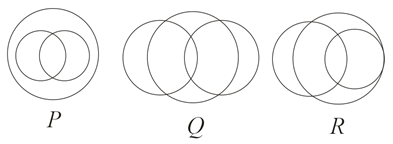
In a school, there are three types of games to be played. Some of the students play two types of games, but none play all the three games. Which Venn diagrams can justify the above statement?
It's clear from the options that none of them satisfy the condition " Some of the students play two types of games, but none play all the three games.".Since all of the venn diagrams have the $$P\ \cap Q\ \cap\ R$$ Region .So the answer is None of them.
If $$A = \{x \in R : |x-2| > 1\}$$, $$B = \{x \in R : \sqrt{x^2 - 3} > 1\}$$, $$C = \{x \in R : |x-4| \geq 2\}$$ and $$Z$$ is the set of all integers, then the number of subsets of the set $$(A \cap B \cap C)^c \cap Z$$ is _________.
We begin by translating each set description into interval form on the real number line.
For set $$A$$ we have the condition $$|x-2|>1$$. The definition of absolute value gives the equivalence
$$|x-2|>1 \;\Longrightarrow\; x-2<-1 \;\text{ or }\; x-2>1.$$
Simplifying each inequality,
$$x<1 \;\text{ or }\; x>3.$$
Hence
$$A=(-\infty,1)\cup(3,\infty).$$
For set $$B$$ the requirement is $$\sqrt{x^{2}-3}>1.$$ Because the square-root function is non-negative, we square both sides, knowing the direction of the inequality will not change:
$$\bigl(\sqrt{x^{2}-3}\bigr)^{2}>1^{2}\quad\Longrightarrow\quad x^{2}-3>1.$$
This rearranges to
$$x^{2}>4\quad\Longrightarrow\quad |x|>2.$$
Therefore
$$B=(-\infty,-2)\cup(2,\infty).$$
For set $$C$$ we are given $$|x-4|\ge 2$$. Using the same absolute-value definition,
$$|x-4|\ge 2 \;\Longrightarrow\; x-4\le-2 \;\text{ or }\; x-4\ge 2,$$
which simplifies to
$$x\le2 \;\text{ or }\; x\ge6.$$
Thus
$$C=(-\infty,2]\cup[6,\infty).$$
Now we find the intersection $$A\cap B$$. Writing the two interval unions together,
$$A=(-\infty,1)\cup(3,\infty),\qquad B=(-\infty,-2)\cup(2,\infty).$$
On the left half-line $$(-\infty,1)$$, the part common with $$B$$ is the portion further restricted by $$x<-2$$, giving $$(-\infty,-2).$$ On the right half-line $$(3,\infty)$$, every point already satisfies $$x>2$$, so the whole interval $$(3,\infty)$$ survives. Consequently
$$A\cap B=(-\infty,-2)\cup(3,\infty).$$
Next we intersect this result with $$C$$:
$$C=(-\infty,2]\cup[6,\infty).$$
The interval $$(-\infty,-2)$$ of $$A\cap B$$ obviously lies inside $$(-\infty,2]$$ of $$C$$, so it remains unchanged. The interval $$(3,\infty)$$ meets $$C$$ only where $$x\ge6$$, giving $$[6,\infty).$$ Therefore
$$A\cap B\cap C=(-\infty,-2)\cup[6,\infty).$$
We now form the complement of this set inside $$\mathbb R$$. Using the fact that the complement of a union is the union of complements, we remove both pieces from the real line:
$$\bigl(A\cap B\cap C\bigr)^{c}=\mathbb R\setminus\bigl((-\infty,-2)\cup[6,\infty)\bigr)=\,[ -2,6 ).$$
Here $$-2$$ is included because it was not in the intersection (the first interval was open at $$-2$$), while $$6$$ is excluded because it was contained in the intersection (the second interval was closed at $$6$$).
To finish, we intersect with $$Z$$, the set of all integers. The integers lying in $$[-2,6)$$ are
$$\{-2,-1,0,1,2,3,4,5\}.$$
We count their number:
$$n=8.$$
The question asks for the number of subsets of this finite set. A fundamental result of set theory states that a set with $$n$$ elements has $$2^{n}$$ distinct subsets (including the empty set and the set itself). Substituting $$n=8$$, we get
$$2^{8}=256.$$
So, the answer is $$256$$.
If $$A = \{x \in R : |x| < 2\}$$ and $$B = \{x \in R : |x - 2| \ge 3\}$$; then:
We have $$A=\{x\in\mathbb R:\;|x|<2\}.$$
The inequality $$|x|<2$$ means $$-2<x<2,$$ so
$$A=(-2,\,2).$$
Next, $$B=\{x\in\mathbb R:\;|x-2|\ge 3\}.$$
For any real number $$t$$ and positive constant $$c,$$ the rule
$$|t|\ge c \;\Longrightarrow\; t\ge c \;\text{or}\; t\le -c$$
applies. Putting $$t=x-2$$ and $$c=3$$, we get
$$x-2\ge 3 \;\text{or}\; x-2\le -3,$$
that is, $$x\ge 5 \;\text{or}\; x\le -1.$$
Hence
$$B=(-\infty,\,-1]\,\cup\,[5,\,\infty).$$
Let us check each option.
Option A: $$A\cap B$$ is the common part of $$(-2,2)$$ and $$(-\infty,-1]\cup[5,\infty).$$ The only overlap is $$(-2,-1],$$ so $$A\cap B=(-2,-1].$$ Option A claims $$(-2,-1)$$ (without the point $$-1$$), therefore Option A is wrong.
Option B: $$B-A$$ consists of elements in $$B$$ that are not in $$A=(-2,2).$$ Removing the piece $$(-2,-1]$$ from $$B$$ leaves
$$B-A=(-\infty,-2]\,\cup\,[5,\infty).$$
The complement of the open interval $$(-2,5)$$ in $$\mathbb R$$ is exactly
$$\mathbb R-(-2,5)=(-\infty,-2]\,\cup\,[5,\infty).$$
Thus $$B-A=\mathbb R-(-2,5),$$ matching Option B. So Option B is correct.
Option C: $$A\cup B=(-\infty,2)\cup[5,\infty),$$ which omits the point $$2.$$ Option C claims $$\mathbb R-(2,5)=(-\infty,2]\,\cup\,[5,\infty),$$ which does include $$2,$$ so Option C is incorrect.
Option D: $$A-B=(-2,2)-\bigl((-\infty,-1]\cup[5,\infty)\bigr)=(-1,2).$$ Option D states $$[-1,2),$$ which wrongly contains the point $$-1,$$ hence Option D is also incorrect.
Hence, the correct answer is Option B.
Let $$A, B, C$$ and $$D$$ be four non-empty sets. The contrapositive statement of "If $$A \subseteq B$$ and $$B \subseteq D$$, then $$A \subseteq C$$" is
We begin with the given conditional statement:
$$\text{If }A \subseteq B\text{ and }B \subseteq D,\text{ then }A \subseteq C.$$
This has the usual “If-then” logical structure. For clarity, let us assign symbols to the two parts of the statement:
$$P : A \subseteq B \text{ and } B \subseteq D,$$
$$Q : A \subseteq C.$$
So the original statement is of the form $$P \rightarrow Q.$$
Now we recall the logical rule for the contrapositive. For any implication $$P \rightarrow Q,$$ the contrapositive is obtained by negating both parts and reversing the direction:
$$P \rightarrow Q \;\; \text{is equivalent to} \;\; \lnot Q \rightarrow \lnot P.$$
Applying this rule, we first negate $$Q$$:
$$Q = A \subseteq C \quad\Longrightarrow\quad \lnot Q = A \nsubseteq C.$$
Next, we negate $$P$$. Since $$P$$ itself is a conjunction, we must use De Morgan’s law:
$$P = (A \subseteq B) \land (B \subseteq D).$$
According to De Morgan’s law, the negation of a conjunction is the disjunction of the negations:
$$\lnot P = \lnot\big[(A \subseteq B) \land (B \subseteq D)\big]$$
$$\phantom{\lnot P} = (A \nsubseteq B) \lor (B \nsubseteq D).$$
Combining these two results into the contrapositive form $$\lnot Q \rightarrow \lnot P,$$ we obtain:
$$\text{If }A \nsubseteq C,\text{ then }(A \nsubseteq B)\text{ or }(B \nsubseteq D).$$
Comparing this with the options given, we see it matches exactly with Option D.
Hence, the correct answer is Option D.
Let $$\bigcup_{i=1}^{50} X_i = \bigcup_{i=1}^{n} Y_i = T$$, where each $$X_i$$ contains 10 elements and each $$Y_i$$ contains 5 elements. If each element of the set $$T$$ is an element of exactly 20 of sets $$X_i$$'s and exactly 6 of sets $$Y_i$$'s then $$n$$ is equal to:
Let us denote the number of distinct elements in the union by $$|T|$$. We begin with the family $$\{X_1,X_2,\dots ,X_{50}\}$$.
Each set $$X_i$$ contains 10 elements, so the total of all ordered pairs “(set, element in that set)” contributed by the 50 sets equals
$$\sum_{i=1}^{50}|X_i| \;=\;50\times 10 \;=\;500.$$
However, the statement tells us that every single element of $$T$$ lies in exactly 20 of the $$X_i$$’s. Hence, if we count the same ordered pairs by first choosing an element of $$T$$ and then choosing the set $$X_i$$ that contains it, we obtain
$$20\times |T|.$$
Because both computations refer to the same collection of ordered pairs, they are equal. Therefore
$$20\times |T| = 500 \;\;\Longrightarrow\;\; |T|=\frac{500}{20}=25.$$
Now we turn to the family $$\{Y_1,Y_2,\dots ,Y_n\}$$. Each $$Y_i$$ has 5 elements, so the total number of ordered pairs “(set, element in that set)” here is
$$\sum_{i=1}^{n}|Y_i| \;=\;n\times 5 \;=\;5n.$$
Again, the problem states that every element of $$T$$ appears in exactly 6 of the $$Y_i$$’s. Counting by first picking an element and then one of the 6 sets that contain it gives
$$6\times |T| = 6\times 25 = 150.$$
Equating the two counts for the $$Y_i$$ family, we have
$$5n = 150 \;\;\Longrightarrow\;\; n = \frac{150}{5}=30.$$
Hence, the correct answer is Option D.
A survey shows that 73% of the persons working in an office like coffee, whereas 65% like tea. If $$x$$ denotes the percentage of them, who like both coffee and tea, then $$x$$ cannot be:
We are told that out of all employees in an office, $$73\%$$ like coffee and $$65\%$$ like tea. Let us denote by $$x\%$$ the employees who like both coffee and tea.
To connect these three percentages, we recall the Principle of Inclusion-Exclusion for two sets. For any two sets $$A$$ and $$B$$, it states
$$|A\cup B|=|A|+|B|-|A\cap B|.$$
In our context,
$$$|A|=73\%, \qquad |B|=65\%, \qquad |A\cap B|=x\%.$$$
Hence the percentage of employees who like at least one of the two beverages is
$$$|A\cup B| = 73 + 65 - x = 138 - x\;(\%).$$$
This quantity obviously cannot exceed the total population, which is $$100\%.$$ Therefore, we must have
$$138 - x \le 100.$$
Solving this simple linear inequality step by step, we move all the terms involving $$x$$ to one side:
$$$138 - x \le 100 \\ \Rightarrow -x \le 100 - 138 \\ \Rightarrow -x \le -38.$$$
Now dividing both sides by $$-1$$ (and remembering to reverse the inequality sign), we get
$$x \ge 38.$$
This is our lower bound: the overlap $$x\%$$ must be at least $$38\%.$$
Next, the overlap cannot exceed either of the individual percentages, because the intersection of two sets can never be larger than each set alone. Thus we have two more inequalities:
$$x \le 73 \quad\text{and}\quad x \le 65.$$
The tighter of these two upper bounds is $$65\%,$$ so altogether we have the admissible range
$$38 \le x \le 65.$$
Now we examine the four candidate values:
$$$\begin{aligned} \text{Option A: }&63 &&\text{lies between }38\text{ and }65\ (\text{allowed}),\\ \text{Option B: }&36 &&\text{is }<38\ (\text{not allowed}),\\ \text{Option C: }&54 &&\text{lies between }38\text{ and }65\ (\text{allowed}),\\ \text{Option D: }&38 &&\text{equals the lower bound }38\ (\text{allowed}).\\ \end{aligned}$$$
Thus the only percentage that violates the necessary condition is $$36\%.$$
Hence, the correct answer is Option B.
Let $$X = \{n \in N : 1 \le n \le 50\}$$. If $$A = \{n \in X : n \text{ is a multiple of } 2\}$$ and $$B = \{n \in X : n \text{ is a multiple of } 7\}$$, then the number of elements in the smallest subset of X, containing both A and B, is
We begin by fixing the universal set. By definition we have $$X=\{n\in\mathbb N:1\le n\le 50\}\,.$$ Thus every natural number from $$1$$ to $$50$$ is in $$X$$.
Next we describe the two given subsets. The first is
$$A=\{n\in X:n\text{ is a multiple of }2\}\,,$$
while the second is
$$B=\{n\in X:n\text{ is a multiple of }7\}\,.$$
The problem asks for the number of elements in the smallest subset of $$X$$ that contains both $$A$$ and $$B$$. The smallest set that contains two sets is simply their union, written $$A\cup B$$. Therefore we need to calculate the cardinality (number of elements) of $$A\cup B$$.
To find $$|A\cup B|$$ we use the Principle of Inclusion-Exclusion, which states
$$|A\cup B| = |A| + |B| - |A\cap B|.$$ Here $$|A|$$ is the number of multiples of $$2$$ in $$X$$, $$|B|$$ is the number of multiples of $$7$$ in $$X$$, and $$|A\cap B|$$ is the number of numbers that are multiples of both $$2$$ and $$7$$, that is, multiples of the least common multiple $$\operatorname{lcm}(2,7)=14$$.
We evaluate each term separately.
Counting |A|: A number is in $$A$$ exactly when it is of the form $$2k$$ with $$1\le 2k\le 50$$. Dividing the inequality by $$2$$ gives $$1\le k\le 25$$, so there are $$25$$ such integers. Hence $$|A|=25$$.
Counting |B|: A number is in $$B$$ exactly when it is of the form $$7m$$ with $$1\le 7m\le 50$$. Dividing by $$7$$ yields $$1\le m\le 7$$ (since $$7\times7=49\le50$$ but $$7\times8=56>50$$). Thus $$|B|=7$$.
Counting |A∩B|: A number lies in the intersection $$A\cap B$$ precisely when it is simultaneously a multiple of $$2$$ and of $$7$$, meaning it is a multiple of $$14$$. Write such a number as $$14r$$ with $$1\le 14r\le 50$$. Dividing by $$14$$ gives $$1\le r\le 3$$ (since $$14\times3=42$$ is allowed but $$14\times4=56>50$$). Therefore $$|A\cap B|=3$$.
Now we substitute these counts into the inclusion-exclusion formula:
$$|A\cup B| = 25 + 7 - 3 = 29.$$
This number $$29$$ is the size of the smallest subset of $$X$$ that contains every element of both $$A$$ and $$B$$.
So, the answer is $$29$$.
Set $$A$$ has $$m$$ elements and set $$B$$ has $$n$$ elements. If the total number of subsets of $$A$$ is 112 more than the total number of subsets of $$B$$, then the value of $$m \cdot n$$ is___.
We have two finite sets, set $$A$$ with $$m$$ elements and set $$B$$ with $$n$$ elements.
First, we state the basic formula: for any set containing $$r$$ elements, the total number of its subsets is $$2^{\,r}$$. This is because each element can be either “chosen” or “not chosen”, giving two possibilities per element and hence $$2 \times 2 \times \dots \times 2 = 2^{\,r}$$ possibilities in all.
Applying this formula to the two given sets, the number of subsets of $$A$$ is $$2^{\,m}$$ and the number of subsets of $$B$$ is $$2^{\,n}$$.
We are told that
$$2^{\,m} = 2^{\,n} + 112.$$
To handle the difference of two powers of two, we isolate the common factor $$2^{\,n}$$ on the right hand side. Subtracting $$2^{\,n}$$ from both sides and then factoring gives
$$2^{\,m} - 2^{\,n} = 112 \quad\Longrightarrow\quad 2^{\,n}\bigl(2^{\,m-n} - 1\bigr) = 112.$$
Let us introduce a new positive integer $$k$$ defined by $$k = m - n$$. Because $$m > n$$ gives a positive difference, we have $$k \ge 1$$. Substituting $$k$$ into the previous expression, we get
$$2^{\,n}\bigl(2^{\,k} - 1\bigr) = 112.$$
The integer $$112$$ can be written in its prime-factor form:
$$112 = 16 \times 7 = 2^{4} \times 7.$$
This factorisation tells us that any power of two dividing $$112$$ must be at most $$2^{4}$$, so we must have $$2^{\,n} \le 2^{4}$$ and therefore $$n \le 4$$ (since $$n$$ is a non-negative integer).
Now we test each possible value of $$n$$ from $$0$$ to $$4$$, computing the corresponding value of $$2^{\,k} - 1$$ and checking whether it is an integer power of two.
• If $$n = 0$$, then $$2^{\,n} = 1$$ and
$$1\bigl(2^{\,k} - 1\bigr) = 112 \;\Longrightarrow\; 2^{\,k} - 1 = 112 \;\Longrightarrow\; 2^{\,k} = 113,$$ which is not a power of two. So $$n = 0$$ is impossible.
• If $$n = 1$$, then $$2^{\,n} = 2$$ and
$$2\bigl(2^{\,k} - 1\bigr) = 112 \;\Longrightarrow\; 2^{\,k} - 1 = 56 \;\Longrightarrow\; 2^{\,k} = 57,$$ and $$57$$ is not a power of two. So $$n = 1$$ is impossible.
• If $$n = 2$$, then $$2^{\,n} = 4$$ and
$$4\bigl(2^{\,k} - 1\bigr) = 112 \;\Longrightarrow\; 2^{\,k} - 1 = 28 \;\Longrightarrow\; 2^{\,k} = 29,$$ but $$29$$ is not a power of two. So $$n = 2$$ is impossible.
• If $$n = 3$$, then $$2^{\,n} = 8$$ and
$$8\bigl(2^{\,k} - 1\bigr) = 112 \;\Longrightarrow\; 2^{\,k} - 1 = 14 \;\Longrightarrow\; 2^{\,k} = 15,$$ and $$15$$ is not a power of two. So $$n = 3$$ is impossible.
• If $$n = 4$$, then $$2^{\,n} = 16$$ and
$$16\bigl(2^{\,k} - 1\bigr) = 112 \;\Longrightarrow\; 2^{\,k} - 1 = 7 \;\Longrightarrow\; 2^{\,k} = 8.$$
Because $$8 = 2^{3}$$ is indeed a power of two, this case works with $$k = 3$$. Therefore
$$m - n = k = 3 \;\Longrightarrow\; m = n + 3 = 4 + 3 = 7.$$
Now that we have $$m = 7$$ and $$n = 4$$, we compute the required product:
$$m \cdot n = 7 \times 4 = 28.$$
So, the answer is $$28$$.
Let A, B and C be sets such that $$\phi \neq A \cap B \subseteq C$$. Then which of the following statements is not true?
We are told that the three sets A, B and C satisfy the double condition $$\phi \neq A \cap B \subseteq C.$$ This means two things at once:
1. $$A \cap B \neq \phi,$$ so at least one element lies in both A and B.
2. Every element that is in $$A \cap B$$ is also in C, that is $$A \cap B \subseteq C.$$
With these facts in hand we now examine each of the four given statements and check whether it must always be true. The statement that fails will be the one that is not true.
Option A. We want to know whether $$B \cap C \neq \phi.$$
Because $$A \cap B \neq \phi,$$ choose an element $$x$$ such that $$x \in A \cap B.$$ From $$x \in A \cap B \subseteq C$$ we immediately obtain $$x \in C.$$ Therefore $$x \in B$$ and $$x \in C$$ at the same time, whence $$x \in B \cap C.$$ Thus $$B \cap C$$ definitely contains at least one element, so $$B \cap C \neq \phi.$$ Option A is always true.
Option B. The expression is $$(C \cup A)\, \cap\, (C \cup B).$$ First recall the standard distributive law of sets:
$$ (X \cup Y) \cap (X \cup Z) \;=\; X \cup (Y \cap Z). $$
Take $$X = C,\; Y = A,\; Z = B.$$ Applying the formula gives
$$ (C \cup A) \cap (C \cup B) \;=\; C \cup (A \cap B). $$
We already know that $$A \cap B \subseteq C,$$ so the union of C with a subset of C is just C itself:
$$ C \cup (A \cap B) = C. $$
Hence the equality in Option B holds for every such triple of sets, so Option B is true.
Option C. We are asked to test the implication
$$ (A - B) \subseteq C \;\Longrightarrow\; A \subseteq C. $$
First write A as the disjoint union of two parts:
$$ A = (A - B)\; \cup\; (A \cap B). $$
If we are given that $$A - B \subseteq C$$ and we already know $$A \cap B \subseteq C,$$ then every element of the left-hand set and every element of the right-hand set lies in C, so their union A also lies in C. Therefore $$A \subseteq C,$$ and Option C is always true.
Option D. Now consider the implication
$$ (A - C) \subseteq B \;\Longrightarrow\; A \subseteq B. $$
Again decompose A, this time relative to C:
$$ A = (A - C)\; \cup\; (A \cap C). $$
The assumption in the hypothesis tells us only that $$A - C \subseteq B.$$ Nothing in the premise gives any information about $$A \cap C,$$ so those elements could fail to belong to B. Hence A may or may not be contained in B; the implication is not guaranteed.
To make this completely concrete, define
$$A = \{1,2\},\quad B = \{1\},\quad C = \{1,2\}.$$
Then
• $$A \cap B = \{1\} \neq \phi,$$ and clearly $$\{1\} \subseteq C,$$ so the initial condition is satisfied.
• Because every element of A is already in C, we have $$A - C = \phi,$$ and the empty set is always a subset of every set, so $$A - C \subseteq B$$ is true.
• However, $$A = \{1,2\}$$ is not a subset of $$B = \{1\},$$ since 2 does not lie in B.
This counter-example shows that the implication in Option D can fail, so Option D is not always true.
Among the four statements the only one that does not hold in every case is Option D.
Hence, the correct answer is Option D.
If $$A, B$$ and $$C$$ are three sets such that $$A \cap B = A \cap C$$ and $$A \cup B = A \cup C$$, then