Join WhatsApp Icon JEE WhatsApp Group

JEE Thermodynamics Questions

Question 1 JEE Advanced

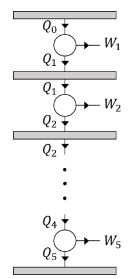
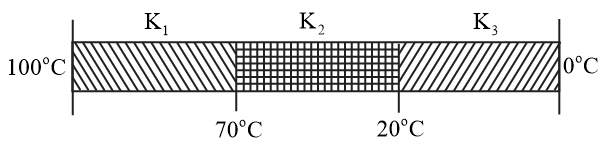
As shown in the figure, five Carnot engines, each with efficiency $$\eta$$ and same number of cycles per unit time, are operating between six heat reservoirs. The amount of heat released per cycle by one engine is completely absorbed by the next engine. Consider $$Q_0$$ to be the amount of heat absorbed per cycle by the first engine and $$W$$ as the amount of total work done by all the engines per cycle, then the net efficiency of the system is found to be $$\eta_{\text{net}}=\dfrac{W}{Q_0}=\dfrac{211}{243}$$. The value of $$\eta$$ is:

image
Question 2 JEE Advanced

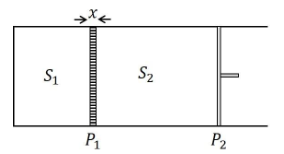
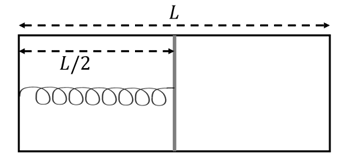
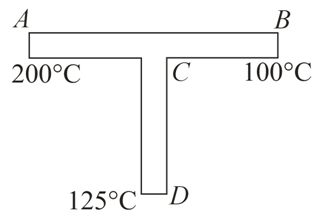
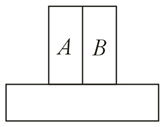
As shown in the figure, an insulated container is fitted with a thermally conducting but immovable partition ($$P_1$$) and a freely movable but thermally insulated piston ($$P_2$$). The partition $$P_1$$ with thermal conductivity $$K$$, cross sectional area $$A$$ and width $$x$$ divides the container into two sections, $$S_1$$ and $$S_2$$, each containing one mole of a monoatomic gas. The piston $$P_2$$ moves freely such that the gas in $$S_2$$ is always at the atmospheric pressure. Initially, the difference between the temperatures of $$S_1$$ and $$S_2$$ is $$\Delta T_0$$. The time it takes for the temperature difference to become $$\dfrac{\Delta T_0}{2}$$ is $$nxR/KA$$, where $$R$$ is the universal gas constant. The value of $$n$$ is:

[ Given: $$\ln 2\approx 0.7$$ ]

image
Question 3 JEE Mains

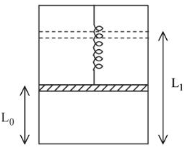
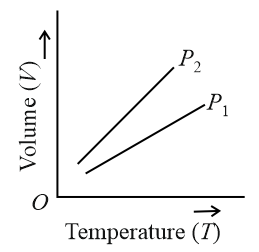
A cylinder with adiabatic walls is closed at both ends and is divided into two compartments by a frictionless adiabatic piston. Ideal gas is filled in both (left and right) the compartments at same P, V, T. Heating is started from left side until pressure changes to $$27 P/8$$. If initial volume of each compartment was 9 litres then the final volume in right-hand side compartment is __________ litres. (for this ideal gas $$C_P/C_V = 1.5$$)

Question 4 JEE Mains

Given below are two statements: one is labelled as Assertion A and the other is labelled as Reason R.
Statement I: Change in internal energy of a system containing $$n$$ mole of ideal gas can be written as $$\Delta U = n C_v (T_f - T_i) = \frac{nR}{\gamma - 1}(T_f - T_i)$$, where $$\gamma = \frac{C_p}{C_v}$$, $$T_i$$ = initial temperature, $$T_f$$ = final temperature.
Statement II: Relation between degree of freedom $$f$$ and $$ \gamma$$ (= $$C_p/C_v$$) is $$\left(\gamma = 1 + \frac{2}{f}\right)$$.
Choose the correct answer from the options given below

Question 5 JEE Mains

Consider the following statements:
A. Zeroth law of thermodynamics gives concept of temperature
B. First law of thermodynamics gives concept of internal energy
C. In isothermal expansion of ideal gas, $$\Delta Q \neq \Delta W$$
D. Product of intensive and extensive variables is extensive
E. The ratio of any extensive variable to mass will be an extensive variable
Choose the correct combination of statements from the options given below:

Question 6 JEE Mains

Given below are two statements: one is labelled as Assertion A and the other is labelled as Reason R

Assertion A: If the average kinetic energy of H$$_2$$ and O$$_2$$ molecules, kept in two different sized containers are same, then their temperatures will be same.

Reason R: The r.m.s. speed of H$$_2$$ and O$$_2$$ molecules are same at same temperature.
Choose the correct answer from the options given below : 

Question 7 JEE Mains

Heat is supplied to a diatomic gas at constant pressure. Then the ratio of $$\Delta Q : \Delta U : \Delta W$$ is __________.

Question 8 JEE Mains

A mixture of carbon dioxide and oxygen has volume 8310 cm$$^3$$, temperature 300 K, pressure 100 kPa and mass 13.2 g. The number of moles of carbon dioxide and oxygen gases in the mixture respectively are _____.
(Assume both gases behave like ideal gases) [$$R = 8.31$$ J/mol.K]

Question 9 JEE Mains

An ideal gas at pressure $$P$$ and temperature $$T$$ is expanding such that $$PT^3 = \text{constant}$$. The coefficient of volume expansion of the gas is :

Question 10 JEE Mains

If 2 mole of an ideal monoatomic gas at temperature $$T$$, is mixed with 6 mole of another ideal monoatomic gas at temperature $$2T$$ then the temperature of mixture is :

Question 11 JEE Mains

One gas of $$n_1$$ mole of molecules at temperature $$T_1$$, volume $$V_1$$, and pressure $$P_1$$, and another gas of $$n_2$$ mole of molecules at temperature $$T_2$$, volume $$V_2$$, and pressure $$P_2$$, are mixed resulting in pressure $$P$$ and volume $$V$$ of the mixture. The temperature of the mixture is :

Question 12 JEE Mains

One mole of diatomic gas having rotational modes only is kept in a cylinder with a piston system. The cross-section area of the cylinder is 4 cm$$^2$$. The gas is heated slowly to raise the temperature by 1.2 $$^\circ$$C during which the piston moves by 25 mm. The amount of heat supplied to the gas is __________ J. (Atmospheric pressure = 100 kPa, $$R = 8.3$$ J/mol. K) (Neglect mass of the piston)

Question 13 JEE Mains

The r.m.s. speed of oxygen molecules at $$47^\circ$$ is equal to that of the hydrogen molecules kept at ________ $$C^\circ$$. (Mass of oxygen molecule/mass of hydrogen molecule = 32/2)

Question 14 JEE Mains

Two closed vessels of same volume are joined through a narrow tube and both vessels are filled with air of pressure 90 kPa and temperature 400 K. Keeping the temperature of one vessel constant at 400 K the second vessel temperature is raised to 500 K. The final pressure in the vessels is _______ kPa.

Question 15 JEE Mains

An ideal gas undergoes a process maintaining relation between pressure $$(P)$$ and volume $$(V)$$ as $$P = P_0\left(1 + \left(\frac{V_0}{V}\right)^2\right)^{-1}$$, where $$P_0$$ and $$V_0$$ are constants. If two samples A and B (two moles each) with initial volumes $$V_0$$ and $$3V_0$$ respectively undergo above mentioned process and attain same pressure, then the difference of the temperatures of these samples, $$T_B - T_A$$ is : 

(R = gas constant)

Question 16 JEE Mains

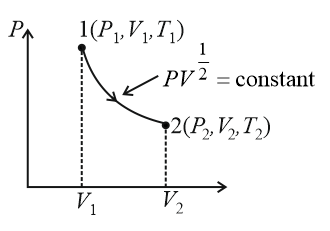
Initial pressure and volume of a monoatomic ideal gas are $$P$$ and $$V$$. The change in internal energy of this gas in adiabatic expansion to volume $$V_{final} = 27V$$ is __________ J.

Question 17 JEE Mains

The mean free path of a molecule of diameter $$5\times 10^{-10}m$$ at the temperature 41 °C and pressure $$1.38\times 10^{5} Pa$$, is given as ___ m (Given $$k_{B}=1.38\times 10^{-23}J/K$$.)

Question 18 JEE Mains

When 300 J of heat given to an ideal gas with $$C_{p}= \frac{7}{2}R$$ its temperature raises from $$20^{\circ}C$$ to $$50^{\circ}C$$ keeping its volume constant. The millimoles of the gas is (approximately) __ . (R = 8.314 J/mol.K)

Question 19 JEE Mains

A vessel contains 0.15 m$$^3$$ of a gas at pressure 8 bar and temperature 140 °C with $$c_p = 3R$$ and $$c_v = 2R$$. It is expanded adiabatically till pressure falls to 1 bar. The work done during this process is __________ kJ. (R is gas constant)

Question 20 JEE Mains

An insulated cylinder of volume $$60cm^{3}$$ is filled with a gas at $$27 ^{\circ}C$$ and 2 atmospheric pressure. Then the gas is compressed making the final volume as $$20cm^{3}$$ while allowing the temperature to rise to $$77 ^{\circ}C$$. The final pressure is ___________ atmospheric pressure.

Question 21 JEE Mains

The heat extracted out of x gram of water initialy at  $$50°$$C to  cool it down to $$0°$$C is sufficient to evaporate  $$(1000 - x)$$ gram  of water also initialy at $$50°$$C. The value of $$x$$ (closest integer) is_______.  (Take Latent heat of water  $$L = 2256$$ kJ/kg K, specific heat capacity of water $$c = 4200$$ J/kg·K)

Question 22 JEE Mains

5 moles of unknown gas is heated at constant volume from 10 °C to 20 °C. The molar specific heat of this gas at constant pressure $$c_p = 8$$ cal/mol.°C and $$R = 8.36$$ J/mol.°C. The change in internal energy of the gas is _________ calorie.

Question 23 JEE Mains

A certain gas is isothermally compressed to $$\left(\frac{1}{3}\right)^{rd}$$ of its initial volume ($$V_0 = 3$$ litre) by applying required pressure. If the bulk modulus of the gas is $$3 \times 10^5$$ N/m$$^2$$, the magnitude of work done on the gas is _______ J.

Question 24 JEE Advanced

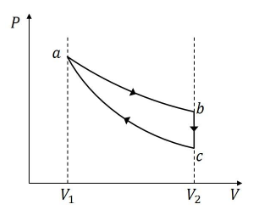
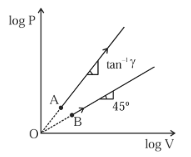
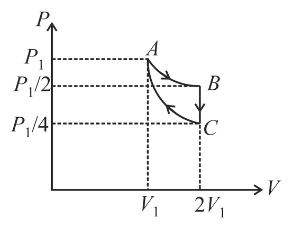
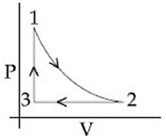
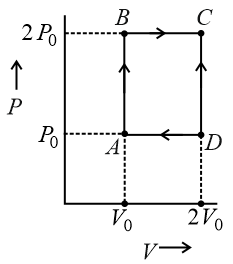
A quasi-static cycle of a monoatomic ideal gas contains an isothermal process ($$\boldsymbol{ab}$$), followed by an isochoric process ($$\boldsymbol{bc}$$) and an adiabatic process ($$\boldsymbol{ca}$$) as shown in the figure. The volumes of the gas are $$V_1$$ and $$V_2$$ at $$\boldsymbol{a}$$ and $$\boldsymbol{b}$$, respectively. If the cycle has heat input $$Q_{\text{in}}$$ and output $$Q_{\text{out}}$$, then the efficiency of the cycle is defined as $$\eta=\dfrac{Q_{\text{in}}-Q_{\text{out}}}{Q_{\text{in}}}$$. The correct statement(s) is(are):

[Given: $$\ln 2\approx 0.7$$]

image
Question 25 JEE Advanced

Ten moles of an ideal monatomic gas, initially in state $$\boldsymbol{a}$$ at atmospheric pressure and temperature $$T_a=27^\circ\mathrm{C}$$, is enclosed in a metal cylinder of volume $$V_0$$ fitted with a frictionless piston. The gas is suddenly compressed to state $$\boldsymbol{b}$$ with volume $$V_0/3$$. Now, keeping the piston stationary, the cylinder is submerged in a water bath of temperature $$11^\circ\mathrm{C}$$ until the gas reaches the temperature of the water bath, which is denoted as state $$\boldsymbol{c}$$. Finally, while still in the water bath, the piston is brought slowly to its initial position, which is denoted as state $$\boldsymbol{f}$$. If $$R$$ is universal gas constant, then the correct option(s) is/are:

[Given: $$9^{1/3}=2.08$$]