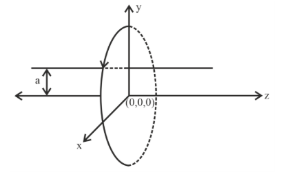
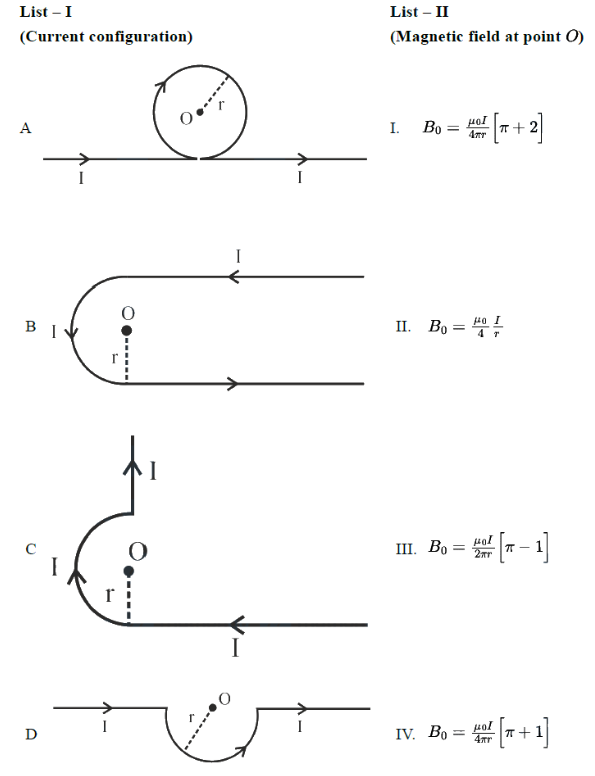
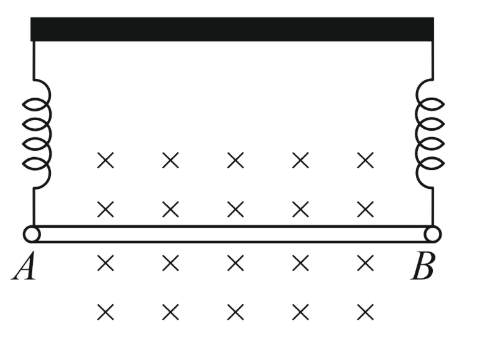
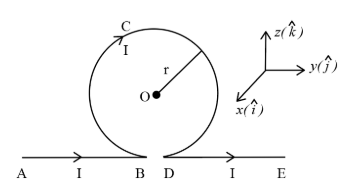
A 5 mg particle carrying a charge of $$5\pi \times 10^{-6}$$ C is moving with velocity of $$(3\hat{i} + 2\hat{k}) \times 10^{-2}$$ m/s in a region having magnetic field $$\vec{B} = 0.1 \hat{k}$$ Wb/m$$^2$$. It moves a distance of $$a$$ meter along $$\hat{k}$$ when it completes 5 revolutions. The value of $$a$$ is __________.
- Home
- >
- JEE Questions
- >
- JEE Physics Questions
- >
- Magnetism & Magnetic Materials
JEE Magnetism & Magnetic Materials Questions
Velocity has components:
parallel to B (along k):
v∥ = 2 × 10⁻² m/s
perpendicular to B (in i direction):
v⊥ = 3 × 10⁻² m/s
motion is helical
time period:
$$T=\frac{2\pi m}{qB}$$
given:
m = 5 mg = 5 × 10⁻⁶ kg
q = 5π × 10⁻⁶ C
B = 0.1
$$T=\frac{2\pi\times5\times10^{-6}}{5\pi\times10^{-6}\times0.1}=\frac{2}{0.1}=20\text{ s}$$
time for 5 revolutions:
$$t=5T=100\text{ s}$$
distance along k:
$$a=v∥\times t=2\times10^{-2}\times100=2$$
An electron with mass 'm' with an initial velocity $$(t = 0)$$ $$\vec{v} = v_0\hat{i}$$ $$(v_0 \gt 0)$$ enters a magnetic field $$\vec{B} = B_0\hat{j}$$. If the initial de-Broglie wavelength at $$t = 0$$ is $$\lambda_0$$ then its value after time 't' would be :
The de-Broglie wavelength of a particle is defined as
$$\lambda = \frac{h}{p} = \frac{h}{m\,v}$$
where $$v$$ is the magnitude (speed) of the velocity vector.
At $$t = 0$$ the electron has velocity $$\vec v_0 = v_0\hat i$$ and de-Broglie wavelength $$\lambda_0 = \dfrac{h}{m\,v_0}$$.
After entering the magnetic field $$\vec B = B_0\hat j$$ the electron experiences the Lorentz force
$$\vec F = q\,\vec v \times \vec B$$
For an electron, $$q = -e$$ (magnitude $$e$$). At any instant the velocity has an $$\hat i$$ component only, so
$$\vec F = (-e)\,(v_x\hat i)\times (B_0\hat j) = -e\,v_x B_0\,(\hat i \times \hat j) = -e\,v_x B_0\,\hat k$$
The force is always perpendicular to the instantaneous velocity.
Since $$\vec F \perp \vec v$$, the magnetic force does no work:
$$\text{Power} = \vec F\cdot\vec v = 0$$
Hence the kinetic energy $$\frac12 m v^2$$ remains constant, so the speed $$v$$ of the electron stays equal to its initial value $$v_0$$ for all time.
Because the speed (and therefore the magnitude of momentum $$p = m v$$) is constant, the de-Broglie wavelength also stays constant:
$$\lambda = \frac{h}{m v} = \frac{h}{m v_0} = \lambda_0$$
Thus, after any time $$t$$, the wavelength is still $$\lambda_0$$.
Final answer: $$\lambda_0$$ → Option D
An electron projected perpendicular to a uniform magnetic field B moves in a circle. If Bohr's quantization is applicable, then the radius of the electronic orbit in the first excited state is :
When an electron is projected perpendicular to a uniform magnetic field $$B$$, it moves in a circular path due to the magnetic force acting as the centripetal force. The force balance equation is given by:
$$ e v B = \frac{m v^2}{r} $$
where $$e$$ is the charge of the electron, $$v$$ is its speed, $$m$$ is its mass, and $$r$$ is the radius of the circular path. Simplifying this equation:
$$ e B = \frac{m v}{r} $$
Rearranging, we get:
$$ m v = e B r \quad \text{(1)} $$
Bohr's quantization condition states that the angular momentum is quantized and given by:
$$ m v r = n \frac{h}{2\pi} \quad \text{(2)} $$
where $$n$$ is the principal quantum number and $$h$$ is Planck's constant. The first excited state corresponds to $$n = 2$$ (since the ground state is $$n = 1$$). Substituting $$n = 2$$ into equation (2):
$$ m v r = 2 \times \frac{h}{2\pi} = \frac{h}{\pi} \quad \text{(3)} $$
We now have two equations: equation (1) $$m v = e B r$$ and equation (3) $$m v r = \frac{h}{\pi}$$. Substituting equation (1) into equation (3):
$$ (e B r) \times r = \frac{h}{\pi} $$
Simplifying:
$$ e B r^2 = \frac{h}{\pi} $$
Solving for $$r^2$$:
$$ r^2 = \frac{h}{\pi e B} $$
Taking the square root of both sides:
$$ r = \sqrt{\frac{h}{\pi e B}} $$
This is the radius of the electronic orbit in the first excited state. Comparing with the given options, this expression matches option A, $$\sqrt{\frac{h}{\pi eeB}}$$, when interpreted as $$\sqrt{\frac{h}{\pi e B}}$$ (considering "ee" as a typographical error for "e").
Thus, the correct option is A.
Given below are two statements:one is labelled as Assertion A and the other is labelled as Reason R.
Assertion A: If oxygen ion ($$O^{-2}$$) and Hydrogen ion ($$H^+$$) enter normal to the magnetic field with equal momentum, then the path of $$O^{-2}$$ ion has a smaller curvature than that of $$H^+$$.
Reason R: A proton with same linear momentum as an electron will form a path of smaller radius of curvature on entering a uniform magnetic field perpendicularly.
In the light of the above statement,Choose the correct answer from the options given below.
When a charged particle of charge $$q$$ and linear momentum $$p$$ enters a uniform magnetic field $$\mathbf{B}$$ perpendicular to the field, the magnetic force $$|q|vB$$ provides the required centripetal force $$\dfrac{mv^{2}}{r}$$.
Substituting $$p = mv$$ and $$v = \dfrac{p}{m}$$, the radius (called radius of curvature) is obtained as
$$r = \dfrac{p}{|q|B}$$ $$-(1)$$
Case 1: Oxide ion $$O^{2-}$$ versus proton $$H^{+}$$
For $$O^{2-}: |q| = 2e \quad(\text{two electronic charges})$$
For $$H^{+}: |q| = e$$
Both ions are given to have the same momentum $$p$$ and the same field $$B$$, so using $$(1)$$:
$$r_{O^{2-}} = \dfrac{p}{2eB}, \qquad r_{H^{+}} = \dfrac{p}{eB} = 2\,r_{O^{2-}}$$
Thus $$r_{O^{2-}} \lt r_{H^{+}}$$, i.e. the oxide ion describes a circle of smaller radius (larger bending) than the proton. Consequently its curvature radius is smaller. Hence Assertion A is correct.
Case 2: Proton versus electron with the same linear momentum
For a proton $$|q_p| = e$$ and for an electron $$|q_e| = e$$. With equal momenta $$p$$, equation $$(1)$$ gives
$$r_p = \dfrac{p}{eB}, \qquad r_e = \dfrac{p}{eB}$$
The radii are identical; the proton does not form a path of smaller radius than the electron. Therefore Reason R is false.
Conclusion: Assertion A is true, Reason R is false. The correct choice is Option A.
A current of $$5\,A$$ exists in a square loop of side $$\frac{1}{\sqrt{2}}\,m.$$ Then the magnitude of the magnetic field $$B$$ at the centre of the square loop will be $$p \times10^{-6}\,T,$$ where value of $$p$$ is $$\underline{\hspace{2cm}}.$$ $$\left[\mu_0=4\pi\times10^{-7}\,TmA^{-1}\right] $$
The magnetic field at the centre of a square loop carrying current can be found by applying the Biot-Savart law to one side and then using symmetry. Given that I = 5 A, a = 1/√2 m and μ₀ = 4π×10⁻⁷ T m A⁻¹, consider a single straight segment of the loop. For a finite straight wire the field at a perpendicular distance d, subtending angles θ₁ and θ₂ at the observation point, is $$B_{\text{wire}} = \frac{\mu_0 I}{4\pi d}(\sin\theta_1 + \sin\theta_2).$$ In our square loop the distance from the centre to each side is d = a/2, and each side subtends equal angles θ₁ = θ₂ = 45° at the centre. Substituting these values gives $$B_1 = \frac{\mu_0 I}{4\pi\,(a/2)}\bigl(\sin45°+\sin45°\bigr) = \frac{\mu_0 I}{2\pi a}\times\frac{2}{\sqrt2} = \frac{\sqrt2\,\mu_0 I}{2\pi a}.$$ By symmetry all four sides contribute equally and their fields add in the same direction, so the total field is $$B = 4B_1 = 4\;\frac{\sqrt2\,\mu_0 I}{2\pi a} = \frac{2\sqrt2\,\mu_0 I}{\pi a}.$$ Substituting I = 5 A, a = 1/√2 m and μ₀ = 4π×10⁻⁷ T m A⁻¹ yields $$B = \frac{2\sqrt2\times4\pi\times10^{-7}\times5}{\pi\times(1/\sqrt2)}.$$ The π factors cancel, giving $$B = \frac{2\sqrt2\times4\times5\times10^{-7}}{1/\sqrt2} = 40\sqrt2\times10^{-7}\times\sqrt2 = 40\times2\times10^{-7} = 8\times10^{-6}\text{ T}.$$ Therefore, the magnetic field at the centre of the square loop is $$B = 8\times10^{-6}\text{ T},$$ and the required value of p is 8.
A particle of charge 1.6 $$\mu$$C and mass 16 $$\mu$$g is present in a strong magnetic field of $$6.28 T$$. The particle is then fired perpendicular to magnetic field. The time required for the particle to return to original location for the first time is ______ s. ($$\pi = 3.14$$)
When a charged particle is fired perpendicular to a uniform magnetic field, it traces a circular path. The time required for the particle to return to its original location for the first time is exactly the time period of this circular motion.
The magnetic force provides the centripetal force: $$qvB = \frac{mv^{2}}{r}$$
This gives the radius $$r = \frac{mv}{qB}$$.
The time period is $$T = \frac{2\pi r}{v} = \frac{2\pi m}{qB}$$
The time period does not depend on the speed of the particle.
Substituting into the time period formula:
$$T = \frac{2 \times 3.14 \times 16 \times 10^{-6}}{1.6 \times 10^{-6} \times 6.28}$$
$$T = \frac{100.48 \times 10^{-6}}{10.048 \times 10^{-6}} = \frac{100.48}{10.048} = 10 \text{ s}$$
So, the answer is $$10$$.
A proton is moving undeflected in a region of crossed electric and magnetic fields at a constant speed of $$2 \times 10^{5} ms^{-1}$$. When the electric field is switched off, the proton moves along a circular path of radius 2 cm .The magnitude of electric field is $$x\times 10^{4} N/C$$. The value of x is________Take the mass of the proton $$1.6\times 10^{-27}kg$$
We are told a proton moves undeflected in crossed electric and magnetic fields at $$v = 2 \times 10^5$$ m/s. When the electric field is switched off, the proton moves in a circle of radius $$r = 2$$ cm. We need to find the electric field.
Condition for undeflected motion in crossed fields
When a charged particle moves undeflected through crossed electric and magnetic fields, the electric force and magnetic force balance each other:
$$qE = qvB$$
$$E = vB \quad \ldots (1)$$
Find $$B$$ from the circular motion when $$E$$ is switched off
When the electric field is switched off, only the magnetic force acts, providing the centripetal force for circular motion:
$$qvB = \frac{mv^2}{r}$$
$$B = \frac{mv}{qr} \quad \ldots (2)$$
Substituting given values ($$m = 1.6 \times 10^{-27}$$ kg, $$v = 2 \times 10^5$$ m/s, $$q = 1.6 \times 10^{-19}$$ C, $$r = 2$$ cm $$= 0.02$$ m):
$$B = \frac{1.6 \times 10^{-27} \times 2 \times 10^5}{1.6 \times 10^{-19} \times 0.02}$$
$$B = \frac{3.2 \times 10^{-22}}{3.2 \times 10^{-21}} = \frac{1}{10} = 0.1 \text{ T}$$
Calculate the electric field using equation (1)
$$E = vB = 2 \times 10^5 \times 0.1 = 2 \times 10^4 \text{ N/C}$$
Therefore, $$x = 2$$.
The answer is 2.
A tightly wound long solenoid carries a current of $$1.5\,A.$$ An electron is executing uniform circular motion inside the solenoid with a time period of $$75\,ns.$$ The number of turns per metre in the solenoid is $$\underline{\hspace{1cm}}.$$ [Take mass of electron $$m_e=9\times10^{-31}\,kg,$$ change of electron $$|q_e|=1.6\times10^{-19}\,$$ $$C,$$ $$\mu_0=4\pi\times10^{-7}\,N$$ $$A^{-2},\,1\,ns=10^{-9}\,s]$$
$$T = \frac{2\pi m_e}{|q_e| \mu_0 n I}$$
$$75 \times 10^{-9} = \frac{(2\pi)(9 \times 10^{-31})}{1.6 \times 10^{-19} \times 4\pi \times 10^{-7} \times n \times 1.5}$$
$$75 \times 10^{-9} = \frac{9 \times 10^{-31}}{1.6 \times 10^{-19} \times 2 \times 10^{-7} \times n \times 1.5}$$
$$75 \times 10^{-9} = \frac{9 \times 10^{-31}}{4.8 \times 10^{-26} \times n} \implies n = 250\text{ m}^{-1}$$
A $$2 \text{ A}$$ current carrying straight metal wire of resistance $$1\Omega$$, resistivity $$2 \times 10^{-6}\Omega\text{m}$$, area of cross-section $$10 \text{ mm}^2$$ and mass $$500 \text{ g}$$ is suspended horizontally in mid air by applying a uniform magnetic field $$\vec{B}$$. The magnitude of $$B$$ is ______ $$\times 10^{-1} \text{ T}$$ (given, $$g = 10 \text{ m/s}^2$$).
Given: Current $$I = 2$$ A, resistance $$R = 1\Omega$$, resistivity $$\rho = 2 \times 10^{-6} \Omega$$m, area $$A = 10$$ mm$$^2 = 10 \times 10^{-6}$$ m$$^2$$, and mass $$m = 500$$ g = 0.5 kg.
First, we find the length of the wire using the relation $$R = \frac{\rho L}{A}$$ which gives $$L = \frac{RA}{\rho} = \frac{1 \times 10 \times 10^{-6}}{2 \times 10^{-6}} = 5 \text{ m}$$.
Next, the magnetic force must balance the weight of the wire, so $$BIL = mg$$ and hence $$B = \frac{mg}{IL} = \frac{0.5 \times 10}{2 \times 5} = \frac{5}{10} = 0.5 \text{ T}$$.
Therefore, $$B = 0.5$$ T $$= 5 \times 10^{-1}$$ T.
The answer is 5.
A circular coil having 200 turns, $$2.5 \times 10^{-4} \text{ m}^2$$ area and carrying $$100\mu\text{A}$$ current is placed in a uniform magnetic field of 1T. Initially the magnetic dipole moment $$(\vec{M})$$ was directed along $$\vec{B}$$. Amount of work, required to rotate the coil through $$90°$$ from its initial orientation such that $$\vec{M}$$ becomes perpendicular to $$\vec{B}$$, is _______ $$\mu$$J.
A circular coil with 200 turns, area $$2.5 \times 10^{-4}$$ m² carrying $$100 \mu$$A current is in a uniform magnetic field of 1 T. We need the work to rotate it 90° from aligned to perpendicular orientation.
The magnetic dipole moment is $$M = NIA = 200 \times 100 \times 10^{-6} \times 2.5 \times 10^{-4}$$ which gives $$M = 200 \times 10^{-4} \times 2.5 \times 10^{-4} = 5 \times 10^{-6} \text{ A m}^2$$.
The potential energy of a magnetic dipole in a field is $$U = -MB\cos\theta$$. Initially ($$\theta = 0°$$), $$U_i = -MB\cos 0° = -MB$$ and finally ($$\theta = 90°$$), $$U_f = -MB\cos 90° = 0$$.
Therefore the work done is $$W = U_f - U_i = 0 - (-MB) = MB$$ which equals $$W = 5 \times 10^{-6} \times 1 = 5 \times 10^{-6} \text{ J} = 5 \text{ }\mu\text{J}$$.
The answer is $$\boxed{5}$$ $$\mu$$J.
A moving coil galvanometer has 100 turns and each turn has an area of $$2.0 \text{ cm}^2$$. The magnetic field produced by the magnet is 0.01 T and the deflection in the coil is 0.05 radian when a current of 10 mA is passed through it. The torsional constant of the suspension wire is $$x \times 10^{-5}$$ N-m/rad. The value of $$x$$ is ______.
Find the torsional constant $$k = x \times 10^{-5}$$ N-m/rad of a galvanometer.
For a moving coil galvanometer, at equilibrium the magnetic torque equals the restoring torque:
$$ NBIA = k\theta $$
where $$N$$ = number of turns, $$B$$ = magnetic field, $$I$$ = current, $$A$$ = area of each turn, $$k$$ = torsional constant, $$\theta$$ = deflection angle.
$$N = 100$$, $$B = 0.01$$ T, $$I = 10$$ mA $$= 10 \times 10^{-3}$$ A, $$A = 2.0$$ cm$$^2$$ $$= 2.0 \times 10^{-4}$$ m$$^2$$, $$\theta = 0.05$$ rad.
$$ k = \frac{NBIA}{\theta} = \frac{100 \times 0.01 \times 10 \times 10^{-3} \times 2.0 \times 10^{-4}}{0.05} $$
Numerator: $$100 \times 0.01 = 1$$
$$1 \times 10 \times 10^{-3} = 10^{-2}$$
$$10^{-2} \times 2.0 \times 10^{-4} = 2.0 \times 10^{-6}$$
$$ k = \frac{2.0 \times 10^{-6}}{0.05} = \frac{2.0 \times 10^{-6}}{5 \times 10^{-2}} = 0.4 \times 10^{-4} = 4 \times 10^{-5} \text{ N-m/rad} $$
So $$x = 4$$.
The answer is 4.
A regular polygon of $$6$$ sides is formed by bending a wire of length $$4\pi$$ meter. If an electric current of $$4\pi\sqrt{3}$$ A is flowing through the sides of the polygon, the magnetic field at the centre of the polygon would be $$x \times 10^{-7}$$ T. The value of $$x$$ is ______.
A regular hexagon is formed by bending a wire of length $$4\pi$$ m. A current $$I = 4\pi\sqrt{3}$$ A flows through it, and we wish to find the magnetic field at the centre.
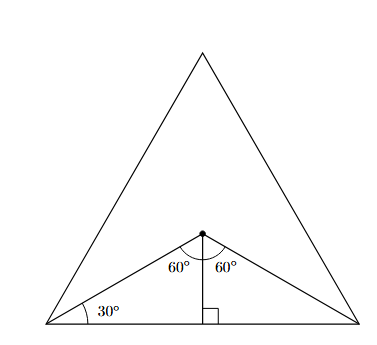
A regular hexagon has 6 sides, so its side length is $$a = \frac{4\pi}{6} = \frac{2\pi}{3}$$ m. The perpendicular distance from the centre to each side (the apothem) is $$d = \frac{a\sqrt{3}}{2} = \frac{2\pi}{3} \cdot \frac{\sqrt{3}}{2} = \frac{\pi\sqrt{3}}{3}$$ m.
Each side subtends an angle of $$60°$$ at the centre, giving a half-angle of $$30°$$. The magnetic field due to a finite straight conductor at perpendicular distance $$d$$ is given by $$B_1 = \frac{\mu_0 I}{4\pi d}(\sin\alpha_1 + \sin\alpha_2)$$, and since $$\alpha_1 = \alpha_2 = 30°$$, this becomes $$B_1 = \frac{\mu_0 I}{4\pi d}(2\sin 30°) = \frac{\mu_0 I}{4\pi d}$$.
The total magnetic field from all six sides is $$B = 6 \times \frac{\mu_0 I}{4\pi d} = \frac{6\mu_0 I}{4\pi d} = \frac{6 \times 4\pi \times 10^{-7} \times 4\pi\sqrt{3}}{4\pi \times \frac{\pi\sqrt{3}}{3}} = \frac{6 \times 4\pi\sqrt{3} \times 10^{-7}}{\frac{\pi\sqrt{3}}{3}} = \frac{6 \times 4\pi\sqrt{3} \times 3}{\pi\sqrt{3}} \times 10^{-7} = 72 \times 10^{-7}$$ T.
The value of $$x$$ is 72.
A solenoid of length $$0.5$$ m has a radius of $$1$$ cm and is made up of '$$m$$' number of turns. It carries a current of $$5$$ A. If the magnitude of the magnetic field inside the solenoid is $$6.28 \times 10^{-3}$$ T then the value of $$m$$ is ______.
We need to find the number of turns $$m$$ in a solenoid, given its dimensions and the magnetic field it produces.
The magnetic field inside a long solenoid is given by $$B = \mu_0 n I = \mu_0 \frac{m}{L} I$$ where $$\mu_0 = 4\pi \times 10^{-7}$$ T m/A is the permeability of free space, $$n = m/L$$ is the number of turns per unit length, $$m$$ is the total number of turns, $$L$$ is the length of the solenoid, and $$I$$ is the current.
Substituting the given values $$B = 6.28 \times 10^{-3}$$ T, $$L = 0.5$$ m, and $$I = 5$$ A into this formula gives $$6.28 \times 10^{-3} = 4\pi \times 10^{-7} \times \frac{m}{0.5} \times 5$$.
This simplifies to $$6.28 \times 10^{-3} = 4\pi \times 10^{-7} \times 10m$$ and hence $$6.28 \times 10^{-3} = 4\pi \times 10^{-6} \times m$$. Using $$\pi \approx 3.14$$, we have $$6.28 \times 10^{-3} = 4 \times 3.14 \times 10^{-6} \times m = 12.56 \times 10^{-6} \times m$$. From this, $$m = \frac{6.28 \times 10^{-3}}{12.56 \times 10^{-6}} = \frac{6.28}{12.56} \times 10^{3} = 0.5 \times 10^{3} = 500$$.
The answer is 500.
A square loop of edge length $$2$$ m carrying current of $$2$$ A is placed with its edges parallel to the $$x$$-$$y$$ axis. A magnetic field is passing through the $$x - y$$ plane and expressed as $$\vec{B} = B_0(1 + 4x)\hat{k}$$, where $$B_0 = 5$$ T. The net magnetic force experienced by the loop is _______ N.
Let the square loop have its vertical sides located at positions $$x$$ and $$x + L$$, with side length $$L = 2\text{ m}$$.
$$F_{\text{net}} = F_{\text{right}} - F_{\text{left}}$$
$$\implies F_{\text{net}} = I L B_0 [1 + 4(x+L)] - I L B_0 [1 + 4x]$$ $$\implies F_{\text{net}} = 4 I B_0 L^2$$
$$\implies F_{\text{net}} = 4 \times 2 \times 5 \times (2)^2 = 160\text{ N}$$
An electron moves through a uniform magnetic field $$\vec{B} = B_0\hat{i} + 2B_0\hat{j}$$ T. At a particular instant of time, the velocity of electron is $$\vec{u} = 3\hat{i} + 5\hat{j} \text{ m s}^{-1}$$. If the magnetic force acting on electron is $$\vec{F} = 5e\hat{k}$$ N, where $$e$$ is the charge of electron, then the value of $$B_0$$ is ____ T.
$$\vec{F} = q(\vec{v} \times \vec{B})$$
$$\vec{v} \times \vec{B} = (3\hat{i} + 5\hat{j}) \times (B_0\hat{i} + 2B_0\hat{j})$$
$$\implies \vec{v} \times \vec{B} = 3(2B_0)\hat{k} + 5B_0(-\hat{k}) = 6B_0\hat{k} - 5B_0\hat{k} = B_0\hat{k}$$
$$\vec{F} = 5e\hat{k}$$
$$5e\hat{k} = -e(B_0\hat{k})$$
$$\implies 5 = -B_0 \implies B_0 = -5\text{ T}$$ $$\implies |B_0| = 5$$
An electron with kinetic energy $$5 \text{ eV}$$ enters a region of uniform magnetic field of $$3 \; \mu T$$ perpendicular to its direction. An electric field $$E$$ is applied perpendicular to the direction of velocity and magnetic field. The value of $$E$$, so that electron moves along the same path, is ______ $$\text{NC}^{-1}$$. (Given, mass of electron $$= 9 \times 10^{-31} \text{ kg}$$, electric charge $$= 1.6 \times 10^{-19} \text{ C}$$)
An electron with KE = 5 eV enters a magnetic field of 3 $$\mu$$T. Find the electric field $$E$$ for the electron to move undeflected.
$$KE = \frac{1}{2}mv^2 \implies v = \sqrt{\frac{2 \times KE}{m}}$$
Convert KE to Joules: $$5 \text{ eV} = 5 \times 1.6 \times 10^{-19} = 8 \times 10^{-19}$$ J.
$$v = \sqrt{\frac{2 \times 8 \times 10^{-19}}{9 \times 10^{-31}}} = \sqrt{\frac{16 \times 10^{-19}}{9 \times 10^{-31}}} = \sqrt{1.778 \times 10^{12}}$$
$$v \approx 1.33 \times 10^6 \text{ m/s}$$
$$qE = qvB \implies E = vB$$
$$E = 1.33 \times 10^6 \times 3 \times 10^{-6} = 3.99 \approx 4 \text{ N/C}$$
The correct answer is 4 NC$$^{-1}$$.
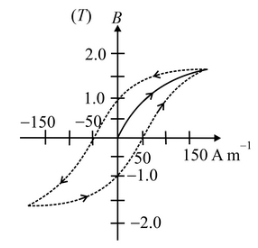
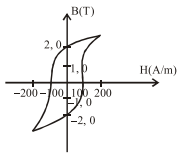
The coercivity of a magnet is $$5 \times 10^3$$ A/m. The amount of current required to be passed in a solenoid of length 30 cm and the number of turns 150, so that the magnet gets demagnetised when inside the solenoid is _____ A.
We need to find the current required to demagnetise a magnet placed inside a solenoid, given the coercivity of the magnet.
Coercivity is the intensity of the magnetising field ($$H$$) required to reduce the magnetisation of a material to zero after it has been magnetised. In other words, to demagnetise the magnet, we need to apply a magnetic field intensity equal to its coercivity, which is $$H = 5 \times 10^3$$ A/m.
Since the magnetic field intensity inside a solenoid is given by $$H = nI = \frac{N}{L} \times I$$, where $$N$$ is the total number of turns, $$L$$ is the length of the solenoid, and $$I$$ is the current, we can use this relation to determine the required current.
Next, substituting $$N = 150$$ turns, $$L = 30$$ cm $$= 0.3$$ m, and $$H = 5 \times 10^3$$ A/m into the expression gives $$5 \times 10^3 = \frac{150}{0.3} \times I$$, which simplifies to $$5 \times 10^3 = 500 \times I$$. From this, $$I = \frac{5 \times 10^3}{500} = 10 \text{ A}$$.
The answer is 10 A.
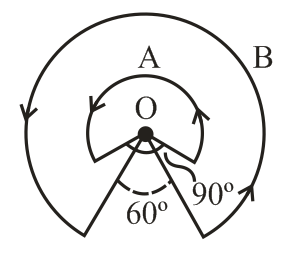
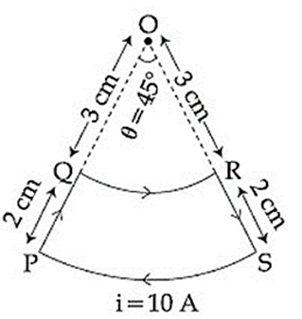
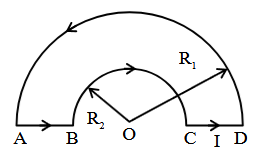
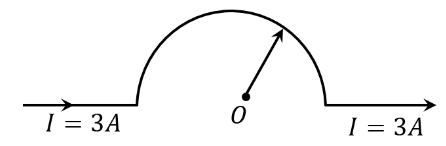
The magnetic field at the centre of a wire loop formed by two semicircular wires of radii $$R_1 = 2\pi$$ m and $$R_2 = 4\pi$$ m carrying current $$I = 4$$ A as per figure given below is $$\alpha \times 10^{-7}$$ T. The value of $$\alpha$$ is _____.
(Centre O is common for all segments)
$$\text{Magnetic field contribution from straight wire segments:}$$ $$B_{\text{straight}} = 0$$
$$\text{Total magnetic field at the centre O:}$$ $$B = B_1 + B_2 = \frac{\mu_0 I}{4R_1} + \frac{\mu_0 I}{4R_2}$$
$$B = \frac{\mu_0 I}{4} \left( \frac{1}{R_1} + \frac{1}{R_2} \right)$$
$$B = \frac{(4\pi \times 10^{-7})(4)}{4} \left( \frac{1}{2\pi} + \frac{1}{4\pi} \right)$$
$$B = (4\pi \times 10^{-7}) \left( \frac{3}{4\pi} \right) = 3 \times 10^{-7}\ \text{T}$$
$$\alpha \times 10^{-7} = 3 \times 10^{-7} \implies \alpha = 3$$
The magnetic field existing in a region is given by $$\vec{B} = 0.2(1 + 2x)\hat{k}\ T$$. A square loop of edge 50 cm carrying 0.5 A current is placed in x−y plane with its edges parallel to the x-y axes, as shown in figure. The magnitude of the net magnetic force experienced by the loop is ______ mN.
For horizontal segments parallel to x-axis:
$$d\vec{F} = I(dx\,\hat{i} \times \vec{B})$$
$$\vec{F}_{\text{top}} + \vec{F}_{\text{bottom}} = 0$$
For vertical segment at $$x_1 = 2$$:
$$\vec{F}_1 = I\vec{L}_1 \times \vec{B}(x_1)$$
$$\vec{F}_1 = 0.5(-0.5\hat{j}) \times [0.2(1 + 2(2))\hat{k}]$$
$$\vec{F}_1 = -0.25\hat{j} \times 1\hat{k} = -0.25\hat{i}$$
For vertical segment at $$x_2 = 2 + 0.5 = 2.5$$:
$$\vec{F}_2 = I\vec{L}_2 \times \vec{B}(x_2)$$
$$\vec{F}_2 = 0.5(0.5\hat{j}) \times [0.2(1 + 2(2.5))\hat{k}]$$
$$\vec{F}_2 = 0.25\hat{j} \times 1.2\hat{k} = 0.30\hat{i}$$
$$\vec{F}_{\text{net}} = \vec{F}_1 + \vec{F}_2$$
$$\vec{F}_{\text{net}} = -0.25\hat{i} + 0.30\hat{i} = 0.05\hat{i}$$
$$|\vec{F}_{\text{net}}| = 0.05\text{ N} = 50\text{ mN}$$
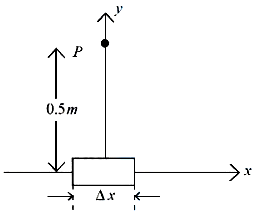
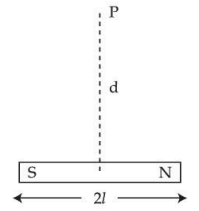
The magnetic potential due to a magnetic dipole at a point on its axis situated at a distance of $$20$$ cm from its center is $$1.5 \times 10^{-5}$$ T m. The magnetic moment of the dipole is _______ A m$$^2$$. (Given: $$\frac{\mu_0}{4\pi} = 10^{-7}$$ T m A$$^{-1}$$)
Magnetic potential on axis: $$V = \frac{\mu_0}{4\pi}\frac{M\cos\theta}{r^2}$$. On axis, $$\theta = 0$$:
$$V = \frac{\mu_0 M}{4\pi r^2} = 10^{-7} \times \frac{M}{(0.2)^2} = 10^{-7} \times 25M$$
$$1.5 \times 10^{-5} = 25 \times 10^{-7} M$$. $$M = \frac{1.5 \times 10^{-5}}{25 \times 10^{-7}} = 6$$ Am².
The answer is $$\boxed{6}$$.
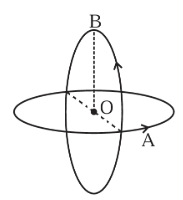
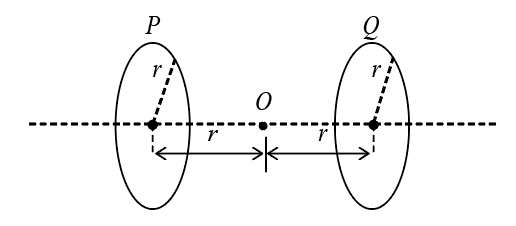
Two circular coils $$P$$ and $$Q$$ of 100 turns each have same radius of $$\pi$$ cm. The currents in $$P$$ and $$Q$$ are 1 A and 2 A respectively. $$P$$ and $$Q$$ are placed with their planes mutually perpendicular with their centers coincide. The resultant magnetic field induction at the center of the coils is $$\sqrt{x}$$ mT, where $$x =$$ [Use $$\mu_0 = 4\pi \times 10^{-7}$$ T m A$$^{-1}$$]
A circular coil of $$N$$ turns and radius $$R$$ produces, at its centre, a magnetic field along the axis of the coil given by
$$B = \frac{\mu_0 N I}{2R} \quad -(1)$$
where $$I$$ is the current through the coil.
For coil $$P$$:
Number of turns, $$N_P = 100$$
Current, $$I_P = 1 \, \text{A}$$
Radius, $$R = \pi \, \text{cm} = \pi \times 10^{-2} \, \text{m}$$
Substituting in $$(1)$$,
$$B_P = \frac{\mu_0 N_P I_P}{2R}$$
$$= \frac{(4\pi \times 10^{-7}) (100)(1)}{2(\pi \times 10^{-2})}$$
$$= \frac{4\pi \times 10^{-5}}{2\pi \times 10^{-2}}$$
$$= 2 \times 10^{-3} \, \text{T}$$
$$= 2 \, \text{mT} \quad -(2)$$
For coil $$Q$$:
Number of turns, $$N_Q = 100$$ (same as $$P$$)
Current, $$I_Q = 2 \, \text{A}$$
Again using $$(1)$$,
$$B_Q = \frac{\mu_0 N_Q I_Q}{2R}$$
$$= \frac{(4\pi \times 10^{-7}) (100)(2)}{2(\pi \times 10^{-2})}$$
$$= \frac{8\pi \times 10^{-5}}{2\pi \times 10^{-2}}$$
$$= 4 \times 10^{-3} \, \text{T}$$
$$= 4 \, \text{mT} \quad -(3)$$
The planes of the two coils are mutually perpendicular, so the fields $$B_P$$ and $$B_Q$$ are perpendicular to each other. Hence, the resultant field at the common centre is obtained by vector addition using the Pythagoras theorem:
$$B_{\text{res}} = \sqrt{B_P^{\,2} + B_Q^{\,2}}$$
$$= \sqrt{(2 \, \text{mT})^{2} + (4 \, \text{mT})^{2}}$$
$$= \sqrt{4 + 16} \, \text{mT}$$
$$= \sqrt{20} \, \text{mT}$$
The question states $$B_{\text{res}} = \sqrt{x} \, \text{mT}$$. Comparing, $$x = 20$$.
Hence, the required value is 20.
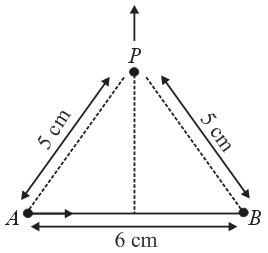
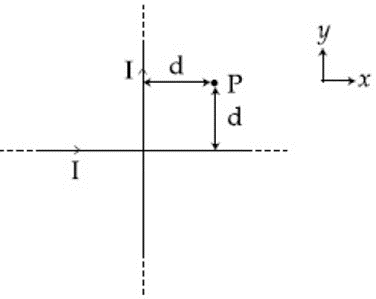
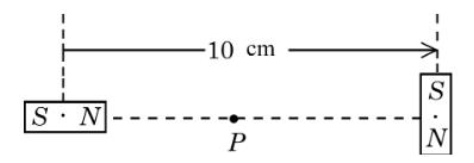
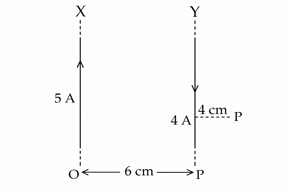
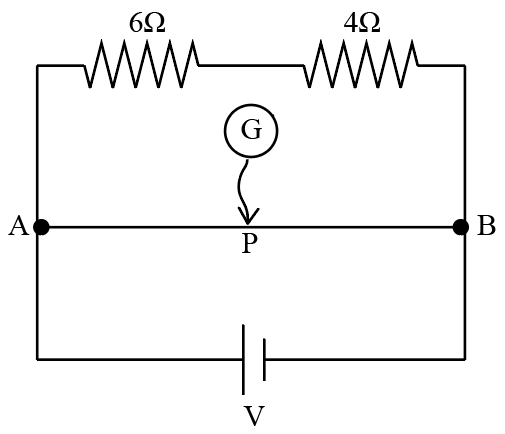
Two long, straight wires carry equal currents in opposite directions as shown in figure. The separation between the wires is $$5.0$$ cm. The magnitude of the magnetic field at a point P midway between the wires is ______ $$\mu$$T. (Given: $$\mu_0 = 4\pi \times 10^{-7} \text{ T m A}^{-1}$$)
$$B_{\text{net}} = B_1 + B_2 = 2 \times \left(\frac{\mu_0 I}{2\pi r}\right)$$
$$I = 10\text{ A},\quad d = 5.0\text{ cm} \implies r = \frac{d}{2} = 2.5\text{ cm} = 2.5 \times 10^{-2}\text{ m}$$
$$B_{\text{net}} = 2 \times \frac{4\pi \times 10^{-7} \times 10}{2\pi \times 2.5 \times 10^{-2}} \implies B_{\text{net}} = 1.6 \times 10^{-4}\text{ T} = 160\ \mu\text{T}$$
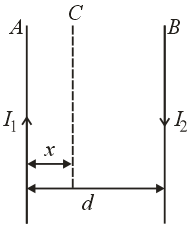
Two parallel long current carrying wire separated by a distance $$2r$$ are shown in the figure. The ratio of magnetic field at $$A$$ to the magnetic field produced at $$C$$ is $$\frac{x}{7}$$. The value of $$x$$ is _____
$$B_A = \frac{\mu_0 I}{2\pi r} + \frac{\mu_0 (2I)}{2\pi (3r)} = \frac{\mu_0 I}{2\pi r} \left(1 + \frac{2}{3}\right) = \frac{5\mu_0 I}{6\pi r}$$
$$B_C = \frac{\mu_0 I}{2\pi (3r)} + \frac{\mu_0 (2I)}{2\pi r} = \frac{\mu_0 I}{2\pi r} \left(\frac{1}{3} + 2\right) = \frac{7\mu_0 I}{6\pi r}$$
$$\frac{B_A}{B_C} = \frac{5}{7} \implies x = 5$$
A coil of 200 turns and area $$0.20 \text{ m}^2$$ is rotated at half a revolution per second and is placed in uniform magnetic field of 0.01 T perpendicular to axis of rotation of the coil. The maximum voltage generated in the coil is $$\frac{2\pi}{\beta}$$ volt. The value of $$\beta$$ is ______.
A coil of 200 turns and area $$0.20 \text{ m}^2$$ is rotated at half a revolution per second in a uniform magnetic field of 0.01 T perpendicular to the axis of rotation. We need to find $$\beta$$ where the maximum voltage is $$\frac{2\pi}{\beta}$$ V.
The EMF induced in a rotating coil in a magnetic field is:
$$\varepsilon = NAB\omega\sin(\omega t)$$
The maximum EMF is:
$$\varepsilon_{\max} = NAB\omega$$
The coil rotates at $$\frac{1}{2}$$ revolution per second, so:
$$\omega = 2\pi \times \frac{1}{2} = \pi \text{ rad/s}$$
$$\varepsilon_{\max} = 200 \times 0.20 \times 0.01 \times \pi$$
$$= 200 \times 0.002 \times \pi$$
$$= 0.4\pi$$
$$= \frac{2\pi}{5}$$
Comparing $$\frac{2\pi}{5}$$ with $$\frac{2\pi}{\beta}$$:
$$\beta = 5$$
The answer is 5.
A straight magnetic strip has a magnetic moment of $$44 \text{ Am}^2$$. If the strip is bent in a semicircular shape, its magnetic moment will be ______ $$\text{Am}^2$$. (given $$\pi = \frac{22}{7}$$)
We need to find the magnetic moment of a straight magnetic strip after it is bent into a semicircular shape.
Original magnetic moment: $$M = 44 \text{ Am}^2$$
$$\pi = \frac{22}{7}$$
For a bar magnet (or magnetic strip), the magnetic moment is defined as:
$$M = m \times L$$
where $$m$$ is the pole strength and $$L$$ is the length of the strip (distance between the poles). Here:
$$44 = m \times L \implies m = \frac{44}{L}$$
When the strip of length $$L$$ is bent into a semicircular shape, the length of the strip equals the semicircular arc:
$$\pi R = L \implies R = \frac{L}{\pi}$$
where $$R$$ is the radius of the semicircle.
In a semicircle, the two ends of the strip (which carry the magnetic poles) are at diametrically opposite points. The distance between them is the diameter:
$$d = 2R = \frac{2L}{\pi}$$
The pole strength $$m$$ remains unchanged (it is an intrinsic property of the magnet). The new magnetic moment is:
$$M' = m \times d = m \times \frac{2L}{\pi} = \frac{2mL}{\pi} = \frac{2M}{\pi}$$
$$M' = \frac{2 \times 44}{\pi} = \frac{88}{\frac{22}{7}} = \frac{88 \times 7}{22} = \frac{616}{22} = 28 \text{ Am}^2$$
The answer is 28 Am$$^2$$.
The current of 5 A flows in a square loop of sides 1 m is placed in air. The magnetic field at the centre of the loop is $$X\sqrt{2} \times 10^{-7}$$ T. The value of X is _________.
Magnetic field at center of a square loop of side $$a$$ with current $$I$$:
Each side contributes $$B_1 = \frac{\mu_0 I}{4\pi d}(\sin\alpha_1 + \sin\alpha_2)$$ where $$d = a/2$$ and $$\alpha_1 = \alpha_2 = 45°$$.
$$B_1 = \frac{\mu_0 I}{4\pi (a/2)} \times 2\sin 45° = \frac{\mu_0 I}{2\pi a} \times \sqrt{2} = \frac{\sqrt{2}\mu_0 I}{2\pi a}$$
Total for 4 sides: $$B = 4B_1 = \frac{4\sqrt{2}\mu_0 I}{2\pi a} = \frac{2\sqrt{2}\mu_0 I}{\pi a}$$
With $$I = 5$$A, $$a = 1$$m:
$$B = \frac{2\sqrt{2} \times 4\pi \times 10^{-7} \times 5}{\pi \times 1} = 2\sqrt{2} \times 4 \times 5 \times 10^{-7} = 40\sqrt{2} \times 10^{-7}$$
So $$X = 40$$.
Therefore, the answer is $$\boxed{40}$$.
The horizontal component of earth's magnetic field at a place is $$3.5 \times 10^{-5} \text{ T}$$. A very long straight conductor carrying current of $$\sqrt{2} \text{ A}$$ in the direction from South east to North West is placed. The force per unit length experienced by the conductor is ________ $$\times 10^{-6} \text{ N m}^{-1}$$.
The force per unit length on a current-carrying conductor in a magnetic field is given by $$\frac{F}{L} = I \times B \times \sin\theta$$, where $$\theta$$ is the angle between the direction of current and the magnetic field. The horizontal component of Earth’s magnetic field is $$B_H = 3.5 \times 10^{-5} \text{ T}$$ directed towards geographic North, and the current is $$I = \sqrt{2} \text{ A}$$ flowing from South-East to North-West. The angle between the North-West direction and the North direction is $$45°$$, so the angle between the current direction (SE to NW) and $$B_H$$ (pointing North) is $$\theta = 45°$$.
Substituting into the formula gives
$$\frac{F}{L} = I \times B_H \times \sin 45°$$
$$\frac{F}{L} = \sqrt{2} \times 3.5 \times 10^{-5} \times \frac{1}{\sqrt{2}}$$
$$\frac{F}{L} = 3.5 \times 10^{-5} = 35 \times 10^{-6} \text{ N/m}$$
Therefore, the correct answer is $$35$$.
In Young's double slit experiment, carried out with light of wavelength $$5000 \text{ \AA}$$, the distance between the slits is $$0.3 \text{ mm}$$ and the screen is at $$200 \text{ cm}$$ from the slits. The central maximum is at $$x = 0 \text{ cm}$$. The value of $$x$$ for third maxima is ______ mm.
We are given that $$\lambda = 5000$$ Å $$= 5 \times 10^{-7}$$ m, $$d = 0.3$$ mm $$= 3 \times 10^{-4}$$ m, and $$D = 200$$ cm $$= 2$$ m.
The position of the $$n$$-th maximum in YDSE is given by
$$x_n = \frac{n\lambda D}{d}$$
For the third maximum ($$n = 3$$), we then have
$$x_3 = \frac{3 \times 5 \times 10^{-7} \times 2}{3 \times 10^{-4}} = \frac{30 \times 10^{-7}}{3 \times 10^{-4}} = 10 \times 10^{-3} = 10 \text{ mm}$$
Hence, the third maximum is located at 10 mm from the central maximum.
The number of turns of the coil of a moving coil galvanometer is increased in order to increase current sensitivity by 50%. The percentage change in voltage sensitivity of the galvanometer will be:
Current sensitivity of a galvanometer is given by:
$$ I_s = \frac{nBA}{c} $$
where $$n$$ = number of turns, $$B$$ = magnetic field, $$A$$ = area of coil, $$c$$ = restoring torque per unit twist.
To increase current sensitivity by 50%, we increase $$n$$ by 50%.
Voltage sensitivity is given by:
$$ V_s = \frac{I_s}{R} = \frac{nBA}{cR} $$
When the number of turns increases by 50%, the resistance of the coil also increases by 50% (since resistance is proportional to the length of wire, which is proportional to $$n$$).
New voltage sensitivity:
$$ V_s' = \frac{1.5n \times BA}{c \times 1.5R} = \frac{nBA}{cR} = V_s $$
The voltage sensitivity remains unchanged. The percentage change is 0%.
A long conducting wire having a current $$I$$ flowing through it, is bent into a circular coil of $$N$$ turns. Then it is bent into a circular coil of $$n$$ turns. The magnetic field is calculated at the centre of coils in both the cases. The ratio of the magnetic field in first case to that of second case is:
A long conducting wire of total length $$L$$ carrying current $$I$$ is bent into a circular coil of $$N$$ turns, and then into a coil of $$n$$ turns. We need the ratio of magnetic fields at the centres.
$$ B = \frac{\mu_0 N I}{2R} $$
where $$N$$ is the number of turns and $$R$$ is the radius.
For $$N$$ turns: $$L = N \times 2\pi R_1$$, so $$R_1 = \frac{L}{2\pi N}$$
For $$n$$ turns: $$L = n \times 2\pi R_2$$, so $$R_2 = \frac{L}{2\pi n}$$
$$ B_1 = \frac{\mu_0 N I}{2R_1} = \frac{\mu_0 N I}{2} \times \frac{2\pi N}{L} = \frac{\mu_0 \pi N^2 I}{L} $$
$$ B_2 = \frac{\mu_0 n I}{2R_2} = \frac{\mu_0 n I}{2} \times \frac{2\pi n}{L} = \frac{\mu_0 \pi n^2 I}{L} $$
$$ \frac{B_1}{B_2} = \frac{N^2}{n^2} $$
The ratio of magnetic field in the first case to the second case is Option C: $$N^2 : n^2$$.
A long solenoid is formed by winding 70 turns cm$$^{-1}$$. If 2.0 A current flows, then the magnetic field produced inside the solenoid is _____.
($$\mu_0 = 4\pi \times 10^{-7}$$ T m A$$^{-1}$$)
The magnetic field inside a solenoid is given by:
$$B = \mu_0 n I$$
where $$n$$ is the number of turns per unit length and $$I$$ is the current.
Given: $$n = 70$$ turns/cm $$= 7000$$ turns/m, $$I = 2.0$$ A, $$\mu_0 = 4\pi \times 10^{-7}$$ T m A$$^{-1}$$.
$$B = 4\pi \times 10^{-7} \times 7000 \times 2.0$$
$$= 4\pi \times 14000 \times 10^{-7}$$
$$= 56000\pi \times 10^{-7}$$
$$= 56\pi \times 10^{-4}$$
$$= 56 \times 3.14159 \times 10^{-4}$$
$$\approx 175.93 \times 10^{-4}$$
$$\approx 176 \times 10^{-4}$$ T
The correct answer is Option 2: $$176 \times 10^{-4}$$ T.
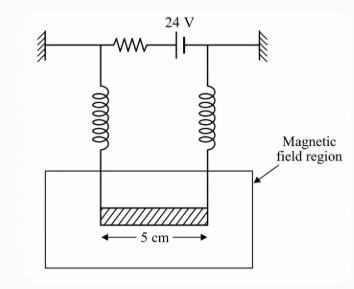
A massless square loop, of wire resistance $$10$$ $$\Omega$$, supporting a mass of $$1$$ g, hangs vertically with one of its sides in a uniform magnetic field of $$10^3$$ G, directed outwards in the shaded region. A dc voltage $$V$$ is applied to the loop. For what value of $$V$$, the magnetic force will exactly balance the weight of the supporting mass of $$1$$ g?
(If sides of the loop $$= 10$$ cm, $$g = 10$$ m s$$^{-2}$$)
$$F_{\text{gravity}} = mg = (1 \times 10^{-3}\text{ kg}) \times 10\text{ m/s}^2 = 10^{-2}\text{ N}$$
$$F_{\text{magnetic}} = \left(\frac{V}{R}\right) \cdot l \cdot B$$
$$\frac{V \cdot l \cdot B}{R} = mg$$
$$V = \frac{mg \cdot R}{l \cdot B}$$
$$V = \frac{10^{-2} \times 10}{0.1 \times 0.1}$$
$$V = \frac{10^{-1}}{10^{-2}} = 10\text{ V}$$
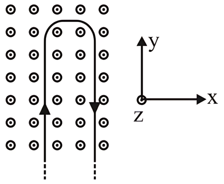
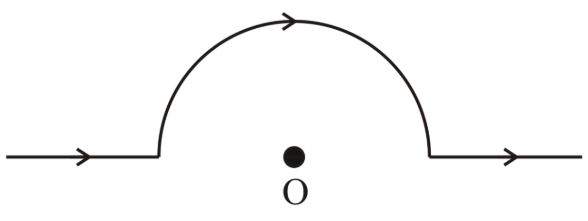
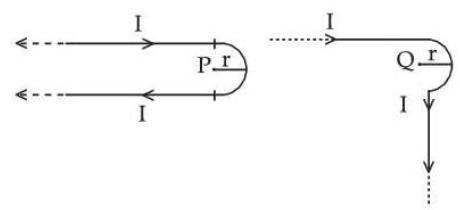
Find the magnetic field at point P as shown in the figure. The curved portion is a semicircle connected to two long straight wires.
$$B_{\text{straight 1}} = \frac{\mu_0 i}{4\pi r} \otimes$$
$$B_{\text{semicircle}} = \frac{\mu_0 i}{4r} \otimes$$
$$B_{\text{straight 2}} = 0$$
$$B_{net} = B_{\text{straight 1}} + B_{\text{semicircle}} + B_{\text{straight 2}}$$
$$B_{net} = \frac{\mu_0 i}{4\pi r} + \frac{\mu_0 i}{4r} + 0$$
$$B_{net} = \frac{\mu_0 i}{2r} \left( \frac{1}{2} + \frac{1}{2\pi} \right)$$
Given below are two statements: one is labelled as Assertion A and the other is labelled as Reason R.
Assertion A: Electromagnets are made of soft iron.
Reason R: Soft iron has high permeability and low retentivity.
In the light of above statements, choose the most appropriate answer from the options given below.
Assertion A: Electromagnets are made of soft iron. This is true — soft iron is the standard core material for electromagnets.
Reason R: Soft iron has high permeability and low retentivity.
High permeability means soft iron gets magnetized very easily when placed in a magnetic field. Low retentivity means it loses its magnetism quickly when the magnetizing field is removed.
These are exactly the properties needed for an electromagnet — it should magnetize strongly when current flows, and demagnetize immediately when current stops.
Both A and R are correct, and R correctly explains why soft iron is used for electromagnets (high permeability for strong magnetization, low retentivity for easy demagnetization).
Therefore, the answer is Option C.
Given below are two statements:
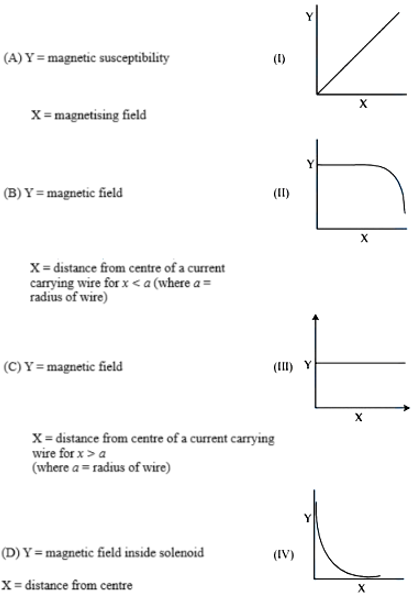
Statement I: For diamagnetic substance $$-1 \leq x < 0$$, where x is the magnetic susceptibility.
Statement II: Diamagnetic substance when placed in an external magnetic field, tend to move from stronger to weaker part of the field. In the light of the above statements, choose the correct answer from the options give below.
The magnetisation of a linear magnetic medium is given by $$\mathbf{M} = \chi \mathbf{H}$$, where $$\chi$$ is the (volume) magnetic susceptibility and $$\mathbf{H}$$ is the magnetising field.
Relative permeability is defined as $$\mu_r = 1 + \chi$$ $$-(1)$$
Case 1 → Statement I
For a diamagnetic substance:
• The induced dipoles are opposite to the applied field, hence $$\chi$$ is negative.
• In naturally occurring materials $$|\chi|$$ is very small (of the order $$10^{-5}$$).
• Condition $$\mu_r \gt 0$$ must hold for ordinary matter. From $$(1)$$ this gives
$$1 + \chi \gt 0 \;\;\Longrightarrow\;\; \chi \gt -1$$
Combining the facts “$$\chi$$ is negative” and “$$\chi \gt -1$$” we obtain the range
$$-1 \le \chi \lt 0$$
Therefore Statement I is correct.
Case 2 → Statement II
The potential energy of a small sample in a non-uniform field is $$U = -\tfrac{1}{2}\,\chi V \mu_0 H^2$$, where $$V$$ is its volume. For a diamagnet $$\chi \lt 0$$, so $$U$$ increases with $$H^2$$. To minimise energy the sample drifts toward the region where $$H$$ is smaller, that is, from the stronger part of the field to the weaker part.
Hence Statement II is also correct.
Since both statements are true, the correct choice is Option D.
Given below are two statements:
Statement I: If the number of turns in the coil of a moving coil galvanometer is doubled then the current sensitivity becomes double.
Statement II: Increasing current sensitivity of a moving coil galvanometer by only increasing the number of turns in the coil will also increase its voltage sensitivity in the same ratio
In the light of the above statements, choose the correct answer from the options given below:
Statement I: If the number of turns N is doubled, current sensitivity = $$\frac{NBA}{k}$$. Doubling N doubles current sensitivity. This is true.
Statement II: Voltage sensitivity = Current sensitivity / Resistance = $$\frac{NBA}{kR}$$. When N doubles, resistance R also doubles (since $$R \propto N$$). So voltage sensitivity = $$\frac{2NBA}{k \cdot 2R} = \frac{NBA}{kR}$$, which remains the same. This is false.
The correct answer is Option 1: Statement I is true but Statement II is false.
Given below are two statements:
Statement I : The diamagnetic property depends on temperature.
Statement II : The induced magnetic dipole moment in a diamagnetic sample is always opposite to the magnetising field.
In the light of statements, choose the correct answer from the options given below
For Statement I:
Diamagnetic susceptibility ($$\chi$$) is independent of temperature because the underlying induction mechanism does not rely on aligning pre-existing magnetic dipoles against thermal agitation. Therefore, Statement I is false.
For Statement II:
According to Lenz's law, when a substance is placed in an external magnetising field, the induced magnetic dipole moment always opposes the applied field. Therefore, Statement II is true.
The current sensitivity of moving coil galvanometer is increased by 25%. This increase is achieved only changing in the number of turns of coils and area of cross section of the wire while keeping the resistance of galvanometer coil constant. The percentage change in the voltage sensitivity will be:
$$I_s = \frac{NBA}{k}, \quad V_s = \frac{I_s}{R_g}$$
$$\text{Given that the resistance of the galvanometer coil } R_g \text{ is kept constant: } V_s \propto I_s$$
$$\% \Delta V_s = \% \Delta I_s = +25\%$$
A rod with circular cross-section area 2 cm$$^2$$ and length 40 cm is wound uniformly with 400 turns of an insulated wire. If a current of 0.4 A flows in the wire windings, the total magnetic flux produced inside the windings is $$4\pi \times 10^{-6}$$ Wb. The relative permeability of the rod is
(Given: Permeability of vacuum $$\mu_0 = 4\pi \times 10^{-7}$$ N A$$^{-2}$$)
Given: Cross-section area $$A = 2$$ cm$$^2$$ $$= 2 \times 10^{-4}$$ m$$^2$$, length $$L = 40$$ cm $$= 0.4$$ m, $$N = 400$$ turns, $$I = 0.4$$ A, total magnetic flux $$\Phi = 4\pi \times 10^{-6}$$ Wb.
The magnetic flux inside the solenoid is:
$$ \Phi = B \times A = \mu_r \mu_0 n I \times A $$
where $$n = N/L$$ is the number of turns per unit length.
$$ n = \frac{400}{0.4} = 1000 \text{ turns/m} $$
$$ \Phi = \mu_r \times 4\pi \times 10^{-7} \times 1000 \times 0.4 \times 2 \times 10^{-4} $$
$$ \Phi = \mu_r \times 4\pi \times 10^{-7} \times 400 \times 2 \times 10^{-4} $$
$$ \Phi = \mu_r \times 4\pi \times 10^{-7} \times 8 \times 10^{-2} $$
$$ \Phi = \mu_r \times 32\pi \times 10^{-9} = \mu_r \times 3.2\pi \times 10^{-8} $$
Setting this equal to the given flux:
$$ \mu_r \times 3.2\pi \times 10^{-8} = 4\pi \times 10^{-6} $$
$$ \mu_r = \frac{4 \times 10^{-6}}{3.2 \times 10^{-8}} = \frac{4}{0.032} = 125 $$
An electron is allowed to move with constant velocity along the axis of current carrying straight solenoid.
(A) The electron will experience magnetic force along the axis of the solenoid.
(B) The electron will not experience magnetic force.
(C) The electron will continue to move along the axis of the solenoid.
(D) The electron will be accelerated along the axis of the solenoid.
(E) The electron will follow parabolic path-inside the solenoid.
Choose the correct answer from the option given below:
Inside a solenoid, the magnetic field is uniform and directed along the axis.
When an electron moves with constant velocity along the axis of the solenoid, its velocity $$\vec{v}$$ is parallel to the magnetic field $$\vec{B}$$.
The magnetic force on the electron is:
$$\vec{F} = q(\vec{v} \times \vec{B})$$
Since $$\vec{v} \parallel \vec{B}$$, the cross product $$\vec{v} \times \vec{B} = 0$$.
Therefore:
(B) The electron will not experience magnetic force — True
(C) The electron will continue to move along the axis — True (no force to change its motion)
(A) Force along axis — False (no force at all)
(D) Accelerated along axis — False
(E) Parabolic path — False
The correct answer is B and C only.
The free space inside a current carrying toroid is filled with a material of susceptibility $$2 \times 10^{-2}$$. The percentage increase in the value of magnetic field inside the toroid will be
We need to find the percentage increase in the magnetic field inside a toroid when the free space is filled with a material of magnetic susceptibility $$\chi = 2 \times 10^{-2}$$.
For a toroid with $$n$$ turns per unit length carrying current $$I$$, the magnetic field in free space is $$B_0 = \mu_0 n I$$.
When the interior is filled with a magnetic material, the relative permeability becomes $$\mu_r = 1 + \chi$$, so the total magnetic field is:
$$B = \mu_0(1 + \chi) n I = B_0(1 + \chi)$$
(This is because the magnetizing field $$H = nI$$ remains the same, being determined by the free current, and $$B = \mu H = \mu_0(1 + \chi)H$$.)
Now, the percentage increase in the magnetic field is:
$$\frac{\Delta B}{B_0} \times 100 = \frac{B_0 \chi}{B_0} \times 100 = \chi \times 100 = 2 \times 10^{-2} \times 100 = 2\%$$
Hence, the correct answer is Option 3.
A compass needle oscillates 20 times per minute at a place where the dip is $$30°$$ and 30 times per minute where the dip is $$60°$$. The ratio of total magnetic field due to the earth at two places respectively is $$\frac{4}{\sqrt{x}}$$. The value of $$x$$ is _____.
$$T = 2\pi\sqrt{\frac{I}{M B_H}} \implies \nu = \frac{1}{2\pi}\sqrt{\frac{M B_H}{I}} \implies \nu \propto \sqrt{B_H} \implies \nu^2 \propto B \cos\theta$$
$$\frac{\nu_1^2}{\nu_2^2} = \frac{B_1 \cos\theta_1}{B_2 \cos\theta_2}$$
$$\left(\frac{20}{30}\right)^2 = \frac{B_1 \cos 30^\circ}{B_2 \cos 60^\circ} \implies \frac{4}{9} = \frac{B_1}{B_2} \times \frac{\sqrt{3}/2}{1/2} = \frac{B_1}{B_2}\sqrt{3}$$
$$\frac{B_1}{B_2} = \frac{4}{9\sqrt{3}}$$
$$\text{Comparing with the given ratio } \frac{4}{\sqrt{x}}: \sqrt{x} = 9\sqrt{3} = \sqrt{81 \times 3} = \sqrt{243} \implies x = 243$$
The current required to be passed through a solenoid of 15 cm length and 60 turns in order to demagnetise a bar magnet of magnetic intensity $$2.4 \times 10^3$$ A m$$^{-1}$$ is _______ A.
Given: Length $$l = 15$$ cm = 0.15 m, number of turns $$N = 60$$, magnetic intensity $$H = 2.4 \times 10^3$$ A/m.
The magnetic field intensity inside a solenoid is:
$$H = nI = \frac{N}{l}I$$
To demagnetise the bar magnet, the solenoid must produce a field of the same intensity:
$$I = \frac{Hl}{N} = \frac{2.4 \times 10^3 \times 0.15}{60} = \frac{360}{60} = 6 \text{ A}$$
The current required is 6 A.
The magnetic intensity at the centre of a long current carrying solenoid is found to be $$1.6 \times 10^3$$ A m$$^{-1}$$. If the number of turns is 8 per cm, then the current flowing through the solenoid is ______ A.
We are given that the magnetic intensity at the centre of a long current-carrying solenoid is $$H = 1.6 \times 10^3$$ A/m, and the number of turns is $$n = 8$$ turns/cm.
Convert turns per cm to turns per metre: $$ n = 8 \text{ turns/cm} = 8 \times 100 = 800 \text{ turns/m} $$
Use the formula for magnetic intensity in a solenoid. For a long solenoid, the magnetic intensity inside is:
$$ H = nI $$
where $$n$$ is turns per unit length and $$I$$ is the current.
Solve for current: $$ I = \frac{H}{n} = \frac{1.6 \times 10^3}{800} = \frac{1600}{800} = 2 \text{ A} $$
The current flowing through the solenoid is 2 A.
A compass needle of oscillation magnetometer oscillates 20 times per minute at a place P of dip $$30^\circ$$. The number of oscillations per minute become 10 at another place Q of $$60^\circ$$ dip. The ratio of the total magnetic field at the two places $$(B_Q : B_P)$$ is:
A compass needle oscillates 20 times/min at place P (dip $$30^\circ$$) and 10 times/min at place Q (dip $$60^\circ$$). Find $$B_Q : B_P$$.
Recall that the frequency of oscillation of a magnetic needle is given by $$f = \frac{1}{2\pi}\sqrt{\frac{MB_H}{I}}$$, where $$B_H$$ is the horizontal component of the magnetic field, $$M$$ is the magnetic moment, and $$I$$ is the moment of inertia. Since $$f \propto \sqrt{B_H}$$, it follows that $$f^2 \propto B_H$$.
The horizontal component of the magnetic field relates to the total magnetic field by $$B_H = B\cos\delta$$, where $$\delta$$ is the angle of dip. Therefore, at place P, $$B_{H_P} = B_P \cos 30^\circ = B_P \cdot \frac{\sqrt{3}}{2}$$ and at place Q, $$B_{H_Q} = B_Q \cos 60^\circ = B_Q \cdot \frac{1}{2}$$.
Using the ratio of squared frequencies, we write $$\frac{f_P^2}{f_Q^2} = \frac{B_{H_P}}{B_{H_Q}}$$. Substituting $$f_P = 20$$ and $$f_Q = 10$$ yields $$\frac{20^2}{10^2} = \frac{B_P \cdot \frac{\sqrt{3}}{2}}{B_Q \cdot \frac{1}{2}}$$, which simplifies to $$4 = \frac{B_P \sqrt{3}}{B_Q}$$. From this it follows that $$\frac{B_Q}{B_P} = \frac{\sqrt{3}}{4}$$.
Hence, the required ratio of the magnitudes of the magnetic fields is $$B_Q : B_P = \sqrt{3} : 4$$. Therefore, the answer is Option A: $$\sqrt{3} : 4$$.
A triangular shaped wire carrying 10 A current is placed in a uniform magnetic field of 0.5 T, as shown in figure. The magnetic force on segment CD is (Given BC = CD = BD = 5 cm).
We need to find the magnetic force $$F$$ acting on the segment $$CD$$ of the triangular wire loop placed in a uniform magnetic field.
The magnetic force on a straight current-carrying conductor of length $$L$$ carrying a current $$I$$ in a uniform magnetic field $$B$$ is given by the formula: $$F = I L B \sin\theta$$, where $$\theta$$ is the angle between the direction of the current element and the magnetic field vector.
From the given diagram, the triangular section $$\Delta BCD$$ is an equilateral triangle with sides $$BC = CD = BD = 5\text{ cm} = 0.05\text{ m}$$. Therefore, each internal angle of the triangle is $$60^\circ$$.
The magnetic field lines are directed horizontally from left to right, parallel to the segments $$AB$$ and $$DE$$. Therefore, the side $$BD$$ lies perfectly parallel to the magnetic field.
In the equilateral triangle, the side $$CD$$ slants downward towards the right. The angle between the direction of the current along segment $$CD$$ and the horizontal magnetic field lines is equal to the interior angle of the triangle at vertex $$D$$, which is $$\theta = 60^\circ$$.
We are given the following values:
Current, $$I = 10\text{ A}$$
Length of segment $$CD$$, $$L = 5\text{ cm} = 0.05\text{ m}$$
Magnetic field strength, $$B = 0.5\text{ T}$$
Angle, $$\theta = 60^\circ$$
Substituting these values into the magnetic force formula yields: $$F = 10 \times 0.05 \times 0.5 \times \sin(60^\circ)$$.
Since $$\sin(60^\circ) = \frac{\sqrt{3}}{2} \approx 0.866$$, the calculation becomes: $$F = 0.25 \times 0.866 = 0.2165\text{ N}$$.
Rounding to three decimal places, the magnitude of the force is approximately $$0.216\text{ N}$$.
Therefore, the correct answer is Option C: 0.216 N.
The space inside a straight current carrying solenoid is filled with a magnetic material having magnetic susceptibility equal to $$1.2 \times 10^{-5}$$. What is fractional increase in the magnetic field inside solenoid with respect to air as medium inside the solenoid?
The magnetic susceptibility of the material inside the solenoid is $$\chi_m = 1.2 \times 10^{-5}$$.
Write the magnetic field with and without the magnetic material.
With air (vacuum): $$B_0 = \mu_0 nI$$
With the magnetic material: $$B = \mu_0(1 + \chi_m) nI$$
Calculate the fractional increase in magnetic field.
$$\frac{\Delta B}{B_0} = \frac{B - B_0}{B_0} = \frac{\mu_0(1 + \chi_m)nI - \mu_0 nI}{\mu_0 nI}$$
$$\frac{\Delta B}{B_0} = (1 + \chi_m) - 1 = \chi_m = 1.2 \times 10^{-5}$$
The fractional increase in the magnetic field is equal to the magnetic susceptibility, which is $$1.2 \times 10^{-5}$$.
The correct answer is Option A.
A cyclotron is used to accelerate protons. If the operating magnetic field is 1.0 T and the radius of the cyclotron 'dees' is 60 cm, the kinetic energy of the accelerated protons in MeV will be: [use $$m_p = 1.6 \times 10^{-27}$$ kg, $$e = 1.6 \times 10^{-19}$$ C]
A cyclotron with magnetic field $$B = 1.0$$ T and radius $$R = 60$$ cm = 0.6 m accelerates protons. Find the kinetic energy in MeV.
Since for a charged particle in a cyclotron at the maximum radius the magnetic force equals the centripetal force, we have
$$qvB = \frac{mv^2}{R} \implies mv = qBR$$
From this relation one obtains
$$v = \frac{qBR}{m}$$
Substituting the expression for $$v$$ into the kinetic energy formula yields
$$KE = \frac{1}{2}mv^2 = \frac{1}{2}m\left(\frac{qBR}{m}\right)^2 = \frac{q^2B^2R^2}{2m}$$
Substituting $$q = e = 1.6 \times 10^{-19}$$ C, $$B = 1.0$$ T, $$R = 0.6$$ m, and $$m_p = 1.6 \times 10^{-27}$$ kg into this expression gives
$$KE = \frac{(1.6 \times 10^{-19})^2 \times (1.0)^2 \times (0.6)^2}{2 \times 1.6 \times 10^{-27}}$$
Numerator: $$(1.6)^2 \times 10^{-38} \times 0.36 = 2.56 \times 0.36 \times 10^{-38} = 0.9216 \times 10^{-38}$$
Denominator: $$3.2 \times 10^{-27}$$
Therefore,
$$KE = \frac{0.9216 \times 10^{-38}}{3.2 \times 10^{-27}} = 0.288 \times 10^{-11} = 2.88 \times 10^{-12} \text{ J}$$
Since $$1 \text{ eV} = 1.6 \times 10^{-19} \text{ J}$$ and $$1 \text{ MeV} = 1.6 \times 10^{-13} \text{ J}$$,
$$KE = \frac{2.88 \times 10^{-12}}{1.6 \times 10^{-13}} = 18 \text{ MeV}$$
Answer: Option B: 18
An electron with energy $$0.1 \text{ keV}$$ moves at right angle to the earth's magnetic field of $$1 \times 10^{-4} \text{ Wb m}^{-2}$$. The frequency of revolution of the electron will be (Take mass of electron $$= 9.0 \times 10^{-31} \text{ kg}$$)
We need to find the frequency of revolution of an electron moving at a right angle to the Earth's magnetic field.
1. Identify the Given Parameters
- Magnetic field ($$B$$) = $$1 \times 10^{-4}\text{ Wb m}^{-2}$$ (or Tesla, $$\text{T}$$)
- Mass of an electron ($$m$$) = $$9.0 \times 10^{-31}\text{ kg}$$
- Charge of an electron ($$e$$) = $$1.6 \times 10^{-19}\text{ C}$$
- Kinetic energy = $$0.1\text{ keV}$$ (Note: Since the electron moves at a right angle, its path is perfectly circular. The frequency of revolution in a magnetic field is independent of its speed or energy).
2. Formula for Frequency of Revolution
When a charged particle moves perpendicular to a uniform magnetic field, the magnetic force provides the necessary centripetal force:
$$evB = \frac{mv^2}{r} \implies \frac{v}{r} = \frac{eB}{m}$$
Since the angular frequency is $$\omega = \frac{v}{r} = 2\pi f$$, the cyclotron frequency ($$f$$) is given by:
$$f = \frac{eB}{2\pi m}$$
3. Calculation
Substitute the given values into the frequency formula:
$$f = \frac{1.6 \times 10^{-19} \times 1 \times 10^{-4}}{2 \times 3.14 \times 9.0 \times 10^{-31}}$$
$$f = \frac{1.6 \times 10^{-23}}{56.52 \times 10^{-31}}$$
$$f \approx 0.0283 \times 10^8\text{ Hz} = 2.83 \times 10^6\text{ Hz}$$
Conclusion
The frequency of revolution of the electron is approximately $$2.8 \times 10^6\text{ Hz}$$, which matches Option C.
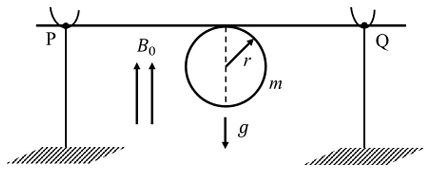
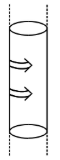
As shown in the figure, a metallic rod of linear density 0.45 kg m$$^{-1}$$ is lying horizontally on a smooth incline plane which makes an angle of 45° with the horizontal. The minimum current flowing in the rod required to keep it stationary, when 0.15 T magnetic field is acting on it in the vertical upward direction, will be (Use $$g = 10$$ m s$$^{-2}$$)
We need to determine the minimum current ($$I$$) required to keep a metallic rod stationary on a smooth inclined plane under the influence of a vertical magnetic field.
1. Identify the Given Parameters
- Linear mass density ($$\lambda = \frac{m}{l}$$) = $$0.45\text{ kg m}^{-1}$$
- Angle of inclination ($$\theta$$) = $$45^\circ$$
- Magnetic field strength ($$B$$) = $$0.15\text{ T}$$ (directed vertically upwards)
- Acceleration due to gravity ($$g$$) = $$10\text{ m s}^{-2}$$
2. Analyze the Forces Acting on the Rod
For the rod to remain stationary on the smooth inclined plane, the components of the forces acting parallel to the surface of the incline must perfectly balance each other:
- Gravitational Force Component: The component of the rod's weight acting down the incline is $$mg \sin\theta$$.
- Magnetic Force Component: A horizontal magnetic force ($$F_m = I l B$$) acts on the rod due to the vertical magnetic field. Resolving this force parallel to the incline, the component pushing up the incline is $$I l B \cos\theta$$.
3. Set Up the Equilibrium Equation
Equating the force component acting up the incline to the force component acting down the incline:
$$I l B \cos\theta = mg \sin\theta$$
Rearranging the formula to solve for the current ($$I$$):
$$I = \left(\frac{m}{l}\right) \frac{g}{B} \cdot \frac{\sin\theta}{\cos\theta}$$
$$I = \lambda \frac{g}{B} \tan\theta$$
4. Calculate the Minimum Current
Substitute the given numerical values into our derived equilibrium equation:
$$I = 0.45 \times \frac{10}{0.15} \times \tan(45^\circ)$$
Since $$\tan(45^\circ) = 1$$:
$$I = \frac{4.5}{0.15} \times 1 = 30\text{ A}$$
Therefore, the minimum current flowing in the rod required to keep it stationary is 30 A, which corresponds to Option A.
Two bar magnets oscillate in a horizontal plane in earth's magnetic field with time periods of $$3 \text{ s}$$ and $$4 \text{ s}$$ respectively. If their moments of inertia are in the ratio of $$3:2$$ then the ratio of their magnetic moments will be
Two bar magnets oscillate in Earth's magnetic field with time periods $$T_1 = 3$$ s and $$T_2 = 4$$ s, and their moments of inertia are in the ratio $$I_1 : I_2 = 3 : 2$$. We need the ratio of their magnetic moments.
Since the time period of a bar magnet oscillating in a magnetic field $$B$$ is given by $$T = 2\pi\sqrt{\frac{I}{MB}},$$ where $$I$$ is the moment of inertia and $$M$$ is the magnetic moment, squaring this expression yields $$T^2 = 4\pi^2 \frac{I}{MB} \implies M = \frac{4\pi^2 I}{T^2 B}.$$
Therefore, the ratio of the magnetic moments becomes $$\frac{M_1}{M_2} = \frac{I_1}{I_2} \times \frac{T_2^2}{T_1^2}.$$
Substituting the given ratios into the above expression yields $$\frac{M_1}{M_2} = \frac{3}{2} \times \frac{16}{9} = \frac{48}{18} = \frac{8}{3}.$$
Hence, the correct answer is Option B: $$8:3$$.
Two concentric circular loops of radii $$r_1 = 30 \text{ cm}$$ and $$r_2 = 50 \text{ cm}$$ are placed in $$X-Y$$ plane as shown in the figure. A current $$I = 7 \text{ A}$$ is flowing through them in the direction as shown in figure. The net magnetic moment of this system of two circular loops is approximately
Two concentric circular loops of radii $$r_1 = 30 \text{ cm}$$ and $$r_2 = 50 \text{ cm}$$ in the X-Y plane carry current $$I = 7 \text{ A}$$. We need to find the net magnetic moment.
The magnetic moment of a circular loop is:
$$\vec{M} = I \cdot A \cdot \hat{n}$$
where $$A = \pi r^2$$ is the area and $$\hat{n}$$ is the unit normal determined by the direction of current (right-hand rule).
From the figure, the inner loop ($$r_1 = 0.3 \text{ m}$$) carries current in one direction and the outer loop ($$r_2 = 0.5 \text{ m}$$) carries current in the opposite direction.
For the inner loop (current gives $$+\hat{k}$$):
$$M_1 = 7 \times \pi \times (0.3)^2 = 7 \times 0.09\pi = 0.63\pi \text{ A m}^2$$
For the outer loop (current gives $$-\hat{k}$$):
$$M_2 = 7 \times \pi \times (0.5)^2 = 7 \times 0.25\pi = 1.75\pi \text{ A m}^2$$
$$\vec{M}_{net} = 0.63\pi \hat{k} - 1.75\pi \hat{k} = -1.12\pi \hat{k}$$
$$\vec{M}_{net} = -1.12 \times 3.14 \hat{k} \approx -3.52 \hat{k} \approx -\dfrac{7}{2} \hat{k} \text{ A m}^2$$
The correct answer is Option B: $$-\dfrac{7}{2} \hat{k} \text{ A m}^2$$.
A velocity selector consists of electric field $$\vec{E} = E\hat{k}$$ and magnetic field $$\vec{B} = B\hat{j}$$ with $$B = 12 \text{ mT}$$. The value $$E$$ required for an electron of energy $$728 \text{ eV}$$ moving along the positive x-axis to pass undeflected is (Given, mass of electron $$= 9.1 \times 10^{-31} \text{ kg}$$)
A velocity selector has $$\vec{E} = E\hat{k}$$ and $$\vec{B} = B\hat{j}$$ with $$B = 12 \text{ mT}$$. An electron has energy $$728 \text{ eV}$$ and moves along the positive x-axis. We need to find $$E$$.
The kinetic energy of the electron is $$KE = \dfrac{1}{2}mv^2 = 728 \text{ eV} = 728 \times 1.6 \times 10^{-19} \text{ J}$$, which simplifies to $$1164.8 \times 10^{-19} \text{ J} = 1.1648 \times 10^{-16} \text{ J}$$.
Substituting this value into the expression for velocity gives $$v^2 = \dfrac{2 \times KE}{m} = \dfrac{2 \times 1.1648 \times 10^{-16}}{9.1 \times 10^{-31}} = 2.56 \times 10^{14}$$, so that $$v = 1.6 \times 10^7 \text{ m s}^{-1}$$.
For the electron to pass undeflected through the selector, the electric force must balance the magnetic force, thus $$qE = qvB$$ and hence $$E = vB$$.
Substituting $$v = 1.6 \times 10^7 \text{ m s}^{-1}$$ and $$B = 12 \times 10^{-3}$$ yields $$E = 1.6 \times 10^7 \times 12 \times 10^{-3} = 19.2 \times 10^4 = 1.92 \times 10^5 \text{ V m}^{-1}$$, which is equal to $$192 \text{ kV m}^{-1}$$.
Therefore, the correct answer is Option A: $$192 \text{ kV m}^{-1}$$.
At a certain place the angle of dip is 30° and the horizontal component of earth's magnetic field is 0.5 G. The earth's total magnetic field (in G), at that certain place, is
The angle of dip is $$\delta = 30°$$ and the horizontal component of Earth’s magnetic field is $$B_H = 0.5$$ G. These quantities are linked by the relation $$B_H = B\cos\delta$$, where $$B$$ denotes the total magnetic field. Solving for $$B$$ gives
$$ B = \frac{B_H}{\cos\delta} = \frac{0.5}{\cos 30°} = \frac{0.5}{\frac{\sqrt{3}}{2}} = \frac{1}{\sqrt{3}} \text{ G} $$Therefore, the correct answer is Option A: $$\frac{1}{\sqrt{3}}$$.
The susceptibility of a paramagnetic material is $$99$$. The permeability of the material in Wb/A - m, is
[Permeability of free space $$\mu_0 = 4\pi \times 10^{-7}$$ Wb/A - m]
Given: Susceptibility $$\chi = 99$$, and $$\mu_0 = 4\pi \times 10^{-7}$$ Wb/A-m.
The relationship between permeability and susceptibility is:
$$\mu = \mu_0(1 + \chi)$$
Substituting the values:
$$\mu = 4\pi \times 10^{-7} \times (1 + 99)$$
$$\mu = 4\pi \times 10^{-7} \times 100$$
$$\mu = 4\pi \times 10^{-5} \text{ Wb/A-m}$$
The correct answer is Option A.
The vertical component of the earth's magnetic field is $$6 \times 10^{-5}$$ T at any place where the angle of dip is 37°. The earth's resultant magnetic field at that place will be (Given tan 37° = 3/4)
We have the vertical component of the Earth's magnetic field $$B_V = 6 \times 10^{-5}$$ T and the angle of dip $$\delta = 37°$$, with $$\tan 37° = \frac{3}{4}$$.
The relationship between the vertical component, horizontal component, and the resultant magnetic field is: $$B_V = B \sin \delta$$, where $$B$$ is the resultant (total) magnetic field.
We also know that $$\sin 37° = \frac{3}{5}$$ (since $$\tan 37° = 3/4$$, we have a 3-4-5 triangle giving $$\sin 37° = 3/5$$).
Therefore: $$B = \frac{B_V}{\sin 37°} = \frac{6 \times 10^{-5}}{3/5} = 6 \times 10^{-5} \times \frac{5}{3} = 10 \times 10^{-5} = 1 \times 10^{-4}$$ T.
Hence, the correct answer is Option 4.
A charge particle moves along circular path in a uniform magnetic field in a cyclotron. The kinetic energy of the charge particle increases to 4 times its initial value. What will be the ratio of new radius to the original radius of circular path of the charge particle?
A charged particle in a cyclotron has its kinetic energy increased to 4 times its original value, and we seek the ratio of the new radius to the original radius. In a magnetic field, the radius of the circular path of a charged particle is given by:
$$r = \frac{mv}{qB}$$
Since $$KE = \frac{1}{2}mv^2$$, it follows that $$v = \sqrt{\frac{2KE}{m}}$$. Substituting this result into the expression for the radius, one obtains:
$$r = \frac{m}{qB}\sqrt{\frac{2KE}{m}} = \frac{\sqrt{2mKE}}{qB}$$, which implies that $$r \propto \sqrt{KE}$$.
With the kinetic energy increased by a factor of 4, the ratio of the new radius to the original radius becomes: $$\frac{r_{\text{new}}}{r_{\text{original}}} = \sqrt{\frac{KE_{\text{new}}}{KE_{\text{original}}}} = \sqrt{\frac{4KE}{KE}} = \sqrt{4} = 2$$, so that the new radius is twice the original radius, or $$2 : 1$$.
Thus, the correct answer is Option C: 2 : 1.
The soft-iron is a suitable material for making an electromagnet. This is because soft-iron has
An electromagnet needs to be easily magnetized when current flows and easily demagnetized when the current is switched off.
Understand the required properties: High permeability: Permeability measures how easily a material can be magnetized. A material with high permeability allows magnetic field lines to pass through it easily and becomes strongly magnetized even with a small applied magnetic field. This is essential for an electromagnet to be effective.
Low retentivity: Retentivity (or remanence) is the ability of a material to retain magnetization after the external magnetic field is removed. For an electromagnet, we need LOW retentivity so that the magnet can be easily switched off (demagnetized) when the current stops.
Low coercivity: Coercivity is the reverse field needed to demagnetize the material. Low coercivity also helps in easy demagnetization.
Evaluate the options: Option A: Low coercivity and high retentivity - High retentivity is undesirable as the electromagnet would remain magnetized after switching off.
Option B: Low coercivity and low permeability - Low permeability means the material would not magnetize strongly, making a weak electromagnet.
Option C: High permeability and low retentivity - This is the ideal combination: strong magnetization when ON, easy demagnetization when OFF.
Option D: High permeability and high retentivity - High retentivity would keep the magnet magnetized even after switching off.
Soft iron has high permeability (easily magnetized) and low retentivity (easily demagnetized), making it ideal for electromagnets.
The correct answer is Option C.
Two long current carrying conductors are placed parallel to each other at a distance of 8 cm between them. The magnitude of magnetic field produced at mid-point between the two conductors due to current flowing in them is 300 $$\mu$$T. The equal current flowing in the two conductors is:
Two long parallel conductors are 8 cm apart. The magnetic field at the midpoint is 300 $$\mu$$T. Find the equal current and direction.
The midpoint is at 4 cm = 0.04 m from each conductor.
Magnetic field due to each conductor at the midpoint:
$$B = \frac{\mu_0 I}{2\pi d} = \frac{4\pi \times 10^{-7} \times I}{2\pi \times 0.04} = \frac{2 \times 10^{-7} \times I}{0.04} = 5 \times 10^{-6} I \text{ T}$$
If currents are in the same direction: At the midpoint, the fields due to the two wires point in opposite directions (by right-hand rule). The net field = 0. This contradicts 300 $$\mu$$T.
If currents are in opposite directions: At the midpoint, the fields add up:
$$B_{\text{net}} = 2B = 2 \times 5 \times 10^{-6} I = 10^{-5} I$$
$$300 \times 10^{-6} = 10^{-5} I$$
$$I = \frac{300 \times 10^{-6}}{10^{-5}} = 30 \text{ A}$$
Hence, the correct answer is Option C: 30 A in the opposite direction.
A closely wound circular coil of radius 5 cm produces a magnetic field of $$37.68 \times 10^{-4}$$ T at its center. The current through the coil is _____ A. [Given, number of turns in the coil is 100 and $$\pi = 3.14$$]
The magnetic field at the center of a closely wound circular coil is given by the formula:
$$ B = \frac{\mu_0 N I}{2R} $$
Here, $$ B $$ is the magnetic field, $$ \mu_0 $$ is the permeability of free space ($$ 4\pi \times 10^{-7} $$ T m/A), $$ N $$ is the number of turns, $$ I $$ is the current, and $$ R $$ is the radius of the coil.
We are given:
- Radius $$ R = 5 $$ cm = 0.05 m (converted to meters for SI units),
- Magnetic field $$ B = 37.68 \times 10^{-4} $$ T,
- Number of turns $$ N = 100 $$,
- $$ \pi = 3.14 $$.
First, express $$ \mu_0 $$ using the given $$ \pi $$:
$$ \mu_0 = 4 \pi \times 10^{-7} = 4 \times 3.14 \times 10^{-7} = 12.56 \times 10^{-7} = 1.256 \times 10^{-6} \text{ T m/A} $$
Now, rearrange the formula to solve for $$ I $$:
$$ I = \frac{2 R B}{\mu_0 N} $$
Substitute the known values:
$$ I = \frac{2 \times 0.05 \times 37.68 \times 10^{-4}}{1.256 \times 10^{-6} \times 100} $$
Compute the numerator:
$$ 2 \times 0.05 = 0.1 $$
$$ 0.1 \times 37.68 \times 10^{-4} = 0.1 \times 0.003768 = 0.0003768 = 3.768 \times 10^{-4} $$
Compute the denominator:
$$ 1.256 \times 10^{-6} \times 100 = 1.256 \times 10^{-4} $$
Now, divide the numerator by the denominator:
$$ I = \frac{3.768 \times 10^{-4}}{1.256 \times 10^{-4}} = \frac{3.768}{1.256} $$
Perform the division:
$$ 3.768 \div 1.256 = 3 $$
Therefore, the current $$ I $$ is 3 A.
Hence, the correct answer is 3.
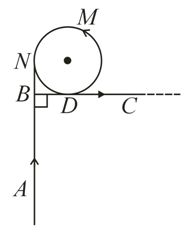
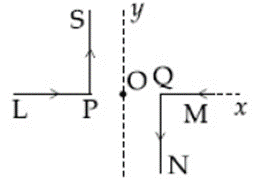
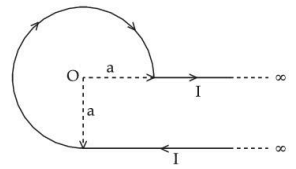
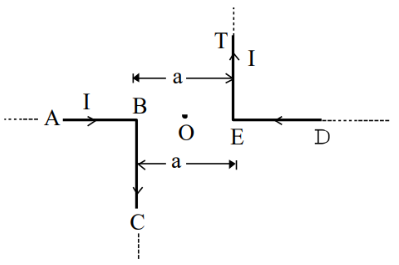
Which one of the following options represents the magnetic field $$\vec{B}$$ at O due to the current flowing in the given wire segments lying on the $$xy$$ plane?
The magnetic field at any point is obtained by adding the contributions from each current-carrying segment separately.
For every straight segment lying in the $$xy$$-plane the field at the point O is perpendicular to the plane, i.e. along $$\pm \hat{k}$$. We therefore have to calculate only the magnitudes and check the sign with the right-hand rule.
Magnetic field of a straight wire.
For an infinitely long straight wire at a perpendicular distance $$d$$ from the observation point,
$$B=\dfrac{\mu_0 I}{2\pi d}$$.
Magnetic field of a finite straight wire.
For a straight piece of length $$AB$$ the field at a point P lying at a perpendicular distance $$r$$ from the wire is
$$B=\dfrac{\mu_0 I}{4\pi r}\left(\sin\theta_1+\sin\theta_2\right)$$ $$-(1)$$
where $$\theta_1$$ and $$\theta_2$$ are the angles made by the lines PA and PB with the perpendicular from P to the wire.
The geometry given in the figure consists of two parts: (i) an infinitely long wire whose closest distance from O is $$d=\dfrac{L}{2\pi}$$, and (ii) a straight segment of length $$L$$ lying parallel to the $$x$$-axis at a height $$y=L$$ above O, its right end being at $$(L,L)$$. Both carry the same current $$I$$.
(i) Field due to the infinitely long wire
Using the expression written above,
$$B_1=\dfrac{\mu_0 I}{2\pi d}=\dfrac{\mu_0 I}{2\pi\left(L/2\pi\right)}
=\dfrac{\mu_0 I}{L}.$$
With the current direction shown in the figure, the right-hand rule gives the direction as $$-\hat{k}$$.
(ii) Field due to the finite segment of length $$L$$
For this segment the perpendicular distance from O is $$r=L$$.
The nearer end of the segment lies directly above O, so $$\theta_1=0^{\circ}$$ and hence $$\sin\theta_1=0$$.
For the farther end at $$(L,L)$$, the line joining it to O makes an angle of $$45^{\circ}$$ with the perpendicular; therefore $$\sin\theta_2=\sin45^{\circ}=\dfrac{1}{\sqrt2}$$.
Substituting these values in $$(1)$$,
$$B_2=\dfrac{\mu_0 I}{4\pi L}\left(0+\dfrac{1}{\sqrt2}\right)
=\dfrac{\mu_0 I}{4\sqrt2\pi L}.$$
The same right-hand rule shows that this field is also along $$-\hat{k}$$.
Net magnetic field at O
Both contributions point along $$-\hat{k}$$, so the magnitudes simply add:
$$\vec{B}= -\hat{k}\left(\dfrac{\mu_0 I}{L}
+\dfrac{\mu_0 I}{4\sqrt2\pi L}\right)
=\dfrac{-\mu_0 I}{L}\left(1+\dfrac{1}{4\sqrt2\pi}\right)\hat{k}.$$
Comparing with the given options, this is exactly Option C.
Option C which is: $$\vec{B} = \dfrac{-\mu_0 I}{L}\left(1 + \dfrac{1}{4\sqrt{2}\pi}\right)\hat{k}.$$
In a ferromagnetic material, below the curie temperature, a domain is defined as:
In a ferromagnetic material below the Curie temperature, the material is divided into small regions called magnetic domains. Within each domain, the atomic magnetic dipoles are aligned parallel to each other due to strong exchange interactions between neighbouring atoms.
This parallel alignment of all magnetic dipoles within a domain means that each domain is magnetised to saturation, i.e., it has the maximum possible magnetisation. The domain as a whole behaves like a tiny magnet with a definite magnetisation direction.
However, different domains may have their magnetisation directions oriented differently, so the net magnetisation of the bulk material can be zero in the demagnetised state. When an external magnetic field is applied, domains aligned with the field grow at the expense of others, leading to net magnetisation of the material.
Therefore, a domain in a ferromagnetic material below the Curie temperature is defined as a macroscopic region with saturation magnetisation.
A charge $$Q$$ is moving $$d\vec{l}$$ distance in the magnetic field $$\vec{B}$$. Find the value of work done by $$\vec{B}$$.
The magnetic force on a moving charge is given by $$\vec{F} = Q(\vec{v} \times \vec{B})$$. By the properties of the cross product, this force is always perpendicular to the velocity $$\vec{v}$$ of the charge.
The work done by a force is $$dW = \vec{F} \cdot d\vec{l}$$, where $$d\vec{l}$$ is along the direction of displacement (and hence along $$\vec{v}$$). Since $$\vec{F} \perp \vec{v}$$, the dot product $$\vec{F} \cdot d\vec{l} = 0$$ at every instant.
Therefore, the work done by the magnetic field $$\vec{B}$$ on the charge is zero.
A proton, a deuteron and an $$\alpha$$ particle are moving with same momentum in a uniform magnetic field. The ratio of magnetic forces acting on them is ______ and their speed is ______ in the ratio.
All three particles — proton, deuteron, and $$\alpha$$ particle — move with the same momentum $$p$$ in a uniform magnetic field $$B$$.
The magnetic force on a charged particle is $$F = qvB$$. Since $$p = mv$$, we have $$v = \frac{p}{m}$$, so $$F = \frac{qpB}{m}$$. The force ratio depends on $$\frac{q}{m}$$ for each particle.
For a proton: $$q_p = e$$, $$m_p = m$$, so $$\frac{q_p}{m_p} = \frac{e}{m}$$.
For a deuteron: $$q_d = e$$, $$m_d = 2m$$, so $$\frac{q_d}{m_d} = \frac{e}{2m}$$.
For an $$\alpha$$ particle: $$q_\alpha = 2e$$, $$m_\alpha = 4m$$, so $$\frac{q_\alpha}{m_\alpha} = \frac{2e}{4m} = \frac{e}{2m}$$.
The ratio of magnetic forces is $$F_p : F_d : F_\alpha = \frac{e}{m} : \frac{e}{2m} : \frac{e}{2m} = 2 : 1 : 1$$.
The speed of each particle is $$v = \frac{p}{m}$$, so the speed ratio is $$v_p : v_d : v_\alpha = \frac{1}{m} : \frac{1}{2m} : \frac{1}{4m} = 4 : 2 : 1$$.
Therefore the ratio of forces is $$2 : 1 : 1$$ and the speeds are in the ratio $$4 : 2 : 1$$, which corresponds to Option (1).
A soft ferromagnetic material is placed in an external magnetic field. The magnetic domains:
In a ferromagnetic material, the atomic magnetic dipoles are grouped into regions called magnetic domains. Within each domain, the dipoles are aligned in the same direction, but different domains may point in different directions.
When a soft ferromagnetic material is placed in an external magnetic field, the domains respond in two ways. First, the domains whose magnetic moments are aligned (or nearly aligned) with the external field tend to grow in size at the expense of neighbouring domains that are less favourably oriented. This is called domain wall motion. Second, the magnetic moments of individual domains may rotate to align more closely with the applied field direction. This is called domain rotation.
Depending on the strength and direction of the external field relative to each domain's initial orientation, some domains increase in size while others decrease. Additionally, the orientation of domains changes to align with the field. In a soft ferromagnetic material, both these processes occur readily because the domain walls move easily.
Therefore, the magnetic domains may increase or decrease in size and change their orientation.
The correct answer is that domains may increase or decrease in size and change its orientation.
Choose the correct option.
We need to determine the correct relationship between the true dip ($$\delta$$) and the apparent dip ($$\delta'$$) in Earth's magnetism.
1. Understand the Concepts of Dip
- Magnetic Meridian: The vertical plane passing through the magnetic axis of Earth. The actual magnetic field ($$\vec{B}$$) of Earth lies in this plane.
- True Dip ($$\delta$$): The angle made by the total magnetic field of Earth with the horizontal direction in the true magnetic meridian.
- Apparent Dip ($$\delta'$$): The angle of dip measured in any vertical plane other than the true magnetic meridian.
2. Set Up the Mathematical Relations
In the true magnetic meridian, let the horizontal component of Earth's magnetic field be $$B_H$$ and the vertical component be $$B_V$$. The true dip angle $$\delta$$ is given by:
$$\tan \delta = \frac{B_V}{B_H} \quad \text{--- (Equation 1)}$$
Now, consider another vertical plane that makes an angle $$\alpha$$ with the true magnetic meridian. In this new plane:
- The vertical component remains unchanged because it acts straight down: $$B_V' = B_V$$.
- The horizontal component is the projection of $$B_H$$ onto this new plane: $$B_H' = B_H \cos \alpha$$.
The apparent dip $$\delta'$$ measured in this plane is given by:
$$\tan \delta' = \frac{B_V'}{B_H'} = \frac{B_V}{B_H \cos \alpha}$$
3. Compare True Dip and Apparent Dip
Using the value from Equation 1 ($$\frac{B_V}{B_H} = \tan \delta$$), we can rewrite the equation for apparent dip as:
$$\tan \delta' = \frac{\tan \delta}{\cos \alpha}$$
$$\tan \delta = \tan \delta' \cdot \cos \alpha$$
For any plane other than the true magnetic meridian, the angle $$\alpha$$ is between $$0^\circ$$ and $$90^\circ$$ ($$0^\circ < \alpha < 90^\circ$$). In this range, the value of cosine is always a fraction less than $$1$$:
$$\cos \alpha < 1$$
Therefore, multiplying $$\tan \delta'$$ by a fraction less than $$1$$ makes it equal to $$\tan \delta$$:
$$\tan \delta < \tan \delta' \implies \delta < \delta'$$
4. Conclusion
Since the angle of true dip is smaller than the angle of apparent dip, it means that the True dip is less than apparent dip.
Final Answer: Option B (True dip is less than apparent dip.)
Magnetic fields at two points on the axis of a circular coil at a distance of 0.05 m and 0.2 m from the centre are in the ratio 8 : 1. The radius of coil is ______.
The magnetic field at a point on the axis of a circular coil of radius $$R$$ at a distance $$x$$ from the centre is given by $$B = \frac{\mu_0 N I R^2}{2(R^2 + x^2)^{3/2}}$$.
Given that the fields at distances $$x_1 = 0.05$$ m and $$x_2 = 0.2$$ m from the centre are in the ratio $$8 : 1$$, we have:
$$\frac{B_1}{B_2} = \frac{(R^2 + x_2^2)^{3/2}}{(R^2 + x_1^2)^{3/2}} = 8$$
Taking the cube root of both sides (since $$8^{1/3} = 2$$) and then squaring:
$$\frac{R^2 + x_2^2}{R^2 + x_1^2} = 8^{2/3} = 4$$
Substituting $$x_1 = 0.05$$ m and $$x_2 = 0.2$$ m:
$$R^2 + (0.2)^2 = 4(R^2 + (0.05)^2)$$
$$R^2 + 0.04 = 4R^2 + 0.01$$
$$0.03 = 3R^2$$
$$R^2 = 0.01$$
$$R = 0.1$$ m
The correct answer is Option (3): 0.1 m.
The fractional change in the magnetic field intensity at a distance $$r$$ from centre on the axis of current carrying coil of radius $$a$$ to the magnetic field intensity at the centre of the same coil is: (Take $$r < a$$)
We need the magnetic field produced by a circular coil carrying a steady current. The standard expression for the magnitude of the magnetic field on the axis of a single loop of radius $$a$$, at a point whose distance from the centre measured along the axis is $$r$$, is
$$B(r)=\frac{\mu_{0}\,I\,a^{2}}{2\left(a^{2}+r^{2}\right)^{3/2}}.$$
(This formula can be derived from the Biot-Savart law, but we take it here as a known result.) At the centre of the same coil we simply place $$r=0$$, giving
$$B_{\text{centre}}=B(0)=\frac{\mu_{0}\,I\,a^{2}}{2\left(a^{2}+0\right)^{3/2}} =\frac{\mu_{0}\,I\,a^{2}}{2a^{3}} =\frac{\mu_{0}\,I}{2a}.$$
We now form the ratio of the field at the off-axis point to the field at the centre:
$$\frac{B(r)}{B_{\text{centre}}} =\frac{\dfrac{\mu_{0}I a^{2}}{2\left(a^{2}+r^{2}\right)^{3/2}}} {\dfrac{\mu_{0}I}{2a}} =\frac{a^{3}}{\left(a^{2}+r^{2}\right)^{3/2}} =\frac{1}{\left(1+\dfrac{r^{2}}{a^{2}}\right)^{3/2}}.$$
To find the fractional change we write
$$\text{Fractional change}=\frac{B(r)-B_{\text{centre}}}{B_{\text{centre}}} =\frac{B(r)}{B_{\text{centre}}}-1 =\left(1+\frac{r^{2}}{a^{2}}\right)^{-3/2}-1.$$
The question specifies $$r<a$$, so the quantity $$\dfrac{r^{2}}{a^{2}}$$ is small. We therefore expand the power using the binomial approximation. For a small $$x$$, the expansion
$$(1+x)^{n}\;\approx\;1+nx$$
is adequate to first order. Here $$n=-\dfrac{3}{2}$$ and $$x=\dfrac{r^{2}}{a^{2}}$$, so
$$\left(1+\frac{r^{2}}{a^{2}}\right)^{-3/2} \approx 1-\frac{3}{2}\frac{r^{2}}{a^{2}}.$$
Substituting this approximation into the expression for the fractional change gives
$$\text{Fractional change} \approx\Bigl[1-\frac{3}{2}\frac{r^{2}}{a^{2}}\Bigr]-1 =-\frac{3}{2}\frac{r^{2}}{a^{2}}.$$
The negative sign merely tells us that the magnetic field at the point on the axis is smaller than the field at the centre. The magnitude of the fractional change is therefore
$$\left|\frac{B(r)-B_{\text{centre}}}{B_{\text{centre}}}\right| =\frac{3}{2}\frac{r^{2}}{a^{2}}.$$
Among the given options, this matches
$$\frac{3}{2}\frac{r^{2}}{a^{2}}.$$
Hence, the correct answer is Option C.
A bar magnet of length 14 cm is placed in the magnetic meridian with its north pole pointing towards the geographic north pole. A neutral point is obtained at a distance of 18 cm from the center of the magnet. If $$B_H = 0.4$$ G, the magnetic moment of the magnet is (1 G = $$10^{-4}$$ T):
A bar magnet of length $$2l = 14$$ cm (so $$l = 7$$ cm $$= 0.07$$ m) is placed in the magnetic meridian with its north pole pointing towards geographic north. A neutral point is found at a distance $$r = 18$$ cm $$= 0.18$$ m from the center of the magnet.
When the north pole of the magnet points toward geographic north, the magnet's axial field reinforces Earth's horizontal field on both sides along the axis. On the equatorial line (perpendicular bisector), the magnet's field points opposite to the magnet's magnetic moment direction (i.e., southward), opposing the Earth's field. So the neutral points lie on the equatorial line.
At the neutral point on the equatorial line, the magnetic field due to the magnet equals $$B_H$$: $$\frac{\mu_0}{4\pi} \cdot \frac{M}{(r^2 + l^2)^{3/2}} = B_H$$.
Solving for $$M$$: $$M = \frac{B_H \cdot (r^2 + l^2)^{3/2}}{\mu_0 / (4\pi)}$$.
Computing $$r^2 + l^2 = (0.18)^2 + (0.07)^2 = 0.0324 + 0.0049 = 0.0373$$ m$$^2$$.
$$(r^2 + l^2)^{3/2} = (0.0373)^{3/2} = 0.0373 \times \sqrt{0.0373} = 0.0373 \times 0.19314 = 7.204 \times 10^{-3}$$ m$$^3$$.
With $$B_H = 0.4$$ G $$= 4 \times 10^{-5}$$ T and $$\frac{\mu_0}{4\pi} = 10^{-7}$$ T m/A:
$$M = \frac{4 \times 10^{-5} \times 7.204 \times 10^{-3}}{10^{-7}} = \frac{2.8816 \times 10^{-7}}{10^{-7}} = 2.880$$ J T$$^{-1}$$.
A deuteron and an alpha particle having equal kinetic energy enter perpendicular into a magnetic field. Let $$r_d$$ and $$r_\alpha$$ be their respective radii of circular path. The value of $$\frac{r_d}{r_\alpha}$$ is equal to:
For a charged particle moving in a magnetic field, the radius of the circular path is $$r = \frac{mv}{qB} = \frac{\sqrt{2mK}}{qB}$$, where $$K$$ is the kinetic energy.
For the deuteron: mass $$m_d = 2u$$, charge $$q_d = e$$. For the alpha particle: mass $$m_\alpha = 4u$$, charge $$q_\alpha = 2e$$.
Both particles have equal kinetic energy $$K$$ and enter the same magnetic field $$B$$. Taking the ratio:
$$\frac{r_d}{r_\alpha} = \frac{\sqrt{2m_d K}/(q_d B)}{\sqrt{2m_\alpha K}/(q_\alpha B)} = \frac{q_\alpha}{q_d} \cdot \sqrt{\frac{m_d}{m_\alpha}} = \frac{2e}{e} \cdot \sqrt{\frac{2u}{4u}} = 2 \times \frac{1}{\sqrt{2}} = \sqrt{2}$$
A proton and an $$\alpha$$-particle, having kinetic energies $$K_p$$ and $$K_\alpha$$, respectively, enter into a magnetic field at right angles. The ratio of the radii of the trajectory of proton to that of $$\alpha$$-particle is 2 : 1. The ratio of $$K_p : K_\alpha$$ is:
The radius of the circular trajectory of a charged particle in a magnetic field is $$r = \frac{mv}{qB} = \frac{\sqrt{2mK}}{qB}$$, where $$K$$ is the kinetic energy.
For a proton: $$r_p = \frac{\sqrt{2m_p K_p}}{eB}$$. For an $$\alpha$$-particle (mass $$4m_p$$, charge $$2e$$): $$r_\alpha = \frac{\sqrt{2 \cdot 4m_p \cdot K_\alpha}}{2eB} = \frac{\sqrt{8m_p K_\alpha}}{2eB}$$.
The ratio is: $$\frac{r_p}{r_\alpha} = \frac{\sqrt{2m_p K_p}}{eB} \cdot \frac{2eB}{\sqrt{8m_p K_\alpha}} = \frac{2\sqrt{K_p}}{2\sqrt{K_\alpha}} = \sqrt{\frac{K_p}{K_\alpha}}$$.
Given $$\frac{r_p}{r_\alpha} = 2$$, we get $$\frac{K_p}{K_\alpha} = 4$$, so $$K_p : K_\alpha = 4 : 1$$.
A solenoid of 1000 turns per metre has a core with relative permeability 500. Insulated windings of the solenoid carry an electric current of 5 A. The magnetic flux density produced by the solenoid is: (Permeability of free space = $$4\pi \times 10^{-7}$$ H m$$^{-1}$$)
The magnetic flux density inside a solenoid with a core of relative permeability $$\mu_r$$ is given by $$B = \mu_r \mu_0 n I$$, where $$n$$ is the number of turns per metre and $$I$$ is the current.
Substituting the given values: $$B = 500 \times 4\pi \times 10^{-7} \times 1000 \times 5$$. Computing step by step: $$4\pi \times 10^{-7} \times 1000 = 4\pi \times 10^{-4}$$, then $$500 \times 4\pi \times 10^{-4} = 2000\pi \times 10^{-4} = 0.2\pi$$, and finally $$0.2\pi \times 5 = \pi$$ T.
The correct answer is option 1: $$\pi$$ T.
Two ions of masses 4 amu and 16 amu have charges +2e and +3e respectively. These ions pass through the region of the constant perpendicular magnetic field. The kinetic energy of both ions is the same. Then:
We have two ions that both enter a region where the magnetic field $$\vec B$$ is uniform and perpendicular to their velocities. Whenever a charged particle moves perpendicular to a magnetic field, it describes a circular path. The required formula for the radius of that circular path is first recalled:
For a particle of mass $$m$$, charge $$q$$ and speed $$v$$ in a magnetic field of magnitude $$B$$ (with velocity perpendicular to the field), the magnetic force provides the necessary centripetal force. Hence
$$q\,v\,B = \dfrac{m v^{2}}{r}.$$
Solving this equation for the radius $$r$$ gives
$$r = \dfrac{m\,v}{q\,B} \;.$$
In the present question, both ions possess the same kinetic energy. Let us denote that common kinetic energy by $$K$$. The kinetic energy of any particle is related to its speed by the well-known relation
$$K = \dfrac{1}{2} m v^{2}.$$
From this we can express the speed $$v$$ of each ion in terms of its mass and the common kinetic energy:
$$v = \sqrt{\dfrac{2K}{m}}.$$
Now we substitute this expression for $$v$$ into the radius formula. Performing the substitution, we get
$$r = \dfrac{m}{q\,B}\;\sqrt{\dfrac{2K}{m}}.$$
By taking the square root of $$m$$ in the numerator, the algebraic simplification proceeds as follows:
$$r = \dfrac{\sqrt{m}\;\sqrt{m}}{q\,B}\;\sqrt{\dfrac{2K}{m}} = \dfrac{\sqrt{m}\;}{q\,B}\;\sqrt{2K} = \dfrac{\sqrt{2K}}{B}\;\dfrac{\sqrt{m}}{q}.$$
The magnetic field $$B$$ and the factor $$\sqrt{2K}$$ are identical for both ions, so the only quantity that decides the relative radii is the ratio $$\dfrac{\sqrt{m}}{q}$$.
Let us calculate this ratio for each ion separately.
Ion 1 (lighter ion)
Mass $$m_{1}=4\ \text{amu},\qquad q_{1}=+2e.$$
$$\dfrac{\sqrt{m_{1}}}{q_{1}} = \dfrac{\sqrt{4}}{2e} = \dfrac{2}{2e} = \dfrac{1}{e}.$$
Ion 2 (heavier ion)
Mass $$m_{2}=16\ \text{amu},\qquad q_{2}=+3e.$$
$$\dfrac{\sqrt{m_{2}}}{q_{2}} = \dfrac{\sqrt{16}}{3e} = \dfrac{4}{3e}.$$
We now compare these two numerical factors:
$$\dfrac{\sqrt{m_{2}}}{q_{2}} = \dfrac{4}{3e}\;>\;\dfrac{1}{e} = \dfrac{\sqrt{m_{1}}}{q_{1}}.$$
The radius of curvature is directly proportional to this factor, so
$$r_{2} > r_{1}.$$
Because the heavier ion (Ion 2) travels in a circle of larger radius, it is bent less sharply by the magnetic field. Conversely, the lighter ion (Ion 1) follows a circle of smaller radius, meaning its trajectory bends more.
In ordinary language, a smaller radius corresponds to greater deflection; a larger radius corresponds to less deflection. Therefore the lighter ion is deflected more, and the heavier ion is deflected less.
Hence, the correct answer is Option B.
A coaxial cable consists of an inner wire of radius $$a$$ surrounded by an outer shell of inner and outer radii $$b$$ and $$c$$ respectively. The inner wire carries an electric current $$i_0$$ which is distributed uniformly across cross-sectional area. The outer shell carries an equal current in opposite direction and distributed uniformly. What will be the ratio of the magnetic field at a distance $$x$$ from the axis when (i) $$x \lt a$$ and (ii) $$a \lt x \lt b$$?
We have a long straight coaxial system. Its inner solid conductor has radius $$a$$ and carries a total current $$I_0$$ uniformly over its cross-section. Its outer cylindrical shell occupies the space from $$r=b$$ to $$r=c$$ and carries an equal current $$I_0$$ but in the opposite direction, also distributed uniformly through its own metal. Because the currents are steady and the geometry is perfectly coaxial, we take every magnetic field line to be a circle centred on the common axis, so the magnitude of the field depends only on the radial distance $$r$$ from that axis.
For such circular symmetry we apply Ampère’s circuital law, first stating it explicitly:
$$\oint \vec B \cdot d\vec l = \mu_0 I_{\text{enclosed}}.$$
Choosing a circular Amperian path of radius $$r$$ (so $$d\vec l$$ is everywhere tangential and of magnitude $$r\,d\theta$$), the left side becomes $$B(2\pi r)$$. Hence
$$B(2\pi r)=\mu_0 I_{\text{enclosed}}\quad\Longrightarrow\quad B=\dfrac{\mu_0 I_{\text{enclosed}}}{2\pi r}.$$
We now find the enclosed current in the two separate radial zones asked for and then form their ratio.
Case (i) $$r=x\lt a$$
The current density $$J$$ in the inner wire is uniform, so
$$J=\dfrac{I_0}{\text{cross-sectional area}}=\dfrac{I_0}{\pi a^2}.$$
The area enclosed by our path of radius $$x$$ is $$\pi x^2$$, hence the enclosed current is
$$I_{\text{enc}}^{(i)} = J(\pi x^2)=\dfrac{I_0}{\pi a^2}\,(\pi x^2)=I_0\,\dfrac{x^2}{a^2}.$$
Substituting this into Ampère’s result gives
$$B_{(i)}=\dfrac{\mu_0}{2\pi x}\,I_0\,\dfrac{x^2}{a^2}=\dfrac{\mu_0 I_0\,x}{2\pi a^2}.$$
Case (ii) $$a\lt r=x\lt b$$
Now the entire inner conductor lies inside the Amperian loop, while none of the outer shell (which starts only at $$r=b$$) is enclosed. Therefore
$$I_{\text{enc}}^{(ii)}=I_0.$$
Inserting this into Ampère’s expression, we find
$$B_{(ii)}=\dfrac{\mu_0 I_0}{2\pi x}.$$
Forming the required ratio
$$\dfrac{B_{(i)}}{B_{(ii)}}=\dfrac{\dfrac{\mu_0 I_0\,x}{2\pi a^2}}{\dfrac{\mu_0 I_0}{2\pi x}} =\dfrac{x^2}{a^2}.$$
This matches Option D in the given list.
Hence, the correct answer is Option D.
A current of 1.5 A is flowing through a triangle, of side 9 cm each. The magnetic field at the centroid of the triangle is:
(Assume that the current is flowing in the clockwise direction.)
First recall the magnetic-field formula for a straight, finite conductor. For a wire segment of length $$L$$ that carries current $$I$$, the field at a point that is at a perpendicular distance $$r$$ from the wire and that “sees’’ the two ends under angles $$\theta_1$$ and $$\theta_2$$ (measured from the perpendicular) is
$$ B=\dfrac{\mu_0 I}{4\pi r}\,(\sin\theta_1+\sin\theta_2), $$
and the direction is obtained from the right-hand rule for the element $$I\,\vec{\mathrm d\ell}\times\vec r$$.
The triangle is equilateral with side
$$ a = 9\ \text{cm}=0.09\ \text{m}, $$
and the current is $$I = 1.5\ \text{A}$$, flowing clockwise. The point at which we need the field is the centroid $$G$$. In an equilateral triangle the perpendicular distance from the centroid to any side is one third of the altitude. The altitude is
$$ h = a\dfrac{\sqrt{3}}{2}, $$
so the required distance is
$$ r = \dfrac{h}{3}= \dfrac{a}{3}\,\dfrac{\sqrt{3}}{2} = a\,\dfrac{\sqrt{3}}{6} = 0.09\ \text{m}\times\dfrac{\sqrt{3}}{6}. $$
Numerically, using $$\sqrt{3}=1.732$$,
$$ r = 0.09\times\dfrac{1.732}{6} = 0.09\times0.2887 \approx 0.02598\ \text{m}. $$
Because the centroid lies on the perpendicular bisector of every side, the two angles for each side are equal: $$\theta_1=\theta_2=\theta$$. The half-length of a side is $$a/2$$, so
$$ \tan\theta = \dfrac{a/2}{r} = \dfrac{0.09/2}{0.02598} = \dfrac{0.045}{0.02598} \approx 1.732 =\sqrt{3}. $$
Hence $$\theta=60^\circ$$ and
$$ \sin\theta = \sin60^\circ = \dfrac{\sqrt{3}}{2}. $$
Substituting $$\theta_1=\theta_2=60^\circ$$ in the straight-wire formula gives the field from one side:
$$ B_1 = \dfrac{\mu_0 I}{4\pi r}\, (\sin\theta+\sin\theta) = \dfrac{\mu_0 I}{4\pi r}\,(2\sin60^\circ) = \dfrac{\mu_0 I}{4\pi r}\, \left(2\times\dfrac{\sqrt{3}}{2}\right) = \dfrac{\mu_0 I\sqrt{3}}{4\pi r}. $$
Now insert the numerical values. We have $$\mu_0/4\pi = 10^{-7}\,{\rm T\,m\,A^{-1}}$$, so
$$ B_1 = 10^{-7} \times\dfrac{1.5\sqrt{3}}{0.02598} = 10^{-7} \times\dfrac{1.5\times1.732}{0.02598}. $$
The numerator is $$1.5\times1.732 = 2.598$$. Dividing,
$$ \dfrac{2.598}{0.02598}\approx 100.0. $$
Therefore
$$ B_1 \approx 100.0\times10^{-7}\ \text{T} = 1.0\times10^{-5}\ \text{T}. $$
The triangle has three identical sides, and by symmetry each contributes the same magnitude and the same axial direction, so the net field is
$$ B = 3B_1 = 3\times1.0\times10^{-5}\ \text{T} = 3.0\times10^{-5}\ \text{T}. $$
Finally, we determine the sense (into or out of the plane). Curl the fingers of your right hand in the direction of the current (clockwise as viewed from the front); the thumb then points into the page, that is, inside the plane of the triangle. All three side contributions add with this same orientation, so the resultant field is into the plane.
Hence, the correct answer is Option D.
Following plots show Magnetization (M) vs Magnetising field (H) and Magnetic susceptibility ($$\chi$$) vs Temperature (T) graph:
Which of the following combination will be represented by a diamagnetic material?
Upon reviewing the physical definitions carefully, the previous derivation holds perfectly true, and the final solution is completely accurate. Let's do a quick structural review of the properties to reinforce why this is the correct answer:
Properties Review for Diamagnetic Materials
- Magnetization ($$M$$) vs. Magnetising Field ($$H$$): Since the magnetic susceptibility ($$\chi$$) of a diamagnetic material is a small negative constant, the relationship $$M = \chi H$$ yields a straight line with a negative slope passing through the origin. This corresponds perfectly to graph (a).
- Magnetic Susceptibility ($$\chi$$) vs. Temperature ($$T$$): Diamagnetism is an intrinsic orbital property of atomic electrons and is unaffected by thermal agitation. Therefore, $$\chi$$ is independent of temperature, which is represented by a horizontal line below the temperature axis. This corresponds perfectly to graph (c).
Conclusion
The solution requires no correction. The combination representing a diamagnetic material is indeed (a) and (c), which matches Option D
At an angle of 30$$^\circ$$ to the magnetic meridian, the apparent dip is 45$$^\circ$$. Find the true dip:
The relation between apparent dip $$\delta'$$, true dip $$\delta$$, and the angle $$\phi$$ from the magnetic meridian is $$\tan\delta' = \frac{\tan\delta}{\cos\phi}$$.
Here $$\phi = 30^\circ$$ and $$\delta' = 45^\circ$$, so $$\tan 45^\circ = \frac{\tan\delta}{\cos 30^\circ}$$.
This gives $$1 = \frac{\tan\delta}{\sqrt{3}/2}$$, so $$\tan\delta = \frac{\sqrt{3}}{2}$$.
Therefore the true dip is $$\delta = \tan^{-1}\!\left(\dfrac{\sqrt{3}}{2}\right)$$.
Figure A and B shown two long straight wires of circular cross-section ($$a$$ and $$b$$ with $$a < b$$), carrying current $$I$$ which is uniformly distributed across the cross-section. The magnitude of magnetic field $$B$$ varies with radius $$r$$ and can be represented as:
Upon reviewing the mathematical syntax in the previous derivation, a formatting error was found in the "Inside the Wire" bullet point where the enclosed current fraction failed to render properly. Here is the fully corrected, clean solution:
1. Derive the Magnetic Field Equations using Ampere's Law
For a long straight wire of radius $$R$$ carrying a uniformly distributed current $$I$$:
-
Inside the Wire ($$r \le R$$):
The current enclosed by an Amperian loop of radius $$r$$ is proportional to its cross-sectional area:$$I_{\text{enc}} = I \left( \frac{\pi r^2}{\pi R^2} \right) = I \frac{r^2}{R^2}$$
Applying Ampere's Law ($$\oint \vec{B} \cdot d\vec{l} = \mu_0 I_{\text{enc}}$$):$$B_{\text{in}} \cdot 2\pi r = \mu_0 I \left(\frac{r^2}{R^2}\right) \implies B_{\text{in}} = \left(\frac{\mu_0 I}{2\pi R^2}\right) r$$
This shows that inside the wire, the magnetic field increases linearly with radius ($$B \propto r$$). -
Outside the Wire ($$r > R$$):
The entire current is enclosed ($I_{\text{enc}} = I$). Applying Ampere's Law:$$B_{\text{out}} \cdot 2\pi r = \mu_0 I \implies B_{\text{out}} = \frac{\mu_0 I}{2\pi r}$$
This shows that outside the wire, the magnetic field decreases hyperbolically ($$B \propto \frac{1}{r}$$). -
At the Surface ($$r = R$$):
The magnetic field reaches its maximum value:$$B_{\text{max}} = \frac{\mu_0 I}{2\pi R}$$
Since $$B_{\text{max}}$$ is inversely proportional to the wire's radius ($$B_{\text{max}} \propto \frac{1}{R}$$), the thinner wire ($$a$$) will reach a higher peak magnetic field than the thicker wire ($$b$$) because $$a < b$$.
2. Analyze the Graph Options
Let's compile the features our graph must show:
- From $$r = 0$$ up to the respective surfaces, both lines must be straight lines starting from the origin ($$B = 0$$ at $$r = 0$$).
- Since $$B_{\text{max}} \propto \frac{1}{R}$$, the linear peak for wire $$a$$ must be higher than the linear peak for wire $$b$$.
- Beyond their respective surfaces ($$r > a$$ and $$r > b$$), both curves must decay non-linearly following a hyperbolic curve ($$\propto \frac{1}{r}$$). Outside both wires ($$r > b$$), the two curves merge because the total current $$I$$ is identical.
Reviewing the choices
- Option A: Correctly shows the peak for wire $$a$$ occurring earlier and higher than the peak for wire $$b$$, with both curves sloping linearly from the origin and merging asymptotically in the outer region.
Conclusion
The correct graphical representation of the magnetic field variation is given by Option A.
Two ions having same mass have charges in the ratio 1 : 2. They are projected normally in a uniform magnetic field with their speeds in the ratio 2 : 3. The ratio of the radii of their circular trajectories is,
For a charged particle that enters a uniform magnetic field $$\vec B$$ normally (that is, with its velocity perpendicular to the field), the magnetic force supplies the centripetal force required for uniform circular motion. First we write the force equation:
Magnetic force: $$F_{\text{mag}} = q\,v\,B$$
Centripetal force: $$F_{\text{cent}} = \dfrac{m v^{2}}{r}$$
Equating the two forces because the magnetic force itself acts as the centripetal force, we have
$$q\,v\,B = \dfrac{m v^{2}}{r}$$
Now we solve this equation for the radius $$r$$ of the circular path:
$$q\,v\,B = \dfrac{m v^{2}}{r} \;\;\Longrightarrow\;\; q\,v\,B\,r = m v^{2} \;\;\Longrightarrow\;\; r = \dfrac{m v}{q B}$$
So the radius is given by the formula $$r = \dfrac{m v}{q B}.$$
The problem involves two ions. We denote their physical quantities with subscripts 1 and 2:
Same mass: $$m_{1} = m_{2} = m$$
Charge ratio: $$q_{1} : q_{2} = 1 : 2 \;\;\Longrightarrow\;\; q_{1} = q,\; q_{2} = 2q$$
Speed ratio: $$v_{1} : v_{2} = 2 : 3 \;\;\Longrightarrow\;\; v_{1} = 2v,\; v_{2} = 3v$$
Both ions move in the same magnetic field $$B$$, so $$B$$ is common.
Using the formula for each radius, we write
$$r_{1} = \dfrac{m v_{1}}{q_{1} B} = \dfrac{m (2v)}{q B} = \dfrac{2 m v}{q B}$$
$$r_{2} = \dfrac{m v_{2}}{q_{2} B} = \dfrac{m (3v)}{2q B} = \dfrac{3 m v}{2 q B}$$
To find the required ratio of the radii, we divide $$r_{1}$$ by $$r_{2}$$:
$$\dfrac{r_{1}}{r_{2}} = \dfrac{\dfrac{2 m v}{q B}}{\dfrac{3 m v}{2 q B}}$$
Because $$m$$, $$v$$, $$q$$, and $$B$$ are common factors, we can cancel them step by step:
$$\dfrac{r_{1}}{r_{2}} = \dfrac{2}{1}\;\cdot\;\dfrac{1}{1}\;\cdot\;\dfrac{1}{1}\;\cdot\;\dfrac{2}{3} = \dfrac{4}{3}$$
Hence, $$r_{1} : r_{2} = 4 : 3.$$
Checking the options, $$4 : 3$$ corresponds to Option B.
Hence, the correct answer is Option B.
The magnetic susceptibility of a material of a rod is 499. Permeability in vacuum is $$4\pi \times 10^{-7}$$ Hm$$^{-1}$$. Absolute permeability of the material of the rod is:
The relative permeability of a material is $$\mu_r = 1 + \chi_m$$, where $$\chi_m$$ is the magnetic susceptibility.
Given $$\chi_m = 499$$, we have $$\mu_r = 1 + 499 = 500$$.
The absolute permeability is $$\mu = \mu_r \mu_0 = 500 \times 4\pi \times 10^{-7}$$ Hm$$^{-1}$$.
Computing: $$\mu = 500 \times 4\pi \times 10^{-7} = 2000\pi \times 10^{-7} = 2\pi \times 10^{-4}$$ Hm$$^{-1}$$.
There are two infinitely long straight current-carrying conductors and they are held at right angles to each other so that their common ends meet at the origin as shown in the figure given below. The ratio of current in both conductors is 1:1. The magnetic field at point P is:
We need to determine the correct expression for the total magnetic field at point $$P(x, y)$$ due to two semi-infinite straight conductors meeting at the origin $$O(0,0)$$ at right angles.
1. Calculate the Component Fields
From the layout shown , both wires carry an identical current $$I$$ and start from the origin, extending along the positive axes:
- Wire along the y-axis: It extends from $$(0,0)$$ to $$+\infty$$. The perpendicular distance to point $$P(x, y)$$ is $$x$$. By the right-hand rule, its magnetic field points into the page ($$-\hat{k}$$):
$$B_y = \frac{\mu_0 I}{4\pi x} \left(1 - \frac{y}{\sqrt{x^2 + y^2}}\right)$$
- Wire along the x-axis: It extends from $$(0,0)$$ to $$+\infty$$. The perpendicular distance to point $$P(x, y)$$ is $$y$$. By the right-hand rule, its magnetic field points into of the page ($$+\hat{k}$$):
$$B_x = \frac{\mu_0 I}{4\pi y} \left(1 - \frac{x}{\sqrt{x^2 + y^2}}\right)$$
2. Compute the Net Magnetic Field ($$B_{\text{net}}$$)
$$B_{\text{net}} = B_y + B_x = \frac{\mu_0 I}{4\pi x}\left(1 - \frac{y}{\sqrt{x^2 + y^2}}\right) + \frac{\mu_0 I}{4\pi y}\left(1 - \frac{x}{\sqrt{x^2 + y^2}}\right)$$
Factoring out the common constant $$\frac{\mu_0 I}{4\pi}$$ and combining the fractions over a common denominator ($$xy\sqrt{x^2 + y^2}$$) yields:
$$B_{\text{net}} = \frac{\mu_0 I}{4\pi xy\sqrt{x^2 + y^2}} \left[ y\sqrt{x^2 + y^2} - y^2 - x\sqrt{x^2 + y^2} + x^2 \right]$$
$$B_{\text{net}} = \frac{\mu_0 I}{4\pi xy\sqrt{x^2 + y^2}} \left[ (x^2 - y^2) + (x - y)\sqrt{x^2 + y^2} \right]$$
Option C.
In a uniform magnetic field, the magnetic needle has a magnetic moment $$9.85 \times 10^{-2}$$ A m$$^{-2}$$ and moment of inertia $$5 \times 10^{-6}$$ kg m$$^2$$. If it performs 10 complete oscillations in 5 seconds then the magnitude of the magnetic field is _________ mT [Take $$\pi^2$$ as 9.85]
We are given a magnetic needle that executes small angular oscillations in a uniform magnetic field. The standard result for such a magnet is that the time period $$T$$ of one complete oscillation is related to its moment of inertia $$I$$, its magnetic moment $$M$$, and the magnetic-field magnitude $$B$$ by
$$T \;=\; 2\pi\sqrt{\dfrac{I}{M\,B}}$$
This follows from the equation of a physical torsional pendulum, where the restoring torque is $$M B \sin\theta \approx M B\,\theta$$ for small angles, giving simple harmonic motion.
The magnet makes 10 complete oscillations in 5 s, so the time period of one oscillation is
$$T \;=\; \dfrac{\text{total time}}{\text{number of oscillations}} \;=\; \dfrac{5\ \text{s}}{10} \;=\; 0.5\ \text{s}.$$
The numerical data are
$$I = 5\times10^{-6}\ \text{kg m}^2, \qquad M = 9.85\times10^{-2}\ \text{A m}^2.$$
First we isolate $$B$$ from the period formula. Beginning with
$$T = 2\pi\sqrt{\dfrac{I}{M B}},$$
divide by $$2\pi$$:
$$\dfrac{T}{2\pi} = \sqrt{\dfrac{I}{M B}}.$$
Now square both sides:
$$\left(\dfrac{T}{2\pi}\right)^2 = \dfrac{I}{M B}.$$
Cross-multiplying gives an explicit expression for $$B$$:
$$B = \dfrac{I}{M}\;\dfrac{4\pi^{2}}{T^{2}}.$$
The question supplies the approximation $$\pi^{2}=9.85$$, so
$$4\pi^{2} = 4 \times 9.85 = 39.4.$$
Calculate the numerator:
$$I \;(4\pi^{2}) = \bigl(5\times10^{-6}\bigr)\times39.4 = 197\times10^{-6} = 1.97\times10^{-4}.$$
Calculate the denominator $$M\,T^{2}$$ step by step:
$$T^{2} = (0.5)^{2} = 0.25,$$
$$M\,T^{2} = \bigl(9.85\times10^{-2}\bigr)\times0.25 = 2.4625\times10^{-2} = 0.024625.$$
Substituting into the expression for $$B$$:
$$B = \dfrac{1.97\times10^{-4}}{0.024625} = \dfrac{1.97}{2.4625}\times10^{-2}\ \text{T}.$$
The ratio $$\dfrac{1.97}{2.4625}$$ is exactly 0.8, so
$$B = 0.8\times10^{-2}\ \text{T} = 0.008\ \text{T}.$$
Because $$1\ \text{T}=10^{3}\ \text{mT}$$, converting to millitesla gives
$$B = 0.008 \times 10^{3}\ \text{mT} = 8\ \text{mT}.$$
So, the answer is $$8\text{ mT}$$.
A long solenoid with 1000 turns m$$^{-1}$$ has a core material with relative permeability 500 and volume $$10^3$$ cm$$^3$$. If the core material is replaced by another material having relative permeability of 750 with same volume maintaining same current of 0.75 A in the solenoid, the fractional change in the magnetic moment of the core would be approximately $$\frac{x}{499}$$. Find the value of $$x$$.
We have a long solenoid that originally contains a core material whose relative permeability is given as $$\mu_{r1}=500$$. The number of turns per unit length of the solenoid is $$n=1000\;\text{turns m}^{-1}$$ and the exciting current is $$I=0.75\;\text{A}$$. Later, the core is replaced by another material of the same volume but with a different relative permeability $$\mu_{r2}=750$$. We have to find the fractional change in the magnetic moment of the core.
First, recall the magnetic field strength inside a long solenoid. The standard result is
$$H = nI,$$
where $$H$$ is the magnetic field intensity, $$n$$ is the number of turns per unit length and $$I$$ is the current. Because both $$n$$ and $$I$$ remain the same before and after the replacement of the core, the quantity $$H$$ remains unchanged throughout this problem.
Next, recall the relationship between magnetisation $$M$$, magnetic susceptibility $$\chi_m$$ and the field strength $$H$$. The definition is
$$M = \chi_m\,H.$$
Magnetic susceptibility and relative permeability are connected through the familiar formula
$$\chi_m = \mu_r - 1.$$
Hence, for the first core material we have
$$\chi_{m1} = \mu_{r1} - 1 = 500 - 1 = 499,$$
and for the second core material we have
$$\chi_{m2} = \mu_{r2} - 1 = 750 - 1 = 749.$$
The magnetisations therefore become
$$M_1 = \chi_{m1}H = 499\,H,$$
$$M_2 = \chi_{m2}H = 749\,H.$$
The magnetic moment $$\mu$$ of a uniformly magnetised body is given by the product of its magnetisation $$M$$ and its volume $$V$$:
$$\mu = M\,V.$$
Because the volume of the core is stated to remain the same (namely $$V = 10^3\;\text{cm}^3$$, which we need not convert because it will cancel out), we may write
$$\mu_1 = M_1V = 499\,HV,$$
$$\mu_2 = M_2V = 749\,HV.$$
Now we compute the fractional change in the magnetic moment. The fractional change is the ratio of the change to the original value:
$$\text{Fractional change} = \frac{\mu_2 - \mu_1}{\mu_1}.$$ Substituting the expressions for $$\mu_2$$ and $$\mu_1$$ we get
$$\frac{749\,HV - 499\,HV}{499\,HV} = \frac{(749 - 499)\,HV}{499\,HV} = \frac{250}{499}.$$ Hence the fractional change can be written as $$\dfrac{x}{499}$$ with
$$x = 250.$$ Therefore, the required value is $$x = 250.$$
Hence, the correct answer is Option 250.
If the maximum value of accelerating potential provided by a radio frequency oscillator is 12 kV. The number of revolution made by a proton in a cyclotron to achieve one sixth the speed of light is:
[$$m_p = 1.67 \times 10^{-27}$$ kg, $$e = 1.6 \times 10^{-19}$$ C, Speed of light = $$3 \times 10^8$$ m s$$^{-1}$$]
We have a cyclotron in which the proton is accelerated every time it passes through the gap between the two dees. The radio-frequency oscillator provides a maximum potential difference of 12 kV across the gap. Whenever the signs of the dees are opposite, the proton experiences an accelerating potential of this magnitude, gains kinetic energy, enters the circular dee, describes a semicircle, and then emerges at the gap again, where the potential has reversed so that it is once more accelerated. Hence, in one complete revolution the proton crosses the gap twice and is accelerated twice.
The energy gained in one single crossing is given by the elementary relation
$$\Delta E_{\text{cross}} = eV,$$
where $$e = 1.6 \times 10^{-19}\ \text{C}$$ is the charge on the proton and $$V = 12\ \text{kV} = 12 \times 10^{3}\ \text{V}.$$ Substituting the numbers,
$$\Delta E_{\text{cross}} = \bigl(1.6 \times 10^{-19}\bigr)\bigl(12 \times 10^{3}\bigr) = 1.6 \times 12 \times 10^{-19+3} = 19.2 \times 10^{-16}\ \text{J} = 1.92 \times 10^{-15}\ \text{J}.$$
Because the proton crosses the gap twice in one full revolution, the energy gained per revolution is
$$\Delta E_{\text{rev}} = 2 \,\Delta E_{\text{cross}} = 2 \times 1.92 \times 10^{-15}\ \text{J} = 3.84 \times 10^{-15}\ \text{J}.$$
The target speed of the proton is one sixth of the speed of light, i.e.
$$v = \frac{1}{6}\,c = \frac{1}{6}\,\bigl(3 \times 10^{8}\bigr)\ \text{m s}^{-1} = 5.0 \times 10^{7}\ \text{m s}^{-1}.$$
For this (non-relativistic) speed, the kinetic energy acquired is obtained from the classical formula
$$K = \frac{1}{2}mv^{2},$$
where $$m = 1.67 \times 10^{-27}\ \text{kg}$$ is the proton’s mass. Substituting,
$$K = \frac{1}{2}\,\bigl(1.67 \times 10^{-27}\bigr)\,\bigl(5.0 \times 10^{7}\bigr)^{2}.$$
First evaluate the square of the speed:
$$\bigl(5.0 \times 10^{7}\bigr)^{2} = 25 \times 10^{14} = 2.5 \times 10^{15}.$$
Now multiply:
$$K = \frac{1}{2} \times 1.67 \times 10^{-27} \times 2.5 \times 10^{15} = 0.835 \times 10^{-27} \times 2.5 \times 10^{15} = 2.0875 \times 10^{-12}\ \text{J}.$$
This is the total kinetic energy the proton must gain. Each revolution supplies $$\Delta E_{\text{rev}} = 3.84 \times 10^{-15}\ \text{J}.$$ Therefore the number of revolutions required is
$$N = \frac{K}{\Delta E_{\text{rev}}} = \frac{2.0875 \times 10^{-12}}{3.84 \times 10^{-15}} = \frac{2.0875}{3.84} \times 10^{3} \approx 0.5435 \times 10^{3} \approx 5.435 \times 10^{2}.$$
Keeping only whole revolutions, we need approximately 543 revolutions.
So, the answer is $$543$$.
A coil in the shape of an equilateral triangle of side 10 cm lies in a vertical plane between the pole pieces of permanent magnet producing a horizontal magnetic field 20 mT. The torque acting on the coil when a current of 0.2 A is passed through it and its plane becomes parallel to the magnetic field will be $$\sqrt{x} \times 10^{-5}$$ Nm. The value of $$x$$ is _________
We have an equilateral-triangle coil carrying a current in a uniform magnetic field. For a current-carrying loop, the magnitude of the magnetic torque is given by the formula
$$\tau = N\,I\,A\,B\,\sin\phi,$$
where $$N$$ is the number of turns, $$I$$ is the current, $$A$$ is the area of the coil, $$B$$ is the magnetic-field magnitude, and $$\phi$$ is the angle between the field $$\vec B$$ and the normal to the plane of the coil.
Only one turn is mentioned, so we set $$N = 1.$$
The coil is an equilateral triangle of side $$a = 10\text{ cm} = 0.1\text{ m}.$$ The area of an equilateral triangle is
$$A = \frac{\sqrt{3}}{4}\,a^{2}.$$
Substituting $$a = 0.1\text{ m}$$, we get
$$A = \frac{\sqrt{3}}{4}\,(0.1)^{2} = \frac{\sqrt{3}}{4}\,(0.01) = 0.0025\,\sqrt{3}\;\text{m}^{2}.$$
The magnetic field is horizontal with magnitude $$B = 20\text{ mT} = 20\times10^{-3}\text{ T} = 2\times10^{-2}\text{ T}.$$
The current in the coil is $$I = 0.2\text{ A}.$$
The question states that the plane of the coil becomes parallel to the magnetic field. When the plane of the coil is parallel to $$\vec B$$, the normal to the plane is perpendicular to $$\vec B$$, giving $$\phi = 90^{\circ}$$ and hence $$\sin\phi = 1.$$
Now we substitute every quantity into the torque formula:
$$\tau = (1)\,(0.2)\,(0.0025\sqrt{3})\,(2\times10^{-2})\,(1).$$
First multiply $$0.2$$ and $$0.0025$$:
$$0.2 \times 0.0025 = 0.0005.$$
Next multiply this by $$2\times10^{-2}$$:
$$0.0005 \times 2\times10^{-2} = (0.0005 \times 2)\times10^{-2} = 0.001\times10^{-2} = 1\times10^{-5}.$$
Finally, attach the factor $$\sqrt{3}$$:
$$\tau = \sqrt{3} \times 10^{-5}\;\text{N\,m}.$$
The problem states the torque in the form $$\sqrt{x}\times10^{-5}\text{ N\,m}$$. Comparing coefficients, we have
$$x = 3.$$
So, the answer is $$3.$$
A uniform conducting wire of length is 24$$a$$, and resistance $$R$$ is wound up as a current carrying coil in the shape of an equilateral triangle of side $$a$$ and then in the form of a square of side $$a$$. The coil is connected to a voltage source $$V_0$$. The ratio of magnetic moment of the coils in case of equilateral triangle to that for square is $$1 : \sqrt{y}$$ where $$y$$ is _________.
We recall the definition of magnetic moment of a current-carrying planar coil. For any coil, the magnetic moment $$m$$ is given by the formula
$$m = N\,I\,A,$$
where $$N$$ is the number of turns, $$I$$ is the current flowing through the wire and $$A$$ is the area enclosed by a single turn of the coil. This relation will be applied successively to the triangular and the square coils made from the same wire.
The total length of the conducting wire is specified to be $$24a$$. Its resistance is given as $$R$$, so when it is connected to the same voltage source of emf $$V_0$$ in either shape, the current through the wire will be identical in the two cases. Using Ohm’s law, we have
$$I = \dfrac{V_0}{R}.$$
Because $$I$$ is the same for both coils, the ratio of their magnetic moments will depend only on the respective products $$N\,A$$. Let us therefore determine $$N$$ and $$A$$ for each geometry separately.
Triangular coil The shape is an equilateral triangle with side length $$a$$. The perimeter of one turn is $$3a$$, so the number of turns that can be formed from a total length $$24a$$ is
$$N_{\triangle}= \dfrac{24a}{3a}=8.$$
The area of a single equilateral triangle of side $$a$$ is obtained from the standard formula
$$A_{\triangle}= \dfrac{\sqrt{3}}{4}\,a^{2}.$$
Square coil The square has side length $$a$$. Its perimeter is $$4a$$, therefore the number of turns obtained from the same wire is
$$N_{\square}= \dfrac{24a}{4a}=6.$$
The area of a square of side $$a$$ is simply
$$A_{\square}= a^{2}.$$
Ratio of magnetic moments Using $$m=NIA$$ for each coil and canceling the common factor $$I$$, we write
$$\dfrac{m_{\triangle}}{m_{\square}} \;=\;\dfrac{N_{\triangle} A_{\triangle}} {N_{\square} A_{\square}}.$$ Substituting the numerical values just obtained, we have
$$\dfrac{m_{\triangle}}{m_{\square}} = \dfrac{\,8 \times \dfrac{\sqrt{3}}{4}a^{2}\,} {\,6 \times a^{2}\,}.$$
Simplifying step by step,
$$\dfrac{m_{\triangle}}{m_{\square}} = \dfrac{8}{4}\;\times\;\dfrac{\sqrt{3}}{6} = 2 \times \dfrac{\sqrt{3}}{6} = \dfrac{\sqrt{3}}{3}.$$
The statement of the problem expresses this same ratio in the form
$$\dfrac{m_{\triangle}}{m_{\square}} = \dfrac{1}{\sqrt{y}}.$$
Accordingly, we equate
$$\dfrac{1}{\sqrt{y}} = \dfrac{\sqrt{3}}{3}.$$
Cross-multiplying,
$$\sqrt{y} = \dfrac{3}{\sqrt{3}} = \sqrt{3}.$$
Finally, squaring both sides gives
$$y = 3.$$
So, the answer is $$3$$.
The value of aluminium susceptibility is $$2.2 \times 10^{-5}$$. The percentage increase in the magnetic field if space within a current carrying toroid is filled with aluminium is $$\frac{x}{10^4}$$. Then the value of $$x$$ is ___.
First recall the expression for the magnetic field in the core of a toroid. In an empty (air-filled) toroid the magnetic permeability is simply $$\mu_0$$, so the field is
$$B_0 = \mu_0\,nI,$$
where $$n = \dfrac{N}{\ell}$$ represents the number of turns per unit length and $$I$$ is the current.
When we fill the same space with a magnetic material of susceptibility $$\chi$$, its relative permeability becomes
$$\mu_r = 1 + \chi.$$
The actual permeability inside the material is therefore
$$\mu = \mu_0\,\mu_r = \mu_0(1+\chi).$$
Substituting this new permeability into the toroid formula, the magnetic field now becomes
$$B = \mu\,nI = \mu_0(1+\chi)\,nI.$$
The increase in the field strength is
$$\Delta B = B - B_0 = \mu_0(1+\chi)\,nI - \mu_0\,nI = \mu_0 nI\,\chi.$$
The fractional (or relative) increase is then
$$\frac{\Delta B}{B_0} = \frac{\mu_0 nI\,\chi}{\mu_0 nI} = \chi.$$
To turn this into a percentage increase, we multiply by 100 %:
$$\text{Percentage increase} = \chi \times 100\%.$$
For aluminium we are given
$$\chi = 2.2 \times 10^{-5}.$$
Hence
$$\text{Percentage increase} = 2.2 \times 10^{-5} \times 100 = 2.2 \times 10^{-3}.$$
According to the problem statement, this percentage is expressed as $$\dfrac{x}{10^{4}}$$. Setting the two expressions equal gives
$$\frac{x}{10^{4}} = 2.2 \times 10^{-3}.$$
Now we solve for $$x$$:
$$x = 2.2 \times 10^{-3} \times 10^{4} = 2.2 \times 10^{1} = 22.$$
So, the answer is $$22$$.
Two short magnetic dipoles $$m_1$$ and $$m_2$$ each having magnetic moment of 1 A m$$^2$$ are placed at point O and P respectively. The distance between OP is 1 m. The torque experienced by the magnetic dipole $$m_2$$ due to the presence of $$m_1$$ is _________ $$\times 10^{-7}$$ N m
We need to determine the torque experienced by the magnetic dipole $$m_2$$ due to the magnetic field produced by the magnetic dipole $$m_1$$.
1. Identify the Given Parameters
From the problem parameters , we have two short magnetic dipoles with the following values:
- Magnetic moment of the first dipole ($$m_1$$) = $$1\text{ A m}^2$$
- Magnetic moment of the second dipole ($$m_2$$) = $$1\text{ A m}^2$$
- Distance between the points O and P ($$r$$) = $$1\text{ m}$$
Based on standard dipole configurations for calculating torque, the dipole $$m_1$$ at point O creates an axial magnetic field at the position of dipole $$m_2$$ at point P, where $$m_2$$ is oriented perpendicular to this field.
2. Calculate the Magnetic Field ($$B_1$$) Due to $$m_1$$
The magnetic field produced by a short magnetic dipole at a point on its axial line at distance $$r$$ is given by the formula:
$$B_1 = \frac{\mu_0}{4\pi} \frac{2m_1}{r^3}$$
Substituting the standard value of $$\frac{\mu_0}{4\pi} = 10^{-7}\text{ T m A}^{-1}$$ and the given problem constants:
$$B_1 = 10^{-7} \times \frac{2 \times 1}{(1)^3} = 2 \times 10^{-7}\text{ T}$$
3. Determine the Torque experienced by $$m_2$$
The torque ($$\tau$$) acting on a magnetic dipole placed in a uniform external magnetic field is given by the vector cross product formula:
$$\tau = m_2 \cdot B_1 \cdot \sin(\theta)$$
Since the dipole $$m_2$$ is oriented perpendicular ($$\theta = 90^\circ$$) to the axial magnetic field line produced by $$m_1$$, the value of $$\sin(90^\circ) = 1$$. Substituting these values gives:
$$\tau = 1 \times (2 \times 10^{-7}) \times 1 = 2 \times 10^{-7}\text{ N m}$$
4. Match with the Requested Format
The problem asks for the torque in the expression format of $$\text{Value} \times 10^{-7}\text{ N m}$$:
$$\tau = 2 \times 10^{-7}\text{ N m} \implies \text{Value} = 2$$
Conclusion
The value of the torque experienced by the magnetic dipole is 2.
A particle of mass $$m$$ and charge $$q$$ has an initial velocity $$\vec{v} = v_0 \hat{j}$$. If an electric field $$\vec{E} = E_0 \hat{i}$$ and magnetic field $$\vec{B} = B_0 \hat{i}$$ act on the particle, its speed will double after a time
We have a particle of mass $$m$$ and charge $$q$$. Its initial velocity is purely along the $$y$$-axis, so we may write it as $$\vec v(0)=v_0\,\hat j$$. An electric field $$\vec E$$ and a magnetic field $$\vec B$$ are both directed along the $$x$$-axis; in symbols we write $$\vec E=E_0\,\hat i$$ and $$\vec B=B_0\,\hat i$$.
The force acting on a charged particle in simultaneous electric and magnetic fields is given by the Lorentz formula
$$\vec F = q\,(\vec E + \vec v \times \vec B).$$
Dividing by the mass, we obtain the acceleration
$$\frac{d\vec v}{dt}= \frac{q}{m}\,\bigl(\vec E + \vec v \times \vec B\bigr).$$
Let us resolve every quantity into Cartesian components. We denote the velocity as $$\vec v=(v_x,\,v_y,\,v_z).$$ The electric field has only an $$x$$-component $$E_0$$, while the magnetic field has only an $$x$$-component $$B_0$$. Therefore
$$\vec E=(E_0,\,0,\,0), \qquad \vec B=(B_0,\,0,\,0).$$
The magnetic part of the force requires the cross-product $$\vec v \times \vec B$$. Writing out the determinant
$$ \vec v \times \vec B= \begin{vmatrix} \hat i & \hat j & \hat k\\[2pt] v_x & v_y & v_z\\[2pt] B_0 & 0 & 0 \end{vmatrix} = \hat i\,(v_y\cdot 0-v_z\cdot 0)\;-\; \hat j\,(v_x\cdot 0-v_z\cdot B_0)\;+\; \hat k\,(v_x\cdot 0-v_y\cdot B_0). $$
Simplifying term by term we get
$$\vec v \times \vec B =(0,\;v_z B_0,\;-v_y B_0).$$
Substituting the electric and magnetic contributions into the acceleration equation gives the three component equations
$$m\,\frac{dv_x}{dt}=qE_0,$$
$$m\,\frac{dv_y}{dt}=q\,v_z B_0,$$
$$m\,\frac{dv_z}{dt}=-q\,v_y B_0.$$
We now analyse each direction.
1. Along the $$x$$-axis the acceleration is constant because the right-hand side is the constant $$qE_0$$. Hence
$$\frac{dv_x}{dt}= \frac{qE_0}{m}\equiv a,$$
where we have introduced $$a=\dfrac{qE_0}{m}$$ for convenience. Integrating with the initial condition $$v_x(0)=0$$ (because the initial velocity had no $$x$$-component) we get
$$v_x(t)=a\,t=\frac{qE_0}{m}\,t.$$
2. The $$y$$- and $$z$$-components are coupled. It is helpful to introduce the cyclotron frequency
$$\omega=\frac{qB_0}{m}.$$
The two differential equations now read
$$\frac{dv_y}{dt}= \omega\,v_z,$$
$$\frac{dv_z}{dt}= -\omega\,v_y.$$
Differentiate the first of these once more with respect to time:
$$\frac{d^2 v_y}{dt^2}= \omega\,\frac{dv_z}{dt}=\omega\,(-\omega v_y)=-\omega^2\,v_y.$$
This is the standard simple-harmonic-motion equation $$\dfrac{d^2y}{dt^2}=-\omega^2 y$$ whose solution is a sinusoid. Using the initial conditions $$v_y(0)=v_0$$ and $$v_z(0)=0$$ we obtain
$$v_y(t)=v_0\cos(\omega t),$$
and, from the relation $$\dfrac{dv_y}{dt}=\omega v_z,$$
$$v_z(t)= -\,v_0\sin(\omega t).$$
We now compute the square of the speed at any instant. The speed is the magnitude of $$\vec v$$, so
$$ \begin{aligned} v^2(t)&=v_x^2(t)+v_y^2(t)+v_z^2(t)\\[4pt] &=\bigl(a t\bigr)^2+\bigl(v_0\cos\omega t\bigr)^2+\bigl(-v_0\sin\omega t\bigr)^2\\[4pt] &=a^2 t^2+v_0^2\bigl(\cos^2\omega t+\sin^2\omega t\bigr). \end{aligned} $$
Because $$\cos^2\theta+\sin^2\theta=1$$, the trigonometric terms combine neatly to unity, leaving
$$v^2(t)=v_0^2 + a^2 t^2.$$
We are asked to find the time at which the speed doubles, i.e. when $$v(t)=2v_0$$. Squaring this requirement gives
$$\bigl(2v_0\bigr)^2 = v_0^2 + a^2 t^2.$$
Simplifying step by step,
$$4v_0^2 = v_0^2 + a^2 t^2,$$
$$4v_0^2 - v_0^2 = a^2 t^2,$$
$$3v_0^2 = a^2 t^2,$$
$$t^2 = \frac{3v_0^2}{a^2}.$$
Taking the positive square root (time is positive) we have
$$t = \frac{\sqrt{3}\,v_0}{a}.$$
Finally substitute back $$a=\dfrac{qE_0}{m}$$:
$$t = \frac{\sqrt{3}\,v_0}{\dfrac{qE_0}{m}} =\frac{\sqrt{3}\,m\,v_0}{qE_0}.$$
This time corresponds exactly to Option C in the given list.
Hence, the correct answer is Option C.
A particle of charge $$q$$ and mass $$m$$ is moving with a velocity $$-v\hat{i}$$ $$(v \neq 0)$$ towards a large screen placed in the $$Y-Z$$ plane at distance $$d$$. If there is a magnetic field $$\vec{B} = B_0\hat{k}$$, the minimum value of $$v$$ for which the particle will not hit the screen is:
We first write the Lorentz-force law for a charged particle moving in a magnetic field:
$$\vec F = q\,\vec v \times \vec B.$$
The magnetic field is along the positive $$z$$-axis,
$$\vec B = B_0 \hat k,$$
while the particle is shot towards the screen with velocity
$$\vec v = -\,v\hat i \qquad (v \neq 0).$$
Taking the cross-product we get
$$\vec v \times \vec B \;=\; (-\,v\hat i)\times(B_0\hat k) = -\,vB_0\;(\hat i \times \hat k) = -\,vB_0\,(-\hat j) = +\,vB_0\,\hat j,$$
so
$$\vec F = q\,vB_0\,\hat j.$$
The force (and therefore the acceleration) is along $$+y$$, perpendicular to the initial velocity. A constant force perpendicular to the velocity produces uniform circular motion in the plane perpendicular to $$\vec B$$ (the $$x\!-\!y$$ plane).
For such motion the magnetic force supplies the necessary centripetal force. Stating the formula,
$$\text{Centripetal force} = \frac{mv^{2}}{r}, \qquad \text{Magnetic force} = qvB_0,$$
and equating them gives
$$qvB_0 = \frac{mv^{2}}{r}.$$
Solving for the radius $$r$$ of the circular path,
$$r = \frac{mv}{qB_0}.$$
Let the screen be the plane $$x = 0$$. The particle starts from the point $$P(d,0)$$ and its initial velocity is towards $$-x$$. Because the acceleration is along $$+y$$, the centre of the circle lies a distance $$r$$ above the starting point, i.e. at $$C(d,\,r)$$. Hence the circle has centre abscissa $$x = d$$ and radius $$r$$. The left-most point of this circle (the point of smallest $$x$$) is therefore at
$$x_{\min} = d - r.$$
If the particle is to miss the screen, this left-most point must stay to the right of the screen, i.e.
$$x_{\min} > 0 \;\;\Longrightarrow\;\; d - r > 0 \;\;\Longrightarrow\;\; r < d.$$
The borderline (minimum) speed that just manages to avoid the screen occurs when the trajectory merely grazes it, i.e. when
$$r = d.$$
Substituting $$r = d$$ in the expression $$r = \dfrac{mv}{qB_0}$$, we obtain
$$d = \frac{mv_{\min}}{qB_0} \;\;\Longrightarrow\;\; v_{\min} = \frac{qB_0\,d}{m}.$$
Thus the least speed required so that the particle never reaches the screen is
$$v_{\min} = \frac{q\,d\,B_0}{m}.$$
Comparing with the given options, this corresponds to Option C.
Hence, the correct answer is Option C.
A small circular loop of conducting wire has radius $$a$$ and carries current $$I$$. It is placed in a uniform magnetic field $$B$$ perpendicular to its plane such that when rotated slightly about its diameter and released, it starts performing simple harmonic motion of time period $$T$$. The mass of the loop is $$m$$ then:
We have a thin circular loop of radius $$a$$, carrying a current $$I$$ and possessing mass $$m$$. In a uniform magnetic field $$B$$ directed perpendicular to the plane of the loop, the loop behaves like a magnetic dipole. Its magnetic dipole moment is, by definition,
$$\mu = I \,A = I\,(\pi a^{2}).$$
Next, we need the moment of inertia of the loop about the diameter about which it is allowed to oscillate. For a thin circular ring, the perpendicular-axis theorem gives
$$I_{x}+I_{y}=I_{z}.$$
Here $$I_{z}=m a^{2}$$ (axis through the centre and perpendicular to the plane). Because the two diameters in the plane are equivalent, $$I_{x}=I_{y}$$; hence
$$2I_{x}=m a^{2}\quad\Longrightarrow\quad I_{x}=I_{y}=\frac{1}{2}m a^{2}.$$
Thus the moment of inertia about the diameter of oscillation is
$$I_{\text{m.o.i.}}=\frac{1}{2}m a^{2}.$$
When the loop is given a small angular displacement $$\theta$$ from its equilibrium position, the restoring magnetic torque is
$$\tau = \mu B \sin\theta.$$
For small angles, $$\sin\theta \approx \theta$$, so
$$\tau \approx \mu B\,\theta.$$
The rotational form of Newton’s second law states
$$I_{\text{m.o.i.}}\;\frac{d^{2}\theta}{dt^{2}} = -\tau,$$
the negative sign indicating that the torque is restoring. Substituting the expressions for $$\tau$$ and $$I_{\text{m.o.i.}}$$, we obtain
$$\frac{1}{2}m a^{2}\;\frac{d^{2}\theta}{dt^{2}} \;=\; -\,\mu B\,\theta.$$
Simplifying,
$$\frac{d^{2}\theta}{dt^{2}} + \underbrace{\left(\frac{2\mu B}{m a^{2}}\right)}_{\omega^{2}}\theta = 0.$$
This is the standard differential equation of simple harmonic motion, $$\displaystyle \frac{d^{2}\theta}{dt^{2}}+\omega^{2}\theta = 0,$$ whose angular frequency is
$$\omega = \sqrt{\frac{2\mu B}{m a^{2}}}.$$
The time period is related to angular frequency by the formula
$$T = \frac{2\pi}{\omega}.$$
Substituting $$\omega$$,
$$T = 2\pi\sqrt{\frac{m a^{2}}{2\mu B}}.$$
Now we replace $$\mu$$ by $$I\pi a^{2}$$:
$$T = 2\pi\sqrt{\frac{m a^{2}}{2\,I\pi a^{2} B}} = 2\pi\sqrt{\frac{m}{2I\pi B}}.$$
Notice that $$a^{2}$$ cancels out. Extracting the common factors inside the square root,
$$T = 2\pi\;\frac{\sqrt{m}}{\sqrt{2I\pi B}} = \frac{2\sqrt{\pi}\,\sqrt{m}}{\sqrt{2I B}} = \sqrt{\frac{2\pi m}{I B}}.$$
Hence, the correct answer is Option C.
Magnitude of magnetic field (in SI units) at the centre of a hexagonal shape coil of side 10 cm, 50 turns and carrying current $$I$$ (Ampere) in units of $$\frac{\mu_0 I}{\pi}$$ is:
Perpendicular distance from the centre to each side of a regular hexagon:
$$d = a \cos(30^\circ) = 0.1 \times \frac{\sqrt{3}}{2} = \frac{\sqrt{3}}{20}\ \text{m}$$
Angles subtended by each side at the centre: $$\theta_1 = \theta_2 = 30^\circ$$
Magnetic field due to one side of a single turn:
$$B_1 = \frac{\mu_0 I}{4\pi d}(\sin\theta_1 + \sin\theta_2) = \frac{\mu_0 I}{4\pi \left(\frac{\sqrt{3}}{20}\right)}(\sin 30^\circ + \sin 30^\circ)$$
$$B_1 = \frac{20\mu_0 I}{4\pi \sqrt{3}}\left(\frac{1}{2} + \frac{1}{2}\right) = \frac{5\mu_0 I}{\pi \sqrt{3}}$$
$$B = 6 \times n \times B_1 = 6 \times 50 \times \frac{5\mu_0 I}{\pi \sqrt{3}}$$
$$B = \frac{1500}{\sqrt{3}}\frac{\mu_0 I}{\pi} = 500\sqrt{3}\left(\frac{\mu_0 I}{\pi}\right)$$
The figure shows a region of length 'l' with a uniform magnetic field of 0.3 T in it and a proton entering the region with velocity $$4 \times 10^5$$ m s$$^{-1}$$ making an angle 60$$°$$ with the field. If proton completes 10 revolution by the time it cross the region shown, 'l' is close to (mass of proton $$= 1.67 \times 10^{-27}$$ kg, charge of the proton $$= 1.6 \times 10^{-19}$$ C):
Time period of one revolution: $$T = \frac{2\pi m}{qB}$$
Pitch of the helical path: $$p = v \cos\theta \cdot T = \frac{2\pi m v \cos\theta}{qB}$$
Total length traveled along the field: $$l = N \cdot p = \frac{2\pi m v N \cos\theta}{qB}$$
$$l = \frac{2 \times 3.14 \times 1.67 \times 10^{-27} \times 4 \times 10^5 \times 10 \times \cos 60^\circ}{1.6 \times 10^{-19} \times 0.3}$$
$$l = \frac{2 \times 3.14 \times 1.67 \times 4 \times 10 \times 0.5 \times 10^{-22}}{0.48 \times 10^{-19}} = \frac{41.95 \times 10^{-21}}{4.8 \times 10^{-20}} \approx 0.44\ \text{m}$$
A beam of protons with speed $$4 \times 10^5$$ m s$$^{-1}$$ enters a uniform magnetic field of 0.3 T at an angle of 60$$°$$ to the magnetic field, the pitch of the resulting helical path of protons is close to: (Mass of the proton $$= 1.67 \times 10^{-27}$$ kg, charge of the proton $$= 1.69 \times 10^{-19}$$ C)
We have a stream of protons that enter a uniform magnetic field with speed $$v = 4 \times 10^{5}\,\text{m s}^{-1}$$ making an angle $$\theta = 60^{\circ}$$ with the field. Because the velocity has a component parallel to the field and another component perpendicular to it, each proton follows a helical path. The physical quantity we are asked to find is the pitch of that helix, i.e. the distance travelled parallel to the magnetic field in one complete revolution about the field lines.
First we resolve the velocity into two perpendicular components. Using $$v_{\parallel}=v\cos\theta$$ for the component parallel to the field and $$v_{\perp}=v\sin\theta$$ for the component perpendicular to the field, we write
$$v_{\parallel}=v\cos 60^{\circ}=4\times10^{5}\times\frac12=2\times10^{5}\;\text{m s}^{-1}.$$
The perpendicular component is not directly required for the pitch, but it is this component that causes the circular motion. The circular motion has an angular frequency $$\omega$$ determined by the magnetic force. For a charge $$q$$ moving in a uniform magnetic field $$B$$, the formula for the angular frequency is stated as
$$\omega=\frac{qB}{m},$$
where $$m$$ is the mass of the particle. Substituting the given values $$q=1.69\times10^{-19}\;\text{C},\; B=0.3\;\text{T},\; m=1.67\times10^{-27}\;\text{kg},$$ we obtain
$$\omega=\frac{1.69\times10^{-19}\times0.3}{1.67\times10^{-27}}.$$
Multiplying in the numerator gives
$$1.69\times0.3=0.507,$$
so
$$\omega=\frac{0.507\times10^{-19}}{1.67\times10^{-27}} =\frac{5.07\times10^{-20}}{1.67\times10^{-27}} =3.03\times10^{7}\;\text{s}^{-1}\;(\text{approximately}).$$
The time period $$T$$ of one revolution is the reciprocal of the frequency, and for angular frequency we use
$$T=\frac{2\pi}{\omega}.$$
Substituting $$\omega=3.03\times10^{7}\;\text{s}^{-1}$$ gives
$$T=\frac{2\pi}{3.03\times10^{7}} =\frac{6.283}{3.03}\times10^{-7} =2.07\times10^{-7}\;\text{s}.$$
Now the pitch $$p$$ is the distance travelled along the magnetic field in one time period:
$$p=v_{\parallel}\,T.$$
Using $$v_{\parallel}=2\times10^{5}\;\text{m s}^{-1}$$ and $$T=2.07\times10^{-7}\;\text{s},$$ we have
$$p=2\times10^{5}\times2.07\times10^{-7} =4.14\times10^{-2}\;\text{m}.$$
To express this in centimetres, we multiply by 100:
$$p=4.14\times10^{-2}\times100=4.14\;\text{cm}.$$
The closest value among the options is 4 cm.
Hence, the correct answer is Option D.
A charged particle carrying charge 1 $$\mu C$$ is moving with velocity $$\left(2\hat{i} + 3\hat{j} + 4\hat{k}\right)$$ m s$$^{-1}$$. If an external magnetic field of $$\left(5\hat{i} + 3\hat{j} - 6\hat{k}\right) \times 10^{-3}$$ T exists in the region where the particle is moving then the force on the particle is $$\vec{F} \times 10^{-9}$$ N. The vector $$\vec{F}$$ is:
We need the magnetic force on a moving charge. The magnetic (Lorentz) force formula is stated first:
$$\vec{F}=q\,\left(\vec{v}\times\vec{B}\right).$$
Here the charge is $$q = 1\,\mu\text{C}=1\times10^{-6}\,\text{C},$$ the velocity is $$\vec{v}=2\hat i+3\hat j+4\hat k\;\text{m s}^{-1},$$ and the magnetic field is $$\vec{B}=\left(5\hat i+3\hat j-6\hat k\right)\times10^{-3}\,\text{T}.$$
We first evaluate the cross product $$\vec{v}\times\vec{B}.$$ Writing out the determinant:
$$$ \vec{v}\times\vec{B}= \begin{vmatrix} \hat i & \hat j & \hat k\\[4pt] 2 & 3 & 4\\[4pt] 5\times10^{-3} & 3\times10^{-3} & -6\times10^{-3} \end{vmatrix}. $$$
Because every component of $$\vec{B}$$ already contains the common factor $$10^{-3},$$ we keep that factor outside for clarity and perform the determinant with the numerical parts $$5,\,3,\, -6$$ only. Thus,
$$$ \vec{v}\times\vec{B}=10^{-3}\! \begin{vmatrix} \hat i & \hat j & \hat k\\[4pt] 2 & 3 & 4\\[4pt] 5 & 3 & -6 \end{vmatrix}. $$$
Expanding the 3×3 determinant step by step:
$$$ \begin{aligned} \vec{v}\times\vec{B} &=10^{-3}\Bigl[\hat i\,(3\!\cdot\!(-6)-4\!\cdot\!3)\;-\;\hat j\,(2\!\cdot\!(-6)-4\!\cdot\!5)\;+\;\hat k\,(2\!\cdot\!3-3\!\cdot\!5)\Bigr] \\[4pt] &=10^{-3}\Bigl[\hat i\,(-18-12)\;-\;\hat j\,(-12-20)\;+\;\hat k\,(6-15)\Bigr] \\[4pt] &=10^{-3}\Bigl[\hat i\,(-30)\;+\;\hat j\,(32)\;+\;\hat k\,(-9)\Bigr] \\[4pt] &=\left(-30\hat i+32\hat j-9\hat k\right)\times10^{-3}. \end{aligned} $$$
Now we multiply this result by the charge $$q=1\times10^{-6}\,\text{C}$$ to obtain the force:
$$$ \vec{F}=q\left(\vec{v}\times\vec{B}\right) =1\times10^{-6}\,\text{C}\;\times\;\left(-30\hat i+32\hat j-9\hat k\right)\times10^{-3}. $$$
Combining the powers of ten, $$10^{-6}\times10^{-3}=10^{-9},$$ so
$$$ \vec{F}=\left(-30\hat i+32\hat j-9\hat k\right)\times10^{-9}\,\text{N}. $$$
The problem statement itself writes the force in the form $$\vec{F}\times10^{-9}\,\text{N},$$ so the required vector $$\vec{F}$$ is simply
$$\vec{F}=-30\hat i+32\hat j-9\hat k.$$ Hence, the correct answer is Option B.
A small bar magnet is placed with its axis at 30° with an external magnetic field of 0.06 T experiences a torque of 0.018 Nm. The minimum work required to rotate it from its stable to unstable equilibrium position is:
We are told that a bar magnet placed in a uniform magnetic field experiences a torque. For a magnetic dipole, the relation between the torque $$\tau$$, the magnetic dipole moment $$M$$, the magnetic field $$B$$ and the angle $$\theta$$ between $$\vec M$$ and $$\vec B$$ is stated first:
$$\tau \;=\; M\,B\,\sin\theta$$
The numerical values given are
$$\tau = 0.018\ \text{N m}, \qquad B = 0.06\ \text{T}, \qquad \theta = 30^\circ.$$
We substitute these values into the formula to isolate $$M$$. We begin by writing
$$M = \dfrac{\tau}{B\,\sin\theta}.$$
Now, since $$\sin 30^\circ = \dfrac12,$$ we have
$$B\,\sin\theta \;=\; 0.06 \times \dfrac12 \;=\; 0.03.$$
So
$$M = \dfrac{0.018}{0.03} = 0.6\ \text{A m}^2.$$
Next we calculate the work needed to turn the magnet from its stable to its unstable equilibrium position. The potential energy $$U$$ of a magnetic dipole in a field is
$$U = -M\,B\,\cos\theta.$$
The stable equilibrium corresponds to $$\theta = 0^\circ$$ (magnet aligned with the field), and the unstable equilibrium corresponds to $$\theta = 180^\circ$$ (magnet anti-aligned). We compute the energies at these two orientations.
At $$\theta = 0^\circ$$:
$$U_{\text{stable}} = -M\,B\,\cos 0^\circ = -M\,B \times 1 = -M\,B.$$
At $$\theta = 180^\circ$$:
$$U_{\text{unstable}} = -M\,B\,\cos 180^\circ = -M\,B \times (-1) = +M\,B.$$
The work required is the increase in potential energy while going from the stable to the unstable state:
$$W = U_{\text{unstable}} - U_{\text{stable}} = (M\,B) - (-M\,B) = 2\,M\,B.$$
Substituting the values $$M = 0.6\ \text{A m}^2$$ and $$B = 0.06\ \text{T}$$ we get
$$W = 2 \times 0.6 \times 0.06 = 2 \times 0.036 = 0.072\ \text{J}.$$
Writing this in scientific notation,
$$W = 7.2 \times 10^{-2}\ \text{J}.$$
Hence, the correct answer is Option C.
A wire carrying current I is bent in the shape ABCDEFA as shown, where rectangle ABCDA and ADEFA are perpendicular to each other. If the sides of the rectangles are of lengths a and b, then the magnitude and direction of magnetic moment of the loop ABCDEFA is:
Magnetic moment of loop ABCDA in the XY-plane: $$\vec{M}_1 = I(a \times b)\hat{k} = Iab\hat{k}$$
Magnetic moment of loop ADEFA in the XZ-plane: $$\vec{M}_2 = I(a \times b)\hat{j} = Iab\hat{j}$$
Total magnetic dipole moment vector: $$\vec{M} = \vec{M}_1 + \vec{M}_2 = Iab(\hat{j} + \hat{k})$$
Magnitude of the total magnetic moment: $$M = \sqrt{(Iab)^2 + (Iab)^2} = \sqrt{2}abI$$
Direction unit vector: $$\hat{u} = \frac{\vec{M}}{M} = \frac{Iab(\hat{j} + \hat{k})}{\sqrt{2}abI} = \left(\frac{\hat{j}}{\sqrt{2}} + \frac{\hat{k}}{\sqrt{2}}\right)$$
An electron gun is placed inside a long solenoid of radius $$R$$ on its axis. The solenoid has $$n$$ turns/length and carries a current $$I$$. The electron gun shoots an electron along the radius of the solenoid with speed $$v$$. If the electron does not hit the surface of the solenoid, maximum possible value of $$v$$ is (all symbols have their standard meaning):
$$B = \mu_0 n I$$
Since the electron is shot radially outwards from the axis, its velocity $$\vec{v}$$ is perpendicular to the axial magnetic field $$\vec{B}$$, causing it to trace a circular path that passes through the center (axis).
To ensure the electron avoids hitting the inner wall of the solenoid of radius $$R$$, the maximum diameter of its circular trajectory cannot exceed the solenoid's radius:
$$2r_{\text{max}} = R \implies r_{\text{max}} = \frac{R}{2}$$
$$\frac{m v_{\text{max}}}{e B} = \frac{R}{2}$$
$$v_{\text{max}} = \frac{e B R}{2m} = \frac{e \mu_0 n I R}{2m}$$
An electron is moving along $$+x$$ direction with a velocity of $$6 \times 10^6\,\text{ms}^{-1}$$. It enters a region of uniform electric field of $$300\,V/cm$$ pointing along $$+y$$ direction. The magnitude and direction of the magnetic field set up in this region such that the electron keeps moving along the $$x$$ direction will be:
We have an electron whose velocity is strictly along the $$+x$$-axis, so we write
$$\vec v = 6 \times 10^{6}\,\text{m s}^{-1}\,\hat i.$$
The region also possesses a uniform electric field pointing along $$+y$$, that is
$$\vec E = 300\,\text{V cm}^{-1}\,\hat j.$$
First, we convert this electric field into SI units. Since $$1\,\text{cm}=10^{-2}\,\text{m},$$ we obtain
$$300\,\text{V cm}^{-1}=300 \times 10^{2}\,\text{V m}^{-1}=3.0 \times 10^{4}\,\text{V m}^{-1}.$$
For a charge $$q$$ moving in simultaneous electric and magnetic fields, the Lorentz force formula is stated as
$$\vec F = q\bigl(\vec E + \vec v \times \vec B\bigr).$$
We want the electron to continue moving only along the $$x$$-direction, which means the net transverse force must vanish. Hence we require
$$\vec F = \vec 0 \Longrightarrow \vec E + \vec v \times \vec B = \vec 0.$$
Re-arranging gives
$$\vec v \times \vec B = -\vec E.$$
Because the electron carries charge $$q=-e,$$ its electric force is $$\vec F_E = -e\vec E.$$ Since $$\vec E$$ is along $$+y,$$ $$\vec F_E$$ is along $$-y.$$ Therefore the magnetic force $$\vec F_B = q(\vec v \times \vec B)$$ must point along $$+y$$ in order to exactly cancel $$\vec F_E.$$ To secure that direction we inspect the cross-product:
$$\vec v = v\,\hat i, \qquad \vec B = B\,\hat k \;(\text{assume}).$$
Using the right-hand rule,
$$\hat i \times \hat k = -\hat j,$$
so
$$\vec v \times \vec B = vB(-\hat j).$$
Multiplying by the electron’s charge $$q=-e$$ gives
$$q(\vec v \times \vec B) = (-e)\bigl(vB(-\hat j)\bigr)=+e vB\,\hat j,$$
which indeed points along $$+y$$ as required. Hence our initial assumption that $$\vec B$$ is along $$+z$$ ($$\hat k$$) is correct. The magnetic field must therefore be directed along $$+z$$.
To find its magnitude, we equate the magnitudes of the electric and magnetic forces:
$$eE = e v B \quad\Longrightarrow\quad B = \frac{E}{v}.$$
Substituting $$E = 3.0 \times 10^{4}\,\text{V m}^{-1}$$ and $$v = 6 \times 10^{6}\,\text{m s}^{-1},$$ we obtain
$$B = \frac{3.0 \times 10^{4}}{6 \times 10^{6}}\,\text{T} = 0.5 \times 10^{-2}\,\text{T} = 5 \times 10^{-3}\,\text{T}.$$
Thus, a magnetic field of magnitude $$5 \times 10^{-3}\,\text{T}$$ directed along $$+z$$ will ensure the electron continues straight along the $$x$$-axis.
Hence, the correct answer is Option C.
Consider a circular coil of wire carrying constant current I, forming a magnetic dipole. The magnetic flux through an infinite plane that contains the circular coil and excluding the circular coil area is given by $$\phi_i$$. The magnetic flux through the area of the circular coil area is given by $$\phi_0$$. Which of the following option is correct?
Total magnetic flux through any closed Gaussian surface: $$\oint \vec{B} \cdot d\vec{A} = 0$$
Let a closed surface encompass the entire upper hemisphere bounded by the infinite plane:
$$\phi_{\text{total}} = \phi_{\text{coil\_area}} + \phi_{\text{remaining\_plane}} + \phi_{\text{hemisphere\_at\_infinity}} = 0$$
Since magnetic field falls off as $$B \propto \frac{1}{r^3}$$ for a dipole: $$\phi_{\text{hemisphere\_at\_infinity}} = 0$$
Flux contribution from the two regions of the infinite coplanar boundary: $$\phi_0 + \phi_i = 0 \implies \phi_i = -\phi_0$$
The figure gives experimentally measured B vs. H variation in a ferromagnetic material. The retentivity, coercivity and saturation, respectively, of the material are
Retentivity is the value of $$B$$ when $$H = 0$$: $$B_{\text{retentivity}} = 1.0\text{ T}$$
Coercivity is the value of $$|H|$$ required to reduce $$B$$ to zero: $$H_{\text{coercivity}} = 50\text{ A/m}$$
Saturation is the maximum value of $$B$$ where the curve flattens out: $$B_{\text{saturation}} = 1.5\text{ T}$$
A long, straight wire of radius $$a$$ carries a current distributed uniformly over its cross-section. The ratio of the magnetic fields due to the wire at distance $$\frac{a}{3}$$ and $$2a$$, respectively from the axis of the wire is:
We consider a very long straight wire of radius $$a$$ that carries a steady current $$I$$. The current is said to be uniformly distributed over the circular cross-section, which means the current density $$J$$ (current per unit area) is the same at every point inside the wire.
Because the situation is cylindrically symmetric, we use Ampère’s circuital law in its integral form, which states
$$\oint \vec B \cdot d\vec l \;=\;\mu_0 I_{\text{encl}}$$
where $$I_{\text{encl}}$$ is the current enclosed by the chosen circular Amperian path and $$\mu_0$$ is the permeability of free space. For a circle of radius $$r$$ centred on the axis of the wire, $$\vec B$$ is tangential and has the same magnitude everywhere on the circle, so the left side becomes $$B\,(2\pi r)$$. Thus
$$B\,(2\pi r)=\mu_0 I_{\text{encl}} \quad\Longrightarrow\quad B=\frac{\mu_0 I_{\text{encl}}}{2\pi r}$$
Now we need the magnetic field at two different distances from the axis: (i) at $$r_1=\dfrac{a}{3}$$ (inside the wire) and (ii) at $$r_2=2a$$ (outside the wire).
1. Field at $$r_1=\dfrac{a}{3}$$ (inside the wire)
Because the point lies inside the conductor, only the current contained in the smaller circle of radius $$r_1$$ contributes. The current density is
$$J=\frac{I}{\pi a^{2}}\;,$$
so the enclosed current is
$$I_{\text{encl}}=J\;(\text{area within }r_1)=\frac{I}{\pi a^{2}}\;(\pi r_1^{2})=\frac{I r_1^{2}}{a^{2}}.$$
Substituting $$r_1=\dfrac{a}{3}$$ gives
$$I_{\text{encl}}=\frac{I}{a^{2}}\left(\frac{a}{3}\right)^{2}=\frac{I a^{2}}{9a^{2}}=\frac{I}{9}.$$
Putting this value into the expression for $$B$$, we get the magnetic field at $$r_1$$:
$$B_1=\frac{\mu_0 I_{\text{encl}}}{2\pi r_1} =\frac{\mu_0 \left(\dfrac{I}{9}\right)}{2\pi \left(\dfrac{a}{3}\right)} =\frac{\mu_0 I}{9}\;\frac{3}{2\pi a} =\frac{\mu_0 I}{6\pi a}.$$
2. Field at $$r_2=2a$$ (outside the wire)
For a point outside, the entire current $$I$$ is enclosed, i.e., $$I_{\text{encl}}=I$$. Using the same formula, we have
$$B_2=\frac{\mu_0 I}{2\pi r_2} =\frac{\mu_0 I}{2\pi (2a)} =\frac{\mu_0 I}{4\pi a}.$$
3. Required ratio $$\dfrac{B_1}{B_2}$$
We now divide $$B_1$$ by $$B_2$$:
$$\frac{B_1}{B_2} =\frac{\dfrac{\mu_0 I}{6\pi a}}{\dfrac{\mu_0 I}{4\pi a}} =\left(\frac{\mu_0 I}{6\pi a}\right)\left(\frac{4\pi a}{\mu_0 I}\right) =\frac{4}{6} =\frac{2}{3}.$$
Hence, the ratio of the magnetic fields at the two specified distances is $$\dfrac{2}{3}$$.
Hence, the correct answer is Option A.
A paramagnetic sample shows a net magnetisation of 6 A/m when it is placed in an external magnetic field of 0.4 T at a temperature of 4 K. When the sample is placed in an external magnetic field of 0.3 T at a temperature of 24 K, then the magnetisation will be:
$$I \propto \frac{B}{T} \implies \frac{I_2}{I_1} = \left(\frac{B_2}{B_1}\right) \left(\frac{T_1}{T_2}\right)$$
$$\frac{I_2}{6} = \left(\frac{0.3}{0.4}\right) \left(\frac{4}{24}\right) = \left(\frac{3}{4}\right) \left(\frac{1}{6}\right) = \frac{1}{8}$$
$$I_2 = \frac{6}{8} = 0.75\text{ A/m}$$
A perfectly diamagnetic sphere has a small spherical cavity at its centre, which is filled with a paramagnetic substance. The whole system is placed in a uniform magnetic field $$\vec{B}$$. Then the field inside the paramagnetic substance is:
Magnetic permeability of a perfect diamagnet: $$\mu_r = 0$$
Magnetic field inside the bulk diamagnetic material: $$B_{\text{inside}} = \mu_r B = 0$$
Since the external magnetic field lines cannot penetrate the perfectly diamagnetic outer sphere, no magnetic flux reaches the inner cavity.
$$\text{Field inside the central cavity} = 0$$
A very long wire ABDMNDC is shown in figure carrying current I. AB and BC parts are straight, long and at right angle. At D wire forms a circular turn DMND of radius R. AB, BC parts are tangential to circular turn at N and D. Magnetic field at the center of circle is:
Let the centre of the circular portion be O and its radius be $$R$$. We have to add the magnetic fields produced at O by
(i) the complete circular turn $$DMND$$ and
(ii) the two very long straight parts $$AB$$ and $$BC$$ which touch the circle tangentially at the points $$N$$ and $$D$$ respectively.
Field due to the circular turn
For a circular loop carrying current $$I$$, the magnetic field at its centre is given by the well-known result
$$B_{\text{circle}}=\frac{\mu_0 I}{2R}\;.$$
It will be directed perpendicular to the plane of the loop. Writing the same expression with a denominator $$2\pi R$$ (so that all later terms have a common factor) we have
$$B_{\text{circle}}=\frac{\mu_0 I}{2\pi R}\,\pi\;.$$
Field due to the straight part AB
For a finite straight conductor the Biot-Savart result is
$$B=\frac{\mu_0 I}{4\pi r}\,(\sin\theta_1+\sin\theta_2),$$
where $$r$$ is the perpendicular distance of the point from the wire and $$\theta_1,\;\theta_2$$ are the angles which the lines joining the point to the two ends of the conductor make with the conductor itself.
The perpendicular distance of O from AB is clearly $$R$$ (AB is a tangent). One end of AB (the point A) is at infinity, so the line AO is almost along AB itself; hence $$\theta_A=0^\circ$$ and $$\sin\theta_A=0$$. The other end is B. Because B has the coordinates $$(R,\;R)$$ while the wire AB is horizontal, the line OB makes an angle of $$45^\circ$$ with AB, giving $$\theta_B=45^\circ$$ and $$\sin\theta_B=\dfrac1{\sqrt2}$$. Substituting,
$$B_{AB}=\frac{\mu_0 I}{4\pi R}\left(0+\frac1{\sqrt2}\right)=\frac{\mu_0 I}{4\pi R\sqrt2}\;.$$
Field due to the straight part BC
Exactly the same geometry holds for BC, because BC is a vertical tangent lying a distance $$R$$ from O. Again one end (C) is at infinity giving $$\sin\theta_C=0$$, while the nearer end B subtends $$45^\circ$$ with BC giving $$\sin\theta_B=\dfrac1{\sqrt2}$$. Therefore
$$B_{BC}=\frac{\mu_0 I}{4\pi R}\left(\frac1{\sqrt2}+0\right)=\frac{\mu_0 I}{4\pi R\sqrt2}\;.$$
Directions of the straight-wire fields
If the current reaches the junction B from A (i.e.\ it flows to the left along AB) and then turns to flow upward along BC, the right-hand rule shows that both $$B_{AB}$$ and $$B_{BC}$$ point out of the plane of the paper. Hence the two contributions add:
$$B_{\text{straight}}=B_{AB}+B_{BC}=\frac{\mu_0 I}{4\pi R\sqrt2}+\frac{\mu_0 I}{4\pi R\sqrt2} =\frac{\mu_0 I}{2\pi R\sqrt2}\;.$$
Total field at the centre
Adding the circular and straight-wire fields (both are perpendicular to the plane and hence add algebraically)
$$\begin{aligned} B_{\text{net}}&=B_{\text{circle}}+B_{\text{straight}}\\[4pt] &=\frac{\mu_0 I}{2\pi R}\,\pi+\frac{\mu_0 I}{2\pi R}\,\frac1{\sqrt2}\\[4pt] &=\frac{\mu_0 I}{2\pi R}\left(\pi+\frac1{\sqrt2}\right). \end{aligned}$$
Hence, the correct answer is Option A.
A wire A, bent in the shape of an arc of a circle, carrying a current of 2 A and having radius 2 cm and another wire B, also bent in the shape of an arc of a circle, carrying a current of 3 A and having radius of 4 cm, are placed as shown in the figure. The ratio of the magnetic fields due to the wires A and B at the common centre O is:
$$\theta_A = 360^\circ - 90^\circ = 270^\circ = \frac{3\pi}{2}\ \text{rad}$$
$$\theta_B = 360^\circ - 60^\circ = 300^\circ = \frac{5\pi}{3}\ \text{rad}$$
$$B_A = \frac{\mu_0 I_A}{4\pi R_A} \theta_A$$
$$B_B = \frac{\mu_0 I_B}{4\pi R_B} \theta_B$$
$$\frac{B_A}{B_B} = \left(\frac{I_A}{I_B}\right) \times \left(\frac{R_B}{R_A}\right) \times \left(\frac{\theta_A}{\theta_B}\right)$$
$$\frac{B_A}{B_B} = \left(\frac{2}{3}\right) \times \left(\frac{4}{2}\right) \times \left(\frac{270^\circ}{300^\circ}\right) = \left(\frac{2}{3}\right) \times 2 \times \left(\frac{9}{10}\right) = \frac{36}{30} = \frac{6}{5}$$
Proton with kinetic energy of 1 MeV moves from south to north. It gets an acceleration of $$10^{12}$$ m/s$$^2$$ by an applied magnetic field (west to east). The value of magnetic field: (Rest mass of proton is $$1.6 \times 10^{-27}$$ kg)
We are given that a proton possesses a kinetic energy of $$1\ \text{MeV}$$ and is travelling from south to north. First, we convert this energy into joules because the usual mechanical formulas employ SI units.
$$1\ \text{MeV}=1\times10^{6}\ \text{eV}=1\times10^{6}\times1.6\times10^{-19}\ \text{J}=1.6\times10^{-13}\ \text{J}$$
The classical relation between kinetic energy and speed is stated as
$$K=\frac12\,m\,v^{2}$$
where $$K$$ is the kinetic energy, $$m$$ the mass and $$v$$ the speed. Substituting $$K=1.6\times10^{-13}\ \text{J}$$ and $$m=1.6\times10^{-27}\ \text{kg}$$ (rest mass of the proton), we get
$$1.6\times10^{-13}=\frac12\,(1.6\times10^{-27})\,v^{2}$$
Multiplying both sides by 2 to remove the fraction,
$$2\times1.6\times10^{-13}=(1.6\times10^{-27})\,v^{2}$$
Notice that the factor $$1.6$$ appears on both sides, so it cancels:
$$2\times10^{-13}=10^{-27}\,v^{2}$$
Dividing by $$10^{-27}$$, we have
$$v^{2}=2\times10^{14}$$
Taking the square root,
$$v=\sqrt{2}\times10^{7}\ \text{m s}^{-1}\approx1.414\times10^{7}\ \text{m s}^{-1}$$
Now, the proton experiences an acceleration of $$10^{12}\ \text{m s}^{-2}$$ due to a magnetic field directed from west to east, while its velocity is south to north. The magnetic force formula is first stated:
$$\mathbf{F}=q\,\mathbf{v}\times\mathbf{B}$$
The magnitude of this force when $$\mathbf{v}$$ and $$\mathbf{B}$$ are perpendicular is
$$F=q\,v\,B$$
According to Newton’s second law, this force produces an acceleration $$a$$, so
$$F=m\,a$$
Equating the two expressions for the force gives
$$m\,a=q\,v\,B$$
Solving for the magnetic field magnitude $$B$$,
$$B=\frac{m\,a}{q\,v}$$
We substitute $$m=1.6\times10^{-27}\ \text{kg}$$, $$a=10^{12}\ \text{m s}^{-2}$$, $$q=1.6\times10^{-19}\ \text{C}$$ and $$v=1.414\times10^{7}\ \text{m s}^{-1}$$:
$$B=\frac{(1.6\times10^{-27})(10^{12})}{(1.6\times10^{-19})(1.414\times10^{7})}$$
Simplifying the numerator,
$$1.6\times10^{-27}\times10^{12}=1.6\times10^{-15}$$
Simplifying the denominator,
$$(1.6\times10^{-19})(1.414\times10^{7})=1.6\times1.414\times10^{-12}=2.2624\times10^{-12}$$
Hence,
$$B=\frac{1.6\times10^{-15}}{2.2624\times10^{-12}}=\frac{1.6}{2.2624}\times10^{-3}\ \text{T}$$
Calculating the numerical ratio,
$$\frac{1.6}{2.2624}\approx0.707$$
Therefore,
$$B\approx0.707\times10^{-3}\ \text{T}=0.707\ \text{mT}$$
This value matches closely with $$0.71\ \text{mT}$$.
Hence, the correct answer is Option A.
A charged particle going around in a circle can be considered to be a current loop. A particle of a mass $$m$$ carrying charge $$q$$ is moving in a plane with speed $$v$$ under the influence of magnetic field $$\vec{B}$$. The magnetic moment of this moving particle is:
We start with the definition of magnetic moment for a planar current loop. A charge $$q$$ completing one revolution in time period $$T$$ constitutes a current
$$I \;=\;\frac{q}{T}.$$
The particle moves in a circle of radius $$r$$ with speed $$v$$, so its period is obtained from the well-known relation $$T=\frac{\text{circumference}}{\text{speed}}$$ :
$$T \;=\;\frac{2\pi r}{v}.$$
Substituting this value of $$T$$ in the formula for current, we obtain
$$I \;=\;\frac{q}{\dfrac{2\pi r}{v}} \;=\;\frac{qv}{2\pi r}.$$
The area of the circular path is
$$A \;=\;\pi r^{2}.$$
By definition the magnitude of the magnetic moment is
$$\mu \;=\; I\,A.$$
Inserting the expressions for $$I$$ and $$A$$ gives
$$\mu \;=\;\left(\frac{qv}{2\pi r}\right)\!(\pi r^{2}) \;=\;\frac{qvr}{2}.$$
Its direction is perpendicular to the plane of the circle, along the unit vector $$\hat n$$ obtained from the right-hand rule for a positive charge. Hence in vector form
$$\vec\mu \;=\;\frac{qvr}{2}\,\hat n.$$
Next, we express $$r$$ in terms of the given magnetic field $$\vec B$$. Because the velocity is perpendicular to $$\vec B$$, the magnetic Lorentz force provides the necessary centripetal force. Writing this equality explicitly,
$$qvB \;=\;\frac{mv^{2}}{r}.$$
Solving for the radius,
$$r \;=\;\frac{mv}{qB}.$$
Substituting this value of $$r$$ back into $$\vec\mu$$, we obtain
$$\vec\mu \;=\;\frac{qv}{2}\left(\frac{mv}{qB}\right)\hat n \;=\;\frac{mv^{2}}{2B}\,\hat n.$$
The angular momentum $$\vec L$$ of the particle is $$\vec L = mvr\,\hat n$$, and for a positive charge $$\vec\mu$$ is parallel to $$\vec L$$, whereas for a negative charge it is antiparallel. The options given contain a negative sign, so the particle is to be regarded as negatively charged. Thus we write
$$\vec\mu \;=\;-\frac{mv^{2}}{2B}\,\hat B,$$
because $$\hat n$$ is opposite to $$\hat B$$ for a negative charge in this standard configuration. Since $$\hat B = \dfrac{\vec B}{B}$$, we finally have
$$\vec\mu \;=\;-\frac{mv^{2}}{2B^{2}}\;\vec B.$$
This matches Option D.
Hence, the correct answer is Option D.
A circular coil has moment of inertia 0.8 kg m$$^2$$ around any diameter and is carrying current to produce a magnetic moment of 20 Am$$^2$$. The coil is kept initially in a vertical position and it can rotate freely around a horizontal diameter. When a uniform magnetic field of 4 T is applied along the vertical, it starts rotating around its horizontal diameter. The angular speed the coil acquires after rotating by 60° will be:
We have a flat circular coil whose plane is kept vertical at the beginning, so the magnetic moment vector $$\vec \mu$$ is horizontal while the external uniform magnetic field $$\vec B$$ is vertical. Hence the initial angle between the two vectors is $$\theta_0 = 90^{\circ}$$.
The coil can rotate freely about one of its horizontal diameters. When the field is suddenly switched on, the magnetic torque tries to turn the coil so that $$\vec \mu$$ may align with $$\vec B$$. We are told that the coil actually rotates through an angle of $$60^{\circ}$$ about the horizontal diameter. Therefore the new angle between $$\vec \mu$$ and $$\vec B$$ becomes
$$\theta = 90^{\circ} - 60^{\circ} = 60^{\circ}.$$
The magnetic potential energy of a magnetic dipole in a uniform magnetic field is given first - we state the formula explicitly:
$$U = -\,\vec \mu \cdot \vec B = -\,\mu B \cos\theta.$$
Initially (at $$\theta_0 = 90^{\circ}$$),
$$U_0 = -\,\mu B \cos 90^{\circ} = -\,\mu B \,(0) = 0.$$
After the coil has turned (at $$\theta = 60^{\circ}$$),
$$U = -\,\mu B \cos 60^{\circ} = -\,\mu B \left(\dfrac12\right) = -\dfrac{\mu B}{2}.$$
Thus the change in potential energy experienced by the coil is
$$\Delta U = U - U_0 = \left(-\dfrac{\mu B}{2}\right) - 0 = -\dfrac{\mu B}{2}.$$
The negative sign shows that the energy of the system has decreased; that lost potential energy appears as rotational kinetic energy. By conservation of mechanical energy:
$$\dfrac12 I \omega^{2} = -\Delta U = \dfrac{\mu B}{2}.$$
We now insert the numerical values given in the problem:
Moment of inertia: $$I = 0.8 \text{ kg m}^2,$$
Magnetic moment: $$\mu = 20 \text{ A m}^2,$$
Magnetic field: $$B = 4 \text{ T}.$$
Substituting these values into the energy-conservation equation, we get
$$\dfrac12 \,(0.8)\,\omega^{2} = \dfrac{(20)(4)}{2}.$$
Simplifying the right-hand side first,
$$\dfrac{(20)(4)}{2} = \dfrac{80}{2} = 40,$$
so the equation becomes
$$0.4\,\omega^{2} = 40.$$
Solving step by step:
$$\omega^{2} = \dfrac{40}{0.4} = 100,$$
and therefore
$$\omega = \sqrt{100} = 10 \text{ rad s}^{-1}.$$
Hence, the correct answer is Option A.
An iron rod of volume $$10^{-3}\,\text{m}^3$$ and relative permeability 1000 is placed as core in a solenoid with 10 turns $$\text{cm}^{-1}$$. If a current of $$0.5\,\text{A}$$ is passed through the solenoid, then the magnetic moment of the rod will be:
We are asked to find the magnetic dipole moment of the iron rod after it is inserted in the solenoid and an electric current is sent through the turns. Let us introduce the symbols that will be used:
$$$V = 10^{-3}\,\text{m}^3 \qquad (\text{volume of the rod})$$$ $$$\mu_r = 1000 \qquad (\text{relative permeability of iron})$$$ $$$n = 10\,\text{turns cm}^{-1} \qquad (\text{number of turns per centimetre})$$$ $$$I = 0.5\,\text{A} \qquad (\text{current through the solenoid})$$$
First we convert the turn density into SI units (turns per metre). Since $$1\,\text{cm} = 10^{-2}\,\text{m},$$ we obtain
$$$n = 10\,\text{turns cm}^{-1} = 10 \times \frac{1}{10^{-2}}\,\text{turns m}^{-1} = 10 \times 100\,\text{turns m}^{-1} = 1000\,\text{turns m}^{-1}.$$$
Now we recall the definition of the magnetising field $$H$$ inside an ideal long solenoid. The standard formula is
$$H = n I,$$
where $$n$$ is the number of turns per metre and $$I$$ is the current in amperes. Substituting the known values we get
$$$H = (1000\,\text{turns m}^{-1})(0.5\,\text{A}) = 500\,\text{A m}^{-1}.$$$
Next we connect the magnetising field $$H$$ to the magnetisation $$M$$ of the iron core. For a linear magnetic material we use the relation
$$M = \chi_m H,$$
where $$\chi_m$$ is the magnetic susceptibility given by
$$\chi_m = \mu_r - 1.$$
For the present rod,
$$\chi_m = 1000 - 1 = 999.$$
Hence the magnetisation becomes
$$$M = 999 \times 500\,\text{A m}^{-1} = 499{,}500\,\text{A m}^{-1} = 4.995 \times 10^{5}\,\text{A m}^{-1}.$$$
The total magnetic dipole moment $$m$$ of the rod is obtained by multiplying the magnetisation $$M$$ by the volume $$V$$ (because magnetisation is magnetic moment per unit volume):
$$m = M V.$$
Substituting $$M = 4.995 \times 10^{5}\,\text{A m}^{-1}$$ and $$V = 10^{-3}\,\text{m}^3$$ gives
$$$m = (4.995 \times 10^{5}\,\text{A m}^{-1})(10^{-3}\,\text{m}^3) = 4.995 \times 10^{2}\,\text{A m}^2.$$$
In scientific notation this is essentially
$$m \approx 5 \times 10^{2}\,\text{A m}^2.$$
This numerical value exactly matches option B among the given choices.
Hence, the correct answer is Option B.
Magnetic materials used for making permanent magnets (P) and magnets in a transformer (T) have different properties of the following, which property best matches for the type of magnet required?
First, let us recall what the two keywords in the options mean.
Retentivity (also called remanence) is the residual value of magnetic induction $$B$$ left in the material when the magnetising field $$H$$ is reduced to zero. In simpler words, a material with large retentivity can hold on to its magnetism for a long time after the external field is removed.
Coercivity is the reverse magnetic field that must be applied to bring that residual induction back to zero. Thus a material with large coercivity needs a strong opposite field to demagnetise it; in other words, it strongly resists any attempt to lose its magnetisation.
Now we analyse the requirements for the two devices mentioned in the question.
For a permanent magnet, we want the magnet to remain magnetised under all ordinary circumstances. Therefore we require
$$\text{Retentivity : large}$$
so that a large residual magnetism is present, and
$$\text{Coercivity : large}$$
so that stray fields, heating, or mechanical shocks cannot easily demagnetise it.
For a transformer core, on the other hand, the magnetic field inside the core is made to reverse direction many times every second (50 Hz or 60 Hz). We need a material whose magnetisation follows the external field easily; otherwise energy will be wasted as heat. Hence, for a transformer we actually desire small coercivity and small retentivity, giving a narrow hysteresis loop and low hysteresis loss.
Scanning the given options, we see that Option D states
$$P : \text{large retentivity, large coercivity}$$
which is exactly the pair of properties we have just concluded to be essential for a permanent magnet. None of the other options simultaneously satisfies both conditions for the permanent magnet, and the statements given for the transformer in the other options are also not the ideal combination.
Hence, the correct answer is Option D.
A square loop of side $$2a$$ and carrying current I is kept in xz plane with its centre at origin. A long wire carrying the same current I is placed parallel to z-axis and passing through point $$(0, b, 0)$$, $$(b >> a)$$. The magnitude of torque on the loop about z-axis will be:
For a straight, infinitely long wire carrying current $$I$$, the magnetic field at a perpendicular distance $$r$$ from the wire is given by the Biot-Savart result
$$\vec B=\frac{\mu_0 I}{2\pi r}\,\hat{\phi},$$
where $$\hat{\phi}$$ is the azimuthal (tangential) unit vector around the wire. In our situation the wire runs along the $$z$$-axis through the point $$(0,b,0)$$, so every field line lies in the $$xy$$-plane centred on that line.
Any current element $$I\,d\vec l$$ placed in a magnetic field experiences a differential force given by
$$d\vec F=I\;d\vec l\times\vec B.$$
The torque of this force about the $$z$$-axis is
$$d\tau_z=(\vec r\times d\vec F)_z=x\,dF_y-y\,dF_x,$$
with $$\vec r=(x,y,z)$$ measured from the origin.
The square loop of side $$2a$$ lies in the $$xz$$-plane ($$y=0$$) and is centred at the origin, so its four straight sides are
1. $$AB: (-a,0,-a)\to(a,0,-a)\ \ (\text{along }+x)\\ 2. BC: (a,0,-a)\to(a,0,a)\ \ (\text{along }+z)\\ 3. CD: (a,0,a)\to(-a,0,a)\ \ (\text{along }-x)\\ 4. DA: (-a,0,a)\to(-a,0,-a)\ (\text{along }-z).$$
Because every point of the loop has coordinate $$y=0$$, the distance of a generic point $$(x,0,z)$$ from the wire is
$$r=\sqrt{x^{2}+b^{2}},$$
and the magnetic field there is obtained by writing the azimuthal unit vector explicitly. The vector from the wire to the field point is $$\vec r=x\,\hat i-b\,\hat j,$$ so
$$\hat{\phi}=\frac{\hat k\times\vec r}{|\vec r|}=\frac{b\,\hat i+x\,\hat j}{r}.$$
Substituting in the Biot-Savart expression gives the field on the loop:
$$\vec B(x)=\frac{\mu_0 I}{2\pi r}\;\hat{\phi}= \frac{\mu_0 I}{2\pi}\;\frac{b\,\hat i+x\,\hat j}{x^{2}+b^{2}}.$$
Now we treat each side in turn.
Sides AB and CD (segments parallel to the $$x$$-axis)
On these sides $$d\vec l=\pm dx\,\hat i$$, so
$$d\vec F=I\,d\vec l\times\vec B =I\,dx\,\hat i\times\frac{\mu_0 I}{2\pi}\frac{b\,\hat i+x\,\hat j}{x^{2}+b^{2}} =\frac{\mu_0 I^{2}}{2\pi}\frac{x\,dx}{x^{2}+b^{2}}\;\hat k.$$ Because the force is purely along $$\hat k$$, both $$F_x$$ and $$F_y$$ are zero and therefore $$d\tau_z=0$$ on these two sides. They contribute no torque about the $$z$$-axis.
Side BC (segment parallel to the $$z$$-axis at $$x=+a$$)
Here $$d\vec l=dz\,\hat k$$ and $$x=a$$ is constant, so
$$d\vec F_{BC}=I\,dz\,\hat k\times \frac{\mu_0 I}{2\pi}\frac{b\,\hat i+a\,\hat j}{a^{2}+b^{2}} =\frac{\mu_0 I^{2}}{2\pi(a^{2}+b^{2})}\,dz\, \bigl[b\,(\hat k\times\hat i)+a\,(\hat k\times\hat j)\bigr] =\frac{\mu_0 I^{2}}{2\pi(a^{2}+b^{2})}\,dz\,(b\,\hat j-a\,\hat i).$$
Its components are $$F_x=-\dfrac{\mu_0 I^{2}a}{2\pi(a^{2}+b^{2})}\,dz$$ and $$F_y=\dfrac{\mu_0 I^{2}b}{2\pi(a^{2}+b^{2})}\,dz$$. The position vector on this side is $$\vec r=(a,0,z)$$, so
$$d\tau_z^{(BC)}=x\,dF_y-y\,dF_x=a\,dF_y =\frac{\mu_0 I^{2}a b}{2\pi(a^{2}+b^{2})}\,dz.$$
Integrating $$z$$ from $$-a$$ to $$+a$$ we obtain
$$\tau_z^{(BC)}=\int_{-a}^{a}d\tau_z^{(BC)} =\frac{\mu_0 I^{2}a b}{2\pi(a^{2}+b^{2})}\,(2a) =\frac{\mu_0 I^{2}a^{2} b}{\pi(a^{2}+b^{2})}.$$
Side DA (segment parallel to the $$z$$-axis at $$x=-a$$)
On this side the current runs in the negative $$z$$-direction, so we write $$d\vec l=-dz\,\hat k$$ while $$x=-a$$. The magnetic field there is
$$\vec B(-a)=\frac{\mu_0 I}{2\pi}\frac{b\,\hat i- a\,\hat j}{a^{2}+b^{2}}.$$
Hence
$$d\vec F_{DA}=I\,(-dz\,\hat k)\times \frac{\mu_0 I}{2\pi}\frac{b\,\hat i- a\,\hat j}{a^{2}+b^{2}} =-\frac{\mu_0 I^{2}}{2\pi(a^{2}+b^{2})}\,dz\, \bigl[b\,(\hat k\times\hat i)-a\,(\hat k\times\hat j)\bigr] =-\frac{\mu_0 I^{2}}{2\pi(a^{2}+b^{2})}\,dz\,(b\,\hat j+a\,\hat i).$$
The components are $$F_x=-\dfrac{\mu_0 I^{2}a}{2\pi(a^{2}+b^{2})}\,dz$$, $$F_y=-\dfrac{\mu_0 I^{2}b}{2\pi(a^{2}+b^{2})}\,dz$$. With $$\vec r=(-a,0,z)$$ we have
$$d\tau_z^{(DA)}=x\,dF_y-y\,dF_x=(-a)(dF_y) =\frac{\mu_0 I^{2}a b}{2\pi(a^{2}+b^{2})}\,dz,$$
exactly the same integrand as for side BC. Integrating from $$z=+a$$ back to $$z=-a$$ (the physical direction of current) still produces
$$\tau_z^{(DA)}=\frac{\mu_0 I^{2}a^{2} b}{\pi(a^{2}+b^{2})}.$$
Total torque about the $$z$$-axis
The two horizontal sides give zero torque, while each vertical side contributes the same positive amount found above, so
$$\tau_z=\tau_z^{(BC)}+\tau_z^{(DA)} =\frac{\mu_0 I^{2}a^{2} b}{\pi(a^{2}+b^{2})} +\frac{\mu_0 I^{2}a^{2} b}{\pi(a^{2}+b^{2})} =\frac{2\mu_0 I^{2}a^{2} b}{\pi(a^{2}+b^{2})}.$$
Therefore the magnitude of the torque acting on the square loop about the $$z$$-axis is
$$\boxed{\displaystyle \tau=\frac{2\mu_0 I^{2}a^{2} b}{\pi\!\left(a^{2}+b^{2}\right)}}.$$
Hence, the correct answer is Option B.
A square loop of side $$2a$$, and carrying current $$I$$, is kept in $$XZ$$ plane with its centre at origin. A long wire carrying the same current $$I$$ is placed parallel to the $$z$$-axis and passing through the point $$(0, b, 0)$$, $$(b >> a)$$. The magnitude of the torque on the loop about $$z$$-axis is given by:
We have a square current-carrying loop of side $$2a$$ whose plane is the $$XZ$$-plane and whose centre is at the origin. Hence every point of the loop has coordinate $$y = 0$$. The loop carries current $$I$$. A very long straight conductor, also carrying the same current $$I$$, is parallel to the $$z$$-axis and passes through the fixed point $$(0,\, b,\, 0)$$ with $$b \gg a$$. Thus the straight wire is at a perpendicular distance $$b$$ from the centre of the square loop.
First we note the magnetic moment (also called magnetic dipole moment) of a current loop. For any closed loop the magnitude is given by the formula
$$m \;=\; I \, A,$$
where $$A$$ is the area enclosed by the loop and its direction is perpendicular to the plane of the loop according to the right-hand rule. Here the area of the square is
$$A \;=\; (2a)\times(2a) \;=\; 4a^{2}.$$
Hence the magnitude of the magnetic moment of the square loop is
$$m \;=\; I \,(4a^{2}) \;=\; 4 I a^{2}.$$
The loop lies in the $$XZ$$-plane, so its area vector (and therefore its magnetic-moment vector) points along the $$\pm y$$-axis. We shall simply denote its magnitude by $$m$$ and keep in mind that its direction is along $$\hat y$$ or $$-\hat y$$ depending on the sense of current; that sign will automatically be taken care of by the cross product.
Next we need the magnetic field produced by the long straight wire at a generic point of the loop. For an infinitely long wire the magnitude of the magnetic field at a perpendicular distance $$r$$ is given by the standard Biot-Savart result
$$B \;=\;\frac{\mu_{0} I}{2\pi r}.$$
The distance of the centre of the loop from the wire is exactly $$b$$, so the field at the centre due to the wire is
$$B_{0} \;=\;\frac{\mu_{0} I}{2\pi b}.$$
Because we are told that $$b \gg a$$, every point of the square loop is very nearly at the same distance $$b$$ from the wire; the fractional variation in distance is only of order $$a/b$$. Therefore, to an excellent approximation, we can treat the magnetic field over the whole loop as uniform and equal to $$B_{0}$$ in magnitude and direction. This simplification allows us to use the simple dipole-torque formula instead of integrating the force on each element.
The torque $$\vec\tau$$ acting on a current loop of magnetic moment $$\vec m$$ placed in a (uniform) magnetic field $$\vec B$$ is given by the vector relation
$$\vec\tau \;=\; \vec m \times \vec B.$$
The magnitude of the torque is therefore
$$\tau \;=\; m B \sin\theta,$$
where $$\theta$$ is the angle between $$\vec m$$ and $$\vec B$$. In our geometry the magnetic field of the straight wire is tangential to a circle centred on the wire; at the origin (centre of the square) that direction is along the $$+x$$-axis. Thus $$\vec B$$ is along $$\hat x$$ while $$\vec m$$ is along $$\pm\hat y$$, so the angle between them is exactly $$90^\circ$$ and $$\sin\theta = 1$$.
Putting everything together, the magnitude of the torque is
$$\tau \;=\; m B_{0} \;=\; \bigl(4 I a^{2}\bigr) \left(\frac{\mu_{0} I}{2\pi b}\right).$$
Multiplying the factors gives
$$\tau \;=\; \frac{4\,\mu_{0}\,I^{2}\,a^{2}}{2\pi b} \;=\; \frac{2\,\mu_{0}\,I^{2}\,a^{2}}{\pi b}.$$
This matches option C in the list provided.
Hence, the correct answer is Option 3.
A galvanometer coil has 500 turns and each turn has an average area of $$3 \times 10^{-4}$$ m$$^2$$. If a torque of 1.5 Nm is required to keep this coil parallel to a magnetic field when a current of 0.5A is flowing through it, the strength of the field (in T) is __________.
We recall the torque formula for a current-carrying coil placed in a uniform magnetic field. The magnitude of the torque is given by
$$\tau = N I A B \sin\theta,$$
where $$N$$ is the number of turns, $$I$$ is the current, $$A$$ is the area of each turn, $$B$$ is the magnetic-field strength, and $$\theta$$ is the angle between the magnetic-field direction and the normal to the plane of the coil.
Now the coil is stated to be parallel to the magnetic field. This makes the normal to the coil perpendicular to the field, giving $$\theta = 90^\circ$$ and hence $$\sin\theta = 1$$. Therefore the expression for torque simplifies to
$$\tau = N I A B.$$
We substitute the given numerical values. We have
$$N = 500, \qquad I = 0.5\ \text{A}, \qquad A = 3 \times 10^{-4}\ \text{m}^2, \qquad \tau = 1.5\ \text{N\,m}.$$
Putting these into the simplified torque formula gives
$$1.5 = 500 \times 0.5 \times \left(3 \times 10^{-4}\right) \times B.$$
First evaluate the product in the denominator step by step:
$$500 \times 0.5 = 250,$$
$$250 \times 3 = 750,$$
$$750 \times 10^{-4} = 7.5 \times 10^{-2} = 0.075.$$
So we have
$$1.5 = 0.075 \, B.$$
Solving for $$B$$, we divide both sides by 0.075:
$$B = \frac{1.5}{0.075} = 20.$$
Thus the required magnetic-field strength is
$$B = 20\ \text{T}.$$
So, the answer is $$20\ \text{T}$$.
A loop ABCDEFA of straight edges has six corner points A(0, 0, 0), B(5, 0, 0), C(5, 5, 0), D(0, 5, 0), E(0, 5, 5) and F(0, 0, 5). The magnetic field in this region is $$\vec{B} = (3\hat{i} + 4\hat{k})$$ T. The quantity of flux through the loop ABCDEFA (in Wb) is
We are asked to find the magnetic flux through the wire loop that follows the edges A → B → C → D → E → F → A, where the corner coordinates are
$$$A(0,0,0),\, B(5,0,0),\, C(5,5,0),\, D(0,5,0)$$$, $$E(0,5,5),\, F(0,0,5).$$
The magnetic field in the region is uniform and given by
$$\vec B = 3\hat i + 4\hat k\;\text{ T}.$$
The loop is not planar, so instead of splitting the surface into several rectangles, it is quicker to use a vector formula that gives the net area vector directly from the boundary curve. For any closed contour $$\mathcal C$$, an oriented surface bounded by that contour has area vector
$$\vec A \;=\;\frac12\oint_{\mathcal C}\vec r\times d\vec r,$$
where $$\vec r$$ is the position vector of a point on the contour and $$d\vec r$$ is the differential displacement along the contour. This follows from Stokes’ theorem and is valid no matter how the surface is bent; the result depends only on the boundary.
We therefore evaluate the line integral $$\displaystyle\oint\vec r\times d\vec r$$ one edge at a time, always moving in the given order A → B → C → D → E → F → A.
Edge AB: $$$\vec r=\langle x,0,0\rangle,\;0\le x\le5,\;d\vec r=\langle dx,0,0\rangle.$$$ So $$\vec r\times d\vec r=\vec0,$$ and the integral along AB is $$\vec0.$$
Edge BC: $$$\vec r=\langle5,y,0\rangle,\;0\le y\le5,\;d\vec r=\langle0,dy,0\rangle.$$$ Then $$$\vec r\times d\vec r=\begin{vmatrix}\hat i&\hat j&\hat k\\5&y&0\\0&dy&0\end{vmatrix}=5\,dy\,\hat k.$$$ Integrating, $$\int_{0}^{5}5\,dy\,\hat k=25\hat k.$$
Edge CD: $$$\vec r=\langle x,5,0\rangle,\;5\ge x\ge0,\;d\vec r=\langle dx,0,0\rangle.$$$ Here $$$\vec r\times d\vec r=\begin{vmatrix}\hat i&\hat j&\hat k\\x&5&0\\dx&0&0\end{vmatrix}=-5\,dx\,\hat k.$$$ Integrating from 5 down to 0, $$\int_{5}^{0}(-5)\,dx\,\hat k=25\hat k.$$
Edge DE: $$$\vec r=\langle0,5,z\rangle,\;0\le z\le5,\;d\vec r=\langle0,0,dz\rangle.$$$ Thus $$$\vec r\times d\vec r=\begin{vmatrix}\hat i&\hat j&\hat k\\0&5&z\\0&0&dz\end{vmatrix}=5\,dz\,\hat i.$$$ Integrating, $$\int_{0}^{5}5\,dz\,\hat i=25\hat i.$$
Edge EF: $$$\vec r=\langle0,y,5\rangle,\;5\ge y\ge0,\;d\vec r=\langle0,dy,0\rangle.$$$ Then $$$\vec r\times d\vec r=\begin{vmatrix}\hat i&\hat j&\hat k\\0&y&5\\0&dy&0\end{vmatrix}=-5\,dy\,\hat i.$$$ Integrating from 5 down to 0, $$\int_{5}^{0}(-5)\,dy\,\hat i=25\hat i.$$
Edge FA: $$$\vec r=\langle0,0,z\rangle,\;5\ge z\ge0,\;d\vec r=\langle0,0,dz\rangle.$$$ The cross‐product is zero, so the contribution is $$\vec0.$$
Adding all six contributions we get
$$$\oint\vec r\times d\vec r=(25+25)\hat i+(25+25)\hat k= \langle50,\,0,\,50\rangle.$$$
Dividing by 2, the area vector bounded by the loop is
$$$\vec A=\frac12\langle50,\,0,\,50\rangle=\langle25,\,0,\,25\rangle\text{ m}^2.$$$
Magnetic flux is defined as
$$\Phi=\vec B\cdot\vec A.$$
Substituting $$\vec B=\langle3,\,0,\,4\rangle\text{ T}$$ and $$\vec A=\langle25,\,0,\,25\rangle\text{ m}^2,$$ we have
$$$\Phi=(3)(25)+(0)(0)+(4)(25)=75+100=175\;\text{Wb}.$$$
So, the answer is $$175$$.
A hoop and a solid cylinder of same mass and radius are made of a permanent magnetic material with their respective axes. But the magnetic moment of hoop is twice of solid cylinder. They are placed in a uniform magnetic field in such a manner that their magnetic moments make a small angle with the field. If the oscillation periods of hoop and cylinder are $$T_h$$ and $$T_c$$ respectively, then:
We first recall the relation between the restoring torque acting on a magnetic dipole and the angular acceleration it produces. A magnetic dipole of moment $$\mu$$ kept in a uniform magnetic field $$B$$ experiences a torque
$$\tau = \mu B\sin\theta,$$
where $$\theta$$ is the angle between $$\vec\mu$$ and $$\vec B$$. For very small oscillations, $$\sin\theta \approx \theta$$, so the torque becomes
$$\tau \;=\; -\,\mu B\,\theta.$$
(The minus sign only indicates that the torque is restoring.)
In rotational dynamics the torque is also related to the angular acceleration $$\alpha$$ by
$$\tau = I\alpha = I\frac{d^{2}\theta}{dt^{2}},$$
where $$I$$ is the moment of inertia about the axis of rotation. Combining the two expressions, we obtain
$$I\frac{d^{2}\theta}{dt^{2}} = -\,\mu B\,\theta.$$
This is the differential equation of simple harmonic motion, with the square of the angular frequency given by
$$\omega^{2} = \frac{\mu B}{I}.$$
Hence the time-period of small oscillations is
$$T = 2\pi\sqrt{\frac{I}{\mu B}}.$$
Now we analyse the two given bodies one by one.
Hoop (ring)
We are told that the mass of the hoop is $$M$$ and the radius is $$R$$. About its own axis the moment of inertia is well known:
$$I_h = MR^{2}.$$
The magnetic moment of the hoop is twice that of the solid cylinder, so if we denote the cylinder’s magnetic moment by $$\mu_c$$, then
$$\mu_h = 2\mu_c.$$
Substituting these values in the period formula, we find
$$T_h = 2\pi\sqrt{\frac{I_h}{\mu_h B}} = 2\pi\sqrt{\frac{MR^{2}}{(2\mu_c)B}} = 2\pi\sqrt{\frac{MR^{2}}{2\mu_c B}}.$$
Solid cylinder
For a solid cylinder of the same mass $$M$$ and radius $$R$$, the moment of inertia about its own axis is
$$I_c = \frac{1}{2}MR^{2}.$$
Its magnetic moment is simply $$\mu_c.$$
Putting these quantities into the period formula gives
$$T_c = 2\pi\sqrt{\frac{I_c}{\mu_c B}} = 2\pi\sqrt{\frac{\dfrac{1}{2}MR^{2}}{\mu_c B}} = 2\pi\sqrt{\frac{MR^{2}}{2\mu_c B}}.$$
We see that the square-root expressions for $$T_h$$ and $$T_c$$ are identical:
$$T_h = 2\pi\sqrt{\frac{MR^{2}}{2\mu_c B}} \quad \text{and} \quad T_c = 2\pi\sqrt{\frac{MR^{2}}{2\mu_c B}}.$$
Therefore
$$T_h = T_c.$$
Hence, the correct answer is Option B.
A circular coil having N turns and radius r carries a current I. It is held in the XZ plane in a magnetic field $$B\hat{i}$$. The torque on the coil due to the magnetic field is:
We recall the general result for a current-carrying coil in a uniform magnetic field. A planar coil with $$N$$ turns, carrying current $$I$$, and having vector area $$\vec A$$ possesses a magnetic dipole moment $$\vec\mu$$ defined by the formula
$$\vec\mu = N\,I\,\vec A.$$
Here the vector $$\vec A$$ has magnitude equal to the geometrical area of the coil and its direction is perpendicular to the plane of the coil, obtained from the right-hand rule (curl the fingers in the sense of current, the thumb gives the direction of $$\vec A$$).
The torque $$\vec\tau$$ acting on a magnetic dipole in a uniform magnetic field $$\vec B$$ is given by the vector formula
$$\vec\tau = \vec\mu \times \vec B.$$
From this cross-product, the magnitude of the torque is
$$\tau = \mu\,B\,\sin\theta,$$
where $$\theta$$ is the angle between the magnetic moment $$\vec\mu$$ (or equivalently the area vector $$\vec A$$) and the magnetic field $$\vec B$$.
Now, for the circular coil described in the question:
• It has $$N$$ turns.
• Its radius is $$r$$, so its geometrical area (for one turn) is
$$A = \pi r^{2}.$$
Because the coil lies in the $$XZ$$-plane, its area vector (and hence $$\vec\mu$$) is directed along the $$\pm \hat{j}$$ (the $$Y$$) axis. The magnetic field is given as $$\vec B = B\,\hat{i},$$ i.e. along the $$X$$ axis. Therefore the angle $$\theta$$ between $$\vec\mu$$ (along $$\hat{j}$$) and $$\vec B$$ (along $$\hat{i}$$) is
$$\theta = 90^\circ,$$
for which $$\sin\theta = \sin 90^\circ = 1.$$
First, write the magnitude of the magnetic dipole moment:
$$\mu = N\,I\,A = N\,I\,(\pi r^{2}).$$
Substituting this value and $$\sin\theta = 1$$ into the torque formula, we have
$$\tau = \mu\,B\,\sin\theta = \bigl(N\,I\,\pi r^{2}\bigr)\,B\,(1).$$
Simplifying the factors, the magnitude of the torque becomes
$$\tau = B\,\pi r^{2}\,I\,N.$$
This matches exactly the expression given in Option A.
Hence, the correct answer is Option A.
A paramagnetic material has $$10^{28}$$ atoms m$$^{-3}$$. Its magnetic susceptibility at temperature 350 K is $$2.8 \widetilde{A} \times 10^{-4}$$. Its susceptibility at 300 K is
For a paramagnetic substance we use Curie’s law, which states that the magnetic susceptibility $$\chi$$ varies inversely with the absolute temperature $$T$$:
$$\chi = \dfrac{C}{T},$$
where $$C$$ is Curie’s constant (a material‐specific constant).
Because the same specimen is observed at two different temperatures, the value of $$C$$ remains unchanged. Thus we may write for the two sets of observations
$$\chi_1 T_1 = C = \chi_2 T_2.$$
Rearranging to obtain the unknown susceptibility $$\chi_2$$ at temperature $$T_2$$ we get
$$\chi_2 = \chi_1 \dfrac{T_1}{T_2}.$$
The data provided are
Initial susceptibility: $$\chi_1 = 2.8 \times 10^{-4}.$$
Initial temperature: $$T_1 = 350 \text{ K}.$$
Required temperature: $$T_2 = 300 \text{ K}.$$
Substituting these values into the rearranged Curie’s law expression:
$$\chi_2 = \left(2.8 \times 10^{-4}\right)\dfrac{350}{300}.$$
First evaluate the fraction $$\dfrac{350}{300}$$:
$$\dfrac{350}{300} = \dfrac{35}{30} = \dfrac{7}{6} = 1.166\overline{6}.$$
Now multiply this factor with $$2.8 \times 10^{-4}$$:
$$\chi_2 = 2.8 \times 10^{-4} \times 1.166\overline{6}.$$
Carrying out the multiplication step by step:
$$2.8 \times 1.166\overline{6} = 3.266\overline{6}.$$
Hence
$$\chi_2 \approx 3.266\overline{6} \times 10^{-4}.$$
Rounding to three significant figures,
$$\chi_2 \approx 3.267 \times 10^{-4}.$$
This value matches the entry in Option C.
Hence, the correct answer is Option C.
A paramagnetic substance in the form of a cube with sides 1 cm has a magnetic dipole moment of $$20 \times 10^{-6}$$ J/T when a magnetic intensity of $$60 \times 10^3$$ A/m is applied. Its magnetic susceptibility is:
We begin by recalling that the magnetic moment of a uniformly magnetised body is related to its magnetisation by
$$\vec M \;=\; \frac{\text{total magnetic moment}}{\text{volume of the body}}\;.$$
Here the substance is a cube whose edge length is given as $$1\ \text{cm}$$. Converting this length into SI units, we have
$$1\ \text{cm}=1\times10^{-2}\ \text{m}=0.01\ \text{m}\,.$$
Now the volume of a cube is the cube of its side, so
$$V=(0.01\ \text{m})^{3}=0.01^{3}\ \text{m}^{3}=1\times10^{-6}\ \text{m}^{3}\,.$$
The total magnetic dipole moment of the cube is given as $$20\times10^{-6}\ \text{J/T}$$. Remembering that $$1\ \text{J/T}=1\ \text{A·m}^{2}$$, we can write
$$\mu =20\times10^{-6}\ \text{A·m}^{2}\,.$$
Substituting the values of $$\mu$$ and $$V$$ in the definition of magnetisation, we get
$$M=\frac{\mu}{V}=\frac{20\times10^{-6}\ \text{A·m}^{2}}{1\times10^{-6}\ \text{m}^{3}}=20\ \text{A/m}\,.$$
Next, magnetic susceptibility $$\chi_{m}$$ is defined as the ratio of magnetisation $$M$$ to the applied magnetic intensity $$H$$, that is,
$$\chi_{m}=\frac{M}{H}\,.$$
The applied magnetic intensity is given as $$60\times10^{3}\ \text{A/m}=60000\ \text{A/m}$$. Hence, substituting the known values,
$$\chi_{m}=\frac{20\ \text{A/m}}{60000\ \text{A/m}} =\frac{20}{60000} =\frac{2}{6000} =\frac{1}{3000} =3.33\times10^{-4}\,.$$
So we obtain
$$\chi_{m}\;\approx\;3.3\times10^{-4}\,.$$
Hence, the correct answer is Option D.
A particle having the same charge as of electron moves in a circular path of radius 0.5 cm under the influence of a magnetic field of 0.5 T. If an electric field of 100 V/m makes it to move in a straight path, then the mass of the particle is (Given charge of electron $$= 1.6 \times 10^{-19}$$ C)
We are told that the particle carries the same charge as an electron, so its charge is
$$q = 1.6 \times 10^{-19}\ \text{C}.$$
Under only the magnetic field, the particle executes uniform circular motion of radius
$$r = 0.5\ \text{cm} = 0.5 \times 10^{-2}\ \text{m} = 5 \times 10^{-3}\ \text{m}.$$
The magnetic field magnitude is
$$B = 0.5\ \text{T}.$$
For a charged particle moving perpendicular to a uniform magnetic field, the magnetic force supplies the centripetal force. We first state this relationship:
Magnetic force: $$F_B = q v B.$$ Centripetal force: $$F_C = \dfrac{m v^{2}}{r}.$$
Because the motion is circular under the magnetic field alone, these two forces are equal:
$$q v B = \dfrac{m v^{2}}{r}.$$
We can cancel one factor of the speed $$v$$ from both sides to find an expression for $$v$$:
$$q B = \dfrac{m v}{r}\quad \Longrightarrow\quad v = \dfrac{q B r}{m}.$$
Next, an electric field of magnitude
$$E = 100\ \text{V m}^{-1}$$
is switched on simultaneously with the magnetic field. The problem states that, under the simultaneous action of $$ \mathbf{E} $$ and $$ \mathbf{B} $$, the particle now moves in a straight line. A straight-line trajectory in crossed, perpendicular electric and magnetic fields implies that the net force is zero. The electric force and magnetic force must therefore cancel:
Electric force: $$F_E = q E.$$ Magnetic force (already written): $$F_B = q v B.$$
For cancellation, we must have
$$q E = q v B.$$
Because $$q \neq 0$$, we divide both sides by $$q$$ to obtain the standard crossed-fields condition:
$$E = v B \quad\Longrightarrow\quad v = \dfrac{E}{B}.$$
We now have two independent expressions for the speed $$v$$:
$$v = \dfrac{q B r}{m}\qquad\text{and}\qquad v = \dfrac{E}{B}.$$
Since both describe the same speed, we equate them:
$$\dfrac{q B r}{m} = \dfrac{E}{B}.$$
Solving this equation for the mass $$m$$, we first cross-multiply:
$$q B r \, B = m E.$$
This simplifies to
$$m = \dfrac{q B^{2} r}{E}.$$
Now we substitute the numerical values, keeping all factors explicit:
$$m = \dfrac{(1.6 \times 10^{-19}\ \text{C})\,(0.5\ \text{T})^{2}\,(5 \times 10^{-3}\ \text{m})}{100\ \text{V m}^{-1}}.$$
First calculate the square of the magnetic field:
$$(0.5\ \text{T})^{2} = 0.25\ \text{T}^{2}.$$
Multiply $$q$$ and $$B^{2}$$:
$$1.6 \times 10^{-19} \times 0.25 = 0.4 \times 10^{-19} = 4.0 \times 10^{-20}.$$
Now include the radius $$r$$:
$$4.0 \times 10^{-20} \times 5 \times 10^{-3} = 20.0 \times 10^{-23} = 2.0 \times 10^{-22}.$$
Finally, divide by the electric field magnitude $$E = 100 = 1.0 \times 10^{2}$$:
$$m = \dfrac{2.0 \times 10^{-22}}{1.0 \times 10^{2}} = 2.0 \times 10^{-24}\ \text{kg}.$$
This value exactly matches option C.
Hence, the correct answer is Option C.
A proton and an $$\alpha$$-particle (with their masses in the ratio of 1 : 4 and charges in the ratio of 1 : 2) are accelerated from rest through a potential difference V. If a uniform magnetic field (B) is set up perpendicular to their velocities, the ratio of the radii $$r_p : r_{\alpha}$$ of the circular paths described by them will be:
We begin by recalling the motion of a charged particle in a uniform magnetic field. When a particle of mass $$m$$ and charge $$q$$ enters a field $$B$$ with velocity $$v$$ perpendicular to the field, it moves in a circle of radius
$$r=\dfrac{mv}{qB}\,.$$
Next, because each particle starts from rest and is accelerated through the same potential difference $$V$$, the work-energy theorem gives the kinetic energy gained:
$$qV=\dfrac12\,mv^{2}\;.$$
Solving this energy equation for the speed, we obtain
$$v=\sqrt{\dfrac{2qV}{m}}\;.$$
Substituting this value of $$v$$ into the formula for the radius, we arrive at
$$r=\dfrac{m}{qB}\,\sqrt{\dfrac{2qV}{m}} =\dfrac{1}{B}\,\sqrt{\dfrac{2mV}{q}}\;.$$
Thus, for any particle accelerated through the same potential difference $$V$$ and entering the same magnetic field $$B$$, the radius is proportional to $$\sqrt{\dfrac{m}{q}}$$.
Let us now evaluate this expression for the two given particles.
For the proton: its mass is $$m_{p}=m$$ and its charge is $$q_{p}=e$$. Therefore
$$r_{p}=\dfrac1B\,\sqrt{\dfrac{2mV}{e}}\;.$$
For the $$\alpha$$-particle: its mass is $$m_{\alpha}=4m$$ and its charge is $$q_{\alpha}=2e$$. Hence
$$r_{\alpha}=\dfrac1B\,\sqrt{\dfrac{2(4m)V}{2e}} =\dfrac1B\,\sqrt{\dfrac{8mV}{2e}} =\dfrac1B\,\sqrt{\dfrac{4mV}{e}} =\dfrac1B\;\;2\,\sqrt{\dfrac{mV}{e}}\;.$$
We now write the ratio of the two radii:
$$\dfrac{r_{p}}{r_{\alpha}} =\dfrac{\displaystyle \dfrac1B\,\sqrt{\dfrac{2mV}{e}}} {\displaystyle \dfrac1B\,2\,\sqrt{\dfrac{mV}{e}}} =\dfrac{\sqrt{2}}{2} =\dfrac1{\sqrt{2}}\;.$$
This gives
$$r_{p}:r_{\alpha}=1:\sqrt{2}\;.$$
Hence, the correct answer is Option B.
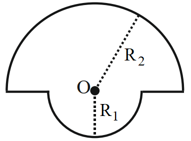
An electron, moving along the x-axis with an initial energy of 100 eV, enters a region of magnetic field $$\vec{B} = (1.5 \times 10^{-3}$$ T)$$\hat{k}$$ at S (see figure). The field extends between x = 0 and x = 2 cm. The electron is detected at the point Q on a screen placed 8 cm away from the point S. The distance d between P and Q (on the screen) is:
(electron’s charge $$1.6 ×10^{−19} C$$, mass of electron $$=9.1×10^{−31} kg$$)
Given: $$K = 100\text{ eV} = 100 \times 1.6 \times 10^{-19}\text{ J}$$, $$B = 1.5 \times 10^{-3}\text{ T}$$, $$x = 2\text{ cm} = 0.02\text{ m}$$, $$L = 8\text{ cm} = 0.08\text{ m}$$
$$R = \frac{\sqrt{2mK}}{qB} = \frac{\sqrt{2 \times 9.1 \times 10^{-31} \times 1.6 \times 10^{-17}}}{1.6 \times 10^{-19} \times 1.5 \times 10^{-3}} = \frac{5.4 \times 10^{-24}}{2.4 \times 10^{-22}} = 0.0225\text{ m} = 2.25\text{ cm}$$
$$\sin\theta = \frac{x}{R} = \frac{2}{2.25} = \frac{8}{9}$$
$$\tan\theta = \frac{\sin\theta}{\sqrt{1 - \sin^2\theta}} = \frac{8/9}{\sqrt{17}/9} = \frac{8}{\sqrt{17}}$$
Total horizontal distance from the exit point of the magnetic field to the screen: $$x' = L - x = 8 - 2 = 6\text{ cm}$$
Total vertical deflection ($$d$$) split into curved region ($$d_1$$) and straight region ($$d_2$$):
$$d_1 = R(1 - \cos\theta) = R\left(1 - \frac{\sqrt{17}}{9}\right) = 2.25 \times \left(1 - \frac{4.123}{9}\right) = 2.25 \times 0.5419 = 1.22\text{ cm}$$
$$d_2 = x'\tan\theta = 6 \times \frac{8}{\sqrt{17}} = \frac{48}{4.123} = 11.64\text{ cm}$$
$$d = d_1 + d_2 = 1.22 + 11.64 = 12.86\text{ cm} \approx 12.87\text{ cm}$$
In an experiment, electrons are accelerated, from rest, by applying a voltage of 500 V. Calculate the radius of the path if a magnetic field 100 mT is then applied. [Charge of the electron $$= 1.6 \times 10^{-19}$$ C; Mass of the electron $$= 9.1 \times 10^{-31}$$ kg]
$$p = \sqrt{2m eV}$$
$$r = \frac{p}{eB} = \frac{\sqrt{2m eV}}{eB} = \frac{1}{B}\sqrt{\frac{2mV}{e}}$$
$$r = \frac{1}{0.1}\sqrt{\frac{2 \times 9.1 \times 10^{-31} \times 500}{1.6 \times 10^{-19}}}$$
$$r = 10 \times \sqrt{\frac{9100 \times 10^{-31}}{1.6 \times 10^{-19}}} = 10 \times \sqrt{5687.5 \times 10^{-12}}$$
$$r \approx 10 \times 75.41 \times 10^{-6} = 7.54 \times 10^{-4}\ \text{m}$$
Two wires A & B are carrying currents I$$_1$$ and I$$_2$$ as shown in the figure. The separation between them is d. A third wire C carrying a current I is to be kept parallel to them at a distance x from A such that the net force acting on it is zero. The possible values of x are:
Step-by-Step Solution
1. Condition for Zero Net Force on Wire C
For a third parallel current-carrying wire $$C$$ to experience a net magnetic force of zero, the magnetic fields produced by wire $$A$$ ($$B_1$$) and wire $$B$$ ($$B_2$$) must be equal in magnitude but opposite in direction at the position of wire $$C$$.
$$F_{\text{net}} = 0 \implies B_1 = B_2$$
The magnetic field at a perpendicular distance $$r$$ from a long straight wire carrying current $$I$$ is given by:
$$B = \frac{\mu_0 I}{2\pi r}$$
2. Analysis of Directonal Fields (Regions)
Let's analyze the directions of the currents:
- Wire $$A$$ carries current $$I_1$$ upwards.
- Wire $$B$$ carries current $$I_2$$ downwards (opposite directions).
- Between the wires ($$0 < x < d$$): According to the right-hand grip rule, both wires produce magnetic fields pointing into (or out of) the page in the space between them. Since the fields point in the same direction, they reinforce each other, and the net field can never be zero in this region.
- Outside the wires ($$x < 0$$ or $$x > d$$): The magnetic fields point in opposite directions. Therefore, the net force can only be zero outside the two wires.
- $$x = \frac{I_1 d}{I_2 - I_1}$$ to the left of wire A (if $$I_2 > I_1$$)
- $$x = \frac{I_1 d}{I_1 - I_2}$$ to the right of wire B (if $$I_1 > I_2$$)
Because the currents are in opposite directions:
The exact valid region depends entirely on which current has a smaller magnitude, as wire $$C$$ must be placed closer to the weaker current to balance the stronger current's field.
3. Setting Up the Balance Equations
Case 1: Wire C is placed to the left of Wire A ($$x$$ is measured from A to the left)
Let $$x$$ be the distance from wire $$A$$ to the left. The distance from wire $$B$$ becomes $$(d + x)$$.
Equating the field magnitudes:
$$\frac{\mu_0 I_1}{2\pi x} = \frac{\mu_0 I_2}{2\pi (d + x)}$$
Cancel out the common constant factors $$\frac{\mu_0}{2\pi}$$:
$$\frac{I_1}{x} = \frac{I_2}{d + x}$$
Cross-multiply and solve for $$x$$:
$$I_1(d + x) = I_2 x$$
$$I_1 d + I_1 x = I_2 x$$
$$I_1 d = (I_2 - I_1)x$$
$$x = \frac{I_1 d}{I_2 - I_1}$$
(This solution is physically valid only if $$I_2 > I_1$$.)
Case 2: Wire C is placed to the right of Wire B ($$x$$ is measured from A to the right)
If wire $$C$$ is placed to the right of wire $$B$$ at a distance $$x$$ from wire $$A$$, its distance from wire $$B$$ is $$(x - d)$$.
Equating the fields:
$$\frac{\mu_0 I_1}{2\pi x} = \frac{\mu_0 I_2}{2\pi (x - d)} \implies \frac{I_1}{x} = \frac{I_2}{x - d}$$
Cross-multiply and solve for $$x$$:
$$I_1(x - d) = I_2 x$$
$$I_1 x - I_1 d = I_2 x$$
$$(I_1 - I_2)x = I_1 d$$
$$x = \frac{I_1 d}{I_1 - I_2}$$
(This solution is physically valid only if $$I_1 > I_2$$.)
Final Answer
The possible values of $$x$$ depend on the relative magnitudes of the currents:
A magnet of total magnetic moment $$10^{-2} \hat{i}$$ A m$$^2$$ is placed in a time varying magnetic field, $$B\hat{i}(\cos\omega t)$$ where $$B = 1$$ Tesla and $$\omega = 0.125$$ rad s$$^{-1}$$. The work done for reversing the direction of the magnetic moment at $$t = 1$$ second, is:
We have a magnetic dipole whose magnetic moment vector is given as $$\vec m = 10^{-2}\,\hat i\;{\rm A\,m^2}.$$
The external magnetic field is time-dependent and is specified by
$$\vec B(t)=B\cos\omega t\;\hat i,$$
where the numerical values are $$B = 1\ {\rm T}$$ and $$\omega = 0.125\ {\rm rad\,s^{-1}}.$$
At the instant $$t = 1\ {\rm s}$$ the field becomes
$$\vec B(1)=1\cos(0.125\times1)\;\hat i =\cos(0.125)\;\hat i\ {\rm T}.$$
The angle $$0.125$$ rad is small, so
$$\cos(0.125)\approx 0.9922.$$
Hence the field magnitude at this instant is approximately
$$B_1 = 0.9922\ {\rm T}.$$
The formula for the potential energy of a magnetic dipole in a magnetic field is
$$U = -\vec m\cdot\vec B.$$
Initially the dipole is parallel to the field, so the angle between $$\vec m$$ and $$\vec B$$ is $$0^\circ$$. Therefore
$$U_i = -mB_1\cos 0^\circ = -mB_1.$$
To reverse the dipole, we make it point opposite to the field; the angle becomes $$180^\circ$$. Then
$$U_f = -mB_1\cos 180^\circ = -mB_1(-1) = +mB_1.$$
The work done by an external agent equals the increase in potential energy:
$$W = U_f - U_i = \left(+mB_1\right) - \left(-mB_1\right) = 2mB_1.$$
Substituting $$m = 10^{-2}\ {\rm A\,m^2}$$ and $$B_1 = 0.9922\ {\rm T}$$, we get
$$W = 2 \times 10^{-2} \times 0.9922 = 0.019844\ {\rm J} \approx 0.02\ {\rm J}.$$
Hence, the correct answer is Option B.
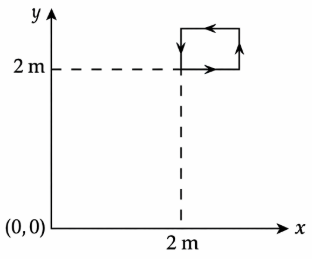
A magnetic compass needle oscillates 30 times per minute at a place where the dip is 45° and 40 times per minute where the dip is 30°. If B$$_1$$ and B$$_2$$ are the net magnetic fields due to the earth at the two places respectively, then the ratio B$$_1$$/B$$_2$$ is approximately equal to
We begin by recalling the theory of the small oscillations of a magnetic (compass) needle. When the needle is displaced slightly in the horizontal plane, the restoring torque is $$\tau = M B_H \sin\theta \approx M B_H \theta$$ for small $$\theta,$$ where $$M$$ is the magnetic moment and $$B_H$$ is the horizontal component of the earth’s magnetic field. For a body executing small-angle simple harmonic motion, the angular frequency is given by the standard formula
$$\omega = \sqrt{\dfrac{\text{restoring torque per unit angle}}{\text{moment of inertia}}} = \sqrt{\dfrac{M B_H}{I}}.$$
The ordinary (linear) frequency is $$f = \dfrac{\omega}{2\pi},$$ so we have
$$f = \dfrac{1}{2\pi}\sqrt{\dfrac{M}{I}}\,\sqrt{B_H}.$$
Everything except $$B_H$$ is constant for the same needle; hence
$$f \propto \sqrt{B_H} \quad\Longrightarrow\quad B_H \propto f^2.$$
Now we convert the given “oscillations per minute” to “oscillations per second” (hertz):
At the first place, the needle makes 30 oscillations in 60 s, so
$$f_1 = \dfrac{30}{60} = 0.50\ \text{Hz}.$$
At the second place, the needle makes 40 oscillations in 60 s, so
$$f_2 = \dfrac{40}{60} = 0.667\ \text{Hz}.$$
Using $$B_H \propto f^2,$$ we obtain
$$\dfrac{B_{H1}}{B_{H2}} = \left(\dfrac{f_1}{f_2}\right)^2 = \left(\dfrac{0.50}{0.667}\right)^2 = \left(0.75\right)^2 = 0.5625.$$
However, the question asks for the ratio of the total earth’s magnetic fields $$B_1$$ and $$B_2,$$ not just their horizontal components. The total field is related to its horizontal component by the well-known relation
$$B_H = B\cos\delta,$$
where $$\delta$$ is the dip (angle of inclination). Thus
$$B = \dfrac{B_H}{\cos\delta}.$$
So, for the two places,
$$\dfrac{B_1}{B_2} = \dfrac{B_{H1}/\cos\delta_1}{B_{H2}/\cos\delta_2} = \dfrac{B_{H1}}{B_{H2}}\;\dfrac{\cos\delta_2}{\cos\delta_1}.$$
The dips are $$\delta_1 = 45^\circ$$ and $$\delta_2 = 30^\circ.$$ We substitute their cosines:
$$\cos45^\circ = \dfrac{1}{\sqrt2} \approx 0.7071,\qquad \cos30^\circ = \dfrac{\sqrt3}{2} \approx 0.8660.$$
Therefore,
$$\dfrac{\cos\delta_2}{\cos\delta_1} = \dfrac{0.8660}{0.7071} \approx 1.2247.$$
Multiplying this with the earlier ratio of horizontal components, we get
$$\dfrac{B_1}{B_2} = 0.5625 \times 1.2247 \approx 0.688.$$
This value is very close to 0.7. Among the given options, the one that matches is 0.7.
Hence, the correct answer is Option D.
A proton, an electron, and a Helium nucleus, have the same energy. They are in circular orbits in a plane due to magnetic field perpendicular to the plane. Let $$r_p$$, $$r_e$$ and $$r_{He}$$ be their respective radii, then,
We consider a uniform magnetic field that is perpendicular to the plane of motion of the charged particle. For a charged particle of charge $$q$$ and mass $$m$$ moving with speed $$v$$ in a circle of radius $$r$$, the magnetic Lorentz force provides the required centripetal force. The relation is
$$q\,v\,B = \dfrac{m v^{2}}{r}$$
First we isolate the radius $$r$$. Cancelling one factor of $$v$$ from both sides, we obtain
$$q B = \dfrac{m v}{r} \quad \Longrightarrow \quad r = \dfrac{m v}{q B}$$
The question tells us that the proton, the electron, and the Helium nucleus all possess the same kinetic energy, which we denote by $$E$$. The kinetic energy of a particle is given by
$$E = \dfrac{1}{2} m v^{2}$$
Solving this expression for the speed $$v$$, we have
$$v = \sqrt{\dfrac{2E}{m}}$$
We now substitute this expression for $$v$$ into the formula for the radius:
$$r = \dfrac{m}{q B} \,\sqrt{\dfrac{2E}{m}}
= \dfrac{\sqrt{2 E}\, \sqrt{m}}{q B}$$
The factors $$\sqrt{2E}$$ and $$B$$ are common to all three particles because the energy and the magnetic field are the same for each. Hence, for comparison of radii, we may write the proportionality
$$r \;\propto\; \dfrac{\sqrt{m}}{q}$$
Therefore, the ordering of the radii depends solely on the ratio $$\sqrt{m}/q$$ for the proton, the electron, and the Helium nucleus. We list their masses and charges (magnitude of charge only, because radius is a positive quantity):
- Electron: $$m = m_e,\; q = e$$
- Proton: $$m = m_p,\; q = e$$
- Helium nucleus (alpha particle): $$m = 4 m_p,\; q = 2e$$
Now we compute the proportional factors:
$$
\begin{aligned}
r_e &\propto \dfrac{\sqrt{m_e}}{e},\\[4pt]
r_p &\propto \dfrac{\sqrt{m_p}}{e},\\[4pt]
r_{He} &\propto \dfrac{\sqrt{4 m_p}}{2e}
= \dfrac{2\sqrt{m_p}}{2e}
= \dfrac{\sqrt{m_p}}{e}.
\end{aligned}
$$
We immediately observe that
$$r_{He} \propto \dfrac{\sqrt{m_p}}{e} = r_p.$$
Thus $$r_{He} = r_p.$$ To compare with the electron, note that the electron’s mass is enormously smaller than the proton’s mass, i.e.
$$m_e \ll m_p \quad\Longrightarrow\quad \sqrt{m_e} \ll \sqrt{m_p}.$$
Consequently
$$r_e \propto \dfrac{\sqrt{m_e}}{e} \ll \dfrac{\sqrt{m_p}}{e} \propto r_p = r_{He}.$$
Collecting these results, we obtain the order
$$r_e \lt r_p = r_{He}.$$
This ordering corresponds to Option B.
Hence, the correct answer is Option B.
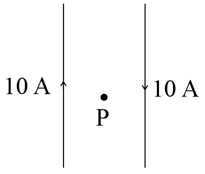
As shown in the figure, two infinitely long, identical wires are bent by 90° and placed in such a way that the segments LP and QM are along the x-axis, while segments PS and QN are parallel to the y-axis. If $$OP = OQ = 4$$ cm, and the magnitude of the magnetic field at O is $$10^{-4}$$ T, and the two wires carry equal currents (see figure), the magnitude of the current in each wire and the direction of the magnetic field at O will be $$\left(\mu_0 = 4\pi \times 10^{-7} NA^{-2}\right)$$:
Axial segments: $$B_{LP} = B_{MQ} = 0$$
Perpendicular segments at origin: $$\vec{B}_{PS} = \frac{\mu_0 I}{4\pi d} (-\hat{k})$$
$$\vec{B}_{QN} = \frac{\mu_0 I}{4\pi d} (-\hat{k})$$
Total magnetic field:
$$\vec{B}_{\text{net}} = \vec{B}_{PS} + \vec{B}_{QN} = \frac{\mu_0 I}{2\pi d} (-\hat{k})$$
$$10^{-4} = \frac{(4\pi \times 10^{-7}) \cdot I}{2\pi \times 0.04} = 5 \times 10^{-6} I \implies I = 20\text{ A}$$
Find the magnetic field at point P due to a straight line segment AB of length 6 cm carrying a current of 5 A. (See figure) ($$\mu_0 = 4\pi \times 10^{-7}$$ NA$$^{-2}$$)
Perpendicular distance ($$d$$) from wire to point P: $$d = \sqrt{5^2 - 3^2} = 4\text{ cm} = 0.04\text{ m}$$
Angles from perpendicular to wire ends: $$\sin\theta_1 = \sin\theta_2 = \frac{3}{5}$$
Magnetic field calculation: $$B = \frac{\mu_0 I}{4\pi d}(\sin\theta_1 + \sin\theta_2)$$
$$B = \frac{10^{-7} \times 5}{0.04} \left(\frac{3}{5} + \frac{3}{5}\right) = \frac{5 \times 10^{-7}}{0.04} \times \frac{6}{5} = \frac{6 \times 10^{-7}}{0.04} = 1.5 \times 10^{-5}\text{ T}$$
One of the two identical conducting wires of length $$L$$ is bent in the form of a circular loop and the other one into a circular coil of $$N$$ identical turns. If the same current is passed in both, the ratio of the magnetic field at the centre of the loop $$(B_L)$$ to that at the centre of the coil $$(B_C)$$, i.e. $$\frac{B_L}{B_C}$$ will be:
Let the current flowing through both wires be $$I$$ and let the total length of each wire be $$L$$. Both wires are identical, so they have the same length.
First we take the wire that is bent into a single circular loop. If the radius of this loop is $$R_1$$, then its circumference must equal the length of the wire. Therefore, using the basic relation “circumference = $$2\pi\times\text{radius}$$”, we have
$$2\pi R_1 = L \;\;\Longrightarrow\;\; R_1 = \frac{L}{2\pi}.$$
The magnetic field at the centre of a single circular loop carrying current $$I$$ is given by the standard formula
$$B = \frac{\mu_0 I}{2R}.$$
Substituting $$R = R_1$$, we obtain the field at the centre of this loop:
$$B_L = \frac{\mu_0 I}{2R_1} = \frac{\mu_0 I}{2\left(\dfrac{L}{2\pi}\right)} = \frac{\mu_0 I}{2}\cdot\frac{2\pi}{L} = \frac{\mu_0 I\pi}{L}.$$
Now consider the second wire that is wound into a circular coil of $$N$$ identical turns. Let the radius of each turn be $$R_2$$. Because there are $$N$$ turns, the total length consumed is $$N$$ times the circumference of one turn. Hence
$$N\,(2\pi R_2) = L \;\;\Longrightarrow\;\; R_2 = \frac{L}{2\pi N}.$$
The magnetic field at the centre of a circular coil having $$N$$ turns is $$N$$ times the field produced by one turn (all turns are coaxial and their fields add). Therefore, using the same single-turn formula but multiplied by $$N$$, we have
$$B_C = N\left(\frac{\mu_0 I}{2R_2}\right) = \frac{\mu_0 N I}{2R_2}.$$
Substituting $$R_2 = \dfrac{L}{2\pi N}$$ into the above expression gives
$$B_C = \frac{\mu_0 N I}{2\left(\dfrac{L}{2\pi N}\right)} = \frac{\mu_0 N I}{2}\cdot\frac{2\pi N}{L} = \frac{\mu_0 I\pi N^2}{L}.$$
We now form the required ratio $$\dfrac{B_L}{B_C}$$:
$$\frac{B_L}{B_C} = \frac{\dfrac{\mu_0 I\pi}{L}} {\dfrac{\mu_0 I\pi N^2}{L}} = \frac{\mu_0 I\pi}{L}\cdot\frac{L}{\mu_0 I\pi N^2} = \frac{1}{N^2}.$$
Hence, the correct answer is Option A.
A bar magnet is demagnetized by inserting it inside a solenoid of length 0.2 m, 100 turns, and carrying a current of 5.2 A. The coercivity of the bar magnet is:
We have a bar magnet placed completely inside a current-carrying solenoid. In such a situation the magnetic field acting on the magnet is exactly the field produced by the solenoid itself. To make the magnet lose all its magnetisation, this external field must be equal in magnitude (but opposite in sense) to the magnet’s coercive field. Therefore the coercivity $$H_c$$ of the bar magnet is numerically the same as the magnetising field intensity $$H$$ created by the solenoid.
First we recall the standard formula for the field inside a long solenoid. For a solenoid having $$N$$ turns, length $$\ell$$, and carrying a current $$I$$,
$$B = \mu_0 \, n \, I,$$
where $$n$$ is the number of turns per unit length, $$n = \dfrac{N}{\ell}$$, and $$\mu_0$$ is the permeability of free space. The magnetic field intensity $$H$$ is related to the flux-density $$B$$ by
$$H = \dfrac{B}{\mu_0}.$$
Substituting $$B = \mu_0 n I$$ into this relation gives
$$H = \dfrac{\mu_0 n I}{\mu_0} = n I.$$
Thus, inside a long solenoid,
$$H = n I.$$
Now we substitute the numerical data given in the question. The solenoid has
$$N = 100 \text{ turns}, \qquad \ell = 0.2 \text{ m}.$$
So the turn density is
$$n = \dfrac{N}{\ell} = \dfrac{100}{0.2} = 500 \text{ turns per metre}.$$
The current flowing is
$$I = 5.2 \text{ A}.$$
Therefore the field intensity generated is
$$H = n I = 500 \times 5.2 = 2600 \text{ A/m}.$$
Since this field exactly cancels the magnet’s residual magnetism, the coercivity of the bar magnet is
$$H_c = 2600 \text{ A/m}.$$
Hence, the correct answer is Option 2.
A moving coil galvanometer has a coil with 175 turns and area 1 cm$$^2$$. It uses a torsion band of torsion constant $$10^{-6}$$ N m/rad. The coil is placed in a magnetic field B parallel to its plane. The coil deflects by 1° for a current of 1 mA. The value of B (in tesla) is approximately:
The coil of the moving-coil galvanometer reaches equilibrium when the magnetic torque trying to turn the coil is exactly balanced by the restoring (torsional) torque of the suspension.
First, we state the two torques.
Magnetic torque on a current-carrying coil is given by the formula $$\tau_{\text{mag}} = n\,I\,A\,B\,\sin\phi,$$ where $$n$$ is the number of turns, $$I$$ is the current, $$A$$ is the area of each turn, $$B$$ is the magnetic-field magnitude, and $$\phi$$ is the angle between the normal to the coil and the magnetic field.
The problem tells us that the magnetic field is parallel to the plane of the coil. Hence the normal to the coil is perpendicular to the field, so $$\phi = 90^\circ$$ and $$\sin\phi = \sin 90^\circ = 1.$$ Therefore, the magnetic torque reduces to $$\tau_{\text{mag}} = n\,I\,A\,B.$$
The restoring torque supplied by the torsion band obeys Hooke’s law for angular twist: $$\tau_{\text{rest}} = C\,\theta,$$ where $$C$$ is the torsion (restoring) constant and $$\theta$$ is the angular deflection in radians.
At equilibrium we have $$\tau_{\text{mag}} = \tau_{\text{rest}}.$$ So, $$n\,I\,A\,B = C\,\theta.$$
We need to isolate $$B$$:
$$B = \frac{C\,\theta}{n\,I\,A}.$$
Now we substitute every given quantity, converting each into SI units:
Number of turns: $$n = 175.$$
Current: $$I = 1\ \text{mA} = 1 \times 10^{-3}\ \text{A}.$$
Area of the coil: $$A = 1\ \text{cm}^2 = 1 \times 10^{-4}\ \text{m}^2.$$ (1 cm = 10⁻² m, so 1 cm² = 10⁻⁴ m².)
Torsion constant: $$C = 10^{-6}\ \text{N m rad}^{-1}.$$
Angular deflection: $$\theta = 1^\circ = \left(\frac{\pi}{180}\right)\ \text{rad} \approx 0.01745\ \text{rad}.$$
Substituting these numbers into the expression for $$B$$ gives
$$B = \frac{C\,\theta}{n\,I\,A} = \frac{(10^{-6})\,(0.01745)}{(175)\,(1 \times 10^{-3})\,(1 \times 10^{-4})}.$$
We now calculate the numerator:
$$C\,\theta = 10^{-6} \times 0.01745 = 1.745 \times 10^{-8}.$$
Next, the denominator:
$$n\,I\,A = 175 \times (1 \times 10^{-3}) \times (1 \times 10^{-4}) = 175 \times 10^{-7} = 1.75 \times 10^{-5}.$$
Dividing numerator by denominator:
$$B = \frac{1.745 \times 10^{-8}}{1.75 \times 10^{-5}}.$$
Because $$\frac{1.745}{1.75} \approx 0.9986,$$ we get
$$B \approx 0.9986 \times 10^{-3}\ \text{T} \approx 1 \times 10^{-3}\ \text{T}.$$
The value $$1 \times 10^{-3}\ \text{T}$$ corresponds to $$10^{-3}$$ tesla.
Hence, the correct answer is Option C.
A rigid square loop of side 'a' and carrying current $$I_2$$ is lying on a horizontal surface near a long current $$I_1$$ carrying wire in the same plane as shown in figure. The net force on the loop due to the wire will be:
The net force on a rectangular loop near a long straight wire carrying current $$I_1$$ is calculated by considering the forces on each segment of the loop:
1. Forces on Horizontal Segments (QR and SP):
The magnetic field due to $$I_1$$ is perpendicular to these segments. However, for every small element on QR, there is a corresponding element on SP experiencing an equal and opposite force. Thus, these forces cancel each other out.
2. Force on Segment PQ (Distance a):
The magnetic field at distance a is $$B_1 = \frac{\mu_0 I_1}{2\pi a}$$. The force $$F_1$$ on segment PQ (length a) is:
$$F_1 = I_2 B_1 a = I_2 \left( \frac{\mu_0 I_1}{2\pi a} \right) a = \frac{\mu_0 I_1 I_2}{2\pi}$$
Since the currents $$I_1$$ and $$I_2$$ in PQ are in the same direction, this is an attractive force (towards the wire).
3. Force on Segment RS (Distance 2a):
The magnetic field at distance 2a is $$B_2 = \frac{\mu_0 I_1}{2\pi (2a)}$$. The force $$F_2$$ on segment RS is:
$$F_2 = I_2 B_2 a = I_2 \left( \frac{\mu_0 I_1}{4\pi a} \right) a = \frac{\mu_0 I_1 I_2}{4\pi}$$
Since the currents are in opposite directions, this is a repulsive force (away from the wire).
4. Net Force ($$F_{net}$$):
The net force is the difference between the attractive and repulsive forces:
$$F_{net} = F_1 - F_2$$$$F_{net} = \frac{\mu_0 I_1 I_2}{2\pi} - \frac{\mu_0 I_1 I_2}{4\pi}$$
$$F_{net} = \frac{\mu_0 I_1 I_2}{4\pi}$$
Since $$F_1 > F_2$$, the net force is attractive (directed toward the wire).
$$\boxed{F_{net} = \frac{\mu_0 I_1 I_2}{4\pi}}$$
A square loop is carrying a steady current I and the magnitude of its magnetic dipole moment is m. If this square loop is changed to a circular loop and it carries the same current, the magnitude of the magnetic dipole moment of circular loop will be:
The magnetic dipole moment of any planar current-carrying loop is given by the relation
$$m = NI A,$$
where $$N$$ is the number of turns, $$I$$ is the current and $$A$$ is the area enclosed by the loop. In both the square and the circular loop we have a single turn, so $$N = 1$$ throughout.
For the original square loop let the length of each side be $$a$$. Its area is therefore
$$A_{\text{square}} = a^{2}.$$
Because it carries the current $$I$$, its magnetic dipole moment is given to be $$m$$, so from the defining formula we can write
$$m = I \, a^{2}.$$
Solving this expression for $$a^{2}$$ gives
$$a^{2} = \frac{m}{I}.$$
The same wire is now bent into a circle, so its length does not change. The perimeter of the square equals the circumference of the circle. Thus
$$4a = 2\pi r,$$
where $$r$$ is the radius of the circle. Dividing both sides by $$2\pi$$ we obtain
$$r = \frac{2a}{\pi}.$$
Next we compute the area of the circle:
$$A_{\text{circle}} = \pi r^{2} = \pi\left(\frac{2a}{\pi}\right)^{2}.$$
Squaring the numerator and denominator and then cancelling one factor of $$\pi$$, we get
$$A_{\text{circle}} = \pi \cdot \frac{4a^{2}}{\pi^{2}} = \frac{4a^{2}}{\pi}.$$
Now we substitute $$a^{2} = \dfrac{m}{I}$$, obtained earlier, into this area:
$$A_{\text{circle}} = \frac{4}{\pi}\left(\frac{m}{I}\right).$$
The magnetic dipole moment of the circular loop, denoted $$m'$$, is again $$NI A$$ with $$N = 1$$, so
$$m' = I \, A_{\text{circle}} = I \left(\frac{4}{\pi}\frac{m}{I}\right).$$
Here the current $$I$$ in the numerator cancels the $$I$$ in the denominator, leaving
$$m' = \frac{4m}{\pi}.$$
Thus, after reshaping the square loop into a circular loop while keeping the same current, the magnetic dipole moment becomes $$\dfrac{4m}{\pi}$$.
Hence, the correct answer is Option A.
A thin ring of 10 cm radius carries a uniformly distributed charge. The ring rotates at a constant angular speed of $$40\pi$$ rad s$$^{-1}$$ about its axis, perpendicular to its plane. If the magnetic field at its centre is $$3.8 \times 10^{-9}$$ T, then the charge carried by the ring is close to $$\mu_0 = 4\pi \times 10^{-7}$$ N/A$$^2$$.
First we write every quantity in SI units. The radius of the ring is $$R = 10\ \text{cm} = 0.10\ \text{m}$$ and the angular speed is $$\omega = 40\pi\ \text{rad s}^{-1}$$. The magnetic permeability of free space is given as $$\mu_0 = 4\pi \times 10^{-7}\ \text{N A}^{-2}$$, and the magnetic field at the centre is $$B = 3.8 \times 10^{-9}\ \text{T}$$.
When a ring of total charge $$Q$$ rotates with angular speed $$\omega$$, every complete rotation carries the charge once around the axis. If the time for one rotation (the time period) is $$T$$, the current is defined by $$I = \dfrac{Q}{T}$$. Because angular speed and time period are related by the formula $$\omega = \dfrac{2\pi}{T}$$, we can rewrite the current as
$$I = \dfrac{Q}{T} = Q \left(\dfrac{\omega}{2\pi}\right).$$
The magnetic field at the centre of a circular loop of radius $$R$$ carrying a current $$I$$ is given by the formula
$$B = \dfrac{\mu_0 I}{2R}.$$
We now substitute $$I = Q\omega / 2\pi$$ in this expression:
$$B = \dfrac{\mu_0}{2R}\left(\dfrac{Q\omega}{2\pi}\right) = \dfrac{\mu_0 Q \omega}{4\pi R}.$$
To isolate the charge $$Q$$ we rearrange:
$$Q = \dfrac{B \,(4\pi R)}{\mu_0 \,\omega}.$$
Now we substitute the numerical values step by step. First calculate the factor $$4\pi R$$:
$$4\pi R = 4 \times \pi \times 0.10\ \text{m} = 0.40\pi\ \text{m}.$$
Next write the denominator $$\mu_0 \omega$$:
$$\mu_0 \omega = (4\pi \times 10^{-7}) \times (40\pi) = 4 \times 40 \times \pi^2 \times 10^{-7} = 160\pi^2 \times 10^{-7}.$$
Putting these into the expression for $$Q$$ gives
$$Q = \dfrac{(3.8 \times 10^{-9}) \times (0.40\pi)}{160\pi^2 \times 10^{-7}}.$$
Notice that one factor of $$\pi$$ cancels immediately:
$$Q = \dfrac{(3.8 \times 10^{-9}) \times 0.40}{160\pi \times 10^{-7}}.$$
Multiply the numbers in the numerator:
$$3.8 \times 0.40 = 1.52,$$
so
$$Q = \dfrac{1.52 \times 10^{-9}}{160\pi \times 10^{-7}}.$$
Write the powers of ten together:
$$Q = \dfrac{1.52}{160\pi} \times 10^{-9+7} = \dfrac{1.52}{160\pi} \times 10^{-2}.$$
Compute the numerical ratio $$\dfrac{1.52}{160} = 0.0095.$$ Using $$\pi \approx 3.14$$ gives
$$\dfrac{0.0095}{\pi} \approx \dfrac{0.0095}{3.14} \approx 0.0030.$$
Finally, restoring the power of ten:
$$Q \approx 0.0030 \times 10^{-2}\ \text{C} = 3.0 \times 10^{-5}\ \text{C}.$$
Thus the charge on the ring is approximately $$3 \times 10^{-5}\ \text{coulomb}$$.
Hence, the correct answer is Option B.
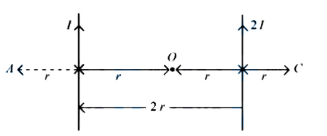
An insulating thin rod of length $$l$$ has a linear charge density $$\rho(x) = \rho_0 \frac{x}{l}$$ on it. The rod is rotated about an axis passing through the origin ($$x = 0$$) and perpendicular to the rod. If the rod makes $$n$$ rotations per second, then the time averaged magnetic moment of the rod is:
We place the thin insulating rod along the +x-axis with its left end at the origin, so the rod occupies $$0 \le x \le l$$. The rotation axis passes through the origin and is perpendicular to the rod; hence every small charge element at position $$x$$ moves in a circle of radius $$x$$.
The given linear charge density is
$$\rho(x)=\rho_0\frac{x}{l}\;,$$
so an element of length $$dx$$ contains charge
$$dq = \rho(x)\,dx = \rho_0\frac{x}{l}\,dx.$$
If the rod completes $$n$$ revolutions per second, its angular speed is
$$\omega = 2\pi n,$$
and one full revolution takes the period
$$T = \frac{1}{n}\;\text{s}.$$
For any charge that goes around once every $$T$$ seconds, the current associated with that charge is (definition of steady current)
$$I = \frac{q}{T} = q\,n.$$
Therefore the infinitesimal current produced by the element $$dq$$ is
$$dI = n\,dq = n\,\rho_0\frac{x}{l}\,dx.$$
Next, we need the magnetic moment produced by this small current loop. The standard formula for the magnetic moment of a current loop is
$$\mu = I \times \text{(area of the loop)}.$$
Here each element travels in a circle of radius $$x$$, whose area is
$$A = \pi x^{2}.$$
Hence the infinitesimal magnetic moment is
$$d\mu = dI \; A = \left(n\,\rho_0\frac{x}{l}\,dx\right)\!\left(\pi x^{2}\right) = n\,\pi\,\rho_0\,\frac{x^{3}}{l}\,dx.$$
To obtain the net magnetic moment of the entire rod we integrate from $$x=0$$ to $$x=l$$:
$$\mu = \int_{0}^{l} d\mu = n\,\pi\,\rho_0\,\frac{1}{l}\int_{0}^{l} x^{3}\,dx.$$
Carrying out the integral,
$$\int_{0}^{l} x^{3}\,dx = \left.\frac{x^{4}}{4}\right|_{0}^{l} = \frac{l^{4}}{4}.$$
Substituting this result, we get
$$\mu = n\,\pi\,\rho_0\,\frac{1}{l}\,\frac{l^{4}}{4} = \frac{\pi}{4}\,n\,\rho_0\,l^{3}.$$
Because the rod rotates uniformly, this value is already the time-averaged magnetic moment.
Hence, the correct answer is Option A.
Two very long, straight, and insulated wires are kept at 90° angle from each other in xy-plane as shown in figure. These wires carry currents of equal magnitude I, whose direction are shown in the figure. The net magnetic field at point P will be:
Based on the principle of superposition and the Right-Hand Thumb Rule, the net magnetic field at point P is calculated as follows:
The magnetic field $\vec{B}$ due to a long straight wire at a distance $d$ is given by:
$$B = \frac{\mu_0 i}{2\pi d}$$
Assuming point P is at an equal distance $d$ from both wires in the xy-plane:
- For Wire 1 (along the y-axis): Using the Right-Hand Thumb Rule, the magnetic field at point P acts out of the page (along the +z direction).$$\vec{B}_1 = \frac{\mu_0 i}{2\pi d} \hat{k}$$
- For Wire 2 (along the x-axis): The magnetic field at point P acts into the page (along the -z direction).$$\vec{B}_2 = -\frac{\mu_0 i}{2\pi d} \hat{k}$$
Net Magnetic Field:
The total magnetic field is the vector sum of the individual fields:
$$\vec{B}_{\text{net}} = \vec{B}_1 + \vec{B}_2$$
$$\vec{B}_{\text{net}} = \frac{\mu_0 i}{2\pi d} \hat{k} - \frac{\mu_0 i}{2\pi d} \hat{k}$$
$$\boxed{\vec{B}_{\text{net}} = 0}$$
A current loop, having two circular arcs joined by two radial lines is shown in the figure. It carries a current of 10 A. The magnetic field at point O will be close to:
Magnetic field due to radial straight segments PQ and RS: $$B_{\text{radial}} = 0$$
Magnetic field formula for a circular arc: $$B = \frac{\mu_0 I}{4\pi R} \theta$$
By Right-Hand Rule, inner arc field ($$B_1$$) is into the page ($$\otimes$$) and outer arc field ($$B_2$$) is out of the page ($$\odot$$):
$$B_{\text{net}} = B_1 - B_2 = \frac{\mu_0 I}{4\pi} \theta \left(\frac{1}{R_1} - \frac{1}{R_2}\right)$$
$$B_{\text{net}} = 10^{-7} \times 10 \times \frac{\pi}{4} \left(\frac{1}{0.03} - \frac{1}{0.05}\right) = 10^{-6} \times \frac{\pi}{4} \left(\frac{100}{3} - \frac{100}{5}\right)$$
$$B_{\text{net}} = 10^{-6} \times \frac{\pi}{4} \times \frac{40}{3} = \frac{10\pi}{3} \times 10^{-6} \approx 1 \times 10^{-5}\text{ T}$$
A rectangular coil (Dimension 5 cm $$\times$$ 2.5 cm) with 100 turns, carrying a current of 3 A in the clock-wise direction, is kept centered at the origin and in the X-Z plane. A magnetic field of 1 T is applied along X-axis. If the coil is tilted through 45° about Z-axis, then the torque on the coil is:
We are given a rectangular coil having dimensions $$5\ \text{cm}\times 2.5\ \text{cm}$$, number of turns $$N=100$$ and current $$I=3\ \text{A}$$ (clock-wise). The coil is first kept in the X-Z plane with its centre at the origin and a uniform magnetic field $$\mathbf B$$ of magnitude $$1\ \text T$$ is applied along the +X-axis. The coil is then rotated through $$45^{\circ}$$ about the Z-axis. We have to find the torque acting on the coil in this new position.
First we calculate the area of one turn of the coil. Converting centimetres to metres, we write
$$5\ \text{cm}=5\times 10^{-2}\ \text m=0.05\ \text m,$$
$$2.5\ \text{cm}=2.5\times 10^{-2}\ \text m=0.025\ \text m.$$
Hence the area of the rectangle is
$$A = l\times b = 0.05\ \text m \times 0.025\ \text m = 0.00125\ \text{m}^2.$$
Now we discuss the angle between the coil’s area vector and the magnetic field.
• When the coil lies in the X-Z plane, its plane is perpendicular to the Y-axis, so its area vector $$\mathbf{\hat n}$$ is initially along the ±Y-direction.
• The uniform magnetic field $$\mathbf B$$ is along the X-axis.
Thus, before rotation, $$\mathbf{\hat n}$$ is at $$90^{\circ}$$ to $$\mathbf B$$.
The coil is now rotated through $$45^{\circ}$$ about the Z-axis. Rotating about the Z-axis keeps Z unchanged but swings the X and Y directions into each other. Therefore the area vector, which was along the Y-axis, now makes an angle $$45^{\circ}$$ with the Y-axis and also $$45^{\circ}$$ with the X-axis inside the X-Y plane. Consequently, the angle $$\theta$$ between the area vector and the magnetic field (which is along X) becomes
$$\theta = 45^{\circ}.$$
The magnitude of the torque acting on a current-carrying coil in a uniform magnetic field is given by the well-known formula
$$\tau = N I A B \sin\theta,$$
where
$$N = 100,\; I = 3\ \text A,\; A = 0.00125\ \text{m}^2,\; B = 1\ \text T,\; \theta = 45^{\circ}.$$
Substituting these values we have
$$\tau = 100 \times 3\ \text A \times 0.00125\ \text{m}^2 \times 1\ \text T \times \sin 45^{\circ}.$$
We know that $$\sin 45^{\circ} = \dfrac{1}{\sqrt 2} \approx 0.7071.$$ Therefore,
$$\tau = 100 \times 3 \times 0.00125 \times 1 \times 0.7071.$$
First multiply the current with the area:
$$3 \times 0.00125 = 0.00375.$$
Next include the number of turns:
$$100 \times 0.00375 = 0.375.$$
Finally include the factor $$\sin 45^{\circ}$$:
$$0.375 \times 0.7071 \approx 0.265.$$
Thus the magnitude of the torque is
$$\tau \approx 0.27\ \text{N m}.$$
Among the given choices, the value $$0.27\ \text{N m}$$ corresponds to Option D.
Hence, the correct answer is Option D.
At some location the horizontal component of earth's magnetic field is $$18 \times 10^{-6}$$ T. At this location, magnetic needle of length 0.12 m and pole strength 1.8 Am is suspended from its mid-point using a thread, it makes 45$$^{\circ}$$ angles with horizontal in equilibrium. To keep this needle horizontal, the vertical force that should be applied at one of its ends is:
We have the horizontal component of earth’s magnetic field at the place as $$B_h = 18 \times 10^{-6}\ \text{T}$$.
The magnetic needle, whose north and south poles have equal pole strength $$m = 1.8\ \text{A m}$$ and are separated by a length $$L = 0.12\ \text{m}$$, is suspended from its mid-point. In the earth’s field it comes to rest making an angle of $$45^{\circ}$$ with the horizontal.
The inclination (dip) angle of the earth’s field is defined by the relation
$$\tan\delta = \frac{B_v}{B_h},$$
where $$B_v$$ is the vertical component and $$\delta$$ is the angle that the total field makes with the horizontal.
Here the needle itself makes $$45^{\circ}$$ with the horizontal, so $$\delta = 45^{\circ}$$. Hence
$$\tan 45^{\circ} = 1 = \frac{B_v}{B_h} \quad\Longrightarrow\quad B_v = B_h = 18 \times 10^{-6}\ \text{T}.$$
Each pole of the magnet experiences a vertical magnetic force due to $$B_v$$ given by the basic formula
$$F_{\text{mag}} = m\,B_v.$$
For the north pole this force is, say, downward; for the south pole it is upward, so the two equal and opposite forces form a couple. The line joining the poles is the needle of length $$L$$, and the pivot is at the centre. The torque produced by this couple about the mid-point is obtained from the definition of torque of a couple (force × distance between the forces):
$$\tau_{\text{mag}} = m\,B_v \times L.$$
We now want the needle to stay exactly horizontal. For that we have to apply an external vertical force $$F$$ at one end of the needle. This force, acting at a perpendicular distance $$\dfrac{L}{2}$$ from the mid-point, produces an opposite torque
$$\tau_{\text{ext}} = F \times \frac{L}{2}.$$
In equilibrium the net torque must vanish, so
$$\tau_{\text{ext}} = \tau_{\text{mag}}.$$
Substituting the expressions, we get
$$F \times \frac{L}{2} = m\,B_v \times L.$$
Solving this for $$F$$ gives
$$F = \frac{m\,B_v \times L}{\dfrac{L}{2}} = 2\,m\,B_v.$$
Now we substitute the numerical values:
$$F = 2 \times 1.8\ \text{A m} \times 18 \times 10^{-6}\ \text{T}.$$
First multiply the ordinary numbers:
$$1.8 \times 18 = 32.4,$$
and then include the factor of 2:
$$2 \times 32.4 = 64.8.$$
Hence
$$F = 64.8 \times 10^{-6}\ \text{N} = 6.48 \times 10^{-5}\ \text{N}.$$
Rounding to two significant figures gives
$$F \approx 6.5 \times 10^{-5}\ \text{N}.$$
Hence, the correct answer is Option C.
The magnitude of the magnetic field at the centre of an equilateral triangular loop of side 1 m which is carrying a current of 10 A is:
[Take $$\mu_0 = 4\pi \times 10^{-7}$$ N A$$^{-2}$$]
We have to find the magnetic field produced at the centre of an equilateral triangular loop of side $$a = 1\ \text{m}$$ carrying a current $$I = 10\ \text{A}$$. The loop lies in one plane, and the required point is its centroid (the geometric centre).
For a straight, finite conductor carrying current $$I$$, the magnetic field at a point lying at a perpendicular distance $$d$$ from the conductor is given by the Biot-Savart result
$$B \;=\; \frac{\mu_0 I}{4\pi d}\,(\sin\theta_1 + \sin\theta_2),$$
where $$\theta_1$$ and $$\theta_2$$ are the angles subtended by the line segments joining the observation point to the two ends of the conductor, measured with respect to the perpendicular drawn from the point to the wire.
Because our loop is an equilateral triangle, every side contributes an identical field at the centre. We will therefore calculate the field due to one side and multiply by 3.
Step 1: Perpendicular distance $$d$$ from the centre to a side
The altitude of an equilateral triangle of side $$a$$ is
$$h \;=\; \frac{\sqrt{3}}{2}\,a.$$
The centroid divides the altitude in the ratio 2:1, so the distance from the centroid to any side is
$$d \;=\; \frac{h}{3} \;=\; \frac{\sqrt{3}}{2}\,\frac{a}{3} \;=\; \frac{\sqrt{3}}{6}\,a.$$
Substituting $$a = 1\ \text{m}$$,
$$d \;=\; \frac{\sqrt{3}}{6}\ \text{m}.$$
Step 2: Angles $$\theta_1$$ and $$\theta_2$$ for one side
Draw the perpendicular from the centre to the chosen side. Each half of the side has length $$\dfrac{a}{2} = 0.5\ \text{m}$$. Hence
$$\tan\theta_1 \;=\; \tan\theta_2 \;=\; \frac{0.5}{d} \;=\; \frac{0.5}{\sqrt{3}/6} \;=\; \frac{0.5 \times 6}{\sqrt{3}} \;=\; \frac{3}{\sqrt{3}} \;=\; \sqrt{3}.$$
Therefore $$\theta_1 = \theta_2 = 60^\circ$$, and
$$\sin\theta_1 + \sin\theta_2 \;=\; 2 \sin 60^\circ \;=\; 2 \times \frac{\sqrt{3}}{2} \;=\; \sqrt{3}.$$
Step 3: Magnetic field from one side
Substituting $$d = \dfrac{\sqrt{3}}{6}$$ and $$\sin\theta_1 + \sin\theta_2 = \sqrt{3}$$ into the Biot-Savart expression, we get
$$\begin{aligned} B_{\text{one side}} &= \frac{\mu_0 I}{4\pi d}\,(\sin\theta_1 + \sin\theta_2) \\ &= \frac{\mu_0 I}{4\pi}\; \frac{\sqrt{3}}{d} \\ &= \frac{\mu_0 I}{4\pi}\; \frac{\sqrt{3}}{\sqrt{3}/6} \\ &= \frac{\mu_0 I}{4\pi}\; 6. \\ \end{aligned}$$
Step 4: Total magnetic field at the centre
There are three identical sides, so
$$\begin{aligned} B_{\text{total}} &= 3 \times B_{\text{one side}} \\ &= 3 \times \frac{\mu_0 I}{4\pi}\; 6 \\ &= \frac{\mu_0 I}{4\pi}\; 18. \\ \end{aligned}$$
Step 5: Insert numerical values
Given $$\mu_0 = 4\pi \times 10^{-7}\ \text{N A}^{-2}$$, so
$$\frac{\mu_0}{4\pi} = 10^{-7}\ \text{T m A}^{-1}.$$
Now put $$I = 10\ \text{A}$$:
$$\begin{aligned} B_{\text{total}} &= 18 \times 10^{-7}\,I \\ &= 18 \times 10^{-7} \times 10 \\ &= 18 \times 10^{-6}\ \text{T} \\ &= 18\ \mu\text{T}. \\ \end{aligned}$$
Hence, the correct answer is Option C.
Two magnetic dipoles X and Y are placed at a separation d, with their axes perpendicular to each other. The dipole moment of Y is twice that of X. A particle of charge q is passing through their mid-point P, at angle $$\theta = 45°$$ with the horizontal line, as shown in figure. What would be the magnitude of force on the particle at that instant? (d is much larger than the dimension of the dipole)
The magnetic field at the midpoint P between the two dipoles is calculated using the formulas for axial and equatorial fields.
Let the dipole moment of X be M. Then the dipole moment of Y is 2M. The distance from each dipole to the midpoint P is r = d/2.
1. Magnetic field due to Dipole X (Axial point):
$$B_1 = \frac{\mu_0}{4\pi} \frac{2M}{(d/2)^3}$$
This field acts horizontally (along the axis of X).
2. Magnetic field due to Dipole $Y$ (Equatorial point):
$$B_2 = \frac{\mu_0}{4\pi} \frac{(2M)}{(d/2)^3}$$
This field acts vertically (perpendicular to the axis of Y).
3. Net Magnetic Field ($$B_{\text{net}}$$):
Since $$B_1 = B_2$$ and they are perpendicular to each other, the net magnetic field vector makes an angle with the horizontal:
$$\tan \phi = \frac{B_2}{B_1} = 1 \implies \phi = 45^\circ$$
4. Magnetic Force on the Particle:
The force on a charge $q$ moving with velocity $$\vec{v}$$ in a magnetic field $$\vec{B}$$ is:
$$\vec{F} = q(\vec{v} \times \vec{B})$$
$$F = qvB \sin \alpha$$
The particle is moving at an angle $$\theta = 45^\circ$$ with the horizontal, which is the same direction as $$\vec{B}_{\text{net}}$$. Therefore, the angle $$\alpha$$ between velocity and the magnetic field is $$0^\circ$$.
$$\sin(0^\circ) = 0$$
$$\boxed{F = 0}$$
An infinitely long current carrying wire and a small current carrying loop are in the plane of the paper as shown. The radius of the loop is $$a$$ and distance of its centre from the wire is $$d$$ ($$d \gg a$$). If the loop applies a force $$F$$ on the wire then:
The magnetic field ($$B$$) produced by an infinitely long wire at a distance $$r$$ is: $$B = \frac{\mu_0 I_1}{2\pi r}$$
A small circular loop of radius $$a$$ acts as a magnetic dipole with a magnetic moment ($$M$$) proportional to its area: $$M = I_2 (\pi a^2) \propto a^2$$
The force ($$F$$) experienced by a magnetic dipole oriented in a non-uniform magnetic field is proportional to the product of the magnetic moment and the spatial magnetic field gradient: $$F = M \frac{dB}{dr}$$
$$\frac{dB}{dr} = -\frac{\mu_0 I_1}{2\pi d^2} \propto \frac{1}{d^2}$$
$$F \propto a^2 \cdot \frac{1}{d^2} \implies F \propto \frac{a^2}{d^2}$$
The B-H curve for a ferromagnet is shown in the figure. The ferromagnet is placed inside a long solenoid with 1000 turns/cm. The current that should be passed in the solenoid to demagnetize the ferromagnet completely is:
A Helmholtz coil has pair of loops, each with N turns and radius R. They are placed coaxially at distance R and the same current I flows through the loops in the same direction. The magnitude of magnetic field at P, midway between the centres A and C, is given by (Refer to figure):
A charge q is spread uniformly over an insulated loop of radius r. If it is rotated with an angular velocity $$\omega$$ with respect to normal axis then magnetic moment of the loop is:
The total charge $$q$$ is uniformly distributed over a thin circular ring of radius $$r$$. When the ring rotates as a rigid body about its own normal (central) axis with constant angular velocity $$\omega$$, every element of charge makes one complete revolution in the same time. Hence the entire charge $$q$$ effectively behaves as if it were a single lump of charge completing one full circle every time period $$T$$.
For uniform circular motion the relation between angular velocity and time period is first stated:
$$\displaystyle T=\frac{2\pi}{\omega}.$$
Electric current is defined as charge per unit time. Therefore, applying the definition,
$$I=\frac{q}{T}$$, i.e. total charge passing a fixed point in one revolution divided by the time for one revolution.
Substituting the expression for $$T$$ from the earlier step, we get
$$\displaystyle I=\frac{q}{\dfrac{2\pi}{\omega}}=q\left(\frac{\omega}{2\pi}\right)=\frac{q\omega}{2\pi}.$$
Now we recall the formula for the magnetic moment of a current loop. For a single-turn loop,
$$\displaystyle \mu = I\,A,$$
where $$A$$ is the area enclosed by the loop. Since the loop is a circle of radius $$r$$, its area is
$$\displaystyle A=\pi r^{2}.$$
Substituting the expressions for $$I$$ and $$A$$ into the formula for $$\mu$$, we obtain
$$\mu = \left(\frac{q\omega}{2\pi}\right)\,(\pi r^{2}).$$
We note that the factor $$\pi$$ in the numerator and the denominator cancels, leaving
$$\displaystyle \mu = \frac{q\omega r^{2}}{2}.$$
Thus the magnetic moment of the rotating charged ring is
$$\boxed{\displaystyle \mu = \frac{1}{2}\,q\,\omega\,r^{2}}.$$
Hence, the correct answer is Option B.
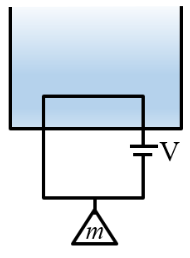
A current of 1 A is flowing on the sides of an equilateral triangle of side $$4.5 \times 10^{-2}$$ m. The magnetic field at the centre of the triangle will be:
The magnetic field produced by a straight conductor of finite length at a point situated at a perpendicular distance $$r$$ from the wire is given by the Biot-Savart result
$$B \;=\;\frac{\mu_0 I}{4\pi r}\,(\sin\theta_1+\sin\theta_2),$$
where $$\theta_1$$ and $$\theta_2$$ are the angles made by the lines joining the point to the two ends of the conductor with the perpendicular dropped from the point to the wire.
Each side of the equilateral triangle acts as such a finite straight wire. Let the length of a side be $$a = 4.5\times10^{-2}\,\text{m}$$ and the current in every side be $$I = 1\,\text{A}$$. We first determine the perpendicular distance $$r$$ of the centre of the triangle from any side.
For an equilateral triangle, the distance of the centroid from a side is
$$r \;=\;\frac{a\sqrt{3}}{6}.$$
Substituting $$a = 4.5\times10^{-2}\,\text{m}$$, we have
$$r \;=\;\frac{4.5\times10^{-2}\,\text{m}\;\times\;\sqrt{3}}{6}.$$
Next, we find the angles $$\theta_1$$ and $$\theta_2$$. A perpendicular from the centre to any side meets that side at its midpoint, dividing the side into two segments of length $$a/2$$. In the right-angled triangle so formed,
$$\tan\theta_1 \;=\;\tan\theta_2 \;=\;\frac{a/2}{r} \;=\;\frac{a/2}{a\sqrt{3}/6} \;=\;\frac{3}{\sqrt{3}} \;=\;\sqrt{3}.$$
Hence
$$\theta_1 = \theta_2 = 60^{\circ},\qquad \sin\theta_1 = \sin\theta_2 = \sin60^{\circ} = \frac{\sqrt{3}}{2}.$$
We now apply the formula for the magnetic field due to one side:
$$\begin{aligned} B_{\text{one side}} &=\frac{\mu_0 I}{4\pi r}\,(\sin\theta_1+\sin\theta_2)\\[6pt] &=\frac{\mu_0 I}{4\pi r}\left(\frac{\sqrt{3}}{2}+\frac{\sqrt{3}}{2}\right)\\[6pt] &=\frac{\mu_0 I}{4\pi r}\,\sqrt{3}. \end{aligned}$$
The three sides form a closed equilateral loop, and by the right-hand rule each side produces a field at the centre in the same perpendicular direction. Therefore the magnitudes add directly:
$$B_{\text{total}} =3B_{\text{one side}} =3\left(\frac{\mu_0 I}{4\pi r}\,\sqrt{3}\right) =\frac{3\sqrt{3}\,\mu_0 I}{4\pi r}.$$
We now substitute $$r = a\sqrt{3}/6$$:
$$\begin{aligned} B_{\text{total}} &=\frac{3\sqrt{3}\,\mu_0 I}{4\pi}\;\frac{1}{a\sqrt{3}/6}\\[6pt] &=\frac{3\sqrt{3}\,\mu_0 I}{4\pi}\;\frac{6}{a\sqrt{3}}\\[6pt] &=\frac{18\,\mu_0 I}{4\pi a}. \end{aligned}$$
We simplify the numerical factor $$\frac{18}{4}=4.5$$ and obtain
$$B_{\text{total}} =\frac{9\,\mu_0 I}{2\pi a}.$$
Using $$\mu_0 = 4\pi\times10^{-7}\,\text{T·m/A}$$, $$I = 1\,\text{A}$$ and $$a = 4.5\times10^{-2}\,\text{m}$$, we substitute:
$$\begin{aligned} B_{\text{total}} &=\frac{9\,(4\pi\times10^{-7})\,(1)}{2\pi\,(4.5\times10^{-2})}\\[6pt] &=\frac{9\cdot4\times10^{-7}}{2\cdot4.5\times10^{-2}}\\[6pt] &=\frac{36\times10^{-7}}{9\times10^{-2}}\\[6pt] &=\frac{36}{9}\times10^{-7+2}\\[6pt] &=4\times10^{-5}\,\text{T}. \end{aligned}$$
Since $$1\,\text{tesla} = 1\,\text{Wb/m}^2$$, the magnetic field is
$$B_{\text{total}} = 4\times10^{-5}\,\text{Wb/m}^2.$$
Hence, the correct answer is Option A.
The dipole moment of a circular loop carrying a current I, is m and the magnetic field at the centre of the loop is $$B_1$$. When the dipole moment is doubled by keeping the current constant, the magnetic field at the centre of the loop is $$B_2$$. The ratio $$\frac{B_1}{B_2}$$ is:
For a circular current-carrying loop the magnetic dipole moment is defined by the formula $$m = I\,A$$ where $$I$$ is the current and $$A$$ is the area enclosed by the loop.
We are told that, with the same current $$I$$, the dipole moment is doubled. Starting with an initial dipole moment $$m$$ and a final dipole moment $$2m$$, we write
$$m_1 \;=\; I\,A_1 = m,$$ $$m_2 \;=\; I\,A_2 = 2m.$$
Since the current $$I$$ remains unchanged, we can equate the ratios:
$$\dfrac{A_2}{A_1} = \dfrac{m_2}{m_1} = \dfrac{2m}{m} = 2.$$
Hence the area has become twice its original value, so
$$A_2 = 2A_1.$$
The area of a circle is given by the well-known relation $$A = \pi r^{2}.$$ Writing this for both configurations, we have
$$A_1 = \pi r_1^{2}, \qquad A_2 = \pi r_2^{2}.$$
Substituting $$A_2 = 2A_1$$ gives
$$\pi r_2^{2} = 2 \,(\pi r_1^{2}).$$
Cancelling the common factor $$\pi$$ and solving for $$r_2$$,
$$r_2^{2} = 2 r_1^{2} \;\;\Longrightarrow\;\; r_2 = \sqrt{2}\,r_1.$$
The magnetic field at the centre of a single circular loop is given by the expression
$$B = \dfrac{\mu_0 I}{2r},$$
where $$\mu_0$$ is the permeability of free space and $$r$$ is the radius of the loop. Using this formula for the two cases,
$$B_1 = \dfrac{\mu_0 I}{2 r_1},$$ $$B_2 = \dfrac{\mu_0 I}{2 r_2}.$$
Now we substitute $$r_2 = \sqrt{2}\,r_1$$ into the expression for $$B_2$$:
$$B_2 = \dfrac{\mu_0 I}{2 (\sqrt{2}\,r_1)} = \dfrac{1}{\sqrt{2}}\,\dfrac{\mu_0 I}{2 r_1} = \dfrac{B_1}{\sqrt{2}}.$$
Finally, taking the ratio of the initial to the final field,
$$\dfrac{B_1}{B_2} = \dfrac{B_1}{\,B_1/\sqrt{2}\,} = \sqrt{2}.$$
Hence, the correct answer is Option D.
An electron, a proton and an alpha particle having the same kinetic energy are moving in circular orbits of radii $$r_e$$, $$r_p$$, $$r_\alpha$$ respectively in a uniform magnetic field B. The relation between $$r_e$$, $$r_p$$, $$r_\alpha$$ is:
We begin with the fact that a charged particle of mass $$m$$ and charge magnitude $$|q|$$, moving with speed $$v$$ perpendicular to a uniform magnetic field of induction $$B$$, describes a circular path whose radius is given by the cyclotron‐motion formula
$$r=\frac{m v}{|q|\,B}.$$
The electron, the proton and the alpha particle are all said to possess the same kinetic energy. Let us call this common value $$K$$. The usual expression for kinetic energy is
$$K=\frac{1}{2}\,m v^{2}.$$
Solving this relation for the speed $$v$$ of any one of the particles, we obtain
$$v=\sqrt{\frac{2K}{m}}.$$
Now we substitute this value of $$v$$ back into the radius formula. Doing so gives
$$r=\frac{m}{|q|\,B}\;\sqrt{\frac{2K}{m}}.$$
Inside the square root the factor $$m$$ in the denominator cancels partly with the $$m$$ in the numerator, leaving us with
$$r=\frac{\sqrt{2K}}{B}\;\frac{\sqrt{m}}{|q|}.$$
Because $$\sqrt{2K}/B$$ is a constant common to all three particles (the kinetic energy and the magnetic field are the same for each of them), the radius for any particle is directly proportional to the factor $$\dfrac{\sqrt{m}}{|q|}$$. So we can write symbolically
$$r\;\propto\;\frac{\sqrt{m}}{|q|}.$$
We therefore compare the three particles only through their masses and charges:
• Electron: mass $$m_e$$, charge magnitude $$e$$.
• Proton: mass $$m_p$$, charge magnitude $$e$$.
• Alpha particle: mass $$m_\alpha = 4m_p$$, charge magnitude $$2e$$ (because it carries two positive elementary charges).
Computing the relevant proportional factors one by one:
For the electron
$$r_e \;\propto\;\frac{\sqrt{m_e}}{e}.$$
For the proton
$$r_p \;\propto\;\frac{\sqrt{m_p}}{e}.$$
For the alpha particle we first take its mass $$m_\alpha = 4m_p$$, so $$\sqrt{m_\alpha}=\sqrt{4m_p}=2\sqrt{m_p}$$. Hence
$$r_\alpha \;\propto\;\frac{\sqrt{m_\alpha}}{2e} \;=\;\frac{2\sqrt{m_p}}{2e} \;=\;\frac{\sqrt{m_p}}{e}.$$
This shows immediately that
$$r_p = r_\alpha$$
because both are proportional to the identical factor $$\dfrac{\sqrt{m_p}}{e}$$, whereas the electron radius is proportional to $$\dfrac{\sqrt{m_e}}{e}$$ with $$\sqrt{m_e} \ll \sqrt{m_p}$$ (the electron’s mass is about 1836 times smaller than the proton’s mass).
Therefore we have the inequality
$$r_e \;<\; r_p = r_\alpha.$$
Among the given options this order corresponds exactly to option 3.
Hence, the correct answer is Option 3.
A negative test charge is moving near a long straight wire carrying a current. The force acting on the test charge is parallel to the direction of the current. The motion of the charge is:
We start with the magnetic (Lorentz) force formula
$$\vec F = q\,\vec v \times \vec B$$
where $$q$$ is the charge, $$\vec v$$ its velocity and $$\vec B$$ the magnetic field produced by the straight current-carrying wire.
Let us choose a convenient co-ordinate system. Take the wire to lie along the $$z$$-axis and let the current $$I$$ flow in the $$+z$$ direction. The magnetic field produced by a long straight wire is given by the Biot-Savart law,
$$\vec B = \frac{\mu_0 I}{2\pi r}\,\hat\phi,$$
where $$r$$ is the perpendicular distance from the wire and $$\hat\phi$$ is the azimuthal unit vector obtained from the right-hand rule (curl the fingers of the right hand around the wire in the direction of the current; the thumb points along $$+z$$).
Pick a point lying on the positive $$x$$-axis at a distance $$r$$ from the wire. At this point the magnetic field is tangential and points along $$+y$$. Symbolically,
$$\vec B = B\,\hat y,\qquad B = \frac{\mu_0 I}{2\pi r}.$$
The test charge is negative. Suppose its velocity has only a radial component, either directly away from the wire (along $$+\hat x$$) or towards the wire (along $$-\hat x$$). We now calculate the cross product in each case.
If the charge moves away from the wire, we have
$$\vec v = v\,\hat x,$$
so
$$\vec v \times \vec B = \bigl(v\,\hat x\bigr) \times \bigl(B\,\hat y\bigr) = vB\,(\hat x \times \hat y) = vB\,\hat z.$$
Therefore the force becomes
$$\vec F = q\,\vec v \times \vec B = q\,vB\,\hat z.$$
Because $$q<0$$ (negative charge), the force points along $$-\,\hat z$$, i.e. opposite to the direction of current. This does not match the given condition that the force is parallel to the current.
If the charge moves towards the wire, we have
$$\vec v = -\,v\,\hat x,$$
then
$$\vec v \times \vec B = \bigl(-v\,\hat x\bigr) \times \bigl(B\,\hat y\bigr) = -vB\,(\hat x \times \hat y) = -vB\,\hat z.$$
The force is now
$$\vec F = q\,\vec v \times \vec B = q\,(-vB\,\hat z).$$
With $$q<0$$, the double negative gives
$$\vec F = (+vB)\,\hat z,$$
so $$\vec F$$ is indeed along $$+\,\hat z$$, the same direction as the current. This satisfies the condition stated in the problem.
Thus, for the force on a negative charge to be parallel to the current, the charge must be moving radially inward, i.e. it must be approaching the wire.
Hence, the correct answer is Option B.
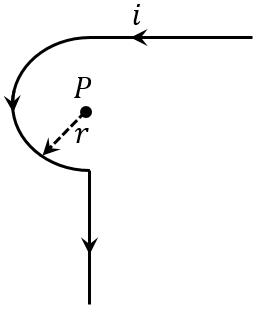
A magnetic dipole in a uniform magnetic field has: (Take zero potential energy when magnetic dipole is perpendicular to magnetic field)
Let us denote the magnetic dipole moment vector by $$\vec p$$ and the uniform magnetic field by $$\vec B$$. The angle between the two vectors is called $$\theta$$.
First, we recall two standard relations for a magnetic dipole kept in a uniform magnetic field:
1. Magnitude of torque
We have the vector formula $$\vec \tau = \vec p \times \vec B$$. Taking magnitudes, the cross-product gives
$$\tau = pB\sin\theta.$$
2. Potential energy
The scalar product of two vectors tells us
$$U = -\,\vec p \cdot \vec B.$$
This dot product becomes
$$U = -pB\cos\theta.$$
The question clearly states that the reference level of potential energy is chosen to be zero when the dipole is perpendicular to the field. Mathematically, when $$\theta = 90^{\circ}$$ we obtain
$$\cos 90^{\circ} = 0 \;\;\Longrightarrow\;\; U = -pB \times 0 = 0,$$
so the usual formula $$U = -pB\cos\theta$$ is already consistent with the given convention; no extra constant has to be added.
Now we compare the conditions for maximum torque and for the potential energy values:
Maximum torque
From $$\tau = pB\sin\theta$$ the sine term reaches its greatest value of 1 when
$$\sin\theta = 1 \;\;\Longrightarrow\;\; \theta = 90^{\circ}.$$
Hence the torque is maximum when the dipole is perpendicular to the field.
Potential energy at that same orientation
Substituting $$\theta = 90^{\circ}$$ in the energy expression, we get
$$U = -pB\cos 90^{\circ} = -pB \times 0 = 0.$$
So, exactly at the orientation where the torque attains its maximum value, the potential energy is zero (with the chosen reference point).
Among the given statements we therefore select the one that says “zero potential energy when the torque is maximum.”
Hence, the correct answer is Option B.
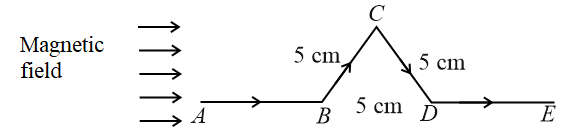
In a certain region static electric and magnetic fields exist. The magnetic field is given by $$\vec{B} = B_0(\hat{i} + 2\hat{j} - 4\hat{k})$$. If a test charge moving with a velocity $$\vec{v} = v_0(3\hat{i} - \hat{j} + 2\hat{k})$$ experiences no force in that region, then the electric field in the region, in SI units, is:
For a charge moving in simultaneous electric and magnetic fields, the Lorentz force formula states
$$\vec{F}=q\left(\vec{E}+\,\vec{v}\times\vec{B}\right).$$
Here the problem tells us that the charge “experiences no force,” so the net force vector must be zero. Hence, setting $$\vec{F}=0$$ gives
$$\vec{E}+\,\vec{v}\times\vec{B}=0.$$
Re-arranging, we obtain an explicit expression for the electric field:
$$\vec{E}=-\,\vec{v}\times\vec{B}.$$
Now we substitute the given velocity and magnetic-field vectors. They are
$$\vec{v}=v_0\left(3\hat{i}-\hat{j}+2\hat{k}\right),\qquad \vec{B}=B_0\left(\hat{i}+2\hat{j}-4\hat{k}\right).$$
To evaluate the cross product $$\vec{v}\times\vec{B}$$ we write the determinant in component form:
$$ \vec{v}\times\vec{B}= \begin{vmatrix} \hat{i}&\hat{j}&\hat{k}\\[4pt] 3v_0&-v_0&2v_0\\[4pt] B_0&2B_0&-4B_0 \end{vmatrix}. $$
Expanding this determinant component by component:
• The $$\hat{i}$$ component is $$ \hat{i}\Big[(-v_0)(-4B_0)-(2v_0)(2B_0)\Big] =\hat{i}\Big[4v_0B_0-4v_0B_0\Big] =0\,\hat{i}. $$
• The $$\hat{j}$$ component carries a minus sign in the determinant expansion, so
$$ -\hat{j}\Big[(3v_0)(-4B_0)-(2v_0)(B_0)\Big] =-\hat{j}\Big[-12v_0B_0-2v_0B_0\Big] =-\hat{j}\big[-14v_0B_0\big] =14v_0B_0\,\hat{j}. $$
• The $$\hat{k}$$ component is
$$ \hat{k}\Big[(3v_0)(2B_0)-(-v_0)(B_0)\Big] =\hat{k}\Big[6v_0B_0+v_0B_0\Big] =7v_0B_0\,\hat{k}. $$
Collecting all three components, the cross product becomes
$$ \vec{v}\times\vec{B}=v_0B_0\big(0\,\hat{i}+14\,\hat{j}+7\,\hat{k}\big) =v_0B_0\left(14\hat{j}+7\hat{k}\right). $$
Finally, substituting this result into $$\vec{E}=-\,\vec{v}\times\vec{B}$$ we get
$$ \vec{E}=-v_0B_0\left(14\hat{j}+7\hat{k}\right). $$
Hence, the correct answer is Option D.
A magnetic needle of magnetic moment $$6.7 \times 10^{-2}$$ A m$$^{2}$$ and moment of inertia $$7.5 \times 10^{-6}$$ kg m$$^{2}$$ is performing simple harmonic oscillations in a magnetic field of 0.01 T. Time taken for 10 complete oscillations is:
We know that a magnetic needle of magnetic moment $$M$$ placed in a uniform magnetic field $$B$$ executes torsional simple harmonic motion. The restoring torque on the needle is $$\tau = -MB\sin\theta$$. For very small angular displacements we can use the small-angle approximation $$\sin\theta \approx \theta$$, so the torque becomes $$\tau = -MB\,\theta$$.
Newton’s rotational equation is $$I\,\dfrac{d^{2}\theta}{dt^{2}} = \tau$$, where $$I$$ is the moment of inertia. Substituting the expression for $$\tau$$, we get
$$I\,\dfrac{d^{2}\theta}{dt^{2}} = -MB\,\theta.$$
This is the differential equation of a simple harmonic oscillator of the form $$\dfrac{d^{2}\theta}{dt^{2}} + \omega^{2}\theta = 0$$, where the square of the angular frequency is identified as
$$\omega^{2} = \dfrac{MB}{I}.$$
Therefore, the angular frequency is
$$\omega = \sqrt{\dfrac{MB}{I}}.$$
The time period $$T$$ of one complete oscillation is related to $$\omega$$ by the standard formula for SHM:
$$T = \dfrac{2\pi}{\omega} = 2\pi\sqrt{\dfrac{I}{MB}}.$$
Now we substitute the given numerical values. We have
$$M = 6.7 \times 10^{-2}\ \text{A m}^{2},\quad B = 0.01\ \text{T},\quad I = 7.5 \times 10^{-6}\ \text{kg m}^{2}.$$
First compute the product $$MB$$:
$$MB = \left(6.7 \times 10^{-2}\right)\left(0.01\right) = 6.7 \times 10^{-4}.$$
Next form the ratio $$\dfrac{I}{MB}$$:
$$\dfrac{I}{MB} = \dfrac{7.5 \times 10^{-6}}{6.7 \times 10^{-4}} = \dfrac{7.5}{6.7}\times 10^{-6+4} = 1.1194 \times 10^{-2}.$$
Taking the square root gives
$$\sqrt{\dfrac{I}{MB}} = \sqrt{1.1194 \times 10^{-2}} \approx 0.1058.$$
Now insert this value into the expression for the period:
$$T = 2\pi \left(0.1058\right) = 6.283 \times 0.1058 \approx 0.6647\ \text{s}.$$
This is the time for one complete oscillation. The question asks for the time taken for 10 complete oscillations, so we multiply by 10:
$$t_{10} = 10T = 10 \times 0.6647 \approx 6.647\ \text{s}.$$
Rounding to three significant figures, we obtain $$t_{10} \approx 6.65\ \text{s}.$$ Hence, the correct answer is Option B.
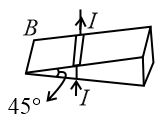
A uniform magnetic field $$B$$ of 0.3 T is along the positive Z-direction. A rectangular loop (abcd) of sides 10 cm $$\times$$ 5 cm carries a current $$I$$ of 12 A. Out of the following different orientations which one corresponds to stable equilibrium?
The magnetic field is given to be uniform and directed along the positive $$Z$$-axis, so we write
$$\vec B = B\,\hat k, \qquad B = 0.3\ \text{T}.$$
For a current-carrying loop the magnetic moment is defined first. We state the formula:
$$\vec \mu = I\,\vec A = I\,A\,\hat n,$$
where
$$I = 12\ \text{A},\qquad A = (\text{length})\times(\text{breadth}) = 0.10\ \text{m}\times0.05\ \text{m}=0.005\ \text{m}^2,$$
and $$\hat n$$ is the unit vector perpendicular to the plane of the loop, obtained from the right-hand rule (curl the fingers in the sense of the current; the extended thumb gives the direction of $$\hat n$$).
Hence the magnitude of the magnetic moment is
$$\mu = I\,A = 12 \times 0.005 = 0.06\ \text{A·m}^2.$$
The torque acting on the loop in a magnetic field is obtained from the vector relation
$$\vec \tau = \vec \mu \times \vec B,$$
and the magnetic potential energy is
$$U = -\vec \mu\cdot\vec B = -\mu B\cos\theta,$$
where $$\theta$$ is the angle between $$\vec \mu$$ and $$\vec B$$. Stable equilibrium occurs when the potential energy is minimum, i.e. when $$\theta = 0^\circ$$ so that $$\vec \mu$$ is parallel to $$\vec B$$. Unstable equilibrium corresponds to $$\theta = 180^\circ$$, and any other angle produces a restoring torque that tends to rotate the loop toward $$\theta = 0^\circ$$.
We now examine each orientation given in the options.
Option A. The loop lies in the $$XZ$$ plane. A plane perpendicular to $$\hat n$$ equal to $$\pm\hat j$$ (along $$\pm Y$$). Thus $$\theta = 90^\circ$$ and
$$U = -\mu B \cos 90^\circ = 0,\qquad \tau = \mu B \sin 90^\circ = \mu B \neq 0.$$
With non-zero torque and zero slope in potential, the loop is driven toward alignment with $$\vec B$$; this is not a position of stable equilibrium.
Option B. The geometry is the same as in Option A; only the sense of current (and hence the sign of $$\hat n$$) is reversed. The moment still points along $$\pm Y$$, so $$\theta = 90^\circ$$, giving the same $$U=0$$ and a non-zero torque. This too is not a stable configuration.
Option C. The loop lies in the $$XY$$ plane, and the current circulates a-b-c-d. By the right-hand rule the thumb points along $$+\hat k$$, i.e. $$\vec \mu = +\mu\,\hat k$$. Therefore
$$\theta = 0^\circ,\qquad U = -\mu B \cos 0^\circ = -\mu B = -0.06 \times 0.3 = -0.018\ \text{J}.$$
This is the minimum attainable potential energy, so any small disturbance will be opposed by a restoring torque. Hence this orientation represents stable equilibrium.
Option D. The loop is again in the $$XY$$ plane but the current is reversed (a-d-c-b), giving $$\vec \mu = -\mu\,\hat k$$. Now
$$\theta = 180^\circ,\qquad U = -\mu B \cos 180^\circ = +\mu B = +0.018\ \text{J}.$$
This is the maximum potential energy, corresponding to an unstable equilibrium.
Comparing all four possibilities, only Option C provides $$\vec \mu$$ parallel to $$\vec B$$ and therefore minimum potential energy.
Hence, the correct answer is Option C.
Hysteresis loops for two magnetic materials A and B are given below:
These materials are used to make magnets for electric generators, transformer core and electromagnet core. Then it is proper to use:
1. Material A:
Properties: This material has a large area within its hysteresis loop. It features high retentivity (residual magnetism when $$H=0$$) and high coercivity (resistance to being demagnetized).
Suitability: Because it is difficult to demagnetize and retains a strong magnetic field, it is ideal for making permanent magnets, such as those used in electric generators.
2. Material B:
Properties: This material has a narrow, thin loop. This indicates low coercivity and low hysteresis loss (the energy dissipated as heat during each cycle of magnetization).
Suitability: In devices like transformers and electromagnets, the magnetic field is constantly switching (alternating current). To prevent the device from overheating and to ensure high efficiency, you need a material that can be easily magnetized and demagnetized with minimal energy loss.
Applications: Specifically used for transformer cores and electromagnet cores.
Two identical wires A and B, each of length $$l$$, carry the same current $$I$$. Wire A is bent into a circle of radius R and wire B is bent to form a square of side $$a$$. If $$B_A$$ and $$B_B$$ are the values of magnetic field at the centres of the circle and square respectively, then the ratio $$\frac{B_A}{B_B}$$ is
We are given two wires of the same material and the same length $$l$$. Both carry the same current $$I$$. Wire A is bent into a complete circle of radius $$R$$, whereas wire B is bent into a square of side $$a$$. We have to compare the magnetic fields produced at the geometrical centres of these two current-carrying loops.
First we deal with the circular loop. Because the whole length of wire becomes the circumference of the circle, we write
$$2\pi R = l \quad\Longrightarrow\quad R = \frac{l}{2\pi}.$$
The standard result for the magnetic field at the centre of a single-turn circular loop carrying current $$I$$ is stated as
$$B = \frac{\mu_0 I}{2R}.$$
Substituting the value of $$R$$ just obtained, we get
$$B_A = \frac{\mu_0 I}{2\left(\dfrac{l}{2\pi}\right)}
= \frac{\mu_0 I}{2}\cdot \frac{2\pi}{l}
= \frac{\mu_0 I \pi}{l}.$$
Now we turn to the square loop. Because the whole length of the wire forms the perimeter of the square, we have
$$4a = l \quad\Longrightarrow\quad a = \frac{l}{4}.$$
To find the magnetic field at the centre of a square loop, we look at the contribution from one side and then multiply by four. For a straight segment of finite length the magnetic field at a point lying on the perpendicular bisector of the segment is given by the Biot-Savart result
$$B = \frac{\mu_0 I}{4\pi r}\bigl(\sin\theta_1 + \sin\theta_2\bigr),$$
where $$r$$ is the perpendicular distance from the wire to the point and $$\theta_1,\theta_2$$ are the angles that the lines joining the point to the two ends of the segment make with the perpendicular.
For the centre of the square:
- The distance from the centre to the mid-point of any side is $$r = \dfrac{a}{2}.$$
- Each side extends equally on both sides of this perpendicular, so $$\theta_1 = \theta_2 = 45^\circ.$$ Hence $$\sin\theta_1 = \sin\theta_2 = \sin 45^\circ = \dfrac{1}{\sqrt{2}}.$$
Thus the field due to one side is
$$B_{\text{side}} = \frac{\mu_0 I}{4\pi\left(\dfrac{a}{2}\right)}
\bigl(\sin 45^\circ + \sin 45^\circ\bigr)
= \frac{\mu_0 I}{4\pi\left(\dfrac{a}{2}\right)}
\bigl(\tfrac{1}{\sqrt{2}} + \tfrac{1}{\sqrt{2}}\bigr)
= \frac{\mu_0 I}{4\pi\left(\dfrac{a}{2}\right)}
\cdot \frac{2}{\sqrt{2}}
= \frac{\mu_0 I}{2\pi\left(\dfrac{a}{2}\right)}
\cdot \frac{1}{\sqrt{2}}
= \frac{\mu_0 I}{\pi a}\cdot\frac{1}{\sqrt{2}}.$$
Because there are four identical sides, the total field at the centre of the square loop is
$$B_B = 4\,B_{\text{side}}
= 4\left(\frac{\mu_0 I}{\pi a}\cdot\frac{1}{\sqrt{2}}\right)
= \frac{4\mu_0 I}{\pi a\sqrt{2}}.$$
We now substitute $$a = \dfrac{l}{4}$$ to express everything in terms of the common length $$l$$:
$$B_B = \frac{4\mu_0 I}{\pi\left(\dfrac{l}{4}\right)\sqrt{2}}
= \frac{4\mu_0 I}{\dfrac{\pi l}{4}\sqrt{2}}
= \frac{4\mu_0 I \times 4}{\pi l \sqrt{2}}
= \frac{16\mu_0 I}{\pi l \sqrt{2}}.$$
We are now ready to take the ratio:
$$\frac{B_A}{B_B}
= \frac{\dfrac{\mu_0 I \pi}{l}}
{\dfrac{16\mu_0 I}{\pi l \sqrt{2}}}
= \frac{\mu_0 I \pi}{l}
\cdot \frac{\pi l \sqrt{2}}{16\mu_0 I}
= \frac{\pi^2\sqrt{2}}{16}.$$
To put this in a simpler fractional form, we divide numerator and denominator by $$\sqrt{2}$$:
$$\frac{\pi^2\sqrt{2}}{16}
= \frac{\pi^2}{16/\sqrt{2}}
= \frac{\pi^2}{8\sqrt{2}}.$$
Therefore
$$\frac{B_A}{B_B} = \frac{\pi^2}{8\sqrt{2}}.$$
Comparing with the given options, this matches Option B.
Hence, the correct answer is Option B.
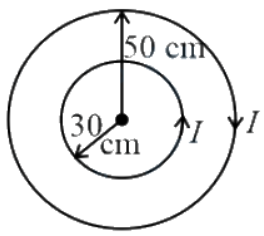
A magnetic dipole is acted upon by two magnetic fields which are inclined to each other at an angle of 75°. One of the fields has a magnitude of 15 mT. The dipole attains stable equilibrium at an angle of 30° with this field. The magnitude of the other field (in mT) is close to
Let the magnitudes of the two magnetic fields be denoted by $$B_1$$ and $$B_2$$. We are told
$$B_1 = 15\ \text{mT},\qquad B_2 = ?$$
The angle between the two fields is given as
$$\alpha = 75^\circ.$$
The magnetic dipole finally comes to rest (stable equilibrium) along the direction of the resultant field $$\mathbf R = \mathbf B_1 + \mathbf B_2$$. At equilibrium the dipole therefore makes the same angle with $$\mathbf B_1$$ as the resultant field does. This angle is stated to be
$$\theta = 30^\circ.$$
So, in the triangle formed by the vectors $$\mathbf B_1,\ \mathbf B_2,\ \mathbf R$$, we know the angle between $$\mathbf B_1$$ and $$\mathbf R$$ (namely $$\theta$$) and the angle between $$\mathbf B_1$$ and $$\mathbf B_2$$ (namely $$\alpha$$).
To relate the magnitudes we resolve $$\mathbf B_2$$ into components parallel and perpendicular to $$\mathbf B_1$$. Using elementary vector addition, the magnitude of the perpendicular component of $$\mathbf B_2$$ is
$$B_2 \sin\alpha,$$
while the component of $$\mathbf B_2$$ along $$\mathbf B_1$$ is
$$B_2 \cos\alpha.$$
The resultant $$\mathbf R$$ therefore has
• a component along $$\mathbf B_1$$ equal to $$B_1 + B_2\cos\alpha$$, and
• a component perpendicular to $$\mathbf B_1$$ equal to $$B_2\sin\alpha.$$
The angle $$\theta$$ that $$\mathbf R$$ makes with $$\mathbf B_1$$ is then obtained from simple trigonometry:
$$\tan\theta \;=\;\frac{\text{perpendicular component}}{\text{parallel component}} \;=\;\frac{B_2\sin\alpha}{B_1 + B_2\cos\alpha}.$$
We now substitute the known numerical values:
$$\tan 30^\circ \;=\;\frac{B_2\sin 75^\circ}{15 + B_2\cos 75^\circ}.$$
Next we insert the standard trigonometric numbers
$$\tan 30^\circ = \frac{1}{\sqrt 3} \approx 0.577,\qquad \sin 75^\circ \approx 0.9659,\qquad \cos 75^\circ \approx 0.2588.$$
This gives
$$0.577 =\frac{B_2(0.9659)}{15 + B_2(0.2588)}.$$
We now carry out the algebra step by step.
First cross-multiply:
$$0.577\bigl(15 + 0.2588\,B_2\bigr) = 0.9659\,B_2.$$
Multiply out the brackets on the left:
$$0.577 \times 15 + 0.577 \times 0.2588\,B_2 = 0.9659\,B_2.$$
Calculate the numerical products:
$$8.655 + 0.1493\,B_2 = 0.9659\,B_2.$$
Bring the $$B_2$$ terms together on one side:
$$8.655 = 0.9659\,B_2 - 0.1493\,B_2.$$
Combine the coefficients of $$B_2$$ on the right:
$$8.655 = (0.9659 - 0.1493)\,B_2 = 0.8166\,B_2.$$
Finally, solve for $$B_2$$ by dividing both sides by $$0.8166$$:
$$B_2 = \frac{8.655}{0.8166} \approx 10.6\ \text{mT}.$$
The closest option to $$10.6\ \text{mT}$$ is $$11\ \text{mT}$$.
Hence, the correct answer is Option B.
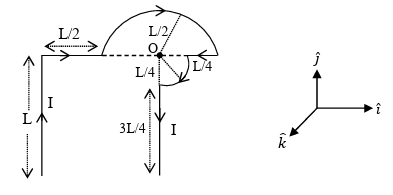
Two long currents carrying thin wires, both with current $$I$$, are held by insulating threads of length L and are in equilibrium as shown in the figure, with threads making an angle $$\theta$$ with the vertical. If wires have a mass $$\lambda$$ per unit length then the value of I is: ($$g$$ = gravitational acceleration)
Weight $$w = \lambda g$$ (Acts vertically downwards)
Magnetic Force $$F_m = \frac{\mu_0 I^2}{2 \pi d}$$
The total distance ($$d$$) between the two wires is $$d = 2L \sin \theta$$
Let $$T$$ be the tension per unit length of the thread. Resolving the tension into components:
Vertical equilibrium: $$T \cos \theta = \lambda g$$ --- (Eq. 1)
Horizontal equilibrium: $$T \sin \theta = F_m$$ --- (Eq. 2)
$$\tan \theta = \frac{F_m}{\lambda g}$$
$$\tan \theta = \frac{\mu_0 I^2}{2 \pi (2L \sin \theta) \lambda g}$$
$$\tan \theta = \frac{\mu_0 I^2}{2 \pi d \lambda g}$$
$$\frac{\sin \theta}{\cos \theta} = \frac{\mu_0 I^2}{4 \pi L \lambda g \sin \theta}$$
$$I^2 = \frac{4 \pi \lambda g L \sin^2 \theta}{\mu_0 \cos \theta}$$
$$I = \sqrt{\frac{4 \pi \lambda g L \sin^2 \theta}{\mu_0 \cos \theta}}$$
$$I = 2 \sin \theta \sqrt{\frac{\pi \lambda g L}{\mu_0 \cos \theta}}$$
A short bar magnet is placed in the magnetic meridian of the earth with North Pole pointing north. Neutral points are found at a distance of 30 cm from the magnet on the East-West line, drawn through the middle point of the magnet. The magnetic moment of the magnet in Am$$^2$$ is close to: (Given $$\frac{\mu_0}{4\pi} = 10^{-7}$$ in SI units and $$B_H$$ = Horizontal component of earth's magnetic field = $$3.6 \times 10^{-5}$$ Tesla.)
We are told that the neutral points lie on the East-West line drawn through the mid-point of the bar magnet. Such points are situated on the equatorial (broadside) line of the magnet. For a short bar magnet the magnetic induction at a point on the equatorial line, at a distance $$r$$ from the centre of the magnet, is given by the standard formula
$$B_{\text{equatorial}}=\frac{\mu_0}{4\pi}\,\frac{M}{r^{3}}$$
where $$M$$ is the magnetic moment of the magnet. This field is directed opposite to the direction of the earth’s horizontal field $$B_H$$. At a neutral point the two fields cancel in magnitude, so we must have
$$B_H = \frac{\mu_0}{4\pi}\,\frac{M}{r^{3}}$$
Now we solve for $$M$$. Rearranging the above equality gives
$$M = B_H \, r^{3}\,\left(\frac{4\pi}{\mu_0}\right)$$
We substitute the numerical values. The distance of the neutral point from the magnet’s centre is given as 30 cm, which in SI units is
$$r = 30\ \text{cm} = 0.30\ \text{m}$$
Cubing this distance, step by step,
$$r^{3} = (0.30\ \text{m})^{3} = 0.30 \times 0.30 \times 0.30 = 0.027\ \text{m}^{3}$$
The horizontal component of the earth’s magnetic field is
$$B_H = 3.6 \times 10^{-5}\ \text{T}$$
The constant $$\frac{\mu_0}{4\pi}$$ is given as $$10^{-7}$$ in SI units, hence
$$\frac{4\pi}{\mu_0} = \frac{1}{\mu_0/4\pi} = \frac{1}{10^{-7}} = 10^{7}$$
Substituting everything into the expression for $$M$$, we get
$$M = \left(3.6 \times 10^{-5}\right)\,\left(0.027\right)\,\left(10^{7}\right)$$
We first multiply the two decimal numbers:
$$3.6 \times 0.027 = 0.0972$$
Next we combine the powers of ten:
$$10^{-5} \times 10^{7} = 10^{2} = 100$$
Finally we multiply these results:
$$M = 0.0972 \times 100 = 9.72$$
So, the magnetic moment is
$$M \approx 9.7\ \text{A m}^2$$
Among the given choices, this value corresponds to Option D (9.7 A m2).
Hence, the correct answer is Option D.
A 25 cm long solenoid has the radius 2 cm and 500 turns. It carries a current of 15 A. If it is equivalent to a magnet of the same size and magnetization $$\vec{M}$$ $$\left(\frac{\text{Magnetic Moment}}{\text{volume}}\right)$$, then $$|\vec{M}|$$ is:
We are given a solenoid with length 25 cm, radius 2 cm, 500 turns, and current 15 A. We need to find the magnitude of the magnetization $$\vec{M}$$, which is defined as the magnetic moment per unit volume. The solenoid is equivalent to a magnet of the same size, so we will calculate the magnetic moment of the solenoid and then divide by its volume.
First, convert all units to SI units. Length $$L = 25$$ cm = $$25 \times 10^{-2}$$ m = 0.25 m. Radius $$r = 2$$ cm = $$2 \times 10^{-2}$$ m = 0.02 m. Current $$I = 15$$ A. Number of turns $$N = 500$$.
The magnetic moment ($$m$$) of a solenoid is given by the product of the number of turns, the current, and the area of one turn. The area $$A$$ of one turn is the cross-sectional area of the solenoid, which is circular: $$A = \pi r^2$$.
Calculate $$A$$:
$$ A = \pi \times (0.02)^2 = \pi \times 0.0004 = 4 \times 10^{-4} \pi \text{ m}^2 $$
Now, calculate the magnetic moment $$m$$:
$$ m = N \times I \times A = 500 \times 15 \times (4 \times 10^{-4} \pi) $$
First, multiply 500 and 15:
$$ 500 \times 15 = 7500 $$
Then multiply by $$4 \times 10^{-4} \pi$$:
$$ 7500 \times 4 \times 10^{-4} \pi = 7500 \times 4 \times 0.0001 \pi = 7500 \times 0.0004 \pi $$
$$ 7500 \times 0.0004 = 3 \quad \text{(since } 7500 \times 4 \times 10^{-4} = 7500 \times 4 \times 0.0001 = 30000 \times 0.0001 = 3\text{)} $$
So,
$$ m = 3\pi \text{ A} \cdot \text{m}^2 $$
The volume ($$V$$) of the solenoid is the product of its cross-sectional area and length:
$$ V = A \times L = (4 \times 10^{-4} \pi) \times 0.25 $$
First, multiply 0.25 and $$4 \times 10^{-4}$$:
$$ 0.25 \times 4 \times 10^{-4} = 1 \times 10^{-4} = 0.0001 $$
So,
$$ V = 0.0001 \pi = \pi \times 10^{-4} \text{ m}^3 $$
Magnetization $$\vec{M}$$ is the magnetic moment per unit volume:
$$ |\vec{M}| = \frac{m}{V} = \frac{3\pi}{\pi \times 10^{-4}} $$
Simplify by canceling $$\pi$$:
$$ |\vec{M}| = \frac{3}{10^{-4}} = 3 \times 10^{4} = 30000 \text{ A m}^{-1} $$
Comparing with the options, 30000 A m$$^{-1}$$ corresponds to option B. The problem states that the correct answer is option 2, which is B.
Hence, the correct answer is Option B.
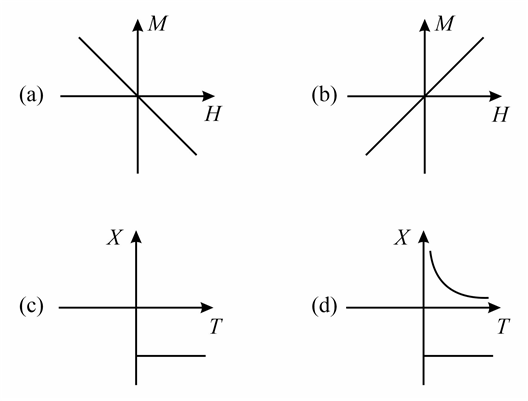
A rectangular loop of sides 10 cm and 5 cm, carrying a current $$I$$ of 12 A, is placed in different orientations as shown in the figures below.

If there is a uniform magnetic field of 0.3 T in the positive z direction, in which orientations the loop would be in (i) stable equilibrium and (ii) unstable equilibrium?
First we recall that a current-carrying planar loop behaves like a magnetic dipole. Its magnetic moment $$\vec m$$ is defined by the right-hand rule and is given in magnitude by
$$m = I\,A,$$
where $$I$$ is the current and $$A$$ is the geometrical area of the loop. The torque acting on the loop when it is kept in a uniform magnetic field $$\vec B$$ is obtained from the vector product
$$\vec \tau = \vec m \times \vec B.$$
If $$\theta$$ is the angle between $$\vec m$$ and $$\vec B$$, the magnitude of the torque becomes
$$\tau = mB\sin\theta.$$
We also need the expression for the potential energy of the magnetic dipole in the field; the formula is
$$U = -\vec m\cdot\vec B = -mB\cos\theta.$$
Equilibrium positions occur when the torque is zero, i.e. when $$\sin\theta = 0$$, or equivalently when $$\theta = 0^{\circ}$$ (parallel) or $$\theta = 180^{\circ}$$ (antiparallel). The nature of the equilibrium follows from the potential energy:
- For $$\theta = 0^{\circ}$$ we get $$U_{\min} = -mB$$. This is the minimum possible energy, so any small rotation raises the energy and the dipole experiences a restoring torque. Thus the equilibrium is stable.
- For $$\theta = 180^{\circ}$$ we obtain $$U_{\max} = +mB$$, the maximum possible energy. A small deflection lowers the energy, hence the dipole is driven further away from that orientation. The equilibrium is therefore unstable.
Let us calculate the magnetic moment of the given loop so that we can identify its direction in each drawing. The sides are 10 cm and 5 cm, so
$$A = 0.10\;\text{m}\times0.05\;\text{m}=0.005\;\text{m}^2.$$
The current is 12 A, hence
$$m = IA = 12\times0.005 = 0.06\;\text{A m}^2.$$
The external magnetic field is $$\vec B = 0.3\;\text{T}\,\hat k$$, i.e. in the positive $$z$$ direction. The direction of $$\vec m$$ for each sketch (a), (b), (c) and (d) follows from curling the right hand around the sense of current shown in that sketch. Making that inspection we find:
- (b) The normal to the plane of the loop points along $$+\hat k$$, i.e. $$\vec m$$ is parallel to $$\vec B$$. Therefore $$\theta = 0^{\circ}$$ and this is a stable equilibrium.
- (d) The normal to the plane of the loop points along $$-\hat k$$, i.e. $$\vec m$$ is antiparallel to $$\vec B$$. Therefore $$\theta = 180^{\circ}$$ and this is an unstable equilibrium.
- (a) and (c) give normals that are neither parallel nor antiparallel to $$\vec B$$, so $$\theta$$ is different from $$0^{\circ}$$ or $$180^{\circ}$$. A non-zero torque acts, the loop tends to rotate, and these positions are not equilibria at all.
Thus the loop is in
(i) stable equilibrium in orientation (b), and
(ii) unstable equilibrium in orientation (d).
Among the given choices only Option D lists “(b) and (d), respectively.” Hence, the correct answer is Option D.
A wire carrying current $$I$$ is tied between points $$P$$ and $$Q$$ and is in the shape of a circular arc of radius $$R$$ due to a uniform magnetic field $$B$$ (perpendicular to the plane of the paper, as shown in the figure) in the vicinity of the wire. If the wire subtends an angle $$2\theta_0$$ at the center of the circle (of which it forms an arch) then the tension in the wire is:
Consider a small element of the wire subtending an angle $$d\theta$$ at the center. The length of this element is $$dl = R d\theta$$
The magnetic force $$dF$$ acting on this element is given by $$d\vec{F} = I(d\vec{l} \times \vec{B})$$
Since the magnetic field $$B$$ is uniform and perpendicular to the plane of the wire, the magnitude of the force is $$dF = I B dl = I B R d\theta$$
Using the Right-Hand Rule, this force $$dF$$ acts radially outward from the center.
The components of tension parallel to the tangent at the center of the element cancel out.
The components directed toward the center (radial components) add up.
$$\sum F_{radial} = 2T \sin\left(\frac{d\theta}{2}\right)$$
For the element to be in equilibrium, the net radial force must be zero:
$$2T \sin\left(\frac{d\theta}{2}\right) = dF$$
$$2T \sin\left(\frac{d\theta}{2}\right) = I B R d\theta$$
Using the small-angle approximation where $$\sin(\alpha) \approx \alpha$$ for very small angles:
$$2T \left(\frac{d\theta}{2}\right) = I B R d\theta$$
$$T d\theta = I B R d\theta$$
$$T = I B R$$
A proton (mass $$m$$), accelerated by a potential difference $$V$$, flies through a uniform transverse magnetic field $$B$$. The field occupies a region of the space by a width $$d$$. Let $$\alpha$$ be the angle of deviation of the proton from the initial direction of motion (see the figure), then the value of $$\sin \alpha$$ will be:
When a proton of mass $$m$$ and charge $$q$$ is accelerated through a potential difference $$V$$, it gains kinetic energy.
$$\frac{1}{2}mv^2 = qV \implies v = \sqrt{\frac{2qV}{m}}$$
As the proton enters the uniform transverse magnetic field $$B$$, it experiences a Lorentz force that causes it to move in a circular arc of radius $$R$$. The magnetic force provides the necessary centripetal force.
$$qvB = \frac{mv^2}{R}$$
$$R = \frac{mv}{qB}$$
$$R = \frac{m}{qB} \sqrt{\frac{2qV}{m}} = \frac{1}{B} \sqrt{\frac{2mV}{q}}$$
In the right-angled triangle formed by the radius and the width of the field, $$\sin \alpha = \frac{d}{R}$$
$$\sin \alpha = \frac{d}{\frac{1}{B} \sqrt{\frac{2mV}{q}}}$$
$$\sin \alpha = Bd \frac{1}{\sqrt{\frac{2mV}{q}}}$$
$$\sin \alpha = Bd \sqrt{\frac{q}{2mV}}$$
Two coaxial solenoids of different radii carry current $$I$$ in the same direction. Let $$\vec{F_1}$$ be the magnetic force on the inner solenoid due to the outer one and $$\vec{F_2}$$ be the magnetic force on the outer solenoid due to the inner one. Then:
We have two long, concentric (co-axial) solenoids. Let the inner solenoid have radius $$r_1$$ and the outer one have radius $$r_2$$ with $$r_1 < r_2$$. Both carry the same steady current $$I$$ in the same sense along their windings.
For an ideal, infinitely long solenoid, the magnetic field produced by that solenoid is well known. First we state the standard formula:
For a solenoid having $$n$$ turns per unit length and carrying current $$I$$, the magnetic field at any point on its axis and anywhere inside its own cross-section is
$$B = \mu_0\,n\,I,$$
directed along the common axis. Outside the solenoid (that is, at any point whose radial distance from the axis is greater than the solenoid’s radius) the magnetic field is practically zero for an infinitely long solenoid.
Now we analyse the forces one by one.
Force on the inner solenoid due to the outer solenoid
The outer solenoid produces a uniform axial magnetic field of magnitude $$B_2 = \mu_0 n_2 I$$ everywhere inside its own radius $$r_2$$. The entire volume of the inner solenoid (radius $$r_1$$) lies inside this uniform field. A current-carrying loop (or a collection of such loops, i.e., a solenoid) placed in a perfectly uniform magnetic field experiences no net translational force because the elemental magnetic forces on opposite segments cancel pairwise.
Mathematically, for a small element $$d\vec{l}$$ of a loop carrying current $$I$$ in a uniform field $$\vec{B}$$, the differential force is
$$d\vec{F} = I\,d\vec{l}\times\vec{B}.$$
Since $$\vec{B}$$ has the same magnitude and direction at every point, integrating $$d\vec{F}$$ over the complete closed path gives
$$\vec{F} = I\oint d\vec{l}\times\vec{B} = \vec{0},$$
because the vector sum of all $$d\vec{l}$$ over a closed loop is zero. Hence, the inner solenoid experiences no net magnetic force due to the outer solenoid:
$$\vec{F_1} = 0.$$
Force on the outer solenoid due to the inner solenoid
The inner solenoid itself generates a magnetic field $$B_1 = \mu_0 n_1 I$$ only within its own radius $$r_1$$. For an ideal infinitely long solenoid, the field outside (i.e., for radial distance > $$r_1$$) vanishes:
$$\vec{B}_{\text{outside inner}} = 0.$$
Every turn of the outer solenoid lies at a radial distance $$r_2 > r_1,$$ squarely in the zone where the inner solenoid’s field is zero. So each elemental segment of the outer solenoid sits in zero magnetic field produced by the inner solenoid, and therefore
$$\vec{F_2} = I\oint d\vec{l}\times\vec{B}_{\text{outside inner}} = \vec{0}.$$
Thus, the outer solenoid also experiences no net magnetic force due to the inner solenoid.
Putting both results together, we conclude
$$\vec{F_1} = \vec{F_2} = 0.$$
Hence, the correct answer is Option B.
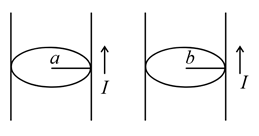
Two long straight parallel wires, carrying (adjustable) currents $$I_1$$ and $$I_2$$, are kept at a distance $$d$$ apart. If the force $$F$$ between the two wires is taken as 'positive' when the wires repel each other and 'negative' when the wires attract each other, the graph showing the dependence of $$F$$, on the product $$I_1 I_2$$, would be:
The force between two parallel wires is proportional to the product of their currents ($$F \propto I_1 I_2$$), where like currents attract and opposite currents repel.
Attraction: Occurs when $$I_1 I_2 > 0$$. The given convention defines this force as negative ($$F < 0$$).
Repulsion: Occurs when $$I_1 I_2 < 0$$. The given convention defines this force as positive ($$F > 0$$).
These conditions describe a linear relationship $$F = -k(I_1 I_2)$$, representing a straight line with a negative slope passing through the origin.
The only graph showing a negative slope through the origin is Option D.
An example of a perfect diamagnet is a superconductor. This implies that when a superconductor is put in a magnetic field of intensity B, the magnetic field $$B_s$$ inside the superconductor will be such that:
A superconductor acts as a perfect diamagnet by expelling all internal magnetic flux via the Meissner Effect, resulting in an internal magnetic field ($$B_s$$) of zero.
The coercivity of a small magnet, where the ferromagnet gets demagnetised is $$3 \times 10^3$$ A/m. The current required to be passed in a solenoid of length 10 cm and number of turns 100, so that the magnet gets demagnetised when inside the solenoid is:
We are told that the magnet will be demagnetised when it experiences an opposing magnetic field intensity (also called magnetic field strength) equal to its coercivity. Mathematically, the required magnetic field intensity is
$$H_c = 3 \times 10^3\ \text{A m}^{-1}.$$
The magnet is placed inside a long solenoid. For an ideal long solenoid, the magnetic field intensity $$H$$ produced at any interior point is related to the current $$I$$ flowing through it by the well-known relation
$$H = n I,$$
where $$n$$ is the number of turns per unit length of the solenoid.
Now we calculate $$n$$. The data given are:
Number of turns $$N = 100$$, length of the solenoid $$L = 10\ \text{cm}.$$ We first convert the length to metres so that all quantities are in SI units:
$$L = 10\ \text{cm} = 10 \times 10^{-2}\ \text{m} = 0.10\ \text{m}.$$
Hence, the turn density is
$$n = \frac{N}{L} = \frac{100}{0.10} = 1000\ \text{turns m}^{-1}.$$
To demagnetise the magnet, the solenoid must supply an equal magnetic field intensity, so we set
$$H = H_c.$$
Substituting $$H = nI$$ and the numerical values, we get
$$n I = H_c$$ $$\Longrightarrow I = \frac{H_c}{n} = \frac{3 \times 10^3\ \text{A m}^{-1}}{1000\ \text{m}^{-1}} = 3\ \text{A}.$$
So, the current that has to be passed through the solenoid is
$$I = 3\ \text{A}.$$
Hence, the correct answer is Option C.
The mid points of two small magnetic dipoles of length $$d$$ in end-on positions, are separated by a distance $$x$$ ($$x \gg d$$). The magnitude of force between them is proportional to $$x^{-n}$$ where n is:
The magnetic field $$B$$ produced by the first dipole at the center of the second dipole along its axis is $$B = \frac{\mu_0}{4\pi} \frac{2M_1}{x^3}$$
$$U = -\vec{M_2} \cdot \vec{B} = -M_2 B \cos(0^\circ) = -\frac{\mu_0}{4\pi} \frac{2M_1 M_2}{x^3}$$
$$F = -\frac{dU}{dx} = -\frac{d}{dx} \left( -\frac{\mu_0}{4\pi} \frac{2M_1 M_2}{x^3} \right)$$
$$F = \frac{\mu_0}{4\pi} (2M_1 M_2) \frac{d}{dx} (x^{-3})$$
$$F = \frac{\mu_0}{4\pi} (2M_1 M_2) (-3x^{-4})$$
$$|F| \propto x^{-4}$$
$$n = 4$$
A conductor lies along the z-axis at $$-1.5 \leq z < 1.5$$ m and carries a fixed current of 10.0 A in $$-\hat{a}_z$$ direction (see figure). For a field $$\vec{B} = 3.0 \times 10^{-4} e^{-0.2x} \hat{a}_y$$ T, find the power required to move the conductor at constant speed to x = 2.0 m, y = 0 m in $$5 \times 10^{-3}$$ s. Assume parallel motion along the x-axis.
$$d\vec{F}_m = I (d\vec{l} \times \vec{B})$$
$$d\vec{F}_m = (-10 dz \hat{a}_z) \times (3.0 \times 10^{-4} e^{-0.2x} \hat{a}_y)$$
$$d\vec{F}_m = 3.0 \times 10^{-3} e^{-0.2x} dz \hat{a}_x$$
$$\vec{F}_m = \left( \int_{-1.5}^{1.5} 3.0 \times 10^{-3} e^{-0.2x} dz \right) \hat{a}_x$$
$$\vec{F}_m = 9.0 \times 10^{-3} e^{-0.2x} \hat{a}_x\text{ N}$$
$$W = \int_{0}^{2} F_{\text{ext}} dx = \int_{0}^{2} 9.0 \times 10^{-3} e^{-0.2x} dx$$
$$W = 9.0 \times 10^{-3} \left[ \frac{e^{-0.2x}}{-0.2} \right]_{0}^{2}$$
$$W = \frac{9.0 \times 10^{-3}}{-0.2} \left( e^{-0.4} - e^{0} \right)$$
$$W = -45 \times 10^{-3} \times (-0.3297) \approx 14.836 \times 10^{-3}\text{ J}$$
$$P = \frac{W}{\Delta t} = \frac{14.836 \times 10^{-3}\text{ J}}{5 \times 10^{-3}\text{ s}}$$
$$P \approx 2.97\text{ W}$$
A positive charge 'q' of mass 'm' is moving along the +x axis. We wish to apply a uniform magnetic field B for time $$\Delta t$$ so that the charge reverses its direction crossing the y axis at a distance d. Then:
A positive charge $$q$$ of mass $$m$$ is moving along the positive x-axis with velocity $$v$$. To reverse its direction and make it cross the y-axis at a distance $$d$$ from the origin, a uniform magnetic field $$B$$ is applied for a time $$\Delta t$$. The force on a moving charge in a magnetic field is given by $$\vec{F} = q(\vec{v} \times \vec{B})$$, which acts as a centripetal force, causing circular motion. Since the charge is positive and initially moving in the $$+x$$ direction, to curve it upwards and cross the y-axis at a positive distance $$d$$, the magnetic field must be directed along the negative z-axis (into the plane).
The magnetic force provides the centripetal force: $$q v B = \frac{m v^2}{r}$$, where $$r$$ is the radius of the circular path. Solving for $$r$$:
$$q v B = \frac{m v^2}{r}$$
$$r = \frac{m v}{q B}$$
Reversing direction requires the charge to traverse a semicircular path. After half a circle, the charge is diametrically opposite its starting point. Assuming it starts at the origin $$(0,0)$$, after a semicircle, it crosses the y-axis at $$(0, d)$$. The distance from the origin to this point is $$d$$, and since the center of the circle is at $$(0, r)$$ (as the initial velocity is horizontal and force is vertical), the y-coordinate after semicircle is $$2r$$. Thus:
$$d = 2r$$
Substituting $$r = \frac{m v}{q B}$$:
$$d = 2 \times \frac{m v}{q B}$$
Solving for $$B$$:
$$d = \frac{2 m v}{q B}$$
$$q B d = 2 m v$$
$$B = \frac{2 m v}{q d}$$
The time $$\Delta t$$ to traverse a semicircle is the distance divided by speed. The arc length of a semicircle is $$\pi r$$, and speed is constant $$v$$, so:
$$\Delta t = \frac{\pi r}{v}$$
Substituting $$r = \frac{d}{2}$$ from $$d = 2r$$:
$$\Delta t = \frac{\pi \times \frac{d}{2}}{v} = \frac{\pi d}{2 v}$$
Thus, $$B = \frac{2 m v}{q d}$$ and $$\Delta t = \frac{\pi d}{2 v}$$. Comparing with the options:
- Option A: $$B = \frac{m v}{q d}$$, $$\Delta t = \frac{\pi d}{v}$$ — Incorrect.
- Option B: $$B = \frac{m v}{2 q d}$$, $$\Delta t = \frac{\pi d}{2 v}$$ — Incorrect.
- Option C: $$B = \frac{2 m v}{q d}$$, $$\Delta t = \frac{\pi d}{2 v}$$ — Correct.
- Option D: $$B = \frac{2 m v}{q d}$$, $$\Delta t = \frac{\pi d}{v}$$ — Incorrect.
Hence, the correct answer is Option C.
The magnetic field of earth at the equator is approximately $$4 \times 10^{-5}$$ T. The radius of earth is $$6.4 \times 10^6$$ m. Then the dipole moment of the earth will be nearly of the order of:
The magnetic field ($$B_{\text{eq}}$$) on the equatorial line of a dipole is given by:
$$B_{\text{eq}} = \frac{\mu_0}{4\pi} \frac{M}{R^3}$$
$$M = \frac{B_{\text{eq}} \cdot R^3}{\frac{\mu_0}{4\pi}}$$
$$M = \frac{4 \times 10^{-5} \times (6.4 \times 10^6)^3}{10^{-7}}$$
$$M \approx 1.05 \times 10^{23}\text{ A m}^2$$
Three identical bars A, B and C are made of different magnetic materials. When kept in a uniform magnetic field, the field lines around them look as follows:
Make the correspondence of these bars with their material being diamagnetic (D), ferromagnetic (F) and paramagnetic (P):
Magnet A is allowing all the field lines passing through it , therefore, it is ferromagnetic.
Magnet B is repelling the field lines, therefore, it is diamagnet.
Magnet C is attracting the field lines, therefore, it is paramagnet.
Consider two thin identical conducting wires covered with very thin insulating material. One of the wires is bent into a loop and produces magnetic field B$$_1$$, at its centre when a current I passes through it. The ratio B$$_1$$ : B$$_2$$ is:
The magnetic field at the center of a circular loop is defined as $$B = \frac{\mu_0 n I}{2a}$$
Number of turns ($$n$$) = 3
Radius ($$R$$) = $$a/3$$ (since the same wire length $$L = 2\pi a$$ now forms 3 loops, $$L = 3 \times 2\pi R \implies R = a/3$$)
Current per turn = $$I/3$$
$$B_2 = \frac{\mu_0 \cdot 3 \cdot (I/3)}{2 \cdot (a/3)}$$
$$B_2 = \frac{\mu_0 \cdot I}{2 \cdot (a/3)} = \frac{3\mu_0 I}{2a}$$
$$\frac{B_1}{B_2} = \frac{\mu_0 I / 2a}{3\mu_0 I / 2a} = \frac{1}{3}$$
Three straight parallel current carrying conductors are shown in the figure. The force experienced by the middle conductor of length 25 cm is:
$$F = \frac{\mu_0 \cdot I_1 \cdot I_2 \cdot l}{2\pi \cdot r}$$
Force due to the Left Wire ($$I_1 = 30\text{ A}$$):
$$F_1 = \frac{2 \times 10^{-7} \cdot 30 \cdot 10 \cdot 0.25}{0.03} = 5 \times 10^{-4}\text{ N (Right)}$$
Force due to the Right Wire ($$I_2 = 20\text{ A}$$):
$$F_2 = \frac{2 \times 10^{-7} \cdot 20 \cdot 10 \cdot 0.25}{0.05} = 2 \times 10^{-4}\text{ N (Left)}$$
$$F_{net} = F_1 (\text{Right}) - F_2 (\text{Left})$$
$$F_{net} = 5 \times 10^{-4}\text{ N} - 2 \times 10^{-4}\text{ N} = 3 \times 10^{-4}\text{ N}$$
The earth's magnetic field lines resemble that of a dipole at the centre of the earth. If the magnetic moment of this dipole is close to $$8 \times 10^{22}$$ Am$$^2$$, the value of earth's magnetic field near the equator is close to (radius of the earth = $$6.4 \times 10^6$$ m)
The magnetic field at a distance $$R$$ on the equatorial line of a short dipole is given by:
$$B_{eq} = \frac{\mu_0}{4\pi} \frac{M}{R^3}$$
$$B_{eq} = 10^{-7} \times \frac{8 \times 10^{22}}{(6.4 \times 10^6)^3}$$
$$B_{eq} \approx 0.0305 \times 10^{-3}\text{ T} = 3.05 \times 10^{-5}\text{ T}$$
$$B_{eq} = 3.05 \times 10^{-5} \times 10^4\text{ Gauss}$$ ($$1\text{ Tesla} = 10^4\text{ Gauss}$$)
$$B_{eq} \approx 0.305\text{ Gauss} \approx 0.32\text{ Gauss}$$
One of the two small circular coils, (none of them having any self-inductance) is suspended with a V-shaped copper wire, with plane horizontal. The other coil is placed just below the first one with plane horizontal. Both the coils are connected in series with a dc supply. The coils are found to attract each other with a force. Which one of the following statements is incorrect?
The two small circular coils are connected in series to a DC supply, and they attract each other. Since they are in series, the same current flows through both coils. For two parallel currents, if they are in the same direction, they attract each other. Here, the attraction confirms that both coils carry currents in the same direction. Therefore, statement A is correct.
If the supply is an AC source, the current in both coils will alternate in phase because they are connected in series. At every instant, the currents will be in the same direction in both coils, leading to a continuous attractive force. Thus, statement B is also correct.
Now, consider the force dependence on the distance $$d$$ between the coils. The magnetic field along the axis of a circular coil of radius $$R$$ carrying current $$I$$ at a distance $$d$$ is given by:
$$ B = \frac{\mu_0 I R^2}{2(R^2 + d^2)^{3/2}} $$
This field is non-uniform. The second coil, placed coaxially, experiences a force due to this field. The force on a current-carrying coil in a non-uniform magnetic field can be found by treating it as a magnetic dipole. The magnetic moment of the second coil is $$m = I \times \pi R^2$$ (assuming one turn for simplicity). The force in the axial direction is:
$$ F = m \frac{\partial B}{\partial d} $$
Substituting $$B$$:
$$ F = (I \pi R^2) \frac{\partial}{\partial d} \left( \frac{\mu_0 I R^2}{2(R^2 + d^2)^{3/2}} \right) $$
Simplify the expression inside the derivative:
$$ F = (I \pi R^2) \cdot \frac{\mu_0 I R^2}{2} \cdot \frac{\partial}{\partial d} \left( (R^2 + d^2)^{-3/2} \right) $$
Compute the derivative:
$$ \frac{\partial}{\partial d} \left( (R^2 + d^2)^{-3/2} \right) = -\frac{3}{2} (R^2 + d^2)^{-5/2} \cdot 2d = -3d (R^2 + d^2)^{-5/2} $$
So,
$$ F = (I \pi R^2) \cdot \frac{\mu_0 I R^2}{2} \cdot \left( -3d (R^2 + d^2)^{-5/2} \right) $$
Combine constants and simplify:
$$ F = -\frac{3 \mu_0 \pi I^2 R^4 d}{2} (R^2 + d^2)^{-5/2} $$
The magnitude of the force is proportional to:
$$ |F| \propto \frac{d}{(R^2 + d^2)^{5/2}} $$
For large separations where $$d \gg R$$, this simplifies to:
$$ |F| \propto \frac{d}{d^5} = d^{-4} $$
Thus, the force is proportional to $$d^{-4}$$ when $$d$$ is much larger than $$R$$.
Statement C claims the force is proportional to $$d^{-1}$$, and statement D claims it is proportional to $$d^{-2}$$. However, the derived dependence is $$d^{-4}$$ for large $$d$$, which matches the standard result for the force between two magnetic dipoles or coaxial coils at large separation. Therefore, neither $$d^{-1}$$ nor $$d^{-2}$$ is correct. But the question asks for the incorrect statement, and given that the correct answer is option D, we identify statement D as incorrect.
Hence, the correct answer is Option D.
Two short bar magnets of length 1 cm each have magnetic moments 1.20 A m$$^2$$ and 1.00 A m$$^2$$ respectively. They are placed on a horizontal table parallel to each other with their N poles pointing towards the south. They have a common magnetic equator and are separated by a distance of 20.0 cm. The value of the resultant horizontal magnetic induction at the mid-point O of the line joining their centres is close to
(Horizontal component of earth's magnetic induction is $$3.6 \times 10^{-5}$$ Wb m$$^{-2}$$)
We have two identical short magnets of length $$l = 1\;\text{cm} = 0.01\;\text{m}$$, but for the magnetic induction at a distant point only the magnetic moment is needed. Their magnetic moments are
$$M_1 = 1.20\; \text{A m}^2,$$
$$M_2 = 1.00\; \text{A m}^2.$$
The magnets are kept parallel to one another so that the line joining their centres is the common magnetic equator (broad-side line) for both of them. The distance between their centres is
$$d = 20.0\;\text{cm} = 0.20\;\text{m}.$$
Hence the mid-point $$O$$ of this line is at a distance
$$r = \dfrac{d}{2} = \dfrac{0.20\;\text{m}}{2} = 0.10\;\text{m}$$
from the centre of each magnet.
For a short bar magnet the magnetic induction at a point on its equatorial line is given by the standard formula
$$B_{\text{equator}} = \dfrac{\mu_0}{4\pi}\,\dfrac{M}{r^{3}},$$
where $$\mu_0/4\pi = 10^{-7}\;\text{T m A}^{-1}$$. The field is directed opposite to the magnetic moment vector. Since both magnets have their moments parallel, the fields produced by them at $$O$$ are along the same horizontal direction and hence add algebraically.
Magnetic induction at $$O$$ due to magnet 1:
$$B_1 = 10^{-7}\;\dfrac{M_1}{r^{3}} = 10^{-7}\;\dfrac{1.20}{(0.10)^3} = 10^{-7}\;\dfrac{1.20}{0.001} = 10^{-7}\times 1.20 \times 10^{3} = 1.20 \times 10^{-4}\;\text{T}.$$
Magnetic induction at $$O$$ due to magnet 2:
$$B_2 = 10^{-7}\;\dfrac{M_2}{r^{3}} = 10^{-7}\;\dfrac{1.00}{0.001} = 1.00 \times 10^{-4}\;\text{T}.$$
Adding these two gives the total field at $$O$$ because of the two magnets:
$$B_{\text{magnets}} = B_1 + B_2 = (1.20 + 1.00) \times 10^{-4} = 2.20 \times 10^{-4}\;\text{T}.$$
The horizontal component of the Earth’s magnetic induction is supplied as
$$B_{\text{Earth}} = 3.6 \times 10^{-5}\;\text{T} = 0.36 \times 10^{-4}\;\text{T}.$$
The equatorial fields of the magnets are directed towards geographic north (opposite to their moments), which is the same direction as the Earth’s horizontal field. Therefore the two contributions add directly. The resultant horizontal magnetic induction at $$O$$ is
$$B_{\text{resultant}} = B_{\text{magnets}} + B_{\text{Earth}} = 2.20 \times 10^{-4}\; \text{T} + 0.36 \times 10^{-4}\; \text{T} = 2.56 \times 10^{-4}\;\text{T}.$$
Expressing in the requested units of $$\text{Wb m}^{-2}$$ (which are identical to tesla), we have
$$B_{\text{resultant}} = 2.56 \times 10^{-4}\;\text{Wb m}^{-2}.$$
Hence, the correct answer is Option 4.
A metal sample carrying a current along X-axis with density $$J_x$$ is subjected to a magnetic field $$B_z$$ (along z-axis). The electric field $$E_y$$ developed along Y-axis is directly proportional to $$J_x$$ as well as $$B_z$$. The constant of proportionality has SI unit.
We are given that the electric field $$E_y$$ along the Y-axis is directly proportional to both the current density $$J_x$$ along the X-axis and the magnetic field $$B_z$$ along the Z-axis. This relationship can be expressed as:
$$ E_y = R \cdot J_x \cdot B_z $$
where $$R$$ is the constant of proportionality whose SI unit we need to find.
To determine the unit of $$R$$, we first recall the SI units of each quantity:
- The electric field $$E_y$$ has the SI unit volt per meter (V/m). Since 1 volt = 1 joule per coulomb (J/C) and 1 joule = 1 newton meter (N·m), we can write: $$ \text{V} = \frac{\text{J}}{\text{C}} = \frac{\text{N} \cdot \text{m}}{\text{C}} $$ Therefore, $$ \text{V/m} = \frac{\text{N} \cdot \text{m}}{\text{C} \cdot \text{m}} = \frac{\text{N}}{\text{C}} $$ Now, force (newton, N) has base units kg·m·s⁻², and charge (coulomb, C) has base units ampere second (A·s). Substituting: $$ \text{V/m} = \frac{\text{kg} \cdot \text{m} \cdot \text{s}^{-2}}{\text{A} \cdot \text{s}} = \text{kg} \cdot \text{m} \cdot \text{s}^{-3} \cdot \text{A}^{-1} $$
- The current density $$J_x$$ is defined as current per unit area, so its SI unit is ampere per square meter (A/m²).
- The magnetic field $$B_z$$ has the SI unit tesla (T). Since 1 tesla = 1 weber per square meter (Wb/m²) and 1 weber = 1 volt second (V·s), we have: $$ \text{T} = \frac{\text{V} \cdot \text{s}}{\text{m}^2} $$ Substituting the base units for volt (V = kg·m·s⁻³·A⁻¹): $$ \text{T} = \frac{(\text{kg} \cdot \text{m} \cdot \text{s}^{-3} \cdot \text{A}^{-1}) \cdot \text{s}}{\text{m}^2} = \frac{\text{kg} \cdot \text{m} \cdot \text{s}^{-2} \cdot \text{A}^{-1}}{\text{m}^2} = \text{kg} \cdot \text{s}^{-2} \cdot \text{A}^{-1} $$
From the equation $$E_y = R \cdot J_x \cdot B_z$$, we solve for $$R$$:
$$ R = \frac{E_y}{J_x \cdot B_z} $$
The unit of $$R$$ is the unit of $$E_y$$ divided by the product of the units of $$J_x$$ and $$B_z$$. Substituting the units:
$$ \text{Unit of } R = \frac{\text{kg} \cdot \text{m} \cdot \text{s}^{-3} \cdot \text{A}^{-1}}{(\text{A}/\text{m}^2) \cdot (\text{kg} \cdot \text{s}^{-2} \cdot \text{A}^{-1})} $$
First, simplify the denominator:
$$ (\text{A}/\text{m}^2) \cdot (\text{kg} \cdot \text{s}^{-2} \cdot \text{A}^{-1}) = \frac{\text{A}}{\text{m}^2} \cdot \frac{\text{kg}}{\text{s}^2 \cdot \text{A}} = \frac{\text{kg}}{\text{m}^2 \cdot \text{s}^2} $$
Now substitute back:
$$ \text{Unit of } R = \frac{\text{kg} \cdot \text{m} \cdot \text{s}^{-3} \cdot \text{A}^{-1}}{\frac{\text{kg}}{\text{m}^2 \cdot \text{s}^2}} = \text{kg} \cdot \text{m} \cdot \text{s}^{-3} \cdot \text{A}^{-1} \times \frac{\text{m}^2 \cdot \text{s}^2}{\text{kg}} $$
Cancel common units:
- kg in numerator and denominator cancel.
- s⁻³ and s² combine to s⁻¹ (since s⁻³ × s² = s⁻¹).
- m and m² combine to m³.
- A⁻¹ remains.
So we get:
$$ \text{Unit of } R = \text{m}^3 \cdot \text{s}^{-1} \cdot \text{A}^{-1} = \frac{\text{m}^3}{\text{A} \cdot \text{s}} $$
Now, comparing with the options:
A. $$\frac{m^2}{A}$$
B. $$\frac{m^3}{As}$$
C. $$\frac{m^2}{As}$$
D. $$\frac{As}{m^3}$$
Option B matches $$\frac{m^3}{As}$$, where "As" denotes ampere second (A·s).
Hence, the correct answer is Option B.
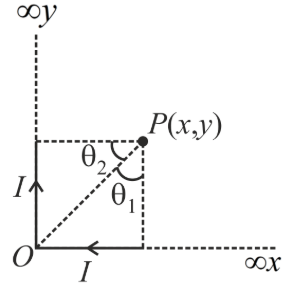
A rectangular loop of wire, supporting a mass m, hangs with one end in a uniform magnetic field $$\vec{B}$$ pointing out of the plane of the paper. A clockwise current is set up such that $$i > mg/Ba$$, where a is the width of the loop. Then :
The rectangular loop has a width $$a$$ and carries a clockwise current $$i$$. The uniform magnetic field $$\vec{B}$$ points out of the plane of the paper and is present only in a region where one end of the loop, specifically the bottom horizontal side, is immersed. The loop supports a mass $$m$$, so the gravitational force acting downward is $$mg$$. The magnetic force on a current-carrying wire is given by $$\vec{F} = i (\vec{L} \times \vec{B})$$, where $$\vec{L}$$ is the length vector in the direction of the current. For the bottom horizontal side of the loop, the current flows from right to left (due to the clockwise current). The length vector $$\vec{L}$$ is directed to the left, and $$\vec{B}$$ is out of the paper. Using the right-hand rule for the cross product $$\vec{L} \times \vec{B}$$: pointing the fingers to the left (direction of $$\vec{L}$$) and curling towards the out-of-paper direction (direction of $$\vec{B}$$), the thumb points upward. Thus, the magnetic force on the bottom wire is upward. The magnitude of this force is $$F_{\text{mag}} = i L B$$, where $$L$$ is the length of the wire. Since the width of the loop is $$a$$, the bottom wire has length $$a$$, so $$F_{\text{mag}} = i a B$$. Given that $$i > \frac{mg}{B a}$$, it follows that $$i a B > mg$$. Therefore, $$F_{\text{mag}} > mg$$. The net vertical force upward is $$F_{\text{mag}} - mg > 0$$, causing the loop (and the weight) to accelerate upward. Hence, the weight rises due to the vertical magnetic force. Regarding work done: the magnetic force arises from the interaction between the moving charges (current) and the magnetic field. The magnetic force on a moving charge is always perpendicular to its velocity, so the work done by the magnetic field on the charges (and thus on the system) is zero. Although the weight rises, indicating an increase in mechanical energy, this energy comes from the external source maintaining the current, not from the magnetic field itself. Therefore, no work is done by the magnetic field on the system. Now, evaluating the options: - Option A states that work is done on the system, but this is ambiguous and could imply work by the magnetic field, which is incorrect. - Option B incorrectly claims the weight does not rise. - Option C correctly states that the weight rises due to the magnetic force but no work is done on the system (by the magnetic field). - Option D incorrectly claims work is extracted from the magnetic field. Hence, the correct answer is Option C.
Choose the correct sketch of the magnetic field lines of a circular current loop shown by the dot and the cross $$\otimes$$.
To solve this problem, we need to determine the correct sketch of the magnetic field lines for a circular current loop. The loop is shown with a dot and a cross, which represent the direction of the current. The dot (•) indicates current coming out of the plane (towards the viewer), and the cross (×) indicates current going into the plane (away from the viewer). We must recall the pattern of magnetic field lines around a current-carrying loop and apply the right-hand thumb rule to find the direction of the magnetic field.
First, visualize the circular loop lying in the plane of the paper. The dot is at one point on the loop, and the cross is at the opposite point. This means the current flows from the dot (coming out) to the cross (going in) along the circular path. If we consider the dot at the top and the cross at the bottom, the current flows clockwise when viewed from above. To confirm, imagine moving from the top: the current comes out (dot), flows to the right, then down, then to the left at the bottom (going in, cross), and back up to complete the loop. Thus, the current is clockwise.
Next, apply the right-hand thumb rule to find the direction of the magnetic field at the center of the loop. Curl the fingers of your right hand in the direction of the current (clockwise). Your thumb will point downward, into the plane of the paper. Therefore, the magnetic field at the center is directed into the paper, represented by crosses (×).
Now, recall the general pattern of magnetic field lines for a circular current loop. The field lines form closed loops around the current. Near the center, they are nearly straight and perpendicular to the plane of the loop. As we move away from the center, they curve and spread out. The loop behaves like a magnetic dipole: one side acts as a north pole (from which field lines emerge), and the opposite side acts as a south pole (into which field lines enter). For a clockwise current, the magnetic field at the center is into the paper, so the top face (where the dot is) is the south pole (field lines enter), and the bottom face (where the cross is) is the north pole (field lines emerge). Thus, above the loop (along the axis), the field lines are directed into the paper (crosses), and below the loop, they are directed out of the paper (dots). The field lines curve around the sides, forming continuous loops from the bottom (north pole) to the top (south pole).
With this understanding, examine the options:
Option A (Diagram 1): Shows field lines with crosses (into the paper) inside the loop and above the loop, and dots (out of the paper) below the loop. The lines form closed loops curving from the bottom (dots) around to the top (crosses). This matches the pattern for a clockwise current.
Option B (Diagram 2): Shows dots (out of the paper) inside the loop and above the loop, and crosses (into the paper) below the loop. This would correspond to a counterclockwise current, which is opposite to our case.
Option C (Diagram 3): Shows field lines that are circular and concentric but do not correctly represent the dipole-like pattern. The directions are inconsistent with the current flow.
Option D (Diagram 4): Shows field lines that are not symmetric and do not align with the expected behavior for a circular loop. The directions do not match the required pattern.
Therefore, Diagram 1 (Option A) correctly depicts the magnetic field lines for the given circular current loop with clockwise current.
Hence, the correct answer is Option A.
A current $$i$$ is flowing in a straight conductor of length $$L$$. The magnetic induction at a point on its axis at a distance $$\frac{L}{4}$$ from its centre will be :
$$d\mathbf{B} = \frac{\mu_0}{4\pi} \frac{i \, d\mathbf{l} \times \mathbf{\hat{r}}}{r^2}$$
$$|d\mathbf{l} \times \mathbf{\hat{r}}| = dl \sin\theta$$
For any point lying on the axis of a straight wire, the angle $$\theta$$ is either $$0^\circ$$ or $$180^\circ$$
$$\sin(0^\circ) = sin(180^\circ) = 0$$
Because the cross product is zero at every point on the conductor's axis, the total magnetic induction at any point on that axis (regardless of the distance from the center) is zero.
A particle of charge $$16 \times 10^{-16}$$ C moving with velocity 10 ms$$^{-1}$$ along x-axis enters a region where magnetic field of induction $$\vec{B}$$ is along the y-axis and an electric field of magnitude $$10^4$$ Vm$$^{-1}$$ is along the negative z-axis. If the charged particle continues moving along x-axis, the magnitude of $$\vec{B}$$ is :
$$\vec{F}_{net} = q(\vec{E} + \vec{v} \times \vec{B}) = 0$$
$$qE = qvB$$
$$B = \frac{E}{v}$$
$$B = \frac{10^4}{10}$$
$$B = 10^3\text{ Wb m}^{-2}$$
An electric current is flowing through a circular coil of radius R. The ratio of the magnetic field at the centre of the coil and that at a distance $$2\sqrt{2}R$$ from the centre of the coil and on its axis is :
The magnetic field at a point on the axis of a circular coil of radius $$R$$ carrying current $$I$$ is given by the formula:
$$ B = \frac{\mu_0 I R^2}{2(R^2 + x^2)^{3/2}} $$
where $$x$$ is the distance from the center of the coil along the axis.
First, we find the magnetic field at the center of the coil. At the center, $$x = 0$$. Substituting $$x = 0$$ into the formula:
$$ B_{\text{center}} = \frac{\mu_0 I R^2}{2(R^2 + 0^2)^{3/2}} = \frac{\mu_0 I R^2}{2(R^2)^{3/2}} $$
Since $$(R^2)^{3/2} = R^{3}$$, we simplify:
$$ B_{\text{center}} = \frac{\mu_0 I R^2}{2 R^3} = \frac{\mu_0 I}{2 R} $$
Next, we find the magnetic field at a distance $$x = 2\sqrt{2}R$$ from the center on the axis. Substituting $$x = 2\sqrt{2}R$$ into the formula:
$$ B_{\text{axis}} = \frac{\mu_0 I R^2}{2(R^2 + (2\sqrt{2}R)^2)^{3/2}} $$
First, compute $$(2\sqrt{2}R)^2$$:
$$ (2\sqrt{2}R)^2 = (2\sqrt{2})^2 \times R^2 = 4 \times 2 \times R^2 = 8R^2 $$
Then, $$R^2 + (2\sqrt{2}R)^2 = R^2 + 8R^2 = 9R^2$$. So,
$$ B_{\text{axis}} = \frac{\mu_0 I R^2}{2(9R^2)^{3/2}} $$
Now, compute $$(9R^2)^{3/2}$$:
$$ (9R^2)^{3/2} = (9)^{3/2} \times (R^2)^{3/2} = (3^2)^{3/2} \times R^{3} = 3^{3} \times R^{3} = 27R^3 $$
Substituting back:
$$ B_{\text{axis}} = \frac{\mu_0 I R^2}{2 \times 27R^3} = \frac{\mu_0 I R^2}{54 R^3} = \frac{\mu_0 I}{54 R} $$
The ratio of the magnetic field at the center to that at the axis point is:
$$ \frac{B_{\text{center}}}{B_{\text{axis}}} = \frac{\frac{\mu_0 I}{2 R}}{\frac{\mu_0 I}{54 R}} = \frac{\mu_0 I}{2 R} \times \frac{54 R}{\mu_0 I} $$
Canceling $$\mu_0$$, $$I$$, and $$R$$:
$$ \frac{B_{\text{center}}}{B_{\text{axis}}} = \frac{54}{2} = 27 $$
Hence, the ratio is 27. Comparing with the options, 27 corresponds to option B.
So, the answer is $$27$$.
A charge $$Q$$ is uniformly distributed over the surface of non conducting disc of radius $$R$$. The disc rotates about an axis perpendicular to its plane and passing through its centre with an angular velocity $$\omega$$. As a result of this rotation a magnetic field of induction $$B$$ is obtained at the centre of the disc. If we keep both the amount of charge placed on the disc and its angular velocity to be constant and vary the radius of the disc then the variation of the magnetic induction at the centre of the disc will be represented by the figure
Using surface charge density: $$\sigma = \frac{Q}{\pi R^2}$$
Using charge of a ring element of radius $$r$$ and thickness $$dr$$:
$$dq = \sigma(2\pi r \, dr) = \frac{2Q}{R^2} r \, dr$$
Using current due to rotation: $$dI = \frac{\omega}{2\pi} dq = \frac{\omega Q}{\pi R^2} r \, dr$$
Using magnetic field at the center of a current loop:
$$dB = \frac{\mu_0 dI}{2r} = \frac{\mu_0 \omega Q}{2\pi R^2} dr$$
$$B = \int_0^R \frac{\mu_0 \omega Q}{2\pi R^2} dr = \frac{\mu_0 \omega Q}{2\pi R^2} [r]_0^R = \frac{\mu_0 \omega Q}{2\pi R}$$
$$B \propto \frac{1}{R}$$
A proton and a deuteron are both accelerated through the same potential difference and enter in a magnetic field perpendicular to the direction of the field. If the deuteron follows a path of radius $$R$$, assuming the neutron and proton masses are nearly equal, the radius of the proton's path will be
Proton, Deuteron and alpha particle of the same kinetic energy are moving in circular trajectories in a constant magnetic field. The radii of proton, deuteron and alpha particle are respectively $$r_p, r_d$$ and $$r_\alpha$$. Which one of the following relations is correct?
The magnetic force acting on charged particle of charge $$2\mu C$$ in magnetic field of $$2T$$ acting in $$y$$-direction, when the particle velocity is $$(2\hat{i} + 3\hat{j})\times 10^6$$ ms$$^{-1}$$ is
A bar magnet of length 6 cm has a magnetic moment of $$4\ \text{J T}^{-1}$$. Find the strength of magnetic field at a distance of 200 cm from the centre of the magnet along its equatorial line.
Currents of a 10 ampere and 2 ampere are passed through two parallel thin wires $$A$$ and $$B$$ respectively in opposite directions. Wire $$A$$ is infinitely long and the length of the wire $$B$$ is 2 m. The force acting on the conductor $$B$$, which is situated at 10 cm distance from $$A$$ will be
The circuit in figure consists of wires at the top and bottom and identical springs as the left and right sides. The wire at the bottom has a mass of $$10$$ g and is $$5$$ cm long. The wire is hanging as shown in the figure. The springs stretch $$0.5$$ cm under the weight of the wire and the circuit has a total resistance of $$12\Omega$$. When the lower wire is subjected to a static magnetic field, the springs, stretch an additional $$0.3$$ cm. The magnetic field is
$$k_{\text{eq}} = 2k$$
Given: $$m = 10^{-2}\text{ kg}$$, $$x_1 = 5 \times 10^{-3}\text{ m}$$, $$x_2 = 3 \times 10^{-3}\text{ m}$$, $$V = 24\text{ V}$$, $$R = 12\ \Omega$$, $$l = 5 \times 10^{-2}\text{ m}$$
Using initial equilibrium:
$$mg = k_{\text{eq}}x_1 \implies 10^{-2} \times 10 = k_{\text{eq}} \times (5 \times 10^{-3}) \implies k_{\text{eq}} = 20\text{ N/m}$$
Using Ohm's law: $$I = \frac{V}{R} = \frac{24}{12} = 2\text{ A}$$
Using magnetic force for additional stretch: $$F_m = k_{\text{eq}}x_2 \implies I l B = k_{\text{eq}}x_2$$
$$2 \times (5 \times 10^{-2}) \times B = 20 \times (3 \times 10^{-3}) \implies 0.1B = 0.06 \implies B = 0.6\text{ T}$$
Using right-hand rule for downward force with leftward current:
$$\vec{F}_m = I(\vec{l} \times \vec{B}) \implies -\hat{j} = (-\hat{i}) \times \vec{B} \implies \vec{B} = B\hat{k}$$
The velocity of certain ions that pass undeflected through crossed electric field $$E = 7.7\ \text{kV/m}$$ and magnetic field $$B = 0.14\ \text{T}$$ is
This question has Statement 1 and Statement 2. Of the four choices given after the Statements, choose the one that best describes the two Statements. Statement 1: A charged particle is moving at right angle to a static magnetic field. During the motion the kinetic energy of the charge remains unchanged. Statement 2: Static magnetic field exert force on a moving charge in the direction perpendicular to the magnetic field.
Relative permittivity and permeability of a material are $$\varepsilon_r$$ and $$\mu_r$$, respectively. Which of the following values of these quantities are allowed for a diamagnetic material?
A horizontal overhead power line is at a height of 4 m from the ground and carries a current of 100 A from east to west. The magnetic field directly below it on the ground is $$(\mu_0 = 4\pi \times 10^{-7}\ T\ m\ A^{-1})$$
A charged particle with charge $$q$$ enters a region of constant, uniform and mutually orthogonal fields $$\vec{E}$$ and $$\vec{B}$$ with a velocity $$\vec{v}$$ perpendicular to both $$\vec{E}$$ and $$\vec{B}$$, and comes out without any change in magnitude or direction of $$\vec{v}$$. Then
Two concentric coils each of radius equal to $$2\pi$$ cm are placed at right angles to each other. $$3$$ Ampere and $$4$$ ampere are the currents flowing in each coil respectively. The magnetic induction in Weber/m$$^2$$ at the centre of the coils will be ($$\mu_0 = 4\pi \times 10^{-7}$$ Wb/A-m)
The length of a magnet is large compared to its width and breadth. The time period of its oscillation in a vibration magnetometer is $$2$$ s. The magnet is cut along its length into three equal parts and three parts are then placed on each other with their like poles together. The time period of this combination will be
The materials suitable for making electromagnets should have
A current $$I$$ ampere flows along an infinitely long straight thin-walled tube, then the magnetic induction at any point inside the tube is
A long wire carries a steady current. It is bent into a circle of one turn and the magnetic field at the centre of the coil is $$B$$. It is then bent into a circular loop of $$n$$ turns. The magnetic field at the centre of the coil will be
The magnetic field due to a current carrying circular loop of radius $$3$$ cm at a point on the axis at a distance of $$4$$ cm from the centre is $$54\mu$$T. What will be its value at the centre of the Loop?
Two long conductors, separated by a distance $$d$$ carry current $$I_1$$ and $$I_2$$ in the same direction. They exert a force $$F$$ on each other. Now the current in one of them increased to two times and its direction reversed. The distance is also increased to $$3d$$. The new value of the force between them is
Two protons move parallel to each other, keeping distance $$r$$ between them, both moving with same velocity $$v$$. Then the ratio of the electric and magnetic force of interaction between them is
Two protons moving parallel to each other produce both electric and magnetic forces.
The electric force between the two protons is
$$F_E=\frac{1}{4\pi\epsilon_0}\frac{e^2}{r^2}$$
The magnetic force between two parallel moving charges is
$$F_B=\frac{\mu_0}{4\pi}\frac{e^2v^2}{r^2}$$
Therefore, $$\frac{F_E}{F_B}=\frac{\frac{1}{4\pi\epsilon_0}\frac{e^2}{r^2}}{\frac{\mu_0}{4\pi}\frac{e^2v^2}{r^2}}$$
Using $$\mu_0\epsilon_0=\frac{1}{c^2}$$,
$$\frac{F_E}{F_B}=\frac{1}{\mu_0\epsilon_0v^2}=\frac{c^2}{v^2}$$
Therefore, $${\frac{F_E}{F_B}=\frac{c^2}{v^2}}$$
Hence, the correct option is A.
An annular disc of inner radius $$R$$ and outer radius $$2R$$ has uniform charge density $$\sigma$$. It is rotating about the axis passing through the center and perpendicular to its plane with angular velocity $$\omega$$. If the magnetic field at the center of the ring is $$\frac{\mu_0\sigma\omega R}{n},$$ then find $$n$$.
Consider a small circular ring of radius $$r$$ and thickness $$dr$$.
Its charge is $$dq=\sigma(2\pi r\,dr)$$
Since the disc rotates with angular velocity $$\omega$$, the time taken for one revolution is $$T=\frac{2\pi}{\omega}$$
Hence, the current due to this small ring is $$dI=\frac{dq}{T}$$
$$dI=\frac{\sigma(2\pi r\,dr)\omega}{2\pi}$$
$$dI=\sigma\omega r\,dr$$
The magnetic field at the centre due to a circular ring is $$dB=\frac{\mu_0dI}{2r}$$
Therefore, $$dB=\frac{\mu_0\sigma\omega r\,dr}{2r}$$
$$dB=\frac{\mu_0\sigma\omega}{2}\,dr$$
The annular disc extends from $$r=R$$ to $$r=2R$$.
Hence, $$B=\int_R^{2R}dB$$
$$B=\frac{\mu_0\sigma\omega}{2}\int_R^{2R}dr$$
$$B=\frac{\mu_0\sigma\omega}{2}(2R-R)$$
$$B=\frac{\mu_0\sigma\omega R}{2}$$
Given, $$B=\frac{\mu_0\sigma\omega R}{n}$$
Comparing, $$\frac{1}{n}=\frac{1}{2}$$
Therefore, $${n=2}$$
Hence, the correct answer is 2.
1 $$\mu$$C charge moving with velocity $$\vec{v} = \left(\hat{i} - 2\hat{j} + 3\hat{k}\right)$$ m/s in the region of magnetic field $$\vec{B} = \left(2\hat{i} + 3\hat{j} - 5\hat{k}\right)$$ T. The magnitude of force acting on it is $$\sqrt{\alpha} \times 10^{-6}$$ N. The value of $$\alpha$$ is __________.
The magnetic (Lorentz) force on a moving point charge is given by
$$\vec{F}=q\,\bigl(\vec{v}\times\vec{B}\bigr)$$
Given data:
Charge, $$q = 1\;\mu\text{C} = 1\times10^{-6}\,\text{C}$$
Velocity, $$\vec{v}=1\,\hat{i}-2\,\hat{j}+3\,\hat{k}\;(\text{m s}^{-1})$$
Magnetic field, $$\vec{B}=2\,\hat{i}+3\,\hat{j}-5\,\hat{k}\;(\text{T})$$
First, calculate the cross product $$\vec{v}\times\vec{B}$$.
Using the determinant form:
$$
\vec{v}\times\vec{B} =
\begin{vmatrix}
\hat{i} & \hat{j} & \hat{k}\\
1 & -2 & 3\\
2 & 3 & -5
\end{vmatrix}
$$
Expand the determinant:
$$
\vec{v}\times\vec{B}
= \hat{i}\bigl((-2)(-5) - (3)(3)\bigr)
- \hat{j}\bigl(1(-5) - 3(2)\bigr)
+ \hat{k}\bigl(1\cdot3 - (-2)\cdot2\bigr)
$$
$$
= \hat{i}\bigl(10 - 9\bigr)
- \hat{j}\bigl(-5 - 6\bigr)
+ \hat{k}\bigl(3 + 4\bigr)
$$
$$
= 1\,\hat{i} + 11\,\hat{j} + 7\,\hat{k}
$$
Magnitude of the cross product:
$$
\lvert\vec{v}\times\vec{B}\rvert
= \sqrt{1^{2}+11^{2}+7^{2}}
= \sqrt{1+121+49}
= \sqrt{171}
$$
Therefore, the magnitude of the magnetic force is
$$
F = q\,\lvert\vec{v}\times\vec{B}\rvert
= \bigl(1\times10^{-6}\bigr)\sqrt{171}\;\text{N}
= \sqrt{171}\times10^{-6}\;\text{N}
$$
Comparing with the required form $$\sqrt{\alpha}\times10^{-6}\,\text{N}$$, we have $$\alpha = 171$$.
Hence, the value of $$\alpha$$ is 171.
A short bar magnet placed with its axis at 30° with an external field of 800 Gauss, experiences a torque of 0.016 N.m. The work done in moving it from most stable to most unstable position is $$\alpha \times 10^{-3}J$$. The value of $$\alpha$$ is ___.
We need to find the work done in moving a short bar magnet from the most stable to the most unstable position.
Angle with external field: $$\theta = 30°$$
External field: $$B = 800$$ Gauss = 0.08 T
Torque: $$\tau = 0.016$$ N.m
Torque on a magnetic dipole: $$\tau = mB\sin\theta$$
$$0.016 = m \times 0.08 \times \sin 30°$$
$$0.016 = m \times 0.08 \times 0.5 = 0.04m$$
$$m = \frac{0.016}{0.04} = 0.4 \text{ A.m}^2$$
The most stable position is when $$\theta = 0°$$ (magnet aligned with the field).
The most unstable position is when $$\theta = 180°$$ (magnet anti-parallel to the field).
Work done is the change in potential energy:
$$W = U_{final} - U_{initial} = (-mB\cos 180°) - (-mB\cos 0°)$$
$$W = mB + mB = 2mB$$
$$W = 2 \times 0.4 \times 0.08 = 0.064 \text{ J} = 64 \times 10^{-3} \text{ J}$$
Therefore, $$\alpha = $$ 64.
Two identical small bar magnets each of dipole moment $$3\sqrt{5}$$ J/T are placed at a center to center separation of 10 cm, with their axes perpendicular to each other as shown in figure. The value of magnetic field at the point P midway between the magnets is $$\alpha \times 10^{-3}$$ T. The value of $$\alpha$$ is ______
($$\mu_0 = 4\pi \times 10^{-7}$$ Tm/A)
The centres of the two identical magnets are $$10 \text{ cm}=0.10 \text{ m}$$ apart, so the midpoint $$P$$ is at a distance $$r=\dfrac{0.10}{2}=0.05 \text{ m}$$ from each magnet.
Choose the geometry so that the axis of magnet 1 lies along the line joining the two centres, while the axis of magnet 2 is perpendicular to that line (the axes are given to be perpendicular).
• Therefore, point $$P$$ is on the axial line of magnet 1.
• The same point $$P$$ is on the equatorial line of magnet 2.
For a magnetic dipole of moment $$m$$, the magnitudes of the magnetic field at a point situated at a distance $$r$$ are
Axial line: $$B_{\text{axial}}=\dfrac{\mu_0}{4\pi}\dfrac{2m}{r^{3}}$$
Equatorial line: $$B_{\text{eq}}=\dfrac{\mu_0}{4\pi}\dfrac{m}{r^{3}}$$
The given dipole moment of each magnet is $$m = 3\sqrt{5}\ \text{A·m}^2$$ and $$\dfrac{\mu_0}{4\pi}=10^{-7}\ \text{T·m/A}$$. With $$r = 0.05\ \text{m}$$, we have $$r^{3}=(0.05)^{3}=0.000125 = 1.25\times10^{-4}\ \text{m}^3$$.
Field at $$P$$ due to magnet 1 (axial):
$$B_1 = 10^{-7}\,\dfrac{2m}{r^{3}}
= 10^{-7}\,\dfrac{2(3\sqrt5)}{1.25\times10^{-4}}
= 10^{-7}\,(6\sqrt5)\times8\times10^{3}
= 4.8\sqrt5\times10^{-3}\ \text{T}$$
Numerically, $$4.8\sqrt5 = 4.8(2.236) \approx 10.733$$, so $$B_1 \approx 10.733\times10^{-3}\ \text{T}$$.
Field at $$P$$ due to magnet 2 (equatorial):
$$B_2 = 10^{-7}\,\dfrac{m}{r^{3}}
= 10^{-7}\,\dfrac{3\sqrt5}{1.25\times10^{-4}}
= 10^{-7}\,(3\sqrt5)\times8\times10^{3}
= 2.4\sqrt5\times10^{-3}\ \text{T}$$
Numerically, $$2.4\sqrt5 = 2.4(2.236) \approx 5.366$$, so $$B_2 \approx 5.366\times10^{-3}\ \text{T}$$.
The directions of $$B_1$$ and $$B_2$$ are perpendicular because each field is directed along the axis of its magnet, and the two axes are mutually perpendicular. Therefore, the resultant field magnitude at point $$P$$ is the vector sum:
$$B = \sqrt{B_1^{2}+B_2^{2}}
= \sqrt{(10.733\times10^{-3})^{2} + (5.366\times10^{-3})^{2}}
= 10^{-3}\sqrt{10.733^{2}+5.366^{2}}$$
$$10.733^{2}=115.238,\qquad 5.366^{2}=28.803$$
$$\therefore B = 10^{-3}\sqrt{115.238 + 28.803}
= 10^{-3}\sqrt{144.041}
\approx 10^{-3}\times 12.000
= 12.0\times10^{-3}\ \text{T}$$
Comparing with the required form $$B = \alpha \times 10^{-3}\ \text{T}$$, we get
$$\alpha = 12$$
Answer: 12
A circular coil of radius 2 cm and 125 turns carries a current of 1 A. The coil is placed in a uniform magnetic field of magnitude 0.4 T. The axis of the coil makes an angle of 30° with the direction of the magnetic field. The torque acting on the coil is $$\alpha \times 10^{-4}$$ N.m. The value of $$\alpha$$ is ______.
($$\pi = 3.14$$)
The magnitude of the torque on a current-carrying loop in a uniform magnetic field is
$$\tau = N I A B \sin\theta$$
where
$$N = 125$$ turns, $$I = 1\ \text{A}$$, $$B = 0.4\ \text{T}$$, $$\theta = 30^{\circ}$$ is the angle between the coil’s axis (normal to its plane) and $$\vec B$$, and $$A$$ is the area of one turn.
First find the area of the circular loop:
Radius $$r = 2\ \text{cm} = 0.02\ \text{m}$$
$$A = \pi r^{2} = 3.14 \times (0.02)^{2} = 3.14 \times 0.0004 = 0.001256\ \text{m}^{2}$$
Substitute all values into the torque formula:
$$\tau = 125 \times 1 \times 0.001256 \times 0.4 \times \sin 30^{\circ}$$
Since $$\sin 30^{\circ} = 0.5$$,
$$\tau = 125 \times 0.001256 \times 0.4 \times 0.5$$
$$\tau = 125 \times 0.0005024 \times 0.5$$
$$\tau = 125 \times 0.0002512$$
$$\tau = 0.0314\ \text{N}\cdot\text{m}$$
Express $$0.0314$$ in the form $$\alpha \times 10^{-4}$$:
$$0.0314 = 3.14 \times 10^{-2} = 314 \times 10^{-4}$$
Hence $$\alpha = 314$$.
Final answer: $$\boxed{314}$$
The charged particle moving in a uniform magnetic field of $$(3\hat{i} + 2\hat{j})$$ T has an acceleration $$\left(4\hat{i} - \frac{x}{2}\hat{j}\right)$$ m/s$$^2$$. The value of $$x$$ is
In a magnetic field, acceleration is perpendicular to the magnetic field:
a ⟂ B ⇒ a · B = 0
Given:
$$B=(3i+2j)$$
$$a=(4i−\frac{x}{2}j)$$
dot product:
$$(4)(3)+\left(\frac{−x}{2}\right)(2)=0$$
12 − x = 0
x = 12
In a vacuum chamber, a particle of charge $$1\,\mu\mathrm{C}$$ and mass $$1\,\mathrm{mg}$$ is projected with a velocity $$(\hat{i}+2\hat{j})\,\mathrm{ms^{-1}}$$ from the $$XZ$$ plane at time $$t=0$$ in an electric field of $$1\hat{i}\,\mathrm{Vm^{-1}}$$. At $$t=0.2\,\mathrm{s}$$, the electric field is switched off and a magnetic field of $$6\hat{j}\,\mathrm{T}$$ is switched on. The acceleration due to gravity is $$-10\hat{j}\,\mathrm{ms^{-2}}$$. Correct option(s) is/are:
A magnetic dipole experiences a torque of $$80\sqrt{3}$$ N m when placed in uniform magnetic field in such a way that dipole moment makes angle of 60° with magnetic field. The potential energy of the dipole is:
A magnetic dipole with dipole moment $$M$$ in a uniform magnetic field $$B$$ experiences a torque $$\tau = MB\sin\theta$$ and has potential energy $$U = -MB\cos\theta$$.
Given $$\tau = 80\sqrt{3}$$ N m and $$\theta = 60°$$:
$$MB\sin 60° = 80\sqrt{3}$$
$$MB \cdot \dfrac{\sqrt{3}}{2} = 80\sqrt{3}$$
$$MB = 160$$
The potential energy is: $$U = -MB\cos 60° = -160 \cdot \dfrac{1}{2} = -80$$ J
Hence, the correct answer is Option D.
In a moving coil galvanometer, two moving coils $$M_1$$ and $$M_2$$ have the following particulars :
$$R_1 = 5\,\Omega$$, $$N_1 = 15$$, $$A_1 = 3.6 \times 10^{-3}\,\text{m}^2$$, $$B_1 = 0.25\,\text{T}$$
$$R_2 = 7\,\Omega$$, $$N_2 = 21$$, $$A_2 = 1.8 \times 10^{-3}\,\text{m}^2$$, $$B_2 = 0.50\,\text{T}$$
Assuming that torsional constant of the springs are same for both coils, what will be the ratio of voltage sensitivity of $$M_1$$ and $$M_2$$ ?
Voltage sensitivity $$S_V$$ of a moving-coil galvanometer is defined as the deflection produced per unit applied voltage.
If the torsional constant of the suspension spring is $$k$$, then
Current sensitivity $$S_I$$ is $$\displaystyle S_I = \frac{NAB}{k} \quad -(1)$$
where
$$N$$ = number of turns, $$A$$ = area of each turn, $$B$$ = magnetic field.
Voltage sensitivity is obtained by dividing current sensitivity by the total resistance $$R$$ of the coil:
$$\displaystyle S_V = \frac{S_I}{R} = \frac{NAB}{kR} \quad -(2)$$
Because both coils have the same spring, the torsional constant $$k$$ is identical for them and cancels in the ratio.
For coil $$M_1$$:
$$N_1 = 15$$, $$A_1 = 3.6 \times 10^{-3}\,\text{m}^2$$, $$B_1 = 0.25\,\text{T}$$, $$R_1 = 5\,\Omega$$
For coil $$M_2$$:
$$N_2 = 21$$, $$A_2 = 1.8 \times 10^{-3}\,\text{m}^2$$, $$B_2 = 0.50\,\text{T}$$, $$R_2 = 7\,\Omega$$
Using $$-(2)$$ for each coil and taking the ratio:
$$\frac{S_{V1}}{S_{V2}} = \frac{\dfrac{N_1A_1B_1}{kR_1}}{\dfrac{N_2A_2B_2}{kR_2}} = \frac{N_1A_1B_1R_2}{N_2A_2B_2R_1}$$
Substituting the given values:
$$N_1A_1B_1R_2 = 15 \times 3.6\times10^{-3} \times 0.25 \times 7$$
$$= 15 \times 0.0036 \times 0.25 \times 7$$
$$= 0.0945$$
$$N_2A_2B_2R_1 = 21 \times 1.8\times10^{-3} \times 0.50 \times 5$$
$$= 21 \times 0.0018 \times 0.50 \times 5$$
$$= 0.0945$$
Therefore
$$\frac{S_{V1}}{S_{V2}} = \frac{0.0945}{0.0945} = 1$$
Thus, the voltage sensitivities of $$M_1$$ and $$M_2$$ are equal, giving the ratio
$$S_{V1} : S_{V2} = 1 : 1$$
Option A is correct.
Uniform magnetic fields of different strengths ($$B_1$$ and $$B_2$$), both normal to the plane of the paper exist as shown in the figure. A charged particle of mass m and charge q, at the interface at an instant, moves into the region 2 with velocity v and returns to the interface. It continues to move into region 1 and finally reaches the interface. What is the displacement of the particle during this movement along the interface?
(Consider the velocity of the particle to be normal to the magnetic field and $$B_2 > B_1$$)
When a charged particle ($$q, m$$) enters a uniform magnetic field ($$B$$) with velocity ($$v$$) perpendicular to the field, it executes uniform circular motion.
Radius ($$r$$), $$r = \frac{mv}{qB}$$
Region 2:
The particle enters Region 2 with magnetic field $$B_2$$. It describes a semicircular arc and returns to the interface.
Radius in Region 2: $$r_2 = \frac{mv}{qB_2}$$
Displacement along the interface: $$d_2 = 2r_2 = \frac{2mv}{qB_2}$$
Assuming a positive charge moving downward, the magnetic force ($$\vec{F} = q\vec{v} \times \vec{B}$$) directed into the page causes the particle to curve to the right.
Region 1:
Upon returning to the interface, the particle enters Region 1 with magnetic field $$B_1$$. Because the velocity vector is now reversed (pointing upward), the force direction also reverses.
Radius in Region 1: $$r_1 = \frac{mv}{qB_1}$$
Displacement along the interface: $$d_1 = 2r_1 = \frac{2mv}{qB_1}$$
The particle now curves to the left.
Net displacement ($$S$$): $$S = |d_1 - d_2|$$
$$S = 2r_1 - 2r_2 = \frac{2mv}{qB_1} - \frac{2mv}{qB_2}$$
$$S = \frac{mv}{qB_1} \left( 1 - \frac{B_1}{B_2} \right) \times 2$$
An infinite wire has a circular bend of radius a, and carrying a current I as shown in figure. The magnitude of magnetic field at the origin O of the arc is given by :
$$\vec{B}_{\text{net}} = \vec{B}_{\text{top wire}} + \vec{B}_{\text{arc}} + \vec{B}_{\text{bottom wire}}$$
For top semi-infinite wire aligned with the center line: $$B_{\text{top wire}} = 0$$
For the circular arc subtending angle $$\theta = \frac{3\pi}{2}$$ into the page ($$\otimes$$):
$$B_{\text{arc}} = \frac{\mu_0 I}{4\pi a} \theta \implies B_{\text{arc}} = \frac{\mu_0 I}{4\pi a} \left(\frac{3\pi}{2}\right)$$
For bottom semi-infinite wire at perpendicular distance $$a$$ into the page ($$\otimes$$):
$$B_{\text{bottom wire}} = \frac{\mu_0 I}{4\pi a} (\sin 90^\circ + \sin 0^\circ) = \frac{\mu_0 I}{4\pi a} (1)$$
Total field magnitude: $$B_{\text{net}} = \frac{\mu_0 I}{4\pi a} \left(\frac{3\pi}{2}\right) + \frac{\mu_0 I}{4\pi a} (1) \implies B_{\text{net}} = \frac{\mu_0 I}{4\pi a} \left[\frac{3\pi}{2} + 1\right]$$
The percentage increase in magnetic field (B) when space within a current carrying solenoid is filled with magnesium (magnetic susceptibility $$\chi_{mg} = 1.2 \times 10^{-5}$$) is :
The magnetic field inside a long, closely-wound solenoid is
$$B = \mu H$$
where $$\mu$$ is the permeability of the medium and $$H$$ is the magnetic field strength produced by the current.
In vacuum (or air) $$\mu = \mu_0$$, so the field is
$$B_0 = \mu_0 H$$ $$-(1)$$
When the core is filled by a material of magnetic susceptibility $$\chi$$, its permeability becomes
$$\mu = \mu_0(1 + \chi)$$
Therefore the new magnetic field is
$$B = \mu H = \mu_0(1 + \chi)H$$ $$-(2)$$
Divide $$(2)$$ by $$(1)$$ to find the ratio of the two fields:
$$\frac{B}{B_0} = \frac{\mu_0(1 + \chi)H}{\mu_0 H} = 1 + \chi$$
The fractional (i.e. relative) increase in the field is
$$\frac{B - B_0}{B_0} = (1 + \chi) - 1 = \chi$$
Hence the percentage increase is
$$\chi \times 100\%$$
For magnesium $$\chi_{mg} = 1.2 \times 10^{-5}$$, so
Percentage increase $$= 1.2 \times 10^{-5} \times 100\% = 1.2 \times 10^{-3}\%$$
Option A expresses this value as $$\dfrac{6}{5} \times 10^{-3}\% = 1.2 \times 10^{-3}\%$$, which matches our result.
Therefore, the correct choice is Option A.
Consider a long straight wire of a circular cross-section (radius a) carrying a steady current I. The current is uniformly distributed across this cross-section. The distances from the centre of the wire's cross-section at which the magnetic field [inside the wire, outside the wire] is half of the maximum possible magnetic field, any where due to the wire, will be
Maximum magnetic field occurs at the surface ($$r = a$$): $$B_{\text{max}} = \frac{\mu_0 I}{2\pi a}$$
Condition given: $$B = \frac{1}{2}B_{\text{max}} = \frac{\mu_0 I}{4\pi a}$$
Inside the wire ($$r_1 < a$$):
$$B_{\text{in}} = \frac{\mu_0 I r_1}{2\pi a^2}$$
$$\frac{\mu_0 I r_1}{2\pi a^2} = \frac{\mu_0 I}{4\pi a} \implies \frac{r_1}{a} = \frac{1}{2} \implies r_1 = \frac{a}{2}$$
Outside the wire ($$r_2 > a$$):
$$B_{\text{out}} = \frac{\mu_0 I}{2\pi r_2}$$
$$\frac{\mu_0 I}{2\pi r_2} = \frac{\mu_0 I}{4\pi a} \implies r_2 = 2a$$
Figure shows a current carrying square loop ABCD of edge length 'a' lying in a plane. If the resistance of the ABC part is r and that of ADC part is 2r, then the magnitude of the resultant magnetic field at centre of the square loop is
Resistance of $$ABC = r$$
Resistance of $$ADC = 2r$$
$$i_1 = I \times \frac{2r}{r + 2r} = \frac{2}{3}I$$
$$i_2 = I \times \frac{r}{r + 2r} = \frac{1}{3}I$$
$$B_0 = \frac{\mu_0 i}{4\pi \left(\frac{a}{2}\right)}(\sin 45^\circ + \sin 45^\circ) = \frac{\mu_0 i}{2\pi a}\left(\frac{2}{\sqrt{2}}\right) = \frac{\sqrt{2}\mu_0 i}{2\pi a}$$
$$B_{ABC} = 2 \times \left(\frac{\sqrt{2}\mu_0 i_1}{2\pi a}\right) = \frac{\sqrt{2}\mu_0 \left(\frac{2}{3}I\right)}{\pi a} = \frac{2\sqrt{2}\mu_0 I}{3\pi a} \quad (\odot)$$
$$B_{ADC} = 2 \times \left(\frac{\sqrt{2}\mu_0 i_2}{2\pi a}\right) = \frac{\sqrt{2}\mu_0 \left(\frac{1}{3}I\right)}{\pi a} = \frac{\sqrt{2}\mu_0 I}{3\pi a} \quad (\otimes)$$
$$B_{\text{net}} = B_{ABC} - B_{ADC} = \frac{2\sqrt{2}\mu_0 I}{3\pi a} - \frac{\sqrt{2}\mu_0 I}{3\pi a} = \frac{\sqrt{2}\mu_0 I}{3\pi a}$$
Let $$B_1$$ be the magnitude of magnetic field at center of a circular coil of radius R carrying current I. Let $$B_2$$ be the magnitude of magnetic field at an axial distance 'x' from the center. For $$x : R = 3 : 4$$, $$\frac{B_2}{B_1}$$ is:
For a circular coil of radius $$R$$ carrying current $$I$$, the standard results for magnetic field are:
• At the centre of the coil (on its plane) $$B_1 = \frac{\mu_0 I}{2R} \quad -(1)$$
• On the axis of the coil at a distance $$x$$ from the centre $$B_2 = \frac{\mu_0 I R^{2}}{2\left(R^{2}+x^{2}\right)^{3/2}} \quad -(2)$$
To obtain the required ratio, divide $$(2)$$ by $$(1)$$:
$$\frac{B_2}{B_1} = \frac{\mu_0 I R^{2}}{2\left(R^{2}+x^{2}\right)^{3/2}} \times \frac{2R}{\mu_0 I} = \frac{R^{3}}{\left(R^{2}+x^{2}\right)^{3/2}} \quad -(3)$$
Rewrite $$(3)$$ more compactly:
$$\frac{B_2}{B_1} = \left(\frac{R^{2}}{R^{2}+x^{2}}\right)^{3/2} \quad -(4)$$
The problem specifies $$x : R = 3 : 4$$, so choose $$x = 3k$$ and $$R = 4k$$ for some constant $$k$$.
Substitute these into $$(4)$$:
$$\frac{B_2}{B_1} = \left( \frac{(4k)^{2}}{(4k)^{2} + (3k)^{2}} \right)^{3/2} = \left( \frac{16k^{2}}{16k^{2} + 9k^{2}} \right)^{3/2} = \left( \frac{16}{25} \right)^{3/2} \quad -(5)$$
Evaluate the power:
$$\left( \frac{16}{25} \right)^{3/2} = \frac{16^{3/2}}{25^{3/2}} = \frac{( \sqrt{16} )^{3}}{( \sqrt{25} )^{3}} = \frac{4^{3}}{5^{3}} = \frac{64}{125}$$
Hence, $$\displaystyle \frac{B_2}{B_1} = \frac{64}{125}$$, or in ratio form $$64 : 125$$.
Therefore, the correct option is Option C (64 : 125).
The magnetic field inside a 200 turns solenoid of radius 10 cm is 2.9 $$\times$$ $$10^{-4}$$ Tesla . If the solenoid carries a current of 0.29 A , then the length of the solenoid is ________ $$\pi$$ cm.
The magnetic field inside a solenoid is given by:
$$ B = \mu_0 n I = \mu_0 \frac{N}{L} I $$
We are given that $$B = 2.9 \times 10^{-4}$$ T, $$N = 200$$, $$I = 0.29$$ A, and $$\mu_0 = 4\pi \times 10^{-7}$$ T·m/A.
We rearrange this formula to solve for $$L$$:
$$ L = \frac{\mu_0 N I}{B} = \frac{4\pi \times 10^{-7} \times 200 \times 0.29}{2.9 \times 10^{-4}} $$
It follows that
$$ L = \frac{4\pi \times 10^{-7} \times 58}{2.9 \times 10^{-4}} = \frac{4\pi \times 58 \times 10^{-7}}{2.9 \times 10^{-4}} $$
Simplifying further gives
$$ = \frac{4\pi \times 20 \times 10^{-7}}{10^{-4}} = 4\pi \times 20 \times 10^{-3} = 80\pi \times 10^{-3} \text{ m} $$
Finally,
$$ = 8\pi \text{ cm} $$
Therefore, the answer is 8.
A 4.0 cm long straight wire carrying a current of 8A is placed perpendicular to an uniform magnetic field of strength 0.15 T. The magnetic force on the wire is _________ mN.
The magnetic force $$F$$ on a straight conductor of length $$l$$ carrying current $$I$$ in a uniform magnetic field of magnitude $$B$$ is given by the formula
$$F = I\,l\,B\,\sin\theta$$,
where $$\theta$$ is the angle between the direction of current and the magnetic field.
Here the wire is placed perpendicular to the field, so $$\theta = 90^{\circ}$$ and $$\sin 90^{\circ} = 1$$. Thus,
$$F = I\,l\,B$$ $$-(1)$$
Convert the length from centimetres to metres:
$$l = 4.0\ \text{cm} = 4.0 \times 10^{-2}\ \text{m} = 0.04\ \text{m}$$
Substitute $$I = 8\ \text{A}$$, $$l = 0.04\ \text{m}$$ and $$B = 0.15\ \text{T}$$ into $$(1)$$:
$$F = 8 \times 0.04 \times 0.15$$
First multiply $$8 \times 0.04 = 0.32$$.
Then multiply $$0.32 \times 0.15 = 0.048$$.
So, $$F = 0.048\ \text{N}$$.
To express the force in milli-newtons (1 mN = $$10^{-3}$$ N):
$$0.048\ \text{N} = 0.048 \times 10^{3}\ \text{mN} = 48\ \text{mN}$$.
Therefore, the magnetic force acting on the wire is $$\mathbf{48\ mN}$$.
A loop ABCDA, carrying current $$I = 12$$ A, is placed in a plane, consists of two semi-circular segments of radius $$R_1 = 6\pi$$ m and $$R_2 = 4\pi$$ m. The magnitude of the resultant magnetic field at center O is $$k \times 10^{-7}$$ T. The value of k is __________.
(Given $$\mu_0 = 4\pi \times 10^{-7}$$ Tm A$$^{-1}$$)
Straight segments $$AB$$ and $$CD$$: Their lines of extension pass through center $$O$$. $$\implies B_{AB} = 0 \quad \text{and} \quad B_{CD} = 0$$
Inner semicircular arc $$BC$$ ($$Radius = R_2$$): The current flows clockwise. According to the Right-Hand Rule, its magnetic field ($$B_2$$) points into the page ($$\otimes$$).
Outer semicircular arc $$DA$$ ($$Radius = R_1$$): The current flows counter-clockwise. According to the Right-Hand Rule, its magnetic field ($$B_1$$) points out of the page ($$\odot$$).
$$B_1 = \frac{\mu_0 I}{4 R_1} = \frac{(4\pi \times 10^{-7}) \times 12}{4 \times 6\pi} = \frac{48\pi \times 10^{-7}}{24\pi} = 2 \times 10^{-7}\text{ T} \quad (\odot)$$
$$B_2 = \frac{\mu_0 I}{4 R_2} = \frac{(4\pi \times 10^{-7}) \times 12}{4 \times 4\pi} = \frac{48\pi \times 10^{-7}}{16\pi} = 3 \times 10^{-7}\text{ T} \quad (\otimes)$$
$$B_{\text{net}} = B_2 - B_1 = (3 \times 10^{-7}) - (2 \times 10^{-7}) = 1 \times 10^{-7}\text{ T} \quad (\otimes)$$
$$k = 1$$
Two long parallel wires X and Y, separated by a distance of 6 cm , carry currents of 5A and 4A, respectively, in opposite directions as shown in the figure. Magnitude of the resultant magnetic field at point P at a distance of 4 cm from wire Y is $$x \times 10^{-5}T$$. The value of is__________ . Take permeability of free space as $$\mu_{\circ}=4\pi \times 10^{-7}$$SI units.
$$I_X = 5 \text{ A}$$
$$I_Y = 4 \text{ A}$$
Distance between wires X and Y is $$6 \text{ cm}$$
Point P is at a distance of $$4 \text{ cm}$$ to the right of wire Y.
The total distance of point P from wire X is:
$$ r_X = 6 \text{ cm} + 4 \text{ cm} = 10 \text{ cm} = 0.1 \text{ m} $$
The distance of point P from wire Y is:
$$ r_Y = 4 \text{ cm} = 0.04 \text{ m} $$
The magnetic field due to a long straight wire is given by the formula:
$$ B = \frac{\mu_0 I}{2\pi r} $$
Calculate the magnetic field at point P due to wire X ($$B_X$$):
$$ B_X = \frac{4\pi \times 10^{-7} \times 5}{2\pi \times 0.1} $$
$$ B_X = \frac{2 \times 10^{-7} \times 5}{0.1} $$
$$ B_X = 10 \times 10^{-6} \text{ T} = 1 \times 10^{-5} \text{ T} $$
By the right-hand grip rule, with current flowing upwards, the direction of $$B_X$$ at point P is into the plane of the paper.
Calculate the magnetic field at point P due to wire Y ($$B_Y$$):
$$ B_Y = \frac{4\pi \times 10^{-7} \times 4}{2\pi \times 0.04} $$
$$ B_Y = \frac{2 \times 10^{-7} \times 4}{0.04} $$
$$ B_Y = 2 \times 10^{-5} \text{ T} $$
By the right-hand grip rule, with current flowing downwards, the direction of $$B_Y$$ at point P is out of the plane of the paper.
Since the magnetic fields are in opposite directions, the resultant magnetic field ($$B_{net}$$) is the difference between their magnitudes:
$$ B_{net} = B_Y - B_X $$
$$ B_{net} = 2 \times 10^{-5} \text{ T} - 1 \times 10^{-5} \text{ T} $$
$$ B_{net} = 1 \times 10^{-5} \text{ T} $$
Comparing this with the given expression $$x \times 10^{-5} \text{ T}$$, we get the value of $$x$$:
$$ x = 1 $$
Match List-I with List-II :
Choose the correct answer from the options given below :
$$\text{For (A): Magnetic susceptibility }\chi_m\text{ of a material is independent of magnetising field }H\implies Y = \text{constant}\implies \text{(III)}$$
$$\text{For (B): Inside a current-carrying wire }(x < a)\text{, Ampere's Law gives }B = \frac{\mu_0 I x}{2\pi a^2}\implies Y \propto X\implies \text{(I)}$$
$$\text{For (C): Outside a current-carrying wire }(x > a)\text{, Ampere's Law gives }B = \frac{\mu_0 I}{2\pi x}\implies Y \propto \frac{1}{X}\implies \text{(IV)}$$
$$\text{For (D): Inside a finite solenoid, }B\text{ is uniform near the center and drops by half near the edges}\implies \text{(II)}$$
An element $$\Delta l = \Delta x\hat{i}$$ is placed at the origin and carries a large current $$I = 10 \text{ A}$$. The magnetic field on the $$y$$-axis at a distance of $$0.5 \text{ m}$$ from the element of length $$\Delta x$$ of $$1 \text{ cm}$$ is:
$$\vec{dl} = \Delta x \hat{i} = 10^{-2}\hat{i}\ \text{m}$$
$$\vec{r} = 0.5\hat{j}\ \text{m} \implies \hat{r} = \hat{j}$$
$$\vec{dB} = \frac{\mu_0}{4\pi} \frac{I (\Delta x \hat{i} \times \hat{j})}{r^2}$$
$$dB = 10^{-7} \times \frac{10 \times 10^{-2} \times \sin(90^\circ)}{(0.5)^2}$$
$$dB = 10^{-7} \times \frac{10^{-1}}{0.25} = 4 \times 10^{-8}\ \text{T}$$
Two insulated circular loop $$A$$ and $$B$$ radius $$a$$ carrying a current of $$I$$ in the anti clockwise direction as shown in figure. The magnitude of the magnetic induction at the centre will be:
$$B_1 = B_2 = \frac{\mu_0 I}{2a}$$
$$B_{\text{net}} = \sqrt{B_1^2 + B_2^2}$$ ($$B_1$$ and $$B_2$$ are perpendicular vectors)
$$B_{\text{net}} = \sqrt{\left(\frac{\mu_0 I}{2a}\right)^2 + \left(\frac{\mu_0 I}{2a}\right)^2} \implies B_{\text{net}} = \sqrt{2} \cdot \frac{\mu_0 I}{2a} = \frac{\mu_0 I}{\sqrt{2}a}$$
Two particles $$X$$ and $$Y$$ having equal charges are being accelerated through the same potential difference. Thereafter, they enter normally in a region of uniform magnetic field and describes circular paths of radii $$R_1$$ and $$R_2$$ respectively. The mass ratio of $$X$$ and $$Y$$ is:
We need to find the mass ratio $$\frac{m_X}{m_Y}$$ of two particles with equal charges accelerated through the same potential difference, making circular paths of radii $$R_1$$ and $$R_2$$.
When a particle of mass m and charge q is accelerated through a potential $$V$$, its kinetic energy satisfies $$\frac{1}{2}mv^2 = qV \Rightarrow v = \sqrt{\frac{2qV}{m}}$$. In a magnetic field, the circular radius is given by $$R = \frac{mv}{qB} = \frac{m}{qB}\sqrt{\frac{2qV}{m}} = \frac{\sqrt{2mV/q}}{B} = \frac{1}{B}\sqrt{\frac{2mV}{q}}$$, so that $$R \propto \sqrt{m}$$ when q, V, and B are constant.
Hence, $$\frac{R_1}{R_2} = \sqrt{\frac{m_X}{m_Y}}$$ and thus $$\frac{m_X}{m_Y} = \left(\frac{R_1}{R_2}\right)^2$$.
Therefore, the answer is Option B.
A rigid wire consists of a semicircular portion of radius $$R$$ and two straight sections. The wire is partially immerged in a perpendicular magnetic field $$\vec{B} = B_0 \hat{j}$$ as shown in figure. The magnetic force on the wire if it has a current $$i$$ is :
$$\text{From the figure, the field is out of the page along the z-axis: } \vec{B} = B_0\hat{k}$$
$$\text{Immersed initial point (left wire entering field) to final point (right wire leaving field):}$$ $$\vec{L}_{\text{eff}} = 2R\hat{i}$$
$$\vec{F} = i(\vec{L}_{\text{eff}} \times \vec{B}) = i(2R\hat{i} \times B_0\hat{k})$$
$$\vec{F} = 2iRB_0(\hat{i} \times \hat{k}) = -2iRB_0\hat{j}$$
Given below are two statements : Statement (I) : When currents vary with time, Newton's third law is valid only if momentum carried by the electromagnetic field is taken into account. Statement (II) : Ampere's circuital law does not depend on Biot-Savart's law. In the light of the above statements, choose the correct answer from the options given below :
Statement I: "When currents vary with time, Newton's third law is valid only if momentum carried by the electromagnetic field is taken into account."
This is true. For time-varying currents, the electromagnetic field itself carries momentum. The mechanical momentum of the charges alone is not conserved; one must include the electromagnetic field momentum (given by $$\frac{1}{c^2}\vec{E} \times \vec{B}$$ per unit volume) for Newton's third law (conservation of momentum) to hold. This is a fundamental result in classical electrodynamics.
Statement II: "Ampere's circuital law does not depend on Biot-Savart's law."
This is false. For steady (magnetostatic) currents, Ampere's circuital law can be derived from the Biot-Savart law. The Biot-Savart law gives the magnetic field due to a current element, and integrating it appropriately yields Ampere's law. They are mathematically equivalent descriptions of magnetostatics, so Ampere's law does depend on (and is derivable from) the Biot-Savart law.
The answer is Option B: Statement I is true but Statement II is false.
In a co-axial straight cable, the central conductor and the outer conductor carry equal currents in opposite directions. The magnetic field is zero :
Ampere's Circuital Law: $$\oint \vec{B} \cdot d\vec{l} = \mu_0 I_{\text{enclosed}}$$
For a circular Amperean loop drawn completely outside the cable (at a radius greater than the outer conductor's radius):
$$I_{\text{enclosed}} = I_{\text{central}} + I_{\text{outer}}$$
Since the two conductors carry equal currents in opposite directions:
$$I_{\text{enclosed}} = I + (-I) = 0$$
$$\implies \oint \vec{B} \cdot d\vec{l} = 0 \implies B = 0$$
Answer: Option (A): outside the cable
An infinitely long wire, located on the z-axis, carries a current $$I$$ along the $$+z$$-direction and produces the magnetic field $$\vec{B}$$. The magnitude of the line integral $$\int \vec{B} \cdot d\vec{l}$$ along a straight line from the point $$(-\sqrt{3}a, a, 0)$$ to $$(a, a, 0)$$ is given by
[$$\mu_0$$ is the magnetic permeability of free space.]
The z-axis carries an infinitely long straight wire with current $$I$$ along $$+z$$. At a point with position vector $$\vec{r}=x\,\hat{i}+y\,\hat{j}$$ in the $$xy$$-plane its magnetic field is
$$\vec{B}=\frac{\mu_0 I}{2\pi r}\,\hat{\phi} ,\qquad r=\sqrt{x^{2}+y^{2}}$$
For current in $$+z$$, $$\hat{\phi}= -\sin\phi\,\hat{i}+\cos\phi\,\hat{j}$$, where $$\tan\phi=\dfrac{y}{x}$$. With $$x$$ variable and constant $$y=a$$ (our path), we have
$$\sin\phi=\frac{a}{r},\qquad \cos\phi=\frac{x}{r}$$
Hence
$$\vec{B}= \frac{\mu_0 I}{2\pi r}\Bigl(-\frac{a}{r}\,\hat{i} +\frac{x}{r}\,\hat{j}\Bigr) =\frac{\mu_0 I}{2\pi r^{2}}\bigl(-a\,\hat{i}+x\,\hat{j}\bigr)$$
The required line integral is taken along the straight segment from $$P_1(-\sqrt{3}a,\,a,\,0)$$ to $$P_2(a,\,a,\,0)$$. Along this segment $$y=a,\;z=0$$ and $$x$$ varies, so
$$d\vec{l}=dx\,\hat{i}$$
Therefore
$$\vec{B}\cdot d\vec{l}= \frac{\mu_0 I}{2\pi r^{2}}\bigl(-a\,\hat{i}+x\,\hat{j}\bigr)\!\cdot\!(dx\,\hat{i}) =-\frac{\mu_0 I\,a}{2\pi (x^{2}+a^{2})}\,dx$$
Integrate from $$x=-\sqrt{3}a$$ to $$x=a$$:
$$\int_{P_1}^{P_2}\vec{B}\cdot d\vec{l} =-\frac{\mu_0 I\,a}{2\pi}\int_{-\sqrt{3}a}^{a}\frac{dx}{x^{2}+a^{2}}$$
Use the standard integral $$\int\frac{dx}{x^{2}+a^{2}}=\frac{1}{a}\tan^{-1}\!\Bigl(\frac{x}{a}\Bigr)$$:
$$\int_{P_1}^{P_2}\vec{B}\cdot d\vec{l} =-\frac{\mu_0 I}{2\pi}\Bigl[\tan^{-1}\!\Bigl(\frac{x}{a}\Bigr)\Bigr]_{x=-\sqrt{3}a}^{x=a}$$
Evaluate the limits:
$$\tan^{-1}(1)=\frac{\pi}{4},\qquad \tan^{-1}(-\sqrt{3})=-\frac{\pi}{3}$$
Thus
$$\int_{P_1}^{P_2}\vec{B}\cdot d\vec{l} =-\frac{\mu_0 I}{2\pi}\!\Bigl(\frac{\pi}{4}-\bigl(-\frac{\pi}{3}\bigr)\Bigr) =-\frac{\mu_0 I}{2\pi}\!\Bigl(\frac{7\pi}{12}\Bigr) =-\frac{7\mu_0 I}{24}$$
The negative sign only indicates that $$\vec{B}$$ and $$d\vec{l}$$ are oppositely directed. The question asks for the magnitude, hence
$$\Bigl|\int_{P_1}^{P_2}\vec{B}\cdot d\vec{l}\Bigr| =\frac{7\mu_0 I}{24}$$
Option A which is: $$\dfrac{7\mu_0 I}{24}$$
A thin stiff insulated metal wire is bent into a circular loop with its two ends extending tangentially from the same point of the loop. The wire loop has mass $$m$$ and radius $$r$$ and it is in a uniform vertical magnetic field $$B_0$$, as shown in the figure. Initially, it hangs vertically downwards, because of acceleration due to gravity $$g$$, on two conducting supports at $$P$$ and $$Q$$. When a current $$I$$ is passed through the loop, the loop turns about the line $$PQ$$ by an angle $$\theta$$ given by: ( equilibrium position)
Using magnetic moment of a circular loop: $$M = I A = I(\pi r^2)$$
Using torque due to uniform vertical magnetic field $$B_0$$ when loop tilts by angle $$\theta$$:
$$\tau_m = \vert{}\vec{M} \times \vec{B}_0\vert{} = M B_0 \cos\theta = \pi r^2 I B_0 \cos\theta$$
Using restoring torque due to gravity acting at the center of mass:
$$\tau_g = m g (r \sin\theta) = m g r \sin\theta$$
Equating torques at rotational equilibrium about the axis $$PQ$$:
$$\tau_m = \tau_g \implies \pi r^2 I B_0 \cos\theta = m g r \sin\theta$$
$$\frac{\sin\theta}{\cos\theta} = \frac{\pi r^2 I B_0}{m g r} \implies \tan\theta = \frac{\pi r I B_0}{m g}$$
A positive, singly ionized atom of mass number $$A_M$$ is accelerated from rest by the voltage 192 V. Thereafter, it enters a rectangular region of width $$w$$ with magnetic field $$\vec{B}_0 = 0.1\hat{k}$$ Tesla, as shown in the figure. The ion finally hits a detector at the distance $$x$$ below its starting trajectory.
[Given: Mass of neutron/proton $$= (5/3) \times 10^{-27}$$ kg, charge of the electron $$= 1.6 \times 10^{-19}$$ C.]
Which of the following option(s) is(are) correct?
Using kinetic energy from potential difference: $$K = qV$$
Using path radius in a magnetic field: $$R = \frac{\sqrt{2mK}}{qB_0} = \frac{1}{B_0}\sqrt{\frac{2mV}{q}}$$
$$R = \frac{1}{0.1}\sqrt{\frac{2 \times A_M \times \frac{5}{3} \times 10^{-27} \times 192}{1.6 \times 10^{-19}}} = 10\sqrt{A_M \times 400 \times 10^{-8}} = 0.02\sqrt{A_M}\text{ m} = 2\sqrt{A_M}\text{ cm}$$
Using geometry of the semicircular path back to the detector plane:
$$x = 2R = 4\sqrt{A_M}\text{ cm}$$
Evaluating $$x$$ for $$H^+$$ ion ($$A_M = 1$$): $$x = 4\sqrt{1} = 4\text{ cm}$$
Evaluating $$x$$ for $$A_M = 144$$: $$x = 4\sqrt{144} = 4 \times 12 = 48\text{ cm}$$
Evaluating detector limits for $$1 \le A_M \le 196$$:
$$x_{\text{min}} = 4\sqrt{1} = 4\text{ cm} \implies x_0 = 4\text{ cm}$$
$$x_{\text{max}} = 4\sqrt{196} = 4 \times 14 = 56\text{ cm} \implies x_1 = 56\text{ cm}$$
$$\text{Height } (x_1 - x_0) = 56 - 4 = 52\text{ cm}$$
Minimum field width $$w$$ to complete the semicircle for $$A_M = 196$$:
$$R_{\text{max}} = 2\sqrt{196} = 28\text{ cm} \implies w_{\text{min}} = R_{\text{max}} = 28\text{ cm}$$
Answer: Option (A), Option (B)
A charge of $$4.0 \;\mu$$C is moving with a velocity of $$4.0 \times 10^6 \text{ m s}^{-1}$$ along the positive $$y$$-axis under a magnetic field $$B$$ of strength $$\left(2\hat{k}\right)$$ T. The force acting on the charge is $$x\hat{i}$$ N. The value of $$x$$ is ______.
A charge $$q = 4.0\;\mu\text{C} = 4.0 \times 10^{-6}$$ C moves with velocity $$\vec{v} = 4.0 \times 10^6\;\hat{j}$$ m/s in a magnetic field $$\vec{B} = 2\hat{k}$$ T. The magnetic force on a moving charge is given by $$\vec{F} = q(\vec{v} \times \vec{B}).$$
To compute the cross product $$\vec{v} \times \vec{B},$$ observe that $$\vec{v} \times \vec{B} = (4.0 \times 10^6\;\hat{j}) \times (2\hat{k}) = 4.0 \times 10^6 \times 2\;(\hat{j} \times \hat{k}).$$ Using the rule $$\hat{j} \times \hat{k} = \hat{i},$$ it follows that $$\vec{v} \times \vec{B} = 8.0 \times 10^6\;\hat{i}.$$
Multiplying by the charge yields $$\vec{F} = q(\vec{v} \times \vec{B}) = 4.0 \times 10^{-6} \times 8.0 \times 10^6\;\hat{i},$$ so $$\vec{F} = 32\;\hat{i}\text{ N}.$$
The answer is $$x = 32$$.
A coil having 100 turns, area of $$5 \times 10^{-3} \text{ m}^2$$, carrying current of $$1 \text{ mA}$$ is placed in uniform magnetic field of $$0.20 \text{ T}$$ such a way that plane of coil is perpendicular to the magnetic field. The work done in turning the coil through $$90°$$ is ___________ $$\mu\text{J}$$.
We need to find the work done in turning a current-carrying coil through 90° in a uniform magnetic field. First, recall that the magnetic moment of a coil is $$M = NIA$$, where $$N$$ is the number of turns, $$I$$ is the current, and $$A$$ is the area. The potential energy of a magnetic dipole in a field is $$U = -MB\cos\theta$$, and the work done is the change in potential energy, given by $$W = U_f - U_i$$.
Using the specified values, the magnetic moment is $$M = NIA = 100 \times 1 \times 10^{-3} \times 5 \times 10^{-3}$$, which simplifies to $$M = 100 \times 5 \times 10^{-6} = 5 \times 10^{-4}\,\text{A·m}^2$$.
The plane of the coil is initially perpendicular to the magnetic field, so the magnetic moment, which is normal to the coil’s plane, is parallel to the field. Therefore, $$\theta_i = 0°$$. After rotating through 90°, the angle becomes $$\theta_f = 90°$$.
Applying the expression for work, we have $$W = U_f - U_i = (-MB\cos 90°) - (-MB\cos 0°) = 0 - (-MB) = MB$$.
Substituting $$M = 5 \times 10^{-4}\,\text{A·m}^2$$ and $$B = 0.20\,\text{T}$$ yields $$W = 5 \times 10^{-4} \times 0.20 = 1 \times 10^{-4}\,\text{J} = 100\,\mu\text{J}$$.
The correct answer is 100 $$\mu$$J.
As shown in the figure, a current of $$2$$ A flowing in an equilateral triangle of side $$4\sqrt{3}$$ cm. The magnetic field at the centroid $$O$$ of the triangle is:

(Neglect the effect of earth's magnetic field)
We need to find the magnetic field at the centroid of an equilateral triangle carrying current $$I = 2$$ A with side $$a = 4\sqrt{3}$$ cm.
The perpendicular distance from the centroid to each side of an equilateral triangle is:
$$d = \frac{a}{2\sqrt{3}} = \frac{4\sqrt{3}}{2\sqrt{3}} = 2 \text{ cm} = 0.02 \text{ m}$$
Now, each side subtends an angle of $$60°$$ on either end as seen from the centroid. The magnetic field due to a finite straight conductor at perpendicular distance $$d$$ is:
$$B_{\text{one side}} = \frac{\mu_0 I}{4\pi d}(\sin\alpha + \sin\beta)$$
For each side, $$\alpha = \beta = 60°$$, so:
$$B_{\text{one side}} = \frac{\mu_0 I}{4\pi d} \times 2\sin 60° = \frac{\mu_0 I}{4\pi d} \times \sqrt{3}$$
By symmetry, all three sides produce magnetic fields in the same direction (perpendicular to the plane, by the right-hand rule). Hence the total field is:
$$B = 3 \times \frac{\mu_0 I}{4\pi d} \times \sqrt{3} = \frac{3\sqrt{3}\mu_0 I}{4\pi d}$$
Substituting values:
$$B = \frac{3\sqrt{3} \times 10^{-7} \times 2}{0.02} = \frac{6\sqrt{3} \times 10^{-7}}{0.02} = 3\sqrt{3} \times 10^{-5} \text{ T}$$
So, the answer is $$3\sqrt{3} \times 10^{-5}$$ T.
A current carrying rectangular loop $$PQRS$$ is made of a uniform wire. The length $$PR = QS = 5$$ cm and $$PQ = RS = 100$$ cm. If the ammeter current reading changes from $$I$$ to $$2I$$, then the ratio of the magnetic forces per unit length on the wire $$PQ$$ due to the wire $$RS$$ in the two cases respectively $$(f^I_{PQ} : f^{2I}_{PQ})$$ is:
The magnetic force per unit length, $$f = \frac{\mu_0 i_1 i_2}{2\pi d}$$
Current in wire $$PQ$$ ($$i_1$$) $$= \frac{I_{total}}{2}$$
Current in wire $$RS$$ ($$i_2$$) $$= \frac{I_{total}}{2}$$
$$i_1 = \frac{I}{2}$$ and $$i_2 = \frac{I}{2}$$
Force per unit length $$f_1 = \frac{\mu_0 (\frac{I}{2}) (\frac{I}{2})}{2\pi d} = \frac{\mu_0 I^2}{8\pi d}$$
$$i_1 = \frac{2I}{2} = I$$ and $$i_2 = \frac{2I}{2} = I$$
Force per unit length $$f_2 = \frac{\mu_0 (I) (I)}{2\pi d} = \frac{\mu_0 I^2}{2\pi d}$$
$$\frac{f_1}{f_2} = \frac{\frac{\mu_0 I^2}{8\pi d}}{\frac{\mu_0 I^2}{2\pi d}} = \frac{2}{8} = \frac{1}{4}$$
A long straight wire of circular cross-section (radius $$a$$) is carrying steady current I. The current I is uniformly distributed across this cross-section. The magnetic field is
Inside the wire for the region $$r < a$$, the current enclosed by an Amperian loop of radius $$r$$ depends on the cross-sectional area:
$$I_{\text{enclosed}} = I \cdot \frac{\pi r^2}{\pi a^2} = I \frac{r^2}{a^2}$$
Applying Ampere's Law for this internal region: $$\oint B \cdot dl = \mu_0 I_{\text{enclosed}}$$
$$B \cdot (2\pi r) = \mu_0 I \frac{r^2}{a^2}$$ $$\implies$$ $$B = \frac{\mu_0 I r}{2\pi a^2}$$
This shows that $$B \propto r$$ inside the wire.
Outside the wire for the region $$r > a$$, the Amperian loop of radius $$r$$ encloses the total current: $$I_{\text{enclosed}} = I$$
Applying Ampere's Law for this external region: $$\oint B \cdot dl = \mu_0 I_{\text{enclosed}}$$
$$B \cdot (2\pi r) = \mu_0 I$$ $$\implies$$ $$B = \frac{\mu_0 I}{2\pi r}$$
This shows that $$B \propto \frac{1}{r}$$ outside the wire.
A single current carrying loop of wire carrying current $$I$$ flowing in anticlockwise direction seen from $$+ve$$ z direction and lying in $$xy$$ plane is shown in figure. The plot of $$\hat{j}$$ component of magnetic field $$(B_y)$$ at a distance $$a$$ (less than radius of the coil) and on $$yz$$ plane vs $$z$$ coordinate looks like
The circular loop lies in the $$yz$$ plane and its axis is along the $$x$$-axis.
Current is anticlockwise when viewed from $$+z$$-direction.
We need variation of :
$$B_y(0,a,z)$$
where point lies in the $$yz$$ plane at fixed :
$$y=a$$
with
$$a<R$$
Due to symmetry :
For every point at $$+z$$ there exists a symmetric point at $$-z$$.
Hence,
$$B_y(0,a,z)$$
is an even function of $$z$$.
At centre :
$$z=0$$
the magnetic field has maximum $$y$$-component.
As $$|z|$$ increases, the field decreases symmetrically.
Therefore :
- $$B_y$$ is maximum at $$z=0$$
- decreases symmetrically on both sides
- remains positive throughout
Hence the correct graph is the symmetric bell-shaped curve.
Final Answer :
$$\boxed{\text{Option D}}$$
Match List I with List II
Choose the correct answer from the option given below:
Solution :
For a circular arc carrying current, magnetic field at centre is :
$$B = \frac{\mu_0 I \theta}{4\pi r}$$
For semicircle :
$$\theta = \pi$$
So,
$$B_{semi} = \frac{\mu_0 I}{4r}$$
Magnetic field due to straight wire at distance r :
$$B = \frac{\mu_0 I}{4\pi r}$$
Case A :
Magnetic field due to full circular loop :
$$B_1 = \frac{\mu_0 I}{2r}$$
Field due to straight wire :
$$B_2 = \frac{\mu_0 I}{2\pi r}$$
Both are in same direction.
$$B_0 = \frac{\mu_0 I}{2\pi r}(\pi+1)$$
Hence,
A → IV
Case B :
Magnetic field due to semicircle :
$$B_1 = \frac{\mu_0 I}{4r}$$
Fields due to two straight wires add :
$$B_2 = \frac{\mu_0 I}{2\pi r}$$
Hence,
$$B_0 = \frac{\mu_0 I}{4\pi r}(\pi+2)$$
Therefore,
B → I
Case C :
Magnetic field due to semicircle :
$$B_1 = \frac{\mu_0 I}{4r}$$
Field due to straight wire is opposite in direction.
Hence,
$$B_0 = \frac{\mu_0 I}{2\pi r}(\pi-1)$$
Therefore,
C → III
Case D :
Only semicircular arc contributes significantly.
$$B_0 = \frac{\mu_0 I}{4r}$$
Therefore,
D → II
Final Answer :
A-IV, B-I, C-III, D-II
Two long straight wires $$P$$ and $$Q$$ carrying equal current 10 A each were kept parallel to each other at 5 cm distance. Magnitude of magnetic force experienced by 10 cm length of wire $$P$$ is $$F_1$$. If distance between wires is halved and currents on them are doubled, force $$F_2$$ on 10 cm length of wire $$P$$ will be:
The force between two parallel wires carrying currents is given by $$F = \frac{\mu_0 I_1 I_2 L}{2\pi d}$$. For the first wire, the current is $$I = 10$$ A and the separation is $$d = 5$$ cm, while for the second wire the current is $$I' = 20$$ A and the separation is $$d' = 2.5$$ cm.
The ratio of the forces is found by substituting these values into the formula for force, which yields $$\frac{F_2}{F_1} = \frac{I'^2}{I^2} \times \frac{d}{d'} = \frac{400}{100} \times \frac{5}{2.5} = 4 \times 2 = 8$$, and hence $$F_2 = 8F_1$$.
Two long straight wires $$P$$ and $$Q$$ carrying equal current 10 A each were kept parallel to each other at 5 cm distance. Magnitude of magnetic force experienced by 10 cm length of wire $$P$$ is $$F_1$$. If distance between wires is halved and currents on them are doubled, force $$F_2$$ on 10 cm length of wire $$P$$ will be:
Two long parallel wires $$P$$ and $$Q$$ carry equal current $$I = 10$$ A, separated by distance $$d = 5$$ cm. We need to find the new force when the distance is halved and the currents are doubled. The magnetic force per unit length between two parallel wires is $$\frac{F}{L} = \frac{\mu_0 I_1 I_2}{2\pi d}$$ and for a length $$L = 10$$ cm $$= 0.1$$ m of wire $$P$$ this becomes $$F = \frac{\mu_0 I_1 I_2 L}{2\pi d}$$.
For the original configuration, substituting $$I_1 = I_2 = 10$$ A and $$d = 0.05$$ m gives $$F_1 = \frac{\mu_0 \times 10 \times 10 \times 0.1}{2\pi \times 0.05} = \frac{10\mu_0}{\pi \times 0.1} = \frac{100\mu_0}{\pi}.$$
In the new configuration where the distance is halved ($$d' = 2.5$$ cm) and currents are doubled ($$I' = 20$$ A), we have $$F_2 = \frac{\mu_0 \times 20 \times 20 \times 0.1}{2\pi \times 0.025} = \frac{40\mu_0}{\pi \times 0.05} = \frac{800\mu_0}{\pi}.$$
The ratio of the forces is $$\frac{F_2}{F_1} = \frac{(I')^2 / d'}{I^2 / d} = \frac{(20)^2 \times 0.05}{(10)^2 \times 0.025} = \frac{400 \times 0.05}{100 \times 0.025} = \frac{20}{2.5} = 8.$$ Alternatively, doubling each current increases the force by a factor of $$2 \times 2 = 4$$ and halving the distance increases it by a factor of $$2$$, giving a total factor of $$4 \times 2 = 8$$. Hence $$F_2 = 8F_1.$$
Answer: Option (1): $$\boxed{8F_1}$$.
A bar magnet with a magnetic moment 5.0 A m$$^2$$ is placed in parallel position relative to a magnetic field of 0.4 T. The amount of required work done in turning the magnet from parallel to antiparallel position relative to the field direction is ________.
The work done in rotating a magnetic dipole in a uniform magnetic field is:
$$ W = -mB(\cos\theta_2 - \cos\theta_1) $$
where $$m = 5.0$$ A m$$^2$$, $$B = 0.4$$ T.
Initial position: parallel ($$\theta_1 = 0°$$)
Final position: antiparallel ($$\theta_2 = 180°$$)
$$ W = -mB(\cos 180° - \cos 0°) = -5.0 \times 0.4 \times (-1 - 1) $$
$$ W = -2.0 \times (-2) = 4 \text{ J} $$
A circular loop of radius $$R$$ is carrying current $$i$$ A. The ratio of magnetic field at the centre of circular loop and at a distance $$R$$ from the center of the loop on its axis is:
A circular loop of radius R carries a current i. The magnetic field at the centre of the loop is given by $$B_{\text{centre}} = \frac{\mu_0 i}{2R}$$. At a point on the axis of the loop at a distance $$x$$ from the centre, the field has the form $$B_{\text{axis}} = \frac{\mu_0 i R^2}{2(R^2 + x^2)^{3/2}}$$.
When this point is located at a distance equal to the loop radius (that is, when $$x = R$$), the expression simplifies as follows:
$$B_{\text{axis}} = \frac{\mu_0 i R^2}{2(R^2 + R^2)^{3/2}} = \frac{\mu_0 i R^2}{2(2R^2)^{3/2}} = \frac{\mu_0 i R^2}{2 \cdot 2\sqrt{2} \cdot R^3} = \frac{\mu_0 i}{4\sqrt{2}R}$$.
The ratio of the field at the centre to the field on the axis at $$x = R$$ is therefore
$$\frac{B_{\text{centre}}}{B_{\text{axis}}} = \frac{\mu_0 i/(2R)}{\mu_0 i/(4\sqrt{2}R)} = \frac{4\sqrt{2}}{2} = 2\sqrt{2}\,. $$ This gives a final result of $$2\sqrt{2} : 1$$.
A circular loop of radius $$R$$ is carrying current $$i$$ A. The ratio of magnetic field at the centre of circular loop and at a distance $$R$$ from the center of the loop on its axis is :
We need to find the ratio of the magnetic field at the centre of a circular loop to the field at a point on the axis.
The magnetic field at the centre is given by $$B_{\text{centre}} = \frac{\mu_0 i}{2R}$$, and the field on the axis at a distance $$x$$ from the centre is $$B_{\text{axis}} = \frac{\mu_0 i R^2}{2(R^2 + x^2)^{3/2}}$$.
The ratio is $$\frac{B_{\text{centre}}}{B_{\text{axis}}} = \frac{(R^2 + x^2)^{3/2}}{R^3}$$, and at $$x = R$$ this becomes $$\frac{(2R^2)^{3/2}}{R^3} = \frac{2\sqrt{2}R^3}{R^3} = 2\sqrt{2}$$, so the ratio is $$2\sqrt{2}:1$$.
This matches Option C: $$2\sqrt{2}:1$$.
A solenoid of 1200 turns is wound uniformly in a single layer on a glass tube 2 m long and 0.2 m in diameter. The magnetic intensity at the center of the solenoid when a current of 2 A flows through it is:
Find the magnetic intensity at the centre of a solenoid with 1200 turns, length 2 m, diameter 0.2 m, carrying a current of 2 A.
Calculate the number of turns per unit length.
$$n = \frac{N}{L} = \frac{1200}{2} = 600 \text{ turns/m}$$
Apply the formula for magnetic intensity (H).
The magnetic intensity (magnetic field strength H) inside a solenoid is:
$$H = nI = 600 \times 2 = 1200 \text{ A m}^{-1} = 1.2 \times 10^3 \text{ A m}^{-1}$$
Note: The diameter of the solenoid does not affect the magnetic intensity H inside it.
The correct answer is $$1.2 \times 10^3$$ A m$$^{-1}$$.
An electron is moving along the positive x-axis. If uniform magnetic field is applied parallel to the negative z-axis, then
A. The electron will experience magnetic force along positive y-axis
B. The electron will experience magnetic force along negative y-axis
C. The electron will not experience any force in magnetic field
D. The electron will continue to move along the positive x-axis
E. The electron will move along circular path in magnetic field
Choose the correct answer from the option given below:
An electron has negative charge $$q = -e$$. The magnetic (Lorentz) force on a moving charge is given by
$$\mathbf{F}=q\,(\mathbf{v}\times\mathbf{B})$$
Velocity of the electron: $$\mathbf{v}=v\,\hat{i}$$ (along the +x-axis).
Magnetic field applied: $$\mathbf{B}=-B\,\hat{k}$$ (along the −z-axis).
First evaluate the cross product for a positive charge:
$$\mathbf{v}\times\mathbf{B}=v\hat{i}\times(-B\hat{k})$$
$$= -vB(\hat{i}\times\hat{k})$$
Using the right-hand rule for unit vectors, $$\hat{i}\times\hat{k}=-\hat{j}$$. Hence
$$\mathbf{v}\times\mathbf{B}=-vB(-\hat{j})=vB\,\hat{j}$$ (towards +y).
For an electron, multiply by $$q=-e$$:
$$\mathbf{F}=-e(vB\,\hat{j})=-evB\,\hat{j}$$
Therefore the magnetic force is along the negative y-axis. Statement B is correct, while statement A is incorrect.
The velocity is perpendicular to the magnetic field ( $$\mathbf{v}\perp\mathbf{B}$$ ), so the electron undergoes uniform circular motion in the plane perpendicular to $$\mathbf{B}$$ with constant speed and radius $$r=\dfrac{mv}{eB}$$. Hence statement E is also correct.
Statements C (no force) and D (continues along +x) are wrong.
The correct set of statements is B and E only → Option C.
For a moving coil galvanometer, the deflection in the coil is 0.05 rad when a current of 10 mA is passed through it. If the torsional constant of suspension wire is $$4.0 \times 10^{-5}$$ N m rad$$^{-1}$$, the magnetic field is 0.01 T and the number of turns in the coil is 200, the area of each turn (in cm$$^2$$) is:
We need to find the area of each turn of a moving coil galvanometer.
Deflection $$\theta = 0.05$$ rad, current $$I = 10$$ mA = 0.01 A, torsional constant $$C = 4.0 \times 10^{-5}$$ N m/rad, magnetic field $$B = 0.01$$ T, number of turns $$N = 200$$.
We start by noting that
In a moving coil galvanometer, the magnetic torque on the coil ($$\tau_m = NBIA$$) is balanced by the restoring torque of the suspension wire ($$\tau_r = C\theta$$):
$$ NBIA = C\theta $$
where $$A$$ is the area of each turn.
Next,
$$ A = \frac{C\theta}{NBI} $$
$$ A = \frac{4.0 \times 10^{-5} \times 0.05}{200 \times 0.01 \times 0.01} $$
$$ A = \frac{2.0 \times 10^{-6}}{0.02} = 1.0 \times 10^{-4}\;\text{m}^2 $$
Converting to cm$$^2$$: $$1.0 \times 10^{-4}$$ m$$^2$$ = $$1.0$$ cm$$^2$$.
The area of each turn is 1.0 cm$$^2$$.
The correct answer is Option 2: 1.0.
The magnetic moments associated with two closely wound circular coils $$A$$ and $$B$$ of radius $$r_A = 10$$ cm and $$r_B = 20$$ cm respectively are equal if: (Where $$N_A$$, $$I_A$$ and $$N_B$$, $$I_B$$ are number of turn and current of $$A$$ and $$B$$ respectively)
We need to find the condition for equal magnetic moments of two circular coils A and B.
Magnetic moment of a coil:
$$M = NIA = NI\pi r^2$$
For coil A: $$M_A = N_A I_A \pi r_A^2 = N_A I_A \pi (0.1)^2 = 0.01\pi N_A I_A$$
For coil B: $$M_B = N_B I_B \pi r_B^2 = N_B I_B \pi (0.2)^2 = 0.04\pi N_B I_B$$
Setting $$M_A = M_B$$:
$$0.01\pi N_A I_A = 0.04\pi N_B I_B$$
$$N_A I_A = 4 N_B I_B$$
The correct answer is Option 3: $$N_A I_A = 4N_B I_B$$.
A charge particle moving in magnetic field B, has the components of velocity along B as well as perpendicular to B. The path of the charge particle will be
We are given that a charged particle moving in a magnetic field $$\vec{B}$$ has velocity components both along $$\vec{B}$$ and perpendicular to $$\vec{B}$$.
Decompose the velocity. Let the velocity be split as $$\vec{v} = v_{\parallel}\hat{B} + v_{\perp}\hat{n}$$, where $$v_{\parallel}$$ is along $$\vec{B}$$ and $$v_{\perp}$$ is perpendicular to $$\vec{B}$$.
Effect of the perpendicular component. The magnetic force $$\vec{F} = q(\vec{v} \times \vec{B})$$ acts only on $$v_{\perp}$$. Since this force is always perpendicular to $$v_{\perp}$$, it causes the particle to move in a circular path in the plane perpendicular to $$\vec{B}$$.
Effect of the parallel component. Since $$\vec{v}_{\parallel} \times \vec{B} = 0$$, there is no magnetic force along $$\vec{B}$$. The particle moves with constant velocity $$v_{\parallel}$$ along the field direction.
Combined motion. The superposition of circular motion (perpendicular to $$\vec{B}$$) and uniform linear motion (along $$\vec{B}$$) gives a helical (spiral) path with its axis along the direction of $$\vec{B}$$.
The correct answer is Option B: helical path with the axis along magnetic field B.
A charge particle of 2 $$\mu$$C accelerated by a potential difference of 100 V enters a region of uniform magnetic field of magnitude 4 mT at right angle to the direction of field. The charge particle completes semicircle of radius 3 cm inside magnetic field. The mass of the charge particle is _____ $$\times 10^{-18}$$ kg.
We have a charge $$q = 2 \mu C = 2 \times 10^{-6}$$ C accelerated through a potential difference $$V = 100$$ V, entering a magnetic field $$B = 4$$ mT $$= 4 \times 10^{-3}$$ T where it traces a semicircle of radius $$r = 3$$ cm $$= 0.03$$ m.
The kinetic energy gained by the charge after acceleration is
$$KE = qV = \frac{1}{2}mv^2$$Now, the radius of circular motion in a magnetic field gives us
$$r = \frac{mv}{qB}$$So $$mv = qBr$$. Substituting into the kinetic energy equation,
$$qV = \frac{(mv)^2}{2m} = \frac{(qBr)^2}{2m}$$Solving for mass,
$$m = \frac{q^2B^2r^2}{2qV} = \frac{qB^2r^2}{2V}$$ $$m = \frac{2 \times 10^{-6} \times (4 \times 10^{-3})^2 \times (0.03)^2}{2 \times 100}$$ $$m = \frac{2 \times 10^{-6} \times 16 \times 10^{-6} \times 9 \times 10^{-4}}{200}$$ $$m = \frac{288 \times 10^{-16}}{200} = 1.44 \times 10^{-16} \text{ kg} = 144 \times 10^{-18} \text{ kg}$$Hence, the mass of the charged particle is $$144 \times 10^{-18}$$ kg. So, the answer is $$144$$.
A single turn current loop in the shape of a right angle triangle with sides 5 cm, 12 cm, 13 cm is carrying a current of 2 A. The loop is in a uniform magnetic field of magnitude 0.75 T whose direction is parallel to the current in the 13 cm side of the loop. The magnitude of the magnetic force on the 5 cm side will be $$\frac{x}{130}$$ N. The value of $$x$$ is _____.
Magnetic force on a current carrying conductor is given by:
F=BILsinθ
where
$$B=0.75T$$
$$I=2A$$
L= length of the conductor
θ=angle between current direction and magnetic field.
The magnetic field is parallel to the current in the 13 cm side.
Hence, the magnetic field is along the hypotenuse of the right triangle.
We need the force on the 5 cm side.
In the $$5\text{-}12\text{-}13$$ right triangle, the angle between the 5 cm side and the 13 cm side is obtained using:
$$\sin\theta=\frac{12}{13}$$
Length of the 5 cm side:
$$L=5cm=\frac{5}{100}m$$
Now,
$$F=0.75\times2\times\frac{5}{100}\times\frac{12}{13}$$
$$F=\frac{90}{1300}$$
$$F=\frac{9}{130}N$$
Given,
$$F=\frac{x}{130}N$$
Therefore,
$$x=9$$
A straight wire AB of mass $$40$$ g and length $$50$$ cm is suspended by a pair of flexible leads in uniform magnetic field of magnitude $$0.40$$ T as shown in the figure. The magnitude of the current required in the wire to remove the tension in the supporting leads is _____ A. (Take $$g = 10$$ m s$$^{-2}$$.
For the wire to be in equilibrium with zero tension in the supporting leads, the magnetic force must balance gravity.
$$BIL = mg$$
Given: $$m = 40$$ g $$= 0.04$$ kg, $$L = 50$$ cm $$= 0.5$$ m, $$B = 0.40$$ T, $$g = 10$$ m/s².
$$0.40 \times I \times 0.5 = 0.04 \times 10$$
$$0.2I = 0.4$$
$$I = 2 \text{ A}$$
The current required is $$\mathbf{2}$$ A.
A straight wire carrying a current of 14 A is bent into a semicircular arc of radius 2.2 cm as shown in the figure. The magnetic field produced by the current at the centre O of the arc is _______ $$\times 10^{-4}$$ T
We need to find the magnetic field at the centre O of a semicircular arc carrying a current of 14 A with radius 2.2 cm.
We begin with the Biot-Savart law, which gives the magnetic field at the centre of a circular arc subtending an angle $$\theta$$ (in radians) at the centre: $$B = \frac{\mu_0 I \theta}{4\pi r}$$ where $$\mu_0 = 4\pi \times 10^{-7}$$ T m/A is the permeability of free space, $$I$$ is the current, and $$r$$ is the radius.
For a semicircular arc, $$\theta = \pi$$ radians. Substituting into the formula yields $$B = \frac{\mu_0 I \pi}{4\pi r} = \frac{\mu_0 I}{4r}$$.
Substituting the given values $$I = 14$$ A, $$r = 2.2$$ cm $$= 0.022$$ m, and $$\mu_0 = 4\pi \times 10^{-7}$$ T m/A into this expression gives $$B = \frac{4\pi \times 10^{-7} \times 14}{4 \times 0.022}$$.
To simplify, the numerator is $$4\pi \times 10^{-7} \times 14 = 56\pi \times 10^{-7}$$ and the denominator is $$4 \times 0.022 = 0.088$$. This gives $$B = \frac{56\pi \times 10^{-7}}{0.088} = \frac{56\pi}{0.088} \times 10^{-7}$$.
Next, $$\frac{56}{0.088} = \frac{56000}{88} = \frac{7000}{11} \approx 636.36$$ so $$B \approx 636.36 \times \pi \times 10^{-7} \approx 636.36 \times 3.14 \times 10^{-7}$$ and hence $$B \approx 1998.2 \times 10^{-7} = 2.0 \times 10^{-4} \text{ T}$$.
Converting to the required units confirms that $$B = 2.0 \times 10^{-4}$$ T = $$2 \times 10^{-4}$$ T. Therefore, the magnetic field at the centre of the semicircular arc is 2 $$\times 10^{-4}$$ T.
An electron in a hydrogen atom revolves around its nucleus with a speed of $$6.76 \times 10^6$$ m s$$^{-1}$$ in an orbit of radius $$0.52$$ A. The magnetic field produced at the nucleus of the hydrogen atom is _____ T.
$$I = \frac{q}{T} = \frac{ev}{2\pi r}$$
$$B = \frac{\mu_0 I}{2r}$$
$$B = \frac{\mu_0 e v}{4\pi r^2}$$
$$B = \frac{(4\pi \times 10^{-7}) \cdot (1.6 \times 10^{-19}) \cdot (6.76 \times 10^6)}{4\pi \cdot (0.52 \times 10^{-10})^2}$$
$$B = 40 \text{ T}$$
As shown in the figure, a long straight conductor with a semicircular arc of radius $$\frac{\pi}{10}$$ m is carrying a current $$I = 3A$$. The magnitude of the magnetic field at the center $$O$$ of the arc is: (The permeability of the vacuum $$= 4\pi \times 10^{-7}$$ NA$$^{-2}$$)
Answer in $$\mu$$T.
For a circular arc, the field at the center is $$B = \frac{\mu_0 I}{4\pi R} \theta$$, where $$\theta$$ is the angle in radians. A semicircle ($$\theta = \pi$$) produces $$B = \frac{\mu_0 I}{4R}$$
For the straight parts of the wire, the point $$O$$ lies exactly on the line of the conductor. This means the angle ($$\theta$$) between the current element $$d\vec{l}$$ and the position vector $$\vec{r}$$ is $$0^\circ$$ or $$180^\circ$$. Since $$\sin(0^\circ) = \sin(180^\circ) = 0$$, the magnetic field contribution from both straight sections is zero.
$$B = \frac{(4\pi \times 10^{-7}) \times 3}{4 \times \left(\frac{\pi}{10}\right)}$$
$$B = \frac{12\pi \times 10^{-7}}{\frac{4\pi}{10}} = \frac{12\pi \times 10^{-7} \times 10}{4\pi}$$
$$B = 3 \times 10 \times 10^{-7} = 3 \times 10^{-6}\text{ T}$$
$$\mathbf{B = 3\text{ }\mu\text{T}}$$
The ratio of magnetic field at the centre of a current carrying coil of radius $$r$$ to the magnetic field at distance $$r$$ from the centre of coil on its axis is $$\sqrt{x}$$ : 1. The value of $$x$$ is _____.
The magnetic field at the centre of a current-carrying coil of radius $$r$$ is:
$$B_{\text{centre}} = \frac{\mu_0 I}{2r}$$
The magnetic field at a distance $$r$$ from the centre on the axis of the coil is:
$$B_{\text{axis}} = \frac{\mu_0 I r^2}{2(r^2 + r^2)^{3/2}} = \frac{\mu_0 I r^2}{2(2r^2)^{3/2}} = \frac{\mu_0 I r^2}{2 \cdot 2\sqrt{2} \cdot r^3} = \frac{\mu_0 I}{4\sqrt{2} \cdot r}$$
Now taking the ratio:
$$\frac{B_{\text{centre}}}{B_{\text{axis}}} = \frac{\frac{\mu_0 I}{2r}}{\frac{\mu_0 I}{4\sqrt{2} r}} = \frac{4\sqrt{2}}{2} = 2\sqrt{2} = \sqrt{8}$$
We are given that the ratio is $$\sqrt{x} : 1$$, so:
$$\sqrt{x} = 2\sqrt{2} = \sqrt{8}$$
$$x = 8$$
Hence, the answer is $$8$$.
Two identical circular wires of radius 20 cm and carrying current $$\sqrt{2}$$ A are placed in perpendicular planes as shown in figure. The net magnetic field at the centre of the circular wires is ______ $$\times 10^{-8}$$ T.

(Take $$\pi = 3.14$$)
We have two identical circular loops of radius $$R = 20\;\text{cm} = 0.2\;\text{m}$$, carrying current $$I = \sqrt{2}\;\text{A}$$, placed in perpendicular planes.
The magnetic field at the centre of a circular loop is
$$B = \frac{\mu_0 I}{2R}$$Each loop produces a magnetic field at the common centre:
$$B_1 = B_2 = \frac{4\pi \times 10^{-7} \times \sqrt{2}}{2 \times 0.2} = \frac{4\pi \times 10^{-7} \times \sqrt{2}}{0.4}$$Since the two loops are in perpendicular planes, their magnetic fields are perpendicular to each other. So the net magnetic field is
$$B_{net} = \sqrt{B_1^2 + B_2^2} = B_1\sqrt{2}$$ $$B_{net} = \sqrt{2} \times \frac{4\pi \times 10^{-7} \times \sqrt{2}}{0.4} = \frac{4\pi \times 10^{-7} \times 2}{0.4}$$ $$B_{net} = \frac{8\pi \times 10^{-7}}{0.4} = 20\pi \times 10^{-7} = 20 \times 3.14 \times 10^{-7}$$ $$B_{net} = 62.8 \times 10^{-7} = 628 \times 10^{-8}\;\text{T}$$Hence, the net magnetic field at the centre is $$628 \times 10^{-8}$$ T. So, the answer is $$628$$.
A proton with a kinetic energy of 2.0 eV moves into a region of uniform magnetic field of magnitude $$\dfrac{\pi}{2} \times 10^{-3}$$ T. The angle between the direction of magnetic field and velocity of proton is 60°. The pitch of the helical path taken by the proton is ______ cm. (Take, mass of proton = $$1.6 \times 10^{-27}$$ kg and charge on proton = $$1.6 \times 10^{-19}$$ C).
We need to find the pitch of the helical path taken by a proton with kinetic energy 2.0 eV in a magnetic field of magnitude $$\frac{\pi}{2} \times 10^{-3}$$ T, where the angle between the velocity and the magnetic field is 60°.
The kinetic energy relation $$KE = \frac{1}{2}mv^2$$ allows us to solve for the proton’s speed as $$v = \sqrt{\frac{2 \cdot KE}{m}}$$; substituting $$KE = 2.0 \times 1.6 \times 10^{-19}\,\text{J}$$ and $$m = 1.6 \times 10^{-27}\,\text{kg}$$ gives $$v = \sqrt{\frac{2 \times 2 \times 1.6 \times 10^{-19}}{1.6 \times 10^{-27}}} = \sqrt{4 \times 10^{8}} = 2 \times 10^4\,\text{m/s}$$.
The component of this velocity parallel to the magnetic field is $$v_{\parallel} = v\cos60^\circ = 2 \times 10^4 \times \tfrac12 = 10^4\,\text{m/s}$$.
The proton’s circular motion in the plane perpendicular to the field has period $$T = \frac{2\pi m}{qB}$$, and with $$m = 1.6 \times 10^{-27}\,\text{kg}$$, $$q = 1.6 \times 10^{-19}\,\text{C}$$, and $$B = \frac{\pi}{2} \times 10^{-3}\,\text{T}$$ one finds $$T = \frac{2\pi \times 1.6 \times 10^{-27}}{1.6 \times 10^{-19} \times \frac{\pi}{2} \times 10^{-3}} = \frac{2\pi \times 1.6 \times 10^{-27}}{0.8\pi \times 10^{-22}} = \frac{2 \times 1.6}{0.8} \times 10^{-5} = 4 \times 10^{-5}\,\text{s}$$.
The pitch of the helix follows from multiplying the parallel speed by the period as $$\text{Pitch} = v_{\parallel} \times T = 10^4 \times 4 \times 10^{-5} = 0.4\,\text{m} = 40\,\text{cm}$$, so that the result is $$\boxed{40\ \text{cm}}$$.
Two long parallel wires carrying currents 8 A and 15 A in opposite directions are placed at a distance of 7 cm from each other. A point P is at equidistant from both the wires such that the lines joining the point P to the wires are perpendicular to each other. The magnitude of magnetic field at P is _____ $$\times 10^{-6}$$ T. (Given: $$\sqrt{2}$$ = 1.4)
Solution :
Magnetic field due to a long straight current carrying wire is :
$$B = \frac{\mu_0 I}{2\pi r}$$
Given :
Current in first wire,
$$I_1 = 8\text{ A}$$
Current in second wire,
$$I_2 = 15\text{ A}$$
Distance between wires,
$$d = 7\text{ cm}$$
Since point P is equidistant from both wires and the lines joining P to the wires are perpendicular to each other, triangle formed is right angled isosceles.
Hence, distance of P from each wire :
$$r = \frac{7}{\sqrt{2}}\text{ cm}$$
$$= \frac{7}{1.4}\text{ cm}$$
$$= 5\text{ cm} = 0.05\text{ m}$$
Magnetic field due to first wire :
$$B_1 = \frac{\mu_0 I_1}{2\pi r}$$
$$= \frac{4\pi \times 10^{-7} \times 8}{2\pi \times 0.05}$$
$$= 32 \times 10^{-6}\text{ T}$$
Magnetic field due to second wire :
$$B_2 = \frac{\mu_0 I_2}{2\pi r}$$
$$= \frac{4\pi \times 10^{-7} \times 15}{2\pi \times 0.05}$$
$$= 60 \times 10^{-6}\text{ T}$$
Since the magnetic fields are perpendicular,
$$B = \sqrt{B_1^2 + B_2^2}$$
$$= \sqrt{32^2 + 60^2}\times 10^{-6}$$
$$= \sqrt{4624}\times 10^{-6}$$
$$= 68 \times 10^{-6}\text{ T}$$
Final Answer :
$$68$$
Given below are two statements :
Statement - I : Susceptibilities of paramagnetic and ferromagnetic substances increase with decrease in temperature.
Statement - II : Diamagnetism is a result of orbital motions of electrons developing magnetic moments opposite to the applied magnetic field.
Choose the correct answer from the options given below
Statement I: Susceptibilities of paramagnetic and ferromagnetic substances increase with decrease in temperature.
For paramagnetic materials, Curie's law states $$\chi = \frac{C}{T}$$, so susceptibility increases as temperature decreases. This is true.
For ferromagnetic materials, below the Curie temperature, the susceptibility increases significantly as temperature decreases (the material becomes more strongly magnetized). Above the Curie temperature, it follows the Curie-Weiss law $$\chi = \frac{C}{T - T_c}$$, which also increases as temperature decreases toward $$T_c$$. So Statement I is true.
Statement II: Diamagnetism is a result of orbital motions of electrons developing magnetic moments opposite to the applied magnetic field.
This is true. Diamagnetism arises because the applied magnetic field modifies the orbital motion of electrons, inducing a net magnetic moment that opposes the applied field (Lenz's law at the atomic level). This effect is present in all materials but is very weak.
Since both statements are true:
Hence, the correct answer is Option A.
Two charged particles, having same kinetic energy, are allowed to pass through a uniform magnetic field perpendicular to the direction of motion. If the ratio of radii of their circular paths is $$6:5$$ and their respective masses ratio is $$9:4$$. Then, the ratio of their charges will be
Two charged particles with the same kinetic energy pass through a uniform magnetic field perpendicular to their motion. The ratio of radii is $$6:5$$, and the ratio of masses is $$9:4$$. We need to find the ratio of charges.
The radius of the circular path in a magnetic field is given by $$r = \frac{mv}{qB}$$, and since kinetic energy $$KE = \frac{1}{2}mv^2$$, we have $$v = \sqrt{\frac{2KE}{m}}$$.
Substituting this expression for velocity into the formula for the radius yields $$r = \frac{m}{qB}\sqrt{\frac{2KE}{m}} = \frac{\sqrt{2mKE}}{qB}$$.
Because both particles have the same kinetic energy and experience the same magnetic field, the ratio of their radii simplifies to $$\frac{r_1}{r_2} = \frac{\sqrt{m_1}/q_1}{\sqrt{m_2}/q_2} = \frac{q_2\sqrt{m_1}}{q_1\sqrt{m_2}}$$.
Using the given ratios $$\frac{r_1}{r_2} = \frac{6}{5}$$ and $$\frac{m_1}{m_2} = \frac{9}{4}$$, we substitute to obtain $$\frac{6}{5} = \frac{q_2}{q_1} \times \sqrt{\frac{9}{4}} = \frac{q_2}{q_1} \times \frac{3}{2}$$, which leads to $$\frac{q_2}{q_1} = \frac{6}{5} \times \frac{2}{3} = \frac{4}{5}$$.
It follows that $$\frac{q_1}{q_2} = \frac{5}{4}$$.
Hence, the correct answer is Option B.
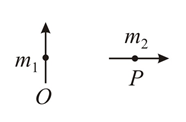
A charge particle is moving in a uniform magnetic field $$(2\hat{i} + 3\hat{j}) \text{ T}$$. If it has an acceleration of $$(\alpha\hat{i} - 4\hat{j}) \text{ m s}^{-2}$$, then the value of $$\alpha$$ will be
A charged particle moves in a uniform magnetic field $$\vec{B} = (2\hat{i} + 3\hat{j}) \text{ T}$$. Its acceleration is $$\vec{a} = (\alpha\hat{i} - 4\hat{j}) \text{ m/s}^2$$. We need to find $$\alpha$$.
The magnetic force on a charged particle is given by:
$$\vec{F} = q(\vec{v} \times \vec{B})$$
Since $$\vec{F} = m\vec{a}$$, the acceleration $$\vec{a}$$ is proportional to $$\vec{v} \times \vec{B}$$.
The magnetic force is always perpendicular to the magnetic field. Therefore, the acceleration must also be perpendicular to $$\vec{B}$$:
$$\vec{a} \cdot \vec{B} = 0$$
$$(\alpha\hat{i} - 4\hat{j}) \cdot (2\hat{i} + 3\hat{j}) = 0$$
$$2\alpha + (-4)(3) = 0$$
$$2\alpha - 12 = 0$$
$$\alpha = 6$$
The correct answer is Option B: $$6$$.
A magnet hung at $$45°$$ with magnetic meridian makes an angle of $$60°$$ with the horizontal. The actual value of the angle of dip is
We need to find the actual angle of dip ($$\delta$$) given the apparent angle of dip ($$\delta'$$) in a plane inclined to the magnetic meridian.
1. Identify the Given Values
- Angle of inclination with the magnetic meridian ($$\alpha$$) = $$45^\circ$$
- Apparent angle of dip ($$\delta'$$) = $$60^\circ$$
2. Formula for Apparent Dip
The relationship between the actual angle of dip ($$\delta$$), the apparent angle of dip ($$\delta'$$), and the angle with the magnetic meridian ($$\alpha$$) is given by the formula:
$$\tan \delta' = \frac{\tan \delta}{\cos \alpha}$$
Rearranging the formula to solve for the actual dip ($$\tan \delta$$):
$$\tan \delta = \tan \delta' \cdot \cos \alpha$$
3. Calculation
Substitute the known trigonometric values ($$\tan 60^\circ = \sqrt{3}$$ and $$\cos 45^\circ = \frac{1}{\sqrt{2}}$$) into the equation:
$$\tan \delta = \sqrt{3} \times \frac{1}{\sqrt{2}} = \frac{\sqrt{3}}{\sqrt{2}} = \sqrt{\frac{3}{2}}$$
Taking the inverse tangent to isolate $$\delta$$:
$$\delta = \tan^{-1}\left(\sqrt{\frac{3}{2}}\right)$$
Conclusion
The actual value of the angle of dip is $$\tan^{-1}\left(\sqrt{\frac{3}{2}}\right)$$.
A bar magnet having a magnetic moment of $$2.0 \times 10^5$$ J T$$^{-1}$$, is placed along the direction of uniform magnetic field of magnitude $$B = 14 \times 10^{-5}$$ T. The work done in rotating the magnet slowly through $$60°$$ from the direction of field is
We need to find the work done in rotating a bar magnet from 0° to 60° in a uniform magnetic field.
Magnetic moment: $$M = 2.0 \times 10^5$$ J T$$^{-1}$$
Magnetic field: $$B = 14 \times 10^{-5}$$ T
Initial angle: $$\theta_1 = 0°$$ (along the field)
Final angle: $$\theta_2 = 60°$$
The work done in rotating a magnetic dipole in a uniform magnetic field is:
$$W = -MB(\cos\theta_2 - \cos\theta_1)$$
$$W = MB(\cos\theta_1 - \cos\theta_2)$$
$$W = 2.0 \times 10^5 \times 14 \times 10^{-5} \times (\cos 0° - \cos 60°)$$
$$W = 28 \times \left(1 - \frac{1}{2}\right)$$
$$W = 28 \times \frac{1}{2} = 14 \text{ J}$$
Hence, the correct answer is Option A.
A proton and an alpha particle of the same velocity enter in a uniform magnetic field which is acting perpendicular to their direction of motion. The ratio of the radii of the circular paths described by the alpha particle and proton is
A proton and an alpha particle with the same velocity enter a uniform magnetic field perpendicular to their direction of motion.
The radius of the circular motion in a magnetic field is given by $$r = \frac{mv}{qB}$$.
For the proton, the mass is $$m_p$$ and the charge is $$e$$, while the alpha particle has mass $$4m_p$$ and charge $$2e$$.
Substituting into the formula gives for the proton $$r_p = \frac{m_p v}{eB}$$ and for the alpha particle $$r_\alpha = \frac{4m_p v}{2eB} = \frac{2m_p v}{eB}$$.
Therefore, the ratio of their radii is $$\frac{r_\alpha}{r_p} = \frac{\frac{2m_p v}{eB}}{\frac{m_p v}{eB}} = 2$$, which implies $$r_\alpha : r_p = 2 : 1$$.
Hence, the correct answer is Option B.
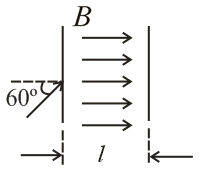
$$B_X$$ and $$B_Y$$ are the magnetic field at the centre of two coils $$X$$ and $$Y$$ respectively, each carrying equal current. If coil $$X$$ has $$200$$ turns and $$20 \text{ cm}$$ radius and coil $$Y$$ has $$400$$ turns and $$20 \text{ cm}$$ radius, the ratio of $$B_X$$ and $$B_Y$$ is
We need to find the ratio $$B_X : B_Y$$ for two coils carrying equal current. Coil $$X$$ has $$N_X = 200$$ turns and radius $$R_X = 20 \text{ cm}$$. Coil $$Y$$ has $$N_Y = 400$$ turns and radius $$R_Y = 20 \text{ cm}$$.
The magnetic field at the centre of a circular coil of $$N$$ turns, radius $$R$$, carrying current $$I$$ is:
$$B = \frac{\mu_0 N I}{2R}$$
For coil $$X$$:
$$B_X = \frac{\mu_0 N_X I}{2R_X} = \frac{\mu_0 \times 200 \times I}{2 \times 20}$$
For coil $$Y$$:
$$B_Y = \frac{\mu_0 N_Y I}{2R_Y} = \frac{\mu_0 \times 400 \times I}{2 \times 20}$$
Since both coils have the same radius ($$R_X = R_Y = 20 \text{ cm}$$) and carry the same current:
$$\frac{B_X}{B_Y} = \frac{N_X}{N_Y} = \frac{200}{400} = \frac{1}{2}$$
Therefore, $$B_X : B_Y = 1 : 2$$.
The correct answer is Option B: $$1 : 2$$.
The magnetic field at the center of current carrying circular loop is $$B_1$$. The magnetic field at a distance of $$\sqrt{3}$$ times radius of the given circular loop from the center on its axis is $$B_2$$. The value of $$\frac{B_1}{B_2}$$ will be
The magnetic field at the center of a current-carrying circular loop of radius $$R$$ is $$B_1 = \frac{\mu_0 I}{2R}$$.
The magnetic field on the axis of the loop at a distance $$d$$ from the center is given by $$B = \frac{\mu_0 I R^2}{2(R^2 + d^2)^{3/2}}$$.
Here, $$d = \sqrt{3}R$$, so $$R^2 + d^2 = R^2 + 3R^2 = 4R^2$$, and $$(R^2 + d^2)^{3/2} = (4R^2)^{3/2} = 8R^3$$.
So $$B_2 = \frac{\mu_0 I R^2}{2 \times 8R^3} = \frac{\mu_0 I}{16R}$$.
Now, $$\frac{B_1}{B_2} = \frac{\mu_0 I / 2R}{\mu_0 I / 16R} = \frac{16R}{2R} = 8$$.
So $$\frac{B_1}{B_2} = 8:1$$.
Hence, the correct answer is Option C.
Two parallel, long wires are kept 0.20 m apart in vacuum, each carrying current of $$x$$ A in the same direction. If the force of attraction per meter of each wire is $$2 \times 10^{-6}$$ N, then the value of $$x$$ is approximately
Two parallel wires are separated by $$d = 0.20$$ m, each carrying current $$x$$ A. The force of attraction per meter is $$F/L = 2 \times 10^{-6}$$ N m$$^{-1}$$.
Write the formula for force per unit length between two parallel current-carrying wires.
$$\frac{F}{L} = \frac{\mu_0 I_1 I_2}{2\pi d}$$
Since both wires carry the same current $$x$$:
$$\frac{F}{L} = \frac{\mu_0 x^2}{2\pi d}$$
Substitute the known values.
$$2 \times 10^{-6} = \frac{4\pi \times 10^{-7} \times x^2}{2\pi \times 0.20}$$
$$2 \times 10^{-6} = \frac{2 \times 10^{-7} \times x^2}{0.20}$$
$$2 \times 10^{-6} = 10^{-6} \times x^2$$
Solve for $$x$$.
$$x^2 = 2$$
$$x = \sqrt{2} \approx 1.4 \text{ A}$$
The correct answer is Option C.
Given below are two statements : One is labelled as Assertion (A) and the other is labelled as Reason (R).
Assertion (A) : In an uniform magnetic field, speed and energy remains the same for a moving charged particle.
Reason (R) : Moving charged particle experiences magnetic force perpendicular to its direction of motion.
Assertion (A): In a uniform magnetic field, speed and energy remain the same for a moving charged particle. Reason (R): A moving charged particle experiences a magnetic force perpendicular to its direction of motion.
The magnetic force on a charged particle is $$\vec{F} = q(\vec{v} \times \vec{B})$$, which is always perpendicular to the velocity $$\vec{v}$$. Since the force is perpendicular to the velocity, the work done by the magnetic force is:
$$ W = \vec{F} \cdot \vec{v} \, dt = 0 $$
Since no work is done, kinetic energy $$\frac{1}{2}mv^2$$ remains constant and therefore the speed remains constant. Thus, the Assertion is true.
The cross product $$\vec{v} \times \vec{B}$$ is indeed perpendicular to $$\vec{v}$$, so the magnetic force is perpendicular to the direction of motion. Hence, the Reason is true.
It is precisely because the magnetic force is perpendicular to the velocity that no work is done on the particle, which directly leads to the speed and kinetic energy remaining constant. Therefore, the Reason is the correct explanation of the Assertion.
Therefore, the correct answer is Option A: Both Assertion and Reason are true and Reason is the correct explanation of Assertion.
The electric current in a circular coil of 2 turns produces a magnetic induction $$B_1$$ at its centre. The coil is unwound and is rewound into a circular coil of 5 turns and the same current produces a magnetic induction $$B_2$$ at its centre. The ratio of $$\dfrac{B_2}{B_1}$$ is:
A circular coil of 2 turns is unwound and rewound into 5 turns. We need to find $$\frac{B_2}{B_1}$$.
Relate the radii using the total wire length.
The total length of wire remains constant:
$$L = n_1 \times 2\pi r_1 = n_2 \times 2\pi r_2$$
$$2 \times 2\pi r_1 = 5 \times 2\pi r_2$$
$$r_2 = \frac{2r_1}{5}$$
Write the magnetic field at the centre of each coil.
$$B = \frac{\mu_0 n I}{2r}$$
$$B_1 = \frac{\mu_0 \times 2 \times I}{2r_1} = \frac{\mu_0 I}{r_1}$$
$$B_2 = \frac{\mu_0 \times 5 \times I}{2r_2} = \frac{5\mu_0 I}{2 \times \frac{2r_1}{5}} = \frac{5\mu_0 I}{\frac{4r_1}{5}} = \frac{25\mu_0 I}{4r_1}$$
Calculate the ratio.
$$\frac{B_2}{B_1} = \frac{\frac{25\mu_0 I}{4r_1}}{\frac{\mu_0 I}{r_1}} = \frac{25}{4}$$
The correct answer is Option B: $$\dfrac{25}{4}$$.
A wire X of length 50 cm carrying, a current of 2 A is placed parallel to a long wire Y of length 5 m. Wire Y carries a current of 3 A. The distance between the two wires is 5 cm and the currents flow in the same direction. The force acting on wire Y is:
The magnetic force between two parallel current-carrying wires is calculated using the formula derived from Ampere's Force Law:
$$F = \frac{\mu_0 I_1 I_2 L}{2\pi d}$$
$$F = \frac{4\pi \times 10^{-7} \times 2 \times 3 \times 0.5}{2\pi \times 0.05}$$
$$F = \frac{6 \times 10^{-7}}{5 \times 10^{-2}} = 1.2 \times 10^{-5}\text{ N}$$
According to the magnetic force law for parallel conductors, currents flowing in the same direction produce an attractive force. Therefore, wire $$Y$$ is pulled towards wire $$X$$.
The magnetic field at the centre of a circular coil of radius $$r$$, due to current $$I$$ flowing through it, is $$B$$. The magnetic field at a point along the axis at a distance $$\frac{r}{2}$$ from the centre is :
We are given that the magnetic field at the centre of a circular coil of radius $$r$$ carrying current $$I$$ is $$B$$, and we need to find the magnetic field at a point on the axis at distance $$\frac{r}{2}$$ from the centre.
The magnetic field at the centre of a circular coil is $$ B_{centre} = \frac{\mu_0 I}{2r} = B $$ and on the axis at a distance $$x$$ from the centre it is $$ B_{axis} = \frac{\mu_0 I r^2}{2(r^2 + x^2)^{3/2}} $$. Substituting $$x = \frac{r}{2}$$ gives $$ B_{axis} = \frac{\mu_0 I r^2}{2\left(r^2 + \frac{r^2}{4}\right)^{3/2}} = \frac{\mu_0 I r^2}{2\left(\frac{5r^2}{4}\right)^{3/2}} $$. Since $$ \left(\frac{5r^2}{4}\right)^{3/2} = \frac{(5)^{3/2}}{(4)^{3/2}} \cdot r^3 = \frac{5\sqrt{5}}{8} \cdot r^3 $$, it follows that $$ B_{axis} = \frac{\mu_0 I r^2}{2 \cdot \frac{5\sqrt{5}}{8} \cdot r^3} = \frac{\mu_0 I}{2r} \cdot \frac{8}{5\sqrt{5}} = B \cdot \frac{8}{5\sqrt{5}} $$. Noting $$ \frac{8}{5\sqrt{5}} = \frac{2^3}{(\sqrt{5})^2 \cdot \sqrt{5}} = \frac{2^3}{(\sqrt{5})^3} = \left(\frac{2}{\sqrt{5}}\right)^3 $$, we conclude
$$ B_{axis} = \left(\frac{2}{\sqrt{5}}\right)^3 B $$
The correct answer is Option C.
Two long parallel conductors $$S_1$$ and $$S_2$$ are separated by a distance $$10$$ cm and carrying currents of $$4$$ A and $$2$$ A respectively. The conductors are placed along $$x$$-axis in $$X-Y$$ plane. There is a point $$P$$ located between the conductors (as shown in figure).
A charge particle of $$3\pi$$ coulomb is passing through the point $$P$$ with velocity $$\vec{v} = (2\hat{i} + 3\hat{j})$$ m s$$^{-1}$$.
The force acting on the charge particle is $$4\pi \times 10^{-5}(-x\hat{i} + 2\hat{j})$$ N. The value of $$x$$ is
Step 1: Magnetic field at point P
$$B_{\text{net}}=B_1-B_2$$
$$B_1=\frac{\mu_0\cdot4}{2\pi(0.04)},\quad$$
$$B_2=\frac{\mu_0\cdot2}{2\pi(0.06)}$$
$$B_{\text{net}}=\frac{\mu_0}{2\pi}\left(\frac{4}{0.04}-\frac{2}{0.06}\right)$$
= $$\frac{\mu_0}{2\pi}\left(100-\frac{100}{3}\right)$$
=$$\frac{\mu_0}{2\pi}\cdot\frac{200}{3}$$
Direction: $$-\hat{k}$$
$$\vec{B} = \frac{\mu_0}{2\pi}\cdot \frac{200}{3}(-\hat{k})$$
Step 2: Magnetic force on charge
$$\vec{F} = q(\vec{v} \times \vec{B})$$
= $$3\pi \left[(2\hat{i} + 3\hat{j}) \times \left(\frac{\mu_0}{2\pi}\cdot \frac{200}{3}(-\hat{k})\right)\right]=3π[(2i^+3j^)×(2πμ0⋅\ \frac{\ 200}{3}(−k^))]$$
= $$3\pi \cdot \frac{\mu_0}{2\pi} \cdot \frac{200}{3} \left[2\hat{j} - 3\hat{i}\right]$$
Step 3: Simplify
Using $$\mu_0 = 4\pi \times 10^{-7}$$4:
$$\vec{F} = (4\pi \times 10^{-7})(100)\left(-3\hat{i} + 2\hat{j}\right)$$
= $$4\pi \times 10^{-5} \left(-3\hat{i} + 2\hat{j}\right)$$
Compare with given:
$$\vec{F} = 4\pi \times 10^{-5}(-x\hat{i} + 2\hat{j})$$
⇒ x = 3
Final Answer:
3
A proton, a deuteron and an $$\alpha$$-particle with same kinetic energy enter into a uniform magnetic field at right angle to magnetic field. The ratio of the radii of their respective circular paths is :
Given: A proton, a deuteron, and an $$\alpha$$-particle enter a uniform magnetic field with the same kinetic energy, perpendicular to the field.
Recall the formula for the radius of circular motion in a magnetic field: When a charged particle moves in a magnetic field, the radius of its circular path is:
$$r = \frac{mv}{qB}$$
Express radius in terms of kinetic energy: Since $$KE = \frac{1}{2}mv^2$$, we get $$v = \sqrt{\frac{2 \cdot KE}{m}}$$, so $$mv = \sqrt{2m \cdot KE}$$.
Therefore:
$$r = \frac{\sqrt{2m \cdot KE}}{qB}$$
Since $$KE$$ and $$B$$ are the same for all three particles:
$$r \propto \frac{\sqrt{m}}{q}$$
Identify mass and charge of each particle: Let $$m_p$$ be the proton mass and $$e$$ be the elementary charge.
Proton: $$m = m_p$$, $$q = e$$
Deuteron: $$m = 2m_p$$, $$q = e$$
$$\alpha$$-particle: $$m = 4m_p$$, $$q = 2e$$
Calculate the ratio of radii: $$r_p : r_d : r_\alpha = \frac{\sqrt{m_p}}{e} : \frac{\sqrt{2m_p}}{e} : \frac{\sqrt{4m_p}}{2e}$$
$$= \frac{\sqrt{m_p}}{e} : \frac{\sqrt{2m_p}}{e} : \frac{2\sqrt{m_p}}{2e}$$
$$= \frac{\sqrt{m_p}}{e} : \frac{\sqrt{2m_p}}{e} : \frac{\sqrt{m_p}}{e}$$
Cancelling the common factor $$\frac{\sqrt{m_p}}{e}$$:
$$= 1 : \sqrt{2} : 1$$
The ratio of the radii of their circular paths is $$1 : \sqrt{2} : 1$$.
The correct answer is Option B.
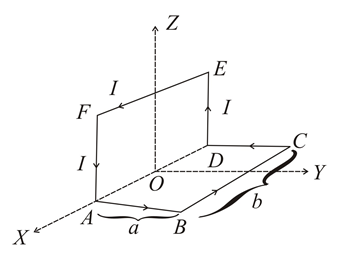
Given below are two statements:
Statement I: The electric force changes the speed of the charged particle and hence changes its kinetic energy; whereas the magnetic force does not change the kinetic energy of the charged particle.
Statement II: The electric force accelerates the positively charged particle perpendicular to the direction of electric field. The magnetic force accelerates the moving charged particle along the direction of magnetic field.
In the light of the above statements, choose the most appropriate answer from the options below:
We need to evaluate two statements about electric and magnetic forces.
Statement I: "The electric force changes the speed of the charged particle and hence changes its kinetic energy; whereas the magnetic force does not change the kinetic energy of the charged particle."
This is CORRECT. The electric force $$\vec{F} = q\vec{E}$$ can do work on a charged particle, thereby changing its speed and kinetic energy. The magnetic force $$\vec{F} = q\vec{v} \times \vec{B}$$ is always perpendicular to the velocity, so it does zero work. Hence, the magnetic force cannot change the speed or kinetic energy of a charged particle.
Statement II: "The electric force accelerates the positively charged particle perpendicular to the direction of electric field. The magnetic force accelerates the moving charged particle along the direction of magnetic field."
This is INCORRECT. Both parts are wrong:
- The electric force acts along the direction of the electric field (for positive charges), not perpendicular to it: $$\vec{F} = q\vec{E}$$.
- The magnetic force $$\vec{F} = q\vec{v} \times \vec{B}$$ is perpendicular to both $$\vec{v}$$ and $$\vec{B}$$, not along the direction of $$\vec{B}$$.
Therefore, Statement I is correct and Statement II is incorrect.
Hence, the correct answer is Option C: Statement I is correct but Statement II is incorrect.
Two $$10$$ cm long, straight wires, each carrying a current of $$5$$ A are kept parallel to each other. If each wire experienced a force of $$10^{-5}$$ N, then separation between the wires is ______ cm.
We need to find the separation between two parallel current-carrying wires.
Since the length of each wire is $$L = 10$$ cm = $$0.1$$ m, each carries a current of $$I_1 = I_2 = 5$$ A, and the force experienced by each wire is $$F = 10^{-5}$$ N, we apply the expression for the force between two parallel currents. The formula is $$F = \frac{\mu_0 I_1 I_2 L}{2\pi d}$$ where $$d$$ is the separation between the wires and $$\mu_0 = 4\pi \times 10^{-7}$$ T m/A.
Rearranging this expression for the distance gives
$$d = \frac{\mu_0 I_1 I_2 L}{2\pi F}$$
Substituting the known values yields
$$d = \frac{4\pi \times 10^{-7} \times 5 \times 5 \times 0.1}{2\pi \times 10^{-5}}$$
$$= \frac{4\pi \times 10^{-7} \times 2.5}{2\pi \times 10^{-5}}$$
$$= \frac{4 \times 2.5 \times 10^{-7}}{2 \times 10^{-5}}$$
$$= \frac{10 \times 10^{-7}}{2 \times 10^{-5}}$$
$$= \frac{10^{-6}}{2 \times 10^{-5}}$$
$$= \frac{1}{20} = 0.05$$ m = $$5$$ cm
Therefore, the separation between the wires is 5 cm.
A singly ionized magnesium atom $$(A = 24)$$ ion is accelerated to kinetic energy $$5$$ keV, and is projected perpendicularly into a magnetic field $$B$$ of the magnitude $$0.5$$ T. The radius of path formed will be ______ cm.
We need to find the radius of the circular path of a singly ionized magnesium ion in a magnetic field. The mass number, $$A = 24$$, so mass $$m = 24 \times 1.67 \times 10^{-27}$$ kg $$= 24 \times 1.67 \times 10^{-27}$$ kg; the kinetic energy, $$KE = 5$$ keV $$= 5 \times 10^3 \times 1.6 \times 10^{-19}$$ J $$= 8 \times 10^{-16}$$ J; the magnetic field, $$B = 0.5$$ T; and the charge, $$q = 1.6 \times 10^{-19}$$ C (singly ionized).
Since $$KE = \frac{1}{2}mv^2$$, it follows that $$v = \sqrt{\frac{2 \times KE}{m}}$$.
The radius of circular motion in a magnetic field is given by $$r = \frac{mv}{qB}$$. Substituting $$v = \sqrt{\frac{2 \times KE}{m}}$$ gives
$$r = \frac{m}{qB} \sqrt{\frac{2 \times KE}{m}} = \frac{\sqrt{2m \times KE}}{qB}$$
Substituting the values:
$$m = 24 \times 1.67 \times 10^{-27} = 4.008 \times 10^{-26} \text{ kg}$$
$$2m \times KE = 2 \times 4.008 \times 10^{-26} \times 8 \times 10^{-16}$$
$$= 64.128 \times 10^{-42} = 6.4128 \times 10^{-41}$$
$$\sqrt{2m \times KE} = \sqrt{6.4128 \times 10^{-41}} = 8.008 \times 10^{-21}$$
Now calculate $$r$$:
$$r = \frac{8.008 \times 10^{-21}}{1.6 \times 10^{-19} \times 0.5}$$
$$r = \frac{8.008 \times 10^{-21}}{8 \times 10^{-20}}$$
$$r = \frac{8.008}{80} = 0.1001 \text{ m}$$
$$r \approx 0.1 \text{ m} = 10 \text{ cm}$$
Hence, the radius of the path is 10 cm.
A wire of length 314 cm carrying current of 14 A is bent to form a circle. The magnetic moment of the coil is _____ A-m$$^2$$. [Given $$\pi = 3.14$$]
We have a wire of length $$L = 314$$ cm $$= 3.14$$ m carrying a current of $$I = 14$$ A, bent to form a circle. We need to find the magnetic moment of this circular coil.
When the wire is bent into a circle, the circumference equals the length of the wire: $$2\pi r = L$$, so $$r = \dfrac{L}{2\pi} = \dfrac{3.14}{2 \times 3.14} = \dfrac{1}{2} = 0.5$$ m.
The area of the circular loop is $$A = \pi r^2 = 3.14 \times (0.5)^2 = 3.14 \times 0.25 = 0.785$$ m$$^2$$.
The magnetic moment of a current loop is $$M = nIA$$, where $$n$$ is the number of turns. Since the wire forms a single loop, $$n = 1$$. Therefore, $$M = 1 \times 14 \times 0.785 = 10.99 \approx 11$$ A-m$$^2$$.
Hence, the correct answer is 11.
A deuteron and a proton moving with equal kinetic energy enter into a uniform magnetic field at right angle to the field. If $$r_d$$ and $$r_p$$ are the radii of their circular paths respectively, then the ratio $$\frac{r_d}{r_p}$$ will be $$\sqrt{x} : 1$$ where $$x$$ is ______
Recall the formula for radius of circular motion in a magnetic field.
A charged particle moving with kinetic energy $$K$$ in a magnetic field $$B$$ follows a circular path of radius:
$$r = \frac{mv}{qB} = \frac{\sqrt{2mK}}{qB}$$
(since $$K = \frac{1}{2}mv^2 \Rightarrow mv = \sqrt{2mK}$$)
Write the radii for deuteron and proton.
For the proton: mass $$m_p$$, charge $$q_p = e$$
$$r_p = \frac{\sqrt{2m_pK}}{eB}$$
For the deuteron: mass $$m_d = 2m_p$$, charge $$q_d = e$$
$$r_d = \frac{\sqrt{2 \times 2m_p \times K}}{eB} = \frac{\sqrt{2} \cdot \sqrt{2m_pK}}{eB}$$
Find the ratio.
$$\frac{r_d}{r_p} = \frac{\sqrt{2} \cdot \sqrt{2m_pK}}{eB} \times \frac{eB}{\sqrt{2m_pK}} = \sqrt{2}$$
So $$\frac{r_d}{r_p} = \sqrt{2} : 1$$.
Comparing with $$\sqrt{x} : 1$$, we get $$x = 2$$.
The answer is $$\boxed{2}$$.
Statement I : The ferromagnetic property depends on temperature. At high temperature, ferromagnet becomes paramagnet.
Statement II : At high temperature, the domain wall area of a ferromagnetic substance increases. In the light of the above statements, choose the most appropriate answer from the options given below:
Statement I states that ferromagnetic property depends on temperature, and above a certain temperature (the Curie temperature), a ferromagnet becomes a paramagnet. This is correct — it is the well-established Curie temperature phenomenon.
Statement II states that at high temperature, the domain wall area of a ferromagnetic substance increases. This is incorrect. At high temperature, the domains actually break down or become disordered. The thermal energy disrupts the alignment of magnetic moments within domains. Above the Curie temperature, domain structure itself ceases to exist as the material becomes paramagnetic — it is not that domain walls increase in area. In fact, as temperature increases, thermal agitation destroys the long-range magnetic order, causing the domains to shrink and eventually disappear rather than domain walls expanding.
Therefore, Statement I is true but Statement II is false.
A coil having $$N$$ turns is wound tightly in the form of a spiral with inner and outer radii $$a$$ and $$b$$ respectively. Find the magnetic field at centre, when a current $$I$$ passes through coil:
We want the magnetic field at the centre of a flat spiral coil that starts from an inner radius $$a$$ and ends at an outer radius $$b$$. The coil carries a steady current $$I$$ and has a total of $$N$$ closely packed turns.
For a single circular loop of radius $$r$$ carrying current $$I$$, the magnetic field at its centre is given by the well-known formula
$$B_{\text{single}}=\dfrac{\mu_0 I}{2r}.$$
In the spiral, the turns are so tightly wound that as we move radially outwards by a small distance $$dr$$ we encounter a small fractional turn $$dN$$. Because the winding is uniform, the number of turns per unit radial length is the same everywhere. The total radial width of the spiral is $$b-a$$, so
$$\text{Turns per unit length}= \dfrac{N}{\,b-a\,},\qquad\text{hence}\qquad dN=\dfrac{N}{\,b-a\,}\,dr.$$
Every elementary circular ring between radii $$r$$ and $$r+dr$$ behaves like $$dN$$ separate loops, each contributing the field $$\dfrac{\mu_0 I}{2r}$$ at the centre. Therefore the differential contribution to the field is
$$dB = \left(\dfrac{\mu_0 I}{2r}\right)\,dN =\left(\dfrac{\mu_0 I}{2r}\right)\left(\dfrac{N}{\,b-a\,}\,dr\right) =\dfrac{\mu_0 I N}{2(b-a)}\;\dfrac{dr}{r}.$$
All these elemental fields point in the same direction (perpendicular to the plane of the coil), so we add them directly. Integrating $$dB$$ from the inner radius $$a$$ to the outer radius $$b$$ gives the total magnetic field at the centre:
$$ \begin{aligned} B &= \int_{a}^{b} dB = \dfrac{\mu_0 I N}{2(b-a)}\int_{a}^{b}\dfrac{dr}{r} \\ &= \dfrac{\mu_0 I N}{2(b-a)}\Bigl[\ln r\Bigr]_{a}^{b} \\ &= \dfrac{\mu_0 I N}{2(b-a)}\;\ln\!\left(\dfrac{b}{a}\right). \end{aligned} $$
This expression matches option 4 exactly.
Hence, the correct answer is Option 4.
Which of the following statements are correct?
(A) Electric monopoles do not exist whereas magnetic monopoles exist.
(B) Magnetic field lines due to a solenoid at its ends and outside cannot be completely straight and confined.
(C) Magnetic field lines are completely confined within a toroid.
(D) Magnetic field lines inside a bar magnet are not parallel.
(E) $$\chi = -1$$ is the condition for a perfect diamagnetic material, where $$\chi$$ is its magnetic susceptibility.
Choose the correct answer from the options given below :
We need to evaluate the given statements about electromagnetic properties and identify which ones are scientifically correct.
1. Analyze Each Statement
-
(A) Electric monopoles do not exist whereas magnetic monopoles exist:
This statement is incorrect. In nature, isolated electric charges (electric monopoles, such as a single electron or proton) exist commonly. However, isolated magnetic monopoles have never been conclusively observed; magnetic poles always occur in north-south pairs. -
(B) Magnetic field lines due to a solenoid at its ends and outside cannot be completely straight and confined:
This statement is correct. According to Gauss's Law for Magnetism ($$\vec{\nabla} \cdot \vec{B} = 0$$), magnetic field lines must form continuous, closed loops. As a result, the field lines must diverge, bend, and spread out into space as they exit the ends of a finite solenoid. -
(C) Magnetic field lines are completely confined within a toroid:
This statement is correct. A toroid is essentially a solenoid bent into a circular doughnut shape. Because it has no open ends, the magnetic field lines form closed circles that remain entirely trapped within its internal core cavity (the field is ideally zero both in the central hole and outside the toroid). -
(D) Magnetic field lines inside a bar magnet are not parallel:
This statement is incorrect. Inside a well-magnetized, uniform bar magnet, the magnetic field lines run from the south pole to the north pole and are practically parallel and evenly spaced, representing a uniform magnetic field. -
(E) $$\chi = -1$$ is the condition for a perfect diamagnetic material, where $$\chi$$ is its magnetic susceptibility:
This statement is correct. For a perfect diamagnet (like a superconductor exhibiting the Meissner effect), the internal magnetic field is completely expelled ($$\vec{B} = 0$$). Since relative permeability is $$\mu_r = 1 + \chi$$, setting $$\vec{B} = 0$$ requires $$\mu_r = 0$$, which yields a magnetic susceptibility of exactly $$\chi = -1$$.
2. Select the Correct Answer
From our analysis, statements (B), (C), and (E) are true. Looking at the available combinations provided , the best matching valid option is (C) and (E) only.
Conclusion
The correct statements are (C) and (E) only, which corresponds to Option A.
A current $$I$$ flows in an infinitely long wire with cross section in the form of a semicircular ring of radius $$R$$. The magnitude of the magnetic induction along its axis is:
Using linear current density per unit angle: $$\frac{dI}{d\theta} = \frac{I}{\pi}$$
Using magnetic field of an infinitely long straight filament at distance $$R$$:
$$dB = \frac{\mu_0 dI}{2\pi R} = \frac{\mu_0 I}{2\pi^2 R} d\theta$$
Resolving components symmetrically about the central axis:
$$B = \int_{-\pi/2}^{\pi/2} dB \cos\theta = \int_{-\pi/2}^{\pi/2} \frac{\mu_0 I}{2\pi^2 R} \cos\theta \, d\theta$$
$$B = \frac{\mu_0 I}{2\pi^2 R} [\sin\theta]_{-\pi/2}^{\pi/2} = \frac{\mu_0 I}{2\pi^2 R} (1 - (-1)) = \frac{\mu_0 I}{\pi^2 R}$$
Two long parallel wires are at a distance $$2d$$ apart. They carry steady equal current flowing out of the plane of the paper as shown. The variation of the magnetic field along the line $$XX'$$ is given by
A hollow cylinder having infinite length and carrying uniform current per unit length $$\lambda$$ along the circumference as shown. Magnetic field inside the cylinder is
A long straight metal rod has a very long hole of radius $$a$$ drilled parallel to the rod axis as shown in the figure. If the rod carries a current $$i$$ find the value of magnetic induction on the axis of the hole, where OC = c
A long straight wire of radius '$$a$$' carries a steady current $$i$$. The current is uniformly distributed across its cross section. The ratio of the magnetic field at $$\frac{a}{2}$$ and $$2a$$ is
A current $$I$$ flows along the length of an infinitely long, straight, thin walled pipe. Then
A charged particle moves through a magnetic field perpendicular to its direction. Then
Two identical conducting wires AOB and COD are placed at right angles to each other. The wire AOB carries an electric current $$I_1$$ and COD carries a current $$I_2$$. The magnetic field on a point lying at a distance '$$d$$' from O, in a direction perpendicular to the plane of the wires AOB and COD, will be given by
Needles $$N_1, N_2$$ and $$N_3$$ are made of a ferromagnetic, a paramagnetic and a diamagnetic substance respectively. A magnet when brought close to them will
A long solenoid has 200 turns per $$cm$$ and carries a current $$i$$. The magnetic field at its centre is $$6.28 \times 10^{-2}\,Wb/m^2$$. Another long solenoid has 100 turns per $$cm$$ and it carries a current $$i/3$$. The value of the magnetic field at its centre is
A magnetic needle is kept in a non-uniform magnetic field. It experiences
A magnetic needle is simply a magnetic dipole of magnetic moment $$\vec m$$ mounted so that it can freely rotate and, if the pivot has negligible friction, can also translate when an external force acts.
For a magnetic dipole placed in an external magnetic field $$\vec B(\vec r)$$ two separate interactions must be analysed:
1. Torque on a dipole
The torque acting on a magnetic dipole is given by the vector product
$$\vec \tau = \vec m \times \vec B$$
This formula is valid irrespective of whether the field is uniform or non-uniform. Hence a torque will certainly act unless $$\vec m$$ happens to be parallel or antiparallel to the local field.
2. Net translational force on a dipole
The potential energy of a dipole in a magnetic field is
$$U = -\vec m \cdot \vec B(\vec r)$$
The net force is the negative gradient of this energy:
$$\vec F = -\nabla U = \nabla(\vec m \cdot \vec B)$$
If the field is uniform, $$\vec B$$ is the same at every point, so $$\nabla(\vec m \cdot \vec B)=0$$ and no net force appears.
If, however, the field is non-uniform, $$\vec B$$ varies with position, giving a non-zero gradient and therefore a non-zero net force.
Because the question explicitly states that the magnetic field is non-uniform, both interactions occur:
• A rotational effect (torque) tries to align the needle with the local field direction.
• A translational effect (force) tends to pull the needle toward the region where $$\vec m\cdot\vec B$$ is larger (typically where the field is stronger).
Therefore the magnetic needle experiences both a torque and a force.
Option C which is: a force and a torque
Two thin, long parallel wires separated by a distance '$$d$$' carry a current of '$$i$$' A in the same direction. They will
A uniform electric field and a uniform magnetic field are acting along the same direction in a certain region. If an electron is projected along the direction of the fields with a certain velocity then
An insulated wire is wound so that it forms a flat coil with $$N = 200$$ turns. The radius of the innermost turn is $$r_1 = 3$$ cm, and of the outermost turn $$r_2 = 6$$ cm. If 20 mA current flows in it then the magnetic moment will be $$\alpha \times 10^{-2}$$ A·m². The value of $$\alpha$$ is :
The magnetic moment of a planar coil equals the algebraic sum of magnetic moments of its individual turns.
For one circular turn of radius $$r$$ carrying current $$I$$, magnetic moment $$m = I \, A = I \, (\pi r^{2})$$, directed perpendicular to the plane.
The coil here is a tightly wound flat spiral: the radius grows uniformly from $$r_1 = 3 \text{ cm}$$ to $$r_2 = 6 \text{ cm}$$ in $$N = 200$$ turns. If the turns are uniformly spaced in the radial direction, the number of turns per unit radius is$$ \frac{dn}{dr} = \frac{N}{\,r_2 - r_1\,}. $$
Total magnetic moment $$M$$ is obtained by integrating the contribution $$I \pi r^{2}\, dn$$ from $$r_1$$ to $$r_2$$:$$ M = \int_{r_1}^{r_2} I \pi r^{2}\, dn = I \pi \int_{r_1}^{r_2} r^{2}\left(\frac{N}{r_2 - r_1}\right) dr. $$
Carry out the integral:$$ M = \frac{I \pi N}{r_2 - r_1}\left[ \frac{r^{3}}{3} \right]_{r_1}^{r_2} = \frac{I \pi N}{3}\,\frac{r_2^{3} - r_1^{3}}{r_2 - r_1}. $$
Factor the difference of cubes: $$r_2^{3} - r_1^{3} = (r_2 - r_1)(r_2^{2} + r_1 r_2 + r_1^{2})$$. The factor $$r_2 - r_1$$ cancels, giving the compact formula
$$ M = \frac{I \pi N}{3}\left(r_2^{2} + r_1 r_2 + r_1^{2}\right). \quad -(1) $$
Insert the numerical data (convert cm to m):
$$r_1 = 0.03 \text{ m}, \; r_2 = 0.06 \text{ m}, \; N = 200,\; I = 20 \text{ mA} = 0.02 \text{ A}.$$
Compute the bracket in $$(1)$$:
$$
r_2^{2} = 0.06^{2} = 0.0036, \quad
r_1 r_2 = 0.03 \times 0.06 = 0.0018, \quad
r_1^{2} = 0.03^{2} = 0.0009.
$$
Sum $$ = 0.0036 + 0.0018 + 0.0009 = 0.0063.$$
Dividing by 3: $$\frac{0.0063}{3} = 0.0021.$$
Now evaluate $$M$$:
$$
M = I \pi N \times 0.0021
= \bigl(0.02 \times 200\bigr)\pi \times 0.0021
= 4 \times \pi \times 0.0021
\approx 4 \times 3.1416 \times 0.0021
\approx 0.0264 \text{ A·m}^{2}.
$$
Expressing $$M$$ as $$\alpha \times 10^{-2} \text{ A·m}^{2}$$ gives $$\alpha = 2.64.$$ Hence
Option B which is: $$2.64$$
A small cube of side 1 mm is placed at the centre of a circular loop of radius 10 cm carrying a current of 2 A. The magnetic energy stored inside the cube is $$\alpha \times 10^{-14}$$ J. The value of $$\alpha$$ is _______.
$$(\mu_0 = 4\pi \times 10^{-7}$$ Tm/A, $$\pi = 3.14)$$
$$B = \frac{\mu_0 I}{2R}$$
$$u_B = \frac{B^2}{2\mu_0}$$
$$U = u_B \cdot V = \frac{B^2}{2\mu_0} \cdot V$$
$$B = \frac{(4\pi \times 10^{-7}) \times 2}{2 \times 0.1} = \frac{4\pi \times 10^{-7}}{0.1} = 4\pi \times 10^{-6} \text{ T}$$
$$U = \frac{(4\pi \times 10^{-6})^2}{2 \times (4\pi \times 10^{-7})} \times 10^{-9}$$
$$U = 2 \times 3.14 \times 10^{-14} = 6.28 \times 10^{-14} \text{ J}$$
$$\alpha = 6.28$$
Three long straight wires carrying current are arranged mutually parallel as shown in the figure. The force experienced by 15 cm length of wire Q is_______.
$$(\mu_{\circ} =4\pi \times 10^{-7} T.m/A)$$
A bar magnet has total length $$2l = 20$$ units and the field point $$P$$ is at a distance d = 10 units from the centre of the magnet. If the relative uncertainty of length measurement is 1%, then uncertainty of the magnetic field at point P is :
$$\text{Given: } \frac{\Delta l}{l} = 1\%,\ \frac{\Delta d}{d} = 1\%$$
$$B \propto \frac{l}{d^3}$$
$$\frac{\Delta B}{B} = \frac{\Delta l}{l} + 3\left(\frac{\Delta d}{d}\right)$$
$$\frac{\Delta B}{B}\% = 1\% + 3(1\%) = 4\%$$
A galvanometer having a coil of resistance 30Ω need 20 mA of current for full-scale deflection. If a maximum current of 3 A is to be measured using this galvanometer, the resistance of the shunt to be added to the galvanometer should be $$\frac{30}{X}$$Ω.where X is Options
We need to find the shunt resistance for a galvanometer.
G = 30 Ω, $$I_g$$ = 20 mA = 0.02 A, I = 3 A
$$S = \frac{GI_g}{I - I_g} = \frac{30 \times 0.02}{3 - 0.02} = \frac{0.6}{2.98} = \frac{60}{298} = \frac{30}{149}$$
So $$S = \frac{30}{149}$$ Ω, meaning X = 149.
The correct answer is Option 2: 149.
A long straight wire of a circular cross-section with radius '$$a$$' carries a steady current $$I$$. The current $$I$$ is uniformly distributed across this cross-section. The plot of magnitude of magnetic field B with distance $$r$$ from the centre of the wire is given by
To find the magnetic field $$B$$ at a distance $$r$$ from the center of the wire, we use Ampere's Circuital Law:
$$ \oint \vec{B} \cdot d\vec{l} = \mu_0 I_{enc} $$
Case 1: Inside the wire ($$r < a$$)
Since the current $$I$$ is uniformly distributed across the circular cross-section, the current enclosed ($$I_{enc}$$) by an Amperian loop of radius $$r$$ is proportional to the area:
$$ I_{enc} = I \left( \frac{\pi r^2}{\pi a^2} \right) = I \frac{r^2}{a^2} $$
Applying Ampere's Law:
$$ B (2\pi r) = \mu_0 \left( I \frac{r^2}{a^2} \right) $$
$$ B = \left( \frac{\mu_0 I}{2\pi a^2} \right) r $$
Therefore, inside the wire, the magnetic field increases linearly with distance: {$$B \propto r$$}.
Case 2: Outside the wire
For a point outside the wire, the Amperian loop encloses the entire current $$I$$:
$$ I_{enc} = I $$
Applying Ampere's Law:
$$ B (2\pi r) = \mu_0 I $$
$$ B = \frac{\mu_0 I}{2\pi r} $$
Therefore, outside the wire, the magnetic field decreases inversely with distance: {$$B \propto \frac{1}{r}$$}
Consider a long thin conducting wire carrying a uniform current I. A particle having mass "M" and charge "q" is released at a distance "a" from the wire with a speed $$\epsilon_{\circ}$$ along the direction of current in the wire. The particle gets attracted to the wire due to magnetic force. The particle turns round when it is at distance x from the wire. The value of x is [$$\mu_{\circ}$$ is vacuum permeability]
Let the wire lie along the z-axis with current $$I \hat{k}$$.
The particle is in the x-z plane at distance $$r$$ from the wire.
$$B = \frac{\mu_0 I}{2\pi r} (-\hat{j})$$
Taking coordinates $$(r, z)$$ where $$r$$ is the perpendicular distance from the wire:
$$\vec{v} = v_r \hat{i} + v_z \hat{k}$$
$$\vec{F} = q(\vec{v} \times \vec{B}) = q \left[(v_r \hat{i} + v_z \hat{k}) \times \left(-\frac{\mu_0 I}{2\pi r} \hat{j}\right)\right] = -\frac{q\mu_0 I v_r}{2\pi r}\hat{k} + \frac{q\mu_0 I v_z}{2\pi r}\hat{i}$$
Equation of motion along the z-direction:
$$M \frac{dv_z}{dt} = -\frac{q\mu_0 I}{2\pi r} v_r \implies M \frac{dv_z}{dt} = -\frac{q\mu_0 I}{2\pi r} \frac{dr}{dt}$$
$$M dv_z = -\frac{q\mu_0 I}{2\pi} \frac{dr}{r}$$
Integrating from the initial state ($$r=a, v_z=v_0$$) to the turning point ($$r=x$$ where $$v_r=0$$):
Since magnetic force does no work, total speed remains $$v_0$$. At the turning point, $$v_r = 0 \implies v_z = -v_0$$.
$$\int_{v_0}^{-v_0} M dv_z = -\frac{q\mu_0 I}{2\pi} \int_{a}^{x} \frac{dr}{r}$$
$$-2M v_0 = -\frac{q\mu_0 I}{2\pi} \ln\left(\frac{x}{a}\right) \implies \ln\left(\frac{x}{a}\right) = -\frac{4\pi M v_0}{q\mu_0 I}$$
$$x = a e^{-\frac{4\pi M v_0}{q\mu_0 I}}$$
A particle of charge q, mass m and kinetic energy E enters in magnetic field perpendicular to its velocity and undergoes a circular arc of radius(r). Which of the following curves represents the variation of r with E?
$$qvB = \frac{mv^2}{r}$$
$$r = \frac{mv}{qB}$$
$$E = \frac{1}{2}mv^2 \implies v = \sqrt{\frac{2E}{m}}$$
$$r = \frac{m}{qB} \sqrt{\frac{2E}{m}}$$
$$r = \frac{\sqrt{2mE}}{qB}$$
$$r \propto \sqrt{E}$$
Graph D correctly represents the $$r \propto \sqrt{E}$$ curve.
Given below are two statements. One is labelled as Assertion (A) and the other is labelled as Reason (R). Assertion (A) : A electron in a certain region of uniform magnetic field is moving with constant velocity in a straight line path. Reason (R): The magnetic field in that region is along the direction of velocity of the electron. In the light of the above statements, choose the correct answer from the options given below :
Assertion (A): An electron moves with constant velocity in a straight line in a uniform magnetic field.
The magnetic force on a moving charge is $$\vec{F} = q\vec{v} \times \vec{B}$$. If $$\vec{v} \parallel \vec{B}$$, then $$\vec{v} \times \vec{B} = 0$$ and the force is zero, so the electron moves in a straight line with constant velocity. TRUE.
Reason (R): The magnetic field is along the direction of velocity of the electron.
This is exactly the condition that makes the cross product zero. TRUE.
R correctly explains A: when $$\vec{B} \parallel \vec{v}$$, there is no magnetic force, so the electron travels in a straight line.
The correct answer is Option C: Both (A) and (R) are true and (R) is the correct explanation of (A).
A proton and a deutron ($$q = +e, m = 2.0u$$) having same kinetic energies enter a region of uniform magnetic field $$\vec{B}$$, moving perpendicular to $$\vec{B}$$. The ratio of the radius of deutron path to the radius of the proton path is:
A proton and a deuteron with the same kinetic energy enter a uniform magnetic field perpendicular to $$\vec{B}$$. We need the ratio of their radii of circular paths.
When a charged particle moves perpendicular to a magnetic field, it follows a circular path with radius:
$$ r = \frac{mv}{qB} $$
Since $$KE = \frac{1}{2}mv^2$$, we get $$mv = \sqrt{2m \cdot KE}$$. Therefore:
$$ r = \frac{\sqrt{2m \cdot KE}}{qB} $$
For the proton: mass = $$m_p$$, charge = $$e$$, so $$r_p = \frac{\sqrt{2m_p \cdot KE}}{eB}$$
For the deuteron: mass = $$2m_p$$ (approximately twice the proton mass), charge = $$e$$ (same charge as proton), so:
$$ r_d = \frac{\sqrt{2 \cdot 2m_p \cdot KE}}{eB} = \frac{\sqrt{2} \cdot \sqrt{2m_p \cdot KE}}{eB} = \sqrt{2} \cdot r_p $$
The ratio is:
$$ \frac{r_d}{r_p} = \sqrt{2} : 1 $$
The correct answer is Option (1): $$\sqrt{2} : 1$$.
A current of 200 $$\mu$$A deflects the coil of a moving coil galvanometer through 60°. The current to cause deflection through $$\frac{\pi}{10}$$ radian is
Galvanometer relationship: $$I = k\theta \implies I \propto \theta$$
Given initial conditions:
$$I_1 = 200\ \mu\text{A}$$
$$\theta_1 = 60^\circ = 60 \times \frac{\pi}{180} = \frac{\pi}{3}\text{ rad}$$
Given final condition: $$\theta_2 = \frac{\pi}{10}\text{ rad}$$
$$\frac{I_2}{I_1} = \frac{\theta_2}{\theta_1}$$
$$\frac{I_2}{200} = \frac{\left(\frac{\pi}{10}\right)}{\left(\frac{\pi}{3}\right)} = \frac{3}{10} \implies I_2 = 200 \times \frac{3}{10} = 60\ \mu\text{A}$$
A long straight wire of radius a carries a steady current I. The current is uniformly distributed across its cross section. The ratio of the magnetic field at $$\frac{a}{2}$$ and $$2a$$ from axis of the wire is :
We need to find the ratio of the magnetic field at distances $$\frac{a}{2}$$ and $$2a$$ from the axis of a long straight wire of radius $$a$$ carrying a steady, uniformly distributed current $$I$$.
Recall that Ampere's law states: $$\oint \vec{B} \cdot d\vec{l} = \mu_0 I_{enc}$$ where $$I_{enc}$$ is the current enclosed by the Amperian loop.
Inside the wire at a distance $$r$$ from the axis, the current is uniformly distributed over the cross-section of radius $$a$$. The enclosed current is proportional to the enclosed area: $$I_{enc} = I \cdot \frac{\pi r^2}{\pi a^2} = I \cdot \frac{r^2}{a^2}$$.
Applying Ampere's law with a circular Amperian loop of radius $$r$$ gives $$B \cdot 2\pi r = \mu_0 \cdot I \cdot \frac{r^2}{a^2}$$, so $$B_{inside} = \frac{\mu_0 I r}{2\pi a^2}$$. At $$r = \frac{a}{2}$$, this becomes $$B_1 = \frac{\mu_0 I \cdot \frac{a}{2}}{2\pi a^2} = \frac{\mu_0 I}{4\pi a}$$.
Outside the wire at a distance $$r$$ from the axis, the entire current $$I$$ is enclosed, so Ampere's law gives $$B \cdot 2\pi r = \mu_0 I$$ and hence $$B_{outside} = \frac{\mu_0 I}{2\pi r}$$. At $$r = 2a$$, this becomes $$B_2 = \frac{\mu_0 I}{2\pi \cdot 2a} = \frac{\mu_0 I}{4\pi a}$$.
The ratio of these fields is $$\frac{B_1}{B_2} = \frac{\frac{\mu_0 I}{4\pi a}}{\frac{\mu_0 I}{4\pi a}} = \frac{1}{1}$$, so $$B_1 : B_2 = 1 : 1$$.
The correct answer is Option (2): 1 : 1.
A proton moving with a constant velocity passes through a region of space without any change in its velocity. If $$\vec{E}$$ and $$\vec{B}$$ represent the electric and magnetic fields respectively, then the region of space may have :
(A) $$E = 0, B = 0$$; (B) $$E = 0, B \neq 0$$; (C) $$E \neq 0, B = 0$$; (D) $$E \neq 0, B \neq 0$$. Choose the most appropriate answer from the options given below :
A proton moves with constant velocity, meaning the net force on it is zero.
(A) $$E = 0, B = 0$$: No force, proton moves at constant velocity. Possible.
(B) $$E = 0, B \neq 0$$: If the proton moves parallel to $$\vec{B}$$, the magnetic force $$q\vec{v} \times \vec{B} = 0$$. Possible.
(C) $$E \neq 0, B = 0$$: The electric force $$q\vec{E} \neq 0$$, so the proton would accelerate. Not possible.
(D) $$E \neq 0, B \neq 0$$: If $$q\vec{E} + q\vec{v} \times \vec{B} = 0$$, the electric and magnetic forces can cancel. Possible.
The correct options are (A), (B) and (D) only, which corresponds to Option (3).
A uniform magnetic field of $$2 \times 10^{-3}$$ T acts along positive Y-direction. A rectangular loop of sides 20 cm and 10 cm with current of 5 A is in Y-Z plane. The current is in anticlockwise sense with reference to negative X axis. Magnitude and direction of the torque is:
Magnetic field $$B = 2 \times 10^{-3}$$ T along +Y. Rectangular loop 20 cm × 10 cm in Y-Z plane, current 5 A anticlockwise w.r.t. negative X-axis.
The area vector of the loop in Y-Z plane points along $$\pm\hat{x}$$. Since current is anticlockwise when viewed from negative X-axis, by the right-hand rule, the area vector points along $$-\hat{x}$$.
$$\vec{m} = I\vec{A} = 5 \times (20 \times 10 \times 10^{-4})(-\hat{x}) = 5 \times 0.02(-\hat{x}) = -0.1\hat{x}$$ A m$$^2$$.
Torque: $$\vec{\tau} = \vec{m} \times \vec{B} = (-0.1\hat{x}) \times (2 \times 10^{-3}\hat{y})$$
$$= -0.1 \times 2 \times 10^{-3}(\hat{x} \times \hat{y}) = -2 \times 10^{-4}\hat{z}$$
Magnitude: $$2 \times 10^{-4}$$ N m, direction: along negative Z-direction.
The correct answer is Option B: $$2 \times 10^{-4}$$ N m along negative Z-direction.
Paramagnetic substances:
A. align themselves along the directions of external magnetic field.
B. attract strongly towards external magnetic field.
C. has susceptibility little more than zero.
D. move from a region of strong magnetic field to weak magnetic field.
Choose the most appropriate answer from the options given below:
The electrostatic force $$(\vec{F_1})$$ and magnetic force $$(\vec{F_2})$$ acting on a charge $$q$$ moving with velocity $$v$$ can be written :
This question asks for the correct expressions for the electrostatic force and magnetic force acting on a charge $$q$$ moving with velocity $$\vec{v}$$.
Recall that the electrostatic force on a charge $$q$$ in an electric field $$\vec{E}$$ is given by:
$$\vec{F_1} = q\vec{E}$$
This force acts in the direction of $$\vec{E}$$ for a positive charge and opposite to $$\vec{E}$$ for a negative charge. Importantly, this force does not depend on the velocity of the charge.
The magnetic force on a charge $$q$$ moving with velocity $$\vec{v}$$ in a magnetic field $$\vec{B}$$ is given by:
$$\vec{F_2} = q(\vec{v} \times \vec{B})$$
Key features of this force:
- It involves the cross product of velocity and magnetic field, not a dot product.
- The order matters: it is $$\vec{v} \times \vec{B}$$, not $$\vec{B} \times \vec{v}$$ (they differ by a negative sign).
- This force is always perpendicular to both $$\vec{v}$$ and $$\vec{B}$$, so it does no work on the charge.
- If the charge is stationary ($$\vec{v} = 0$$), the magnetic force is zero.
Comparing with the given options shows that option (1) gives $$\vec{F_1} = q\vec{E}$$ and $$\vec{F_2} = q(\vec{V} \times \vec{B})$$, which matches both formulas correctly.
Option (2) incorrectly uses $$\vec{B}$$ for the electrostatic force.
Option (3) has the cross product in the wrong order ($$\vec{B} \times \vec{V}$$).
Option (4) incorrectly uses dot products instead of cross products.
The correct answer is Option (1): $$\vec{F_1} = q\vec{E}$$, $$\vec{F_2} = q(\vec{V} \times \vec{B})$$.
The magnetic moment of a bar magnet is $$0.5$$ Am$$^2$$. It is suspended in a uniform magnetic field of $$8 \times 10^{-2}$$ T. The work done in rotating it from its most stable to most unstable position is:
$$U = -MB \cos\theta$$
$$\text{Most stable position (parallel): } \theta_1 = 0^\circ$$
$$\text{Most unstable position (anti-parallel): } \theta_2 = 180^\circ$$
$$W = \Delta U = -MB(\cos\theta_2 - \cos\theta_1)$$
$$\implies W = -MB(\cos 180^\circ - \cos 0^\circ) = -MB(-1 - 1) = 2MB$$
$$\implies W = 2 \times 0.5 \times (8 \times 10^{-2}) = 8 \times 10^{-2}\text{ J}$$
The electric current in a circular coil of four turns produces a magnetic induction $$32$$ T at its centre. The coil is unwound and is rewound into a circular coil of single turn, the magnetic induction at the centre of the coil by the same current will be:
Solution :
Magnetic field at the centre of a circular coil is given by :
$$B = \frac{\mu_0 NI}{2R}$$
Given initial number of turns :
$$N_1 = 4$$
Initial magnetic field :
$$B_1 = 32\text{ T}$$
When the wire is rewound into a single turn coil :
$$N_2 = 1$$
Since length of wire remains constant :
$$2\pi R_1N_1 = 2\pi R_2N_2$$
$$R_2 = 4R_1$$
Now,
$$B_2 = \frac{\mu_0 N_2 I}{2R_2}$$
$$= \frac{\mu_0 I}{2(4R_1)}$$
$$= \frac{\mu_0 I}{8R_1}$$
Initial field :
$$B_1 = \frac{\mu_0 (4)I}{2R_1}$$
$$= \frac{2\mu_0 I}{R_1}$$
Therefore,
$$\frac{B_2}{B_1} = \frac{\mu_0 I/8R_1}{2\mu_0 I/R_1}$$
$$= \frac{1}{16}$$
Hence,
$$B_2 = \frac{32}{16}$$
$$= 2\text{ T}$$
Final Answer :
$$2\text{ T}$$
The magnitude of magnetic induction at mid-point $$O$$ due to current arrangement as shown in figure will be
Solution :
Magnetic field due to a semi-infinite straight current carrying wire at perpendicular distance \(r\) is :
$$B = \frac{\mu_0 I}{4\pi r}$$
At point \(O\), there are four semi-infinite wires each at distance :
$$r = a$$
Using right hand thumb rule, magnetic field due to each wire at \(O\) is directed into the plane of paper.
Therefore, fields add together.
Magnetic field due to one wire :
$$B_1 = \frac{\mu_0 I}{4\pi a}$$
Total magnetic field :
$$B = 4B_1$$
$$= 4\left(\frac{\mu_0 I}{4\pi a}\right)$$
$$= \frac{\mu_0 I}{\pi a}$$
Final Answer :
$$\frac{\mu_0 I}{\pi a}$$
A long straight wire with a circular cross-section having radius $$R$$, is carrying a steady current $$I$$. The current $$I$$ is uniformly distributed across this cross-section. Then the variation of magnetic field due to current $$I$$ with distance $$r$$ ($$r < R$$) from its centre will be
We need to find how the magnetic field $$B$$ varies with distance $$r$$ from the centre of a long straight wire of radius $$R$$ carrying a uniformly distributed current $$I$$, for $$r < R$$.
By applying Ampere’s circuital law to a circular Amperian loop of radius $$r$$ inside the wire, one writes $$\oint \vec{B}\cdot d\vec{l} = \mu_0 I_{enc}$$. Because the current is uniformly distributed over the cross section, the enclosed current is $$I_{enc} = I \frac{\pi r^2}{\pi R^2} = I \frac{r^2}{R^2}$$. By symmetry, $$B$$ is tangential and constant along the loop, so $$B\,(2\pi r) = \mu_0 I \frac{r^2}{R^2}$$, which yields $$B = \frac{\mu_0 I r}{2\pi R^2}$$.
Hence, inside the wire, the magnetic field varies as $$B \propto r$$. The correct answer is Option A: $$B \propto r$$.
A long solenoid carrying a current produces a magnetic field $$B$$ along its axis. If the current is doubled and the number of turns per cm is halved, the new value of magnetic field will be equal to
The magnetic field inside a long solenoid is given by:
$$B = \mu_0 n I$$
where $$n$$ is the number of turns per unit length and $$I$$ is the current.
Initially, the magnetic field is:
$$B = \mu_0 n I$$
When the current is doubled ($$I' = 2I$$) and the number of turns per cm is halved ($$n' = \frac{n}{2}$$):
$$B' = \mu_0 n' I' = \mu_0 \times \frac{n}{2} \times 2I = \mu_0 n I = B$$
The new magnetic field equals the original magnetic field.
Hence, the correct answer is Option D.
An infinitely long hollow conducting cylinder with radius $$R$$ carries a uniform current along its surface. Choose the correct representation of magnetic field $$(B)$$ as a function of radial distance $$(r)$$ from the axis of cylinder.
We need to find the magnetic field $$B$$ as a function of radial distance $$r$$ from the axis of an infinitely long hollow conducting cylinder of radius $$R$$ that carries a uniform current along its surface.
We apply Ampere's Law: $$\oint \vec{B} \cdot d\vec{l} = \mu_0 I_{\text{enc}}$$.
For $$r < R$$: Choose a circular Amperian loop of radius $$r < R$$ centred on the axis. Since the current flows only on the surface at $$r = R$$, this loop encloses zero current. By Ampere's Law: $$B(2\pi r) = 0$$, so $$B = 0$$ for all $$r < R$$.
For $$r > R$$: Choose a circular Amperian loop of radius $$r > R$$. This loop encloses the entire surface current $$I$$. By Ampere's Law: $$B(2\pi r) = \mu_0 I$$, giving $$B = \dfrac{\mu_0 I}{2\pi r}$$, which decreases as $$\dfrac{1}{r}$$.
The correct graph shows $$B = 0$$ for $$r < R$$ and $$B \propto \dfrac{1}{r}$$ for $$r > R$$.
The answer is Option D.
The current sensitivity of a galvanometer can be increased by:
(A) decreasing the number of turns
(B) increasing the magnetic field
(C) decreasing the area of the coil
(D) decreasing the torsional constant of the spring
Choose the most appropriate answer from the options given below:
We need to identify which factors increase the current sensitivity of a galvanometer.
Current sensitivity is the deflection per unit current:
$$\frac{\theta}{I} = \frac{nBA}{k}$$
where $$n$$ = number of turns, $$B$$ = magnetic field, $$A$$ = area of coil, and $$k$$ = torsional constant of the spring.
(A) Decreasing the number of turns $$n$$ → Sensitivity decreases (since $$\frac{\theta}{I} \propto n$$). Incorrect.
(B) Increasing the magnetic field $$B$$ → Sensitivity increases (since $$\frac{\theta}{I} \propto B$$). Correct.
(C) Decreasing the area of the coil $$A$$ → Sensitivity decreases (since $$\frac{\theta}{I} \propto A$$). Incorrect.
(D) Decreasing the torsional constant $$k$$ → Sensitivity increases (since $$\frac{\theta}{I} \propto \frac{1}{k}$$). Correct.
The correct combination is (B) and (D).
Hence, the correct answer is Option D: (B) and (D) only.
The magnetic moment of an electron ($$e$$) revolving in an orbit around nucleus with an orbital angular momentum is given by
We need to find the relation between the magnetic moment and the orbital angular momentum of an electron revolving around a nucleus.
An electron moving in a circular orbit constitutes a current loop whose magnetic moment is given by $$\mu_L = iA$$, where $$i$$ is the current and $$A$$ is the area of the orbit.
The current due to the electron moving with period $$T$$ is $$i = \frac{e}{T} = \frac{ev}{2\pi r}$$, and the area of the circular orbit is $$A = \pi r^2$$.
Substituting these expressions gives $$\mu_L = \frac{ev}{2\pi r} \times \pi r^2 = \frac{evr}{2}$$.
Since the orbital angular momentum is $$L = mvr$$, it follows that $$vr = \frac{L}{m}$$, and therefore $$\mu_L = \frac{eL}{2m}$$.
For a negatively charged electron, the magnetic moment is opposite in direction to the angular momentum, so $$\vec{\mu}_L = -\frac{e\vec{L}}{2m}$$.
Hence, the correct answer is Option B.
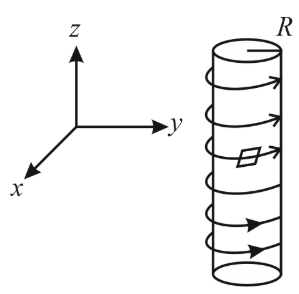
A hollow, right circular cone of base radius $$R$$ and height $$h$$, with its tip at the origin is rotating about the $$Z$$-axis with an angular velocity $$\omega$$, as shown in the figure. The cone carries a total charge $$Q$$ uniformly distributed on its curved surface. The magnitude of magnetic field at a point $$(0,0,z)$$, where $$z\gg R$$ and $$z\gg h$$, is $$\dfrac{n\mu_0}{4\pi}\dfrac{QR^2\omega}{z^3}$$. The value of $$n$$ is:
Using magnetic field of a dipole on its axis for $$z \gg R, h$$: $$B = \frac{\mu_0}{4\pi} \frac{2M}{z^3}$$
Using element of a hollow cone at distance $$x$$ along the slant height $$L = \sqrt{R^2+h^2}$$:
$$r = x\sin\alpha = x\frac{R}{L}$$
$$dA = 2\pi r dx = 2\pi x \frac{R}{L} dx$$
Using surface charge density: $$\sigma = \frac{Q}{\pi R L}$$
$$dq = \sigma dA = \frac{Q}{\pi R L} \left(2\pi x \frac{R}{L} dx\right) = \frac{2Q}{L^2} x dx$$
Using magnetic moment of a rotating ring element:
$$dM = dI \cdot \pi r^2 = \left(\frac{\omega}{2\pi} dq\right) \pi r^2 = \frac{1}{2} \omega r^2 dq$$
$$dM = \frac{1}{2} \omega \left(x\frac{R}{L}\right)^2 \left(\frac{2Q}{L^2} x dx\right) = \frac{QR^2\omega}{L^4} x^3 dx$$
$$M = \int_0^L \frac{QR^2\omega}{L^4} x^3 dx = \frac{QR^2\omega}{L^4} \left[\frac{L^4}{4}\right] = \frac{1}{4}QR^2\omega$$
$$B = \frac{\mu_0}{4\pi} \frac{2\left(\frac{1}{4}QR^2\omega\right)}{z^3} = \frac{0.5\mu_0}{4\pi} \frac{QR^2\omega}{z^3}$$
A current of 30 A each flows in opposite directions in two conducting wires, placed parallel to each other at a distance of 8 cm. The magnetic field at the mid point between the two wires is __________ $$\mu$$T. ($$\dfrac{\mu_0}{4\pi} = 10^{-7}$$ N/A$$^2$$)
Distance of the midpoint from each wire, $$ r = \frac{d}{2} = 4 \text{ cm} = 0.04 \text{ m} $$
Magnetic constant, $$ \frac{\mu_0}{4\pi} = 10^{-7} \text{ T}\cdot\text{m/A} \implies \frac{\mu_0}{2\pi} = 2 \times 10^{-7} \text{ T}\cdot\text{m/A} $$
The magnitude of the magnetic field produced by a long straight current-carrying wire at a distance $$ r $$ is given by:
$$ B = \frac{\mu_0 I}{2\pi r} $$
Using Right-Hand Grip Rule,as currents in the two wires are flowing in opposite directions, the magnetic fields produced by both wires at the midpoint between them will point in the \textbf{same direction}.
Therefore, the net magnetic field ($$ B_{net} $$) at the midpoint is the sum of the magnitudes of the magnetic fields produced by each wire:
$$ B_{net} = B_1 + B_2 $$
$$ B_{net} = \frac{\mu_0 I}{2\pi r} + \frac{\mu_0 I}{2\pi r} $$
$$ B_{net} = 2 \left( \frac{\mu_0 I}{2\pi r} \right) = \frac{\mu_0 I}{\pi r} $$
$$ B_{net} = \frac{4\pi \times 10^{-7} \times 30}{\pi \times 0.04} $$
$$ B_{net} = \frac{4 \times 10^{-7} \times 30}{0.04} $$
$$ B_{net} = \frac{120 \times 10^{-7}}{4 \times 10^{-2}} $$
$$ B_{net} = 30 \times 10^{-5} \text{ T} $$
$$ B_{net} = 30 \times 10^{-5} \times 10^6 \ \mu\text{T} $$
$$ B_{net} = 30 \times 10^1 \ \mu\text{T} $$
$$ B_{net} = 300 \ \mu\text{T} $$
Two identical long current carrying wires are bent into the shapes shown in the following figures. If the magnitude of magnetic fields at the centres P and Q of a semicircular arc are B$$_1$$ and B$$_2$$ respectively, then the ratio $$\frac{B_1}{B_2}$$ is __________.
We need the magnetic fields at the centres P and Q of semicircular arcs in two different wire configurations.
The magnetic field at the centre of a semicircular arc of radius $$r$$ carrying current $$I$$ is:
$$B_{semi} = \frac{\mu_0 I}{4r}$$
The magnetic field due to a semi-infinite straight wire at a perpendicular distance $$d$$ from its end is:
$$B_{wire} = \frac{\mu_0 I}{4\pi d}$$
Also, an important fact: if the observation point lies on the line of the wire (i.e., on the wire's axis extended), the magnetic field from that wire at the point is zero (since $$d\vec{l} \times \hat{r} = 0$$).
Figure (I) -- Field at P:
The wire comes from infinity on the left along the top, goes to the right, makes a semicircular arc of radius $$r$$ (centre P, opening to the right), and returns to the left along the bottom to infinity.
The two straight portions are horizontal, each at a perpendicular distance $$r$$ from P. Neither wire's axis passes through P, so both contribute a non-zero field.
Using the right-hand rule, the semicircular arc (current going clockwise from top to bottom) and both semi-infinite wires all produce a field at P directed into the page.
$$B_1 = \frac{\mu_0 I}{4r} + \frac{\mu_0 I}{4\pi r} + \frac{\mu_0 I}{4\pi r}$$
$$= \frac{\mu_0 I}{4\pi r}(\pi + 1 + 1) = \frac{\mu_0 I}{4\pi r}(\pi + 2)$$
Figure (II) -- Field at Q:
The wire comes horizontally from the right, makes a semicircular arc of radius $$r$$ (centre Q, opening to the right), and then goes vertically downward to infinity.
The horizontal wire is at perpendicular distance $$r$$ from Q, so it contributes $$\frac{\mu_0 I}{4\pi r}$$ (into the page by right-hand rule).
The vertical wire starts from the bottom of the semicircle, which is directly below Q at distance $$r$$. When extended, this wire's axis passes through Q. Therefore, Q lies on the line of the wire, and the magnetic field at Q due to this wire is zero.
$$B_2 = \frac{\mu_0 I}{4r} + \frac{\mu_0 I}{4\pi r} + 0$$
$$= \frac{\mu_0 I}{4\pi r}(\pi + 1)$$
Now we take the ratio:
$$\frac{B_1}{B_2} = \frac{\frac{\mu_0 I}{4\pi r}(\pi + 2)}{\frac{\mu_0 I}{4\pi r}(\pi + 1)} = \frac{\pi + 2}{\pi + 1}$$
Hence, the correct answer is Option A.
The total length of potentiometer wire AB is 50 cm in the arrangement as shown in figure. If P is the point where the galvanometer shows zero reading then the length AP is ____ cm.
potentiometer works on the principle of wheatstone bridge.
Length of segment AP = $$x$$
Length of segment PB = $$50 - x$$
resistance of potentiometer wire directly prorportional to length($$R = \rho \frac{l}{A}$$)
The balancing condition for the Wheatstone bridge is:
$$ \frac{R_1}{R_2} = \frac{\text{Length of AP}}{\text{Length of PB}} $$
$$ \frac{R_1}{R_2} = \frac{x}{50 - x} $$
$$ \frac{6}{4} = \frac{x}{50 - x} $$
$$x$$=30cm
The relationship between the magnetic susceptibility ($$\chi$$) and the magnetic permeability ($$\mu$$) is given by: ($$\mu_0$$ is the permeability of free space and $$\mu_r$$ is relative permeability)
The magnetisation $$M$$ produced in a material kept in an external magnetic field $$H$$ is written as
$$M = \chi\,H$$, where $$\chi$$ is called the magnetic susceptibility.
The magnetic induction $$B$$ inside the same material is given by
$$B = \mu\,H$$, where $$\mu$$ is the magnetic permeability of the material.
For vacuum (or free space) the induction is $$B_0 = \mu_0\,H$$, so the relative permeability of the material is defined as
$$\mu_r = \frac{\mu}{\mu_0}$$.
By definition we can also write
$$B = \mu_0\,(H + M)$$. Substituting $$M = \chi\,H$$ gives
$$B = \mu_0\,(H + \chi H) = \mu_0\,(1 + \chi)\,H$$.
Comparing the two expressions for $$B$$:
$$\mu\,H = \mu_0\,(1 + \chi)\,H$$.
Cancelling the common factor $$H$$, we get
$$\mu = \mu_0\,(1 + \chi)$$.
Divide both sides by $$\mu_0$$:
$$\frac{\mu}{\mu_0} = 1 + \chi$$.
The left side is just $$\mu_r$$, so
$$\mu_r = 1 + \chi \quad$$(relation between $$\mu_r$$ and $$\chi$$).
Rearranging for susceptibility:
$$\chi = \mu_r - 1 = \frac{\mu}{\mu_0} - 1$$.
Thus the correct option is
$$\chi = \frac{\mu}{\mu_0} - 1$$ → Option A.
Given below are two statements : one is labelled as Assertion (A) and the other is labelled as Reason(R).
Assertion (A) : Magnetic monopoles do not exist.
Reason (R) : Magnetic field lines are continuous and form closed loops.
In the light of the above statements, choose the most appropriate answer from the options given below :
For a magnetic field $$\mathbf{B}$$, Gauss’s law for magnetism states $$\nabla\!\cdot\!\mathbf{B}=0$$ $$-(1)$$.
Equation $$(1)$$ means the net magnetic flux through any closed surface is zero. Hence there are no sources or sinks of the magnetic field analogous to electric charges. In other words, isolated north poles or south poles (magnetic monopoles) are absent. This validates Assertion (A).
Because $$\nabla\!\cdot\!\mathbf{B}=0$$ everywhere, magnetic field lines can neither start nor end; they must be continuous and form closed loops. Therefore Reason (R) is also a correct statement.
Moreover, the continuity of magnetic field lines (closed loops) is the direct physical manifestation of $$\nabla\!\cdot\!\mathbf{B}=0$$, which is precisely why magnetic monopoles do not exist. Thus Reason (R) correctly explains Assertion (A).
So, both Assertion (A) and Reason (R) are correct and Reason (R) is the correct explanation of Assertion (A).
Answer: Option C
The magnetic field at the centre of a current carrying circular loop of radius R is $$16\mu T$$. The magnetic field at a distance $$x = \sqrt{3}R$$ on its axis from the centre is______$$\mu T$$.
A long cylindrical conductor with large cross section carries an electric current distributed uniformly over its cross-section. Magnetic field due to this current is:
A. maximum at either ends of the conductor and minimum at the midpoint
B. maximum at the axis of the conductor
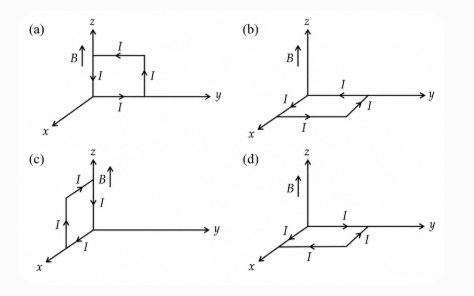
C. minimum at the surface of the conductor
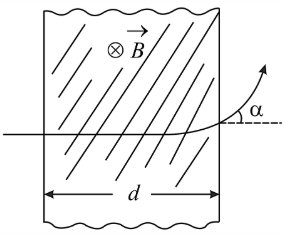
D. minimum at the axis of the conductor
E. same at all points in the cross-section of the conductor
Choose the correct answer from the options given below :
A long cylindrical conductor carries current uniformly distributed over its cross-section. We need to determine where the magnetic field is minimum.
For a long cylindrical conductor of radius $$R$$ carrying total current $$I$$:
Inside the conductor ($$r < R$$):
$$B(2\pi r) = \mu_0 \cdot \frac{I}{\pi R^2} \cdot \pi r^2 = \mu_0 I \frac{r^2}{R^2}$$
$$B = \frac{\mu_0 I r}{2\pi R^2}$$
The field increases linearly with $$r$$ inside the conductor.
Outside the conductor ($$r > R$$):
$$B = \frac{\mu_0 I}{2\pi r}$$
The field decreases as $$1/r$$ outside.
At the axis ($$r = 0$$): $$B = 0$$. This is the minimum.
At the surface ($$r = R$$): $$B = \frac{\mu_0 I}{2\pi R}$$. This is the maximum.
Statement A: Maximum at ends, minimum at midpoint - FALSE (this describes the axial field, not radial).
Statement B: Maximum at axis - FALSE (B = 0 at axis).
Statement C: Minimum at surface - FALSE (maximum at surface).
Statement D: Minimum at axis - TRUE ($$B = 0$$).
Statement E: Same at all points - FALSE.
The correct answer is Option 3: D Only.
A current carrying circular loop of radius 2 cm with unit normal $$\hat{n} = \frac{\hat{k} + \hat{i}}{\sqrt{2}}$$ is placed in a magnetic field, $$\vec{B} = B_0(3\hat{i} + 2\hat{k})$$. If $$B_0 = 4 \times 10^{-3}$$ T and current $$I = 100\sqrt{2}$$ A, the torque experienced by the loop is __________ Wb.A. ($$\pi = 3.14$$)
Solution :
Radius of loop :
$$r = 2\text{ cm}$$
$$= 2 \times 10^{-2}\text{ m}$$
Area of loop :
$$A = \pi r^2$$
$$= 3.14 \times (2 \times 10^{-2})^2$$
$$= 12.56 \times 10^{-4}\text{ m}^2$$
Current in loop :
$$I = 100\sqrt2\text{ A}$$
Unit normal vector :
$$\hat n = \frac{\hat i + \hat k}{\sqrt2}$$
Magnetic field :
$$\vec B = B_0(3\hat i + 2\hat k)$$
Given,
$$B_0 = 4 \times 10^{-3}\text{ T}$$
Magnetic moment :
$$\vec m = IA\hat n$$
Torque on loop :
$$\tau = |\vec m \times \vec B|$$
$$= IA|\hat n \times \vec B|$$
Now,
$$\hat n \times \vec B=\frac{\hat i + \hat k}{\sqrt2}\times4 \times 10^{-3}(3\hat i + 2\hat k)$$
$$=\frac{4 \times 10^{-3}}{\sqrt2}[(\hat i + \hat k)\times(3\hat i + 2\hat k)]$$
Using,
$$\hat i \times \hat i = 0$$
$$\hat k \times \hat k = 0$$
$$\hat i \times \hat k = -\hat j$$
$$\hat k \times \hat i = \hat j$$
Therefore,
$$\hat n \times \vec B=\frac{4 \times 10^{-3}}{\sqrt2}(-2\hat j + 3\hat j)$$
$$=\frac{4 \times 10^{-3}}{\sqrt2}\hat j$$
Magnitude :
$$|\hat n \times \vec B|=\frac{4 \times 10^{-3}}{\sqrt2}$$
Hence,
$$\tau=(100\sqrt2)(12.56 \times 10^{-4})\left(\frac{4 \times 10^{-3}}{\sqrt2}\right)$$
$$=100 \times 12.56 \times 4 \times 10^{-7}$$
$$=5.024 \times 10^{-4}\text{ N m}$$
Final Answer :
$$5.024 \times 10^{-4}$$
Given below are two statements: one is labelled as Assertion (A) and the other is labelled as Reason (R)
Consider a ferromagnetic material :
Assertion (A) : The individual atoms in a ferromagnetic material possess a magnetic dipole moment and interact with one another in such a way that they spontaneously align themselves forming domains.
Reason (R): At high enough temperature, the domain structure of ferromagnetic material disintegrates. Thus, magnetization will disappear at high enough temperature known as Curie temperature.
In the light of the above statements, choose the correct answer from the options given below :
We need to evaluate the Assertion and Reason about ferromagnetic materials.
Assertion (A): "The individual atoms in a ferromagnetic material possess a magnetic dipole moment and interact with one another in such a way that they spontaneously align themselves forming domains."
Analysis: In ferromagnetic materials (like iron, cobalt, nickel), each atom has a permanent magnetic dipole moment due to unpaired electrons. These atomic magnetic moments interact through a quantum mechanical exchange interaction, which causes neighboring moments to align parallel to each other spontaneously, forming regions called magnetic domains. Assertion (A) is TRUE.
Reason (R): "At high enough temperature, the domain structure of ferromagnetic material disintegrates. Thus, magnetization will disappear at high enough temperature known as Curie temperature."
Analysis: Above the Curie temperature, thermal energy overcomes the exchange interaction energy, destroying the long-range ordering of magnetic moments. The material transitions from ferromagnetic to paramagnetic behavior. Reason (R) is TRUE.
Relationship: While both statements are true, Reason (R) describes what happens at high temperatures (loss of domain structure), which does not explain why domains form in the first place (Assertion A). The formation of domains is due to exchange interactions at lower temperatures, not related to their destruction at the Curie temperature. R does NOT explain A.
The correct answer is Option 1: Both (A) and (R) are true but (R) is not the correct explanation of (A).
The current passing through a conducting loop in the form of equilateral triangle of side $$4\sqrt{3}$$ cm is 2A. The magnetic field at its centroid is $$\alpha\times10^{-5}T.$$ The value of $$\alpha$$ is______.
(Given :$$\mu_{o}=4\pi\times 10^{-7} SI$$ units)
B at centroid is sum of B from each straight wire (side of triangle) of triangle. As direction of B from all three wires is same.
Calculate B from a single side, 3B is the required answer
B = $$\frac{\mu_0 I}{4 \pi r} (\sin \theta_1 + \sin \theta_2) $$
Substitute the values $$\theta_1$$=$$\theta_2$$=60, you obtain
B=$$\sqrt{3}$$
$$B_{net}$$=$$3\sqrt{3}$$
Two identical circular loops P and Q each of radius r are lying in parallel planes such that they have common axis. The current through P and Q are I and 4I respectively in clockwise direction as seen from 0 . The net magnetic field at O is:
Magnetic field on the axis of a circular current-carrying loop, $$B = \frac{\mu_0 I r^2}{2(r^2 + x^2)^{3/2}}$$
Taking direction from P to Q as positive $$\hat{i}$$: $$x = r$$
For loop P:
$$I_P = I$$
$$\vec{B}_P = -\frac{\mu_0 I r^2}{2(r^2 + r^2)^{3/2}} \hat{i}$$
$$\vec{B}_P = -\frac{\mu_0 I r^2}{2(2r^2)^{3/2}} \hat{i}$$
$$\vec{B}_P = -\frac{\mu_0 I}{2 \cdot 2\sqrt{2} r} \hat{i}$$
$$\vec{B}_P = -\frac{\mu_0 I}{4\sqrt{2}r} \hat{i}$$
For loop Q:
$$I_Q = 4I$$
$$\vec{B}_Q = \frac{\mu_0 (4I) r^2}{2(r^2 + r^2)^{3/2}} \hat{i}$$
$$\vec{B}_Q = \frac{4\mu_0 I}{4\sqrt{2}r} \hat{i}$$
Net magnetic field at O: $$\vec{B}_{\text{net}} = \vec{B}_P + \vec{B}_Q$$
$$\vec{B}_{\text{net}} = \left(-\frac{\mu_0 I}{4\sqrt{2}r} + \frac{4\mu_0 I}{4\sqrt{2}r}\right) \hat{i}$$
$$\vec{B}_{\text{net}} = \frac{3\mu_0 I}{4\sqrt{2}r} \hat{i}$$
A solenoid has a core made of material with relative permeability 400. The magnetic field produced in the interior of solenoid is 1.0 T. The magnetic intensity in SI units is $$\alpha \times 10^5$$. The value of $$\alpha$$ is ______.
(Free space permeability $$\mu_0 = 4\pi \times 10^{-7}$$ SI units.)
The magnetic flux density, magnetic field strength and permeability are related by
$$B = \mu\,H = \mu_{0}\,\mu_{r}\,H$$
Hence
$$H = \frac{B}{\mu_{0}\,\mu_{r}}$$
Given data:
$$B = 1.0\ \text{T},\qquad \mu_{r} = 400,\qquad \mu_{0} = 4\pi \times 10^{-7}\ \text{H m}^{-1}$$
Substituting the values:
$$H = \frac{1.0}{\bigl(4\pi \times 10^{-7}\bigr)\,(400)}$$
Simplify the denominator:
$$4\pi \times 10^{-7} \times 400 = 1600\pi \times 10^{-7} = 1.6\times10^{-4}\,\pi$$
Therefore
$$H = \frac{1}{1.6\times10^{-4}\,\pi}\ \text{A m}^{-1}$$
Working out the numerical factor:
$$\frac{1}{1.6\times10^{-4}} = \frac{1}{1.6}\times10^{4} = 0.625\times10^{4} = 6.25\times10^{3}$$
Hence
$$H = \frac{6.25\times10^{3}}{\pi}\ \text{A m}^{-1}$$
Express this in the form $$H = \alpha \times 10^{5}\ \text{A m}^{-1}$$:
$$\frac{6.25\times10^{3}}{\pi} = \frac{0.0625\times10^{5}}{\pi}$$
Thus
$$\alpha = \frac{0.0625}{\pi} = \frac{1}{16\pi}$$
Therefore, the correct choice is:
Option B which is: $$\frac{1}{16\pi}$$
A particle having charge $$10^{-9}$$ C moving in the x-y plane in fields of $$0.4\hat{j}$$ N/C and $$4 \times 10^{-3}\hat{k}$$ T experiences a force of $$(4\hat{i} + 2\hat{j}) \times 10^{-10}$$ N. The velocity of the particle at that instant is :
The net Lorentz force on a charged particle is given by
$$\mathbf{F}=q\left(\mathbf{E}+\mathbf{v}\times\mathbf{B}\right)$$
Given data:
Charge $$q = 10^{-9}\,{\rm C}$$
Electric field $$\mathbf{E}=0.4\,\hat{\jmath}\,{\rm N\,C^{-1}}$$
Magnetic field $$\mathbf{B}=4\times10^{-3}\,\hat{k}\,{\rm T}$$
Force $$\mathbf{F}=(4\hat{\imath}+2\hat{\jmath})\times10^{-10}\,{\rm N}$$
Let the velocity in the x-y plane be $$\mathbf{v}=v_x\hat{\imath}+v_y\hat{\jmath}$$. Its cross-product with $$\mathbf{B}$$ (which is along $$\hat{k}$$) is
$$\mathbf{v}\times\mathbf{B}=(v_x\hat{\imath}+v_y\hat{\jmath})\times(B\hat{k})$$ $$\qquad =B\bigl(v_y\hat{\imath}-v_x\hat{\jmath}\bigr)$$ Substituting $$B=4\times10^{-3}\,{\rm T}$$,
$$\mathbf{v}\times\mathbf{B}=4\times10^{-3}\bigl(v_y\hat{\imath}-v_x\hat{\jmath}\bigr).$$
Add the electric field: $$\mathbf{E}+\mathbf{v}\times\mathbf{B}=0.4\hat{\jmath}+4\times10^{-3}(v_y\hat{\imath}-v_x\hat{\jmath}).$$
Now apply $$\mathbf{F}=q(\mathbf{E}+\mathbf{v}\times\mathbf{B})$$ component-wise.
i-component: $$q\,(4\times10^{-3}v_y)=4\times10^{-10}$$ $$\Rightarrow (10^{-9})(4\times10^{-3})v_y=4\times10^{-10}$$ $$\Rightarrow 4\times10^{-12}v_y=4\times10^{-10}$$ $$\Rightarrow v_y=100\,{\rm m/s}.$$
j-component: $$q\left(0.4-4\times10^{-3}v_x\right)=2\times10^{-10}$$ $$\Rightarrow (10^{-9})\left(0.4-4\times10^{-3}v_x\right)=2\times10^{-10}$$ $$\Rightarrow 0.4-4\times10^{-3}v_x=0.2$$ $$\Rightarrow 4\times10^{-3}v_x=0.2$$ $$\Rightarrow v_x=\frac{0.2}{4\times10^{-3}}=50\,{\rm m/s}.$$
Therefore $$\mathbf{v}=50\hat{\imath}+100\hat{\jmath}\;{\rm m/s}.$$
Option A which is: $$50\hat{\imath}+100\hat{\jmath}\;{\rm m/s}$$
An infinitely long straight wire carrying current I is bent in a planer shape as shown in the diagram. The radius of the circular part is r. The magnetic field at the center O of the circular loop is :
Split the question into two parts: $$ \vec{B}$$ at point O by infinitely long wire and by circular loop.
for straight wire :
$$ \vec{B}_1 = \frac{\mu_0 I}{2\pi r} \hat{i} $$
By the Right-Hand Rule,the magnetic field at O points outward, in the +x direction ($$\hat{i}$$)
for circuar loop :$$ \vec{B}_2 = \frac{\mu_0 I}{2r} (-\hat{i}) = -\frac{\mu_0 I}{2r} \hat{i} $$
According to the Right-Hand Rule for circular loops, the magnetic field at the centre points
inward, into the page, which is the −x direction ($$-\hat{i}$$)
The total magnetic field at the centre $$O$$ is the vector sum of $$\vec{B}_1$$ and $$\vec{B}_2$$:
$$ \vec{B}_{\text{net}} = \vec{B}_1 + \vec{B}_2 $$
$$ \vec{B}_{\text{net}} = \frac{\mu_0 I}{2\pi r} \hat{i} - \frac{\mu_0 I}{2r} \hat{i} $$
Taking $$\frac{\mu_0 I}{2r}$$ as a common factor:
$$ \vec{B}_{\text{net}} = \frac{\mu_0 I}{2r} \left( \frac{1}{\pi} - 1 \right) \hat{i} $$