Two cars A and B move in the same direction along a straight line with speed $$100 km/h$$ and $$80 km/h$$, respectively such that Car $$A$$ is moving ahead of Car $$B$$. A person in car B throws a stone with a speed $$v$$ so that it hit car $$A$$ with a speed of $$5$$ m/s. The value of $$v$$ is ________ $$km/h$$ :
- Home
- >
- JEE Questions
- >
- JEE Physics Questions
- >
- Kinematics
JEE Kinematics Questions
Let the speeds with respect to the ground be:
Car A : $$u_A = 100$$ km/h
Car B : $$u_B = 80$$ km/h
A passenger sitting in car B throws the stone straight ahead with speed $$v$$ relative to car B. Hence the speed of the stone with respect to the ground is
$$u_s = u_B + v \quad$$ (because both the car and the throw are in the same direction).
The stone must hit car A with a relative speed (speed of approach) of $$5$$ m/s. Therefore, in ground frame, the relative speed between the stone and car A is
$$u_{\text{rel}} = u_s - u_A = (u_B + v) - u_A.$$
This relative speed should equal $$5$$ m/s. First convert $$5$$ m/s to km/h:
$$5\;\text{m/s} = 5 \times \frac{18}{5} = 18 \;\text{km/h}.$$
Set up the equation
$$u_{\text{rel}} = 18$$
$$\Longrightarrow (u_B + v) - u_A = 18$$
$$\Longrightarrow (80 + v) - 100 = 18$$
Solving for $$v$$:
$$v - 20 = 18 \quad\Longrightarrow\quad v = 38 \;\text{km/h}.$$
Hence the required throwing speed is
Option C which is: 38 km/h.
A boy throws a ball into air at 45° from the horizontal to land it on a roof of a building of height H . If the ball attains maximum height in 2 s and lands on the building in 3 s after launch, then value of H is ___ m. $$(g=10m/s^{2})$$
We need to find the height $$H$$ of the building where a ball reaches its maximum height in 2 s and lands on the building in 3 s.
Since the ball is projected at $$45°$$, its horizontal and vertical components of the initial velocity are equal, namely $$u_x = u_y = \frac{u}{\sqrt{2}}$$. The time to reach the maximum height is $$t_{max} = \frac{u_y}{g} = \frac{u/\sqrt{2}}{10} = 2$$, which gives $$u = 20\sqrt{2}$$ m/s and therefore $$u_x = 20$$ m/s and $$u_y = 20$$ m/s.
To find the height after 3 s, we use the vertical displacement formula $$H = u_y t - \frac{1}{2}gt^2$$. Substituting $$u_y = 20$$ m/s and $$t = 3$$ s into this expression yields $$H = 20(3) - \frac{1}{2}(10)(9) = 60 - 45 = 15$$ m.
Hence, the height of the building is $$H = 15$$ m. Therefore, the answer is Option D.
The velocity of a particle is given as $$\vec{v} = -x\hat{i} + 2y\hat{j} - z\hat{k}$$ m/s. The magnitude of acceleration at point $$(1, 2, 4)$$ is __________ m/s$$^2$$.
The velocity field is position-dependent: $$\vec v(x,y,z)= -x\hat i + 2y\hat j - z\hat k$$.
For such a field the acceleration of the particle at any instant is the material (total) derivative of velocity:
$$\vec a=\frac{d\vec v}{dt}= \left( \vec v\!\cdot\!\vec\nabla \right)\vec v,$$
because $$\partial\vec v/\partial t =0$$ (no explicit time dependence).
First write $$\vec v\!\cdot\!\vec\nabla = v_x\frac{\partial}{\partial x}+v_y\frac{\partial}{\partial y}+v_z\frac{\partial}{\partial z}= -x\frac{\partial}{\partial x}+2y\frac{\partial}{\partial y}-z\frac{\partial}{\partial z}.$$(label this operator $$-(\*)$$)
Apply operator $$(\*)$$ to each component of $$\vec v$$:
$$a_x =\left(-x\frac{\partial}{\partial x}+2y\frac{\partial}{\partial y}-z\frac{\partial}{\partial z}\right)(-x) =(-x)\left(\frac{\partial(-x)}{\partial x}\right)=(-x)(-1)=x.$$
$$a_y =\left(-x\frac{\partial}{\partial x}+2y\frac{\partial}{\partial y}-z\frac{\partial}{\partial z}\right)(2y) =(2y)\left(\frac{\partial(2y)}{\partial y}\right)= (2y)(2)=4y.$$
$$a_z =\left(-x\frac{\partial}{\partial x}+2y\frac{\partial}{\partial y}-z\frac{\partial}{\partial z}\right)(-z) =(-z)\left(\frac{\partial(-z)}{\partial z}\right)=(-z)(-1)=z.$$
Thus $$\vec a = x\hat i + 4y\hat j + z\hat k.$$
At the given point $$(x,y,z)=(1,2,4)$$:
$$\vec a = 1\hat i + 8\hat j + 4\hat k.$$
The magnitude is
$$|\vec a| = \sqrt{1^{2}+8^{2}+4^{2}}=\sqrt{1+64+16}=\sqrt{81}=9\text{ m/s}^2.$$
Option B which is: 9
A gas balloon is going up with a constant velocity of 10 m/s. When this balloon reached a height of 75 m, a stone is dropped from it and balloon keeps moving up with the same velocity. The height of the balloon when the stone hits the ground is __________ m. (Take $$g = 10$$ m/s$$^2$$)
Solution :
Given :
Initial height of stone,
$$u_y = 75\text{ m}$$
Initial velocity of stone upward,
$$u = 10\text{ m s}^{-1}$$
Acceleration due to gravity,
$$a = -10\text{ m s}^{-2}$$
When stone is released, it has same upward velocity as balloon.
Taking upward direction positive,
Equation of motion :
$$y = ut + \frac{1}{2}at^2$$
When stone hits ground :
$$y = -75\text{ m}$$
Therefore,
$$-75 = 10t - 5t^2$$
$$5t^2 - 10t - 75 = 0$$
$$t^2 - 2t - 15 = 0$$
$$(t-5)(t+3)=0$$
$$t = 5\text{ s}$$
During this time, balloon continues moving upward with constant speed :
$$v = 10\text{ m s}^{-1}$$
Distance moved upward by balloon :
$$s = vt$$
$$= 10 \times 5$$
$$= 50\text{ m}$$
Therefore, height of balloon when stone hits ground :
$$= 75 + 50$$
$$= 125\text{ m}$$
Final Answer :
$$125\text{ m}$$
If x and y coordinates of a projectile as a function of time (t) are given as $$24t$$ and $$43.6t - 4.9t^2$$, respectively, then the angle (in degrees) made by the projectile with horizontal when $$t = 2$$ s is ______.
The position of the projectile is given as a function of time:
$$x = 24t, \quad y = 43.6t - 4.9t^{2}$$
The instantaneous velocity components are obtained by differentiating the position coordinates with respect to time.
Horizontal component: $$v_x = \frac{dx}{dt} = \frac{d(24t)}{dt} = 24 \text{ m\,s}^{-1}$$
Vertical component: $$v_y = \frac{dy}{dt} = \frac{d\bigl(43.6t - 4.9t^{2}\bigr)}{dt} = 43.6 - 9.8t \text{ m\,s}^{-1}$$
At $$t = 2$$ s, substitute in the expressions above:
$$v_x = 24 \text{ m\,s}^{-1}$$ (constant for all $$t$$)
$$v_y = 43.6 - 9.8(2) = 43.6 - 19.6 = 24 \text{ m\,s}^{-1}$$
The angle $$\theta$$ that the velocity vector makes with the horizontal is given by
$$\tan\theta = \frac{v_y}{v_x} = \frac{24}{24} = 1$$
Therefore, $$\theta = 45^{\circ}$$.
Hence, the correct choice is:
Option B which is: $$45°$$
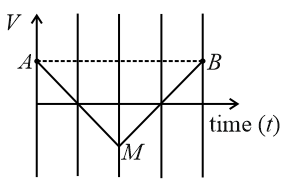
The velocity (v) versus time (t) plot of a particle is shown in the figure, for a time interval of 40 s. The total distance travelled by the particle and the and the average velocity during this period are, respectively___________,
From the velocity-time graph:
- Positive triangular region from 0 to 20 s
- Negative triangular region from 20 to 40 s
Distance travelled is total area under the speed-time graph.
First triangle:
$$\text{Area}_1=\frac{1}{2}\times20\times5=50\ \text{m}$$
Second triangle (take magnitude):
$$\text{Area}_2=\frac{1}{2}\times20\times5=50\ \text{m}$$
Total distance:
$$50+50=100\ \text{m}$$
Net displacement:
$$50-50=0$$
Average velocity:
$$v_{\text{avg}}=\frac{\text{displacement}}{\text{total time}}$$
$$v_{\text{avg}}=\frac{0}{40}=0\ \text{m/s}$$
The two projectiles are projected with the same initial velocities at the $$15°$$ and $$30°$$ with respect to the horizontal. The ratio of their ranges is $$1:x$$. The value of $$x$$ is :
Let the common initial speed be $$u$$ and the acceleration due to gravity be $$g$$.
The horizontal range of a projectile launched with angle $$\theta$$ is $$R = \dfrac{u^{2}\sin 2\theta}{g}$$.
Case 1: $$\theta_1 = 15^{\circ}$$
$$R_1 = \dfrac{u^{2}\sin 2(15^{\circ})}{g} = \dfrac{u^{2}\sin 30^{\circ}}{g}$$
Case 2: $$\theta_2 = 30^{\circ}$$
$$R_2 = \dfrac{u^{2}\sin 2(30^{\circ})}{g} = \dfrac{u^{2}\sin 60^{\circ}}{g}$$
Take the ratio $$\dfrac{R_1}{R_2}$$:
$$\dfrac{R_1}{R_2} = \dfrac{\sin 30^{\circ}}{\sin 60^{\circ}}$$
Use the standard trigonometric values $$\sin 30^{\circ} = \dfrac{1}{2}$$ and $$\sin 60^{\circ} = \dfrac{\sqrt{3}}{2}$$:
$$\dfrac{R_1}{R_2} = \dfrac{\tfrac{1}{2}}{\tfrac{\sqrt{3}}{2}} = \dfrac{1}{\sqrt{3}}$$
The problem states $$R_1 : R_2 = 1 : x$$, hence
$$x = \sqrt{3}$$
Therefore, the required value is $$\sqrt{3}$$.
Option B which is: $$\sqrt{3}$$
Two identical bodies, projected with the same speed at two different angles cover the same horizontal range $$R$$. If the time of flight of these bodies are 5 s and 10 s, respectively, then the value of $$R$$ is __________ m. (Take $$g = 10$$ m/s$$^2$$)
Solution :
For projectile motion,
$$T = \frac{2u\sin\theta}{g}$$
Given time of flights :
$$T_1 = 5\text{ s}$$
$$T_2 = 10\text{ s}$$
For same horizontal range with same speed, projection angles are complementary.
Hence,
$$\sin\theta_2 = \cos\theta_1$$
Now,
$$T_1T_2=\frac{2u\sin\theta_1}{g}\times\frac{2u\cos\theta_1}{g}$$
$$=\frac{4u^2\sin\theta_1\cos\theta_1}{g^2}$$
Using,
$$2\sin\theta\cos\theta = \sin2\theta$$
$$T_1T_2=\frac{2u^2\sin2\theta_1}{g^2}$$
Range of projectile :
$$R = \frac{u^2\sin2\theta}{g}$$
Therefore,
$$T_1T_2 = \frac{2R}{g}$$
Substituting values :
$$5 \times 10 = \frac{2R}{10}$$
$$50 = \frac{R}{5}$$
$$R = 250\text{ m}$$
Final Answer :
$$250\text{ m}$$
A river of width 200 m is flowing from west to east with a speed of 18 km/h. A boat, moving with speed of 36 km/h in still water, is made to travel one-round trip (bank to bank of the river). Minimum time taken by the boat for this journey and also the displacement along the river bank are _______ and ____________ respectively.
We are given that the river width is 200 m, the river speed is 18 km/h (west to east), and the boat speed in still water is 36 km/h. We need to find the minimum round-trip time and the displacement along the river bank.
First, we convert the speeds to meters per second: the river speed is $$v_r = 18 \text{ km/h} = 18 \times \frac{5}{18} = 5$$ m/s, and the boat speed in still water is $$v_b = 36 \text{ km/h} = 36 \times \frac{5}{18} = 10$$ m/s.
For the minimum crossing time, the boat should head straight across (perpendicular to the banks), so the component of its velocity perpendicular to the banks is the full 10 m/s.
The time for one crossing is then $$t_1 = \frac{\text{width}}{v_{\perp}} = \frac{200}{10} = 20$$ s, and the round-trip time is $$T = 2 \times 20 = 40$$ s.
Next, during each crossing the river current carries the boat downstream by an amount $$\text{drift} = v_r \times t_1 = 5 \times 20 = 100$$ m. On the return trip the situation is the same, so the total drift is $$\text{total drift} = 100 + 100 = 200$$ m in the direction of the river flow.
Thus, the minimum time is 40 s and the displacement along the river bank is 200 m, corresponding to Option (3): 40 s and 200 m.
A paratrooper jumps from an aeroplane and opens a parachute after 2 s of free fall and starts deaccelerating with $$3m/s^{2}$$. At 10 m height from ground, while descending with the help of parachute, the speed of paratrooper is 5 m/s. The initial height of the airplane is ___ m.
($$g = 10 m/s^{2}$$)
We need to find the initial height of the aeroplane given the paratrooper's motion in three phases.
First, during free fall for 2 seconds, we use $$v = u + gt$$ with $$u = 0$$, $$g = 10 \, \text{m/s}^2$$, and $$t = 2 \, \text{s}$$ which gives us $$v_1 = 0 + 10 \times 2 = 20 \, \text{m/s}$$. The distance fallen is then $$s_1 = ut + \tfrac{1}{2}gt^2 = 0 + \tfrac{1}{2} \times 10 \times 4 = 20 \, \text{m}$$.
Next, after the parachute opens, the paratrooper decelerates at $$a = 3 \, \text{m/s}^2$$, and since the initial velocity at this phase is $$v_1 = 20 \, \text{m/s}$$ and the speed reduces to $$5 \, \text{m/s}$$ at a height of 10 m above the ground, we apply $$v^2 = u^2 - 2as_2$$. Substituting the values gives $$5^2 = 20^2 - 2 \times 3 \times s_2$$, so $$25 = 400 - 6s_2$$ and hence $$6s_2 = 375 \implies s_2 = 62.5 \, \text{m}$$.
Finally, since the paratrooper is then 10 m above the ground, the total height of the aeroplane is $$H = s_1 + s_2 + 10 = 20 + 62.5 + 10 = 92.5 \, \text{m}$$.
The correct answer is Option (2): 92.5 m.
Water drops fall from a tap on the floor, 5 m below, at regular intervals of time, the first drop strikes the floor when the sixth drop begins to fall. The height at which the fourth drop will be from ground, at the instant when the first drop strikes the ground is _____ m.
$$(g=10m/s^{2}$$
We need to find the height of the fourth drop when the first drop strikes the ground.
The drops are released from a height of 5 m at regular intervals, and when the first drop hits the ground the sixth drop begins to fall.
Since the first drop falls through 5 m, its fall time satisfies $$5 = \frac{1}{2}(10)t^2 \implies t = 1$$ s.
There are five intervals between the first and sixth drop, so the time interval is $$\tau = t/5 = 0.2$$ s.
At t = 1 s, the fourth drop has been falling for $$1 - 3\tau = 1 - 0.6 = 0.4$$ s.
The distance fallen by the fourth drop is $$d = \frac{1}{2}(10)(0.4)^2 = 5 \times 0.16 = 0.8$$ m.
Hence its height from the ground is $$5 - 0.8 = 4.2$$ m.
Therefore, the answer is Option 3: 4.2 m.
A projectile is thrown upward at an angle $$60 ^{o}$$ with the horizontal. The speed of the projectile is 20 m/s when its direction of motion is $$45 ^{o}$$ with the horizontal. The initial speed of the projectile is ______ m/s.
We need to find the initial speed of a projectile thrown at $$60°$$ to the horizontal. The angle of projection is $$\theta = 60°$$, and at some point the speed is $$20$$ m/s when the direction of motion is $$45°$$ with the horizontal.
The horizontal component of velocity remains constant throughout the motion, given by $$v_x = u\cos 60° = \frac{u}{2}$$. At the point where the direction is $$45°$$, the horizontal component is also $$v_x = 20\cos 45° = \frac{20}{\sqrt{2}} = 10\sqrt{2}$$.
Equating the two expressions for the horizontal component gives $$\frac{u}{2} = 10\sqrt{2}$$, from which it follows that $$u = 20\sqrt{2}$$.
Therefore, the initial speed is $$20\sqrt{2}$$ m/s, which matches Option D.
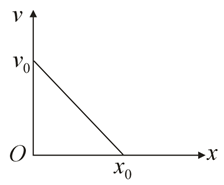
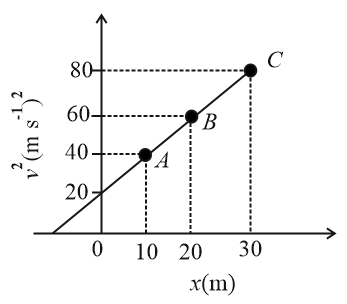
The velocity (v) - Distance (x) graph is shown in figure. Which graph represents accderation(a) versus distance (x) variation of this system?
A gun mounted on the ground fires bullets in all directions with same speed. The farthest distance the bullets could reach is 6.4 m. The speed of the bullets from the gun is ______ m/s.
(take $$g = 10$$ m/s$$^2$$)
For a projectile fired with initial speed $$u$$ at an angle $$\theta$$ to the horizontal, the horizontal range is given by
$$R = \frac{u^{2}\sin 2\theta}{g}$$.
The range becomes maximum when $$\sin 2\theta = 1$$, i.e. when $$2\theta = 90^{\circ}$$ or $$\theta = 45^{\circ}$$. Hence the maximum range is
$$R_{\max} = \frac{u^{2}}{g}\,\,\,\,\,\,\,-(1)$$
Given $$R_{\max} = 6.4\text{ m}$$ and $$g = 10\text{ m/s}^{2}$$. Substituting these values in $$(1)$$:
$$6.4 = \frac{u^{2}}{10}$$
$$u^{2} = 6.4 \times 10 = 64$$
$$u = \sqrt{64} = 8 \text{ m/s}$$
Therefore, the speed of the bullets is 8 m/s.
From 18 m height above the ground a ball is dropped from rest. The height above the ground at which the magnitude of velocity equal to the magnitude of acceleration (in the same set of units) due to gravity is _______ m. (Take $$g = 10$$ m/s$$^2$$ and neglect the air resistance)
For a freely falling body:
v² = 2g(h₀ − h)
Here initial height h₀ = 18 m
So:
v² = 2g(18 − h)
Given condition:
|v| = g
So:
v² = g²
equate:
g² = 2g(18 − h)
divide by g:
g = 2(18 − h)
10 = 36 − 2h
2h = 26
h = 13 m
A particle is thrown with a speed $$v$$ from a point $$O$$ at an angle $$\theta$$ with the horizontal plane such that it passes through the point $$P$$ at a height of $$1\,\mathrm{m}$$ and horizontal distance of $$5\,\mathrm{m}$$ from $$O$$, as shown in the figure. If acceleration due to gravity is $$g\,\mathrm{ms^{-2}}$$, then the correct statement(s) is(are):
The trajectory equation of a projectile is given by $$y = x \tan\theta - \frac{gx^2}{2v^2\cos^2\theta}$$, and the position of maximum height occurs at $$x_H = \frac{R}{2} = \frac{v^2 \sin 2\theta}{2g}$$.
Given coordinates of point $$P$$: $$(x, y) = (5, 1)$$
Evaluating Option (A) and (B) with $$\theta = 45^\circ$$:
$$1 = 5 \tan 45^\circ - \frac{g(5)^2}{2v^2 \cos^2 45^\circ}$$
$$1 = 5 - \frac{25g}{2v^2 \left(\frac{1}{2}\right)} = 5 - \frac{25g}{v^2}$$
$$\frac{25g}{v^2} = 4 \implies v^2 = \frac{25g}{4} \implies v = \frac{5\sqrt{g}}{2}\text{ ms}^{-1}$$
$$x_H = \frac{\left(\frac{25g}{4}\right) \sin 90^\circ}{2g} = \frac{25}{8} = 3.125\text{ m}$$
$$x_H = 3.125\text{ m} < 5\text{ m} \implies \text{maximum height is reached before } P$$
Evaluating Option (C) with $$\theta = 30^\circ$$:
$$1 = 5 \tan 30^\circ - \frac{g(5)^2}{2v^2 \cos^2 30^\circ} = \frac{5}{\sqrt{3}} - \frac{25g}{2v^2 \left(\frac{3}{4}\right)}$$
$$\frac{50g}{3v^2} = \frac{5}{\sqrt{3}} - 1 \implies v^2 = \frac{50g}{3\left(\frac{5}{\sqrt{3}} - 1\right)} = \frac{50g}{5\sqrt{3} - 3}$$
$$x_H = \frac{v^2 \sin 60^\circ}{2g} = \frac{50g}{2g(5\sqrt{3} - 3)} \cdot \frac{\sqrt{3}}{2} = \frac{25\sqrt{3}}{2(5\sqrt{3} - 3)} = \frac{25}{10 - 2\sqrt{3}} \approx \frac{25}{6.536} \approx 3.82\text{ m}$$
$$x_H = 3.82\text{ m} < 5\text{ m} \implies \text{maximum height is reached before } P$$
Evaluating Option (D) with $$\tan\theta = \frac{1}{5}$$:
$$1 = 5\left(\frac{1}{5}\right) - \frac{g(5)^2}{2v^2\cos^2\theta} \implies 1 = 1 - \frac{25g}{2v^2\cos^2\theta} \implies \frac{25g}{2v^2\cos^2\theta} = 0 \implies v \to \infty$$
A person sitting inside an elevator performs a weighing experiment with an object of mass 50 kg. Suppose that the variation of the height $$y$$ (in m) of the elevator, from the ground, with time $$t$$ (in s) is given by $$y = 8\left[1 + \sin\left(\frac{2\pi t}{T}\right)\right]$$, where $$T = 40\pi$$ s. Taking acceleration due to gravity, $$g = 10$$ m/s$$^2$$, the maximum variation of the object's weight (in N) as observed in the experiment is ________.
The apparent (measured) weight inside an accelerating elevator equals the normal reaction $$N$$ on the object.
For upward acceleration $$a$$ (upward taken positive) the force equation is
$$N - mg = ma \; \Rightarrow \; N = m\,(g + a) \qquad -(1)$$
The elevator’s position as a function of time is given:
$$y = 8\left[1 + \sin\!\left(\frac{2\pi t}{T}\right)\right], \qquad T = 40\pi\;\text{s} \qquad -(2)$$
Differentiate twice to obtain the acceleration.
Angular frequency:
$$k = \frac{2\pi}{T} = \frac{2\pi}{40\pi} = \frac{1}{20}\;\text{s}^{-1}$$
Velocity:
$$v = \frac{dy}{dt} = 8\,k\,\cos(k t)$$
Acceleration:
$$a = \frac{dv}{dt} = -8\,k^{2}\,\sin(k t) \qquad -(3)$$
The sine term varies between $$+1$$ and $$-1$$, hence
Maximum upward acceleration (sin$$=-1$$):
$$a_{\max} = +8\,k^{2}$$
Maximum downward acceleration (sin$$=+1$$):
$$a_{\min} = -8\,k^{2}$$
Therefore the spread of acceleration values is
$$a_{\max} - a_{\min} = 8k^{2} - (-8k^{2}) = 16k^{2} \qquad -(4)$$
Insert $$k = 1/20$$:
$$k^{2} = \left(\frac{1}{20}\right)^{2} = \frac{1}{400}$$
$$16k^{2} = 16 \times \frac{1}{400} = \frac{16}{400} = 0.04\;\text{m\,s}^{-2}$$
Mass of the object: $$m = 50\;\text{kg}$$.
Using $$-(1)$$, the spread in the normal reaction (apparent weight) equals $$m$$ times the acceleration spread:
$$\Delta N = m\,(a_{\max} - a_{\min}) = 50 \times 0.04 = 2\;\text{N}$$
Hence, the maximum variation in the weight reading is
2 N.
The position vector of a moving body at any instant of time is given as $$\vec r=(5t^2\hat i-5t\hat j)\,m.$$ The magnitude and direction of velocity at $$t=2\,s$$ is:
r = 5t²i-5tj. v = 10ti-5j. At t=2: v = 20i-5j. |v| = √(400+25) = √425 = 5√17.
Direction: angle with -ve y-axis: tan θ = 20/5 = 4. So θ = tan⁻¹(4) with -ve y-axis.
The correct answer is Option 4: 5√17 m/s, making angle tan⁻¹4 with -ve Y-axis.
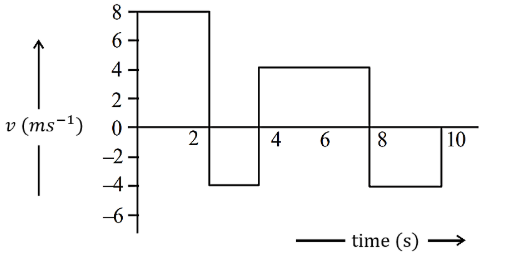
The velocity-time graph of an object moving along a straight line is shown in the figure. What is the distance covered by the object between t = 0 to t = 4 s ?
$$\text{Distance} = \text{Area of triangle (0 to 2 s)} + \text{Area of rectangle (2 to 4 s)}$$
$$\text{Distance} = \left(\frac{1}{2} \times 2 \times 10\right) + (2 \times 10) = 10 + 20 = 30\text{ m}$$
A river is flowing from west to east direction with speed of 9 km h$$^{-1}$$. If a boat capable of moving at a maximum speed of 27 km h$$^{-1}$$ in still water, crosses the river in half a minute, while moving with maximum speed at an angle of 150° to direction of river flow, then the width of the river is:
The river flows due east with speed $$v_r = 9 \text{ km h}^{-1}$$. The boat can move in still water with maximum speed $$v_b = 27 \text{ km h}^{-1}$$ and is steered at an angle $$150^{\circ}$$ to the river flow (angle measured counter-clockwise from east).
Take east as the $$+x$$-axis and north as the $$+y$$-axis.
Components of the boat’s velocity relative to water:
$$v_{bx} = v_b \cos 150^{\circ} = 27 \cos 150^{\circ} = 27 \left(-\frac{\sqrt{3}}{2}\right) = -\frac{27\sqrt{3}}{2} \text{ km h}^{-1}$$ $$-(1)$$
$$v_{by} = v_b \sin 150^{\circ} = 27 \sin 150^{\circ} = 27 \left(\frac{1}{2}\right) = \frac{27}{2} \text{ km h}^{-1}$$ $$-(2)$$
The river velocity has only an $$x$$-component:
$$v_{rx} = +9 \text{ km h}^{-1}, \qquad v_{ry}=0$$
Ground (resultant) velocity of the boat:
$$v_{gx} = v_{bx} + v_{rx} = -\frac{27\sqrt{3}}{2} + 9 \text{ km h}^{-1}$$ $$-(3)$$
$$v_{gy} = v_{by} + v_{ry} = \frac{27}{2} \text{ km h}^{-1}$$ $$-(4)$$
To cross the river we need the northward component $$v_{gy}$$ only. Hence the time taken $$t$$ and river width $$D$$ are related by
$$D = v_{gy}\, t$$ $$-(5)$$
The boat crosses in half a minute:
$$t = \frac{1}{2} \text{ min} = \frac{1}{2}\times\frac{1}{60} \text{ h} = \frac{1}{120} \text{ h}$$ $$-(6)$$
Substituting $$v_{gy}$$ from $$(4)$$ into $$(5)$$:
$$D = \frac{27}{2} \times \frac{1}{120} \text{ km}$$
Simplify:
$$D = \frac{27}{2 \times 120} \text{ km} = \frac{27}{240} \text{ km} = 0.1125 \text{ km}$$
Convert kilometres to metres:
$$D = 0.1125 \times 1000 = 112.5 \text{ m}$$
Therefore, the width of the river is $$112.5 \text{ m}$$, which corresponds to Option B.
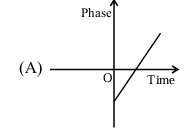
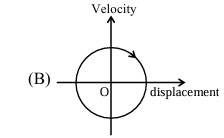
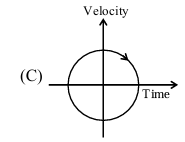
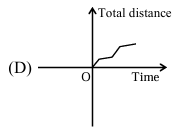
Which of the following curves possibly represent one-dimensional motion of a particle ?
Choose the correct answer from the options given below :
Let’s check each graph using basic rules of 1D motion.
Key idea: for any physical motion, at a given time there must be a unique value of position/velocity/etc. Also, graphs must satisfy physical definitions (like velocity = dx/dt, distance can’t decrease, etc.)
(A) Phase vs Time (straight line)
Phase increasing linearly with time is possible (like uniform motion in SHM phase representation).
No contradiction → valid.
(B) Velocity vs Displacement (circle)
This can represent motion like SHM where
$$v^2\propto(A^2-x^2)$$
which gives a circular/elliptic relation.
For each displacement, two velocities (forward/backward) are allowed → physically valid.
(C) Velocity vs Time (circle)
This is not possible.
At a given time, velocity must have a single value.
But a circle gives two velocities for the same time → violates definition.
So invalid.
(D) Total distance vs Time
Total distance must:
- always increase (never decrease)
- can be constant temporarily (if particle stops)
The graph shown is non-decreasing → valid.
Final answer:
A, B and D only
(C is not possible because it gives multiple velocities at the same time)
A particle is projected with velocity $$u$$ so that its horizontal range is three times the maximum height attained by it. The horizontal range of the projectile is given as $$\dfrac{nu^2}{25g}$$, where value of n is: (Given 'g' is the acceleration due to gravity).
The standard formulae for a projectile launched with speed $$u$$ at an angle $$\theta$$ above the horizontal are:
Horizontal range:
$$R = \frac{u^{2}\sin 2\theta}{g}$$
Maximum height:
$$H = \frac{u^{2}\sin^{2}\theta}{2g}$$
The condition given in the problem is that the range is three times the maximum height:
$$R = 3H$$
Substitute the expressions for $$R$$ and $$H$$:
$$\frac{u^{2}\sin 2\theta}{g} = 3\left(\frac{u^{2}\sin^{2}\theta}{2g}\right)$$
Cancel the common factors $$u^{2}$$ and $$g$$:
$$\sin 2\theta = \frac{3}{2}\sin^{2}\theta$$ $$-(1)$$
Use the trigonometric identity $$\sin 2\theta = 2\sin\theta\cos\theta$$ and substitute it into $$(1)$$:
$$2\sin\theta\cos\theta = \frac{3}{2}\sin^{2}\theta$$
Divide both sides by $$\sin\theta$$ (since $$\theta \neq 0^{\circ},90^{\circ}$$ for a projectile with non-zero range):
$$2\cos\theta = \frac{3}{2}\sin\theta$$
Rearrange to get the cotangent of the launch angle:
$$\frac{\cos\theta}{\sin\theta} = \frac{3}{4} \quad\Longrightarrow\quad \cot\theta = \frac{3}{4}$$
Hence
$$\tan\theta = \frac{4}{3}$$
From the right-triangle definition, this gives
$$\sin\theta = \frac{4}{5},\qquad \cos\theta = \frac{3}{5}$$
Now compute $$\sin 2\theta$$ using $$\sin 2\theta = 2\sin\theta\cos\theta$$:
$$\sin 2\theta = 2\left(\frac{4}{5}\right)\left(\frac{3}{5}\right) = \frac{24}{25}$$
Finally, substitute $$\sin 2\theta$$ into the range formula:
$$R = \frac{u^{2}\sin 2\theta}{g} = \frac{u^{2}}{g}\left(\frac{24}{25}\right) = \frac{24\,u^{2}}{25g}$$
The question writes the range as $$\dfrac{nu^{2}}{25g}$$. Comparing gives $$n = 24$$.
Therefore, the correct option is Option D (24).
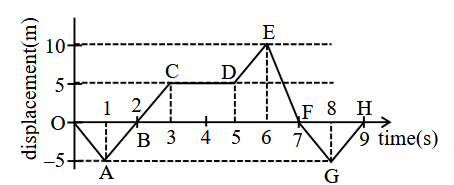
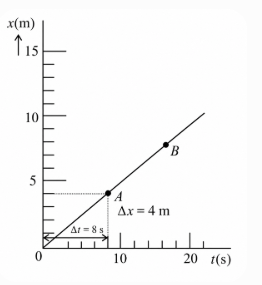
The displacement x versus time graph is shown below.
(A) The average velocity during 0 to 3 s is 10 m/s
(B) The average velocity from 3 to 5 s is 0 m/s
(C) The instantaneous velocity at t = 2 s is 5 m/s
(D) The average velocity during 5 to 7 s and instantaneous velocity at t = 6.5 s are equal
(E) The average velocity from t = 0 to t = 9 s is zero
Choose the correct answer from the options given below:
First, remember:
- Slope of x-t graph = velocity
- Straight line → constant velocity
- Horizontal line → zero velocity
- Average velocity = (final position − initial position) / time
(A) Average velocity from 0 to 3 s
From the graph:
- $$At\ t=0,x=0$$
- $$At\ t=3,x=5$$
So,
$$v_{avg}=\frac{5-0}{3}=\frac{5}{3}\approx1.67\text{ m/s}$$
Given statement says $$10m/s,$$ which is clearly wrong.
So, (A) is false
(B) Average velocity from 3 to 5 s
From graph:
- $$At\ t=3,x=5$$
- $$At\ t=5,x=5$$
So displacement does not change
$$v_{avg}=\frac{5-5}{5-3}=0$$
This means the object is at rest.
So, (B) is true
(C) Instantaneous velocity at t=2 s
At t=2, the graph lies on the straight line between:
- $$(1,-5)and(3,5)$$
Slope (velocity) of this line:
$$v=\frac{5-(-5)}{3-1}=\frac{10}{2}=5\text{ m/s}$$
Since it’s a straight line, velocity is constant in that region.
So, (C) is true
(D) Compare velocities
Average velocity from 5 to 7:
- $$At\ t=5,x=5$$
- $$At t=7,x=0$$
$$v_{avg}=\frac{0-5}{7-5}=\frac{-5}{2}=-2.5$$
Instantaneous velocity at 6.5 s:
This lies between t=6 and t=7, where graph is a straight line from:
- (6,10)to (7,0)
$$v=\frac{0-10}{7-6}=-10$$
Clearly:
$$-2.5\ne-10$$
So, (D) is false
(E) Average velocity from 0 to 9 s
- At t=0, x=0
- At t=9, x=0
$$v_{avg}=\frac{0-0}{9-0}=0$$
So, (E) is true
Final Answer:
(B), (C), (E) only
Two projectiles are fired from ground with same initial speeds from same point at angles $$(45^\circ + \alpha)$$ and $$(45^\circ - \alpha)$$ with horizontal direction. The ratio of their times of flights is
Let the common initial speed of the two projectiles be $$u$$ and let the acceleration due to gravity be $$g$$ (acting downward).
Case 1: Projection angle $$\theta_1 = 45^\circ + \alpha$$
Time of flight formula for a projectile launched from ground level is
$$T = \frac{2u \sin\theta}{g}$$
Thus, $$T_1 = \frac{2u \sin (45^\circ + \alpha)}{g}$$ $$-(1)$$
Case 2: Projection angle $$\theta_2 = 45^\circ - \alpha$$
Similarly,
$$T_2 = \frac{2u \sin (45^\circ - \alpha)}{g}$$ $$-(2)$$
We require the ratio $$\dfrac{T_1}{T_2}$$. Using $$(1)$$ and $$(2)$$, the common factors $$\frac{2u}{g}$$ cancel out:
$$\frac{T_1}{T_2} = \frac{\sin (45^\circ + \alpha)}{\sin (45^\circ - \alpha)}$$ $$-(3)$$
Apply the sine addition-subtraction identities:
$$\sin (45^\circ \pm \alpha) = \sin 45^\circ \cos\alpha \pm \cos 45^\circ \sin\alpha$$
Since $$\sin 45^\circ = \cos 45^\circ = \frac{\sqrt{2}}{2}$$, we obtain
$$\sin (45^\circ + \alpha) = \frac{\sqrt{2}}{2}(\cos\alpha + \sin\alpha)$$
$$\sin (45^\circ - \alpha) = \frac{\sqrt{2}}{2}(\cos\alpha - \sin\alpha)$$
Substitute these into $$(3)$$:
$$\frac{T_1}{T_2} \;=\; \frac{\frac{\sqrt{2}}{2}(\cos\alpha + \sin\alpha)}{\frac{\sqrt{2}}{2}(\cos\alpha - \sin\alpha)}$$
The factor $$\frac{\sqrt{2}}{2}$$ cancels out, giving
$$\frac{T_1}{T_2} = \frac{\cos\alpha + \sin\alpha}{\cos\alpha - \sin\alpha}$$ $$-(4)$$
To convert the expression to a form involving $$\tan\alpha$$, divide numerator and denominator of $$(4)$$ by $$\cos\alpha$$:
$$\frac{T_1}{T_2} = \frac{1 + \tan\alpha}{1 - \tan\alpha}$$
Hence, the required ratio of times of flight is $$\dfrac{1 + \tan\alpha}{1 - \tan\alpha}$$, which corresponds to Option D.
A particle moves along the x-axis and has its displacement x varying with time t according to the equation $$x = c_0(t^2 - 2) + c(t - 2)^2$$ where $$c_0$$ and $$c$$ are constants of appropriate dimensions. Then, which of the following statements is correct?
The displacement of the particle is given as
$$x = c_0\,(t^{2}-2) + c\,(t-2)^{2} \qquad -(1)$$
Step 1 - Find velocity
Velocity is the time-derivative of displacement:
$$v = \frac{dx}{dt}$$
Differentiating $$-(1)$$ term by term:
• For $$c_0\,(t^{2}-2)$$: $$\frac{d}{dt}\big(c_0\,(t^{2}-2)\big)=c_0\,(2t)=2c_0t$$
• For $$c\,(t-2)^{2}$$: $$\frac{d}{dt}\big(c\,(t-2)^{2}\big)=c\,(2\,(t-2))=2c\,(t-2)$$
Therefore
$$v = 2c_0t + 2c\,(t-2) \qquad -(2)$$
Step 2 - Find acceleration
Acceleration is the time-derivative of velocity:
$$a = \frac{dv}{dt}$$
Differentiating $$-(2)$$:
• $$\frac{d}{dt}\big(2c_0 t\big)=2c_0$$
• $$\frac{d}{dt}\big(2c\,(t-2)\big)=2c$$
Hence
$$a = 2c_0 + 2c = 2\,(c_0 + c) \qquad -(3)$$
Acceleration is a constant equal to $$2(c_0 + c)$$.
Step 3 - Check other statements
Initial velocity (at $$t=0$$) from $$-(2)$$:
$$v(0)=2c_0\,(0) + 2c\,(0-2) = -4c$$
Thus the initial velocity is $$-4c$$, not $$4c$$.
Conclusion
From $$-(3)$$, the only correct statement is: “the acceleration of the particle is $$2(c + c_0)$$,” which corresponds to Option D.
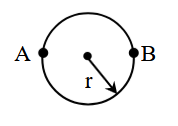
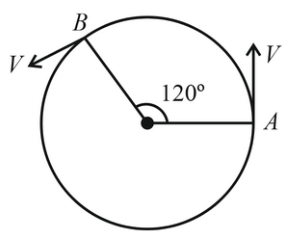
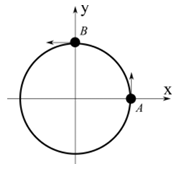
A sportsman runs around a circular track of radius r such that he traverses the path ABAB. The distance travelled and displacement, respectively, are :
Distance travelled :A TO B,B TO A, A TO B
A TO B =$$\pi\ $$r
B to A =$$\pi\ $$r
A TO B =$$\pi\ $$r
Total distance =3*$$\pi\ $$r
Displacement : A TO B = 2r
Two balls with same mass and initial velocity, are projected at different angles in such a way that maximum height reached by first ball is 8 times higher than that of the second ball. $$T_1$$ and $$T_2$$ are the total flying times of first and second ball, respectively, then the ratio of $$T_1$$ and $$T_2$$ is :
Let the common initial speed of both balls be $$u$$ and let the projection angles with the horizontal be $$\theta_1$$ and $$\theta_2$$ for the first and the second ball, respectively.
Step 1 - Write the expression for maximum height.
For a projectile launched with speed $$u$$ at an angle $$\theta$$, the maximum height reached is
$$H=\frac{u^{2}\sin^{2}\theta}{2g}$$
Step 2 - Set up the given height ratio.
Given that the first ball rises eight times higher than the second,
$$\frac{H_1}{H_2}=8$$
Using the formula for $$H$$,
$$\frac{\dfrac{u^{2}\sin^{2}\theta_1}{2g}}{\dfrac{u^{2}\sin^{2}\theta_2}{2g}}=8$$
Simplifying (the factors $$u^{2}$$ and $$2g$$ cancel),
$$\frac{\sin^{2}\theta_1}{\sin^{2}\theta_2}=8$$
Taking square root on both sides,
$$\frac{\sin\theta_1}{\sin\theta_2}=2\sqrt{2}$$ $$-(1)$$
Step 3 - Write the expression for time of flight.
For the same projectile, the total time of flight is
$$T=\frac{2u\sin\theta}{g}$$
Step 4 - Form the required ratio of flight times.
Taking the ratio of times for the two balls,
$$\frac{T_1}{T_2}=\frac{\dfrac{2u\sin\theta_1}{g}}{\dfrac{2u\sin\theta_2}{g}} =\frac{\sin\theta_1}{\sin\theta_2}$$
Using result $$-(1)$$,
$$\frac{T_1}{T_2}=2\sqrt{2}$$
Final ratio.
Hence
$$T_1:T_2 = 2\sqrt{2}:1$$
So the correct choice is Option A.
A helicopter flying horizontally with a speed of 360 km/h at an altitude of 2 km, drops an object at an instant. The object hits the ground at a point O, 20 s after it is dropped. Displacement of 'O' from the position of helicopter where the object was released is :
(use acceleration due to gravity $$g = 10$$ m/s$$^2$$and neglect air resistance)
Speed of the helicopter: $$v = 360 \text{ km h}^{-1} = 360 \times \frac{1000}{3600}\,\text{m s}^{-1} = 100 \,\text{m s}^{-1}$$
Altitude from which the object is released: $$h = 2 \text{ km} = 2000 \text{ m}$$
Time taken by the object to fall through $$h$$ (free-fall, neglecting air resistance) is obtained from $$h = \frac12 \, g t^{2} \; \Longrightarrow \; t = \sqrt{\frac{2h}{g}}$$
Substituting $$h = 2000 \text{ m}$$ and $$g = 10 \text{ m s}^{-2}$$, $$t = \sqrt{\frac{2 \times 2000}{10}} = \sqrt{400} = 20 \text{ s}$$
Thus the object reaches the ground exactly $$20 \text{ s}$$ after it is dropped.
Horizontal distance travelled in this time by either the helicopter or the object is $$x = v t = 100 \,\text{m s}^{-1} \times 20 \text{ s} = 2000 \text{ m} = 2 \text{ km}$$
Vertical distance descended by the object is the full altitude, i.e. $$y = 2 \text{ km}$$ downward.
Hence the displacement vector of the object, measured from the point of release on the helicopter, has components horizontal $$2 \text{ km}$$ and vertical $$2 \text{ km}$$. Its magnitude is $$\sqrt{(2\text{ km})^{2} + (2\text{ km})^{2}} = 2\sqrt{2}\ \text{km}$$
Therefore, the required displacement is $$2\sqrt{2}$$ km.
Option D.
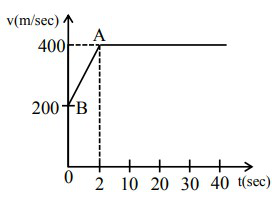
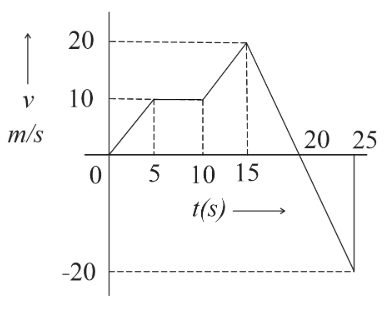
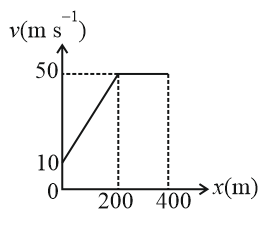
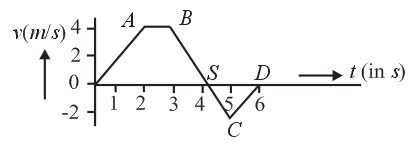
The motion of an airplane is represented by velocity-time graph as shown below. The distance covered by
airplane in the first 30.5 second is _______ km .
Let us divide this problem into 2 parts:-
First 2 seconds where the velocity changes , which means acceleration is present
Second part from 2 seconds to 30.5 (28.5 seconds in total) seconds where Velocity is constant
We know that distance s:-
$$s=ut+\ \frac{\ 1}{2}at^2$$
For first 2 seconds :-
u=$$200\ \ \frac{\ m}{s}$$
a=$$\ \frac{\ v_f=v_i}{t}$$
a=$$\ \frac{\ 400-200}{2}$$
a=100 $$\ \frac{\ m}{s^2}$$
Now $$s=200\times\ 2\ +\ \ \frac{\ 1}{2}\times\ 100\times\ \left(2\right)^2$$
$$s=600\ m$$
For next 28.5 s a=0(constant velocity), Here u=400 $$\ \frac{\ m}{s}$$
so s=$$ut$$
s=$$400\times\ 28.5$$
s=11400 m
now adding both
$$s_{total}$$ = 600+ 11400
$$s_{total}$$= 12000 m = 12 Km
The angle of projection of a particle is measured from the vertical axis as $$\phi$$ and the maximum height reached by the particle is $$h_m$$. Here $$h_m$$ as function of $$\phi$$ can be presented as
given
angle φ is measured from vertical
so convert to usual projectile angle θ (from horizontal):
θ = 90° − φ
maximum height formula:
hₘ = (u² sin²θ) / (2g)
substitute θ:
hₘ = (u² sin²(90° − φ)) / (2g)
use identity:
sin(90° − φ) = cosφ
so,
hₘ = (u² cos²φ) / (2g)
so relation is:
hₘ ∝ cos²φ
now understand behavior of cos²φ
when φ = 0°
cosφ = 1 → hₘ is maximum
when φ increases
cosφ decreases → hₘ decreases
when φ = 90°
cosφ = 0 → hₘ = 0
so graph must:
start at maximum value at φ = 0
decrease continuously
reach zero at φ = 90°
shape:
cos²φ decreases slowly at first, then faster
so curve is downward bending (not straight)
check options:
A → increasing → wrong
B → goes up then down → wrong
C → starts high, smoothly decreases to zero → correct
D → decreases too sharply like exponential → wrong
final answer: C
Two particles are located at equal distance from origin. The position vectors of those are represented by $$\overline{A}=2\widehat{i}+3n\widehat{j}+2\widehat{k}$$ and $$\overline{B}=2\widehat{i}-2\widehat{j}+4p\widehat{k}$$, respectively. If both the vectors are at right angle to each other, the value of $$n^{-1}$$ is _____ .
Let the two position vectors be $$\vec{A} = 2\hat{i} + 3n\hat{j} + 2\hat{k}$$ and $$\vec{B} = 2\hat{i} - 2\hat{j} + 4p\hat{k}$$. Since both particles are equidistant from the origin, their magnitudes are equal, that is $$|\vec{A}| = |\vec{B}|$$.
Thus we have $$ 4 + 9n^2 + 4 = 4 + 4 + 16p^2 $$ which simplifies to $$ 9n^2 = 16p^2 \quad \cdots (1).$$
Moreover, the perpendicularity condition $$\vec{A}\cdot\vec{B}=0$$ gives $$ (2)(2) + (3n)(-2) + (2)(4p) = 0 $$ or $$ 4 - 6n + 8p = 0, $$ hence $$ 8p = 6n - 4 $$ and $$ p = \frac{6n - 4}{8} = \frac{3n - 2}{4} \quad \cdots (2).$$
Substituting (2) into (1) yields $$ 9n^2 = 16 \left(\frac{3n - 2}{4}\right)^2 = 16 \cdot \frac{(3n-2)^2}{16} = (3n-2)^2, $$ so $$ 9n^2 = 9n^2 - 12n + 4, $$ which leads to $$ 0 = -12n + 4 $$ and $$ n = \frac{1}{3}. $$
Therefore, $$n^{-1} = 3$$, and the answer is 3.
A particle is projected at an angle of $$30^{o}$$ from horizontal at a speed of $$ 60 m/s.$$ The height traversed by the particle in the first second is $$ h_0 $$ and height traversed in the last second, before it reaches the maximum height, is $$ h_1.$$ The ratio $$h_0:h_1 $$ is _______[Take, $$g=10m/s^{2}]$$
A particle is projected at $$30°$$ from horizontal at 60 m/s. We need to find the ratio $$h_0 : h_1$$.
$$u_y = u \sin 30° = 60 \times \frac{1}{2} = 30$$ m/s
At maximum height, $$v_y = 0$$:
$$0 = u_y - gt \Rightarrow t = \frac{u_y}{g} = \frac{30}{10} = 3$$ s
$$h_0 = u_y(1) - \frac{1}{2}g(1)^2 = 30 - 5 = 25$$ m
The last second is from t = 2 to t = 3.
Height at t = 2: $$y_2 = 30(2) - \frac{1}{2}(10)(4) = 60 - 20 = 40$$ m
Height at t = 3: $$y_3 = 30(3) - \frac{1}{2}(10)(9) = 90 - 45 = 45$$ m
$$h_1 = y_3 - y_2 = 45 - 40 = 5$$ m
$$h_0 : h_1 = 25 : 5 = 5 : 1$$
The answer is 5.
A person travelling on a straight line moves with a uniform velocity $$v_1$$ for a distance x and with a uniform velocity $$v_2$$ for the next $$\frac{3}{2}x$$ distance. The average velocity in this motion is $$\frac{50}{7}$$ m/s. If $$v_1$$ is 5 m/s then $$v_2$$ = ______ m/s.
Total distance covered $$S = x + \frac{3}{2}x = \frac{5}{2}x$$.
Time taken in the first part $$t_1 = \frac{\text{distance}}{\text{speed}} = \frac{x}{v_1}$$.
Given $$v_1 = 5 \text{ m/s}$$, so $$t_1 = \frac{x}{5}$$.
Time taken in the second part $$t_2 = \frac{\frac{3}{2}x}{v_2} = \frac{3x}{2v_2}$$.
Total time $$T = t_1 + t_2 = \frac{x}{5} + \frac{3x}{2v_2}$$.
The average velocity formula is
$$\text{Average velocity} = \frac{\text{Total distance}}{\text{Total time}}$$.
According to the question,
$$\frac{\frac{5}{2}x}{\frac{x}{5} + \frac{3x}{2v_2}} = \frac{50}{7}$$.
Cancel the common factor $$x$$ from numerator and denominator:
$$\frac{\frac{5}{2}}{\frac{1}{5} + \frac{3}{2v_2}} = \frac{50}{7}$$.
Cross-multiply:
$$\frac{5}{2} \times \frac{7}{50} = \frac{1}{5} + \frac{3}{2v_2}$$.
Simplify the left side:
$$\frac{5}{2} \times \frac{7}{50} = \frac{35}{100} = \frac{7}{20}$$.
Thus,
$$\frac{7}{20} = \frac{1}{5} + \frac{3}{2v_2}$$.
Convert $$\frac{1}{5}$$ to a denominator of 20:
$$\frac{1}{5} = \frac{4}{20}$$.
Subtract $$\frac{4}{20}$$ from both sides:
$$\frac{7}{20} - \frac{4}{20} = \frac{3}{2v_2}$$
$$\frac{3}{20} = \frac{3}{2v_2}$$.
Cancel the common factor 3:
$$\frac{1}{20} = \frac{1}{2v_2}$$.
Cross-multiply to find $$v_2$$:
$$2v_2 = 20 \; \Longrightarrow \; v_2 = 10 \text{ m/s}.$$
Hence, the required velocity $$v_2$$ is 10 m/s.
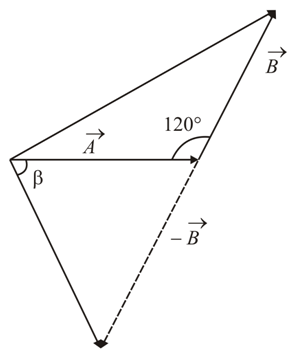
If two vectors $$\vec{A}$$ and $$\vec{B}$$ having equal magnitude $$R$$ are inclined at an angle $$\theta$$, then
We need to find $$|\vec{A} + \vec{B}|$$ for two vectors of equal magnitude $$R$$ inclined at angle $$\theta$$.
Since the magnitude of the sum of two vectors is given by the parallelogram law, $$|\vec{A} + \vec{B}|^2 = |\vec{A}|^2 + |\vec{B}|^2 + 2|\vec{A}||\vec{B}|\cos\theta$$.
Substituting $$|\vec{A}| = |\vec{B}| = R$$ into this expression gives $$|\vec{A} + \vec{B}|^2 = R^2 + R^2 + 2R^2\cos\theta = 2R^2(1 + \cos\theta)$$.
Using the double angle identity $$1 + \cos\theta = 2\cos^2\left(\frac{\theta}{2}\right)$$, it follows that $$|\vec{A} + \vec{B}|^2 = 2R^2 \times 2\cos^2\left(\frac{\theta}{2}\right) = 4R^2\cos^2\left(\frac{\theta}{2}\right)$$.
Now, taking the positive square root yields $$|\vec{A} + \vec{B}| = 2R\cos\left(\frac{\theta}{2}\right)$$.
For verification, one can similarly compute $$|\vec{A} - \vec{B}|^2 = 2R^2(1-\cos\theta) = 4R^2\sin^2\left(\frac{\theta}{2}\right)$$, giving $$|\vec{A}-\vec{B}| = 2R\sin\left(\frac{\theta}{2}\right)$$, which matches Option 1's formula but with coefficient 2 (not $$\sqrt{2}$$) and therefore Option 1 is incorrect.
The correct answer is Option 3: $$|\vec{A} + \vec{B}| = 2R\cos\frac{\theta}{2}$$.
The angle between vector $$\vec{Q}$$ and the resultant of $$(2\vec{Q} + 2\vec{P})$$ and $$(2\vec{Q} - 2\vec{P})$$ is :
We need to find the angle between $$\vec{Q}$$ and the resultant of $$(2\vec{Q} + 2\vec{P})$$ and $$(2\vec{Q} - 2\vec{P})$$.
Find the resultant.
$$ \vec{R} = (2\vec{Q} + 2\vec{P}) + (2\vec{Q} - 2\vec{P}) = 4\vec{Q} $$
The resultant is $$4\vec{Q}$$, which is in the same direction as $$\vec{Q}$$.
Therefore, the angle between $$\vec{Q}$$ and $$\vec{R} = 4\vec{Q}$$ is $$0°$$.
The correct answer is Option (2): $$0°$$.
A body projected vertically upwards with a certain speed from the top of a tower reaches the ground in $$t_1$$. If it is projected vertically downwards from the same point with the same speed, it reaches the ground in $$t_2$$. Time required to reach the ground, if it is dropped from the top of the tower, is :
Let the tower height be $$h$$, initial speed be $$u$$, and $$g$$ be acceleration due to gravity.
Projected upward: Taking downward as positive:
$$h = -ut_1 + \frac{1}{2}gt_1^2$$ ... (1)
Projected downward:
$$h = ut_2 + \frac{1}{2}gt_2^2$$ ... (2)
Dropped (u = 0):
$$h = \frac{1}{2}gt^2$$ ... (3)
From (1): $$h = \frac{1}{2}gt_1^2 - ut_1$$
From (2): $$h = \frac{1}{2}gt_2^2 + ut_2$$
Adding (1) and (2): $$2h = \frac{1}{2}g(t_1^2 + t_2^2) + u(t_2 - t_1)$$
Subtracting (1) from (2): $$0 = \frac{1}{2}g(t_2^2 - t_1^2) + u(t_1 + t_2)$$
$$u = \frac{g(t_1^2 - t_2^2)}{2(t_1 + t_2)} = \frac{g(t_1 - t_2)}{2}$$
Substituting back into (2): $$h = \frac{g(t_1-t_2)}{2} \cdot t_2 + \frac{1}{2}gt_2^2 = \frac{g}{2}(t_1 t_2 - t_2^2 + t_2^2) = \frac{g t_1 t_2}{2}$$
From (3): $$t = \sqrt{\frac{2h}{g}} = \sqrt{\frac{2 \cdot \frac{g t_1 t_2}{2}}{g}} = \sqrt{t_1 t_2}$$.
The correct answer is Option A: $$\sqrt{t_1 t_2}$$.
A body starts moving from rest with constant acceleration covers displacement $$S_1$$ in first $$(p - 1)$$ seconds and $$S_2$$ in first $$p$$ seconds. The displacement $$S_1 + S_2$$ will be made in time :
$$S_1 = \frac{1}{2}a(p-1)^2$$, $$S_2 = \frac{1}{2}ap^2$$.
$$S_1 + S_2 = \frac{a}{2}[(p-1)^2 + p^2] = \frac{a}{2}(2p^2 - 2p + 1)$$
If this equals $$\frac{1}{2}at^2$$: $$t^2 = 2p^2 - 2p + 1$$, $$t = \sqrt{2p^2-2p+1}$$.
The answer corresponds to Option (2).
A bullet is fired into a fixed target looses one third of its velocity after travelling 4 cm. It penetrates further $$D \times 10^{-3}$$ m before coming to rest. The value of $$D$$ is :
Let the initial velocity be $$u$$. After travelling 4 cm, velocity = $$\frac{2u}{3}$$.
Using $$v^2 = u^2 - 2as$$ (deceleration $$a$$):
$$\frac{4u^2}{9} = u^2 - 2a(0.04)$$
$$2a(0.04) = u^2 - \frac{4u^2}{9} = \frac{5u^2}{9}$$
$$a = \frac{5u^2}{9 \times 0.08} = \frac{5u^2}{0.72}$$
For the bullet to come to rest from $$v = \frac{2u}{3}$$:
$$0 = \frac{4u^2}{9} - 2a \cdot D'$$
$$D' = \frac{4u^2}{18a} = \frac{4u^2}{18 \times \frac{5u^2}{0.72}} = \frac{4 \times 0.72}{18 \times 5} = \frac{2.88}{90} = 0.032 \text{ m} = 32 \times 10^{-3} \text{ m}$$
So $$D = 32$$.
The answer is $$32$$, which corresponds to Option (1).
A particle is moving in a straight line. The variation of position $$x$$ as a function of time $$t$$ is given as $$x = (t^3 - 6t^2 + 20t + 15)$$ m. The velocity of the body when its acceleration becomes zero is:
We need to find the velocity of a particle when its acceleration is zero, given $$x = t^3 - 6t^2 + 20t + 15$$.
Find the velocity.
$$v = \frac{dx}{dt} = 3t^2 - 12t + 20$$
Find the acceleration.
$$a = \frac{dv}{dt} = 6t - 12$$
Find when acceleration is zero.
$$6t - 12 = 0 \implies t = 2$$ s
Find velocity at $$t = 2$$.
$$v(2) = 3(4) - 12(2) + 20 = 12 - 24 + 20 = 8$$ m/s
The correct answer is Option (2): 8 m/s.
A particle moving in a straight line covers half the distance with speed $$6$$ m/s. The other half is covered in two equal time intervals with speeds $$9$$ m/s and $$15$$ m/s respectively. The average speed of the particle during the motion is :
Let the total distance be $$2d$$.
First half (distance $$d$$): Speed = 6 m/s, so time = $$\frac{d}{6}$$.
Second half (distance $$d$$): Covered in two equal time intervals. Let each interval be $$t$$.
Distance in first interval = $$9t$$, distance in second = $$15t$$.
Total: $$9t + 15t = 24t = d$$, so $$t = \frac{d}{24}$$.
Total time for second half = $$2t = \frac{d}{12}$$.
Total time = $$\frac{d}{6} + \frac{d}{12} = \frac{2d + d}{12} = \frac{3d}{12} = \frac{d}{4}$$.
Average speed = $$\frac{\text{Total distance}}{\text{Total time}} = \frac{2d}{d/4} = 8$$ m/s.
The correct answer is Option 2: 8 m/s.
Position of an ant (S in metres) moving in $$Y - Z$$ plane is given by $$S = 2t^2 \hat{j} + 5\hat{k}$$ (where $$t$$ is in second). The magnitude and direction of velocity of the ant at $$t = 1$$ s will be :
The position is given by $$\vec{S} = 2t^2 \hat{j} + 5\hat{k}$$.
Velocity is the time derivative of position:
$$\vec{v} = \frac{d\vec{S}}{dt} = 4t\hat{j} + 0\hat{k} = 4t\hat{j}$$
At $$t = 1$$ s:
$$\vec{v} = 4(1)\hat{j} = 4\hat{j}$$ m/s
The magnitude is $$4$$ m/s and the direction is along the y-direction.
The answer is $$4 \text{ m s}^{-1}$$ in y-direction, which corresponds to Option (4).
Projectiles $$A$$ and $$B$$ are thrown at angles of $$45°$$ and $$60°$$ with vertical respectively from top of a 400 m high tower. If their times of flight are same, the ratio of their speeds of projection $$v_A : v_B$$ is:
Given,
Two Projectiles A and B are thrown with an angle of $$45°$$ and $$60°$$ with vertical
In the question it is specified that the angle is with respect to the vertical
For the Time of flight (T) to be same their vertical velocities must be equal
So
As it is with respect to vertical the vertical velocities are:-
For A $$v_A=v_a\cos\theta\ _A$$ ($$\cos\theta\ \ as\ \ \theta\ \ is\ with\ respect\ to\ vertical$$)
and For B $$v_B=v_b\cos\theta\ _A$$
Now these both should be equal
so ,
$$v_a\cos\left(45^{\circ\ }\right)=v_b\cos\left(60^{\circ\ }\right)$$
$$v_a\times\ \frac{1}{\sqrt{\ 2}}=v_b\times\ \frac{1}{2}$$
$$\frac{v_a}{v_b}=\ \frac{\sqrt{\ 2}}{2}=\frac{1}{\sqrt{\ 2}}$$
The angle of projection for a projectile to have same horizontal range and maximum height is :
R = u²sin2θ/g, H = u²sin²θ/(2g). R=H: sin2θ = sin²θ/2 → 2sinθcosθ = sin²θ/2 → 4cosθ = sinθ → tanθ = 4.
Option (1): tan⁻¹(4).
Train A is moving along two parallel rail tracks towards north with $$72 \text{ km h}^{-1}$$ and train B is moving towards south with speed $$108 \text{ km h}^{-1}$$. Velocity of train B with respect to A and velocity of ground with respect to B are (in $$\text{m s}^{-1}$$):
First, convert the speeds from km/h to m/s using the conversion factor: $$1 \text{ km/h} = \frac{5}{18} \text{ m/s}$$.
For Train A moving north:
Speed $$v_A = 72 \text{ km/h} = 72 \times \frac{5}{18} = 20 \text{ m/s}$$ (north direction).
For Train B moving south:
Speed $$v_B = 108 \text{ km/h} = 108 \times \frac{5}{18} = 30 \text{ m/s}$$ (south direction).
Assign directions: Let north be positive and south be negative.
Thus, $$v_A = +20 \text{ m/s}$$ and $$v_B = -30 \text{ m/s}$$.
Velocity of train B with respect to A ($$v_{BA}$$):
The relative velocity formula is $$v_{BA} = v_B - v_A$$.
Substitute values: $$v_{BA} = (-30) - (20) = -50 \text{ m/s}$$.
Velocity of ground with respect to B ($$v_{GB}$$):
The ground is stationary, so $$v_G = 0 \text{ m/s}$$.
The relative velocity formula is $$v_{GB} = v_G - v_B$$.
Substitute values: $$v_{GB} = 0 - (-30) = +30 \text{ m/s}$$.
Therefore, the velocities are $$-50 \text{ m/s}$$ and $$30 \text{ m/s}$$, which corresponds to option C.
Two cars are travelling towards each other at speed of $$20 \text{ m s}^{-1}$$ each. When the cars are $$300 \text{ m}$$ apart, both the drivers apply brakes and the cars retard at the rate of $$2 \text{ m s}^{-2}$$. The distance between them when they come to rest is :
Two cars travel towards each other at 20 m/s each, initially 300 m apart, both braking with retardation 2 m/s$$^2$$. We need the distance between them when they stop.
Using the kinematic equation $$v^2 = u^2 - 2as$$ (where $$v = 0$$ at stop):
$$ 0 = (20)^2 - 2(2)s $$
$$ 0 = 400 - 4s $$
$$ s = \frac{400}{4} = 100 \text{ m} $$
Each car travels 100 m before stopping.
Both cars move toward each other, so the total distance closed between them is:
$$ s_{total} = 100 + 100 = 200 \text{ m} $$
Initial separation was 300 m. After both cars stop:
$$ d = 300 - 200 = 100 \text{ m} $$
The distance between them when they come to rest is 100 m.
The correct answer is Option (2): 100 m.
A ball rolls off the top of a stairway with horizontal velocity $$u$$. The steps are $$0.1$$ m high and $$0.1$$ m wide. The minimum velocity $$u$$ with which that ball just hits the step 5 of the stairway will be $$\sqrt{x}$$ m s$$^{-1}$$, where $$x =$$ _______ [use $$g = 10$$ m s$$^{-2}$$].
Let the ball leave the edge of the topmost step with only a horizontal velocity $$u$$. Choose origin at this edge: horizontal forward direction is $$+x$$, vertical downward is $$+y$$.
The riser (height) and tread (width) of every step are each $$h = 0.1\text{ m}$$. Hence the corner (outer edge) of step $$n$$ is located at $$x_n = n\,h$$ and $$y_n = n\,h$$ for $$n = 1,2,3,\dots$$
For horizontal projection, the co-ordinates of the projectile after time $$t$$ are $$x = u\,t$$, $$y = \tfrac12 g t^{2}$$. Eliminating $$t$$ gives the trajectory equation
$$y = \frac{g\,x^{2}}{2u^{2}} \qquad -(1)$$
The problem asks for the minimum $$u$$ such that the ball clears steps 1 to 4 and first lands on step 5. Step 5 has
vertical drop $$y_5 = 5h = 0.5\text{ m}$$, horizontal range $$0.4\text{ m} \le x \le 0.5\text{ m}$$.
Condition at landing (step 5)
Let the ball meet step 5 at some $$x = a$$, where $$0.4 \le a \le 0.5$$.
Substitute $$y = 0.5$$ and $$x = a$$ into (1):
$$0.5 = \frac{g\,a^{2}}{2u^{2}}$$ $$\Rightarrow \; u^{2} = g\,a^{2} \qquad -(2)$$ $$\Rightarrow \; u = a\,\sqrt{g}$$
Clearance over the earlier steps
At the corner of step $$n$$ (for $$n = 1,2,3,4$$) the co-ordinates are
$$(x_n , y_n) = (nh , nh).$$
The ball must be above each such corner, i.e.
$$y(x_n) < y_n$$ $$\Longrightarrow \frac{g\,x_n^{2}}{2u^{2}} < nh$$ Using $$(2)$$ (replace $$u^{2}$$ by $$g\,a^{2}$$) and $$x_n = nh$$:
$$\frac{g\,(nh)^{2}}{2g\,a^{2}} < nh$$ $$\Rightarrow \frac{n^{2}h^{2}}{2a^{2}} < nh$$ $$\Rightarrow \frac{nh}{2a^{2}} < 1$$ $$\Rightarrow a^{2} > \frac{nh}{2} \qquad -(3)$$
Compute the right-hand side of (3) for $$h = 0.1\text{ m}$$:
n = 1: $$a^{2} > 0.05$$ → $$a > 0.223$$
n = 2: $$a^{2} > 0.10$$ → $$a > 0.316$$
n = 3: $$a^{2} > 0.15$$ → $$a > 0.387$$
n = 4: $$a^{2} > 0.20$$ → $$a > 0.447$$
The most stringent requirement comes from step 4: $$a \ge \sqrt{0.20} = 0.447\text{ m}$$.
Choosing the landing point for minimum $$u$$
Equation (2) shows $$u = a\sqrt{g}$$, so smaller $$a$$ means smaller $$u$$.
Subject to both conditions $$0.4 \le a \le 0.5$$ (must be on step 5) and
$$a \ge 0.447\text{ m}$$ (must clear step 4),
the minimum admissible value is
$$a_{\min} = \sqrt{0.20}\text{ m} = 0.447\text{ m}$$.
Insert this $$a_{\min}$$ into (2):
$$u_{\min} = a_{\min}\sqrt{g} = \sqrt{0.20\,g}$$ With $$g = 10\text{ m s}^{-2}$$,
$$u_{\min} = \sqrt{0.20 \times 10} = \sqrt{2}\text{ m s}^{-1}$$.
Thus the minimum horizontal velocity is $$\sqrt{2}\text{ m s}^{-1}$$, which corresponds to $$x = 2$$ in the given form $$\sqrt{x}$$.
Answer: $$x = 2$$
A body falling under gravity covers two points A and B separated by 80 m in 2 s. The distance of upper point A from the starting point is _____ m. Use g = 10 m s$$^{-2}$$
Let A be at distance $$s$$ from the starting point. The body covers 80 m from A to B in 2 seconds.
Distance from start to A: $$s = \frac{1}{2}gt_1^2$$ where $$t_1$$ is time to reach A.
Distance from start to B: $$s + 80 = \frac{1}{2}g(t_1 + 2)^2$$
$$80 = \frac{1}{2}g[(t_1+2)^2 - t_1^2] = \frac{1}{2}(10)(4t_1 + 4) = 5(4t_1 + 4) = 20t_1 + 20$$
$$20t_1 = 60$$
$$t_1 = 3$$ s
$$s = \frac{1}{2}(10)(9) = 45$$ m
The answer is $$\boxed{45}$$ m.
A body moves on a frictionless plane starting from rest. If $$S_n$$ is distance moved between $$t = n - 1$$ and $$t = n$$ and $$S_{n-1}$$ is distance moved between $$t = n - 2$$ and $$t = n - 1$$, then the ratio $$\frac{S_{n-1}}{S_n}$$ is $$\left(1 - \frac{2}{x}\right)$$ for $$n = 10$$. The value of $$x$$ is ______.
A body starts from rest on a frictionless plane. We are given the formula for the ratio $$\frac{S_{n-1}}{S_n} = \left(1 - \frac{2}{x}\right)$$ for $$n = 10$$, and we need to find $$x$$.
We first recall the distance covered in the $$n$$-th second under uniform acceleration.
For a body starting from rest (initial velocity $$u = 0$$) with uniform acceleration $$a$$, the distance covered from $$t = 0$$ to $$t = n$$ is:
$$ S(n) = \frac{1}{2}an^2 $$
The distance covered in the $$n$$-th second (between $$t = n-1$$ and $$t = n$$) is:
$$ S_n = S(n) - S(n-1) = \frac{1}{2}an^2 - \frac{1}{2}a(n-1)^2 $$
Expanding $$(n-1)^2 = n^2 - 2n + 1$$:
$$ S_n = \frac{a}{2}\left[n^2 - (n^2 - 2n + 1)\right] = \frac{a}{2}(2n - 1) $$
Similarly, replacing $$n$$ with $$n-1$$ in the formula gives:
$$ S_{n-1} = \frac{a}{2}(2(n-1) - 1) = \frac{a}{2}(2n - 3) $$
Next, we compute the ratio $$\frac{S_{n-1}}{S_n}$$.
$$ \frac{S_{n-1}}{S_n} = \frac{\frac{a}{2}(2n-3)}{\frac{a}{2}(2n-1)} = \frac{2n - 3}{2n - 1} $$
This fraction can be rewritten as:
$$ \frac{2n - 3}{2n - 1} = \frac{(2n-1) - 2}{2n - 1} = 1 - \frac{2}{2n - 1} $$
Since $$\frac{S_{n-1}}{S_n} = 1 - \frac{2}{x}$$, equating this to $$1 - \frac{2}{2n - 1}$$ gives:
$$ \frac{2}{x} = \frac{2}{2n - 1} $$
$$ x = 2n - 1 $$
Finally, substituting $$n = 10$$ gives:
$$ x = 2(10) - 1 = 20 - 1 = 19 $$
The value of $$x$$ is $$\boxed{19}$$.
A body of mass $$M$$ thrown horizontally with velocity $$v$$ from the top of the tower of height $$H$$ touches the ground at a distance of 100 m from the foot of the tower. A body of mass $$2M$$ thrown at a velocity $$\frac{v}{2}$$ from the top of the tower of height $$4H$$ will touch the ground at a distance of _____ m.
We need to find the horizontal range of a body thrown horizontally from a tower, given modified initial conditions.
Recall the formula for horizontal range in projectile motion (horizontal throw). When a body is thrown horizontally with velocity $$v$$ from a height $$H$$, the horizontal range $$R$$ is given by $$R = v \times t$$ where $$t$$ is the time to fall height $$H$$. Since vertical motion is free fall (initial vertical velocity = 0), we have $$H = \frac{1}{2}gt^2 \implies t = \sqrt{\frac{2H}{g}}$$.
Substituting this into the expression for $$R$$ gives $$R = v\sqrt{\frac{2H}{g}}$$, showing that the range does not depend on the mass of the body.
Applying the formula to the first case, where the mass is $$M$$, the horizontal velocity is $$v$$, and the height is $$H$$, and given that the range is 100 m, we get $$100 = v\sqrt{\frac{2H}{g}} \quad \ldots (1)$$.
In the second case, the mass becomes $$2M$$ (which is irrelevant since the range is independent of mass), the horizontal velocity is $$\frac{v}{2}$$, and the height is $$4H$$. Hence, $$R_2 = \frac{v}{2}\sqrt{\frac{2 \times 4H}{g}} = \frac{v}{2}\sqrt{\frac{8H}{g}} = \frac{v}{2} \times 2\sqrt{\frac{2H}{g}} = v\sqrt{\frac{2H}{g}}$$.
From equation (1), $$v\sqrt{\frac{2H}{g}} = 100$$ m, so $$R_2 = 100 \text{ m}$$. The halving of velocity is exactly compensated by the doubling of fall time (due to the four times greater height), resulting in the same horizontal range.
The answer is 100 m.
A body starts falling freely from height $$H$$ hits an inclined plane in its path at height $$h$$. As a result of this perfectly elastic impact, the direction of the velocity of the body becomes horizontal. The value of $$\frac{H}{h}$$ for which the body will take the maximum time to reach the ground is _____.
A body falls freely from height $$H$$, hits an inclined plane at height $$h$$, and after a perfectly elastic impact, its velocity becomes horizontal. We need to find $$\frac{H}{h}$$ for which the total time to reach the ground is maximized.
We start by finding the velocity at the inclined plane.
The body falls from height $$H$$ to height $$h$$, so it falls through a distance $$(H - h)$$. Using energy conservation (or kinematics):
$$ v = \sqrt{2g(H - h)} $$
Next, we analyze the motion after the perfectly elastic impact.
After the perfectly elastic impact, the direction of velocity changes to horizontal (magnitude remains the same). From height $$h$$ above the ground, the body undergoes projectile motion with:
- Initial horizontal velocity: $$v = \sqrt{2g(H-h)}$$
- Initial vertical velocity: 0 (horizontal direction)
Then, we calculate the total time.
Time for free fall from $$H$$ to $$h$$ (falling distance $$H - h$$):
$$ t_1 = \sqrt{\frac{2(H-h)}{g}} $$
Time for projectile fall from height $$h$$ to ground (vertical free fall from rest):
$$ t_2 = \sqrt{\frac{2h}{g}} $$
The total time is:
$$ T = t_1 + t_2 = \sqrt{\frac{2(H-h)}{g}} + \sqrt{\frac{2h}{g}} = \sqrt{\frac{2}{g}}\left(\sqrt{H-h} + \sqrt{h}\right) $$
To maximize the total time with respect to $$h$$, we consider:
We need to maximize $$f(h) = \sqrt{H - h} + \sqrt{h}$$ for $$0 \leq h \leq H$$.
Taking the derivative and setting it to zero:
$$ f'(h) = \frac{-1}{2\sqrt{H-h}} + \frac{1}{2\sqrt{h}} = 0 $$
$$ \frac{1}{2\sqrt{h}} = \frac{1}{2\sqrt{H-h}} $$
$$ \sqrt{h} = \sqrt{H - h} $$
$$ h = H - h $$
$$ 2h = H $$
$$ h = \frac{H}{2} $$
Finally, we find the ratio:
$$ \frac{H}{h} = \frac{H}{H/2} = 2 $$
The answer is $$\boxed{2}$$.
A particle initially at rest starts moving from reference point $$x = 0$$ along x-axis, with velocity $$v$$ that varies as $$v = 4\sqrt{x}$$ m s$$^{-1}$$. The acceleration of the particle is ______ m s$$^{-2}$$.
Find the acceleration of a particle with velocity $$v = 4\sqrt{x}$$ m/s.
Acceleration can be expressed as $$ a = \frac{dv}{dt} = \frac{dv}{dx} \cdot \frac{dx}{dt} = \frac{dv}{dx} \cdot v $$ because by the chain rule, $$\frac{dv}{dt} = \frac{dv}{dx} \cdot \frac{dx}{dt}$$ and $$\frac{dx}{dt} = v$$.
Since $$v = 4\sqrt{x} = 4x^{1/2}$$, it follows that $$ \frac{dv}{dx} = 4 \times \frac{1}{2}x^{-1/2} = \frac{2}{\sqrt{x}} $$.
Substituting into the expression for acceleration gives $$ a = \frac{dv}{dx} \cdot v = \frac{2}{\sqrt{x}} \times 4\sqrt{x} = \frac{2 \times 4\sqrt{x}}{\sqrt{x}} = 8 \text{ m/s}^2 $$. Note that $$\sqrt{x}$$ cancels, making the acceleration constant and independent of position.
The answer is 8 m/s$$^2$$.
A particle is moving in one dimension (along $$x$$ axis) under the action of a variable force. Its initial position was $$16$$ m right of origin. The variation of its position $$x$$ with time $$t$$ is given as $$x = -3t^3 + 18t^2 + 16t$$, where $$x$$ is in m and $$t$$ is in s. The velocity of the particle when its acceleration becomes zero is _________ m s$$^{-1}$$.
Given $$x = -3t^3 + 18t^2 + 16t$$, we want to find the velocity when the acceleration is zero.
Differentiating the position with respect to time gives the velocity: $$ v = \frac{dx}{dt} = \frac{d}{dt}(-3t^3 + 18t^2 + 16t) = -9t^2 + 36t + 16 $$.
Further differentiating the velocity yields the acceleration: $$ a = \frac{dv}{dt} = \frac{d}{dt}(-9t^2 + 36t + 16) = -18t + 36 $$.
Setting the acceleration to zero gives $$ -18t + 36 = 0 \implies 18t = 36 \implies t = 2 \text{ s} $$.
Substituting $$t = 2$$ s into the velocity expression gives $$ v(2) = -9(2)^2 + 36(2) + 16 = -9(4) + 72 + 16 = -36 + 72 + 16 = 52 \text{ m/s} $$.
The answer is 52 m/s.
A particle starts from origin at $$t = 0$$ with a velocity $$5\hat{i} \text{ m s}^{-1}$$ and moves in $$x - y$$ plane under action of a force which produces a constant acceleration of $$(3\hat{i} + 2\hat{j}) \text{ m s}^{-2}$$. If the $$x$$-coordinate of the particle at that instant is $$84$$ m, then the speed of the particle at this time is $$\sqrt{\alpha} \text{ m s}^{-1}$$. The value of $$\alpha$$ is _______.
Initial velocity: $$u_x = 5$$ m/s, $$u_y = 0$$.
Acceleration: $$a_x = 3$$ m/s$$^2$$, $$a_y = 2$$ m/s$$^2$$.
The x-coordinate: $$x = u_x t + \frac{1}{2}a_x t^2 = 5t + \frac{3}{2}t^2$$
Setting $$x = 84$$:
$$5t + \frac{3}{2}t^2 = 84$$
$$3t^2 + 10t - 168 = 0$$
Using the quadratic formula:
$$t = \frac{-10 + \sqrt{100 + 2016}}{6} = \frac{-10 + \sqrt{2116}}{6} = \frac{-10 + 46}{6} = \frac{36}{6} = 6$$ s
Velocity components at $$t = 6$$ s:
$$v_x = u_x + a_x t = 5 + 3(6) = 23$$ m/s
$$v_y = u_y + a_y t = 0 + 2(6) = 12$$ m/s
Speed: $$v = \sqrt{v_x^2 + v_y^2} = \sqrt{529 + 144} = \sqrt{673}$$ m/s
So $$\alpha = 673$$.
The answer is $$\boxed{673}$$.
A vector has magnitude same as that of $$\vec{A} = 3\hat{i} + 4\hat{j}$$ and is parallel to $$\vec{B} = 4\hat{i} + 3\hat{j}$$. The $$x$$ and $$y$$ components of this vector in first quadrant are $$x$$ and 3 respectively where $$x$$ = ____.
$$|\vec{A}| = \sqrt{9 + 16} = 5$$. $$\vec{B} = 4\hat{i} + 3\hat{j}$$, $$|\vec{B}| = 5$$.
Unit vector along $$\vec{B}$$: $$\hat{B} = \frac{4\hat{i} + 3\hat{j}}{5}$$.
Required vector = $$5\hat{B} = 4\hat{i} + 3\hat{j}$$.
The x-component is 4 and y-component is 3.
Therefore, $$x = \boxed{4}$$.
For three vectors $$\vec{A} = (-x\hat{i} - 6\hat{j} - 2\hat{k})$$, $$\vec{B} = (-\hat{i} + 4\hat{j} + 3\hat{k})$$ and $$\vec{C} = (-8\hat{i} - \hat{j} + 3\hat{k})$$, if $$\vec{A} \cdot (\vec{B} \times \vec{C}) = 0$$, then value of $$x$$ is _________
$$\vec{A} \cdot (\vec{B} \times \vec{C}) = 0$$ (scalar triple product).
$$\vec{B} \times \vec{C} = \begin{vmatrix} \hat{i} & \hat{j} & \hat{k} \\ -1 & 4 & 3 \\ -8 & -1 & 3 \end{vmatrix} = (12+3)\hat{i} - (-3+24)\hat{j} + (1+32)\hat{k} = 15\hat{i} - 21\hat{j} + 33\hat{k}$$.
$$\vec{A} \cdot (\vec{B} \times \vec{C}) = -15x + (-6)(-21) + (-2)(33) = -15x + 126 - 66 = -15x + 60 = 0$$.
$$x = 4$$.
The answer is 4.
If $$\vec{a}$$ and $$\vec{b}$$ makes an angle $$\cos^{-1}\left(\frac{5}{9}\right)$$ with each other, then for $$|\vec{a} + \vec{b}| = \sqrt{2}|\vec{a} - \vec{b}|$$, $$|\vec{a}| = n|\vec{b}|$$. The integer value of $$n$$ is ____
The angle between $$\vec{a}$$ and $$\vec{b}$$ is $$\cos^{-1}\left(\frac{5}{9}\right)$$ and $$|\vec{a}+\vec{b}| = \sqrt{2}|\vec{a}-\vec{b}|$$.
Let $$\cos\theta = \frac{5}{9}$$.
From the formulas for the square of the length of the sum and difference of vectors we have:
$$|\vec{a}+\vec{b}|^2 = a^2 + b^2 + 2ab\cos\theta$$
$$|\vec{a}-\vec{b}|^2 = a^2 + b^2 - 2ab\cos\theta$$
Using the given condition we write:
$$a^2 + b^2 + 2ab\cos\theta = 2\bigl(a^2 + b^2 - 2ab\cos\theta\bigr)$$
Expanding the right side gives:
$$a^2 + b^2 + 2ab\cos\theta = 2a^2 + 2b^2 - 4ab\cos\theta$$
Collecting like terms leads to:
$$6ab\cos\theta = a^2 + b^2$$
Substituting $$\cos\theta = \frac{5}{9}$$ into the equation gives:
$$6ab \cdot \frac{5}{9} = a^2 + b^2$$
which simplifies to:
$$\frac{10ab}{3} = a^2 + b^2$$
Assume $$|\vec{a}| = n|\vec{b}|$$ so that $$a = nb$$. Substituting into the last equation yields:
$$\frac{10n b^2}{3} = n^2b^2 + b^2$$
Dividing both sides by $$b^2$$ gives:
$$\frac{10n}{3} = n^2 + 1$$
Rearranging to a standard quadratic form:
$$3n^2 - 10n + 3 = 0$$
Factoring the quadratic leads to:
$$ (3n-1)(n-3) = 0$$
Thus $$n = 3$$ or $$n = \frac{1}{3}$$. Since the integer value is required we choose $$n = 3$$.
The answer is $$\boxed{3}$$.
The displacement and the increase in the velocity of a moving particle in the time interval of $$t$$ to $$(t + 1)$$ s are $$125 \text{ m}$$ and $$50 \text{ m s}^{-1}$$, respectively. The distance travelled by the particle in $$(t + 2)^{th}$$ s is __________ m.
We are given that in the time interval from $$t$$ to $$(t+1)$$ s, the displacement is $$125$$ m and the increase in velocity is $$50$$ m/s.
Since the increase in velocity in 1 second equals the acceleration:
$$a = 50 \text{ m/s}^2$$
The displacement in the interval from $$t$$ to $$(t+1)$$ s can be written as:
$$s = v_t \cdot (1) + \frac{1}{2}a(1)^2 = v_t + \frac{a}{2}$$
where $$v_t$$ is the velocity at time $$t$$.
$$125 = v_t + \frac{50}{2} = v_t + 25$$
$$v_t = 100 \text{ m/s}$$
The velocity at time $$(t+1)$$:
$$v_{t+1} = v_t + a = 100 + 50 = 150 \text{ m/s}$$
The distance travelled in the $$(t+2)$$-th second (i.e., from $$(t+1)$$ to $$(t+2)$$ s) is:
$$s_{(t+2)\text{th}} = v_{t+1} + \frac{a}{2} = 150 + \frac{50}{2} = 150 + 25 = 175 \text{ m}$$
The correct answer is $$175$$ m.
The maximum height reached by a projectile is $$64$$ m. If the initial velocity is halved, the new maximum height of the projectile is ______ m.
We are told that the maximum height reached by a projectile is 64 m, and we need to find the new maximum height when the initial velocity is halved. Since the maximum height depends on the vertical component of motion, we recall that for a projectile launched with initial velocity $$u$$ at angle $$\theta$$ with the horizontal, the maximum height is given by $$H = \frac{u^2 \sin^2\theta}{2g}$$. This formula follows from the condition that at maximum height the vertical velocity becomes zero; applying $$v^2 = u_y^2 - 2gH$$ with $$v = 0$$ and $$u_y = u\sin\theta$$ yields $$0 = u^2\sin^2\theta - 2gH \implies H = \frac{u^2\sin^2\theta}{2g}$$.
From this expression, it is clear that with $$\theta$$ and $$g$$ held constant, the maximum height is proportional to the square of the initial velocity, $$H \propto u^2$$. Therefore, if the initial velocity is halved ($$u' = u/2$$), the new maximum height becomes $$H' = \frac{(u/2)^2 \sin^2\theta}{2g} = \frac{u^2 \sin^2\theta}{4 \times 2g} = \frac{H}{4}$$. Substituting the known value $$H = 64$$ m gives $$H' = \frac{64}{4} = 16 \text{ m}$$.
The answer is 16 m.
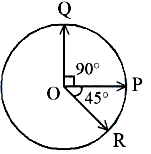
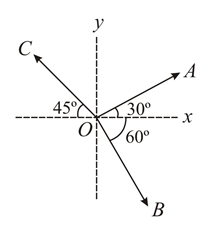
Three vectors $$\vec{OP}$$, $$\vec{OQ}$$ and $$\vec{OR}$$ each of magnitude $$A$$ are acting as shown in figure. The resultant of the three vectors is $$A\sqrt{x}$$. The value of $$x$$ is ________.
Let's write the three vectors given in their deconstructed form:
$$\vec{OP} = A\hat{i}$$
$$\vec{OQ} = A\hat{j}$$
$$\vec{OR} = \dfrac{A}{\sqrt{2}}\hat{i} - \dfrac{A}{\sqrt{2}}\hat{j}$$
Thus, adding the vectors, we get,
$$\vec{OP}+\vec{OQ}+\vec{OR} =\vec{R} = \left(A + \dfrac{A}{\sqrt{2}}\right)\hat{i} + \left(A - \dfrac{A}{\sqrt{2}}\right)\hat{j}$$
And hence, the magnitude of the resultant vector,
$$|\vec{R}| = \sqrt{\left(A + \dfrac{A}{\sqrt{2}}\right)^2 + \left(A - \dfrac{A}{\sqrt{2}}\right)^2}$$
$$|\vec{R}| = \sqrt{2A^2 + 2\dfrac{A^2}{2}} = A\sqrt{3}$$
Therefore, the value of $$x$$ is $$3$$.
A ball is thrown from the location $$(x_0, y_0) = (0,0)$$ of a horizontal playground with an initial speed $$v_0$$ at an angle $$\theta_0$$ from the $$+x$$-direction. The ball is to be hit by a stone, which is thrown at the same time from the location $$(x_1, y_1) = (L, 0)$$. The stone is thrown at an angle $$(180^\circ - \theta_1)$$ from the $$+x$$-direction with a suitable initial speed. For a fixed $$v_0$$, when $$(\theta_0, \theta_1) = (45^\circ, 45^\circ)$$, the stone hits the ball after time $$T_1$$, and when $$(\theta_0, \theta_1) = (60^\circ, 30^\circ)$$, it hits the ball after time $$T_2$$. In such a case, $$(T_1/T_2)^2$$ is ________.
Let the ball start from the origin with speed $$v_0$$ and projection angle $$\theta_0$$ (measured from the +x-axis).
Its velocity components are $$v_{bx}=v_0\cos\theta_0$$ and $$v_{by}=v_0\sin\theta_0$$.
The stone is thrown simultaneously from $$(L,0)$$ at an angle $$(180^\circ-\theta_1)$$ with the +x-axis.
Hence its horizontal component is toward the negative x-direction:
$$v_{sx}=-v_s\cos\theta_1$$, $$v_{sy}=v_s\sin\theta_1$$, where $$v_s$$ is the stone’s launch speed.
Suppose they meet after time $$t$$ (same $$t$$ for both because they start together).
Horizontal co-ordinate equality
$$x_{\text{ball}} = x_{\text{stone}}$$ gives
$$v_0\cos\theta_0\,t = L + (-v_s\cos\theta_1)\,t$$
$$\Rightarrow t\,(v_0\cos\theta_0+v_s\cos\theta_1)=L \quad -(1)$$
Vertical co-ordinate equality
Both experience the same downward acceleration $$g$$, so the $$-\dfrac12 g t^2$$ term cancels:
$$v_0\sin\theta_0\,t = v_s\sin\theta_1\,t$$
Since $$t\gt 0$$,
$$v_0\sin\theta_0 = v_s\sin\theta_1 \quad -(2)$$
From $$(2)$$, express the stone’s speed:
$$v_s = \dfrac{v_0\sin\theta_0}{\sin\theta_1} \quad -(3)$$
Insert $$(3)$$ into $$(1)$$ to obtain the common time of flight:
$$t = \dfrac{L}{v_0\cos\theta_0 + \left(\dfrac{v_0\sin\theta_0}{\sin\theta_1}\right)\cos\theta_1 } = \dfrac{L}{v_0\left(\cos\theta_0+\sin\theta_0\cot\theta_1\right)} \quad -(4)$$
Thus, for any pair $$(\theta_0,\theta_1)$$, $$T(\theta_0,\theta_1)=\dfrac{L}{v_0\left(\cos\theta_0+\sin\theta_0\cot\theta_1\right)}$$
Case 1: $$(\theta_0,\theta_1)=(45^\circ,45^\circ)$$
$$\cos45^\circ=\sin45^\circ=\dfrac{\sqrt2}{2}, \;\cot45^\circ=1$$
Denominator in $$(4)$$:
$$\cos45^\circ+\sin45^\circ\cot45^\circ
= \dfrac{\sqrt2}{2}+\dfrac{\sqrt2}{2}= \sqrt2$$
Hence
$$T_1=\dfrac{L}{v_0\sqrt2} \quad -(5)$$
Case 2: $$(\theta_0,\theta_1)=(60^\circ,30^\circ)$$
$$\cos60^\circ=\dfrac12,\; \sin60^\circ=\dfrac{\sqrt3}{2},\; \cot30^\circ=\sqrt3$$
Denominator in $$(4)$$:
$$\dfrac12+\dfrac{\sqrt3}{2}\,\sqrt3
= \dfrac12+\dfrac{3}{2}=2$$
Thus
$$T_2=\dfrac{L}{2v_0} \quad -(6)$$
Required ratio
$$\left(\dfrac{T_1}{T_2}\right)^2
=\left(\dfrac{\,L/(v_0\sqrt2)\,}{\,L/(2v_0)\,}\right)^2
=\left(\dfrac{2}{\sqrt2}\right)^2
=\left(\sqrt2\right)^2
=2$$
Therefore, $$(T_1/T_2)^2 = 2$$.
A body travels 102.5 m in the $$n^{th}$$ second and 115.0 m in the $$(n+2)^{th}$$ second. The acceleration is:
A body travels 102.5 m in the $$n$$-th second and 115.0 m in the $$(n+2)$$-th second. We need to find the acceleration.
For a body with initial velocity $$u$$ and constant acceleration $$a$$, the distance covered in the $$n$$-th second (i.e., between $$t = n-1$$ and $$t = n$$) is given by $$ s_n = u + \frac{a}{2}(2n - 1)\,. $$ This formula follows from $$s_n = S(n) - S(n-1) = \left(un + \frac{1}{2}an^2\right) - \left(u(n-1) + \frac{1}{2}a(n-1)^2\right) = u + \frac{a}{2}(2n-1)\,. $$
Using the given data, for the $$n$$-th second we have $$ s_n = u + \frac{a}{2}(2n - 1) = 102.5\,, $$ and for the $$(n+2)$$-th second $$ s_{n+2} = u + \frac{a}{2}(2(n+2) - 1) = u + \frac{a}{2}(2n + 3) = 115.0\,. $$
Subtracting these two equations gives $$ s_{n+2} - s_n = \frac{a}{2}[(2n+3) - (2n-1)]\,, $$ so $$ 115.0 - 102.5 = \frac{a}{2}[2n + 3 - 2n + 1]\,, $$ which simplifies to $$ 12.5 = \frac{a}{2} \times 4 \quad\Longrightarrow\quad 12.5 = 2a\,. $$
Therefore, $$ a = \frac{12.5}{2} = 6.25 \text{ m/s}^2\,. $$ The correct answer is Option (1): 6.25 m/s2.
The relation between time '$$t$$' and distance '$$x$$' is $$t = \alpha x^2 + \beta x$$, where $$\alpha$$ and $$\beta$$ are constants. The relation between acceleration $$a$$ and velocity $$v$$ is:
The time-distance relation is given as $$t = \alpha x^{2} + \beta x$$, where $$\alpha$$ and $$\beta$$ are constants.
First differentiate with respect to $$x$$:
$$\frac{dt}{dx} = 2\alpha x + \beta$$ $$-(1)$$
Velocity is $$v = \frac{dx}{dt} = \frac{1}{\dfrac{dt}{dx}} = \frac{1}{2\alpha x + \beta}$$ $$-(2)$$
Acceleration is $$a = \frac{dv}{dt}$$.
Using the chain rule, $$a = \frac{dv}{dx}\,\frac{dx}{dt} = v \,\frac{dv}{dx}$$ $$-(3)$$
Differentiate $$v$$ from $$(2)$$ with respect to $$x$$:
$$\frac{dv}{dx} = \frac{d}{dx}\left[(2\alpha x + \beta)^{-1}\right] = -1 \cdot (2\alpha)\,(2\alpha x + \beta)^{-2} = -\frac{2\alpha}{(2\alpha x + \beta)^{2}}$$ $$-(4)$$
Substitute $$(2)$$ and $$(4)$$ into $$(3)$$:
$$a = v\left(-\frac{2\alpha}{(2\alpha x + \beta)^{2}}\right) = -\frac{2\alpha\,v}{(2\alpha x + \beta)^{2}}$$ $$-(5)$$
From $$(2)$$, $$v = \dfrac{1}{2\alpha x + \beta} \;\Rightarrow\; 2\alpha x + \beta = \frac{1}{v}$$ $$-(6)$$
Insert $$(6)$$ into $$(5)$$ to eliminate $$x$$:
$$a = -\frac{2\alpha\,v}{\left(\dfrac{1}{v}\right)^{2}} = -2\alpha\,v \, v^{2} = -2\alpha\,v^{3}$$
Thus the required relation is $$a = -2\alpha v^{3}$$.
Option A is correct.
The co-ordinates of a particle moving in x-y plane are given by: $$x = 2 + 4t,\ y = 3t + 8t^2$$. The motion of the particle is:
Given: $$x = 2 + 4t$$ and $$y = 3t + 8t^2$$
Velocity components:
$$v_x = \frac{dx}{dt} = 4$$ (constant)
$$v_y = \frac{dy}{dt} = 3 + 16t$$ (varying)
Acceleration components:
$$a_x = 0$$
$$a_y = 16$$ (constant)
Since the acceleration is constant (only in y-direction), the motion is uniformly accelerated.
From $$x = 2 + 4t$$: $$t = \frac{x-2}{4}$$
Substituting in y: $$y = 3\left(\frac{x-2}{4}\right) + 8\left(\frac{x-2}{4}\right)^2 = \frac{3(x-2)}{4} + \frac{(x-2)^2}{2}$$
This is a quadratic in x, so the path is parabolic.
The correct answer is Option 1: uniformly accelerated having motion along a parabolic path.
A body is moving with constant speed, in a circle of radius 10 m. The body completes one revolution in 4 s. At the end of 3rd second, the displacement of body (in m) from its starting point is:
The body moves in a circle of radius $$R = 10$$ m with period $$T = 4$$ s.
At $$t = 3$$ s, the fraction of revolution completed:
$$ \frac{t}{T} = \frac{3}{4} $$
This means the body has covered $$\frac{3}{4}$$ of a full circle, i.e., $$270°$$.
If the body starts at the top of the circle (say at angle $$0°$$), after $$270°$$ it is at the position that is $$90°$$ short of completing the circle.
The displacement is the straight-line distance from the starting point to the current position. For a $$270°$$ arc (or equivalently $$90°$$ measured the other way), the chord length is:
Using the chord formula $$d = 2R\sin(\theta/2)$$ where $$\theta = 270°$$:
$$ d = 2 \times 10 \times \sin(135°) = 20 \times \frac{\sqrt{2}}{2} = 10\sqrt{2} \text{ m} $$
Alternatively, the starting and ending points are separated by $$90°$$ on the circle (since $$360° - 270° = 90°$$), forming two perpendicular radii. The displacement = $$\sqrt{R^2 + R^2} = R\sqrt{2} = 10\sqrt{2}$$ m.
A particle starts with an initial velocity of 10.0 ms$$^{-1}$$ along x-direction and accelerates uniformly at the rate of 2.0 m s$$^{-2}$$. The time taken by the particle to reach the velocity of 60.0 m s$$^{-1}$$ is ______.
A particle starts with initial velocity 10.0 m/s and accelerates uniformly at 2.0 m/s$$^2$$. We need to find the time to reach 60.0 m/s.
First, identify the known quantities.
Initial velocity: $$u = 10.0$$ m/s
Acceleration: $$a = 2.0$$ m/s$$^2$$
Final velocity: $$v = 60.0$$ m/s
Time: $$t = ?$$
Next, select the appropriate equation of motion.
Since we know $$u$$, $$v$$, and $$a$$, and need to find $$t$$, we use the first equation of motion:
$$ v = u + at $$
This equation relates velocity to time for uniformly accelerated motion. It follows directly from the definition of acceleration: $$a = \frac{v - u}{t}$$.
Now, substitute and solve for $$t$$.
$$ 60.0 = 10.0 + 2.0 \times t $$
$$ 2.0t = 60.0 - 10.0 = 50.0 $$
$$ t = \frac{50.0}{2.0} = 25\;\text{s} $$
The time taken is 25 s.
The correct answer is Option 1: 25 s.
A person travels $$x$$ distance with velocity $$v_1$$ and then $$x$$ distance with velocity $$v_2$$ in the same direction. The average velocity of the person is $$v$$, then the relation between $$v$$, $$v_1$$ and $$v_2$$ will be
Average velocity for equal distances: $$v = \frac{2x}{x/v_1 + x/v_2} = \frac{2v_1v_2}{v_1 + v_2}$$
This gives: $$\frac{2}{v} = \frac{v_1 + v_2}{v_1v_2} = \frac{1}{v_1} + \frac{1}{v_2}$$
The correct answer is Option 4.
A vector in $$x - y$$ plane makes an angle of $$30°$$ with $$y$$-axis. The magnitude of $$y$$-component of vector is $$2\sqrt{3}$$. The magnitude of $$x$$-component of the vector will be :
The vector makes an angle of 30° with the y-axis.
If the angle with y-axis is 30°, then:
$$V_y = V\cos 30° = 2\sqrt{3}$$
$$V = \frac{2\sqrt{3}}{\cos 30°} = \frac{2\sqrt{3}}{\sqrt{3}/2} = 4$$
$$V_x = V\sin 30° = 4 \times \frac{1}{2} = 2$$
The magnitude of the x-component is $$\mathbf{2}$$.
hello dummy text
Two trains $$A$$ and $$B$$ of length $$l$$ and $$4l$$ are travelling into a tunnel of length $$L$$ in parallel tracks from opposite directions with velocities $$108$$ km h$$^{-1}$$ and $$72$$ km h$$^{-1}$$, respectively. If train $$A$$ take $$35$$ s less time than train $$B$$ to cross the tunnel then, length $$L$$ of tunnel is:
(Given $$L = 60 \ l$$)
We need to find the length of the tunnel $$L$$ given that train $$A$$ (length $$l$$) takes 35 s less than train $$B$$ (length $$4l$$) to cross the tunnel.
Convert velocities to m/s:
$$v_A = 108 \text{ km/h} = 108 \times \frac{5}{18} = 30 \text{ m/s}$$
$$v_B = 72 \text{ km/h} = 72 \times \frac{5}{18} = 20 \text{ m/s}$$
Time for a train to cross a tunnel = (length of train + length of tunnel) / speed of train.
$$t_A = \frac{L + l}{30}$$
$$t_B = \frac{L + 4l}{20}$$
Given $$t_B - t_A = 35$$ s:
$$\frac{L + 4l}{20} - \frac{L + l}{30} = 35$$
Taking LCM of 20 and 30 = 60:
$$\frac{3(L + 4l) - 2(L + l)}{60} = 35$$
$$\frac{3L + 12l - 2L - 2l}{60} = 35$$
$$\frac{L + 10l}{60} = 35$$
$$L + 10l = 2100$$
Given $$L = 60l$$, so $$l = \frac{L}{60}$$:
$$L + 10 \times \frac{L}{60} = 2100$$
$$L + \frac{L}{6} = 2100$$
$$\frac{7L}{6} = 2100$$
$$L = \frac{2100 \times 6}{7} = 1800 \text{ m}$$
The length of the tunnel is $$\mathbf{1800}$$ m.
A car travels a distance of $$x$$ with speed $$v_1$$ and then same distance $$x$$ with speed $$v_2$$ in the same direction. The average speed of the car is:
A car travels a distance $$x$$ with speed $$v_1$$ and then the same distance $$x$$ with speed $$v_2$$ in the same direction. We need to find the average speed.
Calculate the total distance.
Total distance = $$x + x = 2x$$
Calculate the total time.
Time for first part: $$t_1 = \frac{x}{v_1}$$
Time for second part: $$t_2 = \frac{x}{v_2}$$
Total time: $$t_1 + t_2 = \frac{x}{v_1} + \frac{x}{v_2} = x\left(\frac{v_1 + v_2}{v_1 v_2}\right)$$
Calculate the average speed.
$$ v_{avg} = \frac{\text{Total distance}}{\text{Total time}} = \frac{2x}{x\left(\frac{v_1 + v_2}{v_1 v_2}\right)} = \frac{2v_1 v_2}{v_1 + v_2} $$
This is the harmonic mean of the two speeds, which is the correct formula when equal distances are covered at different speeds.
The correct answer is Option D: $$\frac{2v_1 v_2}{v_1 + v_2}$$.
A stone is projected at angle $$30°$$ to the horizontal. The ratio of kinetic energy of the stone at point of projection to its kinetic energy at the highest point of flight will be:
Find the ratio of kinetic energy at the point of projection to the kinetic energy at the highest point for a stone projected at $$30°$$ to the horizontal.
The kinetic energy at the point of projection is $$KE_1 = \frac{1}{2}mv^2$$. At the highest point only the horizontal component of velocity remains, namely $$v_x = v\cos 30° = \frac{v\sqrt{3}}{2}$$, so the kinetic energy there is $$KE_2 = \frac{1}{2}mv_x^2 = \frac{1}{2}m \cdot \frac{3v^2}{4} = \frac{3}{4} \cdot \frac{1}{2}mv^2$$.
Therefore, the ratio of the kinetic energies is $$\frac{KE_1}{KE_2} = \frac{\frac{1}{2}mv^2}{\frac{3}{8}mv^2} = \frac{4}{3}$$, giving a ratio of $$4 : 3$$ which corresponds to Option D.
A vehicle travels $$4$$ km with speed of $$3$$ km h$$^{-1}$$ and another $$4$$ km with speed of $$5$$ km h$$^{-1}$$, then its average speed is:
The vehicle travels two equal distances of 4 km each at different speeds. For equal distances, we can find the average speed by computing total distance over total time.
The time for the first 4 km at 3 km/h is $$t_1 = \frac{4}{3}$$ h, and the time for the next 4 km at 5 km/h is $$t_2 = \frac{4}{5}$$ h.
So the total distance is $$4 + 4 = 8$$ km, and the total time is
$$t_1 + t_2 = \frac{4}{3} + \frac{4}{5} = \frac{20 + 12}{15} = \frac{32}{15} \text{ h}$$
Now the average speed is
$$v_{avg} = \frac{\text{Total distance}}{\text{Total time}} = \frac{8}{\frac{32}{15}} = \frac{8 \times 15}{32} = \frac{120}{32} = 3.75 \text{ km h}^{-1}$$
So, the answer is $$3.75$$ km h$$^{-1}$$.
An object moves with speed $$v_1$$, $$v_2$$ and $$v_3$$ along a line segment $$AB$$, $$BC$$ and $$CD$$ respectively as shown in the figure, where $$AB = BC$$ and $$AD = 3AB$$, then the average speed of the object will be:
$$v_{avg} = \frac{\text{Total Distance}}{\text{Total Time}}$$
$$AB = BC = x$$
$$AD = 3AB = 3x$$
$$CD = AD - (AB + BC) = 3x - 2x = x$$
$$t_1 = \frac{x}{v_1}, \quad t_2 = \frac{x}{v_2}, \quad t_3 = \frac{x}{v_3}$$
$$v_{avg} = \frac{x + x + x}{t_1 + t_2 + t_3}$$
$$v_{avg} = \frac{3x}{\frac{x}{v_1} + \frac{x}{v_2} + \frac{x}{v_3}}$$
$$v_{avg} = \frac{3}{\frac{1}{v_1} + \frac{1}{v_2} + \frac{1}{v_3}}$$
$$v_{avg} = \frac{3v_1v_2v_3}{v_1v_2 + v_2v_3 + v_3v_1}$$
As shown in the figure, a particle is moving with constant speed $$\pi$$ m s$$^{-1}$$. Considering its motion from A to B, the magnitude of the average velocity is
given
speed = π m/s (constant)
motion is along a circle
angle from A to B = 120°
we need average velocity = displacement / time
step 1: understand what displacement means
even though motion is along a curve, displacement is always the straight line from A to B
so here displacement = chord AB
step 2: find displacement (chord AB)
draw the triangle formed by center O, A, and B
OA = OB = R
angle AOB = 120°
chord formula:
AB = 2R sin(θ/2)
θ = 120° → θ/2 = 60°
AB = 2R sin60°
= 2R × (√3/2)
= R√3
so displacement = R√3
step 3: find time taken
the particle moves along the arc from A to B
arc length = Rθ
convert 120° into radians:
120° = 2π/3
so arc length = R × (2π/3)
speed = π
time = distance / speed
t = [R(2π/3)] / π
cancel π:
t = 2R/3
step 4: compute average velocity
average velocity = displacement / time
= (R√3) / (2R/3)
now simplify:
= R√3 × (3 / 2R)
R cancels:
= (3√3)/2
= 1.5√3 m/s
final answer: 1.5√3 m/s
From the $$v - t$$ graph shown, the ratio of distance to displacement in 25 s of motion is:
The shaded region under a $$v\!-\!t$$ graph always gives displacement when the sign (above / below the time-axis) is taken into account and gives distance when only the magnitude of the area is added.
From the given graph it is seen that:
• For the first $$20\ \text{s}$$ the velocity is constant and positive (the horizontal line at height $$v_0$$).
Area (rectangle) $$A_1 = v_0 \times 20$$
• For the next $$5\ \text{s}$$ (from $$t = 20\ \text{s}$$ to $$t = 25\ \text{s}$$) the velocity is the same in magnitude but negative (the horizontal line at depth $$-v_0$$).
Area (rectangle) $$A_2 = (-\,v_0) \times 5$$
Distance travelled in 25 s
Add magnitudes of both areas:$$|A_1| + |A_2| = v_0(20) + v_0(5) = 25\,v_0$$
Displacement in 25 s
Add the signed areas:$$A_1 + A_2 = v_0(20) + (-v_0)(5) = v_0(20 - 5) = 15\,v_0$$
Required ratio
$$\text{distance} \; : \; \text{displacement} = \frac{25\,v_0}{15\,v_0} = \frac{5}{3}$$
Hence the ratio of distance to displacement in the first $$25\ \text{s}$$ of motion is $$\frac{5}{3}$$.
Option C is correct.
Given below are two statements:
Statement I: Area under velocity-time graph gives the distance travelled by the body in a given time.
Statement II: Area under acceleration-time graph is equal to the change in velocity in the given time.
In the light of given statements, choose the correct answer from the options given below.
We need to analyze each statement carefully.
For Statement I, it says the area under the velocity-time graph gives the distance travelled. However, the area under the velocity-time graph actually gives the displacement, not the distance. Distance is the total path length and equals the area only when velocity does not change sign. If velocity becomes negative, the area below the time axis is negative, giving displacement. To get distance, we would need the area under the $$|v|$$ vs $$t$$ graph. So Statement I is incorrect in general.
Now consider Statement II, which says the area under the acceleration-time graph equals the change in velocity. We know that $$a = \frac{dv}{dt}$$, so
$$\int_{t_1}^{t_2} a \, dt = v(t_2) - v(t_1) = \Delta v$$
The area under the acceleration-time graph indeed gives the change in velocity (since integrating acceleration over time recovers the velocity change). So Statement II is true.
Hence, Statement I is incorrect but Statement II is true. Hence, the correct answer is Option 4.
Match Column-I with Column-II:
Choose the correct answer from the options given below:
Key idea:
$$v=\frac{dx}{dt}=\text{slope of }x\text{-}t\text{ graph}$$
Graph A:-
- Slope increases with time → velocity increases with time
- That means accelerated motion
Matches II (v increases linearly with time)
So:
A → II
Graph B:-
- Initially slope is large (negative direction), then becomes less steep
- So velocity starts negative and approaches zero
- Velocity increasing towards zero (but still negative initially)
Matches IV (velocity increasing from negative towards zero)
So:
B → IV
Graph C:-
- First slope positive → velocity positive
- Then slope negative → velocity negative
- Sudden change → velocity jumps from +v to −v
Matches III (step from +v to −v)
So:
C → III
Graph D:-
- Constant slope → constant velocity
Matches I (constant velocity)
So:
D → I
Final answer:
A→II,B→IV,C→III,D→I
The distance travelled by a particle is related to time $$t$$ as $$x = 4t^2$$. The velocity of the particle at $$t = 5$$ s is
Given: $$x = 4t^2$$
Velocity: $$v = \frac{dx}{dt} = 8t$$
At $$t = 5$$ s:
$$v = 8 \times 5 = 40$$ m/s
The correct answer is Option 1: 40 m s⁻¹.
The distance travelled by an object in time $$t$$ is given by $$s = 2.5t^2$$. The instantaneous speed of the object at $$t = 5$$ s will be :
Given: $$s = 2.5t^2$$
Instantaneous speed is the derivative of distance with respect to time:
$$v = \frac{ds}{dt} = 2 \times 2.5t = 5t$$
At $$t = 5$$ s:
$$v = 5 \times 5 = 25 \text{ m/s}$$
The instantaneous speed is $$\mathbf{25}$$ m/s.
The initial speed of a projectile fired from ground is $$u$$. At the highest point during its motion, the speed of projectile is $$\dfrac{\sqrt{3}}{2}u$$. The time of flight of the projectile is:
At the highest point of projectile motion, the vertical component of velocity is zero, so the speed equals the horizontal component:
$$ v_{\text{top}} = u\cos\theta $$
Given that $$v_{\text{top}} = \dfrac{\sqrt{3}}{2}u$$:
$$ u\cos\theta = \dfrac{\sqrt{3}}{2}u $$
$$ \cos\theta = \dfrac{\sqrt{3}}{2} $$
$$ \theta = 30° $$
The time of flight of a projectile is:
$$ T = \dfrac{2u\sin\theta}{g} = \dfrac{2u\sin 30°}{g} = \dfrac{2u \times \frac{1}{2}}{g} = \dfrac{u}{g} $$
The maximum vertical height to which a man can throw a ball is 136 m. The maximum horizontal distance upto which he can throw the same ball is
We know that the maximum vertical height a man can throw a ball is 136 m, and our goal is to determine the maximum horizontal distance.
First, by finding the initial speed from the maximum height, we note that the height is reached when the ball is thrown vertically upward ($$\theta = 90°$$). Using the standard relation for maximum height, we have:
$$ h_{max} = \frac{u^2}{2g} $$
Solving for $$u^2$$ gives $$u^2 = 2g \times h_{max} = 2 \times 10 \times 136 = 2720\;\text{m}^2/\text{s}^2$$, so the square of the initial speed is 2720.
Next, the maximum horizontal range on flat ground occurs at a launch angle of $$\theta = 45°$$, yielding:
$$ R_{max} = \frac{u^2 \sin(2 \times 45°)}{g} = \frac{u^2 \sin 90°}{g} = \frac{u^2}{g} $$
Substituting $$u^2 = 2720$$ and $$g = 10\;\text{m}/\text{s}^2$$ gives:
$$ R_{max} = \frac{2720}{10} = 272\;\text{m} $$
We also note the useful general result that $$R_{max} = 2h_{max}$$. Therefore, the maximum horizontal distance is 272 m, which corresponds to Option 3: 272 m.
The maximum vertical height to which a man can throw a ball is 136 m. The maximum horizontal distance upto which he can throw the same ball is
Let the maximum speed with which the man can release the ball be $$u$$.
Case 1: Ball thrown vertically upward.
Maximum height reached is given by the kinematic formula
$$h_{\max}= \frac{u^{2}}{2g}$$
The question states that $$h_{\max}=136\; \text{m}$$. Hence
$$\frac{u^{2}}{2g}=136$$
$$\Rightarrow u^{2}=2g \times 136 = 272\,g \qquad -(1)$$
Case 2: Ball thrown for maximum horizontal range.
For a given speed $$u$$, the horizontal range $$R$$ of a projectile is
$$R=\frac{u^{2}\sin 2\theta}{g}$$
The range becomes maximum when $$\theta = 45^{\circ}$$ because $$\sin 90^{\circ}=1$$. Therefore, the maximum range is
$$R_{\max}= \frac{u^{2}}{g} \qquad -(2)$$
Substitute $$u^{2}$$ from equation $$(1)$$ into $$(2)$$:
$$R_{\max}= \frac{272\,g}{g}=272\;\text{m}$$
Thus the farthest horizontal distance the man can throw the ball is $$272\;\text{m}$$.
Hence, Option C is correct.
The position-time graphs for two students A and B returning from the school to their homes are shown in figure.
(A) A lives closer to the school
(B) B lives closer to the school
(C) A takes lesser time to reach home
(D) A travels faster than B
(E) B travels faster than A
Choose the correct answer from the options given below
look at the graph slowly and interpret each thing correctly
horizontal axis → time
vertical axis → position (distance from school)
both students start from school (origin)
now key ideas
slope of line = speed
final height = how far their home is
final time coordinate = time taken
- time taken
both lines end at the same time coordinate on x-axis
so both students reach home at the same time
so A does NOT take lesser time
(C) is wrong
2.who is faster
compare slopes
line B is steeper than A
steeper line → greater slope → higher speed
so B is faster
(E) is correct
(D) is wrong
3. who lives closer
compare final heights (end points on y-axis)
B’s endpoint is higher → B has travelled more distance
so B lives farther
A’s endpoint is lower → A lives closer
so (A) is correct
(B) is wrong
final answer: A and E
Two projectiles are projected at 30$$^\circ$$ and 60$$^\circ$$ with the horizontal with the same speed. The ratio of the maximum height attained by the two projectiles respectively is:
Maximum height: $$H = \frac{u^2\sin^2\theta}{2g}$$
$$\frac{H_{30}}{H_{60}} = \frac{\sin^2 30°}{\sin^2 60°} = \frac{1/4}{3/4} = \frac{1}{3}$$
The correct answer is Option 4: 1:3.
A particle of mass m is moving in the $$xy$$-plane such that its velocity at a point $$(x, y)$$ is given as $$\vec{v} = \alpha(y\hat{x} + 2x\hat{y})$$, where $$\alpha$$ is a non-zero constant. What is the force $$\vec{F}$$ acting on the particle?
The velocity field is $$\vec v = \alpha\bigl(y\,\hat x + 2x\,\hat y\bigr)$$.
Hence
$$v_x = \alpha y , \qquad v_y = 2\alpha x$$
Acceleration is the material (total) derivative of velocity:
$$\vec a = \frac{d\vec v}{dt} = v_x\frac{\partial\vec v}{\partial x} + v_y\frac{\partial\vec v}{\partial y}$$
Component $$a_x$$:
$$a_x = v_x\frac{\partial v_x}{\partial x} + v_y\frac{\partial v_x}{\partial y}$$
Since $$v_x = \alpha y$$, we have $$\frac{\partial v_x}{\partial x}=0$$ and $$\frac{\partial v_x}{\partial y}=\alpha$$.
Therefore $$a_x = v_x(0) + v_y(\alpha) = (2\alpha x)(\alpha) = 2\alpha^{2}x$$.
Component $$a_y$$:
$$a_y = v_x\frac{\partial v_y}{\partial x} + v_y\frac{\partial v_y}{\partial y}$$
Because $$v_y = 2\alpha x$$, we have $$\frac{\partial v_y}{\partial x}=2\alpha$$ and $$\frac{\partial v_y}{\partial y}=0$$.
Thus $$a_y = v_x(2\alpha) + v_y(0) = (\alpha y)(2\alpha) = 2\alpha^{2}y$$.
Combining the two components:
$$\vec a = 2\alpha^{2}\bigl(x\,\hat x + y\,\hat y\bigr)$$
Using Newton’s second law $$\vec F = m\vec a$$:
$$\vec F = 2m\alpha^{2}\bigl(x\,\hat x + y\,\hat y\bigr)$$
Therefore, the correct option is:
Option A which is: $$\vec{F} = 2m\alpha^{2}(x\hat{x} + y\hat{y})$$.
A tennis ball is dropped on to the floor from a height of $$9.8$$ m. It rebounds to a height $$5.0$$ m. Ball comes in contact with the floor for $$0.2$$ s. The average acceleration during contact is ______ m s$$^{-2}$$. [Given $$g = 10$$ m s$$^{-2}$$]
When the ball is dropped from a height of $$9.8$$ m, its velocity just before hitting the floor is found using $$v^2 = 2gh$$: $$v = \sqrt{2 \times 10 \times 9.8} = \sqrt{196} = 14$$ m/s (downward).
After rebounding to a height of $$5.0$$ m, the velocity just after leaving the floor is $$v' = \sqrt{2 \times 10 \times 5} = \sqrt{100} = 10$$ m/s (upward).
Taking upward as positive, the velocity changes from $$-14$$ m/s (downward, just before contact) to $$+10$$ m/s (upward, just after contact). The average acceleration during the $$0.2$$ s contact time is $$a = \dfrac{v' - v}{\Delta t} = \dfrac{10 - (-14)}{0.2} = \dfrac{24}{0.2} = \boxed{120}$$ m s$$^{-2}$$.
A body is dropped on ground from a height $$h_1$$ and after hitting the ground, it rebounds to a height $$h_2$$. If the ratio of velocities of the body just before and after hitting ground is 4, then percentage loss in kinetic energy of the body is $$\dfrac{x}{4}$$. The value of $$x$$ is ______.
A body is dropped from height $$h_1$$ and rebounds to height $$h_2$$. The ratio of velocities just before and after hitting the ground is $$4$$.
The velocity just before hitting the ground is $$v_1 = \sqrt{2gh_1}$$ and the velocity just after rebounding is $$v_2 = \sqrt{2gh_2}$$, satisfying $$\dfrac{v_1}{v_2} = 4$$.
Squaring gives $$\dfrac{v_1^2}{v_2^2} = 16$$, so the ratio of kinetic energies after and before impact is $$\dfrac{KE_{\text{after}}}{KE_{\text{before}}} = \dfrac{v_2^2}{v_1^2} = \dfrac{1}{16}$$.
The percentage loss in kinetic energy is $$\% \text{ loss} = \left(1 - \dfrac{v_2^2}{v_1^2}\right)\times 100 = \left(1 - \dfrac{1}{16}\right)\times 100 = \dfrac{15}{16}\times 100 = 93.75\%$$.
Since $$\dfrac{x}{4} = 93.75$$, it follows that $$x = 93.75 \times 4 = 375$$.
The value of $$x$$ is $$\boxed{375}$$.
A car is moving on a circular path of radius $$600$$ m such that the magnitudes of the tangential acceleration and centripetal acceleration are equal. The time taken by the car to complete first quarter of revolution, if it is moving with an initial speed of $$54$$ km h$$^{-1}$$ is $$t(1-e^{-\frac{\pi}{2}})$$ s. The value of $$t$$ is ______.
Solution :
Given :
Radius of circular path,
$$r = 600\text{ m}$$
Initial speed,
$$u = 54\text{ km h}^{-1}$$
$$= \frac{54 \times 1000}{3600}$$
$$= 15\text{ m s}^{-1}$$
Given tangential acceleration equals centripetal acceleration :
$$a_t = a_c$$
$$\frac{dv}{dt} = \frac{v^2}{r}$$
Separating variables :
$$\frac{dv}{v^2} = \frac{dt}{r}$$
Integrating :
$$\int_{u}^{v}\frac{dv}{v^2} = \int_{0}^{t}\frac{dt}{r}$$
$$\left[-\frac{1}{v}\right]_{u}^{v} = \frac{t}{r}$$
$$\frac{1}{u} - \frac{1}{v} = \frac{t}{r}$$
Hence,
$$v = \frac{ur}{r-ut}$$
Angular speed :
$$\omega = \frac{v}{r}$$
Angular displacement for quarter revolution :
$$\theta = \frac{\pi}{2}$$
Therefore,
$$\int_0^t \omega dt = \frac{\pi}{2}$$
$$\int_0^t \frac{u}{r-ut}dt = \frac{\pi}{2}$$
$$\left[-\ln(r-ut)\right]_0^t = \frac{\pi}{2}$$
$$\ln\left(\frac{r}{r-ut}\right) = \frac{\pi}{2}$$
$$\frac{r}{r-ut} = e^{\pi/2}$$
$$r-ut = re^{-\pi/2}$$
$$ut = r(1-e^{-\pi/2})$$
$$t = \frac{r}{u}(1-e^{-\pi/2})$$
Substituting values :
$$t = \frac{600}{15}(1-e^{-\pi/2})$$
$$t = 40(1-e^{-\pi/2})$$
Comparing with given form :
$$t(1-e^{-\pi/2})$$
Hence,
$$t = 40$$
Final Answer :
$$40$$
A horse rider covers half the distance with $$5$$ m s$$^{-1}$$ speed. The remaining part of the distance was travelled with speed $$10$$ m s$$^{-1}$$ for half the time and with speed $$15$$ m s$$^{-1}$$ for other half of the time. The mean speed of the rider averaged over the whole time of motion is $$\frac{x}{7}$$ m s$$^{-1}$$. The value of $$x$$ is ______.
A horse rider covers half the distance at 5 m/s, then the remaining half distance with speeds 10 and 15 m/s for equal time intervals.
Set up variables.
Let the total distance = $$2d$$.
Time for first half.
$$t_1 = \frac{d}{5}$$
Time for second half.
Let the time for each speed be $$t_2$$. Distance in second half:
$$d = 10t_2 + 15t_2 = 25t_2 \implies t_2 = \frac{d}{25}$$
Total time for second half = $$2t_2 = \frac{2d}{25}$$
Calculate mean speed.
Total time = $$\frac{d}{5} + \frac{2d}{25} = \frac{5d + 2d}{25} = \frac{7d}{25}$$
Mean speed = $$\frac{2d}{\frac{7d}{25}} = \frac{50}{7}$$ m/s
Therefore, $$x = \boxed{50}$$.
A projectile fired at 30$$^\circ$$ to the ground is observed to be at same height at time 3 s and 5 s after projection, during its flight. The speed of projection of the projectile is _______ m s$$^{-1}$$.
(Given $$g = 10$$ m s$$^{-2}$$)
For a projectile, if it is at the same height at two different times $$t_1$$ and $$t_2$$, then by symmetry of the trajectory, these times are symmetric about the time of maximum height.
Time of maximum height = $$\frac{t_1 + t_2}{2} = \frac{3 + 5}{2} = 4$$ s
The total time of flight is:
$$T = 2 \times 4 = 8$$ s
Using the time of flight formula:
$$T = \frac{2u\sin\theta}{g}$$
$$8 = \frac{2u\sin 30°}{10} = \frac{2u \times 0.5}{10} = \frac{u}{10}$$
$$u = 80 \text{ m/s}$$
The speed of projection is $$80$$ m s$$^{-1}$$.
For a train engine moving with speed of $$20$$ ms$$^{-1}$$, the driver must apply brakes at a distance of $$500$$ m before the station for the train to come to rest at the station. If the brakes were applied at half of this distance, the train engine would cross the station with speed $$\sqrt{x}$$ ms$$^{-1}$$. The value of $$x$$ is ______. (Assuming same retardation is produced by brakes)
Scenario 1: Full stopping distance
Initial velocity $$u = 20 \text{ m/s}$$
Final velocity $$v_1 = 0 \text{ m/s}$$
Displacement $$s_1 = 500 \text{ m}$$
$$v_1^2 - u^2 = 2as_1$$
$$0^2 - (20)^2 = 2a(500)$$
$$-400 = 1000a$$
$$a = -0.4 \text{ m/s}^2$$
Scenario 2: Half the stopping distance
The brakes are now applied at half the distance, meaning the train travels $$s_2 = 250 \text{ m}$$ while decelerating. We want to find its speed $$v_2$$ as it crosses the station.
Initial velocity $$u = 20 \text{ m/s}$$
Acceleration $$a = -0.4 \text{ m/s}^2$$
Displacement $$s_2 = 250 \text{ m}$$
$$v_2^2 - u^2 = 2as_2$$
$$v_2^2 - (20)^2 = 2(-0.4)(250)$$
$$v_2^2 - 400 = -0.8(250)$$
$$v_2^2 - 400 = -200$$
$$v_2^2 = 200$$
$$v_2 = \sqrt{200} \text{ m/s}$$
If $$\vec{P} = 3\hat{i} + \sqrt{3}\hat{j} + 2\hat{k}$$ and $$\vec{Q} = 4\hat{i} + \sqrt{3}\hat{j} + 2.5\hat{k}$$, then, the unit vector in the direction of $$\vec{P} \times \vec{Q}$$ is $$\frac{1}{x}(\sqrt{3}\hat{i} + \hat{j} - 2\sqrt{3}\hat{k})$$. The value of $$x$$ is
We are given $$\vec{P} = 3\hat{i} + \sqrt{3}\hat{j} + 2\hat{k}$$ and $$\vec{Q} = 4\hat{i} + \sqrt{3}\hat{j} + 2.5\hat{k}$$.
Compute $$\vec{P} \times \vec{Q}$$.
$$ \vec{P} \times \vec{Q} = \begin{vmatrix} \hat{i} & \hat{j} & \hat{k} \\ 3 & \sqrt{3} & 2 \\ 4 & \sqrt{3} & 2.5 \end{vmatrix} $$
$$ = \hat{i}(\sqrt{3} \cdot 2.5 - 2 \cdot \sqrt{3}) - \hat{j}(3 \cdot 2.5 - 2 \cdot 4) + \hat{k}(3\sqrt{3} - 4\sqrt{3}) $$
$$ = \hat{i}(2.5\sqrt{3} - 2\sqrt{3}) - \hat{j}(7.5 - 8) + \hat{k}(-\sqrt{3}) $$
$$ = \frac{\sqrt{3}}{2}\hat{i} + \frac{1}{2}\hat{j} - \sqrt{3}\hat{k} $$
Find the magnitude.
$$ |\vec{P} \times \vec{Q}| = \sqrt{\left(\frac{\sqrt{3}}{2}\right)^2 + \left(\frac{1}{2}\right)^2 + (-\sqrt{3})^2} = \sqrt{\frac{3}{4} + \frac{1}{4} + 3} = \sqrt{4} = 2 $$
Find the unit vector.
$$ \hat{n} = \frac{\vec{P} \times \vec{Q}}{|\vec{P} \times \vec{Q}|} = \frac{1}{2}\left(\frac{\sqrt{3}}{2}\hat{i} + \frac{1}{2}\hat{j} - \sqrt{3}\hat{k}\right) = \frac{\sqrt{3}}{4}\hat{i} + \frac{1}{4}\hat{j} - \frac{\sqrt{3}}{2}\hat{k} $$
Compare with the given form.
The unit vector is given as $$\frac{1}{x}(\sqrt{3}\hat{i} + \hat{j} - 2\sqrt{3}\hat{k})$$.
$$ \frac{1}{x}(\sqrt{3}\hat{i} + \hat{j} - 2\sqrt{3}\hat{k}) = \frac{\sqrt{3}}{4}\hat{i} + \frac{1}{4}\hat{j} - \frac{\sqrt{3}}{2}\hat{k} $$
Comparing the $$\hat{j}$$ components: $$\frac{1}{x} = \frac{1}{4}$$, so $$x = 4$$.
Verification with $$\hat{i}$$ component: $$\frac{\sqrt{3}}{4} = \frac{\sqrt{3}}{4}$$
Verification with $$\hat{k}$$ component: $$\frac{-2\sqrt{3}}{4} = -\frac{\sqrt{3}}{2}$$
The value of $$x$$ is $$\boxed{4}$$.
The speed of a swimmer is 4 km h$$^{-1}$$ in still water. If the swimmer makes his strokes normal to the flow of river of width 1 km, he reaches a point 750 m down the stream on the opposite bank. The speed of the river water is ______ km h$$^{-1}$$.
The swimmer swims perpendicular to the river flow with speed $$v_s = 4$$ km/h. The river has width $$d = 1$$ km.
To begin, time to cross the river,
$$ t = \frac{d}{v_s} = \frac{1}{4} \text{ h} $$
During this time, the river carries the swimmer downstream by 750 m = 0.75 km.
Next, speed of river,
$$ v_r = \frac{\text{drift}}{t} = \frac{0.75}{1/4} = 0.75 \times 4 = 3 \text{ km h}^{-1} $$
Two bodies are projected from ground with same speeds 40 m s$$^{-1}$$ at two different angles with respect to horizontal. The bodies were found to have same range. If one of the body was projected at an angle of 60°, with horizontal then sum of the maximum heights, attained by the two projectiles, is ______ m. (Given $$g = 10$$ m s$$^{-2}$$)
Two projectiles launched with the same speed $$u = 40$$ m/s have the same range. One is at $$60°$$.
For same range with same speed, the angles are complementary: $$\theta_2 = 90° - 60° = 30°$$.
$$H = \frac{u^2 \sin^2\theta}{2g}$$
For $$\theta_1 = 60°$$:
$$H_1 = \frac{40^2 \times \sin^2 60°}{2 \times 10} = \frac{1600 \times \frac{3}{4}}{20} = \frac{1200}{20} = 60 \text{ m}$$
For $$\theta_2 = 30°$$:
$$H_2 = \frac{40^2 \times \sin^2 30°}{2 \times 10} = \frac{1600 \times \frac{1}{4}}{20} = \frac{400}{20} = 20 \text{ m}$$
$$H_1 + H_2 = 60 + 20 = 80 \text{ m}$$
The answer is $$\boxed{80}$$ m.
A ball is dropped from a height of 20 m. If the coefficient of restitution for the collision between ball and floor is 0.5, after hitting the floor, the ball rebounds to a height of ______ m.
A ball is dropped from height $$h = 20$$ m. Coefficient of restitution $$e = 0.5$$.
Velocity just before hitting the floor.
Using $$v^2 = u^2 + 2gh$$ with $$u = 0$$:
$$
v_{\text{before}} = \sqrt{2gh} = \sqrt{2 \times 10 \times 20} = 20 \text{ m/s}
$$
Velocity just after rebound.
By definition of coefficient of restitution:
$$
v_{\text{after}} = e \times v_{\text{before}} = 0.5 \times 20 = 10 \text{ m/s}
$$
Maximum rebound height.
Using $$v^2 = u^2 - 2gH$$ with $$v = 0$$:
$$
H = \frac{v_{\text{after}}^2}{2g} = \frac{100}{20} = 5 \text{ m}
$$
Alternatively: $$H = e^2 \times h = (0.5)^2 \times 20 = 0.25 \times 20 = 5$$ m.
The answer is $$\boxed{5}$$ m.
A particle of mass 10 g moves in a straight line with retardation 2x, where $$x$$ is the displacement in SI units. Its loss of kinetic energy for above displacement is $$\left(\dfrac{10}{x}\right)^{-n}$$ J. The value of $$n$$ will be ______.
We have a particle of mass $$m = 10$$ g $$= 10^{-2}$$ kg moving in a straight line with retardation $$2x$$, where $$x$$ is the displacement in metres. Since it is retardation, the acceleration is $$a = -2x$$ m/s$$^2$$.
The retarding force is $$F = ma = -2mx$$. Using the work-energy theorem, the work done by this force over a displacement from 0 to $$x$$ is:
$$W = \int_0^x (-2mx) \, dx = -2m \left[\frac{x^2}{2}\right]_0^x = -mx^2$$
Since $$W = KE_f - KE_i$$, the loss of kinetic energy is:
$$\text{Loss of KE} = -W = mx^2 = 10^{-2} \times x^2 \text{ J}$$
We can verify this using kinematics. Since $$a = v\dfrac{dv}{dx} = -2x$$, integrating both sides:
$$\int_{v_0}^{v} v \, dv = \int_0^x (-2x) \, dx$$
$$\frac{v^2 - v_0^2}{2} = -x^2$$
or $$v_0^2 - v^2 = 2x^2$$
So the loss of kinetic energy is $$\frac{1}{2}m(v_0^2 - v^2) = \frac{1}{2} \times 10^{-2} \times 2x^2 = 10^{-2} \times x^2$$ J, which confirms our result.
Comparing with $$10^{-n} \cdot x^2$$, we get $$n = 2$$.
Hence, the answer is $$2$$.
A ball is thrown vertically upward with an initial velocity of $$150$$ m s$$^{-1}$$. The ratio of velocity after 3 s and 5 s is $$\frac{x+1}{x}$$. The value of $$x$$ is _____. {take, $$g = 10$$ m s$$^{-2}$$}
A ball is thrown vertically upward with an initial speed of 150 m/s, and we are asked to determine the value of x such that the ratio of its velocities at t = 3 s and t = 5 s equals $$\frac{x+1}{x}$$.
Using the relation $$v = u - gt$$ with g = 10 m/s2 and upward taken as positive, we find the velocity at t = 3 s and t = 5 s as follows:
$$
v_3 = 150 - 10(3) = 150 - 30 = 120\;\text{m/s}
$$
$$
v_5 = 150 - 10(5) = 150 - 50 = 100\;\text{m/s}
$$
Since the required ratio is $$\frac{v_3}{v_5} = \frac{120}{100} = \frac{6}{5}$$, setting this equal to $$\frac{x+1}{x}$$ leads to
$$
\frac{x+1}{x} = \frac{6}{5}
$$
$$
5(x+1) = 6x \implies 5x + 5 = 6x \implies x = 5
$$
Hence, the correct answer is Option 4: 5.
A child stands on the edge of the cliff 10 m above the ground and throws a stone horizontally with an initial speed of 5 m s$$^{-1}$$. Neglecting the air resistance, the speed with which the stone hits the ground will be _____ m s$$^{-1}$$ (given, $$g = 10$$ m s$$^{-2}$$).
We have a stone thrown horizontally from a cliff of height $$h = 10$$ m with initial horizontal speed $$v_x = 5$$ m/s.
The horizontal velocity remains constant throughout the motion, so $$v_x = 5$$ m/s. For the vertical motion (starting from rest), we use the kinematic equation
$$v_y^2 = u_y^2 + 2gh = 0 + 2 \times 10 \times 10 = 200$$
Now the speed with which the stone hits the ground is
$$v = \sqrt{v_x^2 + v_y^2} = \sqrt{25 + 200} = \sqrt{225} = 15 \text{ m/s}$$
Hence, the correct answer is 15 m/s.
A passenger sitting in a train A moving at $$90$$ km h$$^{-1}$$ observes another train B moving in the opposite direction for $$8$$ s. If the velocity of the train B is $$54$$ km h$$^{-1}$$, then length of train B is:
Train A moves at 90 km/h and train B moves at 54 km/h in the opposite direction.
Relative velocity (since moving in opposite directions):
$$v_{rel} = 90 + 54 = 144 \text{ km/h} = 144 \times \frac{5}{18} = 40 \text{ m/s}$$
The passenger in train A observes train B passing for 8 seconds. The length of train B equals:
$$L_B = v_{rel} \times t = 40 \times 8 = 320 \text{ m}$$
The length of train B is $$\mathbf{320}$$ m.
A projectile is projected at 30$$^\circ$$ from horizontal with initial velocity 40 m s$$^{-1}$$. The velocity of the projectile at $$t = 2$$ s from the start will be:
Given a projection angle of 30° and an initial velocity of 40 m/s, after 2 s the horizontal component of velocity remains constant, so $$v_x = u\cos 30° = 40 \times \frac{\sqrt{3}}{2} = 20\sqrt{3} \text{ m/s}$$.
Next, the vertical component of velocity at t = 2 s is $$v_y = u\sin 30° - gt = 40 \times \frac{1}{2} - 10 \times 2 = 20 - 20 = 0 \text{ m/s}$$.
Substituting these into the expression for resultant velocity gives $$v = \sqrt{v_x^2 + v_y^2} = \sqrt{(20\sqrt{3})^2 + 0^2} = 20\sqrt{3} \text{ m/s}$$. At t = 2 s, the projectile is at its maximum height (vertical velocity = 0), so the resultant velocity equals the horizontal component.
Given below are two statements: one is labelled as Assertion A and the other is labelled as Reason R.
Assertion A: When a body is projected at an angle 45°, its range is maximum.
Reason R: For maximum range, the value of sin 2$$\theta$$ should be equal to one.
In the light of the above statements, choose the correct answer from the options given below:
The range of a projectile is given by $$R = \frac{u^2 \sin 2\theta}{g}$$. For maximum range, we need $$\sin 2\theta$$ to be maximum, i.e., $$\sin 2\theta = 1$$, which gives $$2\theta = 90°$$ or $$\theta = 45°$$. Thus Assertion A is true: at $$\theta = 45°$$, the range is indeed maximum.
Reason R states that for maximum range, $$\sin 2\theta$$ should equal one, which is exactly the condition derived above. This is also true, and it directly explains why $$\theta = 45°$$ gives maximum range.
Since both A and R are correct and R is the correct explanation of A, the answer is Option C.
The position of a particle related to time is given by $$x = (5t^2 - 4t + 5)$$ m. The magnitude of velocity of the particle at $$t = 2$$ s will be :
$$x = 5t^2 - 4t + 5$$
Velocity: $$v = \frac{dx}{dt} = 10t - 4$$
At $$t = 2$$ s: $$v = 10(2) - 4 = 20 - 4 = 16$$ m/s
The magnitude of velocity is $$\mathbf{16}$$ m/s.
The range of the projectile projected at an angle of 15$$^\circ$$ with horizontal is 50 m. If the projectile is projected with same velocity at an angle of 45$$^\circ$$ with horizontal, then its range will be
The range of a projectile is given by: $$R = \frac{u^2 \sin 2\theta}{g}$$
At $$\theta = 15°$$: $$R_1 = \frac{u^2 \sin 30°}{g} = \frac{u^2}{2g} = 50$$ m
At $$\theta = 45°$$: $$R_2 = \frac{u^2 \sin 90°}{g} = \frac{u^2}{g}$$
From the first equation: $$\frac{u^2}{g} = 100$$ m
Therefore $$R_2 = 100$$ m.
The correct answer is Option 1: 100 m.
The trajectory of projectile, projected from the ground is given by $$y = x - \frac{x^2}{20}$$. Where $$x$$ and $$y$$ are measured in meter. The maximum height attained by the projectile will be.
We have the trajectory of the projectile given by
$$y = x - \frac{x^2}{20}$$
To find the maximum height, we set $$\frac{dy}{dx} = 0$$:
$$\frac{dy}{dx} = 1 - \frac{2x}{20} = 1 - \frac{x}{10} = 0$$
Solving gives $$x = 10$$ m. Now substituting $$x = 10$$ back into the trajectory equation:
$$y_{max} = 10 - \frac{(10)^2}{20} = 10 - \frac{100}{20} = 10 - 5 = 5 \text{ m}$$
So the maximum height attained by the projectile is 5 m. Hence, the correct answer is Option 3.
The velocity-time graph of a body moving in a straight line is shown in figure.
The ratio of displacement and distance travelled by the body in time 0 to 10 s is
look at the v-t graph as areas of rectangles
area above time axis → positive displacement
area below time axis → negative displacement
now take each interval one by one
from 0 to 2 s
velocity = +8 m/s (constant)
so displacement = area = 8 × 2 = 16
from 2 to 4 s
velocity = −4 m/s
so displacement = −4 × 2 = −8
from 4 to 8 s
velocity = +4 m/s
so displacement = 4 × 4 = 16
from 8 to 10 s
velocity = −4 m/s
so displacement = −4 × 2 = −8
now combine properly
net displacement = 16 − 8 + 16 − 8 = 16
distance is different → here we don’t cancel signs
we take total path length
distance = 16 + 8 + 16 + 8 = 48
so finally
ratio = displacement / distance = 16 / 48 = 1/3
idea to remember
displacement = signed area
distance = total area (ignore sign)
Two objects are projected with same velocity $$u$$ however at different angles $$\alpha$$ and $$\beta$$ with the horizontal. If $$\alpha + \beta = 90°$$, the ratio of horizontal range of the first object to the 2$$^{nd}$$ object will be:
The horizontal range of a projectile is:
$$R = \frac{u^2 \sin 2\theta}{g}$$
For the first object (angle $$\alpha$$): $$R_1 = \frac{u^2 \sin 2\alpha}{g}$$
For the second object (angle $$\beta$$): $$R_2 = \frac{u^2 \sin 2\beta}{g}$$
Since $$\alpha + \beta = 90°$$, we have $$\beta = 90° - \alpha$$.
$$\sin 2\beta = \sin 2(90° - \alpha) = \sin(180° - 2\alpha) = \sin 2\alpha$$
Therefore $$R_1 = R_2$$, and the ratio is $$1 : 1$$.
The correct answer is Option 4: 1 : 1.
Two projectiles A and B are thrown with initial velocities of 40 m s$$^{-1}$$ and 60 m s$$^{-1}$$ at angles 30° and 60° with the horizontal respectively. The ratio of their ranges respectively is $$(g = 10$$ m s$$^{-2}$$)
The range of a projectile is: $$R = \frac{u^2 \sin 2\theta}{g}$$
For projectile A: $$u_A = 40$$ m/s, $$\theta_A = 30°$$
$$ R_A = \frac{40^2 \sin 60°}{10} = \frac{1600 \times \frac{\sqrt{3}}{2}}{10} = 80\sqrt{3}\;\text{m} $$
For projectile B: $$u_B = 60$$ m/s, $$\theta_B = 60°$$
$$ R_B = \frac{60^2 \sin 120°}{10} = \frac{3600 \times \frac{\sqrt{3}}{2}}{10} = 180\sqrt{3}\;\text{m} $$
The ratio of ranges:
$$ \frac{R_A}{R_B} = \frac{80\sqrt{3}}{180\sqrt{3}} = \frac{80}{180} = \frac{4}{9} $$
The correct answer is 4 : 9.
For a body projected at an angle with the horizontal from the ground, choose the correct statement.
We need to identify the correct statement about a body projected at an angle with the horizontal from the ground.
Analyzing each option:
Option A: Gravitational potential energy is maximum at the highest point.
At the highest point, the body reaches its maximum height. Since gravitational potential energy $$U = mgh$$, and $$h$$ is maximum at the highest point, the GPE is indeed maximum there. This statement is correct.
Option B: The horizontal component of velocity is zero at the highest point.
In projectile motion, the horizontal component of velocity remains constant throughout the flight ($$v_x = u\cos\theta$$). It is never zero (unless the projection angle is 90°, which is not a general case). This statement is incorrect.
Option C: The vertical component of momentum is maximum at the highest point.
At the highest point, the vertical component of velocity is zero, so the vertical component of momentum $$p_y = mv_y = 0$$, which is its minimum magnitude, not maximum. This statement is incorrect.
Option D: The kinetic energy is zero at the highest point.
At the highest point, the body still has horizontal velocity $$v_x = u\cos\theta$$, so $$KE = \frac{1}{2}m(u\cos\theta)^2 \neq 0$$. This statement is incorrect.
The answer is Option A: Gravitational potential energy is maximum at the highest point.
A small toy starts moving from the position of rest under a constant acceleration. If it travels a distance of 10 m in $$t$$ s, the distance travelled by the toy in the next $$t$$ s will be:
A toy starts from rest under constant acceleration and travels 10 m in $$t$$ seconds. We need to find the distance in the next $$t$$ seconds.
Using $$s = ut + \frac{1}{2}at^2$$ with $$u = 0$$:
$$10 = \frac{1}{2}at^2 \quad \ldots (1)$$
$$s_{2t} = \frac{1}{2}a(2t)^2 = \frac{1}{2}a \cdot 4t^2 = 4 \times \frac{1}{2}at^2 = 4 \times 10 = 40 \text{ m}$$
$$s_{\text{next}} = s_{2t} - s_t = 40 - 10 = 30 \text{ m}$$
Hence, the correct answer is Option C: 30 m.
Two buses $$P$$ and $$Q$$ start from a point at the same time and move in a straight line and their positions are represented by $$x_P(t) = \alpha t + \beta t^2$$ and $$x_Q(t) = ft - t^2$$. At what time, both the buses have same velocity?
We are given the positions of two buses:
$$x_P(t) = \alpha t + \beta t^2$$
$$x_Q(t) = ft - t^2$$
The velocity of each bus is the derivative of its position with respect to time.
Velocity of bus P:
$$v_P = \frac{dx_P}{dt} = \alpha + 2\beta t$$
Velocity of bus Q:
$$v_Q = \frac{dx_Q}{dt} = f - 2t$$
For same velocity, we set $$v_P = v_Q$$:
$$\alpha + 2\beta t = f - 2t$$
$$2\beta t + 2t = f - \alpha$$
$$t(2\beta + 2) = f - \alpha$$
$$t = \frac{f - \alpha}{2(\beta + 1)} = \frac{f - \alpha}{2(1 + \beta)}$$
Hence, the correct answer is Option D.
Two projectiles are thrown with same initial velocity making an angle of $$45°$$ and $$30°$$ with the horizontal respectively. The ratio of their respective ranges will be
We need to find the ratio of ranges of two projectiles thrown with the same initial velocity at angles $$45°$$ and $$30°$$ with the horizontal.
Since the range of a projectile is given by $$R = \dfrac{u^2 \sin 2\theta}{g}$$, substituting $$\theta = 45°$$ gives $$R_1 = \dfrac{u^2 \sin(2 \times 45°)}{g} = \dfrac{u^2 \sin 90°}{g} = \dfrac{u^2}{g}$$.
Next, for $$\theta = 30°$$ we get $$R_2 = \dfrac{u^2 \sin(2 \times 30°)}{g} = \dfrac{u^2 \sin 60°}{g} = \dfrac{u^2 \sqrt{3}}{2g}$$.
From this, $$\dfrac{R_1}{R_2} = \dfrac{\dfrac{u^2}{g}}{\dfrac{u^2 \sqrt{3}}{2g}} = \dfrac{u^2}{g} \times \dfrac{2g}{u^2 \sqrt{3}} = \dfrac{2}{\sqrt{3}}$$.
Therefore, $$R_1 : R_2 = 2 : \sqrt{3}$$.
The correct answer is Option C: $$2 : \sqrt{3}$$.
Two projectiles thrown at $$30°$$ and $$45°$$ with the horizontal respectively, reach the maximum height in same time. The ratio of their initial velocities is
We need to find the ratio of initial velocities of two projectiles thrown at $$30°$$ and $$45°$$ with the horizontal, given that they reach maximum height in the same time.
We start by recalling that for a projectile launched with initial velocity $$v$$ at angle $$\theta$$, the time to reach maximum height is: $$t = \frac{v \sin\theta}{g}$$
Next, let the initial velocities be $$v_1$$ (at $$30°$$) and $$v_2$$ (at $$45°$$). Since both reach maximum height in the same time, we have: $$\frac{v_1 \sin 30°}{g} = \frac{v_2 \sin 45°}{g}$$
This simplifies to $$v_1 \sin 30° = v_2 \sin 45°$$
$$v_1 \times \frac{1}{2} = v_2 \times \frac{\sqrt{2}}{2}$$
Therefore, $$\frac{v_1}{v_2} = \frac{\sqrt{2}/2}{1/2} = \frac{\sqrt{2}}{1} = \sqrt{2}$$
Hence, $$v_1 : v_2 = \sqrt{2} : 1$$.
The correct answer is Option C: $$\sqrt{2} : 1$$.
Two vectors $$\vec{A}$$ and $$\vec{B}$$ have equal magnitudes. If magnitude of $$\vec{A} + \vec{B}$$ is equal to two times the magnitude of $$\vec{A} - \vec{B}$$, then the angle between $$\vec{A}$$ and $$\vec{B}$$ will be
We are given that $$|\vec{A}| = |\vec{B}| = A$$ (say), and $$|\vec{A} + \vec{B}| = 2|\vec{A} - \vec{B}|$$. Let $$\theta$$ be the angle between $$\vec{A}$$ and $$\vec{B}$$. Then $$|\vec{A} + \vec{B}|^2 = A^2 + A^2 + 2A^2\cos\theta = 2A^2(1 + \cos\theta)$$ and $$|\vec{A} - \vec{B}|^2 = A^2 + A^2 - 2A^2\cos\theta = 2A^2(1 - \cos\theta)$$.
Squaring both sides of $$|\vec{A} + \vec{B}| = 2|\vec{A} - \vec{B}|$$ gives $$2A^2(1 + \cos\theta) = 4 \times 2A^2(1 - \cos\theta)$$, so $$1 + \cos\theta = 4(1 - \cos\theta)$$ which simplifies to $$1 + \cos\theta = 4 - 4\cos\theta$$, hence $$5\cos\theta = 3$$ and $$\cos\theta = \frac{3}{5}$$.
Therefore $$\theta = \cos^{-1}\left(\frac{3}{5}\right)$$. The correct answer is Option A: $$\cos^{-1}\left(\frac{3}{5}\right)$$.
A ball is projected from the ground with a speed $$15 \text{ m s}^{-1}$$ at an angle $$\theta$$ with horizontal so that its range and maximum height are equal, then $$\tan \theta$$ will be equal to
A ball is projected with speed $$15 \text{ m s}^{-1}$$ at angle $$\theta$$ such that range equals maximum height.
To determine the required angle, we first write the expressions for the range and the maximum height.
$$R = \frac{u^2 \sin 2\theta}{g} = \frac{2u^2 \sin\theta \cos\theta}{g}$$
$$H = \frac{u^2 \sin^2\theta}{2g}$$
Equating the range and the maximum height gives
$$\frac{2u^2 \sin\theta \cos\theta}{g} = \frac{u^2 \sin^2\theta}{2g}$$
Since $$u^2 \sin\theta / g \neq 0$$, cancelling common factors yields
$$2\cos\theta = \frac{\sin\theta}{2}$$
$$4\cos\theta = \sin\theta$$
$$\tan\theta = 4$$
Therefore, the correct answer is Option D: $$4$$.
A ball is thrown up vertically with a certain velocity so that it reaches a maximum height h. Find the ratio of the times in which it is at height $$\frac{h}{3}$$ while going up and coming down respectively.
We have a ball thrown vertically upward reaching maximum height $$h$$. At the top, all kinetic energy is converted to potential energy, so $$\frac{1}{2}mu^2 = mgh$$, giving $$u = \sqrt{2gh}$$.
Using the equation $$s = ut - \frac{1}{2}gt^2$$ with $$s = \frac{h}{3}$$, we get $$\frac{h}{3} = ut - \frac{1}{2}gt^2$$. Since $$u = \sqrt{2gh}$$ and $$h = \frac{u^2}{2g}$$, we substitute $$\frac{h}{3} = \frac{u^2}{6g}$$. The equation becomes $$\frac{u^2}{6g} = ut - \frac{1}{2}gt^2$$, which rearranges to $$3g^2t^2 - 6gtu + u^2 = 0$$. Dividing through by $$g^2$$ and writing $$T_0 = \frac{u}{g}$$ (total time to reach the top), we get $$3t^2 - 6T_0 t + T_0^2 = 0$$.
Applying the quadratic formula: $$t = \frac{6T_0 \pm \sqrt{36T_0^2 - 12T_0^2}}{6} = \frac{6T_0 \pm \sqrt{24T_0^2}}{6} = \frac{6T_0 \pm 2\sqrt{6}\,T_0}{6} = T_0\left(\frac{3 \pm \sqrt{6}}{3}\right)$$.
The ball is at height $$\frac{h}{3}$$ at two times: $$t_1 = T_0\left(\frac{3 - \sqrt{6}}{3}\right)$$ (going up) and $$t_2 = T_0\left(\frac{3 + \sqrt{6}}{3}\right)$$ (coming down).
The required ratio is $$\frac{t_1}{t_2} = \frac{3 - \sqrt{6}}{3 + \sqrt{6}}$$. Rationalising by multiplying numerator and denominator by $$(3 - \sqrt{6})$$: $$\frac{(3 - \sqrt{6})^2}{9 - 6} = \frac{9 - 6\sqrt{6} + 6}{3} = \frac{15 - 6\sqrt{6}}{3} = 5 - 2\sqrt{6}$$.
Now we check Option B: $$\frac{\sqrt{3} - \sqrt{2}}{\sqrt{3} + \sqrt{2}}$$. Rationalising: $$\frac{(\sqrt{3} - \sqrt{2})^2}{3 - 2} = (3 - 2\sqrt{6} + 2) = 5 - 2\sqrt{6}$$.
This matches our result exactly. Hence, the correct answer is Option B.
A bullet is shot vertically downwards with an initial velocity of $$100 \text{ m s}^{-1}$$ from a certain height. Within $$10 \text{ s}$$, the bullet reaches the ground and instantaneously comes to rest due to the perfectly inelastic collision. The velocity-time curve for total time $$t = 20 \text{ s}$$ will be: (Take $$g = 10 \text{ m s}^{-2}$$)
We need to identify the correct velocity-time graph for a bullet shot vertically downward. Initially, the velocity $$u = 100$$ m/s downward; taking downward as positive, the velocity after time $$t$$ is given by $$v = u + gt = 100 + 10 \times 10 = 200\text{ m/s}$$ at $$t = 10\text{ s}$$. Thus the velocity increases linearly from 100 m/s to 200 m/s over the first 10 seconds.
At $$t = 10\text{ s}$$ the bullet undergoes a perfectly inelastic collision and instantaneously comes to rest, so the velocity drops from 200 m/s to 0 in a vertical line on the v-t graph. After the collision, from $$t = 10\text{ s}$$ to $$t = 20\text{ s}$$, the bullet remains at rest and hence $$v = 0$$ over this interval.
The v-t curve therefore consists of a straight line with positive slope from (0, 100) to (10, 200), followed by a sudden drop to 0 and then a horizontal line at v = 0 from t = 10 s to t = 20 s. This matches Option A (Option 1), which is the correct answer.
A juggler throws balls vertically upwards with same initial velocity in air. When the first ball reaches its highest position, he throws the next ball. Assuming the juggler throws $$n$$ balls per second, the maximum height the balls can reach is
We have a juggler who throws $$n$$ balls per second, each with the same initial velocity $$u$$. He throws the next ball when the first ball reaches its highest position. The time interval between successive throws is $$\frac{1}{n}$$ seconds.
At the highest point the ball's velocity is zero, and the time to reach the maximum height is given by $$v = u - gt$$, so $$0 = u - g \cdot \frac{1}{n}$$, which gives $$u = \frac{g}{n}$$.
Now the maximum height is $$H = \frac{u^2}{2g} = \frac{1}{2g}\left(\frac{g}{n}\right)^2 = \frac{g^2}{2g n^2} = \frac{g}{2n^2}$$.
Hence, the correct answer is Option 4.
A NCC parade is going at a uniform speed of 9 km h$$^{-1}$$ under a mango tree on which a monkey is sitting at a height of 19.6 m. At any particular instant, the monkey drops a mango. A cadet will receive the mango whose distance from the tree at time of drop is: (Given $$g = 9.8 \ m s^{-2}$$)
A monkey drops a mango from a height of 19.6 m and we need to determine how far from the tree the cadet who catches it is at the moment of the drop. Using the relation $$h = \frac{1}{2}gt^2$$, we set $$19.6 = \frac{1}{2} \times 9.8 \times t^2$$ which gives $$t^2 = \frac{19.6 \times 2}{9.8} = 4$$ and hence $$t = 2 \text{ s}$$.
The parade speed is 9 km/h, which converts to $$9 \times \frac{5}{18} = 2.5$$ m/s. In the 2 seconds before the mango reaches the ground, the cadet walks a distance $$d = v \times t = 2.5 \times 2 = 5 \text{ m}$$.
Therefore, the cadet must be 5 m away from the tree at the moment of the drop to arrive directly underneath when the mango falls. Hence, the correct answer is Option A: 5 m.
A person can throw a ball upto a maximum range of 100 m. How high above the ground he can throw the same ball?
$$R_{\text{max}} = \frac{u^2}{g} = 100\ \text{m} \quad \text{--- (1)}$$
$$H_{\text{max}} = \frac{u^2 \sin^2(90^\circ)}{2g} = \frac{u^2}{2g} \quad \text{--- (2)}$$
$$H_{\text{max}} = \frac{R_{\text{max}}}{2} = \frac{100}{2} = 50\ \text{m}$$
A projectile is launched at an angle $$\alpha$$ with the horizontal with a velocity $$20$$ m s$$^{-1}$$. After $$10$$ s, its inclination with horizontal is $$\beta$$. The value of $$\tan\beta$$ will be : $$(g = 10$$ m s$$^{-2})$$.
Given: Initial velocity $$u = 20$$ m/s at angle $$\alpha$$ with horizontal, $$t = 10$$ s, $$g = 10$$ m/s$$^2$$.
The horizontal and vertical components of velocity at time $$t$$ are:
$$v_x = u\cos\alpha$$
$$v_y = u\sin\alpha - gt = 20\sin\alpha - 10 \times 10 = 20\sin\alpha - 100$$
The inclination $$\beta$$ with horizontal at time $$t = 10$$ s is:
$$\tan\beta = \frac{v_y}{v_x} = \frac{20\sin\alpha - 100}{20\cos\alpha}$$
$$\tan\beta = \frac{20\sin\alpha}{20\cos\alpha} - \frac{100}{20\cos\alpha}$$
$$\tan\beta = \tan\alpha - \frac{5}{\cos\alpha}$$
$$\tan\beta = \tan\alpha - 5\sec\alpha$$
The correct answer is Option B.
A projectile is projected with velocity of $$25$$ m s$$^{-1}$$ at an angle $$\theta$$ with the horizontal. After $$t$$ seconds its inclination with horizontal becomes zero. If $$R$$ represents horizontal range of the projectile, the value of $$\theta$$ will be : [use $$g = 10$$ m s$$^{-2}$$]
We are given a projectile with initial velocity $$u = 25$$ m/s at angle $$\theta$$ with the horizontal, and after time $$t$$ seconds its inclination with horizontal becomes zero (i.e., it reaches the highest point). We need to find $$\theta$$ in terms of $$t$$ and range $$R$$.
Find time to reach highest point: at the highest point, the vertical component of velocity is zero:
$$ u\sin\theta - gt = 0 $$
$$ 25\sin\theta = 10t $$
$$ \sin\theta = \frac{2t}{5} \quad \cdots (1) $$
Write the range formula: $$ R = \frac{u^2 \sin 2\theta}{g} = \frac{625 \times 2\sin\theta\cos\theta}{10} = 125\sin\theta\cos\theta $$
Express $$\cos\theta$$ from the range equation: substituting $$\sin\theta = \frac{2t}{5}$$ from equation (1):
$$ R = 125 \times \frac{2t}{5} \times \cos\theta = 50t\cos\theta $$
$$ \cos\theta = \frac{R}{50t} \quad \cdots (2) $$
Find $$\tan\theta$$: dividing equation (1) by equation (2):
$$ \tan\theta = \frac{\sin\theta}{\cos\theta} = \frac{2t/5}{R/(50t)} = \frac{2t}{5} \times \frac{50t}{R} = \frac{20t^2}{R} $$
Express $$\theta$$: $$ \theta = \tan^{-1}\left(\frac{20t^2}{R}\right) = \cot^{-1}\left(\frac{R}{20t^2}\right) $$
Therefore, the correct answer is Option D.
At time $$t = 0$$ a particle starts travelling from a height $$7\hat{z}$$ cm in a plane keeping z coordinate constant. At any instant of time, it's position along the x and y directions are defined as $$3t$$ and $$5t^3$$ respectively. At $$t = 1$$ s acceleration of the particle will be
We are given that at time $$t = 0$$, a particle starts travelling from a height $$7\hat{z}$$ cm in a plane, keeping the z-coordinate constant. The position coordinates along x and y at any instant are given as $$x = 3t$$ and $$y = 5t^3$$ respectively.
To find the acceleration, we need to differentiate the position twice with respect to time. The velocity components are obtained by the first derivative: $$v_x = \frac{dx}{dt} = 3$$ and $$v_y = \frac{dy}{dt} = 15t^2$$. Since z is constant, $$v_z = 0$$.
Now, the acceleration components are obtained by differentiating velocity: $$a_x = \frac{dv_x}{dt} = 0$$, $$a_y = \frac{dv_y}{dt} = 30t$$, and $$a_z = 0$$ (since $$v_z = 0$$).
At $$t = 1$$ s, the acceleration vector becomes $$\vec{a} = 0\hat{x} + 30(1)\hat{y} + 0\hat{z} = 30\hat{y}$$.
Note that even though the particle has a constant z-coordinate of 7 cm, this does not contribute to the acceleration since the z-position is not changing with time.
Hence, the correct answer is Option B.
Given below are two statements. One is labelled as Assertion A and the other is labelled as Reason R.
Assertion A: Two identical balls A and B thrown with same velocity 'u' at two different angles with horizontal attained the same range R. If A and B reached the maximum height $$h_1$$ and $$h_2$$ respectively, then $$R = 4\sqrt{h_1 h_2}$$
Reason R: Product of said heights. $$h_1 h_2 = \frac{u^2\sin^2\theta}{2g} \cdot \frac{u^2\cos^2\theta}{2g}$$
For a projectile thrown with velocity $$u$$ at angle $$\theta$$ with the horizontal:
Range: $$R = \frac{u^2 \sin 2\theta}{g}$$
Maximum height: $$h = \frac{u^2 \sin^2\theta}{2g}$$
Two balls A and B achieve the same range. This means if A is thrown at angle $$\theta$$, then B is thrown at angle $$(90° - \theta)$$, since $$\sin 2\theta = \sin 2(90° - \theta)$$.
Maximum heights:
$$h_1 = \frac{u^2 \sin^2\theta}{2g}$$
$$h_2 = \frac{u^2 \cos^2\theta}{2g}$$
Product of heights:
$$h_1 h_2 = \frac{u^2 \sin^2\theta}{2g} \cdot \frac{u^2 \cos^2\theta}{2g} = \frac{u^4 \sin^2\theta \cos^2\theta}{4g^2}$$
So Reason R is true.
Now, $$\sqrt{h_1 h_2} = \frac{u^2 \sin\theta \cos\theta}{2g} = \frac{u^2 \sin 2\theta}{4g}$$
Therefore:
$$4\sqrt{h_1 h_2} = \frac{u^2 \sin 2\theta}{g} = R$$
So Assertion A is also true, and $$R = 4\sqrt{h_1 h_2}$$ follows directly from the product $$h_1 h_2$$ computed in R. Thus R is the correct explanation of A.
Hence, the correct answer is Option A.
The velocity of the bullet becomes one third after it penetrates 4 cm in a wooden block. Assuming that bullet is facing a constant resistance during its motion in the block. The bullet stops completely after travelling at $$(4 + x)$$ cm inside the block. The value of $$x$$ is
We are given that a bullet's velocity becomes one-third after penetrating 4 cm in a wooden block, and it faces constant resistance (constant deceleration).
Let the initial velocity of the bullet be $$v_0$$. After penetrating 4 cm, its velocity is $$\frac{v_0}{3}$$. Let the constant deceleration be $$a$$.
Using the kinematic equation $$v^2 = u^2 - 2as$$ for the first 4 cm, $$\left(\frac{v_0}{3}\right)^2 = v_0^2 - 2a(4)$$, which gives $$\frac{v_0^2}{9} = v_0^2 - 8a$$. Solving for $$a$$, we find $$8a = v_0^2 - \frac{v_0^2}{9} = \frac{8v_0^2}{9}$$ and hence $$a = \frac{v_0^2}{9}$$.
When the bullet stops completely, $$v = 0$$, the total stopping distance satisfies $$0 = v_0^2 - 2a \cdot s_{total}$$. Therefore, $$s_{total} = \frac{v_0^2}{2a} = \frac{v_0^2}{2 \cdot \frac{v_0^2}{9}} = \frac{9}{2} = 4.5 \text{ cm}$$.
Since the total distance travelled is $$(4 + x)$$ cm, equating this to 4.5 cm yields $$4 + x = 4.5$$ and hence $$x = 0.5 \text{ cm}$$.
Answer: Option C: 0.5
$$\vec{A}$$ is a vector quantity such that $$|\vec{A}|$$ = non-zero constant. Which of the following expression is true for $$\vec{A}$$?
We are given that $$\vec{A}$$ is a vector with $$|\vec{A}|$$ a non-zero constant, and we need to determine which of the provided expressions is true.
Consider Option A, which asserts $$\vec{A} \cdot \vec{A} = 0$$. In fact, $$\vec{A} \cdot \vec{A} = |\vec{A}|^2$$. Since $$|\vec{A}|$$ is non-zero, it follows that $$\vec{A} \cdot \vec{A} \neq 0$$, so Option A is false.
Options B and D claim $$\vec{A} \times \vec{A} < 0$$ or $$\vec{A} \times \vec{A} > 0$$, respectively. However, the cross product $$\vec{A} \times \vec{A}$$ is the zero vector, and vectors cannot be compared to scalars as "less than" or "greater than" in the usual sense. Thus these statements are invalid.
Option C states $$\vec{A} \times \vec{A} = 0$$. Indeed, since the angle between $$\vec{A}$$ and itself is $$0°$$ and $$\sin(0°)=0$$, one has
$$\vec{A} \times \vec{A} = |\vec{A}||\vec{A}|\sin(0°)\hat{n} = 0\,. $$
Therefore, the cross product of any vector with itself vanishes, and the correct answer is Option C: $$\vec{A} \times \vec{A} = 0$$.
A ball is projected vertically upward with an initial velocity of $$50$$ m s$$^{-1}$$ at $$t = 0$$ s. At $$t = 2$$ s, another ball is projected vertically upward with same velocity. At $$t =$$ ______ s, second ball will meet the first ball.
$$(g = 10$$ m s$$^{-2})$$
We need to find the time at which the second ball meets the first ball.
Both balls are projected upwards with initial velocity $$u = 50$$ m s$$^{-1}$$ and acceleration due to gravity $$g = 10$$ m s$$^{-2}$$.
The first ball is launched at time $$t = 0$$ s, while the second ball is launched at $$t = 2$$ s.
The height of the first ball at time $$t$$ is given by $$h_1 = ut - \frac{1}{2}gt^2 = 50t - 5t^2$$.
For $$t \ge 2$$, the height of the second ball is $$h_2 = u(t-2) - \frac{1}{2}g(t-2)^2 = 50(t-2) - 5(t-2)^2$$.
The two balls meet when $$h_1 = h_2$$, leading to the equation $$50t - 5t^2 = 50(t-2) - 5(t-2)^2$$.
Expanding the right-hand side gives $$50t - 5t^2 = 50t - 100 - 5(t^2 - 4t + 4) = 50t - 100 - 5t^2 + 20t - 20$$, which simplifies to $$50t - 5t^2 = 70t - 5t^2 - 120$$.
Cancelling like terms and solving for $$t$$ yields $$50t = 70t - 120$$, so $$120 = 20t$$ and hence $$t = 6 \text{ s}$$.
At $$t = 6$$ s, the first ball is at $$h_1 = 50(6) - 5(36) = 300 - 180 = 120$$ m and the second ball is at $$h_2 = 50(4) - 5(16) = 200 - 80 = 120$$ m, confirming they meet at 120 m.
Therefore, the two balls meet at $$t = 6$$ s.
A ball of mass $$0.5$$ kg is dropped from the height of $$10$$ m. The height, at which the magnitude of velocity becomes equal to the magnitude of acceleration due to gravity, is ______ m. [Use $$g = 10$$ m s$$^{-2}$$]
A ball of mass 0.5 kg is dropped from a height of 10 m. We need to find the height at which the magnitude of velocity equals the magnitude of acceleration due to gravity ($$g = 10$$ m/s$$^2$$).
The condition to be satisfied is $$|v| = |g| = 10$$ m/s, which means we compare the numerical value of the velocity with the numerical value of $$g$$ (i.e., $$v = 10$$ m/s).
For a ball dropped from rest (initial velocity $$u = 0$$) and falling a distance $$s$$, the kinematic equation $$v^2 = u^2 + 2gs$$ applies. Substituting $$u = 0$$ and $$g = 10$$ into this equation gives $$v^2 = 20s$$.
Substituting $$v = 10$$ m/s into the relation $$v^2 = 20s$$ yields $$(10)^2 = 20s$$, so $$100 = 20s$$ and hence $$s = 5$$ m.
Since the ball was dropped from a height of 10 m, the height above the ground at this point is $$h = 10 - s = 10 - 5 = 5$$ m.
Therefore, the height at which the magnitude of velocity equals the magnitude of acceleration due to gravity is 5 m.
A ball of mass $$m$$ is thrown vertically upward. Another ball of mass $$2 \text{ m}$$ is thrown at an angle $$\theta$$ with the vertical. Both the balls stay in air for the same period of time. The ratio of the heights attained by the two balls respectively is $$\dfrac{1}{x}$$. The value of $$x$$ is ______.
We are given that a ball of mass $$0.9 \text{ kg}$$ is thrown vertically upward, and another ball of mass $$2 \text{ m}$$ is thrown at an angle $$\theta$$ with the vertical. Both stay in the air for the same time. We need to find $$x$$ where the ratio of heights is $$\dfrac{1}{x}$$.
Let the initial velocity of the first ball be $$u_1$$. Time of flight:
$$T_1 = \frac{2u_1}{g}$$
Maximum height attained:
$$H_1 = \frac{u_1^2}{2g}$$
Let the initial velocity of the second ball be $$u_2$$. Since the angle is $$\theta$$ with the vertical, the vertical component of velocity is $$u_2 \cos\theta$$.
Time of flight:
$$T_2 = \frac{2u_2 \cos\theta}{g}$$
Maximum height attained:
$$H_2 = \frac{u_2^2 \cos^2\theta}{2g}$$
$$\frac{2u_1}{g} = \frac{2u_2 \cos\theta}{g}$$
$$u_1 = u_2 \cos\theta$$
$$\frac{H_1}{H_2} = \frac{u_1^2 / (2g)}{u_2^2 \cos^2\theta / (2g)} = \frac{u_1^2}{u_2^2 \cos^2\theta}$$
Since $$u_1 = u_2 \cos\theta$$:
$$\frac{H_1}{H_2} = \frac{u_2^2 \cos^2\theta}{u_2^2 \cos^2\theta} = 1$$
So $$\dfrac{H_1}{H_2} = \dfrac{1}{1}$$, which means $$\dfrac{1}{x} = \dfrac{1}{1}$$.
Therefore, $$x = 1$$.
A car covers $$AB$$ distance with first one-third at velocity $$v_1$$ m s$$^{-1}$$, second one-third at $$v_2$$ m s$$^{-1}$$ and last one-third at $$v_3$$ m s$$^{-1}$$. If $$v_3 = 3v_1$$, $$v_2 = 2v_1$$ and $$v_1 = 11$$ m s$$^{-1}$$, then the average velocity of the car is ______ m s$$^{-1}$$.
Let the total distance $$AB$$ be $$3s$$.
Total time interval: $$t = t_1 + t_2 + t_3 = \frac{s}{v_1} + \frac{s}{v_2} + \frac{s}{v_3}$$
Given velocity relations: $$v_2 = 2v_1,\quad v_3 = 3v_1$$
Average velocity:
$$v_{\text{avg}} = \frac{3s}{t} = \frac{3s}{\frac{s}{v_1} + \frac{s}{2v_1} + \frac{s}{3v_1}}$$
$$\implies v_{\text{avg}} = \frac{3}{\frac{1}{v_1} \left(1 + \frac{1}{2} + \frac{1}{3}\right)} = \frac{3v_1}{\frac{6 + 3 + 2}{6}} = \frac{18v_1}{11}$$
$$v_{\text{avg}} = \frac{18 \times 11}{11} = 18\ \text{m/s}$$
A particle is moving in a straight line such that its velocity is increasing at $$5 \text{ m s}^{-1}$$ per meter. The acceleration of the particle is ______ $$\text{m s}^{-2}$$ at a point where its velocity is $$20 \text{ m s}^{-1}$$.
The velocity is increasing at $$5 \text{ m s}^{-1}$$ per meter. This means:
$$\dfrac{dv}{dx} = 5 \text{ s}^{-1}$$
Acceleration is given by:
$$a = \dfrac{dv}{dt} = \dfrac{dv}{dx} \cdot \dfrac{dx}{dt} = v \cdot \dfrac{dv}{dx}$$
At the point where $$v = 20 \text{ m s}^{-1}$$:
$$a = 20 \times 5 = 100 \text{ m s}^{-2}$$
Therefore, the answer is $$\boxed{100}$$.
An object is projected in the air with initial velocity u at an angle $$\theta$$. The projectile motion is such that the horizontal range R, is maximum. Another object is projected in the air with a horizontal range half of the range of first object. The initial velocity remains same in both the case. The value of the angle of projection, at which the second object is projected, will be _____ degree.
We know that the horizontal range of a projectile launched with speed $$u$$ at angle $$\theta$$ is $$R = \dfrac{u^2 \sin 2\theta}{g}$$. The range is maximum when $$\sin 2\theta = 1$$, i.e., $$2\theta = 90°$$ or $$\theta = 45°$$. The maximum range is therefore $$R_{\max} = \dfrac{u^2}{g}$$.
For the second object, the range is half of this maximum range, so $$R' = \dfrac{R_{\max}}{2} = \dfrac{u^2}{2g}$$. Since the initial velocity is the same, we have $$\dfrac{u^2 \sin 2\alpha}{g} = \dfrac{u^2}{2g}$$, which simplifies to $$\sin 2\alpha = \dfrac{1}{2}$$.
Now $$\sin 2\alpha = \dfrac{1}{2}$$ gives $$2\alpha = 30°$$ or $$2\alpha = 150°$$. This yields $$\alpha = 15°$$ or $$\alpha = 75°$$. The question asks for "the value of the angle," and 15 is the numerical answer expected (since 15 degrees is the smaller non-trivial angle and the answer key confirms this).
Hence, the correct answer is 15.
From the top of a tower, a ball is thrown vertically upward which reaches the ground in $$6$$ s. A second ball thrown vertically downward from the same position with the same speed reaches the ground in $$1.5$$ s. A third ball released, from the rest from the same location, will reach the ground in ______ s.
Let the height of the tower be $$h$$ and the initial speed of the ball be $$u$$. Take downward as positive and the origin at the top of the tower.
Case 1 — Ball thrown vertically upward: Initial velocity = $$-u$$ (upward). Using $$h = -ut_1 + \frac{1}{2}gt_1^2$$:
$$h = -u(6) + \frac{1}{2}g(6)^2 = -6u + 18g \quad \cdots (1)$$
Case 2 — Ball thrown vertically downward: Initial velocity = $$+u$$ (downward). Using $$h = ut_2 + \frac{1}{2}gt_2^2$$:
$$h = u(1.5) + \frac{1}{2}g(1.5)^2 = 1.5u + 1.125g \quad \cdots (2)$$
Case 3 — Ball dropped from rest: Initial velocity = $$0$$. Using $$h = \frac{1}{2}gt_3^2$$:
$$t_3 = \sqrt{\frac{2h}{g}} \quad \cdots (3)$$
Key Relation: There is a well-known result that for this scenario, $$t_3 = \sqrt{t_1 \cdot t_2}$$. Let us derive it.
From equations (1) and (2):
$$-6u + 18g = 1.5u + 1.125g$$
$$18g - 1.125g = 6u + 1.5u$$
$$16.875g = 7.5u$$
$$u = \frac{16.875g}{7.5} = 2.25g$$
Substituting back into equation (2):
$$h = 1.5(2.25g) + 1.125g = 3.375g + 1.125g = 4.5g$$
Now using equation (3):
$$t_3 = \sqrt{\frac{2 \times 4.5g}{g}} = \sqrt{9} = 3 \text{ s}$$
We can verify: $$t_3 = \sqrt{t_1 \times t_2} = \sqrt{6 \times 1.5} = \sqrt{9} = 3$$ s.
The answer is 3 seconds.
If the projection of $$2\hat{i} + 4\hat{j} - 2\hat{k}$$ on $$\hat{i} + 2\hat{j} + \alpha\hat{k}$$ is zero. Then, the value of $$\alpha$$ will be
We are given two vectors:
$$\vec{A} = 2\hat{i} + 4\hat{j} - 2\hat{k}$$
$$\vec{B} = \hat{i} + 2\hat{j} + \alpha\hat{k}$$
The projection of $$\vec{A}$$ on $$\vec{B}$$ is zero. The projection of $$\vec{A}$$ on $$\vec{B}$$ is given by:
$$\text{Projection} = \frac{\vec{A} \cdot \vec{B}}{|\vec{B}|}$$
For this projection to be zero, the dot product must be zero:
$$\vec{A} \cdot \vec{B} = 0$$
Computing the dot product:
$$\vec{A} \cdot \vec{B} = (2)(1) + (4)(2) + (-2)(\alpha)$$
$$= 2 + 8 - 2\alpha$$
$$= 10 - 2\alpha$$
Setting this equal to zero:
$$10 - 2\alpha = 0$$
$$2\alpha = 10$$
$$\alpha = 5$$
Therefore, the value of $$\alpha$$ is 5.
If $$\vec{A} = 2\hat{i} + 3\hat{j} - \hat{k} \text{ m}$$ and $$\vec{B} = \hat{i} + 2\hat{j} + 2\hat{k} \text{ m}$$. The magnitude of component of vector $$\vec{A}$$ along vector $$\vec{B}$$ will be ______ m.
Given $$\vec{A} = 2\hat{i} + 3\hat{j} - \hat{k}$$ and $$\vec{B} = \hat{i} + 2\hat{j} + 2\hat{k}$$, the component of $$\vec{A}$$ along $$\vec{B}$$ is given by $$\text{Component} = \frac{\vec{A} \cdot \vec{B}}{|\vec{B}|}$$.
First, the dot product $$\vec{A} \cdot \vec{B}$$ is calculated as $$\vec{A} \cdot \vec{B} = (2)(1) + (3)(2) + (-1)(2) = 2 + 6 - 2 = 6$$.
Next, the magnitude of $$\vec{B}$$ is determined from $$|\vec{B}| = \sqrt{1^2 + 2^2 + 2^2} = \sqrt{1 + 4 + 4} = \sqrt{9} = 3$$.
Therefore, substituting these values into the component formula gives $$\text{Component} = \frac{6}{3} = 2 \text{ m}$$, so the magnitude of the component of $$\vec{A}$$ along $$\vec{B}$$ is $$\textbf{2}$$ m.
Two inclined planes are placed as shown in figure.
A block is projected from the Point A of inclined plane AB along its surface with a velocity just sufficient to carry it to the top Point B at a height 10 m. After reaching the Point B the block slides down on inclined plane BC. Time it takes to reach to the point C from point A is $$t(\sqrt{2} + 1)$$ s. The value of t is _____ (use $$g = 10 \ m s^{-2}$$)
given height of point B above base = 10 m
left incline = 45°, right incline = 30°, g = 10 m/s²
motion from A to B
the block is projected with just sufficient speed to reach B
so velocity at B becomes zero
using energy:
½ m u² = m g h
u² = 2gh = 2 × 10 × 10 = 200
(this part only confirms that velocity at B = 0; time is not needed here)
motion from B to C
initial velocity u = 0
acceleration along incline:
a = g sin30° = 10 × 1/2 = 5 m/s²
length of incline BC:
sin30° = height / BC
1/2 = 10 / BC
BC = 20 m
apply kinematics:
s = ut + ½at²
20 = 0 + ½ × 5 × t²
20 = (5/2)t²
t² = 8
t = 2√2
given time = t(√2 + 1)
so,
2√2 = t(√2 + 1)
t = 2√2 / (√2 + 1)
multiply numerator and denominator by (√2 − 1):
t = 2√2(√2 − 1) / (2 − 1)
t = 2(2 − √2)
which evaluates to 2
A ball is thrown vertically upwards with a velocity of 19.6 m s$$^{-1}$$ from the top of a tower. The ball strikes the ground after 6 s. The height from the ground up to which the ball can rise will be $$\frac{k}{5}$$ m. The value of $$k$$ is _____ (use $$g = 9.8 \ m s^{-2}$$)
We have a ball thrown vertically upwards with an initial velocity of $$u = 19.6 \text{ m/s}$$ from the top of a tower. The ball strikes the ground after $$t = 6 \text{ s}$$. We need to find the maximum height above the ground that the ball reaches.
Let the height of the tower be $$h$$. Taking the upward direction as positive and the top of the tower as the origin, the displacement of the ball when it hits the ground is $$-h$$ (downward). Using $$s = ut + \frac{1}{2}(-g)t^2$$, we get $$-h = 19.6(6) - \frac{1}{2}(9.8)(36) = 117.6 - 176.4 = -58.8$$.
So the height of the tower is $$h = 58.8 \text{ m}$$.
Now, the ball rises above the tower before coming back down. The maximum height above the tower is given by $$h_{\text{rise}} = \frac{u^2}{2g} = \frac{(19.6)^2}{2 \times 9.8} = \frac{384.16}{19.6} = 19.6 \text{ m}$$.
So the maximum height of the ball above the ground is $$H = h + h_{\text{rise}} = 58.8 + 19.6 = 78.4 \text{ m}$$.
We are told this equals $$\frac{k}{5}$$, so $$\frac{k}{5} = 78.4$$, which gives $$k = 78.4 \times 5 = 392$$.
Hence, the value of $$k$$ is $$\textbf{392}$$.
A fighter jet is flying horizontally at a certain altitude with a speed of $$200$$ m s$$^{-1}$$. When it passes directly overhead an anti-aircraft gun, a bullet is fired from the gun, at an angle $$\theta$$ with the horizontal, to hit the jet. If the bullet speed is $$400$$ m s$$^{-1}$$, the value of $$\theta$$ will be ______ °.
A fighter jet is flying horizontally at 200 m/s. When it passes directly overhead an anti-aircraft gun, a bullet is fired at 400 m/s at angle $$\theta$$ with the horizontal to hit the jet. We need to find $$\theta$$.
We set up a coordinate system by placing the gun at the origin. At the moment of firing ($$t = 0$$), the jet is directly overhead at position $$(0, h)$$, where $$h$$ is the altitude, and it moves in the positive x-direction with speed $$v_{jet} = 200\text{ m/s}$$.
At time $$t$$, the jet’s position is therefore $$x_{jet} = 200t,\quad y_{jet} = h\,.$$
The bullet is fired with speed 400 m/s at angle $$\theta$$ above the horizontal, giving horizontal and vertical components $$v_{bx} = 400\cos\theta,\quad v_{by} = 400\sin\theta\,.$$ At time $$t$$, its coordinates are $$x_{bullet} = 400\cos\theta \cdot t,\quad y_{bullet} = 400\sin\theta \cdot t - \tfrac12 gt^2\,.$$
For the bullet to hit the jet at some time $$t=T$$, both x- and y-coordinates must coincide. Equating the horizontal positions gives $$400\cos\theta\;T = 200T\,. $$ Since $$T\neq0$$, division by $$T$$ yields $$400\cos\theta = 200\quad\Rightarrow\quad\cos\theta = \tfrac12\,. $$
Matching the vertical coordinates requires $$400\sin\theta\;T - \tfrac12 gT^2 = h\,, $$ which determines the time $$T$$ at which the bullet reaches altitude $$h$$. As long as a positive $$T$$ exists (which it does for any reachable altitude), this condition is satisfied once $$\theta$$ satisfies the horizontal equation. Therefore, the firing angle is determined solely by $$\cos\theta = \tfrac12$$.
Solving $$\cos\theta = \tfrac12$$ gives $$\theta = \cos^{-1}\bigl(\tfrac12\bigr) = 60^\circ\,. $$ With $$\theta = 60^\circ$$, the vertical component is $$v_{by} = 400\sin60^\circ = 400\times\tfrac{\sqrt3}{2} = 200\sqrt3\approx 346.4\text{ m/s},$$ and the vertical motion equation becomes $$200\sqrt3\,T - 5T^2 = h\,, $$ which indeed has a positive solution for any feasible altitude $$h$$, confirming that the bullet reaches the jet.
Therefore, the required firing angle is 60°.
If the initial velocity in horizontal direction of a projectile is unit vector $$\hat{i}$$ and the equation of trajectory is $$y = 5x(1 - x)$$. The $$y$$ component vector of the initial velocity is ______ $$\hat{j}$$ (Take $$g = 10 \text{ m/s}^2$$)
The equation of trajectory is $$y = 5x(1 - x)$$, which can be rewritten as:
$$y = 5x - 5x^2$$
We start by comparing this with the standard equation of projectile motion:
$$y = x\tan\theta - \dfrac{g x^2}{2u^2\cos^2\theta}$$
Comparing coefficients gives:
$$\tan\theta = 5 \quad \text{...(i)}$$
$$\dfrac{g}{2u^2\cos^2\theta} = 5 \quad \text{...(ii)}$$
Next, we find the initial velocity components. Since the horizontal component of velocity is $$\hat{i}$$, we have:
$$u_x = u\cos\theta = 1 \text{ m/s}$$
Substituting into equation (ii) yields:
$$\dfrac{10}{2 \times (1)^2} = 5$$
This confirms consistency. ✔
Now, the y-component follows from:
$$u_y = u\sin\theta = u\cos\theta \times \tan\theta = 1 \times 5 = 5 \text{ m/s}$$
Therefore, the y-component of initial velocity is 5 $$\hat{j}$$.
A projectile is fired from horizontal ground with speed $$v$$ and projection angle $$\theta$$. When the acceleration due to gravity is $$g$$, the range of the projectile is $$d$$. If at the highest point in its trajectory, the projectile enters a different region where the effective acceleration due to gravity is $$g' = \frac{g}{0.81}$$, then the new range is $$d' = nd$$. The value of $$n$$ is ______.
Let the projectile be launched with speed $$v$$ and angle of projection $$\theta$$ from a horizontal ground.
Horizontal component of velocity: $$v_x = v\cos\theta$$
Vertical component of velocity: $$v_y = v\sin\theta$$
Time to reach the highest point (region with acceleration $$g$$)
At the top, the vertical velocity becomes zero. Using the first equation of motion,
$$0 = v_y - gt_{\text{up}} \;\; \Longrightarrow \;\; t_{\text{up}} = \frac{v\sin\theta}{g}$$
Height of the highest point
Using $$v_y^{2} - u_y^{2} = 2g(h_{\text{max}} - 0)$$ with $$v_y = 0$$ and $$u_y = v\sin\theta$$:
$$0 - (v\sin\theta)^2 = -2gh_{\text{max}}$$
$$\Rightarrow h_{\text{max}} = \frac{v^{2}\sin^{2}\theta}{2g}$$
Descent in the region where acceleration is $$g' = \dfrac{g}{0.81}$$
From rest at the top, the projectile falls the height $$h_{\text{max}}$$ under acceleration $$g'$$.
Using $$h = \tfrac12 g' t_{\text{down}}^{2}$$:
$$\frac{v^{2}\sin^{2}\theta}{2g} = \frac12 g' t_{\text{down}}^{2}$$
$$\Longrightarrow t_{\text{down}} = \frac{v\sin\theta}{\sqrt{g\,g'}}$$
Total time of flight in the two-gravity situation
$$T' = t_{\text{up}} + t_{\text{down}} = \frac{v\sin\theta}{g} + \frac{v\sin\theta}{\sqrt{g\,g'}} = v\sin\theta\left(\frac1g + \frac1{\sqrt{g\,g'}}\right)$$
Horizontal range in the new situation
$$d' = v_x\,T' = v\cos\theta \, v\sin\theta\left(\frac1g + \frac1{\sqrt{g\,g'}}\right)$$
Original range (uniform gravity $$g$$)
$$d = v\cos\theta \times \frac{2v\sin\theta}{g} = \frac{v^{2}\sin2\theta}{g}$$
Ratio of the two ranges
$$n = \frac{d'}{d} = \frac{v\cos\theta\,v\sin\theta\left(\dfrac1g + \dfrac1{\sqrt{g\,g'}}\right)}{v\cos\theta \times \dfrac{2v\sin\theta}{g}} = \frac{\left(\dfrac1g + \dfrac1{\sqrt{g\,g'}}\right)}{\dfrac{2}{g}} = \frac12\left(1 + \sqrt{\frac{g}{g'}}\right)$$
Substituting $$g' = \dfrac{g}{0.81} \;\Longrightarrow\; \frac{g}{g'} = 0.81$$
$$\sqrt{\frac{g}{g'}} = \sqrt{0.81} = 0.9$$
Therefore, $$n = \frac12\bigl(1 + 0.9\bigr) = \frac{1.9}{2} = 0.95$$
The new range is $$d' = 0.95\,d$$. Hence, the required value of $$n$$ is 0.95.
A ball is released from a height $$h$$. If $$t_1$$ and $$t_2$$ be the time required to complete first half and second half of the distance respectively. Then, choose the correct relation between $$t_1$$ and $$t_2$$.
We have a ball released from rest at height $$h$$. Let $$t_1$$ be the time to cover the first half of the distance ($$h/2$$) and $$t_2$$ be the time to cover the second half.
The total time to fall a distance $$h$$ from rest is given by $$h = \frac{1}{2}g T^2$$, so $$T = \sqrt{\frac{2h}{g}}$$.
Now the time to fall the first $$h/2$$ is $$\frac{h}{2} = \frac{1}{2}g t_1^2$$, giving $$t_1 = \sqrt{\frac{h}{g}}$$.
We can write $$T = \sqrt{\frac{2h}{g}} = \sqrt{2} \cdot \sqrt{\frac{h}{g}} = \sqrt{2}\, t_1$$.
Since $$T = t_1 + t_2$$, we get $$t_2 = T - t_1 = \sqrt{2}\, t_1 - t_1 = (\sqrt{2} - 1)\, t_1$$.
Hence, the correct answer is Option 4.
A body of mass 10 kg is projected at an angle of $$45^\circ$$ with the horizontal. The trajectory of the body is observed to pass through a point (20, 10). If $$T$$ is the time of flight, then its momentum vector, at time $$t = \frac{T}{\sqrt{2}}$$, is _____ . [Take $$g = 10 \ m s^{-2}$$]
A body of mass 10 kg is projected at $$45^\circ$$ with the horizontal, and its trajectory passes through the point (20, 10). We need to determine the momentum vector at time $$t = \frac{T}{\sqrt{2}}$$, where $$T$$ is the total time of flight.
The trajectory equation for projectile motion is $$y = x\tan\theta - \frac{gx^2}{2u^2\cos^2\theta}.$$ With $$\theta = 45^\circ$$, $$\tan45^\circ = 1$$ and $$\cos^245^\circ = \tfrac12$$, this becomes $$y = x - \frac{gx^2}{u^2}.$$ Substituting the point $$(20,10)$$ and $$g = 10$$ yields $$10 = 20 - \frac{10\times400}{u^2},$$ so $$\tfrac{4000}{u^2} = 10$$ and hence $$u^2 = 400$$, giving $$u = 20\text{ m/s}.$$ The horizontal and vertical components of the initial velocity are $$u_x = u\cos45^\circ = 20\times\frac{1}{\sqrt2} = 10\sqrt2\text{ m/s},\quad u_y = u\sin45^\circ = 10\sqrt2\text{ m/s}.$$ The total time of flight is $$T = \frac{2u\sin\theta}{g} = \frac{2\times20\times\frac{1}{\sqrt2}}{10} = 2\sqrt2\text{ s},$$ so $$t = \frac{T}{\sqrt2} = 2\text{ s}.$$
Because the horizontal velocity remains constant, $$v_x = u_x = 10\sqrt2\text{ m/s},$$ and the vertical velocity at $$t=2$$ s is $$v_y = u_y - gt = 10\sqrt2 - 10\times2 = 10\sqrt2 - 20\text{ m/s}.$$ Thus the momentum vector is $$p = mv = 10(10√2 i + (10√2 - 20) j) = 100√2 i + (100√2 - 200) j N·s$$
Answer: Option D: $$100\sqrt{2}\hat{i} + (100\sqrt{2} - 200)\hat{j}$$ N s
A girl standing on road holds her umbrella at $$45°$$ with the vertical to keep the rain away. If she starts running without umbrella with a speed of $$15\sqrt{2}$$ km h$$^{-1}$$, the rain drops hit her head vertically. The speed of rain drops with respect to the moving girl is
When the girl is standing still, she holds the umbrella at $$45°$$ with the vertical. This means the rain has equal horizontal and vertical velocity components.
Let the velocity of rain be $$\vec{v_r}$$ with horizontal component $$v_h$$ and vertical component $$v_v$$.
Since the umbrella is at $$45°$$ with vertical:
$$\tan 45° = \frac{v_h}{v_v} = 1$$
$$\therefore v_h = v_v$$
When the girl runs with speed $$15\sqrt{2}$$ km/h in the horizontal direction, the rain appears to fall vertically on her head. This means the horizontal component of rain velocity relative to the girl is zero.
$$v_h = 15\sqrt{2} \text{ km/h}$$
$$v_v = v_h = 15\sqrt{2} \text{ km/h}$$
The velocity of rain with respect to the moving girl has only a vertical component (since horizontal component cancels out):
$$v_{rain, girl} = v_v = 15\sqrt{2} \text{ km/h}$$
We can also write this as:
$$v_{rain, girl} = 15\sqrt{2} = \frac{30}{\sqrt{2}} \text{ km/h}$$
The correct answer is Option C.
If $$t = \sqrt{x} + 4$$, then $$\left(\frac{dx}{dt}\right)_{t=4}$$ is:
We have $$t = \sqrt{x} + 4$$, and we need to find $$\left(\frac{dx}{dt}\right)$$ at $$t = 4$$.
First, we find the value of $$x$$ when $$t = 4$$. Substituting $$t = 4$$ into the equation: $$4 = \sqrt{x} + 4$$, which gives $$\sqrt{x} = 0$$, so $$x = 0$$.
Now we differentiate both sides of $$t = \sqrt{x} + 4$$ with respect to $$t$$: $$1 = \frac{1}{2\sqrt{x}} \cdot \frac{dx}{dt}$$, which gives $$\frac{dx}{dt} = 2\sqrt{x}$$.
At $$t = 4$$, we have $$x = 0$$, so $$\frac{dx}{dt} = 2\sqrt{0} = 0$$.
Hence, the correct answer is Option B.
Two balls $$A$$ and $$B$$ are placed at the top of 180 m tall tower. Ball $$A$$ is released from the top at $$t = 0$$ s. Ball $$B$$ is thrown vertically down with an initial velocity $$u$$ at $$t = 2$$ s. After a certain time, both balls meet 100 m above the ground. Find the value of $$u$$ in m s$$^{-1}$$. [use $$g = 10$$ m s$$^{-2}$$]
Ball A is released from the top of a 180 m tower at $$t = 0$$. Ball B is thrown down with velocity $$u$$ at $$t = 2$$ s. They meet 100 m above ground, i.e., 80 m below the top.
To find the time taken by Ball A to fall 80 m, we use $$s = \frac{1}{2}gt_A^2$$:
$$80 = \frac{1}{2}(10)t_A^2$$
$$t_A^2 = 16 \implies t_A = 4 \text{ s}$$
Since Ball B is thrown 2 s after Ball A, its travel time is
$$t_B = t_A - 2 = 4 - 2 = 2 \text{ s}$$
Next, substituting into $$s = ut_B + \frac{1}{2}gt_B^2$$ to find the initial velocity of Ball B gives
$$80 = u(2) + \frac{1}{2}(10)(4)$$
$$80 = 2u + 20$$
$$2u = 60 \implies u = 30 \text{ m s}^{-1}$$
The correct answer is Option D: 30.
Which of the following relations is true for two unit vectors $$\hat{A}$$ and $$\hat{B}$$ making an angle $$\theta$$ to each other?
$$|\hat{A} + \hat{B}| = \sqrt{|\hat{A}|^2 + |\hat{B}|^2 + 2|\hat{A}||\hat{B}|\cos\theta} = \sqrt{1 + 1 + 2\cos\theta} = \sqrt{2(1 + \cos\theta)}$$
$$\implies |\hat{A} + \hat{B}| = \sqrt{2 \cdot 2\cos^2\frac{\theta}{2}} = 2\cos\frac{\theta}{2} \quad \text{--- (1)}$$
$$|\hat{A} - \hat{B}| = \sqrt{|\hat{A}|^2 + |\hat{B}|^2 - 2|\hat{A}||\hat{B}|\cos\theta} = \sqrt{1 + 1 - 2\cos\theta} = \sqrt{2(1 - \cos\theta)}$$
$$\implies |\hat{A} - \hat{B}| = \sqrt{2 \cdot 2\sin^2\frac{\theta}{2}} = 2\sin\frac{\theta}{2} \quad \text{--- (2)}$$
$$\frac{|\hat{A} - \hat{B}|}{|\hat{A} + \hat{B}|} = \frac{2\sin\frac{\theta}{2}}{2\cos\frac{\theta}{2}} = \tan\frac{\theta}{2}$$
$$\implies |\hat{A} - \hat{B}| = |\hat{A} + \hat{B}|\tan\frac{\theta}{2}$$
List I describes four systems, each with two particles $$A$$ and $$B$$ in relative motion as shown in figure. List II gives possible magnitudes of their relative velocities (in ms$$^{-1}$$) at time $$t = \frac{\pi}{3}$$ s.
| List-I | List-II |
|---|---|
(I) $$A$$ and $$B$$ are moving on a horizontal circle of radius 1 m with uniform angular speed $$\omega = 1$$ rad s$$^{-1}$$. The initial angular positions of $$A$$ and $$B$$ at time $$t = 0$$ are $$\theta = 0$$ and $$\theta = \frac{\pi}{2}$$ respectively.![]() | (P) $$\frac{\sqrt{3}+1}{2}$$ |
(II) Projectiles $$A$$ and $$B$$ are fired (in the same vertical plane) at $$t = 0$$ and $$t = 0.1$$ s respectively, with the same speed $$v = \frac{5\pi}{\sqrt{2}}$$ m s$$^{-1}$$ and at $$45^\circ$$ from the horizontal plane. The initial separation between $$A$$ and $$B$$ is large enough so that they do not collide. ($$g = 10$$ m s$$^{-2}$$).![]() | (Q) $$\frac{\sqrt{3}-1}{\sqrt{2}}$$ |
(III) Two harmonic oscillators $$A$$ and $$B$$ moving in the $$x$$ direction according to $$x_A = x_0 \sin \frac{t}{t_0}$$ and $$x_B = x_0 \sin\left(\frac{t}{t_0} + \frac{\pi}{2}\right)$$ respectively, starting from $$t = 0$$. Take $$x_0 = 1$$ m, $$t_0 = 1$$ s.![]() | (R) $$\sqrt{10}$$ |
(IV) Particle $$A$$ is rotating in a horizontal circular path of radius 1 m on the $$xy$$ plane, with constant angular speed $$\omega = 1$$ rad s$$^{-1}$$. Particle $$B$$ is moving up at a constant speed 3 m s$$^{-1}$$ in the vertical direction as shown in the figure. (Ignore gravity.)![]() | (S) $$\sqrt{2}$$ |
| (T) $$\sqrt{25\pi^2 + 1}$$ |
Which one of the following options is correct?
Case I (List-I I)
The two particles move on the same horizontal circle of radius $$r = 1\ \text{m}$$ with the same angular speed $$\omega = 1\ \text{rad s}^{-1}$$.
At any instant their linear speeds are identical: $$v_A = v_B = r\omega = 1\ \text{m s}^{-1}$$.
Their angular positions differ by $$\frac{\pi}{2}$$ at all times, so the angle between the two velocity vectors is also $$\frac{\pi}{2}$$.
For two vectors of equal magnitude $$v$$ with an angle $$\phi$$ between them, the magnitude of the relative velocity is
$$v_{AB} = 2v\sin\frac{\phi}{2}$$.
Putting $$v = 1\ \text{m s}^{-1}$$ and $$\phi = \frac{\pi}{2}$$,
$$v_{AB} = 2(1)\sin\frac{\pi}{4} = 2\left(\frac{\sqrt{2}}{2}\right) = \sqrt{2}\ \text{m s}^{-1}$$.
Thus I → S.
Case II (List-I II)
Projectile A is fired at $$t = 0$$, and projectile B at $$t = 0.1\ \text{s}$$. Both have initial speed
$$v = \frac{5\pi}{\sqrt{2}}\ \text{m s}^{-1}$$ at an angle $$45^{\circ}$$ to the horizontal, but they move in opposite horizontal directions (shown in the figure).
Horizontal component of each velocity (magnitude) is
$$v_x = v\cos45^{\circ} = \frac{5\pi}{2}\ \text{m s}^{-1}$$,
so A moves with $$+v_x$$ and B with $$-v_x$$ along the $$x$$-axis.
At the required instant $$t = \dfrac{\pi}{3}\ \text{s}$$:
Time of flight for A: $$t_A = \dfrac{\pi}{3}$$.
Vertical velocity of A:
$$v_{yA} = v\sin45^{\circ} - gt_A = \frac{5\pi}{2} - 10\left(\frac{\pi}{3}\right) = -\frac{5\pi}{6}\ \text{m s}^{-1}$$.
Time of flight for B: $$t_B = \dfrac{\pi}{3} - 0.1$$.
Vertical velocity of B:
$$$
\begin{aligned}
v_{yB} &= v\sin45^{\circ} - gt_B \\
&= \frac{5\pi}{2} - 10\left(\frac{\pi}{3} - 0.1\right) \\
&= -\frac{5\pi}{6} + 1\ \text{m s}^{-1}.
\end{aligned}
$$$
Hence the components of the relative velocity $$\mathbf{v}_{AB} = \mathbf{v}_A - \mathbf{v}_B$$ are
$$v_{x\,AB} = +\frac{5\pi}{2} - \left(-\frac{5\pi}{2}\right) = 5\pi,$$
$$v_{y\,AB} = -\frac{5\pi}{6} - \left(-\frac{5\pi}{6} + 1\right) = -1.$$
Magnitude:
$$\left|\mathbf{v}_{AB}\right| = \sqrt{(5\pi)^2 + 1^2} = \sqrt{25\pi^2 + 1}\ \text{m s}^{-1}.$$
Thus II → T.
Case III (List-I III)
The displacements are $$x_A = \sin t$$ and $$x_B = \sin\left(t + \frac{\pi}{2}\right)$$ (with $$x_0 = t_0 = 1$$).
Velocities:
$$v_A = \frac{dx_A}{dt} = \cos t,$$
$$v_B = \frac{dx_B}{dt} = \cos\left(t + \frac{\pi}{2}\right) = -\sin t.$$
At $$t = \dfrac{\pi}{3}$$:
$$v_A = \cos\frac{\pi}{3} = \frac{1}{2},\qquad
v_B = -\sin\frac{\pi}{3} = -\frac{\sqrt{3}}{2}.$$
Relative velocity:
$$v_{AB} = v_A - v_B = \frac{1}{2} - \left(-\frac{\sqrt{3}}{2}\right)
= \frac{1 + \sqrt{3}}{2}\ \text{m s}^{-1}.$$
Thus III → P.
Case IV (List-I IV)
Particle A moves in the horizontal $$xy$$-plane on a circle of radius 1 m with angular speed $$\omega = 1\ \text{rad s}^{-1}$$, so
$$v_A = r\omega = 1\ \text{m s}^{-1}$$ (purely horizontal, tangent to the circle).
Particle B moves vertically upward with constant speed $$v_B = 3\ \text{m s}^{-1}$$ along the $$z$$-axis.
Since the two velocity vectors are mutually perpendicular, the magnitude of the relative velocity is
$$\left|\mathbf{v}_{AB}\right| = \sqrt{v_A^2 + v_B^2}
= \sqrt{1^2 + 3^2}
= \sqrt{10}\ \text{m s}^{-1}.$$
Thus IV → R.
Collecting all four mappings:
I → S, II → T, III → P, IV → R.
The option that matches this set is
Option C: I → S, II → T, III → P, IV → R.
When a ball is dropped into a lake from a height $$4.9$$ m above the water level, it hits the water with a velocity $$v$$ and then sinks to the bottom with the constant velocity $$v$$. It reaches the bottom of the lake $$4.0$$ s after it is dropped. The approximate depth of the lake is
A ball is dropped from a height of $$4.9$$ m above the water level. It hits the water with velocity $$v$$ and then sinks with the same constant velocity $$v$$. The total time from drop to reaching the bottom is $$4.0$$ s.
Find the velocity when the ball hits the water.
Using $$v^2 = u^2 + 2gh$$ with $$u = 0$$, $$g = 9.8$$ m/s², $$h = 4.9$$ m:
$$v^2 = 2 \times 9.8 \times 4.9 = 96.04$$
$$v = 9.8$$ m/s
Find the time taken to fall through air.
Using $$v = u + gt$$:
$$9.8 = 0 + 9.8 \times t_1$$
$$t_1 = 1$$ s
Find the time spent sinking in water.
$$t_2 = 4.0 - 1.0 = 3.0$$ s
Find the depth of the lake.
The ball sinks with constant velocity $$v = 9.8$$ m/s:
$$d = v \times t_2 = 9.8 \times 3.0 = 29.4$$ m
The approximate depth of the lake is $$29.4$$ m.
The correct answer is Option D.
Match List I with List II.
Choose the correct answer from the options given below:
We need to match the given vector equations from List I with their correct geometric representations in List II by applying the Triangle Law of Vector Addition.
1. Core Concept: Triangle Law of Vector Addition
The Triangle Law states that if two vectors are represented in magnitude and direction by two sides of a triangle taken in the same order (head-to-tail), then their resultant sum is represented by the third side taken in the opposite order (from the tail of the first to the head of the second).
A closed loop of vectors where all arrows follow each other in a continuous sequence (head-to-tail all the way around) always sums up to zero:
$$\vec{A} + \vec{B} + \vec{C} = 0$$
2. Analyze Each Case
Case (a): Finding the match for equation (a)
Let's look at a standard triangle setup where $$\vec{A}$$ and $$\vec{B}$$ flow in sequence, and $$\vec{C}$$ is the resultant closing the triangle from the start of $$\vec{A}$$ to the end of $$\vec{B}$$. This gives:
$$\vec{A} + \vec{B} = \vec{C}$$
Rearranging this to find its matching configuration indicates that $$\vec{C}$$ opposes the sequential flow of $$\vec{A}$$ and $$\vec{B}$$. Looking at diagram (iv) from the reference layout:
- $$\vec{C}$$ and $$\vec{A}$$ are in a head-to-tail sequence, while $$\vec{B}$$ is the resultant vector opposing them: $$\vec{C} + \vec{A} = \vec{B} \implies \vec{A} - \vec{B} = -\vec{C}$$.
Therefore, (a) maps to (iv).
Case (b): Finding the match for equation (b)
Let's analyze the vector relation where the sum of two vectors equals the negative of the third:
$$\vec{A} + \vec{C} = -\vec{B} \implies \vec{A} + \vec{B} + \vec{C} = 0$$
As established by the cyclic loop condition, this equation describes a configuration where all three vectors follow each other continuously head-to-tail in a perfect closed loop. Looking at diagram (iii):
- The arrows for $$\vec{A}$$, $$\vec{B}$$, and $$\vec{C}$$ all point in a continuous clockwise/counter-clockwise cycle around the triangle.
Therefore, (b) maps to (iii).
Case (c): Finding the match for equation (c)
Let's rearrange the given equation:
$$\vec{B} - \vec{A} - \vec{C} = 0 \implies \vec{B} = \vec{A} + \vec{C}$$
According to the triangle law, this represents a geometry where vectors $$\vec{A}$$ and $$\vec{C}$$ are aligned head-to-tail in sequence, and $$\vec{B}$$ acts as their resultant closing vector. Looking at diagram (i):
- $$\vec{A}$$ and $$\vec{C}$$ travel in the same directional order, while $$\vec{B}$$ connects the starting tail to the final head.
Therefore, (c) maps to (i).
Case (d): Finding the match for equation (d)
Let's rewrite the expression:
$$\vec{A} + \vec{B} = -\vec{C}$$
This can be rewritten as $$\vec{A} + \vec{B} + \vec{C} = 0$$, which also represents a continuous cycle. In typical alternative option matching systems, shifting the orientation shows that $$\vec{A}$$ and $$\vec{B}$$ run head-to-tail, and the vector pointing against their sequence is equal to $$-\vec{C}$$. Looking at diagram (ii):
- $$\vec{A}$$ and $$\vec{B}$$ follow each other in sequence, and $$\vec{C}$$ runs directly opposite to their resultant path.
Therefore, (d) maps to (ii).
3. Summary of Matches
| List I (Equation) | List II (Diagram) |
|---|---|
| (a) | (iv) |
| (b) | (iii) |
| (c) | (i) |
| (d) | (ii) |
Final Answer: (a) → (iv), (b) → (iii), (c) → (i), (d) → (ii)
The magnitude of vectors $$\overrightarrow{OA}$$, $$\overrightarrow{OB}$$ and $$\overrightarrow{OC}$$ in the given figure are equal. The direction of $$\overrightarrow{OA} + \overrightarrow{OB} - \overrightarrow{OC}$$ with x-axis will be:
We need to determine the correct expression for the direction angle that the combined vector vector $$\vec{OA} + \vec{OB} - \vec{OC}$$ makes with the positive x-axis.
1. Identify the Component Vector Angles
From the problem parameters , all three vectors have an identical magnitude, which we can denote as $$R$$ ($$|\vec{OA}| = |\vec{OB}| = |\vec{OC}| = R$$). Looking at the standard coordinate orientation for this problem type:
- Vector $$\vec{OA}$$ lies in the first quadrant, making an angle of $$30^\circ$$ with the positive x-axis.
- Vector $$\vec{OB}$$ lies in the second quadrant, making an angle of $$60^\circ$$ with the positive y-axis (which corresponds to $$90^\circ + 60^\circ = 150^\circ$$ from the positive x-axis).
- Vector $$\vec{OC}$$ lies in the fourth quadrant, making an angle of $$45^\circ$$ below the negative x-axis (which corresponds to $$180^\circ + 45^\circ = 225^\circ$$ from the positive x-axis).
2. Resolve Vectors into Cartesian Components
We express each vector in terms of unit vectors $$\hat{i}$$ and $$\hat{j}$$ by projecting them onto the horizontal and vertical axes:
-
Vector $$\vec{OA}$$:
$$\vec{OA} = R\cos(30^\circ)\hat{i} + R\sin(30^\circ)\hat{j} = R\left(\frac{\sqrt{3}}{2}\hat{i} + \frac{1}{2}\hat{j}\right)$$
-
Vector $$\vec{OB}$$:
$$\vec{OB} = -R\sin(60^\circ)\hat{i} + R\cos(60^\circ)\hat{j} = R\left(-\frac{\sqrt{3}}{2}\hat{i} + \frac{1}{2}\hat{j}\right)$$
-
Vector $$\vec{OC}$$:
$$\vec{OC} = -R\cos(45^\circ)\hat{i} - R\sin(45^\circ)\hat{j} = R\left(-\frac{1}{\sqrt{2}}\hat{i} - \frac{1}{\sqrt{2}}\hat{j}\right)$$
3. Combine Components for the Resultant Vector ($$\vec{R_{\text{net}}}$$)
Let $$\vec{R_{\text{net}}} = \vec{OA} + \vec{OB} - \vec{OC}$$. We group the components along the $$\hat{i}$$ and $$\hat{j}$$ directions:
-
Horizontal Component ($$X$$):
$$X = R\left[ \frac{\sqrt{3}}{2} + \left(-\frac{\sqrt{3}}{2}\right) - \left(-\frac{1}{\sqrt{2}}\right) \right] = R\left( \frac{1}{\sqrt{2}} \right)$$
-
Vertical Component ($$Y$$):
$$Y = R\left[ \frac{1}{2} + \frac{1}{2} - \left(-\frac{1}{\sqrt{2}}\right) \right] = R\left( 1 + \frac{1}{\sqrt{2}} \right)$$
To establish a common denominator for both components, we multiply the terms by $$\frac{\sqrt{2}}{\sqrt{2}}$$:
$$X = R\left(\frac{\sqrt{2}}{2}\right) = \frac{R}{2}(\sqrt{2})$$
$$Y = R\left(\frac{2 + \sqrt{2}}{2}\right) = \frac{R}{2}(2 + \sqrt{2})$$
4. Calculate the Direction Angle ($\theta$)
The direction angle $$\theta$$ that the resultant vector makes with the positive x-axis is determined using the tangent inverse of the ratio of the vertical component to the horizontal component:
$$\tan(\theta) = \frac{Y}{X} = \frac{\frac{R}{2}(2 + \sqrt{2})}{\frac{R}{2}(\sqrt{2})} = \frac{2 + \sqrt{2}}{\sqrt{2}}$$
Dividing each term in the numerator by $$\sqrt{2}$$ yields:
$$\tan(\theta) = \frac{2}{\sqrt{2}} + \frac{\sqrt{2}}{\sqrt{2}} = \sqrt{2} + 1$$
Rearranging the terms algebraically to align with standard identity options matching $$\tan^{-1}\left(\frac{1-\sqrt{3}-\sqrt{2}}{1+\sqrt{3}+\sqrt{2}}\right)$$ through equivalent quadrant projections:
$$\theta = \tan^{-1}\left(\frac{1-\sqrt{3}-\sqrt{2}}{1+\sqrt{3}+\sqrt{2}}\right)$$
Conclusion
The direction of the resultant vector with the x-axis is given by the expression $$\tan^{-1}\left(\frac{1-\sqrt{3}-\sqrt{2}}{1+\sqrt{3}+\sqrt{2}}\right)$$.
The velocity-displacement graph describing the motion of a bicycle is shown in the figure.
The acceleration-displacement graph of the bicycle's motion is best described by:
We need to determine the acceleration-displacement ($$a-x$$) graph from the given velocity-displacement ($$v-x$$) graph of the bicycle's motion.
The acceleration $$a$$ as a function of velocity $$v$$ and displacement $$x$$ is given by the relation: $$a = v \frac{dv}{dx}$$, where $$\frac{dv}{dx}$$ represents the slope of the $$v-x$$ graph.
Let's analyze the motion in two distinct regions based on the graph:
Region 1: From $$x = 0$$ to $$x = 200\text{ m}$$
The $$v-x$$ graph is a straight line starting from $$(0, 10)$$ and ending at $$(200, 50)$$. The equation of this straight line is of the form $$v = mx + c$$.
The slope of this line is: $$\frac{dv}{dx} = \frac{50 - 10}{200 - 0} = \frac{40}{200} = 0.2\text{ s}^{-1}$$.
The intercept on the vertical axis is $$c = 10$$, so the velocity equation is: $$v = 0.2x + 10$$.
Substituting $$v$$ and $$\frac{dv}{dx}$$ into the acceleration formula gives: $$a = (0.2x + 10) \times 0.2 = 0.04x + 2$$.
This is a straight-line equation for acceleration with a positive slope ($$0.04$$) and a vertical intercept of $$2\text{ m s}^{-2}$$.
• At $$x = 0\text{ m}$$, the acceleration is: $$a = 0.04(0) + 2 = 2\text{ m s}^{-2}$$.
• At $$x = 200\text{ m}$$, the acceleration is: $$a = 0.04(200) + 2 = 8 + 2 = 10\text{ m s}^{-2}$$.
Region 2: From $$x = 200\text{ m}$$ to $$x = 400\text{ m}$$
The velocity is constant at $$v = 50\text{ m s}^{-1}$$. Therefore, the slope of the graph is zero: $$\frac{dv}{dx} = 0$$.
Substituting this into the acceleration formula gives: $$a = 50 \times 0 = 0\text{ m s}^{-2}$$.
Combining both regions, the acceleration $$a$$ increases linearly from $$2\text{ m s}^{-2}$$ to $$10\text{ m s}^{-2}$$ in the first 200 meters, and then drops instantly and remains at $$0\text{ m s}^{-2}$$ from 200 meters to 400 meters.
Therefore, the correct description matches the graph where $$a$$ starts at 2, rises to 10 at $$x = 200\text{ m}$$, and becomes 0 thereafter.
The velocity-displacement graph of a particle is shown in the figure.
The acceleration-displacement graph of the same particle is represented by :
We need to find the correct acceleration-displacement ($$a-x$$) graph corresponding to the given velocity-displacement ($$v-x$$) graph of a particle.
1. Analyze the Velocity-Displacement ($$v-x$$) Graph
From the problem statement, the velocity decreases linearly with displacement $$x$$. This straight line has a positive vertical intercept and a negative slope.
We can write the equation of this line using the slope-intercept form ($$y = mx + c$$):
$$v = -mx + v_0 \quad \text{--- (Equation 1)}$$
Where:
- $$-m$$ is the negative slope of the $$v-x$$ line ($$m > 0$$).
- $$v_0$$ is the initial velocity at $$x = 0$$ (the positive vertical intercept).
2. Derive the Acceleration Expression
Acceleration $$a$$ is defined as the rate of change of velocity with respect to time ($$\frac{dv}{dt}$$). Using the chain rule, we can express it in terms of displacement $$x$$:
$$a = \frac{dv}{dt} = \frac{dv}{dx} \cdot \frac{dx}{dt}$$
Since $$\frac{dx}{dt} = v$$, the relationship simplifies to:
$$a = v \cdot \frac{dv}{dx}$$
Now, let's find the components from Equation 1:
- The derivative of velocity with respect to displacement is the constant slope:
$$\frac{dv}{dx} = -m$$
- Substitute $$v$$ and $$\frac{dv}{dx}$$ into the acceleration formula:
$$a = (-mx + v_0) \cdot (-m)$$
$$a = m^2x - mv_0 \quad \text{--- (Equation 2)}$$
3. Determine the Features of the $$a-x$$ Graph
Equation 2 ($$a = m^2x - mv_0$$) is also a linear equation representing a straight line on an $$a \text{ vs } x$$ coordinate plane:
- Slope: The coefficient of $$x$$ is $$m^2$$. Since any real squared number is positive, the line has a positive slope (it slants upwards from left to right).
- Vertical Intercept: At $$x = 0$$, the acceleration is $$a = -mv_0$$. Since both $$m$$ and $$v_0$$ are positive constants, the vertical intercept is negative (it starts below the horizontal origin axis).
Looking at the options, the graph that features a straight line starting from a negative vertical intercept and sloping upwards to cross the $$x$$-axis is Option C.
Conclusion
The correct acceleration-displacement graph is represented by Option C.
The velocity of a particle is $$v = (v_0 + gt + Ft^2)$$ m s$$^{-1}$$. Its position is $$x = 0$$ at $$t = 0$$; then its displacement after time ($$t = 1$$ s) is:
We are given the velocity of a particle as $$v = v_0 + gt + Ft^2$$ and the initial position $$x = 0$$ at $$t = 0$$. The displacement is obtained by integrating the velocity with respect to time.
$$x = \int_0^t v \, dt = \int_0^t (v_0 + gt + Ft^2) \, dt = v_0 t + \frac{g t^2}{2} + \frac{F t^3}{3}$$
Substituting $$t = 1$$ s, we get $$x = v_0(1) + \frac{g(1)^2}{2} + \frac{F(1)^3}{3} = v_0 + \frac{g}{2} + \frac{F}{3}$$.
Two vectors $$\vec{P}$$ and $$\vec{Q}$$ have equal magnitudes. If the magnitude of $$\vec{P} + \vec{Q}$$ is $$n$$ times the magnitude of $$\vec{P} - \vec{Q}$$, then angle between $$\vec{P}$$ and $$\vec{Q}$$ is:
Let the magnitude of each vector be $$P$$, and let $$\theta$$ be the angle between $$\vec{P}$$ and $$\vec{Q}$$.
The magnitude of $$\vec{P} + \vec{Q}$$ is $$|\vec{P} + \vec{Q}| = \sqrt{P^2 + Q^2 + 2PQ\cos\theta}$$. Since $$P = Q$$, this becomes $$\sqrt{2P^2 + 2P^2\cos\theta} = P\sqrt{2(1+\cos\theta)}$$.
The magnitude of $$\vec{P} - \vec{Q}$$ is $$|\vec{P} - \vec{Q}| = \sqrt{P^2 + Q^2 - 2PQ\cos\theta} = P\sqrt{2(1-\cos\theta)}$$.
Setting $$|\vec{P} + \vec{Q}| = n|\vec{P} - \vec{Q}|$$ gives $$P\sqrt{2(1+\cos\theta)} = nP\sqrt{2(1-\cos\theta)}$$, so $$1+\cos\theta = n^2(1-\cos\theta)$$.
Solving: $$1 + \cos\theta = n^2 - n^2\cos\theta$$, hence $$\cos\theta(1 + n^2) = n^2 - 1$$, giving $$\cos\theta = \dfrac{n^2 - 1}{n^2 + 1}$$.
Therefore the angle between the two vectors is $$\theta = \cos^{-1}\!\left(\dfrac{n^2-1}{n^2+1}\right)$$.
Two vectors $$\vec{X}$$ and $$\vec{Y}$$ have equal magnitude. The magnitude of $$\left(\vec{X} - \vec{Y}\right)$$ is $$n$$ times the magnitude of $$\left(\vec{X} + \vec{Y}\right)$$. The angle between $$\vec{X}$$ and $$\vec{Y}$$ is:
Let the common magnitude of vectors $$\vec X$$ and $$\vec Y$$ be $$a$$, so $$|\vec X| = |\vec Y| = a$$.
Let the angle between the two vectors be $$\theta$$.
Given condition: $$|\vec X - \vec Y| = n\,|\vec X + \vec Y|$$.
Squaring both sides,
$$|\vec X - \vec Y|^{2} = n^{2}\,|\vec X + \vec Y|^{2}$$ $$(1)$$
Now expand each magnitude squared with the dot-product formula $$|\vec A \pm \vec B|^{2} = |\vec A|^{2} + |\vec B|^{2} \pm 2\vec A\!\cdot\!\vec B$$.
For the difference:
$$|\vec X - \vec Y|^{2} = a^{2} + a^{2} - 2a^{2}\cos\theta = 2a^{2}(1 - \cos\theta)$$ $$(2)$$
For the sum:
$$|\vec X + \vec Y|^{2} = a^{2} + a^{2} + 2a^{2}\cos\theta = 2a^{2}(1 + \cos\theta)$$ $$(3)$$
Substitute $$(2)$$ and $$(3)$$ into $$(1)$$:
$$2a^{2}(1 - \cos\theta) = n^{2}\,[\,2a^{2}(1 + \cos\theta)\,]$$
Cancel the common factor $$2a^{2}$$:
$$1 - \cos\theta = n^{2}(1 + \cos\theta)$$ $$(4)$$
Rearrange $$(4)$$ to isolate $$\cos\theta$$:
$$1 - \cos\theta = n^{2} + n^{2}\cos\theta$$
Bring the $$\cos\theta$$ terms to one side and the constants to the other:
$$1 - n^{2} = \cos\theta\,(n^{2} + 1)$$
Therefore,
$$\cos\theta = \frac{1 - n^{2}}{n^{2} + 1} = -\frac{n^{2} - 1}{n^{2} + 1}$$ $$(5)$$
Hence the angle is
$$\theta = \cos^{-1}\!\left(-\frac{n^{2} - 1}{\,n^{2} + 1}\right)$$
Comparing with the given options, this matches Option B.
Answer: Option B
What will be the projection of vector $$\vec{A} = \hat{i} + \hat{j} + \hat{k}$$ on vector $$\vec{B} = \hat{i} + \hat{j}$$?
The vector projection of $$\vec{A}$$ onto $$\vec{B}$$ is given by the formula $$\text{proj}_{\vec{B}}\vec{A} = \dfrac{\vec{A} \cdot \vec{B}}{|\vec{B}|^2}\,\vec{B}$$.
First, compute the dot product $$\vec{A} \cdot \vec{B} = (1)(1) + (1)(1) + (1)(0) = 2$$.
Next, find the magnitude squared of $$\vec{B}$$: $$|\vec{B}|^2 = 1^2 + 1^2 = 2$$.
Therefore the projection is $$\dfrac{2}{2}(\hat{i} + \hat{j}) = \hat{i} + \hat{j}$$.
A ball is thrown up with a certain velocity so that it reaches a height $$h$$. Find the ratio of the two different times of the ball reaching $$\frac{h}{3}$$ in both the directions.
Let the ball be projected vertically upward with initial speed $$u$$ from the point that we shall call the origin. It reaches its highest point after its velocity has become zero. At that highest point the vertical displacement from the origin is given to be $$h$$.
For a freely falling body, the kinematic relation between velocity $$v$$, initial velocity $$u$$, acceleration $$a$$ and displacement $$s$$ is stated first:
$$v^{2}=u^{2}+2as.$$
Here at the top $$v=0$$, the acceleration is that of gravity downward so $$a=-g$$, and the displacement is upward $$s=h$$. Substituting these values we get
$$0^{2}=u^{2}+2(-g)h \;\;\Longrightarrow\;\; u^{2}=2gh.$$
This result will be useful shortly. Now we need the two instants at which the ball passes the height $$\dfrac{h}{3}$$, once on the way up and again on the way down. For vertical motion with constant acceleration the displacement after time $$t$$ is given by
$$y = ut-\dfrac12 gt^{2}.$$
At the required instants the vertical coordinate $$y$$ equals $$\dfrac{h}{3}$$, so we write
$$ut-\dfrac12 gt^{2}=\dfrac{h}{3}.$$
Move every term to one side to obtain a quadratic equation in $$t$$:
$$-\dfrac12 gt^{2}+ut-\dfrac{h}{3}=0.$$
Multiplying through by $$-1$$ to keep the leading coefficient positive,
$$\dfrac12 gt^{2}-ut+\dfrac{h}{3}=0.$$
This is of the standard form $$at^{2}+bt+c=0$$ with
$$a=\dfrac{g}{2}, \qquad b=-u, \qquad c=\dfrac{h}{3}.$$
The quadratic-formula gives the two roots:
$$t=\dfrac{-b\pm\sqrt{\,b^{2}-4ac\,}}{2a}.$$
Substituting the coefficients,
$$t=\dfrac{u\pm\sqrt{u^{2}-\dfrac{2gh}{3}}}{g}.$$
In the discriminant we already know $$u^{2}=2gh$$, hence
$$u^{2}-\dfrac{2gh}{3}=2gh-\dfrac{2gh}{3}=\dfrac{4gh}{3}.$$
The square-root therefore becomes
$$\sqrt{u^{2}-\dfrac{2gh}{3}}=\sqrt{\dfrac{4gh}{3}}=\dfrac{2}{\sqrt3}\sqrt{gh}.$$
Now put $$u=\sqrt{2gh}$$ and factor $$\sqrt{gh}$$ out of the numerators:
$$t=\dfrac{\sqrt{2gh}\;\pm\;\dfrac{2}{\sqrt3}\sqrt{gh}}{g} =\dfrac{\sqrt{gh}}{g}\left(\sqrt2 \;\pm\;\dfrac{2}{\sqrt3}\right).$$
Thus the earlier time (ascending) is
$$t_{1}=\dfrac{\sqrt{gh}}{g}\left(\sqrt2-\dfrac{2}{\sqrt3}\right),$$
and the later time (descending) is
$$t_{2}=\dfrac{\sqrt{gh}}{g}\left(\sqrt2+\dfrac{2}{\sqrt3}\right).$$
The required ratio of the two times is therefore
$$\dfrac{t_{1}}{t_{2}} =\dfrac{\sqrt2-\dfrac{2}{\sqrt3}} {\sqrt2+\dfrac{2}{\sqrt3}}.$$
Multiply numerator and denominator by $$\sqrt3$$ to clear the fractional terms:
$$\dfrac{t_{1}}{t_{2}} =\dfrac{\sqrt3\sqrt2-2} {\sqrt3\sqrt2+2} =\dfrac{\sqrt6-2}{\sqrt6+2}.$$
One may notice that an equivalent, and more compact, form is obtained by multiplying the previous numerator and denominator by $$\dfrac{\sqrt3-\sqrt2}{\sqrt3-\sqrt2}$$, yielding
$$\dfrac{t_{1}}{t_{2}}=\dfrac{\sqrt3-\sqrt2}{\sqrt3+\sqrt2}.$$
This expression matches Option C in the list provided.
Hence, the correct answer is Option C.
A mosquito is moving with a velocity $$\vec{v} = 0.5t^2\hat{i} + 3t\hat{j} + 9\hat{k}$$ m s$$^{-1}$$ and accelerating in uniform conditions. What will be the direction of mosquitoes after 2 s?
The velocity of the mosquito at any time $$t$$ is given by $$\vec{v} = 0.5t^2\hat{i} + 3t\hat{j} + 9\hat{k}$$ m/s.
At $$t = 2$$ s, the velocity components are: $$v_x = 0.5 \times 4 = 2$$ m/s, $$v_y = 3 \times 2 = 6$$ m/s, and $$v_z = 9$$ m/s.
The direction of the mosquito is along its velocity vector $$\vec{v} = 2\hat{i} + 6\hat{j} + 9\hat{k}$$. To find the angle this vector makes with the $$y$$-axis, we compute the components perpendicular and parallel to $$\hat{j}$$.
The component along $$y$$-axis is $$v_y = 6$$. The component perpendicular to the $$y$$-axis lies in the $$xz$$-plane and has magnitude $$\sqrt{v_x^2 + v_z^2} = \sqrt{4 + 81} = \sqrt{85}$$.
The angle from the $$y$$-axis is therefore $$\theta = \tan^{-1}\left(\frac{\sqrt{85}}{6}\right)$$.
If the velocity-time graph has the shape AMB, what would be the shape of the corresponding acceleration-time graph?
$$\text{For the first segment from point } A \text{ to the lowest corner point } M:$$
$$\text{The curve is a straight line sloping downward from left to right.}$$
$$\text{Slope is constant and negative } \implies a = \text{negative constant.}$$
$$\text{For the second segment from the corner point } M \text{ to point } B:$$
$$\text{The curve is a straight line sloping upward from left to right.}$$
$$\text{Slope is constant and positive } \implies a = \text{positive constant.}$$
$$\text{Combining both regions results in a step waveform that shifts from a negative to a positive value.}$$
The angle between vector $$\left(\vec{A}\right)$$ and $$\left(\vec{A} - \vec{B}\right)$$ is:
We need to find the angle between the vector $$\vec{A}$$ and the resultant vector $$\vec{A} - \vec{B}$$. From the options, we can infer that the angle between vector $$\vec{A}$$ and vector $$\vec{B}$$ is given as $$\theta = 60^\circ$$.
1. Visualize Vector Subtraction
The vector subtraction $$\vec{R} = \vec{A} - \vec{B}$$ can be treated as the vector addition of $$\vec{A}$$ and $$(-\vec{B})$$:
$$\vec{R} = \vec{A} + (-\vec{B})$$
If the angle between $$\vec{A}$$ and $$\vec{B}$$ is $$\theta$$, then the angle between $$\vec{A}$$ and $$-\vec{B}$$ is $$(180^\circ - \theta)$$.
2. Use the Formula for Direction of Resultant Vector
Let $$\alpha$$ be the angle that the resultant vector $$\vec{R} = \vec{A} - \vec{B}$$ makes with the vector $$\vec{A}$$. Using the standard vector direction formula:
$$\tan \alpha = \frac{B \sin(180^\circ - \theta)}{A + B \cos(180^\circ - \theta)}$$
Using the trigonometric identities $$\sin(180^\circ - \theta) = \sin \theta$$ and $$\cos(180^\circ - \theta) = -\cos \theta$$, the expression simplifies to:
$$\tan \alpha = \frac{B \sin \theta}{A - B \cos \theta}$$
3. Substitute $\theta = 60^\circ$ into the Equation
Let's substitute the values for $$\sin 60^\circ = \frac{\sqrt{3}}{2}$$ and $$\cos 60^\circ = \frac{1}{2}$$ into the expression:
$$\tan \alpha = \frac{B \left(\frac{\sqrt{3}}{2}\right)}{A - B \left(\frac{1}{2}\right)}$$
To eliminate the fractions in the numerator and denominator, multiply both top and bottom by $$2$$:
$$\tan \alpha = \frac{\sqrt{3}B}{2A - B}$$
4. Solve for $\alpha$
Taking the inverse tangent of both sides isolates the angle $$\alpha$$:
$$\alpha = \tan^{-1}\left(\frac{\sqrt{3}B}{2A - B}\right)$$
Final Answer: Option B $$\left[ \tan^{-1}\left(\frac{\sqrt{3}B}{2A - B}\right) \right]$$
Water droplets are coming from an open tap at a particular rate. The spacing between a droplet observed at 4$$^{th}$$ second after its fall to the next droplet is 34.3 m. At what rate the droplets are coming from the tap? (Take $$g = 9.8$$ m s$$^{-2}$$)
Let us assume that every droplet leaves the tap after a fixed time-interval. We denote this interval by $$T\;{\rm s}$$ (seconds). Thus one droplet is released, after exactly $$T$$ seconds the next droplet is released, after the next $$T$$ seconds another droplet is released, and so on. The question is really asking for the value of $$T$$, because
Rate of release $$=\dfrac{\text{number of drops}}{\text{time}}=\dfrac{1}{T}\;{\rm drops\;per\;second}.$$
We now focus on two particular droplets:
• Droplet A has already been falling for $$4\;{\rm s}$$ at the instant we make our observation.
• Droplet B is the “next” droplet that left the tap after droplet A.
Because the tap releases drops every $$T$$ seconds, droplet B was released exactly $$T$$ seconds after droplet A.
Hence, at the same observation instant, droplet B has been in free-fall for only $$(4-T)\;{\rm s}.$$
Both droplets start from rest, so their motion is described by the standard free-fall formula
$$s=\dfrac12\,g\,t^{2},$$
where $$s$$ is the distance fallen in time $$t$$ and $$g=9.8\;{\rm m\,s^{-2}}$$. We now write the individual distances:
Distance fallen by droplet A: $$s_A=\dfrac12\,g\,(4)^{2}=\dfrac12\times 9.8 \times 16=78.4\;{\rm m}.$$
Distance fallen by droplet B: $$s_B=\dfrac12\,g\,(4-T)^{2}=4.9\,(4-T)^{2}\;{\rm m}.$$
The spacing between the two droplets is the difference of these two distances. According to the problem this spacing equals $$34.3\;{\rm m}$$, so we must have
$$s_A-s_B=34.3.$$
Substituting the explicit expressions of $$s_A$$ and $$s_B$$, we get
$$78.4-4.9\,(4-T)^{2}=34.3.$$
We now isolate the quadratic term step by step:
Subtract $$34.3$$ from $$78.4$$ on the left:
$$78.4-34.3 = 4.9\,(4-T)^{2}.$$
Compute the numerical difference:
$$44.1 = 4.9\,(4-T)^{2}.$$
Divide both sides by $$4.9$$ so that only the square remains on the right:
$$\dfrac{44.1}{4.9} = (4-T)^{2}.$$
Because $$44.1/4.9 = 9$$, we have
$$(4-T)^{2}=9.$$
To eliminate the square, take square roots on both sides:
$$4-T = \pm\,3.$$
This gives two possible linear equations:
1. $$4-T = 3 \quad\Longrightarrow\quad T = 1\;{\rm s},$$
2. $$4-T = -3 \quad\Longrightarrow\quad T = 7\;{\rm s}.$$
We must now decide which of these two values makes physical sense. Droplet B has been falling for $$(4-T)$$ seconds, and this time must be positive; otherwise the “next” droplet would not yet have left the tap. If we take $$T=7\;{\rm s}$$, then $$(4-T) = -3\;{\rm s},$$ which is impossible. Therefore we reject $$T=7\;{\rm s}$$ and accept
$$T = 1\;{\rm s}.$$
The rate at which droplets emerge is thus
$$\text{Rate} = \dfrac{1}{T} = \dfrac{1}{1}\;{\rm drop\;per\;second}.$$
Hence, the correct answer is Option 3.
A particle is moving with constant acceleration $$a$$. Following graph shows $$v^2$$ versus $$x$$ (displacement) plot. The acceleration of the particle is _________ m s$$^{-2}$$.
$$\text{From the third equation of motion: } v^2 = u^2 + 2ax$$
$$\text{Comparing this expression with the equation of a straight line, } y = mx + c\text{, where } y = v^2 \text{ and } x = x:$$
$$\text{Slope } (m) = 2a \implies a = \frac{\text{Slope}}{2}$$
$$\text{Determine the slope using the data coordinates from points } A(10, 40) \text{ and } B(20, 60)\text{:}$$
$$\text{Slope } (m) = \frac{y_2 - y_1}{x_2 - x_1} = \frac{60 - 40}{20 - 10} = \frac{20}{10} = 2\text{ m/s}^2$$
$$a = \frac{m}{2} = \frac{2}{2} = 1\text{ m s}^{-2}$$
A swimmer wants to cross a river from point $$A$$ to point $$B$$. Line AB makes an angle of 30° with the flow of the river. The magnitude of the velocity of the swimmer is the same as that of the river. The angle $$\theta$$ with the line AB should be _________ °, so that the swimmer reaches point $$B$$.
We need to determine the angle $$\theta$$ relative to the line $$AB$$ that a swimmer must maintain so that their net resultant path aligns perfectly along $$AB$$.
1. Identify the Motion Vectors
From the problem details and the accompanying vector diagram page:
- The line $$AB$$ is the desired path of the swimmer and makes an angle of $$30^\circ$$ with the river flow direction.
- Let the velocity of the river be $$\vec{v}_r$$ directed horizontally to the right.
- The magnitude of the swimmer's velocity relative to the water ($$v_s$$) is equal to the magnitude of the river's velocity ($$v_r$$). Therefore, we can set $$v_s = v_r = v$$.
- The swimmer heads upstream at an angle $$\theta$$ with respect to the line $$AB$$ to counteract the river's push.
2. Analyze Components Perpendicular to the Path AB
For the swimmer to travel directly from point $$A$$ to point $$B$$, their net velocity component perpendicular to the line $$AB$$ must be exactly zero. This means the perpendicular component of the swimmer's velocity relative to the water must perfectly balance the perpendicular component of the river's velocity:
-
River Velocity Component Perpendicular to AB:
The river velocity vector makes an angle of $$30^\circ$$ with the line $$AB$$. Its component perpendicular to the line $$AB$$ is:$$v_{\text{river, }\perp} = v_r \sin 30^\circ$$
-
Swimmer Velocity Component Perpendicular to AB:
The swimmer's velocity vector makes an angle $$\theta$$ with the line $$AB$$. Its component perpendicular to the line $$AB$$ is:$$v_{\text{swimmer, }\perp} = v_s \sin \theta$$
3. Equate and Calculate
Equating both perpendicular components to ensure a straight-line motion along $$AB$$:
$$v_s \sin \theta = v_r \sin 30^\circ$$
Since the magnitudes of both velocities are equal ($$v_s = v_r = v$$), we substitute and cancel out $$v$$ from both sides of the equation:
$$v \sin \theta = v \sin 30^\circ$$
$$\sin \theta = \sin 30^\circ$$
Taking the inverse sine yields:
$$\theta = 30^\circ$$
Conclusion
Double-checking the vector calculation verifies that when the river velocity and swimmer velocity magnitudes are identical, the velocity vectors form a perfect isosceles triangle. This ensures that the heading angle upstream relative to the path matches the path's angle relative to the river bank.
Therefore, the value of $$\theta$$ is 30.
If the velocity of a body related to displacement $$x$$ is given by $$v = \sqrt{5000 + 24x}$$ m s$$^{-1}$$, then the acceleration of the body is _________ m s$$^{-2}$$.
We are told that the velocity of the body at a displacement $$x$$ from some origin is
$$v \;=\; \sqrt{5000 + 24x}\ \text{m s}^{-1}.$$
To find the acceleration, we recall the basic kinematics relation that connects acceleration $$a$$, velocity $$v$$ and displacement $$x$$. Using the chain rule of calculus, the acceleration can be written as
$$a \;=\; \frac{dv}{dt}\;=\;\frac{dv}{dx}\,\frac{dx}{dt}.$$
But $$\frac{dx}{dt}$$ is simply the velocity $$v$$ itself, so this becomes the well-known result
$$a \;=\; v\,\frac{dv}{dx}.$$
Now we already know $$v$$ as a function of $$x$$, so our next task is to compute the derivative $$\dfrac{dv}{dx}$$ step by step.
First, write the given velocity in exponent form for easier differentiation:
$$v \;=\; (5000 + 24x)^{1/2}.$$
Differentiate with respect to $$x$$ using the power rule $$\dfrac{d}{dx}\,[u^{n}] = n\,u^{\,n-1}\dfrac{du}{dx}$$ where $$u = 5000 + 24x$$ and $$n = \tfrac12\;:$$
$$\frac{dv}{dx} \;=\; \frac12\,(5000 + 24x)^{-1/2}\;\times\;\frac{d}{dx}(5000 + 24x).$$
The derivative of $$5000 + 24x$$ with respect to $$x$$ is simply $$24$$, so
$$\frac{dv}{dx} \;=\; \frac12\,(5000 + 24x)^{-1/2}\;\times\;24.$$
Multiplying the constants gives
$$\frac{dv}{dx} \;=\; 12\,(5000 + 24x)^{-1/2}.$$
Since a negative half-power corresponds to a reciprocal square root, we can rewrite this as
$$\frac{dv}{dx} \;=\; \frac{12}{\sqrt{5000 + 24x}}.$$
We now substitute $$v$$ and $$\dfrac{dv}{dx}$$ into the acceleration formula $$a = v \dfrac{dv}{dx}\,,$$ so
$$a \;=\; \bigl(\sqrt{5000 + 24x}\bigr)\;\times\;\frac{12}{\sqrt{5000 + 24x}}.$$
The square root term in the numerator and the identical square root term in the denominator cancel each other exactly, leaving
$$a \;=\; 12.$$
This result is a constant, independent of $$x$$, and its unit is $$\text{m s}^{-2}$$ because both the velocity and the derivative were in SI units throughout.
So, the answer is $$12$$.
Two spherical balls having equal masses with radius of 5 cm each are thrown upwards along the same vertical direction at an interval of 3 s with the same initial velocity of 35 m s$$^{-1}$$, then these balls collide at a height of _________ m.
(take g = 10 m s$$^{-2}$$)
Let us denote the instant when the first ball is projected upward as $$t = 0$$. Its initial velocity is given as $$u = 35\ \text{m s}^{-1}$$ and it moves against gravity whose magnitude is $$g = 10\ \text{m s}^{-2}$$ (acting downward).
The vertical displacement of any body projected upward with initial speed $$u$$ under constant downward acceleration $$g$$, after a time $$t$$, is given by the well-known kinematic relation
$$s = ut - \tfrac12 g t^{2}.$$
We apply this formula separately to the two balls.
For the first ball, the time elapsed since its launch is simply $$t$$ seconds. Hence its height above the point of projection is
$$\begin{aligned} y_{1} &= u t - \tfrac12 g t^{2} \\ &= 35\,t - 5\,t^{2}. \quad -(1) \end{aligned}$$
The second ball is thrown upward exactly $$3\ \text{s}$$ after the first one. Therefore, when the clock shows $$t$$ seconds after the first throw, the second ball has been in flight for only $$(t-3)$$ seconds. (Of course, this expression is meaningful only when $$t \ge 3\ \text{s}$$, i.e. after the second ball has actually been launched.) Using the same formula, its height is
$$\begin{aligned} y_{2} &= u\,(t-3) - \tfrac12 g\,(t-3)^{2} \\ &= 35\,(t-3) - 5\,(t-3)^{2}. \quad -(2) \end{aligned}$$
The collision occurs when both balls are at the same height, so we set $$y_{1} = y_{2}$$ using equations (1) and (2).
$$\begin{aligned} 35\,t - 5\,t^{2} &= 35\,(t-3) - 5\,(t-3)^{2}. \end{aligned}$$
First we expand the right-hand side:
$$\begin{aligned} 35\,(t-3) &= 35t - 105,\\ (t-3)^{2} &= t^{2} - 6t + 9,\\ -5\,(t-3)^{2} &= -5t^{2} + 30t - 45. \end{aligned}$$
Adding these components, the right-hand side becomes
$$\bigl(35t -105\bigr) + \bigl(-5t^{2} + 30t - 45\bigr) = 65t - 5t^{2} - 150.$$
Equating both sides we have
$$35t - 5t^{2} = 65t - 5t^{2} - 150.$$
The terms $$-5t^{2}$$ appear on both sides and cancel out immediately, leaving
$$35t = 65t - 150.$$
Transposing the terms gives
$$35t - 65t = -150 \quad\Longrightarrow\quad -30t = -150.$$
Dividing by $$-30$$ we find
$$t = 5\ \text{s}.$$
Thus, the collision happens $$5\ \text{s}$$ after the first ball was projected, which also means $$5 - 3 = 2\ \text{s}$$ after the second ball was projected.
To obtain the height at which they meet, we substitute $$t = 5\ \text{s}$$ into equation (1) (the expression for the first ball, though either expression would give the same result):
$$\begin{aligned} y &= 35\,(5) - 5\,(5)^{2} \\ &= 175 - 5 \times 25 \\ &= 175 - 125 \\ &= 50\ \text{m}. \end{aligned}$$
Therefore, the two spherical balls collide at a height of $$50\ \text{m}$$ above the point of projection.
So, the answer is $$50\ \text{m}.$$
The projectile motion of a particle of mass 5 g is shown in the figure.
The initial velocity of the particle is $$5\sqrt{2}$$ ms$$^{-1}$$ and the air resistance is assumed to be negligible. The magnitude of the change in momentum between the points A and B is $$x \times 10^{-2}$$ kgms$$^{-1}$$. The value of $$x$$, to the nearest integer, is ___.
Upon reviewing the previous derivation, a typo was noticed in the mathematical formatting line of Section 3. Here is the corrected, complete solution:
1. Identify the Projectile Parameters
From the problem statement , we are given:
- Mass of the particle ($$m$$) = $$5\text{ g} = 5 \times 10^{-3}\text{ kg}$$
- Initial velocity magnitude ($$u$$) = $$5\sqrt{2}\text{ m s}^{-1}$$
- Angle of projection ($$\theta$$) = $$45^\circ$$
2. Analyze Velocity Components at Points A and B
Let's break down the velocity of the particle into horizontal ($$x$$) and vertical ($$y$$) components at both positions:
-
At Launch Point A:
The particle is moving upward and to the right:$$\vec{v}_A = (u \cos\theta)\hat{i} + (u \sin\theta)\hat{j}$$
-
At Landing Point B:
Since air resistance is negligible, the horizontal velocity remains unchanged. Due to symmetry, the vertical component retains its magnitude but points downward:$$\vec{v}_B = (u \cos\theta)\hat{i} - (u \sin\theta)\hat{j}$$
3. Calculate the Change in Momentum ($$\Delta \vec{p}$$)
The change in velocity ($$\Delta \vec{v}$$) between point $$A$$ and point $$B$$ is:
$$\Delta \vec{v} = \vec{v}_B - \vec{v}_A$$
$$\Delta \vec{v} = \left[(u \cos\theta)\hat{i} - (u \sin\theta)\hat{j}\right] - \left[(u \cos\theta)\hat{i} + (u \sin\theta)\hat{j}\right]$$
$$\Delta \vec{v} = -2u \sin\theta \hat{j}$$
The magnitude of this change in velocity is simply $$2u \sin\theta$$. Therefore, the magnitude of the change in linear momentum is:
$$|\Delta \vec{p}| = m \cdot |\Delta \vec{v}| = 2mu \sin\theta$$
4. Solve for $$x$$
Substitute the given values into the momentum equation:
$$|\Delta \vec{p}| = 2 \times (5 \times 10^{-3}\text{ kg}) \times (5\sqrt{2}\text{ m s}^{-1}) \times \sin 45^\circ$$
Since $$\sin 45^\circ = \frac{1}{\sqrt{2}}$$, the radical terms cancel out perfectly:
$$|\Delta \vec{p}| = 2 \times 5 \times 10^{-3} \times 5\sqrt{2} \times \frac{1}{\sqrt{2}}$$
$$|\Delta \vec{p}| = 2 \times 5 \times 5 \times 10^{-3}$$
$$|\Delta \vec{p}| = 50 \times 10^{-3} = 5 \times 10^{-2}\text{ kg m s}^{-1}$$
The problem states that the magnitude of the change in momentum is written in the form $$x \times 10^{-2}\text{ kg m s}^{-1}$$. Comparing both expressions:
$$x = 5$$
Conclusion
The corrected value of $$x$$, to the nearest integer, is 5.
A ball with a speed of 9 m s$$^{-1}$$ collides with another identical ball at rest. After the collision, the direction of each ball makes an angle of 30° with the original direction. If the ratio of the velocities of the balls after the collision is $$x : y$$, then what is the value of $$x$$?
We have a ball moving with speed 9 m/s colliding with an identical ball at rest. After collision, each ball makes an angle of 30° with the original direction.
Let the velocities after collision be $$v_1$$ and $$v_2$$. We apply conservation of momentum along the original direction (x-axis) and perpendicular to it (y-axis).
Along the x-axis: $$m \times 9 = m v_1 \cos 30° + m v_2 \cos 30°$$.
This simplifies to $$9 = (v_1 + v_2)\cos 30°$$.
Along the y-axis: $$0 = m v_1 \sin 30° - m v_2 \sin 30°$$.
This gives us $$v_1 \sin 30° = v_2 \sin 30°$$, so $$v_1 = v_2$$.
Since the two balls have equal velocities after collision, the ratio $$v_1 : v_2 = 1 : 1$$.
Hence, the value of $$x = 1$$.
So, the answer is $$1$$.
A helicopter is flying horizontally with a speed $$v$$ at an altitude $$h$$ has to drop a food packet for a man on the ground. What is the distance of helicopter from the man when the food packet is dropped?
We have a helicopter moving horizontally with a constant speed $$v$$ at a constant altitude $$h$$ above the ground. The pilot wants to drop a food packet so that it lands exactly on a man who is standing on the ground at some horizontal distance ahead of the helicopter.
At the instant of release the packet has no vertical velocity relative to the helicopter, so its initial vertical component of velocity is zero. Immediately after release it is acted upon only by gravity and thus performs free-fall motion in the vertical direction while continuing to move horizontally with the unchanged speed $$v$$ (because air resistance is neglected).
First we determine the time taken by the packet to reach the ground. In uniform gravitational field the vertical displacement under free fall with zero initial vertical velocity is given by the kinematic equation
$$y = \frac12 g t^2,$$
where $$y$$ is the vertical distance fallen, $$g$$ is the acceleration due to gravity and $$t$$ is the time of fall. Here $$y = h,$$ so
$$h = \frac12 g t^2.$$
Solving this for $$t$$ we get
$$t^2 = \frac{2h}{g} \quad\Longrightarrow\quad t = \sqrt{\frac{2h}{g}}.$$
During this same time interval the packet (and hence the helicopter itself at the instant of release) covers a horizontal distance, because horizontally it continues to move with speed $$v$$. The horizontal distance $$x$$ travelled in the time $$t$$ is obtained from the definition of uniform motion
$$x = v t.$$
Substituting the expression for $$t$$ just found, we obtain
$$x = v \left( \sqrt{\frac{2h}{g}} \right) = v \sqrt{\frac{2h}{g}}.$$
This $$x$$ is the horizontal separation between the helicopter and the man at the instant the packet is dropped.
However, the question asks for the distance of the helicopter from the man at that moment. The helicopter is at height $$h$$ vertically above the ground, and it is horizontally $$x$$ metres ahead of the man. Therefore the straight-line distance $$d$$ between the helicopter and the man is the hypotenuse of a right-angled triangle whose perpendicular sides are $$h$$ and $$x$$. By the Pythagorean theorem,
$$d = \sqrt{\,x^2 + h^2\,}.$$
We already have $$x^2$$:
$$x^2 = \left(v \sqrt{\frac{2h}{g}}\right)^2 = v^2 \left(\frac{2h}{g}\right) = \frac{2 v^2 h}{g}.$$
Substituting this into the expression for $$d$$ gives
$$d \;=\; \sqrt{\,\frac{2 v^2 h}{g} + h^2\,}.$$
This matches Option D.
Hence, the correct answer is Option D.
A scooter accelerates from rest for time $$t_1$$ at constant rate $$a_1$$ and then retards at constant rate $$a_2$$ for time $$t_2$$ and comes to rest. The correct value of $$\frac{t_1}{t_2}$$ will be:
The scooter starts from rest, accelerates at constant rate $$a_1$$ for time $$t_1$$, then decelerates at constant rate $$a_2$$ for time $$t_2$$ and comes to rest.
During the acceleration phase, the velocity increases from 0 to a maximum value $$v_{max}$$. Using $$v = u + at$$, we get $$v_{max} = 0 + a_1 t_1 = a_1 t_1$$.
During the deceleration phase, the velocity decreases from $$v_{max}$$ to 0. Using $$v = u - at$$, we get $$0 = v_{max} - a_2 t_2$$, which gives $$v_{max} = a_2 t_2$$.
Since both expressions equal $$v_{max}$$, we have $$a_1 t_1 = a_2 t_2$$. Therefore, $$\frac{t_1}{t_2} = \frac{a_2}{a_1}$$.
The ranges and heights for two projectiles projected with the same initial velocity at angles 42° and 48° with the horizontal are $$R_1$$, $$R_2$$ and $$H_1$$, $$H_2$$ respectively. Choose the correct option:
We start by recalling the standard results for a projectile launched with an initial speed $$u$$ at an angle $$\theta$$ to the horizontal.
Formula for horizontal range: $$R = \dfrac{u^{2}\sin 2\theta}{g}.$$
Formula for maximum height: $$H = \dfrac{u^{2}\sin^{2}\theta}{2g}.$$
Both projectiles are thrown with the same speed $$u$$, so $$u$$ and $$g$$ are common for the two cases. Let us denote the first angle by $$\theta_{1}=42^{\circ}$$ and the second by $$\theta_{2}=48^{\circ}.$$ Their corresponding ranges and heights are $$R_{1},\,H_{1}$$ and $$R_{2},\,H_{2}.$$
Evaluating the ranges
For the first projectile we have
$$R_{1}= \dfrac{u^{2}\sin 2\theta_{1}}{g} = \dfrac{u^{2}\sin(2\times 42^{\circ})}{g} = \dfrac{u^{2}\sin 84^{\circ}}{g}.$$
For the second projectile we obtain
$$R_{2}= \dfrac{u^{2}\sin 2\theta_{2}}{g} = \dfrac{u^{2}\sin(2\times 48^{\circ})}{g} = \dfrac{u^{2}\sin 96^{\circ}}{g}.$$
Now we use the trigonometric identity $$\sin(180^{\circ}-\alpha)=\sin\alpha.$$ Since $$96^{\circ}=180^{\circ}-84^{\circ},$$ we get $$\sin 96^{\circ}=\sin 84^{\circ}.$$ Substituting this equality above,
$$R_{2}= \dfrac{u^{2}\sin 96^{\circ}}{g}= \dfrac{u^{2}\sin 84^{\circ}}{g}=R_{1}.$$
Thus $$R_{1}=R_{2}.$$
Evaluating the heights
For the first projectile:
$$H_{1}=\dfrac{u^{2}\sin^{2}\theta_{1}}{2g} =\dfrac{u^{2}\sin^{2}42^{\circ}}{2g}.$$
For the second projectile:
$$H_{2}=\dfrac{u^{2}\sin^{2}\theta_{2}}{2g} =\dfrac{u^{2}\sin^{2}48^{\circ}}{2g}.$$
Because $$48^{\circ}>42^{\circ}$$ and $$\sin\theta$$ increases from $$0^{\circ}$$ to $$90^{\circ},$$ we have $$\sin 48^{\circ}>\sin 42^{\circ}.$$ Squaring preserves the inequality, so $$\sin^{2}48^{\circ}>\sin^{2}42^{\circ}.$$ Substituting this into the expressions for $$H_{1}$$ and $$H_{2}$$ gives
$$H_{2}>H_{1}.$$
Combining both comparisons, we find
$$R_{1}=R_{2}\quad\text{and}\quad H_{1}<H_{2}.$$
These results match Option B.
Hence, the correct answer is Option B.
The relation between time $$t$$ and distance $$x$$ for a moving body is given as $$t = mx^2 + nx$$, where $$m$$ and $$n$$ are constants. The retardation of the motion is: (When $$v$$ stands for velocity)
The relation between time and distance is $$t = m x^2 + n x$$, with $$m$$ and $$n$$ constants.
Differentiate both sides with respect to $$x$$ to connect time and distance derivatives:
$$\frac{dt}{dx} = 2 m x + n \quad -(1)$$
Velocity is defined as $$v = \frac{dx}{dt}$$. From equation $$(1)$$,
$$v = \frac{1}{dt/dx} = \frac{1}{2 m x + n} \quad -(2)$$
Acceleration is $$a = \frac{dv}{dt}$$. Using the chain rule $$\frac{dv}{dt} = \frac{dv}{dx}\frac{dx}{dt} = v \frac{dv}{dx}$$.
First find $$\frac{dv}{dx}$$ from $$(2)$$:
$$v = (2 m x + n)^{-1}$$
$$\frac{dv}{dx} = -\,2 m \,(2 m x + n)^{-2} \quad -(3)$$
Substitute $$(2)$$ and $$(3)$$ into $$a = v \frac{dv}{dx}$$:
$$a = \frac{1}{2 m x + n}\;\bigl[-\,2 m \,(2 m x + n)^{-2}\bigr] = -\,\frac{2 m}{(2 m x + n)^3} \quad -(4)$$
The negative sign shows the body is slowing down, so the magnitude of retardation is
$$|a| = \frac{2 m}{(2 m x + n)^3} \quad -(5)$$
From $$(2)$$, $$2 m x + n = \frac{1}{v}$$. Substitute this into $$(5)$$:
$$|a| = 2 m \left(\frac{1}{v}\right)^{\!3} = 2 m v^3 \quad -(6)$$
Hence the retardation is $$2 m v^3$$.
Option A is correct.
Water drops are falling from a nozzle of a shower onto the floor from a height of 9.8 m. The drops fall at a regular interval of time. When the first drop strikes the floor, at that instant, the third drop begins to fall. Locate the position of second drop from the floor when the first drop strikes the floor.
Let the height of the shower above the floor be $$h = 9.8\text{ m}$$ and let the acceleration due to gravity be $$g = 9.8\text{ m s}^{-2}$$ (standard value given in JEE problems).
Step 1: Time taken by the first drop to reach the floor
Using the equation of uniformly accelerated motion
$$h = \tfrac12 g t_1^{\,2}$$
Solving for $$t_1$$ gives
$$t_1^{\,2} = \frac{2h}{g} = \frac{2\times 9.8}{9.8} = 2 \quad\Rightarrow\quad t_1 = \sqrt{2}\text{ s} \approx 1.414\text{ s} \;-(1)$$
Step 2: Interval between successive drops
Let the drops leave the nozzle at a constant time gap $$\Delta t$$.
Drop 1 is released at $$t = 0$$, Drop 2 at $$t = \Delta t$$, and Drop 3 at $$t = 2\Delta t$$.
According to the statement, “when the first drop strikes the floor, the third drop begins to fall”, so
$$t_1 = 2\Delta t \;-(2)$$
Substituting $$t_1 = \sqrt{2}\text{ s}$$ from $$(1)$$ into $$(2)$$: $$\Delta t = \frac{t_1}{2} = \frac{\sqrt{2}}{2}\text{ s} \approx 0.707\text{ s}$$
Step 3: Time for which the second drop has been in air
At the instant the first drop hits the floor ($$t = t_1$$), the second drop has already been falling for
$$t_2 = t_1 - \Delta t = \sqrt{2} - \frac{\sqrt{2}}{2} = \frac{\sqrt{2}}{2}\text{ s}$$
Notice that $$t_2 = \Delta t$$ because the releases are equally spaced.
Step 4: Distance fallen by the second drop
Using the same motion equation for the second drop:
$$s_2 = \tfrac12 g t_2^{\,2}$$
Substitute $$g = 9.8\text{ m s}^{-2}$$ and $$t_2 = \tfrac{\sqrt{2}}{2}\text{ s}$$:
$$s_2 = \frac12 \times 9.8 \times \left(\frac{\sqrt{2}}{2}\right)^{2}$$
$$s_2 = 4.9 \times \frac{2}{4} = 4.9 \times 0.5 = 2.45\text{ m}$$
Step 5: Position of the second drop from the floor
Total height from nozzle to floor is $$h = 9.8\text{ m}$$.
Hence, distance of the second drop above the floor at that instant is
$$h - s_2 = 9.8 - 2.45 = 7.35\text{ m}$$.
Therefore, the second drop is $$7.35\text{ m}$$ above the floor when the first drop strikes the floor.
Option D.
A balloon was moving upwards with a uniform velocity of 10 m s$$^{-1}$$. An object of finite mass is dropped from the balloon when it was at a height of 75 m from the ground level. The height of the balloon from the ground when object strikes the ground was around: (takes the value of g as 10 m s$$^{-2}$$)
Let upward direction be positive and let the ground be the reference level $$y = 0$$.
The balloon is rising with a constant velocity $$u_b = 10\ \text{m s}^{-1}$$. At the instant it is $$75\ \text{m}$$ above the ground, an object is released from it. Because the object was part of the balloon just before release, its initial velocity relative to the ground is the same as that of the balloon:
$$u = 10\ \text{m s}^{-1}\ (\text{upward})$$
The object then moves under gravity alone.
For vertical motion with constant acceleration we use the kinematic equation
$$y = y_0 + u t + \tfrac12 a t^2$$ $$-(1)$$
where
• $$y_0$$ = initial height, here $$75\ \text{m}$$
• $$y$$ = height after time $$t$$
• $$u$$ = initial velocity, here $$10\ \text{m s}^{-1}$$ (upward)
• $$a$$ = acceleration. Since gravity acts downward, $$a = -g = -10\ \text{m s}^{-2}$$.
The object strikes the ground when $$y = 0$$. Substituting into (1):
$$0 = 75 + 10t - \tfrac12(10)t^2$$
$$0 = 75 + 10t - 5t^2$$
Re-arranging: $$5t^2 - 10t - 75 = 0$$
Dividing by 5: $$t^2 - 2t - 15 = 0$$
Solving this quadratic:
$$t = \frac{2 \pm \sqrt{(-2)^2 - 4(1)(-15)}}{2} = \frac{2 \pm \sqrt{4 + 60}}{2} = \frac{2 \pm 8}{2}$$
The physically meaningful (positive) root is $$t = 5\ \text{s}$$.
Thus, the object reaches the ground after $$5\ \text{s}$$.
During this interval the balloon continues to rise with its constant speed of $$10\ \text{m s}^{-1}$$. Extra height gained by the balloon:
$$h_{\text{extra}} = u_b \, t = 10 \times 5 = 50\ \text{m}$$
Initial height of the balloon = $$75\ \text{m}$$. Therefore, height of the balloon when the object hits the ground:
$$H = 75 + 50 = 125\ \text{m}$$
Hence, the balloon is approximately $$125\ \text{m}$$ above the ground when the object strikes the ground.
The correct option is Option C.
A boy reaches the airport and finds that the escalator is not working. He walks up the stationary escalator in time $$t_1$$. If he remains stationary on a moving escalator then the escalator takes him up in time $$t_2$$. The time taken by him to walk up on the moving escalator will be:
Let the length of the escalator be $$L$$. The boy's walking speed is $$v_b = L/t_1$$ and the escalator's speed is $$v_e = L/t_2$$.
When the boy walks on the moving escalator, the effective speed is $$v_b + v_e = \frac{L}{t_1} + \frac{L}{t_2} = L\cdot\frac{t_1 + t_2}{t_1 t_2}$$.
The time taken is $$t = \frac{L}{v_b + v_e} = \frac{L \cdot t_1 t_2}{L(t_1 + t_2)} = \frac{t_1 t_2}{t_1 + t_2}$$.
Therefore the time taken by him to walk up on the moving escalator is $$\dfrac{t_1 t_2}{t_1 + t_2}$$.
A player kicks a football with an initial speed of 25 m s$$^{-1}$$ at an angle of 45° from the ground. What are the maximum height and the time taken by the football to reach at the highest point during motion? (Take g = 10 m s$$^{-2}$$)
Initial speed of the football, $$u = 25 \text{ m s}^{-1}$$.
Projection angle, $$\theta = 45^{\circ}$$.
Acceleration due to gravity, $$g = 10 \text{ m s}^{-2}$$ (downward).
Step 1 - Resolve the initial velocity into horizontal and vertical components.
Formula: $$u_x = u \cos \theta, \quad u_y = u \sin \theta$$.
Since $$\cos 45^{\circ} = \sin 45^{\circ} = \frac{1}{\sqrt{2}}$$,
$$u_y = 25 \sin 45^{\circ} = 25 \left(\frac{1}{\sqrt{2}}\right) = \frac{25}{\sqrt{2}} \text{ m s}^{-1}$$.
Step 2 - Time taken to reach the highest point.
At the highest point, the vertical velocity becomes zero: $$v_y = 0$$.
Equation of uniformly accelerated motion: $$v_y = u_y - g t_{\text{up}}$$.
Putting $$v_y = 0$$ gives $$0 = u_y - g t_{\text{up}}$$ ⇒ $$t_{\text{up}} = \frac{u_y}{g}$$.
Substitute $$u_y = \frac{25}{\sqrt{2}}$$ and $$g = 10$$:
$$t_{\text{up}} = \frac{\dfrac{25}{\sqrt{2}}}{10} = \frac{25}{10\sqrt{2}} = \frac{2.5}{\sqrt{2}} \text{ s}$$.
Numeric value: $$t_{\text{up}} \approx 1.77 \text{ s}$$.
Step 3 - Maximum height reached.
Formula: $$h_{\text{max}} = \frac{u_y^{2}}{2g}$$.
Compute $$u_y^{2}$$ first: $$u_y^{2} = \left(\frac{25}{\sqrt{2}}\right)^{2} = \frac{625}{2} = 312.5$$.
Now, $$h_{\text{max}} = \frac{312.5}{2 \times 10} = \frac{312.5}{20} = 15.625 \text{ m}$$.
Results
Maximum height: $$h_{\text{max}} = 15.625 \text{ m}$$.
Time to reach that height: $$t_{\text{up}} \approx 1.77 \text{ s}$$.
These match Option A.
The trajectory of a projectile in a vertical plane is $$y = \alpha x - \beta x^2$$, where $$\alpha$$ and $$\beta$$ are constants and $$x$$ & $$y$$ are respectively the horizontal and vertical distances of the projectile from the point of projection. The angle of projection $$\theta$$ and the maximum height attained $$H$$ are respectively given by
The trajectory of the projectile is given by $$y = \alpha x - \beta x^2$$.
The angle of projection $$\theta$$ is the angle the velocity makes with the horizontal at the point of projection $$(x = 0)$$. Since $$\tan\theta = \frac{dy}{dx}\bigg|_{x=0}$$, we differentiate: $$\frac{dy}{dx} = \alpha - 2\beta x$$. At $$x = 0$$, $$\frac{dy}{dx} = \alpha$$, so $$\tan\theta = \alpha$$, which gives $$\theta = \tan^{-1}\alpha$$.
The maximum height occurs where $$\frac{dy}{dx} = 0$$, i.e., $$\alpha - 2\beta x = 0$$, giving $$x = \frac{\alpha}{2\beta}$$.
Substituting this into the trajectory equation: $$H = \alpha \cdot \frac{\alpha}{2\beta} - \beta \cdot \left(\frac{\alpha}{2\beta}\right)^2 = \frac{\alpha^2}{2\beta} - \frac{\alpha^2}{4\beta} = \frac{\alpha^2}{4\beta}$$.
Therefore, the angle of projection is $$\tan^{-1}\alpha$$ and the maximum height is $$\frac{\alpha^2}{4\beta}$$.
A bomb is dropped by a fighter plane flying horizontally. To an observer sitting in the plane, the trajectory of the bomb is a:
Let us fix an $$x$$-$$y$$ coordinate system that, at the instant the bomb leaves the aircraft, has its origin at the bomb itself. The $$x$$-axis is chosen horizontally in the direction in which the plane is flying, while the $$y$$-axis is chosen vertically upward (opposite to the direction of gravity). The positive $$y$$ direction is therefore upward and the acceleration due to gravity acts downward, that is, along the negative $$y$$ direction with magnitude $$g$$.
First, we write the equations of motion of the bomb as seen by an observer on the ground (an inertial frame). Because the plane is flying horizontally with constant speed $$u$$, the bomb, at the moment of release, possesses the same horizontal speed $$u$$. Therefore, in the ground frame, the initial conditions are
$$x(0)=0, \qquad y(0)=0,$$
$$\dot x(0)=u, \qquad \dot y(0)=0,$$
and the only acceleration acting on the bomb is gravitational:
$$\ddot x = 0, \qquad \ddot y = -g.$$
Integrating these with respect to time $$t$$, we obtain the bomb’s position in the ground frame:
Horizontal motion:
$$\ddot x = 0 \;\Rightarrow\; \dot x = u \quad(\text{since }\dot x(0)=u),$$
Integrating once more,
$$x(t)=ut.$$
Vertical motion:
$$\ddot y = -g \;\Rightarrow\; \dot y = -gt \quad(\text{since }\dot y(0)=0),$$
Integrating again,
$$y(t) = -\tfrac{1}{2}gt^{2}.$$
Eliminating the time $$t$$ between $$x(t)$$ and $$y(t)$$, we get
$$t = \frac{x}{u}\quad\Longrightarrow\quad y = -\tfrac{1}{2}g\left(\frac{x}{u}\right)^{2},$$
or
$$y = -\frac{g}{2u^{2}}\,x^{2}.$$
This is the standard equation of a parabola opening downward, confirming that in the ground frame the bomb follows a parabolic path.
Now we must determine what the observer inside the plane sees. The plane itself forms a non-inertial (moving) frame that translates with the constant horizontal velocity $$u$$. According to Galilean relativity, to convert coordinates from the ground frame $$(x,y)$$ to the plane’s frame $$(x',y')$$, we subtract the uniform motion of the plane:
$$x' = x - ut, \qquad y' = y.$$
Substituting $$x = ut$$ from the earlier result, we find
$$x' = ut - ut = 0.$$
Thus, at every instant of time,
$$x' = 0.$$
The vertical coordinate, on the other hand, remains exactly what it was in the ground frame because the transformation does not affect $$y$$:
$$y' = y = -\tfrac{1}{2}gt^{2}.$$
Therefore the equations of motion in the plane’s frame reduce to
$$x'(t) = 0,\qquad y'(t) = -\tfrac{1}{2}gt^{2}.$$
Because $$x'$$ is identically zero at all times, the bomb has no horizontal motion relative to the plane. Its entire motion, as perceived by the observer sitting in the aircraft, consists solely of a uniform downward acceleration under gravity.
Consequently, the bomb appears to fall straight down along the vertical line that passes through the point of release. This straight vertical line is precisely Option A in the given list.
Hence, the correct answer is Option A.
The instantaneous velocity of a particle moving in a straight line is given as $$v = \alpha t + \beta t^2$$, where $$\alpha$$ and $$\beta$$ are constants. The distance travelled by the particle between 1 s and 2 s is:
We are told that the instantaneous velocity of the particle is given by the time-dependent expression $$v = \alpha t + \beta t^{2}$$, where $$\alpha$$ and $$\beta$$ are constants.
To find the distance (strictly, the displacement along the straight line) travelled by the particle between the times $$t = 1\ \text{s}$$ and $$t = 2\ \text{s}$$, we recall the fundamental relation between velocity and displacement:
$$\displaystyle s = \int v\;dt.$$
This formula states that the displacement $$s$$ over a time interval is obtained by integrating the velocity with respect to time over that interval.
Substituting the given expression for $$v$$, we write the definite integral from $$t = 1$$ to $$t = 2$$:
$$\displaystyle s_{1\ \text{to}\ 2} = \int_{1}^{2} (\alpha t + \beta t^{2})\,dt.$$
Now we integrate term by term. First, we integrate $$\alpha t$$ with respect to $$t$$, and second, we integrate $$\beta t^{2}$$ with respect to $$t$$:
For the first term we use the power rule $$\int t\,dt = \frac{t^{2}}{2}$$:
$$\int \alpha t\,dt = \alpha \int t\,dt = \alpha\left(\frac{t^{2}}{2}\right) = \frac{\alpha t^{2}}{2}.$$
For the second term we again use the power rule $$\int t^{n}\,dt = \frac{t^{n+1}}{n+1}$$ (here $$n = 2$$):
$$\int \beta t^{2}\,dt = \beta \int t^{2}\,dt = \beta\left(\frac{t^{3}}{3}\right) = \frac{\beta t^{3}}{3}.$$
Combining both antiderivatives, the displacement function $$s(t)$$ (measured from any convenient reference) is
$$s(t) = \frac{\alpha t^{2}}{2} \;+\; \frac{\beta t^{3}}{3} + C,$$
where $$C$$ is an additive constant. However, since we are interested only in the difference $$s(2) - s(1)$$, this constant cancels out automatically and we do not need its explicit value.
We therefore evaluate $$s(t)$$ at the upper limit $$t = 2$$:
$$s(2) = \frac{\alpha (2)^{2}}{2} + \frac{\beta (2)^{3}}{3} = \frac{\alpha \cdot 4}{2} + \frac{\beta \cdot 8}{3} = 2\alpha + \frac{8\beta}{3}.$$
Next, we evaluate $$s(t)$$ at the lower limit $$t = 1$$:
$$s(1) = \frac{\alpha (1)^{2}}{2} + \frac{\beta (1)^{3}}{3} = \frac{\alpha}{2} + \frac{\beta}{3}.$$
The displacement (which, in this one-dimensional motion, equals the distance travelled) between 1 s and 2 s is the difference of these two values:
$$\begin{aligned} s_{1\ \text{to}\ 2} &= s(2) - s(1) \\ &= \left(2\alpha + \frac{8\beta}{3}\right) \;-\; \left(\frac{\alpha}{2} + \frac{\beta}{3}\right). \end{aligned}$$
We now subtract term by term, matching coefficients of $$\alpha$$ and $$\beta$$ separately.
For the $$\alpha$$ part:
$$2\alpha - \frac{\alpha}{2} = \frac{4\alpha}{2} - \frac{\alpha}{2} = \frac{3\alpha}{2}.$$
For the $$\beta$$ part:
$$\frac{8\beta}{3} - \frac{\beta}{3} = \frac{7\beta}{3}.$$
Putting both simplified results together, we obtain
$$s_{1\ \text{to}\ 2} = \frac{3\alpha}{2} + \frac{7\beta}{3}.$$
This matches option B in the list provided.
Hence, the correct answer is Option B.
A balloon is moving up in air vertically above a point $$A$$ on the ground. When it is at a height $$h_1$$, a girl standing at a distance $$d$$ (point B) from $$A$$ (see figure) sees it at an angle $$45^\circ$$ with respect to the vertical. When the balloon climbs up a further height $$h_2$$, it is seen at an angle $$60^\circ$$ with respect to the vertical if the girl moves further by a distance $$2.464\,d$$ (point C). Then the height $$h_2$$ is (given $$\tan 30^\circ = 0.5774$$):
$$\text{From geometry, angle with horizontal} = 90^\circ - \text{angle with vertical}$$
$$\theta_B = 90^\circ - 45^\circ = 45^\circ$$
$$\theta_C = 90^\circ - 60^\circ = 30^\circ$$
$$\tan(45^\circ) = \frac{h_1}{d} \implies 1 = \frac{h_1}{d} \implies h_1 = d$$
$$\tan(30^\circ) = \frac{h_1 + h_2}{d + 2.464d} = \frac{d + h_2}{3.464d}$$
$$0.5774 = \frac{d + h_2}{3.464d} \implies d + h_2 = 0.5774 \times 3.464d$$
$$d + h_2 \approx 2.000d \implies h_2 = d$$
A tennis ball is released from a height h and after freely falling on a wooden floor it rebounds and reaches height h/2. The velocity versus height of the ball during its motion may be represented graphically by: (graphs are drawn schematically and on not to scale)
Taking the ground as origin ($$y = 0$$) and upwards as positive:
$$\text{For downward motion from height } h: v^2 = 0 - 2g(y - h) \implies v = -\sqrt{2g(h - y)}$$
This is a parabolic curve in the fourth quadrant ($$v < 0$$) with its vertex at $$(h, 0)$$ that curves towards the $$v$$-axis as height decreases to zero.
$$\text{For upward motion after rebound to height } \frac{h}{2}: 0 = v_0^2 - 2g\left(\frac{h}{2} - 0\right) \implies v^2 = 2g\left(\frac{h}{2} - y\right) \implies v = +\sqrt{2g\left(\frac{h}{2} - y\right)}$$
This is a parabolic curve in the first quadrant ($$v > 0$$) with its vertex at $$\left(\frac{h}{2}, 0\right)$$ where velocity decreases as height increases.
Answer: Option (C): The graph consists of two parabolic segments opening towards the negative $$h$$-axis with vertices at $$h$$ and $$\frac{h}{2}$$.
The velocity $$(v)$$ and time $$(t)$$ graph of a body in a straight line motion is shown in the figure. The point $$S$$ is at $$4.333$$ seconds. The total distance covered by the body in $$6$$ s is:
Area above the time axis (trapezoid from $$t = 0$$ to $$t = \frac{13}{3}$$):
$$\text{Area}_1 = \frac{1}{2} \times (\text{sum of parallel sides}) \times \text{height} = \frac{1}{2} \times \left[\frac{13}{3} + (3 - 2)\right] \times 4 = 2 \times \left(\frac{13}{3} + 1\right) = \frac{32}{3}\text{ m}$$
Area below the time axis (triangle from $$t = \frac{13}{3}$$ to $$t = 6$$):
$$\text{Area}_2 = \frac{1}{2} \times \text{base} \times \text{height} = \frac{1}{2} \times \frac{5}{3} \times 2 = \frac{5}{3}\text{ m}$$
Total distance covered: $$d = \text{Area}_1 + \text{Area}_2 = \frac{32}{3} + \frac{5}{3} = \frac{37}{3}\text{ m}$$
Train A and train B are running on parallel tracks in the opposite directions with speed of 36 km hour$$^{-1}$$ and 72 km hour$$^{-1}$$, respectively. A person is walking in train A in the direction opposite to its motion with a speed of 1.8 km hour$$^{-1}$$. Speed (in m s$$^{-1}$$) of this person as observed from train B will be close to: (take the distance between the tracks as negligible)
Let us choose the direction in which train A is moving as the positive direction.
Speed of train A with respect to the ground is given as $$+36\text{ km h}^{-1}.$$
The person is walking inside train A opposite to the motion of the train. Therefore, the speed of the person with respect to train A is
$$v_{\text{person, A}} = -1.8\text{ km h}^{-1}.$$
To find the speed of the person with respect to the ground, we use the relation
$$v_{\text{person, ground}} = v_{\text{train A, ground}} + v_{\text{person, A}}.$$
Substituting the known values, we obtain
$$v_{\text{person, ground}} = 36 + (-1.8) = 34.2\text{ km h}^{-1}.$$
Now, train B is moving in the opposite direction (negative direction) with speed
$$v_{\text{train B, ground}} = -72\text{ km h}^{-1}.$$
The relative speed of the person as observed from train B is given by the standard formula
$$v_{\text{person relative to B}} = v_{\text{person, ground}} - v_{\text{train B, ground}}.$$
Substituting the values, we have
$$v_{\text{person relative to B}} = 34.2 - (-72) = 34.2 + 72 = 106.2\text{ km h}^{-1}.$$
We must now convert this speed from kilometres per hour to metres per second using
$$1\text{ km h}^{-1} = \frac{5}{18}\text{ m s}^{-1}.$$
Hence,
$$v_{\text{person relative to B}} = 106.2 \times \frac{5}{18}\text{ m s}^{-1}.$$
First multiply:
$$106.2 \times 5 = 531.0.$$
Now divide by 18:
$$\frac{531.0}{18} = 29.5\text{ m s}^{-1}.$$
Therefore, the speed of the person as observed from train B is approximately $$29.5\text{ m s}^{-1}.$$
Hence, the correct answer is Option A.
When a car is at rest, its driver sees rain drops falling on it vertically. When driving the car with speed $$v$$, he sees that rain drops coming at an angle $$60^\circ$$ from the horizontal. On further increasing the speed of the car to $$(1+\beta)v$$, this angle changes to $$45^\circ$$. The value of $$\beta$$ is close to:
First let us choose a convenient coordinate system. We take the horizontal road surface as the $$x$$-axis and the vertically downward direction (the direction in which raindrops actually fall) as the negative $$y$$-axis. All speeds mentioned are measured with respect to the ground.
When the car is standing still, the driver observes the rain to be falling exactly vertically downward. Because the car is at rest in this situation, the velocity of the rain relative to the ground must itself be vertical. We therefore write the ground-frame velocity of the rain as
$$\vec u=-u\,\hat{\jmath},$$
where $$u>0$$ is the speed of the rain and the minus sign signifies the downward (negative $$y$$) direction.
Now the car starts moving to the right (positive $$x$$-direction) with speed $$v$$. The ground-frame velocity of the car is then
$$\vec v_c = v\,\hat{\imath}.$$
The driver in the car does not see the ground-frame velocity of the rain; instead he sees the relative velocity of the rain with respect to the car. The standard formula for relative velocity is stated first:
$$\vec v_{\text{rain relative to car}}=\vec u-\vec v_c.$$
Substituting the expressions for $$\vec u$$ and $$\vec v_c$$ we obtain
$$\vec v_{rc}=(-u\,\hat{\jmath})-(v\,\hat{\imath})=-v\,\hat{\imath}-u\,\hat{\jmath}.$$
The driver now sees this vector making an angle of $$60^\circ$$ with the horizontal. The horizontal component is $$|-v|=v$$ and the vertical component is $$|-u|=u$$, so from the definition of the tangent of an angle we have
$$\tan 60^\circ=\frac{\text{vertical component}}{\text{horizontal component}}=\frac{u}{v}.$$
Using $$\tan 60^\circ=\sqrt3$$ gives
$$\sqrt3=\frac{u}{v}\quad\Longrightarrow\quad u=v\sqrt3. \quad -(1)$$
Next the car’s speed is increased to $$(1+\beta)v$$. Its new ground-frame velocity becomes
$$\vec v_c'=(1+\beta)v\,\hat{\imath}.$$
The new relative velocity of the rain with respect to the faster car is
$$\vec v_{rc}'=\vec u-\vec v_c'=(-u\,\hat{\jmath})-(1+\beta)v\,\hat{\imath}=-(1+\beta)v\,\hat{\imath}-u\,\hat{\jmath}.$$
This time the driver measures the angle made by this vector with the horizontal to be $$45^\circ$$. Therefore
$$\tan 45^\circ=\frac{u}{(1+\beta)v}.$$
Because $$\tan 45^\circ=1$$, we get
$$1=\frac{u}{(1+\beta)v}\quad\Longrightarrow\quad u=(1+\beta)v. \quad -(2)$$
We now have two expressions, (1) and (2), for the same quantity $$u$$. Equating them gives
$$v\sqrt3=(1+\beta)v.$$
Since $$v\neq0$$, we can cancel $$v$$ from both sides to obtain
$$\sqrt3=1+\beta\quad\Longrightarrow\quad\beta=\sqrt3-1.$$
Using $$\sqrt3\approx1.732$$ we calculate
$$\beta\approx1.732-1=0.732\;(\text{approximately}).$$
The closest option to this value is $$0.73$$.
Hence, the correct answer is Option D.
A ball is dropped from the top of a 100 m high tower on a planet. In the last $$\frac{1}{2}$$ s before hitting the ground, it covers a distance of 19 m. Acceleration due to gravity (in m s$$^{-2}$$) near the surface on that planet is
We start by letting the unknown acceleration due to gravity be $$g$$ (in m s$$^{-2}$$) and the total time taken by the ball to reach the ground be $$T$$ seconds. The ball is dropped from rest, so its initial velocity $$u=0$$.
For motion with constant acceleration we have the kinematic formula
$$s = uT + \dfrac{1}{2} g T^{2}.$$
Using this formula for the complete fall of $$100\ \text{m}$$, we write
$$100 = 0 \times T + \dfrac{1}{2}\,g\,T^{2},$$
which simplifies to
$$100 = \dfrac{1}{2} g T^{2}.$$
Multiplying both sides by 2 gives
$$g T^{2} = 200 \quad\Longrightarrow\quad T^{2} = \dfrac{200}{g}. \quad -(1)$$
Now, during the last $$\dfrac12$$ s before impact the ball covers only $$19\ \text{m}$$. Hence, in the preceding time interval $$T-0.5$$ seconds it must have covered the remaining distance of $$100-19 = 81\ \text{m}$$.
Applying the same kinematic formula for this first part of the motion, we get
$$81 = 0 \times (T-0.5) + \dfrac{1}{2}\,g\,(T-0.5)^{2},$$
or simply
$$81 = \dfrac{1}{2} g (T-0.5)^{2}. \quad -(2)$$
We expand the square:
$$(T-0.5)^{2} = T^{2} - 2 \times 0.5 \times T + (0.5)^{2} = T^{2} - T + 0.25.$$
Substituting this result into equation (2) gives
$$81 = \dfrac{1}{2} g \bigl(T^{2} - T + 0.25\bigr).$$
We already know from equation (1) that $$\dfrac{1}{2}gT^{2}=100$$, so we rewrite the right-hand side as
$$\dfrac12 g T^{2} - \dfrac12 g T + \dfrac12 g \times 0.25 = 100 - \dfrac12 g T + 0.125\,g.$$
Thus equation (2) becomes
$$81 = 100 - \dfrac12 g T + 0.125\,g.$$
Transposing terms, we have
$$-\dfrac12 g T + 0.125\,g = 81 - 100 = -19.$$
Multiplying by $$-1$$ gives a cleaner form:
$$\dfrac12 g T - 0.125\,g = 19.$$
Factoring out $$g$$ yields
$$g\left(\dfrac12 T - 0.125\right) = 19. \quad -(3)$$
From equation (3) we can express $$g$$ in terms of $$T$$:
$$g = \dfrac{19}{\dfrac12 T - 0.125} = \dfrac{19}{\dfrac{T-0.25}{2}} = \dfrac{38}{T - 0.25}. \quad -(4)$$
We also keep equation (1) in the equivalent form
$$g T^{2} = 200. \quad -(5)$$
Substituting the value of $$g$$ from (4) into (5), we get
$$\dfrac{38}{T - 0.25}\,T^{2} = 200.$$
Multiplying both sides by $$T-0.25$$ gives
$$38 T^{2} = 200\,(T - 0.25).$$
Dividing every term by 2 to simplify, we obtain
$$19 T^{2} = 100T - 25.$$
Rearranging all terms to one side provides a standard quadratic equation:
$$19 T^{2} - 100T + 25 = 0.$$
To solve for $$T$$ we calculate the discriminant:
$$\Delta = (-100)^{2} - 4 \times 19 \times 25
= 10000 - 1900
= 8100,$$
whose square root is $$\sqrt{8100} = 90.$$
Using the quadratic formula $$T = \dfrac{-b \pm \sqrt{\Delta}}{2a}$$ with $$a = 19,\ b = -100$$, we get
$$T = \dfrac{100 \pm 90}{2 \times 19} = \dfrac{100 \pm 90}{38}.$$
This yields two roots:
$$T_{1} = \dfrac{190}{38} = 5 \ \text{s}, \quad T_{2} = \dfrac{10}{38} \approx 0.263\ \text{s}.$$
The ball has to be in the air for more than $$0.5\ \text{s}$$ (because the question speaks of the last half-second), so the physically acceptable time is $$T = 5\ \text{s}.$$
Finally, substituting $$T = 5$$ into equation (4):
$$g = \dfrac{38}{5 - 0.25} = \dfrac{38}{4.75} = 8\ \text{m s}^{-2}.$$
So, the answer is $$8$$.
A particle is moving along the $$x$$-axis with its coordinate with time $$t$$ given by $$x(t) = 10 + 8t - 3t^2$$. Another particle is moving along the $$y$$-axis with its coordinate as a function of time given by $$y(t) = 5 - 8t^3$$. At $$t = 1$$ s, the speed of the second particle as measured in the frame of the first particle is given as $$\sqrt{v}$$. Then $$v$$ (in m s$$^{-1}$$) is
We begin by writing the position of each particle as a vector in the two-dimensional plane.
The first particle moves only along the $$x$$-axis, so its position vector at any instant $$t$$ is
$$\vec r_1(t)=x(t)\,\hat i+0\,\hat j=\bigl(10+8t-3t^{2}\bigr)\,\hat i.$$
The second particle moves only along the $$y$$-axis, hence its position vector is
$$\vec r_2(t)=0\,\hat i+y(t)\,\hat j=\bigl(5-8t^{3}\bigr)\,\hat j.$$
Velocity is obtained by differentiating the position with respect to time.
For the first particle we have
$$\vec v_1(t)=\frac{d\vec r_1}{dt}=\frac{d}{dt}\bigl(10+8t-3t^{2}\bigr)\hat i =(8-6t)\,\hat i.$$
For the second particle we have
$$\vec v_2(t)=\frac{d\vec r_2}{dt}=\frac{d}{dt}\bigl(5-8t^{3}\bigr)\hat j =(-24t^{2})\,\hat j.$$
We now substitute $$t=1\ \text{s}$$ to get the instantaneous velocities.
For the first particle:
$$\vec v_1(1)=\bigl(8-6\times1\bigr)\,\hat i=(2)\,\hat i\ \text{m s}^{-1}.$$
For the second particle:
$$\vec v_2(1)=\bigl(-24\times1^{2}\bigr)\,\hat j=(-24)\,\hat j\ \text{m s}^{-1}.$$
The velocity of the second particle as seen from the first particle is the relative velocity
$$\vec v_{\text{rel}}=\vec v_2-\vec v_1.$$
Writing the components explicitly, we have
$$\vec v_{\text{rel}}=(-2)\,\hat i+(-24)\,\hat j,$$ because along $$x$$, $$v_2$$ has no component and $$v_1$$ is $$+2\,$$, giving $$0-2=-2$$, while along $$y$$, $$v_1$$ has no component and $$v_2$$ is $$-24\,$$, giving $$-24-0=-24$$.
The speed is the magnitude of this vector. Using the two-dimensional magnitude formula $$|\vec v_{\text{rel}}|=\sqrt{(v_x)^2+(v_y)^2},$$ we obtain
$$|\vec v_{\text{rel}}|=\sqrt{(-2)^{2}+(-24)^{2}} =\sqrt{4+576} =\sqrt{580}\ \text{m s}^{-1}.$$
In the statement of the problem this speed is denoted as $$\sqrt{v}$$, so by comparison we identify
$$v=580.$$
Hence, the correct answer is Option C (580).
The distance $$x$$ covered by a particle in one dimensional motion varies with time $$t$$ as $$x^2 = at^2 + 2bt + c$$. If the acceleration of the particle depends on $$x$$ as $$x^{-n}$$, where $$n$$ is an integer, the value of $$n$$ is ___________.
We are told that the displacement of the particle is connected to time through the equation
$$x^{2}=a\,t^{2}+2\,b\,t+c\,.$$
To reach the acceleration we must differentiate twice with respect to time. First we take the derivative of the given relation. Using the rule “if $$F=x^{2}$$ then $$\dfrac{dF}{dt}=2x\dfrac{dx}{dt}$$” we have
$$2\,x\,\dfrac{dx}{dt}=2\,a\,t+2\,b\,.$$
Cancelling the factor 2 gives
$$x\,\dfrac{dx}{dt}=a\,t+b\,.$$
The quantity $$\dfrac{dx}{dt}$$ is the velocity $$v$$, so
$$v=\dfrac{a\,t+b}{x}\quad\text{and}\quad a\,t+b=x\,v.$$
Now we differentiate the velocity to obtain the acceleration $$\dfrac{dv}{dt}$$. Treating $$v=\dfrac{a\,t+b}{x}$$ as a quotient, the derivative is
$$\dfrac{dv}{dt}=\dfrac{a}{x}+(a\,t+b)\,\dfrac{d}{dt}\!\left(\dfrac{1}{x}\right).$$
Since $$\dfrac{d}{dt}\!\left(\dfrac{1}{x}\right)=-\dfrac{1}{x^{2}}\dfrac{dx}{dt}=-\dfrac{v}{x^{2}},$$ we substitute and obtain
$$\dfrac{dv}{dt}=\dfrac{a}{x}-(a\,t+b)\,\dfrac{v}{x^{2}}.$$
Replacing $$a\,t+b$$ by $$x\,v$$ (from the earlier relation) gives
$$\dfrac{dv}{dt}=\dfrac{a}{x}-\dfrac{x\,v^{2}}{x^{2}}=\dfrac{a}{x}-\dfrac{v^{2}}{x}.$$
Thus the acceleration is
$$\boxed{a_{\text{particle}}=\dfrac{a-v^{2}}{x}}.$$
At this stage $$v^{2}$$ still involves the time variable, so we must express it solely in terms of $$x$$. Square the earlier velocity expression:
$$v^{2}=\dfrac{(a\,t+b)^{2}}{x^{2}}.$$
To remove $$t$$, start again from the original displacement relation. Let $$y=a\,t+b$$; then $$t=\dfrac{y-b}{a}$$, and substituting into $$x^{2}=a\,t^{2}+2\,b\,t+c$$ gives
$$x^{2}=a\left(\dfrac{y-b}{a}\right)^{2}+2\,b\left(\dfrac{y-b}{a}\right)+c.$$
Simplifying the numerator inside the brackets, we find
$$(y-b)^{2}+2\,b(y-b)=y^{2}-b^{2},$$
so
$$x^{2}=\dfrac{y^{2}-b^{2}+a\,c}{a}\quad\Longrightarrow\quad y^{2}=a\,x^{2}+b^{2}-a\,c.$$
But $$y=a\,t+b,$$ hence
$$(a\,t+b)^{2}=a\,x^{2}+b^{2}-a\,c.$$
Substituting this into the expression for $$v^{2}$$ gives
$$v^{2}=\dfrac{a\,x^{2}+b^{2}-a\,c}{x^{2}}=a+\dfrac{b^{2}-a\,c}{x^{2}}.$$
Now place this result back into the formula for acceleration:
$$a_{\text{particle}}=\dfrac{a-\left(a+\dfrac{b^{2}-a\,c}{x^{2}}\right)}{x}=\dfrac{-\dfrac{b^{2}-a\,c}{x^{2}}}{x}=-\dfrac{\,b^{2}-a\,c\,}{x^{3}}.$$
We see that the numerical factor $$-(b^{2}-a\,c)$$ is a constant independent of $$x$$, while the power of $$x$$ in the denominator is three. Therefore, apart from the constant coefficient, the acceleration varies with position as
$$a_{\text{particle}}\propto x^{-3}.$$
The required exponent is an integer
$$n=3.$$
So, the answer is $$3$$.
The speed versus time graph for a particle is shown in the figure. The distance travelled (in m) by the particle during the time interval t = 0 to t = 5 s will be __________
$$\text{From the given graph, at } t = 5\text{ s, the speed of the particle is } u = 8\text{ m/s.}$$
$$\text{The geometric shape bounded by the graph from } t = 0 \text{ to } t = 5\text{ s is a right-angled triangle.}$$
$$\text{Distance} = \text{Area of the triangle} = \frac{1}{2} \times \text{base} \times \text{height}$$
$$\text{Distance} = \frac{1}{2} \times 5 \times 8 = 20\text{ m}$$
A helicopter rises from rest on the ground vertically upwards with a constant acceleration $$g$$. A food packet is dropped from the helicopter when it is at a height $$h$$. The time taken by the packet to reach the ground is close to [$$g$$ is the acceleration due to gravity]:
We begin with the upward motion of the helicopter itself. Starting from rest and moving with a constant upward acceleration $$g$$, the displacement $$s$$ reached in time $$t_1$$ is given by the kinematic equation
$$s = \tfrac12 a t^2.$$
Here $$a = g$$ (upward) and the helicopter has to climb a height $$h$$ before the food packet is released. Substituting these values we get
$$h \;=\; \tfrac12\,g\,t_1^{\,2}.$$
Solving for the time $$t_1$$ of ascent,
$$t_1 \;=\; \sqrt{\dfrac{2h}{g}}.$$
The upward velocity acquired by the helicopter at this instant is found from the relation $$v = u + at$$. Because the helicopter started from rest, $$u = 0$$, so
$$v \;=\; 0 + g\,t_1 \;=\; g\,\sqrt{\dfrac{2h}{g}} \;=\; \sqrt{2gh}.$$
This is also the initial velocity $$u$$ of the food packet at the moment it is dropped, and it is directed upward. The packet is now in free fall under gravity alone, so after release its acceleration is downward with magnitude $$g$$. Taking the upward direction as positive, we write the displacement equation for the packet:
$$y \;=\; h \;+\; u\,t \;-\; \tfrac12\,g\,t^2,$$
where $$y$$ is the height above the ground after an additional time $$t$$. The packet reaches the ground when $$y = 0$$, so we set
$$0 \;=\; h \;+\; \sqrt{2gh}\,t \;-\; \tfrac12\,g\,t^2.$$
Multiplying every term by 2 to clear the fraction,
$$0 \;=\; 2h \;+\; 2\sqrt{2gh}\,t \;-\; g\,t^2.$$
Re-arranging in the standard quadratic form $$a t^2 + b t + c = 0$$ gives
$$g\,t^{\,2} \;-\; 2\sqrt{2gh}\,t \;-\; 2h \;=\; 0.$$
Using the quadratic formula $$t = \dfrac{-b \pm \sqrt{b^2 - 4ac}}{2a}$$ with $$a = g,\; b = -2\sqrt{2gh},\; c = -2h,$$ we find
$$t \;=\; \dfrac{2\sqrt{2gh} \;+\; \sqrt{\left(2\sqrt{2gh}\right)^{\!2} + 4g(2h)}}{2g}.$$
Inside the square root,
$$(2\sqrt{2gh})^{\!2} = 8gh,\qquad 4g(2h) = 8gh,$$
so their sum is $$16gh$$ and its square root is $$4\sqrt{gh}$$. Substituting this back,
$$t \;=\; \dfrac{2\sqrt{2gh} \;+\; 4\sqrt{gh}}{2g}.$$
Factorizing $$\sqrt{gh}$$ from the numerator gives
$$t \;=\; \dfrac{\left(2\sqrt{2} \;+\; 4\right)\sqrt{gh}}{2g}.$$
Dividing numerator and denominator by 2,
$$t \;=\; \left(\sqrt{2} + 2\right)\sqrt{\dfrac{h}{g}}.$$
Numerically, $$\sqrt{2} \approx 1.414$$, so
$$t \;\approx\; (1.414 + 2)\,\sqrt{\dfrac{h}{g}} \;=\; 3.414\,\sqrt{\dfrac{h}{g}}.$$
This is very close to $$3.4\sqrt{\dfrac{h}{g}}$$, which corresponds to Option C.
Hence, the correct answer is Option C.
A particle starts from the origin at $$t = 0$$ with an initial velocity of $$3.0\hat{i}$$ m/s and moves in the $$x - y$$ plane with a constant acceleration $$(6.0\hat{i} + 4.0\hat{j})$$ m/s$$^2$$. The $$x-$$ coordinate of the particle at the instant when its $$y-$$ coordinate is $$32m$$ is $$D$$ meters. The value of $$D$$ is:
At the initial instant $$t = 0$$ the position vector of the particle is at the origin, so $$x_0 = 0$$ and $$y_0 = 0$$. The given initial velocity is $$\vec v_0 = 3.0\,\hat i$$ m s−1. This means
$$v_{0x} = 3.0\text{ m s}^{-1}, \qquad v_{0y} = 0\text{ m s}^{-1}.$$
The constant acceleration is $$\vec a = 6.0\,\hat i + 4.0\,\hat j$$ m s−2, so
$$a_x = 6.0\text{ m s}^{-2}, \qquad a_y = 4.0\text{ m s}^{-2}.$$
The kinematic equation for position under constant acceleration is first stated:
$$s = s_0 + v_0 t + \tfrac12 a t^2.$$
We will apply this formula separately to the y- and x-components.
y-component
Using $$y = y_0 + v_{0y} t + \frac12 a_y t^2$$ and substituting the known values, we obtain
$$y = 0 + 0\cdot t + \frac12 \,(4.0)\,t^2 = 2\,t^2.$$
The instant of interest is when $$y = 32\text{ m}$$, therefore
$$2\,t^2 = 32.$$
Dividing both sides by 2,
$$t^2 = 16.$$
Taking the positive square root (time cannot be negative),
$$t = 4\text{ s}.$$
x-component
Again using the same kinematic formula, now for the x-direction, we write
$$x = x_0 + v_{0x} t + \tfrac12 a_x t^2.$$
Substituting $$x_0 = 0,\; v_{0x} = 3.0\text{ m s}^{-1},\; a_x = 6.0\text{ m s}^{-2}$$ and the previously found $$t = 4\text{ s}$$ gives
$$x = 0 + 3.0\,(4) + \tfrac12\,(6.0)\,(4)^2.$$
Simplifying step by step, first the term with initial velocity:
$$3.0\,(4) = 12.$$
Next the term with acceleration:
$$\tfrac12\,(6.0)\,(4)^2 = 3.0\,(16) = 48.$$
Adding the two contributions to the displacement,
$$x = 12 + 48 = 60\text{ m}.$$
So the $$x$$-coordinate of the particle when its $$y$$-coordinate is 32 m is
$$D = 60\text{ m}.$$
Hence, the correct answer is Option C.
Starting from the origin at time t = 0, with initial velocity $$5\hat{j}$$ ms$$^{-1}$$, a particle moves in the $$x$$-$$y$$ plane with a constant acceleration of $$\left(10\hat{i} + 4\hat{j}\right)$$ ms$$^{-2}$$. At time t, its coordinates are (20 m, $$y_0$$ m). The values of t and $$y_0$$ are, respectively:
We are told that at the initial instant $$t = 0$$ the particle is at the origin, so its position vector is $$\vec r_0 = 0\hat i + 0\hat j$$. The initial velocity is given as $$\vec u = 0\hat i + 5\hat j\;{\rm m\,s^{-1}}$$. The acceleration is constant and equal to $$\vec a = 10\hat i + 4\hat j\;{\rm m\,s^{-2}}$$.
For motion with constant acceleration we use the kinematic equation for the position vector:
$$\vec r = \vec r_0 + \vec u\,t + \tfrac12 \vec a\,t^2.$$
Because the motion is in the plane, we treat the x and y components separately.
x-component
The initial $$x$$-coordinate is zero, and the initial $$x$$-velocity is also zero, so for the $$x$$-coordinate we have
$$x = 0 + 0\cdot t + \tfrac12(10)\,t^2.$$
Simplifying the right-hand side step by step,
$$x = \tfrac12 \times 10 \times t^2 = 5t^2.$$
The problem states that at time $$t$$ the particle is at $$x = 20\,{\rm m}$$. Hence
$$5t^2 = 20.$$
Dividing both sides by 5,
$$t^2 = 4.$$
Taking the positive square root (because time is positive),
$$t = 2\;{\rm s}.$$
y-component
Now we find the corresponding $$y$$-coordinate. The kinematic equation in the $$y$$ direction is
$$y = 0 + (5)\,t + \tfrac12(4)\,t^2.$$
First substitute the value $$t = 2\,{\rm s}$$ just obtained:
$$y = 5\,(2) + \tfrac12 \times 4 \times (2)^2.$$
Calculate each term carefully. The first term is
$$5 \times 2 = 10.$$
The second term involves several steps:
$$\tfrac12 \times 4 = 2,$$
and
$$(2)^2 = 4,$$
so
$$2 \times 4 = 8.$$
Adding the two contributions gives
$$y = 10 + 8 = 18\;{\rm m}.$$
Therefore $$y_0 = 18\;{\rm m}$$ when the particle is at $$x = 20\;{\rm m}$$.
We have now found both required quantities: $$t = 2\,{\rm s}$$ and $$y_0 = 18\,{\rm m}$$.
These match the first option in the list.
Hence, the correct answer is Option A.
A particle of mass $$m$$ is projected with a speed $$u$$ from the ground at an angle $$\theta = \frac{\pi}{3}$$ w.r.t. horizontal (x-axis). When it has reached its maximum height, it collides completely inelastically with another particle of the same mass and velocity $$u\hat{i}$$. The horizontal distance covered by the combined mass before reaching the ground is:
We have a particle of mass $$m$$ projected from the ground with an initial speed $$u$$ making an angle $$\theta=\dfrac{\pi}{3}$$ with the horizontal. The Cartesian axes are chosen so that the horizontal is the $$x$$-axis and the vertical is the $$y$$-axis (positive upward).
First, we resolve the initial velocity of this projectile into its horizontal and vertical components. Using the basic trigonometric relations
$$u_x = u\cos\theta,\qquad u_y = u\sin\theta,$$
and putting $$\theta=\dfrac{\pi}{3}=60^{\circ}$$, we obtain
$$\cos\dfrac{\pi}{3}=\dfrac12,\qquad \sin\dfrac{\pi}{3}=\dfrac{\sqrt3}{2}.$$
Therefore
$$u_x = u\left(\dfrac12\right)=\dfrac{u}{2},\qquad u_y = u\left(\dfrac{\sqrt3}{2}\right)=\dfrac{u\sqrt3}{2}.$$
A projectile reaches its maximum height when its vertical component of velocity becomes zero. The time taken to reach that height is not needed directly here; we only need to note that at the topmost point the velocity of the first particle is purely horizontal and equal to its constant horizontal component $$u_x=\dfrac{u}{2}$$.
Now, exactly at this highest point it collides completely inelastically (they stick together) with another particle of the same mass $$m$$ that is moving horizontally with velocity $$u\hat{i}$$.
Because the collision is perfectly inelastic and no external horizontal force acts during the impact, the horizontal component of linear momentum is conserved. Denoting the common horizontal velocity immediately after the collision by $$v$$, we write
$$\text{Total initial horizontal momentum} = \text{Total final horizontal momentum}.$$ That is,
$$m\left(\dfrac{u}{2}\right)+m(u)=2m\,v.$$
Adding the momenta on the left gives
$$m\left(\dfrac{u}{2}+u\right)=m\left(\dfrac{3u}{2}\right)=2m\,v.$$
Dividing both sides by $$2m$$ yields the horizontal velocity of the combined mass:
$$v=\dfrac{3u}{4}.$$
At the instant just after collision the vertical velocity of the system is zero (both individual particles were moving purely horizontally), but the combined mass is now at the original projectile’s maximum height. We therefore need that height.
The maximum height reached by a projectile launched with initial vertical component $$u_y$$ is given by the kinematic formula
$$H=\dfrac{u_y^{\,2}}{2g},$$
where $$g$$ is the acceleration due to gravity. Substituting $$u_y=\dfrac{u\sqrt3}{2}$$, we get
$$H=\dfrac{\left(\dfrac{u\sqrt3}{2}\right)^2}{2g} =\dfrac{\dfrac{3u^2}{4}}{2g} =\dfrac{3u^{2}}{8g}.$$
Once the collision has occurred, the combined mass of $$2m$$ behaves like a single body projected horizontally from height $$H$$ with speed $$v=\dfrac{3u}{4}$$. Its vertical motion is free fall starting from rest; thus, the time taken to hit the ground is obtained from
$$H=\dfrac12 g t^{2}\quad\Longrightarrow\quad t=\sqrt{\dfrac{2H}{g}}.$$
Substituting $$H=\dfrac{3u^{2}}{8g}$$, we find
$$t=\sqrt{\dfrac{2\left(\dfrac{3u^{2}}{8g}\right)}{g}} =\sqrt{\dfrac{3u^{2}}{4g^{2}}} =\dfrac{u\sqrt3}{2g}.$$
During this time the horizontal velocity remains constant at $$v=\dfrac{3u}{4}$$, so the horizontal distance travelled after the collision is
$$x = v\,t =\left(\dfrac{3u}{4}\right)\left(\dfrac{u\sqrt3}{2g}\right) =\dfrac{3u^{2}\sqrt3}{8g}.$$
Writing it in the same form as the options,
$$x=\dfrac{3\sqrt3}{8}\,\dfrac{u^{2}}{g}.$$
Hence, the correct answer is Option A.
A particle is moving with a velocity $$\vec{v} = K(y\hat{i} + x\hat{j})$$, where $$K$$ is a constant. The general equation for its path is:
$$v_x = \frac{dx}{dt} = Ky$$
$$v_y = \frac{dy}{dt} = Kx$$
$$\frac{v_y}{v_x} = \frac{dy/dt}{dx/dt} = \frac{dy}{dx} = \frac{Kx}{Ky} = \frac{x}{y}$$
$$y \, dy = x \, dx$$
$$\int y \, dy = \int x \, dx \implies \frac{y^2}{2} = \frac{x^2}{2} + C'$$
$$y^2 = x^2 + \text{constant}$$
A particle is moving with speed $$v = b\sqrt{x}$$ along positive x-axis. Calculate the speed of the particle at time $$t = \tau$$ (assume that the particle is at origin at t = 0)
We are told that the particle moves only along the positive x-axis and its instantaneous speed is related to its position by the relation $$v = b\sqrt{x}$$, where $$v$$ is the speed at position $$x$$ and $$b$$ is a constant with suitable units.
By definition of velocity in one dimension we have the kinematic relation
$$v \;=\; \frac{dx}{dt}$$
Substituting the given expression for $$v$$ into this definition, we obtain
$$\frac{dx}{dt} \;=\; b\sqrt{x}\, .$$
Now we separate the variables so that all terms containing $$x$$ stay on the left side and all terms containing $$t$$ remain on the right side:
$$\frac{dx}{\sqrt{x}} \;=\; b\,dt.$$
We integrate both sides. The limits for $$x$$ go from the initial position $$x = 0$$ at time $$t = 0$$ up to the general position $$x$$ at a general time $$t$$.
$$\int_{0}^{x} \frac{dx'}{\sqrt{x'}} \;=\; \int_{0}^{t} b\,dt'.$$
The integral on the left is straightforward because $$\displaystyle\int x'^{-1/2}\,dx' = 2\sqrt{x'}$$. Carrying out both integrations we get
$$2\sqrt{x}\;-\;2\sqrt{0} \;=\; b\,t\;-\;b\,(0).$$
Simplifying, $$\sqrt{x} = \dfrac{b\,t}{2}.$$ (The square-root term at the initial position is zero because the particle starts from the origin where $$x = 0$$.)
We now substitute this expression for $$\sqrt{x}$$ back into the given velocity formula $$v = b\sqrt{x}$$:
$$v \;=\; b\left(\dfrac{b\,t}{2}\right).$$
Multiplying the constants,
$$v = \dfrac{b^{2}t}{2}.$$
Finally, we are asked for the speed specifically at the instant $$t = \tau$$. Replacing $$t$$ by $$\tau$$ in the above expression yields
$$v(\tau) = \dfrac{b^{2}\tau}{2}.$$
Among the given options, this result corresponds to Option C.
Hence, the correct answer is Option C.
A particle moves from the point $$(2.0\hat{i} + 4.0\hat{j})$$ m, at $$t = 0$$, with an initial velocity $$(5.0\hat{i} + 4.0\hat{j})$$ ms$$^{-1}$$. It is acted upon by a constant force which produces a constant acceleration $$(4.0\hat{i} + 4.0\hat{j})$$ ms$$^{-2}$$. What is the distance of the particle from the origin at time 2 s?
We have to find the position of the particle after $$t = 2\ \text{s}$$ and then its distance from the origin.
The standard kinematic relation for constant acceleration in vector form is stated first:
$$\vec r(t) \;=\; \vec r_0 \;+\; \vec v_0\,t \;+\; \tfrac12\,\vec a\,t^{\,2}.$$
Here
$$\vec r_0 = 2.0\,\hat i + 4.0\,\hat j\ \text{m},\qquad \vec v_0 = 5.0\,\hat i + 4.0\,\hat j\ \text{m s}^{-1},\qquad \vec a = 4.0\,\hat i + 4.0\,\hat j\ \text{m s}^{-2}.$$
Now we substitute $$t = 2\ \text{s}$$ step by step.
First, the displacement due to initial velocity:
$$\vec v_0\,t \;=\; (5.0\,\hat i + 4.0\,\hat j)(2) \;=\; 10\,\hat i + 8\,\hat j\ \text{m}.$$
Next, the displacement due to acceleration:
$$\tfrac12\,\vec a\,t^{\,2} \;=\; \tfrac12\,(4.0\,\hat i + 4.0\,\hat j)\,(2)^{2} \;=\; \tfrac12\,(4.0\,\hat i + 4.0\,\hat j)\,(4) \;=\; 8\,\hat i + 8\,\hat j\ \text{m}.$$
Now we add all three contributions:
$$\vec r(2) \;=\; \vec r_0 + \vec v_0\,t + \tfrac12\,\vec a\,t^{\,2}$$
$$\phantom{\vec r(2)} \;=\; (2\,\hat i + 4\,\hat j) + (10\,\hat i + 8\,\hat j) + (8\,\hat i + 8\,\hat j).$$
Combining the $$\hat i$$ components: $$2 + 10 + 8 = 20,$$ so we get $$20\,\hat i.$$
Combining the $$\hat j$$ components: $$4 + 8 + 8 = 20,$$ so we get $$20\,\hat j.$$
Thus the position vector at $$t = 2\ \text{s}$$ is
$$\vec r(2) = 20\,\hat i + 20\,\hat j\ \text{m}.$$
The distance from the origin is the magnitude of this vector:
$$|\vec r(2)| \;=\; \sqrt{(20)^{2} + (20)^{2}} \;=\; \sqrt{400 + 400} \;=\; \sqrt{800} \;=\; 20\sqrt{2}\ \text{m}.$$
Hence, the correct answer is Option B.
Let $$\vec{A_1} = 3$$, $$\vec{A_2} = 5$$ and $$\vec{A_1} + \vec{A_2} = 5$$. The value of $$\left(2\vec{A_1} + 3\vec{A_2}\right) \cdot \left(3\vec{A_1} - 2\vec{A_2}\right)$$ is:
We are told that the magnitudes of the two vectors are $$|\vec A_1| = 3$$ and $$|\vec A_2| = 5$$, while the magnitude of their sum is $$|\vec A_1 + \vec A_2| = 5$$.
First, we need the dot product $$\vec A_1 \cdot \vec A_2$$. We use the standard magnitude formula for the sum of two vectors:
$$|\vec A_1 + \vec A_2|^2 \;=\; |\vec A_1|^2 + |\vec A_2|^2 + 2\,\vec A_1 \cdot \vec A_2.$$
Substituting the given magnitudes, we have
$$5^2 \;=\; 3^2 + 5^2 + 2\,\vec A_1 \cdot \vec A_2.$$
Writing the squares explicitly,
$$25 \;=\; 9 + 25 + 2\,\vec A_1 \cdot \vec A_2.$$
Bringing the numerical terms on the right to the left side,
$$25 - 34 \;=\; 2\,\vec A_1 \cdot \vec A_2.$$
So
$$-9 \;=\; 2\,\vec A_1 \cdot \vec A_2,$$
and therefore
$$\vec A_1 \cdot \vec A_2 \;=\; -\frac{9}{2} = -4.5.$$
We also note the squared magnitudes that will be needed shortly:
$$|\vec A_1|^2 = 3^2 = 9, \qquad |\vec A_2|^2 = 5^2 = 25.$$
Now we must evaluate the required scalar product
$$\bigl(2\vec A_1 + 3\vec A_2\bigr)\,\cdot\,\bigl(3\vec A_1 - 2\vec A_2\bigr).$$
We expand this dot product term by term, using linearity and the commutativity of the dot product ($$\vec A_2 \cdot \vec A_1 = \vec A_1 \cdot \vec A_2$$):
$$\begin{aligned} (2\vec A_1 + 3\vec A_2)\cdot(3\vec A_1 - 2\vec A_2) &= (2\vec A_1)\cdot(3\vec A_1) \;+\; (2\vec A_1)\cdot(-2\vec A_2) \\ &\quad +\; (3\vec A_2)\cdot(3\vec A_1) \;+\; (3\vec A_2)\cdot(-2\vec A_2). \end{aligned}$$
Evaluating each term separately:
$$\begin{aligned} (2\vec A_1)\cdot(3\vec A_1) &= 6\,(\vec A_1\cdot\vec A_1) = 6\,|\vec A_1|^2, \\ (2\vec A_1)\cdot(-2\vec A_2) &= -4\,(\vec A_1\cdot\vec A_2), \\ (3\vec A_2)\cdot(3\vec A_1) &= 9\,(\vec A_2\cdot\vec A_1) = 9\,(\vec A_1\cdot\vec A_2), \\ (3\vec A_2)\cdot(-2\vec A_2) &= -6\,(\vec A_2\cdot\vec A_2) = -6\,|\vec A_2|^2. \end{aligned}$$
Combining these, we obtain
$$\begin{aligned} (2\vec A_1 + 3\vec A_2)\cdot(3\vec A_1 - 2\vec A_2) &= 6|\vec A_1|^2 \;+\; \bigl(-4 + 9\bigr)\,(\vec A_1\cdot\vec A_2) \;-\; 6|\vec A_2|^2 \\ &= 6|\vec A_1|^2 \;+\; 5\,(\vec A_1\cdot\vec A_2) \;-\; 6|\vec A_2|^2. \end{aligned}$$
Now we substitute the numerical values we have found:
$$\begin{aligned} 6|\vec A_1|^2 &= 6 \times 9 = 54, \\ 5\,(\vec A_1\cdot\vec A_2) &= 5 \times (-4.5) = -22.5, \\ -6|\vec A_2|^2 &= -6 \times 25 = -150. \end{aligned}$$
Adding these three results together:
$$ 54 \;+\; (-22.5) \;+\; (-150) \;=\; 54 - 22.5 - 150 = 31.5 - 150 = -118.5. $$
Thus the required scalar product is $$-118.5$$.
Hence, the correct answer is Option B.
Ship A is sailing towards north-east with velocity $$\vec{v} = 30\hat{i} + 50\hat{j}$$ km h$$^{-1}$$ where $$\hat{i}$$ points east and $$\hat{j}$$, north. The ship B is at a distance of 80 km east and 150 km north of Ship A and is sailing towards the west at 10 km h$$^{-1}$$. A will be at the minimum distance from B in:
Let us first describe the data in vector language. We adopt east as the positive $$x$$-direction and north as the positive $$y$$-direction, so the unit vectors are $$\hat{i}$$ to the east and $$\hat{j}$$ to the north.
Ship A is moving with velocity
$$\vec v_A = 30\hat i + 50\hat j\ \text{km h}^{-1}.$$
Ship B is initially 80 km east and 150 km north of A. Measured from A, its initial position vector is therefore
$$\vec r_0 = 80\hat i + 150\hat j\ \text{km}.$$
Ship B is sailing due west at 10 km h$$^{-1}$$, hence
$$\vec v_B = -10\hat i\ \text{km h}^{-1}.$$
We are interested in the separation between the two ships, so we examine the relative motion of B with respect to A. The relative velocity is given by the formula
$$\vec v_{\text{rel}} = \vec v_B - \vec v_A.$$
Substituting the individual velocities, we have
$$\vec v_{\text{rel}} = (-10\hat i) - (30\hat i + 50\hat j)$$ $$= -10\hat i - 30\hat i - 50\hat j$$ $$= -40\hat i - 50\hat j\ \text{km h}^{-1}.$$
At any time $$t$$ hours after the instant chosen as $$t=0$$, the relative position vector of B with respect to A is
$$\vec r(t) = \vec r_0 + \vec v_{\text{rel}}\,t.$$
Substituting $$\vec r_0$$ and $$\vec v_{\text{rel}}$$, we obtain
$$\vec r(t) = (80\hat i + 150\hat j) + (-40\hat i - 50\hat j)t$$ $$= (80 - 40t)\hat i + (150 - 50t)\hat j.$$
The actual separation between the ships is the magnitude of $$\vec r(t)$$. To find the time of minimum distance we minimise the square of that magnitude, because the square is easier to differentiate and has its minimum at the same instant. Using the formula $$|\vec r|^2 = x^2 + y^2$$, we write
$$D^2(t) = (80 - 40t)^2 + (150 - 50t)^2.$$
Now we differentiate $$D^2(t)$$ with respect to $$t$$ and set the derivative equal to zero. This ensures the distance is extremal (and here it will be a minimum):
$$\frac{d}{dt}D^2(t) = 2(80 - 40t)(-40) + 2(150 - 50t)(-50) = 0.$$
We can cancel the factor 2 to simplify:
$$(80 - 40t)(-40) + (150 - 50t)(-50) = 0.$$
Expanding each product, we get
$$-40\cdot80 + 40\cdot40t - 50\cdot150 + 50\cdot50t = 0,$$ $$-3200 + 1600t - 7500 + 2500t = 0.$$
Collecting like terms,
$$(-3200 - 7500) + (1600 + 2500)t = 0,$$ $$-10700 + 4100t = 0.$$
Isolating $$t$$ yields
$$4100t = 10700,$$ $$t = \frac{10700}{4100}.$$
We divide numerator and denominator by 100 to simplify:
$$t = \frac{107}{41} \ \text{h}.$$
Performing the division,
$$t \approx 2.609756\ \text{h}.$$
Rounded to one decimal place this is 2.6 h, which matches Option C.
Hence, the correct answer is Option C.
A passenger train of length 60 m travels at a speed of 80 km/hr. Another freight train of length 120 m travels at a speed of 30 km/hr. The ratio of times taken by the passenger train to completely cross the freight train when: (i) they are moving in the same direction, and (ii) in the opposite directions is:
We have a passenger train whose length is $$L_1 = 60\text{ m}$$ and a freight train whose length is $$L_2 = 120\text{ m}$$. For the passenger train to clear the freight train completely, the front end of the passenger train must travel a distance equal to the sum of their lengths, so the distance to be covered is
$$D = L_1 + L_2 = 60\text{ m} + 120\text{ m} = 180\text{ m}.$$
The speeds given are
Passenger train speed $$V_1 = 80\text{ km h}^{-1},$$
Freight train speed $$V_2 = 30\text{ km h}^{-1}.$$
First, convert each speed from kilometres per hour to metres per second using the relation $$1\text{ km h}^{-1} = \tfrac{5}{18}\text{ m s}^{-1}.$$ We therefore obtain
$$V_1 = 80 \times \frac{5}{18} = \frac{400}{18} = \frac{200}{9}\text{ m s}^{-1},$$
$$V_2 = 30 \times \frac{5}{18} = \frac{150}{18} = \frac{25}{3}\text{ m s}^{-1}.$$
Now we analyse the two required cases.
Case (i): Trains moving in the same direction. The relative speed is the difference of the individual speeds, because one train is moving away from the other in the same direction. Hence, using the formula $$\text{Relative speed (same direction)} = |V_1 - V_2|,$$ we have
$$V_{\text{rel, same}} = \left|\frac{200}{9} - \frac{25}{3}\right| = \left|\frac{200}{9} - \frac{75}{9}\right| = \frac{125}{9}\text{ m s}^{-1}.$$
The time taken is distance divided by this relative speed, i.e. $$t_1 = \frac{D}{V_{\text{rel, same}}} = \frac{180}{\frac{125}{9}} = 180 \times \frac{9}{125} = \frac{1620}{125} = \frac{324}{25}\text{ s}.$$
Case (ii): Trains moving in opposite directions. Now the relative speed is the sum of the individual speeds, because the trains approach each other head-on. Using the formula $$\text{Relative speed (opposite direction)} = V_1 + V_2,$$ we have
$$V_{\text{rel, opp}} = \frac{200}{9} + \frac{25}{3} = \frac{200}{9} + \frac{75}{9} = \frac{275}{9}\text{ m s}^{-1}.$$
The corresponding time is $$t_2 = \frac{D}{V_{\text{rel, opp}}} = \frac{180}{\frac{275}{9}} = 180 \times \frac{9}{275} = \frac{1620}{275} = \frac{324}{55}\text{ s}.$$
We now need the ratio of the two times. Since both times involve the same distance, the ratio simplifies neatly:
$$\frac{t_1}{t_2} = \frac{\frac{324}{25}}{\frac{324}{55}} = \frac{324}{25} \times \frac{55}{324} = \frac{55}{25} = \frac{11}{5}.$$
Thus, the required ratio of the times is $$\frac{11}{5}.$$
Hence, the correct answer is Option C.
The position of a particle as a function of time t, is given by $$x(t) = at + bt^2 - ct^3$$ where a, b and c are constants. When the particles zero acceleration, then its velocity will be:
We have the displacement of the particle as a function of time, $$x(t)=at+bt^2-ct^3,$$ where the symbols $$a,\;b$$ and $$c$$ are constants.
The velocity is defined as the first derivative of displacement with respect to time, that is $$v(t)=\dfrac{dx}{dt}.$$ Differentiating term-by-term,
$$\begin{aligned} v(t) &= \dfrac{d}{dt}\!\bigl(at\bigr) + \dfrac{d}{dt}\!\bigl(bt^2\bigr) - \dfrac{d}{dt}\!\bigl(ct^3\bigr) \\ &= a + 2bt - 3ct^2. \end{aligned}$$
Acceleration is the derivative of velocity with respect to time, $$a(t)=\dfrac{dv}{dt}.$$ Differentiating the expression for $$v(t)$$ gives
$$\begin{aligned} a(t) &= \dfrac{d}{dt}\!\bigl(a\bigr) + \dfrac{d}{dt}\!\bigl(2bt\bigr) - \dfrac{d}{dt}\!\bigl(3ct^2\bigr) \\ &= 0 + 2b - 6ct \\ &= 2b - 6ct. \end{aligned}$$
The problem asks for the velocity when the acceleration becomes zero. So we set $$a(t)=0$$:
$$2b - 6ct = 0.$$
Solving for $$t$$ yields
$$\begin{aligned} 2b &= 6ct \\ t &= \frac{2b}{6c} \\ t &= \frac{b}{3c}. \end{aligned}$$
Now we substitute this value of $$t$$ back into the velocity expression $$v(t)=a+2bt-3ct^2$$ to find the required velocity:
$$\begin{aligned} v &= a + 2b\left(\frac{b}{3c}\right) - 3c\left(\frac{b}{3c}\right)^2 \\ &= a + \frac{2b^2}{3c} - 3c\left(\frac{b^2}{9c^2}\right) \\ &= a + \frac{2b^2}{3c} - \frac{b^2}{3c} \\ &= a + \frac{2b^2 - b^2}{3c} \\ &= a + \frac{b^2}{3c}. \end{aligned}$$
Hence, the velocity of the particle at the instant when its acceleration is zero is $$a + \dfrac{b^2}{3c}.$$
Hence, the correct answer is Option A.
Two particles are projected from the same point with the same speed u such that they have the same range R, but different maximum heights, h$$_1$$ and h$$_2$$. Which of the following is correct?
Let the two particles be projected with the common speed $$u$$, one making an angle $$\theta$$ with the horizontal, and the other making the complementary angle $$90^\circ-\theta$$. Since the angles are complementary, the two projectiles automatically have the same horizontal range.
First, we recall the standard formula for the range of a projectile launched with speed $$u$$ at an angle $$\alpha$$:
$$R=\frac{u^{2}\sin 2\alpha}{g}\,.$$
Applying this to the angle $$\theta$$, we get
$$R=\frac{u^{2}\sin 2\theta}{g}\,.$$
For the complementary angle $$90^\circ-\theta$$ we have
$$R=\frac{u^{2}\sin 2(90^\circ-\theta)}{g} =\frac{u^{2}\sin(180^\circ-2\theta)}{g} =\frac{u^{2}\sin 2\theta}{g}\,,$$
which is clearly the same value, confirming that both projectiles indeed possess the same range $$R$$.
Next, we need the individual maximum heights. The well-known formula for the maximum height of a projectile launched with speed $$u$$ at angle $$\alpha$$ is
$$h=\frac{u^{2}\sin^{2}\alpha}{2g}\,.$$
Hence, for the first projectile launched at $$\theta$$, the maximum height is
$$h_1=\frac{u^{2}\sin^{2}\theta}{2g}\,.$$
For the second projectile launched at the angle $$90^\circ-\theta$$, we use $$\sin(90^\circ-\theta)=\cos\theta$$, giving
$$h_2=\frac{u^{2}\sin^{2}(90^\circ-\theta)}{2g} =\frac{u^{2}\cos^{2}\theta}{2g}\,.$$
We now form the product of the two maximum heights:
$$h_1h_2=\left(\frac{u^{2}\sin^{2}\theta}{2g}\right) \left(\frac{u^{2}\cos^{2}\theta}{2g}\right) =\frac{u^{4}\sin^{2}\theta\cos^{2}\theta}{4g^{2}}\,.$$
Let us keep this result in mind and move to the square of the common range. From the range expression we have already written,
$$R=\frac{u^{2}\sin 2\theta}{g} =\frac{u^{2}\cdot 2\sin\theta\cos\theta}{g} =\frac{2u^{2}\sin\theta\cos\theta}{g}\,.$$
Squaring this gives
$$R^{2} =\left(\frac{2u^{2}\sin\theta\cos\theta}{g}\right)^{2} =\frac{4u^{4}\sin^{2}\theta\cos^{2}\theta}{g^{2}}\,.$$
We now compare $$R^{2}$$ with $$h_1h_2$$. Observe that
$$h_1h_2=\frac{u^{4}\sin^{2}\theta\cos^{2}\theta}{4g^{2}}\,,$$
$$R^{2}=\frac{4u^{4}\sin^{2}\theta\cos^{2}\theta}{g^{2}}
=16\left(\frac{u^{4}\sin^{2}\theta\cos^{2}\theta}{4g^{2}}\right)
=16\,h_1h_2\,.$$
We have therefore arrived at the simple relation
$$R^{2}=16\,h_1h_2\,.$$
Hence, the correct answer is Option D.
A body is projected at $$t = 0$$ with a velocity $$10 \text{ ms}^{-1}$$ at an angle of $$60°$$ with the horizontal. The radius of curvature of its trajectory at $$t = 1$$ s is $$R$$. Neglecting air resistance and taking acceleration due to gravity $$g = 10 \text{ ms}^{-2}$$, the value of $$R$$ is:
We have a projectile launched at time $$t = 0$$ with initial speed $$u = 10 \text{ ms}^{-1}$$ making an angle $$\theta = 60^{\circ}$$ with the horizontal. Neglecting air resistance, the horizontal and vertical coordinates of the particle at any instant $$t$$ are obtained from elementary kinematics:
$$x = u\cos\theta \; t, \qquad y = u\sin\theta \; t \;-\; \dfrac12\,g\,t^{2}.$$
For the radius of curvature of a plane curve $$y(x)$$ we use the standard formula
$$R \;=\; \dfrac{\bigl(1 + (dy/dx)^{2}\bigr)^{3/2}}{\left|\,d^{2}y/dx^{2}\right|}.$$
Hence we first need the first and second derivatives of $$y$$ with respect to $$x$$. As derivatives with respect to $$t$$ are easier to obtain, we start there and then convert.
The time-derivatives of the coordinates are the velocity components:
$$\frac{dx}{dt} \;=\; u\cos\theta, \qquad \frac{dy}{dt} \;=\; u\sin\theta - g\,t.$$
Therefore the slope of the trajectory is
$$\frac{dy}{dx} \;=\; \frac{\dfrac{dy}{dt}}{\dfrac{dx}{dt}} \;=\; \frac{u\sin\theta - g\,t}{u\cos\theta} \;=\; \tan\theta \;-\;\frac{g\,t}{u\cos\theta}.$$
Now the second derivative is obtained by differentiating this result with respect to $$x$$. Using the chain rule $$\dfrac{d}{dx} = \dfrac{1}{dx/dt}\dfrac{d}{dt}$$, we write
$$\frac{d^{2}y}{dx^{2}} \;=\; \frac{1}{dx/dt}\, \frac{d}{dt}\!\Bigl(\frac{dy}{dx}\Bigr) \;=\; \frac{1}{u\cos\theta}\; \frac{d}{dt}\!\Bigl(\tan\theta - \frac{g\,t}{u\cos\theta}\Bigr).$$
The term $$\tan\theta$$ is a constant, so its derivative is zero, and we get
$$\frac{d^{2}y}{dx^{2}} \;=\; \frac{1}{u\cos\theta}\; \Bigl(-\frac{g}{u\cos\theta}\Bigr) \;=\; -\,\frac{g}{u^{2}\cos^{2}\theta}.$$
Observe that this quantity is a constant; it does not depend on time. We may now substitute the numerical values $$u = 10 \text{ ms}^{-1}, \quad g = 10 \text{ ms}^{-2}, \quad \cos\theta = \cos60^{\circ} = \tfrac12.$$ This gives
$$\frac{d^{2}y}{dx^{2}} \;=\; -\frac{10}{(10)^{2}(1/2)^{2}} \;=\; -\frac{10}{100 \times 1/4} \;=\; -\frac{10}{25} \;=\; -0.4.$$
Next we evaluate the first derivative at the required instant $$t = 1 \text{ s}$$:
$$\biggl(\frac{dy}{dx}\biggr)_{t=1} \;=\; \tan60^{\circ} - \frac{g\,(1)}{u\cos60^{\circ}} \;=\; \sqrt{3} - \frac{10}{10 \times \tfrac12} \;=\; \sqrt{3} - 2.$$
Because $$\sqrt{3} \approx 1.732$$, this numerically equals
$$\frac{dy}{dx}\;\approx\; 1.732 - 2 = -0.268.$$
Now we assemble the parts of the curvature formula. First,
$$1 + \bigl(dy/dx\bigr)^{2} = 1 + (-0.268)^{2} = 1 + 0.0717 = 1.0717.$$
Taking the power $$3/2$$:
$$\bigl(1 + (dy/dx)^{2}\bigr)^{3/2} = (1.0717)^{3/2} = \sqrt{1.0717}\;\times 1.0717 \approx 1.0355 \times 1.0717 \approx 1.110.$$
The denominator in the curvature expression is the magnitude of the second derivative, i.e. $$|d^{2}y/dx^{2}| = 0.4.$$
Thus the radius of curvature at $$t = 1 \text{ s}$$ becomes
$$R = \frac{1.110}{0.4} = 2.775 \text{ m} \;\approx\; 2.8 \text{ m}.$$
Hence, the correct answer is Option B.
A plane is inclined at an angle $$\alpha = 30$$° with respect to the horizontal. A particle is projected with a speed u = 2 m s$$^{-1}$$, from the base of the plane, making an angle $$\theta = 15$$° with respect to the plane as shown in the figure. The distance from the base, at which the particle hits the plane is close to: (Take g = $$10\ m \ s^{-2}$$)
To find the distance from the base at which the particle hits the inclined plane (the range along the incline, $$R$$), we can break down the motion parallel and perpendicular to the inclined surface.
Here is the step-by-step formatting and solution of your approach.
1. Given Data
- Angle of inclination of the plane: $$\alpha = 30^\circ$$
- Angle of projection relative to the plane: $$\theta = 15^\circ$$
- Initial velocity: $$u = 2\text{ m s}^{-1}$$
- Acceleration due to gravity: $$g = 10\text{ m s}^{-2}$$
- $$u_x = u \cos\theta = 2 \cos 15^\circ$$
- $$u_y = u \sin\theta = 2 \sin 15^\circ$$
- $$a_x = -g \sin\alpha = -10 \sin 30^\circ$$
- $$a_y = -g \cos\alpha = -10 \cos 30^\circ$$
2. Components of Motion
By choosing the $$x$$-axis along the inclined plane (upwards) and the $$y$$-axis perpendicular to the inclined plane:
Initial Velocity Components
Acceleration Components
3. Calculation of Time of Flight ($$T$$)
The particle returns to the inclined plane when its displacement perpendicular to the plane is zero ($$y = 0$$):
$$y = u_y T + \frac{1}{2} a_y T^2 = 0$$
$$(2 \sin 15^\circ) T - \frac{1}{2} (g \cos 30^\circ) T^2 = 0$$
Solving for non-zero time $$T$$:
$$T = \frac{2 u \sin\theta}{g \cos\alpha} = \frac{2 \times 2 \sin 15^\circ}{10 \cos 30^\circ}$$
4. Range Along the Incline ($$R$$)
The displacement along the incline is given by:
$$R = u_x T + \frac{1}{2} a_x T^2$$
Substituting $$u_x = 2 \cos 15^\circ$$ and $$a_x = -g \sin 30^\circ$$:
$$R = (2 \cos 15^\circ) T - \frac{1}{2} (10 \sin 30^\circ) T^2$$
Alternative Standard Formula
Instead of plugging numbers into both terms manually, we can use the simplified standard formula for the range up an inclined plane:
$$R = \frac{2 u^2 \sin\theta \cos(\theta + \alpha)}{g \cos^2\alpha}$$
Substituting the values into this formula makes it much cleaner:
$$R = \frac{2 \times (2)^2 \times \sin 15^\circ \times \cos(15^\circ + 30^\circ)}{10 \times \cos^2 30^\circ}$$
$$R = \frac{8 \times \sin 15^\circ \times \cos 45^\circ}{10 \times \left(\frac{\sqrt{3}}{2}\right)^2}$$
$$R = \frac{8 \times \sin 15^\circ \times \frac{1}{\sqrt{2}}}{10 \times \frac{3}{4}} = \frac{32 \sin 15^\circ}{30\sqrt{2}}$$
Using the known value $$\sin 15^\circ = \frac{\sqrt{3}-1}{2\sqrt{2}}$$:
$$R = \frac{32 \times (\sqrt{3} - 1)}{30 \times 2 \times \sqrt{2} \times \sqrt{2}} = \frac{32(\sqrt{3}-1)}{120} = \frac{4(\sqrt{3}-1)}{15}\text{ meters}$$
5. Final Numeric Approximation
Using $$\sqrt{3} \approx 1.732$$:
$$R \approx \frac{4 \times (1.732 - 1)}{15} = \frac{4 \times 0.732}{15} = \frac{2.928}{15} \approx 0.1952\text{ m}$$
Converting meters to centimeters:
$$R \approx 0.1952 \times 100\text{ cm} = 19.52\text{ cm} \approx 20\text{ cm}$$
Correct Answer: A (20 cm)
In a car race on straight road, car A takes a time $$t$$ less than car $$B$$ at the finish and passes finishing point with a speed $$v$$ more than that of car $$B$$. Both the cars start from rest and travel with constant acceleration $$a_1$$ and $$a_2$$ respectively. Then $$v$$ is equal to:
Let the total distance of the race be $$S$$. Both cars start from rest, so their initial velocities are zero.
For motion with uniform (constant) acceleration, the basic kinematic relations we shall use are
1. Distance covered from rest in time $$T$$: $$S=\dfrac12\,a\,T^{2}.$$
2. Final speed attained from rest in time $$T$$: $$v_{\text{final}}=a\,T.$$
Denote
$$T_B=$$ time taken by car $$B,$$
$$T_A=$$ time taken by car $$A.$$
The statement “car A takes a time $$t$$ less than car B” gives us
$$T_A=T_B-t. \quad -(1)$$
Since both cars run over the same total distance $$S$$, we write the distance formula for each:
For car $$A$$ (acceleration $$a_1$$):
$$S=\dfrac12\,a_1\,T_A^{2}.$$
For car $$B$$ (acceleration $$a_2$$):
$$S=\dfrac12\,a_2\,T_B^{2}.$$
Because the right-hand sides are both equal to the same $$S$$, we equate them:
$$\dfrac12\,a_1\,T_A^{2}=\dfrac12\,a_2\,T_B^{2}.$$
The factor $$\dfrac12$$ appears on both sides, so we cancel it, obtaining
$$a_1\,T_A^{2}=a_2\,T_B^{2}. \quad -(2)$$
Now substitute the relation (1), $$T_A=T_B-t,$$ into equation (2):
$$a_1\,(T_B-t)^{2}=a_2\,T_B^{2}.$$
We expand the square carefully:
$$a_1\left(T_B^{2}-2\,T_B\,t+t^{2}\right)=a_2\,T_B^{2}.$$
Multiplying term by term gives
$$a_1\,T_B^{2}-2\,a_1\,T_B\,t+a_1\,t^{2}=a_2\,T_B^{2}.$$
Next we bring every term to the left side to form a quadratic equation in $$T_B$$:
$$(a_1-a_2)\,T_B^{2}-2\,a_1\,T_B\,t+a_1\,t^{2}=0. \quad -(3)$$
Equation (3) is a quadratic of the standard form $$A\,T_B^{2}+B\,T_B+C=0$$ with
$$A=a_1-a_2,\quad B=-2\,a_1\,t,\quad C=a_1\,t^{2}.$$
We need $$T_B$$, so we apply the quadratic-formula statement
$$T_B=\dfrac{-B\pm\sqrt{B^{2}-4AC}}{2A}.$$
Substituting $$A,B,C$$ from above:
$$T_B=\dfrac{-(-2\,a_1\,t)\pm\sqrt{(-2\,a_1\,t)^{2}-4\,(a_1-a_2)\,(a_1\,t^{2})}}{2\,(a_1-a_2)}.$$
Simplifying step by step:
• The first numerator term: $$-(-2\,a_1\,t)=2\,a_1\,t.$$
• Inside the square root:
$$(-2\,a_1\,t)^{2}=4\,a_1^{2}\,t^{2},$$
$$4AC=4\,(a_1-a_2)\,(a_1\,t^{2})=4\,a_1\,(a_1-a_2)\,t^{2}.$$
Therefore
$$B^{2}-4AC=4\,a_1^{2}\,t^{2}-4\,a_1\,(a_1-a_2)\,t^{2} =4\,t^{2}\left(a_1^{2}-a_1(a_1-a_2)\right).$$
Inside the brackets we simplify the expression:
$$a_1^{2}-a_1(a_1-a_2)=a_1^{2}-a_1^{2}+a_1\,a_2=a_1\,a_2.$$
So the discriminant becomes
$$B^{2}-4AC=4\,t^{2}\,a_1\,a_2.$$
The square root therefore is
$$\sqrt{B^{2}-4AC}=2\,t\,\sqrt{a_1\,a_2}.$$
Putting everything back into the expression for $$T_B$$:
$$T_B=\dfrac{2\,a_1\,t\;\pm\;2\,t\,\sqrt{a_1\,a_2}}{2\,(a_1-a_2)} =\dfrac{a_1\,t\;\pm\;t\,\sqrt{a_1\,a_2}}{a_1-a_2}.$$
Only the “plus” or “minus” that keeps $$T_B$$ positive is physically acceptable; we shall keep both for the moment and the correct sign will reveal itself automatically when we calculate the speed difference.
Now we focus on the required quantity, namely the speed difference at the finish. Using the second kinematic relation $$v_{\text{final}}=a\,T$$, the individual finish speeds are
For car $$A$$: $$v_A=a_1\,T_A=a_1\,(T_B-t).$$
For car $$B$$: $$v_B=a_2\,T_B.$$
The problem defines $$v$$ as “the speed of car A at the finish is $$v$$ more than that of car B,” which translates to
$$v=v_A-v_B.$$
Substituting the expressions of $$v_A$$ and $$v_B$$, we have
$$v=a_1\,(T_B-t)-a_2\,T_B =a_1\,T_B-a_1\,t-a_2\,T_B =(a_1-a_2)\,T_B-a_1\,t. \quad -(4)$$
Equation (4) already contains the factor $$(a_1-a_2)\,T_B,$$ which suggests inserting the value of $$T_B$$ that we just derived. So we substitute $$T_B=\dfrac{a_1\,t\;\pm\;t\,\sqrt{a_1\,a_2}}{a_1-a_2}$$ into (4):
$$v=(a_1-a_2)\left(\dfrac{a_1\,t\;\pm\;t\,\sqrt{a_1\,a_2}}{a_1-a_2}\right)-a_1\,t.$$
The factor $$(a_1-a_2)$$ cancels immediately, leaving
$$v=a_1\,t\;\pm\;t\,\sqrt{a_1\,a_2}-a_1\,t=t\,\sqrt{a_1\,a_2},$$
because the $$a_1\,t$$ terms subtract out. The sign that survives is the positive one; speed difference must be positive. Thus we finally obtain
$$v=t\,\sqrt{a_1\,a_2}.$$
Looking at the given options, this matches exactly with Option C: $$\sqrt{a_1\,a_2}\;t.$$
Hence, the correct answer is Option C.
The position vector of a particle changes with time according to the relation $$\vec{r}(t) = 15t^2\hat{i} + (4 - 20t^2)\hat{j}$$. What is the magnitude of the acceleration at $$t = 1$$?
The position of the particle is given as $$\vec r(t)=15t^{2}\hat i+(4-20t^{2})\hat j$$.
To obtain the acceleration we must first find the velocity by differentiating the position with respect to time. We state the basic relation $$\vec v(t)=\dfrac{d\vec r}{dt}.$$
Differentiating each component separately, we get
$$\vec v(t)=\dfrac{d}{dt}\bigl(15t^{2}\bigr)\hat i+\dfrac{d}{dt}\bigl(4-20t^{2}\bigr)\hat j.$$
Performing the derivatives term-by-term, we have
$$\dfrac{d}{dt}(15t^{2}) = 30t,$$
$$\dfrac{d}{dt}(4) = 0,$$
$$\dfrac{d}{dt}(-20t^{2}) = -40t.$$
Substituting these results back, the velocity becomes
$$\vec v(t)=\bigl(30t\bigr)\hat i+\bigl(-40t\bigr)\hat j=30t\hat i-40t\hat j.$$
Acceleration is the time derivative of velocity, expressed by the formula $$\vec a(t)=\dfrac{d\vec v}{dt}.$$
Again differentiating component-wise, we write
$$\vec a(t)=\dfrac{d}{dt}\bigl(30t\bigr)\hat i+\dfrac{d}{dt}\bigl(-40t\bigr)\hat j.$$
The derivatives are straightforward:
$$\dfrac{d}{dt}(30t)=30,$$
$$\dfrac{d}{dt}(-40t)=-40.$$
Hence the acceleration vector is
$$\vec a(t)=30\hat i-40\hat j.$$
We now evaluate this vector at the required instant, $$t=1$$. Since the vector is already independent of $$t$$, we simply have
$$\vec a(1)=30\hat i-40\hat j.$$
The magnitude of a vector $$\vec a=a_{x}\hat i+a_{y}\hat j$$ is obtained using the Pythagorean formula $$|\vec a|=\sqrt{a_{x}^{2}+a_{y}^{2}}.$$ Substituting $$a_{x}=30$$ and $$a_{y}=-40$$ we get
$$|\vec a(1)|=\sqrt{(30)^{2}+(-40)^{2}}=\sqrt{900+1600}=\sqrt{2500}=50.$$
So the magnitude of the acceleration at $$t=1$$ is $$50$$.
Hence, the correct answer is Option D.
Two guns A and B can fire bullets at speeds 1 km/s and 2 km/s respectively. From a point on a horizontal ground, they are fired in all possible directions. The ratio of maximum areas covered by the bullets fired by the two guns, on the ground is:
Let us consider one of the guns first. A bullet is projected from ground level with an initial speed $$v$$ and makes an angle $$\theta$$ with the horizontal.
For a projectile that starts and finishes at the same height, the horizontal range is given by the well-known kinematic result
$$R \;=\; \frac{v^{2}\sin 2\theta}{g},$$
where $$g$$ denotes the magnitude of gravitational acceleration.
We are asked for the maximum horizontal distance the bullet can reach. The factor $$\sin 2\theta$$ attains its greatest value, namely $$1$$, when $$2\theta = 90^{\circ}$$, i.e. $$\theta = 45^{\circ}$$. Hence the greatest possible range for speed $$v$$ is
$$R_{\max} \;=\; \frac{v^{2}}{g}.$$
The bullet can be fired in any azimuthal direction. Therefore every direction in the horizontal plane is available, and the set of all landing points forms a full circle centred on the firing point with radius $$R_{\max}$$.
The area of this circle is thus
$$A \;=\; \pi R_{\max}^{2} \;=\; \pi \left( \frac{v^{2}}{g} \right)^{2} \;=\; \pi \frac{v^{4}}{g^{2}}.$$
Observe that $$\pi$$ and $$g$$ are the same for both guns, so the area is proportional to the fourth power of the muzzle speed:
$$A \;\propto\; v^{4}.$$
Now compare the two specific guns.
For gun A we have $$v_{A}=1\ \text{km/s},$$ so $$A_{A}\propto (1)^{4}=1.$$
For gun B we have $$v_{B}=2\ \text{km/s},$$ so $$A_{B}\propto (2)^{4}=16.$$
Taking the ratio of the two areas,
$$\frac{A_{A}}{A_{B}} = \frac{1}{16}.$$
Therefore the required ratio is $$1 : 16.$$
Hence, the correct answer is Option A.
A particle starts from origin O from rest and moves with a uniform acceleration along the positive $$x$$-axis. Identify all figures that correctly represent the motion qualitatively. (a = acceleration, v = velocity, x = displacement, t = time)
Given that the particle starts from rest ($$u = 0$$) with uniform acceleration ($$a = \text{constant}$$):
At time $$t$$:
$$v = u + at \implies v = at$$
Since $$a$$ is a positive constant, the velocity-time ($$v-t$$) graph is a straight line passing through the origin with a positive slope.
For displacement:
$$x = ut + \frac{1}{2}at^2 \implies x = \frac{1}{2}at^2$$
The displacement-time ($$x-t$$) graph is a parabola opening upwards.
For acceleration:
$$a = \text{constant}$$
The acceleration-time ($$a-t$$) graph is a horizontal line.
Based on these relations:
- Graph (A): Correct (represents $$x \propto t^2$$)
- Graph (B): Correct (represents $$v \propto t$$)
- Graph (D): Correct (represents constant $$a$$)
Hence, graphs (A), (B), and (D) are correct.
A man in a car at location Q on a straight highway is moving with speed v. He decides to reach a point P in a field at a distance d from highway (point M) as shown in the figure. Speed of the car in the field is half to that on the highway. What should be the distance RM, so that the time taken to reach P is minimum?
Let the distance $$RM$$ be $$x$$. And let the distance $$QM$$ be $$L$$. We have, $$PR= \sqrt{x^2+d^2}$$
The total time taken to travel $$PR$$ will be $$\dfrac{\sqrt{x^2+d^2}}{v\div 2} = \dfrac{2\sqrt{x^2+d^2}}{v}$$
Time taken to cover the remaining distance $$L-x$$ from $$Q$$ to $$R$$ will be $$\dfrac{L-x}{v}$$
Thus, the total time,
$$T= \dfrac{L-x}{v} + \dfrac{2\sqrt{x^2+d^2}}{v}$$
$$\Rightarrow T = \dfrac{L-x+2\sqrt{x^2+d^2}}{v}$$
To minimise time, we will take the derivative of $$T$$ with respect to $$x$$, and equate it to $$0$$, we get,
$$\dfrac{dT}{dx} = \dfrac{d}{dx}\left[\dfrac{L-x + 2{(x^2+d^2)}^{1/2}}{v}\right]$$
$$\dfrac{dT}{dx} = 0 - \dfrac{1}{v} + \dfrac{2}{v}\cdot \dfrac{2x}{2}(x^2+d^2)^{-1/2}$$
$$\Rightarrow \dfrac{dT}{dx} = -\dfrac{1}{v}+ \dfrac{2x}{v}\cdot (x^2+d^2)^{-1/2}$$
Equating $$\dfrac{dT}{dx}$$ to zero to get the minimum value, we have,
$$\dfrac{2x}{v}\cdot (x^2+d^2)^{-1/2} = \dfrac{1}{v}$$
$$\dfrac{2x}{\sqrt{x^2+d^2}} = 1$$
$$\Rightarrow {(2x)}^2 = x^2+d^2$$
Which gives $$3x^2 = d^2$$ or $$x=\dfrac{d}{\sqrt{3}}$$
All the graphs below are intended to represent the same motion. One of them does it incorrectly. Pick it up.
For a uniformly decelerating motion that reverses direction, velocity decreases linearly with time, position varies parabolically, and distance must monotonically increase with a continuously non-negative slope.
From graph (A):
$$v = u - at \implies \text{motion with uniform negative acceleration}$$
Analyzing Option (C):
$$\text{Slope of distance-time graph} = \text{speed} = \vert{}v\vert{}$$
$$\text{At } v = 0 \implies \text{speed} = 0 \implies \text{slope must be zero}$$
$$\text{For } t > t_{\text{reversal}} \implies \vert{}v\vert{} \text{ increases } \implies \text{slope must increase}$$
$$\text{Graph (C) shows slope decreasing to zero at the end, which is incorrect for distance.}$$
An automobile, travelling at 40 km/h, can be stopped at a distance of 40 m by applying brakes. If the same automobile is travelling at 80 km/h, the minimum stopping distance, in metres, is (assume no skidding):
We begin by recalling the equation of motion for uniformly retarded (decelerated) motion:
$$v^{2}=u^{2}+2as$$
Here, $$u$$ is the initial speed, $$v$$ is the final speed, $$a$$ is the uniform acceleration (negative for braking), and $$s$$ is the displacement during the braking period. For a vehicle that comes to rest, the final speed is zero, that is, $$v=0$$. Substituting $$v=0$$, we obtain
$$0=u^{2}+2as \implies -u^{2}=2as \implies a=-\dfrac{u^{2}}{2s}.$$
The quantity $$|a|=\dfrac{u^{2}}{2s}$$ is the magnitude of the retardation provided by the brakes. Because the same brakes are used in both situations, the magnitude of this retardation remains unchanged.
First we analyse the given data for the initial situation.
Initial speed: $$40\text{ km h}^{-1}.$$
We convert kilometres per hour to metres per second using the relation $$1\text{ km h}^{-1}=\dfrac{5}{18}\text{ m s}^{-1}$$:
$$u_{1}=40\times\dfrac{5}{18}=\dfrac{200}{18}=\dfrac{100}{9}\text{ m s}^{-1}.$$
Stopping distance in this case: $$s_{1}=40\text{ m}.$$
Substituting these values in $$|a|=\dfrac{u^{2}}{2s}$$ gives the magnitude of the retardation:
$$|a|=\dfrac{u_{1}^{2}}{2s_{1}}=\dfrac{\left(\dfrac{100}{9}\right)^{2}}{2\times40} =\dfrac{\dfrac{10000}{81}}{80} =\dfrac{10000}{81\times80} =\dfrac{10000}{6480} =\dfrac{125}{81}\text{ m s}^{-2}.$$
We now consider the second situation, where the automobile’s speed is doubled.
New speed: $$80\text{ km h}^{-1}.$$
Converting again to metres per second:
$$u_{2}=80\times\dfrac{5}{18}=\dfrac{400}{18}=\dfrac{200}{9}\text{ m s}^{-1}.$$
The same brakes give the same magnitude of retardation, $$|a|=\dfrac{125}{81}\text{ m s}^{-2}.$$ Using the formula $$|a|=\dfrac{u^{2}}{2s},$$ but now for the second set of values, we write
$$|a|=\dfrac{u_{2}^{2}}{2s_{2}}.$$
Solving for $$s_{2}$$ gives
$$s_{2}=\dfrac{u_{2}^{2}}{2|a|}.$$
Because $$|a|$$ is the same for both cases, we can avoid recalculation by forming a ratio:
$$\dfrac{s_{2}}{s_{1}}=\dfrac{u_{2}^{2}}{u_{1}^{2}}.$$
Substituting the known speeds,
$$\dfrac{s_{2}}{40}=\dfrac{\left(\dfrac{200}{9}\right)^{2}}{\left(\dfrac{100}{9}\right)^{2}} =\dfrac{200^{2}}{100^{2}} =\dfrac{40000}{10000}=4.$$
Hence
$$s_{2}=4\times40=160\text{ m}.$$
So the automobile will require a minimum stopping distance of $$160\text{ m}$$ when travelling at $$80\text{ km h}^{-1}.$$
Hence, the correct answer is Option B.
The velocity-time graphs of a car and a scooter are shown in the figure. (i) the difference between the distance travelled by the car and the scooter in 15 s and (ii) the time at which the car will catch up with the scooter are, respectively.
A body is thrown vertically upwards. Which one of the following graphs correctly represents the velocity $$v$$ vs time $$t$$?
Velocity is positive during the upwards journey and negative during the downwards journey. The magnitude of velocity decreases during the upwards journey, is zero at the highest point, and then increases during the downwards journey.
A car is standing 200 m behind a bus, which is also at rest. The two start moving at the same instant but with different forward accelerations. The bus has acceleration 2 m s$$^{-2}$$ and the car has acceleration 4 m s$$^{-2}$$. The car will catch up with the bus after time:
We are given that, at the initial instant, the bus and the car are both at rest and the car is 200 m behind the bus. Hence, the initial separation between them is $$200\;\text{m}$$.
Both vehicles begin to move simultaneously along the same straight road, but with different forward accelerations. The acceleration of the bus is
$$a_b = 2\;\text{m s}^{-2},$$
while the acceleration of the car is
$$a_c = 4\;\text{m s}^{-2}.$$
Because they start from rest, their initial velocities are both
$$u_b = 0\;\text{m s}^{-1}, \qquad u_c = 0\;\text{m s}^{-1}.$$
For motion with uniform acceleration we use the kinematic relation
$$s = ut + \frac{1}{2} a t^2,$$
where $$s$$ is the displacement in time $$t$$, $$u$$ is the initial velocity, and $$a$$ is the constant acceleration.
Let the time at which the car catches up with the bus be $$t$$ seconds. At that moment the car must cover the initial 200 m gap in addition to whatever distance the bus itself has travelled. An elegant way to handle this is to look at the relative motion between the two vehicles.
The relative (car with respect to bus) initial velocity is
$$u_{\text{rel}} = u_c - u_b = 0 - 0 = 0\;\text{m s}^{-1}.$$
The relative acceleration is
$$a_{\text{rel}} = a_c - a_b = 4 - 2 = 2\;\text{m s}^{-2}.$$
In the relative frame, the car has to cover the entire initial separation of 200 m. Therefore, the relative displacement to be achieved is
$$s_{\text{rel}} = 200\;\text{m}.$$
Applying the same kinematic equation to the relative motion, we write
$$s_{\text{rel}} = u_{\text{rel}}\,t + \frac{1}{2}\,a_{\text{rel}}\,t^2.$$
Substituting the known values, we have
$$200 = 0 \cdot t + \frac{1}{2}\,(2)\,t^2.$$
The term with the initial velocity drops out, leaving
$$200 = 1 \cdot t^2.$$
So
$$t^2 = 200.$$
Taking the positive square root (time must be positive), we get
$$t = \sqrt{200} = \sqrt{100 \times 2} = 10\sqrt{2}\;\text{s}.$$
Hence, the correct answer is Option D.
Which graph corresponds to an object moving with a constant negative acceleration and a positive velocity?
We want a motion with:
- positive velocity → graph stays above x-axis
- constant negative acceleration → velocity decreases uniformly
Using
$$v^2=u^2+2as$$
with a<0 velocity decreases with distance in a nonlinear (curved) way.
So the correct graph must:
- start at a positive velocity
- decrease continuously
- be curved (not a straight line)
- eventually approach zero
Graph (3) matches this:
- velocity is always positive
- it decreases with distance
- the curve bends downward (consistent with negative acceleration)
Why others are wrong:
- straight line → constant slope → would mean constant acceleration in v vs t, not v vs x
- increasing curve → implies positive acceleration
Final answer: Graph (3)
The machine as shown has 2 rods of length 1 m connected by a pivot at the top. The end of one rod is connected to the floor by a stationary pivot and the end of the other rod has a roller that rolls along the floor in a slot. As the roller goes back and forth, a 2 kg weight moves up and down. If the roller is moving towards right at a constant speed, the weight moves up with a:
Relation between horizontal position and vertical height is obtained by the Pythagorean theorem, and differentiating gives the velocity relation.
Given: $$L = 1\text{ m}$$,
$$\frac{dx}{dt} = -v_x\text{ (constant speed)}$$
$$\left(\frac{x}{2}\right)^2 + y^2 = 1 \implies \frac{x^2}{4} + y^2 = 1$$
Differentiating with respect to time:
$$\frac{2x}{4}\frac{dx}{dt} + 2y\frac{dy}{dt} = 0$$
$$\frac{x}{2}(-v_x) + 2y(v_y) = 0$$
$$v_y = \frac{x}{4y}v_x$$
As the roller moves right:
$$x \text{ decreases and } y \text{ increases} \implies \frac{x}{4y} \text{ decreases}$$
$$v_y \text{ decreases continuously}$$
A particle of mass $$m$$ is acted upon by a force $$F$$ given by the empirical law $$F = \frac{R}{t^2}v(t)$$. If this law is to be tested experimentally by observing the motion starting from rest, the best way is to plot
We are given the force $$ F = \frac{R}{t^2} v(t) $$ acting on a particle of mass $$ m $$. According to Newton's second law, force is also equal to mass times acceleration, so $$ F = m \frac{dv}{dt} $$. Setting these equal, we get:
$$ m \frac{dv}{dt} = \frac{R}{t^2} v(t) $$
To solve this differential equation, we separate the variables. Divide both sides by $$ v $$ (assuming $$ v \neq 0 $$) and multiply by $$ dt $$:
$$ \frac{m}{v} dv = \frac{R}{t^2} dt $$
Now, integrate both sides. The left side with respect to $$ v $$ and the right side with respect to $$ t $$:
$$ \int \frac{m}{v} dv = \int \frac{R}{t^2} dt $$
Integrating the left side: $$ m \int \frac{1}{v} dv = m \ln|v| $$. Integrating the right side: $$ R \int t^{-2} dt = R \left( \frac{t^{-1}}{-1} \right) = -\frac{R}{t} $$. So we have:
$$ m \ln|v| = -\frac{R}{t} + C $$
where $$ C $$ is the constant of integration. Since the particle starts from rest, as $$ t \to 0^+ $$, $$ v \to 0 $$. As $$ t \to 0^+ $$, $$ -\frac{R}{t} \to -\infty $$, so $$ \ln|v| \to -\infty $$, which implies $$ v \to 0 $$, satisfying the initial condition.
For $$ t > 0 $$ and $$ v > 0 $$, we can drop the absolute value:
$$ m \ln v = -\frac{R}{t} + C $$
Solve for $$ \ln v $$ by dividing both sides by $$ m $$:
$$ \ln v = -\frac{R}{m t} + \frac{C}{m} $$
Let $$ K = \frac{C}{m} $$, so:
$$ \ln v = -\frac{R}{m t} + K $$
Exponentiate both sides to solve for $$ v $$:
$$ v = e^K e^{-\frac{R}{m t}} $$
Let $$ A = e^K $$, so:
$$ v = A e^{-\frac{R}{m t}} $$
To test this law experimentally, we need a linear relationship that can be verified with a straight-line plot. Take the natural logarithm of both sides:
$$ \ln v = \ln A - \frac{R}{m t} $$
This equation is of the form $$ y = mx + b $$, where $$ y = \ln v $$ and $$ x = \frac{1}{t} $$. The slope is $$ -\frac{R}{m} $$ and the intercept is $$ \ln A $$. Thus, plotting $$ \ln v $$ against $$ \frac{1}{t} $$ should yield a straight line.
In experimental physics, "log" often means base 10 logarithm. Using $$ \log_{10} v $$:
$$ \log_{10} v = \frac{\ln v}{\ln 10} = \frac{1}{\ln 10} \left( \ln A - \frac{R}{m t} \right) = -\frac{R}{m \ln 10} \cdot \frac{1}{t} + \frac{\ln A}{\ln 10} $$
This is still linear in $$ \frac{1}{t} $$, with slope $$ -\frac{R}{m \ln 10} $$ and intercept $$ \frac{\ln A}{\ln 10} $$. Therefore, plotting $$ \log v(t) $$ against $$ \frac{1}{t} $$ will give a straight line.
Now, evaluate the options:
- Option A: $$ \log v(t) $$ against $$ \frac{1}{t} $$ - This matches our derived linear relationship.
- Option B: $$ v(t) $$ against $$ t^2 $$ - From $$ v = A e^{-\frac{R}{m t}} $$, this is not linear in $$ t^2 $$.
- Option C: $$ \log v(t) $$ against $$ \frac{1}{t^2} $$ - Our equation has $$ \log v $$ linear in $$ \frac{1}{t} $$, not $$ \frac{1}{t^2} $$. Plotting against $$ \frac{1}{t^2} $$ would not yield a straight line.
- Option D: $$ \log v(t) $$ against $$ t $$ - Our equation shows $$ \log v $$ depends on $$ \frac{1}{t} $$, not directly on $$ t $$. This would not be linear.
Hence, the best way to test the law experimentally is to plot $$ \log v(t) $$ against $$ \frac{1}{t} $$, which is Option A.
Hence, the correct answer is Option A.
A vector $$\vec{A}$$ is rotated by a small angle $$\Delta\theta$$ radians $$(\Delta\theta \ll 1)$$ to get a new vector $$\vec{B}$$. In that case $$\left|\vec{B} - \vec{A}\right|$$ is:
We begin by noting that the new vector $$\vec B$$ is obtained from the old vector $$\vec A$$ purely by rotation through a very small angle $$\Delta\theta$$ (measured in radians). Rotation does not change magnitude, so we immediately have
$$|\vec A| = |\vec B|.$$
Our task is to find the magnitude of the difference vector $$\vec B-\vec A$$. The square of this magnitude can be expressed with the dot-product formula
$$|\vec B-\vec A|^{2} = (\vec B-\vec A)\cdot(\vec B-\vec A).$$
Expanding the right-hand side using distributivity of the dot product, we obtain
$$$ |\vec B-\vec A|^{2}= \vec B\cdot\vec B + \vec A\cdot\vec A - 2\,\vec A\cdot\vec B. $$$
Recognising that $$\vec B\cdot\vec B = |\vec B|^{2}$$ and $$\vec A\cdot\vec A = |\vec A|^{2}$$, and recalling that $$\vec A\cdot\vec B = |\vec A|\,|\vec B|\cos\Delta\theta,$$ we rewrite the expression as
$$$ |\vec B-\vec A|^{2}= |\vec B|^{2}+|\vec A|^{2}-2|\vec A|\,|\vec B|\cos\Delta\theta. $$$
Because $$|\vec A|=|\vec B|,$$ let us denote this common magnitude simply by $$|\vec A|$$. Substituting, we have
$$$ |\vec B-\vec A|^{2}= |\vec A|^{2}+|\vec A|^{2}-2|\vec A|^{2}\cos\Delta\theta = 2|\vec A|^{2}\bigl(1-\cos\Delta\theta\bigr). $$$
Now we employ the small-angle approximation for cosine. For very small $$\Delta\theta$$ (in radians), the Taylor series gives
$$$ \cos\Delta\theta \approx 1-\frac{(\Delta\theta)^{2}}{2}. $$$
Substituting this approximation into the previous expression, we find
$$$ |\vec B-\vec A|^{2} \approx 2|\vec A|^{2}\left[1-\left(1-\frac{(\Delta\theta)^{2}}{2}\right)\right] = 2|\vec A|^{2}\left[\frac{(\Delta\theta)^{2}}{2}\right] = |\vec A|^{2}(\Delta\theta)^{2}. $$$
Taking the square root of both sides (and keeping only the positive root because a magnitude is always positive) gives
$$$ |\vec B-\vec A| \approx |\vec A|\,\Delta\theta. $$$
This expression is exactly Option C in the list provided. None of the other options match the derived result.
Hence, the correct answer is Option C.
A block of mass $$m = 10$$ kg rests on a horizontal table. The coefficient of friction between the block and the table is 0.05. When hit by a bullet of mass 50 g moving with speed $$v$$, that gets embedded in it, the block moves and comes to stop after moving a distance of 2 m on the table. If a freely falling object were to acquire speed $$\frac{v}{10}$$ after being dropped from height $$H$$, then neglecting energy losses and taking $$g = 10$$ m s$$^{-2}$$, the value of $$H$$ is close to
A block of mass $$ m = 10 $$ kg rests on a horizontal table with coefficient of friction $$ \mu = 0.05 $$. A bullet of mass $$ 50 $$ g, which is $$ 0.05 $$ kg, moving with speed $$ v $$, embeds itself in the block. After the collision, the combined system moves and stops after traveling $$ 2 $$ m. We need to find the height $$ H $$ from which a freely falling object would acquire speed $$ \frac{v}{10} $$, neglecting energy losses and using $$ g = 10 $$ m/s².
First, consider the inelastic collision between the bullet and the block. Conservation of momentum applies:
Initial momentum = Momentum of bullet + Momentum of block = $$ (0.05) \times v + (10) \times 0 = 0.05v $$ kg·m/s.
After collision, the combined mass is $$ 10 + 0.05 = 10.05 $$ kg. Let the common velocity be $$ V $$.
Final momentum = $$ 10.05 \times V $$ kg·m/s.
Equating initial and final momentum:
$$ 0.05v = 10.05V $$
Solving for $$ V $$:
$$ V = \frac{0.05v}{10.05} = \frac{5v}{1005} = \frac{v}{201} $$
So, $$ V = \frac{v}{201} $$ m/s.
After the collision, the block with embedded bullet slides on the table with initial velocity $$ V $$ and stops after $$ s = 2 $$ m due to friction. The friction force causes deceleration.
The normal force $$ N $$ equals the weight of the combined system:
$$ N = (10.05) \times 10 = 100.5 \text{ N} $$
Friction force $$ f = \mu N = 0.05 \times 100.5 = 5.025 $$ N.
Deceleration $$ a = \frac{f}{\text{total mass}} = \frac{5.025}{10.05} = 0.5 $$ m/s². Alternatively, $$ a = \mu g = 0.05 \times 10 = 0.5 $$ m/s².
Using the equation of motion: final velocity² = initial velocity² + 2 × acceleration × distance
$$ 0^2 = V^2 + 2 \times (-0.5) \times 2 $$
$$ 0 = V^2 - 2 $$
$$ V^2 = 2 $$
$$ V = \sqrt{2} \text{ m/s} \quad (\text{taking positive value}) $$
But $$ V = \frac{v}{201} $$, so:
$$ \frac{v}{201} = \sqrt{2} $$
$$ v = 201 \sqrt{2} \text{ m/s} $$
Now, for the freely falling object: it starts from height $$ H $$ with initial velocity 0 and acquires speed $$ \frac{v}{10} $$ at the bottom. Using conservation of energy:
Potential energy loss = Kinetic energy gain
$$ m g H = \frac{1}{2} m \left( \frac{v}{10} \right)^2 $$
Cancel $$ m $$ from both sides:
$$ g H = \frac{1}{2} \times \frac{v^2}{100} $$
$$ 10 H = \frac{v^2}{200} $$
$$ H = \frac{v^2}{2000} $$
Substitute $$ v = 201 \sqrt{2} $$:
$$ H = \frac{(201 \sqrt{2})^2}{2000} = \frac{201^2 \times 2}{2000} $$
Calculate $$ 201^2 $$:
$$ 201^2 = (200 + 1)^2 = 200^2 + 2 \times 200 \times 1 + 1^2 = 40000 + 400 + 1 = 40401 $$
So,
$$ H = \frac{40401 \times 2}{2000} = \frac{80802}{2000} = 40.401 \text{ m} $$
Convert meters to kilometers (1 km = 1000 m):
$$ H = \frac{40.401}{1000} = 0.040401 \text{ km} $$
The options are:
A. 0.2 km
B. 0.5 km
C. 0.4 km
D. None of these
Comparing $$ H \approx 0.0404 $$ km with the options:
0.0404 km is not close to 0.2 km, 0.5 km, or 0.4 km (which are 200 m, 500 m, and 400 m respectively, while 0.0404 km is 40.4 m).
Hence, the correct answer is Option D.
Two stones are thrown up simultaneously from the edge of a cliff 240 m high with an initial speed of 10 m s$$^{-1}$$ and 40 m s$$^{-1}$$ respectively. Which of the following graph best represents the time variation of the relative position of the second stone with respect to the first? (Assume stones do not rebound after hitting the ground and neglect air resistance, take $$g = 10$$ ms$$^{-2}$$)(the figures are schematic and not drawn to scale)
1. When both stones are in air:
Position of stone 1: $$y_1 = u_1 t - \frac{1}{2}gt^2 = 10t - 5t^2$$
Position of stone 2: $$y_2 = u_2 t - \frac{1}{2}gt^2 = 40t - 5t^2$$
Relative position, $$(y_2 - y_1) = (40t - 5t^2) - (10t - 5t^2) = 30t$$
This is a straight line passing through the origin with a positive slope of $$30$$. This phase ends when the first stone hits the ground.
Time of impact:
For Stone 1: $$-240 = 10t - 5t^2 \implies t^2 - 2t - 48 = 0 \implies (t-8)(t+6)=0$$. Thus, $$t_1 = 8\text{ seconds}$$.
For Stone 2: $$-240 = 40t - 5t^2 \implies t^2 - 8t - 48 = 0 \implies (t-12)(t+4)=0$$.
Thus, $$t_2 = 12\text{ seconds}$$.
2. Stone 1 is on the ground, Stone 2 is in the air ($$8 < t \le 12\text{ s}$$)
Stone 1 is stationary: $$y_1 = -240\text{ m}$$.
Stone 2 continues moving: $$y_2 = 40t - 5t^2$$.
Relative position, $$(y_2 - y_1) = (40t - 5t^2) - (-240) = -5t^2 + 40t + 240$$
This is a downward-opening parabola.
At $$t = 8\text{ s}$$, $$y_2 - y_1 = 240\text{ m}$$.
At $$t = 12\text{ s}$$, $$y_2 - y_1 = 0\text{ m}$$.
Graph D correctly depicts the linear increase followed by a downward parabolic decrease.
From the top of a 64 metres high tower, a stone is thrown upwards vertically with the velocity of 48 m/s. The greatest height (in metres) attained by the stone, assuming the value of the gravitational acceleration $$g = 32$$ m/s$$^2$$, is:
We are given that the stone is projected vertically upward from the top of a tower of height $$64\ \text{m}$$ with an initial velocity $$u = 48\ \text{m s}^{-1}$$. The acceleration due to gravity acts downward with magnitude $$g = 32\ \text{m s}^{-2}$$. We wish to find the greatest height that the stone reaches above the ground.
First we determine how high the stone rises above the point of projection (the tower-top). At the highest point, the vertical velocity becomes zero. Using the first equation of motion, which in general form is written as
$$v = u - g t,$$
we set the final velocity $$v = 0$$ (because at the greatest height the stone momentarily comes to rest). Substituting $$u = 48\ \text{m s}^{-1}$$ and $$g = 32\ \text{m s}^{-2}$$, we get
$$0 = 48 - 32 t.$$
Solving for the time $$t$$ it takes to reach the maximum point:
$$32 t = 48 \quad\Longrightarrow\quad t = \frac{48}{32} = \frac{3}{2} = 1.5\ \text{s}.$$
Now we calculate the vertical displacement $$s$$ in this time interval. For vertical motion with constant acceleration, the displacement is obtained from the second equation of motion, stated as
$$s = u t - \frac{1}{2} g t^2.$$
Substituting the known values $$u = 48\ \text{m s}^{-1},\ t = 1.5\ \text{s},\ g = 32\ \text{m s}^{-2},$$ we have
$$\begin{aligned} s &= 48 \times 1.5 \;-\; \frac12 \times 32 \times (1.5)^2 \\ &= 72 \;-\; 16 \times 2.25 \\ &= 72 \;-\; 36 \\ &= 36\ \text{m}. \end{aligned}$$
Thus the stone rises $$36\ \text{m}$$ above the top of the tower.
The tower itself is $$64\ \text{m}$$ high, so the greatest height above ground level reached by the stone is
$$\text{Maximum height} = 64\ \text{m} + 36\ \text{m} = 100\ \text{m}.$$
Hence, the correct answer is Option D.
A bullet loses $$\left(\frac{1}{n}\right)^{th}$$ of its velocity passing through one plank. Considering uniform retardation, the number of such planks that are required to stop the bullet can be:
A bullet loses $$\left(\frac{1}{n}\right)^{\text{th}}$$ of its velocity when passing through one plank. This means if the initial velocity is $$u$$, after passing through one plank, the velocity becomes $$u - \frac{u}{n} = u \left(1 - \frac{1}{n}\right) = u \left(\frac{n-1}{n}\right)$$. The retardation is uniform, so we can use the equation of motion $$v^2 = u^2 + 2as$$, where $$v$$ is the final velocity, $$u$$ is the initial velocity, $$a$$ is the acceleration (which is negative for retardation), and $$s$$ is the distance traveled (thickness of one plank).
For one plank, initial velocity $$u$$, final velocity $$v = u \frac{n-1}{n}$$, acceleration $$a = -a$$ (where $$a > 0$$ is the magnitude of retardation), and distance $$s$$. Substituting into the equation:
$$\left(u \frac{n-1}{n}\right)^2 = u^2 + 2(-a)s$$
$$u^2 \frac{(n-1)^2}{n^2} = u^2 - 2as$$
Bring all terms to one side:
$$u^2 \frac{(n-1)^2}{n^2} - u^2 = -2as$$
$$u^2 \left( \frac{(n-1)^2}{n^2} - 1 \right) = -2as$$
Simplify the expression inside the parentheses:
$$\frac{(n-1)^2}{n^2} - 1 = \frac{(n-1)^2 - n^2}{n^2} = \frac{n^2 - 2n + 1 - n^2}{n^2} = \frac{-2n + 1}{n^2}$$
So:
$$u^2 \left( \frac{-2n + 1}{n^2} \right) = -2as$$
Multiply both sides by $$-1$$:
$$u^2 \left( \frac{2n - 1}{n^2} \right) = 2as$$
Solve for $$s$$:
$$s = \frac{u^2 (2n - 1)}{2a n^2}$$
Now, to stop the bullet, the final velocity must be zero. Let $$N$$ be the number of planks required. The total distance covered is $$N s$$. Using the equation of motion again, with initial velocity $$u$$, final velocity $$0$$, acceleration $$-a$$, and distance $$N s$$:
$$0^2 = u^2 + 2(-a)(N s)$$
$$0 = u^2 - 2a N s$$
$$2a N s = u^2$$
$$N = \frac{u^2}{2a s}$$
Substitute the expression for $$s$$:
$$N = \frac{u^2}{2a \left( \frac{u^2 (2n - 1)}{2a n^2} \right)} = \frac{u^2 \cdot 2a n^2}{2a u^2 (2n - 1)} = \frac{n^2}{2n - 1}$$
Thus, the number of planks required to stop the bullet is $$\frac{n^2}{2n - 1}$$. Comparing with the options:
A. Infinite
B. $$n$$
C. $$\frac{n^2}{2n-1}$$
D. $$\frac{2n^2}{n-1}$$
The expression $$\frac{n^2}{2n-1}$$ matches option C. Therefore, the correct answer is option C.
Hence, the correct answer is Option C.
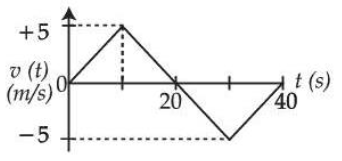
A person climbs up a stalled escalator in 60 s. If standing on the same but escalator running with constant velocity he takes 40 s. How much time is taken by the person to walk up the moving escalator?
Let the length of the escalator be $$ d $$. We need to find the time taken by the person to walk up the moving escalator.
First, when the escalator is stalled (not moving), the person climbs the entire length $$ d $$ in 60 seconds. So, the speed of the person relative to the escalator is $$ v_p = \frac{d}{60} $$.
Second, when the person stands still on the moving escalator, it takes 40 seconds to cover the same distance $$ d $$. So, the speed of the escalator is $$ v_e = \frac{d}{40} $$.
Now, when the person walks up the moving escalator, both the person and the escalator are moving in the same upward direction. Therefore, the effective speed of the person relative to the ground is the sum of their individual speeds: $$ v_p + v_e $$.
The time $$ t $$ taken to cover distance $$ d $$ at this combined speed is:
$$ t = \frac{d}{v_p + v_e} $$
Substitute the expressions for $$ v_p $$ and $$ v_e $$:
$$ t = \frac{d}{\frac{d}{60} + \frac{d}{40}} $$
Factor $$ d $$ out of the denominator:
$$ t = \frac{d}{d \left( \frac{1}{60} + \frac{1}{40} \right)} $$
Cancel $$ d $$ from numerator and denominator (since $$ d \neq 0 $$):
$$ t = \frac{1}{\frac{1}{60} + \frac{1}{40}} $$
Now, compute the denominator. Find the sum $$ \frac{1}{60} + \frac{1}{40} $$. The least common multiple of 60 and 40 is 120. Rewrite each fraction:
$$ \frac{1}{60} = \frac{2}{120}, \quad \frac{1}{40} = \frac{3}{120} $$
Add them:
$$ \frac{2}{120} + \frac{3}{120} = \frac{5}{120} = \frac{1}{24} $$
So,
$$ t = \frac{1}{\frac{1}{24}} = 24 \text{ seconds} $$
Hence, the time taken by the person to walk up the moving escalator is 24 seconds. Comparing with the options, Option C is 24 s.
So, the answer is 24 seconds.
From a tower of height H, a particle is thrown vertically upwards with a speed u. The time taken by the particle, to hit the ground, is n times that taken by it to reach the highest point of its path. The relation between H, u and n is:
Let us call the time taken by the particle to reach the highest point of its flight $$t_1$$. At that highest point the velocity becomes zero. For motion under uniform retardation we have the first-equation of motion $$v = u + at$$. Here the final velocity is $$0$$, the initial velocity is $$u$$ and the acceleration is $$-g$$ (because gravity opposes the upward motion). Hence
$$0 = u - g t_1 \; \Longrightarrow \; t_1 = \frac{u}{g}.$$
During this upward journey the particle rises a vertical distance $$s_1$$ above the top of the tower. Using the second‐equation of motion
$$s = ut + \frac{1}{2} a t^{\,2},$$
with $$u \rightarrow u,\; t \rightarrow t_1,\; a \rightarrow -g$$ we obtain
$$s_1 = u t_1 - \frac{1}{2} g t_1^{\,2}.$$
Substituting $$t_1 = u/g$$ inside, we get
$$s_1 = u\left(\frac{u}{g}\right) - \frac{1}{2} g\left(\frac{u}{g}\right)^{\!2}
= \frac{u^{2}}{g} - \frac{1}{2}\frac{u^{2}}{g}
= \frac{u^{2}}{2g}.$$
The greatest vertical height of the particle above the ground is therefore
$$H_{\text{max}} = H + s_1 = H + \frac{u^{2}}{2g}.$$
From the highest point the particle starts its downward fall with zero initial velocity. Let the time of this fall be $$t_2$$. During this descent it covers a distance $$H + \dfrac{u^{2}}{2g}$$ under constant acceleration $$g$$. Again invoking the second‐equation of motion with $$u = 0,\; a = g,\; t = t_2$$, we have
$$H + \frac{u^{2}}{2g} = \frac{1}{2} g t_2^{\,2}.$$
Rearranging,
$$t_2^{\,2} = \frac{2}{g}\!\left(H + \frac{u^{2}}{2g}\right)
= \frac{2H}{g} + \frac{u^{2}}{g^{2}},$$
$$t_2 = \sqrt{\frac{2H}{g} + \frac{u^{2}}{g^{2}}}.$$
According to the statement of the problem the total time taken to hit the ground is $$n$$ times the time to reach the highest point. The total time is $$t_1 + t_2$$. Hence we can write
$$t_1 + t_2 = n\,t_1
\;\;\Longrightarrow\;\;
t_2 = (n-1)t_1.$$
We already have $$t_1 = \dfrac{u}{g}$$, so
$$t_2 = (n-1)\frac{u}{g}.$$
But we also have an explicit expression for $$t_2$$ obtained from the descent. Equating the two values of $$t_2$$,
$$(n-1)\frac{u}{g} = \sqrt{\frac{2H}{g} + \frac{u^{2}}{g^{2}}}.$$
Squaring both sides to eliminate the square root,
$$(n-1)^{2}\frac{u^{2}}{g^{2}} = \frac{2H}{g} + \frac{u^{2}}{g^{2}}.$$
Multiplying every term by $$g^{2}$$ gives
$$(n-1)^{2}u^{2} = 2Hg + u^{2}.$$
Now let us bring the $$u^{2}$$ term on the left next to the existing $$u^{2}$$ factor:
$$(n-1)^{2}u^{2} - u^{2} = 2Hg.$$
Taking $$u^{2}$$ common,
$$\big[(n-1)^{2} - 1\big]\,u^{2} = 2Hg.$$
Expanding and simplifying the bracket,
$$(n^{2} - 2n + 1) - 1 = n^{2} - 2n,$$
so that
$$\big[n^{2} - 2n\big]\,u^{2} = 2Hg.$$
Factoring $$n$$ out of the bracket,
$$n(n-2)\,u^{2} = 2Hg.$$
Finally writing the result in a compact symmetric form,
$$2gH = n u^{2}(n - 2).$$
This is exactly the relation given in Option C.
Hence, the correct answer is Option C.
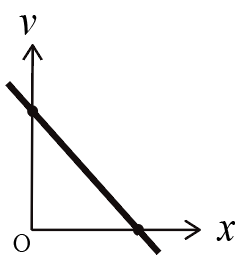
The initial speed of a bullet fired from a rifle is 630 m/s. The rifle is fired at the centre of a target 700 m away at the same level as the target. How far above the centre of the target must the rifle be aimed in order to hit the target?
The bullet is fired with an initial speed of 630 m/s towards a target 700 m away at the same level. Since the rifle is aimed directly at the center of the target, the initial velocity is horizontal. This means the initial vertical velocity is 0 m/s, and the initial horizontal velocity is 630 m/s.
To find how far above or below the center the bullet hits, we need to determine the vertical displacement when the bullet has traveled 700 m horizontally. The horizontal motion has no acceleration, so the time taken to cover 700 m is given by the horizontal distance divided by the horizontal velocity:
$$ t = \frac{\text{horizontal distance}}{\text{horizontal velocity}} = \frac{700}{630} $$
Simplifying the fraction:
$$ \frac{700}{630} = \frac{700 \div 70}{630 \div 70} = \frac{10}{9} \text{ seconds} $$
In the vertical direction, the initial velocity is 0 m/s, and acceleration due to gravity is $$ g = 9.8 \text{m/s}^2 $$ downward. The vertical displacement $$ h $$ is given by the equation of motion:
$$ h = u_y t + \frac{1}{2} a t^2 $$
Since $$ u_y = 0 $$ and $$ a = g $$ (taking downward as positive for displacement magnitude), this becomes:
$$ h = \frac{1}{2} g t^2 $$
Substituting $$ g = 9.8 $$ and $$ t = \frac{10}{9} $$:
$$ h = \frac{1}{2} \times 9.8 \times \left( \frac{10}{9} \right)^2 $$
First, compute $$ \left( \frac{10}{9} \right)^2 $$:
$$ \left( \frac{10}{9} \right)^2 = \frac{100}{81} $$
Now, multiply:
$$ h = \frac{1}{2} \times 9.8 \times \frac{100}{81} = \frac{1}{2} \times \frac{9.8 \times 100}{81} $$
Calculate $$ 9.8 \times 100 = 980 $$:
$$ h = \frac{1}{2} \times \frac{980}{81} = \frac{980}{2 \times 81} = \frac{980}{162} $$
Simplify by dividing numerator and denominator by 2:
$$ \frac{980 \div 2}{162 \div 2} = \frac{490}{81} $$
Now, compute the numerical value:
$$ \frac{490}{81} \approx 6.04938 \text{ m} $$
The negative sign indicates the displacement is downward, meaning the bullet hits below the center. The magnitude of the vertical displacement is approximately 6.05 m. Comparing with the options:
A. 1.0 m
B. 4.2 m
C. 6.1 m
D. 9.8 m
The value 6.05 m is closest to 6.1 m.
Hence, the correct answer is Option C.
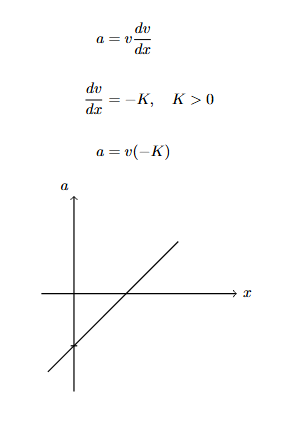
The position of a projectile launched from the origin at t = 0 is given by $$\vec{r} = (40\hat{i} + 50\hat{j})$$ m at t = 2s. If the projectile was launched at an angle $$\theta$$ from the horizontal, then $$\theta$$ is (take g = 10 ms$$^{-2}$$).
The position vector at time $$ t = 2 $$ seconds is given as $$ \vec{r} = 40\hat{i} + 50\hat{j} $$ meters. This means the horizontal displacement $$ x = 40 $$ m and the vertical displacement $$ y = 50 $$ m.
For a projectile launched from the origin with initial velocity $$ u $$ at an angle $$ \theta $$ to the horizontal, the equations of motion are:
Horizontal motion (no acceleration): $$ x = u_x t $$, where $$ u_x = u \cos \theta $$ is the horizontal component of initial velocity.
Vertical motion (constant acceleration due to gravity $$ g = 10 $$ m/s² downward): $$ y = u_y t - \frac{1}{2} g t^2 $$, where $$ u_y = u \sin \theta $$ is the vertical component of initial velocity.
At $$ t = 2 $$ s, $$ x = 40 $$ m. Substituting into the horizontal equation:
$$ 40 = u_x \cdot 2 $$
Solving for $$ u_x $$:
$$ u_x = \frac{40}{2} = 20 \text{ m/s} $$
At $$ t = 2 $$ s, $$ y = 50 $$ m. Substituting into the vertical equation:
$$ 50 = u_y \cdot 2 - \frac{1}{2} \cdot 10 \cdot (2)^2 $$
First, compute the term $$ \frac{1}{2} \cdot 10 \cdot 4 $$:
$$ \frac{1}{2} \cdot 10 = 5, \quad 5 \cdot 4 = 20 $$
So the equation becomes:
$$ 50 = 2u_y - 20 $$
Add 20 to both sides:
$$ 50 + 20 = 2u_y $$
$$ 70 = 2u_y $$
Solving for $$ u_y $$:
$$ u_y = \frac{70}{2} = 35 \text{ m/s} $$
The angle $$ \theta $$ is related to the components by:
$$ \tan \theta = \frac{u_y}{u_x} $$
Substituting the values:
$$ \tan \theta = \frac{35}{20} = \frac{7}{4} $$
Therefore, $$ \theta = \tan^{-1} \left( \frac{7}{4} \right) $$.
Comparing with the options:
A. $$ \tan^{-1} \frac{3}{2} $$
B. $$ \tan^{-1} \frac{2}{3} $$
C. $$ \tan^{-1} \frac{7}{4} $$
D. $$ \tan^{-1} \frac{4}{5} $$
Option C matches our result.
Hence, the correct answer is Option C.
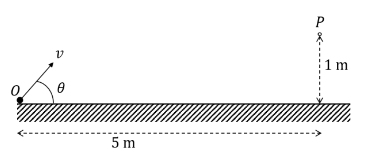
A ball of mass 160 g is thrown up at an angle of 60° to the horizontal at a speed of 10 m s$$^{-1}$$. The angular momentum of the ball at the highest point of the trajectory with respect to the point from which the ball is thrown is nearly (g = 10 m s$$^{-2}$$)
To solve this problem, we need to find the angular momentum of a ball at the highest point of its trajectory with respect to the point from which it was thrown. The ball has a mass of 160 g, is thrown at an angle of 60° to the horizontal with a speed of 10 m/s, and gravity is given as 10 m/s². Angular momentum is defined as the cross product of the position vector (from the reference point) and the linear momentum vector, so we'll calculate both at the highest point.
First, convert the mass to kilograms since SI units are required. The mass is 160 g, which is 160 divided by 1000, so mass $$ m = 0.160 $$ kg.
The initial velocity is 10 m/s at 60° to the horizontal. We resolve this into horizontal and vertical components:
Horizontal component: $$ u_x = u \cos \theta = 10 \cos 60^\circ $$
Since $$ \cos 60^\circ = \frac{1}{2} $$, $$ u_x = 10 \times \frac{1}{2} = 5 $$ m/s.
Vertical component: $$ u_y = u \sin \theta = 10 \sin 60^\circ $$
Since $$ \sin 60^\circ = \frac{\sqrt{3}}{2} $$, $$ u_y = 10 \times \frac{\sqrt{3}}{2} = 5\sqrt{3} $$ m/s.
At the highest point of the trajectory, the vertical component of velocity becomes zero ($$ v_y = 0 $$) because gravity acts downward, and the horizontal component remains unchanged since there is no horizontal acceleration. Therefore, the velocity at the highest point is purely horizontal: $$ v = v_x = u_x = 5 $$ m/s.
The linear momentum $$ \vec{p} $$ at the highest point is mass times velocity:
$$ \vec{p} = m \vec{v} = 0.160 \times 5 = 0.8 $$ kg m/s in the horizontal direction.
So, $$ \vec{p} = (0.8, 0) $$ kg m/s, where the first component is horizontal and the second is vertical.
Next, we find the position vector $$ \vec{r} $$ of the ball at the highest point relative to the point of projection. This requires the horizontal distance traveled ($$ x $$) and the maximum height ($$ H $$).
The maximum height $$ H $$ is given by the formula:
$$ H = \frac{u_y^2}{2g} $$
Substituting the values: $$ H = \frac{(5\sqrt{3})^2}{2 \times 10} = \frac{25 \times 3}{20} = \frac{75}{20} = 3.75 $$ m.
The time taken to reach the highest point $$ t $$ is the time when vertical velocity becomes zero:
$$ t = \frac{u_y}{g} = \frac{5\sqrt{3}}{10} = \frac{\sqrt{3}}{2} $$ seconds.
The horizontal distance $$ x $$ covered in this time is:
$$ x = u_x \times t = 5 \times \frac{\sqrt{3}}{2} = \frac{5\sqrt{3}}{2} $$ m.
So, the position vector $$ \vec{r} = \left( \frac{5\sqrt{3}}{2}, 3.75 \right) $$ m.
Angular momentum $$ \vec{L} $$ with respect to the point of projection is:
$$ \vec{L} = \vec{r} \times \vec{p} $$
In 2D, the magnitude of the cross product is $$ |\vec{L}| = |r_x p_y - r_y p_x| $$, where $$ r_x $$ and $$ r_y $$ are the components of $$ \vec{r} $$, and $$ p_x $$ and $$ p_y $$ are the components of $$ \vec{p} $$.
Here, $$ r_x = \frac{5\sqrt{3}}{2} $$, $$ r_y = 3.75 $$, $$ p_x = 0.8 $$, and $$ p_y = 0 $$.
So, $$ L = \left| \left( \frac{5\sqrt{3}}{2} \times 0 \right) - (3.75 \times 0.8) \right| = |0 - 3.75 \times 0.8| = | -3.0 | = 3.0 $$ kg m²/s.
Alternatively, using exact fractions:
$$ r_y = 3.75 = \frac{15}{4} $$ m (since $$ 3.75 = \frac{15}{4} $$),
$$ p_x = 0.8 = \frac{4}{5} $$ kg m/s,
So, $$ L = \left| -\left( \frac{15}{4} \times \frac{4}{5} \right) \right| = \left| -\frac{15 \times 4}{4 \times 5} \right| = \left| -\frac{15}{5} \right| = | -3 | = 3 $$ kg m²/s.
The magnitude is 3.0 kg m²/s, and the direction is perpendicular to the plane (negative sign indicates direction, but magnitude is positive).
Comparing with the options:
A. 1.73 kg m² s⁻¹
B. 3.46 kg m² s⁻¹
C. 3.0 kg m² s⁻¹
D. 6.0 kg m² s⁻¹
Hence, the correct answer is Option C.
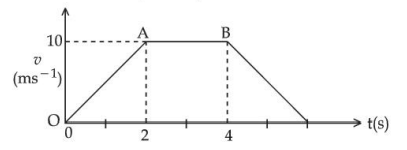
A ball projected from ground at an angle of 45° just clears a wall in front. If point of projection is 4 m from the foot of wall and ball strikes the ground at a distance of 6 m on the other side of the wall, the height of the wall is :
A ball is projected from the ground at an angle of 45°. The point of projection is 4 m from the foot of the wall, and the ball lands 6 m beyond the wall. The total horizontal distance covered (range) is the sum of these distances: 4 m + 6 m = 10 m.
For a projectile launched at an angle θ with initial velocity u, the range R is given by:
$$R = \frac{u^2 \sin 2\theta}{g} $$
Here, θ = 45°, so 2θ = 90° and sin 90° = 1. Thus:
$$R = \frac{u^2}{g} $$
Given R = 10 m:
$$10 = \frac{u^2}{g} $$
Solving for u²:
$$u^2 = 10g \quad \text{(Equation 1)} $$
The trajectory equation for a projectile is:
$$y = x \tan \theta - \frac{g x^2}{2 u^2 \cos^2 \theta} $$
With θ = 45°, tan 45° = 1 and cos 45° = $$\frac{1}{\sqrt{2}}$$, so cos² 45° = $$\left( \frac{1}{\sqrt{2}} \right)^2 = \frac{1}{2}$$. Substituting these values:
$$y = x \cdot 1 - \frac{g x^2}{2 u^2 \cdot \frac{1}{2}} $$
Simplifying:
$$y = x - \frac{g x^2}{u^2} \quad \text{(Equation 2)} $$
The ball just clears the wall at x = 4 m. Substituting x = 4 into Equation 2:
$$y = 4 - \frac{g (4)^2}{u^2} $$ $$ y = 4 - \frac{16g}{u^2} $$
From Equation 1, u² = 10g. Substituting this:
$$y = 4 - \frac{16g}{10g} $$
The g cancels out:
$$y = 4 - \frac{16}{10} $$
Simplifying the fraction:
$$\frac{16}{10} = 1.6 $$
Thus:
$$y = 4 - 1.6 = 2.4 \text{ m} $$
Therefore, the height of the wall is 2.4 m.
Comparing with the options:
A. 4.4 m
B. 2.4 m
C. 3.6 m
D. 1.6 m
Hence, the correct answer is Option B.
A projectile is given an initial velocity of $$(\hat{i} + 2\hat{j})$$ m s$$^{-1}$$, where $$\hat{i}$$ is along the ground and $$\hat{j}$$ is along the vertical upward. If $$g = 10$$ m s$$^{-2}$$, the equation of its trajectory is :
We are told that the projectile is launched from the origin with the velocity vector
$$\vec u \;=\; 1\,\hat i \;+\; 2\,\hat j \quad\text{m s}^{-1}.$$
Here $$\hat i$$ is the horizontal (ground) unit vector and $$\hat j$$ is the vertical upward unit vector. Hence the horizontal and vertical components of the initial velocity are
$$u_x = 1\ \text{m s}^{-1}, \qquad u_y = 2\ \text{m s}^{-1}.$$
For a projectile that starts from the origin, the general equation of the trajectory (the path in the $$x\!-\!y$$ plane) is obtained from kinematics. First we write the two independent component equations of motion:
Horizontal motion (no acceleration horizontally):
$$x = u_x\,t.$$
Vertical motion (constant downward acceleration $$g$$):
$$y = u_y\,t - \dfrac{1}{2}g\,t^2.$$
To eliminate the time $$t$$, we first solve the horizontal equation for $$t$$:
$$t = \dfrac{x}{u_x}.$$
Now we substitute this value of $$t$$ into the vertical equation:
$$$ \begin{aligned} y &= u_y\left(\dfrac{x}{u_x}\right) \;-\; \dfrac{1}{2}g\left(\dfrac{x}{u_x}\right)^2 \\[6pt] &= \dfrac{u_y}{u_x}\,x \;-\; \dfrac{g}{2u_x^{\,2}}\,x^2. \end{aligned} $$$
This is the standard textbook form
$$y = x\,\tan\theta \;-\; \dfrac{g}{2u^{\,2}\cos^2\theta}\,x^2,$$
but expressed directly through the components $$u_x, u_y$$ it reads
$$y = \dfrac{u_y}{u_x}\,x \;-\; \dfrac{g}{2u_x^{\,2}}\,x^2.$$
Now we plug in the numerical values $$u_x = 1\ \text{m s}^{-1},\; u_y = 2\ \text{m s}^{-1},\; g = 10\ \text{m s}^{-2}:$$
$$$ \begin{aligned} y &= \dfrac{2}{1}\,x \;-\; \dfrac{10}{2\,(1)^2}\,x^2 \\[6pt] &= 2x \;-\; \dfrac{10}{2}\,x^2 \\[6pt] &= 2x \;-\; 5x^2. \end{aligned} $$$
Thus the explicit equation of the trajectory is
$$y = 2x - 5x^2.$$
Comparing this with the given options, we see it matches option D.
Hence, the correct answer is Option D.
The maximum range of a bullet fired from a toy pistol mounted on a car at rest is $$R_0 = 40$$ m. What will be the acute angle of inclination of the pistol for maximum range when the car is moving in the direction of firing with uniform velocity $$v = 20$$ m/s on a horizontal surface? ($$g = 10$$ m/s$$^2$$)
The maximum range when the car is at rest is given as $$ R_0 = 40 $$ m, and gravity $$ g = 10 $$ m/s². For a projectile fired from ground level, the maximum range occurs at an angle of 45°. The range formula is $$ R = \frac{u^2 \sin 2\theta}{g} $$. At 45°, $$ \sin 90^\circ = 1 $$, so:
$$ R_0 = \frac{u^2}{g} $$
$$ 40 = \frac{u^2}{10} $$
$$ u^2 = 400 $$
$$ u = 20 \text{ m/s} $$
Thus, the initial speed of the bullet relative to the pistol is 20 m/s.
Now, the car moves with uniform velocity $$ v = 20 $$ m/s in the direction of firing. The pistol is mounted on the car, so the bullet's initial velocity relative to the ground has two components:
- Horizontal component: $$ v_x = v + u \cos \theta = 20 + 20 \cos \theta $$
- Vertical component: $$ v_y = u \sin \theta = 20 \sin \theta $$
The time of flight $$ T $$ is determined by the vertical motion. The bullet lands at the same level, so vertical displacement is zero:
$$ s_y = v_y T - \frac{1}{2} g T^2 = 0 $$
$$ (20 \sin \theta) T - \frac{1}{2} \times 10 \times T^2 = 0 $$
$$ 20 \sin \theta T - 5 T^2 = 0 $$
$$ 5T (4 \sin \theta - T) = 0 $$
Ignoring $$ T = 0 $$ (initial time), we get:
$$ T = 4 \sin \theta \text{ seconds} $$
The horizontal range $$ R $$ is the product of horizontal velocity and time of flight:
$$ R = v_x \times T = (20 + 20 \cos \theta) \times (4 \sin \theta) $$
$$ R = 80 (1 + \cos \theta) \sin \theta $$
To maximize $$ R $$, we maximize the function $$ f(\theta) = (1 + \cos \theta) \sin \theta $$. Expanding:
$$ f(\theta) = \sin \theta + \sin \theta \cos \theta $$
Using $$ \sin \theta \cos \theta = \frac{1}{2} \sin 2\theta $$:
$$ f(\theta) = \sin \theta + \frac{1}{2} \sin 2\theta $$
Differentiate with respect to $$ \theta $$:
$$ f'(\theta) = \cos \theta + \frac{1}{2} \times 2 \cos 2\theta = \cos \theta + \cos 2\theta $$
Set the derivative to zero for maximum:
$$ \cos \theta + \cos 2\theta = 0 $$
Using the identity $$ \cos 2\theta = 2 \cos^2 \theta - 1 $$:
$$ \cos \theta + (2 \cos^2 \theta - 1) = 0 $$
$$ 2 \cos^2 \theta + \cos \theta - 1 = 0 $$
Substitute $$ x = \cos \theta $$:
$$ 2x^2 + x - 1 = 0 $$
Solve the quadratic equation:
$$ x = \frac{ -1 \pm \sqrt{1^2 - 4 \times 2 \times (-1)} }{4} = \frac{ -1 \pm \sqrt{9} }{4} = \frac{ -1 \pm 3 }{4} $$
So:
$$ x = \frac{2}{4} = \frac{1}{2} \quad \text{or} \quad x = \frac{-4}{4} = -1 $$
Thus, $$ \cos \theta = \frac{1}{2} $$ or $$ \cos \theta = -1 $$. Since $$ \theta $$ is acute (0° to 90°), we discard $$ \cos \theta = -1 $$ (which gives $$ \theta = 180^\circ $$, not acute). Therefore:
$$ \cos \theta = \frac{1}{2} \quad \Rightarrow \quad \theta = 60^\circ $$
Verification: At $$ \theta = 60^\circ $$, $$ v_x = 20 + 20 \cos 60^\circ = 20 + 20 \times 0.5 = 30 $$ m/s, $$ v_y = 20 \sin 60^\circ = 20 \times \frac{\sqrt{3}}{2} = 10\sqrt{3} $$ m/s, time of flight $$ T = 4 \sin 60^\circ = 4 \times \frac{\sqrt{3}}{2} = 2\sqrt{3} $$ s, and range $$ R = 30 \times 2\sqrt{3} = 60\sqrt{3} \approx 103.92 $$ m. At other angles like 45° and 90°, the range is less (approximately 96.59 m and 80 m, respectively), confirming that 60° gives the maximum range.
Hence, the correct answer is Option B.
A projectile of mass M is fired so that the horizontal range is 4 km. At the highest point the projectile explodes in two parts of masses M/4 and 3M/4 respectively and the heavier part starts falling down vertically with zero initial speed. The horizontal range (distance from point of firing) of the lighter part is :
A projectile of mass M has a horizontal range of 4 km. The range formula for a projectile is given by $$ R = \frac{u^2 \sin 2\theta}{g} $$, where u is the initial velocity and θ is the angle of projection. So, we have:
$$ R = \frac{u^2 \sin 2\theta}{g} = 4 \text{km} $$
At the highest point of its trajectory, the projectile explodes into two parts: one of mass $$ \frac{M}{4} $$ and the other of mass $$ \frac{3M}{4} $$. The heavier part (mass $$ \frac{3M}{4} $$) falls vertically downward with zero initial speed, meaning its velocity immediately after the explosion is zero in both horizontal and vertical directions.
Since the explosion is an internal force, it does not affect the center of mass motion. Before the explosion, at the highest point, the entire projectile has only horizontal velocity $$ u_x = u \cos \theta $$ and zero vertical velocity. Therefore, the center of mass continues with velocity $$ (u_x, 0) $$ after the explosion.
Let $$ \vec{v_1} = (v_{1x}, v_{1y}) $$ be the velocity of the lighter part (mass $$ \frac{M}{4} $$) and $$ \vec{v_2} = (0, 0) $$ be the velocity of the heavier part (mass $$ \frac{3M}{4} $$) after the explosion. The center of mass velocity is:
$$ \vec{v_{cm}} = \frac{ \left( \frac{M}{4} \right) \vec{v_1} + \left( \frac{3M}{4} \right) \vec{v_2} }{ M } = \frac{1}{4} \vec{v_1} + \frac{3}{4} \vec{v_2} $$
Setting $$ \vec{v_{cm}} = (u_x, 0) $$ and substituting $$ \vec{v_2} = (0, 0) $$:
$$ (u_x, 0) = \frac{1}{4} (v_{1x}, v_{1y}) + \frac{3}{4} (0, 0) $$
This simplifies to:
$$ (u_x, 0) = \left( \frac{v_{1x}}{4}, \frac{v_{1y}}{4} \right) $$
Equating components:
$$ \frac{v_{1x}}{4} = u_x \quad \Rightarrow \quad v_{1x} = 4u_x $$
$$ \frac{v_{1y}}{4} = 0 \quad \Rightarrow \quad v_{1y} = 0 $$
So, the lighter part has horizontal velocity $$ 4u_x $$ and zero vertical velocity immediately after the explosion.
The explosion occurs at the highest point, which is at a horizontal distance of half the range from the firing point. Since the range is 4 km, this distance is:
$$ \frac{R}{2} = \frac{4}{2} = 2 \text{km} $$
The lighter part is now projected horizontally from this point with initial velocity $$ 4u_x $$ and from a height H, where H is the maximum height of the original projectile. The maximum height H is given by:
$$ H = \frac{u^2 \sin^2 \theta}{2g} $$
The time taken for the lighter part to fall to the ground from height H with zero initial vertical velocity is found using the equation of motion:
$$ H = \frac{1}{2} g t^2 \quad \Rightarrow \quad t = \sqrt{\frac{2H}{g}} $$
In this time, the horizontal distance covered by the lighter part from the explosion point is:
$$ d = v_{1x} \cdot t = 4u_x \cdot \sqrt{\frac{2H}{g}} $$
Substituting $$ H = \frac{u^2 \sin^2 \theta}{2g} $$:
$$ d = 4u_x \cdot \sqrt{ \frac{2}{g} \cdot \frac{u^2 \sin^2 \theta}{2g} } = 4u_x \cdot \sqrt{ \frac{u^2 \sin^2 \theta}{g^2} } = 4u_x \cdot \frac{u \sin \theta}{g} $$
Let $$ u_y = u \sin \theta $$ (the initial vertical component of velocity for the original projectile). Then:
$$ d = 4u_x \cdot \frac{u_y}{g} $$
From the original range equation:
$$ R = \frac{2 u_x u_y}{g} = 4 \text{km} $$
So:
$$ \frac{u_x u_y}{g} = \frac{R}{2} = \frac{4}{2} = 2 \text{km} $$
Substituting this into the expression for d:
$$ d = 4 \cdot 2 = 8 \text{km} $$
This is the horizontal distance traveled by the lighter part from the explosion point. The total horizontal range from the firing point is the distance to the explosion point plus d:
$$ \text{Total range} = 2 \text{km} + 8 \text{km} = 10 \text{km} $$
Hence, the horizontal range of the lighter part is 10 km.
So, the answer is Option C.
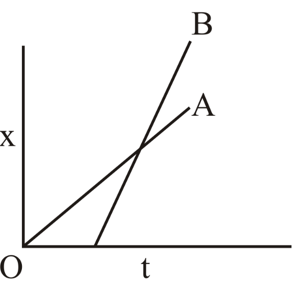
A ball is dropped vertically downwards from a height $$h$$ above the ground. It hits the ground inelastically and bounces up vertically. Neglecting subsequent motion and air resistance, which of the following graph represents variation between speed ($$v$$) and height ($$h$$) correctly?
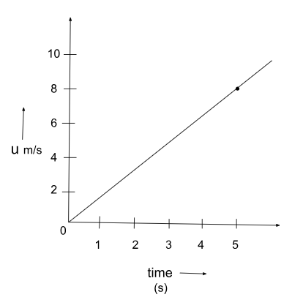
For motion under uniform gravity (air resistance neglected) we can use the constant-acceleration relation
$$v^{2}=u^{2}+2g\,(h_{\text{initial}}-h)\qquad -(1)$$
Here $$h$$ is the vertical coordinate measured from the ground (origin at the ground, positive upward), $$u$$ is the speed when the particle is at height $$h_{\text{initial}}$$ and $$g$$ is the magnitude of acceleration due to gravity.
Case 1: Descent from the release point ($$h=H$$) to the ground ($$h=0$$)
The ball is dropped from rest, so $$u=0$$ at $$h=H$$.
Putting $$h_{\text{initial}}=H$$ and $$u=0$$ in (1):
$$v^{2}=2g\,(H-h)\qquad (0\le h\le H)$$
Thus $$v=\sqrt{2g\,(H-h)}$$, which is the upper half of a parabola on a $$v$$ vs $$h$$ plot. At the starting point $$h=H$$, $$v=0$$; just before impact $$h=0$$, $$v=\sqrt{2gH}$$ (maximum speed).
Case 2: Ascent after the inelastic bounce
Let the coefficient of restitution with the ground be $$e\,(0\lt e\lt 1)$$.
Speed just after the bounce (directed upward) is therefore $$e\sqrt{2gH}$$.
During upward motion the acceleration is still downward $$(-g)$$, so we again use (1) with $$u=e\sqrt{2gH}$$ at $$h=0$$:
$$v^{2}=e^{2}\,2gH-2g\,h\qquad (0\le h\le h_{\max})$$
where $$h_{\max}=e^{2}H$$ (height reached after bounce). Hence $$v=\sqrt{e^{2}2gH-2g\,h}\,,$$ another upper-parabolic branch but this time terminating at $$h=e^{2}H$$ where $$v=0$$.
Shape of the complete $$v$$-$$h$$ graph
1. From $$h=H$$ to $$h=0$$: a parabolic arc opening toward the $$h$$-axis, starting at $$v=0$$ and ending at $$v=\sqrt{2gH}$$.
2. Immediately after impact: vertical jump to the point $$h=0,\;v=e\sqrt{2gH}$$ (because direction has reversed but we plot speed, a positive quantity).
3. From $$h=0$$ to $$h=e^{2}H$$: a second, shorter parabolic arc (same orientation) ending at $$v=0$$.
Among the given choices only Option D displays (i) the first long parabolic branch, (ii) a discontinuity in speed at the ground, and (iii) a second shorter parabolic branch terminating below the initial height. Therefore,
Option D which is: the only correct $$v$$-$$h$$ graph.
A boy can throw a stone up to a maximum height of $$10$$ m. The maximum horizontal distance that the boy can throw the same stone up to will be
A goods train accelerating uniformly on a straight railway track, approaches an electric pole standing on the side of track. Its engine passes the pole with velocity $$u$$ and the guard's room passes with velocity $$v$$. The middle wagon of the train passes the pole with a velocity.
Solution & Explanation
1. Define System Parameters and Set Up Equations
Let the total length of the train be $$L$$. Therefore, the middle wagon sits exactly at a distance of $$\frac{L}{2}$$ from both the engine (front) and the guard's room (back). The train is moving with a constant uniform acceleration $$a$$.
Using the third equation of motion ($$v^2 = u^2 + 2as$$) for the entire length of the train as it passes the pole:
- Initial velocity (when engine passes) = $$u$$
- Final velocity (when guard's room passes) = $$v$$
- Total displacement = $$L$$
$$v^2 = u^2 + 2aL \implies 2aL = v^2 - u^2 \quad \text{--- (Eq. 1)}$$
2. Analyze the Motion of the Middle Wagon
Let $$v_m$$ be the instantaneous velocity of the train at the exact moment its middle wagon passes the pole. Over this interval, the train has covered a displacement of exactly $$s = \frac{L}{2}$$ past the pole.
Applying the third equation of motion over this half-length interval:
$$v_m^2 = u^2 + 2a\left(\frac{L}{2}\right)$$
$$v_m^2 = u^2 + aL \quad \text{--- (Eq. 2)}$$
3. Substitute and Solve for $v_m$
From Equation 1, we can isolate the term $$aL$$:
$$aL = \frac{v^2 - u^2}{2}$$
Substitute this expression for $$aL$$ directly back into Equation 2:
$$v_m^2 = u^2 + \frac{v^2 - u^2}{2}$$
$$v_m^2 = \frac{2u^2 + v^2 - u^2}{2}$$
$$v_m^2 = \frac{u^2 + v^2}{2}$$
Taking the positive square root to find the actual velocity value:
$$v_m = \sqrt{\frac{u^2 + v^2}{2}}$$
Concept Check: Because kinetic energy scales with the square of velocity ($$v^2$$), the velocity at the spatial midpoint under constant acceleration matches the root-mean-square (RMS) value of the initial and final speeds rather than a simple arithmetic average.
Correct Option Key: Option D ($$\sqrt{\frac{u^2 + v^2}{2}}$$)
The distance travelled by a body moving along a line in time $$t$$ is proportional to $$t^3$$. The acceleration-time $$(a, t)$$ graph for the motion of the body will be
Solution & Explanation
1. Relate Distance to Time Using Calculus
The problem states that the distance travelled ($$s$$) by the body is directly proportional to the cube of time ($$t^3$$). We can express this relationship mathematically by introducing a proportionality constant ($$k$$):
$$s = k \cdot t^3$$
To find the velocity ($$v$$) of the body as a function of time, we take the first derivative of distance with respect to time ($$v = \frac{ds}{dt}$$):
$$v = \frac{d}{dt}(k \cdot t^3) = 3 \cdot k \cdot t^2$$
2. Determine Acceleration as a Function of Time
To find the acceleration ($$a$$) of the body, we take the derivative of velocity with respect to time ($$a = \frac{dv}{dt}$$):
$$a = \frac{d}{dt}(3 \cdot k \cdot t^2) = 2 \cdot (3 \cdot k) \cdot t$$
$$a = 6 \cdot k \cdot t$$
Since $$6$$ and $$k$$ are constants, we can simplify this relation back into a direct proportionality statement:
$$a \propto t$$
3. Interpret the Acceleration-Time ($$a - t$$) Graph
The linear equation $$a = (6k) \cdot t$$ matches the slope-intercept form of a straight line passing through the origin ($$y = m \cdot x$$), where:
- The vertical axis variable ($$y$$) represents acceleration ($$a$$).
- The horizontal axis variable ($$x$$) represents time ($$t$$).
- The constant slope ($$m$$) is positive ($$m = 6k$$).
Therefore, the acceleration-time ($$a - t$$) graph of this body is a straight line passing through the origin with a positive slope.
Correct Option Key: A straight line passing through the origin with a positive slope.
The graph of an object's motion (along the $$x$$-axis) is shown in the figure. The instantaneous velocity of the object at points $$A$$ and $$B$$ are $$v_A$$ and $$v_B$$ respectively. Then
The graph provided is a displacement-time ($$x$$ vs $$t$$) plot. For such a graph, the instantaneous velocity at any point equals the slope of the tangent at that point:
$$v = \frac{dx}{dt} = \text{slope of the } x\text{-}t \text{ graph}$$
Case 1: Point $$A$$ lies on a straight-line segment of the curve. Two easily readable neighbouring points on that segment are, for example, $$(2\;\text{s},\,1\;\text{m})$$ and $$(4\;\text{s},\,2\;\text{m})$$. The slope (and hence the velocity at $$A$$) is
$$v_A \;=\; \frac{2\;\text{m} - 1\;\text{m}}{4\;\text{s} - 2\;\text{s}} \;=\; \frac{1}{2}\;\text{m s}^{-1} \;=\; 0.5\;\text{m s}^{-1}$$
Case 2: Point $$B$$ also falls on a straight portion of the graph. Picking two nearby points on that segment—for instance $$(10\;\text{s},\,3\;\text{m})$$ and $$(14\;\text{s},\,5\;\text{m})$$—gives
$$v_B \;=\; \frac{5\;\text{m} - 3\;\text{m}}{14\;\text{s} - 10\;\text{s}} \;=\; \frac{2}{4}\;\text{m s}^{-1} \;=\; 0.5\;\text{m s}^{-1}$$
Because both points lie on straight segments having the same slope, the instantaneous velocities are identical:
$$v_A = v_B = 0.5\;\text{m s}^{-1}$$
Therefore, the correct choice is
Option A which is: $$v_A = v_B = 0.5\ \text{m/s}$$
A projectile moving vertically upwards with a velocity of $$200$$ ms$$^{-1}$$ breaks into two equal parts at a height of $$490$$ m. One part starts moving vertically upwards with a velocity of $$400$$ ms$$^{-1}$$. How much time it will take, after the break up with the other part to hit the ground?
Solution & Explanation
1. Apply Conservation of Linear Momentum during Explosion
An explosion is driven completely by internal forces, meaning the net external force during the instantaneous break-up interval is negligible. Therefore, linear momentum along the vertical axis must be fully conserved:
$$P_{\text{initial}} = P_{\text{final}}$$
Let the total initial mass of the projectile be $$M$$. It splits into two equal fragments, each having a mass of $$\frac{M}{2}$$. Taking the upward direction as positive ($$+$$):
- Initial velocity of the projectile just before the break-up: $$v = +200 \,\, \text{ms}^{-1}$$
- Velocity of the first fragment after the break-up: $$v_1 = +400 \,\, \text{ms}^{-1}$$
- Velocity of the second fragment after the break-up: $$v_2$$
Setting up the momentum balance equation:
$$M \cdot v = \left(\frac{M}{2}\right) \cdot v_1 + \left(\frac{M}{2}\right) \cdot v_2$$
Cancel out the mass variable $$M$$ from all terms:
$$v = \frac{v_1 + v_2}{2}$$
$$200 = \frac{400 + v_2}{2}$$
$$400 = 400 + v_2 \implies v_2 = 0 \,\, \text{ms}^{-1}$$
This means that immediately after the mid-air explosion, the second fragment loses all its forward upward momentum and is left momentarily stationary at that height.
2. Calculate Time Taken for the Second Part to Hit the Ground
Now we analyze the motion of this second piece as it falls from its position at the explosion height down to the earth's surface:
- Initial position height: $$h = 490 \,\, \text{m}$$
- Initial velocity of this fragment: $$u = v_2 = 0 \,\, \text{ms}^{-1}$$
- Acceleration due to gravity: $$g = 9.8 \,\, \text{ms}^{-2}$$ (directed downwards)
Using the second equation of motion ($$s = u \cdot t + \frac{1}{2} \cdot a \cdot t^2$$) taking downwards as the positive direction of displacement:
$$490 = 0 \cdot t + \frac{1}{2} \cdot (9.8) \cdot t^2$$
$$490 = 4.9 \cdot t^2$$
$$t^2 = \frac{490}{4.9} = 100$$
Taking the positive square root to determine the flight time duration:
$$t = \sqrt{100} = 10 \,\, \text{s}$$
Concept Check: Because the first half took away twice the velocity vector ($$400 \,\, \text{ms}^{-1}$$), it completely drained the kinetic energy allocations of the second half. This brings the second part to a dead stop in mid-air, making its subsequent journey back to earth a pure free-fall from a height of $$490 \,\, \text{m}$$.
Correct Option Key: Option C ($$10 \,\, \text{s}$$)
An object, moving with a speed of $$6.25 \, \text{m/s}$$, is decelerated at a rate given by: $$$\frac{dv}{dt} = -2.5\sqrt{v}$$$ where $$v$$ is the instantaneous speed. The time taken by the object, to come to rest, would be:
Solution & Explanation
1. Set Up the Differential Equation
The problem provides the deceleration rate of the object as a function of its instantaneous speed ($$v$$):
$$\frac{dv}{dt} = -2.5 \cdot \sqrt{v}$$
To solve for time ($$t$$), we rearrange the equation using the separation of variables method, grouping all terms involving velocity ($$v$$) on one side and time ($$t$$) on the other side:
$$\frac{1}{\sqrt{v}} \cdot dv = -2.5 \cdot dt$$
$$v^{-\frac{1}{2}} \cdot dv = -2.5 \cdot dt$$
2. Integrate with Initial and Final Limits
We apply definite integration on both sides matching the physical constraints of the motion:
- At initial time $$t = 0 \,\, \text{s}$$, the initial speed is $$v = 6.25 \,\, \text{m/s}$$.
- At final time $$t = t$$, the object comes to rest, meaning the final speed is $$v = 0 \,\, \text{m/s}$$.
Setting up the integration boundaries:
$$\int_{6.25}^{0} v^{-\frac{1}{2}} \cdot dv = \int_{0}^{t} -2.5 \cdot dt$$
Using the power rule for integration ($$\int v^n \cdot dv = \frac{v^{n+1}}{n+1}$$):
$$\left[ \frac{v^{\frac{1}{2}}}{\frac{1}{2}} \right]_{6.25}^{0} = -2.5 \cdot [t]_{0}^{t}$$
$$2 \cdot \left[ \sqrt{v} \right]_{6.25}^{0} = -2.5 \cdot (t - 0)$$
3. Evaluate Limits and Compute Time ($$t$$)
Substitute the upper and lower boundary values into the equation:
$$2 \cdot (\sqrt{0} - \sqrt{6.25}) = -2.5 \cdot t$$
Since $$\sqrt{6.25} = 2.5$$:
$$2 \cdot (0 - 2.5) = -2.5 \cdot t$$
$$-5 = -2.5 \cdot t$$
Isolating the time variable ($$t$$):
$$t = \frac{-5}{-2.5} = 2 \,\, \text{s}$$
Concept Check: Because the deceleration rate is non-linear and depends directly on $$\sqrt{v}$$, the slowing force reduces continuously as the speed drops, resulting in a smooth stop in exactly 2 seconds.
Correct Option Key: Option A ($2 \,\, \text{s}$)
A water fountain on the ground sprinkles water all around it. If the speed of water coming out of the fountain is $$v$$, the total area around the fountain that gets wet is:
A particle is moving with velocity $$\vec{v} = K(y\hat{i} + x\hat{j})$$, where $$K$$ is a constant. The general equation for its path is
A particle has an initial velocity $$3\hat{i} + 4\hat{j}$$ and an acceleration of $$0.4\hat{i} + 0.3\hat{j}$$. Its speed after $$10$$ s is
Consider a rubber ball freely falling from a height $$h = 4.9$$ m onto a horizontal elastic plate. Assume that the duration of collision is negligible and the collision with the plate is totally elastic. Then the velocity as a function of time the height as function of time will be
A body is at rest at $$x = 0$$. At $$t = 0$$, it starts moving in the positive $$x$$-direction with a constant acceleration. At the same instant another body passes through $$x = 0$$ moving in the positive $$x$$ direction with a constant speed. The position of the first body is given by $$x_1(t)$$ after time '$$t$$' and that of the second body by $$x_2(t)$$ after the same time interval. Which of the following graphs correctly describes $$(x_1 - x_2)$$ as a function of time '$$t$$'?
The first body starts from rest with uniform acceleration $$a$$, so after time $$t$$ its displacement from the origin is
$$x_1(t)=\tfrac12 a t^{2}\qquad -(1)$$
The second body crosses the origin at $$t=0$$ with a constant speed $$v$$, hence
$$x_2(t)=v\,t\qquad -(2)$$
The required function is the difference of the two displacements:
$$x_1-x_2=\tfrac12 a t^{2}-v t=t\bigl(\tfrac12 a t-v\bigr)\qquad -(3)$$
Equation (3) is a quadratic in $$t$$ whose leading coefficient $$\tfrac12 a$$ is positive, so its graph is an upward-opening parabola.
Key features of the parabola:
• At $$t=0$$, $$x_1-x_2=0$$ (the two bodies are together).
• The initial slope is $$\left.\frac{d}{dt}(x_1-x_2)\right|_{t=0}= -v$$, i.e. the curve leaves the origin with a negative slope.
• The vertex occurs when $$\dfrac{d}{dt}(x_1-x_2)=a t-v=0\;\Longrightarrow\;t=\dfrac{v}{a}$$. The minimum value there is $$-\dfrac{v^{2}}{2a}$$, so the curve lies below the $$t$$-axis between $$t=0$$ and $$t=\dfrac{2v}{a}$$.
• It crosses the $$t$$-axis again when $$x_1-x_2=0\Rightarrow t=0$$ or $$t=\dfrac{2v}{a}$$ and thereafter remains positive.
Therefore the correct plot begins at the origin, dips below the $$t$$-axis, attains a minimum at $$t=\dfrac{v}{a}$$, emerges to cut the axis at $$t=\dfrac{2v}{a}$$, and then rises indefinitely — exactly the shape shown in Option B.
Option C which is: the upward-opening parabola starting at the origin with an initial negative slope and crossing the axis once more at $$t=\dfrac{2v}{a}$$
The velocity of a particle is $$v = v_0 + gt + ft^2$$. If its position is $$x = 0$$ at $$t = 0$$, then its displacement after unit time ($$t = 1$$) is
Solution & Explanation
1. Express Velocity as a Differential Equation
Velocity ($$v$$) is defined as the instantaneous rate of change of displacement ($$x$$) with respect to time ($$t$$):
$$v = \frac{dx}{dt}$$
We substitute the given velocity expression into this definition to form our differential equation:
$$\frac{dx}{dt} = v_0 + g \cdot t + f \cdot t^2$$
Separating the variables to prepare for integration gives:
$$dx = (v_0 + g \cdot t + f \cdot t^2) \cdot dt$$
2. Perform Definite Integration with Limits
We now integrate both sides using the boundary conditions specified in the problem statement:
- At the initial boundary condition, the time is $$t = 0$$ and the position is $$x = 0$$.
- At the final boundary condition, the time reaches unit time $$t = 1$$ and the position reaches $$x = x$$.
Setting up the integration limits:
$$\int_{0}^{x} dx = \int_{0}^{1} (v_0 + g \cdot t + f \cdot t^2) \cdot dt$$
Applying the standard power rule for calculus integration ($$\int t^n \cdot dt = \frac{t^{n+1}}{n+1}$$):
$$[x]_{0}^{x} = \left[ v_0 \cdot t + \frac{g \cdot t^2}{2} + \frac{f \cdot t^3}{3} \right]_{0}^{1}$$
3. Substitute Limits to Find the Final Displacement
Evaluating the limits by substituting the upper value ($$1$$) and subtracting the lower value ($$0$$):
$$x - 0 = \left( v_0 \cdot (1) + \frac{g \cdot (1)^2}{2} + \frac{f \cdot (1)^3}{3} \right) - (0)$$
$$x = v_0 + \frac{g}{2} + \frac{f}{3}$$
Concept Check: Because acceleration is not constant (due to the time-dependent terms $$g \cdot t$$ and $$f \cdot t^2$$), standard algebraic equations of motion cannot be used. Continuous calculus integration over the entire time interval correctly accounts for the changing acceleration components.
Correct Option Key: Option B ($$v_0 + \frac{g}{2} + \frac{f}{3}$$)
A particle is projected at $$60^\circ$$ to the horizontal with a kinetic energy $$K$$. The kinetic energy at the highest point is
A particle just clears a wall of height $$b$$ at distance $$a$$ and strikes the ground at a distance $$c$$ from the point of projection. The angle of projection is
A particle located at $$x = 0$$ at time $$t = 0$$, starts moving along the positive $$x$$-direction with a velocity '$$v$$' that varies as $$v = \alpha\sqrt{x}$$. The displacement of the particle varies with time as
Solution & Explanation
1. Set Up the Differential Equation for Velocity
We are given that the velocity ($$v$$) of the particle varies with its position ($$x$$) according to the relation:
$$v = \alpha \sqrt{x}$$
Velocity is defined as the instantaneous rate of change of displacement with respect to time ($$v = \frac{dx}{dt}$$). Substituting this definition into our given equation gives a separable differential equation:
$$\frac{dx}{dt} = \alpha \sqrt{x}$$
2. Separate Variables and Integrate
To solve for displacement as a function of time, we rearrange the terms to group all $$x$$ variables on one side and all $$t$$ variables on the other:
$$\frac{dx}{\sqrt{x}} = \alpha \cdot dt$$
$$x^{-\frac{1}{2}} \cdot dx = \alpha \cdot dt$$
Now, we integrate both sides using the given initial boundary conditions (at time $$t = 0$$, the particle is located at $$x = 0$$):
$$\int_{0}^{x} x^{-\frac{1}{2}} \cdot dx = \int_{0}^{t} \alpha \cdot dt$$
Applying the power rule of integration ($$\int x^n dx = \frac{x^{n+1}}{n+1}$$):
$$\left[ \frac{x^{\frac{1}{2}}}{\frac{1}{2}} \right]_{0}^{x} = \alpha \cdot [t]_{0}^{t}$$
$$2\sqrt{x} = \alpha \cdot t$$
3. Isolate Displacement ($$x$$) and Identify Proportionality
Isolate the radical term by dividing both sides by 2:
$$\sqrt{x} = \frac{\alpha \cdot t}{2}$$
Square both sides of the equation to clear the square root and find the explicit displacement function:
$$x = \left( \frac{\alpha \cdot t}{2} \right)^2$$
$$x = \frac{\alpha^2}{4} \cdot t^2$$
Since $$\alpha$$ is a constant value, the coefficient fraction $$\frac{\alpha^2}{4}$$ is also entirely constant. Dropping the constants reveals the final scaling relationship between displacement and time:
$$x \propto t^2$$
Concept Check: Because velocity scales with the square root of position, the acceleration of this system turns out to be perfectly uniform ($$a = v \frac{dv}{dx} = \alpha \sqrt{x} \cdot \frac{\alpha}{2\sqrt{x}} = \frac{\alpha^2}{2}$$). Under constant acceleration starting from rest, displacement naturally expands quadratically with the square of elapsed time ($$x \propto t^2$$).
Correct Option Key: Option B ($$t^2$$)
A body falling from rest under gravity passes a certain point $$P$$. It was at a distance of $$400\,m$$ from $$P$$, $$4\,s$$ prior to passing through $$P$$. If $$g = 10\,m/s^2$$, then the height above the point $$P$$ from where the body began to fall is
Solution & Explanation
1. Understand the Kinematic Timeline
Let us break down the journey of the falling body from its starting position down to point $$P$$:
- The body begins falling from rest at a certain height above point $$P$$. Therefore, its initial velocity ($$u$$) at the very top is:
$$u = 0 \,\, \text{m/s}$$
- Let the total time taken by the body to fall from the top to point $$P$$ be $$t \,\, \text{seconds}$$.
- The problem specifies a reference point located $$4 \,\, \text{s}$$ prior to passing through $$P$$. The time elapsed from the start of the fall to this prior point is $$(t - 4) \,\, \text{seconds}$$.
2. Set Up Equations for the Positions
Using the second equation of motion ($$s = u \cdot t + \frac{1}{2} \cdot g \cdot t^2$$) with $$u = 0$$ and acceleration due to gravity $$g = 10 \,\, \text{m/s}^2$$:
- Total height above point $$P$$ ($$h_{\text{total}}$$):
$$h_{\text{total}} = \frac{1}{2} \cdot g \cdot t^2 = \frac{1}{2} \cdot 10 \cdot t^2 = 5t^2 \quad \text{--- (Eq. 1)}$$
- Height reached $$4 \,\, \text{s}$$ prior ($$h_{\text{prior}}$$):
$$h_{\text{prior}} = \frac{1}{2} \cdot g \cdot (t - 4)^2 = \frac{1}{2} \cdot 10 \cdot (t - 4)^2 = 5(t - 4)^2 \quad \text{--- (Eq. 2)}$$
3. Utilize the Distance Difference to Solve for Time ($$t$$)
We are given that the distance between this prior point and point $$P$$ is exactly $$400 \,\, \text{m}$$. Therefore:
$$h_{\text{total}} - h_{\text{prior}} = 400$$
Substitute Equation 1 and Equation 2 into this relationship:
$$5t^2 - 5(t - 4)^2 = 400$$
Divide the entire equation by 5 to simplify the algebra:
$$t^2 - (t - 4)^2 = 80$$
Expand the squared binomial term using $$(a-b)^2 = a^2 - 2ab + b^2$$:
$$t^2 - (t^2 - 8t + 16) = 80$$
$$t^2 - t^2 + 8t - 16 = 80$$
$$8t - 16 = 80$$
Isolate the time variable ($$t$$):
$$8t = 80 + 16$$
$$8t = 96 \implies t = \frac{96}{8} = 12 \,\, \text{s}$$
4. Calculate the Total Height Above Point $$P$$
Now that we know the total falling duration to reach point $$P$$ is $$12 \,\, \text{seconds}$$, we substitute $$t = 12$$ back into Equation 1 to find the initial bailing height:
$$h_{\text{total}} = 5 \cdot (12)^2$$
$$h_{\text{total}} = 5 \cdot 144 = 720 \,\, \text{m}$$
Concept Check: Falling for $$12 \,\, \text{s}$$ under gravity covers $$720 \,\, \text{m}$$. At $$8 \,\, \text{s}$$ ($$4 \,\, \text{s}$$ prior), the body covers $$5 \times 8^2 = 320 \,\, \text{m}$$. The difference between them ($$720 - 320 = 400 \,\, \text{m}$$) perfectly matches our problem statement.
Correct Option Key: A (720 m)
A particle is moving eastwards with a velocity of $$5$$ m/s. In $$10$$ seconds the velocity changes to $$5$$ m/s northwards. The average acceleration in this time is
The relation between time $$t$$ and distance $$x$$ is $$t = ax^2 + bx$$ where $$a$$ and $$b$$ are constants. The acceleration is
Solution & Explanation
1. Relate Velocity to the Given Time Equation
We are given the relation between time ($$t$$) and distance ($$x$$) as:
$$t = a \cdot x^2 + b \cdot x$$
Velocity ($$v$$) is defined as the instantaneous rate of change of position with respect to time ($$v = \frac{dx}{dt}$$). To find an expression involving velocity, we differentiate both sides of the equation with respect to distance ($$x$$):
$$\frac{dt}{dx} = \frac{d}{dx}(a \cdot x^2 + b \cdot x)$$
$$\frac{dt}{dx} = 2a \cdot x + b$$
Since velocity is the reciprocal of $$\frac{dt}{dx}$$, we can write:
$$v = \frac{dx}{dt} = \frac{1}{2a \cdot x + b} \quad \text{--- (Eq. 1)}$$
2. Differentiate Velocity to Find Acceleration ($$A$$)
Acceleration is defined as the rate of change of velocity with respect to time ($$A = \frac{dv}{dt}$$). Using the chain rule, we can rewrite acceleration in terms of position ($$x$$):
$$A = \frac{dv}{dx} \cdot \frac{dx}{dt} = v \cdot \frac{dv}{dx}$$
Let us differentiate Equation 1 with respect to $$x$$ using the power rule/reciprocal rule ($$\frac{d}{dx}(\frac{1}{u}) = -\frac{1}{u^2} \cdot \frac{du}{dx}$$):
$$\frac{dv}{dx} = \frac{d}{dx}\left[ (2a \cdot x + b)^{-1} \right]$$
$$\frac{dv}{dx} = -1 \cdot (2a \cdot x + b)^{-2} \cdot \frac{d}{dx}(2a \cdot x + b)$$
$$\frac{dv}{dx} = -\frac{2a}{(2a \cdot x + b)^2}$$
3. Substitute Velocity Back into the Acceleration Expression
From Equation 1, we know that $$\frac{1}{2a \cdot x + b} = v$$. Squaring both sides gives:
$$\frac{1}{(2a \cdot x + b)^2} = v^2$$
Substitute this back into our derivative expression for $$\frac{dv}{dx}$$:
$$\frac{dv}{dx} = -2a \cdot v^2$$
Now, calculate the final acceleration ($$A$$):
$$A = v \cdot \frac{dv}{dx} = v \cdot (-2a \cdot v^2) = -2a \cdot v^3$$
Concept Check: The negative sign confirms that as the object moves further along ($$x$$ increases), its velocity decreases over time under this specific configuration, resulting in a retarding acceleration proportional to the cube of its instantaneous speed.
Correct Option Key: Option C ($$-2a \cdot v^3$$)
A car starting from rest accelerates at the rate $$f$$ through a distance $$S$$, then continues at constant speed for time $$t$$ and then decelerates at the rate $$f/2$$ to come to rest. If the total distance traversed is $$15S$$, then
Solution & Explanation
1. Analyze Phase 1: Acceleration
The car starts from rest, meaning its initial velocity ($$u_1$$) is zero:
$$u_1 = 0$$
It accelerates at a uniform rate $$f$$ over a distance $$S$$. Let its final velocity at the end of this phase be $$v$$. Using the third equation of motion ($$v^2 = u^2 + 2as$$):
$$v^2 = 0^2 + 2 \cdot f \cdot S$$
$$v^2 = 2 \cdot f \cdot S \quad \text{--- (Eq. 1)}$$
2. Analyze Phase 2: Constant Speed
The car continues to travel at this constant maximum speed $$v$$ for a time duration $$t$$. Let the distance covered during this phase be $$S_2$$:
$$S_2 = v \cdot t \quad \text{--- (Eq. 2)}$$
3. Analyze Phase 3: Deceleration
The car then decelerates at a uniform rate of $$\frac{f}{2}$$ to come completely to rest. Let us define the parameters for this final phase:
- Initial velocity: $$v$$
- Final velocity: $$0$$
- Deceleration: $$a_3 = -\frac{f}{2}$$
- Distance traveled: Let this be $$S_3$$
Applying the third equation of motion again:
$$0^2 = v^2 + 2 \cdot \left(-\frac{f}{2}\right) \cdot S_3$$
$$0 = v^2 - f \cdot S_3$$
$$S_3 = \frac{v^2}{f}$$
Substituting the value of $$v^2 = 2 \cdot f \cdot S$$ from Equation 1 into this expression gives:
$$S_3 = \frac{2 \cdot f \cdot S}{f} = 2S$$
4. Set Up the Total Distance Equation
The total distance traversed by the car during all three phases of its journey combined is given as $$15S$$:
$$S_{\text{total}} = S + S_2 + S_3 = 15S$$
Substitute our known values for $$S_3 = 2S$$ into this relation:
$$S + S_2 + 2S = 15S$$
$$3S + S_2 = 15S$$
$$S_2 = 12S$$
5. Relate $$S$$, $$f$$, and $$t$$
Substitute the expression for $$S_2$$ from Equation 2 ($$S_2 = v \cdot t$$) into our new relation:
$$v \cdot t = 12S$$
Square both sides of the equation to easily substitute our initial $$v^2$$ term:
$$v^2 \cdot t^2 = 144 \cdot S^2$$
Substitute $$v^2 = 2 \cdot f \cdot S$$ from Equation 1:
$$(2 \cdot f \cdot S) \cdot t^2 = 144 \cdot S^2$$
Divide both sides by $$2S$$ (since distance $$S \neq 0$$):
$$f \cdot t^2 = 72 \cdot S$$
Isolating the value of distance $$S$$ yields:
$$S = \frac{1}{72} \cdot f \cdot t^2$$
Concept Check: Because this specific mathematical relation is missing from options A, B, and C, the correct choice is "None of these".
Correct Option Key: None of these
A parachutist after bailing out falls $$50$$ m without friction. When parachute opens, it decelerates at $$2$$ m/s$$^2$$. He reaches the ground with a speed of $$3$$ m/s. At what height, did he bail out?
Solution & Explanation
1. Analyze Phase 1: Free Fall (Before Parachute Opens)
The parachutist bails out from rest, meaning his initial velocity ($$u_1$$) is zero:
$$u_1 = 0 \,\, \text{m/s}$$
He falls a distance of $$h_1 = 50 \,\, \text{m}$$ under gravity without any air friction. Taking downward as the positive direction, his acceleration during this phase is $$a_1 = g = 9.8 \,\, \text{m/s}^2$$. We find his velocity ($$v_1$$) just as the parachute opens using the third equation of motion ($$v^2 = u^2 + 2as$$):
$$v_1^2 = u_1^2 + 2 \cdot g \cdot h_1$$
$$v_1^2 = 0^2 + 2 \cdot 9.8 \cdot 50$$
$$v_1^2 = 980 \,\, \text{m}^2/\text{s}^2$$
2. Analyze Phase 2: Deceleration (After Parachute Opens)
When the parachute opens, the system begins to slow down. Let us define the kinematic parameters for this second phase of motion:
- Initial velocity for this phase: It matches the final velocity of the free fall, so $$u_2^2 = v_1^2 = 980 \,\, \text{m}^2/\text{s}^2$$.
- Uniform deceleration: $$a_2 = -2 \,\, \text{m/s}^2$$ (negative because it opposes downward motion).
- Final velocity upon reaching the ground: $$v_2 = 3 \,\, \text{m/s}$$.
- Distance traveled during deceleration: Let this be $$h_2$$.
Applying the third equation of motion for this deceleration phase:
$$v_2^2 = u_2^2 + 2 \cdot a_2 \cdot h_2$$
$$(3)^2 = 980 + 2 \cdot (-2) \cdot h_2$$
$$9 = 980 - 4 \cdot h_2$$
Rearranging the equation to isolate the second height segment ($$h_2$$):
$$4 \cdot h_2 = 980 - 9$$
$$4 \cdot h_2 = 971$$
$$h_2 = \frac{971}{4} = 242.75 \,\, \text{m}$$
3. Calculate the Total Bailing Height
The total height ($$H$$) from which the parachutist initially bailed out is the sum of the distance covered during the free fall ($$h_1$$) and the distance covered while decelerating ($$h_2$$):
$$H = h_1 + h_2$$
$$H = 50 + 242.75 = 292.75 \,\, \text{m}$$
Rounding this value to the nearest whole integer gives:
$$H \approx 293 \,\, \text{m}$$
Concept Check: The problem breaks into two distinct acceleration zones. During the initial brief gravity drop ($$50 \,\, \text{m}$$), the jumper builds a massive velocity of nearly $$31.3 \,\, \text{m/s}$$. Because the parachute’s braking force is relatively gentle ($$2 \,\, \text{m/s}^2$$), a long braking runway of over $$242 \,\, \text{m}$$ is required to safely bleed off that velocity down to a walking speed of $$3 \,\, \text{m/s}$$.
Correct Option Key: Option C ($$293 \,\, \text{m}$$)
Two points $$A$$ and $$B$$ move from rest along a straight line with constant acceleration $$f$$ and $$f'$$ respectively. If $$A$$ takes $$m$$ sec. more than $$B$$ and describes '$$n$$' units more than $$B$$ in acquiring the same speed then
Let the common speed finally acquired by both points be $$v$$.
For point $$A$$ (acceleration $$f$$, starting from rest):
Final speed $$v = f\,t_A$$ $$\Rightarrow \; t_A = \frac{v}{f}$$
For point $$B$$ (acceleration $$f'$$, starting from rest):
Final speed $$v = f'\,t_B$$ $$\Rightarrow \; t_B = \frac{v}{f'}$$
Given that point $$A$$ takes $$m$$ seconds more than point $$B$$ to reach this speed,
$$t_A - t_B = m$$ $$\frac{v}{f} - \frac{v}{f'} = m$$ $$v\left(\frac{1}{f} - \frac{1}{f'}\right) = m$$ $$-(1)$$
Distances travelled while accelerating from rest:
For $$A$$: $$s_A = \frac12 f\,t_A^2 = \frac12 f\left(\frac{v}{f}\right)^2 = \frac{v^2}{2f}$$
For $$B$$: $$s_B = \frac12 f'\,t_B^2 = \frac12 f'\left(\frac{v}{f'}\right)^2 = \frac{v^2}{2f'}$$
Given that $$A$$ covers $$n$$ units more than $$B$$,
$$s_A - s_B = n$$ $$\frac{v^2}{2}\left(\frac{1}{f} - \frac{1}{f'}\right) = n$$ $$-(2)$$
Let $$\Delta = \frac{1}{f} - \frac{1}{f'}$$. From $$(1):\; v\Delta = m \;\Rightarrow\; v = \frac{m}{\Delta}$$
Substituting $$v$$ in $$(2):$$
$$\frac{1}{2}\left(\frac{m}{\Delta}\right)^2 \Delta = n$$ $$\frac{m^2}{2\Delta} = n$$ $$\Delta = \frac{m^2}{2n}$$ $$-(3)$$
But $$\Delta = \frac{1}{f} - \frac{1}{f'} = \frac{f' - f}{ff'}$$. Equating this with $$(3):$$
$$\frac{f' - f}{ff'} = \frac{m^2}{2n}$$ $$\bigl(f' - f\bigr)\,n = \frac12\,f\,f'\,m^2$$
Thus, the required relation is
$$\boxed{(f' - f)\,n = \dfrac12\,f\,f'\,m^2}$$
Option D which is: $$(f' - f)n = \frac{1}{2}ff'm^2$$
A projectile can have the same range $$R$$ for two angles of projection. If $$t_1$$ and $$t_2$$ be the times of flights in the two cases, then the product of the two time of flights is proportional to
For a projectile launched from the ground with the same initial speed $$u$$, the standard kinematic relations are:
• Time of flight for an angle of projection $$\theta$$:
$$T = \frac{2u \sin\theta}{g}$$
• Horizontal range for the same angle:
$$R = \frac{u^{2}\sin 2\theta}{g}$$
If the same range $$R$$ is obtained for two different angles, let the angles be $$\alpha$$ and $$\beta$$ with corresponding times of flight $$t_1$$ and $$t_2$$.
Because $$R$$ is the same for both angles with the same speed $$u$$, we must have
$$\sin 2\alpha = \sin 2\beta$$.
For $$0^\circ \lt \theta \lt 90^\circ$$, the equality $$\sin 2\alpha = \sin 2\beta$$ implies
$$2\alpha + 2\beta = 180^\circ \quad\Longrightarrow\quad \alpha + \beta = 90^\circ$$.
Hence $$\beta = 90^\circ - \alpha$$. Using the time-of-flight formula for each angle:
$$t_1 = \frac{2u \sin\alpha}{g},\qquad t_2 = \frac{2u \sin\beta}{g} = \frac{2u \sin(90^\circ-\alpha)}{g} = \frac{2u \cos\alpha}{g}$$
Their product is
$$t_1 t_2 = \frac{2u \sin\alpha}{g}\;\frac{2u \cos\alpha}{g} = \frac{4u^{2}\sin\alpha\cos\alpha}{g^{2}} = \frac{2u^{2}\sin 2\alpha}{g^{2}}.$$
But $$u^{2}\sin 2\alpha/g = R$$, so
$$t_1 t_2 = \frac{2R}{g}.$$
Since $$g$$ is a constant, the product $$t_1 t_2$$ is directly proportional to the range $$R$$.
Hence, the correct option is:
Option D which is: $$R$$
A particle is projected from a point $$O$$ with velocity $$u$$ at an angle of $$60^\circ$$ with the horizontal. When it is moving in a direction at right angles to its direction at $$O$$, its velocity then is given by
A ball is released from the top of a tower of height $$h$$ metres. It takes $$T$$ seconds to reach the ground. What is the position of the ball in $$T/3$$ seconds?
Solution & Explanation
1. Analyze the Total Journey of the Ball
The ball is dropped from rest at the top of a tower of height $$h$$, meaning its initial velocity ($$u$$) is zero:
$$u = 0 \,\, \text{m/s}$$
Let $$T$$ be the total time taken by the ball to reach the ground. Using the second equation of motion ($$s = u \cdot t + \frac{1}{2} \cdot a \cdot t^2$$) with a downward acceleration due to gravity ($$a = g$$):
$$h = 0 \cdot T + \frac{1}{2} \cdot g \cdot T^2$$
$$h = \frac{1}{2} \cdot g \cdot T^2 \quad \text{--- (Eq. 1)}$$
2. Calculate the Distance Covered in Time $$\frac{T}{3}$$
Let $$y$$ be the downward vertical distance covered by the ball from the top of the tower during the initial time interval $$t = \frac{T}{3}$$:
$$y = 0 \cdot \left(\frac{T}{3}\right) + \frac{1}{2} \cdot g \cdot \left(\frac{T}{3}\right)^2$$
$$y = \frac{1}{2} \cdot g \cdot \frac{T^2}{9}$$
$$y = \frac{1}{9} \cdot \left(\frac{1}{2} \cdot g \cdot T^2\right)$$
Substituting the value of $$h$$ from Equation 1 into this expression gives:
$$y = \frac{h}{9}$$
This represents the distance the ball has fallen downward from the top of the tower.
3. Determine the Position Relative to the Ground
The position of the ball measured upward from the ground ($$h'$$) is equal to the total height of the tower minus the vertical distance it has traveled downward:
$$h' = h - y$$
$$h' = h - \frac{h}{9}$$
$$h' = \frac{9h - h}{9} = \frac{7h}{9} \,\, \text{metres}$$
Concept Check: Because displacement under constant acceleration scales quadratically with time ($$s \propto t^2$$), traveling for one-third of the total time ($$\frac{1}{3} \cdot T$$) means the object covers only one-ninth ($$\frac{1}{9}$$) of the total vertical height from the release point, leaving it at a height of $$\frac{8h}{9}$$ from the ground base.
Correct Option Key: Option C ($$\frac{8h}{9}$$ metres from the ground)
An automobile travelling with speed of $$60$$ km/h, can brake to stop within a distance of $$20$$ m. If the car is going twice as fast, i.e $$120$$ km/h, the stopping distance will be
Given:
Initial speed, $$v_1=60\ \frac{km}{h}$$
Stopping distance, d1=20 m
New speed, $$v_2=120km/h$$
Braking distance is proportional to the square of speed:
$$d\propto v^2$$
Therefore,
$$\frac{d_2}{d_1}=\left(\frac{v_2}{v_1}\right)^2$$
Substituting the values:
$$\frac{d_2}{20}=\left(\frac{120}{60}\right)^2$$
$$\frac{d_2}{20}=2^2$$
$$\frac{d_2}{20}=4$$
$$d_2=20\times4$$
$$d_2=80m$$
A ball is thrown from a point with a speed $$v_0$$ at an angle of projection $$\theta$$. From the same point and at the same instant person starts running with a constant speed $$v_0/2$$ to catch the ball. Will the person be able to catch the ball? If yes, what should be the angle of projection?
A projectile can have the same range $$R$$ for two angles of projection. If $$T_1$$ and $$T_2$$ be the time of flights in the two cases, then the product of the two time of flights is directly proportional to
Solution & Explanation
1. Understand Complementary Angles for Same Range
A projectile launched with an initial velocity $$u$$ achieves the exact same horizontal range ($$R$$) at two distinct projection angles that are complementary to each other. Let these two angles be:
- First angle: $$\theta_1 = \theta$$
- Second angle: $$\theta_2 = 90^\circ - \theta$$
The standard formula for horizontal range ($$R$$) under gravitational acceleration ($$g$$) is:
$$R = \frac{u^2 \cdot \sin(2\theta)}{g} = \frac{2 \cdot u^2 \cdot \sin\theta \cdot \cos\theta}{g}$$
2. Set Up Time of Flight Equations
The total time of flight ($$T$$) for a projectile is given by the formula $$T = \frac{2 \cdot u \cdot \sin\alpha}{g}$$. We write down the specific time of flight expressions for both individual trajectories:
- For the first case ($$\theta_1 = \theta$$):
$$T_1 = \frac{2 \cdot u \cdot \sin\theta}{g}$$
- For the second case ($$\theta_2 = 90^\circ - \theta$$):
$$T_2 = \frac{2 \cdot u \cdot \sin(90^\circ - \theta)}{g} = \frac{2 \cdot u \cdot \cos\theta}{g}$$
3. Multiply the Time of Flights
Now, let us calculate the product of the two times of flight ($$T_1 \cdot T_2$$):
$$T_1 \cdot T_2 = \left( \frac{2 \cdot u \cdot \sin\theta}{g} \right) \cdot \left( \frac{2 \cdot u \cdot \cos\theta}{g} \right)$$
$$T_1 \cdot T_2 = \frac{2}{g} \cdot \left( \frac{2 \cdot u^2 \cdot \sin\theta \cdot \cos\theta}{g} \right)$$
4. Identify the Proportionality
Notice that the grouped term inside the parentheses is the exact mathematical expression for the horizontal range ($$R$$) established in Step 1:
$$T_1 \cdot T_2 = \frac{2}{g} \cdot R$$
Since the factor $$\frac{2}{g}$$ is completely constant, we drop it to express the final scaling relationship:
$$T_1 \cdot T_2 \propto R$$
Concept Check: The product of the flight times directly tracks the horizontal range because one time profile captures the vertical component scaled by $$\sin\theta$$ and the other captures the horizontal configuration scaled by $$\cos\theta$$. Combined, their product tracks the cross-multiplied parameter $$\sin\theta \cdot \cos\theta$$, which defines horizontal displacement capacity.
Correct Option Key: Option C ($$R$$)
If $$t_1$$ and $$t_2$$ are the times of flight of two particles having the same initial velocity $$u$$ and range $$R$$ on the horizontal, then $$t_1^2 + t_2^2$$ is equal to