We treat the aeroplane as a set of straight metallic conductors moving with uniform velocity in the earth’s magnetic field. Whenever a conductor of length $$L$$ moves with velocity $$\vec v$$ through a magnetic field $$\vec B$$, an emf
$$\varepsilon \;=\; (\vec v \times \vec B)\cdot\vec L$$
is produced, where $$\vec L$$ is a vector from one end of the conductor to the other. The magnitude is therefore
$$\vert\varepsilon\vert = v\,B_\perp\,L = vBL\sin\phi,$$
$$\phi$$ being the angle between $$\vec v$$ and $$\vec B$$.
The data given are
$$\begin{aligned}
B &= 5\times10^{-5}\,\text{T},\\
\sin\theta &= \frac23 \;(\text{dip}),\\
v &= 240\ \text{m s}^{-1},\\
\text{height} &= 5\ \text{m},\\
\text{wing span} &= 15\ \text{m}.
\end{aligned}$$
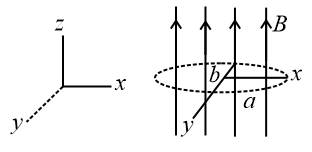
Because the declination is $$\approx 0^\circ$$, the horizontal component of $$\vec B$$ is due north. We choose axes
$$\hat i :$$ East $$,\qquad \hat j :$$ North $$,\qquad \hat k :$$ Up $$.$$
With dip $$\theta$$, the magnetic field is
$$\vec B = B\cos\theta\,\hat j - B\sin\theta\,\hat k.$$
Using $$\sin\theta=\dfrac23,\; \cos\theta=\sqrt{1-\sin^2\theta}=\sqrt{1-\dfrac49}= \sqrt{\dfrac59}= \dfrac{\sqrt5}{3},$$ we have
$$\begin{aligned}
B_H &= B\cos\theta = 5\times10^{-5}\times\frac{\sqrt5}{3}\ \text{T},\\
B_V &= B\sin\theta = 5\times10^{-5}\times\frac23\ \text{T}.
\end{aligned}$$
Numerically
$$\begin{aligned}
B_H &= 5\times10^{-5}\times0.745355\;=\;3.72678\times10^{-5}\ \text{T},\\[2mm]
B_V &= 5\times10^{-5}\times0.666667\;=\;3.33333\times10^{-5}\ \text{T}.
\end{aligned}$$
The velocity of the aircraft is due east, $$\vec v = v\,\hat i$$. Hence
$$\vec v\times\vec B
= v\$$, $$\hat i \times \bigl(B_H\hat j - B_V\hat k\bigr)
= vB_H(\hat i\times\hat j) - vB_V(\hat i\times\hat k)
= vB_H\$$, $$\hat k - vB_V\$$, $$\hat j.$$
Thus
$$\vec v\times\vec B = vB_H\,\hat k \;-\; vB_V\,\hat j.$$
──────────────────────────────────────────
Emf between lower and upper surfaces (height 5 m)
The length vector from the lower surface to the upper surface is $$\vec L_B = 5\,\hat k\ \text{m}.$$ Therefore
$$\varepsilon_B = (\vec v\times\vec B)\cdot\vec L_B
= \bigl(vB_H\,\hat k - vB_V\,\hat j\bigr)\cdot (5\,\hat k)
= vB_H\times5.$$
Substituting numbers,
$$\begin{aligned}
\varepsilon_B &= 240\,(3.72678\times10^{-5})\times5 \\[2mm]
&= 240\times5\times3.72678\times10^{-5}\\[2mm]
&= 1200\times3.72678\times10^{-5}\\[2mm]
&= 4.47214\times10^{-2}\ \text{V}\\[2mm]
&\approx 0.045\ \text{V}\;=\;45\ \text{mV}.
\end{aligned}$$
──────────────────────────────────────────
Emf between the wing tips (span 15 m)
The wings run north-south, the left wing tip being to the north of the pilot. We take the length vector from the right tip (south) to the left tip (north):
$$\vec L_W = 15\,\hat j\ \text{m}.$$
Hence
$$\varepsilon_W = (\vec v\times\vec B)\cdot\vec L_W
= \bigl(vB_H\,\hat k - vB_V\,\hat j\bigr)\cdot(15\,\hat j)
= -\,vB_V\times15.$$
Its magnitude is
$$\vert\varepsilon_W\vert = vB_V\times15
= 240\,(3.33333\times10^{-5})\times15.$$
Step by step:
$$\begin{aligned}
240\times15 &= 3600,\\
3600\times3.33333\times10^{-5} &= 1.20000\times10^{-1}\ \text{V}\\
&= 0.12\ \text{V}\\
&= 120\ \text{mV}.
\end{aligned}$$
The negative sign in $$\varepsilon_W$$ shows that the potential decreases from north to south, i.e. the left (north) wing tip is at a higher potential than the right (south) wing tip.
──────────────────────────────────────────
We have therefore obtained
$$V_B \approx 45\$$ mV $$,\qquad V_W \approx 120\$$ mV $$,$$
with the left side of the pilot (north wing tip) at the higher voltage.
Hence, the correct answer is Option D.
 JEE WhatsApp Group

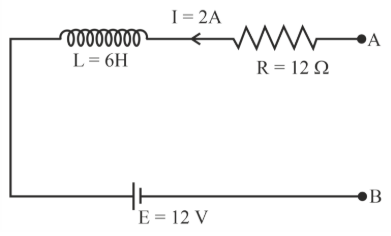
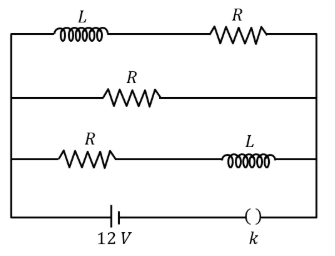
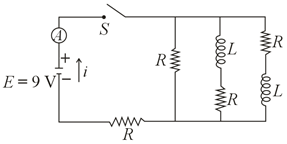
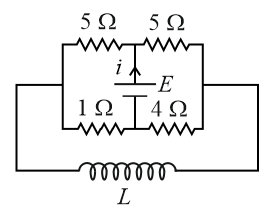
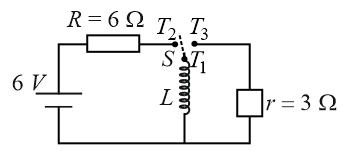
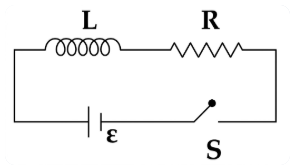
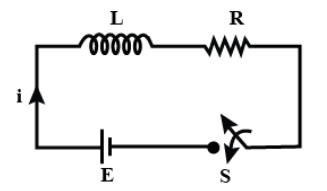
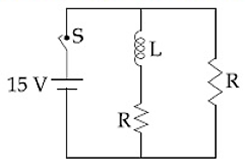
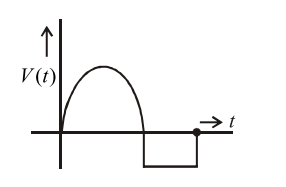
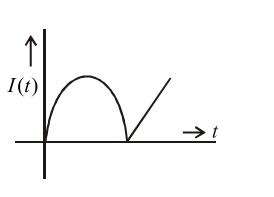
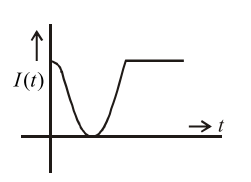
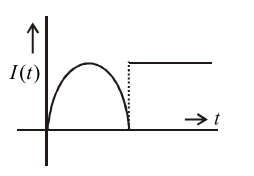



 closed at $$t = 0$$. The potential drop across $$L$$ as a function of time is
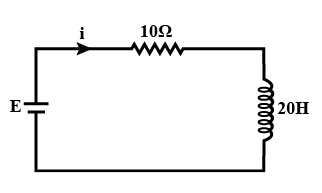
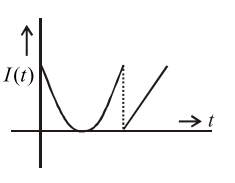
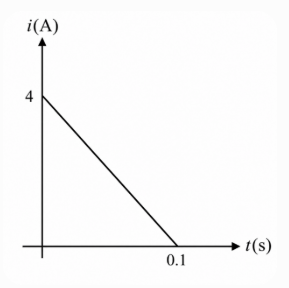
 The current in the circuit $$1\,mm$$ after the circuit is
