
Join Our JEE Preparation Group
Prep with like-minded aspirants; Get access to free daily tests and study material.
Sign in
Please select an account to continue using cracku.in
↓ →
Join Our JEE Preparation Group
Prep with like-minded aspirants; Get access to free daily tests and study material.
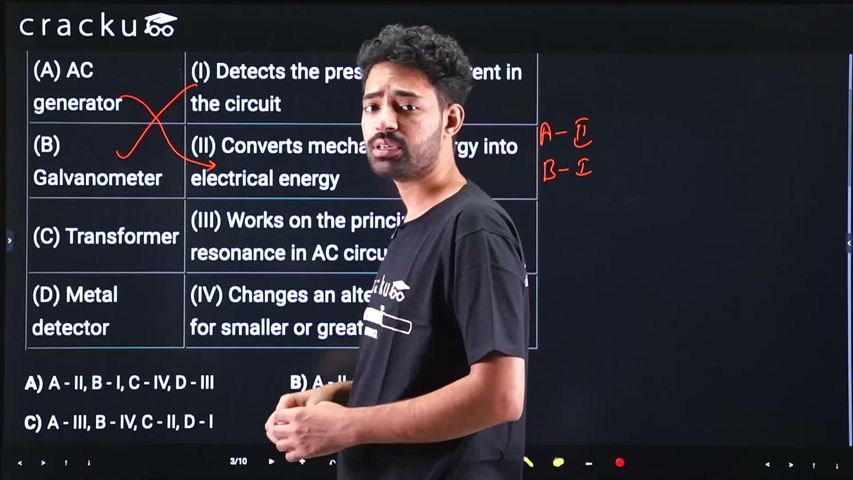
Match List - I with List - II.
| List-I | List-II |
|---|---|
| (A) AC generator | (I) Detects the presence of current in the circuit |
| (B) Galvanometer | (II) Converts mechanical energy into electrical energy |
| (C) Transformer | (III) Works on the principle of resonance in AC circuit |
| (D) Metal detector | (IV) Changes an alternating voltage for smaller or greater value |
We need to match the devices in List-I with their descriptions in List-II.
(A) AC Generator:
An AC generator converts mechanical energy (rotation of the coil in a magnetic field) into electrical energy (alternating current). This matches (II).
(B) Galvanometer:
A galvanometer is a device used to detect the presence and direction of current in a circuit. This matches (I).
(C) Transformer:
A transformer is used to step up or step down an alternating voltage, i.e., it changes an alternating voltage to a smaller or greater value. This matches (IV).
(D) Metal Detector:
A metal detector works on the principle of resonance in an AC circuit. When a metal object is brought near the coil, it changes the impedance and disturbs the resonance condition. This matches (III).
Therefore the correct matching is: A - II, B - I, C - IV, D - III.
The correct answer is Option A: A - II, B - I, C - IV, D - III.
Was this solution helpful?
Click on the Email ☝️ to Watch the Video Solution
Create a FREE account and get:
_1.webp)

Educational materials for JEE preparation

Ask our AI anything

AI can make mistakes. Please verify important information.
AI can make mistakes. Please verify important information.
