
Join Our JEE Preparation Group
Prep with like-minded aspirants; Get access to free daily tests and study material.
Sign in
Please select an account to continue using cracku.in
↓ →
Join Our JEE Preparation Group
Prep with like-minded aspirants; Get access to free daily tests and study material.
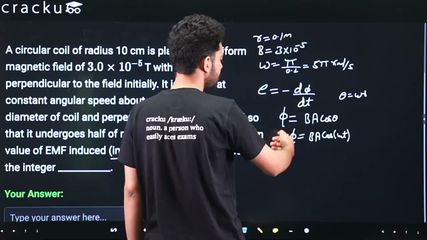
A circular coil of radius 10 cm is placed in a uniform magnetic field of $$3.0 \times 10^{-5}$$ T with its plane perpendicular to the field initially. It is rotated at constant angular speed about an axis along the diameter of coil and perpendicular to magnetic field so that it undergoes half of rotation in 0.2 s. The maximum value of EMF induced (in $$\mu$$V) in the coil will be close to the integer ___________.
Correct Answer: 15
We begin with Faraday’s law of electromagnetic induction, which states that the magnitude of the induced emf in a coil is given by
$$e = -\,\dfrac{d\Phi}{dt},$$
where $$\Phi$$ is the magnetic flux through the coil. For a single circular loop of area $$A$$ placed in a uniform magnetic field $$B$$, the flux at any instant is
$$\Phi = B A \cos\theta,$$
with $$\theta$$ being the angle between the magnetic field and the normal to the plane of the coil.
In this problem the coil is made to rotate at a constant angular speed $$\omega$$ about a diameter that lies in the plane of the coil and is perpendicular to the magnetic field. Because of this rotation, the angle $$\theta$$ changes uniformly with time as
$$\theta = \omega t.$$
Differentiating the flux with respect to time, we obtain
$$$e = -\dfrac{d}{dt}\!\left(B A \cos(\omega t)\right) = -B A \,\dfrac{d}{dt}\!\left(\cos(\omega t)\right).$$$
Using $$\dfrac{d}{dt}[\cos(\omega t)] = -\omega \sin(\omega t)$$, we get
$$$e = -B A \left(-\omega \sin(\omega t)\right) = B A \omega \sin(\omega t).$$$
The sine function can vary from $$-1$$ to $$+1$$, so the maximum magnitude of the emf (denoted $$e_{\text{max}}$$) is obtained when $$\sin(\omega t)=\pm 1$$. Therefore,
$$e_{\text{max}} = B A \omega.$$
Now we substitute the given data step by step.
Radius of the coil: $$r = 10\ \text{cm} = 0.10\ \text{m}.$$
Area of the coil (using $$A = \pi r^{2}$$):
$$$A = \pi (0.10\ \text{m})^{2} = \pi (0.01\ \text{m}^{2}) = 0.01\pi\ \text{m}^{2}.$$$
Uniform magnetic field: $$B = 3.0 \times 10^{-5}\ \text{T}.$$
The coil completes half a revolution (an angle of $$\pi$$ radians) in $$0.2\ \text{s}$$. Hence the constant angular speed is
$$\omega = \dfrac{\pi\ \text{rad}}{0.2\ \text{s}} = 5\pi\ \text{rad s}^{-1}.$$
Taking the coil to have a single turn, $$N = 1$$. (If there were more turns we would multiply by $$N$$, but the numerical answer indicates $$N = 1$$.)
Substituting all values in $$e_{\text{max}} = B A \omega$$ gives
$$$\begin{aligned} e_{\text{max}} &= (3.0 \times 10^{-5}\ \text{T}) \times (0.01\pi\ \text{m}^{2}) \times (5\pi\ \text{rad s}^{-1}) \\ &= 3.0 \times 0.01 \times 5 \times \pi^{2} \times 10^{-5}\ \text{V} \\ &= 0.15 \times \pi^{2} \times 10^{-5}\ \text{V}. \end{aligned}$$$
Using $$\pi^{2}\approx 9.8696$$, we have
$$$e_{\text{max}} = 0.15 \times 9.8696 \times 10^{-5}\ \text{V} = 1.480 \times 10^{-5}\ \text{V}.$$$
To convert this to microvolts, recall that $$1\ \text{V} = 10^{6}\ \mu\text{V}$$, so
$$$e_{\text{max}} = 1.480 \times 10^{-5}\ \text{V} = 1.480 \times 10^{-5} \times 10^{6}\ \mu\text{V} = 14.8\ \mu\text{V}.$$$
Rounding to the nearest integer (as required by the question), we get
$$e_{\text{max}} \approx 15\ \mu\text{V}.$$
So, the answer is $$15$$.
Was this solution helpful?
Click on the Email ☝️ to Watch the Video Solution
Create a FREE account and get:
_1.webp)

Educational materials for JEE preparation

Ask our AI anything

AI can make mistakes. Please verify important information.
AI can make mistakes. Please verify important information.
