
Join Our JEE Preparation Group
Prep with like-minded aspirants; Get access to free daily tests and study material.
Sign in
Please select an account to continue using cracku.in
↓ →
Join Our JEE Preparation Group
Prep with like-minded aspirants; Get access to free daily tests and study material.
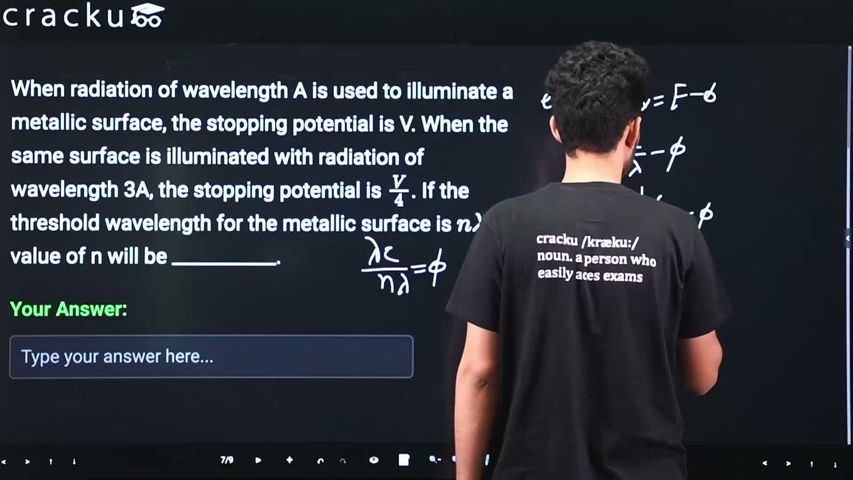
When radiation of wavelength A is used to illuminate a metallic surface, the stopping potential is V. When the same surface is illuminated with radiation of wavelength 3A, the stopping potential is $$\frac{V}{4}$$. If the threshold wavelength for the metallic surface is $$n\lambda$$ then value of n will be ___________.
Correct Answer: 9
We begin with Einstein’s photo-electric equation, stated in terms of stopping potential:
$$eV_s \;=\; h\nu \;-\; \phi$$
Here $$e$$ is the electronic charge, $$V_s$$ the stopping potential, $$h$$ Planck’s constant, $$\nu$$ the frequency of the incident light and $$\phi$$ the work function of the metal. Rewriting the photon energy with wavelength $$\lambda$$ using $$\nu = \dfrac{c}{\lambda}$$ gives
$$eV_s \;=\; \dfrac{hc}{\lambda} \;-\; \dfrac{hc}{\lambda_0}$$
where $$\lambda_0$$ is the threshold wavelength of the surface.
According to the problem, for wavelength $$\lambda = \Lambda$$ the stopping potential is $$V$$. Substituting these values, we have
$$eV \;=\; \dfrac{hc}{\Lambda} \;-\; \dfrac{hc}{\lambda_0} \qquad (1)$$
The same surface is next illuminated with wavelength $$3\Lambda$$ and the stopping potential becomes $$\dfrac{V}{4}$$. Substituting again:
$$e\left(\dfrac{V}{4}\right) \;=\; \dfrac{hc}{3\Lambda} \;-\; \dfrac{hc}{\lambda_0} \qquad (2)$$
For simplicity, let us express the threshold wavelength in the form stated in the question: $$\lambda_0 = n\Lambda$$, where $$n$$ is the unknown we must find. We now rewrite both equations using this relation.
From equation (1):
$$eV = hc\left(\dfrac{1}{\Lambda} - \dfrac{1}{n\Lambda}\right) = hc \left(\dfrac{n-1}{n\Lambda}\right) \qquad (3)$$
From equation (2):
$$e\dfrac{V}{4} = hc\left(\dfrac{1}{3\Lambda} - \dfrac{1}{n\Lambda}\right) = hc \left(\dfrac{n-3}{3n\Lambda}\right) \qquad (4)$$
To eliminate the common factors $$hc$$ and $$\Lambda$$, we divide equation (3) by equation (4). The left-hand side becomes
$$\dfrac{eV}{eV/4} = 4$$
The right-hand side becomes
$$\dfrac{\dfrac{n-1}{n\Lambda}}{\dfrac{n-3}{3n\Lambda}} = \dfrac{n-1}{n\Lambda} \cdot \dfrac{3n\Lambda}{\,n-3\,} = 3\,\dfrac{n-1}{n-3}$$
Equating the two sides gives
$$4 = 3\,\dfrac{n-1}{n-3}$$
Cross-multiplying, we obtain
$$4(n-3) = 3(n-1)$$
Expanding both sides:
$$4n - 12 = 3n - 3$$
Bringing all terms containing $$n$$ to one side:
$$4n - 3n = -3 + 12$$
$$n = 9$$
Thus the threshold wavelength is $$\lambda_0 = 9\Lambda$$.
Hence, the correct answer is Option 9.
Click on the Email ☝️ to Watch the Video Solution
Create a FREE account and get:
_1.webp)

Educational materials for JEE preparation

Ask our AI anything

AI can make mistakes. Please verify important information.
AI can make mistakes. Please verify important information.


