A small metallic sphere of diameter 2 mm and density $$10.5 g/cm ^{3}$$ is dropped in glycerine having viscosity 10 Poise and density $$1.5 g/cm^{3}$$ respectively. The terminal velocity attained by the sphere is __ $$cm/s$$.
$$(\pi=\frac{22}{7} \text { and } g=10m/s^{2})$$
- Home
- >
- JEE Questions
- >
- JEE Physics Questions
- >
- Friction
JEE Friction Questions
Using Stokes' law: $$v_t = \frac{2r^2(\rho_s - \rho_l)g}{9\eta}$$
r = 1 mm = 0.1 cm, ρ_s = 10.5 g/cm³, ρ_l = 1.5 g/cm³, η = 10 P = 10 g/(cm·s), g = 1000 cm/s².
$$v_t = \frac{2 \times 0.01 \times 9 \times 1000}{9 \times 10} = \frac{180}{90} =2.0$$ cm/s
The answer is Option 2: 2.0 cm/s.
A particle of mass m falls from rest through a resistive medium having resistive force, F = -kv, where v is the velocity of the particle and k is a constant. Which of the following graphs represents velocity (v) versus time (t)?
Now the forces acting on the particle are $$mg\ and\ F=-kv$$
so $$mg-kv=F_{net}$$
$$ma=mg-kv$$
$$m\times\ \frac{dv}{dt}=mg-kv$$
$$\frac{dv}{mg-kv}=\frac{dt}{m}$$
Integrating on both sides
$$\int\ \frac{dv}{mg-kv}=\int\ \frac{dt}{m}$$
$$-\frac{1}{k}\ln\ \left(\frac{\left(mg-kv\right)}{mg}\right)=\frac{t}{m}$$
$$v=\frac{mg}{k}\left(1-e^{-\frac{kt}{m}}\right)$$
Therefore option D is right
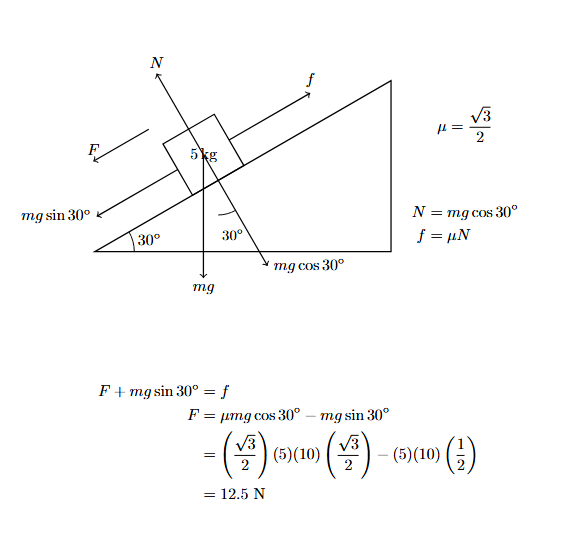
A block of mass 5 kg is moving on an inclined plane which makes an angle of 30° with the horizontal. Friction coefficient between the block and inclined plane surface is $$\frac{\sqrt{3}}{2}$$. The force to be applied on the block so that the block will move down without acceleration is _______N
$$(g=10m/s^{2})$$
A block takes $$t$$ time to slide down a plane inclined at 45° to the horizontal. If the surface is made smooth (frictionless), the block takes time $$\dfrac{t}{2}$$ to slide down the plane. The coefficient of friction between the block and the inclined plane is $$\left(\dfrac{\alpha}{100}\right)$$. The value of $$\alpha$$ is __________.
On a smooth plane: $$a_{\text{smooth}} = g \sin\theta$$
On a rough plane: $$a_{\text{rough}} = g \sin\theta - \mu g \cos\theta$$
$$\frac{t_{\text{rough}}}{t_{\text{smooth}}} = \sqrt{\frac{a_{\text{smooth}}}{a_{\text{rough}}}}$$
$$\frac{t}{\frac{t}{2}} = \sqrt{\frac{g \sin 45^\circ}{g \sin 45^\circ - \mu g \cos 45^\circ}}$$
$$2 = \sqrt{\frac{\frac{1}{\sqrt{2}}}{\frac{1}{\sqrt{2}} - \mu \frac{1}{\sqrt{2}}}} = \sqrt{\frac{1}{1 - \mu}}$$
$$4 = \frac{1}{1 - \mu}$$
$$4 - 4\mu = 1 \implies 4\mu = 3 \implies \mu = \frac{3}{4} = 0.75$$
$$\frac{\alpha}{100} = 0.75 \implies \alpha = 75$$
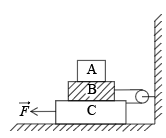
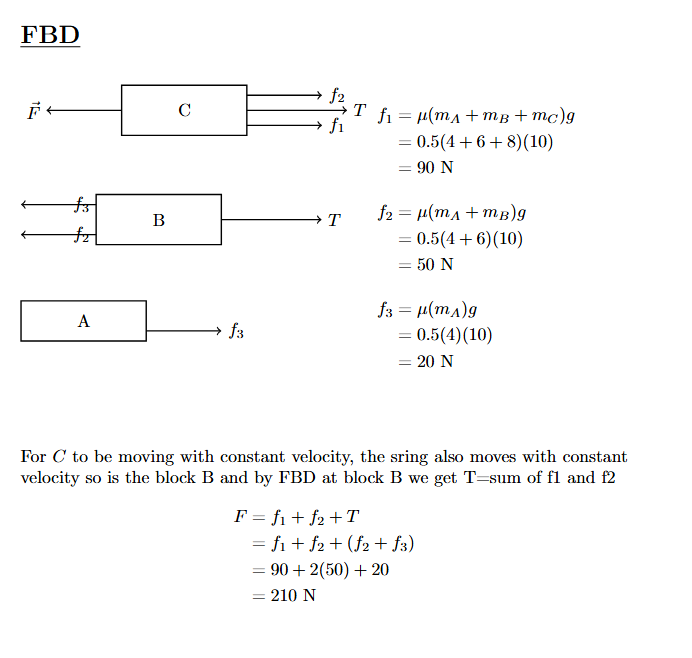
In the given figure, the blocks A, B and C weigh 4 kg, 6 kg and 8 kg, respectively. The coefficient of sliding friction between any two surfaces is 0.5. The force F required to slide the block C with constant speed is __ N. (Use $$g=10m/s^{2}$$)
Sixty four rain drops of radius 1 mm each falling down w-ith a terminal velocity of 10 cm/s coalesce to fonn a bigger drop. The terminal velocity of bigger drop is_____cm/s
We need to find the terminal velocity of a bigger drop formed by the coalescence of 64 small raindrops.
Number of small drops: $$n = 64$$
Radius of each small drop: $$r = 1$$ mm
Terminal velocity of each small drop: $$v = 10$$ cm/s
$$n \times \frac{4}{3}\pi r^3 = \frac{4}{3}\pi R^3$$
$$R^3 = n \times r^3 = 64 r^3$$
$$R = 4r$$
Terminal velocity is proportional to the square of the radius:
$$v_t \propto r^2$$
(This comes from Stokes' law: $$v_t = \frac{2r^2(\rho - \sigma)g}{9\eta}$$)
$$\frac{V}{v} = \frac{R^2}{r^2} = \frac{(4r)^2}{r^2} = 16$$
$$V = 16 \times v = 16 \times 10 = 160 \text{ cm/s}$$
Therefore, the terminal velocity of the bigger drop is 160 cm/s.
A small rigid spherical ball of mass M is dropped in a long vertical tube containing glycerine. The velocity of the ball becomes constant after some time. If the density of glycerine is half of the density of the ball, then the viscous force acting on the ball will be (consider g as acceleration due to gravity)
When the ball reaches terminal velocity, the net force acting on it is zero. The forces involved are:
1. Weight of the ball acting downward: $$W = Mg$$
2. Buoyant force acting upward: This equals the weight of the glycerine displaced by the ball. Let the volume of the ball be $$V$$. The buoyant force is given by $$F_b = \rho_g V g$$, where $$\rho_g$$ is the density of glycerine.
3. Viscous force acting upward: Denoted as $$F_v$$.
Given that the density of glycerine is half the density of the ball, let the density of the ball be $$\rho_b$$. Then:
$$\rho_g = \frac{1}{2} \rho_b$$
The mass of the ball is related to its density and volume by:
$$M = \rho_b V$$
Solving for volume:
$$V = \frac{M}{\rho_b}$$
Substitute this into the buoyant force formula:
$$F_b = \rho_g V g = \left(\frac{1}{2} \rho_b\right) \times \left(\frac{M}{\rho_b}\right) g = \frac{1}{2} M g$$
At terminal velocity, the net force is zero, so upward forces equal downward forces:
$$F_b + F_v = W$$
Substitute the expressions:
$$\frac{1}{2} M g + F_v = M g$$
Solve for the viscous force $$F_v$$:
$$F_v = M g - \frac{1}{2} M g = \frac{1}{2} M g$$
Therefore, the viscous force acting on the ball is $$\frac{Mg}{2}$$.
The correct option is D. $$\frac{Mg}{2}$$
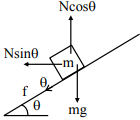
A car of mass $$m$$ moves on a banked road having radius $$' r '$$ and banking angle $$\theta.$$ To avoid slipping from the banked road, the maximum permissible speed of the car is $$v_0.$$ The coefficient of friction $$\mu$$ between the wheels of the car and the banked road is:
consider forces on the car on a banked road
forces acting:
- weight = mg (vertical downward)
- normal reaction = N (perpendicular to surface)
- friction = f (along surface)
for maximum speed, the car tends to slip up the incline, so friction acts down the slope
resolve forces:
along horizontal (towards center → provides centripetal force)
N sinθ + f cosθ = m v₀² / r
along vertical (no vertical acceleration)
N cosθ − f sinθ = mg
at limiting condition:
f = μN
substitute f = μN
horizontal:
N sinθ + μN cosθ = m v₀² / r
N (sinθ + μ cosθ) = m v₀² / r …(1)
vertical:
N cosθ − μN sinθ = mg
N (cosθ − μ sinθ) = mg …(2)
divide (1) by (2):
(sinθ + μ cosθ) / (cosθ − μ sinθ) = (v₀² / rg)
cross multiply:
sinθ + μ cosθ = (v₀² / rg)(cosθ − μ sinθ)
expand:
sinθ + μ cosθ = (v₀² / rg)cosθ − (v₀² / rg)μ sinθ
collect μ terms:
μ cosθ + (v₀² / rg)μ sinθ = (v₀² / rg)cosθ − sinθ
factor μ:
μ [cosθ + (v₀² / rg) sinθ] = (v₀² / rg)cosθ − sinθ
final expression:
μ = [ (v₀² / rg)cosθ − sinθ ] / [ cosθ + (v₀² / rg) sinθ ]
$$ \mu=\frac{v_0^2-rg\tan\theta}{rg+v_0^2\tan\theta} $$
this is the required coefficient of friction for maximum speed.
Given below are two statements:
Statement I: The hot water flows faster than cold water
Statement II: Soap water has higher surface tension as compared to fresh water. In the light above statements, choose the correct answer from the options given below
We need to evaluate two statements about fluid properties.
Statement I: "Hot water flows faster than cold water."
This is TRUE. The viscosity of a liquid decreases with increasing temperature because higher kinetic energy of the molecules helps them overcome intermolecular attractive forces more easily. Since viscosity resists flow, lower viscosity means hot water flows faster than cold water.
Statement II: "Soap water has higher surface tension as compared to fresh water."
This is FALSE. Soap is a surfactant that accumulates at the water surface and disrupts the cohesive hydrogen bonds between water molecules, thereby reducing the surface tension. Fresh water has a surface tension of about $$0.073$$ N/m at room temperature, and adding soap lowers this value significantly. This is precisely why soap helps in cleaning — the reduced surface tension allows water to spread and wet surfaces more effectively.
The correct answer is Option (1): Statement I is true but Statement II is false.
Consider following statements: A. Surface tension arises due to extra energy of the molecules at the interior as compared to the molecules at the surface, of a liquid. B. As the temperature of liquid rises, the coefficient of viscosity increases. C. As the temperature of gas increases, the coefficient of viscosity increases D. The onset of turbulence is determined by Reynold's number. E. In a steady flow two stream lines never intersect. Choose the correct answer from the options given below:
Let us analyze each statement about fluid properties.
Statement A: Surface tension arises due to extra energy of molecules at the interior compared to molecules at the surface.
This is INCORRECT. Surface tension arises because molecules at the surface have higher potential energy than those in the interior (not the other way around). Interior molecules are surrounded by neighbors on all sides and are in a lower energy state.
Statement B: As temperature of liquid rises, the coefficient of viscosity increases.
This is INCORRECT. For liquids, viscosity decreases with increasing temperature because higher thermal energy helps molecules overcome intermolecular forces more easily.
Statement C: As temperature of gas increases, the coefficient of viscosity increases.
This is CORRECT. For gases, viscosity increases with temperature. This is because viscosity in gases arises from momentum transfer between molecular layers, and higher temperature means greater molecular speeds and more momentum transfer. The relationship is $$\eta \propto \sqrt{T}$$.
Statement D: The onset of turbulence is determined by Reynolds number.
This is CORRECT. The Reynolds number $$Re = \frac{\rho v d}{\eta}$$ determines whether flow is laminar or turbulent. Turbulence sets in when $$Re$$ exceeds a critical value.
Statement E: In steady flow, two streamlines never intersect.
This is CORRECT. If streamlines intersected, a fluid element at the intersection would have two velocity directions simultaneously, which is impossible in steady flow.
The correct statements are C, D, and E. The answer is Option A) C, D, E Only.
A $$2$$ kg brick begins to slide over a surface which is inclined at an angle of $$45°$$ with respect to horizontal axis. The co-efficient of static friction between their surfaces is:
Given that the block begins to slide
so $$f_l=Force\ acting\ down\ the\ incline$$
We know that $$f_l=\mu\ _s\times\ N$$ , Where N is the normal force acting on the block
Here the force acting down the incline is $$Mg\sin\theta\ $$
so $$f_l=Mg\sin\theta\ $$
Now
$$f_l=Mg\sin\theta\ =\mu\ _s\times\ N$$
N is normal force which is, $$N=Mg\cos\theta\ $$
$$f_l=Mg\sin\theta\ =\mu\ _s\times\ Mg\cos\theta\ $$
$$\mu\ _s=\tan\ \theta\ $$
Its given that $$\theta\ =45^{\circ\ }$$
so
$$\mu\ _s=1$$
A given object takes n times the time to slide down $$45°$$ rough inclined plane as it takes the time to slide down an identical perfectly smooth $$45°$$ inclined plane. The coefficient of kinetic friction between the object and the surface of inclined plane is :
We compare the descent of an object along a smooth incline with that along a rough incline, both inclined at 45° and covering the same distance s. In the absence of friction, the component of gravitational acceleration along the plane is $$a_s = g\sin 45° = \frac{g}{\sqrt{2}}$$, so that from $$s = \tfrac{1}{2}a_s t_s^2$$ it follows that $$t_s = \sqrt{\frac{2s}{a_s}}\,. $$
When kinetic friction is present, the net acceleration down the plane becomes $$a_r = g\sin 45° - \mu_k g\cos 45° = \frac{g}{\sqrt{2}}\,(1 - \mu_k)\,, $$ and the time to travel the same distance s satisfies $$t_r = \sqrt{\frac{2s}{a_r}}\,. $$
Because the object takes n times as long on the rough incline, we have $$\frac{t_r}{t_s} = n\,. $$ Squaring both sides yields $$\frac{t_r^2}{t_s^2} = n^2\quad\Longrightarrow\quad \frac{a_s}{a_r} = n^2\,. $$ Substituting the expressions for $$a_s$$ and $$a_r$$ gives
$$\frac{g/\sqrt{2}}{(g/\sqrt{2})(1-\mu_k)} = \frac{1}{1-\mu_k} = n^2\,, $$
from which $$1 - \mu_k = \frac{1}{n^2}\quad\Longrightarrow\quad \mu_k = 1 - \frac{1}{n^2}\,. $$
Therefore, the coefficient of kinetic friction is $$\mu_k = 1 - \frac{1}{n^2}\,.$$
Given below are two statements :
Statement (I) : The limiting force of static friction depends on the area of contact and independent of materials.
Statement (II) : The limiting force of kinetic friction is independent of the area of contact and depends on materials.
In the light of the above statements, choose the most appropriate answer from the options given below :
Statement I: The limiting force of static friction depends on the area of contact and independent of materials. This is incorrect. Static friction depends on the coefficient of friction (which depends on materials) and normal force, but is independent of area of contact.
Statement II: The limiting force of kinetic friction is independent of the area of contact and depends on materials. This is correct. Kinetic friction depends on the coefficient of kinetic friction (material-dependent) and normal force, but not on area.
Statement I is incorrect but Statement II is correct. The answer corresponds to Option (2).
A block of mass $$100$$ kg slides over a distance of $$10$$ m on a horizontal surface. If the co-efficient of friction between the surfaces is $$0.4$$, then the work done against friction (in J) is:
We need to find the work done against friction when a 100 kg block slides 10 m on a horizontal surface with a coefficient of friction of 0.4.
The kinetic friction force on a horizontal surface is:
$$f = \mu m g$$
where $$\mu$$ is the coefficient of friction, $$m$$ is the mass, and $$g$$ is the acceleration due to gravity.
$$f = 0.4 \times 100 \times 10 = 400 \text{ N}$$
(using $$g = 10$$ m/s$$^2$$)
Work done against friction is:
$$W = f \times d = 400 \times 10 = 4000 \text{ J}$$
where $$d = 10$$ m is the distance.
Note: The work done against friction is positive because the friction force opposes the direction of motion. The energy is converted into heat.
The correct answer is Option (3): 4000 J.
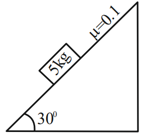
A block of mass 5 kg is placed on a rough inclined surface as shown in the figure. If $$\vec{F_1}$$ is the force required to just move the block up the inclined plane and $$\vec{F_2}$$ is the force required to just prevent the block from sliding down, then the value of $$|\vec{F_1}| - |\vec{F_2}|$$ is: [Use $$g = 10$$ m s$$^{-2}$$]
$$m=5kg,θ=30°,μ=0.1=1/10,g=10$$
Normal reaction:
$$N=mg\cosθ=5\times10\times\cos30°=50\times(\sqrt{3}/2)=25\sqrt{3}$$
Friction:
$$f=μN=(1/10)\times25\sqrt{3}=(5\sqrt{3})/2$$
Now case 1: just moving up the plane
Friction acts down the plane
$$F₁=mg\sinθ+f$$
$$=5\times10\times(1/2)+(5\sqrt{3})/2$$
$$=25+(5\sqrt{3})/2$$
Now case 2: just preventing sliding down
Friction acts up the plane
$$F₂=mg\sinθ−f$$
$$=25−(5\sqrt{3})/2$$
Now difference:
$$|F₁|−|F₂|$$
$$=[25+(5\sqrt{3})/2]−[25−(5\sqrt{3})/2]$$
$$\frac{5\sqrt{3}}{2}-\left(-\frac{5\sqrt{3}}{2}\right)=\frac{5\sqrt{3}}{2}+\frac{5\sqrt{3}}{2}$$
$$=5\sqrt{3}$$
Final answer:
$$=5\sqrt{3}$$
A block of mass $$m$$ is placed on a surface having vertical cross section given by $$y = \frac{x^2}{4}$$. If coefficient of friction is 0.5, the maximum height above the ground at which block can be placed without slipping is:
Surface is given by
$$y=\frac{x^2}{4}$$
At any point, slope:
$$\frac{dy}{dx}=\frac{x}{2}$$
So,
$$\tanθ=\frac{x}{2}$$
For no slipping:
$$\tanθ\leμ$$
Given $$μ=0.5$$
So:
$$\frac{x}{2}\le0.5$$
$$x\le1$$
Now find maximum height:
$$y=\frac{x^2}{4}$$
$$=\frac{(1)^2}{4}$$
=
$$\frac{1}{4}$$
Final answer:
$$\frac{1}{4}$$
A heavy box of mass $$50$$ kg is moving on a horizontal surface. If co-efficient of kinetic friction between the box and horizontal surface is 0.3 then force of kinetic friction is :
Find the kinetic friction force on a 50 kg box on a horizontal surface with $$\mu_k=0.3$$.
The normal force on the horizontal surface is $$N = mg = 50 \times 9.8 = 490$$ N.
From this, the kinetic friction force is $$f_k = \mu_k N = 0.3 \times 490 = 147$$ N.
The correct answer is Option (2): 147 N.
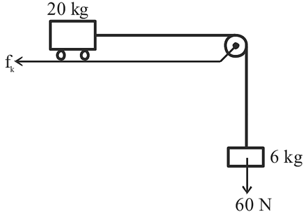
Consider a block and trolley system as shown in figure. If the coefficient of kinetic friction between the trolley and the surface is $$0.04$$, the acceleration of the system in m s$$^{-2}$$ is: (Consider that the string is massless and unstretchable and the pulley is also massless and frictionless):
Lets write equations for both the blocks
First for the 6 Kg block
$$mg-T=ma$$
$$6g-T=6a$$
Now for the 20 Kg block
now our frictional force is $$f_l=\mu\ _kN$$
$$f_l=\mu\ _kmg\ $$
$$f_l=0.04\times\ 200$$
$$f_l=8N$$
Now equation for the 20 Kg block is
$$T-f_l=ma$$
$$T-f_l=20a$$
$$6g-T=6a$$
Now ad both equations
$$60-f_l=26a$$
$$60-8=26a=52$$
$$a=2\ \frac{m}{s^2}$$
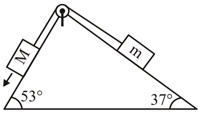
In the given arrangement of a doubly inclined plane two blocks of masses $$M$$ and $$m$$ are placed. The blocks are connected by a light string passing over an ideal pulley as shown. The coefficient of friction between the surface of the plane and the blocks is $$0.25$$. The value of $$m$$, for which $$M = 10$$ kg will move down with an acceleration of $$2 \text{ m s}^{-2}$$, is: (take $$g = 10 \text{ m s}^{-2}$$ and $$\tan 37° = \frac{3}{4}$$)
Now lets write the equations for both the block
So for the 10 Kg block
$$Mg\sin\theta\ _1-\mu\ _sMg\cos\theta\ _1-T=Ma$$
$$Mg\sin\ 53^{\circ\ }-0.25Mg\cos53^{\circ\ }-T=Ma$$
$$100\times\ \frac{4}{5}-0.25\times\ 100\times\ \frac{3}{5}-T=20$$
$$80-T=15$$
$$T=45$$
Now for the block of mass m
$$T-mg\sin\theta\ _2-\mu\ _smg\cos\ \theta\ _2=ma$$
$$T-mg\sin37^{\circ\ }-0.25mg\cos37^{\circ\ }=m\left(2\right)$$
$$45-mg\times\ \frac{3}{5}-0.25mg\times\ \frac{4}{5}\ =m\times\ 2$$
$$mg\times\ \frac{3}{5}+0.25mg\times\ \frac{4}{5}\ +m\times\ 2=45$$
$$6m+2m+2m=45$$
$$10m=45$$
$$m=4.5\ Kg$$
A small spherical ball of radius $$r$$, falling through a viscous medium of negligible density has terminal velocity $$v$$. Another ball of the same mass but of radius $$2r$$, falling through the same viscous medium will have terminal velocity:
We need to find the terminal velocity of a ball of radius $$2r$$ with the same mass as a ball of radius $$r$$.
According to Stokes' law, the terminal velocity is given by $$v_t = \frac{2r^2(\rho_s - \rho_l)g}{9\eta}$$. Since the medium has negligible density ($$\rho_l \approx 0$$), this reduces to $$v_t = \frac{2r^2\rho_s g}{9\eta}$$.
Because the spheres have the same mass, we have $$\frac{4}{3}\pi r_1^3 \rho_1 = \frac{4}{3}\pi r_2^3 \rho_2$$ with $$r_1 = r$$ and $$r_2 = 2r$$. Substituting these radii gives $$\rho_2 = \rho_1 \left(\frac{r_1}{r_2}\right)^3 = \rho_1 \left(\frac{r}{2r}\right)^3 = \frac{\rho_1}{8}$$.
Then the ratio of their terminal velocities is $$\frac{v_2}{v_1} = \frac{r_2^2 \rho_2}{r_1^2 \rho_1} = \frac{(2r)^2 \times \rho_1/8}{r^2 \times \rho_1} = \frac{4r^2 \times \rho_1/8}{r^2 \times \rho_1} = \frac{4}{8} = \frac{1}{2}$$. Hence $$v_2 = \frac{v}{2}$$.
The correct answer is Option 1: $$\frac{v}{2}$$.
Given below are two statements :
Statement (I) : Viscosity of gases is greater than that of liquids.
Statement (II) : Surface tension of a liquid decreases due to the presence of insoluble impurities. In the light of the above statements, choose the most appropriate answer from the options given below :
Viscosity of gases is not greater than that of liquids; in fact, liquids generally exhibit much higher viscosities than gases. For example, the viscosity of water at 20 °C is approximately $$1 \times 10^{-3}$$ Pa·s, while the viscosity of air at 20 °C is approximately $$1.8 \times 10^{-5}$$ Pa·s, which is about fifty times smaller. This difference arises because in liquids, viscosity is governed by strong intermolecular cohesive forces, whereas in gases it results from momentum transfer between molecular layers; the cohesive forces in liquids are far stronger, leading to higher viscosity.
Insoluble impurities such as dust particles, powders, or oils that spread on the surface of a liquid reduce the cohesive forces between the liquid molecules at the interface, thereby lowering its surface tension. For instance, camphor particles on water demonstrate this effect by decreasing the water’s surface tension.
The correct answer is Option (2): Statement I is incorrect but Statement II is correct.
A small ball of mass $$m$$ and density $$\rho$$ is dropped in a viscous liquid of density $$\rho_0$$. After sometime, the ball falls with constant velocity. The viscous force on the ball is :
At terminal velocity: Weight = Buoyant force + Viscous force.
$$mg = \frac{m\rho_0}{\rho}g + F_v$$ (buoyant force = $$V\rho_0 g = \frac{m}{\rho}\rho_0 g$$).
$$F_v = mg - \frac{m\rho_0 g}{\rho} = mg\left(1 - \frac{\rho_0}{\rho}\right)$$.
The correct answer is Option (4): $$mg\left(1 - \frac{\rho_0}{\rho}\right)$$.
The time taken by an object to slide down $$45°$$ rough inclined plane is $$n$$ times as it takes to slide down a perfectly smooth $$45°$$ incline plane. The coefficient of kinetic friction between the object and the incline plane is:
We need to find the coefficient of kinetic friction for a $$45°$$ rough incline, given that the time to slide down is $$n$$ times that on a smooth incline.
Acceleration on a smooth 45° incline.
$$a_1 = g\sin 45° = \frac{g}{\sqrt{2}}$$
Acceleration on a rough 45° incline.
$$a_2 = g(\sin 45° - \mu_k \cos 45°) = \frac{g}{\sqrt{2}}(1 - \mu_k)$$
Next, relate the times using kinematic equations.
For the same distance $$s$$ starting from rest:
$$s = \frac{1}{2}a_1 t_1^2 = \frac{1}{2}a_2 t_2^2$$
Given $$t_2 = n \cdot t_1$$:
$$a_1 t_1^2 = a_2 (nt_1)^2 = a_2 n^2 t_1^2$$
$$a_1 = n^2 a_2$$
Next, solve for $$\mu_k$$.
$$\frac{g}{\sqrt{2}} = n^2 \cdot \frac{g}{\sqrt{2}}(1 - \mu_k)$$
$$1 = n^2(1 - \mu_k)$$
$$\mu_k = 1 - \frac{1}{n^2}$$
The coefficient of kinetic friction is $$1 - \frac{1}{n^2}$$.
The correct answer is Option 4: $$1 - \frac{1}{n^2}$$.
A block of mass 5 kg is placed at rest on a table of rough surface. Now, if a force of 30 N is applied in the direction parallel to surface of the table, the block slides through a distance of 50 m in an interval of time 10 s. Coefficient of kinetic friction is (given, $$g = 10$$ m s$$^{-2}$$):
We have a block of mass $$m = 5$$ kg with an applied force $$F = 30$$ N that travels a distance $$s = 50$$ m in time $$t = 10$$ s, starting from rest (with $$g = 10$$ m/s$$^2$$).
Since the block starts from rest, using $$s = ut + \frac{1}{2}at^2$$ gives
$$50 = 0 + \frac{1}{2} \times a \times (10)^2 = 50a$$
so $$a = 1$$ m/s$$^2$$.
Now applying Newton's second law along the surface (the friction force opposes motion):
$$F - \mu_k mg = ma$$
$$30 - \mu_k \times 5 \times 10 = 5 \times 1$$
$$30 - 50\mu_k = 5$$
$$50\mu_k = 25$$
So $$\mu_k = 0.50$$. Hence, the correct answer is 0.50.
An object of mass $$5$$ kg is thrown vertically upwards from the ground. The air resistance produces a constant retarding force of $$10$$ N throughout the motion. The ratio of time of ascent to the time of descent will be equal to : [Use $$g = 10$$ m s$$^{-2}$$]
Given: mass $$m = 5$$ kg, air resistance force $$F = 10$$ N (constant, always opposing motion), $$g = 10$$ m/s$$^2$$.
Find the effective accelerations: During ascent (object moves upward):
Both gravity and air resistance act downward (opposing upward motion).
$$a_{\text{ascent}} = g + \frac{F}{m} = 10 + \frac{10}{5} = 10 + 2 = 12 \text{ m/s}^2 \text{ (retardation)}$$
During descent (object moves downward):
Gravity acts downward, air resistance acts upward (opposing downward motion).
$$a_{\text{descent}} = g - \frac{F}{m} = 10 - \frac{10}{5} = 10 - 2 = 8 \text{ m/s}^2 \text{ (acceleration)}$$
Find the time of ascent: Let the initial velocity be $$u$$. During ascent, the object decelerates from $$u$$ to $$0$$. Using $$v = u - a_{\text{ascent}} \cdot t_a$$:
$$0 = u - 12 \cdot t_a$$
$$t_a = \frac{u}{12}$$
Find the maximum height: Using $$v^2 = u^2 - 2a_{\text{ascent}} \cdot h$$:
$$0 = u^2 - 2(12)h$$
$$h = \frac{u^2}{24}$$
Find the time of descent: During descent, the object starts from rest at the top and falls through height $$h$$ with acceleration $$a_{\text{descent}} = 8$$ m/s$$^2$$. Using $$h = \frac{1}{2}a_{\text{descent}} \cdot t_d^2$$:
$$\frac{u^2}{24} = \frac{1}{2}(8) t_d^2 = 4t_d^2$$
$$t_d^2 = \frac{u^2}{96}$$
$$t_d = \frac{u}{\sqrt{96}} = \frac{u}{4\sqrt{6}}$$
Find the ratio: $$\frac{t_a}{t_d} = \frac{\frac{u}{12}}{\frac{u}{4\sqrt{6}}} = \frac{u}{12} \times \frac{4\sqrt{6}}{u} = \frac{4\sqrt{6}}{12} = \frac{\sqrt{6}}{3}$$
Simplify: $$\frac{\sqrt{6}}{3} = \frac{\sqrt{6}}{\sqrt{9}} = \sqrt{\frac{6}{9}} = \sqrt{\frac{2}{3}} = \frac{\sqrt{2}}{\sqrt{3}}$$
Therefore, the ratio of time of ascent to time of descent is $$\sqrt{2} : \sqrt{3}$$.
The correct answer is Option B.
A uniform chain of $$6$$ m length is placed on a table such that a part of its length is hanging over the edge of the table. The system is at rest. The co-efficient of static friction between the chain and the surface of the table is $$0.5$$, the maximum length of the chain hanging from the table is ______ m.
Let the total length of the chain be $$L = 6$$ m and the coefficient of static friction be $$\mu = 0.5$$.
Let $$x$$ be the length of the chain hanging over the edge. Then $$(L - x) = (6 - x)$$ is the length on the table.
Let the mass per unit length of the chain be $$\lambda = \frac{m}{L}$$.
Weight of the hanging part (pulling the chain down):
$$W_{hang} = \lambda x g = \frac{m x g}{6}$$
Normal force on the table part:
$$N = \lambda (6 - x) g = \frac{m(6 - x)g}{6}$$
Maximum static friction force:
$$f = \mu N = 0.5 \times \frac{m(6 - x)g}{6}$$
At the maximum hanging length, the system is on the verge of sliding, so:
$$W_{hang} = f$$
$$\frac{m x g}{6} = 0.5 \times \frac{m(6 - x)g}{6}$$
Cancelling common terms:
$$x = 0.5(6 - x)$$
$$x = 3 - 0.5x$$
$$1.5x = 3$$
$$x = 2 \text{ m}$$
The maximum length of the chain hanging from the table is 2 m.
The velocity of a small ball of mass 0.3 g and density 8 g cc$$^{-1}$$ when dropped in a container filled with glycerine becomes constant after some time. If the density of glycerine is 1.3 g cc$$^{-1}$$, then the value of viscous force acting on the ball will be $$x \times 10^{-4}$$ N, the value of x is _____ [use $$g = 10$$ m s$$^{-2}$$]
We have a small ball of mass $$m = 0.3$$ g $$= 3 \times 10^{-4}$$ kg and density $$\rho_b = 8$$ g/cc $$= 8000$$ kg/m$$^3$$, dropped in glycerine of density $$\rho_g = 1.3$$ g/cc $$= 1300$$ kg/m$$^3$$. When the ball reaches terminal velocity, its acceleration is zero, so the net force on the ball is zero.
The forces acting on the ball at terminal velocity are: (1) the weight $$W = mg$$ acting downward, (2) the buoyant force $$F_b$$ acting upward, and (3) the viscous force $$F_v$$ acting upward. At terminal velocity, these balance: $$mg = F_b + F_v$$
The volume of the ball is $$V = \frac{m}{\rho_b}$$. The buoyant force is $$F_b = \rho_g V g = \rho_g \cdot \frac{m}{\rho_b} \cdot g$$.
Now, the viscous force is: $$F_v = mg - F_b = mg - \frac{\rho_g}{\rho_b} mg = mg\left(1 - \frac{\rho_g}{\rho_b}\right)$$
Substituting the values: $$F_v = 3 \times 10^{-4} \times 10 \times \left(1 - \frac{1.3}{8}\right) = 3 \times 10^{-3} \times \left(1 - 0.1625\right) = 3 \times 10^{-3} \times 0.8375$$
$$F_v = 2.5125 \times 10^{-3}$$ N $$= 25.125 \times 10^{-4}$$ N.
Rounding to the nearest integer, $$x = 25$$.
Hence, the correct answer is 25.
The velocity of upper layer of water in a river is $$36$$ km h$$^{-1}$$. Shearing stress between horizontal layers of water is $$10^{-3}$$ N m$$^{-2}$$. Depth of the river is ______ m. (Co-efficient of viscosity of water is $$10^{-2}$$ Pa s)
Velocity of the upper layer is given as $$v = 36$$ km/h, the shearing stress is $$\tau = 10^{-3}$$ N/m$$^2$$, and the coefficient of viscosity is $$\eta = 10^{-2}$$ Pa·s. Converting this velocity to metres per second yields $$v = 36 \times \frac{5}{18} = 10 \text{ m/s}$$.
According to Newton’s law of viscosity, the shearing stress is related to the velocity gradient by $$\tau = \eta \frac{dv}{dx}$$. The velocity gradient $$\frac{dv}{dx}$$ represents the change in velocity over the depth $$d$$ of the river. Assuming the bottom layer is stationary and the top layer moves at velocity $$v$$, we have $$\frac{dv}{dx} = \frac{v}{d}$$.
Substituting into the law of viscosity gives $$\tau = \eta \frac{v}{d}$$, which can be rearranged to solve for the depth:
$$d = \frac{\eta v}{\tau} = \frac{10^{-2} \times 10}{10^{-3}} = \frac{10^{-1}}{10^{-3}} = 10^{2} = 100 \text{ m}$$.
Thus, the depth of the river is 100 m.
A bag is gently dropped on a conveyor belt moving at a speed of $$2 \text{ m s}^{-1}$$. The coefficient of friction between the conveyor belt and bag is $$0.4$$. Initially, the bag slips on the belt before it stops due to friction. The distance travelled by the bag on the belt during slipping motion is: [Take $$g = 10 \text{ m s}^{-2}$$]
A bag is dropped on a conveyor belt moving at 2 m/s. We need to find the distance the bag travels on the belt during slipping.
The bag is dropped gently (initial velocity = 0) onto a belt moving at $$v = 2$$ m/s, and friction accelerates the bag until it reaches belt speed. The friction force on the bag is $$\mu m g$$, so the acceleration of the bag is $$a = \mu g = 0.4 \times 10 = 4 \text{ m/s}^2$$. The bag reaches the belt speed when $$v = a t$$, which gives $$2 = 4t \implies t = 0.5 \text{ s}$$.
During this time, the distance moved by the bag in the ground frame is $$s_{\text{bag}} = \frac{1}{2} a t^2 = \frac{1}{2} \times 4 \times 0.25 = 0.5 \text{ m}$$, and the belt moves $$s_{\text{belt}} = v \times t = 2 \times 0.5 = 1 \text{ m}$$. Therefore, the distance the bag travels relative to the belt while slipping is $$s_{\text{belt}} - s_{\text{bag}} = 1 - 0.5 = 0.5 \text{ m}$$.
The correct answer is Option B: $$0.5 \text{ m}$$.
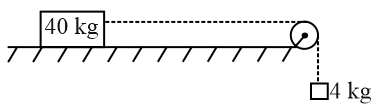
A block of mass 40 kg slides over a surface, when a mass of 4 kg is suspended through an inextensible massless string passing over frictionless pulley as shown below. The coefficient of kinetic friction between the surface and block is 0.02. The acceleration of block is: (Given $$g = 10$$ m s$$^{-2}$$.)
Kinetic friction force ($$f_k$$) acting on the sliding block ($$M$$): $$f_k = \mu_k \cdot N = \mu_k \cdot Mg$$
$$f_k = 0.02 \times 40 \times 10 = 8\ \text{N}$$
For the hanging block ($$m$$) moving downward: $$mg - T = ma \quad \text{--- (1)}$$
For the sliding block ($$M$$) moving horizontally: $$T - f_k = Ma \quad \text{--- (2)}$$
Adding equations (1) and (2) to eliminate tension ($$T$$): $$mg - f_k = (m + M)a$$
$$(4 \times 10) - 8 = (4 + 40)a \implies 40 - 8 = 44a$$
$$a = \frac{32}{44} = \frac{8}{11}\ \text{m s}^{-2}$$
A disc with a flat small bottom beaker placed on it at a distance $$R$$ from its center is revolving about an axis passing through the center and perpendicular to its plane with an angular velocity $$\omega$$. The coefficient of static friction between the bottom of the beaker and the surface of the disc is $$\mu$$. The beaker will revolve with the disc if :
For the beaker to revolve with the disc, the friction must provide the necessary centripetal force.
The centripetal force required for circular motion at distance $$R$$ from the center is:
$$F_c = m\omega^2 R$$
The maximum static friction available is:
$$f_{max} = \mu m g$$
For the beaker to not slide, friction must be sufficient:
$$m\omega^2 R \leq \mu m g$$
Cancelling $$m$$ from both sides:
$$\omega^2 R \leq \mu g$$
$$R \leq \frac{\mu g}{\omega^2}$$
Hence, the correct answer is Option B.
A block of mass $$10$$ kg starts sliding on a surface with an initial velocity of $$9.8$$ ms$$^{-1}$$. The coefficient of friction between the surface and block is $$0.5$$. The distance covered by the block before coming to rest is : [use $$g = 9.8$$ ms$$^{-2}$$]
We are given: mass $$m = 10$$ kg, initial velocity $$u = 9.8$$ m/s, coefficient of friction $$\mu = 0.5$$, $$g = 9.8$$ m/s$$^2$$.
Calculate the deceleration due to friction: the frictional force is $$f = \mu mg$$, so the deceleration is:
$$ a = \mu g = 0.5 \times 9.8 = 4.9 \text{ m/s}^2 $$
Use the kinematic equation to find the distance: using $$v^2 = u^2 - 2as$$ where $$v = 0$$ (block comes to rest):
$$ 0 = u^2 - 2as $$
$$ s = \frac{u^2}{2a} = \frac{(9.8)^2}{2 \times 4.9} = \frac{96.04}{9.8} = 9.8 \text{ m} $$
Therefore, the correct answer is Option A.
A block of mass $$M$$ slides down on a rough inclined plane with constant velocity. The angle made by the incline plane with horizontal is $$\theta$$. The magnitude of the contact force will be :
A block of mass $$M$$ slides down a rough inclined plane with constant velocity, so its acceleration is zero and the net force on the block is zero. The forces acting on the block are the weight $$Mg$$ acting vertically downward, the normal reaction $$N$$ perpendicular to the inclined surface, and the friction force $$f$$ along the inclined surface (opposing motion and directed up the incline). The contact force between the block and the inclined surface is the resultant of the normal reaction and the friction force, and for equilibrium this contact force must balance the weight exactly, giving $$|\text{Contact force}| = Mg$$.
Verification: Along the incline one has $$f = Mg\sin\theta$$ and perpendicular to the incline $$N = Mg\cos\theta$$. Thus the magnitude of the contact force is $$\sqrt{N^2 + f^2} = \sqrt{M^2g^2\cos^2\theta + M^2g^2\sin^2\theta} = Mg\sqrt{\cos^2\theta + \sin^2\theta} = Mg\,. $$
Answer: Option A: $$Mg$$
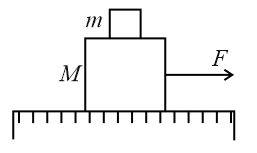
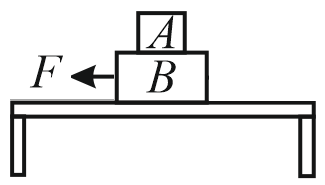
A system of two blocks of masses $$m = 2$$ kg and $$M = 8$$ kg is placed on a smooth table as shown in figure. The coefficient of static friction between two blocks is $$0.5$$. The maximum horizontal force $$F$$ that can be applied to the block of mass $$M$$ so that the blocks move together will be $$(g = 9.8$$ m s$$^{-2})$$
Given:$$m=2kg,\ M=8kg,\ μ=0.5,\ g=9.8m/s^2$$
Step 1: Maximum acceleration (no slipping)
Maximum acceleration comes from maximum static friction acting on the top block:
$$f_{\max}=\mu N=\mu mg\ $$
This friction is the only horizontal force accelerating the top block:
$$f_{\max}=ma_{\max}$$
$$μmg=ma_{\max}\ ⇒\ a_{\max}=μg=0.5\times9.8=4.9m/s^2$$
This ensures the top block does not slip over the bottom block.
Friction provides acceleration to top block:
$$a_{\max}=μg=0.5\times9.8=4.9m/s^2$$
Step 2: Treat system as one body
Total mass:
m+M=2+8=10 kg
Step 3: Maximum force
$$F_{\max}=(m+M)a_{\max}=10\times4.9=49N$$
Final Answer:
49 N
A water drop of radius $$1 \mu$$m falls in a situation where the effect of buoyant force is negligible. Co-efficient of viscosity of air is $$1.8 \times 10^{-5}$$ N s m$$^{-2}$$ and its density is negligible as compared to that of water $$10^6$$ g m$$^{-3}$$. Terminal velocity of the water drop is
(Take acceleration due to gravity $$= 10$$ m s$$^{-2}$$)
Given: radius $$r = 1 \, \mu$$m $$= 10^{-6}$$ m, coefficient of viscosity $$\eta = 1.8 \times 10^{-5}$$ N s m$$^{-2}$$, density of water $$\rho = 10^6$$ g m$$^{-3}$$ $$= 10^3$$ kg m$$^{-3}$$, $$g = 10$$ m s$$^{-2}$$. Buoyant force is negligible.
Write the formula for terminal velocity (neglecting buoyancy).
When buoyancy is negligible, at terminal velocity the drag force equals the weight:
$$6\pi\eta r v_t = \frac{4}{3}\pi r^3 \rho g$$
$$v_t = \frac{2r^2 \rho g}{9\eta}$$
Substitute the values.
$$v_t = \frac{2 \times (10^{-6})^2 \times 10^3 \times 10}{9 \times 1.8 \times 10^{-5}}$$
$$v_t = \frac{2 \times 10^{-12} \times 10^4}{16.2 \times 10^{-5}}$$
$$v_t = \frac{2 \times 10^{-8}}{16.2 \times 10^{-5}}$$
$$v_t = \frac{2}{16.2} \times 10^{-3} = 0.1234 \times 10^{-3}$$
$$v_t = 123.4 \times 10^{-6} \text{ m s}^{-1}$$
The correct answer is Option B.
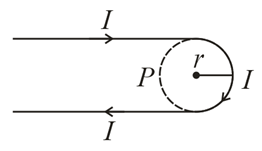
A hairpin like shape as shown in figure is made by bending a long current carrying wire. What is the magnitude of a magnetic field at point $$P$$ which lies on the centre of the semicircle?
We need to determine the maximum force $$F$$ (tension $$T$$) that the boy can exert on the rope so that the piece of wood remains at rest on the floor.
1. Identify the Forces acting on the Boy
Let the tension in the rope held by the boy be $$T$$. The forces acting vertically on the boy (mass $$m = 4\text{ kg}$$) are:
- The downward gravitational force: $$mg = 4 \times 10 = 40\text{ N}$$
- The upward normal reaction force from the wood surface: $$R$$
- The upward pulling force from the rope: $$T$$ (since the rope pulls the boy upwards as he pulls down on it)
For vertical equilibrium of the boy:
$$R + T = mg \implies R = 40 - T \quad \text{--- (Equation 1)}$$
2. Identify the Forces acting on the Piece of Wood
Let's look at the forces acting on the piece of wood (mass $$M = 5\text{ kg}$$):
- Vertical Forces:
- Downward gravitational force: $$Mg = 5 \times 10 = 50\text{ N}$$
- Downward normal pressing force from the boy: $$R$$
- Upward normal reaction force from the floor: $$N$$
For vertical equilibrium of the wood:
$$N = Mg + R$$
Substitute $$R$$ from Equation 1 into this expression:
$$N = 50 + (40 - T) = 90 - T \quad \text{--- (Equation 2)}$$
- Horizontal Forces:
- Based on the pulley system shown in the diagram on the page, the tension $$T$$ pulls the piece of wood horizontally to the right.
- The limiting static frictional force ($$f_s$$) from the floor opposes this motion by acting to the left:
$$f_s = \mu \cdot N$$
3. Set up the Condition for No Movement
For the wood to stay in its place, the horizontal pulling force ($$T$$) must not exceed the maximum limiting friction ($$f_s$$):
$$T \le \mu \cdot N$$
Substitute the value of coefficient of friction ($$\mu = 0.5$$) and the normal force expression from Equation 2:
$$T = 0.5 \times (90 - T)$$
$$T = 45 - 0.5T$$
$$1.5T = 45$$
$$T = \frac{45}{1.5} = 30\text{ N}$$
Conclusion
The maximum force that the boy can exert on the rope so that the piece of wood does not move is 30 N.
A body of mass 1 kg rests on a horizontal floor with which it has a coefficient of static friction $$\frac{1}{\sqrt{3}}$$. It is desired to make the body move by applying the minimum possible force $$F$$ N. The value of $$F$$ will be ________. (Round off to the Nearest Integer) [Take $$g = 10$$ m s$$^{-2}$$]
To move the body with the minimum possible force, the force $$F$$ should be applied at an angle $$\theta$$ above the horizontal. Resolving forces: the horizontal component $$F\cos\theta$$ must overcome friction, and the vertical component $$F\sin\theta$$ reduces the normal reaction.
The normal reaction is $$N = mg - F\sin\theta$$ and the friction force is $$f = \mu N = \mu(mg - F\sin\theta)$$. For the body to just move, $$F\cos\theta = \mu(mg - F\sin\theta)$$, giving $$F = \frac{\mu mg}{\cos\theta + \mu\sin\theta}$$.
To minimize $$F$$, we maximize the denominator $$\cos\theta + \mu\sin\theta$$. Taking the derivative and setting it to zero: $$-\sin\theta + \mu\cos\theta = 0$$, so $$\tan\theta = \mu = \frac{1}{\sqrt{3}}$$, which gives $$\theta = 30°$$.
The maximum value of the denominator is $$\cos 30° + \frac{1}{\sqrt{3}}\sin 30° = \frac{\sqrt{3}}{2} + \frac{1}{\sqrt{3}} \times \frac{1}{2} = \frac{\sqrt{3}}{2} + \frac{1}{2\sqrt{3}} = \frac{3 + 1}{2\sqrt{3}} = \frac{4}{2\sqrt{3}} = \frac{2}{\sqrt{3}}$$.
Therefore $$F = \frac{\frac{1}{\sqrt{3}} \times 1 \times 10}{\frac{2}{\sqrt{3}}} = \frac{10/\sqrt{3}}{2/\sqrt{3}} = \frac{10}{2} = 5$$ N.
A body of mass $$m$$ is launched up on a rough inclined plane making an angle of 30$$^\circ$$ with the horizontal. The coefficient of friction between the body and plane is $$\frac{\sqrt{x}}{5}$$ if the time of ascent is half of the time of descent. The value of $$x$$ is ___.
Let the coefficient of friction be $$\mu = \frac{\sqrt{x}}{5}$$ and the incline angle be $$\theta = 30^\circ$$. During ascent, both the component of gravity along the plane and friction act downward along the slope, so the deceleration is $$a_{\text{up}} = g(\sin\theta + \mu\cos\theta)$$. During descent, gravity acts down the slope while friction acts upward, giving acceleration $$a_{\text{down}} = g(\sin\theta - \mu\cos\theta)$$.
If the body is launched with initial speed $$u$$, it decelerates uniformly to rest, so the time of ascent is $$t_a = \frac{u}{a_{\text{up}}}$$. The distance traveled up the slope is $$s = \frac{u^2}{2a_{\text{up}}}$$. Starting from rest, the body descends this same distance $$s$$ with acceleration $$a_{\text{down}}$$, so $$s = \frac{1}{2}a_{\text{down}}t_d^2$$, giving $$t_d = \sqrt{\frac{2s}{a_{\text{down}}}} = \frac{u}{\sqrt{a_{\text{up}} \cdot a_{\text{down}}}}$$.
We are given $$t_a = \frac{1}{2}t_d$$:
$$\frac{u}{a_{\text{up}}} = \frac{1}{2} \cdot \frac{u}{\sqrt{a_{\text{up}} \cdot a_{\text{down}}}}$$
$$2\sqrt{a_{\text{up}} \cdot a_{\text{down}}} = a_{\text{up}}$$
Squaring both sides: $$4 a_{\text{down}} = a_{\text{up}}$$
Substituting with $$\sin 30^\circ = \frac{1}{2}$$ and $$\cos 30^\circ = \frac{\sqrt{3}}{2}$$:
$$4\left(\frac{1}{2} - \mu\frac{\sqrt{3}}{2}\right) = \frac{1}{2} + \mu\frac{\sqrt{3}}{2}$$
$$2 - 2\sqrt{3}\mu = \frac{1}{2} + \frac{\sqrt{3}}{2}\mu$$
$$\frac{3}{2} = 2\sqrt{3}\mu + \frac{\sqrt{3}}{2}\mu = \frac{5\sqrt{3}}{2}\mu$$
$$\mu = \frac{3}{2} \cdot \frac{2}{5\sqrt{3}} = \frac{3}{5\sqrt{3}} = \frac{\sqrt{3}}{5}$$
Since $$\mu = \frac{\sqrt{x}}{5}$$, we get $$\sqrt{x} = \sqrt{3}$$, so $$x = 3$$.
The coefficient of static friction between a wooden block of mass 0.5 kg and a vertical rough wall is 0.2. The magnitude of the horizontal force that should be applied on the block to keep it adhere to the wall will be ______ N. $$g = 10$$ m s$$^{-2}$$
We have a wooden block of mass $$m = 0.5$$ kg pressed against a vertical rough wall by a horizontal force $$F$$. The coefficient of static friction is $$\mu_s = 0.2$$.
When the block is pushed horizontally against the wall, the normal reaction from the wall equals the applied force. So we have $$N = F$$.
The frictional force acts upward along the wall to prevent the block from sliding down. The maximum static friction is $$f = \mu_s N = \mu_s F$$.
For the block to remain stationary on the wall, the friction must balance the weight of the block. So $$f \geq mg$$, which gives us $$\mu_s F \geq mg$$.
Substituting the values, we get $$0.2 \times F \geq 0.5 \times 10$$.
$$0.2F \geq 5$$
$$F \geq \frac{5}{0.2} = 25 \text{ N}$$
The minimum horizontal force required is $$F = 25$$ N.
So, the answer is $$25$$.
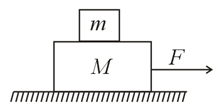
Two blocks ($$m = 0.5$$ kg and $$M = 4.5$$ kg) are arranged on a horizontal frictionless table as shown in the figure. The coefficient of static friction between the two blocks is $$\frac{3}{7}$$. Then the maximum horizontal force that can be applied on the larger block so that the blocks move together is $$N$$. (Round off to the Nearest Integer) [Take $$g$$ as 9.8 m s$$^{-2}$$]
We need to determine the maximum horizontal force $$F$$ that can be applied to the larger block so that both blocks continue to move together without relative slipping.
1. Identify the System Parameters
From the layout shown on page, we have:
- Mass of the smaller top block ($$m$$) = $$0.5\text{ kg}$$
- Mass of the larger bottom block ($$M$$) = $$4.5\text{ kg}$$
- Coefficient of static friction between the blocks ($$\mu_s$$) = $$\frac{3}{7}$$
- Acceleration due to gravity ($$g$$) = $$9.8\text{ m s}^{-2}$$
2. Analyze the Maximum Acceleration of the Top Block
When the horizontal force $$F$$ is applied to the bottom block $$M$$, the top block $$m$$ moves forward solely due to the static frictional force ($$f_s$$) acting between the two contact surfaces.
The maximum possible static frictional force that can act on block $$m$$ is:
$$f_{\text{max}} = \mu_s \cdot N = \mu_s \cdot mg$$
According to Newton's second law, this maximum frictional force dictates the maximum acceleration ($$a_{\text{max}}$$) the top block can experience without slipping:
$$m \cdot a_{\text{max}} = \mu_s \cdot mg$$
$$a_{\text{max}} = \mu_s \cdot g$$
Substitute the given values into the acceleration equation:
$$a_{\text{max}} = \frac{3}{7} \times 9.8 = 3 \times 1.4 = 4.2\text{ m s}^{-2}$$
3. Calculate the Maximum Applied Force ($$F$$)
For both blocks to move together as a single combined system without relative motion, the entire system of mass ($M + m$) must accelerate at this maximum rate ($a_{\text{max}}$):
$$F = (M + m) \cdot a_{\text{max}}$$
Substitute the masses and the calculated acceleration into the formula:
$$F = (4.5 + 0.5) \times 4.2$$
$$F = 5.0 \times 4.2 = 21\text{ N}$$
Conclusion
The maximum horizontal force that can be applied so that the blocks move together is 21 N.
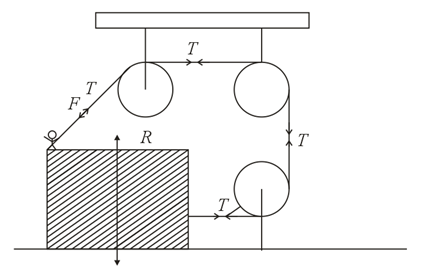
A boy of mass 4 kg is standing on a piece of wood having mass 5 kg. If the coefficient of friction between the wood and the floor is 0.5, the maximum force that the boy can exert on the rope so that the piece of wood does not move from its place is ________ N. (Round off to the Nearest Integer) [Take $$g = 10$$ m s$$^{-2}$$]
We need to determine the maximum force $$F$$ (tension $$T$$) that the boy can exert on the rope so that the piece of wood remains at rest on the floor.
1. Identify the Forces acting on the Boy
Let the tension in the rope held by the boy be $$T$$. The forces acting vertically on the boy (mass $$m = 4\text{ kg}$$) are:
- The downward gravitational force: $$mg = 4 \times 10 = 40\text{ N}$$
- The upward normal reaction force from the wood surface: $$R$$
- The upward pulling force from the rope: $$T$$ (since the rope pulls the boy upwards as he pulls down on it)
For vertical equilibrium of the boy:
$$R + T = mg \implies R = 40 - T \quad \text{--- (Equation 1)}$$
2. Identify the Forces acting on the Piece of Wood
Let's look at the forces acting on the piece of wood (mass $$M = 5\text{ kg}$$):
- Vertical Forces:
- Downward gravitational force: $$Mg = 5 \times 10 = 50\text{ N}$$
- Downward normal pressing force from the boy: $$R$$
- Upward normal reaction force from the floor: $$N$$
For vertical equilibrium of the wood:
$$N = Mg + R$$
Substitute $$R$$ from Equation 1 into this expression:
$$N = 50 + (40 - T) = 90 - T \quad \text{--- (Equation 2)}$$
- Horizontal Forces:
- Based on the pulley system shown in the diagram , the tension $$T$$ pulls the piece of wood horizontally to the right.
- The limiting static frictional force ($$f_s$$) from the floor opposes this motion by acting to the left:
$$f_s = \mu \cdot N$$
3. Set up the Condition for No Movement
For the wood to stay in its place, the horizontal pulling force ($$T$$) must not exceed the maximum limiting friction ($$f_s$$):
$$T \le \mu \cdot N$$
Substitute the value of coefficient of friction ($$\mu = 0.5$$) and the normal force expression from Equation 2:
$$T = 0.5 \times (90 - T)$$
$$T = 45 - 0.5T$$
$$1.5T = 45$$
$$T = \frac{45}{1.5} = 30\text{ N}$$
Conclusion
The maximum force that the boy can exert on the rope so that the piece of wood does not move is 30 N.
An inclined plane is bent in such a way that the vertical cross-section is given by $$y = \frac{x^2}{4}$$ where $$y$$ is in vertical and $$x$$ in horizontal direction. If the upper surface of this curved plane is rough with coefficient of friction $$\mu = 0.5$$, the maximum height in cm at which a stationary block will not slip downward is ______ cm.
We have a curved inclined plane whose vertical cross-section is given by $$y = \frac{x^2}{4}$$. The coefficient of friction is $$\mu = 0.5$$.
At any point on the curve, the slope of the tangent gives the angle of inclination $$\theta$$ with the horizontal. We find the slope by differentiating: $$\frac{dy}{dx} = \frac{2x}{4} = \frac{x}{2}$$.
Now, $$\tan\theta = \frac{dy}{dx} = \frac{x}{2}$$.
A stationary block will not slip as long as the component of gravity along the surface does not exceed the maximum static friction. This condition is $$\tan\theta \leq \mu$$.
Substituting, we get $$\frac{x}{2} \leq 0.5$$, which gives $$x \leq 1$$.
The maximum height is reached when $$x = 1$$. Substituting into the equation of the curve, $$y = \frac{1^2}{4} = \frac{1}{4} = 0.25$$ m.
Converting to centimetres, $$y = 0.25 \times 100 = 25$$ cm.
So, the answer is $$25$$.
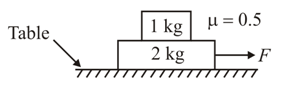
The coefficient of static friction between two blocks is 0.5 and the table is smooth. The maximum horizontal force that can be applied to move the blocks together is _________ N (take $$g = 10$$ m s$$^{-2}$$)
We need to find the maximum horizontal force $$F$$ that can be applied to the lower block such that both blocks move together without slipping between them.
1. Analyze the Maximum Friction Force
The static friction between the two blocks keeps the upper $$1\text{ kg}$$ block moving along with the lower $$2\text{ kg}$$ block. The maximum possible static friction force ($$f_{\text{max}}$$) that can act on the upper block is given by:
$$f_{\text{max}} = \mu \cdot N$$
Where:
- $$\mu = 0.5$$ (Coefficient of static friction)
- $$N$$ is the normal reaction force acting on the $$1\text{ kg}$$ block due to the weight of the block itself:
$$N = m_1 \cdot g = 1\text{ kg} \times 10\text{ m s}^{-2} = 10\text{ N}$$
Substituting the values into the maximum friction formula:
$$f_{\text{max}} = 0.5 \times 10\text{ N} = 5\text{ N}$$
2. Find the Maximum Acceleration of the System
The upper block is accelerated purely due to this frictional force. Therefore, its maximum possible acceleration ($$a_{\text{max}}$$) before it begins to slip is:
$$f_{\text{max}} = m_1 \cdot a_{\text{max}}$$
$$5\text{ N} = 1\text{ kg} \times a_{\text{max}} \implies a_{\text{max}} = 5\text{ m s}^{-2}$$
3. Calculate the Maximum Applied Force ($$F$$)
Since the table is completely smooth, there is no external retarding friction force acting on the bottom surface of the lower block. To prevent slipping, both blocks must move together as a single composite system with a maximum common acceleration of $$a_{\text{max}} = 5\text{ m s}^{-2}$$.
Using Newton's second law for the total mass ($$m_1 + m_2$$):
$$F = (m_1 + m_2) \cdot a_{\text{max}}$$
$$F = (1\text{ kg} + 2\text{ kg}) \times 5\text{ m s}^{-2}$$
$$F = 3\text{ kg} \times 5\text{ m s}^{-2} = 15\text{ N}$$
Final Answer: 15
When a body slides down from rest along a smooth inclined plane making an angle of 30° with the horizontal, it takes time $$T$$. When the same body slides down from rest along a rough inclined plane making the same angle and through the same distance, it takes time $$\alpha T$$, where $$\alpha$$ is a constant greater than 1. The co-efficient of friction between the body and the rough plane is $$\frac{1}{\sqrt{x}} \cdot \frac{\alpha^2-1}{\alpha^2}$$ where $$x$$ = _________.
We are given two situations for the same body moving down the same distance $$s$$ on two different 30° inclined planes, one smooth (no friction) and the other rough (with friction).
For any motion with uniform acceleration, the kinematic relation that connects distance travelled from rest, acceleration and time is stated first:
$$s=\dfrac12\,a\,t^2.$$
Motion on the smooth plane
The only component of gravity acting along the plane is $$g\sin\theta$$, where $$\theta=30^\circ$$. Therefore
$$a_{\text{smooth}}=g\sin\theta.$$
If the time taken is $$T$$, we substitute in the kinematic formula:
$$s=\dfrac12 \,a_{\text{smooth}}\,T^2 =\dfrac12 \,g\sin\theta\,T^2.$$
Motion on the rough plane
Let the coefficient of friction be $$\mu$$.
The normal reaction is $$N=mg\cos\theta$$, so the frictional force is $$\mu N = \mu mg\cos\theta$$ acting up the plane.
The net force down the plane is therefore
$$mg\sin\theta-\mu mg\cos\theta =m\bigl(g\sin\theta-\mu g\cos\theta\bigr).$$
Hence the acceleration on the rough plane is
$$a_{\text{rough}}=g\sin\theta-\mu g\cos\theta.$$
The time of descent now is given to be $$\alpha T$$, so the kinematic relation gives
$$s=\dfrac12 \,a_{\text{rough}}\,( \alpha T )^2 =\dfrac12 \bigl(g\sin\theta-\mu g\cos\theta \bigr)\alpha^2 T^2.$$
Equating the two expressions for the same distance $$s$$
$$\dfrac12 g\sin\theta\,T^2 =\dfrac12 \bigl(g\sin\theta-\mu g\cos\theta\bigr)\,\alpha^2 T^2.$$
The common factors $$\dfrac12\,g\,T^2$$ cancel, leaving
$$\sin\theta =\alpha^2\bigl(\sin\theta-\mu\cos\theta\bigr).$$
Expanding the right side, we have
$$\sin\theta =\alpha^2\sin\theta-\alpha^2\mu\cos\theta.$$
Rearranging to isolate $$\mu$$:
$$\alpha^2\mu\cos\theta =\alpha^2\sin\theta-\sin\theta =(\alpha^2-1)\sin\theta,$$
so
$$\mu=\dfrac{\sin\theta}{\cos\theta}\;\dfrac{\alpha^2-1}{\alpha^2}.$$
Because $$\dfrac{\sin\theta}{\cos\theta}=\tan\theta,$$ we write
$$\mu=\tan\theta\;\dfrac{\alpha^2-1}{\alpha^2}.$$
Given $$\theta=30^\circ,$$ we recall the standard trigonometric value
$$\tan30^\circ=\dfrac1{\sqrt3}.$$
Thus
$$\mu=\dfrac1{\sqrt3}\;\dfrac{\alpha^2-1}{\alpha^2}.$$
This matches the form stated in the question, namely
$$\mu=\dfrac1{\sqrt{x}}\;\dfrac{\alpha^2-1}{\alpha^2},$$
and by direct comparison we identify
$$x=3.$$
So, the answer is $$3$$.
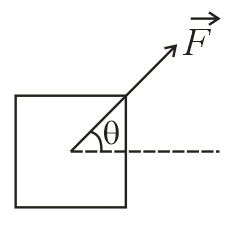
A block of mass $$m$$ slides along a floor while a force of magnitude $$F$$ is applied to it at an angle $$\theta$$ as shown in figure. The coefficient of kinetic friction is $$\mu_K$$. Then, the block's acceleration $$a$$ is given by: ($$g$$ is acceleration due to gravity)
```html
Solution & Explanation
Let us resolve the applied force $$F$$ acting on the block of mass $$m$$ into its orthogonal vector components. The force is applied at an angle $$\theta$$ relative to the horizontal surface:
- Horizontal component ($$F_x$$): Drives the block forward along the floor.
$$F_x = F \cos\theta$$
- Vertical component ($$F_y$$): Pushes the block downward, directly increasing the contact pressure with the floor.
$$F_y = F \sin\theta$$
To find the normal reaction force ($$N$$) exerted by the ground, we set up the static equilibrium equation along the vertical axis where there is no net motion:
$$\Sigma F_{\text{vertical}} = 0 \implies N - mg - F_y = 0$$
$$N = mg + F \sin\theta$$
The kinetic friction force ($$f_K$$) opposing the forward sliding motion of the block depends directly on this normal reaction force:
$$f_K = \mu_K N$$
$$f_K = \mu_K (mg + F \sin\theta)$$
Applying Newton's Second Law along the horizontal axis of motion yields the net force equation:
$$F_{\text{net}} = F_x - f_K = ma$$
$$F \cos\theta - \mu_K (mg + F \sin\theta) = ma$$
To explicitly solve for the block's acceleration ($$a$$), divide the entire expression by the mass $$m$$:
$$a = \frac{F \cos\theta - \mu_K (mg + F \sin\theta)}{m}$$
$$a = \frac{F}{m} \cos\theta - \mu_K \left(g + \frac{F}{m} \sin\theta\right)$$
Concept Check: Because the external force pushes downward at an angle, it actively presses the block tighter into the floor. This structural alignment augments the standard normal force from $$mg$$ to $$mg + F\sin\theta$$, ramping up the kinetic friction drag and reducing the net forward acceleration to exactly $$\frac{F}{m} \cos\theta - \mu_K \left(g + \frac{F}{m} \sin\theta\right)$$.
Correct Option Choice: Option C $$\left(\frac{F}{m} \cos\theta - \mu_K \left(g + \frac{F}{m} \sin\theta\right)\right)$$
```
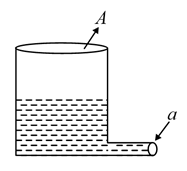
A light cylindrical vessel is kept on a horizontal surface. Area of the base is $$A$$. A hole of cross-sectional area $$a$$ is made just at its bottom side. The minimum coefficient of friction necessary to prevent sliding the vessel due to the impact force of the emerging liquid is
We need to determine the minimum coefficient of friction ($\mu$) required to keep a light cylindrical vessel stationary when liquid flows out of a small hole at its bottom.
1. Identify the Forces Acting on the Vessel
From the problem , two main horizontal forces govern whether the cylinder will slide:
-
Thrust Force ($$F_t$$):
As liquid escapes through the small hole of cross-sectional area $a$, it exerts an equal and opposite reaction force (thrust) on the vessel. According to hydrodynamic principles, this force is given by:$$F_t = \rho a v^2$$
Where $$\rho$$ is the density of the liquid, and $$v$$ is the velocity of efflux. By Torricelli's Law, $$v^2 = 2gh$$ (where $$h$$ is the height of the liquid column). Substituting this gives:$$F_t = \rho a (2gh) = 2\rho g h a$$
-
Limiting Friction Force ($$f_s$$):
The maximum static friction resisting the sliding movement depends on the normal reaction force ($N$) from the surface:$$f_s = \mu N$$
Since the cylindrical vessel itself is described as "light" (mass of the container is negligible), the normal force is solely due to the weight of the liquid inside it:$$N = \text{Mass of liquid} \times g = (\rho \cdot \text{Volume}) \cdot g = \rho (A h) g$$
Where $A$ is the base cross-sectional area of the vessel. Therefore, the maximum friction is:$$f_s = \mu \rho g h A$$
2. Apply the Equilibrium Condition
To prevent the vessel from sliding, the limiting friction force must be greater than or equal to the horizontal impact thrust force:
$$f_s \ge F_t$$
Substitute our derived expressions for both forces into the inequality:
$$\mu \rho g h A \ge 2\rho g h a$$
We can simplify the expression by canceling out the common terms ($\rho, g,$ and $h$) from both sides:
$$\mu A \ge 2a$$
Isolating the friction coefficient ($\mu$):
$$\mu \ge \frac{2a}{A}$$
Conclusion
The minimum coefficient of friction necessary to prevent the cylinder from moving is:
$$\mu = \frac{2a}{A}$$
This corresponds exactly to Option C.
In Millikan's oil drop experiment, what is viscous force acting on an uncharged drop of radius $$2.0 \times 10^{-5}$$ m and density $$1.2 \times 10^3$$ kg m$$^{-3}$$? Take viscosity of liquid = $$1.8 \times 10^{-5}$$ N s m$$^{-2}$$. (Neglect buoyancy due to air).
In Millikan’s oil-drop experiment each drop very quickly reaches its terminal (steady) velocity. At this stage the forces on the uncharged drop balance exactly, so the downward gravitational force is matched by the upward viscous (Stokes) force. Neglecting the tiny buoyant force of the air, we may therefore write
$$\text{Viscous force } F_v \;=\; \text{Weight of the drop } mg.$$
We first determine the mass $$m$$ of the spherical oil drop. The formula for the volume of a sphere is
$$V \;=\;\frac{4}{3}\,\pi r^{3},$$
where $$r$$ is the radius. Substituting $$r = 2.0 \times 10^{-5}\,\text{m}$$, we get
$$V \;=\;\frac{4}{3}\,\pi\,(2.0 \times 10^{-5})^{3}.$$ Now, $$\left(2.0 \times 10^{-5}\right)^{3} = 2^{3} \times 10^{-15} = 8 \times 10^{-15}.$$ So
$$V \;=\;\frac{4}{3}\,\pi \,\left(8 \times 10^{-15}\right) = \frac{32}{3}\,\pi \times 10^{-15}$$ $$\qquad = 10.666\ldots\,\pi \times 10^{-15}$$ $$\qquad \approx 33.51 \times 10^{-15}\;\text{m}^{3}$$ $$\qquad = 3.351 \times 10^{-14}\;\text{m}^{3}.$$
The mass is obtained from $$m = \rho V,$$ where the density of oil is $$\rho = 1.2 \times 10^{3}\,\text{kg m}^{-3}.$$ Hence
$$m \;=\; \left(1.2 \times 10^{3}\right)\left(3.351 \times 10^{-14}\right) = 4.021 \times 10^{-11}\;\text{kg}.$$
The weight of the drop is $$mg,$$ with $$g = 9.8\;\text{m s}^{-2}:$$
$$mg \;=\; (4.021 \times 10^{-11})(9.8) = 3.94 \times 10^{-10}\;\text{N}.$$
Because the drop is falling at terminal velocity, this weight is opposed by an equal viscous drag, so the magnitude of the viscous force is
$$F_v \;=\; 3.9 \times 10^{-10}\;\text{N}.$$
Hence, the correct answer is Option B.
A raindrop with radius R = 0.2 mm falls from a cloud at a height h = 2000 m above the ground. Assume that the drop is spherical throughout its fall and the force of buoyancy may be neglected, then the terminal speed attained by the raindrop is: [Density of water $$f_w = 1000$$ kg m$$^{-3}$$ and Density of air $$f_a = 1.2$$ kg m$$^{-3}$$, g = 10 m/s$$^2$$, Coefficient of viscosity of air = $$1.8 \times 10^{-5}$$ N s m$$^{-2}$$]
For a very small spherical body falling slowly through a viscous fluid, Stokes established that the viscous drag acting opposite to the motion is
$$F_{\text{drag}} = 6\pi \,\eta\, r\, v$$
where $$\eta$$ is the coefficient of viscosity of the fluid, $$r$$ is the radius of the sphere and $$v$$ is its speed relative to the fluid.
At terminal speed the net force on the sphere becomes zero. The downward forces are its weight and (if considered) the upward buoyant force. Because the problem tells us to neglect buoyancy, the force balance at terminal speed $$v_t$$ is simply
$$\text{weight} = \text{viscous drag}$$
$$\rho_w \, V \, g = 6\pi \,\eta\, r\, v_t$$
where $$V$$ is the volume $$\left(\dfrac{4}{3}\pi r^3\right)$$ of the raindrop and $$\rho_w$$ is the density of water.
Substituting the volume of the sphere we have
$$\rho_w \left(\dfrac{4}{3}\pi r^3\right) g = 6\pi \eta r v_t$$
Dividing both sides by $$\pi r$$ and then simplifying, we get
$$\dfrac{4}{3}\,\rho_w \, r^2 \, g = 6 \eta v_t$$
Next, dividing both sides by $$6\eta$$ gives
$$v_t = \dfrac{4}{18}\,\dfrac{\rho_w\, r^2 g}{\eta}$$
Recognising that $$\dfrac{4}{18} = \dfrac{2}{9}$$, the standard Stokes-law expression for terminal speed when buoyancy is neglected becomes
$$v_t = \dfrac{2 r^{2} g \rho_w}{9 \eta}$$
More generally, if buoyancy is included it is $$v_t = \dfrac{2 r^{2} g (\rho_w - \rho_a)}{9 \eta}$$, and because $$\rho_a$$ is so much smaller than $$\rho_w$$ the same result is obtained numerically whether or not we subtract it. For completeness we shall keep the subtraction:
$$v_t = \dfrac{2 r^{2} g (\rho_w - \rho_a)}{9 \eta}$$
Now we substitute the numerical values. The radius is given as
$$r = R = 0.2\ \text{mm} = 0.2 \times 10^{-3}\ \text{m} = 2.0 \times 10^{-4}\ \text{m}$$
First we calculate $$r^2$$ :
$$r^2 = \left(2.0 \times 10^{-4}\right)^2 = 4.0 \times 10^{-8}\ \text{m}^2$$
The difference in densities is
$$(\rho_w - \rho_a) = 1000\ \text{kg m}^{-3} - 1.2\ \text{kg m}^{-3} = 998.8\ \text{kg m}^{-3}$$
The factor $$2 r^{2} g (\rho_w - \rho_a)$$ therefore equals
$$2 \times (4.0 \times 10^{-8}) \times 10 \times 998.8$$
We multiply step by step:
$$2 \times 4.0 \times 10^{-8} = 8.0 \times 10^{-8}$$
Multiplying by $$10$$ gives
$$8.0 \times 10^{-7}$$
Finally, multiplying by $$998.8$$ gives
$$8.0 \times 998.8 \times 10^{-7} = 7990.4 \times 10^{-7} = 7.9904 \times 10^{-4}$$
Now we find $$9\eta$$ :
$$\eta = 1.8 \times 10^{-5}\ \text{N s m}^{-2}$$
$$9\eta = 9 \times 1.8 \times 10^{-5} = 16.2 \times 10^{-5} = 1.62 \times 10^{-4}$$
Putting numerator and denominator together, the terminal speed is
$$v_t = \dfrac{7.9904 \times 10^{-4}}{1.62 \times 10^{-4}}$$
Dividing the powers of ten first we have $$10^{-4} / 10^{-4} = 1$$, so we simply divide the coefficients:
$$v_t = \dfrac{7.9904}{1.62}$$
Carrying out the division,
$$v_t \approx 4.93\ \text{m s}^{-1}$$
The tabulated options list 4.94 m s$$^{-1}$$, which is the same to two significant figures.
Hence, the correct answer is Option C.
The amplitude of a mass-spring system, which is executing simple harmonic motion decreases with time. If mass = 500 g, Decay constant = 20 g s$$^{-1}$$ then how much time is required for the amplitude of the system to drop to half of its initial value? ($$\ln 2 = 0.693$$)
In a damped mass-spring system, the amplitude decreases exponentially as $$A(t) = A_0\, e^{-bt/(2m)}$$, where $$b$$ is the decay constant and $$m$$ is the mass.
We need the time when the amplitude drops to half its initial value, i.e., $$A(t) = \frac{A_0}{2}$$. Setting up the equation: $$\frac{A_0}{2} = A_0\, e^{-bt/(2m)}$$, which gives $$e^{-bt/(2m)} = \frac{1}{2}$$.
Taking the natural logarithm: $$\frac{bt}{2m} = \ln 2 = 0.693$$.
Solving for $$t$$: $$t = \frac{2m \ln 2}{b} = \frac{2 \times 500 \times 0.693}{20} = \frac{693}{20} = 34.65$$ s.
The time required for the amplitude to drop to half its initial value is $$34.65$$ s.
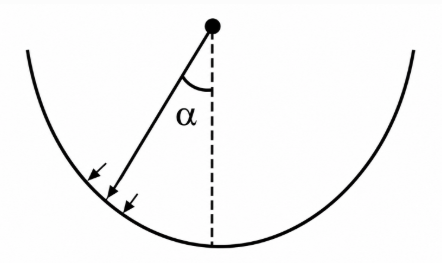
An insect is at the bottom of a hemispherical ditch of radius $$1\,\text{m}$$. It crawls up the ditch but starts slipping after it is at height $$h$$ from the bottom. If the coefficient of friction between the ground and the insect is $$0.75$$, then $$h$$ is: $$(g = 10\,\text{m s}^{-2})$$
Let the radius of the hemispherical ditch be $$R = 1\ \text{m}$$. We consider the insect when it is at some point on the inner surface that is a vertical height $$h$$ above the lowest point (the bottom).
Draw a radius from the centre of the hemisphere to the insect. Let the angle between this radius and the vertical diameter be $$\theta$$. With this definition, the lowest point corresponds to $$\theta = 0$$ and any higher point corresponds to a positive $$\theta$$.
From simple geometry of a circle, the vertical height of the point above the bottom is related to $$\theta$$ by
$$h = R - R\cos\theta.$$
Since $$R = 1\ \text{m}$$, this becomes
$$h = 1 - \cos\theta.$$
Now we analyse the forces acting on the insect when it is momentarily at rest and on the verge of slipping downwards. The forces are:
1. The weight $$mg$$ acting vertically downward.
2. The normal reaction $$N$$ acting radially inward along the radius.
3. The static friction force $$f$$ acting up the surface (because it opposes the impending downward slide).
We resolve the weight into two components with respect to the surface:
• Normal component: $$mg\cos\theta$$ (directed along the normal, toward the centre).
• Tangential component: $$mg\sin\theta$$ (directed down the surface).
By Newton’s second law in the normal direction, because there is no motion perpendicular to the surface, the normal reaction must balance the normal component of weight, so
$$N = mg\cos\theta.$$
The condition for impending slip is that the tangential component of weight equals the maximum static friction. Stating the friction formula first, the maximum static friction is
$$f_{\text{max}} = \mu N,$$
where $$\mu = 0.75$$ is the coefficient of static friction. Setting this equal to the tangential component, we get
$$mg\sin\theta = \mu N = \mu\,mg\cos\theta.$$
Dividing both sides by $$mg\cos\theta$$ yields
$$\frac{\sin\theta}{\cos\theta} = \mu \quad\Longrightarrow\quad \tan\theta = \mu.$$
Substituting $$\mu = 0.75$$, we have
$$\tan\theta = 0.75 = \frac34.$$
We can associate $$\tan\theta = \dfrac{\text{opposite}}{\text{adjacent}} = \dfrac34$$ with a right-angled triangle whose opposite side is 3, adjacent side is 4, and hypotenuse is 5. Hence
$$\cos\theta = \frac{\text{adjacent}}{\text{hypotenuse}} = \frac45 = 0.80.$$
Substituting this value in the height expression $$h = 1 - \cos\theta$$ gives
$$h = 1 - 0.80 = 0.20\ \text{m}.$$
Hence, the correct answer is Option A.
A block starts moving up an inclined plane of inclination 30° with an initial velocity of $$v_0$$. It comes back to its initial position with velocity $$\frac{v_0}{2}$$. The value of the coefficient of kinetic friction between the block and the inclined plane is close to $$\frac{I}{1000}$$. The nearest integer to I is:
We have a block that is projected up an inclined plane making an angle $$\theta = 30^{\circ}$$ with the horizontal. The initial velocity is $$v_0$$. While the block slides, kinetic friction acts opposite to its motion, and the coefficient of kinetic friction is $$\mu_k$$ (we shall write it simply as $$\mu$$). The block first moves upward, stops momentarily, and then slides back down to its starting point with speed $$\dfrac{v_0}{2}$$.
Let the upward direction along the plane be positive. The forces along the plane are the component of gravity $$mg\sin\theta$$ (down the plane) and the kinetic friction force $$\mu mg\cos\theta$$ (also down the plane because motion is upward). Hence, during the upward motion the net acceleration is
$$a_1 = -\bigl(g\sin\theta + \mu g\cos\theta\bigr).$$
The block starts with speed $$v_0$$ and comes to rest after travelling some distance $$s$$ up the plane, so we use the constant-acceleration relation (first state the formula):
For motion with initial speed $$u$$, final speed $$v$$, acceleration $$a$$ and displacement $$s$$, the kinematic equation is $$v^{2}=u^{2}+2as$$. Applying it upward,
$$0^{2}=v_0^{2}+2\,a_1\,s \;\Longrightarrow\; 0=v_0^{2}+2\bigl(-g\sin\theta-\mu g\cos\theta\bigr)s.$$
Re-arranging,
$$v_0^{2}=2\bigl(g\sin\theta+\mu g\cos\theta\bigr)s,$$
so
$$s=\dfrac{v_0^{2}}{2\bigl(g\sin\theta+\mu g\cos\theta\bigr)}. \quad -(1)$$
Now the block slides back down. While it moves downward, gravity’s component $$mg\sin\theta$$ is down the plane (this time along the direction of motion) but friction $$\mu mg\cos\theta$$ is still up the plane, opposing the motion. Thus the net acceleration downward is
$$a_2=g\sin\theta-\mu g\cos\theta.$$
The block starts this return journey from rest (at the top) and gains speed, reaching $$\dfrac{v_0}{2}$$ after descending the same distance $$s$$. Again using $$v^{2}=u^{2}+2as$$ with $$u=0,\;v=\dfrac{v_0}{2},\;a=a_2,\;s=s$$, we get
$$\Bigl(\dfrac{v_0}{2}\Bigr)^{2}=2\,a_2\,s,$$
that is,
$$\dfrac{v_0^{2}}{4}=2\bigl(g\sin\theta-\mu g\cos\theta\bigr)s. \quad -(2)$$
Substituting the value of $$s$$ from equation (1) into equation (2):
$$\dfrac{v_0^{2}}{4}=2\bigl(g\sin\theta-\mu g\cos\theta\bigr)\,\dfrac{v_0^{2}}{2\bigl(g\sin\theta+\mu g\cos\theta\bigr)}.$$
The factor $$v_0^{2}$$ cancels out, and one factor of 2 in numerator and denominator cancels as well, giving
$$\frac{1}{4}=\frac{g\sin\theta-\mu g\cos\theta}{g\sin\theta+\mu g\cos\theta}.$$
The acceleration due to gravity $$g$$ cancels on both numerator and denominator. Putting $$\sin30^{\circ}=\dfrac{1}{2}$$ and $$\cos30^{\circ}=\dfrac{\sqrt3}{2}$$, we have
$$\frac{1}{4}=\frac{\dfrac12-\mu\dfrac{\sqrt3}{2}}{\dfrac12+\mu\dfrac{\sqrt3}{2}}.$$
Multiplying numerator and denominator by 2 to clear the fractions gives
$$\frac{1}{4}=\frac{1-\mu\sqrt3}{1+\mu\sqrt3}.$$
Cross-multiplying,
$$(1+\mu\sqrt3)=4(1-\mu\sqrt3).$$
Expanding the right-hand side,
$$1+\mu\sqrt3=4-4\mu\sqrt3.$$
Now collect the terms containing $$\mu$$ on one side and constants on the other:
$$\mu\sqrt3+4\mu\sqrt3=4-1,$$
which simplifies to
$$5\mu\sqrt3=3.$$
Solving for $$\mu$$,
$$\mu=\frac{3}{5\sqrt3}=\frac{3}{5\times1.732} \approx \frac{3}{8.660} \approx 0.346.$$
The problem states that this value is close to $$\dfrac{I}{1000}$$, so $$I\approx346$$. The nearest integer to $$I$$ is therefore 346.
Hence, the correct answer is Option A: 346.
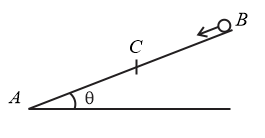
A small block starts slipping down from a point B on an inclined plane AB, which is making an angle $$\theta$$ with the horizontal section BC is smooth and the remaining section CA is rough with a coefficient of friction $$\mu$$. It is found that the block comes to rest as it reaches the bottom (point A) of the inclined plane. If $$BC = 2AC$$, the coefficient of friction is given by $$\mu = k \tan\theta$$. The value of $$k$$ is ___________.
Let $$AC = x \implies BC = 2x$$
Total length of incline $$AB$$: $$s = BC + AC = 2x + x = 3x$$
Work-energy theorem between point B and point A:
$$W_{\text{gravity}} + W_{\text{friction}} = \Delta K$$
$$(mg\sin\theta)s - (\mu mg\cos\theta)AC = K_A - K_B$$
$$mg\sin\theta(3x) - \mu mg\cos\theta(x) = 0$$
$$3mgx\sin\theta = \mu mgx\cos\theta \implies 3\sin\theta = \mu\cos\theta$$
$$\mu = 3\tan\theta$$
A ball is thrown upward with an initial velocity $$V_0$$ from the surface of the earth. The motion of the ball is affected by a drag force equal to $$m\gamma v^2$$ (where m is the mass of the ball, $$v$$ is its instantaneous velocity and $$\gamma$$ is a constant). Time taken by the ball to rise to its zenith is:
Let us take the upward direction as positive. While the ball is rising, two forces act downward: its weight $$mg$$ and the quadratic drag $$m\gamma v^{2}$$ (opposite to the velocity because the velocity is upward). Therefore the net force is downward and the equation of motion is
$$m\frac{dv}{dt}= -\,mg \;-\; m\gamma v^{2}.$$
Dividing by $$m$$ we obtain the differential equation for the velocity:
$$\frac{dv}{dt}= -\,g \;-\; \gamma v^{2}.$$
We now separate the variables, keeping all terms involving $$v$$ on one side and $$t$$ on the other:
$$\frac{dv}{g+\gamma v^{2}} = -\,dt.$$
The ball starts with velocity $$v=V_{0}$$ at time $$t=0$$ and reaches the zenith when $$v=0$$ at time $$t=T$$. We therefore integrate between these limits:
$$\displaystyle \int_{V_{0}}^{0}\frac{dv}{g+\gamma v^{2}} = - \int_{0}^{T} dt.$$
The right-hand integral gives $$-T$$, so flipping the limits on the left removes the minus sign:
$$T = \int_{0}^{V_{0}}\frac{dv}{g+\gamma v^{2}}.$$
Before evaluating the integral, we recall the standard formula
$$\int\frac{dx}{a + b x^{2}} = \frac{1}{\sqrt{ab}}\;\tan^{-1}\!\left(x\sqrt{\frac{b}{a}}\right) + C.$$
In our case $$a=g$$ and $$b=\gamma$$. Substituting these into the formula, we obtain
$$\int_{0}^{V_{0}}\frac{dv}{g+\gamma v^{2}} = \frac{1}{\sqrt{g\gamma}}\;\tan^{-1}\!\left(v\sqrt{\frac{\gamma}{g}}\right)\Bigg|_{0}^{V_{0}}.$$
Evaluating at the limits gives
$$T = \frac{1}{\sqrt{g\gamma}}\left[\tan^{-1}\!\left(V_{0}\sqrt{\frac{\gamma}{g}}\right) - \tan^{-1}(0)\right].$$
Since $$\tan^{-1}(0)=0$$, this simplifies neatly to
$$T = \frac{1}{\sqrt{\gamma g}}\;\tan^{-1}\!\left(\sqrt{\frac{\gamma}{g}}\,V_{0}\right).$$
Hence, the correct answer is Option B.
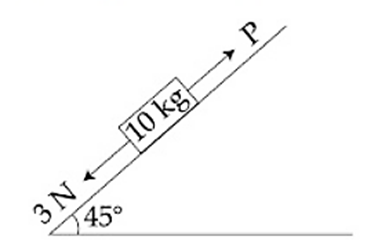
A block of mass 10 kg is kept on a rough inclined plane as shown in the figure. A force of 3 N is applied on the block. The coefficient of static friction between the plane and the block is 0.6. What should be the minimum value of force P, such that the block does not move downward? (take $$g = 10 \; ms^{-2}$$)
$$N = mg\cos\theta = 10 \times 10 \times \cos45^\circ = \frac{100}{\sqrt{2}} = 50\sqrt{2}\text{ N}$$
$$f_{\text{max}} = \mu N = 0.6 \times 50\sqrt{2} = 30\sqrt{2}\text{ N} = 30 \times 1.414 = 42.42\text{ N}$$
$$P + f_{\text{max}} = mg\sin\theta + F_{\text{down}}$$
$$P + 42.42 = 10 \times 10 \times \sin45^\circ + 3$$
$$P + 42.42 = 50\sqrt{2} + 3 = 70.71 + 3 = 73.71\text{ N}$$
$$P = 73.71 - 42.42 = 31.29\text{ N} \approx 32\text{ N}$$
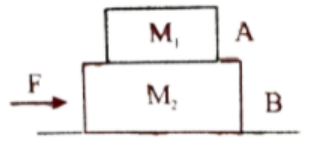
Two blocks A and B of masses m$$_A$$ = 1 kg and m$$_B$$ = 3 kg are kept on the table as shown in figure. The coefficients of friction between A and B is 0.2 and between B and the surface of the table is also 0.2. The maximum force F that can be applied on B horizontally, so that the block A does not slide over the block B is:
[Take g = 10 m/s$$^2$$]
To solve for the maximum force $$F$$ such that block $$A$$ does not slide over block $$B$$, we need to analyze the friction limits and the maximum common acceleration they can share.
Here is the structured, step-by-step breakdown of the solution.
1. Identify the Maximum Acceleration of Block A
Block $$A$$ moves forward solely due to the static friction acting between it and block $$B$$.
- Mass of block A: $$m_A = 1\text{ kg}$$
- Coefficient of friction between A and B: $$\mu_1 = 0.2$$
- Coefficient of friction between B and table: $$\mu_2 = 0.2$$
- Total normal force on the table: $$N_{table} = (m_A + m_B) \cdot g = 4\text{ kg} \times 10\text{ m/s}^2 = 40\text{ N}$$
- Correct Option: A (16 N)
The maximum static friction force ($$f_{max, A}$$) that can act on block $$A$$ is:
$$f_{max, A} = \mu_1 \cdot m_A \cdot g$$
$$f_{max, A} = 0.2 \times 1\text{ kg} \times 10\text{ m/s}^2 = 2\text{ N}$$
Using Newton's second law ($$F = m \cdot a$$), the maximum acceleration ($$a_{max}$$) block $$A$$ can achieve without slipping is:
$$a_{max} = \frac{f_{max, A}}{m_A} = \frac{2\text{ N}}{1\text{ kg}} = 2\text{ m/s}^2$$
If the system accelerates faster than $$2\text{ m/s}^2$$, block $$A$$ will begin to slide backward relative to block $$B$$.
2. Analyze the Whole System (A + B)
To find the maximum force $$F$$ required to achieve this common acceleration, we treat both blocks as a single combined system of mass:
$$M_{total} = m_A + m_B = 1\text{ kg} + 3\text{ kg} = 4\text{ kg}$$
Friction from the Table Surface
The table exerts a kinetic/limiting friction force ($$f_{table}$$) opposing the motion of the combined mass:
$$f_{table} = \mu_2 \cdot N_{table} = 0.2 \times 40\text{ N} = 8\text{ N}$$
3. Calculate the Maximum Force ($$F$$)
Using the equation of motion for the entire combined system:
$$F - f_{table} = M_{total} \cdot a_{max}$$
Substitute the values we calculated:
$$F - 8\text{ N} = 4\text{ kg} \times 2\text{ m/s}^2$$
$$F - 8 = 8$$
$$F = 16\text{ N}$$
Final Answer
The maximum horizontal force $$F$$ that can be applied to block $$B$$ without causing block $$A$$ to slide is 16 N.
A block of mass $$m$$ is placed on a surface with a vertical cross section given by $$y = \frac{x^3}{6}$$. If the coefficient of friction is 0.5, the maximum height above the ground at which the block can be placed without slipping is:
We consider the curve that makes the supporting surface. Its equation in Cartesian form is
$$y=\dfrac{x^{3}}{6}$$
Here the ground is the $$x$$-axis ($$y=0$$) and the point $$P(x,y)$$ on the curve is the position where the block is placed. At $$P$$ the surface is inclined at an angle $$\theta$$ with the horizontal. For a curve $$y=f(x)$$ the tangent makes an angle whose tangent is the derivative of the curve, that is
$$\tan\theta=\left|\dfrac{dy}{dx}\right|.$$
So we first differentiate $$y$$ with respect to $$x$$:
$$\dfrac{dy}{dx}=\dfrac{d}{dx}\!\left(\dfrac{x^{3}}{6}\right)=\dfrac{3x^{2}}{6}=\dfrac{x^{2}}{2}.$$
Hence the local slope and therefore the tangent of the angle of inclination are
$$\tan\theta=\dfrac{x^{2}}{2}.$$
Now the block will remain at rest provided that the component of its weight trying to pull it down the incline is not larger than the maximum static friction which resists that tendency. The usual condition is
$$\text{(down-slope component)}\;\le\;\text{(maximum static friction)}.$$
Writing the forces explicitly:
• The component of the weight along the incline is $$mg\sin\theta.$$
• The normal reaction from the surface is $$N=mg\cos\theta.$$
• The maximum possible static friction is $$f_{\max}=\mu N=\mu mg\cos\theta,$$ where $$\mu$$ is the coefficient of static friction.
The limiting (just-about-to-slip) case therefore satisfies
$$mg\sin\theta=\mu mg\cos\theta.$$
Dividing both sides by $$mg\cos\theta$$ we obtain
$$\tan\theta=\mu.$$
This is the standard result: the block is safe as long as $$\tan\theta\le\mu.$$ To find the highest position that is still safe we set the equality
$$\tan\theta=\mu.$$
Given $$\mu=0.5=\dfrac12,$$ and substituting $$\tan\theta=\dfrac{x^{2}}{2},$$ we write
$$\dfrac{x^{2}}{2}=\dfrac12.$$
Multiplying both sides by $$2$$:
$$x^{2}=1.$$
Taking the positive root because height increases with positive $$x$$:
$$x=1\;\text{m}.$$
Now we substitute this $$x$$ back into the equation of the curve to find the corresponding height $$y$$:
$$y=\dfrac{x^{3}}{6}=\dfrac{1^{3}}{6}=\dfrac16\;\text{m}.$$
This is the greatest vertical height above the ground at which the block can be placed without beginning to slide.
Hence, the correct answer is Option A.
A block A of mass 4 kg is placed on another block B of mass 5 kg, and the block B rests on a smooth horizontal table. If the minimum force that can be applied on A so that both the blocks move together is 12 N, the maximum force that can be applied on B for the blocks to move together will be:

$$f = f_k = \mu_k R = \mu_k m_1\text{ }g$$
$$12 = f_k = \mu_k \times 4\text{ }g$$
$$\therefore \mu_k = \frac{12}{4\text{ }g} = \frac{3}{g}$$
As block $$B$$ is on smooth surface, therefore to move $$A$$ and $$B$$ together, maximum force $$F$$ required to be applied on $$B = $$ frictional force applied on A by B
$$F = \frac{3}{g}(4 + 5)\text{ }g = 27\text{ }N$$
An insect crawls up a hemispherical surface very slowly. The coefficient of friction between the insect and the surface is $$1/3$$. If the line joining the centre of the hemispherical surface to the insect makes an angle $$\alpha$$ with the vertical, the maximum possible value of $$\alpha$$ so that the insect does not slip is given by
Solution & Explanation
1. Identify the Forces Acting on the Insect
Let the insect be at a point on the hemispherical surface where the radius vector from the center makes an angle $$\alpha$$ with the vertical. Let us resolve the forces acting on the insect along and perpendicular to the tangential surface at that point:
- Weight ($$mg$$): Acts vertically downward.
- The component acting perpendicular to the spherical surface (along the normal radius) is $$mg \cdot \cos\alpha$$.
- The component acting tangentially downward (tending to make the insect slide) is $$mg \cdot \sin\alpha$$.
- Normal Reaction ($$N$$): Acts radially outward from the surface, balancing the perpendicular gravitational component:
$$N = mg \cdot \cos\alpha$$
- Frictional Force ($$f_s$$): Acts tangentially upward along the surface to oppose the sliding tendency:
$$f_s = mg \cdot \sin\alpha$$
2. Apply the Limiting Condition for Equilibrium
For the insect to climb safely without slipping, the required static friction force must be less than or equal to the maximum available limiting friction ($$f_{\text{max}} = \mu \cdot N$$):
$$f_s \le \mu \cdot N$$
Substitute our expressions for $$f_s$$ and $$N$$ into the inequality:
mg \cdot \sin\alpha \le \mu \cdot (mg \cdot \cos\alpha)
Canceling out the weight ($$mg$$) from both sides gives:
$$\sin\alpha \le \mu \cdot \cos\alpha$$
$$\frac{\sin\alpha}{\cos\alpha} \le \mu \implies \tan\alpha \le \mu$$
3. Calculate the Maximum Angle Using the Given Coefficient
The maximum possible angle $$\alpha$$ before slipping occurs happens at the limiting condition where $$\tan\alpha = \mu$$. We are given the coefficient of friction as $$\mu = \frac{1}{3}$$:
$$\tan\alpha = \frac{1}{3}$$
Since $$\cot\alpha = \frac{1}{\tan\alpha}$$, we invert both sides of the equation:
$$\cot\alpha = 3$$
Concept Check: As the insect crawls higher up the dome, the incline gets steeper, which causes the destabilizing parallel component ($$mg \cdot \sin\alpha$$) to increase while the stabilizing normal grip force ($$mg \cdot \cos\alpha$$) simultaneously decreases. The threshold where these opposing changes cross over is strictly limited by the traction coefficient ($$\mu$$).
Correct Option Key: Option A ($$\cot\alpha = 3$$)
A smooth block is released at rest on a $$45^\circ$$ incline and then slides a distance $$d$$. The time taken to slide is $$n$$ times as much to slide on rough incline than on a smooth incline. The coefficient of friction is
A block of mass $$m$$ is allowed to slide a distance $$d$$ down an incline making an angle $$\theta = 45^{\circ}$$ with the horizontal.
Case 1: Smooth incline (no friction).
The only component of gravity along the plane is $$mg\sin\theta$$, so the acceleration is
$$a_1 = g\sin\theta = g\frac{1}{\sqrt{2}}$$ because $$\sin 45^{\circ} = \frac{1}{\sqrt{2}}$$.
Starting from rest, the time to cover distance $$d$$ is obtained from $$d = \tfrac12 a_1 t_1^{2}$$, giving
$$t_1 = \sqrt{\frac{2d}{a_1}}$$ $$= \sqrt{\frac{2d}{g/\sqrt{2}}}$$ $$= \sqrt{\frac{2\sqrt{2}d}{g}}$$.
Case 2: Rough incline (kinetic friction present).
Along the plane the net force is
$$mg\sin\theta - \mu_k mg\cos\theta,$$
so the acceleration is
$$a_2 = g\sin\theta - \mu_k g\cos\theta.$$
For $$\theta = 45^{\circ}$$ we have $$\sin\theta = \cos\theta = \tfrac1{\sqrt2}$$, hence
$$a_2 = g\frac{1}{\sqrt{2}}\bigl(1 - \mu_k\bigr)\;.$$
The time to slide the same distance $$d$$ now satisfies $$d = \tfrac12 a_2 t_2^{2}$$, so
$$t_2 = \sqrt{\frac{2d}{a_2}}$$ $$= \sqrt{\frac{2d}{g(1/\sqrt{2})(1-\mu_k)}}$$ $$= \sqrt{\frac{2\sqrt{2}d}{g}}\;\frac{1}{\sqrt{1-\mu_k}}.$$
Notice that $$\sqrt{\frac{2\sqrt{2}d}{g}}$$ is exactly $$t_1$$, hence
$$\frac{t_2}{t_1} = \frac{1}{\sqrt{1-\mu_k}}.$$
The problem states that the rough-incline time is $$n$$ times the smooth-incline time, i.e. $$t_2 = n\,t_1$$. Therefore
$$n = \frac{1}{\sqrt{1-\mu_k}}\; \Longrightarrow\; n^{2} = \frac{1}{1-\mu_k}\; \Longrightarrow\; 1-\mu_k = \frac{1}{n^{2}}.$$
Solving for $$\mu_k$$ gives
$$\mu_k = 1 - \frac{1}{n^{2}}.$$
Thus the coefficient of kinetic friction is $$\mu_k = 1 - \dfrac{1}{n^2}$$.
Option A which is: $$\mu_k = 1 - \frac{1}{n^2}$$