Join WhatsApp Icon JEE WhatsApp Group

JEE Electromagnetic Waves Questions

Electromagnetic Waves is a compact, theory-rich chapter in JEE Physics that ties together electricity, magnetism, and optics into a single elegant framework. It describes how oscillating electric and magnetic fields propagate through space as waves, and it explains the full electromagnetic spectrum from radio waves to gamma rays. Although the chapter is short, JEE Electromagnetic Waves questions appear regularly in JEE Main and reward students who learn the key properties and the spectrum precisely. This chapter covers displacement current, the basic ideas behind Maxwell's equations, the nature and properties of electromagnetic waves, the relationship between the electric and magnetic field amplitudes, the speed of light in terms of fundamental constants, energy and momentum carried by waves, and the electromagnetic spectrum with the uses of each band. JEE Main typically tests wave properties and spectrum-based facts, while JEE Advanced may probe energy density and field relationships. Practising topic-wise Cracku JEE Questions helps you lock in these facts and relationships for quick, accurate answers.

Because the chapter is largely conceptual and fact-based, a focused study session secures its marks efficiently. It also provides the physical foundation for wave optics, making it a valuable bridge within the syllabus that careful aspirants never skip.

Electromagnetic Waves Topic Overview

Parameter

Details

Topic Name

Electromagnetic Waves

Subject

Physics

JEE Main Weightage

~2–4% (1 question on average)

JEE Advanced Weightage

~2–3% (often conceptual)

Difficulty Level

Easy to Moderate

Important Concepts

Displacement Current, Wave Properties, EM Spectrum, Energy & Momentum

Recommended Practice Level

Moderate – attempt 40+ mixed problems

Why Practice JEE Electromagnetic Waves Questions?

  • Accessible marks: Most questions are direct and fact-based, making them quick to score.
  • Compact syllabus: A small set of concepts covers the entire chapter.
  • Unifies physics: It links electricity, magnetism, and optics into one framework.
  • Spectrum facts recur: Uses and order of the spectrum are frequently tested.
  • Bridges to wave optics: It provides the foundation for the optics chapters.
  • Efficient revision: A short fact set makes last-minute review highly effective.
  • Steady weightage: Usually worth a question in JEE Main, so the effort is well rewarded.

Important Concepts and Subtopics

Concept

Importance

Difficulty Level

Frequently Asked In

Displacement Current

High

Moderate

JEE Main & Advanced

Nature & Properties of EM Waves

Very High

Easy–Moderate

JEE Main

E and B Field Relationship

High

Moderate

JEE Main & Advanced

Speed of Light from Constants

High

Easy–Moderate

JEE Main

Energy Density & Intensity

Moderate

Moderate

JEE Advanced

Momentum & Radiation Pressure

Moderate

Moderate

JEE Advanced

Electromagnetic Spectrum & Uses

Very High

Easy

JEE Main

Preparation Strategy for JEE Electromagnetic Waves

Concept learning: Start with displacement current and the idea that a changing electric field produces a magnetic field, completing the symmetry of electromagnetism. Learn the transverse nature of electromagnetic waves, the in-phase relationship of the electric and magnetic fields, and how their amplitudes relate. Then memorise the electromagnetic spectrum in order with the uses of each band.

Formula revision: Keep the speed-of-light relation, the E-B amplitude ratio, and energy-density expressions together for quick review. Well-organised JEE Study Material helps you keep these compact relations and spectrum facts in one place for fast revision before the exam.

Problem-solving techniques: For wave-property questions, recall that the fields are perpendicular to each other and to the direction of propagation. For energy questions, split the energy density between electric and magnetic contributions. For spectrum questions, anchor your memory with frequency or wavelength order.

Common mistakes: Confusing the order of the spectrum, misremembering which field leads, mishandling the E-B amplitude relationship, and forgetting that electromagnetic waves carry both energy and momentum.

Exam strategy: Treat this chapter as a source of quick conceptual marks- answer its property and spectrum questions early and confidently, then move on to heavier chapters.

JEE Main & Advanced Weightage Analysis

Exam

Average Questions

Expected Marks

JEE Main

1

4

JEE Advanced

0–1 (often conceptual)

0–4

Electromagnetic Waves is a lighter-weightage chapter, but its questions are direct and conceptual, making its marks among the easiest to secure. In JEE Advanced, it usually appears through energy and field-relationship reasoning rather than heavy calculation.

Tips to Solve Electromagnetic Waves Questions Faster

  • Recall that E, B, and the direction of propagation are mutually perpendicular.
  • Use the E-B amplitude relation (E0 = cB0) to switch between field magnitudes.
  • Anchor the spectrum in order of frequency or wavelength to answer ordering questions instantly.
  • Split energy density equally between the electric and magnetic field contributions.
  • Express the speed of light in terms of permittivity and permeability when asked.
  • Remember electromagnetic waves carry momentum, so they can exert radiation pressure.

Reinforcing these facts with a timed JEE Mock Test helps you secure these conceptual marks quickly and reliably.

JEE Electromagnetic Waves Questions

Question 1

For an electromagnetic wave propagating through vacuum, $$\vec{k}$$, $$\vec{E}$$ and $$\omega$$ represent propagation vector, electric field and angular frequency, respectively. The magnetic field associated with this wave is represented by :

Question 2

A laser beam has intensity of $$4.0 \times 10^{14} W/m^{2}.$$ The amplitude of magnetic field associated with beam is____________T. (Take $$\epsilon_{0}= 8.85 \times 10^{-12} C^{2}/Nm^{2}$$ and $$c= 3 \times 10^{8} m/s$$ )

Question 3

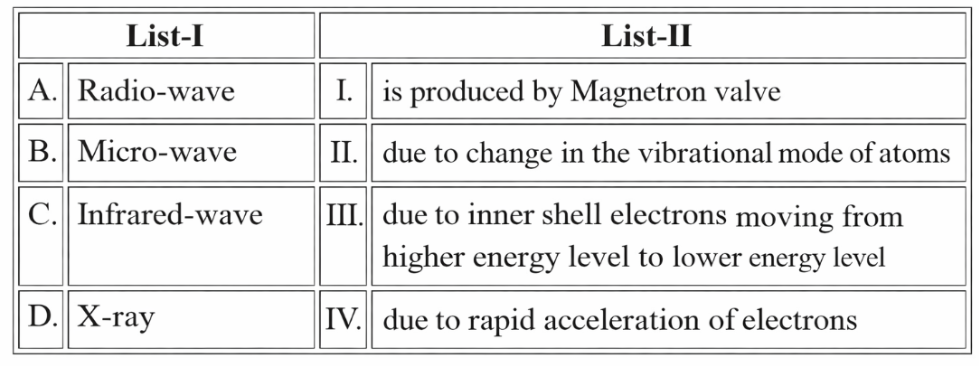
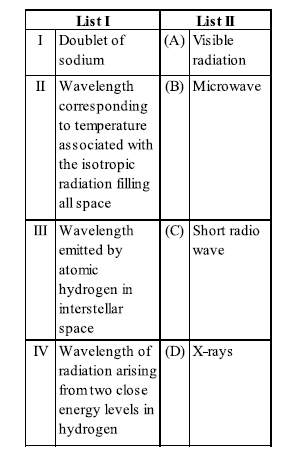
Match the LIST-I with LIST-II

24th slot 1 33


Choose the correct answer from the options given below:

Question 4

The equation of a plane progressive wave is given by $$y = 5 \cos \pi \left(200t - \frac{x}{150}\right)$$ where x and y are in cm and t is in second. The velocity of the wave is __________ m/s.

Video Solution
Question 5

A displacement current of 4.0 A can be set up in the space between two parallel plates of 6 $$\mu$$F capacitor. The rate of change of potential difference across the plates of the capacitor is nearly $$\alpha \times 10^6$$ V/s. The value of $$\alpha$$ is _______.

Video Solution
Question 6

An electromagnetic wave travels in free space along the x-direction. At a particular point in space and time, $$\vec{B} = 2 \times 10^{-7}\hat{j}$$ T is associated with this wave. The value of corresponding electric field $$\vec{E}$$ at this point is _________ V/m.

Question 7

A monochromatic source of light operating at 15 kW emits $$2.5 \times 10^{22}$$ photons/s. The region of an electromagnetic spectrum to which the emitted electromagnetic radiation belongs to __________. (Take $$h = 6.6 \times 10^{-34}$$ J.s and $$c = 3 \times 10^8$$ m/s).

Question 8

The electric field in a plan a electromagnetic wave is given by :
$$E_{y}=69\sin[0.6\times10^{3}x-1.8\times10^{11}t]V/m$$
The expression for magneticfield associated with this electromagnetic wave is ___ T.

Question 9

The electric field of an electromagnetic wave travelling through a medimn is given by $$\overrightarrow{E}(x,t)=25\sin(2.0\times 10^{15}t-10^{7}x)\widehat{n}$$ then the refractive index of the medium is______.
(All given measurement are in SI uits)

Question 10

Given below are two statements: One is labelled as Assertion (A) and the other is labelled as Reason (R).

Assertion (A): The Electromagnetic waves exert pressure on the surface on which they ar allowed to fall.

Reason (R): There is no mass associated with the electromagnetic waves.
In the light of the above statements,  Choose the correct answer from the options given below :

Question 11

A magnetic field vector in an electromagnetic wave is represented by $$\vec{B} = B_0\sin\left(2\pi\nu t - \frac{2\pi x}{\lambda}\right)\hat{j}$$. Its associated electric field vector is ______.

Question 12

A plane electromagnetic wave is moving in free space with velocity $$c=3\times 10^{8} m/s$$ and its eleclric field is given as $$\overrightarrow{E}=54\sin (kz-\omega t)\widehat{j} V/m$$, where $$\widehat{j}$$ is the unit vector along y-axis. The magnetic field vector $$\overrightarrow{B}$$ of the wave is :

Question 13

A point light source emits E.M. waves in free space. A detector, placed at a distance of $$L$$ m, measures the intensity as $$I_0$$. The detector is now shifted to another location on the same spherical surface ensuring the angle between original location and new location as 45$$^\circ$$. The measured intensity at new location will be _______.

Question 14

An electromagnetic wave travelling in x-direction is described by field equation $$E_y = 300 \sin \omega \left(t - \frac{x}{c}\right)$$. If the electron is restricted to move in y-direction only with speed of $$1.5 \times 10^6$$ m/s then ratio of maximum electric and magnetic forces acting on the electron is __________.

Question 15

The ratio of speeds of electromagnetic waves in vacuum and a medium, having dielectric constant $$k = 3$$ and permeability of $$ \mu = 2 \mu_{0}$$, is
($$\mu_{0}$$ = permeability of vacuum)

Question 16

An electromagnetic wave of frequency 100 MHz propagates through a medium of conductivity, $$\sigma$$ = 10mho/m. The ratio of maximum conduction current density to maximum displacement current
density is ___________.
[Take $$\frac{1}{4\pi \epsilon_{0}} = 9 \times 10^{9} Nm^{2}/C^{2}$$]

Question 17

The electric field of a plane electromagnetic wave, travelling in an unknown non-magnetic medium is given by,

$$ E_{y}=20 \sin (3\times 10^{6}x - 4.5\times 10^{14}t)V/m $$
(where $$x, t$$ and other values have S.I. units). The dielectric constant of the medium iS_________
(speed oflight in free space is $$ 3\times 10^{8} m/s $$)

Question 18

The equation of the electric field of an electromagnetic wave propagating through free space is given
by: E=$$\sqrt{377}$$ $$\sin(6.27\times10^{3}t-2.09\times 10^{-5}x)N/C$$
The average power of the electromagnetic wave is $$\left(\frac{1}{\alpha}\right)W/m^{2}$$. The value of $$\alpha$$ is______
$$\left(Take \sqrt{\frac{\mu_{\circ}}{\epsilon_{\circ}}}=377 in SI units \right)$$

Question 19

A transverse wave on a string is described by $$y = 3\sin(36t + 0.018x + \pi/4)$$, where $$x$$, $$y$$ are in cm and $$t$$ in seconds. The least distance between the two successive crests in the wave is _______ cm. (Nearest integer) ($$\pi = 3.14$$)

Question 20

The electric field associated with an electromagnetic wave travelling in vacuum is given by $$E_0\sin(3y+4z+\omega t)\hat{i}$$, where $$\omega$$ is the angular frequency. All quantities are in SI units. The correct statement(s) about this wave is(are):

[Given: speed of light in vacuum $$c=3\times 10^8\,\mathrm{ms^{-1}}$$.]

Frequently Asked Questions